1. Introduction
Understanding the ecological and evolutionary factors that restrict species’ geographic distributions remains a central goal of plant ecology and biogeography [
1,
2]. Range limits often occur where demographic rates—particularly reproduction—decline to levels insufficient to sustain populations [
3,
4]. For flowering plants, reproductive failure at range edges may arise from multiple mechanisms, including pollen limitation (through phenological mismatch with pollinators), breakdown of mating systems, or increased post-pollination seed loss [
5,
6]. As shown in previous studies, these processes may act independently or in combination, making direct tests of reproductive performance essential for evaluating whether reproduction constrains a species’ distribution [
7,
8].
Plants with specialized mating systems may be especially vulnerable to reproductive failure near ecological margins [
9]. Distylous species require legitimate pollen transfer between long-styled and short-styled morphs to produce fruit and seed [
10,
11]. Because autonomous self-pollination is typically absent and intramorph crosses are incompatible, successful reproduction depends on reliable pollinator service and temporal synchrony between morphs [
12,
13]. Numerous studies have documented pollen limitation, reduced fruit set, or partial breakdown of heterostyly in marginal populations, suggesting that mating-system failure can contribute to range limits under some conditions [
14,
15,
16].
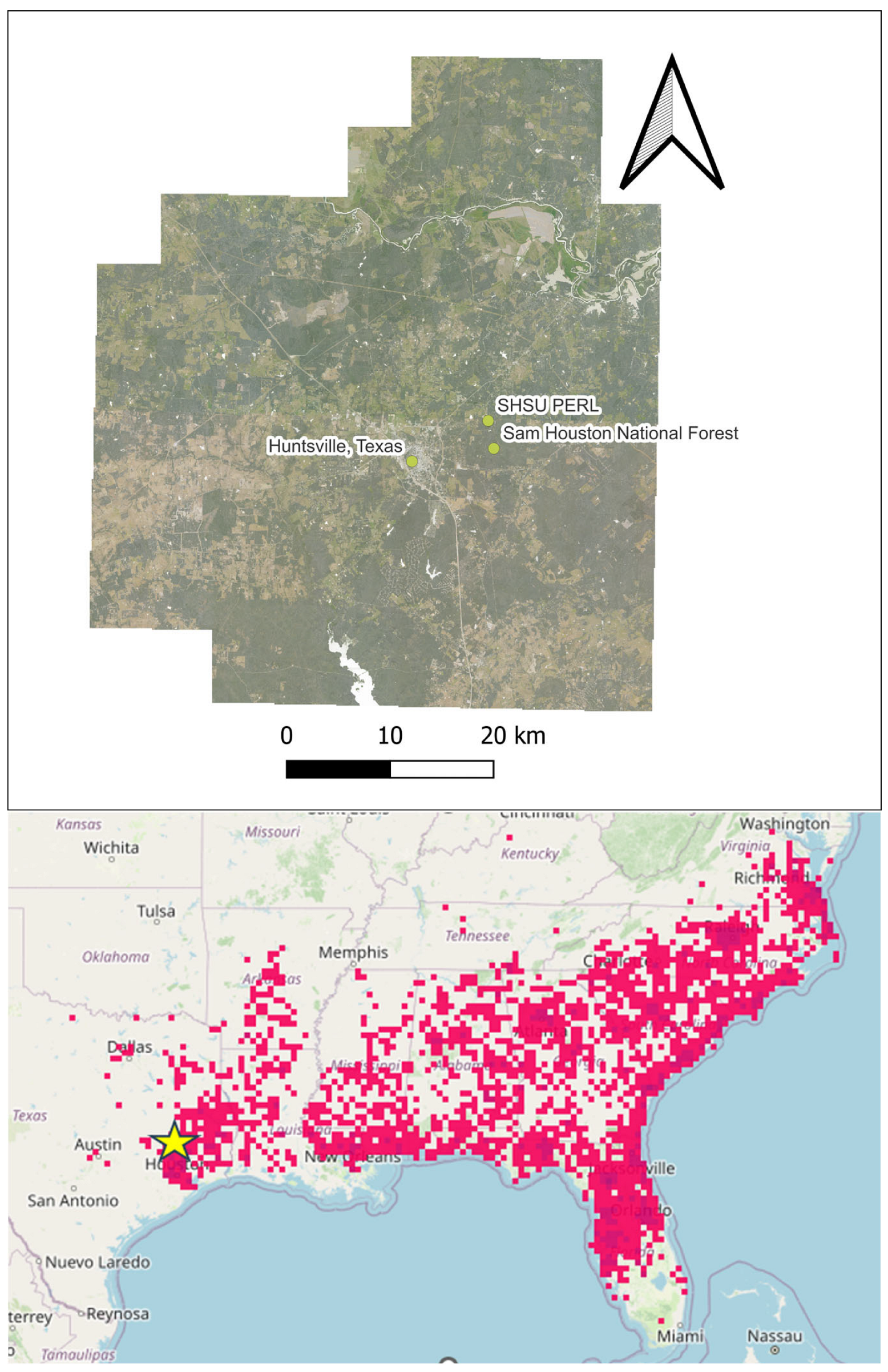
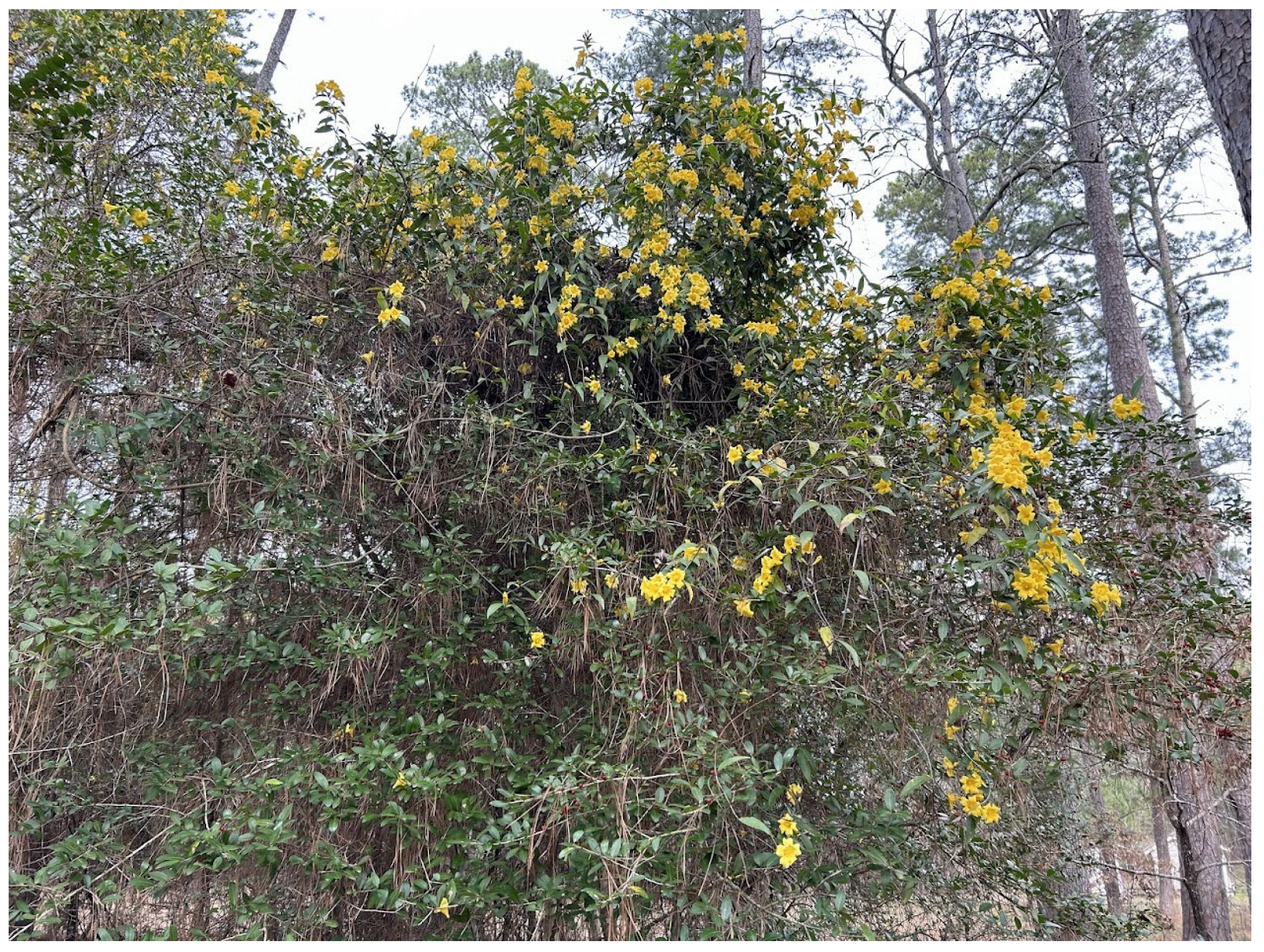
Gelsemium sempervirens (L.) J.ST.-Hil. (Gelsemiaceae) is a distylous, woody vine widely distributed throughout the southeastern United States, where it is abundant in the Coastal Plain and Piedmont (
Figure 1). Its native range extends from the Atlantic Coastal Plain westward into eastern Texas, where populations reach the western edge of the species’ distribution (
Figure 1). The species occurs primarily in pine-dominated forests, forest margins, and adjacent woodland habitats, and its distribution in the southeast broadly corresponds with transitions among forest types. Flowers are tubular, nectariferous, and bloom in early spring; successful seed production requires legitimate pollen transfer between floral morphs [
17,
18]. Neither long-styled (LS) nor short-styled (SS) flowers are capable of autonomous self-pollination, and distyly has been shown to function consistently across multiple populations [
18,
19]. Fruits are two-locule capsules that mature through late summer and dehisce in autumn, dispersing winged seeds. In addition to its ecological role as a dominant early-spring flowering vine,
G. sempervirens is pharmacologically notable due to its production of bioactive indole alkaloids [
17,
18]. Because seed set depends on legitimate pollen movement,
Gelsemium provides a powerful system for testing whether pollination failure contributes to geographic range limits.
In the outer Coastal Plain of Georgia, early-spring bee communities provide abundant effective pollinators. The southeastern blueberry bee,
Habropoda laboriosa, is among the most efficient visitors to
Gelsemium and other early-flowering species and plays a disproportionate role in fruit and seed production [
20,
21,
22,
23,
24,
25]. Importantly,
H. laboriosa itself approaches its western geographic limit near the western distributional boundary of
G. sempervirens [
26,
27]. This geographic coincidence has led to the hypothesis that pollination failure—specifically reduced visitation by this highly effective pollinator or absence of this bee species—could limit reproduction and contribute to the species’ western range edge. Under this model, populations near the range margin would experience reduced fruit set, increased pollen limitation, or altered pollinator assemblages insufficient to maintain reproduction [
1,
2,
3,
4].
Herbivory at the floral stage on
Gelsemium sempervirens has been studied extensively, where damage to corollas and nectaries can alter pollinator behavior and fruit initiation [
28,
29,
30]. In contrast, herbivory affecting developing fruits has received little attention. To date, only a single study has reported fruit herbivory in
Gelsemium, documenting reduced reproductive outcomes in suburban landscapes but without identifying the herbivore or characterizing its feeding mode [
31]. This latter study primarily identified herbivory through external pericarp holes. Whether this form of seed predation is widespread, whether it intensifies toward the western range edge, and whether it contributes meaningfully to range limitation remain unresolved.
The western limit of
Gelsemium sempervirens occurs abruptly in eastern Texas, near the transition from pine-dominated forest (Pineywoods) to post-oak savanna and prairie (Oak Woods and Prairies). This distributional boundary is evident in county-level occurrence maps and regional floristic treatments [
32,
33] and corresponds to a well-recognized ecoregional transition in eastern Texas [
34,
35] (
Figure 2). However, this boundary is not associated with a sharp climatic discontinuity at the regional scale [
34], raising the possibility that biological or ecological constraints, rather than abiotic tolerances alone, define the species’ range edge. If reproductive processes fail in western populations, reduced fruit set, lower pollination efficiency, or increased seed developmental failure would be expected [
19,
36]. Alternatively, if reproduction remains intact, ecological factors such as forest structure, host-tree availability, soil characteristics, or disturbance regimes (including fire) or constraints on the distribution of the primary pollinator itself may better explain the termination of the species’ distribution across the Pineywoods–oak savanna transition [
34,
35].
In this study, the hypothesis that reproductive failure contributes to the western range limit of Gelsemium sempervirens was tested using two years of data from a natural population at the Piney Woods Environmental Research Laboratory (PERL) in Walker County, which is exactly the western edge range in eastern Texas. Integrated analyses of flowering phenology, floral visitation, pollinator effectiveness, and fruit and seed predation were used to evaluate whether (1) pollen limitation or breakdown of functional distyly occurs at the range edge, (2) effective pollinators are present and temporally synchronized with flowering, and (3) post-pollination seed loss is unusually severe. By focusing on a single site across two years, this study analyzes natural interannual variability while providing a direct test of whether reproduction constrains the western distribution of this ecologically specialized distylous vine.
2. Materials and Methods
2.1. Study Site
All fieldwork was conducted at the 91 ha Sam Houston State University Piney Woods Environmental Research Laboratory (PERL) (30.746348° N, −95.474865° W, 78–80 m elevation), Walker County, Texas, located at the western range edge of
G. sempervirens (
Figure 1). The study population occurs within a secondary loblolly pine (
Pinus taeda) forest approximately 35 years old, situated within the forest–prairie ecotone of eastern Texas and bordered on the south and east by the Sam Houston National Forest. This region marks an abrupt transition from pine-dominated forest to post-oak savanna and prairie farther west [
34,
35], a boundary that coincides with the western limit of the native distribution of
G. sempervirens (
Figure 1). Climatic conditions are characterized by high interannual variability in winter and early spring temperatures. Weather data for both years were obtained from the National Weather Service station at Huntsville Municipal Airport (KHTV; 10.65 km west of the Piney Woods Environmental Research Laboratory, PERL). Because 2024 was a leap year, the 2024 dataset included one additional day (91 vs. 90 days).
2.2. Plant Sampling and Census
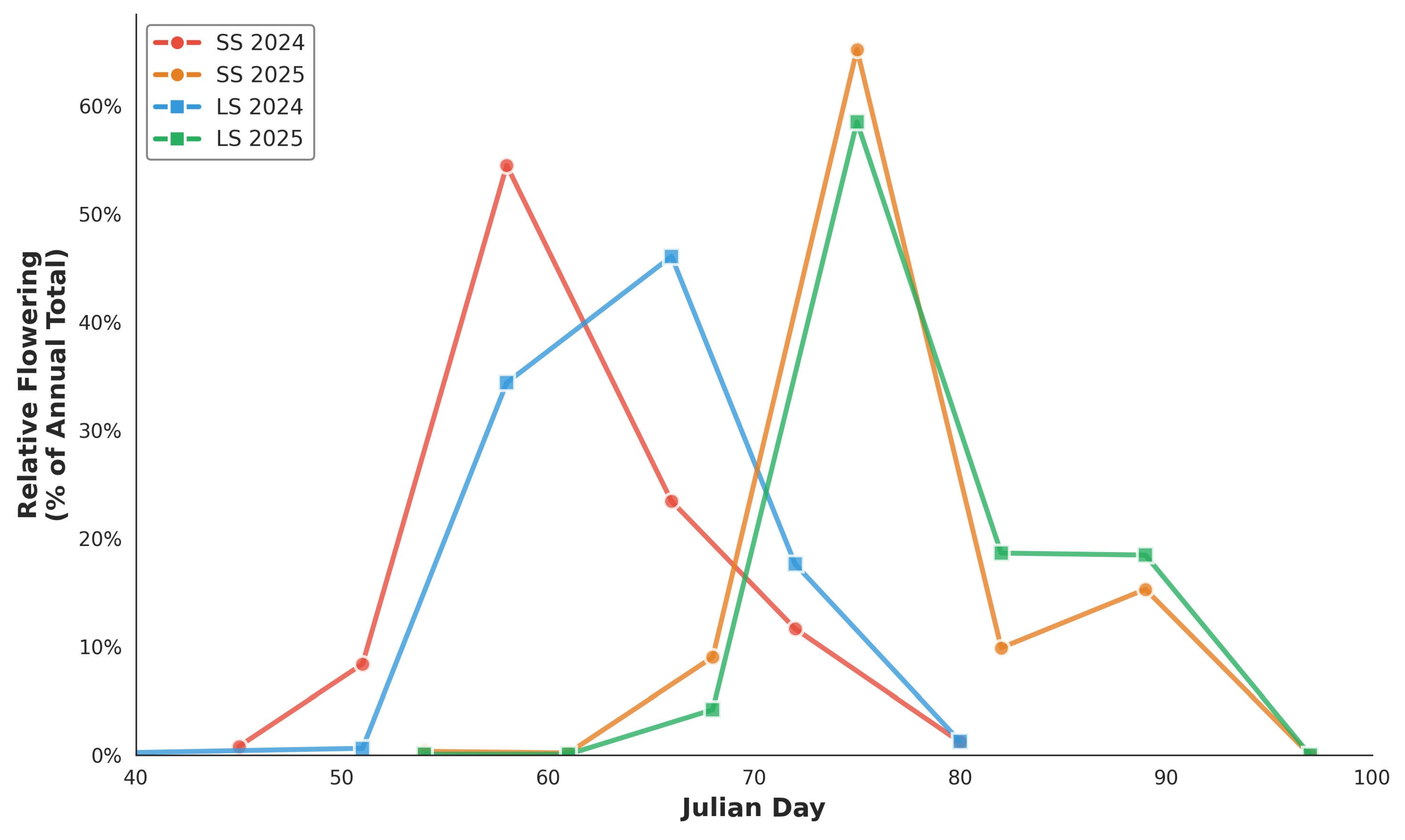
Plants were monitored for flowering phenology beginning in January of each year (
Figure 2).
No flowers were open during January; flowering commenced in February, at which time plants were formally measured and permanently marked. In 2024, 40 flowering individuals were randomly selected and permanently marked within the PERL population. For each plant, vine height on the host tree and horizontal canopy width were measured to characterize plant size. In July 2024, an additional 62 plants were added to the census population to increase sample size for phenological monitoring. Only well-developed, reproductively mature vines climbing into the sub-canopy or canopy were included in the census. Floral morph (LS or SS) was determined for all plants based on anther and stigma positions during anthesis.
2.3. Flowering and Fruiting Phenology
Flowering phenology was monitored weekly from 1 January through the end of April in both 2024 and 2025. On each census date, the number of open flowers was recorded for every marked plant. Total flower production per plant was determined by summing the number of newly opened flowers recorded for each plant across all weekly census dates within a flowering season. Observations began prior to anthesis and continued until no open flowers remained in the population. For each year, population-level flowering curves were generated by aggregating the number of open flowers across all plants by Julian day. Peak flowering was defined as the Julian day with the maximum number of open flowers. Flowering duration for individual plants was calculated as the number of days between the first and last observed open flower. Morph synchrony was quantified as the proportion of flowering days on which both LS and SS morphs were simultaneously in bloom within the population. Fruit production for the 2023 flowering season was recorded in January 2024, whereas fruit production for the 2024 and 2025 flowering seasons was recorded in November of those respective years by counting all fruits on each plant. Gelsemium sempervirens produces dry, dehiscent capsules with wind-dispersed seeds, and intact fruits can persist on vines for up to two years if undisturbed, permitting retrospective assessment of prior-year fruit production. Open-pollination fruit set was quantified in 2024 and 2025 as the proportion of flowers that developed into fruits.
2.4. Floral Visitation
Floral visitors were observed directly throughout the entire bloom period in both 2024 and 2025. Floral visitation observations were conducted on marked plants. Individual plants were observed multiple times within a flowering season, with the number of observation periods per plant varying depending on flowering availability. Observations were conducted in 10 min intervals between 07.00 and 18.00 under suitable weather conditions (no precipitation, low wind). During each observation period, the number of open flowers observed (focal group size), the identity of each floral visitor, the number of flowers visited per visit, the plant identification number, observation time, and local climatic variables (air temperature, mean wind speed, relative humidity, and sky conditions) was recorded. To increase sampling coverage and document visitor behavior, direct observations were supplemented with digital video recordings using Nikon and GoPro (Nikon Corporation, Tokyo, Japan; GoPro, Inc., San Mateo, CA, USA) cameras positioned to capture floral activity. Video footage was reviewed to identify additional visits, confirm visitor identity, and quantify flower-probing behavior. Floral visitors were identified to the lowest taxonomic level possible using direct observation, photographs, and voucher specimens. Representative specimens were collected when feasible and deposited in the Sam Houston State University Natural History Collections.
2.5. Pollinator Effectiveness
Pollinator effectiveness was assessed in 2025 using single-visit and limited multiple-visit observations [
20]. The marked census population used for phenological monitoring (
n = 102;
Section 2.2 and
Section 2.3) served as the source population for this experiment. To facilitate pollination treatments, developing floral buds were bagged with fine-mesh pollination bags on 3 February 2025. Bags were placed over vine tips encompassing one or more adjacent nodes, resulting in a variable number of flower buds per bag. The number of buds enclosed within each bag was recorded at the time of bag placement.
Bags were checked weekly from 10 February through 30 March 2025. Upon flower opening, bags were removed and the number of flowers that opened within each bag was recorded. Flowers were then observed continuously for 10–60 min until one or more visits occurred. Visitor identity and number of visits were recorded. Although the intent was to document single visits, some flowers received multiple visits by the same individual, multiple individuals of the same species, or multiple species during a single observation period. Only flowers receiving visits from a single pollinator taxon were included in pollinator effectiveness analyses; flowers receiving visits from multiple taxa were excluded. Observations were conducted between 09.00 and 19.00 h when air temperatures exceeded 16 °C. Following visitation, flowers were rebagged to prevent additional visits. Floral visitation was monitored on 39 individual plants (21 short-styled, 18 long-styled) across 27 observation days (8 in February and 19 in March), representing approximately 1560 min of observation conducted by four observers.
Pollination bags had a mesh size of 0.37 mm, measured using a Keyence digital microscope (Keyence Corporation, Osaka, Japan), effectively excluding floral visitors while allowing airflow and light penetration. In April, approximately one month after flowering, fruit set was scored as 1 for developing fruits and 0 for aborted flowers. Fruits were marked at initiation and monitored through development. Mature fruits were harvested in August 2025 for measurement and seed analysis. Due to storm events and tree falls, some fruits that initiated development in April were unavailable for harvest.
2.6. Test for Autonomous Self-Pollination
To test for autonomous self-pollination, flowers were bagged prior to anthesis in 2025 to exclude pollinators. This assay was used to evaluate whether reproductive assurance via autonomous selfing occurs at the western range edge, which would indicate potential relaxation or breakdown of obligate outcrossing associated with distyly. Between one and nine flowers were bagged on each of 10 randomly selected plants (6 long-styled, 4 short-styled). Bags remained in place through anthesis and early fruit development. Fruit initiation was monitored weekly following corolla abscission. Flowers on the same plants that were left open for natural pollination were monitored concurrently. This approach does not test compatibility relationships among floral morphs or pollen-tube interactions; these aspects of the breeding system have been extensively characterized in previous studies [
18,
19] and were not re-evaluated here.
2.7. Fruit Phenology
Fruits were collected on 29 August 2025 from a subset of plants monitored for flowering phenology at the Piney Woods Environmental Research Laboratory (PERL). Fruits were mature and dry at harvest. Only closed fruits (pericarp intact, seeds retained) were used to quantify pollination efficiency and seed production. Fruit size was measured as a proxy for developmental investment, allowing assessment of whether herbivory effects varied across fruit growth trajectories rather than being restricted to final fruit set alone. Additional details on fruit classification and herbivory assessment are provided in
Supplementary S1 Methods.
2.9. Seed Scoring and Pollination Efficiency
Fruits were dissected and seeds were classified as good (fully developed), damaged, tiny green (developmentally arrested), or unfertilized ovules. Seed set was calculated as the proportion of ovules that developed into seeds, assuming a maximum of 20 ovules per fruit. Seed survival was calculated as the proportion of good seeds relative to total seeds. Additional details on seed classification and damage categories are provided in the
Supplementary Materials.
2.10. Statistical Analyses
All statistical analyses were conducted in R (version 4.3.3, R Core Team, Vienna, Austria). Statistical procedures, including Fisher’s exact tests, chi-square tests, generalized linear models, and nonlinear phenology models, were implemented using base R functions. Niche overlap metrics were calculated using the vegan package, and bootstrap procedures were conducted using the boot package. Figures were generated using ggplot2.
Population-level flowering curves were summarized by Julian day and fitted with Gaussian and Weibull functions using nonlinear least squares to estimate peak bloom timing and curve spread. Both Gaussian and Weibull functions were evaluated because flowering phenology distributions may be symmetric or skewed, with final model selection based on goodness-of-fit. Differences in individual-plant flowering duration between years were assessed using Welch’s t-tests. Peak bloom timing was compared between years using bootstrap resampling (10,000 iterations) to generate 95% confidence intervals around the difference in peak Julian day.
Temporal overlap in flowering phenology between long-styled (LS) and short-styled (SS) floral morphs was quantified using Pianka’s niche overlap index. Daily flowering distributions were constructed for each morph by summing the number of open flowers per day across all monitored plants within a year. Pianka’s index was then calculated as
where
represents the proportion of flowers of a given morph observed on day
. The index ranges from 0 (no temporal overlap) to 1 (complete overlap). Overlap was calculated separately for 2024 and 2025 using daily flowering data.
For pollinator effectiveness analysis, fruit set was treated as a binary response variable. Differences in fruit set between observation periods with and without Habropoda laboriosa visitation were evaluated using Fisher’s exact tests. Temporal comparisons focused on periods with and without Habropoda laboriosa because it was the only pollinator present across the full flowering period; other visitors occurred too infrequently to support meaningful temporal analysis. Because multiple flowers were often observed on the same plant within a single day, observation periods were used as the unit of analysis for hypothesis testing to reduce pseudo replication and provide a conservative assessment of pollinator effectiveness; flower-level data are presented descriptively.
Pollination efficiency of closed fruits was analyzed using linear models with herbivory category as a predictor. Proportions of good seeds were analyzed using binomial generalized linear models with logit links. Planned contrasts compared unattacked fruits with those exhibiting internal wall feeding or hole presence. Additional analyses related to fruit herbivory and seed damage are described in the
Supplementary Materials. Model assumptions were evaluated using residual diagnostics.
4. Discussion
4.1. Reproductive Failure Does Not Explain the Western Range Limit of Gelsemium sempervirens
This study tested the hypothesis that reproductive failure constrains
Gelsemium sempervirens at its western geographic boundary. Across two flowering seasons at the Piney Woods Environmental Research Laboratory (PERL), reproductive outcomes did not show progressive deterioration consistent with intrinsic reproductive failure at a range edge. Fruit initiation following successful pollination occurred in both years, distyly remained fully functional, and no evidence of autonomous self-pollination or morph-specific reproductive depression was detected. Closed fruits routinely produced viable seeds in numbers comparable to those reported from central-range populations in the Coastal Plain and Piedmont [
19,
20,
21,
22,
31]. Together, these results demonstrate that breakdown of the mating system or failure of fertilization does not explain the abrupt western distributional limit of
G. sempervirens.
These findings are consistent with recent syntheses arguing that range limits often emerge from eco-evolutionary constraints and trade-offs, rather than intrinsic failure of reproduction per se [
36,
37]. In particular, frameworks that emphasize species’ capacity to track environments through colonization ability and phenotype–environment matching predict that populations may persist at margins when reproductive functions remain intact but other ecological axes become limiting [
37].
Because
Gelsemium is obligately outcrossing and depends on legitimate pollen exchange between floral morphs, pollination would be expected to decline if effective pollinators declined toward the range edge [
11,
12]. In much of the species’ range in the Coastal Plain, the southeastern blueberry bee (
Habropoda laboriosa) is among the most effective early-spring pollinators [
22,
24]. At PERL,
H. laboriosa was present in both study years and dominated the floral visitor assemblage throughout the flowering period. Fruit set following visitation was overwhelmingly associated with
Habropoda, whereas visits by other bee taxa rarely resulted in fruit production, although sample sizes were too small to fully evaluate their potential for pollination. These observations indicate that the primary effective pollinator of
Gelsemium remains present and functionally dominant at the western range edge, and that pollinator absence is unlikely to explain reduced reproduction in this population.
Viewed broadly, the persistence of effective pollination at a range boundary accords with evidence that demographic performance at margins can remain robust when key mutualists are present, and that adaptive limits—rather than reproductive collapse—often structure edges in space and time [
38].
4.2. Stability of Distyly and Implications for Range-Edge Theory
Breakdown of heterostylous mating systems is a well-documented mechanism of reproductive failure at ecological margins, particularly when pollinator services become unreliable [
10,
11]. However,
Gelsemium sempervirens shows no evidence of such breakdown at its western range edge. Functional distyly remains intact, morph synchrony is high, and legitimate pollination is common. The persistence of an obligate outcrossing system at the range edge suggests that selection has not favored autonomous selfing or partial compatibility as reproductive assurance, likely because pollination remains sufficiently reliable. This result highlights the importance of directly measuring pollinator effectiveness and fruit set rather than inferring reproductive limitation from geographic coincidence or pollinator range overlap alone. More broadly, intraspecific trait variation can mediate how mating systems function across gradients and how edge populations match local environments [
39], while eco-evolutionary limits to adaptation help explain why some margins remain sharp despite adequate reproduction [
38].
4.3. Phenological Variability, Visitation Dynamics, and Pollination Opportunity
Although pollination was effective, flowering phenology and pollinator activity exhibited pronounced interannual variability. Peak flowering occurred approximately two weeks later in 2025 than in 2024 and was more temporally compressed, consistent with sensitivity to early-season climatic conditions. Despite these shifts, flowering overlap between long-styled and short-styled morphs remained high at the population level, indicating that phenological asynchrony between morphs did not compromise opportunities for legitimate pollination.
Reproductive success was substantially lower in 2025 than in 2024. The most parsimonious explanation for this reduction is direct abiotic damage associated with severe freezing events rather than pollination failure. Early season freezes in 2025 eliminated or damaged developing buds and flowers, reducing the number of reproductive structures available for successful fruit development. Such direct effects of cold stress on floral tissues can strongly constrain reproduction independently of pollinator activity. Importantly, no evidence from this study indicates that reduced reproduction in 2025 resulted from pollinator absence or failure of fertilization processes.
Taken together, these results indicate that reproductive output at the western range edge of
G. sempervirens is shaped primarily by episodic abiotic stress rather than by pollinator decline or breakdown of the mating system. Interannual variation in climate, particularly extreme cold events, can substantially influence reproductive success even when fertilization processes remain intact. Such environmentally driven variability is consistent with contemporary range-limit theory emphasizing phenotype–environment matching and limits to adaptive responses under fluctuating conditions [
37,
38]. While trait variation and mutualistic interactions may influence persistence at margins in other systems, the present results demonstrate that reduced reproduction at this western range edge reflects environmental filtering rather than intrinsic reproductive failure.
4.4. Pollination, Reproductive Limitation, and the Eastern Texas Range Margin
Fruit production at the PERL site varied markedly among years, providing important interannual context for interpreting reproductive performance at the western range edge of Gelsemium sempervirens. In 2023, plants produced a mean of 26.8 fruits per individual, with more than two-thirds of monitored plants fruiting, indicating that high reproductive output is possible at this site under favorable conditions. Fruit production declined in 2024 but remained substantial, whereas in 2025 both the proportion of flowering plants that fruited and mean fruit production per plant were sharply reduced. Importantly, this decline occurred despite high flowering frequency, intact distyly, and the continued presence of effective pollinators. Together, these patterns indicate that interannual variability in realized fruit production reflects sensitivity to year-specific environmental conditions rather than chronic reproductive limitation at the western range margin.
Although flowering phenology and visitation rates varied among years, the present study does not provide evidence that reduced reproduction resulted from insufficient pollination intensity or pollen delivery. Visitation rates were low and temporally uneven, but fruit initiation occurred in both years, and no threshold level of visitation associated with reproductive failure was identified. Accordingly, variation in reproductive output is best interpreted as arising from stochastic exposure of flowers to favorable conditions rather than from consistent pollination limitation.
This interpretation contrasts with models of pollination quantity limitation that invoke reduced visit frequency as a primary constraint on reproduction. While such mechanisms may operate in other systems or under different demographic contexts, the present data do not demonstrate that low visitation intensity imposed a systematic constraint on reproduction in this population. Instead, environmental filtering—particularly freeze damage and its effects on floral availability—appears sufficient to explain the observed interannual variation in fruit production.
Although H. laboriosa itself approaches a range boundary in East Texas, its continued presence and dominance indicate that a coupled plant–pollinator range limit is not imposed by pollinator disappearance. Rather, the eastern Texas range margin of G. sempervirens likely reflects the cumulative effects of environmental variability and episodic reproductive shortfall, rather than a discrete threshold driven by pollinator availability or pollination opportunity. Post-pollination processes quantified in this study, including fruit herbivory and seed loss, further reduced realized reproductive output and contributed to interannual variation in recruitment potential. Together, these results indicate that reproduction at this range margin is shaped by multiple sequential filters acting after flowering, rather than by failure of pollination or breakdown of the mating system.
4.5. Geographic Variation in Pollinator Assemblages and Ecological Context
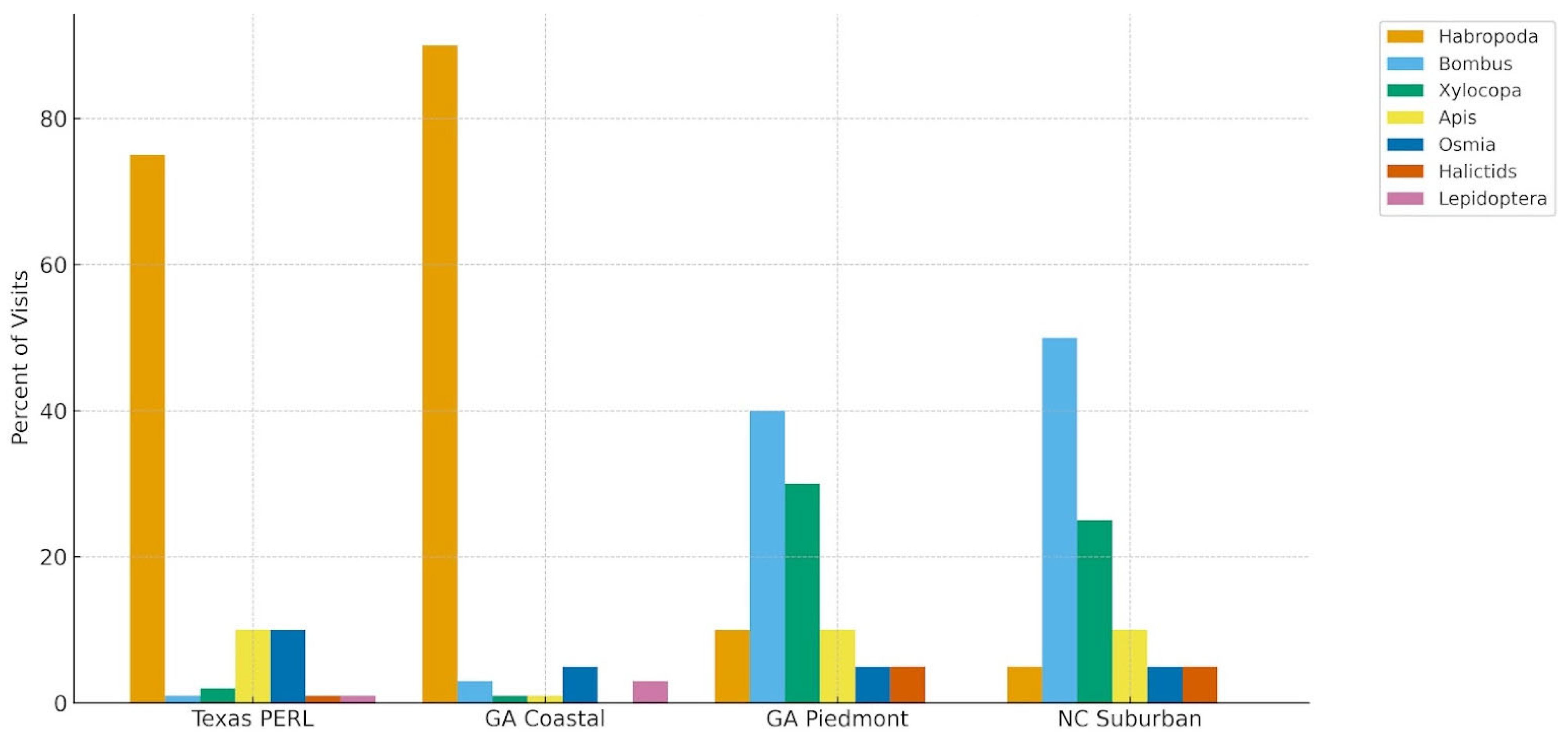
The pollinator composition in East Texas is nearly identical to that in the coastal plain of South Georgia [
21,
22,
23] but differs substantially from that observed in the Piedmont of North Georgia and North Carolina (
Figure 4). This pattern is consistent with regional variation in soil types and climate regimes between the coastal plain and Piedmont, as
Habropoda laboriosa is strongly associated with sandy soils for nesting [
27] and flowering in the Piedmont typically occurs later in the season (often by approximately a month [
26,
31] potentially allowing later emerging bee species to contribute more strongly to visitation.
Geographic variation in pollinator assemblages is expected where climatic regimes, soil properties, and vegetation structure vary across a species’ range, even in the absence of strong physiological constraints on reproduction. Across the southeastern United States, Gelsemium sempervirens occupies habitats that differ markedly in soil texture, moisture availability, forest structure, and disturbance history, all of which can influence the composition and activity of early-season pollinators. Coastal Plain populations typically occur on sandy, well-drained soils within relatively open pine-dominated forests, whereas Piedmont populations occupy more heterogeneous landscapes characterized by finer-textured soils, greater topographic relief, and mixed hardwood–pine forests. These environmental differences are expected to influence nesting substrate availability and phenological overlap for early-emerging bees, thereby contributing to observed differences in pollinator assemblage composition.
The close similarity between the pollinator assemblage observed at the eastern Texas range edge and those reported from Coastal Plain populations in southern Georgia suggests that regional ecological context, rather than geographic position alone, is a primary determinant of pollinator community composition. In contrast, Piedmont populations in northern Georgia and North Carolina support more taxonomically diverse assemblages with reduced dominance by Habropoda laboriosa, reflecting differences in habitat structure and pollinator availability. These patterns indicate that visitation assemblages associated with Gelsemium can vary geographically while remaining functionally adequate for pollination without implying uniformity in pollination dynamics across the range.
From an evolutionary perspective, these results align closely with the geographic mosaic theory of coevolution proposed by John N. Thompson [
40,
41], which predicts that species interactions vary spatially as a function of local ecological conditions, generating a mosaic of interaction outcomes rather than uniform selection pressures across a species’ range. Within this framework. Within this framework, variation in pollinator assemblage composition across regions reflects local ecological context rather than a directional weakening of plant–pollinator interactions toward the western range edge.
Importantly, the persistence of a Coastal Plain–like pollinator assemblage in eastern Texas suggests that the western range limit of Gelsemium is not associated with a transition to a qualitatively different pollination regime. Rather, the abrupt distributional boundary likely reflects ecological constraints not directly to pollinator assemblage composition, such as reduced availability of suitable habitats, altered fire regimes, or shifts in forest structure across the pine–oak savanna ecotone. Under this interpretation, geographic variation in pollinator assemblages represents ecological flexibility within the species’ interaction network, rather than evidence of mutualistic breakdown at the range edge.
4.6. Cryptic Fruit Herbivory: Detection, Impact, and Range Implications
In contrast to the high efficiency of pollination, post-pollination seed predation exerted strong effects on realized reproductive output. Fruits at PERL exhibited multiple forms of herbivory, ranging from external wall feeding to extensive internal destruction by a concealed midge-like herbivore. Dissections revealed that early larval feeding frequently causes seed destruction without causing the capsule wall to collapse. Estimates of herbivory in
Gelsemium have likely been substantially underestimated in the literature. Prior studies relied on externally visible “windows” (capsule collapse) to identify damage [
31]. However, this study showed that collapsed windows are a late, indirect outcome of heavy infestation; many fruits with extensive internal damage retain their structural integrity. Furthermore, previous studies often terminated sampling at early fruit set or used greenhouse protocols that excluded the specific window of gall-midge oviposition. By extending sampling through maturation and employing dissections, this study reveals that cryptic herbivory is neither rare nor anomalous, but rather a historically overlooked pressure on reproductive output.
Despite its severity, this seed predation does not appear to determine the western range limit of
Gelsemium sempervirens. The same or a closely related midge attacks developing fruits within the species’ range interior (e.g., North Carolina) [
31], indicating that herbivory is not geographically restricted to the range margin. The geographic coincidence of this antagonist precludes a simple presence–absence explanation for range limitation. Instead, fruit herbivory acts as a context-dependent demographic modifier of reproductive success. Early larval feeding causes internal seed damage and can induce premature capsule permeability, exposing seeds to secondary predators and decomposers. These cascading effects amplify seed loss, particularly when fruit development is slow. However, unattacked fruits at the range edge consistently produced high numbers of viable seeds. Thus, while cryptic herbivory reduces realized fecundity, it represents a broadly distributed ecological cost on reproduction rather than a unique barrier preventing westward expansion.
This perspective aligns with broader range-edge theory, in which broadly distributed antagonists interact with local environmental conditions to shape population performance without acting as singular causal agents of range limits. From a range-limit perspective, reductions in realized reproduction may still interact with dispersal to influence spread potential; however, recent syntheses indicate that variation in dispersal ability and evolution of dispersal kernels can outweigh moderate reductions in fecundity in determining edge dynamics [
42,
43].
4.7. Ecological Rather than Reproductive Mechanisms Likely Define the Western Range Edge
Given the absence of evidence for reproductive failure at PERL, the abrupt termination of
Gelsemium sempervirens in eastern Texas is unlikely to result from failures in pollination, mating-system function, or early seed development. Instead, ecological factors unrelated to reproduction provide a more parsimonious explanation. The transition from pine-dominated forests to post-oak savanna and prairie is associated with reductions in tree density and vertical structure required for vine growth, shifts in soil texture and hydrology, and changes in disturbance regimes, particularly fire frequency [
44,
45].
Gelsemium sempervirens is sensitive to fire and dependent on woody hosts for support, making it poorly suited to open savanna and prairie landscapes even where climatic conditions may otherwise be suitable.
Seed dispersal may also influence population dynamics near the range margin in Gelsemium sempervirens. The species produces relatively small, wind-dispersed seeds, but actual dispersal distances in natural habitats remain poorly quantified. Barriers such as forest structure, understory density, and limited availability of suitable microsites could restrict successful establishment beyond parent plants. Although dispersal processes were not evaluated in this study, they represent a plausible ecological filter and a productive direction for future work aimed at understanding the factors shaping population spread and site occupancy.
This interpretation accords with contemporary perspectives that species’ range limits often reflect trade-offs among colonization capacity, phenotype–environment matching, and constraints on adaptation, with dispersal and trait expression jointly governing whether populations can track environments beyond current boundaries [
37,
38,
43].
4.8. Future Research Questions
These results highlight several critical avenues for future research on fruit herbivory and seed limitation in Gelsemium sempervirens. First, broader geographic sampling is needed to quantify natural variability in fruit herbivory, particularly comparing intact forest interiors with suburban fragments. Such work would clarify whether infestation severity reflects habitat structure, landscape context, or interannual variation in phenology and environmental conditions. Second, the taxonomic identity and life history of the gall-midge herbivore remain poorly resolved. Detailed study of the insect’s phenology, host specificity, and associated parasitoids is required to understand the stability of this interaction. Third, the ecological consequences of collapsed capsule “windows” remain largely unexplored. Characterizing the secondary arthropods and fungi that colonize these microhabitats would help disentangle primary herbivore effects from secondary mortality. Finally, integrating fruit herbivory into demographic models is a key next step. Quantifying how reduced seed production translates into seedling recruitment and population growth—particularly at range edges—is essential for evaluating the broader ecological significance of this cryptic seed damage. Ongoing work by the author is addressing these questions across multiple natural and suburban sites in southeastern Texas. These results will be presented separately to provide broader spatial and demographic context.