Article

Beyond Time: Divergent Successional Trajectories Driven by Legacies and Edaphic Filters in a Tropical Karst Forest of Yucatan Peninsula, Mexico


by
Aixchel Maya-Martinez
1,
Josué Delgado-Balbuena
2,3,
Ligia Esparza-Olguín
4,
Yameli Guadalupe Aguilar-Duarte
5,
Eduardo Martínez-Romero
6 and
Teresa Alfaro Reyna
1,*
1
Campo Experimental Edzná, San Francisco de Campeche 24520, Campeche, Mexico
2
Centro Nacional de Investigación Disciplinaria Agricultura Familiar, Ojuelos de Jalisco 47540, Jalisco, Mexico
3
Instituto Tecnológico de Sonora (ITSON), Ciudad Obregón 85000, Sonora, Mexico
4
El Colegio de la Frontera Sur (ECOSUR), San Francisco de Campeche 24500, Campeche, Mexico
5
Instituto Nacional de Investigaciones Forestales, Agrícolas y Pecuarias, Mérida 97454, Yucatán, Mexico
6
Facultad Latinoamericana de Ciencias Sociales, Tlalpan, Ciudad de México 14200, Mexico
*
Author to whom correspondence should be addressed.
Forests 2026, 17(3), 386; https://doi.org/10.3390/f17030386
Submission received: 14 February 2026 / Revised: 12 March 2026 / Accepted: 17 March 2026 / Published: 20 March 2026
(This article belongs to the Special Issue Secondary Succession in Forest Ecosystems)

Abstract

Secondary succession in tropical forests is traditionally described as a linear process driven by time since disturbance. However, growing evidence suggests that recovery pathways depend strongly on historical and environmental contexts. We evaluated how disturbance legacies and edaphic constraints interact to shape successional trajectories in a tropical karst landscape of the Maya Forest, Mexico. We sampled 100 plots along a chronosequence, quantifying vegetation structure, floristic diversity, biomass (NDVI), disturbance legacies, and soil properties. Using unsupervised clustering (K-means) and multivariate ordination, we identified four contrasting ecological typologies that represent distinct successional states rather than transient stages. Our results show a pronounced dichotomy in vegetation dynamics following the abandonment of land-use practices: while some sites are experiencing diverse development due to positive forest legacies (Typology B), others remain stalled (Typology C), dominated by lianas, where biotic barriers inhibit tree regeneration despite decades of abandonment. Additionally, we documented an asynchronous recovery between floristic recovery and vertical development; in sites with edaphic constraints, forests reach high diversity and biomass but exhibit stunted growth (Typology D). This suggests that severe abiotic constraints—specifically high rockiness and shallow soils—limit the dominance of highly competitive species, thereby acting as a filter that maintains high levels of diversity despite structural limitations. Edaphic analysis confirmed that chemical fertility and physical constraints (rockiness and shallow depth) act as orthogonal filters. This explains the persistence of structurally constrained yet functionally mature forests as stable, edaphically determined outcomes. Overall, secondary succession in tropical karst is nonlinear and path-dependent, governed by a hierarchical filtering model where historical land use dictates community identity and physical substrate limits structural architecture. These findings highlight the need for trajectory-specific management and the abandonment of uniform expectations of forest recovery in karst landscapes.

1. Introduction

For much of the 20th century, secondary succession in tropical forests was interpreted under a directional and predictable paradigm, in which the recovery of structure, biomass, and diversity was assumed to be synchronous with time since abandonment [1].
However, in the Anthropocene—characterized by fragmented landscapes and complex land-use histories—this linear view has been replaced by the recognition that forest recovery is a multidimensional and asynchronous process [1,2]. Evidence shows that forests of similar chronological age can diverge markedly in composition and functionality, following “multiple successional pathways” shaped by a hierarchy of filters that transcend chronological time [2,3,4,5]. In this context, the regional species pool and the presence of dispersal vectors play a fundamental role in determining initial community assembly by regulating propagule arrival [5]. Once established, these initial assemblages are further modified by biological and structural legacies derived from previous land uses, which function as secondary filters that dictate specific recovery trajectories [2].
One of the main sources of this divergence lies in the biological and structural legacies derived from prior land uses, which function as filters that modify recovery trajectories. In the Mesoamerican region, conceptualized as the “Maya Forest” or a humanized forest, certain traditional agroforestry systems have left a facilitative “fingerprint,” favoring the persistence and abundance of species of high economic or cultural value [6,7]. These enrichment legacies can accelerate the recovery of diversity even at structurally immature stages. In contrast, intense disturbances can erode system resilience and activate negative feedback loops, such as the proliferation of lianas. This biotic mechanism competes aggressively for resources and light, inhibiting tree regeneration and maintaining the system in an alternative stable state of low complexity, a phenomenon known as arrested succession [8,9]. These natural regeneration processes are driven by a combination of seedling recruitment from the soil seed bank and active seed rain, as well as vegetative resprouting (resprouting) from surviving rootstocks [4]. The latter mechanism, known as reforestation, is a dominant and critical resilience strategy for tree recovery in the Maya Forest, enabling rapid canopy reestablishment and the persistence of species despite historical land-use disturbances [10].
Beyond management legacies, succession in the Yucatán Peninsula occurs on a highly heterogeneous karst substrate that imposes a second level of environmental filtering. In these landscapes, edaphic properties not only determine chemical fertility but also impose severe physical constraints—such as rockiness and limited effective soil depth—that vary at fine spatial scales. Regional studies suggest that forest structure, particularly canopy height, can become decoupled from age and respond primarily to these physical limitations [10]. Thus, soil acts as a dual filter: while chemical fertility may sustain biomass and productivity [11], physical constraints can limit vertical development, generating forests that are mature in age but structurally “dwarfed.”
Despite conceptual advances regarding the nonlinearity of succession, few studies have simultaneously integrated the influence of management legacies (enrichment vs. competition) and the dual nature of the edaphic filter (chemical vs. physical) to explain the coexistence of contrasting trajectories within the same landscape. In this study, our aim is to identify and characterize ecological typologies that represent these divergent trajectories in a karst landscape of southeastern Mexico.
We hypothesized that secondary succession does not follow a linear, time-governed pattern, but rather bifurcates into discrete typologies determined by the interaction between: (1) the nature of historical disturbances—acting as enrichment legacies or biotic barriers—and (2) karst heterogeneity, capable of constraining structure independently of successional maturity.

2. Materials and Methods

2.1. Study Site Description

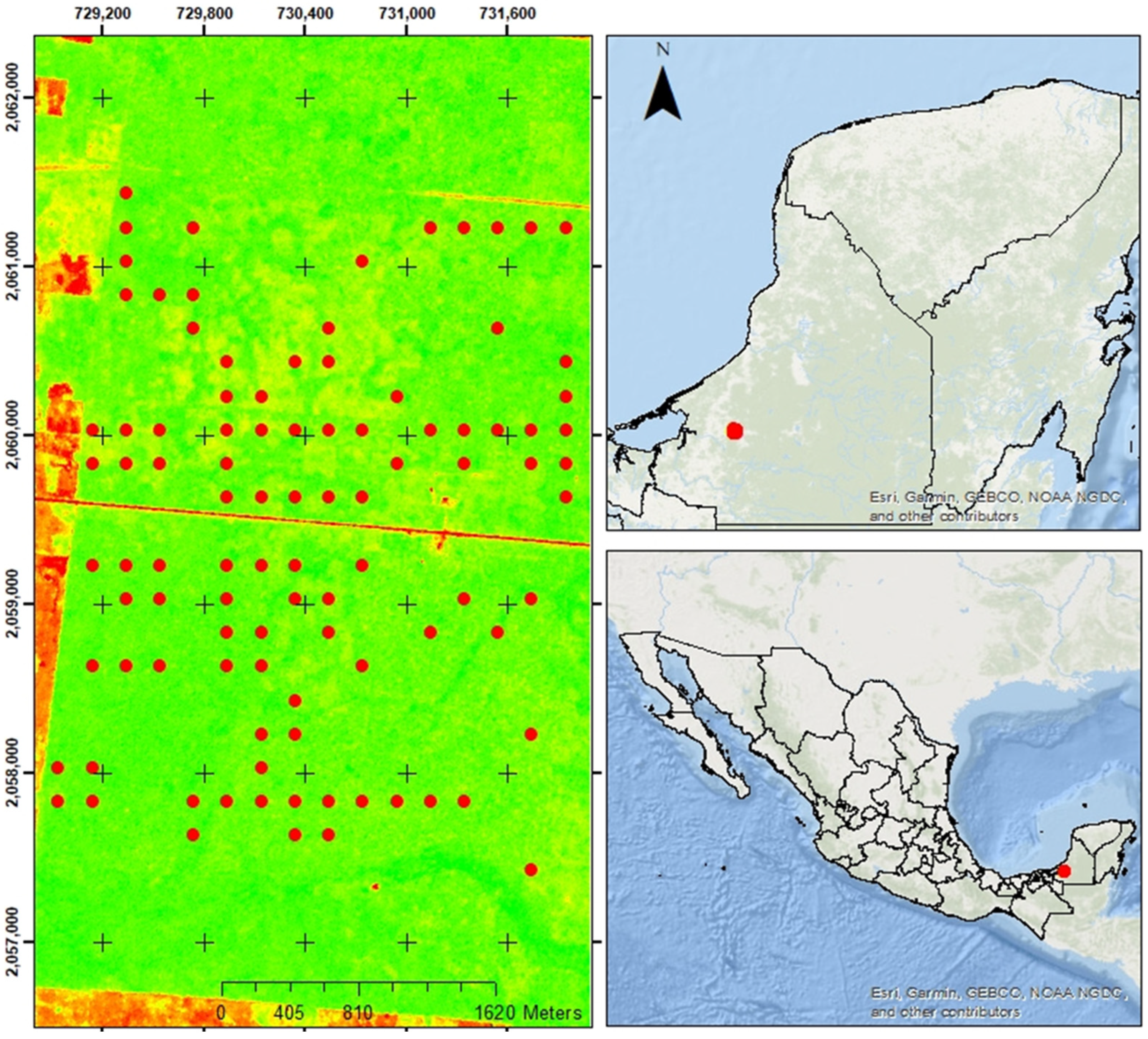
The study was conducted at the Centro de Investigación y Transferencia de Tecnología Forestal (CITTFOR), El Tormento, located 8.5 km northeast of the city of Escárcega, Campeche, Mexico, at kilometer 292 of Federal Highway 186 (18°16′25″ N, 90°43′55″ W; Figure 1). The region has a warm subhumid tropical climate, classified as A(w) l′g, according to a modified Köppen classification [12]. Mean annual temperature ranges between 23 and 25 °C, with absolute maxima close to 42 °C and minima as low as 4.5 °C. Mean annual precipitation is approximately 1145 mm, concentrated mainly between May and October.
The geomorphology corresponds to gently undulating plains with low slope and shallow depth, which leads to the presence of different types of soils ranging from recently formed soils such as Leptosols in the higher areas, to young soils such as Cambisols and Phaeozems on the slopes, followed by developed and clayey soils such as Vertisols and Gleysols in the lower areas [13].
The study area covers approximately 1400 ha of subhumid tropical forest. Since the 1960s, the site has been used for experimental forest research, and between 1962 and 1982, nearly 70% of the original vegetation was modified for the establishment of forest plantations and agroforestry systems using both native and exotic species such as Tectona grandis, Gmelina arborea, Swietenia macrophylla, and Cedrela odorata. The gradual cessation of these experimental forestry and agroforestry activities between 1962 and 1982 represents the “time zero” for the secondary vegetation dynamics analyzed in this study. Most plots therefore reflect natural regeneration following the abandonment of these specific human interventions rather than a single catastrophic deforestation event. Since the progressive abandonment of these practices after 1982, large areas have been left to natural regeneration, resulting in a landscape mosaic of patches at different successional states. This configuration provides an appropriate system for evaluating forest regeneration trajectories under karst conditions and for assessing how different successional states associated with previous management influence subsequent vegetation dynamics [14].

2.1.1. Sampling Units

Sampling units consisted of circular plots of 1000 m2 (radius = 17.84 m). Each plot was subdivided into eight radial sections (“slices”) to facilitate sampling organization and to capture the internal structural and compositional heterogeneity of each site. This strategy enabled a systematic and comparable recording of ecological variables at the plot scale. Although 100 plots were initially surveyed, two corresponded to pure plantations and were excluded from the analyses due to their low representativeness within the landscape.

2.1.2. Sampling Design and Vegetation Distribution

Plot locations were based on the vegetation successional stage map of El Tormento Research Center, developed between 2017 and 2019 as a cartographic input for territorial planning and land-use updating. A one-hectare grid generated by Aguilar et al. [15] was used as the spatial framework for plot selection. From this grid, a sampling intensity of 0.75% per successional stage was assigned, resulting in a total of 100 plots distributed proportionally among the different successional categories.

2.1.3. Assessment of Sampling Representativeness

To evaluate whether sampling effort was sufficient to adequately represent tree species richness in the study area, a species accumulation curve was constructed using the nonparametric Chao estimator. This analysis was conducted using EstimateS (v. 7), which estimates total expected richness based on the frequency of rare species (those occurring in one or two plots). Species accumulation curves are widely used to assess sampling adequacy and to ensure comparability among inventories [16,17].

2.1.4. Vegetation Characterization

To describe vegetation distribution and structure, a semi-quantitative method was used, which allows vegetation cover to be characterized based on physiognomic, structural, and compositional traits [18,19]. This approach is particularly suitable for heterogeneous landscapes such as karst systems, where vegetation structure can vary significantly at fine spatial scales.
In each plot, the following variables were recorded following the criteria proposed by [20]: dominant life form (trees, shrubs, or herbs); height of the dominant stratum (m); taxonomic identity of the tree species present; evidence of disturbance (logging, fire, grazing, fuelwood extraction); and presence and dominance of lianas and climbers (%). Vertical structure was summarized as the abundance of individuals taller than 20 m per plot, a threshold that represents the transition to the upper canopy and emergent layer in the subhumid forests of the Yucatan Peninsula, serving as a reliable indicator of structural maturity. Liana dominance was operationally defined as the cases where lianas occupied more than 50% of the canopy surface within the sampling unit or showed clear suppression of tree crown development, recorded during the semi-quantitative physiognomic characterization. Alpha diversity was estimated using species richness (S) and the Shannon–Wiener index (H′).
Patch age was calculated as the time elapsed from the year of experiment establishment to the year of data collection, while disturbance duration was calculated as the time elapsed from the year of establishment to the year of abandonment.
Photosynthetically active biomass was estimated using the Normalized Difference Vegetation Index (NDVI) derived from RapidEye imagery (Landsat 9), which captures fine-scale spatial variation in vegetation cover. For each plot, the mean NDVI value at its spatial location was extracted, providing an independent and continuous measure of canopy greenness and photosynthetic activity. NDVI was employed as a functional proxy for aboveground biomass and primary productivity, a metric widely validated in tropical ecosystems and particularly effective for comparing successional states with contrasting structural attributes [21]. This approach allowed us to assess the functional state (biomass accumulation) and structural state (canopy development) across successional trajectories.
The edaphic variables—clay and silt content, field capacity, permanent wilting point, soil organic carbon, bulk density, soil organic carbon density, soil organic carbon stocks, total nitrogen, pH, and proportion of coarse fragments—were obtained as spatial products from the Laboratorio Nacional de Modelaje y Sensores Remotos (LNMYSR) with a spatial resolution of 30 m. These products are generated through digital soil mapping using Random Forest algorithms that integrate 2544 field profiles from the National Soil Inventory with environmental covariates (terrain models and remote sensing). While the data represent a spatial interpolation at the landscape scale, mean values were extracted for the specific coordinates of each 1000 m2 plot to ensure local representativeness [22]. Detailed information regarding the source, resolution, and collection dates of all ecological and environmental data is provided in Supplementary Table S1.

2.2. Data Analysis

The analysis was designed to identify multivariate patterns of regeneration and to evaluate the joint influence of disturbance legacies, vegetation structure, and environmental constraints (edaphic filters) on successional trajectories. All analyses were conducted using the Python programming language (v. 3.10), employing Pandas (v. 3.0.1) for data manipulation, Scikit-learn (v. 1.8) and SciPy (1.15.2) for multivariate and classification analyses, and Matplotlib (v. 3.10.0) and Seaborn (v. 0.13.2) libraries for graphical visualization.
Prior to multivariate analyses, synthetic ecological indicators were calculated to characterize the state of each plot. Alpha diversity was estimated using species richness (S) and the Shannon–Wiener index (H′). Vertical structure was summarized as the abundance of individuals taller than 20 m per plot. To quantify canopy greenness, vegetation vigor, and structural recovery across the landscape, we calculated the Normalized Difference Vegetation Index (NDVI). The NDVI is a well-established and robust remote-sensing proxy for photosynthetic capacity and aboveground biomass, making it highly effective for monitoring successional trajectories in heterogeneous and fragmented tropical landscapes [23,24]. The index was calculated using the near-infrared (NIR) and red spectral bands derived from the satellite imagery, following the equation:
N D V I =   N I R R e d N I R + R e d
where NIR and Red represent the spectral reflectance measurements acquired in the near-infrared and red regions, respectively. Furthermore, the selection of K-means clustering and Principal Component Analysis (PCA) was justified by their robustness in handling multidimensional ecological data, allowing for the objective partitioning of the successional continuum into discrete functional typologies without a priori bias [25].
To evaluate the persistence of ecological memory, a “legacy abundance” variable was constructed, defined as the sum of individuals of species indicative of historical enrichment (e.g., Swietenia macrophylla, Cedrela odorata, and Manilkara zapota). Liana’s dominance was quantified as the percentage of sites in which this life form was dominant.
To complement the structural proxies with a floristic assessment tailored to our managed landscape, we evaluated the persistence of enriched/legacy species. For each plot with a history of management, we cross-referenced the species originally promoted or planted during the disturbance phase with the currently dominant canopy species. The presence and relative proportion of these legacy taxa were used as indicators of whether the current successional trajectory still reflects historical management or is progressively shaped by natural colonization.
To complement the structural proxies with a floristic assessment tailored to our managed landscape, we evaluated the persistence of enriched or legacy species. For each plot with a history of management, we compared the species originally promoted or planted during the disturbance phase with the currently dominant canopy species. The presence and relative proportion of these legacy taxa were used as indicators of whether the current successional trajectory still reflects historical management or is progressively shaped by natural colonization.
The analysis was structured into three sequential phases: Phase 1: Classification of ecological typologies (K-means). To identify non-linear successional trajectories, an unsupervised clustering analysis was applied using the K-means algorithm. Five standardized variables (Z-scores) integrating temporal, structural, and functional dimensions were selected: patch age, Upper canopy cover (>20 m), NDVI, species richness (S), and Shannon index (H′). The K-means algorithm was implemented using Euclidean distance on the standardized variables. To ensure reproducibility, we used a random seed of 42, with a maximum of 300 iterations and 10 initializations (n\init = 10) to find the global optimum. The optimal number of clusters was determined using the Elbow Method and the Silhouette Coefficient, identifying k = 4 as the solution that provided the highest statistical robustness and the best ecological interpretability. Subsequently, a Principal Component Analysis (PCA) was performed on the same variables to visualize the distribution of groups in a reduced two-dimensional space and to confirm their structural and floristic separation.
Phase 2: Assessment of drivers and floristic divergence. To determine the mechanisms underlying the resulting typologies, a comparative analysis of means (±standard error) was conducted for the independent explanatory variables: historical management duration (years), abundance of legacy species, and liana dominance. Prior to the comparisons, normality and homogeneity of variance were assessed using Shapiro–Wilk and Levene’s tests, respectively. For variables meeting these assumptions, one-way ANOVA was applied, followed by Tukey HSD post hoc tests; otherwise, Kruskal–Wallis tests with Dunn’s post hoc were used to identify significant differences among typologies.
Additionally, to assess whether structural differences corresponded to changes in community identity (beta diversity), a Non-metric Multidimensional Scaling (NMDS) analysis was performed based on a Bray–Curtis dissimilarity matrix. The NMDS was configured with two dimensions (k = 2), 100 random starts, and a maximum of 300 iterations, achieving a stress value of 0.2975. To statistically validate these compositional differences, a Permutational Multivariate Analysis of Variance (PERMANOVA) was performed using 999 permutations. Prior to interpreting the PERMANOVA, the assumption of homogeneity of multivariate dispersion was verified using the PERMDISP test, ensuring that significant results reflect true compositional shifts rather than differences in group dispersion.
Phase 3: Evaluation of the edaphic filter. To disentangle the effect of chronological age from environmental constraints, a second Principal Component Analysis (PCA) focused on soil properties was conducted. This analysis integrated variables related to chemical fertility (pH, organic carbon, total nitrogen), physical properties (bulk density, proportion of coarse fragments or rockiness), texture (sand, silt, and clay fractions), and soil water constants (field capacity and permanent wilting point). The objective is to identify orthogonal gradients of fertility and physical restriction. Pearson correlations were calculated between these edaphic variables and vegetation response indicators (NDVI and upper canopy cover (>20 m)) to quantify the magnitude of edaphic control over forest development.

3. Results

3.1. Characterization of Ecological Typologies

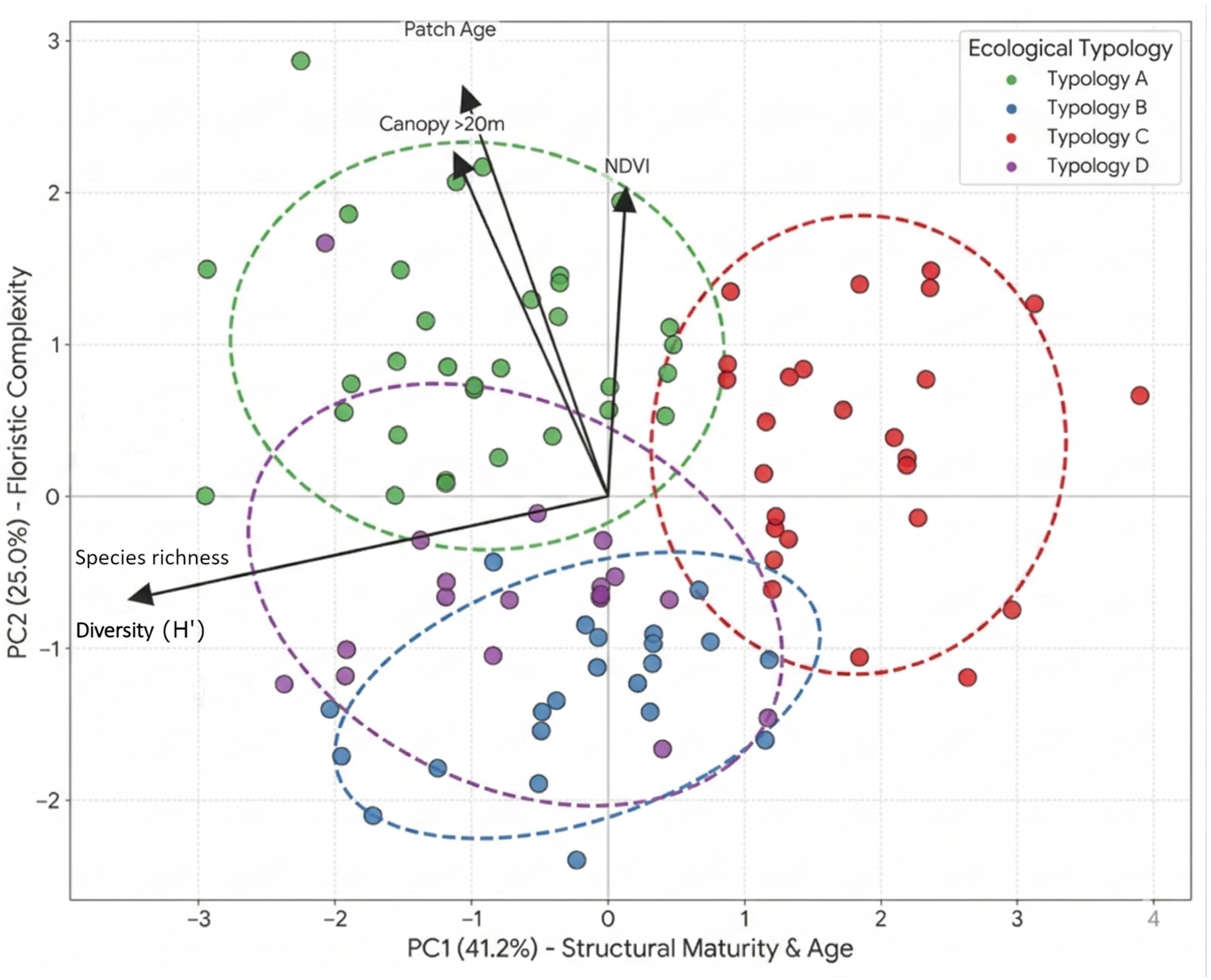
The unsupervised classification analysis (K-means), based on variables of successional age, floristic diversity, upper canopy cover (>20 m), and biomass (NDVI), identified four contrasting ecological typologies that describe differentiated successional states within the karst landscape (Table 1). The Principal Component Analysis (PCA) explained 66.2% of the total variability in its first two axes. The first component (41.2% of the variance) grouped variables related to vertical structure, patch age, and NDVI, whereas the second component (25.0%) showed a strong correlation with species diversity and richness. Consequently, the spatial ordination of sites reflects a gradient of structural maturity along axis 1 and floristic complexity along axis 2 (Figure 2).
By integrating land-use history variables into the post-classification characterization, the typologies were defined as follows: Typology A: Reference mature forest. This typology represents 11% of the sites and constitutes the ecological reference state. It is characterized by patches with the greatest mean age (57.5 years) and maximum structural development, exhibiting a high cover of the upper canopy stratum (>20 m; mean = 15.0%), as well as peak values of biomass (NDVI = 0.63) and diversity (H′ = 2.72). These sites have been subjected to the lowest historical management intensity (Table 1).
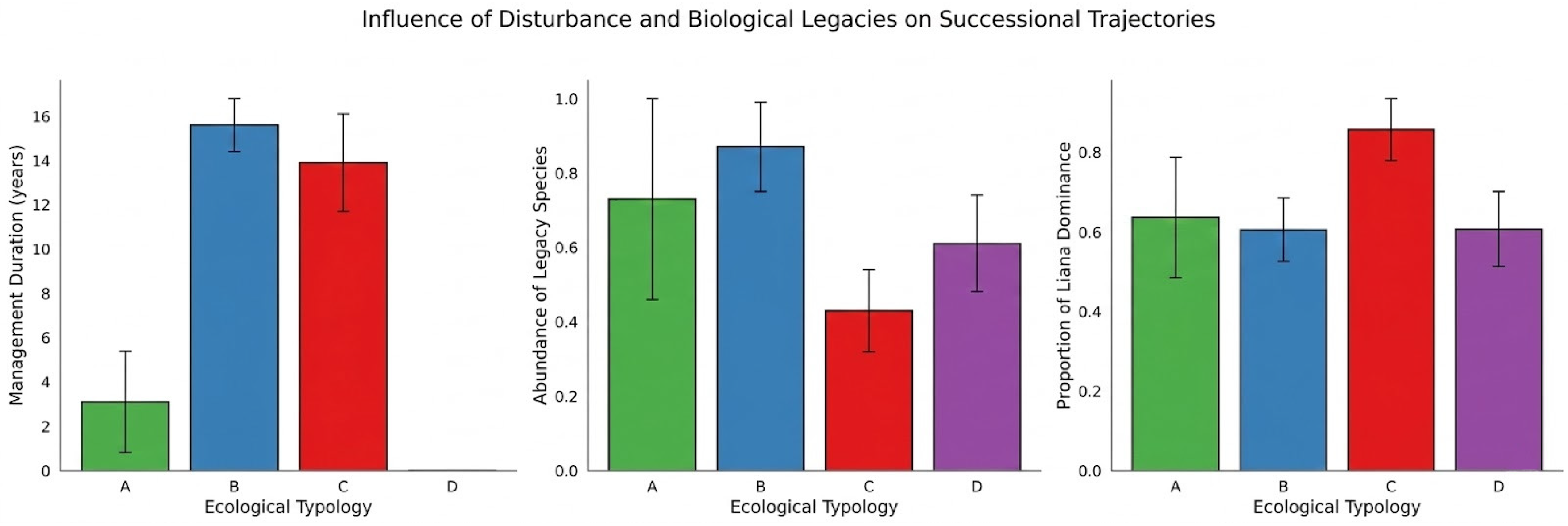
Typology B: Enriched secondary forest. This typology groups 39% of the sites. Despite being young patches (28.0 years) with the highest historical management intensity (15.6 years), they exhibit levels of diversity (H′ = 2.70) and species richness statistically comparable to those of mature forests. However, their vertical structure remains low (upper canopy cover > 20 m: 1.05%), suggesting a lack of synchronization in which compositional state outpaces structural development, likely driven by legacy species (Table 1).
Typology C: Arrested succession. This typology corresponds to 21% of the sites. These are patches of intermediate age (31.4 years) that exhibit a collapse trajectory. In contrast to Typology B, these sites present the lowest values of diversity (H′ = 2.21) and richness (S = 9.3), together with an almost null vertical structure (upper canopy cover > 20 m: 0.95%), indicating a severe blockage of succession.
Typology D: Structurally constrained mature forest. This typology comprises 29% of the sites and groups patches with the greatest chronological age (64.0 years) but with a paradoxically reduced vertical development (upper canopy cover > 20 m: 0.71%), comparable to early successional states. Nevertheless, they maintain high levels of diversity (H′ = 2.61) and biomass (NDVI = 0.61), configuring systems that are functionally mature but height-limited.

3.2. Structural and Floristic Divergence and Disturbance Legacies

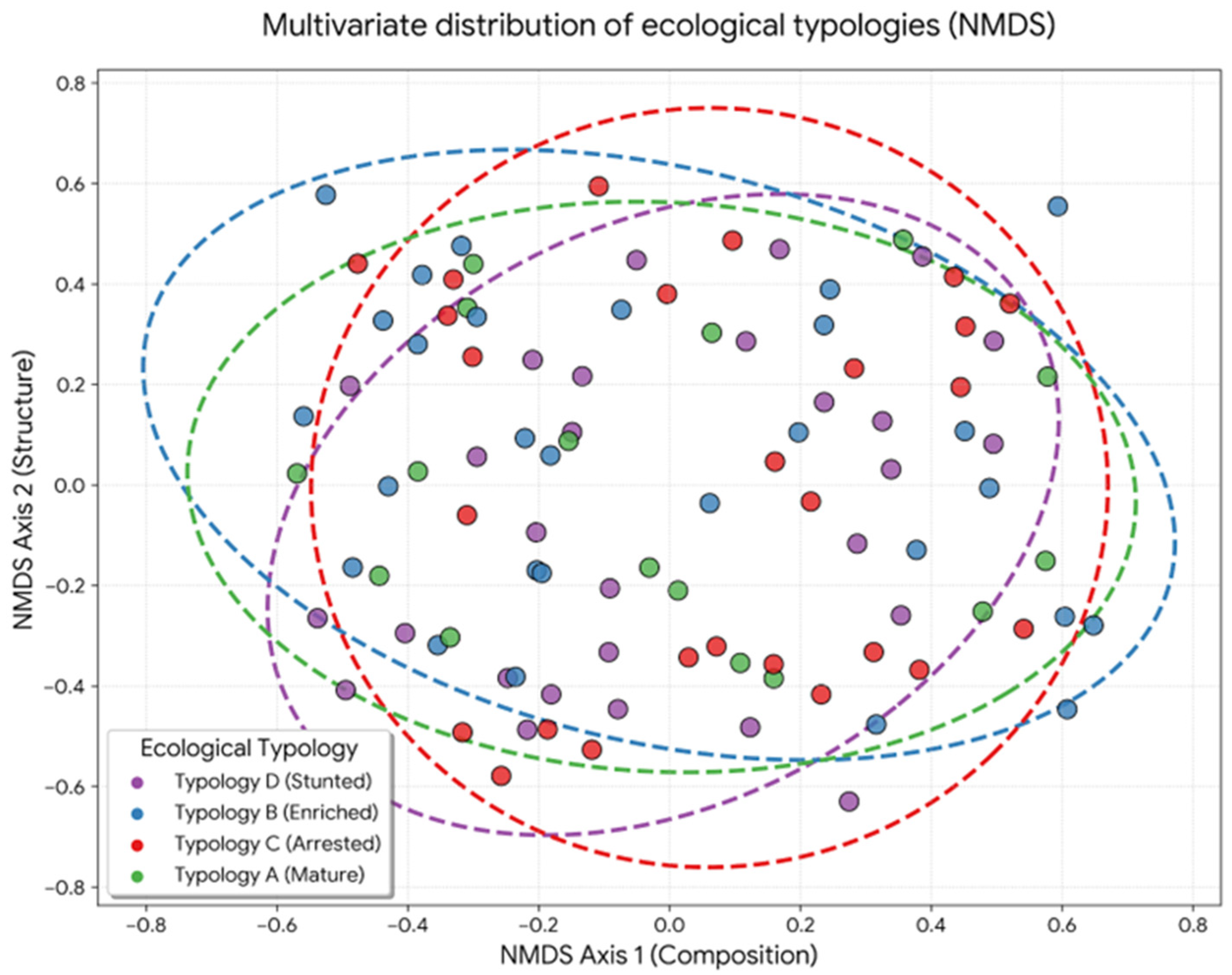
Comparative analyses among groups confirm the existence of divergent trajectories not only in structure but also in community identity. Comparative analyses among groups confirm the existence of divergent trajectories not only in structure but also in community identity (Figure 3). While the Non-metric Multidimensional Scaling (NMDS) ordination displays a degree of visual overlap among individual plots—a pattern inherent to the continuous nature of successional trajectories and hyperdiverse tropical datasets (stress value = 0.29)—statistical validation using Permutational Multivariate Analysis of Variance (PERMANOVA) confirmed significant differences in species composition among typologies (Pseudo-F = 4.21, p < 0.001). To better visualize this statistical segregation despite the natural continuum, 95% confidence ellipses were added to the ordination space, confirming that each successional state harbors a distinct species assemblage core.
Specifically, the comparison between Typologies B and C reveals a critical bifurcation point. Although they share similar ages and management histories, NMDS ordination and pairwise comparisons indicate that their floristic compositions barely overlap. Typology B rapidly reestablishes species richness, driven by a high abundance of commercially valuable legacy species (Swietenia macrophylla, Cedrela odorata), remnants of past silvicultural practices (Figure 4), which exhibited persistence rates exceeding 20% at these sites (see Supplementary Table S2).
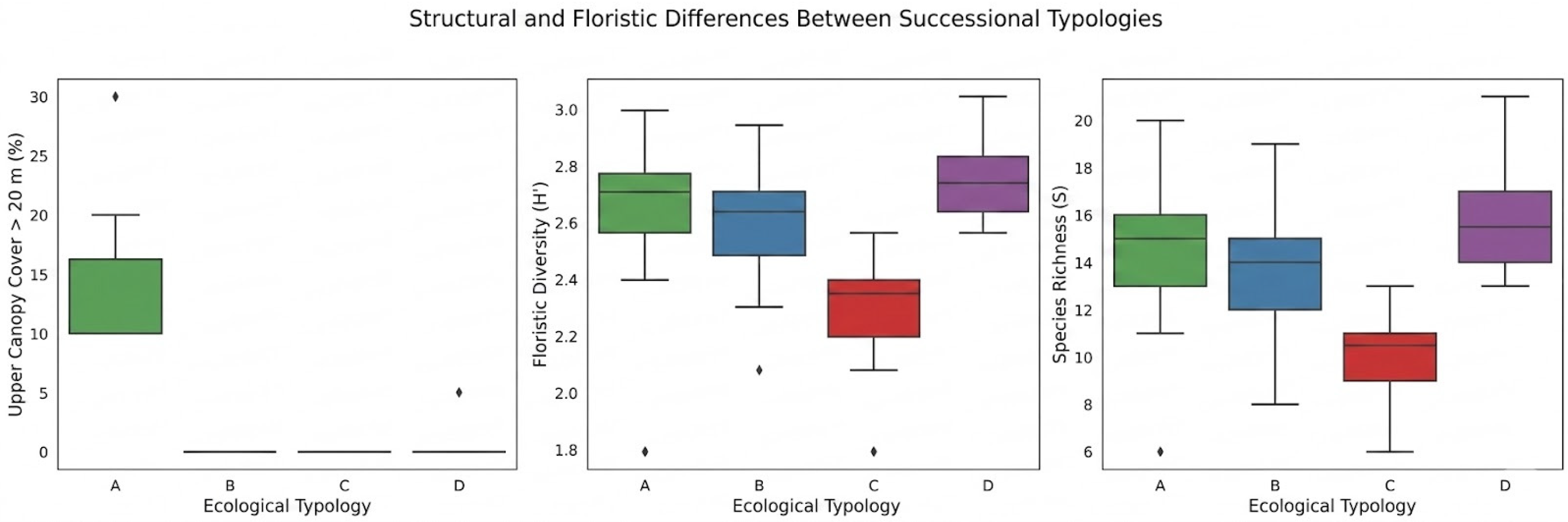
In contrast, Typology C experiences significant biological impoverishment associated with a biotic barrier: 85.7% of its sites are dominated by lianas, a proportion much higher than that observed in enriched sites (60.5%), suggesting that competition from climbers has blocked tree regeneration and altered species composition (Figure 4 and Figure 5). Finally, Typology D illustrates a third stable state in which biomass and diversity recover, but vertical complexity remains constrained over the long term.

3.3. Effect of the Edaphic Filter

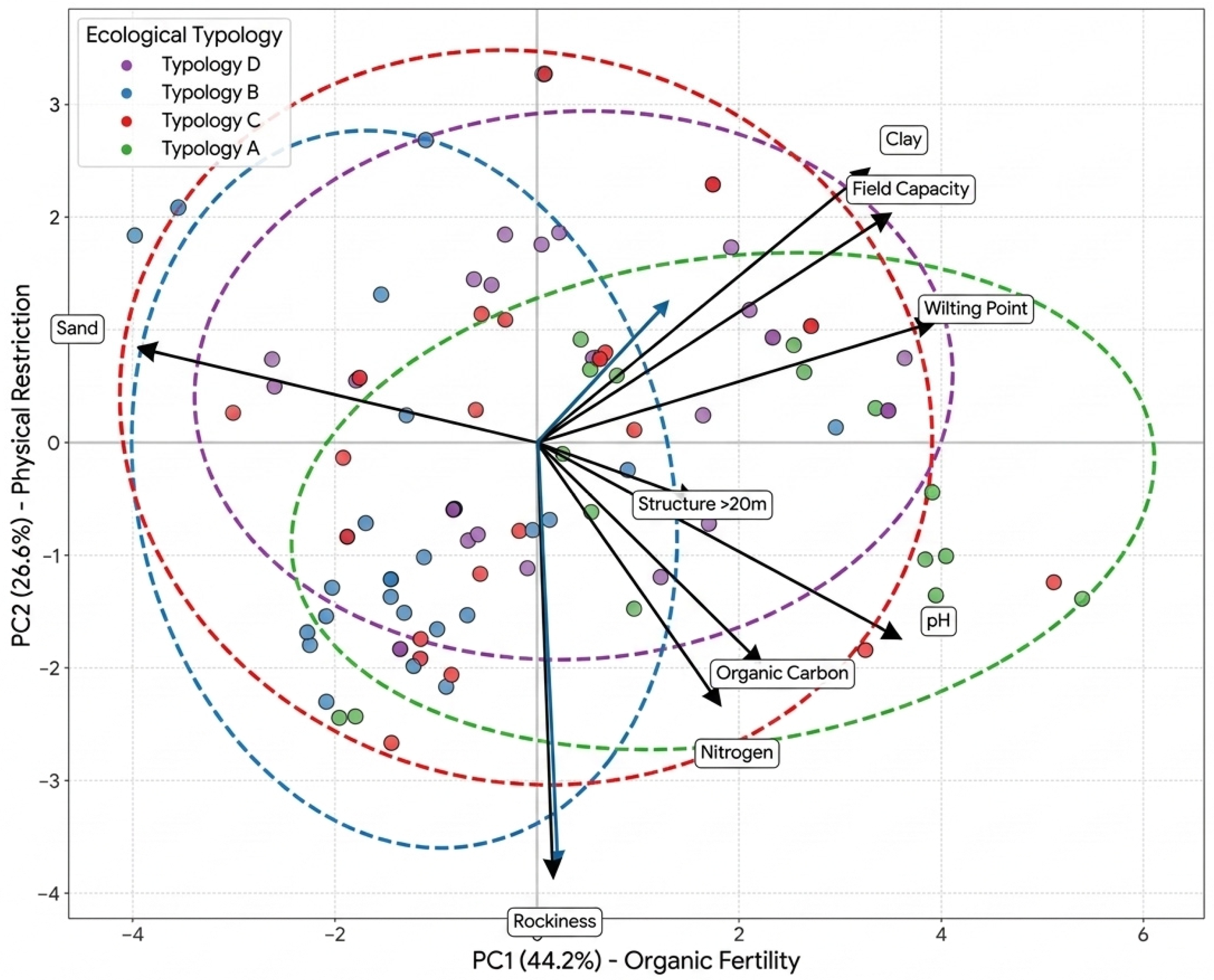
The Principal Component Analysis (PCA) of edaphic variables (Figure 6) revealed that substrate variability is structured along two orthogonal gradients that explain 70.8% of the total variance. The first component (PC1, 44.2%) was defined as a fertility and soil porosity, showing high positive loadings for pH (0.93), organic carbon (0.88), and field capacity (0.73). This indicates a functional coupling in which soils with higher organic matter content and finer texture (clay: 0.70) maximize resource availability (see Supplementary Table S3).
In turn, the second component (PC2, 26.6%) represented the physical restriction filter, dominated by a strong negative loading of rockiness (−0.92), and a strong component of clay content and field capacity, which are related to the soil water holding capacity. The independence of this axis is crucial, as it confirms that physical constraints imposed by rockiness act as a filter distinct from chemical fertility. As detailed in Table 2, biomass (NDVI) is positively correlated with water-holding capacity (clay: r = 0.32), whereas vertical structure depends on long-term stability and fertility (organic carbon: r = 0.31). This pattern explains the persistence of Typology D: sites that, despite being chemically fertile (positive PC1 scores), are structurally constrained by rockiness (negative PC2 scores).

4. Discussion

4.1. Contingent Successional Trajectories and Structural Filters in Tropical Karst Landscapes

The results of this study demonstrate that forest regeneration in tropical karst landscapes cannot be adequately described by a linear successional gradient based solely on patch age. Instead, the identification of four contrasting ecological typologies that coexist within similar temporal ranges, yet differ markedly in structure, composition, and functioning, reveals a system governed by contingent successional trajectories. These are modulated by the interaction among disturbance legacies, biotic processes, and persistent edaphic constraints.
We acknowledge that the four ecological typologies were identified using a subset of the structural and floristic variables; therefore, differences in these specific parameters among groups are expected by design. However, the ecological validity of this classification is supported by the significant divergence observed in external, independent variables that were not included in the clustering process, such as historical management intensity, the abundance of legacy species, and the underlying edaphic constraints. This confirms that the identified typologies represent distinct ecological states driven by historical and environmental filters rather than being mere mathematical artifacts.
Multivariate ordination confirmed the existence of two independent functional axes: one associated with floristic complexity (species diversity and richness) and another linked to structural maturity (canopy cover, biomass, and age).
This pattern suggests a frequent asynchrony or functional independence among diversity, biomass, and vertical structure. Although the use of specific proxies such as NDVI and a single height threshold provides a simplified view of these dynamics, the observed lack of synchronization may reflect the particular resolution of these indicators at the landscape scale [26,27]. Such functional asynchrony suggests that carbon sequestration potential (biomass) and biodiversity (richness) can recover much faster than physical habitat complexity (canopy height) in karst landscapes, which has profound implications for carbon market accounting and ecosystem service valuation.
Our findings on the asynchrony between biomass and vertical structure align with recent research in the Yucatán Peninsula that highlights the complexity of mapping aboveground biomass in fragmented and managed landscapes. Studies by Hernández-Stefanoni et al. [28] and Reyes-Palomeque et al. [29] show that, in neotropical dry forests, biomass can recover independently of canopy complexity, reinforcing our observation that height is not always a reliable indicator of ecosystem functioning in karst environments. This functional independence is an emergent feature that must be integrated into vegetation succession frameworks to avoid misdiagnoses of forest maturity.
Our results provide empirical support for this pattern by showing that diversity, biomass, and vertical structure are not only weakly coupled but can follow contrasting trajectories within the same landscape and age range. Across the four typologies identified, sites with comparable successional ages exhibited markedly different combinations of species richness, NDVI, and canopy development. This indicates that structural complexity is not a reliable proxy for compositional recovery or ecosystem functioning in karst environments. This finding is particularly evident in typologies that combine high diversity or biomass with limited vertical development, underscoring that structural filters operate independently from floristic assembly processes.
Together, these patterns indicate that successional dynamics in tropical karst forests are better described as a set of contingent pathways constrained by both historical and environmental filters, rather than as a single directional trajectory toward a structurally uniform mature state. In this context, patch age functions as a necessary but insufficient predictor of successional outcomes. Forest structure emerges as an emergent property shaped by the complex interaction between species composition, disturbance legacies, and persistent substrate limitations.

4.2. Dichotomy in Vegetation Dynamics Induced by Disturbance Legacies

The comparison between Typology B (enriched secondary forest) and Typology C (arrested succession) constitutes one of the central findings of this study, as it reveals a clear dichotomy in vegetation dynamics under comparable initial conditions of age and management intensity. The NMDS showed that these typologies do not represent variations along a single continuum, but rather distinct floristic assemblages, indicating that disturbance history affects not only the rate of recovery but also the ecological identity of the resulting forest.
These legacies do not merely represent historical artifacts of management, but function as recovery nuclei that accelerate canopy closure and modify microclimatic conditions, thereby influencing subsequent community assembly. The persistence and high abundance of commercial species such as Swietenia macrophylla and Cedrela odorata indicate that these trees not only survive abandonment but also rapidly structure the secondary canopy, facilitating coexistence with other native species and accelerating compositional recovery. This pattern is consistent with recent studies in abandoned agroforestry systems of Mesoamerica, Southeast Asia, and West Africa, where the retention of perennial woody species promotes enriched successional trajectories without collapsing alpha diversity [2,30,31,32].
In contrast, Typology C represents an alternative impoverished state, dominated by lianas and characterized by a substantial loss of diversity and structure. The high proportion of sites dominated by climbers (85.7%) suggests the activation of a persistent biotic barrier, in which competition for light, water, and nutrients inhibits tree recruitment and stabilizes an arrested successional state [33]. This mechanism has been widely documented in seasonal and dry tropical forests, where lianas exhibit physiological advantages under conditions of water stress and recurrent disturbance [34,35,36]. Our results empirically confirm that, in karst landscapes, time since abandonment alone is insufficient to reverse this blockage once it becomes established.
The high dominance of lianas in our Typology C (85.7%) is consistent with the global trend of “liana proliferation” documented in recent international studies from 2024 and 2025 [33,36,37,38]. Research in Panama and other neotropical sites suggests that lianas are reducing forests’ carbon storage capacity by suppressing tree growth and increasing tree mortality, a process that appears to accelerate under conditions of higher atmospheric CO2 [39,40]. Compared with other secondary forests in the region, the level of infestation detected in “El Tormento” confirms that the dominance of climbing plants acts as a persistent biotic barrier that requires specific management interventions to be reversed.
This divergence suggests that regeneration success does not depend solely on propagule availability, but rather on a mechanism of asymmetric competition for light and vertical space [41,42]. In Typology B, legacy trees act as nucleation nuclei that accelerate canopy closure, generating preventive shading that suppresses the proliferation of heliophytic lianas [43]. In contrast, in Typology C, the absence of these structural legacies allows lianas—favored by higher photosynthetic efficiency under water stress and high radiation—to rapidly colonize the space, creating a biotic barrier [44,45]. This process establishes a positive feedback loop: by preventing the recruitment of hardwood seedlings, lianas maintain an open canopy, ensuring the light conditions that perpetuate their dominance and stabilize an arrested successional state that chronological time alone fails to reverse [39].

4.3. Functional Maturity Without Verticalization: The Role of the Edaphic Filter

Typology D (structurally constrained mature forest) adds an additional dimension to the conceptual framework of secondary succession by demonstrating that, even in the absence of historical disturbance and after more than six decades of recovery, vertical forest development can remain severely limited. The coexistence of high diversity, elevated biomass, and reduced vertical structure confirms that the absence of tall trees does not necessarily indicate degradation or successional failure, but rather the expression of an environmentally constrained ecological maturity.
Edaphic analyses showed that this restriction is driven by a physical filter independent of chemical fertility, dominated by rockiness and shallow effective soil depth. This structural limitation imposed by the karst substrate is not an isolated phenomenon in our study area. Comparisons with karst forests in China and the Caribbean show a convergence in species’ “hydro-functional” strategies, where effective soil depth determines the canopy ceiling regardless of patch age [46,47,48]. A recent 2025 study of seasonal karst forests highlights how water limitations and rockiness force species to adopt conservative water-use strategies, limiting vertical growth to avoid hydraulic embolism in shallow soils [49]. The “atrophied” structure of Typology D can be interpreted not as a failure of recovery, but as a state in which unfavorable abiotic conditions (shallow soils and high rockiness) prevent a few vigorous and competitive species from dominating the community. Similar to patterns observed in other resource-limited ecosystems, these environmental constraints may act as a filter that maintains high levels of diversity by limiting the competitive exclusion that often occurs in more productive sites. This positions our Typology D as a functionally stable and adapted mature state, comparable to other fragile karst systems worldwide. This functional asynchrony between fertility and structure is consistent with recent evidence from karst forests in China, Spain, and the Balkans, where aboveground biomass can recover relatively quickly, while canopy height remains limited by the inability to achieve deep root anchorage and by restricted access to stored water [47,48].
The phenomenon of Typology D can be explained through the hydraulic trade-off between tree architecture and hydraulic safety [45]. In shallow karst soils, attaining great height increases the risk of xylem cavitation and embolism due to the extreme tension required to transport water from a restricted substrate to an elevated canopy [50]. Consequently, the “stunted” structure of these forests is not a sign of immaturity, but rather an adaptive water-saving strategy [49,50].
From an ecophysiological perspective, these conditions favor conservative strategies that prioritize survival and water-use efficiency over vertical elongation. Resource investment shifts from stem elongation toward tissue persistence and wood density, allowing the community to maintain levels of biomass (NDVI) and diversity comparable to the reference mature forest (Typology A) without compromising functional integrity under chronic hydric stress. Thus, karst soils do not act as a passive background, but rather as active drivers of successional trajectories, defining biophysical thresholds that cannot be overcome by time alone.

4.4. Conceptual and Management Implications

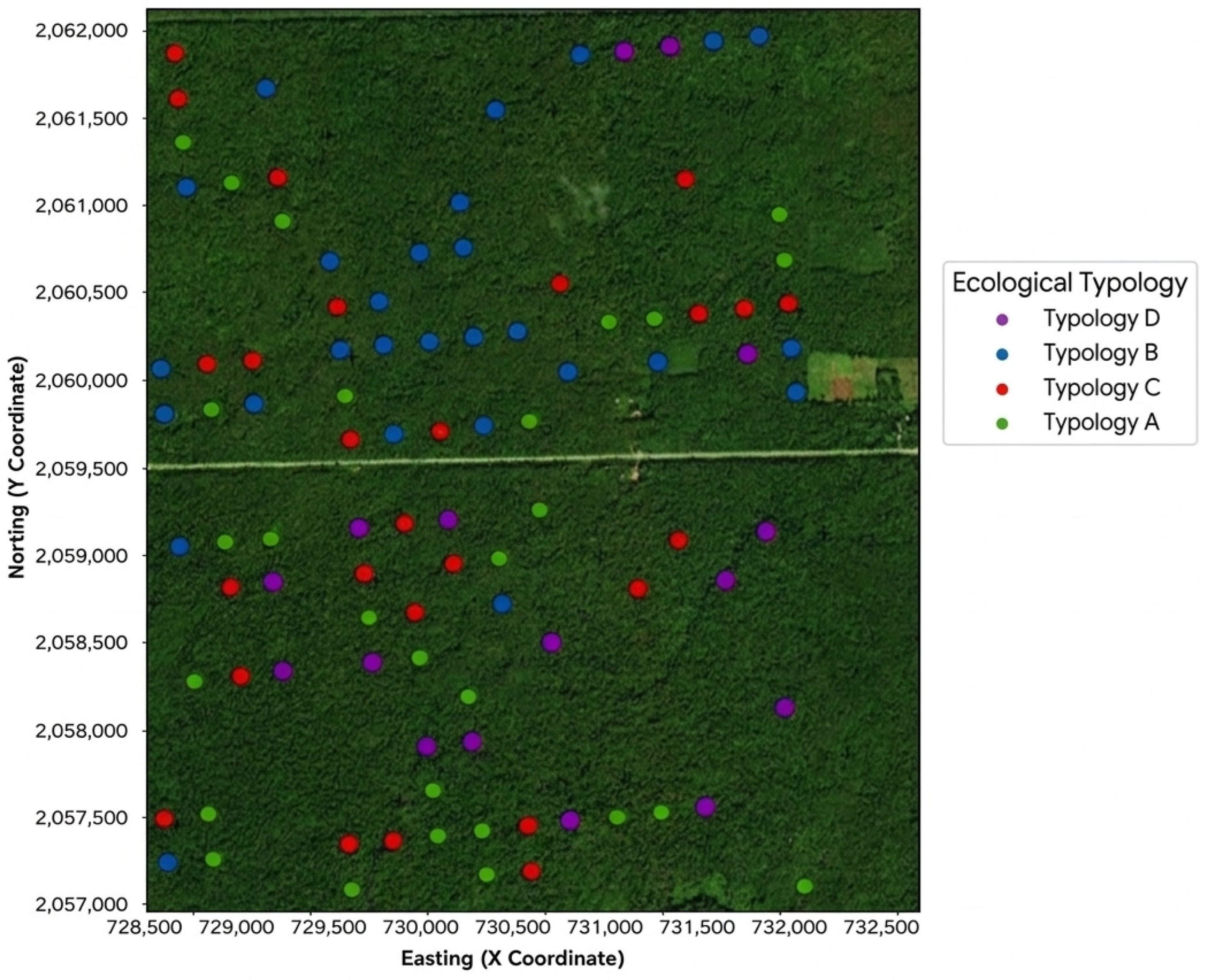
It is necessary to acknowledge certain limitations inherent to our methodological approach. First, this study relied on a chronosequence (space-for-time substitution) to infer successional trajectories. Although this approach is standard in tropical ecology, it implicitly assumes that sites of different ages share comparable baseline environmental conditions. While our design explicitly incorporated edaphic variability and management history to control for this bias, the influence of spatial heterogeneity or undocumented stochastic events (e.g., localized fires, floods or hurricanes) that may have differentially affected landscape structure cannot be ruled out (Figure 7).
Second, the functional metrics used—particularly NDVI—represent a snapshot characterization that may not capture the full extent of intra-annual phenological variability in seasonal forests. Likewise, edaphic characterization focused on the upper 30 cm of soil; given that karst systems are three-dimensional and highly heterogeneous, deep fractures or subsurface reservoirs of water and nutrients not captured by surface sampling may exist. Nevertheless, the strong gradient of physical restriction detected by the PCA suggests that surface sampling served as an effective proxy for rooting limitations.
Despite these limitations, the magnitude and consistency of the observed divergences—particularly the contrast between enriched recovery (Typology B) and structural collapse driven by competition (Typology C) under similar initial conditions—provide strong support for the central hypothesis. The results indicate that secondary succession in these landscapes is not a linear process governed solely by time, but rather a complex dynamic modulated by the interaction between historical land-use legacies and severe biophysical filters.
Taken together, the findings support a framework of nonlinear, multi-trajectory succession in tropical karst landscapes. In this context, the identified typologies should be interpreted as alternative functional ecological states rather than as transient stages along a single temporal gradient. Forest regeneration thus emerges as a path-dependent process, in which small differences in disturbance type, dominant biota, or substrate can lead to profoundly different ecological outcomes.
This insight has direct implications for conservation and restoration. In particular, it helps avoid unrealistic expectations of canopy verticalization in edaphically constrained sites (Typology D), which could otherwise be misclassified as degraded. It also highlights the urgent need to monitor and intervene in arrested states dominated by lianas (Typology C), where active restoration (e.g., liana cutting) may be required to break the biotic barrier. Conversely, it recognizes the potential of certain agroforestry legacies (Typology B) as functional allies for diversity recovery.
Finally, we must acknowledge the limitations of using a single height threshold (>20 m) as a proxy for vertical structure. While this metric provided a standardized way to compare canopy development across the landscape, it represents a simplified characterization of forest architecture. As pointed out by recent ecological frameworks, vertical complexity is not solely a function of height; a single spreading tree with a broad crown can offer a higher diversity of microhabitats, niches, and stable habitats than a dense cluster of tall, slender trees. In the context of the ‘stunted’ forests identified in Typology D, our proxy may underestimate their true structural and ecological value, as these sites likely harbor significant architectural complexity that is not captured by maximum height alone.
In karst landscapes, assessing forest condition exclusively on the basis of age or canopy height may lead to misleading diagnoses. Effective management must instead integrate structure, composition, function, and edaphic context to design strategies tailored to the specific successional trajectory of each site.

5. Conclusions

This study challenges the paradigm of linear, time-driven succession in tropical karst landscapes. Our results demonstrate that forest regeneration follows multiple contingent trajectories, giving rise to distinct ecological typologies that coexist within similar age ranges but differ markedly in structure, composition, and functioning. Consequently, patch age alone proves to be a poor predictor of successional outcomes in heterogeneous karst systems.
Disturbance legacies emerge as critical bifurcation points for these trajectories. Historical agroforestry and silvicultural practices leave positive biological legacies—such as commercial timber species—that accelerate compositional recovery and promote Enriched Secondary Forests (Typology B). Conversely, disruptive land-use histories can trigger persistent biotic barriers, specifically liana dominance, locking the system into Arrested Successional states (Typology C) with collapsed diversity and structural complexity. Thus, historical land use determines not only the rate of recovery but also the ecological identity of the regenerating forest.
Crucially, we document a functional asynchrony between floristic recovery, biomass accumulation, and vertical structural development. High levels of species diversity and photosynthetic biomass can be achieved even in forests with limited canopy height, as observed in the Structurally Constrained Mature Forests (Typology D). This finding indicates that vertical stature should not be interpreted as a universal proxy for forest maturity, particularly in karst environments where shallow soils impose physical limits on tree height through hydraulic and anchorage trade-offs.
Finally, the edaphic filter operates as a dual-control mechanism shaping these outcomes. Our analysis confirms that chemical fertility and physical constraints act as independent drivers: while soil fertility and water-holding capacity (PC1) support biomass and functional recovery, rockiness and shallow soil depth (PC2) impose long-term limitations on vertical growth. Therefore, the short-statured mature forests identified in this landscape represent stable, edaphically determined successional outcomes rather than degraded systems.
Taken together, these results indicate that succession in karst systems operates under a hierarchical filtering model. While floristic composition responds primarily to chemical fertility and management history, the physical structure of the forest is governed by a mechanical and anchorage filter. This independence of processes explains why it is possible to find floristically mature forests that lack the vertical complexity typical of lowland tropical rainforests, challenging the traditional view that canopy height is a universal indicator of ecosystem health or age.
Overall, effective conservation and restoration in the Maya Forest require abandoning uniform expectations of canopy development. Management strategies must adopt a trajectory-specific framework that integrates disturbance history, vegetation structure, and local edaphic context to distinguish between forests that are genuinely arrested by degradation and those that are naturally constrained by the karst substrate.

Supplementary Materials

The following supporting information can be downloaded at: https://www.mdpi.com/article/10.3390/f17030386/s1, Table S1: Summary of data sources, spatial resolution, and temporal coverage for the ecological and environmental variables analyzed in this study. Table S2: Comparative analysis between the historical record of land use and the current presence of promoted or introduced species, indicating their success rate and the ecological typology in which they currently predominate. Table S3: Loadings of edaphic variables on the first two Principal Components.

Author Contributions

Conceptualization, A.M.-M. and T.A.R.; methodology, A.M.-M., T.A.R. and J.D.-B.; software, J.D.-B.; validation, A.M.-M., J.D.-B. and T.A.R.; formal analysis, A.M.-M., T.A.R. and J.D.-B.; investigation, A.M.-M., L.E.-O. and Y.G.A.-D.; resources, A.M.-M. and T.A.R.; data curation, T.A.R.; writing—original draft preparation, A.M.-M. and T.A.R.; writing—review and editing, A.M.-M., Y.G.A.-D., L.E.-O., E.M.-R. and T.A.R.; visualization, A.M.-M.; supervision, T.A.R.; project administration, A.M.-M.; funding acquisition, A.M.-M. and T.A.R. All authors have read and agreed to the published version of the manuscript.

Funding

This research was funded by the Comisión Nacional Forestal (CONAFOR), project number 11202833851, which financed the research, and by the Instituto Nacional de Investigaciones Forestales, Agrícolas y Pecuarias (INIFAP), grant number SIGI: 10102736648, for the generation of soil variables.

Data Availability Statement

Data are available from the corresponding author upon reasonable request.

Acknowledgments

The authors would like to thank Víctor Manuel Rodríguez Moreno for his support of the project and for providing the soil data used in this study. We also thank the Demetrio Álvarez and Manuel Arana for their valuable support. Additionally, we acknowledge the administrative and technical assistance that contributed to the completion of this work.

Conflicts of Interest

The authors declare no conflicts of interest.

Abbreviations

The following abbreviations are used in this manuscript:
CITTFORCentro de Investigación y Transferencia de Tecnología Forestal
LNMYSRLaboratorio Nacional de Modelaje y Sensores Remotos
NDVINormalized Difference Vegetation Index
NMDSNon-metric Multidimensional Scaling
PCAThe Principal Component Analysis
PERMANOVAPermutational Multivariate Analysis of Variance

References

  1. Gee, A.; Werden, L.K.; Verduzco-Salazar, O.E.; Nie, R.; Waring, B.G. Secondary succession of a seasonally dry tropical forest is taxonomically stochastic but functionally deterministic. For. Ecol. Manag. 2025, 598, 123184. [Google Scholar] [CrossRef]
  2. Poorter, L.; Craven, D.; Jakovac, C.C.; van der Sande, M.T.; Amissah, L.; Bongers, F.; Chazdon, R.L.; Farrior, C.E.; Kambach, S.; Meave, J.A.; et al. Multidimensional tropical forest recovery. Science 2021, 374, 1370–1376. [Google Scholar] [CrossRef] [PubMed]
  3. Costa, J.R.S.; Brancalion, P.H.S.; Joly, F.-X.; Simões, L.H.P.; Bonfanti, J.; Maire, G.l.; Robin, A.; Guillemot, J. Forest Ecosystem Multifunctionality: A Systematic Review of Measures and Drivers. Curr. For. Rep. 2026, 12, 2. [Google Scholar] [CrossRef]
  4. Chazdon, R.L. Second Growth: The Promise of Tropical Forest Regeneration in an Age of Deforestation; University of Chicago Press: Chicago, IL, USA, 2014; pp. 55–60. [Google Scholar] [CrossRef]
  5. Arroyo-Rodríguez, V.; Melo, F.P.; Martínez-Ramos, M.; Bongers, F.; Chazdon, R.L.; Meave, J.A.; Norden, N.; Santos, B.A.; Leal, I.R.; Tabarelli, M. Multiple successional pathways in human-modified tropical landscapes: New insights from forest succession, forest fragmentation and landscape ecology research. Biol. Rev. 2017, 92, 326–340. [Google Scholar] [CrossRef]
  6. Gómez-Pompa, A.; Kaus, A. From pre-Hispanic to future conservation alternatives: Lessons from Mexico. Proc. Natl. Acad. Sci. USA 1999, 96, 5982–5986. [Google Scholar] [CrossRef]
  7. Ross, N.J. Modern tree species composition reflects ancient Maya “forest gardens” in northwest Belize. Ecol. Appl. 2011, 21, 75–84. [Google Scholar] [CrossRef]
  8. Schnitzer, S.A.; Bongers, F. Increasing liana abundance and biomass in tropical forests: Emerging patterns and putative mechanisms. Ecol. Lett. 2011, 14, 397–406. [Google Scholar] [CrossRef]
  9. Smith-Martin, C.M.; Jansen, S.; Brodribb, T.J.; Medina-Vega, J.A.; Lucani, C.; Huppenberger, A.; Powers, J.S. Lianas and trees from a seasonally dry and a wet tropical forest did not differ in embolism resistance but did differ in xylem anatomical traits in the dry forest. Front. For. Glob. Change 2022, 5, 834891. [Google Scholar] [CrossRef]
  10. Dupuy, J.M.; Hernández-Stefanoni, J.L.; Hernández-Juárez, R.A.; Tetetla-Rangel, E.; López-Martínez, J.O.; Leyequién-Abarca, E.; Tun-Dzul, F.J.; May-Pat, F. Patterns and correlates of tropical dry forest structure and composition in a highly replicated chronosequence in Yucatán, Mexico. Biotropica 2012, 44, 151–162. [Google Scholar] [CrossRef]
  11. Hernández-Stefanoni, J.L.; Dupuy, J.M.; Tun-Dzul, F.; May-Pat, F. Influence of landscape structure and stand age on species density and biomass of a tropical dry forest across spatial scales. Landsc. Ecol. 2011, 26, 355–370. [Google Scholar] [CrossRef]
  12. García, E. Modificaciones al Sistema de Clasificación Climática de Köppen (Para Adaptarlo a las Condiciones de la República Mexicana), 5th ed.; Instituto de Geografía, UNAM: Mexico City, Mexico, 2004; pp. 41–47. [Google Scholar]
  13. Bautista, F.; Palacio-Aponte, G.; Quintana, P.; Zinck, J.A. Spatial distribution and development of soils in tropical karst areas from the peninsula of Yucatan, Mexico. Geomorphology 2011, 135, 308–321. [Google Scholar] [CrossRef]
  14. Uzcanga, P.N.G.; Aguilar, D.Y.G.; Maya, M.A.; Díaz, M.E.R.A.; Esparza, O.L.G. Compendio Histórico de la Investigación Realizada en el Centro de Investigación y Transferencia de Tecnología Forestal El Tormento; Instituto Nacional de Investigaciones Forestales, Agrícolas y Pecuarias: Mérida, Mexico, 2018; 36p. [Google Scholar]
  15. Aguilar, Y.A.D.; Martínez, A.M.; Olguín, L.E.; García, G.H.; Cruz, R.C.; Chiquini, W.A.H. Actualización cartográfica forestal en una zona kárstica del sureste mexicano. In Conocimientos y Saberes Sobre Sobre el Karst Tropical de México; Martínez, O.F., Ed.; AMEK: Mérida, Mexico, 2019; pp. 95–115. [Google Scholar]
  16. Colwell, R.K.; Coddington, J.A. Estimating terrestrial biodiversity through extrapolation. Philos. Trans. R. Soc. Lond. B Biol. Sci. 1994, 345, 101–118. [Google Scholar] [CrossRef] [PubMed]
  17. Colwell, R.K. EstimateS v. 8.2. 0: Statistical estimation of species richness and shared species from samples. In User’s Guide and Application; Department of Ecology and Evolutionary Biology, University of Connecticut: Storrs, CT, USA, 2009. [Google Scholar]
  18. Jardel-Peláez, E.J. Guía para la Caracterización y Clasificación de Hábitats Forestales; Comisión Nacional Forestal: Zapopan, Mexico, 2015; 115p. [Google Scholar]
  19. Paz, F.; Casiano, M.; Cruz, C.O.; Argumedo, J.; de Jong, B.; Flores, R.; Ochoa, S. (Coordinators) Manual de Referencia para el Muestreo Semicuantitativo del Inventario Forestal Comunitario: Bosques y Selvas; Programa Mexicano del Carbono: Mexico City, Mexico, 2011; 49p, Available online: https://pmcarbono.org/pmc/descargas/manuales/Manual_Inventario_Forestal_Estatal_Semicuantitativo_1_Bosques_y_Selvas.pdf (accessed on 11 March 2026).
  20. González, F.G.M. Las Comunidades Vegetales de México: Propuesta para la Unificación de la Clasificación y Nomenclatura de la Vegetación de México, 2nd ed.; INE-SEMARNAT: Mexico City, Mexico, 2004; 88p. [Google Scholar]
  21. Bueno, I.T.; McDermid, G.J.; Silveira, E.M.; Hird, J.N.; Domingos, B.I.; Acerbi, F.W.J. Spatial agreement among vegetation disturbance maps in tropical domains using Landsat time series. Remote Sens. 2020, 12, 2948. [Google Scholar] [CrossRef]
  22. Rodríguez-Moreno, V.M.; Delgado-Balbuena, J.; Reyna, T.A.; Valenzuela-Solano, C.; López-Hernández, N.A. Estimating Soil Hydraulic Properties Using Random Forest Pedotransfer Functions and SoilGrids Data in Mexico. Earth 2026, 7, 10. [Google Scholar] [CrossRef]
  23. Poorter, L.; van der Sande, M.T.; Amissah, L.; Bongers, F.; Hordijk, I.; Kok, J.; Laurance, S.G.W.; Martínez-Ramos, M.; Matsuo, T.; Meave, J.A.; et al. A comprehensive framework for vegetation succession. Ecosphere 2024, 15, e4794. [Google Scholar] [CrossRef]
  24. Tucker, J.M.; Brondizio, E.S.; Moran, E.F. Secondary succession in the Eastern Amazon: Structural characterization and determinants of regrowth rates. In Ecology and Management of Tropical Secondary Forest: Science, People, and Policy; Centro Agronómico Tropical de Investigación y Enseñanza (CATIE): Turrialba, Costa Rica, 1998; pp. 49–67. [Google Scholar]
  25. Legendre, P.; Legendre, L.F.J. Numerical Ecology; Developments in Environmental Modelling; Elsevier Science: Amsterdam, The Netherlands, 1998; Available online: https://books.google.com.mx/books?id=KBoHuoNRO5MC (accessed on 11 March 2026).
  26. Ciceu, A.; Bronisz, K.; Garcia-Duro, J.; Badea, O. Age-independent diameter increment models for mixed mountain forests. Eur. J. For. Res. 2022, 141, 781–800. [Google Scholar] [CrossRef]
  27. Arasa-Gisbert, R.; Arroyo-Rodriguez, V.; Meave, J.A. The impact of human disturbances on the regeneration layer of tropical rainforests. Environ. Res. Lett. 2024, 19, 123004. [Google Scholar] [CrossRef]
  28. Hernández-Stefanoni, J.L.; Hernández-Martínez, L.A.; Andres-Mauricio, J.; Peña-Lara, V.A.; González-Muñoz, K.E.; Tun-Dzul, F.; Portillo-Quintero, C.A.; Gamboa-Blanco, E.A.; George-Chacon, S. Spatial distribution and drivers of aboveground forest biomass in Mexico using GEDI and national forest inventory data. Remote Sens. Ecol. Conserv. 2025, 11, 755–772. [Google Scholar] [CrossRef]
  29. Reyes-Palomeque, G.; Andrés-Mauricio, J.; Hernández-Martínez, L.A.; Peña-Lara, V.; Tun-Dzul, F.; Hernández-Stefanoni, J.L. Enhancing Aboveground Biomass Estimation in Tropical Dry Forests with GEDI, Sentinel-1/2 and National Forest Inventory Data. Remote Sens. Appl. Soc. Environ. 2026, 41, 101897. [Google Scholar] [CrossRef]
  30. Hordijk, I.; Poorter, L.; Meave, J.A.; Bongers, F.; van der Sande, M.T.; López Mendoza, R.D.; Jamangapé Romero, P.; de Jong, J.; Martínez-Ramos, M. Land use history and landscape forest cover determine tropical forest recovery. J. Appl. Ecol. 2024, 61, 2365–2381. [Google Scholar] [CrossRef]
  31. Sahoo, G.; Wani, A.M.; Sharma, A.; Rout, S. Agroforestry for forest and landscape restoration. Int. J. Adv. Study Res. Work 2020, 9, 536–542. [Google Scholar]
  32. Raj, A.; Jhariya, M.K.; Pandey, V.C. Agroforestry for Landscape Restoration and Sustainability. In Plantation-Based Land Restoration; Springer Nature: Singapore, 2025; pp. 139–159. [Google Scholar]
  33. Ngute, A.S.K.; Schoeman, D.S.; Pfeifer, M.; van Der Heijden, G.M.; Phillips, O.L.; van Breugel, M.; Campbell, M.J.; Chandler, C.J.; Enquist, B.J.; Gallagher, R.V.; et al. Global dominance of lianas over trees is driven by forest disturbance, climate and topography. Glob. Change Biol. 2024, 30, e17140. [Google Scholar] [CrossRef] [PubMed]
  34. Schnitzer, S.A.; Carson, W.P. Lianas suppress tree regeneration and diversity in treefall gaps. Ecol. Lett. 2010, 13, 849–857. [Google Scholar] [CrossRef] [PubMed]
  35. Schnitzer, S.A. Increasing liana abundance in neotropical forests: Causes and consequences. In Ecology of Lianas; John Wiley & Sons, Inc.: Hoboken, NJ, USA, 2015; pp. 451–464. [Google Scholar] [CrossRef]
  36. Visser, M.D.; Detto, M.; Meunier, F.; Wu, J.; Foster, J.R.; Marvin, D.C.; van Bodegom, P.M.; Bongalov, B.; Nunes, M.H.; Coomes, D.; et al. When can we detect lianas from space? Toward a mechanistic understanding of liana-infested forest optics. Ecology 2025, 106, e70082. [Google Scholar] [CrossRef] [PubMed]
  37. Kaçamak, B.; Réjou-Méchain, M.; Rowe, N.; Rossi, V.; Barbier, N.; Bazan, S.; Forni, E.; Guibal, D.; Harris, D.J.; Loubota Panzou, G.J.; et al. Local forest structure and host specificity influence liana community composition in a moist Central African forest. Ecol. Evol. 2025, 15, e71075. [Google Scholar] [CrossRef]
  38. Mackintosh, E.J.; Waite, C.E.; Putz, F.E.; Brennan, S.; Pfeifer, M.; Marshall, A.R. Lianas associated with continued forest biomass losses following large-scale disturbances. Biotropica 2024, 56, e13348. [Google Scholar] [CrossRef]
  39. Schnitzer, S.A.; DeFilippis, D.M. Does increasing canopy liana density decrease the tropical forest carbon sink? Ecology 2025, 106, e70196. [Google Scholar] [CrossRef]
  40. Cao, X.; Van Coillie, F.; Krishna Moorthy, S.M.; Coppieters, K.; D’hont, B.; Schnitzer, S.A.; van der Heijden, G.; Verbeeck, H.; Meunier, F. Lianas reduce tree height with negative consequences for carbon storage and growth estimates. J. Ecol. 2025, 113, 1647–1658. [Google Scholar] [CrossRef]
  41. van der Sande, M.T.; Poorter, L.; Derroire, G.; do Espirito Santo, M.M.; Lohbeck, M.; Müller, S.C.; Bhaskar, R.; van Breugel, M.; Dupuy-Rada, J.M.; Durán, S.M.; et al. Tropical forest succession increases tree taxonomic and functional richness but decreases evenness. Glob. Ecol. Biogeogr. 2024, 33, e13856. [Google Scholar] [CrossRef]
  42. Arasa-Gisbert, R.; Arroyo-Rodríguez, V.; Cervantes-López, M.D.J.; Meave, J.A. The need for a strict delimitation of early tree life stages in vegetation ecology. J. Veg. Sci. 2024, 35, e13313. [Google Scholar] [CrossRef]
  43. de Freitas, T.C.; Teixeira, L.H.; Júnior, R.G.; Venterink, H.O.; Carvalho, F.A. Assessing nucleation strategies and spatial dynamics in the restoration of neotropical terrestrial ecosystems: A comprehensive review. Ecol. Eng. 2025, 220, 107725. [Google Scholar] [CrossRef]
  44. Palomo-Kumul, J.; Valdez-Hernández, M.; Islebe, G.A.; Osorio-de-la-Rosa, E.; Cruz-Piñon, G.; López-Huerta, F.; Juárez-Aguirre, R. Hydro-Functional Strategies of Sixteen Tree Species in a Mexican Karstic Seasonally Dry Tropical Forest. Forests 2025, 16, 1535. [Google Scholar] [CrossRef]
  45. Carrière, S.D.; Ruffault, J.; Cakpo, C.B.; Olioso, A.; Doussan, C.; Simioni, G.; Chalikakis, K.; Patris, N.; Davi, H.; MartinSt-Paul, N.K. Intra-specific variability in deep water extraction between trees growing on a Mediterranean karst. J. Hydrol. 2020, 590, 125428. [Google Scholar] [CrossRef]
  46. Peng, W.; Song, M.; Du, H.; Jiang, S.; Zeng, F.; Chen, H.; Song, T. Assembly processes and networks of soil microbial communities along karst forest succession. Catena 2025, 248, 108574. [Google Scholar] [CrossRef]
  47. Zhou, H.; Feng, X.; He, Z.; Yang, Q.; Ren, H.; Zhao, W. Rapid recovery of desert shrubs is attributed to imbalance of water supply to demand after disturbance in Northwest China. Ecol. Process. 2024, 13, 29. [Google Scholar] [CrossRef]
  48. Peng, Q.; Yin, P.; Ye, X.; Li, H.; Liang, X.; Tian, Z.; Xiao, Y.; Cheng, X.; Liu, L.; Liu, K.; et al. Thermal-index monitoring of water status in humid-region urban forests: A canopy-temperature-based approach. Smart For. 2025, 1, e003. [Google Scholar]
  49. Liu, X.; Chen, X.; Zhang, Z.; Liu, W.; Gao, F.; Cheng, Q.; Chen, J.; Peng, T. The role of rock fractures as a water source for trees growing in karst. Water Resour. Res. 2025, 61, e2024WR039588. [Google Scholar] [CrossRef]
  50. Biber, P.; Seifert, S.; Zaplata, M.K.; Schaaf, W.; Pretzsch, H.; Fischer, A. Relationships between substrate, surface characteristics, and vegetation in an initial ecosystem. Biogeosciences 2013, 10, 8283–8303. [Google Scholar] [CrossRef]
Figure 1. Location of the study area in El Tormento, municipality of Escárcega, Campeche, Mexico. The red points indicate the location of the sampling plots analyzed in this study. The background map on the left shows the Normalized Difference Vegetation Index (NDVI); green tones indicate high photosynthetically active biomass, while reddish and yellowish areas represent low vegetation cover, bare soil, or infrastructure, such as the federal highway and access roads visible in the landscape.
Forests 17 00386 g001
Figure 2. Multivariate distribution and characterization of ecological typologies. Clustering of plots (N = 98) into four distinct ecological states based on structural, floristic, and functional variables: Typology A (Reference mature forest, n = 16), Typology B (Enriched secondary forest, n = 28), Typology C (Arrested succession, n = 26), and Typology D (Structurally constrained mature forest, n = 28). The distribution reflects the partitioning of the landscape into divergent successional trajectories driven by historical and environmental filters.
Forests 17 00386 g002
Figure 3. Non-metric Multidimensional Scaling (NMDS) ordination of tree species composition based on Bray–Curtis dissimilarities, illustrating the segregation of ecological typologies across successional states in the tropical karst landscape.
Forests 17 00386 g003
Figure 4. Influence of disturbance and biological legacies on successional trajectories. Historical management duration (years), abundance of legacy species, and proportion of sites dominated by lianas in each ecological typology.
Forests 17 00386 g004
Figure 5. Structural and floristic differences between successional typologies. Comparison of vertical structure (upper canopy cover > 20 m), floristic diversity (H′), and species richness (S) among ecological typologies. Typology groups are indicated on the x-axis as A–D: A = Typology A Reference mature forest, B = Typology B: Enriched secondary forest, C = Typology C: Arrested succession, D = Typology D: Structurally constrained mature forest.
Forests 17 00386 g005
Figure 6. Edaphic filter and structural restrictions in karst forests. Principal Component Analysis (PCA) ordination of edaphic and ecological variables. The axes represent gradients of organic fertility and soil physical restriction, explaining the persistence of structurally low mature forests (Typology D) under limiting edaphic conditions.
Forests 17 00386 g006
Figure 7. Spatial distribution of the four ecological typologies across the karst landscape of El Tormento. Sampling plots are overlaid on a high-resolution aerial photograph to provide independent visual context regarding forest cover, structural heterogeneity, and landscape fragmentation. Points are color-coded according to the successional states derived from the multivariate clustering.
Forests 17 00386 g007
Table 1. Mean values of patch age, vertical structure (upper canopy cover > 20 m), floristic diversity (Shannon index, H′), species richness (S), photosynthetically active biomass (NDVI), historical management duration (years), proportion of sites dominated by lianas, and legacy species for each ecological typology identified through cluster analysis.
Variable/IndicatorA: Mature ReferenceB: Secondary EnrichedC: Arrested SuccessionD: Mature Restricted
Age (years)57.5 ± 4.428.0 ± 0.031.4 ± 2.464.0 ± 0.0
Vertical structure (upper canopy cover > 20 m)15.00 ± 2.431.05 ± 0.470.95 ± 0.950.71 ± 0.42
Diversity 2.72 ± 0.042.70 ± 0.022.21 ± 0.042.61 ± 0.04
Species richness 15.3 ± 0.715.1 ± 0.49.3 ± 0.413.9 ± 0.5
NDVI (Biomass)0.63 ± 0.010.58 ± 0.010.61 ± 0.010.61 ± 0.01
Historical Management (years)3.1 ± 2.315.6 ± 1.213.9 ± 2.20.0 ± 0.0
Legacy Species (ind/plot)0.73 ± 0.270.87 ± 0.120.43 ± 0.110.61 ± 0.13
Liana Dominance (% of sites)63.6 ± 15.2%60.5 ± 8.0%85.7 ± 7.8%60.7 ± 9.4%
Table 2. Multivariate and bivariate analysis of karst edaphic constraints. Pearson correlations between soil variables and forest biomass (NDVI) and vertical structure (upper canopy cover > 20 m), and loadings of soil variables on the first two axes of the Principal Component Analysis (PCA).
Soil VariableCorr. with Biomass (r NDVI)Corr. with Structure (r Cover > 20 m)PCA Axis 1 (Fertility & Water Retention)PCA Axis 2 (Physical Restriction vs. Aeration)
Soil organic carbon0.150.310.88−0.34
Soil pH (0–30 cm)0.110.300.93−0.32
Clay content0.320.190.700.69
Coarse fragments (Rock)−0.220.040.16−0.92
Total nitrogen−0.050.130.45−0.45
Field Capacity0.280.210.730.6
Wilting Point0.180.280.900.36
Sand content−0.35−0.22−0.970.10
Disclaimer/Publisher’s Note: The statements, opinions and data contained in all publications are solely those of the individual author(s) and contributor(s) and not of MDPI and/or the editor(s). MDPI and/or the editor(s) disclaim responsibility for any injury to people or property resulting from any ideas, methods, instructions or products referred to in the content.