Article

Simultaneous Application of Ammonium and Nitrate Nitrogen Enhances Phytoremediation Efficiency by Mediating Biomass and Bioavailability of Lead and Cadmium in Salix linearistipularis


1
College of Landscape Architecture and Tourism, Hebei Agricultural University, Baoding 071000, China
2
Hongyashan State-Owned Forest Farm of Hebei Province, Baoding 074200, China
3
Hebei Key Laboratory of Floral Biological Breeding, Hebei Agricultural University, Baoding 071000, China
4
Co-Innovation Center for Sustainable Forestry in Southern China, Department of Forest Protection, College of Forestry and Grassland, Nanjing Forestry University, Nanjing 210073, China
*
Authors to whom correspondence should be addressed.
These authors contributed equally to this work.
Forests 2026, 17(3), 364; https://doi.org/10.3390/f17030364
Submission received: 11 February 2026 / Revised: 10 March 2026 / Accepted: 12 March 2026 / Published: 14 March 2026

Abstract

This study aims to elucidate the effects and mechanisms of ammonium (NH4+-N) and nitrate (NO3-N) nitrogen on the efficiency of Salix linearistipularis K. S. Hao in remediating heavy metal-contaminated soils. Thus, the effects of 15 fertilization treatments (comprising three nitrogen levels and five nitrogen form ratios) on Pb and Cd accumulation, soil properties, microbial structure, and metabolic characteristics were investigated using a pot experiment. The results indicated that Pb and Cd accumulation were the highest under the L12 treatment (60 kg N·hm−2·year−1, NH4+-N/NO3-N = 1:2), whereas nitrate-only treatments, irrespective of concentration, resulted in a decrease in accumulation. In the L12 treatment, biomass increased by 87.0%, with Pb and Cd accumulation rising by 85.71% and 80.0%, respectively, suggesting that biomass may contribute predominantly to heavy metal accumulation. Additionally, NH4+-N/NO3-N ratio had a greater effect on biomass than the nitrogen application amount. Microbial composition was altered, and the relative abundance of heavy metal-resistant microbes increased. However, the amount of nitrogen fertilizer had a stronger impact on microbial variation. Under different nitrogen application rates and NH4+-N/NO3-N ratios, the formation or disappearance of unique metabolic pathways related to amino acids and carbohydrates was observed. Furthermore, both microbial metabolism and the bioavailability of Pb and Cd were positively correlated with nitrogen levels and NH4+-N/NO3-N ratios. These findings indicate a potential association between shifts in microbial metabolism and the bioavailability of heavy metals. Therefore, the simultaneous application of ammonium and nitrate nitrogen in appropriate ratios can enhance the remediation efficiency of S. linearistipularis by boosting biomass and heavy metal bioavailability via microbial metabolism. The findings of this study not only provide novel insights into improving the phytoremediation efficiency of woody plants through fertilization strategies but also lay a theoretical foundation for the effects of nitrogen fertilization on nutrient cycling in metal-contaminated soils.

1. Introduction

Soil contamination with heavy metals has become an escalating environmental issue owing to its multiple sources, non-biodegradability, and cumulative nature. Cadmium (Cd) and lead (Pb) are common toxic metals that accumulate in human tissues through the food chain, posing serious health risks [1]. Phytoextraction, which uses plants to absorb and translocate metals to harvestable tissues, is a promising and cost-effective remediation technology [2]. However, its application is often limited by the low bioavailability of target metals in the soil [3,4].
Improving plant biomass and enhancing soil heavy metal bioavailability are the two key strategies to boost phytoremediation efficiency. Most heavy metal-contaminated soils (e.g., mine wastelands, forest marginal soils) are inherently nutrient-poor. Nitrogen (N) is the most important macronutrient for plant growth after carbon, playing a crucial role in plant growth and development. NH4+-N and nitrate NO3-N are the two main inorganic N forms absorbed by plants, and their supply modes (application rates or different N form ratios) exert distinct regulatory effects on plant heavy metal accumulation [2,5]. Previous studies have shown that NO3-N can significantly enhance Cd uptake in rice by up-regulating the expression of OsIRT1 [6], while NH4+-N can promote the accumulation of Cd and Mn in Populus clones, Solanum nigrum L., Brassica napus L., and Polygonum pubescens Blume by inducing rhizosphere acidification and stimulating plant growth [7,8,9,10]. The divergent effects of these two N forms are closely related to species-specific N uptake preferences and their associated metabolic pathways. Plants with a preference for NH4+-N can indirectly promote rhizosphere acidification and heavy metal mobilization through proton extrusion during NH4+ absorption [11], while plants with a preference for NO3-N may absorb heavy metals via NO3-heavy metal co-transporters [12].
Ammonium and nitrate nitrogen are two important forms of nitrogen fertilizer for plants. Optimizing the NH4+-N/NO3-N ratio based on plant traits is crucial for improving nitrogen use efficiency and phytoremediation performance. A 50:50 ratio of NH4+-N/NO3-N has been found to enhance Cd phytoextraction in Panicum maximum cv. Tanzania more effectively than other ratios [13]. However, most existing studies focus on a single nitrogen form or a narrow range of ratios, ignoring the synergistic or antagonistic effects of NH4+-N/NO3-N balance on plant biomass, root architecture, and heavy metal translocation. Thus, studies investigating the effects of nitrogen amount and form ratio on heavy metal accumulation remain limited, particularly for species with high remediation potential such as S. linearistipularis.
In addition, nitrogen fertilization can alter soil chemical properties (e.g., pH, cation exchange capacity) and shape the structure of rhizospheric microbial communities. This not only regulates phytoremediation efficiency [14,15,16,17] but also exerts important implications for nutrient cycling in the soil ecosystem [18,19,20,21]. Ammonium nitrogen nitrification mediated by soil microbes releases hydrogen ions, leading to soil acidification and increased heavy metal bioavailability [22,23,24,25]. Nitrogen addition can reshape the composition of rhizospheric microbial communities, and their metabolites (e.g., organic acids, amino acids) can further modify heavy metal speciation and improve its bioavailability in soil [15,16,17], while also promoting the transformation and utilization of nitrogen nutrients [26]. However, the effects of different nitrogen levels and NH4+-N/NO3-N ratios on phytoremediation and nutrient cycling in contaminated soils remain poorly understood, especially in the rhizosphere of woody plants.
S. linearistipularis, a perennial woody plant with high biomass productivity and strong stress tolerance, shows great potential for the remediation of heavy metal and saline-contaminated soils [27,28,29]. As a typical woody plant suitable for afforestation in contaminated areas, its remediation efficiency is closely related to soil nutrient content. Heavy metal contamination usually causes soil nutrient depletion, and nitrogen, as one of the most important nutrients for plant growth, is a key factor affecting plant growth, as well as heavy metal accumulation and nutrient cycling in contaminated soils. Moreover, in terrestrial ecosystems, soil nitrogen cycling and microbial community structure are key components influencing soil fertility and ecological function. The regulation of nitrogen levels and N form ratios not only affects the phytoremediation efficiency of woody plants but also has important significance for soil nutrient cycling and microbial functional stability in contaminated areas.
Therefore, the primary aims of this study were to (i) investigate the effects of ammonium and nitrate nitrogen amounts and ratios on Pb and Cd accumulation in S. linearistipularis; and (ii) to elucidate the microbial mechanisms influencing Pb and Cd uptake in response to different nitrogen supply modes. The findings of this study will provide novel insights into improving the phytoremediation efficiency of woody plant-based systems for heavy metal-contaminated soils through fertilization strategies, and provide a theoretical basis for further exploring the effects of fertilization on nutrient cycling in metal-polluted soils.

2. Materials and Methods

2.1. Experimental Sites and Plant Material

The experiment was conducted in pots at the experimental station of Hebei Agricultural University, Baoding City, Hebei Province, northern China (38°45′21″ N, 115°24′37″ E). A transparent plastic cloth awning was set up above the experimental area, and the ground was covered with plastic sheeting to prevent contamination of other soils during rainfall. The soil, classified as typical meadow cinnamon soil, has a soil background concentration of Pb and Cd of 23.40 mg·kg−1, 0.16 mg·kg−1 (total amount), and 1.05 mg·kg−1, 0.017 mg·kg−1 (available content), respectively. Contaminated soil was obtained by spiking uncontaminated meadow cinnamon soil (surface soil, depth 0–20 cm) with CdCl2 (Sinopharm Chemical Reagent Co., Ltd., Shanghai, China) and PbNO3 (Sinopharm Chemical Reagent Co., Ltd., Shanghai, China) with the final concentration of 8.12 mg·kg−1 and 215.89 mg·kg−1, respectively, over 5 years ago [29]. These soils had been employed in previous phytoremediation tests and were rehomogenized before the current experiment, with an average Pb concentration of 210 mg·kg−1 and Cd concentration of 7.0 mg·kg−1, respectively. The major physicochemical characteristics of the soil were as follows: pH 8.21, soil organic matter 15.67 g·kg−1, total nitrogen 0.32 g·kg−1, total phosphorus 0.185 g·kg−1, and total potassium 6.12 g·kg−1. One-year-old cuttings of S. linearistipularis with similar growth and vigor were used in this study.

2.2. Experimental Design

S. linearistipularis was planted in cylindrical flower pots (Volume = 20 L), and these pots were filled with contaminated 25 kg of soil (Volume = 16 L) containing Pb and Cd. The plants were subjected to four nitrogen application rates, which were established based on the standard nitrogen application rate of 120 kg·hm−2·year−1 for one-year seedlings. Converted to the pot scale, the corresponding nitrogen application rates per pot were 0 kg·hm−2·year−1 (CK), 0.4823 g·pot−1·year−1 (LN), 0.9646 g·pot−1·year−1 (MN), 1.6077 g·pot−1·year−1 (HN), each applied in five different ammonium (NH4+-N) to nitrate nitrogen (NO3-N) ratios: 1:0, 2:1, 1:1, 1:2 and 0:1. The five NH4+-N:NO3-N ratios were selected based on relevant studies on nitrogen form regulation in phytoremediation. Previous reports have demonstrated that these ratios can effectively cover the gradient from ammonium-dominated to nitrate-dominated nitrogen supply, and are capable of revealing the differential responses of plants and soil microorganisms to nitrogen form changes [13]. Thus, one control treatment (CK) and 15 experimental treatments were included in this study, as detailed in Table 1. Each treatment was replicated 15 times (pots) (Figure S1).
The experiment was conducted from 1 June 2020 to 10 July 2021, with fertilizers applied in four equal portions annually, and each portion was administered once every 10 days. The specific fertilization periods were from 28 June 2020 to 8 August 2020 and from 10 April 2021 to 20 May 2021, which were selected to align with the key growth stages of S. linearistipularis for optimal nutrient uptake and utilization. NH4Cl (Sinopharm Chemical Reagent Co., Ltd., Shanghai, China) and NaNO3 (Sinopharm Chemical Reagent Co., Ltd., Shanghai, China) were used as sources of NH4+-N and NO3-N, respectively, as they have minimal impact on plant growth from Cl and Na+. These fertilizers were dissolved in 1000 mL of water and applied to the soil. Phosphate (Ca(H2PO4)2) (Sinopharm Chemical Reagent Co., Ltd., Shanghai, China) and potassium (KCl) (Sinopharm Chemical Reagent Co., Ltd., Shanghai, China) were applied in the same amounts across all treatments, with 150 kg·hm−2·year−1 of phosphate and 120 kg·hm−2·year−1 of potassium. The pots were placed randomly and managed with consistent practices, including watering and weeding, throughout the experiment.
To accurately clarify the microbial mechanisms underlying nitrogen-mediated phytoremediation, four treatments were selected for metagenomic analysis based on preliminary screening of biomass and Pb/Cd accumulation: (1) the control treatment (CK); (2) L12 (60 kg N·hm−2·year−1, NH4+-N/NO3-N = 1:2) and M10 (120 kg N·hm−2·year−1, NH4+-N/NO3-N = 1:0), which exhibited the most significant promoting effects on Pb/Cd accumulation and plant biomass at their respective nitrogen application levels; (3) H12 (200 kg N·hm−2·year−1, NH4+-N/NO3-N = 1:2), which exerted the strongest inhibitory effect on plant growth and heavy metal uptake among treatments at the same nitrogen application level. This selection aimed to comprehensively analyze the functional differences in microbial communities and metabolism under different nitrogen application modes, thereby effectively revealing the key regulatory mechanisms of nitrogen content and nitrogen form ratio on phytoremediation.

2.3. Sampling

The plants were harvested on 10 July 2021, after 14 months of growth. It is important to note that the aerial parts of the plants were harvested in December 2020 due to the limitation of the growth space. Four pots (replicates) were randomly selected from the 15 potted plants for sampling and subsequent determination of various indicators (Figure S1). During sampling, whole plants were separated into leaves, branches, cuttings, taproots, and lateral roots. Among these, cuttings refer to the original materials used for cutting propagation; taproots are defined as the thickest primary roots that germinated first from the cuttings; all other roots are classified as lateral roots. These tissues were washed several times in the following order: water, Na2EDTA (Sinopharm Chemical Reagent Co., Ltd., Shanghai, China), and deionized water. After the roots were carefully dug up and shaken gently, the soil adhering to the roots was collected with a brush as the rhizosphere soil sample.

2.4. Pb and Cd Analysis in Plant

The plant tissues were oven-dried at 65 °C to a constant weight. Dry biomass was measured, and the tissues were ground and passed through a 60-mesh sieve for total Pb and Cd analysis, following the method described by Niu et al. (2020) [29]. Briefly, 0.5 g of powdered plant tissue was digested in a mixture of HNO3 and HClO4 (Sinopharm Chemical Reagent Co., Ltd., Shanghai, China) (10:1, v/v, 10 mL) at 180 °C for 3.5 h using microwave digestion (Sined, MDS-6, Shanghai, China) until the solution became clear. The solution was then diluted to 50 mL and filtered using a 0.45 µm membrane. Total Pb and Cd concentrations in the extract were measured by atomic absorption spectrophotometry (AA-6880, SHIMADZU, Kyoto, Japan). Then, the total accumulation of Pb/Cd in plants and the transport coefficients of Pb/Cd from plant branches and leaves were calculated using the following formula:
A C = C t i s s u e   ×   M t i s s u e
TF(branch, leaf) = Caboveground (branch, leaf)/Croot
Note: AC represents the accumulation of Pb/Cd; Ctissue represents the unit tissue metal concentration; Mtissue represents the corresponding tissue biomass; TF(branch, leaf) represents the transport coefficient of branch or leaf; Caboveground (branch, leaf) represents the concentration of Pb or Cd in branch or leaf; and Croot represents the concentration of Pb or Cd in root.

2.5. Pb and Cd Analysis in the Soil

Total Pb and Cd, as well as speciation of Pb and Cd, were analyzed in rhizosphere soil following the method outlined by Niu et al. (2021) [17]. Total Pb and Cd were measured as described in Section 2.4. The BCR sequential extraction method was used to partition Pb and Cd into four chemical fractions: acid-soluble, reducible, oxidizable, and residual [30]. Briefly, 0.5 g of soil was sequentially extracted with acetic acid (Sinopharm Chemical Reagent Co., Ltd., Shanghai, China) (0.11 mol·L−1, 16 h), hydroxylamine hydrochloride (Sinopharm Chemical Reagent Co., Ltd., Shanghai, China) (0.5 mol·L−1, pH 1.5, 16 h), and H2O2 (Sinopharm Chemical Reagent Co., Ltd., Shanghai, China) (8.8 mol·L−1, 2 × 1 h, 85 °C) to determine the acid-soluble, reducible, oxidizable, and residual fractions. The residual fraction was then digested with a three-acid mixture (4 mL HCl, 2 mL HNO3, and 2 mL HF) (Sinopharm Chemical Reagent Co., Ltd., Shanghai, China) for further analysis. All extractants were treated with ammonium acetate extraction (Sinopharm Chemical Reagent Co., Ltd., Shanghai, China) (1.0 mol·L−1), and the concentrations of Pb and Cd in the extracts were measured using atomic absorption spectrophotometry (AA-6880, SHIMADZU, Kyoto, Japan).

2.6. Soil Chemistry Properties Analysis

After air-drying, the soil was sieved through a 10-mesh sieve for the determination of soil pH and cation exchange capacity (CEC), and through a 60-mesh sieve for the determination of soil organic matter (SOM). Soil pH was determined using a pH meter (PHSJ-3F) after mixing the soil with deionized water (1:2.5 m/v). CEC and SOM were measured using the barium chloride–sulfuric acid exchange and dichromate oxidation titration methods, respectively. The concentrations of ammonium nitrogen and nitrate nitrogen were measured immediately after sampling using a testing kit (Comin, Suzhou, China; SATD-1-G and SXTD-1-G).

2.7. Metagenomic DNA Extraction and Sequencing

DNA was extracted from 0.5 g of rhizosphere soil using the MoBio Power Soil DNA Extraction Kit (MoBio, San Diego, CA, USA). DNA quality and integrity were checked by agarose gel electrophoresis and a Qubit 2.0 Fluorometer (Invitrogen ABI, Waltham, MA, USA). The DNA samples were then sent to Novogene Technology Co., Ltd. (Beijing, China) for library construction (350 bp) and library quality detection using an Agilent 2100 Bioanalyzer (Agilent Technologies, Santa Clara, CA, USA). The libraries were pooled based on the required effective concentration and target offline data amount, and sequencing was performed using the Illumina PE150 platform. The raw sequencing data were deposited in NCBI under the accession number PRJNA1149906. Raw data were quality-controlled by removing low-quality reads and adapter contamination [31]. Following metagenome assembly, gene prediction was conducted using GeneMark, and a gene catalog was constructed. Species annotation information for each unigene was obtained by annotating the gene catalog against the MicroNR database, and species abundance tables at various taxonomic levels were compiled by integrating the gene abundance data.

2.8. Taxonomic Annotation of Heavy Metal-Resistant Reads and Microbial Function

Taxonomic annotation of heavy metal resistance genes (MRGs) was performed against the BacMet2 database using BLASTP (Version 2.13.0) with an E-value e ≤ 10−5 to identify MRGs at the domain, phylum, and genus levels [32]. Functional gene annotation was performed using the Kyoto Encyclopedia of Genes and Genomes (KEGG) database to predict the functional genes present in the samples and organize them into gene pathways [33]. DIAMOND software (Version 2.0.15) was used to compare unigenes with KEGG functional databases. Unigenes with significant differences in KEGG annotations were further analyzed by the MicroNR database, and species were identified. Unique metabolic pathways or enzymatic reactions were identified by comparing with pathway maps.

2.9. Statistical Analysis

Data are presented as mean values ± standard error, based on four replicates. Two-way ANOVA was used to analyze the effects of nitrogen amount and ratio on biomass, Pb, and Cd accumulation, and soil properties. Normality was checked using the Shapiro–Wilk test. The least significant difference (LSD) and Kruskal–Wallis tests were used for testing significant differences in parameter or non-parametric data, respectively. A p-value < 0.05 was considered significant. All analyses were performed using SPSS 19.0 (IBM, Armonk, NY, USA).
Redundancy analysis (RDA) was performed in CANOCO (Windows version 4.5) (Biometris-Plant Research International, Wageningen, The Netherlands) to examine relationships between microbial community structure and metabolic activity, and their connections with soil properties and heavy metal accumulation. The envfit function was used to assess the importance (R2 and p-value) of soil properties on microbial communities and plant growth. Non-metric multidimensional scaling (NMDS) was used to visualize differences in community composition and function-level subsystems using the metaMDS function in the vegan package (R 4.2.2). Heavy metal resistance-related subsystems were performed based on relative abundance using the agnes function in the cluster package (R 4.2.2). Principal coordinates analysis (PCoA) of metabolic functional abundance was conducted based on Bray–Curtis distances using the agnes function in the cluster package (R 4.2.2).

3. Results

3.1. Biomass and Heavy Metals Accumulation in S. linearistipularis Following Nitrogen Fertilizer Application

The application rate and ratio of NH4+-N to NO3-N significantly affected both the biomass and total Pb/Cd accumulation in S. linearistipularis (Figure 1a,b). Biomass and heavy metal accumulation exhibited similar trends. In general, the combined application of ammonium and nitrate nitrogen resulted in the greatest promotion of biomass at the low nitrogen (LN) level (60 kg·hm−2·year−1), except for treatment L21. This was followed by the single application of ammonium nitrogen in the L10 and M10 treatments. However, biomass and heavy metal accumulation decreased under high nitrogen (HN) treatment (200 kg·hm−2·year−1). With the decrease in the proportion of ammonium nitrogen and the increase in that of nitrate nitrogen, both biomass and Pb/Cd accumulation exhibited a trend of first decreasing and then increasing, reaching the lowest level in the H11 treatment (where all plants died). Notably, all seedlings in the H11 treatment died during the experiment, and thus no data were available for statistical analysis.
The highest biomass was observed in treatments L12 (83.61 g·plant−1) and L11 (73.32 g·plant−1), which were 87.0% and 64.3% higher than that of the control (CK), respectively. In contrast, the lowest biomass was recorded in treatment H12, which was only 38.87% of the control. Similarly, Pb and Cd accumulation in treatment L12 reached 0.65 mg·plant−1 and 1.89 mg·plant−1, an increase of 85.71% and 80.0% over the control, respectively. Conversely, Pb and Cd accumulation in H12 were only 31.42% and 31.43% of that in the control, respectively.

3.2. Pb and Cd Concentration and Transport Coefficient in Plant Tissues

The effects of ammonium and nitrate nitrogen application on Pb and Cd concentrations and transport coefficients varied across different plant tissues (Table 2 and Table S1). Pb concentrations in different tissues generally followed the order: lateral root > taproot > leaf > cutting/branch, indicating that roots are the main tissues for Pb accumulation. However, Cd concentrations in tissues showed a different trend: leaf > lateral root> branch/taproot > cutting, which differs from the tissue preference for Pb accumulation. The highest Pb concentrations were observed in lateral roots (treatments L21, L11, M21, M11), taproots (H treatments), cuttings (treatment L21), branches (treatment H01), and leaves (treatment L11). In contrast, the highest Cd concentrations were detected in lateral roots (treatment M21), taproots (treatment H10), cuttings (treatment H21), branches (treatments H10, H21), and leaves (treatment H10). The dominant factors affecting Pb and Cd concentrations in different plant tissues varied. Specifically, for Pb concentration, lateral roots were mainly affected by the ammonium–nitrate ratio, taproots by the nitrogen application rate, leaves independently by both factors, and cuttings and branches by their interaction. For Cd concentration, lateral roots, taproots, and cuttings were mainly influenced by the interaction of the two factors, while branches and leaves were primarily regulated by the ammonium–nitrate ratio. These results indicate that both nitrogen application rate and ammonium–nitrate ratio play important regulatory roles in plant uptake of Pb and Cd.
The translocation factors of Pb and Cd in branches were the highest in treatments H21, L10, and M12. For leaves, the translocation factors of Pb and Cd were the highest in treatments L21 and L10. Therefore, although the accumulation of Pb and Cd increased significantly in treatments L11, L12, and M10, compared with the control, the concentrations of Pb and Cd only increased in lateral roots, with no significant changes observed in taproots, branches, or leaves. Consequently, in these treatments, the translocation coefficients of Pb and Cd in branches and leaves did not increase and even decreased in some cases. Thus, the increased accumulation of Pb and Cd in aerial parts was mainly attributed to the enhanced biomass production of branches and leaves.

3.3. Soil Chemical Properties

Rhizosphere soil pH significantly decreased with nitrogen application, and the decline was more pronounced at higher application rates (Table 3). The pH was also significantly influenced by the ammonium–nitrate nitrogen ratio: the 1:2 ratio exerted the strongest effect on pH reduction, while the 2:1 ratio had the weakest effect. However, soil organic matter increased in the L10, L11, M10, and M21 treatments. The cation exchange capacity (CEC) significantly decreased with nitrogen fertilizer application, and this decrease was more pronounced as the amount of fertilizer applied increased, indicating that over-fertilization worsened the soil’s fertility retention.
Regardless of the amount of ammonium nitrogen applied, the content of ammonium nitrogen was always lower than that of nitrate nitrogen in all treatments. The content of ammonium nitrogen showed little variation with increasing fertilizer application, while the nitrate nitrogen content increased with higher nitrogen application in the MN (except for M10) and HN treatments. However, the contents of ammonium nitrogen and nitrate nitrogen showed little correlation with the ammonium–nitrate ratio of the applied nitrogen fertilizer, which might be attributed to the mutual transformation between ammonium and nitrate nitrogen, as well as plant uptake. Soil pH and CEC were only affected by the nitrogen application rate and ammonium–nitrate ratio independently. In contrast, SOM, ammonium nitrogen, and nitrate nitrogen were not only regulated by the nitrogen application amount and ammonium–nitrate ratio alone, but also significantly influenced by their interaction.

3.4. Speciation of Pb and Cd in Soil

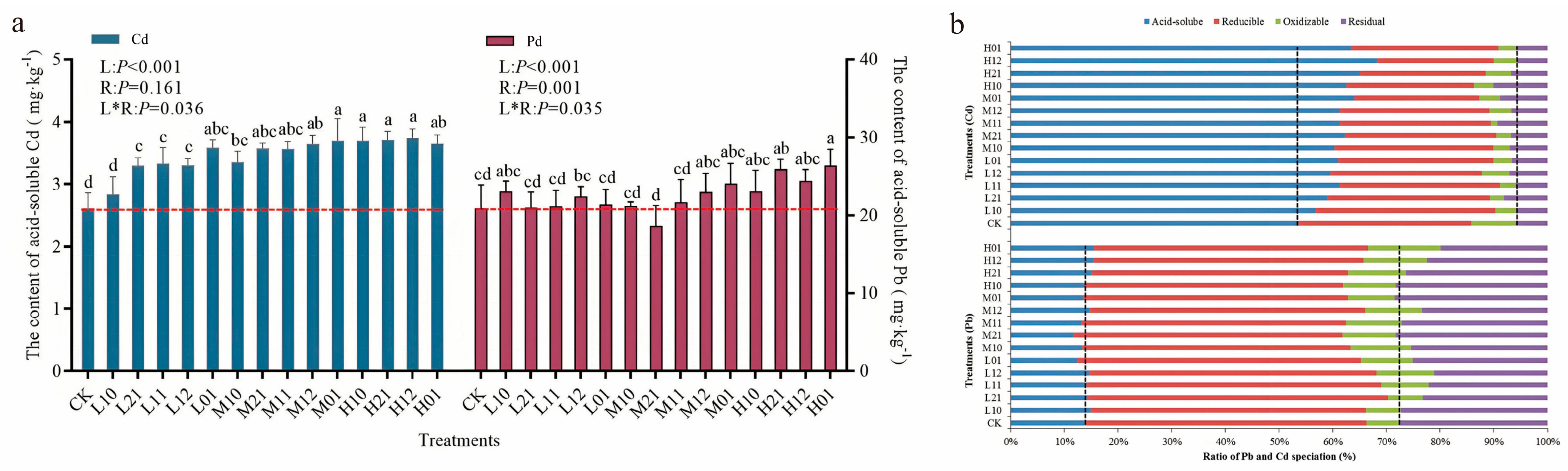
Compared to the control (CK), the content of acid-soluble Cd and Pb significantly increased after nitrogen application (Figure 2a). The content of soluble Cd was only affected by the nitrogen application amount, not by the ammonium–nitrate ratio. In contrast, the content of soluble Pb was affected by both nitrogen application rate and ammonium–nitrate ratio. Additionally, the proportion of acid-soluble Cd increased, while the proportion of acid-soluble Pb decreased in most of the treatments (Figure 2b). Although S. linearistipularis exhibited the highest Cd accumulation in the L11, L12, L10, and M10 treatments, the content of acid-soluble Cd was lower compared to the MN and HN treatments, which might be attributed to plant uptake. Although the contents of soluble Pb and Cd were the highest in the H treatment group, plant uptake of these metals was the lowest. This might be due to the toxic effects of excessive soluble Pb and Cd on plants.

3.5. Soil Microbial Community Responses

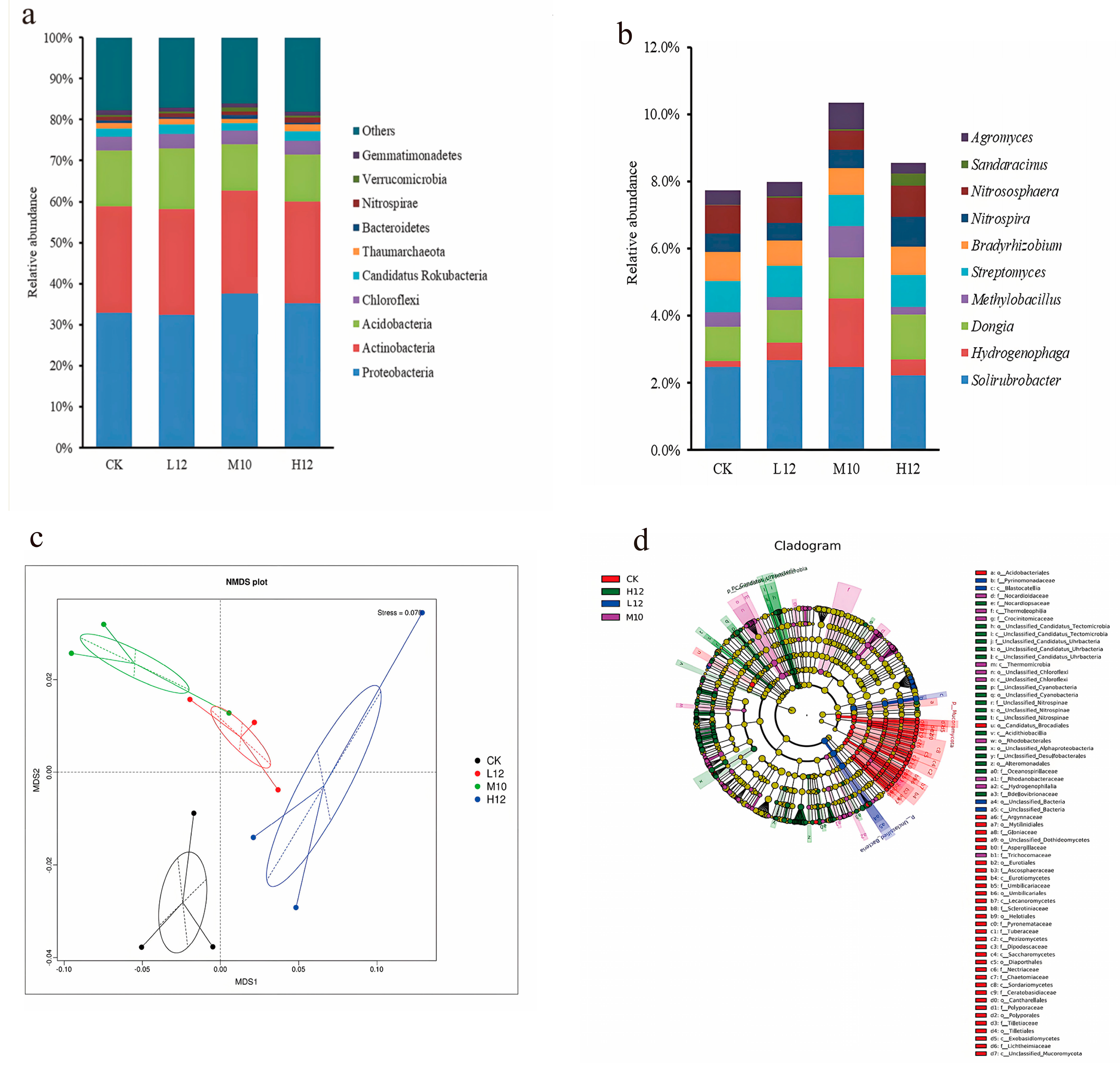
Treatments L12 and M10 exerted the most significant promoting effect on heavy metal uptake by S. linearistipularis, whereas treatment H12 showed the strongest inhibitory effect. Therefore, we analyzed the soil microbial communities in the CK, L12, M10, and H12 treatments. After annotation, 151 phyla, 541 families, and 1948 genera were identified in the CK, L12, M10, and H12 treatments, with bacteria constituting over 90% of the total abundance. Treatment-specific increases in relative abundance were observed: Chloroflexi and Candidatus Rokubacteria in L12, Proteobacteria, Bacteroidetes, and Verrucomicrobia in M10, and Proteobacteria, Nitrospirae, and Candidatus Rokubacteria in H12. While Thaumarchaeota in L12, Acidobacteria and Thaumarchaeota in M10, and Acidobacteria and Bacteroidetes in H12 decreased at the phylum level after nitrogen fertilizer application (Figure 3a). At the genus level, the relative abundance of Hydrogenophaga increased in L12, Hydrogenophaga, Methylobacillus, and Agromyces in M10, and Hydrogenophaga, Nitrospira, and Sandaracinus in H12, while Nitrososphaera in M10 and Methylobacillus in H12 decreased (Figure 3b).
NMDS analysis revealed distinct clustering of microbial communities among treatments (Figure 3c), indicating that both the amount and ratio of applied nitrogen influenced community composition. Further analysis using LEfSe identified microbial biomarkers with significant differences across treatments. In the CK treatment, Brocadiales and Ascomycota, including Gloniaceae, Aspergillaceae, Ascosphaeraceae, and Umbilicariaceae, were identified as biomarkers. However, their relative abundance decreased after nitrogen fertilizer application, resulting in completely different biomarkers in L12, M10, and H12, which were predominantly bacterial (Figure 3d).

3.6. Microbes’ Responses with Heavy Metal Resistance Genes

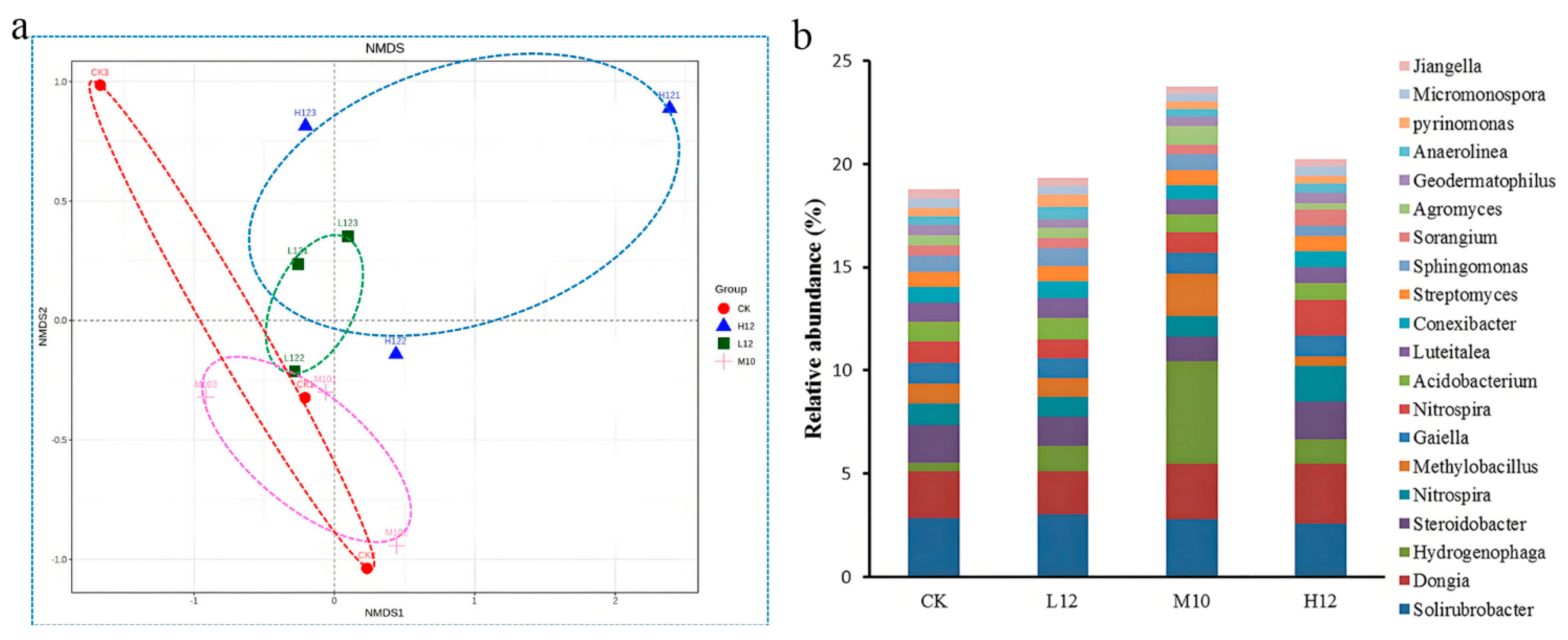
We focused on the resistance genes for Cd, Pb, As, Cr, Cu, Zn, Ni, and Hg, which were present at higher levels in the soil. Significant variations in resistance functions were observed, and the soil samples were clearly divided into four groups based on the function-level subsystems analysis of reads after nitrogen fertilizer application (Figure 4a and Table S2).
Taxonomic annotation of heavy metal resistance genes was performed against the BacMet2 database. Taxonomic analysis revealed that bacteria dominated the datasets (over 95%), followed by archaea, with only a few eukaryotic reads. Heavy metal resistance microorganisms were found in 58 phyla, with Proteobacteria, Actinobacteria, Acidobacteria, and Chloroflexi being the most abundant (over 75%) (Figure S2). In the M10 and H12 treatments, the relative abundance of Proteobacteria increased, while that of Acidobacteria decreased, which was consistent with the overall changes in the microbial community (Figure S2). At the genus level, the relative abundances of the top 20 heavy metal-resistant microbial genera increased, implying that the heavy metal resistance of microorganisms was enhanced following nitrogen fertilizer application. Additionally, the relative abundances of genera such as Dongia, Hydrogenophaga, Methylobacillus, and Nitrospira showed significant changes (Figure 4b). Interestingly, the relative abundance of Hydrogenophaga increased tenfold in M10, and twofold in L12 and H12. Notably, Methylobacillus also increased in M10 but decreased in L12 and H12. The higher relative abundances of Hydrogenophaga and Methylobacillus may be attributed to the application of ammonium nitrogen alone. These findings suggest that the dominance of heavy metal-resistant microorganisms is also influenced by the ratio of ammonium to nitrate nitrogen.

3.7. Microbial Metabolism

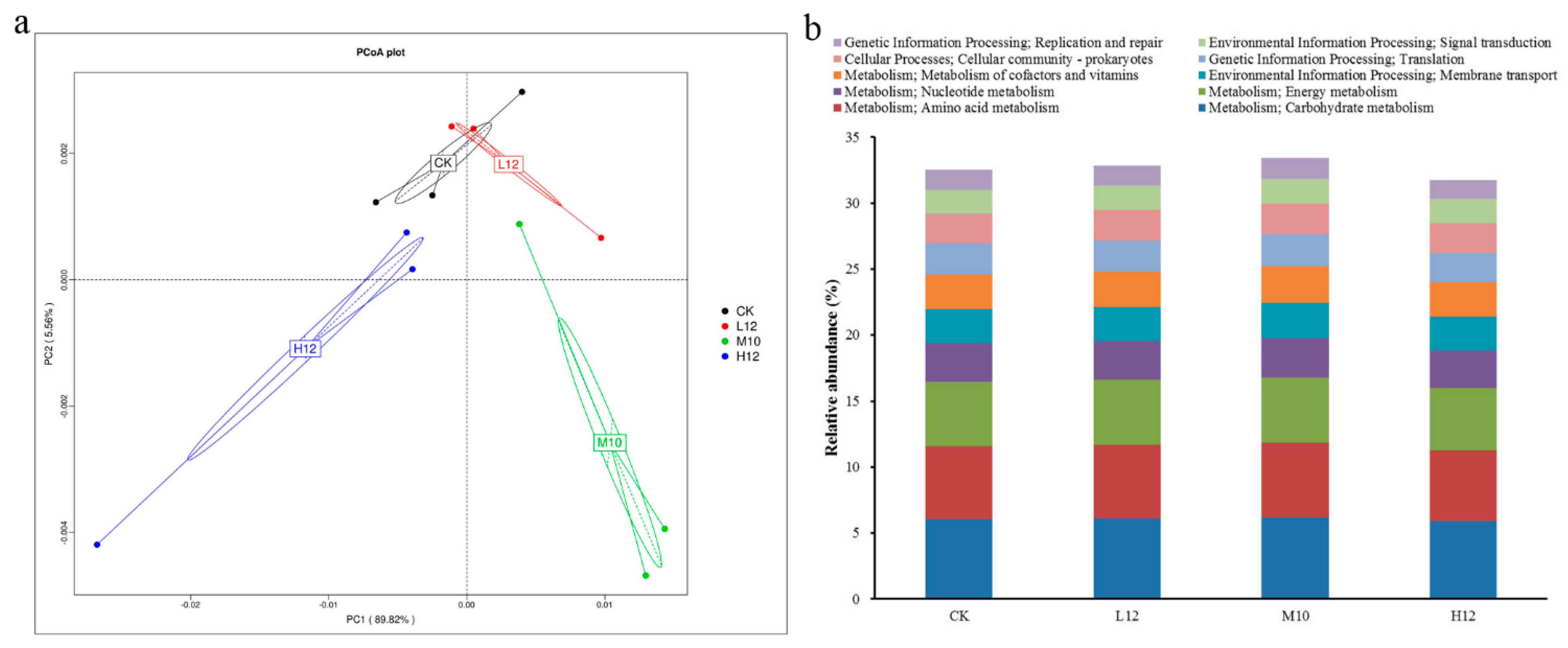
Principal coordinate analysis (PCoA) of metabolic functional abundance, based on 45 KEGG sub-metabolic pathways, revealed significant differences in microbial metabolic functions following nitrogen fertilizer application (Figure 5a). However, the relative abundance of the top 10 microbial metabolic functions was similar among the CK and the three treatment groups (Figure 5b). Most of these functions were associated with metabolism and environmental information processing, with amino acid metabolism and carbohydrate metabolism being the most dominant pathways.
KEGG annotation identified 337 enzyme commission (EC) numbers related to amino acid metabolism and 85 related to carbohydrate metabolism. Comparative analysis revealed that 154 unigenes associated with amino acid metabolism and 26 associated with carbohydrate metabolism differed significantly across treatments (Tables S3 and S4). Taxonomic annotation indicated that most of the contributing microbes belonged to Actinobacteria (e.g., Rhodococcus, Blastococcus, Agromyces, Kribbella, Solirubrobacter, and Actinoplanes) and Proteobacteria (e.g., Afipia, Rhizobium, Sphingomonas, Caenimonas, Rhodospirillaceae, Hyphomicrobium, and Pseudoxanthomonas). These microbial taxa were closely linked to the observed variations in EC-associated unigenes related to amino acid and carbohydrate metabolism, suggesting that nitrogen fertilizer application may modulate their metabolic pathways.
Furthermore, we analyzed unique metabolic pathways and enzymatic reactions that emerged in the treatment groups compared to the CK (Table S5). The results indicated that nitrogen fertilizer application induced the formation of several unique metabolic pathways. Specifically, pathways involved in membrane transport (e.g., k16199, k17236, K17327), carbohydrate metabolism (e.g., EC 1.1.2.7, EC 4.2.1.140), and lipid metabolism (e.g., EC 3.1.2.21) were detected across all treatments (L12, M10, H12). Other pathways were either formed or disappeared depending on the ratio of ammonium to nitrate nitrogen. For example, EC 2.7.1.31 (amino acid metabolism) emerged only in L12 and H12, while k10020 (membrane transport), k15428 (amino acid metabolism), and EC 2.7.1.60 (carbohydrate metabolism) disappeared in these treatments. Notably, most of the unique metabolic pathways were associated with membrane transport, amino acid metabolism, and carbohydrate metabolism, all of which are closely related to Pb and Cd transport or speciation. Additionally, the formation or disappearance of these pathways was influenced by both the amount and ratio of ammonium to nitrate nitrogen. Taxonomic annotation further revealed that Proteobacteria played a dominant role in contributing to these unique metabolic pathways. Thus, changes in microbial amino acid and carbohydrate metabolism may have a potential association with the speciation shifts in heavy metals.

3.8. The Relationship of Microbial Community Characteristics in Relation to Soil Properties and Heavy Metal Accumulation in S. linearistipularis

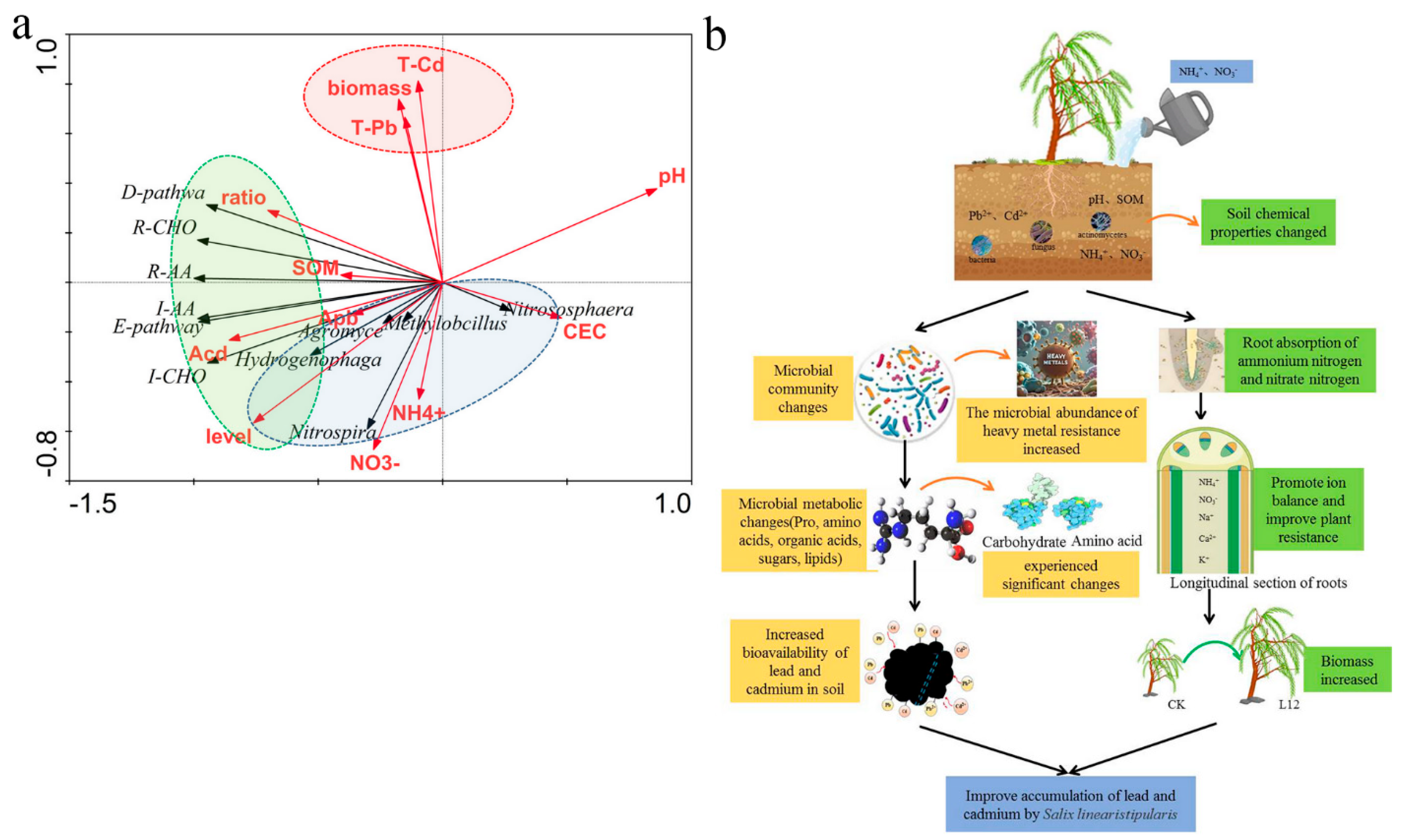
Redundancy analysis (RDA) was used to analyze the relationship between microbial community characteristics (dominant species and metabolic variations), soil properties, and heavy metal accumulation in S. linearistipularis (Figure 6a). The results revealed that the accumulation of Pb and Cd was positively correlated with biomass (pink circle). Additionally, the NH4+-N/NO3-N ratio had a greater impact on biomass than the total nitrogen application amount. The microbial community was positively influenced by the level of ammonium and nitrate nitrogen application (blue circle). Furthermore, the content of NH4+-N and NO3-N, cation exchange capacity (CEC), and the available concentrations of Pb and Cd were also associated with microbial community composition. Microbial metabolism was positively affected by ammonium and nitrate nitrogen application levels and ratios, available Pb and Cd concentrations, and soil organic matter (SOM) (green circles). Notably, the available concentrations of Pb and Cd were linked to microbial metabolic variations, particularly in the increased expression of amino acids and carbohydrates, as well as the emergence of new metabolic pathways.
Based on the RDA correlations (Figure 6a) and experimental observations, we constructed a conceptual framework to illustrate the potential relationships among ammonium/nitrate nitrogen application, soil properties, microbial community, microbial metabolism, and heavy metal accumulation in S. linearistipularis (Figure 6b). Nitrogen fertilizer application initially altered soil properties, which subsequently facilitated heavy metal uptake by S. linearistipularis through two distinct pathways. First, changes in soil properties induced shifts in microbial community structure, with an increased abundance of heavy metal-resistant microorganisms. During this phase, the amount of ammonium and nitrate exerted a more significant effect than their ratio. These microbial shifts induced changes in microbial metabolism, characterized by notable increases in metabolites such as organic carbon and amino acids. Both the amount and ratio of ammonium and nitrate nitrogen were critical in this metabolic shift. Ultimately, these changes enhanced the bioavailability of Pb and Cd. Second, after nitrogen fertilizer application, S. linearistipularis absorbed ammonium and nitrate nitrogen via its roots. An optimal ammonium-to-nitrate ratio promoted nutrient balance within the plant, thereby enhancing its heavy metal resistance and stimulating growth. The increased bioavailability of Pb and Cd in the soil, coupled with the growth in biomass, collectively facilitated the uptake of Pb and Cd by S. linearistipularis.

4. Discussion

4.1. Enhancement of Pb and Cd Accumulation Linked to Increased Biomass and Heavy Metal Bioavailability in Soil

Plant heavy metal accumulation reflects the total metal extraction capacity, whereas the concentration per unit of tissue reflects uptake efficiency and distribution characteristics. By analyzing these parameters, we found that the trend in Pb/Cd accumulation closely mirrored that of plant biomass, while the trend in tissue concentration did not. Thus, the increase in Pb/Cd accumulation in this study, especially the accumulation in aboveground parts, was mainly caused by the increase in plant biomass.
In our study, RDA also indicated that Pb and Cd accumulation were primarily influenced by biomass (Figure 6a). Similar results were obtained when investigating the remediation of Cd-contaminated soils by B. napus with different nitrogen fertilizer forms [9]. Simultaneous supply ofNH4+-N/NO3-N resulted in higher Pb and Cd accumulation, with the most significant effect observed in the L12 treatment. This combination likely maintains the cation–anion balance in plants, thereby improving nitrogen use efficiency. This finding is consistent with the study by de Sousa Leite et al. (2019), who reported that Cd uptake and accumulation are closely related to nitrogen forms, and the supply of a 50:50 NH4+-N/NO3-N ratio increases the phytoextraction of this metal in P. maximum cv. Tanzania [13]. The treatment L21 requires further investigation. In the L10 and M10 treatments, biomass and Pb and Cd accumulation were also enhanced, likely due to the conversion of ammonium nitrogen to nitrate nitrogen. This observation was consistent with the ammonium and nitrate nitrogen content (Table 3). These results align with RDA, which showed that the NH4+-N/NO3-N ratio had a greater effect on biomass than the total nitrogen fertilizer amount (Figure 6a). By contrast, the sole application of nitrate nitrogen did not exhibit a growth-promoting effect. This might be because in dry land soil, ammonium nitrogen is easily converted to nitrate nitrogen, whereas nitrate nitrogen cannot be readily converted back to ammonium nitrogen. Studies have shown that stress, such as from copper, can impair key nitrate transporters (e.g., OsNRT2.3b), directly compromising a plant’s ability to acquire nitrogen [34]. From a physiological perspective, our findings indicate that S. linearistipularis requires a balance of both NH4+-N/NO3-N. An optimal ratio is therefore essential to maintain internal nitrogen balance and synergistically promote growth.
However, under MN and HN treatments, biomass and Pb and Cd accumulation decreased, except for the M10 treatment. The inhibitory effects intensified with higher nitrogen application rates, suggesting that excess nitrogen negatively impacts plant growth, potentially by activating heavy metal toxicity (Figure 2a,b). This finding is consistent with the research of de Sousa Leite et al. (2019), who also reported that excessive nitrogen input can enhance heavy metal bioavailability and thus inhibit plant growth [13]. Other studies have also demonstrated that an appropriate nitrogen supply can maintain a strong antioxidant capacity in Robinia pseudoacacia L., thereby alleviating lead toxicity. Conversely, an unreasonably high nitrogen input may disrupt the redox homeostasis in R. pseudoacacia, rendering the plant more vulnerable to heavy metal stress [35]. The applied ammonium ions (NH4+) undergo a key microbial oxidation process, where NH4+ is gradually oxidized to nitrite (NO2) and ultimately to nitrate (NO3). This series of reactions releases a large quantity of hydrogen ions (H+), leading to soil acidification. Although nitrate nitrogen (NO3) itself is an anion and does not directly participate in acid-producing reactions, its concomitant effect during plant uptake can also induce physiological acidification [35]. Previous studies have shown that NH4+-N application can decrease soil pH and increase the remobilization rate of Cd, thereby enhancing Cd accumulation in crops [23]. With the decrease in pH, the negative charge on the surface of soil colloids diminishes and the cation exchange capacity (CEC) decreases, which intensifies the competitive adsorption between heavy metal cations (e.g., Cd2+, Pb2+, Al3+, Mn2+) and base cations (e.g., Ca2+, Mg2+, K+), thus facilitating the desorption of the former from exchange sites into the soil solution [36]. Therefore, this balance between the promoting effect of nitrogen on plant growth and the toxic effect of activated heavy metals is crucial for understanding plant response.
Additionally, the bioavailability of heavy metals is a critical factor influencing plant uptake. The bioavailability of Pb and Cd increased with nitrogen fertilizer application, regardless of the ammonium to nitrate ratio, particularly for Cd (Figure 2a,b). However, the bioavailability of Pb and Cd is toxic to plants and inhibits their growth [5]. Thus, in this study, high nitrogen (HN) treatments inhibited the growth of S. linearistipularis. Although Cd bioavailability also increased in LN treatments, it remained lower than in MN and HN treatments. In addition, previous studies have reported that appropriate nitrogen fertilizer application could enhance plant resistance to heavy metals [13]. Furthermore, application of inorganic nitrogen fertilizers reduces the soil’s cation exchange capacity (CEC) (Table 3). This reduction significantly impairs the soil’s ability to immobilize toxic metal cations, thereby facilitating the desorption, migration, and increased bioavailability of heavy metals such as lead (Pb) and cadmium (Cd).
Previous studies have confirmed that nitrification rate is positively correlated with soil pH and NH4+ concentration, while denitrification rate is positively correlated with soil organic matter (SOM) and NO3 concentration [37]. Therefore, mild acidification under low/medium nitrogen treatments had little impact on nitrification, whereas severe acidification under high nitrogen treatments inhibited the activity of nitrifying bacteria and disrupted nitrogen cycling. Meanwhile, excessive acidification induced heavy metal toxicity in plants, impairing their growth and leading to low phytoremediation efficiency. SOM drives denitrification and complexes with heavy metals. Under optimal nitrogen treatments, increased SOM provides sufficient carbon sources for denitrifying bacteria. Furthermore, its functional groups form soluble complexes with Pb and Cd, a process that optimizes heavy metal bioavailability while alleviating metal toxicity [37,38]. The plant mortality in the H11 treatment group was likely due to the combined effect of high nitrogen supply and the synergistic action of ammonium and nitrate, which increased the toxicity of Pb and Cd in the soil. Thus, the threshold of nitrogen application rate in this study was approximately 120 kg·hm−2·year−1. When the application rate was ≤120 kg·hm−2·year−1, soil acid-soluble Pb/Cd increased moderately, and plants enhanced their stress resistance via the regulation of ammonium–nitrate nitrogen balance. At this stage, the biomass promotion effect dominated Pb/Cd accumulation. In contrast, when the application rate was ≥200 kg·hm−2·year−1 (HN), acid-soluble Pb/Cd rose sharply, far exceeding the plant tolerance threshold, which caused root damage and a decrease in translocation factor. Eventually, the toxicity inhibition effect became dominant, impairing plant growth and thus leading to a reduction in Pb/Cd accumulation. Therefore, selecting the appropriate nitrogen amount and ratio is essential for optimizing nitrogen use efficiency and improving phytoremediation effectiveness in soils with varying properties.
In addition to biomass, another important factor influencing heavy metal uptake is the concentration of heavy metals within plant tissues. Pb and Cd concentrations increased in the lateral roots of S. linearistipularis in the L11, L12, and M10 treatments, but did not decrease in the taproot, branches, or leaves despite the increase in biomass. While the biomass of S. nigrum increased with the application of N fertilizer, the Cd concentration in its shoot and root did not change significantly; there was no ‘dilution effect’ [39]. However, this result contrasts with findings in Arabidopsis thaliana (L.) Heynh. and wheat, where increased biomass contributed to decreased Cd concentrations due to the “dilution effect” [40,41]. Furthermore, the transport coefficient for Cd and Pb did not increase and, in some cases, decreased, and plants sequester heavy metals in lateral roots and reduce their translocation to the aboveground parts, which may represent a protective mechanism against heavy metal toxicity. Studies have shown that increased transport of Cd correlates with symptoms of toxicity in P. maximum cv. Tanzania [13]. Therefore, future research should consider adopting integrated remediation strategies, such as inoculating microorganisms or adding exogenous metabolites, to promote the translocation of bioavailable heavy metals from roots to aerial tissues while maintaining high biomass production. This combination will enhance the metal removal capacity of S. linearistipularis and better meet the requirements of efficient phytoextraction.

4.2. Changes in Microbial Community and Heavy Metal Resistance Microbes After Application of Nitrogen Fertilization

Shifts in microbial community structure may affect plant growth and the uptake of heavy metals. The dominant microbial species remained similar, though their relative abundance shifted following nitrogen fertilizer application [42]. Previous studies have reported that many microbes are sensitive to nitrogen fertilization [43,44]. Resource competition drives microbial community assembly. Nitrogen fertilization reshapes soil resource distribution, intensifying microbial competition for nitrogen. Dominant bacterial taxa usually have higher nitrogen utilization efficiency, for example, those with nitrogen transport systems or nitrogen-fixing potential. These taxa outcompete others, leading to increased relative abundance. In contrast, microorganisms adapted to nitrogen-non-limiting habitats may become less competitive in nitrogen-enriched soils, leading to a reduction in their relative abundance [45]. In our study, the dominant bacterial taxa with increased abundance in the L12, M10, and H12 treatments were either associated with nitrogen cycling or involved in heavy metal resistance (Figure 3b), which aligns with previous findings on nitrogen–microbial–heavy metal interactions [46,47,48,49]. In the M10 treatment, the relative abundance of Agromyces increased, and Kuffner et al. (2008) demonstrated that Agromyces can promote the growth of willows [46]. In contrast, in the H12 treatment, the relative abundance of Sandaracinus increased. Lin et al. (2025) [50] reported that Sandaracinus facilitated organic matter degradation, releasing bioavailable Cd, thus enhancing the phytoremediation efficiency. This genus can enhance the bioavailability of Pb and Cd, indicating that it is a strain with great application potential in the remediation of heavy metal-contaminated soils.
Our findings further emphasized that shifts in microbial community composition were closely correlated with the levels of applied NH4+-N/NO3-N and concentrations in the soil (Figure 6a). Similar observations have been made, showing that changes in NH4+-N, NO3-N, and dissolved organic carbon, resulting from nutrient additions, have a more substantial impact on microbial community structure than soil pH changes caused by nitrogen fertilization [51]. This is likely because both ammonium and nitrate nitrogen in the soil can be biofixed and converted by microorganisms. Therefore, the applied levels of ammonium and nitrate nitrogen exert a greater influence on microbial community structure than their individual ratios.
Furthermore, significant variations were observed in the microbial resistance functions (Figure 4a), which is consistent with previous metagenomic studies on microbial heavy metal tolerance and aligns with findings from previous studies [52,53]. The most abundant genes were classified predominantly to the Proteobacteria, followed by Actinobacteria and Acidobacteria, which is similar to the characteristics of microbial communities in metal-contaminated sediments reported in previous studies [1]. Other studies have also identified Proteobacteria, Bacteroidetes, and Firmicutes as key phyla in metal-contaminated soils, harboring a broad range of metal-resistance genes [54]. At the genus level, the relative abundance of heavy metal-resistant microbes increased under different nitrogen treatments, especially in M10, including genera such as Dongia, Hydrogenophaga, Methylobacillus, and Nitrospira, which indicated that nitrogen fertilization enhanced microbial resistance to heavy metals. Methylobacillus has been shown to tolerate high concentrations of Cr, Cr(VI), Cu, and Zn, demonstrating potential for soil remediation [55]. Furthermore, Hydrogenophaga species enriched in tailings may contribute to the development of mine bioremediation technologies [56]. As a typical acidogenic bacterium, Hydrogenophaga can enhance the bioavailability of Pb and Cd [57]. Methylophilus and Nitrosospira have also been identified in Pb, Zn, and Cu contaminated soils using 16S rRNA gene amplicon sequencing technology [58]. However, the abundance changes in heavy metal-resistant microorganisms are associated with the ratio of nitrate and ammonium, for instance, Hydrogenophaga and Methylobacillus. Therefore, it is necessary to explore an optimal NH4+-N/NO3-N ratio for enhancing the phytoremediation of heavy metal-contaminated soils.

4.3. The Bioavailability of Pb and Cd Promoted by Microbial Metabolism

In our study, principal coordinate analysis (PCoA) of metabolic functional abundance demonstrated significant differences in microbial metabolic functions following nitrogen fertilizer application (Figure 5a). Additionally, the microbes formed or disappeared several unique metabolic pathways, which were jointly influenced by the nitrogen application level and NH4+-N/NO3-N ratio (Figure 6a and Table S5). In this study, the enrichment of these KEGG-annotated metabolic pathways was positively correlated with Pb/Cd bioavailability (Figure 6a), suggesting a potential link between microbial metabolic shifts and heavy metal speciation. This aligns with the findings of Cui et al. (2022) [59], who demonstrated in a 30-year field experiment that microbial metabolism is closely linked to nitrogen availability. Specifically, long-term combined organic-inorganic fertilization induced nitrogen limitation on microbial communities. This nitrogen limitation further reshaped the metabolic characteristics and functional pathways of the microbes.
After the application of ammonium nitrogen and nitrate nitrogen at different amounts and ratios, the differential metabolism of the microbial community was mainly enriched in amino acid metabolism, carbohydrate metabolism, and lipid metabolism. Previous studies have shown that these metabolic pathways play a significant role in the variation in heavy metal speciation [60,61]. These metabolic pathways may potentially affect heavy metal bioavailability through two possible mechanisms. First, microbes secrete low-molecular-weight amino acids (e.g., histidine, glycine), which can serve as carriers for plant heavy metal uptake. Second, the production of organic acids (e.g., citric acid) and extracellular polymeric substances (EPS) through carbohydrate metabolism, which can bind heavy metal ions to form soluble or plant-available complexes, thereby improving heavy metal bioavailability [62,63].
Nitrogen fertilizer application may facilitate phytoremediation by potentially regulating soil nutrient supply and shaping microbial community structure, metabolic activity, and functional pathways. However, long-term chemical nitrogen application may lead to nitrate accumulation, increased N2O emission risks, and reduced microbial diversity [64]. Given the controlled pot experiment setting, future research should verify the findings through long-term field in situ trials, incorporating natural environmental factors (e.g., precipitation, temperature fluctuations) to enhance applicability. In addition, this study has certain limitations. We performed metagenomic analysis on only four representative treatments (CK, L12, M10, H12), and the regulatory model was constructed as a conceptual model based on RDA correlation analysis and experimental observations. Therefore, although these four treatments cover the “promotion–inhibition–control”, the limited number of treatments and the lack of targeted validation experiments imply that the interpretation of the microbial mechanisms underlying the effects of ammonium and nitrate nitrogen application rates and ratios on Pb/Cd uptake has certain limitations. More comprehensive studies are required in the future.

5. Conclusions

The results indicated that the amount and ratio of ammonium nitrogen (NH4+-N) and nitrate nitrogen (NO3-N) affect the biomass of S. linearistipularis and the bioavailability of Pb and Cd in soil, thereby regulating the total accumulation of Pb and Cd in the plant. Compared with the control (CK), the L12 treatment achieved the maximum enhancement of Pb and Cd accumulation. Notably, the NH4+-N/NO3-N ratio had a greater impact on plant biomass, while the total nitrogen application rate exerted a stronger influence on the microbial community. Based on the experimental conditions, economic considerations, and fertilization effects, we recommend applying 60 kg N·hm−2·year−1 with an NH4+-N/NO3-N ratio of 1:2 for S. linearistipularis in heavy metal-contaminated soils to enhance its phytoremediation capacity. Excessive nitrogen application not only fails to further improve remediation efficiency but also causes fertilizer waste and potential environmental pollution. The findings of this study not only provide novel insights into improving the phytoremediation efficiency of woody plants through fertilization strategies but also provide a theoretical foundation for the effects of nitrogen fertilization on nutrient cycling in metal-contaminated soils.
To expand the applicability of the findings, future research should conduct long-term field in situ trials to verify the effects of regulating the ammonium–nitrate ratio under natural environmental conditions. Experimental verification is also needed to clarify how exogenous metabolites, such as organic acids or amino acids, affect Pb/Cd accumulation. Additionally, exploring the combined application of nitrogen fertilization and functional microbial inoculants is necessary to further improve the bioavailability of Pb/Cd and their translocation from roots to aboveground tissues. Furthermore, although this study was conducted under controlled pot conditions, the experimental soil was typical meadow cinnamon soil from northern forest marginal zones, and the nitrogen application rates were set based on the standard rate for 1-year-old seedlings. Therefore, these findings can be applied to the practical management of heavy metal-contaminated forest marginal soils and provide a theoretical basis for further investigation for subsequent long-term in situ trials in forest ecosystems.

Supplementary Materials

The following supporting information can be downloaded at: https://www.mdpi.com/article/10.3390/f17030364/s1, Table S1 Transport coefficient of Pb and Cd in branch and leaf of S. linearistipularis. Table S2 Screening of Lead resistance genes. Table S3 Uniges of 337 ECs (KEGG EC number) amino acid. Table S4 Uniges of 85 ECs (KEGG EC number) carbohydrate. Table S5 The unique metabolic pathways compared with CK. Figure S1 The layout diagram for potted plant experiments. Figure S2 Top 20 phylum of microorganisms with heavy metal resistance.

Author Contributions

J.Z. designed the project, carried out the experiments, and wrote the original draft. D.D.: carried out the experiments and interpreted the results. Y.Z. interpreted the results and performed data analysis. Z.G.: conducted the field experiment and analyzed data. X.N. designed the project, wrote and revised the manuscript. D.H. revised the manuscript. K.Z. performed data analysis. All authors provided critical feedback, helped shape the research, analysis, and manuscript; all discussed the results and contributed to the final version of the manuscript. All authors have read and agreed to the published version of the manuscript.

Funding

This research was supported by the National Natural Science Foundation of China (No. 32301550), Natural Science Foundation of Hebei province (No. C2022204161), Youth Fund Project of Hebei Provincial Education Department (No. QN2022120), and Hebei Agriculture Research System (HBCT2024200203).

Data Availability Statement

Raw sequence data have been submitted to the NCBI Sequence Read Archive, Nos. PRJNA1149906).

Conflicts of Interest

The authors declare that the research was conducted in the absence of any commercial or financial relationships that could be construed as a potential conflict of interest.

References

  1. Yan, C.; Wang, F.; Geng, H.; Liu, H.; Pu, S.; Tian, Z.; Chen, H.; Zhou, B.; Yuan, R.; Yao, J. Integrating High-Throughput Sequencing and Metagenome Analysis to Reveal the Characteristic and Resistance Mechanism of Microbial Community in Metal Contaminated Sediments. Sci. Total Environ. 2020, 707, 136116. [Google Scholar] [CrossRef] [PubMed]
  2. Bai, Z.; Li, D.; Zhu, L.; Tang, X.; Wang, Y.; Mao, R.; Wu, J. Nitrate Increases Cadmium Accumulation in Sweet Sorghum for Improving Phytoextraction Efficiency Rather Than Ammonium. Front. Plant Sci. 2021, 12, 643116. [Google Scholar] [CrossRef] [PubMed]
  3. Han, R.; Dai, H.; Guo, B.; Noori, A.; Sun, W.; Wei, S. The Potential of Medicinal Plant Extracts in Improving the Phytoremediation Capacity of Solanum nigrum L. for heavy metal contaminated soil. Ecotoxicol. Environ. Saf. 2021, 220, 112411. [Google Scholar] [CrossRef] [PubMed]
  4. Gavrilescu, M. Enhancing Phytoremediation of Soils Polluted with Heavy Metals. Curr. Opin. Biotechnol. 2022, 74, 21–31. [Google Scholar] [CrossRef]
  5. Wang, A.; Li, X.; Hao, X.; Luo, X.; Chen, W.; Huang, Q. Ammonia Level Influences the Assembly of Dissimilatory Nitrate Reduction to Ammonia Bacterial Community in Soils under Different Heavy Metal Remediation Treatments. Sci. Total Environ. 2022, 838, 156393. [Google Scholar] [CrossRef]
  6. Yang, Y.; Xiong, J.; Chen, R.; Fu, G.; Chen, T.; Tao, L. Excessive Nitrate Enhances Cadmium (Cd) Uptake by up-Regulating the Expression of Osirt1 in Rice (Oryza sativa). Environ. Exp. Bot. 2016, 122, 141–149. [Google Scholar] [CrossRef]
  7. Bi, J.; Liu, X.; Liu, S.; Wang, Y.; Liu, M. Microstructural and Physiological Responses to Cadmium Stress under Different Nitrogen Forms in Two Contrasting Populus Clones. Environ. Exp. Bot. 2020, 169, 103897. [Google Scholar] [CrossRef]
  8. Yang, W.; Dai, H.; Skuza, L.; Wei, S. Enhanced Cd Phytoextraction by Solanum nigrum L. From Contaminated Soils Combined with the Application of N Fertilizers and Double Harvests. Toxics 2022, 5, 266. [Google Scholar] [CrossRef]
  9. Zeng, X.; Zou, D.; Wang, A.; Zhou, Y.; Liu, Y.; Li, Z.; Liu, F.; Wang, H.; Zeng, Q.; Xiao, Z. Remediation of Cadmium-Contaminated Soils Using Brassica napus: Effect of Nitrogen Fertilizers. J. Environ. Manag. 2020, 255, 109885. [Google Scholar] [CrossRef]
  10. Yu, F.; Li, Y.; Li, F.; Zhou, Z.; Chen, C.; Liang, X.; Li, C.; Liu, K. Nitrogen Fertilizers Promote Plant Growth and Assist in Manganese (Mn) Accumulation by Polygonum pubescens Blume Cultured in Mn Tailings Soil. Int. J. Phytoremediation 2019, 12, 1225–1233. [Google Scholar] [CrossRef]
  11. Ye, X.; Hu, H.; Li, H.; Xiong, Q.; Gao, H. Combined Nitrogen Fertilizer and Wheat Straw Increases the Cadmium Phytoextraction Efficiency of Tagetes patula. Ecotoxicol. Environ. Saf. 2019, 170, 210–217. [Google Scholar] [CrossRef]
  12. Zhu, Y.; Wang, Y.; Zheng, H.; Xiang, X.; Wang, H.; Xie, M.; Liu, H.; Fang, Z.; Liu, L.; Du, S. N Fertilizers Promote Abscisic Acid-Catabolizing Bacteria to Enhance Heavy Metal Phytoremediation from Metalliferous Soils. Sci. Total Environ. 2023, 894, 164964. [Google Scholar] [CrossRef] [PubMed]
  13. Leite, T.d.S.; Monteiro, F.A. Nitrogen Form Regulates Cadmium Uptake and Accumulation in Tanzania Guinea Grass Used for Phytoextraction. Chemosphere 2019, 236, 124324. [Google Scholar] [CrossRef] [PubMed]
  14. Nakamaru, Y.M.; Matsuda, R.; Sonoda, T. Environmental Risks of Organic Fertilizer with Increased Heavy Metals (Cu and Zn) to Aquatic Ecosystems Adjacent to Farmland in the Northern Biosphere of Japan. Sci. Total Environ. 2023, 884, 163861. [Google Scholar] [CrossRef] [PubMed]
  15. Hou, D.; Wang, K.; Liu, T.; Wang, H.; Lin, Z.; Qian, J.; Lu, L.; Tian, S. Unique Rhizosphere Micro-Characteristics Facilitate Phytoextraction of Multiple Metals in Soil by the Hyperaccumulating Plant Sedum alfredii. Environ. Sci. Technol. 2017, 51, 5675–5684. [Google Scholar] [CrossRef]
  16. Islam, S.; Kormoker, T.; Idris, A.M.; Proshad, R.; Kabir, H.; Ustaoğlu, F. Plant–Microbe–Metal Interactions for Heavy Metal Bioremediation: A Review. Crop. Pasture Sci. 2021, 73, 181–201. [Google Scholar] [CrossRef]
  17. Niu, X.-Y.; Wang, S.-K.; Zhou, J.; Di, D.-L.; Sun, P.; Huang, D.-Z. Inoculation with Indigenous Rhizosphere Microbes Enhances Aboveground Accumulation of Lead in Salix integra Thunb. By Improving Transport Coefficients. Front. Microbiol. 2021, 12, 686812. [Google Scholar] [CrossRef]
  18. Barunawati, N.; Giehl, R.F.H.; Bauer, B.; von Wirén, N. The Influence of Inorganic Nitrogen Fertilizer Forms on Micronutrient Retranslocation and Accumulation in Grains of Winter Wheat. Front. Plant Sci. 2013, 4, 320. [Google Scholar] [CrossRef]
  19. Gu, Y.; Chen, X.; Shen, Y.; Chen, X.; He, G.; He, X.; Wang, G.; He, H.; Lv, Z. The Response of Nutrient Cycle, Microbial Community Abundance and Metabolic Function to Nitrogen Fertilizer in Rhizosphere Soil of Phellodendron chinense Schneid Seedlings. Front. Microbiol. 2023, 14, 1302775. [Google Scholar] [CrossRef]
  20. Niu, Y.; Zhang, M.; Bai, S.H.; Xu, Z.; Liu, Y.; Chen, F.; Guo, X.; Luo, H.; Wang, S.; Xie, J.; et al. Successive Mineral Nitrogen or Phosphorus Fertilization Alone Significantly Altered Bacterial Community Rather Than Bacterial Biomass in Plantation Soil. Appl. Microbiol. Biotechnol. 2020, 104, 7213–7224. [Google Scholar] [CrossRef]
  21. Lian, J.; Li, G.; Zhang, J.; Massart, S. Nitrogen Fertilization Affected Microbial Carbon Use Efficiency and Microbial Resource Limitations Via Root Exudates. Sci. Total Environ. 2024, 950, 174933. [Google Scholar] [CrossRef]
  22. Qasim, B.; Motelica-Heino, M.; Bourgerie, S.; Gauthier, A.; Morabito, D. Effect of Nitrate and Ammonium Fertilization on Zn, Pb, Cd Phytostabilization by Populus euramericana Dorskamp in Contaminated Technosol. Environ. Sci. Pollut. Res. 2015, 22, 18759–18771. [Google Scholar] [CrossRef] [PubMed]
  23. Wang, J.-F.; Li, W.-L.; Li, Q.-S.; Wang, L.-L.; He, T.; Wang, F.-P.; Xu, Z.-M. Nitrogen Fertilizer Management Affects Remobilization of the Immobilized Cadmium in Soil and Its Accumulation in Crop Tissues. Environ. Sci. Pollut. Res. 2021, 28, 31640–31652. [Google Scholar] [CrossRef] [PubMed]
  24. Zhou, W.; Wang, Q.; Chen, S.; Chen, F.; Lv, H.; Li, J.; Chen, Q.; Zhou, J.; Liang, B. Nitrate Leaching Is the Main Driving Factor of Soil Calcium and Magnesium Leaching Loss in Intensive Plastic-Shed Vegetable Production Systems. Agric. Water Manag. 2024, 293, 108708. [Google Scholar] [CrossRef]
  25. Zhang, F.; Jin, Q.; Peng, H.; Zhu, T. Soil Acidification in Moso Bamboo (Phyllostachys edulis) Forests and Changes of Soil Metal Ions (Cu, Pb) Concentration. Arch. Agron. Soil Sci. 2021, 67, 1799–1808. [Google Scholar] [CrossRef]
  26. Wang, Y.-F.; Wang, J.-F.; Xu, Z.-M.; She, S.-H.; Yang, J.-Q.; Li, Q.-S. L-Glutamic Acid Induced the Colonization of High-Efficiency Nitrogen-Fixing Strain Ac63 (Azotobacter chroococcum) in Roots of Amaranthus tricolor. Plant Soil 2020, 451, 357–370. [Google Scholar] [CrossRef]
  27. Feng, S.; Ren, L.; Sun, H.; Qiao, K.; Liu, S.; Zhou, A. Morphological and Physiological Responses of Two Willow Species from Different Habitats to Salt Stress. Sci. Rep. 2020, 10, 18228. [Google Scholar] [CrossRef]
  28. Feng, S.; Sun, H.; Ma, H.; Zhang, X.; Ma, S.; Qiao, K.; Zhou, A.; Bu, Y.; Liu, S. Sexual Differences in Physiological and Transcriptional Responses to Salinity Stress of Salix linearistipularis. Front. Plant Sci. 2020, 11, 517962. [Google Scholar] [CrossRef]
  29. Niu, X.; Zhou, J.; Wang, X.; Su, X.; Du, S.; Zhu, Y.; Yang, J.; Huang, D. Indigenous Bacteria Have High Potential for Promoting Salix integra Thunb. Remediation of Lead-Contaminated Soil by Adjusting Soil Properties. Front. Microbiol. 2020, 11, 924. [Google Scholar] [CrossRef]
  30. Rauret, G.; López-Sánchez, J.F.; Sahuquillo, A.; Rubio, R.; Davidson, C.; Ure, A.; Quevauviller, P. Improvement of the Bcr Three Step Sequential Extraction Procedure Prior to the Certification of New Sediment and Soil Reference Materials. J. Environ. Monit. 1999, 1, 57–61. [Google Scholar] [CrossRef]
  31. Zhang, J.; Buhe, C.; Yu, D.; Zhong, H.; Wei, Y. Ammonia Stress Reduces Antibiotic Efflux but Enriches Horizontal Gene Transfer of Antibiotic Resistance Genes in Anaerobic Digestion. Bioresour. Technol. 2020, 295, 122191. [Google Scholar] [CrossRef] [PubMed]
  32. Pal, C.; Bengtsson-Palme, J.; Rensing, C.; Kristiansson, E.; Larsson, D.G.J. Bacmet: Antibacterial Biocide and Metal Resistance Genes Database. Nucleic Acids Res. 2014, 42, D737–D743. [Google Scholar] [CrossRef] [PubMed]
  33. Kanehisa, M.; Goto, S.; Kawashima, S.; Okuno, Y.; Hattori, M. The Kegg Resource for Deciphering the Genome. Nucleic Acids Res. 2004, 32, D277–D280. [Google Scholar] [CrossRef] [PubMed]
  34. Huo, K.; Shangguan, X.; Xia, Y.; Shen, Z.; Chen, C. Excess Copper Inhibits the Growth of Rice Seedlings by Decreasing Uptake of Nitrate. Ecotoxicol. Environ. Saf. 2020, 190, 110105. [Google Scholar] [CrossRef]
  35. Xia, Z.; Xue, C.; Liu, R.; Hui, Q.; Hu, B.; Rennenberg, H. Lead Accumulation and Concomitant Reactive Oxygen Species (Ros) Scavenging in Robinia pseudoacacia Are Dependent on Nitrogen Nutrition. Plant Physiol. Biochem. 2025, 219, 109388. [Google Scholar] [CrossRef]
  36. Wang, S.; Lin, W.; Ye, Q.; Lv, W.; Liao, P.; Yu, J.; Mu, C.; Wu, L.; Muneer, M.A.; Zhang, Y.; et al. Effects of Different Nitrogen Fertilizer Rates on Soil Magnesium Leaching in Tea Garden. J. Soil Sci. Plant Nutr. 2024, 24, 6630–6640. [Google Scholar] [CrossRef]
  37. Shi, Y.; Zhang, X.; Wang, Z.; Xu, Z.; He, C.; Sheng, L.; Liu, H.; Wang, Z. Shift in Nitrogen Transformation in Peatland Soil by Nitrogen Inputs. Sci. Total Environ. 2021, 764, 142924. [Google Scholar] [CrossRef]
  38. Chen, W.; Peng, L.; Hu, K.; Zhang, Z.; Peng, C.; Teng, C.; Zhou, K. Spectroscopic Response of Soil Organic Matter in Mining Area to Pb/Cd Heavy Metal Interaction: A Mirror of Coherent Structural Variation. J. Hazard. Mater. 2020, 393, 122425. [Google Scholar] [CrossRef]
  39. Yang, W.; Dai, H.; Skuza, L.; Wei, S. Strengthening Role and the Mechanism of Optimum Nitrogen Addition in Relation to Solanum nigrum L. Cd Hyperaccumulation in Soil. Ecotoxicol. Environ. Saf. 2019, 182, 109444. [Google Scholar] [CrossRef]
  40. Vazquez, A.; Recalde, L.; Cabrera, A.; Groppa, M.D.; Benavides, M.P. Does Nitrogen Source Influence Cadmium Distribution in Arabidopsis Plants? Ecotoxicol. Environ. Saf. 2020, 191, 110163. [Google Scholar] [CrossRef]
  41. Yu, L.; Wang, X.; Li, X.; Wang, Y.; Kang, H.; Chen, G.; Fan, X.; Sha, L.; Zhou, Y.; Zeng, J. Protective Effect of Different Forms of Nitrogen Application on Cadmium-Induced Toxicity in Wheat Seedlings. Environ. Sci. Pollut. Res. 2019, 26, 13085–13094. [Google Scholar] [CrossRef]
  42. Wang, Y.; Bao, G. Diversity of Prokaryotic Microorganisms in Alkaline Saline Soil of the Qarhan Salt Lake Area in the Qinghai–Tibet Plateau. Sci. Rep. 2022, 12, 3365. [Google Scholar] [CrossRef]
  43. Ikeda, S.; Okazaki, K.; Tsurumaru, H.; Suzuki, T.; Hirafuji, M. Effects of Different Types of Additional Fertilizers on Root-Associated Microbes of Napa Cabbage Grown in an Andosol Field in Japan. Microbes Environ. 2022, 37, ME22013. [Google Scholar] [CrossRef] [PubMed]
  44. Yang, Y.; Ji, R.; Zhang, H.; Christie, P.; Feng, G.; Li, X.; Gai, J. Stoichiometric Analysis of an Arable Crop–Soil–Microbe System after Repeated Fertilizer and Compost Application for 10 Years. J. Soils Sediments 2021, 21, 1466–1475. [Google Scholar] [CrossRef]
  45. Lin, Z.; Dou, C.; Li, Y.; Wang, H.; Niazi, N.K.; Zhang, S.; Liu, D.; Zhao, K.; Fu, W.; Li, Y.; et al. Nitrogen Fertilizer Enhances Zinc and Cadmium Uptake by Hyperaccumulator Sedum alfredii Hance. J. Soils Sediments 2020, 20, 320–329. [Google Scholar] [CrossRef]
  46. Kuffner, M.; Puschenreiter, M.; Wieshammer, G.; Gorfer, M.; Sessitsch, A. Rhizosphere Bacteria Affect Growth and Metal Uptake of Heavy Metal Accumulating Willows. Plant Soil 2008, 304, 35–44. [Google Scholar] [CrossRef]
  47. Ming, H.; Zan, S.; Liu, J.; Su, J.; Ren, K.; Lin, J.; Chen, Q.; Shi, Y.; Shi, T.; Fan, J. Promoting the Denitrification Process by Heavy Metals in Liaohe Estuary Sediment. Mar. Pollut. Bull. 2024, 203, 116408. [Google Scholar] [CrossRef]
  48. Tian, J.; Du, Y.; Yu, C.; Liu, W.; Zou, R.; Zhao, Y.; Zhang, T.; Jiang, Y.; Tian, Z. The Influences of Heavy Metals on Soil Microbial C, N, P Cycling and Heavy Metal Resistance under Different Fertilization Regimes. Environ. Pollut. 2025, 370, 125915. [Google Scholar] [CrossRef]
  49. Wu, Z.; Gao, G.; Wang, Y. Effects of Soil Properties, Heavy Metals, Pbdes on Microbial Community of E-Waste Contaminated Soil. Ecotoxicol. Environ. Saf. 2019, 180, 705–714. [Google Scholar] [CrossRef]
  50. Lin, Z.; Qiao, Y.; Xu, K.; Lu, L.; Shu, Q.-Y.; Tian, S. The Endophytic Fungus Serendipita Indica Reshapes Rhizosphere Soil Microbiota to Improve Salix suchowensis Growth and Phytoremediation. J. Hazard. Mater. 2025, 495, 138620. [Google Scholar] [CrossRef]
  51. Zhang, H.; Jiang, N.; Zhang, S.; Zhu, X.; Wang, H.; Xiu, W.; Zhao, J.; Liu, H.; Zhang, H.; Yang, D. Soil Bacterial Community Composition Is Altered More by Soil Nutrient Availability Than Ph Following Long-Term Nutrient Addition in a Temperate Steppe. Front. Microbiol. 2024, 15, 1455891. [Google Scholar] [CrossRef] [PubMed]
  52. Chakraborty, J.; Sapkale, V.; Shah, M.; Rajput, V.; Mehetre, G.; Agawane, S.; Kamble, S.; Dharne, M. Metagenome Sequencing to Unveil Microbial Community Composition and Prevalence of Antibiotic and Metal Resistance Genes in Hypersaline and Hyperalkaline Lonar Lake, India. Ecol. Indic. 2020, 110, 105827. [Google Scholar] [CrossRef]
  53. Puthusseri, R.M.; Nair, H.P.; Johny, T.K.; Bhat, S.G. Insights into the Response of Mangrove Sediment Microbiomes to Heavy Metal Pollution: Ecological Risk Assessment and Metagenomics Perspectives. J. Environ. Manag. 2021, 298, 113492. [Google Scholar] [CrossRef] [PubMed]
  54. Chen, Y.; Jiang, Y.; Huang, H.; Mou, L.; Ru, J.; Zhao, J.; Xiao, S. Long-Term and High-Concentration Heavy-Metal Contamination Strongly Influences the Microbiome and Functional Genes in Yellow River Sediments. Sci. Total Environ. 2018, 637, 1400–1412. [Google Scholar] [CrossRef]
  55. Gong, W.-J.; Niu, Z.-F.; Wang, X.-R.; Zhao, H.-P. How the Soil Microbial Communities and Activities Respond to Long-Term Heavy Metal Contamination in Electroplating Contaminated Site. Microorganisms 2021, 9, 362. [Google Scholar] [CrossRef]
  56. Gan, C.-D.; Cui, S.-F.; Wu, Z.-Z.; Yang, J.-Y. Multiple Heavy Metal Distribution and Microbial Community Characteristics of Vanadium-Titanium Magnetite Tailing Profiles under Different Management Modes. J. Hazard. Mater. 2022, 429, 128032. [Google Scholar] [CrossRef]
  57. Zhang, J.; Mao, C.; Khan, A.; Zhao, S.; Gao, T.; Redina, M.M.; Zhang, Q.; Song, P.; Liu, P.; Li, X. Enhanced Methane Production by Using Phytoremediated Halogeton Glomeratus as Substrate Via Anaerobic Digestion. Renew. Energy 2022, 194, 28–39. [Google Scholar] [CrossRef]
  58. Kou, S.; Vincent, G.; Gonzalez, E.; Pitre, F.E.; Labrecque, M.; Brereton, N.J.B. The Response of a 16s Ribosomal Rna Gene Fragment Amplified Community to Lead, Zinc, Copper Pollution in a Shanghai Field Trial. Front. Microbiol. 2018, 9, 366. [Google Scholar] [CrossRef]
  59. Cui, J.; Zhu, R.; Wang, X.; Xu, X.; Ai, C.; He, P.; Liang, G.; Zhou, W.; Zhu, P. Effect of High Soil C/N Ratio and Nitrogen Limitation Caused by the Long-Term Combined Organic-Inorganic Fertilization on the Soil Microbial Community Structure and Its Dominated Soc Decomposition. J. Environ. Manag. 2022, 303, 114155. [Google Scholar] [CrossRef]
  60. Achor, S.; Aravis, C.; Heaney, N.; Odion, E.; Lin, C. Response of Organic Acid-Mobilized Heavy Metals in Soils to Biochar Application. Geoderma 2020, 378, 114628. [Google Scholar] [CrossRef]
  61. Wang, J.-F.; Zhu, C.-Y.; Weng, B.-S.; Mo, P.-W.; Xu, Z.-J.; Tian, P.; Cui, B.-S.; Bai, J.-H. Regulation of Heavy Metals Accumulated by Acorus calamus L. In Constructed Wetland through Different Nitrogen Forms. Chemosphere 2021, 281, 130773. [Google Scholar] [CrossRef]
  62. Khodamoradi, K.; Khoshgoftarmanesh, A.H.; Maibody, S.A.M.M. Root Uptake and Xylem Transport of Cadmium in Wheat and Triticale as Affected by Exogenous Amino Acids. Crop. Pasture Sci. 2017, 68, 415–420. [Google Scholar] [CrossRef]
  63. Kocaman, A. Combined Interactions of Amino Acids and Organic Acids in Heavy Metal Binding in Plants. Plant Signal. Behav. 2023, 18, 2064072. [Google Scholar] [CrossRef]
  64. Liang, Y.; Yang, C.; Sainju, U.M.; Zhang, N.; Zhao, F.; Wang, W.; Wang, J. Differential Responses of Soil Microbial N-Cycling Functional Genes to 35 Yr Applications of Chemical Fertilizer and Organic Manure in Wheat Field Soil on Loess Plateau. Agronomy 2023, 13, 1516. [Google Scholar] [CrossRef]
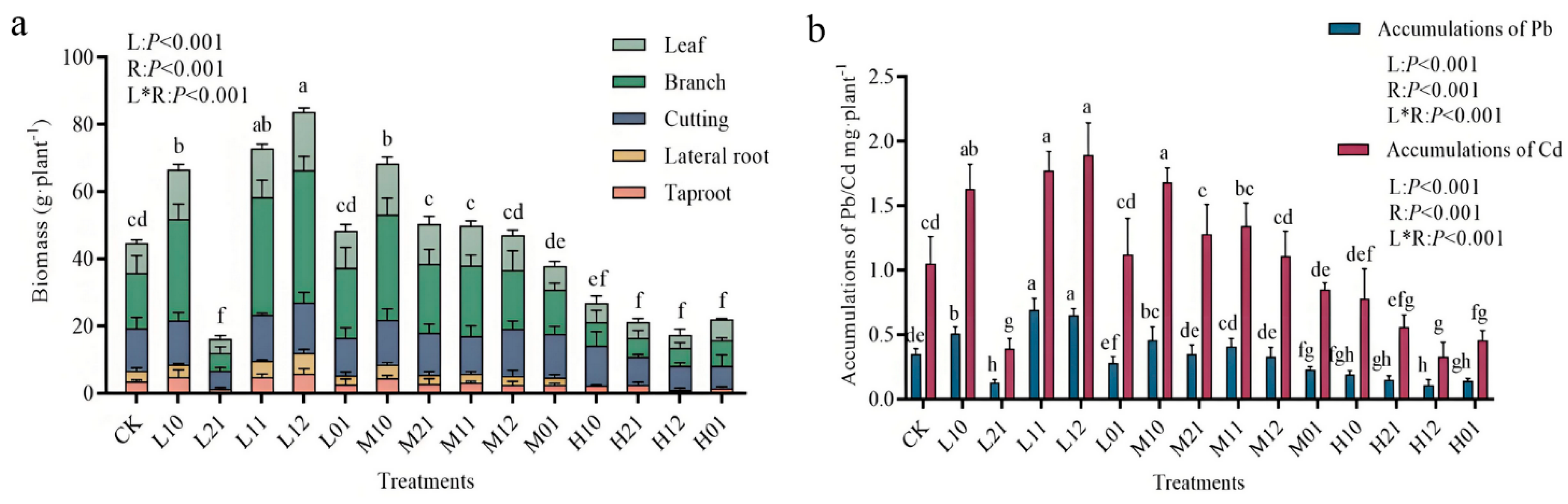
Figure 1. Biomass (a) and heavy metal accumulation (b) in S. linearistipularis following nitrogen fertilizer application. Different letters indicate that the values differ significantly at p < 0.05. L and R represent main effect respectively; L stand for amount of nitrogen fertilizer; R stand for ratio of ammonium and nitrate nitrogen; L*R represents the interactive effect.
Forests 17 00364 g001
Figure 2. The content of acid-soluble Cd and Pb in soil (a) and the proportions of different chemical speciation of Pb and Cd in soil. Note: The vertical dashed lines in (b) were set as the reference values of the control treatment to facilitate a clear comparison between other treatments and the control. Different letters indicate that the values differ significantly at p < 0.05.
Forests 17 00364 g002
Figure 3. The relative abundance of the top 10 at the phylum level (a) and genus level (b). NMDS analysis at the genus level (c). LEfSe analysis of different species between groups (d).
Forests 17 00364 g003
Figure 4. Non-metric multidimensional scaling (NMDS) ordination plot of reads related to function level subsystems for heavy metal resistance (a) and the top 20 genera of microorganisms with heavy metal resistance (b).
Forests 17 00364 g004
Figure 5. PCoA of metabolism functional abundance based on level 2 sub-metabolic pathways (a) and the top 10 microbial metabolic functions by relative abundance (b).
Forests 17 00364 g005
Figure 6. RDA of microbial community and metabolic characteristics in relation to soil properties and heavy metal accumulation in S. linearistipularis (a), and a conceptual model depicting the promotion of heavy metal accumulation in S. linearistipularis by ammonium and nitrate nitrogen application (b). Notes: This conceptual model (b) is derived from observed correlations in RDA (a) and experimental phenomena. T-Cd, total accumulation of Cd; T-Pb, total accumulation of Pb; SOM, soil organic matter; ACd, available concentration of Cd; APb, available concentration of Pb; ratio, the ratio of NH4+/NO3; level, the level of ammonium nitrogen and nitrate nitrogen; CEC, cation exchange capacity; D-pathway, disappeared metabolic pathways; E- pathway, emerged metabolic pathways; I-CHO, increased expression of carbohydrates; R-CHO, reduced expression of carbohydrates; I-AA, increased expression of amino acids; R-AA, reduced expression of amino acids.
Forests 17 00364 g006
Table 1. Fertilization treatments.
TreatmentsTotal (N)
(kg·hm−2·year−1)
Total (N)
(g·pot−1·year−1)
NH4+ (g·pot−1·year−1)NO3 (g·pot−1·year−1)Ratio
CK00000
L10600.48230.482301:0
L21600.48230.32150.16082:1
L11600.48230.241150.241151:1
L12600.48230.16080.32151:2
L01600.482300.48230:1
M101200.96460.964601:0
M211200.96460.64310.32152:1
M111200.96460.48230.48231:1
M121200.96460.32150.64311:2
M011200.964600.96460:1
H102001.60771.607701:0
H212001.60771.07180.53592:1
H112001.60770.803850.803851:1
H122001.60770.53591.07181:2
H012001.607701.60770:1
Note: The nitrogen application rate of NH4+/NO3 per pot is calculated based on the mass of nitrogen (N), rather than the mass of NH4+ or NO3 themselves.
Table 2. Pb and Cd concentrations in different plant tissues of S. linearistipularis.
TreatmentsPb Concentrations/mg·kg−1Cd Concentrations/mg·kg−1
Lateral RootTaprootCuttingBranchLeafLateral RootTaprootCuttingBranchLeaf
CK24.37 ± 2.1 b16.76 ± 1.94 b5.54 ± 1.44 de3.56 ± 0.29 bc9.26 ± 1.02 ab24 ± 4.17 de18.51 ± 1.78 def14.59 ± 1.72 bcd19.28 ± 1.59 ab46.4 ± 1.54 bc
L1026.1 ± 5.71 b14.74 ± 1.4 bc5.61 ± 0.57 de4.43 ± 0.96 ab9.14 ± 0.93 ab23.71 ± 2.24 de14.28 ± 0.66 gh12.88 ± 2.34 d20.55 ± 2.18 a47.05 ± 1.59 b
L2136.7 ± 0 a17.21 ± 3.59 bc8.55 ± 0.41 a1.77 ± 0.52 de10.81 ± 0.7 ab34.42 ± 0 b21.24 ± 4.09 cd8.86 ± 1.25 e21.14 ± 3.45 a47.65 ± 3.41 b
L1139.85 ± 3.58 a16.05 ± 3.31 bc7.55 ± 0.37 ab3.92 ± 0.72 abc12.44 ± 2.58 a31.63 ± 2.1 bcd15.63 ± 1.84 fgh16.03 ± 3.06 abcd18.52 ± 2.88 ab46.91 ± 7.61 bc
L1230.63 ± 1.91 b12.17 ± 0.54 bc8.19 ± 1.01 ab2.75 ± 0.48 cd9.04 ± 0.92 ab32.97 ± 4.78 bc13.17 ± 1.52 h15.28 ± 0.44 abcd19.2 ± 4.09 ab35.41 ± 2.61 d
L0124.97 ± 4.9 b13.02 ± 1.47 bc3.29 ± 0.21 g1.43 ± 0.45 e9.99 ± 1.15 ab26.57 ± 2.49 bcde14.4 ± 1.95 gh17.34 ± 1.69 abc17.55 ± 2.48 b40.43 ± 2.03 bcd
M1028.13 ± 1.4 b11.62 ± 1.71 c7.42 ± 2.02 ab2.06 ± 1.81 de8.3 ± 1.3 bc30.76 ± 6.83 bcde14.54 ± 1.2 fgh18.38 ± 1.27 a20.4 ± 0.86 a40.54 ± 4.61 bcd
M2136.07 ± 2.62 a13.2 ± 2.16 c7.12 ± 0.27 abc2.7 ± 0.72 cd6.36 ± 0.35 c43.78 ± 2.44 a21.32 ± 0.38 cd18.21 ± 0.16 a21.45 ± 1.26 a36.63 ± 7.15 d
M1133.5 ± 3.63 a14.36 ± 1.38 c7.68 ± 1.12 ab4.77 ± 0.51 ab7.73 ± 1.36 c33.38 ± 4.9 bc16.91 ± 1.35 efgh18.3 ± 1.82 a21.89 ± 2.34 ab45.63 ± 3.09 bc
M1229.03 ± 7.96 b12.87 ± 1.68 c6.91 ± 0.58 bcd3.85 ± 0.54 abc5.88 ± 0.18 c22.41 ± 8.53 e16.03 ± 0.68 fgh14.33 ± 1.02 cd20.99 ± 2.01 ab42.07 ± 3.2 bcd
M0125.48 ± 1 b15.22 ± 4.45 c3.13 ± 0.73 g3.89 ± 0.93 abc5.65 ± 1 c25.32 ± 6.86 cde17.66 ± 4.6 defg12.7 ± 1.05 d19.96 ± 3.08 b45.89 ± 5.8 bc
H10-20.39 ± 5.59 a3.64 ± 0.34 fg4.61 ± 0.79 ab7.77 ± 1.4 bc-35.27 ± 1.34 a17.89 ± 3.91 ab24.97 ± 2.39 a56.01 ± 3.75 a
H21-18.28 ± 1.2 a4.84 ± 0.49 ef4.8 ± 0.69 ab7.68 ± 0.46 bc-25.22 ± 2.71 b18.1 ± 1.64 a22.31 ± 3.66 a47.8 ± 3.63 b
H12-18.98 ± 0.48 a5.94 ± 0.77 cde4.09 ± 0.58 ab8.32 ± 3.12 bc-23.31 ± 2.32 bc15.3 ± 2.54 abcd18.33 ± 2.51 ab34.18 ± 7.3 d
H01-20.94 ± 1.69 a5.16 ± 0.69 e4.97 ± 0.46 a8.23 ± 1.11 bc-20.2 ± 2.38 cde14.54 ± 0.41 bcd16.59 ± 1.02 b38.57 ± 7.76 cd
P (L)ns****ns**nsns
P (R)*ns********
P (L*R)nsns**ns***ns*
Notes: “-” indicates no value; L and R represent main effect; L stands for the amount of nitrogen fertilizer; R stands for the ratio of ammonium and nitrate nitrogen; L*R represents the interactive effect; ns represents not significant; different letters indicate that the values differ significantly at p < 0.05. * indicates p < 0.05.
Table 3. Soil chemical properties in rhizosphere soil under different treatments.
TreatmentspHSOM/g·kg−1CEC/cmol·Kg−1NH4+-N/mg·kg−1NO3-N/mg·kg−1
CK7.82 ± 0.01 a11.74 ± 0.22 de11.32 ± 1.39 a3.12 ± 0.23 de19.0 ± 1.00 gh
L107.69 ± 0.04 cd14.32 ± 0.49 a10.19 ± 0.56 b3.1 ± 0.12 de15.07 ± 0.23 h
L217.8 ± 0.06 b12.9 ± 0.04 bcd10.26 ± 0.74 bc3.12 ± 0.01 de16.24 ± 0.35 gh
L117.73 ± 0.1 bcd13.63 ± 0.03 abc10.17 ± 1.68 bc2.77 ± 0.08 de15.16 ± 0.57 h
L127.64 ± 0.03 d12.72 ± 0.34 bcd9.2 ± 1.31 c2.56 ± 0.2 e15.17 ± 0.85 h
L017.76 ± 0.04 bc12.63 ± 0.86 cde9.91 ± 1.16 c3.78 ± 0.29 bc16.77 ± 1.97 gh
M107.54 ± 0.04 cd13.93 ± 1.89 ab10.83 ± 1.48 b4.27 ± 0.44 ab19.1 ± 0.42 gh
M217.64 ± 0.1 b13.57 ± 0.02 abc8.74 ± 0.17 bc4.16 ± 0.15 b35.07 ± 1.34 d
M117.52 ± 0.09 bcd12.93 ± 1.13 bcd8.33 ± 0.67 bc4.77 ± 0.28 a24.23 ± 0.52 f
M127.54 ± 0.08 d12.4 ± 0.35 cde8.34 ± 1.19 c2.9 ± 0.36 de19.78 ± 1.46 g
M017.65 ± 0.05 bc11.83 ± 0.33 de8.42 ± 0.86 c3.31 ± 0.06 cd26.46 ± 0.23 ef
H107.49 ± 0.09 cd11.41 ± 0.66 e9.6 ± 0.23 b4.22 ± 0.17 ab49.58 ± 4.62 b
H217.58 ± 0.13 b11.41 ± 0.37 e9.49 ± 0.52 bc3.19 ± 0.31 d28.12 ± 3.15 e
H127.48 ± 0.08 d11.91 ± 0.41 de8.91 ± 0.11 c2.8 ± 0.12 de42.54 ± 1.76 c
H017.51 ± 0.2 bc12.06 ± 0.36 de7.72 ± 0.78 c4.15 ± 0.47 b71.47 ± 0.15 a
p (L)*****
p (R)*****
p (L*R)ns*ns**
Notes: SOM stands for soil organic matter; CEC stands for cation exchange capacity; L and R represent the main effect; L stands for the amount of nitrogen fertilizer; R stands for the ratio of ammonium and nitrate nitrogen; L*R represents the interactive effect; ns represents not significant; different letters indicate that the values differ significantly at p < 0.05. * indicates p < 0.05.
Disclaimer/Publisher’s Note: The statements, opinions and data contained in all publications are solely those of the individual author(s) and contributor(s) and not of MDPI and/or the editor(s). MDPI and/or the editor(s) disclaim responsibility for any injury to people or property resulting from any ideas, methods, instructions or products referred to in the content.