Article

Landowner Awareness, Participation, and Satisfaction in Watershed Stewardship Programs: A Diffusion of Innovations Lens


1
Department of Sustainable Resources Management, College of Environmental Science and Forestry, State University of New York, Syracuse, NY 13210, USA
2
Watershed Agricultural Council, Walton, NY 13856, USA
*
Author to whom correspondence should be addressed.
Forests 2026, 17(3), 361; https://doi.org/10.3390/f17030361
Submission received: 19 February 2026 / Revised: 6 March 2026 / Accepted: 11 March 2026 / Published: 13 March 2026
(This article belongs to the Section Forest Economics, Policy, and Social Science)

Abstract

Watershed stewardship programs succeed when intended users progress from awareness to participation. This study applies diffusion of innovations theory to five forestry, agricultural, and economic viability programs administered by the Watershed Agricultural Council in the New York City watershed. These five programs are voluntary and intended to support water quality and community vitality on working lands. A survey of nonindustrial private farm and forest landowners measured awareness, participation, and satisfaction across the watershed programs. Awareness was limited and participation was rare, yet nearly all participants reported high satisfaction, indicating an entry bottleneck at the awareness-to-participation stage. Logistic regression and generalized estimating equations models showed higher participation among landowners with larger acreage. The study recommends strengthening existing extension and outreach to better communicate programs’ relative advantages and increase observability through peer examples and targeted messaging to improve enrollment among eligible landowners.

1. Introduction

Natural resource management regularly introduces new practices, technologies, and programs to respond to changing environmental and societal conditions, comply with evolving regulations, leverage new technology, and meet community needs and environmental goals [1]. Natural resource managers and policymakers need to understand how these new approaches to resource management are received and integrated, both within their own organizations and among resource users [2]. Encouraging landowners, farmers, and other natural resource users to support these innovations requires understanding the factors that shape their decisions to adopt them. In particular, understanding how knowledge networks transfer information and frame the benefits and risks of new practices is crucial for designing extension, outreach and technical assistance that moves innovations from trial to routine use [3]. A well-established framework for this is diffusion of innovations (DOIs), which explains how new practices spread through social systems and why people decide whether to accept and adopt them [4]. DOI aims to understand behaviors, attitudes, and decision-making processes that underline the adoption of innovations [5]. In natural resource management, DOI has been applied across conservation, planning, and resource governance [6,7,8], including watershed farms and forestry management [9,10,11] to understand values and beliefs, attitudes, social norms, concerns of the adopters, to study adoption patterns, the attributes that make practices more or less attractive, and the role of networks and opinion leaders [12,13,14,15,16,17]. As Dearing and Singhal (2020) note, diffusion research has largely prioritized the early stages of adoption, offering far less systematic evidence on implementation and long-term continuation [18]. This limitation is particularly important for community-based programs, which must sustain behavior change after launch and operate with feedback constraints, where environmental performance and its impact on community livelihoods influence whether participants continue participating or disengage [19]. Despite Rogers’ detailed innovation-decision model, diffusion studies rarely quantify post-adoption dynamics. Stage-based measures of knowledge, decision, implementation, and confirmation are feasible in principle [18,20], yet reviews still document persistent measurement gaps for sustained outcomes [21]. As a result, there is limited evidence on how knowledge translates into decision and implementation, how implementation translates into confirmation, and confirmation into continued use to a self-sustaining level (also known as critical mass by Rogers) once programs have moved past their initial launch phase.
This paper addresses that gap by operationalizing three DOI-aligned constructs as measurable indicators of post-implementation user metrics—awareness, participation, and satisfaction for five specific New York City (NYC) watershed programs. These programs include a forestry program, an agricultural program and three economic viability programs (Table 1). Here, awareness is treated as the knowledge stage that reveals whether landowners are familiar with the programs, participation as the implementation stage that captures the decision to engage with the programs, and satisfaction as the confirmation stage that signals whether adopters intend to continue, to recommend, or to discontinue use. This paper addresses the following two research questions: (i) what share of nonindustrial private farm and forest landowners are aware of, participate in, and are satisfied with the five watershed programs? and (ii) what factors are associated with participation in these programs?

NYC Watershed (Study Area) Context

New York City’s watershed is a useful natural resource management case for applying DOI theory. NYC relies on a regional surface water system that integrates the Croton, Catskill, and Delaware watersheds (Figure 1) through nineteen reservoirs and three controlled lakes that together serve roughly 3.8 billion liters (1 billion gallons) per day to the city and nearby counties [22]. In this system, water from the Croton (10% of supply) is now filtered, whereas the Catskill–Delaware system (90% of supply) remains the nation’s largest unfiltered surface water source, treated with chlorination and ultraviolet disinfection and supplying high-quality drinking water to nearly nine million residents [23].
The Catskill–Delaware Watershed (the Watershed from hereon), located between roughly 128 and 200 km (80 and 125 miles) northwest of NYC, functions as a predominantly privately owned working landscape where forests and farms at the urban–rural interface support local livelihoods while safeguarding downstream water quality [24].
Nearly 80% of the Watershed is forested, of which 65% is privately owned [25], highlighting how long-term protection of the watershed depends on partnerships with rural landowners managing working farms and forests [26]. This long-running policy context relies on thousands of privately managed farms, forests, and homes adopting new practices through voluntary programs rather than regulation alone [27]. This operating model depends on a governance framework that protects source water while sustaining watershed communities [28]. The 1997 NYC Watershed Memorandum of Agreement (MOA) formalized that framework [29].
The MOA updated watershed rules and regulations, a land acquisition program based on willing sellers, and a financed portfolio of Watershed Protection and Partnership Programs [30]. It also created coordinating bodies, including the Watershed Protection and Partnership Council and its executive committee, and recognized intermediary implementers such as the Catskill Watershed Corporation (CWC) and the Watershed Agricultural Council (WAC), to protect source water while reinforcing the community vitality of the largely private Catskill–Delaware watershed. CWC is a locally governed not-for-profit that administers West-of-Hudson programs financed under the MOA and delivers household and hamlet-scale investments such as septic repair and replacement, stormwater retrofits, and community wastewater systems, and supports flood mitigation, public education programs, and economic initiatives such as workforce development. Its primary beneficiaries are residents and municipalities in West-of-Hudson towns [31].
WAC, on the other hand, focuses on farms and forests landowners of the Watershed [32]. It is a nonprofit intermediary that administers agricultural and forestry initiatives under contract with the City. Its mission is to protect water quality from nutrients, pathogens, sediments, and pesticides, and to support the economic vitality of working farms and forests. WAC’s beneficiaries are agricultural farms and forest landowners, loggers, foresters, educators, and students. By aligning stewardship with enterprise viability, WAC advances both pillars of the MOA. To achieve the dual goals of the MOA, WAC has promoted a range of “innovations” such as best management practices (BMPs) for farms and forests, innovative forest and farm management plans, demonstration forests and business incentives, all supported by cost-share and technical assistance [33,34]. They implement these offerings through programs such as the Watershed Agricultural Program (WAP), Watershed Forestry Program (WFP), Economic Viability Micro-Grants Program (EVMGP), Business Planning Program (BPP), and Farms and Forests in Transition Reimbursement Program (FFTRP) (Table 1). These programs translate regulatory goals into locally workable options that reinforce community vitality.
Table 1. Agricultural, Forestry, and Economic Viability Programs offered by the Watershed Agricultural Council with monetary benefits.
Programs (Acronym)Funding, Incentives and Monetary Benefits
Watershed Agricultural Program
(WAP)
  • Whole Farm Planning: a voluntary WAC funding agreement that helps farmers assess and prioritize on-farm environmental concerns without compromising their business, using best management practices to prevent or reduce nonpoint-source pollution.
[35]
Watershed Forestry Program
(WFP)
  • Best Management Practice Program: funding, materials, and technical assistance for loggers to implement water-quality BMPs.
  • Management Assistance Program: funding and technical guidance for landowners to carry out stewardship projects.
  • 480-a Enrollment and Update Incentive: cost-share support for landowners with at least 50 forested acres to enroll in New York’s Forest Tax Law Program, update plans, and reduce property taxes.
  • Funding for school field trips to the NYC Watershed.
[36]
Business Planning Program
(BPP)
  • Reimbursable grants: reimburses the costs of creating or updating business plans for farm and forestry enterprises to improve profitability and long-term sustainability.
[37]
Economic Viability Micro-Grants Program
(EVMGP)
  • Reimbursable grants: reimburses up to $5 k per year to farm and forestry enterprises for:
    (i)
    Training—offsets costs of online courses, workshops, seminars, conferences, and college classes.
    (ii)
    Marketing—supports branding, advertising, and product or service communications.
    (iii)
    Events—helps cover new events, fairs, and farmers’ markets, including travel mileage and vendor fees.
    (iv)
    Staffing—funds hire staff to improve profitability, boost productivity, or enable business expansion.
[38]
Farms and Forests in Transition
Reimbursement Program
(FFTRP)
  • Reimbursable grants: reimburses up to $5 k per year for professional legal and accounting services related to succession, estate planning, ownership transfer, and easements for farm and forest businesses.
[39]
Administered by WAC, the agriculture and forestry programs reduce non-point source pollution while keeping working lands viable. The WAP helps farms create Whole Farm Plans and adopt BMPs, now reaching much of the eligible farm base, benefiting farm households, downstream water users, and communities tied to agriculture [35]. WAP advances the MOA’s dual goals by reducing pollutant loads at the source while strengthening the resilience of watershed agriculture. The WFP enhances sustainable forestry through BMPs, riparian buffers, professional training such as Trained Logger Certification, and 480-a forest management plan enrolments and updates, benefiting private woodland owners, loggers, local mills, and downstream users [36]. It furthers MOA objectives by preventing erosion and sedimentation while supporting livelihoods that make it viable for landowners to keep their properties in forest and thereby discourage conversion to other land uses. The following three economic-viability programs complement these efforts: (1) the BPP reimburses professional business-planning services and offers technical assistance [37]. It supports MOA objectives by improving the financial durability of stewardship-dependent businesses. Then, (2) the EVMGP provides small, timely reimbursements for training, marketing, staffing, events, and targeted infrastructure [38]. It promotes the MOA by stabilizing the enterprises that maintain working lands and rural livelihoods. Finally, (3) the FFTRP covers succession and transfer services [39]. It reinforces the MOA goals by keeping working lands intact and preventing disruptive conversions that can undermine both water quality and community stability. These five agriculture, forestry, and economic-viability programs (Table 1) keep working lands intact, stabilize stewardship-dependent enterprises, and deliver incentives, financial and technical support to property owners. In doing so, they translate the MOA’s dual goals of protecting water quality and sustaining community vitality into everyday practices.
DOI provides a useful process lens for the NYC watershed case study because WAC has introduced a steady stream of practices, technologies, and programs for almost three decades to meet changing environmental and community needs and comply with evolving regulations [40]. Using DOI and treating awareness as the knowledge stage, participation as decision and implementation, and satisfaction as confirmation of continued adoption helps assess post-launch dynamics and whether programs are progressing toward self-sustained adoption.

2. Materials and Methods

2.1. Data Collection

A sample frame of property owners used for its Conservation Awareness Index (CAI) survey [41] was obtained from WAC. Cochran’s finite-population formula [42] indicated a target of 380 completed surveys. Assuming a 10% response rate, 3800 surveys were planned for distribution. Proportional allocation [43] ensured representation across the 37 Watershed towns. Purposive sampling [44] prioritized nonindustrial private farm and forest landowners (NIPFF) with at least 20 years of ownership. Within each town, addresses were randomly selected and ownership dates were verified on county deed websites to confirm 2004 or earlier, yielding a final mailing list of 3429 properties. In a few towns, deed websites were not accessible, and ownership tenure could not be verified. This may have resulted in a small number of respondents with less than 20 years of residence in the Catskills, who were excluded from the statistical analysis.
The survey instrument (Appendix A) assessed landowners’ awareness of, satisfaction with, and participation in five programs supporting community vitality and source-water protection. Awareness and satisfaction were measured using Likert-scale items, and participation was measured with yes/no items. The survey was administered via Qualtrics in both paper and online formats using a QR code, and each questionnaire included a unique tracking number to maintain respondent confidentiality while also removing them from the mailing list once the response had been received. Packets included a cover letter and consent information, and the study received exempt IRB approval.
Surveys were administered from July to November 2024 following Dillman’s Total Design Method [45], including an advance letter, initial mailing, reminder, and a second mailing to nonrespondents.

2.2. Data Analysis

Analysis 1 describes landowners’ familiarity with, participation in, and satisfaction with the five programs using frequencies and percentages.
Analysis 2 used program-specific binary logistic regression models because participation was measured as yes/no outcome (Yes = 1, No = 0). Separate models were estimated for each program (WAP, WFP, BPP, EVGMP, and FFTRP) with participation as the dependent variable. Predictors were housing type, length of residency, age, household income, gender, race, employment status, and acreage in which categorical predictors were coded using indicator (reference-category) coding (Appendix B). To address sparse cell counts, selected predictors were collapsed to two categories, whereas acreage and employment were retained as multi-level factors for consistency with descriptive results and conceptual clarity. Cases with missing data were excluded via listwise deletion. For each program, single-predictor models were first fit for each candidate variable, and significant predictors from these models were entered simultaneously into a multivariable model [46]. Predictors remaining significant after joint adjustment were retained. Results are reported as odds ratios (ORs) with 95% confidence intervals, p-values, and model fit statistics.
Analysis 3 used a joint modeling approach across programs. Because each respondent reported participation for five WAC programs (WFP, WAP, BPP, EVGMP, and FFTRP), outcomes were stacked to long format (one row per respondent–program) and analyzed using generalized estimating equations (GEEs) with a binomial logit link, an exchangeable working correlation structure, and robust standard errors. Participation (Yes = 1, No = 0) was the dependent variable, with the same categorical demographic predictors as in Analysis 2. Respondent ID was specified as the clustering variable and program as the within-subject factor. Population-averaged ORs with 95% confidence intervals, Type III tests for program and predictors, and model-adjusted predicted probabilities by program were reported. Model selection followed a two-stage procedure—single-predictor GEE screening models were fit first, and significant predictors were then entered together in a multivariable GEE model to evaluate independent associations after mutual adjustment [46].
Nonresponse bias was assessed using an early–late respondent comparison (wave analysis), treating late respondents as a proxy for nonrespondents [47]. Early respondents were defined as surveys returned prior to the first reminder mailing, whereas late respondents were defined as surveys returned after reminder letters. Group differences were evaluated using chi-square tests for binary (yes/no) items and Mann–Whitney U tests for ordinal variables. No statistically significant differences were detected between early and late respondents (Appendix C).
Analysis 1 addresses research question (i) descriptively while Analysis 2 and 3 address research question (ii) by estimating factors associated with participation. All three analyses were performed in IBM SPSS Statistics, Version 29 [48].

3. Results

3.1. Descriptive Findings

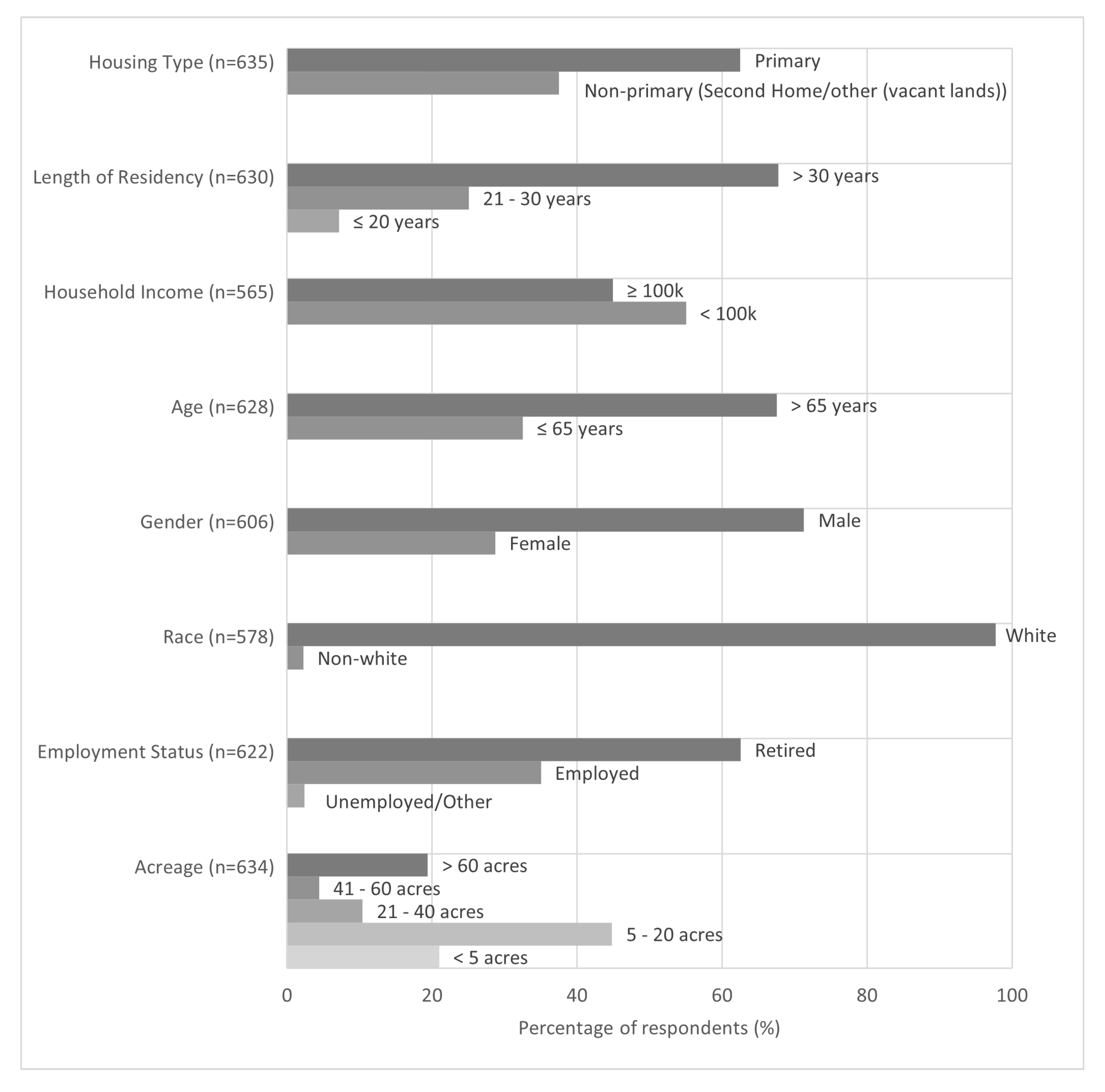
A total of 635 responses were received, yielding an adjusted response rate of 21%. Respondents were predominantly older, White, and retired (Figure 2), which is consistent with the demographic composition of the study area reported by the U.S. Census Bureau and prior research in the region [26]. Most respondents were aged 65 or older (68%), identified as White (98%), and were retired (63%). Approximately 70% were male. Household income was roughly evenly split, with slightly more reporting less than $100,000. Residency was concentrated in the longest tenure categories (Figure 2), with 68% reporting more than 30 years and 25% reporting 21–30 years. Landholdings were most commonly 5–20 acres (45%), followed by less than 5 acres (21%), more than 60 acres (20%), 21–40 acres (10%), and 41–60 acres (4%). Most respondents reported as primary (full-time) residents (63%), about one-third reported as secondary (seasonal/absentee) residents (33%), and the remainder reported other arrangements, primarily vacant land. In this study, the latter two groups are collectively referred to as ‘non-primary’ to distinguish them from full-time landowners who live in the Watershed year-round.

3.1.1. Awareness

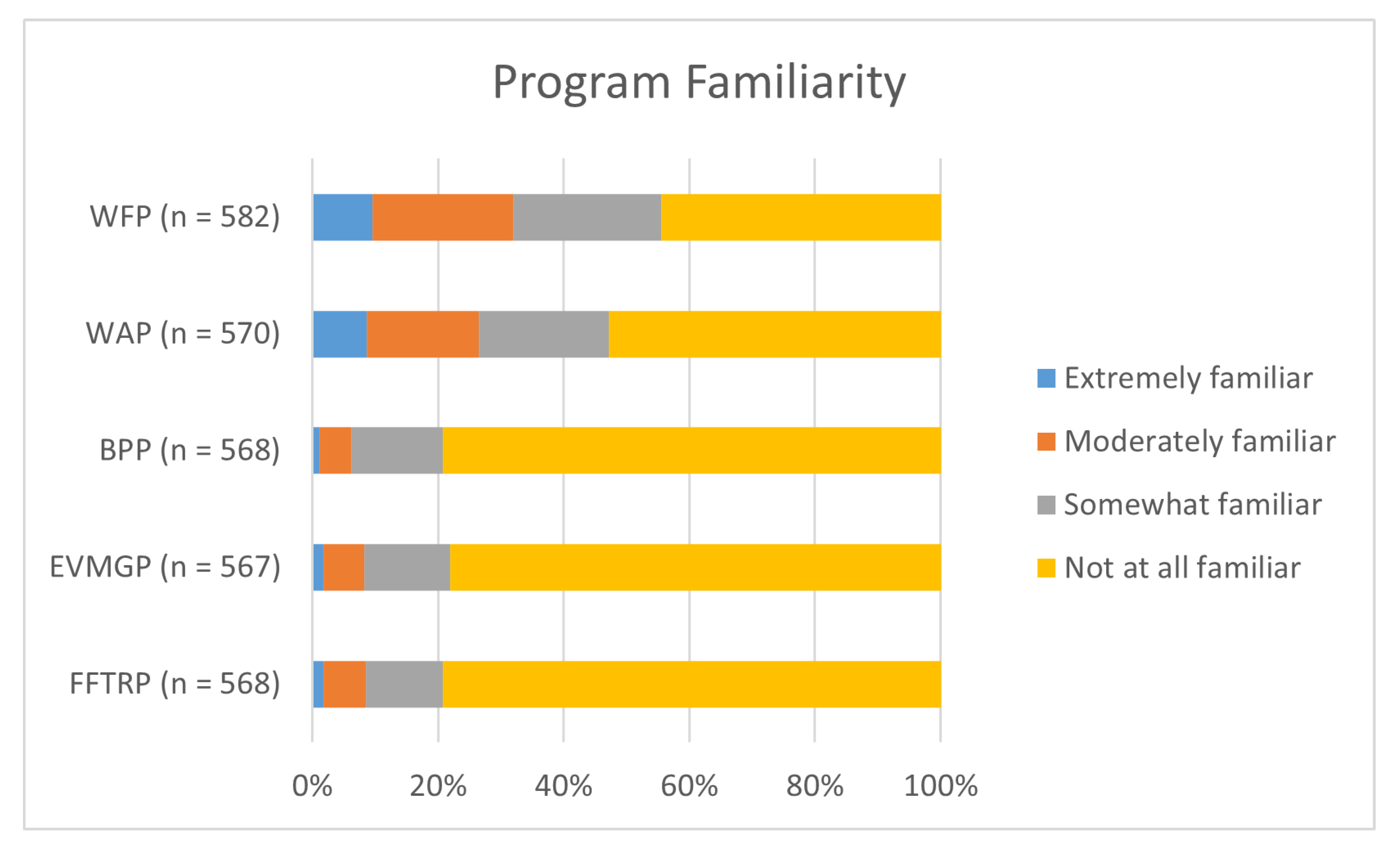
Familiarity with the five focal programs was generally low. WAP and WFP showed roughly 9% to 10% of respondents being extremely familiar, while around 44% to 53% reported no familiarity, and the remainder were somewhat to moderately familiar (Figure 3). Awareness of the business and economic-viability offerings was lower. For BPP, EVMGP, and FFTRP, lack of familiarity was almost 80%, and only about 1% to 2% reported being extremely familiar.

3.1.2. Participation

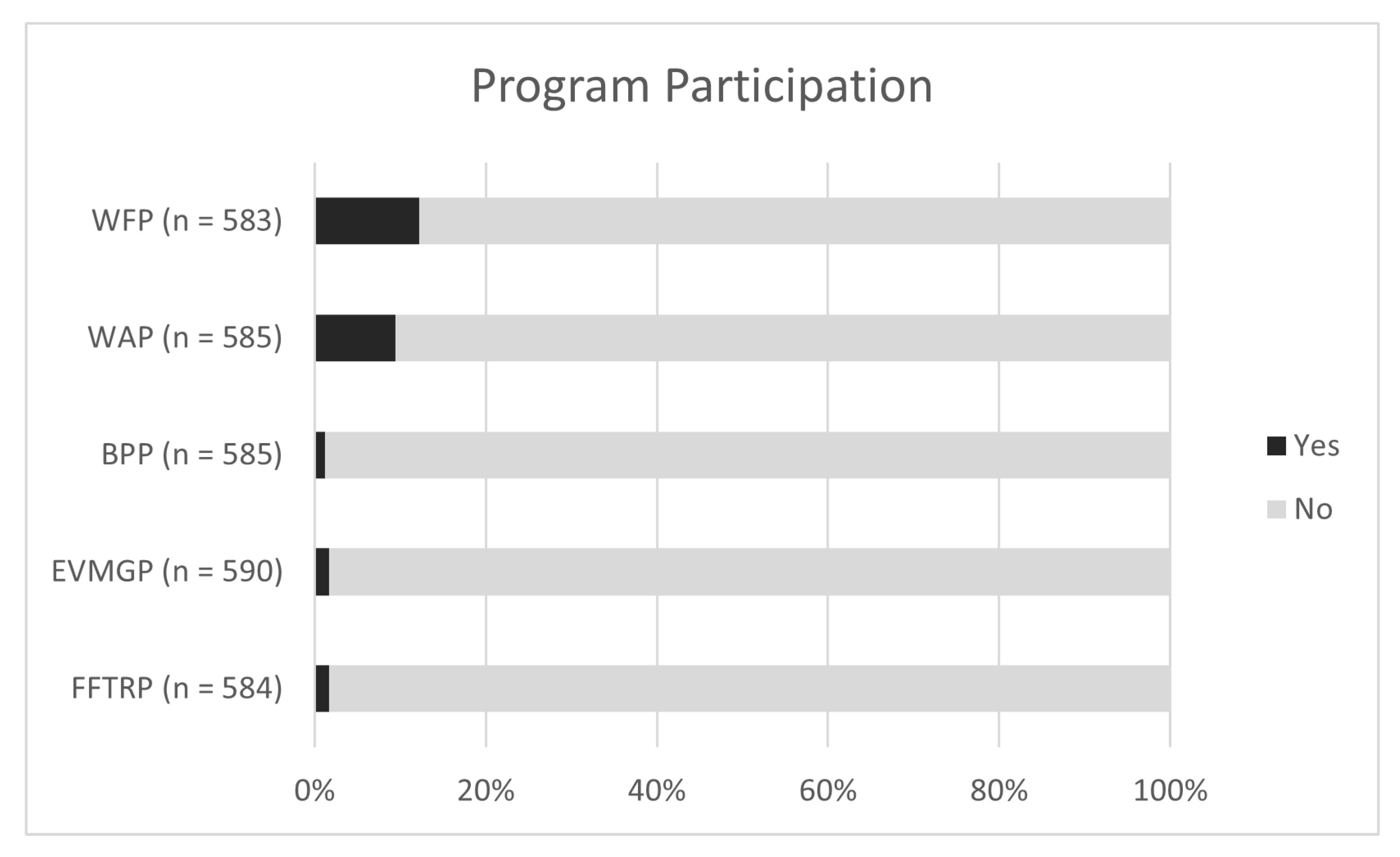
Participation rates were also low across the five programs, ranging from 1% to 2% for the economic viability programs and 9%–12% for agricultural and forestry programs (Figure 4).

3.1.3. Satisfaction

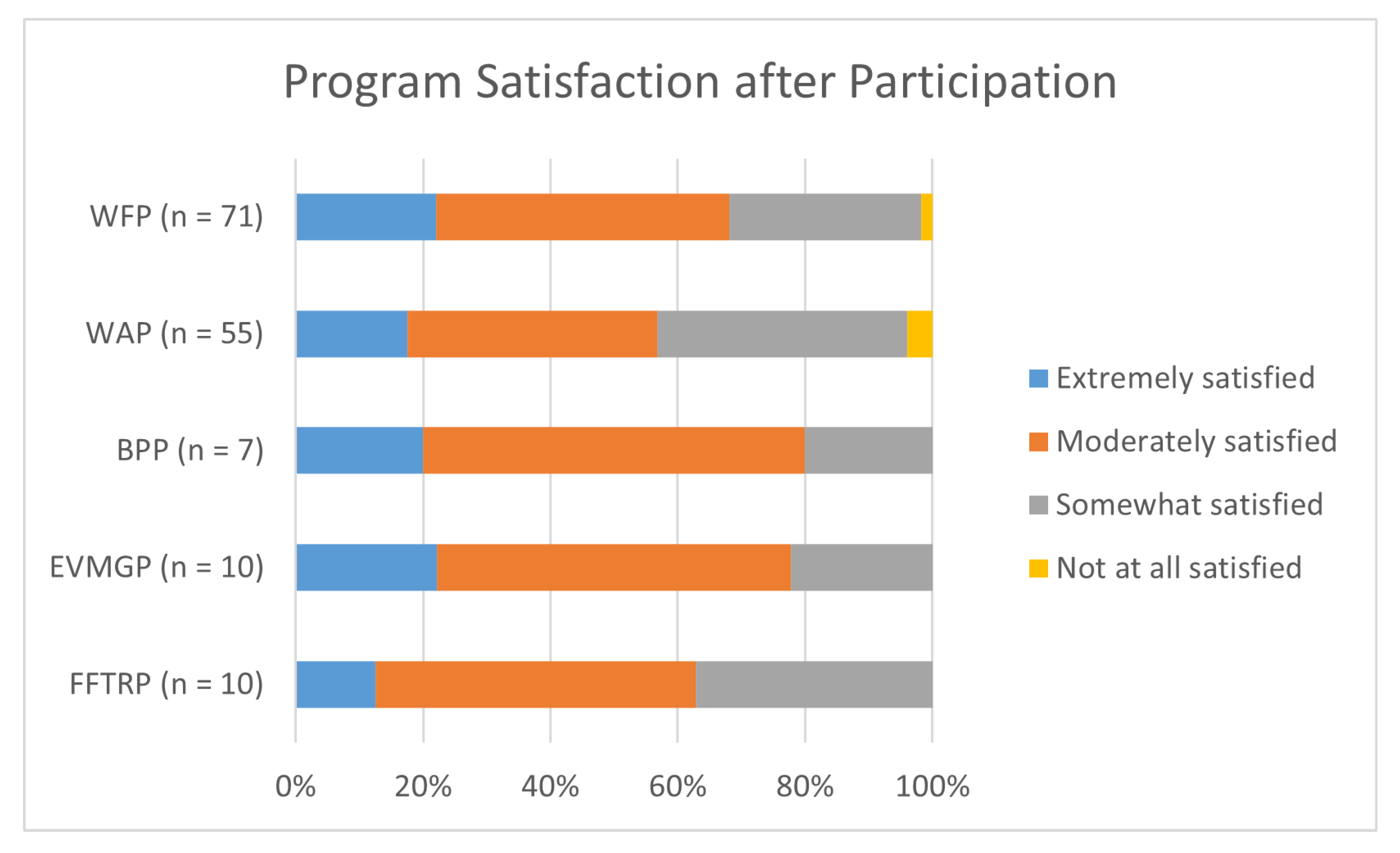
Among the relatively few participants, overall satisfaction was quite favorable with 96% for WAP and 98% for WFP, and a 100% for BPP, EVMGP, and FFTRP (Figure 5). It is important to note that less than one-quarter (ranging 12%–22%) of respondents were extremely satisfied across all programs and roughly one-third of respondents in WAP and WFP were only somewhat satisfied.

3.2. Model Results

3.2.1. Program-Specific Models

Participation in each program was modeled with a separate binary logistic regression. Univariable screening results are summarized in Appendix D (Table A4). Predictors remaining significant after joint adjustment were retained in multivariate models with results presented below. No predictors were significant for BPP, EVGMP, or FFTRP, so multivariate models were not developed. WFP and WAP had significant univariate predictors and multivariate models.
In the WFP model (n = 583), acreage was the only retained predictor and was significant overall (Table 2). Compared with landowners with <5 acres, participation odds were higher for 21–40 acres (about 8 times), 41–60 acres (about 7 times), and >60 acres (about 22 times). The 5–20-acre group did not differ from the <5-acre group.
In the multivariate WAP model (n = 486), participation was associated with acreage, housing type, residency tenure, and income (Table 3). Relative to <5 acres, participation odds were higher for 21–40 acres (about seven times), 41–60 acres (about eight times), and >60 acres (about 26 times), while 5–20 acres did not differ significantly. Primary-home residents had higher odds of participating than those in non-primary housing (about two times). Respondents with >30 years of residency had substantially higher odds than those with 21–30 years (about 15 times). Higher-income households (≥$100 k) had lower odds of participation than those with <$100 k (OR = 0.45, or about 55% lower odds).

3.2.2. Joint Model (GEE)

The multivariable GEE model retained program, housing type, and acreage as significant predictor variables (Table 4). The model included 599 respondents contributing 2927 respondent–program observations. Participation odds were higher for respondents living in a primary home than in non-primary housing (about two times). Relative to <5 acres, odds were higher for 21–40 acres (about six times), 41–60 acres (about five times), and >60 acres (about 19 times), while 5–20 acres did not differ.
With WFP as the reference program, participation odds were lower for WAP and substantially lower for BPP, EVGMP, and FFTRP. Model-adjusted predicted probabilities were highest for WFP and WAP, and lowest for BPP, EVGMP, and FFTRP (Appendix D, Table A5 and Table A6).

3.3. Land Parcel Size Distribution

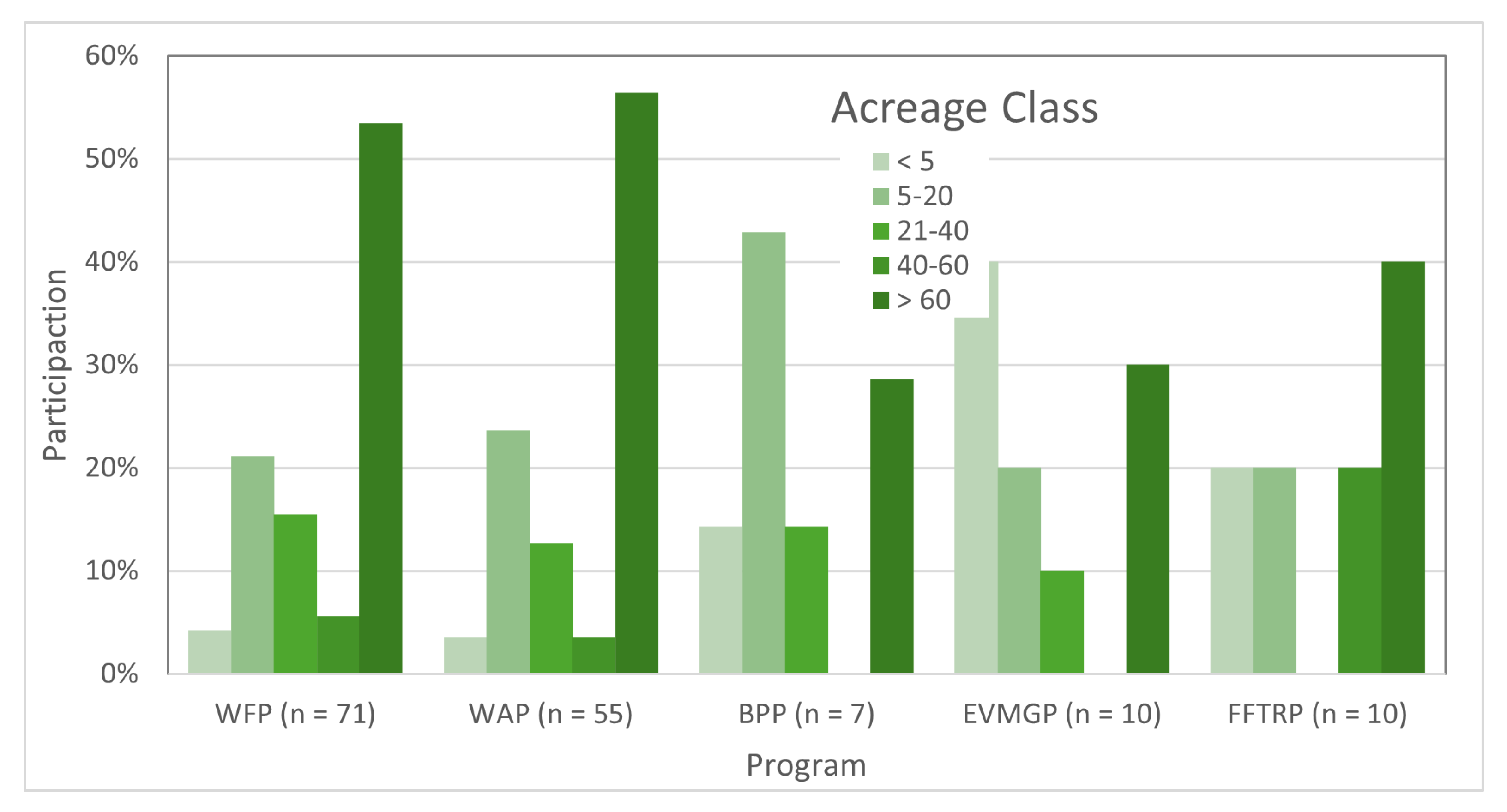
Descriptive statistics show that the mix of participants differs by program type and acreage size (Figure 6).
In the forestry and agricultural programs, participants are more heavily drawn from landowners with larger acreages, particularly those with 60 acres or more. In contrast, participants in the economic viability programs are more concentrated in the smaller acreage categories.
The logistic regression results provide a complementary perspective. In both the program-specific models and the joint GEE model, acreage is the only predictor that is consistently and significantly associated with participation across programs. The strongest associations are observed among landowners with more than 60 acres, who have the highest odds of participation. This pattern reflects the difference between the composition of participants and the likelihood of participation. The descriptive results indicate which acreage groups comprise the participant pool. The regression results estimate the relative likelihood of participation within each acreage group after adjustment. This indicates that larger-parcel owners are more likely to participate than smaller-parcel owners, even when smaller-parcel owners still comprise a substantial share of participants in some programs, particularly the economic viability programs.

4. Discussion

The following three key results were found: (1) the pattern of low awareness or participation but relatively high satisfaction among adopters suggests entry bottlenecks in knowledge and observability; (2) the agricultural and forestry programs have higher awareness and participation compared to economic viability programs; and (3) larger land parcel size is a significant predictor that increases the odds of participation.

4.1. A DOI-Lens on the Entry Bottlenecks in Program Adoption

The pattern of limited familiarity with and rare participation in programs points to an entry bottleneck, while relatively high satisfaction rates of participants confirm a generally positive experience among program adopters. For example, 47% and 56% of respondents were familiar with WAP and WFP, yet only 9% and 12% participated. Economic viability programs showed just over 20% familiarity but only 1%–2% participation, with almost all participants satisfied with the programs. Viewed through a DOI lens, landowners appear to remain in the knowledge or awareness stage rather than moving into persuasion and decision. Expanding awareness and clarifying entry points are therefore necessary precursors to increasing participation, even in programs that earn satisfaction from those who engage. Since the agricultural (WAP) and forestry (WFP) programs have higher awareness and participation than the economic viability programs, different and tailored approaches are needed to raise awareness and ease entry for different kinds of programs. The higher awareness and participation in agricultural and forestry programs compared to economic viability programs may reflect program age, as WAP and WFP were established nearly three decades ago, whereas BPP, EVMGP, and FFTRP have been operating for less than ten years [40]. The pattern of earlier programs having higher awareness and participation than more recent ones aligns with DOI’s emphasis on time in the diffusion process, i.e., the amount of time it takes a person to go through the stages of deciding about an innovation [4]. However, program age alone is not causal since differences in eligibility rules, target populations, cost-share requirements, budget scale, and regulatory triggers may also shape adoption. DOI studies find that innovations with highly visible outputs and clear monetary benefits tend to score high on observability and relative advantage and have low perceived complexity [49,50,51,52]. The five WAC programs seem to be valued by participants but are less observable to nonparticipants and can appear more complex, which may slow movement from awareness to participation even when benefits are high. This pattern points to an entry bottleneck rather than a quality problem as satisfaction is relatively high once people participate [53].
To address this bottleneck, WAC could strengthen its existing outreach to highlight the relative advantages of its programs and increase their observability. Outreach should expand awareness of forestry, agricultural, and economic viability programs by using plain-language descriptions of typical projects, eligibility, and timelines, and by sharing examples through participants (early adopters or opinion leaders) since they are satisfied with the programs and can serve as advocates [13,50,54]. WAC’s CAI survey [41], which currently focuses on forestry programs, could be adapted or complemented to raise awareness of economic viability programs alongside forestry and agricultural offerings. WAC could streamline and standardize steps, while keeping technical requirements intact, so the process is easier for nonspecialists [49,52]. Trusted intermediaries such as Cooperative Extension agents and regional landowner associations could continue hosting peer demonstrations and share brief testimonials from early adopters, since messages from similar peers often help landowners move from awareness to adoption, especially for early-stage programs like the economic viability programs.

4.2. Aligning Watershed Programs with Landowner Adoption Patterns

The results show that although small parcels constitute roughly two thirds of landowners in the watershed, large parcels (especially 60 acres or more) are especially well represented among participants in all five programs. This pattern likely reflects both the underlying population structure and how program incentives align with different landholding types. Small-acreage owners are more numerous but less likely to enroll, whereas owners of large working farms and forests are fewer in number but more inclined and able to participate once eligible. In practice, larger operations have more capacity to handle administrative and advisory requirements [55]. Larger operations can more easily absorb the fixed transaction costs of program enrollment and are more likely to sustain participation, given their stronger economic base and dependence on land-based income [56], while owners of extensive parcels are also more embedded in extension and knowledge networks [3]. From a DOI perspective, this reflects greater perceived relative advantage and compatibility among larger working-land parcels, which increases the perceived relative advantage and compatibility of the programs. These patterns also suggest that current program design and delivery are more attractive or feasible for larger operations and that additional effort may be needed to adapt offerings, reduce transaction costs, and increase perceived benefits for small-parcel owners. WAC could prioritize larger-parcel owners for direct contact while maintaining general information channels for owners of smaller parcels and use communication modes that work well for high-visibility projects, such as on-site demonstrations, contractor networks, and local communications [57,58,59]. Such strategies can heighten observability, reduce perceived complexity, and create low-risk opportunities to experiment with new practices and help move owners from awareness to adoption. Moreover, participation in WAP was also associated with length of residency and household income, which suggests that aspects of program design and outreach could be further refined. Within the long-tenured sample, respondents who had lived in the Watershed for more than 30 years had higher odds of participating, whereas respondents with household income of $100,000 or more had lower odds of participation. This pattern suggests that WAP incentives, eligibility constraints, outreach strategies, or perceived need may align more closely with lower-income households, even among long-term landowners. These results reflect long-tenured owners in the analytic sample, although newer or transitional owners may require different approaches.
Because the watershed includes substantial numbers of both primary/full-time resident and non-resident (seasonal/absentee) owners [26], communication should be tailored to their distinct touchpoints. For primary/full-time residents, messages can be integrated into day-to-day, place-based settings such as local events, farm visits, and municipal communications. For seasonal/absentee owners, outreach may need to rely more on digital channels, scheduled mailings, or coordinated communication through service providers. Visibility and trialability could be increased by placing farm and forest practices being offered alongside highly visible watershed programs that the public already recognizes, such as septic replacements, culvert upgrades, and stream restorations [49,52,58].
Framed explicitly through DOI attributes, outreach and program design can be refined in three ways. First, to raise awareness of the five programs, messages should be tailored by ownership type and parcel size, should use peer messengers and opinion leaders who have completed the programs, and pair general outreach with concrete before and after examples that enhance observability [60,61].
Second, to increase participation, trialability needs to be improved and perceived complexity needs to be reduced. Studies of natural resource programs similarly find that simplifying enrollment and paperwork, lowering enrollment costs, bundling site visits across programs, offering small pilot slots, and providing hands-on implementation support and low-commitment entry options for first-time applicants are critical for lowering perceived complexity and encouraging initial participation [62,63].
Third, to elevate satisfaction levels from ‘somewhat’ to ‘extremely’, the focus could remain on delivery quality and fit. Extension studies indicate people are willing to pay more for models that emphasize frequent visits and prompt, well-resourced support, underscoring how improvements in delivery quality and follow-up can lift satisfaction to higher levels [64].

4.3. Program Sustainability Through DOI-Lens

If the five programs are to be sustainable over the long term, they need to become self-running. In DOI terms, the programs need to reach a critical mass or a tipping point at which the adoption of an innovation becomes self-sustaining [4]—in practical terms, “taking the training wheels off”. Through a DOI lens, a self-sustaining program should maintain relative advantage, increase observability, compatibility, and trialability, and reduce complexity over time so that adoption persists without heavy promotion [15,65]. Programs that deliver clear monetary gains and produce visible outcomes often score high on all five DOI attributes [66]. Since the five programs have an entry bottleneck, despite relative satisfaction when participated, to move toward self-running status, they should be structured so benefits are easy to see, understand, and try for newer participants [8,67]. As adoption shifts from early adopters to the early majority, reliance on intensive promotion and exceptional subsidies can taper. Programs should track three outcomes, namely awareness, participation, and satisfaction, and should also monitor discontinuance and referrals [68,69]. Results could be reported by ownership type, parcel size, and property location to identify where adoption is favored or disfavored and where awareness, participation, and satisfaction are high or low [50,51,70].
In the broader natural resource management context, diffusion should be treated as a dynamic process shaped by external uncertainty such as climate variability and regulatory cycles [65,71]. Such shocks can alter perceived relative advantage, compatibility, complexity, trialability, and observability of the innovations, which may slow movement from knowledge and persuasion through decision, implementation, and confirmation, or trigger discontinuance [8,49,67]. Climate-related events may also increase issue salience. In DOI terms, this corresponds to increased problem recognition and perceived need, which can motivate engagement in stewardship programs. In the Watershed context, increases in high-intensity rainfall and associated erosion, wash-outs, and sediment transport can create visible, immediate impacts that heighten perceived risk and the relative advantage of technical assistance and cost-share programs. When landowners experience or observe these events on their properties or nearby, they may be more likely to seek guidance from available stewardship programs, potentially increasing program inquiry and accelerating movement from awareness to adoption and participation. From DOI perspective, such events can act as triggering events that increase readiness to adopt, strengthen persuasion, and shorten the time to the decision stage. As noted by diffusion of innovation studies [65,72], it is prudent for natural resource managers, consultants, and extension specialists to develop scenario budgets and contingency plans that incorporate modest buffers to accommodate periods of uncertainty and external shocks.

5. Conclusions

Using a diffusion of innovation lens, this study examined five Watershed Agricultural Council programs and asked two related questions about program adoption. It assessed what share of landowners are aware of each program, participate in them, and report being satisfied. It also examined which factors are associated with participation. The survey shows a clear pattern where awareness was limited and participation was rare across WAP, WFP, EVMGP, BPP, and FFTRP, while almost all participants were relatively satisfied with the programs. In the statistical models, owning more acreage was positively associated with and increased the odds of participation. These are associations rather than causal effects, but they indicate where movement stalls along the innovation-decision process from knowledge to implementation to confirmation to continued adoption. At the same time, conclusions are constrained by the study sample of long-term Watershed residents, so future work is warranted to sample both long-term and newer property owners.
This study identifies three opportunities to build on and enhance existing WAC practices and programs. First, raise observability and trialability by pairing farm and forest innovations with visible works, hosting brief field demonstrations, and sharing short, local before and after summaries, ideally using opinion leaders as messengers. Second, reduce perceived complexity and access costs by standardizing checklists and timelines, using preapproved contractor pools, offering help for first-time applicants, and simplifying enrollment wherever possible. Third, target outreach by landowner segment.
DOI links adoption dynamics to practical design choices and offers a lightweight dashboard for sustaining participation and satisfaction in both new and mature watershed programs. The same template, which uses the DOI lens to measure knowledge (familiarity), decision and implementation (participation), and confirmation (satisfaction), can support post-adoption assessment of Catskill Watershed Corporation and New York City Department of Environmental Protection programs that were established to strengthen economic development in the NYC watershed. It can also be adapted to other watershed and regulated-resource contexts and used by watershed managers, natural resource managers, consultants, and extension specialists to refine program design and outreach.
More broadly, natural resource managers should treat diffusion as a dynamic, shock-sensitive process and design flexible scenario budgets, contingency plans, and ongoing monitoring of adoption stages so that promising innovations remain viable under changing climatic and regulatory conditions.

Author Contributions

Conceptualization, A.L.; methodology, A.L. and E.B.; software, A.L.; validation, R.H.G., E.B. and K.B.; formal analysis, A.L.; investigation, A.L.; resources, R.H.G., E.B. and K.B.; data curation, A.L.; writing—original draft preparation, A.L.; writing—review and editing, A.L., R.H.G., E.B. and K.B.; visualization, A.L. and E.B.; supervision, R.H.G.; project administration, R.H.G. All authors have read and agreed to the published version of the manuscript.

Funding

This research was funded by the Watershed Agricultural Council, award number 105280, project number 1201384.

Data Availability Statement

The data presented in this study are available on request from the corresponding author due to Institutional Review Board (IRB) restrictions. Access is limited to individuals who obtain approval from the Office of Research and Integrity Protection for this specific study.

Conflicts of Interest

The authors declare no conflicts of interest.

Appendix A. Survey Questions

“Catskill region” refers to the entire watershed area that falls within
Delaware, Greene, Schoharie, Sullivan, and Ulster counties.
  • Please indicate your housing situation in the Catskill region
(Check all that apply).
▢ Primary Home ▢ Second Home ▢ Rental Home
▢ Rental Apartment ▢ Other ____________________________________________
2.
Please indicate the length of residency in your current house in the Catskill region.
O Less than 5 years  O 5–10 years  O 11–20 years  O 21–30 years O More than 30 years
3.
Please indicate your overall length of residency in the Catskill region.
O Less than 5 years   O 5–10 years  O 11–20 years  O 21–30 years O More than 30 years
4.
Please indicate the acreage of land you own in the Catskill region.
O Less than 5 acres   O 5–20 acres  O 21–40 acres  O 41–60 acres O More than 60 acres
5.
Are you familiar with the program listed below?
Extremely familiar  Moderately familiar  Somewhat familiar  Not at all familiar  Unsure
Watershed Forestry Program (WFP)  O O O O O
Watershed Agricultural Program (WAP)  O O O O O
Business Planning Program  O O O O O
Economic Viability Micro Grants Program  O O O O O
Farms and Forest Transition Reimbursement Program  O O O O O
6.
Have you participated/been involved in any of the program(s) listed below?
Yes  No  Unsure
Watershed Forestry Program (WFP)  O O O
Watershed Agricultural Program (WAP) O O O
Business Planning Program  O O O
Economic Viability Micro Grants Program  O O O
Farms and Forest Transition Reimbursement Program  O O O
7.
If you answered ‘yes’ in 28 above, please indicate your level of satisfaction with the program(s) you have participated/been involved in.
Extremely satisfied  Moderately satisfied  Somewhat satisfied  Not at all
satisfied  Unsure
Watershed Forestry Program (WFP) O O O O O O
Watershed Agricultural Program (WAP) O O O O O
Business Planning Program  O O O O O
Economic Viability Micro Grants Program  O O O O O
Farms and Forest Transition Reimbursement Program  O O O O O
8.
Please indicate your age group.
O 18–30 years O 31–50 years O 51–65 years O 66–80 years O Over 80 years
9.
Please indicate your gender.
O Female   O Male   O Non-binary/third gender   O Prefer not to say
10.
Please indicate your race.
▢ White   ▢ Black or African American   ▢ American Indian or Alaska Native
▢ Asian   ▢ Native Hawaiian or Pacific Islander  ▢ Other   ▢ Prefer not to say
11.
Please indicate your employment status.
O Full-time employed—write your occupation _
O Part-time employed—write your occupation _
O Retired—write your former occupation _
O Unemployed    O Other_
12.
Please indicate your household income level.
O Less than $10,000  O $10,000–$39,999  O $40,000–$69,999 O $70,000–$99,999
O $100,000–149,999  O $150,000 or more

Appendix B. Variable Coding and Reference Categories

Table A1. Variable coding and reference categories.
VariableRole in ModelTypeCategories/Coding (Reference Group)
Program participationDependent variableBinaryYes = 1, No = 0
HousingPredictorCategoricalPrimary vs. non-primary (ref)
Residency tenurePredictorCategorical30+ years vs. 21–30 years (ref)
AcreagePredictorCategorical≤20 acres vs. >20 acres (ref)
Employment statusPredictorCategoricalTwo indicators with Retired (ref): (1) Unemployed vs. Retired (ref); (2) Employed vs. Retired (ref)
AgePredictorCategorical≤65 years vs. >65 years (ref)
GenderPredictorCategoricalFemale vs. Male (ref)
RacePredictorCategoricalWhite vs. Non-White (ref)
Household incomePredictorCategorical<$100 k vs. ≥$100 k (ref)

Appendix C. Nonresponse Bias

Table A2. Nonresponse bias test for participation (early vs. late).
Variable (Early vs. Late)n (Valid)StatisticsEffect Size (phi)p-Value
WFP583χ2(1) = 3.3020.0750.069
WAP585χ2(1) = 0.5720.0310.449
BPP585Fisher’s exact0.0161.000 *
EVGMP590Fisher’s exact0.0430.507 *
FFTRP584Fisher’s exact0.0430.507 *
* Fisher’s exact p-value (reported by SPSS for small samples).
Table A3. Nonresponse bias test for satisfaction (early vs. late).
Variable (Early vs. Late)n (Valid)StatisticsEffect Size (r = Z/√n)p-Value
WFP71U = 260.5 (Z = −1.044)−0.1360.297
WAP55U = 218.0 (Z = −1.346)−0.1880.178
BPP7U = 2.0 (Z = 0.000)0.0001.000 *
EVGMP10U = 7.0 (Z = 0.000)0.0001.000 *
FFTRP10U = 4.5 (Z = −0.548)−0.1940.643 *
* Exact p-value (reported by SPSS for small samples).

Appendix D. Additional Results Table

Appendix D.1. Program-Specific (Univariable) Logistic Regression Screening Models

Table A4 summarizes the program-specific (univariable) logistic regression screening models. A separate binary logistic regression was estimated for each program (WFP, WAP, BPP, EVGMP, and FFTRP), with program participation as the dependent variable (Yes = 1, No = 0). Within each program column, each row reports the odds ratio (OR) for that predictor from a model that includes only that predictor (not adjusted for the other demographics). The p-value is shown in parentheses. For multi-category predictors (e.g., acreage and employment), ORs are shown for each category relative to the listed reference group. An OR greater than 1 indicates higher odds of participation relative to the reference group, and an OR less than 1 indicates lower odds of participation. Bolded values indicate statistically significant associations (p < 0.05). Multivariable models were developed only for programs with significant predictors (WFP and WAP). No multivariable models were developed for BPP, EVGMP, or FFTRP because no predictors were statistically significant.
Table A4. Odds ratios and associated p-values (in parentheses) from Univariable Logistic Regression Models assessing individual predictors for Program-Specific Participation in Five WAC Programs.
Predictor (Groups)WFP (Prog 1)WAP (Prog 2)BPP (Prog 3)EVGMP (Prog 4)FFTRP (Prog 5)
Housing (Primary vs. Non-primary)1.074
(0.787)
3.024
(0.002)
NE
(0.995)
5.581
(0.104)
1.439
(0.600)
Tenure (>30 y vs. 21–30 y)1.039
(0.896)
22.982
(0.002)
0.946
(0.947)
1.534
(0.591)
0.644
(0.550)
Acreage (<5 acres)5–20: 2.390 (0.175);
21–40: 8.233 (0.002);
41–60: 6.899 (0.015);
>60: 22.167 (<0.001)
5–20: 3.033 (0.148);
21–40: 7.437 (0.014);
41–60: 4.760 (0.128);
>60: 24.593 (<0.001)
5–20: 1.342 (0.800);
21–40: 1.951 (0.639);
41–60: ≈0.000 (1.000) *;
>60: 2.245 (0.511)
5–20: 0.222 (0.085);
21–40: 0.476 (0.511);
41–60: ≈0.000 (1.000) *;
>60: 0.827 (0.807)
5–20: 0.445 (0.421);
21–40: ≈0.000 (1.000) *;
41–60: 4.917 (0.120);
>60: 2.248 (0.355)
Age (65+ vs. ≤65)0.935 (0.801)0.727 (0.272)0.199 (0.055)0.754 (0.665)0.760 (0.674)
Gender (Male vs. Female)1.076
(0.802)
0.788
(0.444)
0.970
(0.971)
3.537
(0.233)
1.384
(0.687)
Race (Non-White vs. White)≈0.000
(0.999) *
≈0.000
(0.999) *
≈0.000
(1.000) *
≈0.000
(1.000) *
≈0.000
(1.000) *
Employment (Employed)Retired: 0.733 (0.234); Unemp/Other: 0.451
(0.451)
Retired: 0.865 (0.625); Unemp/Other: 0.797
(0.832)
Retired: 0.434 (0.277); Unemp/Other: ≈0.000 (1.000) *Retired: 1.346 (0.670); Unemp/Other: ≈0.000 (1.000) *Retired: 2.395 (0.272); Unemp/Other: ≈0.000 (1.000) *
Income (≥$100 k vs. <$100 k)1.212
(0.468)
0.388
(0.004)
0.461
(0.358)
0.331
(0.170)
1.149
(0.845)
* Values shown as ≈0.000 or NE reflect sparse data or complete separation in some categories, producing unstable or non-estimable odds ratios.

Appendix D.2. Joint Generalized Estimating Equations Model of Participation Across Programs

In the joint GEE model (Table A5), the program odds ratios compare participation odds across programs after accounting for respondents’ repeated responses and adjusting for the other retained predictors in the model. WFP is the reference program (OR = 1.000). Odd ratios less than 1 indicate lower odds of participation than WFP.
Relative to WFP, the odds of participation were significantly lower for all other programs. Participation odds were lower for WAP (OR = 0.713, 95% CI 0.527–0.965, p = 0.028), which corresponds to about 29% lower odds than WFP. The largest differences were observed for BPP (OR = 0.081, 95% CI 0.039–0.170, p < 0.001), EVGMP (OR = 0.106, 95% CI 0.054–0.209, p < 0.001), and FFTRP (OR = 0.112, 95% CI 0.060–0.208, p < 0.001), indicating substantially lower participation odds in those programs compared with WFP.
Table A5. Joint Generalized Estimating Equation Model of Participation across programs.
Program (vs. Program = 1, WFP) *OR95% CI (OR)p
Program = 5 (FFTRP)0.112[0.060, 0.208]<0.001
Program = 4 (EVMGP)0.106[0.054, 0.209]<0.001
Program = 3 (BPP)0.081[0.039, 0.170]<0.001
Program = 2 (WAP)0.713[0.527, 0.965]0.028
Program = 1 (WFP)1.000--
* Reference category is Program = 1 (Watershed Forestry Program [WFP]). OR = odd ratio; 95% CI for OR = confidence interval for the odds ratio; p = p value.

Appendix D.3. Model-Adjusted Predicted Probabilities of Participation by Program from the Joint GEE Model

Table A6’s values are model-adjusted predicted probabilities of participation from the joint GEE model. They represent the estimated probability that a respondent participates in each program after accounting for the predictors retained in the model and the correlation of multiple program responses from the same respondent. The 95% confidence intervals (CIs) reflect uncertainty around each estimated probability.
Adjusted participation was highest for WFP at 0.10 (95% CI 0.07–0.14), meaning the model estimates about a 10% probability of participation in WFP. Participation was slightly lower for WAP at 0.07 (95% CI 0.05–0.10). In contrast, adjusted probabilities were low for BPP, EVGMP, and FFTRP, each at approximately 0.01 (with 95% CIs ranging from 0.00 to 0.02).
Table A6. Model-adjusted predicted probabilities of participation by program from the joint GEE model.
ProgramAdjusted Predicted Probability95% CI
WFP0.10[0.07, 0.14]
WAP0.07[0.05, 0.10]
BPP0.01[0.00, 0.02]
EVGMP0.01[0.01, 0.02]
FFTRP0.01[0.00, 0.02]

References

  1. Obiorah, C.A.; Ndubuisi, O.G.; Ali, S.E.; Aku, U.T.; Nesiama, O.; Agbakhamen, C.O.; Gumi, S.A. Balancing Human Needs and Environmental Sustainability: Challenges and Opportunities in Natural Resource Management. Int. J. Innov. Financ. Econ. Res. 2025, 13, 281–295. [Google Scholar] [CrossRef]
  2. Lubell, M.; Fulton, A. Local diffusion networks act as pathways to sustainable agriculture in the Sacramento River Valley. Calif. Agric. 2007, 61, 131–137. [Google Scholar] [CrossRef]
  3. Lubell, M.; Matous, P.; Klerkx, L.; Barahona, C. The population ecology of sustainable agriculture knowledge networks: Insights from California. Ecol. Soc. 2023, 28, art15. [Google Scholar] [CrossRef]
  4. Rogers, E.M. Diffusion of Innovations, 5th ed.; Free Press: New York, NY, USA, 2003. [Google Scholar]
  5. Rogers, E.M.; Singhal, A.; Quinlan, M.M. Diffusion of Innovations. In An Integrated Approach to Communication Theory and Research; Routledge: New York, NY, USA, 2019; pp. 415–434. [Google Scholar] [CrossRef]
  6. Brown, C.; Alexander, P.; Rounsevell, M. Empirical evidence for the diffusion of knowledge in land use change. J. Land Use Sci. 2018, 13, 269–283. [Google Scholar] [CrossRef]
  7. Burritt, R.L.; Herzig, C.; Schaltegger, S.; Viere, T. Diffusion of environmental management accounting for cleaner production: Evidence from some case studies. J. Clean. Prod. 2019, 224, 479–491. [Google Scholar] [CrossRef]
  8. Palm, A. Innovation systems for technology diffusion: An analytical framework and two case studies. Technol. Forecast. Soc. Change 2022, 182, 121821. [Google Scholar] [CrossRef]
  9. Bixler, R.; Taylor, P. Toward a Community of Innovation in Community-Based Natural Resource Management: Insights from Open Source Software. Hum. Organ. 2012, 71, 234–243. [Google Scholar] [CrossRef]
  10. Munsell, J.F.; Germain, R.H.; Bevilacqua, E.; Schuster, R.M. Voluntary Best Management Practice Implementation by Nonindustrial Private Forestland Owners in New York City’s Water Supply System. NJAF 2006, 23, 133–140. [Google Scholar] [CrossRef]
  11. Prokopy, L.S.; Towery, D.; Babin, N. Adoption of Agricultural Conservation Practices: Insights from Research and Practice; Purdue Extension: West Lafayette, IN, USA, 2014. [Google Scholar]
  12. Dearing, J.W. Applying Diffusion of Innovation Theory to Intervention Development. Res. Soc. Work Pract. 2009, 19, 503–518. [Google Scholar] [CrossRef]
  13. Dearing, J.W.; Cox, J.G. Diffusion Of Innovations Theory, Principles, And Practice. Health Aff. 2018, 37, 183–190. [Google Scholar] [CrossRef]
  14. Dearing, J.W. Diffusion of Innovations. In The Oxford Handbook of Organizational Change and Innovation; Oxford University Press: Oxford, UK, 2021; pp. 611–638. [Google Scholar] [CrossRef]
  15. Karakaya, E.; Hidalgo, A.; Nuur, C. Diffusion of eco-innovations: A review. Renew. Sustain. Energy Rev. 2014, 33, 392–399. [Google Scholar] [CrossRef]
  16. Lang, Z.; Rabotyagov, S. Socio-psychological factors influencing intent to adopt conservation practices in the Minnesota River Basin. J. Environ. Manag. 2022, 307, 114466. [Google Scholar] [CrossRef] [PubMed]
  17. Mascia, M.B.; Mills, M. When conservation goes viral: The diffusion of innovative biodiversity conservation policies and practices. Conserv. Lett. 2018, 11, e12442. [Google Scholar] [CrossRef]
  18. Dearing, J.W.; Singhal, A. New directions for diffusion of innovations research: Dissemination, implementation, and positive deviance. Hum. Behav. Emerg. Technol. 2020, 2, 307–313. [Google Scholar] [CrossRef]
  19. Jenkins, L.D. Turtles, TEDs, tuna, dolphins, and diffusion of innovations: Key drivers of adoption of bycatch reduction devices. ICES J. Mar. Sci. 2023, 80, 417–436. [Google Scholar] [CrossRef]
  20. Walitzer, K.S.; Dermen, K.H.; Barrick, C.; Shyhalla, K. Modeling the Innovation–Decision Process: Dissemination and Adoption of a Motivational Interviewing Preparatory Procedure In Addiction Outpatient Clinics. J. Subst. Abus. Treat. 2015, 57, 18–29. [Google Scholar] [CrossRef]
  21. Mettert, K.; Lewis, C.; Dorsey, C.; Halko, H.; Weiner, B. Measuring implementation outcomes: An updated systematic review of measures’ psychometric properties. Implement. Res. Pract. 2020, 1, 2633489520936644. [Google Scholar] [CrossRef]
  22. National Academies of Sciences, Engineering, and Medicine. Review of the New York City Watershed Protection Program; The National Academies Press: Washington, DC, USA, 2020. [Google Scholar] [CrossRef]
  23. Leonard, K.; Shaw, S.B.; Francis, A.; Hermann, D.; Josset, L.; May, C.L.; Wright, B.; Yokota, K.; Stevens, A. New York State Climate Impacts Assessment Chapter 10: Water Resources. Ann. NY Acad. Sci. 2024, 1542, 561–619. [Google Scholar] [CrossRef]
  24. Germain, R.H.; Schwartz, J.J.; Parrish, J. Developing the New York City Watershed Model Forests: Working laboratories to study and demonstrate sustainable forestry. J. Ext. 2001, 39, 16. [Google Scholar]
  25. New York City Filtration Avoidance Determination. NYC DEP. Available online: https://www.nyc.gov/assets/dep/downloads/pdf/about/filtration-avoidance-determination/rev_2017_fad_122822.pdf (accessed on 4 October 2023).
  26. Lamsal, A.; Germain, R.H.; Bevilacqua, E. Socioeconomic Implications of Upstream–Downstream Relationships and Watershed Communities: A New York City Watershed Case Study. Water 2024, 16, 3197. [Google Scholar] [CrossRef]
  27. Kousky, C. New York City’s Watershed Agricultural Program. In Use of Economic Instruments in Water Policy; Springer: Cham, Switzerland, 2015; pp. 351–363. [Google Scholar] [CrossRef]
  28. Hanlon, J.W. Complementary safeguards for robust regional watershed governance in a federation: New York City and its municipal water supply. Environ. Sci. Policy 2017, 75, 47–55. [Google Scholar] [CrossRef]
  29. New York City Watershed Memorandum of Agreement. Available online: https://archive.epa.gov/region02/water/nycshed/web/html/nycmoa.html (accessed on 2 October 2023).
  30. Schlager, E.C.; Olivier, T.; Cox, T.E.; Hanlon, J.W. Polycentricity and state reinforced self-governance: The case of the New York City watersheds governing arrangement. Ecol. Soc. 2025, 30, 3. [Google Scholar] [CrossRef]
  31. Programs. Catskill Watershed Corporation. Available online: https://cwconline.org/programs/ (accessed on 9 November 2025).
  32. Watershed Agricultural Council. Available online: https://www.nycwatershed.org/ (accessed on 3 October 2023).
  33. Economic Viability. Watershed Agricultural Council. Available online: https://nycwatershed.org/economic-viability/ (accessed on 21 October 2025).
  34. Germain, R.H.; Munsell, J.F.; Brazill, K. The New York City Watershed Model Forests revisited five years later: An assessment of successes, failures, and challenges for the future. J. Ext. 2007, 45, 7. [Google Scholar]
  35. Agriculture. Watershed Agricultural Council. Available online: https://nycwatershed.org/agriculture/ (accessed on 21 October 2025).
  36. Forestry. Watershed Agricultural Council. Available online: https://nycwatershed.org/forestry/ (accessed on 21 October 2025).
  37. Business Planning. Watershed Agricultural Council. Available online: https://nycwatershed.org/economic-viability/business-planning/ (accessed on 21 October 2025).
  38. Micro Grants Program. Watershed Agricultural Council. Available online: https://nycwatershed.org/economic-viability/micro-grants-program/ (accessed on 21 October 2025).
  39. Farms & Forests in Transition. Watershed Agricultural Council. Available online: https://nycwatershed.org/economic-viability/farms-forests-in-transition/ (accessed on 21 October 2025).
  40. History. Watershed Agricultural Council. Available online: https://nycwatershed.org/about-us/overview/timeline/ (accessed on 10 November 2025).
  41. Van Fleet, T.E.; Kittredge, D.B.; Butler, B.J.; Catanzaro, P.F. Reimagining Family Forest Conservation: Estimating Landowner Awareness and Their Preparedness to Act with the Conservation Awareness Index. J. For. 2012, 110, 207–215. [Google Scholar] [CrossRef]
  42. Cochran, W.G. Sampling Techniques, 3rd ed.; John Wiley & Sons: New York, NY, USA, 1977. [Google Scholar]
  43. Chao, C.-T. Proportional Sampling. In Encyclopedia of Research Design; SAGE Publications, Inc.: Thousand Oaks, CA, USA, 2010. [Google Scholar] [CrossRef]
  44. Tajik, O.; Golzar, J.; Noor, S. Purposive Sampling. Int. J. Educ. Lang. Stud. 2024, 2, 1–9. Available online: https://www.researchgate.net/publication/391849280_Purposive_Sampling (accessed on 24 September 2025).
  45. Dillman, D.A.; Smyth, J.D.; Christian, L.M. Internet, Phone, Mail, and Mixed-Mode Surveys: The Tailored Design Method; Wiley: Hoboken, NJ, USA, 2014. [Google Scholar]
  46. Bursac, Z.; Gauss, C.H.; Williams, D.K.; Hosmer, D.W. Purposeful selection of variables in logistic regression. Source Code Biol. Med. 2008, 3, 17. [Google Scholar] [CrossRef]
  47. Lindner, J.R.; Murphy, T.H.; Briers, G.E. Handling Nonresponse In Social Research. J. Agric. Educ. 2001, 42, 43–53. [Google Scholar] [CrossRef]
  48. IBM Corp. IBM SPSS Statistics for Windows, Version 29.0; IBM Corp: Armonk, NY, USA, 2025.
  49. Fichter, K.; Clausen, J. Diffusion of environmental innovations: Sector differences and explanation range of factors. Environ. Innov. Soc. Transit. 2021, 38, 34–51. [Google Scholar] [CrossRef]
  50. Houle, J. Use of Diffusion of Innovation Theory to Enhance Adoption of Innovative Stormwater Management Strategies in Municipal Populations. Acad. J. Eng. Stud. 2021, 2, 3. [Google Scholar] [CrossRef]
  51. Kumar, A.; Takeshima, H.; Thapa, G.; Adhikari, N.; Saroj, S.; Karkee, M.; Joshi, P. Adoption and diffusion of improved technologies and production practices in agriculture: Insights from a donor-led intervention in Nepal. Land Use Policy 2020, 95, 104621. [Google Scholar] [CrossRef]
  52. Siebrecht, N. Sustainable Agriculture and Its Implementation Gap—Overcoming Obstacles to Implementation. Sustainability 2020, 12, 3853. [Google Scholar] [CrossRef]
  53. Pratt, S.B.; Tanner, S.; Thornsbury, B. Behavioral Factors in the Adoption and Diffusion of USDA Innovations; AgEcon Search: Minneapolis, MN, USA, 2021. [Google Scholar] [CrossRef]
  54. Prihadyanti, D.; Aziz, S.A.; Sari, K. Diffusion of Social Innovation: The Innovation Provider’s Perspective. J. Knowl. Econ. 2024, 15, 4516–4570. [Google Scholar] [CrossRef] [PubMed]
  55. McCulloch, J.; Ge, J. Predicting adoption of agri-environmental schemes by farmers in the European Union. PLoS Sustain. Transform. 2025, 4, e0000162. [Google Scholar] [CrossRef]
  56. Bojnec, Š.; Fertő, I. Exploring the drivers of farm sustained participation in agri-environmental programmes. Agric. Food Econ. 2025, 13, 50. [Google Scholar] [CrossRef]
  57. Hubbard, W.G.; Sandmann, L.R. Using diffusion of innovation concepts for improved program evaluation. J. Ext. 2007, 45, 33. [Google Scholar]
  58. Sabo, A.N.; Berger-Tal, O.; Blumstein, D.T.; Greggor, A.L.; Swaddle, J.P. Conservation practitioners’ and researchers’ needs for bridging the knowledge–action gap. Front. Conserv. Sci. 2024, 5, 1415127. [Google Scholar] [CrossRef]
  59. Sirolli, M.V.; Rocchi, A.; Solimene, A.; Tufani, G.; Chiaron, G.B. Applying open innovation practices to social innovation initiatives: Building the coalescence innovation framework for urban regeneration. Sustain. Futures 2025, 10, 100949. [Google Scholar] [CrossRef]
  60. Read, D.; Wainger, L. Before and After Photos of Agricultural Best Management Practices; University of Maryland Center for Environmental Science: Cambridge, MD, USA, 2025. [Google Scholar]
  61. Rust, N.A.; Stankovics, P.; Jarvis, R.M.; Morris-Trainor, Z.; de Vries, J.R.; Ingram, J.; Mills, J.; Glikman, J.A.; Parkinson, J.; Toth, Z.; et al. Have farmers had enough of experts? Environ. Manag. 2022, 69, 31–44. [Google Scholar] [CrossRef]
  62. Egerson, D.; Thornton, B.S.; Thompson, D.; Westlake, S.M.; McConnell, M.D.; Evans, K.O. A Rapid Mapping Review of Studies on the Motivations and Barriers to Participation in the Conservation Reserve Program. Soc. Nat. Resour. 2025, 38, 1146–1168. [Google Scholar] [CrossRef]
  63. Houser, M.; Campbell, B.; Jacobs, A.; Fanok, S.; Johnson, S.E. Farmers’ participation in incentivized conservation programs: Exploring barriers and opportunities for innovative designs. J. Soil Water Conserv. 2024, 79, 20–30. [Google Scholar] [CrossRef]
  64. Konkombo, N.; Tham-Agyekum, E.K.; Osei, C.; Andivi, J.-E.; Ankuyi, F.; Jones, E.O.; Arhin, M.; Asiedu, P. Cocoa Farmers’ Willingness to Pay for Improved Extension Services in Ghana. J. Ext. Educ. 2023, 35, 7044–7059. [Google Scholar] [CrossRef]
  65. Hasna, Z. Green Innovation and Diffusion: Policies to Accelerate Them and Expected Impact on Macroeconomic and Firm-Level Performance; International Monetary Fund: Washington, DC, USA, 2023. [Google Scholar]
  66. Sartipi, F. Diffusion of Innovation Theory in the Realm of Environmental Construction. J. Constr. Mater. 2020, 4, 2. [Google Scholar] [CrossRef]
  67. Kiparsky, M.; Sedlak, D.L.; Thompson, B.H.; Truffer, B. The Innovation Deficit in Urban Water: The Need for an Integrated Perspective on Institutions, Organizations, and Technology. Environ. Eng. Sci. 2013, 30, 395–408. [Google Scholar] [CrossRef] [PubMed]
  68. Clark, S.; Harper, S.; Weber, B. Growing Up in Rural America. RSF 2022, 8, 1–47. [Google Scholar] [CrossRef]
  69. Greenhalgh, T.; Robert, G.; Macfarlane, F.; Bate, P.; Kyriakidou, O. Diffusion of Innovations in Service Organizations: Systematic Review and Recommendations. Milbank Q. 2004, 82, 581–629. [Google Scholar] [CrossRef]
  70. Fuglie, K.O.; Kascak, C.A. Adoption and Diffusion of Natural-Resource-Conserving Agricultural Technology. Rev. Agric. Econ. 2001, 23, 386–403. [Google Scholar] [CrossRef]
  71. Bretschger, L. Economics of technological change and the natural environment: How effective are innovations as a remedy for resource scarcity? Ecol. Econ. 2005, 54, 148–163. [Google Scholar] [CrossRef]
  72. Lyytinen, K.; Damsgaard, J. What’s Wrong with the Diffusion of Innovation Theory? In Diffusing Software Product and Process Innovations, Proceedings of the TDIT 2001, IFIP; Springer: New York, NY, USA, 2001; Volume 59, pp. 173–190. [Google Scholar] [CrossRef]
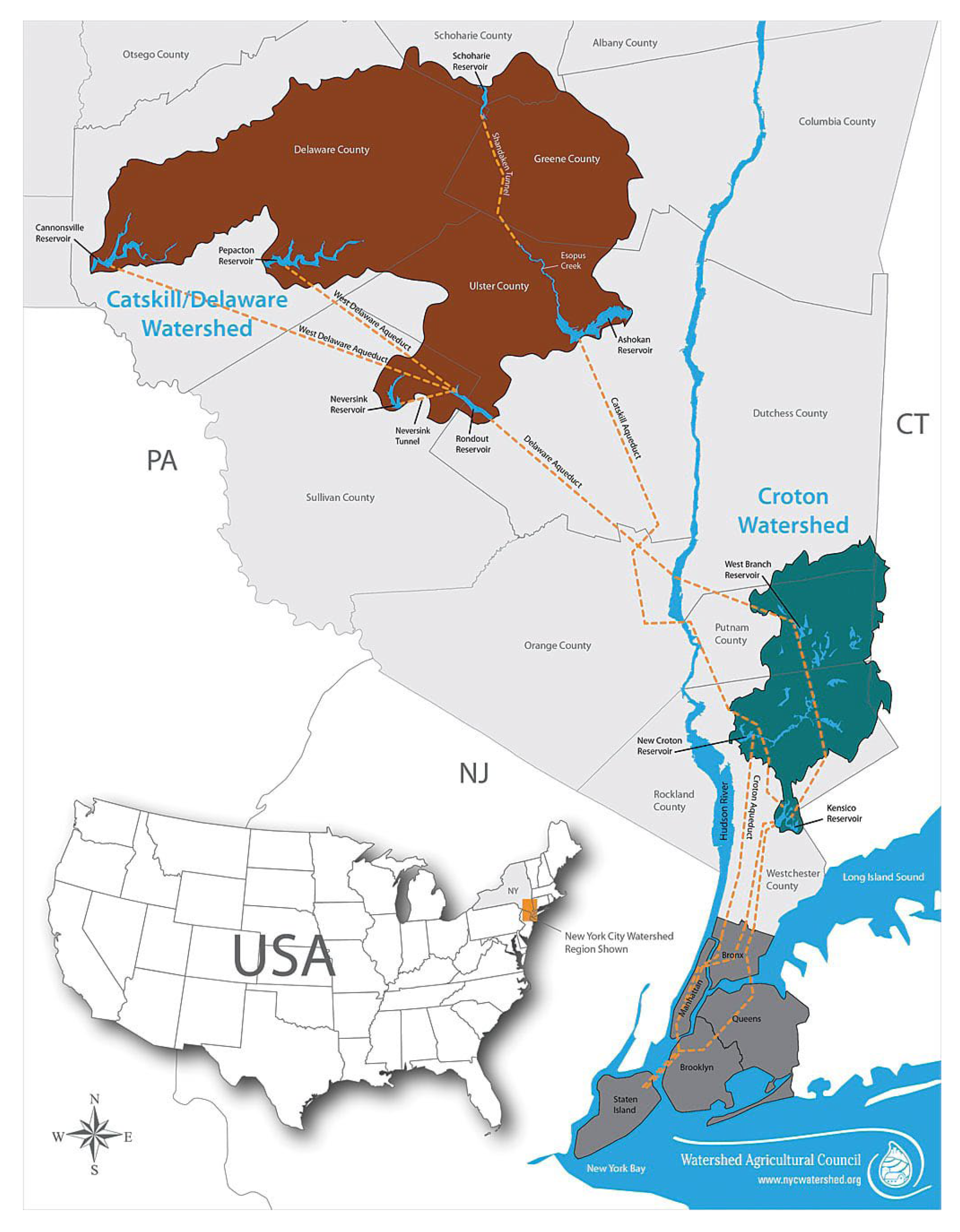
Figure 1. NYC water supply system (Source: Watershed Agricultural Council).
Forests 17 00361 g001
Figure 2. Demographic characteristics of the Watershed respondents.
Forests 17 00361 g002
Figure 3. Familiarity with the Agricultural, Forestry and Economic Viability programs offered by WAC.
Forests 17 00361 g003
Figure 4. Participation in the Agricultural, Forestry, and Economic Viability programs offered by WAC.
Forests 17 00361 g004
Figure 5. Satisfaction after participation in the Agricultural, Forestry, and Economic Viability programs offered by WAC.
Forests 17 00361 g005
Figure 6. Participation in forestry, agricultural, and economic viability programs by acreage classes.
Forests 17 00361 g006
Table 2. Predictors of participation from the Multivariate Binary Logistic Models for WFP.
Predictors
(Reference)
CategoriesOdds Ratio (OR) *95% Confidence Interval for Odds Ratiop-ValueNagelkerke R2
Acreage
(ref: <5 acres)
Overall factor test: Wald χ2(4) = 58.675-<0.0010.213
5–20--0.175
21–408.233[2.205, 30.726]0.002
41–606.899[1.446, 32.888]0.015
>6022.167[6.591, 74.607]<0.001
* OR > 1 → higher odds of participation; OR < 1 → lower odds of participation.
Table 3. Predictors of participation from the Multivariate Binary Logistic Models for WAP.
Predictors
(Reference)
CategoriesOdds Ratio (OR) *95% Confidence Interval for Odds Ratiop-ValueNagelkerke R2
Acreage
(ref: <5 acres)
Overall factor test: Wald χ2(4) = 37.783-<0.0010.317
5–20--0.111
21–407.394[1.401, 39.058]0.018
41–608.403[1.040, 67.922]0.046
>6026.522[5.933, 118.562]<0.001
Housing
(ref: non-primary)
Primary2.381[1.020, 5.550]0.045
Length of Residency
(ref: 21–30 yrs)
>30 yrs15.495[2.071, 116.038]0.008
Income
(ref: <$100 k)
$100 k0.450[0.211, 0.959]0.038
* OR > 1 → higher odds of participation; OR < 1 → lower odds of participation.
Table 4. Joint GEE model of demographic predictors of participation across the five WAC programs.
Predictors
(Reference)
CategoriesOdd Ratio (OR) *95% Confidence Interval for ORp-Value
Housing
(ref: non-primary)
Overall factor test: Wald χ2(1) = 8.0430.005
Primary2.055[1.249, 3.381]0.005
Acreage
(ref: <5 acres)
Overall factor test: Wald χ2(4) = 72.214<0.001
5–20--0.132
21–406.217[2.038, 18.962]0.001
41–605.395[1.473, 19.764]0.011
>6018.810[6.731, 52.567]<0.001
* OR > 1 → higher odds of participation; OR < 1 → lower odds of participation.
Disclaimer/Publisher’s Note: The statements, opinions and data contained in all publications are solely those of the individual author(s) and contributor(s) and not of MDPI and/or the editor(s). MDPI and/or the editor(s) disclaim responsibility for any injury to people or property resulting from any ideas, methods, instructions or products referred to in the content.