Article

Environmental Parameter Drivers of Odor-Active Compound Fingerprinting and Sensory Profile in Waterborne-Coated Manchurian Ash (Fraxinus mandshurica Rupr.)


1
Forestry College, Northwest Agriculture & Forestry University, Yangling 712100, China
2
Beijing Key Laboratory of Indoor Air Quality Evaluation and Control, Beijing 100084, China
3
Department of Building Science, Tsinghua University, Beijing 100084, China
4
National Key Laboratory of Fundamental Science on Synthetic Vision, Sichuan University, Chengdu 610064, China
5
College of Material Science and Engineering, Northeast Forestry University, Harbin 150040, China
*
Authors to whom correspondence should be addressed.
Forests 2026, 17(3), 335; https://doi.org/10.3390/f17030335
Submission received: 9 February 2026 / Revised: 2 March 2026 / Accepted: 5 March 2026 / Published: 8 March 2026
(This article belongs to the Section Wood Science and Forest Products)

Abstract

Wood products made from Manchurian ash are widely used as furniture and decorations, particularly waterborne-coated Manchurian ash (Fraxinus mandshurica Rupr.). However, while waterborne coatings offer less air pollution, their odor emission dynamics under different environmental conditions remain poorly understood. To address these gaps, this study systematically analyzed 28-day volatile organic compounds (VOCs) and very volatile organic compounds (VVOCs) release profiles under controlled temperature, relative humidity, and air exchange rate-to-loading factor ratios (AER/Ls), using thermal desorption–gas chromatography–mass spectrometry/olfactometry (TD-GC-MS/O). Eighteen key odor-active compounds (OACs) were identified, comprising 11 wood-derived and seven coating components, exhibiting eight odor attributes: disinfectant-like, aromatic, tobacco-like, unpleasant, vinegar-like, flowery, sweety, and alcohol-like. The dominant attributes were disinfectant-like and aromatic. The results showed that temperature accelerated release rates and shortened equilibrium time, while increasing concentrations and odor intensity. Relative humidity prolonged equilibrium, with stage-dependent concentration effects, yet consistent odor intensity rise. Higher AER/L reduced equilibrium time and concentrations through dilution-dominated dynamics despite accelerated release rates from increased pressure differentials. These findings indicated that synergistic high-temperature (40 °C)/high-humidity (60% RH) conditions accelerate odorant emission, while optimized ventilation (AER/L 0.5 m3·m−2·h−1) ensures effective mitigation. The findings will inform strategies to reduce odor impact and advance eco-efficient finishing technologies for wood products.

1. Introduction

Healthy buildings have garnered increasing attention in recent years. Studies indicate that over 90% of modern life is spent indoors, underscoring the critical role of indoor air quality (IAQ) in human comfort, health, and work efficiency [1,2]. Prolonged exposure to indoor volatile organic compounds (VOCs) has been associated with respiratory irritation, allergic reactions, and sick building syndrome (SBS) symptoms [3,4,5]. In particular, building materials have significant importance for indoor air quality [6]. As significant sources of indoor air pollutants and odorous compounds [7], wooden furniture and building materials emit strong odors that not only reduce product market acceptance but may also trigger negative psychological responses in consumers [8,9].
To mitigate IAQ concerns, efforts have long focused on reducing total volatile organic compound (TVOC) emissions from materials, with corresponding regulatory limits established. However, despite reductions in overall emissions, odor-related issues persist unresolved [10]. Trace odorous compounds with low detection thresholds often evade conventional analytical methods, prompting the adoption of gas chromatography–mass spectrometry–olfactometry (GC-MS-O) for precise identification. International frameworks like the International Organization for Standardization (ISO) 16000 series [11,12,13,14] now offer standardized protocols for measuring VOC emissions—from chamber testing to analytical determination. Regionally, these have been adapted to specific regulatory contexts; Europe’s European Norm (EN) 16516 [15], for instance, focuses specifically on dangerous substances released from construction products. Health-based evaluation procedures, such as the German AgBB scheme, incorporate risk values (RVs) based on the lowest concentration of interest (LCI) for individual compounds [16,17], emphasizing that total VOC concentration alone is insufficient for health assessment; the specific composition and toxicological properties of individual compounds must be considered [18].
Current research on wood-derived odors primarily focuses on characterizing odor components and their release dynamics in both solid wood and engineered wood products. For example, Matsubara and Kawai employed GC-MS and GC-O to identify diverse aroma-active compounds in global oak wood extracts [19], while Shen et al. (2024) revealed 25 terpenoid-dominated odorants in Pinus massoniana Lamb., exhibiting moisture-dependent release and heartwood/sapwood divergence [20]. Building on these foundational investigations, growing awareness of odor-related issues has intensified research on both detection and remediation. Previous investigations have identified specific irritants in wood processing, such as the prismatic crystals and saponins found in Albizia, which can be mitigated by acid treatment [21]. In parallel, Li et al. innovatively developed herb-functionalized particleboard that retains mechanical properties while achieving ultra-low formaldehyde/TVOC emissions and releasing beneficial volatiles with >99% antibacterial efficacy [22]. Beyond single-species studies, recent systematic analyses have expanded the field by examining odorant composition across multiple wood species commonly used in panel production. Liu et al. [23] investigated 22 species from Chinese fiberboard and particleboard lines, identifying terpenes, aldehydes, and alcohols as the predominant odor-contributing compounds. Their comprehensive database, which includes threshold odor concentrations (TOCs), odor activity values (OAVs), and risk values (RVs), provides valuable reference data for selecting low-odor raw materials.
Advances in material engineering have led to the development of formaldehyde-free, low-odor bonding systems through supramolecular assembly. Yu et al. [24] demonstrated that oxidative pretreatment combined with sodium ion and tannic acid-mediated supramolecular interactions can produce high-density fiberboards with markedly low VOC and formaldehyde emissions. The perception of wood odors is not solely governed by chemical composition; psychological and contextual factors also play critical roles. Butter et al. [25] found that congruent visual context significantly enhanced familiarity and pleasantness ratings, highlighting that odor evaluation is inherently subjective and context-dependent. Thus, wood odor perception depends on an interplay of VOC profile, individual familiarity, and visual environment. The identification of key odorant compounds (KOCs) in wood-based materials has been advanced through the application of relative odor activity value (ROAV) analysis. Yin et al. [26] applied this method to Eucalyptus particleboard, identifying hexanal (ROAV = 100) and o-cymene (ROAV = 76.90) as the primary odor contributors. Furthermore, they demonstrated that thermal post-treatment at 50–60 °C for 6–12 h effectively reduced residual VOC concentrations by accelerating diffusion and volatilization [26,27]. These findings suggest that similar analytical and mitigation strategies may be applicable to other commercially important species, such as Manchurian ash.
Manchurian ash (Fraxinus mandshurica Rupr.), a premier timber species widely distributed in Northeast China, Russia, Japan, and Korea, is valued for its mechanical stability, deformation resistance, aesthetic grain, and cost-effectiveness—making it ideal for structural and decorative applications. Although prior studies confirm temperature-accelerated VOC release, humidity-modulated diffusion, and ventilation-driven dilution in wood composites [28], research on VOC emissions from waterborne-coated Manchurian ash (solid wood substrates coated with water-based acrylic–polyurethane finishes) under dynamic environmental conditions remains scarce. Despite their eco-friendly profile, these coatings emit odorous VOCs with poorly quantified environmental response mechanisms. Odor release in wood products is multifactorial, influenced by species-specific attributes, moisture content fluctuations, and storage conditions (temperature/humidity) [29]. While our previous study characterized odor-active compounds in uncoated Manchurian ash under different environmental conditions [28], the critical knowledge gaps persist in quantifying odor-active compound (OAC) signatures of waterborne-coated Manchurian ash, decoupling synergistic temperature–relative humidity (RH)–air exchange rate-to-loading factor ratio (AER/L) effects across VOC release phases (pre/mid/late-release), and linking physicochemical release dynamics to sensory odor characteristics.
This study investigates these unknowns by combining sensory and chemical analysis. We used GC-MS/O to pinpoint the key odor-active compounds in coated Manchurian ash and tracked their emission dynamics over 28 days under varying temperature, humidity, and ventilation conditions. Our goal is to move beyond simple emission factors; by establishing predictive links between environmental parameters and perceived odor intensity, we aim to provide actionable data for manufacturers. This could inform better coating choices, storage practices, or ventilation designs—ultimately facilitating the development of wood products that are not only structurally sound but also contribute to healthier indoor spaces.

2. Materials and Methods

2.1. Preparation of Wood Samples and Coating

2.1.1. Wood Samples

The wood samples were obtained from commercially sourced Manchurian ash (Fraxinus mandshurica Rupr.) boards provided by Shenyang Senbao Wood Industry Co. (Shenyang, China). To ensure sample uniformity and minimize variability due to inherent wood heterogeneity, all specimens were taken from adjacent positions within the same board, ensuring they originated from as close to the same location as possible. The boards were uniformly cut into wooden disks with a diameter of 60 mm and a thickness of 16 mm, resulting in an exposed surface area of 5.65 × 10⁻³ m2 per specimen. Before coating, all wood samples were conditioned to an equilibrium moisture content of 10 ± 2%.

2.1.2. Coating Material and Application

A transparent waterborne acrylic–polyurethane wood coating (Three Trees Paint Co., Ltd., Putian, China) was used in this study. According to the manufacturer’s technical data sheet, the base component consists of an acrylic–polyurethane hybrid dispersion (35%–40% solid content) as the primary binder. For application, this base was mixed with distilled water at a weight ratio of 10:1 (base: water) to achieve working viscosity. The formulation includes a small amount (<5%) of coalescing agents (primarily dipropylene glycol n-butyl ether and 2,2,4-trimethyl-1,3-pentanediol monoisobutyrate) and additives such as a defoamer (<0.5%), a wetting agent (<0.5%), and a biocide (<0.1%). The coating was applied using a brush in four layers: two primer coats and two top coats, each at an application rate of 100 g/m2. Prior to the first layer, the surfaces were sanded with 150-grit sandpaper using a flatbed sander (model DS-180, Dongcheng M&E Tools Co., Ltd., Qidong, China), and all dust was removed with a brush. The surfaces were lightly sanded with 320-grit sandpaper between each coating layer to improve interlayer adhesion, and dust was removed after each sanding step.

2.1.3. Post-Coating Treatment and Conditioning

After the application of each individual layer, the samples were allowed to dry naturally at room temperature (23 ± 2 °C) for 12 h before the subsequent layer was applied. This extended conditioning period ensures the coating reaches a thorough “hard-dry” state, promoting proper interlayer adhesion and preventing damage during intermediate sanding. This cycle was repeated sequentially for the two primer coats, followed by the two topcoats. After application of the final topcoat and its complete curing, the total dry film thickness was measured using a coating thickness gauge and determined to be 90 ± 10 µm. Subsequently, the circular faces remained exposed, while the side edges of the specimens were carefully sealed with aluminum foil to prevent any edge emission, ensuring that only emissions from the coated faces would be measured in subsequent analyses. Finally, the coated samples were placed in a well-ventilated room at 23 ± 2 °C for a 28-day natural release period. Following this conditioning, the samples were vacuum-sealed in polytetrafluoroethylene (PTFE) bags, labeled, and stored in a refrigerator at −30 °C until analysis.

2.2. Sampling and Experimental Scheme

VOCs and very volatile organic compounds (VVOCs) released from the samples were collected using a Micro-chamber/Thermal Extractor (M-CTE250, Markes International, Llantrisant, UK), which contains four independent chambers and can be adjusted from 0 °C to 250 °C. The detailed test parameters for the sampling procedure, including exposed area, compartment volume, load factor, temperature, relative humidity, and the ratio of air exchange rate to loading factor, are summarized in Table 1. Single samples were collected simultaneously from four samples by the microchamber/thermal extractor under different environment conditions (temperature, relative humidity, and the ratio of air exchange rate to loading factor). Sampling schemes under different environmental conditions were presented in Table 2. For each environmental condition, three independently prepared coated wooden disks were sampled simultaneously using three of the four chambers. These three samples served as the primary experimental replicates (n = 3). The remaining fourth chamber was used as a blank control, containing no sample but with a blank adsorbent tube, to monitor background contamination during sampling. The experiment was conducted using two types of tubes: Tenax-TA tubes (Markes International, Llantrisant, UK) and tubes with multi-beds of carbopack C, carbopack B, and carboxen 1000 tubes (Markes International, Llantrisant, UK). The day after the end of the 28-day natural release of the coated wood was taken as the first day. The samples were checked on days 1, 3, 7, 14, 21, and 28 for the release of the components, with the samples remaining in well-ventilated conditions at intervals to allow for the natural release of the samples for 28 days.

2.3. Analysis of Thermal Desorption–Gas Chromatography–Mass Spectrometry (TD–GC–MS)

After sample collection, components released from the samples in the adsorbent tubes were analyzed using a thermal desorption full autosampler (Markes International, Llantrisant, UK) paired with a thermal desorber (TD) (Markes International, Llantrisant, UK) and gas chromatography–mass spectrometry (GC-MS) (Thermo Fisher Scientific, Bremen, Germany). The following parameters were used in the experiment: thermal desorption temperature, 280 °C; cold-trap adsorption temperature, −15 °C; thermal analysis time, 10 min; and injection time, 1 min.
The separation of volatile compounds was achieved using a DB-5 capillary column [30 m (length) × 0.25 mm (inner diameter) × 0.25 mm (particle size)] (Agilent Technologies, Santa Clara, CA, USA). Helium was used as the carrier gas at a constant flow rate of 1.0 mL·min−1 under splitless injection conditions. The oven temperature program was as follows: initial hold at 40 °C for 2 min, ramped to 50 °C at 2 °C·min−1 (held for 4 min), and finally increased to 250 °C at 10 °C·min−1 (held for 8 min). The injection port temperature was maintained at 250 °C throughout the analysis. For GC-MS, we used the following conditions: electron ionization mode; ion energy of 70 eV; transmission line temperature of 270 °C; ion source temperature of 230 °C; and mass scan range of 50–650 atomic mass units. The quantitative analysis of compounds refers to the national standard GB/T 29899-2013 [30]. Mass concentrations (μg·m−3) of individual compounds were determined using five-point calibration curves established with standard solutions (benzene, toluene, ethylbenzene, xylene, styrene, and other target compounds). The mass of each compound in sample tubes was calculated by comparing its peak area to the corresponding calibration curve, then divided by the sampling volume (2 L). Total mass concentration refers to the sum of mass concentrations of all identified VOCs and VVOCs in a given sample.

2.4. Odor Identification and Evaluation

Odor identification was performed using gas chromatography–olfactometry (GC-O) with a Sniffer 9100 olfactory detector (Brechbuhler AG, Schlieren, Switzerland). The GC capillary column effluent was split 1:1 between the mass spectrometer and the olfactory port. The transmission line temperature was maintained at 150 °C, with nitrogen as the carrier gas through a purge valve. Moist air was added at the olfactory port to prevent dehydration of the assessors’ nasal mucosa.

2.4.1. Sensory Panel Composition and Training Procedure

A panel of four trained assessors (two males, two females; aged 20–30 years) with normal olfactory function and no history of olfactory disorders, nasal diseases, or allergies participated in the study. All assessors were non-smokers and refrained from using fragranced products prior to testing. Training followed the guidelines of EN 13725:2003 [31] and included: (1) familiarization with the six-point odor intensity scale using n-butanol reference solutions (2, 10, 20, and 30 mL/L and 99.5% n-butanol); (2) identification of common odor descriptors (e.g., fruity, floral, woody) using standard odorants; and (3) practice sessions with wood samples to ensure consistent odor detection and description. Training continued until all panel members achieved >80% correct identification and intensity rating in test sessions.

2.4.2. Evaluation Procedure

Sensory evaluation was performed in a dedicated, odor-free room maintained at 23 ± 2 °C with adequate ventilation. To minimize external influences, panel members abstained from eating, drinking, or using any scented products for at least 5 h prior to each session. During GC-O analysis, each assessor recorded the perceived odor character, intensity, and retention time at the sniffing port for every eluting compound. Compound identification was based on a combination of criteria: (i) comparison of mass spectra with National Institute of Standards and Technology (NIST) and Wiley libraries, (ii) matching of retention indices (RI) calculated from n-alkane (C6–C30) standards (Sigma-Aldrich, St. Louis, MO, USA) under identical chromatographic conditions [32], and (iii) corroboration with published odor descriptions. To ensure reliability, only compounds detected by at least two assessors at the same retention time were retained for subsequent analysis.
Odor intensity was rated using the Japanese Ministry of the Environment (Law No. 91, 1971) six-point scale (0 = none, 1 = very weak, 2 = weak, 3 = moderate, 4 = strong, 5 = very strong), with the final intensity value for each recorded odorant being the average across assessors. A fingerprint spectrum was generated to corroborate the results. For each compound, the final odor intensity value represents the average of assessments from at least two panel members who detected and agreed on the odor characteristic at the same retention time. Total odor intensity for a given sample was calculated as the sum of the average odor intensity values of all individual odor-active compounds detected in that sample, providing a comparative metric for overall odor load under different experimental conditions.

3. Results and Discussion

3.1. Characteristics of Key Odor-Active Compounds of Waterborne-Coated Manchurian Ash Under Different Environmental Parameters

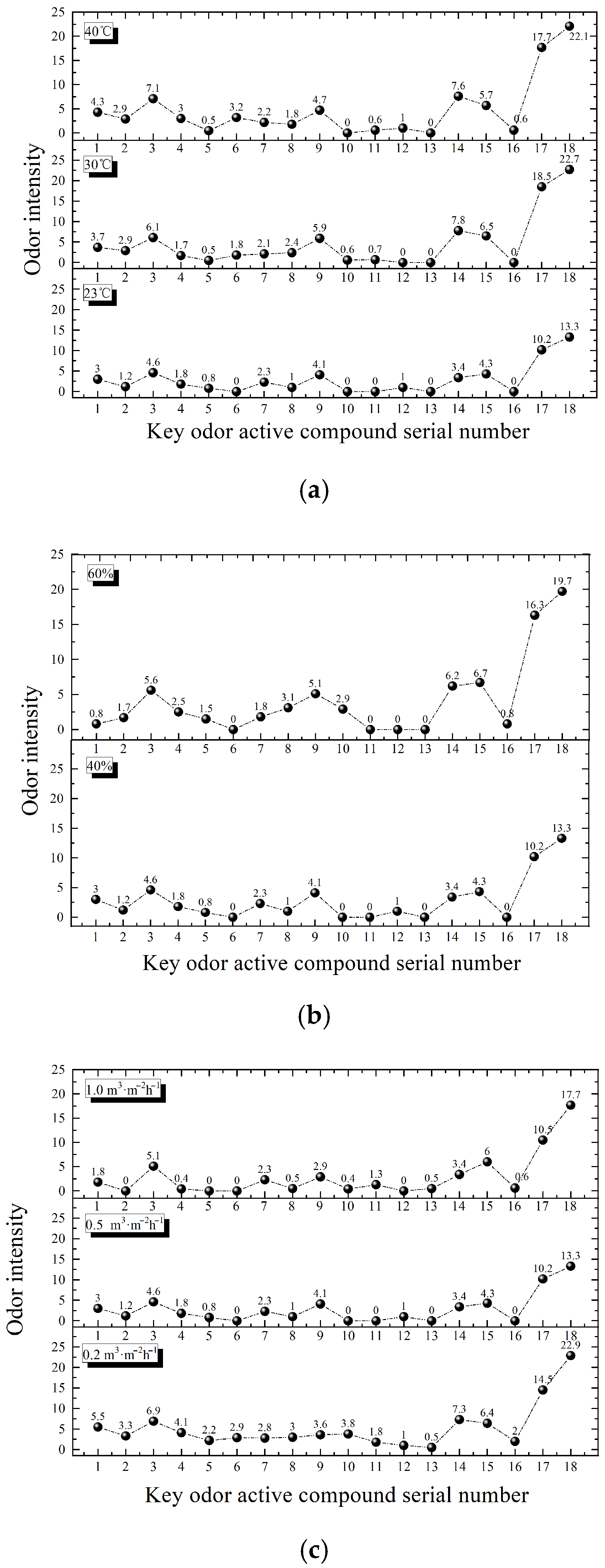
The key odor-active compounds in waterborne-coated Manchurian ash were identified through comprehensive odor intensity analysis across varying environmental parameters. To establish significance in this investigation, compounds were designated as key odorants only when significance occurred in at least two different environmental parameters, and the compound demonstrated odor intensity values ≥1 (on the odor spectrum value scale) in at least one experimental condition. The values presented in Figure 1 represent the average odor intensity scores for individual compounds.
A total of 18 key odor-active compounds were identified in waterborne-coated Manchurian ash across the tested environmental conditions (Table 3). Consistent with previous findings [28], 11 of these compounds originated from the wood substrate (e.g., ethanol, acetic acid, and hexanal), primarily terpenes, fatty acids, and essential oils localized in parenchyma cells and other storage tissues [33]. The detection of hexanal as a key odorant aligns with recent studies on Eucalyptus particleboard, where hexanal was identified as the most significant contributor to overall odor profiles (ROAV = 100) [26]. Furthermore, the presence of terpenes as dominant odorants corroborates the systematic findings of Liu et al. [23], who reported terpenes as the predominant compound class affecting wood odor across 22 species.
The remaining seven odor-active compounds were attributed to the waterborne coating. The odor characteristics of the 18 key odor-active compounds were determined by GC-O analysis and corroborated established reference databases and the existing literature (Table 3). Multiple compounds exhibited fruity attributes: ethyl acetate was perceived as fruity, consistent with descriptions of “fruity with a brandy note” [34] and an “ether-like odor reminiscent of pineapple” [34,35]; 6-methyl-5-hepten-2-one also presented a fruity character [36]; and 2-methyl-2-propanoic acid methyl ester exhibited both fruity and irritative notes. Aromatic and sweety notes were observed for ethylbenzene [37] and p-xylene, with the latter described as both aromatic and sweet in multiple sources [37,38]. In contrast, 1,3-dimethyl-benzene was perceived as metallic in this study, diverging from the sweety and aromatic descriptions reported elsewhere [38,39]. Several compounds displayed fatty or green characteristics: hexanal was grassy [36], heptanal was fatty [36] (though also noted as “penetrating fruity” [37]), and nonanal exhibited a citrus-like attribute [37]. Alcohol- and acid-derived notes included the alcoholic character of ethanol [38,40], the vinegar-like quality of acetic acid [39], the buttery note of 2-methyl-propanoic acid [36], and the unpleasant perception of pentanoic acid [35,41] and 2-(2-methoxypropoxy)-1-propanol. Terpene-related compounds showed distinct profiles: (ñ)-2,6,6-trimethyl-bicyclo[3.1.1]hept-2-ene was pine-like, 2-ethyl-1-hexanol was flowery (reminiscent of the “mild, oily, sweet, slightly floral odor reminiscent of rose” [35]), and 2-(2-hydroxypropoxy)-1-propanol presented a tobacco-like character. Finally, two compounds exhibited distinctive notes: 2-methyl-propanoic acid, 1-(1,1-dimethylethyl)-2-methyl-1,3-propanediyl ester was perceived as disinfectant-like, consistent with our previous findings [28], while methyl 2-methyl-2-propenoate showed an irritative quality alongside its fruity character.
The influence of environmental parameters on the odor intensity of these OACs is summarized in Figure 1. Increasing temperature from 23 °C to 40 °C generally enhanced the total odor intensity of most compounds. As shown in Figure 1a, six compounds (e.g., ethanol, acetic acid, and nonanal) exhibited a steady increase in intensity with rising temperature, while seven others (e.g., ethylbenzene, 2-ethyl-1-hexanol) peaked at 30 °C and then slightly declined at 40 °C. This temperature-dependent behavior may be related to enhanced molecular thermal motion and reduced adsorption capacity of the material at higher temperatures [25]. Relative humidity also significantly affected odor intensity profiles (Figure 1b). Increasing RH from 40% to 60% increased the intensity of 12 OACs (e.g., acetic acid, p-xylene, and 2-ethyl-1-hexanol) but decreased the intensity of three compounds, including ethanol and hexanal. (ñ)-2,6,6-trimethyl-bicyclo[3.1.1]hept-2-ene was completely suppressed at 60% RH, suggesting that elevated humidity may effectively inhibit the release of certain terpenoid compounds. The air exchange rate-to-loading factor ratio (AER/L) exerted a pronounced effect on odor intensity (Figure 1c). Increasing AER/L from 0.2 to 1.0 m3·m−2·h−1 generally reduced the total intensity of most OACs, consistent with dilution-dominated dynamics despite accelerated release rates from increased pressure differentials [29,32]. Ten compounds (e.g., ethanol, ethyl acetate, hexanal) showed a steady decreasing trend, while others exhibited a slight rebound at the highest ventilation rate, though remaining below their initial intensity levels at low AER/L. Detailed odor intensity values for each compound under all conditions are provided in Table 3.

3.2. Influence of Environmental Parameters on VOC/VVOC Release Concentration and Odor Intensity of Waterborne-Coated Manchurian Ash

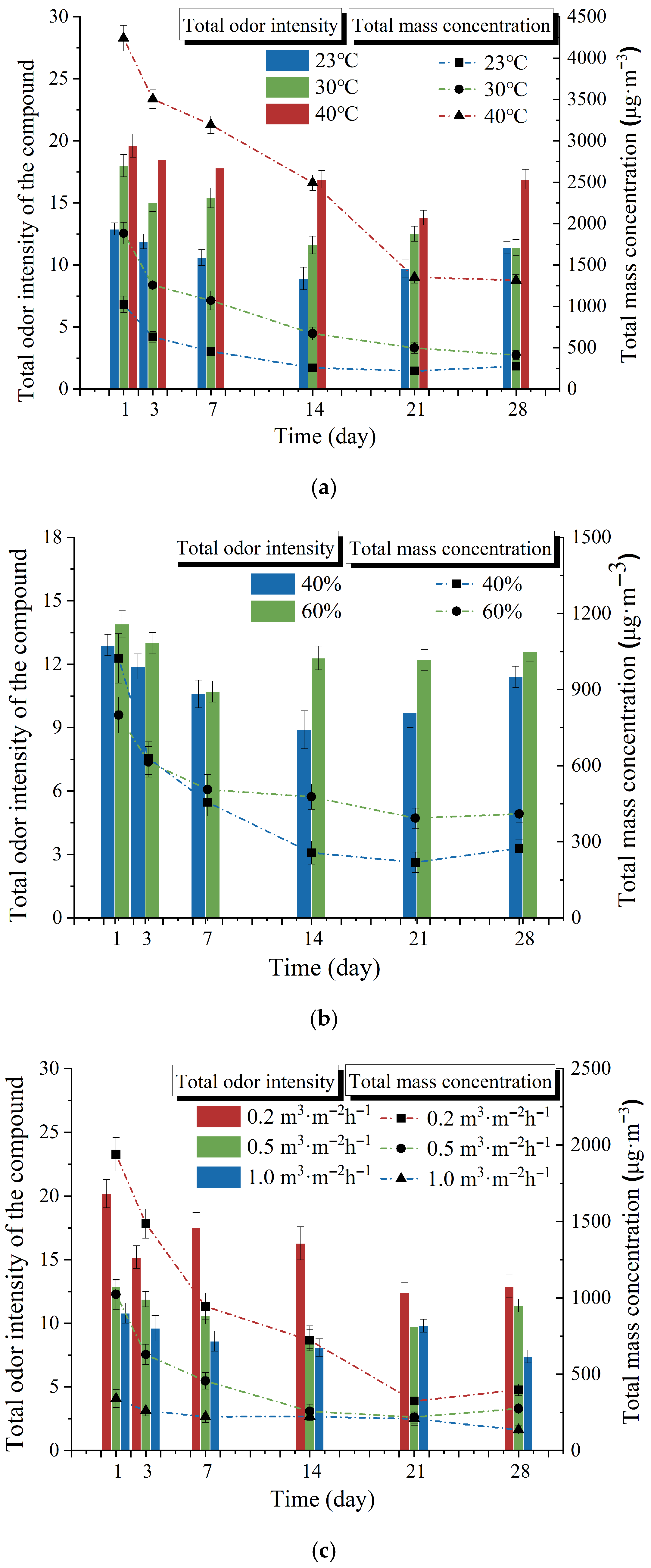
The characteristics of the release of VOC/VVOC total mass concentration and odor-active compounds from waterborne-coated Manchurian ash were investigated under test conditions A, B, and C during the 28-day test cycle. The emission trend of mass concentration and total odor intensity of waterborne-coated Manchurian ash under different environmental parameters is presented in Figure 2. All data in this section are presented as mean ± standard deviation (SD) of three independent samples. Error bars in figures represent the standard deviation.
The results indicate that different environmental parameters influenced the mass concentration of components released from the waterborne-coated Manchurian ash at the same time, as well as the release rate and the time to reach equilibrium. Time was identified as the most effective factor in reducing the total mass concentration of VOC/VVOC in waterborne-coated Manchurian ash. Over time, the total mass concentration of VOC/VVOC in waterborne-coated Manchurian ash gradually decreased until an equilibrium state was reached. During the pre-release period, the mass concentration reached its maximum, and the release rate was faster than during the mid- and late-release periods. According to mass transfer theory, internal components continue to release until the concentration difference disappears [28].
Regarding temperature effects, temperature appeared to influence release rates during the pre-release period, with higher temperatures accelerating the decline in mass concentration. From day 1 to day 7 at 23 °C, 30 °C, and 40 °C, the average release concentration decrease rates were 80.97 μg·m−3d−1, 116.24 μg·m−3d−1, 149.50 μg·m−3d−1, respectively. During the mid-release period, average decrease rates were 16.95 μg·m−3d−1, 40.83 μg·m−3d−1, 131.56 μg·m−3d−1. Release equilibrium was reached at all temperatures during the late period, with minimal changes in concentration. Equilibrium times under 23 °C, 30 °C, and 40 °C were 14, 21, and 21 days, respectively. Temperature significantly increased equilibrium concentrations and total odor intensity with increasing temperature (40 °C > 30 °C > 23 °C). Temperature markedly affected release components throughout all periods. Increasing temperature from 23 °C to 30 °C on days 1, 3, and 7 raised component concentrations by 860.39 μg·m−3 (84.10%), 627.16 μg·m−3 (99.68%), and 613.46 μg·m−3 (134.46%), and total odor intensity by 5.1, 3.1, and 4.8 units, respectively. Further increase to 40 °C raised concentrations by 2356.96 μg·m−3 (125.14%), 2250.02 μg·m−3 (179.09%), and 2124.16 μg·m−3 (198.57%), and odor intensity by 1.6, 3.5, and 2.4 units. Similarly, on days 14, 21, and 28, the 23 °C to 30 °C increase raised concentrations by 412.63 μg·m−3 (160.41%), 279.15 μg·m−3 (127.52%), and 135.89 μg·m−3 (49.38%), and odor intensity by 2.7, 2.8, and 0 units. The subsequent rise to 40 °C increased concentrations by 1823.79 μg·m−3 (272.26%), 853.95 μg·m−3 (171.46%), and 903.32 μg·m−3 (219.75%), and odor intensity by 5.3, 1.3, and 5.5. Previous studies have shown that elevated temperature enhances release by intensifying molecular thermal motion within the board and reducing its adsorption/retention capacity, leading to rapid component release [42]. This temperature-dependent behavior is consistent with observations from thermally treated particleboards, where post-treatment at 50–60 °C effectively accelerated VOC diffusion and reduced residual odorants [26,27].
The increased thermal motion of VOC molecules on the coated surface also promotes desorption and evaporation. Concurrently, higher temperature increases the mixed vapor pressure, enlarging the pressure differential with the chamber environment, which may accelerate release. Furthermore, mass transfer resistance decreases with temperature, potentially increasing VOC mass transfer flux, release coefficient E, and chamber concentration [43].
Regarding relative humidity (RH) effects, the decline rate of total VOC/VVOC mass concentration slowed with increasing RH. From day 1 to day 7 (pre-release) at 40% and 60% RH, average decrease rates were 80.97 μg·m−3d−1 and 41.95 μg·m−3d−1, respectively. From day 7 to day 28 (mid-late release), rates were 8.62 μg·m−3d−1 and 4.56 μg·m−3d−1. Equilibrium was reached earlier at 40% RH (day 14) than at 60% RH (day 21), suggesting that higher humidity prolonged the time to equilibrium. Humidity effects varied by stage, while total odor intensity consistently increased slightly with humidity. On day 1, concentration decreased by 223.58 μg·m−3 (21.85%) as humidity rose from 40% to 60%, despite a 1.0 increase in total odor intensity. Concentrations converged by day 3, where odor intensity at 60% RH was 1.1 times higher than at 40% RH. Subsequently, concentration correlated positively with humidity. On days 7, 14, 21, and 28, increasing humidity from 40% to 60% was associated with concentration decreases of 49.54 μg·m−3 (10.86%), 219.97 μg·m−3 (85.51%), 174.22 μg·m−3 (79.59%), and 134.89 μg·m−3 (49.02%), respectively, while odor intensity increased by 0.1, 3.4, 2.5, and 1.2. Related studies on particleboard [44] have reported similar humidity effects during pre-release. However, in mid-late release stages, humidity showed a positive correlation with release concentration for Manchurian ash, contrasting with a negative correlation for particleboard. This discrepancy may arise from differing material release timelines. The pre-tested 28-day natural release of Manchurian ash resulted in lower baseline concentrations during the test’s mid-late stages compared to particleboard. Some studies report increased concentrations with humidity for other boards [45,46], suggesting substrate, finish properties, and test conditions modulate humidity’s effect.
Regarding the air exchange rate-to-loading factor ratio (AER/L), increasing this ratio was associated with a shorter time to equilibrium and decreased equilibrium concentration. Equilibrium times at 0.2, 0.5, and 1.0 m3·m−2·h−1 were 28, 14, and 7 days, respectively. Concentrations at 0.2 m3·m−2·h−1 consistently exceeded those at higher ratios. With fixed loading, increasing AER rapidly reduced chamber concentrations, maintaining dynamic equilibrium at lower levels. Increasing AER/L generally decreased component concentrations and total odor intensity. Throughout the release, concentrations and odor intensity were consistently lower at higher AER/Ls. Increasing AER/L from 0.2 to 0.5 m3·m−2·h−1 on days 1, 3, and 7 decreased concentrations by 916.60 μg·m−3 (47.26%), 857.42 μg·m−3 (57.68%), and 487.97 μg·m−3 (51.68%), and odor intensity by 36.14%, 21.71%, and 39.43%. A further increase to 1.0 m3·m−2·h−1 decreased concentrations by 682.76 μg·m−3 (66.74%), 368.05 μg·m−3 (58.50%), and 234.99 μg·m−3 (51.50%), and odor intensity by 16.28%, 19.33%, and 18.87%. AER/L continued to affect concentrations and odor intensity mid-late release. On days 14, 21, and 28, increasing from 0.2 to 0.5 m3·m−2·h−1 decreased concentrations by 64.40%, 32.45%, and 30.89%, and odor intensity by 45.40%, 21.77%, and 11.63%. Increasing further to 1.0 m3·m−2·h−1 decreased concentrations by 13.25%, 5.58%, and 50.78%, and odor intensity by 8.99%, −1.03% (slight increase), and 35.09%. Under constant pressure and temperature, higher AER/L introduces more fresh carrier gas per unit time, displacing gaseous components. This may enlarge the vapor pressure differential between sample and air, potentially accelerating release, but dilutes components in the chamber, reducing mass concentration [47]. Related studies have indicated that elevated air exchange promotes VOC release from materials [48]. Conceptually, maintaining a higher AER/L in a real living environment (analogous to the chamber) may enable rapid reduction in indoor pollutant concentrations, aligning with the common practice that ventilation improves indoor air quality.

3.3. Influence of Environmental Parameters on the Concentration of VOC/VVOC Components Released from Waterborne-Coated Manchurian Ash

The total amount of VOC/VVOC component compounds released from the waterborne-coated Manchurian ash was analyzed under different environment parameters. Release components from the waterborne-coated Manchurian ash under different environmental parameters during the 28-day period are presented in Figure 3. All the data in this section are presented as mean ± standard deviation (SD) of three independent samples (n = 3). Error bars in figures represent the standard deviation. It was found that the main components released by waterborne-coated Manchurian ash were: esters and alcohols, with small amounts of aromatic compounds, alkanes, olefins, aldehydes and ketones, and other substances. The odor-active substances were mainly from esters and alcohols, as well as a small number of aromatic compounds.
The results suggested that with increasing temperature, the proportion of the odor-active compound component concentration of waterborne-coated Manchurian ash to the total concentration tended to decrease. Under the temperature conditions of 23 °C, 30 °C, and 40 °C, the concentration of odor-active compound components in the waterborne-coated Manchurian ash was 95.77%, 96.24%, and 97.46%, respectively. It was found that the proportion of odor-active compound component concentration to total concentration in the waterborne-coated Manchurian ash was not greatly affected by RH, with proportions of 95.77% and 95.70% under 40% and 60% RH. The ratio of air exchange rate to load factor did not exhibit a clear pattern in relation to the proportion of odor-active compound component concentration to total concentration. Under three different AER/Ls (0.2, 0.5, and 1.0 m3·m−2·h−1), the proportions of odor-active compound fractions to the total concentration of the waterborne-coated Manchurian ash were 96.30%, 95.77%, and 96.34%, respectively.
Figure 3a illustrates that elevated temperature was associated with increased release of key volatile components, including esters, alcohols, and aromatic compounds from the waterborne-coated Manchurian ash. Specifically, increasing temperature from 23 °C to 30 °C was accompanied by substantial increases in total ester and alcohol concentrations by 160.32% and 252.24%, respectively, with corresponding odor-active components rising by 161.60% and 249.68%. Concurrently, total aromatic compounds and their odor components increased by 95.38% and 87.13%. A further temperature increase to 40 °C led to continued increases in ester and alcohol concentrations (177.69% and 59.92% overall; 181.20% and 58.23% for odor components). However, total aromatic compounds and their odor components decreased by 15.89% and 19.36% at this stage. As shown in Figure 3b, higher RH was also associated with the enhanced release of esters, alcohols, and aromatic compounds. Increasing humidity from 40% to 60% resulted in concentration increases of 44.76%, 45.49%, and 186.61% for these components, respectively, with odor components rising by 44.64%, 47.79%, and 209.50%. Conversely, increasing AER/L suppressed component release, as illustrated in Figure 3c. Raising this ratio from 0.2 to 0.5 m3·m−2·h−1 decreased ester, alcohol, and aromatic compound concentrations by 65.43%, 64.73%, and 67.03%, respectively. Corresponding odor component reductions were 65.62%, 58.70%, and 62.27%. A further increased ratio of 1.0 m3·m−2·h−1 was associated with additional declines of 29.97%, 40.32%, and 27.69% in component concentrations, with odor components decreasing by 26.37%, 38.63%, and 23.96%.

3.4. Influence of Environmental Parameters on the Odor Attributes of Waterborne-Coated Manchurian Ash

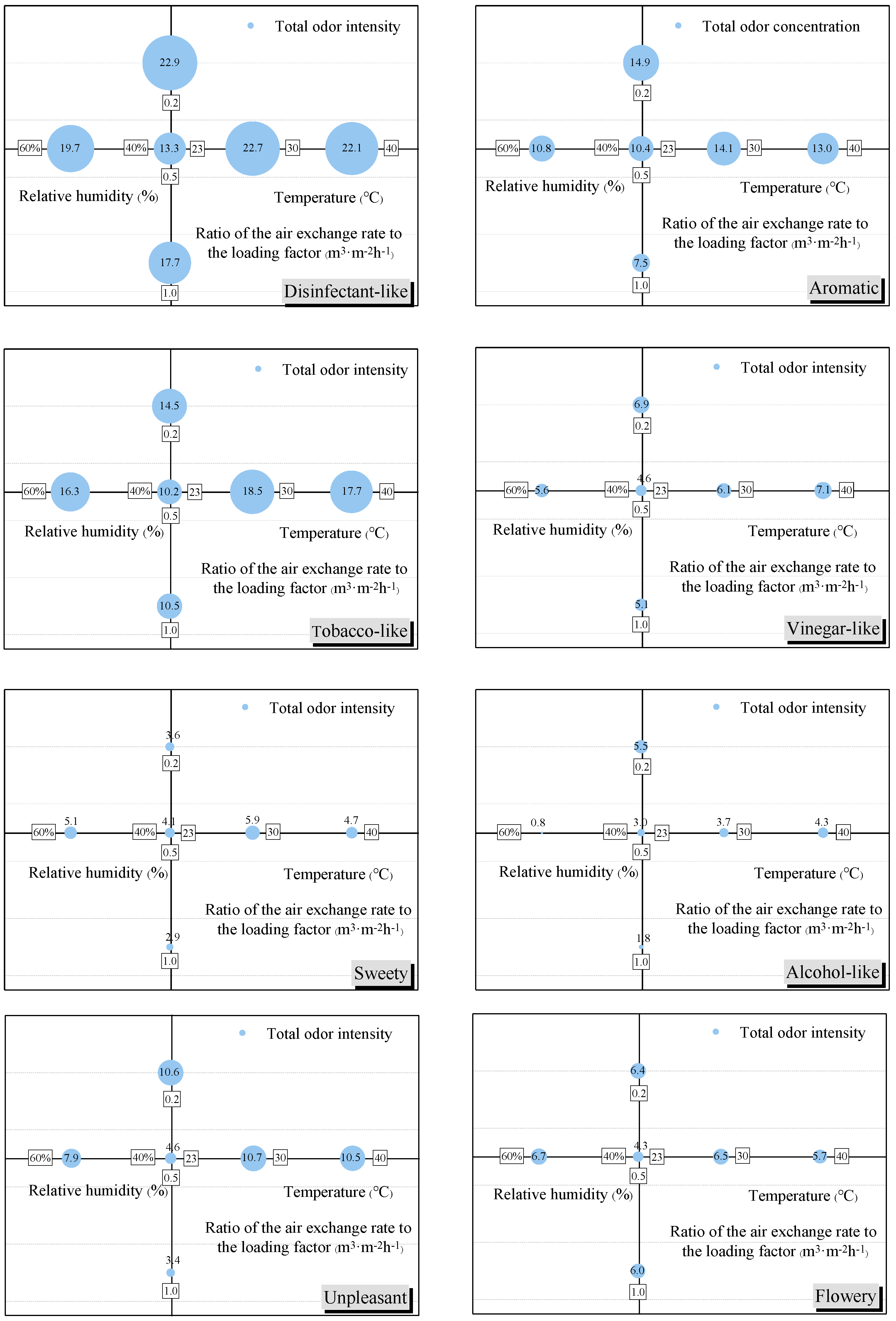
To elucidate odor composition, key odor attributes of the waterborne-coated Manchurian ash under varying environmental parameters were classified based on GC-MS/O identification, grouping compounds with similar descriptors and summing their intensities. Eight key attributes were identified: disinfectant-like, aromatic, tobacco-like, unpleasant, vinegar-like, flowery, sweety, and alcohol-like, with their intensity distributions shown in Figure 4.
The results showed that vinegar-like and alcohol-like odor intensities increased steadily with temperature, rising by 2.5 and 1.3 units, respectively, from 23 °C to 40 °C. Six characteristics (disinfectant-like, aromatic, tobacco-like, tobacco-like, flowery, and sweety) initially increased then decreased with rising temperature, yet remained higher at 40 °C than at 23 °C: increasing by 9.4, 3.7, 8.3, 6.1, 2.2, and 1.8 from 23 °C to 30 °C, then decreasing by 0.6, 1.1, 0.8, 0.2, 0.8, and 1.2 at 40 °C, respectively. Thus, temperature increase from 23 °C to 30 °C promoted odor release, while the rise to 40 °C suppressed some characteristics. Increasing humidity from 40% to 60% increased intensities for disinfectant-like, aromatic, tobacco-like, unpleasant, vinegar-like, flowery, and sweety by 6.4, 0.4, 6.1, 3.3, 1.0, 2.4, and 1.0, respectively, but decreased alcohol-like intensity by 2.2 units. Conversely, increasing the AER/L induced an overall decrease in all eight odor intensities. The intensities of disinfectant-like, aromatic, unpleasant, and alcohol-like decreased steadily, specifically, decreasing by 5.2, 7.4, 7.2, and 3.7 units as the ratio rose from 0.2 to 0.5 to 1.0 m3·m−2·h−1. Tobacco-like, vinegar-like, flowery, sweety, also ultimately decreased (by 4.0, 1.8, 0.4, and 0.7 units at 1.0 vs. 0.2 m3·m−2·h−1), albeit with fluctuations during the increase. Compared to temperature and humidity, the AER/L exerted a greater impact on the critical odor attributes.

3.5. Limitations

This study systematically investigated VOC release and odor characteristics from waterborne-coated Manchurian ash over 28 days, revealing the individual effects of temperature, humidity, and ventilation under controlled conditions. Several limitations should be noted when interpreting the findings. First, due to the exploratory nature and limited sample size (n = 3 per condition), formal statistical hypothesis testing was not performed; future studies with larger samples are needed to validate these observations using inferential statistics. Second, although predictive models linking environmental parameters to odor intensity were intended, they were not developed here. Findings are therefore presented as descriptive trends rather than formal predictive relationships. Future research with expanded datasets and robust experimental designs should aim to establish such models for estimating VOC release and odor intensity across diverse scenarios. Third, odor intensity ratings varied among assessors, consistent with evidence that perception is subjective and influenced by familiarity and context. Butter et al. [25] reported persistent inter-individual differences despite standardized training and noted that visual context can modulate hedonic judgment. These factors warrant consideration in sensory evaluation and protocol development. Fourth, the experimental design examined temperature, relative humidity, and air exchange rate-to-loading factor ratio (AER/L) in isolation, while holding others constant. While this isolates individual effects, it overlooks potential interactions among factors. In real indoor environments, these parameters co-vary and may exert synergistic or antagonistic effects on VOC and odor emissions. Future studies employing full factorial or response surface designs would help elucidate such interactions and support more comprehensive indoor air quality management.

4. Conclusions

The study investigated the effects of temperature, relative humidity (RH), and air exchange rate-to-loading factor ratio (AER/L) on VOC/VVOC release and odor profiles of waterborne-coated Manchurian ash. In total, 18 kinds of key odor-active compounds were detected from waterborne-coated Manchurian ash, comprising 11 originating from the wood substrate and 7 attributed to the waterborne coating. The predominant odorants were esters and alcohols, with minor contributions from aromatic compounds. Eight distinct odor attributes were characterized, with disinfectant-like representing the dominant odor impression, followed by aromatic, tobacco-like, and unpleasant notes. Vinegar-like, flowery, sweety, and alcohol-like attributes constituted secondary odor components.
Temperature was associated with accelerated VOC release rates, shortened equilibrium time, and increased final concentrations and odor intensity. Relative humidity prolonged equilibrium, with stage-dependent concentration effects, and the rise in consistent odor intensity. Higher AER/L reduced equilibrium time and concentrations through dilution-dominated dynamics despite accelerated release rates from increased pressure differentials, validating ventilation efficacy for indoor air quality control. Temperature elevation (23–40 °C) accelerated VOC release and altered emission profiles, increasing ester and alcohol concentrations but reducing the relative proportion of odor-active compounds. In contrast, RH variation primarily influenced emission kinetics without substantially altering the odor-active fraction. RH elevation (40%–60%) uniformly enhanced emissions across all compound classes, whereas increased AER/L suppressed component release. Odor profiles comprised eight characteristics: vinegar-like and alcohol-like intensities rose steadily with temperature, while others peaked at 30 °C before declining at 40 °C. Humidity enhanced six odor attributes (disinfectant-like, aromatic, tobacco-like, unpleasant, vinegar-like, flowery, sweety) but reduced alcohol-like. Higher AER/L uniformly decreased all odor intensities, demonstrating stronger modulation than temperature or RH under the conditions tested.
From a practical perspective, these findings suggest that temporary placement of waterborne-coated products under conditions of elevated temperature, higher humidity, or increased ventilation during initial storage or prior to installation may facilitate more rapid initial VOC release. However, this observation is based on controlled laboratory conditions and should be validated under real-world scenarios. AER/L exerted a pronounced influence on odor characteristics, suggesting that ventilation may be a particularly effective strategy for indoor VOC mitigation. These preliminary findings provide a basis for developing optimized product handling protocols, though further research under diverse environmental conditions is recommended. It should be noted that this study did not develop predictive models for VOC release or odor intensity, as mentioned in the introduction. The findings are presented as empirical observations and descriptive trends, providing a foundation for future modeling efforts. Subsequent research with expanded datasets and more comprehensive experimental designs would be valuable to establish quantitative predictive relationships and to further elucidate the mechanisms underlying VOC release from coated wood products.

Author Contributions

Conceptualization, J.S.; methodology, J.D., J.S. and L.Y.; validation, Q.W., L.W. and J.D.; data curation, Q.W. and Y.S.; writing—original draft preparation, Q.W. and Y.S.; writing—review and editing, J.S. and L.Y. All authors have read and agreed to the published version of the manuscript.

Funding

This research was funded by the Natural Science Foundation of Shaanxi Province, China (Grant No. 2025JC-YBQN-230) and the Fundamental Research Funds for the Central Universities (Northwest A&F University PhD Research Initiation Fund, China) (Grant No. 2452025102).

Data Availability Statement

The original contributions presented in this study are included in the article. Further inquiries can be directed to the corresponding authors.

Conflicts of Interest

The authors declare no conflicts of interest.

References

  1. Klepeis, N.E.; Nelson, W.C.; Ott, W.R.; Robinson, J.P.; Tsang, A.M.; Switzer, P.; Behar, J.V.; Hern, S.C.; Engelmann, W.H. The National Human Activity Pattern Survey (NHAPS): A Resource for Assessing Exposure to Environmental Pollutants. J. Expo. Sci. Environ. Epidemiol. 2001, 11, 231–252. [Google Scholar] [CrossRef]
  2. Weschler, C.J. Changes in Indoor Pollutants since the 1950s. Atmos. Environ. 2009, 43, 153–169. [Google Scholar] [CrossRef]
  3. Tran, H.M.; Bui, H.T.M.; Thoumsang, S.; Ngo, N.T.B.; Nguyen, N.P.T.; Nguyen, H.T.M.; Nguyen, S.M.; Hara, K.; Wangwongwatana, S. Occupational Symptoms Due to Exposure to Volatile Organic Compounds among Female Vietnamese Nail Salon Workers in Danang City. J. Occup. Health 2020, 62, e12160. [Google Scholar] [CrossRef] [PubMed]
  4. Landrigan, P.J.; Fuller, R.; Acosta, N.J.R.; Adeyi, O.; Arnold, R.; Basu, N.; Baldé, A.B.; Bertollini, R.; Bose-O’Reilly, S.; Boufford, J.I.; et al. The Lancet Commission on Pollution and Health. Lancet 2018, 391, 462–512. [Google Scholar] [CrossRef]
  5. SciELO Brazil—Formaldehyde Exposure and Asthma in Children: A Systematic Review Formaldehyde Exposure and Asthma in Children: A Systematic Review. Available online: https://www.scielo.br/j/csc/a/6phMMDZsDsxFDDchwSW3sCg/?lang=en (accessed on 1 March 2026).
  6. Kampragkou, P.; Kamperidou, V.; Stefanidou, M. Evaluation of Hydrothermally Treated Wood Fibre Performance in Cement Mortars. Fibers 2024, 12, 21. [Google Scholar] [CrossRef]
  7. Liu, W.; Zhang, Y.; Yao, Y.; Li, J. Indoor Decorating and Refurbishing Materials and Furniture Volatile Organic Compounds Emission Labeling Systems: A Review. Chin. Sci. Bull. 2012, 57, 2533–2543. [Google Scholar] [CrossRef]
  8. Rosenkranz, H.S.; Cunningham, A.R. Environmental Odors and Health Hazards. Sci. Total Environ. 2003, 313, 15–24. [Google Scholar] [CrossRef]
  9. Shim, I.-K.; Kim, J.; Won, S.R.; Hwang, E.S.; Lee, Y.; Park, S.; Ryu, J.; Lee, J. Prevalence of Sick Building Syndrome Symptoms and Subjective–Objective Indoor Air Quality of Stores in Underground Shopping Districts of Korea. Build. Environ. 2023, 228, 109882. [Google Scholar] [CrossRef]
  10. Knudsen, H.N.; Kjaer, U.D.; Nielsen, P.A.; Wolkoff, P. Sensory and Chemical Characterization of VOC Emissions from Building Products: Impact of Concentration and Air Velocity. Atmos. Environ. 1999, 33, 1217–1230. [Google Scholar] [CrossRef]
  11. ISO 16000-34:2025; Indoor Air—Part 34: Strategies for the Measurement of Airborne Particles. Standards Australia: Sydney, Australia, 2025.
  12. ISO 16000-9:2024; Indoor Air—Part 9: Determination of the Emission of Volatile Organic Compounds from Building Products and Furnishing—Emission Test Chamber Method. ISO: Geneva, Switzerland, 2024.
  13. ISO 16000-3:2025; Indoor Air—Part 3: Determination of Formaldehyde and Other Carbonyl Compounds in Indoor and Test Chamber Air—Active Sampling Method. ISO: Geneva, Switzerland, 2025.
  14. ISO 16000-33:2025; Indoor Air—Part 33: Determination of Phthalates with Gas Chromatography/Mass Spectrometry (GC/MS). ISO: Geneva, Switzerland, 2025.
  15. EN 16516:2017; Construction Products: Assessment of Release of Dangerous Substances—Determination of Emissions into Indoor Air. European Committee for Standardization: Brussels, Belgium, 2017.
  16. AgBB (Ausschuss Zur Gesundheitlichen Bewertung von Bauprodukten). Health-Related Evaluation Procedure for Volatile Organic Compounds Emissions (VOC and SVOC) from Building Products; German Federal Environment Agency: Dessau-Rosslau, Germany, 2015. [Google Scholar]
  17. AgBB. Requirements for the Indoor Air Quality in Buildings: Health-Related Evaluation Procedure for Emissions of Volatile Organic Compounds (VvOC, VOC and SVOC) from Building Products; German Federal Environment Agency: Dessau-Rosslau, Germany, 2021. [Google Scholar]
  18. ECA (European Collaborative Action). Harmonisation Framework for Health Based Evaluation of Indoor Emissions from Construction Products in the European Union Using the EU-LCI Concept; ECA Report No. 29; Publications Office of the European Union: Luxembourg, 2013. [Google Scholar]
  19. Matsubara, E.; Kawai, S. VOCs Emitted from Japanese Cedar (Cryptomeria Japonica) Interior Walls Induce Physiological Relaxation. Build. Environ. 2014, 72, 125–130. [Google Scholar] [CrossRef]
  20. Shen, X.; Zeng, B.; Ge, M.; Wang, J. Analysis of Odor-Active Compounds from Pinus Massoniana as Materials in Landscape Design Based on GC-MS-O Technology. Sci. Silvae Sin. 2024, 60, 159–169. [Google Scholar]
  21. Wang, J.; Xu, F.; Zhang, W.; Zhou, J.; Sun, F.; Ji, X. A Preliminary Study on the Irritation Odor Source of Albizia Falcataria during Sawing and Its Relieving Treatment by Extraction. J. Eng. 2021, 6, 101–106. [Google Scholar] [CrossRef]
  22. Li, S.; Fan, Z.; Huang, C.; He, W.; Zhao, H.; Wen, T.; Peng, L. Preparation and Properties of Fragrant Particleboards with Added Chinese Herbal Medicine. J. Eng. 2022, 7, 73–79. [Google Scholar]
  23. Liu, B.; Yang, F.; Tang, L.; Zou, X.; Zhu, L.; Chen, Q.; Lv, B.; Fu, Y. Screening of Wood Raw Materials for Low-Odor Fiberboard and Particleboard Production: Analysis and Evaluation Based on Volatile Odor Compounds. Polymers 2025, 17, 2429. [Google Scholar] [CrossRef]
  24. Yu, X.; Fu, Z.; Liu, B.; Guo, X.; Lu, Y.; Yao, L. Low-Odor High-Density Fiberboard Enabled by Supramolecular Interactions in Wood Fibers. Polymers 2026, 18, 297. [Google Scholar] [CrossRef]
  25. Butter, K.; Hucke, C.I.; Ohlmeyer, M.; Van Thriel, C. The Impact of Visual Context on the Perception of Wood Odours. Build. Environ. 2025, 280, 113129. [Google Scholar] [CrossRef]
  26. Yin, W.; Zhang, Y.; Li, C.; Wu, B.; Yang, Z.; Huang, H.; Luo, B.; Du, G.; Zhao, P.; Yang, X. Unlocking the Potential of Thermal Post-Treatments: A Study on Odor Emission Control in Eucalyptus Wood Particleboard. Molecules 2025, 30, 1949. [Google Scholar] [CrossRef]
  27. Manninen, A.-M.; Pasanen, P.; Holopainen, J.K. Comparing the VOC Emissions between Air-Dried and Heat-Treated Scots Pine Wood. Atmos. Environ. 2002, 36, 1763–1768. [Google Scholar] [CrossRef]
  28. Wang, Q.; Shen, J.; Zeng, B.; Wang, H.; Wang, W. Effects of Environmental Conditions on the Emission and Odor-Active Compounds from Fraxinus Mandshurica Rupr. Environ. Sci. Pollut. Res. 2022, 29, 30459–30469. [Google Scholar] [CrossRef]
  29. Ghadiriasli, R.; Mahmoud, M.A.A.; Wagenstaller, M.; van de Kuilen, J.-W.; Buettner, A. Chemo-Sensory Characterization of Aroma Active Compounds of Native Oak Wood in Relation to Their Geographical Origins. Food Res. Int. 2021, 150, 110776. [Google Scholar] [CrossRef]
  30. GB/T 29899-2013; Determination of the emission of volatile organic compounds from wood-based panels and furnishing—Small chamber method. Standardization Administration of China: Beijing, China, 2013.
  31. EN 13725:2003; Air quality-Determination of odour concentration by dynamic olfactometry. European Committee for Standardization: Brussels, Belgium, 2003.
  32. Van den Dool, H.; Kratz, P. A Generalization of the Retention Index System Including Linear Temperature Programmed Gas–Liquid Partition Chromatography. J. Chromatogr. A 1963, 11, 463–470. [Google Scholar] [CrossRef]
  33. Peng, W.; Zhu, T.; Zheng, Z.; Fan, Z.; Li, K. Research Status and Trend of Wood Extracts. China For. Sci. Technol. 2004, 5, 6–9. [Google Scholar]
  34. Fahlbusch, K. Flavors and Fragrances. In Ullmann’s Encyclopedia of Industrial Chemistry, 7th ed.; John Wiley Sons: Hoboken, NJ, USA, 2003. [Google Scholar]
  35. Burdock, G.A. Fenaroli’s Handbook of Flavor Ingredients; CRC Press: Boca Raton, FL, USA, 1975. [Google Scholar]
  36. Furia, T.E. CRC Handbook of Food Additives, 2nd ed.; CRC Press: Boca Raton, FL, USA, 1980; Volume 2. [Google Scholar]
  37. Larranaga, M.D.; Lewis, R.J.S.; Lewis, R.A. Hawley’s Condensed Chemical Dictionary, 16th ed.; John Wiley Sons Inc.: Hoboken, NJ, USA, 2016. [Google Scholar]
  38. NOAA. Ethanol (64-17-5). In CAMEO Chemicals: Database of Hazardous Materials; National Oceanic and Atmospheric Administration, Office of Response and Restoration: Silver Spring, MD, USA, 2007. Available online: https://cameochemicals.noaa.gov/chemical/667 (accessed on 7 February 2026).
  39. NIOSH NIOSH Pocket Guide to Chemical Hazards. Department of Health & Human Services, Centers for Disease Control & Prevention; National Institute for Occupational Safety & Health: Cincinnati, OH, USA, 2010; No 2010-168.
  40. Sax, N.I. Dangerous Properties of Industrial Materials; Lewis, R.J., Jr., Ed.; Wiley–Interscience Wiley Sons Inc.: Hoboken, NJ, USA, 1984; Volume 3, p. 1983. [Google Scholar]
  41. O’Neil, M. The Merck Index—An Encyclopedia of Chemicals, Drugs, and Biologicals, 13th ed.; Merck Co. Inc.: Whitehouse Station, NJ, USA, 2001; p. 1764. [Google Scholar]
  42. Jiang, L.; Shen, J.; Dong, H.; Shen, X. Effects of surface finishes on VOCs emission from particleboards. J. Beijing For. Univ. 2018, 40, 110–116. [Google Scholar] [CrossRef]
  43. Li, X.; Li, W.; Liu, X. The Effect of Temperature on the Release of Volatile Organic Compounds in Coatings and Paints. J. Environ. Health 2008, 6, 544–545. [Google Scholar]
  44. Wang, Q.; Shen, J.; Shao, Y.; Dong, H.; Li, Z.; Shen, X. Volatile Organic Compounds and Odor Emissions from Veneered Particleboards Coated with Water-Based Lacquer Detected by Gas Chromatography-Mass Spectrometry/Olfactometry. Eur. J. Wood Wood Prod. 2019, 77, 771–781. [Google Scholar] [CrossRef]
  45. Shan, B.; Chen, J.; Xiao, J. Climatic Chamber Test and Analysis of Formaldehyde Release Influencing Factors of Glued Bamboo Glubam. J. Environ. Eng. 2013, 7, 649–656. [Google Scholar]
  46. Zhu, H.; Que, Z.; Lu, Z. Effect of Testing Conditions on the Release of Volatile Organic Compounds from Bamboo Flooring. Wood Ind. 2013, 27, 13–17. [Google Scholar]
  47. Yu, Y.; Zhang, G.; Yu, D. Analysis of the Role of External Influences on Pollutant Emission from Porous Materials. J. HVAC 2006, 36, 13–19. [Google Scholar]
  48. Yang, S.; Zhang, J.; Ren, W. Analysis of the Effect of Natural Ventilation on the Emission of Pollutants from Decorative Materials. Contam. Control Air-Cond. Technol. 2007, 2, 155–160. [Google Scholar]
Figure 1. The intensity distribution of key odor-active compounds of waterborne-coated Manchurian ash under different environmental parameters (The NO. correspond to Table 3): (a) Different temperatures (constant conditions: 40% RH, AER/L = 0.5 m3·m−2·h−1); (b) different relative humidity (constant conditions: 23 °C, AER/L = 0.5 m3·m−2·h−1); (c) different ratios of air exchange rate to loading factor (constant conditions: 23 °C, 40% RH).
Forests 17 00335 g001
Figure 2. Emission trend of mass concentration and total odor intensity of waterborne-coated Manchurian ash under different environmental parameters: (a) Different temperatures, (b) different relative humidity, (c) different ratios of air exchange rate and loading factor.
Forests 17 00335 g002
Figure 3. Release amount of components from waterborne-coated Manchurian ash under different environmental parameters during 28-day period: (a) Different temperatures, (b) different relative humidity, (c) different ratios of air exchange rate and loading factor.
Forests 17 00335 g003
Figure 4. Intensity distribution of key odor attributes of waterborne-coated Manchurian ash under different environmental parameters.
Forests 17 00335 g004
Table 1. Test parameters.
Test ParametersPrerequisite
Exposed area (m2)5.65 × 10⁻³
Compartment volume (m3)1.35 × 10⁻⁴
Load factor (m2·m−3)41.85
Ratio of air exchange rate to the loading factor (m3·m−2·h−1)0.2/0.5/1.0 ± 0.05
Temperature (°C)23/30/40 ± 1
Table 2. Experimental conditions of Thermal Extractor M-CTE250.
ConditionsFactorsTemperature/°CRelative
Humidity/(%)
The Ratio of the Air Exchange Rate to Loading Factor/(m3·m−2·h−1)
A1/A2/A3Temperature23/30/40400.5
B1/B2Relative humidity2340/600.5
C1/C2/C3The ratio of air exchange rate to loading factor23400.2/0.5/1.0
Table 3. Identification of key odor-active compounds of waterborne-coated Manchurian ash under different environmental parameters.
No.RIRSIFormula CompoundsOdor CharacteristicsOriginOdor intensity
A1/B1/C2A2A3B2C1C3
1<600888C2H6Oethanolalcoholwood3.03.74.30.85.51.8
2<600963C5H10O2pentanoic acidunpleasantwood1.22.92.91.73.30
3<600911C2H4O2acetic acidvinegar-likewood4.66.17.15.66.95.1
4617947C4H8O2ethyl acetatefruitycoating1.81.73.02.54.10.4
5712839C5H8O22-methyl-2-propanoic acid, methyl esterirritative, fruitycoating0.80.50.51.52.20
6749881C4H8O22-methyl-propanoic acidbutterywood01.83.202.90
7806940C6H12Ohexanalgrassywood2.32.12.21.82.82.3
8852945C8H10ethylbenzenearomaticwood/coating1.02.41.83.13.00.5
9877944C8H10p-xylenearomatic, sweetywood/coating4.15.94.75.13.62.9
10900924C8H101,3-dimethyl-benzenemetallicwood/coating00.602.93.80.4
11911870C7H14Oheptanalfattywood00.70.601.81.3
12946933C10H16(ñ)-2,6,6-trimethyl-bicyclo[3.1.1]hept-2-enepine-likewood1.001.001.00
13997890C8H14O6-methyl-5-hepten-2-onefruitycoating00000.50.5
141025818C7H16O32-(2-methoxypropoxy)-1-propanolunpleasantcoating3.47.87.66.27.33.4
151045956C8H18O2-ethyl-1-hexanolflowerycoating4.36.55.76.76.46.0
161124903C9H18Ononanalcitrus-likewood000.60.82.00.6
171325853C6H14O32-(2-hydroxypropoxy)-1-propanoltobacco-likecoating10.218.517.716.314.510.5
181654896C16H30O42-methyl-propanoicacid,1-(1,1-dimethylethyl)-2-methyl-1,3-propanediylesterdisinfectant-likecoating13.322.722.119.722.917.7
RI: Retention index; RSI: Reverse Search Index.
Disclaimer/Publisher’s Note: The statements, opinions and data contained in all publications are solely those of the individual author(s) and contributor(s) and not of MDPI and/or the editor(s). MDPI and/or the editor(s) disclaim responsibility for any injury to people or property resulting from any ideas, methods, instructions or products referred to in the content.