Review

Mechanisms, Processes, and Climate Change Responses of Carbon Cycling in Chinese Subtropical Forest Ecosystems


1
State Key Laboratory for Development and Utilization of Forest Food Resources, Zhejiang A&F University, Hangzhou 311300, China
2
Key Laboratory of Carbon Cycling in Forest Ecosystems and Carbon Sequestration of Zhejiang Province, Zhejiang A&F University, Hangzhou 311300, China
3
School of Environmental and Resources Science, Zhejiang A&F University, Hangzhou 311300, China
4
College of Forestry and Biotechnology, Zhejiang A&F University, Hangzhou 311300, China
5
Qujiang District Forestry Bureau, Quzhou 324000, China
6
Hangzhou Woodpecker Ancient Tree Rescue Co., Ltd., Hangzhou 311300, China
7
Zhejiang Province Key Think Tank, Institute of Ecological Civilization, Zhejiang A&F University, Hangzhou 311300, China
*
Author to whom correspondence should be addressed.
These authors contributed equally to this work.
Forests 2026, 17(3), 330; https://doi.org/10.3390/f17030330
Submission received: 12 February 2026 / Revised: 26 February 2026 / Accepted: 5 March 2026 / Published: 6 March 2026

Abstract

Subtropical forest ecosystems, especially evergreen broad-leaved forests in the East Asian monsoon region, are a crucial component of the global terrestrial carbon cycle and make a key contribution to the “missing carbon sequestration” in the Northern Hemisphere. This review systematically integrates recent research progress on the carbon pool patterns, aboveground-subsurface biogeochemical processes, and global change responses of subtropical forests, summarizing the potential mechanisms of their sustainable carbon sequestration capacity and identifying current cognitive bottlenecks. Studies have shown that subtropical mature forests have carbon sequestration potential that exceeds traditional theoretical expectations, but there are still significant shortcomings in terms of carbon stability in deep soil (>1 m), quantitative constraints on rhizosphere activating effects, and assessment of ecosystem resilience under extreme climate events. Furthermore, the nonlinear interactions between factors such as climate warming, precipitation changes, and nitrogen deposition may trigger a critical turning point in carbon sink functions, and the water-carbon-geological coupling processes in special habitats such as karst and mangrove forests are often underestimated. We further propose that future research should focus on developing coupled models of “plant–soil–microbe hydrology”, combining molecular and isotopic techniques to elucidate microbial carbon pump mechanisms and strengthening long-term in situ experiments under combined extreme events to provide scientific support for subtropical forest carbon sink management and prediction.

1. Introduction

Since the Industrial Revolution, greenhouse gas (GHG) emissions from humankind’s activities have been driving continuous and profound impacts on the global climate. The terrestrial carbon sink is considered as one of the most fundamental natural mechanisms that could mitigate the rise in atmospheric carbon dioxide (CO2) concentration in the context of the international negotiations and scientific exploration [1]. For decades, studies on the global carbon cycle mainly discuss the region of mid-to-high latitudes of the Northern Hemisphere and tropical areas. The former is highly focused on due to its notable seasonality and temperature sensitivity, while the latter, the tropical rainforest, is hailed as the “lungs of the Earth” because of its enormous biomass and productivity. However, the subtropical forest ecosystems between these two zones, especially the systems located in the East Asian monsoon climate region, are treated as the “transition belt”, leading to the insufficient quantification of the global carbon budget [2].
After the hypothesis of the “Missing Sink”, researchers have deeper insights into the carbon sequestration capability that belongs to mid-to-low latitude regions. Due to the co-work of the Qinghai–Tibet Plateau and East Asian monsoon circulation, the vast subtropical region of China does not exhibit the desert or arid grassland landscape typically found in North Africa, the Arabian Peninsula, or Southwest North America at the same latitudes. In contrast, it hosts the most abundant, unique, and largest evergreen broad-leaved forest belt [2]. The region is distinguished by the synchrony of high temperature with abundant precipitation and extremely high vegetation productivity. Flux observations suggest that these forest ecosystems show remarkable net ecosystem productivity (NEP), with the average NEP of East Asian monsoon forests (20–40° N) reaching 362 ± 39 g·C·m−2·yr−1, which significantly exceeds the 63 ± 52 g·C·m−2·yr−1 observed in Asian tropical forests (0–20° N) [3]. Furthermore, the widespread young-age structure and high nitrogen deposition background in this region may further stimulate the growth potential of forests, positioning them as an unignorable and critical developing point for terrestrial carbon sinks in the Northern Hemisphere in the present and for a considerable future period [4]. Therefore, deeper research into carbon (C) cycle mechanisms in Chinese subtropical forests is necessitated not only by scientific inquiry but also by strategic imperatives, such as the official goals of China in both Nationally Determined Contributions (NDC) and “Peak carbon emissions by 2030, carbon neutrality by 2060” targets.
Compared to the temperate forest ecosystems and tropical rainfall ecosystems, it can be said that the subtropical forest ecosystems hold significant uniqueness and high complexity, which may be described as below: Firstly, the evergreen broadleaf forest has considerably abundant species diversity and complex vertical structures, which would maximize light-energy capture and utilization (with capture ratios reaching up to 96.3%) [5], and the mature stands show carbon sink function continuously, which is opposite to the traditional steady-state carbon balance theory (NEP ≈ 0) [6]. Secondly, the widely developed acidic red and yellow earths are rich in iron (Fe) and aluminum (Al) oxides, which create a strongly acidic environment and may inhibit microbial decomposition. At the same time, by chemical bonding and aggregating formation, formations based on Fe and Al oxides provide strong mineral protection mechanisms for soil organic carbon (SOC). These mechanisms are crucial for the long-term SOC stability in this region. However, it is also susceptible to environmental changes such as acid rain and nitrogen (N) deposition [7]. Thirdly, due to the terrain fragmentation and the strong redistribution processes, it leads to a high degree of heterogeneity in carbon storage [8], which also creates ecosystems based on very different landscapes, like karst and mangrove communities. For karst ecosystems, there is a common dual spatial structure of “above- and underground”, and a rapid hydrogeological cycle involving the coupling of rock weathering and biological carbon sequestration [9]. As for mangroves, there is a significant challenge in describing their carbon cycle processes via general modeling, owing to the superior blue carbon sequestration capacity and the vulnerability to sea-level rise inherent in the ecosystem [10]. Lastly, it is profoundly exhibited over this region in the carbon cycle, a “nature-society-economy” character, which is the result of drivers such as large-scale land use change, high-intensity nitrogen deposition and frequent anthropogenic management practices [11].
A systematic literature search was conducted via Web of Science, Scopus, and CNKI, retrieving peer-reviewed articles published primarily between 2000 and 2026. Search terms included combinations of (“subtropical forest” OR “evergreen broad-leaved forest” OR “karst” OR “mangrove”) AND (“carbon cycle” OR “soil organic carbon” OR “net ecosystem productivity”) AND “China”. The inclusion criteria strictly focused on studies providing long-term empirical data (e.g., eddy covariance fluxes, large-scale spatial inventories) and in situ global change manipulative experiments (e.g., warming, nitrogen/phosphorus addition). Purely theoretical extrapolations without field validation were excluded.
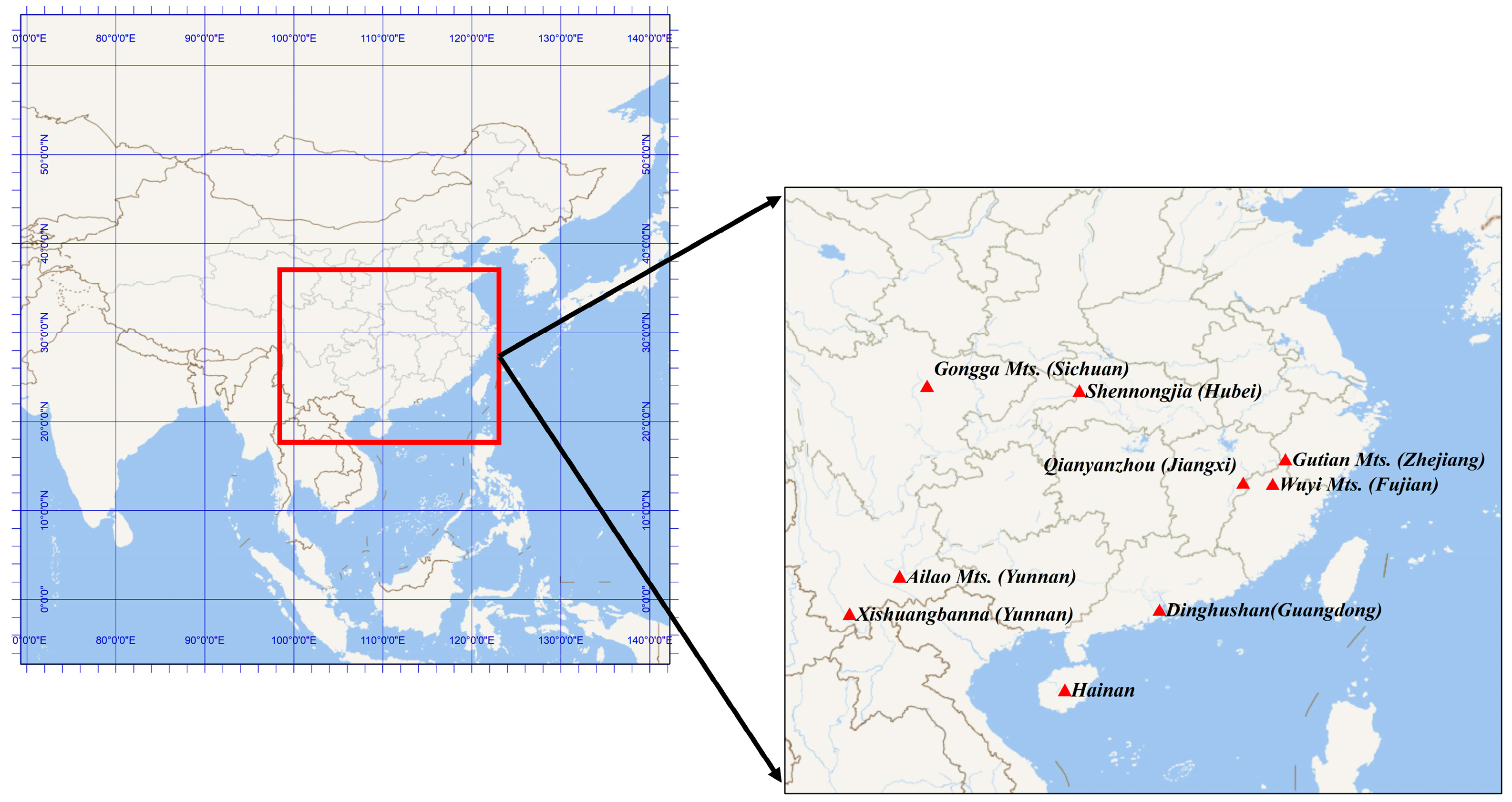
Synthesizing this robust literature base, we analyzed data from highly representative sites across the East Asian monsoon region (Figure 1). These sites (e.g., Dinghushan, Qianyanzhou, Xishuangbanna) were explicitly selected to capture comprehensive geographical, altitudinal, and hydrothermal gradients. They encompass the dominant regional vegetation types and are largely affiliated with national ecological observation networks, ensuring standardized, long-term continuity for the underlying carbon flux and pool data.
This review primarily references long-term observational and survey studies of several typical forest ecosystems in subtropical regions of China (Table 1). As shown in Figure 1, the research sites are widely distributed, including the Gongga Mts. in Sichuan Province, Shennongjia in Hubei Province, Qianyanzhou in Jiangxi Province, the Wuyi Mts. in Fujian Province, Dinghushan in Guangdong Province, the Ailao Mts. and Xishuangbanna in Yunnan Province, Gutianshan in Zhejiang Province, and Hainan Province. Exhibiting significant climatic gradients and topographic differences, these sites cover key vegetation types such as subtropical evergreen broad-leaved forests, monsoon evergreen broad-leaved forests, and montane forests. These sites collectively form a representative research network, providing crucial spatial data and field observation foundations for systematically revealing the carbon cycle mechanisms and processes of Chinese subtropical forest ecosystems and their responses to climate change.

2. Carbon Storage and Distribution in Chinese Subtropical Forests

2.1. Biological Synergy and Soil Carbon Stabilization Pathways

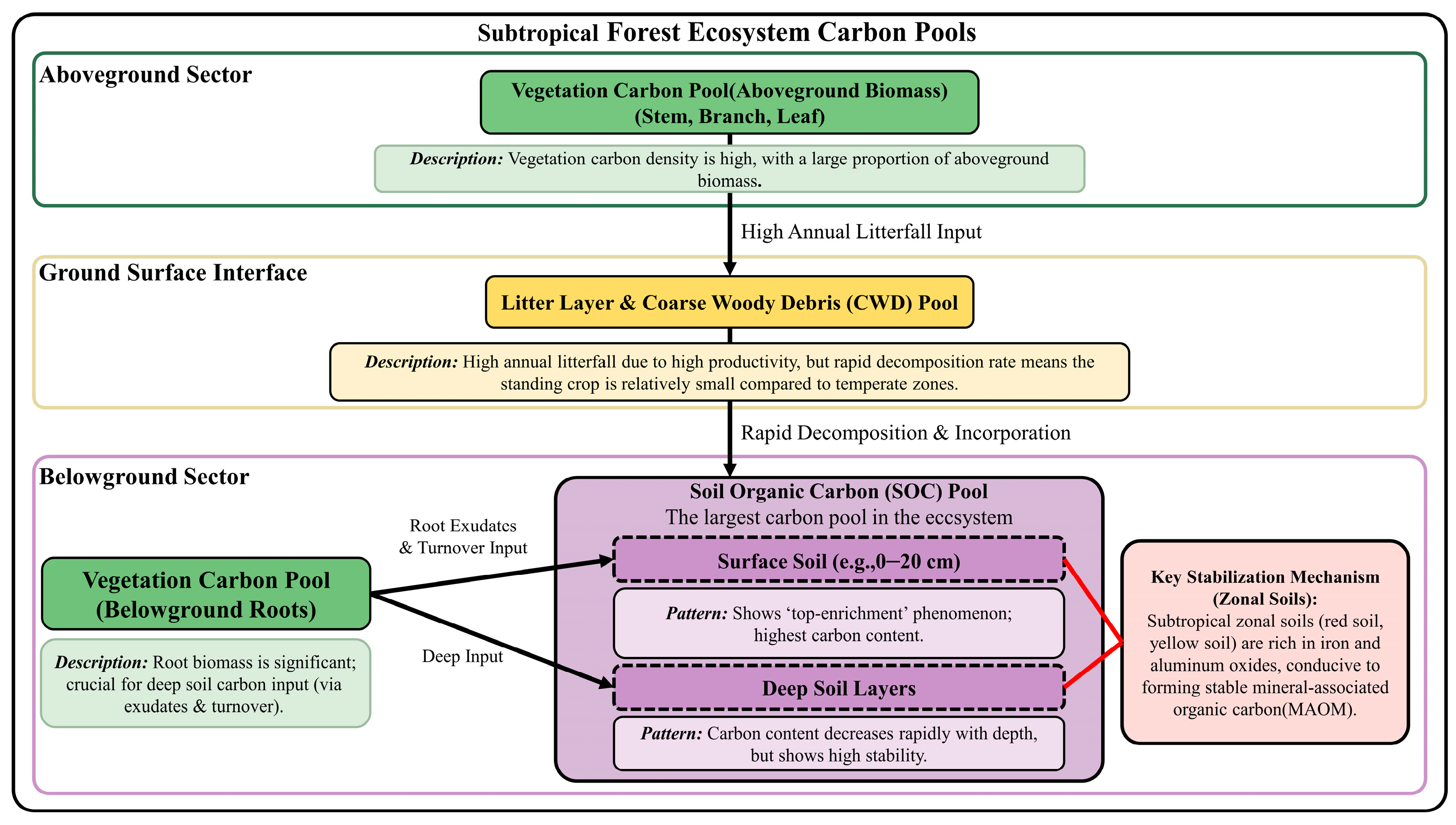
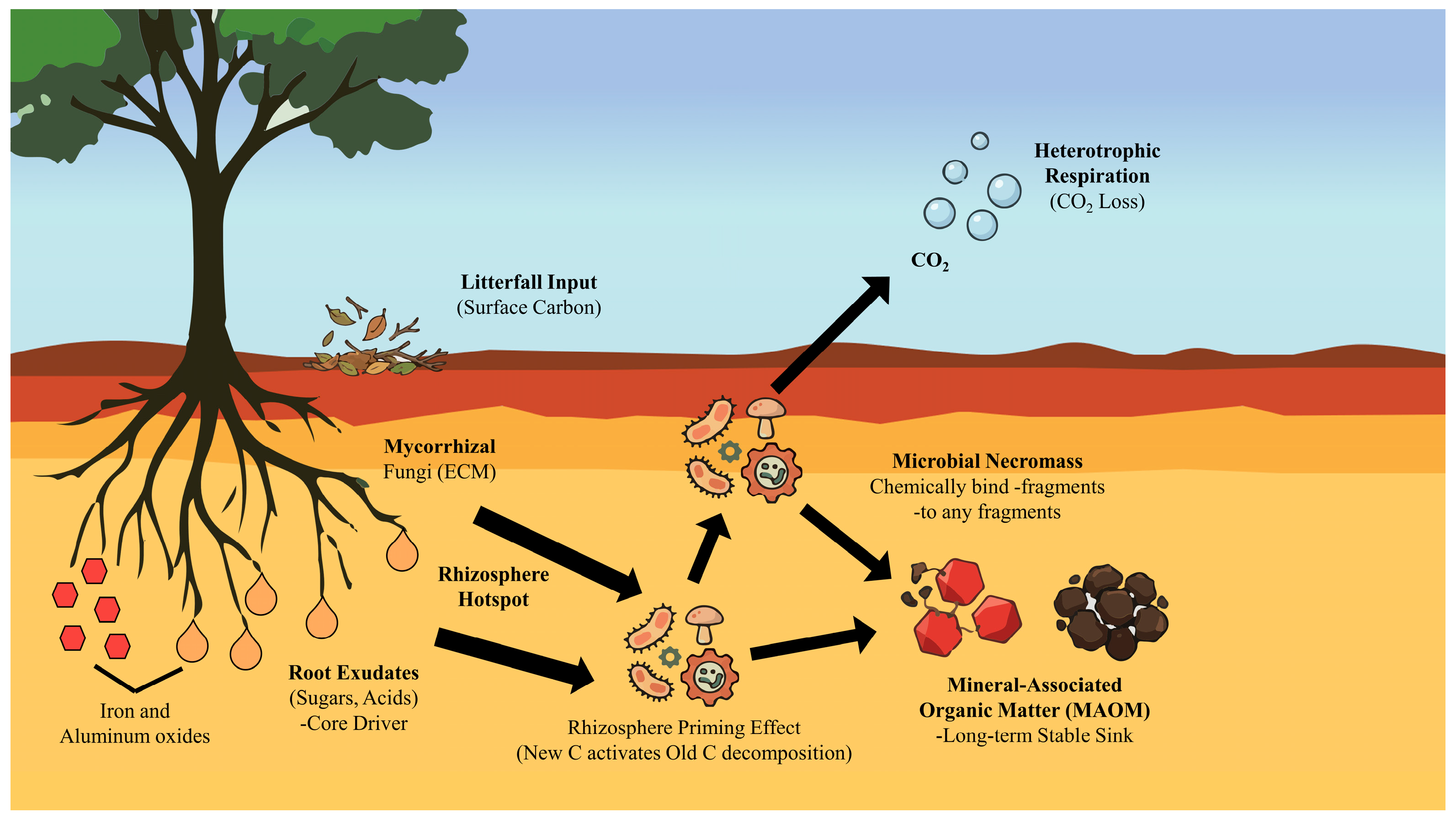
Subtropical forest ecosystems are distinguished by their exceptional carbon sink capacity (Figure 2). This originates from the efficient synergy among biological components along the vertical continuum from the canopy to deep soil in the ecosystem. Ren et al. [5] demonstrated that mature evergreen broad-leaved forests in Dinghushan, Guangdong Province, as the region’s zonal vegetation, exhibit complex canopy structures, characterized by Leaf Area Indices (LAIs) reaching up to 17 (with a Leaf Area Index (LAI) of 6.37 recorded for the uppermost tree layer, followed by 3.04 for the second tree layer, 2.67 for the third tree layer, 2.22 for the shrub layer, and 2.70 for the herb and seedling layer; detailed information is provided in the Appendix A Table A1) and solar radiation interception as high as 96.3%. This productivity is further enhanced by the structural complementarity facilitated by tree species diversity [12]. Root-derived carbon inputs influence soil biogeochemical cycles through two functionally distinct pathways: the active exudation of metabolites and the structural turnover of fine roots. Root exudates, specifically organic acids, serve as both “microbial fuel” and “P-mobilizing signals” that stimulate specific microbial functions to release recalcitrant phosphorus, thereby directly coupling carbon investment with phosphorus acquisition [13,14]. Beyond nutrient mining, these exudates bidirectionally regulate the decomposition of native soil organic carbon (SOC) by triggering environment-dependent rhizosphere priming effects, which actively shape the net soil carbon balance and the stability of mineral-associated organic matter [15,16]. In contrast, fine root turnover provides the primary structural carbon input, often dominating over extraradical hyphae in driving long-term SOC accumulation during forest succession [15]. The decomposition of these first-order roots is governed by unique trait controls that differ significantly from leaf litter, leading to distinct dynamics in the formation of particulate organic matter (POM) [17,18]. While the exudate pathway is critical for overcoming phosphorus limitations—which can actually limit plant biomass responses to elevated CO2 due to intense microbial competition—the turnover pathway is the primary engine for building long-term carbon stocks [14,17,19]. In specialized environments like Chinese fir plantations, these biological pathways are further modulated by abiotic carbon transfers, such as stemflow and litter leachate, illustrating a highly integrated system of nutrient acquisition and carbon sequestration [20,21].
The fate of interfacial carbon inputs is governed by a microbially mediated continuum anchored in soil physicochemical properties. As the system’s dominant, slow-cycling reservoir, soil carbon stocks exceed vegetation stocks by 1 to 3 times [22,23]. This ratio typically leans toward the lower limit in young forests or warmer lowland areas but shifts toward the upper limit in mature forests characterized by persistent deep-soil sequestration and in high-altitude regions where low temperatures significantly inhibit microbial decomposition [23,24,25,26]. Biological drivers also play a role, as stands dominated by arbuscular mycorrhizal (AM) tree species can maintain soil C stocks 25% higher than ectomycorrhizal (ECM) stands [27]. Sequestration proceeds via the “microbial carbon pump,” regulated by carbon use efficiency (CUE), a critical valve that scales with tree species diversity in subtropical forests [28]. Characterized by high chemical stability and mineral affinity, microbial necromass is a primary precursor for Mineral-Associated Organic Matter (MAOM) stabilization. Globally, MAOM accounts for approximately 65% of soil organic carbon, with over half likely originating from microbial residues [29]. This process is profoundly influenced by mycorrhizal symbiosis types: arbuscular mycorrhizal (AM) tree species are associated with rapid carbon turnover and the formation of mineral-associated organic matter (MAOM), whereas ectomycorrhizal (ECM) tree species promote the accumulation of particulate organic carbon through the inhibition of decomposition [30,31]. Specifically, tree species in subtropical forests predominantly form symbioses with either AM or ECM fungi [30,31]. AM tree species (e.g., most species of the Lauraceae and Magnoliaceae families) are typically characterized by high-quality litter (low C:N ratio) and active rhizosphere bacteria, leading to rapid carbon cycling, with MAOM being formed predominantly via the microbial necromass pathway [30,31]. In contrast, the fungal hyphae of ECM tree species (e.g., Pinaceae and Fagaceae plants) secrete oxidative enzymes capable of decomposing complex organic matter; furthermore, their hyphal residues, rich in melanin and chitin, are more recalcitrant to decomposition, thereby favoring the storage of carbon in organic layers. Concurrently, ECM fungi can acquire nitrogen directly from organic matter, suppressing the activity of saprotrophic microorganisms and consequently slowing decomposition rates (the Gadgil effect) [30,31]. It has been demonstrated that in ecosystems dominated by ECM-associated plants, the carbon content per unit of soil nitrogen is more than 70% higher than in soils dominated by AM-associated plants [31]. Conversely, the total litter-plus-soil carbon stock in stands dominated by AM tree species has been found to be 25% higher than in those dominated by ECM tree species [27]. These two markedly distinct regulatory pathways suggest that a single mycorrhizal strategy may impose limitations on the form or total amount of carbon storage. Indeed, their mixed planting synergistically enhances soil carbon stocks [32]; for instance, on tropical coastal terraces, the establishment of mixed forests comprising both AM and ECM tree species resulted, after a 60-year recovery period, in soil carbon stocks approximately 40% higher than those in monoculture plantations [32].
Through their divergent litter qualities, enzymatic secretion strategies, and nitrogen acquisition pathways, AM and ECM tree species shape the resource status and microbial activity within their rhizosphere microenvironments. These differences are inevitably reflected in the network architecture of the soil microbial community. Molecular ecological network analysis has revealed that microbial communities in healthy subtropical forest soils typically exhibit highly modular and tightly connected network structures [33,34]. This network complexity is fundamental to the stability of carbon cycling functions [34]; for example, the co-occurrence network connectivity of bacterial communities in natural primary forest soils has been shown to be 13% higher than in anthropogenically cultivated soils [33]. Within these networks, keystone taxa occupy a central position, and their disappearance directly weakens the network structure [33]. However, whether the ecosystem collapses depends on functional redundancy: when numerous species capable of performing similar functions are present within the community, the system can buffer the impact of keystone species loss. Indirect evidence for this is provided by soils experiencing continuous cropping obstacles, where the bacterial network exhibits greater complexity in functional modules related to energy metabolism, carbon cycling, and nitrogen cycling compared to healthy soils. This suggests that during soil degradation, the microbial community may enhance internal modular connections (i.e., functional redundancy) to sustain core cycling functions [35]. Global change factors, such as nitrogen deposition, can significantly reconfigure network complexity (which may be either enhanced or reduced) by altering resource availability and the soil environment, thereby regulating soil carbon turnover and stabilization processes [34]. This constitutes a key microscopic mechanism underpinning the response of forest carbon cycling to climate change.
Ultimately, carbon is stabilized over the long term through physical occlusion within aggregates and via chemical bonding with oxides in iron- and aluminum-rich soils. Although deep soil layers exhibit low carbon concentrations, their immense volume and exceedingly slow turnover rates (which can reach tens of thousands of years) render them a stable, long-term carbon sink within the ecosystem; consequently, they have been identified as the primary contributors to the increase in carbon stocks during forest recovery [23,24,25].

2.2. Topographic Modulation of Carbon Patterns Across Spatial Scales

The spatial distribution of forest carbon pools is inherently heterogeneous, systematically governed by topographic factors across multiple scales. At the macro scale, altitude modulates carbon accumulation patterns through the comprehensive restructuring of hydrothermal regimes, where vegetation carbon storage frequently exhibits a nonlinear altitudinal trend characterized by an “altitude window” optimal for sequestration. For instance, woody plant carbon storage in Guangdong’s Gudou Mountain peaks at mid-elevations (~546 m) [36], while pantropical analyses reveal that carbon accumulation rates in plantations and regrowth forests reach their maximum at approximately 1000 m a.s.l. [37]. Regarding soil carbon pools, the elevation-driven inhibition of microbial decomposition typically outweighs productivity limitations, thereby facilitating organic carbon accumulation; specifically, for every thousand meters increase in elevation below the tree line, topsoil bulk carbon and subsoil carbon concentrations rise by 5.11% ± 2.23% (p < 0.05) and 2.11% ± 1.27% (p < 0.05) (mean ± SE, p-value), respectively [26]. This accumulation is accompanied by a shift in carbon fractions, where stable organic carbon associated with minerals, particularly fractions bound to Fe and Al, increases monotonically, while particulate organic carbon (POC) may decline. This trend is linked to significant reductions in litter mass loss rates at higher altitudes, such as the decrease from 75.40% at 1300 m to 41.03% at 2300 m, and variations in fine root biomass [38]. At the local scale, topographic factors such as slope and slope position dominate fine-scale carbon patterns by redistributing water, heat, nutrients, and litter. The influence of slope position on vegetation carbon storage often follows a unimodal distribution, peaking at mid-slope positions [39], though carbon density is typically higher on ridges, upper slopes, and sunny slopes [40]. This effect is partly mediated by the topographic filtering of species, which subsequently shapes canopy structural diversity [41]. Soil carbon pools exhibit distinct local enrichment (Figure 3); while MAOM content may remain relatively uniform across slope positions, mobile POC displays a significant decreasing trend from ridges to valleys [42]. This primarily results from the topographic convergence of water and litter in depressions, leading to markedly higher litter standing stocks and carbon storage in footslopes and depressions [43].

2.3. Responses of Carbon Dynamics to Nutrient Imbalance and Global Change

This intricate natural carbon cycle is undergoing profound disruption by global change drivers. The subtropical region of China, a global hotspot for N deposition characterized by widespread P limitation in ancient red soils, represents a unique response context [11,13]. Moderate N inputs can stimulate plant growth in the short term via a “fertilization effect” [13], yet chronic excessive deposition exacerbates soil acidification. Specifically, when soil pH drops below 5.5, Al solubility increases sharply, inducing root toxicity and suppressing microbial activity [44]. Long-term N addition experiments demonstrate that while total soil organic carbon may rise, the newly sequestered carbon consists primarily of labile and readily decomposable fractions, signaling a decline in pool stability [45]. High N environments further suppress the activity of key fungal enzymes involved in [46], facilitating the accumulation of recalcitrant materials alongside the impairment of microbial function and diversity [13]. Against a backdrop of soil P scarcity, N deposition intensifies the stoichiometric imbalance of N and P [13], compelling plants and microorganisms to divert additional energy and carbon toward phosphatase secretion for P acquisition [13]. Paradoxically, direct P addition does not necessarily translate into linear increases in carbon storage; while prolonged P application can triple total soil P, it fails to significantly enhance soil organic carbon stocks [47] and may even accelerate native organic matter decomposition by alleviating microbial P limitation. As observed in a 27-year red soil experiment, P application resulted in no net change in total soil carbon after nearly three decades, whereas N mineralization rates rose by as much as 388.1% [48]. Consequently, the interaction between N deposition and soil P limitation tightly couples the cycles of C, N, and P. Over the long term, exogenous nutrient loading threatens the stability and sequestration potential of soil carbon pools by altering microbial functionality, stimulating decomposition, or inducing chemical toxicity.

3. Impacts of Climate Change Drivers and Ecosystem Responses

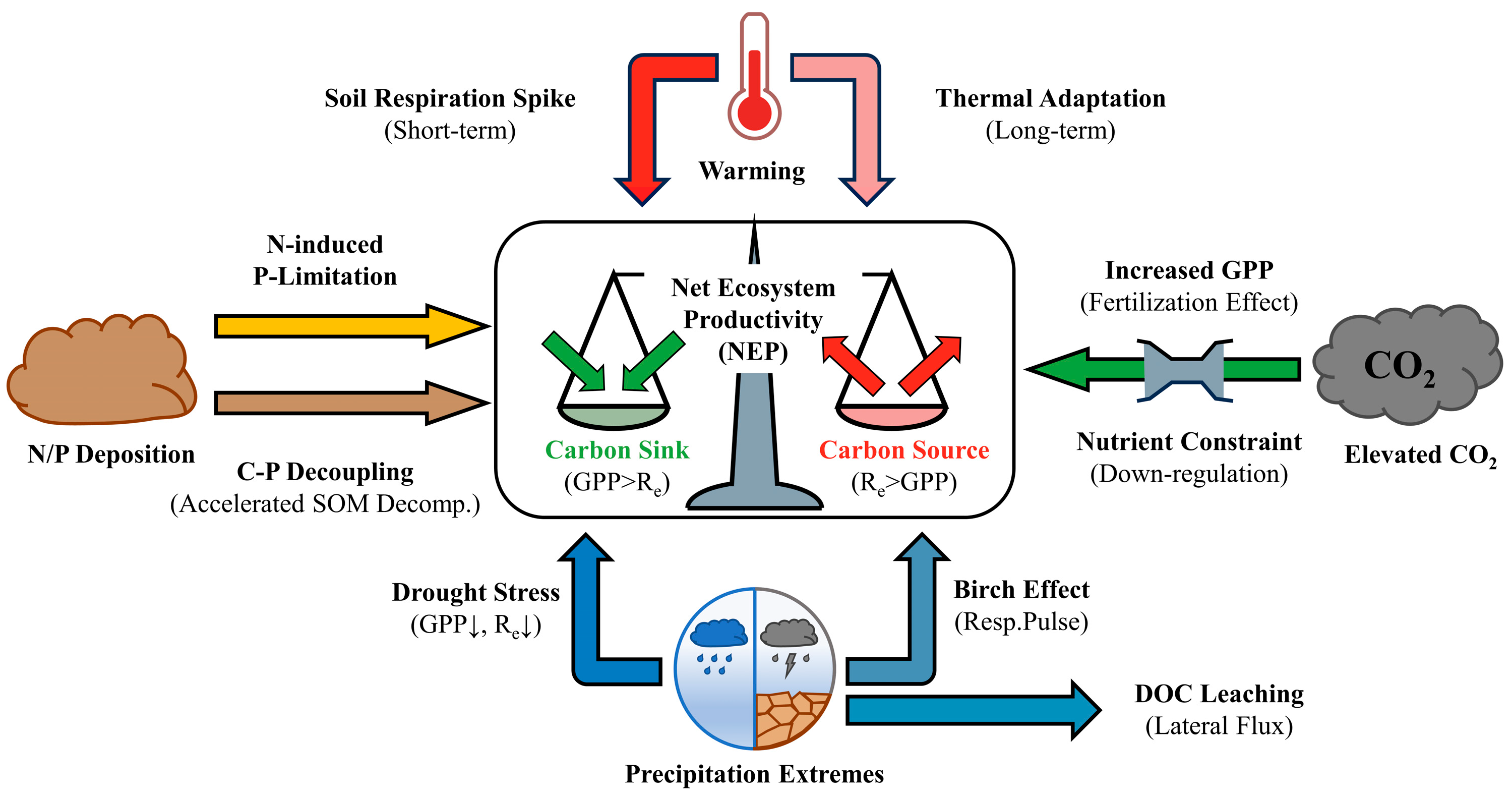
Subtropical forests in China occupy a region undergoing pronounced global changes, where shifts in climate warming, precipitation regimes, and atmospheric CO2 concentrations profoundly disrupt carbon cycling. These drivers operate not in isolation but through complex nonlinear interactions, collectively shaping future trajectories of forest carbon source and sink dynamics (Figure 4) [2,49,50].
Temperature elevation exerts multifaceted impacts on soil carbon pools by modulating microbial metabolism, a process typically characterized by initial priming effects followed by long-term thermal adaptation. During initial warming phases, soil respiration rates accelerate significantly, with temperature sensitivity (Q10 values) ranging from 1.56 to 3.27 across eastern subtropical China, where soil temperature explains 58.3% to 90.2% of the seasonal variability in respiration [51]. However, chronic warming often leads to a diminished or even negligible respiratory response, demonstrating the phenomenon of “thermal adaptation”. For instance, a decade-long experiment at Dinghushan revealed that soil microbial respiration returned to levels comparable to the control after ten years of warming [52]. The underlying mechanisms primarily include the depletion of readily decomposable carbon substrates—exemplified by the significant reduction in microbial biomass carbon by 32.1% and 59.8% during specific months after seven years of warming in a Chinese fir (Cunninghamia lanceolata L.) plantation [53]—and the restructuring of microbial communities toward slow-growing but efficient K-strategists [52]. This suggests that in subtropical forests with high baseline temperatures, long-term warming may impair the formation of microbial necromass carbon and soil carbon sequestration by suppressing specific microbial cohorts [54,55]. Such thermal effects are not independent; they are strictly modulated by water and nutrient availability, as evidenced by N and P addition significantly reducing the Q10 of soil respiration [56]. Furthermore, large-scale studies reveal that the apparent temperature sensitivity of ecosystem respiration at regional scales may be lower than plot-level observations, indicating the presence of systemic buffering mechanisms [57].
Precipitation regime shifts represent another fundamental yet complex driver, where forest productivity is governed by critical thresholds. In mountainous regions, aboveground net primary productivity (ANPP) may decline when annual precipitation exceeds approximately 2500 mm [58]. Conversely, when annual precipitation falls below 1200 mm, gross primary productivity (GPP) often exhibits nonlinear declines—with extreme droughts reducing water use efficiency (WUE) by 2.35 g·C·kg−1·H2O [59]. Precipitation also serves as a primary force driving the lateral transport and transformation of carbon forms. On one hand, it facilitates vertical dissolved carbon inputs; for instance, the annual dissolved organic carbon (DOC) flux from litter leaching in C. lanceolata forests can reach 57.79% of ANPP [60]. On the other hand, precipitation constitutes a major pathway for carbon loss [61]. Subtropical evergreen broadleaf forests exhibit rainfall-driven DOC dynamics, where plant-derived DOC input fluxes reach as high as 22,317 kg·C·km−2·yr−1 [29]. During this transition, the soil layer can retain approximately 17,466 kg·C·km−2·yr−1 of DOC, equivalent to 3.04% of net ecosystem productivity, which forms a significant hidden carbon sink [29,62]. Globally, stream DOC export can account for 10% of total forest carbon sinks [63]. These terrestrial fluxes are frequently intercepted by reservoirs, where the C cycle is strongly regulated by hydrodynamic conditions. For example, CO2 emissions during periods of weak hydrodynamics are approximately sevenfold lower than during strong hydrodynamic periods, while dissolved inorganic carbon (DIC) retention can reach 69.2 tons per day [64]. Projected increases in the frequency and intensity of seasonal droughts pose multifaceted threats to the carbon cycle [65]. Severe droughts can reduce average tree growth rates by 28% and decrease canopy LAI by approximately 10.5% [66], while simultaneously inhibiting soil microbial activity and enzymatic functions in natural Castanopsis carlesii forests [67]. Subsequent rewetting may trigger a “Birch effect”, causing sharp pulses in soil respiration [68]. Collectively, these shifts interactively modulate carbon cycling pathways across entire watersheds.
Shifts in atmospheric composition, specifically N and P deposition alongside elevated CO2, exert effects that are fundamentally constrained by the phosphorus-poor soils characteristic of subtropical regions [11,13]. Moderate N input may stimulate short-term growth via a “fertilization effect” [13]. However, long-term excess N can exacerbate soil acidification and Al toxicity, thereby impairing root and microbial functions [13,44]. Notably, under N addition levels approximating actual atmospheric deposition, AM fungal communities may not undergo significant structural changes, suggesting that the negative impacts of N deposition on microbial-mediated carbon sequestration might be overestimated in current models [69]. Against a background of P limitation, N deposition further intensifies the stoichiometric imbalance of N and P within these ecosystems [13].
In summary, the response of subtropical forests to future climate change represents a complex system driven by the nonlinear coupling of multiple factors, including temperature, water, nutrients and CO2. These drivers redistribute and transform carbon fluxes through active hydrological processes, where the net effect transcends a simple summation of individual factor impacts. Future research and nature-based carbon management strategies must be anchored in this systemic and coupled perspective to accurately predict and enhance the climate-resilience and carbon sink functions of subtropical forest ecosystems.

4. Carbon Pool Patterns and Distribution Characteristics in Distinct Subtropical Ecosystems

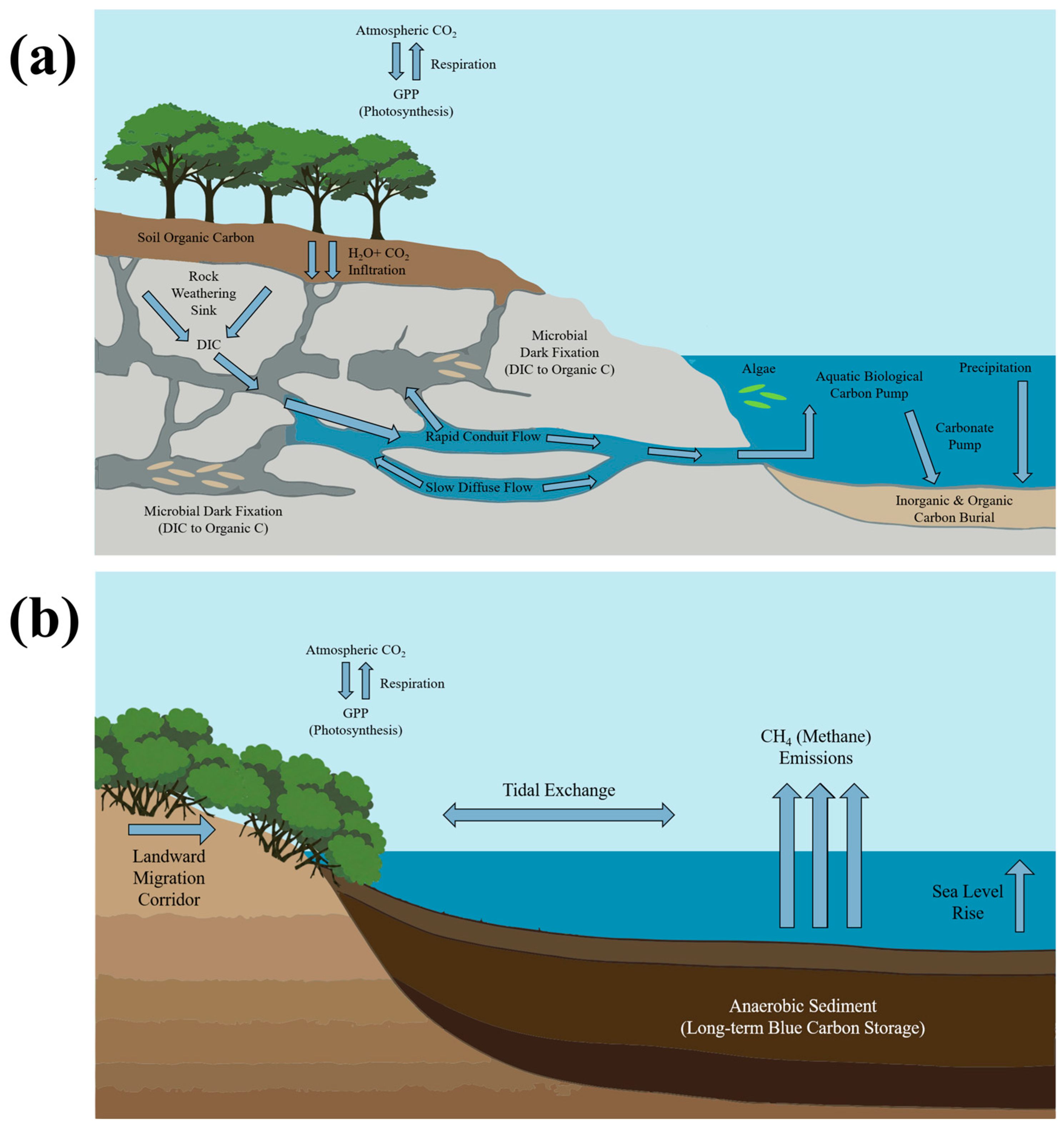
Karst landscapes in subtropical China represent a specialized habitat with a distinct role in the C cycle. These systems, founded on soluble carbonate formations, possess a characteristic dual spatial structure spanning both “above- and underground” domains. Their carbon dynamics are driven by the interplay of biological sequestration through vegetation and abiotic processes involving rock weathering, which together form an integrated sink system (Figure 5) [70].
A defining feature of this system is the vigorous water-carbon coupling facilitated by the active hydrological regimes typical of the subtropics [70]. Specifically, groundwater movements convert atmospheric or soil CO2 into DIC, primarily H C O 3 via dissolution processes. This carbon is subsequently transported by water flow to create a substantial rock weathering carbon sink. Regional estimates for China place the rate of this weathering sink between approximately 3 and 64 million tons of carbon annually, reflecting both its significant impact and the difficulties associated with its precise measurement [71]. The distribution and ultimate fate of this dissolved carbon are further governed by groundwater pathways, ranging from rapid pipe flow to slow diffuse flow. In favorable settings, microorganisms utilize dark fixation to reconvert DIC into organic carbon, establishing a stable and long-term underground reservoir [69].
Consequently, the total sequestration capacity arises from the combination of photosynthetic carbon capture (the green carbon sink) and the abiotic-biological coupled pathway involving rock weathering and microbial fixation [69]. Analysis from 1981 to 2019 indicates that NEP in karst regions grew at a rate of 0.54 g·C·m−2·yr−1, a value slightly exceeding that of non-karst areas with LAI serving as the dominant driver [72]. The aboveground biomass capacity for forests in southwestern karst regions is estimated at 20.54 Pg, with an additional future sequestration potential of roughly 5.32 Pg [73]. However, this sink remains highly vulnerable to hydrological shifts; water flux and precipitation contribute 57% and 35% to the variability in carbon flux, respectively [74]. Extreme droughts, such as the consecutive events of 2009 and 2010, can impair WUE by approximately 18.2% compared to typical years [75]. Processes in karst reservoirs are equally noteworthy. The biological carbon pump (BCP) promotes the conversion of high-concentration DIC (1668.6–1777.9 µmol/L) into autochthonous organic carbon burial in the lentic zones, intercepting about 40% of the total organic load [76,77]. When paired with P removal via calcium (Ca) carbonate co-precipitation, this creates a synergistic mechanism for both carbon sequestration and the control of eutrophication [78]. The link between the biological and carbonate pumps integrates primary production with nutrient cycling, forming a negative feedback loop that captures carbon while minimizing the risk of nutrient enrichment [79,80].
Mangrove wetlands rank among the most carbon-dense ecosystems per unit area, though their carbon pools exhibit pronounced spatial heterogeneity (Figure 5) [81]. In Hainan Island, the total blue carbon stock is estimated at approximately 703,000 tons, with significant density variations. Specifically, the regions of Haikou and Wenchang alone contribute 67.6% of the island’s total storage [81,82]. The majority of mangrove carbon, approximately 75%, is sequestered belowground. This dominance of belowground pools is attributed to the anaerobic conditions maintained by periodic tidal flooding, which suppresses organic matter decomposition and facilitates long-term organic carbon accumulation [83]. While mature natural forests function as robust net carbon sinks, with net ecosystem CO2 exchange (NEE) ranging from 249 to 890 g·C·m−2·yr−1, restoration sites in their early stages may act as net carbon sources [79]. For instance, a 12-year-old restored mangrove park in Zhuhai remains a CO2 source (82 to 175 g·C·m−2·yr−1) and exhibits substantial methane (CH4) emissions. Consequently, its century-scale global warming potential (GWP) may increase during the initial restoration phase, suggesting that climate benefits could be transiently negative and necessitating scientifically optimized planning [84]. Sea level rise represents a primary climatic threat to mangroves, as their growth is highly sensitive to regional sea-level anomalies. Model projections identify regions such as the Pearl River Estuary as high-vulnerability zones by 2100 [85]. Therefore, facilitating landward migration space is a critical strategy to enhance climate resilience. This is further supported by the disaster-mitigation services provided by complex root structures; a 100 m-wide mangrove belt can reduce wave height by 13% to 66% [86]. Under future climate scenarios, the synergy between sea level rise and rising temperatures will dictate the net climate benefits of these ecosystems. Simulations at the northern distribution limits in China project that CO2 removal may increase by over 24%. However, the GWP of greenhouse gases from sediments is expected to rise by over 13%, with CH4 emissions potentially surging by 54% to 79% [87]. This underscores the necessity of balancing carbon sequestration gains against the costs of non-CO2 GHG emissions when evaluating the net carbon sink function of mangroves.
In summary, karst ecosystems are characterized by synergistic biological-geological carbon sequestration governed by hydrological connectivity [70]. Meanwhile, mangroves demonstrate exceptional capacity for blue carbon sequestration yet encounter significant threats to carbon pool stability due to environmental shifts. Future initiatives should emphasize the development of coupled models for the precise quantification of karst carbon sinks [70] alongside the intensification of carbon budget monitoring across mangrove restoration stages [84]. Integrating the carbon sink functions of these two unique ecosystems into carbon neutrality accounting systems is essential. Such integration should be facilitated by establishing protected areas and implementing ecological compensation to effectively conserve and bolster these natural carbon reservoirs [73].

5. Impacts of Anthropogenic Disturbance on Key Carbon Cycle Processes

Subtropical forest carbon cycling is profoundly coupled with intensive anthropogenic activities. Ultimately, such disturbances modulate carbon sink functions and services through the alteration of carbon pool patterns and the regulation of carbon flow processes [88]. This was exemplified by a study conducted in the karst region of Yunnan, where distinctly different vegetation recovery trajectories were found to result from varied land-use histories (e.g., fuelwood harvesting, grazing abandonment) and subsequent restoration approaches (natural succession versus artificial afforestation). In this area, a basal area at breast height of only 4.7 m2·ha−1 was recorded in a Pinus yunnanensis plantation established by aerial seeding in 1980 after 25–30 years, where species diversity was also found to be extremely low. By contrast, a basal area of 11.3 m2·ha−1 was achieved in a natural secondary forest that regenerated following the abandonment of fuelwood collection in 1990, with a community structure that was much closer to that of a natural forest. Comparatively, a basal area of merely 1.3 m2·ha−1 was observed in shrubland formed by natural succession on grazing land abandoned in 1989. Highlighted by these findings is the uncertainty inherent in recovery pathways following land-use change: although forest cover can be quickly restored through afforestation, this may be achieved at the expense of biodiversity; in contrast, naturally regenerated secondary forests have been shown to exhibit significant advantages in both structure and composition—a discovery of great importance for the guidance of forest restoration practices [89].
Ecological restoration initiatives strive to reverse these trends. Within the karst regions of southwestern China, natural recovery and artificial afforestation were reported to have contributed 14% and 18%, respectively, to the regional carbon sink between 2002 and 2017 [90]. However, large-scale monoculture plantations, despite their potential for short-term enhancement of vegetation carbon storage, might trigger ecological trade-offs such as soil moisture depletion and the simplification of biodiversity [88,90]. Conversely, well-preserved natural forests are capable of maintaining robust and persistent carbon sinks. For example, the tropical rainforest in Xishuangbanna has annually sequestered a net average of 157.9 ± 56.7 g·C·m−2 over the past two decades, with its sink capacity reportedly increasing at a rate of 3.4% per year [91].
Forest carbon cycling is influenced by management activities, including logging and silviculture, through the direct regulation of vegetation structure. It is suggested by modeling studies that, under scientific planning, moderate selective logging might not necessarily compromise long-term carbon sink capacity. An optimized scenario could even slightly exceed long-term biomass sequestration trends compared to the status quo while simultaneously meeting timber demand. At the core of this scheme is a fundamental shift away from the current baseline model, in which only 0.3 billion m3 per year is harvested from mature planted forests, with the remainder being imported. Instead, a selective harvesting strategy is adopted, whereby 0.5 billion m3 per year is extracted from mature and over-mature trees in both planted and natural forests, thereby enabling the complete fulfillment of domestic annual wood demand. Through model simulations, multiple benefits of this optimized scenario have been projected. In terms of carbon sequestration, a long-term forest biomass carbon sink of 0.225 Pg·C·yr−1 is expected to be achieved between 2020 and 2060, which is 1.12 times that of the business-as-usual scenario; by 2060, an increase of approximately 4.79% in the forest carbon sink is predicted. Regarding wood security, a reduction in the supply import dependency from as high as 42.55% to zero is made possible, by which the escalating geopolitical, trade, and resource risks can be effectively mitigated. Environmentally, only a minimal increase of 0.79% in average sediment loss is estimated compared with the baseline scenario, indicating a negligible impact on soil erosion [92]. The underlying mechanism involves the promotion of stand regeneration, the rejuvenation of forest age structures, and the improvement of growth efficiency. Furthermore, the transformation of harvested wood into long-lasting products establishes a transferred long-term carbon reservoir. It is indicated by data that China accumulated carbon storage equivalent to 4.375 billion tons of CO2 through the production of wood forest products between 1990 and 2020 [93]. Optimized management practices, such as the adjustment of rotation periods, are further estimated to potentially augment carbon storage by up to 2.3 billion tons [94].
Given this complex pattern of anthropogenic influences, future management strategies for subtropical forests must be advanced from multiple dimensions to synergistically achieve the multi-objective goals of carbon sink enhancement, ecological protection, and resource supply. Firstly, a shift in management objectives from area expansion to quality improvement is required. Building upon existing afforestation outcomes, existing forest structures should be transformed through thinning, the introduction of native tree species, and the development of multi-layered, uneven-aged forests. It has been demonstrated by research that the aboveground carbon density of C. lanceolata plantations is closely correlated with maximum diameter at breast height and stand density; retaining large-diameter trees and increasing the proportion of shade-tolerant species are identified as important pathways for enhancing carbon sinks [95]. Secondly, the integrated management of aboveground and belowground components must be implemented. Attention in carbon accounting practices should be directed towards both tree biomass and the protection of soil carbon pools, minimizing mechanical disturbance and retaining harvesting residues to maintain aggregate structure. Theoretical support for this concept has been provided by the recently proposed “plant-mycorrhizal synergy” framework: AM plants, acting as “deep carbon engineers,” facilitate the formation of mineral-associated organic matter in deep soil layers; ECM plants, conversely, act as “surface active managers,” accumulating particulate organic matter in topsoil. Through their synergy, carbon pools at different depths within the soil profile can be simultaneously optimized; it has been found that in mixed forests, soil carbon storage can be increased by approximately 40% after 60 years of recovery compared to monoculture plantations [32]. Thirdly, differentiated strategies are necessitated by special habitats. In karst regions, priority should be given to regulating hydrological processes through vegetation restoration to curb rocky desertification [71]. In mangrove areas, landward migration corridors must be reserved in response to sea-level rise, while restoration techniques should be optimized to reduce methane emissions [86]. Fourthly, a watershed-scale perspective should be established, coordinating forest management with water resource protection to reduce lateral carbon losses caused by erosion and to utilize the carbon burial function of reservoirs. Research on the Beiluo River Basin has revealed trade-offs between water yield service and both soil conservation and carbon storage, whereas a synergistic relationship is observed between soil conservation and carbon storage. As vegetation restoration progresses, these three factors exhibit significant spatiotemporal heterogeneity alongside relatively stable trade-off and synergy relationships—a finding that provides a scientific basis for the comprehensive optimization of watershed-scale ecosystem services [96].
In summary, the carbon cycle within subtropical forests is subject to the dual effects of anthropogenic activities. Scientific adaptive management—including the optimization of logging regimes, the promotion of near-natural restoration, the prudent assessment of nutrient management, and the establishment of an integrated aboveground-belowground-watershed multi-scale framework—can synergistically enhance multi-dimensional benefits such as carbon sequestration, timber supply, and ecological resilience; this remains key to achieving multifaceted management objectives [88,92,97]. It has also been confirmed by research in European forests that the success of carbon sequestration practices is highly context-dependent on forest type, disturbance risk, and future climatic conditions.

6. Challenges and Future Perspectives

The accurate quantification and prediction of carbon cycling within subtropical forest ecosystems are confronted with multifaceted challenges. These difficulties are derived from the inherent complexity of the systems themselves, as well as the limitations inherent in current mechanistic understanding.
A primary source of uncertainty is constituted by the dynamics and stability of deep-soil carbon pools. Below a depth of 1 m, carbon stocks are vast, and their turnover times are extremely protracted. At horizons of 140 cm, these times potentially range from 5000 to 40,000 years, thereby constituting a resilient long-term sink [23,24,25]. However, substantial knowledge gaps persist regarding the mechanisms governing their accumulation. A challenge to the traditional perception centered on surface carbon pools has been posed by recent findings from the Sanming Forest Ecosystem National Field Scientific Observation and Research Station in Fujian Province. It was discovered that during long-term forest restoration in the subtropics, the contribution of subsurface (20–60 cm) and deep (60–100 cm) soils to the increase in total organic carbon stocks significantly exceeds that of the surface layer, with the accumulation of microbial necromass carbon and lignin, although relatively lagging, exhibiting a more significant increasing trend [24]. On one hand, the contribution of deep soil may far exceed current expectations—carbon sequestration during forest restoration in subtropical regions has been reported to occur primarily within the 20 to 100 cm layer [24], with a lignin-microbial necromass carbon coupling mechanism being suggested to drive the stratified effect of deep soil carbon sequestration [24]. On the other hand, ancient carbon pools could be “awakened” by the activity of deep plant roots through rhizosphere priming effects. The identification of these depth-dependent priming thresholds remains a critical research priority [98]. For the widespread, deeply weathered profiles and substantial belowground root biomass prevalent in subtropical regions, in situ deep profile (>1 m) observation experiments are urgently required. These should be integrated with 14C dating and microbiome technologies to quantify the carbon budget balance between root inputs and priming effects at different depths and to determine depth-specific priming thresholds for typical subtropical forest types (e.g., monsoonal evergreen broadleaf forests, Pinus massoniana forests).
Microbial transformation processes remain a metaphorical “black box.” Although the core contribution of microbial necromass to stable carbon pools has been established by the MCP theory [29], key parameters such as CUE are subject to complex regulation by temperature and nutrients. The underlying drivers of these parameters remain elusive. A decade-long soil warming experiment at Dinghushan has revealed, for the first time, that the CUE of soil microorganisms in subtropical forests is positively correlated with temperature after long-term warming, contrary to expectations from short-term experiments. This phenomenon has been attributed to the restructuring of the microbial community towards a more stable network composed of K-strategists, thereby enhancing the thermal adaptation of microbial metabolism [52]. This finding diverges from observations in temperate forests, suggesting unique adaptive mechanisms in subtropical microbial communities. Nevertheless, significant debate persists regarding whether this observation originates from genuine physiological adaptation or the depletion of readily decomposable carbon substrates [52,99]. Furthermore, in typical phosphorus (P)-limited, highly weathered subtropical soils, a fifteen-year long-term nutrient addition experiment at the Xiaoliang Tropical Coastal Ecosystem Research Station has revealed that phosphorus addition more than tripled total soil phosphorus content without significantly enhancing soil organic carbon stocks. This empirically demonstrates, for the first time, a decoupling phenomenon characterized by a “stable carbon pool versus a surging phosphorus pool” [47]. It was further revealed that while phosphorus content in the particulate organic matter pool—considered the “responsive pool”—increased significantly, the mineral-associated organic matter pool—the “stable pool”—is governed by mineral protection mechanisms. Excessive phosphorus input may therefore interfere with microbe-mediated long-term carbon stabilization processes [47]. This raises a series of specific questions that urgently need answers: What trade-offs exist between microbial necromass formation and mineral protection under phosphorus addition? How is this trade-off regulated by the high calcium and iron oxide environments in karst regions [100]? Future research should integrate nanoscale secondary ion mass spectrometry (NanoSIMS) with stable isotope probing techniques to track the carbon-phosphorus coupling processes across multiple scales—from individual microbes to communities to mineral surfaces—following phosphorus addition, and to clarify the mechanistic thresholds for the destabilization of microbial necromass within mineral-associated organic matter.
Hydrologically driven lateral carbon fluxes are frequently underestimated in conventional budget accounting. In high-precipitation subtropical regions, lateral carbon migration along hydrological pathways is substantial. Annual DOC fluxes from litter leaching could account for over 50% of NPP [21]. The fate of this carbon within the terrestrial-aquatic continuum lacks systematic tracking, leading to potential biases in regional carbon budget estimations. For the complex terrain of subtropical hilly regions, the establishment of multi-level “hillslope-watershed” observation systems is necessary. These should utilize hydrogen and oxygen stable isotope tracing to differentiate hydrological pathway contributions, combined with three-dimensional fluorescence spectroscopy and ultra-high-resolution mass spectrometry to analyze changes in DOC molecular composition during transport. This would facilitate the development of coupled surface-subsurface biogeochemical models (e.g., CNMM-DNDC [101]) to quantify correction coefficients for lateral fluxes in regional carbon budgets. In karst regions, the quantification of rock weathering sinks is complicated by the unique dual aboveground-underground structure. Research from the Institute of Subtropical Agriculture, Chinese Academy of Sciences, indicates that the high Ca- and Fe-oxide content in karst soils enhances macroaggregate stability and mineral protection. The trade-off effects between soil aggregates and minerals on organic carbon formation and stabilization are regulated by lithology, suggesting that assessing carbon sequestration potential based solely on microbial CUE may be biased [100]. Therefore, coordinated observations of lithology–soil–vegetation are urgently needed in karst regions to quantify the contributions of the microbial carbon pump versus the mineral carbon pump under different lithological backgrounds and to identify key environmental disturbance factors affecting the coupled biological-carbonate rock pump processes. Regarding coastal mangroves, high-density carbon stocks are primarily threatened by sea-level rise exceeding sediment accretion thresholds and the “coastal squeeze” effect [10]. A systematic assessment of the dynamic responses of mangrove sediment accretion rates and carbon burial potential under different sea-level rise scenarios is required, along with identifying the spatial distribution patterns and critical thresholds of the “coastal squeeze” effect.
The nonlinear interaction of climate change drivers further exacerbates predictive difficulties. Threshold-dependent relationships are exhibited between precipitation and productivity, such as a precipitous decline in productivity below 1200 mm. This relationship might be intensified by future alternations between extreme droughts and intensive rainfall events [59,102]. Analysis of 12 years of flux data from Dinghushan has revealed that the response sensitivities of Gross Ecosystem Productivity (GEP) and Ecosystem Respiration (ER) to hydrothermal factors exhibit seasonal variability. It is the asynchronous response of these two components that determines the seasonal and interannual variation patterns of NEP [103]. Under chronic N deposition, the expected fertilization effect could be constrained by the interplay of P limitation and potential aluminum (Al) toxicity. Despite observed thermal adaptation in microbial respiration [52], the tipping points of ecosystem functions under compound stressors (e.g., scenarios such as concurrent heat and drought) represent significant unknown risks. The subtropics are experiencing the dual pressures of intensified seasonal drought and frequent extreme rainfall. The establishment of controlled experimental platforms incorporating multiple stressors (e.g., warming + drought + N deposition) is needed, integrated with flux observations and ecological models, to identify the key environmental thresholds driving the asynchronous responses of carbon flux components and to quantify the changing trajectories of ecosystem resilience under different stressor combinations.
Based on the analysis of the aforementioned challenges, a prioritization assessment can be made: Deep soil carbon dynamics, given their immense carbon stocks and uncertain priming responses, have the most profound impact on long-term carbon sink function. However, due to the difficulty of observation and the long research cycles required, this should be treated as a strategic direction for priority investment. Regarding microbial process mechanisms, breakthroughs have been achieved in research on CUE parameterization and carbon-phosphorus decoupling mechanisms [47,52], making them ready for application in model parameterization; this can be considered a priority direction for near-term breakthroughs. Research methods for lateral flux monitoring and for specialized ecosystems like karst and mangroves are relatively mature and can be advanced rapidly by leveraging existing observation networks. The complexity of multi-factor nonlinear effects is the highest, and its elucidation will need to be progressively deepened based on the accumulation of mechanistic understanding from the aforementioned priorities.
To address the aforementioned challenges and improve the predictive capacity for carbon cycling in subtropical forests, future research should prioritize the following directions:
The development of monitoring technologies for deep-soil and lateral carbon fluxes. This effort should focus on creating high-resolution observational methods to accurately quantify carbon dynamics in deep-soil horizons and track the migration of carbon across the terrestrial-aquatic continuum. Given the deeply weathered profiles and complex terrain of subtropical forests, priority should be given to developing deep-profile soil moisture-carbon coupling monitoring technologies based on the cosmic-ray neutron method. Constructing multi-level “hillslope–watershed” hydrological observation networks, combined with molecular marker tracing of DOC, is essential to achieve coordinated quantification of vertical and lateral carbon fluxes.
The achievement of cross-scale coupling between microbial functions and carbon fluxes. By integrating microbial functional traits with ecosystem-scale carbon flux data, researchers could develop coupled models that transcend the current “black box” representations of microbial processes. Building upon the mechanisms of microbial network restructuring [52] and the carbon-phosphorus decoupling phenomenon [47] revealed from long-term subtropical forest platforms, key indicators such as microbial ecological network stability parameters and mineral-associated organic matter formation efficiency should be incorporated into a new generation of ecosystem models. This will overcome the current limitation of using fixed values for CUE in models, enabling a transition from “parameterized” to “mechanistic” representation of microbial physiological and ecological processes.
The quantitative assessment of vulnerability and adaptive management windows for specialized ecosystems. Within a framework of multi-factor climate change interactions, it is essential to identify the vulnerability thresholds of unique ecosystems, such as karst landscapes and mangroves, and to determine corresponding strategies for adaptive management. For karst regions, targeted at the lithology-driven trade-off effects on carbon sinks [100], a lithology–soil–vegetation typology classification system should be established to formulate differentiated technical pathways for carbon sequestration and sink enhancement. For coastal mangroves, spatial planning is needed; by integrating sea-level rise scenario modeling with sediment dynamic monitoring, high-risk zones for “coastal squeeze” should be identified, and ecological space should be reserved to allow for mangrove landward migration [10].
The research progress outlined above carries significant implications for carbon sink management and ecological restoration policies in subtropical forests. First, nutrient management strategies must be optimized. The findings on carbon-phosphorus decoupling resulting from long-term phosphorus addition suggest that blindly applying phosphorus fertilizers in subtropical regions should be avoided. Site-specific nutrient management strategies are required to maintain carbon-phosphorus balance and ecosystem stability [47]. Second, precise ecological restoration demands stratified regulation. Informed by research on deep soil carbon accumulation mechanisms, efforts should be made to alleviate nutrient limitations in deep soil layers and optimize tree species mixing ratios to balance lignin input with microbial turnover. This would enable the maximization of soil organic carbon sequestration across the entire profile [24].

7. Conclusions

Facilitated by monsoon climate and complex topography, highly productive evergreen broad-leaved forests form efficient, resilient carbon sinks. Mature forests, research indicates, do not maintain a static carbon balance. Through complex vertical structures, light-use efficiency exceeding 96% is reportedly achieved, while organic carbon is continuously supplied to deep-soil horizons. Challenged by this long-term sequestration evidence is the classic climax community carbon neutrality paradigm. Essential for regional carbon balance, therefore, is the protection of mature and old-growth forests [6].
Fundamentally dependent on soil carbon pool stability is the persistence of this sink function. Within subtropical acidic red and yellow soils, robust mineral protection mechanisms are formed through Fe/Al oxide cementation and aggregate physical encasement. By these mechanisms, deep-soil carbon turnover times are extended to millennial scales [7,15]. This stability, however, relies on a delicate plant-microbe-mineral interface balance. While carbon accumulation is driven by root exudates and the microbial carbon pump, ancient carbon reservoir decomposition may also be triggered. Disrupted by climate-induced alterations in root distribution or microbial metabolism, this balance could be destabilized, releasing deep-soil carbon.
Highly heterogeneous carbon cycling patterns are shaped by topography, lithology, and hydrology. Within these patterns, unique regional cycle components are constituted by karst rock-weathering sinks and mangrove blue carbon sequestration [9,10]. Involving biological-geological pump coupling and anaerobic preservation, these processes are rendered particularly sensitive to environmental shifts. To systematic regional carbon budget misjudgment could their omission lead. Future climate impacts are expected to manifest through nonlinear interactions: water threshold effects (droughts, heavy rain) and stoichiometry-induced C-P decoupling—primary threats to ecosystem stability [48,102].
Dual effects are exhibited by human activities. Significant soil carbon loss and sink-to-source conversion are frequently caused by improper practices like clear-cutting or monoculture afforestation [88]. Conversely, synergy between carbon sequestration and timber production could be achieved through adaptive management following natural principles (near-natural silviculture, mixed-species afforestation).
In summary, a dynamic but challenged carbon sink system is represented by China’s subtropical forests. On scientific understanding of deep-soil processes and multi-factor interactions must future management be based, while nature-based solutions are actively explored, ensuring these ecosystems’ critical role under global climate change.

Author Contributions

Conceptualization, Y.S.; methodology, J.Y. and Y.X.; software, Y.X. and Y.C.; validation, J.Y., Y.X., X.C. and H.W.; formal analysis, J.Y. and Y.X.; investigation, J.Y., X.C., H.W., J.H. and Y.W.; resources, Y.S. and Z.C.; data curation, Y.X. and Z.N.; writing—original draft preparation, J.Y. and Y.X.; writing—review and editing, Y.S. and Y.C.; visualization, J.Y. and Y.X.; supervision, Y.S.; project administration, Y.S.; funding acquisition, Y.S. All authors have read and agreed to the published version of the manuscript.

Funding

This review is financially supported by the Joint Research Fund of the Department of Forestry of Zhejiang Province and the Chinese Academy of Forestry: 2022SY05. The Central Government Guidance Fund for Local Science and Technology Development Program (Grant No. 2025ZY01088).

Data Availability Statement

No new data were created or analyzed in this study. Data sharing is not applicable to this article.

Acknowledgments

The authors acknowledge the use of Gemini 3 Pro (https://gemini.google.com, developed by Google) for assisting in the visual conceptualization of Figure 3 and Figure 5, also limited text generation in early stage. The authors have critically reviewed, edited, and revised all content and take full responsibility for the accuracy, integrity, and originality of the final manuscript.

Conflicts of Interest

Author Zhiwei Chen was employed by the company Hangzhou Woodpecker Ancient Tree Rescue Co., Ltd. The remaining authors declare that the research was conducted in the absence of any commercial or financial relationships that could be construed as a potential conflict of interest.

Abbreviations

The following abbreviations are used in this manuscript:
AlAluminum
AMArbuscular Mycorrhizal
ANPPAboveground Net Primary Productivity
BCPBiological Carbon Pump
CCarbon
CaCalcium
CH4Methane
CO2Carbon Dioxide
CUECarbon Use Efficiency
CWDCoarse Woody Debris
DICDissolved Inorganic Carbon
DOCDissolved Organic Carbon
ECMEctomycorrhizal
FeIron
GHGGreenhouse Gas
GPPGross Primary Productivity
ReEcosystem Respiration
GWPGlobal Warming Potential
LAILeaf Area Indices
MAOMMineral-Associated Organic Matter
MCPMicrobial Carbon Pump
NNitrogen
NDCNationally Determined Contributions
NEENet Ecosystem CO2 Exchange
NEPNet Ecosystem Productivity
PPhosphorus
POCParticulate Organic Carbon
POMParticulate Organic Matter
SOCSoil Organic Carbon
WUEWater Use Efficiency

Appendix A

Table A1. Leaf Area Index of Dinghu Mountain Monsoon Evergreen Broadleaf Forest Used to explain the main text content.
LayerLAI
Tree layer I6.37
Tree layer II3.04
Tree layer III2.67
Shrub layer IV2.22
Herbaceous layer V2.70
Note. Cited from ref. [5].
Table A2. Comprehensive geographical and climatic characteristics of all investigated research sites within the Chinese subtropical forest ecosystems.
SiteProvinceLAT/LONElevation (m)MAT (°C)MAP (mm)Vegetation/Ecosystem
Gongga Mts.Sichuan29.6° N, 101.9° E30004.21935Subtropical montane forest/Mixed forest
ShennongjiaHubei31.3° N, 110.5° E1200–170010.61330Mixed evergreen and deciduous forest
Gutian Mts.Zhejiang29.2° N, 118.1° E300–120015.31964Subtropical evergreen broad-leaved forest
Xingangshan *Jiangxi29.1° N, 117.9° E100–20016.71911Subtropical evergreen broad-leaved forest
QianyanzhouJiangxi26.7° N, 115.1° E10017.81485Subtropical coniferous plantation
Wuyi Mts.Fujian27.7° N, 117.7° E500–215815.0–18.02000Subtropical evergreen broad-leaved forest
DinghushanGuangdong23.2° N, 112.5° E200–60022.21771Monsoon evergreen broad-leaved forest
Gudou Mts. *Guangdong22.2° N, 113.0° E0–96022.32200Subtropical evergreen broad-leaved forest
North Guangdong *Guangdong24.5° N, 113.0° E300–80019.51800Subtropical montane forest
Ailao Mts.Yunnan24.5° N, 101.0° E248011.31931Subtropical montane evergreen forest
XishuangbannaYunnan21.9° N, 101.3° E600–100021.71500Tropical seasonal rainforest
Gaoligong Mts. *Yunnan25.0° N, 98.5° E1500–250014.51800Subtropical mountainous region
Yunnan Karst *Yunnan23.5° N, 103.0° E150015.81000Subtropical karst ecosystem
Huanjiang *Guangxi24.7° N, 108.3° E272–64719.61389Subtropical karst evergreen forest
Puding *Guizhou26.3° N, 105.5° E110015.11390Subtropical karst ecosystem
Jinfo Mts. *Chongqing29.0° N, 107.2° E20008.21395Subtropical evergreen broad-leaved forest
Pearl River/Zhuhai *Guangdong21.6° N, 109.8° E0231535Mangrove forest
Hainan/
(Haikou/Wenchang)
Hainan20.0° N, 110.3° E023.81700Mangrove forest
Note. MAT: Mean Annual Temperature; MAP: Mean Annual Precipitation. Sites marked with an asterisk (*) represent supplementary research plots explicitly discussed in the main text or cited core experiments that are integrated into the regional synthesis but not displayed in the simplified schematic of Figure 1.

References

  1. Canadell, J.G.; Monteiro, P.M.S.; Costa, M.H.; Cotrim da Cunha, L.; Cox, P.M.; Eliseev, A.V.; Henson, S.; Ishii, M.; Jaccard, S.; Koven, C.; et al. Global Carbon and other Biogeochemical Cycles and Feedbacks. In Climate Change 2021: The Physical Science Basis. Contribution of Working Group I to the Sixth Assessment Report of the Intergovernmental Panel on Climate Change; Masson-Delmotte, V., Zhai, P., Pirani, A., Connors, S.L., Péan, C., Berger, S., Caud, N., Chen, Y., Goldfarb, L., Gomis, M.I., et al., Eds.; Cambridge University Press: Cambridge, UK; New York, NY, USA, 2021; pp. 673–816. [Google Scholar] [CrossRef]
  2. Piao, S.L.; Ito, A.; Li, S.G.; Huang, Y.; Ciais, P.; Wang, X.H.; Peng, S.S.; Nan, H.J.; Zhao, C.; Ahlström, A.; et al. The carbon budget of terrestrial ecosystems in East Asia over the last two decades. Biogeosciences 2012, 9, 3571–3586. [Google Scholar] [CrossRef]
  3. Yu, G.; Chen, Z.; Piao, S.; Peng, C.; Ciais, P.; Wang, Q.; Li, X.; Zhu, X. High carbon dioxide uptake by subtropical forest ecosystems in the East Asian monsoon region. Proc. Natl. Acad. Sci. USA 2014, 111, 4910–4915. [Google Scholar] [CrossRef]
  4. Fang, J.; Guo, Z.; Hu, H.; Kato, T.; Muraoka, H.; Son, Y. Forest biomass carbon sinks in East Asia, with special reference to the relative contributions of forest expansion and forest growth. Glob. Change Biol. 2014, 20, 2019–2030. [Google Scholar] [CrossRef] [PubMed]
  5. Ren, H.; Peng, S.; Zhang, Z.; Zhang, W. Study on Canopy Structure and Canopy Radiation of Monsoon Evergreen Broad Leaf Forest in Dinghushan Biosphere Reserve, Guangdong. Acta Ecol. Sin. 1996, 2, 174–179. [Google Scholar]
  6. Zhou, G.; Liu, S.; Li, Z.; Zhang, D.; Tang, X.; Zhou, C.; Yan, J.; Mo, J. Old-Growth Forests Can Accumulate Carbon in Soils. Science 2006, 314, 1417. [Google Scholar] [CrossRef]
  7. Li, Y.; Wang, C.; Zou, C.; Zhao, Y.; Wei, P.; Liu, Y.; Zhao, X.; Lin, D.; He, X.; Huang, J.; et al. Effects of iron/aluminum mineral phases on soil organic carbon storage in different clay soils of subtropical acidic forests. Catena 2025, 252, 108853. [Google Scholar] [CrossRef]
  8. Tang, X.; Zhao, X.; Bai, Y.; Tang, Z.; Wang, W.; Zhao, Y.; Wan, H.; Xie, Z.; Shi, X.; Wu, B.; et al. Carbon pools in China’s terrestrial ecosystems: New estimates based on an intensive field survey. Proc. Natl. Acad. Sci. USA 2018, 115, 4021–4026. [Google Scholar] [CrossRef] [PubMed]
  9. Zeng, Q.; Liu, Z.; Chen, B.; Hu, Y.; Zeng, S.; Zeng, C.; Yang, R.; He, H.; Zhu, H.; Cai, X.; et al. Carbonate weathering-related carbon sink fluxes under different land uses: A case study from the Shawan Simulation Test Site, Puding, Southwest China. Chem. Geol. 2017, 474, 58–71. [Google Scholar] [CrossRef]
  10. Cui, X.; Liang, J.; Lu, W.; Chen, H.; Liu, F.; Lin, G.; Xu, F.; Luo, Y.; Lin, G. Stronger ecosystem carbon sequestration potential of mangrove wetlands with respect to terrestrial forests in subtropical China. Agric. For. Meteorol. 2018, 249, 71–80. [Google Scholar] [CrossRef]
  11. Yang, Y.; Chen, G.; Xie, J.; Fan, Y.; Guo, J.; Yang, Z. Strategy for carbon management in China’s forests. J. For. Environ. 2015, 35, 297–303. [Google Scholar] [CrossRef]
  12. Deng, X.; Schmid, B.; Bruelheide, H.; Chen, C.; Li, Y.; Li, S.; Morsdorf, F.; Ray, T.; Schuman, M.C.; Tang, T.; et al. Forest biodiversity increases productivity via complementarity from greater canopy structural complexity. Proc. Natl. Acad. Sci. USA 2025, 122, e2506750122. [Google Scholar] [CrossRef]
  13. Wang, S.; Duan, S.; George, T.S.; Feng, G.; Zhang, L. Adding plant metabolites improve plant phosphorus uptake by altering the rhizosphere bacterial community structure. Plant Soil 2024, 497, 503–522. [Google Scholar] [CrossRef]
  14. Yang, K.; Zhang, Q.; Zhu, J.; Wang, Q.; Gao, T.; Wang, G.G. Mycorrhizal type regulates trade-offs between plant and soil carbon in forests. Nat. Clim. Change 2024, 14, 91–97. [Google Scholar] [CrossRef]
  15. Chen, X.; Mou, Z.; Zhang, J.; Li, Y.; Wu, W.; Wang, T.; Zhu, X.; Wu, D.; Petticord, D.F.; Hui, D.; et al. Roots Dominate Over Extraradical Hyphae in Driving Soil Organic Carbon Accumulation During Tropical Forest Succession. Glob. Change Biol. 2025, 31, e70499. [Google Scholar] [CrossRef]
  16. Jia, J.; Zhai, G.; Jia, Y.; Feng, X. Fast Decomposition of Nitrogen-Rich Mineral-Associated Organic Matter in Soils. Glob. Change Biol. 2025, 31, e70448. [Google Scholar] [CrossRef]
  17. Cotrufo, M.F.; Ranalli, M.G.; Haddix, M.L.; Six, J.; Lugato, E. Soil carbon storage informed by particulate and mineral-associated organic matter. Nat. Geosci. 2019, 12, 989–994. [Google Scholar] [CrossRef]
  18. Sun, T.; Hobbie, S.E.; Berg, B.; Zhang, H.; Wang, Q.; Wang, Z.; Hättenschwiler, S. Contrasting dynamics and trait controls in first-order root compared with leaf litter decomposition. Proc. Natl. Acad. Sci. USA 2018, 115, 10392–10397. [Google Scholar] [CrossRef]
  19. Jiang, M.; Crous, K.Y.; Carrillo, Y.; Macdonald, C.A.; Anderson, I.C.; Boer, M.M.; Farrell, M.; Gherlenda, A.N.; Castañeda-Gómez, L.; Hasegawa, S.; et al. Microbial competition for phosphorus limits the CO2 response of a mature forest. Nature 2024, 630, 660–665. [Google Scholar] [CrossRef]
  20. Jiang, P.; Jiang, Q.; Xu, Q.; Qian, X.; Jin, L. Study on Root Exudates of Chinese Fir Seedling Using Carbon 14. J. Zhejiang Coll. 1994, 3, 241–246. [Google Scholar]
  21. Nong, H.; Shen, W.; Huang, Y.; Lyu, S.; Zhao, M.; Song, X. Modeling carbon transfers in subtropical Chinese fir plantations: The role of stemflow and litter leachate. J. Hydrol. 2025, 658, 133158. [Google Scholar] [CrossRef]
  22. Wiesmeier, M.; Urbanski, L.; Hobley, E.; Lang, B.; Von Lützow, M.; Marin-Spiotta, E.; Van Wesemael, B.; Rabot, E.; Ließ, M.; Garcia-Franco, N.; et al. Soil organic carbon storage as a key function of soils—A review of drivers and indicators at various scales. Geoderma 2019, 333, 149–162. [Google Scholar] [CrossRef]
  23. Zhang, L.; Xu, T.; Bai, Y.; Wiesmeier, M.; Li, H.; Huang, Y.; Liu, Y.; Xie, B.; Song, M.; Wu, J.; et al. Historical and future dynamics of soil organic carbon and driving mechanisms in mountainous soils of China. Catena 2025, 258, 109212. [Google Scholar] [CrossRef]
  24. Jiang, Y.; Lyu, M.; Lu, Y.; Deng, C.; Liu, J.; Wang, M.; Yang, Y.; Xie, J. Lignin–microbial necromass carbon coupling drives the vertical stratification mechanism of deep soil carbon sequestration in subtropical forests. J. Appl. Ecol. 2025, 62, 3550–3564. [Google Scholar] [CrossRef]
  25. Kögel-Knabner, I.; Guggenberger, G.; Kleber, M.; Kandeler, E.; Kalbitz, K.; Scheu, S.; Eusterhues, K.; Leinweber, P. Organo-mineral associations in temperate soils: Integrating biology, mineralogy, and organic matter chemistry. J. Plant Nutr. Soil Sci. 2008, 171, 61–82. [Google Scholar] [CrossRef]
  26. Wu, Y.; Peñuelas, J.; Deng, M.; Pan, S.; Zhang, X.; Zhang, Z.; Liu, L. Elevational changes in vegetation and soil geochemistry drive thresholds in bulk soil carbon and its key fractions. J. Ecol. 2025, 113, 1985–1996. [Google Scholar] [CrossRef]
  27. Lei, H. Effects of Changes in the Abundance of Ectomycorrhizal and Arbuscular Mycorrhizal Tree Species on Soil Nitrogen Cycling in Subtropical Forests. Master’s Thesis, Central South University of Forestry and Technology, Changsha, China, 2022. [Google Scholar] [CrossRef]
  28. Duan, P.; Fu, R.; Nottingham, A.T.; Domeignoz-Horta, L.A.; Yang, X.; Du, H.; Wang, K.; Li, D. Tree species diversity increases soil microbial carbon use efficiency in a subtropical forest. Glob. Change Biol. 2023, 29, 7131–7144. [Google Scholar] [CrossRef]
  29. Liang, C.; Schimel, J.P.; Jastrow, J.D. The importance of anabolism in microbial control over soil carbon storage. Nat. Microbiol. 2017, 2, 17105. [Google Scholar] [CrossRef]
  30. Phillips, R.; Bernhardt, E.S.; Finzi, A. Nitrogen mediates CO2-induced changes in rhizosphere priming effects in an aggrading forest (Invited). In Proceedings of the American Geophysical Union, Fall Meeting, San Francisco, CA, USA, 14–18 December 2009. [Google Scholar]
  31. Averill, C.; Turner, B.L.; Finzi, A.C. Mycorrhiza-mediated competition between plants and decomposers drives soil carbon storage. Nature 2014, 505, 543–545. [Google Scholar] [CrossRef]
  32. Li, T.; Phillips, R.P.; Rillig, M.C.; Angst, G.; Kiers, E.T.; Bonfante, P.; Eisenhauer, N.; Liu, Z. Mycorrhizal allies: Synergizing forest carbon and multifunctional restoration. Trends Ecol. Evol. 2025, 40, 983–994. [Google Scholar] [CrossRef]
  33. Xue, Y.; Tian, J.; Quine, T.A.; Powlson, D.; Xing, K.; Yang, L.; Kuzyakov, Y.; Dungait, J.A.J. The persistence of bacterial diversity and ecosystem multifunctionality along a disturbance intensity gradient in karst soil. Sci. Total Environ. 2020, 748, 142381. [Google Scholar] [CrossRef]
  34. Zhang, Y.; Niu, D.; Li, Q.; Liu, H.; Wang, Y.; Xu, J.; Du, B.; Guo, D.; Liu, Y.; Fu, H.; et al. Nonlinear response of soil microbial network complexity to long-term nitrogen addition in a semiarid grassland: Implications for soil carbon processes. Agric. Ecosyst. Environ. 2025, 380, 109407. [Google Scholar] [CrossRef]
  35. Zeng, W.; Yang, Z.; Huang, Y.; Gu, Y.; Tao, J.; Liu, Y.; Xie, P.; Cai, H.; Yin, H. Response of soil bacterial community structure and co-occurrence network topology properties to soil physicochemical properties in long-term continuous cropping farmland. Acta Microbiol. Sin. 2022, 62, 2403–2416. [Google Scholar] [CrossRef]
  36. Chen, B.; Wu, L.; He, B.; Li, J.; Lin, C.; Guo, Y. Effects of Altitude Gradient on Biomass and Carbon Storage of Woody Plants in Gudoushan, Guangdong Province. For. Environ. Sci. 2020, 36, 97–103. [Google Scholar]
  37. Su, Y.; Li, X.; Zhang, C.; Yan, W.; Ciais, P.; Cook-Patton, S.C.; Phillips, O.L.; Shang, J.; Cescatti, A.; Chen, J.-M.; et al. Carbon accumulation rate peaks at 1,000-m elevation in tropical planted and regrowth forests. One Earth 2025, 8, 101147. [Google Scholar] [CrossRef]
  38. Bohara, M.; Acharya, K.; Perveen, S.; Manevski, K.; Hu, C.; Yadav, R.K.P.; Shrestha, K.; Li, X. In situ litter decomposition and nutrient release from forest trees along an elevation gradient in Central Himalaya. Catena 2020, 194, 104698. [Google Scholar] [CrossRef]
  39. Ke, X.; Zhang, L.; Su, Z. Variation of Soil Organic Carbon Content Along Altitudinal Gradient in Subtropical Montane Forest in North Guangdong. J. Ecol. Rural Environ. 2012, 28, 151–156. [Google Scholar]
  40. Tian, Q.; Wang, D.; Li, D.; Huang, L.; Wang, M.; Liao, C.; Liu, F. Variation of soil carbon accumulation across a topographic gradient in a humid subtropical mountain forest. Biogeochemistry 2020, 149, 337–354. [Google Scholar] [CrossRef]
  41. Wen, Z.; Jiang, Z.; Zheng, H.; Ouyang, Z. Tropical forest strata shifts in plant structural diversity-aboveground carbon relationships along altitudinal gradients. Sci. Total Environ. 2022, 838, 155907. [Google Scholar] [CrossRef]
  42. Wang, J.; Xu, H.; Li, Y.; Li, Y. Topography and life stage regulate species aboveground biomass distribution in combination in a tropical montane rainforest. Front. Plant Sci. 2024, 15, 1403048. [Google Scholar] [CrossRef] [PubMed]
  43. Cai, L. Effects of Degraded Forest Restoration on Soil Aggregate Stability and Organic Carbon in Subtropical Region. Master’s Thesis, Hubei University, Wuhan, China, 2023. [Google Scholar]
  44. Munyaneza, V.; Zhang, W.; Kant, S.; Ding, G. Acidic soils: Sustainable mitigation technologies. Trends Plant Sci. 2026, 31, 112–113. [Google Scholar] [CrossRef] [PubMed]
  45. Li, H.; Chen, Y.; Lu, Z.; Wang, F.; Lambers, H.; Zhang, J.; Qin, G.; Zhou, J.; Wu, J.; Zhang, L.; et al. Nitrogen deposition in low-phosphorus tropical forests benefits soil C sequestration but not stabilization. Ecol. Indic. 2023, 146, 109761. [Google Scholar] [CrossRef]
  46. Xi, J.; Wang, J.; Zhu, Y.; Xu, M. Nitrogen Deposition Reduces the Rate of Leaf Litter Decomposition: A Global Study. Forests 2024, 15, 1492. [Google Scholar] [CrossRef]
  47. Li, T.; Zheng, J.; Li, Y.; Mou, Z.; Zhang, J.; Wu, W.; Wang, T.; Wang, F.; Wang, J.; Hui, D.; et al. Divergent chemical responses of soil carbon and phosphorus to nutrient addition mediated by functional carbon pools in tropical forests. Plant Soil 2026, 518, 1795–1810. [Google Scholar] [CrossRef]
  48. Shi, W.; Zhang, L.; Wang, J.; Li, C.; Gu, C.; Zhao, H. The Subsequent Effects of Phosphorus Fertilization in Upland Red Soils and the Underlying Mechanisms. Acta Ecol. Sin. 2022, 59, 1100–1111. [Google Scholar] [CrossRef]
  49. Dieleman, W.I.; Vicca, S.; Dijkstra, F.A.; Hagedorn, F.; Hovenden, M.J.; Larsen, K.S.; Morgan, J.A.; Volder, A.; Beier, C.; Dukes, J.S.; et al. Simple additive effects are rare: A quantitative review of plant biomass and soil process responses to combined manipulations of CO2 and temperature. Glob. Change Biol. 2012, 18, 2681–2693. [Google Scholar] [CrossRef]
  50. Zhu, Z.; Piao, S.; Myneni, R.B.; Huang, M.; Zeng, Z.; Canadell, J.G.; Ciais, P.; Sitch, S.; Friedlingstein, P.; Arneth, A.; et al. Greening of the Earth and its drivers. Nat. Clim. Change 2016, 6, 791–795. [Google Scholar] [CrossRef]
  51. Zhou, W.; Shi, Z.; Wang, W. Temporal and spatial patterns of soil respiration in subtropical forests of eastern China. Chin. J. Plant Ecol. 2011, 35, 731–740. [Google Scholar] [CrossRef]
  52. Liu, X.; Zhou, S.-Y.-D.; Reich, P.B.; Lie, Z.; Wu, G.; Li, Y.; Chu, G.; Liu, S.; Meng, Z.; Liu, Z.; et al. Robust microbial interactions, not diversity, dominate metabolic thermal adjustment following decadal warming in a subtropical forest. Sci. Adv. 2025, 11, eadz3747. [Google Scholar] [CrossRef]
  53. Lei, C.; Su, X.; Wang, Y.; Chen, X.; Xiong, D.; Chen, S.; Yang, Z. Effects of warming on soil microbial respiration and entropy in subtropical Chinese fir (Cunninghamia lanceolata) plantation. Acta Ecol. Sin. 2024, 44, 6186–6194. [Google Scholar] [CrossRef]
  54. Crowther, T.W.; Todd-Brown, K.E.O.; Rowe, C.W.; Wieder, W.R.; Carey, J.C.; Machmuller, M.B.; Snoek, B.L.; Fang, S.; Zhou, G.; Allison, S.D.; et al. Quantifying global soil carbon losses in response to warming. Nature 2016, 540, 104–108. [Google Scholar] [CrossRef]
  55. Malik, A.A.; Martiny, J.B.H.; Brodie, E.L.; Martiny, A.C.; Treseder, K.K.; Allison, S.D. Defining trait-based microbial strategies with consequences for soil carbon cycling under climate change. ISME J. 2020, 14, 1–9. [Google Scholar] [CrossRef] [PubMed]
  56. Meng, M.-H.; Liang, C.; He, J.; Shi, Z.-Y.; Chen, F.-S.; Wang, F.-C.; Jiang, X.-L.; Fang, X.-M. Nutrient enrichment weakens the positive feedback of soil organic carbon decomposition to short-term warming in subtropical forests. Plant Soil 2025, 513, 153–167. [Google Scholar] [CrossRef]
  57. Sun, W.; Luo, X.; Fang, Y.; Shiga, Y.P.; Zhang, Y.; Fisher, J.B.; Keenan, T.F.; Michalak, A.M. Biome-scale temperature sensitivity of ecosystem respiration revealed by atmospheric CO2 observations. Nat. Ecol. Evol. 2023, 7, 1199–1210. [Google Scholar] [CrossRef]
  58. Ji, B.; Yin, J.; Shi, Y.; Xu, L.; Tao, J.; Zhou, Y. Predicting Vegetation Carbon Density Distribution in different Terrains in Subtropical Forests in China. J. Sustain. For. 2021, 40, 473–490. [Google Scholar] [CrossRef]
  59. Mwangi, B.N.; Ayoma, W.; Li, Y.; Bruijnzeel, L.A.; Liu, J.; Zhang, J.; Otieno, D.; Sikuku, L.; Yang, M.; Suba, V.; et al. Drought-driven declines in water-use efficiency reshape carbon dynamics of a subtropical forest. Ecol. Process. 2025, 14, 73. [Google Scholar] [CrossRef]
  60. Wang, W.; Lyu, M.; Xu, C.; Chen, G. Responses of organic carbon loss dynamics to rainfall in the evergreen broad-leaved forest and Cunninghamia lanceolate plantation in subtropical China. Acta Ecol. Sin. 2023, 43, 7474–7484. [Google Scholar] [CrossRef]
  61. Song, X.; Lyu, S.; Wang, J.; Sun, K.; Gao, Y.; Wen, X. High dissolved organic carbon deposition is buffered by surface soil in a headwater catchment of a subtropical plantation. J. Hydrol. 2022, 607, 127557. [Google Scholar] [CrossRef]
  62. Tang, X.; Kong, D.; Chen, Y.; Li, Y.; Qian, F.; Ding, Z.; Ma, M. A dataset of carbon and water fluxes observations in subtropical evergreen broad-leaved forest in Jinfo Mountain from 2020 to 2021. China Sci. Data 2023, 8, 1–9. [Google Scholar] [CrossRef]
  63. Tan, S.; Yue, K.; Peñuelas, J.; Svenning, J.-C.; Meerbeek, K.V.; Peng, Y.; Wu, Q.; Fan, Y.; Heděnec, P.; Li, Z.; et al. Forest streams may discharge one tenth of the annual total global forest carbon sink through dissolved organic carbon. Innov. Geosci. 2025, 3, 100148. [Google Scholar] [CrossRef]
  64. Shi, W.; Wang, W.; Yu, S.; Liang, L.; Zhong, J.; Yi, Y.; Li, S.-L. Influences of hydrodynamics on dissolved inorganic carbon in deep subtropical reservoir: Insights from hydrodynamic model and carbon isotope analysis. Water Res. 2024, 250, 121058. [Google Scholar] [CrossRef] [PubMed]
  65. Yin, S.; Mao, F.; Zhou, G.; Du, H.; Li, X.; Chen, Q.; Yan, M. Multi-scalar Spatiotemporal Pattern and Evolution Trend of Drought in Subtropical China. Res. Soil Water Conserv. 2022, 29, 242–253. [Google Scholar] [CrossRef]
  66. Tang, S.; Sun, H.; Xu, X.; Wan, F.; Cui, E.; Qiao, Y.; Du, Y.; Zhou, X.; Xia, J.; Yan, L. Long-term drought triggers contrasting responses of foliar stable nitrogen isotopes and soil available nitrogen in a subtropical forest. J. Ecol. 2025, 113, 2093–2105. [Google Scholar] [CrossRef]
  67. Cao, P.; Sun, S.; Lu, S.; Zhang, J.; Liu, X.; Guo, J. Response of Soil Extracellular Enzymes Activities to Throughfall Exclusion at Different Depths in a Subtropical Natural Castanopsis carlesii Forest. J. Soil Water Conserv. 2022, 36, 205–211. [Google Scholar] [CrossRef]
  68. Dong, L.; Wu, C.; Gao, J.; Sha, L. Effects of simulated rainfall on the soil respiration in tropical secondary forest and rubber plantation in Xishuangbanna of Yunnan, Southwest China. Chin. J. Ecol. 2012, 31, 1887–1892. [Google Scholar] [CrossRef]
  69. Li, A.; Meidl, P.; Wang, S.; Tang, B.; Rillig, M.C.; Yu, G.; Chen, J.; Liu, R.; Lie, Z.; Wu, A.; et al. Atmospheric nitrogen deposition has minor impacts on the abundance and diversity of arbuscular mycorrhizal fungi and their contribution to soil carbon stock in tropical forests. Soil Biol. Biochem. 2025, 204, 109746. [Google Scholar] [CrossRef]
  70. Shao, M.; Wu, J.; Liu, Z.; Zeng, S.; Abdul, R.M.; Sun, H.; Zhou, E.; He, H.; Yan, J.; Shi, L.; et al. Coupled water-carbon cycling in karst regions: A review of processes and modeling. J. Hydrol. 2026, 664, 134374. [Google Scholar] [CrossRef]
  71. Song, X.; Gao, Y.; Wen, X.; Guo, D.; Yu, G.; He, N.; Zhang, J. Carbon sequestration potential and its eco-service function in the karst area, China. J. Geogr. Sci. 2017, 27, 967–980. [Google Scholar] [CrossRef]
  72. Li, C.; Zhang, S. Assessing and explaining rising global carbon sink capacity in karst ecosystems. J. Clean. Prod. 2024, 477, 143862. [Google Scholar] [CrossRef]
  73. Zhang, X.M.; Brandt, M.; Yue, Y.M.; Tong, X.W.; Wang, K.L.; Fensholt, R. The Carbon Sink Potential of Southern China After Two Decades of Afforestation. Earth’s Future 2022, 10, e2022EF002674. [Google Scholar] [CrossRef]
  74. Gong, S.; Wang, S.; Bai, X.; Luo, G.; Wu, L.; Chen, F.; Qian, Q.; Xiao, J.; Zeng, C. Response of the weathering carbon sink in terrestrial rocks to climate variables and ecological restoration in China. Sci. Total Environ. 2021, 750, 141525. [Google Scholar] [CrossRef]
  75. Wang, M.; Ding, Z.; Wu, C.; Song, L.; Ma, M.; Yu, P.; Lu, B.; Tang, X. Divergent responses of ecosystem water-use efficiency to extreme seasonal droughts in Southwest China. Sci. Total Environ. 2021, 760, 143427. [Google Scholar] [CrossRef]
  76. Zhang, W.; Wang, W.; Zhong, J.; Chen, S.; Yi, Y.; Xu, X.; Chen, S.; Li, S.-L. Carbon sequestration and decreased CO2 emission caused by biological carbon pump effect: Insights from diel hydrochemical variations in subtropical karst reservoirs. J. Hydrol. 2024, 632, 130909. [Google Scholar] [CrossRef]
  77. Du, Y.; Zhao, C.; Han, X.; An, S.; Mao, Z.; Xun, F.; He, D.; Zhang, Y.; Feng, M.; Luo, W.; et al. Authigenic CaCO3 precipitation contributes to the stabilization of algal-derived organic carbon in karst lake. Water Res. 2025, 285, 123999. [Google Scholar] [CrossRef] [PubMed]
  78. Zhang, W.; Wang, W.; Xu, S.; Sun, Q.; Shi, W.; Man, J.; Yu, S.; Yang, Y.; Wu, W.; Hu, X.; et al. Effectively mitigated eutrophication risk by strong biological carbon pump (BCP) effect in karst reservoirs. Water Res. 2025, 278, 123395. [Google Scholar] [CrossRef]
  79. Han, C.; Wei, Y.; Sun, H.; Ma, S.; Yan, H.; Bao, Q.; Zhang, Y.; Xue, Y.; He, H. Mechanisms of phosphorus removal by biological carbon pump in karst reservoirs and their role in eutrophication mitigation: Insights from two subtropical karst reservoirs in Guizhou Province, China. J. Hydrol. 2025, 663, 134130. [Google Scholar] [CrossRef]
  80. He, H.; Liu, Z.; Chen, J.; Li, D.; Wang, Y.; Han, Y.; Liu, X.; Sun, H.; Chen, Q.; Cao, W. Enhanced biological pump and carbonate pump synergy: The primary pathway for phosphorus clearance in the century-long dynamics of a karst lake. Glob. Planet. Change 2025, 245, 104694. [Google Scholar] [CrossRef]
  81. Sun, S.; Song, Z.; Guo, L.; Duarte, C.M.; Macreadie, P.I.; Zhang, Z.; Fang, Y.; Chen, B.; Wang, Z.; Wang, W.; et al. A Spatial Baseline of China’s Blue Carbon Stocks for Improved Monitoring, Management, and Protection. Earth’s Future 2025, 13, e2024EF005380. [Google Scholar] [CrossRef]
  82. Meng, Y.; Gou, R.; Bai, J.; Moreno-Mateos, D.; Davis, C.C.; Wan, L.; Song, S.; Zhang, H.; Zhu, X.; Lin, G. Spatial patterns and driving factors of carbon stocks in mangrove forests on Hainan Island, China. Glob. Ecol. Biogeogr. 2022, 31, 1692–1706. [Google Scholar] [CrossRef]
  83. Han, G.; Song, W.; Li, Y.; Xiao, L.; Zhao, M.; Chu, X.; Xie, B. Enhancement of coastal blue carbon: Concepts, techniques, and future suggestions. Bull. Chin. Acad. Sci. 2023, 38, 492–503. [Google Scholar] [CrossRef]
  84. Zhao, X.; Wang, C.; Li, T.; Zhang, C.; Fan, X.; Zhang, Q.; Zhang, Q.; Chen, X.; Zou, X.; Shen, C.; et al. Net CO2 and CH4 emissions from restored mangrove wetland: New insights based on a case study in estuary of the Pearl River, China. Sci. Total Environ. 2022, 811, 151619. [Google Scholar] [CrossRef]
  85. Dong, X.; Zhu, M.; Luan, B.; Guan, S.; Lin, F. Vulnerability assessment of costal habitats in the Guangdong-Hong Kong-Macao Greater Bay Area from sea-level rise. Acta Ecol. Sin. 2024, 44, 5116–5127. [Google Scholar] [CrossRef]
  86. Chen, X.; Wang, B.; Yin, Z.; Cheng, J.; Lin, P.; Guo, Z.; Zhu, J.; Zhao, M.; Jiang, Y.; Wang, Y.; et al. Research progress on mangrove forest disaster prevention and mitigation functions and suggestions for protection and restoration. Mar. Sci. Bull. 2023, 42, 469–480. [Google Scholar]
  87. Qiao, P.; Dong, Y.; Gu, X.; Xu, L.; Li, M.; Chen, W.; Lin, L.; Ni, X.; Chen, L. Warming stimulates mangrove carbon sequestration in rising sea level at their northern limit: An in situ simulation. Limnol. Oceanogr. 2024, 69, 2138–2151. [Google Scholar] [CrossRef]
  88. Yang, J.; Chen, Z.; Zhang, W.; Meng, G.; Cao, M.; Li, J.; Xu, C.; Wu, R.; Leng, H.; Wen, Q.; et al. Relationships among multiple ecosystem services in mountainous regions: A case study of the Gaoligong Mountains. J. Environ. Manag. 2025, 387, 125765. [Google Scholar] [CrossRef]
  89. Tang, C.Q.; Li, Y.-h.; Zhang, Z.-y. Species Diversity Patterns in Natural Secondary Plant Communities and Man-made Forests in a Subtropical Mountainous Karst Area, Yunnan, SW China. Mt. Res. Dev. 2010, 30, 244–251. [Google Scholar] [CrossRef]
  90. Tong, X.; Brandt, M.; Yue, Y.; Ciais, P.; Rudbeck Jepsen, M.; Penuelas, J.; Wigneron, J.-P.; Xiao, X.; Song, X.-P.; Horion, S.; et al. Forest management in southern China generates short term extensive carbon sequestration. Nat. Commun. 2020, 11, 129. [Google Scholar] [CrossRef]
  91. Liu, Y.; Jiao, L.; Zhang, J.; Li, X.; Zheng, H.; Sawasdchai, B.; Chen, Y.; Zhang, Y.; Gnanamoorthy, P.; Song, Q. Increase in carbon sink in a protected tropical seasonal rainforest in southwestern China over 20 years. Agric. For. Meteorol. 2025, 375, 110851. [Google Scholar] [CrossRef]
  92. Li, X.; Zhang, H.; Shang, R.; Chen, J.; Wang, D.; Zhu, J.; Huang, H.; Lin, S.; Pan, B.; Yuan, W.; et al. It is time to optimize forest management policy for both carbon sinks and wood harvest in China. Natl. Sci. Rev. 2025, 12, nwae464. [Google Scholar] [CrossRef] [PubMed]
  93. Zhang, X.; Chen, J.; Lenzen, M.; Brunet-Navarro, P.; Dias, A.C.; Shao, S.; Liu, G.; Cao, Z.; Hu, W.; Lu, F.; et al. Carbon Balance of China-Made Wood Products Assessed Using a Trade-Linked Approach. Environ. Sci. Technol. 2025, 59, 10227–10238. [Google Scholar] [CrossRef] [PubMed]
  94. Zhang, Y.; Li, K.; Zhang, X.; Huang, M.; Wang, Q.; Zhang, S.; Zhang, F.; Li, H. Response mechanism of subtropical forest carbon balance to climate change based on InTEC model. Front. For. Glob. Change 2025, 8, 1526743. [Google Scholar] [CrossRef]
  95. Wang, C.; Liu, S.; Zhu, Y.; Smith, A.R.; Ning, Y.; Deng, D. Aboveground carbon sequestration of Cunninghamia lanceolata forests: Magnitude and drivers. For. Ecosyst. 2024, 11, 100165. [Google Scholar] [CrossRef]
  96. Zhang, Y.; Zhang, X.; Sun, W.; Geng, W.; Wang, H.; Wang, M.; Yu, K.; Liu, X. Spatiotemporal Evolution Characteristics and Trade-offs/Synergies of Water Yield, Soil Conservation, and Carbon Storage Ecosystem Services in the Beiluo River Basin from 1970 to 2020. In Proceedings of the European Geosciences Union General Assembly 2025 (EGU25), Vienna, Austria, 27 April–2 May 2025. [Google Scholar]
  97. Zhang, M.; Liu, S.; Luo, X.; Keenan, T.F.; Fu, L.; Xiao, C.; Zhang, Y.; Gong, P. Incorporating site suitability and carbon sequestration of tree species into China’s climate-adaptive forestation. Sci. Bull. 2025, 70, 1834–1845. [Google Scholar] [CrossRef]
  98. Pei, J.; Li, J.; Luo, Y.; Rillig, M.C.; Smith, P.; Gao, W.; Li, B.; Fang, C.; Nie, M. Patterns and drivers of soil microbial carbon use efficiency across soil depths in forest ecosystems. Nat. Commun. 2025, 16, 5218. [Google Scholar] [CrossRef] [PubMed]
  99. Davidson, E.A.; Janssens, I.A. Temperature sensitivity of soil carbon decomposition and feedbacks to climate change. Nature 2006, 440, 165–173. [Google Scholar] [CrossRef] [PubMed]
  100. Hu, P.; Zhang, W.; Nottingham, A.T.; Xiao, D.; Kuzyakov, Y.; Xu, L.; Chen, H.; Xiao, J.; Duan, P.; Tang, T.; et al. Lithological Controls on Soil Aggregates and Minerals Regulate Microbial Carbon Use Efficiency and Necromass Stability. Env. Sci. Technol. 2024, 58, 21186–21199. [Google Scholar] [CrossRef]
  101. Zhang, W.; Zheng, X.; Li, S.; Han, S.; Liu, C.; Yao, Z.; Wang, R.; Wang, K.; Chen, X.; Yu, G.; et al. Modelling forest-atmosphere exchanges of carbon and water using an improved hydro-biogeochemical model in subtropical and temperate monsoon climates. Ecol. Model. 2025, 507, 111174. [Google Scholar] [CrossRef]
  102. Qian, F.; Lan, A.; Fan, Z.; Wang, R.; Tao, Q.; Zou, Y.; Xu, J. Spatiotemporal Variation Characteristics and Influencing Factors of NPP in Guizhou Province from 2000 to 2020. Res. Soil Water Conserv. 2023, 30, 408–416+426. [Google Scholar] [CrossRef]
  103. Wang, L.; Yu, M.; Ye, S.; Yan, J. Seasonal patterns of carbon and water flux responses to precipitation and solar radiation variability in a subtropical evergreen forest, South China. Agric. For. Meteorol. 2023, 342, 109760. [Google Scholar] [CrossRef]
Figure 1. Spatial distribution of the representative research sites in subtropical China. This figure shows the distribution of key research sites for carbon cycle studies in subtropical forest ecosystems across China, ranging from the Gongga Mts in Sichuan to Hainan Island, covering representative mountainous and regional forests within this climatic zone.
Forests 17 00330 g001
Figure 2. This figure illustrates the composition and distribution of major carbon pools within a subtropical forest ecosystem. The vegetation carbon pool, primarily composed of aboveground biomass (stems, branches, and leaves), exhibits high carbon density. The litter layer and coarse woody debris (CWD) pool benefit from high productivity resulting in substantial annual litterfall; however, rapid decomposition rates mean that the standing crop of this pool remains relatively small compared to temperate regions. The soil organic carbon (SOC) pool represents the largest carbon reservoir in the ecosystem. It is characterized by a distinct “top-enrichment” phenomenon, with the highest carbon content found in the surface soil (e.g., 0–20 cm). While carbon content decreases rapidly with depth in deeper soil layers, it demonstrates high stability. The key stabilization mechanism in these subtropical zonal soils (such as red soil and yellow soil) is their richness in iron and aluminum oxides, which are conducive to the formation of stable mineral-associated organic carbon (MAOM).
Forests 17 00330 g002
Figure 3. Plant–soil–microbe interactions in carbon sequestration. This figure illustrates the core processes of the soil carbon cycle, highlighting how root exudates drive carbon transformation, microbial necromass binds with minerals to form a long-term stable carbon pool, and the rhizosphere priming effect influences the dynamic balance between carbon decomposition and sequestration.
Forests 17 00330 g003
Figure 4. Complex ecosystem responses to climate change. This figure illustrates how net ecosystem productivity (NEP) responds to climate change and regulates the carbon cycle. GPP (Gross Primary Production) refers to the total amount of organic carbon fixed by plants in an ecosystem through photosynthesis. It represents the “income” portion of the ecosystem and reflects the plants’ ability to convert solar energy into chemical energy. In the figure, it corresponds to the carbon sink side, meaning that when GPP is greater than R (ecosystem respiration), the ecosystem acts as a net absorber of CO2, thereby mitigating climate warming. R refers to the total amount of CO2 released by all organisms (plants, microorganisms, animals, etc.) in an ecosystem through respiration. It includes autotrophic respiration (plant respiration) and heterotrophic respiration (decomposition of organic matter by microorganisms). In the figure, it corresponds to the carbon source side, meaning that when R is greater than GPP, the ecosystem acts as a net emitter of CO2, potentially exacerbating climate change. In the figure, GPP↓ represents a decrease in GPP, and Re↓ represents a weakening of Re.
Forests 17 00330 g004
Figure 5. Carbon cycle in karst/mangrove ecosystems. (a). Illustration of the key processes of the carbon cycle in karst regions, including the entry of atmospheric CO2 into terrestrial ecosystems through photosynthesis and rock weathering absorbing CO2 to form dissolved inorganic carbon, as well as processes such as the aquatic biological pump and carbon burial. It depicts the pathway of carbon migration and transformation “from the atmosphere to water bodies and then to sedimentation. (b). Illustration of the key carbon cycle processes in mangrove ecosystems, including carbon sequestration through photosynthesis, tidal exchange, methane emissions, and the landward migration corridor driven by sea-level rise. It highlights the critical role of anaerobic sediments as a long-term blue carbon sink.
Forests 17 00330 g005
Table 1. Geographical and climatic characteristics of the representative research sites corresponding to Figure 1.
SiteProvinceLAT/LONElevation (m)MAT (°C)MAP (mm)Vegetation Type
Gongga Mts.Sichuan29.6° N,
101.9° E
1600–30004.0–13.01000–1900Subtropical montane forest/Mixed forest
ShennongjiaHubei31.3° N,
110.5° E
1200–170010.61330Mixed evergreen and deciduous forest
Gutian Mts.Zhejiang29.2° N,
118.1° E
300–120015.31964Subtropical evergreen broad-leaved forest
QianyanzhouJiangxi26.7° N,
115.1° E
10017.81485Subtropical coniferous plantation
Wuyi Mts.Fujian27.7° N,
117.7° E
500–215815.0–18.02000Subtropical evergreen broad-leaved forest
DinghushanGuangdong23.2° N,
112.5° E
200–60022.21771Monsoon evergreen broad-leaved forest
Ailao Mts.Yunnan24.5° N,
101.0° E
248011.31931Subtropical montane evergreen forest
XishuangbannaYunnan21.9° N,
101.3° E
600–100021.71500Tropical seasonal rainforest
HainanHainan20.0° N,
110.3° E
023.81700Mangrove forest
Disclaimer/Publisher’s Note: The statements, opinions and data contained in all publications are solely those of the individual author(s) and contributor(s) and not of MDPI and/or the editor(s). MDPI and/or the editor(s) disclaim responsibility for any injury to people or property resulting from any ideas, methods, instructions or products referred to in the content.