Article

The Impact of Groundwater Depth on the Microbial Network and Key Microbial Communities in the Rhizosphere of Populus euphratica


1
College of Horticulture and Forestry, Tarim University, Alar 843300, China
2
College of Life Science and Technology, Tarim University, Alar 843300, China
3
College of Marine Life Sciences, Ocean University of China, Qindao 266003, China
*
Author to whom correspondence should be addressed.
Forests 2026, 17(3), 314; https://doi.org/10.3390/f17030314
Submission received: 13 January 2026 / Revised: 25 February 2026 / Accepted: 26 February 2026 / Published: 1 March 2026
(This article belongs to the Section Forest Soil)

Abstract

Populus euphratica (P. euphratica) is a dominant tree species in the arid and semi-arid regions along the main stem of the Tarim River. This study aims to explore the response of microbial communities in the rhizosphere soil of P. euphratica to varying groundwater depths (GWD) and to elucidate the ecological functions of key microbial groups in drought resistance. We established three groundwater depth levels (3.8 m, 5.4 m, and 7.35 m) and employed metagenomic sequencing technology to systematically analyze the topological characteristics of functional microbial community networks, as well as the types and quantities of key microbial groups in the rhizosphere soil of P. euphratica under different GWD conditions. The results indicate that compared to GWDs of 3.8 m and 7.35 m, the average degree and graph density of microbial communities in the rhizosphere soil of P. euphratica at a depth of 5.4 m are the highest. This suggests that at a GWD of 5.4 m, the connectivity and stability of the microbial network structure in the rhizosphere soil of P. euphratica are significantly enhanced. Analysis of the Zi-Pi values within the microbial network structure reveals that, compared to GWDs of 3.8 m and 7.35 m, a depth of 5.4 m supports the greatest variety and quantity of key microbial species in the rhizosphere soil of P. euphratica. The four connecting nodes identified are Actinophytocola, Haladaptatus, Devosia and Pseudonocardia. Spearman correlation analysis demonstrates that the relative abundance of the key bacterial genus Mesorhizobium in the rhizosphere soil of P. euphratica at different GWD is significantly positively correlated with soil catalase (CAT) and urease (UE) activity. Furthermore, the relative abundance of the key bacterial genus Pseudonocardia shows a significant positive correlation with soil total nitrogen (TN) and ammonium nitrogen (NH4+-N) (p < 0.05). The relative abundance of the key bacterial genus Devosia exhibits a highly significant positive correlation with soil water content (SWC) (p < 0.01) and a significant negative correlation with soil NH4+-N (p < 0.05). Additionally, the relative abundance of Devosia is significantly positively correlated with soil CAT (p < 0.05). This study provides a theoretical foundation for the conservation of desert poplar forests in arid regions and for the identification and cultivation of specific key microbial communities in the rhizosphere soil of P. euphratica.

1. Introduction

Global warming has led to alterations in precipitation patterns, resulting in an increase in extreme drought events that impact the stability and functionality of global ecosystems. This phenomenon is particularly evident in the intensity, frequency, and duration of droughts, which restrict plant growth and development in arid and semi-arid regions and can even lead to plant mortality [1]. This global crisis is not evenly distributed; its impacts are amplified in ecologically fragile arid zones, making these regions microcosms for observing and studying the ecological effects of climate change. The Tarim Basin in southern Xinjiang serves as a highly representative regional case. It is situated in an extremely arid desert area characterized by scarce precipitation and limited surface water. Changes in groundwater levels can affect plant survival, growth and development [2].
Populus euphratica is not only a dominant species in desert oases but also a rare relic plant exhibiting extreme drought resistance in the Taklamakan Desert [3]. Therefore, P. euphratica serves as a unique plant for studying drought stress in desert woody plants. Previous studies have demonstrated that P. euphratica can adapt to the continuous decline of groundwater levels by modifying its water and nutrient absorption, supply, and various physiological and biochemical metabolic processes [4]. Fu et al. [5] demonstrated that the three morphologically distinct leaf types of P. euphratica adapt to the extreme arid desert environment through alterations in morphological structures and physiological traits, as well as through synergistic trade-offs among these traits as ecological strategies. Du et al. [6] revealed the response mechanism of P. euphratica rhizosphere microbial community to saline-alkaline stress, focusing on the key role that rhizosphere microbial community may play in plant saline-alkaline tolerance. However, existing literature still has limitations regarding the ecological functions of key microbial communities in the rhizosphere soil of P. euphratica in response to varying groundwater depths (GWD) and their roles in drought resistance, which warrants further investigation.
Through the testing and analysis of physiological and biochemical indicators (such as chlorophyll, soluble sugar, proline, malondialdehyde, superoxide dismutase and peroxidase) of various desert riparian forest plants at differing GWD, it was inferred that the stress groundwater level for P. euphratica is 4 m, while the suitable groundwater level for its survival ranges from 4 to 6 m [7]. At GWDs of 4–6 m, the ecological niche width of desert riparian forest plants is maximized, demonstrating the strongest capacity for utilizing limited water resources, alongside significant niche differentiation. Different species occupy distinct positions in resource utilization with minimal overlap, resulting in low interspecific competition and facilitating mutual adaptation [8]. Consequently, this study classifies the natural distribution of GWD into three ranges: <4 m at 3.8 m, 4–6 m at 5.4 m, and >6 m at 7.35 m.
Accordingly, the present study aims to investigate the response of key microbial communities in the rhizosphere soil of P. euphratica to different GWD. We selected natural P. euphratica forests with uniform site conditions, specifically focusing on those with GWDs of 3.8 m, 5.4 m, and 7.35 m. Utilizing metagenomic techniques, we investigated the microbial diversity present in the rhizosphere soil of P. euphratica at varying GWD. This study primarily addresses the following questions: (1) What are the changes in enzyme activity and physicochemical properties of P. euphratica soil at different GWD? (2) How do the topological structures of microbial networks and the types and quantities of key microbial groups in the rhizosphere soil of P. euphratica vary with different GWD? (3) What are the potential interrelationships between key microbial groups and soil characteristics in the rhizosphere soil of P. euphratica at varying GWD?

2. Materials and Methods

2.1. Overview of the Study Area

The study area is located in the P. euphratica forest in Tanan Town, Luntai County, Kuqa City, Xinjiang. The longitude and latitude of the P. euphratica forest with a GWD of 3.8 m are (85°15′26.0″, 40°50′18.1″), those for the P. euphratica forest with a GWD of 5.4 m are (85°14′14.3″, 40°50′42.5″), and those for the P. euphratica forest with a GWD of 7.35 m are (85°17′02″, 40°51′48″). This region experiences a warm temperate continental arid climate [9], with an average annual temperature of 9–11 °C [10] and a frost-free period extending up to 266 days. The average annual precipitation is a mere 50–80 mm [11], indicating a region characterized by scarce rainfall, while the average annual sunshine amounts is 2915.9 h. The predominant soil composition is sandy loam, which is thin and poor in nutrients. The underbrush includes Alhagi sparsifolia, while the herbaceous flora mainly comprises Salsola collina Pall, Lepidium latifolium var. affine, and Glycyrrhiza inflata, among others. The growth conditions of P. euphratica at the study site are summarized in Table 1.

2.2. Sample Collection and Measurement

In July 2024, this study established three standard plots of 50 × 50 m near monitoring wells within the P. euphratica forest to investigate species diversity. Concurrently, we measured tree height, diameter at breast height, and crown width, subsequently calculating their average values [12]. Based on these averages, five standard trees were selected from the forest. The rhizosphere soil of P. euphratica was categorized into three groups based on GWD: Group 1 at 3.8 m, Group 2 at 5.4 m, and Group 3 at 7.35 m.
Surface litter and other impurities were removed using a shovel, followed by the collection of mixed soil and root samples from underground layers at depths of 0–20 cm, 20–40 cm, and 40–60 cm using a soil auger. Fine roots were then manually separated. For each standard tree, a minimum of 20 g of root samples was collected, mixed from the same layer, placed in sterile self-sealing bags, labeled, and immediately stored in a low-temperature sampling box [13]. After each collection, the sampling equipment was disinfected with 70% alcohol to prevent contamination between different soil samples. Soil without root systems was excavated from bare ground areas lacking canopy cover to serve as understory soil.

2.2.1. Collection of Rhizosphere Soil

After gently shaking off the root-associated soil in a clean bench, the root samples were transferred into a 50 mL centrifuge tube containing 20 mL of sterile PBS solution and placed on a shaker oscillating at 120 rpm at room temperature for 20 min [14]. Using sterile tweezers, the roots were extracted from the 50 mL centrifuge tube, and the remaining suspension was centrifuged at high speed (6000× g, 4 °C) for 20 min. The pellet was retained while the supernatant was discarded to collect the rhizosphere soil [15]. The collected rhizosphere soil was rapidly frozen in liquid nitrogen and stored at −80 °C in an ultra-low temperature freezer for microbial DNA extraction and gene sequencing [13].

2.2.2. Determination of Soil Physical and Chemical Properties

After collecting the forest floor soil, it was transported to the laboratory, where it was passed through a 2 mm sieve to eliminate large plant residues and roots. The soil was then air-dried prior to the assessment of its physical and chemical properties. Soil water content (SWC) was measured using the ring knife method at 105 °C. The total salt (TS) content of the soil was determined through the residue drying-weight method. The pH was measured using a soil-to-water ratio of 1:2.5, while soil electrical conductivity (EC) was assessed at a ratio of 1:5. Total nitrogen (Soil Total Nitrogen, TN), ammonium nitrogen (Soil Ammonium Nitrogen, NH4+-N), nitrate nitrogen (Soil Nitrate Nitrogen, NO3-N), total phosphorus (Soil Total Phosphorus, TP), and available phosphorus (Soil Available Phosphorus, AP) contents were quantified using an automatic discontinuous chemical analyzer (Carlo Erba NA 1500) [16]. The content of available potassium (Soil Available Potassium, AK) and total potassium (Soil Total Potassium, TK) in the soil was measured using the NH4OAc extraction-flame photometry method [17].

2.2.3. Determination of Soil Enzyme Activity

Soil samples were passed through a 2 mm sieve to eliminate large plant debris and roots. Following air-drying, extracellular enzyme assays were conducted, which included the measurement of soil urease, alkaline phosphatase, alkaline protease, sucrase, and catalase activities. The activity of urease (Urease, UE) in the soil was measured using the indophenol blue colorimetric method, as outlined by Zuo et al. [18]. The enzyme activity is expressed in units of μg/d/g, indicating the production of 1 μg NH3-N per gram of soil per day. The activity of alkaline phosphatase was measured using the disodium phenyl phosphate colorimetric method, with an incubation period of 2 h at 37 °C [16]. Alkaline protease activity was assessed using the Gelles-Jiang method [19]. Sucrase activity was measured via the 3,5-dinitrosalicylic acid colorimetric method [20]. The determination of catalase (Catalase, CAT) activity was performed using the method described by Li et al. [20], with enzyme activity expressed in μmol/d/g, representing the degradation of 1 μmol H2O2 per gram of soil per day within the reaction system. Reagent kits were procured from Suzhou Mengxi Biomedical Technology Co., Ltd. (Suzhou, China).

2.3. Metagenomic Sequencing Analysis

The TGuide S96 magnetic bead method was employed to extract microbial genomic DNA from the rhizosphere soil of P. euphratica at varying GWD using a nucleic acid extraction kit. The concentration of the extracted nucleic acids was quantified using a Nanodrop (Thermo Fisher Scientific, Waltham, MA, USA, model: NANODROP2000) and a Qubit (Invitrogen, Carlsbad, CA, USA, model: QubitTM 3 Fluorometer), while the integrity was evaluated through agarose gel electrophoresis (electrophoresis apparatus by Tanon, model: EPS600; electrophoresis tank by Tiangen Biotech (Beijing) Co., Ltd. (Beijing, China), model: HE-120). A 10 ng aliquot of genomic DNA (quantified by Qubit) was utilized for library preparation; Input DNA, FEA Buff, and FEA Enzyme Mix reagents were incorporated into the DNA and promptly placed in a PCR instrument for the reaction. The sequences of the polyA adapter primers used are as follows: adapter3 = “AGATCGGAAGAGCACACGTCTGAACTCCAGTCAC”; adapter5 = “AGATCGGAAGAGCGTCGTGTAGGGAAAGAGTGT”. The PCR products were purified using Vazyme DNA Clean magnetic beads (Vazyme Biotech Co., Ltd., Nanjing, China, Item No. N411-03) at a 0.8× ratio, followed by fragment selection with Vazyme DNA Clean magnetic beads. Subsequently, PCR Primer Mix 3 (2 μL), VAHTS HiFi Amplification Mix (10 μL), and the size-selected product (8 μL) were added to the aforementioned mixture. The PCR amplification procedure consisted of pre-denaturation at 95 °C for 3 min, followed by 8 cycles of 98 °C for 20 s, 60 °C for 15 s, and 72 °C for 30 s, concluding with a final extension at 72 °C for 5 min and a hold at 4 °C. Finally, a 0.6× bead purification of the PCR product was performed using Vazyme DNA Clean magnetic beads to obtain a qualified library. Upon passing quality control, the library was sequenced on the Illumina Novaseq 6000 sequencer (Illumina, San Diego, CA, USA, model: NovaSeq 6000).
The raw sequencing reads (Raw reads) often contain low-quality sequences. To ensure the integrity of bioinformatics analyses, it is essential to filter the Raw reads to obtain Clean reads for subsequent analysis. The primary steps involved in data filtering are as follows: (1) Utilize fastp version 0.23 software to filter the Raw Tags and generate high-quality sequencing data (Clean Tags); (2) Employ bowtie2 version 2.2.4 software to align the data with the host genome sequence and eliminate any host contamination. Following data quality control, metagenomic assembly was conducted using MEGAHIT v 1.1.2 [21], filtering out contig sequences shorter than 300 bp. Using MetaGeneMark software version 3.26 with default parameters, coding regions in the genome were identified for gene prediction [22]. The MMseq2 software version 11-e1a1c was employed to deduplicate all predicted genes, with a similarity threshold set at 95% and a coverage threshold of 90% [23]. Subsequently, this non-redundant gene set was annotated against the NR database, and the composition and abundance of genes in the corresponding samples were statistically analyzed. The analysis was conducted using BMKCloud (http://www.biocloud.net/, accessed on 12 January 2026).

2.4. Statistical Analysis

The top 30 genera of microbial functional abundance in the root-soil of P. euphratica at varying groundwater depths were selected for analysis. A correlation network diagram was constructed using Spearman correlation analysis, which included both positive and negative correlations, with a correlation coefficient (r) greater than 0.1 and a significance level (P) less than 0.05. The correlation network diagram was plotted using R version 3.6.1, along with the “psych” (version 2.1.9), “igraph” (version 1.2.5), and “visNetwork” (version 2.1.0) packages to analyze the topological feature indices of the network [24]. Key nodes in the microbial network of P. euphratica root-soil at varying GWD were identified based on node connectivity within modules (Zi value) and connectivity between modules (Pi value) [25]. Correlation analysis was performed to examine the relationships between key microbial communities in the root zone of P. euphratica and soil characteristics at different GWD. This analysis utilized the corr.test function from the “psych” package in R software (version 1.0.12) to calculate the rank correlation coefficient (r) and assess its significance (p < 0.05) [26]. Data visualization was subsequently executed using the pheatmap function from the “pheatmap” package [27]. Additionally, SPSS 25.0 was used to perform one-way analysis of variance (ANOVA) of LSD post hoc tests on the growth conditions of P. euphratica at different GWD, soil physical and chemical properties and enzyme activity.

3. Results and Analysis

3.1. Growth Conditions of P. euphratica at Different GWD

As illustrated in Table 1, when the GWD is 5.4 m, the height, diameter at breast height, and height of the lower branches of P. euphratica exceed those observed at GWD of 3.8 m and 7.35 m. This finding indicates that an increase in GWD to 5.4 m can enhance the growth of P. euphratica.

3.2. Soil Physical and Chemical Properties and Enzyme Activity

Under P. euphratica at different GWD from Table 2, it is evident that at a GWD of 3.8 m, the soil water content (SWC) of P. euphratica is significantly higher than that at GWD of 5.4 m and 7.35 m (p < 0.05). The pH value of the soil beneath P. euphratica at GWD of 3.8 m and 5.4 m is significantly higher than that at a GWD of 7.35 m (p < 0.05). Conversely, the alkaline potassium (AK) content in the soil under P. euphratica at a GWD of 3.8 m is significantly lower than that at GWDs of 5.4 m and 7.35 m. Additionally, the concentrations of NH4+-N and NO3-N in the soil at a GWD of 7.35 m are significantly higher than those at depths of 3.8 m and 5.4 m. The total nitrogen (TN) and total phosphorus (TP) contents in the P. euphratica soil at a GWD of 5.4 m are significantly greater than those at depths of 3.8 m and 7.35 m. While the differences in total salt (TS) content among P. euphratica soils at varying GWD are not significant, the TS content at a GWD of 7.35 m is higher than that at depths of 3.8 m and 5.4 m. This suggests that as GWD increases, soil moisture content significantly decreases, whereas the concentrations of NO3-N, AK, TN, and TP exhibit a significant increasing trend.
Table 3 illustrates significant differences in catalase (CAT) activity in P. euphratica soil at varying GWD. Specifically, CAT activity at a GWD of 3.8 m is markedly higher than at depths of 5.4 m and 7.35 m (p < 0.05). In contrast, the activities of sucrose (SC), alkaline protease (ALPT), alkaline phosphatase (AKP), urease (UE), and SC do not exhibit significant differences at different GWD. Notably, SC activity at a GWD of 3.8 m surpasses that at 5.4 m and 7.35 m, while ALPT activity at a GWD of 5.4 m exceeds that at 3.8 m and 7.35 m. Furthermore, the activities of AKP and UE at a GWD of 7.35 m are greater than those at 3.8 m and 5.4 m. These findings suggest that as GWD increases, CAT activity in the soil significantly decreases, whereas ALPT activity demonstrates an upward trend.

3.3. Construction and Topological Characterization of Correlation Networks of Functional Microbial Communities in the Rhizosphere Soils of P. euphratica at Different GWD

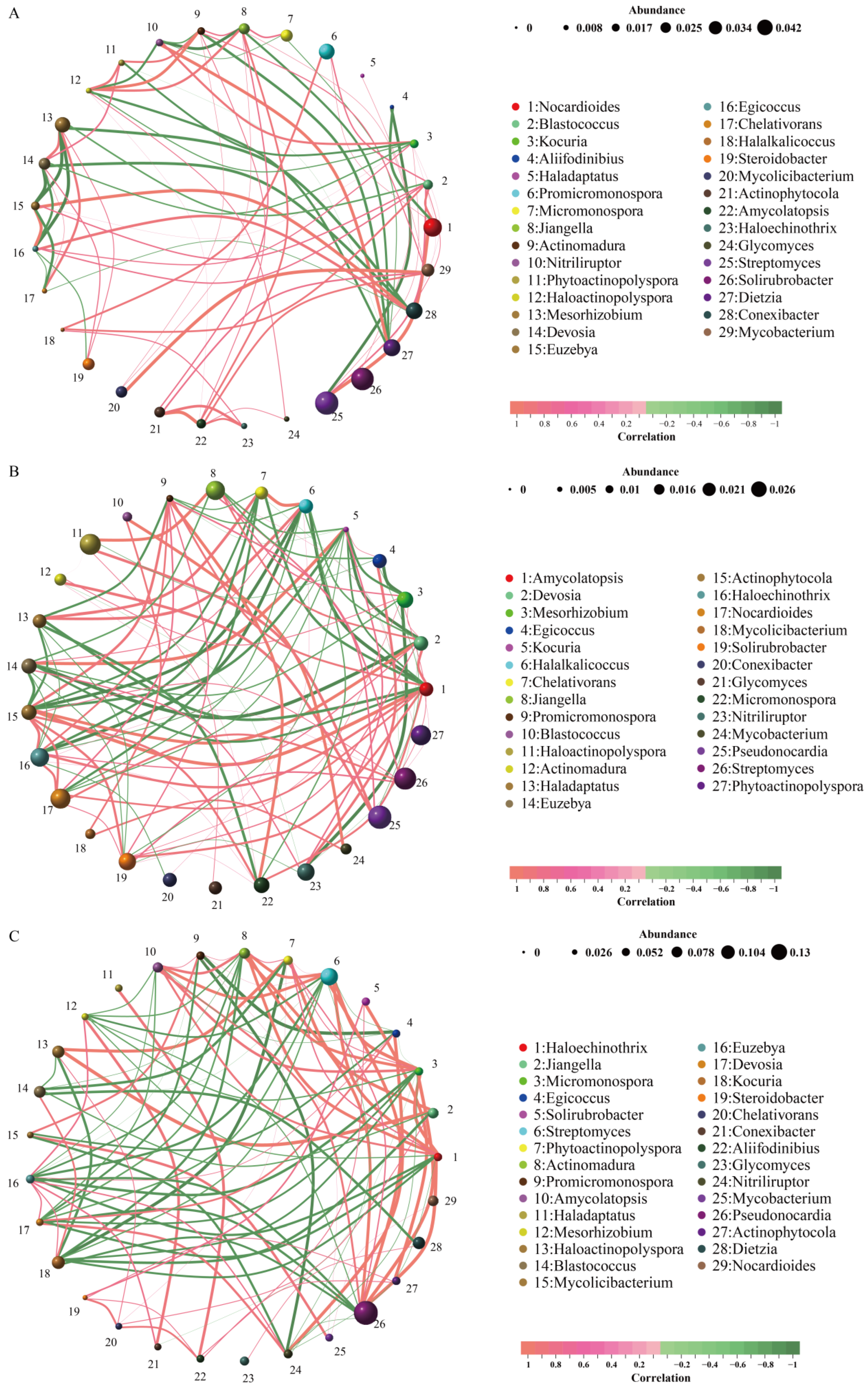
At the genus classification level, correlation networks of functional microbial communities in the rhizosphere soils of P. euphratica at different GWD were constructed. The findings revealed that at a GWD of 3.8 m, 66.67% of the connections within the microbial network structure were positively correlated, while 33.33% exhibited negative correlations. Notably, the relative abundances of Nocardioides, Promicromonospora, and Blastococcus were significantly positively correlated (p < 0.05) and significantly negatively correlated with Aliifodinibius (p < 0.05). Additionally, the relative abundances of Actinophytocola, Amycolatopsis, and Haloechinothrix were also significantly positively correlated (p < 0.05). Furthermore, the relative abundances of Phytoactinopolyspora and Haloactinopolyspora demonstrated significant positive correlations (p < 0.05). Conversely, the genera Conexibacter and Mesorhizobium exhibited a significant negative correlation (p < 0.05) (Figure 1A).
In the rhizosphere soil of P. euphratica at a GWD of 5.4 m, 56% of the connections within the microbial network structure were positively correlated, while 44% were negatively correlated. The relative abundance of Actinophytocola exhibited a highly significant positive correlation with Amycolatopsis (p < 0.01). Conversely, the relative abundance of Mesorhizobium showed a highly significant negative correlation with both Nitriliruptor and Egicoccus (p < 0.01). Furthermore, the relative abundance of Euzebya and Devosia demonstrated a highly significant negative correlation (p < 0.01) alongside a highly significant positive correlation with Kocuria (p < 0.01). Additionally, the relative abundance of Halalkalicoccus was found to have a highly significant negative correlation with Amycolatopsis, Actinophytocola, and Haloechinothrix (p < 0.01) (Figure 1B).
In the rhizosphere soil of P. euphratica at a GWD of 7.35 m, 54% of the connections within the microbial network structure exhibited positive correlations, while 46% displayed negative correlations. The relative abundance of Micromonospora was significantly positively correlated with that of Pseudonocardia and Streptomyces (p < 0.01). Furthermore, the relative abundance of Phytoactinopolyspora showed a significant positive correlation with Haloactinopolyspora and Jiangella (p < 0.01), while it demonstrated a significant negative correlation with Kocuria (p < 0.01). Additionally, the relative abundance of Egicoccus was significantly negatively correlated with that of Promicromonospora (p < 0.01). The relative abundance of Actinomadura was significantly positively correlated with that of Pseudonocardia and Streptomyces (p < 0.01). Moreover, the relative abundance of Mesorhizobium was significantly positively correlated with Conexibacter (p < 0.05). These results indicate that as GWD increases, the types of functional microbial communities within the microbial community network structure differ significantly, and the correlations among genera change markedly, resulting in alterations to the microbial community network structure (Figure 1C).
Based on the analysis of network topology indices, this study examined the ecological network topology characteristics of functional microbial communities in the rhizosphere soil of P. euphratica at GWDs of 3.8 m, 5.4 m, and 7.35 m (Table 4). The results indicated that the number of edges in the microbial community at a GWD of 3.8 m was the lowest compared to those at 5.4 m and 7.35 m, with the network density and clustering coefficient also being the lowest. This finding suggests that the microbial network structure in the rhizosphere soil of P. euphratica at a GWD of 3.8 m is the simplest and most fragile. In contrast, the microbial network edges at GWDs of 5.4 m and 7.35 m significantly increased compared to those at 3.8 m, indicating that an increase in GWD can enhance the complexity of the microbial network structure. Additionally, compared to a GWD of 3.8 m, the average degree, graph density, clustering coefficient, and degree centralization of the microbial community in the rhizosphere soil of P. euphratica significantly increased at depths of 5.4 m and 7.35 m.

3.4. Types and Quantities of Key Microbial Communities in the Rhizosphere Soil of P. euphratica at Different GWD

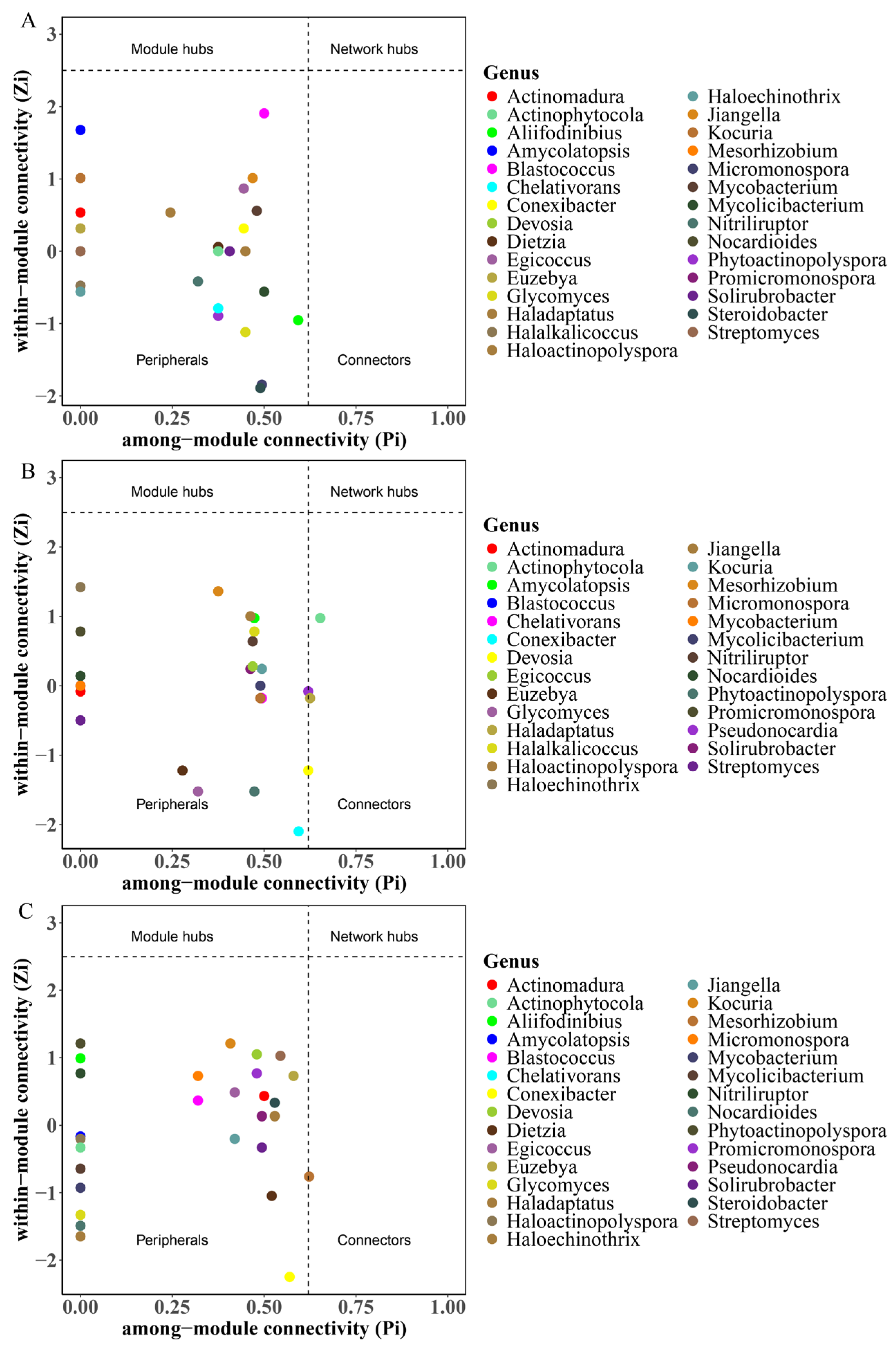
Based on the values of Zi and Pi, nodes can be classified into four categories: Peripherals (nodes with low connectivity both within and between modules, characterized by Zi ≤ 2.5 and Pi ≤ 0.62), Connectors (nodes with high connectivity between two modules, characterized by Zi ≤ 2.5 and Pi > 0.62), Module hubs (nodes with high connectivity within a module, characterized by Zi > 2.5 and Pi ≤ 0.62), and Network hubs (nodes with high connectivity across the entire network, characterized by Zi > 2.5 and Pi > 0.62). Among these categories, Connectors, Module hubs, and Network hubs are identified as key nodes within the network [25]. Figure 2 of the Zi-Pi graph indicates that nodes at a GWD of 3.8 m are exclusively located in the peripheral areas, suggesting the absence of key nodes in the rhizosphere soil of P. euphratica at this depth. In contrast, the rhizosphere soil of P. euphratica at GWDs of 5.4 m and 7.35 m exhibits an increase in both the diversity and abundance of key microbial taxa. The rhizosphere soil at a GWD of 5.4 m exhibits the highest diversity and abundance of key microbial taxa, which is consistent with the observed topological characteristics. In this rhizosphere soil, 85% of the nodes are located in peripheral areas, with four connector nodes identified: Actinophytocola (Zi = 0.976; Pi = 0.653), Haladaptatus (Zi = −0.178; Pi = 0.625), Devosia (Zi = −1.220; Pi = 0.620) and Pseudonocardia (Zi = −0.080; Pi = 0.620). These four nodes are indicative of key genera present in the rhizosphere soil of P. euphratica at a GWD of 5.4 m. In contrast, at a GWD of 7.35 m, 97% of the nodes are situated in peripheral areas, with only one connector node identified, belonging to Mesorhizobium (Zi = −0.761; Pi = 0.622). This study’s results suggest that, compared to a GWD of 3.8 m, the abundance and diversity of key genera in the microbial community increase as the GWD rises to 5.4 m. However, an increase to a GWD of 7.35 m is associated with a decline in both the number and types of key genera.

3.5. Correlation Analysis Between Key Genera and Soil Properties in the Rhizosphere Soil of P. euphratica at Different GWD

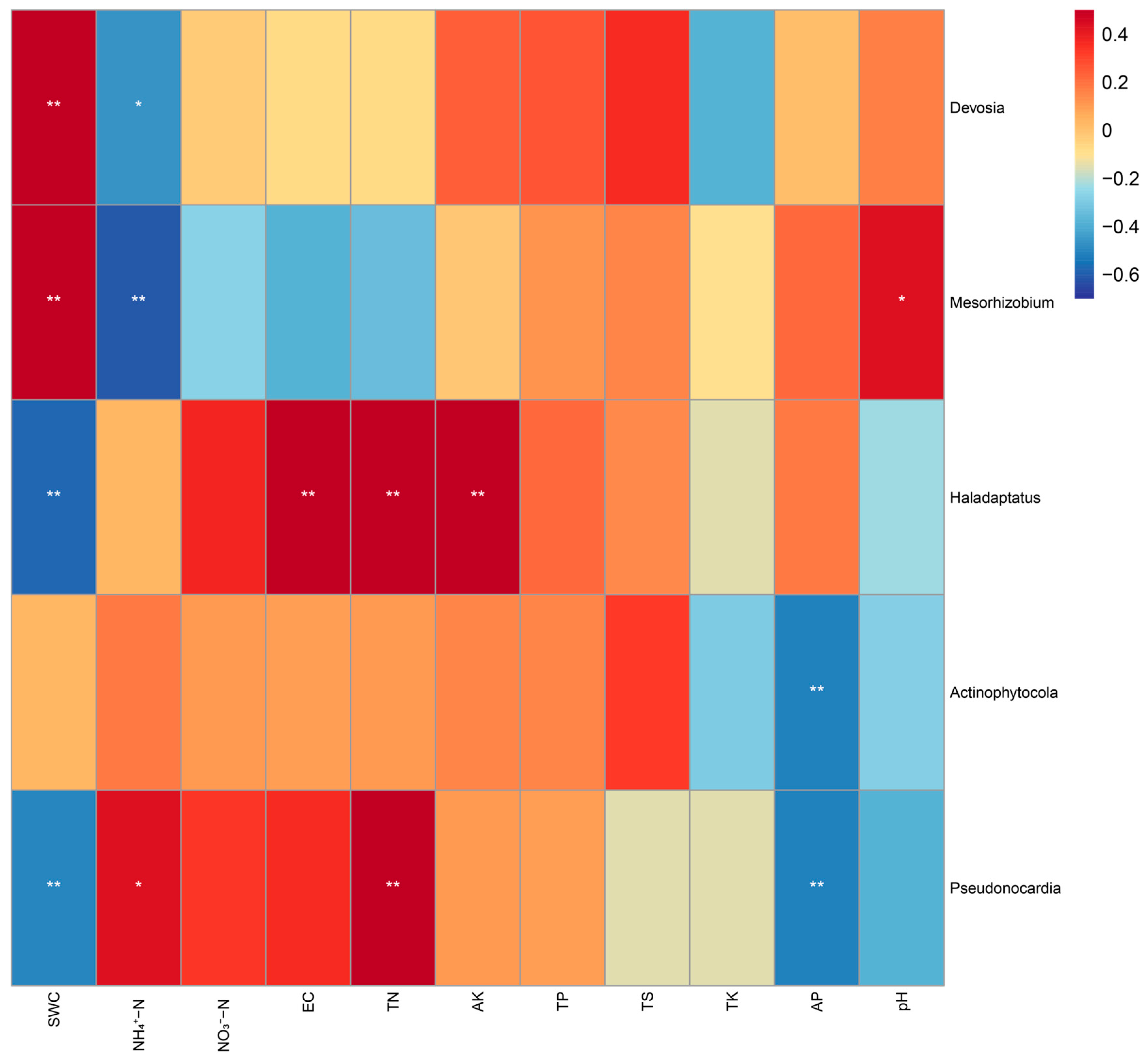
Figure 3 illustrates that the relative abundance of the key genus Haladaptatus in the rhizosphere soil of P. euphratica exhibits a highly significant negative correlation with SWC (p < 0.01) and a highly significant positive correlation with soil EC, TN, and AK (p < 0.01). The relative abundance of the key genus Pseudonocardia shows a highly significant negative correlation with soil SWC and AP (p < 0.01), while it exhibits a highly significant positive correlation with soil TN (p < 0.01) and a significant positive correlation with NH4+-N (p < 0.05). The relative abundance of the key genus Devosia presents a highly significant positive correlation with soil SWC (p < 0.01) but a significant negative correlation with soil NH4+-N (p < 0.05). Lastly, the relative abundance of the key genus Mesorhizobium is highly significantly positively correlated with soil SWC (p < 0.01) and significantly positively correlated with soil pH (p < 0.05), while it shows a highly significant negative correlation with soil NH4+-N (p < 0.01).
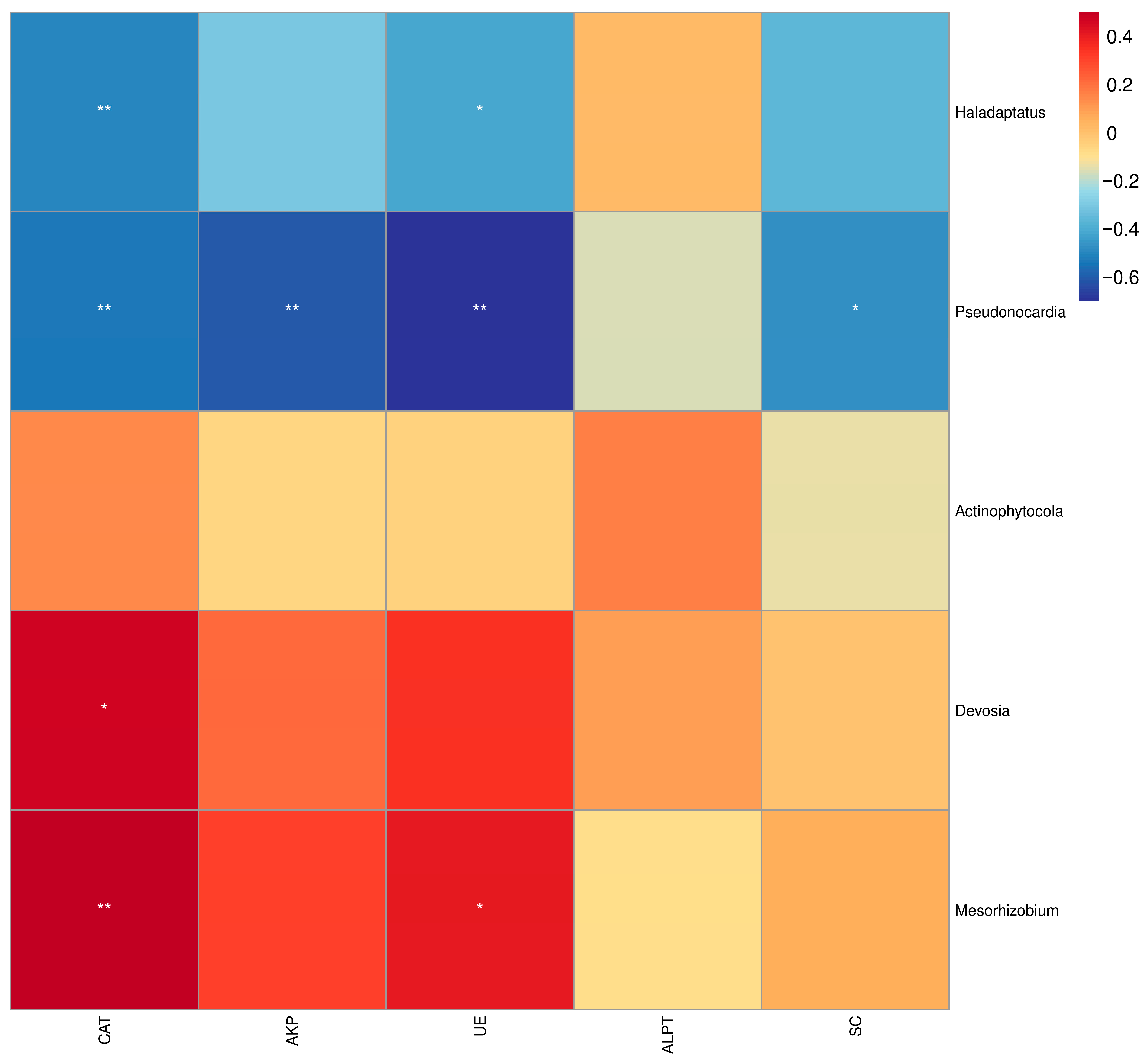
Figure 4 illustrates that the relative abundance of the key genus Haladaptatus in the rhizosphere soil of P. euphratica at varying groundwater depths is significantly negatively correlated with soil CAT activity (p < 0.01) and exhibits a significant negative correlation with soil UE activity (p < 0.05). Furthermore, the relative abundance of the key genus Pseudonocardia is significantly negatively correlated with soil CAT, AKP, and UE activities (p < 0.01), and also shows a significant negative correlation with soil SC (p < 0.05). In contrast, the relative abundance of the key genus Devosia demonstrates a significant positive correlation with soil CAT (p < 0.05). Additionally, the relative abundance of the key genus Mesorhizobium is significantly positively correlated with soil CAT activity (p < 0.01) and shows a significant positive correlation with soil UE activity (p < 0.05).

4. Discussion

4.1. Correlation of Functional Microbial Communities in the Rhizosphere Soil of P. euphratica at Different GWD

The study of the microbial association network structure reveals that in the rhizosphere soil of P. euphratica forests at different GWD, the number of positive correlations in the microbial network structure exceeds that of negative correlations. This indicates that more microbial communities in the network may be in a mutually beneficial symbiotic relationship or may have similar ecological niches [16,28]. Notably, at a GWD of 3.8 m, the relative abundances of Streptomyces, Blastococcus, Nocardioides and Kocuria in the rhizosphere soil of P. euphratica exhibit a significant positive correlation (p < 0.05), while a significant negative correlation is observed with the mineral-associated genus Aliifodinibius.
Research has indicated that Streptomyces, a core microbial group within the plant rhizosphere, can directly enhance the drought resistance of plants and improve the drought resilience of ecosystems by regulating the entire microbial community network [29]. Chen et al. [30] isolated functional strains of Streptomyces from the rhizosphere soil of P. euphratica in southern Xinjiang, suggesting that these strains may possess ecological functions that can enhance the drought resistance of P. euphratica. Additionally, strains of Blastococcus can be isolated from the extremely arid soil of the Atacama Desert, indicating that Blastococcus is a functional strain capable of adapting to extreme drought conditions [31]. Furthermore, it has been found that the relative abundance of the mineral-associated genus Aliifodinibius is significantly positively correlated with soil TS, and Aliifodinibius exhibits the highest relative abundance in heavily saline soils. This suggests that it is a functional strain capable of adapting to extreme saline environments. Overall, the ecological adaptability of Streptomyces and Blastococcus appears to be similar, as their relative abundances show a positive correlation, whereas the ecological adaptability of Streptomyces and Aliifodinibius differs, with their relative abundances demonstrating a negative correlation.
At a GWD of 5.4 m, the relative abundance of the extreme halophilic archaeon Halalkalicoccus in the rhizosphere soil of P. euphratica exhibited a highly significant negative correlation (p < 0.01) with the halophilic actinobacteria Amycolatopsis and Actinophytocola, which belong to the phylum Actinobacteria. This phenomenon may be attributed to the exclusivity of carbon (C) and nitrogen (N) metabolic pathways. Halalkalicoccus appears to preferentially utilize simple carbon sources, such as light-driven amino acid transport systems, while the actinobacterium Amycolatopsis is capable of degrading lignin and other complex organic materials due to its genomic complexity. Under conditions of carbon source limitation induced by drought, the differing metabolic strategies between these two groups of microorganisms intensify competition, resulting in a significant negative correlation.
At a GWD of 7.35 m, the relative abundance of the genera Actinomadura, Pseudonocardia and Streptomyces in the rhizosphere soil of P. euphratica exhibited a highly significant positive correlation (p < 0.01). All three genera are classified as beneficial soil microorganisms. Among them, Actinomadura and Pseudonocardia, which belong to the phylum Actinobacteria, are commonly found thermophilic groups in saline-alkali soils. These genera can proliferate abundantly at elevated temperatures and are capable of decomposing soil organic matter, humus, cellulose, and both plant and animal residues, thereby playing a crucial role in enhancing soil nutrient cycling [32,33]. Additionally, the genus Streptomyces may exhibit ecological functions that confer resistance to drought, salinity, and high temperatures, enabling it to adapt to the extremely arid and nutrient-poor desert environment, thus promoting plant growth [34].

4.2. Key Microbial Taxa and Their Ecological Functions in the Rhizosphere Soil of P. euphratica at Different GWD

Through the analysis of the Zi-Pi values in the microbial network structure, it was found that at a GWD of 5.4 m, the key microbial genera present in the rhizosphere soil of P. euphratica include Actinophytocola, Haladaptatus, Devosia and Pseudonocardia. Among these, Actinophytocola is classified as a rare actinobacterium [20] and is a member of the phylum Actinobacteria. Previous studies have indicated that Actinophytocola demonstrates significant ecological adaptability within the rhizosphere microenvironment of saline-alkali soils [35], enabling it to thrive in arid desert and saline-alkali ecosystems. Haladaptatus is known to belong to halophilic archaea and may have extreme halophilic ecological functions [36]. Devosia, part of the α-Proteobacteria phylum, comprises Gram-negative bacteria commonly found in soil, rhizosphere, and extreme environments, and has been shown to enhance plant tolerance to drought and saline-alkali stress [37]. Lastly, Pseudonocardia is part of a rare group of actinomycetes, characterized by its ability to thrive in environments with high salinity and alkalinity, adapting to nutrient-poor, arid, saline-alkaline conditions [38]. At a depth of 7.35 m, the predominant bacterial genus in the rhizosphere soil of P. euphratica is Mesorhizobium. Previous studies have indicated that Mesorhizobium serves as a plant root-promoting functional bacterium, capable of enhancing drought tolerance in plants and safeguarding specific microbial communities within the rhizosphere soil. This genus plays a crucial ecological role in bolstering plant resistance under conditions of drought stress [39]. The aforementioned key bacterial genera exhibit adaptability to the harsh ecological conditions characterized by desert aridity and salinity-alkalinity, and may possess certain ecological restoration functions.

4.3. Correlation Between Key Bacterial Genera and Environmental Factors in the Rhizosphere Soil of P. euphratica at Different GWD

Through the analysis of the correlation between key bacterial genera in the rhizosphere soil of P. euphratica and soil characteristics at varying GWD, it was observed that the key bacterial genera in the rhizosphere soil exhibit significant correlations with soil enzyme activity. This finding suggests that they may have potential positive roles in soil biogeochemical cycles and ecosystem processes [40]. Notably, the relative abundance of the key genus Mesorhizobium is extremely positively correlated with soil CAT activity (p < 0.01) and significantly positively correlated with soil UE activity (p < 0.05). As a nitrogen-fixing bacterium, the metabolic activity of Mesorhizobium may directly secrete UE or stimulate host plants to release nitrogen-containing root exudates, thereby activating the soil enzyme system [41]. Furthermore, the relative abundance of the key microbial genus Pseudonocardia is significantly positively correlated with soil NH4+-N content (p < 0.05). Pseudonocardia is a crucial genus involved in soil nitrogen cycling and carbon fixation, exhibiting notable ecological adaptability, particularly in nitrogen-affected sandy vegetation restoration areas. Research indicates that in sandy soils, Pseudonocardia is the dominant genus within the carbon-fixing microbial community, and its activity is significantly correlated with soil NH4+-N content, highlighting its potential role in the transformation of NH4+-N through assimilation [42].

5. Conclusions

The depth of GWD significantly influences the growth status of P. euphratica. Specifically, at a GWD of 5.4 m, the height, diameter at breast height, and height under branches of P. euphratica are greater than those observed at GWDs of 3.8 m and 7.35 m. Different GWD levels significantly affect the community network structure, as well as the types and quantities of key microbial groups in the rhizosphere soil of P. euphratica. Compared to GWDs of 3.8 m and 7.35 m, the rhizosphere soil of P. euphratica at a GWD of 5.4 m exhibits the highest average degree and graph density, alongside the lowest modularity index. This indicates that a GWD of 5.4 m enhances the connectivity, complexity, and stability of the microbial community network structure in the rhizosphere soil of P. euphratica. Furthermore, the rhizosphere soil at this GWD contains the highest number of key bacterial genera, including Actinophytocola, Haladaptatus, Devosia and Pseudonocardia. In contrast, the key bacterial genus identified in the rhizosphere soil at a GWD of 7.35 m is Mesorhizobium. The relative abundance of key bacterial genera such as Haladaptatus, Devosia, Pseudonocardia and Mesorhizobium in the rhizosphere soil of P. euphratica at varying GWD levels is significantly correlated with soil CAT and UE activity, soil SWC, TN, NH4+-N, AP content and pH. This suggests that key bacterial genera in the rhizosphere soil of P. euphratica in riparian desert regions may play a potentially positive role in maintaining the stability of microbial network structures and in responding to drought stress within desert soil ecosystems.

Author Contributions

All authors contributed to the study conception and design. Material preparation, data collection and analysis were performed by X.C., H.L., F.C., L.Y., J.Y., Y.W. and R.L. The first draft of the manuscript was written by X.C., and all authors commented on previous versions of the manuscript. All authors have read and agreed to the published version of the manuscript.

Funding

This study was funded by the following grants: 1. Xinjiang Uygur Autonomous Region Key Research and Development Program: Research and Demonstration of Comprehensive and Efficient Utilization of Brackish Groundwater in Photovoltaic Parks (2024B04031-2). 2. Tianchi Yingcai Young Doctor Talent Project: Plant-Microorganism Joint Remediation Mechanism in Different Degraded Areas of the Mainstream of the Tarim River (BT-2025-TCYC-0036). 3. The D-Level Talent Project of the Southern Xinjiang Corps: Mechanism Support of Plant Rhizosphere Soil Microorganisms in Different Degraded Areas of the Mainstream of the Tarim River in Response to Drought. 4. The President’s Fund of Tarim University grant number [TDZKBS202511].

Institutional Review Board Statement

Not applicable.

Informed Consent Statement

Not applicable.

Data Availability Statement

The original data on soil physical and chemical properties and soil enzyme activity were uploaded as attachments.

Acknowledgments

We thank Hailian Liang and Junxia Zhang for their help in collecting rhizosphere soil samples of P. euphratica at different GWD. We thank You Wang for the revision and review of the paper.

Conflicts of Interest

The authors declare no competing interests.

References

  1. de Oliveira-Júnior, J.F.; Mendes, D.; Porto, H.D.; Cardoso, K.R.A.; Ferreira Neto, J.A.; da Silva, E.B.C.; de Aquino Pereira, M.; Damião Mendes, M.C.; Bernardo Bruno Dias Baracho, B.B.D.; Jamjareequlgarn, P. Analysis of drought and extreme precipitation events in Thailand: Trends, climate modeling, and implications for climate change adaptation. Sci. Rep. 2025, 15, 4501. [Google Scholar] [CrossRef]
  2. Vörös, A.F.; Mojzes, A.; Cseresnyes, I.; Kalapos, T.; Kertesz, M.; Konnyu, B.; Onodi, G.; Kröel-Dulay, G. The effects of an initial extreme drought and chronic change in precipitation on plant biomass allocation in a temperate grassland. Ecol. Evol. 2025, 15, e71625. [Google Scholar] [CrossRef]
  3. Wang, Y.; Wu, Z.H.; Jia, M.Y.; Li, J.; Song, T.R.; Jin, H.Y.; Sun, J.H.; Qiu, C.; Lu, X.N.; Yuan, Y.; et al. The identification and characterization of the PeGRF gene family in Populus euphratica oliv. heteromorphic leaves provide a theoretical basis for the functional study of PeGRF9. Int. J. Mol. Sci. 2025, 26, 66. [Google Scholar] [CrossRef]
  4. Zhu, G.F.; Li, X.; Su, Y.H.; Lu, L.; Huang, C.L. Seasonal fluctuations and temperature dependence in photosynthetic parameters and stomatal conductance at the leaf scale of Populus euphratica Oliv. Tree Physiol. 2011, 31, 178–195. [Google Scholar] [CrossRef] [PubMed]
  5. Fu, Y.R.; Li, F.R.; Mu, S.C.; Jiang, L.B.; Ye, M.X.; Wu, R.L. Heterophylly quantitative trait loci respond to salt stress in the desert tree Populus euphratica. Front. Plant Sci. 2021, 12, 692494. [Google Scholar] [CrossRef]
  6. Du, Y.; Zhang, L.; Yang, Y.; Cheng, K.X.; Li, K.H.; Zhou, Y.W.; Li, L.; Jin, Y.; He, X.Q. Assembly, network and functional compensation of specialists and generalists in poplar rhizosphere under salt stress. npj Biofilms Microbiomes 2025, 11, 28. [Google Scholar] [CrossRef] [PubMed]
  7. Chen, Y.N.; Wang, Q.; Li, W.H.; Ruan, X.; Chen, Y.P.; Zhang, L.H. Rational groundwater table indicated by the eco-physiological parameters of the vegetation: A case study of ecological restoration in the lower reaches of the Tarim River. Chin. Sci. Bull. 2006, 51, 8–15. (In Chinese) [Google Scholar] [CrossRef]
  8. Chen, Y.N.; Chen, Y.P.; Zhu, C.G.; Li, W.H. The concept and mode of ecosystem sustainable management in arid desert areas in northwest China. Acta Ecol. Sin. 2019, 39, 7410–7417. (In Chinese) [Google Scholar] [CrossRef]
  9. Kottek, M.; Grieser, J.; Beck, C.; Rudolf, B.; Rubel, F. World Map of the Köppen-Geiger climate classification updated. Meteorol. Z. 2006, 15, 259–263. [Google Scholar] [CrossRef]
  10. Aishan, T.; Halik, Ü.; Betz, F.; Gärtner, P.; Cyffka, B. Modeling height–diameter relationship for Populus euphratica in the Tarim riparian forest ecosystem, Northwest China. J. For. Res. 2016, 27, 889–900. [Google Scholar] [CrossRef]
  11. Keyimu, M.; Halik, Ü.; Betz, F.; Dulamsuren, C. Vitality variation and population structure of a riparian forest in the lower reaches of the Tarim River, NW China. J. For. Res. 2018, 29, 749–760. [Google Scholar] [CrossRef]
  12. Yusup, A.; Halik, Ü.; Abliz, A.; Aishan, T.; Keyimu, M.; Wei, J.X. Population Structure and Spatial Distribution Pattern of Populus euphratica Riparian Forest Under Environmental Heterogeneity Along the Tarim River, Northwest China. Front. Plant Sci. 2022, 13, 844819. [Google Scholar] [CrossRef] [PubMed]
  13. Chao, X.; Zhu, Y.G.; Wang, J.T.; Singh, B.; Han, L.L.; Shen, J.P.; Li, P.P.; Wang, G.B.; Wu, C.F.; Ge, A.H.; et al. Host selection shapes crop microbiome assembly and network complexity. New Phytol. 2021, 229, 1091–1104. [Google Scholar]
  14. Beckers, B.; De Beeck, M.O.; Weyens, N.; Boerjan, W.; Vangronsveld, J. Structural variability and niche differentiation in the rhizosphere and endosphere bacterial microbiome of field-grown poplar trees. Microbiome 2017, 5, 25. [Google Scholar] [CrossRef]
  15. Ma, W.X.; Yang, Z.; Liang, L.S.; Ma, Q.H.; Wang, G.X.; Zhao, T.T. Characteristics of the fungal communities and cooccurrence networks in hazelnut tree root endospheres and rhizosphere soil. Front. Plant Sci. 2021, 12, 749871. [Google Scholar] [CrossRef]
  16. Wen, Y.Q.; Wu, R.T.; Qi, D.D.; Xu, T.L.; Chang, W.; Li, K.; Fang, X.X.; Song, F.Q. The effect of AMF combined with biochar on plant growth and soil quality undersaline-alkali stress:Insights from microbial community analysis. Ecotoxicol. Environ. Saf. 2024, 281, 116592. [Google Scholar] [CrossRef]
  17. Rehmat, U.; Zafar, A.; Muhammad, B.; Fareeha, H.; Javed, L.; Farhat, B.; Sobia, N.; Muhammad, A.Q.; Abid, N.; Khurram, S.B.; et al. Method development and validation for the determination of potassium (K2O) in fertilizer samples by flame photometry technique. J. King. Saud. Univ. Sci. 2022, 34, 102070. [Google Scholar]
  18. Zuo, R.; Zou, F.; Tian, S.; Masabni, J.; Yuan, D.; Xiong, H. Differential and interactive effects of scleroderma sp. and inorganic phosphate on nutrient uptake and seedling quality of castanea henryi. Agronomy 2022, 12, 901. [Google Scholar] [CrossRef]
  19. Geisseler, D.; Horwath, W.R. Regulation of extracellular protease activity in soil in response to different sources and concentrations of nitrogen and carbon. Soil. Biol. Biochem. 2008, 40, 3040–3048. [Google Scholar] [CrossRef]
  20. Li, Q.J.; Zhang, A.Q.; Cheng, H.Y.; Ren, L.R.; Jin, X.; Fang, W.S.; Yan, D.D.; Li, Y.; Wang, Q.X.; Cao, A.C. Organic fertilizers activate soil enzyme activities and promote the recovery of soil beneficial microorganisms after dazomet fumigation. J. Environ. Manag. 2022, 309, 114666. [Google Scholar] [CrossRef]
  21. Li, D.H.; Liu, C.M.; Luo, R.B.; Sadakane, K.; Lam, T.W. MEGAHlT: An ultra-fast single-node solution for large and complex metagenomics assembly via succinct de Bruijn graph. Bioinformatics 2015, 31, 1674–1676. [Google Scholar] [CrossRef]
  22. Deng, Y.Y.; Li, J.Q.; Wu, S.F.; Zhu, Y.P.; He, F.C.; Chen, Y.W. Integrated nr database in protein annotation system and its localization. Comput. Eng. 2006, 32, 71–74. (In Chinese) [Google Scholar]
  23. Steinegger, M.; Söding, J. MMseqs2 enables sensitive protein sequence searching for the analysis of massive data sets. Nat. Biotechnol. 2017, 35, 1026–1028. [Google Scholar] [CrossRef]
  24. Deng, Y.; Jiang, Y.H.; Yang, Y.F.; He, Z.L.; Luo, F.; Zhou, J.Z. Molecular ecological network analyses. BMC Bioinform. 2012, 13, 113. [Google Scholar] [CrossRef]
  25. Yuan, M.M.; Guo, X.; Wu, L.W.; Zhang, Y.; Xiao, N.J.; Ning, D.L.; Zhou, S.; Zhou, X.S.; Wu, L.Y.; Yang, Y.F.; et al. Climate warming enhances microbial network complexity and stability. Nat. Clim. Chang. 2021, 11, 343–348. [Google Scholar] [CrossRef]
  26. Skariah, S.; Abdul-Majid, S.; Hay, A.G.; Acharya, A.; Kano, N.; Al-Ishaq, R.K.; de Figueiredo, P.; Han, A.; Guzman, A.; Dargham, S.R.; et al. Soil Properties Correlate with Microbial Community Structure in Qatari Arid Soils. Microbiol. Spectr. 2023, 11, 0346222. [Google Scholar] [CrossRef] [PubMed]
  27. Gu, Z. Complex Heatmap Visualization. iMeta 2022, 1, e43. [Google Scholar] [CrossRef]
  28. Li, J.; Wang, B.Y.; Yang, Q.; Si, H.; Zhao, Y.T.; Zheng, Y.L.; Peng, W.F. Enabling Efficient Genetic Manipulations in a Rare Actinomycete Pseudonocardia alni Shahu. Front. Microbiol. 2022, 13, 848964. [Google Scholar] [CrossRef] [PubMed]
  29. Guo, B.B.; Zhang, H.; Liu, Y.; Chen, J.W.; Li, J.J. Drought-resistant trait of different crop genotypes determines assembly patterns of soil and phyllosphere microbial communities. Microbiol. Spectr. 2023, 11, e0006823. [Google Scholar] [CrossRef]
  30. Chen, Y.H.; Wu, Y.Z.; Ran, S.; Wang, J.M.; Luo, X.X. Isolation of Actinomycetes from rhizosphere soil of Populus euphratica andscreening of their antagonistic activity. Biot. Resour. 2024, 46, 231–237. (In Chinese) [Google Scholar]
  31. Castro, J.F.; Nouioui, I.; Sangal, V.; Choi, S.; Yang, S.J.; Kim, B.Y.; Truillo, M.E.; Riesco, R.; del Carmen Montero-Calasanz, M.; Rahmani, T.P.D.; et al. Blastococcus atacamensis sp. nov., a novel strain adapted to life in the Yungay core region of the Atacama Desert. Int. J. Syst. Evol. Microbiol. 2018, 68, 2712–2721. [Google Scholar] [CrossRef] [PubMed]
  32. Nan, L.L.; Guo, Q.E.; Cao, S.Y.; Zhan, Z.B. Diversity of bacterium communities in saline-alkali soil in arid regions of Northwest China. BMC. Microbiol. 2022, 22, 11. [Google Scholar] [CrossRef]
  33. Bao, Y.Y.; Dolfing, J.; Guo, Z.Y.; Chen, R.R.; Wu, M.; Li, Z.P.; Lin, X.G.; Feng, Y.Z. Important ecophysiological roles of non-dominant Actinobacteria in plant residue decomposition, especially in less fertile soils. Microbiome 2021, 9, 84. [Google Scholar] [CrossRef] [PubMed]
  34. Wen, T.; Xie, P.H.; Penton, C.R.; Hale, L.; Thomashow, L.S.; Yang, S.D.; Ding, Z.X.; Su, Y.Q.; Yuan, J.; Shen, Q.R. Specific metabolites drive the deterministic assembly of diseased rhizosphere microbiome through weakening microbial degradation of autotoxin. Microbiome 2022, 10, 177. [Google Scholar] [CrossRef]
  35. Li, H.Q.; Jiang, X.W. Inoculation with Plant Growth-Promoting Bacteria (PGPB) improves salt tolerance of maize seedling. Russ. J. Plant Physl. 2017, 64, 235–241. [Google Scholar] [CrossRef]
  36. Baker, A.B.; Gutiérrez-Preciado, A.; Río, D.R.Á.; del Río, Á.R.; McCarthy, C.G.P.; López-García, P.; Huerta-Cepas, J.; Susko, E.; Roger, A.J.; Eme, L.; et al. Expanded phylogeny of extremely halophilic archaea shows multiple independent adaptations to hypersaline environments. Nat. Microbiol. 2024, 9, 964–975. [Google Scholar] [CrossRef]
  37. Bai, Y.S.; Zheng, X.Q.; Ma, J.; Liu, H.; Zeng, H.J.; Zhang, F.J.; Wang, J.B.; Song, K. Multiple Perspectives of Study on the Potential of Bacillus amyloliquefaciens JB20221020 for Alleviating Nutrient Stress in Lettuce. Curr. Microbiol. 2024, 81, 228. [Google Scholar] [CrossRef] [PubMed]
  38. Jose, P.A.; Jebakumar, S.R.D. Phylogenetic appraisal of antagonistic, slow growing actinomycetes isolated from hypersaline inland solar salterns at Sambhar salt Lake, India. Front. Microbiol. 2013, 4, 190. [Google Scholar] [CrossRef]
  39. Du, X.Y.; Liu, N.; Yan, B.F.; Li, Y.S.; Liu, M.H.; Huang, Y. Proximity-based defensive mutualism between Streptomyces and Mesorhizobium by sharing and sequestering iron. ISME J. 2024, 18, wrad041. [Google Scholar] [CrossRef]
  40. Liu, L.C.; Liu, Y.B.; Zhang, P.; Song, G.; Hui, R.; Wang, Z.R.; Wang, J. Development of bacterial communities in biological soil crusts along a revegetation chronosequence in the Tengger Desert, northwest China. Biogeosciences 2017, 14, 3801–3814. [Google Scholar] [CrossRef]
  41. Egamberdieva, D.; Li, L.; Ma, H.; Wirth, S.; Bellingrath-Kimura, S.D. Soil amendment with different maize biochars improves chickpea growth under different moisture levels by improving symbiotic performance with Mesorhizobium ciceri and soil biochemical properties to varying degrees. Front. Microbiol. 2019, 10, 2423. [Google Scholar] [CrossRef] [PubMed]
  42. Wang, Z.Q.; Zhang, Y.; Wang, Y.; Cui, Y.N.; Cao, C.Y. Effects of revegetation on soil nitrogen-fixation and carbon-fixation microbial communities in the Horqin Sandy Land, China. Chin. J. Appl. Ecol. 2024, 35, 31–40. [Google Scholar]
Figure 1. Network structure of functional genera in the rhizosphere soil of Populus euphratica (P. euphratica) at different groundwater depths (GWD). Note: The red connecting lines indicate a positive correlation between two microbial communities, while the green connecting lines indicate a negative correlation. Group 1: GWD of 3.8 m, Group 2: GWD of 5.4 m, Group 3: GWD of 7.35 m. (A) Network structure diagram of the microbial community in the rhizosphere soil of P. euphratica at a GWD of 3.8 m; (B) Network structure diagram of the microbial community in the rhizosphere soil of P. euphratica at a GWD of 5.4 m; (C) Network structure diagram of the microbial community in the rhizosphere soil of P. euphratica at a GWD of 7.35 m. GWD, groundwater depths.
Forests 17 00314 g001
Figure 2. Zi-Pi plots of the microbial communities in the rhizosphere soil of P. euphratica at different GWD at the genus classification level. Note: Group 1: GWD of 3.8 m, Group 2: GWD of 5.4 m, Group 3: GWD of 7.35 m. (A) Zi-Pi plot of the microbial community in the rhizosphere soil of P. euphratica at a GWD of 3.8 m, (B) Zi-Pi plot of the microbial community in the rhizosphere soil of P. euphratica at a GWD of 5.4 m, (C) Zi-Pi plot of the microbial community in the rhizosphere soil of P. euphratica at a GWD of 7.35 m. GWD, groundwater depths.
Forests 17 00314 g002
Figure 3. The correlation heatmap of key microbial communities and soil physicochemical properties in the rhizosphere soil of P. euphratica at different GWD. Note: Red indicates a positive correlation, while blue indicates a negative correlation. Significance levels: * p < 0.05, ** p < 0.01. GWD, groundwater depths.
Forests 17 00314 g003
Figure 4. The correlation heatmap of key microbial communities and soil enzyme activities in the rhizosphere soil of P. euphratica at different GWD. Note: Red indicates a positive correlation, while blue indicates a negative correlation. Significance levels: * p < 0.05, ** p < 0.01. GWD, groundwater depths.
Forests 17 00314 g004
Table 1. Vegetation growth status of Populus euphratica (P. euphratica) forests with different groundwater depths.
GWD/mPlant Height/mDBH/cmWidth/mCanopy Density/%Height to First Branch/m
East to WestNorth to South
3.84.66 ± 1.17 b16.61 ± 12.87 a2.50 ± 1.06 b3.30 ± 0.72 b0.28 ± 0.18 b1.20 ± 0.89 b
5.47.44 ± 1.70 a24.03 ± 12.05 a3.78 ± 0.57 a3.63 ± 0.42 b1.21 ± 0.20 a3.69 ± 1.07 a
7.356.88 ± 1.16 a21.86 ± 4.78 a3.42 ± 1.25 ab4.21 ± 0.63 a1.33 ± 0.60 a3.23 ± 0.69 a
Note: Data are presented as mean ± standard deviation (SD). n = 10. Different lowercase letters in the same column indicate significant differences among different GWD (p < 0.05). DBH, diameter at breast height. GWD, groundwater depths.
Table 2. Soil physical and chemical properties of P. euphratica forest with different GWD.
Soil PropertiesGWD/m
3.85.47.35
SWC0.0132 ± 0.0100 a0.0048 ± 0.0037 b0.0029 ± 0.0007 b
pH8.22 ± 0.09 a8.19 ± 0.05 a7.97 ± 0.14 b
TS4.39 ± 3.38 a4.14 ± 0.99 a4.40 ± 3.25 a
EC0.18 ± 0.05 b1.40 ± 0.15 a1.36 ± 0.78 a
NH4+-N1.42 ± 0.51 b1.11 ± 0.20 b2.13 ± 0.44 a
NO3-N0.92 ± 0.70 b2.22 ± 0.70 b5.99 ± 1.48 a
AP2.05 ± 0.38 a1.93 ± 1.12 a1.73 ± 0.75 a
AK157.56 ± 44.73 b285 ± 70.78 a256.06 ± 125.25 a
TN1.11 ± 0.45 c9.11 ± 4.00 a5.29 ± 2.67 b
TP0.41 ± 0.08 b0.47 ± 0.03 a0.43 ± 0.03 ab
TK2.96 ± 1.10 a2.67 ± 0.61 ab2.07 ± 0.53 b
Note: Data are presented as mean ± standard deviation (SD). n = 9. Different lowercase letters in the same row indicate significant differences among different GWD (p < 0.05). Electrical conductivity (EC)/(ms·cm−1), ammonium nitrogen (NH4+-N)/(mg·kg−1), nitrate nitrogen (NO3-N)/(mg·kg−1), available phosphorus (AP)/(mg·kg−1), available potassium (AK)/(mg·kg−1), total nitrogen (TN)/(g·kg−1), total phosphorus (TP)/(g·kg−1), total potassium (TK)/(g·kg−1), soil water content (SWC), pH, total salt (TS)/(g·kg−1). GWD, groundwater depths.
Table 3. Soil enzyme activity of P. euphratica forest at different GWD.
Soil PropertiesGWD/m
3.85.47.35
AKP (μmol/d/g)1.19 ± 0.37 a0.31 ± 0.04 a3.25 ± 5.94 a
ALPT (mg/d/g)0.08 ± 0.04 a0.10 ± 0.04 a0.08 ± 0.03 a
SC (mg/d/g)4.33 ± 3.46 a0.02 ± 0.01 a4.11 ± 7.88 a
CAT (mmol/d/g)29.67 ± 7.76 a20.20 ± 3.39 b22.00 ± 6.81 b
UE (μg/d/g)82.96 ± 18.84 a55.21 ± 4.04 a94.31 ± 81.94 a
Note: Data are presented as mean ± standard deviation (SD). n = 9. Different lowercase letters in the same row indicate significant differences among different GWD (p < 0.05). Alkaline phosphatase (AKP/ALP) (μmol/d/g soil sample), alkaline protease (ALPT) (mg/d/g soil sample), sucrose enzyme (SC) (mg/d/g soil sample), catalase (CAT) (mmol/d/g soil sample), and urease (UE) (μg/d/g soil sample). GWD, groundwater depths.
Table 4. Topological characteristics of microbial community network in rhizosphere soil of P. euphratica at different GWD.
Topological IndicesGWD/m
3.85.47.35
Number of nodes292729
Number of edges75100100
Average degree5.1727.4076.897
Nodes connectivity001
Edges connectivity001
Average path length2.5261.9892.739
Graph diameter12.5206.57314.623
Graph density0.1850.2850.246
Clustering coefficient0.5630.6390.676
Betweenness centralization0.2450.1040.252
Degree centralization0.1370.2150.254
Modularity0.4580.2630.315
Note: Group 1: GWD of 3.8 m, Group 2: GWD of 5.4 m, Group 3: GWD of 7.35 m. GWD, groundwater depths.
Disclaimer/Publisher’s Note: The statements, opinions and data contained in all publications are solely those of the individual author(s) and contributor(s) and not of MDPI and/or the editor(s). MDPI and/or the editor(s) disclaim responsibility for any injury to people or property resulting from any ideas, methods, instructions or products referred to in the content.