Article

Phosphorus Acquisition Strategy of Different Wild Rhododendron Species Modulates Soil Phosphorus Cycle in Subtropical Montane Forest Ecosystems


1
Hunan Botanical Garden, Changsha 410116, China
2
Hunan Changsha–Zhuzhou–Xiangtan City Cluster National Research Station of Forest Ecosystem, Changsha 410116, China
3
College of Agriculture, Nanjing Agricultural University, Nanjing 210095, China
*
Author to whom correspondence should be addressed.
Forests 2026, 17(3), 310; https://doi.org/10.3390/f17030310
Submission received: 25 November 2025 / Revised: 17 January 2026 / Accepted: 30 January 2026 / Published: 28 February 2026
(This article belongs to the Section Forest Ecophysiology and Biology)

Abstract

Montane forests are commonly limited by phosphorus (P) scarcity, yet Rhododendron species persist via specialized P-acquisition strategies. However, the microbial processes governing P utilization among wild Rhododendron species remain unclear. We collected soil and root samples from three wild Rhododendron species—Rhododendron latoucheae Franch. (R. latoucheae), Rhododendron fortunei Lindl. (R. fortunei) and Rhododendron simsii Planch. (R. simsii)—in a montane forest and analyzed soil P fractions, acid phosphatase activity, and fungal community traits to investigate their relationships with P cycling. The results showed significant differences in P fraction contents between non-rhizosphere and rhizosphere soils among the three species. In R. fortunei, rhizospheric NaOH-Po decreased tenfold while H2O-Pi increased by 9.13 mg/kg, indicating a shift toward labile P. In contrast, R. latoucheae and R. simsii showed increases in moderately labile P by 32.54% and 22.09%, respectively. R. latoucheae exhibited the lowest acid phosphatase activity in non-rhizosphere soil (4.810 ± 0.560 μmol/d/g), which increased significantly in the rhizosphere. Fungal community analysis revealed a significant enrichment of Podila in the rhizosphere of R. latoucheae (10.84%) and R. simsii (9.17%), while Penicillium (6.80%), Trichoderma (3.65%) and Mortierella (5.83%) were dominant in the R. fortunei rhizosphere. R. latoucheae mineralized organic P through acid phosphatase hydrolysis driven by nutrient scarcity. R. fortunei likely mobilizes inorganic P through ericoid mycorrhizal-associated secretion of organic acids and the activity of specialized phosphate-solubilizing fungi facilitated by high substrate availability. Soil nutrients (SOC, TN, N O 3 -N) influenced fungal abundances and indirectly shaped soil P fractions, whereas fungal taxa abundance in the rhizosphere directly drove P turnover. Our results confirm that different wild Rhododendron species employ distinct P-acquisition strategies mediated by rhizosphere fungi and enzyme activities, and provide new insights into microbial-driven P cycling in montane forests.

1. Introduction

Phosphorus (P) availability frequently limits plant growth in montane forest ecosystems. This limitation arises from a combination of factors, including the low solubility of primary mineral phosphates, slow organic matter mineralization rates under cool temperatures, short growing seasons, and the accumulation of organic matter that can immobilize nutrients. While nitrogen (N) limitation or N-P co-limitation is also common in such systems, P scarcity remains a key constraint on vegetation productivity [1,2,3,4]. Soil P exists in three principal forms: labile, moderately labile, and stable. Among different P fractions, labile P (e.g., H2O-Pi) is readily plant-available, moderately labile P (e.g., NaOH-Po) requires microbial mediation for mobilization, and stable P (e.g., residual-Pi) is largely inaccessible in the short term [5,6]. Understanding the distribution and transformation of these fractions is critical to elucidating plant–microbe interactions in P-limited systems. The dynamics of these pools are driven by a complex interplay of biotic and abiotic factors, including climate, edaphic properties, and microbial processes [7,8]. Crucially, soil P dynamics and species-specific plant P acquisition strategies are coupled through a reciprocal feedback framework. Low-P conditions shape the evolutionary and physiological development of plant strategies, such as increased root hair length and surface area or extensive extraradical hyphal networks [9,10]. In turn, these traits actively modify rhizosphere biogeochemical processes (e.g., phosphatase secretion and exudation of organic acids), modulating the distribution and availability of soil P pools. Thus, elucidating the composition of soil P pools and their determinants is essential for understanding species-specific P acquisition strategies and plant–soil feedbacks in montane forest ecosystems.
Microorganisms mediate soil P cycling by acting as either sources or sinks, thereby regulating the direction and magnitude of P fluxes [11,12,13,14]. Phosphate-solubilizing microorganisms regulate soil P transformations, primarily by mobilizing inorganic P through organic acid exudation and mineralizing organic P via phosphatases, with acid phosphatase (ACP) predominating in montane forest soils [15,16,17,18,19]. These microorganisms can enhance rhizosphere P turnover by stimulating root proliferation, promoting microbial activity, and facilitating cooperative interactions [20,21,22]. Past studies have focused on bacterial mechanisms and their responses to environmental factors [23], while emerging evidence highlights the significant role of phosphate-solubilizing fungi (PSF). Although PSF often constitute a minor fraction (e.g., 0.1%–0.5%) of the total phosphate-solubilizing microbial community, their per-capita contribution to P solubilization can be substantially higher than that of bacteria, owing to traits such as extensive hyphal networks and efficient organic acid production [24,25,26]. Furthermore, biological P mobilization depends on the coordinated activities of root-associated microbes, with endophytic fungi (including mycorrhizal symbionts that span root and soil compartments) facilitating plant P acquisition, and rhizospheric microbial communities driving the transformation of soil P pools [27,28,29]. However, the integrated roles of endophytic and rhizospheric fungi in P acquisition remain poorly understood, limiting our insight into the complex mechanisms underlying plant–soil P dynamics in montane forest ecosystems. Considering the intricate regulation of the P cycle, both abiotic factors, such as soil physicochemical properties (e.g., weathering, moisture, pH, metal ions) and habitat features (e.g., vegetation composition), and microbial activity jointly govern P mobilization, underscoring the need to account for their interactive effects [30,31,32].
Rhododendron, a genus within the Ericaceae family [33], includes species of ecological and ornamental importance. Many wild Rhododendron species are important components of montane and high-elevation flora, where they are adapted to acidic, nutrient-poor soils at high elevations [34]. Long-term evolution under such conditions has led to specialized P acquisition strategies that extend beyond general low-P adaptations. These strategies include the development of fine, fibrous root systems concentrated in topsoil layers, where P uptake is facilitated by a structured gradient of rhizospheric and endophytic fungi. Ericoid mycorrhizae, a specialized form of symbiosis common in Ericaceae, involve fungi that colonize root cortical cells and enhance nutrient acquisition, particularly from organic and complex forms. In functional guild analyses, ericoid mycorrhizal fungi are classified within the “symbiotroph” trophic mode, although not all symbiotrophs are ericoid mycorrhizal. These fungal communities differ among Rhododendron species and contribute to species-specific mobilization of organic and mineral P pools [35,36,37,38]. Additional P-mobilization mechanisms, such as enhanced phosphatase activity, carboxylate exudation, and mycorrhizal associations, further reflect adaptive diversification to nutrient-limited environments [39,40]. Notably, ecological niches vary considerably across Rhododendron species. For example, Rhododendron latoucheae Franch. (R. latoucheae) frequently occurs in rocky, nutrient-poor substrates and has been reported to exhibit lithophytic or facultatively epiphytic growth habits [41]. In contrast, Rhododendron fortunei Lindl. (R. fortunei) typically grows in mixed forests with richer organic layers, while Rhododendron simsii Planch. (R. simsii) is often found in open shrublands and forest margins [42] (Flora of China, Vol. 14). These distinct ecological preferences are likely to influence the composition of associated microbial communities and the P acquisition strategies employed by each species. Nevertheless, the P acquisition mechanisms of wild Rhododendron in montane forest ecosystems remain poorly understood. Nevertheless, the P acquisition mechanisms of wild Rhododendron in montane forest ecosystems remain poorly understood.
However, the integrated roles of endophytic and rhizospheric fungi in P acquisition remain poorly understood, limiting our insight into the complex mechanisms underlying plant–soil P dynamics in montane forest ecosystems. Specifically, it is unclear how different wild Rhododendron species modulate rhizosphere and root-associated fungal communities to acquire P under nutrient-limited conditions, and how these microbial processes translate into distinct soil P fraction patterns.
In this study, we selected three representative wild Rhododendron species and conducted a comprehensive assessment of their habitat conditions. Soil properties, P fractions, and fungal community composition were jointly analyzed to address these knowledge gaps and clarify the microbial mechanisms mediating species-specific P acquisition. We hypothesized that different wild Rhododendron species would exhibit distinct soil P fraction patterns and associated fungal community structures, reflecting species-specific P-acquisition strategies adapted to their local soil conditions. To test this, the study aimed to (a) characterize the distribution patterns of soil P fractions across three wild Rhododendron species, and (b) establish mechanistic links between P mobilization and soil properties as well as root- and rhizosphere-associated fungal community composition. This work provides new insights into the adaptive strategies of wild Rhododendron species under low-P conditions, offering a scientific basis for sustaining the stability and resilience of montane forest ecosystems.

2. Materials and Methods

2.1. Study Site Description

The work was an observational study conducted in the montane forests (elevation > 1000 m) of Yangmingshan National Forest Park, northeastern Shuangpai County, Yongzhou City, Hunan Province (25.40–25.59° N, 114.02–114.32° E), within the southern Nanling Mountains. This park was considered a single study region, given the relatively homogeneous montane environmental conditions shared among the study sites, including climate, topography, and vegetation. The region has a humid subtropical monsoon climate strongly influenced by altitude, with a maximum elevation of 1624.6 m. The mean annual temperature of 14.2 °C (from officially published data) reflects the cool, montane conditions at the study sites [43]. The mean annual precipitation is 1512 mm, with a mean annual relative humidity of over 87%. The forest coverage is 98%, and the total area is 117.33 km2. The predominant soil type is yellow-brown soil, characterized as highly weathered acidic soils, corresponding to Acrisols in the WRB [44]. Vegetation is dominated by subtropical evergreen broadleaf and mixed conifer–broadleaf forests, whereas areas above 1000 m comprise montane meadows and subtropical shrublands with multiple Rhododendron species. Regional plant diversity is summarized in Figure S2.

2.2. Experimental Design and Sample Collection

In July 2023, three representative wild Rhododendron species—R. latoucheae, R. fortunei, and R. simsii—were surveyed. While acknowledging that soil P dynamics and microbial communities can vary seasonally, this sampling time was chosen to capture active plant–microbe interactions during a period of high biological activity. Considering their natural distribution and status as secondary forest stands, plots were selected within the same subtropical forest area to ensure species dominance and environmental comparability, including similar elevation, soil type, slope position, and dominant vegetation structure. This design aimed to minimize site-specific environmental heterogeneity so that observed differences in soil P fractions and fungal communities primarily reflect species-specific traits. For each species, three 10 × 10 m plots, each separated by at least 10 m, were established. Within each plot, five 1 × 1 m subplots were systematically collected and pooled to form one composite sample, resulting in three composite samples per species (n = 9 composite samples in total).
Soil and fine root (RF) samples were collected from the upper 0–20 cm layer, which represents the primary rooting zone and the soil horizon with the highest biological activity and P cycling rates for these shallow-rooted Rhododendron species. RF samples were collected from the terminal, non-lignified portions of fine roots from mature Rhododendron, gently washed with sterile water, surface-sterilized by sequential immersion in 75% ethanol for 1 min, 2% NaClO for 3 min, and a final rinse in sterile water three times, and then subsequently stored at −80 °C for biochemical analyses [45]. For soil samples, rhizosphere soil (RS) was defined as soil adhering to the fine roots within 2 mm and was initially separated in the field to preserve in situ characteristics [46,47]. Non-rhizosphere soil (NRS), also referred to as bulk soil, was defined as soil detached from the root system after gentle shaking, representing soil not directly influenced by root exudates. The RS remaining after shaking was carefully collected by brushing. To ensure sufficient material for further analyses, RS samples were gently shaken and centrifuged (12,000 rpm, 20 min) in the laboratory. Soil samples were divided into three parts: one air-dried and sieved (2 mm for physicochemical analyses, 0.15 mm for P fraction determination), one sieved to 2 mm and stored at 4 °C for ACP activity assays, and one stored at −80 °C for biochemical analyses. In total, 27 samples were obtained: 9 RS, 9 NRS, and 9 RF samples. Of these, the 18 soil samples (9 RS and 9 NRS) were used for soil physicochemical measurements and Hedley P fractionation. Fungal community sequencing was conducted on 9 RS and 9 RF samples. Basic site information and soil properties are provided in Tables S1 and S2.

2.3. Determination of Soil Phosphorus Fractions

Soil P fractions were measured from NRS and RS samples using the modified Hedley sequential extraction method [48] and reference to Tiessen and Moir [49] modified P classification method. The operations are as follows: 1.0 g air-dried, sieved soil was sequentially extracted to quantify nine P fractions. First, the soil was shaken with 30 mL of deionized water for 16 h, followed by 20 mL of 0.5 M NaHCO3 (pH 8.2) for another 16 h. The resulting supernatants were sequentially extracted with 30 mL of 0.1 M NaOH, followed by 1 M HCl (D.HCl), and 30 mL of concentrated HCl (C.HCl), while the residual soil was digested with concentrated H2SO4 and P-free H2O2. Inorganic and total P in all extracts were measured via the molybdenum–antimony colorimetric method, and organic P was obtained by subtracting inorganic P from total P. Fractions were then classified into labile P (LP, including H2O-Pi and NaHCO3-Pi/Po), moderately labile P (MP, including NaOH-Pi/Po and D.HCl-Pi), and stable P (SP, including C.HCl-Pi/Po and Residual-Pt). All extracts from the same soil sample were analyzed sequentially.

2.4. Soil Properties and Biochemical Analysis

Soil moisture (WC) was determined using the oven-drying weight difference method at 105 °C. Soil pH was determined by a glass electrode after mixing with a ratio of 1:2.5 soil: water (w/v). Soil organic carbon (SOC) was measured using the potassium dichromate titrimetric method with external heating. The contents of total carbon (TC) and total nitrogen (TN) were determined using an elemental analyzer (Thermo Fisher Scientific, Waltham, MA, USA) with combustion at 950 °C. Total potassium (TK) was estimated using the sodium hydroxide fusion followed by flame photometry, as described by Jackson [50]. Ammonium nitrogen ( N H 4 + -N) was determined using the KCl extraction-indophenol blue colorimetric method. Nitrate nitrogen ( N O 3 -N) was measured using ultraviolet spectrophotometry. Available phosphorus (AP) was extracted with 0.03 M NH4F + 0.025 M HCl and measured using the molybdenum-antimony colorimetric method on a spectrophotometer. Specific wavelengths and standard curves were established for each assay.
Acid phosphatase (ACP) activity was determined using the colorimetric method with disodium phenyl phosphate. DNA was extracted from fresh RS and RF samples (n = 18) within one week after sampling using the E.Z.N.A.® Soil DNA Isolation Kit (Omega Bio-Tek, Inc., Norcross, GA, USA) following the manufacturer’s instructions. The concentration and purity of the extracted DNA were assessed using a NanoDrop 2000 spectrophotometer (Thermo Fisher Scientific, USA), and DNA integrity was checked on 1% agarose gel electrophoresis. The fungal ITS region was amplified using primers ITS1F and ITS2R, compatible with Illumina indices and sequencing adapters. PCR products were purified, pooled in equimolar concentrations, and subjected to paired-end sequencing (2 × 250 bp) on an Illumina MiSeq platform (Illumina®, San Diego, CA, USA) [51]. Raw sequence reads were quality-filtered and merged using Trimmomatic and FLASH, and operational taxonomic units (OTUs) were clustered at 97% sequence similarity using USEARCH, with chimeric sequences removed. Taxonomic assignment of OTU representative sequences was performed using the UNITE database (Release 8.0) using the RDP Classifier with a 0.7 confidence threshold. Sequence data have been deposited in the NCBI Sequence Read Archive (SRA) under accession number PRJNA1348924.

2.5. Statistical Analyses

All data were used to organize in Microsoft Excel 2024 software. One-way analysis of variance (One-way ANOVA) was conducted using SPSS Statistics 29 (IBM, USA) to analyze the difference in soil P fractions, soil properties, the ACP activity and the characteristics of fungal communities, with least significant difference (LSD) multiple comparison tests and significance set at p < 0.05. When ANOVA showed significant differences, post hoc multiple comparisons were performed using Tukey’s HSD test. Non-metric multidimensional scaling (NMDS) ordination was conducted based on Bray–Curtis dissimilarities using all samples combined, with species identity used as a grouping factor for visualization. Pearson’s and Spearman’s correlation coefficients were examined to clarify the correlations between soil P fractions, functional taxa, and their driving factors. Partial least squares path mode (PLS-PM) was employed to identify potential pathways through which variables influence soil P fractions in different Rhododendron species, with goodness of fit (GOF) serving as the main criterion for evaluating model quality and performance by using the “plspm” package in R 4.5.1. Plots were performed using the “ggplot2” package in R [52].

3. Results

3.1. Divergent Distribution of Soil P Fractions and ACP Activity

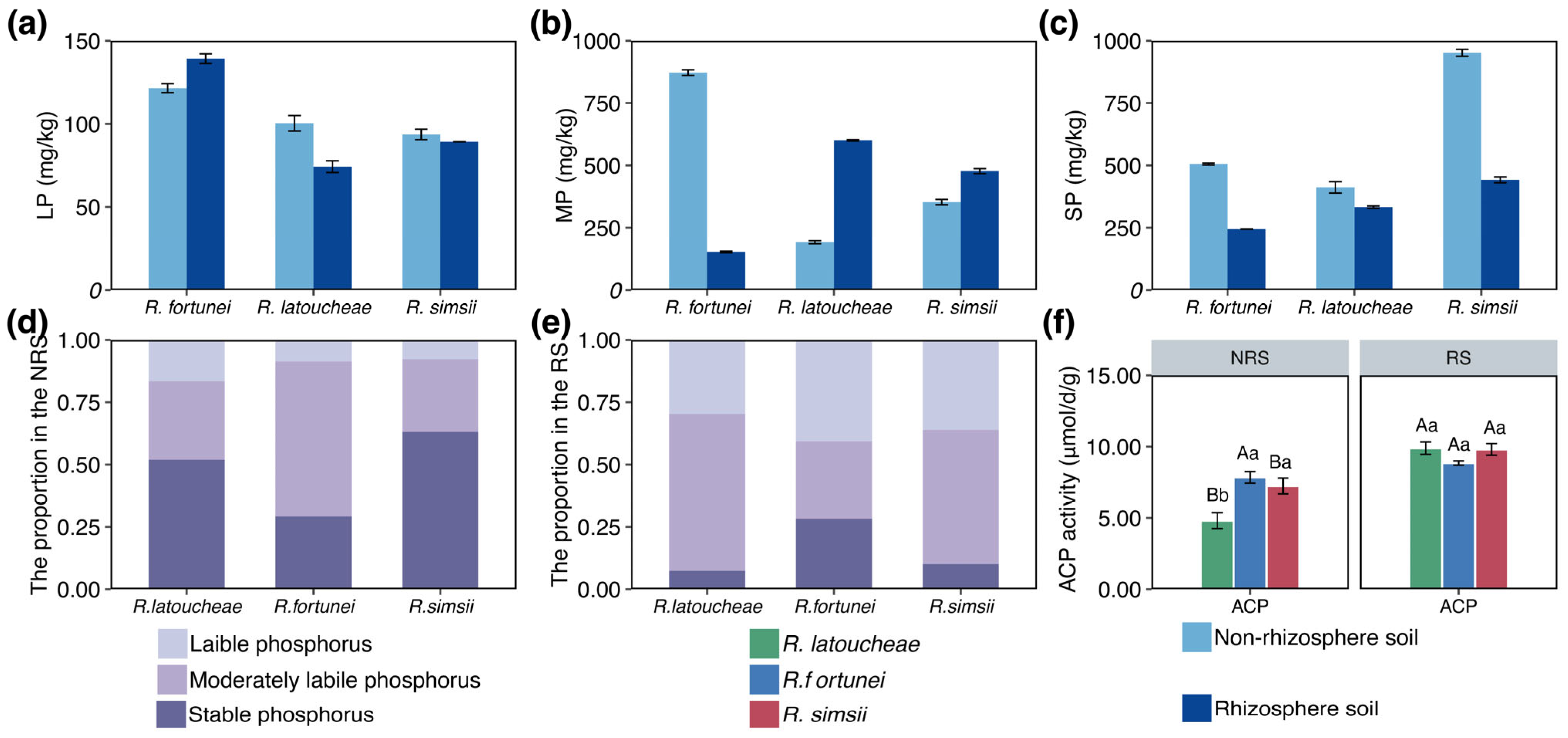
Soil P fractions of three Rhododendron species were dominated by SP and MP, together accounting for nearly 75% of total soil P in both non-rhizosphere and rhizosphere soil (Figure 1d,e and Table S3). For R. latoucheae and R. simsii, MP contents in the rhizosphere soil increased significantly by 32.54% and 22.09%, respectively (R. latoucheae: p < 0.001; R. simsii: p = 0.001, Figure 1b and Figure S1b,e). In contrast, R. fortunei exhibited a pronounced shift in P pool, with MP decreasing markedly (NaOH-Po reduced tenfold, p < 0.001), accompanied by a substantial increase in LP (H2O-Pi increased by 9.13 mg/kg, p = 0.001) in the rhizosphere soil (Figure 1a and Figure S1a,e, and Table S3).
In the non-rhizosphere soil, R. latoucheae exhibited the lowest ACP activity among the three species (4.810 ± 0.560 μmol/d/g, p = 0.013, Figure 1f). Moreover, ACP activity of R. latoucheae and R. simsii increased significantly in the RS (R. latoucheae: p = 0.002; R. simsii: p = 0.02), whereas no significant change was observed in R. fortunei (p = 0.081).

3.2. Characteristic of Fungal Community Structure

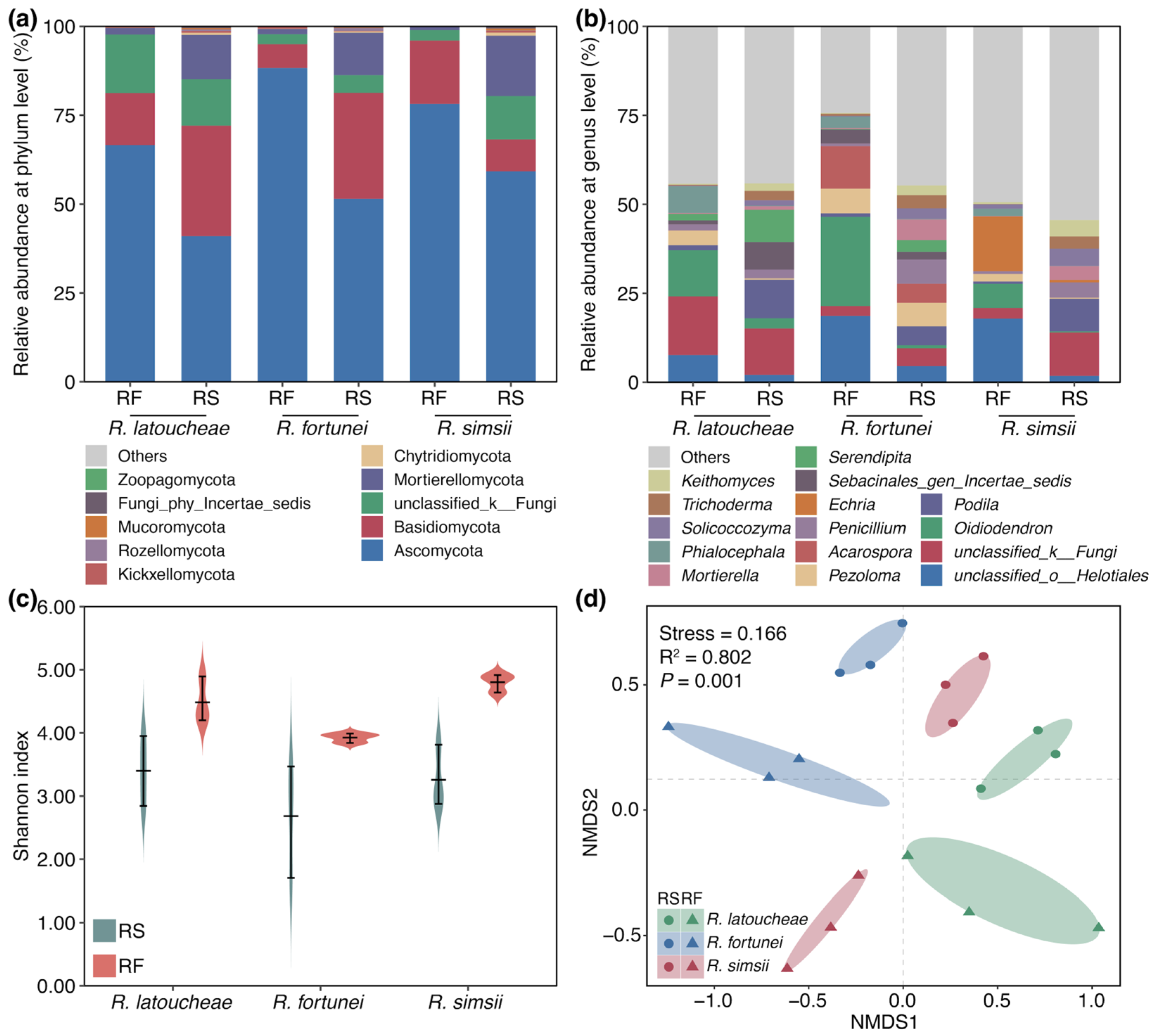
A total of 1,191,112 fungal sequences were obtained from the 18 samples, which were classified into 4553 OTUs based on 97% sequence identity. Based on relative sequence abundance, Ascomycota and Basidiomycota were the predominant fungal phyla, jointly comprising >80% of sequences in fine roots and >70% in rhizosphere soils across all species (Figure 2a and Table S4). At the genus level, the relative abundance of dominant fungal taxa showed a significant difference in the three wild Rhododendron species, both in the fine root sample and the rhizosphere soil samples (Figure 2b and Table S5). In R. latoucheae, dominant fungal genera differed between fine roots and the rhizosphere soil, shifting from Oidiodendron (12.99% in RF) and unclassified_k_fungi (16.49% in RF) in fine roots to unclassified_k_fungi (13.05% in RS), Podila (10.84% in RS, p = 0.028), and Serendipita (9.05% in RS) in the rhizosphere soil. A comparable trend was also found in R. simsii, with the core fungal assemblage shifting from unclassified_o__Helotiales and Echria (fine root samples) to unclassified_k_fungi and Podila (rhizosphere soil samples), in which Podila showed significant enrichment (9.17% in RS, p < 0.001). In R. fortunei, the dominant fungal genera were unclassified_o__Helotiales, Oidiodendron, and Acarospora, whereas the rhizosphere soil exhibited a more diverse fungal community composition. Specifically, the relative abundances of Penicillium (6.80% in RS, p = 0.018), Trichoderma (3.65% in RS, p = 0.023), and Mortierella (5.83% in RS, p < 0.001) were significantly enriched in the rhizosphere soil samples (Table S5). Fungal α-diversity indices (Shannon, Sobs, Chao1, and ACE) were consistently higher in rhizosphere soils than in fine roots (Figure 2c and Figure S2, and Table S6). NMDS ordination demonstrated distinct clustering of fungal taxa across the three Rhododendron species, with a stress value of 0.166, R2 of 0.802 (Figure 2d and Figures S3).

3.3. Composition of Fungal Functional Guilds

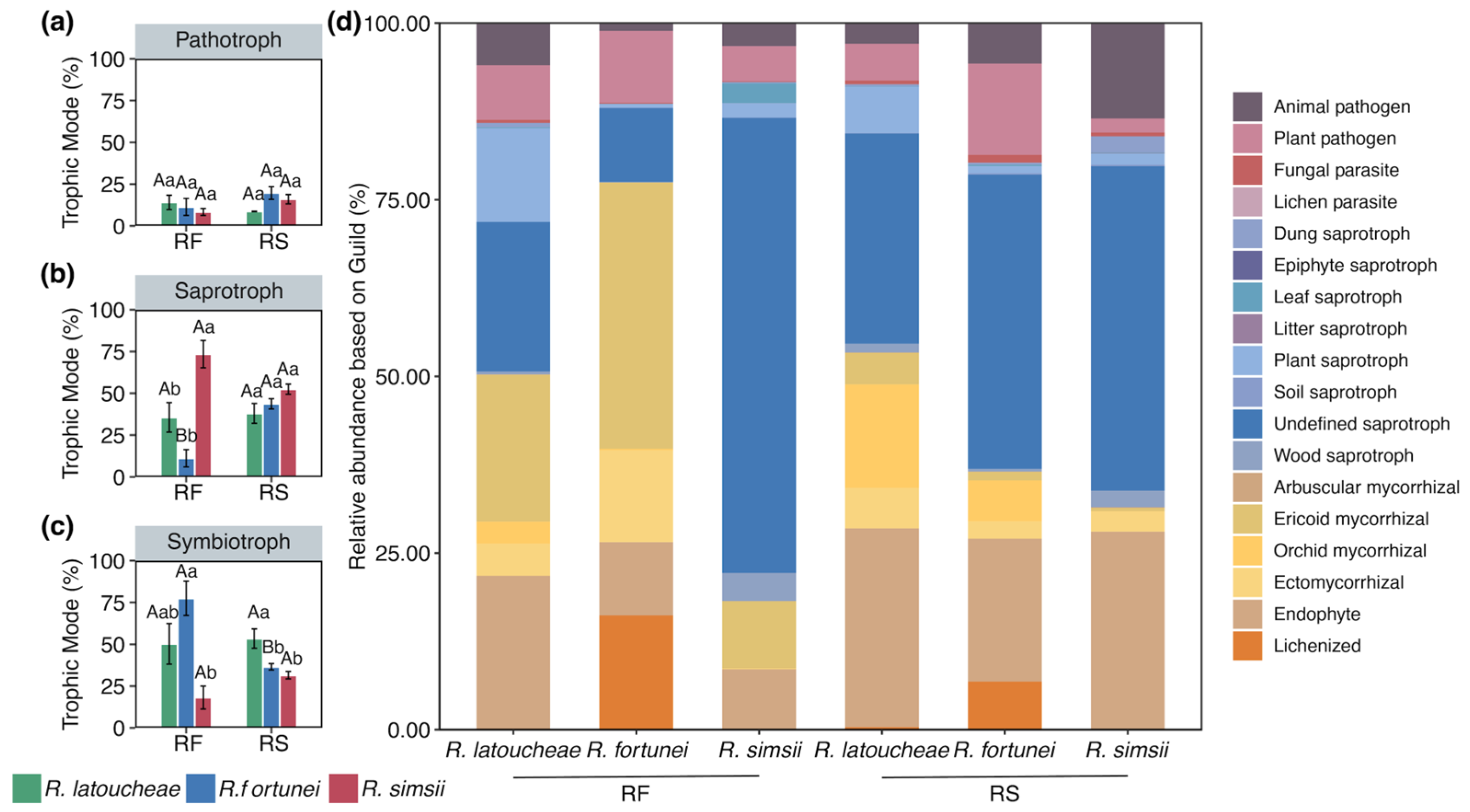
Fungal functional guilds classify fungi according to their ecological roles and functional traits, capturing their ecological functions within communities. Using the FUNGuild database based on taxonomic classifications, we evaluate the relative abundances of these guilds in three Rhododendron species, identifying pathotrophs, saprotrophs, and symbiotrophs as the three major ecological strategies, which were further subdivided into 12 distinct functional groups (Figure 3b,d, Tables S7 and S8). Results showed that symbiotrophs dominated in the fungal functional guilds of R. latoucheae in both fine root and rhizosphere soil samples (Figure 3b and Table S7). In R. fortunei, symbiotrophs predominated in the fungal functional guilds in fine root samples (77.45%, p = 0.017), with ericoid mycorrhizal fungi showing the highest relative abundance (37.68%), while the rhizosphere soil exhibited a shift in dominance toward saprotrophs. In R. simsii, the fungal community was functionally dominated by saprotrophs in both fine root and rhizosphere soil samples, with wood saprotrophs representing the most abundant identified saprotrophic guild, excluding unclassified saprotrophs (RF: 3.97%, RS: 2.32%).

3.4. Correlations Between P Fractions and Regulating Factors

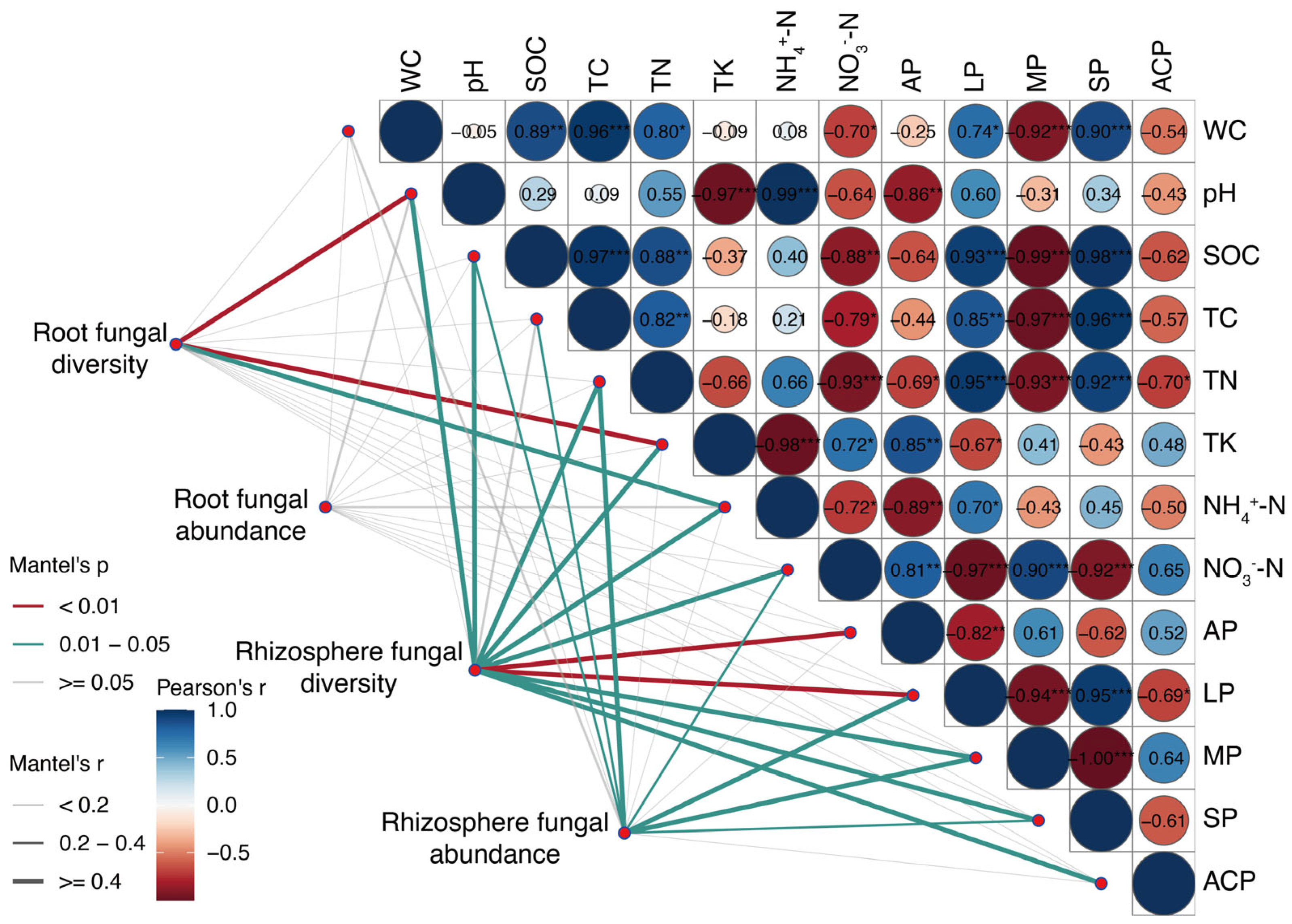
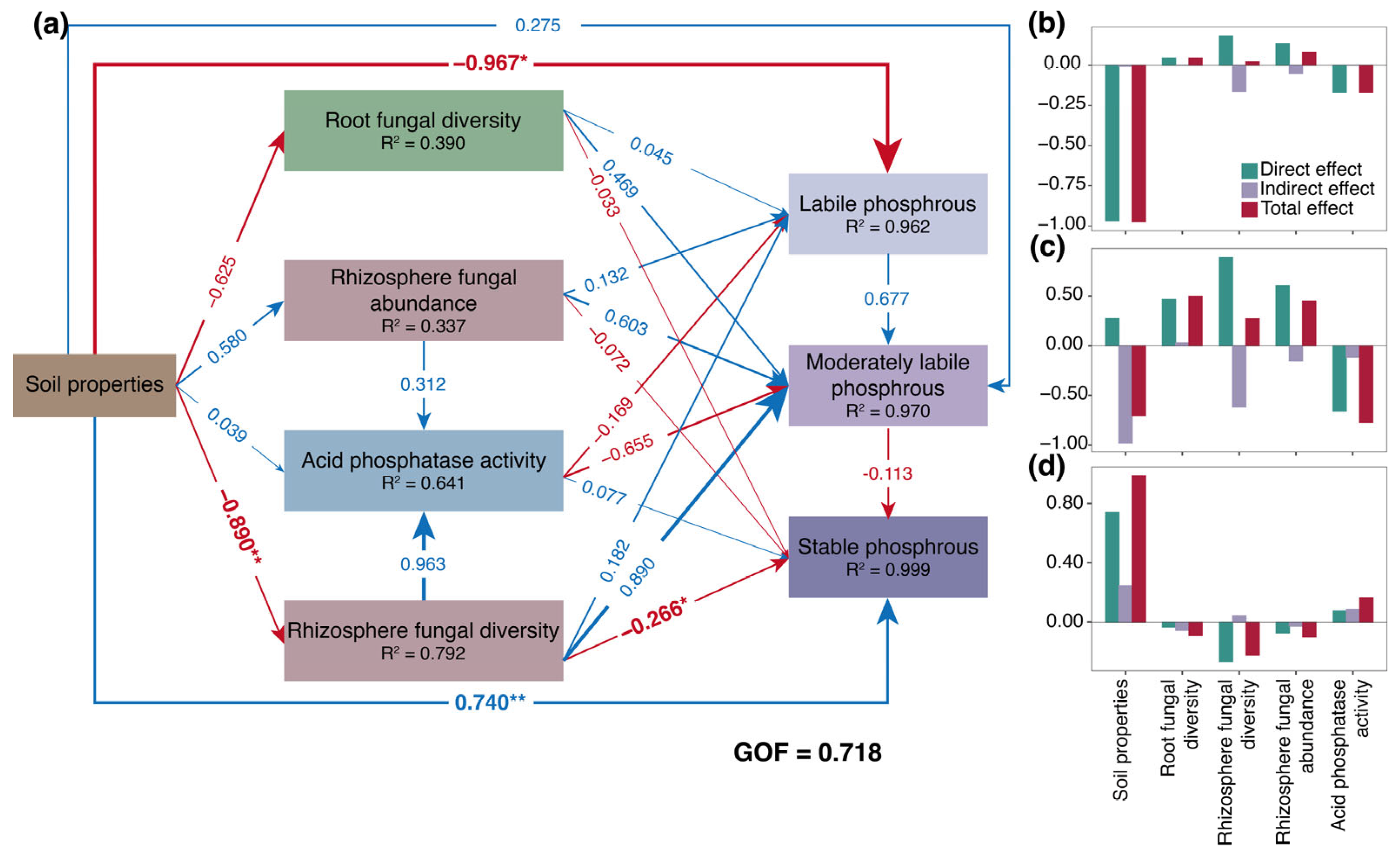
Mantel test revealed that soil P fractions had significant correlations with rhizosphere fungi (rhizosphere fungal diversity and rhizosphere fungal abundance) and rhizosphere soil nutrients (e.g., WC, SOC, TC, TN, and N O 3 -N), in which MP displayed positive associations, while LP and SP were negatively associated. Moreover, fungal α-diversity in fine root samples was highly significantly correlated with soil pH (p = 0.007; Figure 4 and Table S9). The PLS-PM model exhibited robust predictive capacity, with modeled pathways explaining 96.2% of the variance in labile phosphorus, 97.0% in moderately labile phosphorus, and 99.9% in stable phosphorus (GOF = 0.716; Figure 5a and Table S10). Standardized path coefficients revealed distinct regulatory drivers shaping the distribution of P fractions in the soil P pool. Soil properties had strong and significant direct effects on LP and SP contents, with path coefficients of −0.967 and 0.740, respectively (Figure 5b–d). Changes in soil properties indirectly influenced MP dynamics through the regulation of biological processes, with rhizosphere ACP activity and soil biota serving as primary drivers (Figure 5).

4. Discussion

4.1. Species-Specific Modulation of Soil Phosphorus Pools and ACP Activity by Rhododendron

Soil P fraction bioavailability is influenced by the energetic cost of biotransformation and by alterations in soil environmental conditions [22,26]. Both MP and SP dominate the soil P pool, largely due to intense regional weathering, which enriches Fe and Al (hydr) oxides and enhances P sorption, thereby limiting its bioavailability (Figure 1d,e and Table S3) [53]. Among different P fractions, H2O-Pi is readily accessible to plants, and NaHCO3-Pi meets short-term P needs, whereas the activation of moderately stable NaOH-Po relies on biological processes. Our results revealed distinct soil P fractionation patterns among the three Rhododendron species (Figure 1 and Table S3). These patterns reflect species-specific P-acquisition strategies linked to their associated fungal communities. For R. fortunei, the pronounced decrease in NaOH-Po (by tenfold) and concurrent increase in H2O-Pi (by 9.13 mg/kg) in the rhizosphere indicate a shift from moderately labile to labile P pools, likely facilitated by the activity of putative phosphate-solubilizing fungi such as Penicillium and Trichoderma. Furthermore, nutrient-rich habitats with dense herbaceous cover appeared to support a more active microbial community, as reflected by higher substrate availability (SOC, TC, TN) and the presence of the same putative phosphate-solubilizing fungal genera. These conditions corresponded with a pronounced shift in the soil P pool, marked by a decrease in NaOH-Po and an increase in labile P fractions (H2O-Pi) in the rhizosphere (Figure S1e), indicating a potential mobilization of moderately labile P, though direct P flux measurements are needed to confirm this process. By contrast, R. latoucheae grew in highly weathered, low-fertility soils characterized by low organic carbon content and advanced weathering, which promote the dominance of Fe/Al (hydr) oxides. These oxides strongly sorb phosphorus, leading to the accumulation of Fe/Al-bound inorganic P and organically complexed P. This process is reflected in a relative increase in NaOH-Po pool in the rhizosphere compared to non-rhizosphere soil, although the absolute content of NaOH-Po decreased across all species (Figure S1e and Table S3). This pattern, combined with our enzymatic activity data, suggests that R. latoucheae and R. simsii may rely more on enhanced organic P mineralization (e.g., via elevated ACP activity) rather than on fungal solubilization of inorganic P. These findings align with previous studies indicating that soil nutrient availability critically shapes the functional attributes of root-associated fungal communities [54], underscoring how distinct ecological niches drive divergent P mobilization strategies among closely related Rhododendron species.
These conditions coincide with significantly elevated ACP activity in the rhizosphere compared to non-rhizosphere soil (Figure 1), highlighting the potential role of enzymatic mineralization in mobilizing organic P under nutrient-limited conditions [55]. Both R. latoucheae and R. simsii showed higher ACP activity in the rhizosphere soil (p < 0.05) when compared to non-rhizosphere soil samples, indicating that nutrient limitation stimulates both plants and rhizosphere microbiota to upregulate phosphatase secretion, thereby accelerating organic P hydrolysis and enhancing P turnover at the root–soil interface [56]. This underscores a coupled plant–microbe strategy that promotes enzymatic P mobilization to improve local P availability under nutrient-impoverished conditions.

4.2. Species-Specific Root–Fungal Associations Underpin Divergent Phosphorus Acquisition Strategies

Ascomycota and Basidiomycota were the predominant fungal phyla in both fine roots and rhizosphere soils (Figure 2a and Table S4), consistent with their specialized symbiotic roles in Rhododendron ericoid mycorrhizal associations [57]. Additionally, these two phyla actively participate in soil organic matter decomposition and nutrient mobilization: Ascomycota include many saprotrophs that mineralize labile substrates, whereas Basidiomycota contain taxa capable of decomposing recalcitrant polymers (e.g., lignin and cellulose), which may indirectly influence P availability by modifying soil organic matter composition [58,59]. However, not all basidiomycetes contribute directly to P solubilization, and functional inferences should be drawn cautiously in the absence of metagenomic or enzymatic data. The relative abundance of dominant fungal genera varies significantly between fine roots and rhizosphere soils across the three Rhododendron species (p < 0.05, Figure 2b), suggesting the formation of species-specific root–microbe assemblages that may underpin divergent P acquisition strategies. The abundance of Podila in rhizosphere soils was significantly higher than that of fine roots both in R. latoucheae and R. simsii (Table S5). Although few studies provide direct evidence for the contribution of Podila to soil P cycling, its affiliation with Mortierellomycota, a phylum containing taxa (e.g., Mortierella spp.) that are known to secrete phosphatases, points to a potential role in P transformation [60,61]. Several studies have reported certain fungal genera as phosphate-solubilizing fungi (PSF). For instance, Penicillium and Trichoderma, as typical functional genera, secrete low-molecular-weight organic acids such as oxalic, citric, and malic acids [3,28]. These acids chelate metal ions in the soil, solubilizing otherwise insoluble inorganic phosphates (e.g., Ca-P, Fe-P, Al-P) and lowering soil pH to enhance P availability [62,63]. In addition, these PSF can expand their soil contact through extensive mycelial networks, modifying the rhizosphere environment and further enhancing their phosphorus-solubilizing potential [64]. The high abundance of putative phosphate-solubilizing fungal genera such as Penicillium, Mortierella, and Trichoderma, coupled with lower rhizosphere pH in R. fortune (p < 0.05, Tables S2 and S5), suggests a possible role of organic acid secretion in P mobilization, although this study did not directly measure organic acids or phosphatase genes. Moreover, the higher fungal diversity observed in the rhizosphere compared to roots can be attributed to multiple, complementary factors (Figure 2c,d and Table S6). First, host selection within roots acts as a strong filter, allowing only a subset of fungi to colonize as endophytes, naturally limiting root-associated diversity [64]. Second, the rhizosphere soil provides a structurally complex and heterogeneous environment with more ecological niches, supporting a greater variety of fungal taxa [65]. Third, functional differentiation reinforces this pattern: root-associated fungi are often specialized symbionts, whereas rhizosphere fungi encompass a broader range of functional types, including symbiotic, decomposer, and free-living species [66,67,68].
Ericoid mycorrhizal fungi constitute a distinctive group of symbionts associated with Ericaceae, playing a key role in plant adaptation by mobilizing organic nutrient pools [69]. Symbiotrophs dominated the functional guilds in the fine roots of R. latoucheae and R. fortunei (Figure 3b). Specifically, ericoid mycorrhizal fungi showed a significant increase in R. latoucheae and attained the highest abundance in R. fortunei, likely contributing to their multifunctional roles in plant nutrient acquisition (Figure 3d and Table S8). First, ericoid mycorrhizal fungi can secrete phosphatases and low molecular weight organic acids to biodegrade soil organic matter [70], driving the mineralization and solubilization of complex P compounds [71,72]. Second, they form mycelium at the root-soil interface to increase nutrient exchange area and promote microbial recruitment, which further accelerates P turnover [28]. Shifts in the dominant functional guilds from saprotrophs in the rhizosphere soil to symbiotrophs in the fine roots of R. fortunei may reflect niche differentiation between root-associated and soil-inhabiting fungi. Saprotrophic fungi exploit soil organic substrates such as leaf litter, explaining their dominance in rhizosphere soils, whereas symbiotrophic fungi depend on host-derived carbon and form intimate mycelial associations with roots, resulting in higher abundance within fine roots. This observation suggests a functional partitioning, with saprotrophs decomposing soil organic matter and symbiotrophs enhancing nutrient exchange in roots [30,73]. However, the high proportion of unclassified taxa and the lack of explicit mycorrhizal status data for genera such as Acarospora limit functional interpretations.
In contrast, the fungal community of R. simsii was functionally dominated by saprotrophs in both fine root and rhizosphere soil samples. The ecological implication of this saprotroph-dominated strategy, as opposed to the strong symbiotroph-based strategies of R. latoucheae and R. fortunei, requires careful interpretation. It may not represent a “weaker” microbial-symbiotic strategy, but rather a different adaptive solution. Saprotrophs are crucial decomposers that mineralize organic matter, releasing nutrients locked in litter. In certain edaphic or successional contexts, efficient nutrient recycling via saprotrophs could be highly advantageous, reducing dependence on specific symbiotic partners and potentially offering greater ecological flexibility [74,75]. The ecological success of a species is multi-factorial, and its dominant microbial strategy must be evaluated in the context of its overall habitat conditions and resource availability.

4.3. Species-Specific P Acquisition in Rhododendron Is Shaped by Fungal Community Functions and Soil Feedbacks

Soil properties and fungal characteristics jointly affect soil P availability, and they contribute differentially to the solubility, mobility, and stabilization of different P fractions. In our study, Mantel test results indicated that higher soil water content was associated with enhanced nutrient diffusion, while soil nutrients (SOC, TC, TN, N O 3 -N) were correlated with substrates and energy availability that may regulate microbial activity and P mineralization potential (Figure 4). The PLS-PM further disentangled the pathways linking these factors to soil P dynamics (Figure 5). LP serves as a short-term source for plants and is rapidly depleted, with its replenishment governed by both abiotic processes (adsorption–desorption at mineral surfaces) and biotic processes such as the mineralization of labile organic P by phosphatase activity and microbial turnover [5]. For example, elevated soil moisture can enhance the solubilization of P from mineral salts and the soil solution to increase LP availability [76]. SP is largely sequestered within mineral lattices or tightly bound to soil colloids, limiting microbial accessibility, and its long-term stabilization is primarily determined by soil physicochemical properties. In contrast, fluctuation of MP is closely linked to microbial activity, as they typically occur in organic P compounds (e.g., phosphocreatine, nucleic acid P) or weakly bound inorganic P (e.g., fractions of Ca-P, Al-P, Fe-P), and its release depends on biological processes, including phosphatase-mediated mineralization and organic acid-mediated solubilization [77].
While soil nutrients and properties shape the assembly of fungal communities, our findings highlight a critical feedback loop: these fungal functional guilds, in turn, actively modify soil nutrient pools. This bidirectional interaction is exemplified by the species-specific P-acquisition strategies observed. High rhizosphere fungal diversity supports a broader repertoire of P-mobilization strategies, and the specific dominant genera, filtered by biotic and abiotic factors, drive unique P-acquisition pathways [26]. For example, in R. fortunei, an increase in key phosphate-solubilizing fungi (e.g., Penicillium, Trichoderma, Mortierella) coupled with ericoid mycorrhizal dominance suggests a specialized strategy. This is evidenced by a significant reduction in rhizosphere pH and a functional shift toward symbiotrophs within fine roots, indicating a reliance on ericoid mycorrhizal fungi to release organic acids and mobilize inorganic P [13]. In contrast, mantel test results and habitat conditions suggested that nutrient deficiency in R. latoucheae and R. simsii stimulated ACP secretion, enhancing the potential for organic P mineralization. In this feedback framework, saprotrophic fungi enhance organic matter decomposition, releasing nutrients that accumulate in soil, while mycorrhizal fungi facilitate organic acid secretion and mineral weathering, contributing to long-term nutrient availability. Thus, fungal communities not only respond to but also actively modulate soil nutrient dynamics, culminating in the distinct, bidirectional plant–fungus–soil interactions that underpin the ecological adaptations of each Rhododendron species.
Moreover, in natural habitats, Rhododendron species coexist with diverse understory vegetation, which may compete for limited soil P resources. Such competition could further modulate their P-acquisition strategies, potentially drive niche differentiation or enhancing symbiotic associations with fungi to improve P scavenging efficiency. For example, neighboring plants may reshape rhizosphere P dynamics by shifting local nutrient niches, altering competitive or facilitative interactions, and modifying microbial turnover of organic P [78,79]. Such interactions may ultimately reshape the activity and functional roles of root- and rhizosphere-associated fungi, particularly by modifying their enzymatic activity and P cycling functions [80]. Future studies should consider plant–plant interactions and community composition to better understand how interspecific competition shapes P cycling in montane ecosystems.

5. Conclusions

This study revealed distinct P fraction patterns among three Rhododendron species, with moderately labile P and stable P dominating the soil P pool. These patterns were primarily shaped by soil physicochemical properties and habitat characteristics and associated with rhizosphere biological characteristics, including fungal communities and ACP activity, highlighting the combined effects of abiotic regulation and species-specific biological processes. Specifically, variations in soil properties (e.g., SOC, pH, and Fe/Al oxides) and habitats’ nutrient status with dense herbaceous cover altered the P stabilization and transformation pathways. R. fortunei, inhabiting relatively nutrient-rich soils, existed in a fungal community enriched in taxa frequently linked to phosphate solubilization (e.g., Penicillium, Trichoderma, Mortierella) and ericoid mycorrhizal symbionts, consistent with a hypothesized microbial contribution to P mobilization under favorable edaphic conditions. However, the functional roles of these taxa in P solubilization or mycorrhizal colonization were not directly verified. In contrast, R. latoucheae inhabiting nutrient-limited soils showed indications of stronger enzymatic P mineralization, evidenced by elevated ACP activity and reduced rhizosphere pH. Overall, the contrasting rhizosphere P fractionation patterns among the three Rhododendron species reflected an integrated response of inherent edaphic context and plant functional differentiation, as indicated by critical differences in P pool dynamics, root-associated fungal community composition, and extracellular enzymatic activities. Further mechanistic resolution will require temporally explicit experiments integrated with isotopic and functional genomic approaches to clarify the contributions of key fungal taxa to P cycling in montane forest ecosystems.

Supplementary Materials

The following supporting information can be downloaded at https://www.mdpi.com/article/10.3390/f17030310/s1, Table S1: Characteristics of the sampling plots; Table S2: Soil properties in the rhizosphere and non-rhizosphere soil samples of three wild Rhododendron species; Table S3: Different contents of soil P forms in different Rhododendron communities; Table S4: Characteristics of the top 10 relative abundance of the fungal communities at the phylum level; Table S5: Characteristics of the top 15 relative abundance of the fungal communities at the genus level; Table S6: Different analysis of alpha-diversity about fungi of different Rhododendron communities expressed by sobs index, chao1 index, Shannon index, and Simpson index. Table S7: Relative contribution of functional taxa in Rhododendron communities based on trophic mode; Table S8: Relative contribution of functional taxa in Rhododendron communities based on guild, based on one-way analysis of variance (One-Way ANOVA); Table S9: The correlation and significant difference between the four variable indicators and regulating factors; Table S10: Path effect coefficient of contribution to soil phosphorus forms; Table S11: Voucher specimen information and publicly accessible herbarium links for the three studied Rhododendron species; Figure S1: Concentrations of individual P fractions in non-rhizosphere and rhizosphere soils of three wild Rhododendron species. Figure S2: Plant diversity among different Rhododendron species; Figure S3: Rarefaction curves of microbial diversity indices; Figure S4: Alpha-diversity of fungal communities in different Rhododendron species; Figure S5: Discrepancy in different Rhododendron species with analysis of similarity (ANOSIM) based on Bray–Curtis distances; Figure S6: Differentiation of root and rhizosphere fungal communities in Rhododendron species revealed by PCoA.

Author Contributions

Conceptualization, Y.L. (Yuwen Lin), J.L. and X.Y.; methodology, Y.L. (Yuwen Lin); software, Y.L. (Yuwen Lin); validation, Y.L. (Yuwen Lin), C.C. and X.Y.; formal analysis, Y.L. (Yuwen Lin); investigation, Y.L. (Yuwen Lin), L.W. and Y.H.; resources, J.L., Y.L. (Yan Liu) and X.Y.; data curation, Y.L. (Yuwen Lin); writing—original draft preparation, Y.L. (Yuwen Lin); writing—review and editing, Y.L. (Yuwen Lin), C.C. and X.Y.; visualization, Y.L. (Yuwen Lin); supervision, J.L., Y.L. (Yan Liu), X.L. and H.X.; project administration, J.L. and Y.L. (Yan Liu); funding acquisition, J.L. and Y.L. (Yan Liu). All authors have read and agreed to the published version of the manuscript.

Funding

This work was supported by a grant from the Natural Science Foundation of Hunan Province [grant number 2024JJ5235; 2024JJ6283] and Forestry Science and Technology Innovation Project of Hunan Province [grant number XLKY202313].

Data Availability Statement

The sequencing datasets supporting the conclusions of this article are available in the NCBI repository, in the BioProject PRJNA1348924.

Conflicts of Interest

The authors declare no conflicts of interest.

Abbreviations

The following abbreviations are used in this manuscript:
R. latoucheaeRhododendron latoucheae Franch.
R. fortuneiRhododendron fortunei Lindl.
R. simsiiRhododendron simsii Planch.
NRSnon-rhizosphere soil
RSrhizosphere soil
RFfine root
ACPacid phosphatases

References

  1. Cheng, H.Y.; Zhu, X.Z.; Sun, R.X.; Niu, Y.N.; Yu, Q.; Shen, Y.F.; Li, S.Q. Effects of different mulching and fertilization on phosphorus transformation in upland farmland. J. Environ. Manag. 2020, 253, 109717. [Google Scholar] [CrossRef]
  2. Hou, E.Q.; Luo, Y.Q.; Kuang, Y.W.; Chen, C.R.; Lu, X.K.; Jiang, L.F.; Luo, X.Z.; Wen, D.Z. Global meta-analysis shows pervasive phosphorus limitation of aboveground plant production in natural terrestrial ecosystems. Nat. Commun. 2020, 11, 637. [Google Scholar] [CrossRef]
  3. Divjot, K.; Rana, K.L.; Tanvir, K.; Yadav, N.; Yadav, A.N.; Manish, K.; Vinod, K.; Harcharan, S.D.; Anil, K.S. Biodiversity, current developments and potential biotechnological applications of phosphorus-solubilizing and-mobilizing microbes: A review. Pedosphere 2021, 31, 43–75. [Google Scholar]
  4. Sui, L.; Tang, C.Y.; Cheng, K.; Fang, F. Biochar addition regulates soil phosphorus fractions and improves release of available phosphorus under freezing-thawing cycles. Sci. Total Environ. 2022, 848, 157748. [Google Scholar] [CrossRef]
  5. Richter, D.D.; Allen, H.L.; Li, J.; Markewitz, D.; Raikes, J. Bioavailability of slowly cycling soil phosphorus: Major restructuring of soil P fractions over four decades in an aggrading forest. Oecologia 2006, 150, 259–271. [Google Scholar] [CrossRef]
  6. Stevenson, F.J.; Cole, M.A. Cycles of soils: Carbon, nitrogen, phosphorus, sulfur, micronutrients. Soil Sci. 1986, 144, 387–388. [Google Scholar]
  7. Hou, E.Q.; Chen, C.R.; Luo, Y.Q.; Zhou, G.Y.; Kuang, Y.W.; Zhang, Y.G.; Marijke, H.; Lu, X.K.; Wen, D.Z. Effects of climate on soil phosphorus cycle and availability in natural terrestrial ecosystems. Glob. Change Biol. 2018, 24, 3344–3356. [Google Scholar] [CrossRef] [PubMed]
  8. Khan, A.; Jin, X.; Yang, X.Y.; Guo, S.L.; Zhang, S.L. Phosphorus fractions affected by land use changes in soil profile on the loess soil. J. Soil Sci. Plant Nutr. 2021, 21, 722–732. [Google Scholar] [CrossRef]
  9. Chen, Z.; Wang, L.; Cardoso, J.A.; Zhu, S.; Liu, G.; Rao, I.M.; Lin, Y. Improving phosphorus acquisition efficiency through modification of root growth responses to phosphate starvation in legumes. Front. Plant Sci. 2023, 14, 1094157. [Google Scholar] [CrossRef] [PubMed]
  10. Poirier, Y.; Bucher, M. Phosphate acquisition and metabolism in plants. Curr. Biol. 2022, 32, R623–R629. [Google Scholar] [CrossRef]
  11. Bünemann, E.K.; Smernik, R.J.; Doolette, A.L.; Marschner, P.; Stonor, R.; Wakelin, S.A.; McNeill, A.M. Forms of phosphorus in bacteria and fungi isolated from two Australian soils. Soil Biol. Biochem. 2008, 40, 1908–1915. [Google Scholar] [CrossRef]
  12. Turner, B.; Lambers, H.; Condron, L.; Cramer, M.; Leake, J.; Richardson, A.; Smith, S. Soil microbial biomass and the fate of phosphorus during long-term ecosystem development. Plant Soil 2013, 367, 225–234. [Google Scholar] [CrossRef]
  13. Wang, J.P.; Wu, Y.H.; Zhou, J.; Bing, H.J.; Sun, H.Y.; He, Q.; Li, J.; Wilcke, W. Soil microbes become a major pool of biological phosphorus during the early stage of soil development with little evidence of competition for phosphorus with plants. Plant Soil 2013, 446, 259–274. [Google Scholar] [CrossRef]
  14. Guerra, C.A.; Bardgett, R.D.; Caon, L.; Crowther, T.W.; Delgado-Baquerizo, M.; Montanarella, L.; Navarro, L.M.; Orgiazzi, A.; Singh, B.K.; Tedersoo, L.; et al. Tracking, targeting, and conserving soil biodiversity. Science 2021, 371, 239–241. [Google Scholar] [CrossRef] [PubMed]
  15. George, E.; Marschner, H.; Jakobsen, I. Role of arbuscular mycorrhizal fungi in uptake of phosphorus and nitrogen from soil. Crit. Rev. Biotechnol. 1995, 15, 257–270. [Google Scholar] [CrossRef]
  16. Alori, E.T.; Glick, B.R.; Babalola, O.O. Microbial phosphorus solubilization and its potential for use in sustainable agriculture. Front. Microbiol. 2017, 8, 971. [Google Scholar] [CrossRef]
  17. Amadou, I.; Houben, D.; Faucon, M.P. Unravelling the role of rhizosphere microbiome and root traits in organic phosphorus mobilization for sustainable phosphorus fertilization. A review. Agronomy 2021, 11, 2267. [Google Scholar] [CrossRef]
  18. Borges, B.; Gallo, G.; Coelho, C.; Negri, N.; Maiello, F.; Hardy, L.; Würtele, M. Dynamic cross correlation analysis of Thermus thermophilus alkaline phosphatase and determinants of thermostability. Biochim. Biophys. Acta 2021, 1865, 129895. [Google Scholar] [CrossRef]
  19. Zhang, Y.; Feng, H.; Druzhinina, I.S.; Wang, E.; Martin, F.; Yuan, Z. Phosphorus/nitrogen sensing and signaling in diverse root-fungus symbioses. Trends Microbiol. 2024, 32, 200–215. [Google Scholar] [CrossRef]
  20. Cui, Y.X.; Bing, H.J.; Fang, L.C.; Jiang, M.; Shen, G.T.; Yu, J.L.; Wang, X.; Zhu, H.; Wu, Y.H.; Zhang, X.C. Extracellular enzyme stoichiometry reveals the carbon and phosphorus limitations of microbial metabolisms in the rhizosphere and bulk soils in alpine ecosystems. Plant Soil 2021, 458, 7–20. [Google Scholar] [CrossRef]
  21. Chai, Y.N.; Schachtman, D.P. Root exudates impact plant performance under abiotic stress. Trends Plant Sci. 2022, 27, 80–91. [Google Scholar] [CrossRef]
  22. Tang, J.; Wu, D.S.; Li, X.X.; Wang, L.F.; Xu, L.; Zhang, Y.; Xu, F.; Liu, H.B.; Xie, Q.J.; Dai, S.J.; et al. Plant immunity suppression via PHR1-RALF-FERONIA shapes the root microbiome to alleviate phosphate starvation. EMBO J. 2022, 41, e109102. [Google Scholar] [CrossRef]
  23. Liang, J.L.; Liu, J.; Jia, P.; Yang, T.T.; Zeng, Q.W.; Zhang, S.C.; Liao, B.; Shu, W.S.; Li, J.T. Novel phosphate-solubilizing bacteria enhance soil phosphorus cycling following ecological restoration of land degraded by mining. ISME J. 2020, 14, 1600–1613. [Google Scholar] [CrossRef]
  24. Fatima, F.; Ahmad, M.; Verma, S.; Pathak, N. Relevance of phosphate solubilizing microbes in sustainable crop production: A review. Int. J. Environ. Sci. Technol. 2022, 19, 9283–9296. [Google Scholar] [CrossRef]
  25. Pang, F.; Li, Q.; Solanki, M.K.; Wang, Z.; Xing, Y.X.; Dong, D.F. Soil phosphorus transformation and plant uptake driven by phosphate-solubilizing microorganisms. Front. Microbiol. 2024, 15, 1383813. [Google Scholar] [CrossRef] [PubMed]
  26. Leifheit, E.F.; Camenzind, T.; Lehmann, A.; Andrade-Linares, D.R.; Fussan, M.; Westhusen, S.; Wineberger, T.M.; Rillig, M.C. Fungal traits help to understand the decomposition of simple and complex plant litter. FEMS Microbiol. Ecol. 2024, 100, fiae033. [Google Scholar] [CrossRef] [PubMed]
  27. Jiang, Y.F.; Tian, J.; Ge, F. New insight into carboxylic acid metabolisms and pH regulations during insoluble phosphate solubilisation process by Penicillium oxalicum PSF-4. Curr. Microbiol. 2020, 77, 4095–4103. [Google Scholar] [CrossRef]
  28. Liu, C.J.; Li, B.; Dong, Y.B.; Lin, H. Endophyte colonization enhanced cadmium phytoremediation by improving endosphere and rhizosphere microecology characteristics. J. Hazard. Mater. 2022, 434, 128829. [Google Scholar] [CrossRef]
  29. Li, J.; Hou, L.; Zhang, G.; Cheng, L.; Liu, Y. Comparative Analysis of Rhizosphere and Endosphere Fungal Communities in Healthy and Diseased Faba Bean Plants. J. Fungi 2024, 10, 84. [Google Scholar] [CrossRef]
  30. Helfenstein, J.; Tamburini, F.; von Sperber, C.; Massey, M.S.; Pistocchi, C.; Chadwick, O.A.; Vitousek, P.M.; Kretzschmar, R.; Frossard, E. Combining spectroscopic and isotopic techniques gives a dynamic view of phosphorus cycling in soil. Nat. Commun. 2018, 9, 3226. [Google Scholar] [CrossRef]
  31. McDowell, R.W.; Catto, W.; McDowell, N.L.S. The mitigation of phosphorus losses from a water-repellent soil used for grazed dairy farming. Geoderma 2020, 362, 114125. [Google Scholar] [CrossRef]
  32. Castrillo, G.; Teixeira, P.J.P.L.; Paredes, S.H.; Law, T.F.; Lorenzo, L.D.; Feltcher, M.E.; Finkel, O.M.; Breakfield, N.W.; Mieczkowski, P.; Jones, C.D.; et al. Root microbiota drive direct integration of phosphate stress and immunity. Nature 2017, 543, 513–518. [Google Scholar] [CrossRef]
  33. Yu, F.; Wu, Z.; Shen, J.; Huang, J.; Groen, T.A.; Skidmore, A.K.; Ma, K.; Wang, T. Low-elevation endemic Rhododendrons in China are highly vulnerable to climate and land use change. Ecol. Indic. 2021, 126, 107699. [Google Scholar] [CrossRef]
  34. Deng, Q.X.; Zhang, T.; Xie, D.T.; Yang, Y.H. Rhizosphere microbial communities are significantly affected by optimized phosphorus management in a slope farming system. Front. Microbiol. 2021, 12, 739844. [Google Scholar] [CrossRef]
  35. Wurzburger, N.; Hendrick, R.L. Ericoid mycorrhizal fungi and multicopper oxidases: Links to nutrient cycling and organic matter decomposition. New Phytol. 2012, 194, 1009–1013. [Google Scholar]
  36. Wei, X.; Li, Q.; Han, J.; Liu, J.; Xu, Y.; Si, Y.-J.; Li, B.-Q.; Chen, P.; Wu, L.-L.; Guo, P.; et al. Ericoid Mycorrhizal Fungi as Biostimulants: Mechanisms and Applications in Nutrient-Poor Environments. Front. Plant Sci. 2022, 13, 835479. [Google Scholar]
  37. Liu, J.; Xu, Y.; Si, Y.-J.; Li, B.-Q.; Chen, P.; Wu, L.-L.; Guo, P.; Ji, R.-Q. The Diverse Mycorrizal Morphology of Rhododendron dauricum, the Fungal Communities Structure and Dynamics from the Mycorrhizosphere. J. Fungi 2024, 10, 65. [Google Scholar] [CrossRef]
  38. Zhang, Y.; Tang, F.; Ni, J.; Dong, L.; Sun, L. Diversity of Root-Associated Fungi of Rhododendron simsii in Subtropical Forests: Fungal Communities with High Resistance to Anthropogenic Disturbances. J. For. Res. 2019, 30, 2321–2330. [Google Scholar] [CrossRef]
  39. Lambers, H.; de Britto Costa, P.; Cawthray, G.R.; Guilherme Pereira, C.; Hayes, P.E.; Kreuzwieser, J.; Laughlin, D.C.; Morgan, H.; Weston, P. Strategies to acquire and use phosphorus in phosphorus-impoverished and fire-prone environments. Plant Soil 2022, 476, 133–160. [Google Scholar] [CrossRef]
  40. Zhu, Y.; Lv, J.; Lei, P.; Chen, M.; Xie, J. Different Phosphorus Preferences Among Arbuscular and Ectomycorrhizal Trees with Different Acquisition Strategies in a Subtropical Forest. Forests 2025, 16, 1241. [Google Scholar] [CrossRef]
  41. Zhang, Z.H.; Hu, G.; Zhu, J.D.; Luo, D.H.; Ni, J. Spatial patterns and interspecific associations of dominant tree species in two old-growth karst forests, SW China. Ecol. Res. 2010, 25, 1151–1160. [Google Scholar] [CrossRef]
  42. Li, J.X.; Zhang, X.; Xie, Z.Q.; Lu, C.F.; Tu, X.Y.; Xun, Y. Community composition and structure of Rhododendron simsii shrubland in Dawei Mountain, Hunan Province, China. Biodivers. Sci. 2015, 23, 815–823. [Google Scholar] [CrossRef]
  43. Public Notice on the Summary of the Forest Certification Management Plan for Yangmingshan State-Owned Forest Farm. Shuangpai County Forestry Bureau. Available online: http://www.sp.gov.cn/spxlyj/0500/202011/89f196ab84eb420d810deaf721052c85.shtml (accessed on 15 January 2026).
  44. IUSS Working Group WRB. World Reference Base for Soil Resources 2006, First Update 2007; World Soil Resources Reports No. 103; FAO: Rome, Italy, 2007.
  45. He, X.; Yang, Y.; Yuan, Z. Standard operating procedure for field sampling of tree roots and collection of rhizosphere soil. Bio-protocol 2021, 11, e2003655. [Google Scholar] [CrossRef]
  46. Barillot, C.D.C.; Sarde, C.O.; Bert, V.; Grieu, P.; Reibel, C.; Roumet, C. A standardized method for the sampling of rhizosphere and rhizoplane soil bacteria associated to a herbaceous root system. Ann. Microbiol. 2013, 63, 471–476. [Google Scholar] [CrossRef]
  47. Richter-Heitmann, T.; Eickhorst, T.; Knauth, S.; Friedrich, M.W.; Schmidt, H. Evaluation of strategies to separate root-associated microbial communities: A crucial choice in rhizobiome research. Front. Microbiol. 2016, 7, 773. [Google Scholar] [CrossRef] [PubMed]
  48. Hedley, M.; Stewart, J.; Chauhan, B. Changes in inorganic and organic soil phosphorus fractions induced by cultivation practices and by laboratory incubations. Soil Sci. Soc. Am. J. 1982, 46, 970–976. [Google Scholar] [CrossRef]
  49. Tiessen, H.J.W.B.; Moir, J.O. Characterization of available P by sequential extraction. In Soil Sampling and Methods of Analysis; Carter, M.R., Ed.; Canadian Society of Soil Science: Boca Raton, FL, USA, 1993; pp. 75–86. [Google Scholar]
  50. Jackson, M.L. Soil Chemical Analysis; Prentice Hall: Englewood Cliffs, NJ, USA, 1958; pp. 212–214. [Google Scholar]
  51. Smith, D.P.; Peay, K.G. Sequence depth, not PCR replication, improves ecological inference from next generation DNA sequencing. PLoS ONE 2014, 9, e90234. [Google Scholar] [CrossRef]
  52. Villanueva, R.A.M.; Chen, Z.J. ggplot2: Elegant Graphics for Data Analysis. In Use R! Springer: Cham, Switzerland, 2019; pp. 160–167. [Google Scholar]
  53. Chen, C.; Fang, X.; Xiang, W.; Lei, P.; Ouyang, S.; Kuzyakov, Y. Soil-plant costimulation during forest vegetation restoration in a subtropical area of southern China. For. Ecosyst. 2020, 7, 32. [Google Scholar] [CrossRef]
  54. Hogan, J.A.; Jusino, M.A.; Smith, M.E.; Corrales, A.; Song, X.; Hu, Y.-H.; Yang, J.; Cao, M.; Valverde-Barrantes, O.J.; Baraloto, C. Root-associated fungal communities are influenced more by soils than by plant-host root traits in a Chinese tropical forest. New Phytol. 2023, 238, 1849–1864. [Google Scholar] [CrossRef]
  55. LeBrun, E.S.; King, R.S.; Back, J.A.; Kang, S.H. Microbial community structure and function decoupling across a phosphorus gradient in streams. Microb. Ecol. 2018, 75, 64–73. [Google Scholar] [CrossRef]
  56. Dai, G.; Liu, H.; Chen, C.; Chen, J.; Wang, S.; Ai, D.; Wei, D.; Li, B.; Ma, C.; Tang, P.; et al. Long-term nutrient inputs shift soil microbial functional profiles of phosphorus cycling in diverse agroecosystems. ISME J. 2020, 14, 757–770. [Google Scholar] [CrossRef]
  57. Wang, L.X.; Pang, X.Y.; Li, N.; Qi, K.B.; Yin, C.Y. Effects of vegetation type, fine and coarse roots on soil microbial communities and enzyme activities in eastern Tibetan plateau. Catena 2020, 194, 104694. [Google Scholar] [CrossRef]
  58. Challacombe, J.F.; Hesse, C.N.; Bramer, L.M.; McCue, L.A.; Lipton, M.; Purvine, S.; Nicora, C.; Gallegos-Graves, L.V.; Porras-Alfaro, A.; Kuske, C.R. Genomes and secretomes of Ascomycota fungi reveal diverse functions in plant biomass decomposition and pathogenesis. BMC Genom. 2019, 2, 976. [Google Scholar] [CrossRef]
  59. Gong, X.W.; Liu, C.J.; Li, J.; Luo, Y.; Yang, Q.H.; Zhang, W.L.; Yang, P.; Feng, B.L. Responses of rhizosphere soil properties, enzyme activities and microbial diversity to intercropping patterns on the Loess Plateau of China. Soil Tillage Res. 2019, 195, 104355. [Google Scholar] [CrossRef]
  60. Cao, Y.; Shen, Z.; Zhang, N.; Deng, X.; Thomashow, L.S.; Lidbury, I.; Liu, H.; Li, R.; Shen, Q.; Kowalchuk, G.A. Phosphorus availability influences disease-suppressive soil microbiome through plant-microbe interactions. Microbiome 2024, 12, 185. [Google Scholar] [CrossRef] [PubMed]
  61. García-Díaz, C.; Siles, J.A.; Moreno, J.L.; García, C. Phenological stages of wheat modulate effects of phosphorus fertilization in plant-soil microbial interactions. Plant Soil 2025, 509, 523–542. [Google Scholar] [CrossRef]
  62. Xiao, C.Q.; Chi, R.A.; Hu, L.H. Solubilization of aluminum phosphate by specific Penicillium spp. J. Cent. South Univ. 2013, 20, 2109–2114. [Google Scholar] [CrossRef]
  63. Sang, Y.; Jin, L.; Zhu, R.; Yu, X.Y.; Hu, S.; Wang, B.T.; Ruan, H.H.; Jin, F.J.; Lee, H.G. Phosphorus-Solubilizing Capacity of Mortierella Species Isolated from Rhizosphere Soil of a Poplar Plantation. Microorganisms 2022, 10, 2361. [Google Scholar] [CrossRef]
  64. Ma, Y.; Chen, S.; Liu, S.; Guo, L.; Zhang, C.; Ye, X.; Tian, D. Phosphate solubilizing fungi enhance insoluble phosphate dissolution via organic acid production: Mechanisms and applications. Front. Microbiol. 2025, 16, 1600231. [Google Scholar] [CrossRef]
  65. Wang, M.X.; Ge, A.H.; Ma, X.Z.; Wang, X.L.; Xie, Q.J.; Wang, L.K.; Song, X.W.; Jiang, M.C.; Yang, W.B.; Mueeay, J.D.; et al. Dynamic root microbiome sustains soybean productivity under unbalanced fertilization. Nat. Commun. 2024, 15, 1668. [Google Scholar] [CrossRef] [PubMed]
  66. Lumibao, C.Y.; Kimbrough, E.R.; Day, R.H.; Conner, W.H.; Krauss, K.W.; Van Bael, S.A. Divergent biotic and abiotic filtering of root endosphere and rhizosphere soil fungal communities along ecological gradients. FEMS Microbiol. Ecol. 2020, 96, fiaa124. [Google Scholar] [CrossRef]
  67. Qian, X.; Li, H.; Wang, Y.; Wu, B.; Wu, M.; Chen, L.; Li, X.; Zhang, Y.; Wang, X.; Shi, M.; et al. Leaf and root endospheres harbor lower fungal diversity and less complex fungal co-occurrence patterns than rhizosphere. Front. Microbiol. 2019, 10, 1015. [Google Scholar] [CrossRef]
  68. Chen, D.; Zeng, J.; Wan, X.; Wang, Y.; Lan, S.; Zou, S.; Qian, X. Variation in community structure of the root-associated fungi of Cinnamomum camphora forest. J. Fungi 2022, 8, 1210. [Google Scholar] [CrossRef]
  69. Read, D.J.; Perez-Moreno, J. Mycorrhizas and nutrient cycling in ecosystems—A journey towards relevance? New Phytol. 2003, 157, 475–492. [Google Scholar] [CrossRef]
  70. Martino, E.; Morin, E.; Grelet, G.; Kuo, A.; Kohler, A.; Daghino, S.; Barry, K.W.; Cichocki, N.; Clum, A.; Dockter, R.B.; et al. Comparative genomics and transcriptomics depict ericoid mycorrhizal fungi as versatile saprotrophs and plant mutualists. New Phytol. 2018, 217, 1213–1229. [Google Scholar] [CrossRef] [PubMed]
  71. Read, D.J. The structure and function of the ericoid mycorrhizal root. Ann. Bot. 1996, 77, 365–374. [Google Scholar] [CrossRef]
  72. Wei, X.; Zhang, W.; Zulfiqar, F.; Zhang, C.; Chen, J. Ericoid mycorrhizal fungi as biostimulants for improving propagation and production of ericaceous plants. Front. Plant Sci. 2022, 13, 1027390. [Google Scholar] [CrossRef] [PubMed]
  73. Burrill, H.M.; Wang, G.; Bever, J.D. Rapid differentiation of soil and root microbiomes in response to plant composition and biodiversity in the field. ISME Commun. 2023, 3, 31. [Google Scholar] [CrossRef]
  74. Cao, T.; Fang, Y.; Chen, Y.; Kong, X.; Yang, J.; Alharbi, H.; Tian, X. Synergy of saprotrophs with mycorrhiza for litter decomposition and hotspot formation depends on nutrient availability in the rhizosphere. Geoderma 2022, 410, 115662. [Google Scholar] [CrossRef]
  75. Lebreton, A.; Zeng, Q.; Miyauchi, S.; Kohler, A.; Dai, Y.C.; Martin, F.M. Evolution of the mode of nutrition in symbiotic and saprotrophic fungi in forest ecosystems. Annu. Rev. Ecol. Evol. Syst. 2021, 52, 385–404. [Google Scholar] [CrossRef]
  76. Zhu, H.; Bing, H.J.; Wu, Y.H.; Sun, H.Y.; Zhou, J. Low molecular weight organic acids regulate soil phosphorus availability in the soils of montane forests, eastern Tibetan Plateau. Catena 2021, 203, 105328. [Google Scholar] [CrossRef]
  77. Zhu, J.; Li, M.; Whelan, M. Phosphorus activators contribute to legacy phosphorus availability in agricultural soils: A review. Sci. Total Environ. 2018, 612, 522–537. [Google Scholar] [CrossRef]
  78. Hortal, S.; Lozano, Y.M.; Bastida, F.; Armas, C.; Moreno, J.L.; García, C.; Pugnaire, F.I. Plant–plant competition outcomes are modulated by plant effects on the soil bacterial community. Sci. Rep. 2017, 7, 17756. [Google Scholar] [CrossRef]
  79. Li, J.; You, Y.; Zhang, W.; Wang, Y.; Liang, Y.; Huang, H.; Ma, H.; He, Q.; Ming, A.; Huang, X. Soil microbial diversity and network complexity promote phosphorus transformation—A case of long-term mixed plantations of Eucalyptus and a nitrogen-fixing tree species. Biogeosciences 2025, 22, 4221–4239. [Google Scholar] [CrossRef]
  80. Lee, J.H.; Kim, K.; Guber, A.K.; Oerther, M.; Kuzyakov, Y.; Kravchenko, A.N. Direct root contact among neighboring plants influences activity of soil extracellular enzymes. Appl. Soil Ecol. 2025, 215, 106422. [Google Scholar] [CrossRef]
Figure 1. Soil P pool composition and acid phosphatase activity in non-rhizosphere and rhizosphere soils of three wild Rhododendron species. The subfigure expressed by the contents of labile phosphorus (a), moderately labile phosphorus (b), and stable phosphorus (c); the proportion of three phosphorus compositions both in the non-rhizosphere soil (d) and rhizosphere soil (e); the acid phosphatase activity in rhizosphere soil of three wild Rhododendron species (f). Different lowercase letters denote significant difference among different Rhododendron in the non-rhizosphere or rhizosphere soil sample at p < 0.05, and different uppercase letters denote significant difference between the non-rhizosphere soil and rhizosphere soil samples in each Rhododendron at p < 0.05. NRS: non-rhizosphere soil; RS: rhizosphere soil; ACP: acid phosphatase activity.
Forests 17 00310 g001
Figure 2. Characteristics of microbial community in different wild Rhododendron. Relative abundances of fungal community composition at the phylum level (a) and the genus level (b), respectively. Discrepancies in alpha diversity of fungal diversity (c) are expressed by the Shannon index. Non-metric multidimensional scaling (NMDS) analysis associated based on Bray–Curtis distances for different wild Rhododendron communities in the rhizosphere soil and fine root samples (d). RF: root fungi; RS: rhizosphere soil.
Forests 17 00310 g002
Figure 3. Relative contribution of functional fungal taxa in different Rhododendron in the root-endophyte and rhizosphere soil samples based on Trophic mode (ac) and Guild (d). Different lowercase letters denote significant difference among different Rhododendron in the fine root or rhizosphere soil samples at p < 0.05, and different uppercase letters denote significant difference between the fine root and rhizosphere soil samples in each Rhododendron at p < 0.05. RF: root fungi; RS: rhizosphere soil.
Forests 17 00310 g003
Figure 4. Correlation effects of variables related to soil P fractions on biotic and abiotic factors by Mantel test results. With significant differences in characteristics of fungal diversity in fine roots (Root fungal diversity and Root fungal abundance) and rhizosphere soil samples (Rhizosphere fungal diversity and Rhizosphere fungal abundance), and acid phosphatase activity determined by the Mantel r statistic and p value. LP: labile phosphorus; MP: moderately labile phosphorus; SP: stable phosphorus; ACP: acid phosphatase activity. * p < 0.05, ** p < 0.01, *** p < 0.001.
Forests 17 00310 g004
Figure 5. Partial least squares path model (PLS-PM) for soil P fractions under the effect of biotic and abiotic factors (a). With the path effect coefficient of labile phosphorus (b), moderately labile phosphorus (c), and stable phosphorus (d). Standardized effects of soil P fractions (labile phosphorus, moderately labile phosphorus, and stable phosphorus), soil properties, acid phosphatase activity, and the proportion of fungi both in the fine root and rhizosphere soil samples explained the proportion of variance by R2-values. Blue and red arrows indicate positive and negative effects, respectively (p < 0.05). Numbers in arrow paths indicate standardized path coefficients of the relationships. Arrow thickness shows the strength of standardized path coefficients. LP: labile phosphorus; MP: moderately labile phosphorus; SP: stable phosphorus; ACP: acid phosphatase activity. * p < 0.05 and ** p < 0.01.
Forests 17 00310 g005
Disclaimer/Publisher’s Note: The statements, opinions and data contained in all publications are solely those of the individual author(s) and contributor(s) and not of MDPI and/or the editor(s). MDPI and/or the editor(s) disclaim responsibility for any injury to people or property resulting from any ideas, methods, instructions or products referred to in the content.