Domestication Level and Soil Fertility Differentially Alter Soil Carbon Sequestration Potential in Breadfruit (Artocarpus)

 , , , and
Abstract
1. Introduction
- How are AMF abundance and function in breadfruit influenced by edaphic conditions (abiotic constraints)?
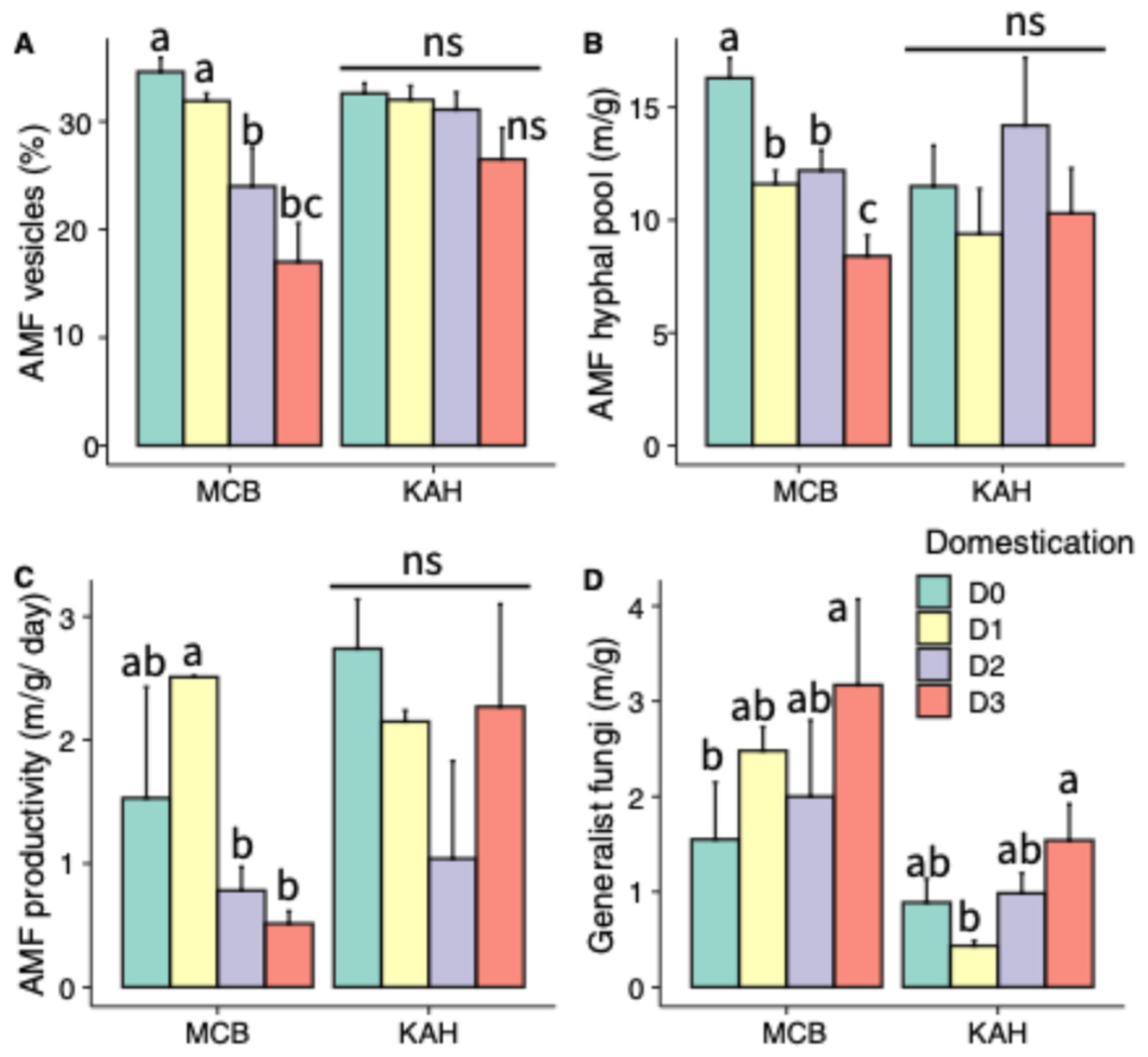
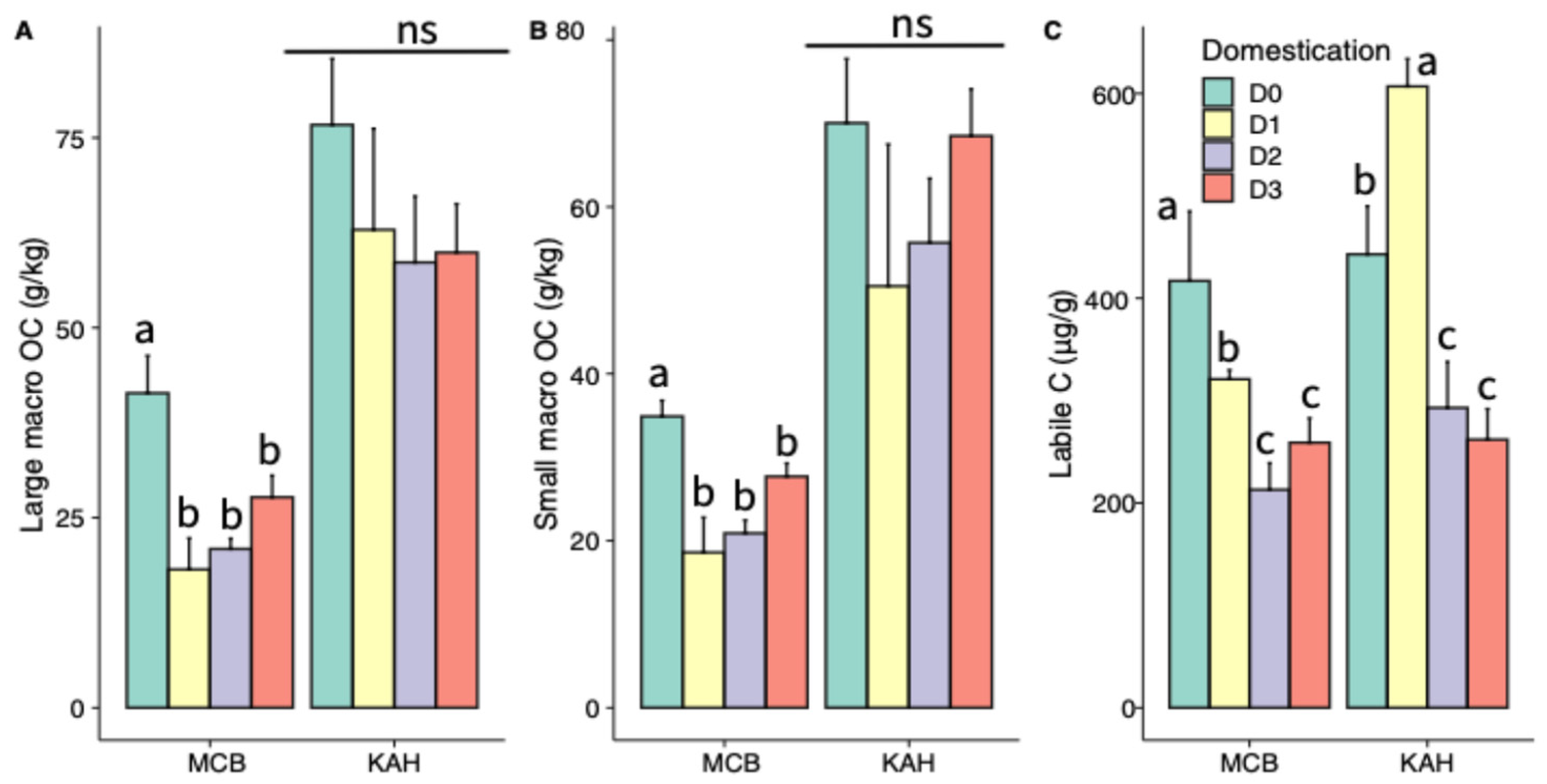
- To what extent are (a) AMF abundance and (b) functioning (aggregation, and aggregate C) mediated by domestication history (host determinism)?
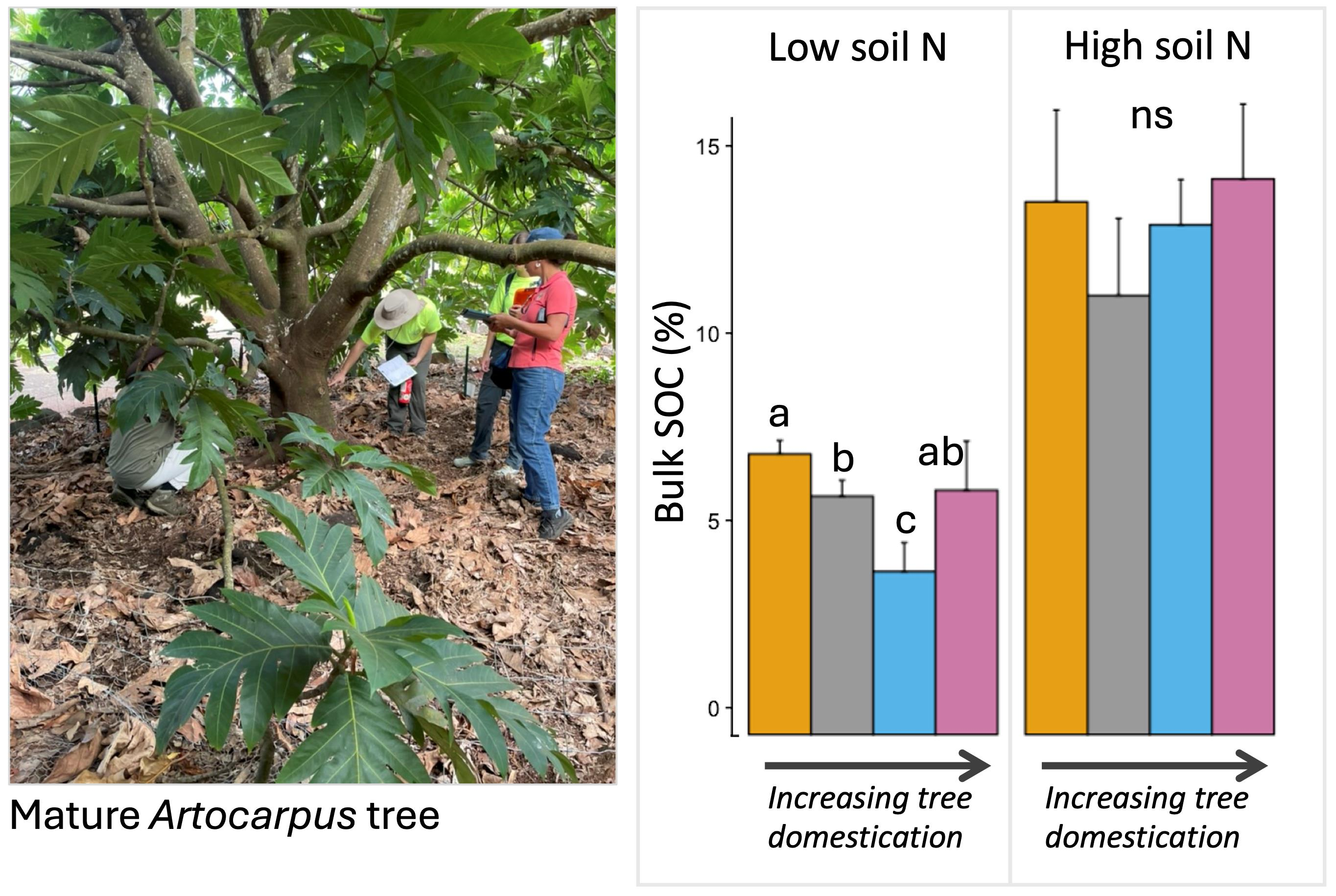
- Does breadfruit domestication history and soil N fertility converge to affect AMF functions in soil aggregate C and SOC accrual (host insensitivity)?
2. Materials and Methods
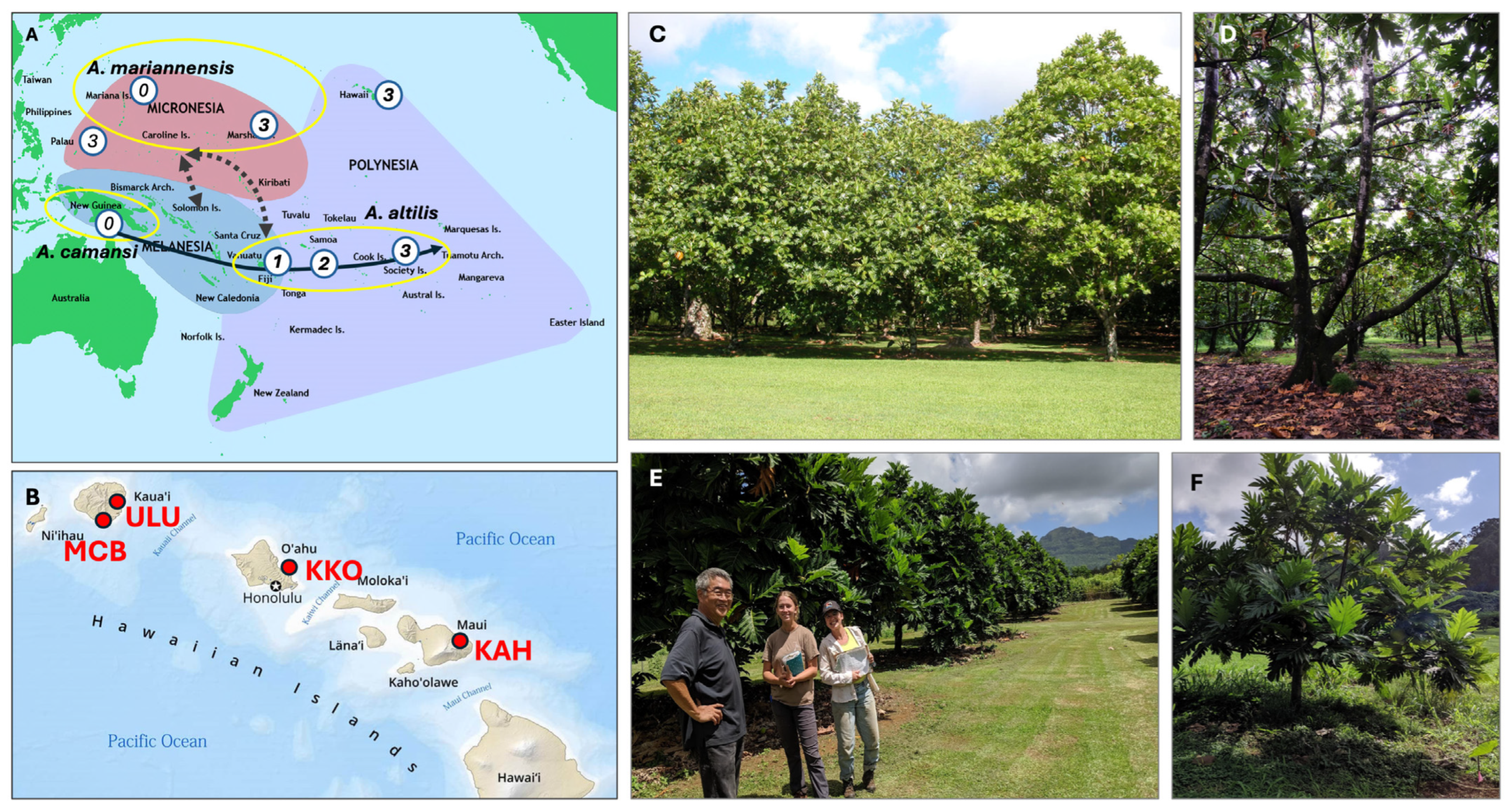
2.1. Study Sites and Species

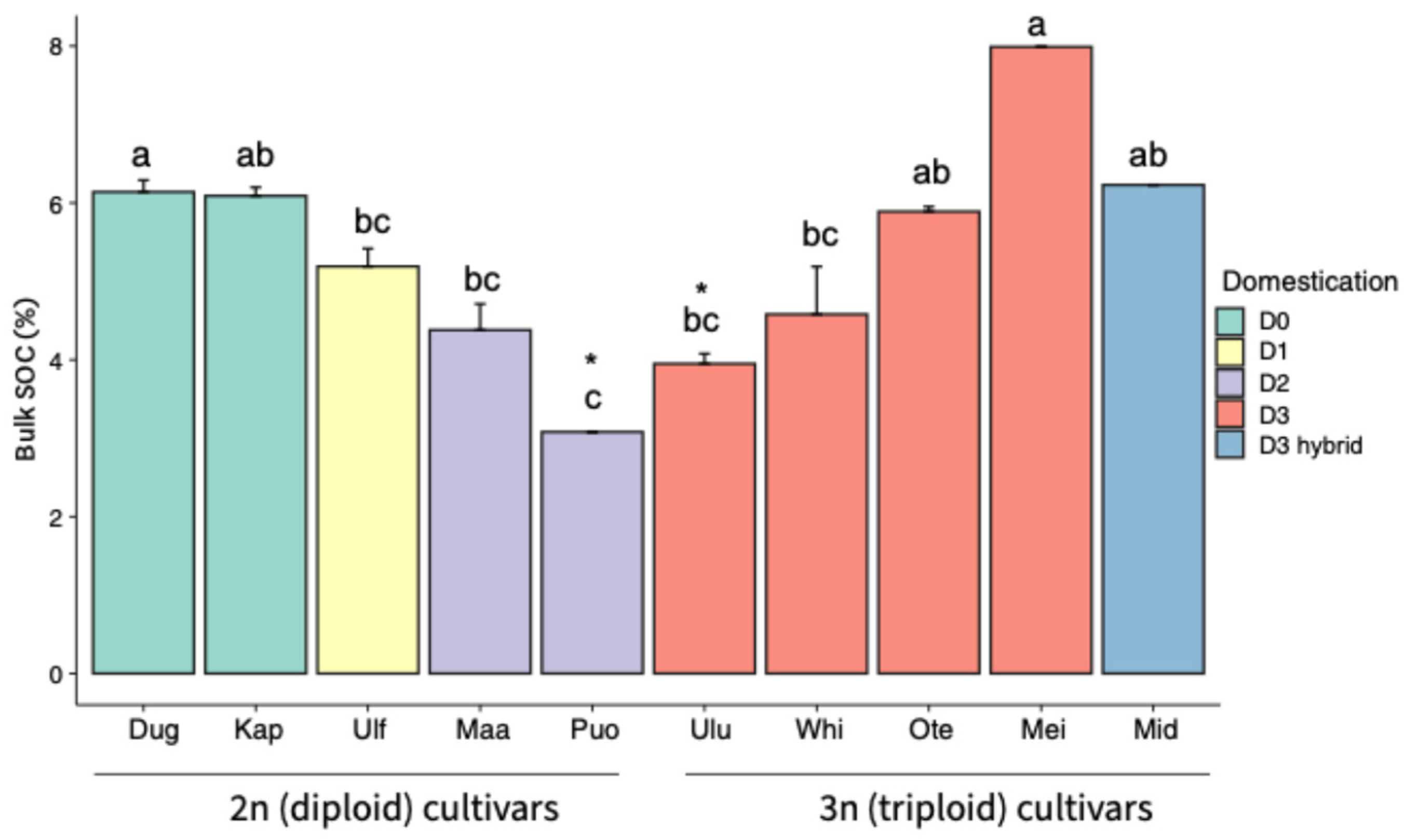
| Status (Ploidy) ‡ | Cultivar | Artocarpus sp. | Origin (Region) ¶ | Fruit Size (kg) † | Leaf % C § | Leaf C:N § | Number of Trees Sampled | |||
|---|---|---|---|---|---|---|---|---|---|---|
| KAH ˆ | MCB | ULU | KKO | |||||||
| D0 (2n) | Breadnut | A. camansi | Papua New Guinea (ME) | 0.8–1.2 | 40.3 (1) ab | 18 (1) | 3 | 3 | - | - |
| D0 (2n) | Dugdug | A. mariannensis | Mariana Isl (MI) | 0.7–3.1 | 41.9 (1) a | 17 (1) | 3 | 2 | - | - |
| D1 (2n) | Ulu fiti | A. altilis | Samoa (WP) | 1.1–2.8 | 41.0 (1) ab | 15 (2) | 3 | 3 | - | - |
| D2 (2n) | Ma’afala | A. altilis | Samoa (WP) | 0.4–1.3 | 37.6 (3) c | 19 (5) | 3 | 4 | 4 | 3 |
| D2 (2n) | Puou | A. altilis | Cook Isl (EP) | 0.7–2.5 | 41.0 (1) ab | 15 (2) | 4 | 1 | - | - |
| D3 (3n) | Otea | A. altilis | Society Isl (EP) | 1.4–2.5 | 39.0 (2) bc | 15 (1) | 4 | 3 | - | - |
| D3 (3n) | ‘Ulu | A. altilis | Hawaii (PO) | 1.3–5.4 | 41.3 (1) ab | 17 (4) | 3 | 3 | - | - |
| D3 (3n) | Meitehid | A. altilis | Pohnpei (MI) | ~1.2 | 41.3 (1) ab | 16 (3) | 1 | 1 | - | - |
| D3 (3n) | White | A. altilis | Seychelle Isl (IO) | 1.2–5.0 | 40.9 (2) ab | 17 (1) | 3 | 2 | - | - |
| D3 (3n) | Midolab | A. altilis × A. mariannensis | Palau (MI) | 0.7–2.0 | 39.4 (2) ab | 15 (2) | 2 | 1 | - | - |
2.2. Soil and Leaf Tissue Sampling
2.3. Soil Analyses
2.4. AMF and Microbial Analyses
2.5. Statistical Analyses
3. Results
3.1. How Are AMF Abundance and Function in Breadfruit Influenced by Edaphic Conditions (Abiotic Constraints)?
3.2. To What Extent Are (a) AMF Abundance and (b) Functioning (Aggregation, and Aggregate C) Mediated by Domestication History (Host Determinism)?
3.3. Does Breadfruit Domestication History and Soil N Fertility Converge to Affect AMF Abundance in Relation to AMF Functions in Soil Aggregation, or Aggregate C and SOC Accrual (Host Insensitivity)?
4. Discussion
4.1. To What Extent Is AMF Abundance Mediated by Domestication History (Host Determinism)?
4.2. To What Extent Is AMF Functioning (Aggregation and Aggregate C), Mediated by Domestication History (Host Determinism)?
4.3. Can the Combined Effects of Host Domestication and AMF Modulate Bulk SOC (Host Determinism)?
4.4. Does Breadfruit Domestication History and Soil N Fertility Converge to Affect AMF Abundance in Relation to AMF Functions in Soil Aggregate C and SOC Accrual (Host Insensitivity)?
5. Conclusions, Limitations, and Outlook for Agroforestry
Supplementary Materials
Author Contributions
Funding
Data Availability Statement
Acknowledgments
Conflicts of Interest
References
- Albrecht, A.; Kandji, S.T. Carbon sequestration in tropical agroforestry systems. Agric. Ecosyst. Environ. 2003, 99, 15–27. [Google Scholar] [CrossRef]
- Ma, Z.; Chen, H.Y.H.; Bork, E.W.; Carlyle, C.N.; Chang, S.X.; Fortin, J. Carbon accumulation in agroforestry systems is affected by tree species diversity, age and regional climate: A global meta-analysis. Glob. Ecol. Biogeogr. 2020, 29, 1817–1828. [Google Scholar] [CrossRef]
- Haider, S.M.A.; Ahmad, I.; Majeed, K.; Hussain, M. Soil organic carbon sequestration potential and its sustainability comparison between mango-based agroforestry and cropland seeking soil fertility parameters under climate resilience. Water Air Soil Pollut. 2024, 235, 682. [Google Scholar] [CrossRef]
- Noponen, M.R.A.; Healey, J.R.; Soto, G.; Haggar, J.P. Sink or source—The potential of coffee agroforestry systems to sequester atmospheric CO2 into soil organic carbon. Agric. Ecosyst. Environ. 2013, 175, 60–68. [Google Scholar] [CrossRef]
- Murphy, T.; Jones, G.; Vanclay, J.; Glencross, K. Preliminary carbon sequestration modelling for the Australian macadamia industry. Agrofor. Syst. 2012, 87, 689–698. [Google Scholar] [CrossRef]
- Monroe, P.H.M.; Gama-Rodrigues, E.F.; Gama-Rodrigues, A.C.; Marques, J.R.B. Soil carbon stocks and origin under different cacao agroforestry systems in Southern Bahia, Brazil. Agric. Ecosyst. Environ. 2016, 221, 99–108. [Google Scholar] [CrossRef]
- Lincoln, N.K.; Cho, A.; Dow, G.; Radovich, T. Early growth of breadfruit in a variety × environment trial. Agron. J. 2019, 111, 3020–3027. [Google Scholar] [CrossRef]
- Dow, G.J.; Lincoln, N.K.; Autufuga, D.; Paull, R. From forests to farming: Identification of photosynthetic limitations in breadfruit across diverse environments. Tree Physiol. 2024, 45, tpaf007. [Google Scholar] [CrossRef]
- Zerega, N.J.; Ragone, D.; Motley, T.J. Complex origins of breadfruit (Artocarpus altilis, Moraceae): Implications for human migrations in Oceania. Am. J. Bot. 2004, 91, 760–766. [Google Scholar] [CrossRef]
- Mausio, K.; Miura, T.; Lincoln, N.K. Cultivation potential projections of breadfruit (Artocarpus altilis) under climate change scenarios using an empirically validated suitability model calibrated in Hawai’i. PLoS ONE 2020, 15, e0228552. [Google Scholar] [CrossRef]
- Livingston, C.; Lincoln, N.K. Determining allometry and carbon sequestration potential of breadfruit (Artocarpus altilis) as a climate-smart staple in Hawai‘i. Sustainability 2023, 15, 15682. [Google Scholar] [CrossRef]
- Langston, B.; Lincoln, N. The role of breadfruit in biocultural restoration and sustainability in Hawai‘i. Sustainability 2018, 10, 3965. [Google Scholar] [CrossRef]
- Lorenz, K.; Lal, R. Soil organic carbon sequestration in agroforestry systems. A review. Agron. Sustain. Dev. 2014, 34, 443–454. [Google Scholar] [CrossRef]
- Cardinael, R.; Guenet, B.; Chevallier, T.; Dupraz, C.; Cozzi, T.; Chenu, C. High organic inputs explain shallow and deep SOC storage in a long-term agroforestry system–combining experimental and modeling approaches. Biogeosciences 2018, 15, 297–317. [Google Scholar] [CrossRef]
- Basiru, S.; Hijri, M. Trade-off between soil organic carbon sequestration and plant nutrient uptake in arbuscular mycorrhizal symbiosis. Fungal Biol. Rev. 2024, 49, 100381. [Google Scholar] [CrossRef]
- Leifheit, E.F.; Veresoglou, S.D.; Lehmann, A.; Morris, E.K.; Rillig, M.C. Multiple factors influence the role of arbuscular mycorrhizal fungi in soil aggregation—A meta-analysis. Plant Soil 2013, 374, 523–537. [Google Scholar] [CrossRef]
- Agnihotri, R.; Sharma, M.P.; Prakash, A.; Ramesh, A.; Bhattacharjya, S.; Patra, A.K.; Manna, M.C.; Kurganova, I.; Kuzyakov, Y. Glycoproteins of arbuscular mycorrhiza for soil carbon sequestration: Review of mechanisms and controls. Sci. Total Environ. 2022, 806, 150571. [Google Scholar] [CrossRef]
- Basile-Doelsch, I.; Balesdent, J.; Pellerin, S. Reviews and syntheses: The mechanisms underlying carbon storage in soil. Biogeosciences 2020, 17, 5223–5242. [Google Scholar] [CrossRef]
- Horsch, C.C.A.; Antunes, P.M.; Fahey, C.; Grandy, A.S.; Kallenbach, C.M. Trait-based assembly of arbuscular mycorrhizal fungal communities determines soil carbon formation and retention. New Phytol. 2023, 239, 311–324. [Google Scholar] [CrossRef]
- Martin-Robles, N.; Lehmann, A.; Seco, E.; Aroca, R.; Rillig, M.C.; Milla, R. Impacts of domestication on the arbuscular mycorrhizal symbiosis of 27 crop species. New Phytol. 2018, 218, 322–334. [Google Scholar] [CrossRef]
- Xing, X.; Koch, A.M.; Jones, A.M.; Ragone, D.; Murch, S.; Hart, M.M. Mutualism breakdown in breadfruit domestication. Proc. R. Soc. Ser. B Biol. Sci. 2012, 279, 1122–1130. [Google Scholar] [CrossRef]
- Giovannini, L.; Sbrana, C.; Giovannetti, M.; Avio, L.; Lanubile, A.; Marocco, A.; Turrini, A. Diverse mycorrhizal maize inbred lines differentially modulate mycelial traits and the expression of plant and fungal phosphate transporters. Sci. Rep. 2022, 12, 21279. [Google Scholar] [CrossRef]
- Dai, M.; Hamel, C.; Bainard, L.D.; Arnaud, M.S.; Grant, C.A.; Lupwayi, N.Z.; Malhi, S.S.; Lemke, R. Negative and positive contributions of arbuscular mycorrhizal fungal taxa to wheat production and nutrient uptake efficiency in organic and conventional systems in the Canadian prairie. Soil Biol. Biochem. 2014, 74, 156–166. [Google Scholar] [CrossRef]
- He, X.; Hochholdinger, F.; Chen, X.; Peng, Y. Crop domestication and improvement reshape root traits and the structure and function of their associated microbiome. Front. Agric. Sci. Eng. 2024, 12, 27–36. [Google Scholar] [CrossRef]
- Rinehart, B.; Borras, L.; Salmeron, M.; McNear, D.H.; Poffenbarger, H. Commercial maize hybrids have smaller root systems after 80 Years of breeding. Rhizosphere 2024, 30, 100915. [Google Scholar] [CrossRef]
- Isaac, M.E.; Nimmo, V.; Gaudin, A.C.M.; Leptin, A.; Schmidt, J.E.; Kallenbach, C.M.; Martin, A.; Entz, M.; Carkner, M.; Rajcan, I.; et al. Crop domestication, root trait syndromes, and soil nutrient acquisition in organic agroecosystems: A systematic review. Front. Sustain. Food Syst. 2021, 5, 716480. [Google Scholar] [CrossRef]
- Porter, S.S.; Sachs, J.L. Agriculture and the Disruption of Plant-Microbial Symbiosis. Trends Ecol. Evol. 2020, 35, 426–439. [Google Scholar] [CrossRef]
- Garo, G.; Van Geel, M.; Eshetu, F.; Swennen, R.; Honnay, O.; Vancampenhout, K. Arbuscular mycorrhizal fungus communities and their response to soil phosphorous differ between wild and domesticated enset (Ensete ventricosum) in Southern Ethiopia. Rhizosphere 2021, 20, 100444. [Google Scholar] [CrossRef]
- Sangabriel-Conde, W.; Maldonado-Mendoza, I.E.; Mancera-López, M.E.; Cordero-Ramírez, J.D.; Trejo-Aguilar, D.; Negrete-Yankelevich, S. Glomeromycota associated with Mexican native maize landraces in Los Tuxtlas, Mexico. Appl. Soil Ecol. 2015, 87, 63–71. [Google Scholar] [CrossRef]
- Ma, X.; Geng, Q.; Zhang, H.; Bian, C.; Chen, H.Y.H.; Jiang, D.; Xu, X. Global negative effects of nutrient enrichment on arbuscular mycorrhizal fungi, plant diversity and ecosystem multifunctionality. New Phytol. 2021, 229, 2957–2969. [Google Scholar] [CrossRef]
- Abdelhalim, T.; Jannoura, R.; Joergensen, R.G. Arbuscular mycorrhizal dependency and phosphorus responsiveness of released, landrace and wild Sudanese sorghum genotypes. Arch. Agron. Soil Sci. 2019, 66, 706–716. [Google Scholar] [CrossRef]
- Elliott, A.J.; Daniell, T.J.; Cameron, D.D.; Field, K.J. A commercial arbuscular mycorrhizal inoculum increases root colonization across wheat cultivars but does not increase assimilation of mycorrhiza-acquired nutrients. Plants People Planet 2021, 3, 588–599. [Google Scholar] [CrossRef]
- Schmidt, J.E.; Bowles, T.M.; Gaudin, A.C. Using ancient traits to convert soil health into crop yield: Impact of selection on maize root and rhizosphere function. Front. Plant Sci. 2016, 7, 373. [Google Scholar] [CrossRef] [PubMed]
- Cesco, S.; Alzate Zuluaga, M.Y.; Cavani, L.; Borruso, L.; Laudicina, V.A.; Mazzetto, F.; Mimmo, T.; Pii, Y.; Terzano, R.; Astolfi, S. Roots and the rhizosphere: A perspective on the hidden engine of regenerative, antifragile, and digitally enabled agriculture. Farming Syst. 2026, 4, 100199. [Google Scholar] [CrossRef]
- Zhang, X.; Yang, M.; Liu, Y.; Ye, J.; Tangyu, J.; Gao, J.; Liu, W.; Fan, Y. Soil Microbes Mediate Productivity Differences Between Natural and Plantation Forests. Plants 2025, 15, 98. [Google Scholar] [CrossRef] [PubMed]
- Tang, B.; Rocci, K.S.; Lehmann, A.; Rillig, M.C. Nitrogen increases soil organic carbon accrual and alters its functionality. Glob. Change Biol. 2023, 29, 1971–1983. [Google Scholar] [CrossRef]
- Ma, Y.; Zhang, H.; Wang, D.; Guo, X.; Yang, T.; Xiang, X.; Walder, F.; Chu, H. Differential Responses of Arbuscular Mycorrhizal Fungal Communities to Long-Term Fertilization in the Wheat Rhizosphere and Root Endosphere. Appl. Environ. Microbiol. 2021, 87, e0034921. [Google Scholar] [CrossRef]
- Giambelluca, T.W.; Chen, Q.; Frazier, A.G.; Price, J.P.; Chen, Y.-L.; Chu, P.-S.; Eischeid, J.K.; Delparte, D.M. Online Rainfall Atlas of Hawai‘i. Bull. Am. Meteorol. Soc. 2013, 94, 313–316. [Google Scholar] [CrossRef]
- Deenik, J.; McClellan, A. Soils of Hawaii. Univ. Hawaii Soil Crop Manag. 2007, 12. Available online: http://hdl.handle.net/10125/12463 (accessed on 23 February 2026).
- Augusto, L.; Borelle, R.; Boča, A.; Bon, L.; Orazio, C.; Arias-González, A.; Bakker, M.R.; Gartzia-Bengoetxea, N.; Auge, H.; Bernier, F.; et al. Widespread slow growth of acquisitive tree species. Nature 2025, 640, 395–401. [Google Scholar] [CrossRef]
- Jones, A.M.P.; Ragone, D.; Aiona, K.; Lane, W.A.; Murch, S.J. Nutritional and morphological diversity of breadfruit (Artocarpus, Moraceae): Identification of elite cultivars for food security. J. Food Compos. Anal. 2011, 24, 1091–1102. [Google Scholar] [CrossRef]
- Miller, W.P.; Miller, D.M. A micro-pipette method for soil mechanical analysis. Commun. Soil Sci. Plant Anal. 1987, 18, 1–15. [Google Scholar] [CrossRef]
- Tisdall, J.M.; Oades, J.M. Organic matter and water-stable aggregates in soils. J. Soil Sci. 1982, 33, 141–163. [Google Scholar] [CrossRef]
- Kemper, W.D.; Rosenau, R.C. Aggregate stability and size distribution. Methods Soil Anal. 1986, 5, 425–442. [Google Scholar]
- Cleveland, C.C.; Liptzin, D. C:N:P stoichiometry in soil: Is there a “Redfield ratio” for the microbial biomass? Biogeochemistry 2007, 85, 235–252. [Google Scholar] [CrossRef]
- Doane, T.A.; Horwáth, W.R. Spectrophotometric determination of nitrate with a single reagent. Anal. Lett. 2003, 36, 2713–2722. [Google Scholar] [CrossRef]
- Weatherburn, M.W. Phenol-hypochlorite reaction for determination of ammonia. Anal. Chem. 1967, 39, 971–974. [Google Scholar] [CrossRef]
- Baykov, A.A.; Evtushenko, O.A.; Avaeva, S.M. A malachite green procedure for orthophosphate determination and its use in alkaline phosphatase-based enzyme immunoassay. Anal. Biochem. 1988, 171, 266–270. [Google Scholar] [CrossRef]
- Koske, R.; Gemma, J. A modified procedure for staining roots to detect VA mycorrhizas. Mycol. Res. 1989, 92, 486–488. [Google Scholar] [CrossRef]
- Giovannetti, M.; Mosse, B. An evaluation of techniques for measuring vesicular arbuscular mycorrhizal infection in roots. New Phytol. 1980, 84, 489–500. [Google Scholar] [CrossRef]
- Jakobsen, I.; Abbott, L.; Robson, A. External hyphae of vesicular-arbuscular mycorrhizal fungi associated with Trifolium subterraneum L. 1. Spread of hyphae and phosphorus inflow into roots. New Phytol. 1992, 120, 371–380. [Google Scholar] [CrossRef]
- Newman, E. A method of estimating the total length of root in a sample. J. Appl. Ecol. 1966, 3, 139–145. [Google Scholar] [CrossRef]
- Vance, E.D.; Brookes, P.C.; Jenkinson, D.S. An extraction method for measuring soil microbial biomass C. Soil Biol. Biochem. 1987, 19, 703–707. [Google Scholar] [CrossRef]
- Schroeder, J.; Kammann, L.; Helfrich, M.; Tebbe, C.C.; Poeplau, C. Impact of common sample pre-treatments on key soil microbial properties. Soil Biol. Biochem. 2021, 160, 108321. [Google Scholar] [CrossRef]
- DuBois, M.; Gilles, K.A.; Hamilton, J.K.; Rebers, P.A.; Smith, F. Colorimetric method for determination of sugars and related substances. Anal. Chem. 1956, 28, 350–356. [Google Scholar] [CrossRef]
- Neff, J.C.; Asner, G.P. Dissolved organic carbon in terrestrial ecosystems: Synthesis and a model. Ecosystems 2001, 4, 29–48. [Google Scholar] [CrossRef]
- Horwath, W.R.; Paul, E.A.; Harris, D.; Norton, J.; Jagger, L.; Horton, K.A. Defining a realistic control for the chloroform fumigation- incubation method using microscopic counting and 14C-substrates. Can. J. Soil Sci. 1996, 76, 459–467. [Google Scholar] [CrossRef]
- Oksanen, J.; Simpson, G.; Blanchet, F.; Kindt, R.; Legendre, P.; Minchin, P.; O’Hara, R.; Solymos, P.; Stevens, M.; Szoecs, E.; et al. Vegan: Community Ecology Package. R Package Version 2.8-0. Available online: https://vegandevs.github.io/vegan/ (accessed on 21 February 2026).
- Kirsten, M.; Mikutta, R.; Vogel, C.; Thompson, A.; Mueller, C.W.; Kimaro, D.N.; Bergsma, H.L.T.; Feger, K.-H.; Kalbitz, K. Iron oxides and aluminous clays selectively control soil carbon storage and stability in the humid tropics. Sci. Rep. 2021, 11, 5076. [Google Scholar] [CrossRef]
- Six, J.; Feller, C.; Denef, K.; Ogle, S.; de Moraes Sa, J.C.; Albrecht, A. Soil organic matter, biota and aggregation in temperate and tropical soils-Effects of no-tillage. Agronomie 2002, 22, 755–775. [Google Scholar] [CrossRef]
- Alam, O.; Purugganan, M.D. Domestication and the evolution of crops: Variable syndromes, complex genetic architectures, and ecological entanglements. Plant Cell 2024, 36, 1227–1241. [Google Scholar] [CrossRef]
- Guigard, L.; Jobert, L.; Busset, N.; Moulin, L.; Czernic, P. Symbiotic compatibility between rice cultivars and arbuscular mycorrhizal fungi genotypes affects rice growth and mycorrhiza-induced resistance. Front. Plant Sci. 2023, 14, 1278990. [Google Scholar] [CrossRef] [PubMed]
- Sugiura, Y.; Akiyama, R.; Tanaka, S.; Yano, K.; Kameoka, H.; Marui, S.; Saito, M.; Kawaguchi, M.; Akiyama, K.; Saito, K. Myristate can be used as a carbon and energy source for the asymbiotic growth of arbuscular mycorrhizal fungi. Proc. Natl. Acad. Sci. USA 2020, 117, 25779–25788. [Google Scholar] [CrossRef] [PubMed]
- Sawers, R.J.; Ramírez-Flores, M.R.; Olalde-Portugal, V.; Paszkowski, U. The impact of domestication and crop improvement on arbuscular mycorrhizal symbiosis in cereals: Insights from genetics and genomics. New Phytol. 2018, 220, 1135–1140. [Google Scholar] [CrossRef] [PubMed]
- Essiane-Ondo, O.; Zerbib, J.; Gianinazzi, S.; Wipf, D. Wheat landraces with low mycorrhizing ability at field respond differently to inoculation with artificial or indigenous arbuscular mycorrhizal fungal communities. Symbiosis 2019, 78, 229–240. [Google Scholar] [CrossRef]
- Sawers, R.J.H.; Svane, S.F.; Quan, C.; Grønlund, M.; Wozniak, B.; Gebreselassie, M.-N.; González-Muñoz, E.; Chávez Montes, R.A.; Baxter, I.; Goudet, J.; et al. Phosphorus acquisition efficiency in arbuscular mycorrhizal maize is correlated with the abundance of root-external hyphae and the accumulation of transcripts encoding PHT1 phosphate transporters. New Phytol. 2017, 214, 632–643. [Google Scholar] [CrossRef]
- Wu, Q.-S.; Cao, M.-Q.; Zou, Y.-N.; He, X.-h. Direct and indirect effects of glomalin, mycorrhizal hyphae and roots on aggregate stability in rhizosphere of trifoliate orange. Sci. Rep. 2014, 4, 5823. [Google Scholar] [CrossRef]
- Totsche, K.U.; Amelung, W.; Gerzabek, M.H.; Guggenberger, G.; Klumpp, E.; Knief, C.; Lehndorff, E.; Mikutta, R.; Peth, S.; Prechtel, A. Microaggregates in soils. J. Plant Nutr. Soil Sci. 2018, 181, 104–136. [Google Scholar] [CrossRef]
- Tripathi, S.K.; Kushwaha, C.P.; Singh, K.P. Tropical forest and savanna ecosystems show differential impact of N and P additions on soil organic matter and aggregate structure. Glob. Change Biol. 2008, 14, 2572–2581. [Google Scholar] [CrossRef]
- Six, J.; Elliott, E.T.; Paustian, K. Soil macroaggregate turnover and microaggregate formation: A mechanism for C sequestration under no-tillage agriculture. Soil Biol. Biochem. 2000, 32, 2099–2103. [Google Scholar] [CrossRef]
- Kopittke, P.M.; Hernandez-Soriano, M.C.; Dalal, R.C.; Finn, D.; Menzies, N.W.; Hoeschen, C.; Mueller, C.W. Nitrogen-rich microbial products provide new organo-mineral associations for the stabilization of soil organic matter. Glob. Change Biol. 2018, 24, 1762–1770. [Google Scholar] [CrossRef]
- Kögel-Knabner, I. The macromolecular organic composition of plant and microbial residues as inputs to soil organic matter: Fourteen years on. Soil Biol. Biochem. 2017, 105, A3–A8. [Google Scholar] [CrossRef]
- Mooshammer, M.; Wanek, W.; Hämmerle, I.; Fuchslueger, L.; Hofhansl, F.; Knoltsch, A.; Schnecker, J.; Takriti, M.; Watzka, M.; Wild, B.; et al. Adjustment of microbial nitrogen use efficiency to carbon:nitrogen imbalances regulates soil nitrogen cycling. Nat. Commun. 2014, 5, 3694. [Google Scholar] [CrossRef] [PubMed]
- Rosinger, C.; Keiblinger, K.M.; Rousk, J.; Sandén, H. Shifts in microbial stoichiometry upon nutrient addition do not capture growth-limiting nutrients for soil microorganisms in two subtropical soils. Biogeochemistry 2022, 159, 33–43. [Google Scholar] [CrossRef]
- Zhao, R.; Kuzyakov, Y.; Zhang, H.; Wang, Z.; Li, T.; Shao, L.; Jiang, L.; Wang, R.; Li, M.; Jianxin Sun, O.; et al. Labile carbon inputs offset nitrogen-induced soil aggregate destabilization via enhanced growth of saprophytic fungi in a meadow steppe. Geoderma 2024, 443, 116841. [Google Scholar] [CrossRef]
- Khan, K.S.; Mack, R.; Castillo, X.; Kaiser, M.; Joergensen, R.G. Microbial biomass, fungal and bacterial residues, and their relationships to the soil organic matter C/N/P/S ratios. Geoderma 2016, 271, 115–123. [Google Scholar] [CrossRef]
- Six, J.; Frey, S.D.; Thiet, R.K.; Batten, K. Bacterial and fungal contributions to carbon sequestration in agroecosystems. Soil Sci. Soc. Am. J. 2006, 70, 555–569. [Google Scholar] [CrossRef]
- Denef, K.; Six, J. Clay mineralogy determines the importance of biological versus abiotic processes for macroaggregate formation and stabilization. Eur. J. Soil Sci. 2005, 56, 469–479. [Google Scholar] [CrossRef]
- Matus, F.J. Fine silt and clay content is the main factor defining maximal C and N accumulations in soils: A meta-analysis. Sci. Rep. 2021, 11, 6438. [Google Scholar] [CrossRef]
- Perez-Jaramillo, J.E.; Mendes, R.; Raaijmakers, J.M. Impact of plant domestication on rhizosphere microbiome assembly and functions. Plant Mol. Biol. 2016, 90, 635–644. [Google Scholar] [CrossRef]
- Yue, H.; Yue, W.; Jiao, S.; Kim, H.; Lee, Y.H.; Wei, G.; Song, W.; Shu, D. Plant domestication shapes rhizosphere microbiome assembly and metabolic functions. Microbiome 2023, 11, 70. [Google Scholar] [CrossRef]
- Junaidi, J.; Kallenbach, C.M.; Byrne, P.F.; Fonte, S.J. Root traits and root biomass allocation impact how wheat genotypes respond to organic amendments and earthworms. PLoS ONE 2018, 13, e0200646. [Google Scholar] [CrossRef] [PubMed]
- Bruun, T.B.; Elberling, B.; Christensen, B.T. Lability of soil organic carbon in tropical soils with different clay minerals. Soil Biol. Biochem. 2010, 42, 888–895. [Google Scholar] [CrossRef]
- Lehmann, A.; Zheng, W.; Ryo, M.; Soutschek, K.; Roy, J.; Rongstock, R.; Maaß, S.; Rillig, M.C. Fungal traits important for soil aggregation. Front. Microbiol. 2020, 10, 2904. [Google Scholar] [CrossRef] [PubMed]
- de Goede, S.P.; Hannula, S.E.; Jansen, B.; Morriën, E. Fungal-mediated soil aggregation as a mechanism for carbon stabilization. ISME J. 2025, 19, wraf074. [Google Scholar] [CrossRef]
- Shi, L.; Feng, W.; Xu, J.; Kuzyakov, Y. Agroforestry systems: Meta-analysis of soil carbon stocks, sequestration processes, and future potentials. Land Degrad. Dev. 2018, 29, 3886–3897. [Google Scholar] [CrossRef]
- Fontaine, S.; Hénault, C.; Aamor, A.; Bdioui, N.; Bloor, J.; Maire, V.; Mary, B.; Revaillot, S.; Maron, P.-A. Fungi mediate long term sequestration of carbon and nitrogen in soil through their priming effect. Soil Biol. Biochem. 2011, 43, 86–96. [Google Scholar] [CrossRef]
- Veresoglou, S.D.; Rillig, M.C. Suppression of fungal and nematode plant pathogens through arbuscular mycorrhizal fungi. Biol. Lett. 2012, 8, 214–217. [Google Scholar] [CrossRef]
- Van de Broek, M.; Ghiasi, S.; Decock, C.; Hund, A.; Abiven, S.; Friedli, C.; Werner, R.A.; Six, J. The soil organic carbon stabilization potential of old and new wheat cultivars: A 13CO2-labeling study. Biogeosciences 2020, 17, 2971–2986. [Google Scholar] [CrossRef]
- Leff, J.W.; Lynch, R.C.; Kane, N.C.; Fierer, N. Plant domestication and the assembly of bacterial and fungal communities associated with strains of the common sunflower, Helianthus annuus. New Phytol. 2017, 214, 412–423. [Google Scholar] [CrossRef]
- Hart, M.M.; Reader, R.J. Taxonomic basis for variation in the colonization strategy of arbuscular mycorrhizal fungi. New Phytol. 2002, 153, 335–344. [Google Scholar] [CrossRef]
- Hawkins, H.-J.; Cargill, R.I.M.; Van Nuland, M.E.; Hagen, S.C.; Field, K.J.; Sheldrake, M.; Soudzilovskaia, N.A.; Kiers, E.T. Mycorrhizal mycelium as a global carbon pool. Curr. Biol. 2023, 33, R560–R573. [Google Scholar] [CrossRef] [PubMed]
- Buckeridge, K.M.; Creamer, C.; Whitaker, J. Deconstructing the microbial necromass continuum to inform soil carbon sequestration. Funct. Ecol. 2022, 36, 1396–1410. [Google Scholar] [CrossRef]
- Liang, C.; Amelung, W.; Lehmann, J.; Kästner, M. Quantitative assessment of microbial necromass contribution to soil organic matter. Glob. Change Biol. 2019, 25, 3578–3590. [Google Scholar] [CrossRef] [PubMed]
- Wang, C.; Qu, L.; Yang, L.; Liu, D.; Morrissey, E.; Miao, R.; Liu, Z.; Wang, Q.; Fang, Y.; Bai, E. Large-scale importance of microbial carbon use efficiency and necromass to soil organic carbon. Glob. Change Biol. 2021, 27, 2039–2048. [Google Scholar] [CrossRef]
- Yan, Z.; Zhou, J.; Liu, C.; Jia, R.; Mganga, K.Z.; Yang, L.; Yang, Y.; Peixoto, L.; Zang, H.; Zeng, Z. Legume-based crop diversification reinforces soil health and carbon storage driven by microbial biomass and aggregates. Soil Tillage Res. 2023, 234, 105848. [Google Scholar] [CrossRef]
- Hu, J.; Huang, C.; Zhou, S.; Liu, X.; Dijkstra, F.A. Nitrogen addition increases microbial necromass in croplands and bacterial necromass in forests: A global meta-analysis. Soil Biol. Biochem. 2022, 165, 108500. [Google Scholar] [CrossRef]
- Manzoni, S.; Taylor, P.; Richter, A.; Porporato, A.; Ågren, G.I. Environmental and stoichiometric controls on microbial carbon-use efficiency in soils. New Phytol. 2012, 196, 79–91. [Google Scholar] [CrossRef]
- Yang, Y.; Gunina, A.; Cheng, H.; Liu, L.; Wang, B.; Dou, Y.; Wang, Y.; Liang, C.; An, S.; Chang, S.X. Unlocking mechanisms for soil organic matter accumulation: Carbon use efficiency and microbial necromass as the keys. Glob. Change Biol. 2025, 31, e70033. [Google Scholar] [CrossRef]
- Zhou, R.; Liu, Y.; Dungait, J.A.; Kumar, A.; Wang, J.; Tiemann, L.K.; Zhang, F.; Kuzyakov, Y.; Tian, J. Microbial necromass in cropland soils: A global meta-analysis of management effects. Glob. Change Biol. 2023, 29, 1998–2014. [Google Scholar] [CrossRef]
- Yang, L.; Canarini, A.; Zhang, W.; Lang, M.; Chen, Y.; Cui, Z.; Kuzyakov, Y.; Richter, A.; Chen, X.; Zhang, F.; et al. Microbial life-history strategies mediate microbial carbon pump efficacy in response to N management depending on stoichiometry of microbial demand. Glob. Change Biol. 2024, 30, e17311. [Google Scholar] [CrossRef]
- Egerton-Warburton, L.M.; Johnson, N.C.; Allen, E.B. Mycorrhizal community dynamics following nitrogen fertilization: A cross-site test in five grasslands. Ecol. Monogr. 2007, 77, 527–544. [Google Scholar] [CrossRef]
- Reichenbach, M.; Fiener, P.; Garland, G.; Griepentrog, M.; Six, J.; Doetterl, S. The role of geochemistry in organic carbon stabilization against microbial decomposition in tropical rainforest soils. Soil 2021, 7, 453–475. [Google Scholar] [CrossRef]
- Lehmann, J.; Kinyangi, J.; Solomon, D. Organic matter stabilization in soil microaggregates: Implications from spatial heterogeneity of organic carbon contents and carbon forms. Biogeochemistry 2007, 85, 45–57. [Google Scholar] [CrossRef]
- Milla, R. Phenotypic evolution of agricultural crops. Funct. Ecol. 2023, 37, 976–988. [Google Scholar] [CrossRef]


| Site (Abbreviation) | |||||
|---|---|---|---|---|---|
| Property | Kahanu (KAH) | McBryde (MCB) | Ulutopia (ULU) | Kāko’o ‘Ōiwi (KKO) | p |
| Island | Maui | Kaui | Kaui | O’ahu | - |
| Latitude (N) | 20.798 | 21.886 | 21.968 | 21.434 | - |
| Longitude (W) | 156.037 | 159.493 | 159.417 | 157.811 | - |
| Elevation (m above sea level) | 15 | 131 | 105 | 39 | - |
| Rainfall (mm per annum) § | 1980 | 1693 | 1783 | 1580 | - |
| Soil order ‡ | Andisol | Oxisol | Oxisol | Inceptisol | - |
| Soil series ‡ | Hana | Lihue | Puhi | Hanalei | - |
| Sand (%) | 5 (5) a | 6 (5) a | 6 (5) a | 6 (5) a | 0.107 |
| Clay (%) | 86 (10) a | 85 (10) a | 81 (9) a | 85 (11) a | 0.968 |
| Silt (%) | 9(10) a | 9 (10) a | 11 (9) a | 9 (10) a | 0.435 |
| Bulk density (g/cm3) | 0.62 (0.08) b | 1.31 (0.09) a | 1.25 (0.08) a | 1.14 (0.09) a | 0.001 |
| pH | 6.33 (0.12) b | 7.01 (0.14) a | 5.58 (0.33) c | 7.07 (0.33) ab | 0.003 |
| CEC (cmol/kg) ‡ | 34.6 | 17.5 | 12.5 | 13.9 | - |
| Bulk soil N (%) | 1.19 (0.18) a | 0.47 (0.21) b | 0.38 (0.40) b | 0.83 (0.51) ab | 0.023 |
| Plant-available N (µg/g) † | 48 (5) a | 22 (6) b | 17 (13) b | 11 (14) b | <0.001 |
| Plant-available P (µg/g) | 16 (2) a | 22 (3) a | 12 (5) a | 15 (6) a | 0.395 |
| N:P ratio | 4.1 (0.6) a | 1.2 (0.6) b | 1.7 (1.4) b | 0.7 (1) ab | <0.001 |
| Total P (µg/g) | 547 (133) b | 533 (111) c | 512 (21) bc | 831 (155) a | 0.021 |
| Fe (%) | 4.36 (1) a | 3.59 (0.6) ab | 0.99 (0.1) b | 3.47 (0.6) ab | 0.035 |
| Mn (%) | 0.149 (0.02) a | 0.051 (0.08) b | 0.021 (0.01) b | 0.146 (0.02) a | 0.011 |
| Ca (%) | 0.739 (0.1) b | 0.311 (0.2) c | 0.485 (0.15) c | 2.719 (0.6) a | <0.001 |
| K (%) | 0.21 (0.08) a | 0.25 (0.02) a | 0.17 (1) a | 0.14 (0.04) a | 0.238 |
| Site ˆ | |||||
|---|---|---|---|---|---|
| Property | KAH ˆ | MCB | ULU | KKO | p |
| Bulk SOC (%) | 11.46 (1.5) a | 4.47 (1.3) b | 5.48 (0.58) b | 5.09 (0.86) b | <0.001 |
| Labile C (mg/kg) | 252 (31) a | 217 (35) a | 196 (84) a | 302 (98 a) | 0.411 |
| Large macroaggregate OC (g/kg soil) | 7.40 (0.4) a | 2.33 (0.4) b | 3.18 (0.3) b | 2.51 (0.4) b | <0.001 |
| Small macroaggregate OC (g/kg soil) | 6.84 (0.3) a | 2.29(0.3) b | 2.31 (0.3) b | 3.55 (0.3) b | <0.001 |
| Microaggregate OC (g/kg soil) | 6.85 (0.4) a | 2.33 (0.4) b | 2.95 (0.4) b | 2.51 (0.4) b | <0.001 |
| Aggregate C:N | 8.7 (2) a | 8.3 (3) a | 6.5 (1) a | 4.3 (2) a | 0.246 |
| Bulk soil C:N | 13 (6) a | 8 (3) a | 15 (6) a | 7 (2) a | 0.131 |
| AMF hyphal pool (m/g soil) | 8.55 (0.8) a | 12.6 (0.9) a | 9.6 (2.0) a | 12.9 (2.4) a | 0.624 |
| AMF root colonization (%), total | 49.8 (9) a | 50.1 (8) a | 46.9 (9) a | 59.8 (8) a | 0.857 |
| AMF root colonization (%) by vesicles | 27 (21) a | 22 (23) a | 16 (56) a | 29 (65) a | 0.171 |
| Microbial biomass C (mg/g) | 2.28 (0.02) a | 1.79 (0.84) a | 3.15 (0.61) a | 2.92 (0.23) a | 0.366 |
| Carbon Pool | ||||
|---|---|---|---|---|
| Property | Large Macroaggregate | Small Macroaggregate | Micro- Aggregate | Bulk SOC |
| Bulk density (g/cm3) | −0.732 * | −0.871 * | −0.675 * | −0.773 * |
| Soil P (µg/g) | −0.591 * | ns | ns | −0.538 * |
| N:P ratio | 0.625 * | ns | 0.568 * | 0.661 * |
| Bulk N (%) | 0.547 * | 0.535 * | ns | ns |
| Soil K content (%) | ns | 0.553 * | ns | ns |
| Soil Fe content (%) | ns | 0.563 * | ns | ns |
| AMF root colonization (%) | 0.722 * | ns | ns | ns |
| Silt (%) | ns | −0.752 * | ns | ns |
| C Pool | Predictor | Estimate | S.E. | t-Value | p | Model R2 | p |
|---|---|---|---|---|---|---|---|
| S Macroaggregate | (Intercept) | 0.619 | 1.822 | 0.340 | 0.736 | 0.403 | 0.001 |
| AMF productivity | 0.436 | 0.219 | 1.987 | 0.053 | |||
| Soil N | 0.074 | 0.017 | 4.393 | <0.001 | |||
| L Macroaggregate | (Intercept) | −1.528 | 1.609 | −0.950 | 0.348 | 0.552 | <0.001 |
| AMF productivity | 0.606 | 0.199 | 3.048 | 0.004 | |||
| Microbial biomass | 0.927 | 0.394 | 2.352 | 0.024 | |||
| Soil N | 0.076 | 0.014 | 5.409 | <0.001 | |||
| Resin P | 0.025 | 0.010 | 2.378 | 0.022 | |||
| Bulk SOC | (Intercept) | 21.494 | 6.613 | 3.250 | 0.002 | 0.645 | <0.001 |
| AMF productivity | 1.041 | 0.190 | 5.474 | 0.000 | |||
| Microbial biomass | 1.328 | 0.379 | 3.500 | 0.001 | |||
| Soil N | 0.068 | 0.014 | 4.701 | 0.000 | |||
| Soil P | 0.053 | 0.020 | 2.582 | 0.013 | |||
| Resin N | −0.013 | 0.005 | −2.794 | 0.008 | |||
| Resin P | 0.058 | 0.011 | 5.482 | 0.000 | |||
| Generalist fungal hyphae | −0.506 | 0.218 | −2.319 | 0.025 | |||
| Leaf C | −0.534 | 0.157 | −3.393 | 0.001 |
Disclaimer/Publisher’s Note: The statements, opinions and data contained in all publications are solely those of the individual author(s) and contributor(s) and not of MDPI and/or the editor(s). MDPI and/or the editor(s) disclaim responsibility for any injury to people or property resulting from any ideas, methods, instructions or products referred to in the content. |
© 2026 by the authors. Licensee MDPI, Basel, Switzerland. This article is an open access article distributed under the terms and conditions of the Creative Commons Attribution (CC BY) license.
Share and Cite
Gohd, L.; Egerton-Warburton, L.M.; Porter, E.; Dickinson, N.D.; Zerega, N.J.C.; Dybzinski, R. Domestication Level and Soil Fertility Differentially Alter Soil Carbon Sequestration Potential in Breadfruit (Artocarpus). Forests 2026, 17, 300. https://doi.org/10.3390/f17030300
Gohd L, Egerton-Warburton LM, Porter E, Dickinson ND, Zerega NJC, Dybzinski R. Domestication Level and Soil Fertility Differentially Alter Soil Carbon Sequestration Potential in Breadfruit (Artocarpus). Forests. 2026; 17(3):300. https://doi.org/10.3390/f17030300
Chicago/Turabian StyleGohd, Lindsey, Louise M. Egerton-Warburton, Ellinore Porter, Noel Dakar Dickinson, Nyree J. C. Zerega, and Ray Dybzinski. 2026. "Domestication Level and Soil Fertility Differentially Alter Soil Carbon Sequestration Potential in Breadfruit (Artocarpus)" Forests 17, no. 3: 300. https://doi.org/10.3390/f17030300
APA StyleGohd, L., Egerton-Warburton, L. M., Porter, E., Dickinson, N. D., Zerega, N. J. C., & Dybzinski, R. (2026). Domestication Level and Soil Fertility Differentially Alter Soil Carbon Sequestration Potential in Breadfruit (Artocarpus). Forests, 17(3), 300. https://doi.org/10.3390/f17030300