Article

Willingness of West Virginia Forest Stewardship Program (FSP) Participants to Establish Bioenergy Crops


School of Natural Resources and the Environment, West Virginia University, Morgantown, WV 26506, USA
*
Author to whom correspondence should be addressed.
Forests 2026, 17(3), 294; https://doi.org/10.3390/f17030294
Submission received: 2 February 2026 / Revised: 23 February 2026 / Accepted: 24 February 2026 / Published: 26 February 2026
(This article belongs to the Section Forest Economics, Policy, and Social Science)

Abstract

While bioenergy crops are often promoted as a strategy to reduce fossil fuel dependence, adoption among private forest landowners remains limited. This study focuses on private forest landowners enrolled in the West Viginia Forest Stewardship Program, a group characterized by more active management and institutional participation than the broader forest landowner population. We surveyed program participants to identify factors influencing their decision to establish dedicated bioenergy crops. Although general awareness of bioenergy is high, willingness to adopt in the near future remains low. Fewer than 5% of landowners surveyed indicated that they intend to plant bioenergy crops within the next five years. Those who are currently involved in agricultural or forest land use were more likely to adopt, as were those familiar with specific bioenergy crops such as switchgrass, miscanthus, and willow. Participation in government conservation programs also increased adoption likelihood. In contrast, ownership size and age were negatively associated with willingness to adopt. Interestingly, general awareness that many crops can be grown for bioenergy was linked to lower adoption, suggesting skepticism about profitability or feasibility. Farmers were nearly eight times more likely to adopt than non-farmers. The results highlight the need for stable markets, well-aligned incentives, and institutional support rather than information alone.

1. Introduction

The effort to achieve low-carbon energy alternatives has renewed interest in bioenergy crops as a means of reducing fossil fuel dependence and increasing domestic renewable energy production in the U.S. Perennial biomass crops such as switchgrass, miscanthus, and short-rotation woody crops (e.g., willow) offer multiple ecological and economic advantages, including high biomass yields, reduced input requirements, enhanced soil carbon storage, enhanced biodiversity, improved water quality, and suitability for marginal or degraded lands [1,2,3,4,5,6,7]. Marginal lands are broadly understood as areas that are less suitable for conventional agricultural production due to biophysical, economic, or social constraints, yet may hold significant potential for dedicated bioenergy crop cultivation [8]. However, financial feasibility depends on feedstock type, conversion technology, geographic context, policy support, and the availability of supplementary revenue streams [9,10]. The passage of the Energy Independence and Security Act of 2007 further stimulated research and policy interest in biofuels and bioelectricity [11]. Forest landowners in the United States have multiple pathways for engaging in bioenergy production, ranging from low-intensity participation to more substantial land-use changes. Options include supplying biomass from existing forest management activities such as timber harvesting or logging residue removal, modifying forest management practices to increase biomass output, or establishing dedicated bioenergy crops on non-forest lands such as cropland, pasture or marginal areas [11,12,13,14,15]. Participation may also occur through contractual arrangements, including land-leasing, fixed-price arrangements, or cooperative structures with biomass processing facilities or energy firms [15]. Despite these opportunities, the practicality of converting existing croplands or mixed-use lands into bioenergy production systems remains uncertain due to fluctuating market conditions, policy instability, climate-related disruptions, socio-technical challenges, and sustainability concerns [16,17].
Private forest landowners can play a significant role in the potential development of biomass and bioenergy industries. Family forest owners control about 39% of all U.S. forest land and an even greater majority in the U.S. Mid-Atlantic region [18]. Their management decisions influence not only timber supply, but also land-use change and biomass availability for renewable energy development. The emerging demand for bioenergy feedstocks presents forest landowners with new management possibilities. For example, they may choose to modify current management practices to cultivate and sell dedicated bioenergy crops [19]. Establishing biomass energy crops can provide landowners with an opportunity to diversify income streams and buffer against volatility in the timber and agricultural markets [20,21]. Despite these potential benefits, many landowners are reluctant to change their land-use practices. Participation in bioenergy crop production has been historically low among landowners [11,20,22]. Concerns about market stability, uncertainty regarding both short-term and long-term profitability, and the substantial costs associated with changing management practices have all been identified as key barriers to participation in emerging bioenergy markets [23,24]. Furthermore, prior research indicates that private forest landowners’ willingness to supply biomass is one of the biggest uncertainties affecting the potential scale and growth of bioenergy markets [25]. These challenges reflect broader structural conditions, including evolving market institutions, limited supply chain development, and uncertain policy environments, which may limit adoption even when potential economic benefits exist. Understanding these structural constraints is critical for explaining persistent low participation rate. In addition, understanding the motivations of forest landowners is essential for designing effective policies and programs that can support their participation in future bioenergy initiatives.
This study focuses specifically on private forest landowners enrolled in the Forest Stewardship Program (FSP), a group characterized by more active management and institutional participation than the broader private forest landowner population. Examining adoption behavior within this group provides insights into how institutional context and landowner characteristics may influence willingness to adopt bioenergy crops and distinguishes this research from prior studies that primarily examine agricultural producers or general landowner populations.
Landowner decision-making is often complex. Participation is often shaped by a combination of economic expectations, sociocultural factors, spatial considerations, and knowledge levels. Drivers of adoption vary substantially across feedstock types, producer groups, and geographic contexts, suggesting that policy interventions must be targeted [26]. Many landowners’ limited interest and familiarity with bioenergy crops often depends on perceived profitability and alignment with existing land management goals [22,27]. Sociocultural perceptions, such as viewing bioenergy as a progressive or beneficial technology, can also increase support and willingness to grow perennial crops, particularly among more educated landowners or those with idle land available [28]. Economic factors also remain an important factor in landowners’ decisions. Substantial price premiums or guaranteed returns are often required to motivate adoption, especially on marginal or mixed-used lands [11,29]. Land characteristics also influence landowners’ decisions. For example, landowners with marginal lands are more willing to plant dedicated energy crops and require lower willingness-to-accept prices relative to those without marginal lands [30]. Proximity to processing facilities and localized “hotspots” of willing landowners may influence where supply chains can realistically develop [31].
Prior studies provide important insights into adoption potential on agricultural lands, but not so much focus has been placed on private forest landowners’ willingness to adopt bioenergy crops, particularly among landowners engaged in formal financial or technical assistance programs. These limited studies have shown that forest landowner decisions are shaped by a number of factors such as ownership objectives, demographic characteristics, forest conditions, and attitudes towards biomass markets. Younger landowners or those with larger acreages and pine or mixed stands are more likely to supply woody biomass [20]. Forest owners in the U.S. South assign multiple, and sometimes competing, values to their forests, which influence their management choices [32]. Studies that present landowners with multiple options for supplying biomass (e.g., thinning, harvesting residues, or planting dedicated feedstocks) find higher willingness to supply biomass than previously reported, suggesting opportunities to synergize programs that incentivize different supply pathways [13]. In addition, willingness increases with price incentives, tax benefits, technical assistance, and stable long-term markets [33,34]. Additional studies show that landowner willingness is also shaped by non-monetary factors such as soil impacts, aesthetics, forest legacy, and social norms [35], and that younger, more rural landowners may be more open to participating in feedstock production [19]. Most of these works focus on the supply of residues or low-value timber, or on general willingness to supply woody biomass, rather than examining landowners’ willingness to establish new, dedicated bioenergy crops or mixed-use lands.
West Virginia has long played a key role in supplying the natural resources that drive the U.S. economy. It ranks as the fifth-largest energy-producing state with substantial fossil energy and renewable resources [36]. The state is among the top five coal producers in the nation, contributing more than 10% of national coal output, and is also one of the leading producers of natural gas [37,38]. However, coal production has declined over the last decade as national demand has fallen, a trend further exacerbated by the COVID-19 pandemic and its associated economic downturn [39]. As global markets move away from carbon-intensive energy sources, West Virginia is facing increasing economic pressures to explore alternative energy sources. Despite these challenges, the state offers significant opportunities for economic diversification. Its established chemical industry, strategic location near major population centers and transportation networks, and strong energy-related research capacity offer promising avenues for growth [37]. Interest in biomass-based economic development has grown in response to declining coal production and growing search for alternative economic opportunities. West Virginia’s predominantly forested landscape positions private landowners as critical stakeholders in any transition toward biomass or bioenergy crop systems. Yet, little is known about whether these landowners are willing to plant bioenergy crops and what factors influence their decisions. Because perceived benefits and risks vary widely across landowners and regions, empirical research at the state level is critical for understanding adoption.
While prior studies provide important insights into landowners’ willingness to supply biomass, this study contributes to the literature in several ways. First, it focuses on private forest landowners when much of the existing studies have emphasized agricultural producers. Specifically, the study examines private forest landowners enrolled in FSP, a group characterized by higher levels of institutional engagement and management planning. This focus allows the examination of adoption behavior among landowners with greater baseline capacity and policy engagement. Second, prior work has mainly focused on the supply of residues or low-value timber, or on general willingness to supply woody biomass, rather than examining landowners’ willingness to establish new, dedicated bioenergy crops or integrate bioenergy into mixed-used land systems. By focusing on adoption decisions involving new crop establishment, this study addresses an important gap related to land-use change decisions. Third, the study distinguishes between a general awareness of bioenergy and crop-specific knowledge, allowing the examination of how different types of information may influence adoption decisions. This distinction provides insights into the roles of information and uncertainty in shaping landowner behavior. Fourth, the study provides empirical evidence from West Virginia, a historically energy-dependent and heavily forested state undergoing an economic transition, offering insight into adoption dynamics in regions where bioenergy markets and infrastructure remain underdeveloped.
This study examines the factors influencing private forest landowners’ willingness to plant bioenergy crops in West Virginia. As part of a larger regional effort assessing the feasibility of sustainable biomass production in the Mid-Atlantic, this study provides state-specific insights that can inform extension programming, energy policy development, and landowner outreach strategies aimed at expanding bioenergy crop production on private forest lands. Specifically, the study addresses the following research questions: (1) what is the level of forest landowner knowledge, awareness, and perceptions regarding biomass and bioenergy crops; (2) to what extent are landowners willing to plant dedicated bioenergy crops under favorable market scenarios; and (3) what factors influence landowners’ willingness to plant dedicated bioenergy crops on their property. By answering these questions, this study contributes empirical evidence needed to understand adoption potential among forest landowners and supports efforts to develop tailored strategies for sustainable biomass production in the region.

2. Materials and Methods

2.1. Survey Design and Data Collection

This study targeted private forest landowners enrolled in West Virginia’s FSP. This program is administered by the WV Division of Forestry (WV DOF) and offers technical and financial assistance to landowners interested in planning and managing their forest land for multiple-use benefits. Because FSP enrollment requires a written forest management plan, participants tend to have a clearer long-term management objective and are more likely to consider integrating new practices (e.g., dedicated bioenergy crops) into their existing management practices. Thus, they are well-positioned to evaluate emerging land-use opportunities such as bioenergy crop production. The WV DOF maintains a database of participants with email addresses and was used to randomly select landowners to participate in the survey. An online survey was administered through Qualtrics, following Dillman’s methodology for web surveys [40]. The survey collected information on ownership and landowner characteristics; current land-use practices; awareness, knowledge, and perception of biomass and bioenergy crops; and the propensity for planting bioenergy crops.

2.2. Theoretical Model and Statistical Analysis

The decision to plant bioenergy crops depends on landowners’ utility-maximizing behavior. Utility is modeled as a random variable to reflect the uncertainty in the individual’s decision-making pertaining to incomplete information [41]. The model used in this study assumes that landowners choose the option (i.e., planting or not planting bioenergy crops) that provides them with the highest perceived utility. This underlying utility is not directly observable but is represented by a set of observable factors. Thus, the utility model for the landowner’s willingness or unwillingness to plant bioenergy crops can be presented as: Ui = f(L, O, K, P, D) where Ui is the utility received by the landowner’s decision to plant or not to plant bioenergy crops; L is a vector of current land-use practices; O represents a vector of ownership characteristics (e.g., ownership size); K represents a vector of landowners’ awareness and knowledge of biomass, bioenergy, and bioenergy crops; P represents institutional participation; and D is a vector of landowner characteristics (e.g., socio-demographic characteristics).
Landowners’ bioenergy decisions are related to current land use practices (L) because these shape perceived risks, compatibility of operations, and investment needs. Landowners who are already engaged in land-use practices compatible with bioenergy crop requirements are more likely to adopt. They face lower transition costs and perceive less uncertainty [11,42].
With regard to ownership characteristics (O), it is expected that landholding size will have an influence on bioenergy crop adoption, although the direction of relationship may be ambiguous. Some studies have shown that larger landholdings may increase willingness to participate because they provide greater flexibility to allocate land to alternative uses without significantly disrupting existing production activities [22,28,43,44]. Other studies report negative relationships [22,45], which could be driven by higher opportunity cost as larger landowners are more integrated into established markets.
Awareness and knowledge variables (K) may influence decisions through their effects on expected profitability as well as perceived risk and uncertainty. Adoption of new land-use practices such as bioenergy crop establishment involves high investment risks, delayed payoffs and uncertain markets, especially for perennial crops [45,46]. Landowners must evaluate not only the expected revenues but also the variability and reliability of those revenues. Under expected utility theory, risk-averse landowners would prefer familiar land uses with more predictable returns even if the alternative may offer a higher payoff [47,48]. In addition, perceived uncertainty regarding future market conditions can reduce the expected utility associated with adopting a new crop system. The impact of awareness on adoption behavior can be positive or negative. For example, greater awareness could increase willingness to adopt if it reduces information barrier and improves confidence in production feasibility [42,43]. However, broader awareness may also expose landowners to information about market volatility and other risks, thereby increasing perceived risk [49,50]. In such cases, awareness may reduce expected utility by increasing uncertainty regarding future return. This is particularly relevant in bioenergy markets because supply chains and price signals are not yet fully established and adoption is therefore dependent on future market conditions [51,52].
Institutional participation (P), such as enrollment in conservation and land management programs, is expected to positively influence bioenergy crop adoption. As previous studies have shown, enrollment in such programs can reduce the financial burden, thereby increasing willingness to adopt new land-use practices [13,42]. Landowners’ socio-demographic characteristics (L) also influence adoption of bioenergy crops. Age is expected to be inversely related to adoption, as older landowners may have shorter planning horizons. In contrast, higher levels of education are expected to be positively associated with adoption as more educated landowners may have greater access to information [22,28,44]. Socio-demographic factors can therefore shape perceived benefits and risks associated with bioenergy crop establishment, thereby influencing adoption decisions.
Thus, the empirical model is specified as:
PLANT_BIO = β0 + β1SIZE + β2CROPS + β3FOREST + β4ENERGY + β5KNOW + β6AWARE + β7PROGRAM + β8OCCU + β9INCOME + β10EDU + β11AGE + ε
where βs and ε are the model coefficients and error term, respectively. The dependent variable PLANT_BIO is the observable choice of whether landowners would be willing (1) or not (0) to plant bioenergy crops on their open lands if they could earn more revenue. The descriptions of the independent variables and summary statistics are listed in Table 1.
Since the dependent variable in the model is dichotomous, binary logistic regression model was used to estimate the model parameters. Logistic regression uses the cumulative logistic probability function to model the probability of an event occurring given a set of categorical characteristics [53]
P i = E Y = 1 X i = 1 1 + e α + β i X i
o r P i = E ( Y = 1 | X i ) = 1 1 + e z i
where
Z i = α + β i X i
Thus, in logistic regression, the probability of each outcome is expressed as:
l o g P i 1 P i = α + β i X i
where
Pi = probability that the landowner would plant bioenergy crops
Βi = model coefficients
Xi = independent variables
Stata software (StataNow/BE 19.5 for Windows) was used to estimate model parameters.

2.3. Use of Artificial Intelligence Tools

Artificial intelligence-based tools were used for limited support during manuscript preparation. Consensus AI was used to assist in identifying relevant peer-reviewed articles for the literature review. Generative AI (ChatGPT) was used solely for language editing, grammar, and sentence clarity. These tools were not used to generate data, design the study, perform statistical analyses, interpret results, or produce figures. All analyses, interpretations, and final text were reviewed and approved by authors to ensure accuracy and credibility.

3. Results

3.1. Survey Results

A total of 859 landowners were contacted to participate in the survey, and 273 respondents completed the questionnaire, yielding a response rate of approximately 32%. This response rate is higher than those reported in previous landowner surveys conducted in West Virginia, which generally range between 10% and 20% [54,55].

3.2. Descriptive Statistics

On average, respondents reported owning 193 hectares of land. The majority of respondents were male, with 66.7% identifying as male and 33.33% as female. The average age of respondents was 60.9 years, indicating an older landowner profile. Only about 3% of the respondents reported being farmers. In terms of educational attainment, 97% of the respondents had completed some level of post-secondary education. Regarding household income, 64% of respondents reported an annual income above $70,000.
Approximately 28% of respondents reported having grown perennial or annual crops, row crops, and pasture/hay/alfalfa, while about 36% indicated forest as a primary land use. Most respondents (70.4%) were not enrolled in any government conservation or land management programs. Among those who reported participation, the Conservation Stewardship Program was the most enrolled program (32%).
With regard to existing knowledge about bioenergy and bioenergy crops, a large majority of respondents (81%) indicated that they had heard the term bioenergy. About 56.7% reported having knowledge of specific bioenergy crops, including switchgrass, miscanthus, and willow, while 51.3% were aware that a wide range of crops can be grown for bioenergy production. In addition, 38.6% of respondents indicated that they were aware that existing farming technologies are compatible with bioenergy crop production.
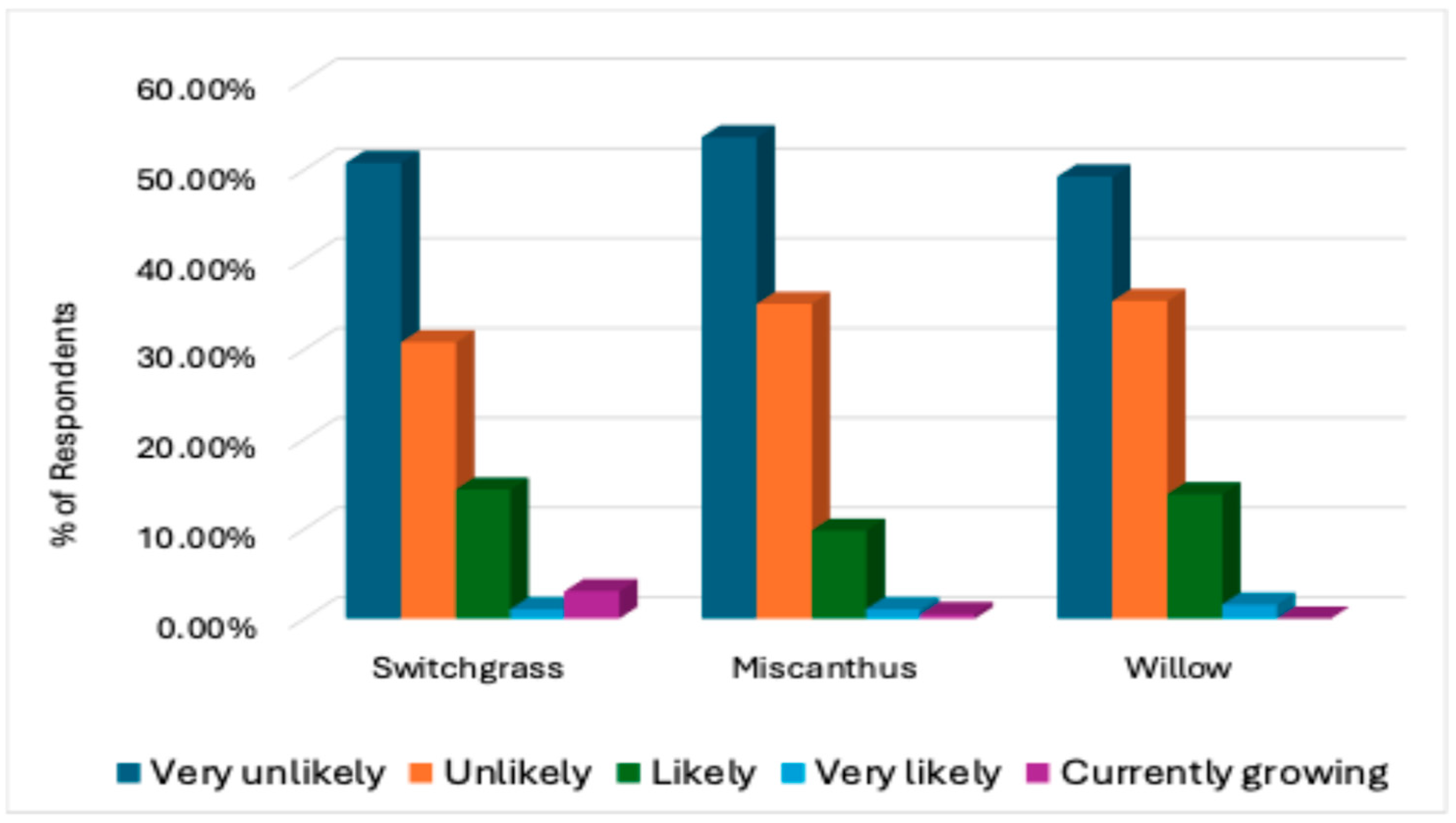
With regard to willingness to grow bioenergy crops, 50.5% of respondents indicated that they would be willing to plant bioenergy crops if doing so would generate higher revenue. Figure 1 illustrates the landowners-stated likelihood of adopting selected bioenergy crops, including switchgrass, miscanthus, and willow. Across all three crops, most respondents reported being either very unlikely or unlikely to adopt, with fewer respondents indicating they were likely or very likely to grow these crops. Actual adoption remains very limited, with only a small proportion of respondents reporting that they are currently growing any of the bioenergy crops.
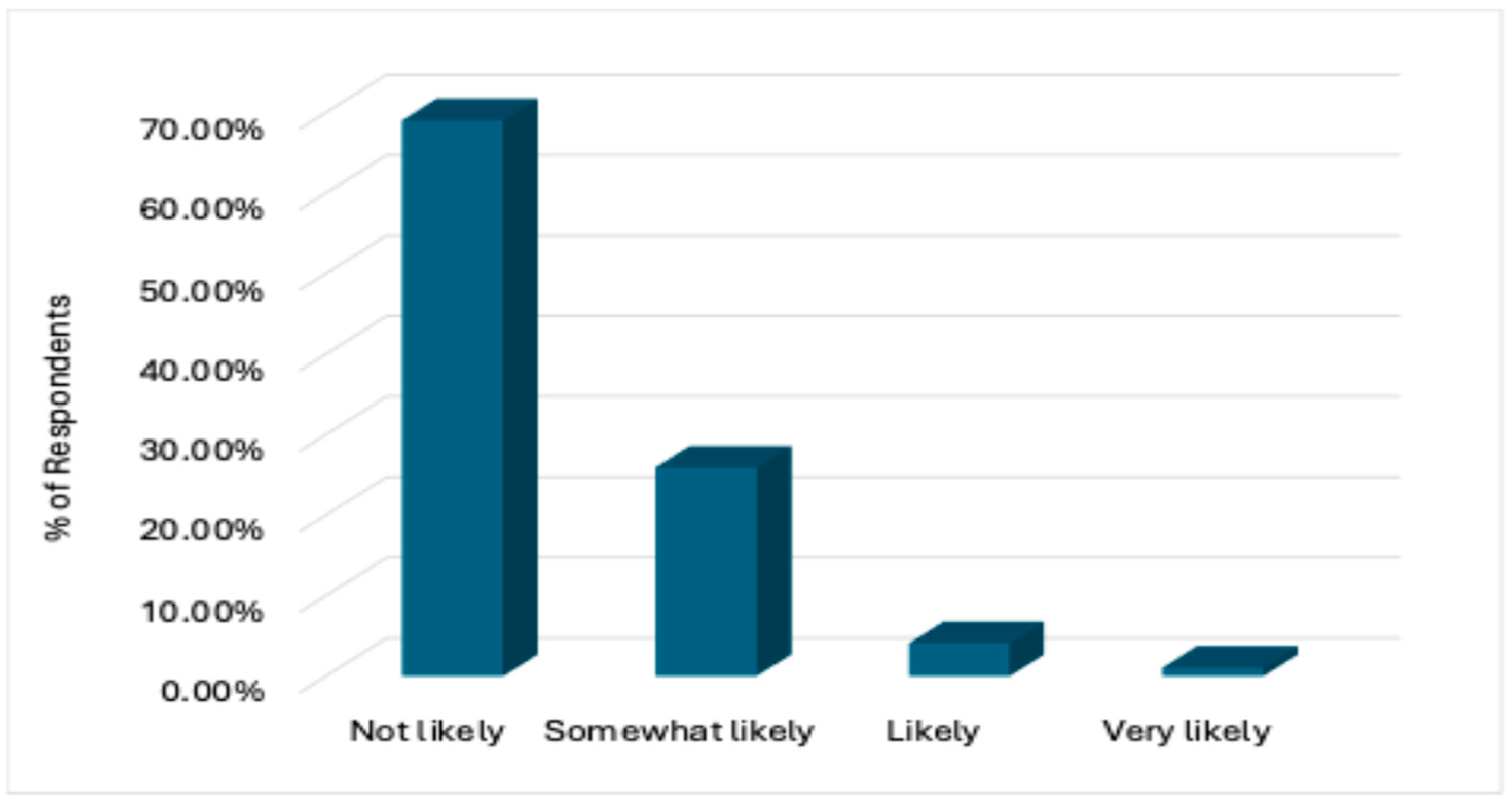
Figure 2 presents the landowners-stated likelihood of planting bioenergy crops within the next five years. Most respondents (69%) indicated that they are not likely to plant bioenergy crops during this period. About 26% reported it being somewhat likely, while only a small share expressed stronger intentions, with roughly 4% indicating likely and about 1% reporting being very likely. Overall, the results suggest limited near-term interest in bioenergy crop adoption among surveyed landowners.

3.3. Results of Regression Model

Model diagnostics were conducted to assess goodness of fit and potential for multicollinearity. The Pearson’s goodness-of-fit test indicated no evidence of poor model fit (X2 = 172.62; p = 0.186), suggesting that the logistic specification adequately represents the data. Classification statistics show that the model correctly predicted 68.6% of the observations, with the sensitivity of approximately 69% indicating reasonable predictive performance for a cross-sectional behavioral data. Multicollinearity among independent variables was evaluated using variance inflation factor (VIF), and all values were below 5 (mean VIF = 1.21), indicating no multicollinearity concerns. Odds ratios are reported to facilitate interpretation of the effects of explanatory variables on the likelihood of adoption.
Table 2 presents the results of the binary logistic regression model examining the factors influencing West Virginia landowners’ decisions to plant bioenergy crops. Several landowner and land-use characteristics were found to significantly affect adoption decisions. Land size (SIZE), measured as the natural log of total land owned, has a negative and statistically significant effect on adoption. The odds ratio of 0.79 suggests that larger landowners are less likely to plant bioenergy crops, holding other factors constant. Landowners who reported having annual or perennial crops or pasture in the past three years (CROPS) are significantly more likely to adopt bioenergy crops, with an odds ratio of 2.57. Similarly, those with forest land (FOREST) are also more likely to adopt, with their adoption being approximately 3.66 times higher than those without forest land. These results suggest that landowners already engaged in agricultural or forest production are more receptive to integrating bioenergy crops into their existing land management practices.
Knowledge- and information-related variables are also significant determinants of adoption. Landowners who have heard of the term “bioenergy” (ENERGY) are more likely to adopt bioenergy crops, with odds of adoption increasing by a factor of 2.50. Likewise, landowners who report having specific knowledge about bioenergy crops such as switchgrass, miscanthus, and willow (KNOW) are more likely to adopt, with an odds ratio of 2.18. These findings highlight the importance of awareness and knowledge in shaping landowners’ adoption behavior. In contrast, general awareness that many crops can be grown for bioenergy production (AWARE) has a negative and highly significant effect on adoption. The odds ratio of 0.16 indicates that landowners who were broadly aware of bioenergy crop options are substantially less likely to adopt. This unexpected result may reflect skepticism, perceived risks, or concerns about the economic viability of bioenergy crops among landowners with greater awareness.
Participation in conservation or land management programs is a statistically significant predictor of willingness to plant bioenergy crops. The corresponding odds ratio of 2.50 suggests that program participants are more than twice as likely to consider planting bioenergy crops. This finding highlights the importance of institutional engagement and program networks in shaping landowner behavior, as these programs may reduce information barriers, increase trust in technical guidance, and lower perceived risks associated with adopting new land management practices.
Among demographic characteristics, occupation and age emerge as significant predictors of bioenergy crop adoption. Farmers (OCCU) are significantly more likely to adopt bioenergy crops than non-farmers, with the odds of adoption nearly eight times higher. This suggests that individuals whose primary occupation is farming may be more willing to experiment with or invest in new crop systems, likely due to greater production experience, access to equipment, and familiarity with agricultural markets. Age (AGE) has a negative and highly significant effect on adoption. The odds ratio of 0.95 indicates that each additional year of age slightly reduces the likelihood of adoption, implying that younger landowners are more likely to adopt bioenergy crops. Household income (INCOME) and education level (EDU) are not statistically significant, suggesting that these factors do not play a major role in shaping adoption decisions among West Virginia forest landowners.

4. Discussion

This study provides empirical evidence on private forest landowners’ willingness to establish dedicated bioenergy crops in West Virginia and contributes to the growing literature on decisions around shifts in management and willingness to adopt bioenergy crops. Although general awareness of bioenergy is relatively high among FSP participants, actual interest in adoption in the near future remains limited. Only about half of the respondents indicated willingness to plant bioenergy crops under a favorable revenue scenario, and fewer than 5% expressed strong intentions to adopt within the next five years. These findings are consistent with previous studies reporting modest adoption potential for perennial bioenergy crops [11,22,29,33,56] and highlight the gap between general support for bioenergy and actual willingness to adopt at the landowner level.
The results also reflect the underlying constraints that continue to limit bioenergy development. Landowners’ decision to adopt remain primarily driven by economic motivations and market factors [13,29,30,32]. The lack of stable markets, unclear policy frameworks, and underdeveloped supply chains continue to discourage large-scale adoption despite the availability of technology and existing government mandates that promote bioenergy production [17,43,57]. This pattern is particularly relevant in Mid-Atlantic states like West Virginia, where traditional energy (e.g., coal) and forestry sectors remain dominant and bioenergy infrastructure is still limited.
Beyond individual landowner characteristics, the results suggest that broader structural factors may be limiting adoption. Emerging bioenergy markets are often characterized by uncertain price signals, limited processing infrastructure, and evolving policy support, which can increase perceived risk and reduce incentives to adopt different land use [58,59,60]. Landowners may face substantial opportunity costs when considering alternative crops relative to existing forest and agricultural uses. These structural constraints may help explain why adoption intentions remain low even under favorable revenue assumptions and highlight the importance of market development, institutional coordination, and long-term policy stability in promoting bioenergy crop adoption.
Current land use is an important determinant of adoption. Landowners who had recently been growing annual/perennial crops, who maintained pasture, or who had forest land-use for the past three years were significantly more likely to plant bioenergy crops. Survey evidence from the Northern Great Lakes Region demonstrates positive willingness across both land use types: landowners indicated they would rent up to 23% of their cropland and 15% of their forestland for bioenergy crops [11]. Similarly, agricultural landowners showed substantial receptivity to both herbaceous and woody bioenergy crops, with 72% willing to grow perennial grasses and 48% willing to grow short-rotation woody crops [61]. These findings indicate that landowners already involved in agricultural production or forest management are more receptive to bioenergy crop systems because they already possess the relevant production experience and are better positioned to integrate alternative crops into existing land-uses [11,22,27,42,62]. Prior land use reflects both physical capacity and management familiarity, which reduces perceived uncertainty and transaction costs in adopting new cropping systems.
In contrast, landholding size has a negative effect on adoption, with larger landowners being less willing to plant bioenergy crops. While some studies found positive relationships between ownership size and biomass supply [20,28,33] other studies found that landowners are generally willing to commit less land to bioenergy production [22,23,63]. This negative relationship may reflect the fact that larger landowners may already be integrated into established timber or agricultural markets and therefore face higher opportunity costs associated with reallocating land to bioenergy crops. They may also perceive bioenergy markets as comparatively risky relative to conventional forest or agricultural crop production.
Knowledge and awareness about bioenergy and bioenergy crops also strongly influence adoption decisions. Landowners who had heard of the term “bioenergy” and those with specific knowledge of bioenergy crops such as switchgrass, miscanthus, and willow were significantly more likely to adopt. This result is consistent with previous studies that emphasize the central role of knowledge, perceptions, and information access in bioenergy adoption. Familiarity with bioenergy and understanding of crop production system significantly increases landowners’ willingness to adopt bioenergy crops to supply land for energy crop production [22,28,29]. Similarly, targeted education and information about dedicated energy crops are associated with greater interest and adoption willingness among landowners [27]. These findings underscore the importance of extension services and outreach programs in reducing informational barriers and enhancing landowners’ confidence in bioenergy systems.
Interestingly, general awareness that many crops can be grown for bioenergy production is negatively associated with adoption. This counterintuitive result suggests that broad awareness may reflect increased exposure to perceived risks, economic uncertainty, or skepticism regarding profitability. Prior studies have shown that while awareness is a necessary condition for adoption, it does not guarantee positive behavioral outcomes. Landowners might have the perception that growing bioenergy crops may not be profitable or may not be a viable alternative [42]. Sociocultural perceptions and concerns about economic viability can dampen support for local bioenergy systems [28]. Thus, general awareness without clear economic signals or technical support may heighten perceived risks rather than encourage adoption. This pattern may also reflect broader structural uncertainty surrounding emerging bioenergy markets. Greater awareness may expose landowners to concerns about unstable markets, limited infrastructure, or uncertain policy support, which could reduce perceived attractiveness despite potential economic benefits [49,50].
Landowners enrolled in conservation or land management programs were more likely to adopt bioenergy crops, which may lower barriers to adoption by providing technical assistance, financial incentives, or exposure to sustainable practices. This result is consistent with previous research showing that institutional support and policy incentives can facilitate adoption of sustainable land management practices, including planting bioenergy crops [13,42]. Enrollment in such programs can enhance economic viability and returns for landowners [64]. Programs like CRP provide annual rental payments and cost-share assistance to landowners making participation financially attractive. Program participation may also reflect a broader orientation toward environmental stewardship.
It is also worth noting that respondents in the study were participants of FSP, who are generally more engaged in land management planning and institutional programs than the broader private forest landowner population. Therefore, the findings are likely to reflect the adoption potential among relatively motivated subgroups rather than the general landowner population. Adoption rate among the broader population may therefore be lower than indicated in this study. At the same time, focusing on FSP participants provides valuable insight into adoption behavior among landowners with greater engagement capacity and institutional connections, who may represent early adopters of bioenergy crop systems. Programs such as FSP and other conservation initiatives may serve as effective entry points for promoting bioenergy crop adoption.
In terms of demographic factors, age and occupation are both significant determinants of willingness to plant bioenergy crops. Specifically, younger landowners show greater willingness to adopt bioenergy crops. Consistent with our findings, younger landowners show greater willingness to adopt bioenergy crops, particularly perennial woody biomass crops that require long-term land conversion [34]. Young farmers may have longer planning horizons to capture returns from these investments. In contrast, middle-aged landowners tend to prefer annual or short-rotation bioenergy crops that can be more easily integrated into existing production systems [65]. This may be due to already having established operations and ongoing financial commitment, coupled with a desire to maintain operational flexibility while still having sufficient time to explore alternative land uses. This relationship is also shaped by landowners’ attitudes towards bioenergy. Younger landowners with a positive attitude towards bioenergy are specially willing to promote and adopt bioenergy crops [22].
Farmers in this study are far more likely to adopt bioenergy crops than non-farmer landowners, with odds nearly eight times higher. This effect is stronger than what is typically reported in the literature, where occupation is usually a weaker or secondary predictor of willingness to adopt bioenergy crops once factors like profitability, risk, experience, and land characteristics are considered [28,43,66,67]. Our findings do not necessarily contradict earlier work, but suggest that occupation reflects access and production capacity. In this context, being an active farmer often means having the equipment, labor, production experience, and market connections needed to try planting a new crop. These factors lower both financial risk and practical barriers to adoption. In contrast, many non-farmer landowners may support bioenergy in principle but face higher costs and uncertainty when it comes to actually planting.
This study has several limitations that should be considered when interpreting results. First, perceptions of market stability, supply chain reliability, and policy stability were not directly measured in the survey instrument. Although these factors are discussed as potential barriers to adoption, their influence is inferred from adoption behavior and existing literature. Future research should explore explicit measures of perceived market risks. Second, the survey evaluated willingness to adopt under the adoption of general favorable revenue conditions but did not elicit minimum acceptable price premiums or economic thresholds for adoption. Incorporating contingent valuation or choice experiments in future studies would provide more context for the economic thresholds for participation.

5. Conclusions

This study provides new evidence on the factors shaping private forest landowners’ willingness to establish dedicated bioenergy crops in West Virginia. Although general awareness of bioenergy is relatively high, interest in near-term adoption remains limited. The findings highlight the persistent gap between general support for bioenergy and actual willingness to adopt, emphasizing the continued importance of economic feasibility, market access, and institutional support in driving decisions to plant bioenergy crops.
Several of our findings are consistent with previous research. Adoption is most likely where bioenergy can be integrated into existing production systems, as reflected in the positive influence of land-use history, participation in conservation or management programs, and farming as a primary occupation. These results reinforce earlier evidence that compatibility with land practices, management capacity, experience, and institutional engagement play important roles in shaping adoption decisions.
At the same time, this study identifies findings that differ from previous research. In particular, the negative relationship between general awareness and willingness to adopt suggests that increased awareness alone may not promote adoption and instead reflect perceived risks or skepticism about emerging markets like bioenergy. In addition, the negative relationship between landholding size and willingness highlights the role of opportunity costs and existing market commitments in shaping land-use decisions.
In terms of policy implications, these results imply that efforts to promote bioenergy should move beyond broad awareness campaigns and instead focus on reducing uncertainty and improving economic feasibility. Policies that provide cost-share support during establishment, long-term purchase agreements or price guarantees, tax incentives, and technical assistance may help reduce financial risk and increase adoption incentives for landowners. Institutional programs such as FSP and Natural Resources Conservation Service (NRCS) and conservation programs like the Environmental Quality Incentives Program (EQIP) or the Conservation Reserve Program (CRP) may serve as effective platforms for implementation, particularly for landowners with existing management plans and institutional connections. Targeting these landowners may support early adoption and provide demonstration opportunities that could facilitate broader adoption over time. More broadly, this study emphasizes the importance of considering bioenergy not as a stand-alone land-use alternative, but as one component of a broader forest and agricultural management system. In regions like West Virginia, where economic transitions away from the traditional energy sector is ongoing, bioenergy crop programs may also contribute to rural economic diversification if supported by stable markets and institutional investments.
Although this study is grounded in the utility-based framework, the results also suggest that landowner decisions are influenced by factors beyond purely economic considerations. Prior land-use experience, familiarity with management practices, and confidence in bioenergy systems also shape willingness, indicating that perceived risk and uncertainty may be important barriers to adoption. Therefore, in addition to improving economic feasibility and market conditions, policies that build trust, provide demonstration projects, and facilitate peer learning may help reduce perceived risks and encourage participation.

Author Contributions

Conceptualization, R.B., K.G. and S.G.; methodology, K.G. and R.B.; software, K.G.; validation, R.B.; formal analysis, K.G.; investigation, K.G., R.B. and S.G.; resources, R.B.; data curation, K.G. and R.B.; writing—original draft preparation, K.G.; writing—review and editing, R.B.; visualization, K.G.; supervision, K.G.; project administration, R.B.; funding acquisition, R.B. All authors have read and agreed to the published version of the manuscript.

Funding

This project was supported by the Mid-Atlantic Sustainable Biomass Consortium for Value-Added Products (MASBio) funded by the United States Department of Agriculture (USDA) and the National Institute of Food and Agriculture (NIFA) (Agriculture and Food Research Initiative competitive grant no. 2020-68012-3188).

Institutional Review Board Statement

The study was conducted in accordance with the Declaration of Helsinki and approved by the Institutional Review Board of WEST VIRGINIA UNIVERSITY (protocol code #2306805624; date of approval: 26 July 2023) for studies involving humans.

Informed Consent Statement

Our study is based on an anonymous survey and does not include any identifying participant information, images, or videos. No personal identifiers were collected, and individuals cannot be recognized from the data presented in the manuscript.

Data Availability Statement

Data is unavailable due to privacy restrictions.

Acknowledgments

The authors acknowledge the use of Consensus AI for assisting with literature searches and ChatGPT 5.2 (OpenAI, San Francisco, CA, USA) for limited language editing and text refinement. These tools did not contribute to data generation, study design, analysis, interpretation, or original scholarly content.

Conflicts of Interest

The authors declare no conflicts of interest. The funders had no role in the design of the study; in the collection, analyses, or interpretation of data; in the writing of the manuscript; or in the decision to publish the results.

Abbreviations

The following abbreviations are used in this manuscript:
FSPForest Stewardship Program
WV DOFWest Virginia Division of Forestry

References

  1. Whitaker, J.; Field, J.L.; Bernacchi, C.J.; Cerri, C.E.P.; Ceulemans, R.; Davies, C.A.; DeLucia, E.H.; Donnison, I.S.; McCalmont, J.P.; Paustian, K.; et al. Consensus, Uncertainties and Challenges for Perennial Bioenergy Crops and Land Use. GCB Bioenergy 2018, 10, 150–164. [Google Scholar] [CrossRef]
  2. Midwest Perennial Bioenergy Crop Diversification. Available online: https://farmland.org/midwest-perennial-bioenergy-crop-diversification (accessed on 19 November 2025).
  3. Happs, R.M.; Hanes, R.J.; Bartling, A.W.; Field, J.L.; Harman-Ware, A.E.; Clark, R.J.; Pendergast, T.H.; Devos, K.M.; Webb, E.G.; Missaoui, A.; et al. Economic and Sustainability Impacts of Yield and Composition Variation in Bioenergy Crops: Switchgrass (Panicum virgatum L.). ACS Sustain. Chem. Eng. 2024, 12, 1897–1910. [Google Scholar] [CrossRef]
  4. Xu, Y.; Zhou, J.; Feng, W.; Jia, R.; Liu, C.; Fu, T.; Xue, S.; Yi, Z.; Guillaume, T.; Yang, Y.; et al. Marginal Land Conversion to Perennial Energy Crops with Biomass Removal Enhances Soil Carbon Sequestration. GCB Bioenergy 2022, 14, 1117–1127. [Google Scholar] [CrossRef]
  5. Siddique, I.A.; Grados, D.; Chen, J.; Lærke, P.E.; Jørgensen, U. Soil Organic Carbon Stock Change Following Perennialization: A Meta-Analysis. Agron. Sustain. Dev. 2023, 43, 58. [Google Scholar] [CrossRef]
  6. Bužinskienė, R.; Miceikienė, A.; Venslauskas, K.; Navickas, K. Assessment of Energy–Economy and Environmental Performance of Perennial Crops in Terms of Biogas Production. Agronomy 2023, 13, 1291. [Google Scholar] [CrossRef]
  7. He, Y.; Jaiswal, D.; Liang, X.; Sun, C.; Long, S.P. Perennial Biomass Crops on Marginal Land Improve Both Regional Climate and Agricultural Productivity. GCB Bioenergy 2022, 14, 558–571. [Google Scholar] [CrossRef]
  8. O’Neill, E.G.; Lark, T.J.; Xie, Y.; Kim, S.; Dale, B.E.; Robertson, G.P.; Basso, B.; Maravelias, C.T. Available Land for Cellulosic Biofuel Production: A Supply Chain Centered Comparison. Environ. Res. Lett. 2025, 20, 014067. [Google Scholar] [CrossRef]
  9. Mishra, S.K.; Gautam, S.; Mishra, U.; Scown, C.D. Performance-Based Payments for Soil Carbon Sequestration Can Enable a Low-Carbon Bioeconomy. Environ. Sci. Technol. 2021, 55, 5180–5188. [Google Scholar] [CrossRef]
  10. Calvin, K.; Cowie, A.; Berndes, G.; Arneth, A.; Cherubini, F.; Portugal-Pereira, J.; Grassi, G.; House, J.I.; Johnson, F.X.; Popp, A.; et al. Bioenergy for Climate Change Mitigation: Scale and Sustainability. GCB Bioenergy 2021, 13, 1346–1371. [Google Scholar] [CrossRef]
  11. Swinton, S.M.; Tanner, S.; Barham, B.L.; Mooney, D.F.; Skevas, T. How Willing Are Landowners to Supply Land for Bioenergy Crops in the Northern Great Lakes Region? GCB Bioenergy 2017, 9, 414–428. [Google Scholar] [CrossRef]
  12. Swinton, S.M.; Dulys, F.; Klammer, S. Why Biomass Residue Is Not as Plentiful as It Looks: Case Study on Economic Supply of Logging Residues. Appl. Econ. Perspect. Policy 2020, 43, 1003–1025. [Google Scholar] [CrossRef]
  13. Wolde, B.; Lal, P.; Burli, P. Forestland Owners’ Willingness to Consider Multiple Ways of Supplying Biomass Simultaneously: Implications for Biofuel Incentive Policies. Energy Policy 2017, 105, 183–190. [Google Scholar] [CrossRef][Green Version]
  14. Perrin, R.K.; Fulginiti, L.E.; Alhassan, M. Biomass from Marginal Cropland: Willingness of North Central US Farmers to Produce Switchgrass on Their Least Productive Fields. Biofuels Bioprod. Biorefining 2017, 11, 281–294. [Google Scholar] [CrossRef]
  15. Yang, X.; Paulson, N.D.; Khanna, M. Optimal Mix of Vertical Integration and Contracting for Energy Crops: Effect of Risk Preferences and Land Quality. Appl. Econ. Perspect. Policy 2015, 38, 632–654. [Google Scholar] [CrossRef]
  16. Azadi, H.; Taheri, F.; Burkart, S.; Mahmoudi, H.; De Maeyer, P.; Witlox, F. Impact of Agricultural Land Conversion on Climate Change. Environ. Dev. Sustain. 2021, 23, 3187–3198. [Google Scholar] [CrossRef]
  17. Helal, M.A.; Anderson, N.; Wei, Y.; Thompson, M. A Review of Biomass-to-Bioenergy Supply Chain Research Using Bibliometric Analysis and Visualization. Energies 2023, 16, 1187. [Google Scholar] [CrossRef]
  18. Butler, B.J. Family Forest Ownerships of the United States, 2018: Results from the USDA Forest Service, National Woodland Owner Survey; General Technical Report NRS: Newtown Square, PA, USA, 2021. [Google Scholar]
  19. Dorning, M.A.; Smith, J.W.; Shoemaker, D.A.; Meentemeyer, R.K. Changing Decisions in a Changing Landscape: How Might Forest Owners in an Urbanizing Region Respond to Emerging Bioenergy Markets? Land Use Policy 2015, 49, 1–10. [Google Scholar] [CrossRef]
  20. Joshi, O.; Mehmood, S.R. Factors Affecting Nonindustrial Private Forest Landowners’ Willingness to Supply Woody Biomass for Bioenergy. Biomass Bioenergy 2011, 35, 186–192. [Google Scholar] [CrossRef]
  21. Ridier, A. Farm Level Supply of Short Rotation Woody Crops: Economic Assessment in the Long-Term for Household Farming Systems. Can. J. Agric. Econ./Rev. Can. D’agroeconomie 2012, 60, 357–375. [Google Scholar] [CrossRef]
  22. Nepal, S.; Tran, L.T.; Hodges, D.G. Determinants of Landowners’ Willingness to Participate in Bioenergy Crop Production: A Case Study from Northern Kentucky. Forests 2020, 11, 1052. [Google Scholar] [CrossRef]
  23. Jensen, K.; Clark, C.D.; Ellis, P.; English, B.; Menard, J.; Walsh, M.; de la Torre Ugarte, D. Farmer Willingness to Grow Switchgrass for Energy Production. Biomass Bioenergy 2007, 31, 773–781. [Google Scholar] [CrossRef]
  24. Cope, M.A.; McLafferty, S.; Rhoads, B.L. Farmer Attitudes Toward Production of Perennial Energy Grasses in East Central Illinois: Implications for Community-Based Decision Making. Ann. Assoc. Am. Geogr. 2011, 101, 852–862. [Google Scholar] [CrossRef]
  25. Buchholz, T.; Canham, C.D. Forest Biomass and Bioenergy: Opportunities and Constraints in the Northeastern United States; Cary Institute of Ecosystem Studies: Millbrook, NY, USA, 2011. [Google Scholar]
  26. Galik, C.S. Exploring the Determinants of Emerging Bioenergy Market Participation. Renew. Sustain. Energy Rev. 2015, 47, 107–116. [Google Scholar] [CrossRef]
  27. Gowan, C.H.; Kar, S.P.; Townsend, P.A. Landowners’ Perceptions of and Interest in Bioenergy Crops: Exploring Challenges and Opportunities for Growing Poplar for Bioenergy. Biomass Bioenergy 2018, 110, 57–62. [Google Scholar] [CrossRef]
  28. Eaton, W.M.; Burnham, M.; Hinrichs, C.C.; Selfa, T.; Yang, S. How Do Sociocultural Factors Shape Rural Landowner Responses to the Prospect of Perennial Bioenergy Crops? Landsc. Urban Plan. 2018, 175, 195–204. [Google Scholar] [CrossRef]
  29. Signorini, G.; Ortega, D.L.; Ross, R.B.; Peterson, H.C. Heterogeneity in Farmers’ Willingness to Produce Bioenergy Crops in the Midwest USA. Agric. Resour. Econ. Rev. 2021, 50, 367–393. [Google Scholar] [CrossRef]
  30. Jiang, W.; Zipp, K.Y.; Jacobson, M. Economic Assessment of Landowners’ Willingness to Supply Energy Crops on Marginal Lands in the Northeastern of the United States. Biomass Bioenergy 2018, 113, 22–30. [Google Scholar] [CrossRef]
  31. Jiang, W.; Zipp, K.Y.; Langholtz, M.H.; Jacobson, M.G. Modeling Spatial Dependence and Economic Hotspots in Landowners’ Willingness to Supply Bioenergy Crops in the Northeastern United States. GCB Bioenergy 2019, 11, 1086–1097. [Google Scholar] [CrossRef]
  32. Schelhas, J.; Hitchner, S.; Brosius, J.P. What Family Forest Owners Talk about When They Talk about Trees: Bioenergy and Forest Landscapes in the U.S. South. Trees For. People 2024, 17, 100606. [Google Scholar] [CrossRef]
  33. Hodges, D.G.; Chapagain, B.; Watcharaanantapong, P.; Poudyal, N.C.; Kline, K.L.; Dale, V.H. Opportunities and Attitudes of Private Forest Landowners in Supplying Woody Biomass for Renewable Energy. Renew. Sustain. Energy Rev. 2019, 113, 109205. [Google Scholar] [CrossRef]
  34. Adjoyi, G.; Kebede, E. Landowners’ Willingness to Supply Woody Biomass for Biofuel in West Alabama. Prof. Agric. Work. J. 2017, 5, 4. [Google Scholar]
  35. Becker, D.R.; Eryilmaz, D.; Klapperich, J.J.; Kilgore, M.A. Social Availability of Residual Woody Biomass from Nonindustrial Private Woodland Owners in Minnesota and Wisconsin. Biomass Bioenergy 2013, 56, 82–91. [Google Scholar] [CrossRef]
  36. West Virginia Profile. Available online: https://www.eia.gov/state/print.php?sid=WV (accessed on 20 November 2025).
  37. Center for Climate and Energy Solutions. Investing in West Virginia’s Future: Aligning Climate and Economic Development; Center for Climate and Energy Solutions: Washington, DC, USA, 2021. [Google Scholar]
  38. U.S. Department of Energy Fossil Energy and Carbon Management. Appalachia Regional Report: Building a Clean Energy and Industrial Economy and the Supporting Role of the U.S. Department of Energy’s Office of Fossil Energy and Carbon Management; U.S. Department of Energy Fossil Energy and Carbon Management: Washington, DC, USA, 2024; p. 19. [Google Scholar]
  39. Bureau of Business and Economic Research, West Virginia University. Coal Production and Employment in Central Appalachia; Bureau of Business and Economic Research, West Virginia University: Morgantown, WV, USA, 2023. [Google Scholar]
  40. Dillman, D.; Bowker, D. The Web Questionnaire Challenge to Survey Methodologists. Online Soc. Sci. 2001, 7, 53–71. [Google Scholar]
  41. Manski, C.F. The Structure of Random Utility Models. Theory Decis. 1977, 8, 229–254. [Google Scholar] [CrossRef]
  42. Burli, P.; Lal, P.; Wolde, B.; Jose, S.; Bardhan, S. Factors Affecting Willingness to Cultivate Switchgrass: Evidence from a Farmer Survey in Missouri. Energy Econ. 2019, 80, 20–29. [Google Scholar] [CrossRef]
  43. Yang, P.; Cai, X.; Leibensperger, C.; Khanna, M. Adoption of Perennial Energy Crops in the US Midwest: Causal and Heterogeneous Determinants. Biomass Bioenergy 2021, 155, 106275. [Google Scholar] [CrossRef]
  44. Khanna, M.; Chen, L.; Basso, B.; Cai, X.; Field, J.L.; Guan, K.; Jiang, C.; Lark, T.J.; Richard, T.L.; Spawn-Lee, S.A.; et al. Redefining Marginal Land for Bioenergy Crop Production. GCB Bioenergy 2021, 13, 1590–1609. [Google Scholar] [CrossRef]
  45. Skevas, T.; Swinton, S.M.; Tanner, S.; Sanford, G.; Thelen, K.D. Investment Risk in Bioenergy Crops. GCB Bioenergy 2016, 8, 1162–1177. [Google Scholar] [CrossRef]
  46. Knápek, J.; Starý, O.; Vávrová, K.; Bemš, J.; Weger, J.; Horák, M. Modelling the Impact of Business Risk on the Competitiveness of Purpose-Grown Biomass of Annual and Perennial Crops. Renew. Sustain. Energy Rev. 2024, 202, 114707. [Google Scholar] [CrossRef]
  47. Rabin, M. Risk Aversion and Expected-Utility Theory: A Calibration Theorem. Econometrica 2000, 68, 1281–1292. [Google Scholar] [CrossRef]
  48. Moschini, G.; Hennessy, D.A. Chapter 2 Uncertainty, Risk Aversion, and Risk Management for Agricultural Producers. In Handbook of Agricultural Economics; Elsevier: Amsterdam, The Netherlands, 2001; Volume 1, pp. 87–153. [Google Scholar]
  49. Arbuckle, J.G., Jr.; Roesch-McNally, G. Cover Crop Adoption in Iowa: The Role of Perceived Practice Characteristics. J. Soil Water Conserv. 2015, 70, 418–429. [Google Scholar] [CrossRef]
  50. Uncertainty, Learning, and Technology Adoption in Agriculture—Chavas—2020—Applied Economic Perspectives and Policy—Wiley Online Library. Available online: https://onlinelibrary.wiley.com/doi/10.1002/aepp.13003 (accessed on 17 February 2026).
  51. Akhtari, S.; Sowlati, T.; Griess, V.C. Optimal Design of a Forest-Based Biomass Supply Chain Based on the Decision Maker’s Viewpoint Towards Risk. For. Sci. 2020, 66, 509–519. [Google Scholar] [CrossRef]
  52. Knight, L.; Pfeiffer, A.; Scott, J. Supply Market Uncertainty: Exploring Consequences and Responses within Sustainability Transitions. J. Purch. Supply Manag. 2015, 21, 167–177. [Google Scholar] [CrossRef]
  53. Pindyck, R.S.; Rubinfeld, D.L. Econometric Models and Economic Forecasts, 2nd ed.; References—Scientific Research Publishing; McGraw-Hill: Singapore, 1981; Available online: https://www.scirp.org/reference/referencespapers?referenceid=2301241 (accessed on 9 December 2025).
  54. Gazal, K.; Eastman, B.; Cheye, S.; Arano, K.; Dahle, G. Understanding Family Forest Landowners’ Preferences for Carbon Offset Programs in Central Appalachia. Forests 2025, 16, 1415. [Google Scholar] [CrossRef]
  55. Gazal, K.A.; Hwang, J.; Eastman, B. West Virginia Forest Landowners’ Preferences for Forest Carbon Offset Programs. Trees For. People 2024, 18, 100683. [Google Scholar] [CrossRef]
  56. Skevas, T.; Hayden, N.J.; Swinton, S.M.; Lupi, F. Landowner Willingness to Supply Marginal Land for Bioenergy Production. Land Use Policy 2016, 50, 507–517. [Google Scholar] [CrossRef]
  57. Stewart, D.W.; Cortés-Peña, Y.R.; Li, Y.; Stillwell, A.S.; Khanna, M.; Guest, J.S. Implications of Biorefinery Policy Incentives and Location-Specific Economic Parameters for the Financial Viability of Biofuels. Environ. Sci. Technol. 2023, 57, 2262–2271. [Google Scholar] [CrossRef]
  58. Bergtold, J.S.; Shanoyan, A.; Fewell, J.E.; Williams, J. Annual Bioenergy Crops for Biofuels Production: Farmers’ Contractual Preferences for Producing Sweet Sorghum. Energy 2017, 119, 724–731. [Google Scholar] [CrossRef]
  59. Proskurina, S.; Vakkilainen, E. Perspectives on Challenges to Bioenergy Use in the EU. Biofuels Bioprod. Biorefining 2024, 18, 938–951. [Google Scholar] [CrossRef]
  60. Hallmann, F.W.; Amacher, G.S. Forest Bioenergy Adoption for a Risk-averse Landowner Under Uncertain Emerging Biomass Market. Nat. Resour. Model. 2012, 25, 482–510. [Google Scholar] [CrossRef]
  61. Smith, D.J.; Schulman, C.; Current, D.; Easter, K.W. Willingness of Agricultural Landowners to Supply Perennial Energy Crops. Res. Agric. Appl. Econ. 2011. [Google Scholar] [CrossRef]
  62. Smithhart, R.; Vlosky, R.P.; Blazier, M.; Darby, P.; Hughes, G.; Terrell, D. Bio-Based Paths to Prosperity for Small and Medium Forest Landowners: A Pilot Study in Southwest Louisiana. Open J. For. 2012, 2, 272–278. [Google Scholar] [CrossRef]
  63. Munn, I.A.; Hussain, A.; Grebner, D.L.; Grado, S.C.; Measells, M.K. Mississippi Private Landowner Willingness for Diverting Land to Growing Short Rotation Woody Crops for Bioenergy Enterprises. For. Sci. 2018, 64, 471–479. [Google Scholar] [CrossRef]
  64. Chen, L.; Blanc-Betes, E.; Hudiburg, T.W.; Hellerstein, D.; Wallander, S.; DeLucia, E.H.; Khanna, M. Assessing the Returns to Land and Greenhouse Gas Savings from Producing Energy Crops on Conservation Reserve Program Land. Environ. Sci. Technol. 2021, 55, 1301–1309. [Google Scholar] [CrossRef]
  65. Zhou, X.V.; Jensen, K.L.; Larson, J.A.; English, B.C. Farmer Interest in and Willingness to Grow Pennycress as an Energy Feedstock. Energies 2021, 14, 2066. [Google Scholar] [CrossRef]
  66. Yang, B.; Yang, P.; Golub, E.; Cai, X. The Role of Social Support on Midwestern Farmers’ Willingness to Grow Perennial Bioenergy Crops. Biomass Bioenergy 2023, 175, 106898. [Google Scholar] [CrossRef]
  67. Embaye, W.T.; Bergtold, J.S.; Archer, D.; Flora, C.; Andrango, G.C.; Odening, M.; Buysse, J. Examining Farmers’ Willingness to Grow and Allocate Land for Oilseed Crops for Biofuel Production. Energy Econ. 2018, 71, 311–320. [Google Scholar] [CrossRef]
Figure 1. Landowners’ likelihood of adopting selected bioenergy crops in West Virginia.
Forests 17 00294 g001
Figure 2. Landowners’ likelihood of planting bioenergy crops within the next 5 years.
Forests 17 00294 g002
Table 1. Descriptions of the independent variables and summary statistics in the empirical model that examine the factors affecting landowners’ decision to plant bioenergy crops in West Virginia.
VariableDescriptionMeanStd. Dev.
SIZENatural log of total land owned (hectares)3.021.61
CROPSDummy variable equal to 1 if land-use in the last 3 years included perennial, annual and row crops, or pasture/hay/alfalfa; 0 otherwise0.410.49
FORESTDummy variable equal to 1 if land-use in the last 3 years included forest; 0 otherwise0.740.44
ENERGYDummy variable equal to 1 if the landowner has heard of the term “bioenergy”; 0 otherwise0.810.39
KNOWDummy variable equal to 1 if the landowner has knowledge about bioenergy crops such as switchgrass, miscanthus, and willow; 0 otherwise0.630.48
AWAREDummy variable equal to 1 if landowner is aware that multiple crops can be grown for bioenergy production; 0 otherwise0.510.50
PROGRAMDummy variable equal to 1 if the landowner is enrolled in any conservation or land management programs; 0 otherwise0.290.46
OCCUDummy variable equal to 1 if landowner’s primary occupation is farming; 0 otherwise0.020.16
INCOMEDummy variable equal to 1 if annual household income exceeds $70,000; 0 otherwise 0.260.44
EDUDummy variable equal to 1 if the respondent has at least some college education; 0 otherwise0.470.50
AGELandowner age in years60.8714.34
Table 2. Results of binary logistic regression.
VariableCoefficient (Standard Error)Odds Ratio
SIZE−0.24 (0.12) *0.79
CROPS0.94 (0.39) ***2.57
FOREST1.30 (0.58) **3.66
ENERGY0.91 (0.57) *2.50
KNOW0.78 (0.42) *2.18
AWARE−1.83 (0.49) ***0.16
PROGRAM0.91 (0.42) **2.50
OCCU2.07 (1.17) *7.91
INCOME0.01 (0.39)1.01
EDU−0.34 (0.39)0.71
AGE−0.4 (0.01) ***0.95
*** p < 0.01, ** p < 0.05, * p < 0.10.
Disclaimer/Publisher’s Note: The statements, opinions and data contained in all publications are solely those of the individual author(s) and contributor(s) and not of MDPI and/or the editor(s). MDPI and/or the editor(s) disclaim responsibility for any injury to people or property resulting from any ideas, methods, instructions or products referred to in the content.