Review

X-Ray Computed Microtomography and Investigations of Wood Structure and the Vascular Cambium
by
David A. Collings
1,2,* and
Ichirou Karahara
3
1
School of Biological Sciences, University of Canterbury, Christchurch 8140, New Zealand
2
Research School of Biology, Australian National University, Canberra, ACT 2601, Australia
3
Faculty of Science, University of Toyama, 3190 Gofuku, Toyama 930-8555, Japan
*
Author to whom correspondence should be addressed.
Forests 2026, 17(2), 286; https://doi.org/10.3390/f17020286
Submission received: 15 January 2026 / Revised: 9 February 2026 / Accepted: 17 February 2026 / Published: 23 February 2026

Abstract

X-ray computed microtomography (µCT) provides an important complement to optical imaging for understanding the three-dimensional (3D) organization and function of xylem and wood. Unlike conventional sectioning, µCT is a non-destructive process that produces high-quality data sets that can be rotated, resliced and, following image segmentation, quantified. We highlight examples in which quantitative processing of 3D µCT sets has provided quantitative understanding of xylem and wood including the development and refilling of xylem embolisms, tree ring analyses and the development of interlocked grain. We also highlight two ways through which the µCT imaging of wood, and plants in general, will be improved. While the current staining protocols for plants are non-specific, developments in specific labeling techniques, including modifications of traditional electron microscopy stains for cell walls and recent developments in µCT imaging in non-plant specimens for studying antibody labeling and transgenes, should allow significant improvements in the imaging of xylem and wood by µCT. We also highlight machine learning which is already facilitating improvements in image segmentation and quantification of µCT data sets. When coupled with the recent advances in molecular genetics of the vascular cambium, these improvements in µCT should dramatically increase our understanding of xylem formation.

1. Introduction

Secondary growth, the increase in the girth of plant stems and roots, occurs through the activity of two distinct layers of meristematic tissue. While the outer of these layers, the cork cambium, produces cells that form the components of the bark, the vascular cambium produces cells in two directions, forming secondary phloem on the outside of the vascular cambium and secondary xylem or wood on the inside. Because these cells allow for water and nutrient transport, as well as providing mechanical support, the evolution of the vascular cambium was a defining moment in the evolution of land plants. The vascular cambium is present in gymnosperms and many angiosperms, although lost in some angiosperm lineages such as the monocots.
The vascular cambium is composed of initials, stem cells whose division produces daughters that either differentiate into the new tissues or which are retained in the vascular cambium. These initials come in two forms: the shorter ray initials whose division yields ray cells and the much longer fusiform initials whose division generates conducting and supporting tissues. The complex organization and development of the vascular cambium, along with the woody tissues that derive from it, are epitomized by the detailed drawings of cellular organization present in gymnosperms and woody angiosperms shown in Esau’s classic plant anatomy textbook (see, for example, Figures 9.1 and 9.4 in [1]). The development of the vascular cambium has been comprehensively reviewed in a monograph by Larson [2], while more recent advances in the molecular control of cambial development have also been reviewed [3,4,5,6].
The vascular cambium is important for plant development as the cells that it generates provide much of the plant’s vascular transport system as well as providing mechanical support for the plant.
The organization of cells within wood provides a history of the activity of the vascular cambium. However, difficulties in interpreting the three-dimensional (3D) organization of cells within wood and the vascular cambium make the understanding of this history complex. Numerous factors contribute to these difficulties. Not only are the fusiform initials exceptionally long and narrow, but they are delicate, have thin cell walls, are located deep within the stem where they are surrounded by mechanically strengthened cells, and are also under mechanical stress [7]. Furthermore, the fusiform initials and the products of these cells can undergo intrusive growth, where the end of the cells elongate, growing in between adjacent cells in a most unusual manner for plant cells [8,9]. As well as showing variability between taxa, the vascular cambium can also show distinct spatial and temporal patterns: in temperate species, the cambium is most active during spring and summer but inactive over winter with the wood forming characteristic growth rings [10], while the development of regular grain patterns, such as interlocked and spiral grain, results from the activity of the vascular cambium [11] (see Section 3). These factors all limit our understanding of the 3D organization of the vascular cambium and the cells that derive from it. To overcome the structural difficulties in seeing the vascular cambium, conventional light microscopy typically requires tissue to be chemically fixed, embedded and sectioned, and then imaged in two dimensions (2D). The third dimension is then either interpreted from the 2D images, or serial sectioning followed by image alignment is used to reconstruct the 3D organization (see Section 1.1).

1.1. Understanding the 3D Structure of Wood Samples and the Vascular Cambium

Various approaches have been used to study the 3D organization of the vascular cambium and wood development (Table 1). The simplest approach has been to cut cross and longitudinal sections through samples; 3D organization can then be interpreted from these two-dimensional (2D) views. The development of serial sectioning from the late 1800s onwards allowed for better reconstructions, although the alignment of images had to be conducted manually and the resolution in the Z direction depended on the thickness of the sections cut; thin cuts that provide better Z-resolution limit the depth of tissue that can be reconstructed. Together, these limitations mean that the total number of cells that can be analyzed by these conventional serial section techniques is comparatively small. These sectioning studies allowed models of cambial and xylem development to be made from different plant species [1,2]. Confocal microscopy, developed from the 1980s and 1990s onwards, fostered a revolution in the understanding of biological samples in 3D because of the ability to optically section and then reconstruct samples. Nevertheless, the size of wood samples, the position of the vascular cambium and the limitations imposed by light’s ability to penetrate samples has meant that it is difficult to image samples more than several hundred micrometers in depth. Even so, sections that were 60–80 µm thick could be dissected from samples, stained and assessed by confocal imaging and compared well with traditional serial sectioning but provided better analysis in 3D [12].
An alternative approach that overcomes the problems with aligning serial sections is to collect the images from the sample as sections are removed, and to use these images which are already aligned to build 3D reconstructions. This approach was pioneered for light microscopy [13] with images used to map xylem development in stems of a sedge (Prionium serratum) [14] and wheat (Triticum aestivum) [15]. Laser ablation tomography (LATscan) is conceptually similar to this approach and involves collecting fluorescence images from the sample and then removing a thin layer with an orthogonally oriented UV laser. Because the sample itself has not moved, the images collected as the faces are removed are aligned. This approach has been used to collect large 3D data sets of the wood from several lianas [16]. Serial block face electron microscopy (SBEM) imaging also uses this approach, with serial electron micrographs collected as thin sections are either cut or ablated away. We are not, however, aware of examples of wood or xylem being imaged by SBEM, although the approach has mapped the organization of pit channels in the sclerenchyma that surround the walnut (Juglans regia) shell [17].
While the serial sectioning, SBEM and LATscan approaches can generate 3D images through samples, they are destructive techniques. There are, however, several non-destructive approaches to generating 3D data of samples that have been applied to wood imaging. In optical coherence microscopy, reflected light images collected at different angles are processed to generate 3D images [18] but the limitations of light penetration through samples limit the more general applicability of the methods to wood imaging. Magnetic resonance imaging (MRI) uses powerful magnetic fields to align hydrogen atoms within samples whose alignment is then disturbed by radiofrequency pulses, with the signals generated by this realignment detected and used to generate 3D images. First used to image growth rings and knots in aspen (Populus tremuloides) [19], MRI requires wet samples and has recently been used to image wood at a cellular level with resolutions as good as 8 µm [20,21,22]. A further alternative to light-based imaging, X-ray imaging provides several advantages that overcome many of the limitations discussed above. X-ray photons have much higher energies than visible light photons (see Section 2.1) and readily penetrate biological samples with only certain higher density materials such as bone in animals attenuating the X-rays (see Section 2.2). Because modern computing power can be applied to X-ray images, it is also possible for these to be reconstructed into 3D data sets. This is the basis of the medical technology of CT (computer assisted tomography) scans, and we argue in this review that these non-destructive approaches have many applications for the study of the vascular cambium and wood. Moreover, the sub-micrometer resolution achievable with µCT is considerably better than is possible with MRI. Furthermore, we suggest that automated image processing (see Section 6) will become more important for the handling of µCT data sets, including those in which wood samples are investigated.
Table 1. Approaches for studying the 3D organization of cells in the vascular cambium and wood.
MethodCommentsRef(s)
Optical imaging
    Serial sectioningResolution in Z direction determined by the thickness of cut sections as low as 10 µm. Sections require manual alignment.
    Serial sectioning (imaging of blocks)Images collected of the block from which sections have been removed. Resolution in Z direction determined by the thickness of cut sections (as low as 10 µm).[13,14,15]
    Confocal fluorescence microscopyResolution in the Z direction limited by the numerical aperture of the lens used, and typically higher than the XY resolution. Penetration of lasers into sample often limited to less than 200 µm.[12]
    Laser ablation tomography (LATscan)Autofluorescence collected from samples after sections serially ablated. Images collected with a Z resolution of 4 µm.[16]
X-ray imaging
    Computer assisted tomography (CT)Resolutions in the XY and Z directions the same. Medical CT imaging has resolution from 0.5 mm and upwards.many—see text
    X-ray microtomography (µCT)Resolutions in the XY and Z directions the same. Resolutions typically in the range of 1 to 10 µm, but values as low as 0.6 µm can be achieved.many—see text
Electron microscopy
    Serial block face electron microscopy (SBEM)Not previously applied to wood or xylem, but a Z resolution of 100 nm achieved.[17]
Other imaging approaches
    Magnetic resonance imaging (MRI)XY and Z resolutions the same as voxels imaged. Wood imaging reported to resolutions as low as 8 µm per voxel.[20,21,22]

1.2. The Scope of This Review

In this review, we consider the applicability of µCT for imaging wood samples, and for understanding and quantifying the 3D organization and development of cells within the vascular cambium. Previous reviews of plant imaging by µCT have been published with these focusing on imaging methods and aspects of wood structure [23,24,25,26,27,28]. The aim of this review is not to replicate these previous reviews but to consider specifically how µCT imaging might allow for a better understanding of wood organization and cambial development. The importance of µCT for wood and cambial studies is that µCT is a constitutively 3D technique that, while non-destructive, allows 3D rendering and re-slicing of the data sets created, and quantitative analyses to be conducted.
Our review is targeted at wood scientists who might be unfamiliar with µCT and for whom µCT imaging might provide a valuable complement to traditional methods. Because of this, the following section of our review provides some background to X-rays, X-ray imaging and how tomographic reconstructions are generated. Detailed technical information is, however, avoided, although references are provided for those researchers who need further information. In the next section, we look at how µCT has been used to image woody tissues, in most cases in purely descriptive studies, and highlight several of the limitations of current µCT methods. In Section 3 and Section 4, we look at several examples of how µCT has been applied specifically to quantifying wood grain patterns at cellular or near cellular resolutions. However, our review is also aimed at researchers currently using µCT imaging, and, having highlighted some of the limitations in current imaging techniques, we turn in the final two sections of the review to where technology may develop. We discuss how new approaches for cell wall labeling might be developed that can be used for studying cambial development. We then consider how developments in image processing and machine learning might facilitate image analysis and allow for the massive data sets generated by µCT to be processed more effectively.

2. X-Rays, X-Ray Attenuation and X-Ray Microtomography

2.1. X-Rays

X-rays are a part of the electromagnetic spectrum and describe radiation with wavelengths between about 0.01 and 10 nm. The longer wavelength X-rays, between 0.1 and 10 nm, are often referred to as soft X-rays whereas the shorter wavelength, higher-energy X-rays are described as hard X-rays. Traditionally, however, the X-rays used for CT and µCT imaging are not described in terms of wavelength but by the energy of the individual photons, measured using a non-SI unit, the kiloelectronvolt (keV). An X-ray with a wavelength of 0.01 nm has an energy of 124 keV, whereas a 10 nm X-ray has energy of only 124 eV. CT systems, whether for medical imaging or µCT, use high-energy hard X-rays between about 10 and 120 keV (0.01 to 0.1 nm).

2.2. X-Ray Attenuation and Generating Contrast in X-Ray Images

The attenuation of X-rays by an atom increases with the atom’s atomic number, with absorbance and scattering dependent on approximately the third power of the atomic number [29]. This means that low atomic number elements, such as carbon, nitrogen, oxygen and hydrogen that make up most plant cells, attenuate X-rays only weakly, and there is generally little contrast within images [27]. This also explains the conventional medical use of X-rays: calcium, with an atomic number of 20, makes up more than half the weight of bones and generates the stronger attenuation of X-rays by bones than the surrounding tissue. X-ray absorbance also depends on the energy of the X-ray, with different atoms showing different absorbance spectra. Higher atomic number atoms absorb high-energy X-rays more strongly than lightweight atoms meaning that the energy of the X-rays used in imaging (i.e., the X-ray wavelength) contributes to the nature of the image [29].
For imaging plants by µCT, the primary difficulty is obtaining contrast between different tissues and any surrounding media. While it is possible to image the difference between cell walls and organelles in living or fixed tissues, the contrast is typically low. There are multiple ways in which contrast can be generated between non-absorbing tissue and absorbing tissue. The simplest of these is drying, because the absorbance of the dried down tissue, although low, will be higher than the surrounding air. For woody samples that are stable during drying, this can provide sufficient contrast for µCT imaging [30,31,32] and has also allowed studies on embolisms within the xylem [33,34,35] (see Section 3.2). For more delicate samples, critical point drying allows the retention of structures [23]. Some samples, however, including valuable wooden archeological samples, cannot be dried, and for imaging specimens such as these, MRI approaches which require saturated samples may prove to be superior [20,21,22].
One alternative approach to generating contrast for µCT imaging is the addition of contrasting agents. These are higher atomic number elements, usually metals but sometimes iodine, whose higher X-ray absorbance allows for more contrast within samples. In medical imaging, X-ray absorbing iodinated contrasting agents are widely used in CT scans to improve X-ray absorption and imaging [36], and a wide range of heavy metal-containing solutions have been tested for µCT imaging of animal tissues [37]. For plant specimens, infiltration of samples for one to several days with a range of contrasting agents including potassium permanganate, ruthenium red, Lugol’s iodine, phosphotungstic acid, osmium tetroxide, bismuth tartrate and lead citrate have been tested, with phosphotungstic acid, Lugol’s iodine and osmium tetroxide generally providing the best imaging [38,39]. The contrasting agents used in plant tissues, to date, are typically non-specific, or show at best low specificity. This means that they bind throughout the tissues into which they are impregnated rather than being targeted to specific locations within cells or tissues. By comparison, many chromatic stains have been developed for the optical imaging of different organelles and structures in plant tissues, initially being color-based and subsequently for fluorescence imaging. Approaches for more specific contrast enhancement in plant samples are possible, and some of these are considered in Section 5. A second alternative method for generating contrast in µCT images is phase or refraction contrast imaging (see Section 2.3).

2.3. CT Scanning and µCT Imaging

The development of µCT in the 1980s [40,41] has overcome some of the limitations of optical and fluorescence imaging that arise from the imaging of large and complex samples in 3D. In medical CT scanning, the approach from which µCT was developed, multiple X-ray images are recorded at different angles with the X-ray source and detector rotating around the person. From this series of images, a 3D reconstruction can then be calculated (see Section 2.4). For µCT imaging, a slightly different arrangement is used, with the sample being rotated through a stationary X-ray beam. µCT systems can be divided into two different types: there are numerous different commercially available systems including those from SkyScan system from Bruker and the Zeiss Xradia. There are also synchrotron-based µCT imaging systems which use the much stronger X-ray sources available from synchrotrons.
Several comparisons between conventional µCT imaging and light microscopy are instructive as these highlight the similarities and differences between these imaging modes. In light microscopy, the optimization of images requires balancing imaging speed, image noise and image resolution and improving any one of these factors invariably means compromising one or both of the other aspects of the image. The same holds true for µCT where image optimization requires the balancing of image resolution (voxel size), signal-to-noise ratios and the time required for imaging [42].
Because conventional µCT imaging relies on the absorbance of X-rays by samples, imaging is unaffected by the refractive index mismatch and diffraction that can limit optical imaging. In light microscopy, image resolution is limited by the numerical aperture of the lens to about half the wavelength of light, with resolutions possible to around 200 nm (in the absence of super resolution methods). For µCT, this is not the case. Instead, image resolution will be determined by the size of the X-ray source’s focal spot, the number of pixels available within the detector system, and the size of the sample size. Typically, the very best resolutions achieved by laboratory-based µCT images are 500 nm per voxel or higher, although synchrotron systems can provide slightly better resolutions. For resolving individual plant cells, especially in large and /or complex plant samples, this can be limiting.
Another similarity between light-based imaging and µCT is the application of phase contrast imaging. For light microscopy, phase contrast generates contrast in images by converting the changes in phase that occur when the imaging photons interact with the sample into differences in brightness. In a similar manner, phase contrast µCT increases the contrast in images without the need for either drying or adding contrasting agents by detecting the changes in phase when the X-ray photons pass through the sample [43]. Phase contrast µCT requires coherent, high-powered X-ray sources and is normally conducted in synchrotron facilities, although laboratory-based phase contrast µCT systems are now available. Thus, this approach has only infrequently been applied to plant specimens, but it has shown that high-resolution images can be achieved without the use of contrasting agents [31,44,45].
A final similarity between light-based imaging and µCT relates to the wavelength of the imaging photons. In optical microscopy, color differences between samples are often critical for identifying different structures, with these color differences resulting from variations in absorbance at different wavelengths across the visible spectrum. A conceptually similar approach is used with dual energy CT imaging (DECT). DECT takes advantage of differences in X-ray absorption spectra between elements by collecting images at two different energy levels. As high atomic number elements, for example, iodine which is often used as a tracer, show much stronger differences in attenuation between low- and high-energy X-rays than light atomic number elements, DECT can localize where the high atomic number elements are concentrated within samples [46]. Conceptually, this is similar to identifying structures in light-based imaging based on color differences. While we are not aware of DECT having been applied to plant samples, we highlight this approach because of its potential to be coupled with specific labeling approaches.

2.4. The Computations Required for µCT Imaging and Analysis

Tomography is any imaging process that generates sections through samples, and is not limited to X-ray imaging. The calculations that drive image reconstruction in CT and µCT, a process known as the Radon transformation, are also required for the image reconstructions in electron tomography [47] that is used for imaging thicker sections in TEM and for determining protein structures from high-resolution images in cryo-EM. Similar processes are also used for various forms of optical tomography. While we do not cover the full mathematical details of the Radon transformation in this review, with the processes summarized elsewhere [47,48], the transformation converts the series of images collected at different angles into a volumetric map where the intensity value for each voxel records the X-ray attenuation at that location.

3. µCT Imaging of Xylem and Wood

The generation of contrast within µCT images relies on differences in X-ray attenuation within the sample being imaged. For plant material, in which X-ray absorbance is typically low, this is problematic: while some plant specimens will survive drying which can provide contrast, this is not always possible for delicate samples. Imaging of meristematic tissue, for example, requires material to be embedded for support and while methods have been developed that allow resin embedded tissue to be imaged [39], counter-staining of the samples is required as the resins also attenuate X-rays. To date, heavy metal stains used in plant tissues are all non-specific or of low specificity but provide enough contrast for imaging to be conducted [38,39]. In this section, we consider several systems in which the 3D imaging and quantitative nature of µCT approaches has proved useful for the analysis of plant samples, focusing on xylem and wood development, while in the following section we consider a specific example of µCT’s usefulness in more detail, namely the analysis of wood grain. One aspect of µCT imaging in plant growth and development that we will not consider is the imaging of root samples growing through soil, often conducted at lower, non-cellular resolutions (reviewed in [49]).
Because of the improved contrast available in dried samples and the stability of wood during drying, it is not surprising that wood samples provided some of the earliest examples of plant material being imaged by µCT. These descriptive studies included observations and measurements of xylem vessels in both beech (Fagus sylvatica) and oak (Quercus robur) [30], high-resolution imaging of the tracheids in spruce (Picea abies) including observations of pits between cells [50], high-resolution, phase contrast imaging of wood from a range of trees including loblolly pine (Pinus taeda), Douglas fir (Pseudotsuga menziesii) and unnamed species of eucalyptus and teak [31], and imaging of white rot developing in spruce wood [51]. While several of these studies provided quantitative analyses of cell size, and dramatically demonstrated µCT’s usefulness in 3D visualizations, subsequent studies have begun to use µCT for investigating functionality.

3.1. Observing Embolisms

Because air attenuates X-rays much less strongly than water or cellular contents, µCT imaging reveals the presence of air inclusions within living plant tissues. Critical point drying of plant samples allows structures to be retained and imaged by µCT. However, one location in which air bubbles are physiologically significant is in xylem vessels where the water tension generated by transpiration can lead to the formation of embolisms if the plant is under water stress. To limit the damage caused by a loss of water conductivity, plants have evolved mechanisms to remove embolisms from within xylem vessels, with this process first imaged and quantified in grapevines (Vitis vinifera) in a synchrotron-based µCT system in a manner not possible with light-based imaging [33]. Vessel interconnectivity in grapes was further investigated through automated image segmentation and 3D reconstructions [52]. Subsequent studies have been able to visualize embolism formation and recovery in laboratory-based µCT systems in birch (Betula pendula) [53], laurel (Laurus nobilis) [34], (Fraxinus excelsior) [54] and beech (Fagus sylvatica) [55].

3.2. Observing Programmed Cell Death

Willow (Salix spp.) stems that formed tension wood following tilting were investigated with µCT by Brereton and colleagues in a study to investigate the improved digestibility of wood samples. They demonstrated not only that the tension wood that forms on the upper side of angiosperms following tipping can be discriminated by µCT, but that there was a quantifiable reduction in programmed cell death during tension wood development. Additionally, there were significant increases in the volume of vessels within the tension wood, suggesting that structural and hydraulic changes occurred [56].

3.3. Observing the Organization of the Vascular System

The organization of the vascular system within plant tissues is important for the delivery of water and nutrients, as well as for structurally supporting the plant. Understanding this organization has typically involved clearing in simple systems such as leaves, but different approaches have been required in more complex tissues. In some cases, parenchymal cells can be dissolved away, leaving the vascular tissue behind, an approach used to demonstrate the complex interconnections of the xylem within maize (Zea mays) tassels [57], but typically such analyses have required serial sectioning. Thus, there are numerous systems in which the application of µCT would be highly beneficial for understanding vascular organization.
Above ground, the basic organization of plants features repeating units of nodes and internodes. Internodes characteristically have cells and tissues organized in a roughly linear manner; Wang and colleagues have screened internodal anatomy and vascular organization in 268 maize lines using µCT to conduct a genome-wide association study that identified genes linked to vascular bundle organization [58]. However, the 3D arrangement of vascular tissue in nodes is considerably more intricate than found in internodes, with Esau observing that grass nodes “are characterized by the complexity of their vascular systems” [59]. Bamboos are a group of grasses in which nodal architecture has been investigated because the rapid-growing stems of these grasses are used extensively for their structural properties in both building and furniture, and have been investigated as a source of biofuels [60], and because the structure of the nodes is important for the overall strength of the stems. As with other grasses, the internodes are organized primarily in a longitudinal manner, but the nodes are complex with the cross-linked nodal vasculature providing much of the structural strength to the bamboo stems. Serial sectioning demonstrated the complex organization of vascular bundles within nodes of several bamboo species [61] but it has taken the advent of µCT for the complexity of these nodes to be fully appreciated [62,63,64]. Palombini and colleagues used the structural information gathered from µCT imaging to conduct finite element analysis modeling that suggested that the interwoven nature of the node in Bambusa tuldoides allowed the distribution of mechanical stress [63]. Analysis of the vascular bundles within the µCT imaging has proven to be complex because discrimination between the secondary cell walls of the bundles and the primary cell walls of the surrounding parenchyma cells can be difficult. Without a lignin-specific stain, or some other method for specific imaging of the secondary walls specifically, rapid identification of the vascular tissue was difficult.
A second system in which vascular organization has been investigated is in the horticulturally important process of grafting where xylem in the upper scion must develop connections with the xylem in the rootstock for the graft to take successfully. µCT imaging demonstrated that successful grafts in grapes, where the grafting of varietal scions onto phylloxera-resistant root stocks is critical, show regular xylem connections, whereas poor grafts show irregular and incomplete connections [65]. However, as with the analysis of bamboo nodes, discrimination between the lignified secondary cell walls of the vascular bundles and the surrounding parenchyma cells was difficult. Subsequent µCT analysis of grafting by Camboué and colleagues has introduced several important advances [66]. Not only did the use of the contrasting agent iohexol, which was taken up by the transpiration stream into functional xylem, provide improved visualization of the vascular system, but automated image segmentation using the trainable ImageJ plugin Weka (Waikato Environment for Knowledge Analysis) (see Section 6) also improved data recovery. The imaging demonstrated the complex arrangement of xylem in the graft connection, but also the presence of extensive diagonal cross-branching in between different xylem strands in the internodes.

3.4. Wood Identification and Tree Ring Analysis

Several further areas of wood science, including wood identification and tree ring analysis, have been achieved with µCT. Tree ring analysis, including measurements of ring width, is widely applied in research fields such as forestry (including forest engineering), archeology, ecology and climate science. This is important not only because the information contained in the annual growth rings provides insights into rates of environmental change, but because the ring patterns can then be used to date wooden samples. Tree ring analysis can generally be performed using two-dimensional images. However, conventional approaches require sawing or drilling wood samples to obtain cross sections for ring measurement which is inherently destructive and which conflicts with the conservation requirements when dealing with valuable archeological artifacts. In such cases, non-destructive µCT can be employed [67,68] and, moreover, the three-dimensional nature of the data allowed the recovery of more rings from the samples compared to conventional microscopy [69]. As noted previously, however, MRI analysis does provide an alternative route for imaging some specimens, especially those that are water-saturated [20,21,22]. The samples in which tree rings are to be imaged are often larger than optimal for high-resolution µCT imaging, leading to larger voxel sizes, but this is often sufficient for the analysis of growth rings [26,70].
Detection of wood defects is also critical for industrial applications, particularly in quality control. Because identifying internal flaws requires three-dimensional assessment, X-ray computed tomography (CT) is often employed to meet this need [71,72]. Species have also been identified from µCT images of wood [73] and charcoal [74].

3.5. Teaching Wood Anatomy

One of the principal benefits of µCT imaging is the generation of 3D data sets. Because wood structure is so complex, Koddenberg has highlighted the advantages of using µCT data in teaching wood anatomy [75]. The detailed anatomical reconstructions of different wood and cell types provided will greatly aid the understanding of wood structure.

4. µCT Analyses of Wood Grain

One system to which the 3D analytical power of µCT imaging has been applied is the measurement of wood grain. Grain refers to the overall or average alignment of the tracheids in gymnosperms and the fibers and, less so, vessels in angiosperms. This need not be vertical within a stem or trunk, nor constant, and various grain patterns occur. Spiral grain, common in gymnosperms, occurs when the wood grain forms a helix winding up and around the stem in either a right- or left-handed pattern [11]. The presence of excessive spiral grain within timber can cause the timber to shrink asymmetrically during drying causing twisting, and the presence of spiral grain devalues the timber [11,76]. In interlocked grain, which is more common in angiosperms, the grain pattern alternates between left- and right-handed helices that can be characterized by both the periodicity and amplitude of the grain changes during growth [11,77]. The cross laminations provided by interlocked grain have been suggested to strengthen the timber [78]. Although numerous studies have indicated that both spiral and interlocked grain are at least partially heritable [77,79,80,81,82], the mechanisms through which these patterns develop remain obscure. Grain patterns are, however, thought to arise through reorientation of initials within the vascular cambium, and possibly through the subsequent intrusive growth of the cells [2,11]. Traditional methods for analyzing the grain do not, however, provide the combination of cellular resolution and large tissue samples necessary to understand how grain patterns develop.
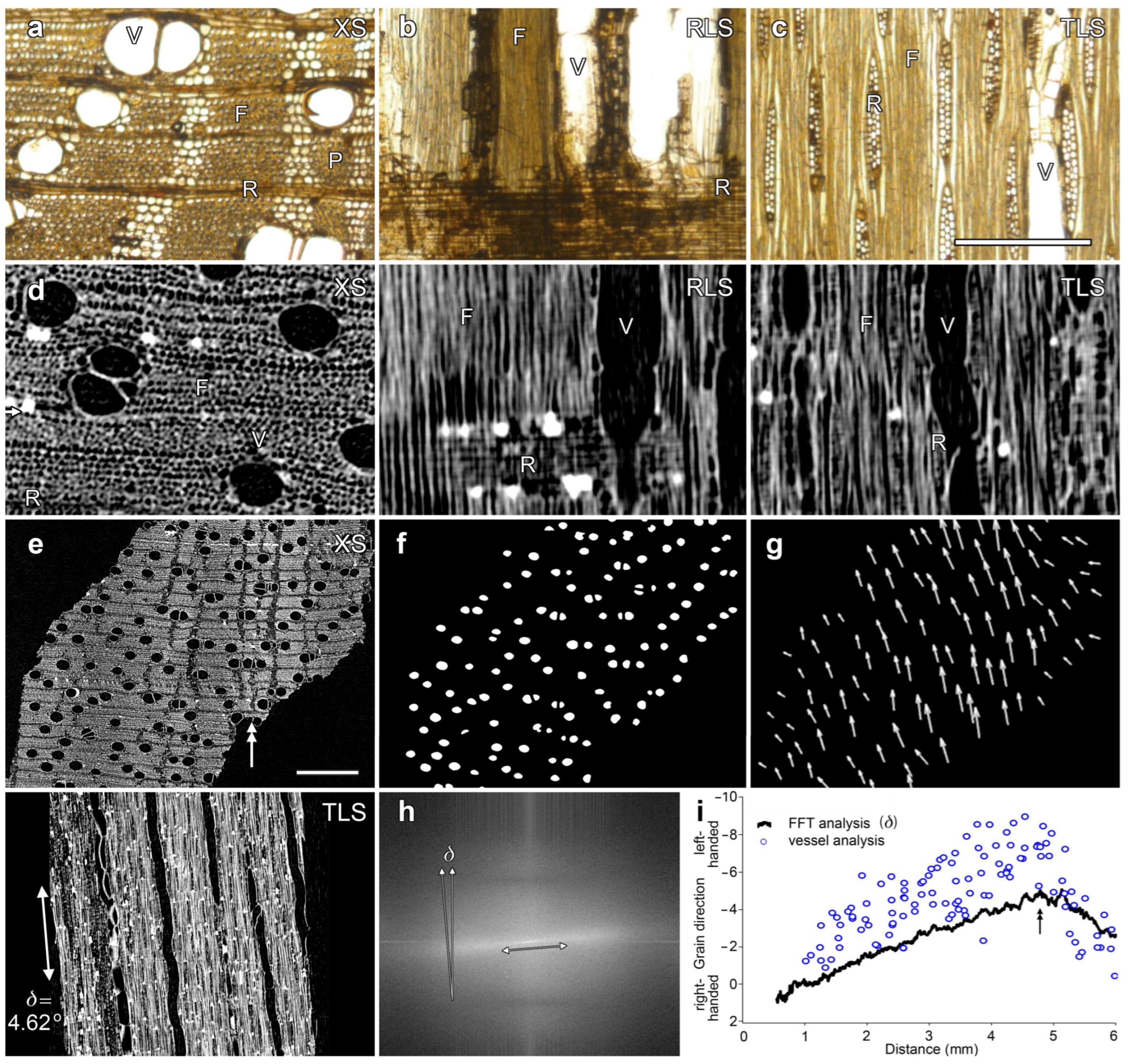
African mahogany (Khaya spp.) is a commercially valuable, tropical timber that commonly exhibits strong interlocked grain [11,83] with bands of fibers running at different angles giving rise to interesting optical properties that contribute to the timber’s value. In an attempt to understand the development of interlocked grain, Khaya samples were analyzed with µCT [32]. µCT images were observed in a single sample in three different planes (cross sections, XS; radial longitudinal sections, RLS; tangential longitudinal sections, TLS) using the reslice function in ImageJ (Figure 1d) and, with the exception of poorly defined parenchyma cells, were similar to light microscopy images of microtome sections separately cut in the three different planes (Figure 1a–c). Grain orientation in Khaya timber was quantified from µCT with two independent approaches. First, vessels identified in cross sections by image segmentation in ImageJ (Figure 1f) were strung together in 3D and their position and orientation measured. Second, TLS images showing fibers (Figure 1e) were directly analyzed in ImageJ using a fast Fourier transform (FFT) that produces a power spectrum (Figure 1h) whose skew provides a direct measure of grain. When compared, these two approaches showed different patterns: vessels ran at steeper angles than the fibers and the location at which the vessels’ re-orientation switched directions was displaced inwards compared to the fibers (Figure 1i). Based on these observations, a model for interlocked grain development was suggested in which an external signal controls both the reorientation of cambial initials and the patterning through which xylem vessels differentiate, with this explaining the differences in the vessel and fiber patterns within the timber [32]. Similar FFT analyses have also allowed quantification of interlocked grain in gray box (Eucalyptus bosistoana) [82] and demonstrated that the formation of compression wood in radiata pine (Pinus radiata) can inhibit the development of spiral grain [84]. µCT was also used to investigate interlocked grain in camphor laurel (Cinnamomum camphora). The FFT approach was compared with separate cell tracking measurements in which the displacement of cells was detected between adjacent reconstructed sections within a stack; there was good agreement between the two different grain measurement approaches. Moreover, camphor laurel is a temperate species with pronounced annual rings, unlike African mahogany, and systematic changes were detected in the grain pattern within rings [85]. These studies not only demonstrate the applicability of µCT for understanding grain but, more importantly, show the value of being able to quantify large areas of tissue, which overcomes the effects of local variability. These methods are not, however, suitable for the direct investigation of the vascular cambium. Current µCT methods for assessing grain have used air dried tissue to generate contrast within the samples, precluding observations and measurements on the vascular cambium that would not be preserved. New approaches will need to be developed for these more delicate tissues to be imaged.

5. New Approaches to µCT of Xylem and Cambial Development

If µCT were compared to light microscopy, then the application of heavy metal contrasting agents would be comparable to the application of colored stains which might (or might not) provide a degree of differential labeling within a sample. Such non-specific stains do not, however, compare with the large range of highly specific fluorescent dyes that are now available, nor with the use of antibodies and fluorescent protein fusions that have become fundamental to cell and molecular biology in recent decades. Can µCT contrasting agents be designed to label specific components of the plant cell or specific tissues within a plant, and might such methods be used to image the xylem and developing vascular cambium? In this section, we consider possible schemes through which targeted labeling for µCT might be achieved in plants. Several of these strategies are based on recent animal studies. We also provide some preliminary evidence for these approaches in plant samples.

5.1. Chemical Approaches

Traditional electron microscopy approaches to specific labeling provide a good starting point for developing novel µCT labeling approaches as methods that provide specific deposition of electron absorbent materials into thin sections might be adapted to give specific deposition of X-ray attenuating deposits in whole tissues.
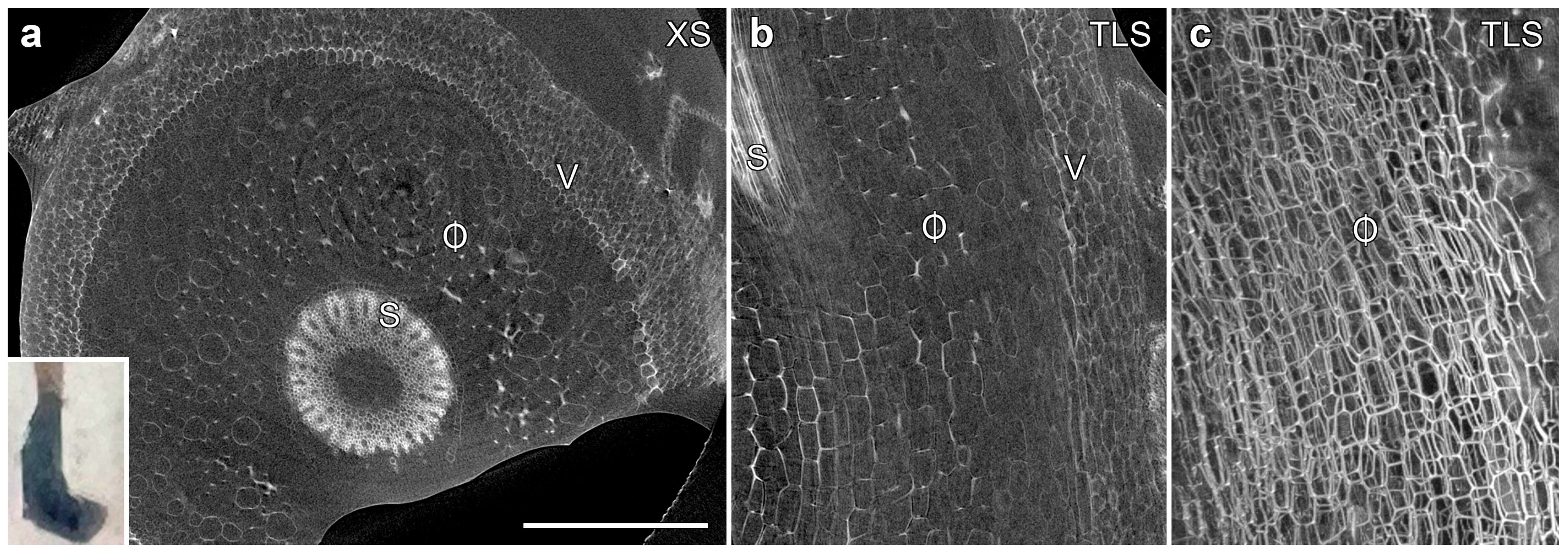
One possibility for specific labeling by µCT is the use of potassium permanganate to stain lignin. Used in transmission electron microscopy (TEM) as a lignin stain [86,87], the permanganate ion oxidizes lignin but is itself reduced to form an insoluble manganese dioxide. Permanganate has previously been used as a contrasting agent for imaging plant cell walls [38] but was not washed from the plant tissue, and secondary walls were not so clearly defined. Labeling in permanganate-infused tissue was also reported to be highly variable. While we have also noted variability in labeling, we successfully used permanganate to label lignified cell walls in various plant samples that have been fixed and cleared, including orchid roots (Figure 2). This approach may prove suitable for imaging various aspects of the xylem within plant tissues, and we are determining whether the method might be used for the detection of vascular bundle organization. However, the lack of lignification in the primary walls of cells in the vascular cambium means that different approaches will be needed for that tissue.
A second approach to specifically staining cell walls involves modifying the periodic acid–Schiff labeling of cellulose and other carbohydrates. In the Malaprade reaction, periodic acid oxidation of adjacent -OH groups in cellulose produces reactive, dialdehyde cellulose that was traditionally coupled to the magenta-colored dye pararosaniline [88]. This reaction is now being widely used in materials science in which derivatized cellulose forms for the base for further reactions [89,90], for fluorescence and confocal microscopy through the use of propidium iodide [91,92,93,94] and for super-resolution imaging with Atto-645 amine [95]. Several approaches might then be used to deposit metals at the locations of dialdehyde cellulose, with these again being based on pre-existing chemistries developed for TEM. Bismuth subnitrate, for example, forms an ammonia-based complex under alkaline conditions, and has been used to stain periodate-oxidized carbohydrates for electron microscopy [96]. Alternatively, osmium ammine, a complex of osmium with multiple ammonia groups, has been used in reactions with free aldehydes to generate labeling for TEM [97]. Similarly, silver proteinate has been used to stain oxidized carbohydrates for TEM [98], while ammoniacal silver, formed when silver nitrate reacts with ammonia, reacts with free aldehyde groups to deposit metallic silver on cellulose [99]. Thus, the use of periodic acid-oxidized cellulose might prove to be as useful for µCT as it has for fluorescence imaging.

5.2. Immunological Approaches

The development of immunofluorescence labeling proved to be a boon for cell biological research: is it possible to adapt immunolabeling for µCT? For this to occur, the problems of antibody penetration and heavy metal labeling would both need to be solved. For antibody penetration, the PeaClarity method for immunolabeling [100], an adaptation of the Clarity approach to immunolabeling animal tissue such as a whole mouse brain [101], may solve antibody penetration issues along with providing the necessary mechanical support for delicate samples. This original Clarity method involves fixing tissue in a combination of formaldehyde and acrylamide. Post-fixation, the acrylamide is then polymerized to form a rigid gel that supports the tissue during a subsequent clearing step. In PeaClarity, incubation with cell wall digesting enzymes allows the penetration of primary and secondary antibodies through the sample although a major limitation is that antibody incubation times, especially in difficult to digest samples, may be several months or more for each labeling step [102]. These methods have been developed specifically for fluorescent imaging of large tissue samples and have not yet been adapted for µCT.
The problem of metal labeling has several possible solutions. Several early immunolabeling studies of the cytoskeleton used silver-enhanced gold labeling to visualize microtubules as an alternative to fluorescence labeling [103,104], although these studies were conducted in systems in which antibodies had direct access, being cell wall-free. In mouse embryos, however, immunolabeling for µCT has been conducted using peroxidase-linked secondary antibodies that reduce silver ions to a metallic silver precipitate [105]. Gold enhancement of reduced silver has also been used for antibody-specific in situ hybridization and subsequent µCT imaging [106] (see Section 5.4).

5.3. Transgenic Approaches

Fluorescent proteins have revolutionized cell and molecular biology through their use as cell and promoter markers and in fluorescent fusion proteins. However, the deep location of the vascular cambium and the developing wood cells makes optical imaging of fluorescent fusion proteins in these cells problematic. Moreover, it is difficult to see ways in which the expression of fluorescent proteins might be visualized by µCT.
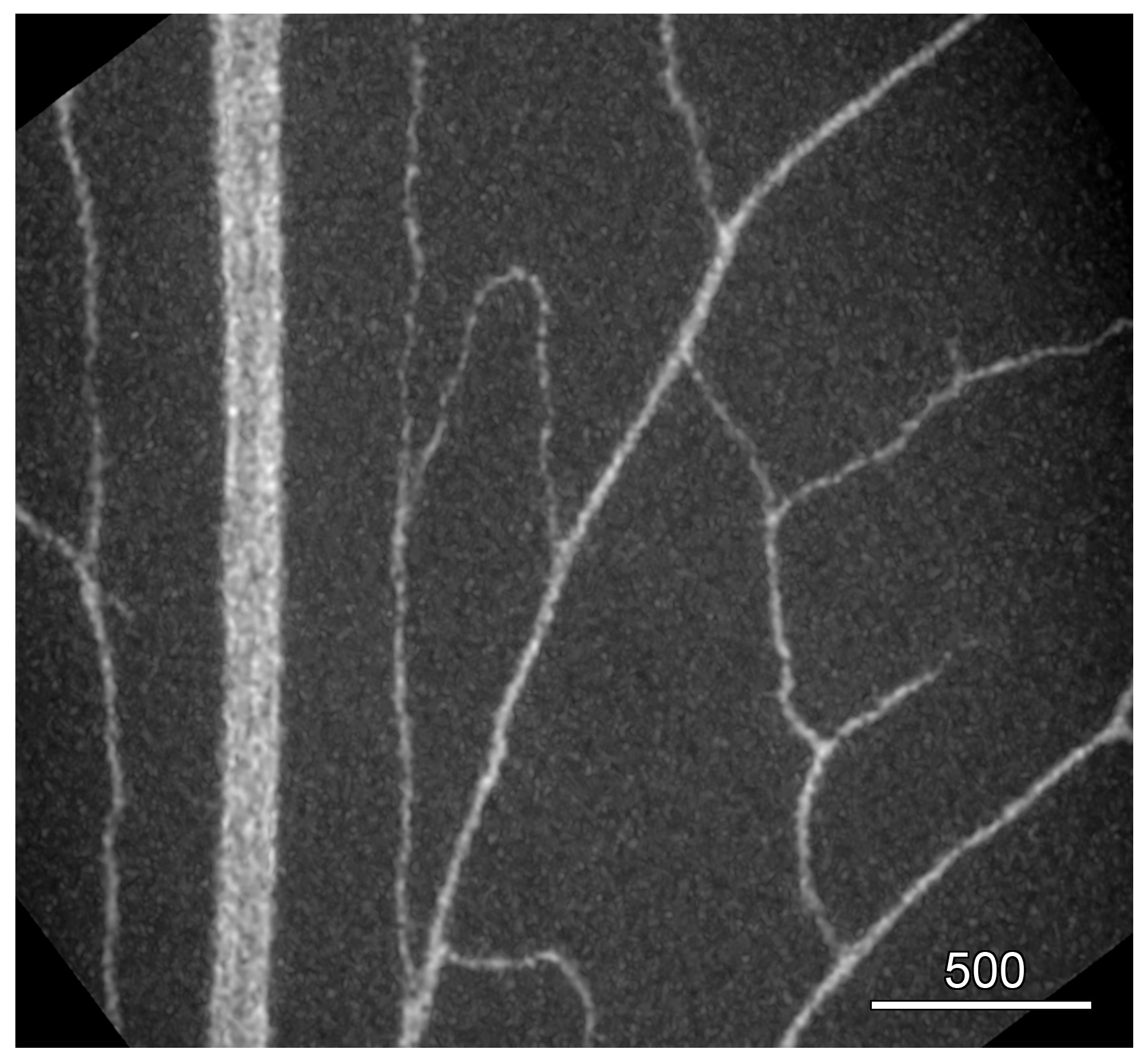
Other transgenic approaches are, however, more promising. The APEX2 (ascorbate peroxidase) expression system was developed for TEM and uses the ascorbate peroxidase enzyme, initially isolated from legumes, which is stable during fixation. This enzyme will catalyze a reaction in which soluble 3,3-diaminobenzidine (DAB) is converted into an insoluble polymer. The technique was developed for TEM, where the electron dense polymer localizes the expression of the APEX2 gene [107]. The technique has subsequently been developed for µCT where it allowed the localization of mammalian tissue culture cells [108]. One potential complication with using the APEX2 system in plants is that endogenous ascorbate peroxidases present in plants may confound the imaging system, although recent experimental evidence suggests that this might not always be a problem [109]. Traditionally, however, the most common system for assessing promoter activity in plants involves fusing promoters to the β-glucuronidase (GUS) gene, originally isolated from E. coli. As with APEX2, the expressed GUS enzyme remains stable through fixation and will cleave a glucuronic acid sugar residue from a colorless and soluble compound, X-Gluc, forming an insoluble blue precipitate marking the location of promoter activity. GUS localizations are typically assessed by light microscopy but the presence of two bromine atoms in each molecule of the blue precipitate means that the blue cells absorb more X-rays than the surrounding tissue and can be imaged by µCT. This can be demonstrated in an Arabidopsis leaf expressing a bundle sheath-targeted GUS construct stained with X-Gluc. While individual cells were not visible, the overall architecture of the vein system was visible and could be viewed in 3D (Figure 3). A similar µCT approach has also recently been reported for the analogous bromine-containing X-Gal stain with this used to track GAL (β-Galactosidase) enzyme activity in mouse brains [110]. Successfully adapting GUS for µCT imaging will, however, require the development of GUS substrates with stronger X-ray absorbances: the GAL substrate purple-β-D-Gal works in a similar manner to conventional GUS and GAL reporters but contains iodine instead of bromine and might prove slightly more suitable for µCT imaging. The GUS analog of this molecule does not seem to be commercially available, but iodine or metal-based stains might be developed that would allow for existing GUS-transformed lines to be used for µCT imaging. Were vascular cambium specific promoters, such as PtrSCZ1 found in Populus [111], used to drive GUS expression, the characterization of cambial dynamics might be visualized in 3D.

5.4. In Situ Hybridization Approaches

Väänänen and colleagues have modified conventional fluorescence in situ hybridization to work with µCT. Instead of detecting specific mRNA in mouse embryos using a fluorescently tagged antibody, they demonstrated that an HRP-tagged secondary antibody could reduce silver ions to silver metal, and that these deposits could form the nuclei for gold enhancement, generating a stain suitable for µCT [106].

6. Image Analysis and Machine Learning

Image segmentation is the process of dividing the pixels in each of the separate planes into regions or segments based on properties such as intensity or structure. This process was originally conducted manually when serial sections were aligned with, for example, the xylem strands of wheat being identified and 3D models generated [15]. However, image analysis software automates the process which is essential not only for reproducible image quantification but required for massive data sets produced by µCT. The latest Skyscan system, for example, generates 16-bit images that are 2992 by 2992 pixels, meaning that each image is about 17 MB. When a full data set comprises as many as 3600 sections, this means that the reconstructed data set is over 60 GB in size. Processing even subsets of the image data requires one of the numerous image analysis programs that are available: there are numerous commercial packages, as well two widely used freeware packages, ImageJ [112] and Drishti [113].
Like all quantitative analyses of microscopic data, the analysis of µCT images requires accurate and reproducible image segmentation in which pixels, for 2D images, and voxels for 3D data sets as found in µCT, are allocated to different classes or segments within the images. This is a non-trivial process: manual segmentation of images is time-consuming, can be inconsistent, and is subjective with the possibility of user bias. Automated segmentation overcomes the problem of user bias but faces the problem of pattern recognition. While the brain and eye can often distinguish patterns and groupings, having a computer program reproduce this segmentation has often proven to be difficult. Machine learning promises to overcome some of these difficulties. There are numerous recent reviews on the applications of machine learning to automated image segmentation [114,115] including reviews specifically related to µCT imaging [27,116].
Machine learning can be defined as algorithms that enable computers to learn from data, often through an initial, labeled training data set in supervised learning, but also through unlabeled data in unsupervised learning. This learning then allows automated recognition of patterns and objects in larger, previously unseen data sets. Major machine learning technologies utilized include both traditional machine learning algorithms, such as k-nearest neighbors, linear discriminant analysis, and support vector machine, and deep learning algorithms, such as multilayer perceptron and artificial neural networks. Deep learning algorithms automatically extract features, but they require a large amount of data for training. Traditional machine learning algorithms require manual feature engineering and are often more efficient on small data sets. Therefore, the use of the traditional machine learning algorithms is also being pursued in combination with improvements in feature extraction methods [117,118]. In the context of utilizing traditional machine learning algorithms, a convenient approach is to use Fiji (ImageJ) which contains the plugin Weka (Waikato Environment for Knowledge Analysis) and its plugin called Trainable Weka Segmentation [119]. Weka is a GUI-based open-source software providing a machine learning algorithm developed by the University of Waikato [120]. Users can perform pixel classification for semantic segmentation using the Fast Random Forest classifier, without needing any programming skills. Weka provides an accessible entry point for beginners in machine learning, offering efficient learning with limited training data and applicability to 3D µCT data sets [44].
To achieve higher segmentation performance, deep learning algorithms such as convolutional neural networks (CNNs) can be used. However, training CNNs on µCT data sets typically requires a GPU-equipped computer with substantial memory capacity. Because CNNs are a powerful classifier for pixel-wise segmentation tasks, they have attracted considerable attention for image segmentation. Although CNNs require large amounts of training data and computational resources, they can automatically extract useful features from images and capture spatial structures like positional relationships and patterns. In a CT segmentation study to identify internal wood defects, Xie and colleagues trained five different CNN models (U-Net, DeeplabV3+, PSPNet, HRNet, YOLOv8-seg) using 512 × 512 pixel CT slices collected at a resolution of about 0.6 mm through poplar and Korean pine. Using a Dell Precision 7750 mobile workstation running Python 3.8, although without specifying GPU usage, training used 300 training iterations per data set. Their study suggested that for their system, the YOLOv8-seg model provided the most accurate segmentation [72]. CNNs can understand complex structures that are difficult for traditional machine learning algorithms, resulting in higher prediction performance in visual tasks such as image recognition and segmentation.
Morphological analyses of wood tissue images utilizing machine learning have been conducted for various wood science-related studies. The detection of wood defects is important for both industrial and research purposes. Although routine industrial quality control typically relies on faster, lower-cost methods, µCT can be used in research and in specialized high-value applications. Because identifying internal flaws requires three-dimensional assessment, X-ray computed tomography is often employed to meet this need [121]. The effective voxel size of μCT is typically ≤50 μm under a narrower definition, or ranges from 5 to 150 μm under a broader definition. However, for both tree ring analysis and wood defect detection, the sample size is often relatively large, requiring imaging over a wide area of tissue. Consequently, a very high resolution is generally unnecessary, and μCT is not typically employed for these purposes [26]. Because this review specifically addresses µCT, we note that a relatively high-resolution analysis at μCT resolution, with a pixel size of 27–44 μm, has resolved all rings down to the smallest width of 0.12 mm and that the 3D volume enabled the recovery of additional rings from the samples compared to conventional microscopy [71]. There are other examples of imaging at a relatively high resolution with voxel sizes of 110 µm [69] and 139 μm [70] which fall within the broader definition of μCT. In these studies, basic image processing, such as several types of filters [69,121] or edge detecting algorithms [70,122], were applied for the automatic detection of tree ring boundaries. A rule-based algorithm for detecting the pith as a reference point in tree ring analysis using X-ray CT data was developed and implemented as a plugin for ImageJ software [123].
In machine learning applications, differences in resolution are generally irrelevant; therefore, analyses using low-resolution μCT data can provide useful insights when applying machine learning methods to μCT data. In tree ring analysis using μCT, however, applications of machine learning appear to be absent so far. On the other hand, when broadening the scope beyond μCT to encompass other approaches to the image analysis of wood tissue, such as 2D color imaging, the frequent need to process large numbers of samples, including quality control, has driven the adoption of machine vision technology and machine learning-based image processing is increasingly being applied. Earlier studies are summarized by Yadav et al. [124]. Studies for wood defect detection are summarized by Chen et al. [121]. In wood defect detection using µCT, CNNs have begun to be employed. The YOLOv8-seg model demonstrated superior detection and segmentation performance in the identification of common internal wood defects such as knots, decay and hollows. While the study only used 2D CNN models, the utilization of 3D CNN models is anticipated to further improve detection [72]. Weka-based machine learning approaches to the segmentation of µCT data were also used to identify xylem in grape grafts (see Section 3.4) [66]. Investigations of embolisms in the xylem of ash have also been aided by machine learning and, in particular, the attempt to link embolism formation with acoustic signals from the samples [54].

7. Conclusions

Light microscopy remains fundamental for investigations of the structure of wood and the development of the vascular cambium and xylem, but we envisage that µCT will play an increasingly complementary role in understanding these developmental processes. The primary advantages of µCT are that X-rays readily penetrate through plant tissues, unaffected by the processes that limit light-based imaging such as refraction, scattering and absorbance, meaning that non-destructive, 3D imaging of larger samples is possible and that traditional, destructive sectioning can be avoided. However, the low levels of X-ray attenuation in plant tissues typically require the use of contrast enhancement for imaging, leading to the major disadvantage of current µCT protocols: unlike light-based imaging, these contrast enhancement techniques are non-specific. As we have discussed in this review, however, recent developments, particularly in animal and medical sciences, suggest that many of these limitations can be overcome. When coupled with machine-based learning to process the large data sets generated by µCT, we envisage that when coupled with the recent advances in molecular genetics of the vascular cambium [4,5,6], the development of these new techniques will lead to discoveries concerning our understanding of cambial and xylem development. Thus, we strongly encourage plant scientists to investigate the use of µCT for their experimental systems.

Author Contributions

Conceptualization, D.A.C. and I.K.; methodology, D.A.C. and I.K.; software, D.A.C. and I.K.; validation, D.A.C. and I.K.; formal analysis, D.A.C. and I.K.; investigation, D.A.C. and I.K.; resources, D.A.C. and I.K.; data curation, D.A.C. and I.K.; writing—original draft preparation, D.A.C. and I.K.; writing—review and editing, D.A.C. and I.K.; visualization, D.A.C. and I.K.; supervision, D.A.C. and I.K.; project administration, D.A.C. and I.K.; funding acquisition, D.A.C. and I.K. All authors have read and agreed to the published version of the manuscript.

Funding

Research in DAC’s group has been funded by the Hermon Slade Foundation (HSF24008) while research in IK’s group has been funded by JSPS KAKENHI grants (numbers 24K09514 and 23K17399). DAC’s research at Toyama University was facilitated by a JSPS Bridge Fellowship (BR241802).

Data Availability Statement

The raw data supporting the unpublished experiments discussed in this review will be made available by the corresponding author on request.

Acknowledgments

DAC thanks Chris Baros and Martha Ludwig for supplying the GUS-stained Arabidopsis thaliana leaf. IK’s synchrotron radiation experiments were performed at the BL20B2 of SPring-8 with the approval of the JASRI (proposal numbers 2022B1143, 2024B1190).

Conflicts of Interest

The authors declare no conflicts of interest.

Abbreviations

The following abbreviations are used in this manuscript:
2DTwo-dimensional
3DThree-dimensional
CATComputer assisted tomography
CNNConvolutional neural network
DECTDual energy CT imaging
FFTFast Fourier transform
GALβ-Galactosidase
GUSβ-Glucuronidase
MRIMagnetic resonance imaging
SBEMSerial block face electron microscopy
TEMTransmission electron microscopy
µCTX-ray microtomography
WekaWaikato environment for knowledge analysis

References

  1. Esau, K. Anatomy of Seed Plants; Wiley: New York, NY, USA, 1960. [Google Scholar]
  2. Larson, P.R. The Vascular Cambium. Development and Structure; Springer: Berlin, Germany, 1994. [Google Scholar]
  3. Spicer, R.; Groover, A. Evolution of development of vascular cambia and secondary growth. New Phytol. 2010, 186, 577–592. [Google Scholar] [CrossRef]
  4. Ragni, L.; Greb, T. Secondary growth as a determinant of plant shape and form. Semin. Cell Dev. Biol. 2018, 79, 58–67. [Google Scholar] [CrossRef] [PubMed]
  5. Fischer, U.; Kucukoglu, M.; Helariutta, Y.; Bhalerao, R.P. The dynamics of cambial stem cell activity. Annu. Rev. Plant Biol. 2019, 70, 293–319. [Google Scholar] [CrossRef] [PubMed]
  6. Wybouw, B.; Zhang, X.; Mähönen, A.P. Vascular cambium stem cells: Past, present and future. New Phytol. 2024, 243, 851–865. [Google Scholar] [CrossRef] [PubMed]
  7. Kojs, P.; Miodek, A.; Miodek, A.P.; Włoch, W. Vascular cambium—Between the hammer and the anvil: A tensile stress hypothesis on the mechanism of radial growth of broadleaved trees. Forests 2023, 14, 823. [Google Scholar] [CrossRef]
  8. Lev-Yadun, S. Intrusive growth—The plant analog to dendrite and axon growth in animals. New Phytol. 2001, 150, 508–512. [Google Scholar] [CrossRef]
  9. Włoch, W.; Jura-Morawiec, J.; Kojs, P.; Iqbal, M.; Krawczyszyn, J. Does intrusive growth of fusiform initials really contribute to circumferential growth of vascular cambium? Botany 2009, 87, 154–163. [Google Scholar] [CrossRef]
  10. Rathgeber, C.B.K.; Cuny, H.E.; Fonti, P. Biological basis of tree-ring formation: A crash course. Front. Plant Sci. 2016, 7, 734. [Google Scholar] [CrossRef]
  11. Harris, J.M. Spiral Grain and Wave Phenomena in Wood Formation; Springer: Berlin, Germany, 1989. [Google Scholar]
  12. Kitin, P.; Funada, R.; Sano, Y.; Ohtani, J. Analysis by confocal microscopy of the structure of cambium in the hardwood Kalopanax pictus. Ann. Bot. 2000, 86, 1109–1117. [Google Scholar] [CrossRef]
  13. Zimmermann, M.H.; Tomlinson, P.B. Analysis of complex vascular systems in plants: Optical shuttle method. Science 1966, 152, 72–73. [Google Scholar] [CrossRef]
  14. Zimmermann, M.H.; Tomlinson, P.B. Vascular construction and development in the aerial stem of Prionium (Juncaceae). Am. J. Bot. 1968, 55, 1100–1109. [Google Scholar] [CrossRef]
  15. Wu, H.; Jaeger, M.; Wang, M.; Li, B.; Zhang, B.G. Three-dimensional distribution of vessels, passage cells and lateral roots along the root axis of winter wheat (Triticum aestivum). Ann. Bot. 2011, 107, 843–853. [Google Scholar] [CrossRef] [PubMed]
  16. Cunha Neto, I.L.; Hall, B.T.; Lanba, A.R.; Blosenski, J.D.; Onyenedum, J.G. Laser ablation tomography (LATscan) as a new tool for anatomical studies of woody plants. New Phytol. 2023, 239, 429–444. [Google Scholar] [CrossRef] [PubMed]
  17. Antreich, S.J.; Huss, J.C.; Xiao, N.; Singh, A.; Gierlinger, N. The walnut shell network: 3D visualisation of symplastic and apoplastic transport routes in sclerenchyma tissue. Planta 2022, 256, 49. [Google Scholar] [CrossRef]
  18. Dingemans, L.M.; Liu, P.; Papadakis, V.; Groves, R.M.; Adam, A.J.L. Optical coherence microscopy for analysis of coatings on wood. In Proceedings of the Photomechanics 2015 Conference; Groves, R., Huntley, J., Bhattacharya, N., Eds.; Delft University of Technology: Delft, The Netherlands, 2015; pp. 112–115. [Google Scholar]
  19. Hall, L.D.; Rajanayagam, V.; Stewart, P.R.; Steiner, P.R. Magnetic resonance imaging of wood. Can. J. For. Res. 1986, 16, 423–426. [Google Scholar] [CrossRef]
  20. Capuani, S.; Stagno, V.; Missori, M.; Sadori, L.; Longo, S. High-resolution multiparametric MRI of contemporary and waterlogged archaeological wood. Magn. Reason. Chem. 2020, 58, 860–869. [Google Scholar] [CrossRef]
  21. Longo, S.; Egizi, F.; Stagno, V.; Di Trani, M.G.; Marchelletta, G.; Gili, T.; Fazio, E.; Favero, G.; Capuani, S. A multi-parametric investigation on waterlogged wood using a magnetic resonance imaging clinical scanner. Forests 2023, 14, 276. [Google Scholar] [CrossRef]
  22. Stagno, V.; Moricca, C.; Sadori, L.; Dell’Aglio, E.; Reale, R.; Capuani, S. Evaluation of the efficacy of micro-magnetic resonance imaging compared with light microscopy to investigate the anatomy of modern and ancient waterlogged wood. Magn. Reson. Imaging 2023, 102, 164–178. [Google Scholar] [CrossRef]
  23. Stuppy, W.H.; Maisano, J.A.; Colbert, M.W.; Rudall, P.J.; Rowe, T.B. Three-dimensional analysis of plant structure using high-resolution X-ray computed tomography. Trends Plant Sci. 2003, 8, 2–6. [Google Scholar] [CrossRef]
  24. Dhondt, S.; Vanhaeren, H.; Van Loo, D.; Cnudde, V.; Inzé, D. Plant structure visualization by high-resolution X-ray computed tomography. Trends Plant Sci. 2010, 15, 419–422. [Google Scholar] [CrossRef]
  25. Brodersen, C.R. Visualizing wood anatomy in three dimensions with high-resolution X-ray micro-tomography (MCT)—A review. IAWA J. 2013, 34, 408–424. [Google Scholar] [CrossRef]
  26. Beaulieu, J.; Dutilleul, P. Applications of computed tomography (CT) scanning technology in forest research: A timely update and review. Can. J. For. Res. 2019, 49, 1173–1188. [Google Scholar] [CrossRef]
  27. Piovesan, A.; Vancauwenberghe, V.; Van De Looverbosch, T.; Verboven, P.; Nicolaï, B. X-ray computed tomography for 3D plant imaging. Trends Plant Sci. 2021, 26, 1171–1185. [Google Scholar] [CrossRef] [PubMed]
  28. Karahara, I.; Yamauchi, D.; Uesugi, K.; Mineyuki, Y. Three-dimensional visualization of plant tissues and organs by X-ray micro-computed tomography. Microscopy 2023, 72, 310–325. [Google Scholar] [CrossRef] [PubMed]
  29. Seibert, J.A.; Boone, J.M. X-ray imaging physics for nuclear medicine technologists. Part 2: X-ray interactions and image formation. J. Nucl. Med. Technol. 2005, 33, 3–18. [Google Scholar] [PubMed]
  30. Steppe, K.; Cnudde, V.; Girard, C.; Lemeur, R.; Cnudde, J.-P.; Patric Jacobs, P. Use of X-ray computed microtomography for non-invasive determination of wood anatomical characteristics. J. Struct. Biol. 2004, 148, 11–21. [Google Scholar] [CrossRef]
  31. Mayo, S.C.; Chen, F.; Evans, R. Micron-scale 3D imaging of wood and plant microstructure using high-resolution X-ray phase-contrast microtomography. J. Struct. Biol. 2010, 171, 182–188. [Google Scholar] [CrossRef]
  32. Collings, D.A.; Thomas, J.; Dijkstra, S.M.; Harrington, J.J. The formation of interlocked grain in African mahogany (Khaya spp.) analysed by X-ray computed microtomography. Tree Physiol. 2021, 41, 1542–1557. [Google Scholar] [CrossRef]
  33. Brodersen, C.R.; McElrone, A.J.; Choat, B.; Matthew, M.A.; Shackel, K.A. The dynamics of embolism repair in xylem: In vivo visualizations using high-resolution computed tomography. Plant Physiol. 2010, 154, 1088–1095. [Google Scholar] [CrossRef]
  34. Cochard, H.; Delzon, S.; Badel, E. X-ray microtomography (micro-CT): A reference technology for high-resolution quantification of xylem embolism in trees. Plant Cell Environ. 2015, 38, 201–206. [Google Scholar] [CrossRef]
  35. Choat, B.; Badel, E.; Burlett, R.; Delzon, S.; Cochard, H.; Jansen, S. Noninvasive measurement of vulnerability to drought-induced embolism by X-ray microtomography. Plant Physiol. 2016, 170, 273–282. [Google Scholar] [CrossRef] [PubMed]
  36. Lusic, H.; Grinstaff, M.W. X-ray-computed tomography contrast agents. Chem. Rev. 2013, 113, 1641−1666. [Google Scholar] [CrossRef] [PubMed]
  37. Pauwels, E.; Van Loo, D.; Cornillie, P.; Brabant, L.; Van Hoorebeke, L. An exploratory study of contrast agents for soft tissue visualization by means of high resolution X-ray computed tomography imaging. J. Microsc. 2013, 250, 21–31. [Google Scholar] [CrossRef]
  38. Staedler, Y.M.; Masson, M.; Schönenberger, J. Plant tissues in 3D via X-ray tomography: Simple contrasting methods allow high resolution imaging. PLoS ONE 2013, 8, e75295. [Google Scholar] [CrossRef] [PubMed]
  39. Duncan, K.E.; Czymmek, K.J.; Jiang, N.; Thies, A.C.; Topp, C.N. X-ray microscopy enables multiscale high-resolution 3D imaging of plant cells, tissues, and organs. Plant Physiol. 2022, 188, 831–845. [Google Scholar] [CrossRef]
  40. Elliott, J.C.; Dover, S.D. X-ray microtomography. J. Microsc. 1982, 126, 211–213. [Google Scholar] [CrossRef]
  41. Flannery, B.P.; Deckman, H.W.; Roberge, W.G.; D’Amico, K.L. Three-dimensional X-ray microtomography. Science 1987, 237, 1439–1444. [Google Scholar] [CrossRef]
  42. Martinez-Garcia, J.; Guarda, D.; Gwerder, D.; Fenk, B.; Ravotti, R.; Mancin, S.; Stamatiou, A.; Worlitschek, J.; Fischer, L.J.; Schuetz, P. Applications of X-ray computed tomography technology to solid–liquid phase change materials—A review. Energies 2025, 18, 4704. [Google Scholar] [CrossRef]
  43. Mayo, S.C.; Davis, T.J.; Gureyev, T.E.; Miller, P.R.; Paganin, D.; Pogany, A.; Stevenson, A.W.; Wilkins, S.W. X-ray phase-contrast microscopy and microtomography. Opt. Express 2003, 11, 2289–2302. [Google Scholar] [CrossRef]
  44. Karahara, I.; Umemura, K.; Soga, Y.; Akai, Y.; Bando, T.; Ito, Y.; Tamaoki, D.; Uesugi, K.; Abe, J.; Yamauchi, D.; et al. Demonstration of osmotically dependent promotion of aerenchyma formation at different levels in the primary roots of rice using a ‘sandwich’ method and X-ray computed tomography. Ann. Bot. 2012, 110, 503–509. [Google Scholar] [CrossRef]
  45. Yamaura, R.; Tamaoki, D.; Kamachi, H.; Yamauchi, D.; Mineyuki, Y.; Uesugi, K.; Hoshino, M.; Suzuki, T.; Shimazu, T.; Kasahara, H.; et al. Three-dimensionally visualized rhizoid system of moss, Physcomitrium patens, by refraction-contrast X-ray micro-computed tomography. Microscopy 2022, 71, 364–373. [Google Scholar] [CrossRef]
  46. García-Figueiras, R.; Oleaga, L.; Broncano, J.; Tardáguila, G.; Fernández-Pérez, G.; Vañó, E.; Santos-Armentia, E.; Méndez, R.; Luna, A.; Baleato-González, S. What to expect (and what not) from dual-energy CT imaging now and in the future? J. Imaging 2024, 10, 154. [Google Scholar] [CrossRef] [PubMed]
  47. Hawkes, P.W. The electron microscope as a structure projector. In Electron Tomography; Frank, J., Ed.; Springer: New York, NY, USA, 2007; pp. 83–111. [Google Scholar] [CrossRef]
  48. Penczek, P.A. Fundamentals of three-dimensional reconstruction from projections. Meth. Enzymol. 2010, 482, 1–33. [Google Scholar] [CrossRef]
  49. Mooney, S.J.; Pridmore, T.P.; Helliwell, J.; Bennet, M.J. Developing X-ray computed tomography to non-invasively image 3-D root systems architecture in soil. Plant Soil 2012, 352, 1–22. [Google Scholar] [CrossRef]
  50. Trtik, P.; Dual, J.; Keunecke, D.; Mannes, D.; Niemz, P.; Stähli, P.; Kaestner, A.; Groso, A.; Stampanoni, M. 3D imaging of microstructure of spruce wood. J. Struct. Biol. 2007, 159, 46–55. [Google Scholar] [CrossRef]
  51. Fuhr, M.J.; Stührk, C.; Münch, B.; Schwarze, F.W.M.R.; Schubert, M. Automated quantification of the impact of the wood-decay fungus Physisporinus vitreus on the cell wall structure of Norway spruce by tomographic microscopy. Wood Sci. Technol. 2012, 46, 769–779. [Google Scholar] [CrossRef]
  52. Brodersen, C.R.; Lee, E.F.; Choat, B.; Jansen, S.; Phillips, R.J.; Shackel, K.A.; McElrone, A.J.; Matthews, M.A. Automated analysis of three-dimensional xylem networks using high-resolution computed tomography. New Phytol. 2011, 191, 1168–1179. [Google Scholar] [CrossRef]
  53. Suuronen, J.P.; Peura, M.; Fagerstedt, K.; Serimaa, R. Visualizing water-filled versus embolized status of xylem conduits by desktop x-ray microtomography. Plant Meth. 2013, 9, 11. [Google Scholar] [CrossRef]
  54. De Baerdemaeker, N.J.F.; Stock, M.; Van den Bulcke, J.; De Baets, B.; Van Hoorebeke, L.; Steppe, K. X-ray microtomography and linear discriminant analysis enable detection of embolism-related acoustic emissions. Plant Meth. 2019, 15, 153. [Google Scholar] [CrossRef]
  55. Schreel, J.D.M.; Brodersen, C.; De Schryver, T.; Dierick, M.; Rubinstein, A.; Dewettinck, K.; Boone, M.N.; Van Hoorebeke, L.; Steppe, K. Foliar water uptake does not contribute to embolism repair in beech (Fagus sylvatica L.). Ann. Bot. 2022, 129, 555–566. [Google Scholar] [CrossRef]
  56. Brereton, N.J.B.; Ahmed, F.; Sykes, D.; Ray, M.J.; Shield, I.; Karp, A.; Murphy, R.J. X-ray micro-computed tomography in willow reveals tissue patterning of reaction wood and delay in programmed cell death. BMC Plant Biol. 2015, 15, 83. [Google Scholar] [CrossRef] [PubMed]
  57. Laubengayer, R.A. The vascular anatomy of the eight-rowed ear and tassel of Golden Bantam sweet corn. Am. J. Bot. 1949, 36, 236–244. [Google Scholar] [CrossRef]
  58. Wang, Y.; Zhang, Y.; Huang, G.; Wang, J.; Lv, L.; Zhao, S.; Lu, X.; Zhang, M.; Guo, M.; Zhang, C.; et al. Association analysis of maize stem vascular bundle micro-characteristics with yield components based on micro-CT and identification of related genes. Sci. Rep. 2025, 15, 13009. [Google Scholar] [CrossRef] [PubMed]
  59. Esau, K. Ontogeny of the vascular bundle in Zea mays. Hilgardia 1943, 15, 327–368. [Google Scholar] [CrossRef]
  60. Ahmad, Z.; Kumari, R.; Mir, B.; Saeed, T.; Firdaus, F.; Vijayakanth, V.; Keerthana, K.; Ramakrishnan, M.; Wei, Q. Bamboo for the future: From traditional use to industry 5.0 applications. Plants 2025, 14, 3019. [Google Scholar] [CrossRef]
  61. Ding, Y.L.; Liese, W. On the nodal structure of bamboo. J. Bamboo Res. 1995, 14, 24–32. [Google Scholar]
  62. Peng, G.; Jiang, Z.; Liu, X.; Fei, B.; Yang, S.; Qin, D.; Ren, H.; Yu, Y.; Xie, H. Detection of complex vascular system in bamboo node by X-ray μCT imaging technique. Holzforschung 2014, 68, 223–227. [Google Scholar] [CrossRef]
  63. Palombini, F.L.; Nogueira, F.M.; Kindlein, W.; Paciornik, S.; de Araujo Mariath, J.E.; de Oliveira, B.F. Biomimetic systems and design in the 3D characterization of the complex vascular system of bamboo node based on X-ray microtomography and finite element analysis. J. Mat. Res. 2020, 35, 842–854. [Google Scholar] [CrossRef]
  64. Xiang, E.; Yang, S.; Cao, C.; Liu, X.; Peng, G.; Shang, L.; Tian, G.; Ma, Q.; Ma, J. Visualizing complex anatomical structure in bamboo nodes based on X-ray microtomography. J. Renew. Mater. 2021, 9, 1531–1540. [Google Scholar] [CrossRef]
  65. Milien, M.; Renault-Spilmont, A.-S.; Cookson, S.J.; Sarrazin, A.; Verdeil, J.-L. Visualization of the 3D structure of the graft union of grapevine using X-ray tomography. Sci. Hort. 2012, 122, 130–140. [Google Scholar] [CrossRef]
  66. Camboué, M.; Janoueix, A.; Tandonnet, J.P.; Spilmont, A.S.; Moisy, C.; Mathieu, G.; Cordelières, F.; Teillon, J.; Santesteban, L.G.; Ollat, N.; et al. Phenotyping xylem connections in grafted plants using X-ray micro-computed tomography. Plant Cell Environ. 2024, 47, 2351–2361. [Google Scholar] [CrossRef] [PubMed]
  67. De Mil, T.; Vannoppen, A.; Beeckman, H.; Van Acker, J.; Van den Bulcke, J. A field-to-desktop toolchain for X-ray CT densitometry enables tree ring analysis. Ann. Bot. 2016, 117, 1187–1196. [Google Scholar] [CrossRef] [PubMed]
  68. Martinez-Garcia, J.; Stelzner, I.; Stelzner, J.; Gwerder, D.; Schuetz, P. Automated 3D tree-ring detection and measurement from X-ray computed tomography. Dendrochronologia 2021, 69, 125877. [Google Scholar] [CrossRef]
  69. Stelzner, J.; Million, S.; Stelzner, I.; Martinez-Garcia, J.; Gwerder, D.; Nelle, O.; Schuetz, P. Non-destructive dendrochronology with X-ray computed tomography: The influence of different conservation methods for waterlogged archaeological wood. Dendrochronologia 2023, 78, 126065. [Google Scholar] [CrossRef]
  70. Martinez-Garcia, J.; Stelzner, I.; Stelzner, J.; Gwerder, D.; Million, S.; Nelle, O.; Schuetz, P. Curvilinear-tree-ring measurements in archaeological wood samples from X-ray computed tomography. Dendrochronologia 2022, 76, 126002. [Google Scholar] [CrossRef]
  71. Chen, S.; Shiina, R.; Nakai, K.; Awano, T.; Yoshinaga, A.; Sugiyama, J. Potential of machine learning approaches for predicting mechanical properties of spruce wood in the transverse direction. J. Wood Sci. 2023, 69, 22. [Google Scholar] [CrossRef]
  72. Xie, G.; Wang, L.; Williams, R.A.; Li, Y.; Zhang, P.; Gu, S. Segmentation of wood CT images for internal defects detection based on CNN: A comparative study. Comput. Electron. Agric. 2024, 224, 109244. [Google Scholar] [CrossRef]
  73. Dierickx, S.; Genbrugge, S.; Beeckman, H.; Hubau, W.; Kibleur, P.; Van den Bulcke, J. Non-destructive wood identification using X-ray µCT scanning: Which resolution do we need? Plant Meth. 2024, 24, 98. [Google Scholar] [CrossRef]
  74. Haag, V.; Dremel, K.; Zabler, S. Volumetric imaging by micro computed tomography: A suitable tool for wood identification of charcoal. IAWA J. 2022, 44, 210–224. [Google Scholar] [CrossRef]
  75. Koddenberg, T. A new dimension in wood anatomy education: Exploring softwood and hardwood structures in 3D. Eur. J. Wood Wood Prod. 2025, 83, 201. [Google Scholar] [CrossRef]
  76. Kubler, H. Function of spiral grain in trees. Trees 1991, 5, 125–135. [Google Scholar] [CrossRef]
  77. Thinley, C.; Palmer, G.; Vanclay, J.K.; Henson, M. Spiral and interlocking grain in Eucalyptus dunnii. Hols Roh-Werkst. 2005, 63, 372–379. [Google Scholar] [CrossRef]
  78. Bossu, J.; Lehnebach, R.; Corn, S.; Regazzi, A.; Beauchene, J.; Clair, B. Interlocked grain and density patterns in Bagassa guianensis: Changes with ontogeny and mechanical consequences for trees. Trees 2018, 32, 1643–1655. [Google Scholar] [CrossRef]
  79. Costa e Silva, J.; Borralho, M.G.; Wellendorf, H. Genetic parameter estimates for diameter growth, pilodyn penetration and spiral grain in Picea abies (L.) Karst. Silvae Genet. 2000, 49, 29–36. [Google Scholar]
  80. Gapare, W.; Hathorn, W.; Kain, D.; Mathseon, C.; Wu, H. Inheritance of spiral grain in the juvenile core of Pinus radiata. Can. J. For. Res. 2007, 37, 116–127. [Google Scholar] [CrossRef]
  81. Ishiguri, F.; Diloksumpun, S.; Tanabe, J.; Ohshima, J.; Iizuka, K.; Yokota, S. Among-family variations of solid wood properties in 4-year-old Eucalyptus camaldulensis trees selected for pulpwood production in Thailand. Int. Wood Prod. J. 2017, 8, 36–40. [Google Scholar] [CrossRef]
  82. Sharma, M.; Dijkstra, S.M.; Garrill, A.; Collings, D.A.; Altaner, C.M. Assessing wood grain and twist in a 2-year-old Eucalyptus bosistoana breeding population. Trees 2024, 38, 1481–1489. [Google Scholar] [CrossRef]
  83. Tulik, M.; Kłosińska, T.; Iqbal, M.; Grochowsina, A. Figures of the wood of Khaya ivorensis and Millettia laurentii. Wood Res. 2011, 56, 613–620. [Google Scholar]
  84. Thomas, J.; Dijkstra, S.M.; Harrington, J.J.; Collings, D.A. Induction of compression wood inhibits development of spiral grain in radiata pine. IAWA J. 2022, 44, 36–62. [Google Scholar] [CrossRef]
  85. Cipta, H.; Kobayashi, K.; Chen, S.; Sugiyama, J. Examination of Cinnamomum camphora interlocked grain adopting X-ray computed tomography combined with particle image velocimetry. J. Wood Sci. 2022, 68, 56. [Google Scholar] [CrossRef]
  86. Hepler, P.K.; Fosket, D.E.; Newcomb, E.H. Lignification during secondary wall formation in Coleus: An electron microscopic study. Am. J. Bot. 1970, 57, 85–96. [Google Scholar] [CrossRef]
  87. Fromm, J.; Rockel, B.; Lautner, S.; Windeisen, E.; Wanner, G. Lignin distribution in wood cell walls determined by TEM and backscattered SEM techniques. J. Struct. Biol. 2003, 143, 77–84. [Google Scholar] [CrossRef] [PubMed]
  88. McManus, J.F.A. Histological and histochemical uses of periodic acid. Stain Technol. 1948, 23, 99–108. [Google Scholar] [CrossRef] [PubMed]
  89. Simon, J.; Lukas, L.; Drexler, F.; Bacher, M.; Sapkota, J.; Ristolainen, M.; Hummel, M.; Potthast, A.; Rosenau, T. Debugging periodate oxidation of cellulose: Why following the common protocol of quenching excess periodate with glycol is a bad idea. Carbohydr. Polym. 2023, 310, 120691. [Google Scholar] [CrossRef] [PubMed]
  90. Sultana, N.; Edlund, U.; Guria, C.; Westman, G. Kinetics of periodate-mediated oxidation of cellulose. Polymers 2024, 16, 381. [Google Scholar] [CrossRef]
  91. Haseloff, J. Old botanical techniques for new microscopes. BioTechniques 2003, 34, 1174–1178. [Google Scholar] [CrossRef]
  92. Truernit, E.; Bauby, H.; Dubreucq, B.; Grandjean, O.; Runions, J.; Barthélémy, J.; Palauquia, J.-C. High-resolution whole-mount imaging of three-dimensional tissue organization and gene expression enables the study of phloem development and structure in Arabidopsis. Plant Cell 2008, 20, 1494–1503. [Google Scholar] [CrossRef]
  93. Wuyts, N.; Palauqui, J.-C.; Conejero, G.; Verdeil, J.-L.; Granier, C.; Massonnet, C. High contrast three-dimensional imaging of the Arabidopsis leaf enables the analysis of cell dimensions in the epidermis and mesophyll. Plant Meth. 2010, 6, 17. [Google Scholar] [CrossRef]
  94. Nguyen, S.S.T.; McCurdy, D.W. High-resolution confocal imaging of wall ingrowth deposition in plant transfer cells: Semi-quantitative analysis of phloem parenchyma transfer cell development in leaf minor veins of Arabidopsis. BMC Plant Biol. 2015, 15, 109. [Google Scholar] [CrossRef]
  95. Rae, A.E.; Wei, X.; Flores-Rodriguez, N.; McCurdy, D.W.; Collings, D.A. Super-resolution fluorescence imaging of Arabidopsis thaliana transfer cell wall ingrowths using Improved pseudo-Schiff labelling. Plant Cell Physiol. 2020, 61, 1775–1787. [Google Scholar] [CrossRef]
  96. Ainsworth, S.K.; Ito, S.; Karnovsky, M.J. Alkaline bismuth reagent for high resolution ultrastructural demonstration of periodate-reactive sites. J. Histochem. Cytochem. 1972, 20, 995–1005. [Google Scholar] [CrossRef]
  97. Masiello, I.; Biggiogera, M. Osmium ammine for staining DNA in electron microscopy. Meth. Mol. Biol. 2017, 1560, 261–267. [Google Scholar] [CrossRef]
  98. Foissner, I.; Wasteneys, G.O. The characean internodal cell as a model system for studying wound healing. J. Microsc. 2012, 247, 10–22. [Google Scholar] [CrossRef]
  99. Bryan, J.H.D. A silver-Schiff reaction for cytological studies: Light microscope observations. Quart. J. Micro. Sci. 1964, 105, 363–366. [Google Scholar] [CrossRef]
  100. Palmer, W.M.; Martin, A.P.; Flynn, J.R.; Reed, S.L.; White, R.G.; Furbank, R.T.; Grof, C.P.L. Pea-Clarity: 3D molecular imaging of whole plant organs. Sci. Rep. 2015, 5, 13492. [Google Scholar] [CrossRef] [PubMed]
  101. Chung, K.; Wallace, J.; Kim, S.-Y.; Kalyanasundaram, S.; Andalman, A.S.; Davidson, T.J.; Mirzabekov, J.J.; Zalocusky, K.A.; Mattis, J.; Denisin, A.K.; et al. Structural and molecular interrogation of intact biological systems. Nature 2013, 497, 332–339. [Google Scholar] [CrossRef] [PubMed]
  102. Danila, F.R.; Quick, W.P.; White, R.G.; Furbank, R.T.; von Caemmerer, S. The metabolite pathway between bundle sheath and mesophyll: Quantification of plasmodesmata in leaves of C3 and C4 monocots. Plant Cell 2016, 28, 1461–1471. [Google Scholar] [CrossRef]
  103. De Mey, J.; Lambert, A.M.; Bajer, A.S.; Moeremans, M.; De Brabander, M. Visualization of microtubules in interphase and mitotic plant cells of Haemanthus endosperm with the immuno-gold staining method. Proc. Natl. Acad. Sci. USA 1982, 79, 1898–1902. [Google Scholar] [CrossRef]
  104. Wasteneys, G.O.; Williamson, R.E. Microtubule organization differs between acid and alkaline bands in internodal cells of Chara but bands can develop in the absence of microtubules. Planta 1992, 188, 99–105. [Google Scholar] [CrossRef]
  105. Metscher, B.D.; Müller, G.B. MicroCT for molecular imaging: Quantitative visualization of complete three-dimensional distributions of gene products in embryonic limbs. Dev. Dyn. 2011, 240, 2301–2308. [Google Scholar] [CrossRef]
  106. Väänänen, V.; Christensen, M.M.; Suhonen, H.; Jernvall, J. Gene expression detection in developing mouse tissue using in situ hybridization and µCT imaging. Proc. Natl. Acad. Sci. USA 2023, 120, e2301876120. [Google Scholar] [CrossRef]
  107. Lam, S.S.; Martell, J.D.; Kamer, K.J.; Deerinck, T.J.; Ellisman, M.H.; Mootha, V.K.; Ting, A.Y. Directed evolution of APEX2 for electron microscopy and proximity labeling. Nat. Meth. 2015, 12, 51–54. [Google Scholar] [CrossRef]
  108. Kong, H.; Zhang, J.; Li, J.; Wang, J.; Shin, H.J.; Tai, R.; Yan, Q.; Xia, K.; Hu, J.; Wang, L.; et al. Genetically encoded X-ray cellular imaging for nanoscale protein localization. Natl. Sci. Rev. 2020, 7, 1218–1227. [Google Scholar] [CrossRef] [PubMed]
  109. Huang, J.; He, W.; Xu, P.; Zhang, M.; Fu, Z.; Liu, C.; Wu, X.; Hu, Y. Validating the utility of APEX2 for protein localization at nanometre resolution in plant cells. Plant Biotechnol. J. 2025, 23, 3234–3236. [Google Scholar] [CrossRef] [PubMed]
  110. Ermakova, O.; Orsini, T.; Fruscoloni, P.; Chiani, F.; Gambadoro, A.; Putti, S.; Cirilli, M.; Mezzi, A.; Kaciulis, S.; Pasquini, M.; et al. Three-dimensional X-ray imaging of galactosidase reporter activity by micro-CT: Implication for quantitative analysis of gene expression. Brain Sci. 2021, 11, 746. [Google Scholar] [CrossRef] [PubMed]
  111. Sun, Y.; Jiang, J.; Zhang, Q.; Zhao, J.; Ma, H.; Li, D.; Li, S.; Zhou, C.; Li, W. The vascular-cambium-specific transcription factor PtrSCZ1 and its homologue regulate cambium activity and affect xylem development in Populus trichocarpa. Front. Plant Sci. 2025, 16, 1546660. [Google Scholar] [CrossRef]
  112. Schindelin, J.; Arganda-Carreras, I.; Frise, E.; Kaynig, V.; Longair, M.; Pietzsch, T.; Preibisch, S.; Rueden, C.; Saalfeld, S.; Schmid, B.; et al. Fiji: An open-source platform for biological-image analysis. Nat. Meth. 2012, 9, 676–682. [Google Scholar] [CrossRef]
  113. Limaye, A. Drishti: A volume exploration and presentation tool. Proc. SPIE 2012, 8506, 85060X. [Google Scholar] [CrossRef]
  114. Minaee, S.; Boykov, Y.; Porikli, F.; Plaza, A.; Kehtarnavaz, N.; Terzopoulos, D. Image segmentation using deep learning: A survey. IEEE Trans. Pattern Anal. Mach. Intell. 2022, 44, 3523–3542. [Google Scholar] [CrossRef]
  115. Krikid, F.; Rositi, H.; Vacavant, A. state-of-the-art deep learning methods for microscopic image segmentation: Applications to cells, nuclei, and tissues. J. Imaging 2024, 10, 311. [Google Scholar] [CrossRef]
  116. Jonsson, T. Micro-CT and deep learning: Modern techniques and applications in insect morphology and neuroscience. Front. Insect Sci. 2023, 3, 1016277. [Google Scholar] [CrossRef] [PubMed]
  117. Hwang, S.-W.; Sugiyama, J. Evaluation of image partitioning strategies for preserving spatial information of cross-sectional micrographs in automated wood recognition of Fagaceae. J. Wood Sci. 2021, 67, 18. [Google Scholar] [CrossRef]
  118. Kobayashi, K.; Kegasa, T.; Hwang, S.-W.; Sugiyama, J. Anatomical features of Fagaceae wood statistically extracted by computer vision approaches: Some relationships with evolution. PLoS ONE 2019, 14, e0220762. [Google Scholar] [CrossRef] [PubMed]
  119. Arganda-Carreras, I.; Kaynig, V.; Rueden, C.; Eliceiri, K.W.; Schindelin, J.; Cardona, A.; Seung, H.S. Trainable Weka segmentation: A machine learning tool for microscopy pixel classification. Bioinformatics 2017, 33, 2424–2426. [Google Scholar] [CrossRef]
  120. Frank, E.; Hall, M.A.; Witten, I.H. The WEKA workbench. online appendix. In Data Mining: Practical Machine Learning Tools and Techniques, 4th ed.; Witten, I.H., Frank, E., Hall, M.A., Pal, C.J., Eds.; Morgan Kaufmann Publishers: Burlington, MA, USA, 2016. [Google Scholar] [CrossRef]
  121. Chen, Y.; Sun, C.; Ren, Z.; Na, B. Review of the current state of application of wood defect recognition technology. BioResources 2023, 18, 2288. [Google Scholar] [CrossRef]
  122. Chen, C.; Toraño Caicoya, A.; Hufnagel, E.; Claußen, J.; Malzer, T.; Gerth, S.; Uhl, E.; Pretzsch, H. A semi-automatic protocol for delineating internal stem features from moisture-preserved discs using X-ray computed tomography. Dendrochronologia 2025, 94, 126397. [Google Scholar] [CrossRef]
  123. Boukadida, H.; Longuetaud, F.; Colin, F.; Freyburger, C.; Constant, T.; Leban, J.M.; Mothe, F. PithExtract: A robust algorithm for pith detection in computer tomography images of wood—Application to 125 logs from 17 tree species. Comput. Electron. Agric. 2012, 85, 90–98. [Google Scholar] [CrossRef]
  124. Yadav, A.R.; Anand, R.S.; Dewal, M.L.; Gupta, S. Multiresolution local binary pattern variants based texture feature extraction techniques for efficient classification of microscopic images of hardwood species. Appl. Soft Comput. 2015, 32, 101–112. [Google Scholar] [CrossRef]
Figure 1. Imaging Khaya ivorensis (African mahogany) timber by µCT. (ac) Conventional light microscopy of microtome sections showing cross section (XS) (a), radial longitudinal section (RLS) (b) and tangential longitudinal section (TLS) (c). (d) µCT imaging showing three different image planes generated from the same data set using the reslice function in ImageJ. F = fiber; R = resin canal; V = vessel; P = parenchyma. (ei) Analysis of grain and vessel patterns in a single piece of mahogany timber. Cross (XS) and tangential longitudinal sections (TLS), with the TLS corresponding to the location of the double-headed arrow (e). Image segmentation in ImageJ identified the location of vessels in the cross section (f) with these then linked in Matlab (version R2102a) to measure the location and angles of the vessels (g). (h) Power spectrum calculated through FFT analysis of the TLS giving a grain angle δ of 4.62°. (i) Calculated grain and fiber angles (δ) for the timber piece. The double headed arrow shows the location of the TLS in panel (e). Note that the vessels and fibers show subtly different patterns, with the inflection point for the vessels being slightly inside the turning point for the fibers. Bar in (c) = 500 µm for (ad); bar in (e) = 1 mm for (eg). Images in all panels except (h) modified from [32] with permission from the publisher.
Forests 17 00286 g001
Figure 2. Potassium permanganate-stained lignin in plant tissues. (ac) Phi thickenings in the cortex of fixed Cattleya orchid roots that had been cleared with bleach and then stained with 1% potassium permanganate for 60 min. Samples were imaged with a Skyscan 1172 system at a resolution of 1.8 µm per voxel. (a) Cross section (XS) showing potassium permanganate-stained lignified cell walls, including a complex network of phi thickenings present in multiple layers of the root cortex. The inset shows the black, stained root prior to imaging. (b) A single tangential longitudinal section (TLS) showing phi thickenings in the root cortex. (c) Maximum projection of multiple TLS images showing the complex phi thickening network. S = stele, V = velamen, ϕ = phi thickenings. Scale bar in (c) = 1 mm for all images.
Forests 17 00286 g002
Figure 3. An Arabidopsis thaliana leaf expressing GUS in bundle sheath cells was stained with X-Gluc but imaged with the Zeiss Xradia Versa 520 µCT system at a resolution of 3 µm per voxel. The vascular network was visible but individual cells were not resolved. The leaf sample was kindly provided by Chris Baros and Marth Ludwig, University of Western Australia. Scale bar = 500 µm.
Forests 17 00286 g003
Disclaimer/Publisher’s Note: The statements, opinions and data contained in all publications are solely those of the individual author(s) and contributor(s) and not of MDPI and/or the editor(s). MDPI and/or the editor(s) disclaim responsibility for any injury to people or property resulting from any ideas, methods, instructions or products referred to in the content.