Article

Effects of Industry-Inspired Storage Conditions on the Contents of Hydrophilic Extractives and Polyphenols in Silver Fir (Abies alba Mill.) Bark


1
Department of Wood Science and Technology, Biotechnical Faculty, University of Ljubljana, Jamnikarjeva 101, 1000 Ljubljana, Slovenia
2
Slovenian Forestry Institute, Večna pot 2, 1000 Ljubljana, Slovenia
*
Authors to whom correspondence should be addressed.
Forests 2026, 17(2), 280; https://doi.org/10.3390/f17020280
Submission received: 14 January 2026 / Revised: 13 February 2026 / Accepted: 15 February 2026 / Published: 19 February 2026

Abstract

Silver fir bark (Abies alba Mill.) is an underutilized renewable resource containing valuable extractives and polyphenols of industrial importance. This study compared the influence of two storage methods on the extraction of total hydrophilic extractives content (TEC) and total polyphenols content (TPC) from silver fir bark samples. Bark samples were collected from two storage types: bark left on stem sections and stored under cover (B-D), and mechanically removed industrial bark stored outdoors (B-IS), over a 12-month period with monthly sampling and extraction, followed by measurements of TEC and TPC using gravimetric and spectrophotometric methods. B-D samples showed no statistically significant decrease in TEC or TPC during one year of storage, while B-IS samples exhibited substantial losses, with TEC decreasing by more than half (50.82%) and TPC by 65.68%, most rapidly within the first 3 months when precipitation-driven leaching and degradation processes were obviously most pronounced. These results demonstrate that bark removed before storage is much more susceptible to degradation and leaching of the hydrophilic extractives than bark retained on logs, confirming that mechanical disintegration and exposure to weathering accelerate the loss of valuable extractives and polyphenols. A strong TEC–TPC correlation (r = 0.67–0.81, p < 0.0001) provides a practical methodological approach for rapid biomass quality screening. Overall, the findings offer quantitative guidance for optimizing debarking timing and storage practices to preserve extractive yield and enhance the efficiency of bark-based biorefinery processes.

1. Introduction

Within the circular economy framework, residual materials from industrial processes are increasingly recognized as valuable resources for high-value applications. Integrating circular principles into production significantly addresses climate issues and protects biodiversity [1,2,3]. The European Union emphasizes bio-based innovations and efficient use of side streams as key elements of sustainable development [4,5,6]. A central theme in current research is the biorefining of low-grade plant biomass, which serves as a source of high-value natural compounds [7,8,9,10]. This includes underutilized tree biomass and residues from forestry and wood processing [4,8,11,12,13]. Silver fir (Abies alba Mill.), a coniferous species gaining attention for its resilience to climate stressors and its growing importance in future forest composition models [14,15,16], represents one such underutilized resource. Despite increasing interest in silver fir biomass, which is predicted to be a climate-resilient conifer species, no long-term study has quantified how industry-relevant storage conditions affect its extractives. This is the first research report to present year-round data that bridge laboratory knowledge and actual industrial practice.
In wood processing, bark is typically considered waste or a by-product and is mainly used as an energy source in sawmills. However, recent studies highlight bark and other low-value wood biomass as sources for innovative valorization [17,18,19,20,21]. Conifer bark contains significantly higher concentrations of bioactive polyphenols than wood, up to six times more [22,23,24,25,26]. Polyphenols and other non-structural compounds in bark can be extracted using various polar organic solvents and extraction techniques, and are collectively referred to as extractives [27,28,29]. Extracts from silver fir bark may include sugars, terpenes, fatty acids, aliphatic alcohols, and a range of polyphenols, such as flavonoids, lignans, and tannins [30,31,32,33]. Phenolic extractives exhibit antioxidant, antimicrobial, and antifungal properties [34,35,36] and are increasingly regarded as sustainable alternatives to synthetic and ecotoxic biocides [7,37,38]. Hydrophilic extracts from silver fir bark, already used in commercial dietary supplements, demonstrate the industrial relevance of this biomass [39]. Because total hydrophilic extractives (TEC) and total polyphenols (TPC) are generally used as key quantitative indicators of bark quality in laboratory-scale biomass quality assessments, their stability directly determines the efficiency and economic value of bark-based biorefining processes.
Beyond the extraction methods themselves, biomass handling prior to extraction plays a crucial role in preserving both the quantity and quality of extracts [29,40,41,42,43]. Environmental exposure, including heat, UV radiation, and rainwater leaching can significantly reduce polyphenol content in biomass [44,45,46]. Research on species such as Scots pine (Pinus sylvestris L.) and Norway spruce (Picea abies L.) shows that extractives and polyphenols decline rapidly after debarking, due to changes in moisture, temperature, and microbial activity [40,42]. However, data for silver fir bark remain limited, despite its increasing utilization potential. Our recent findings demonstrate that particle size and storage environment significantly affect extractive retention, with ground bark stored outdoors showing the greatest losses, while larger particles stored in dry, sheltered conditions retain the most phenolic compounds [41]. These findings highlight the importance of optimizing storage strategies to maintain bark quality.
This study investigates how post-harvest handling and storage methods influence the total hydrophilic extractives content (TEC) and total polyphenols content (TPC) in silver fir bark over a 12-month period. Bark samples were collected either immediately after debarking at the sawmill (industrial samples) or directly from log sections just before extraction and were analyzed monthly. Building on previous observations and addressing the lack of long-term storage data for silver fir bark, the study aims to provide practical guidelines for improving bark preparation protocols for biorefining.

2. Materials and Methods

2.1. Material

2.1.1. Felling of Silver Firs

The study included 15 mature (adult) silver firs (Abies alba Mill.) that were intact and without visible mechanical damage. Sampling was carried out in forests near Kočevska Reka (45°34′31.5″ N, 14°46′27.8″ E). All 15 silver fir trees included in this study were felled during four harvesting events in 2020 and 2021. Shortly after the trees were felled, basic dendrometric data were collected for all sampled trees [41]. For this study, one disc approximately 15 cm thick was taken from each tree at a height of 4.6 m. The average bark thickness of the fifteen discs sampled was 13.5 mm ± 2.4 mm, with a maximum of 21.1 mm (tree no. 10) and a minimum of 9.7 mm (tree no. 8). Detailed dendrometric data for the sampled discs are presented in Table 1.

2.1.2. Bark Sampling and Basic Dendrometric Data

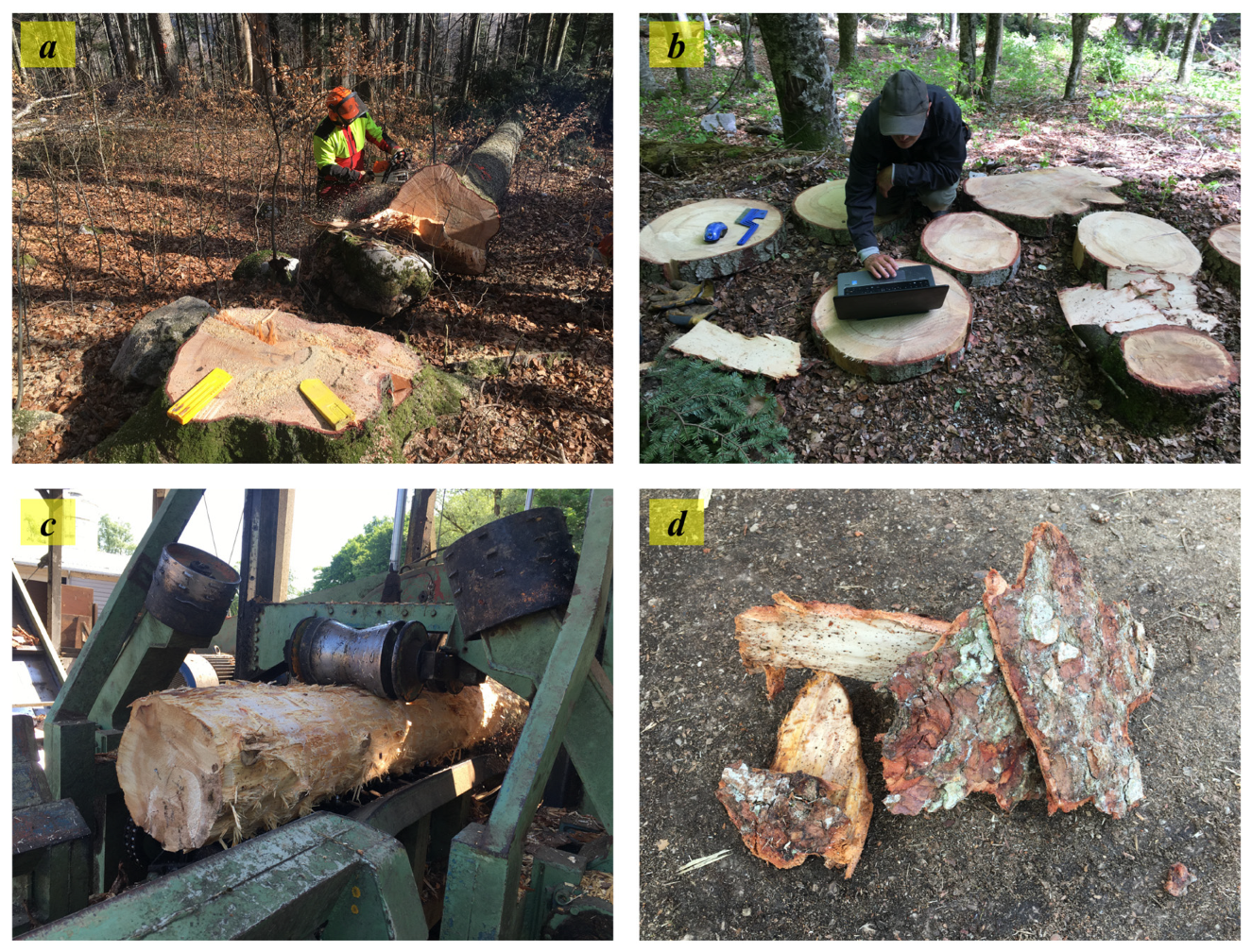
Two distinct series of bark samples were prepared to evaluate the influence of storage conditions on extractive contents: bark left on the log section (stem discs) and stored under cover (B-D, bark-stem disc sample), and bark obtained by peeling silver fir logs with an industrial debarker (B-IS, bark-industrial sample) (Figure 1).
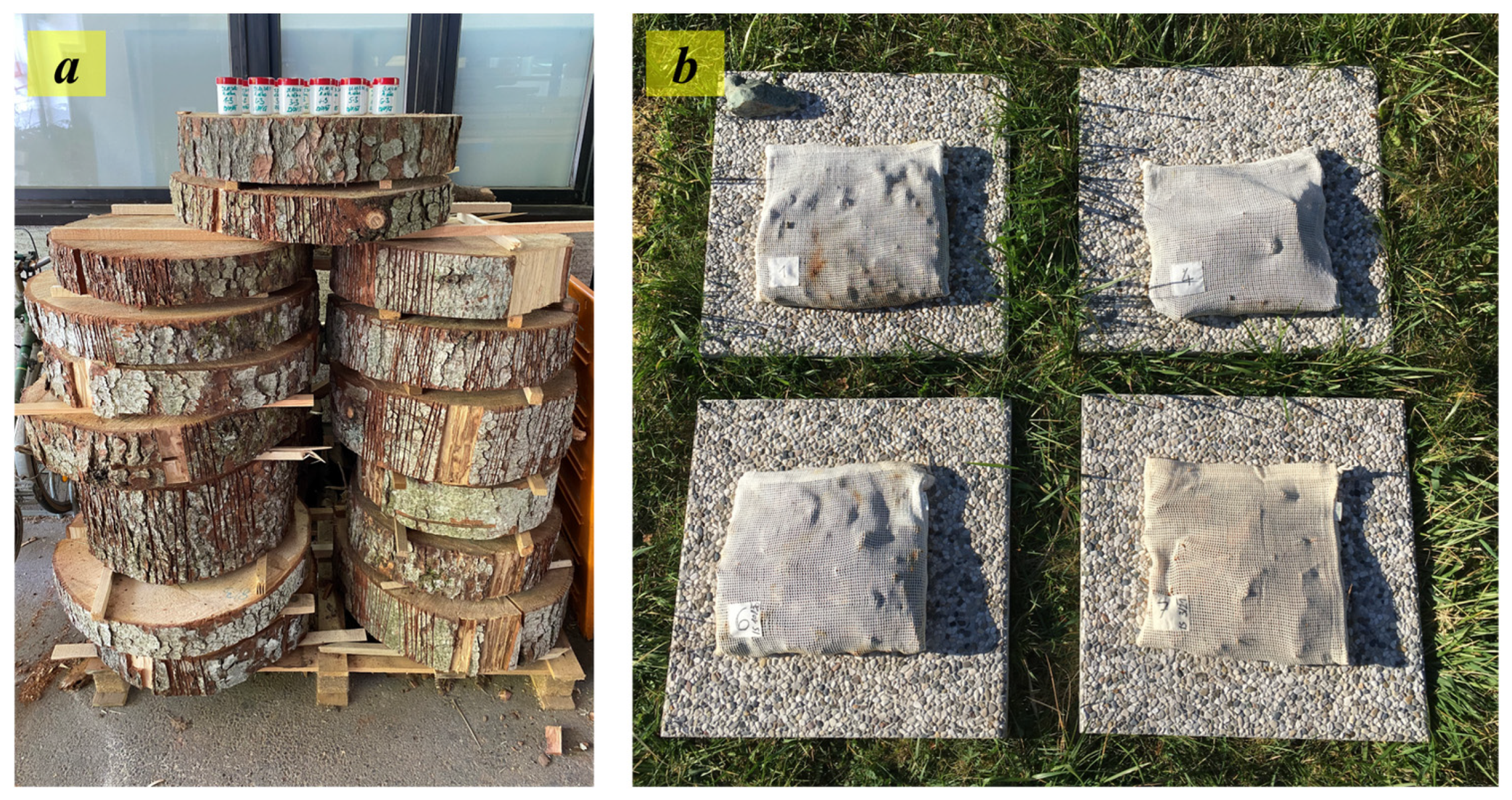
The first series of bark samples (B-D) was obtained from bark that remained attached to stem discs. Immediately after felling, discs were cut from the logs at a height of 4.6 m and transported to the storage site (Figure 1b). To reduce environmental impact, the discs were stacked in a covered area on an asphalt surface, elevated approximately 10 cm above ground level to prevent direct contact with moisture. This arrangement protected the material from precipitation while allowing natural air circulation (Figure 2a).
The second series consisted of bark samples collected from an industrial bark pile remaining after mechanical debarking of logs at the sawmill (Figure 1c,d). After felling, the logs were loaded onto trucks and transported to the Poganci sawmill in Novo mesto, where they were debarked using an industrial debarker. The silver fir logs were peeled using an industrial rotary debarking machine (model E12-181, 100 kW, Tombiac, Germany), which has a capacity of up to 40 m3 of bark per hour and enables fast, efficient processing of logs with medium to large diameters (up to 1 m) (Figure 1c). The industrially processed bark contained pieces of different sizes, mostly longer than 10 cm in at least one dimension (Figure 1d). For the analysis, four samples of industrial bark were prepared (B-IS, bark-industrial sample). The B-IS samples were compiled as a mixture of volume aliquots of bark from all sampled trees. These B-IS samples were stored under conditions simulating common practice, that is, on an uncovered concrete surface exposed to precipitation and temperature fluctuations. The industrial bark samples were placed in air-permeable cotton bags to prevent scattering and material loss while limiting direct contact with the concrete surface (Figure 2b). In contrast, the discs were stored without additional packaging, simulating a scenario where bark remains on the log until processing.

2.2. Field Test and Storage of Bark Samples

Bark samples B-D were left attached to stem discs after felling and stored outdoors in a covered area to protect them from precipitation. In contrast, B-IS samples were industrially prepared bark obtained by machine debarking of separate trunk sections immediately after harvesting; these samples were stored outdoors without cover under typical industrial conditions. Both series of bark samples were stored at the test sites at the Department of Wood Science and Technology (DWST). This experimental design provided insight into the influence of two contrasting storage strategies on changes in the chemical composition of hydrophilic extractives and polyphenols in bark samples: bark retained on the log and protected from precipitation versus bark removed immediately after felling and exposed to open-air conditions. The chemical composition of bark was monitored for one year, focusing on the contents of both total hydrophilic extractives (TEC) and total polyphenols (TPC). Bark sampling was performed monthly, with samples taken from all prepared stem discs (B-D, Figure 2a) and industrial bark samples (B-IS, Figure 2b). Bark from stem discs and industrial samples was collected and analysed separately. Monitoring and statistical evaluation were conducted independently for each sample group, ensuring that observed changes reflected the influence of storage conditions within each strategy. This approach provided a clear basis for assessing trends in hydrophilic extractives and polyphenols over time and for identifying the impact of storage practices on the preservation of bioactive compounds present ins silver fir bark.

2.3. Monitoring of Extractive Content in Bark Samples

2.3.1. Preparation of Bark Samples for Extraction

Bark samples obtained using an industrial debarking machine and stored in cotton bags (samples B-IS) were disintegrated before extraction using a Retsch SM 2000 mill (Retsch GmbH, Haan, Germany) equipped with a 4 mm sieve. Bark left on log sections (samples B-D), stored in a covered area, was collected as sawdust immediately before extraction by mechanically removing the bark across its entire thickness. The particle size of B-D samples was estimated to be comparable to that of ground B-IS samples; therefore, the sample size was comparable prior to extraction. The disintegrated B-D and B-IS samples were weighed directly into a stainless-steel extraction cell (STT) (for further details, see the section below) and into a container for determining the material’s moisture content. During 12 months of monitoring the chemical composition of extractives in bark samples stored under two different storage conditions, B-D and B-IS samples were taken, prepared for extraction, and analyzed monthly.

2.3.2. Moisture Content of Bark

The moisture content of bark samples (u) was analyzed according to the standard TAPPI T264 cm-97 protocol, which specifies the procedure for determining moisture content in wood materials [47]. The process involves drying the samples in an oven at a constant temperature of 105 °C until a constant weight is achieved. Moisture content was calculated, and the results of gravimetric analysis are expressed as the ratio of water mass to dry sample mass (u, w/w) [48]. For clarity, the results are also presented in the text as a percentage (% dw), which is mathematically equivalent.

2.3.3. Extraction

Extraction of bark samples collected monthly during monitoring was performed using a Thermo Scientific™ Dionex™ ASE™ 350 system (ASE stands for Accelerated Solvent Extractor) (Thermo Fisher Scientific Inc., Waltham, MA, USA), which enables efficient extraction of solid and semi-solid samples. Stainless steel (SST) extraction cells with a volume of 10 mL, each containing one gram of bark sample, were placed on the tray of the automated sampler. Extraction was carried out under subcritical conditions at a temperature of 140 °C and a pressure of 103.42 bar in an inert nitrogen (N2) atmosphere. Each sample was extracted in four cycles, with each static cycle lasting 5 min. Distilled water was used as the solvent, and between extractions, the system was rinsed with 50% methanol (v/v, aqueous solution). The aqueous extracts obtained were filtered through a metal frit and cellulose filter paper into 250 mL collection bottles [18]. The sample-to-solvent ratio is an important factor influencing polyphenol extraction efficiency, as insufficient solvent volume can limit the solubility of extractives [43]. Therefore, in this study, extracts were prepared at a ratio of 1:100 (w/v) to ensure sufficient solubilisation of hydrophilic extractives and polyphenols.

2.3.4. Total Extractives Content (TEC) in Silver Fir Bark

The total content of hydrophilic extractives (TEC, total extractives content) in bark samples was determined by gravimetric analysis. After ASE extraction, the filtered aqueous extracts were diluted with distilled water to achieve a sample-to-solvent ratio of 1:100 (w/v). To determine the content of hydrophilic extractives, 10 mL of the diluted extract was dried in a laboratory oven to constant weight. Gravimetric analysis was performed using a Mettler Toledo XS analytical balance (Mettler Toledo GmbH, Greifensee, Switzerland), and the results were expressed as milligrams of total extractives per gram of dry bark (mg/g dw) [28].

2.3.5. Total Polyphenols Content (TPC) in Silver Fir Bark

For colorimetric analyses, aliquots of diluted extracts were evaporated in a vacuum-tested desiccator connected to a membrane vacuum pump (model MV 2 NT, Ilmvac GmbH, Ilmenau, Germany) and dried at 100 mbar until the solvent was removed and the extracts appeared dry. The vacuum-dried aqueous extracts were then dissolved in methanol at a 1:2 (w/v) ratio. The total phenols content (TPC) in the extracts was determined using the Folin–Ciocalteu colorimetric method, as described in previous reports [28,49,50]. Each disposable polystyrene cuvette was filled with 0.25 mL of sample or gallic acid standard, 1.25 mL of Folin–Ciocalteu reagent, and 1.00 mL of sodium carbonate solution (75 g/L), then sealed and incubated for 120 min at room temperature in the dark. Absorbance was measured at 765 nm using a UV-Vis spectrophotometer. The content of total polyphenolics was calculated as gallic acid equivalent from the calibration curve (R2 > 0.99) and expressed per gram of dry bark (mg GAE/g dw) [28].

2.4. Statistical Analysis

Statistical analysis was conducted using OriginPro software (version 10.2.0.196), developed by OriginLab Corporation (Copyright 1991–2025, Northampton, MA, USA). The results were analyzed separately, applying the same testing approach to data from monitoring the chemical composition of bark extractives sampled directly from stem discs just before extraction (B-D) and to industrially prepared bark samples (B-IS) stored in bags.
First, descriptive statistics were applied, and the data were tested for normality, as normal distribution is a key assumption for using ANOVA. Origin provides several tests for assessing normality (Shapiro–Wilk, Lilliefors, Anderson–Darling, Kolmogorov–Smirnov, D’Agostino K2, and Chen–Shapiro), typically performed at a 0.05 significance level. In our analysis, we used the Shapiro–Wilk and D’Agostino K2 tests because they complement each other. The Shapiro–Wilk test is most reliable for smaller samples with fewer than 200 observations, while the D’Agostino K2 test better detects deviations in skewness and kurtosis of the distribution curve.
To test differences in mean extractives content across monitoring phases, we applied ANOVA. Bonferroni, Tukey, and LSD (Fisher’s least significant difference) post hoc tests were used to identify which means differed significantly at the 95.0% confidence level. These tests were chosen because the Bonferroni test reduces the risk of Type I error by controlling for multiple comparisons, Tukey’s test provides accurate pairwise comparisons, and the LSD test is the most sensitive to differences but increases the risk of incorrectly rejecting the null hypothesis. In addition to the p-values obtained from ANOVA, which indicate whether statistically significant differences exist between storage months, the effect size (η2), quantifying how much of the total variance in TEC and TPC for B-D and B-IS samples is explained by storage month, was also calculated. This combined statistical approach ensures that the interpretation of results reflects both statistical significance (p-values) and practical relevance (effect size). The main ANOVA outputs (p-values, R2, and η2) are presented in the Results section, while complete ANOVA tables and detailed outcomes of all multiple comparison tests are provided in the Supplementary Materials.
The correlation between gravimetrically determined TEC and spectrophotometrically measured TPC was also examined. The statistical significance of the relationship was assessed using Pearson’s correlation test, and the relationship between the two variables was analyzed using linear regression. The strength of the correlation was expressed using Pearson’s correlation coefficient (r) and the corresponding p-value, while the predictive performance of the regression model was summarized using the coefficient of determination (R2), which indicates the proportion of variance in TPC explained by TEC.

3. Results

More than two hundred observations were performed during the chemical monitoring of extractives in the stored silver fir bark samples. For each observation, moisture content (u), total hydrophilic extractives content (TEC), and polyphenol content (TPC) were measured. These measurements provided a comprehensive dataset that enabled evaluation of the variability in TEC and TPC within each group of stored samples over a 12-month period. The collected results formed the basis for the subsequent statistical assessment of differences in TEC and TPC between the two sample groups. Together, these measurements allowed a detailed evaluation of how the selected storage method influenced the extractive and polyphenol contents in silver fir bark.

3.1. Changes in Moisture Content of Bark Samples

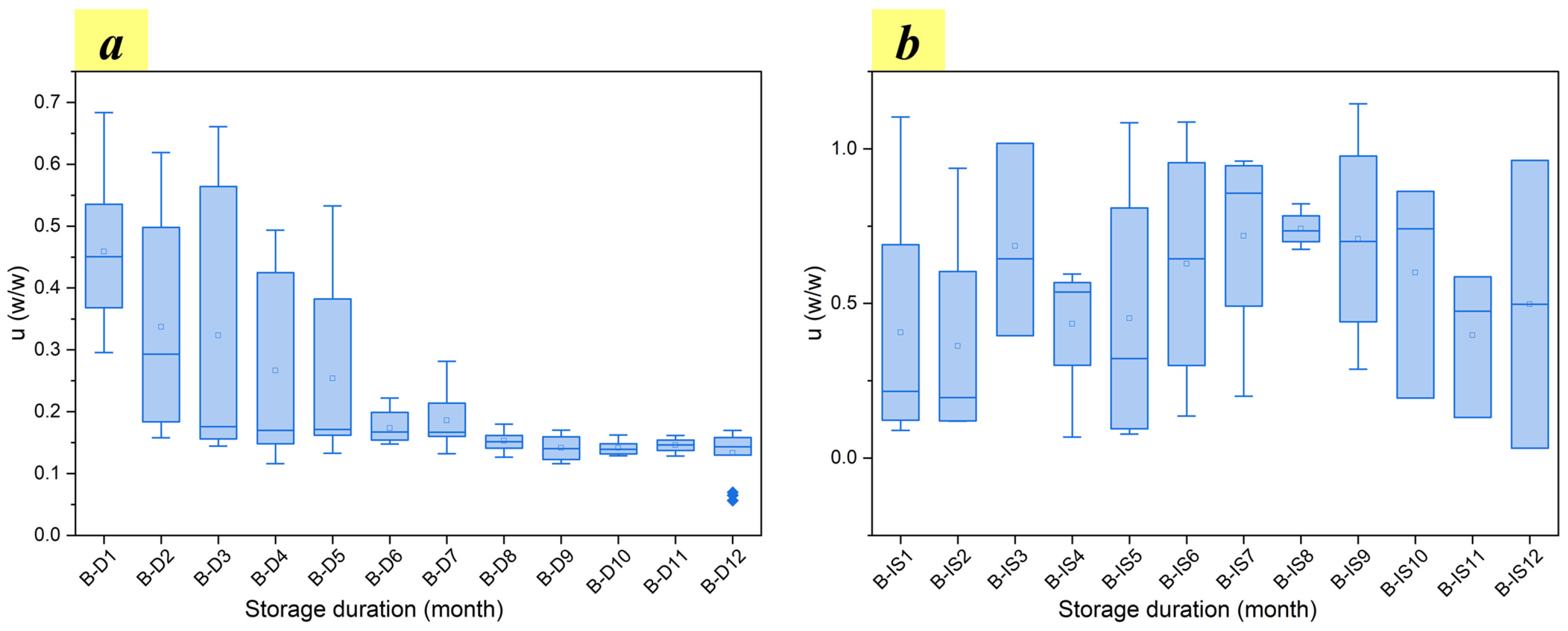
The results of monthly moisture content analysis in bark samples are shown in Figure 3a,b. Bark samples (B-D) taken from stem discs during the first (u = 45.88% ± 10.83% SD) to the fifth month (u = 25.39% ± 13.13% SD) contained, on average, more water than bark sampled in later months (ranging from u = 17.33% ± 2.38% to u = 13.33% ± 3.81% SD) (Figure 3a). Since the stem discs were stored in a covered area under outdoor conditions, the results clearly indicate that the bark on these discs began to dry at the start of the test, with moisture content after the sixth month of storage apparently fluctuating in line with ambient humidity (Figure 3a). Further analyses will be required to statistically confirm this observation and to examine the correlation between bark equilibrium moisture content and relative air humidity in more detail. The average measured moisture content of bark samples taken from discs after the sixth month did not exceed 20% (Figure 3a).
Gravimetric analysis of the moisture content in industrial bark samples (B-IS) stored outdoors for 12 months (test field BF-OL) is shown in Figure 3b. The water content in samples stored on an uncovered concrete surface was more variable than in the bark sampled from stem discs (Figure 3a). As shown in Figure 3b, B-IS samples generally contained more water than air-dried bark attached on stem discs (Figure 3a). The average moisture content in B-IS during the entire monitoring period was 55.24% (±36.11% SD), while monthly averages ranged from 36.18% (±6.11% SD) to 74.15% (±65.80% SD). This variability is due to outdoor storage, as the samples were directly exposed to weather conditions and precipitation. The measured moisture content therefore reflects the combined influence of these external factors on the material, although specific relationships with individual meteorological variables were not assessed in this study.

3.2. Descriptive Statistics and Normality Analysis of Total Extractives and Polyphenol Content in Silver Fir Bark

Basic descriptive statistics for total extractives content (TEC) and polyphenol content (TPC) in bark samples from discs (B-D) and industrial samples (B-IS), along with the results of the normality analysis, are presented in Table 2. The Shapiro–Wilk and D’Agostino K2 tests were used to determine whether the measured TEC and TPC values followed a normal distribution. Normal distribution of data is a key assumption for applying ANOVA when testing differences between groups. If the data are not normally distributed, non-parametric tests must be used for valid comparisons. The statistical analysis showed that all p-values from the Shapiro–Wilk test and the D’Agostino test for skewness and kurtosis were greater than 0.05. Therefore, the null hypothesis of normality cannot be rejected, confirming that the data for TEC and TPC in both sample groups are normally distributed. These data confirm that all distributions meet the assumption of normality, which is essential for applying one-way ANOVA in the subsequent statistical analysis. (Table 2).
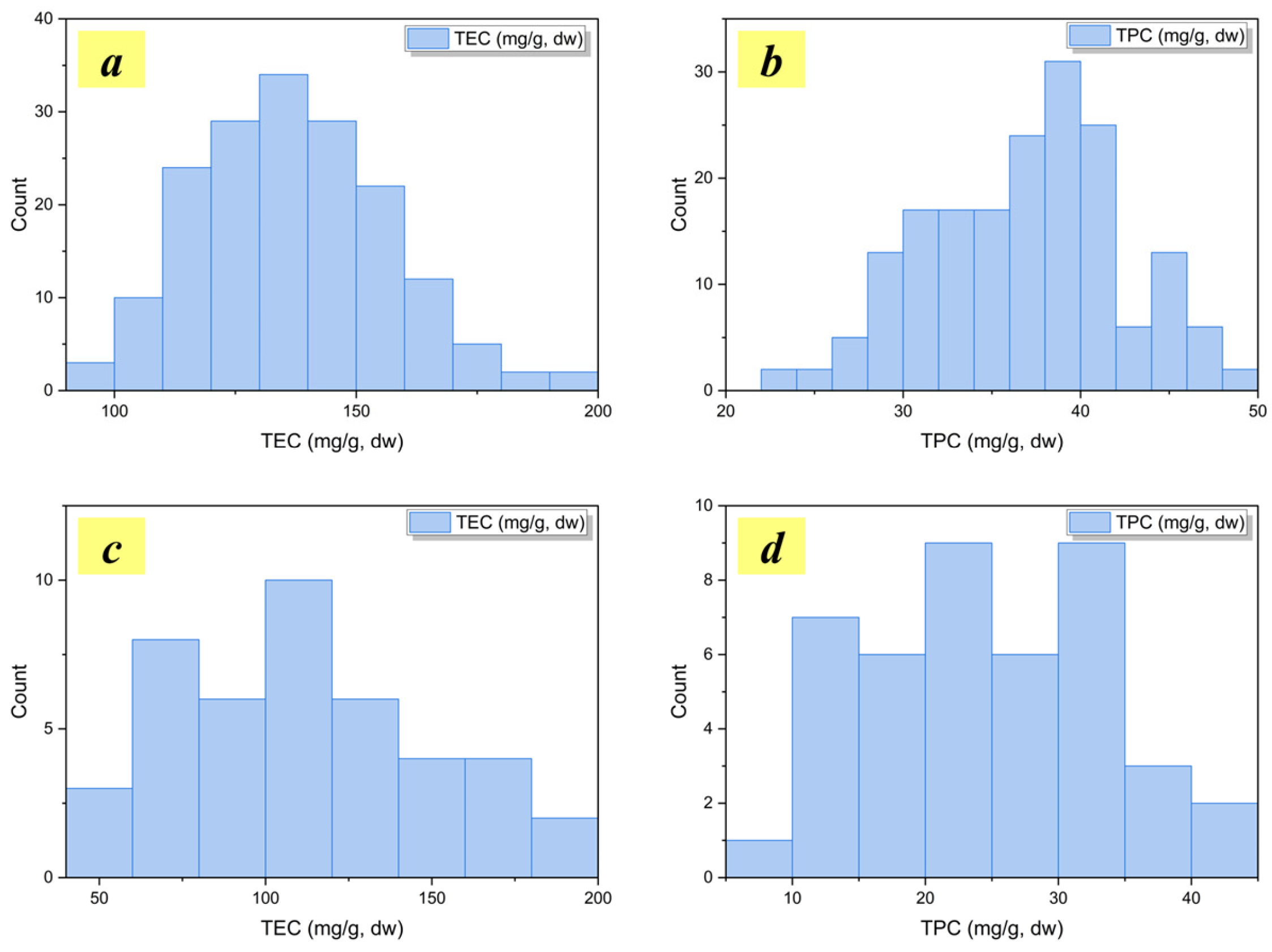
Normality of the distribution was also assessed visually using histograms for all four data groups, i.e., TEC and TPC in samples from discs (B-D) (Figure 4a,b) and in industrial samples (B-IS) (Figure 4c,d). Histograms provide a quick overview of the distribution’s shape and are useful for checking symmetry, identifying potential outliers, and detecting the presence of tails. These visual representations complement the descriptive statistics tests (Table 2) and further support the conclusion of normal data distribution.
The coefficient of variation for the measured TEC values (33.26%) and TPC values (36.40%) in industrial bark samples indicates greater variability compared to the TEC (14.27%) and TPC (14.94%) values in bark samples from discs (Table 2). For data expected to follow a normal distribution, the coefficient of variation is typically below 30%. As shown in Table 2, the coefficient of variation for TEC and TPC in industrial samples slightly exceeds 0.3, which may suggest notable deviations from normality. This higher variability is further supported by the visible asymmetry in the histograms for TEC and TPC in Figure 4c,d. In such cases, it is important to verify normality using more rigorous statistical tests, such as the Shapiro–Wilk and D’Agostino K2 tests. In our case, the results of these tests statistically confirmed the normal distribution of TEC and TPC data in industrial bark samples (Table 2).

3.3. Statistical Relationships Between Total Hydrophilic Extractives and Polyphenols Content in Stored Silver Fir Bark

To analyze the statistical relationships between total hydrophilic extractives content (TEC) and polyphenol content (TPC), we examined whether a correlation exists between these two parameters in the studied bark samples. Correlation and regression analyses were performed to determine whether changes in TEC could predict changes in TPC. Understanding relationships between gravimetrically measurable hydrophilic extractives and spectrophotometrically or chromatographically measurable polyphenols can facilitate the optimization of wood and bark extraction processes and support the study of physiological processes in tree tissues [28,51]. Correlation and regression analyses between TEC and TPC were conducted separately for bark samples obtained from stem discs (B-D) and for industrially prepared bark samples (B-IS).
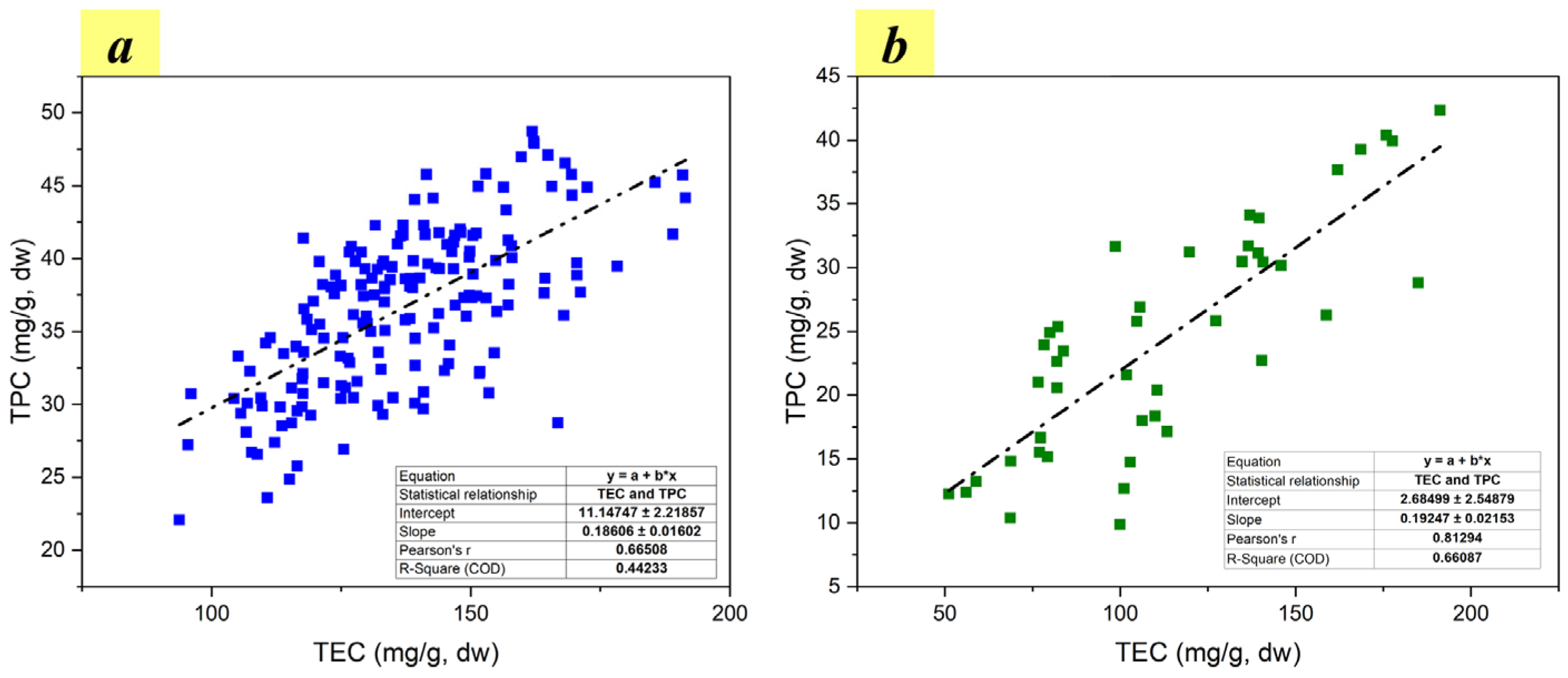
The results of the statistical correlation and linear regression are presented in Figure 5, which graphically illustrates the relationship between measured TEC and TPC values in silver fir bark samples from stem discs (Figure 5a) and industrial bark samples (Figure 5b). The correlation analysis uses Pearson’s correlation coefficient (r) and the p-value, which indicates the probability that the data are consistent with the null hypothesis. Pearson’s coefficient assumes a linear relationship between the variables, with statistical significance defined as p < 0.05 at a 95% confidence interval. Analysis of bark samples from stem discs revealed a strong and statistically significant correlation between TEC and TPC (r = 0.67; p < 0.0001), with the model explaining approximately 44% of the data variability (R2 = 0.44) (Figure 5a). An even stronger relationship was observed in industrial bark samples (r = 0.81; p < 0.0001), where the model explains about 66% of the variability (R2 = 0.66) (Figure 5b). Both correlations are positive and statistically significant, confirming a pronounced association between TEC and TPC. The relationship between TEC and TPC is more pronounced in industrial samples than in samples from stem discs. However, the regression models shown in Figure 5 do not account for all variability in the data. Approximately 56% of the variability remains unexplained in the bark samples of the stem disc, and about 34% remains unexplained in the industrial samples. This unexplained variability likely reflects the influence of additional biological and technological factors affecting polyphenol content in bark.

3.4. Effect of Storage on Total Hydrophilic Extractives and Polyphenol Content in Silver Fir Bark

The results of a one-year monthly monitoring of total hydrophilic extractives content (TEC) and polyphenol content (TPC), conducted separately for bark samples from stem discs (B-D) and industrial bark samples (B-IS), are presented in Figure 6 and Figure 7.
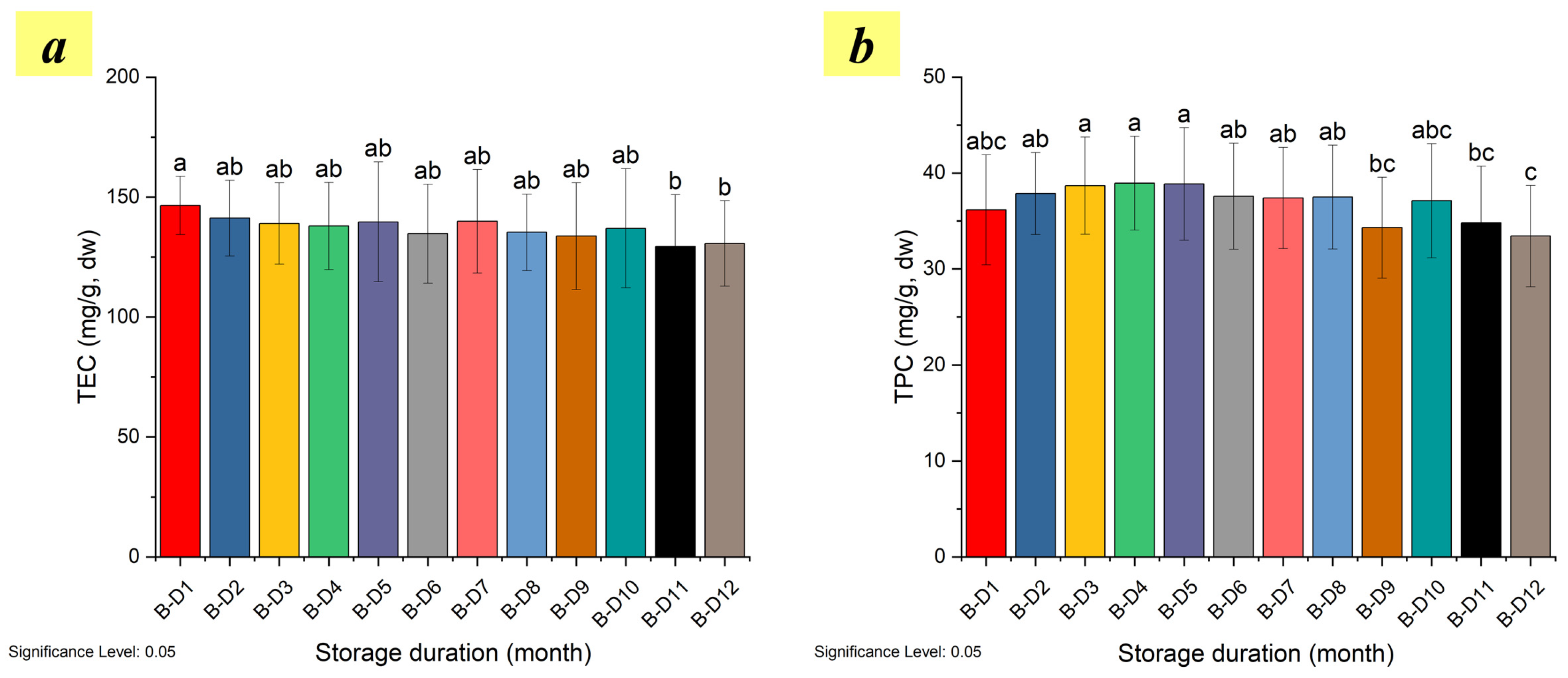
On average, B-D samples stored in a covered outdoor area contained 13.71% ± 1.96% (SD) total hydrophilic extractives (TEC) (Figure 6a) and 3.69% ± 0.55% (SD) polyphenols (TPC) (Figure 6b) (Table 2). Statistical analysis using ANOVA showed that the measured monthly mean values of TEC and TPC in B-D samples did not differ significantly at the 0.05 significance level. The ANOVA results and corresponding p-values for TEC (ANOVA TEC in B-D, p = 0.6044) and TPC (ANOVA TPC in B-D, p = 0.0694) were greater than 0.05, confirming the null hypothesis that there are no statistically significant differences among monthly means for TEC and TPC in B-D samples (Figure 6). Effect size analysis supported these findings, indicating that storage month explained only about 5% of the variance in TEC (η2 = 0.054) and about 10% of the variance in TPC (η2 = 0.102), showing that the influence of storage on the chemical composition of the B-D samples was small and consistent with the overall stability observed during the one-year monitoring period (Table S5).
Further comparison of monthly means for TEC and TPC in bark from stem discs, using Bonferroni, Tukey, and Fisher tests, did not reveal significant differences in TEC (Table S1) or TPC (Table S2) across months for B-D samples. Significant differences between TEC and TPC were confirmed only by Fisher’s LSD test, which is generally considered more sensitive because it facilitates the detection of differences between means, particularly when a smaller number of groups is compared [52]. Statistically significant differences in TEC means for B-D samples extracted in the 1st, 11th, and 12th months were identified by Fisher’s LSD test (Figure 6a). For TPC, the analysis indicated that, compared to measurements from the 9th, 11th, and 12th months, significantly higher polyphenol content was extracted from bark sampled in the 3rd, 4th, 5th, and 8th months (Figure 6b). These results indicate that losses under the storage method where bark remains on the log and biomass is stored outdoors under cover are minimal. Over one year, TEC in B-D bark samples decreased by only 10.83%, while TPC decreased by 7.84% (Figure 6).
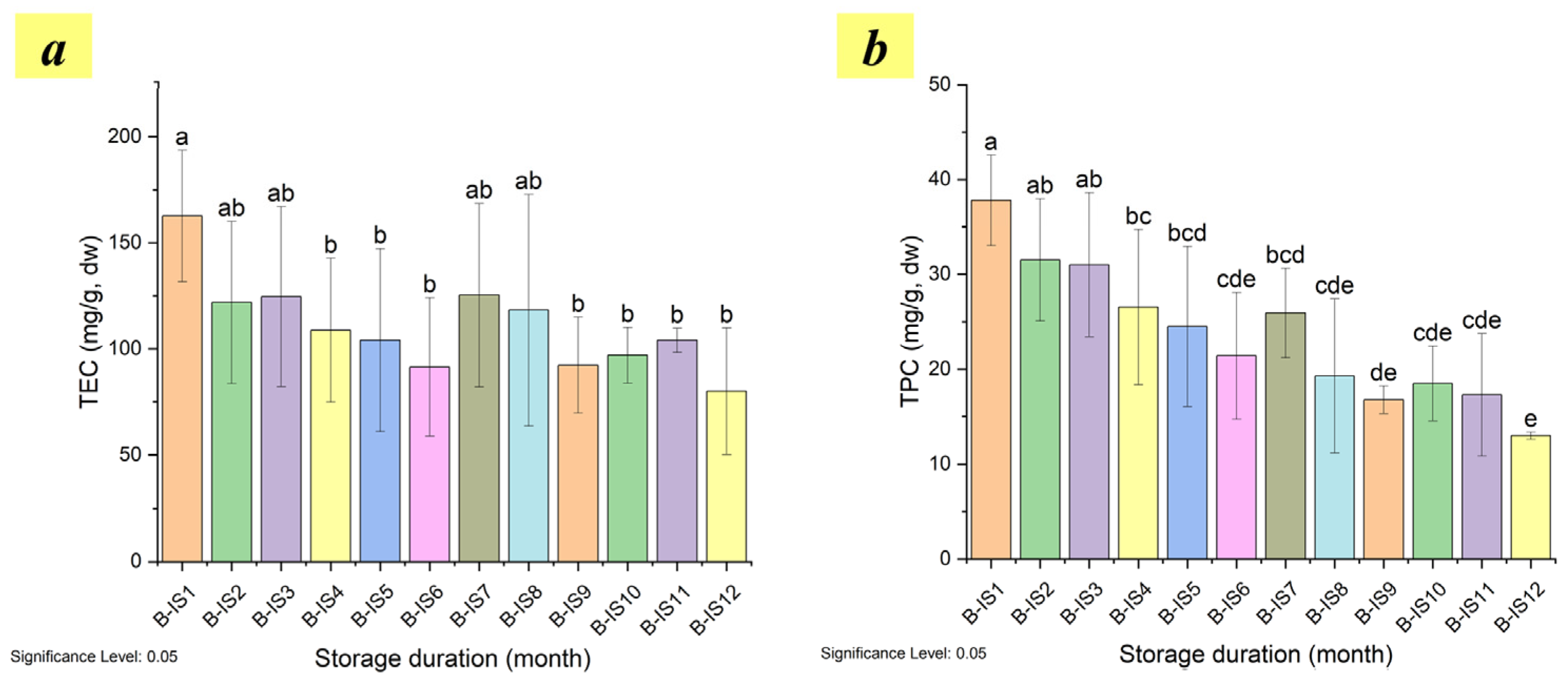
From industrially prepared silver fir bark samples (B-IS), which were stored under conditions commonly used in practice, an average of 11.24% ± 3.74% (SD) TEC and 2.43% ± 0.89% (SD) TPC was extracted during the one-year monitoring period. These values are lower than those from bark obtained from stem discs stored outdoors under cover (Table 2). Further statistical analysis of TEC (Figure 7a) and TPC (Figure 7b) in B-IS samples using ANOVA did not reveal significant differences between storage months for TEC (ANOVA TEC in B-IS, p = 0.2790), whereas TPC values varied significantly across months (ANOVA TPC in B-IS, p < 0.001). Analysis of TEC and TPC losses due to storage conditions indicated that losses in B-IS samples (Figure 7) were considerably higher than in B-D bark samples (Figure 6). Over one year, the average TEC in B-IS samples decreased by more than half (50.82%), while TPC decreased by 65.68% (Figure 7). Effect size analysis clarified these patterns, indicating that storage time accounted for approximately 31% of the variance in TEC (η2 = 0.313), a moderate influence masked in the ANOVA by high within-month variability, while the effect on TPC was very strong, with η2 = 0.611 showing that more than 60% of the total TPC variance was explained by storage time (Table S5). These findings are consistent with the observed trend in the decline of the measured extractives, as the average TEC in B-IS samples decreased by 50.82% and TPC by 65.68% over one year (Figure 7), confirming that mechanically disintegrated bark stored outdoors is highly susceptible to leaching and degradative loss of hydrophilic extractives and polyphenols.
Pairwise comparisons of monthly TEC means in industrial bark (B-IS1 to B-IS12) using Bonferroni, Tukey, and Fisher tests confirmed the ANOVA results. Bonferroni and Tukey tests did not detect statistically significant differences among the examined pairs (Table S3). For B-IS samples, Fisher’s LSD test was more sensitive, indicating that the average TEC at the first extraction at the beginning of monitoring was higher than in months 4–6 and 9–12 (Figure 7a, Table S3). For TPC in B-IS samples, statistically significant differences between months were detected by all applied tests. In addition to Fisher’s LSD test, Bonferroni and Tukey tests also confirmed differences at the 0.05 significance level (Table S4).

4. Discussion

This study provides a comprehensive quantitative assessment of how storage method and post-harvest handling influence the chemical stability of hydrophilic extractives in silver fir bark. In more than two hundred measurements, clear differences were observed between bark stored unpeeled on stem sections under cover and industrially removed bark stored outdoors, with the latter showing significantly greater losses in both total hydrophilic extractives and polyphenols over one year. These results demonstrate that storage conditions have a strong and measurable impact on extractive preservation, highlighting the need for improved handling practices when bark is used as a raw material for polyphenol extraction.
The moisture content measurements clearly showed that bark samples can be air-dried to equilibrium moisture content in a simple, low-effort manner. Elevated moisture negatively affects the polyphenol composition in bark and wood by promoting chemical and biological processes that cause structural changes. Water-soluble polyphenols are especially susceptible to leaching under these conditions, which alters their chemical profile. The chemical composition of extractives in tree biomass exposed to leaching shifts toward more stable, often condensed phenolic compounds, while the content of simpler polyphenols decreases [40,42,53,54].
Descriptive statistics confirmed that the measurements were performed consistently and that the obtained datasets reliably reflect the variability within each sample group. Although the coefficients of variation for TEC and TPC in industrial bark were higher than those in disc samples and slightly exceeded 0.30, indicating greater dispersion, normality testing showed that this variability did not violate the assumptions required for parametric analysis. The normality of TEC and TPC distributions was verified using the Shapiro–Wilk test and the D’Agostino test, and the results showed that the data meet the key assumptions for applying one-way ANOVA. Therefore, the statistical evaluation is methodologically justified, and the reported differences between storage conditions can be interpreted as statistically sound.
A statistically significant relationship between TEC and TPC in wood extracts was verified in our previous studies [28], and the results of the present analysis provide an important addition. Changes in bark quality for polyphenol extraction during storage can be monitored using relatively simple gravimetric analyses. Measured TEC values in silver fir bark allow a reasonably reliable indirect prediction of polyphenol content (TPC) without the need for time-consuming and methodologically demanding spectrophotometric analyses.
The results indicate that post-harvest bark manipulation, particularly the choice of storage method, significantly influences the total hydrophilic extractives (TEC) and polyphenol content (TPC) in bark intended for extraction. As shown in Figure 6 and Figure 7, higher amounts of extractives (TEC and TPC) were retained after one year in bark stored under cover, with debarking performed just before extraction. In B-IS samples, TEC decreased by more than 50% within one year, while TPC losses were even greater, reaching nearly 66%. The greatest losses occurred in bark samples stored on uncovered surfaces, a common industrial practice. Similar results were reported by Routa et al. [40,42], who showed that the content of lipophilic and hydrophilic extractives, especially polyphenols, in Scots pine (Pinus sylvestris) and Norway spruce (Picea abies) bark decreases rapidly, especially during the first weeks of outdoor storage. According to their data, more than 60% of the initial condensed tannin content in Scots pine bark was leached after two weeks of storage [40].
Our findings support existing literature by confirming that maintaining bark quality for polyphenol extraction also depends on delaying debarking until just before extraction. Keeping logs intact with bark and storing this biomass under cover substantially reduces changes in total extractives and polyphenol content. Once bark is removed from the log and mechanically disintegrated, non-structural compounds containing phenolic extractives are immediately exposed to biochemical changes, which can trigger undesirable oxidation and polymerization reactions of phenolic compounds [29,43,54]. Additionally, water-soluble extractives, including polyphenols, are intensively leached from biomass stored on uncovered surfaces and directly exposed to precipitation, which may eventually render wood and bark unsuitable for plant polyphenol extraction. Our investigation also showed a greater decrease in TPC compared to TEC, indicating that low-molecular-weight polyphenols are more susceptible to leaching during precipitation and to other biochemical transformations following tissue disruption. Selective leaching preferentially removes water-soluble phenolics, while oxidation and subsequent polymerization of these compounds into higher molecular weight forms can reduce their extractability, making them less detectable by spectrophotometry. These processes may explain why TPC decreased more significantly than gravimetrically measured TEC in industrial bark. Although our study did not quantify individual phenolic compounds, other non-structural compounds besides phenolics may have been extracted from the bark samples and measured by the colorimetric method used. Overall, our results have practical implications for extract standardization, as uncontrolled storage conditions can alter polyphenol composition and reduce extract quality.
While our sampling approach aims to reflect industrial practice and ensure practical representativeness, it inherently masks tree-level biological variability because industrial bark samples were homogenized. Future studies examining how storage affects non-homogenized bark samples from individual silver fir trees would provide a more detailed assessment of biological variability. Additionally, the observed reductions in TEC and TPC in industrial bark samples reflect the combined impact of mechanical disintegration during debarking and leaching due to weathering, as both processes occur simultaneously under outdoor storage conditions. In our previous study, we showed that bark particle size can significantly influence the retention of extractives when the biomass is exposed outdoors [41]. The design of the present study reflects realistic industrial constraints rather than an idealized factorial experimental setup. Bark generated at sawmills is unavoidably mixed, mechanically disintegrated, and stored outdoors in large piles, making controlled separation of individual effects impractical. This approach therefore prioritizes industrial relevance over complete factor separation and provides insight into the actual conditions under which bark quality deteriorates in practice. In this context, our findings also have direct implications for industrial bark logistics and storage protocols. The pronounced decline in extractives in uncovered, mechanically processed bark indicates that inappropriate storage practices can lead to substantial reductions in extractives yield and biomass quality. While our study was not designed to quantify losses at the industrial scale, the observed trends highlight the importance of covered or otherwise controlled storage conditions in maintaining extractive content and ensuring more consistent raw material quality for large-scale extraction. Further large-scale investigations are needed to determine exact loss rates under different industrial handling and storage scenarios.
This study offers practical, statistically supported insights into how post-harvest handling and storage practices affect the preservation of hydrophilic extractives and polyphenols in silver fir bark. These findings complement existing knowledge and may help improve biomass utilization within circular bioeconomy frameworks. However, a detailed understanding of the chemical transformations and degradation pathways of individual phenolic compounds during storage will require further research using advanced chromatographic and spectrometric techniques, such as LC-MS, GC-MS, TGA-MS, and NMR. Since changes in the biological activity of silver fir bark extractives were not assessed during storage, evaluating how storage-related chemical transformations of the biomass affect the bioactivity of the extracts would add value and strengthen our study’s results.

5. Conclusions

This study demonstrated that post-harvest bark handling, storage practices, and the timing of bark removal significantly affect the preservation of total hydrophilic extractives and polyphenols in silver fir bark (Abies alba Mill.). A strong TEC-TPC relationship confirms that gravimetric extractive measurements can serve as a practical and rapid predictor of polyphenol content. During the 12-month monitoring period, extractive contents in bark left on logs and stored under cover remained unchanged, whereas mechanically disintegrated bark stored on uncovered surfaces showed large and statistically confirmed reductions, with TEC decreasing by more than half and TPC by nearly two-thirds. These findings align with the literature, which indicates that bark removal and mechanical processing appear to initiate biochemical changes, while exposure to precipitation further promotes leaching of hydrophilic and water-soluble extractives. The results confirm that improper storage leads to substantial extractive losses and can render silver fir bark unsuitable for extracting bioactive compounds. Previous research demonstrated that particle size and storage environment strongly affect extractive and polyphenol retention, and the present study further shows that delaying debarking until just before extraction helps maintain bark quality for extracting bioactive extractives. These observations provide clear guidelines for industrial practice: appropriate bark handling and covered storage improve extractive preservation, increase extraction efficiency, and reduce raw-material losses, supporting sustainable and circular use of forest-based by-products. Although the study reflects real industrial conditions, homogenization of industrial bark masked tree-level biological variability and prevented the separation of mechanical and precipitation-driven effects. Future research should therefore integrate advanced chromatographic and spectrometric methods to resolve compound-specific degradation pathways, model the kinetics of extractive losses, and test storage improvements such as protective coatings and controlled-humidity environments, including assessments of how storage-related chemical changes influence extract biological activity.

Supplementary Materials

The following supporting information can be downloaded at: https://www.mdpi.com/article/10.3390/f17020280/s1, Table S1: Results of the comparison of the mean total extractives content (TEC) in the bark of stem discs (B-D) stored outdoors under a covered area. Statistical comparisons between pairs of TEC means were performed using the Bonferroni test, the Tukey test, and Fisher’s LSD test; Table S2: Results of the comparison of the mean total polyphenols content (TPC) in the bark of stem discs (B-D) stored outdoors under a covered area. Statistical comparisons between pairs of TPC means were performed using the Bonferroni test, the Tukey test, and Fisher’s LSD test; Table S3: Results of the comparison of mean total extractives content (TEC) in industrial bark samples (B-IS) stored outdoors and exposed to weathering. Statistical comparisons between pairs of TEC means were performed using the Bonferroni test, the Tukey test, and Fisher’s LSD test; Table S4: Results of the comparison of the mean polyphenol content (TPC) in industrial bark samples (B-IS) stored outdoors and exposed to weathering. Statistical comparisons between pairs of TEC means were performed using the Bonferroni test, the Tukey test, and Fisher’s LSD test; Table S5: Summary of one-way ANOVA results and effect sizes (η2) for total hydrophilic extractives (TEC) and total polyphenol content (TPC) in silver fir (Abies alba Mill.) bark from stem discs (B-D) stored under cover and industrial bark (B-IS) stored outdoors and exposed to weathering.

Author Contributions

Conceptualization, V.V., I.P. and P.O.; methodology, P.H. and V.V.; software and preparation of figures and tables, V.V., P.H. and U.O.; validation and formal analysis, V.V., I.P.; investigation, P.H., V.V., I.P., U.O. and P.O.; preparation of the original draft, V.V.; resources, V.V., P.H. and P.O.; writing, V.V., P.H., I.P., U.O., T.L. and P.O. All authors have reviewed the manuscript. Revision and manuscript editing and preparation of a response to the reviewers’ reports, V.V., P.H., U.O., I.P., T.L. and P.O. All authors have read and agreed to the published version of the manuscript.

Funding

The authors gratefully acknowledge the Slovenian Research and Innovation Agency (ARIS) and Ars Pharmae d.o.o. for funding project L4-2623 (ArsAlbi), as well as ARIS for supporting research program P4-0015 (Wood and lignocellulosic composites). The authors also acknowledge the University of Ljubljana for supporting the international M-Era.Net project Bapur, and project CRP V4-2512 “Simulation and optimization of potential valorization routes for lower quality wood in Slovenia,” financially supported by ARIS and the Ministry of Economy, Tourism and Sport of the Republic of Slovenia. The authors further acknowledge support from the ARIS research program P4-0107 (Forest Biology, Ecology, and Technology).

Data Availability Statement

The authors declare that all data supporting the findings of this study are included in the article. Additional research results not presented in the main text due to their volume are available from the corresponding author upon reasonable request.

Acknowledgments

We thank Kočevski les d.o.o. for providing the silver fir bark and extend special thanks to Andrej Mikec, for his valuable support. We gratefully acknowledge Anže Lopatič for his support in sampling and chemical analysis. During the preparation of this manuscript, the authors used generative artificial intelligence tools (Microsoft Copilot (cloud-based, continuously updated by Microsoft, used in 2026) and GPT-5 (OpenAI)-based services integrated into licensed Microsoft Office applications, as well as the licensed language-editing software InstaText (Microsoft Word add-in, web-based version, used in 2026)) solely for linguistic refinement. All scientific content, including research design, data acquisition, experimental work, analysis, interpretation, and preparation of figures and results, was conducted independently by the authors.

Conflicts of Interest

The authors declare no conflicts of interest. The funders had no role in the design of the study; in the collection, analyses, or interpretation of data; in the writing of the ma script; or in the decision to publish the results.

References

  1. Aliaño-González, M.J.; Gabaston, J.; Ortiz-Somovilla, V.; Cantos-Villar, E. Wood waste from fruit trees: Biomolecules and their applications in agri-food industry. Biomolecules 2022, 12, 238. [Google Scholar] [CrossRef] [PubMed]
  2. Eilmann, B.; de Vries, S.M.G.; den Ouden, J.; Mohren, G.M.J.; Sauren, P.; Sass-Klaassen, U. Origin matters! Difference in drought tolerance and productivity of coastal Douglas-fir (Pseudotsuga menziesii (Mirb.)) provenances. For. Ecol. Manag. 2013, 302, 133–143. [Google Scholar] [CrossRef]
  3. Kleinbauer, I.; Dullinger, S.; Peterseil, J.; Essl, F. Climate change might drive the invasive tree Robinia pseudacacia into nature reserves and endangered habitats. Biol. Conserv. 2010, 143, 382–390. [Google Scholar] [CrossRef]
  4. Leppänen, T.; Mustonen, E.; Saarela, H.; Kuokkanen, M.; Tervonen, P. Productization of industrial side streams into by-products-case: Fiber sludge from pulp and paper industry. J. Open Innov. Technol. Mark. Complex. 2020, 6, 185. [Google Scholar] [CrossRef]
  5. Tamantini, S.; Del Lungo, A.; Romagnoli, M.; Paletto, A.; Keller, M.; Bersier, J.; Zikeli, F. Basic steps to promote biorefinery value chains in forestry in Italy. Sustainability 2021, 13, 11731. [Google Scholar] [CrossRef]
  6. CEAP. Communication from the Commission to the European Parliament, the Council, the European Economic and Social Committee and the Committee of the Regions: A New Circular Economy Action Plan for a Cleaner and More Competitive Europe, European Commission, COM(2020), 98 Final. 2020. Available online: https://eur-lex.europa.eu/legal-content/EN/TXT/?uri=CELEX:52020DC0098 (accessed on 13 January 2026).
  7. Kirker, G.T.; Hassan, B.; Mankowski, M.E.; Eller, F.J. Critical Review on the Use of Extractives of Naturally Durable Woods as Natural Wood Protectants. Insects 2024, 15, 69. [Google Scholar] [CrossRef]
  8. Holmbom, B. Extraction and utilisation of non-structural wood and bark components. In Biorefining of Forest Resources; Alén, R., Ed.; Paper Engineers’ Association/Paperi ja Puu Oy: Helsinki, Finland, 2011; pp. 178–224. [Google Scholar]
  9. Fernandez-Costas, C.; Palanti, S.; Charpentier, J.P.; Sanroman, M.A.; Moldes, D. A sustainable treatment for wood preservation: Enzymatic grafting of wood extractives. ACS Sustain. Chem. Eng. 2017, 5, 7557–7567. [Google Scholar] [CrossRef]
  10. Barbero-Lopez, A.; Chibily, S.; Tomppo, L.; Salami, A.; Ancin-Murguzur, F.J.; Venalainen, M.; Lappalainen, R.; Haapala, A. Pyrolysis distillates from tree bark and fibre hemp inhibit the growth of wood-decaying fungi. Ind. Crops Prod. 2019, 129, 604–610. [Google Scholar] [CrossRef]
  11. Willför, S.; Nisula, L.; Hemming, J.; Reunanen, M.; Holmbom, B. Bioactive phenolic substances in industrially important tree species. Part 1: Knots and stemwood of different spruce species. Holzforschung 2004, 58, 335–344. [Google Scholar] [CrossRef]
  12. Hagemann, N.; Gawel, E.; Purkus, A.; Pannicke, N.; Hauck, J. Possible futures towards a wood-based bioeconomy: A scenario analysis for Germany. Sustainability 2016, 8, 98. [Google Scholar] [CrossRef]
  13. Wijayanto, A.; Dumarçay, S.; Gérardin-Charbonnier, C.; Sari, R.K.; Syafii, W.; Gérardin, P. Phenolic and lipophilic extractives in Pinus merkusii Jungh. et de Vries knots and stemwood. Ind. Crops Prod. 2015, 69, 466–471. [Google Scholar] [CrossRef]
  14. Dobrowolska, D.; Boncina, A.; Klumpp, R. Ecology and silviculture of silver fir (Abies alba Mill.): A review. J. For. Res. 2017, 22, 326–335. [Google Scholar] [CrossRef]
  15. Dyderski, M.K.; Paź, S.; Frelich, L.E.; Jagodziński, A.M. How much does climate change threaten European forest tree species distributions? Glob. Change Biol. 2018, 24, 1150–1163. [Google Scholar] [CrossRef] [PubMed]
  16. Seidl, R.; Aggestam, F.; Rammer, W.; Blennow, K.; Wolfslehner, B. The sensitivity of current and future forest managers to climate-induced changes in ecological processes. Ambio 2016, 45, 430–441. [Google Scholar] [CrossRef]
  17. Osolnik, U.; Vek, V.; Korošec, R.C.; Oven, P.; Poljanšek, I. Integration of wood-based components—Cellulose nanofibrils and tannic acid—Into a poly(vinyl alcohol) matrix to improve functional properties. Int. J. Biol. Macromol. 2024, 256, 128495. [Google Scholar] [CrossRef]
  18. Willför, S.; Nisula, L.; Hemming, J.; Reunanen, M.; Holmbom, B. Bioactive phenolic substances in industrially important tree species. Part 2: Knots and stemwood of fir species. Holzforschung 2004, 58, 650–659. [Google Scholar] [CrossRef]
  19. Vek, V.; Hofmann, T.; Rajczi, E.V.; Osolnik, U.; Poljanšek, I.; Oven, P. Effect of accelerated extraction and sonication on the antioxidant capacity of wood and bark extracts of wet-hearted silver fir (Abies alba Mill.). Eur. J. Wood Wood Prod. 2024, 82, 1479–1490. [Google Scholar] [CrossRef]
  20. Supriyadi, D.; Damayanti, D.; Veigel, S.; Hansmann, C.; Gindl-Altmutter, W. Unlocking the potential of tree bark: Review of approaches from extractives to materials for higher-added value products. Mater. Today Sustain. 2025, 29, 101074. [Google Scholar] [CrossRef]
  21. Sommerauer, L.; Konkler, M.; Presley, G.; Schnabel, T.; Petutschnigg, A.; Hinterstoisser, B. Douglas fir bark: Composition, extracts utilization and enzymatic treatment for enrichment of bioactive constituents. Holzforschung 2024, 78, 203–215. [Google Scholar] [CrossRef]
  22. Osolnik, U.; Vek, V.; Humar, M.; Oven, P.; Poljanšek, I. Tailoring bionanocomposite film functionality using cellulose nanofibrils and bioactive wood extractives. Cellulose 2025, 32, 8239–8261. [Google Scholar] [CrossRef]
  23. Brennan, M.; Fritsch, C.; Cosgun, S.; Dumarcay, S.; Colin, F.; Gerardin, P. Yield and compositions of bark phenolic extractives from three commercially significant softwoods show intra- and inter-specific variation. Plant Physiol. Biochem. 2020, 155, 346–356. [Google Scholar] [CrossRef]
  24. Hofmann, T.; Nebehaj, E.; Stefanovits-Bányai, É.; Albert, L. Antioxidant capacity and total phenol content of beech (Fagus sylvatica L.) bark extracts. Ind. Crops Prod. 2015, 77, 375–381. [Google Scholar] [CrossRef]
  25. Routa, J.; Brännström, H.; Anttila, P.; Mäkinen, M.; Jänis, J.; Asikainen, A. Wood Extractives of Finnish Pine, Spruce and Birch—Availability and Optimal Sources of Compounds; Natural Resources and Bioeconomy Studies; Luonnonvarakeskus, Luke: Helsinki, Finland, 2017; Volume 73, p. 55. [Google Scholar]
  26. D’Andrea, G. Pycnogenol: A blend of procyanidins with multifaceted therapeutic applications? Fitoterapia 2010, 81, 724–736. [Google Scholar] [CrossRef] [PubMed]
  27. Barbero-López, A.; Akkanen, J.; Lappalainen, R.; Peräniemi, S.; Haapala, A. Bio-based wood preservatives: Their efficiency, leaching and ecotoxicity compared to a commercial wood preservative. Sci. Total Environ. 2021, 753, 142013. [Google Scholar] [CrossRef] [PubMed]
  28. Luque de Castro, M.D.; Priego-Capote, F. Soxhlet extraction: Past and present panacea. J. Chromatogr. A 2010, 1217, 2383–2389. [Google Scholar] [CrossRef]
  29. Vek, V.; Poljanšek, I.; Oven, P. Efficiency of three conventional methods for extraction of dihydrorobinetin and robinetin from wood of black locust. Eur. J. Wood Wood Prod. 2019, 77, 891–901. [Google Scholar] [CrossRef]
  30. Willför, S.M.; Smeds, A.I.; Holmbom, B.R. Chromatographic analysis of lignans. J. Chromatogr. A 2006, 1112, 64–77. [Google Scholar] [CrossRef]
  31. Tavčar Benković, E.; Grohar, T.; Žigon, D.; Švajger, U.; Janeš, D.; Kreft, S.; Štrukelj, B. Chemical composition of the silver fir (Abies alba) bark extract Abigenol® and its antioxidant activity. Ind. Crops. Prod. 2014, 52, 23–28. [Google Scholar] [CrossRef]
  32. Vek, V.; Poljanšek, I.; Osolnik, U.; Oven, P. Analysis of Extractives in Liquid and Headspace Samples of Silver Fir Using Gas Chromatography Coupled with a Mass Selective Detector. Drv. Ind. 2024, 75, 457–468. [Google Scholar] [CrossRef]
  33. Vek, V.; Šmidovnik, T.; Humar, M.; Poljanšek, I.; Oven, P. Comparison of the content of extractives in the bark of the trunk and the bark of the branches of silver fir (Abies alba Mill.). Molecules 2023, 28, 225. [Google Scholar] [CrossRef]
  34. Bianchi, S.; Kroslakova, I.; Janzon, R.; Mayer, I.; Saake, B.; Pichelin, F. Characterization of condensed tannins and carbohydrates in hot water bark extracts of European softwood species. Phytochemistry 2015, 120, 53–61. [Google Scholar] [CrossRef] [PubMed]
  35. Naczk, M.; Shahidi, F. Extraction and analysis of phenolics in food. J. Chromatogr. A 2004, 1054, 95–111. [Google Scholar] [CrossRef] [PubMed]
  36. Välimaa, A.-L.; Honkalampi-Hämäläinen, U.; Pietarinen, S.; Willför, S.; Holmbom, B.; von Wright, A. Antimicrobial and cytotoxic knotwood extracts and related pure compounds and their effects on food-associated microorganisms. Int. J. Food Microbiol. 2007, 115, 235–243. [Google Scholar] [CrossRef]
  37. Pietarinen, S.; Willför, S.; Ahotupa, M.; Hemming, J.; Holmbom, B. Knotwood and bark extracts: Strong antioxidants from waste materials. J. Wood Sci. 2006, 52, 436–444. [Google Scholar] [CrossRef]
  38. Singh, T.; Singh, A.P. A review on natural products as wood protectant. Wood. Sci. Technol. 2012, 46, 851–870. [Google Scholar] [CrossRef]
  39. Barbero-López, A.; Vek, V.; Poljanšek, I.; Virjamo, V.; López-Gómez, Y.M.; Sainio, T.; Humar, M.; Oven, P.; Haapala, A. Characterisation, Recovery and Activity of Hydrophobic Compounds in Norway Spruce Log Soaking Pit Water: Could they be Used in Wood Preservative Formulations? Waste Biomass Valorization 2022, 13, 2553–2564. [Google Scholar] [CrossRef]
  40. Domazet, M.; Zaloker, U.; Vek, V. Ars Pharmae®: Innovative natural approach to prevent and reduce diseases of modern times; food supplements from wood extractives. In Proceedings of the BioRural Knowledge-Exchange Workshop: Advancing the European Rural Bioeconomy, Online, 14–16 February 2024. [Google Scholar]
  41. Routa, J.; Brännström, H.; Hellström, J.; Laitila, J. Influence of storage on the physical and chemical properties of Scots pine bark. Bioenerg. Res. 2021, 14, 575–587. [Google Scholar] [CrossRef]
  42. Hrovatič, P.; Poljanšek, I.; Osolnik, U.; Oven, P.; Vek, V. Changes in the content of extractives in silver fir (Abies alba Mill.) bark due to different storage conditions. Eur. J. Wood Wood Prod. 2025, 83, 186. [Google Scholar] [CrossRef]
  43. Routa, J.; Brännström, H.; Laitila, J. Effects of storage on dry matter, energy content and amount of extractives in Norway spruce bark. Biomass Bioenergy 2020, 143, 105821. [Google Scholar] [CrossRef]
  44. Naczk, M.; Shahidi, F. Phenolics in cereals, fruits and vegetables: Occurrence, extraction and analysis. J. Pharm. Biomed. Anal. 2006, 41, 1523. [Google Scholar] [CrossRef]
  45. Keržič, E.; Vek, V.; Oven, P.; Humar, M. Changes in wood durability due to leaching of biologically active substances (extractives) resulting from weathering. Case Stud. Constr. Mater. 2024, 21, e03921. [Google Scholar] [CrossRef]
  46. Volf, I.; Ignat, I.; Neamtu, M.; Popa, V.I. Thermal stability, antioxidant activity, and photo-oxidation of natural polyphenols. Chem. Pap. 2014, 68, 121–129. [Google Scholar] [CrossRef]
  47. T 264 cm-97; Preparation of Wood for Chemical Analysis. Technical Association of the Pulp and Paper Industry (TAPPI): Atlanta, GA, USA, 1997.
  48. Vek, V.; Poljanšek, I.; Cerc Korošec, R.; Humar, M.; Oven, P. Impact of steam-sterilization and oven drying on the thermal stability of phenolic extractives from pine and black locust wood. J. Wood Chem. Technol. 2022, 42, 467–477. [Google Scholar] [CrossRef]
  49. Gorišek, Ž. Les: Zgradba in Lastnosti: Njegova Variabilnost in Heterogenost; Biotechnical Faculty, Department of Wood Science and Technology: Ljubljana, Slovenia, 2009; p. 178. [Google Scholar]
  50. Singleton, V.L.; Rossi, J.A., Jr. Colorimetry of total phenolics with phosphomolybdic-phosphotungstic acid reagents. Am. J. Enol. Vitic. 1965, 16, 144–158. [Google Scholar] [CrossRef]
  51. Scalbert, A.; Monties, B.; Janin, G. Tannins in wood: Comparison of different estimation methods. J. Agric. Food Chem. 1989, 37, 1324–1329. [Google Scholar] [CrossRef]
  52. Karppanen, O.; Venäläinen, M.; Harju, A.M.; Willför, S.; Pietarinen, S.; Laakso, T.; Kainulainen, P. Knotwood as a window to the indirect measurement of the decay resistance of Scots pine heartwood. Holzforschung 2007, 61, 600–604. [Google Scholar] [CrossRef]
  53. Liu, S.; Tu, D. On the Applications of Fisher’s Least Significant Difference (LSD) Procedure in Three-Arm Clinical Trials with Survival Endpoints. Drug Inf. Assoc. 2008, 42, 81–91. [Google Scholar]
  54. Martinez, M.V.; Whitaker, J.R. The biochemistry and control of enzymatic browning. Trends Food Sci. Technol. 1995, 6, 195–200. [Google Scholar] [CrossRef]
Figure 1. Silver fir (Abies alba Mill.) trees felled in the Kočevska forests, Slovenia. (a) Bark samples (B-D) on stem discs cut from felled trees; (b) discs checked fresh before transport to DWST for storage and ASE extraction; (c) industrial bark removal using the Tombiac debarking machine; (d) bark particles forming the industrial bark sample (B-IS).
Forests 17 00280 g001
Figure 2. (a) Stem discs of silver fir (Abies alba Mill.) and (b) industrial bark samples (B-IS) included in the monitoring of extractive content (TEC, TPC). The bark was sampled monthly from the stem discs and from the B-IS bags, the samples were extracted and chemically analyzed.
Forests 17 00280 g002
Figure 3. Moisture content (u, w/w) of silver fir (Abies alba Mill.) bark samples by month over a one-year monitoring period. (a) Bark from stem discs (B-D1 to B-D12) stored in a covered outdoor area and (b) industrial bark (B-IS1 to B-IS12) from a sawmill stored on an uncovered concrete surface. The bark samples were taken immediately before extraction and chemical analysis.
Forests 17 00280 g003
Figure 4. Histograms of the distribution of total hydrophilic extractives (TEC) and total polyphenol content (TPC) in samples of silver fir bark (Abies alba Mill.). Comparison of TEC and TPC in bark samples from disks (a,b) and industrial bark samples (c,d).
Forests 17 00280 g004
Figure 5. Correlation between the content of total hydrophilic extractives (TEC) and the content of polyphenols (TPC) in silver fir (Abies alba Mill.) bark samples. Results of the statistical analysis of the relationship between TEC (ordinate, independent variable) and TPC (abscissa, dependent variable) in bark samples from stem discs (a) and industrial bark samples (b).
Forests 17 00280 g005
Figure 6. Content of (a) total hydrophilic extractives (TEC) and (b) polyphenols (TPC) in silver fir (Abies alba Mill.) bark samples over the months (B-D1 to B-D12) during one year of monitoring. The bark samples were taken from stem discs stored in a covered outdoor area just before extraction. Different letters above the bars (a–c) indicate statistically significant differences in TEC and TPC at the 0.05 significance level (Fisher’s Least Significant Difference Test). A detailed statistical comparison of all pairwise means can be found in Tables S1 and S2.
Forests 17 00280 g006
Figure 7. Content of (a) total hydrophilic extractives (TEC) and (b) polyphenols (TPC) in silver fir (Abies alba Mill.) bark samples over the months (B-IS1 to B-IS12) during one year of monitoring. The industrial bark samples from the sawmill were stored on an uncovered concrete surface. Different letters above the bars (a–e) indicate statistically significant differences in TEC and TPC at the 0.05 significance level (Fisher’s LSD test). A detailed statistical comparison of all pairwise means can be found in Tables S3 and S4.
Forests 17 00280 g007
Table 1. Basic dendrometric data of analyzed silver fir (Abies alba Mill.) stem discs and bark. Avg, average; SD, standard deviation; mm, millimeter; m, meter; No., tree number.
TreeTreeAge 1Bark Thickness [mm] 2
HeightStandard
[No.][m][Years]AverageDeviation
135.07912.31.18
231.017115.90.70
330.08811.71.17
435.09412.40.78
535.08813.40.93
631.08411.90.40
733.010613.91.43
834.59210.51.61
933.013116.43.07
1030.012216.83.97
1132.010112.60.66
1238.09414.61.46
1329.015715.80.41
1428.015812.40.96
1532.09611.20.51
1 The age was determined by counting the annual rings on a cross-section of the stem disc at a height of 4.6 m. 2 The bark thickness is given as the average of the measured bark thicknesses on the disc at a height of 4.6 m.
Table 2. Descriptive statistics and results of the normality test for total extractives content (TEC) and total polyphenols content (TPC) in bark samples from discs (B-D) and industrial bark (B-IS).
Bark from Stem Discs (B-D)Industrial Bark (B-IS)
TECTPCTECTPC
Mean137.0836.88112.4524.33
Standard deviation19.565.5137.408.86
Coefficient of variation0.140.150.330.36
Standardized skewness *1.86−0.851.180.70
Standardized kurtosis **0.00−1.53−1.31−1.52
p: Shapiro–Wilk ***0.160.170.090.24
p: D’Agostino skewness test ***0.060.400.240.48
p: D’Agostino kurtosis test ***1.000.130.190.13
* Standardized skewness: standardized coefficient of skewness. ** Standardized kurtosis: standardized coefficient of kurtosis (“peakedness/flatness”). *** p: p-value of the Shapiro–Wilk test, p-value of D’Agostino skewness test, and p-value of D’Agostino kurtosis test.
Disclaimer/Publisher’s Note: The statements, opinions and data contained in all publications are solely those of the individual author(s) and contributor(s) and not of MDPI and/or the editor(s). MDPI and/or the editor(s) disclaim responsibility for any injury to people or property resulting from any ideas, methods, instructions or products referred to in the content.