Abstract
Wind disturbance is the major driver of forest damage in Northern Europe, particularly during late autumn and winter when cyclonic activity might coincide with unfrozen soil conditions. We quantified the thermal regime of periodically waterlogged mineral soils in relation to snow cover thickness (SCT) in hemiboreal forests of Latvia. The study was conducted in 15 forest stands dominated by birch (Betula spp.), Scots pine (Pinus sylvestris L.), and Norway spruce (Picea abies (L.) H. Karst.) during two contrasting winters (2023/2024 and 2024/2025) across two regions differing in local climatic conditions. Soil temperature was monitored at 0, 10, and 20 cm depths, while SCT was measured at five points per plot. Linear mixed-effects models were used to assess the effects of air temperature, precipitation, region, season, and species composition to snow cover thickness (SCT) and effect of the other parameters to soil temperatures. SCT varied strongly between regions and seasons. Snow accumulation was lower in pine- and spruce-dominated stands compared to birch stands. Formation of snow layer increased soil temperatures at the surface, whereas SCT had a more pronounced insulating effect at depths of 10–20 cm, especially during prolonged snow cover (F = 15.43 − 54.25, p < 0.001). Heat transfer from deeper layers further enhanced thawing under waterlogged conditions. Snow cover significantly insulates soil in a depth-dependent manner, with its magnitude varying across regions and seasons. Promoting mixed-species stands and selecting deep-rooted species, such as birch, can enhance the formation of frozen soil, and thus soil–root anchorage, reducing wind damage risk on periodically waterlogged soils.
1. Introduction
Since the mid-20th century, the socio-economic and ecological impacts of wind disturbances and their related negative legacy effects (increased tree susceptibility to drought and to secondary biotic agents such as pathogens and pests) on European forests have intensified substantially, accounting for almost half of the total forest damage [1,2,3,4,5,6,7,8]. There is evidence that storms will continue to affect forest ecosystems under the increasing wind speeds and shorter recurrence intervals of such events [9,10,11,12,13]. Most of the wind damage to standing stock in forests of Northern Europe, including the Eastern Baltic region, is related to cyclonic activity during late autumn–early spring [14,15]. During this period, cyclones bring warm temperatures, strong winds, and high amounts of precipitation [16,17].
Under climate change, winters in the Eastern Baltic region are expected to become milder, resulting in longer frost-free periods and increased heterogeneity in precipitation, both as rain and snow [18,19]. Rain can induce thawing of frozen soil, while snow cover acts as an insulator, protecting soil from air temperature fluctuations, thereby delaying freezing even under relatively cold conditions [20,21,22]. Both frozen conditions and low water saturation of soil reinforce soil–root anchorage of trees through strengthening the binding between soil particles and roots [23], increasing soil stiffness, and reducing root movement [24,25]. The absence of soil freezing and high-water saturation, both of which are typically associated with cyclonic activity, negatively contributes to the strength of tree soil–root anchorage, increasing the susceptibility of trees to failure as uprooting [26,27,28,29]. Prolonged periods of unfrozen soil can lower the critical wind speed required to initiate tree uprooting, and because snow cover insulates the soil and slows freezing, its distribution and thickness play a key role in moderating these conditions.
In forests, snow cover thickness (SCT) is influenced by tree species composition, tree morphology, tree age, spatial structure, ground vegetation, and the soil water regime (drained or waterlogged), etc. [30]. Temperature regime and precipitation level also play an important role [31]. Due to the above-mentioned factors, SCT is not uniform throughout the stand [32], often being thinner or absent in areas with higher exposure to the solar radiation or near tree trunks, which accumulate heat during thaw periods [30]. The amount of solar radiation that reaches the surface is controlled by tree canopy density, which is influenced by factors such as tree species, tree dimensions, and stand density [30,33].
In the Eastern Baltic region, birch (Betula spp.), Scots pine (Pinus sylvestris L.), and Norway spruce (Picea abies (L.) H. Karst.) are the most common forest tree species, having high economic and socio-ecological importance [34]. All of them are commonly found in forests on both freely draining and periodically waterlogged mineral soils [34]. Under consistently high groundwater levels, tree root systems tend to be shallow to ensure root respiration; however, in return, soil–root anchorage, and thus the mechanical stability of the tree might be compromised [35,36,37,38]. In dense stands, particularly of Norway spruce on peaty or waterlogged soils, mechanical stability may be partially enhanced by the intertwining and interlocking of shallow root systems, which can increase stand-level resistance to uprooting despite limited individual root penetration [39].
Susceptibility to wind damage varies among tree species due to their ecological adaptations, which are characterised by typical patterns of root growth, canopy structure, and their capacity for snow interception and accumulation, as well as differences in wind load dissipation [28,30,33]. It is important to note that, combined with species-specific traits, soil type also has an influence on the probability of wind damage [29,36,38,40,41].
During the leafless period, the canopies of birch stands are expected to have lower snow interception capacity than conifers, resulting in higher SCT and potentially less pronounced depth of frozen soil compared to spruce or pine that have higher snow interception levels [42]. However, the leafless canopies of birch are less susceptible to wind loading; therefore, greater snow cover thickness and the absence of frozen soil may have a less negative effect on wind resistance in birch stands than in spruce or pine stands [28,43]. Moreover, under waterlogged soil conditions, birch is capable of developing deeper roots, providing greater mechanical stability than spruce [44], which is widely known to be less wind-resistant due to its typically shallow root system [36,44]. Pine is also known to develop shallow roots under consistently high groundwater tables [40,41,43,45].
Information on the development of frozen soil under periodically waterlogged conditions is limited; however, it could provide a valuable insight into species selection and silvicultural approaches that may be suitable for such sites, helping to reduce the potential risk of wind damage during the late autumn–early spring season. Therefore, the aim of the study was to assess the formation of frozen soil in periodically waterlogged mineral soils in relation to the thickness of snow cover. We hypothesize that H1: Snow cover thickness has a significant insulating effect on soil temperature, which is depth-dependent; H2: The magnitude of snow insulation effects differs between regions and seasons due to contrasting climatic conditions; and H3: Near-surface soil temperature is primarily driven by air temperature rather than snow cover thickness.
2. Materials and Methods
2.1. Study Area and Sample Plots
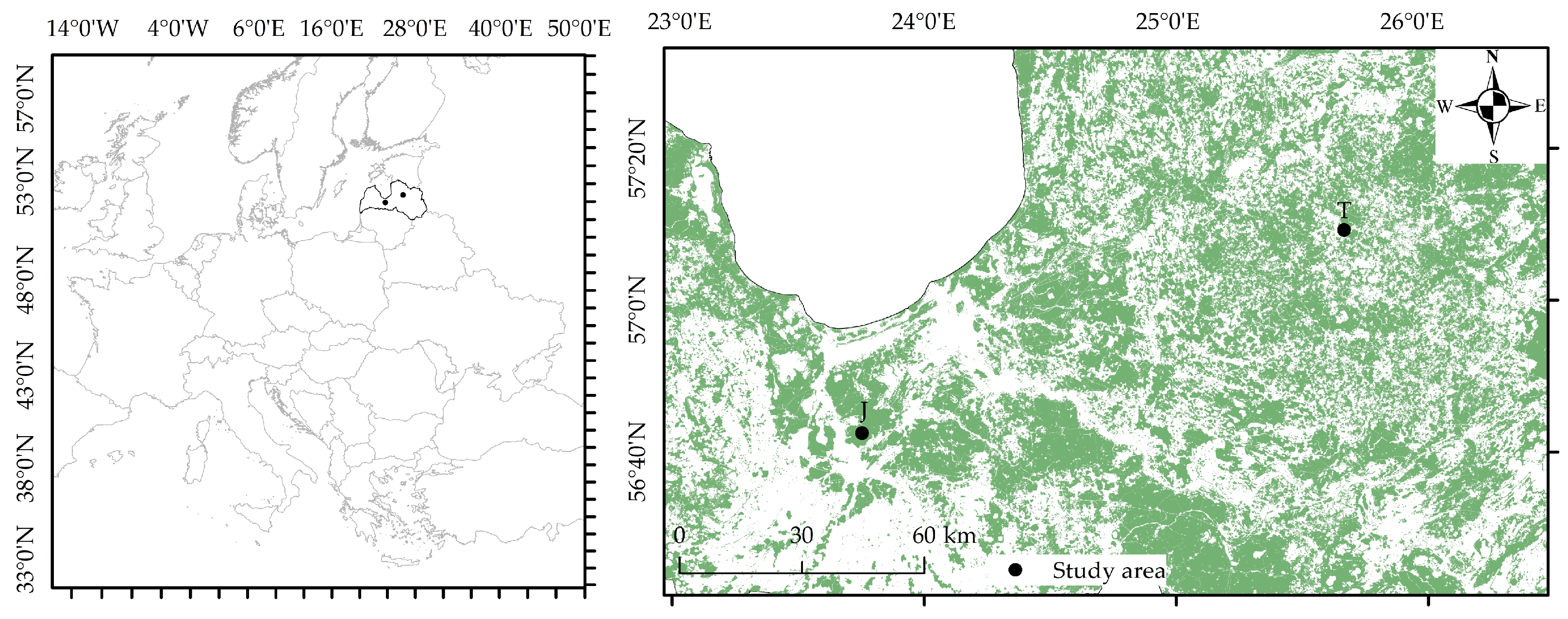
The study area is located in the hemiboreal forest zone in Latvia (Figure 1), where approximately 50% of the territory is covered by forests, about 10% of which are situated on periodically waterlogged mineral soils [34]. The forest stand age and structure, as well as the forest landscape of Latvia, are notably fragmented and formed by a mixture of forest patches and agricultural land [34]. Birch (Betula spp.), Scots pine (Pinus sylvestris L.), and Norway spruce (Picea abies (L.) H.Karst.) are the most economically important tree species, forming both pure and mixed stands and accounting for approximately 76% of the total standing volume [34]. About 10% of the standing volume of birch, pine, and spruce is found in stands on periodically waterlogged mineral soils [34].
Figure 1.
Location of the study area in Latvia near Jelgava (J) and Taurene (T). The green-coloured area represents forest cover within the territory of Latvia.
The study was conducted in the forest stands managed by the Forest Research Station near Jelgava (56°44′24″ N 23°44′32″ E) and Taurene (57°10′20″ N 25°41′40″ E), representing the increasing distance from the Baltic Sea (Figure 1). This corresponds to the eastward increase in continentality [46], and thus to local differences in mean air temperatures and precipitation [47], which are further amplified by differences in elevation, as Jelgava is located at approximately 5 m a.s.l., while Taurene is at around 190 m a.s.l. The climate in the study area (Latvia) is humid continental [48], with the mean annual air temperature ranging from +7.1 °C in Jelgava to +5.7 °C in Taurene during the period 1991–2020 [47]. The mean monthly air temperatures during the winter months (December–February) in these localities (Jelgava and Taurene) are −0.9 °C, −2.7 °C, −2.7 °C, −2.6 °C, −4.5 °C, and −4.7 °C, respectively [47]. The potential length of the frost season differs between Jelgava and Taurene, as indicated by the mean monthly air temperatures in November and March, which are +2.5 °C and +0.7 °C in Jelgava, and +0.8 °C and −1.0 °C in Taurene, respectively [47].
The annual sum of precipitation is lower in Jelgava, reaching 651 mm with a monthly average of 42 mm during the winter period (December–February), while in Taurene, these values are 729 mm and 53 mm, respectively [47]. The mean long-term SCT varies between 4.5 cm in Jelgava and 8.1 cm in Taurene, with maximum values of 25.3 cm and 31.1 cm, respectively [47]. Across the entire territory of Latvia, the mean SCT tends to decrease, while maximum values remain stable without a negative trend [47]. However, the number of days with snow cover is decreasing, with Jelgava and Taurene still averaging 88 and 117 days with snow cover, respectively [47]. Although the study areas near Jelgava and Taurene are situated on relatively flat terrain, elevation still plays a significant role in shaping local meteorological conditions.
In both study areas, circular sample plots of 500 m2 were established in forest stands with minimal recent management (no interventions within the last 10 years). These stands included both pure and mixed-species compositions typical of middle-aged birch, pine, and spruce on mesotrophic mineral soils that are periodically waterlogged [34]. A total of 15 forest stands were sampled across the study areas, representing a range of stand structures and species compositions. The average height of birch ranged from 10.1 to 23.6 m, spruce from 10.1 to 22.1 m, and pine from 13.7 to 17.4 m. Average diameter at breast height of birch ranged from 8.8 to 17.6 cm, for spruce from 9.2 to 20.2 cm, and for pine from 9.9 to 14.9 cm. The proportion of basal area occupied by birch ranged from 0% to 87.1%, for spruce from 2.6% to 100%, and for pine 0% to 88.6% (Table 1). In the sample plots, the proportions of ground cover varied, with moss cover ranging from 20% to 99%, tree litter from 1% to 70%, and bare soil from 0% to 10%.
Table 1.
Forest stands and their basal area, height, and diameter at breast height for each sample plot and species. SP ID—sample plot ID (region (Jelgava—J, Taurene—T), forest compartment–sub compartment–sample plot number), G—basal area, H—height, DBH—diameter at breast height.
2.2. Measurements of Snow Cover, Soil Conditions, and Weather Parameters
Snow cover measurements were conducted every 10–15 days during the late autumn to early spring seasons (November–March) of 2023–2024, depending on freeze–thaw conditions. The total duration varied depending on the timing of the first snowfall and the onset of melting, respectively. In each sample plot, SCT was measured at seven fixed points: at the stem base and under the canopy of each of three sample trees, and at one point in a stand canopy opening. Measurements were taken using a ruler with a resolution of 1 cm and were repeated at the same locations within an area of 0.5 m2 to ensure undisturbed snow cover (avoiding small pits from previous measurements).
Snow density was calculated from the volume and mass of snow samples collected using a cylindrical sampler with a diameter of 10 cm. In each sample plot, three independent snow samples were collected and weighed. To determine the presence of soil freezing, soil temperature was measured at each sample plot at three depths along a vertical profile: at the upper surface of the ground cover (usually a moss layer), immediately beneath the ground cover (0 cm), and at depths of 10 cm and 20 cm.
Soil temperature was measured using Thermo Button 22L data loggers (Proges Plus, Willems, France) with a resolution of 0.5 °C and a sampling interval of 3 h. Soil temperature, SCT, and snow density were measured within the forest stands at the same sample plots described above, including measurements taken beneath tree canopies and in canopy openings. All measurements were conducted at the same locations and depths to ensure consistency.
Weather parameters, such as air temperature and precipitation, were measured in the open field just right next to the forest stands, in which sample plots were established, using automatic weather stations Vantage Pro2 (Davis Instruments Corporation, Hayward, CA, USA) and iMETOS 3.3 (Pessl Instruments, Weiz, Austria). Snowfall was collected using a precipitation gauge and subsequently melted to determine the total sum of precipitation.
2.3. Statistical Analysis
All analyses were conducted in programme R version 4.5.1 [49], using the package “nlme” [50].
2.3.1. Snow Cover Thickness (SCT) Models
A linear mixed-effects model was fitted with SCT as the response variable and region, season (2023–24 and 2024–25), total basal area (G), mean stand height (h), mean diameter at breast height (DBH), and the proportions of spruce and pine from G as explanatory variables. Interactions among explanatory variables were not included, except for the interaction between season and region, as more complex interaction structures resulted in strong collinearity and non-estimable coefficients. The models included forest compartment (kv), subcompartment (nog), and plot ID as random effects. Because SCT was measured repeatedly over time, an AR(1) autocorrelation structure was incorporated to account for temporal dependence among observations. After fitting the initial model, it was simplified by removing non-significant predictors, and competing models were compared using AIC values. Given the high amount of tested factor combinations, models that were insignificant or affected by strong multicollinearity are not presented.
2.3.2. Soil Temperature Models
Soil temperature was analysed separately for each measurement depth (0, 10, and 20 cm). Linear mixed-effects models were constructed with soil temperature as the response variable, and SCT, snow density, daily mean air temperature, total sum of precipitation, and the number of days since 1 October (within the season) as explanatory variables. Additionally, three-way interactions between these variables, region, and season were included. The models incorporated plot ID and measurement place ID as nested random effects. An additional ARMA autocorrelation structure (second-order autoregression with a moving average component) was included in the model to account for temporal dependence among observations. Initial full models were simplified by removing non-significant interaction effects, and model selection was based on AIC values. When a significant three-way interaction was retained in the final model, pairwise comparisons of slopes were performed using Tukey’s method implemented in the R package “emmeans” [51].
Snow water equivalent (SWE) was not included in the models due to its strong correlation with SCT (r > 0.85), which caused multicollinearity and unstable parameter estimates.
3. Results
3.1. Snow Cover Thickness (SCT)
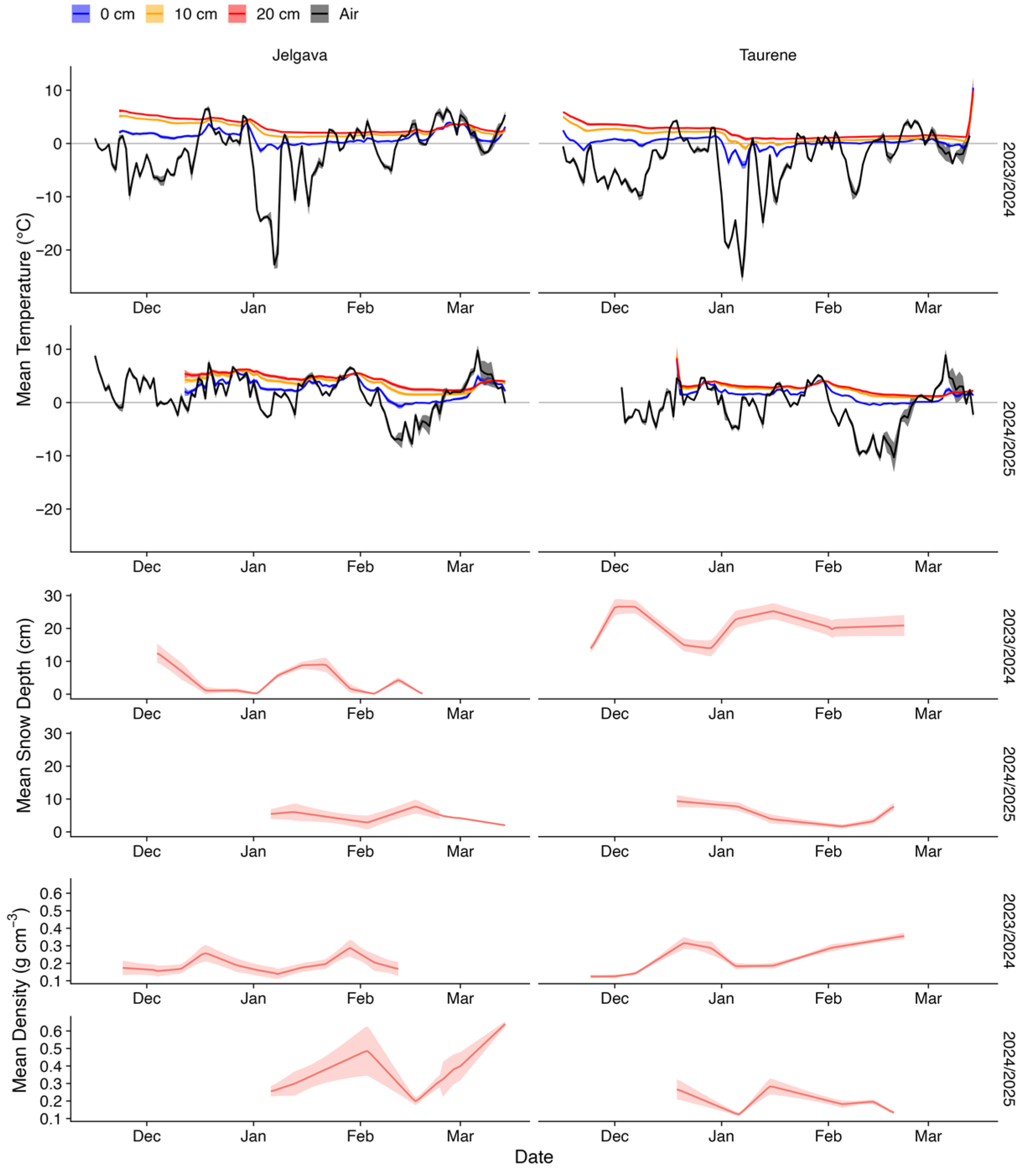
The difference in SCT between Jelgava and Taurene was significant only during the 2023/2024 season, when substantially more snow accumulated in Taurene than in Jelgava (Figure 2). In contrast, during the 2024/2025 season, snow cover formation was sporadic in both study areas. Across both seasons, snow accumulation was consistently lower in pine- and spruce-dominated stands and higher in birch-dominated stands (Supplementary Materials, Table S1). Analysis of variance (ANOVA) and fixed-effects modelling indicated that SCT was strongly influenced by the interaction between season and region (F = 69.22; p < 0.001; Table 2). This interaction indicates that the effect of season on snow accumulation differed between Jelgava and Taurene; in other words, the combined influence of location and season had a greater effect on SCT than either factor alone. During the 2023/2024 season, mean SCT reached 18.4 cm in Taurene but only 3.6 cm in Jelgava. By contrast, during the 2024/2025 season, mean SCT values converged between the regions, reaching 5.7 cm in Jelgava and 5.5 cm in Taurene, with no statistically significant regional differences (Table 2 and Table 3).
Figure 2.
Mean temperature of air and soil at three depths (0, 10, and 20 cm), and mean depth (snow cover thickness (SCT)) and density of snow within forest stands managed by the Forest Research Station near Jelgava (central Latvia) and Taurene (eastern Latvia) during the seasons of 2023/2024 and 2024/2025. The coloured area indicates 95% confidence interval.
Table 2.
Marginal means (emmeans) of snow cover thickness (SCT) depending on season and region. SE—standard error.
Table 3.
Generalised linear mixed-effects model coefficients, their standard errors, factor effects, and significance for factors influencing snow cover thickness. Est.—coefficient values, SE—standard error, F—effect of factors, SD—standard deviation, Φ—autocorrelation parameter (AR(1)) for repeated measurements.
Tree species composition also significantly affected SCT, with higher proportions of conifers, particularly Scots pine, associated with reduced snow accumulation (F = 15.80; p < 0.01; Table 3). The proportion of spruce alone did not have a statistically significant effect (F = 4.07; p = 0.090); however, its inclusion improved model performance, suggesting a weak but relevant contribution to explaining SCT variability. The negative and significant coefficients for spruce (−6.708, p < 0.01) and pine (−5.430, p < 0.05) indicate that stands with higher proportions of these conifers accumulate less snow, likely due to greater snow interception by tree canopies.
Model autocorrelation (Φ = 0.629; Table 3) indicates moderate temporal dependence in SCT measurements, reflecting persistence of snow conditions between consecutive sampling days. Spatial variability in SCT was primarily associated with the random block effect, which showed the highest standard deviation (SD = 0.970), exceeding variation attributed to plot- and sample-plot-level effects. Nevertheless, a substantial proportion of SCT variability remained unexplained, as indicated by the relatively large model residual (SD = 5.099; Table 3).
3.2. Soil Temperature
Soil temperature varied by depth, indicating a shift from strong atmospheric control at the surface to SCT-determined insulation in deeper soil layers. In all studied depths, significant interactions among region, season, and SCT shaped soil thermal responses, with the influence of it increasing at 10 and 20 cm. Deeper layers showed greater temporal persistence and reduced sensitivity to short-term atmospheric variability, while snow density was a consistent and strong insulating factor.
3.2.1. Depth of 20 cm
At 20 cm, soil temperature reflects integrated winter conditions, with snow acting as a long-term thermal buffer, hence soil temperature is least directly influenced by short-term atmospheric variability and most strongly moderated by snowpack properties (both SCT and density and seasonal context (Temp air, 20 cm: F = 89.95, p < 0.001; Day, 20 cm: F = 280.46, p < 0.001; Table 4). The only significant three-way interaction was Region × Season × SCT, which was consistent across all studied depths (Table 4), indicating that the insulating effect of snow depth depends strongly on both region and season (20 cm: F = 45.60; p < 0.001; Table 4). This reflects regional differences in how snow cover affects soil thermal conditions (Region × SCT, 10 cm, F = 10.46, p < 0.01; Table 4). These differences can be partly attributed to the significant interaction between mean air temperature, region, and measurement season, with consistently lower air temperatures observed in the elevated area of Taurene compared to the lowland of Jelgava (Region × Temp air, 20 cm: F = 20.09, p < 0.001; 137.05; Region × Season, 20 cm: F = 137.05, p < 0.001; Table 4; Figure 2).
Table 4.
Parameter estimates (Est.) and standard errors (SE), as well as the strength of effects (F-values), of environmental and temporal factors and their interactions influencing soil temperature at three soil depths (0, 10, and 20 cm) in the generalised linear mixed-effects model. Significance is reported for both estimates and F-values. Region—study area, Season—measurement season, SCT—snow cover thickness, Temp air—air temperature, Precipitation—precipitation amount, and Day—day of year.
Furthermore, air temperature remains significant main effect (Temp air, 20 cm: F = 89.95, p < 0.001; Table 4) yet F-values of interactions are also large, suggesting interaction-dominated influence (Region × Temp air, 20 cm: F = 20.09, p < 0.001; Season × Temp air, 20 cm: F = 26.15, p < 0.001; Table 4). Precipitation has no direct effect and appears only weakly through interactions (Precipitation, 20 cm: F = 1.11, p > 0.05; Region × Precipitation, 20 cm: F = 7.56, p > 0.05; Table 4). Snow density has a strong and independent main effect, confirming that snowpack structure plays a key role in deep-soil thermal insulation (Snow density, 20 cm: F = 47.45, p < 0.001; Table 4). Temporal autocorrelation is very strong (Φ1 ≈ 0.937; Table 5), showing high persistence of thermal conditions at this depth.
Table 5.
Autocorrelation parameters and random-effect variability from generalised linear mixed-effects models of soil temperature (0, 10, and 20 cm depths). ARMA(2,1) autocorrelation parameter (Φ1) associated with the fixed effects listed in Table 4 and Table 5, as well as the standard deviations (SD) of the nested random effects (sample plot and measurement place ID) and model residuals.
3.2.2. Depth of 10 cm
The 10 cm layer represents a transition zone, where soil temperature responds both to snowpack characteristics and short-term atmospheric variability. Still, patterns similar to those observed at a depth of 20 cm were evident, as soil temperature was significantly influenced by the three-way interaction among region, season, and SCT (Region × Season × SCT; 10 cm: F = 50.89, p < 0.001; Table 4). However, the magnitude of this effect was stronger than at a depth of 20 cm. Soil temperature was also significantly affected by interactions between air temperature, region, and season (Region × Temp air, 10 cm: F = 12.45, p < 0.001; Season × Temp air, 10 cm: 13.08; p < 0.001; Table 4). Compared to 20 cm depth, the higher F-value for the three-way interaction indicates that soil temperature at 10 cm is more sensitive to the combined effects of snow cover and seasonal conditions. At 10 cm of depth, soil temperature shows a balance between snow insulation and atmospheric forcing, making this depth the most interaction-rich. Air temperature has a strong main effect and multiple interactions (Temp air, 10 cm: F = 84.88, p < 0.001; Region × Temp air, 10 cm: F = 12.45, p < 0.001; Season × Temp air, 10 cm: F = 13.02, p < 0.001; Table 4).
Snow depth emerges as a significant main effect, indicating increased sensitivity to snow accumulation (SCT, 10 cm: F = 12.64, p < 0.001; Table 4). However, the main effect of SCT at 10 cm is much weaker in magnitude and interpretation than that observed at 20 cm of depth, despite its statistical significance. Snow density remains strongly significant, with a stronger effect than at 20 cm (Snow density, 10 cm: F = 39.21, p < 0.001; Table 4). The effects of precipitation appear significant only via interaction with region (Region × Precipitation, 10 cm: F = 4.00, p < 0.01; Table 4), further emphasising the role of regional climatic contrasts.
3.2.3. Depth of 0 cm
At 0 cm, soil temperature responds rapidly to daily weather conditions, with snow providing only partial and variable insulation. Soil temperature at 0 cm of depth, located immediately beneath the snow layer, showed the highest sensitivity to air temperature fluctuations (Temp air, 0 cm: F = 186.71, p < 0.001; Table 4) compared to that at 10 cm and 20 cm, reflecting strong coupling with atmospheric conditions. This layer was also highly responsive to the insulating effect of snow and its seasonal dynamics. Snow cover exerted its less pronounced insulating effect at a depth of 0 cm, where soil temperature was highly variable and strongly weather-dependent. At this depth, snow cover had the weakest significant positive effect on soil temperature (SCT, 0 cm: F = 9.07, p < 0.01; Snow density, 0 cm: F = 23.91, p < 0.001; Table 4), in contrast to the deeper soil layers at 10 and 20 cm depth.
The patterns of the three-way interaction among region, season, and SCT, similar to those observed at depths of 10 cm and 20 cm, were still evident, yet less pronounced (Region × Season × SCT; 0 cm: F = 7.55, p < 0.01; Table 4). However, A new three-way interaction appeared with days of the year, reflecting strong seasonal progression effects (Region × Season × Day, 0 cm: F = 4.63, p < 0.05; Table 4).
Moderate temporal dependence was observed in soil temperature measurements at all three depths, with autocorrelation coefficients (φ) associated with the model factors listed in Table 4 and Table 5 ranging from φ = 0.645 to 1.038 (Table 5). The strongest autocorrelation occurred at a depth of 10 cm (φ = 1.038), indicating greater thermal inertia and persistence of soil temperature conditions at this depth. In contrast, the random effects and residual variance revealed substantial spatial variability in soil temperature across sample plots, indicating that differences among plots, rather than repeated measurements within plots, accounted for a large proportion of the observed variability at all depths. The standard deviation associated with sample plot effects ranged from 0.290 to 0.420, while residual variability ranged from 0.210 to 0.310 (Table 5), with the highest overall variability observed at a depth of 0 cm.
In summary, with increasing soil depth, the influence of air temperature decreases while the importance of snowpack properties and seasonal context increases. At a depth of 0 cm, soil temperature is primarily controlled by air temperature and seasonal progression, whereas at a depth of 10 cm, both atmospheric forcing and snow insulation play comparable roles. At a depth of 20 cm, soil temperature is dominated by snow-related insulation effects, particularly the interaction between SCT, region, and season, with snow density exerting a consistent independent influence across all depths.
4. Discussion
Snow cover varied by region, season, and species, with birch stands accumulating the most and conifers the least. Near-surface soil temperature followed air temperature, while deeper layers were insulated by snow. These interactions between snow, soil, and species strongly influence frozen soil formation and tree anchorage, affecting wind damage risk. Although the study areas are relatively close, differences in elevation and continentality led to contrasting snow accumulation and soil temperature responses. This supports previous findings that even relatively small regional differences can result in substantial variability in soil temperature regimes [15,21].
The formation of a new snow layer led to warming of the soil profile and melting of existing frozen soil under periodically waterlogged conditions. This aligns with observations by [20,21], who showed that snow cover regulates soil temperature by stabilising fluctuations and slowing the formation of frozen soil when snow accumulates on unfrozen ground. Under periodically waterlogged conditions, this effect is further amplified by heat transfer from deeper, unfrozen soil layers and groundwater, promoting thawing from below [52]. As a result, prolonged snow-covered periods can substantially reduce both the depth and duration of frozen soil conditions, thereby weakening soil–root anchorage during the period of highest storm activity [20,21,22,30,53].
4.1. Snow Cover Thickness (SCT)
Tree species composition significantly influenced SCT, with higher proportions of conifers, particularly Scots pine, associated with reduced snow accumulation. This is consistent with differences in canopy structure and snow interception capacity between deciduous and coniferous species [32,33,42,54]. Birch stands tend to accumulate more snow and thus experience stronger soil insulation, yet birch is also capable of developing deeper root systems under waterlogged conditions [44], potentially compensating for reduced soil freezing. In contrast, spruce, with its typically shallow root system, remains highly vulnerable [55,56,57,58], especially when unfrozen conditions persist. Pine, although capable of deeper rooting on freely draining soils, may also develop shallow root systems under high groundwater levels [40,41,43,46], limiting its wind resistance in such environments.
Although the proportion of spruce alone did not have a strong effect in the models, its inclusion improved the model stability, indicating a relevant role. These results align with previous studies demonstrating lower snow accumulation under coniferous canopies and greater spatial heterogeneity in mixed and multi-layered stands [30,32,54]. Reduced snow accumulation under conifers may partially mitigate the insulating effect of snow and promote deeper soil freezing under suitable climatic conditions; however, under mild winters with frequent thawing and high precipitation, this potential benefit may be reduced by elevated soil moisture and limited frost penetration [26,27,28,29,53].
The pronounced differences in SCT between the two study regions highlight the strong interannual variability in winter conditions, which is typical for the Eastern Baltic region [17] and is largely controlled by cyclonic activity during late autumn and winter [14,15]. However, part of the observed variability might be related to the relatively short observation period, which included two contrasting winters. The strong interaction between season and region in determining SCT implies that neither factor alone can explain the snow dynamics. Instead, the combined effect indicates the importance of both spatial and temporal variability in the formation of frozen soil.
4.2. Soil Temperature
In the Eastern Baltic region, soil temperature of periodically waterlogged mineral soils is strongly controlled by the combined effects of snow cover (SCT and snow density), air temperature, precipitation regime, seasonality, and regionality. Several factors, such as milder winters, increased cyclonic activity, and altered snow dynamics, are identified as key drivers potentially reducing the formation of frozen soil and thereby weakening soil–root anchorage and increasing wind damage risk. Although these factors remain uncertain under future conditions [2,6,7,11,59,60], the results illustrate potential forest stand responses to variable frozen soil conditions.
Soil temperature responses were strongly depth-dependent: at 20 cm, the deepest layer, soil exhibited the strongest insulation and weakest coupling with atmospheric variability; at 10 cm, the intermediate layer acted as a transition zone, integrating both snow insulation and air temperature effects; and at 0 cm, the near-surface layer was most strongly controlled by atmospheric conditions. These depth-specific patterns suggest that warming at intermediate depths can remain over longer periods, potentially maintaining unfrozen conditions during short cold spells. From the perspective of mechanical stability, this is critical, as anchorage strength depends not only on freezing of the soil surface but also on freezing of deeper soil layers that provide resistance to movement of the soil–root plate [61]. Accordingly, even shallow, yet continuous snow cover may notably compromise tree stability. The interaction between snow cover, soil temperature, and species composition has direct implications for wind damage susceptibility [30,31]. Under periodically waterlogged conditions, unfrozen and saturated soils substantially reduce soil stiffness and root anchorage strength, increasing the likelihood of uprooting during storms [24,25]. This effect is particularly critical during late autumn and winter, when cyclonic activity peaks and soils are most vulnerable [14,15].
Overall, the results indicate that the formation of frozen soil in periodically waterlogged mineral soils is highly sensitive to snow dynamics, which are increasingly variable under climate change [53,59,60]. The ongoing trend of winter warming with shorter periods of frozen soil [19] suggests a future increase in unfrozen soil conditions during the storm season, potentially elevating wind damage risk [15,59,62,63,64]. From a forest management perspective, selecting tree species with greater rooting depth and adaptability to high soil moisture, such as birch [44], and promoting mixed-species stands may help enhance stand stability. Mixed stands can modify snow accumulation patterns [30], increase structural diversity [65], and improve overall ecosystem resilience [66,67,68,69]. While not all factors influencing soil–root anchorage can be controlled, knowledge-based species selection and stand structure management are critical for mitigating wind damage risk in periodically waterlogged forest sites under changing climatic conditions.
5. Conclusions
The study indicates that snow cover can influence soil temperature in periodically waterlogged mineral soils, supporting H1. This effect was clearly depth-dependent, as both snow cover thickness and snow density had more pronounced impacts on soil temperature at the deeper studied layers. The formation of a snow layer leads to soil warming and melting of existing frozen soil under periodically waterlogged conditions, and heat transfer from deeper unfrozen layers further amplifies thawing from below. H2 was also supported since the magnitude of snow insulation effects differed between the two study regions and across seasons. Differences in regionality, and thus in continentality, produced contrasting snow accumulation and soil temperature responses, and strong interannual variability in winter conditions further modulated frozen soil dynamics. Neither season nor region alone can explain soil temperature patterns; instead, spatial and temporal variability jointly determine the formation and persistence of frozen soil. H3 was also supported, as near-surface soil temperatures were strongly influenced by air temperature, whereas snow cover thickness had a more pronounced effect at intermediate depths and during prolonged snow-covered periods. Accordingly, snow provides an important insulating effect, but air temperature remains the dominant driver of near-surface soil temperature variability.
Overall, these findings underscore the complex interactions between snow cover, soil temperature, and regional climate in periodically waterlogged mineral soils. From a forest management perspective, selecting species with deep rooting systems, such as birch, and promoting mixed-species stands can help buffer the effects of reduced soil freezing, modify snow accumulation patterns, enhancing stand stability. Both snow dynamics and air temperature must be considered when assessing soil–root anchorage and wind damage risk under changing climatic conditions.
Supplementary Materials
The following supporting information can be downloaded at: https://www.mdpi.com/article/10.3390/f17020276/s1. Table S1: Duration of freezing temperatures of the studied soil layers, snow cover duration, and maximum SCT in both seasons for every studied plot.
Author Contributions
Conceptualization, K.R. and A.S.; methodology, O.K., A.S. and K.B.; formal analysis, D.E.; data curation, A.S., K.B., E.B. and O.K.; writing—original draft preparation, K.R. and A.S.; writing—review and editing, A.S., E.B. and O.K.; supervision, E.B. and O.K.; funding acquisition, R.M. All authors have read and agreed to the published version of the manuscript.
Funding
The preparation of this study was funded by the JCS Latvia’s State Forests research programme “Effect of climate change on forestry and associated risks” (agreement No. 5–5.9.1_007p_101_21_78). Oskars Krišāns was supported independently by Activity 1.1.1.9 “Post-doctoral Research” of the Specific Objective 1.1.1 “Strengthening research and innovative capacities and introduction of advanced technologies in the common R&D system” of the European Union’s Cohesion Policy Programme for 2021–2027 research application No 1.1.1.9/LZP/1/24/035 “A solution for reducing wind damage risk in uneven-aged management of Scots pine stands in the Eastern Baltic region”. Andris Seipulis was supported independently by the LBTU Doctoral Support and Development Initiative ERAF project No. 1.1.1.8/1/24/I/002.
Data Availability Statement
The data presented in this study are available on request from the corresponding author due to commercial restrictions.
Acknowledgments
The involvement of Kristaps Ozoliņš, Nauris Īstenais, Liene Zēberga, and Emīls Mārtiņš Upenieks in technical support for conducting the study is acknowledged.
Conflicts of Interest
The authors declare no conflicts of interest.
References
- Gardiner, B.; Blennow, K.; Carnus, J.M.; Fleischer, P.; Ingemarson, F.; Landmann, G.; Lindner, M.; Marzano, M.; Nicoll, B.; Orazio, C.; et al. Destructive Storms in European Forests: Past and Forthcoming Impacts; European Forest Institute: Bordeaux, France, 2010. [Google Scholar] [CrossRef]
- Lindner, M.; Fitzgerald, J.B.; Zimmermann, N.E.; Reyer, C.; Delzon, S.; van Der Maaten, E.; Schelhaas, M.J.; Lasch, P.; Eggers, J.; van der Maaten-Theunissen, M.; et al. Climate change and European forests: What do we know, what are the uncertainties, and what are the implications for forest management? J. Environ. Manag. 2014, 146, 69–83. [Google Scholar] [CrossRef] [PubMed]
- Gregow, H.; Laaksonen, A.; Alper, M.E. Increasing large scale windstorm damage in Western, Central and Northern European forests, 1951–2010. Sci. Rep. 2017, 7, 46397. [Google Scholar] [CrossRef] [PubMed]
- Reyer, C.P.; Bathgate, S.; Blennow, K.; Borges, J.G.; Bugmann, H.; Delzon, S.; Faias, S.P.; Garcia-Gonzalo, J.; Gardiner, B.; Gonzalez-Olabarria, J.R.; et al. Are forest disturbances amplifying or canceling out climate change-induced productivity changes in European forests? Environ. Res. Lett. 2017, 12, 034027. [Google Scholar] [CrossRef] [PubMed]
- Seidl, R.; Thom, D.; Kautz, M.; Martin-Benito, D.; Peltoniemi, M.; Vacchiano, G.; Wild, J.; Ascoli, D.; Petr, M.; Honkaniemi, J.; et al. Forest disturbances under climate change. Nat. Clim. Change 2017, 7, 395–402. [Google Scholar] [CrossRef]
- Ossó, A.; Allan, R.P.; Hawkins, E.; Shaffrey, L.; Maraun, D. Emerging new climate extremes over Europe. Clim. Dyn. 2022, 58, 487–501. [Google Scholar] [CrossRef]
- Patacca, M.; Lindner, M.; Lucas-Borja, M.E.; Cordonnier, T.; Fidej, G.; Gardiner, B.; Hauf, Y.; Jasinevičius, G.; Labonne, S.; Linkevicius, E.; et al. Significant increase in natural disturbance impacts on European forests since 1950. Glob. Change Biol. 2022, 29, 1359–1376. [Google Scholar] [CrossRef]
- Ridder, N.N.; Ukkola, A.M.; Pitman, A.J.; Perkins-Kirkpatrick, S.E. Increased occurrence of high impact compound events under climate change. npj Clim. Atmos. Sci. 2022, 5, 3. [Google Scholar] [CrossRef]
- Pryor, S.C.; Barthelmie, R.J.; Clausen, N.E.; Drews, M.; MacKellar, N.; Kjellström, E. Analyses of possible changes in intense and extreme wind speeds over northern Europe under climate change scenarios. Clim. Dyn. 2012, 38, 189–208. [Google Scholar] [CrossRef]
- Usbeck, T.; Wohlgemuth, T.; Dobbertin, M.; Pfister, C.; Bürgi, A.; Rebetez, M. Increasing storm damage to forests in Switzerland from 1858 to 2007. Agric. For. Meteorol. 2010, 150, 47–55. [Google Scholar] [CrossRef]
- Outten, S.; Sobolowski, S. Extreme wind projections over Europe from the Euro-CORDEX regional climate models. Weather Clim. Extrem. 2021, 33, 100363. [Google Scholar] [CrossRef]
- Senf, C.; Seidl, R. Storm and fire disturbances in Europe: Distribution and trends. Glob. Change Biol. 2021, 27, 3605–3619. [Google Scholar] [CrossRef] [PubMed]
- Severino, L.G.; Kropf, C.M.; Afargan-Gerstman, H.; Fairless, C.; de Vries, A.J.; Domeisen, D.I.; Bresch, D.N. Projections and uncertainties of winter windstorm damage in Europe in a changing climate. Nat. Hazards Earth Syst. Sci. 2024, 24, 1555–1578. [Google Scholar] [CrossRef]
- Martínez-Alvarado, O.; Gray, S.L.; Catto, J.L.; Clark, P.A. Sting jets in intense winter North-Atlantic windstorms. Environ. Res. Lett. 2012, 7, 024014. [Google Scholar] [CrossRef]
- Laapas, M.; Lehtonen, I.; Venäläinen, A.; Peltola, H.M. The 10-year return levels of maximum wind speeds under frozen and unfrozen soil forest conditions in Finland. Climate 2019, 7, 62. [Google Scholar] [CrossRef]
- Lizuma, L.; Briede, A.; Klavins, M. Long-term changes of precipitation in Latvia. Hydrol. Res. 2010, 41, 241–252. [Google Scholar] [CrossRef]
- Jaagus, J.; Briede, A.; Rimkus, E.; Remm, K. Precipitation pattern in the Baltic countries under the influence of large-scale atmospheric circulation and local landscape factors. Int. J. Climatol. 2010, 30, 705–720. [Google Scholar] [CrossRef]
- Christensen, J.H.; Hewitson, A.B.; Busuioc, A.; Chen, X.; Gao, I.; Held, R.; Jones, R.K.; Kolli, W.-T.; Kwon, R.; Laprise, V.; et al. Chapter 11: Regional Climate Projections. In Climate Change: The Physical Science Basis. Contribution of Working Group I to the Fourth Assessment Report of the Intergovernmental Panel on Climate Change; Solomon, S., Qin, D., Manning, M., Chen, Z., Marquis, M., Averyt, K.B., Tignor, M., Miller, H.L., Eds.; Cambridge University Press: Cambridge, UK; New York, NY, USA, 2007; pp. 847–940. [Google Scholar]
- Carvalho, D.; Cardoso Pereira, S.; Rocha, A. Future surface temperatures over Europe according to CMIP6 climate projections: An analysis with original and bias-corrected data. Clim. Change 2021, 167, 10. [Google Scholar] [CrossRef]
- Hardy, J.P.; Groffman, P.M.; Fitzhugh, R.D.; Henry, K.S.; Welman, A.T.; Demers, J.D.; Fahey, T.J.; Driscoll, C.T.; Tierney, G.L.; Nolan, S. Snow depth manipulation and its influence on soil frost and water dynamics in a northern hardwood forest. Biogeochemistry 2001, 56, 151–174. [Google Scholar] [CrossRef]
- Venäläinen, A.; Tuomenvirta, H.; Heikinheimo, M.; Kellomäki, S.; Peltola, H.; Strandman, H.; Väisänen, H. Impact of climate change on soil frost under snow cover in a forested landscape. Clim. Res. 2001, 17, 63–72. [Google Scholar] [CrossRef]
- Kellomäki, S.; Maajärvi, M.; Strandman, H.; Kilpeläinen, A.; Peltola, H. Model computations on the climate change effects on snow cover, soil moisture and soil frost in the boreal conditions over Finland. Silva Fenn. 2010, 44, 213–233. [Google Scholar] [CrossRef]
- Shastri, A.; Sánchez, M.; Gai, X.; Lee, M.Y.; Dewers, T. Mechanical behavior of frozen soils: Experimental investigation and numerical modeling. Comput. Geotech. 2021, 138, 104361. [Google Scholar] [CrossRef]
- Dupuy, L.; Fourcaud, T.; Stokes, A. A numerical investigation into the influence of soil type and root architecture on tree anchorage. Plant Soil 2007, 278, 119–134. [Google Scholar] [CrossRef]
- Liu, S.; Ji, X.; Zhang, X. Effects of soil properties and tree species on root–soil anchorage characteristics. Sustainability 2022, 14, 7770. [Google Scholar] [CrossRef]
- Dobbertin, M. Influence of stand structure and site factors on wind damage comparing the storms Vivian and Lothar. For. Snow Landsc. Res. 2002, 77, 187–205. [Google Scholar]
- Blennow, K.; Andersson, M.; Sallnäs, O.; Olofsson, E. Climate change and the probability of wind damage in two Swedish forests. For. Ecol. Manag. 2010, 259, 818–830. [Google Scholar] [CrossRef]
- Peltola, H.; Ikonen, V.P.; Gregow, H.; Strandman, H.; Kilpeläinen, A.; Venäläinen, A.; Kellomäki, S. Impacts of climate change on timber production and regional risks of wind-induced damage to forests in Finland. For. Ecol. Manag. 2010, 260, 833–845. [Google Scholar] [CrossRef]
- Peltola, H.; Gardiner, B.; Nicoll, B. Mechanics of wind damage. In Living with Storm Damage to Forests; Gardiner, B., Schuck, A., Schelhaas, M.-J., Orazio, C., Blennow, K., Nicoll, B., Eds.; European Forest Institute: Joensuu, Finland, 2013; Volume 3, pp. 31–38. [Google Scholar]
- Löfvenius, M.O.; Kluge, M.; Lundmark, T. Snow and soil frost depth in two types of shelterwood and a clear-cut area. Scand. J. For. Res. 2003, 18, 54–63. [Google Scholar] [CrossRef]
- Varhola, A.; Coops, N.C.; Weiler, M.; Moore, R.D. Forest canopy effects on snow accumulation and ablation: An integrative review of empirical results. J. Hydrol. 2010, 392, 219–233. [Google Scholar] [CrossRef]
- Horstkotte, T.; Roturier, S. Does forest stand structure impact the dynamics of snow on winter grazing grounds of reindeer (Rangifer t. tarandus)? For. Ecol. Manag. 2013, 291, 162–171. [Google Scholar] [CrossRef]
- Davis, R.E.; Hardy, J.P.; Ni, W.; Woodcock, C.; McKenzie, J.C.; Jordan, R.; Li, X. Variation of snow cover ablation in the boreal forest: A sensitivity study on the effects of conifer canopy. J. Geophys. Res. Atmos. 1997, 102, 29389–29395. [Google Scholar] [CrossRef]
- NFI National Forest Inventory. Available online: https://mail.silava.lv/petnieciba/nacionalais-meza-monitorings (accessed on 7 January 2026).
- Ray, D.; Nicoll, B.C. The effect of soil water-table depth on root-plate development and stability of Sitka spruce. For. Int. J. For. Res. 1998, 71, 169–182. [Google Scholar] [CrossRef]
- Nicoll, B.C.; Gardiner, B.A.; Rayner, B.; Peace, A.J. Anchorage of coniferous trees in relation to species, soil type, and rooting depth. Can. J. For. Res. 2006, 36, 1871–1883. [Google Scholar] [CrossRef]
- Zubizarreta-Gerendiain, A.; Pellikka, P.; Garcia-Gonzalo, J.; Ikonen, V.P.; Peltola, H. Factors affecting wind and snow damage of individual trees in a small management unit in Finland: Assessment based on inventoried damage and mechanistic modelling. Silva Fenn. 2012, 46, 181–196. [Google Scholar] [CrossRef]
- Gardiner, B.; Berry, P.; Moulia, B. Wind impacts on plant growth, mechanics and damage. Plant Sci. 2016, 245, 94–118. [Google Scholar] [CrossRef] [PubMed]
- Krisans, O.; Matisons, R.; Rust, S.; Burnevica, N.; Bruna, L.; Elferts, D.; Kalvane, L.; Jansons, A. Presence of root rot reduces stability of Norway spruce (Picea abies): Results of static pulling tests in Latvia. Forests 2020, 11, 416. [Google Scholar] [CrossRef]
- Peltola, H.; Kellomäki, S.; Hassinen, A.; Granander, M. Mechanical stability of Scots pine, Norway spruce and birch: An analysis of tree-pulling experiments in Finland. For. Ecol. Manag. 2000, 135, 143–153. [Google Scholar] [CrossRef]
- Donis, J.; Kitenberga, M.; Šņepsts, G.; Dubrovskis, E.; Jansons, Ā. Factors affecting windstorm damage at the stand level in hemiboreal forests in Latvia: Case study of 2005 winter storm. Silva Fenn. 2018, 52, 10009. [Google Scholar] [CrossRef]
- Peltola, H.; Kellomäki, S.; Väisänen, H. Model computations of the impact of climatic change on the windthrow risk of trees. Clim. Change 1999, 41, 17–36. [Google Scholar] [CrossRef]
- Ikonen, V.P.; Kilpeläinen, A.; Strandman, H.; Asikainen, A.; Venäläinen, A.; Peltola, H. Effects of using certain tree species in forest regeneration on regional wind damage risks in Finnish boreal forests under different CMIP5 projections. Eur. J. For. Res. 2020, 139, 685–707. [Google Scholar] [CrossRef]
- Krišāns, O.; Matisons, R.; Kitenberga, M.; Donis, J.; Rust, S.; Elferts, D.; Jansons, Ā. Wind resistance of Eastern Baltic silver birch (Betula pendula Roth.) suggests its suitability for periodically waterlogged sites. Forests 2021, 12, 21. [Google Scholar] [CrossRef]
- Päätalo, M.L.; Peltola, H.; Kellomäki, S. Modelling the risk of snow damage to forests under short-term snow loading. For. Ecol. Manag. 1999, 116, 51–70. [Google Scholar] [CrossRef]
- Kalliokoski, T.; Nygren, P.; Sievänen, R. Coarse root architecture of three boreal tree species growing in mixed stands. Silva Fenn. 2008, 42, 189–210. [Google Scholar] [CrossRef]
- Krauklis, Ā.; Draveniece, A. Landscape seasons and air mass dynamics in Latvia. Folia Geogr. 2004, 12, 16–47. [Google Scholar]
- LEGMC Climate of Latvia. Available online: https://klimats.meteo.lv/klimats_latvija/latvijas_klimatiskais_raksturojums/ (accessed on 7 January 2026).
- Belda, M.; Holtanová, E.; Halenka, T.; Kalvová, J. Climate classification revisited: From Köppen to Trewartha. Clim. Res. 2014, 59, 1–13. [Google Scholar] [CrossRef]
- R Core Team. R: A Language and Environment for Statistical Computing; R Foundation for Statistical Computing: Vienna, Austria, 2025; Available online: https://www.R-project.org/ (accessed on 7 January 2026).
- Pinheiro, J.; Bates, D.; R Core Team. nlme: Linear and Nonlinear Mixed Effects Models, R Package Version 3.1-168; R Foundation for Statistical Computing: Vienna, Austria, 2025. Available online: https://CRAN.R-project.org/package=nlme (accessed on 7 January 2026).
- Lenth, R.; Piaskowski, J. emmeans: Estimated Marginal Means, aka Least-Squares Means, R Package Version 2.0.1; R Foundation for Statistical Computing: Vienna, Austria, 2025. Available online: https://rvlenth.github.io/emmeans/ (accessed on 7 January 2026).
- Gregow, H.; Rantanen, M.; Laurila, T.K.; Mäkelä, A. Review on Winds, Extratropical Cyclones and Their Impacts in Northern Europe and Finland; Raportteja; Ilmatieteen Laitos: Helsinki, Finland, 2020; Volume 3, p. 38. [Google Scholar]
- Forzieri, G.; Girardello, M.; Ceccherini, G.; Spinoni, J.; Feyen, L.; Hartmann, H.; Beck, P.S.A.; Caregion-Valls, G.; Chirici, G.; Mauri, A.; et al. Emergent vulnerability to climate-driven disturbances in European forests. Nat. Commun. 2021, 12, 1081. [Google Scholar] [CrossRef]
- Zhang, T. Influence of the seasonal snow cover on the ground thermal regime: An overview. Rev. Geophys. 2005, 43, RG4002. [Google Scholar] [CrossRef]
- Gregow, H.; Peltola, H.; Laapas, M.; Saku, S.; Venäläinen, A. Combined occurrence of wind, snow loading and soil frost with implications for risks to forestry in Finland under the current and changing climatic conditions. Silva Fenn. 2011, 45, 35–54. [Google Scholar] [CrossRef]
- Krišāns, O.; Matisons, R.; Vuguls, J.; Rust, S.; Elferts, D.; Seipulis, A.; Saleniece, R.; Jansons, Ā. Silver birch (Betula pendula Roth.) on dry mineral rather than on deep peat soils is more dependent on frozen conditions in terms of wind damage in the Eastern Baltic region. Plants 2022, 11, 1174. [Google Scholar] [CrossRef]
- Strasser, U.; Warscher, M.; Liston, G.E. Modeling snow–canopy processes on an idealized mountain. J. Hydrometeorol. 2011, 12, 663–677. [Google Scholar] [CrossRef]
- Albrecht, A.; Hanewinkel, M.; Bauhus, J.; Kohnle, U. How does silviculture affect storm damage in forests of south-western Germany? Results from empirical modelling based on long-term observations. Eur. J. For. Res. 2010, 131, 229–247. [Google Scholar] [CrossRef]
- Richter, C. Wood Characteristics: Description, Causes, Prevention, Impact on Use and Technological Adaptation; Springer International Publishing: Cham, Switzerland, 2015; p. 222. [Google Scholar]
- Lodin, I. Choice of Tree Species in the Aftermath of Two Major Storms—A Qualitative Study of Private Forest Owners in Southern Sweden. Master’s Thesis, Swedish University of Agricultural Sciences, Alnarp, Sweden, 2016. [Google Scholar]
- Krišāns, O.; Samariks, V.; Donis, J.; Jansons, Ā. Structural Root-plate characteristics of wind-thrown Norway spruce in hemiboreal forests of Latvia. Forests 2020, 11, 1143. [Google Scholar] [CrossRef]
- Venäläinen, A.; Lehtonen, I.; Laapas, M.; Ruosteenoja, K.; Tikkanen, O.P.; Viiri, H.; Ikonen, V.P.; Peltola, H. Climate change induces multiple risks to boreal forests and forestry in Finland: A literature review. Glob. Change Biol. 2020, 26, 4178–4196. [Google Scholar] [CrossRef] [PubMed]
- Kilpeläinen, A.; Gregow, H.; Strandman, H.; Kellomäki, S.; Venäläinen, A.; Peltola, H. Impacts of climate change on the risk of snow-induced forest damage in Finland. Clim. Change 2010, 99, 193–209. [Google Scholar] [CrossRef]
- Lehtonen, I.; Venäläinen, A.; Kämäräinen, M.; Asikainen, A.; Laitila, J.; Anttila, P.; Peltola, H. Projected decrease in wintertime bearing capacity on different forest and soil types in Finland under a warming climate. Hydrol. Earth Syst. Sci. 2019, 23, 1611–1631. [Google Scholar] [CrossRef]
- Juchheim, J.; Ehbrecht, M.; Schall, P.; Ammer, C.; Seidel, D. Effect of tree species mixing on stand structural complexity. For. Int. J. For. Res. 2020, 93, 75–83. [Google Scholar] [CrossRef]
- Jactel, H.; Bauhus, J.; Boberg, J.; Bonal, D.; Castagneyrol, B.; Gardiner, B.; Gonzalez-Olabarria, J.R.; Koricheva, J.; Meurisse, N.; Brockerhoff, E.G. Tree diversity drives forest stand resistance to natural disturbances. Curr. For. Rep. 2017, 3, 223–243. [Google Scholar] [CrossRef]
- Honkaniemi, J.; Rammer, W.; Seidl, R. Norway spruce at the trailing edge: The effect of landscape configuration and composition on climate resilience. Landsc. Ecol. 2020, 35, 591–606. [Google Scholar] [CrossRef]
- Pardos, M.; Del Río, M.; Pretzsch, H.; Jactel, H.; Bielak, K.; Bravo, F.; Brazaitis, G.; Defossez, E.; Engel, M.; Godvod, K.; et al. The greater resilience of mixed forests to drought mainly depends on their composition: Analysis along a climate gradient across Europe. For. Ecol. Manag. 2021, 481, 118687. [Google Scholar] [CrossRef]
Disclaimer/Publisher’s Note: The statements, opinions and data contained in all publications are solely those of the individual author(s) and contributor(s) and not of MDPI and/or the editor(s). MDPI and/or the editor(s) disclaim responsibility for any injury to people or property resulting from any ideas, methods, instructions or products referred to in the content. |
© 2026 by the authors. Licensee MDPI, Basel, Switzerland. This article is an open access article distributed under the terms and conditions of the Creative Commons Attribution (CC BY) license.