1. Introduction
Tunisia is a forest-poor country, similar to other nations with low forest cover (less than 10% of their total land area). According to the FAO Global Forest Resources Assessment, approximately 49 countries worldwide fall into this category [
1]. These countries are mainly located in extreme arid, arid, and semi-arid regions, including the Middle East (Qatar, Kuwait, Oman, Saudi Arabia, Iraq, Jordan, and the United Arab Emirates), North Africa (Algeria, Egypt, Libya, and Mauritania), and Central Asia (Kazakhstan, Afghanistan, and Pakistan), as well as several African countries such as Djibouti, Niger, Kenya, and Namibia.
Although wood product consumption varies by income level, imports in forest-poor countries may consist either of raw wood used by furniture and woodworking industries or of finished products with higher value added. Moreover, while some countries experience a trade deficit in raw wood, they may record a surplus in finished wood products by focusing on labor-intensive processing and design activities along the value chain, as is the case for Tunisia.
International trade theory explains foreign trade flows by emphasizing differences in production costs across countries. According to Heckscher and Ohlin, these differences arise from variations in factor endowments. Countries tend to enjoy comparative advantages in the production of goods that make intensive use of the factors with which they are most richly endowed. On the fringes of this theory, Linder developed the idea in 1961 that trade in primary products is well explained by the law of factor proportions, but that trade in manufactured goods does not depend on relative natural endowments. Later, several economists explained comparative advantage not only by factor endowments [
2], but also by technological development [
3].
Several empirical applications of the Heckscher–Ohlin theory were developed for wood products and wood derivatives between 1990 and 2010. Studies by Bonnefoi and Buongiorno, Prestemon and Buongiorno, and Lundmark show that the theory has mainly been confirmed for primary and intermediate products, but not for finished products [
4,
5,
6]. While abundant forest resources (in countries like France) are a favorable factor, limited resource availability (as in Italy and China) is not necessarily a limiting factor in explaining a country’s net exports and causing trade deficits [
7]. The literature also highlights the fact that an increase in wood demand often relies on imported wood, even in countries with substantial forest resources, as was demonstrated for France [
7] and the United Kingdom [
8]. Several studies further emphasize the importance of other determinants, particularly technological development, in explaining the net exports of forest products [
9]. The main implication is that reducing the wood trade deficit is more strongly influenced by technological progress and the competitiveness of wood-processing industries than by expanding domestic wood production or harvesting.
Compared to primary forest products, trade in processed wood forest products is larger, more complex in structure, and more closely linked [
10]. Trade in secondary processed products is integrated into product groups. Wood and wood-derived products in Tunisia are facing a critical situation and major challenges regarding supply, demand, and international trade. The country has limited forest resources, with forest surface area covering around 700,000 ha and consisting mainly of Aleppo pine and Oak [
11]. These forests are characterized by slow growth and limited extraction levels, making their ability to meet national demand complicated [
12]. This situation has led to an extreme dependence on imports to meet raw material needs (90% of raw materials are imported). Also, an increasing demand is notable when examining the apparent consumption of wood and wood-derived products, which grew from from 190,000 m
3 in 1961 to 1.3 million m
3 in 2012 [
12].
The fact that the demand for wood and wood-derived products, such as sawnwood, panels, veneers, plywood, and different categories of paper and paperboard, has increased simultaneously with the standard of income and population growth [
13,
14] has led to an international trade disequilibrium. This fact can be explained by the observed deficit resulting from the steadily rising net imports of wood and wood-derived products.
The lack of availability of raw materials related to natural resources and the opening up of the Tunisian market to the European market based on the free trade agreement with the European Union in 1996 have led to a disequilibrium. This situation has become worse, considering the fact that the international market favors imports when local production is not competitive enough to face international competition. Also, the external deficit depends on international markets’ fluctuations in terms of the prices and availability of imported wood [
15], which are highly sensitive to crises (the war in Ukraine, post-COVID logistical disruptions).
Tracing the literature, demand models for wood and wood-derived products were first developed in the 1960s [
4]. Several types of models have been developed to better understand trends in the international market and the industrial sector. The aggregate demand model is based on the relationship between the total demand for wood and wood-derived products and macroeconomic variables such as income, prices, etc. The sectoral demand model segments demand according to different products (sawnwood, panels, plywood, paper, etc.) to analyze the specific characteristics of each branch [
13,
16]. These models often use historical data to forecast future demand based on past trends and explanatory variables. They make it possible to analyze how demand responds to changes in income and prices, often using elasticity calculations.
For Tunisia, models of demand for wood and wood-derived products were developed in 1990, 1998, and 2007 to predict future trends. In the 90s, the first publication by Daly-Hassen used variables related to the standards of income, population, construction, and education to explain the consumption and imports of wood and wood products, paper, and paperboard, using a time series from 1970 to 1988. A good correlation between the variables was obtained, which made it possible to make projections for the period of 1990–2010. Also, power functions and linear models of apparent consumption were developed for six main wood products (sawnwood, fiberboard, particle board, veneer sheets and plywood, newsprint, printing and writing paper, wrapping and packaging paper, and paperboard) based on income, import prices, and substitute product prices, using time series data from 1970 to 1995 [
17]. These showed that consumption of wood and wood products is highly elastic in relation to income, with elasticities higher than 1 for sawnwood and veneers, but low elasticity in relation to price. These models were used to make demand forecasts up to 2015, applying assumptions to explanatory variable changes (income, population, and prices). The application of these assumptions predicted an estimated global demand for wood and wood products of 2.222 million m
3 roundwood equivalents (RWE) in 2015, which, compared to the real apparent consumption of 2015 (2.370 million m
3 RWE), shows a variation of 6.7% that can mainly be attributed to model errors and assumptions about changes in independent variables.
In a recent publication, demand models were created for the same products using the same variables (standard of income, import prices, substitution prices), applying a logarithmic function with a longer time series: 1975–2005 [
14]. Modeling the apparent consumption per capita showed a good correlation, with high elasticity in relation to the standard of income. Demand forecasts for 2030 were put forward based on assumptions on annual growth in the standard income, import prices, substitution prices, and population growth trends.
Models of the trade of wood and wood products often focus on analyzing trade flows, international market dynamics, and factors affecting trade [
17,
18,
19]. These models allow the dynamics between imports and exports to be studied and improve the understanding of factors that influence the trade deficit in this sector. These dynamic trade balance models represent the evolution of the deficit over a given period by integrating macroeconomic variables, international prices, and trade policies. They are econometric time series models that analyze past trends in the deficit, using historical data to predict its future trajectory based on explanatory variables such as commodity prices, economic growth, or tariff policies. They also make it possible to isolate the impact of different factors (level of consumption, local supply capacity, tariff policy) on the evolution of the deficit. These models are valuable to decision-makers for anticipating potential disequilibria, guiding trade policy, and planning adaptive strategies in terms of diversification or optimization, either from the production side or the commercialization side.
This paper aims to analyze actual changes in the consumption of wood and wood products over a long period, from 1975 to 2024, and then to develop models of consumption and trade deficits for wood and wood-derived products. Finally, it compares the models developed with existing ones in order to understand the dynamics of demand, forecast for 2050, and assess Tunisia’s dependence on imports.
The primary objective of this paper is to analyze the long-term dynamics of wood and wood-derived product demand in a country with limited forest resources. To address this objective, the study examines how changes in demand translate into increasing import dependence and trade deficits under domestic supply constraints. The analysis also discusses the implications of these demand trends for forest resource use and industrial development. Together, these dimensions provide an integrated framework for understanding demand-driven trade imbalances in forest-poor countries.
2. Materials and Methods
2.1. Data Collection
Data on production were collected from the Forestry administration and the FAO databases. Data on the imports and exports of various products were collected from the National Institute of Statistics (INS) and the FAO databases [
20,
21,
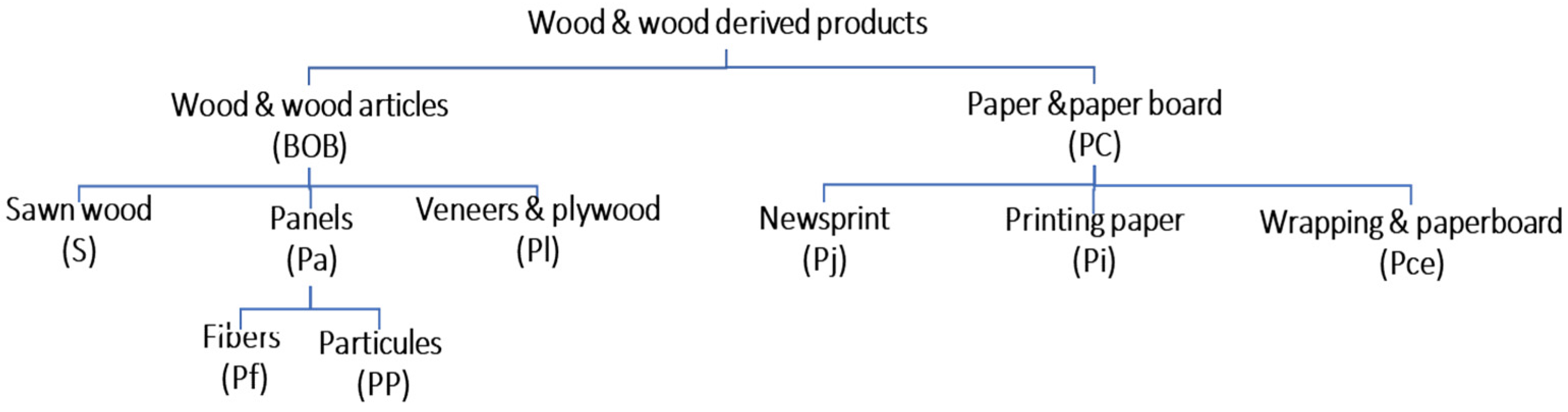
22]. The available data cover the period of 1975–2024, i.e., 49 years. The following analysis focused on the modeling of the apparent consumption and deficit of wood and wood-derived products. Products treated in this paper are classified according to the main branches of the wood industry, as mentioned in
Figure 1. In the following analysis, two main groups of products are considered. The first group, “Wood and articles of wood,” includes fiber and particle board, veneers and plywood, and sawn timber. This group also includes other items such as wooden structures and furniture, which, however, are not treated separately in this paper. The second group, “Paper and paperboard,” includes newsprint, printing and writing paper, wrapping paper, and paperboard. Similarly, this group also covers other products such as paper pulp and other paper and paperboard items, which are not analyzed individually in this study.
2.2. Definition of Wood and Wood-Derived Product Consumption and Deficit
In order to analyze long-term trends in wood and wood-derived product consumption, demand dynamics were modeled using time-series data. As wood and wood-derived products are largely considered to be capital goods that stems for final products, derived demand theory provides the most appropriate framework for analyzing their demand. Based on the fact that the demand for a product is negatively related to its own price and positively related to the demand for the final goods that use it, as well as being affected by the prices of other inputs, including substitutes and complements, the derived demand for the product can be expressed as a function of final demand factors such as consumer income and the prices of substitute products [
13]. Factors that may influence wood and wood-derived products include the state of internal resources and technological developments. Technological progress can help reduce wood consumption. However, the proportion of raw wood processed and used for the manufacturing of finished products may increase. The increased use of panels (particleboard and fiberboard) in the manufacturing of finished products is a sign of technological progress. Similarly, the use of waste paper and paperboard in the paper industry helps to limit the consumption of wood and wood products [
19].
Consumption is estimated based on its apparent consumption “Ca” which corresponds to the sum of production and net imports (imports minus exports). The apparent consumption presented in detail for the six specific product categories and aggregated into two main product groups, as shown in
Figure 1, is expressed as follows:
where
Cai: Apparent consumption in year i
Pij: Production of a considered product j in year i
Mij: Import of a considered product j in year i
Xij: Export of a considered product j in year i
ccj: conversion coefficient of a considered product j into roundwood equivalents (RWE)
Apparent consumption per capita, considered as a dependent variable, is then obtained by dividing by the population of the year i:
CaPDhi: Consumption of forest product per capita in year i
Popi: Population of year i
The deficit value is calculated from the net imports of wood and wood-derived products as follows:
where
Mij: Import of a considered product j in year i
Xij: Export of a considered product j in year i
ccj: Conversion coefficient of a considered product j into raw wood volume
Given that different wood products are expressed in m
3, conversion coefficients are used to obtain a single unit: the m
3 roundwood equivalents (
Table 1).
2.3. Definition of Foreign Dependency
The foreign dependency coefficient measures the extent to which net imports are used to meet domestic demand for a given product. It is calculated as follows:
where
Cai: Apparent consumption for year i
Mi: Imports for year i
Xij: Exports for year i
The dependency coefficient was calculated for wood and wood-derived products and the two major groups: wood and wood articles, and paper and paperboard.
The price of the product includes, in addition to the import price, the trade tariffs that were applied to sawn products (until 2000) and panels (until 2007). A gradual decrease in tariffs was implemented following the agreement to create a free trade area between Tunisia and the European Union in 1996, based on the Official Journal of 1998. The duty trade tariff applied at that time was 43%. For sawn timber, a gradual reduction was applied from 1996 to 2000, while for panels, the reduction was applied from 2000 to 2007.
2.4. Model Specification
Based on the previously defined wood and wood-derived product consumption and deficit, the apparent consumption per capita is considered the dependent variable in the present model. Independent variables include the following indicators: demand (income), supply (raw materials for the wood industry and paper industry), prices (for considered products and substitutes), and technological progress (for the wood industry and paper industry). All dependent and independent variables used in the econometric analysis are defined, with their indicators, symbols, and units summarized in
Table 2.
Statistical analysis was conducted to identify the main determinants of the apparent consumption of wood and wood-derived products in Tunisia and to measure elasticities. Statistical processing was performed using IBM SPSS Statistics software (version 27), chosen for its reliability in time series econometric analyses. Analysis included Logarithmic transformation: variables were converted to a Neperian logarithm (Ln-Ln) function in SPSS, which was adapted for economic log transformations.
A multiple linear regression analysis was conducted using the SPSS software in order to model the relationship between the apparent consumption of wood and wood-derived products and its main explanatory variables (
Table 2). The explanatory variables were selected from a broader initial set in order to optimize model performance, while remaining consistent with the theoretical framework presented in the introduction, particularly with respect to income effects, price dynamics, substitution mechanisms, and technological progress. The log–log specification allowed the estimated coefficients to be directly interpreted as elasticities, indicating the percentage change in the consumption of each of the studied products associated with a 1% change in each explanatory variable. The regression was performed using the Ordinary Least Squares (OLS) method, and standard diagnostic tests were applied to verify the assumptions of linearity, normality, and homoscedasticity of residuals.
The logarithmic models for the apparent consumption and deficit of the different considered wood and wood-derived products are specified as follows:
where
: Apparent consumption for product j
: Deficit for product j
to , to : Parameters to be estimated
to
: Independent variables (
Table 2)
, : Residual errors
The econometric approach adopted in this study focuses on identifying long-run structural relationships between wood product consumption, income, prices, and technological variables. Log–log OLS specifications are widely used in forest product demand studies when the primary objective is to estimate long-term elasticities rather than short-term adjustment dynamics. Given the length and continuity of the time series (1975–2024), the estimated coefficients are interpreted as average long-run associations. While more advanced time-series techniques, such as cointegration or error-correction models, could be used to analyze short-run dynamics, these extensions fall outside the scope of the present study and are identified as directions for future research.
Model performance is assessed using standard goodness-of-fit indicators (R2, adjusted R2, F-statistics). In addition, a set of diagnostic tests is conducted to examine key assumptions of the OLS framework, including multicollinearity, heteroskedasticity, and residual autocorrelation using STATA (version 19).
2.5. Future Forecasting
For future forecasting, projections were carried out for all of the studied dependent variables included in the econometric model. The projection framework is based on a combination of scenario analysis for income growth and assumption-driven extrapolation for the remaining explanatory variables. Income growth constitutes the central driver of the projection scenarios. A baseline scenario based on the historical trend over the study period was first considered, assuming an average annual growth in GDP of 1.2% per capita. This annual growth follows the trend in Tunisia’s GDP and was calculated based on the past evolution of the Tunisian GDP per capita [
21]. To account for the uncertainty surrounding future economic conditions, two alternative scenarios were defined: a pessimistic scenario assuming 0.6% annual growth (representing a 50% reduction from the historical trend) and an optimistic scenario assuming 2% annual growth [
27].
Price variables were extrapolated using their historical trends, under the assumption of continuity in relative price dynamics over the projection horizon. Structural and technological variables were projected based on fixed annual growth assumptions consistent with their long-term observed evolution. In particular, the share of panel consumption was assumed to increase at an average annual rate of 0.8%, capturing gradual substitution effects between panels and sawnwood within the wood products sector. Population projections are based on United Nations demographic forecasts. Lagged consumption variables are generated endogenously within the projection process.
3. Results
3.1. Wood and Wood-Derived Product Consumption and Deficit Evolution
Diagnostic tests were conducted to assess multicollinearity using the Variance Inflation Factor (VIF), heteroskedasticity using the Breusch–Pagan test, and residual autocorrelation using Durbin’s alternative test. The results of these diagnostic tests are reported in
Appendix A (
Table A1). In general, the results are robust across the models. Multicollinearity remains within acceptable econometric standards, with mean VIF values below commonly used thresholds (VIF < 10). Heteroskedasticity and residual autocorrelation, evaluated at the 5% significance level, appear in some consumption series but remain limited in scope and sector-specific, with no evidence of widespread or systematic misspecification.
More specifically, deficit-related variables for both product groups—wood and wood articles and paper and paperboard—exhibit stable statistical behavior, with no significant diagnostic issues detected. Consumption series display more heterogeneous dynamics across sectors: paper and paperboard consumption shows localized deviations reflecting structural demand changes, while wood and wood article consumption exhibits stronger dynamic adjustments, consistent with industrial inertia. Overall, these findings confirm that the data and model specifications are sufficiently robust and coherent to support the empirical analysis.
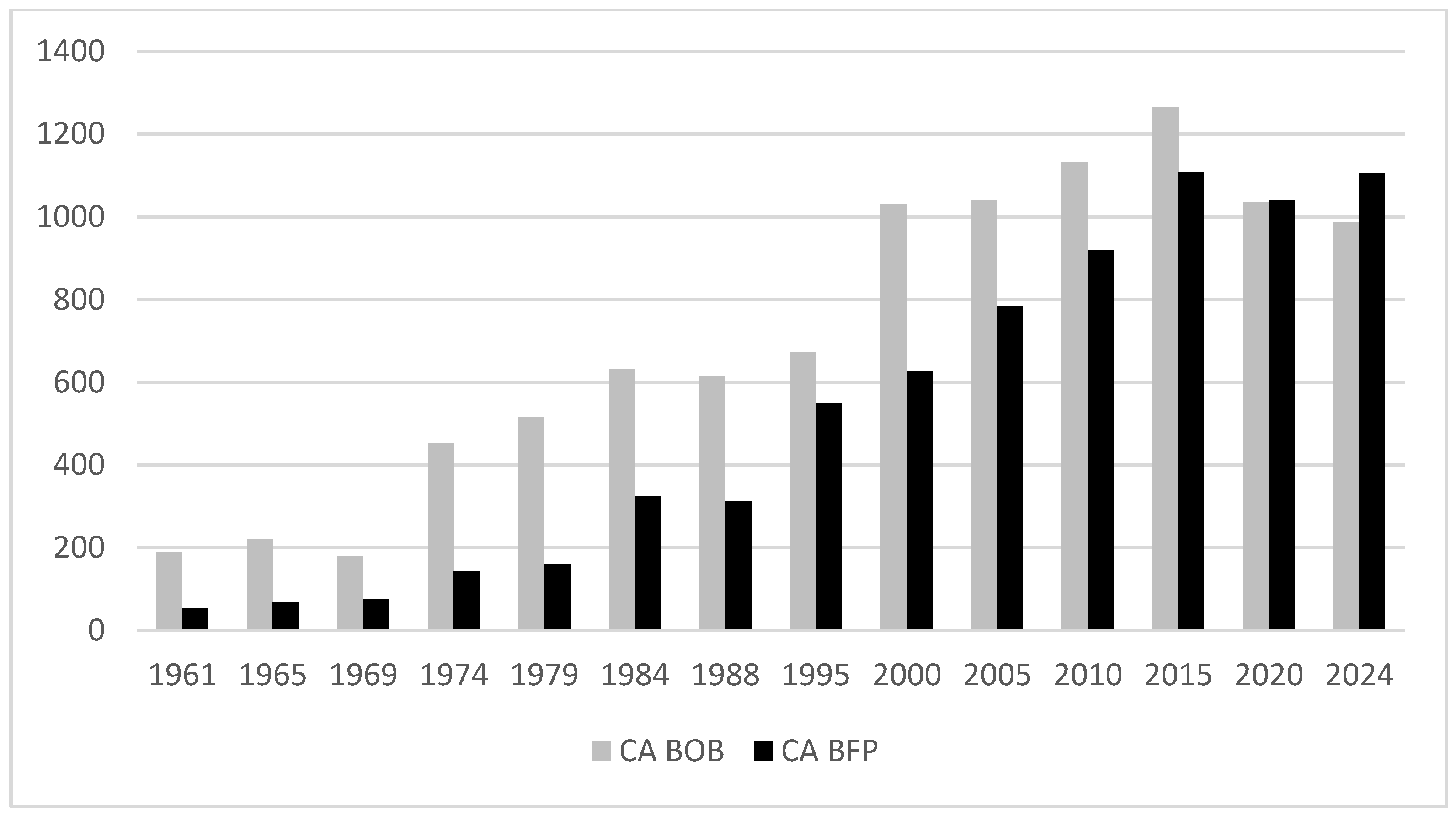
When considering the two major wood products “wood and wood articles” and “paper and paper board”, we notice a continuously increasing demand until 2015, followed by a decline (
Figure 2).
Looking further, the consumption of sawnwood and veneers has fallen sharply since 2005, while demand for panels (fiber and particle board), especially fiberboard, has risen significantly. The consumption of newsprint and printing paper has declined since 2015, particularly as a result of the spread of electronic information and communication. It should also be noted that income (GDP per capita) increased by only 0.2% per year during the period of 2012–2024, compared to an annual growth of 2.8% during the period of 1990–2012. This resulted in a 12% decline in demand for wood and wood-derived products during the period of 2015 to 2024 (
Table 3).
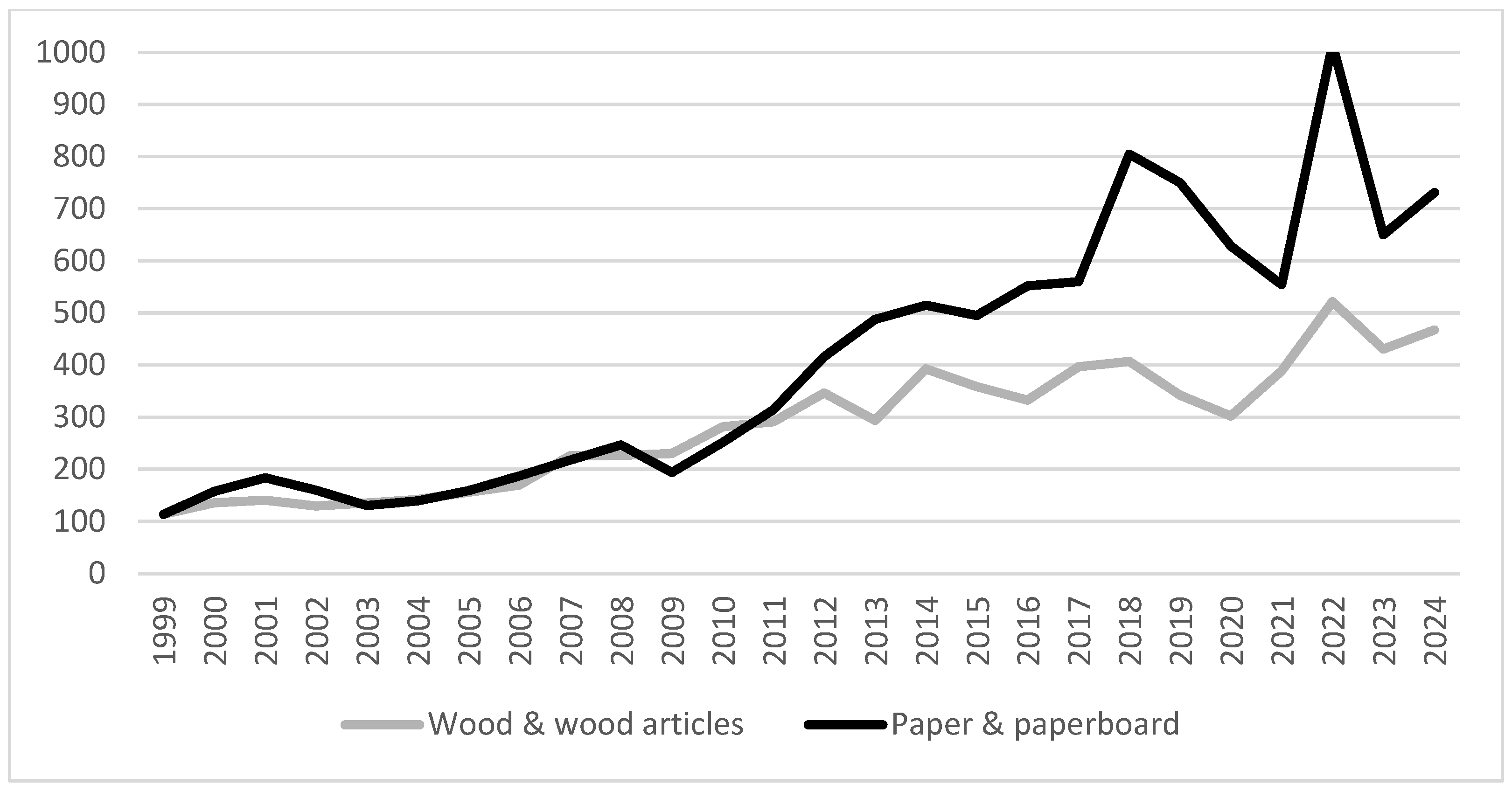
The external deficit rose steadily until 2017, after which sharp fluctuations were observed, linked to both price and volume variations in imports. The external deficit in wood and wood-derived products was 1198.2 million Tunisian dinars (TND) in 2024, representing 6.32% of the trade balance deficit in 2024, including 467.5 million TND for wood and wood articles, and 730.7 million TND for paper and paperboard (
Figure 3).
3.2. Foreign Dependency
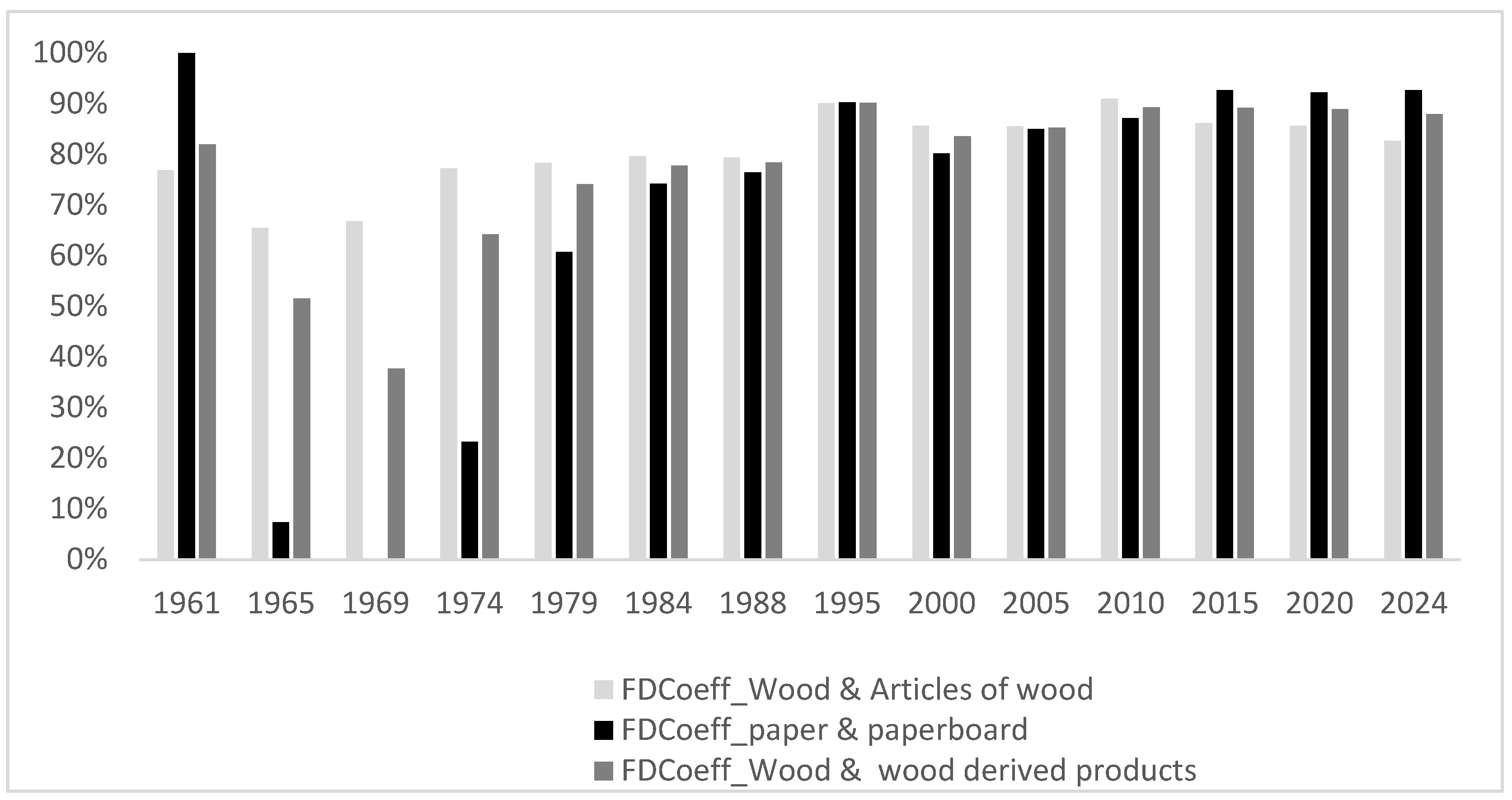
Consumption of wood and wood-derived products has always been dependent on imports; in fact, the harvesting of wood for industrial use and the production of primary processing products (sawnwood, panels,…) have not kept pace with demand. This has resulted in a dependency coefficient of between 84% and 90% over the last thirty years (
Figure 4).
3.3. Model Findings
In total, ten econometric regressions were estimated, covering both apparent consumption and the external deficit for the major categories of wood and wood-derived products in Tunisia. Eight models examined the determinants of apparent consumption per capita for the two main product groups—wood and wood articles (Cabob) and paper and paperboard (Capc)—as well as their respective subcomponents: Sawn Timber (CaS), Panels (Particleboard and Fiberboard) (CApa), Veneers and Plywood (CApl), Newsprint (CAJ), Printing Paper (CAI), and Wrapping and Paperboard (CApce).
Table 4 shows that across all the models, the F-statistics are statistically significant at the 1% level, indicating that the explanatory variables jointly account for a substantial share of the variation in the dependent variables. The coefficients of determination (R
2) range from 0.63 to 0.98, reflecting a high explanatory power. The fact that adjusted R
2 values remain close to the R
2 coefficients suggests that the models are not overparameterized.
The fact that estimations rely on log–log functional forms means that all coefficients represent elasticities. Looking into the details, we notice that income is the main driver of consumption. The coefficients of LN_Y are positive, range from 0.348 to 0.860, and are mostly highly significant (p < 0.01). This means that a 1% increase in income raises consumption per capita by approximately 0.35% to 0.86%, confirming that wood and wood-derived products are normal goods. Prices generally have a negative effect on apparent consumption (sawnwood, vinyl, and plywood). A positive coefficient suggests substitution effects between product categories. The lagged consumption coefficients (LN_Caj−1) are positive and highly significant in most models. This shows that consumption habits or stock effects strongly influence current consumption, particularly for products like newsprint (CAJ) and panels (CApa).
Looking at the deficit regressions in the two main groups, these being wood and wood articles (BOB) and paper and paperboard (BFP), in Tunisia, the net import values of these products are strongly influenced by income, labor costs, and raw material availability. The fact that income has a strong positive effect on the deficits reflects that higher income drives demand faster than domestic supply can meet. Labor cost has a positive effect on the wood and wood articles deficit, increasing the deficit by 1.27% per 1% increase, indicating that higher labor costs constrain domestic production, widening the supply–demand gap. In contrast, greater availability of raw materials (Ln_Propc) reduces the deficit by 0.88% per 1% increase, highlighting the mitigating effect of raw material access on the deficit.
3.4. Forecasting Results
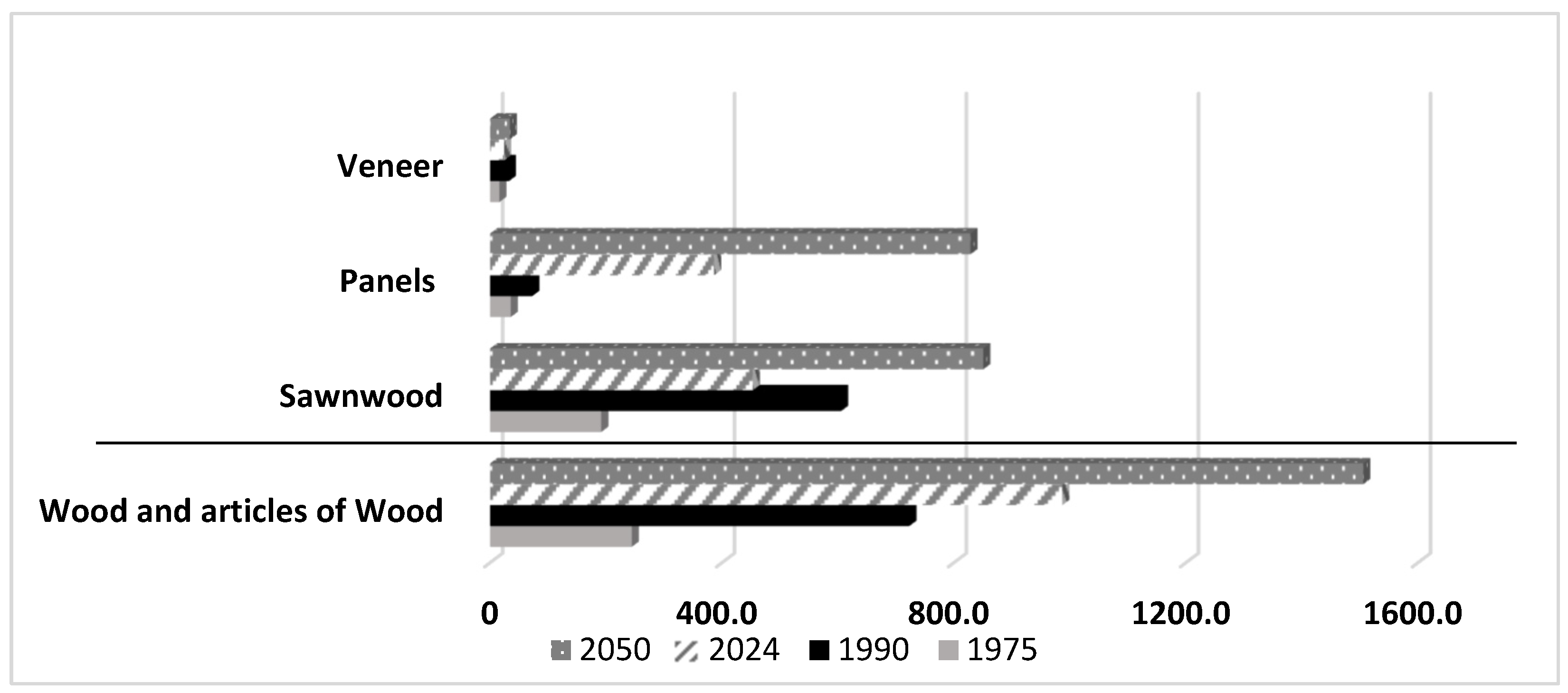
Baseline projections are first presented under the trend scenario, which serves as the common reference framework by combining historical consumption patterns with long-term forecasts to 2050. Under the trend scenario, the 2050 forecasting implies moderate to strong annual growth across all wood product categories. For the category of wood and wood articles (
Figure 5), consumption increases at roughly 1.62% per year. Looking in more detail, a heterogeneous pattern is observed among the different wood types. Panels exhibit the highest expansion rate at nearly 3% per year, followed by sawnwood with about a 2.4% annual growth, while veneers show a more modest rise of approximately 0.3% per year.
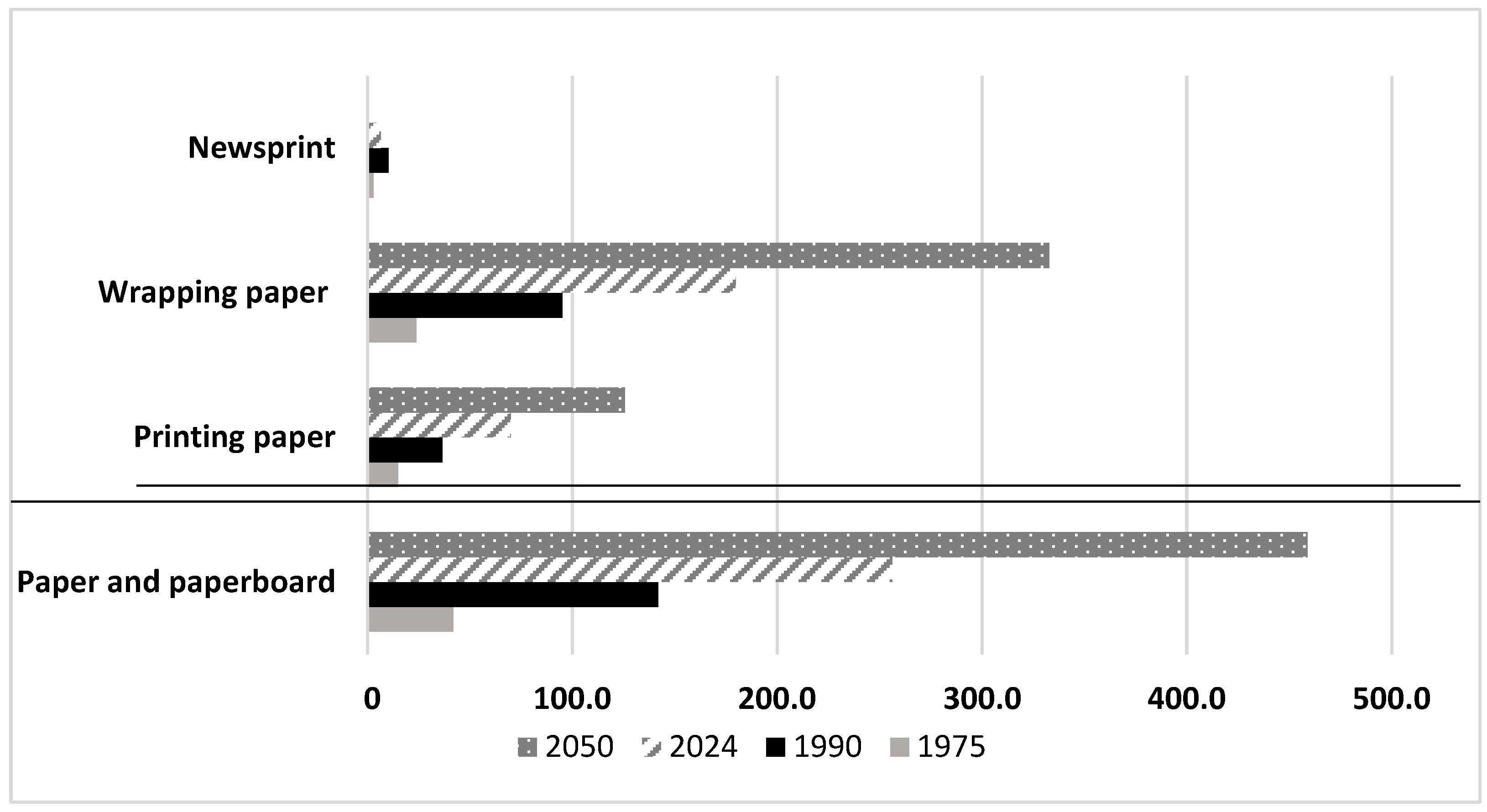
Paper and paperboard see strong growth under the trend forecast, with an annual growth of 1.7% per year (
Figure 6), showing a continued expansion in most paper categories. Printing paper and wrapping paper show a slightly higher annual growth, at 1.96% and 1.5%, respectively, in sharp contrast with newsprint, which experiences a drastic decline at −14.2% per year.
The comparison of GDP per capita growth scenarios shows clear differences in the projected consumption growth rates across product categories, except for veneer and newsprint, which display limited variation across scenarios. Average annual growth rates are computed over the 2024–2050 period.
At the aggregate level, wood and wood articles consumption increases from 1.26% annually under the pessimistic scenario to 1.64% under the trend scenario and 2.15% under the optimistic scenario. Among wood products, panels exhibit the highest growth rates, rising from 2.0% per year in the pessimistic case to 3.0% under the trend scenario and reaching 4.30% per year under the optimistic scenario. Sawnwood shows lower but still increasing growth rates, rising from 1.9% to 2.45% and 3.15% per year across the pessimistic, trend, and optimistic scenarios, respectively.
For paper and paperboard products, aggregate consumption increases from 1.13% annually in the pessimistic scenario to 1.70% under the trend scenario and 2.45% under the optimistic scenario. Printing paper consumption grows from 1.53% per year to 1.96% and 2.52% per year across the three scenarios, while wrapping paper follows a similar pattern, with growth rates of 1.15%, 1.50%, and 1.96% per year, respectively.
External deficit projections also vary across GDP growth scenarios. The wood-related external deficit grows at an average annual rate of 1.51% under the pessimistic scenario, 2.36% under the trend scenario, and 3.50% under the optimistic scenario. For paper and paperboard, the external deficit increases from 2.11% per year to 3.10% and 4.43% per year across the pessimistic, trend, and optimistic scenarios.
4. Discussion
Over the study period, Tunisia’s wood sector has been exposed to several major structural events, including trade liberalization with the European Union, global financial shocks, political transitions, and the COVID-19 pandemic. These events may have affected short-term demand and trade flows. However, the present analysis focuses on long-term structural trends rather than event-specific dynamics. Consequently, the results should be interpreted as reflecting underlying demand patterns rather than short-term shocks.
The elasticities of income for different products vary considerably. For instance, at the international level, elasticities vary greatly from one group of countries to another [
28]. Elasticity estimates can be obtained by considering differences between countries, taking into account consumer preferences and choices [
28]. It has also been shown that elasticities can vary from one period to another, but also between groups of countries with low and high incomes, considering the fact that effective elasticities could be obtained by grouping as many observations as possible [
29]. The literature also shows that an increasing trend was found between per-capita GDP and per-capita consumption for 33 OECD member countries and 6 BRIKS. Nevertheless, consumption declined over time when a high level of income was attained [
30].
While the prices of products and their substitutes were the explanatory variables in previous models, the present analysis indicates that other variables, such as technological progress—proxied here by access to the Internet—also contribute to explaining the consumption of wood and wood-derived products.
The results of this work also demonstrate the lack of a correlation between the consumption of forest products and the production of industrial wood, a finding that has been confirmed by several authors [
19,
29]. On the other hand, labor costs affect the performance of the trade in wood products. Indeed, growing competition from emerging countries is leading to significant changes in international trade flows of wood and wood-derived products [
18].
In Tunisia, demand for wood and wood-derived products is expected to increase from 2.1 million cubic meters in 2024 to 3.2 million m
3 in 2050, based on an annual growth rate in income of 1.2%. According to the FAO, the global demand for primary processed wood products is expected to increase from 2.286 million m
3 in 2020 to 3.124 million m
3 in 2050 [
31]. For the period of 2024–2050, demand growth in Tunisia is estimated to be 52%, which is higher than global growth (37%). This growth would be 71% for sawnwood, 114% for panels, 40% for veneers, and 55% for paper and paperboard. Thus, panels continue to replace sawnwood in multiple applications such as furniture, construction, and packaging. According to the FAO, global demand for primary processed wood products is expected to increase from 2.286 million m
3 to 3.124 million m
3 in 2050 [
31]. Following this estimate, demand for industrial roundwood will grow by 25 to 45% between 2020 and 2050, depending on the intensity of use of industrial residues. Globally, trends vary from one product to another: an increase of 30% is projected for sawnwood, 72% for particleboard and fiberboard, and 102% for veneer and plywood. Trends also vary by region and country. The higher growth rate for Tunisia is mainly explained by greater income elasticity.
The magnitude of estimated income elasticities reflects differences in consumption behavior and product maturity. Higher elasticities for panels and sawnwood indicate strong sensitivity to income growth, consistent with construction-related demand. In contrast, lower elasticities for veneers and newsprint suggest more mature or declining consumption patterns. These differences also reveal substitution effects driven by technological progress, notably the increasing use of panels and recycled materials. From a trade perspective, high income elasticities combined with limited domestic supply capacity contribute to rising import dependence and reduced international competitiveness.
These findings are consistent with international evidence reported by Buongiorno in 2015, who showed that income elasticities for several forest product categories tend to remain relatively stable over long periods, while differing significantly across product types and stages of processing [
32]. In particular, the higher elasticities observed for sawnwood and panels are associated with construction-related demand, whereas lower elasticities characterize more mature products such as paper and newsprint. This reinforces the interpretation that long-term demand dynamics are driven more by structural consumption patterns and technological substitution than by short-term price fluctuations. In this perspective, the Tunisian case illustrates how stable demand elasticities, combined with limited domestic resource availability, translate into persistent import dependence.
A comparison of the obtained results with previous publications from 1998 and 2008 shows a strong correlation between the consumption of wood and wood-derived products and the income per capita in Tunisia, with relatively high elasticity, which has already been confirmed [
14,
17]. However, there is a significant discrepancy between the results of projections based on previous models, coupled with an assumption of annual growth in income of 3.2%, and the actual observations in 2024 of wood and wood-derived product consumption.
This is also the case in Turkey, where demand for imported wood depends mainly on the import prices of sawn timber and the prices of domestic logs, rather than on changes in production [
33]. While producer countries (the United States, Finland, Sweden, Romania, and Russia) remain among Tunisia’s main suppliers of wood and wood-derived products, some neighboring countries (Turkey, Italy, Spain, and Portugal) are emerging as suppliers of wood and wood-derived products in 2024.
Unlike many countries where imports of wood products have a significant impact on ongoing forest transitions [
34], the absence of an appropriate forest management and exploitation program has meant that trade in wood and wood-derived products is carried out with the aim of satisfying demand without any link to timber harvesting [
35]. The forest code needs to be revised in order to meet the needs of primary processing industries while following sustainable forest management guidelines [
36].
These findings are consistent with international evidence showing that forest-poor countries often experience rising import dependence despite economic growth. Similar patterns of substitution, technological upgrading, and structural transformation have been observed in other regions, reinforcing the relevance of the Tunisian case within the broader forest sector literature.
5. Conclusions
This article explores the relationships between apparent consumption and the external trade deficit in wood and wood-derived products on the one side, and income, the production of industrial wood and fiber for paper manufacturing, prices, technological progress, and labor costs on the other side. Income remains the main variable explaining the apparent consumption and external deficit, but other variables such as technological progress, prices, labor costs, and fiber production from
Stipa tenacissima for paper also play a considerable role. A slowdown in demand can be noticed in the most recent years, which can be explained by the decline in income growth, but also by technological developments in the wood, paper, and paperboard industry, which are reflected in the trend toward substituting wood with other materials, and sawnwood and veneers with panels. In addition, the substantial increase in paper recycling and the rise in digitalization and the use of information networks are structural changes that will encourage this trend. In order to reduce the deficit in wood and wood-derived products, the wood and paper industries should increase their competitiveness, and the production of raw materials must also increase to ensure a regular supply to these industries. Current wood harvests have remained at the same level since 2004 despite the country’s reforestation efforts. Indeed, Tunisia has seen a significant increase in forest plantations, from 643,000 ha in 1990 to 687,000 ha in 2025, with forest plantations covering around 262,000 ha between 1990 and 2022 [
11]. The development of productive forests will increase production potential as part of a long-term sustainable wood management and harvesting strategy. In addition, industrial innovation focused on the use of lower-quality wood is an argument in favor of promoting local wood. However, the lack of coordination between logging and primary wood processing within the same sector, the wood sector, hinders any short-term sectoral momentum.
The effects of increased demand for industrial wood in a country or region are not necessarily limited to those countries or regions, but can also be supplied from other countries and regions through changes in consumption, production, and trade patterns induced by variations in the prices of wood and wood products. Distortions between supply trends (industrial wood and Alfa harvests) and demand for wood and wood-derived products may explain the current deficit.
This study contributes to the literature by providing a long-term, integrated analysis of demand and trade dynamics in a forest-poor country. While the results highlight robust structural relationships, they also point to the need for future research combining long-run and short-run modeling approaches.