Review

Optimizing Urban Green Space Ecosystem Services for Resilient and Sustainable Cities: Research Landscape, Evolutionary Trajectories, and Future Directions


1
School of Film and TV Arts, Xi’an Jiaotong-Liverpool University, Suzhou 215123, China
2
Department of Design, Graduate School, Dongseo University, Busan 47011, Republic of Korea
3
Shanghai Academy of Fine Arts, Shanghai University, Shanghai 200040, China
*
Author to whom correspondence should be addressed.
Forests 2026, 17(1), 97; https://doi.org/10.3390/f17010097
Submission received: 10 November 2025 / Revised: 4 December 2025 / Accepted: 8 January 2026 / Published: 11 January 2026
(This article belongs to the Special Issue Sustainable Urban Forests and Green Environments in a Changing World)

Abstract

Urban forests and green spaces are increasingly promoted as Nature-Based Solutions (NbS) to mitigate climate risks, enhance human well-being, and support resilient and sustainable cities. Focusing on the theme of optimizing urban green space ecosystem services to foster resilient and sustainable cities, this study systematically analyzes 861 relevant publications indexed in the Web of Science Core Collection from 2005 to 2025. Using bibliometric analysis and scientific knowledge mapping methods, the research examines publication characteristics, spatial distribution patterns, collaboration networks, knowledge bases, research hotspots, and thematic evolution trajectories. The results reveal a rapid upward trend in this field over the past two decades, with the gradual formation of a multidisciplinary knowledge system centered on environmental science and urban research. China, the United States, and several European countries have emerged as key nodes in global knowledge production and collaboration networks. Keyword co-occurrence and cluster analyses indicate that research themes are mainly concentrated in four clusters: (1) ecological foundations and green process orientation, (2) nature-based solutions and blue–green infrastructure configuration, (3) social needs and environmental justice, and (4) macro-level policies and the sustainable development agenda. Overall, the field has evolved from a focus on ecological processes and individual service functions toward a comprehensive transition emphasizing climate resilience, human well-being, and multi-actor governance. Based on these findings, this study constructs a knowledge ecosystem framework encompassing knowledge base, knowledge structure, research hotspots, frontier trends, and future pathways. It further identifies prospective research directions, including climate change adaptation, integrated planning of blue–green infrastructure, refined monitoring driven by remote sensing and spatial big data, and the embedding of urban green space ecosystem services into the Sustainable Development Goals and multi-level governance systems. These insights provide data support and decision-making references for deepening theoretical understanding of Urban Green Space Ecosystem Services (UGSES), improving urban green infrastructure planning, and enhancing urban resilience governance capacity.

1. Introduction

Against the intertwined backdrop of global climate change, rapid urban expansion, and ongoing ecological degradation, cities have become concentrated arenas of multiple risks [1,2]. While cities serve as engines of economic growth and centers of population aggregation, they simultaneously face increasingly severe environmental pressures and social inequalities, manifested as intensified urban heat island effects, frequent flooding, deteriorating air quality, and rising public health risks [3,4,5,6]. How to construct resilient cities with systemic adaptability, risk response capacity, and sustainable development potential has emerged as a core issue in global environmental governance and urban transformation [7,8]. As an essential component of urban ecological infrastructure, urban green space systems play a pivotal role in regulating microclimates, enhancing biodiversity, improving environmental quality, and strengthening social resilience through the provision of diverse ecosystem services [9,10]. They are widely regarded as a core urban-scale practice of Nature-Based Solutions (NbS). The optimization of Urban Green Space Ecosystem Services (UGSES) is therefore not only critical for improving urban environmental quality but also constitutes a strategic foundation for climate risk mitigation, resilience enhancement, and sustainable urban development [11,12,13].
In this context, a large body of empirical research, drawing on multiple spatial scales and disciplinary perspectives, has systematically revealed the multidimensional effects and mechanisms of urban green space ecosystem services [14,15,16]. Wang et al. (2024) proposed an urban green infrastructure framework from an adaptive management perspective, emphasizing multifunctionality, connectivity, diversity, and accessibility to reconcile biodiversity conservation with sustainable urban development [17]. McPhearson et al. (2022) developed a Social–Ecological–Technological Systems (SETS) framework, arguing that gray infrastructure, green ecological infrastructure, and institutional governance must be designed in an integrated manner to systematically enhance the supply capacity and resilience of urban ecosystem services [18]. Ring et al. (2021) constructed green space and open-space factors, quantified ecosystem services such as climate regulation, environmental benefits, and social well-being, and embedded these into a parcel-scale planning and regulatory instrument [19]. Venter et al. (2021), using spatial multi-criteria decision analysis and cloud-computing platforms, took green roofs in Oslo as an example to identify spatial gaps in services such as temperature regulation, stormwater mitigation, and habitat provision, thereby providing a technical pathway for prioritizing green infrastructure under multi-stakeholder participation [20]. From a supply–demand perspective on ecosystem services, Liu et al. (2021) identified different types of imbalances between the supply of and demand for green space services at both administrative-unit and fine-grid scales, and proposed zoning-based optimization strategies [21]. Shi et al. (2021) combined MSPA, PANDORA, minimum-cost path analysis, and circuit theory to develop a green infrastructure network optimization framework grounded in the importance of ecosystem services and landscape connectivity, and, using Kaifeng as an example, identified key patches and corridors as critical nodes, thereby providing an approach for enhancing urban green space ecosystem services and disturbance resistance at the network scale [22].
The research focus on UGSES is gradually shifting from functional evaluation of single projects or localized spaces to deep coupling with broader urban development strategies and governance systems [23,24]. Specifically, UGSES is increasingly being incorporated into comprehensive urban planning, climate adaptation strategies, and sustainable development agendas [13,25,26]. An increasing body of research emphasizes that urban green spaces should not be regarded merely as auxiliary tools for environmental improvement, but rather as systemic solutions that integrate climate governance, ecological restoration and social inclusion [17,27,28,29]. Within the NbS framework, UGSES are endowed with multifunctionality and synergies, and have become an integral component of policy toolkits that support climate change mitigation, carbon-neutral transitions, and improvements in the living environments of vulnerable groups [30,31,32].
Current research primarily focuses on the quantitative assessment and spatial optimization of multiple types of UGSES, as well as on the construction of multi-scale frameworks, indicator systems, and decision-support tools from a social–ecological–technological perspective, with the aim of revealing service supply mechanisms and supporting the planning and governance of resilient cities [33,34]. At the same time, an increasing number of review and integrative studies have examined urban green infrastructure and UGSES from various perspectives [35,36]. For example, Lu et al. (2025) conducted a critical review of quantitative methods for the ecosystem service supply–flow–demand continuum in order to promote the standardization of decision-making frameworks [37]. Similarly, Bani Khalifi et al. (2025) focused on integrating Life-Cycle Assessment (LCA) to evaluate greenhouse gas mitigation and climate resilience potentials [38]. Yao et al. (2025) systematically categorized the effects of different types of Urban Green Infrastructure (UGI) at the landscape, community and individual scales [39]. In addition, Veibiakkim et al. (2025) synthesized long-neglected ecosystem disservices to present a more balanced picture of human–nature interactions [40]. Although these recent studies provide in-depth insights into specific mechanisms, assessment tools or service types, the overall research landscape remains fragmented. Consequently, there is still a lack of a comprehensive review that, at the global scale and using scientific knowledge mapping as a core approach, systematically integrates UGSES research, identifies its knowledge base and research frontiers, and links them to the agendas of urban resilience and sustainable development. This gap has, to some extent, constrained the academic community’s holistic understanding of the macro-structure and developmental trajectories of UGSES research and weakened its role in providing knowledge support and practical guidance for global resilient and sustainable urban transformation agendas.
To address this gap, this study centers on the theme of optimizing urban green space ecosystem services for building resilient and sustainable cities. It employs bibliometric and knowledge mapping methods to systematically analyze 861 relevant publications indexed in the Web of Science Core Collection between 2005 and 2025. The specific objectives are as follows: (1) to construct a global knowledge map of UGSES research and reveal its publication characteristics, evolutionary pathways, developmental stages, and key research actors; (2) to identify the core themes and emerging hotspots of UGSES research based on analyses of its knowledge base, knowledge structure, and topical trends, thereby constructing an integrated knowledge framework linking UGSES with urban resilience and sustainable city development; and (3) to propose future research directions and key governance implications grounded in comprehensive knowledge mapping, providing empirical evidence and theoretical support for the formulation of forward-looking urban green space planning and ecological management policies.

2. Materials and Methods

2.1. Data Sources and Retrieval Strategy

The Web of Science Core Collection (WoS) was chosen as the main data source for this study to secure the authority, coherence, and cross-study comparability of the dataset [29]. Curated by Clarivate Analytics, WoS is widely acknowledged as a leading, high-quality multidisciplinary citation database [41]. Its strict journal inclusion criteria—encompassing the Science Citation Index (SCI), Social Sciences Citation Index (SSCI), and Emerging Sources Citation Index (ESCI)—ensure that the indexed literature is both academically rigorous and representative. With its extensive coverage of the natural sciences, social sciences, and interdisciplinary domains, WoS provides internationally representative and reliable data, thereby offering a robust and comprehensive foundation for the analyses in this study [42].
The research theme centers on optimizing UGSES to promote urban resilience and sustainability. Accordingly, a systematic search strategy was developed by integrating three core research dimensions: urban green space, ecosystem services, and urban resilience and sustainability. The retrieval was conducted using the Topic (TS) field in WoS, which covers the title, abstract, author keywords, and Keywords Plus, thereby ensuring comprehensive inclusion of relevant literature. The detailed search expression was constructed as follows:TS = (((“urban green space*” OR “urban greenspace*” OR “urban park*” OR “city park*” OR “urban forest*” OR “urban forestry” OR “street tree*” OR “urban green infrastructure” OR “green infrastructure” OR “blue-green infrastructure” OR “urban open space*” OR “urban garden*” OR “community garden*”) AND (“ecosystem service*” OR “ecosystem function*” OR “ecosystem benefit*” OR “ecosystem-based approach” OR “ecosystem based approach” OR “nature-based solution*” OR “nature based solution*” OR “NbS”)) AND (“urban resilience” OR “resilient city” OR “resilient cities” OR “city resilience” OR “climate resilience” OR “climate-resilien*” OR “sustainable city” OR “sustainable cities” OR “urban sustainab*” OR “sustainable urban development” OR “sustainable urbanization” OR “sustainable urbanisation” OR “SDG 11” OR “sustainable cities and communities”)).
The search period was set from 1 January 2005 to 1 October 2025, covering nearly two decades of research development in this field. The initial search yielded 937 relevant publications. The results were then restricted to English-language documents, excluding non-English works, leaving 929 publications. Subsequently, the document types were refined to include only Articles and Review Articles, while excluding Proceedings Papers (31), Early Access items (13), Editorial Materials (8), and Book Chapters (1), resulting in 896 documents.
To further ensure data quality and analytical precision, the research team conducted a manual screening based on titles, abstracts, and keywords, removing papers that were not directly relevant to the research theme. Ultimately, 861 publications were included in the analysis, comprising 735 original research articles and 126 review articles. Although review articles differ from empirical studies, they were retained in this study because they often function as key nodes with high centrality in the knowledge network, synthesizing theoretical developments and bridging different subfields of research. This screening process strictly followed the PRISMA 2020 guidelines, thereby ensuring the reliability of data sources and the scientific validity of the analytical sample. The screening procedure is illustrated in Figure 1.

2.2. Data Processing and Analytical Methods

This study integrates bibliometric analysis and scientific knowledge mapping to systematically examine the evolutionary trajectory, research hotspots, collaboration networks, and knowledge foundations of studies related to UGSES and sustainable urban development. Bibliometric analysis focuses on quantifying research outputs and structural characteristics, while scientific knowledge mapping emphasizes uncovering the implicit relationships among studies and the logical evolution of research themes [43,44]. To enhance analytical rigor and visualization capacity, three mainstream tools—ArcGIS 10.8.1, VOSviewer 1.6.19, and CiteSpace 6.4.R1—were employed to construct a multidimensional and multilayer analytical framework.
Microsoft Excel 2021: Used for organizing and visualizing basic bibliometric data, including annual publication trends, author productivity, institutional and national publication distributions, core journal outputs, and research field classifications. These data provide the quantitative foundation for subsequent analyses.
VOSviewer 1.6.19: Employed to construct and visualize collaboration networks among authors, countries, and institutions, as well as keyword co-occurrence networks. Through co-occurrence analysis and the Louvain modularity clustering algorithm, VOSviewer identifies the structural clusters of research themes. By incorporating the average publication year of keywords, it further illustrates the temporal evolution of research topics.
CiteSpace 6.4.R1: Applied for co-citation analysis to identify highly influential references, theoretical foundations, and knowledge diffusion pathways in the field. The analysis was conducted with a time slice of one year, using the g-index (k = 25) as the node selection criterion. The Pathfinder network pruning algorithm was employed to construct clear co-citation network structures and clustered subgraphs, thereby revealing the knowledge base and research frontiers of the field.
ArcGIS 10.8.1: Utilized to generate the global geographic distribution map of publications. Based on national publication data and vector world map layers, spatial visualization was conducted within a GIS environment to display country-level participation and regional disparities, thereby revealing the spatial structure of global research efforts in UGSES studies.

3. Results

3.1. Publication and Disciplinary Distribution Trends

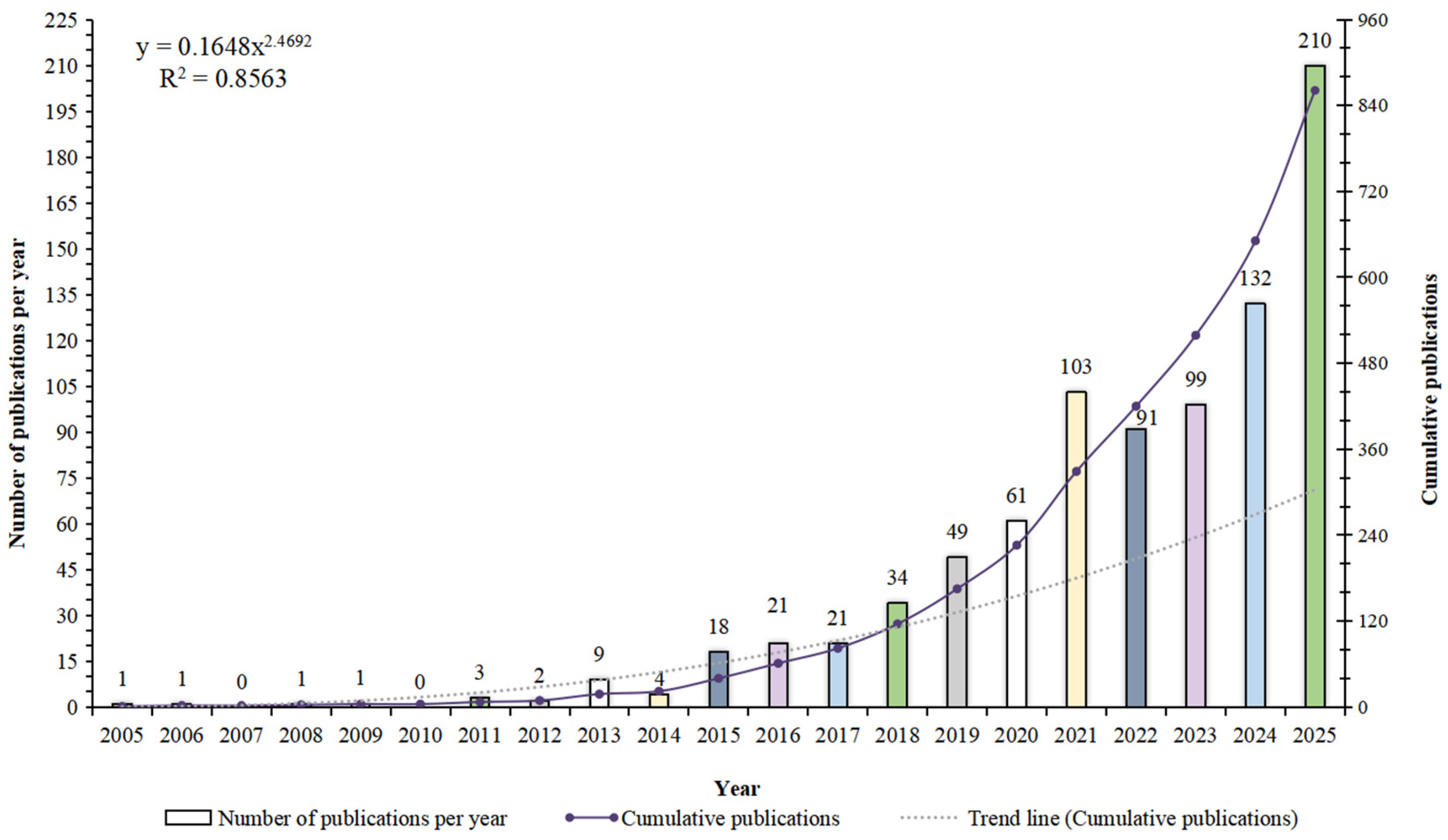
The annual publication trend serves as an important indicator for assessing the vitality, academic attention, and theoretical development stage of a research field [45]. It helps to identify the evolution of research hotspots and potential future directions. Figure 2 illustrates the changes in the annual number of publications in this field from 2005 to 2025. Overall, the development of this research area can be divided into three distinct stages: the nascent accumulation stage, the steady development stage, and the rapid expansion stage.
From 2005 to 2012, the field was in its initial stage, characterized by an extremely low publication volume—fewer than two papers per year on average over eight years—indicating that the topic had not yet attracted widespread attention in the international academic community. Research during this period primarily consisted of conceptual discussions, lacking a systematic theoretical framework and empirical evidence.
Between 2015 and 2019, the field entered a phase of steady development, with the annual number of publications increasing from 18 in 2015 to 49 in 2019, representing an average annual growth rate of 28.1%. The release of the United Nations’ 2030 Agenda for Sustainable Development in 2015 directly stimulated academic interest in topics such as green infrastructure, urban resilience, and NbS, significantly broadening the research scope of this field.
From 2020 to 2025, the field entered a stage of rapid expansion, with the number of publications exhibiting exponential growth. Between 2020 and 2024, the annual publication counts were 61, 103, 91, 99, and 132, respectively, and by October 2025, the number had reached 210—an approximately 3.5-fold increase over five years. The cumulative publication trend fits well to the function y = 0.1648 x 2.4692 (R2 = 0.8563), indicating that the field has entered a mature phase of accelerated expansion. This rapid growth not only reflects the increasing global significance of urban green space ecosystem services amid the dual challenges of climate change and urban vulnerability but also demonstrates the international community’s broad recognition and policy responsiveness toward NbS in urban adaptive governance [46].
In summary, research on urban green space ecosystem services is rapidly evolving into a key academic pillar for urban sustainability transitions. The explosive growth of related literature underscores the increasing scholarly attention to this topic and provides a solid theoretical and empirical foundation for developing resilient, low-carbon, and nature-based cities in the future.
Identifying the core journals within a research field helps to reveal the main channels of knowledge dissemination and the pathways of intellectual accumulation [47]. This information provides crucial insights for analyzing disciplinary evolution and formulating publication strategies aimed at producing high-quality scholarly outputs. Table 1 presents the top ten core journals in terms of publication volume, where NP denotes the number of relevant articles indexed in each journal, NC represents the total number of citations to these articles, and IF (2024) refers to the 2024 impact factor of the journal, which is used to reflect its overall academic influence and citation performance.
Among them, Sustainability (IF = 3.3) ranks first with 102 papers, reflecting its broad dissemination capacity and high visibility within the field. However, its impact factor of 3.3 indicates that it primarily publishes applied and policy-oriented research, with relatively limited theoretical depth.
Urban Forestry & Urban Greening (65 papers, IF = 6.7) exhibits outstanding citation performance, with a total of 2774 citations, underscoring its central role in studies on urban ecosystems, green space planning, and ecological infrastructure development. Its high citation rate suggests that the journal exerts strong influence at the intersection of theory and practice.
High-impact journals such as Landscape and Urban Planning (IF = 9.2) and Sustainable Cities and Society (IF = 12), although having relatively fewer publications (30 and 22 papers, respectively), demonstrate exceptional citation performance (2148 and 975 citations). This indicates their leading role in theoretical innovation, methodological advancement, and cross-scale research. These journals tend to publish high-quality modeling studies and systematic analyses, thereby driving the theoretical refinement of research on urban green space ecosystem services.
In addition, journals such as Ecological Indicators, Ecosystem Services, and Journal of Environmental Management—all with high citation frequencies and impact factors above 6.0—highlight the growing importance of research on ecosystem service assessment, indicator system development, and management decision-making. These journals provide a robust quantitative and empirical foundation for advancing urban ecological resilience research and fostering interdisciplinary integration.
Analysis of the disciplinary distribution within this research field reveals the foundational disciplines and structural characteristics of knowledge in urban green space ecosystem services research [48]. It reflects both the degree of interdisciplinary integration and the developmental trajectory of the field. A statistical analysis based on the Web of Science subject categories indicates that this research area spans multiple intersecting disciplines, including environmental science, urban studies, ecology, sustainable technology, and engineering—demonstrating a high degree of diversity and comprehensiveness. Table 2 presents the top 20 research domains.
Among all subject areas, Environmental Sciences and Environmental Studies rank first and second, with 428 and 365 publications, respectively, together accounting for more than half of the total number of papers. This dominance underscores the foundational role of environmental disciplines in addressing ecosystem services and urban sustainability issues. Following these are Urban Studies (184 papers) and Green & Sustainable Science and Technology (181 papers), highlighting the growing research focus on urban planning, green infrastructure, and sustainable technology applications. Such studies primarily explore the spatial distribution of ecosystem services during urbanization, the enhancement of ecological resilience, and pathways toward carbon neutrality—reflecting an emerging trend of coupled research on socio-economic and natural systems.
Overall, research on urban green space ecosystem services exhibits a knowledge structure centered on environmental science and urban studies, characterized by strong interdisciplinary integration. The field is transitioning from being dominated by ecological and environmental disciplines toward an integrated “ecology–planning–technology” development paradigm. Environmental science provides the theoretical foundation; urban and geographical disciplines contribute spatial perspectives; ecology and plant science supply the biological underpinnings; while engineering and technological fields facilitate the translation of research outcomes into urban management and policy practice.

3.2. Geographical Distribution of Publications

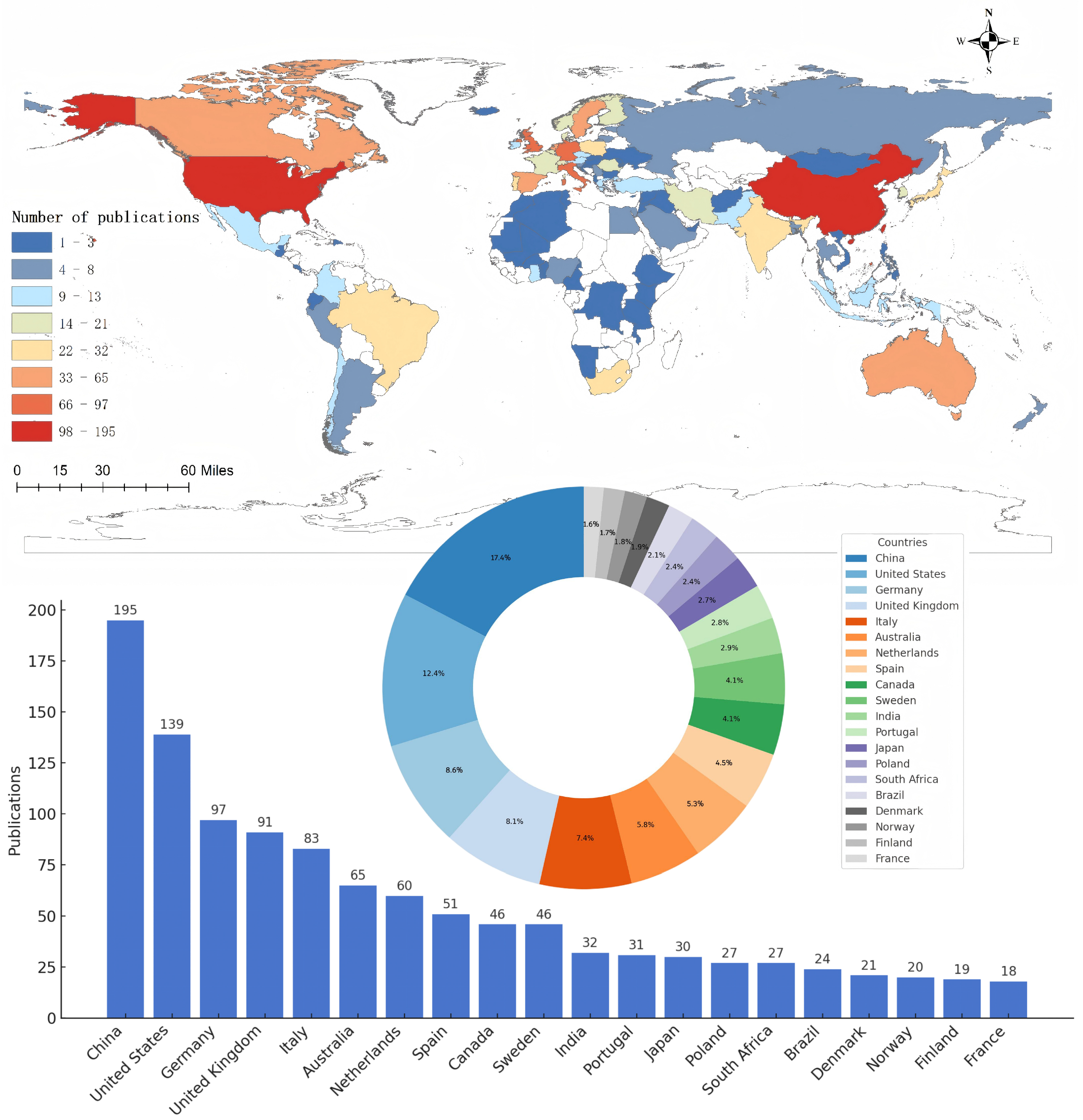
Analyzing the geographical distribution of publications by country and region helps to uncover the global spatial participation patterns and regional leadership dynamics in research on urban green space ecosystem services, urban resilience, and sustainable development [49]. Figure 3 presents the distribution and proportional composition of publications by country, revealing a pronounced regional imbalance.
In terms of total publication volume, China ranks first with 195 papers, accounting for 17.3% of the top twenty publishing countries. This reflects China’s strong growth momentum and its rapidly increasing international influence in this field. The United States ranks second with 139 publications (12.4%), maintaining a long-standing foundation in theoretical development and methodological innovation in ecosystem services research. Although the U.S. output is lower than China’s, its research impact and citation frequency remain among the highest globally. Germany (97 papers), the United Kingdom (91 papers), and Italy (83 papers) follow closely behind, highlighting Europe’s systematic and in-depth engagement in green urban planning, ecological design, and sustainable policy implementation. Moreover, the research is largely concentrated in China, the United States and European countries (as shown in Figure 3), which implies that existing knowledge is primarily focused on temperate and subtropical climate zones. In terms of research scale, studies at the national and urban levels are prevalent, indicating a strong emphasis on local urban governance and regional planning strategies [50].
Globally, research efforts are mainly concentrated in Europe, North America, East Asia, and Oceania. In contrast, Africa, Latin America, and several developing countries in Asia contribute relatively few publications, reflecting an uneven global distribution of academic resources in this field. Such regional disparities are likely influenced by multiple factors, including research funding, policy priorities, urbanization processes, and data accessibility [51,52].
Overall, the optimization of urban green space ecosystem services has emerged as a mature interdisciplinary research focus worldwide. Nevertheless, it remains essential to strengthen the participation of countries in the Global South and to promote regional cooperation and knowledge sharing. These efforts will be vital for enhancing both the resilience and equity of global urban ecosystem service management.
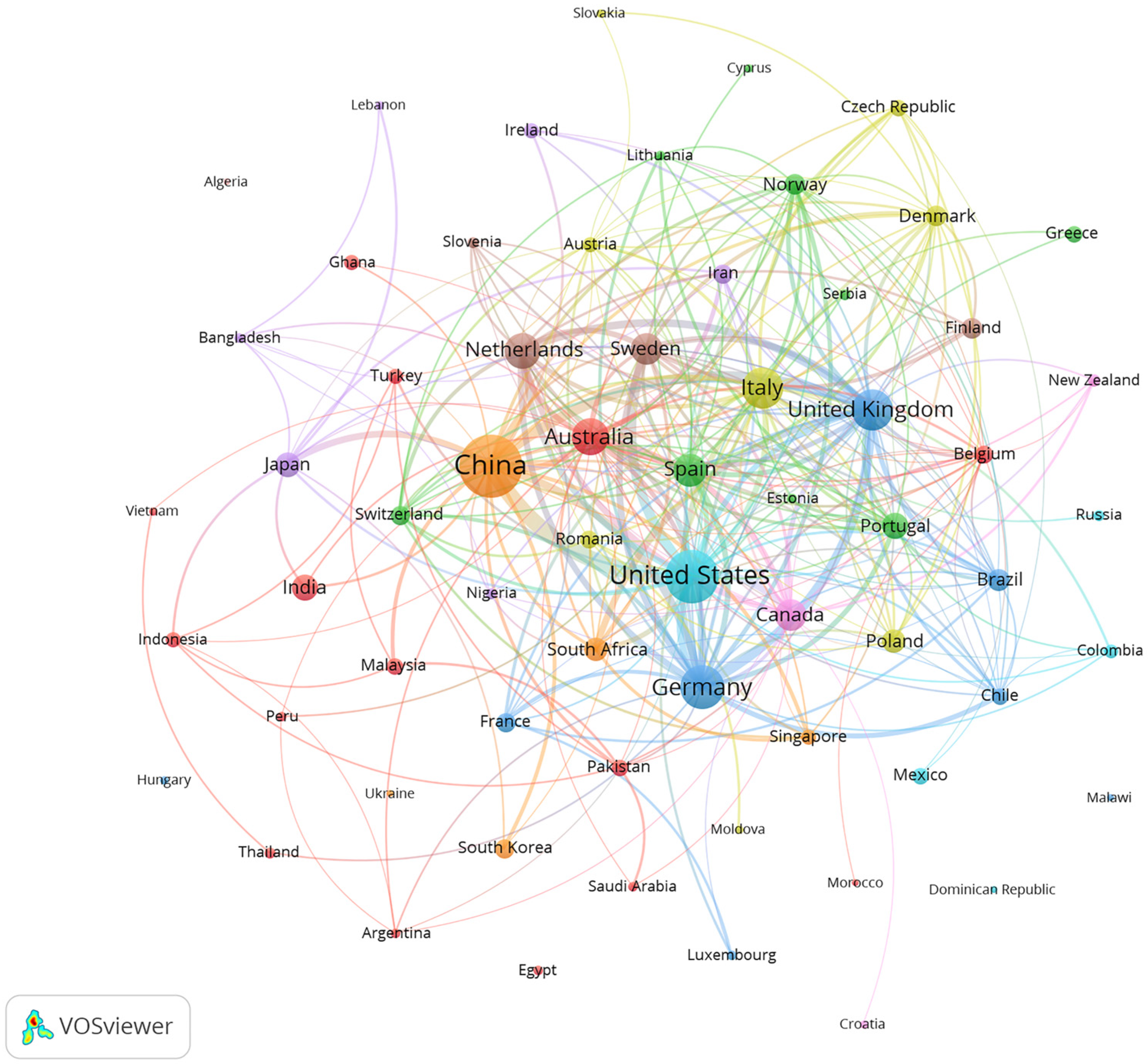
To further reveal the collaborative relationships and network structures among countries, this study employed VOSviewer software to visualize international research collaborations. As shown in Figure 4, the cooperation network exhibits a highly complex and tightly connected structure, within which several core collaboration clusters have emerged among major contributing countries.
The United States, China, and Germany occupy prominent central positions in the network, characterized by large node sizes and high connection densities. This indicates that these three countries not only generate substantial research output individually but also serve as key hubs in international academic collaboration. Notably, the partnership between China and the United States is particularly strong, with both nations maintaining stable bilateral research relationships with Australia, the United Kingdom, Germany, and Canada. Germany, through its close cooperation with the United States, the United Kingdom, Italy, and other European nations, has established a robust European research network. In addition, countries such as the United Kingdom, Italy, Australia, the Netherlands, and Canada, though publishing slightly fewer papers than the top three, play significant intermediary roles within the network. They frequently act as bridges connecting research forces from different regions. For instance, the United Kingdom serves as a pivotal link between European–North American and Asia–Pacific research communities, fostering cross-regional knowledge exchange and integration.
It is worth noting that several peripheral countries remain on the margins of the collaboration network, exhibiting relatively low levels of research participation and limited international engagement—manifested as scattered nodes and sparse linkages. This pattern suggests that global research on urban green space ecosystem services remains unevenly developed across nations, with considerable potential for expanding international cooperation and strengthening the inclusiveness of the global research network.

3.3. Influential Authors

Analyzing prolific authors helps identify core scholars and delineate patterns of academic influence within the field, providing an important foundation for understanding knowledge dissemination networks and research collaboration models [53]. In this research domain, a total of 3231 authors have contributed publications. Table 3 lists 13 authors who have published six or more papers. As shown, Timon McPherson from New York University ranks first with 11 papers, a total of 730 citations, and an H-index of 56, demonstrating his sustained contribution and high academic recognition in the study of urban ecosystem services. Closely following is Niki Frantzeskaki, who, despite publishing 10 papers, holds the highest citation impact with 1622 total citations and an H-index of 57, indicating that her research has achieved wide dissemination and profound influence. Stephan Pauleit, Dagmar Haase, and Salman Qureshi rank among the top five with 9, 8, and 6 publications, respectively. Notably, Dagmar Haase, with 800 total citations and an H-index of 80, exhibits remarkable academic influence, highlighting the high citation value of her research on urban green infrastructure and ecological urban planning.
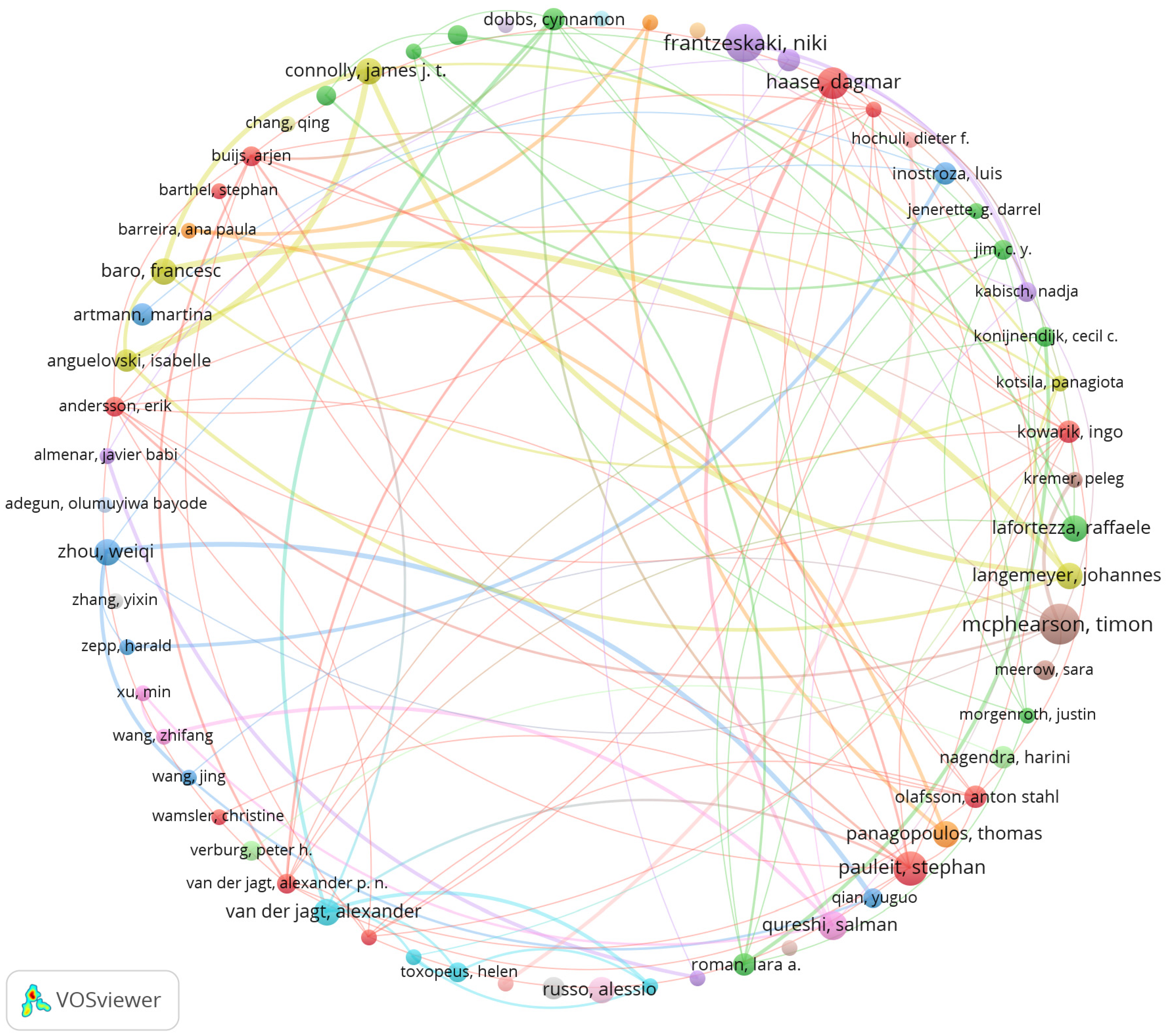
To further reveal the scholarly collaboration structure within the research field of urban green space ecosystem services, this study employed VOSviewer software to conduct a visualization analysis. By setting the minimum publication threshold at three, 63 authors were selected from the 3231 total authors, and a co-authorship network was generated (Figure 5). In the figure, each node represents an author, and the connecting lines indicate collaborative relationships. The visualization reveals that multiple tightly connected international research clusters have been formed, exhibiting clear regional and interdisciplinary characteristics.
From the network structure, authors such as Niki Frantzeskaki, Dagmar Haase, and Timon McPherson occupy central positions in the map, reflecting their pivotal roles and strong collaborative capacity within the academic network. The authors within this cluster engage in frequent cooperation, forming a highly cohesive international collaboration network primarily focused on urban sustainability research in Europe and North America. In addition, James J. T. Connolly, Nadja Kabisch, and Stephan Pauleit have also established stable partnerships with multiple scholars, underscoring their active roles in promoting interdisciplinary and inter-institutional collaborations. It is worth noting that Chinese scholar Weiqi Zhou also holds a visible position within the international collaboration network, maintaining partnerships with several European and American researchers, which reflects dynamic global scientific interaction.
Overall, the author collaboration network in this field demonstrates characteristics of internationalization and a high degree of integration, with research teams increasingly engaging in cross-regional and cross-disciplinary cooperation. Such collaboration patterns not only deepen theoretical frameworks but also enhance the breadth of empirical research and the translation of findings into policy. In the future, as global challenges related to urban climate adaptation and ecological resilience intensify, this collaborative network is expected to continue playing a pivotal role.

3.4. Influential Institutions

Analyzing high-impact research institutions helps identify the core centers of knowledge production, research collaboration hubs, and leading sources of academic innovation in a field [54]. Such analysis provides valuable insights for future scientific collaboration and resource allocation. In the field of urban green space ecosystem services, a total of 1351 institutions have contributed to related studies. Table 4 lists the top ten institutions in terms of publication volume, providing a clear overview of the research distribution and academic influence of each institution within this domain.
The results indicate that the Chinese Academy of Sciences ranks first with 36 publications, demonstrating its sustained research investment and leading role in this field. The Humboldt University of Berlin, ranking second with 23 publications, stands out for its exceptionally high total citations (NC = 2268) and average citations per article (AC = 99), far surpassing other institutions. This highlights the substantial academic impact of its research outputs. The Helmholtz Centre for Environmental Research (ranked third) and the University of Chinese Academy of Sciences (ranked fourth) both exhibit strong capacities in ecological modeling and ecosystem function assessment. Although their average citation counts (AC = 33 and 26, respectively) are relatively modest, their studies are frequently published in high-impact journals, indicating continued recognition and influence within the international academic community.
Overall, the high-impact institutions in this field display a multicentric structure. Asian research institutions, represented by the Chinese Academy of Sciences, emphasize data accumulation and model application; European universities prioritize theoretical advancement and interdisciplinary integration; while North American institutions excel in policy-oriented research and practical implementation. This diversified landscape has fostered the global collaborative development of urban green space ecosystem service research, providing multidimensional scientific support for building resilient and sustainable cities.
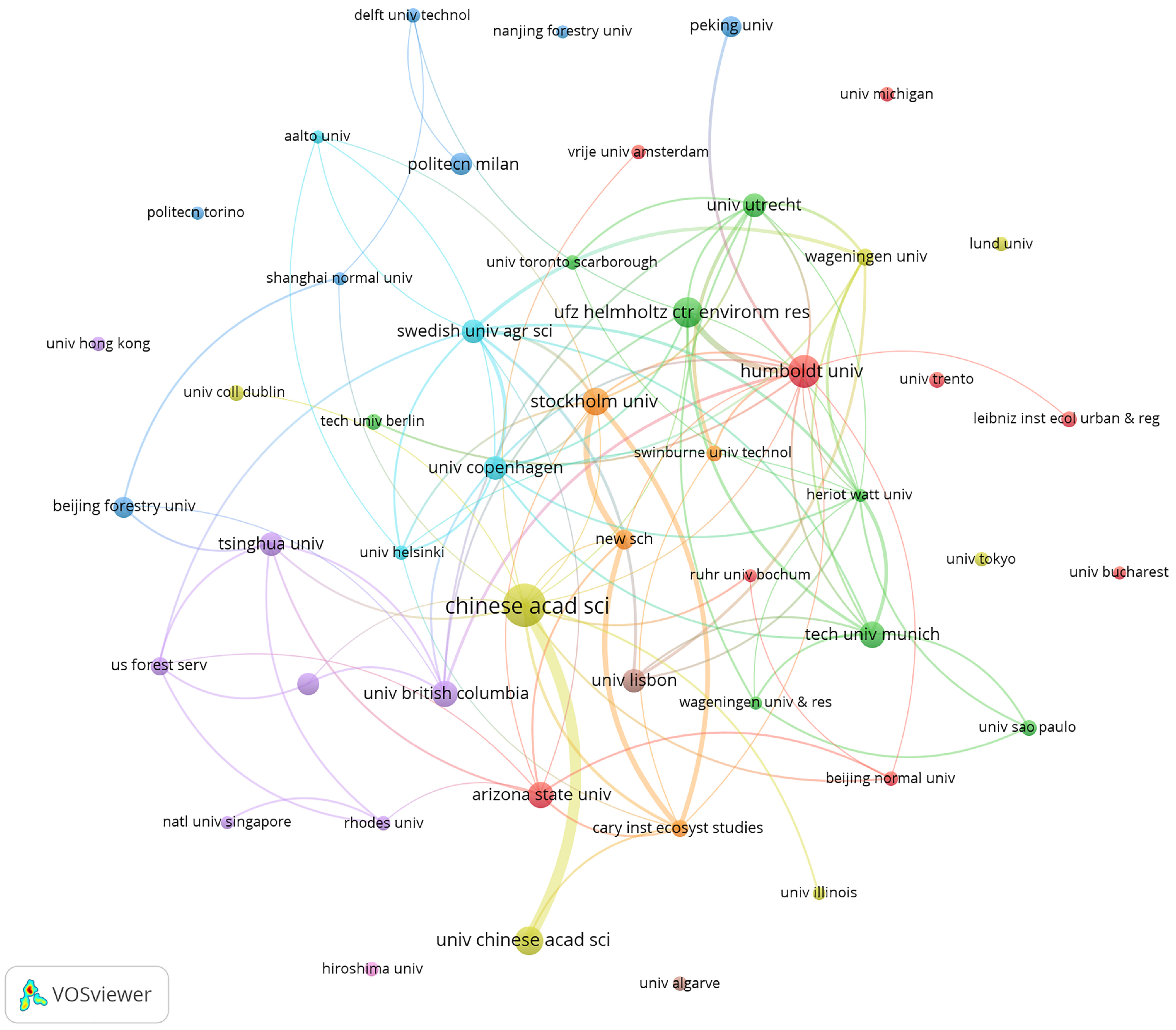
To further identify the collaborative cores and knowledge dissemination pathways within the field, this study employed VOSviewer software to construct an institutional collaboration network map (Figure 6). By setting a minimum publication threshold of six, 49 institutions were selected from a total of 1351 for visualization. Among them, the Chinese Academy of Sciences occupies the central position in the network, exhibiting the highest degree of centrality and linkage strength. It serves as one of the most influential collaboration hubs in this research domain. The Academy has established stable collaborative axes with the University of Chinese Academy of Sciences, the Cary Institute of Ecosystem Studies, and University College Dublin, forming crucial pivots that facilitate global research exchange and resource integration.
In the European region, institutions such as the Humboldt University of Berlin, the Helmholtz Centre for Environmental Research, the University of British Columbia, and Stockholm University have developed high-frequency cooperative networks centered on topics including environmental systems and urban resilience, demonstrating a strong capacity for scientific collaboration.
Overall, the international cooperation structure in this field has evolved into a multi-polar collaborative pattern. The dense interactions among core institutions drive knowledge co-creation, while the integration potential of peripheral nodes indicates emerging directions for future partnerships. Strengthening mechanisms for cross-regional and cross-cluster collaboration will be a key pathway to enhancing the comprehensiveness and systematic nature of global research on urban green space ecosystem services.

3.5. Research Knowledge Base

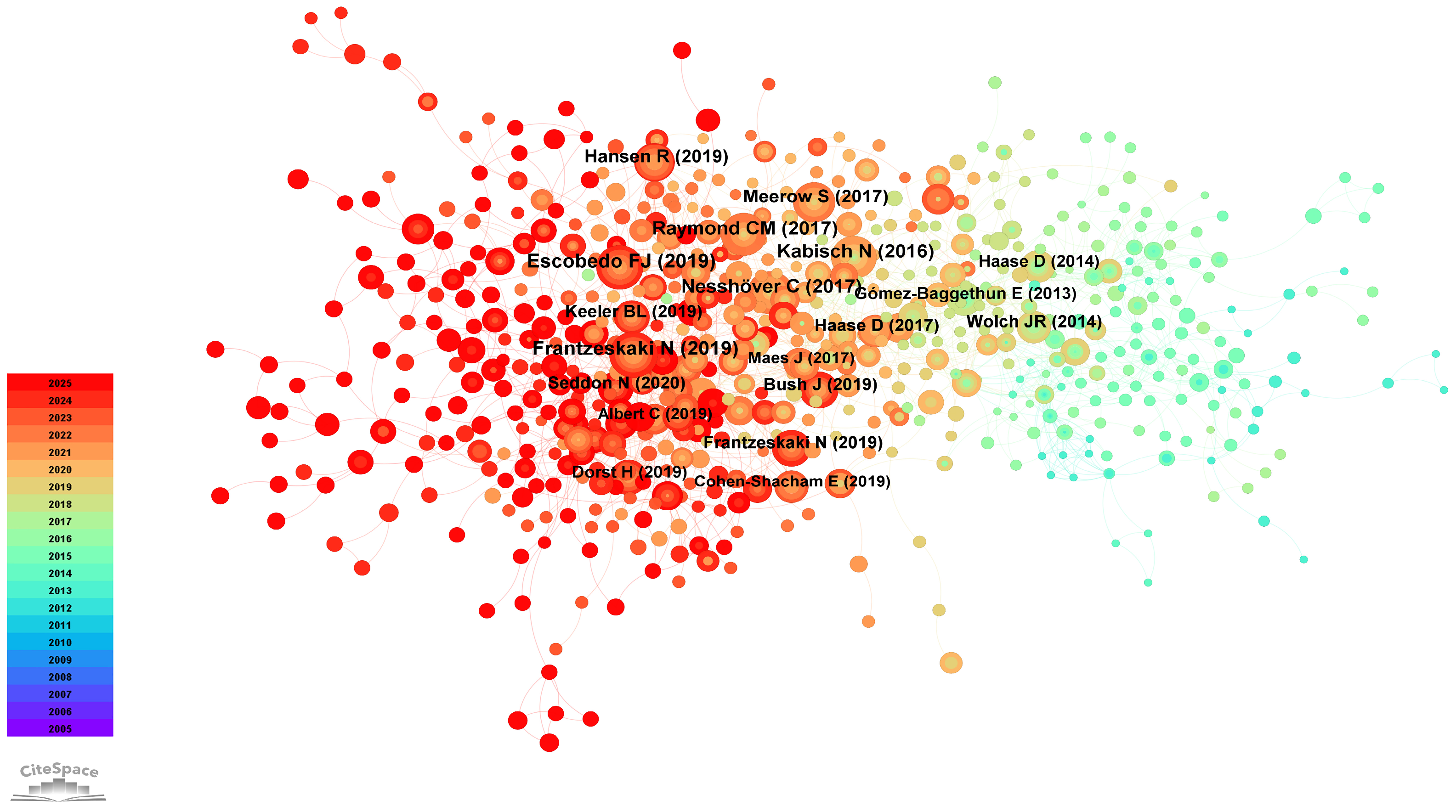
Co-citation analysis is an essential method for identifying core literature within a research domain and for revealing the foundational knowledge and evolutionary trajectory of that field [55]. To further uncover the research foundations and knowledge structure in the field of urban green space ecosystem services, this study employed CiteSpace v6.4.R1 to perform a co-citation analysis of relevant publications. Using a one-year time slice, the g-index (k = 25) as the node selection criterion, and the Pathfinder algorithm for network pruning, a co-citation network comprising 828 nodes and 1815 links was generated (Figure 7). The largest connected component (Largest CCs) contains 610 nodes, accounting for approximately 73% of the total, indicating a relatively cohesive and centralized knowledge structure in this research domain.
Among the highly cited references, one of the most influential nodes in the network is the paper by Frantzeskaki, N. published in Environmental Science & Policy in 2019 [56], entitled Seven lessons for planning nature-based solutions in cities, which has been cited 553 times across all databases. This publication holds a significant academic position in the field. Based on analyses of multiple European case studies on the practice of NBS in cities, the study summarized seven key lessons: integrating NBS into overall urban planning, establishing multi-stakeholder participation mechanisms, promoting policy and governance innovation, ensuring long-term financial sustainability, enhancing cross-sectoral collaboration, strengthening knowledge co-creation processes, and ensuring social equity and inclusiveness. The paper emphasizes that NBS should not merely be viewed as ecological tools, but rather as critical pathways toward achieving urban sustainability and driving social transformation [56].
In addition, the paper by Escobedo, F. J. et al. published in Urban Forestry & Urban Greening in 2019 [57], titled Urban forests, ecosystem services, green infrastructure and nature-based solutions: Nexus or evolving metaphors?, has been cited 361 times across all databases and has also exerted a substantial influence in the field. Through a systematic literature review and network analysis, this study traced the origins, evolution, and policy applications of key concepts such as urban forests, ecosystem services, green infrastructure, and nature-based solutions. It revealed that although these terms have continuously evolved, they essentially converge toward similar goals of urban nature governance. The study proposed that urban forestry could serve as a core practical framework for achieving these objectives and underscored the importance of interdisciplinary collaboration and contextualized communication in enhancing urban human well-being [57].

3.6. Knowledge Structure and Clustering Characteristics

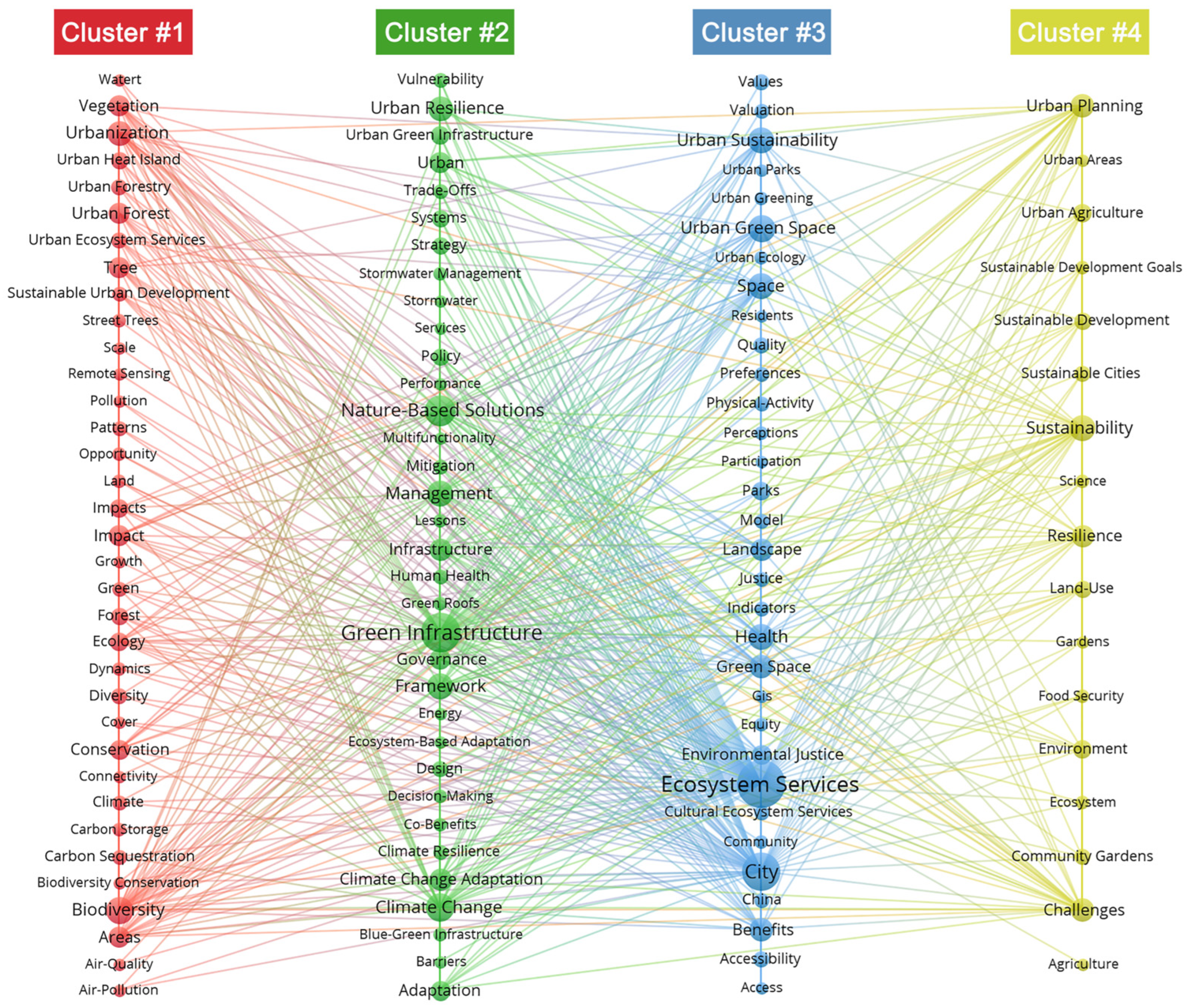
To identify the main themes, research hotspots, and evolutionary patterns of the knowledge structure in this field, we performed a keyword co-occurrence analysis using VOSviewer 1.6.19. The minimum co-occurrence threshold was set to 12, yielding 152 high-frequency keywords out of a total of 3490. After merging synonymous expressions and unifying term formats, 117 keywords were ultimately retained. To uncover the underlying semantic structure, we applied the Louvain community detection algorithm, a heuristic method based on modularity optimization, to the keyword co-occurrence network. This algorithm iteratively reassigns nodes to maximize the modularity value and thus identifies non-overlapping communities of closely related keywords. Without predefining the number of groups, the algorithm partitioned the network into four major clusters, which represent the optimal modularity-based division of the semantic structure [58,59]. These four clusters were visualized in different colors to form an organized knowledge network (Figure 8).
  • Cluster 1: Ecological Foundations and Green Process Orientation
This cluster mainly focuses on the fundamental ecological processes and ecological functions of urban green space ecosystems during the process of urbanization. Keywords such as “Vegetation,” “Urbanization,” “Urban Forest,” “Tree,” “Biodiversity,” “Air Pollution,” “Carbon Sequestration,” and “Conservation” occur frequently. This cluster emphasizes the important ecological service functions of urban green spaces in regulating the urban ecological environment, mitigating the heat island effect, improving air quality, and promoting carbon sequestration and storage [60,61,62]. The research core focuses on the structural composition of ecosystems, functional response mechanisms, and issues of ecological degradation and restoration under the background of urban expansion, providing theoretical support for the ecological foundation of urban green space system construction [63,64]. Methodologically, the high frequency of keywords such as “Remote Sensing” and “Model” indicates that this cluster is dominated by quantitative assessments based on spatial big data and biophysical models [65].
  • Cluster 2: Nature-Based Solutions and Infrastructure Support
This cluster focuses on NBS and Green Infrastructure as key approaches to enhancing urban ecosystem services and improving climate adaptation capacity. Keywords include “Stormwater Management,” “Mitigation,” “Climate Change Adaptation,” “Governance,” “Infrastructure,” and “Human Health.” The research emphasizes that through the construction of green infrastructure, such as green roofs, rain gardens, and blue-green infrastructure systems, multifunctional synergistic benefits can be achieved to enhance ecological resilience while serving the health and well-being of urban residents [66,67]. This cluster reflects the conceptual transformation from traditional engineering to ecological engineering, representing one of the important research trends in recent studies on urban sustainable transformation [68].
  • Cluster 3: Social Needs and Urban Spatial Justice
This cluster focuses on the interactive relationship between urban green space services and residents’ well-being. The core keywords include “Urban Sustainability,” “Urban Green Space,” “Health,” “Equity,” “Environmental Justice,” “Accessibility,” and “Preferences.” Research in this cluster emphasizes the impact of the fairness, accessibility, and usage preferences of urban green space distribution on the health and well-being of different social groups, highlighting participatory governance and spatial justice [69,70]. This cluster demonstrates the increasing social value of ecosystem services and the trend toward the integrated development of ecological planning and social policy. In contrast to Cluster 1, the prominence of keywords such as “Perceptions”, “Preferences” and “Residents” suggests that this line of research relies heavily on social science methods such as questionnaires and interviews to evaluate human well-being and social equity [71].
  • Cluster 4: Macro Policies and the Sustainable Development Agenda
This cluster revolves around keywords such as “Urban Planning,” “Sustainable Development Goals (SDGs),” “Resilience,” “Food Security,” and “Community Gardens.” It presents a research orientation that incorporates urban green space ecosystem services into the macro-level urban planning and policy system. This cluster highlights the potential of green spaces to support urban sustainable development, enhance social resilience, promote food security, and encourage community participation [72]. Its research perspective is more policy-oriented and features strong interdisciplinary integration, serving as a key linkage for achieving multiple ecological, social, and economic goals [73].
In summary, the four keyword co-occurrence clusters collectively construct a multi-level and multi-dimensional research framework. Cluster 1 emphasizes the structure and processes of ecosystems, forming the ecological foundation of urban green space research; Cluster 2 highlights the application value of nature-based solutions in addressing climate and environmental challenges; Cluster 3 focuses on the social equity and human well-being dimensions of ecosystem services, expanding the social dimension of ecological value; and Cluster 4 incorporates urban green space systems into macro-level policy and sustainable governance frameworks, promoting cross-scale integration. The four clusters are interconnected and mutually reinforcing, indicating that research on urban green space ecosystem services is shifting from ecological science toward a comprehensive socio-ecological-technological system [74,75]. This transformation provides a solid theoretical foundation and practical pathway for building resilient and sustainable cities.

3.7. Thematic Evolution and Trend Analysis

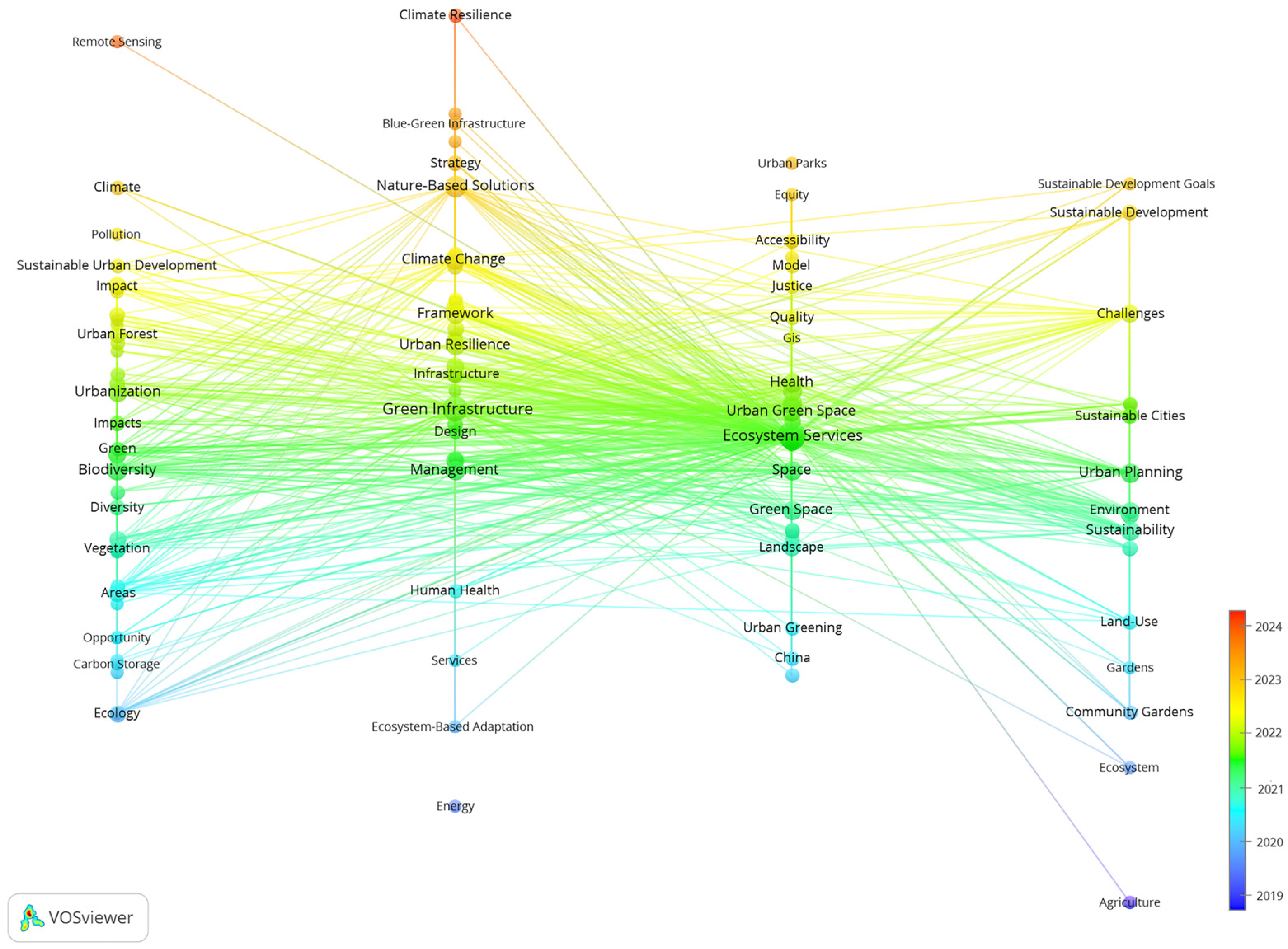
To further reveal the temporal evolution and emerging trends in research on urban green space ecosystem services, this study employed VOSviewer 1.6.19 to visualize the temporal variation in keywords, producing a keyword evolution map (Figure 9). In the map, the color of each node represents the average year of keyword occurrence, with colors gradually shifting from blue–violet (earlier period) to yellow–red (recent period), thereby illustrating the dynamic evolution of research themes.
In the early stage (before 2020), high-frequency keywords such as “Ecology,” “Carbon Storage,” “Biodiversity,” “Urbanization,” and “Vegetation” were predominant. This indicates that early studies primarily focused on the structural composition of urban green space ecosystems, biodiversity conservation, and the ecological functions of green spaces in carbon sequestration and climate regulation. Research during this period was mainly devoted to the identification and quantitative assessment of fundamental ecological processes, laying a solid scientific foundation for subsequent studies.
During 2021–2022, keywords gradually shifted toward “Green Infrastructure,” “Urban Green Space,” “Ecosystem Services,” “Health,” “Management,” and “Human Health.” This transition reflects an expansion of research interests from ecological processes to human well-being and the construction of green infrastructure, with increasing emphasis on the relationship between green space services and residents’ health. This period demonstrates a rising trend in the study of ecological–social system coupling, highlighting the growing integration between ecological functionality and social benefits.
In the recent stage (after 2023), the thematic evolution has further deepened toward climate resilience and sustainable development. High-frequency keywords such as “Climate Resilience,” “Nature-Based Solutions,” “Sustainable Development Goals,” “Urban Resilience,” and “Blue-Green Infrastructure” suggest that the research focus has expanded from individual ecological or landscape perspectives to macro-level issues concerning climate change mitigation and urban system adaptability. Scholars have begun to explore, from a systemic perspective, the key role of NBS in enhancing urban climate adaptability and achieving the Sustainable Development Goals (SDGs). Meanwhile, the increasing presence of social dimension keywords such as “Equity,” “Justice,” and “Accessibility” indicates growing scholarly attention to the spatial equity and environmental justice of urban green space distribution. This reflects a deepening trend toward integrated socio-ecological-spatial research, marking the ongoing transition of the field toward a more holistic and interdisciplinary framework.

4. Discussion

4.1. Constructing a Knowledge Ecosystem: A Data-Driven Framework

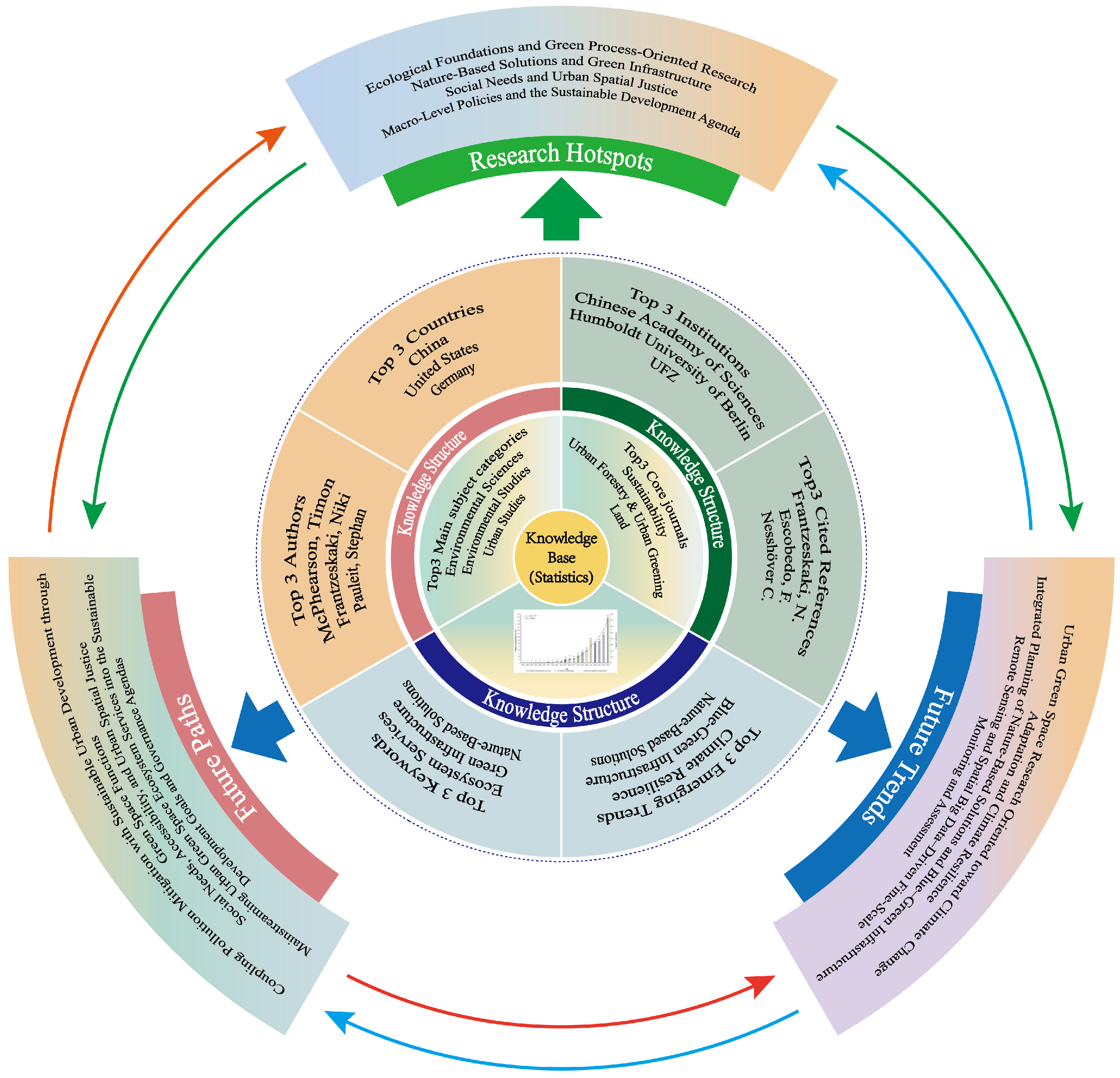
Drawing on the results of the bibliometric analysis and knowledge mapping, this study constructs a data-driven framework of the UGSES knowledge ecosystem that supports urban resilience and sustainable development (Figure 10). Rather than simply restating empirical findings, the framework is used as an analytical lens to diagnose how knowledge on UGSES is produced, distributed, and applied. By integrating five interrelated dimensions—knowledge base, knowledge structure, research hotspots, frontier trends, and future pathways—the framework links quantitative publication patterns with their underlying institutional, thematic, and normative dynamics. In doing so, it directly responds to the fragmentation highlighted in previous studies by revealing where knowledge is dense, where it is thin, and how these imbalances shape the capacity of UGSES research to inform urban policy and practice.
At the knowledge base level, the rapid increase in annual publications and the exponential growth in recent years indicate that UGSES has evolved from a peripheral topic into an important research frontier supporting climate adaptation and sustainable urban transformation [76]. This expansion is not merely a numerical phenomenon; it signals the progressive institutionalization of UGSES as a core component of the broader nature-based solutions and urban sustainability agenda [77]. However, the concentration of core journals in environmental science, urban studies, and ecology shows that the field is still anchored primarily in natural science and planning-oriented disciplines. Journals with moderate to high impact factors drive theoretical and methodological innovation, while more applied-oriented journals strengthen policy translation and practical implementation. At the same time, fields such as public health, social policy, and political science remain relatively under-represented. This disciplinary profile helps explain why ecological processes and technical assessment methods are comparatively mature, whereas issues of governance, power relations, and everyday practices of green space use are less systematically theorized.
At the knowledge structure level, analyses of international collaboration networks among countries, institutions, and authors, as well as co-citation mapping, reveal a highly centralized configuration of epistemic authority. China, the United States, and Germany constitute the principal geographic centers of global knowledge production, while key institutions such as the Chinese Academy of Sciences, Humboldt University, and the Helmholtz Centre for Environmental Research, together with influential scholars including Timon McPhearson, Niki Frantzeskaki, and Stephan Pauleit, form high-impact collaborative clusters. These actors not only generate a large share of publications but also shape the dominant conceptual vocabularies and methodological standards in the field. At the same time, the limited representation of many countries in the Global South suggests that the knowledge ecosystem is spatially asymmetric. Evidence on UGSES still largely reflects contexts with relatively strong research capacity and data availability, which may limit the transferability of current findings to cities facing acute resource constraints or extensive informality [78]. Recognizing this structural imbalance is crucial for future efforts to diversify empirical bases and promote more inclusive global knowledge production [79].
At the research hotspot level, the four main thematic categories identified—(1) ecological foundations and green processes; (2) nature-based solutions and green infrastructure; (3) social needs and spatial justice; and (4) macro-level policy and the sustainable development agenda—can be interpreted as a multi-layered chain linking biophysical processes to governance arrangements. The first cluster provides the ecological and technical foundations necessary to quantify and model ecosystem services. The second cluster translates these foundations into spatial configurations of nature-based solutions and blue–green infrastructure intended to address climate and environmental risks. The third cluster foregrounds social needs, health benefits, and environmental justice, thereby problematizing who benefits from UGSES and under what conditions. The fourth cluster embeds these issues in broader institutional frameworks such as urban planning systems, resilience strategies, and the Sustainable Development Goals. Although these clusters are interconnected, the knowledge ecosystem still shows signs of compartmentalization: studies that rigorously integrate ecological performance, infrastructural design, and distributive justice within concrete governance contexts remain relatively scarce [80,81]. This thematic structure therefore highlights both the strengths of the field—its multi-dimensional coverage—and its main gap—insufficient cross-cluster integration.
At the research trend level, recent studies have increasingly shifted toward topics such as climate resilience, nature-based solutions, the Sustainable Development Goals, environmental justice, and spatial equity. The temporal evolution of keywords indicates the emergence of concepts such as urban resilience, climate resilience, nature-based solutions, and environmental justice, reflecting a paradigmatic transition in UGSES research—from static ecological benefit assessments to dynamic governance frameworks emphasizing supply–demand matching, multi-objective synergies, and social equity [82,83]. Nevertheless, this normative and conceptual shift is not yet fully matched by methodological innovation: many empirical studies still rely on single-service indicators, short-term case studies, or simplified representations of social vulnerability. The knowledge ecosystem thus appears to be in a transitional phase in which advanced discourses on resilience and justice coexist with relatively conventional analytical tools [84]. This misalignment underscores the need for future work to develop integrative evaluation frameworks capable of capturing trade-offs, synergies, and long-term impacts across ecological, social, and governance dimensions.
Overall, the data-driven knowledge ecosystem framework proposed in this study is not only a descriptive map of existing literature but also a diagnostic instrument for strategic learning. By revealing how publication trends, disciplinary configurations, collaboration networks, thematic clusters, and emerging concepts interact, the framework helps identify leverage points for strengthening UGSES research—such as broadening disciplinary participation, enhancing contributions from under-represented regions, and designing studies that explicitly connect ecological performance with governance arrangements and justice outcomes. In this sense, the framework provides a foundation for the subsequent analysis of evolving trends and research directions, and offers a structured knowledge base to support more reflexive and context-sensitive applications of urban forests and green spaces as nature-based solutions for resilient and sustainable cities.

4.2. Evolution of Trends and Research Directions

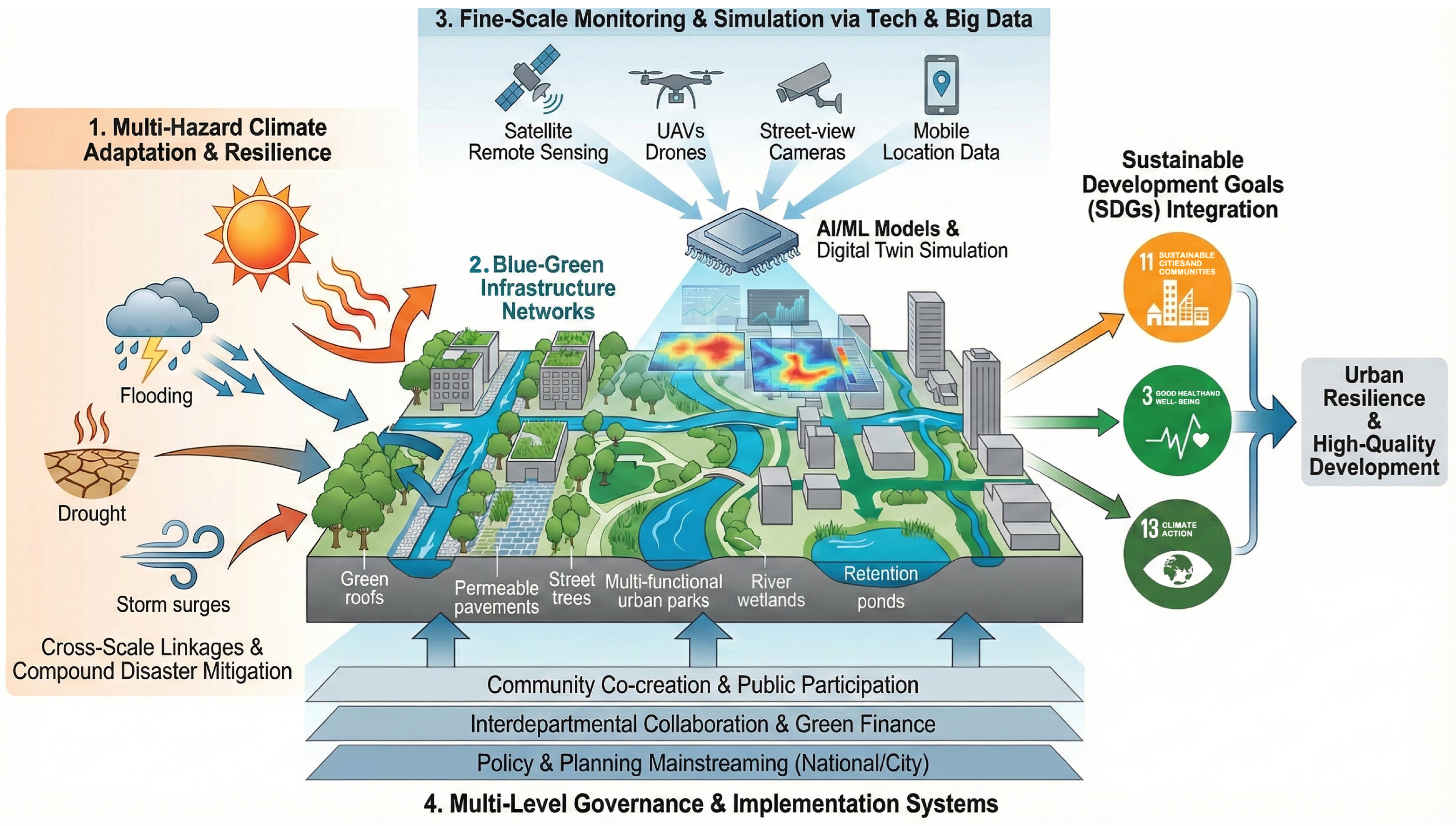
Building upon current research and integrating the temporal evolution of keywords with knowledge mapping results, it is evident that studies on optimizing UGSES to support urban resilience and sustainable development are rapidly advancing from a single-dimensional assessment of ecological effects toward a new stage characterized by deep coupling across social, ecological, technological, and governance dimensions. Future research should pursue more systematic explorations in areas such as multi-hazard climate risks, blue-green infrastructure systems, digital technology support, pollution control synergy, social equity and spatial justice, and governance innovation. These efforts aim to construct an integrated governance framework for urban green spaces capable of addressing complex and uncertain challenges. Based on the findings of this study, four major research trends warrant particular attention.
  • Deepening Research on Urban Green Spaces for Climate Adaptation and Resilience
The evolution of keywords such as Climate Change and Climate Resilience reveals a significant recent surge in climate-related research, reflecting the growing centrality of urban green spaces in addressing global climate crises and multi-hazard risk governance [85,86]. Future research should expand beyond the single function of thermal environment mitigation to encompass compound disaster contexts involving heatwaves, heavy rainfall, droughts, and storm surges [87]. A systematic evaluation is needed of the comprehensive disaster prevention and mitigation benefits of urban green spaces under multiple extreme climate scenarios, along with the establishment of resilience assessment indicators suited to diverse risk contexts [88]. Furthermore, it is essential to strengthen cross-scale linkages between microclimate regulation and citywide climate control, promoting the development of multi-scale green space configuration strategies and scenario-based simulation methods at neighborhood, urban, and regional levels [89,90]. Such research would clarify the long-term value and boundary conditions of urban green spaces within integrated climate governance systems encompassing mitigation, adaptation, and transformation [91,92].
2.
Integrated Planning of Nature-Based Solutions and Blue-Green Infrastructure
The frequent appearance of keywords such as Nature-Based Solutions, Blue-Green Infrastructure, and Strategy in the recent literature signifies a paradigm shift—from traditional “greening projects” to urban green spaces as key components driving infrastructure transformation [93,94]. Future research should strengthen the theoretical and methodological integration of NBS and blue-green infrastructure [95]. This includes systematically examining the connectivity and synergies among elements such as urban parks, river and lake wetlands, green roofs, and street greenery to construct multi-scale, multi-level optimization models of blue-green networks [32,96]. In parallel, comprehensive performance assessments of hybrid gray–green–blue infrastructure should be advanced to analyze synergies and trade-offs among functions such as stormwater regulation, thermal environment mitigation, biodiversity conservation, and social well-being [97,98]. Moreover, it is crucial to translate project-level experiences into policy instruments and planning standards, exploring practical pathways to embed NBS principles into spatial planning, climate adaptation strategies, and infrastructure investment decisions [99,100].
3.
Remote Sensing and Spatial Big Data for Fine-Scale Monitoring and Simulation
The increasing frequency and forward shift in methodological keywords such as Remote Sensing, GIS, Model, and Quality indicate that remote sensing and spatial big data have become core technological supports for UGSES research [101,102]. Future studies must advance in both data integration and modeling methodologies. On the data side, integrating high-resolution satellite imagery, UAV remote sensing, street-view images, mobile device location data, and social media information can achieve multi-source fusion and high spatiotemporal resolution representations of the structure, function, and usage behaviors of urban green spaces [103,104,105]. On the modeling side, the adoption of machine learning and deep learning methods can facilitate the construction of more accurate and adaptive predictive models and scenario simulation tools for ecosystem services. At the same time, uncertainty analysis and ground-based validation should be strengthened to enhance the interpretability and reliability of these models in planning and decision-making contexts [106,107].
4.
Integrating Urban Green Space Ecosystem Services into the Sustainable Development Goals and Multi-Level Governance Systems
The clustering of keywords such as Sustainable Development, Sustainable Development Goals, and Challenges reflects that the systematic incorporation of UGSES into sustainable development agendas and governance frameworks has become a research frontier [108]. Future work should focus on multi-level and multi-actor governance mechanisms. It is necessary to systematically examine the linkages between green space policies and the Sustainable Development Goals—particularly SDG 11 (Sustainable Cities and Communities), SDG 3 (Good Health and Well-Being), and SDG 13 (Climate Action)—across international, national, urban, and community scales [109,110,111]. Researchers should identify structural barriers and potential entry points for mainstreaming ecosystem services in policymaking [112]. Attention should also be directed toward coordination mechanisms across planning, ecology, finance, and public health sectors, exploring institutional innovations that support NBS implementation through interdepartmental collaboration, green finance, and climate investment and financing mechanisms [113]. Furthermore, strengthening public participation and co-creative governance is vital, encouraging collaboration among community residents, social organizations, and the private sector in the planning, construction, and management of green spaces [114]. Such efforts can foster the integration of scientific knowledge with local experience and build a more inclusive, flexible, and adaptive governance system for urban green spaces.
As illustrated in Figure 11, contemporary research on urban green space ecosystem services, resilience, and development is gradually forming an integrated framework encompassing climate change adaptation, nature-based solutions, spatial big data monitoring, and sustainable governance systems. Future research on UGSES and resilient, sustainable cities will become increasingly data-intensive and model-driven in methodology, more focused on multi-risk coupling, social equity, and governance innovation in content, and more attentive to differentiated pathways across cities in the Global South and those at varying stages of development. Through continuous advancements in these areas, research can provide a solid foundation for achieving high-quality, resilient, and equitable urban transitions under conditions of climatic and social uncertainty.

5. Conclusions

Focusing on the core theme of optimizing UGSES to build resilient and sustainable cities, this study employed the bibliometric analysis and scientific knowledge mapping methods to systematically review and synthesize 861 relevant articles indexed in the Web of Science Core Collection from 2005 to 2025. From multiple dimensions—knowledge base, knowledge structure, research hotspots, and thematic evolution—the study delineates the overall landscape and developmental trajectory of UGSES research. The results indicate a continuous upward trend over the past two decades, with the field gradually forming an interdisciplinary knowledge structure that integrates environmental science, urban studies, and ecology. China, the United States, and several European countries have emerged as key nodes in global knowledge production and collaboration. The research themes primarily center on ecological processes and green foundations, nature-based solutions and blue-green infrastructure, social needs, and spatial justice, as well as macro-level policy and sustainable development agendas. Overall, the field exhibits a transition from static ecological benefit assessment toward an integrated transformation pathway emphasizing climate resilience, social equity, and multi-actor governance.
The contribution of this study lies in constructing an integrated knowledge framework that connects ecosystem services, urban resilience, and sustainable development, thereby revealing the interactive logic among natural, social, and governance dimensions from a multidisciplinary perspective. The research not only deepens the understanding of how green space ecosystem services function in addressing climate change and enhancing urban resilience, but also provides new theoretical support for the planning of nature-based solutions and blue-green infrastructure. Furthermore, by introducing a knowledge-mapping approach to uncover the evolutionary trajectory of UGSES research, this study establishes a replicable analytical paradigm for future interdisciplinary investigations. More importantly, the findings offer practical policy implications: urban policymakers should regard green space systems as critical infrastructure, incorporating ecological functions, social well-being, and spatial equity into the urban governance framework to achieve nature-based sustainable urban transformation.
Despite its systematic and innovative nature, this study has certain limitations. The dataset is primarily derived from English-language publications in the WoS Core Collection, which may not fully capture regional studies or non-English research outputs. Future research could expand to include multilingual and multi-database sources, combined with content analysis and case studies, to further explore diverse UGSES practices across varying socio-economic and climatic contexts. Comparative and scenario-based analyses across regions should be strengthened to deepen the understanding of how UGSES fosters urban resilience and sustainable development. Such efforts would provide more practical and actionable knowledge to support the creation of equitable, inclusive, and adaptive cities of the future.

Author Contributions

Conceptualization, J.S., J.X. and L.Q.; methodology, J.S. and J.X.; software, J.S.; validation, J.S., J.X. and L.Q.; formal analysis, J.S.; investigation, J.S.; resources, L.Q.; data curation, J.S.; writing—original draft preparation, J.S.; writing—review and editing, J.X. and L.Q.; visualization, J.S.; supervision, J.X. and L.Q.; project administration, J.X.; funding acquisition, J.X. All authors have read and agreed to the published version of the manuscript.

Funding

This research received no external funding.

Data Availability Statement

The data that support the findings of this study are available from the corresponding author upon reasonable request.

Conflicts of Interest

The authors declare no conflicts of interest.

Abbreviations

The following abbreviations are used in this manuscript:
UGSESUrban Green Space Ecosystem Services
NbSNature-Based Solutions

References

  1. Das, S.; Choudhury, M.R.; Chatterjee, B.; Das, P.; Bagri, S.; Paul, D.; Bera, M.; Dutta, S. Unraveling the urban climate crisis: Exploring the nexus of urbanization, climate change, and their impacts on the environment and human well-being—A global perspective. AIMS Public Health 2024, 11, 963–1001. [Google Scholar] [CrossRef]
  2. Wamsler, C.; Brink, E.; Rivera, C. Planning for climate change in urban areas: From theory to practice. J. Clean. Prod. 2013, 50, 68–81. [Google Scholar] [CrossRef]
  3. Venter, Z.S.; Figari, H.; Krange, O.; Gundersen, V. Environmental justice in a very green city: Spatial inequality in exposure to urban nature, air pollution and heat in Oslo, Norway. Sci. Total Environ. 2023, 858, 160193. [Google Scholar] [CrossRef]
  4. Surya, B.; Hadijah, H.; Suriani, S.; Baharuddin, B.; Fitriyah, A.T.; Menne, F.; Rasyidi, E.S. Spatial transformation of a new city in 2006–2020: Perspectives on the spatial dynamics, environmental quality degradation, and socio—Economic sustainability of local communities in Makassar City, Indonesia. Land 2020, 9, 324. [Google Scholar] [CrossRef]
  5. Piracha, A.; Chaudhary, M.T. Urban air pollution, urban heat island and human health: A review of the literature. Sustainability 2022, 14, 9234. [Google Scholar] [CrossRef]
  6. Nazarian, N.; Krayenhoff, E.; Bechtel, B.; Hondula, D.; Paolini, R.; Vanos, J.; Cheung, T.; Chow, W.; de Dear, R.; Jay, O. Integrated assessment of urban overheating impacts on human life. Earth Future 2022, 10, e2022EF002682. [Google Scholar] [CrossRef]
  7. Esposito, D. A Ladder of Urban Resilience: An Evolutionary Framework for Transformative Governance of Communities Facing Chronic Crises. Sustainability 2025, 17, 6010. [Google Scholar] [CrossRef]
  8. Reyers, B.; Moore, M.-L.; Haider, L.J.; Schlüter, M. The contributions of resilience to reshaping sustainable development. Nat. Sustain. 2022, 5, 657–664. [Google Scholar] [CrossRef]
  9. Sharifi, A. Resilience of urban social-ecological-technological systems (SETS): A review. Sustain. Cities Soc. 2023, 99, 104910. [Google Scholar] [CrossRef]
  10. Pamukcu-Albers, P.; Ugolini, F.; La Rosa, D.; Grădinaru, S.R.; Azevedo, J.C.; Wu, J. Building green infrastructure to enhance urban resilience to climate change and pandemics. Landsc. Ecol. 2021, 36, 665–673. [Google Scholar] [CrossRef]
  11. Yan, S.; Tang, J. Optimization of green space planning to improve ecosystem services efficiency: The case of Chongqing urban areas. Int. J. Environ. Res. Public Health 2021, 18, 8441. [Google Scholar] [CrossRef] [PubMed]
  12. Russo, A.; Cirella, G.T. Urban Ecosystem Services: Agroecology, Green Spaces, and Environmental Quality for Sustainable Futures. Land 2025, 14, 288. [Google Scholar] [CrossRef]
  13. Jafar, M.; Samuel, H.; Rickson, N.H.; Edidiong, S.; Sunday, E.E.E. Sustainable Smart Urban Form: Integration of Green Spaces and Ecosystem Services in Developing Cities of Nigeria. Ecosyst. Serv. 2025, 6, 104–121. [Google Scholar]
  14. Wang, D.; Liang, Y. Environmental decentralization and urban green space provision: Based on the multidimensional perspective of decentralization. Environ. Dev. Sustain. 2025, 27, 12013–12044. [Google Scholar] [CrossRef]
  15. Wu, S.; Wang, D.; Wei, Y.; Wang, X.; Lou, R.; Duan, J. Bridging the key components of urban ecosystem services assessment: Links and feedbacks between “typology-multifunctionality-supply and demand”. Landsc. Ecol. 2025, 40, 67. [Google Scholar] [CrossRef]
  16. Yang, M.; Qiu, J.; Luo, S.; Zhang, S.; Xie, J.; Liu, L.; Wang, Z.; Zheng, Y. Evidence on how planning and design contribute to building a habitat security space: A multidimensional exploration. Environ. Res. Commun. 2025, 7, 092002. [Google Scholar] [CrossRef]
  17. Wang, D.; Xu, P.-Y.; An, B.-W.; Guo, Q.-P. Urban green infrastructure: Bridging biodiversity conservation and sustainable urban development through adaptive management approach. Front. Ecol. Evol. 2024, 12, 1440477. [Google Scholar] [CrossRef]
  18. McPhearson, T.; Cook, E.M.; Berbés-Blázquez, M.; Cheng, C.; Grimm, N.B.; Andersson, E.; Barbosa, O.; Chandler, D.G.; Chang, H.; Chester, M.V. A social-ecological-technological systems framework for urban ecosystem services. One Earth 2022, 5, 505–518. [Google Scholar] [CrossRef]
  19. Ring, Z.; Damyanovic, D.; Reinwald, F. Green and open space factor Vienna: A steering and evaluation tool for urban green infrastructure. Urban For. Urban Green. 2021, 62, 127131. [Google Scholar] [CrossRef]
  20. Venter, Z.S.; Barton, D.N.; Martinez-Izquierdo, L.; Langemeyer, J.; Baró, F.; McPhearson, T. Interactive spatial planning of urban green infrastructure–Retrofitting green roofs where ecosystem services are most needed in Oslo. Ecosyst. Serv. 2021, 50, 101314. [Google Scholar] [CrossRef]
  21. Liu, Q.; Tian, Y.; Yin, K.; Zhang, F.; Huang, H.; Chen, F. Landscape pattern theoretical optimization of urban green space based on ecosystem service supply and demand. ISPRS Int. J. Geo-Inf. 2021, 10, 263. [Google Scholar] [CrossRef]
  22. Shi, X.; Qin, M.; Li, B.; Zhang, D. A framework for optimizing green infrastructure networks based on landscape connectivity and ecosystem services. Sustainability 2021, 13, 10053. [Google Scholar] [CrossRef]
  23. Men, D.; Pan, J. Incorporating network topology and ecosystem services into the optimization of ecological network: A case study of the Yellow River Basin. Sci. Total Environ. 2024, 912, 169004. [Google Scholar] [CrossRef] [PubMed]
  24. Alavi, S.A.; Esfandi, S.; Khavarian-Garmsir, A.R.; Tayebi, S.; Shamsipour, A.; Sharifi, A. Assessing the connectivity of urban green spaces for enhanced environmental justice and ecosystem service flow: A study of tehran using graph theory and least-cost analysis. Urban Sci. 2024, 8, 14. [Google Scholar] [CrossRef]
  25. Govindarajulu, D. Urban green space planning for climate adaptation in Indian cities. Urban Clim. 2014, 10, 35–41. [Google Scholar] [CrossRef]
  26. Dong, J.; Jiang, H.; Gu, T.; Liu, Y.; Peng, J. Sustainable landscape pattern: A landscape approach to serving spatial planning. Landsc. Ecol. 2022, 37, 31–42. [Google Scholar] [CrossRef]
  27. Semeraro, T.; Scarano, A.; Buccolieri, R.; Santino, A.; Aarrevaara, E. Planning of urban green spaces: An ecological perspective on human benefits. Land 2021, 10, 105. [Google Scholar] [CrossRef]
  28. Liu, N.; Zhang, F. Urban green spaces and flood disaster management: Toward sustainable urban design. Front. Public Health 2025, 13, 1583978. [Google Scholar] [CrossRef]
  29. Qu, L.; Wang, H.; Xia, J. Urban Forests and Green Environments for Sustainable Cities: Knowledge Landscape, Research Trends, and Future Directions. Forests 2025, 16, 1675. [Google Scholar] [CrossRef]
  30. Ramalingam, S.; Hassan, W.H.; Subramanian, M.; Elkamchouchi, D.H.; Tarakaramu, N.; Prashanth, K. Synergies for sustainability: Renewable energy, urban planning, and green industry in carbon emission reduction. Sustain. Futures 2025, 10, 101222. [Google Scholar] [CrossRef]
  31. Liu, Y.; Han, B.; Jiang, C.; Ouyang, Z. Uncovering the role of urban green infrastructure in carbon neutrality: A novel pathway from the urban green infrastructure and cooling power saving. J. Clean. Prod. 2024, 452, 142193. [Google Scholar] [CrossRef]
  32. Han, D.; Xia, J.; Wu, D. Ecological Resilience and Urban Health: A Global Analysis of Research Hotspots and Trends in Nature-Based Solutions. Forests 2025, 16, 1305. [Google Scholar] [CrossRef]
  33. Tondelli, S.; Marzani, G. How to Plan for Circular Cities: A New Methodology to Integrate the Circular Economy Within Urban Policies and Plans. Sustainability 2025, 17, 5534. [Google Scholar] [CrossRef]
  34. Othengrafen, F.; Sievers, L.; Reinecke, E. Using augmented reality in urban planning processes: Sustainable urban transitions through innovative participation. GAIA Ecol. Perspect. Sci. Soc. 2023, 32, 54–63. [Google Scholar] [CrossRef]
  35. Yang, X.; Kinoshita, T.; Wang, Q.; Chen, Y. Systematic Literature Review and Meta-Analysis of Landscape-Scale Green Infrastructure Identification. Sustain. Dev. 2025, 33, 475–500. [Google Scholar] [CrossRef]
  36. van Dorsselaer, E.; Voets, J.; Dupont, C. Implementing Nature-Based Solutions in Cities: Testing and Refining the Integrative Framework for Collaborative Governance. Environ. Policy Gov. 2025, 35, 761–774. [Google Scholar] [CrossRef]
  37. Lu, G.; Zhang, G.; Liu, K.; Cheng, Z.; Liu, H. Decision-making framework for green infrastructure practices based on the quantification of ecosystem services supply-flow-demand: A review. J. Environ. Manag. 2025, 389, 126163. [Google Scholar] [CrossRef]
  38. Bani Khalifi, N.; Avgoustaki, D.D.; Bartzanas, T. Integrating life cycle assessment into green infrastructure: A systematic review and meta-analysis of urban sustainability strategies. Front. Sustain. Cities 2025, 7, 1601091. [Google Scholar] [CrossRef]
  39. Yao, Y.; Zheng, H.; Ouyang, Z.; Gong, C.; Zhang, J.; Ying, L.; Wen, Z. Impact of urban green infrastructure on ecosystem services: A systematic review. Ecol. Indic. 2025, 178, 113885. [Google Scholar] [CrossRef]
  40. Veibiakkim, R.; Shkaruba, A.; Sepp, K. A systematic review of Urban Ecosystem Disservices and its evaluation: Key findings and implications. Environ. Sustain. Indic. 2025, 26, 100612. [Google Scholar] [CrossRef]
  41. Xia, J.; Zhao, Z.; Chen, L.; Sun, Y. How urban renewal affects the sustainable development of public spaces: Trends, challenges, and opportunities. Front. Environ. Sci. 2024, 12, 1482169. [Google Scholar] [CrossRef]
  42. Vlase, I.; Lähdesmäki, T. A bibliometric analysis of cultural heritage research in the humanities: The Web of Science as a tool of knowledge management. Humanit. Soc. Sci. Commun. 2023, 10, 84. [Google Scholar] [CrossRef] [PubMed]
  43. Kastrin, A.; Hristovski, D. Scientometric analysis and knowledge mapping of literature-based discovery (1986–2020). Scientometrics 2021, 126, 1415–1451. [Google Scholar] [CrossRef]
  44. Karakose, T.; Papadakis, S.; Tülübaş, T.; Polat, H. Understanding the intellectual structure and evolution of distributed leadership in schools: A science mapping-based bibliometric analysis. Sustainability 2022, 14, 16779. [Google Scholar] [CrossRef]
  45. Lyu, G.; Angkawisittpan, N.; Fu, X.; Sonasang, S. Investigating the relationship between built environment and urban vitality using big data. Sci. Rep. 2025, 15, 579. [Google Scholar] [CrossRef]
  46. Goodwin, S.; Olazabal, M.; Castro, A.J.; Pascual, U. Global mapping of urban nature-based solutions for climate change adaptation. Nat. Sustain. 2023, 6, 458–469. [Google Scholar] [CrossRef]
  47. Zhang, S.X.; Ertug, G. CROSSROADS—Organization research as an applied science: Lessons from fields that shape practice and policy. Organ. Sci. 2025, 36, 2028–2039. [Google Scholar] [CrossRef]
  48. Menconi, M.; Palazzoni, L.; Grohmann, D. Core themes for an urban green systems thinker: A review of complexity management in provisioning cultural ecosystem services. Urban For. Urban Green. 2021, 65, 127355. [Google Scholar] [CrossRef]
  49. Valente, D.; Marinelli, M.V.; Lovello, E.M.; Giannuzzi, C.G.; Petrosillo, I. Fostering the resiliency of urban landscape through the sustainable spatial planning of green spaces. Land 2022, 11, 367. [Google Scholar] [CrossRef]
  50. Fastiggi, M.; Meerow, S.; Miller, T.R. Governing urban resilience: Organisational structures and coordination strategies in 20 North American city governments. Urban Stud. 2021, 58, 1262–1285. [Google Scholar] [CrossRef]
  51. Mngadi, M.; Odindi, J.; Mutanga, O.; Sibanda, M. Quantitative remote sensing of forest ecosystem services in sub-Saharan Africa’s urban landscapes: A review. Environ. Monit. Assess. 2022, 194, 242. [Google Scholar] [CrossRef] [PubMed]
  52. Bakhtsiyarava, M.; Moran, M.; Ju, Y.; Zhou, Y.; Rodriguez, D.A.; Dronova, I.; de Fatima Rodrigues Pereira de Pina, M.; de Matos, V.P.; Skaba, D.A. Potential drivers of urban green space availability in Latin American cities. Nat. Cities 2024, 1, 842–852. [Google Scholar] [CrossRef]
  53. Cao, Z.; Zhang, L.; Huang, Y. How do researchers collaborate across disciplines? Patterns of interdisciplinary collaboration based on disciplinary and contributory perspectives. J. Inf. Sci. 2025, 01655515251373082. [Google Scholar] [CrossRef]
  54. Rodríguez-Salazar, A.E.; Torres-Huerta, A.M.; Licona-Aguilar, Á.I.; Gutiérrez-Galicia, F.; Hernández-Alvarado, M.J.; Nivón-Pellón, A.; Domínguez-Crespo, M.A. Linkage Academia–Industry/Innovative High-Performance Systems: A Pathway to Strengthen Technological Capabilities for Innovation in Public Research Centers in Mexico. Sustainability 2025, 17, 122. [Google Scholar] [CrossRef]
  55. Kleminski, R.; Kazienko, P.; Kajdanowicz, T. Analysis of direct citation, co-citation and bibliographic coupling in scientific topic identification. J. Inf. Sci. 2022, 48, 349–373. [Google Scholar] [CrossRef]
  56. Frantzeskaki, N. Seven lessons for planning nature-based solutions in cities. Environ. Sci. Policy 2019, 93, 101–111. [Google Scholar] [CrossRef]
  57. Escobedo, F.J.; Giannico, V.; Jim, C.Y.; Sanesi, G.; Lafortezza, R. Urban forests, ecosystem services, green infrastructure and nature-based solutions: Nexus or evolving metaphors? Urban For. Urban Green. 2019, 37, 3–12. [Google Scholar] [CrossRef]
  58. Adithya, M.A.; Geetha, R.; Sundar, S.; Varghese, M.A.; Velmurugan, P.R. Bibliometric analysis of the evolution of smart factories and sustainable manufacturing in Industry 4.0. Discov. Sustain. 2025, 6, 1179. [Google Scholar] [CrossRef]
  59. Lozano, S.; Calzada-Infante, L.; Adenso-Díaz, B.; García, S. Complex network analysis of keywords co-occurrence in the recent efficiency analysis literature. Scientometrics 2019, 120, 609–629. [Google Scholar] [CrossRef]
  60. Dong, H.; Li, L.; Wang, X.; Wang, W. Scale effects in urban neighborhood green space carbon sequestration: Linking equity and quality. J. Clean. Prod. 2025, 530, 146838. [Google Scholar] [CrossRef]
  61. Zhu, W.; Ding, Y. Integrating Decision Tools for Environmental Impact Reduction in Sustainable Urban Planning. IEEE Access 2025, 13, 30212–30234. [Google Scholar] [CrossRef]
  62. Mundula, L.; Di Fazio, C.; Leccis, F.; Paradiso, M. Urban Green Infrastructures as Tools for Urban Interconnection: The Case of San Bartolomeo District in Cagliari, Italy. Sustainability 2024, 16, 11246. [Google Scholar] [CrossRef]
  63. Klaus, V.H.; Kiehl, K. A conceptual framework for urban ecological restoration and rehabilitation. Basic Appl. Ecol. 2021, 52, 82–94. [Google Scholar] [CrossRef]
  64. Miao, C.; Wang, J.; Wang, D. Research progress on urban forest ecosystem services and multifunctionality. Int. J. Environ. Sci. Technol. 2025, 22, 11557–11566. [Google Scholar] [CrossRef]
  65. Markham, K.; Frazier, A.E.; Singh, K.K.; Madden, M. A review of methods for scaling remotely sensed data for spatial pattern analysis. Landsc. Ecol. 2023, 38, 619–635. [Google Scholar] [CrossRef]
  66. Shah, A.M.; Liu, G.; Meng, F.; Yang, Q.; Xue, J.; Dumontet, S.; Passaro, R.; Casazza, M. A review of urban green and blue infrastructure from the perspective of food-energy-water nexus. Energies 2021, 14, 4583. [Google Scholar] [CrossRef]
  67. Kumar, P.; Perez, K.C.; Biswal, A.; Sun, H.; Dwivedi, A.K.; Hama, S.; Khalili, S.; Ahlawat, A.; de Fatima Andrade, M.; Alves, R.A. Overlooked Considerations in Prescribing Green and Blue Infrastructure Solutions for Urban Environments. Innovation 2025. pre-proof. [Google Scholar] [CrossRef]
  68. Siehr, S.A.; Sun, M.; Aranda Nucamendi, J.L. Blue-green infrastructure for climate resilience and urban multifunctionality in Chinese cities. Wiley Interdiscip. Rev. Energy Environ. 2022, 11, e447. [Google Scholar] [CrossRef]
  69. Korpilo, S.; Kaaronen, R.O.; Olafsson, A.S.; Raymond, C.M. Public participation GIS can help assess multiple dimensions of environmental justice in urban green and blue space planning. Appl. Geogr. 2022, 148, 102794. [Google Scholar] [CrossRef]
  70. Bressane, A.; da Cunha Pinto, J.P.; de Castro Medeiros, L.C. Urban green space disparities: Implications of environmental injustice for public health. Urban For. Urban Green. 2024, 99, 128441. [Google Scholar] [CrossRef]
  71. Clapham, D.; Foye, C.; Christian, J. The concept of subjective well-being in housing research. Hous. Theory Soc. 2018, 35, 261–280. [Google Scholar] [CrossRef]
  72. Song, S.; Wang, S.; Shi, M.; Hu, S.; Xu, D. Urban blue–green space landscape ecological health assessment based on the integration of pattern, process, function and sustainability. Sci. Rep. 2022, 12, 7707. [Google Scholar] [CrossRef]
  73. Mukherjee, M.; Takara, K. Urban green space as a countermeasure to increasing urban risk and the UGS-3CC resilience framework. Int. J. Disaster Risk Reduct. 2018, 28, 854–861. [Google Scholar] [CrossRef]
  74. Ward, S.; Staddon, C.; De Vito, L.; Zuniga-Teran, A.; Gerlak, A.K.; Schoeman, Y.; Hart, A.; Booth, G. Embedding social inclusiveness and appropriateness in engineering assessment of green infrastructure to enhance urban resilience. Urban Water J. 2019, 16, 56–67. [Google Scholar] [CrossRef]
  75. Fang, X.; Li, J.; Ma, Q.; Zhou, R.; Du, S. A quantitative review of nature-based solutions for urban sustainability (2016–2022): From science to implementation. Sci. Total Environ. 2024, 927, 172219. [Google Scholar] [CrossRef]
  76. Lobo, J.; Aggarwal, R.M.; Alberti, M.; Allen-Dumas, M.; Bettencourt, L.M.; Boone, C.; Brelsford, C.; Broto, V.C.; Eakin, H.; Bagchi-Sen, S. Integration of urban science and urban climate adaptation research: Opportunities to advance climate action. npj Urban Sustain. 2023, 3, 32. [Google Scholar] [CrossRef]
  77. Fang, X.; Li, J.; Ma, Q. Integrating green infrastructure, ecosystem services and nature-based solutions for urban sustainability: A comprehensive literature review. Sustain. Cities Soc. 2023, 98, 104843. [Google Scholar] [CrossRef]
  78. Feltynowski, M.; Kronenberg, J.; Bergier, T.; Kabisch, N.; Łaszkiewicz, E.; Strohbach, M.W. Challenges of urban green space management in the face of using inadequate data. Urban For. Urban Green. 2018, 31, 56–66. [Google Scholar] [CrossRef]
  79. Wolch, J.R.; Byrne, J.; Newell, J.P. Urban green space, public health, and environmental justice: The challenge of making cities ‘just green enough’. Landsc. Urban Plan. 2014, 125, 234–244. [Google Scholar] [CrossRef]
  80. Sikor, T.; Martin, A.; Fisher, J.; He, J. Toward an empirical analysis of justice in ecosystem governance. Conserv. Lett. 2014, 7, 524–532. [Google Scholar] [CrossRef]
  81. Jamal, T.; Hales, R. Performative justice: New directions in environmental and social justice. Geoforum 2016, 76, 176–180. [Google Scholar] [CrossRef]
  82. He, J.; Zhou, Y.; Pandey, R.; Stringer, L.C.; Cao, Y.; Bhatt, H.; Luo, R.; Wang, S.; Li, T.; Li, S. Characteristics and Framework for Assessing Supply and Demand Relationship for Ecosystem Services Using a Trade-off and Synergy Lens. Land Degrad. Dev. 2025, 36, 1771–1786. [Google Scholar] [CrossRef]
  83. Gou, H.; Ma, C.; Liu, W.; Xu, X.; Zhang, R.; Huang, W. Adaptive water management under coal-fired power phase-out: Reshaping of water supply-demand patterns and new equilibrium for cascade reservoir reoperation. Water Res. 2025, 284, 124038. [Google Scholar] [CrossRef] [PubMed]
  84. Ludwig, D.; Macnaghten, P. Traditional ecological knowledge in innovation governance: A framework for responsible and just innovation. J. Responsible Innov. 2020, 7, 26–44. [Google Scholar] [CrossRef]
  85. Majlingova, A.; Kádár, T.S. From Risk to Resilience: Integrating Climate Adaptation and Disaster Reduction in the Pursuit of Sustainable Development. Sustainability 2025, 17, 5447. [Google Scholar] [CrossRef]
  86. Pizzorni, M.; Innocenti, A.; Tollin, N. Droughts and floods in a changing climate and implications for multi-hazard urban planning: A review. City Environ. Interact. 2024, 24, 100169. [Google Scholar] [CrossRef]
  87. Green, J.; Haigh, I.D.; Quinn, N.; Neal, J.; Wahl, T.; Wood, M.; Eilander, D.; De Ruiter, M.; Ward, P.; Camus, P. A comprehensive review of compound flooding literature with a focus on coastal and estuarine regions. Nat. Hazards Earth Syst. Sci. 2025, 25, 747–816. [Google Scholar] [CrossRef]
  88. Rezvani, S.M.; Falcão, M.J.; Komljenovic, D.; de Almeida, N.M. A systematic literature review on urban resilience enabled with asset and disaster risk management approaches and GIS-based decision support tools. Appl. Sci. 2023, 13, 2223. [Google Scholar] [CrossRef]
  89. Brigham, L.M.; Suding, K.N. Cross-scale facilitation: A framework for microclimate moderation of climate change. Oikos 2024, 2024, e10241. [Google Scholar] [CrossRef]
  90. Zhao, L.; Fan, X.; Hong, T. Urban Heat Island Effect: Remote Sensing Monitoring and Assessment—Methods, Applications, and Future Directions. Atmosphere 2025, 16, 791. [Google Scholar] [CrossRef]
  91. Romero-Muñoz, S.; Sánchez-Chaparro, T.; Muñoz Sanz, V.; Tillie, N. Urban Greening Management Arrangements between Municipalities and Citizens for Effective Climate Adaptation Pathways: Four Case Studies from The Netherlands. Land 2024, 13, 1414. [Google Scholar] [CrossRef]
  92. Vedeld, T.; Hofstad, H.; Solli, H.; Hanssen, G.S. Polycentric urban climate governance: Creating synergies between integrative and interactive governance in Oslo. Environ. Policy Gov. 2021, 31, 347–360. [Google Scholar] [CrossRef]
  93. Kotsila, P.; Anguelovski, I.; Baró, F.; Langemeyer, J.; Sekulova, F.; Jt Connolly, J. Nature-based solutions as discursive tools and contested practices in urban nature’s neoliberalisation processes. Environ. Plan. E Nat. Space 2021, 4, 252–274. [Google Scholar] [CrossRef]
  94. Nóblega-Carriquiry, A.; March, H.; Sauri, D. Community acceptance of nature-based solutions in the Delta of the Tordera River, Catalonia. Land 2022, 11, 579. [Google Scholar] [CrossRef]
  95. Guo, Y.; Liu, S.; Dong, Y.; Wu, G.; Liu, J.; Wang, W.; Wang, J. Research progress and prospects of nature-based solutions in green infrastructure: A bibliometric analysis. Ecol. Front. 2025, 45, 561–571. [Google Scholar] [CrossRef]
  96. Chen, S.; Qiu, J.; Yang, M.; Li, J. A Synergetic Perspective on the Planning of the “City in a Park”: A Case Study of the Sichuan Tianfu New Area, China. Buildings 2024, 14, 1542. [Google Scholar] [CrossRef]
  97. Chen, H.; Li, J.; Wang, Y.; Ni, Z.; Xia, B. Evaluating Trade-Offs in Ecosystem Services for Blue–Green–Grey Infrastructure Planning. Sustainability 2023, 16, 203. [Google Scholar] [CrossRef]
  98. McNabb, T.; Charters, F.J.; Challies, E.; Dionisio, R. Unlocking urban blue-green infrastructure: An interdisciplinary literature review analysing co-benefits and synergies between bio-physical and socio-cultural outcomes. Blue-Green Syst. 2024, 6, 217–231. [Google Scholar] [CrossRef]
  99. Ahmad, M.; Du, J. Unlocking Financial Potential for Urban Nature-Based Solutions: A PRISMA-Based Systematic Review. Sustain. Dev. 2025. online version. [Google Scholar]
  100. Dorst, H.; van der Jagt, A.; Runhaar, H.; Raven, R. Structural conditions for the wider uptake of urban nature-based solutions–A conceptual framework. Cities 2021, 116, 103283. [Google Scholar] [CrossRef]
  101. Yu, D.; Fang, C. Urban remote sensing with spatial big data: A review and renewed perspective of urban studies in recent decades. Remote Sens. 2023, 15, 1307. [Google Scholar] [CrossRef]
  102. Dritsas, E.; Trigka, M. Remote sensing and geospatial analysis in the big data era: A survey. Remote Sens. 2025, 17, 550. [Google Scholar] [CrossRef]
  103. Yu, D. Toward Integrated Urban Observatories: Synthesizing Remote and Social Sensing in Urban Science. Remote Sens. 2025, 17, 2041. [Google Scholar] [CrossRef]
  104. Chen, B.; Feng, Q.; Niu, B.; Yan, F.; Gao, B.; Yang, J.; Gong, J.; Liu, J. Multi-modal fusion of satellite and street-view images for urban village classification based on a dual-branch deep neural network. Int. J. Appl. Earth Obs. Geoinf. 2022, 109, 102794. [Google Scholar] [CrossRef]
  105. Zeybek, M. Integrating Advanced Remote Sensing Technologies and Machine Learning in Urban Forestry: A Comprehensive Review and Future Outlook. Meas. Sci. Technol. 2025, 36, 062004. [Google Scholar] [CrossRef]
  106. Li, Y.; Peng, Y.-L.; Peng, H.-N.; Cheng, W.-Y. Assessment and multi-scenario prediction of ecosystem services in the Yunnan-Guizhou Plateau based on machine learning and the PLUS model. Front. Ecol. Evol. 2025, 13, 1539547. [Google Scholar] [CrossRef]
  107. Masalvad, S.K.; Patil, C.; Vardhan, A.R.; Yadav, A.; Lavanya, B.; Sakare, P.K. Predicting land use changes and ecosystem service impacts with CA-Markov and machine learning techniques. Environ. Dev. Sustain. 2025, 1–23. [Google Scholar] [CrossRef]
  108. Hickmann, T.; Biermann, F.; Sénit, C.-A.; Sun, Y.; Bexell, M.; Bolton, M.; Bornemann, B.; Censoro, J.; Charles, A.; Coy, D. Scoping article: Research frontiers on the governance of the Sustainable Development Goals. Glob. Sustain. 2024, 7, e7. [Google Scholar] [CrossRef]
  109. Lombardía, A.; Gómez-Villarino, M.T. Green infrastructure in cities for the achievement of the un sustainable development goals: A systematic review. Urban Ecosyst. 2023, 26, 1693–1707. [Google Scholar] [CrossRef]
  110. Xu, Z.; Peng, J.; Zhang, H.; Liu, Y.; Dong, J.; Qiu, S. Exploring spatial correlations between ecosystem services and sustainable development goals: A regional-scale study from China. Landsc. Ecol. 2022, 37, 3201–3221. [Google Scholar] [CrossRef]
  111. Biermann, F.; Hickmann, T.; Sénit, C.-A.; Beisheim, M.; Bernstein, S.; Chasek, P.; Grob, L.; Kim, R.E.; Kotzé, L.J.; Nilsson, M. Scientific evidence on the political impact of the Sustainable Development Goals. Nat. Sustain. 2022, 5, 795–800. [Google Scholar] [CrossRef]
  112. Zhang, C.; Li, J.; Zhou, Z. Ecosystem service cascade: Concept, review, application and prospect. Ecol. Indic. 2022, 137, 108766. [Google Scholar] [CrossRef]
  113. Crane, M.; Lloyd, S.; Haines, A.; Ding, D.; Hutchinson, E.; Belesova, K.; Davies, M.; Osrin, D.; Zimmermann, N.; Capon, A. Transforming cities for sustainability: A health perspective. Environ. Int. 2021, 147, 106366. [Google Scholar] [CrossRef]
  114. Kiss, B.; Sekulova, F.; Hörschelmann, K.; Salk, C.F.; Takahashi, W.; Wamsler, C. Citizen participation in the governance of nature-based solutions. Environ. Policy Gov. 2022, 32, 247–272. [Google Scholar] [CrossRef]
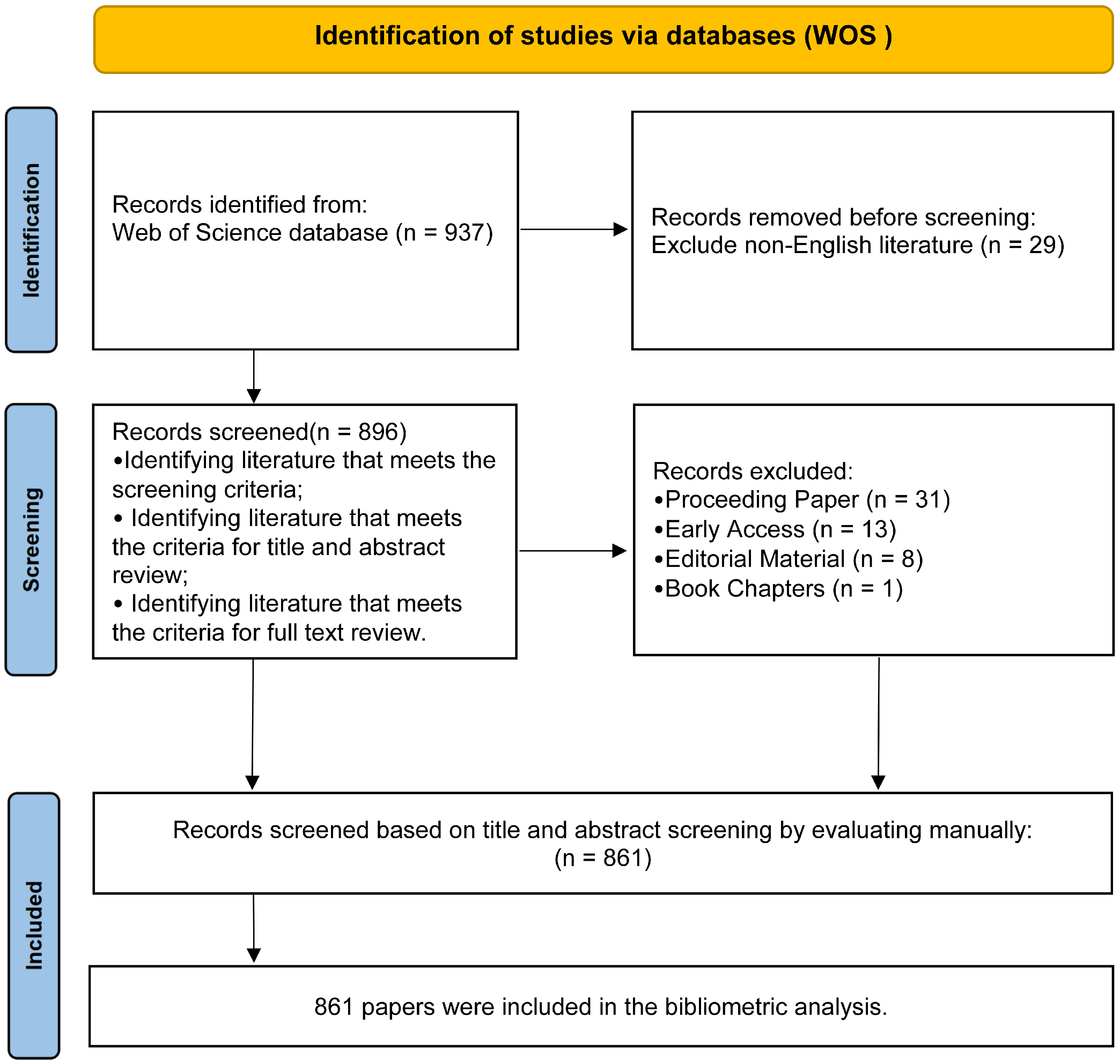
Figure 1. PRISMA flow for this research.
Forests 17 00097 g001
Figure 2. Annual publication trends.
Forests 17 00097 g002
Figure 3. Distribution of publications by country.
Forests 17 00097 g003
Figure 4. International collaboration network (each node represents a country or region; the node size indicates the number of publications, the links represent collaborations between countries, and the colors denote different collaboration clusters).
Forests 17 00097 g004
Figure 5. Author collaboration network (each node represents an author; the node size reflects the number of publications, the links indicate co-authorship relationships, and the colors represent different collaboration groups).
Forests 17 00097 g005
Figure 6. Institutional collaboration network (each node represents a research institution; the node size reflects the number of publications, the links indicate collaborative relationships between institutions, and the colors represent different collaboration groups).
Forests 17 00097 g006
Figure 7. Reference co-citation network (each node represents a cited reference; larger nodes indicate higher co-citation frequencies; the color reflects the year when the reference was first cited, with cooler colors indicating earlier years and warmer colors indicating more recent ones; the links represent co-citation relationships among references, and the highlighted nodes denote the core literature in the research field).
Forests 17 00097 g007
Figure 8. Keyword co-occurrence network (each node denotes a keyword, with node size indicating its occurrence frequency; links between nodes represent co-occurrence relationships, and thicker links correspond to stronger co-occurrence strength).
Forests 17 00097 g008
Figure 9. This is a figure. Temporal evolution of keywords (each node represents a keyword; the node size reflects its frequency of occurrence, the links indicate co-occurrence relationships among keywords, and the color represents the average time of the keyword’s first appearance).
Forests 17 00097 g009
Figure 10. Structure of the knowledge framework.
Forests 17 00097 g010
Figure 11. Integrated management framework for urban green spaces.
Forests 17 00097 g011
Table 1. Top 10 core journals by number of publications.
RankJournal TitleNPNCIF (2024)
1Sustainability10220343.3
2Urban Forestry & Urban Greening6527746.7
3Land585423.2
4Landscape And Urban Planning3021489.2
5Sustainable Cities and Society2297512
6Ecological Indicators1710587.4
7Ecosystem Services1710246.6
8Frontiers In Sustainable Cities161712.1
9Journal Of Environmental Management166828.4
10Land Use Policy1610305.9
Note: NP = Number of Publications; NC = Total Citations; IF = Impact Factor.
Table 2. Top 20 research fields.
RankWeb of Science CategoriesNPRankWeb of Science CategoriesNP
1Environmental Sciences42811Geography Physical40
2Environmental Studies36512Engineering Environmental39
3Urban Studies18413Meteorology Atmospheric Sciences36
4Green Sustainable Science Technology18114Water Resources35
5Ecology11215Construction Building Technology30
6Forestry9116Energy Fuels27
7Plant Sciences7817Geosciences Multidisciplinary26
8Geography7018Remote Sensing20
9Regional Urban Planning6019Public Environmental Occupational Health19
10Biodiversity Conservation4920Engineering Civil18
Table 3. Authors with six or more publications.
RankAuthorNPNCH-Index
1McPhearson, Timon1173056
2Frantzeskaki, Niki10162257
3Pauleit, Stephan939553
4Haase, Dagmar880080
5Qureshi, Salman768032
6Baro, Francesc658233
7Connolly, James J. T.6101629
8Lafortezza, Raffaele643242
9Langemeyer, Johannes662017
10Panagopoulos, Thomas641129
11Russo, Alessio635120
12van der Jagt, Alexander642624
13Zhou, Weiqi629755
Note: NP = Number of Publications; NC = Number of Citations; H-index = Hirsch index.
Table 4. Top 10 institutions by number of publications.
RankOrganizationNPNCAC
1Chinese Academy of Sciences36110131
2Humboldt University of Berlin23226899
3Helmholtz Centre for Environmental Research 2065633
4University of Chinese Academy of Sciences1950026
5Stockholm University18132974
6University of British Columbia17167298
7Arizona State University1671545
8Technical University of Munich1655835
9Swedish University of Agricultural Sciences142367169
10Chinese Academy of Sciences36110131
Note: NP = Number of Publications; NC = Number of Citations; AC = Average Citations per Article.
Disclaimer/Publisher’s Note: The statements, opinions and data contained in all publications are solely those of the individual author(s) and contributor(s) and not of MDPI and/or the editor(s). MDPI and/or the editor(s) disclaim responsibility for any injury to people or property resulting from any ideas, methods, instructions or products referred to in the content.