Article

Leaf–Litter–Soil C:N:P Coupling Indicates Nitrogen and Phosphorus Limitation Across Subtropical Forest Types


1
College of Forestry and Biotechnology, Zhejiang A&F University, Hangzhou 311300, China
2
Kaihua County Forestry Bureau, Quzhou 324300, China
3
Kaihua County Forest Farm, Quzhou 324300, China
4
Zhejiang Forest Resources Monitoring Center, Hangzhou 310020, China
*
Authors to whom correspondence should be addressed.
These authors contributed equally to this work.
Forests 2026, 17(1), 68; https://doi.org/10.3390/f17010068 (registering DOI)
Submission received: 7 December 2025 / Revised: 31 December 2025 / Accepted: 1 January 2026 / Published: 4 January 2026
(This article belongs to the Special Issue Elemental Cycling in Forest Soils)

Abstract

Ecological stoichiometry provides a useful lens for linking nutrient status to ecosystem functioning, but cross-compartment (green leaves, surface litter, and topsoil) evidence for subtropical secondary forests is still limited. In particular, it remains unclear how forest type regulates coupled carbon (C), nitrogen (N), and phosphorus (P) patterns in leaves, litter, and soils on P-retentive Acrisols and how these patterns can be used to infer nutrient limitations. We measured C, N, and P concentrations and stoichiometric ratios in leaves, surface litter, and topsoil (0–10 cm) from 38 plots representing four dominant forest types (shrub, coniferous, mixed coniferous–broadleaf, and broadleaf) in subtropical public welfare forests of eastern China. We compared elemental concentrations and ratios among forest types and compartments and examined cross-compartment associations. Forest-type differences in stoichiometric patterns were most pronounced for leaf and soil concentrations/ratios, whereas litter metrics were comparatively conservative. Coniferous stands had the highest leaf C concentration and the highest litter C:N and C:P ratios, together with relatively low soil N and P concentrations. Broadleaf stands had the highest soil C and N concentrations and the highest litter and soil N:P, suggesting a tendency toward P limitation under comparatively N-rich conditions. Shrub and mixed forests were intermediate, with shrubs exhibiting the lowest litter N:P. Leaf N:P averaged 7.5 in coniferous stands and 12.5–14.9 in mixed and broadleaf stands. Coherent correlations of C:P from leaves to litter and soils and a negative relationship between leaf N:P and soil C:N suggested coordinated stoichiometric linkages along the leaf–litter–soil continuum. Overall, the results show that forest type organizes plot-scale C:N:P coupling on Acrisols and that leaf–litter–soil stoichiometry can be used as a practical framework for identifying whether N- versus P-related constraints are more likely to dominate different subtropical forest types and for informing nutrient-aware restoration and management.

1. Introduction

Ecological stoichiometry links the elemental composition of organisms and substrates to ecosystem processes and has become a practical framework for integrating information across forest compartments [1,2,3]. In forests, the carbon (C), nitrogen (N), and phosphorus (P) concentrations and ratios of leaves, litter, and topsoil reflect nutrient acquisition, allocation, and retention, as well as decomposition-driven nutrient release and transfer from litter to soil, and thereby relate to productivity and soil carbon storage [4]. Because these compartments are tightly connected by litterfall, root activity, and decomposition, their joint C:N:P patterns can reveal how stand composition shapes nutrient cycling at the ecosystem level. However, many existing stoichiometric assessments emphasize leaf–soil relationships and implicitly treat litter as a passive conduit. This omission matters because litter is the immediate interface between foliage and topsoil, temporarily storing and transforming nutrients and mediating decomposition-driven nutrient return; therefore, leaf–soil patterns alone may not capture the full pathway by which forest type regulates nutrient retention and availability.
Humid subtropical regions in eastern China are characterized by highly weathered, acidic Acrisols with strong P sorption and by high N inputs from atmospheric deposition and biological fixation [5,6]. These conditions create a mosaic of N-lean and P-lean stands in secondary forests. However, most studies have focused on single compartments or on particular management regimes, such as forest age or thinning [7,8]. Recent work has begun to adopt a leaf–litter–soil or plant–soil–microbe perspective in single-species plantations and thinning trials [9,10,11,12], but there is still little information on how a broader set of forest types behaves on Acrisols.
Forest type is expected to be a major control on leaf–litter traits and decomposition-driven nutrient return [13]. Broadleaf stands often produce nutrient-richer litter and faster litter decomposition and nutrient release, enhancing soil fertility [7], whereas conifers typically show higher structural C, slower litter decay, and delayed nutrient return together with higher C:N and C:P in plant tissues [13,14]. Mixed stands and N-fixing species can moderate these contrasts and improve the overall C:N:P balance [11,15,16]. In this context, simple indicators that integrate information from leaves, litter, and soils could help diagnose the dominant nutrient constraint—N versus P—and support restoration planning in public welfare forests.
Leaf N:P ratios are widely used as coarse, heuristic indicators of potential nutrient limitation, with thresholds near 14 and 16 often interpreted as indicative transitions between N- and P-limited conditions [17,18,19]. These cutoffs are not definitive and can shift with site context, and they are more robust when evaluated together with soil and litter stoichiometry [4,20]. Cross-compartment coupling—such as consistent C:P from leaves to soils or negative associations between leaf N:P and soil C:N—can strengthen inferences about the dominant limiting element.
Public welfare forests in Zhejiang Province are managed primarily for ecological functions rather than timber. Managers therefore need tractable, plot-scale diagnostics of the nutrient status to guide species composition, the mixing of conifers and broadleaves, and potential fertilization. Here, we quantify C, N, and P concentrations and stoichiometric ratios in leaves, surface litter, and 0–10 cm soils across shrub, coniferous, mixed, and broadleaf secondary forests on Acrisols in eastern China. Our objectives were to (i) assess how forest types influence stoichiometry in each compartment; (ii) test whether plant signals propagate to litter and soils through cross-compartment coupling; and (iii) use these patterns to infer whether stands are more likely constrained by N or by P. We hypothesized the following: (H1) forest-type contrasts would be strongest in leaves and soils (conifers with higher leaf C and higher C:N and C:P; shrubs with higher leaf N and P; broadleaf stands with higher soil C and N); (H2) C:P would be positively coupled from leaves to litter to soils, while leaf N:P would negatively relate to soil C:N; (H3) coniferous stands would mainly show N-lean signals, whereas mixed and broadleaf stands would more often show P-lean or transitional patterns.

2. Materials and Methods

2.1. Study Area and Plot Selection

This study was conducted in public welfare forests of Zhejiang Province, eastern China (28.276–28.557° N, 119.233–119.669° E). The region has a meso-subtropical monsoon climate with a mean annual temperature of 17.7 °C and a mean annual precipitation of about 1700 mm concentrated from March to June. Forest cover is about 80%, dominated by secondary shrublands, coniferous plantations, mixed coniferous–broadleaf stands, and broadleaf forests between 43 and 1032 m a.s.l. Soils are zonal red and yellow soils classified as Acrisols. They are acidic (pH 4.5–5.6 at the 0–10 cm soil layer) and have high P sorption capacity.
Four dominant forest types were investigated: shrubland, coniferous forest, mixed conifer–broadleaf forest, and broadleaf forest. In total, 38 forest subcompartments were selected from the provincial forest inventory using probability-proportional-to-size (PPS) sampling within each forest-type stratum such that subcompartments had a higher chance of selection while maintaining randomness and spatial representativeness. One 20 m × 20 m permanent plot was established in each selected subcompartment. Plots were at least 500 m apart: 21 coniferous, 7 mixed, 5 broadleaf, and 5 shrub plots. Plot elevation, slope, aspect, canopy closure, soil type, and GPS coordinates were recorded for each plot and are provided in Table S1 (Supplementary Materials). All plots are designated ecological public welfare forests and are managed under a protection-oriented regime. According to local management records and our field inspection, no recent high-intensity interventions (e.g., fertilization or clear-cutting) have been implemented in these stands.

2.2. Sampling of Leaves, Litter, and Soils

All plots were sampled in June 2024. Within each plot, a full tree inventory recorded species, diameter at breast height, and height. Using species importance values, we identified three dominant tree species per plot, and for each species, three healthy, sun-exposed adult trees were selected. From each sampling tree, current-year mature leaves were collected from the outer canopy along the four cardinal directions and combined into one composite leaf sample per tree. Around each tree, existing litter was collected from four 0.5 × 0.5 m quadrats in the same direction and composed as one litter sample. Surface litter was collected as existing litter from the forest floor (O horizon) and, therefore, represents a mixture of decomposition stages rather than exclusively freshly fallen, undecomposed material. Coarse woody debris was excluded. Adjacent to each quadrat, 0–10 cm mineral soil was sampled with an auger after removing the litter layer and composed as one soil sample. We focused on the 0–10 cm layer because it is the most biogeochemically active zone and the soil depth is most directly influenced by surface litter inputs and fine-root activity, thereby best capturing short-term variability in nutrient availability and stoichiometric coupling across compartments. Thus, each plot yielded three paired sets of leaf, litter, and soil samples.
Leaves and litter were carefully cleaned to remove adhering soil/mineral particles, oven-dried at 105 °C for 1 h and then at 80 °C to constant mass, finely ground, and sieved to pass a screen of 0.149 mm prior to chemical analyses. Soils were air-dried, gently crushed, and sieved to pass a screen of 0.149 mm. For chemical analysis, equal subsample masses from the three tree-level composites per plot were combined, resulting in one plot-level composite for leaves, litter, and soil (n = 38 per compartment).

2.3. Chemical Analyses

Total C and N concentrations were determined with a Vario MAX CN elemental analyzer (Elementar Analysensysteme GmbH, Langenselbold, Germany). Total P was measured by an inductively coupled plasma optical emission spectrometer (ICP-OES; Optima 8000, PerkinElmer, Waltham, MA, USA) after H2SO4–HClO4 digestion. Quality control included blanks, calibration checks, certified reference materials, and analytical duplicates. Stoichiometric ratios (C:N, C:P, and N:P) were calculated on a mass basis for each plot-level composite.

2.4. Derived Indices and Statistical Analysis

Apparent leaf–litter nutrient shifts were expressed as follows:
REN = (Nleaf − Nlitter)/Nleaf × 100%
REP = (Pleaf − Plitter)/Pleaf × 100%
Because forest existing litter is species-mixed and partially decomposed, REN and REP are interpreted as plot-level proxies rather than species-level physiological resorption [21,22].
Leaf–soil stoichiometric homeostasis was evaluated by fitting log–log models of leaf versus soil N:P:
log (Leaf N:P) = a + (1/H)·log (Soil N:P)
where slope 1/H is a measure of the sensitivity of leaf N:P to soil N:P [23]. Analogous models were tested for C:N and C:P.
All analyses used plot-level data. Normality (Shapiro–Wilk) and homoscedasticity (Levene) were checked; log10 transforms were applied where needed. For each compartment, we tested forest-type differences in C, N, and P and their ratios by one-way ANOVA with Tukey’s HSD; Games–Howell tests were used when variances were unequal. Within each forest type, differences among compartments were tested with one-way ANOVA and Fisher’s LSD. Statistical significance was assessed at α = 0.05. We used Fisher’s LSD for post hoc pairwise comparisons because the number of a priori group contrasts was limited, and our primary goal was to describe among-forest-type differences. To reduce the risk of inflated Type I errors, we applied LSD only when the overall ANOVA was significant and report exact p-values where appropriate.
Pearson correlations were calculated among all variables; Holm correction controlled for multiple testing. Principal component analysis (PCA) on standardized variables was used to visualize multivariate patterns across forest types. Permutational multivariate analysis of variance (PERMANOVA, 999 permutations) tested for overall type separation. Analyses were conducted in R (version 4.4). Overall, our analyses are intended to be exploratory and diagnostic (pattern-oriented) rather than mechanistic, and therefore, we interpret the results as evidence of stoichiometric structure and co-variation rather than causal processes.

3. Results

3.1. C, N, and P Concentrations and Ratios by Compartment and Forest Type

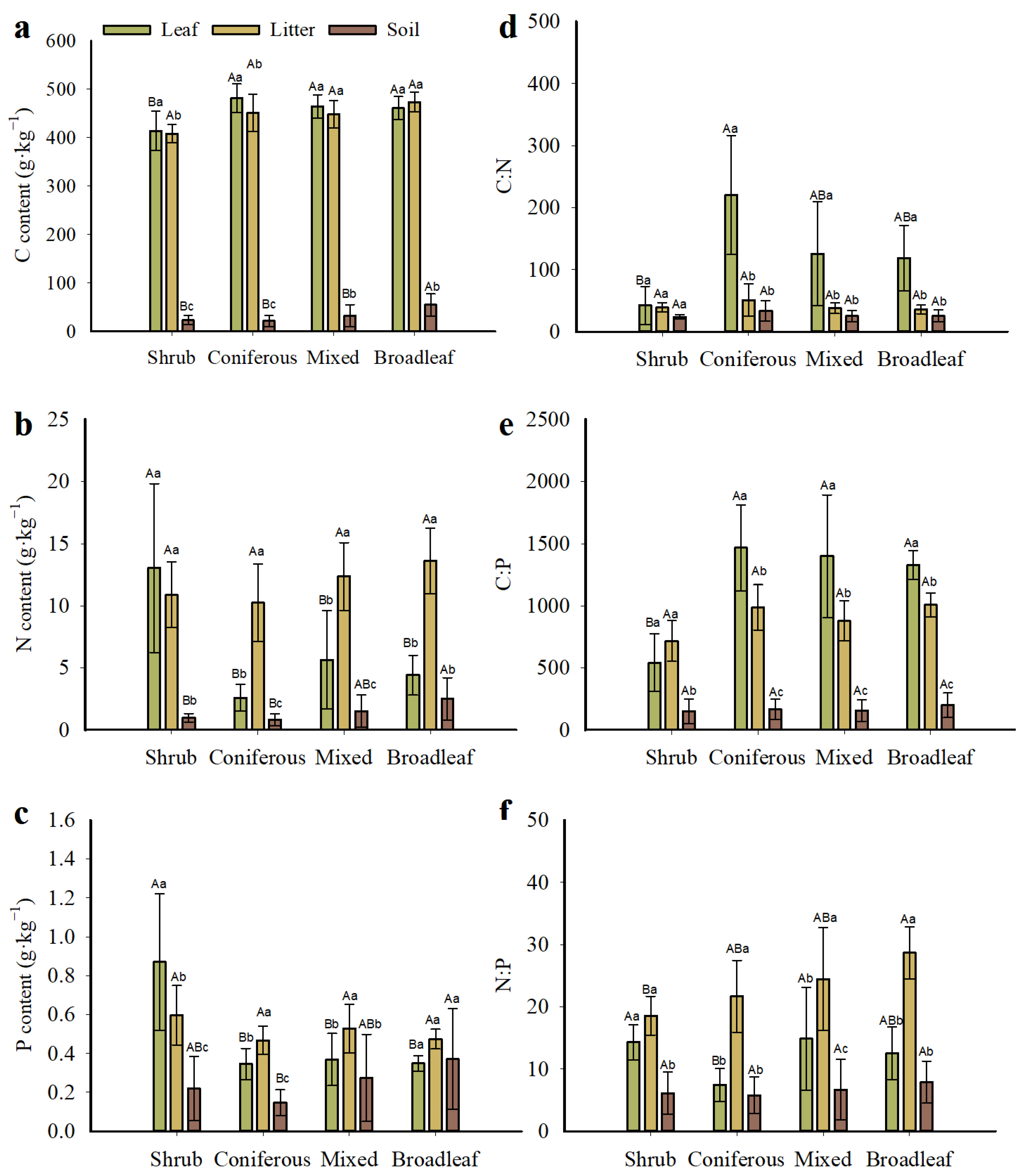
Across forest types, leaves and litter showed higher C concentrations than soils (Figure 1a; p < 0.05). For N and P, leaves and litter generally exceeded soils (Figure 1b,c), whereas leaf–litter differences varied among forest types and were significant only in some cases (Figure 1a–c). These among-compartment contrasts are consistent with differences in structural C investment versus nutrient enrichment from canopy tissues to the forest floor and topsoil.
Forest type significantly affected element concentrations within each compartment (different uppercase letters in Figure 1; p < 0.05). Coniferous stands had greater leaf C concentration than shrub, mixed, and broadleaf stands, while shrub stands tended to have higher leaf N and P concentrations than the other forest types (Figure 1a–c, p < 0.05). Litter C, N, and P concentrations were similar among forest types, although broadleaf litter tended to have higher C and N concentrations and shrub litter had slightly higher P concentrations. Soil C and N concentrations were higher in broadleaf stands than in coniferous and shrub stands (p < 0.05); mixed stands were intermediate. Soil P concentrations remained low (mean 0.15–0.37 g kg−1 across forest types). Although among-type differences in soil P concentration were modest, the consistently low values suggest a generally P-poor background in these acidic Acrisols, which is ecologically relevant even when statistical contrasts are weak.
Stoichiometric ratios mirrored these concentration patterns (Figure 1d–f). Coniferous stands generally exhibited higher leaf C:N (averaged 220.2) and C:P ratios (averaged 1466.7) than the other forest types, whereas shrub leaves showed the lowest C:P (averaged 540.8) and highest N:P ratio (averaged 14.3) (p < 0.05). Leaf N:P averaged 7.5 in coniferous stands and 12.5–14.9 in mixed and broadleaf stands. Litter C:N, C:P, and N:P ratios varied only slightly among forest types, and these differences were not statistically significant. This relative stability of litter ratios suggests that the forest-floor compartment may dampen among-type contrasts observed in green leaves. Soil C:N, C:P, and N:P ratios showed similarly small among-type shifts. Within forest types, leaves generally had higher C:N and C:P ratios than litter and soils, and litter commonly had the highest N:P.

3.2. Cross-Compartment Correlations and Multivariate Patterns

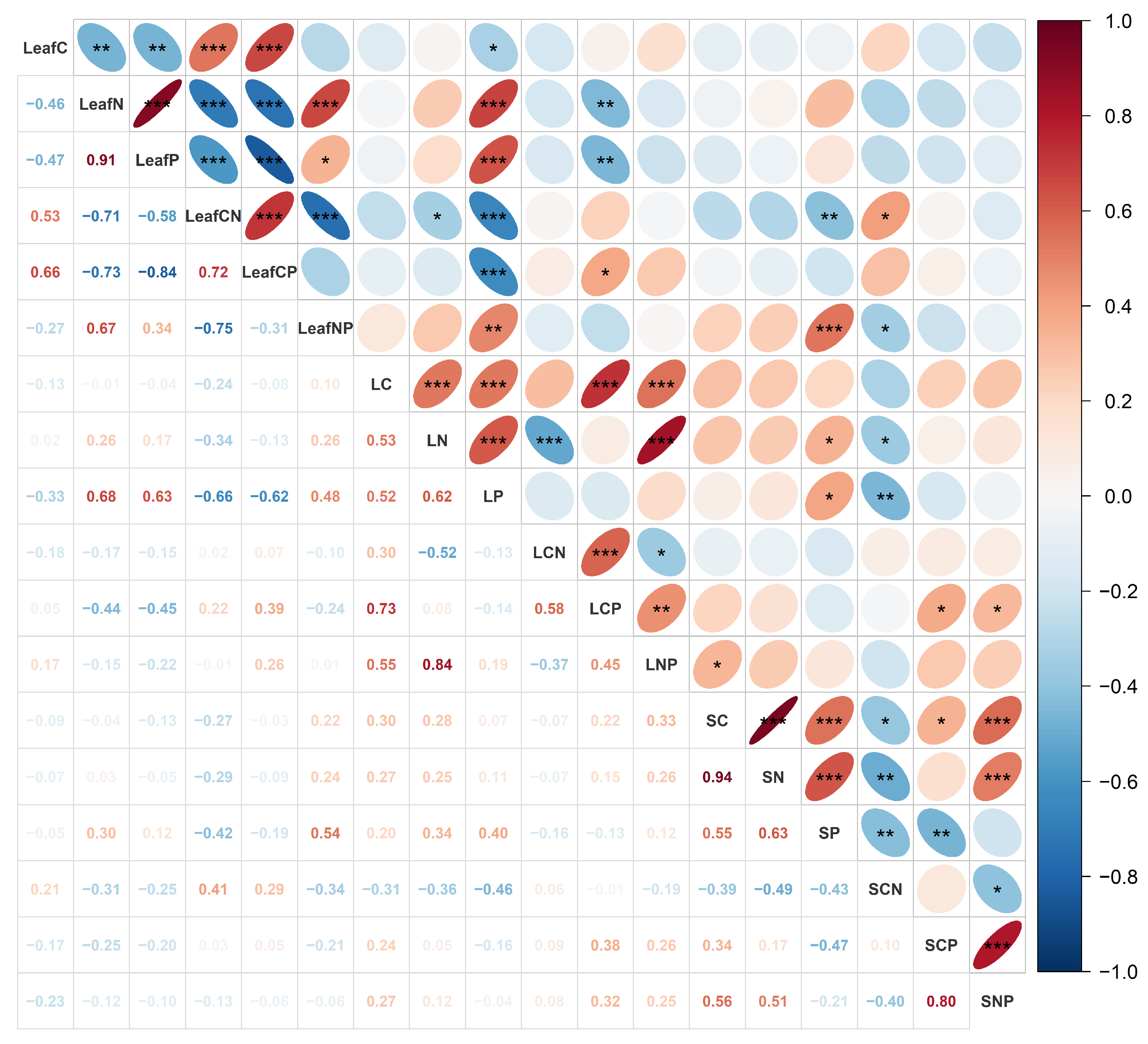
Pearson correlation analysis revealed strong within-compartment (green leaves, surface litter, and topsoil) covariation among elemental concentrations and stoichiometric ratios (Figure 2). Within each compartment, C concentrations were negatively correlated with N and P concentrations, and N and P concentrations were positively correlated (Holm-adjusted p < 0.01), consistent with trade-offs between structural C and nutrient-rich tissues. Cross-compartment correlations were overall consistent in direction, suggesting coordination among leaf, litter, and soil stoichiometry (Figure 2). The leaf C:P ratio correlated positively with litter C:P, and litter C:P correlated positively with soil C:P (p < 0.05), suggesting a coherent alignment of C:P among compartments (leaf–litter–soil) rather than implying a directional flux or causation from one compartment to another. Leaf N:P was negatively associated with soil C:N (p < 0.05), so plots with relatively N-richer soils (lower soil C:N) tended to have leaves with lower N:P.
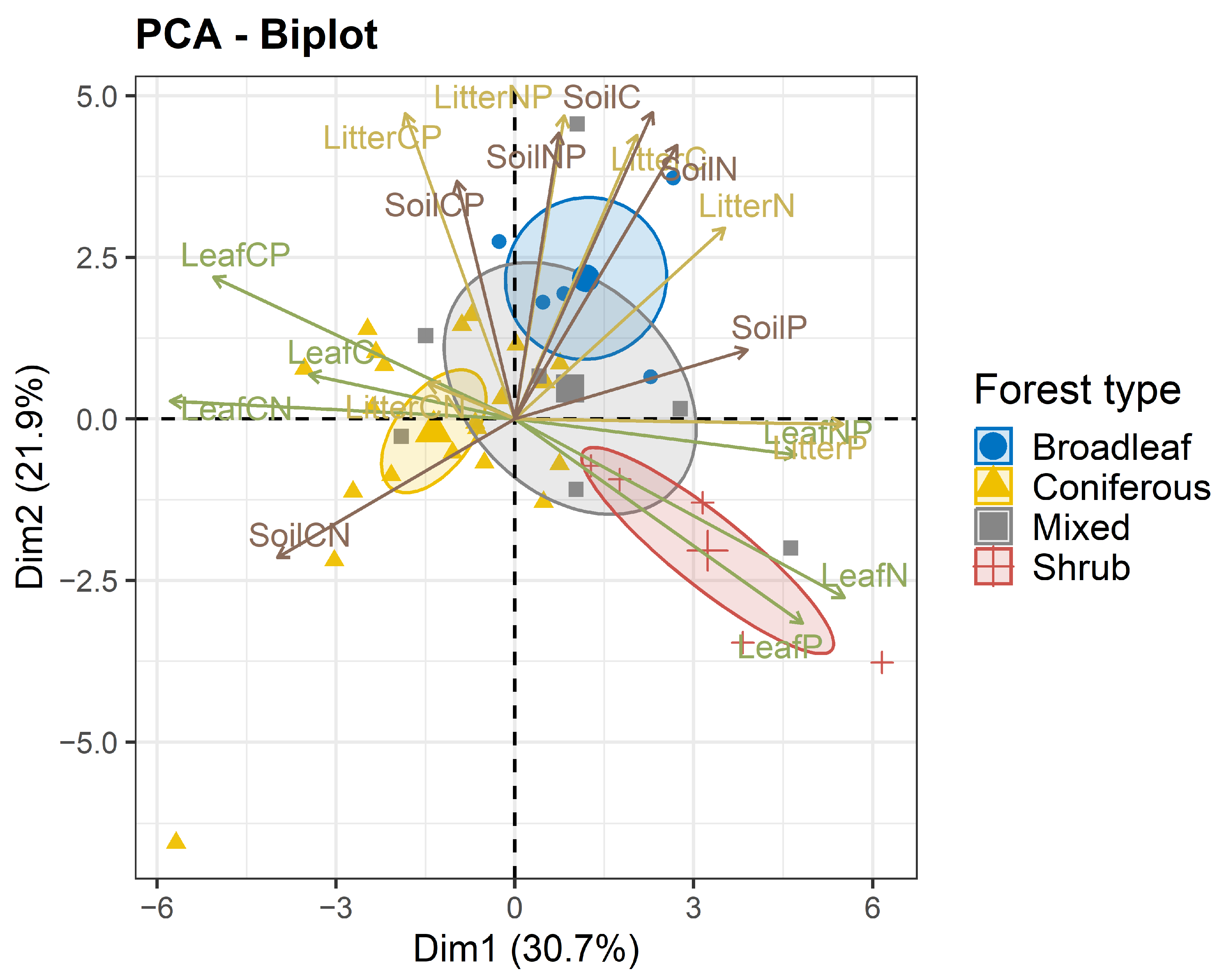
PCA integrating the 18 stoichiometric variables summarized multivariate differences in leaf–litter–soil stoichiometric structure among forest types (Figure 3). The first two dimensions explained 30.7% (Dim1) and 21.9% (Dim2) of the total variance. Dim1 captured a gradient from plots characterized by higher leaf C and higher leaf C-based ratios (negative scores) toward plots with relatively higher nutrient concentrations across compartments, particularly higher leaf N and P together with higher soil and litter nutrient concentrations (positive scores). Dim2 further separated plots associated with higher soil nutrient concentrations and relatively higher litter metrics (positive scores) from those associated with comparatively higher leaf N and P and higher soil C:N (negative scores). Broadleaf plots tended to score positively on both axes, shrub plots were shifted toward positive Dim1 but negative Dim2, coniferous plots tended to occupy the negative side of Dim1, and mixed forests generally fell in intermediate positions. PERMANOVA confirmed significant overall differences among forest types in multivariate stoichiometry (p < 0.01). Overall, the ordination reflects differences in multivariate stoichiometric structure across compartments rather than implying directionality or ecosystem function per se. In other words, the separation represents differences in stoichiometric composition/covariation and is not a direct measure of ecosystem functioning.

3.3. Leaf–Litter Nutrient Shift and Leaf–Soil Homeostasis

REN and REP values centered near zero and did not differ among forest types, with many slightly negative values, consistent with mass-loss concentration and species mixing in forest-floor litter. Ecologically, values near zero suggest limited net enrichment or depletion of N and P during the leaf-to-litter transition at the plot scale under the observed conditions.
Log–log models of leaf versus soil N:P, C:N, and C:P yielded shallow, non-significant slopes (p ≥ 0.05), indicating strong foliar stoichiometric homeostasis relative to soil variation across plots. In this context, “strong homeostasis” denotes weak sensitivity of leaf stoichiometry to changes in soil stoichiometry (i.e., low slope in the log–log regressions). Notably, non-significant slopes still provide ecological insight by indicating limited stoichiometric flexibility under the observed range of soil conditions. Thus, the absence of significant slopes should not be interpreted as “no pattern”, but as evidence that foliar ratios remain relatively constrained despite measurable soil variation.

4. Discussion

4.1. Forest-Type Signatures in Leaves and Soils

Our findings show that forest-type differences in nutrient status are most clearly expressed in leaves and soils, while surface litter is relatively homogenized. In these subtropical public welfare forests, this likely reflects, in part, that all stands are ecological public welfare forests under broadly comparable management (no fertilization) and that litter was sampled as the mixed surface layer at the same time of year, which reduces variations associated with litter age and seasonal inputs. Coniferous stands combined high leaf C and high C:N and C:P with low soil N and P, reflecting conservative nutrient use and N-poor soils. Shrub stands had acquisitive foliage (high leaf N and P; low leaf C:P) but only modest soil C and N, which is consistent with relatively rapid nutrient turnover but limited topsoil retention within the studied shrub plots. Broadleaf stands store more C and N in soils than other types, likely because of higher-quality litter and more active nutrient cycling [7,13,14,24]. Here, we use cross-compartment C:N:P coupling as a diagnostic signal of stoichiometric coordination among leaves, litter, and topsoil, rather than as a direct measure of decomposition rates or nutrient fluxes.
These patterns are consistent with leaf–litter–soil studies in subtropical plantations and thinning experiments, where conifers typically show higher structural C and slower nutrient return, and broadleaf or mixed stands improve soil fertility [4,25,26]. The weak forest-type contrasts in litter ratios reflect the mixed, decomposition-enriched nature of the litter layer and the tendency for tissues to converge toward similar stoichiometric values as decomposition proceeds [27]. We note that the relatively homogenized litter stoichiometry may therefore dampen among-type contrasts that are more apparent in green leaves and topsoil.

4.2. Cross-Compartment Coupling and Nutrient Limitation

The positive alignment of C:P from leaves to litter and soils suggests that plot-level variations in plant P economy are reflected across the leaf–litter–soil continuum. The negative relationship between leaf N:P and soil C:N further links soil N status to foliar composition: Plots with relatively N-richer soils support foliage with lower N:P. Similar plant–soil coupling has been reported in subtropical plantations where plant, soil, and microbial stoichiometry respond coherently to environmental gradients [5,9].
From a decomposer-stoichiometry perspective, whether decomposition tends toward net nutrient immobilization versus mineralization depends on the mismatch between resource C:N (or C:P) and microbial elemental demand, often conceptualized using threshold elemental ratio (TER) frameworks [28,29]. Accordingly, the coupling signals observed here are interpreted as diagnostic indicators of potential nutrient constraints rather than mechanistic proof of fluxes or limitation.
Combining these cross-compartment signals with leaf N:P thresholds provides a qualitative, plot-scale diagnosis that is consistent with different relative constraints among forest types. Coniferous leaf stands mainly below N:P = 14 have high leaf and litter C:N and low soil N and P, and therefore, they are consistent with a relatively stronger N constraint. Broadleaf stands, in contrast, have relatively high soil N and high litter and soil N:P, with leaf N:P often in or above the 14–16 range, which is consistent with a tendency toward a stronger P constraint under N-richer conditions on Acrisols [30]. Shrub and mixed stands occupy intermediate positions, suggesting more balanced or transitional states. We emphasize that the 14/16 thresholds are heuristic and should always be interpreted together with soil and litter stoichiometry [4,19]. Moreover, limitation is inherently relative and context-dependent, and on acidic Acrisols, strong P sorption/fixation can further modulate how foliar and soil stoichiometry map onto nutrient constraints.

4.3. Management Implications and Limitations

For public welfare forests on Acrisols, a simple diagnostic workflow emerges. Leaf N:P provides a rapid screen of potentially N-lean (<14), transitional (14–16), and P-lean (>16) stands. Cross-compartment C:P coherence and the alignment of leaf N:P with soil C:N then strengthen inference on the dominant limitation. In strongly N-lean coniferous stands, mixed planting with broadleaf or N-fixing species and protecting the litter layer are likely more sustainable than relying solely on fertilization [15,16,31]. In N-richer broadleaf stands trending toward P limitation, strategies that enhance P availability—such as selecting P-efficient species or modest P additions on severely P-poor sites—may be more effective. We distinguish short-term management actions (e.g., targeted nutrient amendments on severely deficient sites) from long-term restoration strategies (e.g., adjusting species composition and stand structure to promote sustained nutrient cycling and soil C accumulation). Shrublands may benefit from management that enhances soil C and nutrient retention and gradually steers succession toward mixed or broadleaf forests, but such recommendations should be interpreted within the studied system and should not be overgeneralized to shrublands under different climates, soils, or disturbance histories.
This study has some limitations. Sampling was restricted to one season and to 0–10 cm soils; seasonal dynamics and deeper horizons were not captured. Apparent leaf–litter resorption indices are influenced by species mixing and decomposition and should not be interpreted as true physiological resorption [21,22]. Finally, we did not measure microbial biomass or enzyme activities; combining leaf–litter–soil stoichiometry with microbial indicators would allow explicit tests of N versus P limitation at the microbial level [9,20].

5. Conclusions

Across 38 subtropical forest plots on acidic Acrisols, forest-type contrasts in C, N, and P concentrations were strongest in leaves and soils, while surface litter varied little among types. Coniferous stands showed conservative leaf stoichiometry and low soil N and P concentrations, broadleaf stands had nutrient-richer soils and higher litter and soil N:P, and shrub and mixed stands were intermediate. Cross-compartment correlations revealed a consistent alignment of C:P from leaves through litter to soils and a negative relationship between leaf N:P and soil C:N.
These patterns indicate that forest type organizes stoichiometric coupling along the leaf–litter–soil continuum and that a combined use of leaf N:P thresholds with cross-compartment C:N:P provides a practical, plot-scale diagnostic of whether N- versus P-related constraints are more likely to dominate different forest types. Such diagnostics can inform nutrient-aware restoration strategies, including the design of conifer–broadleaf mixtures and targeted nutrient management in subtropical public welfare forests on Acrisols.
Overall, this coupling-based approach provides a compartment-integrated diagnostic perspective for comparing likely nutrient constraints among forest types, rather than a mechanistic proof of causality. To enhance applicability for management, this diagnostic framework can be linked to adaptive monitoring (e.g., periodic re-assessment of leaf and soil stoichiometry to track trajectories and evaluate interventions). Future work could strengthen these diagnoses through repeated seasonal monitoring and process-based measurements (e.g., decomposition dynamics, nutrient resorption, microbial indicators) and by extending soil profiling beyond the 0–10 cm layer to evaluate vertical heterogeneity and longer-term nutrient retention.

Supplementary Materials

The following supporting information can be downloaded at https://www.mdpi.com/article/10.3390/f17010068/s1, Table S1: Site and plot characteristics and geographic information across forest types.

Author Contributions

Conceptualization, J.W. and Y.M.; methodology, B.W., Y.Y. and N.J.; investigation, B.W., Y.Y. and N.J.; data curation, B.W., Y.Y. and N.J.; writing—original draft preparation, B.W. and Y.Y.; writing—review and editing, J.W. and Y.M.; supervision, J.W. and Y.M.; funding acquisition, B.W.; B.W. and Y.Y. contributed equally to this work. All authors have read and agreed to the published version of this manuscript.

Funding

This research was funded by the Forestry science and technology cooperation project between Zhejiang Province and the Chinese Academy of Forestry, grant number 2023SY07.

Data Availability Statement

Data will be made available upon request.

Conflicts of Interest

The authors declare no conflicts of interest. The funders had no role in the design of the study; in the collection, analyses, or interpretation of data; in the writing of this manuscript; or in the decision to publish the results.

References

  1. Mori, T. The newly proposed threshold for enzymatic stoichiometry: A reliable solution? Soil. Biol. Biochem. 2025, 209, 109886. [Google Scholar] [CrossRef]
  2. Luan, J.; Liu, S.; Schindlbacher, A.; Prescott, C.; Stokes, A.; Whalen, J. Plant-soil interactions in forests: Effects of management, disturbance and climate. Soil. Biol. Biochem. 2022, 168, 108642. [Google Scholar] [CrossRef]
  3. Moorhead, D.; Cui, Y.; Sinsabaugh, R.; Schimel, J. Interpreting patterns of ecoenzymatic stoichiometry. Soil. Biol. Biochem. 2023, 180, 108997. [Google Scholar] [CrossRef]
  4. Fan, H.; Wu, J.; Liu, W.; Yuan, Y.; Hu, L.; Cai, Q. Linkages of plant and soil C:N:P stoichiometry and their relationships to forest growth in subtropical plantations. Plant Soil. 2015, 392, 127–138. [Google Scholar] [CrossRef]
  5. Chen, B.; Chen, L.; Jiang, L.; Zhu, J.; Chen, J.; Huang, Q.; Liu, J.; Xu, D.; He, Z. C:N:P stoichiometry of plant, litter and soil along an elevational gradient in subtropical forests of China. Forests 2022, 13, 372. [Google Scholar] [CrossRef]
  6. Huang, C.; Zhao, C.; Zhang, P.; Chen, Z.; Liu, D.; Li, G.; Wang, S.; Wu, X. Soil C, N, and P contents and their stoichiometry as impacted by main forest vegetation types in Xinglongshan, China. J. Soil. Sci. Plant Nutr. 2024, 24, 512–523. [Google Scholar] [CrossRef]
  7. Ge, J.; Xie, Z. Leaf litter carbon, nitrogen, and phosphorus stoichiometric patterns as related to climatic factors and leaf habits across Chinese broad-leaved tree species. Plant Ecol. 2017, 218, 1063–1076. [Google Scholar] [CrossRef]
  8. Tong, R.; Zhou, B.; Jiang, L.; Ge, X.; Cao, Y.; Shi, J. Leaf litter carbon, nitrogen and phosphorus stoichiometry of Chinese fir (Cunninghamia lanceolata) across China. Glob. Ecol. Conserv. 2021, 27, e01542. [Google Scholar] [CrossRef]
  9. Li, H.; Yang, Y.; Weng, X.; Zhou, Y.; Zhang, S.; Liu, L.; Pei, J. Plant–soil–microbial carbon, nitrogen, and phosphorus ecological stoichiometry in Mongolian pine-planted forests under different environmental conditions in Liaoning Province, China. Forests 2025, 16, 720. [Google Scholar] [CrossRef]
  10. Ma, L.; Bai, S.H.; Chen, J.; Lucas-Borja, M.E.; Yue, C.; Deng, L.; Zheng, Y.; Bell, S.M.; Hu, Z. Tree species identity drives the vertical distribution of soil carbon and nutrient concentrations in the Loess Plateau, China. Plant Soil. 2024, 501, 89–105. [Google Scholar] [CrossRef]
  11. Zhang, H.; Li, X.; Wang, S.; Jiang, C.; Cui, Y.; Fan, R.; Lan, Y.; Zhang, Q.; Ye, S. Tree–litter–soil system C:N:P stoichiometry and tree organ homeostasis in mixed and pure Chinese fir stands in south subtropical China. Front. For. Glob. Change 2024, 7, 1293439. [Google Scholar] [CrossRef]
  12. Wang, S.; Zhao, S.; Yang, B.; Zhang, K.; Fan, Y.; Zhang, L.; Yang, X. The carbon and nitrogen stoichiometry in litter-soil-microbe continuum rather than plant diversity primarily shapes the changes in bacterial communities along a tropical forest restoration chronosequence. Catena 2022, 213, 106202. [Google Scholar] [CrossRef]
  13. Sariyildiz, T.; Anderson, J.M. Interactions between litter quality, decomposition and soil fertility: A laboratory study. Soil. Biol. Biochem. 2003, 35, 391–399. [Google Scholar] [CrossRef]
  14. Hobbie, S.E. Effects of plant species on nutrient cycling. Trends Ecol. Evol. 1992, 7, 336–339. [Google Scholar] [CrossRef]
  15. Xu, W.; Zhang, B.; Xu, Q.; Gao, D.; Zuo, H.; Ren, R.; Diao, K.; Chen, Z. Enhanced carbon storage in mixed coniferous and broadleaf forest compared to pure forest in the north subtropical–warm temperate transition zone of China. Forests 2024, 15, 1520. [Google Scholar] [CrossRef]
  16. Yao, X.; Hui, D.; Xing, S.; Zhang, Q.; Chen, J.; Li, Z.; Xu, Y.; Deng, Q. Mixed plantations with N-fixing tree species maintain ecosystem C:N:P stoichiometry: Implication for sustainable production. Soil. Biol. Biochem. 2024, 191, 109356. [Google Scholar] [CrossRef]
  17. Koerselman, W.; Arthur, F.M.M. The vegetation N:P ratio: A new tool to detect the nature of nutrient limitation. J. Appl. Ecol. 1996, 33, 1441–1450. [Google Scholar] [CrossRef]
  18. Güsewell, S. N:P ratios in terrestrial plants: Variation and functional significance. New Phytol. 2004, 164, 243–266. [Google Scholar] [CrossRef]
  19. He, J.; Wang, L.; Flynn, D.F.B.; Wang, X.; Ma, W.; Fang, J. Leaf nitrogen:phosphorus stoichiometry across Chinese grassland biomes. Oecologia 2008, 155, 301–310. [Google Scholar] [CrossRef]
  20. Mooshammer, M.; Wanek, W.; Zechmeister-Boltenstern, S.; Richter, A.A. Stoichiometric imbalances between terrestrial decomposer communities and their resources: Mechanisms and implications of microbial adaptations to their resources. Front. Microbiol. 2014, 5, 22. [Google Scholar] [CrossRef]
  21. Aerts, R. Nutrient resorption from senescing leaves of perennials: Are there general patterns? J. Ecol. 1996, 84, 597–608. [Google Scholar] [CrossRef]
  22. Killingbeck, K.T. Nutrients in senesced leaves: Keys to the search for potential resorption and resorption proficiency. Ecology 1996, 77, 1716–1727. [Google Scholar] [CrossRef]
  23. Sterner, R.W.; Elser, J.J. Ecological Stoichiometry: The Biology of Elements from Molecules to the Biosphere; Princeton University Press: Princeton, NJ, USA, 2002. [Google Scholar]
  24. Chen, Z.; Jiang, Z.; Li, Q.; Tan, Y.; Yan, P.; Arif, M. Examining the stoichiometry of C:N:P:K in the dynamics of foliar-litter-soil within dominant tree species across different altitudes in southern China. Glob. Ecol. Conserv. 2024, 51, e02885. [Google Scholar] [CrossRef]
  25. Jiang, X.; Yang, J.; Yang, Y.; Yang, J.; Dong, Q.; Zeng, H.; Zhang, K.; Xu, N.; Yuan, J.; Liu, M.; et al. Response of thinning to C:N:P stoichiometric characteristics and seasonal dynamics of leaf-litter-soil system in Cupressus funebris Endl. artificial forests in southwest, China. Forests 2024, 15, 1435. [Google Scholar] [CrossRef]
  26. Rivas-Ubach, A.; Sardans, J.; Pérez-Trujillo, M.; Estiarte, M.; Peñuelas, J. Strong relationship between elemental stoichiometry and metabolome in plants. Proc. Natl. Acad. Sci. USA 2012, 109, 4181–4186. [Google Scholar] [CrossRef]
  27. Manzoni, S.; Taylor, P.; Richter, A.; Porporato, A.; Ågren, G.I. Environmental and stoichiometric controls on microbial carbon-use efficiency in soils. New Phytol. 2012, 196, 79–91. [Google Scholar] [CrossRef]
  28. Chavez-Ortiz, P.; Larsen, J.; Olmedo-Alvarez, G.; García-Oliva, F. Control of inorganic and organic phosphorus molecules on microbial activity, and the stoichiometry of nutrient cycling in soils in an arid, agricultural ecosystem. PeerJ 2024, 12, e18140. [Google Scholar] [CrossRef]
  29. Li, J.; Liu, Y.; Hai, X.; Shangguan, Z.; Deng, L. Dynamics of soil microbial C:N:P stoichiometry and its driving mechanisms following natural vegetation restoration after farmland abandonment. Sci. Total Environ. 2019, 693, 133613. [Google Scholar] [CrossRef]
  30. Tian, H.; Chen, G.; Zhang, C.; Melillo, J.M.; Hall, C.A.S. Pattern and variation of C:N:P ratios in China’s soils: A synthesis of observational data. Biogeochemistry 2010, 98, 139–151. [Google Scholar] [CrossRef]
  31. Bao, B.; Huang, X.; Xu, H.; Xie, H.; Cheng, X. Patterns and driving mechanism of C, N, P ecological stoichiometry in plant-litter-soil systems of monoculture and mixed coastal forests in southern Zhejiang Province of China. Forests 2023, 14, 1306. [Google Scholar] [CrossRef]
Figure 1. Carbon (C), nitrogen (N), and phosphorus (P) concentrations and stoichiometric ratios of leaves, surface litter, and 0–10 cm soils by forest type: (a) C concentration, (b) N concentration, and (c) P concentration; and (d) C:N ratio, (e) C:P ratio, and (f) N:P ratio. Bars represent mean ± standard deviation. Upper-case letters indicate significant differences among forest types within a compartment; lower-case letters indicate significant differences among compartments within a forest type (p < 0.05; one-way ANOVA with Fisher’s LSD). Forest types: shrub (shrubland), coniferous (coniferous stand), mixed (mixed coniferous–broadleaf stand), broadleaf (broadleaf stand). Variables were log10-transformed where required for analysis.
Forests 17 00068 g001
Figure 2. Pearson correlation matrix among C, N, and P concentrations and stoichiometric ratios in leaves, litter, and soils. Ellipse orientation and color indicate the sign and strength of correlations. Asterisks denote significance after Holm correction (* p < 0.05; ** p < 0.01; *** p < 0.001). Variable abbreviations: Leaf C/N/P (leaf concentrations), LC/LN/LP (litter concentrations), SC/SN/SP (soil concentrations), Leaf CN/CP/NP (leaf ratios), LCN/LCP/LNP (litter ratios), and SCN/SCP/SNP (soil ratios).
Forests 17 00068 g002
Figure 3. Principal component analysis (PCA) biplot of standardized stoichiometric variables across leaves, litter, and soils. Points represent plots colored by forest type; ellipses indicate 95% confidence regions. Arrows show variable loadings. Arrow and label colors indicate compartments (green = leaf variables, yellow = litter variables, brown = soil variables). PC1 explains 30.7% and PC2 22.0% of the total variance. Group separation among forest types was tested by PERMANOVA (999 permutations).
Forests 17 00068 g003
Disclaimer/Publisher’s Note: The statements, opinions and data contained in all publications are solely those of the individual author(s) and contributor(s) and not of MDPI and/or the editor(s). MDPI and/or the editor(s) disclaim responsibility for any injury to people or property resulting from any ideas, methods, instructions or products referred to in the content.