1. Introduction
Bamboo is a widely used plant with significant ecological and economic value. Against the backdrop of increasingly severe global plastic pollution, the demand for bamboo-based materials has risen rapidly [
1,
2]. Traditionally, bamboo utilization has focused primarily on culms, the above-ground stems of bamboo, which have been widely applied in the construction sector, including structural frames, scaffolding, flooring, panels, and engineered bamboo products. In recent years, bamboo has also been increasingly incorporated into building bio-composites, such as fiber-reinforced mortars and cementitious or lime-based composites, due to its favorable strength-to-weight ratio and sustainability advantages [
2]. In contrast to the well-studied culms, the utilization of other bamboo organs has received comparatively less attention, particularly rhizomes—the belowground stems. As a vegetative reproductive organ, the bamboo rhizome extends horizontally through the soil and possesses strong growth and propagation capabilities (
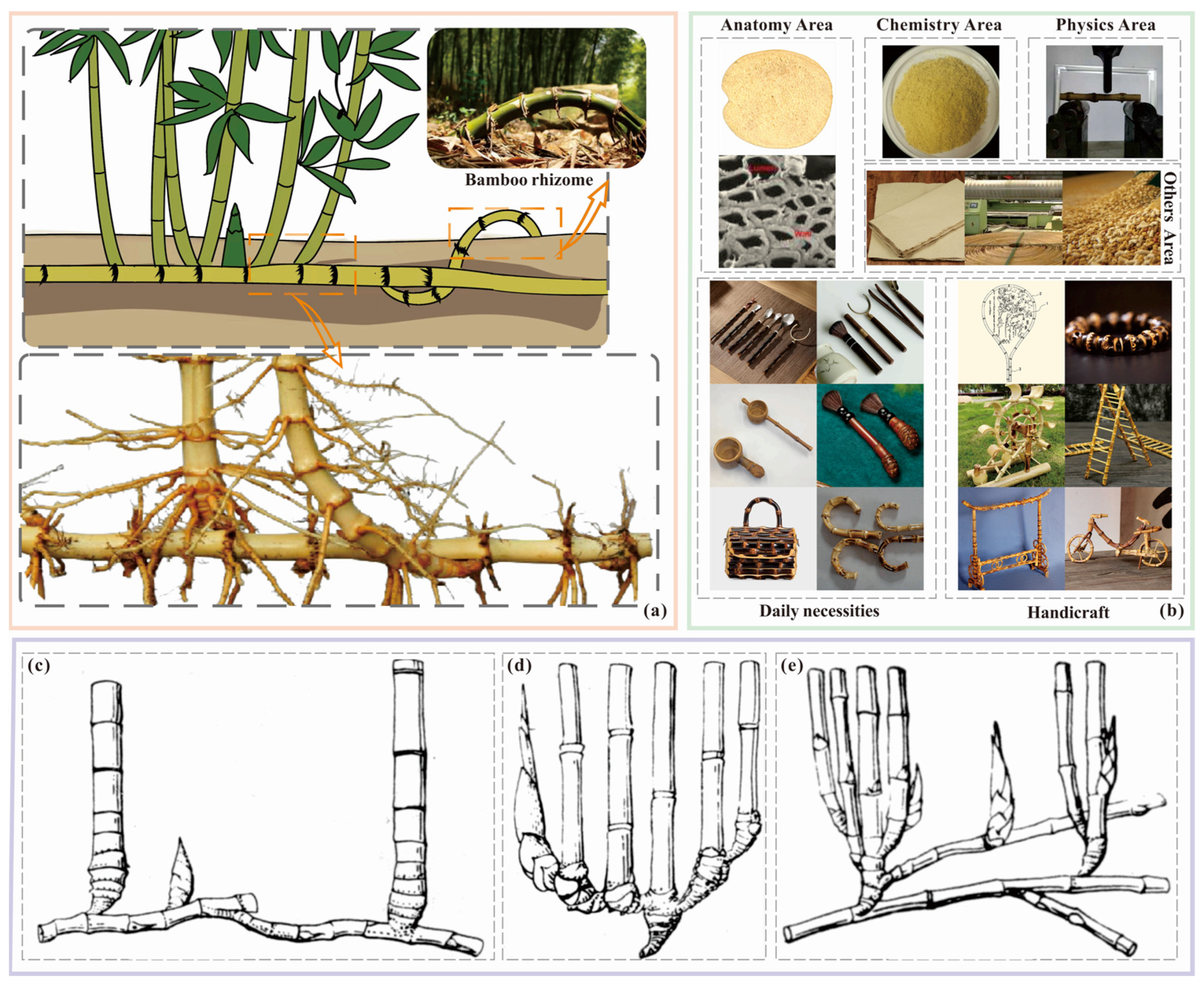
Figure 1a) [
3,
4]. It plays essential roles in nutrient acquisition, water transport, and clonal reproduction [
5]. In addition, rhizomes help stabilize soil, reduce erosion, and maintain surface integrity. As they spread laterally belowground, roots and buds are generated at the nodes; these buds can develop into new rhizomes or bamboo shoots, enabling rapid expansion of bamboo stands [
6,
7].
The lifespan of bamboo rhizomes varies among species, but most lose physiological activity after several to more than ten years of growth, eventually becoming residual biomass within bamboo forests [
8]. Moreover, bamboo root–rhizome systems can rapidly occupy belowground space, depleting soil nutrients, suppressing the growth of neighboring plants, and even invading adjacent forest or agricultural ecosystems [
9,
10]. Such expansion may threaten biodiversity, destabilize soil structure, and potentially increase ecological risks such as landslides. Therefore, sustainable bamboo forest management requires scientifically designed strategies for cultivation, harvesting, and stand renewal [
11,
12]. For example, periodic removal of senescent, pest-infested, overly dense, or poorly developed rhizomes is necessary to maintain stand health and preserve the ecological space for other plant species. Consequently, large quantities of rhizome biomass are generated during bamboo forest cultivation. If not properly utilized, these materials become agricultural and forestry waste. At present, discarded rhizomes are mainly treated through on-site abandonment or burning, which not only wastes resources but also poses risks of air pollution.
In fact, beyond their ecological and clonal functions, bamboo rhizomes also have potential for value-added utilization. They are currently used in some regions for small craft products, such as decorative items or artisanal tools, as shown in
Figure 1b, owing to their workable size and fibrous structure. However, these applications are mostly handcrafted and small-scale, and systematic or industrial utilization of rhizomes has rarely been reported. In addition, from a biomass recycling perspective, rhizomes represent a significant portion of bamboo residues generated during forest management. Although these materials could be repurposed for products such as bamboo charcoal, bio-fuel, or fertilizer, practical examples remain limited. Furthermore, physiological studies indicate that mature rhizomes actively mediate carbon storage and transport via non-structural carbohydrates, supporting both growth and regeneration. This combination of ecological function and material potential underscores the importance of exploring rhizome-based utilization strategies within a sustainable and high-value bamboo industry. Given their ecological role and material potential, bamboo rhizomes require a systematic understanding of their resources, properties, and applications. Although abundant in bamboo forests, they remain less studied than culms, especially regarding mechanical, physical, and chemical traits. Summarizing current research can provide theoretical insights and practical guidance, supporting sustainable utilization and transforming rhizomes from largely discarded biomass into a valuable resource.
Therefore, improving the utilization efficiency of bamboo rhizomes and reducing waste are of great importance for maintaining the ecological health of bamboo forests, enhancing economic benefits, and promoting sustainable development. A thorough understanding of material characteristics is fundamental to achieving high-value applications. Based on this need, the present review aims to systematically summarize the current status, research progress, and application potential of bamboo rhizomes, with a comprehensive analysis of their mechanical, physical, and chemical properties. The findings are expected to provide theoretical support and data resources for the rational utilization of rhizomes, enhance overall bamboo resource efficiency, and facilitate the sustainable development of the bamboo industry.
Figure 1.
Bamboo rhizome morphology and research application [
12]. (
a) The morphology. (
b) The research and application. (
c) Monopodial bamboo rhizome. (
d) Sympodial bamboo rhizome. (
e) Amphipodial bamboo rhizome. Copyright 2025, licensed under CC BY 4.0 (
https://creativecommons.org/licenses/by/4.0/).
Figure 1.
Bamboo rhizome morphology and research application [
12]. (
a) The morphology. (
b) The research and application. (
c) Monopodial bamboo rhizome. (
d) Sympodial bamboo rhizome. (
e) Amphipodial bamboo rhizome. Copyright 2025, licensed under CC BY 4.0 (
https://creativecommons.org/licenses/by/4.0/).
2. Biological Basis and Resource Status of Bamboo Rhizomes
2.1. Morphological Types and Growth Characteristics of Bamboo Rhizomes
Bamboo rhizomes are the belowground stems of bamboo and play a critical role in vegetative growth and clonal propagation. Based on morphological characteristics and branching patterns, bamboo rhizomes are generally classified into three types: monopodial (
Figure 1c), sympodial (
Figure 1d), and amphipodial systems (
Figure 1e) [
13].
The monopodial rhizome system is characterized by long internodes, with roots and buds forming at each node, enabling strong horizontal extension, as shown in
Figure 1c. Species such as
Phyllostachys edulis (Carrière) J. Houzeau,
Phyllostachys nigra (Lodd. ex Lindl.) Munro,
Phyllostachys heteroclada Oliv., and
Phyllostachys bambusoides Siebold & Zucc. fall into this category. Their stands typically exhibit a scattered distribution pattern due to the extensive and rapidly spreading rhizome-root system [
14]. The sympodial rhizome system features enlarged rhizome bases and compact nodes. Terminal buds develop into shoots, while lateral buds form new rhizome segments, resulting in densely clumping stands. Representative species include
Bambusa emeiensis and
Bambusa textilis McClure [
15]. Some bamboo species possess transitional belowground structures, in which the basal culm neck elongates and develops into a rhizome-like organ resembling a leptomorph rhizome. Species such as
P. edulis,
P. nigra, and
Phyllostachys acuta exhibit this transitional structural feature. The amphipodial rhizome system combines the growth strategies of both types, producing both outward-spreading rhizomes and dense basal clusters. Species such as
Pleioblastus amarus (Keng) Keng f. var.
pugionifolius and
Indocalamus tessellatus (Munro) Keng f. are common examples of this type [
16].
Different bamboo species exhibit pronounced differences in rhizome longevity and growth rhythm. For example, monopodial rhizomes of
P. edulis can survive for over 10 years [
17], whereas those of many medium to small monopodial species (e.g.,
Phyllostachys prominens, and
Phyllostachys glauca) typically last 6–8 years. Rhizomes aged 3–5 years generally show vigorous bud development and represent the critical period for stand expansion. Most bamboo rhizomes grow actively from April to November, but exceptions exist. For instance, the growth of
Chimonobambusa tumidissinoda Ohrnb. may begin as early as March [
18], while
Bambusa textilis McClure grows mainly from June to November [
19]. These phenological variations depend largely on species-specific ecological strategies, climatic conditions, and belowground metabolic rhythms [
20].
The physiological condition and age structure of bamboo rhizomes are widely recognized as key determinants shaping harvesting decisions and renewal dynamics in managed bamboo forests. Existing anatomical and chemical studies suggest that rhizomes of ~1–2 years old may be structurally and physiologically less mature (lower cell-wall thickness, lower lignin), which supports traditional management practices that recommend preserving them to maintain clump vigor [
21,
22,
23]. Mature rhizomes, which exhibit maximum growth potential and clonal propagation capacity, represent the core functional component of the belowground network and warrant strict protection from unnecessary disturbance [
24]. Experimental studies show that clonal integration via intact rhizomes maintains higher photosynthetic performance and nutrient sharing among ramets, whereas severing rhizomes impairs growth under environmental stress [
25,
26]. In contrast, senescent rhizomes, which typically exhibit denser anatomical structures but markedly reduced metabolic activity, are generally considered suitable targets for selective removal. Their extraction can provide a source of biomass materials while having minimal negative influence on stand renewal, since they contribute little to clonal propagation or resource redistribution [
23,
26,
27,
28]. Furthermore, research consistently supports the recommendation that harvesting activities be scheduled during periods of slow growth or near physiological dormancy, in order to minimize damage to the rhizome system and promote rapid post-harvest recovery [
29]. Collectively, these findings highlight the importance of aligning harvesting cycles with the natural growth rhythm of rhizomes, which is fundamental to balancing resource utilization, stand stability, and the long-term sustainability of bamboo forest management [
30,
31].
2.2. Assessment of Bamboo Rhizome Resources in China
Bamboo plants belong to the subfamily
Bambusoideae of the family
Poaceae and are perennial evergreen species [
32,
33]. Approximately 1600 species have been identified worldwide, distributed across tropical to temperate regions, forming essential vegetation types particularly in Asia, Africa, and the Americas [
34]. In recent decades, despite the rapid decline of global forest resources, bamboo forests have shown a contrasting trend of expansion, with the global bamboo forest area increasing at an annual rate of nearly 3% [
35]. China possesses the richest bamboo resources globally, ranking first in both bamboo forest area and bamboo material production [
36]. A total of 39 genera and 857 species of bamboo have been recorded in China, accounting for approximately 51% of the world’s bamboo species [
37]. The country currently maintains more than 7 million hectares of bamboo forests, mainly distributed in Hunan, Jiangxi, Guangdong, Zhejiang, and Fujian. Among these, Moso bamboo occupies the largest proportion, covering 5.28 million hectares, or 69.78% of the national bamboo forest area [
38]. Since 1990, China’s bamboo timber production has continued to grow, reaching 3.243 billion culms in 2020 and 3.256 billion culms in 2021, representing a year-on-year increase of 0.4% [
39]. These trends underscore the expanding ecological and economic significance of bamboo resources and highlight their growing potential in sustainable forestry and bio-based industries.
Although independent statistics on bamboo rhizomes are currently lacking, existing studies provide a basis for estimating their biomass. Zhou (2006) [
40] measured the belowground system of moso bamboo and found that rhizomes and roots accounted for 40.52% and 59.48% of the belowground biomass, respectively, with the majority distributed in the shallow 0–40 cm soil layer, of which over 92% was concentrated near the surface [
41]. Further investigations by Zheng et al. indicated that the proportion of mature rhizomes (typically 2–4 years old) varies depending on forest management type in moso bamboo plantations: in timber-oriented forests, mature rhizomes accounted for 71.4% of rhizome length and 67.1% of rhizome biomass; in dual-purpose (shoot and timber) forests, the corresponding values were 64.6% and 65.0%; and in shoot-oriented forests, 54.3% and 62.1%. Based on these data, the average proportion of mature rhizomes in terms of length and biomass was approximately 63.4% and 64.7% [
42]. Similar patterns have been observed in other bamboo species. For instance, in
Phyllostachys arcana McClure forests, rhizomes are primarily distributed in the 5–30 cm soil layer, with 2~4-year-old segments accounting for 67.31% [
43,
44]; in
Pleioblastus bamboo stands, mature rhizomes represent roughly 65% of the total [
45]; and in species such as
Chimonobambusa and
Dendrocalamus bamboos, rhizomes are predominantly concentrated within the shallow 0–20 cm soil layer [
46,
47]. In terms of biomass, according to Cao et al. [
48], individual Phyllostachys edulis plants may have a total biomass in the range of ~16-23 kg, and the biomass of a single rhizome may be ~0.46–1.32 kg, which would represent roughly 4%–5% of the total plant biomass. Based on the national estimate of 14.33 billion Moso bamboo culms in 2021, they extrapolated a total rhizome biomass in China on the order of 10
10 kg.
These findings indicate that bamboo rhizomes represent an extremely abundant and underutilized resource with substantial stock potential, highlighting their significance for sustainable bamboo forest management and biomass utilization.
3. Current Research on Bamboo Rhizome Structure and Properties
3.1. Research on the Anatomical Structure of Bamboo Rhizome
3.1.1. Morphological Characteristics and Tissue Proportions of Bamboo Rhizomes
Anatomical traits of bamboo rhizomes constitute the structural basis for their mechanical performance, storage capacity, and belowground physiological functions. Although species vary widely in ecology and growth strategy, current evidence shows that rhizomes share several conserved structural features, which are further shaped by radial differentiation, ontogenetic development, and habitat-specific adaptation. Below, we integrate existing findings into a three-component framework to better characterize rhizome anatomical organization and its functional implications.
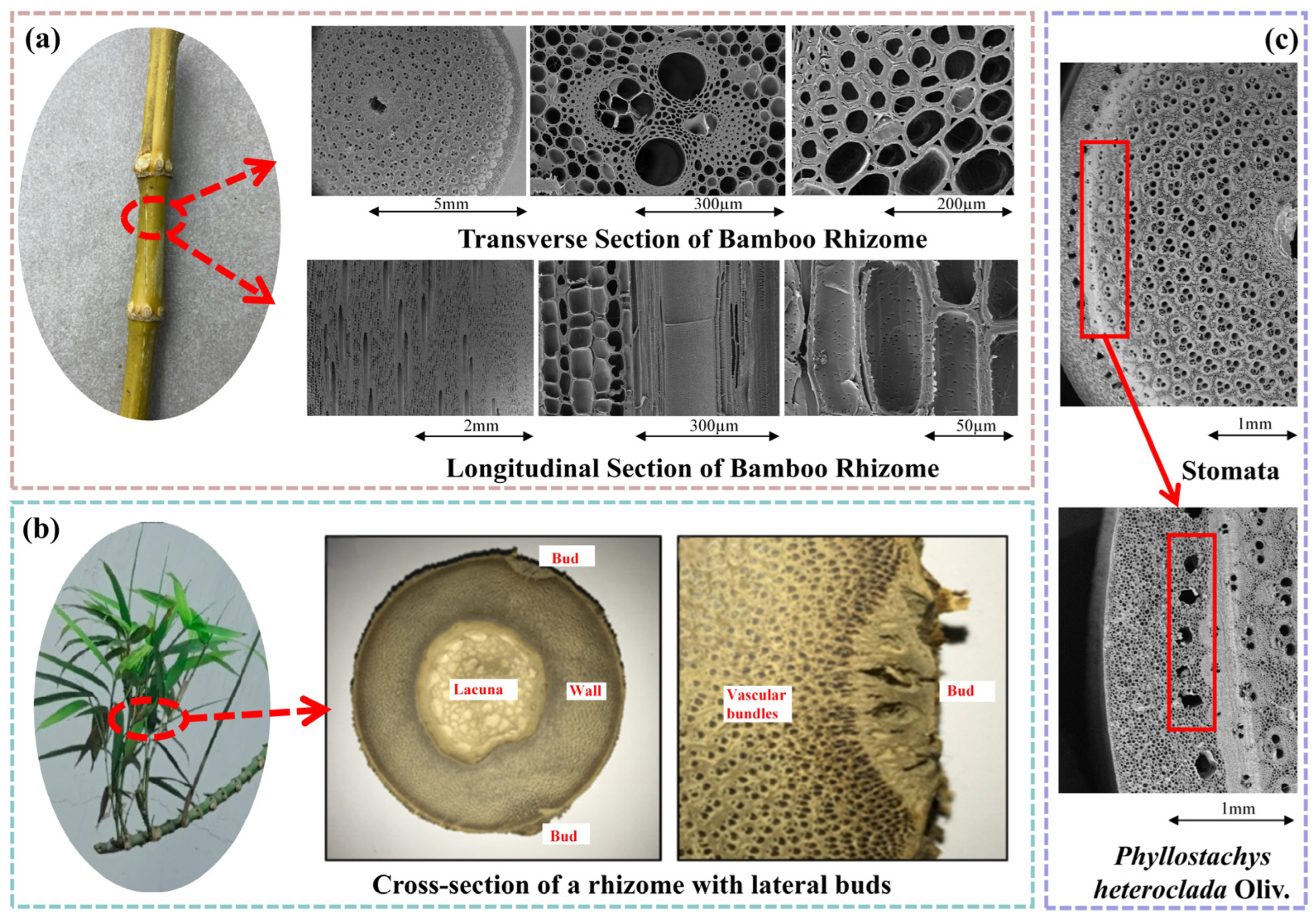
First, bamboo rhizomes consistently present a five-layer structure—pith, parenchymatous ground tissue containing scattered vascular bundles, cortex, subcortex, and epidermis (
Figure 2a)—across both running and clumping species [
49,
50,
51]. This conserved architecture closely parallels the organization of bamboo culms, suggesting a shared developmental origin and providing a structural basis for the considerable load-bearing ability observed in mature rhizomes [
52]. Despite its frequent description, this layered pattern remains under-quantified in the literature, and its functional significance is seldom examined beyond basic morphological comparison.
Second, a universal radial gradient in vascular bundle distribution is evident across species: smaller, denser bundles are typically located near the epidermis, whereas larger, sparser bundles occur toward the pith, as shown in
Figure 2a. This organization reflects a functional division in which the outer region provides mechanical reinforcement, while the inner region specializes in hydraulic and nutrient transport. Clumping bamboos, for example, often possess thicker cortical tissues and more heavily lignified fiber sheaths, consistent with the need for enhanced structural stability in dense stands.
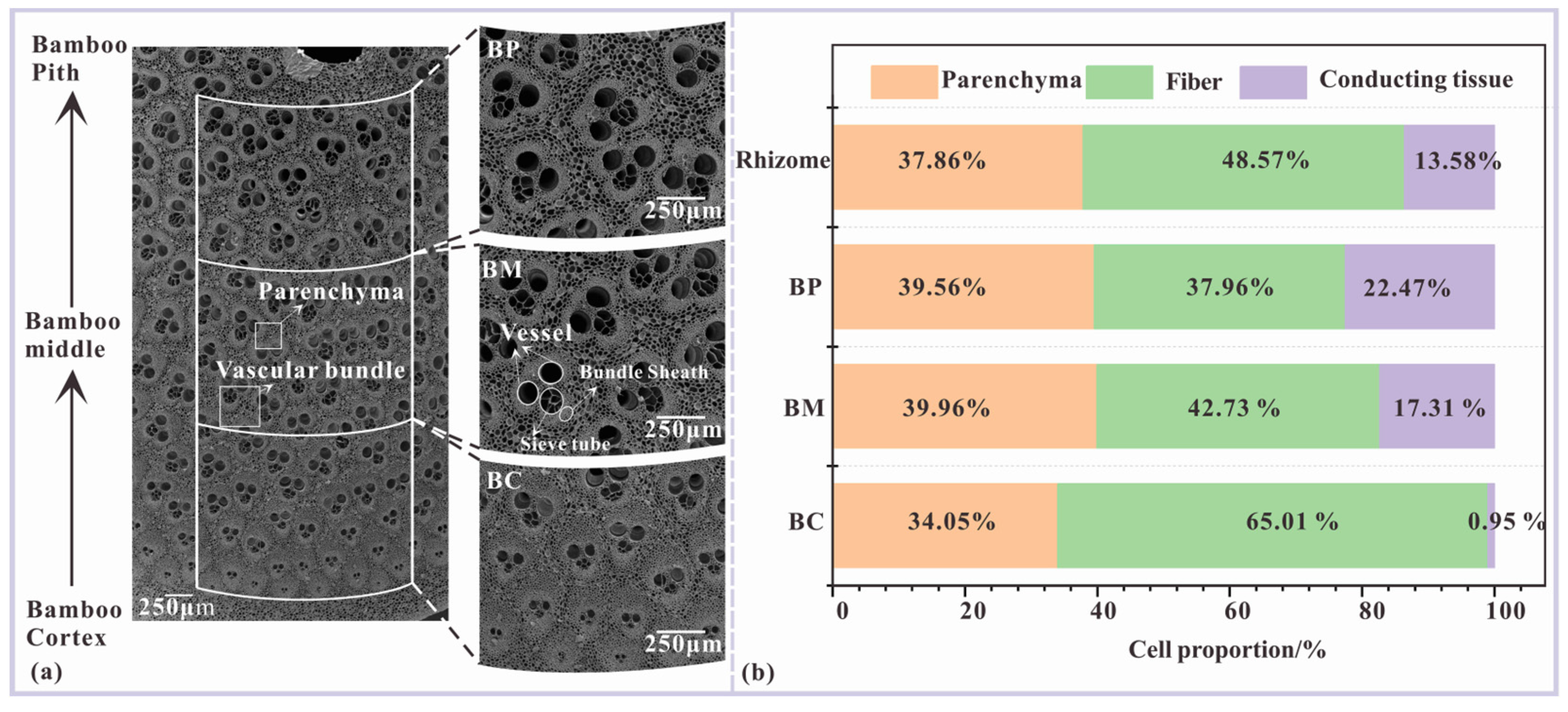
While most studies describe these gradients qualitatively, recent comparative work has begun to quantify radial variation across multiple bamboo rhizome species, offering a more standardized framework for interspecific evaluation [
53]. Such analyses reveal that vascular bundle size, density, and fiber wall characteristics change systematically from cortex to pith as shown in
Figure 3, yet the magnitude and steepness of these gradients differ among species. This emerging quantitative approach not only strengthens cross-species comparability but also highlights the need to formalize radial-gradient models as analytical tools in bamboo anatomical research—addressing a methodological gap long noted but rarely operationalized.
Third, rhizome anatomical traits undergo predictable age-dependent remodeling. Older rhizomes exhibit increased vascular bundle diameter, fiber wall thickness, and overall lignification, while parenchyma lumens progressively shrink [
54,
55]. These changes strengthen the rhizome mechanically but may reduce hydraulic efficiency. Mohamed et al. (2019) [
56] showed that in
Gigantochloa scortechinii, most anatomical parameters increased with age, whereas the radial-to-tangential ratio declined, indicating geometric adjustments during maturation. Protoxylem diameter varied among sites but not with age, underscoring environmental modulation independent of ontogenetic trends, as shown in
Figure 2b. Despite such findings, few studies integrate these age-related changes into broader models linking anatomy with rhizome performance.
Species-specific adaptations further modify the shared structural template. In moso bamboo, the rhizome epidermis develops a thick silica layer that enhances pest resistance and tolerance to abiotic stress, while pith cells accumulate substantial starch reserves for belowground storage [
55]. Yunnan arrow bamboo displays a pronounced radial differentiation in vascular bundle size [
54].
Phyllostachys heteroclada uniquely forms a ring of stomata-like aeration pores in the epidermal region (
Figure 2c), likely linked to sustained waterlogged conditions typical of its habitats [
57,
58]. Such traits represent ecologically conditioned deviations, yet current studies rarely frame them as adaptive syndromes.
Taken together, available evidence suggests that bamboo rhizome anatomy can be conceptualized through a three-level structural model: (1) a conserved layered architecture shared across species; (2) a universal radial gradient coordinating mechanical and physiological functions, which recent cross-species analyses have begun to quantify using standardized anatomical metrics and radial descriptors; and (3) age- and environment-driven remodeling that fine-tunes performance.
This integrated view highlights both the common developmental basis of bamboo rhizomes and the ecological or ontogenetic factors generating interspecific divergence. Moreover, it underscores key research gaps-particularly the limited number of studies providing parameterized radial gradients, the lack of standardized anatomical measurements across species, and the need to establish mechanistic links between structure and function. Addressing these gaps will facilitate future investigations and support the sustainable utilization of bamboo belowground resources.
Figure 2.
Anatomical characteristics of bamboo rhizome [
56]. Copyright 2019, licensed under CC BY-NC 4.0 (
https://creativecommons.org/licenses/by/4.0/), accessed on 15 December 2025 (
a) Schematic diagram of the rhizome anatomy; (
b) Cross-section of a rhizome with lateral buds of
Gigantochloa scortechinii bamboo; (
c) the stomata of
Phyllostachys heteroclada Oliy. bamboo rhizome.
Figure 2.
Anatomical characteristics of bamboo rhizome [
56]. Copyright 2019, licensed under CC BY-NC 4.0 (
https://creativecommons.org/licenses/by/4.0/), accessed on 15 December 2025 (
a) Schematic diagram of the rhizome anatomy; (
b) Cross-section of a rhizome with lateral buds of
Gigantochloa scortechinii bamboo; (
c) the stomata of
Phyllostachys heteroclada Oliy. bamboo rhizome.
Figure 3.
(
a) Schematic diagram of radial partition of bamboo rhizome. (
b) Ratios of each tissue [
56]. Copyright 2019,licensed under CC BY-NC 4.0 (
https://creativecommons.org/licenses/by/4.0/). Abbreviations: BC = bamboo cortex; BM = bamboo middle; BP = bamboo pith ring.
Figure 3.
(
a) Schematic diagram of radial partition of bamboo rhizome. (
b) Ratios of each tissue [
56]. Copyright 2019,licensed under CC BY-NC 4.0 (
https://creativecommons.org/licenses/by/4.0/). Abbreviations: BC = bamboo cortex; BM = bamboo middle; BP = bamboo pith ring.
3.1.2. Fiber Cell Morphology and Parameters of Bamboo Rhizomes
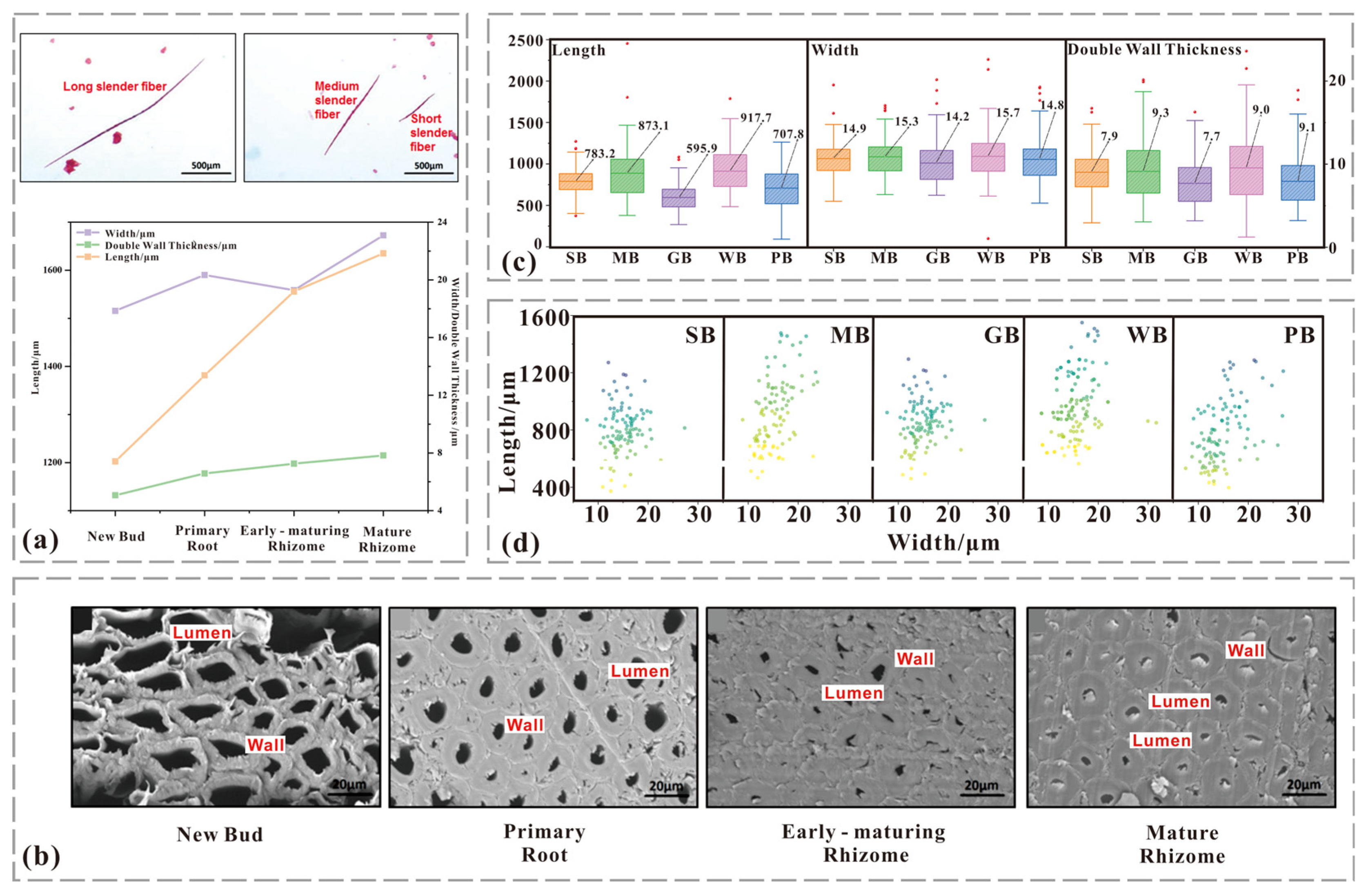
Fibers represent the primary mechanical elements within bamboo rhizomes, and their morphology plays a decisive role in determining the physical and mechanical behavior of the material. Although rhizome fibers share the typical spindle−shaped form of bamboo culm fibers, they display distinct dimensional characteristics (
Figure 4a). Across species, rhizome fibers are consistently shorter than those of culms−generally falling well below the 1.5−4.5 mm range reported for most bamboo stems-while maintaining comparable diameters and cell wall thicknesses [
53,
56]. This combination of short length but relatively robust walls leads to lower aspect ratios than culm fibers, suggesting reduced fiber maturity and elongation capacity, which likely reflects the unique biomechanical and physiological roles of subterranean organs.
Comparative analyses across several common bamboo rhizomes confirm these trends. Despite species−level variation, fiber lengths typically cluster around 0.6–0.9 mm, whereas fiber widths remain similar to those in culms (
Figure 4c,d). Wall-to-lumen ratios in many rhizomes are slightly higher than those reported for common culm species such as moso bamboo or
Neosinocalamus affinis (Kurz) Keng f., indicating more compact fiber structures and potentially higher density or hardness in localized tissues [
53]. The consistency in wall thickness across species further supports the notion that rhizome fibers are structurally adapted for resisting soil pressure and supporting nutrient transport, rather than for the high tensile demands experienced by culms.
Fiber traits also change systematically with rhizome age. Studies on several species, including Yunnan arrow bamboo [
54], small black bamboo [
56], and moso bamboo [
59], show that fiber walls gradually thicken and lumens shrink as rhizomes mature, reflecting progressive lignification and tissue densification, as shown in
Figure 4b. These anatomical changes occur both longitudinally and radially: fibers near the pith tend to have thinner walls than those toward the periphery, and age-related thickening is more prominent in inner tissues. Age effects are especially evident in properties such as wall thickness, wall-to-lumen ratio, and aspect ratio, whereas fiber diameter and lumen size often remain relatively stable. Collectively, these patterns indicate that rhizome fibers undergo pronounced structural reinforcement during development, enhancing stiffness and decay resistance while maintaining functional efficiency in the belowground environment.
This integrative view underscores that bamboo rhizome fibers are structurally distinct from culm fibers, with morphologies precisely aligned to the specialized biomechanical and physiological demands of subterranean growth. The observed differences—shorter, thicker rhizome fibers versus longer, thinner culm fibers—also suggest potential distinctions in material utilization, implying that rhizome fibers may be more suitable for applications requiring compactness and stiffness rather than tensile strength. Collectively, these structural patterns support the notion that rhizome fibers are adapted for belowground mechanical support, nutrient transport, and hydraulic efficiency. Despite these insights, several critical research gaps remain, including the limited quantification of interspecific variation, the lack of standardized fiber metrics for comparative studies, the untested potential for material utilization, and the need to link anatomical traits with mechanical performance models—issues that must be addressed to advance the sustainable utilization of rhizome biomass.
3.1.3. Parenchyma Cell Morphology and Parameters of Bamboo Rhizomes
Parenchyma tissue constitutes the primary storage and metabolic system within bamboo rhizomes, and its anatomical characteristics reflect not only the physiological status of the belowground stem but also the developmental basis of rhizome material properties [
60,
61]. Despite its importance, studies specifically targeting parenchyma cells in rhizomes remain limited, and existing research mainly documents their developmental changes and basic cellular types. Current findings indicate that parenchyma cells undergo pronounced age-related modifications, including gradual increases in cell diameter, lumen size, and wall thickness [
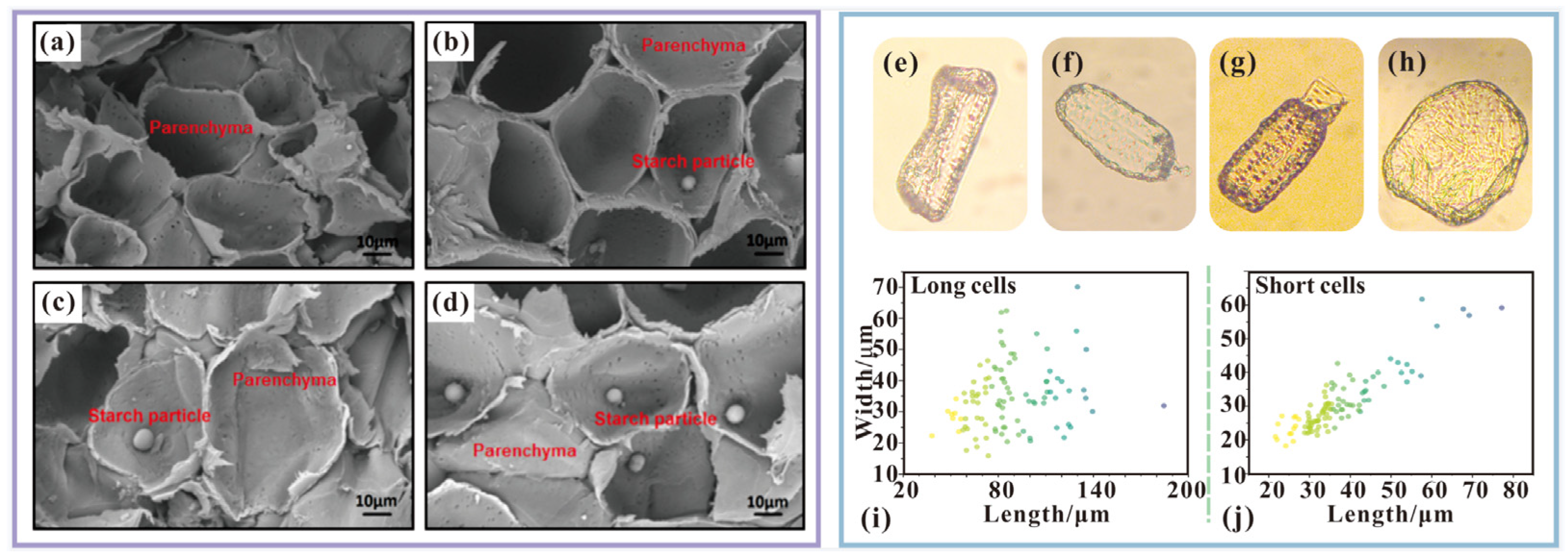
56]. These trends correspond to the progressive deposition and lignification of secondary wall layers, which strengthen the structural integrity and compressive resistance of the rhizome. In addition, starch grains within parenchyma cells exhibit clear seasonal patterns: they are abundant in mature rhizomes but largely absent in newly emerging shoots, consistent with the carbohydrate mobilization that occurs prior to shoot emergence, as shown in
Figure 5a.
The cellular composition of rhizome parenchyma also resembles that of bamboo culms [
62], consisting of long (
Figure 5e–g) and short parenchyma cells (
Figure 5h), which differ markedly in both shape and size. Long cells typically appear rectangular or irregular, with a broad length range and higher length-to-width ratios that underline their slender morphology, as shown in
Figure 5i. In contrast, short cells are generally near circular, shorter in length, and characterized by much lower length-to-width ratios, forming a “short and wide” geometry, as shown in
Figure 5j [
57]. These distinctions suggest a degree of structural heterogeneity within rhizome parenchyma, likely reflecting the diverse functional demands of storage, transport, and mechanical support.
3.2. Research on the Chemical Properties of Bamboo Rhizome
Lignin, cellulose, and hemicelluloses form the fundamental framework of bamboo rhizome cell walls, yet their relative proportions vary systematically with rhizome age, species, and season, reflecting both developmental trajectories and adaptation to the subterranean environment. Multiple studies consistently show that lignin content increases with age, enhancing tissue stiffness, mechanical strength, and decay resistance. For instance, in Yunnan arrow bamboo pseudorhizomes, fibers near the pith exhibit thin walls in young rhizomes, which progressively thicken as lignin becomes the dominant component of the secondary wall [
52]. Similarly, in moso bamboo, lignin and ethanol–benzene extractives content increase with age, whereas hemicelluloses, total cellulose, and ash content decrease, indicating improved structural integrity and microbial resistance in older rhizomes [
56]. High lignin levels in
Pseudoxytenanthera further enhance water resistance, supporting belowground function [
59]. Seasonal fluctuations in soluble sugars and starch—peaking in spring and lowest in summer—add another layer of variation, potentially affecting processing performance and degradation susceptibility [
63,
64].
Inter-species differences further contribute to the chemical heterogeneity of rhizomes [
57].
Phyllostachys bambusoides f. violascens rhizomes exhibit a notably high cellulose content (39.4%), suggesting strong load-bearing capacity, while lower lignin and hemicellulose contents may limit durability.
Phyllostachys nigra rhizomes exhibit lower cellulose (29.7%) but higher lignin (31.6%) and hemicelluloses (26.6%), conferring superior hardness and decay resistance.
Phyllostachys edulis and
Phyllostachys aurea rhizomes show moderate-to-high levels of all three major components, balancing mechanical and durability traits, whereas
Phyllostachys heteroclada rhizomes, with relatively high lignin content (31.0%), demonstrate excellent biodegradation resistance and long-term belowground stability.
Comparison with bamboo culms reveals distinct chemical profiles, though reported trends vary. Ito (2015) [
54] reported that rhizomes generally have lower cellulose and lignin than culms, coupled with higher hemicelluloses and ash content, suggesting lower tensile strength but higher mineralization. Seasonal variations in soluble sugars and starch were also observed, highlighting the potential influence of harvest timing on processing outcomes and degradation susceptibility. In contrast, recent cross-species analyses by Su et al. (2025) [
57] show that while rhizome cellulose content remains lower than in culms (29.7%–39.4% vs. 40%–55%), lignin content is typically higher (26.4%–31.6%), imparting greater hardness, durability, and microbial resistance, with hemicelluloses levels remaining comparable. These discrepancies likely reflect differences in species, rhizome age, environmental conditions, and methodological approaches, underscoring the need for standardized comparative studies.
Overall, the chemical characteristics of bamboo rhizomes can be conceptualized within a three-tier framework: (1) age-driven lignin deposition and carbohydrate dynamics; (2) species-specific chemical adaptations influencing mechanical performance and durability; and (3) functional differentiation between rhizomes and culms. Notably, this chemical feature framework aligns closely with the anatomical characteristics of bamboo rhizomes–such as layered tissue organization, radial vascular bundle gradients, and age-related lignification–indicating a coordinated development of chemical composition and structural architecture. This concordance suggests that rhizome tissues are chemically and anatomically optimized to meet the mechanical, storage, and physiological demands of the subterranean environment. Such an integrated perspective illustrates how developmental, ecological, and anatomical factors jointly shape rhizome properties, providing a theoretical foundation for targeted harvesting, high-value utilization, and processing strategies. Nonetheless, most current studies remain descriptive with limited species coverage, and mechanistic links between chemical composition, anatomical traits, and mechanical performance, as well as standardized comparative metrics, represent key gaps for future research.
3.3. Research on the Mechanical Properties of Bamboo Rhizome
The mechanical behavior of bamboo rhizomes is governed by a combination of species identity, developmental stage, and moisture conditions, forming a multifactorial system that directly influences their suitability for processing and high-value utilization [
65]. Age-related mechanical trajectories differ markedly across species. For instance, in moso bamboo, middle-aged and mature rhizomes exhibit higher tensile strength but lower stiffness than young rhizomes, whereas
Phyllostachys viridis maintains a relatively stable modulus of elasticity across ages yet consistently shows lower strength [
65]. Rhizome diameter and root type further modulate performance: tensile strength decreases as diameter increases, while stiffness remains positively correlated with strength [
66,
67].
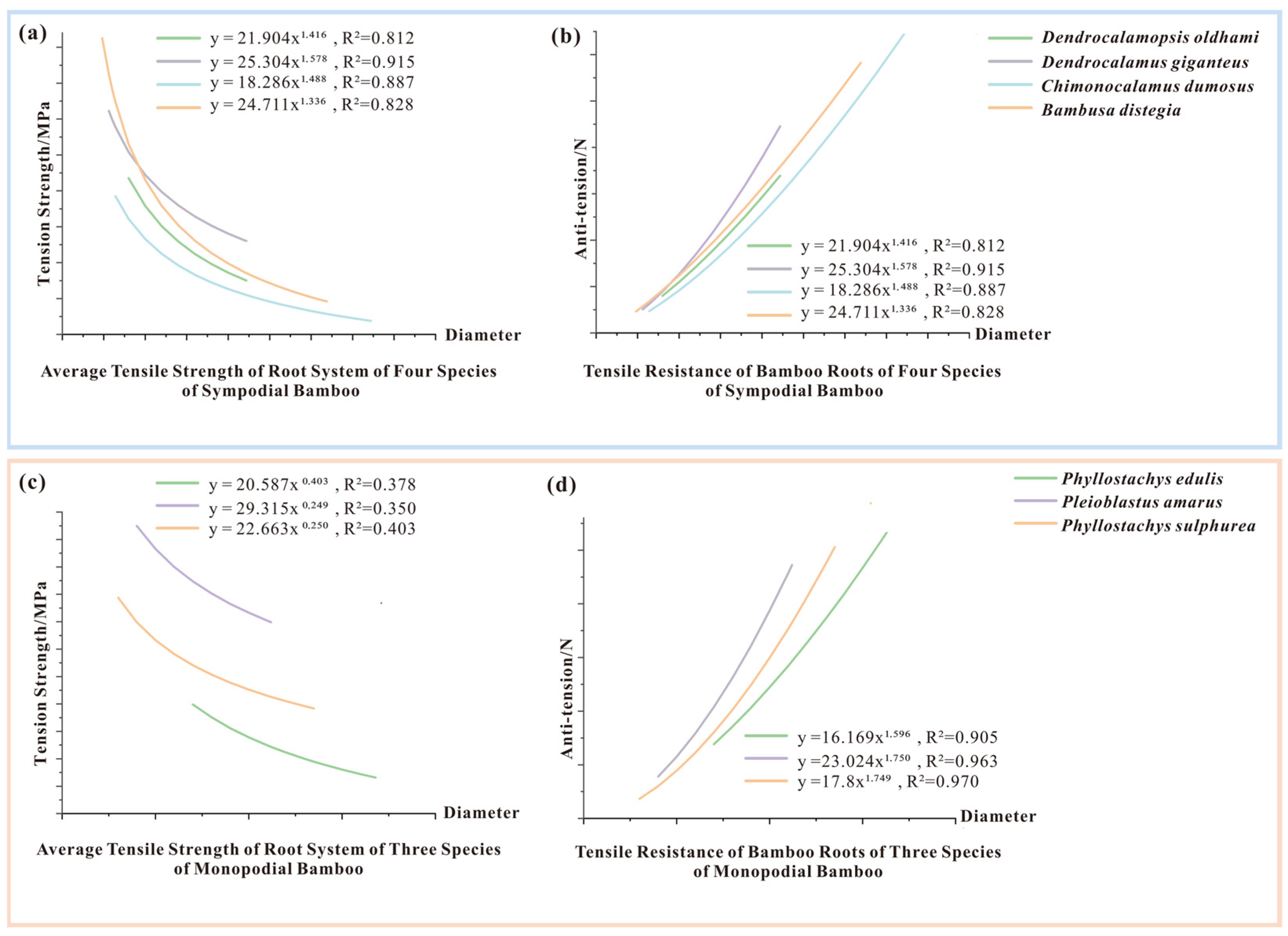
Distinct mechanical strategies are also evident between monopodial and sympodial bamboos, as shown in
Figure 6. Among monopodial species (
P. edulis,
P. dulcis,
P. aurea),
P. dulcis shows the greatest tensile strength (26.07 MPa) and modulus of elasticity (182.03 MPa), whereas
P. edulis reaches the highest maximum tensile force (71.96 N). In sympodial species (
Bambusa multiplex,
Bambusa viridistriata,
Bambusa longispiculata,
Bambusa aromatica),
B. longispiculata achieves the highest tensile strength (30.24 MPa) and modulus of elasticity (169.86 MPa), while B. multiplex shows the greatest maximum tensile force (59.47 N) [
66,
67]. Overall, bamboo rhizomes exceed common plantation woods—including
Pinus tabuliformis,
Larix spp., and
Betula platyphylla—in tensile strength and stiffness, underscoring the mechanical advantages of subterranean bamboo structures.
Moisture content is another critical determinant of bamboo mechanical behavior. Ribeiro et al. reported that moisture level strongly influences bending strength and structural stability of bamboo materials [
68]. Further investigations by Wang [
69] demonstrated that the longitudinal compressive strength decreases linearly with increasing moisture content, whereas longitudinal tensile strength, shear strength, and bending strength follow a non-monotonic pattern characterized by an initial decrease, subsequent increase, stabilization, and final decline. These findings highlight the complex moisture-dependent mechanical responses of bamboo and underscore the necessity of moisture control during processing and utilization.
Overall, rhizome mechanics can be conceptualized as a coupled system controlled by species-specific anatomy, developmental stage, and moisture state. Understanding these interactions provides a technical basis for material selection, process optimization, and the development of rhizome-based products in industrial applications.
3.4. Water Absorption Behavior and Dimensional Stability of Bamboo Rhizomes
The water absorption behavior and dimensional stability of bamboo rhizomes are critical determinants of their processing performance and potential for high-value utilization, and they are profoundly influenced by the unique anatomical structure of the rhizomes. Existing studies [
70] indicate that, compared with culms, rhizomes exhibit stronger end-surface hydrophobicity, lower short-term water absorption, and significantly reduced dimensional changes (approximately 50%–70%), allowing them to maintain shape stability during brief water exposure. This property is advantageous for applications such as handles, craft products, and bent components. However, under long-term water immersion, rhizomes display higher saturated water absorption than culms, likely due to higher porosity, larger average pore size, and greater vessel area, suggesting that additional protective measures may be necessary in humid environments to prolong service life.
Anatomical analyses offer insights into the structural basis that may influence water transport and dimensional stability in bamboo rhizomes. Mohamed et al. (2019) [
56] investigated
Gigantochloa scortechinii rhizomes and found that parenchyma cells are vertically elongated, transitioning from short cuboidal to rectangular shapes. With increasing age, vascular bundle diameter, parenchyma cell diameter, chamber size, and fiber diameter and wall thickness all increase, whereas tangential ratios, primary xylem diameter, and fiber lumen diameter decrease. Hydraulic conductance is negatively correlated with parenchyma cell diameter and lumen size, indicating that smaller, tightly packed parenchyma favors efficient water transport, whereas wall thickness has little effect. The maturation of rhizomes, characterized by densification and lignification of vascular bundles and parenchyma, reduces hydraulic conductivity but enhances belowground structural stability and compressive resistance.
Collectively, bamboo rhizomes exhibit a dual strategy for water regulation: a small central cavity and dense parenchyma ensure short-term dimensional stability and low moisture sensitivity, while higher porosity and larger vessel area sustain long-term water transport. This integrated perspective not only reveals the functional adaptations of rhizomes to subterranean environments but also provides a theoretical foundation for high-value utilization, processing design, and studies of belowground physiology. It also highlights future research gaps, such as the need for systematic quantitative analysis of the coupling between rhizome pore structure and mechanical performance.
3.5. Thermal Properties of Bamboo Rhizomes
The thermal properties of bamboo rhizomes are critical for their processing and high-value utilization, as they directly influence thermal stability, heat transfer behavior, and performance under high-temperature conditions. Although the thermal behavior of bamboo culms has been relatively well studied, systematic investigations on rhizomes remain limited, which restricts a comprehensive understanding of their processing characteristics and potential for high-value applications.
Existing studies indicate that bamboo rhizomes exhibit distinct thermal characteristics compared with culms. For example, the extrapolated onset decomposition temperature (Te) of 3-year-old Phyllostachys edulis rhizomes was slightly higher (266.1 °C) than that of younger rhizomes, but still generally lower than culms of the same age. Additionally, the glass transition temperature (Tg) of certain rhizome fractions was higher than that of culms, while variations between rhizomes of different ages were minimal. Although the slightly lower Te suggests that the chemical thermal stability of rhizomes is somewhat lower than that of culms, the relatively stable Tg indicates consistent thermal behavior across age classes.
Overall, bamboo rhizomes demonstrate advantages in thermal processing and dimensional stability, yet related research remains limited. Further systematic studies are needed to quantify thermal decomposition profiles, glass transition behavior, and heat conduction characteristics, providing a scientific basis for high-temperature processing and high-value utilization of bamboo rhizomes.
3.6. The Coupled Features of Structure, Chemical Composition, and Properties of Bamboo Rhizomes
The functional performance of bamboo rhizomes is intrinsically linked to their anatomical architecture and chemical composition, which collectively determine their mechanical, thermal, and hygroscopic behaviors. Structurally, rhizomes exhibit a conserved layered organization reminiscent of culms, comprising the pith, ground tissue with embedded vascular bundles, cortex, sub-epidermal layer, and epidermis progressing from the inner to outer regions. This hierarchical arrangement underpins their ability to sustain mechanical loads, with tissue distribution and structural integrity emerging as primary determinants of performance rather than bamboo growth type, as evidenced by the similar tensile trends observed across monopodial and sympodial rhizomes.
Chemical composition modulates these structural effects, with cellulose, hemicelluloses, and lignin exhibiting systematic variations with age. Progressive lignification of fiber cells strengthens intercellular cohesion, contributing to higher tensile strength in middle-aged and older rhizomes, whereas cellulose content predominantly governs tensile behavior. Comparisons with culms reveal that rhizomes generally have lower cellulose and lignin but higher hemicelluloses and ash contents, resulting in reduced thermal stability and increased hydrophilicity. Thermal analyses corroborate this: for samples of equivalent age, the extrapolated onset decomposition temperature of rhizomes is consistently lower than that of culms, reflecting a greater susceptibility to thermal degradation. In addition, increased hemicelluloses content, as the primary hygroscopic component, contributes significantly to water uptake, whereas the influence of ash content appears to be secondary or indirect. Despite this tendency, rhizomes exhibit superior dimensional stability compared with culms, likely due to their smaller central cavities and more regular cross-sectional architecture.
Taken together, these findings indicate that bamboo rhizome performance arises from a complex interplay between hierarchical anatomy and dynamic chemical composition. Structural integrity and tissue arrangement dictate mechanical response, while the relative proportions of cellulose, lignin, and hemicelluloses regulate thermal and hygroscopic properties. This integrated perspective underscores the necessity of mechanistic, species-level analyses to guide the optimized processing, utilization, and high-value application of bamboo rhizomes, and highlights critical gaps in linking anatomical features with functional performance under diverse environmental and developmental contexts.
4. Applications of Bamboo Rhizomes
Bamboo rhizomes constitute a versatile bioresource owing to their rich fiber content and abundant nutritional components. The apical rhizome shoot is widely consumed as food, and rhizome-derived materials have also been used in traditional medicine for the relief of respiratory and digestive ailments [
71]. In recent years, growing interest in sustainable materials and the concept of “replacing plastic with bamboo” has encouraged the broader utilization of bamboo rhizomes, which were historically regarded as by-products. They are now increasingly explored for applications in ecological restoration, agriculture, construction, and various industrial sectors, including feed, fertilizers, papermaking, and composite manufacturing [
72].
4.1. Handicrafts and Daily–Use Products
Bamboo rhizomes exhibit excellent toughness, strength, and durability, making them suitable for direct processing into a variety of daily–use items and handicrafts. Through cutting, sanding, polishing, and shaping, they can be manufactured into walking sticks, water dippers, tea scoops, wine ladles, bracelets, and rhizome-woven handbags (
Figure 1b). Notably, the performance requirements for handicrafts and daily-use products differ substantially.
Handicraft production places greater emphasis on appearance-related attributes, including color, surface patina, and overall aesthetic stability. The formation of patina is largely influenced by the chemical composition of the rhizome–particularly lignin and cellulose—which can undergo chemical reactions with air or perspiration to form new organic compounds. Consequently, chemical composition becomes an important factor in selecting rhizomes for ornamental purposes. In contrast, daily-use products demand superior mechanical properties, such as bending strength, tensile strength, and compressive resistance.
Several examples illustrate how processing methods are optimized to meet these functional requirements. For instance, Huang (2014) developed a technique for producing basket handles from
Phyllostachys edulis rhizomes, in which treatment with copper naphthenate and phenolic resin, followed by pressurized impregnation, drying, microwave-assisted bending, and curing, was used to enhance bending performance and reduce spring-back [
73]. Similarly, Shu (2011) [
74] designed an innovative rhizome-frame fan in which a single rhizome is bent to form a seamless frame and handle, improving durability and preventing handle detachment commonly seen in traditional bamboo-frame fans.
At present, bending and shaping remain the core techniques in manufacturing bamboo rhizome handicrafts and daily-use products. Compared with culms, rhizomes generally exhibit a lower elastic modulus, which likely contributes to their superior bendability. Their relatively small central cavity also reduces the risk of cracking during bending. Nonetheless, rhizomes still exhibit a tendency to fracture during processing, highlighting the need for improved softening or pretreatment methods. Developing such techniques will be essential for expanding the industrial applications of bamboo rhizome–based products.
4.2. Research on the Applications of Bamboo Rhizomes in Agriculture, Industry, and Functional Materials
The applications of bamboo rhizomes in agriculture and industry are gradually being explored, demonstrating considerable potential and diverse uses. In agriculture, discarded bamboo rhizomes can be converted into high-quality organic fertilizers through long–term natural fermentation, improving soil structure and water retention. Further, by incorporating microbial inoculants dominated by fiber–degrading microorganisms during pile fermentation, bamboo rhizomes can be processed into bamboo shoot shell organic fertilizers or organic–inorganic compound fertilizers [
75].
In industrial applications, bamboo rhizomes are primarily utilized in textiles, paper production, and composite materials. The fibers of bamboo rhizomes can be combined with other raw materials to produce high-strength composites or fiberboards. Moreover, bamboo waste generated during processing can be incorporated with other materials to produce composite products [
76,
77,
78].
Beyond conventional industrial uses, bamboo rhizomes are increasingly recognized as functional materials with engineering potential. Recent studies have demonstrated that bamboo rhizome–derived powders, after chemical surface treatments (e.g., alkaline treatment, potassium permanganate treatment, or benzoylation), can be incorporated with cashew nut shell powder, graphite, calcium carbonate, and phenolic resins to fabricate molded composites. These materials exhibit enhanced interfacial bonding, reduced surface roughness, stable friction coefficients, and improved wear resistance over time [
63]. Such findings highlight the potential of bamboo rhizomes for the development of high-performance functional composites, particularly in tribological and friction-related applications.
Overall, although the practical utilization of bamboo rhizomes is still in an early stage, their renewability, biodegradability, and favorable processing characteristics make them highly promising for applications in circular agriculture, industrial materials, and functional engineering products. Future research should focus on performance optimization, functional modification, and scalable manufacturing technologies to further expand their role in green and sustainable industrial development.
5. Challenges, Knowledge Gaps and Future Perspectives
Bamboo rhizomes possess distinctive structural and chemical characteristics that suggest considerable potential for applications in handicrafts, construction materials, and functional composites. Nevertheless, their high-value utilization remains constrained by a series of technical and scientific challenges that have yet to be systematically resolved. Current industrial attempts frequently encounter process instability, including susceptibility to mold growth, cracking during bending, and elastic springback after forming, which negatively affect surface quality, dimensional accuracy, and the feasibility of complex shapes. In addition, most modification and forming technologies used for rhizomes are directly adapted from culm-based processing, lacking targeted optimization and limiting their effectiveness for belowground stem tissues.
From a material perspective, several intrinsic factors further restrict large-scale applications. The naturally high hygroscopicity of rhizomes increases their sensitivity to environmental moisture, complicating storage, processing, and service performance. Moreover, pronounced interspecific and age-related differences in anatomical structure, chemical composition, and mechanical behavior introduce uncertainty in material performance and hinder the establishment of standardized processing routes. Performance changes during prolonged storage and repeated moisture–temperature cycles also remain poorly understood, representing a major gap in current knowledge.
To overcome these limitations, future research should prioritize systematic, multidimensional characterization of bamboo rhizomes, including detailed assessments of anatomical features, chemical composition, density distribution, and hygroscopic behavior. Such data are essential to provide a scientific basis for the development of species-specific softening, shaping, and functional modification strategies. In particular, targeted process optimization—encompassing mold-prevention treatments, thermal modification, softening protocols, and controlled bending/forming techniques—will be critical to improving processing stability, product reliability, and manufacturing reproducibility.
Further investigations should also focus on clarifying structure–property–process relationships across different species and age classes. Comparative studies of mechanical, thermal, and moisture-related performance will facilitate rational material selection and enable the design of application-oriented processing methods. In parallel, long-term durability evaluation under high-humidity, cyclic wetting–drying, and outdoor exposure conditions is required to support the development of protective treatments and life-cycle assessment of rhizome-based products.
By addressing these technical bottlenecks and scientific gaps, future work can establish a solid foundation for transforming bamboo rhizomes from an underutilized belowground biomass into a reliable and high-value lignocellulosic resource. This progress will be essential for advancing sustainable material innovation and supporting green manufacturing strategies.
6. Conclusions
Bamboo rhizomes, the belowground stems of bamboo, play a crucial role in ecosystem functioning and material cycling, yet they have long been regarded as forest residues and remain relatively understudied. This review systematically summarizes current knowledge on the anatomical features, chemical composition, physical and mechanical properties, and applications of bamboo rhizomes, highlighting their potential for high-value utilization.
Based on existing studies, a three–tiered framework can be proposed to describe bamboo rhizome characteristics: (1) age–related changes, including lignin deposition, cellulose distribution, and cell wall development; (2) interspecific differences, encompassing chemical composition and anatomical variability that modulate mechanical performance and durability; and (3) functional differentiation between rhizomes and culms, reflecting adaptation to belowground environments. Within this framework, the anatomical structure, chemical composition, and physical, mechanical, and hygroscopic properties of rhizomes exhibit tight coupling, providing a theoretical basis for species selection, harvesting strategies, and processing applications.
In terms of utilization, bamboo rhizomes have been applied in handicrafts, agricultural organic fertilizers, and composite materials, and they show promise in emerging areas such as high-friction functional materials and bio-based composites. However, systematic studies remain limited, particularly regarding structure–property relationships, interspecific performance variation, and optimized processing techniques. Future research should prioritize multidimensional characterization, elucidation of structure–property coupling mechanisms, and the development of high–value processing technologies to transform bamboo rhizomes into high-added-value products, supporting the “Bamboo Instead of Plastic” initiative and promoting sustainable development in the bamboo industry.
Author Contributions
Conceptualization, N.S. and C.F.; methodology, N.S.; software, Y.L. and Y.C.; investigation, C.Z. and Y.L.; writing—original draft preparation, N.S.; writing—review and editing, C.F., L.C. and H.X.; visualization, Y.L.; supervision, H.X.; funding acquisition, N.S., L.C. and H.X. All authors have read and agreed to the published version of the manuscript.
Funding
This research was funded by National Natural Science Youth Foundation of China, grant number 32301679, and The Science & Technology Research and Development Program of Guizhou Forestry Administration for Rural Industrial Revolution and Characteristic Forestry Industry, grant number GZMC-ZD20202112, and the Postgraduate Research &Practice Innovation Program of Jiangsu-Province, grant number KYCX23_1183.
Data Availability Statement
This study did not generate any new data. All data supporting the findings of this work are available in the cited references.
Conflicts of Interest
The authors declare no conflicts of interest.
References
- Jia, P.; Ji, X.; Zheng, B.; Wang, C.; Hao, W.; Han, W.; Zhang, J.; Xia, G.; Ji, X.; Zhang, J. Eco-Friendly and Complete Recycling of Waste Bamboo-Based Disposable Paper Cups for Value-Added Transparent Cellulose-Based Films and Paper Plastic Composites. Polymers 2022, 14, 1589. [Google Scholar] [CrossRef] [PubMed]
- Petrini Kampragkou, P.; Dabekaussen, M.; Kamperidou, V.; Stefanidou, M. Bio-Additives in Lime-Based Mortars: An Investigation of the Morphology Performance. Constr. Build. Mater. 2025, 474, 141177. [Google Scholar] [CrossRef]
- Shou, Y.; Zhu, Y.; Ding, Y. Transcriptome analysis of lateral buds from Phyllostachys edulis rhizome during germination and early shoot stages. BMC Plant Biol. 2020, 20, 229. [Google Scholar] [CrossRef] [PubMed]
- Long, L.; Yu, M.; Yao, W.; Ding, Y.; Lin, S. Research advance in growth and development of bamboo organs. Ind. Crops Prod. 2023, 205, 117428. [Google Scholar] [CrossRef]
- Zhang, J.; Ma, R.; Ding, X.; Huang, M.; Shen, K.; Zhao, S.; Xiao, Z.; Xiu, C. Association among starch storage, metabolism, related genes and growth of Moso bamboo (Phyllostachys heterocycla) shoots. BMC Plant Biol. 2021, 21, 477. [Google Scholar] [CrossRef]
- Pan, X.; Shao, J.F. Linking the structure of vascular bundles and mineral element deposition reveals the hub role of nodes in bamboo. Hortic. Res. 2025, 12, uhaf113. [Google Scholar] [CrossRef]
- Gao, G.; Wen, X.; Wu, Z.; Zhong, H.; Pan, Y.; Zhang, X. Growth Characteristics of Ramet System in Phyllostachys praecox Forest under Mulch Management. Plants 2024, 13, 1761. [Google Scholar] [CrossRef]
- Kobayashi, K.; Ohashi, M.; Fujihara, M.; Kitayama, K.; Onoda, Y. Rhizomes play significant roles in biomass accumulation, production and carbon turnover in a stand of the tall bamboo Phyllostachys edulis. J. For. Res. 2022, 28, 42–50. [Google Scholar] [CrossRef]
- Xu, Q.F.; Liang, C.F.; Chen, J.H.; Li, Y.C.; Qin, H.; Fuhrmann, J.J. Rapid bamboo invasion (expansion) and its effects on biodiversity and soil processes. Glob. Ecol. Conserv. 2020, 21, e00787. [Google Scholar] [CrossRef]
- Bai, S.; Wang, Y.; Conant, R. Can native clonal moso bamboo encroach on adjacent natural forest without human intervention? Sci. Rep. 2016, 6, 31504. [Google Scholar] [CrossRef]
- Liang, K.; Wang, G.; Shen, Z.; Wu, J.; Zou, N.; Yu, H.; Yu, S.; Chen, F.; Shi, J. Application of the strip clear-cutting system in a running bamboo (Phyllostachys glauca McClure) forest: Feasibility and sustainability assessments. Front. Plant Sci. 2024, 15, 1335250. [Google Scholar] [CrossRef] [PubMed]
- Su, N.; Yan, Q.; Zhang, C.; Li, Y.; Su, W.; Fang, C. Coupled effects of chemical composition, fiber traits, and structural properties on bending performance: A species-level study of common bamboo rhizomes. Ind. Crops Prod. 2026, 239, 122452. [Google Scholar] [CrossRef]
- Liu, J.X.; Guo, C.; Ma, P.F.; Zhou, M.Y.; Luo, Y.H.; Zhu, G.F.; Xu, Z.C.; Milne, R.I.; Vorontsova, M.S.; Li, D.Z. The origin and morphological character evolution of the paleotropical woody bamboos. J. Integr. Plant Biol. 2024, 66, 2242–2261. [Google Scholar] [CrossRef] [PubMed]
- Chen, C. Study on Phytolith-Occluded Carbon Sink of Belowground Rhizome and Trunk in Key Monopodial Bamboo Species Across China. Ph.D. Thesis, Zhejiang A & F University, Hangzhou, China, 2020. (In Chinese). [Google Scholar]
- Li, Y.L. Studies on Sympodial Bamboo Resources in Jiangxi Province. Ph.D. Thesis, Jiangxi Agricultural University, Nanchang, China, 2024. (In Chinese). [Google Scholar]
- Ye, T.Y.; Chen, L.; Liang, K.; Chen, Q.M.; Liao, C.; Zhang, L.W.; Wu, R.C.; Lin, S.F.; Shi, J.M.; Pei, N.C. Investigation and Analysis of Ornamental Bamboo Resources in Nanchang City. For. Sci. Technol. 2023, 48, 97–100. (In Chinese) [Google Scholar]
- Liu, S.D.; Xie, Q.W. Growth Characteristics of Phyllostachys edulis and Bamboo Forest Harvesting. For. Ecol. 2009, 5, 26–27. (In Chinese) [Google Scholar]
- Zhong, Y.B.; Jiang, X. Research Progress in Growth Rhythm of Bamboos. World Bamboo Ratt. 2014, 12, 35–44. (In Chinese) [Google Scholar]
- Dong, W.Y.; Huang, B.L.; Xie, Z.X.; Xie, Z.H.; Liu, H.Y. Study on the Pattern of Rhizome Growth of Qiongzhuea tumidinoda Clone. J. Bamboo Res. 2002, 21, 56–60. (In Chinese) [Google Scholar]
- Zeng, L.; Ren, P.; Li, Z.X.; Yang, D.S.; Mou, X.W.; Chen, Z.Y.; Chen, D.C. Observation on the Biological Characteristics of Bambusa textilis. Non-Wood For. Res. 1998, 34, 9–11+19–73. (In Chinese) [Google Scholar]
- Jing, X.; Cai, C.; Fan, S.; Liu, G.; Wu, C.; Chen, B. Effects of Rhizome Integration on the Water Physiology of Phyllostachys edulis Clones under Heterogeneous Water Stress. Plants 2020, 9, 373. [Google Scholar] [CrossRef]
- Mohamed, J.; Abdul Hamid, H.; Nuruddin, A.A.; Nik Abdul Majid, N. Chemical attributes of Gigantochloa scortechinii bamboo rhizome in relation with hydraulic conductance. BioResources 2019, 14, 8155–8173. [Google Scholar] [CrossRef]
- Li, X.; Ye, C.; Fang, D.; Zeng, Q.; Cai, Y.; Du, H.; Mei, T.; Zhou, G. Non-Structural Carbohydrate and Water Dynamics of Moso Bamboo during Its Explosive Growth Period. Front. For. Glob. Change 2022, 5, 938941. [Google Scholar] [CrossRef]
- Chen, C.; Huang, H.Y.; Gong, M.; Wang, J.; Hou, S.F.; Jin, A.W. Rhizome Characteristics and Its Age Structure in Phyllostachys edulis Forests under Different Management Types. J. Bamboo Res. 2020, 39, 19–24. (In Chinese) [Google Scholar]
- Hu, T.; Kong, L.; Hu, S.; Deng, M.; Yang, G.; Wei, Q.; Yu, F. Emerging Insights into the Roles of the Rhizome–Culm System in Bamboo Shoot Development through Analysis of Non-Structural Carbohydrate Changes. Plants 2024, 13, 2. [Google Scholar] [CrossRef] [PubMed]
- Kotangale, P.; Agashe, A.; Sawarkar, R.; Dewangan, C.; Tijare, G.; Singh, L. Unlocking the hidden power of bamboo rhizomes: A comprehensive review of their role in nutrient storage, water retention, and plant growth. Adv. Bamboo Sci. 2025, 10, 100122. [Google Scholar] [CrossRef]
- Cai, Z.M.; Deng, Z.W.; Li, B.J.; Li, S.K.; Wen, W.Q.; Rong, J.D.; Zheng, Y.S.; Chen, L.G. Effects of Strip-cutting Width on the Structural Characteristics of Underground Bamboo Rhizome in Moso Bamboo Forests. Sci. Silvae Sin. 2023, 59, 79–87. (In Chinese) [Google Scholar]
- Zhan, H.; He, W.; Li, M.; Yu, L.; Li, J.; Wang, C.; Wang, S. The Dynamics of Non-Structural Carbohydrates in Different Types of Bamboo in Response to Their Phenological Variations: Implications for Managing Bamboo Plantations. Forests 2022, 13, 1218. [Google Scholar] [CrossRef]
- Ren, S.X.; Wang, Y.K.; Jin, A.W.; Zhu, Q.G.; Ji, X.L.; Ma, Y.; Fang, W.L. Rhizome Characteristics, Stand Structure and Soil Properties under Phyllostachys edulis Expansion into Coniferous and Broadleaf Forest. J. Northeast. For. Univ. 2023, 51, 21–27. (In Chinese) [Google Scholar]
- Wang, Y.Q.; Shen, X.Q.; Li, Z.G. Research on regulation of rhizome renewal and harvesting in bamboo forest management. World Bamboo Ratt. 2016, 14, 23–28. (In Chinese) [Google Scholar]
- Cheng, L.; Huang, D.Y.; Chen, S.C.; Dai, J.; Huang, K.Y.; Li, L.J. Research on the progress of comprehensive utilization of bamboo resources. Anhui Agric. Sci. Bull. 2023, 29, 94–99, 118. (In Chinese) [Google Scholar]
- Chen, Y.; Deng, J.M.; Lin, L.L.; Wu, H.L.; Yang, J.J.; Zhong, H.J. Studies on the Extraction Process of Total Flavonoids in Bamboo Leaves. J. Putian Univ. 2012, 19, 38–41. (In Chinese) [Google Scholar]
- Ohrnberger, D. The Bamboos of the World: Annotated Nomenclature and Literature of the Species and the Higher and Lower Taxa; Elsevier Science: Amsterdam, The Netherlands, 1999. [Google Scholar]
- Lobovikov, M.; Paudel, S.; Piazza, M.; Ren, H.; Chen, J.; Wu, J. World Bamboo Resources: A Thematic Study Prepared in the Framework of the Global Forest Resources Assessment 2005; Food and Agriculture Organization of the United Nations: Rome, Italy, 2007. [Google Scholar]
- Liu, J. Distribution Characteristic of Non-structural Carbohydrate for Phyllostachys edulis in Its Clonal Expansion. Ph.D. Thesis, Jiangxi Agricultural University, Nanchang, China, 2012. (In Chinese). [Google Scholar]
- Zheng, W.Y. Ministry of Education Higher Vocational and Technical Education Forestry Major Teaching Guidance Committee Planning Textbook Plywood Production Technology; China Forestry Publishing House: Beijing, China, 2006. (In Chinese) [Google Scholar]
- Cao, Y.; Wang, X.Z.; Li, Y.J.; Shen, D.H.; Dai, Y.P.; Zhang, S.Z.; Zhang, W.G. Effect of high temperature oil heat treatment on the starch content and mold-resistant property of bamboo. J. For. Eng. 2020, 5, 109–115. (In Chinese) [Google Scholar]
- Yin, J.P.; Tang, Z.Q.; Zhu, R.X.; Yu, W.J. Research on the Current Situation and Changing Trend of Global Bamboo Resources. Chin. Wild Plant Resour. 2024, 43, 72–78. (In Chinese) [Google Scholar]
- Feng, P.F.; Li, Y.M. China’s Bamboo Resources in 2021. World Bamboo Ratt. 2023, 21, 100–103. (In Chinese) [Google Scholar]
- Zhou, B.Z. Dynamics of Bamboo’s Below-ground System Based on Minirhizotron Technique. Ph.D. Thesis, Ecology and Nature Conservation Institute, Beijing, China, 2006. (In Chinese). [Google Scholar]
- Zheng, Y.S.; Hong, W.; Chen, L.G.; Zhang, T.H. Study on Structural Characteristics of Rhizomes in High-Yield Phyllostachys Heterocycla cv. Pubescens Forests. Acta Bot. Boreali-Occident. Sin. 1998, 34, 52–59. (In Chinese) [Google Scholar]
- Xia, C.G.; Ning, C.; Luo, Z.H.; Deng, X.W.; Yan, W.D.; Tian, D.L. Nutrient distribution and biochemical cycling in different aged moso bamboo (Phyllostachys pubescens) ecosystems. Acta Ecol. Sin. 2020, 40, 3715–3725. (In Chinese) [Google Scholar]
- Lu, X.; Jiang, X.B.; Xiang, Z.F. Research and Analysis on Rhizome-Root System of Phyllostachys praecox cv. Prevernalis Forest. Hubei For. Sci. Technol. 2014, 43, 38–40+75. (In Chinese) [Google Scholar]
- Cai, F.C.; Wu, Z.W.; Xie, S.W.; Liu, Y.S.; Li, S.C. Survey on the Structure and Distribution of the Underground Rhizome System of Phyllostachys violascens. J. Jiangsu For. Sci. Technol. 2009, 36, 29–30+33. (In Chinese) [Google Scholar]
- Huang, F.Z.; Fan, Y.; Wang, F.S.; Lü, D.Y. Studies on rhizome and root system structure of Phyllostachys nidularia Munro. J. For. Eng. 2012, 26, 55–59. (In Chinese) [Google Scholar]
- Chen, D.Y. Study on the Bamboo Scourge Growth Regularity of Pseudosasa amabilis McCl. J. Bamboo Res. 2002, 21, 48–53. (In Chinese) [Google Scholar]
- Gao, P.J.; Zheng, Y.S.; Chen, L.G.; Zheng, R.M.; Ding, M.F. Investigation on the Growth Law of Underground Bamboo Rhizome Structure of Pleioblastus amarus. J. Fujian For. Sci. Technol. 2003, 30, 5–8. (In Chinese) [Google Scholar]
- Cao, F.M.; Yan, W.D.; Tian, D.L.; Deng, X.W.; Chen, J.H. Distribution of biomass and carbon storage in different aged stands of Moso Bamboo plantations in Taojiang, Hunan. Acta Ecol. Sin. 2017, 37, 2005–2013. (In Chinese) [Google Scholar] [CrossRef]
- Yu, W.J.; Jiang, Z.H.; Ye, K.L. Characteristics Research of Bamboo and Its Development. World For. Res. 2002, 15, 50–55. (In Chinese) [Google Scholar]
- Xiang, Y.; Ding, Y.L.; Zhang, C.X.; Wei, Q. Anatomical and transcriptomic analysis of bamboo rhizome internode growth. J. Nanjing For. Univ. (Nat. Sci. Ed.) 2020, 44, 33–40. (In Chinese) [Google Scholar]
- Gong, Z.N.; Zhao, H.R. Comparative Anatomical Observation and Preliminary Taxonomic Study of the Underground Stems of Native Scattered Bamboos. J. Nanjing Norm. Univ. (Nat. Sci. Ed.) 1990, 13, 62–69. (In Chinese) [Google Scholar]
- Tong, R.; Chen, Q.B.; Zhou, B.Z.; Tang, Y.Q.; An, Y.F.; Ge, X.G.; Cao, Y.H.; Yang, Z.Y. Structure and biomechanical properties of underground system of Moso bamboo and Lei bamboo. Acta Ecol. Sin. 2020, 40, 2242–2251. (In Chinese) [Google Scholar]
- Su, N.; Li, Y.; Chen, Y.; Chen, L.; Xu, H.; Su, W.Y. Study on the anatomical structure and chemical characteristics of several common bamboo rhizomes. Holzforschung 2025. [Google Scholar] [CrossRef]
- Li, P.C.; Ao, C.Y.; Wang, S.G. Anatomical Structure Characteristics and Lignification Observation of Pseudo rhizomes of Yunnan Arrow Bamboo at Different Ages. Acta Bot. Boreali-Occident. Sin. 2019, 39, 84–91. (In Chinese) [Google Scholar]
- Ito, R.; Miyafuji, H.; Kasuya, N. Rhizome and root anatomy of moso bamboo (Phyllostachys pubescens) observed with scanning electron microscopy. J. Wood Sci. 2015, 61, 431–437. [Google Scholar] [CrossRef]
- Mohamed, J.; Hamid, H.A.; Nuruddin, A. Anatomical characteristics of Gigantochloa scortechinii bamboo rhizome in relation with hydraulic conductance. BioResources 2019, 14, 9082–9099. [Google Scholar] [CrossRef]
- Su, N.; Li, Y.; Yan, Q.; Zhu, M.; Wang, H.; Lian, C.P.; Su, W.Y.; Xu, H.C. Qualitative and quantitative study of the anatomical characteristics of Phyllostachys edulis rhizome. Wood Sci. Technol. 2025, 60, 5. [Google Scholar] [CrossRef]
- Li, Y.; Xue, L.; Fan, L. Study on germplasm resources and application value of Bambusoideae plants. Sichuan For. Sci. Technol. 2019, 40, 117–122. (In Chinese) [Google Scholar]
- Liu, S. Preliminary The primary basis study on the higher value application for bamboo rhizome of P. pubescens. Ph.D. Thesis, Anhui Agricultural University, Hefei, China, 2015. (In Chinese). [Google Scholar]
- Wang, X. Topicalities in the Research and Application of Bamboo and Wood. Forests 2024, 15, 1917. [Google Scholar] [CrossRef]
- Zhang, X.; Guo, F.; Yu, Z.; Cao, M.; Wang, H.; Yang, R.; Yu, Y.; Salmén, L. Why Do Bamboo Parenchyma Cells Show Higher Nanofibrillation Efficiency than Fibers: An Investigation on Their Hierarchical Cell Wall Structure. Biomacromolecules 2022, 23, 4053–4062. [Google Scholar] [CrossRef] [PubMed]
- Lian, C.; Liu, R.; Zhang, S.; Yuan, J.; Luo, J.; Yang, F.; Fei, B. Ultrastructure of parenchyma cell wall in bamboo (Phyllostachys edulis) culms. Cellulose 2020, 27, 7321–7329. [Google Scholar] [CrossRef]
- Jiyas, N. Harnessing the potential of Pseudoxytenanthera bamboo rhizome for enhanced high-friction assistive solutions. J. Clean. Prod. 2024, 451, 142114. [Google Scholar] [CrossRef]
- Ito, R.; Miyafuji, H.; Kasuya, N. Characterization of the Rhizome of Moso Bamboo. Zair./J. Soc. Mater. Sci. 2014, 63, 865–870. [Google Scholar] [CrossRef]
- Lei, G.; Wang, P.C.; Wang, Y.H.; Zhao, Q.; Qi, L.H. Main Properties of Several Monopodial Bamboos in Southern Anhui Province. J. N. For. Univ. 2022, 37, 223–228, 247. (In Chinese) [Google Scholar]
- Zhang, Y.W.; Hui, S.; Bu, X.L.; Shang, S.L.; Yang, C.M. Mechanical Characteristics of Tensile Strength for Three Monopodial Bamboo Single Roots. Sci. Silvae Sin. 2013, 49, 183–187. (In Chinese) [Google Scholar]
- Hui, S.; Zhang, Y.W.; Liu, J.; Zhu, T.G. Mechanical Characteristics of Tensile Strength of Sympodial Bamboo Roots. Mt. Res. 2013, 31, 65–70. (In Chinese) [Google Scholar]
- Ribeiro, R.A.S.; Ribeiro, M.G.S.; Miranda, I.P.A. Bending strength and nondestructive evaluation of structural bamboo. Constr. Build. Mater. 2017, 146, 38–42. [Google Scholar] [CrossRef]
- Wang, H.K. Study the Mechanism of Moisture Affecting the Bamboo Fibre Cell Walls and Macroscopic Mechanical Behavior. Ph.D. Thesis, Central South University of Forestry and Technology, Changsha, China, 2012. (In Chinese). [Google Scholar]
- Su, N.; Zhu, M.Q.; Yan, Q.Q.; Li, Y.; Xu, H.; Su, W.Y. Research on water absorption behavior and dimensional stability of bamboo rhizome. Wood Mater. Sci. Eng. 2025, 1–14. [Google Scholar] [CrossRef]
- Chen, H.; Zhang, Y.; Yang, X.; Ji, H.; Zhong, T.; Wang, G. A comparative study of the microstructure and water permeability between flattened bamboo and bamboo culm. J. Wood Sci. 2019, 65, 64. [Google Scholar] [CrossRef]
- Zhu, J.Y.; Liu, F.W. Small Bamboos Make a Big Green Difference. People’s Daily Overseas Edition 2022-08-02(008). Available online: https://paper.people.com.cn/rmrbhwb/html/2022-08/02/content_25932022.htm (accessed on 19 November 2025). (In Chinese).
- Huang, X.D. A Method for Manufacturing Craft Basket Handles Using Phyllostachys Edulis Rhizomes; Fujian Agriculture and Forestry University: Fuzhou, China, 2014. (In Chinese) [Google Scholar]
- Shu, D.H. Bamboo Rhizome Frame Fan. Chinese Patent CN201709598U, 19 January 2011. (In Chinese). [Google Scholar]
- Jia, Y.F. Study on Fiber Research on the utilization of fibers from bamboo shoots processing and recycling industry chain design. Ph.D. Thesis, Zhejiang University, Hangzhou, China, 2012. (In Chinese). [Google Scholar]
- Kaur, G.; Rasaily, S.; Khandy, M.T.; Thakur, V.K.; Maji, P.K. Bamboo as a Source for Value-Added Products: Paving Way to Global Circular Economy. BioResources 2022, 17, 5437–5466. [Google Scholar] [CrossRef]
- Wang, Q.; Zhou, Y.; Chen, Y.; Cheng, J.; Zeng, G.; Xu, P. Valorization of Bamboo Shoot Shell Waste for the Production of Glucose and Xylooligosaccharides. Front. Bioeng. Biotechnol. 2022, 10, 1006925. [Google Scholar] [CrossRef]
- Lamaming, J.; Hashim, R.; Sulaiman, O.; Sugimoto, T.; Nordin, N.A.M.; Nasir, N.F.M. A Review on Bamboo as an Adsorbent for Removal of Contaminants in Wastewater. Int. J. Chem. Eng. 2022, 2022, 1–21. [Google Scholar] [CrossRef]
| Disclaimer/Publisher’s Note: The statements, opinions and data contained in all publications are solely those of the individual author(s) and contributor(s) and not of MDPI and/or the editor(s). MDPI and/or the editor(s) disclaim responsibility for any injury to people or property resulting from any ideas, methods, instructions or products referred to in the content. |




 ,
,