Article

Remote Sensing-Enhanced Structural Equation Modeling for Evaluating the Health of Ancient Juglans regia L. in Tibetan Traditional Villages

1
School of Architecture, Southwest Jiaotong University, Chengdu 611756, China
2
School of Ecology and Environment, Tibet University, Lhasa 850000, China
3
Zhejiang Key Laboratory for Restoration of Damaged Coastal Ecosystems, Taizhou 318000, China
4
School of Life Sciences, Taizhou University, Taizhou 318000, China
5
School of Engineering, Tibet University, Lhasa 850000, China
*
Author to whom correspondence should be addressed.
Forests 2026, 17(1), 56; https://doi.org/10.3390/f17010056
Submission received: 20 November 2025 / Revised: 27 December 2025 / Accepted: 27 December 2025 / Published: 30 December 2025
(This article belongs to the Section Forest Inventory, Modeling and Remote Sensing)

Abstract

Ancient walnut trees (Juglans regia L.), revered as “cultural heritage in motion,” have coexisted harmoniously with dense clusters of Tibetan traditional villages for centuries. However, accelerating climate change and expanding human activities along the middle reaches of the Yarlung Tsangpo River have increasingly threatened their survival. To quantitatively evaluate the health of these ancient trees and identify the underlying driving mechanisms, this study developed a remote sensing-enhanced Structural Equation Model (SEM) that integrated satellite-derived ecological indices, land-use intensity, and field-measured morphological and physiological indicators. A total of 135 ancient walnut trees from villages such as Gamai in Jiacha County, Tibet, were examined. Key findings: (1) The SEM demonstrated an excellent model–data fit (Minimum Discrepancy Divided by Degrees of Freedom (CMIN/DF) = 1.372, Root Mean Square Error of Approximation (RMSEA) = 0.053, Tucker–Lewis Index (TLI) = 0.956, and Comparative Fit Index (CFI) = 0.962), confirming its robustness. (2) Among the latent variables, overall condition exerted the strongest influence (weight = 0.360), whereas foliage condition contributed least (0.289). (3) Approximately 35.56% of trees were healthy or sub-healthy, while 61.48% showed varying levels of decline. (4) Tree health was jointly shaped by intrinsic and extrinsic factors, with intrinsic drivers exhibiting stronger explanatory power. Externally, human disturbance negatively affected health, whereas ecological quality was positively associated. These results highlight the effectiveness of integrating remote sensing and SEM for ancient tree assessment and underscore the urgent need for long-term monitoring and adaptive conservation strategies to enhance ecological resilience.

1. Introduction

Ancient trees (commonly >100 years old [1]) represent irreplaceable ecological, cultural, and scientific heritage, sustaining biodiversity, moderating microclimatic conditions, and preserving long-term ecological information [2,3,4,5]. Their exceptional structural integrity and longevity make them unique biological archives capable of recording climatic fluctuations and ecological processes across historical timeframes [6]. Within traditional settlements along the middle reaches of the Yarlung Tsangpo River, ancient walnut trees (Juglans regia L.) are particularly prominent. Walnut cultivation has a long history in this region, and ancient walnut individuals are extensively distributed within and around village spaces. Functionally, they serve as dominant native tree species, forming essential components of the local ecological substrate and landscape structure [7,8,9]. Embedded in these culturally shaped environments, ancient trees mediate human–environment relationships and contribute to the ecological stability of village ecosystems [7].
Despite their immense significance, the health of ancient trees is increasingly under threat. Climate change-induced extreme events, such as droughts, floods, and lightning, combined with pest infestations, have accelerated physiological decline and structural deterioration. Age-related senescence further reduces resilience [10]. Concurrently, rural urbanization and infrastructure expansion since the early 21st century have intensified human disturbance, surpassing natural processes as the primary force shaping landscapes. The continuous loss of ecological space [11] has degraded habitats, compromised the survival of ancient trees, and triggered broader ecological consequences, including vegetation loss and soil erosion. Although legal instruments such as the Ancient and Famous Trees Protection Regulations and technological advancements such as LiDAR monitoring have strengthened conservation efforts, the ecological and cultural functions of ancient trees remain fragile under the combined impacts of natural and anthropogenic stressors [12].
The evaluation of ancient tree health has traditionally relied on indicator-weighting methods, in which morphological, physiological, and environmental indicators are classified and assigned specific weights to construct assessment systems. These approaches generally fall into three categories: subjective, objective, and integrated weighting methods [13,14]. Subjective methods, such as the analytic hierarchy process (AHP), depend heavily on expert judgment and prior knowledge but often overlook correlations among indicators [15]. For instance, Xie et al. [16] applied AHP to evaluate 365 ancient trees in Beijing based on trunk damage and inclination. Objective approaches, such as principal component analysis (PCA), derive weights directly from statistical properties but may underestimate the intrinsic importance of certain indicators, thereby introducing bias [17]. Integrated approaches, including AHP-fuzzy comprehensive evaluation, partially address qualitative aspects yet fail to eliminate redundancy among correlated indicators.
Structural equation modeling (SEM) represents a methodological advancement by integrating path analysis and factor analysis. SEM explicitly defines hypothesized causal relationships while identifying latent variable structures, effectively overcoming issues such as multicollinearity and neglected inter-indicator associations. This approach has been widely applied in studies on ecosystem functionality, ecological security, and forest health [18,19]. Because ancient tree health is influenced by morphological traits, habitat quality, environmental stressors, and human disturbance [20,21], SEM offers a robust and comprehensive framework for developing more reliable evaluation systems. Although previous SEM-based studies have made valuable progress in evaluating ecological conditions and tree health, many of them prioritize variance explanation and indicator associations, and thus do not explicitly disentangle the mechanistic contributions of ecological and anthropogenic drivers. In addition, external drivers such as human disturbance, land-use change, and habitat alteration, while recognized conceptually, have seldom been explicitly modeled as causal pathways affecting ancient tree health. For example, proximity to buildings may induce abnormal growth in ancient walnut trees [22], whereas complex ecosystems enhance resilience and create favorable microhabitats [2,23]. These patterns underscore the need to explicitly assess the interplay between anthropogenic drivers and tree health.
Remote sensing products enable village-scale measurement of vegetation cover, soil moisture, humidity, and Land Surface Temperature (LST) [11]. The remote sensing ecological index (RSEI), introduced by Xu [24], has been widely validated for integrated ecosystem quality monitoring across heterogeneous landscapes [25,26].
Human Activity Intensity (HAI) quantifies anthropogenic pressure and has been widely used in ecological evaluations [27,28,29]. Yet most studies operate at administrative scales (county, watershed), producing coarse resolution unsuitable for village-level ancient tree assessment [30,31]. Fine-scale habitat–disturbance interactions around individual-tree locations are rarely analyzed.
Although SEM has been increasingly adopted in ecological and forest-health studies, most applications remain indicator-driven and primarily emphasize explaining statistical variance rather than elucidating ecological mechanisms. In particular, external drivers such as land-use change, microhabitat modification, and anthropogenic disturbance are frequently simplified as contextual variables instead of being rigorously modeled as causal pathways [32,33]. As a consequence, existing SEM-based evaluations are limited in their capacity to reveal how intrinsic tree attributes interact with environmental stressors, thereby restricting their suitability for diagnosing stress mechanisms and informing practical management strategies for ancient trees.
Meanwhile, current approaches to quantifying Human Activity Intensity (HAI) predominantly operate at coarse administrative or regional scales, resulting in ecological assessments that lack precision in fine-grained environments such as traditional villages [25,34]. This scale mismatch obscures localized microenvironmental pressures surrounding individual tree locations, constraining the relevance of existing findings to conservation applications. To overcome these limitations, the present study advances a village-scale, second-order SEM framework by simultaneously integrating physiological and morphological indicators of ancient walnut trees with remote sensing-derived ecological indicators (RSEI) and GIS-based HAI quantification [35,36]. This unified framework enables explicit causal inference among intrinsic health traits, external ecological conditions, and anthropogenic disturbance, thereby addressing both the mechanism-related and scale-related gaps and providing a more actionable scientific basis for ancient-tree conservation in traditional cultural landscapes.

2. Materials and Methods

2.1. Overview of the Study Area and Data Processing

2.1.1. Study Area

Jiacha County is located in the central section of the middle reaches of the Yarlung Tsangpo River Valley, a mid-latitude, high-altitude region characterized by a plateau semi-temperate and semi-humid climate. The terrain slopes gradually from west to east, with an average elevation of approximately 4000 m. Within the valley, altitudes range from 3100 to 3500 m, where fertile soils, synchronized rainfall and heat, and abundant water and thermal resources create highly favorable conditions for agriculture. Consequently, this region has long been recognized as one of the major agricultural centers of the Tibet Autonomous Region [37,38]. The valley supports a variety of economically valuable tree species, particularly walnut (Juglans regia L.) and wild peach (Amygdalus mira Koehne), with walnut being especially dominant. Historically, walnuts harvested from this region were selected as tributes to successive Dalai Lamas, leading to Jiacha being recognized as the “Economic Forest Base of Southeastern Tibet” [39]. In addition to their cultural prominence, ancient walnut trees (Juglans regia L.) perform essential ecological functions within mountainous village ecosystems. As long-lived native broadleaf trees with deep and well-developed rooting systems, they improve soil structure and enhance slope stability, thereby reducing erosion risks on steep Himalayan terrain [40,41]. Their large and persistent canopy architectures moderate near-surface temperature and humidity, creating thermally buffered microhabitats that benefit understory vegetation and associated fauna [42]. Moreover, Juglans-dominated agroforestry configurations increase landscape heterogeneity and support biodiversity maintenance in traditional Tibetan villages [43,44]. The synergistic integration of cultural heritage, ecological stability, and habitat provisioning highlights walnut trees as uniquely appropriate focal species for evaluating ancient-tree health and environmental conditions in traditional settlement contexts.
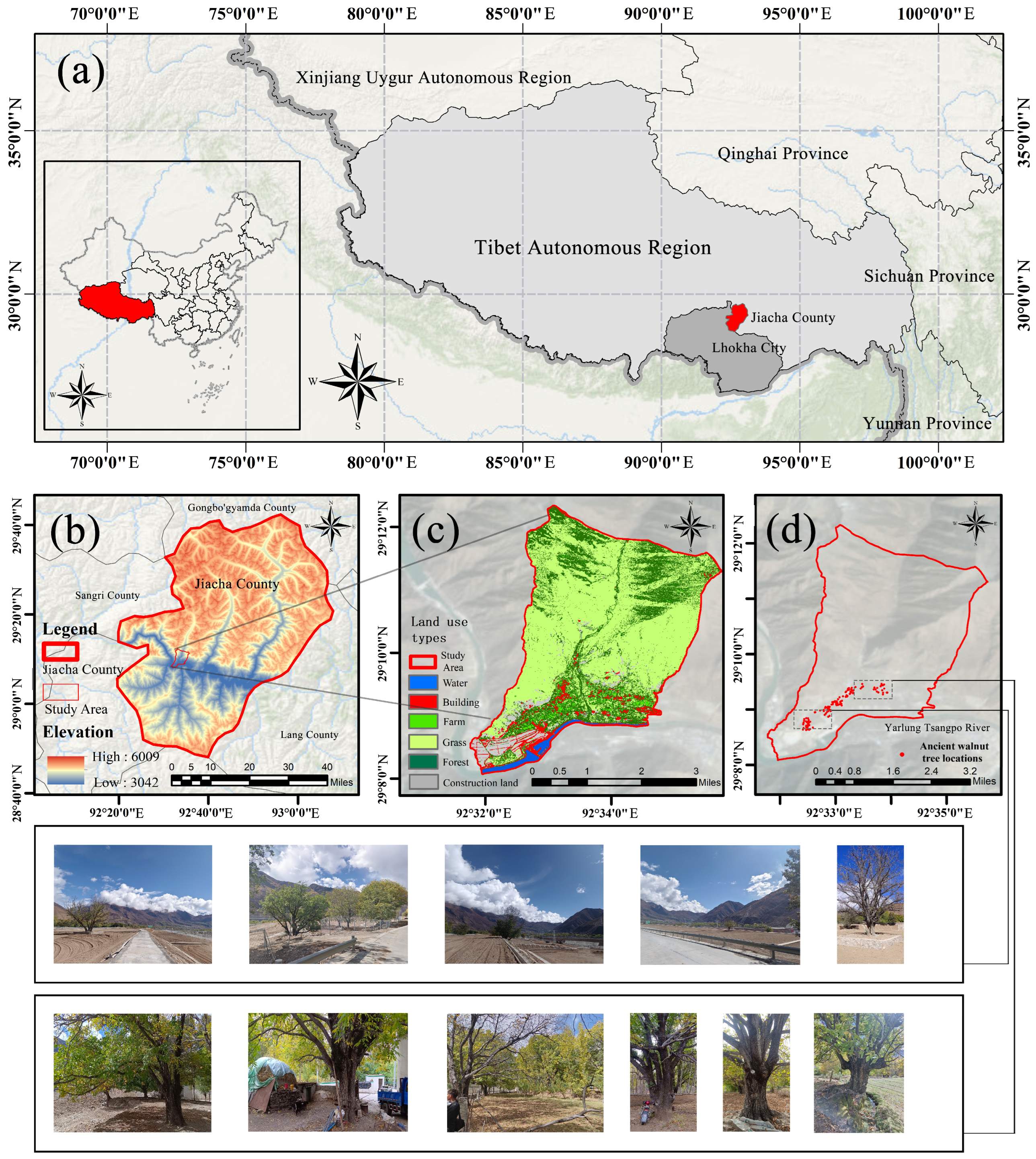
This study focused on four representative villages, Gamai, Gaji, Gadu, and Liegang (Figure 1). Agriculture remains the primary livelihood in these communities, and ancient walnut trees are widely distributed throughout the area. Notably, the region is home to a 2000-year-old “King Walnut Tree,” symbolizing the enduring coexistence between local residents and walnut cultivation. In recognition of its ecological and cultural significance, Gamai Village was included in the sixth batch of China’s National List of Traditional Villages in 2023.

2.1.2. Data Source and Processing

Information on ancient walnut trees was obtained from a joint census conducted by the Forestry and Grassland Bureau of Jiacha County and the Walnut Industry Research Institute of the Tibet Plateau at Yangtze University. In October 2024, 135 registered ancient walnut trees were surveyed within the study area (Figure 1d). To reduce subjective variability, all observers participated in a pre-survey calibration session that standardized indicator definitions, scoring thresholds, and representative examples. During field assessment, each tree was evaluated independently by two trained investigators, and any discrepancies were resolved through reassessment and consensus-based discussion; additionally, a subset of trees was rescored at a later date to verify consistency of interpretation. Indicator selection was initially informed by previous studies [45,46], and indicators exhibiting redundancy, insufficient discriminative power, or poor feasibility under field conditions were excluded during calibration. The final set of 20 indicators was retained to ensure comprehensive representation of the major structural dimensions of tree health—specifically crown architecture, foliage condition, and trunk integrity—while also incorporating remotely sensed metrics that capture habitat stressors relevant to the high-altitude village environment.
Geospatial vector data were obtained from the National Platform for Common Geospatial Information Services (Tianditu), provided by the Ministry of Natural Resources of China. Sentinel-2A Level-2A imagery acquired on 2 April 2025 was downloaded from the ESA Copernicus Data Hub (https://www.copernicus.eu/en/access-data/conventional-data-access-hubs, accessed on 23 July 2025). For image compositing, three of the ten Sentinel-2A spectral bands available at 10 m spatial resolution (B2–blue, B3–green, and B4–red) were selected because they provide superior separability among vegetation, bare soil, and built-up surfaces, while avoiding redundancy introduced by the remaining bands [47,48]. Image preprocessing (radiometric correction, geometric rectification, projection transformation, and clipping) was carried out in ArcGIS 10.7. Land-use classification was then performed using supervised Maximum Likelihood Classification (MLC), which assigns pixels to the most probable class based on class-specific mean vectors and covariance matrices [49,50]. Cross-validation was applied to minimize overfitting, and the resulting classified raster was used to calculate the area of each land-use category (Figure 1c).
For the RSEI and the Normalized Difference Vegetation Index (NDVI), Landsat 8 OLI/TIRS imagery acquired on 18 June 2025, with less than 5% cloud cover, was downloaded from the USGS Earth Explorer platform (https://earthexplorer.usgs.gov, accessed on 29 July 2025). Radiometric calibration, Flaash atmospheric correction, image mosaicking, and clipping were performed in ENVI (v5.6; NV5 Geospatial, Boulder, CO, USA), followed by raster calculations in ArcGIS (v10.7; Esri Inc., Redlands, CA, USA) to generate the final datasets (Table 1). Among these, OLI refers to the Operational Land Imager, a multispectral sensor onboard the Landsat-8 platform, which was utilized in this study to derive RSEI and NDVI.

2.2. Development of the Health Evaluation Model for Ancient Walnut Trees

2.2.1. Selection of Health Evaluation Indicators

Tree health is influenced by a combination of intrinsic attributes and extrinsic drivers that collectively reflect natural processes and anthropogenic pressures. To establish a comprehensive and scientifically robust evaluation framework, multiple dimensions were integrated. Based on structural and morphological characteristics, three primary indicators—Overall Condition (OC), Leaf Health (LH) and Trunk Health (TH)—were defined to provide a holistic assessment of tree vitality. For the OC dimension, four secondary indicators were selected: Tree Vigor (TV), Tree Inclination (TI), Biotic Damage (BD), and Environmental Stress (ES). Leaf Health (LH) was characterized using Crown Structure (CS), Leaf Color (LC), Major Branch Damage (MBD), and Apical Shoot Dieback (ASD). Trunk Health (TH) was assessed using Trunk Cavities (TC), Trunk Damage (TD), Bark Necrosis (BN), and Hollow Trunk (HT). To capture external pressures, four Anthropogenic Disturbance (AD) indicators—Human Activity Intensity (HAI), Land Surface Imperviousness (LSI), Land-use Type (LUT), and Distance to Roads/Buildings (DRB)—were incorporated. External Habitat Condition (EHC) was represented by four environmental indices: NDVI, RSEI, light availability (LA), and neighboring vegetation competition (NVC). Together, these indicators enabled an integrated evaluation of internal physiological status and external ecological constraints affecting tree health.
TV reflects the integrated physiological performance of the crown, leaves, and trunk. TI denotes trunk leaning caused by external forces such as wind, solar asymmetry, or anthropogenic cutting. BD incidence indicates pathogenic or insect infestation, with severity serving as a direct measure of health decline [51]. ES accounts for shading from neighboring trees or buildings and spatial constraints imposed by roads or debris, thereby reflecting the degree of external disturbance [52]. CS describes canopy fullness [53], while LC reflects photosynthetic activity and efficiency. MBD and ASD represent structural deterioration caused by natural senescence or human interference. TC disrupts nutrient transport between above- and below-ground compartments, weakening structural stability. TD, BN and HT further impair physiological function, collectively serving as strong indicators of aging and vitality loss [54].
AD was quantified using LUT and LSI, while DRB provided a spatial measure of construction-related impacts. NDVI and RSEI were employed to represent vegetation vigor and overall ecosystem quality, whereas LC and NVC reflected habitat pressures.

2.2.2. Tree Health Evaluation Indicators

Evaluation criteria were established with reference to previous studies and standardized guidelines, and subsequently adapted to the walnut tree health assessment framework [55,56,57,58]. Seventeen key indicators were classified into five ordinal levels and scored on a scale from 0 to 4, where a score of 4 indicated optimal health and a score of 0 represented the poorest condition (Table 2).

2.2.3. Determination of Indicator Weights

The structural equation model (SEM) employed in this study comprises two components: the measurement model [Equations (1) and (2)] and the structural model [Equation (3)]. The measurement model delineates the associations between latent constructs and their observed indicators, whereas the structural model specifies the directional relationships among the latent constructs themselves. The general formulations of these two components are presented as follows:
X = ΛXξ + δ
Y = ΛYη + ε
η = +Гξ + ζ
where X and Y denote the vectors of exogenous and endogenous observed variables, respectively; ΛX and ΛY represent the factor loading matrices; δ and ε are the measurement errors; ξ and η denote the exogenous and endogenous latent variables, respectively; Γ represents the effects of exogenous latent variables on endogenous latent variables; and ζ is the disturbance term. In this study, no directed paths were specified among endogenous latent variables; therefore, the path matrix B was fixed to zero to avoid model misspecification.
The SEM was statistically identified under standard confirmatory factor modeling principles. Each latent construct was measured by at least three observed indicators, ensuring local identification, and one factor loading per latent variable was fixed to unity to establish the measurement scale. Model identification was further confirmed by the fact that the number of known sample moments exceeded the number of freely estimated parameters, yielding positive degrees of freedom and thereby rendering the model over-identified and statistically testable. This identification strategy follows established SEM methodological guidelines [59,60,61].
SEM analysis was conducted in five stages: (i) theoretical model construction, (ii) hypothesis formulation, (iii) assessment of construct reliability and validity, (iv) evaluation of model fit, and (v) model respecification when necessary. Model estimation was performed using the maximum likelihood method in AMOS 26.0 (IBM Corp., Armonk, NY, USA).
  • Theoretical model construction
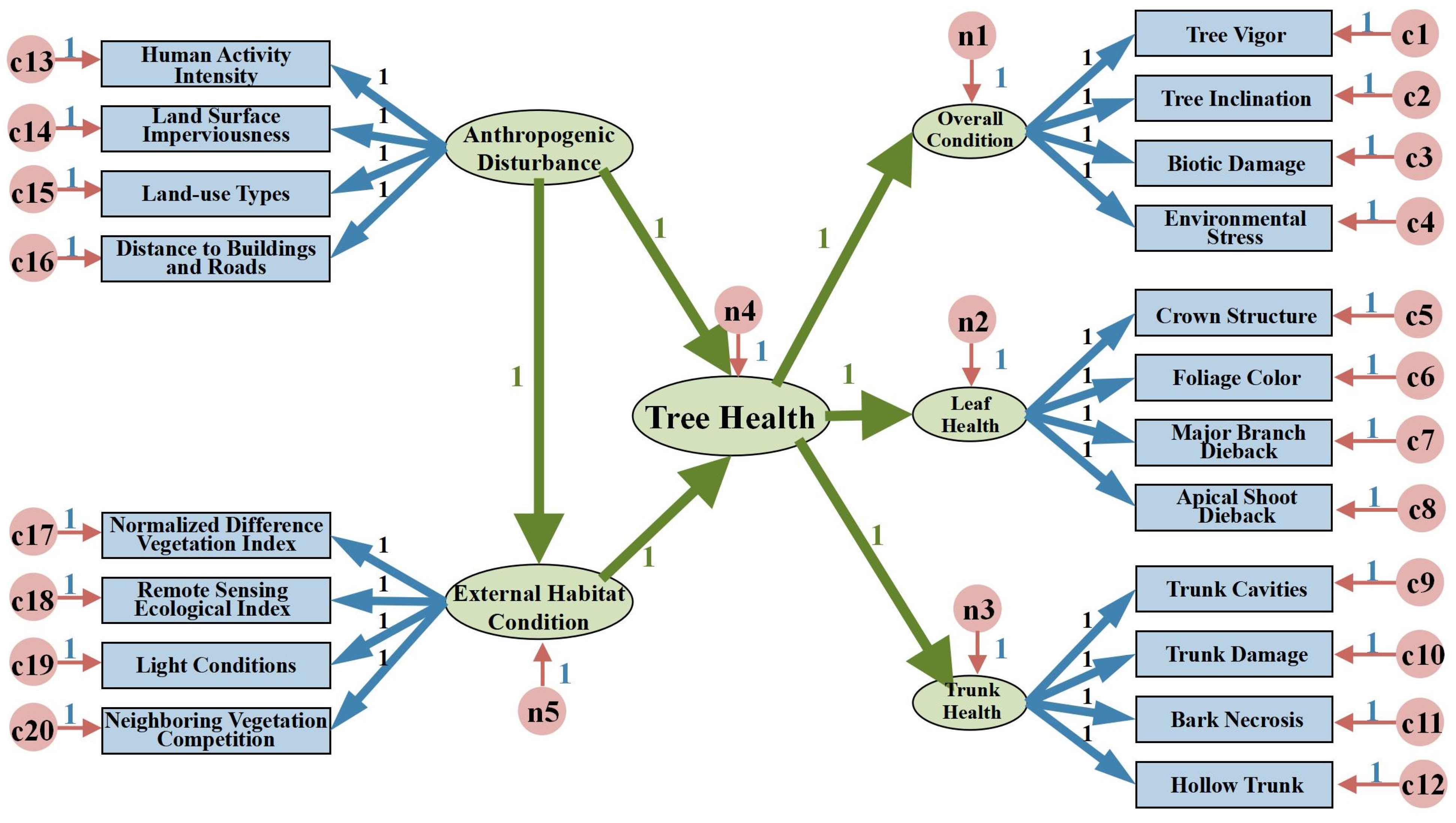
Tree Health was defined as the sole endogenous latent construct in the structural model. To maintain both conceptual coherence and statistical rigor, tree health was specified as a second-order reflective latent variable, represented by three first-order latent factors: Overall Condition (OC), Leaf Health (LH), and Trunk Health (TH). Each first-order construct was measured through multiple observed indicators. Specifically, OC was assessed using indicators such as tree vigor and crown morphology; LH was represented by foliage coloration and branch dieback; and TH was characterized by trunk damage, cavity presence, and bark condition. Two exogenous latent variables, Anthropogenic Disturbance (AD) and External Habitat Condition (EHC), were hypothesized to exert direct influences on tree health, with AD expected to have a negative effect and EHC a positive one. This model specification ensured consistency between theoretical constructs and statistical estimation, thereby minimizing risks of theoretical–statistical misalignment. The conceptual framework is illustrated in Figure 2.
  • Model hypotheses
Based on previous studies of ancient tree health and the ecological characteristics of walnut trees, the following hypotheses were formulated (Table 3).
  • Reliability and validity testing
Internal consistency was evaluated using Cronbach’s alpha (α > 0.7 indicating satisfactory reliability) [62]. Sampling adequacy was examined through the Kaiser–Meyer–Olkin (KMO) statistic, where values above 0.5 were considered acceptable, 0.5–0.7 moderate, 0.7–0.8 good, 0.8–0.9 very good, and greater than 0.9 excellent [63]. All statistical analyses were performed using IBM SPSS Statistics 22.0 (IBM Corp., Somers, NY, USA).
  • Model fit evaluation
Confirmatory factor analysis was conducted to assess the overall goodness of fit of the model. Four key indices were used: the chi-square to degrees of freedom ratio (χ2/df, denoted as NC), root mean square error of approximation (RMSEA), Tucker–Lewis Index (TLI), and comparative fit index (CFI). An NC value between 1 and 3 indicated an excellent fit, whereas values between 3 and 5 were considered acceptable [60]. An RMSEA below 0.05 suggested a close fit, while values between 0.05 and 0.08 indicated a reasonable fit [64]. TLI and CFI values greater than 0.9 reflected strong model adequacy, and values above 0.8 were deemed acceptable [65].
R MSEA = F 0 d f = m a x F ML d f 1 N 1 , 0
T L I = χ N 2 d f N χ T 2 d f T χ N 2 d f N 1
C F I = 1 m a x χ T 2 d f T , 0 m a x χ N 2 d f N , 0
where F0 denotes the population discrepancy function value; df represents the model’s degrees of freedom; FML is the value of the maximum likelihood estimation function; N refers to the sample size; χ N 2 is the chi-square value of the null model; χ T 2 is the chi-square value of the hypothesized model; d f N represents the degrees of freedom of the null model; and d f T denotes the degrees of freedom of the hypothesized model.
  • Model modification
If the hypothesized model did not adequately fit the observed data, adjustments were performed based on the modification indices (covariance, variance, and regression weights) provided by AMOS. All modifications were theoretically justified to ensure conceptual validity. Each revised model was subsequently re-evaluated through an iterative process until the final model achieved both statistical robustness and theoretical coherence.

2.2.4. Comprehensive Health Scoring

The comprehensive health index (S) for each tree was computed as follows:
S = i = 1 m W i A i
where Wi denotes the weight of the i-th indicator, Ai represents its assigned score, and m is the total number of indicators.
To categorize tree health status, K-means clustering was applied to the 135 surveyed ancient walnut trees. The reliability of the clustering outcomes was subsequently validated using Fisher’s linear discriminant analysis, ensuring robust classification consistency and accuracy.

2.3. Model Indicator Extraction and Composite Index Construction

2.3.1. RSEI and NDVI

The RSEI integrates multiple ecological dimensions, including vegetation vigor, soil moisture, surface dryness, impervious surface extent, and LST. It has been widely employed to assess regional ecological quality [10,23]. In this study, the NDVI was used as an indicator of greenness; the normalized difference built-up and soil index (NDBSI), derived from the Soil Index (SI) and the index-based built-up index (IBI), represented surface dryness; the tasseled cap wetness component (WET) quantified soil and vegetation moisture; and LST reflected the thermal condition [66,67]. Accordingly:
RSEI = f Greenness , Wetness , Heat , Dryness
where greenness denotes vegetation vigor and canopy density, wetness represents surface moisture content, heat indicates land surface temperature, and dryness characterizes the degree of surface aridity or bare soil exposure. In the context of remote sensing, the RSEI can therefore be expressed as:
RSEI = f NDVI ,   WET ,   LST ,   NDBSI
where NDVI, Wet, LST, and NDBSI denote the vegetation index, the surface moisture component, the land surface temperature, and the normalized difference built-up and soil index (NDBSI), respectively.
  • Greenness (NDVI) reflects biomass, leaf area index, and canopy cover, calculated as:
NDVI = ρ NIR ρ Red ρ NIR + ρ Red
where pNIR and pRed denote the reflectance in the near-infrared and red spectral bands, respectively, The NDVI ranges from −1 to 1,
  • Wetness (WET) was derived from the tasseled cap transformation for Landsat-8 OLI surface reflectance, using the sensor-specific coefficients proposed by Baig et al. [68]:
Wet = 0.1511 p Blue + 0.1973 p Green + 0.3283 p Red + 0.3407 p NIR 0.7117 p SWIR 1 0.4559 p SWIR 2
where pBlue, pGreen, pRed, pNIR, pSWIR1 and pSWIR2 denote the reflectance of the blue, green, red, near-infrared, and the first and second shortwave infrared bands, respectively.
  • The heat index (LST) was represented by LST. Numerous studies worldwide have retrieved LST from satellite imagery [69,70,71]. In particular, Vineesha Singh (2017) proposed an automated algorithm for LST mapping using Landsat 8 data [72]. The data processing steps were as follows:
1.
First step: Conversion to TOA Radiance
Thermal infrared sensor (TIRS) data were converted to spectral radiance (Lλ) using the radiance rescaling factors provided in the metadata file, as expressed by the following equation:
L λ = M L Q cal + A L
where Lλ = TOA spectral radiance (Watts/(m2 × sr × μm)), ML = Band-specific multiplicative rescaling factor from the metadata (RADIANCE_MULT_BAND_x, where x is the band number), AL = Band-specific additive rescaling factor from the metadata (RADIANCE_ADD_BAND_x, where x is the band number), and Qcal = quantized and calibrated standard product pixel values (DN).
2.
Second step: Conversion to At-Satellite Brightness Temperature
The TOA spectral radiance (Lλ) was converted to brightness temperature (TB) using the thermal constants (K1 AND K2) provided in the metadata file, as expressed by the following equation:
T B = K 2 I n   K 1 L λ + 1 273.15
where TB = At-satellite brightness temperature (K), Lλ = Top of Atmospheric (TOA) spectral radiance (Watts/(m2 × sr × μm)), K1 = Band-specific thermal conversion constant from the metadata (K1_CONSTANT_BAND_x, where x is the thermal band number), and K2 = Band-specific thermal conversion constant from the metadata (K2_CONSTANT_BAND_x, where x is the thermal band number)
3.
Third step: Calculation of NDVI value
The NDVI was estimated from the OLI sensor’s optical bands after stacking Band 4 and Band 5, using the algorithm presented in Equation (10):
4.
Fourth step: Calculation of Pv
Proportion Vegetation: Pv was estimated using NDVI Threshold method.
P v = NDVI N D V I min N D V I max N D V I min 2
5.
Fifth step: Calculation of Emissivity value step
Deriving Land surface emissivity (LSE):
ε = 0.004 P v + 0.996
6.
Sixth step: Estimation of LST
LST: To derive LST, it is first necessary to calculate the LSE of the area.
LST = BT 1 + w BT ρ ln ε
where BT is the satellite brightness temperature (K); λ is the wavelength of emitted radiance (m); ρ = h·c/σ (1.438 × 10⁻² m·K), where h is the Planck constant (6.626 × 10⁻³⁴ J·s), k is the Boltzmann constant (1.38 × 10⁻²³ J·K−1) and c is the speed of light (2.998 × 10⁸ m·s−1).
  • Dryness (NDBSI):
  • Calculated as the mean of SI and IBI:NDBSI = (IBI + SI)/2,
IBI = 2 ρ S W I R 1 ρ NIR ρ Green 2 ρ S W I R 1 + ρ NIR ρ Green
SI = ρ SWIR 1 + ρ Red ρ NIR + ρ Blue ρ SWIR 1 + ρ Red + ρ NIR + ρ Blue
where pBlue, pGreen, pRed, pNIR and pSWIR1 denote the reflectance of the blue, green, red, near-infrared, and the first shortwave infrared bands, respectively.
PCA was applied to integrate the four standardized indicators, NDVI, WET, LST, and NDBSI. Prior normalization eliminated dimensional inconsistencies and minimized the influence of outliers. The initial ecological index (RSEI0) was derived from the first principal component and subsequently rescaled to a range of 0–1:
N I i = I i I m i n I m a x I m i n
where N I i denotes the normalized value of the indicator, ranging from 0 to 1. I i represents the value of the indicator at pixel i, while I m a x and I m i n present the maximum and minimum values of the indicator, respectively.
PCA was conducted using the normalized indicators, and the resulting principal components were subsequently normalized to ensure comparability across variables.
R S E I 0 = 1 P C 1 f Wet , NDVI , LST , NDBSI
R S E I = R S E I 0 R S E I 0 , min R S E I 0 , max R S E I 0 , min
where PCA denotes the Principal Component Analysis; RSEI0 represents the initial ecological index; and RSEI presents the constructed Remote Sensing Ecological Index, with values ranging from 0 to 1. Higher RSEI values indicate better overall ecological quality.

2.3.2. HAI

HAI was quantified from a landscape ecology perspective, wherein anthropogenic processes reduce the natural attributes of different land-cover types [26,27]. The disturbance coefficients were interpreted as representing relative gradients of anthropogenic modification rather than precise numerical estimates. Accordingly, the HAI values serve comparative rather than absolute purposes, and a formal sensitivity or uncertainty analysis was not required within the current exploratory framework. On this basis, HAI was defined as follows:
HAI = i = 1 n A i P i T A
where Ai denotes the area of landscape type i, TA represents the total area, and Pi is the AD coefficient. Higher HAI values indicate more intense human disturbance and greater ecological stress.

2.4. Correlation Analysis

To investigate the relationships between tree health status and its influencing factors, correlation analysis was performed using IBM SPSS Statistics 22.0 (IBM SPSS, Somers, NY, USA) [73]. External drivers (e.g., AD and EHC) and intrinsic tree attributes (e.g., OC, LH, and TH) were analyzed in relation to the health assessment scores. As the sampled trees are spatially distributed, spatial dependence among observations may occur; thus, the correlations are interpreted as exploratory associations rather than strict spatially independent inferences. Nevertheless, the analysis offers meaningful diagnostic insight into the principal drivers of tree health and supports the development of targeted conservation and management strategies.

3. Results

3.1. Comprehensive Evaluation of RSEI

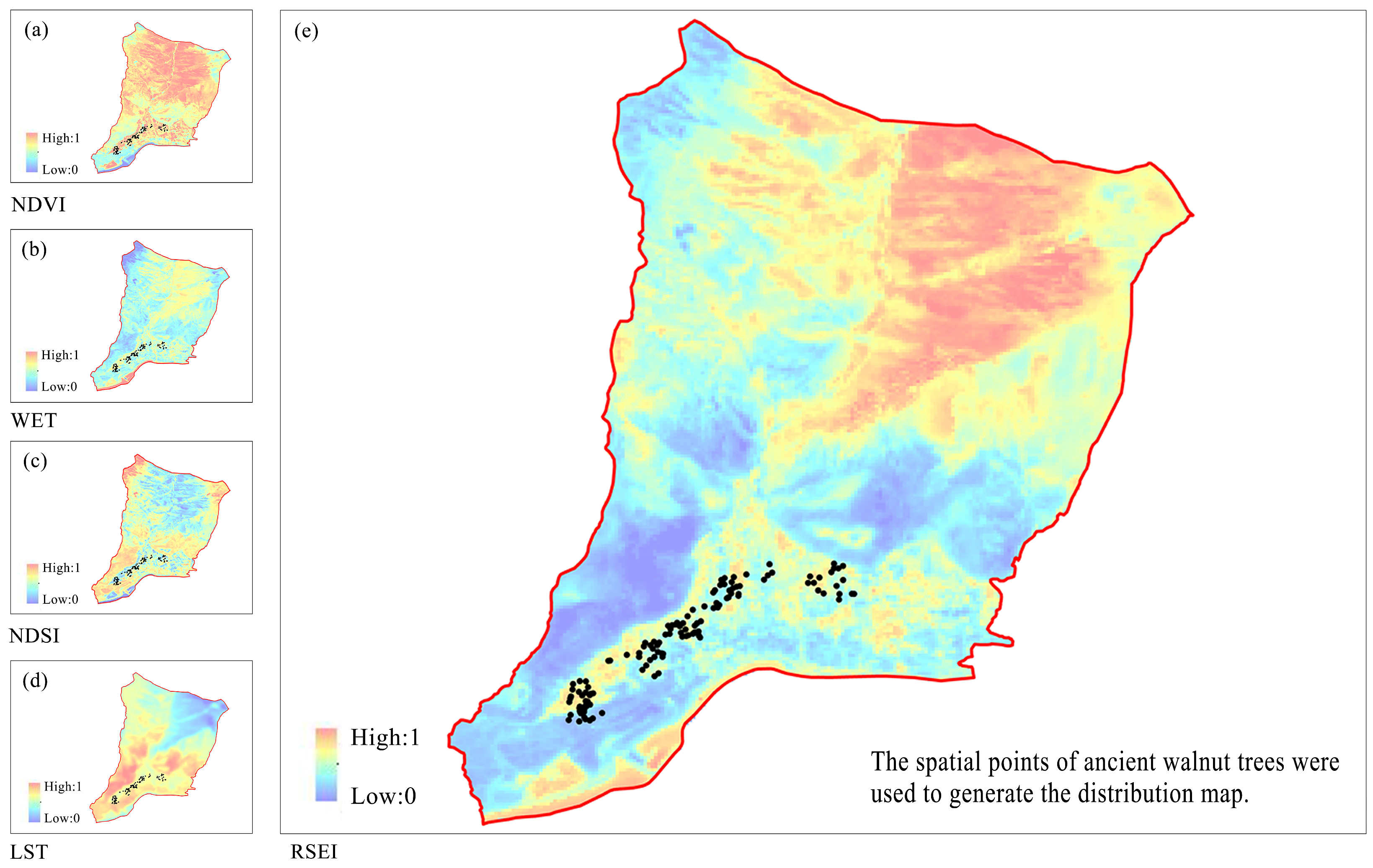
Table 4 presents the PCA results of the RSEI for the new study area in 2025. In PC1, the greenness indicator (NDVI) and the WET exhibit positive loadings, whereas the dryness indicator (NDBSI) and the heat indicator (LST) show negative loadings. This pattern aligns with the ecological principle that greenness and wetness contribute positively to environmental quality, while dryness and heat exert negative effects. Given that the eigenvalue contribution rate of PC1 is approximately 62%, insufficient to comprehensively capture the variance across all indicators, and considering the unique characteristics of the plateau environment, the eigenvalue contributions of PC1 through PC3 were integrated to improve accuracy and minimize error. Using ArcGIS 10.7, the three principal components (PC1, PC2, and PC3) were weighted by coefficients of 0.63, 0.23, and 0.14, respectively, for raster-based computation. This integrated approach provided a more scientifically robust and reasonable representation of regional ecological quality. The resulting spatial distribution map of ecological environmental quality was subsequently generated (Figure 3). Furthermore, using ArcGIS 10.7, ancient-tree point data were overlaid with the RSEI and NDVI layers to quantitatively extract the corresponding RSEI and NDVI values for each ancient tree.

3.2. HAI and Its Spatial Distribution

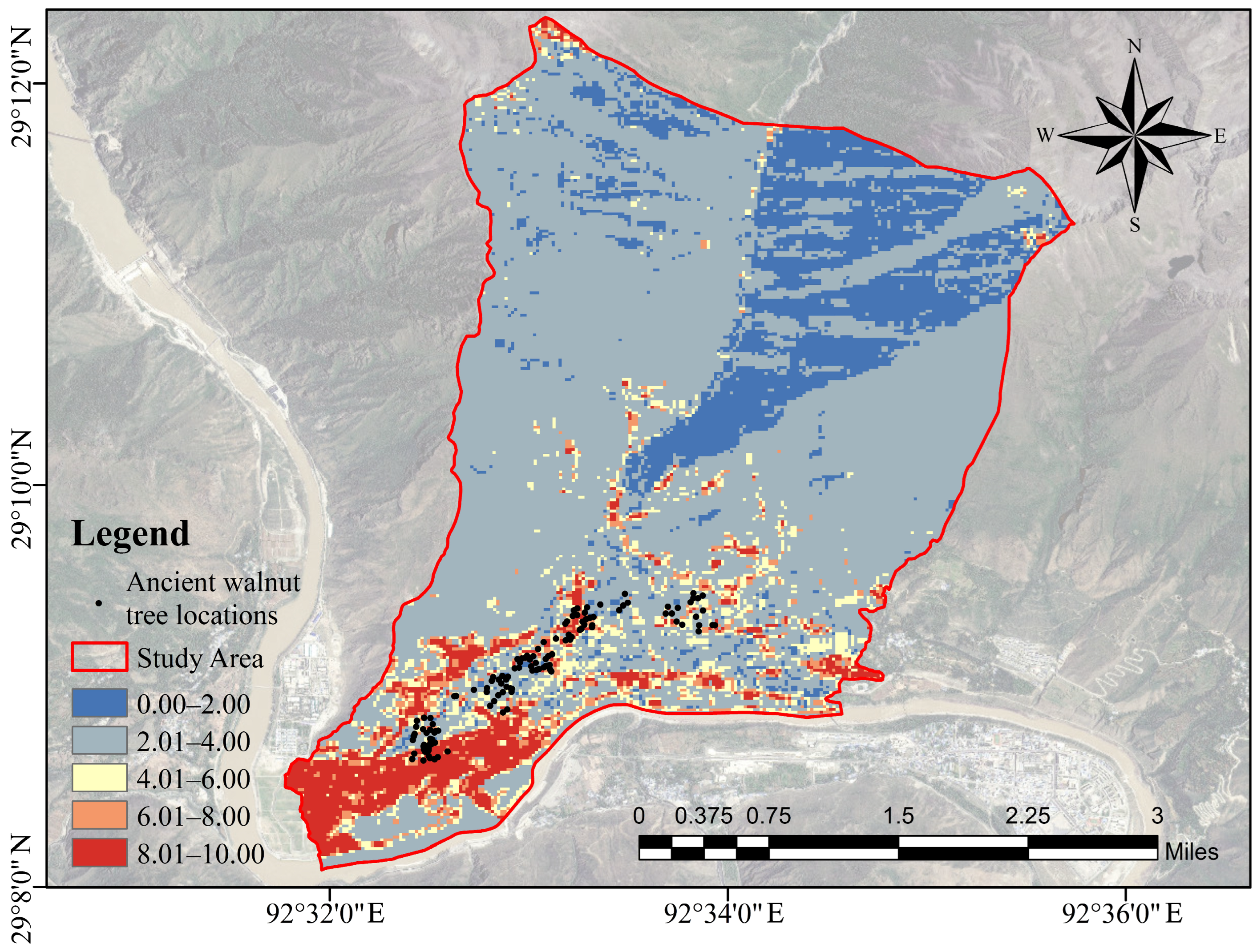
Given the relatively small spatial scale of the village-level study area, the determination of human impact intensity coefficients for various land-use types was based on previous studies. Land use was classified into three categories: (1) unused layer, comprising unused land; (2) low-use layer, including grassland, forest, and water bodies; and (3) transformed/developed layer, encompassing cropland, bare land, and construction land. A 10-point scale was adopted to assign human impact intensity coefficients to each land-use type, with higher values indicating stronger human activity or development intensity. The corresponding coefficients are presented in Table 5. Considering that the study area contains a substantial proportion of bare land subjected to intensive construction and development activities, the bare land category was assigned a coefficient value of 9.
For the quantitative assessment of HAI, land-use data of the study area were first utilized to calculate the overall characteristics of human disturbance based on the formula and coefficients presented in Table 5. Considering the spatial resolution of satellite imagery, the scale of the study area, the size of landscape patches, and the feasibility of analysis units, the Fishnet tool in ArcGIS 10.7 was employed to divide the study area into a uniform vector grid of 50 m × 50 m. Using spatial analysis techniques, the average HAI value was computed for each grid cell, thereby deriving the spatial distribution characteristics of baseline human disturbance at the grid scale. Subsequently, the calculated HAI values were classified into five levels using an equal-interval classification scheme (2-unit intervals), which is a widely applied method in ecological and spatial analyses [74]. The five disturbance categories—low (0 < HAI ≤ 2), relatively low (2 < HAI ≤ 4), moderate (4 < HAI ≤ 6), relatively high (6 < HAI ≤ 8), and high (8 < HAI ≤ 10)—describe a relative gradient of anthropogenic influence rather than absolute statistical thresholds. This equal-interval classification scheme enables clear visualization of spatial variation in disturbance intensity and supports spatially explicit mapping of AD patterns, thereby highlighting the heterogeneity of anthropogenic pressures across the study area (Figure 4).
As illustrated in Figure 4, the study area is generally subject to strong anthropogenic influence, though notable spatial heterogeneity exists across subregions. (1) Central village core: This area features relatively flat terrain and favorable hydrothermal conditions, supporting a broad distribution of walnut trees. Land-use Types are dominated by forest, farmland, and grassland, with only scattered construction land. Consequently, land-use coefficients are low, and human disturbance intensity remains at a relatively low level. (2) Southern Yarlung Tsangpo River bank: Due to hydropower development and the construction of major infrastructure such as the Lalin Railway, original land-use types have been extensively altered and converted into bare or construction land. The associated disturbance coefficients are high, resulting in strong human disturbance. (3) Northern sector: Characterized by natural mountainous terrain primarily covered by grassland and forest, this region exhibits low land-use coefficients and well-preserved landscape patches. Overall, disturbance intensity here is the lowest among the three sectors.

3.3. Health Assessment Framework for Ancient Walnut Trees

3.3.1. Model Construction

  • Reliability and validity of indicator data
Reliability and factor analyses (Table 6) indicated strong internal consistency and sampling adequacy across the latent constructs. All three latent variables exhibited Cronbach’s alpha values exceeding 0.8, confirming high reliability, while KMO values for the seven observed variables were above 0.7, indicating satisfactory sampling adequacy. Collectively, these results demonstrate the dataset’s robust reliability and construct validity, validating its suitability for modeling the health status of ancient walnut trees.
  • Model fit
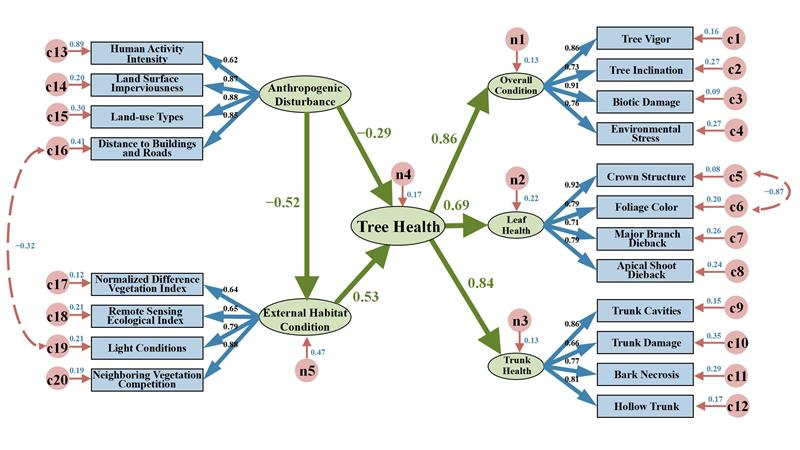
As shown in Table 7, the initial theoretical model exhibited a poor fit, with an RMSEA value of 0.115, exceeding the acceptable threshold of 0.08. Following model refinement, the goodness-of-fit indices improved substantially, yielding NC = 1.372, RMSEA = 0.053 (<0.08), TLI = 0.956, and CFI = 0.962. These values indicate that the revised model achieved an excellent overall fit to the observed data, confirming its statistical robustness and theoretical adequacy [67].

3.3.2. Indicator Weight Determination

The revised structural path diagram (Figure 5) demonstrates that the latent variables OC, LH and TH, exhibited strong and positive loadings on tree health, with standardized coefficients of 0.86, 0.69, and 0.84, respectively. These results confirm the hypothesized positive causal relationships among the constructs.
As shown in Table 7, the measurement model met recognized criteria for reliability and construct validity. The majority of observed indicators exhibited high standardized loadings on their corresponding latent constructs, demonstrating that the selected variables adequately capture the conceptual dimensions of tree health.
Normalization of standardized loadings is commonly used to express the relative contributions of observed indicators under each latent variable in SEM applications. To enhance clarity, the normalized indicator weights are summarized in Table 8.
Briefly, among the three endogenous dimensions, Overall Condition and Trunk Health contributed more strongly to the latent construct of tree health than Leaf Health. At the indicator level, only a subset of variables accounted for most of the explanatory power. Indicators associated with structural integrity and vigor decline, such as biotic damage, trunk cavities, and tree vigor, exhibited comparatively higher weights, whereas leaf-related symptoms contributed less.
Among exogenous influences, land-use configuration and competitive interactions from surrounding vegetation were the strongest determinants, whereas generalized greenness indices (e.g., NDVI) had relatively minor contributions. Overall, these results indicate that ancient walnut health is primarily governed by structural deterioration and vigor impairment, with anthropogenic land-use pressure and neighborhood competition acting as key external controls.

3.3.3. Health Assessment Outcomes

K-means clustering categorized tree health into five distinct classes: healthy, sub-healthy, declining, severely declining, and near death. Fisher’s linear discriminant analysis (Table 9) effectively validated the robustness of this classification scheme. Among the 135 trees evaluated, 12 (8.89%) were classified as healthy, 36 (26.67%) as sub-healthy, 54 (40.00%) as declining, 29 (21.48%) as severely declining, and 4 (2.96%) as near death. Overall, approximately 30% of the trees were in relatively good condition (healthy + sub-healthy), while about 20% were in a state of critical decline.

3.4. Correlation Between Health and Influencing Factors

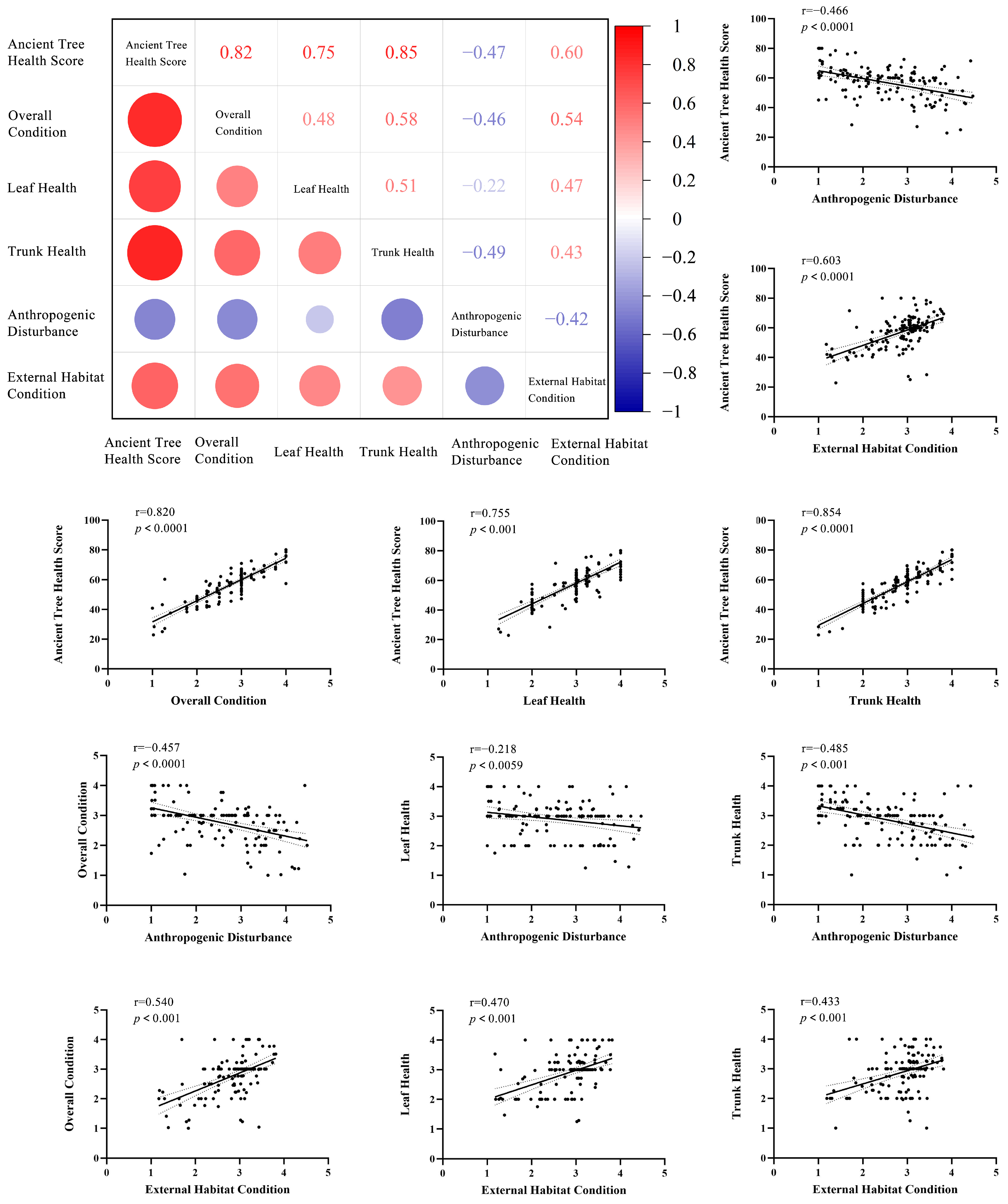
As shown in Table 10, both intrinsic (OC, LH, and TH) and extrinsic (AD and EHC) factors were significantly associated with overall tree health (p < 0.001). Among intrinsic factors Overall Condition (OC), Leaf Health (LH), and Trunk Health (TH) were all positively correlated with tree health (r = 0.820, 0.755, and 0.854, respectively). Notably, TH exhibited the strongest association, highlighting its role as a central physiological determinant of ancient walnut tree vitality (Table 11).
Among extrinsic factors, Anthropogenic Disturbance (AD) was negatively correlated with tree health (r = −0.466), whereas External Habitat Condition (EHC) was positively correlated (r = 0.603). These results align with previous studies. For instance, previous studies have reported that urban development often fragments ancient tree habitats and disrupts soils and root systems, thereby reducing longevity [74]. In contrast, favorable habitats characterized by intact vegetation, stable soil moisture, and buffered microclimates enhance tree resilience. Similarly, other studies have shown that ancient trees typically persist in relatively undisturbed, stable environments, such as parks, wooded pastures, or forest edges, further supporting the present findings [75].

4. Discussion

4.1. Performance of the SEM-Based Health Assessment

We evaluated 135 ancient walnut trees using an SEM. The goodness-of-fit indices (NC, RMSEA, TLI, and CFI) fell within acceptable ranges, indicating that the SEM adequately represents the observed data and satisfies the requirements for reliable health assessment. These results confirm the feasibility and scientific validity of the SEM-based framework as a robust alternative to conventional indicator-weighting methods, providing a transparent, theory-driven basis for evaluation and evidence-informed management.
Conventional weighting approaches often underutilize information contained in raw data and neglect inter-indicator dependencies. In contrast, SEM integrates prior knowledge with multivariate relationships, explicitly encodes hypothesized causal pathways, and produces a logically coherent path structure following model refinement. By coupling SEM with quantitative remote-sensing indicators (e.g., RSEI), the framework enhances interpretability and minimizes subjectivity in weight derivation. Overall, the revised model demonstrates strong fit to the data and is well-suited for operational health assessment of ancient walnut trees.

4.2. Interpretation of Weights and Key Drivers

As illustrated in Figure 6. Across the three health dimensions, Overall Condition (OC), Leaf Health (LH), and Trunk Health (TH) all showed significant positive correlations with tree health (r = 0.82, 0.76, and 0.85, respectively), with TH exerting the strongest influence. These correlations do not indicate causal dominance; rather, they reflect the tendency for structural integrity to co-vary with overall vitality. Trunk integrity is critical for hydraulic transport and mechanical stability; trees with few, well-healed cavities, continuous bark, and non-load-bearing internal hollows are able to maintain key ecosystem functions, including carbon storage, habitat provisioning, and aesthetic services [76]. In contrast, expanding cavities, advanced decay, and bark necrosis that extend into load-bearing zones disrupt nutrient transport, compromise structural stability, and precipitate sharp declines in overall health [77].
At the indicator level, Trunk Cavities, Hollow Trunk and Biotic Damage carried the highest weights, whereas Leaf Color (LC), Major Branch Damage (MBD) and Apical Shoot Dieback (ASD) were comparatively less influential. This pattern aligns with prior studies: trunk inclination significantly affected the health of 695 oaks [78]; trunk condition was pivotal in Brazilian urban heritage trees [79]; and dead branches, cavities, and mechanical damage were key indicators of decline in 3659 urban trees. Observed deviations among studies likely reflect differences in sample size, climate, and species morphology [80,81].
Among Anthropogenic Disturbance (AD) indicators, Land-use Type (LUT) carried the greatest weight, whereas Remote-sensing-based Human Activity Intensity (HAI) contributed the least. Land-use mosaics integrate multiple disturbance pathways, including surface sealing, construction encroachment, tourism, and agricultural expansion, which can alter root-zone structure, reduce soil water retention, and fragment habitats. Consequently, their explanatory power often surpasses that of single disturbance metrics [82]. Indeed, land-use change is a dominant driver of forest stability and tree survival, frequently exerting greater influence than individual pressure variables [83].
Within External Habitat Condition (EHC) indicators, Normalized Difference Vegetation Index (NDVI) had the highest weight, highlighting the critical role of vegetation cover and biomass as foundational support for ancient tree vitality. NDVI has long been recognized as a reliable proxy for habitat quality and primary productivity [84]. By contrast, light availability exhibited the lowest weight, likely because mature canopy trees efficiently capture sunlight, and marginal light effects are often outweighed by neighbor competition and below-ground resource limitations [85].

4.3. Management Implications for Ancient Walnuts

Discriminant analyses indicate that the population of ancient walnut trees is generally in poor health: only 8.89% of trees were classified as healthy and 26.67% as sub-healthy, whereas 40.00% and 21.48% fell into the declining and severely declining categories, with 2.96% near death. The population is thus dominated by compromised health classes, consistent with global evidence of tree degradation under intense human pressure and habitat fragmentation [86].
Field observations corroborate these findings. Healthier trees typically exhibit strong vigor, full crowns, dense foliage, and intact stems, with minimal pest or disease incidence and low levels of AD. In contrast, many trees, though not necessarily the oldest, display sparse foliage, widespread twig dieback, severe trunk hollows, and exposed roots, patterns closely associated with construction-related vegetation removal and habitat loss, which exacerbate drought and soil erosion stress [87,88].
Ancient tree health arises from the interaction of biotic factors (e.g., parasitism, competition, and pests) and abiotic factors (e.g., wind, drought, and flooding). Walnuts require specific edaphic conditions, a warm, moist climate and loose, fertile, well-drained, slightly acidic soils, so shifts in soil physicochemical properties can have pronounced effects on health [89]. Although rhizosphere metrics were not included in the present study, future research should integrate high-resolution soil monitoring to better capture soil–tree interactions. In addition to ecological conditions, socio-cultural dynamics may influence health outcomes. Observational studies in Tibetan and Himalayan contexts have reported that culturally valued trees may receive differential care, reduced disturbing activities, and preferential protection, which can indirectly buffer ecological stress [90,91]. Such effects have been documented in other regions where traditional practices lead to reduced disturbance around sacred trees or groves, thereby promoting longevity and structural stability [92,93]. Accordingly, active community participation and integration of local knowledge constitute promising pathways to enhance conservation effectiveness.
For the middle Yarlung Tsangpo region, our standardized framework can be directly operationalized. Field measurements, combined with model-derived weights, enable rapid scoring and risk classification, supporting precise and time-efficient interventions. We recommend the following strategies:
(1)
Habitat-centric management: Treat the tree and its immediate surroundings as an integrated micro-ecosystem and biodiversity micro-hotspot, addressing the current overemphasis on individual trees while neglecting site integrity.
(2)
Diagnostics focused on trunk integrity and foliage color: Employ non-destructive tools such as sonic tomography and ground-penetrating radar (GPR) to enhance objectivity and reliability.
(3)
Targeted restoration for low-scoring compartments: Apply structural pruning, eco-friendly cavity treatment, and root-zone aeration. Codify management standards, adopt multidisciplinary practices, legislate protective zones, and promote community awareness to ensure long-term conservation.
(4)
Limitations and future directions: Spatial scope, sample size, and indicator coverage were constrained, and some diagnostics retain subjective components. Advances in technology will improve measurement rigor. Future studies should refine class thresholds and integrate both ecological and cultural variables to design more precise, context-specific management strategies.
Overall, ancient walnuts in Tibetan traditional villages along the middle Yarlung Tsangpo are in a precarious state. Coordinated action across ecological, cultural, and technological dimensions is essential to achieve sustainable conservation and management.

5. Conclusions

Using Gamai and neighboring villages in Jiacha County (Tibet Autonomous Region) as case studies, this research integrated satellite-based remote sensing with a tree health assessment framework to evaluate ancient walnut trees at the fine scale of Tibetan traditional villages. By applying SEM, we quantified ecological conditions, HAI, and tree health, and analyzed the interactions between intrinsic and extrinsic drivers. The key conclusions are as follows:
(1)
We developed an SEM-based health risk assessment model for ancient walnut trees, with all fit indices meeting accepted statistical thresholds, demonstrating strong model reliability and suitability for operational evaluation. These results reflect patterns within the present dataset and spatial–temporal sampling frame.
(2)
Overall health status was moderate; however, trees located in construction-affected areas outside village cores exhibited substantially reduced vigor and pronounced structural decline. This pattern is consistent with the fitted model, in which disturbance-related indicators show higher weights and negative path coefficients, confirming that anthropogenic pressure is a significant determinant of declining tree health.
(3)
SEM analysis identified trunk condition as the most critical diagnostic indicator, reflecting its decisive role in structural integrity and physiological stability. This finding is consistent with theoretical expectations, though influenced by the inherent complexity of field-based structural assessment.
(4)
Tree Health is influenced by both intrinsic and extrinsic factors. Externally, health declined under increased Anthropogenic Disturbance (AD) but improved with better External Habitat Condition (EHC), with land-use change exerting both direct and indirect effects through habitat modification. Internally, indicators such as Hollow Trunk (HT) and Bark Necrosis (BN) showed strong correlations with health, underscoring tree vigor as a central integrative trait.
In summary, integrating SEM with modern remote-sensing indicators offers a rigorous, transparent, and scalable framework for evaluating ancient tree health. Implementing dynamic monitoring, prioritizing declining individuals, optimizing site conditions, and mitigating anthropogenic pressures are essential for effective conservation. Beyond walnut trees, the proposed framework provides valuable guidance for the assessment and sustainable management of other heritage trees and contributes to the cultural landscape conservation of Tibetan traditional villages. While both visual scoring and remotely sensed metrics carry inherent limitations, the consistent application of these methods preserves internal comparability. Future work incorporating multi-season imagery, expanded physiological measurements, and quantitative monitoring approaches would further enhance the generality of the findings and reduce methodological uncertainty.


Author Contributions

Conceptualization, Q.Z. and L.Q.; methodology, Q.Z.; software, Q.Z. and M.W.; validation, Q.Z., M.W. and L.Q.; formal analysis, Q.Z. and L.Q.; investigation, Q.Z. and S.B.; resources, W.Y. and S.B.; data curation, Q.Z. and M.W.; writing—original draft preparation, Q.Z.; writing—review and editing, Q.Z. and W.Y.; visualization, Q.Z. and L.Q.; supervision, M.W., W.Y. and L.Q.; project administration, S.B. and L.Q.; funding acquisition, L.Q. All authors have read and agreed to the published version of the manuscript.

Funding

This research received no external funding.

Data Availability Statement

Data are contained within the article.

Acknowledgments

We thank all the students who participated in this ancient tree research, the staff involved in ancient tree conservation, local residents, and everyone who supported our research efforts.

Conflicts of Interest

The authors declare no conflicts of interest.

References

  1. Ministry of Ecology and Environment of the People’s Republic of China. Regulations on the Protection of Ancient and Famous Trees. Available online: https://www.mee.gov.cn/zcwj/gwywj/202502/t20250206_1101763.shtml (accessed on 6 June 2025).
  2. Lindenmayer, D.B.; Laurance, W.F. The ecology, distribution, conservation and management of large old trees. Biol. Rev. 2017, 92, 1434–1458. [Google Scholar] [CrossRef]
  3. Blicharska, M.; Mikusinski, G. Old trees: Cultural value. Science 2013, 339, 904. [Google Scholar] [CrossRef]
  4. Gilhen-Baker, M.; Roviello, V.; Beresford-Kroeger, D.; Roviello, G.N. Old growth forests and large old trees as critical organisms connecting ecosystems and human health: A review. Environ. Chem. Lett. 2022, 20, 1529–1538. [Google Scholar] [CrossRef]
  5. Zheng, J.; Chen, Y.; Guan, L.; Ke, K.; Zhang, H.; Zhang, J.; Xiao, Y. Predicting the Age of Ancient Trees and the Factors Influencing Their Growth of Lychee Trees (Litchi chinensis). npj Herit. Sci. 2025, 13, 250. [Google Scholar] [CrossRef]
  6. Fritts, H.C. Tree Rings and Climate; Academic Press: New York, NY, USA, 1976. [Google Scholar]
  7. Gunn, B.F.; Aradhya, M.; Salick, J.; Miller, A.J.; Yang, Y.; Liu, L.; Hai, X. Genetic Variation in Walnuts (Juglans regia and J. sigillata; Juglandaceae): Species Distinctions, Human Impacts, and the Conservation of Agrobiodiversity in Yunnan, China. Am. J. Bot. 2010, 97, 660–671. [Google Scholar] [CrossRef] [PubMed]
  8. Jiacha County People’s Government. Jiachaxian Huo “Shijie Zui Da Guimo de Qiannian Hetaolin” Jilu Renzheng (Jiacha County Awarded the Record for the “World’s Largest Thousand-Year Walnut Forest”). 2013. Available online: https://web.archive.org/web/20240101/https://www.jiacha.gov.cn/xwzx/jcyw/202312/t20231218_128989.html (accessed on 8 June 2025).
  9. China Tibet Online. Exploring the Integration of Natural Beauty and Cultural Heritage in the Millennium Walnut Forest. 2024. Available online: http://ccpd.china.com.cn/2024-09/06/content_42910895.html (accessed on 6 September 2024).
  10. Wang, Q.; Yuan, W.; Qing, S.; Zhao, Z. Construction and application of a health assessment model for old Sophora japonica trees. J. Northwest For. Univ. 2023, 38, 115–122. (In Chinese) [Google Scholar]
  11. Ren, Y.; Zhou, T.; Li, H.; Xie, S.; Yin, Z. Research on the urban ecological environment pattern in the main urban area of Chongqing based on remote sensing and POI data. Prog. Geophys. 2021, 36, 766–778. (In Chinese) [Google Scholar] [CrossRef]
  12. Ru, Y.; Bao, X.; Wu, J.; Bai, Y.; Chen, H. Research progress in the health assessment of ancient and famous trees. Ecol. Environ. Sci. 2024, 5, 10. Available online: https://journals.nassg.org/index.php/ees-cn/article/view/3518 (accessed on 29 July 2025). (In Chinese).
  13. Liu, S.; He, X.; Li, J. The method of attribute weight in forest ecosystem health evaluation based on knowledge granularity. Chin. J. Ecol. 2014, 33, 1082–1088. (In Chinese) [Google Scholar] [CrossRef]
  14. Cao, X.; Wei, X.; Zhao, W.; Li, J. Evaluation of forest health based on structural equation model. Chin. J. Ecol. 2021, 40, 2635–2647. (In Chinese) [Google Scholar] [CrossRef]
  15. Weng, S.; Li, C.; Pang, R. Establishment of landscaping tree health assessment model using analytic hierarchy process. J. Northwest For. Univ. 2009, 24, 177–181. (In Chinese) [Google Scholar]
  16. Xie, Y.; Wu, H.; Huang, H.; Liu, J.; Wang, N.; Cao, J.; Zhang, Z. Ancient trees’ health evaluation in Beijing. For. Resour. Manag. 2012, 6, 71–75. (In Chinese) [Google Scholar] [CrossRef]
  17. Wang, Y.; Yu, Y.; Liu, Y.; Wang, K.; Zhou, X.; Wang, Y. Health assessment and influencing factors of Fraxinus pennsylvanica in Beijing core area. J. Zhejiang A&F Univ. 2022, 39, 1340–1349. [Google Scholar] [CrossRef]
  18. Liu, H.; Xu, W.; Yu, Y.; Wang, X.; Liu, W.; Wei, Z.; Chen, L.; Peng, D. An integrated approach for the assessment of ancient trees combining remote sensing and structural equation modeling. Forests 2025, 16, 703. [Google Scholar] [CrossRef]
  19. Fan, Y.; Chen, J.; Shirkey, G.; John, R.; Wu, S.R.; Park, H.; Shao, C. Applications of structural equation modeling (SEM) in ecological studies: An updated review. Ecol. Process. 2016, 5, 19. [Google Scholar] [CrossRef]
  20. Nandika, D.; Kusuma, H.; Kusumawardhani, D.T.; Rumiyati, E.; Karlinasari, L.; Siregar, I.Z. Health assessment of large and old trees in Ragunan Zoo, Jakarta. IOP Conf. Ser. Mater. Sci. Eng. 2020, 935, 012072. [Google Scholar] [CrossRef]
  21. Harris, R.W. Arboriculture: Integrated Management of Landscape Trees, Shrubs, and Vines; Prentice-Hall: Englewood Cliffs, NJ, USA, 1992. [Google Scholar]
  22. Li, X.; Song, L.; Ma, C.; Liu, W. Problems and countermeasures in the protection and management of ancient and famous trees. Land Green 2024, 11, 52–54. (In Chinese) [Google Scholar]
  23. Thorn, S.; Seibold, S.; Leverkus, A.B.; Michler, T.; Müller, J.; Noss, R.F.; Lindenmayer, D.B. The living dead: Acknowledging life after tree death to stop forest degradation. Front. Ecol. Environ. 2020, 18, 505–512. [Google Scholar] [CrossRef]
  24. Xu, H. A remote sensing index for assessment of regional ecological environmental changes. China Environ. Sci. 2013, 33, 889–897. (In Chinese) [Google Scholar]
  25. Xu, Y.; Xu, X.; Tang, Q. Human activity intensity of land surface: Concept, methods and application in China. J. Geogr. Sci. 2016, 26, 1349–1361. [Google Scholar] [CrossRef]
  26. Wen, Y. Preliminary discussion on quantitative evaluation method of human activity intensity. Impact Sci. Soc. 1998, 4, 56–61. (In Chinese) [Google Scholar]
  27. Magalhães, J.L.L.; Lopes, M.A.; de Queiroz, H.L. Development of a Flooded Forest Anthropization Index (FFAI) applied to Amazonian areas under pressure from different human activities. Ecol. Indic. 2015, 48, 440–447. [Google Scholar] [CrossRef]
  28. Su, C.; Fu, B.; Wei, Y.; Lü, Y.; Liu, G.; Wang, D.; Feng, X. Ecosystem management based on ecosystem services and human activities: A case study in the Yanhe watershed. Sustain. Sci. 2012, 7, 17–32. [Google Scholar] [CrossRef]
  29. Dodds, W.K.; Perkin, J.S.; Gerken, J.E. Human impact on freshwater ecosystem services: A global perspective. Environ. Sci. Technol. 2013, 47, 9061–9068. [Google Scholar] [CrossRef]
  30. Li, T.; Li, L.; Tang, M.; Deng, H. Heterogeneous Impacts of Human Activity Intensity on Regional Ecological Security Patterns: The Case of Southwest China. Land 2024, 13, 2172. [Google Scholar] [CrossRef]
  31. Wu, Y.; Qin, F.; Li, L.; Dong, X. Exploring Landscape Ecological Risk with Human Activity Intensity and Correlation in the Kuye River Basin. Front. Ecol. Evol. 2024, 12, 1409515. [Google Scholar] [CrossRef]
  32. Lam, T.Y.; Maguire, D.A. Structural Equation Modeling: Theory and Applications in Forest Management. Int. J. For. Res. 2012, 2012, 263953. [Google Scholar] [CrossRef]
  33. Bakshi, B.; Polasky, S.; Frelich, L.E. Using structural equation models (SEM) to link climate change, forest composition, deer, and outdoor recreation. Ecol. Model. 2024, 493, 110731. [Google Scholar] [CrossRef]
  34. Sun, Y.; Liu, S.; Shi, F.; An, Y.; Li, M.; Liu, Y. Spatio-temporal variations and coupling of human activity intensity and ecosystem services based on the four-quadrant model on the Qinghai–Tibet Plateau. Sci. Total Environ. 2020, 743, 140721. [Google Scholar] [CrossRef]
  35. Xu, M.; Zhao, W.; Yang, Y.; Wu, J.; Mukhtar, H. An improved estimation of remote sensing-based ecological index for tracking continuous changes in eco-environmental quality. Int. J. Digit. Earth 2024, 17, 2445625. [Google Scholar] [CrossRef]
  36. Zhang, K.; Feng, R.; Zhang, Z.; Deng, C.; Zhang, H.; Liu, K. Exploring the Driving Factors of Remote Sensing Ecological Index Changes from the Perspective of Geospatial Differentiation: A Case Study of the Weihe River Basin, China. Int. J. Environ. Res. Public Health 2022, 19, 10930. [Google Scholar] [CrossRef]
  37. Yin, D.; Cai, Y.; Li, Y.; Wang, L.; Chen, Q. Assessment of the Health Status of Old Trees of Platycladus orientalis L. Using UAV Multispectral Imagery. Drones 2024, 8, 91. [Google Scholar] [CrossRef]
  38. Yang, H.; Bai, Y.; Gao, W.; Lü, Q.; Gu, Q. Status and Spatial Distribution of Farmland Soil Nutrients in the “One River and Two Tributaries” Basin of Tibet. North. Hortic. 2023, 2, 72–79. (In Chinese) [Google Scholar]
  39. Pan, G. Preliminary Investigation Report on Excellent Walnut Resources in Jiacha County. North. Hortic. 2010, 1, 60–63. (In Chinese) [Google Scholar]
  40. McGranahan, G.H.; Leslie, C. Walnut. In Fruit Breeding; Badenes, M.L., Byrne, D.H., Eds.; Springer: New York, NY, USA, 2012; pp. 827–846. [Google Scholar]
  41. Wani, M.S.; Hussain, A.; Ganie, S.A.; Munshi, A.H.; Lal, E.P.; Gupta, R.C. Juglans regia—A review. Int. J. Latest Res. Sci. Technol. 2016, 5, 90–97. [Google Scholar]
  42. Wang, L.; Zhong, C.; Gao, P.; Liu, J.; Jia, J.; Zhang, S. Soil infiltration characteristics in agroforestry systems and their relationships with the temporal distribution of rainfall on the Loess Plateau in China. PLoS ONE 2015, 10, e0124767. [Google Scholar] [CrossRef]
  43. Gao, P.; Zheng, X.; Wang, L.; Liu, B.; Zhang, S. Changes in the soil bacterial community in a chronosequence of temperate walnut-based intercropping systems. Forests 2019, 10, 299. [Google Scholar] [CrossRef]
  44. Rehnus, M.; Mamadzhanov, D.; Venglovsky, B.I.; Sorg, J.-P. The importance of agroforestry hay and walnut production in the walnut-fruit forests of southern Kyrgyzstan. Agrofor. Syst. 2013, 87, 1–12. [Google Scholar] [CrossRef]
  45. Chen, J. Research on the Health Evaluation of Ancient Trees in Beijing. Master’s Thesis, Beijing Forestry University, Beijing, China, 2014. (In Chinese). [Google Scholar]
  46. Scarrow, R. Risk factors for mortality in individual trees. Nat. Plants 2021, 7, 1521. [Google Scholar] [CrossRef] [PubMed]
  47. European Space Agency (ESA). Sentinel-2 User Handbook; ESA Standard Document, Issue 1, Rev. 2, 2015. Available online: https://sentinels.copernicus.eu/documents/247904/685211/Sentinel-2_User_Handbook (accessed on 1 May 2025).
  48. Pesaresi, M.; Corbane, C.; Julea, A.; Florczyk, A.J.; Syrris, V.; Soille, P. Assessment of the Added-Value of Sentinel-2 for Detecting Built-Up Areas. Remote Sens. 2016, 8, 299. [Google Scholar] [CrossRef]
  49. Lillesand, T.M.; Kiefer, R.W.; Chipman, J.W. Remote Sensing and Image Interpretation, 7th ed.; Wiley: Hoboken, NJ, USA, 2015. [Google Scholar]
  50. Topaloğlu, R.H.; Sertel, E.; Musaoglu, N. Assessment of Classification Accuracies of Sentinel-2 and Landsat-8 Data for Land Cover/Use Mapping. Int. Arch. Photogramm. Remote Sens. Spat. Inf. Sci. 2016, XLI-B8, 1055–1059. [Google Scholar] [CrossRef]
  51. Ye, Y.; Yu, Y.; Peng, S.; Shen, X.; Hou, Y.; Zhang, S.; Liang, Y. Evaluation of tree health in Songshan Park, Macao. J. For. Environ. Sci. 2009, 25, 56–61. (In Chinese) [Google Scholar]
  52. Liu, Y.; Lin, D.; Zhu, Y.; Chen, C. The impacts of trees’ canopy occupation on pedestrian thermal environment of township streets. IOP Conf. Ser. Earth Environ. Sci. 2022, 1004, 012019. [Google Scholar] [CrossRef]
  53. Sporek, M.; Sporek, K. Allometric model of crown length for Pinus sylvestris L. stands in south-western Poland. Forests 2023, 14, 1779. [Google Scholar] [CrossRef]
  54. Momolli, D.R.; Schumacher, M.V.; Ludvichak, A.A.; Caldeira, M.V.W.; Faria, J.C.T.; Pereira, M.G.; Delgado, R.C. Weed Coexistence in Eucalyptus Hybrid Stands Decreases Biomass and Nutritional Efficiency Mid-Rotation. Forests 2023, 14, 1816. [Google Scholar] [CrossRef]
  55. Dunster, J.A.; Smiley, E.T.; Matheny, N.; Lilly, S. Tree Risk Assessment Manual; International Society of Arboriculture: Champaign, IL, USA, 2013. [Google Scholar]
  56. Zheng, R.; Le, Y.; Wang, X.; Wen, Z.; Guan, W. Method of Risk Assessment and Management for Ancient Trees. J. Beijing For. Univ. 2013, 35, 144–150. (In Chinese) [Google Scholar] [CrossRef]
  57. Zhang, J.; Chen, Y. Investigation on growth status and evaluation indices of ancient Cinnamomum camphora in central Guangzhou. Anhui Agric. Sci. 2017, 45, 172–174, 202. (In Chinese) [Google Scholar]
  58. Yang, L.; Kang, Y.; Li, X.; Wang, F.; Wang, D.; Guo, L. Health of ancient Platycladus orientalis in the Mausoleum of the Yellow Emperor. J. Zhejiang A&F Univ. 2014, 31, 779–784. (In Chinese) [Google Scholar] [CrossRef]
  59. Hoyle, R.H. (Ed.) Handbook of Structural Equation Modeling; Guilford Press: New York, NY, USA, 2012. [Google Scholar]
  60. Kline, R.B. Principles and Practice of Structural Equation Modeling, 4th ed.; Guilford Press: New York, NY, USA, 2016. [Google Scholar]
  61. Schumacker, R.E.; Lomax, R.G. A Beginner’s Guide to Structural Equation Modeling, 4th ed.; Routledge: New York, NY, USA, 2016. [Google Scholar]
  62. Peterson, R.A. A Meta-Analysis of Cronbach’s Coefficient Alpha. J. Consum. Res. 1994, 21, 381–391. [Google Scholar] [CrossRef]
  63. Kaiser, H.F. An Index of Factorial Simplicity. Psychometrika 1974, 39, 31–36. [Google Scholar] [CrossRef]
  64. Browne, M.W.; Cudeck, R. Alternative Ways of Assessing Model Fit. In Testing Structural Equation Models; Bollen, K.A., Long, J.S., Eds.; Sage: Newbury Park, CA, USA, 1993; pp. 136–162. [Google Scholar]
  65. Hu, L.; Bentler, P.M. Cutoff Criteria for Fit Indexes in Covariance Structure Analysis: Conventional Criteria versus New Alternatives. Struct. Equ. Model. 1999, 6, 1–55. [Google Scholar] [CrossRef]
  66. Shao, F.; Luo, W.; Zhang, L. Research on Ecological Environment Quality Evaluation of Mount Tai Provincial Nature Reserve Based on Remote Sensing Ecological Index. For. Constr. 2023, 41, 9–14. (In Chinese) [Google Scholar]
  67. Aizizi, Y.; Kasimu, A.; Liang, H.; Zhang, X.; Wei, B.; Zhao, Y.; Ainiwaer, M. Evaluation of Ecological Quality Status and Changing Trend in Arid Land Based on the Remote Sensing Ecological Index: A Case Study in Xinjiang, China. Forests 2023, 14, 1830. [Google Scholar] [CrossRef]
  68. Baig, M.H.A.; Zhang, L.; Shuai, T.; Tong, Q. Derivation of a Tasselled Cap Transformation Based on Landsat 8 At-Satellite Reflectance. Remote Sens. Lett. 2014, 5, 423–431. [Google Scholar] [CrossRef]
  69. Barsi, J.A.; Schott, J.R.; Hook, S.J.; Raqueno, N.G.; Markham, B.L.; Radocinski, R.G. Landsat-8 Thermal Infrared Sensor (TIRS) Vicarious Radiometric Calibration. Remote Sens. 2014, 6, 11607–11626. [Google Scholar] [CrossRef]
  70. Liu, D.; Zhu, X. An Enhanced Physical Method for Downscaling Thermal Infrared Radiance. IEEE Geosci. Remote Sens. Lett. 2012, 9, 690–694. [Google Scholar] [CrossRef]
  71. Sekertekin, A.; Bonafoni, S. Land Surface Temperature Retrieval from Landsat 5, 7, and 8 over Rural Areas: Assessment of Different Retrieval Algorithms and Emissivity Models and Toolbox Implementation. Remote Sens. 2020, 12, 294. [Google Scholar] [CrossRef]
  72. Singh, V. Estimating Land Surface Temperature in ArcGIS Using Landsat-8, Hoshangabad District (Madhya Pradesh). Int. J. Appl. Res. 2017, 3, 1374–1379. [Google Scholar] [CrossRef]
  73. IBM Corp. IBM SPSS Statistics for Windows, Version 22.0; IBM Corp.: Armonk, NY, USA, 2013.
  74. Nowak, D.J.; McBride, J.R. Urban forest structure: The state of the urban forest in the San Francisco Bay Area. Urban Ecol. 1991, 15, 49–64. [Google Scholar]
  75. Hartel, T.; Hanspach, J.; Moga, C.I.; Holban, L.; Szapanyos, Á.; Tamás, R.; Hováth, C.; Réti, K.-O. Abundance of large old trees in wood-pastures of Transylvania (Romania). Sci. Total Environ. 2018, 613–614, 263–270. [Google Scholar] [CrossRef]
  76. Lindenmayer, D.B.; Laurance, W.F.; Franklin, J.F. Global decline in large old trees. Science 2012, 338, 1305–1306. [Google Scholar] [CrossRef]
  77. Lonsdale, D. Ancient and Other Veteran Trees: Further Guidance on Management; The Tree Council: London, UK, 2013. [Google Scholar]
  78. Hui, K.K.W.; Wong, M.S.; Kwok, C.Y.T.; Li, H.; Abbas, S.; Nichol, J.E. Unveiling falling urban trees before and during Typhoon Higos (2020): Empirical case study of potential structural failure using tilt sensor. Forests 2022, 13, 359. [Google Scholar] [CrossRef]
  79. Vieira-Dos-Santos-Ataide, G.C.; Dos-Santos-Ataide, D.H.; Cerqueira-Martins, B.; Monteiro-De-Carvalho, A.; De-Figueiredo-Latorraca, J.V. Historic urban trees: Assessment of the internal integrity of the stem. Bosque 2023, 44, e44042. [Google Scholar] [CrossRef]
  80. Allen, C.D.; Macalady, A.K.; Chenchouni, H.; Bachelet, D.; McDowell, N.; Vennetier, M.; Kitzberger, T.; Rigling, A.; Breshears, D.D.; Hogg, E.H.; et al. A global overview of drought and heat-induced tree mortality reveals emerging climate change risks for forests. For. Ecol. Manag. 2010, 259, 660–684. [Google Scholar] [CrossRef]
  81. Intergovernmental Panel on Climate Change (IPCC). Climate Change 2014: Impacts, Adaptation, and Vulnerability. Contribution of Working Group II to the Fifth Assessment Report of the Intergovernmental Panel on Climate Change; Cambridge University Press: Cambridge, UK; New York, NY, USA, 2014; Available online: https://www.ipcc.ch/report/ar5/wg2/ (accessed on 20 February 2025).
  82. Newbold, T.; Hudson, L.N.; Hill, S.L.L.; Contu, S.; Lysenko, I.; Senior, R.A.; Börger, L.; Bennett, D.J.; Choimes, A.; Collen, B.; et al. Global Effects of Land Use on Local Terrestrial Biodiversity. Nature 2015, 520, 45–50. [Google Scholar] [CrossRef] [PubMed]
  83. Jaurguiberry, P.; Titeux, N.; Wiemers, M.; Bowler, D.E.; Coscieme, L.; Golden, A.S.; Guerra, C.A.; Jacob, U.; Takahashi, Y.; Settele, J.; et al. The Direct Drivers of Recent Global Anthropogenic Biodiversity Loss. Sci. Adv. 2022, 8, eabm9982. [Google Scholar] [CrossRef] [PubMed]
  84. Pettorelli, N.; Vik, J.O.; Mysterud, A.; Gaillard, J.-M.; Tucker, C.J.; Stenseth, N.C. Using the Satellite-Derived NDVI to Assess Ecological Responses to Environmental Change. Trends Ecol. Evol. 2005, 20, 503–510. [Google Scholar] [CrossRef]
  85. Niinemets, Ü. A Review of Light Interception in Plant Stands from Leaf to Canopy in Different Plant Functional Types and in Species with Varying Shade Tolerance. Ecol. Res. 2010, 25, 693–714. [Google Scholar] [CrossRef]
  86. DellaSala, D.A.; Mackey, B.; Kormos, C.F.; Young, V.; Boan, J.J.; Skene, J.L.; Lindenmayer, D.B.; Kun, Z.; Selva, N.; Malcolm, J.R.; et al. Measuring Forest Degradation via Ecological-Integrity Indicators at Multiple Spatial Scales. Biol. Conserv. 2025, 302, 110939. [Google Scholar] [CrossRef]
  87. Marchin, R.M.; Esperon-Rodriguez, M.; Tjoelker, M.G.; Ellsworth, D.S. Crown Dieback and Mortality of Urban Trees Linked to Heatwaves during Extreme Drought. Sci. Total Environ. 2022, 850, 157915. [Google Scholar] [CrossRef]
  88. Koeser, A.K.; Grabosky, J.; Benson, A.; Morgenroth, J. Quercus virginiana Mill. Root Regrowth Following Linear Trenching. Arboric. Urban For. 2025, 51, 3–13. [Google Scholar] [CrossRef]
  89. Mercan, Ç. Assessment of Walnut (Juglans regia L.) Cultivation Land Suitability Using a Multiple-Criteria Decision-Making Method in Southeastern Turkey. Sci. Rep. 2025, 15, 2716. [Google Scholar] [CrossRef]
  90. Huang, L.; Tian, L.; Huang, L.; Jin, C.; Hu, S.; Zhang, Z.; Yan, E.; Jim, C.Y.; Yang, Y.; Lindenmayer, D.B.; et al. Religious Temples Are Long-Term Refuges for Old Trees in Human-Dominated Landscapes in China. Curr. Biol. 2025, 35, 2994–3000.e3. [Google Scholar] [CrossRef] [PubMed]
  91. Zhang, S.; Wu, T.; Guo, L. The Positive Influence of Tibetan Buddhist Monasteries on Forest Conservation. Herit. Sci. 2024, 12, 413. [Google Scholar] [CrossRef]
  92. Cheng, Z.; Lu, X.; Fan, Y.; Cui, Q.; Hu, X.; Long, C. Traditional Knowledge Promotes the Protection of Large Old Trees: A Case from China’s Richest Biocultural Diversity Area. People Nat. 2025, 7, 2700. [Google Scholar] [CrossRef]
  93. Ormsby, A.A.; Bhagwat, S.A. Sacred forests of India: A strong tradition of community-based natural resource management. Environ. Conserv. 2010, 37, 320–326. [Google Scholar] [CrossRef]
Figure 1. Study area and distribution of ancient walnut trees. (a) Geographical location of the study area. (b) Elevation of Jiacha County. (c) Land-use classification within the study area. (d) Spatial distribution of ancient walnut trees in the study area.
Forests 17 00056 g001
Figure 2. Theoretical model of health evaluation of old Juglans regia L.
Forests 17 00056 g002
Figure 3. Evaluation results of ecological environment quality in the study area: (a) spatial distribution of NDVI; (b) spatial distribution of WET; (c) spatial distribution of NDSI; (d) spatial distribution of LST; and (e) spatial distribution of RSEI with the locations of ancient walnut trees.
Forests 17 00056 g003
Figure 4. Spatial differences in HAI in Study Area.
Forests 17 00056 g004
Figure 5. Modified SEM path map.
Forests 17 00056 g005
Figure 6. Correlation Analysis of Various Indicators Affecting the Health Status of old Juglans regia L.
Forests 17 00056 g006
Table 1. Details of satellite imagery datasets.
Data TypeData Source & PlatformSatellite (Product)Image ID/NameSpatial Resolution (m)PreprocessingBandsDate
Land-use dataESA Copernicus SciHub (Sentinel Open Access Hub) (https://dataspace.copernicus.eu/, accessed on 23 July 2025)Sentinel-2A
L2a
S2A_MSIL1C_20250402T043221_N0511_R133_T46RDT_20250402T08110910 m × 10 mGeometric correction; coordinate & projection transform; supervised classification2, 3, 42 April 2025
Ecological IndexUSGS Earth Explorer (https://earthexplorer.usgs.gov, accessed on 29 July 2025)Landsat 8 OLI TIRSLC08_L2SP_136040_20250609_20250618_02_T130 m × 30 mRadiometric calibration; FLAASH atmospheric correction; mosaicking; clipping2, 3, 4, 5, 6, 7, 1018 June 2025
Table 2. Evaluation criteria for health indicators of ancient walnut trees.
Primary IndicatorsSecondary IndicatorsDescriptionTree Vigor
43210
Overall ConditionTree VigorOverall growth conditionGrowth is vigorous with no adverse signsGood growth with minor local impactsNoticeable decline in vigorVery poor growth, extremely weakEntire tree desiccated, near death
Tree InclinationDegree of deviation from vertical≤5%≤10%≤20%≤30%>30%
Biotic DamageDegree of damage caused by insects, fungi, etc.<5% affected5–25% affected25–50% affected50–75% affected>75% affected
Environmental StressExtent of external environmental restrictions on growthNo shading/obstruction, sufficient spaceMinor shading or debrisConsiderable shading, limited spaceSevere shading, highly restrictedCompletely shaded or occupied, no space
Leaf ConditionCrown StructureIntegrity of crown formRound and completeNearly natural≤20% crown loss≤40% crown loss>40% crown loss
Leaf ColorPercentage of discolored foliageAll leaves greenNo obvious change (<10%)Slight discoloration (<25%)Moderate discoloration (25–60%)Severe discoloration (>60%)
Major Branch DamageExtent of damage to large branchesNoneVery minorNoticeableSevere, incl. breakageMajority damaged
Apical Shoot DiebackExtent of dieback at crown top<5% dieback5–25% dieback25–50% dieback50–75% dieback>75% dieback
Trunk ConditionTrunk CavitiesProportion of trunk area affected by cavities/decayNo decay/cavity<1/8 trunk area1/8–1/4 trunk area1/4–1/2 trunk area>1/2 trunk area
Trunk DamageProportion of bark circumference damagedNo damage<1/3 circumference1/3–1/2 circumference1/2–2/3 circumference>2/3 circumference
Bark NecrosisProportion of bark area dead or detachedNone<1/8 trunk area1/8–1/4 trunk area1/4–1/2 trunk area>1/2 trunk area
Hollow TrunkExtent of internal decay<5%5–15%15–30%30–50%>50%
Anthropogenic DisturbanceLand Surface ImperviousnessDegree of surrounding land imperviousness<5%5–25%25–50%50–75%>75%
Land-use TypeType of land-use unit where tree growsForest landFarmlandGrasslandBare landImpervious surface
Distance to roads/buildingsProximity to built structures>30 m20–30 m10–20 m5–10 m0–5 m
External Habitat ConditionLight ConditionsShading by surrounding vegetation or buildings<5% shaded5–15% shaded15–30% shaded30–50% shaded>50% shaded
Neighboring Vegetation CompetitionExtent of competition with neighboring plantsNo competitionMinor competitionModerate competitionConsiderable competitionVery strong competition
Table 3. Hypotheses for the health evaluation model of old Juglans regia L.
HypothesisStatement
H1Overall Condition (OC) is a significant reflective dimension of Tree Health.
H2Leaf Health (LH) is a significant reflective dimension of Tree Health.
H3Trunk Health (TH) is a significant reflective dimension of Tree Health.
H4Anthropogenic Disturbance (AD) has a significant negative effect on Tree Health.
H5External Habitat Condition (EHC) has a significant positive effect on Tree Health.
Table 4. PCA result of RSEI.
Title 1P1P2P3P4
NDVI0.563−0.652−0.469−0.190
WET0.2640.0570.557−0.786
NDBSI−05010.177−0.610−0.587
LST−0.601−0.7340.313−0.033
Eigenvalue0.0280.0100.0060.001
Variance contribution (%)62.84722.90113.6840.568
Table 5. Description of human impact intensity factor for landscape types.
Intensity LevelLand-Use TypeLandscape DescriptionCoefficient InterpretationCoefficient
Unused layer
Low-use layer
Forest landDominated by evergreen broadleaf forest, coniferous forest, and mixed conifer–broadleaf forest, with small areas of plantationsNatural surface cover remains unchanged; very limited utilization2
GrasslandNatural and artificial grasslandsPartial alteration and utilization of surface cover3
Water bodiesNatural lakes, rivers, artificial reservoirs, and canalsPartial alteration and utilization of surface cover4
FarmlandPaddy fields, dryland, and irrigated croplandSurface cover altered; used for short-term or perennial crops6
Transformed/developed layerBare construction landAbandoned bare land after construction activitiesSurface cover largely altered, with artificial isolation layers affecting energy exchange9
Construction landResidential, transportation, and facility landSurface cover completely altered, with artificial isolation layers affecting energy exchange10
Table 6. Evaluation index data reliability and validity test statistic.
Latent VariableObserved VariableCronbach’s AlphaKaiser–Meyer–Olkin (KMO) Test
Overall Condition (OC)40.8840.823
Leaf Health (LH)40.8560.723
Trunk Health (TH)40.8550.810
Anthropogenic Disturbance (AD)40.8720.825
External Habitat Condition (EHC)40.8190.791
Table 7. Goodness-of-fit indices of the initial (theoretical) SEM and the modified SEM.
Model Fit IndicesNC (CMIN/DF)RMSEAGFIAGFITLICFI
Theoretical Model2.7770.1150.7720.7080.8410.839
Modified Model1.3720.0530.8680.8290.9560.962
Table 8. Calculation results of health index weight of old Juglans regia L.
Latent VariableWeightObserved VariableWeight
Overall Condition0.360Tree Vigor0.095
Tree Inclination0.081
Biotic Damage0.100
Environmental Stress0.084
Leaf Health0.289Crown Structure0.083
Leaf Color0.071
Major Branch Damage0.064
Apical Shoot Dieback0.071
Trunk Health0.351Trunk Cavities0.097
Trunk Damage0.075
Bark Necrosis0.087
Hollow Trunk0.092
Anthropogenic Disturbance Remote-sensing-based Human Activity Intensity0.193
Land Surface Imperviousness0.270
Land-use Type0.273
Distance to roads/buildings0.264
External Habitat Condition Normalized Difference Vegetation Index0.216
Remote Sensing-based Ecological Index0.219
Light Conditions0.267
Neighboring Vegetation Competition0.298
Table 9. Health discrimination results of old Juglans regia L. based on K-means clustering.
Health CategoryFisher’s Linear Discriminant Analysis (FLDA)
HealthySub-HealthyDecliningSeverely DecliningNear DeathTotal
Healthy12000012
Sub-Healthy03600036
Declining00540054
Severely Declining00029029
Near Death000044
Total123654294135
Percentage (%)8.8926.6740.0021.482.96100
Table 10. Description and statistical analysis of the correlation of data related to various factors affecting the health of old Juglans regia L.
IndicatorOverall ConditionLeaf HealthTrunk HealthAnthropogenic DisturbanceExternal Habitat Condition
Mean ± SD2.770 ± 0.6622.900 ± 0.6172.869 ± 0.6472.525 ± 0.9592.858 ± 0.570
p<0.001<0.001<0.001<0.001<0.001
Table 11. Analysis of the Correlation between the Health Status of old Juglans regia L. and Their Internal Factors.
IndicatorTree HealthOverall ConditionLeaf HealthTrunk HealthAnthropogenic DisturbanceExternal Habitat Condition
Tree Health1.0000.820 **0.755 **0.854 **−0.466 **0.603 **
Overall Condition0.820 **1.0000.481 **0.584 **−0.457 **0.540 **
Leaf Health0.755 **0.481 **1.0000.510 **−0.218 *0.470 **
Trunk Health0.854 **0.584 **0.510 **1.000−0.485 **0.433 **
Anthropogenic Disturbance−0.466 **−0.457 **−0.218 *−0.485 **1.000−0.420 **
External Habitat Condition0.603 **0.540 **0.470 **0.433 **−0.420 **1.000
Note: ** Correlation is significant at the 0.01 level (two-tailed). * Correlation is significant at the 0.05 level (two-tailed).
Disclaimer/Publisher’s Note: The statements, opinions and data contained in all publications are solely those of the individual author(s) and contributor(s) and not of MDPI and/or the editor(s). MDPI and/or the editor(s) disclaim responsibility for any injury to people or property resulting from any ideas, methods, instructions or products referred to in the content.