


Abstract
Tree-related microhabitats (TreMs) are small features on living or dead trees that offer habitat, shelter, breeding sites, or food for many organisms, making them useful indicators of forest-dwelling species. Despite increasing research on TreMs in Europe, most published studies have focused on temperate regions, leaving a relative paucity of data from hemiboreal forests. In our research, we aimed to fill the knowledge gap, offering insight into the occurrence patterns and factors influencing TreM diversity in the hemiboreal region. We analyzed data from the National Forest Inventory in Latvia, comprising information on 168,839 trees across 5653 sample plots. The most common TreMs were bark loss (6.1% of trees), bryophytes (2.6%), and perennial polypores (2.6%). TreMs occurred more frequently on deciduous than on coniferous trees, on larger trees (diameter at breast height more than 60 cm), and on dead trees compared to living ones. Forest type and signs of recent cutting also had significant effects on TreM richness at both the tree and plot scales, whereas forest protection status was significant only at the plot scale. TreMs such as buttress-root concavities and ivy or liana cover, which are common in temperate Europe, had a low relative occurrence in our study. The occurrence of specific TreM forms was strongly tree-species dependent: exudates were much more common on live Picea abies (4.0%) than on other species, whereas Populus tremula had a higher occurrence of fruiting bodies of saproxylic fungi and slime moulds (2.0%). The highest occurrence of crown deadwood was observed on Quercus robur. Overall, dead trees play a particularly important role, providing both a higher total number of TreMs and certain TreM types more frequently. Given their high TreM richness, dead and large trees represent important structural components supporting biodiversity in hemiboreal forests.
1. Introduction
Forests play a critical role in maintaining global biodiversity, harboring more than 80% of terrestrial species [1]. However, ongoing habitat loss, fragmentation, and intensive forest management practices are among the leading drivers of biodiversity decline in these ecosystems [2]. As global conservation priorities shift toward integrating biodiversity objectives into multifunctional landscapes, there is an increasing need for efficient tools to monitor and promote habitat quality in both protected and production forests. In this context, structural indicators have emerged as valuable proxies for ecological integrity and species richness [3]. Among these, tree-related microhabitats (TreMs) have received growing attention as measurable, scalable, and management-relevant features that reflect key ecological processes [4,5]. The presence and diversity of TreMs have been shown to correlate with forest naturalness and continuity [6], making them a promising tool for integrating biodiversity considerations into forest management and conservation planning across both managed and unmanaged landscapes.
Tree-related microhabitats are small features found on living or dead trees that serve as habitats, nesting sites, shelters, or food sources for various organisms, including invertebrates, vertebrates, and epiphytic species [4]. Therefore, the presence of different TreMs might indicate that the tree is suitable for organisms that require the specific TreM. It is not only theoretical, but there has been evidence that the presence of particular TreMs is associated with higher taxa diversity of different organism groups, for example, tree cavities were associated with saproxylic beetles and bats [7], and trees with TreM epiphytic and epixylic structures did in fact host higher lichen species richness than trees without such TreM [8].
Numerous studies have shown that trees with larger diameters, deadwood (snags and logs), and broadleaf species support a greater diversity of tree-related microhabitats than smaller, living, or coniferous trees [9,10]. However, the relationship between tree diameter and TreM occurrence is not uniform across all TreM types; some features, such as bark loss or dendrotelms, may form more frequently on smaller trees [11]. While models often incorporate predictors such as diameter at breast height (DBH), tree species, vitality, and time since last harvest, recent findings suggest that plot-level context explains the greatest proportion of variation in TreM occurrence [12]. Additionally, environmental factors including slope, aspect, and elevation can significantly influence TreM formation patterns and should be integrated into predictive frameworks [10].
The rate of TreM formation varies across tree species, with pioneer species typically developing microhabitats more rapidly than slow-growing, long-lived species [13]. Courbaud et al. [11] introduced the concept of a “hazard rate” for first TreM formation—defined as the probability of a TreM forming on a tree previously without one during an infinitesimal DBH increment—which was found to increase with DBH for features like woodpecker cavities, rot holes, and root concavities. In contrast, TreMs such as bark loss or dendrotelms showed declining formation rates in very large trees. Studies in old-growth temperate forests further confirm that TreM richness tends to increase with tree age and size [14]. At the stand scale, however, TreM abundance is often higher at higher elevations and in monospecific coniferous forests, while the greatest diversity is typically observed in mixed coniferous–broadleaved stands [15].
Managed and unmanaged forests differ in several structural and ecological aspects. In this study, we use the term managed/unmanaged to refer to the presence or absence of forest management activities, whereas protected/unprotected refers to legal protection status and associated management restrictions. Although these categories may overlap, they are not equivalent. Primary forests typically contain a higher proportion of large, old living trees and snags, along with greater variability in DBH and tree age, contributing to more heterogeneous habitat conditions. These features are closely linked to increased TreM abundance, with trees in unmanaged forests generally supporting more microhabitats than those in intensively managed stands [9]. Spatial patterns of TreMs also differ, with unmanaged forests exhibiting more irregular and diverse distributions [16]. In even-aged, conifer-dominated production forests, the diversity of TreMs on retention trees increased with surrounding tree density, although the effects varied by TreM type—for example, crown deadwood and bryophytes were more frequent, while buttress-root concavities and lichens were less common [17]. Most TreM groups form less frequently in managed forests (harvested within the past 100 years) compared to unmanaged forests (no logging for over a century), though dendrotelms were an exception to this trend [11]. Interestingly, Vuidot et al. [9] also reported that, when controlling for tree size and site conditions, management type alone did not significantly influence TreM occurrence—suggesting that forest structure may be a stronger driver than management per se. However, forest management activities can have a strong and direct influence on forest structure, especially under intensive practices such as clear-cutting [18]. Despite increases in research on TreMs in Europe, the majority of published studies have focused on temperate, Central and Southern European forests, leaving a relative paucity of data from Northern Europe and the Baltic region. For example, extensive TreM analyses have been conducted in primeval beech forests in the Carpathians [19], the Białowieża Forest in Poland [20], and mountain beech-dominated forests in the Carpathians [21]. In contrast, data from hemiboreal forests, such as those found in Latvia, remain rare, although see [22]. This geographic bias limits our understanding of how TreM richness and distribution respond to management and environmental gradients in northern forest ecosystems. Here, by analysing National Forest Inventory data from Latvia, we fill this gap by comparing TreM richness and identifying tree and site level drivers of TreM occurrence in a northern European context.
The aim of this study was to compare TreM richness between protected and unprotected forests, and to identify which factors best explain TreM occurrence at the tree level. To achieve this, we used a large dataset derived from the National Forest Inventory (NFI), comprising information on 168,839 trees across 5653 sample plots. To our knowledge, this is the first study in northern Europe to integrate TreM data into a national forest inventory framework, enabling a broad-scale, management-relevant analysis of TreM patterns. We hypothesized that (i) TreM richness would be higher in protected forests compared to unprotected ones, and (ii) TreM richness at the tree level would be significantly influenced by tree DBH, tree species, and tree status (alive or dead).
2. Materials and Methods
2.1. Study Area
This study was conducted in Latvia, a Northern European country located on the eastern coast of the Baltic Sea. Latvia lies within the hemiboreal forest zone, which represents a transitional region between the temperate broadleaf and boreal coniferous forest biomes [23]. In this zone, climatic conditions and species composition reflect both northern cold-tolerant and temperate broadleaf elements, resulting in mixed forest stands where boreal conifers (e.g., Pinus sylvestris and Picea abies) co-occur with temperate deciduous species (e.g., Betula sp., Alnus sp., Quercus sp., and Tilia sp.) across environmental gradients [24]. This mosaic of structural and compositional features contributes to high habitat heterogeneity and biodiversity compared to forests dominated solely by either boreal or temperate species [24]. In Latvia, the main forest management model is clear-cuts [25], with an average size of 0.94 ha [26] and at least five retention trees per ha according to government regulations [27].
The country’s total land area is about 64,600 km2, of which forests cover roughly 52% [28]. The climate is temperate and humid, characterized by relatively mild winters and cool summers, influenced by both maritime and continental air masses [29]. Mean annual precipitation ranges from 600 to 850 mm, while mean annual temperature varies from 4.5 °C in the east to 6.5 °C in the coastal regions [30].
2.2. Study Design
In total, 5653 evenly distributed sample plots were included in the analysis. These plots are part of the National Forest Inventory (NFI) network, ensuring systematic coverage across all forest types, age classes, and management categories throughout Latvia to represent average values in the country. The spatial distribution of plots allows for a representative assessment of national-scale forest structure, composition, and environmental gradients.
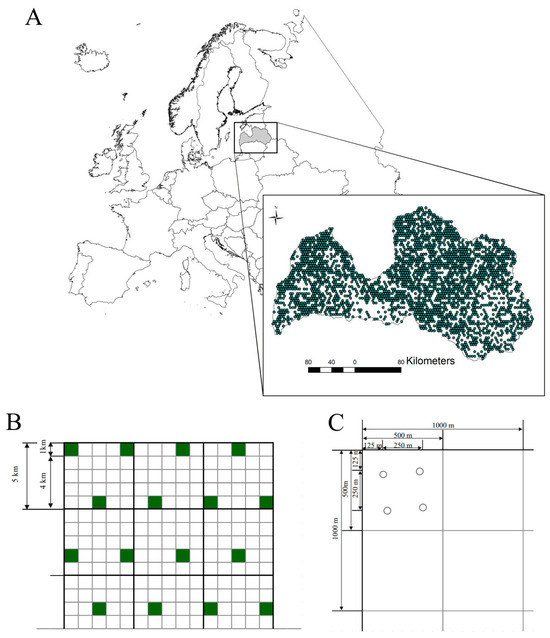
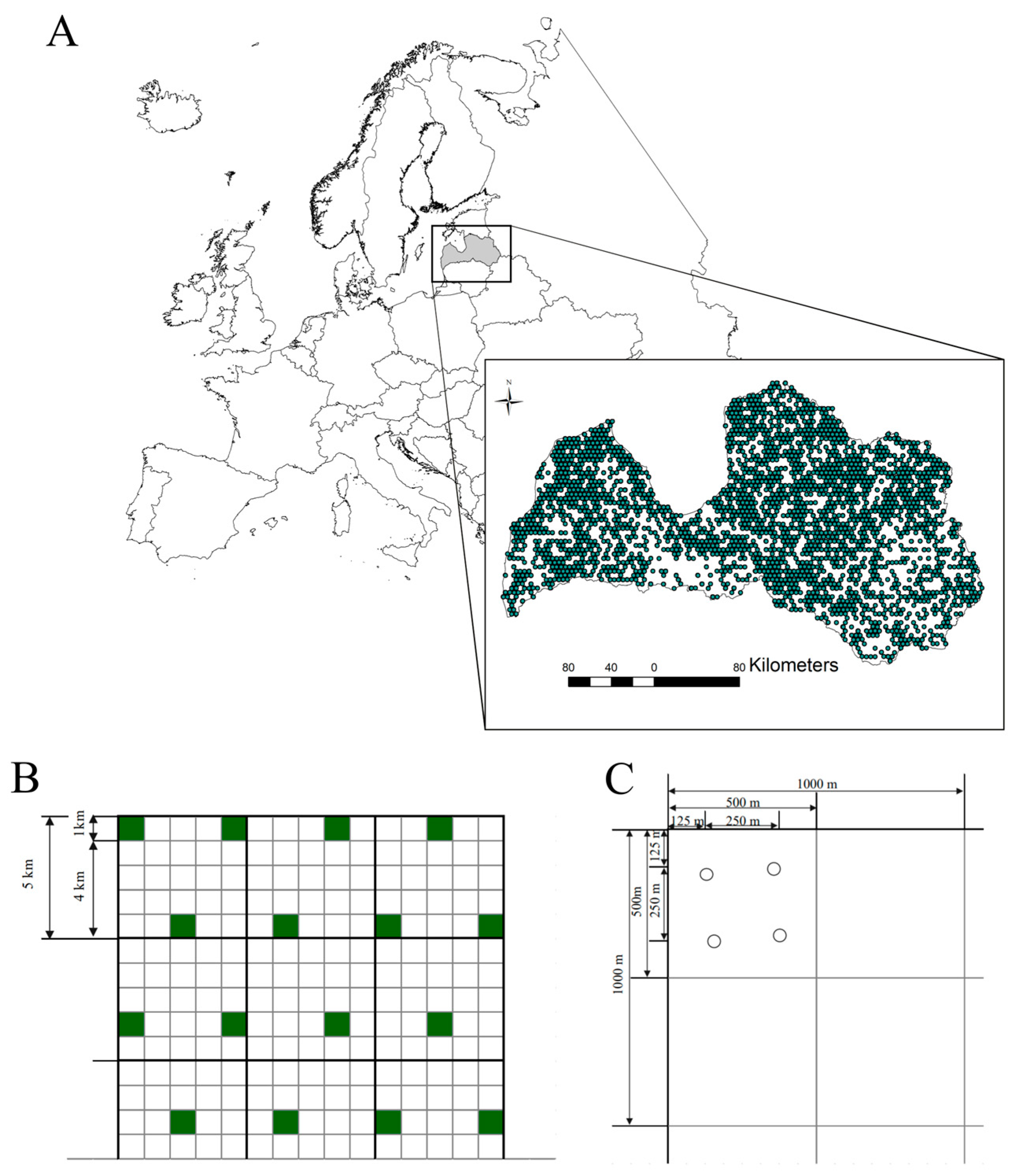
The data for this study were obtained from the National Forest Inventory (NFI), which, in addition to measuring three standard forestry parameters, also included assessments of TreMs. The NFI plots are evenly distributed across the entire country according to a systematic sampling design that begins from a randomly selected starting point (Figure 1A). Sample plot tracts are arranged uniformly at 4 × 4 km intervals, following a layout that forms isosceles triangles (Figure 1B). Each tract contains four plots arranged at the vertices of a 250 × 250 m square (Figure 1C). The area of each circular sampling plot is 500 m2, within which for all of the trees with diameter at breast height (DBH) ≥ 14.1 cm, DBH was measured, as well as their condition (living, dead, cut, damaged, etc.) recorded. In a concentric subplot with the area of 100 m2, all trees with DBH ≥ 6.1 cm are measured, while in a 90° sector of the subplot (area of 25 m2), all trees with DBH ≥ 2.1 cm are measured. Trees above the largest diameter threshold were measured across the entire area of the largest plot and recorded only once. In the intermediate and smallest nested plots, only additional trees within the respective smaller diameter classes were measured and added, while trees already measured in the larger plot were not re-recorded. To ensure even spatial and temporal coverage, one-fifth of all sample plots are surveyed annually, providing an unbiased distribution of fieldwork across Latvia.
Figure 1.
(A) Locations of sample plot tracts in Latvia; (B) Layout scheme of sample plot tracts [31]; (C) Layout scheme of sample plots within a sampling tract [31].
From all the NFI data we selected trees that were in forest stands or clearcuttings; therefore, in total 168,839 trees were selected across 5653 sample plots surveyed between 2019 and 2024. Assessment was carried out by NFI teams during the fieldwork season (normally between April 1 and October 31). Potential seasonal effects on TreM detectability (e.g., reduced visibility during the leaf-on period) were not specifically adjusted for. The NFI was conducted by five field teams. Before the survey period, all NFI teams received training on the recognition of TreMs and participated in a calibration meeting. Each tree was assessed by a single trained surveyor during the measurement of tree parameters: the lower part of the tree was inspected while measuring DBH, and the upper part of the tree, including the main trunk and major branches visible from the ground, was assessed during tree height measurement (without using binoculars). The dominant tree species in the sampled forests were Pinus sylvestris (present in 30.3% of plots), Betula pendula or Betula pubescens (28.2%), Picea abies (20.1%), Populus tremula (8.1%), Alnus incana (7.2%), and Alnus glutinosa (6.1%). The age of the dominant tree species ranged from 1 to 250 years, with two-thirds of the plots representing stands younger than 80 years. Across all plots, trees from 23 different taxa were recorded (Table 1). Approximately 16% of the measured trees were dead, including both snags and logs.
Table 1.
The number of studied trees in the study plots.
Alongside the tree measurements, TreMs were assessed on each measured tree using a classification originally developed by combining the approaches of Kraus et al. [5] and Larrieu et al. [4]. Although this methodology was established prior to the publication of Bütler et al. [32], it corresponds almost exactly to the TreMs classification proposed therein. Accordingly, all TreM types defined in Bütler et al. [32] were assessed in this study. In addition, two TreM categories not included in Bütler et al. [32] were recorded: splintered stems (sensu Kraus et al. [5]) and dead parts of the tree top, defined as dead branches with a diameter ≥ 3 cm accounting for more than 10% of the total crown. TreMs were assessed both on live and dead trees. However, on dead trees, crown deadwood was not assessed, and exudates were evaluated only on dead trees in decay stage I (wood hard).
Forest types at each plot were classified following the Latvian forest ecosystems classification system [33], which is based on soil characteristics and vegetation at tree stand maturity and expected regeneration. For data analysis, these forest types were grouped into five categories according to soil conditions: dry and mesic mineral soils, drained mineral soils, drained peat soils, wet mineral soils, and wet peat soils. Additionally, forest types were also grouped into five categories according to soil fertility: eutrophic soils, mesoeutrophic soils, mesotrofic soils, oligomesotrophic soils, oligotrophic soils. Based on management restrictions in force according to legislation in 2024, we classified all plots as either protected (prohibited final felling and thinning or any management activity) or unprotected (available for wood supply). Between 2018 and 2024, the protection status changed for 68 plots (≈1.2% of all plots), in all cases toward more stringent protection. Given the small proportion of affected plots, this is unlikely to influence the overall results. In total, 910 plots were designated as protected and 4743 as unprotected. However, the absence of management restrictions does not necessarily imply that management activities have occurred. Therefore, signs of recent cutting were recorded separately when stumps of anthropogenic origin indicated logging within the past 15 years (since beginning of NFI). Among unprotected forests, 1086 plots showed signs of recent cutting, whereas 85 plots did so in protected forests (in places where protection has started recently). Protected forests have significantly higher DBH (according to Wilcox test W = 1,771,234,921, p < 0.001) and a higher proportion of dead trees (according to Fisher’s Exact Test odds ratio = 0.763, 95% CI = 0.738–0.788, p < 0.001) than unprotected forests.
2.3. Statistical Analysis
To estimate the weighted occurrence of each TreM type, we calculated the weighted proportion of trees on which it was observed. Each tree was assigned a weight corresponding to the number of trees it represents based on its diameter class and the subplot area in which it was measured. The weighted proportion (P) was then calculated as the sum of represented trees with the TreM divided by the total number of represented trees:
where j indexes individual trees, is the number of trees represented by tree j (based on subplot area and diameter class); Tj = 1, if tree j has the TreM, 0 otherwise.
This approach ensures that trees sampled in smaller subplots or representing fewer trees in their diameter class contribute proportionally to the plot-level estimate.
These calculations were performed separately for trees from protected and unprotected sites, as well as for trees with DBH > 14 cm and those with DBH ≤ 14 cm, reflecting both differences in measurement methodology and the need to assess potential differences in occurrence patterns between smaller and larger trees. Because the weights differ among individual trees, the weighted occurrence calculated for all trees combined is not a simple average of the occurrences in the DBH subsets. In some cases, this can result in the overall weighted occurrence being smaller than the weighted occurrences in both subsets. In addition, the proportion of trees with at least one TreM was also separately calculated for trees with DBH > 14 cm in the mature forest, where only mature stands eligible for final cutting were selected. In Latvia, the minimum allowable rotation age is regulated by legislation: 121 for Quercus robur, 101 years for Pinus sylvestris, 81 years for Picea abies, Fraxinus excelsior, Tilia cordata, Ulmus glabra, Ulmus laevis, Acer platanoides, 71 for Betula pendula and Alnus glutinosa, 41 for Populus tremula [34].
Linear mixed-effects models were fitted using the glmer function from the lme4 R package to assess the effects of tree- and stand-level variables on TreM aspects at the plot level.
Response variables:
- Presence of TreMs (at least one tree with at least one TreM; binary).
- Number of TreMs per plot (count).
- Proportion of trees with TreMs (proportion).
- Number of TreM forms per plot (count).
Explanatory (fixed) variables: signs of recent cutting (presence of stumps of anthropogenic origin after recent, <15 years, cuttings), management restrictions (with vs. without restrictions—protected/unprotected), forest type group, dominant tree species, sample plot tree species composition (single-species or mixed), and age of the dominant tree species.
Random effect: sampling team (the NFI team collecting data in each plot).
Model structure and error distributions:
- Count data (number of TreMs and number of TreM forms): Poisson distribution, log link.
- Proportion data: beta distribution, logit link.
- Presence/absence data: binomial distribution, logit link.
Significance testing: the significance of individual explanatory variables was assessed using model-derived p-values, with p < 0.05 considered statistically significant. To analyze effects at the tree level, only tree species represented by at least 500 trees were included. Generalized additive models (GAMs) from the mgcv R package were used to assess how tree- and stand-level variables influence the total number of TreMs per tree.
Response variable: total number of TreMs per tree (count).
Explanatory (fixed) variables: tree species, tree status (dead or alive), management restrictions, forest type, signs of recent cutting, DBH, tree species composition (mixed vs. single species), and tree species dominance (whether the tree represents the dominant species in the stand).
Random effect: sampling team.
Non-linear effects: DBH was included as a smooth term interacting with tree status (dead or alive), with basis dimension k = 4. Diagnostic checks confirmed the basis dimension was adequate (estimated effective degrees of freedom k′ slightly lower than k), indicating no overfitting.
Model structure: Poisson error distribution with log link function. Separate GAMs with the same structure were also fitted for each tree species.
Significance testing: significance of explanatory variables was assessed using model-derived p-values, with p < 0.05 considered statistically significant.
All measured factors were included in the models to evaluate their effects explicitly. We tested multiple modeling frameworks (linear models, generalized linear models, and generalized additive models) and selected the approach that best accommodated the data structure, including non-linear relationships and random effects. No formal model selection or model averaging was applied, and all results are derived from the full models.
Spearman correlation was used to assess the relationship between the Shannon diversity index (H′), which accounts for both richness and relative abundance [35], calculated for tree species and for TreM forms at the plot level. The Shannon diversity index is calculated as follows:
where S is the number of species (or TreM forms), and pi is the proportion of individuals belonging to species (or category) i.
All statistical tests were done in “R” v. 4.2.2. [36]. For data selection, analysis, and visualization following libraries were used: dplyr [37], ggplot2 [38], readxl [39], tidyr [40], lme4 [41], mgcv [42], ggeffects [43].
3. Results
3.1. Differences in TreM Occurrence on the Plot Level
At plot level, factors such as forest type according to soil fertility, management restrictions, dominant tree species, and age of dominant tree species had a significant effect on all analyzed aspects of TreMs—their presence, number of TreMs, proportion of trees with TreMs, as well as number of different forms of the TreMs (Table 2). However, signs of recent cutting did not significantly affect whether at least one TreM was present in a plot.
Table 2.
Plot-level effects of forest management, forest type, and tree characteristics on TreM presence and diversity.
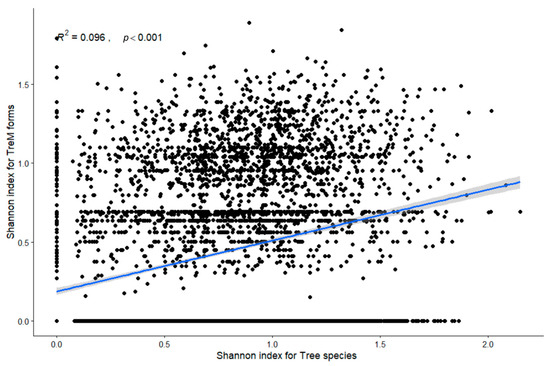
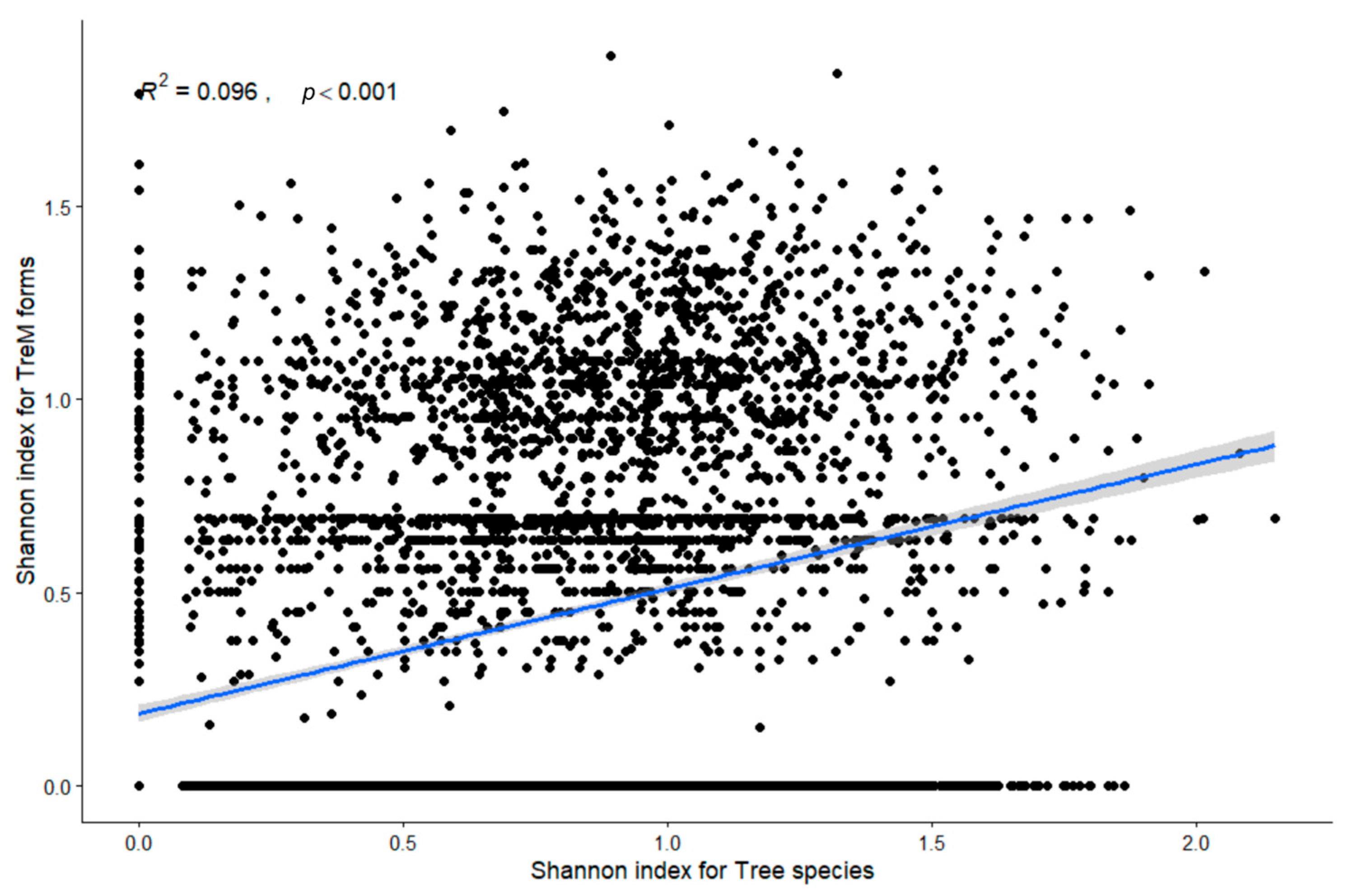
There was a statistically significant (p < 0.001) weak positive (r = 0.31) correlation between the Shannon index for tree species and the Shannon index for TreM forms on plot level (Figure 2).
Figure 2.
The relationship between the Shannon index for tree species and the Shannon index for TreM forms on plot level.
3.2. Occurrence of TreMs at the Tree Level
At least one TreM was found on 13.1% of all assessed trees and on 14.8% of trees with DBH greater than 14 cm. In addition, in mature forest stands, at least one TreM was present on 20% of trees with a DBH greater than 14 cm. Among all recorded TreMs, the most frequently observed were bark loss (3.8% of all trees and 6.7% of trees with DBH > 14 cm), bryophytes (1.4% and 3.0%), perennial polypores (1.2% and 2.8%), stem breakage (0.7% and 2.1%), and heavy resinosis (0.9% and 1.8%). TreMs such as chimney trunk rot-hole, lightning scar, myxomycetes (slime moulds), ferns, and mistletoe were among the least common ones (Table 3). For almost all TreM types, the occurrence on tree with DBH ≤ 14 cm was lower than on trees with DBH > 14 cm. There were differences in the frequency of the presence of different types of TreMs between protected and non-protected forests, for most of TreMs being more frequent in protected forests. However, a few TreMs, as ivy and lianas (woody vines) and heavy resinosis, had higher occurrence in unprotected forests.
Table 3.
Weighted occurrence of TreM types in protected and unprotected forests.
3.3. Factors Affecting TreM Richness on the Tree Level
On the single tree level, the total number of TreMs was significantly affected by tree species, with Sorbus aucuparia, Acer platanoides, Salix caprea, Populus tremula, and Quercus robur hosting the highest number of TreMs (Table 4). In addition, factors as tree status (alive or dead), DBH, signs of recent cutting, tree species composition, and forest type also had a significant effect on the number of TreMs on a tree. However, management restrictions and tree species dominance had no significant effect on a tree level.
Table 4.
Tree-level effects of tree species, tree status, management restrictions, forest type, and DBH on the presence of the total number of TreMs (response variable in the model).
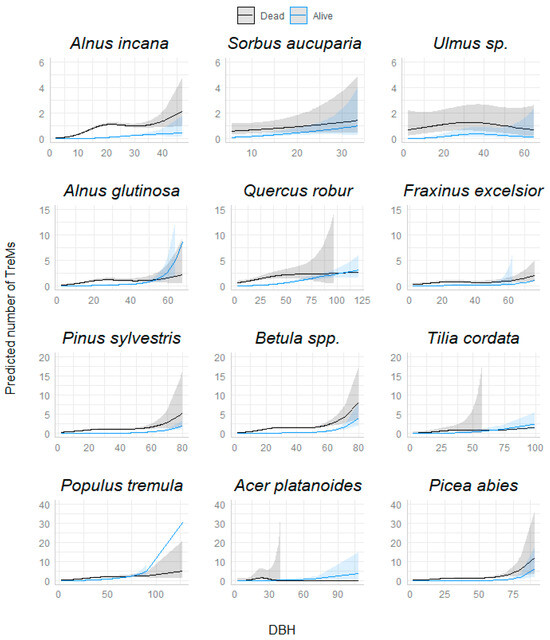
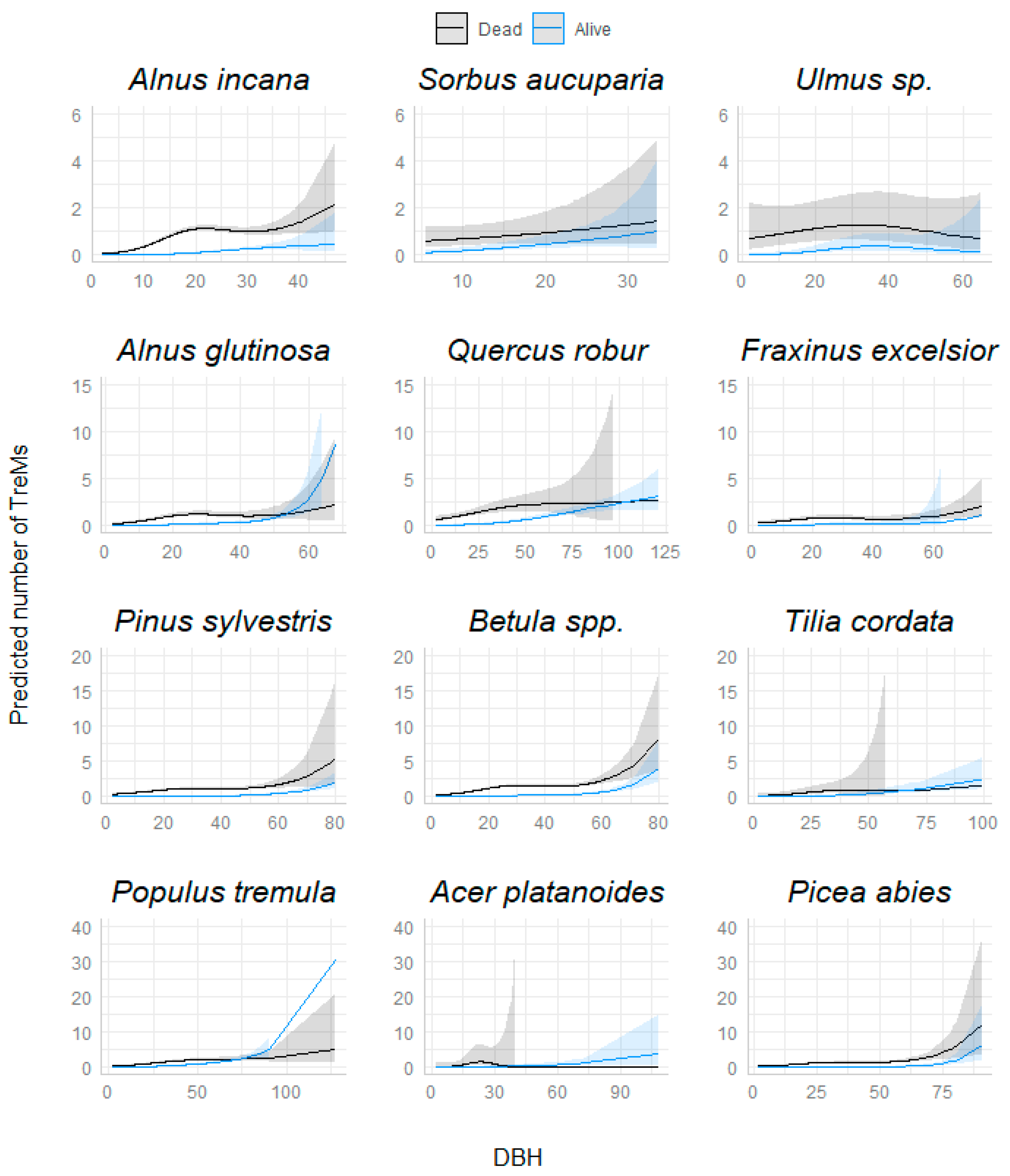
The number of TreMs was higher for dead trees compared to living trees for most of the compared species (Figure 3). The number of TreMs increases with increasing DBH for all the species; however, the pattern by which it changes differs. For example, a more rapid increase in the number of TreMs was for Betula spp., Picea abies, and Pinus sylvestris after DBH increased over 60 cm. While the increase in the number of TreMs seems gradual across all the included DBH ranges for Tilia cordata and Acer platanoides without having such a turning point.
Figure 3.
Predicted number of TreMs depending on tree DBH by tree species on alive and dead trees. Graphs showing GAM model results. NB! DBH scale is different by species.
Epiphytic and epixylic structures and tree injuries and exposed wood on live trees were more common on deciduous tree species compared to conifers (Table 5). Crown deadwood was more frequently on Quercus robur than on other species. Excrescences were similarly rare on all the compared species except from Sorbus aucuparia. However, exudates were quite rare on all the species except for Picea abies.
Table 5.
Weighted occurrence (% of trees) of different TreM forms by tree species on alive trees.
While a higher proportion of dead trees compared to living trees had TreMs, epiphytic and epixylic structures, tree injuries, exposed wood, cavities, and fruiting bodies of saproxylic fungi and slime moulds, the occurrence of excrescences and exudates was similarly low (Table 6). Approximately 15% of dead Quercus robur and 20% of dead Fraxinus excelsior trees had epiphytic and epixylic structures. Tree injuries and exposed wood were mostly recorded on Pinus sylvestris and Ulmus sp., while fruiting bodies of saproxylic fungi and slime moulds were most common on dead Betula spp. trees (21.5%).
Table 6.
Weighted occurrence (% of trees) of different TreM forms by tree species on dead trees.
4. Discussion
TreMs serve as habitats, nesting sites, shelters, or food sources for various organisms, including invertebrates, vertebrates, and epiphytic species [4]. Although they have potentially important value in hosting various groups of species [7], TreM are not always abundant, and their occurrence can vary between regions and forest types. For example, in our study only 13.1% of all the trees and 14.8% of trees with DBH > 14 cm had at least one TreM. In contrast, in other studies, the proportion of trees has usually been higher like 23% of trees in mature production forests in Lithuania [22]. In our study selecting data from only mature stands and for trees with DBH > 14 cm, we had similar results, more specifically—20% of the trees had at least one TreM. The proportion of trees with TreMs is much greater in studies focused on potential habitat trees (DBH ≥ 50 cm) (72% trees with TreMs) or retention trees (61%) [44,45]. However, in our study, the most commonly found TreM was bark loss, which was found only on 6 to 7% of all the trees (Table 3), while the vast majority of TreM types were present on less than 1% of trees both in protected and unprotected forests.
The frequency of different TreM types in managed and natural forests in central Europe has been published by Bütler et al. [32]. Comparing to their results, we could suggest that there are slight differences in northern Europe. For example, buttress-root concavities and ivies and lianas were common in Switzerland [32] but had low relative occurrence in our study (Table 3). Smaller occurrence of buttress-root concavities in hemiboreal forests might be explained by the differences in tree species composition—this TreM is frequently recorded on Fagus sylvatica in terms of the number of individual TreMs (pieces) [46], which is a common species in central Europe but not a native species in most parts of northern Europe [47]. Similarly, ivies and lianas in central Europe might be represented by several species, such as Hedera spp., Humulus lupulus, and Clematis vitalba for many of which northern Europe is out of their distribution area [48,49], while in Latvia this TreM type could be represented by Hedera helix or Humulus lupulus.
Although there are slight differences in the occurrence of particular TreMs in different parts of Europe, the overall factors influencing their richness seem to be the same as already found in previous studies—the total number of TreMs increases with larger DBH trees, and deciduous trees have a greater richness of TreMs than conifers (Table 4) [9,10]. The predicted number of TreMs for multiple species increased more rapidly after reaching a specific turning point of DBH value (Figure 3). It is also important to keep in mind that certain types of TreMs could even theoretically be present on trees starting from a certain diameter; for example, cavities of a certain size could not be present on trees of small sizes.
We also observed that some factors were significant only at the plot level, but not at the tree level—for example, management restrictions (Table 2 and Table 4), which is expected because all trees within a plot share the same values for these attributes (e.g., forest type, management type). The higher number of TreMs and the greater proportion of trees bearing TreMs in protected forests are largely driven by stand-level characteristics—such as a higher abundance of large, old, and dead trees—that are more typical of unmanaged stands. In contrast, at the individual-tree level, management restrictions themselves did not significantly affect TreM richness, suggesting that similar tree-level patterns can also be found outside protected areas when comparable tree attributes are present. This finding indicates that the conservation of TreMs can be supported in production forests through retention of large trees and deadwood, highlighting that habitat-friendly management practices may complement protected areas in maintaining biodiversity. Also, Vuidot et al. [9] found that, when controlling for tree size and site conditions, management type alone did not significantly influence the occurrence of TreM. However, that might not always be true—management might also have an impact on the formation of a specific TreMs; for instance, Courbaud et al. [11] found that dendrotelm had higher formation rates in managed forests, which was explained by the fact that they often result from harvesting a tree on a twinstem or a coppice stump. In our study, site-specific factors such as recent cutting, forest type, and tree species composition significantly affected TreM abundance at both plot and tree scale (Table 2 and Table 4), likely through their influence on stand structure, availability of large trees, and disturbance and decay processes. Similar studies have shown that plot-level context explains a large share of variation in TreM occurrence [12] and that topographic conditions can further influence TreM formation [10]. In Latvia, key plot-level variables such as forest type, dominant species, and management history are available from the National Forest Inventory and allow analyses like those presented here; however, finer-scale environmental variables (e.g., microtopography or microclimate) are not consistently recorded and could not be assessed in the present study. Tree species are an important factor influencing the biodiversity associated with trees, including epiphyte richness [50], invertebrate [51] and vertebrate [52] communities, and the diversity of tree-related microhabitats (TreMs), as discussed previously. Each tree species provides a specific set of conditions—for instance, through differences in bark chemistry (e.g., pH and nutrient content) [53], bark and wood structure (thickness, fissuring, porosity) [54,55], wood-decay dynamics [56], branching architecture and crown form [57]. These factors, in turn, influence the likelihood and nature of tree-related microhabitats (TreMs) forming on them. The results of our study clearly show that, for example, exudates are much more common on living Picea abies than on other tree species, while Populus tremula stands out with a higher occurrence of fruiting bodies of saproxylic fungi and slime molds, and the highest occurrence of crown deadwood was observed on Quercus robur (Table 5). Similar results were reported in the hemiboreal zone by Brazaityte et al. [22]. It is important to highlight that some tree species are crucial for providing specific TreMs, even if they do not have the greatest overall TreM diversity, as seen in Picea abies. The differences between tree species might be the main reason why TreM diversity was significantly positively correlated to tree species diversity in the plot level (Figure 2). However, the differences among tree species are not important only on living trees, but also on dead trees; moreover, there are differences between alive and dead trees even within the same species (Table 5 and Table 6).
Dead wood possesses unique physical and chemical properties that create specialized habitats, and it is widely recognized as a key component for maintaining biodiversity in forest ecosystems [58]. Our study shows that the total number of TreMs on dead wood is higher than on live trees for most of the compared tree species (Figure 3), which is consistent with the findings of Jansone et al. [45] on retention trees. It is important to note that crown deadwood was not assessed for snags and logs in our study (see Materials and Methods); therefore, the actual TreM richness on deadwood may be even higher than recorded. The higher occurrence of epiphytic and epixylic structures, exposed wood, and fruiting bodies of saproxylic fungi and slime moulds on dead trees reflects the key role of tree death and subsequent decay processes in TreM development. Dead wood provides stable substrates and microclimatic conditions that favour colonisation by saproxylic organisms, a pattern widely reported in forest ecosystems [59]. The particularly high occurrence of fungal and slime mould fruiting bodies on dead Betula spp. may be linked to its rapid decomposition and wood properties conducive to fungal growth [60], whereas the relatively small difference observed for Populus tremula suggests that this species can host such TreMs already on living trees due to internal decay [61]. Although we do not propose a specific deadwood volume threshold, our results support management practices that retain sufficient quantities and a diversity of deadwood types and tree species within managed forests, as such structural elements are crucial for sustaining TreM-associated biodiversity. The optimal amount of dead wood is likely to be context dependent, varying with forest type, stand structure, and management history.
The results from our study offer valuable insight into the occurrence patterns and factors influencing TreM diversity in the hemiboreal region, as our data included both managed and unmanaged forests across different age classes and a broad spatial (territorial) distribution of sampling plots across the country. However, it is important to note that in Latvia, since 1997, guidelines have required that old and wind-resistant trees, hollow trees, and trees with large bird nests be left in clearcuts, leaving a total of 5–10 trees per hectare [62]. Therefore, the TreM richness shown in this study for managed forests may differ from those in other hemiboreal forests that have been managed without such restrictions. In addition, several limitations should be considered when interpreting the data. For instance, the data collection period spanned from April 1 to October 31, which may have affected the TreMs that could be observed at specific times of the year. Certain features, such as fungi, might not have been registered due to seasonal constraints, and some TreMs in the tree crown may have been difficult to detect on leafy trees (e.g., in summer compared to early spring or late autumn). Fungal fruiting bodies are known to exhibit strong seasonal dynamics, with species richness and composition differing markedly among seasons and many taxa fruiting preferentially in spring or autumn rather than summer, which can lead to under-estimation in seasonally restricted surveys [63,64]. Additionally, it is important to note that all TreM assessments were conducted as part of general forest inventories rather than with the explicit purpose of recording TreMs, which likely resulted in a lower probability of detection compared to studies focused specifically on TreM identification. However, the NFI method is designed such that the same plots will be remeasured every five years at approximately the same time of year (±20 days), thereby providing the opportunity for future assessments of temporal trends in TreM dynamics.
5. Conclusions
TreMs such as buttress-root concavities and ivy or liana cover, which are common in temperate Europe, had a low relative occurrence in our study. TreMs were significantly more numerous, and occurred on a higher proportion of trees, in protected forests compared to unprotected forests, largely reflecting differences in stand structure. At the tree level, however, TreM richness did not differ between management regimes, indicating that tree-level drivers—such as tree size, species, and living status—are consistent across forest types. Overall, TreMs occurred more frequently on deciduous than on coniferous trees, on larger trees (with higher DBH), and on dead trees compared to living ones. The occurrence of specific TreM forms was strongly tree-species-dependent: exudates were much more common on live Picea abies than on other species, whereas Populus tremula had a higher occurrence of fruiting bodies of saproxylic fungi and slime moulds. The highest occurrence of crown deadwood was observed on Quercus robur. Overall, dead trees play a particularly important role, providing both a higher total number of TreMs and certain TreM types more frequently. Based on our findings, forest management should retain large living trees and deadwood, promote mixed-species stands, and consider tree-species-specific TreM patterns to improve the quantity and quality of TreMs and support forest biodiversity.
Author Contributions
Conceptualization, J.D.; methodology, J.D.; formal analysis, I.B.; resources, J.D.; data curation, J.D.; writing—original draft preparation, I.B.; writing—review and editing, J.D.; visualization, I.B.; supervision, J.D.; project administration, J.D.; funding acquisition, J.D. All authors have read and agreed to the published version of the manuscript.
Funding
This research was funded by the Medium-term Development Strategy of “Silava”, and the State Research Program Forest4LV—Innovation in Forest Management and Value Chain for Latvia’s Growth: New Forest Services, Products and Technologies (No. VPP-ZM-VRIIILA-2024/2-0002).
Data Availability Statement
The datasets presented in this article are not readily available because the data are restricted as for internal use only. Requests to access the datasets should be directed to inst@silava.lv.
Acknowledgments
We thank the National Forest Inventory monitoring teams for collecting and providing the field data that made this study possible. Field data were collected by Latvian State Forest Research Institute “Silava” as part of the National Forest Monitoring program, carried out according to national regulations and the institution’s Medium-term Development Strategy.
Conflicts of Interest
The authors declare no conflicts of interest. The funders had no role in the design of the study; in the collection, analyses, or interpretation of data; in the writing of the manuscript; or in the decision to publish the results.
Abbreviations
The following abbreviations are used in this manuscript:
| DBH | Diameter at Breast Height |
| NFI | National Forest Inventory |
| TreMs | Tree-Related Microhabitats |
References
- FAO. Global Forest Resources Assessment 2020—Key Findings; FAO: Rome, Italy, 2020. [Google Scholar]
- Paillet, Y.; Bergès, L.; Hjältén, J.; Ódor, P.; Avon, C.; Bernhardt-Römermann, M.; Bijlsma, R.J.; De Bruyn, L.; Fuhr, M.; Grandin, U.; et al. Biodiversity differences between managed and unmanaged forests: Meta-analysis of species richness in Europe. Conserv. Biol. 2010, 24, 101–112. [Google Scholar] [CrossRef] [Scilit]
- Bauhus, J.; Puettmann, K.; Messier, C. Silviculture for old-growth attributes. For. Ecol. Manag. 2009, 258, 525–537. [Google Scholar] [CrossRef] [Scilit]
- Larrieu, L.; Paillet, Y.; Winter, S.; Bütler, R.; Kraus, D.; Krumm, F.; Lachat, T.; Michel, A.K.; Regnery, B.; Vandekerkhove, K. Tree related microhabitats in temperate and Mediterranean European forests: A hierarchical typology for inventory standardization. Ecol. Indic. 2018, 84, 194–207. [Google Scholar] [CrossRef] [Scilit]
- Kraus, D.; Bütler, R.; Krumm, F.; Lachat, T.; Larrieu, L.; Mergner, U.; Paillet, Y.; Rydkvist, T.; Schuck, A.; Winter, S. Catalogue of Tree Microhabitats; FAO AGRIS: Rome, Italy, 2016. [Google Scholar]
- Winter, S.; Möller, G.C. Microhabitats in lowland beech forests as monitoring tool for nature conservation. For. Ecol. Manag. 2008, 255, 1251–1261. [Google Scholar] [CrossRef] [Scilit]
- Dutta, T.; Larrieu, L.; Schuck, A. Who is using tree-related microhabitats (TreMs)? Biol. Conserv. 2025, 307, 111180. [Google Scholar] [CrossRef] [Scilit]
- Barone, I.; Gerra-Inohosa, L.; Jansone, D.; Treimane, A.; Jansons, Ā.; Donis, J. Links between species richness of bryophytes and lichens and tree-related microhabitats on retention trees. Eur. J. For. Res. 2025, 144, 1631–1643. [Google Scholar] [CrossRef] [Scilit]
- Vuidot, A.; Paillet, Y.; Archaux, F.; Gosselin, F. Influence of tree characteristics and forest management on tree microhabitats. Biol. Conserv. 2011, 144, 441–450. [Google Scholar] [CrossRef] [Scilit]
- Regnery, B.; Paillet, Y.; Couvet, D.; Kerbiriou, C. Which factors influence the occurrence and density of tree microhabitats in Mediterranean oak forests? For. Ecol. Manag. 2013, 295, 118–125. [Google Scholar] [CrossRef] [Scilit]
- Courbaud, B.; Larrieu, L.; Kozak, D.; Kraus, D.; Lachat, T.; Ladet, S.; Müller, J.; Paillet, Y.; Sagheb-Talebi, K.; Schuck, A.; et al. Factors influencing the rate of formation of tree-related microhabitats and implications for biodiversity conservation and forest management. J. Appl. Ecol. 2022, 59, 492–503. [Google Scholar] [CrossRef] [Scilit]
- Larrieu, L.; Courbaud, B.; Drénou, C.; Goulard, M.; Bütler, R.; Kozák, D.; Kraus, D.; Krumm, F.; Lachat, T.; Müller, J.; et al. Key factors determining the presence of Tree-related Microhabitats: A synthesis of potential factors at site, stand and tree scales, with perspectives for further research. For. Ecol. Manag. 2022, 515, 120235. [Google Scholar] [CrossRef] [Scilit]
- Spînu, A.P.; Mysiak, W.; Bauhus, J.; Bielak, K.; Niklasson, M. Pioneer tree species accelerate restoration of tree-related microhabitats in 50-year-old reserves of Białowieża Forest, Poland. Ecol. Evol. 2023, 13, e10238. [Google Scholar] [CrossRef] [Scilit]
- Kozák, D.; Svitok, M.; Zemlerová, V.; Mikoláš, M.; Lachat, T.; Larrieu, L.; Paillet, Y.; Buechling, A.; Bače, R.; Keeton, W.S.; et al. Importance of conserving large and old trees to continuity of tree related microhabitats. Conserv. Biol. 2023, 37, e14066. [Google Scholar] [CrossRef] [Scilit]
- Asbeck, T.; Pyttel, P.; Frey, J.; Bauhus, J. Predicting abundance and diversity of tree-related microhabitats in Central European montane forests from common forest attributes. For. Ecol. Manag. 2019, 432, 400–408. [Google Scholar] [CrossRef] [Scilit]
- Larrieu, L.; Bouget, C.; Courbaud, B.; Doerfler, I.; Gouix, N.; Goulard, M.; Ladet, S.; Laroche, F.; Acloque, A.; Bütler, R.; et al. Spatial distribution of tree-related microhabitats in European beech-dominated forests. Biol. Conserv. 2025, 301, 110867. [Google Scholar] [CrossRef] [Scilit]
- Torres-García, M.T.; Hedwall, P.O.; Larrieu, L.; Öckinger, E.; Johansen, H.; Niklasson, M.; Petersson, L.; Svensson, E.; Uría-Díez, J.; Felton, A. Tree and stand characteristics jointly predict tree-related microhabitats on retention trees in production forests. Biol. Conserv. 2024, 299, 110821. [Google Scholar] [CrossRef] [Scilit]
- Paluots, T.; Liira, J.; Leis, M.; Laarmann, D.; Põldveer, E.; Franklin, J.F.; Korjus, H. Long-Term Cumulative Effect of Management Decisions on Forest Structure and Biodiversity in Hemiboreal Forests. Forests 2024, 15, 2035. [Google Scholar] [CrossRef] [Scilit]
- Jahed, R.R.; Kavousi, M.R.; Farashiani, M.E.; Sagheb-Talebi, K.; Babanezhad, M.; Courbaud, B.; Wirtz, R.; Müller, J.; Larrieu, L. A comparison of the formation rates and composition of tree-related microhabitats in beech-dominated primeval carpathian and hyrcanian forests. Forests 2020, 11, 144. [Google Scholar] [CrossRef] [Scilit]
- Przepióra, F.; Ciach, M. Profile of tree-related microhabitats in the primeval Białowieża Forest: A benchmark for temperate woodlands. Sci. Total Environ. 2023, 905, 167273. [Google Scholar]
- Przepióra, F.; Lewandowski, P.; Ciach, M. Spatial distribution of tree-related microhabitats in a primeval mountain forest: From natural patterns to landscape planning and forest management recommendations. Sci. Total Environ. 2025, 960, 178319. [Google Scholar] [CrossRef] [Scilit] [PubMed]
- Brazaitytė, G.; Manton, M.; Preikša, Ž.; Marozas, V.; Brazaitis, G. Tree-related microhabitat characteristics in hemi-boreal production forests: The role of DBH and stand heterogeneity. For. Ecol. Manag. 2025, 594, 122942. [Google Scholar] [CrossRef] [Scilit]
- Ahti, T.; Hämet-Ahti, L.; Jalas, J. Vegetation zones and their sections in northwestern Europe. Ann. Bot. Fenn. 1968, 5, 169–211. [Google Scholar]
- European Environment Agency. European Forest Types: Categories and Types for Sustainable Forest Management Reporting and Policy (EEA Technical Report No. 9/2006); European Environment Agency: Copenhagen, Denmark, 2006.
- Mason, W.L.; Diaci, J.; Carvalho, J.; Valkonen, S. Continuous Cover Forestry in Europe: Usage and the Knowledge Gaps and Challenges to Wider Adoption. Forestry 2022, 95, 1–12. [Google Scholar] [CrossRef] [Scilit]
- Meža Valsts Reģistra Meža Dati. Available online: https://data.gov.lv/dati/lv/dataset/meza-valsts-registra-meza-dati (accessed on 28 December 2025).
- Barone, I.; Brūmelis, G.; Donis, J. Living and Dead Retention Tree Value in the Conservation of Bryophyte and Lichen Communities in Production Forests. For. Ecol. Manag. 2024, 569, 122152. [Google Scholar] [CrossRef] [Scilit]
- Central Statistical Bureau of Latvia. Statistical Yearbook of Latvia; Central Statistical Bureau of Latvia: Riga, Latvia, 2023.
- Krauklis, A.; Draveniece, A. Landscape seasons and air mass dynamics in Latvia. Folia Geogr. 2004, 12, 16–47. [Google Scholar]
- Latvian Environment; Geology and Meteorology Centre. Climate Data and Analysis. 2021. Available online: https://www.meteo.lv/en (accessed on 10 November 2025).
- Anonymous. Meža Resursu Monitoringa Metodika; Silava: Salaspils, Latvia, 2022; Available online: https://www.silava.lv/images/Petijumi/Nacionalais-meza-monitorings/2022-04-28-MRM-metodika.pdf (accessed on 25 November 2025).
- Bütler, R.; Lachat, T.; Krumm, F.; Kraus, D.; Larrieu, L. Field Guide to Descriptions and Size Limits for Their Inventory; Swiss Federal Institute for Forest, Snow and Landscape Research: Birmensdorf, Switzerland, 2020; 59p.
- Bušs, K. Forest ecosystem classification in Latvia. Proc. Latv. Acad. Sci. Sect. B 1997, 51, 204–218. [Google Scholar]
- Saeima. Law on Forests. Latvijas Vēstnesis. 2000. Available online: https://likumi.lv/ta/en/en/id/2825-law-on-forests (accessed on 19 December 2025).
- Shannon, C.E. A Mathematical Theory of Communication. Bell Syst. Tech. J. 1948, 27, 623–656. [Google Scholar] [CrossRef] [Scilit]
- R Core Team. R: Language and Environment for Statistical Computing; R Foundation for Statistical Computing: Vienna, Austria, 2022. [Google Scholar]
- Wickham, H.; François, R.; Henry, L.; Müller, K.; Vaughan, D. R Package, version 1.1.0. dplyr: A Grammar of Data Manipulation. R Foundation for Statistical Computing: Vienna, Austria, 2023.
- Wickham, H. ggplot2: Elegant Graphics for Data Analysis; Springer: New York, NY, USA, 2016. [Google Scholar]
- Wickham, H.; Jennifer, B. R Package, version 1.4.2. readxl: Read Excel Files_. R Foundation for Statistical Computing: Vienna, Austria, 2023. Available online: https://CRAN.R-project.org/package=readxl (accessed on 13 October 2025).
- Wickham, H.; Vaughan, D.; Girlich, M.; Ushey, K. R Package, version 1.3.0; tidyr: Tidy Messy Data; R Foundation for Statistical Computing: Vienna, Austria, 2023.
- Bates, D.; Mächler, M.; Bolker, B.M.; Walker, S.C. Fitting linear mixed-effects models using lme4. J. Stat. Softw. 2015, 67, 1–48. [Google Scholar] [CrossRef] [Scilit]
- Wood, S. Fast stable restricted maximum likelihood and marginal likelihood estimation of semiparametric generalized linear models. J. R. Stat. Soc. 2011, 73, 3–36. [Google Scholar] [CrossRef] [Scilit]
- Lüdecke, D. ggeffects: Tidy Data Frames of Marginal Effects from Regression Models. J. Open Source Softw. 2018, 3, 772. [Google Scholar] [CrossRef] [Scilit]
- Asbeck, T.; Messier, C.; Bauhus, J. Retention of tree-related microhabitats is more dependent on selection of habitat trees than their spatial distribution. Eur. J. For. Res. 2020, 139, 1015–1028. [Google Scholar] [CrossRef] [Scilit]
- Jansone, D.; Matisons, R.; Gerra-Inohosa, L.; Lībiete, Z.; Jansons, Ā. Dead Better than Alive—The Case of Retention Trees and Tree-Related Microhabitats in Young Stands of Hemiboreal Forests in Latvia. Forests 2023, 14, 1949. [Google Scholar] [CrossRef] [Scilit]
- Johansson, H. Influence of Tree Species on Tree-Related Micro-Habitats in a Broadleaf Forest in Eastern Skåne, Sweden; Swedish University of Agricultural Sciences: Uppsala, Sweden, 2024. [Google Scholar]
- Rukh, S.; Sanders, T.G.M.; Krüger, I.; Schad, T.; Bolte, A. Distinct Responses of European Beech (Fagus sylvatica L.) to Drought Intensity and Length—A Review of the Impacts of the 2003 and 2018–2019 Drought Events in Central Europe. Forests 2023, 14, 248. [Google Scholar] [CrossRef] [Scilit]
- Coca-de-la-Iglesia, M.; Gallego-Narbón, A.; Alonso, A.; Valcárcel, V. High rate of species misidentification reduces the taxonomic certainty of European biodiversity databases of ivies (Hedera L.). Sci. Rep. 2024, 14, 4876. [Google Scholar] [CrossRef] [Scilit]
- WFO. Humulus lupulus L. 2025. Available online: http://www.worldfloraonline.org/taxon/wfo-0000725866 (accessed on 25 November 2025).
- Király, I.; Nascimbene, J.; Tinya, F.; Ódor, P. Factors influencing epiphytic bryophyte and lichen species richness at different spatial scales in managed temperate forests. Biodivers. Conserv. 2013, 22, 209–223. [Google Scholar] [CrossRef] [Scilit]
- Lekoveckaitė, A.; Jimenez, M.F.T.; Trakimas, G.; Ferenca, R.; Podėnienė, V. Tree Species Affect Beetle Diversity on the Common Deciduous Dead Wood in Lithuanian Unmanaged Forests. Forests 2023, 14, 1836. [Google Scholar] [CrossRef] [Scilit]
- Dondina, O.; Orioli, V.; Massimino, D.; Pinoli, G.; Bani, L. A method to evaluate the combined effect of tree species composition and woodland structure on indicator birds. Ecol. Indic. 2015, 55, 44–51. [Google Scholar] [CrossRef] [Scilit]
- Spier, L.; Van Dobben, H.; Van Dort, K. Is bark pH more important than tree species in determining the composition of nitrophytic or acidophytic lichen floras? Environ. Pollut. 2010, 158, 3607–3611. [Google Scholar] [CrossRef] [Scilit] [PubMed]
- Nicolai, V. The bark of trees: Thermal properties, microclimate and fauna. Oecologia 1986, 69, 148–160. [Google Scholar] [CrossRef] [Scilit]
- Klein, A.; Bockhorn, O.; Mayer, K.; Grabner, M. Central European wood species: Characterization using old knowledge. J. Wood Sci. 2016, 62, 194–202. [Google Scholar] [CrossRef] [Scilit]
- Hararuk, O.; Kurz, W.A.; Didion, M. Dynamics of dead wood decay in Swiss forests. For. Ecosyst. 2020, 7, 36. [Google Scholar] [CrossRef] [Scilit]
- Jucker, T.; Fischer, F.J.; Chave, J.; Coomes, D.A.; Caspersen, J.; Ali, A.; Panzou, G.J.L.; Feldpausch, T.R.; Falster, D.; Usoltsev, V.A.; et al. The global spectrum of tree crown architecture. Nat. Commun. 2025, 16, 45–50. [Google Scholar] [CrossRef] [Scilit]
- Bauhus, J.; Baber, K.; Müller, J. Dead Wood in Forest Ecosystems; Oxford Bibliographies Ecology: Oxford, UK, 2018. [Google Scholar]
- Siitonen, J. Forest Management, Coarse Woody Debris and Saproxylic Organisms: Fennoscandian Boreal Forests as an Example. Ecol. Bull. 2001, 49, 11–41. [Google Scholar]
- Yatskov, M.; Harmon, M.E.; Krankina, O.N. A chronosequence of wood decomposition in the boreal forests of Russia. Can. J. For. Res. 2003, 33, 1211–1226. [Google Scholar] [CrossRef] [Scilit]
- Wikstrom, C.; Unestam, T. The decay pattern of Phellinus tremulae (Bond.) Bond, et Borisov in Populus tremula L. Eur. J. For. Pathol. 1976, 6, 291–301. [Google Scholar]
- Valsts Meža Dienests. Gada 24. Aprīļa Rīkojums nr.38 “Galvenās Cirtes Norādījumi”; Valsts Meža Dienests: Riga, Latvia, 1997.
- Sato, H.; Morimoto, S.; Hattori, T. A Thirty-Year Survey Reveals That Ecosystem Function of Fungi Predicts Phenology of Mushroom Fruiting. PLoS ONE 2012, 7, e49777. [Google Scholar] [CrossRef] [Scilit]
- Halme, P.; Kotiaho, J.S. The importance of timing and number of surveys in fungal biodiversity research. Biodivers. Conserv. 2012, 21, 205–219. [Google Scholar]

Disclaimer/Publisher’s Note: The statements, opinions and data contained in all publications are solely those of the individual author(s) and contributor(s) and not of MDPI and/or the editor(s). MDPI and/or the editor(s) disclaim responsibility for any injury to people or property resulting from any ideas, methods, instructions or products referred to in the content. |
© 2025 by the authors. Licensee MDPI, Basel, Switzerland. This article is an open access article distributed under the terms and conditions of the Creative Commons Attribution (CC BY) license.