Review

A Dual Soil Carbon Framework for Enhanced Silicate Rock Weathering: Integrating Organic and Inorganic Carbon Pathways Across Forest and Cropland Ecosystems
1
Key Laboratory of Ecosystem Carbon Source and Sink, China Meteorological Administration (ECSS-CMA), School of Ecology and Applied Meteorology, Nanjing University of Information Science and Technology, Nanjing 210044, China
2
Changwang School of Honors, Nanjing University of Information Science and Technology, Nanjing 210044, China
3
Centre for Ecological Research and Forestry Applications, E08193 Cerdanyola del Vallès, Catalonia, Spain
*
Authors to whom correspondence should be addressed.
Forests 2026, 17(1), 144; https://doi.org/10.3390/f17010144
Submission received: 15 December 2025 / Revised: 19 January 2026 / Accepted: 20 January 2026 / Published: 22 January 2026
(This article belongs to the Section Forest Soil)

Abstract

Enhanced silicate rock weathering (ESRW) has been proposed as a promising carbon dioxide removal strategy, yet its carbon sequestration pathways, durability, and ecosystem dependence remain incompletely understood. Here, we synthesize evidence from field experiments, observational studies, and modeling to compare ESRW-induced carbon dynamics across forest and cropland ecosystems using a unified SOC–SIC dual-pool framework. Across both systems, ESRW operates through shared geochemical processes, including proton consumption during silicate dissolution and base cation release, which promote atmospheric CO2 uptake. However, carbon fate diverges markedly among ecosystems. Forest systems, characterized by high biomass production, deep rooting, and strong hydrological connectivity, primarily favor biologically mediated pathways, enhancing net primary productivity and mineral-associated organic carbon (MAOC) formation, while facilitating downstream export of dissolved inorganic carbon (DIC). In contrast, intensively managed croplands more readily accumulate measurable soil inorganic carbon (SIC) and soil DIC over short to medium timescales, particularly under evapotranspiration-dominated or calcium-rich conditions, although SOC responses are often moderate and variable. Importantly, only a subset of ESRW-driven pathways—such as MAOC formation and secondary carbonate precipitation—represent durable carbon storage on decadal to centennial timescales. By explicitly distinguishing carbon storage from carbon transport, this synthesis clarifies the conditions under which ESRW can contribute to climate change mitigation and highlights the need for ecosystem-specific deployment and monitoring strategies.

1. Introduction

Meeting the Paris Agreement’s 1.5–2.0 °C temperature target requires not only rapid and deep reductions in greenhouse gas emissions, but also the deployment of CDR strategies to offset residual emissions and potentially reverse atmospheric CO2 accumulation [1,2,3]. According to the IPCC AR6 Synthesis Report, limiting warming to 1.5 °C implies a remaining carbon budget of approximately 400–500 Gt CO2 from 2020 onward, while most mitigation pathways require cumulative CDR in the order of several hundred gigatonnes of CO2 over the 21st century, even under low-emission scenarios [3].
Soils constitute one of the largest terrestrial carbon reservoirs, storing approximately 1300–1600 Pg C as SOC and an additional 700–1000 Pg C as SIC within the upper meter, although substantial uncertainties remain, particularly regarding SIC stocks and their spatial distribution [4,5,6,7]. Enhancing soil carbon retention and stabilization is therefore increasingly recognized as an important component of land-based climate change mitigation portfolios [7]. Among emerging approaches, ESRW—the deliberate application of finely ground silicate minerals such as basalt to land surfaces—has received growing attention for its potential to accelerate natural weathering reactions that consume atmospheric CO2 [8,9]. Beyond direct CO2 uptake, ESRW can, under specific conditions, modify soil pH, nutrient availability, and mineralogical composition, thereby influencing ecosystem processes, although such cobenefits are not universal and remain strongly soil and context-dependent [9].
Natural silicate weathering operates on geological timescales (103–106 years) and forms the basis of the long-term carbonate–silicate cycle regulating Earth’s climate. In this process, atmospheric CO2 dissolves in water to form carbonic acid, generating protons (H+) that drive silicate mineral hydrolysis, releasing base cations (e.g., Ca2+, Mg2+) and producing bicarbonate (HCO3) in solution [10,11]. ESRW seeks to accelerate these reactions by increasing mineral surface area through crushing and land application [8,9]. The resulting bicarbonate primarily represents carbon transport rather than in situ terrestrial storage, as it may be exported via leaching to rivers and oceans and contribute to long-term alkalinity budgets. In contrast, durable terrestrial carbon storage occurs mainly through the formation of pedogenic carbonates (SIC) and the indirect stabilization of soil organic matter via mineral interactions [5].
Model-based assessments suggest that large-scale ESRW deployment on croplands and managed lands—typically assuming application over approximately 1–5 × 10⁹ ha globally—could remove in the order of 0.5–2.0 Gt CO2 yr−1, depending on mineral type, application rate, climate, and logistical constraints [9,12]. To date, however, ESRW research has been dominated by agricultural systems, while forest ecosystems remain comparatively underexplored, largely due to operational constraints, heterogeneous terrain, and challenges in monitoring and attributing weathering-derived carbon fluxes under high hydrological connectivity [13]. This imbalance limits our understanding of which weathering-driven carbon sequestration mechanisms are shared across land-use types and which are ecosystem-specific.
Importantly, ESRW can influence soil carbon dynamics beyond inorganic pathways by altering soil chemical and biological processes. In some cases, short-term SOC losses have been observed due to priming effects, whereby increases in soil pH or nutrient availability stimulate microbial decomposition of labile organic matter [14]. Over longer timescales, however, the release of Ca2+ and Mg2+ and the formation of secondary mineral phases can enhance mineral-associated organic carbon (MAOC) formation via adsorption, cation bridging, and co-precipitation, thereby increasing SOC residence times [15,16,17]. These responses are not unidirectional, as pH-mediated changes in aggregation, moisture dynamics, and microbial activity can either enhance or suppress SOC stabilization depending on environmental context [9].
Adopting a unified SOC–SIC dual-pool perspective, forests and croplands can be conceptualized as distinct end-members along an ESRW–soil carbon continuum [4,5]. Forest ecosystems, characterized by high biomass production, deep rooting, and strong hydrological connectivity, tend to favor organic carbon inputs and stabilization through a biological carbon pump, while weathering-derived dissolved inorganic carbon is more likely to be exported via leaching rather than retained as SIC [13]. In contrast, croplands are primarily managed for yield and often experience substantial leaching due to drainage and irrigation. Nevertheless, under specific conditions—such as Ca-rich substrates and evapotranspiration-dominated climates—measurable SIC accumulation and enhanced bicarbonate fluxes can occur alongside moderate SOC gains driven by increased crop productivity [5,12].
In this review, we synthesize the current understanding of how ESRW influences both organic and inorganic soil carbon pools across forest and cropland ecosystems. We first evaluate mechanisms controlling inorganic carbon transformation and transport, then examine key biotic and abiotic drivers of SOC responses. Finally, we propose a mechanistic framework to clarify SOC–SIC trade-offs and synergies, providing a realistic theoretical basis for assessing the role of ESRW in climate change mitigation strategies.

2. Impacts of ESRW on Soil Carbon Sequestration in Forest Ecosystems

Forest ecosystems serve as significant biomass carbon reservoirs and have historically functioned as major carbon sinks, while soils—encompassing both SOC and SIC—represent the largest terrestrial carbon pool [6,18,19]. These forest soils typically receive substantial organic inputs, including litter and roots, and are often acidic, conditions that favor mineral dissolution and weathering reactions [7,20,21]. However, it is important to note that forests should not be regarded as the “optimal” environments for ESRW deployment. Operational challenges such as access, heterogeneous application, and difficulties associated with MRV make forest systems more complicated than croplands. Additionally, hydrological connectivity complicates the attribution of alkalinity export and carbon removal [22,23,24]. As such, forests are more appropriately viewed as biogeochemically distinct testbeds for investigating coupled organic–inorganic responses and resolving MRV challenges under realistic terrain and hydrological conditions [23,24].
Mechanistically, ESRW-driven geochemical CDR pathways include: (i) enhanced dissolution of Ca/Mg silicates, which consume CO2 and generate alkalinity (primarily in the form of HCO3), potentially exporting this alkalinity to aquatic systems, and (ii) under suitable saturation conditions, secondary carbonate precipitation [7,25,26]. Simultaneously, ESRW can affect ecosystem carbon storage by altering nutrient supply (e.g., phosphorus, base cations), soil pH, aggregation, and organo-mineral interactions—factors that influence the stabilization of SOC, particularly the formation of MAOC. However, these changes in SOC are part of broader ecosystem responses rather than being specific “weathering pathways” [7,27].
Global modeling suggests that the nutrient release associated with silicate amendments could boost productivity in nutrient-limited regions, potentially increasing ecosystem carbon inputs. Nonetheless, any climate-mitigation benefits arising from these productivity gains depend on carbon residence time, turnover, respiration, disturbance, and saturation effects. These factors must be considered in comprehensive carbon-cycle accounting, rather than treating them as unconditional climate-mitigation “options” [9,24]. Evidence indicates that forests can respond to geogenic phosphorus and base-cation supply in certain contexts, as discussed below. However, this does not suggest that historical forest carbon sinks were primarily driven by weathering, nor that forests are inherently more suitable than grasslands for ESRW deployment [19,28].

2.1. Impacts of ESRW on Soil Organic Carbon Sequestration in Forest Ecosystems

Forest SOC is primarily derived from litter, roots, and microbial necromass, with its persistence strongly influenced by mineral associations and aggregation processes [21,28]. Recent field evidence from ESRW trials suggests that in certain acidic forest plantations, silicate amendments can increase SOC fractions that are associated with minerals and aggregates, in line with enhanced formation of MAOC. In a 2-year field experiment conducted in tropical rubber plantations, additions of wollastonite led to increases in both SOC and bicarbonate concentrations, with the SOC response surpassing the bicarbonate response within the observation period. Notably, the SOC gains were primarily observed in MAOM and macroaggregate-associated carbon, with little change in particulate organic matter [27]. Since SOC changes reflect ecosystem carbon storage responses, we characterize this as the dominant observed component of soil-C storage (SOC/MAOC accrual) during the early phase of treatment, rather than categorizing it as a “weathering pathway” [22,27]. Additionally, we note that a 2-year SOC increase represents a change in carbon stock; determining whether this constitutes durable sequestration requires further assessment of persistence over extended timescales and depth inventories [22].
Simultaneously, SOC responses to alkalinity-generating amendments can be bidirectional. Rapid pH elevation and changes in ionic strength can trigger decomposition (“priming”) in certain soils, leading to transient SOC losses, even in the presence of alkalinity production [22]. As such, net carbon outcomes cannot be inferred merely by summing percentage changes across different carbon pools. Instead, they require consistent mass-balance accounting in common units (e.g., Mg C ha−1), with uncertainty propagation, and ideally should be coupled with monitoring of alkalinity and ion fluxes to assess geochemical CDR [22,29]. Finally, mineral-specific kinetics play a crucial role: wollastonite weathers more rapidly than many basalts under comparable conditions, meaning that results from wollastonite-amended forests should not be directly extrapolated to basalt deployments without considering differences in kinetic rates and particle-size scaling [7,27].

2.2. Impacts of ESRW on Soil Inorganic Carbon Sequestration in Forest Ecosystems

In warm, humid, and well-drained forest ecosystems, the products of silicate weathering—base cations (e.g., Ca2+, Mg2+) and alkalinity, primarily as bicarbonate (HCO3)—are easily transported downward and laterally with percolating water. These products enter hillslope hydrological networks, streams, and ultimately rivers and oceans [7,13,30]. As a result, despite potentially high weathering intensities, the in situ accumulation of pedogenic carbonates within forest soils is typically limited. Forest ESRW systems generally function as sources of exported dissolved inorganic carbon rather than as significant sites for local SIC storage [29,30].
However, under specific conditions—such as semi-arid forest climates, Ca-rich parent materials (e.g., basaltic or calcareous substrates), or strong evapotranspiration that leads to pore-water supersaturation—secondary carbonate precipitation can occur in subsoil horizons (B or C layers), forming localized SIC pools [5,7]. These cases are context-dependent exceptions rather than the dominant mode of inorganic carbon retention in humid forest ecosystems, where hydrological export pathways generally prevail.
Overall, field experiments, watershed-scale manipulations, and cross-site analyses show that forest ESRW leads to inorganic carbon sequestration through two contrasting but interconnected pathways: (i) downstream export of alkalinity and DIC, and (ii) limited, context-specific in situ SIC formation. In most reported forest ESRW studies, SOC and MAOC responses represent the primary locally observed soil carbon signals. Inorganic carbon sequestration is more frequently expressed as downstream alkalinity export rather than persistent in situ SIC accumulation (Table 1) [22,27,29]. Importantly, the table also emphasizes strong system-level controls—particularly hydrology, parent material, and deployment feasibility—that determine whether alkalinity is retained locally or transferred to downstream aquatic reservoirs [7,26].
A landmark illustration of this behavior is provided by the 15-year watershed-scale experiment at the Hubbard Brook Experimental Forest. In this study, application of 3.44 t ha−1 wollastonite (CaSiO3) resulted in cumulative inorganic carbon capture via carbonic-acid weathering of only 0.025–0.13 t CO2 ha−1, while substantially increasing Ca2+ and bicarbonate export relative to the control watershed [29]. These findings demonstrate that, although local gains in soil inorganic carbon are modest, the broader geochemical CDR effect of forest ESRW is more appropriately conceptualized as the transfer of alkalinity to long-lived downstream reservoirs, (e.g., riverine and oceanic DIC/alkalinity pools), rather than as geologically stable SIC storage within forest soils [22,32,33,34].
Mechanistically, forest soils can enhance silicate dissolution through elevated soil CO2 concentrations produced by root respiration and microbial metabolism, which commonly exceed atmospheric CO2 levels by one to two orders of magnitude [7,20]. However, as weathering proceeds, reactive mineral surfaces may become depleted or passivated, and specific surface area does not necessarily increase monotonically over time. These kinetic constraints further limit sustained rates of inorganic carbon capture within forest soils [35,36].
Taken together, evidence across observational scales and ecosystem contexts indicates that forest-based ESRW most commonly produces a coupled inorganic–organic response. In this response, SOC and MAOC stabilization constitute the dominant local soil-carbon signal, whereas inorganic carbon sequestration is expressed primarily through downstream alkalinity export rather than persistent in situ carbonate accumulation (Table 1). This pattern highlights the necessity of explicitly incorporating hydrological connectivity and life-cycle accounting when evaluating the long-term carbon-removal efficacy of ESRW in forest ecosystems. Table 1. Synthesis of field, watershed, and global evidence for inorganic carbon pathways under ESRW in forest ecosystems [9].

3. Impacts of ESRW on Soil Carbon Sequestration in Cropland Ecosystems

Croplands are a prime candidate for ESRW because they are extensive, intensively managed, and supported by established infrastructure for the application of soil amendments [9]. However, CDR from cropland ESRW is realized primarily through alkalinity generation—dissolved (bi)carbonate—and its subsequent export or leaching pathways [7,37,38], whereas pedogenic carbonate SIC formation is conditional on hydroclimatic regime, drainage characteristics, and carbonate saturation state [5,6,7].
Mechanistically, ESRW consumes CO2 through silicate dissolution, which generates alkalinity (predominantly as HCO3) and releases base cations such as Ca2+, Mg2+, and K+ [7]. Alkalinity therefore represents the first-order CDR product, while carbonate precipitation is a secondary fate that occurs only when soil solutions become supersaturated with respect to carbonate minerals—a condition more likely in water-limited or strongly evaporative environments [5,26].

3.1. Impacts of ESRW on Soil Organic Carbon Sequestration in Cropland Ecosystems

In cropland systems, ESRW influences SOC dynamics primarily through indirect biological and physico-chemical pathways rather than through direct carbon fixation. Dissolution of silicate minerals releases base cations (Ca2+, Mg2+, K+), which alleviate soil acidity and can enhance nutrient availability and plant performance. These changes may stimulate crop growth, root biomass production, and residue return to soils [9,38,39]. Beyond increasing carbon inputs, ESRW can also alter SOC stabilization mechanisms by modifying mineral surfaces and cation chemistry, thereby affecting organo–mineral interactions. However, the direction and magnitude of observed MAOM/MAOC responses vary widely across soil types and plant–water regimes [40,41].
At the same time, ESRW-induced increases in soil pH and nutrient availability can stimulate microbial activity and accelerate the decomposition of pre-existing SOC through priming effects, particularly during the early stages of amendment application [42,43]. Field studies further show that total SOC stocks may remain unchanged over short observation periods even when SOC fractions shift, indicating redistribution among pools rather than guaranteed net sequestration [41,42].
Taken together, current evidence suggests that in cropland ecosystems, ESRW can contribute to SOC retention mainly through productivity-mediated inputs and context-dependent stabilization. However, the net SOC outcome reflects a balance between enhanced carbon inputs and decomposition responses, which varies across soil types, climatic conditions, and management regimes [9,40,41].

3.2. Impacts of ESRW on Inorganic Carbon Sequestration in Cropland Ecosystems

Silicate weathering in cropland soils alters inorganic carbon dynamics primarily by converting atmospheric CO2 into alkalinity and DIC, dominated by bicarbonate (HCO3), through proton consumption during mineral hydrolysis [7,26]. This alkalinity generation represents the first-order geochemical outcome of enhanced ESRW in soils. In contrast, secondary carbonate (SIC) precipitation is a secondary and conditional fate that requires carbonate supersaturation and is therefore strongly controlled by soil pH, solution chemistry, and water balance [5,6,7]. As a result, ESRW does not universally lead to measurable in situ SIC accumulation across agricultural systems [33,44,45].
Field and experimental evidence further shows that cropland inorganic carbon pathways diverge systematically along climatic and hydrological gradients [22,45]. In humid or well-drained agroecosystems, precipitation, irrigation, and artificial drainage promote downward percolation and lateral export of weathering-derived alkalinity, favoring DIC (HCO3) export over pedogenic carbonate formation [33,46]. By contrast, in water-limited or evapotranspiration-dominated croplands, evapoconcentration can increase carbonate saturation and enable secondary carbonate precipitation, typically within subsoil horizons. However, the occurrence, depth distribution, and persistence of these SIC pools are highly site-specific and may be reversible under changes in moisture regime, acidity, or management practices [5,22]. These contrasting outcomes highlight that SIC formation is governed by climate and water balance rather than being an inherent consequence of ESRW deployment [7,33].
To synthesize how these mechanistic distinctions are expressed across real-world agricultural settings, Table 2 compiles representative field trials, mesocosm experiments, and regional-to-global syntheses that jointly constrain SOC responses and inorganic carbon pathways under ESRW in croplands [22,45,47]. Collectively, these studies indicate that the partitioning of weathering-derived inorganic carbon between DIC export and SIC retention is controlled primarily by hydrology and carbonate saturation, while rock properties-such as mineralogy and particle size-modulate reaction rates without ensuring stable SIC storage [7,22]. In humid croplands, DIC export generally dominates the inorganic pathway, whereas SIC accumulation, when observed, is largely confined to water-limited settings and exhibits strong spatial heterogeneity with depth [5,33].
Longer-term field monitoring and regional assessments further support this conditionality. In China, multi-site observations and scenario analyses show that ESRW consistently increases soil pH and base-cation availability, while the inorganic carbon removal signal is expressed mainly as alkalinity and DIC export, with SIC responses varying across climatic zones [47]. Similarly, ESRW trials in the U.S. Corn Belt are located within humid to sub-humid hydroclimates, where leaching and artificial drainage favor DIC export, a characterization supported by long-term gridded precipitation datasets [45,48].
Short-term mesocosm experiments reinforce these patterns. In a potato-based mesocosm study, basalt addition substantially increased pore-water and leachate alkalinity, whereas soil total inorganic carbon did not increase over a 99-day period. This result indicates that early-stage ESRW sequestration in wet systems is dominated by hydrologically mediated bicarbonate transport rather than local carbonate storage [46].
Importantly, even where secondary carbonates form in croplands, they do not necessarily constitute a permanently stable sink, as pedogenic carbonates can dissolve and re-precipitate in response to changes in soil moisture, acidity, or management practices [5]. Accordingly, inorganic carbon sequestration under cropland ESRW is best conceptualized as a continuum ranging from alkalinity generation and bicarbonate export to conditional carbonate retention, rather than as a universally SIC-dominated process [22,45].
In this context, “HCO3-export sequestration” refers to CO2 removal via silicate weathering that is quantified as net alkalinity generation and subsequent export of bicarbonate to groundwater and surface waters. This pathway ultimately contributes to longer-lived storage within aquatic DIC pools and the marine carbonate system, rather than to local soil SIC accumulation [7,33].

4. Trade-Offs Between SOC and SIC in Forest and Cropland Ecosystems

4.1. Forest Ecosystems: The SOC-Dominant End-Member

In forest ecosystems, strong biological carbon inputs from litter and roots, together with typically acidic and well-leached soil conditions, tend to favor organic carbon stabilization while limiting widespread in situ pedogenic carbonate (SIC) accumulation. As a result, many humid forests are positioned toward a SOC-dominant end-member along the SOC–SIC continuum [5,19]. Forest soils commonly develop under sustained leaching and acidification, where weathering-derived base cations (e.g., Ca2+, Mg2+) are preferentially retained on exchange sites and through organic–mineral complexation. These processes promote aggregation and organo-mineral stabilization rather than necessarily driving carbonate precipitation [7,49].
In humid forest systems, high precipitation and deep percolation enhance the downward transport and catchment-scale export of weathering-derived alkalinity, making DIC and alkalinity export a more prevalent inorganic pathway than local SIC accumulation [7,29]. Catchment-scale evidence from a wollastonite-treated watershed at Hubbard Brook further demonstrates that the inorganic CDR signal was expressed primarily as weathering-driven alkalinity and DIC capture followed by export, while the larger net CDR signal arose from ecosystem productivity responses rather than substantial soil carbonate accumulation [29].
Overall, forest ESRW outcomes are most consistently characterized as a combination of biologically mediated SOC and MAOC gains together with hydrologically exported alkalinity, rather than as a local, geologically stable soil-carbonate sink [7,45]. At the same time, deployment feasibility and MRV in forest systems are often constrained by limited access, heterogeneous spreading conditions, and hydrological connectivity that complicates attribution of alkalinity export [23].

4.2. Cropland Ecosystems: The SIC-Dominant and MRV-Responsive End-Member

Compared with forests, croplands are subject to stronger management controls and more frequent disturbance (e.g., tillage, fertilization regimes, irrigation, and drainage). These factors can generate more rapid and readily detectable inorganic carbon signals, but they may also constrain long-term SOC stabilization through physical disruption [5,45]. Critically, inorganic carbon outcomes under cropland ESRW should be interpreted through a hydrology–saturation framework: silicate weathering first generates alkalinity (predominantly as HCO3), while SIC precipitation is a secondary and conditional fate that requires carbonate supersaturation and an appropriate water balance, rather than representing a universal endpoint [5,7].
Management influences these pathways primarily by modifying soil–water fluxes. Irrigation often increases percolation and leaching, thereby enhancing alkalinity and DIC transport. In water-limited irrigated systems, however, evapoconcentration and solute accumulation can also accelerate pedogenic carbonate formation, with implications for abiotic CO2 fluxes that complicate interpretation of a net carbon sink [50]. Likewise, tillage effects on leaching are highly context-dependent: changes in macroporosity, residue cover, compaction, and preferential flow can either increase or decrease infiltration and solute transport, and therefore should not be generalized as uniformly constraining deep leaching [51].
Field-scale ESRW trials in humid croplands indicate that inorganic CDR can be robustly quantified using cation and alkalinity mass balances, with the dominant product commonly expressed as bicarbonate and alkalinity export rather than persistent soil carbonate accumulation under high water-flux conditions [7,45]. In contrast, in water-limited or evapotranspiration-dominated systems, carbonate supersaturation may occur and secondary carbonate formation can be detected. Even in these cases, however, the magnitude and persistence of SIC remain site-specific and potentially reversible under changes in soil moisture or acidity [5].
Importantly, fertilization should not be treated as a uniform driver of SIC gains. Nitrogen fertilization and atmospheric N deposition can acidify soils; subsequent neutralization by carbonates promotes SIC dissolution and CO2 release, leading to net SIC losses in carbonate-bearing croplands [5,52]. Accordingly, discussion of cropland SIC dynamics should distinguish between (i) conditions that favor carbonate supersaturation (e.g., adequate Ca/Mg supply, evapoconcentration, limited drainage) and (ii) acidifying management practices that dissolve SIC and emit CO2 [5,52].
Taken together, croplands can be framed as systems in which ESRW carbon removal is often more accessible to MRV through measurable alkalinity and DIC fluxes, while SIC accumulation is conditional rather than guaranteed, and SOC persistence remains strongly shaped by disturbance and management intensity [7,45]. Finally, forest versus grassland deployment should not be treated as a universal hierarchy: ecosystem growth responses to nutrient release can amplify total CDR in some scenarios, but this does not imply that historical forest carbon sinks were driven by weathering, nor that forests are intrinsically preferable to other ecosystems for ESRW deployment [19,28].

5. Mechanisms Driving Silicate Weathering-Induced Carbon Sequestration in Forest and Cropland Ecosystems

In forest ecosystems, sequestration mechanisms are commonly framed within a “high biomass–deep rooting–intense leaching” paradigm [41]. Forests, characterized by high NPP and thick organic horizons, sustain soil CO2 concentrations that are 10–100 times higher than atmospheric levels through root respiration and microbial decomposition. These conditions markedly accelerate silicate dissolution and bicarbonate formation [53,54]. However, owing to the high permeability and strong hydrological connectivity of forest soils, the resulting DIC is readily exported through hydrological networks, manifesting primarily as a “riverine–marine sink” rather than as in situ SIC accumulation [55]. Taylor et al. reported cumulative weathering capture of 0.025–0.13 t CO2 ha−1 over 15 years and net CDR of 8.5–11.5 t CO2 ha−1 when enhanced productivity and logistical emissions were accounted for [37]. Peters et al. provided independent mass-balance and isotopic evidence for wollastonite dissolution within the same watershed context [56]. Together, these findings underscore that in forest systems, the dominant ESRW carbon flux is biologically mediated and organic rather than mineral-inorganic. Moreover, global modeling indicates that prioritizing phosphorus-rich basalt in forests to alleviate nutrient limitation could triple ESRW-induced sink capacity relative to croplands, reinforcing the role of forests as “biological carbon sequestration amplifiers” [9].
In cropland ecosystems, ESRW drivers are tightly coupled to anthropogenic management and crop growth feedback [57]. Rock dust amendments neutralize acidity and supply essential nutrients (e.g., K, Mg, Zn, P), thereby stimulating crop yields and root biomass production [42,58]. This process generates a positive feedback loop: enhanced productivity increases rhizosphere inputs, which in turn augment soil carbon pools [59]. Field trials in the U.S. Corn Belt and European vineyards demonstrate that basalt application can significantly increase yields, microbial activity, and nutrient status within 2–4 years. Nevertheless, changes in total SOC stocks are often modest, reflecting redistribution into MAOM fractions rather than substantial net accumulation [57,59]. Reported average SOC gains of 3.8–7.5% are statistically significant but “meaningful rather than transformative” indicating that while cropland ESRW contributes to sequestration, it cannot alone support large-scale CDR objectives [60].
Crucially, these processes exhibit distinct temporal phasing. During early-stage weathering, fine and highly reactive particles can induce rapid pH increases and soluble carbon inputs that stimulate SOC priming, creating a potential trade-off between inorganic gains and organic losses. As reactive mineral surfaces become passivated and weathering rates decline, the formation of mineral–organic complexes promotes net SOC accumulation. Medium- to long-term outcomes therefore depend on the balance among SOC stabilization, SIC/DIC generation, and hydrological export [5]. Spatially, a pattern of functional complementarity emerges: arid and semi-arid croplands and forests on Ca-rich parent material favor pedogenic carbonate (SIC) retention, whereas humid systems preferentially promote DIC export and SOC enhancement [5,7,61].

Complementary Deployment Potential of Forest and Cropland ESRW

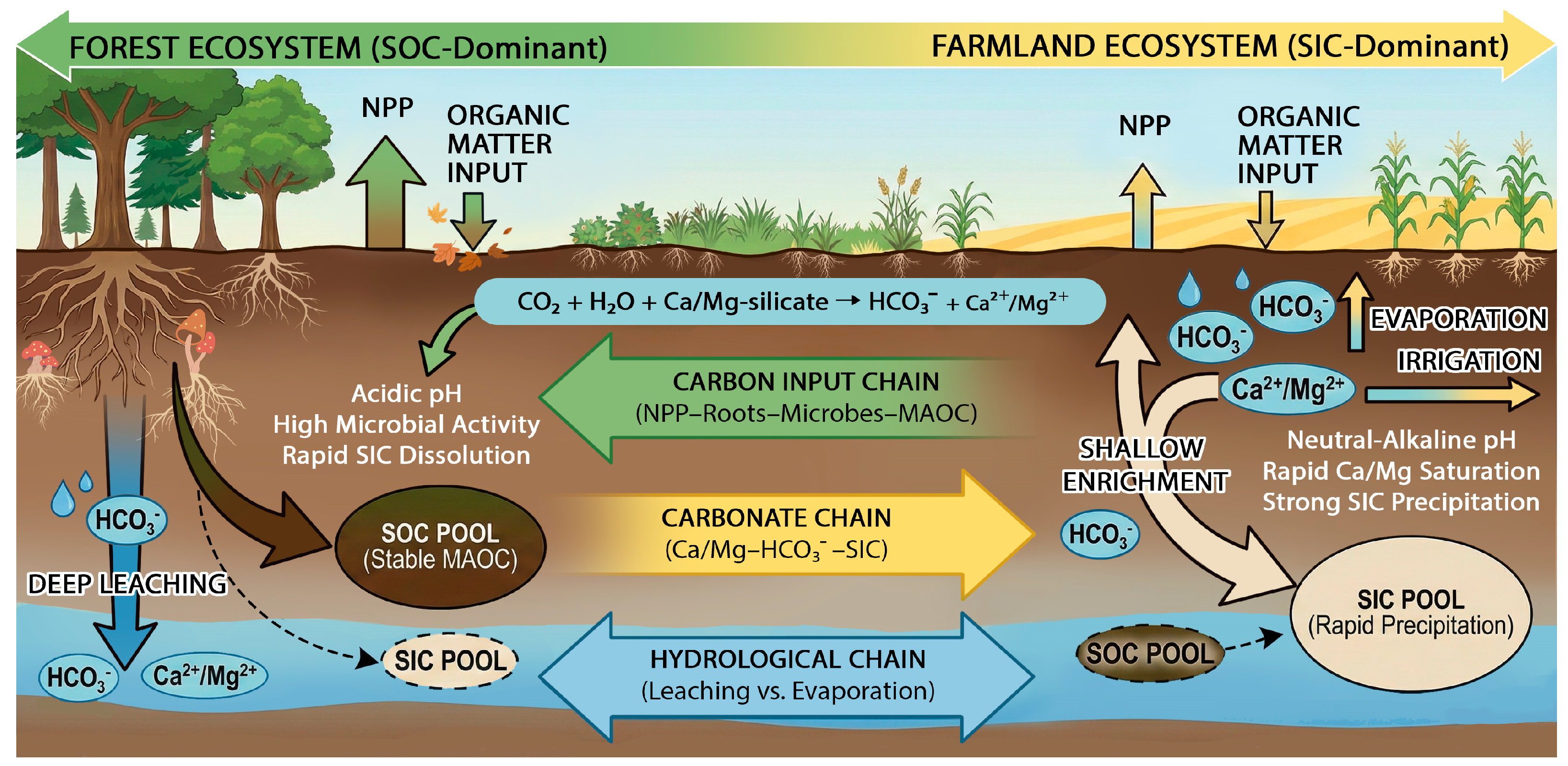
To integrate the evidence reviewed above into a unified, deployment-relevant synthesis, Figure 1 presents a conceptual framework of ESRW-induced carbon sequestration pathways across forest and cropland ecosystems [7,9,29]. The framework highlights that ESRW outcomes arise from the coupling of geochemical fluxes (alkalinity generation and transport) with ecosystem responses (productivity enhancement and SOC stabilization), and therefore require MRV approaches that explicitly track both soil and hydrological compartments [22,29].
Synthesizing these findings, forest and cropland ESRW share three mechanistic pillars that jointly determine net carbon removal and associated co-benefits. First, acidity supply and base-cation release co-regulate weathering intensity: proton consumption coupled to Ca–Mg silicate dissolution is a prerequisite for alkalinity generation and potential CO2 removal, with reaction rates modulated by particle size, organic ligands, and hydrological conditions [7,9]. Second, ecosystem productivity and organo-mineral stabilization pathways govern how additional plant-derived inputs are converted into persistent soil carbon. In many systems, nutrient release and pH shifts alter biomass production and influence the partitioning of new carbon into mineral-associated pools, which can dominate the net carbon balance relative to direct inorganic capture within soils [9,29]. Third, hydrogeological context controls the SOC–SIC partitioning: humid, well-drained regimes tend to export weathering-derived alkalinity as dissolved inorganic carbon to downstream waters, whereas water-limited or Ca-rich settings can favor localized secondary carbonate formation [7,29].
Based on these shared drivers, a practical “division of labor” emerges for global ESRW deployment. Forest systems may preferentially express ESRW benefits through productivity responses and downstream alkalinity export, while croplands provide intensively managed platforms where amendment application, sampling, and verification can be operationally integrated with agronomic practice [9,22,29]. Importantly, as emphasized in Figure 1, this complementarity does not represent a binary classification but rather a hydroclimate- and management-dependent continuum governed by water balance, soil buffering capacity, and the relative dominance of biological versus inorganic pathways in determining net outcomes [7,22].
Furthermore, under extreme-heat scenarios, supplying plant-available silicon via Si-bearing amendments represents a plausible pathway to enhance stress tolerance by improving antioxidant capacity, photosynthetic performance, and plant–water relations. However, the magnitude and consistency of these benefits remain context-dependent and should be evaluated alongside net carbon accounting [62]. In forest ecosystems, the emphasis often shifts toward carbon stabilization, where mineral additions may enhance MAOC formation and modulate respiration responses, potentially reducing the risk of heat-amplified carbon losses. Nevertheless, the net effect depends on site-specific conditions and the balance between priming and stabilization processes [9,29].
Taken together, Figure 1 motivates a cross-ecosystem deployment strategy that couples mechanistic targeting (rock type, particle size, and application rate) with hydroclimatic suitability and socio-economic feasibility. Such an approach ensures that carbon-removal claims are supported by robust MRV and life-cycle accounting, while maximizing co-benefits and minimizing trade-offs [22,63,64].

6. Limitations and Perspectives

While current studies provide early evidence that ESRW can reshape both SOC and SIC pathways across forests and croplands, mechanistic resolution and cross-scale quantification remain at an early stage [58,65]. A central limitation is that many trials still emphasize surface-layer reactions and short monitoring periods, which restrict the ability to resolve deeper rhizosphere weathering, subsurface DIC migration, and the coupled fate of weathering products along the soil–groundwater–catchment continuum [22]. Because carbon removal via ESRW ultimately depends on the integrated “weathering–transport–storage” chain, incomplete profiling of soil solutions and leachate fluxes can bias both carbon accounting and inferred sink strength [22,66]. In many forest settings, ESRW is expected to favor DIC and alkalinity export rather than in situ carbonate accumulation; however, robust constraints on the magnitude, attribution, and persistence of this export remain limited, particularly under open hydrological boundaries [29]. These uncertainties are further amplified by catchment-scale attribution challenges, including linking alkalinity signals to treated areas, tracking downstream transport, and closing long-term mass balances [22,29]. In addition, biotic controls—such as root–microbe–mineral interactions and mycorrhizal interfaces—are widely recognized as accelerators of mineral dissolution, yet they remain poorly quantified within most ESRW MRV designs [22,67].
In agricultural systems, near-surface pH shifts, irrigation, evapotranspiration, and Ca availability exert strong control over whether weathering products are retained as SIC or exported as DIC, resulting in highly site-specific outcomes [5,7,22]. However, many available datasets span only a few growing seasons, which limits confidence in decadal SIC stability, the potential for carbonate re-dissolution, and the long-term balance between SOC turnover and inorganic carbon outcomes [22,65]. A further constraint for agricultural deployment is the potential for repeated silicate applications to introduce or concentrate toxic trace elements (e.g., Ni, Cr, Cu) toward or beyond regulatory thresholds, depending on feedstock composition, application rate, background soil conditions, and time horizon [22,42]. Accordingly, risk management must be feedstock-specific and regulation-aware, incorporating proactive screening, blending or selective sourcing, and long-term soil monitoring to prevent cumulative exceedances under high application intensities [11,24].
ESRW deployment is also constrained by the monetary and carbon costs associated with mining, grinding, transporting, and spreading large mineral volumes. Comminution targets and transport distance are consistently identified as dominant cost and energy drivers in life-cycle and techno-economic assessments [68]. Case studies indicate that the use of quarry fines and optimization of local supply chains can substantially improve levelized costs and life-cycle performance, although outcomes remain highly contingent on feedstock availability and logistical context [68]. At the same time, MRV frameworks for ESRW remain under active development. Existing studies quantify different products (e.g., cations, alkalinity, or inorganic carbon) and focus on different compartments (soil solids, porewater, or leachate), complicating cross-study comparability and potentially biasing reported carbon dioxide removal estimates [22,66]. As a result, global-scale assessments continue to rely heavily on models, and uncertainty in key parameters—such as particle size, hydrology, soil chemistry, and logistical emissions—can lead to multi-fold divergence among scenarios [7,9].
Looking forward, a critical trajectory for ESRW research is the transition from single-site, short-term trials toward unified, cross-scale carbon accounting frameworks that explicitly couple SOC–MAOC–SIC–DIC dynamics with hydrological transport pathways and life-cycle constraints [22,65]. Achieving this shift requires moving beyond surface-soil inventories toward profile-scale and flux-resolving monitoring, including deep porewater and leachate measurements as well as catchment-relevant alkalinity and DIC tracking, in order to constrain the ultimate fate and permanence of weathering-derived carbon. In parallel, standardized protocols are urgently needed to evaluate feedstock-related risks, particularly trace-element mobilization and downstream environmental trade-offs. Recent techno-economic and life-cycle assessments further demonstrate that the net carbon-removal efficiency of ESRW is strongly shaped by material sourcing, comminution energy, transport distance, and field management practices, underscoring the need for integrated management–supply-chain co-design when evaluating ESRW scalability and climate-mitigation potential [10,22,42,66].

7. Conclusions

ESRW shows emerging potential to influence both SOC cycling and SIC/DIC pathways. Forests often amplify biologically driven responses—supporting productivity gains and more stable organic matter formation—yet frequently channel a substantial fraction of weathering-derived carbon into downstream DIC export rather than long-term storage on site. Croplands, by contrast, can show faster and more readily detectable increases in inorganic carbon pools under favorable hydroclimatic and geochemical conditions, although organic carbon responses remain less consistent. Crucially, the climate-mitigation value of ESRW depends not on DIC generation alone, but on whether carbon is retained through durable pathways such as mineral-associated organic carbon stabilization or secondary carbonate precipitation. Recognizing these divergent trajectories and the strong control exerted by local mineralogical, climatic, hydrological, and biological factors is essential for designing effective ESRW interventions. Future progress hinges on coupling profile-scale measurements and standardized MRV with explicit accounting of supply-chain costs and environmental risks (notably trace metal accumulation) to enable credible, comparable, and scalable carbon removal claims. Integrating ESRW with ecosystem-specific management and logistics optimization will be essential for translating promising pilot results into robust, policy-relevant deployment frameworks.

Author Contributions

Conceptualization, Y.D., Z.Y., Z.F. and C.F.; data curation, Y.D., Z.Y., H.W., Y.M. and Z.L.; funding acquisition, Z.F. and C.F.; investigation, Y.D.; methodology, Y.D. and Z.Y.; project administration, Z.F. and C.F.; resources, Z.F. and C.F.; software, Y.D. and Z.L.; supervision, C.F. and Z.F.; Validation, Y.D., Z.Y., H.W., J.S. and C.F.; writing—original draft, Y.D.; writing—review and editing, C.F., Y.D., Z.F., Z.Y., H.W., J.S. and Z.L. All authors have read and agreed to the published version of the manuscript.

Funding

This research was funded by the Basic Research Program of Jiangsu (Grant Nos BE2023400, BK20220017), National Natural Science Foundation of China (42107248).

Data Availability Statement

The data presented in this study are available upon request from the corresponding author.

Conflicts of Interest

The authors declare that they have no known competing financial interests or personal relationships that could have appeared to influence the work reported in this paper.

Abbreviations

The following abbreviations are used in this manuscript:
ESRWEnhanced Silicate Rock Weathering
CDRCarbon Dioxide Removal
SOCSoil Organic Carbon
SICSoil Inorganic Carbon
DICDissolved Inorganic Carbon
MAOCMineral-Associated Organic Carbon
MAOMMineral-Associated Organic Matter
NPPNet Primary Productivity
EMFEcosystem Multifunctionality
MRVMonitoring, Reporting, and Verification
POMParticulate Organic Matter
TICTotal Inorganic Carbon
NBPNet Biome Productivity
ESMsEarth System Models
PgPetagram (1015 g)
yrYear

References

  1. Rogelj, J.; Popp, A.; Calvin, K.V.; Luderer, G.; Emmerling, J.; Gernaat, D.; Fujimori, S.; Strefler, J.; Hasegawa, T.; Marangoni, G.; et al. Scenarios towards limiting global mean temperature increase below 1.5 °C. Nat. Clim. Change 2018, 8, 325–332. [Google Scholar]
  2. Smith, P.; Davis, S.; Creutzig, F.; Fuss, S.; Minx, J.; Gabrielle, B.; Kato, E.; Jackson, R.B.; Cowie, A.; Kriegler, E.; et al. Biophysical and economic limits to negative CO2 emissions. Nat. Clim. Change 2016, 6, 42–50. [Google Scholar] [CrossRef]
  3. IPCC. Climate Change 2023: Synthesis Report; Contribution of Working Groups I, II and III to the Sixth Assessment Report of the Intergovernmental Panel on Climate Change; IPCC: Geneva, Switzerland, 2023. [Google Scholar]
  4. Batjes, N.H. Total carbon and nitrogen in the soils of the world. Eur. J. Soil Sci. 1996, 47, 151–163. [Google Scholar] [CrossRef]
  5. Zamanian, K.; Pustovoytov, K.; Kuzyakov, Y. Pedogenic carbonates: Forms and formation processes. Earth Sci. Rev. 2016, 157, 1–17. [Google Scholar]
  6. FAO. Global Forest Resources Assessment 2020: Main Report; FAO: Rome, Italy, 2020; ISBN 978-92-5-132974-0. [Google Scholar]
  7. Lal, R. Soil Carbon Sequestration Impacts on Global Climate Change and Food Security. Science 2004, 304, 1623–1627. [Google Scholar] [CrossRef]
  8. Hartmann, J.; West, A.J.; Renforth, P.; Köhler, P.; De La Rocha, C.L.; Wolf-Gladrow, D.A.; Dürr, H.H.; Scheffran, J. Enhanced chemical weathering as a geoengineering strategy to reduce atmospheric carbon dioxide, supply nutrients, and mitigate ocean acidification. Rev. Geophys. 2013, 51, 113–149. [Google Scholar] [CrossRef]
  9. Beerling, D.J.; Kantzas, E.P.; Lomas, M.R.; Wade, P.; Eufrasio, R.M.; Renforth, P.; Sarkar, B.; Andrews, M.G.; James, R.H.; Pearce, C.R.; et al. Potential for large-scale CO2 removal via enhanced rock weathering with croplands. Nature 2020, 583, 242–248. [Google Scholar] [CrossRef]
  10. Berner, R.A.; Lasaga, A.C.; Garrels, R.M. The carbonate-silicate geochemical cycle and its effect on atmospheric carbon dioxide over the past 100 million years. Am. J. Sci. 1983, 283, 641–683. [Google Scholar] [CrossRef]
  11. Taylor, L.L.; Banwart, S.A.; Valdes, P.J.; Leake, J.R.; Beerling, D.J. Evaluating the effects of terrestrial ecosystems, climate and carbon dioxide on weathering over geological time: A global-scale process-based approach. Philos. Trans. R. Soc. B Biol. Sci. 2012, 367, 565–582. [Google Scholar] [CrossRef]
  12. Zhang, B.; Kroeger, J.; Planavsky, N.; Yao, Y. Techno-Economic and Life Cycle Assessment of Enhanced Rock Weathering: A Case Study from the Midwestern United States. Environ. Sci. Technol. 2023, 57, 13828–13837. [Google Scholar] [CrossRef]
  13. de Oliveira Garcia, W.; Amann, T.; Hartmann, J.; Karstens, K.; Popp, A.; Boysen, L.; Smith, P.; Goll, D. Impacts of enhanced weathering on biomass production for negative emission technologies and soil hydrology. Biogeosciences 2020, 17, 2107. [Google Scholar] [CrossRef]
  14. Fontaine, S.; Barot, S.; Barré, P.; Bdioui, N.; Mary, B.; Rumpel, C. Stability of organic carbon in deep soil layers controlled by fresh carbon supply. Nature 2007, 450, 277–280. [Google Scholar] [CrossRef]
  15. Torn, M.; Trumbore, S.; Chadwick, O.A.; Vitousek, P.M.; Hendricks, D.M. Mineral control of soil organic carbon storage and turnover. Nature 1997, 389, 170–173. [Google Scholar] [CrossRef]
  16. Kleber, M.; Eusterhues, K.; Keiluweit, M.; Mikutta, C.; Mikutta, R.; Nico, P.S. Mineral—Organic Associations: Formation, Properties, and Relevance in Soil Environments. Adv. Agron. 2015, 130, 1–140. [Google Scholar]
  17. Sokol, N.W.; Sanderman, J.; Bradford, M.A. Pathways of mineral-associated soil organic matter formation: Integrating the role of plant carbon source, chemistry, and point of entry. Glob. Change Biol. 2018, 25, 12–24. [Google Scholar] [CrossRef] [PubMed]
  18. IPCC. Climate Change and Land: An IPCC Special Report; IPCC: Geneva, Switzerland, 2019. [Google Scholar]
  19. Pan, Y.; Birdsey, R.A.; Fang, J.; Houghton, R.; Kauppi, P.E.; Kurz, W.A.; Phillips, O.L.; Shvidenko, A.; Lewis, S.L.; Canadell, J.G.; et al. A large and persistent carbon sink in the world’s forests. Science 2011, 333, 988–993. [Google Scholar] [CrossRef]
  20. Hinsinger, P. Bioavailability of soil inorganic P in the rhizosphere as affected by root-induced chemical changes: A review. Plant Soil 2001, 237, 173–195. [Google Scholar] [CrossRef]
  21. Hinsinger, P.; Bengough, A.G.; Vetterlein, D.; Young, I.M. Rhizosphere: Biophysics, biogeochemistry and ecological relevance. Plant Soil 2009, 321, 117–152. [Google Scholar] [CrossRef]
  22. Levy, C.R.; Almaraz, M.; Beerling, D.J.; Raymond, P.; Reinhard, C.T.; Suhrhoff, T.J.; Taylor, L. Enhanced Rock Weathering for Carbon Removal–Monitoring and Mitigating Potential Environmental Impacts on Agricultural Land. Environ. Sci. Technol. 2024, 58, 17215–17226. [Google Scholar] [CrossRef]
  23. Guo, M.; Power, I.M.; Watmough, S.A.; Gorgolewski, A.S.; Wallisch, L.M.; Spence, J.; Wilson, S. Incorporating enhanced rock weathering into sustainable forest management. J. Environ. Manag. 2025, 394, 127335. [Google Scholar] [CrossRef]
  24. Zhang, Z.; Jones, G.; Calabrese, S.; Bertagni, M.; Fatichi, S.; Waring, B.; Paschalis, A. An integrated modelling framework to determine terrestrial carbon dioxide removal via enhanced rock weathering. Glob. Change Biol. 2025, 31, e70650. [Google Scholar] [CrossRef]
  25. Manning, D.A.C.; Renforth, P. Passive Sequestration of Atmospheric CO2 through Coupled Plant-Mineral Reactions in Urban soils. Environ. Sci. Technol. 2013, 47, 135–141. [Google Scholar]
  26. Renforth, P. The negative emission potential of alkaline materials. Nat. Commun. 2019, 10, 1401. [Google Scholar] [CrossRef]
  27. Xu, T.; Yuan, Z.; Vicca, S.; Goll, D.S.; Li, G.; Lin, L.; Chen, H.; Bi, B.; Chen, Q.; Li, C.; et al. Enhanced silicate weathering accelerates forest carbon sequestration by stimulating the soil mineral carbon pump. Glob. Change Biol. 2024, 30, e17464. [Google Scholar] [CrossRef] [PubMed]
  28. Gaucher, Y.; Tanaka, K.; Johansson, D.J.A.; Goll, D.S.; Ciais, P. Leveraging ecosystems responses to enhanced rock weathering in mitigation scenarios. Nat. Commun. 2025, 16, 3021. [Google Scholar] [CrossRef]
  29. Taylor, L.L.; Driscoll, C.T.; Groffman, P.M.; Rau, G.H.; Blum, J.D. Increased carbon capture by a deep-rooted bioenergy crop strongly enhanced by enhanced rock weathering. Biogeosciences 2021, 18, 169–188. [Google Scholar]
  30. Amundson, R.; Berhe, A.A.; Hopmans, J.W.; Olson, C.; Sztein, A.E.; Sparks, D.L. Soil science. Soil and human security in the 21st century. Science 2015, 348, 1261071. [Google Scholar] [CrossRef]
  31. Calmels, D.; Gaillardet, J.; Brenot, A.; France-Lanord, C. Sustained sulfide oxidation by physical erosion processes in the Mackenzie River basin: Climatic perspectives. Geology 2007, 35, 1003–1006. [Google Scholar] [CrossRef]
  32. Gaillardet, J.; Dupré, B.; Louvat, P.; Allègre, C. Global silicate weathering and CO2 consumption rates deduced from the chemistry of large rivers. Chem. Geol. 1999, 159, 3–30. [Google Scholar] [CrossRef]
  33. Renforth, P.; Henderson, G. Assessing ocean alkalinity for carbon sequestration. Rev. Geophys. 2017, 55, 636–674. [Google Scholar] [CrossRef]
  34. Knapp, W.J.; Stevenson, E.I.; Renforth, P.; Ascough, P.L.; Knight, A.C.G.; Bridgestock, L.; Bickle, M.J.; Lin, Y.; Riley, A.L.; Mayes, W.M.; et al. Quantifying CO2 Removal at Enhanced Weathering Sites: A Multiproxy Approach. Environ. Sci. Technol. 2023, 57, 9854–9864. [Google Scholar] [CrossRef]
  35. White, A.F.; Brantley, S.L. The effect of time on the weathering of silicate minerals: Why do weathering rates differ in the laboratory and field? Chem. Geol. 2003, 202, 479–506. [Google Scholar] [CrossRef]
  36. Oelkers, E.H.; Declercq, J.; Saldi, G.D.; Gislason, S.R.; Schott, J. Olivine dissolution rates: A critical review. Chem. Geol. 2018, 500, 1–19. [Google Scholar] [CrossRef]
  37. Taylor, L.L.; Beerling, D.J.; Quegan, S.; Banwart, S.A. Simulating carbon capture by enhanced weathering with croplands: An overview of key processes highlighting areas of future model development. Biol. Lett. 2017, 13, 20160868. [Google Scholar] [CrossRef] [PubMed]
  38. Amann, T.; Hartmann, J.; Struyf, E.; de Oliveira Garcia, W.; Fischer, E.K.; Janssens, I.; Meire, P.; Schoelynck, J. Enhanced Weathering and related element fluxes—A cropland mesocosm approach. Biogeosciences 2020, 17, 103–119. [Google Scholar] [CrossRef]
  39. Kelland, M.E.; Wade, P.W.; Lewis, A.L.; Taylor, L.L.; Sarkar, B.; Andrews, M.G.; Lomas, M.R.; Cotton, T.E.A.; Kemp, S.J.; James, R.H.; et al. Increased yield and CO2 sequestration potential with the C4 cereal Sorghum bicolor (L.) Moench cultivated in basaltic rock dust-amended agricultural soil. Glob. Change Biol. 2020, 26, 3658–3676. [Google Scholar] [CrossRef]
  40. Buss, W.; Hasemer, H.; Ferguson, S.; Borevitz, J. Stabilisation of soil organic matter with rock dust partially counteracted by plants. Glob. Change Biol. 2023, 30, e17052. [Google Scholar]
  41. Sokol, N.W.; Sohng, J.; Moreland, K.; Slessarev, E.; Goertzen, H.; Schmidt, R.; Samaddar, S.; Holzer, I.; Almaraz, M.; Geoghegan, E.; et al. Reduced accrual of mineral-associated organic matter after two years of enhanced rock weathering in cropland soils, though no net losses of soil organic carbon. Biogeochemistry 2024, 167, 989–1005. [Google Scholar] [CrossRef]
  42. Kuzyakov, Y.; Friedel, J.K.; Stahr, K. Review of mechanisms and quantification of priming effects. Soil Biol. Biochem. 2000, 32, 1485–1498. [Google Scholar] [CrossRef]
  43. Dupla, X.; Claustre, R.; Bonvin, E.; Graf, I.; Le Bayon, R.C.; Grand, S. Let the dust settle: Impact of enhanced rock weathering on soil fertility. Sci. Total Environ. 2024, 954, 176297. [Google Scholar]
  44. Haque, F.; Santos, R.M.; Chiang, Y.W. Optimizing inorganic carbon sequestration and crop yield with wollastonite soil amendment in a microplot study. Front. Plant Sci. 2020, 11, 1012. [Google Scholar] [CrossRef]
  45. Beerling, D.J.; Leake, J.R.; Long, S.P.; Scholes, D.J.; Ton, J.; Nelson, P.N.; Bird, M.; Kantzas, E.; Taylor, L.L.; Sarkar, B.; et al. Farming with crops and rocks to address global climate, food and soil security. Nat. Plants 2018, 4, 138–147. [Google Scholar]
  46. Vienne, A.; Poblador, S.; Portillo-Estrada, M.; Hartmann, J.; Ijiehon, S.; Wade, P.; Vicca, S. Enhanced Weathering Using Basalt Rock Powder: Carbon Sequestration, Co-benefits and Risks in a Mesocosm Study with Solanum tuberosum. Front. Clim. 2022, 4, 869456. [Google Scholar] [CrossRef]
  47. Guo, F.; Wang, Y.; Zhu, H.; Zhang, C.; Sun, H.; Fang, Z.; Yang, J.; Zhang, L.; Mu, Y.; Man, Y.B.; et al. Crop productivity and soil inorganic carbon change mediated by enhanced rock weathering in farmland: A comparative field analysis of multi-agroclimatic regions in central China. Agric. Syst. 2023, 210, 103691. [Google Scholar] [CrossRef]
  48. Daly, C.; Halbleib, M.; Smith, J.I.; Gibson, W.P.; Doggett, M.K.; Taylor, G.H.; Curtis, J.; Pasteris, P.P. Physiographically sensitive mapping of climatological temperature and precipitation across the conterminous United States. Int. J. Clim. 2008, 28, 2031–2064. [Google Scholar] [CrossRef]
  49. Shabtai, I.A.; Wilhelm, R.C.; Schweizer, S.A.; Höschen, C.; Buckley, D.H.; Lehmann, J. Calcium promotes persistent soil organic matter by altering microbial transformation of plant litter. Nat. Commun. 2023, 14, 6609. [Google Scholar] [CrossRef]
  50. Ortiz, A.C.; Jin, L.X.; Ogrinc, N.; Kaye, J.; Krajnc, B.; Ma, L. Dryland irrigation increases accumulation rates of pedogenic carbonate and releases soil abiotic CO2. Sci. Rep. 2022, 12, 464. [Google Scholar] [CrossRef]
  51. Blanchy, G.; Bragato, G.; Claudia, D.B.; Jarvis, N.; Larsbo, M.; Meurer, K.; Garré, S. Soil and crop management practices and the water cycle: A review. SOIL 2023, 9, 1–20. [Google Scholar]
  52. Raza, S.; Miao, N.; Wang, P.Z.; Ju, X.T.; Chen, Z.J.; Zhou, J.; Kuzyakov, Y. Dramatic loss of inorganic carbon by nitrogen-induced soil acidification in Chinese croplands. Glob. Change Biol. 2020, 26, 3738–3751. [Google Scholar] [CrossRef] [PubMed]
  53. Ma, J.; Wang, Z.Y.; Stevenson, B.; Zheng, X.J.; Li, Y. An inorganic CO2 diffusion and dissolution process that increases carbon storage in soil. Sci. Rep. 2013, 3, 2025. [Google Scholar] [CrossRef]
  54. Campeau, A.; Bishop, K.; Amvrosiadi, N.; Billett, M.F.; Garnett, M.H.; Laudon, H.; Öquist, M.G.; Wallin, M.B. Current forest carbon fixation fuels stream CO2 emissions. Nat. Commun. 2019, 10, 1876. [Google Scholar] [CrossRef]
  55. Kindler, R.; Siemens, J.; Kaiser, K.; Walmsley, D.C.; Bernhofer, C.; Buchmann, N.; Cellier, P.; Eugster, W.; Gleixner, G.; Grũnwald, T.; et al. Dissolved carbon leaching from soil is a crucial component of the net ecosystem carbon balance. Glob. Change Biol. 2011, 17, 1167–1185. [Google Scholar] [CrossRef]
  56. Peters, S.C.; Blum, J.D.; Driscoll, C.T.; Likens, G.E. Dissolution of wollastonite during the experimental manipulation of Hubbard Brook Watershed 1. Biogeochemistry 2004, 67, 309–329. [Google Scholar] [CrossRef]
  57. Panagea, I.S.; Apostolakis, A.; Berti, A.; Bussell, J.; Čermak, P.; Diels, J.; Elsen, A.; Kusá, H.; Piccoli, I.; Poesen, J.; et al. Impact of agricultural management on soil aggregates and associated organic carbon fractions. SOIL 2022, 8, 621. [Google Scholar] [CrossRef]
  58. Beerling, D.J.; Epihov, D.Z.; Kantola, I.B.; Masters, M.D.; Reershemius, T.; Planavsky, N.J.; Reinhard, C.T.; Jordan, J.S.; Thorne, S.J.; Weber, J.; et al. Enhanced weathering in the US Corn Belt delivers carbon removal with agronomic benefits. Proc. Natl. Acad. Sci. USA 2024, 121, e2319436121. [Google Scholar] [CrossRef] [PubMed]
  59. Cotrufo, M.F.; Wallenstein, M.D.; Boot, C.M.; Denef, D.K.; Paul, E. The Microbial Efficiency–Matrix Stabilization (MEMS) framework. Glob. Change Biol. 2013, 19, 988–995. [Google Scholar] [CrossRef]
  60. Lei, K.; Bucka, F.B.; Teixeira, P.P.C.; Buegger, F.; Just, C.; Kögel-Knabner, I. Balancing Organic and Inorganic Carbon Dynamics in Enhanced Rock Weathering: Implications for Carbon Sequestration. Glob. Change Biol. 2025, 31, e70186. [Google Scholar]
  61. Monger, H.C.; Kraimer, R.A.; Khresat, S.; Cole, D.R.; Wang, X.; Wang, J. Sequestration of inorganic carbon in soil and groundwater. Geology 2015, 43, 375–378. [Google Scholar] [CrossRef]
  62. Saha, G.; Mostofa, M.G.; Rahman, M.M.; Tran, L.-S.P. Silicon-mediated heat tolerance in higher plants: A mechanistic outlook. Plant Physiol. Biochem. 2021, 166, 341–347. [Google Scholar] [CrossRef]
  63. Strefler, J.; Amann, T.; Bauer, N.; Kriegler, E.; Hartmann, J. Potential and costs of carbon dioxide removal by enhanced weathering of rocks. Environ. Res. Lett. 2018, 13, 034010. [Google Scholar] [CrossRef]
  64. Eufrasio, R.M.; Kantzas, E.P.; Edwards, N.R.; Holden, P.B.; Pollitt, H.; Mercure, J.-F.; Koh, S.C.L.; Beerling, D.J. Environmental and health impacts of atmospheric CO2 removal by enhanced rock weathering depend on nations’ energy mix. Commun. Earth Environ. 2022, 3, 106. [Google Scholar] [CrossRef]
  65. Manning, D.A.C.; de Azevedo, A.C.; Zani, C.F.; Barneze, A.S. Soil carbon management and enhanced rock weathering: The separate fates of organic and inorganic carbon. Eur. J. Soil Sci. 2024, 75, E13534. [Google Scholar] [CrossRef]
  66. Reershemius, T.; Kelland, M.E.; Jordan, J.S.; Davis, I.R.; D’ascanio, R.; Kalderon-Asael, B.; Asael, D.; Suhrhoff, T.J.; Epihov, D.Z.; Beerling, D.J.; et al. Initial validation of a soil-based mass-balance Approach for empirical monitoring of enhanced rock weathering rates. Environ. Sci. Technol. 2023, 57, 19497–19507. [Google Scholar] [CrossRef]
  67. Bonneville, S.; Smits, M.M.; Brown, A.; Harrington, J.; Leake, J.R.; Brydson, R.; Benning, L.G. Plant-driven fungal weathering: Early stages of mineral alteration at the nanometer scale. Geology 2009, 37, 615–618. [Google Scholar] [CrossRef]
  68. Breunig, H.M.; Fox, P.; Domen, J.; Kumar, R.; Alves, R.J.E.; Zhalnina, K.; Voigtländer, A.; Deng, H.; Arora, B.; Nico, P. Life cycle impact and cost analysis of quarry materials for land-based enhanced weathering in Northern California. J. Clean. Prod. 2024, 476, 143757. [Google Scholar] [CrossRef]
Figure 1. Conceptual framework of ESRW-induced carbon sequestration pathways in forest and cropland ecosystems.
Forests 17 00144 g001
Table 1. Field and experimental evidence for ESRW’s impacts on SOC/MAOC and inorganic carbon pathways in forest systems.
Forest System/Study ContextRock Type & DurationDominant Carbon ResponseInorganic C PathwayKey Mechanistic InterpretationReferences
Tropical plantation forest (field)Wollastonite powder; ~2 yearsIncreased SOC concentrated in MAOCAlkalinity (HCO3) export > SICEarly response driven by SOC stabilization via mineral–microbial aggregation; limited in situ carbonate formation[5,9]
Temperate managed forest (operational trial)Wollastonite-rich amendment; operational trialSOC change heterogeneousMinor alkalinity capturePractical constraints dominate; spatial variability complicates attribution and monitoring[13,30]
Watershed-scale temperate forest (long-term)Wollastonite; 15 yearsSystem-scale CDR dominated by productivityDIC export > SICForest ESRW primarily enhances weathering-driven alkalinity fluxes; requires watershed-scale accounting[9,31]
Conceptual humid forest synthesisCa/Mg-silicate amendments (general)SOC response context-dependentPedogenic SIC limitedHigh hydrological connectivity favors DIC transport; SIC rarely accumulates in situ[5,8]
Table 2. Field and experimental evidence for ESRW’s impacts on soil carbon pools and inorganic carbon pathways in cropland ecosystems.
Cropland
System/Study Context
Rock Type & DurationSOC/MAOC ResponseInorganic C Pathway (DIC/SIC)Key Mechanistic InterpretationReferences
Humid croplands (China; field monitoring + modeling)Silicate rock powders; multi-yearYield-driven C inputs possible; SOC response heterogeneousPredominantly alkalinity/DIC export; SIC conditionalHydroclimate and soil pH gate DIC vs. SIC partitioning; management context critical[7,33,47]
US Corn Belt (humid–subhumid rainfed maize–soybean systems)Basalt rock dust; multi-year large trialAgronomic co-benefits reported; SOC change requires long-term measurement“Bicarbonate pathway” dominates; downstream storage in aquatic systemsAlkalinity export represents main CDR product; verification requires mass balance & hydrology[7,22,45]
Humid cropland mesocosms (short-term constraints)Basalt; weeks–monthsSOC change uncertain over short horizons; priming possiblePore-water/leachate alkalinity signals; short-term SIC/TIC gains absentWet systems favor DIC export; SIC not a default outcome[5,7,46]
Cool-temperate croplands (Hokkaido field experiment)Silicate rock powder; field-scale Carbon budgets improved; SOC response context-dependentMixed DIC export with conditional SICNet CDR must be evaluated at ecosystem scale, not via single pool changes[7,22,45]
Global syntheses/meta-analysesMultiple rock types; multi-studyMean SOC/MAOC changes modest and heterogeneousInorganic pathway often dominates CDR accountingAvoid generalizing SIC formation; emphasize hydrology, saturation state & MRV[5,7,33]
Disclaimer/Publisher’s Note: The statements, opinions and data contained in all publications are solely those of the individual author(s) and contributor(s) and not of MDPI and/or the editor(s). MDPI and/or the editor(s) disclaim responsibility for any injury to people or property resulting from any ideas, methods, instructions or products referred to in the content.