Article

Genome-Wide Identification and Expression Analysis of the GRX Gene Family Reveals Its Potential Role in Floral Organ Development and Sex Differentiation in Litsea cubeba

by
Siqi Wang
1,2,3,
Yangdong Wang
1,3,
Ming Gao
1,2,3,
Yicun Chen
1,2,3 and
Yunxiao Zhao
1,2,3,*
1
State Key Laboratory of Tree Genetics and Breeding, Chinese Academy of Forestry, Beijing 100091, China
2
Research Institute of Subtropical Forestry, Chinese Academy of Forestry, Hangzhou 311400, China
3
Zhejiang Key Laboratory of Forest Genetics and Breeding, Hangzhou 311400, China
*
Author to whom correspondence should be addressed.
Forests 2026, 17(1), 128; https://doi.org/10.3390/f17010128
Submission received: 29 November 2025 / Revised: 26 December 2025 / Accepted: 9 January 2026 / Published: 16 January 2026
(This article belongs to the Section Genetics and Molecular Biology)

Abstract

As a class of glutathione-dependent oxidoreductases, glutaredoxins (GRXs) play a central role in maintaining cellular redox homeostasis, thereby influencing diverse biological processes including growth, development, and stress adaptation in plants. This study identified 36 GRX genes in Litsea cubeba through whole-genome analysis. Phylogenetic classification placed them into four subfamilies (CC-, CGFS-, CPYC-type, and a species-specific SS branch), consistent with patterns in model plants like Arabidopsis thaliana and Oryza sativa, indicating evolutionary conservation of GRX core motifs. Genomic analyses including chromosomal location, collinearity, and gene structure revealed family evolution features. Expression profiling showed 11 LcGRX genes were flower-specific, with marked differential expression during stamen (M2) and pistil (F2) degeneration, supporting their roles in sexual dimorphism. Functional assays confirmed that floral highly expressed LcGRX12 directly interacts with TGA transcription factor LcTGA10, similar to its Arabidopsis homolog ROXY1. This study reveals the GRX-TGA module’s role in floral organ development in L. cubeba, offering insights into redox-mediated sex differentiation in Lauraceae and providing candidate genes for molecular breeding.

1. Introduction

Glutaredoxins (GRXs), a class of small glutathione-dependent oxidoreductases, are pivotal in maintaining cellular redox homeostasis, which is a process fundamental to plant growth and development [1,2,3,4,5,6]. Based on conserved active-site sequences, plant GRXs are classified into three types: CPYC, CGFS, and the land plant-specific CC-type (also known as the ROXY-type, named after the well-characterized ROXY subfamily in Arabidopsis thaliana [7]. These enzymes are involved in processes such as reactive oxygen species (ROS) scavenging, iron-sulfur cluster metabolism, transcription factor activity regulation, and hormone signaling, collectively constituting a molecular network that enables plants to respond to environmental cues and precisely regulate development [8,9,10,11,12,13].
The role of GRXs in floral development has been well established in model plants. In A. thaliana, ROXY1 and ROXY2 interact with TGA transcription factors to regulate tapetum development and anther maturation, with double mutants exhibiting abnormal anther structure and pollen abortion [14,15]. In Zea mays (maize), the GRX gene MSCA1 involved in floral organ development has also been identified, and mutations in MSCA1 result in abnormalities of maize anthers [16]. Notably, in Litsea cubeba, TGA family members (e.g., LcTGA10) are key regulators of stamen abortion, and this gene is a core interaction partner of ROXY1/2 in Arabidopsis, suggesting a potentially conserved GRX-TGA module in L. cubeba [17].
Litsea cubeba is an economically important essential oil tree species endemic to China, belonging to the Lauraceae family [18,19]. It is dioecious with pronounced sexual dimorphism, and its sex determination mechanism directly influences economic traits such as floral structure, essential oil composition, and yield [20]. Previous studies have shown that salicylic acid and gibberellin signaling pathways regulate the abortion of floral organs before meiosis in L. cubeba [17]. However, the role of GRX-mediated redox regulation in its sex differentiation remains unexplored, representing a significant knowledge gap in the underlying molecular mechanism.
Based on the conserved functions of GRXs and the current research status of L. cubeba, we hypothesize that its GRX members may regulate floral organ development and sex determination through interactions with TGA transcription factors. To test this hypothesis, we conducted a comprehensive study integrating whole-genome and transcriptome data, including genome-wide identification, phylogenetic and motif analysis of the GRX family, and examination of their expression patterns across tissues and floral developmental stages. This study aims to elucidate the regulatory roles of GRXs in floral development of L. cubeba, providing a theoretical foundation and candidate gene resources for researching sex determination mechanisms in Lauraceae plants and supporting molecular breeding efforts in L. cubeba.

2. Materials and Methods

Experimental materials of L. cubeba were collected from Hangzhou City, Zhejiang Province, China (30°27′94″ N, 119°58′43″ E). The classification of floral bud developmental stages was based on the criteria proposed by Xu et al. [17]. The mean diameters for each stage were defined as follows: for female floral buds, approximately 1.2 mm (F1 stage), 1.7 mm (F2 stage), and 2.6 mm (F3 stage); for male floral buds, approximately 1.4 mm (M1 stage), 1.8 mm (M2 stage), and 2.9 mm (M3 stage), with a measurement error of ±0.2 mm for all stages.

2.1. Genome-Wide Identification of the GRX Gene Family in L. cubeba

In this study, coding sequences and protein sequences required for subsequent analyses were retrieved from the L. cubeba genome database [18]. Using the Hidden Markov Model (HMM) file corresponding to the conserved domain of the glutaredoxin (GRX) family as the search probe, HMMER software (version 3.3.2) was used for analysis with a screening threshold of E-value < 1 × 10⁻⁵. Furthermore, TBtools version 2.376 (available at https://github.com/CJ-Chen/TBtools, accessed on 1 November 2025) was utilized to obtain the GRX gene sequences of L. cubeba, employing additional criteria for screening with a sequence identity match exceeding 50%. By integrating and analyzing the results of HMMER and BLAST (version 2.376) [21,22], 36 putative LcGRX proteins were initially identified, and all duplicated sequences were manually removed from the candidate set. To validate the reliability of these identifications, cross validation was further conducted using three major conserved domain databases: Pfam (PF00462), NCBI CDD (https://www.ncbi.nlm.nih.gov/cdd/, accessed on 3 November 2025), and SMART (http://smart.embl.de/, accessed on 3 November 2025). The validation confirmed that all 36 candidate proteins contained the characteristic core domain of the GRX family, thus confirming them as valid LcGRX proteins. Construction of the phylogenetic tree for the 36 identified LcGRXs was performed with PhyML 3.0 software, applying the default parameter set [23].

2.2. An Integrated Analysis of LcGRX Proteins and Gene Architecture

The ExPASy online tool [24,25] was employed to assess key physicochemical properties of the predicted LcGRX proteins, including molecular weight, isoelectric point (pI), and grand average of hydropathicity (GRAVY). To identify conserved motifs, an analysis was performed with the MEME suite [26,27], and the results were visualized using TBtools. The identified motifs were annotated based on information from the SMART and Pfam databases [28,29]. Furthermore, the gene structures of the LcGRX genes were analyzed from their Gff3 files with TBtools [30].

2.3. Chromosomal Distribution and Collinearity Analysis of LcGRX Genes

Following the initial chromosomal mapping of LcGRX genes via BLAST alignment against the L. cubeba genome assembly, the localization results were graphically presented on the 11 chromosomes using MG2C v2.1 (http://mg2c.iask.in/mg2c_v2.1/, accessed on 6 November 2025). Interspecies synteny analysis was then conducted employing the MCScanX tool within TBtools (v2.376) to explore their evolutionary conservation [31].

2.4. RNA Isolation and qRT-PCR Analysis

Total RNA extraction and reverse transcription of L. cubeba samples were performed following the methods described by Zhao et al. [32]. For the reverse transcription reaction, 1 μg of high-quality RNA was used per tube, with PrimeScript™ RT Master Mix (Cat. No.: RR036Q, TaKaRa, Kyoto, Japan) as the reagent. Quantitative real-time PCR (qPCR) analyses were conducted on an ABI PRISM 7500 Real-Time PCR System using the TB Green Premix Ex Taq kit (Cat. No.: RR420Q, TaKaRa, Kyoto, Japan). The qPCR program was set as follows: First, pre-denaturation (Hold) was performed at 95.0 °C for 30 s (1 cycle), followed by 2-step PCR amplification consisting of 40 cycles, with each cycle including denaturation at 95.0 °C for 5 s and annealing/extension at 60.0 °C for 10 s (data collection was enabled in this step for real-time fluorescent signal detection), and finally, dissociation (melting curve analysis) was conducted with conditions sequentially set as 95.0 °C for 15 s (1 cycle) → 60.0 °C for 30 s (1 cycle) → 95.0 °C for 15 s (1 cycle).
The ubiquitin-conjugating enzyme gene (UBC, Chen et al. [18]) was selected as the reference gene. Its expression stability in L. cubeba has been validated, confirming its suitability as a reliable reference gene. In this study, only this single validated reference gene (UBC) was used for normalizing the expression levels of target genes [18]. The relative expression levels of target genes were calculated using the 2−ΔΔCt method. The experiment included 3 independent biological replicates, with each biological replicate consisting of 3 technical replicates. Final data are presented as mean ± standard deviation (mean ± SD). The design of all qPCR primers was conducted with the web-based program Primer3 (https://primer3.ut.ee/, accessed on 6 June 2025). The corresponding primer sequences are available in Supplementary Table S1.

2.5. Yeast Two-Hybrid Assay (Y2H)

To investigate the potential interaction between LcTGA10 and LcGRX12 via the yeast two-hybrid system, the CDS of LcTGA10 was inserted into the bait vector pGBKT7, while that of LcGRX12 was cloned into the prey vector pGADT7. First, pGBKT7-LcTGA10 was co-transformed with the empty vector pGADT7, and pGBKT7 was co-transformed with pGADT7-LcGRX12 into the Gold Y2H yeast strain to confirm the absence of autoactivation. Following the protocol described by Han et al. [33], the bait-prey vector constructs were co-transformed into the same strain using the lithium acetate method. Meanwhile, autoactivation verification groups, as well as standard positive controls (pGBKT7-53 + pGADT7-T) and negative controls (pGBKT7-Lam + pGADT7-T), were set up. All yeast two-hybrid assays were performed with three independent biological replicates and three technical replicates per biological replicate. Yeast cells from each group were inoculated onto SD/-Leu-Trp medium, cultured at 30 °C for 72 h, and photographed. Subsequently, the colonies were transferred to SD/-Leu-Trp-Ade-His medium, incubated at the same temperature for another 72 h, and photographed again. A 2 μL aliquot of 20 mg/mL X-α-Gal reagent was added to each colony on the agar plate. After 12 h, the color development was observed to verify the interaction between LcTGA10 and LcGRX12.

3. Results

3.1. Identification of LcGRXs

A comprehensive set of 36 putative glutaredoxin (GRX) family members was characterized from the L. cubeba genome. Based on the physical localization order of the genes encoding these 36 proteins on the chromosomes of L. cubeba, they were officially named LcGRX1LcGRX36.
The proteins exhibited considerable variation in the number of amino acids, ranging from 87 (LcGRX8) to 488 (LcGRX36), with corresponding molecular weights spanning a broad range from approximately 9.8 kDa to 53.5 kDa. The theoretical isoelectric point (pI) also varied considerably, encompassing both acidic (e.g., LcGRX8, pI = 4.85) and basic proteins (e.g., LcGRX28, pI = 9.89), indicating a diverse range of charge properties in solution. The instability index was above 40 for the majority of the proteins, with notably high values observed for LcGRX3 (75.81) and LcGRX13 (64.79). The aliphatic index and the grand average of hydropathicity (GRAVY) also showed a wide spectrum of values. For instance, the GRAVY values for LcGRX22 and LcGRX23 were 0.404 and −0.011, respectively, suggesting that the former is relatively hydrophobic while the latter is nearly neutral.

3.2. An Integrated Analysis of Phylogeny and Sequence Structure

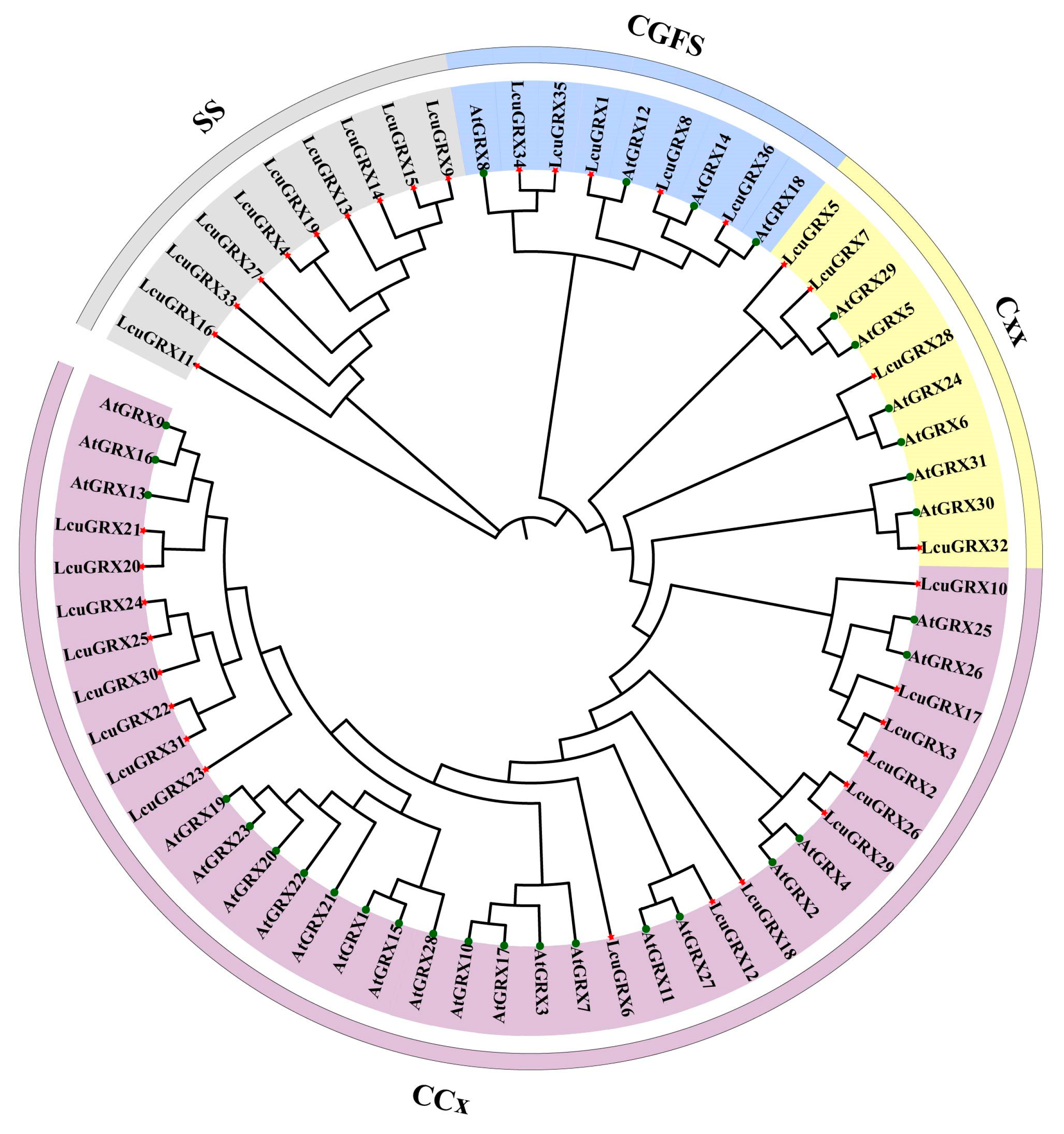
Based on the established classification system for the A. thaliana GRX family [7], combined with the phylogenetic topology, the L. cubeba GRX family was classified into four subfamilies: Cxx-type, CGFS-type, CCx-type, and a species-specific (SS) clade unique to L. cubeba (Figure 1). The composition and structural features of each subfamily are as follows: the Cxx-type subfamily comprises four LcGRX members and possesses the typical double-cysteine active site [Y/W]C[G/P/S]Y[C/S]; the CGFS-type subfamily contains five members characterized by the conserved CGFS active-site sequence; the CCx-type subfamily is the largest, with 17 members, and contains a motif [S/T/G]CC[M/L][C/S/G] specific to higher plants; the SS clade consists of 10 members, lacks homologous genes in A. thaliana, and is inferred to represent a distinct lineage formed through functional divergence during the evolution of L. cubeba.
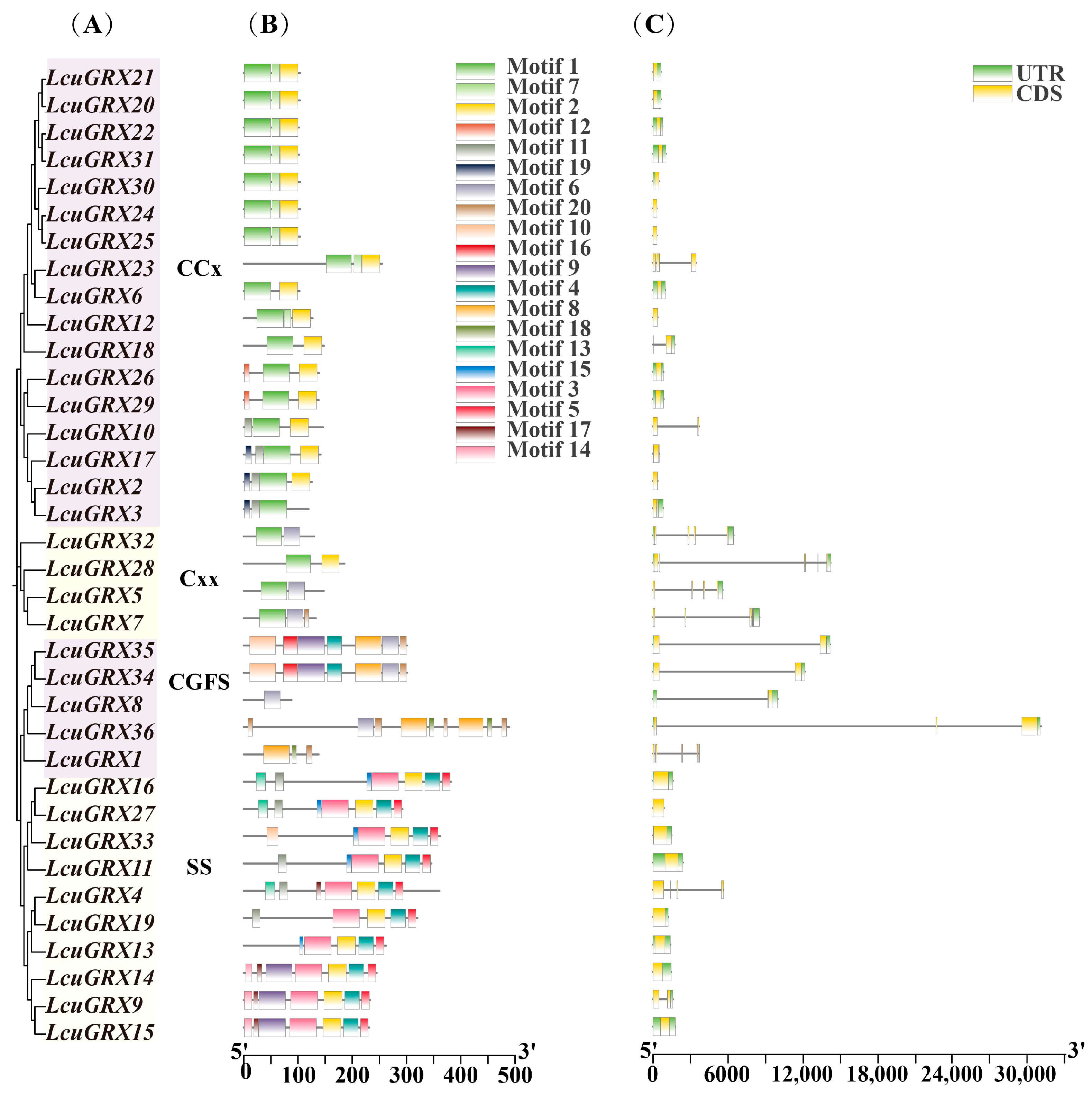
To elucidate the structural features and evolutionary conservation of the GRX gene family in L. cubeba, this study conducted a comprehensive analysis of the exon-intron architecture based on their protein sequences and genome annotations (Figure 2). Among the 36 LcGRX genes, 22 contained no introns, and the remaining genes had between 1 and 5 exons. It is noteworthy that although intron lengths varied considerably among different genes, most homologous genes within the same subfamily showed high similarity in the number and arrangement of exons and introns. This structural conservation aligns with the typical evolutionary patterns seen across gene families. For the SS subfamily in particular, its genes exhibit short and structurally uniform CDS regions (with 1–2 exons), lack or contain only extremely short UTRs, and have overall sequence lengths significantly shorter than those of other subfamilies, with a highly consistent structural pattern within the clade (Figure 2C).

3.3. Analysis of Chromosomal Distribution and Collinearity of the LcGRX Genes

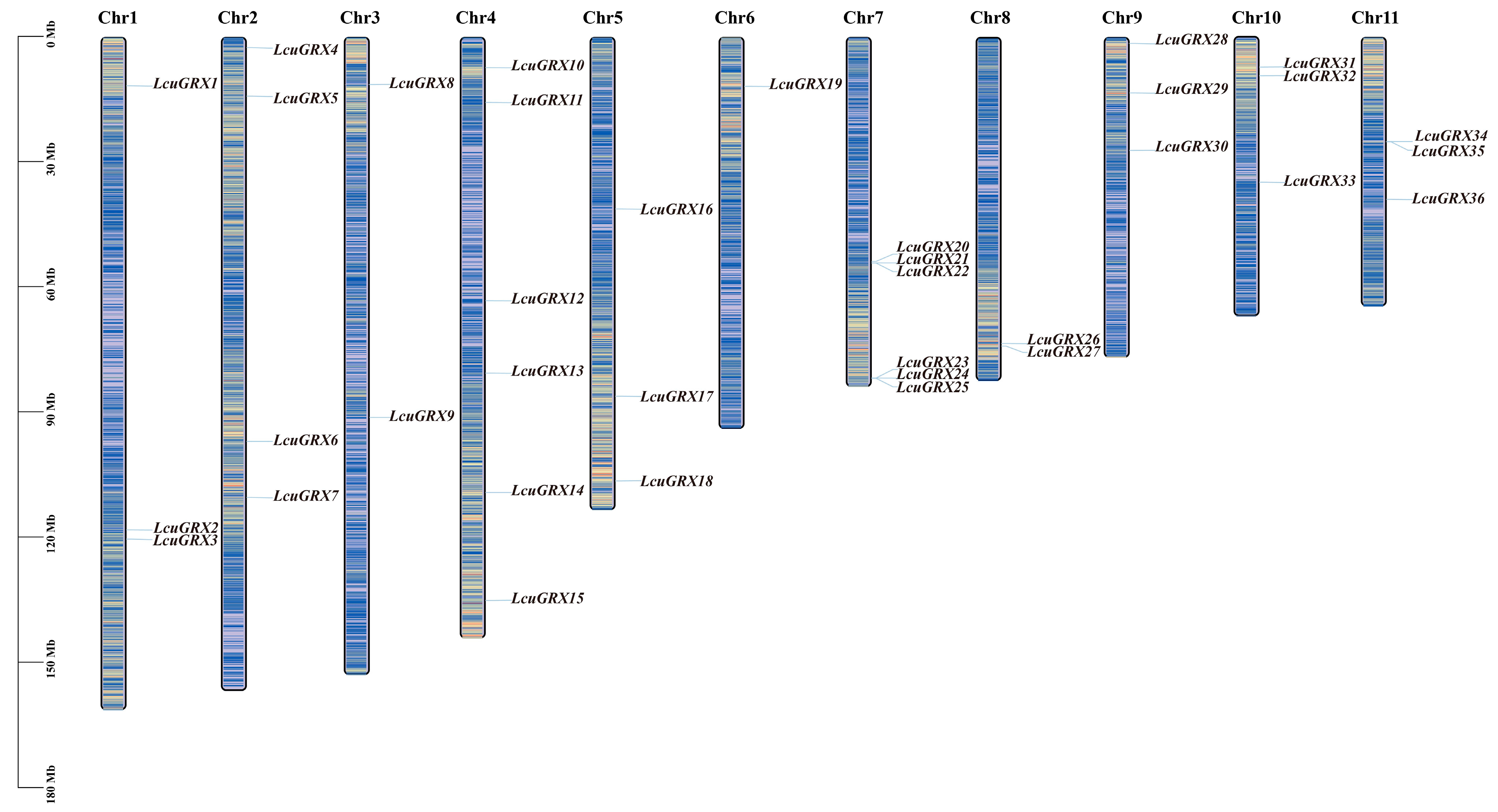
The L. cubeba genome comprises 12 chromosomes; however, its GRX family genes are only widely distributed across 11 chromosomes (Chr1–Chr11), with no GRX family members detected on Chr12, showing an overall pattern of significant uneven distribution (Figure 3). Specifically, the number of GRX genes harbored by different chromosomes varies extremely remarkably. Among them, Chr4 and Chr7 are chromosomes with highly enriched GRX genes, and there is an obvious gene clustering phenomenon (e.g., LcGRX20LcGRX22) on Chr7, while Chr6 contains only one GRX gene (LcGRX19) (Figure 3). Notably, there is no direct correlation between the number of distributed genes and chromosome length. For instance, Chr1, one of the longer chromosomes in the genome, contains merely 3 GRX genes (LcGRX1LcGRX3), whereas Chr7, which is relatively shorter, harbors 6 GRX genes (Figure 3). This distribution pattern is speculated to be closely associated with the evolutionary history of the GRX gene family (such as gene duplication and segmental duplication events) and functional differentiation (such as the formation of subfamily-specific functional modules).
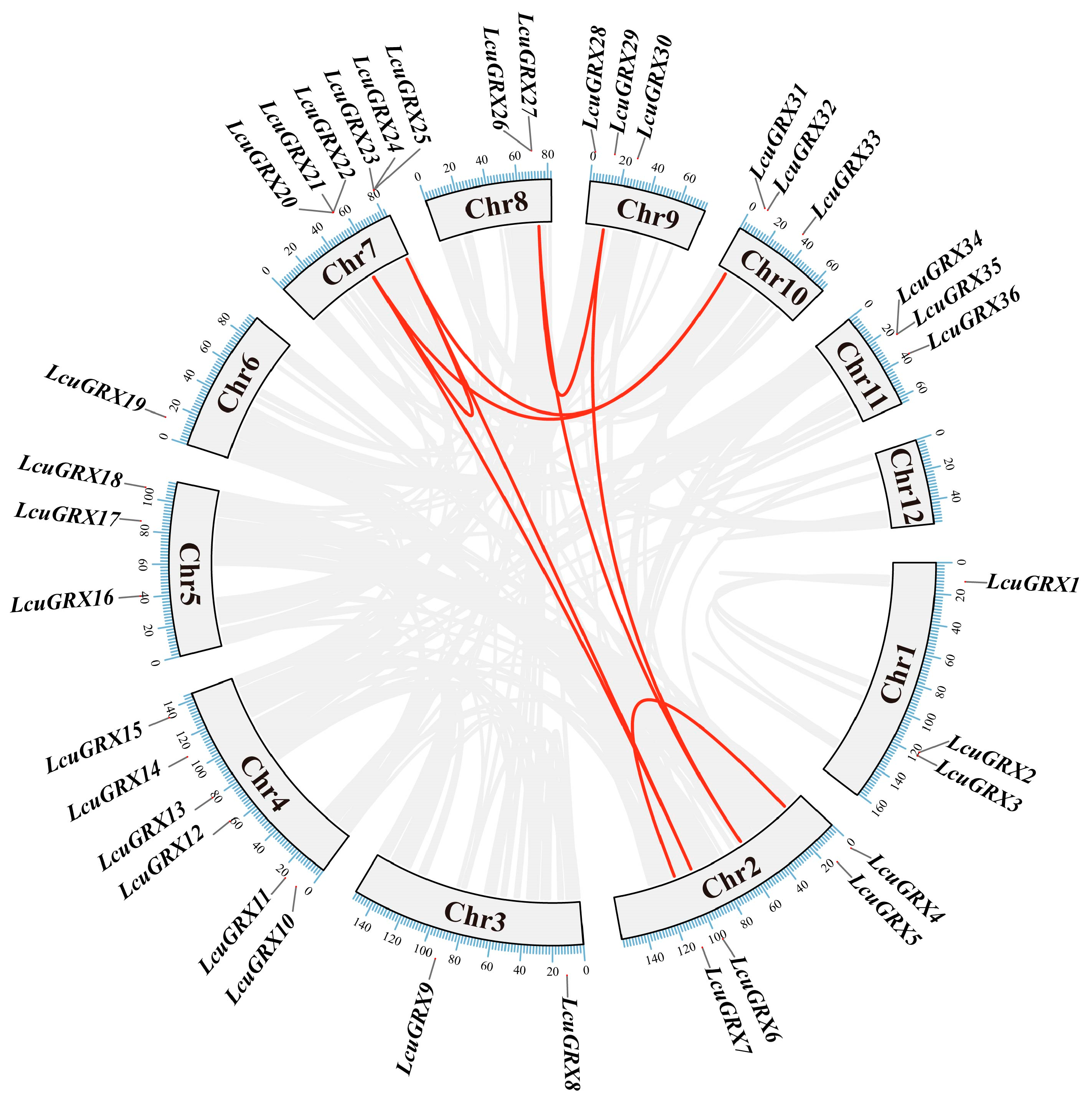
By utilizing the TBtools software in conjunction with the MCScanX approach [34] to investigate segmental duplication occurrences within the LcGRX gene family, we identified nine pairs of genes that experienced segmental duplication (Figure 4). Further research revealed that the collinearity of this family is mainly concentrated in the collinear connections between Chr2 and Chr7, Chr8, and Chr9 (Figure 4). This extensive collinearity reflects an important evolutionary mechanism that has facilitated the expansion and subsequent functional differentiation of the GRX gene family.
This study traced the evolutionary maintenance of GRX functions by analyzing genomic collinearity between L. cubeba and A. thaliana, identifying genes descended from common ancestors. The results showed that the GRX genes of L. cubeba have extensive collinear relationships with those of A. thaliana (Figure 5).

3.4. Tissue-Specific Expression of LcGRX Gene Family

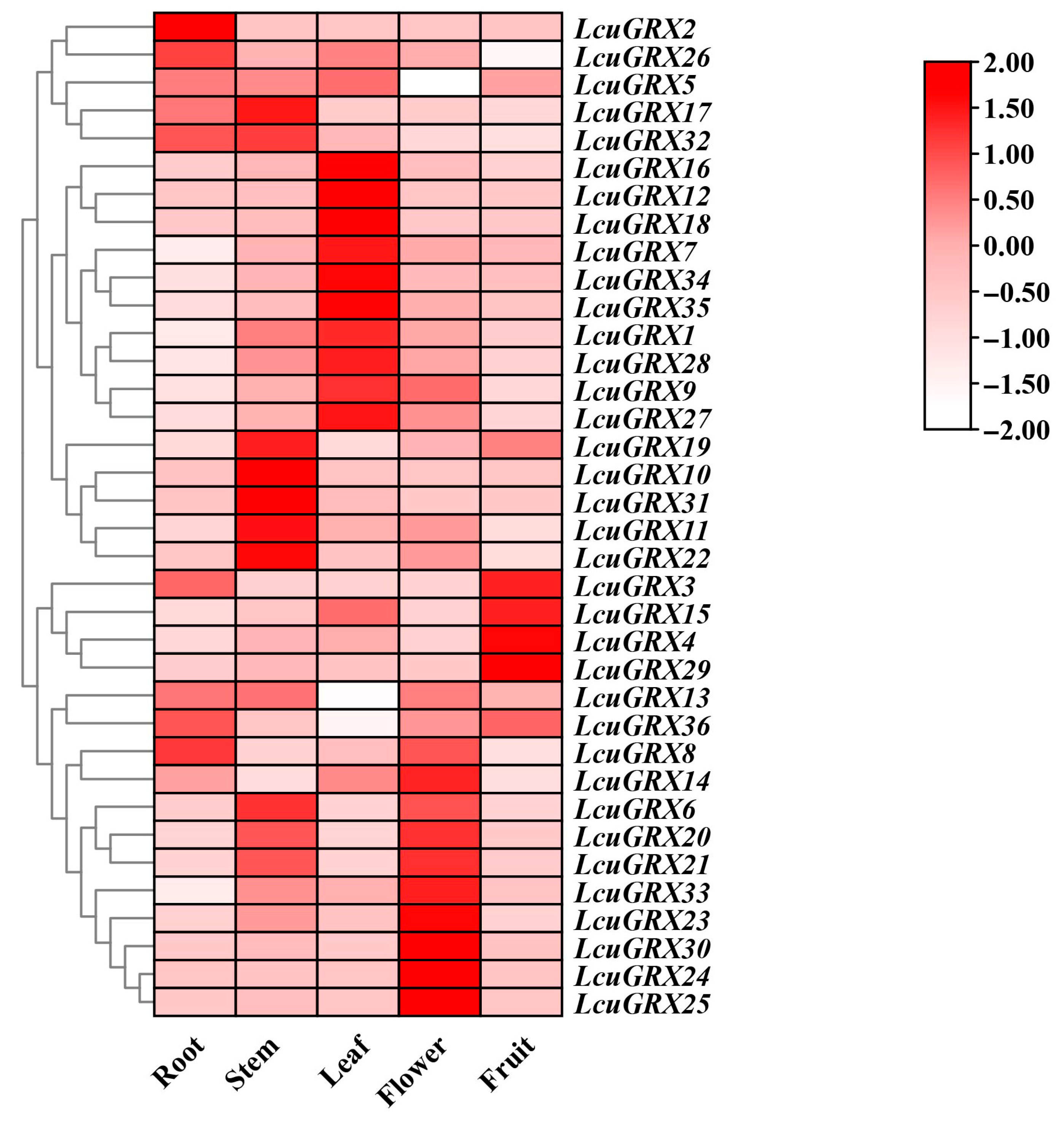
The expression characteristics of 36 LcGRX genes in roots, stems, leaves, flowers, and fruits of L. cubeba were systematically analyzed based on multi-tissue transcriptome data, in order to elucidate the tissue-specific expression patterns of this gene family. A heatmap was employed for the visual presentation of their expression patterns (Figure 6).
The results revealed that most LcGRX genes exhibited distinct tissue-specific expression features. Among them, 8 members (LcGRX8, LcGRX14, LcGRX33, LcGRX23, LcGRX30, LcGRX24, LcGRX12, and LcGRX25) displayed highly flower-preferential expression patterns. Their expression levels in floral tissues were significantly higher than those in vegetative organs such as roots, stems, and leaves, suggesting that these genes may play core regulatory roles in the floral organ development of L. cubeba.
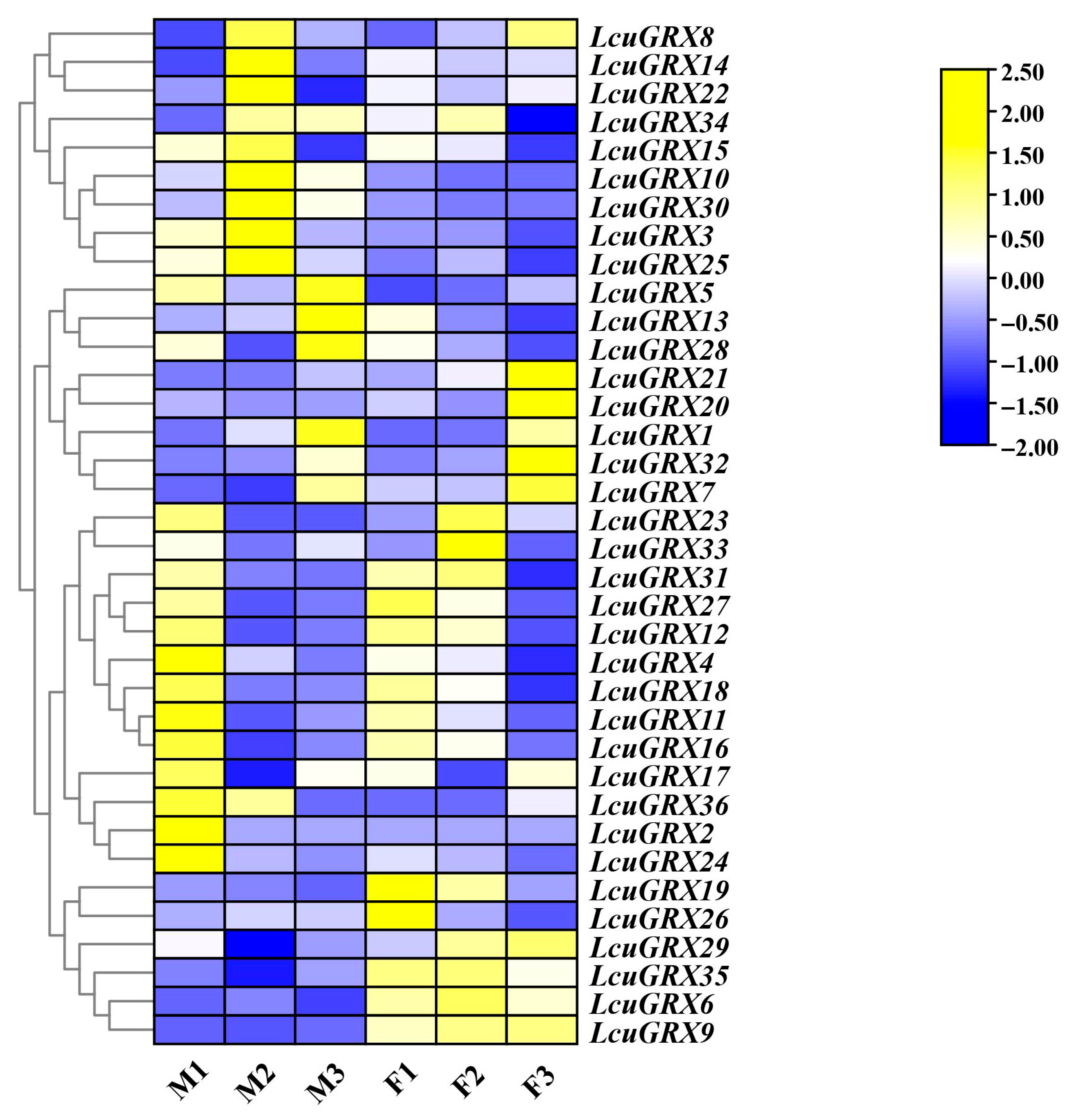
To elucidate the regulatory functions of the GRX gene family during floral organ development in L. cubeba, this study systematically analyzed their expression patterns across key developmental stages. The developmental process of the abortive stamens and pistils in L. cubeba can be divided into three critical phases: the primordium formation stage (M1: stamen primordium emergence; F1: pistil primordium emergence), the critical degeneration stage (M2: stamen degeneration; F2: pistil degeneration), and the post-degeneration stage (M3: post-stamen degeneration; F3: post-pistil degeneration). Based on transcriptome data from these developmental stages, we constructed an expression heatmap of the GRX gene family (Figure 7). The analysis revealed that GRX genes exhibited distinct stage-specific expression patterns during flower bud development in L. cubeba, with pronounced expression divergence particularly during the critical degeneration stages of stamens and pistils (M2 and F2).
Specifically, nine genes—LcGRX4, LcGRX11, LcGRX12, LcGRX16, LcGRX18, LcGRX23, LcGRX27, LcGRX31, and LcGRX33—exhibited specifically high expression during the F2 stage (pistil degeneration) compared to their expression levels in the M2 stage (stamen degeneration). In contrast, expression dominance during the M2 stage was concentrated in genes such as LcGRX8, LcGRX14, and LcGRX22 (i.e., their expression levels in the M2 stage were significantly higher than those in the F2 stage). This expression divergence suggests that different members of the GRX family may regulate the degeneration processes of pistils and stamens, respectively. Notably, LcGRX34 maintained relatively high expression levels in both F2 and M2 stages, implying its potential involvement in a common regulatory pathway underlying floral organ degeneration. Furthermore, LcGRX35, LcGRX6, and LcGRX9 displayed a marked female-flower-preferential expression pattern, maintaining high expression across all pistil developmental stages while showing lower expression in the corresponding stamen stages.

3.5. Confirmation of Differentially Expressed Genes by qRT-PCR

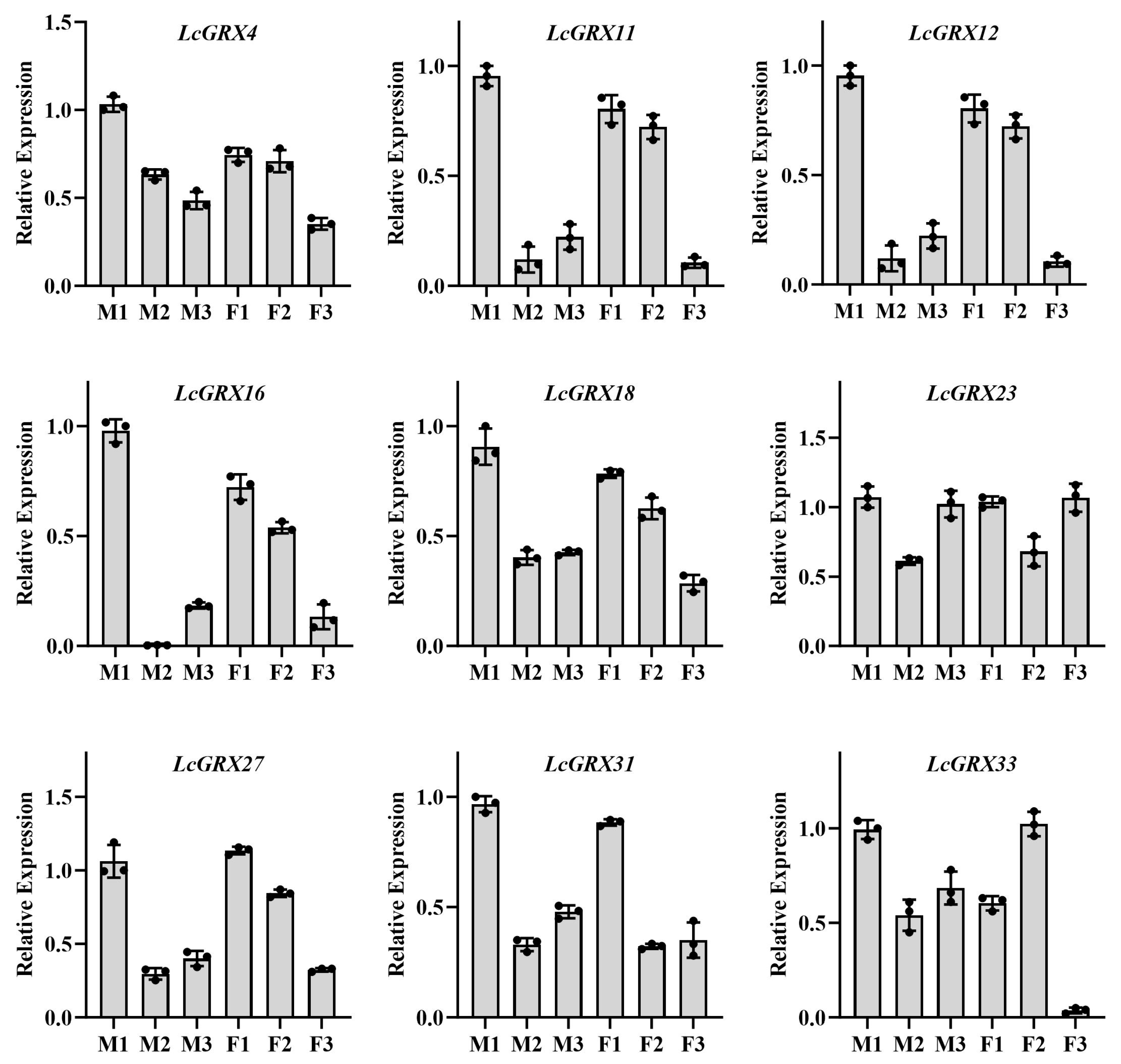
In order to confirm the transcriptome-based expression patterns, a qRT-PCR analysis was carried out for the nine selected differentially expressed GRX genes (Figure 8). Integrated analysis revealed a strong concordance between the transcriptome data and qRT-PCR results, particularly for LcGRX11, LcGRX12, and LcGRX16, which exhibited marked differential expression during the critical stamen and pistil degeneration stages. By integrating expression heatmaps from different tissues and floral developmental stages with the qRT-PCR results, we found that LcGRX12 was not only specifically highly expressed in the flowers of L. cubeba, but also exhibited a marked expression advantage during the stamen degeneration process in female flowers (Figure 8).

3.6. LcTGA10-LcGRX12 Binding Verification

Homology analysis results indicated that LcGRX12 is an ortholog of ROXY1 from A. thaliana. Given that previous studies have confirmed that ROXY1 regulates floral organ development through interaction with TGA transcription factors, we hypothesized that LcGRX12 from L. cubeba may adopt a similar mechanism to interact with the TGA transcription factor LcTGA10, thereby participating in the regulation of stamen degeneration in female flowers.
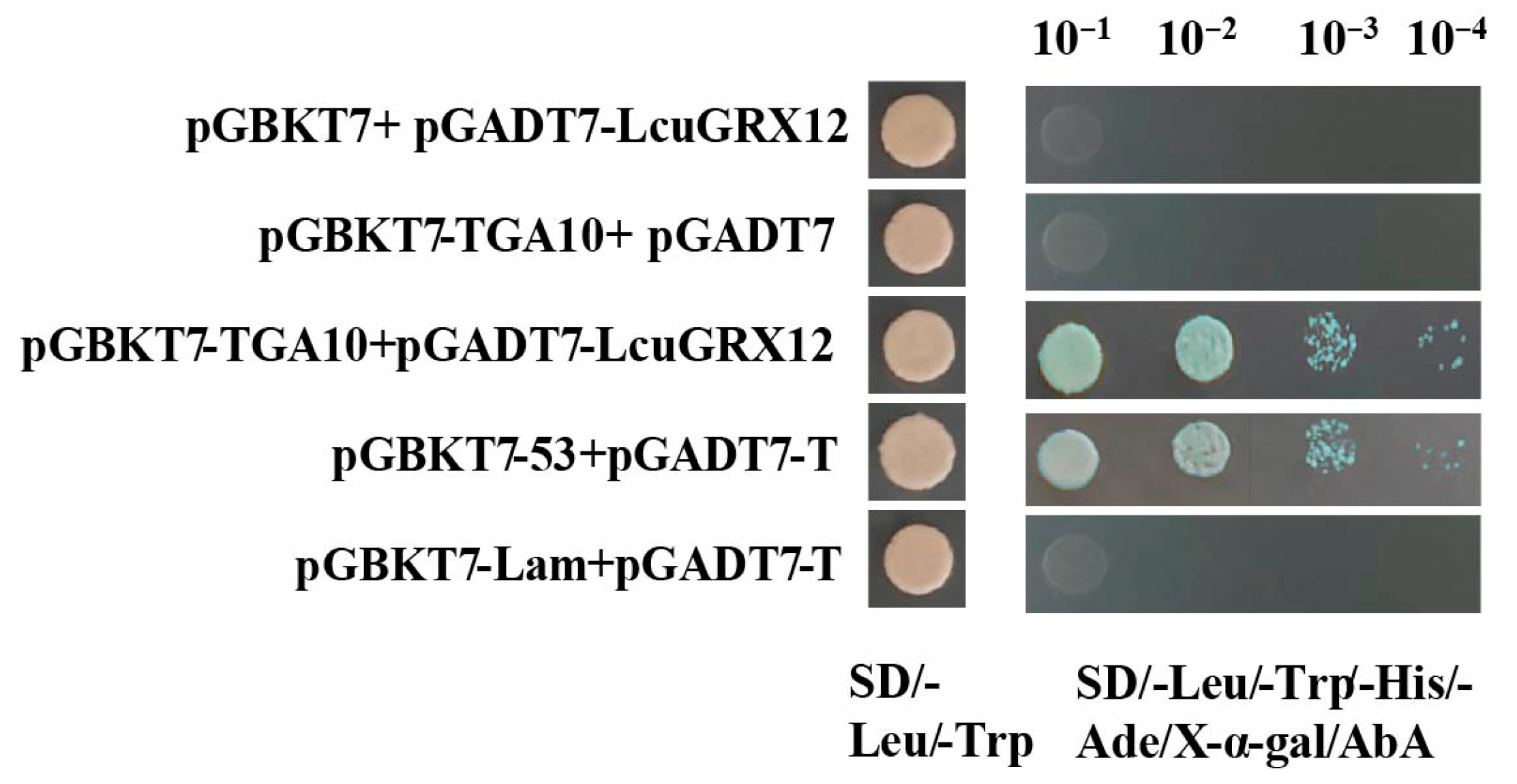
To test this hypothesis, we performed a yeast two-hybrid (Y2H) assay with a complete set of control systems established simultaneously to eliminate experimental interference. In the autoactivation validation step, we co-transformed yeast cells with two vector combinations, the bait vector pGBKT7-LcTGA10 plus the empty prey vector pGADT7 and the empty bait vector pGBKT7 plus the prey vector pGADT7-LcGRX12, respectively. The results showed that the transformants of both groups could only grow on the basic medium (SD/-Leu/Trp) but failed to survive on the deficient medium (SD/-Leu/Trp-His-Ade/X-α-Gal/AbA), demonstrating that neither the bait protein LcTGA10 nor the prey protein LcGRX12 had autoactivation activity (Figure 9). Meanwhile, standard positive controls (pGBKT7-53 + pGADT7-T) and negative controls (pGBKT7-Lam + pGADT7-T) were included in the experiment. The transformants of the positive control grew normally and turned blue on the deficient medium, whereas those of the negative control could not grow, thus verifying the reliability of the experimental system (Figure 9). Based on the rigorous control design described above, the experimental results clearly confirmed a direct protein–protein interaction between LcGRX12 and LcTGA10 (Figure 9).

4. Discussion

The glutaredoxin (GRX) gene family has been identified in A. thaliana, O. sativa, Populus trichocarpa, Solanum lycopersicum, and other plant species, with its involvement in anther development and pollen fertility validated in model plants like A. thaliana and O. sativa [5,35,36,37,38,39,40]. By contrast, no investigations into the GRX gene family have been reported for L. cubeba. This study systematically identified 36 GRX family members in L. cubeba. Through phylogenetic, sequence structure, chromosome distribution, and expression pattern analyses, the evolutionary characteristics and potential functions of this gene family in L. cubeba were revealed. The findings enrich the research on GRX gene families in Lauraceae plants and provide new insights into the molecular mechanisms underlying flower development and sex differentiation in monoecious plants.
Phylogenetic analysis classified the 36 LcGRX genes into four subfamilies (CC-type, CGFS-type, CPYC-type, and a species-specific SS clade). This classification framework is consistent with those reported for GRX genes in model plants or crops such as A. thaliana [3], O. sativa [16], and Phaseolus vulgaris [17]. Maize MSCA1 is a key CC-type GRX that regulates the activity of TGA transcription factors and floral development through redox modification [5]. LcGRX12, a CCx-type GRX in L. cubeba, shares the same functional core motif with MSCA1, and both are involved in plant reproductive development, supporting the functional conservation of the GRX-TGA regulatory module. The CC-type, CGFS-type, and CPYC-type GRX subfamilies possess conserved active-site motifs: the CPYC-type contains (Y/W)C(G/P/S)Y(C/S) sequences, the CGFS-type features the CGFS motif, and the CC-type exhibits (S/T/G)CC(M/L)(C/S/G) sequences. Different GRX subfamilies (including CC-type, CGFS-type, and CPYC-type) all possess unique conserved active-site signature sequences. Specifically, the signature sequence of the CPYC-type subfamily can be represented as (Y/W)C(G/P/S)Y(C/S), while the CGFS-type subfamily is characterized by its specific CGFS sequence, and the signature sequence of the CC-type subfamily exhibits a (S/T/G)CC(M/L)(C/S/G) structure. The high conservation of these motifs reflects the stable retention of core GRX functions during plant evolution. For instance, the largest CC-type subfamily in L. cubeba (17 members) aligns with observations in A. thaliana [3] and Capsicum annuum [18], where CC-type GRXs (ROXY-type) have undergone expansion in land plants and undertake specialized functions in developmental regulation and stress responses.
Notably, we identified a species-specific SS clade (10 members) with no homologous genes in Arabidopsis, representing a distinctive characteristic of the L. cubeba GRX family. Such lineage-specific expansion is a common evolutionary pathway for plants to acquire species-specific traits. For example, the halophyte Puccinellia tenuiflorahas evolved stress-optimized GRX variants that enhance salt tolerance [19], while Musa acuminatahas developed GRX fusion proteins associated with fruit ripening [20]. As a dioecious plant exhibiting significant sexual dimorphism and high essential oil content, the unique SS clade in L. cubeba may have evolved to meet species-specific functional demands related to sex differentiation, secondary metabolism regulation, or environmental adaptation. The presence of subfamily-specific motifs (e.g., motifs 3, 5, 13, 14, 15, and 17 in the SS clade and motif 8 in the CGFS-type) further supports functional divergence. These conserved motifs likely represent key sites determining substrate specificity and catalytic activity.
Tissue-specific expression analysis identified 11 flower-specific LcGRX genes (including LcGRX12 and LcGRX23), showing significantly higher expression in floral tissues compared to vegetative organs. This finding is consistent with the established roles of GRXs in regulating flower development in model plants. For instance, A.thaliana ROXY1 and ROXY2 are specifically expressed in flowers, where they regulate tapetum development and pollen maturation [41], and Zea mays MSCA1 (a CC-type GRX) participates in floral organ formation [42]. The presence of these flower-specific GRX genes in L. cubeba strongly implies their core regulatory roles in flower development.
Stage-specific expression patterns during flower development further highlight the functional specialization of LcGRX genes. Nine genes (e.g., LcGRX12 and LcGRX31) were highly expressed specifically at the F2 stage (pistil degeneration phase), whereas LcGRX8, LcGRX14, and LcGRX22 showed dominant expression at the M2 stage (stamen degeneration phase). This differential expression suggests that distinct LcGRX members may, respectively, regulate pistil and stamen degeneration processes, providing a molecular explanation for the sexual dimorphism observed in L. cubeba flowers. Notably, LcGRX34 maintained high expression levels during both F2 and M2 stages, implying its potential involvement in common regulatory pathways governing floral organ degeneration. Furthermore, LcGRX35, LcGRX6, and LcGRX9 exhibited pistil-preferential expression, with consistently high expression during all pistil developmental stages and lower expression in corresponding stamen stages.
Yeast two-hybrid assays confirmed a direct interaction between protein LcGRX12 and LcTGA10. LcGRX12 is a homolog of A.thaliana ROXY1 (which regulates stamen development via TGA interaction and shares functional conservation with maize MSCA1 [5,41]. Combined with the specific high expression of LcGRX12 during stamen degeneration in female flowers, we hypothesize that the LcGRX12-LcTGA10 module plays a key regulatory role in stamen abortion of L. cubeba female flowers. This discovery not only expands the known functional scope of the GRX-TGA module but also provides new perspectives for understanding the redox regulation mechanisms underlying sex differentiation in dioecious plants.
As an economically important essential oil crop, the sex determination of L. cubeba directly affects oil yield and quality, and its essential oil’s core component (citral) is synthesized primarily via the methylerythritol phosphate (MEP) pathway [43]. The flower-specific and stage-specific LcGRX genes identified in this study (particularly LcGRX12) provide valuable candidate genes for molecular breeding aimed at regulating plant sex or improving flower-related economic traits. For example, modulating LcGRX12 expression may alter stamen development in female flowers, offering novel strategies for optimizing breeding systems. Moreover, considering GRXs’ core function in maintaining redox homeostasis, it is reasonable to infer that LcGRXs may indirectly regulate MEP pathway key genes (e.g., 1-deoxy-D-xylulose-5-phosphate synthase, geranyl diphosphate synthase) through redox balance modulation, thereby affecting citral synthesis. This potential link between GRX-mediated redox regulation and terpenoid biosynthesis merits further exploration to bridge the gap between gene function and economic trait improvement. This study has several limitations that require further investigation. First, the subcellular localization of LcGRX proteins (especially key members like LcGRX12) remains unclear. Clarifying the subcellular localization of LcGRX proteins will help elucidate their interaction and regulatory mechanisms with target proteins, such as LcTGA10 in the nucleus. Second, functional validation of LcGRX genes is still insufficient. Overexpression and knockout experiments using techniques are necessary to define their phenotypic effects on flower development and sex differentiation in L. cubeba. Third, the downstream target genes of the LcGRX12-LcTGA10 module have not been identified; integrating chromatin immunoprecipitation (ChIP) and RNA sequencing (RNA-seq) technologies could help unravel the complete regulatory pathway. Fourth, the current dataset is limited to genomic and transcriptomic analyses, and future studies should expand to include epigenetic (e.g., DNA methylation, histone modification) and metabolomic data. This multi-omics integration will enable systematic evaluation of GRXs’ roles in terpenoid biosynthesis under oxidative stress, facilitating precise dissection of the redox regulatory network governing citral synthesis in L. cubeba.

5. Conclusions

In summary, this study systematically characterized the GRX gene family in L. cubeba, elucidating its evolutionary patterns and expression profiles, and confirmed the functional conservation of the GRX-TGA regulatory module in flower development. These results enhance our comprehension of the diversity in both structure and function exhibited by the GRX gene family within woody plant species. Moreover, they provide a theoretical foundation and valuable candidate gene resources for investigating sex determination mechanisms in the Lauraceae family and for conducting molecular breeding to improve traits in L. cubeba.

Supplementary Materials

The following supporting information can be downloaded at: https://www.mdpi.com/article/10.3390/f17010128/s1, Table S1: Primer sequences of real-time quantitative PCR (5′-3′).

Author Contributions

Y.Z., M.G. and S.W. conducted the molecular research, engaged in the analysis, and prepared the manuscript draft. Meanwhile, Y.C. and Y.W. offered technical support and materials for the experiments. The project was formulated by Y.W., M.G. and Y.Z., who also oversaw the analysis and provided critical enhancements to the manuscript. All authors have read and agreed to the published version of the manuscript.

Funding

This work was supported by the Key Scientific and Technological Grant of Zhejiang for Breeding New Agricultural Varieties (Grant No. 2021C02070-3).

Data Availability Statement

This study employed raw data from the NCBI Short Read Archive (project accession: PRJNA763042; https://www.ncbi.nlm.nih.gov/bioproject/PRJNA763042, accessed on 1 November 2025), which includes the following sequence read accessions: SRR10053824, SRR10053795, SRR10053793, SRR10053782, SRR10053780, SRR10053770, SRR10053769, SRR10053767, SRR10053765, SRR10053109, SRR10052556, SRR10052491, SRR10052460, SRR10052459, SRR10052050, SRR10052049, SRR10051549, and SRR10051547.

Acknowledgments

The authors are solely responsible for the final content of this publication. In the preparation phase, ChatGPT-4 was utilized solely for the purpose of language polishing and spelling correction, and all AI-assisted output was critically reviewed and edited by the authors.

Conflicts of Interest

The authors declare no conflicts of interest.

References

  1. Schachtman, D.P. The Role of Ethylene in Plant Responses to K+ Deficiency. Front. Plant Sci. 2015, 6, 1153. [Google Scholar] [CrossRef]
  2. Li, S. Redox Modulation Matters: Emerging Functions for Glutaredoxins in Plant Development and Stress Responses. Plants 2014, 3, 559–582. [Google Scholar] [CrossRef] [PubMed]
  3. Rouhier, N.; Lemaire, S.D.; Jacquot, J.P. The role of glutathione in photosynthetic organisms: Emerging functions for glutaredoxins and glutathionylation. Annu. Rev. Plant Biol. 2008, 59, 143–166. [Google Scholar] [CrossRef]
  4. Wang, Z.; Xing, S.; Birkenbihl, R.P.; Zachgo, S. Conserved functions of Arabidopsis and rice CC-type glutaredoxins in flower development and pathogen response. Mol. Plant 2009, 2, 323–335. [Google Scholar] [CrossRef]
  5. Yang, R.S.; Xu, F.; Wang, Y.M.; Zhong, W.S.; Dong, L.; Shi, Y.N.; Tang, T.J.; Sheng, H.J.; Jackson, D.; Yang, F. Glutaredoxins regulate maize inflorescence meristem development via redox control of TGA transcriptional activity. Nat. Plants 2021, 7, 1589–1601. [Google Scholar] [CrossRef]
  6. Li, S.; Lauri, A.; Ziemann, M.; Busch, A.; Bhave, M.; Zachgo, S. Nuclear activity of ROXY1, a glutaredoxin interacting with TGA factors, is required for petal development in Arabidopsis thaliana. Plant Cell 2009, 21, 429–441. [Google Scholar] [CrossRef]
  7. Rouhier, N.; Gelhaye, E.; Jacquot, J.P. Plant glutaredoxins: Still mysterious reducing systems. Cell. Mol. Life Sci. CMLS 2004, 61, 1266–1277. [Google Scholar] [CrossRef] [PubMed]
  8. Hu, L.; Liang, W.; Yin, C.; Cui, X.; Zong, J.; Wang, X.; Hu, J.; Zhang, D. Rice MADS3 regulates ROS homeostasis during late anther development. Plant Cell 2011, 23, 515–533. [Google Scholar] [CrossRef]
  9. Yu, J.; Zhang, D. Molecular Control of Redox Homoeostasis in Specifying the Cell Identity of Tapetal and Microsporocyte Cells in Rice. Rice 2019, 12, 42. [Google Scholar] [CrossRef]
  10. Ströher, E.; Grassl, J.; Carrie, C.; Fenske, R.; Whelan, J.; Millar, A.H. Glutaredoxin S15 Is Involved in Fe-S Cluster Transfer in Mitochondria Influencing Lipoic Acid-Dependent Enzymes, Plant Growth, and Arsenic Tolerance in Arabidopsis. Plant Physiol. 2016, 170, 1284–1299. [Google Scholar] [CrossRef] [PubMed]
  11. Laporte, D.; Olate, E.; Salinas, P.; Salazar, M.; Jordana, X.; Holuigue, L. Glutaredoxin GRXS13 plays a key role in protection against photooxidative stress in Arabidopsis. J. Exp. Bot. 2012, 63, 503–515. [Google Scholar] [CrossRef]
  12. Bandyopadhyay, S.; Gama, F.; Molina-Navarro, M.M.; Gualberto, J.M.; Claxton, R.; Naik, S.G.; Huynh, B.H.; Herrero, E.; Jacquot, J.P.; Johnson, M.K.; et al. Chloroplast monothiol glutaredoxins as scaffold proteins for the assembly and delivery of [2Fe-2S] clusters. EMBO J. 2008, 27, 1122–1133. [Google Scholar] [CrossRef]
  13. Riondet, C.; Desouris, J.P.; Montoya, J.G.; Chartier, Y.; Meyer, Y.; Reichheld, J.P. A dicotyledon-specific glutaredoxin GRXC1 family with dimer-dependent redox regulation is functionally redundant with GRXC2. Plant Cell Environ. 2012, 35, 360–373. [Google Scholar] [CrossRef] [PubMed]
  14. Xing, S.; Zachgo, S. ROXY1 and ROXY2, two Arabidopsis glutaredoxin genes, are required for anther development. Plant J. Cell Mol. Biol. 2008, 53, 790–801. [Google Scholar] [CrossRef]
  15. Xing, S.; Rosso, M.G.; Zachgo, S. ROXY1, a member of the plant glutaredoxin family, is required for petal development in Arabidopsis thaliana. Development 2005, 132, 1555–1565. [Google Scholar] [CrossRef] [PubMed]
  16. Chaubal, R.; Anderson, J.R.; Trimnell, M.R.; Fox, T.W.; Albertsen, M.C.; Bedinger, P. The transformation of anthers in the msca1 mutant of maize. Planta 2003, 216, 778–788. [Google Scholar] [CrossRef] [PubMed]
  17. Xu, Z.; Wang, Y.; Chen, Y.; Yin, H.; Wu, L.; Zhao, Y.; Wang, M.; Gao, M. A Model of Hormonal Regulation of Stamen Abortion During Pre-Meiosis of Litsea cubeba. Genes 2019, 11, 48. [Google Scholar] [CrossRef]
  18. Chen, Y.C.; Li, Z.; Zhao, Y.X.; Gao, M.; Wang, J.Y.; Liu, K.W.; Wang, X.; Wu, L.W.; Jiao, Y.L.; Xu, Z.L.; et al. The Litsea genome and the evolution of the laurel family. Nat. Commun. 2020, 11, 1675. [Google Scholar] [CrossRef]
  19. Ni, R.; Wang, P.; Zhan, P.; Tian, H.; Li, T. Effects of different frying temperatures on the aroma profiles of fried mountain pepper (Litsea cubeba (Lour.) Pers.) oils and characterization of their key odorants. Food Chem. 2021, 357, 129786. [Google Scholar] [CrossRef]
  20. Gao, M.; Chen, Y.-c.; Zhao, Y.-x.; Wang, Y.-d. Sex-specific physiological and biochemical responses of Litsea cubeba under waterlogging stress. Environ. Exp. Bot. 2022, 202, 105018. [Google Scholar] [CrossRef]
  21. Potter, S.C.; Luciani, A.; Eddy, S.R.; Park, Y.; Lopez, R.; Finn, R.D. HMMER web server: 2018 update. Nucleic Acids Res. 2018, 46, W200–W204. [Google Scholar] [CrossRef]
  22. Altschul, S.F.; Madden, T.L.; Schäffer, A.A.; Zhang, J.; Zhang, Z.; Miller, W.; Lipman, D.J. Gapped BLAST and PSI-BLAST: A new generation of protein database search programs. Nucleic Acids Res. 1997, 25, 3389–3402. [Google Scholar] [CrossRef]
  23. Guindon, S.; Dufayard, J.F.; Lefort, V.; Anisimova, M.; Hordijk, W.; Gascuel, O. New algorithms and methods to estimate maximum-likelihood phylogenies: Assessing the performance of PhyML 3.0. Syst. Biol. 2010, 59, 307–321. [Google Scholar] [CrossRef]
  24. Wilkins, M.R.; Gasteiger, E.; Bairoch, A.; Sanchez, J.C.; Williams, K.L.; Appel, R.D.; Hochstrasser, D.F. Protein identification and analysis tools in the ExPASy server. Methods Mol. Biol. 1999, 112, 531–552. [Google Scholar] [CrossRef] [PubMed]
  25. Guo, C.; Guo, R.; Xu, X.; Gao, M.; Li, X.; Song, J.; Zheng, Y.; Wang, X. Evolution and expression analysis of the grape (Vitis vinifera L.) WRKY gene family. J. Exp. Bot. 2014, 65, 1513–1528. [Google Scholar] [CrossRef] [PubMed]
  26. Bailey, T.L.; Johnson, J.; Grant, C.E.; Noble, W.S. The MEME Suite. Nucleic Acids Res. 2015, 43, W39–W49. [Google Scholar] [CrossRef]
  27. Bailey, T.L.; Boden, M.; Buske, F.A.; Frith, M.; Grant, C.E.; Clementi, L.; Ren, J.; Li, W.W.; Noble, W.S. MEME SUITE: Tools for motif discovery and searching. Nucleic Acids Res. 2009, 37, W202–W208. [Google Scholar] [CrossRef]
  28. Schultz, J.; Milpetz, F.; Bork, P.; Ponting, C.P. SMART, a simple modular architecture research tool: Identification of signaling domains. Proc. Natl. Acad. Sci. USA 1998, 95, 5857–5864. [Google Scholar] [CrossRef]
  29. Mistry, J.; Chuguransky, S.; Williams, L.; Qureshi, M.; Salazar, G.A.; Sonnhammer, E.L.L.; Tosatto, S.C.E.; Paladin, L.; Raj, S.; Richardson, L.J.; et al. Pfam: The protein families database in 2021. Nucleic Acids Res. 2021, 49, D412–D419. [Google Scholar] [CrossRef]
  30. Chen, C.; Chen, H.; Zhang, Y.; Thomas, H.R.; Frank, M.H.; He, Y.; Xia, R. TBtools: An Integrative Toolkit Developed for Interactive Analyses of Big Biological Data. Mol. Plant 2020, 13, 1194–1202. [Google Scholar] [CrossRef]
  31. Wang, Y.; Li, J.; Paterson, A.H. MCScanX-transposed: Detecting transposed gene duplications based on multiple colinearity scans. Bioinformatics 2013, 29, 1458–1460. [Google Scholar] [CrossRef]
  32. Zhao, Y.; Chen, Y.; Gao, M.; Yin, H.; Wu, L.; Wang, Y. Overexpression of geranyl diphosphate synthase small subunit 1 (LcGPPS.SSU1) enhances the monoterpene content and biomass. Ind. Crops Prod. 2020, 143, 111926. [Google Scholar] [CrossRef]
  33. Han, Y.C.; Kuang, J.F.; Chen, J.Y.; Liu, X.C.; Xiao, Y.Y.; Fu, C.C.; Wang, J.N.; Wu, K.Q.; Lu, W.J. Banana Transcription Factor MaERF11 Recruits Histone Deacetylase MaHDA1 and Represses the Expression of MaACO1 and Expansins During Fruit Ripening. Plant Physiol. 2016, 171, 1070–1084. [Google Scholar] [CrossRef]
  34. Wang, Y.; Tang, H.; Debarry, J.D.; Tan, X.; Li, J.; Wang, X.; Lee, T.H.; Jin, H.; Marler, B.; Guo, H.; et al. MCScanX: A toolkit for detection and evolutionary analysis of gene synteny and collinearity. Nucleic Acids Res. 2012, 40, e49. [Google Scholar] [CrossRef]
  35. Garg, R.; Jhanwar, S.; Tyagi, A.K.; Jain, M. Genome-wide survey and expression analysis suggest diverse roles of glutaredoxin gene family members during development and response to various stimuli in rice. DNA Res. Int. J. Rapid Publ. Rep. Genes Genomes 2010, 17, 353–367. [Google Scholar] [CrossRef]
  36. Lu, Y.; Liu, L.; Wang, X.; Han, Z.; Ouyang, B.; Zhang, J.; Li, H. Genome-wide identification and expression analysis of the expansin gene family in tomato. Mol. Genet. Genom. MGG 2016, 291, 597–608. [Google Scholar] [CrossRef] [PubMed]
  37. Boubakri, H.; Najjar, E.; Jihnaoui, N.; Chihaoui, S.A.; Barhoumi, F.; Jebara, M. Genome-wide identification, characterization and expression analysis of glutaredoxin gene family (Grxs) in Phaseolus vulgaris. Gene 2022, 833, 146591. [Google Scholar] [CrossRef] [PubMed]
  38. Esposito, S.; Cappetta, E.; Tranchida-Lombardo, V.; Batelli, G.; Ruggiero, A.; Ruocco, M.; Sportelli, G.; Cillo, F.; De Palma, M. Genome-wide survey of glutaredoxin gene family in four Solanaceae species and exploitation of duplicated CC-type following different environmental stimuli in tomato (Solanum lycopersicum). Sci. Hortic. 2023, 319, 112188. [Google Scholar] [CrossRef]
  39. Wang, S.; Dong, Y.; Gu, L.; Chen, X.; Zhang, C.; Long, L.; Wang, J.; Yang, M. Identification and adaptive evolution analysis of glutaredoxin genes in Populus spp. Plant Biol. 2023, 25, 1154–1170. [Google Scholar] [CrossRef] [PubMed]
  40. Hong, L.; Tang, D.; Zhu, K.; Wang, K.; Li, M.; Cheng, Z. Somatic and reproductive cell development in rice anther is regulated by a putative glutaredoxin. Plant Cell 2012, 24, 577–588. [Google Scholar] [CrossRef]
  41. Murmu, J.; Bush, M.J.; DeLong, C.; Li, S.; Xu, M.; Khan, M.; Malcolmson, C.; Fobert, P.R.; Zachgo, S.; Hepworth, S.R. Arabidopsis basic leucine-zipper transcription factors TGA9 and TGA10 interact with floral glutaredoxins ROXY1 and ROXY2 and are redundantly required for anther development. Plant Physiol. 2010, 154, 1492–1504. [Google Scholar] [CrossRef] [PubMed]
  42. Kelliher, T.; Walbot, V. Hypoxia triggers meiotic fate acquisition in maize. Science 2012, 337, 345–348. [Google Scholar] [CrossRef] [PubMed]
  43. Sharma, S.; Negi, S.; Kumar, P.; Irfan, M. Cellular strategies for surviving the alpine extremes: Methylerythritol phosphate pathway-driven isoprenoid biosynthesis and stress resilience. Protoplasma 2025, 262, 1053–1072. [Google Scholar] [CrossRef]
Figure 1. Phylogenetic tree of the GRX gene family from L. cubeba and A. thaliana. This phylogenetic tree was drawn using TBtools. The tree scale represents genetic distance. Different colored blocks correspond to the subfamily classification of the GRX family. CGFS type (blue block): GRX subfamily containing the single-cysteine CGFS active site. Cxx type (yellow block): GRX subfamily containing the double-cysteine [Y/W]C[G/P/S] Y[C/S] active site. CCx type (purple block): GRX subfamily containing the conserved motif [S/T/G]CC[M/L] [C/S/G] specific to higher plants. SS group (gray block): L. cubeba-specific clade (Species-Specific) with no homologous genes in A. thaliana, presumably a specialized subtype formed by functional innovation during the evolution of L. cubeba. The genes marked with green circles represent GRX family members of A. thaliana, while those marked with red stars represent GRX family members of L. cubeba. The LcGRX family members exhibited substantial diversity in the number of conserved motifs, which varied between 1 and 9. Phylogenetic analysis further revealed that GRX proteins within the same clade, which are closely related, exhibited highly consistent motif compositions. This finding supports the rationality of the previously proposed subfamily classification of LcGRX genes from the perspective of sequence conservation. Specifically, motifs 3, 5, 13, 14, 15, and 17 are unique to the SS subfamily, whereas motifs 2, 3, 4, and 5 are common to all its members (Figure 2B). The CGFS subfamily members all contained motif 8, and motif 16 was specific to this group. The Cxx subfamily members generally possessed motif 1, while the CCx subfamily members shared motifs 1 and 2, along with unique motifs 12 and 19. The presence of these subfamily-specific motifs suggests their potential role in functional divergence among GRX proteins.
Forests 17 00128 g001
Figure 2. DNA structure and protein motifs of the LcGRX gene family in L. cubeba. (A) Phylogenetic tree depicting the classification of GRX subfamilies, with distinct letters indicating each subfamily. Genes in the first pink block belong to the CCx subfamily; genes in the first yellow block belong to the Cxx subfamily; genes in the second pink block belong to the CGFS subfamily; and genes in the second yellow block belong to the SS subfamily; (B) Distribution of conserved protein motifs identified in GRX family members. The clustering pattern corresponds to the phylogenetic relationships shown in (A); (C) Gene structure organization, showing exons (yellow bars), introns (black lines), and untranslated regions (UTRs) (Green bar).
Forests 17 00128 g002
Figure 3. A chromosomal map showing the physical locations of the GRX gene family members across the 11 chromosomes (Chr1–Chr11) of L. cubeba. Changes in color on the chromosomes represent differences in gene density.
Forests 17 00128 g003
Figure 4. Syntenic relationships among GRX genes in L. cubeba. The genomic organization is illustrated with chromosomes 1–12 represented as gray rectangles. Genome-wide collinearity blocks are shown as gray lines, and red lines connecting chromosomes indicate segmental duplications of GRX gene pairs.
Forests 17 00128 g004
Figure 5. An analysis of the GRX gene family’s syntenic relationships between L. cubeba and A. thaliana. Chromosomes are shown as colored bars: orange (A. thaliana) and green (L. cubeba). Gray lines link orthologous regions, with red lines indicating syntenic GRX gene pairs.
Forests 17 00128 g005
Figure 6. Heatmap illustrating the expression profiles of 36 LcGRX genes across root, stem, leaf, flower, and fruit tissues. The grouping and ordering of genes in the figure are based on the hierarchical clustering results of their expression patterns.
Forests 17 00128 g006
Figure 7. Expression profiles of LcGRX genes during floral development, illustrating distinct transcriptional patterns between female (F1–F3) and male (M1–M3) bud stages in L. cubeba. The six key stages are defined as follows: Female flower developmental stages: Stamen primordium formation (M1), stamen degeneration (M2), and post-stamen degeneration (M3). Male flower developmental stages: Pistil primordium formation (F1), pistil degeneration (F2), and post-pistil degeneration (F3).
Forests 17 00128 g007
Figure 8. Relative expression levels of L. cubeba GRX genes at different flower development stages. M1: pre-abortion stage of pistil; M2: abortion stage of pistil; M3: post-abortion stage of pistil; F1: pre-abortion stage of stamen; F2: abortion stage of stamen; F3: post-abortion stage of stamen.
Forests 17 00128 g008
Figure 9. The yeast two-hybrid assay demonstrated a specific interaction between LcGRX12 and LcTGA10 proteins. Strict controls were included in the experiment: the positive control consisted of the pGBKT7-53/pGADT7-T vector combination, and the negative control consisted of the pGBKT7-Lam/pGADT7-T combination, to ensure the reliability of the results.
Forests 17 00128 g009
Disclaimer/Publisher’s Note: The statements, opinions and data contained in all publications are solely those of the individual author(s) and contributor(s) and not of MDPI and/or the editor(s). MDPI and/or the editor(s) disclaim responsibility for any injury to people or property resulting from any ideas, methods, instructions or products referred to in the content.