Stand Age and Litter Shape Myriapod Communities in a Forest Mosaic (Diplopoda, Chilopoda) †



Abstract
1. Introduction
2. Materials and Methods
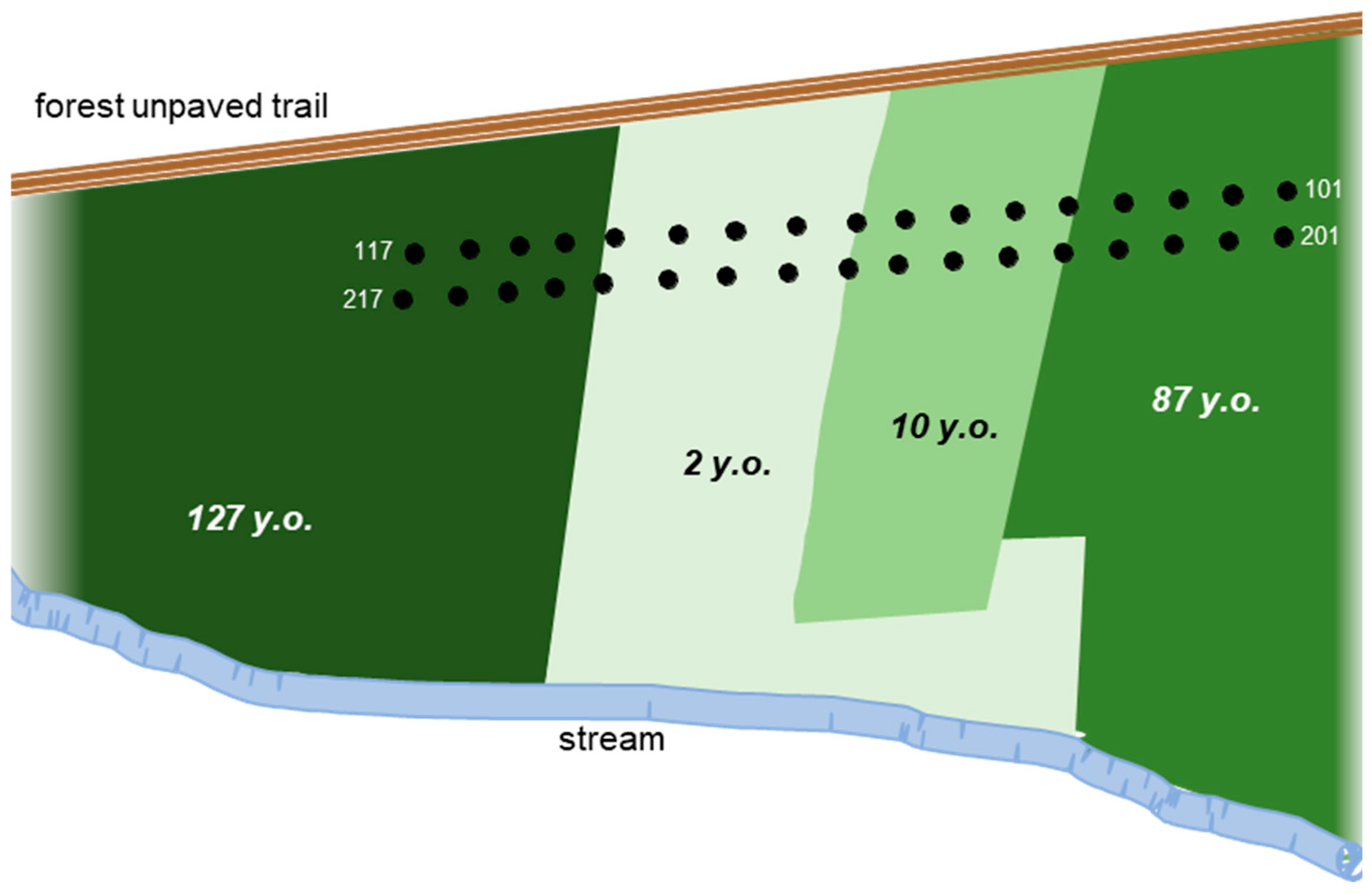
2.1. Locality
2.2. Sample Collection
2.3. Statistical Analyses
3. Results
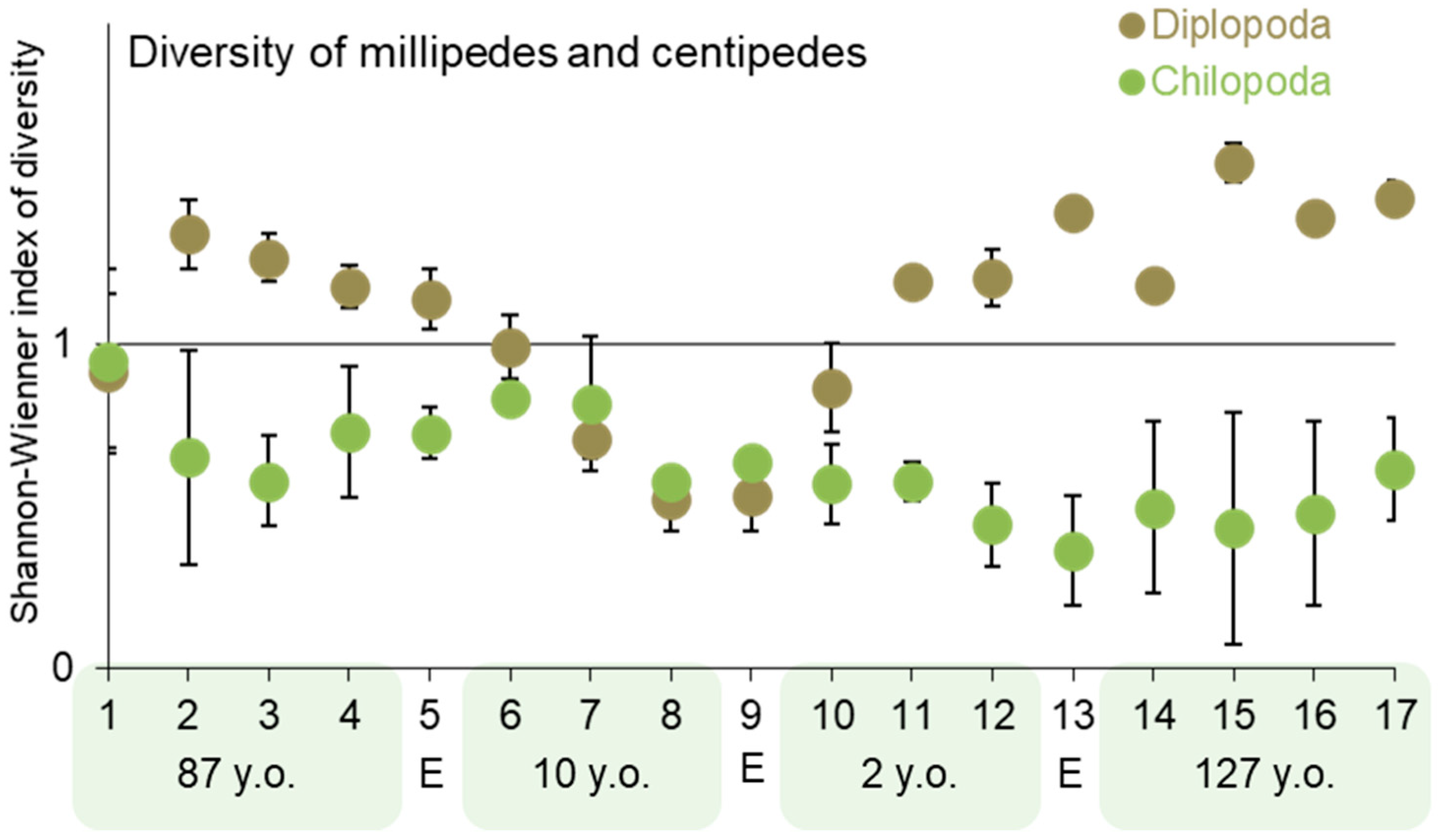
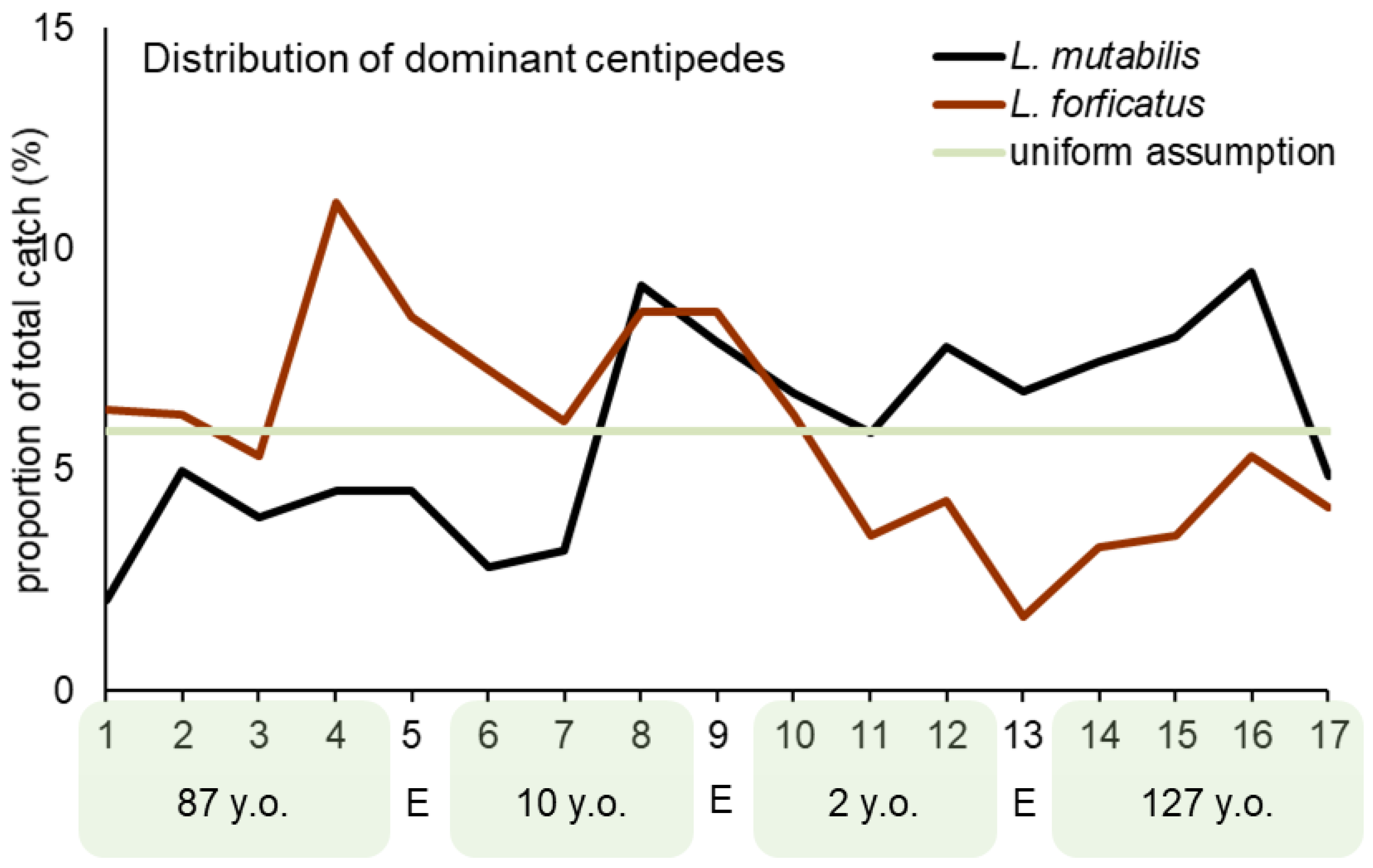
3.1. Diversity
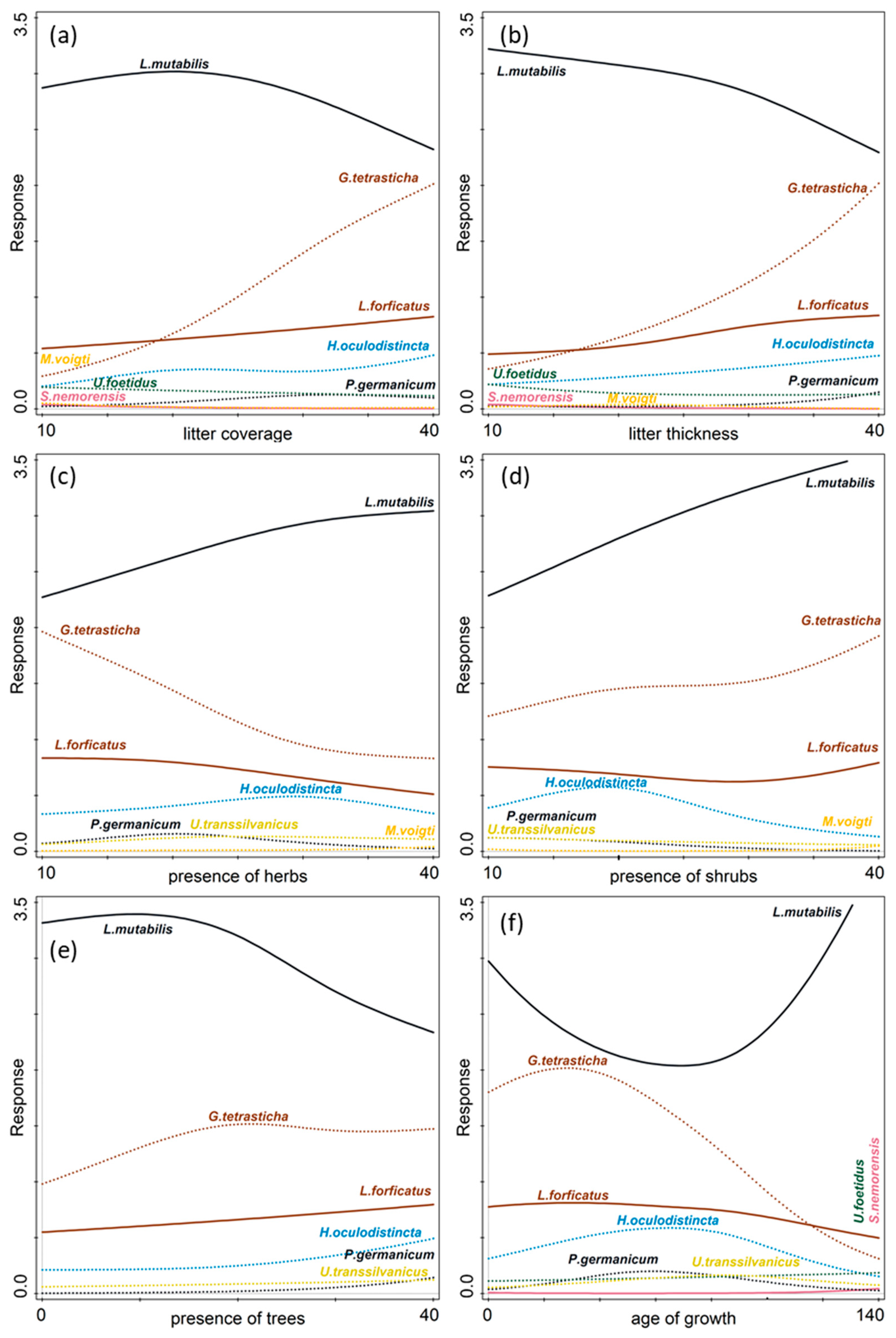
3.2. Environmental Factors Analysis
4. Discussion
4.1. Environmental Factors
4.2. Species-Specific Comments
5. Conclusions
Supplementary Materials
Author Contributions
Funding
Data Availability Statement
Acknowledgments
Conflicts of Interest
References
- Máslo, J.; Adolt, R.; Kohn, I.; Kučera, M. Plocha lesa v ČR: Výsledky třetího cyklu národní inventarizace lesů 2016–2020. [Forest area in the Czech Republic: Results of the third cycle of the national forest inventory 2016–2020]. Lesn. Práce 2023, 102, 378–384. (In Czech) [Google Scholar]
- Hédl, R.; Ewald, J.; Bernhardt-Römermann, M.; Kirby, K. Coppicing systems as a way of understanding patterns in forest vegetation. Folia Geobot. 2017, 52, 1–3. [Google Scholar] [CrossRef]
- Murcia, K. Edge effects in fragmented forests: Implications for conservation. Trends Ecol. Evol. 1995, 10, 58–62. [Google Scholar] [CrossRef] [PubMed]
- De Smedt, P.; Baeten, L.; Proesmans, W.; Van de Poel, S.; Van Keer, J.; Giffard, B.; Martin, L.; Vanhulle, R.; Brunet, J.; Cousins, S.A.O.; et al. Strength of forest edge effects on litter-dwelling macro-arthropods across Europe is influenced by forest age and edge properties. Divers. Distrib. 2019, 25, 963–974. [Google Scholar] [CrossRef]
- Saunders, A.D.; Hobbs, J.R.; Margules, R.C. Biological consequences of ecosystem fragmentation: A review. Conserv. Biol. 1991, 5, 18–32. [Google Scholar] [CrossRef]
- Yang, H.; Zhang, J.; Xu, B. Spatial hints of forest ecotone indicating forest succession, a case of larch forests in Baihuashan Reserve, north China. Front. Biol. China 2009, 4, 523–530. [Google Scholar] [CrossRef]
- Lloyd, M.K.; McQueen, A.M.A.; Lee, J.B.; Wilson, C.B.R.; Walker, S.; Wilson, B.J. Evidence on ecotone concepts from switch, environmental and anthropogenic ecotones. J. Veg. Sci. 2000, 11, 903–910. [Google Scholar] [CrossRef]
- Ries, L.; Siesk, D.T. A predictive model of edge effects. Ecology 2004, 85, 2917–2926. [Google Scholar] [CrossRef]
- Dangerfield, M.J.; Pik, J.A.; Britton, D.; Holmes, A.; Gillings, M.; Oliver, I.; Briscoe, D.; Beattie, J.A. Patterns of invertebrate biodiversity across a natural edge. Austral Ecol. 2003, 28, 227–236. [Google Scholar] [CrossRef]
- Lacasella, F.; Gratton, C.; De Felici, S.; Isaia, M.; Zapparoli, M.; Marta, S.; Sbordoni, V. Asymmetrical responses of forest and “beyond edge” arthropod communities across a forest–grassland ecotone. Biodivers. Conserv. 2015, 24, 447–465. [Google Scholar] [CrossRef]
- Lawrence, R.F. Centipedes and Millipedes of South Africa: A Guide; A. A. Balkema: Rotterdam, The Netherlands, 1984. [Google Scholar]
- Hopkin, S.P.; Read, H.J. The Biology of Millipedes; Oxford Science Publications: Oxford, UK, 1992. [Google Scholar] [CrossRef]
- Eason, E.H. Centipedes of the British Isles; Frederick Warne & Co Ltd.: London, UK, 1964. [Google Scholar]
- Matlack, R.G. Microenvironment variation within and among forest edge sites in the eastern United States. Biol. Conserv. 1993, 66, 185–194. [Google Scholar] [CrossRef]
- Hauser, H.; Voigtländer, K. Doppelfüsser (Diplopoda) Ostdeutschlands; Deutscher Jugendbund für Naturbeobachtung: Göttingen, Germany, 2009. [Google Scholar]
- Voigtländer, K. Habitat preferences of selected Central European centipedes. Peckiana 2005, 4, 163–179. [Google Scholar]
- Tuf, I.H.; Tufová, J. Proposal of ecological clasification of centipede, millipede and terrestrial isopod faunas for evaluation of habitat quality in Czech Republic. Časopis Slez. Zemského Muz. Opava Ser. A 2008, 57, 37–44. [Google Scholar]
- Ter Braak, C.J.F.; Šmilauer, P. CANOCO Reference Manual a User’s Guide to Canoco for Windows: Software for Canonical Community Ordination (Version 4); Microcomputer Power: Ithaca, NY, USA, 1998. [Google Scholar]
- Tajovský, K. Mnohonožky (Diplopoda), stonožky (Chilopoda) a suchozemští stejnonožci (Oniscidea) vybraných aluviálních ekosystémů střední a severní Moravy (Litovelské Pomoraví a Poodří). [Millipedes (Diplopoda), centipedes (Chilopoda) and woodlice (Oniscidea) of selected alluvial ecosystems of Middle and North Moravia (Litovelské Pomoraví and Poodří)]. In Mokřady 2000. Sborník z Konference při Příležitosti 10. Výročí Vzniku CHKO Litovelské Pomoraví; Kovařík, P., Machar, I., Eds.; Správa CHKO ČR a Český Ramsarský Výbor: Praha, Czech Republic, 2000; pp. 230–232. [Google Scholar]
- Tuf, I.H.; Ožanová, J. Chilopoda and Diplopoda in different ecosystems of Protected Landscape Area Litovelské Pomoraví. In Soil Zoological Problems in Central Europe; Pižl, V., Tajovský, K., Eds.; Institut of Soil Biology ASCR: České Budějovice, Czech Republic, 1998; pp. 247–253. [Google Scholar]
- Leśniewska, M.; Koralewska-Batura, E.; Błoszyk, J. Centipede communities in oak-hornbeam forests of different ages and exploitation in Wielkopolska (Poland). Peckiana 2005, 4, 67–77. [Google Scholar]
- Stašiov, S. Millipede (Diplopoda) communities in mixed oak-hornbeam forest stands–effect of selected site factors. Pol. J. Ecol. 2009, 57, 785–792. [Google Scholar]
- Jabin, M. Influence of Environmental Factors on the Distribution Pattern of Centipedes (Chilopoda) and Other Soil Arthropods in Temperate Deciduous Forests; Cuvillier Verlag: Göttingen, Germany, 2008. [Google Scholar]
- Olechowicz, E. Soil-litter macrofauna in the mixed forest and midfield shelterbelts of different age (Turew Area, West Poland). Pol. J. Ecol. 2004, 52, 405–419. [Google Scholar]
- Staněk, L.; Hamřík, T.; Košulič, O. Vliv věkové struktury a managementu dubin na epigeické členovce. [Effect of age structure and management type on epigeic arthropods in commercial oak forests]. Zprávy Lesn. Výzkumu 2020, 65, 265–275, (In Czech with English Abstract). [Google Scholar]
- David, J.-F. Ecology of millipedes (Diplopoda) in the context of global change. Soil Org. 2009, 81, 719–734. [Google Scholar]
- Grgič, T.; Kos, I. Centipede diversity of different development phases in an unevenly aged beech forest stand in Slovenia. Afr. Invertebr. 2003, 44, 237–252. [Google Scholar]
- Grgič, T.; Kos, I. Centipede diversity in differently structured forests in Slovenia. Peckiana 2005, 4, 49–56. [Google Scholar]
- Kareiva, P. Habitat fragmentation and the stability predator–prey interactions. Nature 1987, 326, 388–390. [Google Scholar] [CrossRef]
- Fründ, H.C.; Balkenhol, B.; Ruszkowski, B. Chilopoda in forest habitat-islands in north-west Westphalia, Germany. Entomol. Scand. 1997, 51, 107–114. [Google Scholar]
- Hora, P.; Tuf, I.H.; Machač, O.; Brichta, M.; Tufová, J. Ekoton-prosté rozhraní, nebo specifický biotop? [An ecotone—A standard interface or a specific habitat?]. Živa 2009, 57, 25–27. (In Czech) [Google Scholar]
- Hanski, I. The Shrinking World: Ecological Consequences of Habitat Loss; International Ecology Institute: Oldendorf/Luhe, Germany, 2005. [Google Scholar]
- Hedde, M.; Aubert, M.; Bureau, E.; Margerie, P.; Decaëns, T. Soil detritivore macro-invertebrate assemblages throughout a managed beech rotation. Ann. For. Sci. 2007, 64, 219–228. [Google Scholar] [CrossRef]
- Golovatch, S.I.; Kime, R.D. Millipede (Diplopoda) distributions: A review. Soil Org. 2009, 81, 565–597. [Google Scholar]
- Stoev, P.; Zapparoli, M.; Golovatch, S.; Enghoff, H.; Akkari, N.; Barber, A. Myriapods (Myriapoda). BioRisk 2010, 4, 97–130. [Google Scholar] [CrossRef]
- Koivula, M.; Punttila, P.; Haila, Y.; Niemelä, J. Leaf litter and the small-scale distribution of carabid beetles (Coleoptera, Carabidae) in the boreal forest. Ecography 1999, 22, 424–435. [Google Scholar] [CrossRef]
- Niemelä, J. Invertebrates and boreal forest management. Conserv. Biol. 1997, 11, 601–610. [Google Scholar] [CrossRef]
- Wytwer, J.; Zalewski, M. The role of island size and isolation in diversity of Myriapoda. Peckiana 2005, 4, 195–208. [Google Scholar]
- Topp, W.; Kappes, H.; Kulfan, J.; Zach, P. Distribution pattern of woodlice (Isopoda) and millipedes (Diplopoda) in four primeval forests of the western Carpathians (Central Slovakia). Soil Biol. Biochem. 2006, 38, 43–50. [Google Scholar] [CrossRef]
- Kotze, J.D.; Samways, J.M. Invertebrate conservation at the interface between the grassland matrix and natural Afromontane forest fragments. Biodivers. Conserv. 1999, 8, 1339–1363. [Google Scholar] [CrossRef]
- Magura, T.; Tóthmérész, B.; Molnár, T. Forest edge and diversity: Carabids along forest-grass transects. Biodivers. Conserv. 2001, 10, 287–300. [Google Scholar] [CrossRef]
- Didham, R.K. An overview of invertebrate responses to forest fragmentation. In Forests and Insects; Watt, A.D., Stork, N.E., Hunter, M.D., Eds.; Chapman & Hall: London, UK, 1997; pp. 303–320. [Google Scholar]
- Perry, A.D. The scientific basis of forestry. Annu. Rev. Ecol. Syst. 1998, 29, 435–466. [Google Scholar] [CrossRef]
- Grgič, T.; Kos, I. Temperature preference in some centipede species of the genus Lithobius Leach, 1814 (Chilopoda: Lithobiidae). Acta Biol. Slov. 2001, 44, 3–12. [Google Scholar]
- Loksa, I. Über einige Arthropoden-Gruppen aus dem Pilis-Biosphären-Reservat (Ungarn). 2. Die Diplopoden, Chilopoden, Weberknechte und Spinnen aus dem Gebiet zwischen Kakas-Berg (Pilisszentkereszt) und Ispán-Wiese (Mikula-haraszt). Opusc. Zool. 1991, 24, 129–141. [Google Scholar]
- Lee, R.E. Summer microhabitat distribution of some centipedes in a deciduous and coniferous community of central Ohio (Chilopoda). Entomol. News 1980, 91, 1–6. [Google Scholar]
- Hickerson, M.C.; Anthony, D.C.; Walton, M.B. Edge effects and intraguild predation in native and introduced centipedes: Evidence from the field and from laboratory microcosms. Oecologia 2005, 146, 110–119. [Google Scholar] [CrossRef]
- Ferlian, O.; Scheu, S.; Pollierer, M.M. Trophic interactions in centipedes (Chilopoda, Myriapoda) as indicated by fatty acid patterns: Variations with life stage, forest age and season. Soil Biol. Biochem. 2012, 52, 33–42. [Google Scholar] [CrossRef]
- Jastrzębski, P.; Hajdamowicz, I.; Żabka, M.; Paszko, K.; Błaszczuk, B. Millipedes (Diplopoda) of selected habitats of the Poleski National Park. Acta Sci. Pol. Biol. 2006, 5, 13–25. [Google Scholar]
- Haupt, J. Ecology of Diplopoda in northern Hesse. In Proceedings of the 7th International Congress of Myriapodology; Minelli, A., Ed.; E. J. Brill: Leiden, The Netherlands; New York, NY, USA; København, Denmark; Köln, Germany, 1990; pp. 247–255. [Google Scholar] [CrossRef]
- Tufová, J. Development of millipede assemblages in floodplain forests after summer flood. In Studies on Soil Fauna in Central Europe; Tajovský, K., Balík, V., Pižl, V., Eds.; Institute of Soil Biology ASCR: České Budějovice, Czech Republic, 2002; pp. 247–251. [Google Scholar]
- Vagalinski, B.; Stoev, P. An annotated catalogue of the millipede order Julida (Diplopoda) in Bulgaria. Hist. Nat. Bulg. 2007, 18, 35–63. [Google Scholar]



| Coded as | 10 | 20 | 30 | 40 | |
|---|---|---|---|---|---|
| herb layer coverage | 0–25 | 25–50 | 50–75 | 75–100 | % |
| shrub layer coverage | 0–25 | 25–50 | 50–75 | 75–100 | % |
| tree-crowns coverage | 0–25 | 25–50 | 50–75 | 75–100 | % |
| litter coverage | 0–25 | 25–50 | 50–75 | 75–100 | % |
| litter thickness | 0–1 | 1–3 | 3–5 | 5≥ | cm |
| 87 y.o. | Ecotone | 10 y.o. | Ecotone | 2 y.o. | Ecotone | 127 y.o. | n | |
|---|---|---|---|---|---|---|---|---|
| centipedes | ||||||||
| Lithobius agilis CL Koch, 1847 | 0.9 | – | 1.4 | 0.5 | 0.5 | 0.5 | 0.5 | 24 |
| Lithobius erythrocephalus CL Koch, 1847 | 0.1 | – | 0.2 | 1.0 | 0.2 | – | 0.4 | 8 |
| Lithobius forficatus (Linnaeus, 1758) | 27.9 | 32.5 | 28.2 | 33.0 | 18.0 | 6.5 | 15.6 | 769 |
| Lithobius mutabilis L. Koch, 1862 | 54.8 | 64.0 | 71.5 | 112.0 | 96.4 | 96.0 | 105.6 | 2834 |
| Geophilus flavus (de Geer, 1778) | – | – | 0.2 | – | – | – | – | 1 |
| Geophilus impressus CL Koch, 1847 | 0.1 | – | – | 0.5 | – | 0.5 | – | 3 |
| Schendyla nemorensis (CL Koch, 1837) | 0.1 | – | – | – | 0.5 | – | 0.8 | 10 |
| Strigamia acuminata (Leach, 1815) | 0.5 | 2.0 | 1.4 | – | 0.7 | – | 1.0 | 28 |
| Strigamia crassipes (CL Koch, 1835) | 0.1 | – | – | 0.5 | 0.4 | 0.5 | 0.3 | 7 |
| Strigamia transsilvanica (Verhoeff, 1928) | – | – | – | – | – | 1.0 | – | 2 |
| millipedes | ||||||||
| Polyzonium germanicum Brandt, 1837 | 5.4 | 14.0 | 2.0 | 1.5 | – | 1.0 | 0.8 | 94 |
| Haplogona oculodistincta (Verhoeff, 1893) | 21.5 | 22.0 | 16.5 | 5.0 | 6.4 | 6.5 | 4.6 | 413 |
| Melogona voigtii (Verhoeff, 1899) | 0.8 | – | – | – | 1.0 | – | 0.6 | 17 |
| Leptoiulus proximus (Němec, 1896) | 2.9 | 0.5 | 0.7 | 4.5 | 1.0 | 1.0 | 1.3 | 55 |
| Unciger foetidus (CL Koch, 1838) | 4.4 | 5.0 | 2.5 | 2.5 | 4.4 | 8.5 | 5.3 | 150 |
| Unciger transsilvanicus (Verhoeff, 1899) | 6.9 | 4.5 | 1.7 | 1.5 | 2.0 | 1.5 | 2.3 | 110 |
| Brachydesmus superus Latzel, 1884 | – | – | – | – | 0.2 | – | – | 1 |
| Polydesmus complanatus (Linnaeus, 1761) | 0.5 | 0.5 | 0.2 | – | 0.2 | 0.5 | 0.1 | 9 |
| Polydesmus denticulatus CL Koch, 1847 | – | 0.5 | – | – | 0.8 | – | – | 6 |
| Glomeris tetrasticha Brandt, 1833 | 48.5 | 80.0 | 67.5 | 111.5 | 30.0 | 14.0 | 9.8 | 1462 |
| Sum | 175.3 | 225.5 | 193.7 | 274.0 | 162.4 | 138.0 | 148.7 | 6061 |
| Name | Explains % | pseudo-F | P | P(adj) |
|---|---|---|---|---|
| Litter layer thickness (cm) | 2.07 | 22.5 | 0.002 | 0.003 |
| Presence of herbs (%) | 0.53 | 5.7 | 0.002 | 0.003 |
| Presence of trees (%) | 0.53 | 5.7 | 0.002 | 0.003 |
| Age of growth (years) | 0.39 | 4.3 | 0.002 | 0.003 |
| Presence of shrubs (%) | 0.24 | 2.6 | 0.006 | 0.0072 |
| Litter coverage (%) | 0.21 | 2.3 | 0.016 | 0.016 |
| A | B | C | D | E | F | |
|---|---|---|---|---|---|---|
| A: Litter coverage (%) | 1 | |||||
| B: Litter layer thickness (cm) | 0.732 *** | 1 | ||||
| C: Presence of herbs (%) | −0.070 | −0.157 | 1 | |||
| D: Presence of shrubs (%) | 0.395 * | 0.113 | 0.471 ** | 1 | ||
| E: Presence of trees (%) | −0.003 | 0.199 | −0.674 *** | −0.753 *** | 1 | |
| F: Age of growth (years) | −0.511 ** | −0.425 | −0.018 | −0.561 *** | 0.430 * | 1 |
Disclaimer/Publisher’s Note: The statements, opinions and data contained in all publications are solely those of the individual author(s) and contributor(s) and not of MDPI and/or the editor(s). MDPI and/or the editor(s) disclaim responsibility for any injury to people or property resulting from any ideas, methods, instructions or products referred to in the content. |
© 2026 by the authors. Licensee MDPI, Basel, Switzerland. This article is an open access article distributed under the terms and conditions of the Creative Commons Attribution (CC BY) license.
Share and Cite
Grinvald, M.; Tuf, I.H. Stand Age and Litter Shape Myriapod Communities in a Forest Mosaic (Diplopoda, Chilopoda). Forests 2026, 17, 127. https://doi.org/10.3390/f17010127
Grinvald M, Tuf IH. Stand Age and Litter Shape Myriapod Communities in a Forest Mosaic (Diplopoda, Chilopoda). Forests. 2026; 17(1):127. https://doi.org/10.3390/f17010127
Chicago/Turabian StyleGrinvald, Marea, and Ivan Hadrián Tuf. 2026. "Stand Age and Litter Shape Myriapod Communities in a Forest Mosaic (Diplopoda, Chilopoda)" Forests 17, no. 1: 127. https://doi.org/10.3390/f17010127
APA StyleGrinvald, M., & Tuf, I. H. (2026). Stand Age and Litter Shape Myriapod Communities in a Forest Mosaic (Diplopoda, Chilopoda). Forests, 17(1), 127. https://doi.org/10.3390/f17010127