Article

Radial Growth Patterns Across the Growing Season in Response to Microclimate in Silvopastoral Systems of Nothofagus antarctica Forests


by
Julián Rodríguez-Souilla
1,*,
Juan Manuel Cellini
2,
María Vanessa Lencinas
1,
Lucía Bottan
1,
Jimena Elizabeth Chaves
1,
Fidel Alejandro Roig
3 and
Guillermo Martínez Pastur
1
1
Laboratorio de Recursos Agroforestales, Centro Austral de Investigaciones Científicas (CADIC), Consejo Nacional de Investigaciones Científicas y Técnicas (CONICET), Bernardo Houssay #200, Ushuaia 9410, Tierra del Fuego, Argentina
2
Laboratorio de Investigaciones en Maderas (LIMAD), Universidad Nacional de la Plata (UNLP), Diagonal 113 # 469, La Plata 1900, Buenos Aires, Argentina
3
Instituto Argentino de Nivología, Glaciología y Ciencias Ambientales (IANIGLA), Consejo Nacional de Investigaciones Científicas y Técnicas (CONICET), Parque San Martin s/n, Mendoza 5500, Argentina
*
Author to whom correspondence should be addressed.
Forests 2026, 17(1), 129; https://doi.org/10.3390/f17010129
Submission received: 10 December 2025 / Revised: 9 January 2026 / Accepted: 15 January 2026 / Published: 17 January 2026
(This article belongs to the Section Forest Ecology and Management)

Abstract

Silvopastoral systems in Patagonia (Argentina) aim to synergize forest and grassland productivity through thinning interventions in native forests of Antarctic beech (Nothofagus antarctica (G.Forst.) Oerst.), locally known as ñire, modifying ecosystem dynamics. This study aimed to determine how thinning strategies modify microclimatic conditions (air and soil temperatures, precipitation, soil water content) and modulate the intra-annual radial growth patterns in N. antarctica trees within subpolar deciduous forests of Tierra del Fuego, Argentina. We established three treatments: unmanaged mature forest (UF), thinning under crown cover influence (UC), and thinning outside crown cover influence (OC). Microclimate and radial growth were continuously monitored using high-precision dendrometers and associated data loggers during the 2021–2022 and 2023–2024 growing seasons. Data were analyzed using Generalized Linear Mixed Models and Principal Component Analysis. OC treatment consistently exhibited the highest total annual radial growth, averaging 1.44 mm yr−1, which was substantially greater than the observed in both the UC (0.56 mm yr−1) and UF (0.83 mm yr−1) across the two seasons. An advanced growth dynamic, with cambial activity starting approximately five days earlier than in UF and UC, was detected. Air temperature was a primary positive driver of daily growth (GLMM Estimates > 0.029, p < 0.001 for all treatments), while soil water content (SWC) was significantly higher in OC (mean 25.4%) compared to UF (22.3%) and UC (15.9%). These findings showed that OC, characterized by higher soil moisture, likely facilitated the trees’ ability to capitalize on warm temperature days. This accelerates and extends the period of radial growth, offering a direct strategy to enhance productivity in these silvopastoral systems, essential for long-term forest sustainability.

1. Introduction

Silvopastoral systems in Patagonia are typically implemented in habitats where forests and grasslands coexist. There, management objectives combine different activities to achieve productive synergies, as the optimal strategy involves modifying the forest structure through thinning [1]. These interventions generally increase the understory’s productivity, favoring palatable plants and improving forage quality [2]. Specifically, in Tierra del Fuego (Argentina), pure Nothofagus antarctica (G. Forst.) Oerst. (locally known as ñire, or Antarctic beech in English) forests are a fundamental ecological and socioeconomic component of the ecotone zone. These forests, which cover a vast area of the province (approximately 187,000 ha), represent a key productive landscape [3], providing timber, firewood, and essential ecosystem services [2]. They exist extensively within a matrix of diverse land covers, including mesic-hygrophilous and xeric grasslands, and peatlands. This high spatial heterogeneity presents a great management challenge for developing efficient and sustainable production systems, as overuse can lead to environmental degradation. The primary causes of this include historical selective logging [4], recurrent fires that drastically alter forest structure and composition [4], extensive overgrazing by both domestic livestock and native herbivores [5], and potential changes in site quality induced by the effects of climate change [6]. These threats can greatly impact the regeneration process and make these forests vulnerable on a long-term scale [2].
In this complex scenario, the survival of healthy trees and the growth of natural regeneration are essential to ensure the continuity of the forest cover over time, especially following natural or anthropogenic disturbances [7]. To this end, the implementation of silvopastoral systems emerges as a more sustainable and integrated management alternative [2]. Thinning involves the removal of certain trees to reduce stand density. This practice is considered to simplify the forest structure by opening the canopy and maintaining homogeneous tree and age distributions [7], and it can be beneficial for climate change adaptation and mitigation by maintaining similar conservation values to non-harvested forest [1]. Likewise, these interventions have varied impacts on the stand microclimate, and in the eco-physiology of the remnant trees [8]. Opening the canopy can create opportunities, such as increasing the water availability for understory, regeneration, and trees [9], due to canopy interception significantly influences the amount of water reaching the soil, potentially accounting for 15% to 50% of annual precipitation [10]. Additionally, seedling growth is stimulated by modifying light availability and soil moisture. More open sites tend to have higher radiation, temperature, and wind speed, leading to a greater diurnal temperature range influencing plant water balance [11]. Additionally, soil temperature influences the rate of chemical reactions and tree growth, as temperatures below 0 °C can interrupt sap translocation and affect physiological processes [12].
To improve the understanding and monitoring of growth dynamics and survival thresholds for natural regeneration and mature trees under different management alternatives, as well as the potential impacts of climate change [13,14,15], it is important to understand the effects of harvesting on tree growth. This can be achieved by studying the climate-related formation and growth of tree rings. In this regard, the use of dendrometers, which allow for the determination of plasticity response in environments with daily climatic variability, is particularly useful for explaining physiological processes of diametric increment at a sub-hourly temporal scale [16]. These studies focus on isolating daily data of stem expansion and contraction and relating them to climatic variables.
At high latitudes, growth rings develop over a short period and are highly dependent on daily climatic conditions [8]. Despite general knowledge about the effects of thinning, there is a limited understanding of how different conditions of this practice specifically modify the microclimate at daily and seasonal scales in these N. antarctica forests. In particular, there is a lack of detailed evidence on how these microclimatic alterations, which vary among different forest environments [17,18,19], translate into differential daily radial growth rates of the remaining trees. The connection between these tree–microclimate responses and the optimization of conditions for the viability and productivity of silvopastoral systems in N. antarctica forests needs to be explored in greater depth, especially considering that the impact of these dynamics on tree-ring formation—a central aspect of productivity through annual wood formation—has only recently been explored [11]. In this context, the objective was to determine the effect of microclimatic conditions on the radial growth dynamics of Nothofagus antarctica at different forest environments (unmanaged mature forests and thinned forests, under and outside crown cover influence) in Tierra del Fuego, Argentina, by characterizing the growing season phases (onset, growth, and cessation) and determining climatic thresholds that define daily and annual radial increments. Two research questions were proposed: (i) How do the phases across the growing season and the magnitude of daily radial growth differ among the treatments? (ii) In what way, do microclimatic variables are linked to the dynamics of radial growth across the season, and what are the climatic thresholds that define the radial growth pattern? Biologically, the thinned treatment with no neighbor trees represents a condition of maximum resource release, where the removal of immediate competitors is expected to maximize both solar radiation interception and soil water availability for the remaining trees. We then hypothesized that, compared to trees in unmanaged forests (UF) and thinning under crown cover competition (UC), trees in thinning outside crown competition (OC) would exhibit: (i) an advanced growth dynamic, with an earlier onset of cambial activity; (ii) a greater magnitude of daily radial increment; and (iii) a prolonged growing season. This differential response may be attributed to the combination of lower intraspecific competition and a more favorable microclimate in OC, characterized by higher water availability (greater effective precipitation and/or soil water content) and higher daily temperatures resulting from the thinning interventions. Consequently, the climatic thresholds modulating growth are expected to differ significantly among treatments. By providing this mechanistic understanding, our findings are expected to inform silvicultural insights that can more effectively balance timber production, forage availability, and forest resilience in Patagonian silvopastoral systems.

2. Materials and Methods

2.1. Study Site

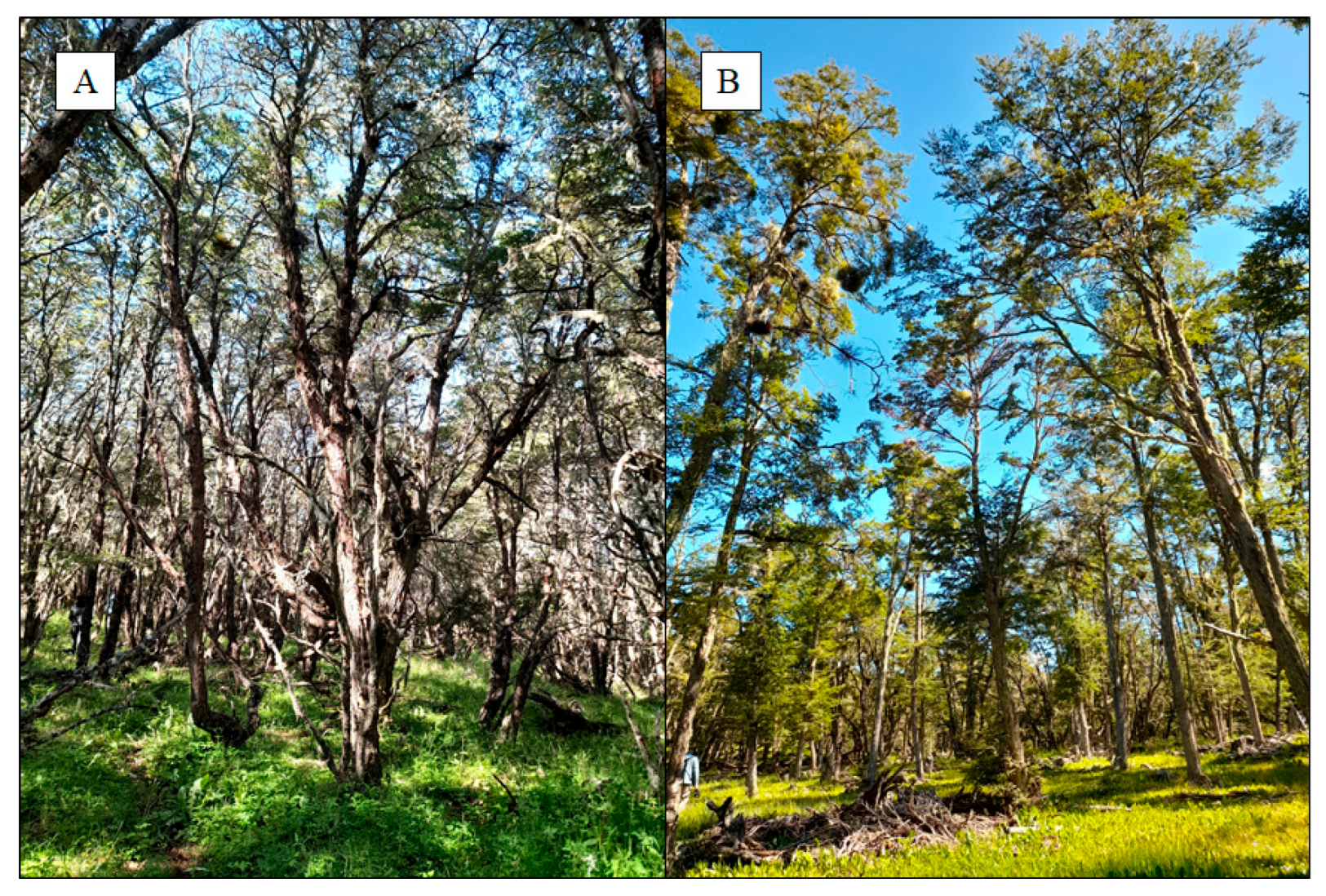
The study was conducted in pure temperate deciduous Nothofagus antarctica forests located at El Roble Ranch (54.09 S, 67.59 W) in the central region of Isla Grande of Tierra del Fuego Province, Argentina, with a subpolar oceanic climate. The study site belongs to the PEBANPA long-term research network (Parcelas de Ecología y Biodiversidad de Ambientes Naturales en Patagonia Austral). The experimental design involved three distinct forest environments originating from the same age cohort, established for silvopastoral purposes: (i) Unmanaged forests (UF): mature stands (>150 years old) with a closed canopy (>70% cover) and near 100% inter-tree crown contact, serving as a control. Then, the same area with two different sub-treatments: (ii) Thinning under crown cover competition (UC): thinned areas where measured trees are in direct competition with neighboring trees, defined by having 25%–50% of their crown in contact with neighbors. (iii) Thinning outside of crown competition (OC): thinned areas where measured trees are located in open areas, facing no direct competition from neighboring trees, defined by having less than 25% of their crown in contact with neighbors (see Figure A1 for representative photographs of the unmanaged and thinned stands). The silvicultural intervention, executed in January 2019, consisted of a heavy thinning designed to convert the dense secondary forest into a silvopastoral system. The operation was performed motor-manually (chainsaws), reducing the original basal area by approximately 60% (removing ~29 m2 ha−1) and stand density by ~75%. The selection criteria focused on removing suppressed, intermediate, and malformed trees, retaining only dominant and co-dominant individuals with good sanitary conditions to ensure stand stability and seed production.
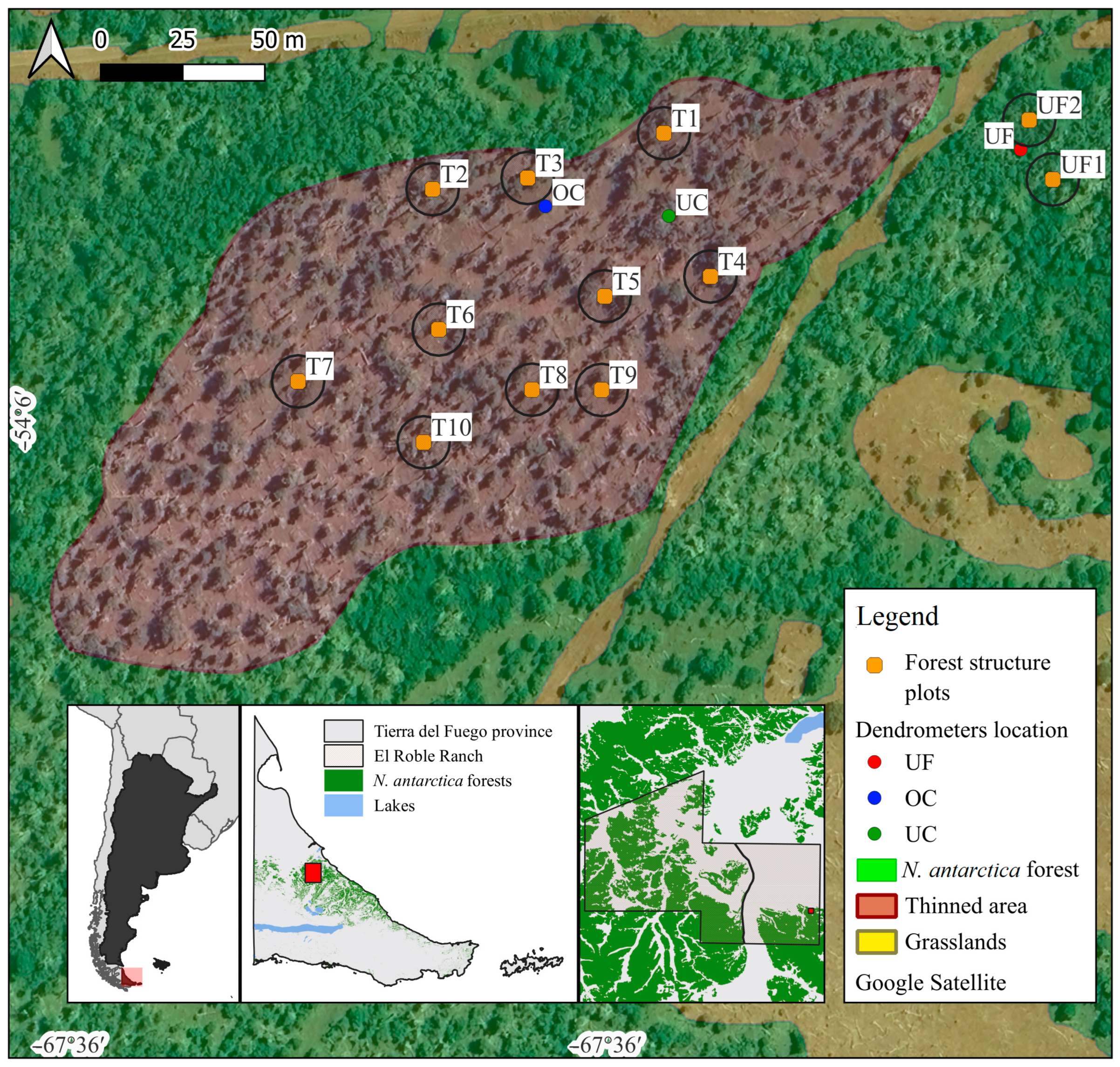
Forest structure was characterized by 12 fixed circular plots (8 m radius) (Figure 1). To quantify the overall effect of the harvesting intervention at the stand level, data from the thinned plots (both UC and OC) were pooled into a single ‘thinned’ category (T, 10 plots) for this analysis, which was compared against the unmanaged forest (UF, 2 plots). In these plots, all living trees with a diameter at breast height (DBH, 1.30 m height) > 5 cm were included. Dominant height (m) was measured using a TruPulse 200 (Laser Technology, Centennial, CO, USA) laser clinometer by averaging the height of the two tallest trees per plot. DBH of each tree was measured with a forest caliper. These data were used to calculate basal area (BA, m2 ha−1), tree density (trees ha−1), and total over bark volume (TOBV, m3 ha−1) following models proposed by Ivancich [20]. Thinning occurred on January 2019, then DBH was measured annually for monitoring growth and mortality: before harvesting (January 2019) and every May during a period of six years after thinning (YAT) (2019–2025).

2.2. Radial Growth and Microclimatic Conditions

Continuous radial growth monitoring was conducted on six representative trees (two dominant and healthy trees per treatment) using six high-precision electronic dendrometers (DEX70, ±0.0001 mm; Dynamax, Houston, TX, USA). Data from two dendrometers per treatment were recorded every 30 min (from October to March) during two growing seasons (2021–2022 and 2023–2024) using three GP1 data loggers (Delta T, Cambridge, England). Dendrometers and their associated data loggers were installed on each monitored tree within each treatment. The units were placed at breast height (1.3 m) and securely fastened to the stem to prevent wind-induced measurement errors and to avoid disturbance by herbivores. To create a representative growth signal for each treatment, the high-resolution dendrometer readings from the two monitored trees per treatment were averaged at each time point. This process yielded a distinct time series for each treatment in each of the two seasons, resulting in a total of six time series (n = 6) for analysis. Data from the 2022–2023 growing season were excluded due to an equipment malfunction that resulted in an incomplete dataset. This analysis was performed using the “dendRoAnalyst” [21] package in R, which allowed us to process and analyze dendrometer data using various approaches
Microclimatic variables were recorded concurrently within each treatment. The sensors were installed in the immediate vicinity of each dendrometer-equipped tree to ensure that the environmental data accurately represented the specific conditions driving the observed radial growth. Soil water content (SWC, m3 m−3, ± 0.1%) was measured every 30 min at a 10 cm depth using five ECHO EC5 probes connected to Em5b data loggers (Decagon, Pullman, WA, USA). Air temperature (AT, °C) was recorded hourly at a height of 30 cm within a radiation shield, while soil temperature (ST, °C) was measured at 10 cm depth. Temperature data were collected using HOBO (Onset, Bourne, MA, USA) and WatchDog (Spectrum Technologies, Aurora, IL, USA) data loggers. Additionally, a portable weather station (Davis Monitor II, Davis Instruments, Hayward, CA, USA) located in a nearby open area (≈500 m from the forest edge) collected 30 min data on precipitation (PP, mm, ±0.1 mm), used for this study. From this data, daily mean, minimum, and maximum values were calculated for all variables. To place the experiment in a climatic context, we compared the conditions of the two study seasons against the recent average from the portable weather station. We defined the growing season from October to March, consistent with the main growth analysis period [15]. Mean air temperature and total precipitation for this period for each year from 2018 to 2024 to establish a recent baseline for comparison were calculated.

2.3. Data Processing and Radial Increment Phases Analysis

The daily radial growth increment (DI, mm day−1) was derived from the dendrometer readings considering minimum, mean and maximum values for each day of the year (DOY). To analyze the seasonal growth pattern, the entire growing season for each treatment and year was partitioned into three distinct radial increment phases: Phase 1 (onset), characterized by the initial stem expansion, following the start of the monitoring period on October 1st (DOY 274), which corresponds to the beginning of the austral spring and a time when growth has not yet started [15]; Phase 2 (growth), representing the grand period of cambial activity with the highest growth rates; and Phase 3 (cessation), marked by a significant slowdown and eventual end of radial increment. The dendrometer readings capture a composite signal of two distinct processes: (1) irreversible stem growth due to cell division and enlargement, and (2) reversible, diurnal fluctuations in stem radius caused by changes in tree water status (i.e., contraction due to transpiration and expansion due to water uptake). While a single measurement reflects both processes, our analysis is designed to isolate the growth component. The daily radial growth increment (DI) was calculated based on the net increase in stem radius over a 24 h period, effectively separating the underlying irreversible growth trend from the temporary diurnal variations. This approach, allowed to quantify the actual radial growth while also using the diurnal patterns to understand tree water dynamics, a standard and well-established methodology in dendrometer studies [21].
The precise start and end dates defining these phases were objectively identified using the non-parametric Pettit’s test for change-point detection [22]. This test was applied to the cumulative radial growth time series for each treatment, identifying significant shifts in the data’s mean, which correspond to the transitions between the radial increment phases, when analyzing the complete growing period (DOY 274: October 1st—DOY 90: March 31st). To examine climate response thresholds in detail, the analysis focused on Phase 2, the growth period. Days within this phase were categorized into those with positive increments (expansions, >0.005 mm day−1), zero increments (between −0.005 and 0.005 mm day−1), and negative increments (contractions, <−0.005 mm day−1). These thresholds were established to define a ‘zero-growth’ range that accounts for sensor resolution and minor reversible stem fluctuations, ensuring that the ‘positive’ category reflects significant radial expansion beyond instrumental noise [21].

2.4. Statistical Analyses

All statistical analyses were performed using R Core Team software (version 4.4.1) [23]. First, to explore the main axes of microclimatic variation and the relationships among environmental drivers, a Principal Component Analysis (PCA) was performed separately for each growing season [24]. The analysis was based on a correlation matrix, which is appropriate for standardizing variables measured in different units. The input data matrix consisted of daily observations as rows for the 2021–2022 and 2023–2024 seasons and eight standardized environmental variables as columns: daily precipitation (PP), soil water content (SWC), and mean, minimum, and maximum air (AT) and soil (ST) temperatures. A preliminary Detrended Correspondence Analysis (DCA) revealed that the length of the first gradient was short (<2.0 standard deviation units), indicating that the environmental variables exhibited primarily linear responses. Therefore, PCA was selected as the most suitable unconstrained ordination technique for this dataset [25]. DI was treated as a supplementary variable and was not used in the calculation of the principal components. This approach allows for an independent analysis of the environmental structure, a key distinction from constrained ordination methods. The results were visualized using a biplot, with the environmental variables represented as vectors. The ordination pattern of the daily observations was interpreted by 95% confidence ellipses to delineate the environmental space occupied by each treatment (UF, UC, OC) and DI magnitude, where shadow of the points in the biplot was scaled to the continuous DI value (<0, 0–0.1, >0.1 mm). To statistically test for differences in the overall daily microclimatic conditions among treatments, we performed a permutational multivariate analysis of variance (PERMANOVA) using the adonis2 function in the “vegan” package in R [26]. This analysis was run on a Euclidean distance matrix of the standardized environmental data. Pairwise post-hoc comparisons were conducted using the pairwise.perm.manova function from the “RVAideMemoire” package in R [27] with a Bonferroni p-value adjustment. Additionally, to test for homogeneity of multivariate dispersions (variability) among treatments, the “betadisper” function followed by a permutation test was used.
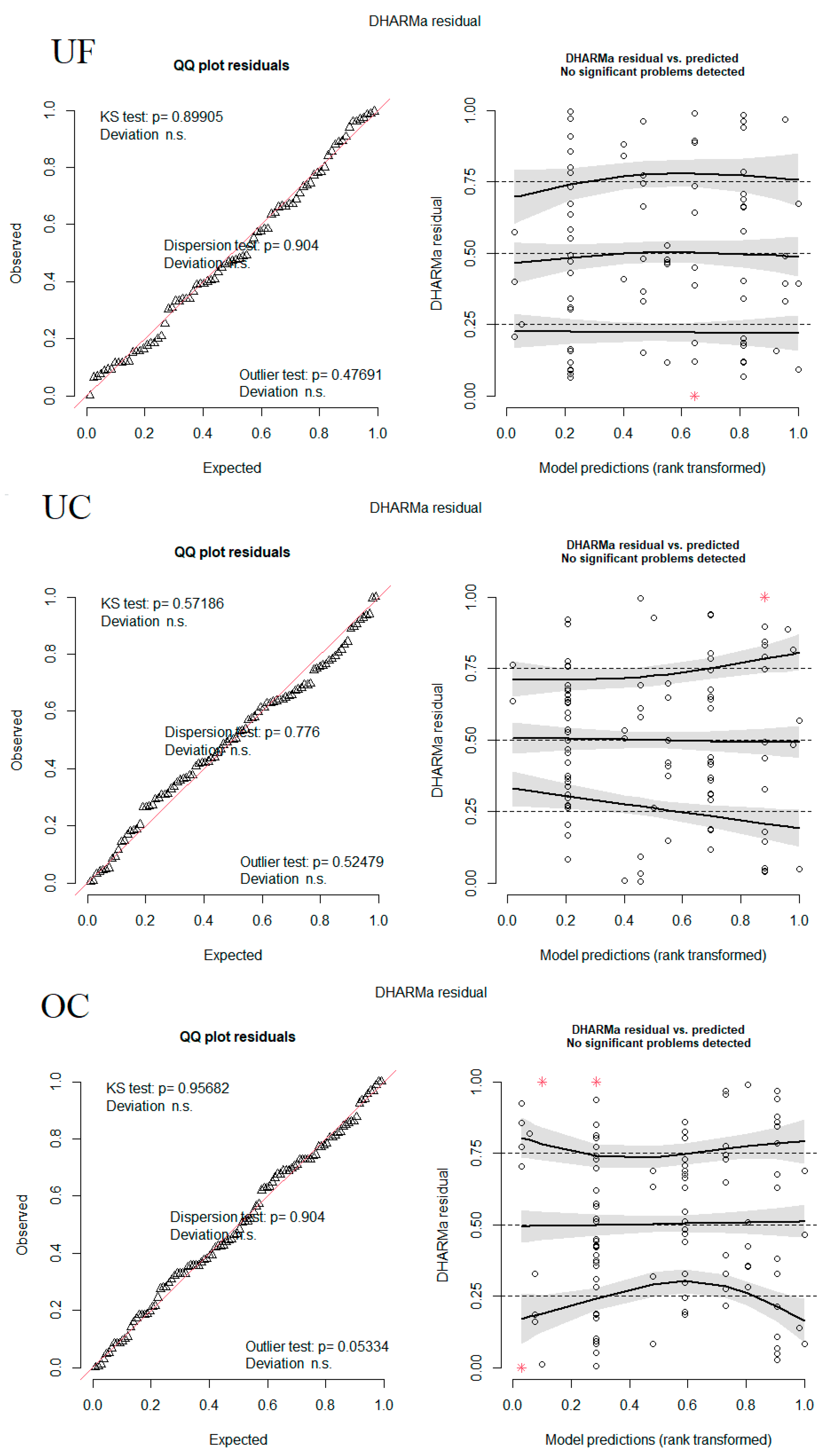
To evaluate the influence of radial increment phases environmental factors on DI while accounting for temporal autocorrelation, a series of Generalized Linear Mixed Models (GLMMs) were fitted using the “glmmTMB” package in R [28]. A first-order autoregressive correlation structure (ar1) was incorporated into all models, using the DOY within each season and treatment as the time variable. Two sets of models were developed, stratified by forest treatment (UF, UC, and OC). (i) Full-season models: to analyze the influence of environmental factors across the entire growing season, these models included radial increment phase (Phase 1, 2, 3), season (2021–2022, 2023–2024, and categorical levels of precipitation and temperature as fixed effects. (ii) Growth phase models: to isolate the climatic drivers during the period of maximum cambial activity, a second set of models were fitted exclusively to the data from Phase 2. These models included categorical levels of precipitation and air temperature as fixed effects. For the categorical variables, precipitation was classified as No Rain (0.0 mm day−1), Trace (>0.0–0.2 mm day−1), Light (0.2–1.0 mm day−1), and Moderate (>1.0 mm day−1). For temperature, categories were defined based on the distribution of daily mean values for each season and sensor type (air/soil) as: Cold (<1 standard deviation below the mean), Mid (within ±1.0 standard deviation of the mean), and Hot (>1 standard deviation above the mean). For all GLMMs, the significance of fixed effects was assessed using Type II Wald chi-square tests from the “car” package in R [29]. The validity and robustness of each fitted GLMM were thoroughly assessed. First, we checked for multicollinearity among predictor variables by calculating the Variance Inflation Factor (VIF). Second, model assumptions were verified by analyzing scaled residuals using the “DHARMa” package in R [30].

3. Results

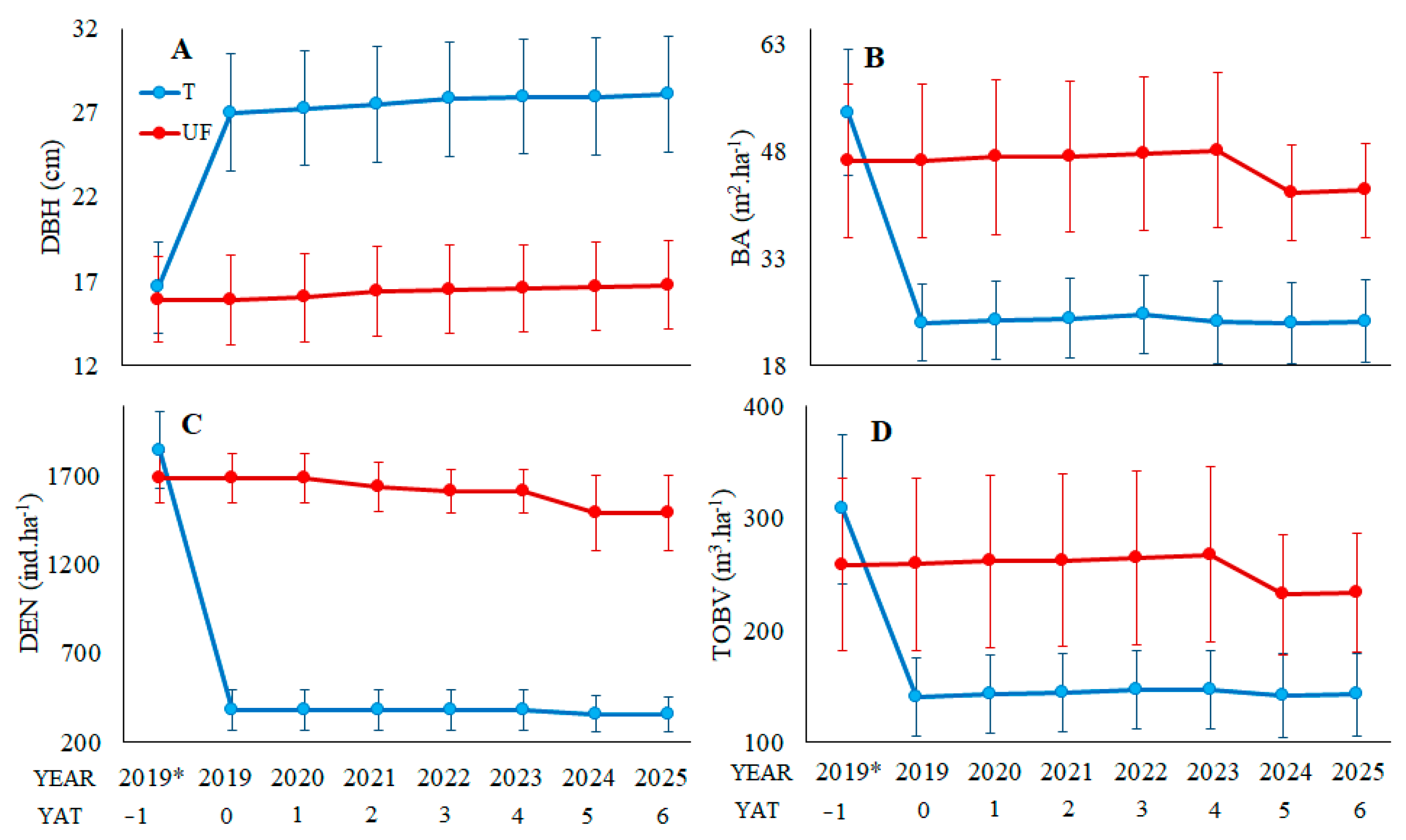
Forest structure changed as a result of harvesting interventions in thinned treatments. While the dominant height remained similar between the unmanaged forest (UF) and the thinned stands (10.50 m vs. 10.05 m on average, respectively), the diameter at breast height was significantly higher in the thinned plots compared to the unmanaged forest (27.0 vs. 15.9 cm on average, respectively). This difference was a direct consequence of the intervention strategy, where the preferential removal of smaller-diameter trees raised the average DBH within the thinned plots from 16.5 cm (pre-thinning) to 27.0 cm (post-thinning), an increase of 10.5 cm (Figure 2A). As expected, the thinning operation led to a reduction in basal area (BA) of 29.3 m2 ha−1. This value remained stable until 2024 (5 YAT), when a minor additional reduction of 1.1 m2 ha−1 was observed following a windblown storm (Figure 2B). The intervention involved the extraction of 167 m3 ha−1 of timber volume (Figure 2D) and resulted in a final stand density of 378 trees ha−1 (in contrast with UF with 1472 trees ha−1; Figure 2C).
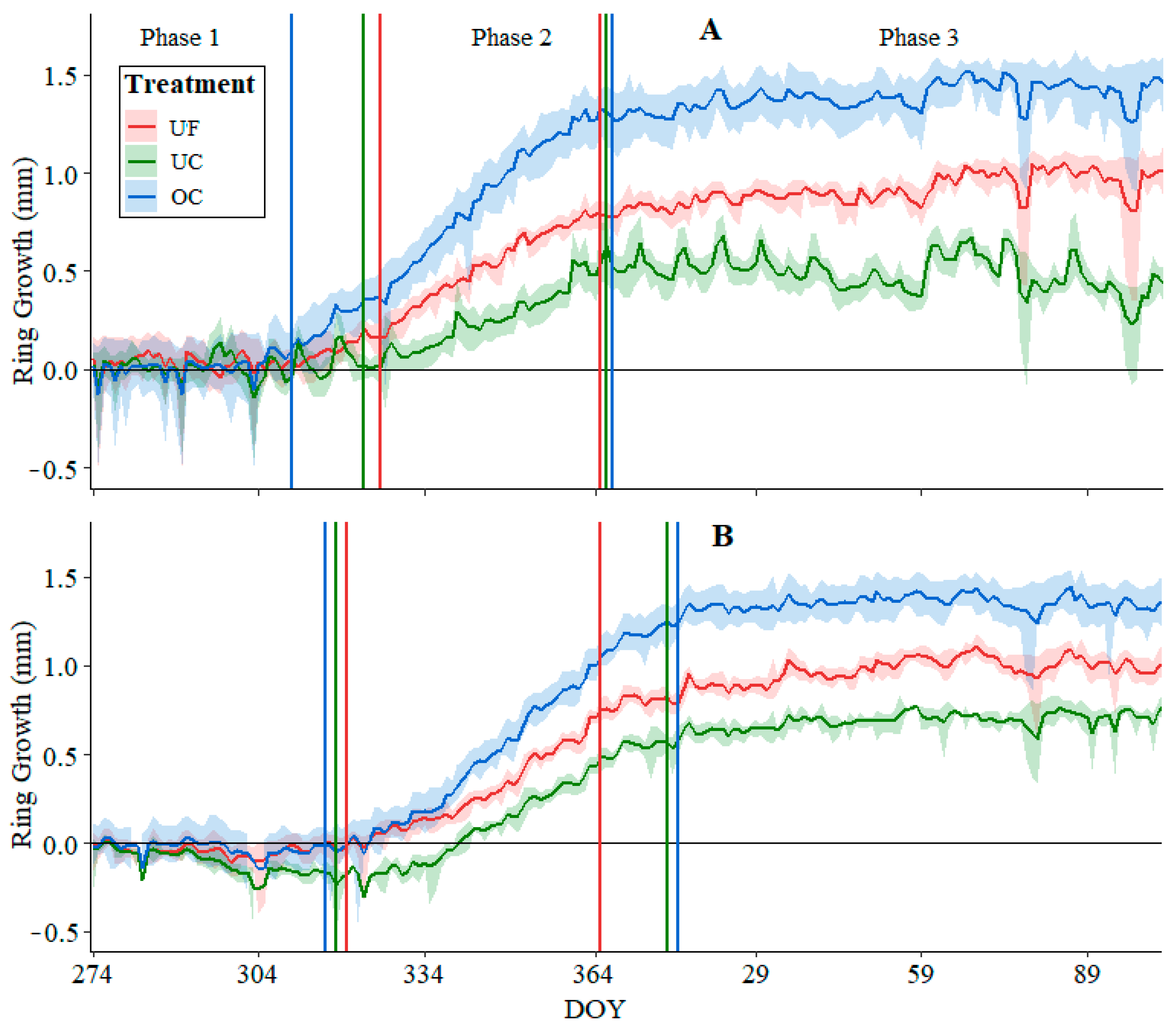
Intra-annual radial growth dynamics showed that OC consistently exhibited the highest total radial annual growth in both the 2021–2022 (1.45 mm yr−1) and 2023–2024 (1.43 mm yr−1) growing seasons, compared to UC (0.54 and 0.59 mm yr−1) and UF treatments (0.81 and 0.85 mm yr−1). The 2023–2024 growing season was longer than the 2021–2022 season (53 vs. 47 days on average), particularly in the thinned sites (Table 1 and Figure 3). Pettit’s test successfully identified the three distinct growth phases (onset, growth, and cessation) in all cases. While the onset of the growth phase was similar for UF and UC across both seasons, it began five days earlier in the OC treatment. Across all treatments and seasons, growth phase was characterized by the highest radial daily increments.
The high-resolution data also revealed a dynamic seasonal shift in the diurnal pattern of stem radius variation. For instance, the daily minimum radius (typically corresponding to peak transpiration stress) occurred at 7:00 h in October, shifted earlier to 5:00 h at the peak of summer in December, and occurred later at 8:00 h in April. The timing of the maximum radius showed a corresponding shift (14:00 h, 17:00 h, and 15:00 h, respectively), denoting growth occurring during daylight hours.
The microclimatic conditions varied distinctly across treatments and growth phases (Table 2). In general, OC experienced the highest soil temperatures and soil water content, while UF and UC showed higher air temperatures. Across all treatments, growth phase was influenced by the highest air and soil temperatures and the lowest SWC. Precipitation was highest during Phase 3.
The average growing season (October to March) conditions for the 2018–2024 period were a mean temperature of 8.83 °C and a total precipitation of 150.1 mm. The 2021–2022 growing season was slightly cooler (−0.20 °C anomaly) and wetter, with 37% more precipitation (206.0 mm) than the recent average. Similarly, the 2023–2024 season was also slightly cooler (−0.16 °C anomaly) and wetter, receiving 33% more precipitation (199.6 mm). Therefore, both seasons under study were characterized by temperatures close to the recent average but with substantially higher water availability.
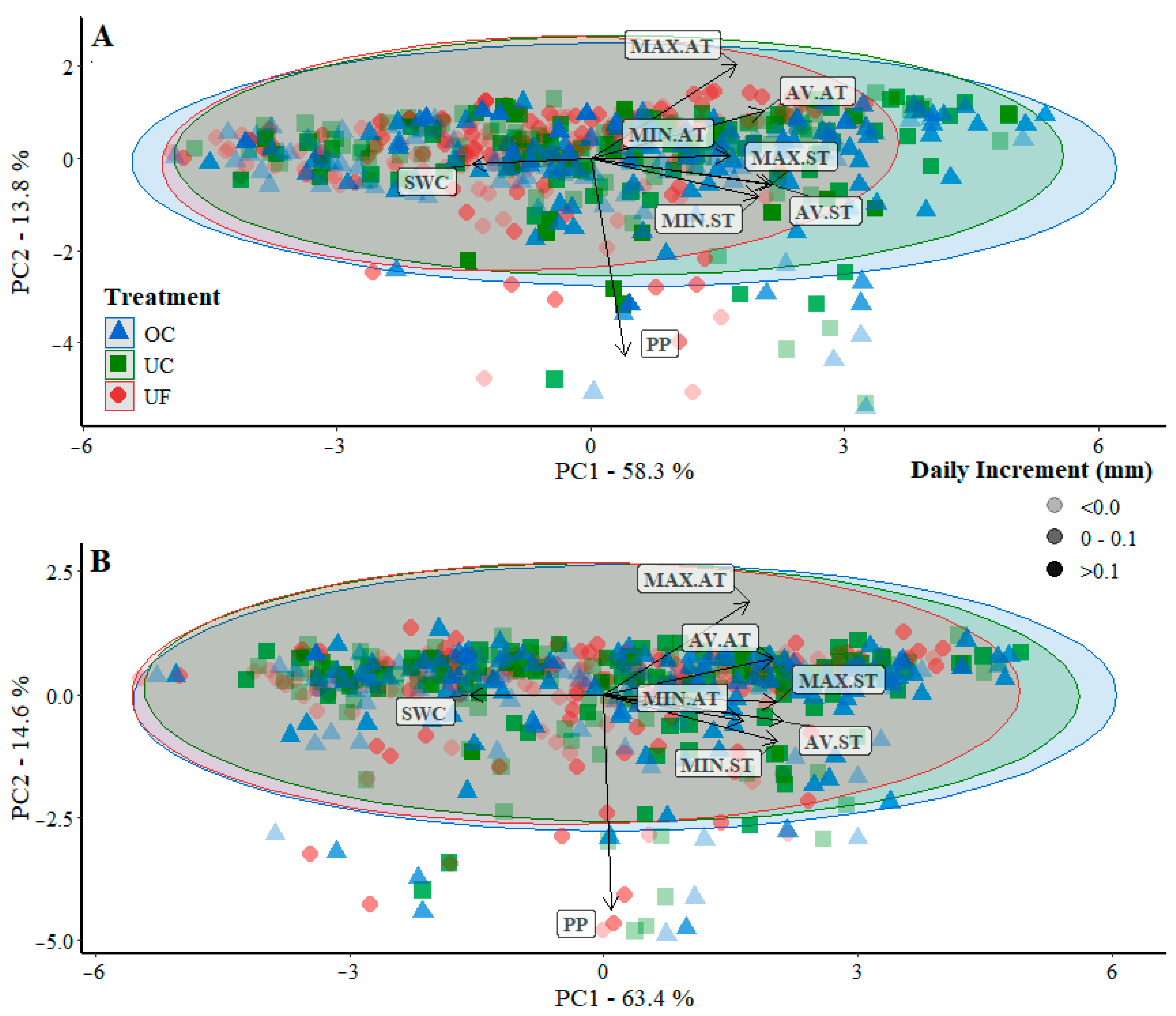
The Principal Component Analysis (PCA) provided further insight into the main environmental drivers. The first two principal components (PC1 and PC2) collectively explained 72.1% of the variance in 2021–2022 (PC1: 58.3%, eigenvalue = 4.66; PC2: 13.8%, eigenvalue 1.10) and 78.0% in 2023–2024 (PC1: 63.4%, eigenvalue = 5.06; PC2: 14.6%, eigenvalue = 1.16) (Figure 4). In both seasons, PC1 was primarily driven by an opposition between temperature variables and soil water content, defining a clear temperature-moisture gradient. Precipitation emerged as a largely independent axis of variation, orthogonal to this main gradient. The ordination of daily observations revealed distinct environmental spaces occupied by each treatment. The ordination of daily observations revealed distinct, yet overlapping, environmental spaces for each treatment. The 95% confidence ellipses for UF and UC treatments showed considerable overlap, indicating that they shared a very similar range of daily microclimatic conditions. In contrast, the ellipse for OC treatment was visibly shifted along PC1, suggesting a consistently different microenvironment, although significant overlap remained.
The PERMANOVA revealed a significant effect of the thinning treatment on the overall microclimatic conditions in both the 2021–2022 (F = 39.3, R2 = 0.25, p < 0.001) and 2023–2024 (F = 10.7, R2 = 0.19, p < 0.001) seasons. Crucially, pairwise post-hoc tests showed a consistent pattern across both years: the OC treatment’s microclimate was significantly different from both UF and UC (p.adj ≤ 0.003 for all comparisons). However, the microclimates of UF and UC did not differ significantly from each other in either 2021–2022 (p.adj = 0.003) or 2023–2024 (p.adj = 0.114), although the difference in 2021–2022 was notable. Furthermore, the analysis of multivariate dispersion (PERMDISP) showed that the daily variability of the microclimate was significantly different among treatments in 2021–2022 (F = 15.1, p < 0.001), but not in 2023–2024 (F = 3.0, p = 0.051).
The Generalized Linear Mixed Models (GLMMs) provided a detailed assessment of the climatic and radial increment phases of daily increment (DI), revealing distinct responses stratified by treatment (Table 3). Analysis of the time series during the active growth phase (Phase 2) revealed extremely high temporal autocorrelation across all treatments, with Lag-1 coefficients ranging from 0.96 to 0.97. This strong temporal dependence confirms the biological inertia of cambial activity and justifies the inclusion of the AR1 structure in the models. Across the full growing season, warmer air temperatures and moderate precipitation events were strong positive drivers of DI across all treatments. Conversely, higher soil temperatures showed a consistent negative relationship with DI, likely reflecting increased water stress on warmer days. While the Phase 2 was a significant predictor in all treatments, its effect was most pronounced in the OC, where daily growth during the growth phase was substantially higher than in UF and UC. Notably, UC exhibited the strongest positive response to precipitation, suggesting a higher sensitivity to moisture availability.
Treatment-specific responses (Table 4) during this Phase 2 showed that the climatic drivers of growth diverged significantly. In UF, a significant increase in DI required a strong thermal stimulus, occurring only on hot days. In contrast, trees in OC responded positively even to mid temperature days, indicating a lower thermal threshold for growth. UC again showed a unique pattern, where its radial growth was significantly driven by moderate precipitation, while the influence of air temperature was weaker and less distinct. These results indicate that thinning intensity not only affects the magnitude of growth but also fundamentally alters the relative importance of temperature and precipitation as daily growth drivers.

4. Discussion

This study provides high-resolution, intra-annual evidence that silvicultural thinning significantly alters the microclimate and, consequently, the radial growth of Nothofagus antarctica trees. The results support our primary hypothesis: thinning outside of crown competition (OC) exhibited an advanced growth dynamic, a greater magnitude of daily increment, and a longer growing season compared to thinning under crown cover competition (UC) and to unmanaged mature forest (UF). This differential response highlights the strong influence of stand structure on tree performance at a short temporal scale [5], confirming that management interventions can modulate key growth dynamics characteristics like the onset, growth, and cessation of ring growth. The ability to pinpoint these changes provides tools for understanding how forests respond to management in near real-time [15].
The enhanced radial growth in OC can be attributed to a combination of reduced competition and a more favorable microclimate. By removing surrounding trees, thinning directly reduces competition for essential resources such as light, water, and nutrients, an effect clearly demonstrated by the post-thinning increase in mean diameter at breast height and decrease in basal area, volume, and density in thinned sites [2]. The opening of the canopy increases light availability not only for the remnant trees but also for the understory, where productivity can triple compared to not thinned sites [31] and can lead to shifts in plant community composition along canopy cover gradients [32]. This increase in understory biomass is a primary objective of silvopastoral systems for forage production [5], aligning with the principle that they can have greater direct precipitation compared to unmanaged systems, as suggested by higher soil water content [33,34]. This dual benefit of increased light and water availability, particularly evident in the OC which benefits from increased leaf area and direct radiation [35], likely creates better conditions for photosynthesis and cell division, driving the greater radial growth rates (daily increments) observed [8]. Referring to stem contraction and expansion, this temporal adjustment directly mirrors the changing photoperiod and the duration of daily solar radiation, which influence the tree’s transpiration and water status dynamics. This pattern, where the main stem expansion and net radial increment occur during daylight hours, contrasts with findings for other temperate broadleaf species like Fagus sylvatica, where growth has been reported to be predominantly nocturnal [36]. The daytime growth observed in Nothofagus antarctica suggests that turgor-driven cell expansion is tightly coupled with periods of active photosynthesis and water uptake, a physiological rhythm that may differ from the water-use strategies of species like European beech. Specifically, for N. antarctica, this behavior can be explained by its high phenotypic plasticity and hydraulic strategy. Previous studies have shown that this species possesses a remarkable capacity to adjust its leaf traits and photosynthetic efficiency when released from competition [37]. However, it also exhibits strict stomatal control to avoid hydraulic failure [38]. This suggests that, in the UC treatment, even moderate water stress (lower SWC) likely triggered early stomatal closure, limiting carbon assimilation despite the available light, whereas the OC trees, free from hydraulic competition, could maintain gas exchange for longer periods.
Air temperature resulted in a primary positive driver of daily growth, which is expected in high-latitude ecosystems where temperature is often the principal limiting factor [39,40]. The warmer microclimate in thinned sites, especially OC, likely facilitated an earlier start to the growing season and maintained higher metabolic rates during growth [18]. Trees in OC, with no neighbor competition, are the first to receive solar radiation in spring and the last to cease receiving it, thus benefiting from a longer period for photo assimilate fixation [41]. This aligns with observations that maximum growth often coincides with the summer solstice rather than necessarily the absolute temperature maximums, with photoperiod acting as a “safe limit” for growth deceleration [42]. It is important to note that this strong positive relationship is not an artefact of thermal expansion of the stem, which has a negligible effect on dendrometer readings. Instead, it reflects the direct influence of temperature on the metabolic processes that govern cambial activity and cell development [39]. However, our results suggest a more complex, not direct relationship. While the warmer conditions in our study were beneficial, and the 2023–2024 season, with higher mean and minimum temperatures, showed greater growth and a longer Phase 2, future climate change scenarios predict further warming [43]. This raises a crucial question: at what point do the benefits of warmth become liabilities? It is plausible that the more open OC sites, while currently benefiting, could become more vulnerable to heat stress during extreme summer events. This could potentially lead to a decoupling of growth from temperature, where rising temperatures no longer correlate with increased growth or even lead to a decline, a phenomenon in dendroclimatology known as the “divergence problem” [44].
While temperature is a dominant factor, our results strongly confirm soil water content as a critical co-limiting factor [45,46], particularly as precipitation declines can influence understory patterns too [47]. SWC shows high variability during growing seasons, underscoring its role as a key limiting factor for annual growth [39]. In these latitudes, soil water content typically decreases from late spring to late summer due to snowmelt and increased evapotranspiration, coinciding with the onset of Phase 2. This water is crucial for sustaining evapotranspiration rates and ensuring photosynthesis for new cell formation [44]. The dynamic revealed by the PCA, where periods of high growth coincide with low soil water content, is not contradictory; rather, it reflects that periods of high growth (driven by warm, sunny days) simultaneously lead to increased evapotranspiration and subsequent soil water depletion.
It is important to frame our findings within the climatic context of the study period. Our analysis revealed that both growing seasons were significantly wetter than the recent average for the site. This prevalence of higher water availability likely influenced the observed growth dynamics, potentially making soil moisture less of a limiting factor than it might be in an average or drier year. The consistent outperformance of the OC treatment, which benefits from increased light and temperature, was likely facilitated by this lack of significant water stress. Future studies during average or drought conditions would be valuable to confirm if these growth relationships hold true under higher water constraints. In the absence of hydric deficit, increased temperatures boost growth and carbon fixation [48]. However, under “hotter droughts”, where sustained global temperature increases exacerbate drought effects [49], stand decline and mortality may be favored [50]. Under such drought conditions, trees reduce transpiration by closing stomata, restricting carbon assimilation and cell turgor, ultimately modifying tree-ring formation [51,52]. This physiological response represents an important legacy for future performance and resilience [53]. Therefore, the ability of thinning to increase effective precipitation reaching the soil is a key mechanism for enhancing forest resilience. The often substantially greater precipitation on growth days suggests a moisture threshold, where adequate daily water input, coupled with conducive temperatures, is necessary to trigger or sustain radial increment. Collectively, these observations indicate a synergistic modulation of daily radial tree growth by temperature and moisture.
A particular finding was the clear separation of OC radial growth response from the UF and UC treatments, which, contrary to expectations, does not significantly differ from each other. While it was hypothesized that any level of thinning would improve growth relative to the unmanaged forest [54], our results in N. antarctica show that the low-intensity UC treatment failed to consistently outperform the UF control. This is evidenced by their similar growth dynamic, with the onset of the main growth phase (Phase 2) occurring simultaneously, and by the fact that the daily increment in UC was even slightly lower than in UF during the 2021–2022 season. This suggests that the different microclimate under the residual canopy in the UC treatment was insufficient to surpass key physiological thresholds for enhanced growth, revealing a potential ecological trade-off. Our results confirm that a physiological threshold exists: unless canopy removal is sufficient to modify the interception/radiation balance (as in OC), the remaining trees continue to function within the constraints of a closed stand [8]. In fact, data show that SWC was consistently lowest in the UC treatment, indicating that any potential benefit from reduced root competition may have been offset by the persistent influence of the overhead canopy (e.g., continued rainfall interception, altered evapotranspiration rates) [10]. This creates a condition of heightened moisture stress, making these trees hyper-responsive to any rainfall event that provides relief. It suggests that high canopy influence may create a more precarious water balance for remnant trees, even compared to the unmanaged forest. In contrast, the complete removal of direct overhead competition in the OC treatment created a different and more favorable microenvironment by improving overall resource availability, effectively lowering the barrier for growth, and allowing trees to capitalize on days with conditions that might be too marginal for trees in the competition-limited UF or the moisture-stressed UC treatments. Finally, the remnant trees were successfully pushed beyond these growth-limiting thresholds [8]. However, this positive hydrological balance relies on adequate soil water holding capacity; in marginal xeric sites or coarse-textured soils, the increased evaporation in open areas could outweigh the benefits of throughfall, requiring site-specific adaptive management.
We acknowledge limitations in our experimental design that should be considered. The sample size of two trees per treatment is low for making broad, population-level inferences. We recognize that a larger number of replicates would be necessary to quantify the full range of inter-tree variability and to generalize our findings more broadly. Unfortunately, logistical constraints, including the availability of high-precision equipment, limited our sample size. Similarly, the unforeseen loss of the 2022–2023 growing season due to equipment malfunction, while regrettable, led us to prioritize a robust analysis of two complete seasons over including partial data. Future studies should also prioritize the calculation of Basal Area Increment to provide a more direct assessment of annual productivity, although our use of radial increment is appropriate for analyzing high-resolution growth dynamics among similarly age-sized trees. We believe that addressing these aspects would provide an even more comprehensive understanding of these silvopastoral systems. From a management perspective, this study validates thinning as a pivotal tool for enhancing productivity in N. antarctica silvopastoral systems. The advanced radial growth and higher rates in the OC treatment demonstrate that more intensive canopy opening can maximize timber and forage production, considering a medium- and long-term perspective. Our findings identified growth thresholds, with highest growth rates occurring on days with higher precipitation and warmer temperature, critical for tree survival and adaptation analyses, suggesting the need for adaptive management strategies based on long-term monitoring [7,13,55]. The microclimatic conditions observed in the OC treatment (higher radiation and soil moisture) are known to be equally beneficial for understory forage production [2]. Therefore, the OC strategy likely offers the best synergy for the system as a whole. However, these benefits must be weighed against potential ecological trade-offs. For instance, livestock may negatively affect Nothofagus forests by browsing regeneration [29]. The success of thinning in improving understory growth can attract more livestock, potentially increasing browsing pressure. Therefore, successful silvopastoral systems implementation requires an integrated framework that optimizes tree growth and manages livestock stocking rates to ensure natural regeneration, essential for long-term ecosystem sustainability. Future research should focus on long-term monitoring to confirm these patterns across a wider range of climatic conditions.

5. Conclusions

Silvicultural thinning in Nothofagus antarctica forests directly modifies the microclimate, leading to significant alterations in the intra-annual radial growth patterns of remnant trees. Our high-resolution analysis concludes the following: (i) a thinning microsite where there is not crown cover competition (OC treatment) advances the onset of the growing season and significantly increases the magnitude of daily and total radial growth compared to crown cover influence (UC) and unmanaged forests (UF). (ii) The enhanced radial growth in thinned stands is driven by a synergistic increase in air temperature and soil water availability. Air temperature is the primary positive driver of daily growth, while UC fails to outperform unmanaged forests, likely due to increased moisture stress that offsets the benefits of reduced competition. (iii) These findings suggest that canopy openness is a key factor in modulating tree productivity in these silvopastoral systems. Promoting greater canopy openness is an effective management tool to enhance timber production, particularly in mesic environments where maximizing soil moisture recharge is critical; however, it must be balanced with sustainable livestock management to ensure the long-term persistence of the forest ecosystem.

Author Contributions

Conceptualization, J.R.-S., J.E.C. and J.M.C.; methodology, J.R.-S., L.B. and J.M.C.; formal analysis, J.R.-S.; investigation, J.R.-S., G.M.P., J.E.C., L.B., J.M.C., M.V.L. and F.A.R.; resources, G.M.P.; data curation, J.R.-S. and G.M.P.; writing—original draft preparation, J.R.-S.; writing—review and editing, G.M.P., J.E.C., L.B., J.M.C., M.V.L. and F.A.R.; supervision, G.M.P.; project administration, G.M.P.; funding acquisition, G.M.P. All authors have read and agreed to the published version of the manuscript.

Funding

This research was funded by Proyecto de Investigación Plurianual (PIP2021GI 2022–2025 CONICET): “Resiliencia de los bosques manejados de Nothofagus pumilio frente a alternativas silvícolas, cambio climático y eventos extremos en Tierra del Fuego”. This publication is also part of Julián Rodríguez-Souilla’s doctoral thesis, “Resilience of managed Nothofagus pumilio and N. antarctica forests against silvicultural options and climatic variations in Tierra del Fuego,” developed with an internal CONICET scholarship and within the framework of the doctoral program at the Facultad de Ciencias Agrarias y Forestales (Universidad Nacional de La Plata, Argentina).

Data Availability Statement

The raw data supporting the conclusions of this article will be made available by the authors on request.

Acknowledgments

The authors gratefully thank the researchers, students, and technicians who supported this research. Special thanks are extended to El Roble Ranch people, for their generosity and willingness in allowing access for sample collection and for providing invaluable assistance that facilitated the development of this work. Their contributions were invaluable in obtaining the information used in this study.

Conflicts of Interest

The authors declare no conflicts of interest.

Appendix A

Figure A1. Representative photographs of the contrasting forest structures. (A) The unmanaged mature forest (UF), characterized by high tree density and a shaded understory. (B) A representative view of a thinned stand, showing a more open canopy and increased light on the forest floor. This thinned environment encompasses the conditions for both the UC and OC treatments.
Forests 17 00129 g0a1
Table A1. Results of the Generalized Variance Inflation Factor (GVIF) analysis for assessing multicollinearity among predictor variables. Values below 5 indicate no problematic multicollinearity. Standardized GVIF = GVIF1/(2 × Df).
Predictor VariableGVIFDegrees of FreedomStandardized GVIF
Full-season models
Phase1.4821.10
Season1.0411.02
Precipitation1.1831.03
Air Temperature1.9721.18
Soil Temperature2.4821.25
Growth-phase models
Precipitation1.1031.02
Air Temperature1.1121.02
Figure A2. Diagnostic plots for the refined GLMMs. The figure shows simulated scaled residual diagnostics from the “DHARMa” package for the full-season models, stratified by treatment: unmanaged forests (UF), thinning under crown cover influence (UC), and thinning outside of crown cover influence (OC). “*” refers to outliers.
Forests 17 00129 g0a2

References

  1. Peri, P.L.; Rosas, Y.M.; López, D.R.; Lencinas, M.V.; Cavallero, L.; Martínez Pastur, G. Marco conceptual para definir estrategias de manejo en sistemas silvopastoriles para los bosques nativos. Ecol. Austral 2022, 32, 749–766. [Google Scholar] [CrossRef]
  2. Martínez Pastur, G.; Rosas, Y.M.; Cellini, J.M.; Huertas Herrera, A.; Toro-Manríquez, M.D.; Lencinas, M.V.; Benitez, J.; Pechar, S.; Peri, P.L. Changes derived by the silvopastoral management in Nothofagus antarctica forests of Tierra del Fuego compared to other productive environments. Agrofor. Syst. 2024, 98, 2237–2252. [Google Scholar] [CrossRef]
  3. Gönc, R.L.; Casaux, R.J.; Szulkin-Dolhatz, D. Effects of disturbances generated by different management strategies on the vegetation strata of Nothofagus antarctica forests of Chubut, Argentina. Ecol. Austral 2015, 25, 231–241. [Google Scholar] [CrossRef]
  4. Ruggirello, M.J.; Bustamante, G.; Fulé, P.Z.; Soler, R. Drivers of post-fire Nothofagus antarctica forest recovery in Tierra del Fuego, Argentina. Front. Ecol. Evol. 2023, 11, 1113970. [Google Scholar] [CrossRef]
  5. Martínez Pastur, G.; Cellini, J.M.; Chaves, J.E.; Rodríguez-Souilla, J.; Benítez, J.; Rosas, Y.M.; Soler, R.M.; Lencinas, M.V.; Peri, P.L. Changes in forest structure modify understory and livestock occurrence along the natural cycle and different management strategies in Nothofagus antarctica forests. Agrofor. Syst. 2022, 96, 1039–1052. [Google Scholar] [CrossRef]
  6. Vettese, E.S.; Villalba, R.; Ibáñez, I.A.O.; Peri, P.L. Tree-Growth Variations of Nothofagus antarctica Related to Climate and Land Use Changes in Southern Patagonia, Argentina. In Latin American Dendroecology; Pompa-García, M., Camarero, J.J., Eds.; Springer: Cham, Switzerland, 2020; pp. 265–286. [Google Scholar] [CrossRef]
  7. Chillo, V.; Ladio, A.; Salinas Sanhueza, J.; Soler, R.M.; Arpigiani, D.; Rezzano, C.; Cardozo, A.; Peri, P.L.; Amoroso, M. Silvopastoral systems in northern Argentine-Chilean Andean Patagonia: Ecosystem services provision in a complex territory. In Ecosystem Services in Patagonia; Peri, P.L., Martínez Pastur, G., Nahuelhual, L., Eds.; Springer: Cham, Switzerland, 2021; pp. 115–138. [Google Scholar] [CrossRef]
  8. Martínez Pastur, G.; Rodríguez-Souilla, J.; Lencinas, M.V.; Cellini, J.M.; Chaves, J.E.; Aravena-Acuña, M.C.; Roig, F.A.; Peri, P.L. Microclimatic conditions restrict the radial growth of Nothofagus antarctica regeneration based on the type of forest environment in Tierra del Fuego. Sustainability 2023, 15, 8687. [Google Scholar] [CrossRef]
  9. Olivar, J.; Bogino, S.; Rathgeber, C.; Bonnesoeur, V.; Ordoñez, C.; Bravo, F. Thinning has a positive effect on growth dynamics and growth-climate relationships in Aleppo pine (Pinus halepensis L.) trees of different crown classes. Ann. For. Sci. 2014, 71, 395–404. [Google Scholar] [CrossRef]
  10. Gerrits, A.M.J.; Savenije, H.H.G.; Hoffmann, L.; Pfister, L. New technique to measure forest floor interception—An application in a beech forest in Luxembourg. Hydrol. Earth Syst. Sci. 2007, 11, 695–701. [Google Scholar] [CrossRef]
  11. Lozano-Parra, J.; Pulido, M.; Lozano-Fondón, C.; Schnabel, S. How do soil moisture and vegetation covers influence soil temperature in drylands of Mediterranean regions? Water 2018, 10, 1747. [Google Scholar] [CrossRef]
  12. Song, Y.; Zhou, D.; Zhang, H.; Li, G.; Jin, Y.; Li, Q. Effects of vegetation height and density on soil temperature variations. Chin. Sci. Bull. 2013, 58, 907–912. [Google Scholar] [CrossRef]
  13. Castellano, P.; Srur, A.; Bianchi, L. Climate-growth relationships of deciduous and evergreen Nothofagus species in Southern Patagonia, Argentina. Dendrochronologia 2019, 58, 125646. [Google Scholar] [CrossRef]
  14. Yang, J.; Cooper, D.; Li, Z.; Song, W.; Zhang, Y.; Zhao, B.; Han, S.; Wang, X. Differences in tree and shrub growth responses to climate change in a boreal forest in China. Dendrochronologia 2020, 63, 125744. [Google Scholar] [CrossRef]
  15. Kang, J.; Shishov, V.V.; Tychkov, I.; Zhou, P.; Jiang, S.; Ilyin, V.A.; Ding, X.; Huang, J.G. Response of model-based cambium phenology and climatic factors to tree growth in the Altai Mountains, Central Asia. Ecol. Indic. 2022, 143, 109393. [Google Scholar] [CrossRef]
  16. Drew, D.M.; Downes, G.M. The use of precision dendrometers in research on daily stem size and wood property variation: A review. Dendrochronologia 2009, 27, 159–172. [Google Scholar] [CrossRef]
  17. Sniderhan, A.E.; Mamet, S.D.; Baltzer, J.L. Non-uniform growth dynamics of a dominant boreal tree species (Picea mariana) in the face of rapid climate change. Can. J. For. Res. 2021, 51, 565–572. [Google Scholar] [CrossRef]
  18. Gao, S.; Liang, E.; Liu, R.; Babst, F.; Camarero, J.J.; Fu, Y.H.; Piao, S.; Rossi, S.; Shen, M.; Wang, T.; et al. An earlier start of the thermal growing season enhances tree growth in cold humid areas but not in dry areas. Nat. Ecol. Evol. 2022, 6, 397–404. [Google Scholar] [CrossRef]
  19. Martínez-Sancho, E.; Treydte, K.; Lehmann, M.M.; Rigling, A.; Fonti, P. Drought impacts on tree carbon sequestration and water use–evidence from intra-annual tree-ring characteristics. New Phytol. 2022, 236, 58–70. [Google Scholar] [CrossRef]
  20. Ivancich, H.S. Relaciones Entre la Estructura Forestal y el Crecimiento del Bosque de Nothofagus antarctica en Gradientes de Edad y Calidad de Sitio. Ph.D. Thesis, Universidad Nacional de La Plata, La Plata, Argentina, 2013. [Google Scholar]
  21. Aryal, S.; Häusser, M.; Grießinger, J.; Fan, Z.; Bräuning, A. “dendRoAnalyst”: A tool for processing and analysing dendrometer data. Dendrochronologia 2020, 64, 125772. [Google Scholar] [CrossRef]
  22. Pettitt, A.N. A Non-Parametric Approach to the Change-point Problem. J. R. Stat. Soc. Ser. C Appl. Stat. 1979, 28, 126–135. [Google Scholar] [CrossRef]
  23. R Core Team. R: A Language and Environment for Statistical Computing; R Foundation for Statistical Computing: Vienna, Austria, 2024; Available online: https://www.R-project.org/ (accessed on 1 January 2026).
  24. Anderson, T.W. An Introduction to Multivariate Statistical Analysis; John Wiley & Sons: New York, NY, USA, 1958. [Google Scholar]
  25. Verniest, F.; Greulich, S. Methods for assessing the effects of environmental parameters on biological communities in long-term ecological studies—A literature review. Ecol. Model. 2019, 414, 108732. [Google Scholar] [CrossRef]
  26. Oksanen, J.; Simpson, G.; Blanchet, F.; Kindt, R.; Legendre, P.; Minchin, P.; O’Hara, R.; Solymos, P.; Stevens, M.; Szoecs, E.; et al. Vegan: Community Ecology Package, version 2.7-2; The R Foundation: Vienna, Switzerland, 2025. [Google Scholar]
  27. Hervé, M. RVAideMemoire: Testing and Plotting Procedures for Biostatistics, R package version 0.9-73; The R Foundation: Vienna, Austria, 2020. [Google Scholar]
  28. Brooks, M.E.; Kristensen, K.; Van Benthem, K.J.; Magnusson, A.; Berg, C.W.; Nielsen, A.; Bolker, B.M. glmmTMB balances speed and flexibility among packages for zero-inflated generalized linear mixed modeling. J. Stat. Softw. 2017, 112, 1–19. [Google Scholar] [CrossRef]
  29. Fox, J.; Weisberg, S. An R Companion to Applied Regression; Sage publications: Thousand Oaks, CA, USA, 2018. [Google Scholar]
  30. Hartig, F. DHARMa: Residual Diagnostics for Hierarchical (Multi-Level/Mixed) Regression Models, R package version 0.4.7; The R Foundation: Vienna, Austria, 2024; Available online: https://CRAN.R-project.org/package=DHARMa (accessed on 1 January 2026).
  31. Martínez, N.; Cuerda, F.; Gomez, F.; Mondino, V.; Tejera, L.; Tarabini, M.; Bava, J.; von Müller, A.R. Direct and indirect estimations of aerial forage net primary productivity in Nothofagus antarctica forests under silvopastoral systems in Northwest of Chubut, Argentina. Agrofor. Syst. 2024, 98, 2027–2040. [Google Scholar] [CrossRef]
  32. Alonso, M.F.; Wentzel, H.; Schmidt, A.; Balocchi, O. Plant community shifts along tree canopy cover gradients in grazed Patagonian Nothofagus antarctica forests and grasslands. Agrofor. Syst. 2020, 94, 651–661. [Google Scholar] [CrossRef]
  33. Olivar, J.; Rais, A.; Pretzsch, H.; Bravo, F. The impact of climate and adaptive forest management on the intra-annual growth of Pinus halepensis based on long-term dendrometer recordings. Forests 2022, 13, 935. [Google Scholar] [CrossRef]
  34. Gomez, F.A.; Tarabini, M.M.; La Manna, L.A.; Von Müller, A.R. Effects of livestock on the quality of the riparian forest, soil and water in Nothofagus silvopastoral systems. Agrofor. Syst. 2024, 98, 2293–2308. [Google Scholar] [CrossRef]
  35. Boisvenue, C.; Running, S.W. Impacts of climate change on natural forest productivity-evidence since the middle of the 20th century. Glob. Change Biol. 2006, 12, 862–882. [Google Scholar] [CrossRef]
  36. Zweifel, R.; Item, H.; Häsler, R. Link between diurnal stem radius changes and tree water relations. Tree Physiol. 2001, 21, 869–877. [Google Scholar] [CrossRef]
  37. Stecconi, M.; Barthélémy, D.; Puntieri, J.G. Una mirada arquitectural a las formas de crecimiento de Nothofagus antarctica (ñire) en el norte de Patagonia. Patagon. For. 2014, 12–17. Available online: https://ri.conicet.gov.ar/handle/11336/11911 (accessed on 29 November 2025).
  38. Gyenge, J.E.; Fernández, M.E.; Licata, J.; Weigandt, M.; Bond, B.J.; Schlichter, T.M. Uso del agua y productividad de los bosques nativos e implantados en el NO de la Patagonia: Aproximaciones desde la ecohidrología y la ecofisiología. Ecol. Austral 2011, 21, 271–284. [Google Scholar]
  39. Kramer, P.J. The role of water in wood formation. In The Formation of Wood in Forest Trees; Zimmermann, M.H., Ed.; Academic Press: New York, NY, USA, 1964; pp. 519–532. [Google Scholar]
  40. van der Maaten, E.; Pape, J.; van der Maaten-Theunissen, M.; Scharnweber, T.; Smiljanić, M.; Cruz-García, R.; Wilmking, M. Distinct growth phenology but similar daily stemdynamics in three co-occurring broadleaved tree species. Tree Physiol. 2018, 38, 1820–1828. [Google Scholar] [CrossRef]
  41. Rathgeber, C.B.; Rossi, S.; Bontemps, J.D. Cambial activity related to tree size in a mature silver-fir plantation. Ann. Bot. 2011, 108, 429–438. [Google Scholar] [CrossRef]
  42. Rossi, S.; Deslauriers, A.; Anfodillo, T.; Morin, H.; Saracino, A.; Motta, R.; Borghetti, M. Conifers in cold environments synchronize maximum growth rate of tree-ring formation with day length. New Phytol. 2006, 170, 301–310. [Google Scholar] [CrossRef]
  43. De Frenne, P.; Lenoir, J.; Luoto, M.; Scheffers, B.; Zellweger, F.; Aalto, J.; Ashcroft, M.; Christiansen, D.; Decocq, G.; De Pauw, K.; et al. Forest microclimates and climate change: Importance, drivers and future research agenda. Glob. Change Biol. 2021, 27, 2279–2297. [Google Scholar] [CrossRef]
  44. Loehle, C. A mathematical analysis of the divergence problem in dendroclimatology. Clim. Change 2009, 94, 233–245. [Google Scholar] [CrossRef]
  45. Arzac, A.; Popkova, M.; Anarbekova, A.; Olano, J.M.; Gutiérrez, E.; Nikolaev, A.; Shishov, V. Increasing radial and latewood growth rates of Larix cajanderi Mayr. and Pinus sylvestris L. in the continuous permafrost zone in Central Yakutia (Russia). Ann. For. Sci. 2019, 76, 99. [Google Scholar] [CrossRef]
  46. Tabakova, M.A.; Arzac, A.; Martínez, E.; Kirdyanov, A.V. Climatic factors controlling Pinus sylvestris radial growth along a transect of increasing continentality in southern Siberia. Dendrochronologia 2020, 62, 125709. [Google Scholar] [CrossRef]
  47. Soto, D.; Donoso, P.; Zamorano Elgueta, C.; Ríos, A.; Promis, A. Precipitation declines influence the understory patterns in Nothofagus pumilio old-growth forests in northwestern Patagonia. For. Ecol. Manag. 2021, 491, 119169. [Google Scholar] [CrossRef]
  48. Allen, C.D.; Breshears, D.D.; McDowell, N.G. On underestimation of global vulnerability to tree mortality and forest die-off from hotter drought in the Anthropocene. Ecosphere 2015, 6, art129. [Google Scholar] [CrossRef]
  49. IPCC. Climate Change 2023: Synthesis Report. Contribution of Working Groups I, II and III to the Sixth Assessment Report of the Intergovernmental Panel on Climate Change; Core Writing Team; Lee, H., Romero, J., Eds.; IPCC: Geneva, Switzerland, 2023; pp. 35–115. [Google Scholar] [CrossRef]
  50. Rodríguez-Catón, M.; Villalba, R.; Srur, A.; Williams, A.P. Radial growth patterns associated with tree mortality in Nothofagus pumilio forest. Forests 2019, 10, 489. [Google Scholar] [CrossRef]
  51. Irvine, J.; Perks, M.P.; Magnani, F.; Grace, J. The response of Pinus sylvestris to drought: Stomatal control of transpiration and hydraulic conductance. Tree Physiol. 1998, 18, 393–402. [Google Scholar] [CrossRef]
  52. Steppe, K.; Sterck, F.; Deslauriers, A. Diel growth dynamics in tree stems: Linking anatomy and physiology. Trends Plant Sci. 2015, 20, 335–343. [Google Scholar] [CrossRef] [PubMed]
  53. Anderegg, W.R.; Klein, T.; Bartlett, M.; Sack, L.; Pellegrini, A.F.; Choat, B.; Jansen, S. Meta-analysis reveals that hydraulic traits explain cross-species patterns of drought-induced tree mortality across the globe. Proc. Natl. Acad. Sci. USA 2016, 113, 5024–5029. [Google Scholar] [CrossRef] [PubMed]
  54. Martín-Benito, D.; Del Río, M.; Heinrich, I.; Helle, G.; Cañellas, I. Response of climate-growth relationships and water use efficiency to thinning in a Pinus nigra afforestation. For. Ecol. Manag. 2010, 259, 967–975. [Google Scholar] [CrossRef]
  55. Betancourt, J.A.; Florez Yepes, G.; Hernández García, D. Innovation in agricultural systems facing climate change. J. Southwest Jiaotong Univ. 2022, 57, 257–267. [Google Scholar] [CrossRef]
Figure 1. Map of the study site showing the experimental layout and geographical context. The locations of the trees monitored with dendrometers are shown by treatment: unmanaged forest (UF, red circle), thinning under crown cover influence (UC, green circle), thinning outside of crown cover influence (OC, blue circle). The locations of the forest structure plots are shown as orange dots (T = thinned plots, UF = unmanaged forests plots). The background satellite imagery distinguishes the unthinned forest from the thinned area and adjacent grasslands. The inset maps provide geographical reference, showing the location of the study site within Tierra del Fuego province and its position in southern Argentina.
Forests 17 00129 g001
Figure 2. Forest structure characteristics of unmanaged forest (UF) and thinned (T) stands over the calendar years (YEAR) and the years after thinning (YAT). For this stand-level analysis, the thinning under crown competition (UC) and thinning outside of crown competition (OC) treatments were grouped into a single ‘thinned’ category (T) to show the overall effect of the intervention. The panels show mean values for (A) diameter at breast height (DBH, cm), (B) basal area (BA, m2 ha−1), (C) tree density (DEN, trees ha−1), and (D) total over bark volume (TOBV, m3 ha−1). 2019* and (YAT −1) represent forest structure previous to thinning interventions. Bars indicate standard error of estimation for each forest treatment. See Figure A1 for representative photographs of treatments.
Forests 17 00129 g002
Figure 3. Ring radial growth dynamics during 2021–2022 (A) and 2023–2024 (B) growing seasons, comparing forest treatments: unmanaged forests (UF), thinning under crown cover influence (UC), and thinning outside of crown cover influence (OC). For each treatment, solid lines show mean daily growth, while shaded areas represent the range between minimum and maximum daily values. X-axis is the day of the year (DOY), where the first day analyzed corresponding to the growing season is defined (DOY 274). Vertical lines indicate the onset of growth phases (1 = onset, 2 = growth, 3 = cessation) for each treatment.
Forests 17 00129 g003
Figure 4. Principal Component Analysis (PCA) biplot showing the ordination of daily microclimatic conditions during the 2021–2022 (A) and 2023–2024 (B) growing seasons. Vectors represent the influence of eight environmental variables: daily precipitation (PP), soil water content (SWC), and mean, minimum, and maximum air (AT) and soil (ST) temperatures. Each point is a daily observation, where its color and shape denote the forest treatment, while its size is scaled to the corresponding daily increment (DI) category. The shaded 95% confidence ellipses delineate the core environmental space occupied by each treatment.
Forests 17 00129 g004
Table 1. Characteristics of growth phases during 2021–2022 and 2023–2024 growing seasons (GS), showing the duration of the period and the daily radial increment (DI, mm day−1). The start and end dates for each phase were determined using Pettit’s test for change-point detection. Date format: day/month. K(p) indicates the Pettit’s test statistic (K) and its corresponding significance level (p-value) for the detected change point.
GSPhaseUFUCOC
PeriodDIK(p)PeriodDIK(p)PeriodDIK(p)
2021–202211 October–22 November 0.001041 October–19 November 0.003341 October–6 November 0.00450
223 November–31 December 0.01633480
(0.022)
20 November–1 January 0.01866660
(0.032)
7 November–2 January 0.02177723
(0.002)
31 January–31 March 0.001961125
(0.006)
2 January–31 March −0.001491233
(0.007)
3 January–31 March 0.001391025
(0.009)
2023–202411 October–18 November 0.000441 October–13 November −0.003171 October–11 November 0.00086
219 November–31 December 0.01733618
(0.014)
14 November–12 January 0.01441734
(0.004)
12 November–13 January 0.02204736
(0.008)
31 January–31 March 0.001831414
(0.033)
13 January–31 March 0.000251486
(0.007)
14 January–31 March −0.000022112
(0.002)
Table 2. Mean (± standard deviation) values of microclimatic variables during 2021–2022 and 2023–2024 growing seasons evaluated by growth phase, analyzing air (AT, °C) and soil temperature (ST, °C), soil water content (SWC, %), and total accumulated precipitation per phase (PP, mm). UF = unmanaged forests, UC = thinning under crown cover influence, and OC = thinning outside of crown cover influence.
FactorTreat2021–20222023–2024
Phase 1Phase 2Phase 3Phase 1Phase 2Phase 3
ATUF6.30 ± 2.3510.27 ± 2.567.81 ± 2.566.16 ± 2.399.28 ± 2.798.64 ± 3.47
UC6.75 ± 2.4210.21 ± 3.058.18 ± 3.076.50 ± 1.989.55 ± 2.908.59 ± 2.90
OC6.19 ± 2.529.55 ± 2.917.97 ± 3.186.46 ± 2.359.03 ± 3.018.44 ± 3.48
STUF6.14 ± 1.589.37 ± 1.138.11 ± 1.625.11 ± 1.268.97 ± 1.558.95 ± 2.05
UC5.74 ± 1.699.21 ± 1.578.54 ± 1.625.18 ± 1.299.93 ± 1.969.25 ± 2.33
OC5.66 ± 1.359.78 ± 1.569.43 ± 2.045.19 ± 1.4710.22 ± 1.739.33 ± 2.61
SWCUF25.3 ± 3.513.0 ± 2.917.9 ± 5.923.9 ± 1.113.9 ± 6.014.4 ± 6.7
UC20.5 ± 1.611.6 ± 3.513.5 ± 5.929.58 ± 1.621.6 ± 6.722.2 ± 8.0
OC40.9 ± 0.723.8 ± 9.321.8 ± 7.530.1 ± 1.923.5 ± 5.823.7 ± 8.0
PPAll18.840.4147.036.627.0106.0
Table 3. Parameter estimates (Estimate ± SE) and significance from the Generalized Linear Mixed Models (GLMMs) analyzing the effects of radial increment phases and environmental factors on DI (mm day−1) across the full season. The analysis was stratified by forest treatment. The reference levels for the categorical predictors were phase ‘Onset’, Season ‘2021–2022’, precipitation ‘No Rain’, and temperature ‘Cold’ for both air and soil. Precipitation categories: no rain, 0.0 mm day−1; trace, 0.0–0.2 mm day−1; light, 0.2–1.0 mm day−1; and moderate, >1.0 mm day−1. Significance codes: ‘***’ p < 0.001, ‘**’ p < 0.01, ‘*’ p < 0.05, ‘.’ p < 0.1. See Table A1 and Figure A2 for sensitivity analyses and overfitting tests.
FactorLevelUF (Estimate ± SE)UC (Estimate ± SE)OC (Estimate ± SE)
(Intercept) −0.016 ± 0.005 **−0.021 ± 0.007 **−0.019 ± 0.006 **
PhaseGrowth0.013 ± 0.005 *0.011 ± 0.0080.021 ± 0.006 ***
Cessation0.002 ± 0.004−0.005 ± 0.0070.005 ± 0.005
Season2023–20240.003 ± 0.0030.007 ± 0.005−0.003 ± 0.004
PrecipitationTrace0.001 ± 0.0060.001 ± 0.009−0.002 ± 0.007
Light0.006 ± 0.0060.024 ± 0.008 **0.012 ± 0.007 .
Moderate0.013 ± 0.005 **0.039 ± 0.006 ***0.015 ± 0.005 **
Air TemperatureMid0.034 ± 0.006 ***0.029 ± 0.007 ***0.032 ± 0.006 ***
Hot0.063 ± 0.008 ***0.047 ± 0.010 ***0.048 ± 0.008 ***
Soil TemperatureMid−0.021 ± 0.006 ***−0.020 ± 0.008 **−0.017 ± 0.006 **
Hot−0.044 ± 0.008 ***−0.025 ± 0.011 *−0.033 ± 0.008 ***
Table 4. Parameter estimates (Estimate ± SE) from the Generalized Linear Mixed Models (GLMMs) analyzing the influence of environmental factors on DI (mm day−1) exclusively during the growth phase (Phase 2). The analysis was stratified by forest treatment. The reference levels for the categorical predictors were Precipitation ‘No Rain’ and Air Temperature ‘Cold’. Significance codes: ‘**’ p < 0.01, ‘*’ p < 0.05. See Table A1 and Figure A2 for sensitivity analyses and overfitting tests.
FactorLevelUF (Estimate ± SE)UC (Estimate ± SE)OC (Estimate ± SE)
(Intercept) −0.001 ± 0.0110.003 ± 0.016−0.015 ± 0.012
PrecipitationTrace0.009 ± 0.010−0.006 ± 0.0140.009 ± 0.012
Light0.008 ± 0.0100.013 ± 0.0120.012 ± 0.011
Moderate0.011 ± 0.0080.026 ± 0.010 *0.020 ± 0.009 *
Air TemperatureMid0.009 ± 0.011−0.001 ± 0.0160.025 ± 0.012 *
Hot0.026 ± 0.012 *0.021 ± 0.0170.035 ± 0.013 **
Disclaimer/Publisher’s Note: The statements, opinions and data contained in all publications are solely those of the individual author(s) and contributor(s) and not of MDPI and/or the editor(s). MDPI and/or the editor(s) disclaim responsibility for any injury to people or property resulting from any ideas, methods, instructions or products referred to in the content.