Review

Computer Vision, Machine Learning, and Deep Learning for Wood and Timber Products: A Scopus-Based Bibliometric and Systematic Mapping Review (1983–2026, Early Access)


by
Gianmarco Goycochea Casas
1,*,
Zool Hilmi Ismail
2,* and
Helio Garcia Leite
1
1
Department of Forest Engineering, Federal University of Viçosa, Viçosa 36570-900, MG, Brazil
2
Center for Artificial Intelligence and Robotics, Universiti Teknologi Malaysia, Jalan Sultan Yahya Petra, Kuala Lumpur 54100, Malaysia
*
Authors to whom correspondence should be addressed.
Forests 2026, 17(1), 112; https://doi.org/10.3390/f17010112
Submission received: 15 December 2025 / Revised: 3 January 2026 / Accepted: 10 January 2026 / Published: 14 January 2026
(This article belongs to the Special Issue Innovations in Timber Engineering)

Abstract

This systematic mapping review and bibliometric analysis examines Scopus-indexed research on computer vision, image processing, and deep learning applied to wood and timber materials and products. A rule-based Scopus search (TITLE-ABS-KEY, 9 December 2025), combining wood and timber terms with imaging and computer vision terminology, followed by duplicate removal and structured exclusions, retained 1019 papers (1983–2026, early access) covering surface inspection, internal imaging, species identification, processing operations (log-yard/sawmill/panels), automation, dimensional metrology, and image-based property/structure characterization. The papers were classified into nine application categories and three methodological classes using improved rule-based classification with weighted scoring and exclusion rules. Paper output continues to accelerate, with 63.7% of papers published since 2016; Wood Surface Quality Control dominates (48.3%), followed by 3D and Internal Wood Imaging (13.6%), Wood Microstructure and Characterization (10.1%), and Wood Species and Origin Identification (10.6%). Methodologically, classical computer vision prevails (73.6%). Deep learning accounts for 26.4% of the corpus overall and 48.8% of papers from 2023–2026 (early access), while classical computer vision remains prevalent (70.1%) across most categories; the dataset totals 11,961 citations (mean: 11.74 per paper). Validation on 97 papers showed 80.41% accuracy for methodological classification and 70.1% for application categories. We quantitatively map method evolution across the nine categories, introducing a tailored taxonomy and tracking the shift from classical vision to deep learning at the category level. The remaining gaps include dimensional measurement automation, warp detection, sawing optimization, and benchmark datasets, with future directions emphasizing Vision Transformers, multi-modal sensing, edge computing, and explainable AI for certification.

1. Introduction

The wood processing industry represents one of the oldest manufacturing sectors, yet it continues to evolve through the integration of modern technologies. Computer vision, defined as the automated extraction of meaningful information from digital images, has become an important tool for automation, quality control, and process optimization in wood manufacturing operations [1,2,3,4].
The application of computer vision to wood processing traces its origins to the early 1980s, when pioneering researchers first demonstrated the feasibility of automated defect detection in lumber [1]. Over the subsequent four decades, the field has evolved from simple edge detection algorithms to sophisticated deep learning systems capable of matching or exceeding human expert performance in complex visual tasks.
This evolution mirrors broader trends in computer vision, which experienced a paradigm shift following the breakthrough success of convolutional neural networks (CNNs) at the ImageNet Large Scale Visual Recognition Challenge in 2012 [5]. The subsequent proliferation of deep learning architectures—including ResNet [6], YOLO [7], and U-Net [8]—has fundamentally altered the methodological landscape across virtually all computer vision application domains, and is increasingly complemented by physics-informed and reliability-oriented neural formulations [9].
Within wood science, deep learning adoption has accelerated dramatically since 2016. This has enabled automated surface defect detection and knot grading with minimal feature engineering [10,11], as well as real-time species and origin identification from macroscopic and microscopic imagery [12,13,14,15,16]. Deep learning also supports instance segmentation and recognition for log counting and yard automation [17], and end-to-end grading and navigation systems that operate in real time [18]. Recent advances include Detection Transformer (DETR)- and YOLO-based pipelines for veneer and panel defects, as well as computed tomography (CT)-based internal inspection [19,20,21,22].
Several structural characteristics of the wood processing industry further increase the relevance of computer vision (CV). Unlike manufactured materials with controlled composition, wood exhibits substantial variability in grain patterns, density, defect occurrence, and mechanical properties—both between and within species. This variability creates complex visual inspection tasks that benefit from sophisticated pattern recognition and multi-scale imaging approaches [23,24,25].
Economically, lumber grading directly determines product value, with price differentials between grades often exceeding 50%. Accurate, consistent grading maximizes revenue while reducing customer complaints and returns [1,10,11]. At the same time, many regions face skilled labor shortages for demanding visual inspection tasks that require sustained attention and consistent judgment, making automation attractive for both availability and consistency.
Modern sawmill operations process lumber at very high throughput, requiring inspection systems capable of real-time analysis and decision making [17,18,26,27]. Recent vision-based grasping and navigation systems in forestry and log-handling operations illustrate the feasibility of such deployments [17,18,26].
Finally, tightening regulatory frameworks requires species verification and origin traceability, creating demand for scalable, auditable identification technologies. These frameworks include the EU Timber Regulation (EUTR), US Lacey Act, and EU Deforestation Regulation (EUDR, Regulation (EU) 2023/1115 [28]) main obligations apply from 30 December 2025 for large operators and 30 June 2026 for micro/small enterprises).
While several reviews have addressed specific aspects of computer vision in wood science [2,29], a comprehensive bibliometric analysis spanning the full scope of industrial applications and methodological evolution is lacking.
Previous reviews have typically concentrated on a narrow range of application domains such as defect detection or species identification, emphasized a single methodological strand like CT scanning or deep learning, have covered limited time windows that miss the recent deep learning surge, or have included remote sensing forestry studies outside industrial processing. Representative examples include CT-focused work [29] and wood identification [2], each covering only part of the landscape.
However, prior work has not delivered a quantitative bibliometric analysis of the entire field with a systematic classification across all application domains. Such an analysis would require the explicit tracking of methodological evolution, from classical CV to deep learning (DL), coupled with a disciplined exclusion of remote sensing or forestry studies that lack wood processing context. Early work on explainable deep models for timber inspection further underscores the need for a consolidated view of where such emerging approaches sit within the broader landscape of computer vision for wood processing.

Aim, Research Questions, and Contributions

This study systematically maps and bibliometrically analyzes Scopus-indexed research on computer vision, image processing, and deep learning applied to wood and timber materials and products, covering surface inspection, internal imaging, species identification, processing operations (log-yard/sawmill/panels), automation, dimensional metrology, and image-based property/structure characterization. The analysis addresses three research questions: (RQ1) What are the temporal evolution and dominant application domains in computer vision research for wood processing? (RQ2) How has the methodological landscape evolved within computer vision across application categories, from classical approaches to deep learning? (RQ3) What are the current research gaps and future directions for computer vision in wood processing? The main contributions are (i) a comprehensive bibliometric synthesis and systematic mapping of 1019 papers spanning four decades; (ii) a nine-category application taxonomy with methodological evolution tracking; and (iii) the identification of research gaps and future directions, including emerging technologies such as Vision Transformers, multi-modal sensing, and explainable AI.
The remainder of this paper proceeds as follows. Section 2 details the materials and methods, including search, screening, and classification rules. Section 3 provides the bibliometric overview. Section 4 analyzes application categories, while Section 5 traces methodological evolution. Section 6 covers temporal dynamics, Section 7 discusses implications and gaps, Section 8 outlines future directions, and Section 9 concludes.    

2. Materials and Methods

This systematic mapping review was retrospectively registered on the Open Science Framework (OSF). The public registration is available at https://doi.org/10.17605/OSF.IO/89FUD.

2.1. Data Source and Search Strategy

Bibliographic data were retrieved from the Scopus database, which offers broad coverage of journals and conference proceedings in engineering, computer science, and wood science. The search targeted the intersection of wood/wood product terminology and imaging/computer vision terminology, and was run in the TITLE–ABS–KEY fields on 9 December 2025, retaining early-access items already assigned to 2026 volume years. No publication year restriction was imposed. Peer-reviewed journal articles, conference papers, reviews, and book chapters were primarily targeted, while editorials and short communications were generally excluded; however, during the automated retrieval, a small number of other document types (notes, data papers, retracted items, short surveys, and records with incomplete metadata) were also captured. Non-conventional document types (notes, data papers, and short surveys) were included to ensure comprehensive field coverage, as they provide valuable domain-specific information and contribute to comprehensive field mapping. These non-conventional document types were treated equally to conventional document types in all subsequent bibliometric analyses, as they were deemed relevant and met all eligibility criteria based on content relevance and wood processing context. Retracted items identified during screening were explicitly excluded from the final corpus to ensure data integrity and avoid introducing misinformation into the bibliometric analysis. For transparency, the exact Scopus query follows:
TITLE-ABS-KEY (
    "computer vision" OR "machine vision" OR "image processing" OR
    "deep learning" OR "object detection" OR "image segmentation"
)
AND
TITLE-ABS-KEY (
    wood OR timber OR lumber OR "round timber" OR roundwood OR
    "wood log" OR "wood logs" OR "log yard" OR sawmill OR
    "log sorting" OR "wood stack" OR "stack timber"
)

2.2. Initial Screening and Eligibility Criteria

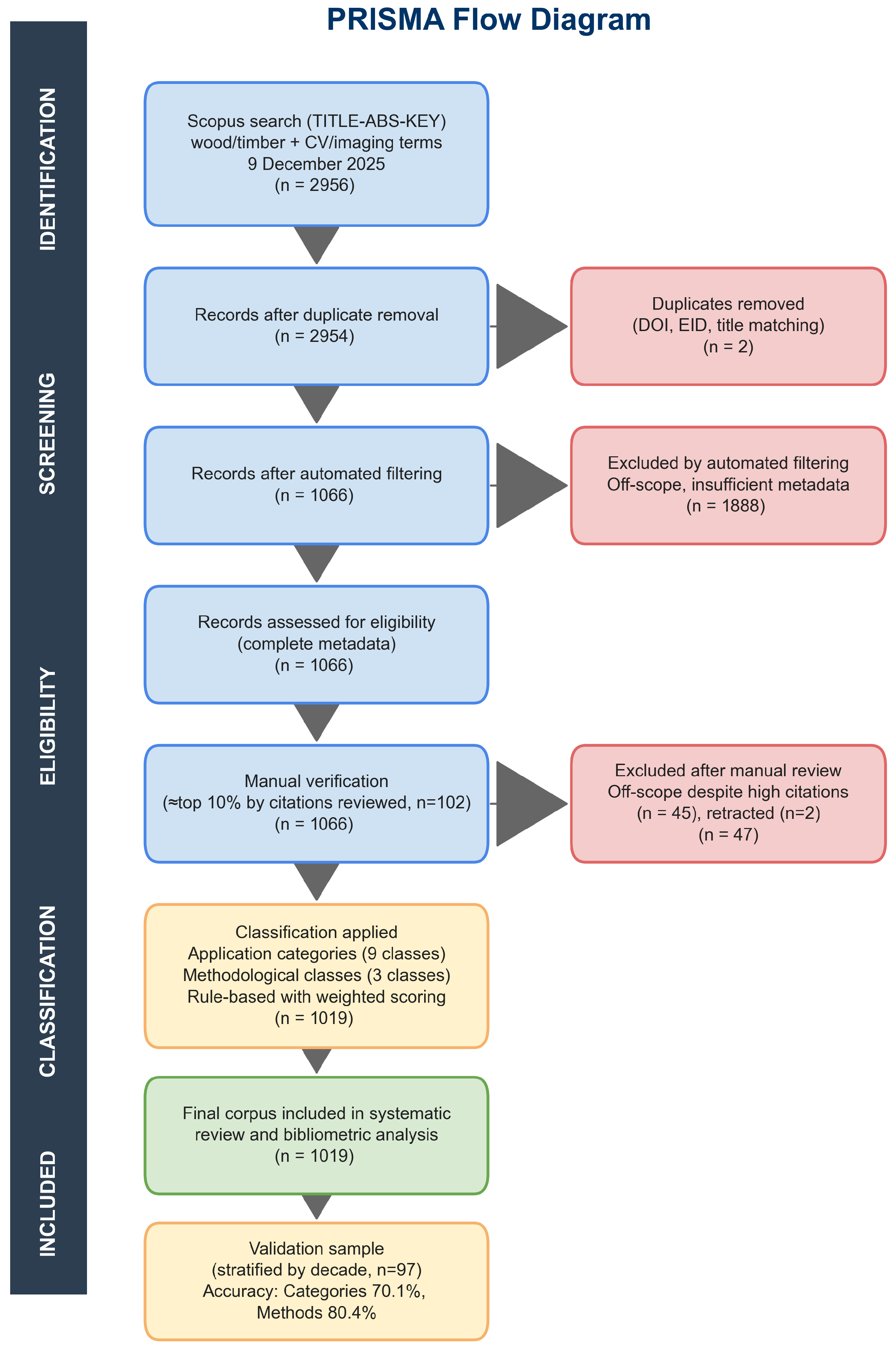
The raw Scopus export underwent automated filtering that included duplicate removal based on DOI, EID, and title matching to ensure each unique publication was counted only once.
The automated filtering process then applied multiple exclusion criteria. Records were retained only when they showed evidence of image-based analysis, explicitly targeted wood or wood-based products (logs, lumber, engineered wood, panels, or microstructure relevant to performance), and addressed a relevant task such as defect detection, grading, optimization, dimensional measurement, process monitoring, or property prediction. Records were excluded if they (i) lacked clear computer vision or image analysis content; (ii) focused solely on remote sensing or forestry ecology without industrial processing context; (iii) involved medical imaging unrelated to wood; (iv) described generic computer vision or graphics without a wood application; (v) lacked essential metadata (authors, title, or year); (vi) had ambiguous application assignments that could not be confidently classified (ambiguous application assignments were defined as cases where the title, abstract, and keywords did not provide sufficient information to confidently assign a paper to a single primary application category); or (vii) were duplicate records identified by DOI, EID, or title matching. The automated filtering process resulted in the exclusion of 1890 papers (including two duplicates), leaving 1066 records.
A second depuration stage ensured consistency: records with empty authors were removed; application and method labels were re-evaluated under the refined rules; ambiguous application assignments were excluded; and highly cited but clearly off-topic titles were removed even if they passed generic filters. Following the automated filtering process, a manual verification step was conducted to reinforce the quality of the final corpus. This manual verification was performed by two expert internal reviewers. Reviewers analyzed full-text papers when available; for papers not available as open access, classification was based on title, abstract, and keywords. Reviewers reached consensus on all classifications through discussion. Specifically, all highly cited references (≈10% by citation count; 102 papers) were manually reviewed to confirm their alignment with the study’s scope. This manual check identified and excluded 47 papers: 45 papers that, despite high citation counts, did not strictly meet the inclusion criteria (e.g., remote sensing forestry studies, medical imaging applications, or generic computer graphics without wood-specific context), and two retracted items. The resulting corpus therefore contains only records with complete core metadata, a clear wood context, and internally consistent application and method labels, verified through both automated filtering and manual review of the most influential papers. The screening flow is summarized in Table 1.
The complete screening and classification workflow is visualized in Figure 1, which follows the Preferred Reporting Items for Systematic Reviews and Meta-Analyses (PRISMA) 2020 guidelines [30] for the transparent reporting of systematic reviews.

2.3. Text Preprocessing and Rule-Based Filtering

For consistent screening and classification, a combined text field was created by concatenating title, abstract, author keywords, and index keywords, all converted to lower case. This combined text field was used both for initial filtering (to identify records with computer vision or imaging content and wood context) and for subsequent classification into application categories and methodological classes. Keyword sets were defined to identify (i) computer vision or imaging content, (ii) wood context, (iii) remote sensing forestry only, and (iv) medical/biomedical topics. These keyword sets were developed iteratively: initial keyword lists were derived from domain knowledge and a review of a representative sample of papers; these lists were then tested and validated on a subset of the corpus; and, finally, they were refined during the screening process based on observed classification patterns, false positives, and false negatives identified during manual verification. Additional flags captured a small list of highly cited off-topic titles noted during manual inspection (e.g., An Image Synthesizer, Volume Sculpting, Detection of grapevine yellows symptoms in Vitis vinifera, and Root architecture and wind-firmness of mature Pinus pinaster). A record was retained if it contained clear indicators of image-based analysis and wood context, was not flagged as remote sensing forestry, medical/biomedical, or off-topic, and had non-empty authors, title, and year fields. Excluded records were tagged with a brief reason (e.g., “no clear CV or image analysis”, “remote sensing or forestry ecology”, or “off-topic title flagged in manual review”).

2.4. Application Taxonomy and Classification

Eligible papers were assigned to one primary application category reflecting the dominant task. The nine categories are as follows: (1) Wood Surface Quality Control; (2) 3D & Internal Wood Imaging; (3) Wood Species and Origin Identification; (4) Panel and Board Production; (5) Log and Roundwood Processing; (6) Sawmill Automation and Robotics; (7) Wood Microstructure and Characterization; (8) Wood Property Prediction; and (9) Dimensional Measurement and Geometry. The weighting scheme and priority rules were established based on domain knowledge, tested and calibrated on a representative subset of papers, and refined iteratively during the classification process based on observed patterns and validation results.
The rule-based classification system operated as follows. For each paper, a combined text field (title, abstract, author keywords, and index keywords, all lowercased) was analyzed. Each application category received a weighted score based on keyword matches: high-priority keywords (e.g., “property prediction”, “log sorting”, and “computed tomography”) contributed higher positive scores (+3 to +4), while lower-priority keywords contributed smaller positive scores (+1 to +2). Exclusion rules applied negative penalties (−1 to −2) when conflicting terms appeared (e.g., surface defect terms penalized Wood Property Prediction; log/roundwood terms in a surface-only context penalized 3D and Internal Imaging). Scores were constrained to non-negative values. The category with the highest score was selected; in case of ties, a predefined priority order was applied: Wood Property Prediction > Log and Roundwood Processing > Panel and Board Production > Wood Surface Quality Control > Wood Species and Origin Identification > Sawmill Automation and Robotics > Wood Microstructure and Characterization > Dimensional Measurement and Geometry > 3D and Internal Wood Imaging. If all scores were zero, papers defaulted to Wood Surface Quality Control as the most common category. The complete pseudocode is presented below:
Rule-based classification (pseudocode):
INPUT:
 row = {Title, Abstract, Author Keywords, Index Keywords}
 
STEP (1) Build text
 text = (Title + " " + Abstract + " " + Author Keywords + " " + Index Keywords).lower()
 
STEP (2) Application scoring (one category)
 scores = {}
 # Wood Property Prediction
 scores[‘WPP’] = 0
  +3 if any of {property prediction, strength prediction, moisture content prediction,
       density prediction, ...}
  +1 if any of {moisture content, wood density, mechanical property, ...}
  -2 if any of {surface defect, knot detection, crack detection, quality grading, ...}
  scores[‘WPP’] = max(scores[‘WPP’], 0)
 
 # Log & Roundwood Processing
 scores[‘LRP’] = 0
  +4 if any of {log sorting, log yard, roundwood, photogrammetry, ...}
  +2 if any of {log, roundwood, log scanning, ...}
  +3 if (ct/tomography/x-ray/internal) AND any log term
  (minor penalties if text is mainly surface/species); scores[‘LRP’] = max(., 0)
 
 # 3D & Internal Wood Imaging
 scores[‘I3D’] = 0
  +3 if any of {computed tomography, micro-ct, internal imaging, ...}
  +1 if any of {ct, tomography, x-ray, 3d imaging}
  +4 if tomography/internal co-occur
  -1/-2 if surface/log/species context appears; scores[‘I3D’] = max(., 0)
 
 # Panel & Board Production
  boost panel/board/OSB/MDF terms; extra if defect/quality detection; small penalty if only surface QC
 
 # Wood Surface Quality Control
  boost defect/surface/inspection/grading terms; penalty if clearly panel-only
 
 # Wood Species & Origin Identification
  boost species/origin/traceability; penalty if mostly about log volume/roundwood
 
 # Sawmill Automation & Robotics
  boost robotics/grasp/automation; penalty if only surface QC
 
 # Wood Microstructure & Characterization
  boost microstructure/anatomy/microscopy terms
 
 # Dimensional Measurement & Geometry
  boost warp/deformation/metrology/shape measurement terms
 
 # Pick best score; if tie, apply priority:
 PRIORITY = [WPP, LRP, PBP, SurfaceQC, SpeciesID, SawmillAuto,
       Microstructure, Dimensional, I3D]
 if all scores == 0: fallback SurfaceQC
 application_category = argmax_with_priority(scores, PRIORITY)
 
STEP (3) Method classification (mutually exclusive)
 if text has any DL terms (cnn, fcn, u-net, r-cnn, yolo, transformer,
       gan, autoencoder, ...):
   method = "Deep Learning"
 elif text has any classical-ML terms (svm, random forest, decision tree,
       k-nn, logistic regression, lda,
       shallow nn, clustering, ...):
   method = "Classical Machine Learning"
 else:
   method = "Classical Computer Vision"
 
OUTPUT: (application_category, method)
Each article was assigned to exactly one primary application category. We classified papers according to their dominant objective as stated in the title and abstract. The classifier always assigns the best category by score/tie-breaking; cases excluded due to “low confidence” represent a separate methodological decision (e.g., if there is insufficient title/abstract/keywords information, or if all scores remain at zero and we prefer to exclude rather than accept the fallback). When the primary focus could not be determined with reasonable confidence from the bibliographic information, the article was excluded from the quantitative analyses rather than arbitrarily assigned to multiple categories. Subcategories (e.g., knot defects vs. stain/discoloration; MDF vs. plywood vs. OSB) were used only to provide additional granularity within each primary category, without double-counting papers across categories.

2.5. Methodological Taxonomy and Classification

Three mutually exclusive methodological classes were defined. Classical computer vision covers hand-crafted image processing and feature engineering without supervised learning or with rule-based decisions (filtering, edge detection, morphology, color/texture descriptors, and template matching). Classical machine learning (ML) combines engineered features with non-deep algorithms such as support vector machines (SVM), random forests, decision trees, k-nearest neighbors (k-NN), Naive Bayes, logistic regression, linear discriminant analysis (LDA), shallow neural networks, and clustering. Deep learning (DL) includes architectures that learn representations end-to-end, spanning convolutional neural network (CNN)/fully convolutional network (FCN)/U-Net variants, Faster/Mask region-based convolutional neural network (R-CNN), YOLO-family detectors, modern backbones like ResNet/DenseNet/EfficientNet, autoencoders and generative adversarial networks (GANs), transformers, and recurrent models. Methodological classification followed a hierarchical decision rule applied to the combined text field: if the text contained any deep learning terms (e.g., CNN, FCN, U-Net, R-CNN, YOLO, transformer, GAN, autoencoder, ResNet, DenseNet, andEfficientNet), the paper was assigned to Deep Learning; otherwise, if the text contained any classical ML terms (e.g., SVM, random forest, decision tree, k-NN, logistic regression, LDA, shallow neural network, and clustering), it was assigned to Classical Machine Learning. The remaining image-based papers were assigned to Classical Computer Vision. This mutually exclusive classification ensured each paper received exactly one methodological label. The complete classification algorithm, including both application category and methodological class assignment, is provided in the pseudocode above.

2.6. Validation of Classification Reliability

To assess the reliability and accuracy of our classification scheme for both application categories and methodological classes, we conducted a comprehensive validation analysis. The validation corpus excluded the top 10% of papers by citation count (102 papers), which had already undergone manual verification. From the remaining 915 papers, we sampled 97 papers using stratified sampling by decade, ensuring representative coverage across temporal periods and domains.
Each sampled paper was classified using both (i) improved rule-based keyword matching (with weighted scoring, exclusion rules, and priority handling) and (ii) manual labeling (using the same taxonomic rules). The accuracy of the rule-based system was evaluated against manual labels using a macro-averaged F1-score (F1), a weighted F1-score, and the overall accuracy.

2.6.1. Metrics and Formulas

For each class i (category or method), the F1-score is defined as follows:
F 1 ( i ) = 2 × Precision ( i ) × Recall ( i ) Precision ( i ) + Recall ( i )
where Precision ( i ) = TP ( i ) / ( TP ( i ) + FP ( i ) ) and Recall ( i ) = TP ( i ) / ( TP ( i ) + FN ( i ) ) for true positives (TP), false positives (FP), and false negatives (FN). The macro-F1 is the unweighted mean of F1-scores across all classes:
Macro-F1 = 1 C i = 1 C F 1 ( i )
where C is the number of classes. The weighted-F1 accounts for class imbalance by weighting each F1-score by the number of true instances:
Weighted-F1 = i = 1 C n i × F 1 ( i ) i = 1 C n i
where n i is the number of true instances of class i. The overall accuracy is the proportion of correctly classified papers:
Accuracy = i = 1 C TP ( i ) N
where N is the total number of papers.

2.6.2. Validation Results

The validation results demonstrate acceptable performance for both classification tasks. For application categories, the rule-based system achieved an overall accuracy of 70.1% (68/97 papers correctly classified) with a macro-F1 of 48.32% and weighted-F1 of 64.57%. The percentages reported are per-class accuracies in the validation sample (n = 97), and the F1 values are per-class F1 scores. The performance by category follows: Wood Microstructure and Characterization (90.0%, F1 = 0.857), Wood Surface Quality Control (78.3%, F1 = 0.758), Wood Species and Origin Identification (72.7%, F1 = 0.800), 3D and Internal Wood Imaging (83.3%, F1 = 0.500), Panel and Board Production (50.0%, F1 = 0.500), Log and Roundwood Processing (28.6%, F1 = 0.400), Sawmill Automation and Robotics (33.3%, F1 = 0.333), Wood Property Prediction (12.5%, F1 = 0.200), and Dimensional Measurement and Geometry (0.0%, F1 = 0.000). Categories with small sample sizes (Wood Property Prediction, Dimensional Measurement and Geometry) showed lower accuracy due to the inherent difficulty of classification with limited training signals, but were considered acceptable given their low representation in the corpus (18 papers; 1.8% and 33 papers; 3.2%, respectively).
For methodological classes, the system achieved an overall accuracy of 80.41% (78/97 papers correctly classified) with a macro-F1 of 70.78% and weighted-F1 of 79.37%. The performance by class follows: Classical Computer Vision (100.0%, F1 = 0.835), Deep Learning (65.1%, F1 = 0.789), and Classical Machine Learning (33.3%, F1 = 0.500). The high accuracy for methodological classification confirms that the rule-based system effectively distinguishes between classical computer vision, classical machine learning, and deep learning approaches.

2.7. Limitations of the Classification

Classification relied on titles, abstracts, and keywords available in Scopus rather than full texts. Residual misclassifications cannot be ruled out; when confidence was low, records were excluded rather than forced into a category. As detailed in Section 2.2, manual verification was systematically applied to the top-cited references to ensure alignment with inclusion criteria, resulting in the exclusion of 47 papers (45 off-scope papers and 2 retracted items) that did not meet the strict scope requirements despite their high citation impact.

3. Bibliometric Overview

3.1. Publication Trends

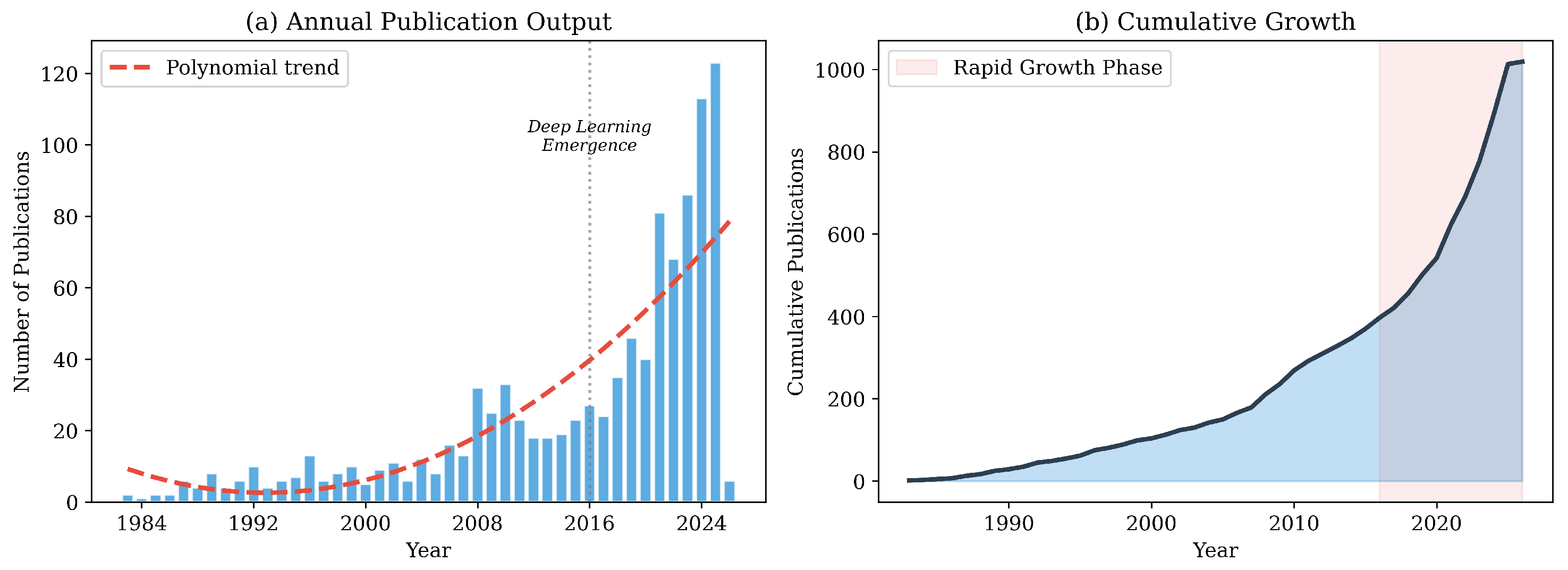
The 1019-paper corpus spans 1983–2026 (early access) and shows a clear inflection after 2015 (Figure 2). Annual output during the foundation period of 1983–1999 totaled 99 papers (9.7%) before rising to 137 papers (13.4%) in 2000–2009 as digital imaging matured. The consolidation phase of 2010–2015 added 134 papers (13.2%), and the deep learning era of 2016–2026 (early access) accounts for 649 papers (63.7%), averaging 59.0 publications per year. The apparent dip in the final bar reflects partial 2025–2026 early-access indexing rather than a decline. The cumulative curve in Figure 2 underscores the sustained acceleration once modern neural architectures became dominant.

3.2. Document Types and Venues

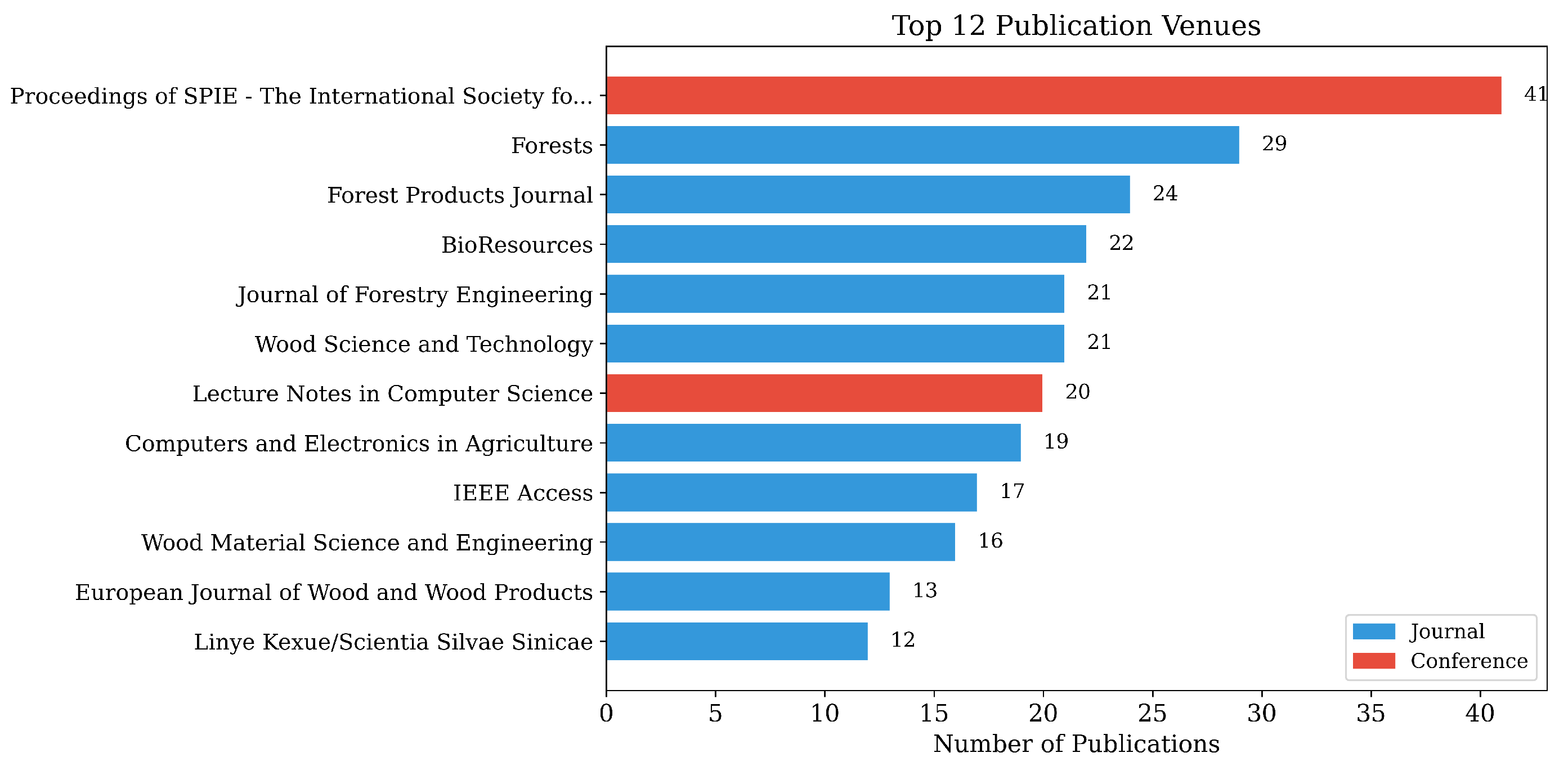
The corpus comprises 623 journal articles (61.1%), 359 conference papers (35.2%), 20 reviews (2.0%), 9 book chapters (0.9%), 6 other document types (0.6%) including notes, data papers, and short surveys, and 2 papers with undefined document types (0.2%), totaling 1019 papers. This distribution reflects both academic rigor and industrial deployment contexts. The interdisciplinary spread of outlets is evident in Figure 3: optics-focused Proceedings of the Society of Photo-Optical Instrumentation Engineers (SPIE) lead with 41 papers, followed by Forests (29), Forest Products Journal (24), BioResources (22), Journal of Forestry Engineering (21), Wood Science and Technology (21), Computers and Electronics in Agriculture (20), and Lecture Notes in Computer Science (20). This mix captures contributions from wood science, computer vision, and applied automation.

3.3. Geographic Distribution of Corresponding Authors

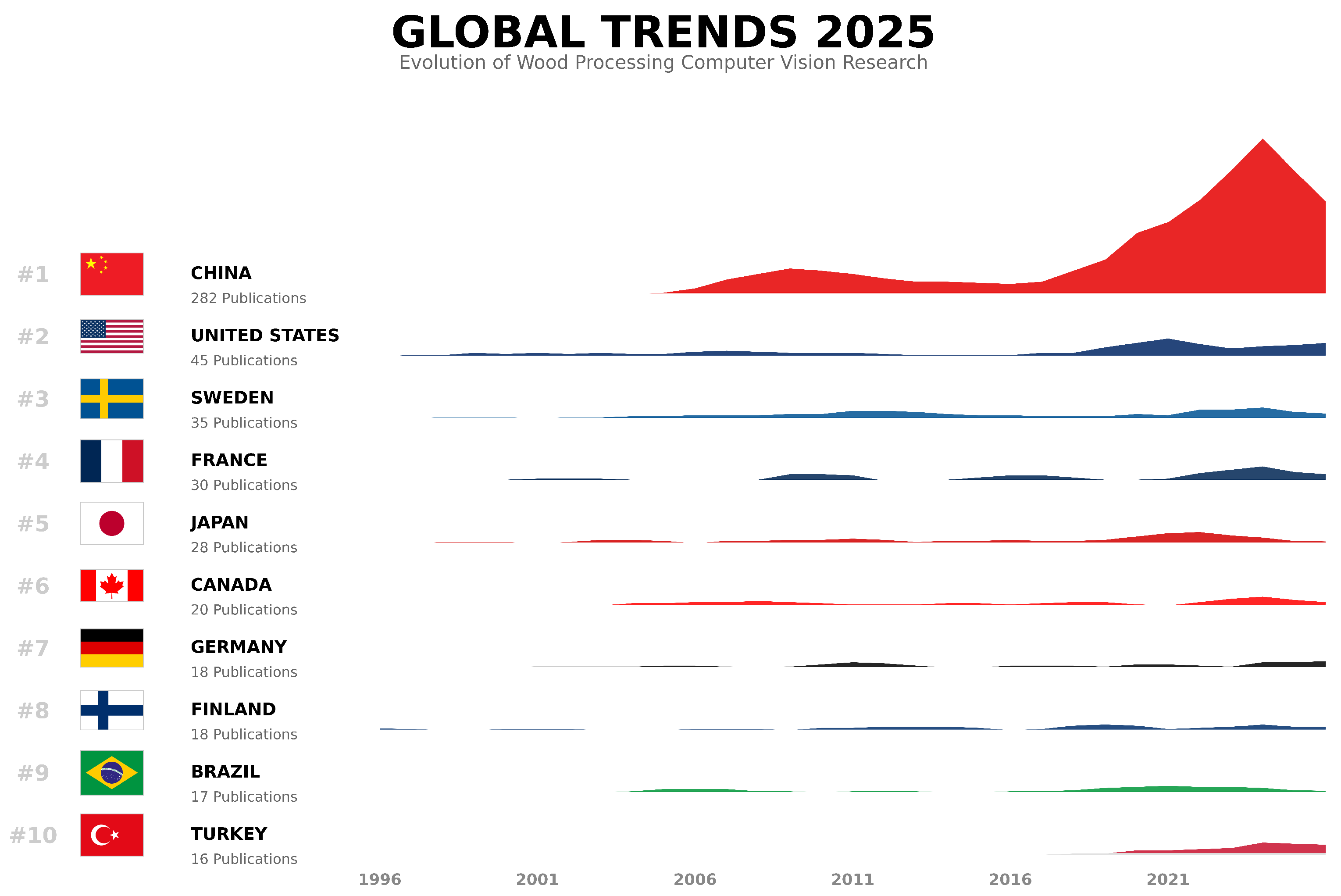
Using 707 correspondence–address records with resolved countries (filtered to included application categories), the top contributors are China (283 papers), the United States (45), Sweden (35), France (30), Japan (28), Canada (20), Germany (18), Finland (18), Brazil (17), and Turkey (16) (Figure 4). The stacked ridgelines show early balance between China and the United States through 2009, a modest rise from several European contributors, and a sharp post-2016 surge from China that drives most of the recent output. The United States grows slowly after 2016, while France, Sweden, Japan, and Canada contribute steady but lower annual volumes; Finland and Turkey emerge only in the most recent period.

3.4. Citation Analysis

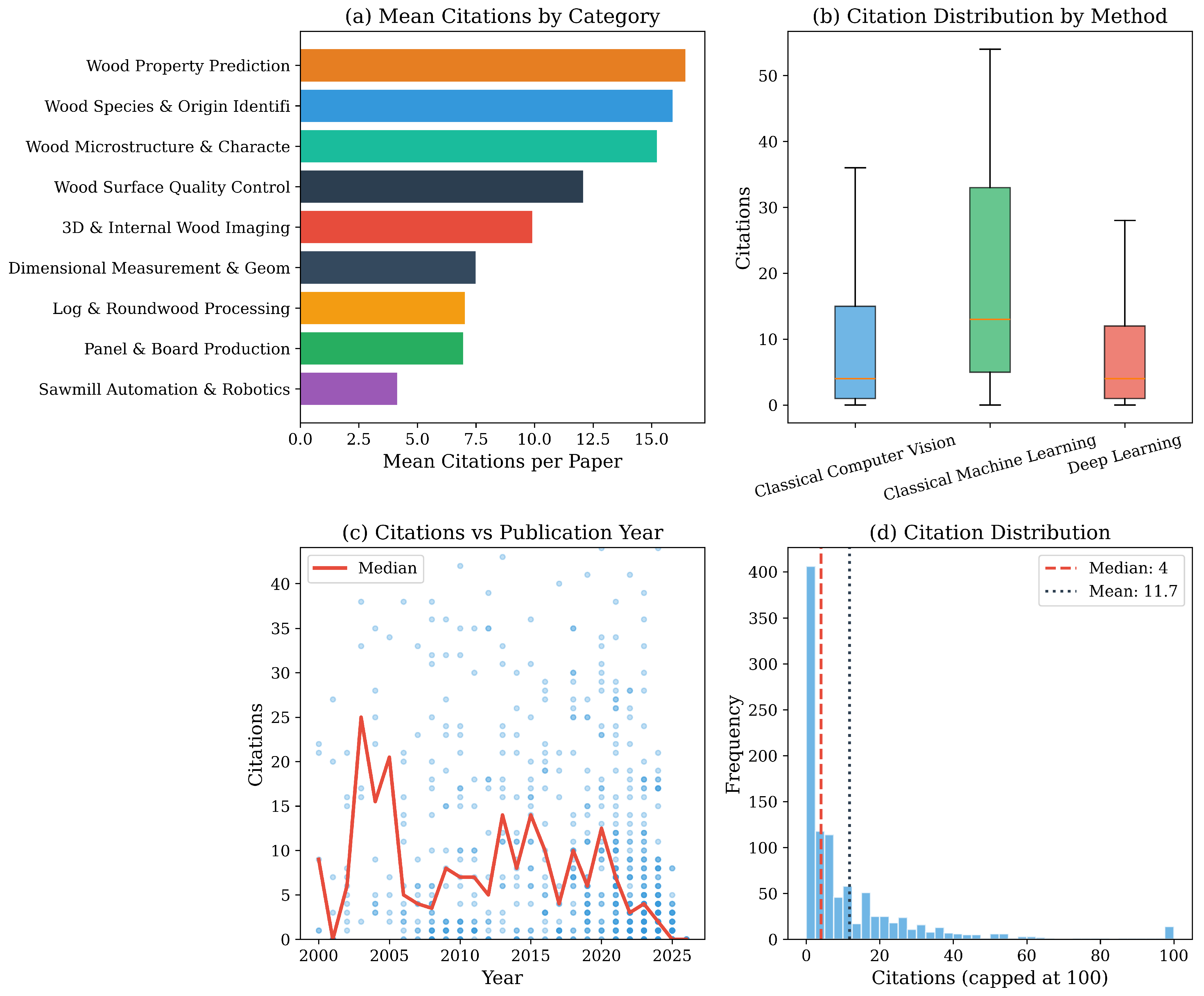
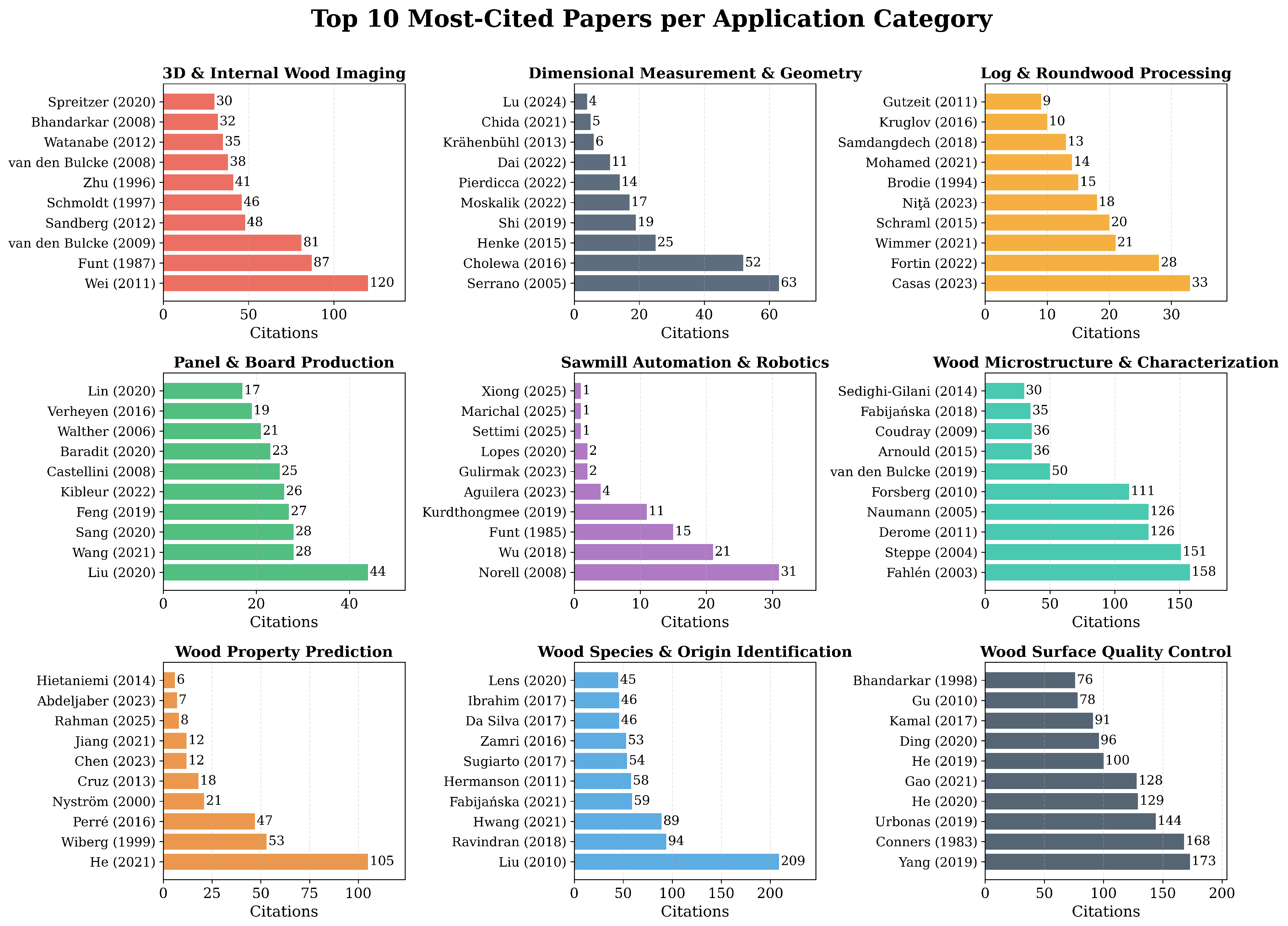
The corpus has accrued 11,961 citations, with a mean of 11.74 and a median of 4, indicating a right-skewed impact distribution (Figure 5). The mean value of citations is highest for Wood Property Prediction (16.4), followed by Wood Species and Origin Identification (15.9) and Wood Microstructure and Characterization (15.2), with Wood Surface Quality Control at 12.1 and 3D and Internal Wood Imaging averaging 9.9. To avoid masking category-specific influence, Figure 6 reports the ten most-cited papers within each application class (first-author label and publication year). Surface Quality Control concentrates the highest-impact items, with three studies exceeding 200 citations (classical and deep learning). Classical physics-driven imaging still anchors the top of 3D and Internal Wood Imaging, while microstructural characterization also shows legacy citation strength. Panel and Board Production and Dimensional Measurement and Geometry feature long-cited classical pipelines, whereas newer deep learning studies dominate the recent peaks in species identification, sawmill automation, and property prediction. Citation dispersion across methods remains wider for deep learning than for classical approaches [1,3,10,11,12,13,14,17,26,29,31,32,33,34,35,36,37,38,39,40,41,42,43,44,45,46,47,48,49,50,51,52,53,54,55,56,57,58,59,60,61,62,63,64,65,66,67,68,69,70,71,72,73,74,75,76,77,78,79,80,81,82,83,84,85,86,87,88,89,90,91,92,93,94,95,96,97,98,99,100,101,102,103,104,105,106,107,108,109,110].
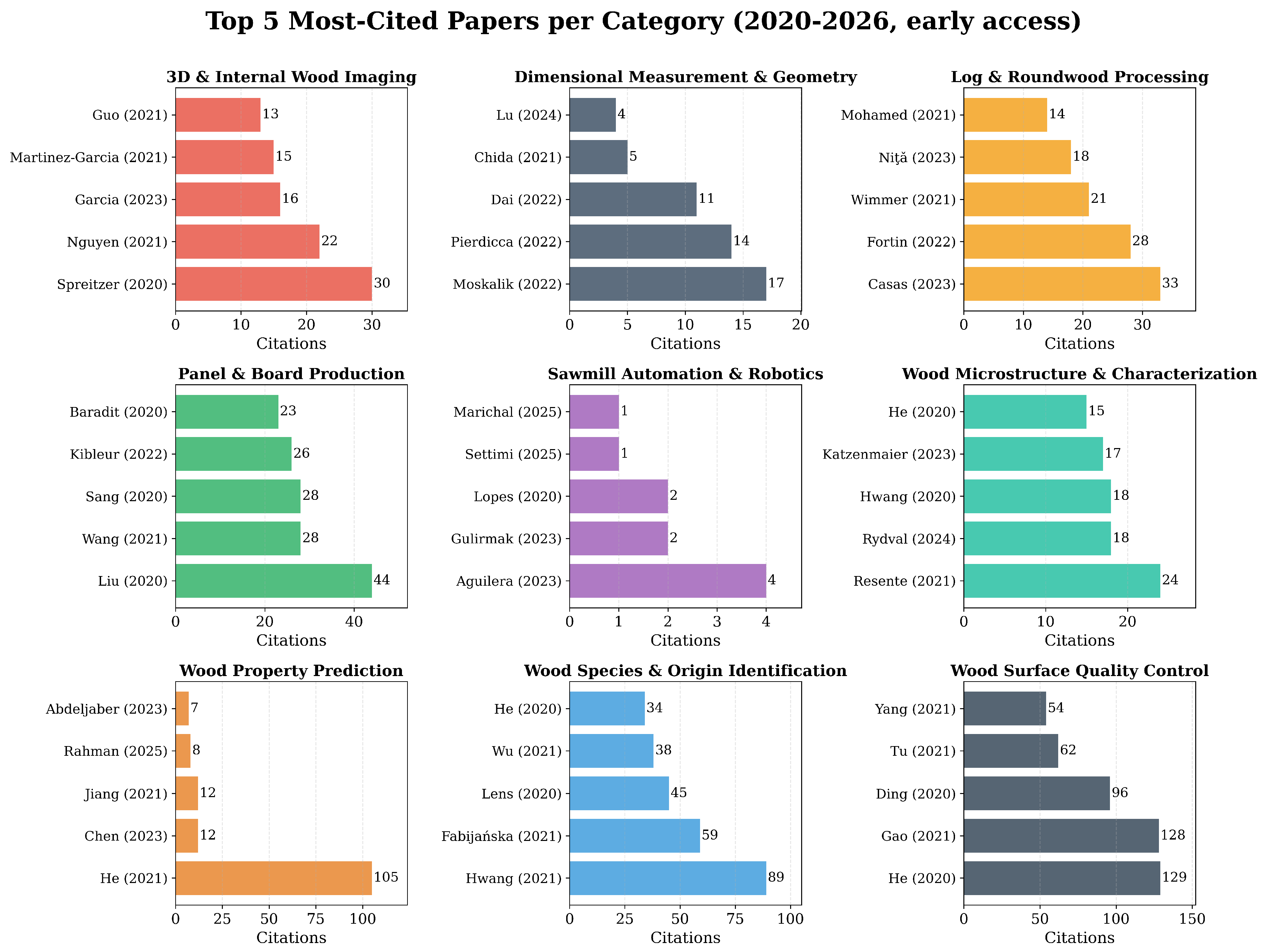
Figure 7 highlights the most-cited recent papers (2020–2026, early access) per application category. Compared with the all-time leaders, these bars shift toward deep learning detectors and transformers in surface quality, species identification, and sawmill automation, while physics-driven imaging and metrology still anchor citation impact in dimensional and internal imaging tasks [10,11,14,15,16,17,23,26,37,38,44,52,56,58,59,60,61,62,63,65,66,67,68,69,70,71,72,73,74,75,76,77,79,80,81,111,112,113,114,115,116,117,118,119,120]. The pattern underscores that post-2020 influence is increasingly concentrated in data-driven approaches, except where acquisition physics dominates.

3.5. Keyword Co-Occurrence Network

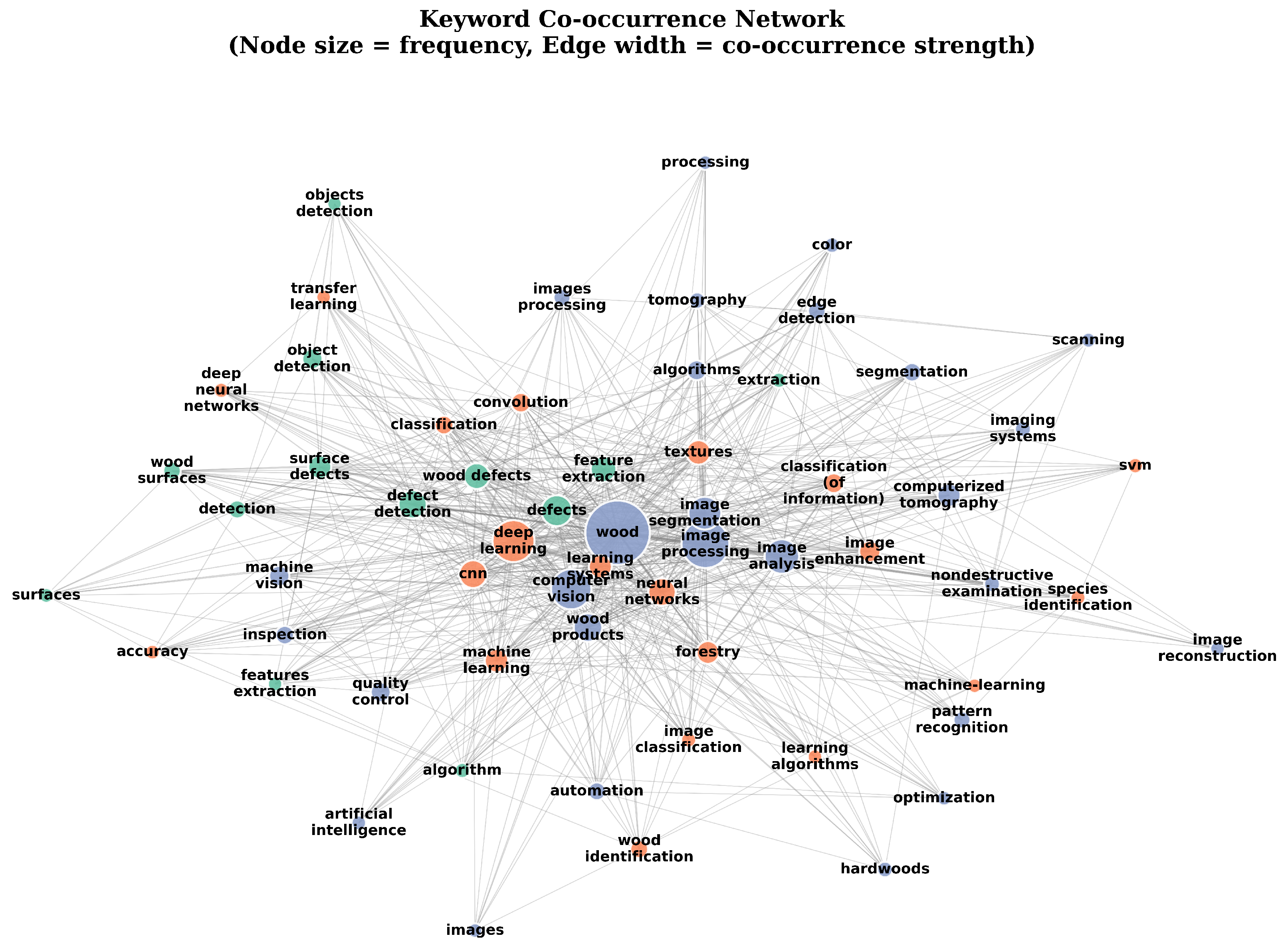
The keyword network in Figure 8 summarizes the thematic structure after harmonizing author and index keywords. Sixty-one nodes and 1659 co-occurrence edges yield a density of 0.907 and an average clustering coefficient of 0.907, with four Louvain communities corresponding to deep learning methods, wood properties and species, core image processing techniques, and surface quality inspection. Central terms include “wood”, “image processing”, “computer vision”, “deep learning”, and “defects”, reflecting the balance between generic vision methods and domain-specific terminology.

4. Application Categories

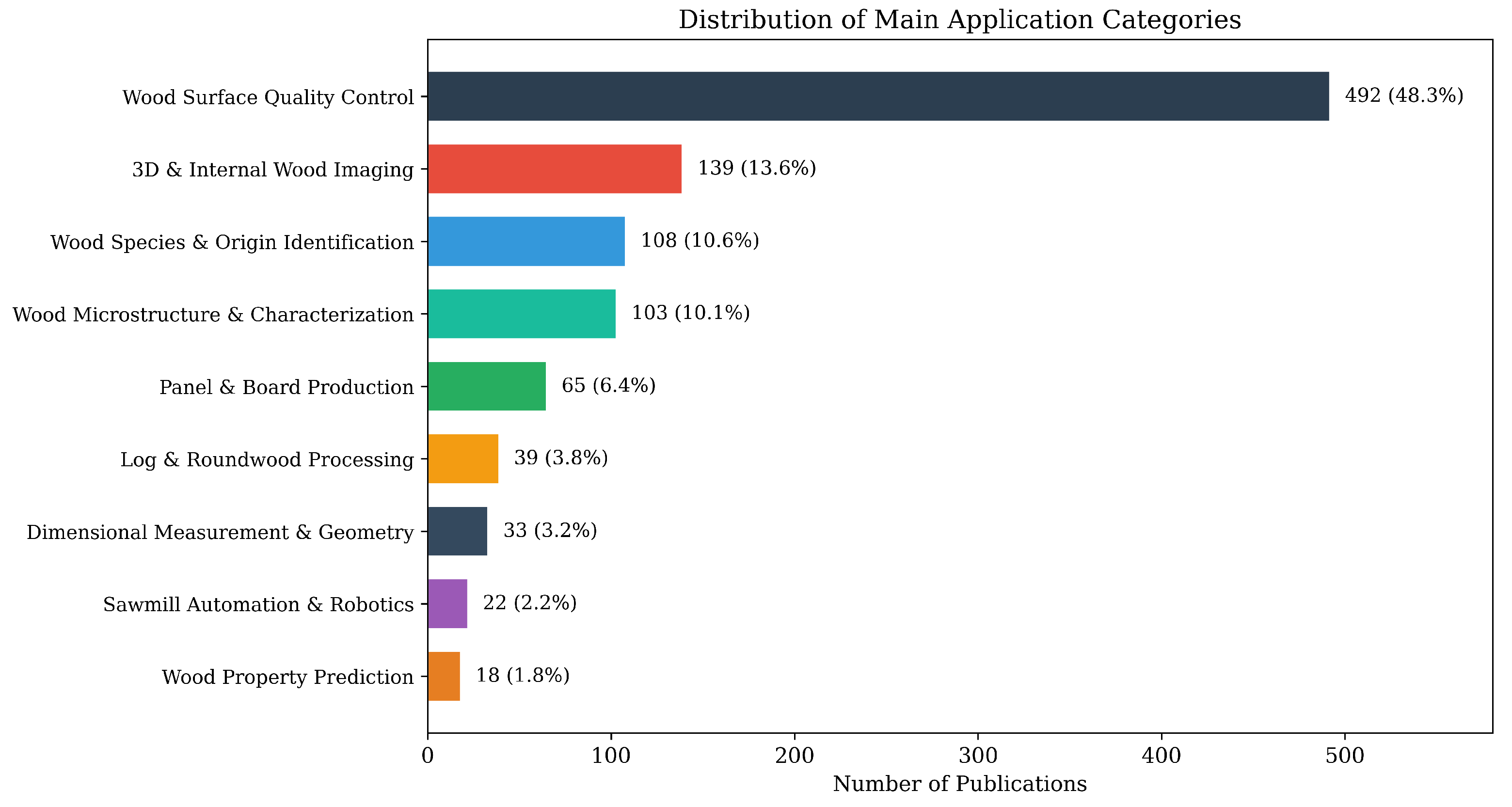
Figure 9 presents the distribution of main application categories: Wood Surface Quality Control dominates with 492 papers (48.3%), followed by 3D and Internal Wood Imaging (139; 13.6%), Wood Species and Origin Identification (108; 10.6%), and Wood Microstructure and Characterization (103; 10.1%). Panel and Board Production (65; 6.4%), Log and Roundwood Processing (39; 3.8%), Dimensional Measurement and Geometry (33; 3.2%), Sawmill Automation and Robotics (22; 2.2%), and Wood Property Prediction (18; 1.8%) comprise the remaining share.

4.1. Wood Surface Quality Control (492 Papers, 48.3%)

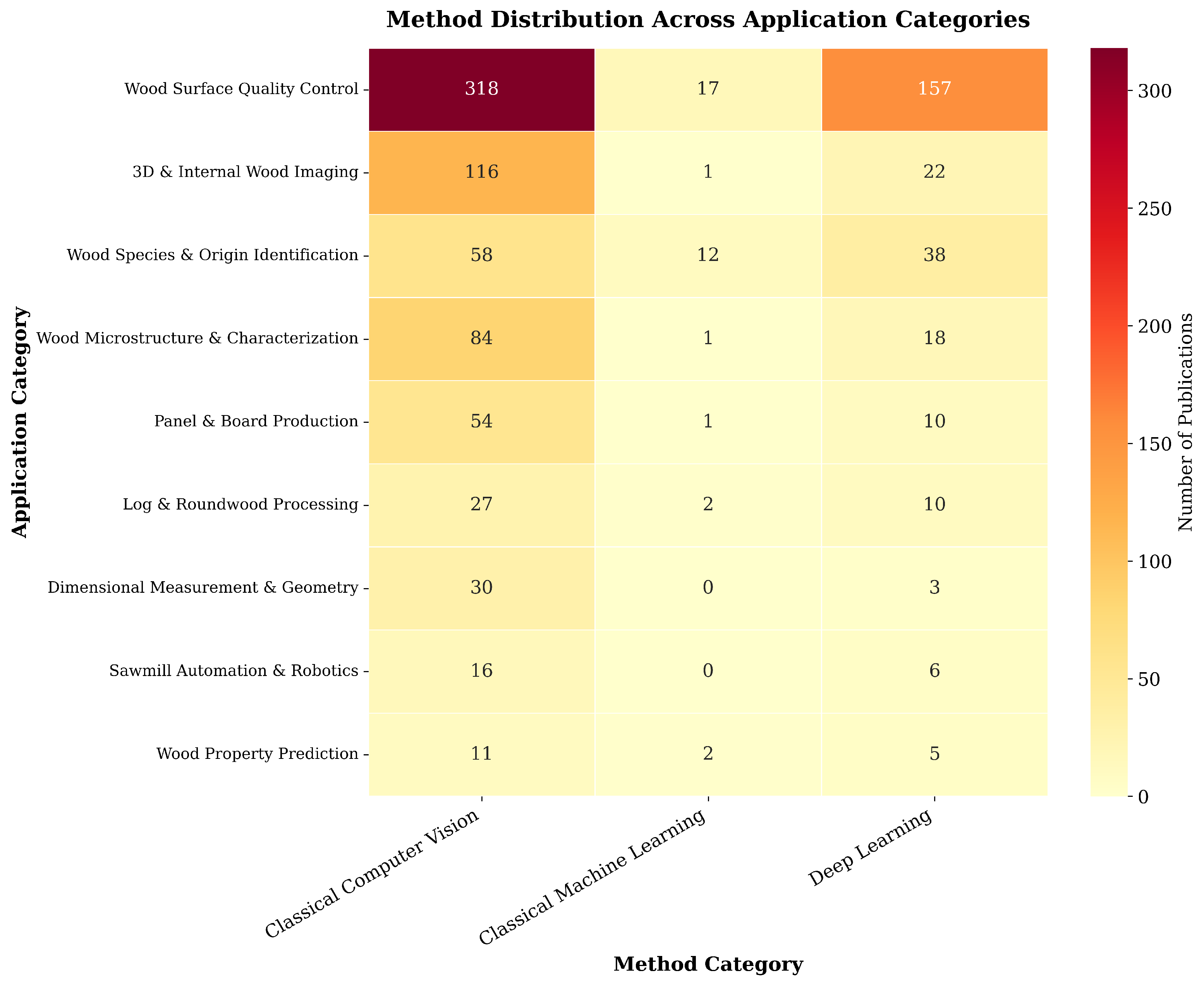
Surface inspection remains the core industrial driver for vision adoption. More than two hundred papers address mixed or general surface flaws, while 111 focus on staining/discoloration and 86 concentrate on knot detection and grading. Classical computer vision accounts for 64.6% of the work, with deep learning representing 31.9% and classical machine learning 3.5%; the mean citation impact is 12.1. Research has progressed from rule-based segmentation and texture analysis to SVM-based feature pipelines and, most recently, to deep detectors and segmentation networks that enable real-time grading.

4.2. 3D and Internal Wood Imaging (139 Papers, 13.6%)

Work in this category targets information beyond the surface through CT, X-ray, and tomographic modalities. Classical computer vision dominates (83.5%) owing to physics-driven reconstruction and analysis pipelines, while deep learning has begun to appear (15.8%), and classical ML represents 0.7%; the mean citation impact is 9.9. This high classical CV share reflects specialized imaging modalities and physics-based analysis requirements.

4.3. Wood Species and Origin Identification (108 Papers, 10.6%)

Species and provenance recognition is the most classification-friendly task in the corpus, with image-based anatomical studies and spectral/NIR works. Deep learning accounts for 35.2% of the papers, with classical CV at 53.7% and classical ML at 11.1%, reflecting the advantages of modern classifiers for regulatory compliance and trade verification; the average citation rate is 15.9.

4.4. Panel and Board Production (65 Papers, 6.4%)

Research on engineered wood products centers on veneer and LVL inspection, particleboard and chipboard monitoring, and other panel lines. Classical CV techniques remain prevalent (83.1%), with deep learning present in 15.4% and classical ML at 1.5%; the mean citation reach is 10.4.

4.5. Log and Roundwood Processing (39 Papers, 3.8%)

Log-yard and breakdown tasks include general sorting and inspection, volume and geometry estimation, and optimization or bucking decisions. Classical CV methods account for 69.2% of the literature, deep learning 25.6%, and classical ML 5.1%, with a mean citation number of 9.3.

4.6. Sawmill Automation and Robotics (22 Papers, 2.2%)

Vision-enabled automation covers general sawmill control, robotic manipulation and handling, and inline process monitoring and control. Method choices favor classical CV (72.7%) for speed and interpretability, with deep learning appearing in 27.3% and classical ML absent; the mean number of citations is 7.6.

4.7. Wood Microstructure and Characterization (103 Papers, 10.1%)

Cellular and sub-cellular investigations rely heavily on microscopy and spectral imaging. Classical CV dominates (81.6%) because of handcrafted feature extraction suited to microscopy data; deep learning is present in 17.5% and classical ML in 1.0%. This category has the highest citation impact (15.2 is the mean number of citations).

4.8. Wood Property Prediction (18 Papers, 1.8%)

The smallest category targets the image-based estimation of mechanical, physical, or chemical properties. Classical CV accounts for 61.1%, deep learning for 27.8%, and classical ML for 11.1%; the mean number of citations is 16.4. Despite being the smallest category, it shows interest in both traditional feature-based and modern deep learning approaches.

4.9. Dimensional Measurement and Geometry (33 Papers, 3.2%)

Dimensional tasks include general metrology and measurement, warp and twist detection, and other geometric characterization. Classical CV methods dominate (90.9%), with deep learning at 9.1%; the mean citation number is 9.2.

5. Methodological Evolution

5.1. Classical Computer Vision (714 Papers, 70.1%)

Hand-crafted pipelines dominated from 1983 to 2015, combining edge detection, threshold-based segmentation, morphological filtering, template matching, and texture descriptors such as GLCM, LBP, Gabor filters, and wavelets. These approaches require no training data, run quickly, and offer high interpretability, but they demand careful parameter tuning and struggle with illumination changes and complex backgrounds.

5.2. Classical Machine Learning (36 Papers, 3.5%)

Between 2000 and 2015, engineered visual features such as HOG, SIFT/SURF, LBP, GLCM, and color histograms were paired with SVM, random forests, k-NN, and shallow neural networks, often after PCA or LDA dimensionality reduction. This stage bridged fully manual pipelines and modern deep learning by adding statistical decision layers on top of crafted descriptors.

5.3. Deep Learning (269 Papers, 26.4%)

Since 2016, end-to-end learned representations have reshaped the field. Classification tasks employ VGG, ResNet, Inception, DenseNet, and EfficientNet backbones; detection relies on Faster R-CNN, YOLO, SSD, and RetinaNet families; segmentation is led by U-Net, FCN, DeepLab, and Mask R-CNN; and early adoption of Vision Transformers and foundation models (e.g., SAM) is emerging for zero-shot or few-shot segmentation.

5.4. Method Distribution by Application

Figure 10 summarizes method choices across application domains. Classical CV remains dominant in 3D/internal imaging, dimensional measurement, and microstructure studies, whereas deep learning leads in species identification and holds a strong presence in surface quality control and property prediction. Classical ML persists in specialized niches such as spectral species identification and certain surface inspection pipelines.

5.5. Deep Learning Adoption Trends

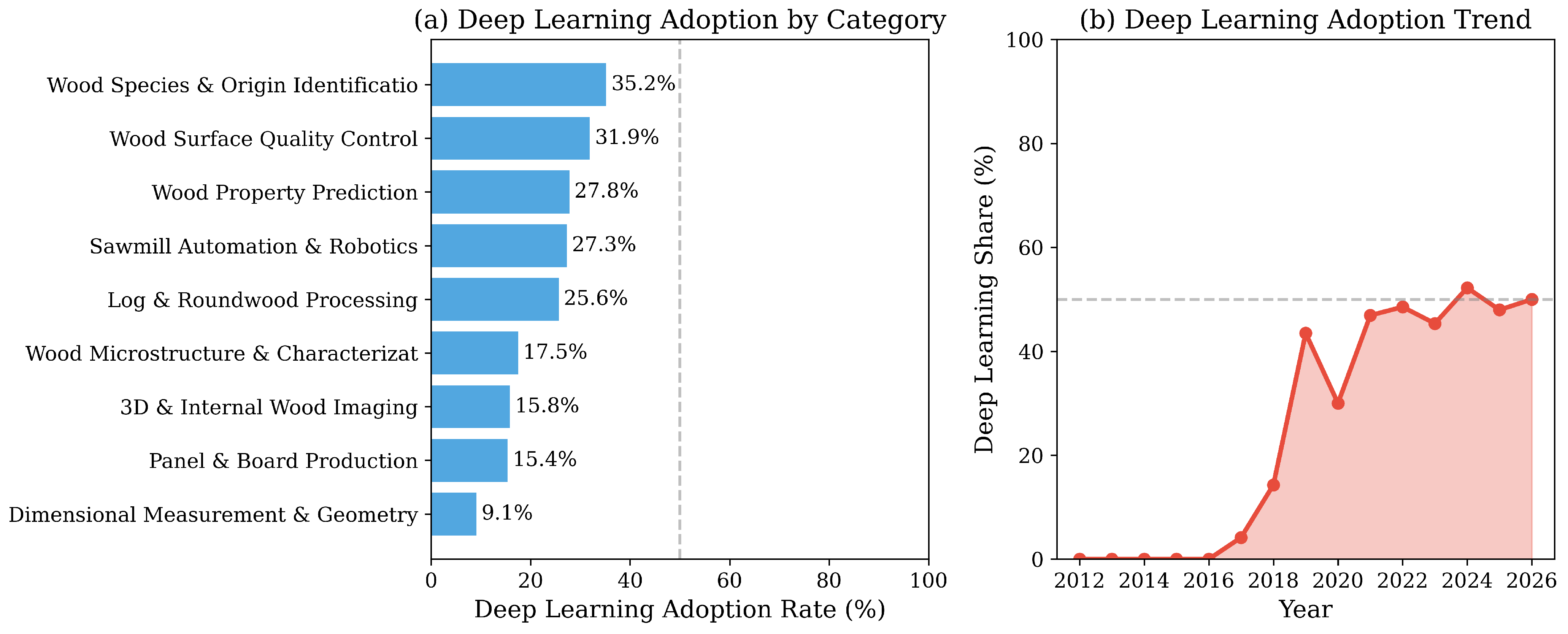
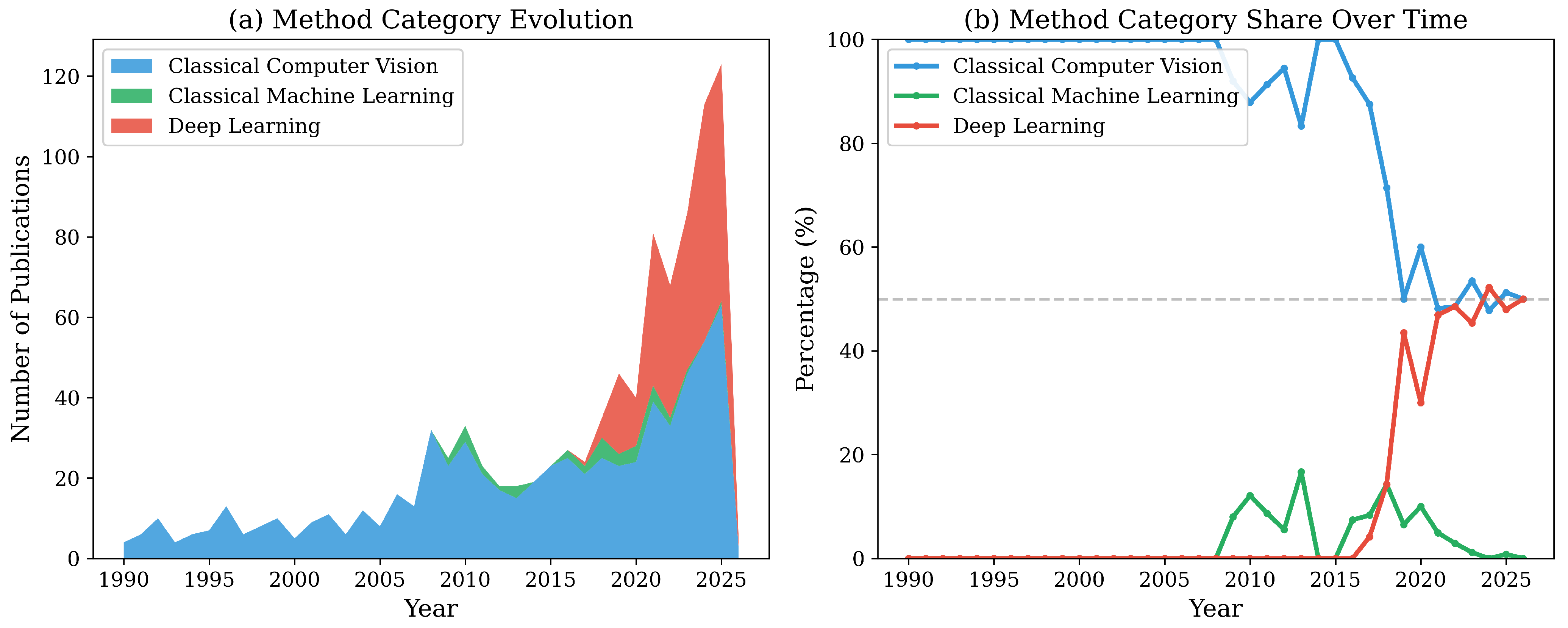
Deep learning share rose from 0% before 2016 to 48.8% during 2023–2026 (early access) (Figure 11). Adoption is highest in species identification (35.2%), followed by surface quality control (31.9%) and property prediction (27.8%), while 3D/internal imaging remains largely classical (15.8% DL) due to physics-driven workflows and smaller datasets.

6. Temporal Analysis

6.1. Foundation Period (1983–1999)

In total, the foundation period comprises 99 papers (9.7%) spanning 1983–1999, dominated exclusively by classical CV (100%) with no deep learning and no machine learning. The key contributions include those of Conners et al. (1983) [1] who established automated defect detection paradigms.

6.2. Growth Period (2000–2015)

This period comprises 271 papers (26.5%), averaging 16.9 papers/year. Machine learning remains modest (∼2.6%), with CT scanning protocols established and GLCM/LBP texture descriptors becoming standard. Deep learning was entirely absent during this period.

6.3. Deep Learning Era (2016–Present)

This period comprises 649 papers (63.7%), which reflect a fundamental shift, with transfer learning on VGG/ResNet architectures appearing in 2016–2018, instance segmentation and GAN-based augmentation spreading during 2019–2021, and early Vision Transformer work and edge deployment studies emerging from 2022 onward.

6.4. Category Evolution over Time

Figure 12 shows how research focus has shifted across time periods. Deep learning was entirely absent before 2016, began appearing in 2016, and has reached about 48.8% of annual papers in 2023–2026 (early access); the apparent drop in the final point reflects partial 2025–2026 indexing rather than a reversal. Classical computer vision fell from near-universal dominance (100% pre-2000, 97.4% in 2000–2015) to 55.8% in 2016–present, while classical machine learning remains a minority contributor (2.6% in 2000–2015, 3.5% in 2016–present) with intermittent peaks tied to specific niches.

7. Discussion

Across four decades, the evidence points to sustained expansion of computer vision in wood processing, with 63.7% of all publications appearing after 2016 (Figure 2). Wood Surface Quality Control remains the largest application (48.3%), followed by 3D and Internal Wood Imaging (13.6%), Wood Microstructure and Characterization (10.1%), and Wood Species and Origin Identification (10.6%) (Figure 9). Deep learning has become an important methodological force, climbing from 0% of papers before 2016 to 48.8% during 2023–2026 and reshaping practice in surface inspection, property prediction, and species recognition (Figure 10 and Figure 11). However, classical computer vision remains dominant overall (70.1%), particularly in specialized domains like 3D imaging and dimensional measurement. This trajectory mirrors the broader transition in computer vision from early rule-based pipelines inspired by classic defect detection work [1] to modern deep architectures widely adopted across vision tasks [5,6,7,8,121,122]. Although foundational work on deep neural networks dates back to the 1980s, with the backpropagation algorithm introduced in 1986 [123], and though deep learning was established as a distinct research field around 2000 through seminal contributions by Hinton, LeCun, and Bengio [124,125], its widespread adoption in computer vision applications was triggered by the breakthrough success of convolutional neural networks at the ImageNet Large Scale Visual Recognition Challenge in 2012 [5]. In our corpus, the appearance of deep learning terms and architectures in titles and abstracts becomes visibly prominent only after 2015, which explains the recent adoption curve observed in our temporal analysis (Figure 12). This delay between the theoretical foundations of deep learning and its practical adoption in wood processing applications reflects the typical technology transfer timeline from fundamental computer vision research to domain-specific applications. The bibliometric structure reveals key field characteristics. The publication venues (Figure 3) span optics, wood science, and automation journals, reflecting interdisciplinary integration. The geographic distribution (Figure 4) shows China’s post-2016 dominance, while traditional contributors maintain steady output. Citation analysis (Figure 5, Figure 6 and Figure 7) indicates the highest impact resulting from Wood Microstructure and Characterization and Species Identification, with recent high-impact papers increasingly favoring deep learning approaches. The right-skewed citation distribution and higher dispersion for deep learning reflect the field’s growth phase and competitive emerging applications. The keyword co-occurrence network (Figure 8) reveals strong field integration, with high density (0.907) and clustering (0.907) indicating close interconnections between themes. The four Louvain communities (deep learning methods, wood properties and species, core image processing, and surface quality inspection) reflect distinct but interconnected clusters. Central terms like “wood”, “computer vision”, “deep learning”, and “defects” serve as bridges connecting methodological and domain-specific research, demonstrating successful integration of generic vision methods with wood processing terminology. The network structure indicates evolution from isolated applications toward a unified landscape where methodological advances, particularly deep learning, are rapidly adopted across diverse application domains. Overall impact is substantial, with 11,961 citations accrued across the dataset and particularly high mean citations in Wood Microstructure and Characterization (15.2) and 3D and Internal Wood Imaging (9.9).
Despite this growth, several gaps remain pronounced. Dimensional measurement and warp detection contribute only 33 papers, and just a handful explicitly tackle deformation or strain using digital image correlation, photogrammetry, or image-based metrology in wood and structural elements [56,58,126,127,128], building on earlier work in internal log scanning and breakdown optimization [129]. Vision-enabled process monitoring and control in sawmills are also under-represented: only a small subset of contributions addresses autonomous log grasping, crane manipulation, or terrain object detection in forest operations [17,18,26,27]. In species and origin identification, influential datasets exist for CITES-listed timbers and microscopic specimens [12,13,14,15,16,38,41,42], yet most systems are still trained on limited species sets and single-mill imagery, leaving cross-species and cross-region generalization as open questions. Methodologically, the field still lacks widely adopted benchmark datasets, mature explainability frameworks tailored to grading and certification, and robust strategies for efficient edge deployment, despite emerging work on explainable deep models for timber inspection; these limitations constrain reproducibility and technology transfer.
From an industrial perspective, the results suggest a division of labour between methods. Deep learning is best positioned for classification-heavy tasks—surface defect grading, species and origin determination, and multi-class property prediction—where modern detectors and segmentation networks already deliver real-time performance and strong accuracy [3,10,11,37,44,56,59,130]. In contrast, deterministic classical pipelines remain appropriate for high-precision geometric metrology and line speed constraints, particularly in dimensional measurement and internal imaging where physics-based models and calibrated optics dominate. Investment in consistent, mill-level data collection and labeling emerges as a prerequisite for robust deployment, while hybrid systems that combine deep representations with interpretable rule-based checks can balance performance with traceability for regulatory compliance [28].
This systematic mapping review extends prior narrative surveys of CT imaging and wood identification [29,37] by offering a quantitative synthesis of 1019 Scopus-indexed papers on computer vision, image processing, and deep learning applied to wood and timber, structured into nine application categories and multiple subcategories with full coverage from 1983 to 2026 (early access). The proposed taxonomy and method evolution analysis delineate where deep learning has displaced classical approaches, where classical techniques remain justified, and where emerging technologies are only beginning to appear. The lower F1 scores observed for 3D and Internal Wood Imaging, Panel and Board Production, Log and Roundwood Processing, and Sawmill Automation and Robotics are attributable to (i) few validation examples in those classes, (ii) keyword overlap with dominant categories (e.g., surface/defect/log terms in titles/abstracts), and (iii) the exclusive use of title/abstract/keywords, which limits disambiguation in less frequent domains. At the same time, several limitations must be acknowledged. The analysis is constrained to Scopus records, which may omit content indexed exclusively in other databases and introduces an English language bias. The search query, while comprehensive, may have missed some relevant papers that use alternative terminology (e.g., “wood product” or “neural networks” without explicit “deep learning” labels), although the included terms captured a substantial and representative sample of the field, including classical machine learning approaches. Automated classification based on titles, abstracts, and keywords can mislabel borderline cases, and citation-based indicators disadvantage recent work. Commercial proprietary systems were not included, and co-authorship or country-level networks were not mapped, leaving collaboration structures outside the present scope.
The validation results (Section 2.6) demonstrate that our rule-based classification system achieves acceptable performance for systematic mapping purposes, with 80.41% accuracy for methodological classification and 70.1% for application categories. The higher accuracy for methodological classes (80.41%) reflects the clear terminological distinctions between classical computer vision, classical machine learning, and deep learning in titles and abstracts, making this classification more reliable for tracking methodological evolution over time. The lower accuracy for application categories (70.1%) is explained by the inherent complexity of assigning papers to a single primary category when many address multiple tasks. The variation in per-category performance (ranging from 90.0% for Wood Microstructure and Characterization to 0.0% for Dimensional Measurement and Geometry) reflects both sample size effects and the degree of terminological specificity in each domain. Categories with well-established terminology (e.g., surface quality control and species identification) show higher accuracy, while emerging or interdisciplinary domains show lower accuracy due to keyword ambiguity. These validation results support the reliability of our bibliometric findings, particularly for dominant categories and methodological trends, while acknowledging that conclusions about under-represented categories should be interpreted with caution given their lower validation accuracy and small sample sizes.
These findings are expected to influence future research by guiding attention toward under-represented domains (dimensional metrology and sawmill automation) and motivating the development of open benchmarks and labeled datasets for categories with limited training data. The observed methodological evolution suggests continued transition toward deep learning, with potential for hybrid approaches combining deep learning with physics-based models in 3D imaging and metrological applications. Improved methodological descriptions and keyword selection in published articles would also facilitate better classification and visibility.

8. Future Research Directions

The quantitative patterns observed in this review suggest several priority directions for future research. First, there is a clear need for robust, scalable warp detection and dimensional metrology systems that exploit modern detectors, depth sensing, and 3D reconstruction to close the gap between laboratory prototypes and mill deployment, building on existing image-based metrology and strain measurement studies in wood and structural components [56,58,126,127,128] and classic internal log scanning work [129]. Second, vision-enabled automation in sawmills and log yards should move beyond proof-of-concept demonstrations of grasp planning, crane control, and terrain object detection [17,18,26,27] toward integrated, real-time control loops operating at industrial line speeds. Third, future species and origin identification systems would benefit from datasets that span more species, geographic regions, and imaging modalities, extending the scale and diversity already demonstrated by current microscopic and CITES-oriented collections [12,13,14,15,16,38].
Emerging methodologies provide concrete tools for addressing these gaps. Vision Transformers and high-resolution detectors [121,122] are particularly suited to warp and geometry estimation in high-throughput grading lines, while foundation models such as the Segment Anything Model can drastically reduce annotation cost for complex panel and log datasets [131]. Multi-modal sensing that combines RGB, hyperspectral, depth, and CT imaging—as explored in existing CT and microstructural studies [24,29,32,50,99]—offers a principled route to link internal structure with surface appearance for more reliable grading and property prediction. Practical deployment will also require attention to edge computing; sub-100 ms inference at throughputs of 100–300 boards per minute demands optimized execution on embedded GPUs using quantization, pruning, and knowledge distillation, extending early real-time deployments in forestry and mobile platforms [17,18,26,27]. Finally, progress would accelerate with open benchmarks of at least 10,000 images per task, spanning multiple species, mills, and imaging conditions with expert-verified labels; large species-identification datasets [12,13,14,15,16] illustrate the impact such resources can have when made publicly available. Together, these directions position computer vision not only as a mature tool for existing inspection tasks but also as an enabling technology for new sensing, automation, and certification paradigms in industrial wood processing.

9. Conclusions

This systematic mapping review and bibliometric analysis provides a comprehensive quantitative synthesis of computer vision research in wood and timber processing, spanning decades of evolution from classical image processing to modern deep learning architectures. The analysis reveals that computer vision has transitioned from a specialized research niche to a mature industrial technology, with deep learning emerging as a transformative force while classical approaches remain essential for physics-driven applications requiring high precision and interpretability.
The field’s evolution demonstrates a clear division of labor between methodological approaches: deep learning dominates classification-heavy tasks where data-driven learning provides clear advantages, while classical computer vision persists in domains where deterministic measurement, physics-based models, and real-time constraints are paramount.
The identified research gaps represent both challenges and opportunities for future research. The strong growth momentum and increasing integration of generic computer vision methods with domain-specific applications suggest that the field is well-positioned to address these gaps through emerging technologies such as Vision Transformers, foundation models, and multi-modal sensing. The systematic taxonomy and classification framework established in this review provides a foundation for future systematic analyses and enables more precise tracking of methodological and application trends as the field continues to evolve.

Author Contributions

G.G.C.: conceptualization, data curation, formal analysis, methodology, writing—original draft, and writing—review and editing; Z.H.I.: formal analysis and supervision; H.G.L.: formal analysis and supervision. All authors have read and agreed to the published version of the manuscript.

Funding

This research received no external funding.

Institutional Review Board Statement

Not applicable.

Informed Consent Statement

Not applicable.

Data Availability Statement

The dataset supporting this review consists of bibliometric records on computer vision in wood processing (titles, abstracts, and categories) in Excel format, used for trend analysis and methodological classification. Both the dataset and the study protocol were retrospectively registered and are publicly available on the Open Science Framework (OSF) at https://doi.org/10.17605/OSF.IO/89FUD.

Acknowledgments

The authors thank Universiti Teknologi Malaysia and Universidade Federal de Viçosa for institutional support.

Conflicts of Interest

The authors declare no conflict of interest.

Abbreviations

The following abbreviations are used in this manuscript:
CNNConvolutional Neural Network
CTComputed Tomography
CVComputer Vision
DLDeep Learning
DOIDigital Object Identifier
DETRDetection Transformer
EIDElectronic Identifier
EUDREU Deforestation Regulation
EUTREU Timber Regulation
FCNFully Convolutional Network
F1F1-score
FPFalse Positives
FNFalse Negatives
GANGenerative Adversarial Network
k-NNk-Nearest Neighbors
LDALinear Discriminant Analysis
MLMachine Learning
MDFMedium-Density Fiberboard
OSBOriented Strand Board
OSFOpen Science Framework
PRISMAPreferred Reporting Items for Systematic Reviews and Meta-Analyses
QCQuality Control
R-CNNRegion-Based Convolutional Neural Network
RQResearch Question
SPIESociety of Photo-Optical Instrumentation Engineers
SVMSupport Vector Machine
TPTrue Positives
CITESConvention on International Trade in Endangered Species of Wild Fauna and Flora

References

  1. Conners, R.; McMillin, C.W.; Lin, K.; Vásquez-Espinosa, R.E. Identifying and Locating Surface Defects in Wood: Part of an Automated Lumber Processing System. IEEE Trans. Pattern Anal. Mach. Intell. 1983, PAMI-5, 573–583. [Google Scholar] [CrossRef]
  2. Hwang, S.-W.; Sugiyama, J. Evaluation of image partitioning strategies for preserving spatial information of cross-sectional micrographs in automated wood recognition of Fagaceae. J. Wood Sci. 2021, 67, 19. [Google Scholar] [CrossRef]
  3. Urbonas, A.; Raudonis, V.; Maskeliunas, R.; Damasevicius, R. Automated Identification of Wood Veneer Surface Defects Using Faster Region-Based Convolutional Neural Network with Data Augmentation and Transfer Learning. Appl. Sci. 2019, 9, 4898. [Google Scholar] [CrossRef]
  4. Chen, L.-C.; Pardeshi, M.S.; Lo, W.-T.; Sheu, R.-K.; Pai, K.-C.; Chen, C.-Y.; Tsai, P.-Y.; Tsai, Y.-T. Edge-glued wooden panel defect detection using deep learning. Wood Sci. Technol. 2022, 56, 477–507. [Google Scholar] [CrossRef]
  5. Krizhevsky, A.; Sutskever, I.; Hinton, G.E. ImageNet Classification with Deep CNNs. In Proceedings of the Advances in Neural Information Processing Systems (NeurIPS), Lake Tahoe, NV, USA, 3–6 December 2012; pp. 1097–1105. [Google Scholar]
  6. He, K.; Zhang, X.; Ren, S.; Sun, J. Deep Residual Learning for Image Recognition. In Proceedings of the IEEE Conference on Computer Vision and Pattern Recognition (CVPR), Las Vegas, NV, USA, 27–30 June 2016; pp. 770–778. [Google Scholar] [CrossRef]
  7. Redmon, J.; Divvala, S.; Girshick, R.; Farhadi, A. You Only Look Once: Unified, Real-Time Object Detection. In Proceedings of the IEEE Conference on Computer Vision and Pattern Recognition (CVPR), Las Vegas, NV, USA, 27–30 June 2016; pp. 779–788. [Google Scholar]
  8. Ronneberger, O.; Fischer, P.; Brox, T. U-Net: Convolutional Networks for Biomedical Image Segmentation. In Proceedings of the International Conference on Medical Image Computing and Computer-Assisted Intervention (MICCAI), Munich, Germany, 5–9 October 2015; pp. 234–241. [Google Scholar] [CrossRef]
  9. Das, S.; Tesfamariam, S. Reliability assessment of stochastic dynamical systems using physics informed neural network based PDEM. Reliab. Eng. Syst. Saf. 2024, 243, 109849. [Google Scholar] [CrossRef]
  10. He, T.; Liu, Y.; Yu, Y.; Zhao, Q.; Hu, Z. Application of deep convolutional neural network on feature extraction and detection of wood defects. Measurement 2020, 152, 107357. [Google Scholar] [CrossRef]
  11. Gao, M.; Chen, J.; Mu, H.; Qi, D. A transfer residual neural network based on ResNet-34 for detection of wood knot defects. Forests 2021, 12, 212. [Google Scholar] [CrossRef]
  12. Ravindran, P.; Costa, A.; Soares, R.; Wiedenhoeft, A.C. Classification of CITES-listed and other neotropical Meliaceae wood images using convolutional neural networks. Plant Methods 2018, 14, 25. [Google Scholar] [CrossRef]
  13. Da Silva, N.; de Ridder, M.; Baetens, J.M.; van den Bulcke, J.; Rousseau, M.; Bruno, O.; Beeckman, H.; van Acker, J.; De Baets, B. Automated classification of wood transverse cross-section micro-imagery from 77 commercial Central-African timber species. Ann. For. Sci. 2017, 74, 30. [Google Scholar] [CrossRef]
  14. Lens, F.; Liang, C.; Guo, Y.; Tang, X.; Jahanbanifard, M.; da Silva, F.S.C.; Ceccantini, G.; Verbeek, F.J. Computer-assisted timber identification based on features extracted from microscopic wood sections. IAWA J. 2020, 41, 660–680. [Google Scholar] [CrossRef]
  15. Wu, F.; Gazo, R.; Haviarova, E.; Benes, B. Wood identification based on longitudinal section images by using deep learning. Wood Sci. Technol. 2021, 55, 553–580. [Google Scholar] [CrossRef]
  16. He, T.; Lu, Y.; Jiao, L.; Zhang, Y.; Jiang, X.; Yin, Y. Developing deep learning models to automate rosewood tree species identification for CITES designation and implementation. Holzforschung 2020, 74, 877–888. [Google Scholar] [CrossRef]
  17. Wimmer, G.; Schraml, R.; Hofbauer, H.; Petutschnigg, A.; Uhl, A. Two-Stage CNN-Based Wood Log Recognition. In Proceedings of the International Conference on Advanced Concepts for Intelligent Vision Systems (ACIVS), Lecce, Italy, 24–27 August 2021; pp. 115–125. [Google Scholar] [CrossRef]
  18. Li, S.; Lideskog, H. Implementation of a system for real-time detection and localization of terrain objects on harvested forest land. Forests 2021, 12, 1142. [Google Scholar] [CrossRef]
  19. Ge, Y.; Jiang, D.; Sun, L. Wood Veneer Defect Detection Based on Multiscale DETR with Position Encoder Net. Sensors 2023, 23, 4837. [Google Scholar] [CrossRef]
  20. Han, S.; Jiang, X.; Wu, Z. An Improved YOLOv5 Algorithm for Wood Defect Detection Based on Attention. IEEE Access 2023, 11, 71593–71604. [Google Scholar] [CrossRef]
  21. Jia, H.; Xu, H.; Wang, L.; Zhang, J.; Chu, X.; Tang, X. Quantitative identification of surface defects in wood paneling based on improved YOLOv5. J. Beijing For. Univ. 2023, 45, 132–140. [Google Scholar] [CrossRef]
  22. Xie, G.; Wang, L.; Williams, R.A.; Li, Y.; Zhang, P.; Gu, S. Segmentation of wood CT images for internal defects detection based on CNN: A comparative study. Comput. Electron. Agric. 2024, 216, 109244. [Google Scholar] [CrossRef]
  23. Nguyen, D.M.; Almeida, G.; Nguyen, T.M.L.; Zhang, J.; Lu, P.; Colin, J.; Perre, P. A Critical Review of Current Imaging Techniques to Investigate Water Transfers in Wood and Biosourced Materials. Transp. Porous Media 2021, 137, 21–61. [Google Scholar] [CrossRef]
  24. Geng, H.; Jin, H.; Zhou, X.; Lu, J.; Li, X.; Zhao, J. Evaluation and Quantification of Wood 3D Pore Structure via X-CT Technology. For. Eng. 2021, 37, 108–114. [Google Scholar] [CrossRef]
  25. Ye, R.; Pei, Y.; Wang, W.; Zhou, H. Scientific Computational Visual Analysis of Wood Internal Defects Detection in View of Tomography Image Reconstruction Algorithm. Mob. Inf. Syst. 2022, 2022, 6091352. [Google Scholar] [CrossRef]
  26. Fortin, J.-M.; Gamache, O.; Grondin, V.; Pomerleau, F.; Giguere, P. Instance Segmentation for Autonomous Log Grasping in Forestry Operations. In Proceedings of the IEEE/RSJ International Conference on Intelligent Robots and Systems (IROS), Kyoto, Japan, 23–27 October 2022; pp. 6064–6071. [Google Scholar] [CrossRef]
  27. Andersson, J.; Bodin, K.; Lindmark, D.; Servin, M.; Wallin, E. Reinforcement Learning Control of a Forestry Crane Manipulator. In Proceedings of the IEEE/RSJ International Conference on Intelligent Robots and Systems (IROS), Prague, Czech Republic, 27 September–1 October 2021; pp. 2121–2128. [Google Scholar] [CrossRef]
  28. European Union. Regulation (EU) 2023/1115 on deforestation-free products. Off. J. Eur. Union 2023, L 150, 206–247. [Google Scholar]
  29. Wei, Q.; Leblon, B.; la Rocque, A. On the use of X-ray computed tomography for determining wood properties: A review 1. Can. J. For. Res. 2011, 41, 2120–2140. [Google Scholar] [CrossRef]
  30. Page, M.J.; McKenzie, J.E.; Bossuyt, P.M.; Boutron, I.; Hoffmann, T.C.; Mulrow, C.D.; Shamseer, L.; Tetzlaff, J.M.; Akl, E.A.; Brennan, S.E.; et al. The PRISMA 2020 statement: An updated guideline for reporting systematic reviews and meta-analyses. BMJ 2021, 372, n71. [Google Scholar] [CrossRef]
  31. van den Bulcke, J.; Boone, M.N.; van Acker, J.; Stevens, M.; Van Hoorebeke, L. X-ray tomography as a tool for detailed anatomical analysis. Ann. For. Sci. 2009, 66, 508. [Google Scholar] [CrossRef]
  32. van den Bulcke, J.; Masschaele, B.; Dierick, M.; van Acker, J.; Stevens, M.; Van Hoorebeke, L. Three-dimensional imaging and analysis of infested coated wood with X-ray submicron CT. Int. Biodeterior. Biodegrad. 2008, 61, 278–286. [Google Scholar] [CrossRef]
  33. Liu, C.; Sharan, L.; Adelson, E.H.; Rosenholtz, R. Exploring features in a Bayesian framework for material recognition. In Proceedings of the IEEE Conference on Computer Vision and Pattern Recognition (CVPR), San Francisco, CA, USA, 13–18 June 2010; pp. 239–246. [Google Scholar] [CrossRef]
  34. Yang, H.; Chen, Y.; Song, K.; Yin, Z. Multiscale Feature-Clustering-Based Fully Convolutional Autoencoder for Fast Accurate Visual Inspection of Texture Surface Defects. IEEE Trans. Autom. Sci. Eng. 2019, 16, 1450–1467. [Google Scholar] [CrossRef]
  35. Derome, D.; Griffa, M.; Koebel, M.; Li, J. Hysteretic swelling of wood at cellular scale probed by phase-contrast X-ray tomography. J. Struct. Biol. 2011, 173, 180–190. [Google Scholar] [CrossRef] [PubMed]
  36. Sandberg, K.; Salin, J.-G. Liquid water absorption in dried Norway spruce timber measured with CT scanning and viewed as a percolation process. Wood Sci. Technol. 2012, 46, 207–219. [Google Scholar] [CrossRef]
  37. Hwang, S.-W.; Sugiyama, J. Computer vision-based wood identification and its expansion and contribution potentials in wood science: A review. Plant Methods 2021, 17, 47. [Google Scholar] [CrossRef]
  38. Fabijanska, A.; Danek, M.; Barniak, J. Wood species automatic identification from wood core images with a residual convolutional neural network. Comput. Electron. Agric. 2021, 181, 105941. [Google Scholar] [CrossRef]
  39. Hermanson, J.C.; Wiedenhoeft, A.C. A brief review of machine vision in the context of automated wood identification systems. IAWA J. 2011, 32, 233–250. [Google Scholar] [CrossRef]
  40. Sugiarto, B.; Prakasa, E.; Wardoyo, R.; Damayanti, R.; Krisdianto, K.; Dewi, L.M.; Pardede, H.F.; Rianto, Y. Wood identification based on histogram of oriented gradient (HOG) feature and support vector machine (SVM) classifier. In Proceedings of the International Conference on Information Technology and Electrical Engineering (ICITISEE), Yogyakarta, Indonesia, 11–12 October 2017; pp. 1–6. [Google Scholar] [CrossRef]
  41. Zamri, M.I.P.; Cordova, F.; Mohd Khairuddin, A.S.M.; Mokhtar, N.; Yusof, R. Tree species classification based on image analysis using Improved-Basic Gray Level Aura Matrix. Comput. Electron. Agric. 2016, 124, 227–233. [Google Scholar] [CrossRef]
  42. Ibrahim, I.; Mohd Khairuddin, A.S.M.; Abu Talip, M.S.; Arof, H.; Yusof, R. Tree species recognition system based on macroscopic image analysis. Wood Sci. Technol. 2017, 51, 431–444. [Google Scholar] [CrossRef]
  43. Schmoldt, D.L.; Li, P.; Abbott, A. Machine vision using artificial neural networks with local 3D neighborhoods. Comput. Electron. Agric. 1997, 16, 255–271. [Google Scholar] [CrossRef]
  44. Casas, G.G.; Ismail, Z.H.; Limeira, M.M.C.; da Silva, A.A.L.; Leite, H.G. Automatic Detection and Counting of Stacked Eucalypt Timber Using the YOLOv8 Model. Forests 2023, 14, 2369. [Google Scholar] [CrossRef]
  45. Bhandarkar, S.M.; Luo, X.; Daniels, R.F.; Tollner, E.W. Automated planning and optimization of lumber production using machine vision and computed tomography. IEEE Trans. Autom. Sci. Eng. 2008, 5, 677–695. [Google Scholar] [CrossRef]
  46. Norell, K.; Borgefors, G. Estimation of pith position in untreated log ends in sawmill environments. Comput. Electron. Agric. 2008, 63, 155–162. [Google Scholar] [CrossRef]
  47. Fahlen, J.; Salmen, L. Cross-sectional structure of the secondary wall of wood fibers as affected by processing. J. Mater. Sci. 2003, 38, 119–126. [Google Scholar] [CrossRef]
  48. Steppe, K.; Cnudde, V.; Girard, C.; Lemeur, R.; Cnudde, J.-P.; Jacobs, P. Use of X-ray computed microtomography for non-invasive determination of wood anatomical characteristics. J. Struct. Biol. 2004, 148, 11–21. [Google Scholar] [CrossRef] [PubMed]
  49. Naumann, A.; Navarro-Gonzalez, M.; Peddireddi, S.; Kues, U.; Polle, A. Fourier transform infrared microscopy and imaging: Detection of fungi in wood. Fungal Genet. Biol. 2005, 42, 829–835. [Google Scholar] [CrossRef] [PubMed]
  50. Forsberg, F.; Sjodahl, M.; Mooser, R.; Hack, E.; Wyss, P. Full three-dimensional strain measurements on wood exposed to three-point bending: Analysis by use of digital volume correlation applied to synchrotron radiation micro-computed tomography image data. Strain 2010, 46, 47–60. [Google Scholar] [CrossRef]
  51. Wiberg, P.; Moren, T.J. Moisture flux determination in wood during drying above fibre saturation point using CT-scanning and digital image processing. Eur. J. Wood Wood Prod. 1999, 57, 137–144. [Google Scholar] [CrossRef]
  52. He, Z.; Ni, F.; Wang, W.; Zhang, J. A physics-informed deep learning method for solving direct and inverse heat conduction problems of materials. Mater. Today Commun. 2021, 28, 102719. [Google Scholar] [CrossRef]
  53. Bhandarkar, S.M.; Faust, T.D.; Tang, M. CATALOG: A system for detection and rendering of internal log defects using computer tomography. Mach. Vis. Appl. 1998, 11, 171–190. [Google Scholar] [CrossRef]
  54. Serrano, E.; Enquist, B. Contact-free measurement and non-linear finite element analyses of strain distribution along wood adhesive bonds. Holzforschung 2005, 59, 641–646. [Google Scholar] [CrossRef]
  55. Henke, K.; Pawlowski, R.; Schregle, P.; Winter, S. Use of digital image processing in the monitoring of deformations in building structures. J. Civ. Struct. Health Monit. 2015, 5, 141–152. [Google Scholar] [CrossRef]
  56. Mohamed, A.; Deng, Y.; Zhang, H.; Wong, S.H.F.; Uheida, K.; Zhang, Y.X.; Zhu, M.-C.; Lehmann, M.; Quan, Y. Photogrammetric evaluation of shear modulus of glulam timber using torsion test method and dual stereo vision system. Eur. J. Wood Wood Prod. 2021, 79, 1451–1463. [Google Scholar] [CrossRef]
  57. Kurdthongmee, W.; Suwannarat, K. Locating Wood Pith in a Wood Stem Cross Sectional Image Using YOLO Object Detection. In Proceedings of the International Conference on Technologies and Applications of Artificial Intelligence (TAAI), Kaohsiung, Taiwan, 21–23 November 2019; pp. 1–5. [Google Scholar] [CrossRef]
  58. Dai, Y.; Li, H. Multi-Camera Digital Image Correlation in Deformation Measurement of Civil Components with Large Slenderness Ratio and Large Curvature. Materials 2022, 15, 6281. [Google Scholar] [CrossRef]
  59. Ding, F.; Zhuang, Z.; Liu, Y.; Jiang, D.; Yan, X.; Wang, Z. Detecting defects on solid wood panels based on an improved SSD algorithm. Sensors 2020, 20, 5315. [Google Scholar] [CrossRef]
  60. Sang, R.; Manley, A.J.; Wu, Z.; Feng, X. Digital 3D wood texture: UV-curable inkjet printing on board surface. Coatings 2020, 10, 1144. [Google Scholar] [CrossRef]
  61. Settimi, A.; Gamerro, J.; Weinand, Y. Augmented Carpentry: Computer vision-assisted framework for manual fabrication. Autom. Constr. 2025, 179, 106433. [Google Scholar] [CrossRef]
  62. Marichal, H.; Passarella, D.; Randall, G. Automatic Wood Pith Detector: Local Orientation Estimation and Robust Accumulation. In Pattern Recognition; Lecture Notes in Computer Science; Springer: Cham, Switzerland, 2025; Volume 15317 LNCS, pp. 1–15. [Google Scholar] [CrossRef]
  63. Rahman, A.; Street, J.T.; Wooten, J.; Marufuzzaman, M.; Gude, V.G.; Buchanan, R.; Wang, H. MoistNet: Machine vision-based deep learning models for wood chip moisture content measurement. Expert Syst. Appl. 2025, 259, 125363. [Google Scholar] [CrossRef]
  64. Xiong, Y.; Wang, Y. Placing Nature: Interactive form-finding using computer vision and robotic arm collaboration for natural timber structure. In Proceedings of the International Conference on Computer-Aided Architectural Design Research in Asia, Tokyo, Japan, 22–29 March 2025; Volume 2, pp. 295–304. [Google Scholar] [CrossRef]
  65. Lu, Z.; Yao, H.; Lyu, Y.; He, S.; Ning, H.; Yu, Y.; Zhai, L.; Zhou, L. A Deep Learning Method for Log Diameter Measurement Using Wood Images Based on Yolov3 and DeepLabv3+. Forests 2024, 15, 755. [Google Scholar] [CrossRef]
  66. Chen, S.; Shiina, R.; Nakai, K.; Awano, T.; Yoshinaga, A.; Sugiyama, J. Potential of machine learning approaches for predicting mechanical properties of spruce wood in the transverse direction. J. Wood Sci. 2023, 69, 22. [Google Scholar] [CrossRef]
  67. Niţǎ, M.; Borz, S. Accuracy of a Smartphone-based freeware solution and two shape reconstruction algorithms in log volume measurements. Comput. Electron. Agric. 2023, 205, 107653. [Google Scholar] [CrossRef]
  68. Abdeljaber, O.; Habite, T.; Olsson, A. Automatic estimation of annual ring profiles in Norway spruce timber boards using optical scanning and deep learning. Comput. Struct. 2023, 275, 106912. [Google Scholar] [CrossRef]
  69. Gulirmak, E.A.; Bingül, Z. Determining Robot Trajectory Planning Using Image Processing for Wood Painting. In Proceedings of the 2023 7th International Symposium on Multidisciplinary Studies and Innovative Technologies (ISMSIT), Ankara, Turkiye, 26–28 October 2023. [Google Scholar] [CrossRef]
  70. Aguilera, C.A.; González Böhme, L.F.; Valdes, F.; Quitral-Zapata, F.J.; Rǎducanu, B. A Hand-Drawn Language for Human-Robot Collaboration in Wood Stereotomy. IEEE Access 2023, 11, 100975–100985. [Google Scholar] [CrossRef]
  71. Pierdicca, R.; Balestra, M.; Micheletti, G.; Felicetti, A.; Toscano, G. Semi-automatic detection and segmentation of wooden pellet size exploiting a deep learning approach. Renew. Energy 2022, 197, 406–416. [Google Scholar] [CrossRef]
  72. Moskalik, T.; Tymendorf, Ł.; van der Saar, J.; Trzciński, G. Methods of Wood Volume Determining and Its Implications for Forest Transport. Sensors 2022, 22, 6028. [Google Scholar] [CrossRef] [PubMed]
  73. Kibleur, P.; Aelterman, J.; Boone, M.N.; van den Bulcke, J.; van Acker, J. Deep learning segmentation of wood fiber bundles in fiberboards. Compos. Sci. Technol. 2022, 221, 109287. [Google Scholar] [CrossRef]
  74. Jiang, Z.; Liang, Y.; Su, Z.; Chen, A.; Sun, J. Nondestructive testing of mechanical properties of bamboo–wood composite container floor by image processing. Forests 2021, 12, 1535. [Google Scholar] [CrossRef]
  75. Wang, Z.; Zhuang, Z.; Liu, Y.; Ding, F.; Tang, M. Color classification and texture recognition system of solid wood panels. Forests 2021, 12, 1154. [Google Scholar] [CrossRef]
  76. Chida, H.; Takahashi, N. Study on image diagnosis of timber houses damaged by earthquake using deep learning. Jpn. Archit. Rev. 2021, 4, 420–430. [Google Scholar] [CrossRef]
  77. Liu, S.; Jiang, W.; Wu, L.; Wen, H.; Liu, M.; Wang, Y. Real-Time Classification of Rubber Wood Boards Using an SSR-Based CNN. IEEE Trans. Instrum. Meas. 2020, 69, 8725–8734. [Google Scholar] [CrossRef]
  78. Lin, Y.; Chen, D.; Liang, S.; Xu, Z.; Qiu, Y.; Zhang, J.; Liu, X. Color classification of wooden boards based on machine vision and the clustering algorithm. Appl. Sci. 2020, 10, 6816. [Google Scholar] [CrossRef]
  79. Spreitzer, G.; Tunnicliffe, J.; Friedrich, H. Porosity and volume assessments of large wood (LW) accumulations. Geomorphology 2020, 358, 107122. [Google Scholar] [CrossRef]
  80. Baradit, E.; Gatica, C.; Yáñez, M.; Figueroa, J.C.; Guzmán, R.; Catalán, C. Surface roughness estimation of wood boards using speckle interferometry. Opt. Lasers Eng. 2020, 128, 106009. [Google Scholar] [CrossRef]
  81. Lopes, D.J.V.; Burgreen, G.W.; Bobadilha, G.S.; Barnes, H.M. Automated means to classify lab-scale termite damage. Comput. Electron. Agric. 2020, 168, 105105. [Google Scholar] [CrossRef]
  82. Shi, J.; Xiang, W.; Liu, Q.; Shah, S. MtreeRing: An R package with graphical user interface for automatic measurement of tree ring widths using image processing techniques. Dendrochronologia 2019, 58, 125644. [Google Scholar] [CrossRef]
  83. van den Bulcke, J.; Boone, M.A.; Dhaene, J.; van Loo, D.; van Hoorebeke, L.; Boone, M.N.; Wyffels, F.; Beeckman, H.; van Acker, J.; de Mil, T. Advanced X-ray CT scanning can boost tree ring research for earth system sciences. Ann. Bot. 2019, 124, 837–847. [Google Scholar] [CrossRef]
  84. He, T.; Liu, Y.; Xu, C.; Zhou, X.; Hu, Z.; Fan, J. A fully convolutional neural network for wood defect location and identification. IEEE Access 2019, 7, 123453–123462. [Google Scholar] [CrossRef]
  85. Feng, X.; Wu, Z.; Sang, R.; Wang, F.; Zhu, Y.; Wu, M. Surface design of wood-based board to imitate wood texture using 3D printing technology. BioResources 2019, 14, 8196–8211. [Google Scholar] [CrossRef]
  86. Samdangdech, N.; Phiphobmongkol, S. Log-End Cut-Area Detection in Images Taken from Rear End of Eucalyptus Timber Trucks. In Proceedings of the 2018 15th International Joint Conference on Computer Science and Software Engineering (JCSSE), Nakhonpathom, Thailand, 11–13 July 2018. [Google Scholar] [CrossRef]
  87. Fabijańska, A.; Danek, M. DeepDendro—A tree rings detector based on a deep convolutional neural network. Comput. Electron. Agric. 2018, 150, 353–363. [Google Scholar] [CrossRef]
  88. Wu, K.; Kilian, A. Designing Natural Wood Log Structures with Stochastic Assembly and Deep Learning. In Robotic Fabrication in Architecture, Art and Design; Springer: Cham, Switzerland, 2018; pp. 16–30. [Google Scholar] [CrossRef]
  89. Kamal, K.; Qayyum, R.; Mathavan, S.; Zafar, T. Wood defects classification using laws texture energy measures and supervised learning approach. Adv. Eng. Inform. 2017, 34, 125–135. [Google Scholar] [CrossRef]
  90. Kruglov, A.V. The Algorithm of the Roundwood Volume Measurement via Photogrammetry. In Proceedings of the 2016 International Conference on Digital Image Computing: Techniques and Applications (DICTA), Gold Coast, Australia, 30 November–2 December 2016. [Google Scholar] [CrossRef]
  91. Verheyen, M.; Beckers, W.; Claesen, E.; Moonen, G.; Demeester, E. Vision-based sorting of medium density fibreboard and grade A wood waste. In Proceedings of the 2016 IEEE 21st International Conference on Emerging Technologies and Factory Automation (ETFA), Berlin, Germany, 6–9 September 2016. [Google Scholar] [CrossRef]
  92. Perré, P.; Almeida, G.; Ayouz, M.; Frank, X. New modelling approaches to predict wood properties from its cellular structure: Image-based representation and meshless methods. Ann. For. Sci. 2016, 73, 147–162. [Google Scholar] [CrossRef]
  93. Cholewa, N.; Summers, P.T.; Feih, S.; Mouritz, A.P.; Lattimer, B.Y.; Case, S.W. A Technique for Coupled Thermomechanical Response Measurement Using Infrared Thermography and Digital Image Correlation (TDIC). Exp. Mech. 2016, 56, 145–164. [Google Scholar] [CrossRef]
  94. Schraml, R.; Charwat-Pessler, J.; Petutschnigg, A.; Uhl, A. Towards the applicability of biometric wood log traceability using digital log end images. Comput. Electron. Agric. 2015, 119, 112–122. [Google Scholar] [CrossRef]
  95. Arnould, O.; Arinero, R. Towards a better understanding of wood cell wall characterisation with contact resonance atomic force microscopy. Compos. Part A Appl. Sci. Manuf. 2015, 74, 69–76. [Google Scholar] [CrossRef]
  96. Sedighi-Gilani, M.; Boone, M.N.; Mader, K.; Schwarze, F.W.M.R. Synchrotron X-ray micro-tomography imaging and analysis of wood degraded by Physisporinus vitreus and Xylaria longipes. J. Struct. Biol. 2014, 187, 149–157. [Google Scholar] [CrossRef]
  97. Hietaniemi, R.; LÓopez, M.B.; Hannuksela, J.; Silvén, O. A real-time imaging system fo lumber strength prediction. For. Prod. J. 2014, 64, 126–133. [Google Scholar] [CrossRef]
  98. Cruz, H.; Saporiti Machado, J.S. Effects of beetle attack on the bending and compression strength properties of pine wood. Adv. Mater. Res. 2013, 778, 145–151. [Google Scholar] [CrossRef]
  99. Krähenbühl, A.; Kerautret, B.; Debled-Rennesson, I. Knot segmentation in noisy 3D images of wood. In Discrete Geometry for Computer Imagery; Lecture Notes in Computer Science; Springer: Berlin/Heidelberg, Germany, 2013; Volume 7749 LNCS, pp. 383–394. [Google Scholar] [CrossRef]
  100. Watanabe, K.; Lăzărescu, C.; Shida, S.; Avramidis, S. A Novel Method of Measuring Moisture Content Distribution in Timber During Drying Using CT Scanning and Image Processing Techniques. Dry. Technol. 2012, 30, 256–262. [Google Scholar] [CrossRef]
  101. Gutzeit, E.; Ohl, S.; Voskamp, J.; Kuijper, A.; Urban, B. Automatic wood log segmentation using graph cuts. Commun. Comput. Inf. Sci. 2011, 229, 96–109. [Google Scholar] [CrossRef]
  102. Gu, I.Y.-H.; Andersson, H.; Vicén-Bueno, R. Wood defect classification based on image analysis and support vector machines. Wood Sci. Technol. 2010, 44, 693–704. [Google Scholar] [CrossRef]
  103. Coudray, N.; Dieterlen, A.; Roth, E.; Trouvé, G. Density measurement of fine aerosol fractions from wood combustion sources using ELPI distributions and image processing techniques. Fuel 2009, 88, 947–954. [Google Scholar] [CrossRef]
  104. Castellini, P.; Abaskin, V.; Achimova, E. Portable electronic speckle interferometry device for the damages measurements in veneered wood artworks. J. Cult. Herit. 2008, 9, 225–233. [Google Scholar] [CrossRef]
  105. Walther, T.; Terzic, K.; Donath, T.; Meine, H.; Beckmann, F.; Thoemen, H. Microstructural analysis of lignocellulosic fiber networks. In Proceedings of the Developments in X-Ray Tomography V, San Diego, CA, USA, 13–17 August 2006; Volume 6318. [Google Scholar] [CrossRef]
  106. Nyström, J.; Kline, D.E. Automatic classification of compression wood in green southern yellow pine. Wood Fiber Sci. 2000, 32, 301–310. [Google Scholar]
  107. Zhu, D.; Conners, R.; Schmoldt, D.L.; Araman, P.A. A prototype vision system for analyzing CT imagery of hardwood logs. IEEE Trans. Syst. Man Cybern. Part B Cybern. 1996, 26, 522–532. [Google Scholar] [CrossRef]
  108. Brodie, J.R.; Hansen, A.C.; Reid, J.F. Size assessment of stacked logs via the Hough transform. Trans. Am. Soc. Agric. Eng. Gen. Ed. 1994, 37, 303–310. [Google Scholar] [CrossRef]
  109. Funt, B.V.; Bryant, E.C. Detection of internal log defects by automatic interpretation of computer tomography images. For. Prod. J. 1987, 37, 56–62. [Google Scholar]
  110. Funt, B.V.; Bryant, E.C. A computer vision system that analyses CT-SCANS of sawlogs. In Proceedings of the IEEE Computer Society Conference on Computer Vision and Pattern Recognition, Miami Beach, FL, USA, 22–26 June 1985; pp. 175–177. Available online: https://jglobal.jst.go.jp/en/detail?JGLOBAL_ID=200902012088818148 (accessed on 9 January 2026).
  111. Yang, Y.; Wang, H.; Jiang, D.; Hu, Z. Surface detection of solid wood defects based on SSD improved with ResNet. Forests 2021, 12, 1419. [Google Scholar] [CrossRef]
  112. Rydval, M.; Björklund, J.; von Arx, G.; Begović, K.; Lexa, M.; Nogueira, J.; Schurman, J.S.; Jiang, Y. Ultra-high-resolution reflected-light imaging for dendrochronology. Dendrochronologia 2024, 83, 126160. [Google Scholar] [CrossRef]
  113. Katzenmaier, M.; Garnot, V.S.F.; Björklund, J.; Schneider, L.; Wegner, J.D.; von Arx, G. Towards ROXAS AI: Deep learning for faster and more accurate conifer cell analysis. Dendrochronologia 2023, 81, 126126. [Google Scholar] [CrossRef]
  114. Garcia, R.A.; Rosero-Alvarado, J.; Hernández, R.E. Moisture-induced strains in earlywood and latewood of mature and juvenile woods in jack pine from 3D-DIC measurements. Wood Mater. Sci. Eng. 2023, 18, 570–579. [Google Scholar] [CrossRef]
  115. Resente, G.; Gillert, A.; Trouillier, M.; Anadon-Rosell, A.; Peters, R.L.; von Arx, G.; Freiherr von Lukas, U.; Wilmking, M. Mask, Train, Repeat! Artificial Intelligence for Quantitative Wood Anatomy. Front. Plant Sci. 2021, 12, 767400. [Google Scholar] [CrossRef]
  116. Martinez-Garcia, J.; Stelzner, I.; Stelzner, J.; Gwerder, D.; Schütz, P. Automated 3D tree-ring detection and measurement from X-ray computed tomography. Dendrochronologia 2021, 69, 125877. [Google Scholar] [CrossRef]
  117. Guo, X.; Lee, C. Preliminary study of phase-shifting strobo-stereoscopy for cutting tool monitoring. J. Manuf. Processes 2021, 64, 1214–1222. [Google Scholar] [CrossRef]
  118. Tu, Y.; Ling, Z.; Guo, S.; Wen, H. An Accurate and Real-Time Surface Defects Detection Method for Sawn Lumber. IEEE Trans. Instrum. Meas. 2021, 70, 3024431. [Google Scholar] [CrossRef]
  119. Hwang, S.-W.; Kobayashi, K.; Sugiyama, J. Detection and visualization of encoded local features as anatomical predictors in cross-sectional images of Lauraceae. J. Wood Sci. 2020, 66, 16. [Google Scholar] [CrossRef]
  120. He, S.; Chen, Y.; Wu, Z.; Hu, Y. Research progress on wood/bamboo microscopic fluid transportation. J. For. Eng. 2020, 5, 12–19. [Google Scholar] [CrossRef]
  121. Carion, N.; Massa, F.; Synnaeve, G.; Usunier, N.; Kirillov, A.; Zagoruyko, S. End-to-End Object Detection with Transformers. In Proceedings of the European Conference on Computer Vision (ECCV), Glasgow, UK, 23–28 August 2020; pp. 213–229. [Google Scholar] [CrossRef]
  122. Dosovitskiy, A. An Image is Worth 16x16 Words: Transformers for Image Recognition at Scale. In Proceedings of the International Conference on Learning Representations (ICLR), Virtual, 3–7 May 2021. [Google Scholar]
  123. Rumelhart, D.E.; Hinton, G.E.; Williams, R.J. Learning representations by back-propagating errors. Nature 1986, 323, 533–536. [Google Scholar] [CrossRef]
  124. Hinton, G.E.; Salakhutdinov, R.R. Reducing the dimensionality of data with neural networks. Science 2006, 313, 504–507. [Google Scholar] [CrossRef] [PubMed]
  125. LeCun, Y.; Bottou, L.; Bengio, Y.; Haffner, P. Gradient-based learning applied to document recognition. Proc. IEEE 1998, 86, 2278–2324. [Google Scholar] [CrossRef]
  126. Murata, K.; Masuda, M.; Ichimaru, M. Analysis of radial compression behavior of wood using digital image correlation method. Mokuzai Gakkaishi 1999, 45, 375–381. [Google Scholar]
  127. Carmo, R.N.F.; Valenca, J.; Bencardino, F.; Cristofaro, S.; Chiera, D. Assessment of plastic rotation and applied load in reinforced concrete, steel and timber beams using image-based analysis. Eng. Struct. 2019, 198, 109519. [Google Scholar] [CrossRef]
  128. Li, W.; Zhang, Z.; Zhou, G.; Leng, W.; Mei, C. Understanding the interaction between bonding strength and strain distribution of plywood. Int. J. Adhes. Adhes. 2020, 96, 102506. [Google Scholar] [CrossRef]
  129. Rinnhofer, A.; Petutschnigg, A.; Andreu, J.-P. Internal log scanning for optimizing breakdown. Comput. Electron. Agric. 2003, 41, 7–21. [Google Scholar] [CrossRef]
  130. Megid, W.A.; Khayat, K.H. Variations in surface quality of self-consolidation and highly workable concretes with formwork material. Constr. Build. Mater. 2020, 236, 117638. [Google Scholar] [CrossRef]
  131. Kirillov, A.; Mintun, E.; Ravi, N.; Mao, H.; Rolland, C.; Gustafson, L.; Xiao, T.; Whitehead, S.; Berg, A.C.; Lo, W.-Y.; et al. Segment Anything. In Proceedings of the IEEE/CVF International Conference on Computer Vision (ICCV), Paris, France, 2–6 October 2023; pp. 4015–4026. [Google Scholar] [CrossRef]
Figure 1. PRISMA flow diagram showing the systematic screening process from initial Scopus retrieval through automated filtering, manual verification, classification, and validation. The diagram illustrates the exclusion criteria applied at each stage and the final corpus size used for bibliometric analysis.
Forests 17 00112 g001
Figure 2. Publication trends in computer vision for wood processing: (a) shows the annual publication output with a polynomial trend line (for visual guidance only) and the 2016 marker for the deep learning emergence; (b) displays cumulative growth.
Forests 17 00112 g002
Figure 3. Top 12 publication venues for computer vision in wood processing. Blue bars denote journals and red bars denote conference series.
Forests 17 00112 g003
Figure 4. Evolution of the top ten corresponding author countries by publication count (address-based; three-year centered mean). Bands are stacked by total volume; darker peaks indicate higher annual output.
Forests 17 00112 g004
Figure 5. Citation analysis across categories and methods. Mean citations by category (a), citation dispersion by method (b), citations versus publication year (c), and overall citation histogram (d).
Forests 17 00112 g005
Figure 6. Top ten most-cited papers per application category (labels show first author and publication year).
Forests 17 00112 g006
Figure 7. Top five most-cited papers per application category published from 2020 onward (labels show first author and publication year).
Forests 17 00112 g007
Figure 8. Keyword co-occurrence network. Node size encodes keyword frequency; edge width encodes co-occurrence strength; colors denote Louvain communities.
Forests 17 00112 g008
Figure 9. Distribution of main application categories (n = 1019).
Forests 17 00112 g009
Figure 10. Method distribution across application categories (heatmap).
Forests 17 00112 g010
Figure 11. Deep learning adoption analysis. (a) DL adoption rate by category. (b) DL share over time; the dashed line indicates the 50% reference level.
Forests 17 00112 g011
Figure 12. Method evolution across time periods showing the transition from classical CV to deep learning; the dashed line indicates the 50% reference level.
Forests 17 00112 g012
Table 1. Screening flow for the Scopus corpus.
StagePapers
Initial Scopus retrieval (TITLE-ABS-KEY)2956
Automated filtering exclusions1888
    Duplicates removed2
    Off-scope topics, insufficient metadata1886
Records after automated filtering1066
Manual verification exclusions47
    ≈10% top-cited references reviewed102
    Off-scope papers removed45
    Retracted items excluded2
Final included corpus1019
Disclaimer/Publisher’s Note: The statements, opinions and data contained in all publications are solely those of the individual author(s) and contributor(s) and not of MDPI and/or the editor(s). MDPI and/or the editor(s) disclaim responsibility for any injury to people or property resulting from any ideas, methods, instructions or products referred to in the content.