1. Introduction
Despite the fact that Mexico’s energy supply is predominantly reliant on fossil fuels, including oil, charcoal, and natural gas, a decline in global demand is anticipated in the medium term [
1]. It is therefore imperative to diversify non-fossil and renewable energy sources. In this regard, forest biomass fuel is a viable solution that complies with these principles and mitigates the adverse environmental effects caused by the use of traditional fossil fuels [
2,
3].
Charcoal is a forest by-product obtained by pyrolysis or carbonisation [
4]. It is utilised for various purposes, including heating, cooking, and recreational activities, due to its high calorific value [
5]. Charcoal is characterised by a high percentage of fixed carbon [
6], a low ash content [
7,
8], a high density, and low moisture content [
9,
10,
11]. Additionally, it is used in industrial applications, such as iron sintering, when it exhibits high quality [
12].
Globally, 1966.2 million m
3 of wood are utilised as an energy source, with the production of 54.9 million tons of charcoal being particularly significant. The countries of Africa (5.1%), the Americas (22.1%), and Asia (17.5%) are the predominant producers and consumers of this product, with Brazil, Nigeria, Ethiopia, India, and the Democratic Republic of Congo being the primary producers of charcoal [
13].
The wood carbonisation process is typically conducted in earthen, brick, or metal kilns, with the specific type chosen based on the prevailing socioeconomic conditions of the site. In 2018, charcoal constituted 5.9% of Mexico’s total timber production. That same year, 64.0% of the authorised timber volume in the Mexican states of Guanajuato, Sonora, Tamaulipas, and Yucatán was allocated for charcoal production [
14].
Between 2017 and 2018, Mexico recorded a 15.9% increase in the volume of wood used for charcoal production. In 2018, the volume of timber authorised for charcoal production in Mexico was 620,195
, of which 271,647
was
Q. sp. During this period, 3971
was authorised for this purpose in Guerrero [
14]. In 2022, charcoal production in Mexico was 38.4 million
, equivalent to 2.0% of global production, but national timber production between 2020 (538,719
) and 2021 (418,330
) fell by 22.3%, and by 2022, Guerrero had allocated 2728.7
for charcoal production [
15].
Charcoal production is linked to the social economy of small producers [
16]. More than 60.0% of production is carried out on a family scale [
17], using traditional methods with different species and in rudimentary earthen kilns with low-yield techniques [
18,
19,
20]. Furthermore, there are no standardised processes to homogenise characteristics and evaluate product quality.
The quality of charcoal depends on the species, section of the tree, physical and chemical properties of the wood, types of kiln, and carbonisation process [
21,
22,
23]. The calorific value indicates the amount of thermal energy produced by a fuel when burned and is the most important property of charcoal, in addition to the friability, moisture content, volatiles, ash, and fixed carbon, as expressed in percentage terms [
10,
19,
24]; these properties that can be altered by transport, the storage time, and the charcoal size [
25]. In this study, the calorific values of wood and charcoal were evaluated using the international standard ASTM E711-87’s criteria [
26].
Some authors have shown [
27,
28] that wood characteristics, including basic density, have a greater influence on charcoal yield and properties than the pyrolysis process. In this regard, heartwood is expected to produce charcoal with a higher basic density and calorific value than sapwood in the species
Q. scytophylla.
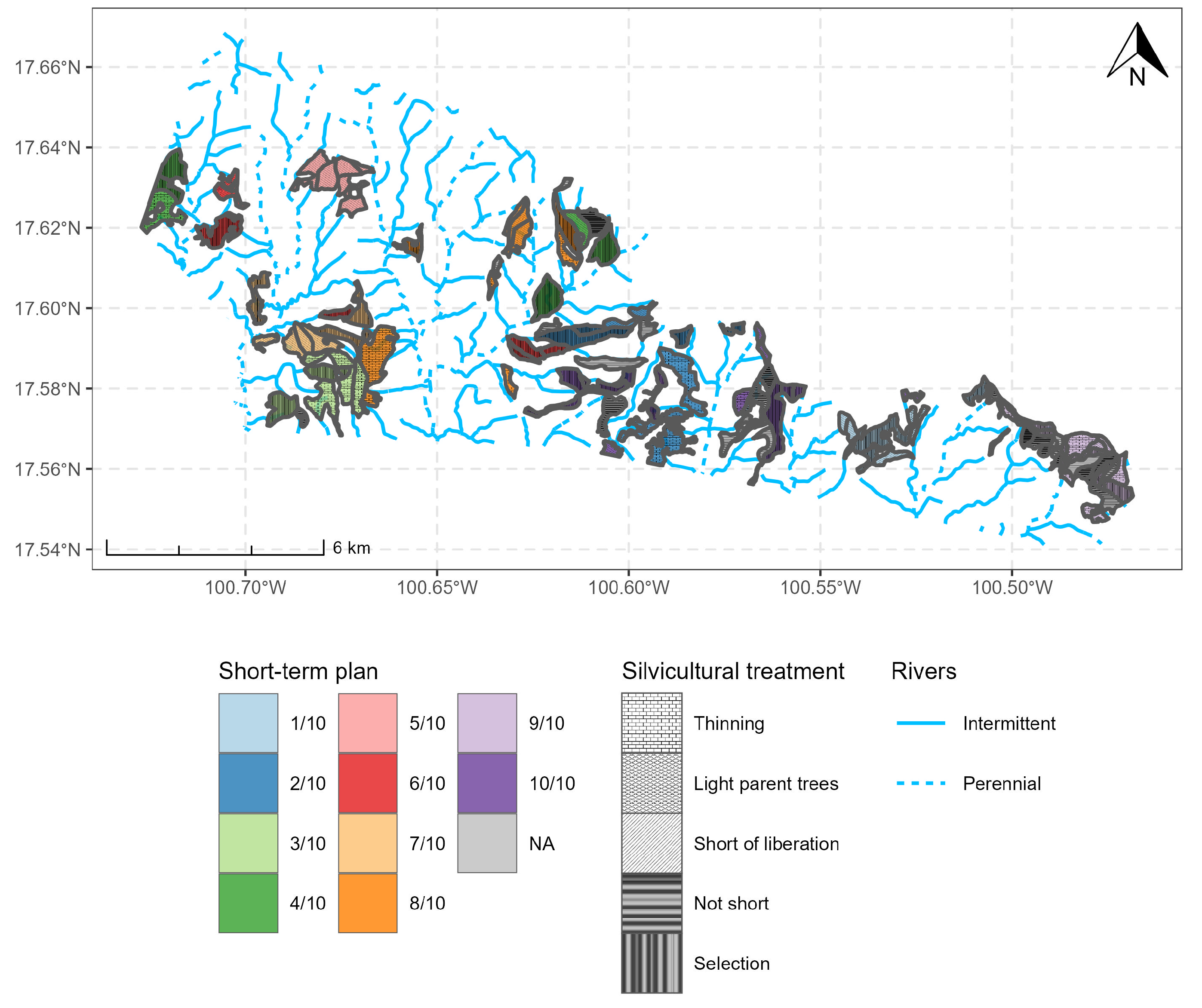
The objective of this study was to evaluate the quality of charcoal produced from sapwood and heartwood of Q. scytophylla in portable metal kilns installed at logging sites in the Cordón Grande forest community in the municipality of Técpan de Galeana, state of Guerrero, Mexico.
4. Discussion
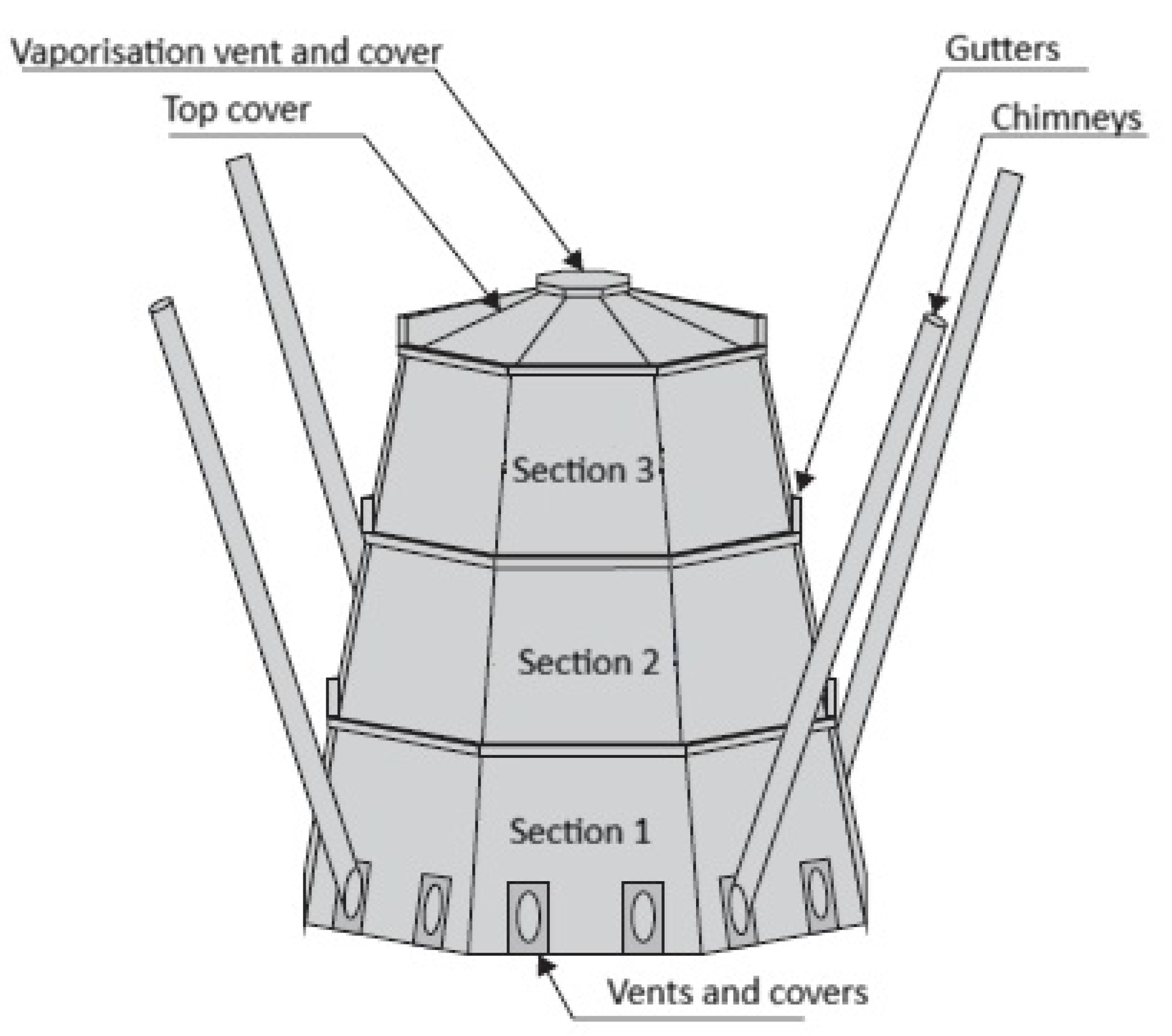
The production of charcoal in Mexico using CEVAG-type metal kilns is considered a technological innovation for charcoal production that complies with regulatory standards. These kilns were developed by INIFAP and offer significant advantages over traditional methods, including a capacity of 3000-3200 kg of firewood per load, production of 500–600 kg of charcoal, and a process lasting 28 to 36 h. Portable steel kilns, such as the RMV steel kiln [
44] and Mark V [
45], can be a benchmark for CEVAG, reducing the percentage of pollution from various greenhouse gases compared with traditional systems, and thus, mitigating the environmental impact.
In this study on
Q. scytophylla, it was observed that depending on the position within the kiln, there are statistically significant differences in the basic density of the charcoal, with the maximum being 0.57 g cm
−3 for sapwood in the upper part. This demonstrates that temperature gradients and air flow affect the quality of the charcoal produced in this kiln type [
46]. On the other hand, the best quality charcoal from
Quercus sideroxila Humb. & Bonpl. was obtained from the middle section of the Brazilian beehive-type kiln, with an average calorific value of 8096.88 cal g
−1, a moisture content of 3.3%, 19.0% volatile material, 5.2% ash, and 72.2% fixed carbon. This quality is acceptable according to international standards (from France and Belgium) [
5].
The calorific values obtained for
Q. scytophylla charcoal (6751.14–7508.26 cal g
−1) in this study have already been reported for this and other species in Mexico, for example,
Quercus laurina (7332.57 cal g
−1) and other species of oak trees (6926.534 and 8359.61 cal g
−1). The variations between the different positions within the oven (lower, middle, and upper) were similar to previous research, demonstrating that temperature and air flow within the oven influence the energy properties of the resulting charcoal [
47].
This study did not generate the thermal profile [
48,
49], which would allow the carbonisation process to be controlled and optimised, as well as provide correlations with the quality parameters (moisture content, ash, volatile material, and fixed carbon). In the context of the CEVAG system, this would constitute a complementary tool for advanced standardisation, but it is not a requirement for evaluating the performance of this technology.
The quality of the charcoal (fixed carbon) of 73.73-74.05% is close to the optimal parameters (≥75%) of international standards DIN 51749 and EN 1860-2:2023 [
50,
51]; therefore, we can consider the values obtained in this study to be acceptable. On the other hand, considering the moisture content (1.49–3.56%) and ash content (2.18–2.52%) results observed in this study, it is considered that national and international standards are met. However, the moisture content is below the recommended maximum limit of 8.0%, which is an indicator of the efficiency of the carbonisation process, but is comparable with that of species such as
Eucalyptus (5.0–6.1%) [
52].
The moisture content of the wood utilised during the carbonisation process exerts negligible influence on the majority of the variables that ensure the quality of the charcoal, with the exception of the friability value. In this particular instance, a positive correlation is observed between the moisture content of the wood and friability. Consequently, it can be concluded that the moisture content of the wood employed for carbonisation must be less than 20% [
53].
The charcoal yield obtained in the portable metal furnace in this study is low (26.7% anhydrous basis), although its basic density is high (0.80 g cm
−3 heartwood and 0.70 g cm
−3 sapwood). This is attributed to the high moisture content (25.8%) of the
Q. scytophylla wood before the carbonisation process. This situation was also found with woods of
Q. laurina and
Q. crassifolia [
23], which, despite their high basic densities, had low yields. However, the yields observed in our research on
Q. scytophylla wood are within the parameters for the carbonisation of Mexican forest species; for example, species such as
Q. spp. yield 16 to 30% of the raw material weight. The results are similar when using brick kilns at 4.4 m
3 ton
−1 [
23].
The preferred wood for wood energy in Oaxaca, Mexico, is oak (
Q. spp.), which has a calorific value of 7332.57 cal g
−1, a moisture content of 3.14%, 21.93% volatile matter, 3.16% ash content, and 74.91% fixed carbon. Regarding charcoal quality, the best indicators were found at the top of the kiln: lower moisture content, lower percentages of volatile matter and ash, and a higher percentage of fixed carbon. Overall, the charcoal produced in Ixtlán de Juárez, Oaxaca, complies with international standards for moisture and ash content, and the charcoal from the upper part of the kiln also meets the requirements for fixed carbon [
23]. On the other hand, the dendroenergetic properties of wood from four Brazilian juvenile tropical tree species (
Eucalyptus grandis Hill,
Acacia mearnsii De Willd,
Mimosa scarabella Benth., and
Atelia glazioviana Baill) determined by [
54] fluctuated between 4467 and 4545 cal g
−1 of calorific value, 75.33% and 82.90% of volatile material, 1.14% and 1.75% of ash content, and 15.96% and 23.21% of fixed carbon content. In our work, higher calorific values were found in the inner layer for sapwood (7508.26 cal g
−1) and heartwood (7296.28 cal g
−1).
The basic densities of wood from five common tropical forest species (
Alnus acuminata subsp. arguta (Schltdl.) Furlow,
Arbutus xalapensis Kunth,
Myrsine juergensenii (Mez) Ricketson & Pipoly,
Persea longipes (Schltdl.) Meisn., and
Prunus serotina Ehrh.) used for charcoal production in Oaxaca, Mexico, range from 0.37 to 0.50 g cm
−3, containing 75.41% to 83.66% volatile material and 0.56% to 1.50% ash, and reach 4657.50 to 5968.76 cal g
−1 of calorific value; meanwhile, the charcoal produced from these woods contains between 28.4% and 34.3% volatile material and 1.13% and 4.83% ash, with a calorific value of 7017.30 to 7669.34 cal g
−1. These tests were carried out under laboratory conditions and the carbon yields ranged from 26.2% to 34.1% [
35]. These researchers demonstrated that wood converted to charcoal becomes a more efficient fuel. Charcoal produced from woods with a very high basic density, such as
Ebenopsis ebano (Berland.) Barneby & J.W. Grimes and
Prosopis laevigata (Humb. & Bonpl. ex Willd.) M.C. Johnst. but produced in a pit-type oven [
5] presented the following charcoal quality values: moisture contents of 3.6% and 3.5%; volatile matter contents of 22.8% and 24.9%; ash percentages of 2.8% and 3.2%; fixed carbon contents of 70.8% and 68.6%; and calorific values of 7222.94 and 7099.70 cal g
−1, respectively. These are ranges within which the values obtained for
Q. scytophylla in this research fall.
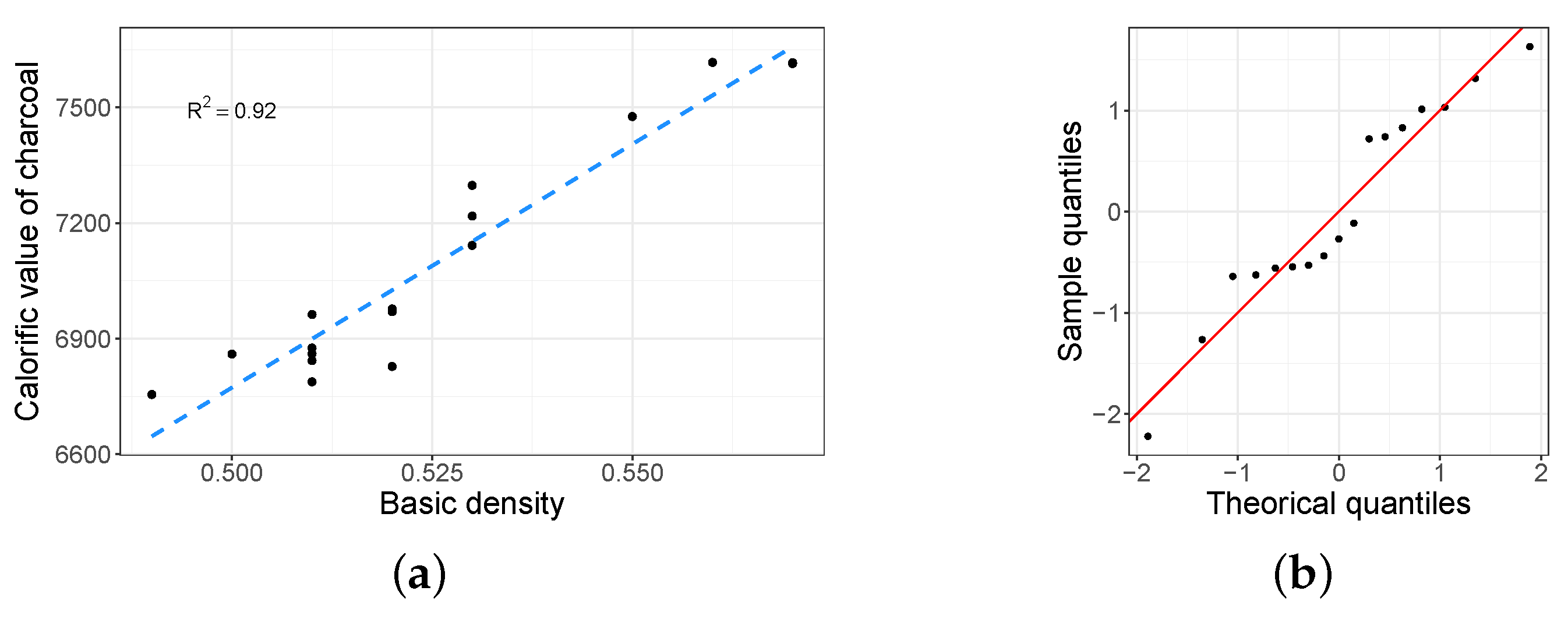
On the other hand, the estimated linear regression model suggests that the calorific value of charcoal can be explained by its basic density (R
2 = 0.67); although the model is not conclusive, it allows us to identify a type of correlation between the two variables, which is essential for predicting the energy quality. This coincides with other research demonstrating the importance of basic density as an energy predictor. For example, the basic density of
Q. scytophylla charcoal (0.50–0.57 g cm
−3) is comparable with other species in Mexico [
47,
55].
The study provides a robust experimental design (factorial
) that allows for the simultaneous evaluation of multiple factors affecting charcoal quality. This methodological approach is valuable for future studies on the energy characterisation of Mexican forest species. This research validates the effectiveness of CEVAG metal kilns in producing high-quality charcoal from Mexican species. This is particularly relevant considering that Mexico allocated 620,195 m
3 of wood for charcoal production in 2018, with
Q. spp. accounting for 271,647 m
3 [
47].
The present study also demonstrates that regarding calorific value, basic density, and quality variables in wood and charcoal, sapwood yields superior results in comparison with heartwood.
5. Conclusions
Regarding the sustainable utilisation of forest resources in Mexico, charcoal emerges as a renewable alternative, underscoring the economic and environmental significance of the ecosystem services provided by this wood resource.
The present study offers results that identify opportunities for improvement in fixed carbon content to achieve optimal international standards. In particular, it is suggested that Q. scytophylla is a viable species for the production of charcoal of acceptable quality. This is relevant for sustainable forest management, especially in forest ejidos such as Cordón Grande, where charcoal production can be integrated as part of comprehensive forest utilisation strategies. The carbon yield (20.0%) in this study corresponds to the index estimated by the manufacturer of the CEVAG furnace.
This research study serves to reinforce the scientific underpinnings that support the advancement of wood energy in Mexico. In addition, it contributes to the global corpus of knowledge pertaining to the carbonisation of tropical and subtropical species. Consequently, it establishes itself as a significant point of reference for future studies in the forestry and energy sectors.
Future research arising from the analysis of the data presented includes the following: optimisation of carbonisation parameters (temperature and time); full life cycle analysis of charcoal production; and characterisation of other Mexican species with potential, such as the genus Q. spp.



 ,
,