Spatial Visibility in Urban Parks and Social Functions: A Multimodal Correlational Study



Abstract
1. Introduction
2. Methodology
2.1. Study Areas
2.2. User-Generated Imagery Collection and Processing
2.3. Research Framework
- 1.
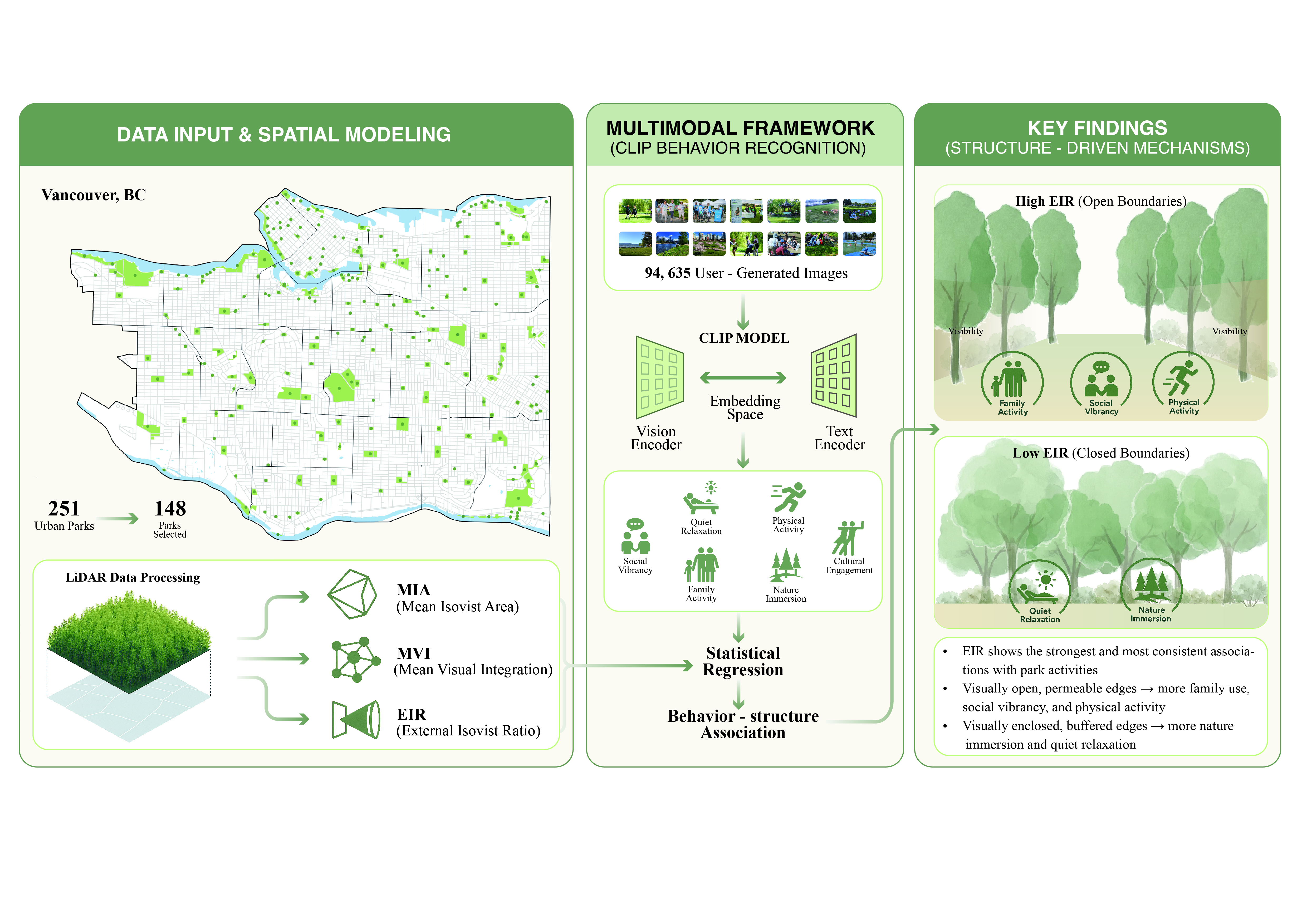
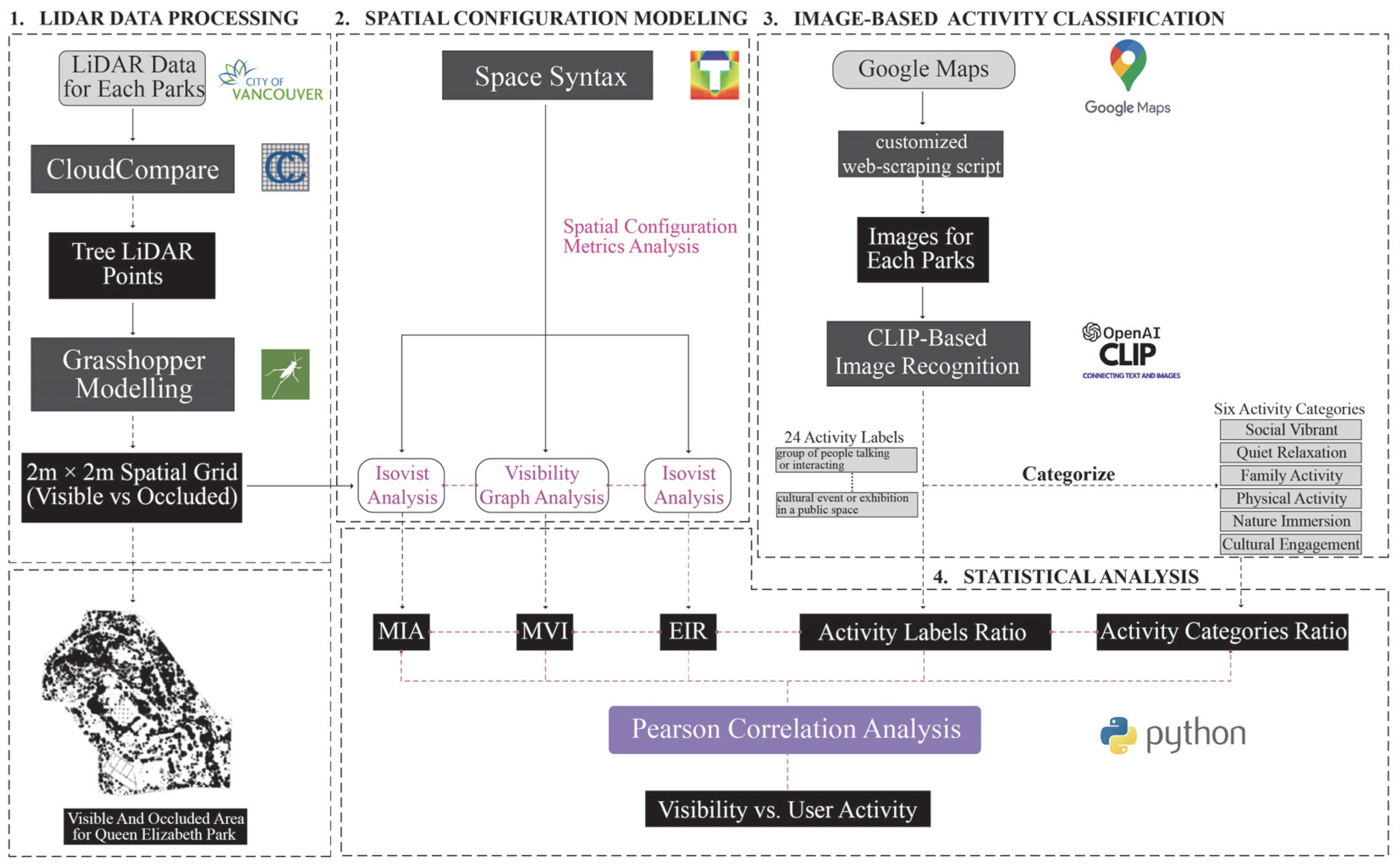
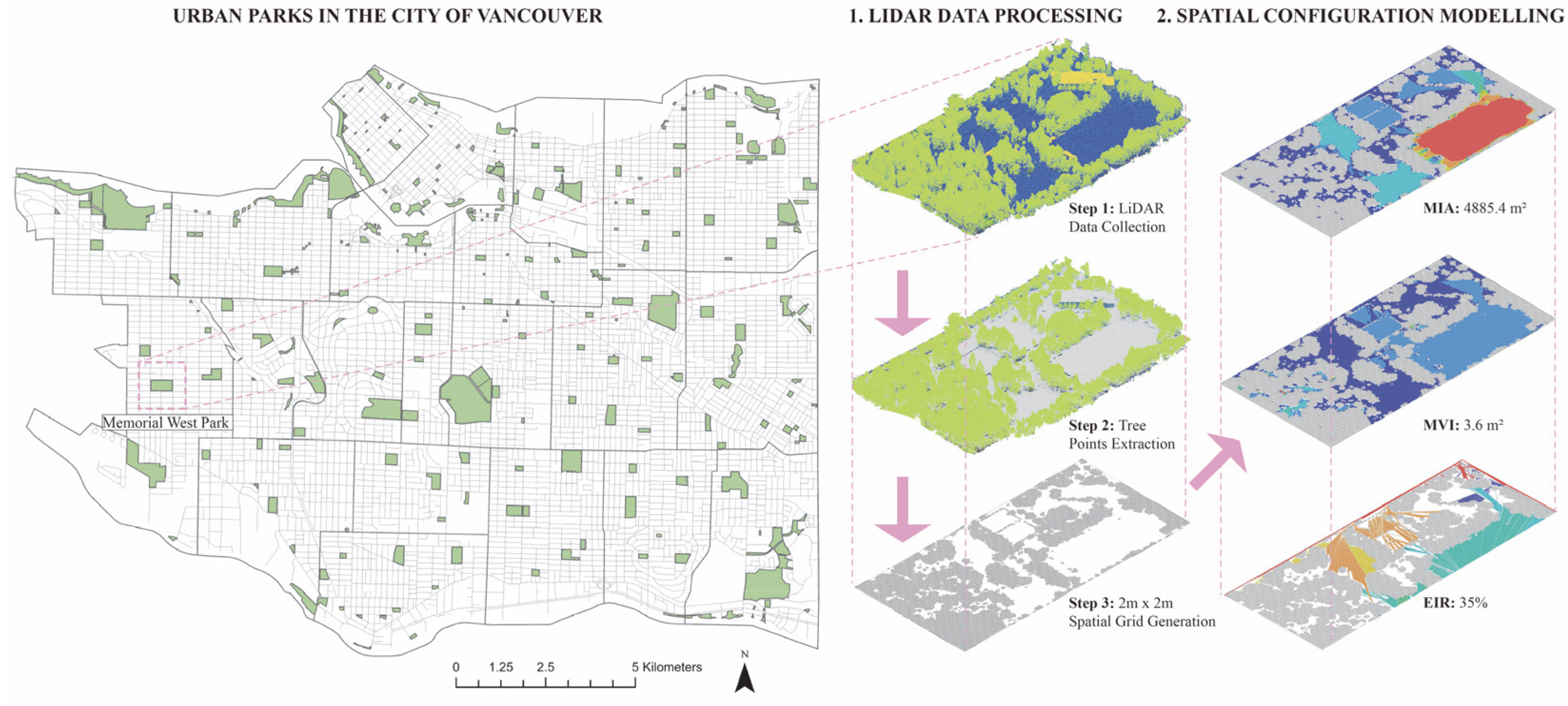
- LiDAR data processing: High-resolution airborne LiDAR data were processed to retain tree canopy points and geo-aligned with urban park boundaries for visibility analysis [31].
- 2.
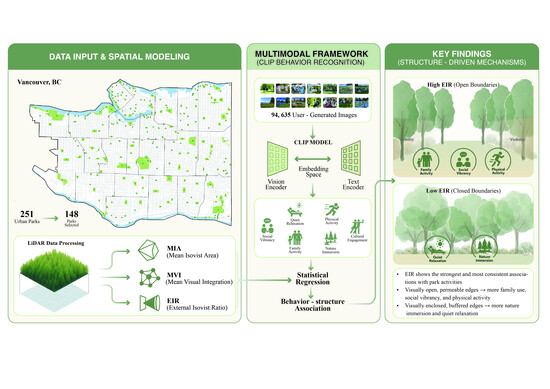
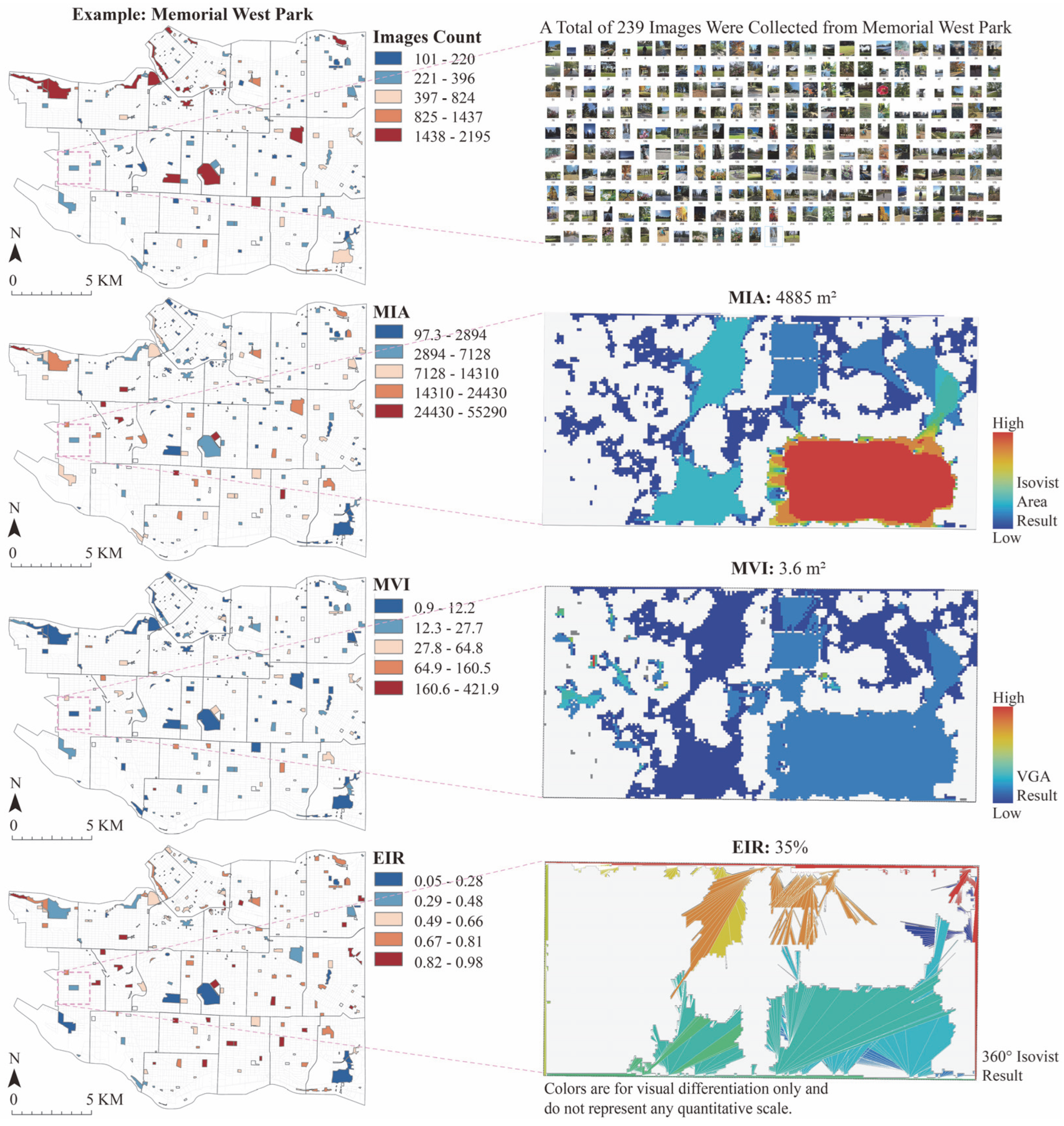
- Spatial configuration modeling: The filtered LiDAR point cloud was used to generate three key visibility metrics—Mean Isovist Area (MIA), representing the average visible area from internal viewpoints and thus internal openness; Mean Visual Integration (MVI), capturing global visual connectivity within the park; and External Isovist Ratio (EIR), expressing the proportion of park area visible from its perimeter and therefore edge transparency [25].
- 3.
- Image-based user activity classification: 94,635 geotagged user-uploaded photographs were collected from Google Maps associated with the 148 urban parks. These images represent the complete set of publicly accessible geotagged photographs available on the platform at the time of data collection, and no sampling or down-selection was performed. Using the CLIP model, these images were semantically classified based on natural language prompts to infer the predominant user activity of the studied urban parks [22].
- 4.
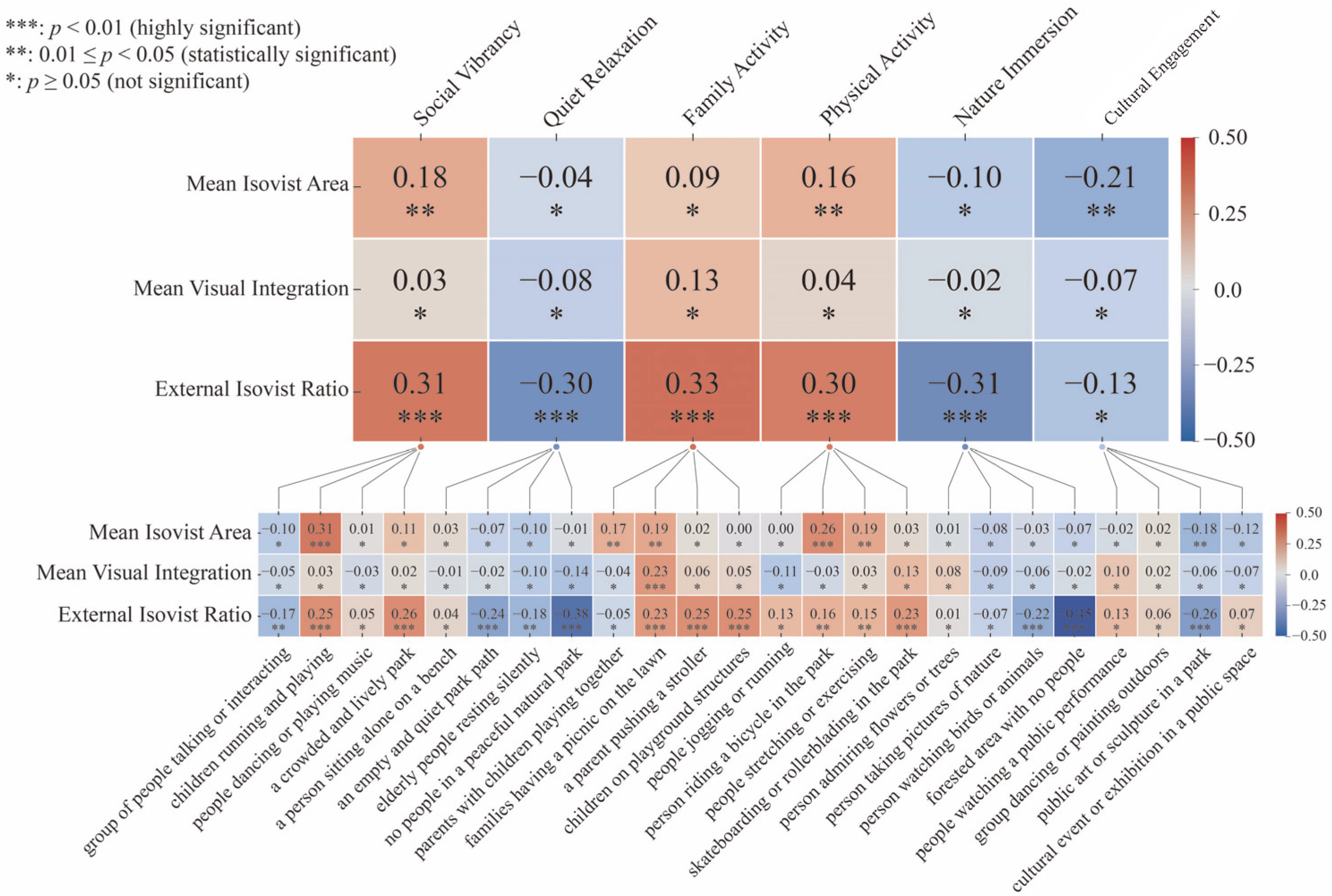
- Statistical correlation analysis: Pearson correlation analyses were conducted to test the relationships between the visibility metrics and the proportions of image-derived user activity [32].
2.4. Spatial Data Processing and Configuration Metrics Analysis
2.4.1. LiDAR Data Collection and Processing
2.4.2. Three Spatial Configuration Metrics
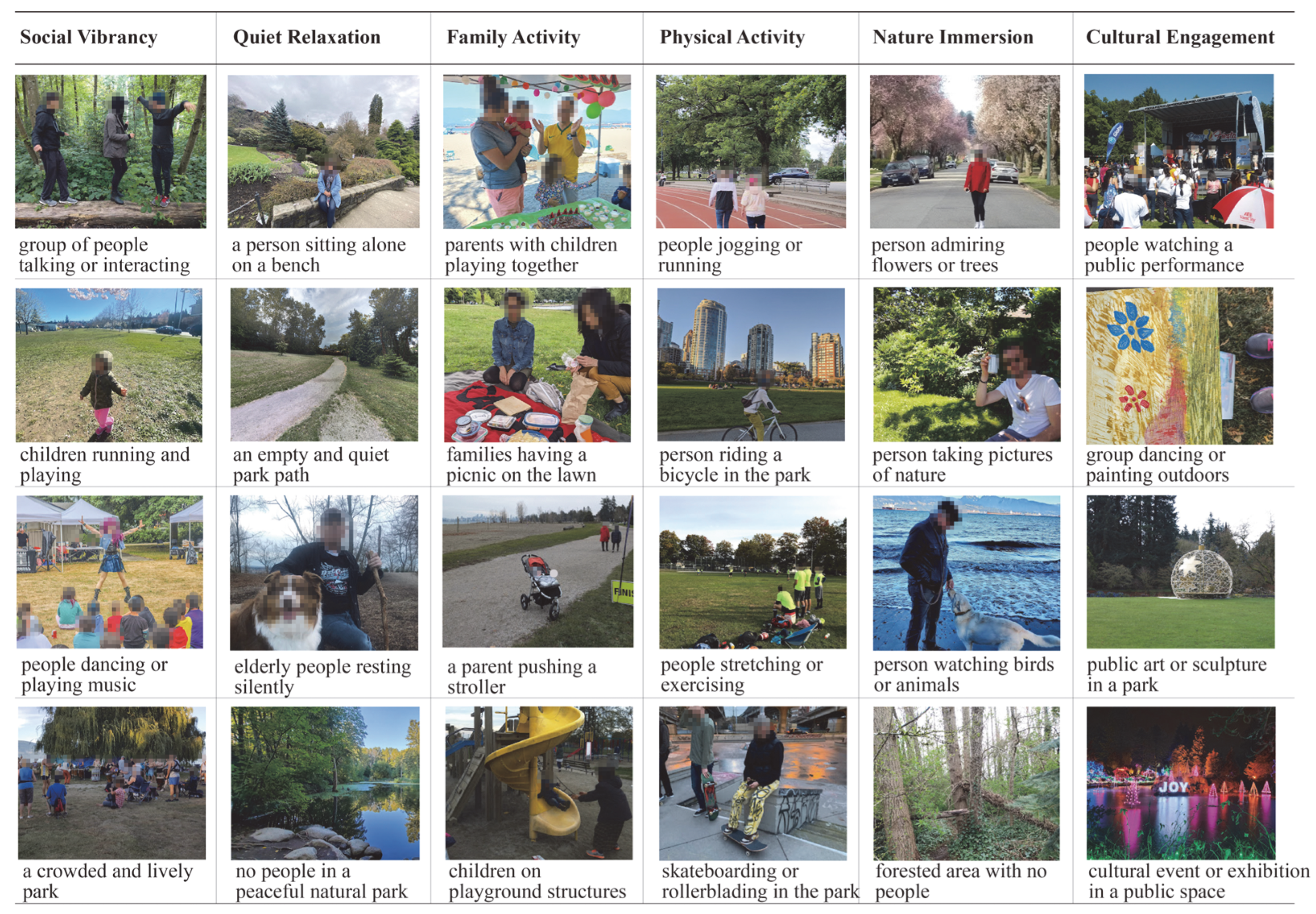
2.5. CLIP Semantic Classification of Park Activities: Six Categories and 24 Prompts
2.5.1. CLIP Model and Recognition Process
2.5.2. Prompt Design and Labeling Process for Park Activities
- Social Vibrancy: Reflects dynamic, interactive environments characterized by group activity, social gatherings, and playful energy. Prompts: “Group of people talking or interacting”, “Children running and playing”, “People dancing or playing music”, “A crowded and lively park”.
- Quiet Relaxation: Represents tranquil, low-activity settings where individuals are alone or quietly relaxing. Prompts: “A person sitting alone on a bench”, “An empty and quiet park path”, “Elderly people resting silently”, “No people in a peaceful natural park”.
- Family Activity: Denotes family-centered environments where child-focused activities are dominant. Prompts: “Parents with children playing together”, “Families having a picnic on the lawn”, “A parent pushing a stroller”, “Children on playground structures”.
- Physical Activity: Characterizes vigorous physical activity scenes involving individual or group exercise. Prompts: “People jogging or running”, “Person riding a bicycle in the park”, “People stretching or exercising”, “Skateboarding or rollerblading in the park”.
- Nature Immersion: Highlights scenes where interaction with or immersion in nature is the central theme. Prompts: “Person admiring flowers or trees”, “Person taking pictures of nature”, “Person watching birds or animals”, “Forested area with no people”.
- Cultural Engagement: Identifies parks as venues for cultural display, community art, or public performances. Prompts: “People watching a public performance”, “Group dancing or painting outdoors”, “Public art or sculpture in a park”, “Cultural event or exhibition in a public space”.
2.6. Statistical Analysis
2.7. Park-Level Multivariable Models
3. Results
3.1. Park Distribution Patterns
3.2. Correlation Between Spatial Configuration and User Activity
3.3. Unique Associations After Adjustment for Park and Neighborhood Covariates
4. Discussion
4.1. Spatial Openness and Edge Transparency as Key Correlates of Urban Park Use
4.2. Implications for Urban Park Planning and Policy
4.3. Limitations and Future Prospects
5. Conclusions
Supplementary Materials
Author Contributions
Funding
Data Availability Statement
Acknowledgments
Conflicts of Interest
Abbreviations
| CLIP | Contrastive Language-Image Pretraining |
| MIA | Mean Isovist Area |
| MVI | Mean Visual Integration |
| EIR | External Isovist Ratio |
| UGI | User-Generated Images |
| VGA | Visibility Graph Analysis |
References
- Hanson, H.I.; Eckberg, E.; Widenberg, M.; Alkan Olsson, J. Gardens’ Contribution to People and Urban Green Space. Urban For. Urban Green. 2021, 63, 127198. [Google Scholar] [CrossRef]
- Jennings, V.; Baptiste, A.K.; Osborne Jelks, N.; Skeete, R. Urban Green Space and the Pursuit of Health Equity in Parts of the United States. Int. J. Environ. Res. Public Health 2017, 14, 1432. [Google Scholar] [CrossRef]
- Lopes, M.N.; Camanho, A.S. Public Green Space Use and Consequences on Urban Vitality: An Assessment of European Cities. Soc. Indic. Res. 2013, 113, 751–767. [Google Scholar] [CrossRef]
- Dadvand, P.; Hariri, S.; Abbasi, B.; Heshmat, R.; Qorbani, M.; Motlagh, M.E.; Basagaña, X.; Kelishadi, R. Use of Green Spaces, Self-Satisfaction and Social Contacts in Adolescents: A Population-Based CASPIAN-V Study. Environ. Res. 2019, 168, 171–177. [Google Scholar] [CrossRef] [PubMed]
- Yang, M.; Nie, W.; Wu, R.; Yan, H.; Tian, S.; Wang, K.; Shi, L.; Cheng, X.; Ji, T.; Bao, Z. Towards More Equitable Cooling Services of Urban Parks: Linking Cooling Effect, Accessibility and Attractiveness. J. Environ. Manag. 2024, 370, 122475. [Google Scholar] [CrossRef]
- Fang, C.-F.; Ling, D.-L. Investigation of the Noise Reduction Provided by Tree Belts. Landsc. Urban Plan. 2003, 63, 187–195. [Google Scholar] [CrossRef]
- Herath, P.; Bai, X.; Jin, H.; Thatcher, M. Does the Spatial Configuration of Urban Parks Matter in Ameliorating Extreme Heat? Urban Clim. 2024, 53, 101756. [Google Scholar] [CrossRef]
- Mahmoud, A.H.; Omar, R.H. Planting Design for Urban Parks: Space Syntax as a Landscape Design Assessment Tool. Front. Archit. Res. 2015, 4, 35–45. [Google Scholar] [CrossRef]
- Schroeder, H.W.; Orland, B. Viewer Preference for Spatial Arrangement of Park Trees: An Application of Video-Imaging Technology. Environ. Manag. 1994, 18, 119–128. [Google Scholar] [CrossRef]
- Jennings, V.; Bamkole, O. The Relationship between Social Cohesion and Urban Green Space: An Avenue for Health Promotion. Int. J. Environ. Res. Public Health 2019, 16, 452. [Google Scholar] [CrossRef]
- Mateer, T.J. Developing Connectedness to Nature in Urban Outdoor Settings: A Potential Pathway through Awe, Solitude, and Leisure. Front. Psychol. 2022, 13, 940939. [Google Scholar] [CrossRef] [PubMed]
- Liu, C.; Wang, T.-Y.; Yuizono, T. Assessing the Landscape Visual Quality of Urban Green Spaces with Multidimensional Visual Indicators. Urban For. Urban Green. 2025, 106, 128727. [Google Scholar] [CrossRef]
- Tabrizian, P.; Baran, P.K.; Smith, W.R.; Meentemeyer, R.K. Exploring Perceived Restoration Potential of Urban Green Enclosure through Immersive Virtual Environments. J. Environ. Psychol. 2018, 55, 99–109. [Google Scholar] [CrossRef]
- Gehl, J. Life Between Buildings: Using Public Space; Island Press: Washington, DC, USA, 2011. [Google Scholar]
- Whyte, W.H. The Social Life of Small Urban Spaces; Project for Public Spaces: Brooklyn, NY, USA, 1980. [Google Scholar]
- Yuan, F.; Chen, M. A Systematic Review of Measurement Tools and Senior Engagement in Urban Nature: Health Benefits and Behavioral Patterns Analysis. Health Place 2025, 91, 103410. [Google Scholar] [CrossRef] [PubMed]
- Goodchild, M.F. Citizens as Sensors: The World of Volunteered Geography. Geojournal 2007, 69, 211–221. [Google Scholar] [CrossRef]
- Tulloch, D. Crowdsourcing Geographic Knowledge: Volunteered Geographic Information (VGI) in Theory and Practice. Int. J. Geogr. Inf. Sci. 2014, 28, 847–849. [Google Scholar] [CrossRef]
- Heikinheimo, V.; Tenkanen, H.; Bergroth, C.; Järv, O.; Hiippala, T.; Toivonen, T. Understanding the Use of Urban Green Spaces from User-Generated Geographic Information. Landsc. Urban Plan. 2020, 201, 103845. [Google Scholar] [CrossRef]
- Van den Homberg, M.; Susha, I. Characterizing Data Ecosystems to Support Official Statistics with Open Mapping Data for Reporting on Sustainable Development Goals. ISPRS Int. J. Geo-Inf. 2018, 7, 456. [Google Scholar] [CrossRef]
- Chen, M.; Cai, Y.; Guo, S.; Sun, R.; Song, Y.; Shen, X. Evaluating Implied Urban Nature Vitality in San Francisco: An Interdisciplinary Approach Combining Census Data, Street View Images, and Social Media Analysis. Urban For. Urban Green. 2024, 95, 128289. [Google Scholar] [CrossRef]
- Radford, A.; Kim, J.W.; Hallacy, C.; Ramesh, A.; Goh, G.; Agarwal, S.; Sastry, G.; Askell, A.; Mishkin, P.; Clark, J.; et al. Learning Transferable Visual Models from Natural Language Supervision. arXiv 2021, arXiv:2103.00020. [Google Scholar] [CrossRef]
- Hillier, B. Space Is the Machine: A Configurational Theory of Architecture; Cambridge University Press: Cambridge, UK, 1996. [Google Scholar]
- Hillier, B.; Hanson, J. The Social Logic of Space; Cambridge University Press: Cambridge, UK, 1984; ISBN 978-0-521-36784-4. [Google Scholar]
- Turner, A.; Doxa, M.; O’Sullivan, D.; Penn, A. From Isovists to Visibility Graphs: A Methodology for the Analysis of Architectural Space. Environ. Plan. B Plan. Des. 2001, 28, 103–121. [Google Scholar] [CrossRef]
- Wiener, J.M.; Franz, G.; Rossmanith, N.; Reichelt, A.; Mallot, H.A.; Bülthoff, H.H. Isovist Analysis Captures Properties of Space Relevant for Locomotion and Experience. Perception 2007, 36, 1066–1083. [Google Scholar] [CrossRef]
- Wineman, J.D.; Peponis, J. Constructing Spatial Meaning: Spatial Affordances in Museum Design. Environ. Behav. 2010, 42, 86–109. [Google Scholar] [CrossRef]
- Wei, J.; Yue, W.; Li, M.; Gao, J. Mapping Human Perception of Urban Landscape from Street-View Images: A Deep-Learning Approach. Int. J. Appl. Earth Obs. Geoinf. 2022, 112, 102886. [Google Scholar] [CrossRef]
- Government of Canada; Statistics Canada. Focus on Geography Series, 2021 Census—Greater Vancouver (Census Division). Available online: https://www12.statcan.gc.ca/census-recensement/2021/as-sa/fogs-spg/Page.cfm?lang=E&topic=1&dguid=2021A00035915 (accessed on 27 May 2025).
- Veitch, J.; Salmon, J.; Ball, K. Children’s Active Free Play in Local Neighborhoods: A Behavioral Mapping Study. Health Educ. Res. 2008, 23, 870–879. [Google Scholar] [CrossRef]
- Hu, T.; Wei, D.; Su, Y.; Wang, X.; Zhang, J.; Sun, X.; Liu, Y.; Guo, Q. Quantifying the Shape of Urban Street Trees and Evaluating Its Influence on Their Aesthetic Functions Based on Mobile Lidar Data. ISPRS J. Photogramm. Remote Sens. 2022, 184, 203–214. [Google Scholar] [CrossRef]
- Chen, M.; Liu, Y.; Liu, F.; Chadha, T.; Park, K. Measuring Pedestrian-Level Street Greenery Visibility through Space Syntax and Crowdsourced Imagery: A Case Study in London, UK. Urban For. Urban Green. 2025, 105, 128725. [Google Scholar] [CrossRef]
- LiDAR 2022. Available online: https://opendata.vancouver.ca/explore/dataset/lidar-2022/ (accessed on 27 May 2025).
- Row, A.T.; Jacobs, J. The Death and Life of Great American Cities; Vintage: New York, NY, USA, 1992. [Google Scholar]
- Mukaka, M. A Guide to Appropriate Use of Correlation Coefficient in Medical Research. Malawi Med. J. 2012, 24, 69–71. [Google Scholar]
- Schober, P.; Boer, C.; Schwarte, L.A. Correlation Coefficients: Appropriate Use and Interpretation. Anesth. Analg. 2018, 126, 1763. [Google Scholar] [CrossRef] [PubMed]
- Bahr, S. The Relationship between Urban Greenery, Mixed Land Use and Life Satisfaction: An Examination Using Remote Sensing Data and Deep Learning. Landsc. Urban Plan. 2024, 251, 105174. [Google Scholar] [CrossRef]
- Chen, C.; Li, H.; Luo, W.; Xie, J.; Yao, J.; Wu, L.; Xia, Y. Predicting the Effect of Street Environment on Residents’ Mood States in Large Urban Areas Using Machine Learning and Street View Images. Sci. Total Environ. 2022, 816, 151605. [Google Scholar] [CrossRef]
- Al-Saedi, D.F.S.; Chamani, A. Integrating Public Perception and Quantitative Metrics for Improved Urban Park Planning in Isfahan, Iran. Trees For. People 2024, 18, 100729. [Google Scholar] [CrossRef]
- Zhang, F.; Zhou, B.; Liu, L.; Liu, Y.; Fung, H.H.; Lin, H.; Ratti, C. Measuring Human Perceptions of a Large-Scale Urban Region Using Machine Learning. Landsc. Urban Plan. 2018, 180, 148–160. [Google Scholar] [CrossRef]
- Chen, N.; Wang, L.; Xu, T.; Wang, M. Perception of Urban Street Visual Color Environment Based on the CEP-KASS Framework. Landsc. Urban Plan. 2025, 259, 105359. [Google Scholar] [CrossRef]
- Liu, Y.; Chen, M.; Wang, M.; Huang, J.; Thomas, F.; Rahimi, K.; Mamouei, M. An Interpretable Machine Learning Framework for Measuring Urban Perceptions from Panoramic Street View Images. Iscience 2023, 26, 106132. [Google Scholar] [CrossRef] [PubMed]
- Kaplan, R.; Kaplan, S. The Experience of Nature: A Psychological Perspective; Cambridge University Press: New York, NY, USA, 1989; p. 340. ISBN 978-0-521-34139-4. [Google Scholar]
- Ulrich, R.S. Aesthetic and Affective Response to Natural Environment. In Behavior and the Natural Environment; Altman, I., Wohlwill, J.F., Eds.; Springer: Boston, MA, USA, 1983; pp. 85–125. ISBN 978-1-4613-3541-2. [Google Scholar]
- Wang, Z.; Zhou, R.; Rui, J.; Yu, Y. Revealing the Impact of Urban Spatial Morphology on Land Surface Temperature in Plain and Plateau Cities Using Explainable Machine Learning. Sustain. Cities Soc. 2025, 118, 106046. [Google Scholar] [CrossRef]
- Hu, Y.; Chen, M.; Cai, Y. Comparative Analysis of Greenery Inequalities in New York and London: Social-Economic and Spatial Dimensions. Urban For. Urban Green. 2025, 112, 128939. [Google Scholar] [CrossRef]




| Activity Category | Mean Proportion (%) | Standard Deviation (%) | Minimum (%) | Maximum (%) |
|---|---|---|---|---|
| Social Vibrancy | 15.52 | 8.14 | 1.34 | 42.53 |
| Quiet Relaxation | 25.24 | 7.53 | 9.33 | 60.87 |
| Family Activity | 10.09 | 7.07 | 0 | 43.09 |
| Physical Activity | 9.22 | 5.74 | 0 | 50.66 |
| Nature Immersion | 23.94 | 10.24 | 1.29 | 50.52 |
| Cultural Engagement | 16 | 8.36 | 1.98 | 65.19 |
| Predictor | Social Vibrancy β (p) | Family Activity β (p) | Physical Activity β (p) |
|---|---|---|---|
| EIR | 0.018 (0.030) | 0.026 (<0.001) | 0.014 (0.016) |
| Log Park area (ha) | 0.017 (0.103) | 0.007 (0.421) | 0.004 (0.590) |
| Amenity count | −0.006 (0.429) | −0.014 (0.037) | 0.001 (0.891) |
| Population density | 0.007 (0.352) | 0.001 (0.847) | −0.005 (0.379) |
| Average income | −0.001 (0.915) | 0.005 (0.349) | 0.004 (0.392) |
| R2 | 0.12 | 0.15 | 0.11 |
Disclaimer/Publisher’s Note: The statements, opinions and data contained in all publications are solely those of the individual author(s) and contributor(s) and not of MDPI and/or the editor(s). MDPI and/or the editor(s) disclaim responsibility for any injury to people or property resulting from any ideas, methods, instructions or products referred to in the content. |
© 2025 by the authors. Licensee MDPI, Basel, Switzerland. This article is an open access article distributed under the terms and conditions of the Creative Commons Attribution (CC BY) license (https://creativecommons.org/licenses/by/4.0/).
Share and Cite
Liu, Y.; Chen, Y.; Zhou, S.; Chen, K.; Zhao, S.; Chen, M. Spatial Visibility in Urban Parks and Social Functions: A Multimodal Correlational Study. Forests 2025, 16, 1874. https://doi.org/10.3390/f16121874
Liu Y, Chen Y, Zhou S, Chen K, Zhao S, Chen M. Spatial Visibility in Urban Parks and Social Functions: A Multimodal Correlational Study. Forests. 2025; 16(12):1874. https://doi.org/10.3390/f16121874
Chicago/Turabian StyleLiu, Yuxiang, Yi Chen, Shuhan Zhou, Kaixuan Chen, Shuang Zhao, and Mingze Chen. 2025. "Spatial Visibility in Urban Parks and Social Functions: A Multimodal Correlational Study" Forests 16, no. 12: 1874. https://doi.org/10.3390/f16121874
APA StyleLiu, Y., Chen, Y., Zhou, S., Chen, K., Zhao, S., & Chen, M. (2025). Spatial Visibility in Urban Parks and Social Functions: A Multimodal Correlational Study. Forests, 16(12), 1874. https://doi.org/10.3390/f16121874