Article

Evaluating the Carbon Budget and Seeking Alternatives to Improve Carbon Absorption Capacity at Pinus rigida Plantations in South Korea


1
National Institute of Ecology, Seocheon 33657, Republic of Korea
2
Department Bio and Environmental Technology, Seoul Women’s University, Seoul 01797, Republic of Korea
3
Center for Atmospheric and Environmental Modeling, Seoul 08375, Republic of Korea
*
Author to whom correspondence should be addressed.
Forests 2025, 16(12), 1860; https://doi.org/10.3390/f16121860
Submission received: 31 October 2025 / Revised: 4 December 2025 / Accepted: 12 December 2025 / Published: 16 December 2025
(This article belongs to the Section Forest Ecology and Management)

Abstract

This study was carried out to investigate stand structure, growth dynamics, and carbon fluxes in Pinus rigida plantations of varying ages in South Korea. Field measurements across four mountain sites quantified diameter-class distributions, net primary productivity (NPP), soil respiration, and net ecosystem production (NEP). P. rigida exhibited normally distributed diameter structures in larger classes, whereas Quercus spp. showed reverse J-shaped patterns, indicating active regeneration and ongoing succession toward mixed broadleaved stands. Individual NPP was highest in P. densiflora (4.77 kg yr−1) and P. rigida (4.31 kg yr−1), while Quercus spp. displayed lower growth due to light limitation. Stand-level NPP peaked in 20–40-year-old stands (4.27–4.88 ton C ha−1 yr−1) and declined with age (2.30 ton C ha−1 yr−1). Soil respiration averaged 1.0 ton C ha−1 yr−1 and was strongly temperature dependent (R2 = 0.56; Q10 = 2.70). NEP on Mt. Galmi reached 4.38 ton C ha−1 yr−1, demonstrating substantial carbon sink capacity. These findings indicate that aging P. rigida plantations maintain ecosystem-level carbon uptake through successional compensation. Policy efforts should prioritize adaptive thinning, assisted natural regeneration, and long-term monitoring frameworks to accelerate the transition toward climate-resilient mixed forests and to strengthen national forest carbon neutrality strategies. Future research should integrate long-term carbon flux observations, species interaction modeling, and assessments of climate-driven disturbance regimes to refine management pathways for resilient mixed-forest landscapes.

1. Introduction

Temperate deciduous forests are structurally diverse ecosystems composed of multiple vegetation layers—the tree, sub-tree, shrub, and herbaceous strata [1,2]. While most carbon assessments emphasize the tree layer, which stores the majority of biomass, the ecological and carbon-sequestration roles of lower vegetation strata have often been overlooked, particularly in plantation forests undergoing natural regeneration [3,4].
Global afforestation and reforestation initiatives—such as the UN-REDD+ Program, the Bonn Challenge, and the New York Declaration on Forests—emphasize enhancing forest carbon sinks and strengthening ecosystem resilience to achieve long-term climate goals [5,6].
Many of these programs have led to large-scale plantations of fast-growing, often non-native species. In South Korea, extensive afforestation programs launched in the 1970s successfully restored degraded landscapes using early-successional species such as Pinus rigida [7]. P. rigida is a disturbance-adapted species capable of resprouting from epicormic buds following fire and tolerating nutrient-poor soils, making it suitable for restoration of barren mountain slopes [8].
Today, many of these plantations are reaching maturity and undergoing natural succession as native broadleaved species such as Quercus variabilis, Q. serrata, and Q. mongolica establish under the canopy [3,9]. This natural succession allows native trees and shrubs to establish beneath these canopies, increasing structural complexity and potentially enhancing long-term carbon storage [10,11]. Such multi-layered communities are more resilient to climate stress and may contribute more substantially to carbon sequestration than previously assumed [12,13,14]. Therefore, even as canopy growth of P. rigida slows, understory development and increased litter decomposition may sustain or enhance net primary productivity [15]. Understanding productivity trends and carbon flux changes during this successional process is critical for guiding forest management aligned with national carbon-neutrality policy frameworks, including Korea’s 2050 Carbon Neutrality Roadmap and forest-based mitigation strategies promoting mixed-species conversion and adaptive stand thinning [16,17].
Despite these insights, most forest carbon studies still focus on aboveground tree biomass, as it dominates total carbon stocks and can be efficiently estimated through allometric equations [18,19]. However, this canopy-centered approach risks underestimating carbon storage in multi-layered forests. The sub-tree, shrub, and herbaceous layers—though smaller in biomass—play important roles in biodiversity maintenance, regeneration, and nutrient cycling [20,21]. Limited sampling protocols and methodological challenges have nonetheless led to their frequent exclusion from forest carbon inventories [22].
Recent advances in high-resolution sensing and field measurement have enabled more accurate carbon accounting across vegetation strata [23]. Yet, comprehensive field-based evaluations that include all forest layers remain rare, leaving significant uncertainty in quantifying total ecosystem carbon dynamics.
To address these knowledge gaps, this study investigates stand structure, growth patterns, and ecosystem carbon fluxes across P. rigida plantations of varying ages. By integrating diameter-class distribution, NPP, soil respiration, and NEP measurements, we aim to clarify how natural succession influences carbon absorption capacity in aging plantations. The results provide scientific evidence to support adaptive management policies that enhance carbon sequestration, accelerate succession toward resilient mixed forests, and contribute to long-term carbon neutrality objectives.

2. Materials and Methods

2.1. Study Site

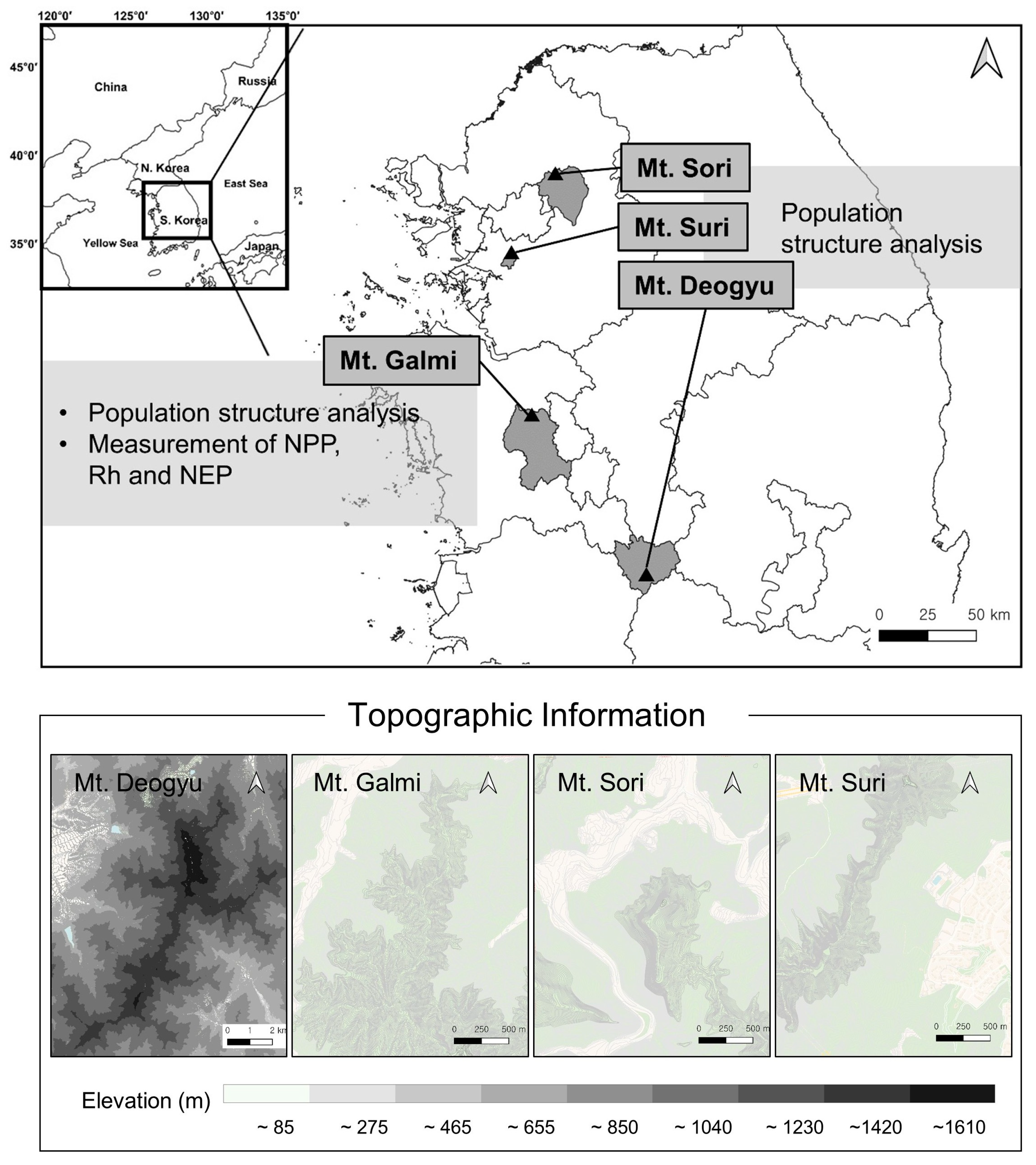
The survey sites for this study were (1) Mt. Galmi in Gongju-si, Chungcheongnam-do, (2) Mt. Sori in Namyangju-si, Gyeonggi-do, (3) Mt. Suri in Gunpo-si, Gyeonggi-do, and (4) Mt. Deogyu in Muju-gun, Jeollabuk-do. The stand ages of each survey site were the 20s (Mt. Suri), 30s (Mt. Galmi), 40s (Mt. Sori), and 70s (Mt. Deogyu). Evaluation of carbon absorption capacity was performed at Mt. Galmi, and remaining sites were selected to investigate the density of woody plants that appeared in the tree layer and on the forest floor (Figure 1).
Stand ages and environmental conditions of P. rigida plantations studied are shown in Table 1.

2.2. Ecological Background of P. rigida

P. rigida is a medium-sized, evergreen conifer native to eastern North America. The species exhibits strong fire-adaptive traits, including resprouting from epicormic buds, and frequently develops irregular or gnarled growth forms under low-nutrient or otherwise stressful conditions. P. rigida is long-lived, typically reaching 150–200 years, with occasional individuals exceeding 300 years [8].
The natural range of P. rigida spans the northeastern and mid-Atlantic United States, with occurrences in Maine, New Hampshire, Massachusetts, Connecticut, Rhode Island, New York, New Jersey, and Pennsylvania, and extending into the Appalachian regions of Maryland, Virginia, and West Virginia. Additionally, patchy populations occur in North Carolina, South Carolina, and Georgia, with the species strongly represented in the New Jersey Pine Barrens [8,24].
The species commonly occupies nutrient-poor, acidic, sandy soils of coastal plains and upland ridges. It also occurs along the margins of swamps and bogs, reflecting its tolerance of both drought and periodic flooding. Due to strong fire-adaptive traits, P. rigida frequently dominates fire-prone, xeric, and low-nutrient habitats, often forming mixed pine–oak forest communities [8,24].

2.3. Measurement of Stand Density and Analysis of Population Structure

After installing two 20 m × 20 m quadrats in each survey site, the density of the P. rigida that forms the tree layer and the tree species that forms the understory vegetation was measured. At this time, the DBH of all tree plants that appeared within the quadrat was measured to determine the population structure and dynamics of the major species. Based on the measured DBH data, the frequency distribution by diameter class was analyzed, and the successional trend of the P. rigida established in each survey site was analyzed [9,25].

2.4. Measurement of Net Primary Productivity (NPP)

To evaluate productivity, five survey plots were installed, and the density of tree species within the plots was examined. Disc samples for measuring diameter growth were collected by logging 20 individuals of P. rigida and three individuals of P. densiflora, Quercus mongolica, Q. serrata, Q. variabilis, Styrax obassia, Castanea crenata, and Prunus sargentii. Diameter growth was measured in mm units using a Vernier caliper (Mitutoyo, Tokyo, Japan). Diameter growth was taken as the mean of two measurements after measuring the long and short diameters. Productivity was calculated as the mean annual change in biomass after obtaining the annual biomass by substituting the diameter measured by year into the existing allometric equations (Table 2). The stand NPP for Mt. Suri, Mt. Sori, and Mt. Deokyu was obtained by multiplying the individual NPP of tree species obtained from Mt. Galmi with the density of tree species obtained at those sites.
The amount of carbon was calculated by applying the IPCC [29] carbon fraction (0.5 of dry biomass), and that of CO2 was obtained by multiplying carbon stock by the conversion factor (44/12) [29].

2.5. Measurement of Soil Respiration

Soil respiration (SR) in the Pinus rigida stands was quantified using a portable infrared gas analyzer (EGM-5, PP Systems, Amesbury, MA, USA) in conjunction with a static closed chamber (SRC-2, PP Systems). The chamber, which has a surface area of 78 cm2 and a volume of 1171 mL, was fitted with an integrated soil temperature probe (STP-2, PP Systems) for synchronous temperature monitoring. A closed dynamic chamber technique was adopted to capture temporal variations in CO2 concentration over a defined soil surface during each measurement period.
At each sampling site, six cylindrical PVC collars (10 cm in diameter, 8 cm in height) were installed approximately 6 cm deep into the mineral soil to establish measurement bases. Collars were positioned randomly to represent the spatial heterogeneity of the forest floor. All aboveground vegetation inside the collars was removed approximately 24 h before measurement to minimize photosynthetic and root-interference effects.
Measurements were conducted monthly from May to October 2023, between 09:00 and 13:00 local time, when temperature fluctuations were minimal. During each observation, the SRC-2 chamber was placed over the collar and sealed using a rubber gasket to ensure an airtight connection. The EGM-5 analyzer continuously recorded CO2 concentration changes within the chamber at one-second intervals over a 120 s period. The analyzer’s internal software computed both linear and quadratic regressions of CO2 concentration against time to correct for potential nonlinearities due to leakage or pressure effects.
Soil respiration rate (SR, mg CO2 m−2 h−1) was calculated using the following equation:
SR rate (mg CO2 m−2 h−1) = [(Cn − C0)/Tn]·[V/A]
where Cn represents the CO2 concentration at a given time Tn; C0 represents the CO2 concentration at the chamber installation time (T = 0); V represents the total chamber volume (m3); and A is the area of exposed soil (m2).
To examine the influence of temperature on SR, air temperature (Ta, measured at 1.5 m aboveground) and soil temperature (Ts, measured at 5 cm depth) were continuously logged every hour from May 2023 to October 2025 using temperature recorders with soil probes (HOBO Pro, Onset Computer Corp., Bourne, MA, USA). Daily mean values of SR, Ta, and Ts were derived for each site. The amount of soil respiration of the heterotrophic organisms was calculated by applying the respiratory coefficient, 0.55, which is usually cited for forest soil [30,31].
The relationship between SR and temperature was modeled using an exponential regression of the form:
SR rate = α·exp(b·t)
where α represents the base respiration rate at 0 °C, b is the temperature sensitivity coefficient, and t is the measured Ta (°C) or Ts (°C). The temperature sensitivity of soil respiration was further expressed using the Q10 coefficient, calculated as (Equation (3)):
Q10 = exp10b
which represents the proportional increase in SR corresponding to a 10 °C rise in temperature. The parameters obtained from the regression describe the thermal responsiveness of soil CO2 efflux and serve as indicators of ecosystem metabolic sensitivity to temperature variability.

2.6. Calculation of Carbon Absorption Capacity

The net ecosystem production (NEP) was obtained from the difference between the CO2 absorption (NPP) by vegetation and CO2 emission via the respiration of soil microorganisms and animals, i.e., heterotrophic respiration.

2.7. Statistical Analysis

To account for uncertainty in diameter growth measurements, a 95% confidence interval (CI) for the NPP at each stand age was calculated. This procedure was used to correct estimation errors arising from natural variability in annual diameter increments and differences in sample size. In addition, the annual distribution of diameter growth was examined using descriptive statistics (mean, standard deviation, and coefficient of variation) to ensure that interannual variability within the same individuals did not disproportionately affect subsequent model calculations.

3. Results

3.1. Diameter Class Distribution of Tree Species

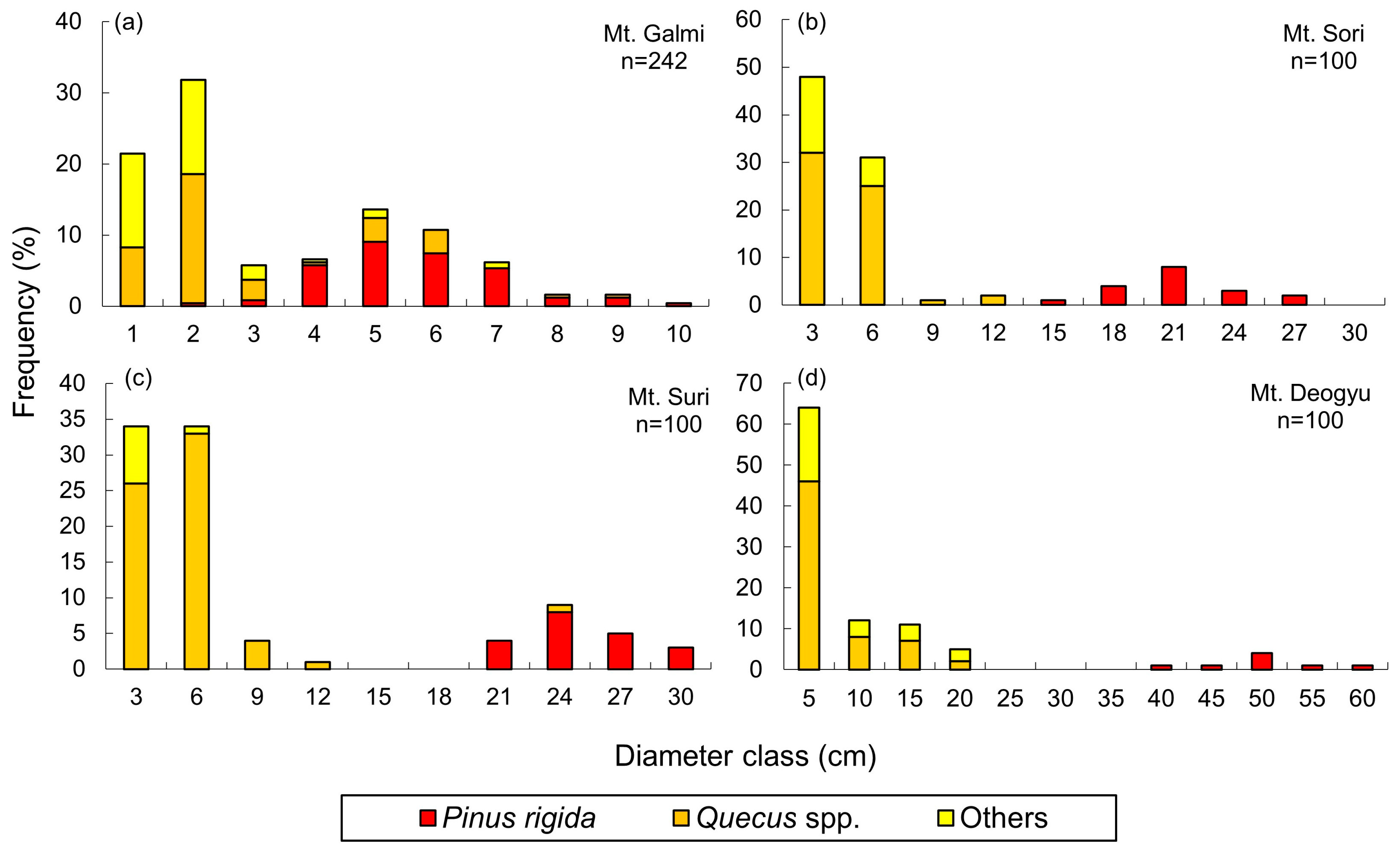
Figure 2 shows the DBH class distribution diagram prepared by investigating the major tree species in the quadrat. In the diagrams of all survey areas, P. rigida showed a normal distribution pattern in the large-diameter class, and oak trees and other tree species appeared in the understory layers of P. rigida plantations, showing a reversed J-shaped distribution centered on the small-diameter class.

3.2. Diameter Growth

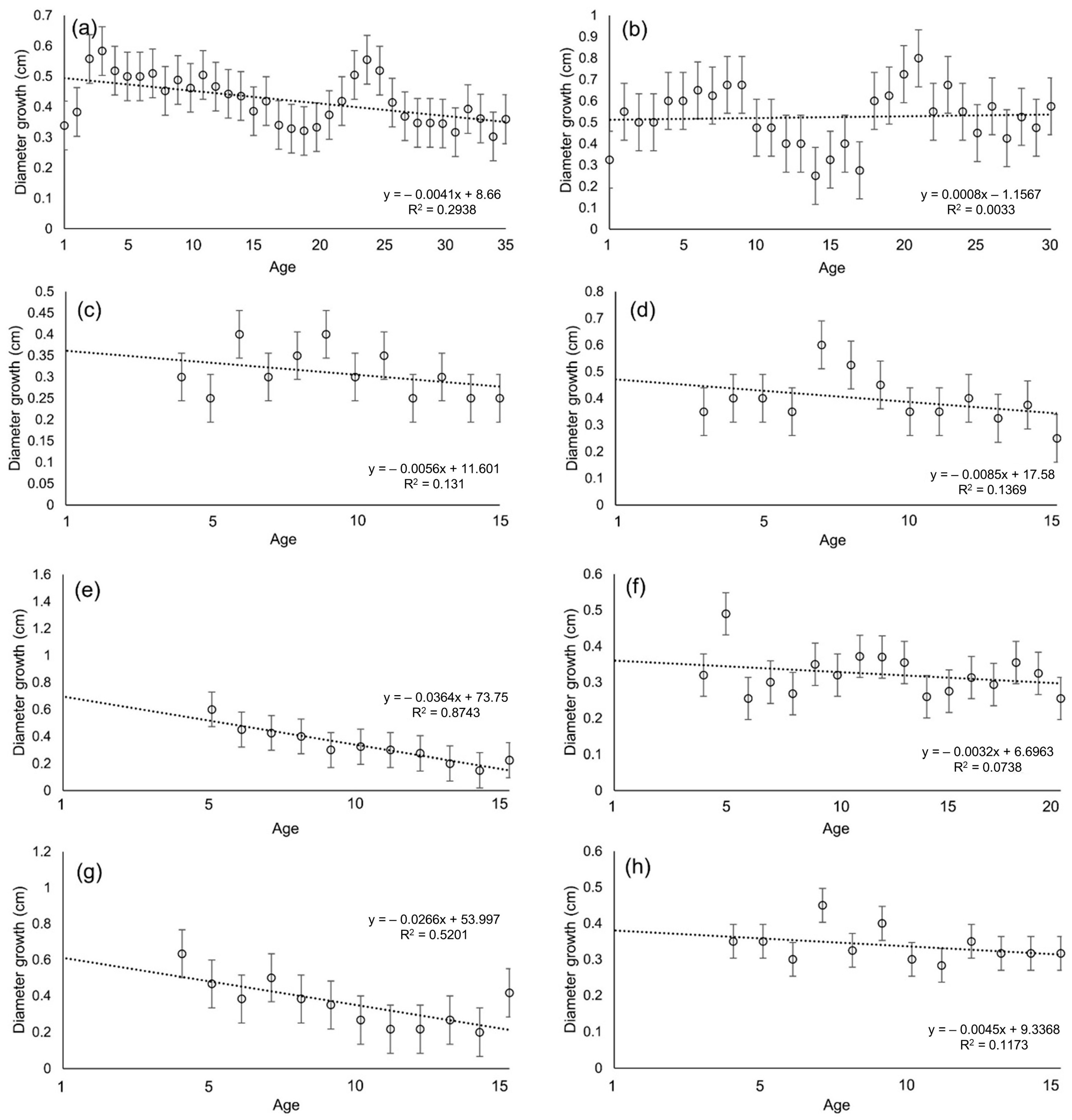
Figure 3 shows the diameter growth of major tree species measured in the P. rigida stand of Mt. Galmi. The growth of P. rigida increased until the initial four years and then continuously decreased until 20 years. The growth, which increased for about five years after 20 years, continued to decrease with increasing age thereafter. The growth of pine trees, which are 30 years old, continued to increase during the first 10 years and continued to decrease over the next 10 years. This growth pattern continued afterwards and showed a trend of repeating the increase and decrease in growth every 10 years. Oak trees and other tree species showed age within 15 years, and their growth showed a decreasing trend as age increased.

3.3. NPP of Individual Trees

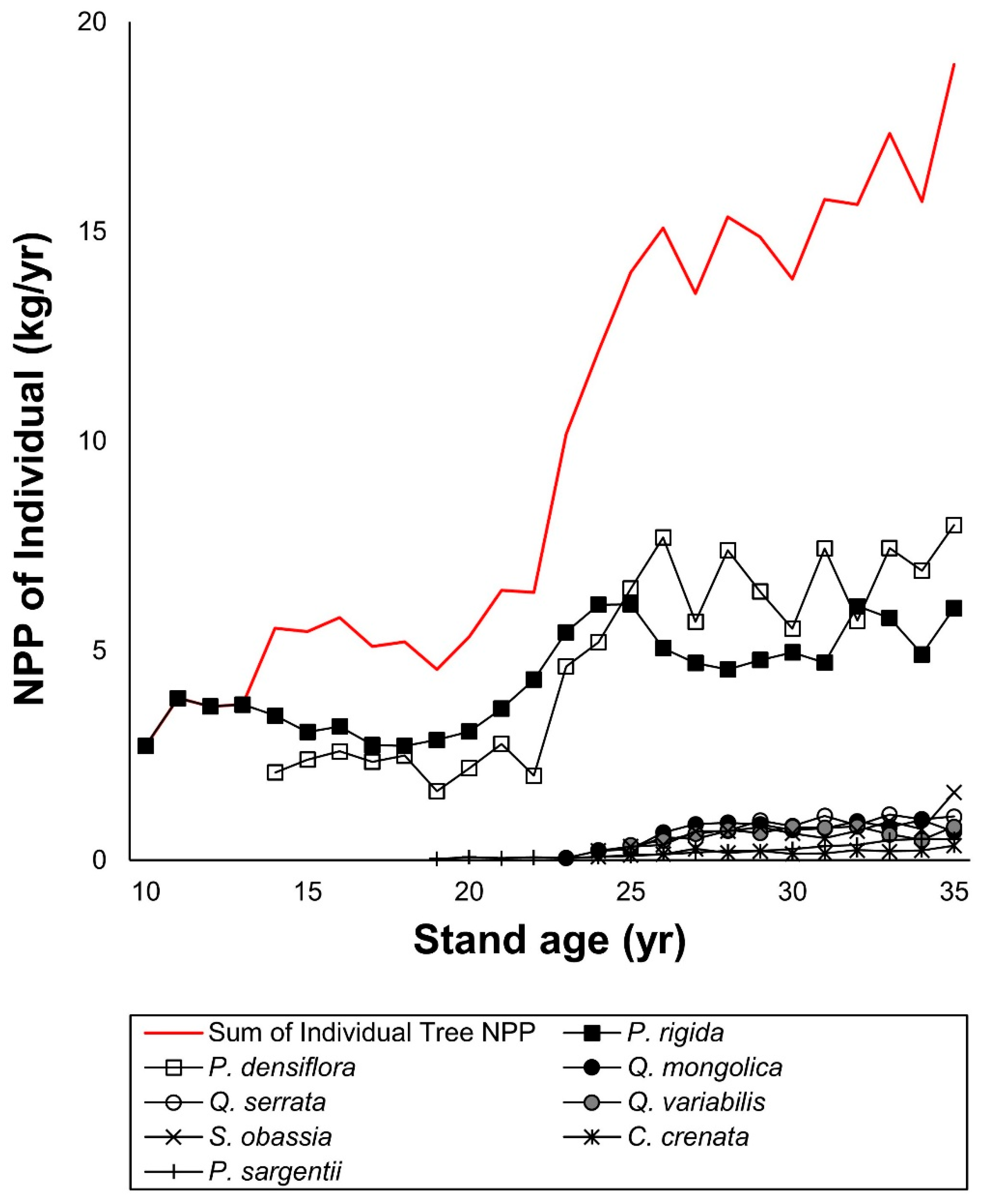
NPP of P. rigida was low under 20 years of age; however, since then, it has increased rapidly, maintaining a continuously high value after 25 years (Figure 4). NPP of P. densiflora showed a trend of change similar to that of P. rigida. Trees that make up the understory vegetation of P. rigida stands appear after 20 years of stand age, which is interpreted as a result of the understory vegetation cutting work.
As for the individual NPP, P. densiflora recorded the highest value with a mean of 4.77 kg·yr−1, and P. rigida averaged 4.31 kg·yr−1. Among the Quercus spp., the NPP of Q. serrata averaged the highest at 0.75 kg·yr−1, followed by Q. mongolica (0.66 kg·yr−1) and Q. variabilis (0.65 kg·yr−1). Meanwhile, among other species, the NPP of S. obassia, P. sargentii, and C. crenata was 0.68 kg·yr−1, 0.21 kg·yr−1, and 0.19 kg·yr−1, respectively. The NPP obtained by combining all tree species was found to be an average of 9.86 kg·yr−1. Deciduous broad-leaved trees showed lower NPPs compared to pine trees due to a lack of light reaching the forest floor as understory vegetation of P. rigida afforestation.

3.4. NPP of P. rigida Stand

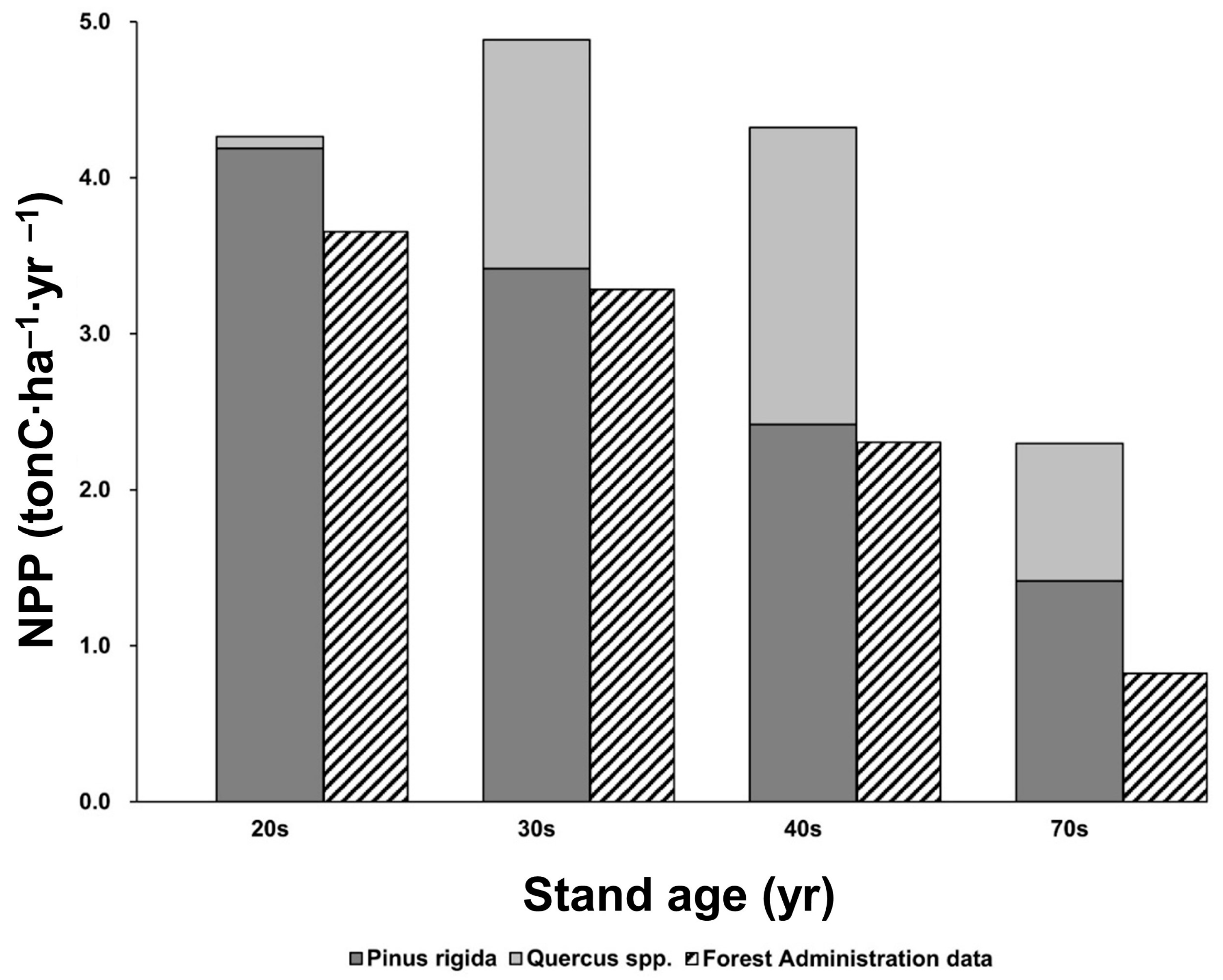
Figure 5 shows the NPP of stands obtained by multiplying the individual NPP of each tree species present in P. rigida stand by their density. In the case of Mt. Suri, where the stand age is in the 20s, the NPP of P. rigida was 4.19 tonC·ha−1·yr−1, and the NPP of other species was 0.08 tonC·ha−1·yr−1, and the stand NPP was 4.27 tonC·ha−1·yr−1. In Mt. Galmi, where the stand age is in the 30 s, the NPP of P. rigida was 3.42 tonC·ha−1·yr−1, the NPP of other species was 1.47 tonC·ha−1·yr−1, and the NPP of stand was 4.88 tonC·ha−1·yr−1. In Mt. Sori, where the stand age is in the 40 s, the NPP of P. rigida was 2.42 tonC·ha−1·yr−1, the NPP of other species was 1.90 tonC·ha−1·yr−1, and the stand NPP was 4.32 tonC·ha−1·yr−1. In Mt. Deokyu, where the stand age is in the 70 s, the NPP of P. rigida was 1.41 tonC·ha−1·yr−1, the NPP of other species was 0.89 tonC·ha−1·yr−1, and the stand NPP was 2.30 tonC·ha−1·yr−1.
As a result of comparing the data measured in this study with the existing Forest Administration data, the results of this study were higher, and such differences were found to be due to the inclusion of understory plants.

3.5. Seasonal Changes in Soil Respiration and Amount of Annual Soil Respiration

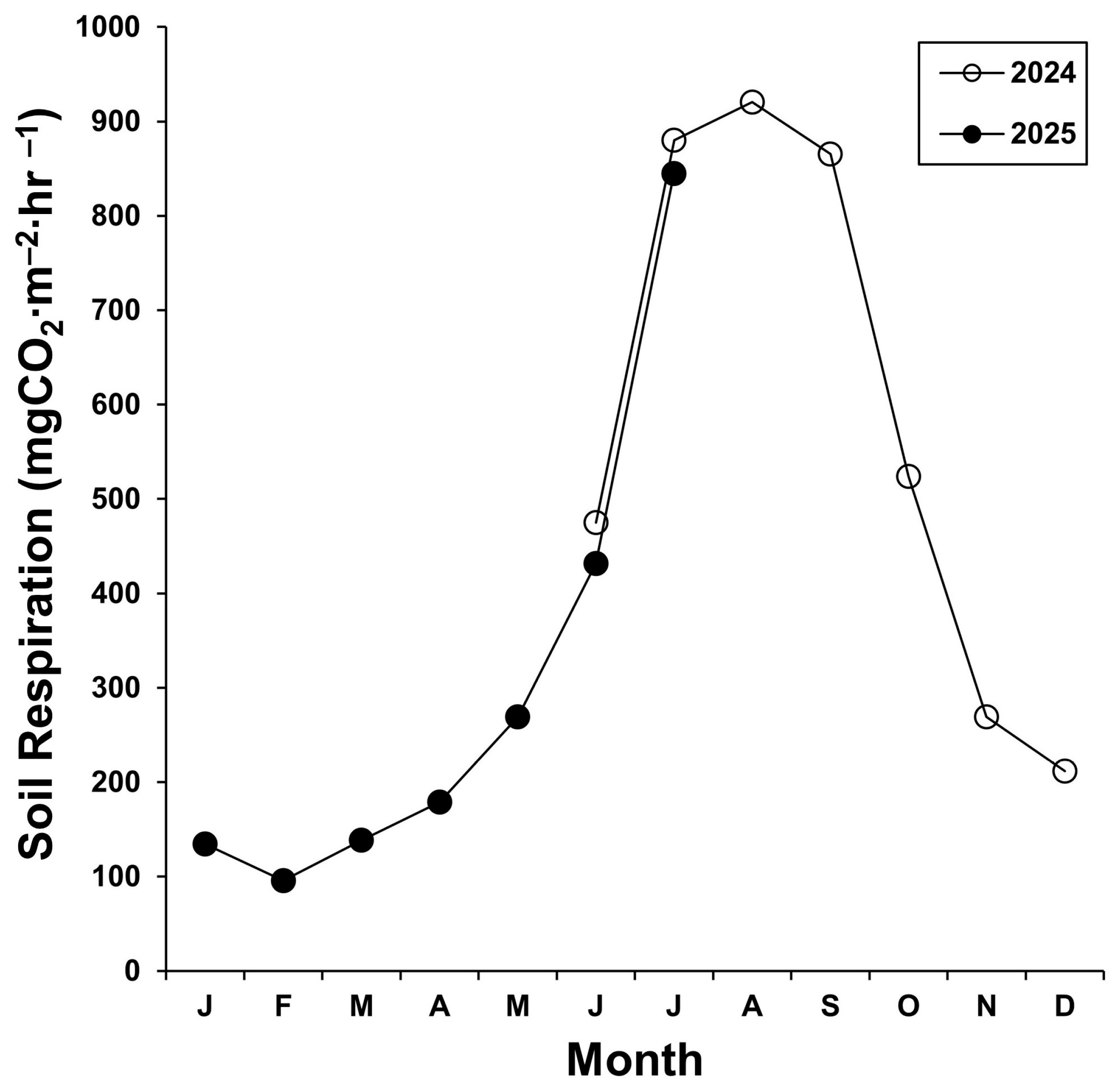
The soil respiration rate showed the typical seasonal change pattern (Figure 6). The soil respiration rate was the lowest in February and began to gradually increase, peaking in August. It then decreased until December.
The total amount of soil respiration in the P. rigida stand established on Mt. Galmi was calculated as 1.0 tonC·ha−1·yr−1, and the amount of heterotrophic respiration was 0.5 tonC·ha−1·yr−1 (Table 3).
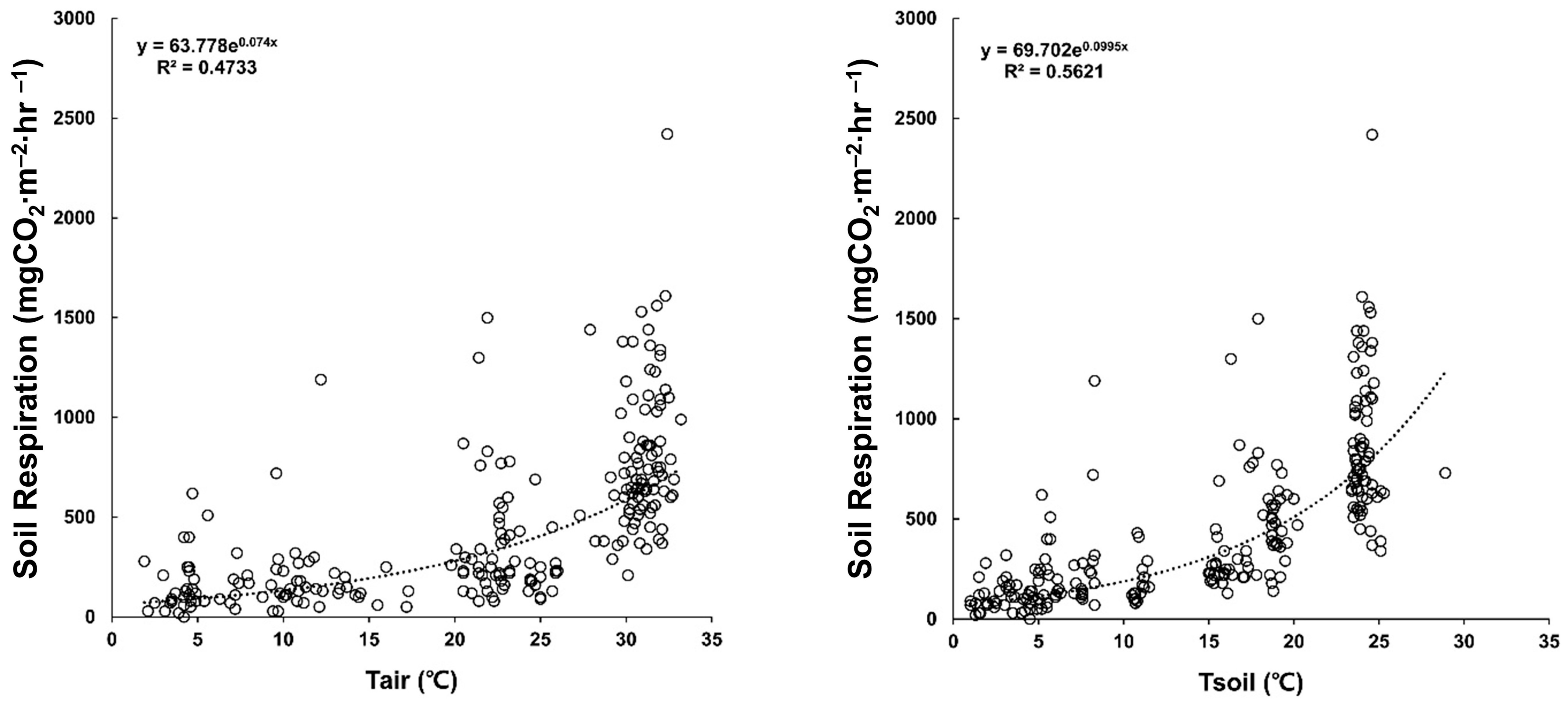
The regression equations of the exponential form were derived from the relationships between the monthly mean SR rates and the temperatures (Tair and Tsoil) observed at 1.5 m aboveground and a 5 cm soil depth for the entire study period to elucidate the dependence of SR on the temporal variabilities in temperature in the P. rigida stand (Figure 7). The regression equations were as follows: SR = 63.778 e0.074Tair (R2 = 0.47) and SR = 69.702 e0.0995Tsoil (R2 = 0.56), respectively. The optimal regression equation values (R2 = 0.56) were for Tsoil (Figure 7). That is, soil respiration correlated more closely with the temperatures at a soil depth of 5 cm than with the air temperature.
The Q10 values for the air and soil temperatures were 2.10 and 2.70, respectively (Figure 6).

3.6. NEP of P. rigida Community

The NPP obtained from the allometric equations at the Mt. Galmi site was 4.88 tonC·ha−1·yr−1. The heterotrophic respiration was 0.50 tonC·ha−1·yr−1. Hence, the NEP, calculated as the difference between the NPP and heterotrophic respiration, was 4.39 tonC·ha−1·yr−1 (Table 3).

4. Discussion

4.1. Successional Dynamics in P. rigida Plantations

Analysis of the diameter class distribution in P. rigida plantations revealed contrasting patterns between the introduced pine and naturally regenerating broadleaved species. While P. rigida populations were concentrated in larger diameter classes, indicative of aging stands with limited recruitment, oak and other broadleaved species in the understory exhibited a reverse J-shaped distribution, reflecting continuous seedling recruitment and active natural regeneration (Figure 2). At Mt. Galmi, the diameter distribution of broadleaved trees extended into medium-sized classes, suggesting progression toward canopy replacement in the near future.
These structural transitions represent more than compositional shifts; they indicate functional enhancements in stand dynamics. Multi-layered and size-diverse stands improve resource complementarity, particularly in light capture and nutrient utilization, thereby increasing the spatial efficiency of ecosystem carbon absorption [32,33,34]. Canopy openings caused by the slowing growth and partial senescence of P. rigida facilitate light penetration and improve soil moisture conditions, promoting the establishment and growth of shade-tolerant broadleaved species [35]. Collectively, these findings suggest that P. rigida plantations are entering a transitional phase from structurally simple artificial forests toward naturally layered, resilient forest systems, capable of long-term carbon storage.

4.2. Changes in NPP with the Stand Age

Analysis of net primary productivity (NPP) across P. rigida stands of different ages revealed a gradual decline in P. rigida NPP with stand age. However, total stand NPP, including broadleaved species in the understory, remained stable except in the oldest (1970s) stands. This indicates that the emergence of new functional groups compensates for the reduced productivity of aging P. rigida individuals [35,36,37].
Korea’s large-scale afforestation programs since the 1970s primarily used P. rigida, a fast-growing, light-demanding species well suited to degraded soils [7]. While these plantations successfully restored forest cover, natural succession is now evident, with native species such as Q. variabilis, Q. serrata, and Q. mongolica expanding into the understory and gradually replacing P. rigida in the canopy [3,9]. This shift marks an ecological transition from short-term carbon storage systems to more stable, long-term carbon sinks [10,11].
Many efforts are being made to increase carbon absorption capacity due to the influence of internationally required carbon neutrality. As one of them, a reduction in the logging age of afforested trees has also been proposed. However, as shown in the results of this study, even if the productivity of afforested tree species decreases as the age of afforestation increases, the increased productivity of lower vegetation compensates for this. This successional shift represents compensatory growth, in which total NPP is maintained through regeneration of broadleaved trees and enhanced litter decomposition rather than signaling a decline [15]. In this regard, it is necessary to allow the process to proceed naturally rather than artificially renewing the forest with the burden of reversing the carbon budget due to increased soil respiration and reducing biodiversity. The present findings demonstrate that natural succession in P. rigida stands supports a gradual conversion toward mixed broadleaved forests, enhancing long-term carbon absorption and ecosystem resilience without the need for intensive intervention.
However, for sites other than Mt. Galmi, NPP values may differ from actual condi tions because they were indirectly estimated by applying individual-tree NPP from Mt. Galmi to the species-specific stem densities at each site. Nevertheless, the patterns suggest that although the productivity of the original plantation species declines with age, successional recruitment of other species compensates for this loss, maintaining overall stand-level productivity.
Meanwhile, Mt. Deokyu—now more than 70 years old—showed markedly lower productivity than the younger plantations. This reduced NPP is consistent with its advanced successional status, as the stand’s species composition closely resembles that of late-successional broad-leaved forests, which are generally less productive than early-successional stands such as P. rigida plantations [38].
As a result of comparing the NPP, Rh, and NEP obtained in this study with the values of several species obtained from various countries around the world, the values were generally lower. However, the results obtained from Larix kaempferi forest, Q. serrata forest, and P. deniflora forest in Japan were very similar to the results of this study (Table 4).

4.3. Ecological Challenge to Achieve Carbon Neutrality

Carbon neutrality refers to achieving net-zero carbon dioxide emissions by balancing emissions with equivalent carbon absorption. This concept emerged from the urgent need to address climate change, as excessive carbon emissions have surpassed the Earth’s natural absorption capacity, threatening the long-term sustainability of global ecosystems [43,44].
The international community has identified the overuse of fossil fuels and unsustainable land use as the primary drivers of climate change [45,46]. While mitigation strategies have largely focused on reducing greenhouse gas emissions through the adoption of renewable energy, increasing attention has recently been directed toward the role of land use in the global carbon cycle. Initiatives such as Nature-based Solutions [47], the UN Decade on Ecosystem Restoration [48], and the Glasgow Leaders’ Declaration on Forests and Land Use adopted at COP26 in 2021 emphasize forest conservation and land restoration as key pathways to carbon neutrality [49].
Climate change arises not only from greenhouse gas accumulation but also from the enhanced trapping of longwave radiation, which intensifies global warming. Therefore, achieving carbon neutrality requires an integrated approach that considers both emission reduction and land-based carbon absorption [46,50]. Many researchers highlight the significant impact of land use change, particularly urbanization, on regional warming, with some estimating that the thermal effects of urban expansion can be comparable to those of a doubling of atmospheric CO2 concentrations [49,51].

4.4. Measures to Enhance Carbon Absorption Capacity

The carbon absorption capacity of forests can be strengthened by facilitating natural succession in aging plantations toward communities dominated by native species adapted to local environments. In Korea, P. rigida, an exotic species introduced for large-scale afforestation in the 1970s, is gradually giving way to native broadleaved trees such as Q. serrata, Q. mongolica, and Q. variabilis that are regenerating in the understory. This transition represents a natural pathway toward improved ecological stability and enhanced long-term carbon sequestration [9].
However, complete removal of existing stands for replanting is not an effective strategy. Large-scale clear-cutting raises soil temperatures and accelerates decomposition of organic matter, releasing substantial amounts of CO2 and potentially converting forests into temporary emission sources [52]. Life-cycle assessments indicate that abrupt stand replacement can worsen the carbon balance in the short term. Consequently, gradual, succession-based conversion—rather than full reforestation—should be prioritized to maintain ecosystem integrity and carbon retention.
Such approaches must be limited to existing afforested areas, with species composition determined by ecological suitability and site-specific conditions. In Korea, most plantations are situated on mid-slope terrain; thus, conversion should align with the site’s potential natural vegetation and restoration ecology principles. Encouraging the growth of already established native understory plants, combined with selective thinning or gap creation that mimics natural canopy openings, can accelerate regeneration and improve vertical forest structure [53,54,55].
Where active planting is required, native species such as Q. aliena, Q. serrata, Q. variabilis, or Q. acutissima should be used to ensure ecological compatibility and long-term carbon stability. Replacing exotic species with native ones enhances both biodiversity and resilience, enabling forests to function as more stable carbon sinks [56].
The degradation or loss of forest cover intensifies regional warming and disrupts the carbon budget [39,57]. Recognizing these risks, the United Nations Decade on Ecosystem Restoration (2021–2030) promotes global reforestation and land restoration efforts. Its target of restoring 350 million ha of degraded land could remove 13–26 Gt of greenhouse gases while providing significant ecological and economic benefits [44]. These initiatives highlight that nature-based, successional forest management is an essential and sustainable pathway toward achieving global carbon neutrality.

5. Conclusions

This study demonstrates that carbon assessments limited to the tree layer substantially underestimate stand-level carbon dynamics in P. rigida plantations. By explicitly incorporating understory vegetation into carbon accounting, we provide a novel contribution: understory strata play a significant role in total carbon absorption, resulting in higher stand-level sequestration than commonly reported for P. rigida forests. Notably, carbon absorption remained stable across stand ages, indicating that natural succession—from pine-dominated stands to mixed broadleaved forests—can sustain or even enhance sequestration despite declining productivity in mature pines. Our results also suggest that thinning interventions that prevent excessive surface-temperature increases may further facilitate successional progress. Moreover, future afforestation should shift toward ecologically based approaches that draw on reference ecosystem information to simultaneously support biodiversity conservation and maximize ecosystem services.
These findings underscore the value of promoting understory regeneration, canopy turnover, and structural diversification as nature-based strategies for maintaining long-term carbon sinks. They also highlight the potential for aging plantations to contribute meaningfully to carbon-neutrality goals when managed to encourage structural complexity and native-species recruitment, in alignment with global ecosystem restoration frameworks.
Future research should build on these insights by quantifying species-specific contri butions of understory functional groups, incorporating direct measurements of carbon fractions, and monitoring long-term successional trajectories through repeated field surveys or remote-sensing observations. Integrating physiological, microclimatic, and soil carbon processes will further refine carbon-budget estimates and advance our understanding of how regenerating plantations function as resilient carbon sinks under changing environmental conditions.

Author Contributions

Conceptualization, C.S.L.; methodology, B.S.L., J.S., S.J.J. and C.S.L.; software, B.S.L., J.S., G.T.K. and C.S.L.; validation, S.J.J. and C.S.L.; formal analysis, J.S., G.T.K. and C.S.L.; investigation, B.S.L., J.S., S.J.J. and C.S.L.; resources, C.S.L.; data curation, C.S.L.; writing—original draft preparation, C.S.L.; writing—review and editing, S.J.J. and C.S.L.; visualization, S.J.J. and C.S.L.; supervision, C.S.L.; project administration, C.S.L.; funding acquisition, C.S.L. All authors have read and agreed to the published version of the manuscript.

Funding

This study was supported by the R&D Program for Forest Science Technology (Project No. RS-2024-00402171) funded by Korea Forest Service (Korea Forestry Promotion Institute).

Institutional Review Board Statement

Not applicable.

Informed Consent Statement

Not applicable.

Data Availability Statement

The data are included in the manuscript.

Conflicts of Interest

The authors declare no conflicts of interest.

References

  1. Geng, Q.; Arif, M.; Yin, F.; Chen, Y.; Gao, J.; Liu, J.; Liu, X.; He, X.; Wu, Y.; Zheng, J. Characteristics of Forest Understory Herbaceous Vegetation and Its Influencing Factors in Biodiversity Hotspots in China. Ecol. Indic. 2024, 167, 112634. [Google Scholar] [CrossRef]
  2. Zhu, S.; Wang, R.; Wang, Q.; Lei, T.; Cui, G. Coniferous and Broad-Leaved Mixed Forest Has the Optimal Forest Therapy Environment among Stand Types in Xinjiang. Ecol. Indic. 2024, 169, 112950. [Google Scholar] [CrossRef]
  3. Han, S.H.; Park, B.B. Comparison of Allometric Equation and Destructive Measurement of Carbon Storage of Naturally Regenerated Understory in a Pinus Rigida Plantation in South Korea. Forests 2020, 11, 425. [Google Scholar] [CrossRef]
  4. Sheikh, M.A.; Tiwari, A.; Anjum, J.; Sharma, S. Dynamics of Carbon Storage and Status of Standing Vegetation in Temperate Coniferous Forest Ecosystem of North Western Himalaya India. Vegetos 2021, 34, 822–833. [Google Scholar] [CrossRef]
  5. FAO. Forestry for a Low Carbon Future: Integrating Forests and Wood Products in Climate Change Strategies; FAO Forestry Paper. No. 177; FAO: Rome, Italy, 2016. [Google Scholar]
  6. Brack, D. Forests and Climate Change; United Nations Forum on Forests: New York, NY, USA, 2019. [Google Scholar]
  7. KFS. Development of Greenhouse Gas Inventory System in forest sector of for Post-2012 Climate Regime; National Institute of Forest Science: Seoul, Republic of Korea, 2013.
  8. Gucker, C.L. Pinus rigida; USDA Forest Service, Rocky Mountain Research Station, Fire Sciences Laboratory: Missoula, MT, USA, 2007.
  9. Lee, H.; An, J.H.; Shin, H.C.; Lee, C.S. Assessment of Restoration Effects and Invasive Potential Based on Vegetation Dynamics of Pitch Pine (Pinus rigida Mill.) Plantation in Korea. Forests 2020, 11, 568. [Google Scholar] [CrossRef]
  10. Swank, W.T.; Knoepp, J.D.; Vose, J.M.; Laseter, S.N.; Webster, J.R. Response and Recovery of Water Yield and Timing, Stream Sediment, Abiotic Parameters, and Stream Chemistry Following Logging. In Long-Term Response of a Forest Watershed Ecosystem: Clearcutting in the Southern Appalachians; Swank, W.T., Webster, J.R., Eds.; Oxford University Press: Oxford, UK, 2014; pp. 36–56. ISBN 978-0-19-537015-7. [Google Scholar]
  11. Anyomi, K.A.; Neary, B.; Chen, J.; Mayor, S.J. A Critical Review of Successional Dynamics in Boreal Forests of North America. Environ. Rev. 2022, 30, 563–594. [Google Scholar] [CrossRef]
  12. Deng, J.; Fang, S.; Fang, X.; Jin, Y.; Kuang, Y.; Lin, F.; Liu, J.; Ma, J.; Nie, Y.; Ouyang, S. Forest Understory Vegetation Study: Current Status and Future Trends. For. Res. 2023, 3, 6. [Google Scholar] [CrossRef]
  13. Ma, T.; Zhang, C.; Ji, L.; Zuo, Z.; Beckline, M.; Hu, Y.; Li, X.; Xiao, X. Development of Forest Aboveground Biomass Estimation, Its Problems and Future Solutions: A Review. Ecol. Indic. 2024, 159, 111653. [Google Scholar] [CrossRef]
  14. Li, T.; Phillips, R.P.; Rillig, M.C.; Angst, G.; Kiers, E.T.; Bonfante, P.; Eisenhauer, N.; Liu, Z. Mycorrhizal Allies: Synergizing Forest Carbon and Multifunctional Restoration. Trends Ecol. Evol. 2025, 40, 983–994. [Google Scholar] [CrossRef]
  15. Li, C.; Barclay, H.; Roitberg, B.; Lalonde, R. Forest Productivity Enhancement and Compensatory Growth: A Review and Synthesis. Front. Plant Sci. 2020, 11, 575211. [Google Scholar] [CrossRef]
  16. Desport, L. Implementation of Carbon Capture Utilization and Storage in Global Socio-Techno-Economic Models: Long-Term Optimization of the Energy System and Industry Decarbonization. Ph.D. Thesis, Université Paris Sciences et Lettres, Paris, France, 2023. [Google Scholar]
  17. Sasaki, N. Timber Production and Carbon Emission Reductions through Improved Forest Management and Substitution of Fossil Fuels with Wood Biomass. Resour. Conserv. Recycl. 2021, 173, 105737. [Google Scholar] [CrossRef]
  18. Chave, J.; Réjou-Méchain, M.; Búrquez, A.; Chidumayo, E.; Colgan, M.S.; Delitti, W.B.; Duque, A.; Eid, T.; Fearnside, P.M.; Goodman, R.C. Improved Allometric Models to Estimate the Aboveground Biomass of Tropical Trees. Glob. Change Biol. 2014, 20, 3177–3190. [Google Scholar] [CrossRef]
  19. Khan, I.A.; Khan, W.R.; Ali, A.; Nazre, M. Assessment of Above-Ground Biomass in Pakistan Forest Ecosystem’s Carbon Pool: A Review. Forests 2021, 12, 586. [Google Scholar] [CrossRef]
  20. Gilliam, F.S. The Ecological Significance of the Herbaceous Layer in Temperate Forest Ecosystems. BioScience 2007, 57, 845–858. [Google Scholar] [CrossRef]
  21. Toivonen, J.; Kangas, A.; Maltamo, M.; Kukkonen, M.; Packalen, P. Assessing Biodiversity Using Forest Structure Indicators Based on Airborne Laser Scanning Data. For. Ecol. Manag. 2023, 546, 121376. [Google Scholar] [CrossRef]
  22. Anderson-Teixeira, K.J.; Davies, S.J.; Bennett, A.C.; Gonzalez-Akre, E.B.; Muller-Landau, H.C.; Joseph Wright, S.; Abu Salim, K.; Almeyda Zambrano, A.M.; Alonso, A.; Baltzer, J.L.; et al. CTFS-ForestGEO: A Worldwide Network Monitoring Forests in an Era of Global Change. Glob. Change Biol. 2015, 21, 528–549. [Google Scholar] [CrossRef]
  23. Wilkes, P.; Lau, A.; Disney, M.; Calders, K.; Burt, A.; Gonzalez de Tanago, J.; Bartholomeus, H.; Brede, B.; Herold, M. Data Acquisition Considerations for Terrestrial Laser Scanning of Forest Plots. Remote Sens. Environ. 2017, 196, 140–153. [Google Scholar] [CrossRef]
  24. Lee, C.-S.; Robinson, G.R.; Robinson, I.P.; Lee, H. Regeneration of Pitch Pine (Pinus rigida) Stands Inhibited by Fire Suppression in Albany Pine Bush Preserve, New York. J. For. Res. 2019, 30, 233–242. [Google Scholar] [CrossRef]
  25. Lim, C.H.; An, J.H.; Jung, S.H.; Lee, C.S. Allogenic Succession of Korean Fir (Abies koreana Wils.) Forests in Different Climate Condition. Ecol. Res. 2018, 33, 327–340. [Google Scholar] [CrossRef]
  26. Son, Y.; Kim, R.; Lee, K.; Pyo, J.; Kim, S.; Hwang, J.; Lee, S.; Park, H. Carbon Emission Factors and Biomass Allometric Equations by Species in Korea; Korea Forest Research Institute Report; National Institute of Forest Science: Seoul, Republic of Korea, 2014; pp. 14–18.
  27. Kim, S.C. Effect of Vegetation on the Soil Erosion After Forest Fire, Korea. Master’s Thesis, Gangneung-Wonju National University, Gangneung, Republic of Korea, 2003. [Google Scholar]
  28. Lee, K.-S.; Choung, Y.-S.; Kim, S.-C.; Shin, S.-S.; Noh, C.-H.; Park, S.-D. Development of Vegetation Structure after Forest Fire in the East Coastal Region, Korea. Korean J. Ecol. 2004, 27, 99–106. [Google Scholar] [CrossRef]
  29. IPCC. Guidelines for National Greenhouse Gas Inventories; Intergovernmental Panel on Climate Change: Cambridge, UK, 2006. [Google Scholar]
  30. Raich, J.W.; Tufekciogul, A. Vegetation and Soil Respiration: Correlations and Controls. Biogeochemistry 2000, 48, 71–90. [Google Scholar] [CrossRef]
  31. Lee, M.-S. Method for Assessing Forest Carbon Sinks by Ecological Process-Based Approach-a Case Study for Takayama Station, Japan. Korean J. Ecol. 2003, 26, 289–296. [Google Scholar] [CrossRef]
  32. Pretzsch, H.; Zenner, E.K. Toward Managing Mixed-Species Stands: From Parametrization to Prescription. For. Ecosyst. 2017, 4, 19. [Google Scholar] [CrossRef]
  33. LaRue, E.A.; Knott, J.A.; Domke, G.M.; Chen, H.Y.; Guo, Q.; Hisano, M.; Oswalt, C.; Oswalt, S.; Kong, N.; Potter, K.M.; et al. Structural Diversity as a Reliable and Novel Predictor for Ecosystem Productivity. Front. Ecol. Environ. 2023, 21, 33–39. [Google Scholar] [CrossRef]
  34. Zhai, L.; Will, R.E.; Zhang, B. Structural Diversity Is Better Associated with Forest Productivity than Species or Functional Diversity. Ecology 2024, 105, e4269. [Google Scholar] [CrossRef] [PubMed]
  35. Tang, T.; Zhang, N.; Bongers, F.J.; Staab, M.; Schuldt, A.; Fornoff, F.; Lin, H.; Cavender-Bares, J.; Hipp, A.L.; Li, S. Tree Species and Genetic Diversity Increase Productivity via Functional Diversity and Trophic Feedbacks. eLife 2022, 11, e78703. [Google Scholar] [CrossRef] [PubMed]
  36. Yan, H.; Schmid, B.; Xu, W.; Bongers, F.J.; Chen, G.; Tang, T.; Wang, Z.; Svenning, J.; Ma, K.; Liu, X. The Functional Diversity–Productivity Relationship of Woody Plants Is Climatically Sensitive. Ecol. Evol. 2024, 14, e11364. [Google Scholar] [CrossRef]
  37. Chen, X.; Reich, P.B.; Taylor, A.R.; An, Z.; Chang, S.X. Resource Availability Enhances Positive Tree Functional Diversity Effects on Carbon and Nitrogen Accrual in Natural Forests. Nat. Commun. 2024, 15, 8615. [Google Scholar] [CrossRef] [PubMed]
  38. Ohtsuka, T.; Yoshitake, S.; Yashiro, Y.; Shizu, Y.; Iimura, Y.; Yimatsa, N.; Kondo, M.; Adachi, M.; Chen, S.; Cao, R. Changes in Stand Biomass Accumulation and Wood NPP during Secondary Succession: Insights from a 23-Year Study of Forest Dynamics in a Cool-Temperate Secondary Deciduous Forest. Plant Ecol. 2025, 226, 895–906. [Google Scholar] [CrossRef]
  39. Kim, G.S.; Kim, A.R.; Lim, B.S.; Seol, J.; An, J.H.; Lim, C.H.; Joo, S.J.; Lee, C.S. Assessment of the Carbon Budget of Local Governments in South Korea. Atmosphere 2022, 13, 342. [Google Scholar] [CrossRef]
  40. Tomotsune, M.; Suzuki, Y.; Kato, Y.; Masuda, R.; Suminokura, N.; Koyama, Y.; Sakamaki, Y.; Koizumi, H. Comparison of Carbon Dynamics among Three Cool-Temperate Forests (Quercus Serrata, Larix Kaempferi and Pinus Densiflora) under the Same Climate Conditions in Japan. J. Environ. Prot. 2019, 10, 929–941. [Google Scholar] [CrossRef]
  41. Becknell, J.M.; Vargas G, G.; Pérez-Aviles, D.; Medvigy, D.; Powers, J.S. Above-ground Net Primary Productivity in Regenerating Seasonally Dry Tropical Forest: Contributions of Rainfall, Forest Age and Soil. J. Ecol. 2021, 109, 3903–3915. [Google Scholar] [CrossRef]
  42. Lee, D.K.; Kwon, K.-C. Biomass and Annual Net Production of Quercus Mongolica Stands in Pyungchang and Jecheon Areas. J. Korean For. Soc. 2006, 95, 309–315. [Google Scholar]
  43. The Paris Agreement|UNFCCC. Available online: https://unfccc.int/process-and-meetings/the-paris-agreement (accessed on 14 August 2024).
  44. United Nations General Assembly, 2015. Available online: https://www.gov.uk/government/topical-events/united-nations-general-assembly-2015 (accessed on 26 October 2025).
  45. Schimel, D.S. Terrestrial Ecosystems and the Carbon Cycle. Glob. Change Biol. 1995, 1, 77–91. [Google Scholar] [CrossRef]
  46. Barati, A.A.; Zhoolideh, M.; Azadi, H.; Lee, J.-H.; Scheffran, J. Interactions of Land-Use Cover and Climate Change at Global Level: How to Mitigate the Environmental Risks and Warming Effects. Ecol. Indic. 2023, 146, 109829. [Google Scholar] [CrossRef]
  47. IUCN. International Union for Conservation of Nature Annual Report 2016; IUCN: Gland, Switzerland, 2016. [Google Scholar]
  48. UNEP; FAO. The UN Decade on Ecosystem Restoration 2021–2030; UNEP: Nairobi, Kenya; FAO: Rome, Italy, 2020. [Google Scholar]
  49. Lee, C.-S.; Kim, D.-U.; Lim, B.-S.; Seok, J.-E.; Kim, G.-S. Vegetation Succession for 12 Years in a Pond Created Restoratively. Biology 2024, 13, 820. [Google Scholar] [CrossRef] [PubMed]
  50. Lee, S.-J.; Lee, C.-M.; Yang, S.-A.; Jung, H.-J.; Lee, J.-M.; Min, Y.-G.; Kim, J.-W.; Myung, H.-H.; Park, H.-C. Estimation of Soil Microbiological Respiration Volume in Forest Ecosystem in the Sobaeksan National Park of Korea. J. Korean Soc. Environ. Restor. Technol. 2023, 26, 19–28. [Google Scholar] [CrossRef]
  51. McCarthy, M.P.; Best, M.J.; Betts, R.A. Climate Change in Cities Due to Global Warming and Urban Effects. Geophys. Res. Lett. 2010, 37, 1–5. [Google Scholar] [CrossRef]
  52. Kim, G.S.; Joo, S.J.; Lee, C.S. Seasonal Variation of Soil Respiration in the Mongolian Oak (Quercus mongolica Fisch. Ex Ledeb.) Forests at the Cool Temperate Zone in Korea. Forests 2020, 11, 984. [Google Scholar] [CrossRef]
  53. Lee, C.S. Disturbance Regime of the Pinus Densiflora Forest in Korea. J. Ecol. Environ. 1995, 18, 179–188. [Google Scholar]
  54. Lee, C.S. Regeneration Process after Disturbance of the Pinus Densiflora Forest in Korea. J. Ecol. Environ. 1995, 18, 189–201. [Google Scholar]
  55. Lee, C.S.; Chun, Y.M.; Lee, H.; Pi, J.H.; Lim, C.H. Establishment, Regeneration, and Succession of Korean Red Pine (Pinus densiflora S. et Z.) Forest in Korea; IntechOpen: London, UK, 2018; ISBN 1-78984-801-6. [Google Scholar]
  56. An, Y.; Gao, Y.; Tong, S. Emergence and Growth Performance of Bolboschoenus planiculmis Varied in Response to Water Level and Soil Planting Depth: Implications for Wetland Restoration Using Tuber Transplantation. Aquat. Bot. 2018, 148, 10–14. [Google Scholar] [CrossRef]
  57. Lim, C.H.; Pi, J.H.; Kim, A.R.; Cho, H.J.; Lee, K.S.; You, Y.H.; Lee, K.H.; Kim, K.D.; Moon, J.S.; Lee, C.S. Diagnostic Evaluation and Preparation of the Reference Information for River Restoration in South Korea. Int. J. Environ. Res. Public Health 2021, 18, 1724. [Google Scholar] [CrossRef] [PubMed]
Figure 1. A map showing the study sites.
Forests 16 01860 g001
Figure 2. Diameter class distribution diagram of the tree species in P. rigida stands of the survey sites. (a) Mt. Galmi, (b) Mt. Sori, (c) Mt. Suri, (d) Mt. Deogyu. n-numbers indicate the number of individuals investigated.
Forests 16 01860 g002
Figure 3. Changes in annual diameter growth of tree species with increasing age in P. rigida stand of Mt. Galmi. The dashed lines indicate the trend lines. (a) P. rigida, (b) P. densiflora, (c) Q. serrata, (d) Q. mongolica, (e) Q. variabilis, (f) P. sargentii, (g) S. obassia, (h) C. crenata.
Forests 16 01860 g003
Figure 4. Changes in the NPP of tree species with increasing age in P. rigida stand of Mt. Galmi.
Forests 16 01860 g004
Figure 5. A comparison of NPP among P. rigida stands with different stand ages.
Forests 16 01860 g005
Figure 6. Seasonal variation in monthly mean soil respiration in P. rigida stands established on Mt. Galmi. The numbers on the graph represent the measurement years.
Forests 16 01860 g006
Figure 7. Scatter plots of observed soil respiration (SR) vs. temperatures (°C) measured in air (1.5 m height) and soil (5 cm depth) for P. rigida on Mt. Galmi. The circles are observed data. Q10 = 2.10 and 2.70, respectively, for air and soil temperatures. The dashed lines indicate the trend lines.
Forests 16 01860 g007
Table 1. Stand ages and environmental conditions of P. rigida plantations studied.
Study SiteStand Age (Years)AspectElevation (m)Slope (°)Mean
Temperature (°C)
Mean
Precipitation (mm)
Parent RockSoil
Mt. Galmi35W1502012.51292.6MetamorphicBrown forest
Mt. Sori43NE1542011.71383.6MetamorphicBrown forest
Mt. Suri26S561513.31327.6MetamorphicBrown forest
Mt. Deogyu76S7132011.61105.3GraniteBrown forest
Table 2. Allometric equations of plant species used for NPP calculation in this study.
SpeciesEquationReference
Pinus rigidaStemY(kg) = 0.22D2.116[26]
BranchY(kg) = 0.004D2.814
LeafY(kg) = 0.003D2.784
RootY(kg) = 0.063D2.285
Pinus densifloraStemY(kg) = 0.235D2.071
BranchY(kg) = 0.004D2.748
LeafY(kg) = 0.054D1.561
RootY(kg) = 0.031D2.279
Quercus serrataStemY(kg) = 0.177D2.195
BranchY(kg) = 0.003D3.265
LeafY(kg) = 0.002D2.713
RootY(kg) = 0.4D1.676
Quercus variabilisStemY(kg) = 0.186D2.184
BranchY(kg) = 0.035D2.293
LeafY(kg) = 0.61D2.456
RootY(kg) = 0.077D2.199
Quercus mongolicaStemY(kg) = 0.595D1.766
BranchY(kg) = 0.007D2.970
LeafY(kg) = 0.052D3.262
RootY(kg) = 0.691D1.526
Castanea crenataStemY(kg) = 0.0003D4.217
BranchY(kg) = 0.010D3.006
LeafY(kg) = 0.261D1.199
RootY(kg) = 0.130D2.159
Prunus sargentiiY(kg) = 0.3421D2.1813[27,28]
Styrax obassiaY(kg) = 0.1412D2.4976
Table 3. The net primary productivity (NPP), heterotrophic respiration, and net ecosystem production (NEP) measured in the Pinus rigida stand established on Mt. Galmi.
SiteNPP
(tonC·ha−1·yr−1)
Heterotrophic Respiration
(tonC·ha−1·yr−1)
NEP
(tonC·ha−1·yr−1)
Mt. Galmi4.880.504.39
Table 4. A comparison of NPP, heterotrophic respiration, and NEP obtained from this study with those from previous studies (Unit: ton C ha−1 yr−1).
CommunityCountryNPPHeterotrophic
Respiration
NEPReference
P. rigidaKorea4.27 (20 s)0.504.39Current study
4.88 (30 s)
4.32 (40 s)
2.30 (70 s)
P. rigidaKorea7.24.92.3[39]
8.64.64.0
P. densifloraKorea6.44.12.3[39]
9.46.72.7
Japan7.3 ± 0.74.2 ± 3.12.9 ± 3.2[38]
5.32.13.2[40]
Quercus spp.Costa Rica7.8 [41]
Q. acutissimaKorea12.44.87.6[39]
9.64.45.2
Q. mongolicaKorea6.94.72.2[39]
8.7--[42]
7.1--
10.6--
Q. serrataJapan4.64.10.5[40]
Larix kaempferiKorea7.13.14.0[39]
Japan3.22.30.9[40]
Disclaimer/Publisher’s Note: The statements, opinions and data contained in all publications are solely those of the individual author(s) and contributor(s) and not of MDPI and/or the editor(s). MDPI and/or the editor(s) disclaim responsibility for any injury to people or property resulting from any ideas, methods, instructions or products referred to in the content.