Article

Phyllosphere Fungal Diversity and Community in Pinus sylvestris Progeny Trials and Its Heritability Among Plus Tree Families

Institute of Forestry and Engineering, Estonian University of Life Sciences, F.R. Kreutzwaldi 5, 51006 Tartu, Estonia
*
Author to whom correspondence should be addressed.
Forests 2025, 16(12), 1859; https://doi.org/10.3390/f16121859
Submission received: 19 September 2025 / Revised: 4 December 2025 / Accepted: 9 December 2025 / Published: 16 December 2025
(This article belongs to the Special Issue Biodiversity Patterns and Ecosystem Functions in Forests)

Abstract

Scots pine (Pinus sylvestris L.) is a key species in boreal forests, valued both economically and ecologically, in part due to its associations with foliar fungi. These fungi influence plant health, nutrient cycling, and resistance induction. To investigate these interactions, we collected 1367 needle and shoot samples across 12 plus tree genotypes grown in 4 progeny trials in Estonia. Amplifying the ITS1-5.8S-ITS2 gene region, we obtained over 1.3 million high-quality sequences and identified 1261 fungal OTUs at the 98% species hypothesis level. Among the identified OTUs, 24.6% were classified as saprotrophic and 18.2% as pathogenic fungi. Fungal diversity varied significantly between tree tissue types, progeny trial locations, and plus tree origins. Fungal community composition varied across tissue types, with older needles tending to harbor more complex communities. Plus trees 593 and 267-1 progenies stood out for their high phyllosphere fungal richness, and genotype-specific correlations indicated associations between fungal diversity and tree height or needle retention, suggesting potential genotype-dependent effects on tree performance. Heritability of fungal diversity between ramets in seed orchard and progeny trees was found for saprotrophic fungi but was negligible for total fungi and pathogens, indicating strong influence of microclimate conditions. These findings underscore the potential value of integrating fungal community traits into Scots pine breeding programs. Considering microbial associations alongside traditional growth traits may help identify genotypes better suited for future forestry needs under changing environmental conditions. Additionally, Setomelanomma holmii is reported here as a new fungal pathogen on Scots pine shoots in Estonia.

1. Introduction

Microorganisms (fungi, bacteria, archaea, protists and viruses) inhabit the phyllosphere and rhizosphere and play essential roles in forest ecosystems. Through their interactions with plants and each other, they can influence ecosystem functionality and composition [1,2]. Forests not only underpin national biodiversity and economies but also serve as important soil carbon sinks [1,2,3]. Scots pine (Pinus sylvestris L.) is one of the most important and widely distributed timber tree species in Europe and Asia [4], thriving across boreal, temperate and Mediterranean climates [5,6,7]. It is also commercially important in Europe [8], not only for the production and export of timber, but also for its industrial and medicinal secondary metabolites [9,10].
Fungal communities associated with Scots pine, particularly the ecological interactions among endophytic and epiphytic fungi, the host plant, and other organisms, help support and maintain forest ecosystem health. Unlike bacteria, fungi are well adapted to drought conditions, as their hyphae can redistribute water to actively growing parts of the mycelium [1,11,12]. Fungi are also involved in nutrient transformation and tree survival through both beneficial and detrimental interactions [13,14,15]. By colonizing the phyllosphere and rhizosphere, fungi enhance tree resilience to extreme abiotic conditions and may induce acquired systemic resistance [16,17,18]. These ecological interactions suggest that the presence of fungi in the phyllosphere and rhizosphere of Scots pine is not random. According to Wagner (2021) [19], microbial communities may evolve through host selection and environmental interactions, shaping the recruitment of specific fungal taxa, a phenomenon considered part of the plant’s extended phenotype and genotype [20,21,22].
The assembly, composition and stability of a plant microbiome depends on the host (genotype and phenotype) interactions with biotic and abiotic factors, and the interaction between microorganisms. When plant genetics determine which microorganisms can colonize its tissues, the process is referred to as horizontal microbiome heritability [23,24]. In contrast, vertical heritability is when microorganisms are transmitted directly from the mother tree to its progeny via seeds. Nevertheless, in both scenarios, the inherited microbiome may represent only a minor or transient fraction of the final microbial community [19,25] as most microorganisms are acquired through soil–plant–atmosphere interactions, which directly provide microorganisms from the environment and indirectly affect the expression of plant phenotypic traits. Consequently, host genotype shapes physiological traits, which in turn affect the microorganism-host interactions and composition of the microbiome. The extent to which these mechanisms govern the assembly of foliar fungal communities in trees remains unclear [26]. Ultimately, the plant microbiome reflects the integration of the inherited microorganisms with those acquired from the environment, under strong influence of climatic conditions. For instance, in dry environments, leaf phenotypic traits such as permeability can shape foliar microbiome composition [19,27,28].
Local climate is a crucial factor affecting the diversity and composition of foliar fungal communities, including the colonization and establishment of endophytes. Eusemann et al. (2016) [29] have shown that climatic factors such as wind speed, desiccation, temperature, and humidity vary significantly between and within different habitats, likely exerting a significant impact on fungal colonization and establishment. Climate influences extend across forest types from tropical and temperate forests to boreal and arctic environments, affecting the density and diversity of fungi [29,30]. Climate change, with rising temperatures and variability in precipitation, has led to a greater incidence of pests in both weakened and healthy trees [1]. Climatic variability also influences plant-microorganism interaction. It is the crucial factor in disease risk, as it can generates stress in the host tree and provides favorable conditions for pathogens [31,32]. In addition, several Pinus-related alien pathogens have been recorded in northern Europe over the last few decades due to global trade and climate change [33,34,35], and risks expected to increase in the future [36]. These challenges underscore the need to select the best suited progenies for future forestry conditions.
In this context, analyzing microbial communities across tree genotypes and identifying microbiomes that support tree health may help inform the best tree selection for the future. Although fungal and bacterial microbial communities have been studied in Scots pine, most of this research has focused on the rhizosphere [37,38,39]. Whereas the fungal diversity of the phyllosphere has received less attention, despite hosting ecologically important epiphytic and endophytic microbial communities [18,40]. Traditional breeding often overlooks the role of plant-associated microorganisms, despite their potential influence on host traits. Incorporating the holobiont concept therefore requires new genotyping and phenotyping methods that incorporate microbial communities [41].
The interaction between leaf microbiomes and tree genotypes, involving genetic and environmental factors, remains poorly understood. Research on this topic can inform and improve our understanding of fungal communities coadaptation and its relationship with tree health [26,42,43,44]. Scots pine progeny trials provide an ideal framework for exploring genetic variation and its association with fungal community structure and stability under changing environmental conditions and new pathogen interactions [45,46]. Therefore, this study analyses the fungal taxa of the phyllosphere (needles and shoots) of Scots pine across four progeny trial locations in Estonia, using high-throughput sequencing to characterize fungal communities. Our objectives were to
(1)
analyze the diversity and structure of fungal communities on needles and shoots across Scots pine plus tree progeny trials, considering environmental factors and differences among plus tree genotypes;
(2)
evaluate the influence of fungal diversity on tree height growth and needle retention;
(3)
investigate the heritability of the fungal communities between the same plus tree families of Scots pine in progeny trials and seed orchards.

2. Materials and Methods

2.1. Study Sites, Sampling Trees and Samples Preparation

Progeny Trees and Sampling Sites

Scots pine plus tree progeny trials, consisting of 471 families, were established between 2012 and 2017 in 4 sites of Estonia: Mändjala, Pärnassaare, Nohipalo and Tarumaa. These sites span effective temperature sums (SET) (base temperature +5 °C) ranging from 1150 to 1300 °C, in 2021 (Table 1). A single-tree plot design with 25 blocks/replications per site was used, with a plating density of 2 × 2 m.
Sampling design
Sampling was conducted at four Scots pine plus tree progeny trial sites in spring (March–April) 2022 (Table 1). Twelve plus tree genotypes (each representing a unique genetic background) were included, with 10 plus tree progeny per genotype, yielding 480 trees in total (Supplementary Information S1, Table S1). From each tree, three tissue types were sampled: one-year-old needles, two-year-old needles, and shoots. This resulted in 1367 samples; however, the final number was reduced because plus tree genotype 63S was not collected at the Pärnassaare site (10 trees, 30 samples), and some second-year needles from other genotypes had already fallen at the time of sampling (Supplementary Information S1, Table S2). After sequencing and quality filtering, the dataset comprised 1081 high-quality samples (Supplementary Information S1, Table S3), which were used for taxonomic assignment and OTU table construction for statistical analyses.
Genotype coverage
Plus tree genotype 102 was the only genotype represented at all four sites. In contrast, genotype 267-1 was present only at Nohipalo and Pärnassaare. The remaining ten genotypes (519, 168-1, 593, 63S, E44, KN18, RV38, T20, T2, and V14) were partially represented due to missing samples at some sites or absence of certain tissue types (one- or two-year-old needles).
Sample collection
From each tree, one live branch from the middle canopy was randomly selected. One- and two-year-old needles and shoots were collected from this branch. In total, the dataset included 325 samples of one-year-old needles, 371 samples of two-year-old needles, and 385 shoot samples (Supplementary Information S1, Table S3). Progeny tree ages ranged from 9 to 13 years depending on planting year: 8-year-old progenies (593, T2, T20, E44, 168-1, KN18, 102), 9-year-old progenies (267-1, 63S, V14), 10-year-old progeny (519), and 11-year-old progeny (RV38).
Sample preparation
Needle and shoot samples were processed following Agan et al. [49]. For each needle sample, three pairs of needles were randomly selected, cut into 1–2 mm segments, and placed in sterile 2 mL tubes. Shoots were processed by removing the bark and cutting thin xylem pieces (~0.02 g) into sterile 2 mL tubes. One- and two-year-old shoots were combined into a single sample. Cutting tools and tweezers were sterilized with 96% ethanol and flamed before and after each sample. All samples were stored at −20 °C until DNA extraction.
Additional sampling for heritability analysis
In addition to progeny trial samples, one-year-old needle samples from Scots pine ramets of mother trees were collected for heritability analyses. These ramets originated from eight seed orchards located in different regions of Estonia: Kullenga, Kuressaare, Päri 1, Päri 2, Kauksi, Räpina, Sõmerpalu, and Tartu (Supplementary Information S3). Sampling and analysis of seed orchard trees followed the methodology described by Carvajal-Arias et al. [50].
Definition of replicates and subsamples
In this study, individual trees of each plus tree progeny were considered biological replicates. Biological replicates were defined also as the number of tissue samples collected from the same tree, with one- and two-year-old needles and mixed shoots treated as separate biological subsamples. Conventional PCRs were performed in duplicate for each sample, which is as technical replicates (see Section 2.2). Unequal sample numbers resulting from field conditions and sequencing success were addressed using robust statistical tests for unequal sample sizes, as described below.

2.2. DNA Extraction and Molecular Analysis

For each sample, a metal ball (2.5 mm diameter) was added to the micro centrifuge tube containing the tissue material, each tube corresponding to a specific tissue type (one-year-old needles, two-year-old needles, or shoots). Samples were then homgenized using a Retsch MM400 homogenizer (Retsch GmbH, Haan, Germany). DNA extraction was performed using the GeneJET genomic DNA purification kit (Thermo Fisher Scientific, Vilnius, Lithuania) according to Drenkhan et al. [51]. Amplification of the ITS1-5.8S-ITS2 region was performed using conventional PCR performed in duplicate for each sample (Technical replicates) in a total reaction volume of 25 µL containing 23 µL of HOT FIREPol Blend Master Mix Ready to Load (Soils, BioDyne, Tartu, Estonia), and 0.5 µL of forward and reverse primer and 1 µL of sample DNA. The amplification cycle protocol consisted of 15 min at 95 °C, followed by 35 cycles of 95 °C for 30 s, 55 °C for 30 s and 72 °C for 1 min, with a final extension at 72 °C for 10 min [52]. The primers ITS1catta [53], which exclude plant DNA, and ITS4ngsUni [54], complemented with a 10- to 12-base multiplex identifier (MID) tag at the 5′ and 3′ ends, were used for amplification. PCR products were verified using 1.0% agarose gel [52].
The FavorPrep™ GEL/PCR purification kit (Favorgen Biotech Corp., Ping Tung Biotechnology Park, Ping Tung, Taiwan) was used to purify PCR products. Amplicons were pooled into two equimolar wsequencing libraries (n = 23) without grouping by geographic location or pine plus tree genotype. For library preparation, established protocols for the RSII instrument of the PacBio third-generation sequencing platform (Pacific Biosciences, Inc., Menlo Park, CA, USA) were followed. Libraries were diffusion-loaded onto SMRT cells and sequenced with P6-C4 chemistry for 10 h at the University of Oslo, Norway [53].

2.3. Bioinformatics

2.3.1. Sequences and Taxonomic Identification

PacBio reads were processed using the Pipecraft v2.0 pipeline, which integrates several tools for amplicon analysis. Sequences were first filtered by length, preserving reads longer than 100 bp, and then demultiplexed within Pipecraft, allowing up to three mismatches in the index sequences. Primer regions were trimmed using cutadapt, as implemented in the pipeline. Quality filtering and preliminary dereplication were performed using mothur [55], followed by de novo chimera detection with UCHIME v2.18 (implemented within VSEARCH v2.18) [56]. ITS regions were extracted using ITSx v1.1.3 [57] to preserve full or partial ITS sequences. Clustering into operational taxonomic units (OTUs) with a 98% similarity threshold was performed using the VSEARCH OTU v2.18 module [58], and clusters of redundant sequences were further reduced using CD-Hit v4.8.1 [59]. This combined workflow produced the final set of OTUs with 98% similarity. Taxonomic identification of OTUs was performed using the UNITE v.9.0 database [60], based on representative sequences. OTUs were considered fungi if their representative sequences showed the highest similarity to fungal taxa with an e-value < e − 50. Representative sequences showing 98% similarity to reference sequences were assigned to species hypotheses (SHs) using the UNITE database v.9.0 [60].

2.3.2. Functional Traits and Relative OTU Frequency

From the complete needle and shoot sequences collected from 12 plus tree progeny, an overview of the functional properties of the fungal taxa and an ecological interpretation (lifestyle assignment) were performed using the FungalTraits trait and character database [61]. These trait assignments were later manually double-checked in order to verify their correct assignment.
The most frequent taxa in the fungal communities were calculated from the binary transformation of the OTU abundance table. Values different from zero were coded as 1, and values equal to 0 indicated absence. Relative frequency of occurrence (expressed as a percentage) of each taxon was calculated by dividing the total number of occurrences of each OTU by the total number of occurrences of all OTUs.

2.4. Statistical Analysis of Fungal Diversity

To assess fungal diversity and to conduct analyses from an ecological perspective, univariate and multivariate statistical approaches were used. Normality and homogeneity of variance were tested using the Shapiro–Wilk and Levene tests, respectively, for each data set. The alpha diversity data did not meet these assumptions (p < 0.05), and the sampling design was unbalanced due to missing genotypes and unequal sample sizes across sites. Therefore, nonparametric tests were applied, as they are robust to violations of normality and heteroskedasticity and do not require equal sample sizes. Kruskal–Wallis tests were used for group comparisons, and Spearman correlations were used for associations between diversity and environmental variables. Univariate tests (Kruskal–Wallis, Spearman correlation coefficient, and Generalized Linear Model) were used to assess within-sample diversity (α diversity) and its relationship with host and environmental variables, while multivariate tests (PERMANOVA, ANOSIM, and BEST) were used to assess between-sample variation (β diversity) and to identify the factors determining community structure. The dependent and independent variables for each statistical test are described in Table 2.

2.4.1. Alpha Diversity

To estimate alpha diversity, the Shannon index (H′) was used, as it integrates the richness and evenness of species in each sample [62]. Abundance-adjusted residuals were also used. Relative abundance data were transformed and normalized to account for differences in sequencing depth. A linear regression was performed on the logarithmically transformed sequence and richness data, obtaining normalized residuals that were used as proxies for OTU counts per sample. The statistical analysis of alpha diversity was performed using the nonparametric Kruskal–Wallis (KW) test, which is appropriate for data that do not follow a normal distribution. Post hoc comparisons were corrected using the Bonferroni method.
Furthermore, the correlation of factors: Scots pine plus tree genotype, tissue, location (Table 1), and environmental variables, SET (°C) and ATVP (°C), were evaluated in relation to the alpha diversity of each sample using the Spearman test. A Generalized Linear Model (GLM) was also applied to model relationships between variables and the alpha diversity of the fungal communities where the Shannon index was the dependent variable, plus tree genotype was a categorical factor, and environmental factors (SET, location) as predictors, using a normal distribution and identity link. Statistical analyses were performed using IBM SPSS Statistics version 27 (IBM Corp., Armonk, NY, USA).

2.4.2. Beta Diversity

To determine fungal composition and structure, the OTU abundance matrix was initially Log (x + 1) transformed to reduce the effect of dominant species. Bray–Curtis dissimilarity [63] was calculated to obtain dissimilarity indices and distance measures. Analyses and visualization of clustering patterns based on fungal community composition were performed using Principal Coordinate Analysis (PCoA) and Non-Metric Multidimensional Scaling (NMDS). ANOSIM (Analysis of Similarities) was used to determine which factors explain significant differences in fungal community composition, and Permutational Multivariate Analysis of Variance (PERMANOVA+) was used to test for differences in fungal communities between locations and pine plus tree genotype, where location was a fixed factor and clone a random factor, and PERMDISP was applied to confirm that significant effects were not due to heterogeneity of dispersion.
A BEST (Bio-Env + Stepwise) analysis was also performed to identify environmental variables that could explain the patterns of dissimilarity observed in the fungal communities [64]. Multivariate and ordination analyses were performed using the PRIMER 7 software [64,65].
To assess the breeding implications of alpha and beta diversity in relation to the functional groups of pathogens and saprotrophs, both measures were determined using the methodology described above. The results are presented in Supplementary Information S8 and S9.

2.4.3. Analyses of Fungal Diversity and Tree Height

To assess the effect of fungal diversity on tree height and needle retention, alpha diversity metrics from one-year-old needles, two-year-old needles, and shoots were correlated with tree height (2022) and needle retention (2022) across plus tree genotypes.
OTUs were classified into three functional groups: total fungi, pathogenic and saprotrophic fungi, based on tissue type (needles and shoots) following the methodology described above. The Shannon diversity index (H′) was calculated for each sample. Data were log-transformed [log10(x + 1)], and Bray–Curtis dissimilarity was computed to obtain distance measures.
Spearman correlations were performed for four tissue categories: (1) combined 1- and 2-year-old needles, (2) 1-year-old needles, (3) 2-year-old needles, and (4) shoots. Analyses were conducted per plus tree genotype.
Additional Spearman correlations were calculated between tree height (2022) and factors (temperature, tree genotype), as well as Shannon index and location, to evaluate whether factors other than fungal diversity influence tree height.
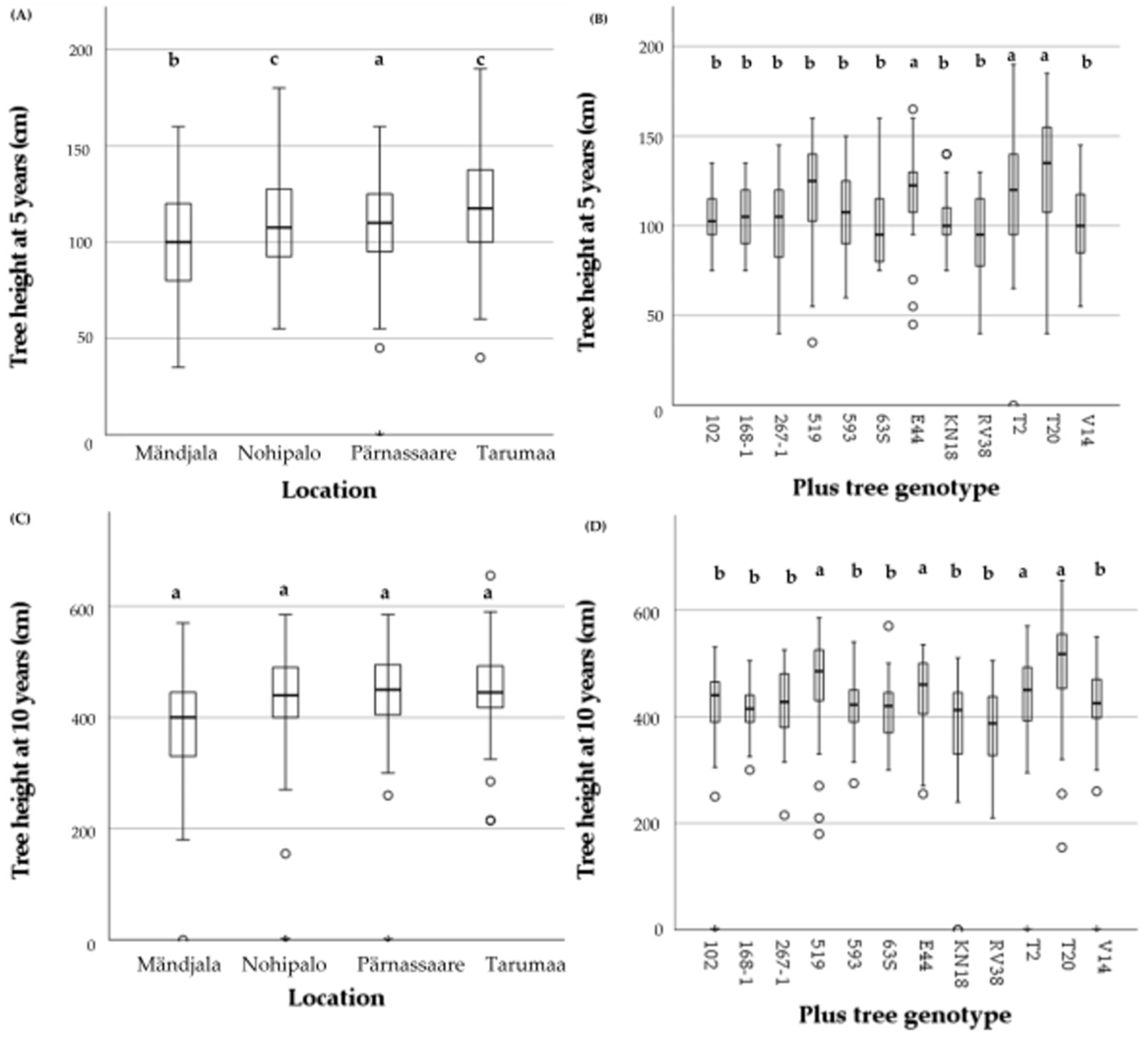
Tree height (cm) measurements from 5- and 10-year-old plus tree progeny, along with average height increment over a 5-year vegetation period, were included in the analysis. These data were obtained from a long-term progeny trial. Kruskal–Wallis and Bonferroni tests were applied to identify the tallest and shortest trees across locations and among plus tree origins within each site. Exploratory analyses using pivot tables supported interpretation of fungal diversity effects on host performance.

2.5. Heritability

The heritability of the needle-associated fungal communities was assessed by comparing microbial diversity metrics (alpha and beta diversity) between one-year-old needles of Scots pine ramets (grafted plus trees origins in seed orchards) and progeny trees (from progeny trials). All diversity estimates were derived from a single OTU matrix that included samples from both generations, with genotypic information used to link seed orchard and progeny trees. To evaluate potential heritability of fungal communities’ alpha diversity, the Shannon index was calculated for seed orchard and progeny trees and compared with the Independent-Samples Mann–Whitney U Test Summary (MW). A non-significant p-value (p > 0.05) was interpreted as indicating no significant differences in alpha diversity between the two groups, suggesting stability or potential inheritance of the fungal community diversity pattern. To determine the heritability of beta diversity (fungal community structure), PERMANOVA and visual interpretation tests were conducted using PCoA plots and NMDS [19,25,43].
The broad-sense heritability (H2) of fungal communities on one-year old Scots pine needles was estimated using a univariate general linear model, with genotypes as the fixed effect and the response variables being the Shannon index (alpha diversity) and percentage explained by PCoA axis 1 beta diversity-fungal community structure [19,25,43]. The heritability was calculated from the mean squares between (MSB) and within (MSW) clonal groups, applying the formula:
H 2 = M S B M S W M S B + n 1 M S W
where MSB is the quantification of the variation between genotype means, and represents the variance caused by differences between plus tree genotype (VG), MSW is the variation between replicates within the same genotype (VE). Data were estimated using one-way ANOVA [66,67,68]. Heritability was calculated according to the entire fungal community and functional groups: saprotrophs and pathogens.

3. Results

3.1. Taxonomic Classification of Fungi from Needles and Shoots of Scots Pine Progenies

Complete sequencing was successfully performed on 1081 samples of pine needles (one- and two-year-old) and shoots (merged one- and two-year-old shoots), yielding a total of 1,364,402 high-quality, full-length ITS sequences. The dataset consisted of 1261 OTUs, of which 74.6% belonged to the phylum Ascomycota, and 22.5% to the phylum Basidiomycota. OTUs belonging to other phyla, including Mucoromycota (0.23%), Chytridiomycota (0.19%), Oomycota (<0.1%) and others were of minimal percentage.
Analysis of the primary ecological lifestyles of fungi associated with pine needles and shoots revealed considerable diversity. Saprotrophs were the most dominant functionally assigned group (24.6%), followed by plant pathogenic fungi (18.2%). However, 46.7% of OTUs could not be taxonomically classified, and a portion of the remaining OTUs lacked functional assignment. Smaller proportions of other identified lifestyles included lichenised fungi (5.1%) and mycoparasites (1.6%). Additional lifestyles, animal parasites, epiphytes, lichen parasites, algal parasites, foliar endophytes, nonspecific pathotrophs, and ectomycorrhizal fungi, each accounted for ≤1.0% of OTUs and were grouped as “unclassified” in Figure 1B. The total percentage of OTUs represented in the figure sums to 100%, including all minor groups.
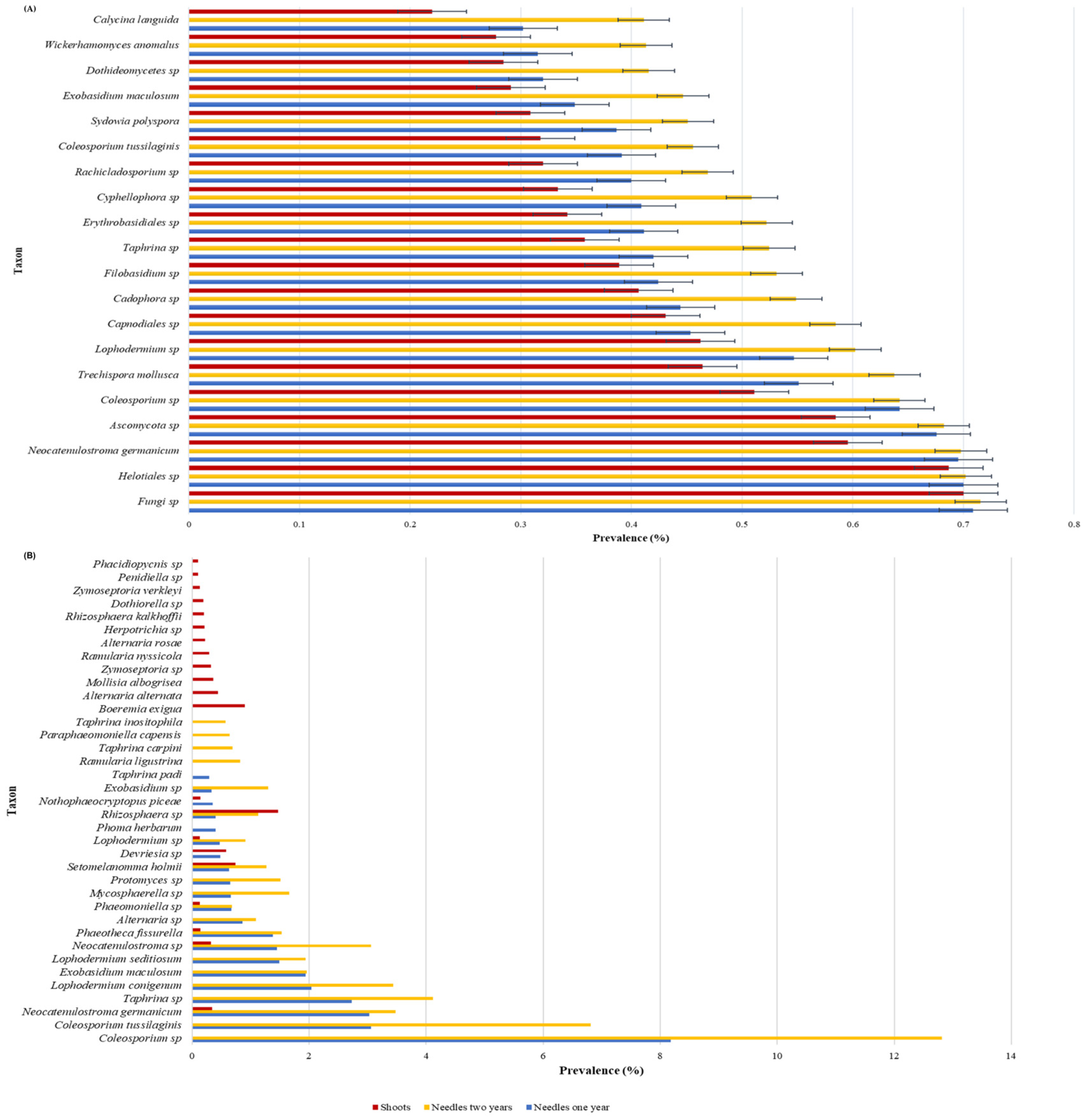
According to the calculated relative abundances of fungal taxa in the evaluated tissues the five most dominant taxa in one- and two-year-old needles were Helotiales, Neocatenulostroma germanicum, Coleosporium sp., Trechispora molusca and Lophodermium sp. (Figure 2A). Fungal pathogens Coleosporium sp., Coleosporium tussilaginis, Taphrina sp., Neocatenulostroma germanicum and Neocatenulostroma sp. were more abundant in two-year-old needles than in one-year-old needles. In shoots, the distribution of pathogenic fungi was different, with Rhizosphaera sp. Boeremia exigua and Setomelanomma holmii being the most prevalent taxa (Figure 2B).

3.2. Overall Fungal Alpha Diversity on Progeny Trees

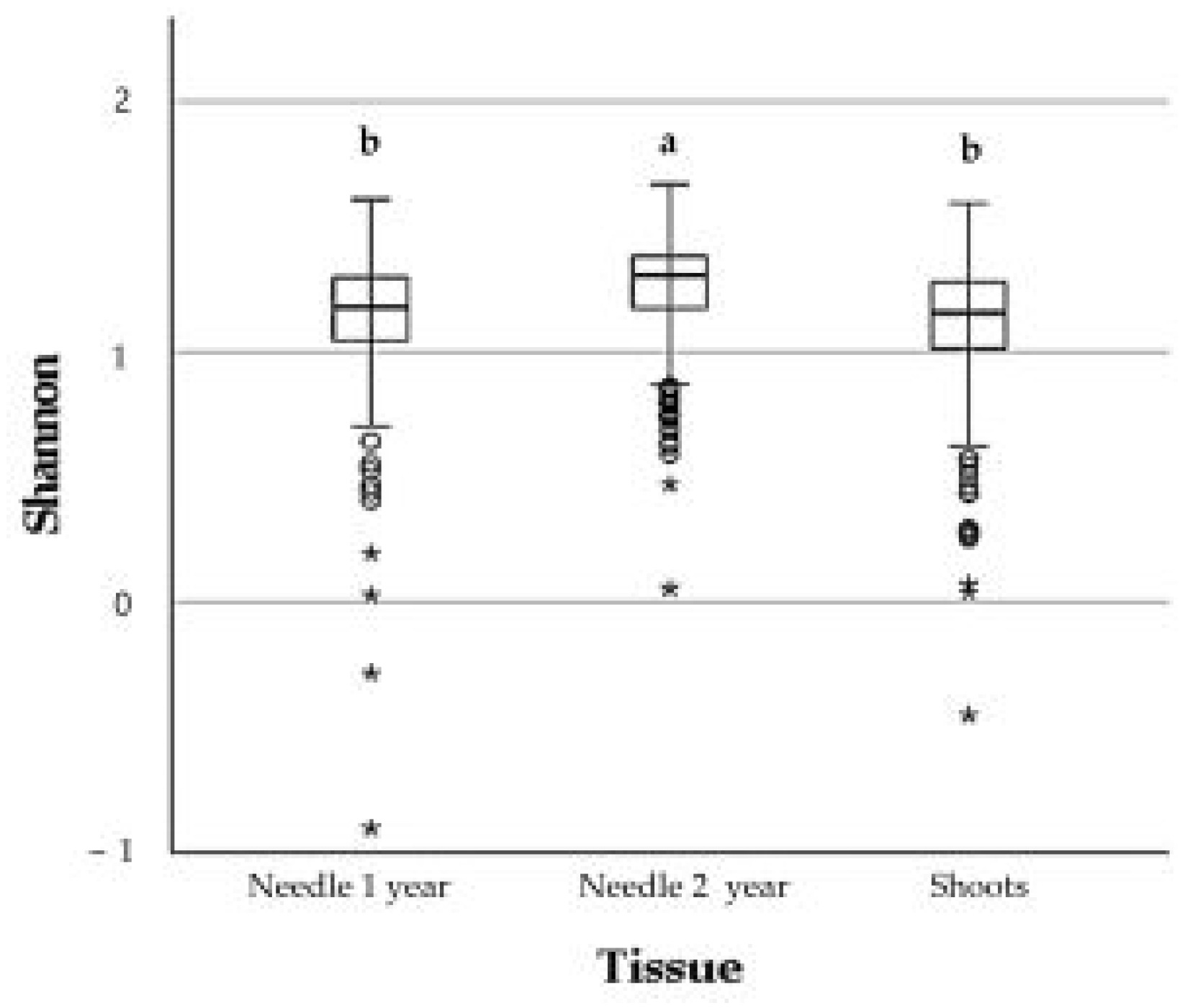
The alpha diversity showed statistically significant differences between tissues (p < 0.0001). Two-year-old needles (p < 0.001) showed greater diversity compared to first year needles and shoots, although there were no significant differences in alpha diversity between shoots and first year needles (p = 0.422) (Figure 3). Further analyses based on abundance-adjusted residuals confirmed these trends (detailed results are presented in Supplementary Information S2, Figure S1). According to the adjusted Bonferroni test, the shoots had greater fungal alpha diversity (p < 0.001) than first year needles, but there were no statistically significant differences between the fungal diversity of shoots and two-year-old needles (p = 0.562).

3.3. Fungal Overall Alpha Diversity on Pine Plus Tree Genotype and Environmental Variables in Needles and Shoots

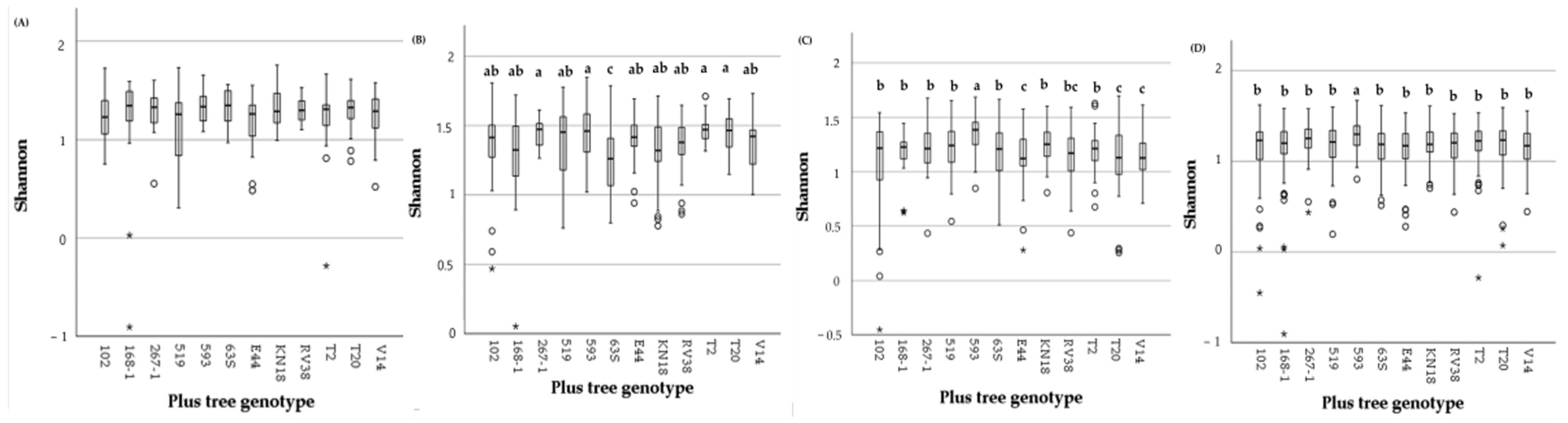
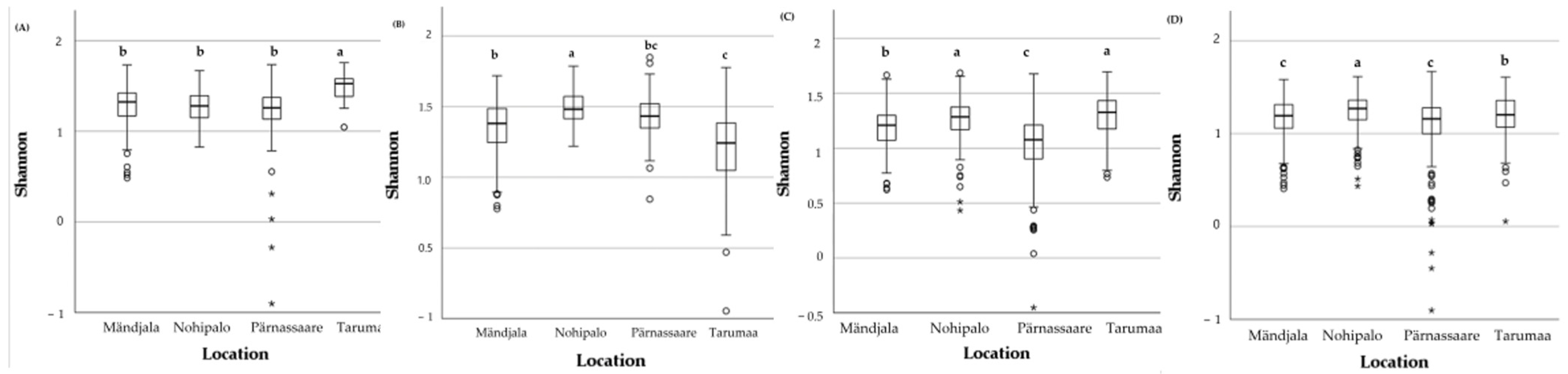
Across all Scots pine samples overall fungal diversity was assessed in relation to location, plus tree genotype, and environmental variables. Significant differences in fungal diversity were found between locations based on the Shannon index (p < 0.001) (Figure 4D). Analyses using abundance-adjusted residuals supported these trends, with full results presented in Supplementary Information S2, Figure S3.
Fungal diversity showed positive, moderate correlations with environmental factors e.g., SET (ρ = 0.109, p < 0.001), ATVP (ρ = 0.116, p < 0.001), and location (ρ = 0.127, p < 0.001), indicating that higher values of these variables are associated with increased alpha diversity. These relationships were further confirmed by the GLM, which revealed a significant positive correlation (B > 0) between fungal alpha diversity of plus tree genotype (Wald χ2 = 24.498, p = 0.011) and SET (Wald χ2 = 12.573, p < 0.001), ATVP (Wald χ2 = 10.547, p = 0.001) and progeny trial location (Wald χ2 = 21.143, p < 0.001) (Supplementary Information S3, Table S4).
One-year-old needle fungal diversity differed among locations and plus tree genotypes. The highest diversity occurred in Tarumaa (genotypes KN18 and T2) while the lowest values occurred in Pärnassaare (genotypes 519, V14, and E44) (Figure 4A and Figure 5A). A weak but significant negative correlation was detected between one-year-old needle fungal diversity and SET (ρ = −0.156, p = 0.005) (Supplementary Information S3, Table S5).
In two-year-old needles, pine plus tree genotypes 267-1, 593, T20, and 519 were associated with higher fungal diversity, whereas genotypes KN18 and 63S exhibited the lowest diversity (Figure 4B). Fungal diversity was positively correlated with location (ρ = −0.152, p = 0.003) and ATVP (ρ = 0.472, p < 0.001), while SET was not significant (p > 0.05) (Supplementary Information S3, Table S6). Fungal diversity was highest in Nohipalo and Mändjala and lowest in Tarumaa and Pärnassaare (Figure 5B).
Shoot fungal diversity was greatest in Tarumaa and Nohipalo sites, whereas Pärnassaare consistently exhibited the lowest fungal diversity (Figure 5C). Fungal diversity was highest in genotypes 593 and 267-1, and lowest in V14, RV38, and E44 (Figure 4C). The GLM revealed that fungal diversity in shoots was significantly affected by ATVP (B = −1.211, p < 0.0001), SET (B = 0.008, p < 0.0001), location (B = 0.006, p < 0.0001), and genotype (B = 0.181, p < 0.0001) (Supplementary Information S3, Table S7).

3.4. Fungal Community (Beta Diversity) of Pine Plus Tree Genotype and Tree Tissue Type

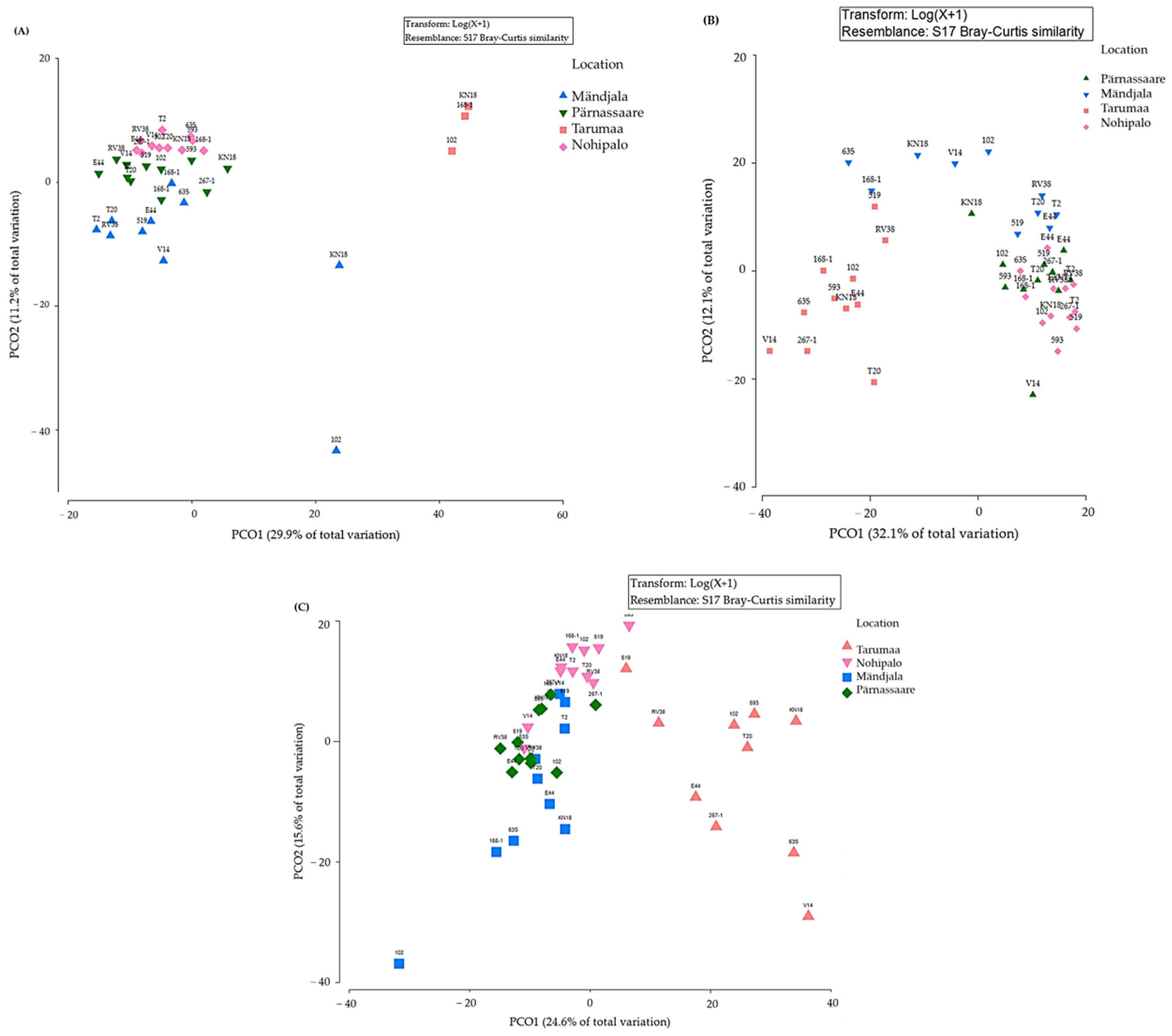
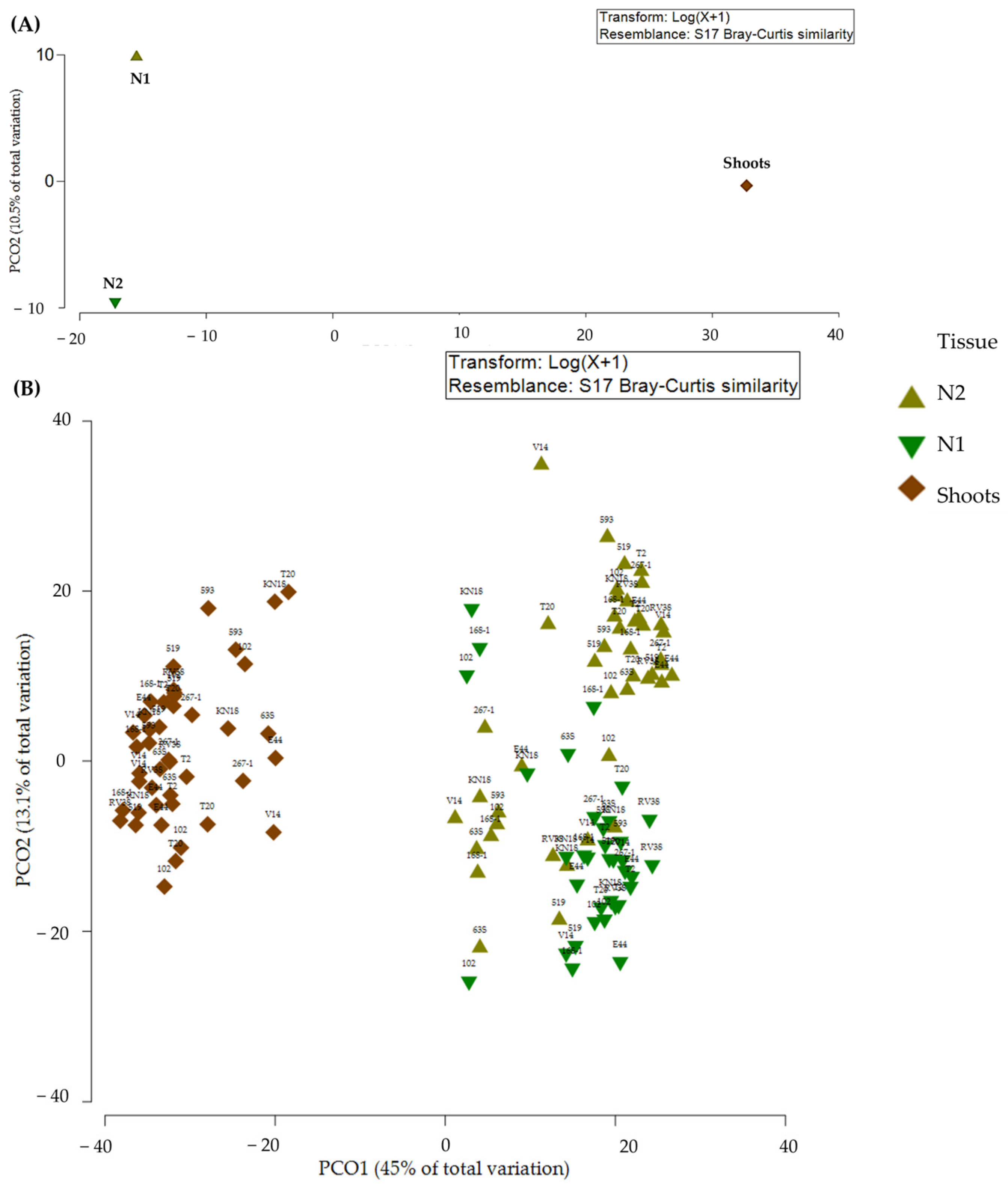
Multivariate analysis comparing the three tissue types (one-, two-year-old needles, and shoots) demonstrated that tissue type had a highly significant (p = 0.001) effect on fungal community (Supplementary Information S4, Table S8). Plus tree genotype also had a significant (p = 0.037) effect on fungal community, yet geographic location did not (p = 0.131). The ANOSIM analysis revealed highly significant differences between tissue types (R = 0.775, p = 0.001), and locations (R = 0.236, p = 0.001). While the tree genotype (R = 0.074, p = 0.054) showed minor effects to fungal communities in each tissue (Figure 6).
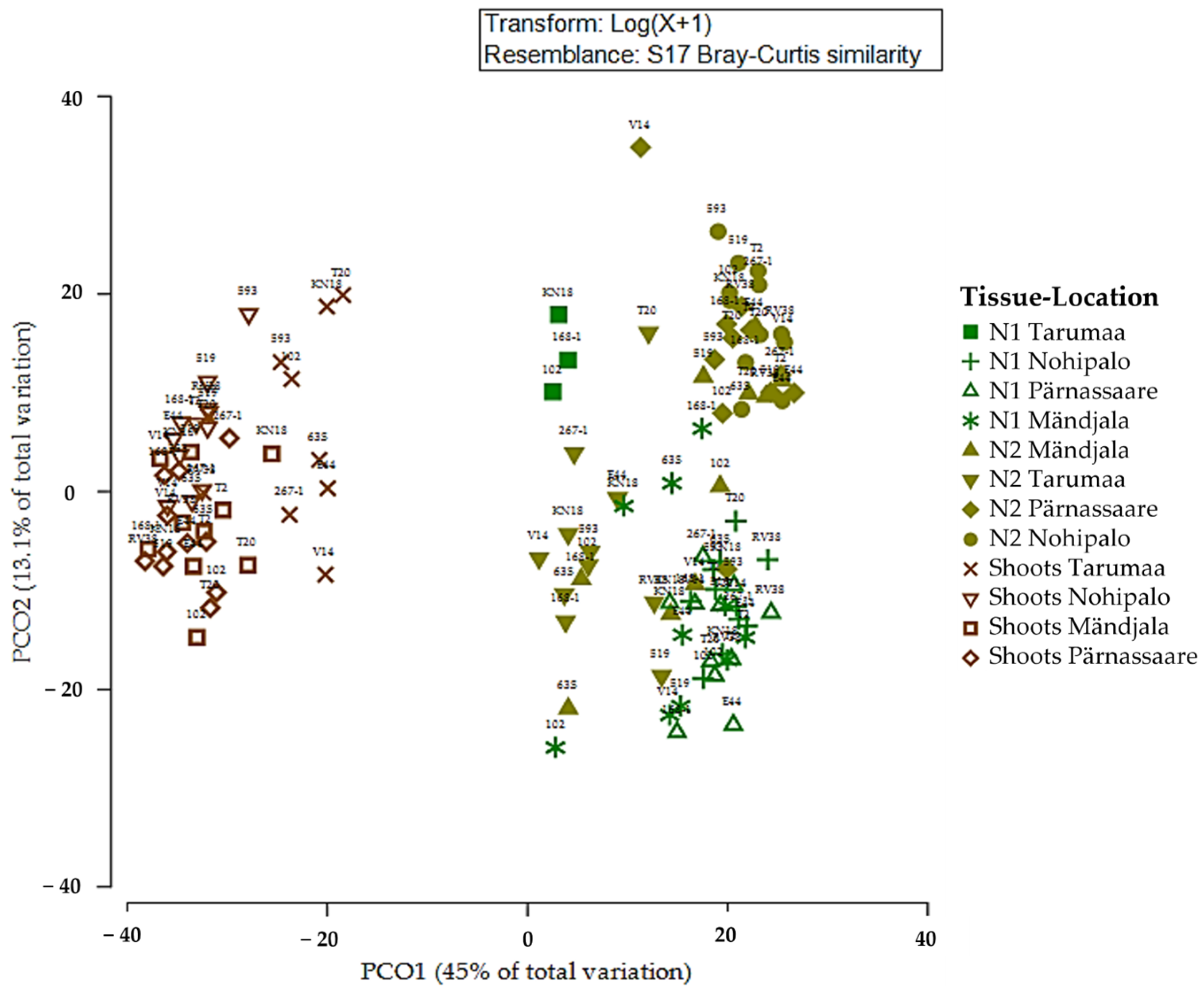
Principal coordinate analysis (PCoA) of the fungal composition of pine genotypes across all tissues showed that beta diversity of pine progenies is affected by tissue type as well as location (Figure 7). The Tarumaa site had a clearly different fungal community structure than the other locations. Furthermore, the BEST/BIOENV analysis indicated that the combination of SET and location explained a moderate-to-strong proportion of the variation observed in microbial community structure (ρ = 0.638) (Supplementary Information S4, Table S8, Figure S4).

3.5. Fungal Community and Multivariate Tissue Analysis

PERMANOVA test showed that geographical location had a significant influence on the fungal community of shoots and one-year-old needles of Scots pine (p = 0.001), although plus tree genotype showed a marginal effect (p = 0.057). Both geographical location and plus tree genotype had a statistically significant influence on the fungal community of two-year-old needles (p = 0.001; p = 0.018, respectively). The ANOSIM analyses demonstrated significant differences in fungal communities between location and tissue type (one-year-old needles p = 0.001; two-year-old needles p = 0.005; shoots p = 0.003). No statistically significant differences were found in fungal community composition among plus tree families within any of the analyzed tissue types (one- and two-year-old needles and shoots) (Supplementary Information S4, Table S9).
To assess whether differences in fungal communities were linked to variation in within-group heterogeneity we performed PERMDISP analyses. These revealed significant differences between fungal communities and site locations for shoots, one-, and two-year-old needles (p = 0.001, 0.005, and 0.018, respectively).
The PCoA plots showed that fungal communities from the Tarumaa and Mändjala progeny trials were more widely dispersed in shoots and one-year-old needles, indicating higher within-site variability in community composition compared to the more homogeneous fungal communities observed in Nohipalo and Pärnassaare (Figure 8). In two-year old needles, the fungal communities were heterogeneous and dispersed at Pärnassaare, Mändjala, and Tarumaa locations. Functional group analyses (saprotrophs and plant pathogens) are presented in Supplementary Information S8.

3.6. Scots Pine Plus Tree Height According to Age, Location, and Genotype

The smallest trees were classified within the lower quartile (25%), defined as ≤90 cm for 5-year-old trees and ≤125 cm for 10-year-old trees from seed. Among 5-year-old trees, the highest number of small individuals occurred in Mändjala (44 trees), making it the site with the greatest proportion of slow-growing trees.
In Nohipalo and Tarumaa, plus tree genotypes 267-1 and RV38 also showed a high number of small trees (30 trees). Plus tree RV38 had the highest number of slow-growth trees overall (18 trees), followed by 267-1 and V14.
For 10-year-old trees, the smallest individuals were most prevalent in plus tree genotypes T20 and 519 at Pärnassaare and Nohipalo sites. Plus trees 168-1, E44, and T20 did not show any low-growth trees at any progeny trial locations (Figure 9).
The tallest trees were defined as those within the upper quartile (75%), measuring ≥125 cm at age 5 and ≥375 cm at age 10. Nohipalo, Pärnassaare, and Tarumaa sites showed the highest number of tall trees, with plus tree genotypes T20, 519, and E44 among the 5- and 10-year-old trees. Site Mändjala had the highest number of tall trees in plus tree RV38 for 10-year-old trees.
Plus tree genotypes 519, 593, and T20 did not have tall trees at any locations (Figure 9).
This overview of growth variation among Scots pine progenies provided the basis for assessing potential links between tree performance and fungal diversity (Section 3.7).

3.7. Correlation of Fungal Diversity with Tree Height and Needle Retention of Scots Pine Plus Tree Genotipes

A negative correlation was observed between one-year-old needle fungal diversity and tree height in plus tree genotype 593 (ρ = −0.448, p = 0.047, n = 47), while a positive correlation was found in plus tree genotype 63S (ρ = 0.480, p = 0.037, n = 47). Pathogen diversity in plus tree genotype 63S showed consistent positive correlations with height across all tissues, reaching ρ = 0.685 (p = 0.001, n = 47) in one-year-old needles. In contrast, pathogen diversity in shoots of KN18 plus tree showed a negative correlation with height (ρ = −0.391, p = 0.024, n = 33). Saprotrophic diversity in 63S showed positive correlations in one-year-old needles (ρ = 0.492, p = 0.032, n = 47) and when combining all three tissues (ρ = 0.322, p = 0.027, n = 1367). Other plus trees: V14, E44, KV38, T2, T20, showed no significant associations between fungal diversity and tree height (Supplementary Table S7). Total fungal diversity was negatively correlated with height growth in plus tree genotypes 593 (ρ = −0.397, p = 0.040, n = 47), 102 (ρ = −0.394, p = 0.047, n = 58), and 168-1 (ρ = −0.433, p = 0.017, n = 77). Saprotrophs fungal diversity was negatively associated with growth in plus trees 102, 168-1, KN18, and 593 (Supplementary Table S7).
Needle retention in 2022 was associated with fungal diversity, with the strength and direction of correlations varying by tree genotype. Plus tree T20 showed negative correlations between needle retention and overall as well as saprotrophic fungal diversity in one-year-old needles (ρ = −0.436 to −0.471, p < 0.05, n = 29). Plus tree 267-1 showed negative correlations between needle retention and overall (ρ = −0.524, p = 0.004, n = 47), pathogenic (ρ = −0.551, p = 0.002, n = 47), and saprotrophic (ρ = −0.541, p = 0.003, n = 47) fungal diversity. In contrast, plus trees V14 and 519 showed positive correlations between needle retention and pathogens diversity in the combined tissues (ρ = 0.325–0.476, p < 0.05, n = 1367). Only plus tree 593 showed positive correlations between needle retention in 2022 and height growth in 2023 across all tissues (ρ = 0.379–0.482, p ≤ 0.039, n = 325) (Supplementary Tables S8 and S9).
Genotype showed moderate positive correlations with tree height across all tissues in 2022 (ρ = 0.425–0.493, p < 0.001, n = 325). Fungal diversity exhibited weak negative correlations with location in one-year-old needles (ρ = −0.196, p < 0.001, n = 325) and positive in two-year-old needles (ρ = 0.148, p = 0.004, n = 372). Climate variables showed weak or no associations, except for small positive correlations between fungal diversity and the SET and ATVP in two-year-old needles and shoots (ρ ≈ 0.178–0.188, p < 0.001, n = 372–385), and a weak negative correlation between location and shoot diversity (ρ = −0.142, p = 0.010, n = 385) (Supplementary Figure S8). Overall, these results indicate that relationships between fungal diversity and growth traits are moderate and strongly dependent on plus tree genotype and tissue type (needles versus shoots), suggesting that caution should be exercised when generalizing these patterns.

3.8. Scots Pine Plus Tree Heritability

Evidence of heritability was detected for saprotrophic fungal diversity (Supplementary Information S7, Tables S14 and S16). The Mann–Whitney U test showed no statistically significant differences in fungal diversity of one-year-old needles between ramets of the same plus trees (mother trees in the seed orchard) and their plus tree genotype progenies (H2 = 0.048, p = 0.179; Supplementary Information S8, Figure S14). In contrast, overall fungal diversity and pathogen diversity showed significant differences between ramets and progenies (p < 0.001), with low heritability coefficients (H2 = 0.046 and H2 = 0.07, respectively; Supplementary Information S7).
For beta diversity, heritability of the entire fungal community was evident, based on PCoA axis 1 values, as no significant differences were detected between ramets and plus tree genotype progenies (p = 0.179), with a heritability coefficient of H2 = 0.23. However, saprotrophic and pathogenic functional groups showed no heritability with significant differences (p < 0.001) and very low coefficients (H2 = 0.081 and H2 = 0.0027, respectively). These findings were confirmed by PERMANOVA, which indicated significant differences (p < 0.001) across all functional groups (all fungi, saprotrophs, pathogens) (Supplementary Information S7).

4. Discussion

4.1. Fungal Diversity and Composition of One- and Two-Year-Old Needles and Shoots

Comparison of fungal alpha and beta diversity across one- and two-year-old needles and shoots revealed significant differences among Scots pine plus tree genotypes. Based on the Shannon index, fungal diversity was highest in two-year-old needles, most likely due to their prolonged exposure to environmental conditions and the establishment of a stable microbiota through constant plant-microorganism interactions during tree development [69]. The reduced physiological activity of these older needles may also reduce defence responses and facilitate microbial establishment [70]. In contrast, younger needles exhibited lower diversity, which may reflect more active defence mechanisms, such as the production of antimicrobial compounds or physical barriers, that restrict colonization [18]. This pattern is consistent with previous findings that younger plant tissues harbor lower microbial richness than older ones. Thus, fungal diversity calculated with adjusted abundances showed the greatest fungal diversity in shoots, probably because they represent a heterogeneous ecological niche in which the microorganisms may have broad ecological tolerances [20,69,70].
Site-specific differences in fungal diversity were evident, with two-year-old needles showing the highest values in Nohipalo and Mändjala. These patterns may partly reflect local climatic variation, as higher temperatures during the vegetation period appeared to increase fungal diversity in two-year-old needles but reduce it in one-year-old needles [69,71,72,73]. This suggests that tissue age could influence sensitivity to temperature, with mature needles potentially providing a more stable environment for fungal colonization [69,71,72,73]. Plus tree genotypes 267-1 and 593 consistently exhibited the highest fungal diversity in two-year-old needles across all four sites, indicating a greater ability to host complex microbial diversity that might benefit tree health [20]. The same progenies (593 and 267-1) also showed the highest shoot fungal diversity, although only at Tarumaa and Nohipalo. Finally, GLM analyses indicated that average temperatures during the vegetative period (ATVP) negatively affected shoot fungal diversity, suggesting temperature sensitivity of fungal colonization in shoot tissues [69,74].
In the shoots, the most prevalent taxa of endophytic and saprophytic fungi were Filobasidium sp. and Taphrina sp., while the most common pathogenic fungi were Rhizosphaera sp., Boeremia exigua and Setomelanomma holmii. Notably, S. holmii is reported for the first time in Estonia, although the fungus has been found in Picea species in other countries [75,76]. Boeremia exigua is a widespread plant pathogen affecting numerous plant species globally [77]. Rhizosphaera species are primarily known for causing needle cast diseases on Picea, although they can also infect Pinus shoots. Surprisingly, well-known and widespread Pinus pathogen Diplodia sapinea [77] was rare in this dataset; it was detected only in the shoots of two sampling at the Pärnassaare site. Additional observations from healthy-looking 10-year-old forest trees (R. Drenkhan, unpublished) show a similar sporadic occurrence, suggesting that D. sapinea is not widely distributed as an endophyte in local Scots pine populations in Estonia.
We initially expected to detect common major pathogens associated with pine needles including Lophodermium seditiosum, Lecanosticta acicola, and Dothistroma septosporum [33,34,35,78]. For example, Dothistroma sp. is one of the most widespread pine pathogens in Northern Europe and globally [79]. Instead, this study revealed a broader diversity of pathogenic fungi, many of which differ from those commonly described in the literature. In the needles the most frequent pathogens detected in needles were Coleosporium sp., Coleosporium tussilaginis, Neocatenulostroma germanicum, Lophodermium conigenum and Taphrina sp. These findings are in accordance with Agan et al. (2021) [49], which also reported diverse fungal communities beyond the traditionally recognized pathogens, highlighting similar patterns of unexpected taxa associated with Scots pine needles in Northern Europe.

4.2. Environmental vs. Genetic Effects

Across the entire phyllosphere comprising shoots, one-year-old needles and two-year-old needles, the highest level of overall fungal diversity was found in plus tree progenies 593 and 267-1, and in the Nohipalo and Tarumaa sites. This suggests a clear interaction between environmental conditions and host mycobiota. However, plus tree genotypes E44 and 519 showed high fungal diversity at the Nohipalo site, and genotypes 593 and 267-1 in Tarumaa. This has previously been reported in studies on foliage fungal communities in Scots pine, where genotype interaction × environment significantly modulates fungal colonization [50,80,81]. This also means that hosts, under specific environmental conditions, may favor possibly more diverse and different functional fungal communities. Since fungal diversity is frequently associated with benefits including pathogen resistance and nutrient acquisition efficiency [82,83], these plus tree genotype and progeny trial site (genotype-location) combinations could indicate optimal parameters for future forestry.
The observed variation in foliage fungal diversity among plus tree genotype and locations is likely influenced by both genetic characteristics and local-site environmental factors. One-year-old needles on KN18 and T2 plus trees and the location-genotype interaction for plus trees 168-1 and KN18 in Tarumaa showed the highest alpha diversity. In Pärnassaare, plus tree genotypes 519, V14, and E44 showed lower fungal diversity. Whether this pattern reflects local environmental conditions or genotype-specific traits remains unclear, as the same genotypes were not comparable across locations. Factors such as phyllosphere microclimate and leaf structural or chemical properties (e.g., wax content on needles) could influence fungal colonization [71,80].
Fungal communities varied significantly between the different tissues, indicating strong differences in microbial composition between shoots and one- and two-year-old needles. This difference may be related to tissue physiology, accumulation of secondary compounds, or different exposure to biotic and abiotic factors over time [84,85], which is evident in the PCoA grouping (Figure 8). Analyses of fungal communities across all progeny trial locations and plus trees indicate that genotype exerts a significant but weak effect on fungal communities. According to PERMANOVA, genotype does not affect the fungal composition between different progeny trial sites. However, ANOSIM shows significant differences between fungal communities and progeny trial sites, suggesting that host genetics and local site conditions influence fungal composition. These results underscore the influence of both local environment and the host genetics on the structure of the foliar fungal microbiome [86,87].
BEST/BIOENV analyses identified SET and progeny trial site as the main explanatory variables for fungal community composition (ρ = 0.638), highlighting the importance of microclimate in structuring microbial assemblages. These results are generally, but not entirely, consistent with previous studies in Scots pine that have highlighted the environmental factors influencing fungal communities [18,86,88]. It is important to note that these studies did not explicitly assess the effects of host genotype; therefore, direct comparison with our findings on genetic influence is limited. In general, the scientific literature offers little information on microbiome variation related to host genetics. Nevertheless, they collectively show that endophytic foliar fungal composition is primarily determined by environmental conditions, suggesting that adverse microclimates and unstable temperature regimes may contribute to the observed variation in fungal communities across tree genotypes and locations.

4.3. Fungal Diversity Effect to Tree Growth (2022) and Needle Retention (2022) in Progenies of Scots Pine

Spearman correlation analyses showed that only genotype 63S across overall, saprotrophic and pathogenic fungal diversity of one- and two-year-old needles was positively associated with tree height (2022). Notably, this genotype does not exhibit high fungal diversity in the needles. This may be because the phyllosphere can not only comprise functional and pathogenic microorganisms but also includes commensal microorganisms. These generally have a neutral interaction with the host but can indirectly influence its physiology by modulating competition between microorganisms, altering nutrient availability and activating secondary metabolite production pathways in the plant, which are associated with growth or immune system activation [89].
Only saprotrophic fungal diversity showed a negative correlation with tree growth in several genotypes (593, 102, 168-1, KN18). This may arise because some group of saprotrophic fungi often behaving as endophytes can affect plant growth at certain points in their life cycle [90]. As sessile organisms on plants can limit their growth and development when responding to microbial stimuli [91], potentially through the activation of defence mechanisms or via antagonistic interactions between microorganisms that affect photosynthetic efficiency or shift the production of secondary metabolites and host hormones [92,93,94].
The pathogenic fungal communities of two-year-old needles and shoots in genotypes 267-1 and KN18 showed a negative correlation with needle retention, which may suggest that pathogenic fungi on these genotypes are associated with necrotrophic or hemibiotrophic lifestyles, accelerating the process of leaf senescence [95,96]. It is worth mentioning that the needles of these genotypes displayed a high abundance of pathogens commonly associated with needle necrosis and loss (Figure 2B). Shoots of these genotypes also harbored pathogens linked to cankers and tissue deformities along with opportunistic species (Figure 2B). Abiotic factors: low temperatures, shade, drought, or waterlogging may further exacerbate needle senescence [97].
In contrast, genotypes V14 and 519 showed a positive correlation between one- and two-year-old needle fungal diversity and needle retention. This suggests that maintaining needles may function as a defense strategy against necrotrophic fungi, which require dead tissue for proliferation. Necrotrophic fungi require dead tissue to proliferate and complete their life cycle. By sustaining live tissue, trees interrupt pathogen life cycles and limit colonization. On the other hand, biotrophic and hemibiotrophic pathogens require living tissue and thus may delay leaf senescence [84,95,96].
Furthermore, saprotrophic fungal diversity of needles in genotypes T20, 593 and 267-1 showed a negative correlation with needle retention. This suggests that saprotrophs in these genotypes may include mutualistic, commensal, or opportunistic endophytic fungi that trigger biotic stress during their development, ultimately promoting needle senescence [89,97]. This reduced needle retention may, in turn, be linked to increased growth, as previously reported in Scots pine, where a negative correlation between needle retention and tree growth has been observed [98]. This suggests a possible trade-off, where reduced foliar longevity allows the tree to allocate more resources to height growth. However, in genotype 593, the diversity of saprotrophic fungi in the needles and shoots was negatively correlated with growth, suggesting a potential trade-off between fungal community diversity and productivity, which could suggest a trade-off between growth and defense. This trade-off allows plants to allocate their energy to adjust growth and defense based on external conditions [99], representing negative growth and survival relationships that arise from different biotic and abiotic interactions as a life cycle strategy. However, high fungal diversity (saprotrophic and pathogenic) did not impede needle retention or sustained growth, indicating an efficient symbiotic interaction, possibly mediated by a regulated or functionally stable microbiome. For example, in studies with trees such as cacao, the pathogenic and endophytic fungus Lasiodiplodia sp. can modulate host defenses through precursors of phenylpropanoids and salicylic acid [100]. Other studies show that interaction with some endophytes induces tolerance in trees to biotic stress, reducing pest damage and increasing molecules associated with defense responses [101]. This is the case of the fungus Phialocephala scopiformis which maintains needle retention and prevents the survival of defoliating insects in eastern spruce (Picea rubens) trees [102,103]. In Acadian forests, associations with endophytic ascomycetes have increased the tolerance of conifers to pathogens and needle herbivores [104]. Thus, despite potential negative effects on the height growth of trees, the functional fungal group diversity (e.g., saprotrophs and pathogen) observed in plus tree genotypes 593 and 267-1 could confer advantages in resilience and stability. These findings suggest that plus tree progenies selection should integrate the functional composition of the microbiome, rather than to physiological or performance variables to enhance tree survival under changing climate conditions. This perspective aligns with broader ecological trade-off theories, where survival and defense mechanisms can come at the expense of growth. Such dynamics can be evidenced by high survival but lower growth [105], as these interactions can be called improvements for the tree as they help develop prevention and defense mechanisms, which could involve sacrificing vital physiological functions such as growth and reproduction, and creating a balance. This phenomenon has been evident in genetic studies in several plant models [106,107].
Fungal community is a key ecological component in plant–microorganism interactions during plant development, with a significant influence on tree growth. This influence can be positive, through the production of secondary metabolites that promote growth, or negative for growth, when fungi act as stressors or pathogens, redirecting plant metabolism from growth toward maintenance and activation of defense mechanisms [108]. Additionally, the plant fungal communities can also interact with other microorganisms, providing biological control that benefits the plant. These interactions, together with the environmental characteristics, define plant fitness [109]. The results obtained in this research demonstrated that fungal diversity and the growth of trees are consistent, since direct observed associations in plus tree progenies height (2022) and needle retention (2022), this means that in some plus tree genotypes, higher or lower fungal diversity was directly correlated with tree height and needle retention, suggesting that specific fungal community structures may influence growth and foliar longevity. However, this association was not significant in all Scots pine plus tree genotypes evaluated in this research.
The results show that tree height is not directly driven by fungal diversity, the findings suggest that tree growth is shaped by multiple interacting factors, including tree genotype, environmental conditions (e.g., temperature), and microbial interactions. However, the relative contribution of each factor was not quantified in this study, and our conclusions are based on correlation analyses rather than predictive modeling. However, these conclusions must be interpreted carefully, because the effects of local environmental variables linked to abiotic stress cannot be distinguished from those of genetic factors on tree growth [110,111].

4.4. Fungal Heritability Among Plus Tree Families

Saprotrophs and endophytes appear to show a slight dependence on host genotype. Regarding fungal alpha diversity, heritability was weak for saprotrophic fungi and negligible for overall and pathogenic fungal diversity. Previous studies have shown that the diversity and composition of fungal endophytes vary significantly between progenies, even at sites with similar environmental conditions [112]. This variation suggests that these groups respond to host functional traits, including foliar chemistry, leaf structure, and gene expression related to defence and colonization.
Considering fungal beta diversity, no significant differences were observed, indicating that the overall fungal community was maintained between ramets (seed orchard) and progeny trees. This suggests possible inheritance of the total fungal communities, indicating permanence in the structure of the fungal communities across tree generations. Furthermore, the broad-sense heritability calculated shows a moderate influence of the host genotype on the preservation of fungal community structure.
These results suggest that both alpha and beta diversity of the fungal communities are largely non-heritable between plus trees genotypes grown in seed orchards and progeny trials. This indicates a limited influence of genotype on fungal diversity of the phyllosphere. The weak heritability observed may be due to the use of young needles, which are not optimal tissues for assessing genotype-driven microbial associations. Additional factors include unequal numbers of sampled trees per genotype in seed orchards and progeny trials (e.g., plus tree genotype 102 was the only genotype represented at all four sites). Furthermore, needles were not surface-sterilized, which may have allowed site-dependent epiphytic species to persist and obscure genotype effects. Surface sterilization was omitted because previous analyses showed minimal sterilization impact on needle mycobiome composition. Future work should evaluate genotype effects on root-associated fungal communities, where stronger heritability signals may occur.
These results are broadly consistent with the findings of Carvajal-Arias et al. (2025) [50], who reported that fungal community structure in seed orchard material was largely shaped by environmental factors associated with location rather than genotype. Although the experimental design differs from systematic progeny trials, both studies suggest that site-related conditions play an important role in structuring fungal assemblages. The effect of the host on microbial communities can vary with the adaptation of the tree phenotype to new environments [113] and heritability may depend partly on host genetics but it is also explained by plant adaptation to the environment [25]. Heritability of the fungal communities may also change during plant development due to adaptation to the environment, interactions with other organisms, and phenotypic variation arising from microbial interactions [19]. For example, Van Wallendael et al. [112] demonstrated that alterations in the leaf microbiome of Panicum virgatum (switchgrass) were associated with the expression of host genes linked to immunity and disease resistance. Likewise, Bodenhausen et al. [81] reported that phenotypic variation in the leaf cuticle and ethylene production in Arabidopsis thaliana significantly influence the composition of the phyllosphere microbiome.

5. Conclusions

This research shows that the structure and composition of Scots pine fungal communities varies depending on two factors: host tissue and progeny trial location. Two-year-old needles were found to host the most diverse fungal communities. Both location and plus tree genotype influence the composition of fungal communities, but the most determining effect was progeny trial site location. However, additional analyses are needed to clarify the plus tree genotype effect on fungal diversity and composition in different tree organs. The interactions between phyllosphere fungal communities and tree growth revealed the complexity of the interaction between tree genetics, microbiome, and local environment.
Plus tree progenies of 593 and 267-1 showed higher fungal diversity across the entire mycobiome and across saprotrophic and pathogenic functional groups. Plus tree genotype 593, despite its high fungal diversity, also showed higher needle retention and tree height, suggesting that the interaction between the host and its mycobiome could be mediated by a functionally stable symbiotic relationship compared to other tree progenies in genotypes (KN18, 168-1, 102) of the same age.
The current work demonstrates that the phyllosphere’s higher fungal diversity does not support biomass production in Scots pine, but it does serve as an indicator of tree vitality. Therefore, foliar microbiome diversity and composition can complement traditional criteria in breeding programs. Future studies should aim to build integrative models that include host genotype and microbial communities of the phyllosphere and also rhizosphere, as well as local environmental variables. These models would deepen our understanding of how the microbiome influences tree growth dynamics and improve predictions of tree performance under changing climatic conditions.

Supplementary Materials

The following supporting information can be downloaded at: https://www.mdpi.com/article/10.3390/f16121859/s1, Table S1. Theoretical experimental design (plan): Experimental design for DNA extraction from Scots pine trees; Table S2. Summary of the final number of needle and shoot samples collected, organized by tissue type and clone; Table S3. Number of samples after sequencing, 1081 high-quality samples were retained for the construction of the Operational Taxonomic Units (OTU) table; Figure S1. Overall fungal Alpha diversity calculated with residuals adjusted for abundances, comparing three tissues; Figure S2. Overall alpha fungal diversity (Standardized residuals) in Scots pine genotype; Figure S3. Overall alpha fungal diversity (Shannon index) in Scots pine genotype according to location; Table S4. Alfa diversity of all tissues, KW analysis, Spearman correlation and GLM; Table S5. Alfa diversity-One year old needles, KW analysis, Spearman correlation and GLM; Table S6. Alfa diversity-Two-year-old needles, KW analysis, Spearman correlation and GLM; Table S7. Alfa diversity-Shoots Alfa diversity shoots, KW analysis, Spearman correlation and GLM; Table S8. Beta diversity tissue, location and genotype, ANOSIM and PERMANOVA analysis overall fungal communities, and comparing all tissues (one- and two-years old needles and shoots together); Figure S4. PCoA with BEST/BIOENV analysis, accounting for the combination of cumulative effective temperature and location used as proxy for spatial variation-location, which most explains the observed variation in fungal communities (ρ = 0.638); Table S9. Beta diversity tissue, location and genotype, ANOSIM and PERMANOVA analysis overall fungal communities, calculation per tissue (Shoots and one- and two-years old needles); Table S10. Statistically significant Spearman correlations (rho) between tree height in 2022 and alpha diversity of fungal communities, categorized by genotype, tissue type (N1, N2, shoots), and functional group (mycobiome, pathogens, saprotrophs); Table S11. Statistically significant Spearman correlations (rho) between needle retention in 2022 and alpha diversity of fungal communities, categorized by genotype, tissue type (N1, N2, shoots), and functional group (mycobiome, pathogens, saprotrophs); Table S12. Statistically significant Spearman correlations (rho) between needle retention in 2022 and alpha diversity of fungal communities, categorized by genotype, tissue type (N1, N2, shoots), and functional group (mycobiome, pathogens, saprotrophs); Table S13. Spearman correlations between tree height in 2022 and environmental/genetic variables across three tissue types: one-year-old needles, two-year-old needles, and shoots; Table S14. Summary of statistical tests and heritability estimates for fungal community diversity and structure across functional groups; Figure S5. All fungal mycobiome of one-year-old needles heritability analyses of mother and progeny trees; Figure S6. Saprotrophs mycobiome of one-year-old needles heritability analyses of mother and progeny trees; Figure S7. Pathogens mycobiome of one-year-old needles heritability analyses of mother and progeny trees; Figure S8. Saprotrophic fungal diversity in one-year-old needles; Figure S9. Saprotrophic fungal diversity in two-year-old needles; Figure S10. Saprotrophic fungal diversity in Shoots; Figure S11. Pathogenic fungal diversity in one-year-old needles; Figure S12. Pathogenic fungal diversity in two-year-old needles; Figure S13. Pathogenic fungal diversity in Shoots; Table S15. summarizes the main steps of the Pipecraft v2.0 pipeline applied to PacBio ITS reads; Figure S14. General outline of the workflow, from sampling to statistical analysis.

Author Contributions

Conceptualization, R.D., K.A. and T.M.; methodology, T.M., R.D. and C.E.C.-A.; software, C.E.C.-A. and A.A.; validation, C.E.C.-A., A.A. and R.D.; formal analysis, C.E.C.-A.; investigation, T.M., R.D. and C.E.C.-A.; resources, R.D.; data curation, C.E.C.-A. and A.A.; writing—original draft preparation, C.E.C.-A.; writing—review and editing, C.E.C.-A., R.D., A.A., K.A. and T.M.; visualization, C.E.C.-A.; supervision, R.D., A.A. and K.A.; project administration, R.D.; funding acquisition, R.D. and K.A. All authors have read and agreed to the published version of the manuscript.

Funding

This study was supported by the Estonian Research Council grant PRG1615.

Institutional Review Board Statement

Not applicable.

Data Availability Statement

Raw PacBio sequencing data divided according to sampling site is available in SRA (Sequence Read Archive) under the following IDs: Mändjala: PRJNA1371735, Nohipalo: PRJNA1371761, Pärnassaare: PRJNA1371784, Tarumaa: PRJNA1371871. All other data is available as Supplementary Material.

Acknowledgments

We would like to thank native speaker Martin Mullett for English revision and three anonymous reviewers for improving the manuscript.

Conflicts of Interest

The authors declare no competing interests.

References

  1. Baldrian, P.; López-Mondéjar, R.; Kohout, P. Forest Microbiome and Global Change. Nat. Rev. Microbiol. 2023, 21, 487–501. [Google Scholar] [CrossRef]
  2. Bonan, G.B. Forests and Climate Change: Forcings, Feedbacks, and the Climate Benefits of Forests. Science 2008, 320, 1444–1449. [Google Scholar] [CrossRef]
  3. Harris, N.L.; Gibbs, D.A.; Baccini, A.; Birdsey, R.A.; de Bruin, S.; Farina, M.; Fatoyinbo, L.; Hansen, M.C.; Herold, M.; Houghton, R.A.; et al. Global Maps of Twenty-First Century Forest Carbon Fluxes. Nat. Clim. Change 2021, 11, 234–240. [Google Scholar] [CrossRef]
  4. Brichta, J.; Vacek, S.; Vacek, Z.; Cukor, J.; Mikeska, M.; Bílek, L.; Šimůnek, V.; Gallo, J.; Brabec, P. Importance and Potential of Scots Pine (Pinus sylvestris L.) in 21 St Century. Cent. Eur. For. J. 2023, 69, 3–20. [Google Scholar] [CrossRef]
  5. Oleksyn, J.; Tjoelker, M.G.; Reich, P.B. Adaptation to Changing Environment in Scots Pine Populations across a Latitudinal Gradient. Silva Fenn. 1998, 32, 129–140. [Google Scholar] [CrossRef]
  6. Jasińska, A.K.; Boratyńska, K.; Dering, M.; Sobierajska, K.I.; Ok, T.; Romo, A.; Boratyński, A. Distance between South-European and South-West Asiatic Refugial Areas Involved Morphological Differentiation: Pinus sylvestris Case Study. Plant Syst. Evol. 2014, 300, 1487–1502. [Google Scholar] [CrossRef]
  7. Żukowska, W.B.; Wójkiewicz, B.; Lewandowski, A.; László, R.; Wachowiak, W. Genetic Variation of Scots Pine (Pinus sylvestris L.) in Eurasia: Impact of Postglacial Recolonization and Human-Mediated Gene Transfer. Ann. For. Sci. 2023, 80, 42. [Google Scholar] [CrossRef]
  8. Gustafsson, L.; Baker, S.C.; Bauhus, J.; Beese, W.J.; Brodie, A.; Kouki, J.; Lindenmayer, D.B.; Lõhmus, A.; Pastur, G.M.; Messier, C.; et al. Retention Forestry to Maintain Multifunctional Forests: A World Perspective. Bioscience 2012, 62, 633–645. [Google Scholar] [CrossRef]
  9. Ferreira-Santos, P.; Zanuso, E.; Genisheva, Z.; Rocha, C.M.R.; Teixeira, J.A. Green and Sustainable Valorization of Bioactive Phenolic Compounds from Pinus By-Products. Molecules 2020, 25, 2931. [Google Scholar] [CrossRef]
  10. Hoai, N.; Duc, H.; Thao, D.; Orav, A.; Raal, A. Selectivity of Pinus sylvestris Extract and Essential Oil to Estrogen-Insensitive Breast Cancer Cells Pinus sylvestris against Cancer Cells. Pharmacogn. Mag. 2015, 11, 290. [Google Scholar] [CrossRef] [PubMed]
  11. Nilsson, R.H.; Anslan, S.; Bahram, M.; Wurzbacher, C.; Baldrian, P.; Tedersoo, L. Mycobiome Diversity: High-Throughput Sequencing and Identification of Fungi. Nat. Rev. Microbiol. 2019, 17, 95–109. [Google Scholar] [CrossRef] [PubMed]
  12. Terhonen, E.; Blumenstein, K.; Kovalchuk, A.; Asiegbu, F.O. Forest Tree Microbiomes and Associated Fungal Endophytes: Functional Roles and Impact on Forest Health. Forests 2019, 10, 42. [Google Scholar] [CrossRef]
  13. Hyde, K.D.; Jeewon, R.; Chen, Y.J.; Bhunjun, C.S.; Calabon, M.S.; Jiang, H.B.; Lin, C.G.; Norphanphoun, C.; Sysouphanthong, P.; Pem, D.; et al. The Numbers of Fungi: Is the Descriptive Curve Flattening? Fungal Divers. 2020, 103, 219–271. [Google Scholar] [CrossRef]
  14. Hyde, K.D.; Soytong, K. Understanding Microfungal Diversity-a Critique. Cryptogam. Mycol. 2007, 28, 281–289. [Google Scholar]
  15. Peay, K.G.; Bidartondo, M.I.; Elizabeth Arnold, A. Not Every Fungus Is Everywhere: Scaling to the Biogeography of Fungal–Plant Interactions across Roots, Shoots and Ecosystems. New Phytol. 2010, 185, 878–882. [Google Scholar] [CrossRef]
  16. Vallad, G.E.; Goodman, R.M. Systemic Acquired Resistance and Induced Systemic Resistance in Conventional Agriculture. Crop Sci. 2004, 44, 1920–1935. [Google Scholar] [CrossRef]
  17. Lazarević, J.; Menkis, A. Fungal Diversity in the Phyllosphere of Pinus Heldreichii H. Christ-An Endemic and High-Altitude Pine of the Mediterranean Region. Diversity 2020, 12, 172. [Google Scholar] [CrossRef]
  18. Marčiulynienė, D.; Marčiulynas, A.; Mishcherikova, V.; Lynikienė, J.; Gedminas, A.; Franic, I.; Menkis, A. Principal Drivers of Fungal Communities Associated with Needles, Shoots, Roots and Adjacent Soil of Pinus sylvestris. J. Fungi 2022, 8, 1112. [Google Scholar] [CrossRef]
  19. Wagner, M.R. Prioritizing Host Phenotype to Understand Microbiome Heritability in Plants. New Phytol. 2021, 232, 502–509. [Google Scholar] [CrossRef] [PubMed]
  20. Li, Y.; Wu, X.; Chen, T.; Wang, W.; Liu, G.; Zhang, W.; Li, S.; Wang, M.; Zhao, C.; Zhou, H.; et al. Plant Phenotypic Traits Eventually Shape Its Microbiota: A Common Garden Test. Front. Microbiol. 2018, 9, 2479. [Google Scholar] [CrossRef] [PubMed]
  21. Unterseher, M.; Siddique, A.B.; Brachmann, A.; Peršoh, D. Diversity and Composition of the Leaf Mycobiome of Beech (Fagus sylvatica) Are Affected by Local Habitat Conditions and Leaf Biochemistry. PLoS ONE 2016, 11, e0152878. [Google Scholar] [CrossRef]
  22. Zilber-Rosenberg, I.; Rosenberg, E. Role of Microorganisms in the Evolution of Animals and Plants: The Hologenome Theory of Evolution. FEMS Microbiol. Rev. 2008, 32, 723–735. [Google Scholar] [CrossRef]
  23. Henry, L.P.; Bruijning, M.; Forsberg, S.K.G.; Ayroles, J.F. The Microbiome Extends Host Evolutionary Potential. Nat. Commun. 2021, 12, 5141. [Google Scholar] [CrossRef]
  24. Ebert, D. The Epidemiology and Evolution of Symbionts with Mixed-Mode Transmission. Annu. Rev. Ecol. Evol. Syst. 2013, 44, 623–643. [Google Scholar] [CrossRef]
  25. Boyle, J.A.; Frederickson, M.E.; Stinchcombe, J.R. Genetic Architecture of Heritable Leaf Microbes. Microbiol. Spectr. 2024, 12, e0061024. [Google Scholar] [CrossRef]
  26. Redondo, M.A.; Oliva, J.; Elfstrand, M.; Boberg, J.; Capador-Barreto, H.D.; Karlsson, B.; Berlin, A. Host Genotype Interacts with Aerial Spore Communities and Influences the Needle Mycobiome of Norway Spruce. Environ. Microbiol. 2022, 24, 3640–3654. [Google Scholar] [CrossRef] [PubMed]
  27. Guo, J.; Ling, N.; Li, Y.; Li, K.; Ning, H.; Shen, Q.; Guo, S.; Vandenkoornhuyse, P. Seed-Borne, Endospheric and Rhizospheric Core Microbiota as Predictors of Plant Functional Traits across Rice Cultivars Are Dominated by Deterministic Processes. New Phytol. 2021, 230, 2047–2060. [Google Scholar] [CrossRef]
  28. Xiong, C.; Singh, B.K.; He, J.-Z.; Han, Y.-L.; Li, P.-P.; Wan, L.-H.; Meng, G.-Z.; Liu, S.-Y.; Wang, J.-T.; Wu, C.-F.; et al. Plant Developmental Stage Drives the Differentiation in Ecological Role of the Maize Microbiome. Microbiome 2021, 9, 171. [Google Scholar] [CrossRef]
  29. Eusemann, P.; Schnittler, M.; Nilsson, R.H.; Jumpponen, A.; Dahl, M.B.; Würth, D.G.; Buras, A.; Wilmking, M.; Unterseher, M. Habitat Conditions and Phenological Tree Traits Overrule the Influence of Tree Genotype in the Needle Mycobiome-Picea glauca System at an Arctic Treeline Ecotone. New Phytol. 2016, 211, 1221–1231. [Google Scholar] [CrossRef] [PubMed]
  30. Gazis, R.; Chaverri, P. Wild Trees in the Amazon Basin Harbor a Great Diversity of Beneficial Endosymbiotic Fungi: Is This Evidence of Protective Mutualism? Fungal Ecol. 2015, 17, 18–29. [Google Scholar] [CrossRef]
  31. Huang, W.-F.; Li, J.; Huang, J.-A.; Liu, Z.-H.; Xiong, L.-G. Review: Research Progress on Seasonal Succession of Phyllosphere Microorganisms. Plant Sci. 2023, 338, 111898. [Google Scholar] [CrossRef]
  32. Rudgers, J.A.; Afkhami, M.E.; Bell-Dereske, L.; Chung, Y.A.; Crawford, K.M.; Kivlin, S.N.; Mann, M.A.; Nuñez, M.A. Climate Disruption of Plant-Microbe Interactions. Annu. Rev. Ecol. Evol. Syst. 2020, 51, 561–586. [Google Scholar] [CrossRef]
  33. Adamson, K.; Mullett, M.S.; Solheim, H.; Barnes, I.; Müller, M.M.; Hantula, J.; Vuorinen, M.; Kačergius, A.; Markovskaja, S.; Musolin, D.L.; et al. Looking for Relationships between the Populations of Dothistroma septosporum in Northern Europe and Asia. Fungal Genet. Biol. 2018, 110, 15–25. [Google Scholar] [CrossRef] [PubMed]
  34. Müller, M.M.; Hamberg, L.; Morozova, T.; Sizykh, A.; Sieber, T.; Wingfield, B.D. Adaptation of Subpopulations of the Norway Spruce Needle Endophyte Lophodermium piceae to the Temperature Regime. Fungal Biol. 2019, 123, 887–894. [Google Scholar] [CrossRef]
  35. Laas, M.; Adamson, K.; Barnes, I.; Janoušek, J.; Mullett, M.S.; Adamčíková, K.; Akiba, M.; Beenken, L.; Braganca, H.; Bulgakov, T.S.; et al. Diversity, Migration Routes, and Worldwide Population Genetic Structure of Lecanosticta acicola, the Causal Agent of Brown Spot Needle Blight. Mol. Plant Pathol. 2022, 23, 1620–1639. [Google Scholar] [CrossRef]
  36. Tubby, K.; Adamčikova, K.; Adamson, K.; Akiba, M.; Barnes, I.; Boroń, P.; Bragança, H.; Bulgakov, T.; Burgdorf, N.; Capretti, P.; et al. The Increasing Threat to European Forests from the Invasive Foliar Pine Pathogen, Lecanosticta acicola. For. Ecol. Manag. 2023, 536, 120847. [Google Scholar] [CrossRef]
  37. Yeste, A.; Blanco, J.A.; Imbert, J.B.; Zozaya-Vela, H.; Elizalde-Arbilla, M. Pinus sylvestris L. and Fagus sylvatica L. Effects on Soil and Root Properties and Their Interactions in a Mixed Forest on the Southwestern Pyrenees. For. Ecol. Manag. 2021, 481, 118726. [Google Scholar] [CrossRef]
  38. Lasa, A.V.; Pérez-Luque, A.J.; Fernández-López, M. Root-Associated Microbiota of Decline-Affected and Asymptomatic Pinus sylvestris Trees. Sci. Data 2025, 12, 891. [Google Scholar] [CrossRef]
  39. Lasa, A.V.; Fernández-González, A.J.; Villadas, P.J.; Mercado-Blanco, J.; Pérez-Luque, A.J.; Fernández-López, M. Mediterranean Pine Forest Decline: A Matter of Root-Associated Microbiota and Climate Change. Sci. Total Environ. 2024, 926, 171858. [Google Scholar] [CrossRef]
  40. Zhu, Y.G.; Xiong, C.; Wei, Z.; Chen, Q.L.; Ma, B.; Zhou, S.Y.D.; Tan, J.; Zhang, L.M.; Cui, H.L.; Duan, G.L. Impacts of Global Change on the Phyllosphere Microbiome. New Phytol. 2022, 234, 1977–1986. [Google Scholar] [CrossRef]
  41. Agler, M.T.; Ruhe, J.; Kroll, S.; Morhenn, C.; Kim, S.T.; Weigel, D.; Kemen, E.M. Microbial Hub Taxa Link Host and Abiotic Factors to Plant Microbiome Variation. PLoS Biol. 2016, 14, e1002352. [Google Scholar] [CrossRef] [PubMed]
  42. Bálint, M.; Bartha, L.; O’Hara, R.B.; Olson, M.S.; Otte, J.; Pfenninger, M.; Robertson, A.L.; Tiffin, P.; Schmitt, I. Relocation, High-Latitude Warming and Host Genetic Identity Shape the Foliar Fungal Microbiome of Poplars. Mol. Ecol. 2015, 24, 235–248. [Google Scholar] [CrossRef]
  43. Wagner, M.R.; Lundberg, D.S.; Del Rio, T.G.; Tringe, S.G.; Dangl, J.L.; Mitchell-Olds, T. Host Genotype and Age Shape the Leaf and Root Microbiomes of a Wild Perennial Plant. Nat. Commun. 2016, 7, 12151. [Google Scholar] [CrossRef]
  44. Terhonen, E.; Marco, T.; Sun, H.; Jalkanen, R.; Kasanen, R.; Vuorinen, M.; Asiegbu, F. The Effect of Latitude, Season and Needle-Age on the Mycota of Scots Pine (Pinus sylvestris) in Finland. Silva Fenn. 2011, 45, 104. [Google Scholar] [CrossRef]
  45. Provenance and Progeny Trials|World Agroforestry|Transforming Lives and Landscapes with Trees. Available online: https://www.worldagroforestry.org/publication/provenance-and-progeny-trials-0 (accessed on 29 July 2025).
  46. Verbylaitė, R.; Aravanopoulos, F.A.; Baliuckas, V.; Juškauskaitė, A.; Ballian, D. Can a Forest Tree Species Progeny Trial Serve as an Ex Situ Collection? A Case Study on Alnus Glutinosa. Plants 2023, 12, 3986. [Google Scholar] [CrossRef]
  47. Rouan, D. Effective Temperature. In Encyclopedia of Astrobiology; Springer: Berlin/Heidelberg, Germany, 2011; pp. 479–480. [Google Scholar]
  48. Length of the Vegetation Period—SMHI. Available online: https://www.smhi.se/en/climate/tools-and-inspiration/climate-indicators/length-of-the-vegetation-period (accessed on 17 September 2025).
  49. Agan, A.; Solheim, H.; Adamson, K.; Hietala, A.M.; Tedersoo, L.; Drenkhan, R. Seasonal Dynamics of Fungi Associated with Healthy and Diseased Pinus sylvestris Needles in Northern Europe. Microorganisms 2021, 9, 1757. [Google Scholar] [CrossRef] [PubMed]
  50. Carvajal-Arias, C.E.; Adamson, K.; Ahto, A.; Maaten, T.; Rein, D. Fungal Diversity and Composition in Pinus sylvestris Needles Are Influenced by Host Genotype and Seed Orchard Location. Eur. J. For. Res. 2025; Accepted. [Google Scholar]
  51. Drenkhan, R.; Solheim, H.; Bogacheva, A.; Riit, T.; Adamson, K.; Drenkhan, T.; Maaten, T.; Hietala, A.M. Hymenoscyphus fraxineus Is a Leaf Pathogen of Local Fraxinus Species in the Russian Far East. Plant Pathol. 2017, 66, 490–500. [Google Scholar] [CrossRef]
  52. Agan, A.; Drenkhan, R.; Adamson, K.; Tedersoo, L.; Solheim, H.; Børja, I.; Matsiakh, I.; Timmermann, V.; Nagy, N.E.; Hietala, A.M. The Relationship between Fungal Diversity and Invasibility of a Foliar Niche—The Case of Ash Dieback. J. Fungi 2020, 6, 150. [Google Scholar] [CrossRef]
  53. Tedersoo, L.; Anslan, S. Towards PacBio-based Pan-eukaryote Metabarcoding Using Full-length ITS Sequences. Environ. Microbiol. Rep. 2019, 11, 659–668. [Google Scholar] [CrossRef] [PubMed]
  54. Tedersoo, L.; Bahram, M.; Põlme, S.; Kõljalg, U.; Yorou, N.S.; Wijesundera, R.; Ruiz, L.V.; Vasco-Palacios, A.M.; Thu, P.Q.; Suija, A.; et al. Global Diversity and Geography of Soil Fungi. Science 2014, 346, 1256688. [Google Scholar] [CrossRef]
  55. Schloss, P.D.; Westcott, S.L.; Ryabin, T.; Hall, J.R.; Hartmann, M.; Hollister, E.B.; Lesniewski, R.A.; Oakley, B.B.; Parks, D.H.; Robinson, C.J.; et al. Introducing Mothur: Open-Source, Platform-Independent, Community-Supported Software for Describing and Comparing Microbial Communities. Appl. Environ. Microbiol. 2009, 75, 7537–7541. [Google Scholar] [CrossRef]
  56. Edgar, R.C.; Haas, B.J.; Clemente, J.C.; Quince, C.; Knight, R. UCHIME Improves Sensitivity and Speed of Chimera Detection. Bioinformatics 2011, 27, 2194–2200. [Google Scholar] [CrossRef]
  57. Bengtsson-Palme, J.; Ryberg, M.; Hartmann, M.; Branco, S.; Wang, Z.; Godhe, A.; De Wit, P.; Sanchezgarcia, M.; Ebersberger, I.; De Sousa, F.; et al. Improved Software Detection and Extraction of ITS1 and ITS2 from Ribosomal ITS Sequences of Fungi and Other Eukaryotes for Analysis of Environmental Sequencing Data. Methods Ecol. Evol. 2013, 4, 914–919. [Google Scholar] [CrossRef]
  58. Anslan, S.; Bahram, M.; Hiiesalu, I.; Tedersoo, L. PipeCraft: Flexible Open-Source Toolkit for Bioinformatics Analysis of Custom High-Throughput Amplicon Sequencing Data. Mol. Ecol. Resour. 2017, 17, e234–e240. [Google Scholar] [CrossRef]
  59. Fu, L.; Niu, B.; Zhu, Z.; Wu, S.; Li, W. Sequence Analysis CD-HIT: Accelerated for Clustering the next-Generation Sequencing Data. Bioinformatics 2012, 28, 3150–3152. [Google Scholar] [CrossRef] [PubMed]
  60. Kõljalg, U.; Nilsson, R.H.; Abarenkov, K.; Tedersoo, L.; Taylor, A.F.S.; Bahram, M.; Bates, S.T.; Bruns, T.D.; Bengtsson-Palme, J.; Callaghan, T.M.; et al. Towards a Unified Paradigm for Sequence-Based Identification of Fungi. Mol. Ecol. 2013, 22, 5271–5277. [Google Scholar] [CrossRef] [PubMed]
  61. Põlme, S.; Abarenkov, K.; Henrik Nilsson, R.; Lindahl, B.D.; Engelbrecht Clemmensen, K.; Kauserud, H.; Nguyen, N.; Kjøller, R.; Bates, S.T.; Baldrian, P.; et al. FungalTraits: A User-Friendly Traits Database of Fungi and Fungus-like Stramenopiles. Fungal Divers. 2021, 105, 1–16. [Google Scholar] [CrossRef]
  62. Kers, J.G.; Saccenti, E. The Power of Microbiome Studies: Some Considerations on Which Alpha and Beta Metrics to Use and How to Report Results. Front. Microbiol. 2022, 12, 796025. [Google Scholar] [CrossRef]
  63. Bray, J.R.; Curtis, J.T. An Ordination of the Upland Forest Communities of Southern Wisconsin. Ecol. Monogr. 1957, 27, 325–349. [Google Scholar] [CrossRef]
  64. Clarke, K.R. Gorley RN PRIMER v7: User Manual/Tutorial; PRIMER-E: Plymouth, UK, 2015. [Google Scholar]
  65. Gorley, R.N. Clarke KR PERMANOVA+ for PRIMER: Guide to Software and Statistical Methods; PRIMER-E: Plymouth, UK, 2022. [Google Scholar]
  66. Dumont, B.L.; Gatti, D.M.; Ballinger, M.A.; Lin, D.; Phifer-Rixey, M.; Sheehan, M.J.; Suzuki, T.A.; Wooldridge, L.K.; Frempong, H.O.; Lawal, R.A.; et al. Into the Wild: A Novel Wild-Derived Inbred Strain Resource Expands the Genomic and Phenotypic Diversity of Laboratory Mouse Models. PLoS Genet. 2024, 20, e1011228. [Google Scholar] [CrossRef]
  67. Visscher, P.M.; Hill, W.G.; Wray, N.R. Heritability in the Genomics Era—Concepts and Misconceptions. Nat. Rev. Genet. 2008, 9, 255–266. [Google Scholar] [CrossRef]
  68. Rutledge, H.; Aylor, D.L.; Carpenter, D.E.; Peck, B.C.; Chines, P.; Ostrowski, L.E.; Chesler, E.J.; Churchill, G.A.; de Villena, F.P.M.; Kelada, S.N.P. Genetic Regulation of Zfp30, CXCL1, and Neutrophilic Inflammation in Murine Lung. Genetics 2014, 198, 735–745. [Google Scholar] [CrossRef] [PubMed]
  69. Sangiorgio, D.; Cáliz, J.; Mattana, S.; Barceló, A.; De Cinti, B.; Elustondo, D.; Hellsten, S.; Magnani, F.; Matteucci, G.; Merilä, P.; et al. Host Species and Temperature Drive Beech and Scots Pine Phyllosphere Microbiota across European Forests. Commun. Earth Environ. 2024, 5, 747. [Google Scholar] [CrossRef]
  70. Wang, L.; Liu, Z.; Bres, C.; Jin, G.; Fanin, N. Coniferous Tree Species Identity and Leaf Aging Alter the Composition of Phyllosphere Communities Through Changes in Leaf Traits. Microb. Ecol. 2024, 87, 126. [Google Scholar] [CrossRef] [PubMed]
  71. Reisberg, E.E.; Hildebrandt, U.; Riederer, M.; Hentschel, U. Distinct Phyllosphere Bacterial Communities on Arabidopsis Wax Mutant Leaves. PLoS ONE 2013, 8, e78613. [Google Scholar] [CrossRef]
  72. Leveau, J.H. A Brief from the Leaf: Latest Research to Inform Our Understanding of the Phyllosphere Microbiome. Curr. Opin. Microbiol. 2019, 49, 41–49. [Google Scholar] [CrossRef]
  73. Wang, X.; Yuan, Z.; Ali, A.; Yang, T.; Lin, F.; Mao, Z.; Ye, J.; Fang, S.; Hao, Z.; Wang, X.; et al. Leaf Traits and Temperature Shape the Elevational Patterns of Phyllosphere Microbiome. J. Biogeogr. 2023, 50, 2135–2147. [Google Scholar] [CrossRef]
  74. Mishcherikova, V.; Lynikienė, J.; Marčiulynas, A.; Gedminas, A.; Prylutskyi, O.; Marčiulynienė, D.; Menkis, A. Biogeography of Fungal Communities Associated with Pinus sylvestris L. and Picea abies (L.) H. Karst. along the Latitudinal Gradient in Europe. J. Fungi 2023, 9, 829. [Google Scholar] [CrossRef]
  75. Dobreva, M.; Georgieva, M.; Dermendzhiev, P.; Velinov, V.; Nachev, R.; Georgiev, G. First Record of the Fungus Setomelanomma holmii (Pleosporales, Phaeosphaeriaceae) on Picea abies in Bulgaria. Hist. Nat. Bulg. 2025, 47, 157–161. [Google Scholar] [CrossRef]
  76. Rossman, A.Y.; Farr, D.F.; Castlebury, L.A.; Shoemaker, R.; Mengistu, A. Setomelanomma Holmii (Pleosporales, Phaeosphaeriaceae) on Living Spruce Twigs in Europe and North America. Can. J. Bot. 2002, 80, 1209–1215. [Google Scholar] [CrossRef]
  77. Lan, Y.; Duan, T. Characterization of Boeremia Exigua Causing Stem Necrotic Lesions on Luobuma in Northwest China. Sci. Rep. 2022, 12, 21609. [Google Scholar] [CrossRef]
  78. Hanso, M.; Drenkhan, R. Lophodermium Needle Cast, Insect Defoliation and Growth Responses of Young Scots Pines in Estonia. For. Pathol. 2012, 42, 124–135. [Google Scholar] [CrossRef]
  79. Drenkhan, R.; Tomešová-Haataja, V.; Fraser, S.; Bradshaw, R.E.; Vahalík, P.; Mullett, M.S.; Martín-García, J.; Bulman, L.S.; Wingfield, M.J.; Kirisits, T.; et al. Global Geographic Distribution and Host Range of Dothistroma Species: A Comprehensive Review. For. Pathol. 2016, 46, 408–442. [Google Scholar] [CrossRef]
  80. Pincebourde, S.; Woods, H.A. Climate Uncertainty on Leaf Surfaces: The Biophysics of Leaf Microclimates and Their Consequences for Leaf-Dwelling Organisms. Funct. Ecol. 2012, 26, 844–853. [Google Scholar] [CrossRef]
  81. Bodenhausen, N.; Bortfeld-Miller, M.; Ackermann, M.; Vorholt, J.A. A Synthetic Community Approach Reveals Plant Genotypes Affecting the Phyllosphere Microbiota. PLoS Genet. 2014, 10, e1004283. [Google Scholar] [CrossRef] [PubMed]
  82. Beule, L.; Grüning, M.M.; Karlovsky, P.; L-M-Arnold, A. Changes of Scots Pine Phyllosphere and Soil Fungal Communities during Outbreaks of Defoliating Insects. Forests 2017, 8, 316. [Google Scholar] [CrossRef]
  83. Wen, Z.; Manninen, M.J.; Asiegbu, F.O. Beneficial Mutualistic Fungus Suillus Luteus Provided Excellent Buffering Insurance in Scots Pine Defense Responses under Pathogen Challenge at Transcriptome Level. BMC Plant Biol. 2025, 25, 12. [Google Scholar] [CrossRef] [PubMed]
  84. Senashova, V.A.; Aniskina, A.A.; Polyakova, G.G. Relationships in the Host Plant–Pathogen System Using the Example of Scots Pine and Facultative Saprotroph Lophodermium Seditiosum Minter, Staley & Millar. Contemp. Probl. Ecol. 2023, 16, 440–450. [Google Scholar] [CrossRef]
  85. Pavlov, I.N. Biotic and Abiotic Factors as Causes of Coniferous Forests Dieback in Siberia and Far East. Contemp. Probl. Ecol. 2015, 8, 440–456. [Google Scholar] [CrossRef]
  86. Schönrogge, K.; Gibbs, M.; Oliver, A.; Cavers, S.; Gweon, H.S.; Ennos, R.A.; Cottrell, J.; Iason, G.R.; Taylor, J. Environmental Factors and Host Genetic Variation Shape the Fungal Endophyte Communities within Needles of Scots Pine (Pinus sylvestris). Fungal Ecol. 2022, 57–58, 101162. [Google Scholar] [CrossRef]
  87. Maitra, P.; Hrynkiewicz, K.; Szuba, A.; Niestrawska, A.; Mucha, J. The Effects of Pinus sylvestris L. Geographical Origin on the Community and Co-Occurrence of Fungal and Bacterial Endophytes in a Common Garden Experiment. Microbiol. Spectr. 2024, 12, e0080724. [Google Scholar] [CrossRef]
  88. Millberg, H.; Boberg, J.; Stenlid, J.; Dighton, J. Changes in Fungal Community of Scots Pine (Pinus sylvestris) Needles along a Latitudinal Gradient in Sweden. Fungal Ecol. 2015, 17, 126–139. [Google Scholar] [CrossRef]
  89. Sohrabi, R.; Paasch, B.C.; Liber, J.A.; He, S.Y. Phyllosphere Microbiome. Annu. Rev. Plant Biol. 2023, 74, 539–568. [Google Scholar] [CrossRef]
  90. Christian, N.; Herre, E.A.; Clay, K. Foliar Endophytic Fungi Alter Patterns of Nitrogen Uptake and Distribution in Theobroma Cacao. New Phytol. 2019, 222, 1573–1583. [Google Scholar] [CrossRef]
  91. Ali, S.; Tyagi, A.; Bae, H.; Ali, S.; Tyagi, A.; Bae, H. Plant Microbiome: An Ocean of Possibilities for Improving Disease Resistance in Plants. Microorganisms 2023, 11, 392. [Google Scholar] [CrossRef]
  92. Li, M.; Hong, L.; Ye, W.; Wang, Z.; Shen, H. Phyllosphere Bacterial and Fungal Communities Vary with Host Species Identity, Plant Traits and Seasonality in a Subtropical Forest. Environ. Microbiomes 2022, 17, 29. [Google Scholar] [CrossRef]
  93. Xiong, Q.; Yang, J.; Ni, S. Microbiome-Mediated Protection against Pathogens in Woody Plants. Int. J. Mol. Sci. 2023, 24, 16118. [Google Scholar] [CrossRef] [PubMed]
  94. Almeida, B.K.; Tran, E.H.; Afkhami, M.E. Phyllosphere Fungal Diversity Generates Pervasive Nonadditive Effects on Plant Performance. New Phytol. 2024, 243, 2416–2429. [Google Scholar] [CrossRef]
  95. Newton, A.C.; Fitt, B.D.L.; Atkins, S.D.; Walters, D.R.; Daniell, T.J. Pathogenesis, Parasitism and Mutualism in the Trophic Space of Microbe-Plant Interactions. Trends Microbiol. 2010, 18, 365–373. [Google Scholar] [CrossRef] [PubMed]
  96. Häffner, E.; Konietzki, S.; Diederichsen, E. Keeping Control: The Role of Senescence and Development in Plant Pathogenesis and Defense. Plants 2015, 4, 449–488. [Google Scholar] [CrossRef]
  97. Sieber, T.N. Endophytic Fungi in Forest Trees: Are They Mutualists? Fungal Biol. Rev. 2007, 21, 75–89. [Google Scholar] [CrossRef]
  98. Drenkhan, R.; Kurkela, T.; Hanso, M. The Relationship between the Needle Age and the Growth Rate in Scots Pine (Pinus sylvestris): A Retrospective Analysis by Needle Trace Method (NTM). Eur. J. For. Res. 2006, 125, 397–405. [Google Scholar] [CrossRef]
  99. He, Z.; Webster, S.; He, S.Y. Growth–Defense Trade-Offs in Plants. Curr. Biol. 2022, 32, R634–R639. [Google Scholar] [CrossRef]
  100. Paolinelli-Alfonso, M.; Villalobos-Escobedo, J.M.; Rolshausen, P.; Herrera-Estrella, A.; Galindo-Sánchez, C.; López-Hernández, J.F.; Hernandez-Martinez, R. Global Transcriptional Analysis Suggests Lasiodiplodia theobromae Pathogenicity Factors Involved in Modulation of Grapevine Defensive Response. BMC Genom. 2016, 17, 615. [Google Scholar] [CrossRef] [PubMed]
  101. Martínez-Arias, C.; Sobrino-Plata, J.; Ormeño-Moncalvillo, S.; Gil, L.; Rodríguez-Calcerrada, J.; Martín, J.A. Endophyte Inoculation Enhances Ulmus minor Resistance to Dutch Elm Disease. Fungal Ecol. 2021, 50, 101024. [Google Scholar] [CrossRef]
  102. Quiring, D.; Adams, G.; McCartney, A.; Edwards, S.; Miller, J.D. A Foliar Endophyte of White Spruce Reduces Survival of the Eastern Spruce Budworm and Tree Defoliation. Forests 2020, 11, 659. [Google Scholar] [CrossRef]
  103. Quiring, D.; Adams, G.; Flaherty, L.; McCartney, A.; Miller, J.D.; Edwards, S. Influence of a Foliar Endophyte and Budburst Phenology on Survival of Wild and Laboratory-Reared Eastern Spruce Budworm, Choristoneura fumiferana on White Spruce (Picea glauca). Forests 2019, 10, 503. [Google Scholar] [CrossRef]
  104. Tanney, J.B.; McMullin, D.R.; Miller, J.D. Toxigenic Foliar Endophytes from the Acadian Forest; Springer: Berlin/Heidelberg, Germany, 2018; pp. 343–381. [Google Scholar] [CrossRef]
  105. Iida, Y.; Niiyama, K.; Aiba, S.; Kurokawa, H.; Kondo, S.; Mukai, M.; Mori, A.S.; Saito, S.; Sun, Y.; Umeki, K. The Trait-Mediated Trade-off between Growth and Survival Depends on Tree Sizes and Environmental Conditions. J. Ecol. 2023, 111, 1777–1793. [Google Scholar] [CrossRef]
  106. Ballaré, C.L.; Austin, A.T. Recalculating Growth and Defense Strategies under Competition: Key Roles of Photoreceptors and Jasmonates. J. Exp. Bot. 2019, 70, 3425–3434. [Google Scholar] [CrossRef]
  107. Züst, T.; Agrawal, A.A. Trade-Offs Between Plant Growth and Defense Against Insect Herbivory: An Emerging Mechanistic Synthesis. Annu. Rev. Plant Biol. 2017, 68, 513–534. [Google Scholar] [CrossRef]
  108. Azcón-Bieto, J.; Talón, M. Fundamentos de Fisiología Vegetal, 2nd ed.; McGraw-Hill Interamericana: Columbus, OH, USA, 2008. [Google Scholar]
  109. Vandenkoornhuyse, P.; Quaiser, A.; Duhamel, M.; Le Van, A.; Dufresne, A. The Importance of the Microbiome of the Plant Holobiont. New Phytol. 2015, 206, 1196–1206. [Google Scholar] [CrossRef]
  110. Loehle, C. Height Growth Rate Tradeoffs Determine Northern and Southern Range Limits for Trees. J. Biogeogr. 1998, 25, 735–742. [Google Scholar] [CrossRef]
  111. Niinemets, Ü. Responses of Forest Trees to Single and Multiple Environmental Stresses from Seedlings to Mature Plants: Past Stress History, Stress Interactions, Tolerance and Acclimation. For. Ecol. Manag. 2010, 260, 1623–1639. [Google Scholar] [CrossRef]
  112. Van Wallendael, A.; Benucci, G.M.N.; da Costa, P.B.; Fraser, L.; Sreedasyam, A.; Fritschi, F.; Juenger, T.E.; Lovell, J.T.; Bonito, G.; Lowry, D.B. Host Genotype Controls Ecological Change in the Leaf Fungal Microbiome. PLoS Biol. 2022, 20, e3001681. [Google Scholar] [CrossRef]
  113. Karasov, T.L.; Lundberg, D.S. The Changing Influence of Host Genetics on the Leaf Fungal Microbiome throughout Plant Development. PLoS Biol. 2022, 20, e3001748. [Google Scholar] [CrossRef]
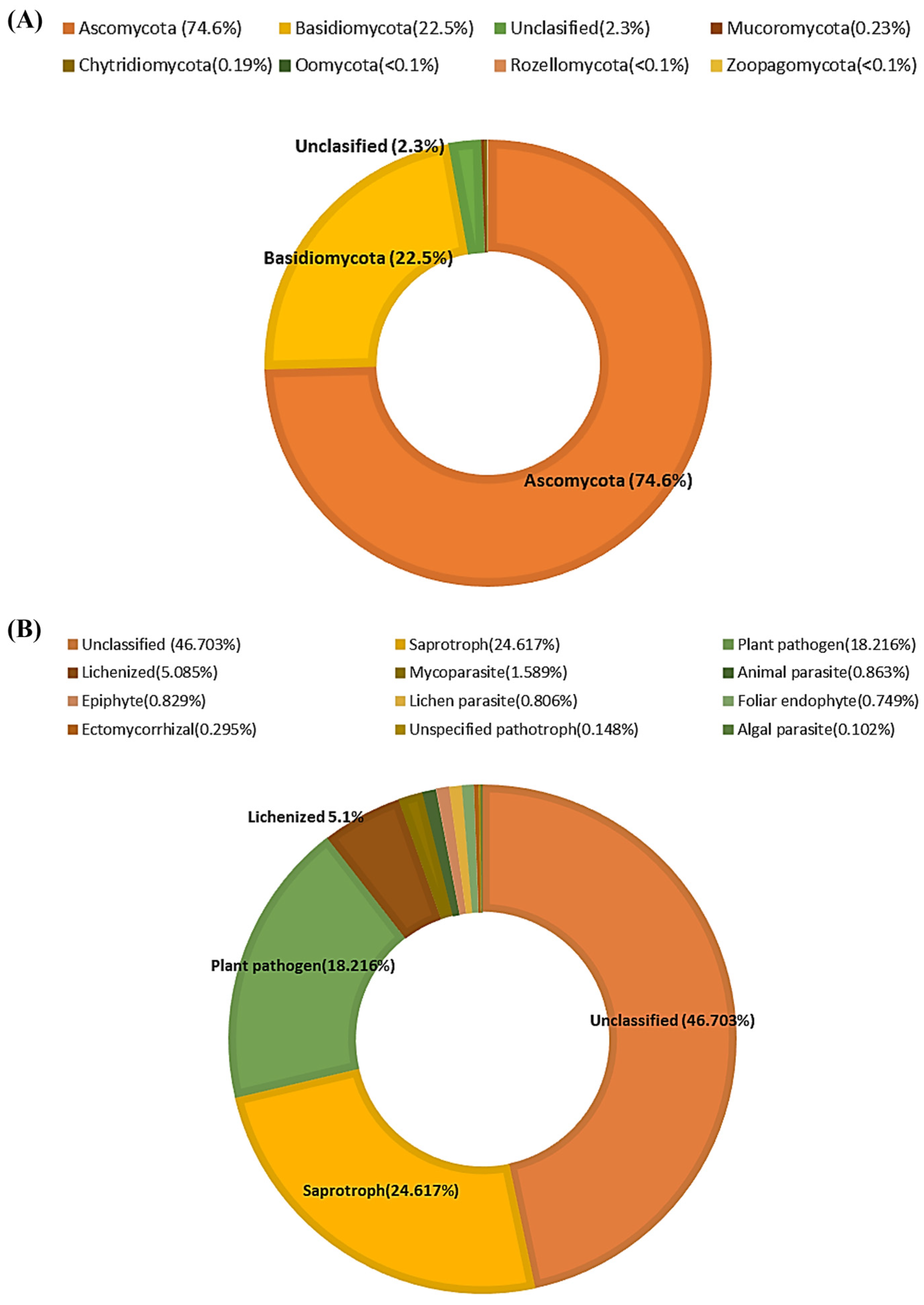
Figure 1. Phylum distribution of fungal OTUs (A) and primary lifestyle distribution of fungal OTUs (B) found in one-and two-year-old needles and shoots of P. sylvestris progeny trees.
Forests 16 01859 g001
Figure 2. (A) Prevalence of overall fungal taxa in one- and two-year-old needles and shoots. (B) Prevalence of pathogenic fungal taxa in one- and two-year-old needles and shoots.
Forests 16 01859 g002
Figure 3. Shannon diversity index of microbial communities in one-and two-year-old needles, and shoots. Boxplots show median, interquartile range (IQR), and whiskers (1.5× IQR); circles (○) and asterisks (*) indicate outliers and extreme values, respectively. Different lowercase letters denote significant differences among tissues (p < 0.05, Bonferroni-adjusted).
Forests 16 01859 g003
Figure 4. Overall alpha fungal diversity (Shannon index) in Scots pine plus tree genotype and tissue: (A) One-year-old needles, (B) Two-year-old needles and (C) Shoots. (D) Overall fungal diversity across all tissues (one- and two-year-old needles, and shoots). Boxes represent median values and interquartile ranges; whiskers indicate the minimum and maximum values. Significant differences between plus tree genotypes are shown according to pairwise comparisons (p < 0.05). Different lowercase letters above boxes denote significant differences among genotypes (p < 0.05, Bonferroni-adjusted). Circles (○) indicate outliers, and asterisks (*) indicate extreme values.
Forests 16 01859 g004
Figure 5. Overall alpha fungal diversity (Shannon index) in Scots pine plus tree genotype progenies according to location and tissue: (A) One-year-old needles, (B) Two-year-old needles and (C) Shoots. (D) Overall fungal diversity across all tissues (one- and two-year-old needles, and shoots). Boxes represent median values and interquartile ranges; whiskers indicate the minimum and maximum values. Significant differences between genotypes are shown according to pairwise comparisons (p < 0.05). Different lowercase letters above boxes denote significant differences among genotypes (p < 0.05, Bonferroni-adjusted). Circles (○) indicate outliers, and asterisks (*) indicate extreme values.
Forests 16 01859 g005
Figure 6. PCoA illustrating the fungal community structure of needles and shoots. (A) Comparison of fungal communities between tissues of Scots pine trees, (B) Comparison of fungal community structures between Scots pine plus trees genotype and tissues. N1 = one-year-old needles, N2 = two-year-old needles.
Forests 16 01859 g006
Figure 7. Principal coordinates analysis (PCoA) of all fungal composition in Scots pine. Samples are grouped by tissue type (N1 = one-year-old needles, N2 = two-year-old needles, Shoots) and location (Mändjala, Pärnassaare, Tarumaa, Nohipalo), with pine plus tree identity as the grouping factor.
Forests 16 01859 g007
Figure 8. Principal coordinates analysis (PCoA) illustrating fungal composition structure according to trial locations and pine plus trees genotype at: (A) one-year–old needles, (B) two-year-old needles and (C) shoots.
Forests 16 01859 g008
Figure 9. Comparison of Scots pine progenies height (m) at 5 (A,B) and 10 (C,D) years by location and plus tree genotype. (A,C) Tree height at four progeny trial locations. (B,D) Tree height by genotype. Letters above the boxes indicate significant differences between groups (p < 0.05). Circles (○) indicate outliers, and asterisks (*) indicate extreme values.
Forests 16 01859 g009
Table 1. General and meteorological information about progeny trials.
LocationGeographical CoordinatesMeteorological StationSum of Effective Temperature (SET) (°C) *Average Temperature of Vegetation Period (AVTP) (°C) **Altitude (m.a.s.l)/Location Parameter
Mändjala58.212886° N, 22.303049° ESõrve120015.03
Pärnassaare58.18252° N, 24.924042° EPärnu125015.543–44
Nohipalo57.959597° N, 27.355232° EVõru130015.853–57
Tarumaa59.223592° N, 27.134243° ENarva115014.857–59
* Sum of Effective Temperature (SET) (°C) is an agroclimatic index that calculates the total of daily temperatures exceeding a specific threshold (generally +5 °C) during the plant growth period [47]. ** Average Temperature of the Vegetation Period (AVTP) (°C) is the average of daily temperatures during the period when climatic conditions allow for active plant growth [48].
Table 2. Dependent and independent variables for statistical analyses.
AnalysisDependent VariableIndependent Variables
Kruskal–WallisShannon indexPlus tree genotype, Tissue, Location
Generalized Lineal ModelShannon indexPlus tree genotype, SET, ATVP, Location
SpearmanShannon index; Tree heightEnvironmental covariates (SET, ATVP, Location), Plus tree genotype
PERMANOVAOTU compositionPlus tree genotype, Tissue, Location
ANOSIMCommunity dissimilarity (Bray–Curtis)Grouping factors: Tree tissue type, Location, Plus tree genotype
BEST/BIOENVCommunity dissimilarity (Bray–Curtis)Environmental variables: SET, ATVP, Location
Disclaimer/Publisher’s Note: The statements, opinions and data contained in all publications are solely those of the individual author(s) and contributor(s) and not of MDPI and/or the editor(s). MDPI and/or the editor(s) disclaim responsibility for any injury to people or property resulting from any ideas, methods, instructions or products referred to in the content.