Article

Cooling Effects in Large Urban Mountains: A Case Study of Chengdu Longquan Mountains Urban Forest Park


1
Ecological Restoration and Biodiversity Conservation Key Laboratory of Sichuan Province, Chengdu Institute of Biology, Chinese Aeademy of Sciences, Chengdu 610213, China
2
University of Chinese Academy of Sciences, Beijing 100049, China
3
Xigaze Wetland Conservation Center, Xigaze 857000, China
4
Management Committee of Chengdu Longquan Mountain Urban Forest Park, Chengdu 610100, China
*
Author to whom correspondence should be addressed.
Forests 2025, 16(12), 1850; https://doi.org/10.3390/f16121850
Submission received: 4 November 2025 / Revised: 30 November 2025 / Accepted: 5 December 2025 / Published: 12 December 2025
(This article belongs to the Section Urban Forestry)

Abstract

Large Urban Mountains (LUM) with their rich vegetation cover offer a key natural solution to mitigate Urban Heat Island (UHI) effects. This study uses Longquan Mountain Forest Park (LMFP) as a case to investigate the spatiotemporal variations in cooling effects and the key factors influencing cooling intensity. Using Landsat images from 2001, 2011, and 2023, surface temperatures (LST) were retrieved through radiative transfer methods, and the thermal environment and cooling effects of LMFP were systematically analyzed. The eXtreme Gradient Boosting (XGBoost) model and Shapley Additive exPlanations(SHAP) methods were applied to explore the complex relationships between cooling intensity and its driving factors. Results show that in the years 2001, 2011, and 2023, the heat island area in LMFP has gradually shrunk, while the cooling intensity area has expanded. In the three years, the cooling distance increased from 330 m to 420 m, the cooling area expanded to 124.84 km2, and cooling efficiency increased to 18.31%. Vegetation coverage, leaf area index (LAI), and elevation are core factors influencing cooling, while human activities such as population and road density have a negative impact. This study provides important theoretical insights into the cooling mechanisms of large urban mountain parks.

1. Introduction

Urban Heat Island (UHI) not only diminishes human thermal comfort but also exacerbates urban air quality degradation and thereby poses a persistent threat to public health [1,2,3,4]. This threat is further amplified in densely populated megacities by global climate change and its attendant extreme heat events, making the mitigation of UHI a core issue in contemporary urban ecological governance. Early UHI research primarily relied on air temperature data from meteorological stations [4,5]. However, such point-based observations have limited spatial coverage and cannot reveal the spatial heterogeneity of UHI or the influence of urban structural characteristics on UHI patterns, thus failing to meet the needs of regional-scale studies [4,6]. At present, satellite-based retrieval of Land Surface Temperature (LST) from thermal infrared bands has become the dominant approach in UHI research [4,7,8]. Owing to its high spatial resolution, low acquisition cost, and extensive spatial coverage, this technique has become a key methodological foundation for elucidating the mechanisms underlying UHI formation and for optimizing mitigation strategies [4,8,9].
Urban mountain refers to a natural mountainous patch embedded within, or adjacent to, a city’s built-up area [4,10]. Mountainous green spaces exhibit a superior capacity for regulating the thermal environment compared to artificial urban green spaces [4,11], This advantage is mainly due to two factors. First, urban mountains are usually dominated by natural or near-natural vegetation with complex community structures and greater biomass, leading to more vigorous transpiration [4,10,12]. Second, the spatial heterogeneity of mountain terrain creates natural air circulation corridors that promote air exchange between heat accumulation zones and cooler areas, achieving heat dissipation far more efficiently than artificial green spaces constrained by urban building surfaces [4,13]. Consistent with these mechanisms, numerous empirical studies have found that temperatures inside mountain green spaces are generally lower than those in the surrounding urban built-up areas, highlighting their critical role in mitigating UHI [4,10,14,15].
Researchers have widely investigated the relationship between urban green spaces and urban LST in terms of area thresholds, vegetation composition, landscape morphology, surface cover, and spatial distribution [4,16,17,18]. In the context of urban mountains, some studies have likewise reported their influence on the spatial pattern of the urban thermal environment [4,19,20]. Studies on Mount Maxian in Lanzhou, China, and Mount Vitosha near Sofia, Bulgaria, have demonstrated that mountains can substantially modulate urban thermal environment patterns, with areas in proximity to mountains exhibiting lower temperatures than the surrounding urban built-up areas [4,14,21]. It is worth noting, however, that most existing studies are based on single-date or short-term remote sensing observations, lacking continuous long-term tracking of urban mountain LST and the dynamics of their cooling effects. Consequently, elucidating the coupling between large urban mountains and the urban thermal environment over extended time scales remains a critical but under-explored topic in urban ecology and climate-adaptive planning.
Beyond characterizing the thermal environment itself, researchers are also highly concerned with the cooling effects of green spaces, which are commonly quantified using metrics such as park cooling distance (PCD), park cooling intensity (PCI), and park cooling area (PCA) [4,22,23,24,25,26]. Empirical evidence generally shows that large green spaces have greater cooling intensities, can provide cooling over a larger area, and typically influence temperatures at a longer distance than small or medium-sized green spaces [4,23,27,28]. However, urban mountains generally cover much larger areas than typical urban green spaces, and thus in theory should exert more pronounced cooling effects [13,29]; yet only a few studies have so far investigated the cooling effects of urban mountains. For example, remnant natural features in or around urban areas (e.g., karst mountains or hill forests) have been shown to induce localized cooling, lowering near-surface air temperatures by approximately 1–2.5 °C and extending this cooling effect roughly 100–300 m into the surrounding urban area [30,31,32]. These cases illustrate that large urban mountains can indeed generate notable cooling, though their internal environments vary greatly. Such variability, through complex interactions, leads to substantial spatial heterogeneity in the cooling effects of different parts of an urban mountain.
Longquan Mountain Urban Forest Park (LMFP), located on the eastern side of Chengdu—western China’s most populous city—is the study area. LMFP serves as an important ecological barrier for Chengdu and its surrounding urban cluster [33,34]. Yet, despite the park’s ecological significance, understanding of its role in UHI mitigation and its cooling benefits remains very limited to date. To address this gap, we utilize Landsat remote sensing imagery to retrieve LST and examine the spatiotemporal characteristics of the urban thermal environment during the summers of 2001, 2011, and 2023, three representative stages of Chengdu’s urban expansion. We further employ an ‘inflection point’ method and related techniques to quantify LMFP’s cooling distance, intensity, and area at each time point. To identify the drivers of summer cooling intensity with both accuracy and interpretability, we employ an integrated eXtreme Gradient Boosting (XGBoost) model and Shapley Additive exPlanations (SHAP) framework, which captures nonlinearities and interactions among multiple factors while quantifying each factor’s contribution, thereby overcoming the limitations of linear, single-factor analyses [10,25,35,36]. Accordingly, the objectives of this study are (1) to ascertain the spatiotemporal evolution of the UHI pattern within LMFP and adjacent areas; (2) to reveal the spatiotemporal dynamics of LMFP’s cooling effect; and (3) to identify the main factors and their interactions that affect LMFP’s summer cooling intensity. Our findings will deepen our understanding of the role of large urban mountains in mitigating urban heat islands and provide a useful reference for UHI mitigation efforts in megacities.

2. Materials and Methods

2.1. Study Area

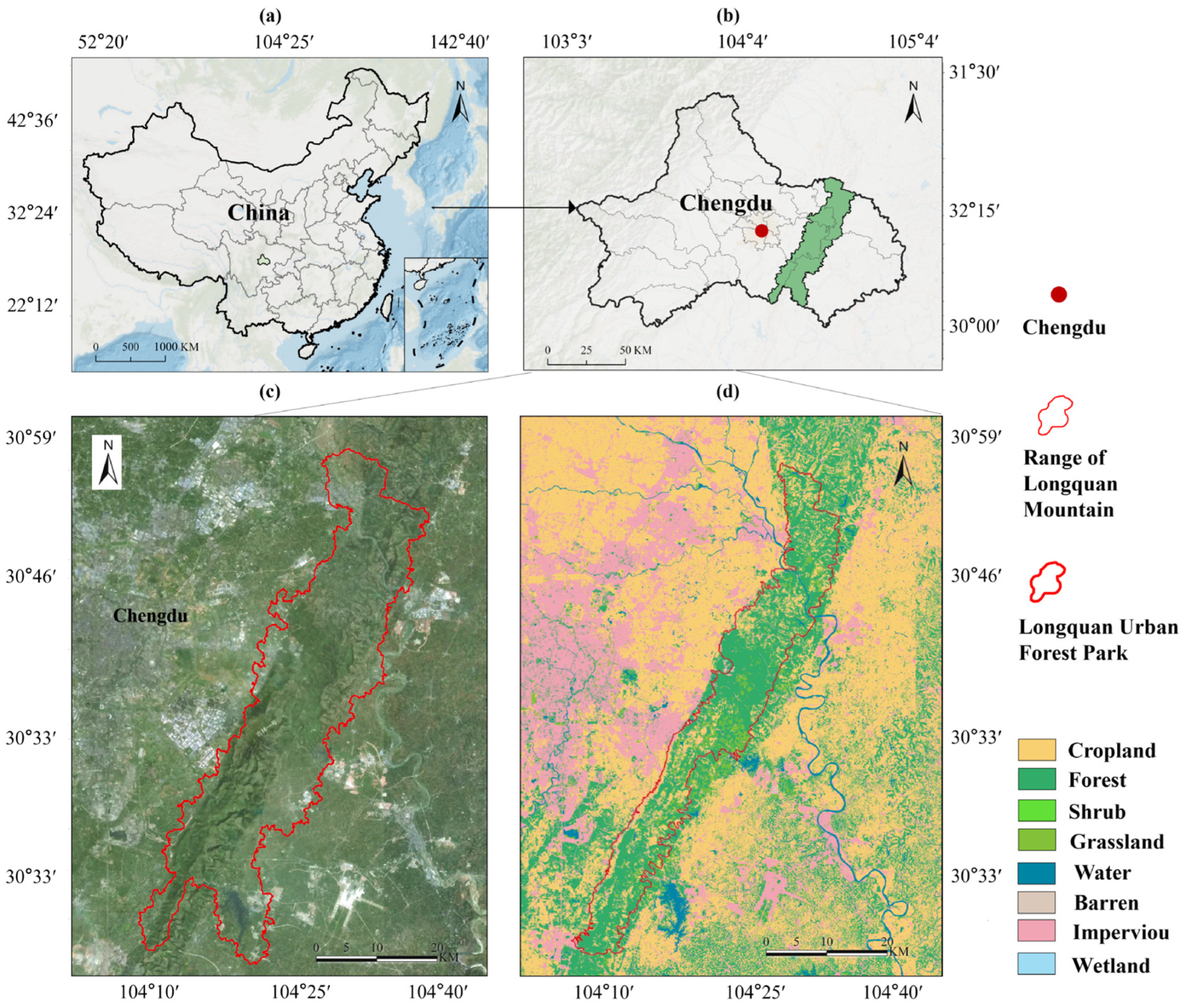
LMFP is situated in the western part of China’s Sichuan Basin. It is located approximately 25 km from the center of Chengdu, with geographical coordinates ranging between 30°12′ N, 104°5′ E and 30°57′ N, 104°36′ E (Figure 1). The Longquan Mountain range within the park runs north–south, spanning about 12 km in width and extending approximately 90 km in length. The park’s jurisdiction covers 38 towns across six districts and counties of Chengdu, including Longquanyi District, Jintang County, and Shuangliu District, encompassing a total area of about 1275 square kilometers. The Longquan Mountain range within the park serves as a natural boundary transitioning from the eastern edge of the Chengdu Plain to the hilly regions of central Sichuan. Its highest peak reaches an elevation of 1051 m above sea level, and the terrain is predominantly characterized by hills and low mountains. Climatically, the region falls within a subtropical humid monsoon climate zone, featuring mild temperatures, a long frost-free period, and distinct seasons. Rainfall and heat are concurrent during summer and autumn, while the winter and spring seasons are relatively dry. The primary land use types are forest and shrubland, with a small amount of farmland distributed within the park’s area. As of 2023, the forest coverage rate of the park has reached 59.5%.

2.2. Data Source

2.2.1. Land Surface Temperature Data

We selected three representative years—2001, 2011, and 2023—corresponding to the early expansion, rapid urbanization, and post-establishment stabilization phases of urban development around the LMFP. According to the Chengdu Statistical Yearbooks (2001, 2011, 2023), the city’s permanent population increased from 10.29 to 21.26 million, while the built-up area expanded from 386 to 1032 km2, indicating substantial and sustained urban growth. Summer LST data for these three years were retrieved from Landsat 5 TM and Landsat 8 OLI-2/TIRS-2 imagery (Table 1). The Landsat data used in this study were obtained from the United States Geological Survey (USGS) Collection 2 products. All scenes had been corrected and terrain-corrected by USGS and orthorectified to the standard map projection at the time of download. Considering the climatic characteristics of the Chengdu Plain, all images were acquired during the peak high-temperature period (June to August) to accurately capture the summer thermal environment of the park. Due to frequent cloud cover over the Chengdu Plain in summer, low-cloud-cover (<10%) Landsat thermal infrared images are rare. Therefore, only one image with less than 10% cloud cover was selected each year for LST inversion, using single-day data to represent the summer LST characteristics for that year. For radiometric processing, the digital numbers (DN) of the visible and near-infrared bands were converted to surface reflectance, and the thermal infrared bands were converted to top-of-atmosphere radiance and brightness temperature using the gain and offset coefficients provided in the metadata file. For the reflective bands, we used the official Collection 2 Level-2 surface reflectance products or an atmospheric correction scheme based on a radiative transfer model to reduce atmospheric scattering and absorption, whereas the thermal bands were subsequently used for LST retrieval following the radiative transfer equation (RTE) method [37]. The detailed formulation for LST inversion is provided in Section 2.3.1.

2.2.2. Additional Data Sources

Topographic characteristics were derived from the 30 m resolution Digital Elevation Model (DEM) of the United States Geological Survey (USGS). Population density data were obtained from the Oak Ridge National Laboratory LandScan dataset. Road density was calculated using road vectors from OpenStreetMap (https://www.openstreetmap.org/) by summing the total road length within a 300 m radius for each 30 m grid cell. Land use information from the China Land Cover Dataset (CLCD) was used to extract green-space patches, and core landscape metrics were computed using Fragstats 4.2 [38]. Canopy height was obtained from the GEDI L2A product released by the Global Land Analysis and Discovery (GLAD) laboratory of the University of Maryland. Leaf area index (LAI) and fractional vegetation cover (FVC) were generated on Google Earth Engine (GEE) using the MODIS LAI product (MCD15A3H) and an NDVI-based estimation, respectively, and were averaged across the growing season for each study year. Vegetation transpiration (Es) and soil evaporation (Ec) were derived from the PML_V2 evapotranspiration dataset. All raster layers of the influencing factors were clipped to the study area in RStudio (version 4.3.2), projected to the WGS84 coordinate system, and resampled to match the lowest-resolution raster layer before being exported as CSV files for XGBoost–SHAP machine-learning analysis. All processing codes and data-source links are provided in the public GitHub repository. Additional dataset details are available in the Supplementary Material.

2.3. Methods

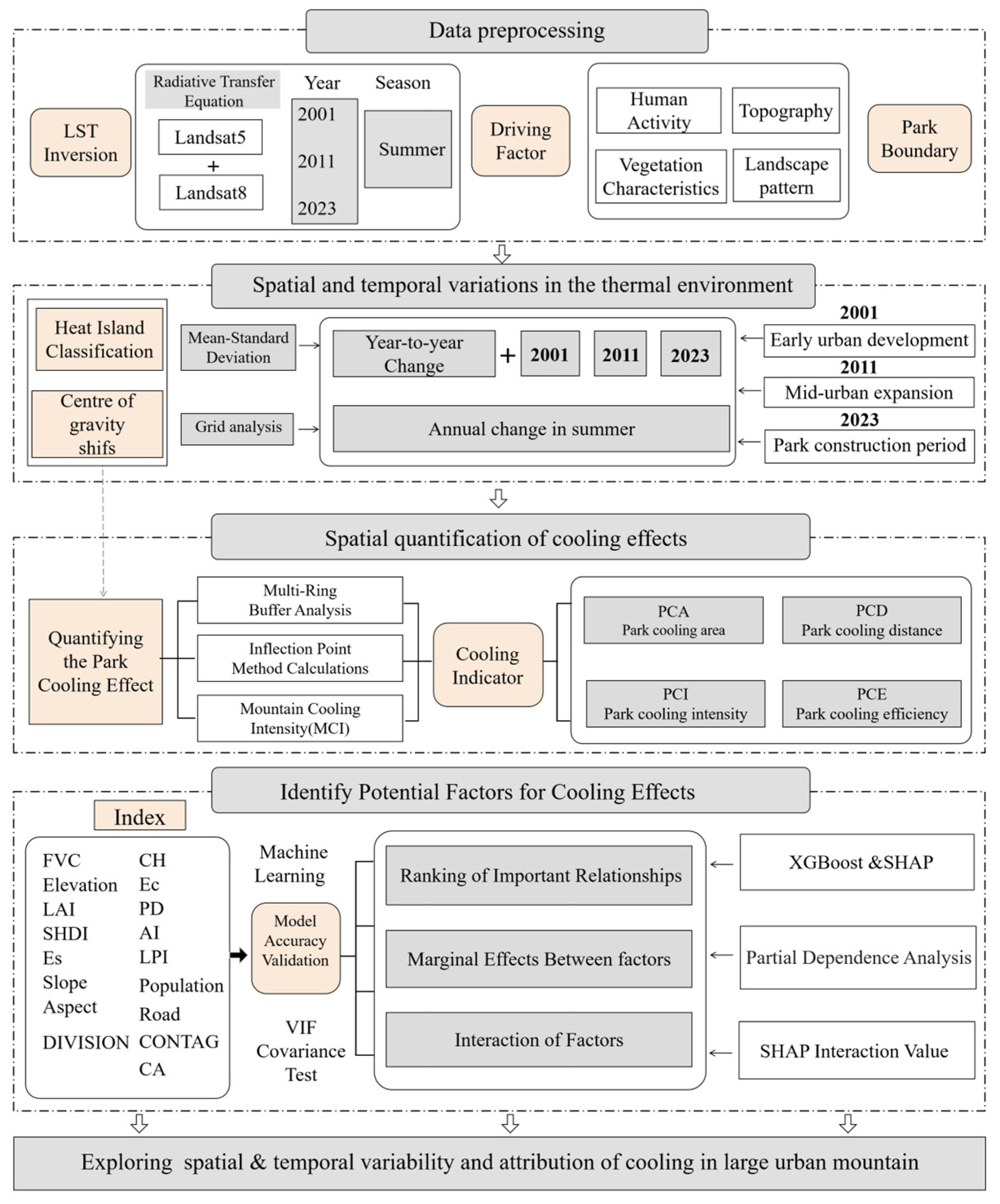
The workflow of this study includes seven steps (Figure 2): (1) data acquisition and pre-processing; (2) LST retrieval and quality control based on RTE; (3) classification of summer thermal environments and water pixel masking; (4) concentric buffer zones and inflection-point detection to quantify PCD, PCI, PCA, and PCE; (5) construction of a multi-dimensional factor set including vegetation–hydrology, topography, landscape, and human activity; (6) XGBoost modeling with SHAP for global and local interpretation, and interaction analysis; (7) this provides the overall methodology of the study.

2.3.1. Land Surface Temperature Inversion

Land surface temperature (LST) retrieval is centered on Planck’s law, which states that the radiative energy of an object is directly related to its temperature [39]. A quantitative relationship between at-sensor radiance and LST can be established based on the Radiative Transfer Equation (RTE).
For a specific wavelength, the at-sensor radiance measured by the sensor can be simplified using RTE as [40,41]:
L λ s e n = ε λ B λ T s + ( 1 ε λ ) L λ τ λ + L λ
where L λ s e n denotes at-sensor radiance; ε λ is land surface emissivity (LSE), noting that LSE is essentially different from “surface albedo”—the former characterizes emission properties, while the latter characterizes reflection properties; τ λ represents atmospheric transmittance; B λ ( T s ) is the emitted radiance of a black body at the land surface temperature T s ; L λ is downwelling atmospheric radiance; and L λ is upwelling atmospheric path radiance.
The black body emitted radiance can be derived from Equation (1):
B λ T s = L λ s e n L λ τ λ ( 1 ε λ ) L λ τ λ ε λ
LST is then calculated by combining with Planck’s law:
T s = C 2 λ ln C 1 λ 5 L λ s e n L λ τ λ ε λ 1 ε λ ε λ L λ + 1 1
where C 1 = 2 π h c 2 = 3.7419 × 1 0 16   W · m 2 and C 2 = h c k = 1.4388 × 1 0 2   m · K (with h as Planck’s constant, c as the speed of light, and k as Boltzmann’s constant); λ is the target wavelength.
For Landsat Band 10, the simplified Equation can be used:
L S T = K 2 ln K 1 B λ ( T s ) + 1
Among these, K1 and K2 are the Landsat satellite sensor calibration constants. Landsat 8 OLI:   K 1 = 774.89   W · m 2 · s r 1 · μ m 1 and K 2 = 1321.0789   K ; Landsat 5 TM: K 1 = 607.76   W · m 2 · s r 1 · μ m 1 and K 2 = 1260.56   K [42].
ε λ : Obtained via the NDVI method—NDVI is calculated using the reflectances of near-infrared and red bands:
N D V I = ρ N I R ρ R ρ N I R + ρ R
Then ε λ is derived by combining vegetation coverage P v : calculated from N D V I m a x and N D V I m i n . where vegetation coverage P v is:
P v = N D V I N D V I m i n N D V I m a x N D V I m i n 2
where N D V I m a x and N D V I m i n are obtained from the histogram of the NDVI image.
L λ s e n : Converted from Digital Number (DN) values using band-specific scaling factors in the image metadata:
L λ s e n = M L Q c a l + A L
where M L is the band-specific multiplicative rescaling factor, A L is the band-specific additive rescaling factor, and Q c a l refers to DN values);
Atmospheric parameters τ λ , L λ , L λ : Primarily acquired using NASA’s Atmospheric Correction Parameter Calculator. The parameters can be reproduced by implementing the protocol with locally downloaded official atmospheric profile datasets [43].

2.3.2. Spatiotemporal Analysis of LST

Classification of Heat Island Intensity
The mean-standard deviation method was employed to classify heat island intensity, capitalizing on its suitability for multi-temporal analyses [44]. This approach delineates areas according to the deviation of land surface temperature (LST) from its mean value. In this study, the retrieved LST data were segmented into seven distinct intensity levels, as outlined in Table 2.

2.3.3. Spatial Quantification of Cooling Effects

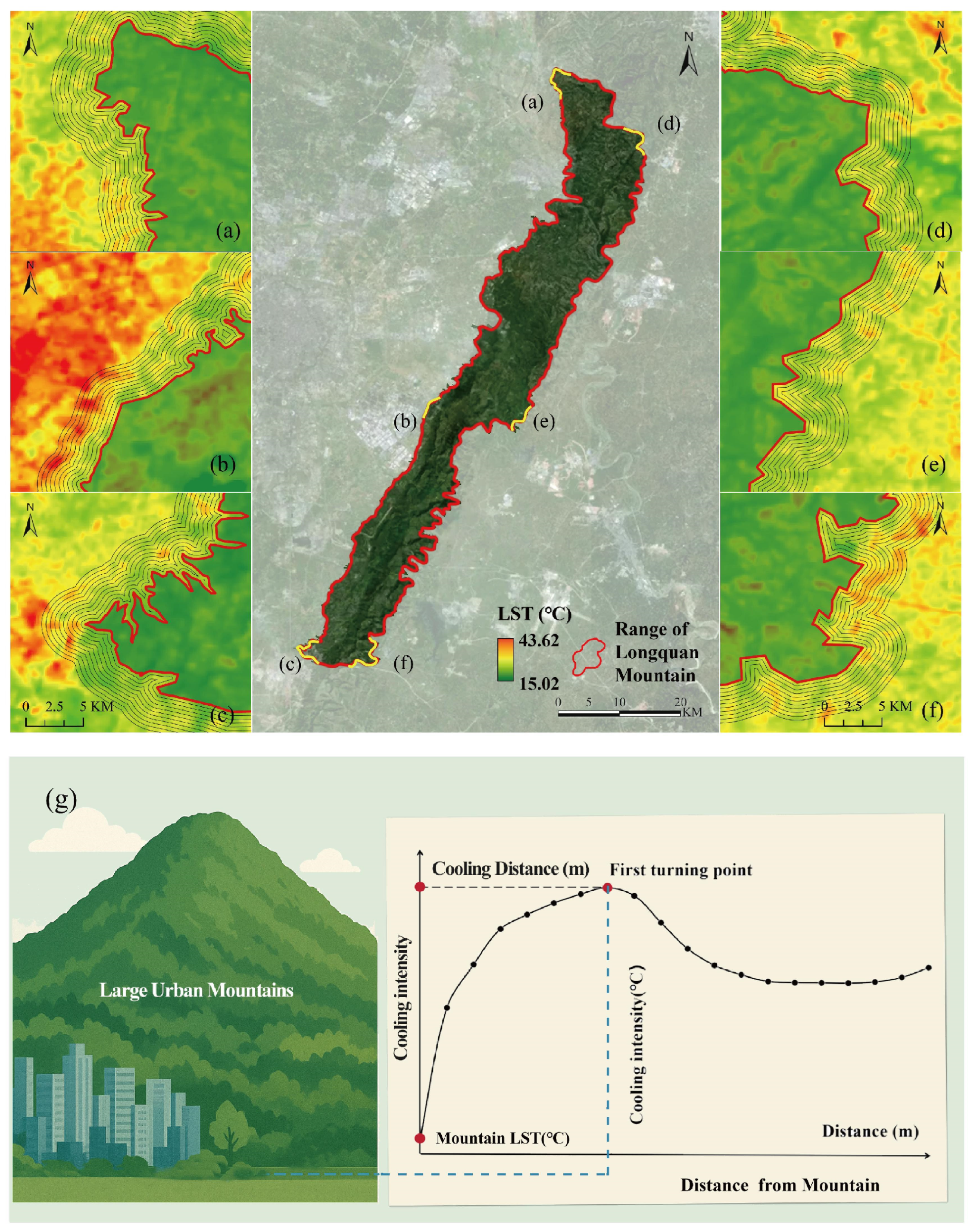
To quantify cooling effects across the study area, multi-tiered buffer rings were established to characterize the spatial attenuation of such effects. The main body of the Longquan Mountain Range, as a core cold zone formed by the park’s concentrated vegetation cover, served as the baseline for buffer zone delineation. Concentric buffer rings were generated by expanding outward from the mountain edge at 30 m intervals, extending to a maximum distance of 900 m. Mean land surface temperature (LST) was computed for each ring and compared with the mean temperature at the boundary of the mountain buffer zone [45]. By plotting the relationship between buffer distance and corresponding temperature, the inflection point marking a significant temperature drop was identified. This inflection point defined two key metrics: park cooling distance (PCD), representing the distance from the inflection point to the park boundary, and park cooling intensity (PCI), denoting the temperature difference between the inflection point and the park’s core (Figure 3). A larger PCD indicates a broader spatial coverage of the park’s cooling effect, while a larger PCI reflects a more pronounced temperature reduction within the park relative to the surrounding environment. Park cooling area (PCA) was defined as the area of the maximum buffer zone (Smax), representing the largest region influenced by significant cooling. Park cooling efficiency (PCE) was calculated as the ratio of PCA (Smax) to the total park area, reflecting the efficiency and cost-effectiveness of the park’s cooling process [27,46]. The detailed calculation principles for PCI, PCD, PCA, and PCE are provided in the Supplementary Material.

2.3.4. Factors Affecting Cooling Effect

Previous studies have shown that the cooling effect of parks is correlated with the parks’ landscape characteristics [47]. This study considers the potential influencing factors of the cooling effect of parks in five areas: vegetation canopy structure, water evaporation, topography, human activity, and landscape pattern index. The specific list of factors is shown in Table 3. This study uses the average temperature of green patches within Longquan Mountain and the temperature difference at the inflection point of the buffer zone. To mitigate the cooling effect of water bodies, the Normalized Difference Water Index (NDWI) was calculated using the reflectance values from the green and near-infrared bands of Landsat imagery. Subsequently, water pixels were masked from the land surface temperature (LST) data to facilitate the calculation of cooling intensity, excluding temperature values in water areas [29]. The formula for this calculation is as follows:
M C I = T = T m T u
where MCI is the cooling intensity, Tm is the average surface temperature of the green patches within the main mountain range, and Tu is the average temperature within the buffer zone in degrees Celsius.
XGBoost Model and SHAP Explainability Method
The XGBoost algorithm, an efficient gradient boosting framework that iteratively constructs decision trees to minimize prediction errors and capture complex nonlinear relationships [48,49], was implemented in Python 3.10 (PyCharm 2024.1.5). The model was configured with max_depth = 4, learning_rate = 0.05, n_estimators = 150, reg_alpha = 0.1, and reg_lambda = 0.1, and the dataset was randomly split into training and testing subsets at an 8:2 ratio. SHAP analysis was employed to quantify the relative importance and interactions of potential influencing factors, providing an interpretable assessment of their contributions to the predicted cooling effect [4].

3. Results

3.1. Spatial Evolution of the Urban Heat Island

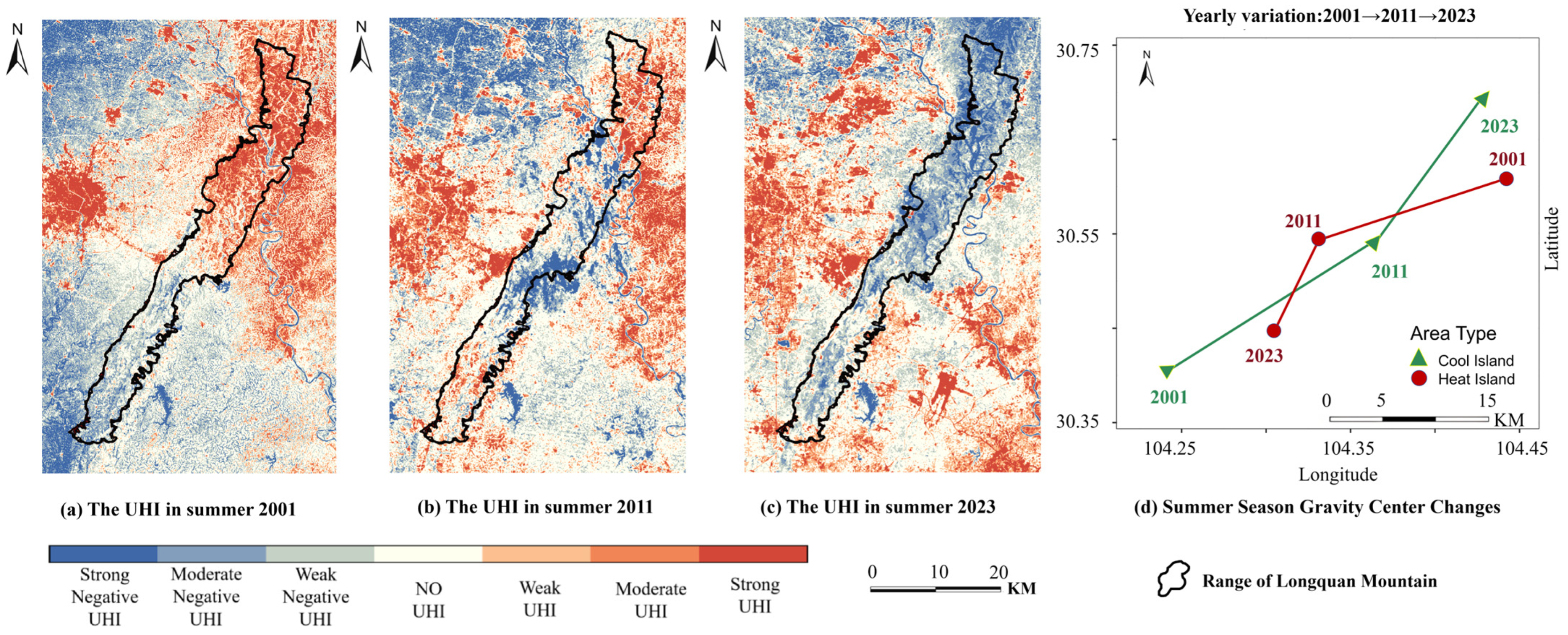
UHI was most pronounced around the park perimeter and adjacent urbanized areas (Figure 4). In summer 2001, high-temperature UHI patches were widely distributed across the LMFP, with only the central forested belt remaining cool; by summer 2011 (Figure 4b), the high-temperature zone contracted markedly and the central cool band expanded laterally; by summer 2023, cool areas further coalesced into contiguous swaths, and high-temperature patches were confined to scattered locations along the study-area margins. Relative to 2001, however, accelerated urbanization was accompanied by an overall increase in the areal extent and intensity of the summer heat island by 2011. By 2023, the geographic footprint of high-temperature areas decreased compared with 2011, although local hotspots persisted along the Longquan Mountain ridge within the LMFP. Centroid analysis shows a sustained southward shift in the summer UHI centroid in the years 2001, 2011, and 2023, while the cool-island centroid migrated from the northeast toward the southeast, indicating an ongoing reconfiguration of the summer thermal gradient around the LMFP.

3.2. Interannual Variation in the Summer Cooling Effect

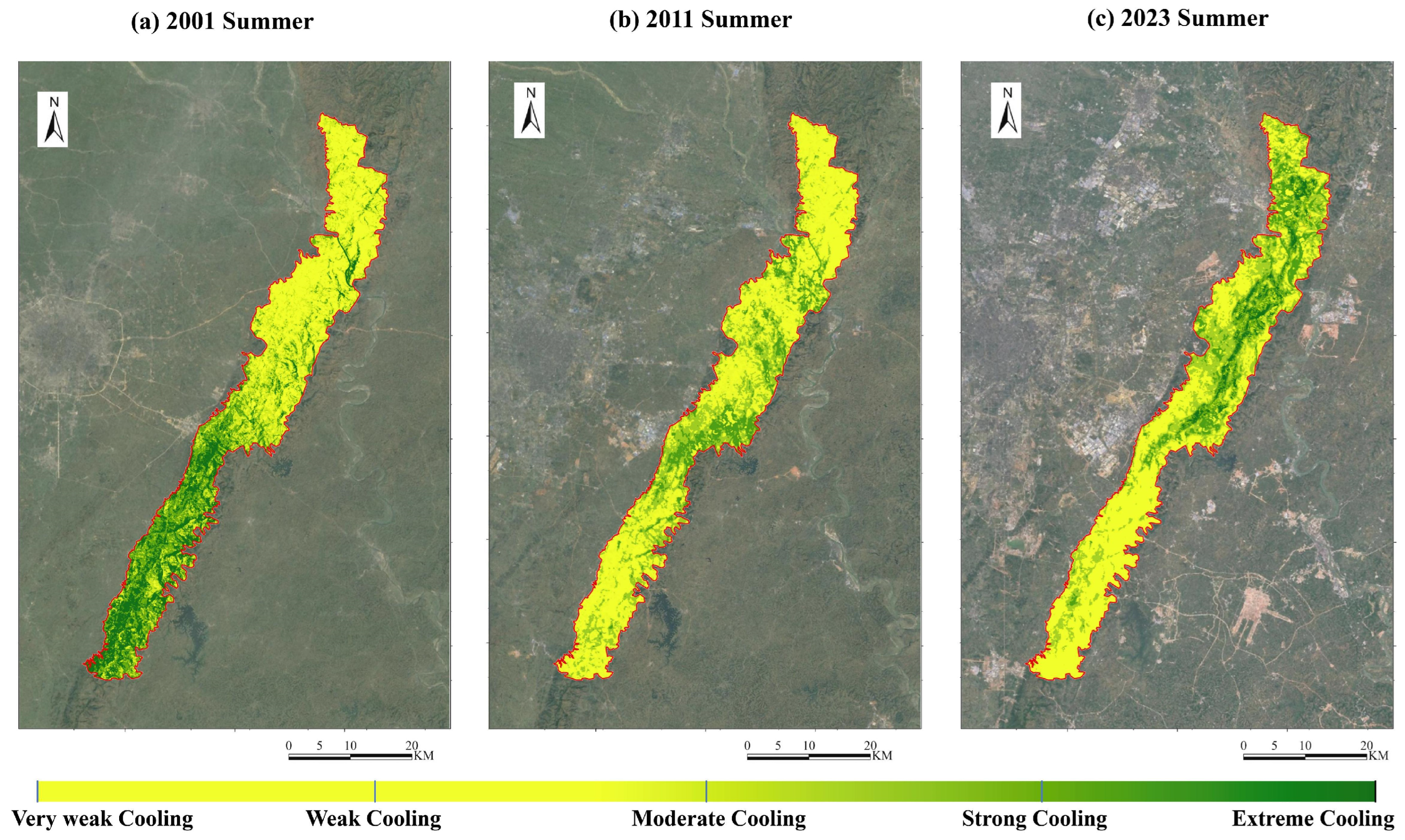
Drawing on Figure 5 and Table 3, the LMFP’s summer cooling effect exhibits a clear three-stage evolution. In 2001, cooling was strong but spatially concentrated, with the extreme and strong classes accounting for 37.59% and 15.25%, and the very weak class only 11.56%. By 2011, the pattern weakened and became fragmented, with the extreme class falling to 19.18% and the very weak class rising to 27.43%. In 2023, a recovery occurred with the emergence of continuous strong-cooling belts: the strong class increased to 33.60% and became dominant, the extreme class rebounded to 22.48%, while the moderate and very weak classes declined to 9.19% and 16.08%, respectively. In spatial terms, high-intensity cooling in 2001 was concentrated in the northern and southern segments of the mountain range; in 2011, high-cooling areas were fragmented and very weak cooling expanded; by 2023, strong-cooling zones expanded markedly, extreme-cooling areas showed local aggregation, and very weak cooling contracted.
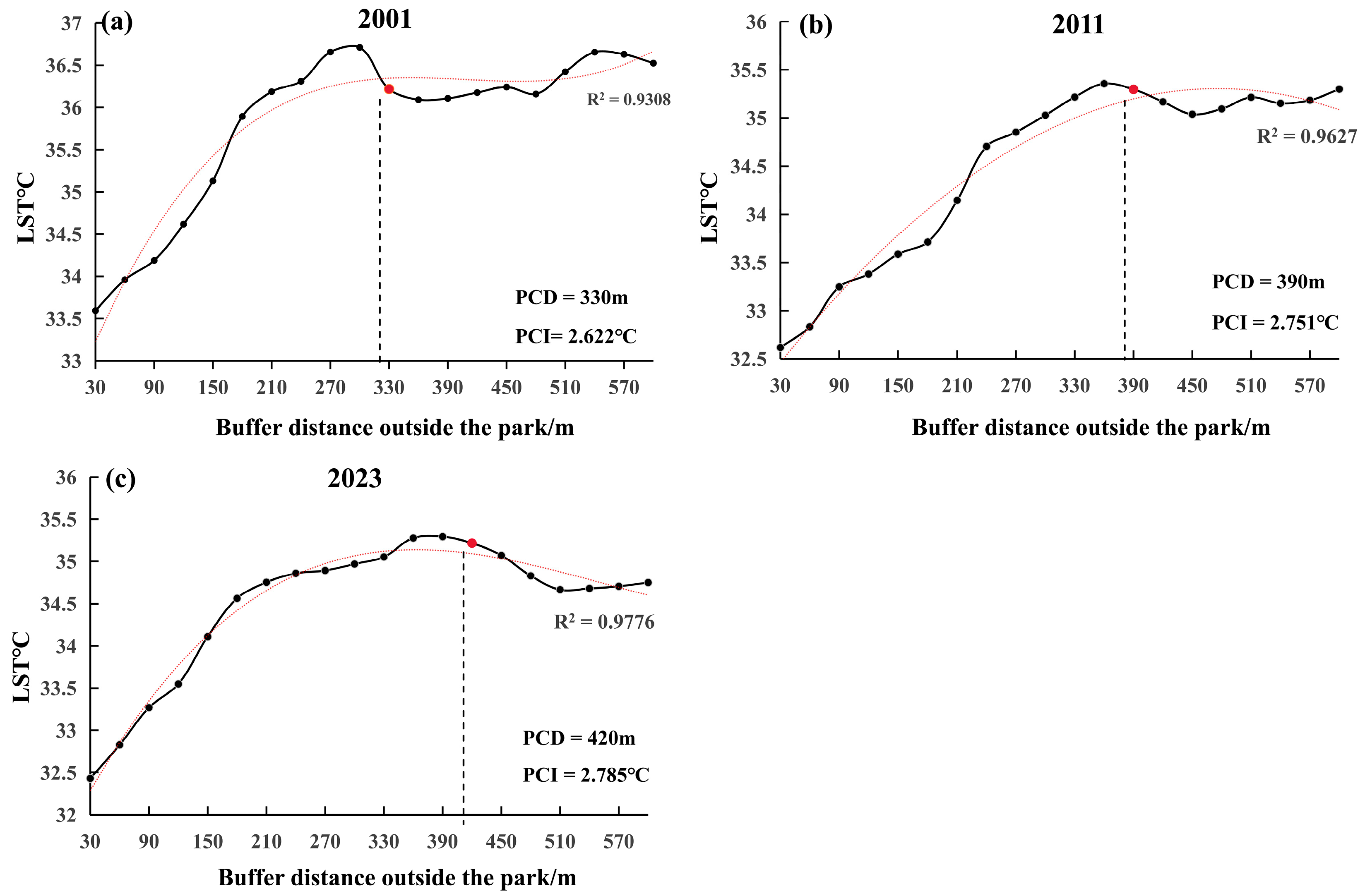
As shown in Figure 6 and Table 4, the LMFP’s summer cooling effect strengthened progressively in the years 2001, 2011, and 2023. The park cooling distance (PCD) increased from 330 m (2001) to 390 m (2011) and 420 m (2023). The park cooling intensity (PCI) rose from 2.623 °C to 2.751 °C and 2.785 °C, respectively. Consistently, the park cooling area (PCA) expanded from 101.121 km2 (2001) to 117.048 km2 (2011) and 124.844 km2 (2023), while the park cooling efficiency (PCE) increased from 14.83% to 17.17% and 18.31%. The buffer-distance curves exhibit high goodness of fit (R2 ≈ 0.931, 0.963, 0.978 for 2001, 2011, and 2023), with clear inflection points delineating the PCD. In all three years, LST increases with distance from the park boundary up to the inflection point and then attenuates beyond it, indicating a widening reach and strengthening magnitude of the park’s summer cooling influence over time.

3.3. Analysis of the Factors Influencing the Spatial Variation in Cooling Effect

3.3.1. Importance Ranking of Drivers of Cooling Intensity

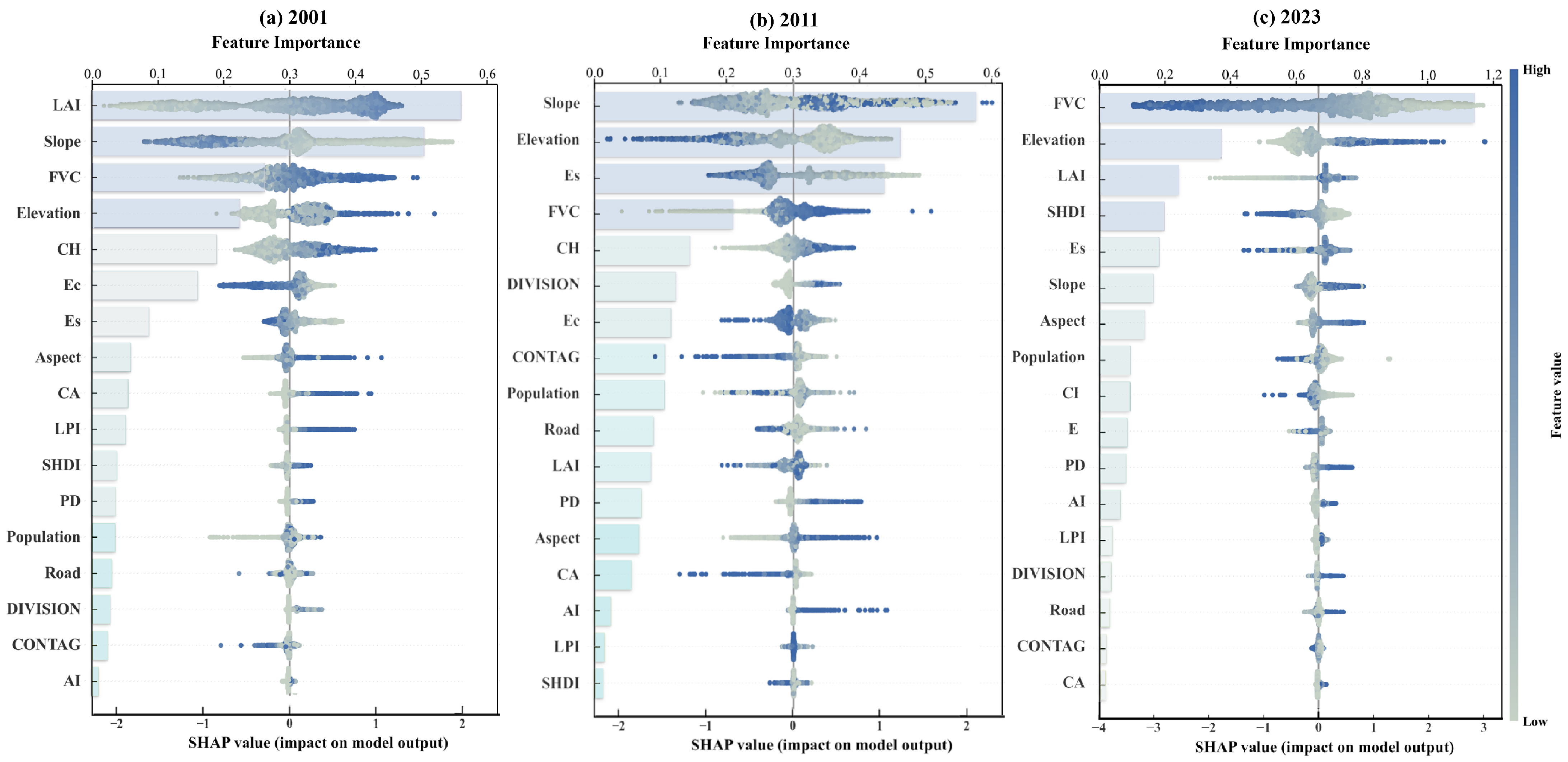
Before model fitting, we screened covariates for multicollinearity using the variance inflation factor (VIF); all variables met the threshold and were retained. Across the three years, SHAP diagnostics indicate a transition from joint vegetation–terrain control to vegetation-dominated regulation (Figure 7). In 2001, LAI, slope, and FVC were the principal drivers. SHAP values for LAI and FVC were predominantly positive; slope showed both positive and negative effects; elevation and CH contributed positively overall; and human-activity indicators (population density, road density) were negative, suppressing cooling. In 2011, the importance of slope increased, and the influence of elevation strengthened; Es (vegetation transpiration) was mostly positive, and FVC and CH continued to promote cooling. By contrast, landscape fragmentation metrics, particularly DIVISION and, in part, SHDI, exerted negative effects. In 2023, FVC became the dominant driver with a marked positive impact; elevation and LAI jointly reinforced cooling; SHDI exhibited inhibitory effects within specific intervals; and Es and slope were generally positive within the observed range. Although Population and Road remained negative, the positive contributions of landscape-structure indicators (e.g., LPI, CA) increased.

3.3.2. Marginal Effects of Drivers on Cooling Intensity

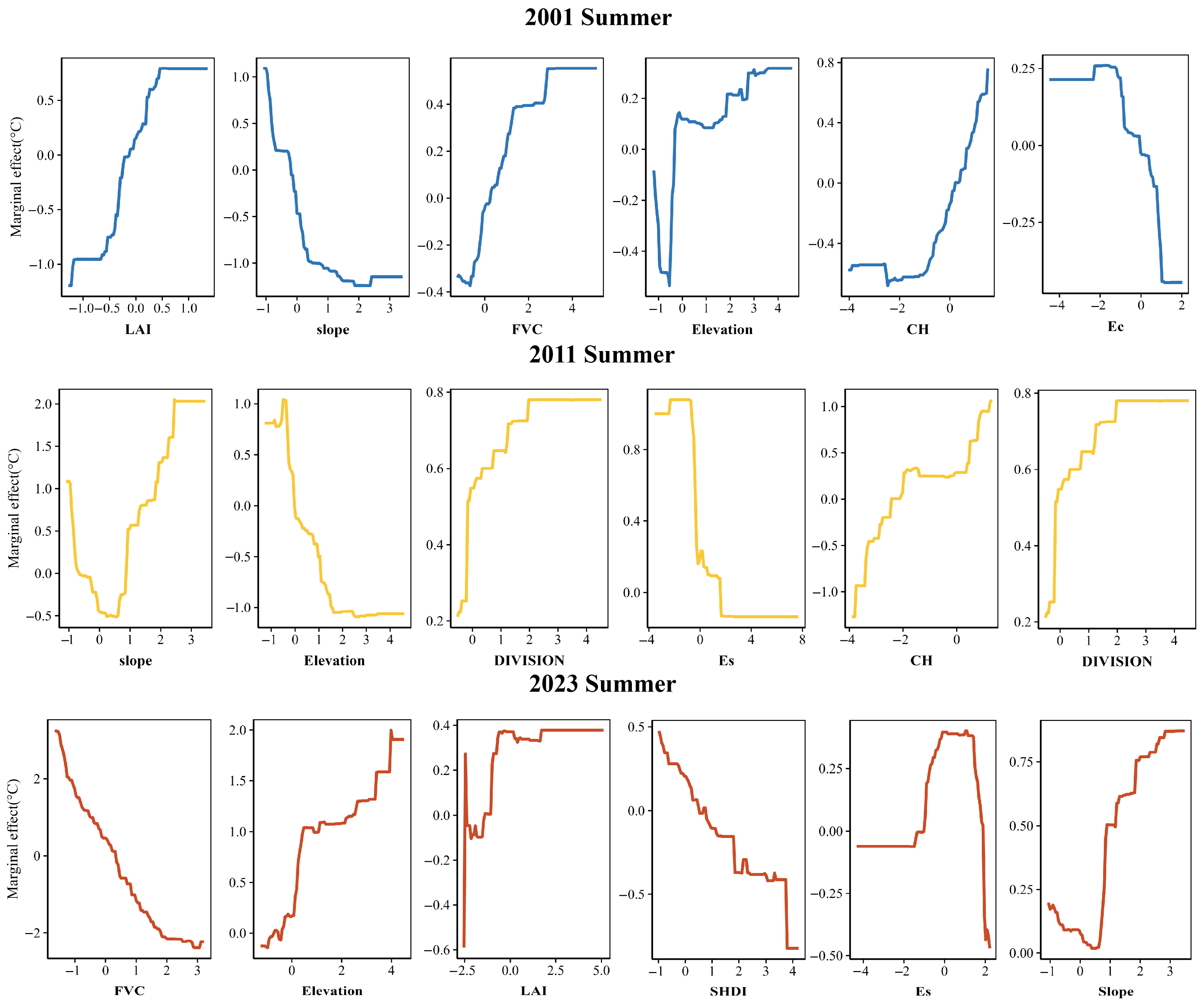
Using the XGBoost model’s marginal effect curves, we identified the top six variables (ranked by importance) to analyze the nonlinear relationships between each variable and MCI (Figure 8). In 2001, LAI’s contribution to the cooling effect increased initially and then gradually leveled off. FVC continued to rise with no sign of saturation in its cooling benefit. By contrast, slope showed a diminishing effect on cooling, whereas elevation had a positive influence. Other variables such as canopy height (CH), soil evaporation (Ec), vegetation transpiration (Es), and aspect also demonstrated distinct marginal effect patterns on the cooling effect. In 2011, the effect of slope first declined and then rose: within a certain range of slope, it suppressed the cooling, but beyond that threshold, it became promotive of cooling. Elevation significantly enhanced the cooling effect within a specific range, though its marginal benefit grew more slowly once past that range. Variables such as Es, FVC, CH, DIVISION, Ec, and CONTAG also showed complex marginal effect curves, underscoring their complicated influences on the cooling effect. In 2023, the FVC curve continued to rise, further strengthening its promotion of the cooling effect. The LAI curve was steep in the early stage but then leveled off, with its rate of increase diminishing after a certain threshold was reached. The SHDI curve declined, indicating a suppressive effect on cooling within a particular interval. Meanwhile, Es exhibited variable effects across some value ranges, and the effect of slope fluctuated within a specific interval. Additionally, the marginal influence of the aspect on cooling varied across different ranges, and population density likewise displayed a notable effect on cooling within a certain range.

3.3.3. The Interaction of Driving Factors on Cooling Intensity

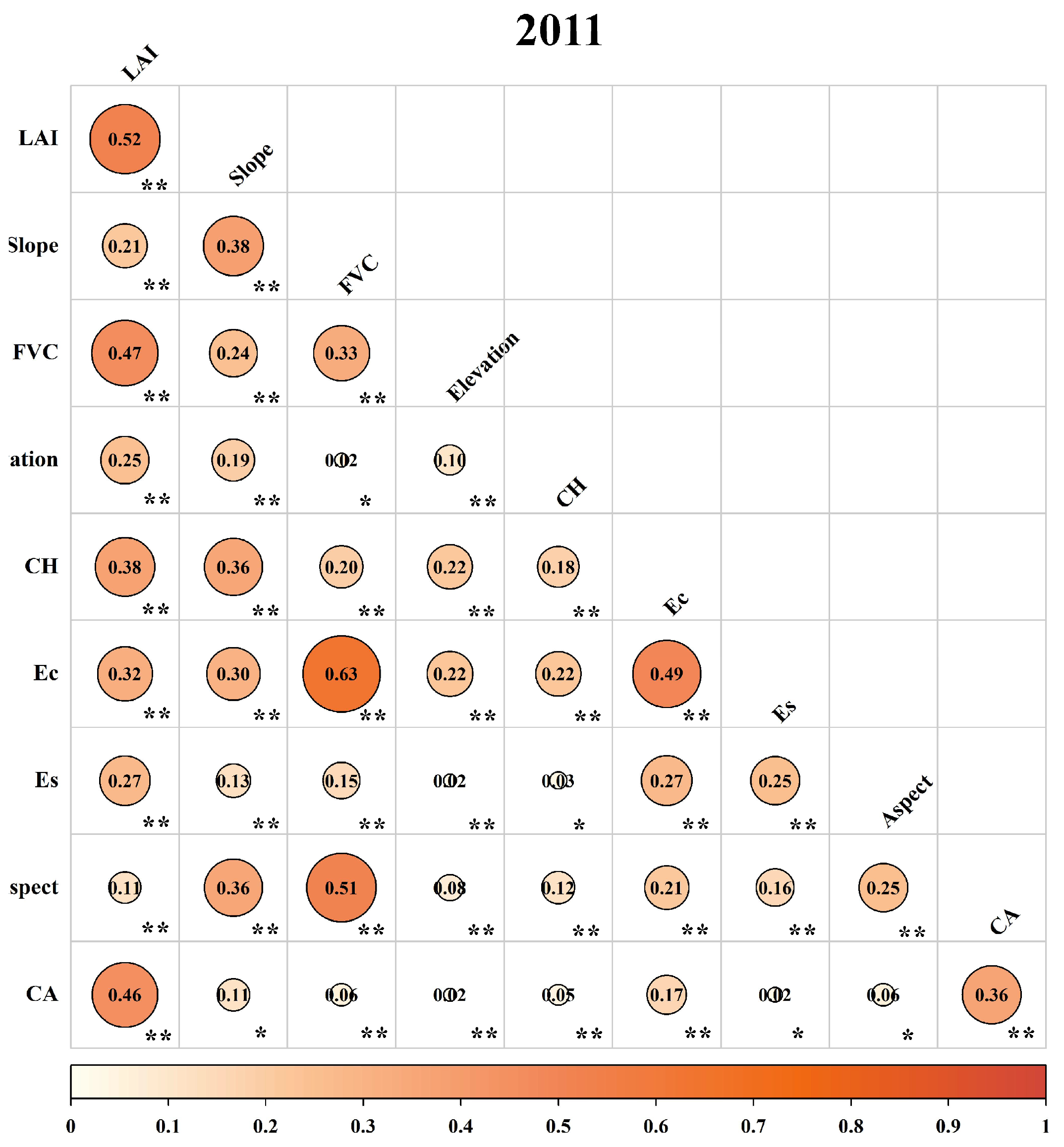
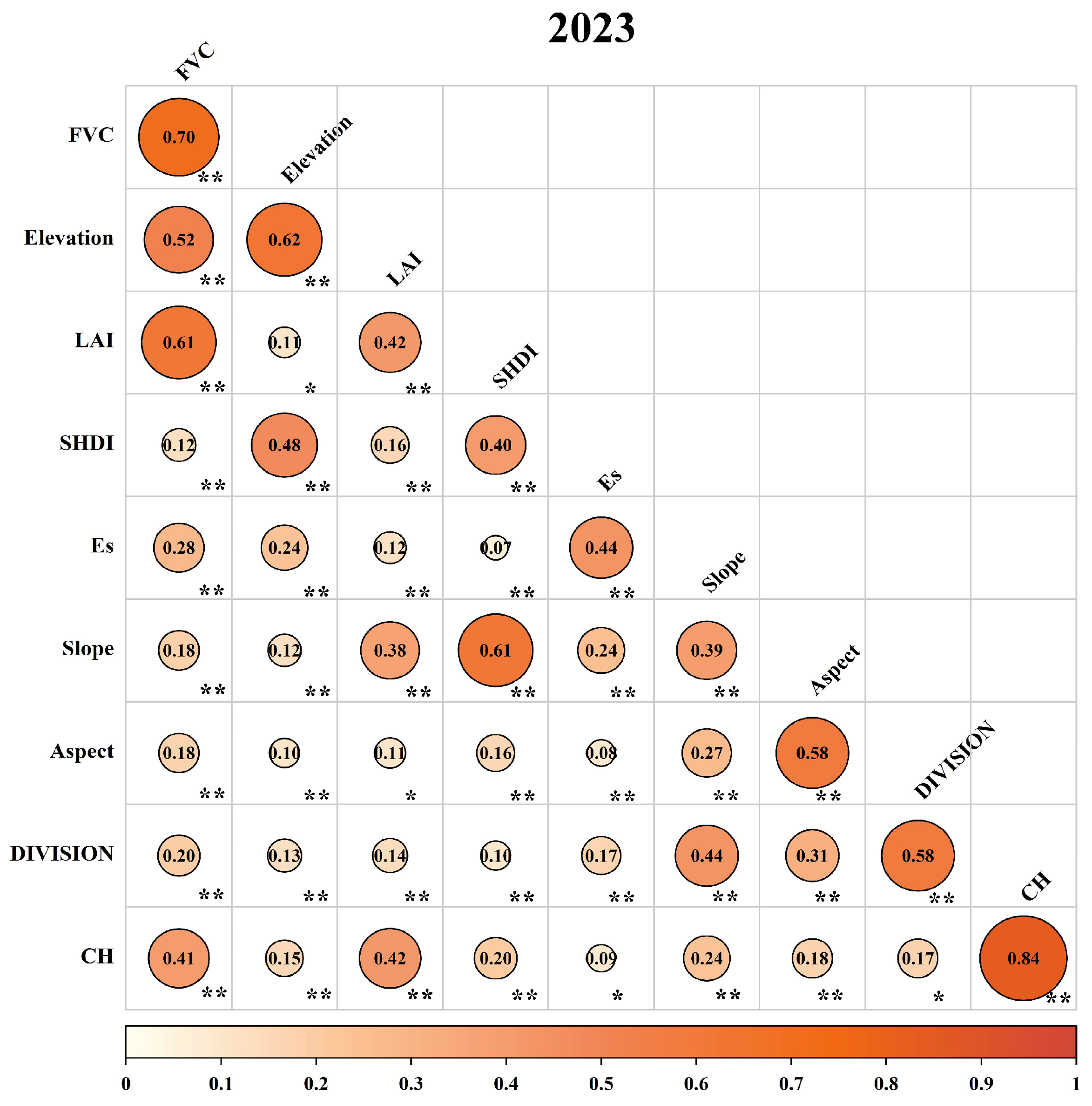
We selected the top nine variables at each time point for interaction analysis (Figure 9, Figure 10 and Figure 11). In 2001, the principal interaction pairs involved FVC with Ec, Aspect, and LAI, highlighting the synergy between vegetation cover and moisture exchange, terrain factors, and vertical vegetation structure. Concurrent interactions were also observed for LAI with CA, CH, and Ec. In 2011, interactions of slope with FVC and with elevation became dominant, indicating a strengthened synergy between terrain factors and vegetation cover; interactions of FVC with DIVISION and of Es with CONTAG were further reinforced. In 2023, the FVC–LAI interaction emerged as the core combination, reflecting the strongest coupling between vertical structure and surface cover. Simultaneously, interactions of elevation with SHDI, FVC with Es, and slope with CH were present, evidencing continued interplay among terrain, landscape diversity, moisture processes, and vegetation height; the LAI–slope interaction also retained appreciable strength. Across the three years, the dominant interaction types shifted markedly: 2001 was characterized by vegetation traits interacting with moisture and terrain factors; in 2011, synergies between terrain factors and vegetation cover intensified; by 2023, interactions between vegetation traits and landscape diversity became predominant.

4. Discussion

4.1. Significant Temporal and Spatial Variations in the Thermal Environment of LMFP

The summer thermal environment of a large urban mountain park is highly dynamic and reflects the joint imprint of complex terrain [50,51]. In summer, the park’s peripheral and some internal areas generally exhibit higher land surface temperatures (LST), forming localized urban heat islands. Under intense heat and solar radiation in the summer, the impervious urban surfaces heat up rapidly, creating urban heat islands [6]. In contrast, the dense vegetation within LMFP consumes a large amount of incident solar radiation through vigorous transpiration, transforming it into latent heat loss, effectively lowering surface temperatures [9]. Additionally, the tall canopy of trees provides effective shade, reducing direct solar radiation absorption by the ground [52,53].
When compared with other urban green spaces, the thermal environment characteristics of large urban mountain parks are unique. The thermal environment of urban parks in plains is more influenced by park size, shape, and surrounding urban morphology [54], whereas mountain parks, due to their significant elevation differences and terrain undulations, facilitate both vertical and horizontal air movement, further enhancing temperature differences between the park and surrounding areas [55]. For example, some studies indicate that the cooling island effect in plain parks is mainly concentrated in the interior and adjacent edge areas [56]. However, in this study, LMFP’s cooling island effect in summer covers a broader area and continues to strengthen, likely due to the land retention effect of large mountain parks [57]. Furthermore, studies on urban residual natural mountain areas (URNMs) also show a cooling island effect, but its range and intensity are generally smaller than those of large urban forest parks [30].
Analysis of interannual variations reveals the evolution of LMFP’s thermal environment pattern with urbanization. In the years 2001, 2011, and 2023, although heat island phenomena still existed in the park’s peripheral areas, the extent of the heat island has diminished, likely due to green space improvements in the surrounding areas. The trajectory analysis of heat island and cooling island centroids further confirms this dynamic change. The sustained southward movement of the summer heat island centroid, from 30.5° N in 2001 to 30.1° N in 2023, corresponds with the main expansion direction and intensity of Chengdu’s urban development [58], indicating that rapid development in the urban edge areas has intensified heat accumulation. The centroid of the cooling island, however, shows a shift from northeast to southeast, which may be related to changes in the areas with the fastest-growing vegetation and the most significant improvements in ecological functions [59]. These findings are consistent with the conclusion that the centroid of heat islands shifts toward the most active urban development areas.

4.2. Spatial Range of Cooling Effects of LMFP on Surrounding Areas

The cooling effect of large urban green spaces on surrounding areas is one of their most important ecological services, crucial for improving urban residents’ thermal comfort and mitigating urban heat island effects [44]. We found that the PCD, PCI, PCA, and PCE in summer in the years 2001, 2011, and 2023 exhibited a year-on-year increasing trend. This suggests that as time progresses and the park’s ecosystem recovers and develops, the cooling range and efficiency provided by LMFP in summer have significantly improved. The enhancement of summer cooling effects is likely due to the dense vegetation within the park, which absorbs a large amount of heat through transpiration, lowering surface temperatures and affecting the surrounding air temperature through convection and radiation processes [52,60]. Additionally, the large-scale and elevation differences in the mountain park create localized microclimatic circulations that help transport cold air from the park to surrounding areas, expanding the cooling effect range [61].
The PCD in summer increased from 330 m in 2001 to 420 m in 2023, highlighting the enhanced thermal environment regulation capability of the large mountain park in the context of sustained urbanization. Previous studies have found that the cooling effect of urban green spaces does not always operate, sometimes showing a slight warming or weakening trend during drought periods [52]. This phenomenon may be related to the extreme climate event in Chengdu’s plains in 2011, during which a prolonged drought in the spring and autumn severely damaged local natural vegetation, reducing the park’s cooling efficiency [62].
When comparing the cooling effects of LMFP with other urban green spaces, it becomes evident that large urban mountain parks have a unique advantage in cooling. For example, Yan et al. found that the Olympic Park in Beijing exhibited temperatures 0.6–4.8 °C lower than surrounding urban areas, with the cooling effect extending up to 1.4 km beyond the park boundary [63]. Observations of large parks and urban forests in Leipzig, Germany, showed that the maximum cooling effect of the park extended up to 391 m, while that of the forest reached 469 m [29]. This is similar to the 420 m PCD observed in LMFP in summer, indicating that large green spaces generally have a larger cooling effect range. In a study in London, eight central parks of various sizes were examined to determine the impact of park size on cooling. Results showed that small green spaces of 0.5–2 hectares only reduced temperatures by 0.3 °C within 40 m, whereas large green spaces of more than 5 hectares caused a temperature decrease extending up to 70–120 m [18], which is much smaller than LMFP. Its massive size (1275 km2) provides a substantial cooling source, and the unique mountainous terrain facilitates air circulation and cold air transport, making its cooling effect range far exceed that of typical urban parks.

4.3. Key Driving Factors and Their Interactions in the Cooling Effects of LMFP over Time

LMFP is adjacent to the main urban area of a megacity, where human activities are relatively frequent. During different periods, the results show that vegetation characteristics have the most significant contribution to LMFP’s cooling effects. Among the changes over the three years, the LAI, FVC, and elevation ranked in the top four in terms of impact, consistent with previous studies indicating that vegetation growth and natural topography have a significant regulatory effect on the cooling effect of urban mountain parks [30,61]. In 2001, the main driving factors for LMFP’s summer cooling effect included LAI, slope, and FVC. LAI, as a key indicator of vegetation density, has a significant impact on local climate regulation. Studies in Kolkata, India, have shown that for every unit increase in LAI, surface temperatures can decrease by 0.83 °C, which aligns with this study’s finding that LAI enhances cooling through transpiration [50]. Slope, by influencing water retention and solar radiation reception angles, also regulates soil temperature and plant growth [14]. Areas with high FVC in the park can provide more shade, reducing surface temperature increase [64]. In fact, the Sichuan Basin, where LMFP is located, has abundant water and heat resources that are conducive to plant growth, highlighting the importance of high vegetation cover for enhancing LMFP’s cooling effects [62].
By 2011, as urbanization accelerated, the importance of slope as a driving factor for LMFP’s cooling effect gradually increased, showing a significant positive correlation. At the same time, factors such as population density and road density, reflecting human activities, became more prominent in negatively impacting the cooling effect. Before 2017, the park experienced intensive agricultural activity, which led to significant vegetation degradation. However, this trend began to be effectively curbed after the park’s formal establishment in 2017. During this period, plant transpiration remained the primary cooling mechanism, but its effectiveness began to decline due to interference from human activities. High-density human activities not only increased heat release but also changed land use patterns, such as tourism development around Three Chashan Lake, the construction of Chengdu’s Eastern New City, and the large-scale cultivation of agricultural products, all of which contributed to the transformation of natural and agricultural vegetation into urban development, thereby affecting the stability of the natural ecosystem.
By 2023, the study indicates that FVC and LAI remain the dominant driving factors for cooling effects, with the slope’s impact still significant. Research has shown that areas with steeper slopes typically experience more pronounced cooling effects, as steep slopes promote air movement, enhance transpiration cooling, and reduce surface heat accumulation [55]. It is worth noting that the interaction between vegetation and topography also influences the cooling effect, particularly in high-altitude areas where cooling effects are more pronounced. Studies in regions such as the Rocky Mountains in the U.S. and valleys in Alberta, Canada, also support this view [12,65]. Our results indicate that areas with flatter terrain and lower forest cover experience less pronounced cooling effects and are more susceptible to rapid local climate changes.

4.4. Methodological Limitations

Although this study provides valuable insights into the cooling effects of LUM, several limitations should be noted. First, the RTE method used for LST retrieval may introduce uncertainties, especially in heterogeneous areas with complex vegetation and terrain. Second, pixel mixing bias can occur in areas with high variability, particularly in forested regions where the sensor may capture mixed signals from different surface types. Additionally, extreme weather events in 2011 may have affected vegetation growth, potentially influencing the observed cooling effects that year. Finally, the use of concentric buffer zones in mountainous studies may have limitations, as complex terrain can alter the spatial distribution of cooling effects, which the buffer method does not fully account for. In the future, we aim to refine our data processing methods and explore more precise spatial analysis techniques to better capture cooling effects in complex terrains.

5. Conclusions

This study takes LMFP as a case study to systematically reveal the spatiotemporal differentiation patterns of cooling effects in large urban mountain parks and their driving mechanisms. Overall,
(1) The summer heat island effect in LMFP is concentrated around the park’s periphery, reflecting the enhancement of the park’s ability to regulate the surrounding thermal environment over time. The extent of the heat island has reduced in the years 2001, 2011, and 2023. The centroid of the summer heat island has continuously shifted southward in the years 2001, 2011, and 2023, while the centroid of the cooling island has migrated from the northeast to the southeast.
(2) In the years 2001, 2011, and 2023, the areas of high cooling intensity in LMFP have gradually shifted from a north–south concentrated distribution to a pattern dominated by strong cooling with an expanded range and localized extreme cooling, while areas with weak cooling first expanded and then contracted, with corresponding fluctuations in their proportion. In the years 2001, 2011, and 2023, the PCD in summer increased from 330 m to 420 m, the PCA expanded to 124.84 km2, and the PCE improved to 18.31%.
(3) Vegetation and topographic factors dominate the cooling effects, while human activities have a significant negative impact. Among these, vegetation fractional cover, leaf area index, and elevation are the core driving factors, with their positive effects strengthening over time. Human activities, such as population density and road density, continue to suppress cooling. The marginal effects show that the relationship between driving factors and cooling intensity is nonlinear. The interaction of these factors exhibits stage-specific characteristics, with the early period primarily driven by the synergy of natural topography and vegetation and the later period dominated by interactions between vegetation characteristics and landscape patterns.
To effectively enhance the cooling effects of large urban mountain parks, measures such as increasing vegetation coverage, optimizing landscape connectivity, and controlling the intensity of development in peripheral areas can be implemented. Future management strategies should prioritize the restoration and ecological rehabilitation of vegetation, especially in degraded peripheral areas, by increasing the planting of tall trees to strengthen the park’s transpiration cooling capacity. Additionally, optimizing the park’s internal landscape structure by designing diverse vegetation layers can enhance the ecosystem’s functionality. For example, terrain-shaded forest stands could serve as “slow lanes” to buffer the negative impacts of climate change in the short term while providing a cooling corridor for the long-term transport of cooling air from vegetation.

Supplementary Materials

The following supporting information can be downloaded at https://www.mdpi.com/article/10.3390/f16121850/s1. Table S1. Data sources for park cooling effects. Table S2. Variance inflation test results for each driver. Table S3. Spearman’s correlation coefficient for different years of the driver. Figure S1. Scatter Plot for Accuracy Validation of Landsat-Retrieved LST Against MODIS MOD11A1. Figure S2. Spatial Distribution Comparison of Landsat-Retrieved LST and MODIS MOD11A1 LST. Figure S3. Validation of the prediction accuracy of the XGBoost model for different years.

Author Contributions

Conceptualization, Y.R. and L.Z.; methodology, Y.R. and L.L.; software, Y.R. and J.P.; validation, Y.R. and J.L.; formal analysis, Z.G. and T.L.; investigation, Y.F.; resources, C.Y.; data curation, T.L. and L.L.; writing—original draft preparation, Y.R., J.P. and T.L.; writing—review and editing, L.Z.; visualization, Y.R. and J.L.; supervision, L.Z.; project administration, L.Z.; funding acquisition, Y.F. and L.Z. All authors have read and agreed to the published version of the manuscript.

Funding

This research was funded by the National Natural Science Foundation of China (32360298), the West Light Foundation of the Chinese Academy of Sciences (2022XBZG_XBQNXZ_A_003), and the Longquan Mountain Native Flora and Fauna Conservation and Breeding Research Project (E1D134).

Data Availability Statement

All datasets used in this study are derived from publicly accessible sources. Detailed information, data descriptions, and processing scripts can be found at https://github.com/renhang31/Urban-Mountain-Cooling-Effects-LMFP (accessed on 3 November 2025).

Conflicts of Interest

The authors declare no conflicts of interest.

Abbreviations

The following abbreviations are used in this manuscript:
UHIUrban Heat IslandCHCanopy Height
LUMLarge Urban MountainsLAILeaf Area Index
LMFPLongquan Mountain Forest ParkFVCFractional Vegetation Cover
LSTLand surface temperatureEsVegetation Transpiration
RTERadiative Transfer EquationEcSoil Evaporation
PCDPark Cooling DistanceCAClass Area
PCAPark Cooling AreaPDPatch Density
PCIPark Cooling IntensityLPILargest Patch Index
PCEPark Cooling EfficiencySHDIShannon’s Diversity Index
MCIMountain Cooling IntensityAIAggregation Index
NDVINormalized Difference Vegetation Index

References

  1. Grimm, N.B.; Faeth, S.H.; Golubiewski, N.E.; Redman, C.L.; Wu, J.; Bai, X.; Briggs, J.M. Global Change and the Ecology of Cities. Science 2008, 319, 756–760. [Google Scholar] [CrossRef] [PubMed]
  2. Nations, U. World Urbanization Prospects: The 2018 Revision; United Nations: New York, NY, USA, 2019. [Google Scholar]
  3. Wang, S.; Zhan, W.; Zhou, B.; Tong, S.; Chakraborty, T.C.; Wang, Z.; Huang, K.; Du, H.; Middel, A.; Li, J.; et al. Dual impact of global urban overheating on mortality. Nat. Clim. Change 2025, 15, 497–504. [Google Scholar] [CrossRef]
  4. Wang, Z.; Zhou, R.; Yu, Y. The impact of urban morphology on land surface temperature under seasonal and diurnal variations: Marginal and interaction effects. Build. Environ. 2025, 272, 112673. [Google Scholar] [CrossRef]
  5. Rizwan, A.M.; DENNIS, L.Y.C.; LIU, C. A review on the generation, determination and mitigation of Urban Heat Island. J. Environ. Sci. 2008, 20, 120–128. [Google Scholar] [CrossRef]
  6. Bherwani, H.; Singh, A.; Kumar, R. Assessment methods of urban microclimate and its parameters: A critical review to take the research from lab to land. Urban Clim. 2020, 34, 100690. [Google Scholar] [CrossRef]
  7. Rao, P. Remote sensing of urban heat islands from an environmental satellite. Bull. Am. Meteorol. Soc. 1972, 53, 647–648. [Google Scholar]
  8. Diem, P.K.; Nguyen, C.T.; Diem, N.K.; Diep, N.T.H.; Thao, P.T.B.; Hong, T.G.; Phan, T.N. Remote sensing for urban heat island research: Progress, current issues, and perspectives. Remote Sens. Appl. 2024, 33, 101081. [Google Scholar] [CrossRef]
  9. Li, Z.; Liu, Q.; Yan, K.; Xiong, D.; Xu, P.; Yan, Y.; Lin, L. Cooling effects of urban parks under various ecological factors. Urban Clim. 2024, 58, 102134. [Google Scholar] [CrossRef]
  10. Liu, Y.; Lai, Y.; Jiang, L.; Cheng, B.; Tan, X.; Zeng, F.; Liang, S.; Xiao, A.; Shang, X. A study of the thermal comfort in urban mountain parks and its physical influencing factors. J. Therm. Biol. 2023, 118, 103726. [Google Scholar] [CrossRef]
  11. Terschanski, J.; Nunes, M.H.; Aalto, I.; Pellikka, P.; Wekesa, C.; Maeda, E.E. The role of vegetation structural diversity in regulating the microclimate of human-modified tropical ecosystems. J. Environ. Manag. 2024, 360, 121128. [Google Scholar] [CrossRef]
  12. Higuera, P.E.; Briles, C.E.; Whitlock, C.; Austin, A. Fire-regime complacency and sensitivity to centennial-through millennial-scale climate change in Rocky Mountain subalpine forests, Colorado, USA. J. Ecol. 2014, 102, 1429–1441. [Google Scholar] [CrossRef]
  13. Song, D.; Zhang, X.; Zhou, X.; Shi, X.; Jin, X. Influences of wind direction on the cooling effects of mountain vegetation in urban area. Build. Environ. 2022, 209, 108663. [Google Scholar] [CrossRef]
  14. He, B.; Shangguan, D.; Wang, R.; Xie, C.; Li, D.; Cheng, X. Cold and Wet Island Effect in Mountainous Areas: A Case Study of the Maxian Mountains, Northwest China. Forests 2024, 15, 1578. [Google Scholar] [CrossRef]
  15. Pepin, N.C.; Arnone, E.; Gobiet, A.; Haslinger, K.; Kotlarski, S.; Notarnicola, C.; Palazzi, E.; Seibert, P.; Serafin, S.; Schoener, W.; et al. Climate Changes and Their Elevational Patterns in the Mountains of the World. Rev. Geophys. 2022, 60, e2020RG000730. [Google Scholar] [CrossRef]
  16. Hamada, S.; Ohta, T. Seasonal variations in the cooling effect of urban green areas on surrounding urban areas. Urban For. Urban Green. 2010, 9, 15–24. [Google Scholar] [CrossRef]
  17. Shi, D.; Song, J.; Huang, J.; Zhuang, C.; Guo, R.; Gao, Y. Synergistic cooling effects (SCEs) of urban green-blue spaces on local thermal environment: A case study in Chongqing, China. Sustain. Cities Soc. 2020, 55, 102065. [Google Scholar] [CrossRef]
  18. Menteş, Y.; Yilmaz, S.; Qaid, A. The cooling effect of different scales of urban parks on land surface temperatures in cold regions. Energ. Build. 2024, 308, 113954. [Google Scholar] [CrossRef]
  19. Tan, P.Y.; Wang, J.; Sia, A. Perspectives on five decades of the urban greening of Singapore. Cities 2013, 32, 24–32. [Google Scholar] [CrossRef]
  20. Liu, S.; Wang, Z.; Kumilamba, G.; Yu, L. Optimizing green space configuration for mitigating land surface temperature: A case study of karst mountainous cities. Sustain. Cities Soc. 2025, 125, 106345. [Google Scholar] [CrossRef]
  21. Vitanova, L.L.; Kusaka, H. Study on the urban heat island in Sofia City: Numerical simulations with potential natural vegetation and present land use data. Sustain. Cities Soc. 2018, 40, 110–125. [Google Scholar] [CrossRef]
  22. Algretawee, H. The effect of graduated urban park size on park cooling island and distance relative to land surface temperature (LST). Urban Clim. 2022, 45, 101255. [Google Scholar] [CrossRef]
  23. Guo, A.; Yue, W.; Yang, J.; Li, M.; Zhang, Z.; Xie, P.; Zhang, M.; Lu, Y.; He, T. Quantifying the cooling effect and benefits of urban parks: A case study of Hangzhou, China. Sustain. Cities Soc. 2024, 113, 105706. [Google Scholar] [CrossRef]
  24. Ruiz, M.A.; Colli, M.F.; Martinez, C.F.; Correa-Cantaloube, E.N. Park cool island and built environment. A ten-year evaluation in Parque Central, Mendoza-Argentina. Sustain. Cities Soc. 2022, 79, 103681. [Google Scholar] [CrossRef]
  25. Li, P.; Wu, W.; Yin, Y. Enhanced accessibility to park cooling services in developed areas: Experimental insights on the walkability in large urban agglomerations. Build. Environ. 2025, 272, 112665. [Google Scholar] [CrossRef]
  26. Peng, J.; Dan, Y.; Qiao, R.; Liu, Y.; Dong, J.; Wu, J. How to quantify the cooling effect of urban parks? Linking maximum and accumulation perspectives. Remote Sens. Environ. 2021, 252, 112135. [Google Scholar] [CrossRef]
  27. Park, J.; Kim, J.; Sohn, W.; Lee, D. Urban cooling factors: Do small greenspaces outperform building shade in mitigating urban heat island intensity? Urban For. Urban Green. 2021, 64, 127256. [Google Scholar] [CrossRef]
  28. Gunawardena, K.R.; Wells, M.J.; Kershaw, T. Utilising green and bluespace to mitigate urban heat island intensity. Sci. Total Environ. 2017, 584, 1040–1055. [Google Scholar] [CrossRef]
  29. Jaganmohan, M.; Knapp, S.; Buchmann, C.M.; Schwarz, N. The Bigger, the Better? The Influence of Urban Green Space Design on Cooling Effects for Residential Areas. J. Environ. Qual. 2016, 45, 134–145. [Google Scholar] [CrossRef]
  30. Chen, X.; Wang, Z.; Bao, Y. Cool island effects of urban remnant natural mountains for cooling communities: A case study of Guiyang, China. Sustain. Cities Soc. 2021, 71, 102983. [Google Scholar] [CrossRef]
  31. Liu, C.; Li, Y. Spatio-Temporal Features of Urban Heat Island and Its Relationship with Land Use/Cover in Mountainous City: A Case Study in Chongqing. Sustainability 2018, 10, 1943. [Google Scholar] [CrossRef]
  32. Bhattarai, S.; Banjara, P.; Pandey, V.P.; Aryal, A.; Pradhan, P.; Al-Douri, F.; Pradhan, N.R.; Talchabhadel, R. Quantifying the cooling effects of blue-green spaces across urban landscapes: A case study of Kathmandu Valley, Nepal. Urban Clim. 2025, 61, 102493. [Google Scholar] [CrossRef]
  33. Chen, Y.; Zhao, Q.; Liu, Y.; Zeng, H. Exploring the impact of natural and human activities on vegetation changes: An integrated analysis framework based on trend analysis and machine learning. J. Environ. Manag. 2025, 374, 124092. [Google Scholar] [CrossRef] [PubMed]
  34. Feng, X.; Yu, J.; Xin, C.; Ye, T.; Wang, T.A.; Chen, H.; Zhang, X.; Zhang, L. Quantifying and Comparing the Cooling Effects of Three Different Morphologies of Urban Parks in Chengdu. Land 2023, 12, 451. [Google Scholar] [CrossRef]
  35. Keikhosravi, G.; Khalidi, S.; Shahmoradi, M. Effects of climates and physical variables of parks on the radius and intensity of cooling of the surrounding settlements. Urban Clim. 2023, 51, 101601. [Google Scholar] [CrossRef]
  36. Hong, T.; Yim, S.H.L.; Heo, Y. Interpreting complex relationships between urban and meteorological factors and street-level urban heat islands: Application of random forest and SHAP method. Sustain. Cities Soc. 2025, 126, 106353. [Google Scholar] [CrossRef]
  37. Kowe, P.; Mutanga, O.; Odindi, J.; Dube, T. Effect of landscape pattern and spatial configuration of vegetation patches on urban warming and cooling in Harare metropolitan city, Zimbabwe. GISci. Remote Sens. 2021, 58, 261–280. [Google Scholar] [CrossRef]
  38. Zhang, X.; Liu, L.; Chen, X.; Gao, Y.; Xie, S.; Mi, J. GLC_FCS30: Global land-cover product with fine classification system at 30 m using time-series Landsat imagery. Earth Syst. Sci. Data 2021, 13, 2753–2776. [Google Scholar] [CrossRef]
  39. OTTLE, C.; STOLL, M. Effect of atmospheric absorption and surface emissivity on the determination of land surface temperature from infrared satellite data. Int. J. Remote Sens. 1993, 14, 2025–2037. [Google Scholar] [CrossRef]
  40. Sekertekin, A. Validation of Physical Radiative Transfer Equation-Based Land Surface Temperature Using Landsat 8 Satellite Imagery and SURFRAD in-situ Measurements. J. Atmos. Sol.-Terr. Phys. 2019, 196, 105161. [Google Scholar] [CrossRef]
  41. Gokdemir, N.; Marangoz, A.M.; Sekertekin, A. Satellite-Based Thermal Analysis of Water-Induced Cooling in Afyonkarahisar, Türkiye. Case Stud. Therm. Eng. 2025, 76, 107437. [Google Scholar] [CrossRef]
  42. Chander, G.; Markham, B.L.; Helder, D.L. Summary of current radiometric calibration coefficients for Landsat MSS, TM, ETM+, and EO-1 ALI sensors. Remote Sens. Environ. 2009, 113, 893–903. [Google Scholar] [CrossRef]
  43. Barsi, J.A.; Schott, J.R.; Palluconi, F.D.; Hook, S.J. Validation of a Web-Based Atmospheric Correction Tool for Single Thermal Band Instruments; SPIE: Bellingham, WA, USA, 2005; p. 58820E. [Google Scholar]
  44. Qiu, J.; Li, X.; Qian, W. Optimizing the spatial pattern of the cold island to mitigate the urban heat island effect. Ecol. Indic. 2023, 154, 110550. [Google Scholar] [CrossRef]
  45. Li, H.; Wang, G.; Tian, G.; Jombach, S. Mapping and Analyzing the Park Cooling Effect on Urban Heat Island in an Expanding City: A Case Study in Zhengzhou City, China. Land 2020, 9, 57. [Google Scholar] [CrossRef]
  46. Qiao, Y.; Sun, H.; Qi, J.; Liu, S.; Li, J.; Ji, Y.; Wang, H.; Peng, Y. Examining water bodies’ cooling effect in urban parks with buffer analysis and random forest regression. Urban Clim. 2025, 59, 102301. [Google Scholar] [CrossRef]
  47. Geng, X.; Yu, Z.; Zhang, D.; Li, C.; Yuan, Y.; Wang, X. The influence of local background climate on the dominant factors and threshold-size of the cooling effect of urban parks. Sci. Total Environ. 2022, 823, 153806. [Google Scholar] [CrossRef]
  48. Li, J.; Chen, D.; Ou, J.; Rui, Q.; Jin, B.; Zhu, Z.; Ding, G. Exploring the integrating factors and size thresholds affecting cooling effects in urban parks: A diurnal balance perspective. Sustain. Cities Soc. 2025, 126, 106386. [Google Scholar] [CrossRef]
  49. Yazdi, H.; Moser-Reischl, A.; Rötzer, T.; Petzold, F.; Ludwig, F. Machine learning-based prediction of tree crown development in competitive urban environments. Urban For. Urban Green. 2024, 101, 128527. [Google Scholar] [CrossRef]
  50. Ghale, B.; Mamgain, S.; Gupta, K.; Roy, A. Urban Parks and their Cooling Potential: Evaluating how Park Characteristics Affects Land Surface Temperature. Int. Arch. Photogramm. Remote Sens. Spat. Inf. Sci. 2025, 48, 29–35. [Google Scholar] [CrossRef]
  51. Luo, J.; Xu, T.; Yan, C. Seasonal variation in vegetation cooling effect and its driving factors in a subtropical megacity. Build. Environ. 2024, 266, 112065. [Google Scholar] [CrossRef]
  52. Bachofen, C.; Peillon, M.; Meili, N.; Bourgeois, I.; Grossiord, C. High transpirational cooling by urban trees despite extreme summer heatwaves. Urban For. Urban Green. 2025, 107, 128819. [Google Scholar] [CrossRef]
  53. Spronken-Smith, R.A.; Oke, T.R. Scale Modelling of Nocturnal Cooling in Urban Parks. Bound.-Layer Meteorol. 1999, 93, 287–312. [Google Scholar] [CrossRef]
  54. Kong, F.; Yin, H.; James, P.; Hutyra, L.R.; He, H.S. Effects of spatial pattern of greenspace on urban cooling in a large metropolitan area of eastern China. Landsc. Urban Plan 2014, 128, 35–47. [Google Scholar] [CrossRef]
  55. Hamada, S.; Tanaka, T.; Ohta, T. Impacts of land use and topography on the cooling effect of green areas on surrounding urban areas. Urban For. Urban Green. 2013, 12, 426–434. [Google Scholar] [CrossRef]
  56. Feldman, A.F.; Daniel, J.S.G.; Dong, J.; Trigo, I.F.; Salvucci, G.D.; Entekhabi, D. Tropical Surface Temperature Response to Vegetation Cover Changes and the Role of Drylands. Glob. Change Biol. 2023, 29, 110–125. [Google Scholar] [CrossRef] [PubMed]
  57. Yin, S.; Peng, L.L.H.; Feng, N.; Wen, H.; Ling, Z.; Yang, X.; Dong, L. Spatial-temporal pattern in the cooling effect of a large urban forest and the factors driving it. Build. Environ. 2022, 209, 108676. [Google Scholar] [CrossRef]
  58. Wang, Y.; Sheng, S.; Xiao, H. The cooling effect of hybrid land-use patterns and their marginal effects at the neighborhood scale. Urban For. Urban Green. 2021, 59, 127015. [Google Scholar] [CrossRef]
  59. Balsa-Barreiro, J.; Li, Y.; Morales, A.; Pentland, A.S. Globalization and the shifting centers of gravity of world’s human dynamics: Implications for sustainability. J. Clean Prod. 2019, 239, 117923. [Google Scholar] [CrossRef]
  60. Jamei, E.; Rajagopalan, P.; Seyedmahmoudian, M.; Jamei, Y. Review on the impact of urban geometry and pedestrian level greening on outdoor thermal comfort. Renew. Sustain. Energy Rev. 2016, 54, 1002–1017. [Google Scholar] [CrossRef]
  61. Estoque, R.C.; Murayama, Y. Monitoring surface urban heat island formation in a tropical mountain city using Landsat data (1987—2015). Isprs. J. Photogramm. 2017, 133, 18–29. [Google Scholar] [CrossRef]
  62. Li, C.; Adu, B.; Wu, J.; Qin, G.; Li, H.; Han, Y. Spatial and temporal variations of drought in Sichuan Province from 2001 to 2020 based on modified temperature vegetation dryness index (TVDI). Ecol. Indic. 2022, 139, 108883. [Google Scholar] [CrossRef]
  63. Yan, H.; Wu, F.; Dong, L. Influence of a large urban park on the local urban thermal environment. Sci. Total Environ. 2018, 622, 882–891. [Google Scholar] [CrossRef]
  64. Stamou, A.; Karachaliou, E.; Dosiou, A.; Tavantzis, I.; Stylianidis, E. Exploring patterns of surface urban heat island intensity: A comparative analysis of three Greek urban areas. Discov. Cities 2024, 1, 18. [Google Scholar] [CrossRef]
  65. Estevo, C.A.; Stralberg, D.; Nielsen, S.E.; Bayne, E. Topographic and vegetation drivers of thermal heterogeneity along the boreal—Grassland transition zone in western Canada: Implications for climate change refugia. Ecol. Evol. 2022, 12, e9008. [Google Scholar] [CrossRef]
Figure 1. Geographical map of the study area. (a) China map; (b) Chengdu map; (c) satellite image of the surrounding area of LMFP; (d) map of the boundary of the Longquan Mountain Range and surrounding land use types, land use types derived from the China Land Cover Dataset (2023).
Forests 16 01850 g001
Figure 2. Technology roadmap. The core analysis includes five steps: first, conduct integration and preprocessing of multi-source data; second, analyze the spatiotemporal characteristics of the thermal environment; next, quantify the spatial distribution of cooling effects; then, identify key influencing factors via models; finally, reveal the cooling mechanism of large urban mountains.
Forests 16 01850 g002
Figure 3. Buffer zone diagrams (af) of Longquan Mountain and the cooling effect diagram (g) based on the inflection point method. The red line represents the boundary of Longquan Mountain, and the yellow line corresponds to the positions of the profiles in subfigures (af). the blue dashed line (g) represents the cooling inflection point of the mountain.
Forests 16 01850 g003
Figure 4. Summer thermal environment of the LMFP and surrounding areas in 2001, 2011, and 2023. (a) Summer UHI map for 2001; (b) summer UHI map for 2011; (c) summer UHI map for 2023; (d) trajectories of the summer UHI and cool-island centroids (2001 → 2011 → 2023).
Forests 16 01850 g004
Figure 5. Spatial distribution of summer cooling intensity (MCI) in Longquan Mountain (LMFP) in 2001, 2011, and 2023. (a) 2001 summer; (b) 2011 summer; (c) 2023 summer. The red line represents the boundary of Longquan Mountain.
Forests 16 01850 g005
Figure 6. Results of cooling distance (PCD) and cooling intensity (PCI) based on the inflection-point method for summer 2001 (a), 2011 (b), and 2023 (c). Black points depict mean LST along outward buffers; the red point denotes the inflection point; the red dotted lines depict the cubic function fitting curve; the vertical dashed line marks the PCD. Insets report PCI and goodness-of-fit (R2).
Forests 16 01850 g006
Figure 7. Feature importance ranking and SHAP analysis of drivers for summer cooling intensity (MCI) in the LMFP. (a), (b), and (c) correspond to the results of 2001, 2011, and 2023, respectively. In each plot (ac), the blue dots denote the SHAP value of an individual sample.
Forests 16 01850 g007
Figure 8. Marginal effect of key drivers on summer cooling intensity (2001, 2011, 2023).
Forests 16 01850 g008
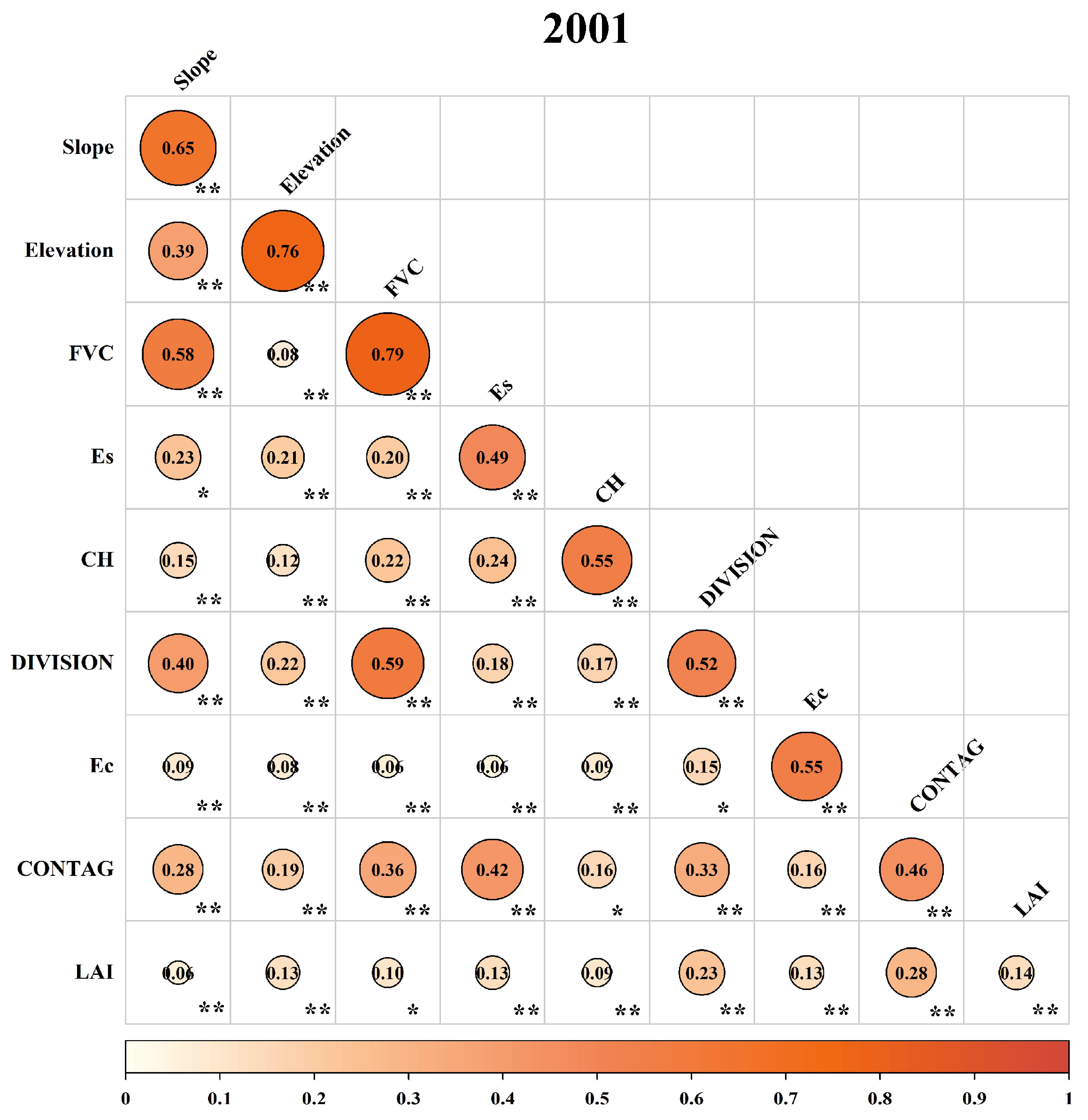
Figure 9. Interactions of key drivers of summer cooling intensity (MCI) in 2001. * indicates statistical significance at p < 0.05 ; ** indicates statistical significance at p < 0.01 .
Forests 16 01850 g009
Figure 10. Interactions of key drivers of summer cooling intensity (MCI) in 2011. * indicates statistical significance at p < 0.05 ; ** indicates statistical significance at p < 0.01 .
Forests 16 01850 g010
Figure 11. Interactions of key drivers of summer cooling intensity (MCI) in 2023. * indicates statistical significance at p < 0.05 ; ** indicates statistical significance at p < 0.01 .
Forests 16 01850 g011
Table 1. Summary of Landsat imagery used for summer LST retrieval in 2001, 2011, and 2023.
YearSeasonImage DateCloud Cover (%)Transit Time (UTC + 8)
2001 Summer 14 June 2001 8.7 10:31
2011 Summer 30 June 2011 6.3 10:29
2023 Summer 5 July 2023 7.9 10:30
Table 2. Heat island intensity grading method (μ is mean, std is standard deviation).
UHI Intensity GradeGrading Method
Strong Negative UHI Ts ≤ μ − 2std
Moderate Negative UHI μ − 2std < Ts ≤ μ − std
Weak Negative UHI μ − std < Ts ≤ μ
NO UHI μ < Ts ≤ μ + std
Weak UHI μ + std < Ts ≤ μ + 2std
Moderate UHI μ + 2std < Ts ≤ μ + 3std
Strong UHI Ts > μ + 3std
Table 3. Classification proportions of summer MCI in Longquan Mountain, 2001, 2011, 2023.
Type2001 Summer2011 Summer2023 Summer
Extreme Cooling 37.59% 19.18% 22.48%
Strong Cooling 15.25% 14.67% 33.60%
Moderate Cooling 17.57% 20.01% 9.19%
Weak Cooling 18.02% 18.72% 18.65%
Very weak Cooling 11.56% 27.43% 16.08%
Table 4. Summer cooling distance (PCD), cooling intensity (PCI), cooling area (PCA), and cooling efficiency (PCE) for the LMFP in 2001, 2011, and 2023.
YearSeasonPCD (m)PCI (°C)PCA (km2)PCE (%)
2001Summer3302.623101.12114.83
2011Summer3902.751117.04817.17
2023Summer4202.785124.84418.31
Disclaimer/Publisher’s Note: The statements, opinions and data contained in all publications are solely those of the individual author(s) and contributor(s) and not of MDPI and/or the editor(s). MDPI and/or the editor(s) disclaim responsibility for any injury to people or property resulting from any ideas, methods, instructions or products referred to in the content.