Article

Chemical Modification of Pachira aquatica Oil for Bio-Based Polyurethane Wood Adhesives

1
Department of Forest and Wood Sciences, Federal University of Espírito Santo, Jerônimo Monteiro 29550-000, ES, Brazil
2
Centre for Natural Resources, Environment and Society (CERNAS-IPV), Polytechnic Institute of Viseu, 3504-510 Viseu, Portugal
3
Department of Wood Engineering, Polytechnic Institute of Viseu, 3504-510 Viseu, Portugal
4
LEEPABE, Faculty of Engineering, University of Porto, 4200-465 Porto, Portugal
5
Department of Chemistry, Federal University of Espírito Santo, Campus Goiabeiras, Vitória 29075-951, ES, Brazil
6
Department of Agricultural Sciences, State University of Montes Claros, Montes Claros 39401-089, MG, Brazil
7
Department of Forest Products, Institute of Forests, Federal Rural University of Rio de Janeiro, Seropédica 23890-000, RJ, Brazil
*
Author to whom correspondence should be addressed.
Forests 2025, 16(12), 1843; https://doi.org/10.3390/f16121843
Submission received: 7 November 2025 / Revised: 2 December 2025 / Accepted: 3 December 2025 / Published: 10 December 2025
(This article belongs to the Section Wood Science and Forest Products)

Abstract

The development of biomass-based adhesives has attracted interest as an alternative to petroleum-derived synthetic and potentially toxic adhesives. Pachira aquatica oil is a renewable raw material that can be incorporated into an MDI-based polyurethane system. In this study, the chemical composition and reactivity of P. aquatica oil were characterized using GC–MS, FTIR, and hydroxyl index measurements. The oil showed a predominance of saturated fatty acids, particularly methyl hexadecanoate (64.80%), derived from palmitic acid, and exhibited a low initial hydroxyl value. To enhance reactivity, the oil was transesterified with glycerol under different conditions, producing polyols with substantially increased hydroxyl values (412–769 mg KOH g−1), as confirmed by the intensified O–H and C–O bands in the FTIR spectra. The polyurethane adhesives were formulated from the selected polyols (P3 and P4) and evaluated at different NCO/OH ratios and pressing temperatures, using ABES shear tests. The highest ABES shear strength recorded was approximately 3.6 MPa, obtained for isocyanate indices between 0.8 and 1.0 and temperatures around 115 °C. Although this value represents the best performance among the tested conditions, it remains below the industrial benchmarks typically associated with the EN 205 standard (≈10 MPa). It is important to note that the ABES and EN 205 methods are not directly comparable due to differences in testing protocols. Nevertheless, the results indicate that, under the evaluated conditions, the adhesives exhibit limited mechanical performance and require further optimization.

1. Introduction

Over the years, research aimed at developing bio-based adhesives for wood bonding has intensified, driven by the growing demand for bonded components using synthetic adhesives and concerns regarding the emission of phenols and formaldehyde from these conventional products, posing potential risks to human health and the environment. Studies in this field are considered promising, as some natural compounds show potential for the synthesis of bioadhesives, contributing to the reduction in the use of toxic substances and encouraging the use of renewable resources.
In addition to representing a safer alternative, natural-based adhesives contribute to sustainability by reducing dependence on petroleum-derived raw materials, which positively impacts the reduction in carbon emissions. Being obtained from renewable sources, these bioadhesives are considered more environmentally friendly compared to synthetic ones, reinforcing the potential of this research area to meet environmental demands and the pursuit of cleaner solutions [1,2].
Among the raw materials considered promising to produce bio-based adhesives, vegetable oils stand out. These are biodegradable meaning they can be broken down by microorganisms into harmless substances, and help reduce the long-term risk of environmental contamination. In contrast to petrochemical products, which can persist in the environment for decades, vegetable oil emerges as an advantageous and sustainable alternative for various sectors, especially in applications as natural adhesives [3,4].
Vegetable oils can provide good adhesion, flexibility, and moisture resistance. Their capacity for chemical modification enables the production of raw materials with enhanced performance characteristics, fostering high reactivity and potential adhesive properties suitable for wood bonding [5]. However, some vegetable oils are known to lack hydroxyl groups in their chemical structure, which hinders their direct use in polyol production [6,7]. Due to this limitation, hydroxyl groups have to be added in its structure. Introducing hydroxyl groups (–OH) into vegetable oils can be achieved through several chemical modifications. Among them, epoxidation of double bonds followed by ring-opening reactions is the most widely applied method [8,9], thanks to the variety of nucleophiles available for introducing hydroxyl functionalities. These vegetable oils-based polyols help reduce reliance on fossil-based resources while improving the sustainability of polyurethane production. Other methods include ozonolysis, transesterification or transamidation [10], thiolene coupling, hydroformylation and metathesis [8].
It is important to note that not all vegetable oils exhibit the same capacity for chemical modification, highlighting the need for scientific investigation into the potential of each substance. Despite the advantages associated with these materials, some limitations must also be considered, such as susceptibility to oxidative polymerisation, low mechanical strength, and reduced toughness due to their chemical composition. These factors underscore the importance of in-depth studies that can generate insights to enhance their performance and broaden their applicability as natural adhesives [11].
Considering the need to expand knowledge on vegetable oils with adhesive potential, this study focuses on the oil of Pachira aquatica Aubl., a species belonging to the Bombacaceae family, commonly known in Brazil as munguba, castanheira-do-maranhão, castanheira, and wild cacao [12]. Native to southern Mexico and northern Brazil, P. aquatica thrives in moist soils that are subject to periodic flooding, particularly along riverbanks and streams. In Brazil, it is commonly found in the Amazon region and the state of Maranhão [13]. In addition to thriving in wetland areas, the species can also be found in various other regions of Brazil due to its adaptability to different soil and climate conditions. It is frequently used in urban landscaping and for the recovery of degraded areas [13,14].
The fruits of this species typically ripen between April and June and are characterized by numerous thin-shelled seeds rich in oils and proteins, which can be consumed raw, roasted, or cooked [15,16]. The oil extracted from these seeds holds significant sustainable potential. However, like other products derived from this tree, it remains little known to the public, which limits the recognition of its economic importance [13].
The main objective of this study was to investigate the potential of Pachira aquatica oil as a precursor in adhesive formulations, providing technical support for future research on its industrial applications. Up to now, this oil has been little, or practically not at all explored, as a raw material for the synthesis of polyols and adhesives intended for wood bonding, representing a significant scientific gap. The originality of this approach lies precisely in the exploration of a species that has been little studied from a technological perspective, whose chemical properties may facilitate interactions with lignocellulosic substrates and help to reduce dependence on petroleum-derived synthetic adhesives.
As far as we know, this is the first study to integrate the characterization of Pachira aquatica oil using different analytical techniques, combined with the transesterification process with glycerol and the evaluation of adhesives derived from this precursor. This integrated approach establishes a robust starting point for understanding the oil’s potential in adhesive applications, expanding the range of plant-based raw materials available to the industry. More than comparing performance with conventional formulations, this work inaugurates a line of research grounded in consistent scientific and technological foundations, highlighting P. aquatica oil as a promising alternative aligned with the growing demand for more sustainable materials in the wood industry.

2. Materials and Methods

2.1. Origin of the Fruits and Extraction of the Oil

The fruits of the Pachira aquatica Aubl. species were collected in the municipality of Alegre, located in the southern region of the state of Espírito Santo, Brazil. The collected material was stored in plastic bags and subsequently kept in an open environment to allow for the spontaneous opening of the fruits.
After dehiscence, the seeds were processed, and healthy, defect-free seeds were selected. These selected seeds were then subjected to a drying process in an oven at 60 ± 2 °C for 24 h to facilitate the removal of the seed coat. The resulting kernels were then placed in an oil extractor (Pand, X8S, Zhengzhou, China) for oil extraction without the use of solvents. The extracted oil was stored in test tubes and centrifuged for 20 min at a relative centrifugal force (RCF) of 4000 for purification of the substance.

2.2. Characterization of Pachira aquatica Oil

In order to develop the adhesive from P. aquatica oil, the material was subjected to characterization to identify its chemical constituents. Gas chromatography–mass spectrometry (GC-MS) was performed by converting a 1 mg aliquot of the oil into methyl esters. The sample was hydrolyzed using 300 μL of potassium hydroxide (KOH) in methanol at 0.5 mol L−1, followed by heating for 30 min at 60 °C. Subsequently, 300 μL of boron trifluoride (BF3) in methanol (14%) was added, and the mixture was heated again for 30 min at 60 °C. Standard post-treatment included the addition of 300 μL of distilled water and 400 μL of n-hexane.
The organic phase of n-hexane containing the methyl esters of fatty acids was analyzed using a GC-MS system (Shimadzu, QP2010 Ultra, Kyoto, Japan) equipped with a capillary column (DB-5 ms, 5% phenyl–95% methylpolysiloxane, Agilent J&W, Agilent Technologies, Santa Clara, CA, USA) measuring 30 m in length × 0.25 mm in internal diameter × 250 µm film thickness. A 1 µL aliquot of the n-hexane phase was injected in split mode (10:1) with the injector temperature set at 290 °C.
The initial oven temperature of the GC was set at 40 °C and maintained for 3 min, followed by a heating rate of 5 °C·min−1 up to 110 °C, where it was held for 1 minute. The temperature was increased at a rate of 12 °C min−1 up to 290 °C and held for 15 min. Helium was used as the carrier gas at a flow rate of 1.5 mL min−1. The total chromatographic run time was 48 min. The mass spectrometer operated in electron ionization mode (70 eV) with scanning in the mass range of 40 to 550 m z−1. The ion source temperature was set at 230 °C, the interface temperature at 270 °C, and a solvent delay of 2.5 min was applied.
Data processing from gas chromatography was carried out using the LabSolutions GC-MS solution software (Shimadzu Corporation, version 4.20, Kyoto, Japan). Compound identification was performed by comparing the experimental mass spectra with records from the NIST11 and Wiley7 libraries. The peak areas in the total ion chromatogram were integrated, and the results were expressed as relative percentages (%).
Fourier transform infrared spectroscopy (FTIR) was carried out as described by Delatorre et al. [17]. Samples of the oil were analyzed using a spectrometer (Bruker, Tensor 27, Markham, ON, Canada) equipped with an attenuated total reflectance (ATR) accessory, allowing spectral acquisition in the 4000–600 cm−1 range, at a resolution of 4 cm−1, with 32 scans per sample. The FTIR-ATR spectra obtained for P. aquatica oil were analyzed using Origin® software (version 8.5 SR1, OriginLab Corporation, Northampton, MA, USA) used for spectral editing.
The hydroxyl index (OH index) was determined using the methodology adopted by Vieira et al. [18] and Dulyanska et al. [19], which involved potentiometric titration of the residual acetic acid remaining after the esterification of free OH groups. Approximately 20 mg of purified oil was placed in test tubes, followed by the addition of 0.1 mL of an acetylating mixture prepared by combining 2.35 mL of acetic anhydride solution with 2 mL of pyridine. The contents of the tubes were homogenized and maintained in an oven at 50 ± 2 °C for 24 h. After cooling, 10 mL of acetone and 10 mL of distilled water were added to remove residual reagents. The mixture was then titrated with standardized lithium hydroxide (LiOH)–0.1 N, and the OH index was determined according to Equations (1) and (2).
OH ( % ) = m s × V b m b V × f × 1.7 × 100   W ,
IOH mg   KOH g = 33 × OH ( % )
where ms is the weight of the acetylating mixture (mg); Vb is the volume of LiOH solution required for the titration of the blank (mL); mb is the weight of the blank (acetic anhydride and pyridine) in mg; V is the volume of LiOH solution required for the titration of the sample (mL); W is the weight of the sample (mg); f is the standardized concentration of LiOH solution; 1.7 is the mass, in mg, of OH groups equivalent to 1 mL of 0.1 M LiOH; 33 is a universal conversion factor to transform OH% (calculated by titration) into the IOH value (mg KOH g−1).

2.3. Transesterification of the P. aquatica Oil

Transesterification was applied to P. aquatica oil with the addition of glycerol according to a method used before for Palm olein [20], aiming to generate a branched structure in the resulting polyol by forming monoacylglycerol or diacylglycerol. This process introduces hydroxyl groups into the vegetable oil structure, enhancing its reactivity for adhesive production.
The process began with the oil with 824 g/cm3 of molecular weight being dried at 100 ± 2 °C for 48 h to remove water. Then, different proportions of oil/glycerol, and sodium hydroxide (NaOH, 0.0971 mol L−1, standardized) as the catalyst were added to a reactor (Parr LKT PED, Moline, IL, USA) for transesterification, using predefined temperatures and durations (Table 1).
After obtaining and cooling the resulting polyol, solidification of the substance occurred due to the constituents present in P. aquatica oil. As a result, the polyol needed to be stored in an oven at 60 ± 2 °C for 24 h to improve its workability.
Due to the different proportions of reagents used, the polyols were subjected to hydroxyl index characterization and FTIR-ATR analysis to assess their reactivity and verify the possible incorporation of new constituents into the resulting polyols.

2.4. Production of Bioadhesive

To test the performance of the polyols in the production of bioadhesives, the hydroxyl index results were initially analyzed, which allowed for the formulation of different combinations of the polyols with the isocyanate Voranate MDI M229® (Dow Portugal, Estarreja, Portugal). For this, the molar ratio between isocyanate groups (NCO) and hydroxyl groups (OH) was considered, calculated according to Equation (3).
R N C O / O H = m iso × 56.1 × % NCO m polyol × 0.042 × I OH
where miso represents the mass of isocyanate (g); 56.1 is the molar mass of KOH (mg mmol−1); %NCO is 31.1%, which refers to the weight percentage of free isocyanate groups in MDI M229® Voranate (Dow Inc., Midland, MI, USA).; mpolyol represents the mass of polyol (g); 0.042 is the molar mass of the NCO group (g mmol−1); and IOH is the hydroxyl index (OH) of the polyol.
The tests carried out using polyols P1 and P2, aiming to evaluate their reactive performance showed that the resulting bioadhesive was difficult to handle, which became a limiting factor for continuing the tests with the mentioned polyols.
As a result, tests with polyols P3 and P4 were carried out using different proportions of isocyanate and tested at different temperatures (Table 2). The polyol at 60 °C was mixed with isocyanate by mechanical stirring for 60 s. These formulations exhibited slower polymerization behavior, improving the workability of the tested bioadhesives.

2.5. Adhesion Test with the Bioadhesive

Following the production of the bioadhesives, shear tests were conducted using strips of beech (Fagus sylvatica), as detailed by Costa et al. [21]. Two wood strips with dimensions of 117 mm × 20 mm and a thickness of 0.5 mm were used, and the bioadhesive was manually spread onto them.
For each test, 5 mg of the mixture was applied to join an overlapping area of 100 mm2. After application, the joined strips were subjected to shear tests following the ASTM D7998-19R24 standard [22], where a dedicated automated device (Automated bonding evaluation system-ABES, Corvallis, OR, USA) was used, programmed to perform the tests under standardized conditions with pressing times of 30, 40, 60, 80, 120, 240 and 300 s (Figure 1).
The pressing temperature was adjusted according to the rheological behavior of each bioadhesive. It is worth noting that these additional temperature tests for polyol P3 were motivated by its initial behavior, in which initial, albeit weak, adhesion to the beech strips was observed.
At the end of the test, the equipment recorded the force (N) required to break the glue line, and the shear strength of the bonded joints was determined according to Equation (4) described by Esteves et al. [23].
  Shear   strength   MPa = Force   ( N ) Overlap   area   mm 2

2.6. Experimental Data Analysis

The data obtained from the characterization analyses of the oil and bio-polyols were organized in spreadsheets using the Excel software (Microsoft®, Office Professional Plus, version 2016, Redmond, WA, USA) and processed using specific equations for each evaluated parameter. The results of this characterization were interpreted and discussed descriptively.
The data related to shear strength at the glue line were initially subjected to statistical assumption checks for homogeneity of variances using Cochran’s test (p < 0.05), and for normality of experimental errors using the Shapiro–Wilk test (p < 0.05).
For the shear strength test, analysis of variance (ANOVA, p < 0.05) in the completely randomized design followed by mean comparation test (Scott-Knott, p < 0.05) in order to identify significant differences among of the bioadhesives. Six repetitions were produced. To evaluate the significance of the bioadhesives in comparison to the control treatment (pure oil), Dunnett’s test was applied (p < 0.05). Despite being subjected to different temperatures, all treatment means were compared to the control (pure oil pressed at 105 °C) in accordance with Dunnett’s test criteria. All statistical analyses were performed using R software (version 4.5.1) [24].

3. Results and Discussion

3.1. P. aquatica Oil Characteristics

The results obtained from GC-MS spectrometry for P. aquatica oil revealed the presence of fatty acid derivatives with hydrocarbon chains ranging from C14 to C27. The major compound identified was methyl hexadecanoate (C17H34O2), with a concentration of 64.80% (±2.661), indicating a predominance of long-chain saturated fatty acids, particularly palmitic acid, the main lipid component of the substance. Similar results were presented before by Rodrigues et al. [25] where the most dominant fatty acid found was palmitic acid, which accounted for 60.92% of the oil. This high concentration makes the oil similar to palm oil in its properties. In cosmetics and personal care products, palmitic acid acts as an emollient and surfactant, providing a smooth, creamy texture. Another saturated fatty acid, found by Rodrigues et al. [25] was stearic acid, present at 1.77%.
In addition, unsaturated fatty acids were also detected, especially the C18:2 and C18:1 derivative, identified as methyl octadeca-9,12-dienoate (C18:2, linoleic acid) and cis- and trans-isomers of methyl octadec-9-enoate (C18:1, oleic acid), which showed concentrations of 11.83% (±0.029) and 7.07% (±0.343), respectively. Similarly the study by Rodrigues et al. [25] revealed that the unsaturated fatty acids constitute a smaller fraction, with a total of 14.21%. Oleic acid at 7.67%, similar to this study and linoleic acid, making up 6.56% of the oil (lower than the obtained in this study). The analysis of the seeds composition has reached similar conclusions to those obtained by Camargo [26] and Jorge and Luzia [16].
Although P. aquatica oil predominantly contains saturated fatty acids such as palmitic acid, which are typically less reactive, this does not preclude its potential use as a natural adhesive. Studies have shown that despite their lower intrinsic reactivity, these fatty acids confer thermal and oxidative stability, which can be advantageous in structural formulations, such as adhesives [27,28,29].
Furthermore, vegetable oils are widely recognized for their chemical versatility and can be functionalized through reactions such as transesterification. This makes renewable raw material a viable alternative source for the development of natural adhesives, particularly due to the presence of unsaturated fatty acids [30].
The hydroxyl index determined for the pure P. aquatica oil revealed a low concentration of hydroxyl (OH) groups, with a value of 70.91 mg KOH g−1. It is important to highlight that the value obtained for the vegetable oil falls within the range commonly observed for plant-based substances, which typically present hydroxyl indices between 50 and 110 mg KOH g−1. This range indicates a relatively low presence of hydroxyl groups. Therefore, the adoption of methods aimed at modifying the chemical structure of vegetable oils is a promising strategy, as it leads to the generation of more reactive derivatives a fundamental aspect for the performance of these oils in adhesive formulations [31].
In contrast, the polyols obtained through the transesterification process showed significant increases in hydroxyl value, with 413.97 mg KOH g−1 for polyol P1, 610.74 mg KOH g−1 for P2, 768.90 mg KOH g−1 for P3, and 684.90 mg KOH g−1 for P4. These results demonstrate the effectiveness of the transesterification process in introducing hydroxyl groups into the molecules, significantly increasing the reactivity of the raw material. Although P4 was prepared with a higher glycerol ratio (18:1), its measured hydroxyl value is lower than P3. This apparent discrepancy can be due to side reactions promoted by the excess glycerol, mainly etherification/dehydration and partial esterification, which consume or mask free hydroxyl groups and shift the product distribution toward oligomeric/esterified species.
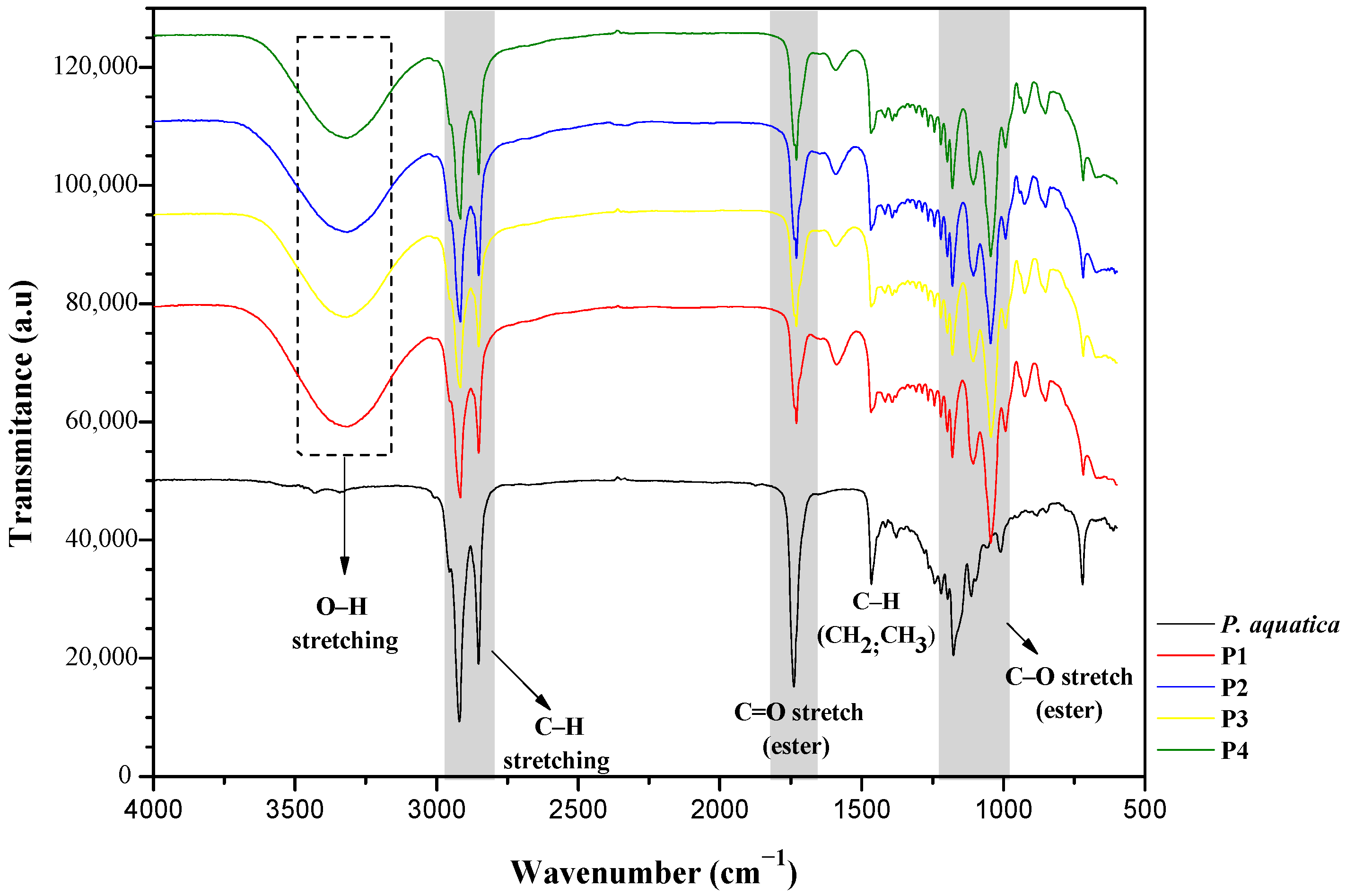
Based on the results obtained through FTIR analysis for the characterization of functional groups present in the P. aquatica oil and in the treatments carried out via transesterification, it was confirmed that the method employed to introduce hydroxyl (–OH) groups was effective. The FTIR-ATR spectrum of the native P. aquatica oil shows only a very small O–H stretching band at ~3300–3500 cm−1, consistent with a low content of free hydroxyls. After NaOH-catalyzed transesterification with glycerol (P1–P4), this O–H band becomes markedly broader and more intense, evidencing the incorporation of glycerol-derived hydroxyl groups and, under some conditions, glycerol oligomers. The progressive increase in the intensity of these bands in the generated polyols was evidenced by the presence of signals around 3319 cm−1, characteristic of O–H bonds, indicating the successful transesterification process (Figure 2).
Bands around 2920 and 2850 cm−1, associated with the C–H stretching of aliphatic chains, were observed in all spectra. However, these bands showed a slight reduction in intensity in the generated polyols, suggesting a dilution of the aliphatic chains present in P. aquatica oil. Additionally, peaks around 1740 cm−1 were also identified in all treatments, corresponding to the C=O stretching of ester groups, which are characteristic of the triglycerides found in vegetable oils. This band shows a reduced intensity, consistent with conversion of triglycerides into mono-/diacylglycerols and the creation of new ester environments.
The peaks around 1467 cm−1, observed in all spectra and with greater intensity in the pure P. aquatica oil, reflect C–H deformations (CH2 and CH3), which are related to the aliphatic chains of lipids [32,33]. Enhanced bands in the 1000–1150 cm−1 region further indicate increased C–O and C–O–C stretching from glycerol and polyol linkages [34]. Collectively, these features confirm successful glycerolysis/hydroxylation of the oil, with the O–H increase and changes in the C–O region differentiating the four methods by their extent of glycerol incorporation and polymerization, key attributes for generating a hydroxyl-rich polyol suitable for adhesive formulation. These results are also in accordance with the increase in OH index discussed before.
As reported by Arniza et al. [20], glycerol can increase the number of hydroxyl groups during transesterification with vegetable oil, promoting the incorporation of this group into the triglyceride structure, thus improving the functionality and enhancing the properties of the resulting polyols. Furthermore, glycerol can be converted into various chemical compounds through catalytic processes, which may enhance C–O bond formation in polyols [35,36].
Regarding the bands around 2920 cm−1 and 2850 cm−1 observed in the infrared spectra of this study, it is confirmed that the C–H bond stretching vibrations in aliphatic chains are characteristic of the presence of fatty acids in vegetable oils [37]. The peaks near 1740 cm−1, corresponding to carbonyl (C=O) stretching vibrations of ester groups, are typical of vegetable oil structures such as soybean, peanut, and mustard oils [38].

3.2. Performance of the Bioadhesives Based on the P. aquatica Oil

Studies indicate that, despite recent advances, one of the main challenges in producing natural adhesives based on vegetable oils is the optimization of the stoichiometric ratio between isocyanate (NCO) and hydroxyl (OH) groups. This balance is considered essential to ensure the cohesion of the polymeric network and the desired adhesive performance, as it is necessary to simultaneously adjust the crosslinking density and flexibility to maximize adhesion without compromising the mechanical integrity of the final product [39,40].
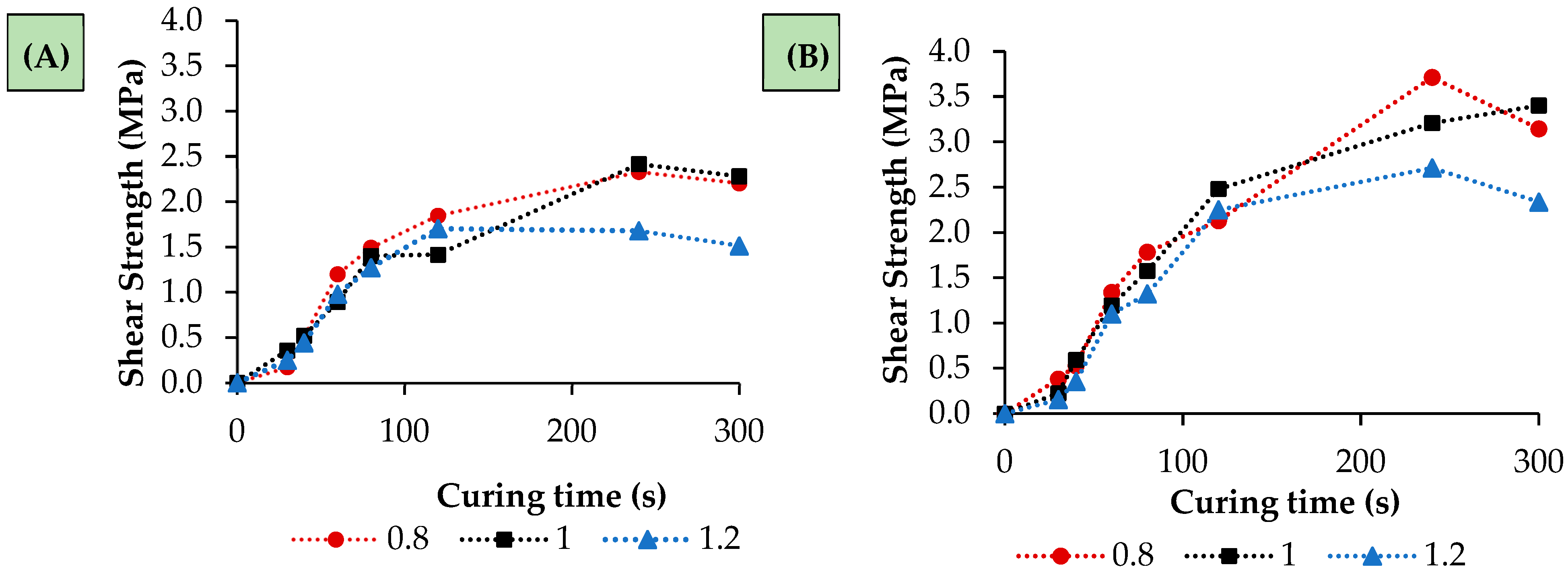
Polyurethane adhesives were produced with P3 (18:1 ratio, 200 °C) and P4 (13:1 ratio, 200 °C) polyols with different isocyanate indices and different curing temperatures. Figure 3 presents the shear strength of bioadhesives based on polyols (A–P3 and B–P4) derived from P. aquatica oil, subjected to different pressing times at 105 °C.
The data in Figure 3 show how the lap–shear strength of the polyurethane adhesives develops with cure time for three isocyanate indexes (0.8, 1.0 and 1.2). All three series increase rapidly between roughly 20 and 120 s, and then entered a slower-growth region that approaches a maximum by 200–300 s. The early time behavior is consistent with an initial wetting period followed by the nearly linear increase in bond strength due the wood-adhesive links formation and rapid adhesive crosslinking; the later-time behavior indicates approach to the resin final cure and cohesive strength of the adhesive, with small differences between formulations as curing proceeds.
These results are in accordance with those of similar works made before that show that ABES produces bond-strength versus pressing/curing-time curves that typically show a rapid rise in shear strength with increasing press/cure time, followed by a plateau or slight decline once the adhesive is essentially cured. This behavior is described and illustrated in the comparative ABES studies by Martins et al. [41] and Costa et al. [42]. The precise time to reach a useful shear strength depends strongly on adhesive chemistry and temperature; ABES data are used to identify the minimum pressing time (or cure time) required to reach target strength for a given adhesive/substrate/temperature combination. Martins et al. [41] emphasize the value of these time-dependent curves for optimizing industrial hot-press cycles.
The adhesion of polyurethane adhesives depends strongly on the NCO/OH ratio. Comparing the formulations, the index-0.8 system attains the highest ultimate shear strength, peaking at approximately 2.3–2.5 MPa for P3 and 3.6–3.7 MPa for P4 near 240–250 s. The index-1.0 formulation follows closely with similar maximum for P3 but reaching a slightly lower maximum (≈3.2–3.4 MPa) for P4. The index-1.2 formulation is systematically weaker across the entire time range, with a peak near 1.6–1.7 MPa for P3 and 2.6–2.7 MPa for P4 and a small decline by 300 s. Thus, increasing isocyanate index from 0.8 to 1.2 reduces shear strength under the conditions tested, especially for 1.2 isocyanate index. Overall P4 polyol-based adhesive performed better across all isocyanate indices. The main different is that P4 polyol has a higher hydroxyl value than P3. An increase in the hydroxyl value of the polyol provides more reactive sites for isocyanate groups, thereby enhancing the crosslinking density of the polyurethane adhesive and promoting the formation of a more compact network structure [43].
Somewhat different results were presented before for polyurethane adhesives made with a polyester polyol derived from castor oil where at a ratio of 1.0, lap shear strength is low and as the ratio increases to 1.3, strength rises sharply. Beyond this point, at 1.7 ratio, strength declines [44]. In accordance to these authors excess isocyanate leads to over-crosslinking and increased stiffness which leads to a reduction on shear strength. In practice, an increased NCO/OH ratio enhances hydrogen bonding, leading to higher shear strength. However, it may compromise shear strength due to reduced flexibility and elongation at break, which can result in stiffer structures that do not adhere as effectively under shear stress, ultimately affecting the bioadhesive’s performance [45].
In addition, the adhesive’s chemical structure is directly influenced by the NCO/OH ratio, which affects the formation of covalent bonds such as C–N and C–O–C, which are crucial for enhancing shear strength. Lower ratios may result in incomplete reactions and fewer covalent bonds, weakening the resulting adhesive [46]. Another important aspect is the presence of unreacted hydroxyl groups due to a low NCO/OH ratio, which can lead to phase separation and, consequently, reduced mechanical properties, further compromising the adhesive’s shear strength [45].
However, the literature highlights a knowledge gap regarding the precise influence of adjustments to the NCO/OH ratio in vegetable oil-based polyols on the microstructure and macroscopic properties of adhesives. This limits the ability to tailor bio-based adhesives for various applications, thereby restricting their exploitation across different sectors [47,48,49].
There seems to be a decrease in shear strength for 300 s in all cases which is justifiable since excessively prolonged pressing times, as observed at 300 s, may result in over-curing of polyurethane-based systems. This phenomenon tends to generate more rigid and brittle bonds with reduced flexibility, which may slightly impair the adhesive strength, possibly due to excessive hardening of the polymer matrix [50].
From an application perspective these results imply that formulation and processing must be optimized together. For this adhesive chemistry and substrate, an isocyanate index in the neighborhood of 0.8–1.0 gives the best combination of rapid strength development and high final shear strength; increasing index to 1.2 does not improve results and may be detrimental. In practice, formulators should therefore avoid simply maximizing NCO content and should instead tune index, polyol functionality, catalyst level and cure schedule to achieve the desired balance between modulus, toughness and interfacial performance.
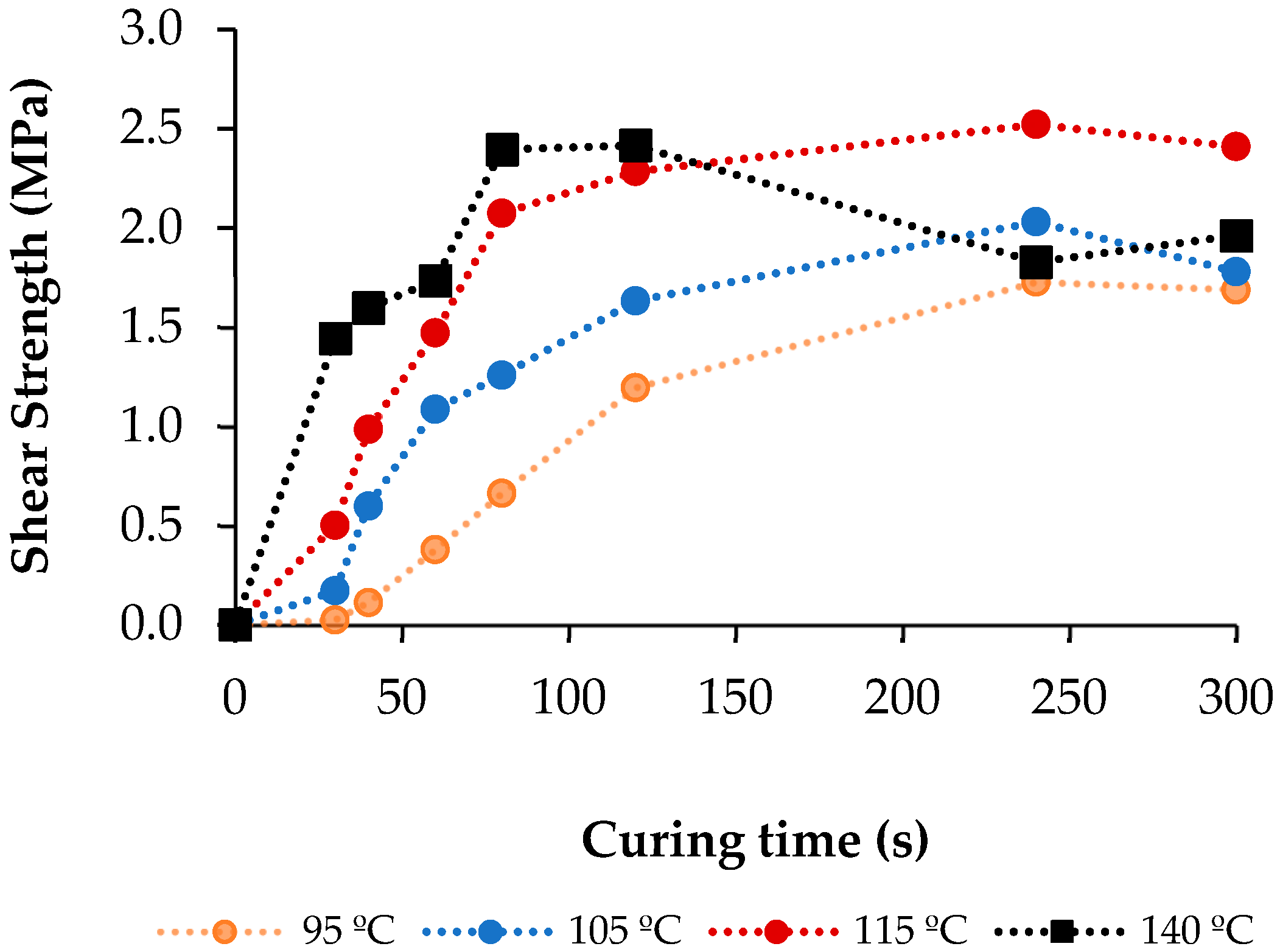
The effect of pressing temperature on the development of shear strength is shown in Figure 4. All formulations exhibited an induction period at very short times, followed by rapid strength build-up whose rate and magnitude depended strongly on temperature. At the lowest temperature (95 °C), strength developed slowly and reached only ~1.7 MPa after 300 s, indicating incomplete network formation under these conditions. Increasing the temperature to 105 °C accelerated the cure and raised the final strength to ~2.0 MPa, while curing at 115 °C resulted in both faster strength development and the highest ultimate strength (~2.5 MPa at 240 s). At 140 °C, the adhesive showed a very rapid rise in strength within the first minute, reaching values comparable to or higher than those at 115 °C; however, extended curing led to a decline in shear strength, suggesting embrittlement or degradation at excessive temperatures and times.
These results highlight the dual role of temperature in polyurethane adhesive performance: while higher temperatures promote faster curing and higher early strength, excessive thermal exposure can compromise cohesive properties. Optimal performance in this system was obtained around 115 °C, where the balance between cure kinetics and network integrity yielded the highest and most stable shear strength values.
Regarding pressing temperatures, values above 120 °C can favor the curing reaction and consequently improve certain mechanical properties of bioadhesives, resulting in greater adhesion to wood. However, this effect depends on the formulation used, since the balance between triglyceride groups and isocyanate directly influences the formation of the polymer network, affecting both the resistance and the structural recovery after cooling. In some cases, this imbalance can lead to a reduction in the final mechanical strength of the material [51,52].
A statistical analysis was made to determine if there is a significant difference between bioadhesives. The performance of the bioadhesives formulated with polyols by the NCO/OH ratio, evaluated at different temperatures and under standardized pressing time conditions, is presented in Table 3. According to the shear strength results, were statistically significant differences were found among the formulations of bioadhesives based on P. aquatica oil (Scott–Knott, p < 0.05).
When comparing the shear strength performance of the different bioadhesives with the control treatment (pure oil), pressed at 105 °C under the same pressing time conditions, a statistically significant difference was observed (Dunnett, p < 0.05). This result demonstrates that P. aquatica oil without chemical modification exhibits inferior bonding performance, thereby highlighting the importance of enhancing its reactivity through chemical modifications and more suitable formulations. Within the bioadhesive formulations, statistical grouping indicates that most samples fall into the “a” category, showing no significant differences among them despite numerical variation. In contrast, P3-T5 is grouped as ‘b’, indicating that this adhesive achieved significantly lower shear strength (0.83 MPa) compared to the others analyzed. Overall, these results demonstrate that certain treatment conditions (notably P3-T6, P4-T1, and P4-T2) yield adhesives with superior strength, but the majority of formulations perform comparably within the same statistical group.
Moreover, although test conditions influence bioadhesive performance, no significant mechanical variations were observed among the formulations tested in this study. This reinforces the importance of exploring methods that allow for more effective adjustments to improve the adhesive and reactive performance of the substance in question (Table 3).
Concerning the shear strength performance obtained for slats bonded with pure oil (control), it is worth noting that the substance does not exhibit reactive characteristics, which is common in saturated vegetable oils. These are predominantly composed of fatty acids with single bonds and are consequently less reactive. The absence of double bonds in this type of substance reduces the number of sites available for radical attack such as hydroxyl radicals which are essential for enhancing reactivity [53,54].
In this context, the high proportion of palmitic acid in P. aquatica oil may have directly contributed to this behavior, as its high degree of saturation may have further limited the availability of reactive sites required for the polymerization and crosslinking of adhesive formulations. This, in turn, tends to reduce the potential for forming cohesive and durable bonds between adhered surfaces [55,56].
Corroborating the results obtained, several studies highlight that the performance of products formulated with polyurethane is strongly dependent on the ratio between hydroxyl and isocyanate groups [57,58]. To produce natural adhesives, it is essential to consider the chemical composition and reactivity of the raw material, as they directly influence the formation of a structure with greater rigidity and toughness in the final product [59,60].
Besides the composition of the oil, the absence of a catalyst during the natural adhesive production process may have hindered the production of a more reactive polyol. The decision not to use a catalyst during this process is justified by the tendency of P. aquatica oil to solidify quickly at room temperature, making it difficult to carry out the reaction. According to the literature, this oil has a melting point between 41.9 °C and 63 °C, which is considered relatively high [16,61,62]. This characteristic may favor the undesired acceleration of the curing reactions of the resulting bio-adhesive, compromising its workability under environmental conditions.
Another aspect reinforcing the absence of the catalyst is that the high melting point of palmitic acids may hinder the action of catalysts in the chemical modification of vegetable oils, limiting the accessibility of reagents to the catalyst. At the elevated temperatures required for effective catalysis, palmitic acid may not dissolve completely or interact efficiently with the catalyst, reducing the reaction’s overall efficiency. This component may therefore inhibit molecular mobility and the necessary collisions, ultimately affecting the overall yield and selectivity of the desired chemical transformations [63,64,65,66].
Another relevant aspect may be related to the variation in viscosity throughout the testing period. At elevated temperatures, viscosity tends to decrease, which may initially favor surface wetting and improve adhesion. However, prolonged exposure to such conditions may result in excessive adhesive flow and thinning of the applied layer, compromising joint integrity and, consequently, reducing shear strength [67].
Overall, when evaluating the average shear strength values obtained for the bioadhesives formulated, it was observed that performance was below the minimum value established by the European Norm standard EN:205 [68], which defines 10 MPa as the minimum strength threshold for bonded joints for all classes C1, C2, C3 and C4 considering a conditioning during 7 days in standard atmosphere. These results indicate that, in this study, the developed bioadhesives did not exhibit satisfactory performance, a result mainly attributed to intrinsic factors of P. aquatica oil, which compromised the quality of the bonded joints.
However, it should be noted that the results obtained from the test on the ABES equipment are primarily intended for relative comparison between formulations at this exploratory stage and should not be interpreted as direct substitutes for the values determined according to the EN:205 standard. This limitation reinforces the preliminary nature of the assessment and provides a more balanced interpretation of the results, situating them in the appropriate context of screening and early adhesive development.

4. Conclusions

The chemical and structural characterization of Pachira aquatica oil confirmed a predominance of saturated fatty acids, particularly palmitic acid (64.80%), which limits the intrinsic reactivity of the native oil but provides thermal and oxidative stability. Transesterification with glycerol proved to be an effective modification strategy, as evidenced by significant increases in hydroxyl index and characteristic FTIR bands, confirming successful hydroxylation and formation of polyols with enhanced reactivity.
Polyurethane bioadhesives produced from the modified polyols demonstrated measurable adhesion performance, influenced by both the NCO/OH ratio and curing temperature. Optimal shear strength was achieved with polyols of higher hydroxyl value (P4) and at moderate isocyanate indices (0.8–1.0), under curing conditions around 115 °C. Excess isocyanate (index 1.2) or excessively prolonged pressing times led to reduced performance, highlighting the need to balance crosslinking density and flexibility in the adhesive network.
Despite these improvements, the bioadhesives derived from P. aquatica oil did not reach the minimum shear strength required by European standard (10 MPa). This limitation is attributed to the high saturation of the oil, its relatively low natural hydroxyl content, and the absence of a catalyst during chemical modification. These factors likely restricted the development of a cohesive and durable polymer network, resulting in insufficient bonding strength.
Although the results do not fully meet regulatory requirements, the study confirms the potential of P. aquatica oil as a renewable raw material for the production of polyols and bioadhesives. To overcome its limitations, particularly related to low unsaturation content and lower reactivity, future prospects include the use of catalytic routes to enhance polyol synthesis, blending polyols derived from P. aquatica oil with polyols from more unsaturated oils, incorporating bio-reactive or co-reactive components, and optimizing the isocyanate structure and/or catalyst use under milder conditions. These strategies may increase the formation of functional groups, promote a more cohesive polymer network, and improve shear resistance, making P. aquatica oil more competitive and technically viable for adhesive applications.

Author Contributions

Conceptualization, F.G., and B.E.; methodology, E.S., M.A., B.A. and B.E.; validation, B.E., F.G., I.D. and E.S.; formal analysis, E.S. and B.E.; investigation, E.S., B.A. and M.A.; resources, B.E. and F.G.; data curation, E.S., I.D. and B.E.; writing—original draft preparation, E.S.; writing—review and editing, F.G., B.E., I.D., L.C., J.P., M.F. and I.C.; visualization, F.G., B.E., L.C. and R.L.; supervision, F.G., and B.E.; project administration, F.G. All authors have read and agreed to the published version of the manuscript.

Funding

This research was funded by the Research Support Foundation of Espírito Santo (FAPES), under Edital FAPES N° 04/2022 (PROAPEM), Term of Grant/Scholarship N°. 311/2023, and by the Coordination for the Improvement of Higher Education Personnel (CAPES) through scholarship and research support (Funding Code 001) and by CERNAS- IPV Research Centre under the project UIDB/00681FCT/MECI and also LEPABE, UID/00511/2025 (https://doi.org/10.54499/UID/00511/2025) and UID/PRR/00511/2025 (https://doi.org/10.54499/UID/PRR/00511/2025) and ALiCE, LA/P/0045/2020 (https://doi.org/10.54499/LA/P/0045/2020).

Data Availability Statement

The original contributions presented in this study are included in the article. Further inquiries can be directed to the corresponding author.

Conflicts of Interest

The authors declare no conflicts of interest. The funders had no role in the design of the study; in the collection, analyses, or interpretation of data; in the writing of the manuscript; or in the decision to publish the results.

References

  1. Dunky, M. Naturally-Based Adhesives for Wood and Wood-Based Panels. In Biobased Adhesives; John Wiley & Sons, Ltd.: Hoboken, NJ, USA, 2023; pp. 517–578. [Google Scholar]
  2. Hemmilä, V.; Adamopoulos, S.; Karlsson, O.; Kumar, A. Development of Sustainable Bio-Adhesives for Engineered Wood Panels—A Review. RSC Adv. 2017, 7, 38604–38630. [Google Scholar] [CrossRef]
  3. Aluyor, E.O.; Obahiagbon, K.O.; Ori-Jesu, M. Biodegradation of Vegetable Oils: A Review. Sci. Res. Essay 2009, 4, 543–548. [Google Scholar]
  4. Ciastowicz, Ż.; Pamuła, R.; Bobak, Ł.; Białowiec, A. Characterization of Vegetable Oils for Direct Use in Polyurethane-Based Adhesives: Physicochemical and Compatibility Assessment. Materials 2025, 18, 918. [Google Scholar] [CrossRef] [PubMed]
  5. Ciastowicz, Ż.; Pamuła, R.; Białowiec, A. Utilization of Plant Oils for Sustainable Polyurethane Adhesives: A Review. Materials 2024, 17, 1738. [Google Scholar] [CrossRef]
  6. Shahdan, S.N.; Hirzin, R.S.F.N. Pre-Treatment of Used Cooking Oil Followed by Transesterification Reaction in the Production of Used Cooking Oil-Based Polyol. Sci. Res. J. 2021, 18, 129–146. [Google Scholar] [CrossRef]
  7. Li, Y.; Luo, X.; Hu, S. Bio-Based Polyols and Polyurethanes, 1st ed.; Springer Briefs in Molecular Science; Springer: Cham, Switzerland, 2015. [Google Scholar]
  8. Kaikade, D.S.; Sabnis, A.S. Polyurethane Foams from Vegetable Oil-Based Polyols: A Review. Polym. Bull. 2023, 80, 2239–2261. [Google Scholar] [CrossRef] [PubMed]
  9. Kong, X.; Liu, G.; Curtis, J.M. Characterization of Canola Oil Based Polyurethane Wood Adhesives. Int. J. Adhes. Adhes. 2011, 31, 559–564. [Google Scholar] [CrossRef]
  10. Lin, C.S.K.; Kirpluks, M.; Priya, A.; Kaur, G. Conversion of Food Waste-Derived Lipid to Bio-Based Polyurethane Foam. Case Stud. Chem. Environ. Eng. 2021, 4, 100131. [Google Scholar] [CrossRef]
  11. Briede, S.; Platnieks, O.; Barkane, A.; Sivacovs, I.; Leitans, A.; Lungevics, J.; Gaidukovs, S. Tailored Biobased Resins from Acrylated Vegetable Oils for Application in Wood Coatings. Coatings 2023, 13, 657. [Google Scholar] [CrossRef]
  12. Souza, M.; Silva, S.; Costa Júnior, S.; Bezerra, G. Análise Sensorial de Produto Elaborado a Partir Da Farinha de Munguba (Pachira aquatica Aubl.). In Proceedings of the VI Congresso Latino-Americano de Agroecologia X Congresso Brasileiro de Agroecologia, V Seminário de Agroecologia do Distrito Federal e Entorno, Brasília, DF, Brazil, 12–15 September 2017. [Google Scholar]
  13. Silva, B.L.A.; Bora, P.S.; Azevedo, C.C. Caracterização Química Parcial Das Proteínas Das Amêndoas Da Munguba (Pachira aquatica Aubl). Rev. Inst. Adolfo Lutz 2010, 69, 333–340. [Google Scholar] [CrossRef]
  14. Peixoto, A.L.; Escudeiro, A. Pachira aquatica (Bombacaceae) Na Obra “História Dos Animais e Árvores Do Maranhão” de Frei Cristóvão de Lisboa. Rodriguésia 2002, 53, 123–130. [Google Scholar] [CrossRef]
  15. Brasil, T.S.S.; Boas, J.C.V.; Souza, M.L.F.S.; Oliveira, M.V.L.; Cordoba, L.B.; Neto, J.A.B.; Vargas, M.O.F. Análise Comparativa Das Propriedades Funcionais de Munguba (Pachira aquatica Aubl.) e Seus Alternativos Alimentares Possíveis. Braz. J. Dev. 2021, 7, 41577–41588. [Google Scholar] [CrossRef]
  16. Jorge, N.; Luzia, D.M.M. Caracterização Do Óleo Das Sementes de Pachira aquatica Aublet Para Aproveitamento Alimentar. Acta Amaz. 2012, 42, 149–156. [Google Scholar] [CrossRef]
  17. Delatorre, F.M.; Cupertino, G.F.M.; Pereira, A.K.S.; Souza, E.C.; Silva, Á.M.; Ucella Filho, J.G.M.; Saloni, D.; Profeti, L.P.R.; Profeti, D.; Dias Júnior, A.F. Photoluminous Response of Biocomposites Produced with Charcoal. Polymers 2023, 15, 3788. [Google Scholar] [CrossRef]
  18. Vieira, F.R.; Barros-Timmons, A.; Evtuguin, D.V.; Pinto, P.C.R. Effect of Different Catalysts on the Oxyalkylation of Eucalyptus Lignoboost® Kraft Lignin. Holzforschung 2020, 74, 567–576. [Google Scholar] [CrossRef]
  19. Dulyanska, Y.; Cruz-Lopes, L.; Esteves, B.; Guiné, R.; Domingos, I. FTIR Monitoring of Polyurethane Foams Derived from Acid-Liquefied and Base-Liquefied Polyols. Polymers 2024, 16, 2214. [Google Scholar] [CrossRef] [PubMed]
  20. Arniza, M.Z.; Hoong, S.S.; Idris, Z.; Yeong, S.K.; Hassan, H.A.; Din, A.K.; Choo, Y.M. Synthesis of Transesterified Palm Olein-Based Polyol and Rigid Polyurethanes from This Polyol. J. Am. Oil Chem. Soc. 2015, 92, 243–255. [Google Scholar] [CrossRef] [PubMed]
  21. Costa, N.A.; Pereira, J.; Ferra, J.; Cruz, P.; Martins, J.; Magalhães, F.D.; Mendes, A.; Carvalho, L.H. Evaluation of Bonding Performance of Amino Polymers Using ABES. J. Adhes. 2014, 90, 80–88. [Google Scholar] [CrossRef]
  22. ASTM D7998-19; Standard Test Method for Measuring the Effect of Temperature on the Cohesive Strength Development of Adhesives Using Lap Shear Bonds Under Tensile Loading. American Society for Testing and Material: West Conshohocken, PA, USA, 2024.
  23. Esteves, B.; Martins, J.; Martins, J.; Cruz-Lopes, L.; Vicente, J.; Domingos, I. Liquefied Wood as a Partial Substitute of Melamine-Urea-Formaldehyde and Urea-Formaldehyde Resins. Maderas Cienc. Tecnol. 2015, 17, 277–284. [Google Scholar] [CrossRef]
  24. R Core Team. R: A Language and Environment for Statistical Computing. 2025. Available online: https://cran.r-project.org/doc/manuals/r-release/fullrefman.pdf (accessed on 3 July 2025).
  25. Rodrigues, A.P.; Pereira, G.A.; Tomé, P.H.F.; Arruda, H.S.; Eberlin, M.N.; Pastore, G.M. Chemical Composition and Antioxidant Activity of Monguba (Pachira aquatica) Seeds. Food Res. Int. 2019, 121, 880–887. [Google Scholar] [CrossRef]
  26. Camargo, M.F. Caracterização Química Do Óleo Extraído Da Pachira aquatica Aubl. Periód. Tchê Quím. 2008, 5, 19–22. [Google Scholar] [CrossRef]
  27. Dunky, M. Wood Adhesives Based on Natural Resources: A Critical Review: Part IV. Special Topics. In Progress in Adhesion and Adhesives; Wiley: Hoboken, NJ, USA, 2021; pp. 761–840. [Google Scholar]
  28. Gardner, D.J.; Pokhrel, G.; Collins, A. Adhesion Theories in Naturally-based Bonding. In Biobased Adhesives; Dunky, M., Mittal, K.L., Eds.; Jhon Wiley & Sons: Hoboken, NJ, USA, 2023; pp. 45–83. [Google Scholar]
  29. Gavrilović-Grmuša, I.; Rančić, M.; Tešić, T.; Stupar, S.; Milošević, M.; Gržetić, J. Bio-Epoxy Resins Based on Lignin and Tannic Acids as Wood Adhesives—Characterization and Bonding Properties. Polymers 2024, 16, 2602. [Google Scholar] [CrossRef]
  30. Agu, C.M.; Orakwue, C.C.; Ani, O.N.; Chinedu, M.P.; Kadurumba, C.H.; Ahaneku, I.E. Methyl Ester Production from Cotton Seed Oil via Catalytic Transesterification Process; Characterization, Fatty Acids Composition, Kinetics, and Thermodynamics Study. Sustain. Chem. Environ. 2024, 5, 100064. [Google Scholar] [CrossRef]
  31. Ma, Y.; Zhu, X.; Zhang, Y.; Li, X.; Chang, X.; Shi, L.; Lv, S.; Zhang, Y. Castor Oil-Based Adhesives: A Comprehensive Review. Ind. Crops Prod. 2024, 209, 117924. [Google Scholar] [CrossRef]
  32. Nascimento, T.A.; Lopes, T.I.B.; Nazario, C.E.D.; Oliveira, S.L.; Alcantara, G.B. Vegetable Oils: Are They True? A Point of View from ATR-FTIR, 1H NMR, and Regiospecific Analysis by 13C NMR. Food Res. Int. 2021, 144, 110362. [Google Scholar] [CrossRef] [PubMed]
  33. Pavia, D.L.; Lampman, G.M.; Kriz, G.S.; Vyvyan, J.R. Introdução à Espectroscopia, 4th ed.; Cengage Learning, Ed.: São Paulo, Brazil, 2015. [Google Scholar]
  34. Fontalvo-Gómez, M.; Colucci, J.A.; Velez, N.; Romañach, R.J. In-Line Near-Infrared (NIR) and Raman Spectroscopy Coupled with Principal Component Analysis (PCA) for in Situ Evaluation of the Transesterification Reaction. Appl. Spectrosc. 2013, 67, 1142–1149. [Google Scholar] [CrossRef] [PubMed]
  35. Borówka, G.; Semerjak, G.; Krasodomski, W.; Lubowicz, J. Purified Glycerine from Biodiesel Production as Biomass or Waste-Based Green Raw Material for the Production of Biochemicals. Energies 2023, 16, 4889. [Google Scholar] [CrossRef]
  36. Mohan, K.; Pai, S.D.K.R.; Reghunath, B.S.; Pinheiro, D. Unveiling Cutting Edge Innovations in the Catalytic Valorization of Biodiesel Byproduct Glycerol into Value Added Products. ChemistrySelect 2023, 8, e202204501. [Google Scholar] [CrossRef]
  37. Zavafer, A.; Ball, M.C. Good Vibrations: Raman Spectroscopy Enables Insights into Plant Biochemical Composition. Funct. Plant Biol. 2022, 50, 1–16. [Google Scholar] [CrossRef]
  38. Meng, Y.; Ferreira, E.N.; Ricardo, N.M.P.S.; Kebir, N.; Leveneur, S. Epoxidation Showdown: Unveiling the Kinetics of Vegetable Oils vs Their Methyl Ester Counterparts. Ind. Eng. Chem. Res. 2024, 63, 18849–18860. [Google Scholar] [CrossRef]
  39. Dutta, S.; Karak, N. Effect of the NCO/OH Ratio on the Properties of Mesua ferrea L. Seed Oil-modified Polyurethane Resins. Polym. Int. 2006, 55, 49–56. [Google Scholar] [CrossRef]
  40. Sahoo, S.; Kalita, H.; Mohanty, S.; Nayak, S.K. Synthesis and Characterization of Vegetable Oil Based Polyurethane Derived from Low Viscous Bio Aliphatic Isocyanate: Adhesion Strength to Wood-Wood Substrate Bonding. Macromol. Res. 2017, 25, 772–778. [Google Scholar] [CrossRef]
  41. Martins, J.; Pereira, J.; Coelho, C.; Ferra, J.; Mena, P.; Magalhães, F.; Carvalho, L. Adhesive Bond Strength Development Evaluation Using ABES in Different Lignocellulosic Materials. Int. J. Adhes. Adhes. 2013, 47, 105–109. [Google Scholar] [CrossRef]
  42. Costa, N.A.; Ferra, J.; Martins, J.; Coelho, C.; Pereira, J.; Cruz, P.; Magalhães, F.; Carvalho, L. Impact of Thermal Treatment on Bonding Performance of UF/PVAc Formulations. Int. Wood Prod. J. 2014, 5, 212–216. [Google Scholar] [CrossRef]
  43. Moghadam, P.N.; Yarmohamadi, M.; Hasanzadeh, R.; Nuri, S. Preparation of Polyurethane Wood Adhesives by Polyols Formulated with Polyester Polyols Based on Castor Oil. Int. J. Adhes. Adhes. 2016, 68, 273–282. [Google Scholar] [CrossRef]
  44. Somani, K.P.; Kansara, S.S.; Patel, N.K.; Rakshit, A.K. Castor Oil Based Polyurethane Adhesives for Wood-to-Wood Bonding. Int. J. Adhes. Adhes. 2003, 23, 269–275. [Google Scholar] [CrossRef]
  45. Feng, J.; Lu, Q.; Tan, W.; Chen, K.; Ouyang, P. The Influence of the NCO/OH Ratio and the 1,6-Hexanediol/Dimethylol Propionic Acid Molar Ratio on the Properties of Waterborne Polyurethane Dispersions Based on 1,5-Pentamethylene Diisocyanate. Front. Chem. Sci. Eng. 2019, 13, 80–89. [Google Scholar] [CrossRef]
  46. Xu, Z.-X.; Dou, R.; Gao, F.; Chen, Y.-X.; Leng, L.-J.; Osman, S.M.; Luque, R. Bio-Adhesives Derived from Sewage Sludge via Hydrothermal Carbonization: Influence of Aqueous Phase Recycling. Chem. Eng. J. 2024, 490, 151685. [Google Scholar] [CrossRef]
  47. Kaushik, A.; Singh, P. Kinetic Study of Polyurethane Reaction between Castor Oil/TMP Polyol and Diphenyl Methane Diisocyanate in Bulk. Int. J. Polym. Mater. 2006, 55, 549–561. [Google Scholar] [CrossRef]
  48. Palle, I.; Lodin, V.; Mohd Yunus, A.A.; Lee, S.H.; Md Tahir, P.; Hori, N.; Antov, P.; Takemura, A. Effects of NCO/OH Ratios on Bio-Based Polyurethane Film Properties Made from Acacia mangium Liquefied Wood. Polymers 2023, 15, 1154. [Google Scholar] [CrossRef]
  49. Vieira, F.R.; Gama, N.; Magina, S.; Barros-Timmons, A.; Evtuguin, D.V.; Pinto, P.C.O.R. Polyurethane Adhesives Based on Oxyalkylated Kraft Lignin. Polymers 2022, 14, 5305. [Google Scholar] [CrossRef]
  50. Maulana, S.; Setiawan, I.P.; Pusbanarum, D.; Antov, P.; Iswanto, A.H.; Kristak, L.; Lee, S.H.; Lubis, M.A.R. Adhesion and Cohesion Performance of Polyurethane Made of Bio-Polyol Derived from Modified Waste Cooking Oil for Exterior Grade Plywood. Macromol. Mater. Eng. 2024, 309, 2400225. [Google Scholar] [CrossRef]
  51. del Prado, A.; Hohl, D.K.; Balog, S.; Espinosa, L.M.; Weder, C. Plant Oil-Based Supramolecular Polymer Networks and Composites for Debonding-on-Demand Adhesives. ACS Appl. Polym. Mater. 2019, 1, 1399–1409. [Google Scholar] [CrossRef]
  52. Lascano, D.; Gomez-Caturla, J.; Garcia-Sanoguera, D.; Garcia-Garcia, D.; Ivorra-Martinez, J. Optimizing Biobased Thermoset Resins by Incorporating Cinnamon Derivative into Acrylated Epoxidized Soybean Oil. Mater. Des. 2024, 243, 113084. [Google Scholar] [CrossRef]
  53. Roman, O.; Heyd, B.; Broyart, B.; Castillo, R.; Maillard, M.-N. Oxidative Reactivity of Unsaturated Fatty Acids from Sunflower, High Oleic Sunflower and Rapeseed Oils Subjected to Heat Treatment, under Controlled Conditions. LWT Food Sci. Technol. 2013, 52, 49–59. [Google Scholar] [CrossRef]
  54. Szori, M.; Csizmadia, I.G.; Viskolcz, B. Nonenzymatic Pathway of PUFA Oxidation. A First-Principles Study of the Reactions of OH Radical with 1,4-Pentadiene and Arachidonic Acid. J. Chem. Theory Comput. 2008, 4, 1472–1479. [Google Scholar] [CrossRef] [PubMed]
  55. Pang, M.; Liu, Z.; Li, H.; Liang, L.; Li, L. Effect of Fatty Acids on Vegetable-Oil-Derived Sustainable Polyurethane Coatings for Controlled-Release Fertilizer. Coatings 2024, 14, 1183. [Google Scholar] [CrossRef]
  56. Serrano-Vega, M.J.; Martínez-Force, E.; Garcés, R. Lipid Characterization of Seed Oils from High-palmitic, Low-palmitoleic, and Very High-stearic Acid Sunflower Lines. Lipids 2005, 40, 369–374. [Google Scholar] [CrossRef]
  57. Peptu, C.; Diaconu, A.-D.; Danu, M.; Peptu, C.A.; Cristea, M.; Harabagiu, V. The Influence of the Hydroxyl Type on Crosslinking Process in Cyclodextrin Based Polyurethane Networks. Gels 2022, 8, 348. [Google Scholar] [CrossRef]
  58. Petrović, Z.S.; Zhang, W.; Zlatanić, A.; Lava, C.C.; Ilavskyý, M. Effect of OH/NCO Molar Ratio on Properties of Soy-Based Polyurethane Networks. J. Polym. Environ. 2002, 10, 5–12. [Google Scholar] [CrossRef]
  59. Hussain, N.I.A.M.; Bonnia, N.N.; Hirzin, R.S.F.N.; Ali, E.S.; Zawawi, E.Z.E. Effect of NCO/OH Ratio on Physical and Mechanical Properties of Castor-Based Polyurethane Grouting Materials. J. Phys. Conf. Ser. 2019, 1349, 012113. [Google Scholar] [CrossRef]
  60. Jašek, V.; Figalla, S. Vegetable Oils for Material Applications–Available Biobased Compounds Seeking Their Utilities. ACS Polym. Au 2025, 5, 105–128. [Google Scholar] [CrossRef]
  61. Marcelino, J.M. Avaliação da Toxicidade, Genotoxicidade e Mutagenicidade do Óleo da Semente de Pachira aquatica Aublet. Master’s Thesis, Universidade Federal da Grande Dourados, Dourados, Brazil, 2018. [Google Scholar]
  62. Silva, T.G. Potencial Nutricional das Amêndoas de Pachira aquatica Aubl. Master’s Thesis, Universidade Federal da Grande Dourados, Dourados, Brazil, 2016. [Google Scholar]
  63. Bart, J.C.J.; Gucciardi, E.; Cavallaro, S. Chemical Transformations of Renewable Lubricant Feedstocks. In Biolubricants; Bart, J.C.J., Gucciardi, E., Cavallaro, S., Eds.; Woodhead Publishing: Cambridge, UK, 2013; pp. 249–350. [Google Scholar]
  64. Fu, J.; Lu, X.; Savage, P.E. Catalytic Hydrothermal Deoxygenation of Palmitic Acid. Energy Environ. Sci. 2010, 3, 311. [Google Scholar] [CrossRef]
  65. Ghosh, S.; Bhattacharyya, D.K. Utilization of High-melting Palm Stearin in Lipase-catalyzed Interesterification with Liquid Oils. J. Am. Oil Chem. Soc. 1997, 74, 589–592. [Google Scholar] [CrossRef]
  66. Melero, J.A.; Bautista, L.F.; Morales, G.; Iglesias, J.; Briones, D. Biodiesel Production with Heterogeneous Sulfonic Acid-Functionalized Mesostructured Catalysts. Energy Fuels 2009, 23, 539–547. [Google Scholar] [CrossRef]
  67. Mao, A.; Shi, S.Q. Dynamic Mechanical Properties of Polymeric Diphenylmethane Diisocyanate/Bio-Oil Adhesive System. For. Prod. J. 2012, 62, 201–206. [Google Scholar] [CrossRef]
  68. DIN EN 205; Adhesives—Wood Adhesives for Non-Structural Applications: Determination of Tensile Shear Strength of Lap Joints. European Committee for Standardization: Brussels, Belgium, 2003.
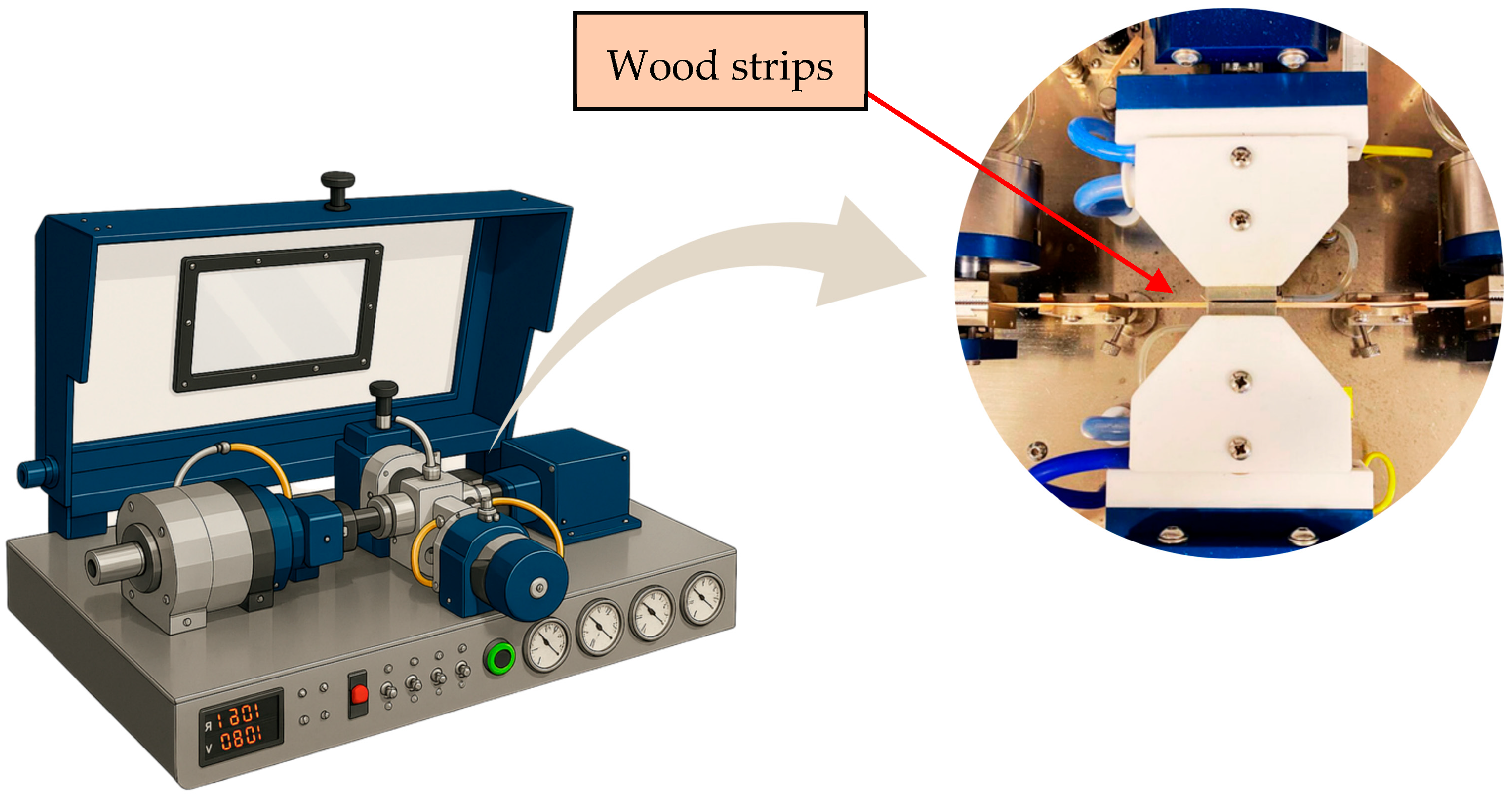
Figure 1. Diagram of the shear strength testing system in the ABES equipment.
Forests 16 01843 g001
Figure 2. FTIR spectra obtained for different bioadhesive formulations based on P. aquatica oil compared to pure oil.
Forests 16 01843 g002
Figure 3. Variation of shear strength as a function of the isocyanate–hydroxyl index (NCO/OH), in the range of 0.8 to 1.2, for adhesives formulated from polyol P3 (A) and P4 (B).
Forests 16 01843 g003
Figure 4. Shear resistance behavior of the P3 bioadhesive tested at different pressing temperatures (°C).
Forests 16 01843 g004
Table 1. Test conditions for the transesterification process of the P. aquatica oil.
PolyolTemperature
(°C)
Time
(h)
Molar Ratio
(Glycerol/Oil)
Catalyst
(%)-(NaOH)
P118066:12.0
P220066:12.0
P3200618:12.0
P4200613:12.0
Table 2. Preparation conditions of the bioadhesives with polyols P3 and P4 obtained from P. aquatica oil.
BioadhesivesPolyol Amount (mL)/Isocyanate (mL)—
(NCO/OH Ratio)
Temperature (°C)
P3-T1 *3:4.0—(1.00)105
P3-T23:3.2—(0.80)105
P3-T33:4.8—(1.20)105
P3-T43:3.0—(0.75)115
P3-T53:3.0—(0.75)95
P3-T63:3.0—(0.75)140
P3-T73:2.4—(0.60)105
P4-T13:4.5—(1.00)105
P4-T23:3.6—(0.80)105
P4-T33:5.4—(1.20)105
* P: Polyol; T(n°): Numbered test.
Table 3. Shear strength of bioadhesives formulated with different proportions of polyol derived from P. aquatica oil.
BioadhesivesShear Strength (MPa)
P3-T11.33 (0.80) a *
P3-T21.39 (0.82) a *
P3-T31.12 (0.59) a *
P3-T41.75 (0.78) a *
P3-T50.83 (0.71) b *
P3-T61.91 (0.38) a *
P3-T71.22 (0.66) a *
P4-T11.81 (1.25) a *
P4-T21.86 (1.25) a *
P4-T31.46 (1.00) a *
Pure oil (Control)0.30 (0.28)
P3: Polyol 3; P4: Polyol 4; T(n°): Numbered test. Means followed by the same do not differ (Scott–Knott, p > 0.05). * Different letters indicate statistically significant differences (Scott–Knott test, p < 0.05, followed by Dunnett’s test versus the pure oil). Value in parentheses corresponds to the standard deviation. Value in parentheses corresponds to standard deviation.
Disclaimer/Publisher’s Note: The statements, opinions and data contained in all publications are solely those of the individual author(s) and contributor(s) and not of MDPI and/or the editor(s). MDPI and/or the editor(s) disclaim responsibility for any injury to people or property resulting from any ideas, methods, instructions or products referred to in the content.