Article

Response of Eucalyptus Seedlings to Water Stress in a Warm Tropical Region in Brazil

by
Sara Bezerra Bandeira Milhomem
1,*,
Nadia Da Silva Ramos
2,
Flavia Barreira Gonçalves
2,
Gessica Hashimoto de Medeiros
2,
Hallefy Elias Fernandes
2,
Marciane Cristina Dotto
2,
Rodrigo Eiji Hakamada
3,
Susana Cristine Siebeneichler
2 and
Eduardo Andrea Lemus Erasmo
2
1
Department of Forest Science, Federal Rural University of Pernambuco, Recife 52171-900, Brazil
2
Department of Agronomy, Federal University of Tocantins, Gurupi 77410-570, Brazil
3
Department of Forest Science, Luiz de Queiroz School of Agriculture–USP, Piracicaba 13418-900, Brazil
*
Author to whom correspondence should be addressed.
Forests 2025, 16(12), 1802; https://doi.org/10.3390/f16121802 (registering DOI)
Submission received: 9 October 2025 / Revised: 18 November 2025 / Accepted: 20 November 2025 / Published: 30 November 2025

Abstract

This study evaluated the physiological and biochemical responses of three Eucalyptus genotypes (E. urophylla; hybrid E. urophylla × E. grandis; hybrid E. urophylla × E. camaldulensis) under three water regimes (well-watered—plants watered daily with 70% of field capacity; rehydrated—water supply suspended at initial wilting symptoms; water deficit—water supply suspended upon reaching 50% of soil water retention capacity) in a warm tropical environment. The treatment was performed through daily weighing of plant pots and addition of the required water amount to reach the pot weight in each treatment. Measurements included stomatal conductance (gs), carbon assimilation rate (A), transpiration rate (E), leaf water potential (Ψleaf), chlorophyll content (a and b), proline accumulation, and the activities of superoxide dismutase (SOD) and catalase (CAT). The genotypes exhibited contrasting drought responses: E. urophylla × E. camaldulensis showed the highest resilience, maintaining gas exchange, water status, and proline accumulation under stress. E. urophylla × E. grandis displayed intermediate tolerance, while E. urophylla was the most sensitive. Overall, drought tolerance in Eucalyptus emerged from the coordinated interaction of hydraulic, osmotic, and antioxidant mechanisms.

1. Introduction

Forests cover roughly 4 billion ha worldwide, with 300 million ha of planted forests [1]. Although planted forests account for only 7% of the total forest area, they supply about 50% of the world’s wood demand while playing a social, economic, and environmental role [1]. Brazil has the world’s second-largest forest area with 500 million ha (60% of the territory), of which 10 million ha is with planted forests [2], accounting for 85% of the revenue generated by the forest sector [3]. In 2018, the area occupied by forest plantations of Eucalyptus in Brazil was estimated at 5.7 million ha, from which 119,871 ha were planted in the state of Tocantins [4]. Although Eucalyptus species have shown a significant improvement in cultivation and production, reports from the Brazilian Industry of Trees have shown a small increment in crop yield of Eucalyptus species in the last five years, partially due to climate change, which has affected rainfall patterns in many parts of the Brazilian territory [5].
Tocantins State is long and presents different biomes and ecological regions [6]. The relative humidity is higher in the Northwest region and decreases to the east and southeast. The state has a small thermal amplitude, with high mean temperatures in all months of the year. The hottest month is September (around 25 °C), and the lowest temperature occurs in July (around 21.2 °C). Throughout the year, the lowest mean temperatures are observed in the southeast of Tocantins, a region with greater latitude and higher altitudes when compared to the north, which has the highest temperature with lower latitude and altitude. The biggest biome in Tocantins state is the Brazilian savanna (Cerrado) and most of the soils, besides the low natural fertility, present some physical limitations to plant development, such as the presence of abundant gravels and/or concretions (petroplinthite, mainly); high water table; high stoniness or rockiness; low water holding capacity; sandy or medium light texture; shallow depths [7]. Consequently, Tocantins is considered a non-traditional area of Eucalyptus cultivation in the northern region of the country, as the forest plantations in the state started only in the 2000s. Eucalyptus grandis, Eucalyptus camaldulensis, and Eucalyptus urophylla are among the most cultivated Eucalyptus species in Brazil, in addition to hybrids from cross-breeding, such as hybrid E. grandis × E. urophylla [8].
Water stress is a major environmental factor, jeopardizing plant growth and crop yield [9,10,11]. Therefore, breeding programs place efforts to generate plants with high survival and growth rates under water stress conditions [12,13,14]. Forest growth is highly related to water supply, as reported by an experiment conducted in Brazil and Uruguay. The study investigated 18 Eucalyptus species in a 3500 km environmental gradient and found a reduction of approximately 4 m3 ha−1 y−1 for each 100 mm of water deficit [15,16]. It was observed that genotypes responded distinctly to water deficit, as the three most productive clones in the study had a reduction of 6 m3 ha−1 y−1, indicating that water relations are specific to the site condition and to the plant genotype.
Plants employ multiple strategies to cope with water limitation, including stomatal regulation, osmotic adjustment, and activation of antioxidant defense pathways [17,18,19,20]. The balance between these mechanisms determines whether a species exhibits isohydric or anisohydric behavior—two contrasting strategies for maintaining water balance. Isohydric plants, such as E. camaldulensis, tightly regulate stomatal closure to prevent xylem embolism, whereas anisohydric species allow wider fluctuations in leaf water potential, risking cavitation but sustaining photosynthesis longer under mild stress [21]. Additionally, the accumulation of osmolytes like proline and enhanced activities of enzymes such as SOD, CAT, and ascorbate peroxidase (APX) contribute to redox balance and protection against oxidative damage [20].
E. urophylla is a widely planted species in tropical regions of Brazil due to its versatility and ability to adapt to various environmental conditions. These species are highly productive and known for their growth in dry tropical regions. Observations in Eucalyptus plantations have shown that different genotypes exhibit varying levels of drought tolerance. In view of the above, considering that within the biochemical variables, information on the activity of the antioxidant system in genotypes of highly productive Eucalyptus spp. plants cultivated in tropical regions are limited, it is clear that the study of the physiological and biochemical characteristics and variables presented above is extremely important to understand how eucalyptus genotypes modulate them in areas with some level of water suppression. In this study, we investigated the physiological and biochemical responses of three Eucalyptus genotypes with contrasting drought tolerances. We hypothesized that drought-tolerant genotypes would display coordinated stomatal control, osmotic adjustment via proline accumulation, and enhanced ROS-scavenging enzyme activity, allowing better water status maintenance and post-stress recovery.

2. Materials and Methods

The study was carried out under a greenhouse with temperature and humidity measured by sensors and controlled by exhaust fans and sprinklers. The greenhouse is covered with a transparent plastic film (0.15 µm thick) at the Research Experimental Unit of the Federal University of Tocantins (Campus TO/Gurupi), Brazil. During the experiment, the average temperature observed was 26 ± 2.1 °C, with the minimal and maximum temperatures of 25.2 ± 2.2 °C and 26.8 ± 1.9 °C, respectively; relative humidity levels ranged from 64.5 ± 7.1% to 70.8 ± 5%, with an average of 67.6 ± 6% (Figure 1).
The experimental design was completely randomized, with 10 repetitions (four for physiological and morphological parameters and six for biochemical parameters), arranged in a factorial scheme 3 × 3, three genotypes (E. urophylla; hybrid E. urophylla × E. grandis; hybrid E. urophylla × E. camaldulensis), and three watering conditions. In field conditions in the region where the experiment was conducted, genotypes have different drought tolerance levels, and the most tolerant is E. urophylla × E. camaldulensis, followed by E. urophylla × E. grandis, and finally the genotype of pure E. urophylla. However, this is only practical information. The second genotype is known as the most planted in Brazil [22] and one with the highest adaptation level and wood yield in the country, adapted to many sites and climate conditions [16]. The hybrid E. urophylla × E. camaldulensis is adapted to dry conditions, mainly because of its hybridization with E. camaldulensis, which provides higher drought tolerance in forest plantations [16].
Eucalyptus seedlings used in the experiment were provided by the “Marka Florestal Comércio e Serviços Florestais LTDA”, based in the city of Carolina, Maranhão State, Brazil. Seedlings were produced in 50 cm3 tubes with a substrate of carbonized rice husk, coconut fiber, and vermiculite, propagated through mini-cutting. Seedlings remained 20 days in the greenhouse, plus 30 days in the acclimation house covered with a transparent plastic film (0.15 µm thick), and remained for more than 40 days growing in an open space. The greenhouse was a closed environment with controlled conditions, while the acclimatization house had a plastic cover to protect against rain, without controlled conditions. In the production process, the seedlings received daily irrigation through microsprinkler and were fertilized with slow-release fertilizer (osmocote). After being removed from the greenhouse, the seedlings continued to receive microsprinkler irrigation and additional fertilization with monoammonium phosphate. After this period, seedlings were planted in 3.8 L pots and filled with a soil mixture obtained from approximately 80 cm deep (55%), sand (30%), and organic compost (carbonized rice husk, coconut fiber, and commercial substrate, produced by companies that formulate and bag substrates—1:1:1) (15%). The application of fertilizers and correctives was carried out according to recommendations of [23], based on the demands of the culture and the substrate chemical analysis (Table 1). A total of 2.49 g of limestone, 9.02 g of super simple, 1.4 g of KCl, 6.9 g of urea, and 1.2 g of microelements were added to the transplant for each pot with a capacity of 3.8 L.
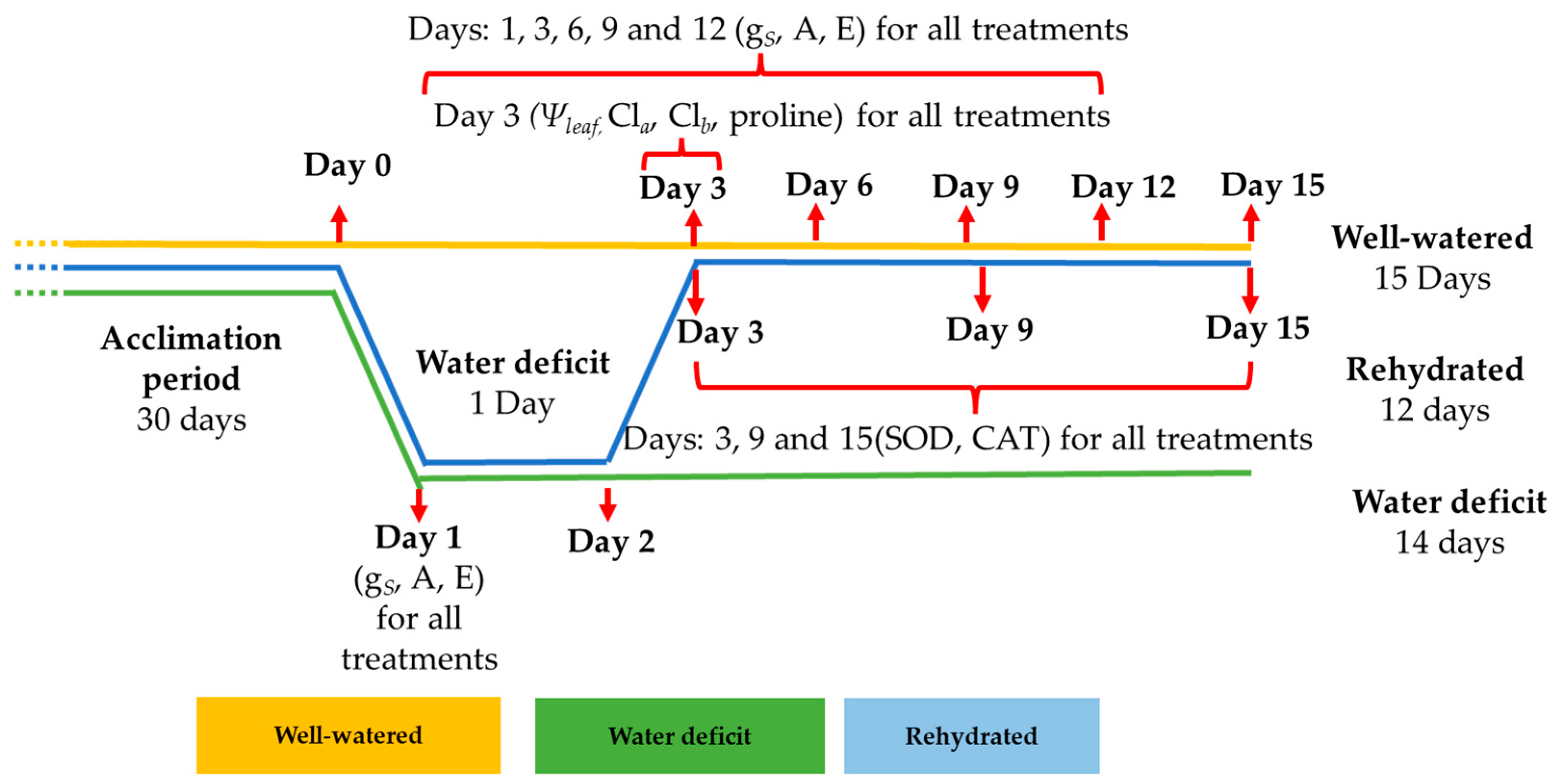
After genotype transplantation, plants were subjected to an acclimation period under field capacity for 30 days, which was previously determined through the gravimetric method [24]. After acclimation period, the seedlings were standardized for all evaluated clones, the heights and diameters of the seedlings were measured using a graduated rod and a digital caliper, where they had an average of 89.82 cm in height and 11.20 mm in diameter, then separated into three treatments and the following watering treatments were implemented: well-watered—plants watered daily with 70% of field capacity; rehydrated—plants irrigated with 70% of field capacity and irrigation was suspended upon reaching 50% of field capacity, which coincided with the appearance of initial wilting symptoms, followed by rehydration to 70% of field capacity; water deficit—water supply suspended upon reaching 50% of field capacity, kept under this condition until the end of the experiment (Figure 2). The experiment was implemented through the daily weighing of plant pots and the addition of the required water amount, according to each treatment.
This study aimed to evaluate plant responses under conditions of severe water stress, while avoiding plant mortality. Therefore, the experimental duration was defined based on physiological assessments conducted from the onset of the treatments until plants ceased to respond to water deficit and subsequent rehydration. As illustrated in Figure 2, the treatments began after an acclimation period.
In the well-watered treatment, plants were maintained at 70% of field capacity throughout the entire 15-day experimental period. In the water-deficit and rehydration treatments, irrigation was suspended, and within one day, the soil moisture decreased to approximately 50% of field capacity. In the rehydration treatment, plants remained at 50% of field capacity for one day and were then rewatered to reach 70% of field capacity, remaining under these conditions for an additional 12 days of evaluation. In the water-deficit treatment, after irrigation was suspended and soil moisture reached 50% of field capacity, plants were maintained under these conditions for 14 consecutive days.
To ensure the accuracy of water replenishment, the amount of water supplied was determined gravimetrically by daily weighing of each pot and adding water to reach the target level of field capacity established for each treatment. Because the plants exhibited continuous biomass accumulation during the experimental period, the reference pot weight corresponding to 100% of field capacity was readjusted every three days to account for growth, based on representative pots from each treatment. This procedure ensured that plants with higher biomass did not receive less water due to increased pot weight, thereby preventing underestimation of water demand and maintaining consistent irrigation management among treatments.
After establishing the different watering treatments, we evaluated stomatal conductance (gs—mol H2O m−2 s−1), carbon assimilation rate (A—μmol CO2 m−2 s−1), and transpiration rate (E—mol H2O m−2 s−1). Measurements were taken using fully expanded leaves from the middle third of the plants, on the surface of two fully expanded leaves of four plants, per clone and treatment. The gas exchange analyses were conducted using a portable infrared gas analyzer (IRGA, model LI-6400 XT, LI-COR, Inc. Lincoln, NE, USA) at room concentrations of CO2 (370 ± 10 μmol m−2 s−1), under artificial, saturating photon flux density (1200 μmol m−2 s−1), and with leaf temperature kept at 28 °C. Measurements were carried out at three-day intervals, from 8:00 to 11:00. The assessments were conducted on the abaxial (lower) leaf surface, where the highest density of stomata is typically found in Eucalyptus species, ensuring accurate and representative measurements of photosynthetic rate (A), stomatal conductance (gs), and transpiration rate (E).
Leaf water potential (Ψleaf) was assessed using two plants per treatment: one measured at predawn and the other at midday, on the third day after treatment application. For each measurement, two fully expanded leaves were collected from the middle third of the canopy. In the plant sampled at midday, two fully expanded leaves were collected for proline determination, and three leaves were collected for the quantification of chlorophyll pigments (a and b) and antioxidant enzyme activities. Measurements of Ψleaf were performed using a Scholander-type pressure chamber [25].
Chlorophyll a and b were extracted from fresh leaf tissue in 80% (v/v) acetone at 4 °C and quantified spectrophotometrically [26]. To minimize the effect of differences in leaf water content between treatments, all samples were collected at noon from the middle third of the canopy, immediately frozen in liquid nitrogen, and stored under cryogenic conditions until analysis. This approach prevented post-harvest dehydration and ensured comparable hydration states across treatments. Chlorophyll concentrations were expressed as mg g−1 fresh mass, maintaining consistency with other biochemical analyses performed on fresh tissue.
Free proline content was quantified, using 3% (w/v) sulfosalicylic acid for extraction and the acid ninhydrin reaction. Absorbance was read at 520 nm, and concentrations were calculated from an L-proline standard curve and expressed as µmol g−1 fresh mass [27].
The activities of superoxide dismutase (SOD) and catalase (CAT) were determined according to [28]. Enzyme extracts were obtained from fresh leaf tissue in 50 mM phosphate buffer (pH 7.0) containing 0.1 mM EDTA, 1% PVPP, and 0.1% Triton X-100, followed by centrifugation at 12,000× g for 15 min at 4 °C. SOD activity was measured by the inhibition of NBT photoreduction, whereas CAT activity was determined by monitoring the decomposition of H2O2 at 240 nm.
The protein content of each enzyme extract was determined using bovine serum albumin (BSA) as the standard. Absorbance was measured at 595 nm, and protein concentration was expressed as mg mL−1 of extract. The activities of SOD and CAT were normalized to the corresponding protein content and expressed as units per mg of protein (U mg−1 protein) [29]. For the enzyme activity assessments, four plants were selected, and from each plant × clone × treatment, two fully expanded leaves located in the middle third of the plant were collected starting from the 6th day after applying the treatments, at 3-day intervals during the duration of the experiment.
The experimental data were subjected to two-way analysis of variance (ANOVA) after verifying the assumptions of normality and homogeneity of variances. Normality was assessed using the Shapiro–Wilk test, and homogeneity of variances was verified using Levene’s test. Since all variables met these assumptions, parametric analyses were applied. Mean comparisons were performed using Tukey’s HSD test at p ≤ 0.05.
Analyses for gas-exchange variables (gs, A, and E) were conducted in Sisvar® (version 5.6) [30], and the corresponding figures were generated in SigmaPlot® (version 14.0). In contrast, the variables chlorophyll pigments (Chl a and Chl b), proline content, antioxidant enzymes (SOD and CAT), and leaf water potential (Ψleaf) were analyzed in R (version 4.5.1), using packages stats, car, emmeans, and ggplot2 for ANOVA, post hoc tests, and figure generation.

3. Results

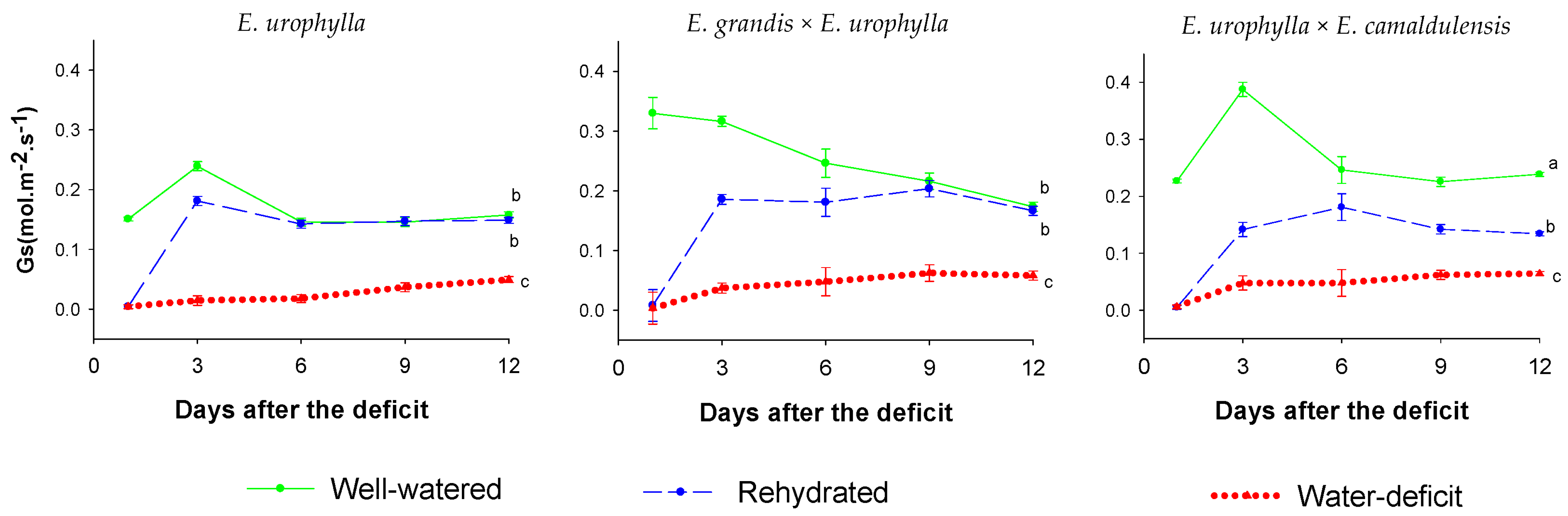
Stomatal conductance (gs) responded strongly to water regime (Table S1A; F = 22.54, p < 0.001), with no significant effects of clone or Clone × Treatment interaction. In well-watered plants, all genotypes maintained the highest gs values throughout the evaluation period. Under rehydrated conditions, gs was initially reduced, followed by a progressive increase after water supply was reestablished, reflecting the reopening of stomata. In the water-deficit treatment, gs approached zero during the first days of stress, with a slight increase toward the end of the experiment. Among clones, E. urophylla × E. camaldulensis exhibited the highest gs under well-watered conditions, while E. urophylla showed the lowest values under drought (Figure 3).
The highest gs level was observed for E. urophylla × E. camaldulensis genotype (0.388 mol m−2 s−1) in the well-watered treatment, and the lowest for E. urophylla genotype (0.146 mol m−2 s−1) in the water deficit treatment. For the rehydrated treatment, the gs levels obtained for E. urophylla genotype were basically the same when compared to the levels observed in well-watered plants (0.147 mol m−2 s−1) after the 6th day of plant rehydration (0.146 mol m−2 s−1). Comparing the well-watered and rehydrated treatments, no difference was found in gs levels for E. urophylla × E. grandis genotype after the 9th day of plant rehydration, displaying gs values of 0.216 mol m−2 s−1 and 0.204 mol m−2 s−1 for the well-watered and rehydrated treatments, respectively. In the water-deficit treatment, the lowest gs level (0.005 mol m−2 s−1) was observed after the 1st day of treatment for all clones, and, at the 12th day of analysis, the gs levels were 10-fold higher, near 0.05 mol m−2 s−1 for the three clones. This work was carried out with the objective of evaluating the first responses of plants to water stress and their defense mechanisms under conditions of stress and rehydration without affecting their development. This increase in conductivity under water deficit conditions may be related to the plants’ recovery from water deficit through defense mechanisms.
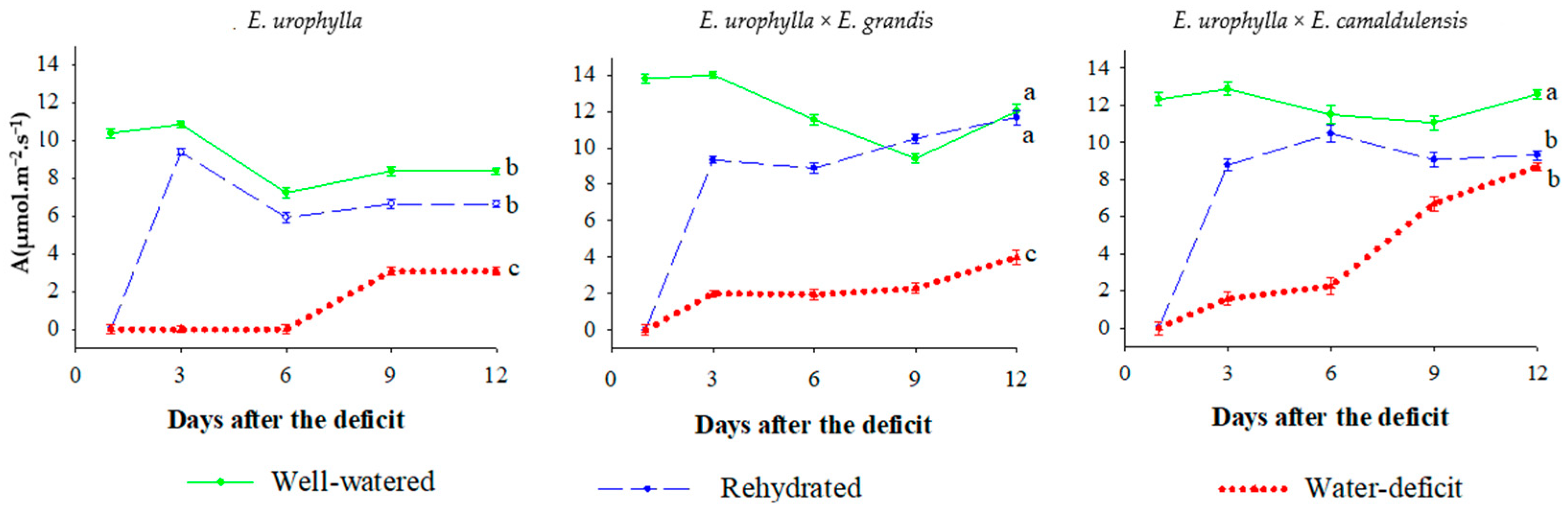
Carbon assimilation (A) followed a similar pattern, with water regime significantly affecting A (F = 5.83, p = 0.0048; Table S1B). Well-watered plants maintained the highest photosynthetic rates across all genotypes. Rehydrated plants exhibited initially low values due to restricted stomatal aperture, followed by recovery after irrigation resumed. Under water deficit, a marked decrease was observed, but it showed partial recovery over time. The hybrids (E. urophylla × E. grandis and E. urophylla × E. camaldulensis) maintained higher A values than E. urophylla across all treatments (Figure 4).
The highest A values were observed in E. urophylla × E. grandis (9.41–14.00 µmol m−2 s−1) and E. urophylla × E. camaldulensis (11.06–12.88 µmol m−2 s−1) genotypes, with E. urophylla clone displaying relatively lower A values (7.22–10.83 µmol m−2 s−1). In the rehydrated treatment, due to the water-deficit imposed at the experiment start, plants initially showed a reduced stomata aperture (Figure 2), and A could not be detected. After stomatal opening, clones E. urophylla × E. grandis and E. urophylla × E. camaldulensis showed the highest A levels (11.67 µmol m−2 s−1 and 10.47 µmol m−2 s−1, respectively), while the lowest A levels were observed for the E. urophylla clone (5.90–9.36 µmol m−2 s−1). Plants from the water-deficit treatment showed the highest (0–8.69 µmol m−2 s−1) and lowest (0–3.07 µmol m−2 s−1) levels of A for E. urophylla × E. camaldulensis and E. urophylla clones, respectively.
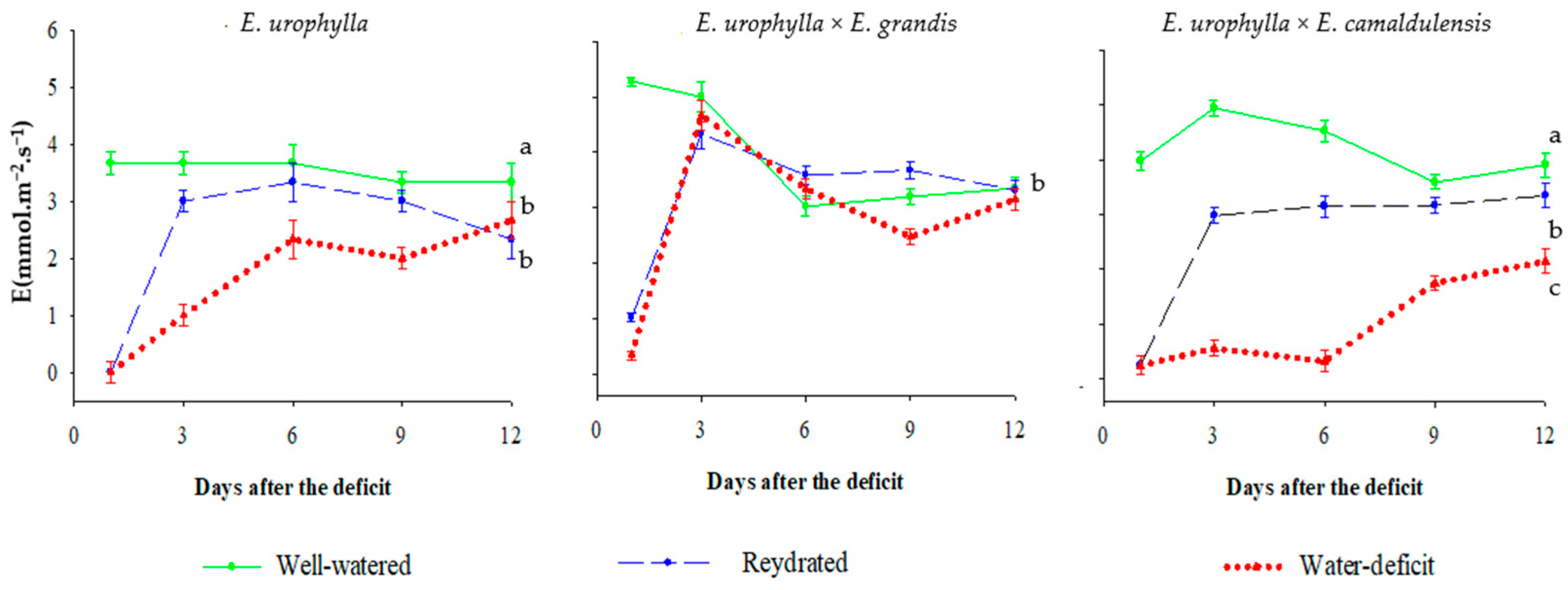
Similar to gs and A, the highest transpiration rate (E) was observed in well-watered plants, with the lowest E levels observed in plants submitted to water-deficit conditions (Figure 5). Plants of E. urophylla × E. grandis clone showed the highest E levels (5.27–3.03 µmol m−2 s−1), and relatively lower E values were observed in E. urophylla clone (3.33–3.67 µmol m−2 s−1). After the water-deficit period, plants from the rehydrated treatment of E. urophylla × E. grandis clone showed the highest E levels (4.33 µmol m−2 s−1), with relatively lower E values observed for E. urophylla clone (3.33 µmol m−2 s−1) and E. urophylla × E. camaldulensis clone displaying a gradual increase in the E rates towards the end of the experiment. In plants from the water-deficit treatment, the highest (4.67 µmol m−2 s−1) and lowest (2.15 µmol m−2 s−1) levels of E were observed for E. urophylla × E. grandis and E. urophylla × E. camaldulensis clones, respectively.
These responses indicate that the imposition of water deficit caused rapid stomatal closure, reducing gas exchange, while rehydration partially restored gs, A, and E in all genotypes.
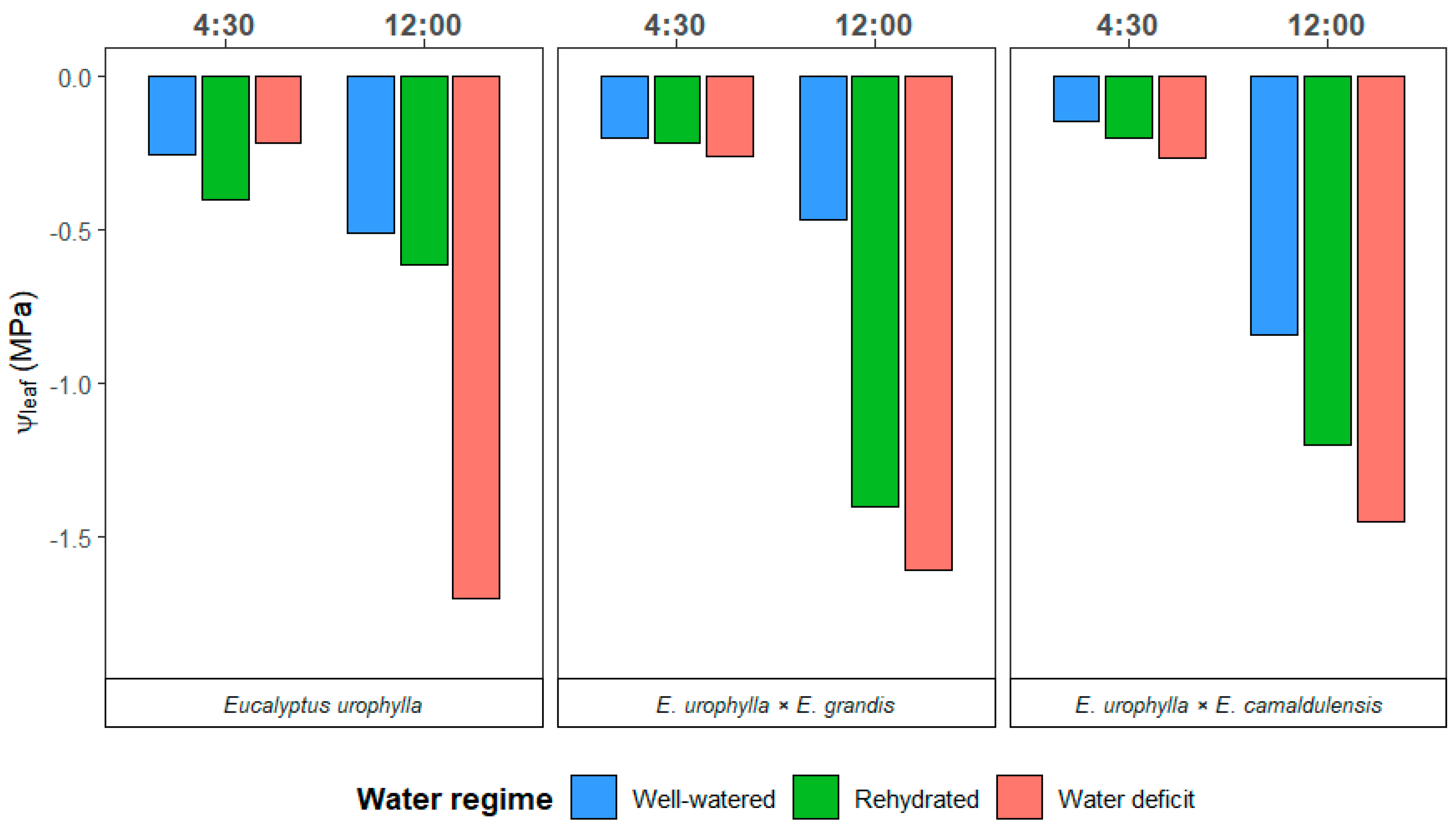
Predawn leaf water potential (Ψleaf) values remained relatively high and similar between well-watered and rehydrated plants across all clones (Figure 6). Under water deficit, predawn Ψleaf decreased modestly, especially in E. urophylla. At midday, Ψleaf declined sharply in all treatments, reflecting high evaporative demand. The reduction was most pronounced in E. urophylla under water deficit, reaching the most negative values observed. In contrast, E. urophylla × E. camaldulensis exhibited comparatively less negative midday Ψleaf values. These results indicate that water deficit reduced leaf water status, with stronger midday declines associated with higher atmospheric demand. Clone responses differed in magnitude, with E. urophylla showing greater sensitivity.
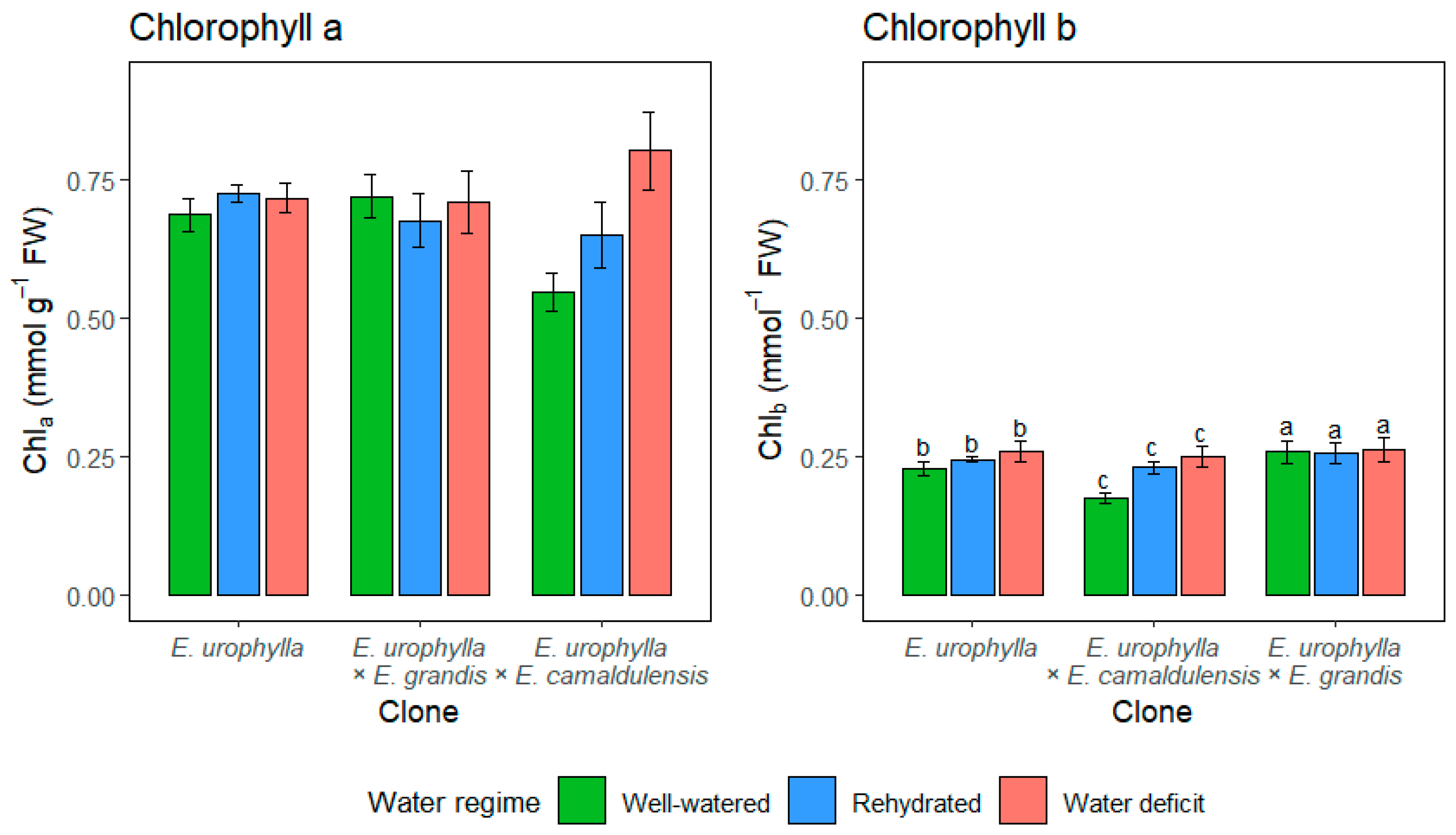
Chlorophyll a (Chl a) showed no significant effects of clone (F = 1.84, p = 0.188), water regime (F = 0.77, p = 0.478), or interaction (Table S2). Chl a remained stable across treatments and clones (Figure 7), indicating that the imposed stress did not induce significant degradation of light-harvesting complexes.
Chlorophyll b (Chl b) differed significantly among clones (F = 7.29, p = 0.0048), with E. urophylla × E. grandis presenting the highest values and E. urophylla × E. camaldulensis the lowest, regardless of treatment (Table S3). Although E. urophylla tended to show numerical reductions under water deficit (down to 0.12 mmol g−1 FW), these differences were not statistically significant. Under well-watered conditions, E. urophylla exhibited the highest pigment levels, while E. urophylla × E. grandis showed the lowest initial values. Following rehydration, chlorophyll levels converged among treatments, suggesting recovery of pigment pools.
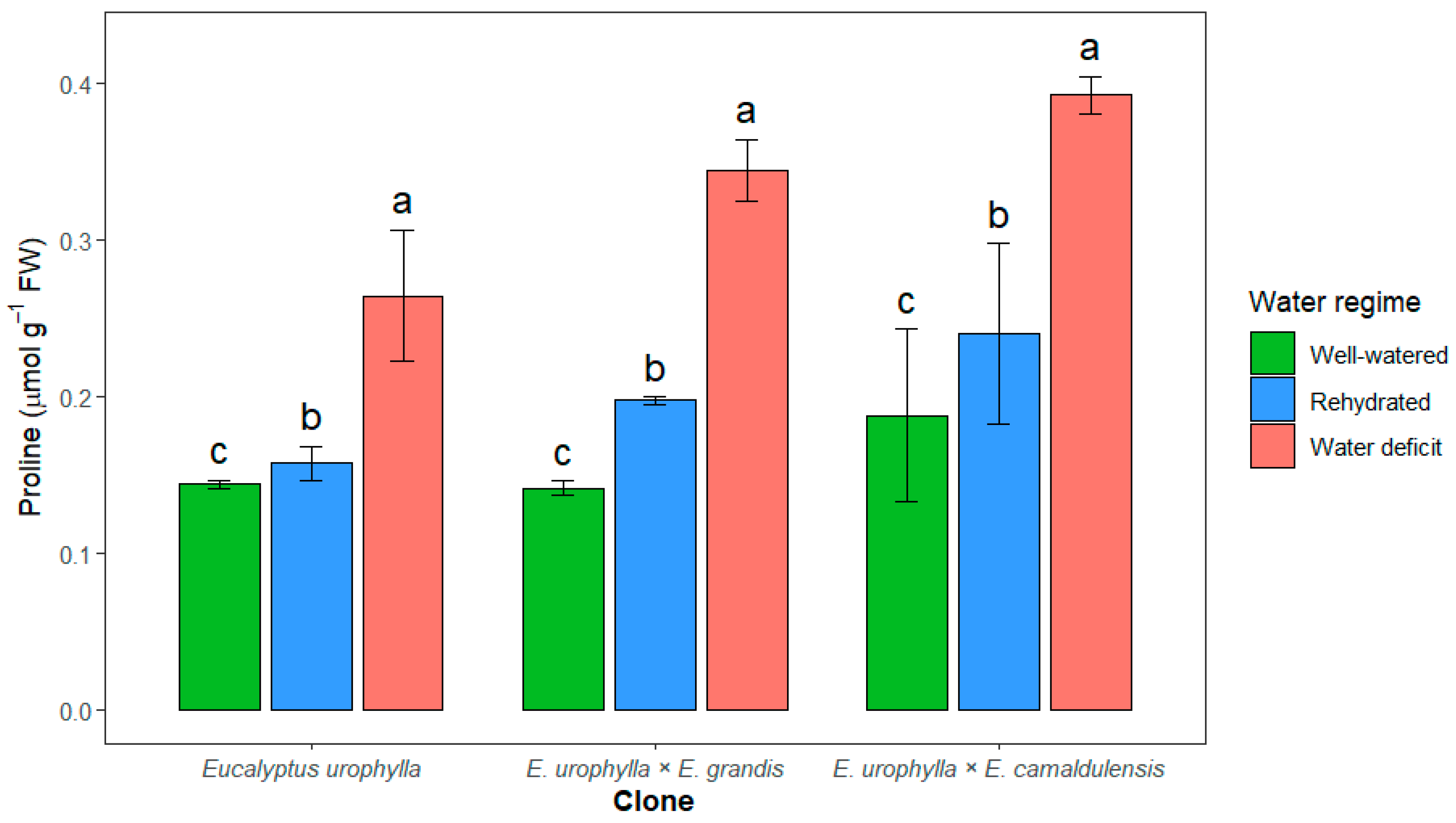
Proline content varied significantly with treatment (F = 25.92, p = 0.00018) and clone (F = 5.53, p = 0.027), with no significant interaction (Table S4). Under well-watered conditions, E. urophylla × E. camaldulensis exhibited the highest basal proline concentrations (~0.19 μmol g−1 FW), whereas E. urophylla and E. urophylla × E. grandis showed similarly low values (~0.14 μmol g−1 FW) (Figure 8).
Rehydrated plants showed increased proline relative to irrigated plants, especially in E. urophylla × E. camaldulensis. Under water deficit, all genotypes exhibited marked proline accumulation, with the highest values observed in E. urophylla × E. camaldulensis, followed by E. urophylla and E. urophylla × E. grandis. These patterns indicate consistent osmotic adjustment across genotypes, with a greater magnitude in the more drought-tolerant hybrid.
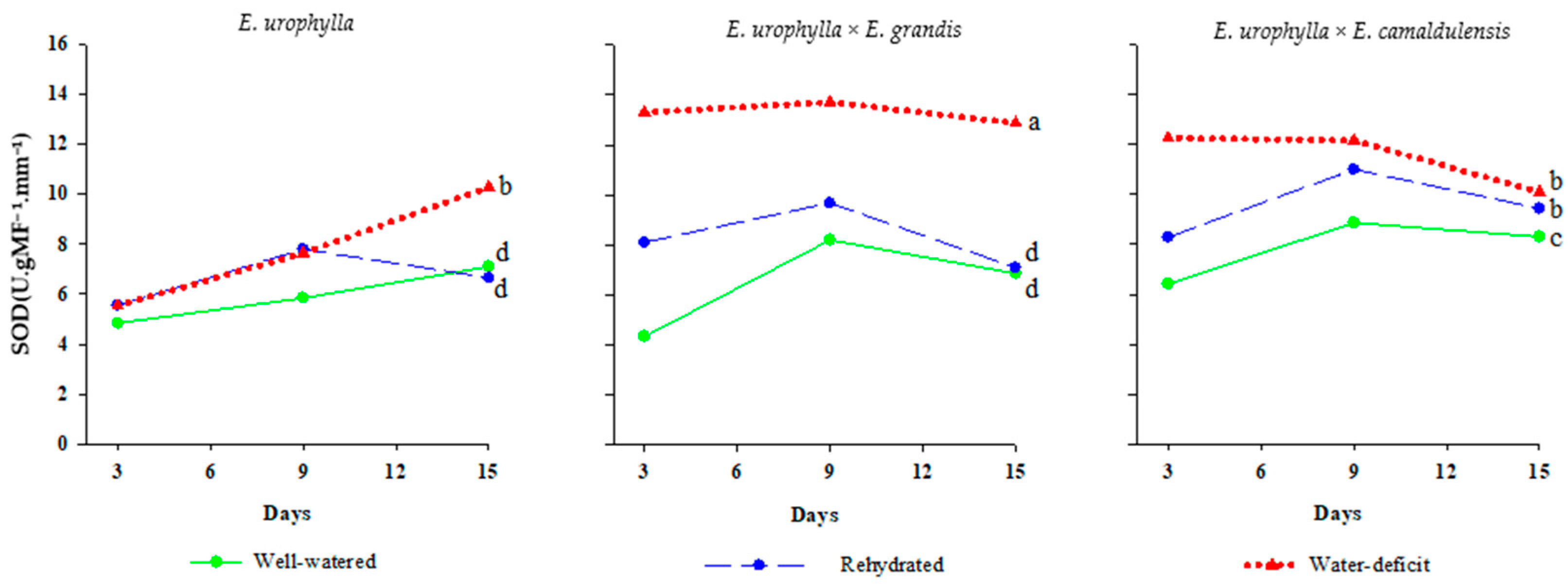
Superoxide dismutase (SOD) activity exhibited significant effects of clone, treatment, period, and all interactions (Table S5; p < 0.001). Under well-watered conditions, E. urophylla × E. camaldulensis consistently exhibited the highest SOD activity across measurement times, while E. urophylla showed the lowest (Figure 9). In rehydrated plants, SOD increased until day 9 and subsequently returned to levels similar to well-watered plants by day 15 in all clones. Under deficit, E. urophylla × E. camaldulensis and E. urophylla × E. grandis showed strong induction of SOD, whereas E. urophylla exhibited a more gradual response.
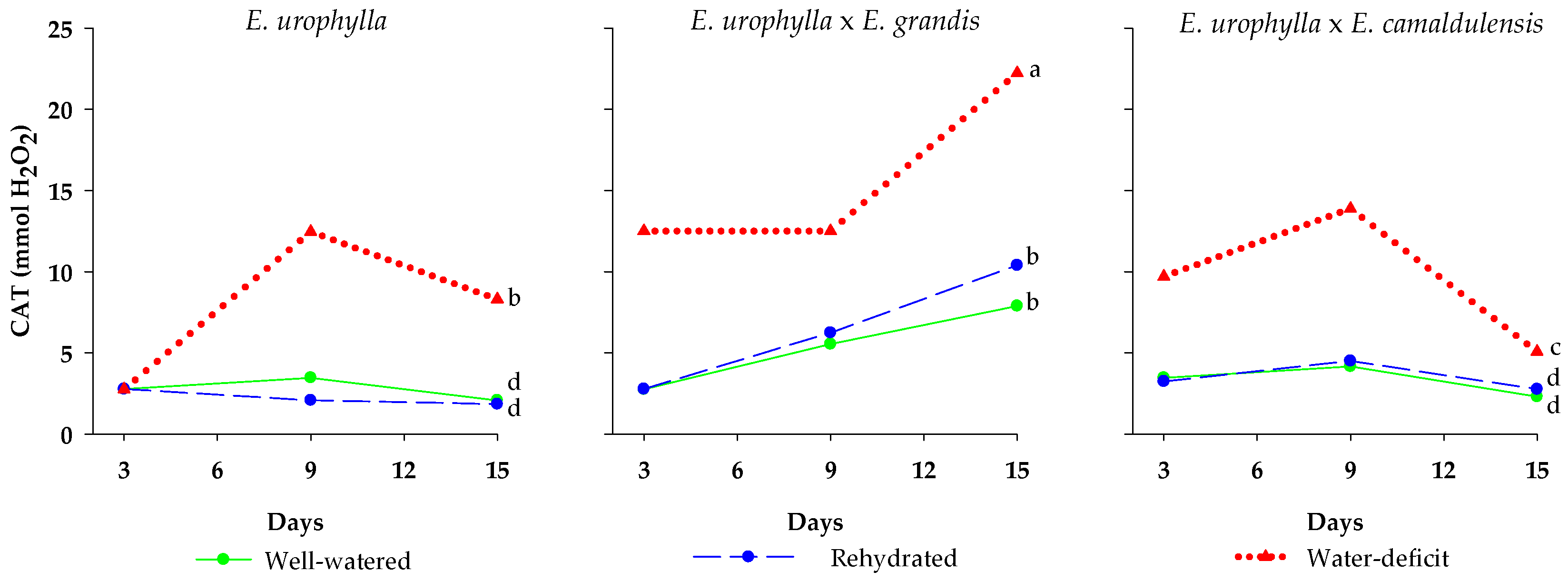
Catalase (CAT) activity also showed strong and significant effects of clone, treatment, period, and all interactions (Table S5; p < 0.001). CAT activity increased markedly under water deficit in all clones (Figure 10), with E. urophylla × E. camaldulensis exhibiting the fastest increase until day 9, followed by a decline by day 15. Rehydrated plants generally maintained intermediate CAT activity relative to well-watered and deficit treatments. E. urophylla × E. grandis showed a delayed but strong CAT increase upon rehydration, while E. urophylla presented the lowest overall enzymatic activity.

4. Discussion

Hybrid genotype E. urophylla × E. camaldulensis was the most tolerant to drought and showed a distinct behavior for gs, A, and E. This hybrid maintained relatively higher photosynthetic activity under water deficit (Figure 4), even when transpiration (Figure 5) and stomatal conductance declined (Figure 3). This pattern indicates efficient stomatal regulation characteristic of an isohydric response strategy [31]. Isohydric behavior reduces xylem tension and prevents embolism formation, thereby maintaining hydraulic integrity [32]. The smaller difference between predawn and midday Ψleaf observed in this hybrid (Figure 6) supports this interpretation, suggesting tighter hydraulic regulation and superior drought-avoidance capacity. In contrast, E. urophylla exhibited pronounced reductions in gs and A, indicating weaker hydraulic control and lower drought resilience—responses consistent with anisohydric behavior, in which reduced stomatal control exposes leaves to cavitation risk and metabolic impairment [33].
Studies evaluating water relations, photosynthesis, xylem embolism, and carbohydrate accumulation in E. camaldulensis and E. torquata under dehydration–rehydration cycles also support this pattern. Souden et al. [34] observed that E. camaldulensis maintains water status, photosynthetic activity, and xylem conductance during drought and is more capable of recovering after moisture restoration. This species can access groundwater along riparian systems [35] and has a broad ecological amplitude, which has favored its use in hybrid breeding to enhance drought and salinity tolerance
Plants under water deficit usually close their stomata early, limiting both E and A [36]. This was observed in the present study (Figure 4 and Figure 5), where all clones showed reduced gas exchange immediately after stress imposition. As drought intensifies, reductions in leaf water potential further restrict stomatal activity. Water scarcity reduces CO2 diffusion and carbon transport to the mesophyll, decreasing intercellular CO2 concentration. These parameters tend to recover after rehydration, as seen in the increase in A following watering (Figure 4). However, when plants approach the wilting point, photosynthetic recovery becomes slower, as observed in the deficit treatment.
Soil water depletion reduces leaf water potential by decreasing cell turgor pressure, contributing to stomatal closure and explaining the marked difference between predawn and midday Ψleaf (Figure 6) [37]. Predawn Ψleaf is an indicator of plant water status and soil moisture availability, as also reported by Valladares & Pearcy [38]. During the hottest period of the day, leaf temperature and evaporative demand increase, intensifying Ψleaf decline and exacerbating photoinhibition.
Although photoinhibition is primarily caused by excess energy absorbed in the thylakoid membranes, drought enhances this process via declines in Ψleaf. Lower Ψleaf induces stomatal closure, restricting CO2 diffusion and reducing the capacity for photochemical energy utilization. As a result, excitation pressure increases in PSII, enhancing the probability of photodamage and ROS formation [39,40,41]. Therefore, drought-induced photoinhibition acts as a secondary effect of water deficit due to imbalances in energy capture and use, especially at midday.
Chlorophyll content varied among clones and treatments (Figure 7). E. urophylla × E. grandis maintained similar pigment levels across water regimes, while E. urophylla showed reductions under deficit, and E. urophylla × E. camaldulensis showed increased chlorophyll under stress. Chlorophyll responses to drought are highly dependent on stress intensity and species physiology. Some studies report increased or stable chlorophyll content under mild drought [42,43], while severe drought may cause chlorophyll degradation via oxidative stress [44]. Other research shows higher chlorophyll content in drought-tolerant genotypes [45,46], suggesting that chlorophyll accumulation may act as a defense mechanism, supported by efficient antioxidant activity [47]. Increases in chlorophyll under drought may also be associated with carotenoid-mediated protection [48].
Proline content differed among treatments, with E. urophylla × E. camaldulensis showing the highest values under deficit and after rehydration (Figure 8). Under water deficit, many plants accumulate compatible solutes that protect cellular structures and prevent dehydration and oxidative damage while contributing to osmotic adjustment [49]. Proline plays a central role in maintaining cell turgor and sustaining photosynthesis, stomatal function, and growth under drought [50]. Even at high concentrations, proline does not impair enzyme activity or damage macromolecules [51], and its accumulation is proportional to drought severity, making it a reliable biochemical marker [52]. Its ability to stabilize membranes and proteins enhances dehydration tolerance [53]. Thus, the high proline content in E. urophylla × E. camaldulensis aligns with its greater drought tolerance observed in the field [54].
Antioxidant enzymes also play essential roles in stress mitigation. SOD acts as the first line of defense by converting O2• into H2O2 [55,56,57,58]. This H2O2 must then be detoxified by CAT and APX to prevent the formation of harmful hydroxyl radicals [53,59,60]. SOD activity increased under drought in all genotypes (Figure 9), indicating activation of ROS-scavenging pathways. CAT activity, however, showed contrasting patterns (Figure 10), with E. urophylla × E. camaldulensis exhibiting the lowest CAT under deficit after 15 days, despite maintaining stable SOD activity. This suggests that temporary increases in H2O2 may serve as signaling cues rather than indicating oxidative imbalance—an adaptive trait common in stress-tolerant species. In contrast, E. urophylla showed less coordinated SOD–CAT responses, consistent with its lower drought tolerance.
Interestingly, E. urophylla behaved as drought-sensitive in this study, contrary to earlier classifications [61]. These discrepancies highlight the genotype-specific nature of drought tolerance. Similar findings were reported by Matos et al. [55], who observed high drought tolerance in E. urophylla × E. camaldulensis due to reduced transpiration and delayed dehydration. Furthermore, optimum growth temperatures for several high-yield Eucalyptus clones in Brazil range between 18 and 22 °C, with each 1 °C increase reducing growth by ~10% [62]. The average temperature during this study (~26 °C) exceeded this optimum, indicating that even well-watered plants experienced thermal stress. This environmental context reinforces the ecological relevance of the physiological and biochemical adjustments observed.

5. Conclusions

The three Eucalyptus genotypes exhibited distinct physiological and biochemical strategies in response to contrasting water regimes. The hybrid E. urophylla × E. camaldulensis demonstrated the greatest drought resilience, maintaining higher gas-exchange performance, less pronounced reductions in leaf water potential at midday, and the highest proline accumulation under water deficit. These responses indicate efficient hydraulic regulation, enhanced osmotic adjustment, and a well-coordinated antioxidant system, which collectively support the maintenance of its physiological functions during stress.
E. urophylla × E. grandis showed intermediate tolerance, characterized by stable chlorophyll pools and sustained superoxide dismutase (SOD) activity, although with lower osmotic adjustment compared to E. urophylla × E. camaldulensis. In contrast, E. urophylla exhibited the strongest reductions in gs, A, and Ψleaf under water deficit, as well as lower antioxidant coordination, reflecting greater susceptibility to drought.
Overall, the integration of water relations, gas exchange, pigment stability, osmoprotective compounds, and antioxidant enzyme dynamics reveals that drought tolerance in Eucalyptus results from multiple interacting mechanisms rather than a single dominant trait. The superior performance of E. urophylla × E. camaldulensis highlights the adaptive advantage of hybridization for plantation forestry in warm tropical environments subject to high evaporative demand and irregular rainfall. These findings reinforce the relevance of genotype selection for climates where heat and water stress frequently co-occur.

Supplementary Materials

The following supporting information can be downloaded at: https://www.mdpi.com/article/10.3390/f16121802/s1, Table S1. ANOVA Type III results for stomatal conductance (gs, mol H2O m−2 s−1), photosynthetic rate (A, µmol CO2 m−2 s−1), and transpiration (E, mmol H2O m−2 s−1) measured on day 12 for three Eucalyptus clones under different irrigation regimes (I = irrigated, R = rehydrated, D = deficit); Table S2. ANOVA results for chlorophyll a (Chl a, µmol g−1 FW) in three Eucalyptus clones subjected to irrigated (I), rehydrated (R), and deficit (D) water regimes; Table S3. ANOVA results for chlorophyll b (Chl b, µmol g−1 FW) in three Eucalyptus clones under the same water regimes (I, R, D); Table S4. ANOVA results for proline content (µmol g−1 FW) as a function of Clone, Treatment, and their interaction; Table S5. ANOVA results for superoxide dismutase (SOD) activity (U mg−1 protein) at day 15 for three Eucalyptus clones under irrigated (I), rehydrated (R), and deficit (D) conditions; Table S6. ANOVA results for catalase (CAT) activity (µmol H2O2 min−1 mg−1 protein) at day 15 for the same clones and water regimes.

Author Contributions

S.B.B.M.—Formal analysis; Writing; Investigation. N.D.S.R.—Data curation. F.B.G.—Investigation. G.H.d.M.—Formal Investigation. H.E.F.—Investigation. M.C.D.—Methodology. R.E.H.—Validation. S.C.S.—Supervision. E.A.L.E.—Project administration; Resources and Funding acquisition. All authors have read and agreed to the published version of the manuscript.

Funding

This research received no external funding from the Coordination for the Improvement of Higher Education Personnel (CAPES).

Data Availability Statement

The original contributions presented in this study are included in the article/Supplementary Materials. Further inquiries can be directed to the corresponding author.

Acknowledgments

To CAPES for the scholarship granted, the Federal University of Tocantins for the opportunity to develop this work, and the “Marka Florestal Comércio e Serviços Florestais LTDA” for the donation of seedlings.

Conflicts of Interest

The authors declare no conflicts of interest. The funders had no role in the design of the study; in the collection, analyses, or interpretation of data; in the writing of the manuscript; or in the decision to publish the results.

References

  1. FAO. The State of the World’s Forests 2022: Forest Pathways for Green Recovery and Building Inclusive, Resilient and Sustainable Economies; FAO: Rome, Italy, 2022. [Google Scholar]
  2. Brazilian Tree Industry—IBÁ. Brazilian Tree Industry Report; Brazilian Tree Industry: Brasília, Brazil, 2022. [Google Scholar]
  3. Brazilian Forest Service—SFB. Produção da Extração Vegetal e Silvicultura. Available online: https://publicacoes-snif.florestal.gov.br/florestasdobrasil/pt/producao-economia-e-mercado-florestal/producao-e-extracao-vegetal/ (accessed on 12 November 2022).
  4. Brazilian Tree Industry—IBÁ. Brazilian Tree Industry Report; Brazilian Tree Industry: Brasília, Brazil, 2018; p. 80. [Google Scholar]
  5. Brazilian Tree Industry—IBÁ. Brazilian Tree Industry Report; Brazilian Tree Industry: Brasília, Brazil, 2016; p. 100. [Google Scholar]
  6. Ávila, L.F.; Cassalho, F.; Viola, M.R.; Beskow, S.; Coelho, G.; da Silva Nardes, K. Spatial distribution of climatic variables in Tocantins State, Brazil. Científica 2019, 47, 269–277. [Google Scholar] [CrossRef]
  7. Schaefer, C.E.G.R.; Candido, H.G.; Corrêa, G.R.; Campos, P.V.; Senra, E.O.; Gjorup, D.F.; Fernandes Filho, E.I. Soils of Campos Rupestres (Rupestrian Grasslands) of the Old Brazilian Mountain Ranges. In The Soils of Brazil; World Soils Book Series; Schaefer, C.E.G.R., Ed.; Springer: Cham, Switzerland, 2023; pp. 343–362. [Google Scholar] [CrossRef]
  8. Lerayer, A. Guia do Eucalipto—Oportunidades Para um Desenvolvimento Sustentável; Conselho de Informações Sobre Biotecnologia: São Paulo, Brazil, 2008; p. 20. [Google Scholar]
  9. Gonçalves, J.L.M.; Alvares, C.A.; Rocha, J.H.T.; Brandani, C.B.; Hakamada, R. Eucalypt plantation management in regions with water stress. South. For. J. For. Sci. 2017, 2017, 169–183. [Google Scholar] [CrossRef]
  10. Ashraf, M.A.; Iqbal, M.; Rasheed, R.; Hussain, I.; Riaz, M.; Arif, M.S. Environmental stress and secondary metabolites in plants: An overview. Plant Metab. Regul. Under Environ. Stress 2018, 2018, 153–167. [Google Scholar] [CrossRef]
  11. Camaille, M.; Fabre, N.; Clément, C.; Ait Barka, E. Advances in Wheat Physiology in Response to Drought and the Role of Plant Growth Promoting Rhizobacteria to Trigger Drought Tolerance. Microorganisms 2021, 9, 687. [Google Scholar] [CrossRef] [PubMed]
  12. Osakabe, Y.; Kajita, S.; Osakabe, K. Genetic engineering of woody plants: Current and future targets in a stressful environment. Physiol. Plant. 2011, 142, 105–117. [Google Scholar] [CrossRef]
  13. Nishiyama, R.; Watanabe, Y.; Leyva-Gonzalez, M.A.; Ha, C.V.; Fujita, Y.; Tanaka, M.; Seki, M.; Yamaguchi-Shinozaki, K.; Shinozaki, K.; Herrera-Estrella, L.; et al. Arabidopsis AHP2, AHP3, and AHP5 histidine phosphotransfer proteins function as redundant negative regulators of drought stress response. Proc. Natl. Acad. Sci. USA 2013, 110, 4840–4845. [Google Scholar] [CrossRef] [PubMed]
  14. Ha, C.V.; Leyva-Gonzalez, M.A.; Osakabe, Y.; Tran, U.T.; Nishiyama, R.; Watanabe, Y.; Tanaka, M.; Seki, M.; Yamaguchi, S.; Dong, N.V.; et al. Positive regulatory role of strigolactone in plant responses to drought and salt stress. Proc. Natl. Acad. Sci. USA 2014, 111, 851–856. [Google Scholar] [CrossRef]
  15. Binkley, D.; Campoe, O.C.; Alvares, C.; Carneiro, R.L.; Cegatta, Í.; Stape, J.L. The interactions of climate, spacing and genetics on clonal Eucalyptus plantations across Brazil and Uruguay. For. Ecol. Manag. 2017, 405, 271–283. [Google Scholar] [CrossRef]
  16. Binkley, D.; Campoe, O.C.; Alvares, C.A.; Carneiro, R.L.; Stape, J.L. Variation in whole-rotation yield among Eucalyptus genotypes in response to water and heat stresses: The TECHS project. For. Ecol. Manag. 2020, 462, 117953. [Google Scholar] [CrossRef]
  17. Hasanuzzaman, M.; Zhou, M.; Shabala, S. How Does Stomatal Density and Residual Transpiration Contribute to Osmotic Stress Tolerance? Plants 2023, 12, 494. [Google Scholar] [CrossRef]
  18. Conti Junior, L.F.; de Araujo, M.J.; de Paula, R.C.; Queiroz, T.B.; Hakamada, R.E.; Hubbard, R.M. Quantifying turgor loss point and leaf water potential across contrasting Eucalyptus clones and sites within the TECHS research platform. For. Ecol. Manag. 2020, 475, 118454. [Google Scholar] [CrossRef]
  19. Blum, A. Osmotic adjustment is a prime drought stress adaptive engine in support of plant production. Plant Cell Environ. 2017, 40, 4–10. [Google Scholar] [CrossRef]
  20. Laxa, M.; Liebthal, M.; Telman, W.; Chibani, K.; Dietz, K.J. The role of the plant antioxidant system in drought tolerance. Antioxidants 2019, 8, 94. [Google Scholar] [CrossRef] [PubMed]
  21. Li, X.; Blackman, C.J.; Peters, J.M.R.; Choat, B.; Rymer, P.D.; Medlyn, B.E.; Tissue, D.T. More than iso/anisohydry: Hydroscapes integrate plant water use and drought tolerance traits in 10 eucalypt species from contrasting climates. Funct. Ecol. 2019, 33, 1035–1049. [Google Scholar] [CrossRef]
  22. Caldeira, D.R.M.; Alvares, C.A.; Campoe, O.C.; Hakamada, R.E.; Guerrini, I.A.; Cegatta, Í.R.; Stape, J.L. Multisite evaluation of the 3-PG model for the highest phenotypic plasticity Eucalyptus clone in Brazil. For. Ecol. Manag. 2020, 462, 117989. [Google Scholar] [CrossRef]
  23. Soil Fertility Commission of the State of Minas Gerais. Recommendations for the Use of Lime and Fertilizers in Minas Gerais—5th Approximation; Ribeiro, A.C., Guimarães, P.T.G., Alvarez, V.H.V., Eds.; University of the Fraser Valley: Abbotsford, BC, Canada, 1999; pp. 43–61. [Google Scholar]
  24. Souza, C.C.; Oliveira, F.A.; Silva, I.F.; Amorim Neto, M.S. Evaluation of methods of available water determinaton and irrigation management in “terra roxa” under cotton crop. Braz. J. Agric. Environ. Eng. 2000, 4, 338–342. [Google Scholar] [CrossRef]
  25. Scholander, P.F.; Bradstreet, E.D.; Hemmingsen, E.A.; Hammel, H.T. Sap Pressure in Vascular Plants: Negative hydrostatic pressure can be measured in plants. Science 1965, 148, 339–346. [Google Scholar] [CrossRef]
  26. Sims, D.A.; Gamon, J.A. Relationships between leaf pigment content and spectral reflectance across a wide range of species, leaf structures and developmental stages. Remote Sens. Environ. 2002, 81, 337–354. [Google Scholar] [CrossRef]
  27. Bates, L.S.; Waldren, R.P.; Teare, I.D. Rapid determination of free proline for water stress studies. PlantSoil Dordr. 1973, 39, 205–207. [Google Scholar] [CrossRef]
  28. Havir, E.A.; Mchale, N.A. Biochemical and developmental characterization of multiple forms of catalase in tobacco leaves. Plant Physiol. 1987, 84, 450–455. [Google Scholar] [CrossRef]
  29. Bradford, M.M. A rapid and sensitive method for the quantitation of microgram quantities of protein utilizing the principle of protein-dye binding. Anal. Biochem. 1976, 72, 248–254. [Google Scholar] [CrossRef]
  30. Ferreira, D.F. Sisvar: A computer statistical analysis system. Ciência E Agrotecnologia 2011, 35, 1039–1042. [Google Scholar] [CrossRef]
  31. Nolan, R.H.; Tarin, T.; Santini, N.S.; McAdam, S.A.; Ruman, R.; Eamus, D. Differences in osmotic adjustment, foliar abscisic acid dynamics, and stomatal regulation between an isohydric and anisohydric woody angiosperm during drought. Plant Cell Environ. 2017, 40, 3122–3134. [Google Scholar] [CrossRef]
  32. Choat, B.; Brodribb, T.J.; Brodersen, C.R.; Duursma, R.A.; López, R.; Medlyn, B.E. Triggers of tree mortality under drought. Nature 2018, 528, 119–122. [Google Scholar] [CrossRef]
  33. Brodribb, T.J.; Cochard, H. Hydraulic failure defines the recovery and point of death in water-stressed conifers. Plant Physiol. 2009, 149, 575–584. [Google Scholar] [CrossRef] [PubMed]
  34. Souden, S.; Ennajeh, M.; Ouledali, S.; Massoudi, N.; Cochard, H.; Khemira, H. Water relations, photosynthesis, xylem embolism and accumulation of carbohydrates and cyclitols in two Eucalyptus species (E. camaldulensis and E. torquata) subjected to dehydration–rehydration cycle. Trees 2020, 34, 1439–1452. [Google Scholar] [CrossRef]
  35. Mensforth, L.J.; Thorburn, P.J.; Tyerman, S.D.; Walker, G.R. Sources of water used by riparian Eucalyptus camaldulensis overlying highly saline groundwater. Oecologia 1994, 100, 21–28. [Google Scholar] [CrossRef]
  36. Butcher, P.A.; McDonald, M.W.; Bell, J.C. Congruence between environmental parameters, morphology and genetic structure in Australia’s most widely distributed eucalypt, Eucalyptus camaldulensis. Tree Genet. Genomes 2009, 5, 189–210. [Google Scholar] [CrossRef]
  37. Gholz, H.L.; Ewel, K.C.; Teskey, R.O. Water and forest productivity. For. Ecol. Manag. Amst. 1990, 30, 1–18. [Google Scholar] [CrossRef]
  38. Valladares, F.; Pearcy, R.W. Interactions between water stress, sun-shade acclimation, heat tolerance and photoinhibition in the sclerophyll Heteromeles arbutifolia. Plant Cell Environ. 1997, 20, 25–36. [Google Scholar] [CrossRef]
  39. Zivcak, M.; Brestic, M.; Kalaji, H.M.; Govindjee. Photosynthetic responses of sun- and shade-grown barley leaves to high light: Is the lower PSII activity in shade leaves associated with photoprotection? Photosynthetica 2014, 55, 378–394. [Google Scholar] [CrossRef]
  40. Pérez-López, U.; Robredo, A.; Lacuesta, M.; Sgherri, C.; Muñoz-Rueda, A.; Navari-Izzo, F.; Mena-Petite, A. The oxidative stress caused by salinity in two barley cultivars is mitigated by elevated CO2. Physiologia Plantarum. 2009, 135, 29–42. [Google Scholar] [CrossRef]
  41. Kalaji, H.M.; Schansker, G.; Brestic, M.; Bussotti, F.; Calatayud, A.; Ferroni, L.; Goltsev, V.; Guidi, L.; Jajoo, A.; Misra, A.N. Frequently asked questions about chlorophyll fluorescence, the sequel. Photosynth. Res. 2017, 132, 13–66. [Google Scholar] [CrossRef] [PubMed]
  42. Huang, C.J.; Zhao, S.Y.; Wang, L.C.; Anjum, S.A.; Zhang, B.; Chen, M.; Wang, L.; Yang, Y. Alteration in yield, gas exchange and chlorophyll synthesis of ramie to progressive drought stress. J. Food Agric. Environ. 2013, 11, 302–305. [Google Scholar]
  43. Lenhard, N.R.; Scalon, S.P.Q.; Novelino, J.O. Initial growth of wood iron (Caesalpinia ferrea Mart. ex. Tul var. leiostachya Benth) under different hydric regimes. Ciência E Agrotecnologia 2010, 34, 870–877. [Google Scholar] [CrossRef]
  44. Xue, L.L.; Anjum, S.A.; Wang, L.C.; Saleem, M.F.; Liu, X.J.; Ijaz, M.F.; Bilal, M.F. Influence of straw mulch on yield, chlorophyll contents, lipid peroxidation and antioxidant enzymes activities of soybean under drought stress. J. Food Agric. Environ. 2011, 9, 699–704. [Google Scholar]
  45. Mendes, H.S.J.; Paula, N.F.E.; Scarpinatti, A.; Paula, R.C. Physiological responses of Eucalyptus grandis × E. urophylla genotypes to water availability and potassium fertilization. Cerne 2013, 19, 603–611. [Google Scholar] [CrossRef]
  46. Silva, I.M.A.; Souza, M.W.R.; Rodrigues, A.C.P.; Correia, L.P.S.; Veloso, R.V.S.; Santos, J.B.; Titon, M.; Gonçalves, J.F.; Laia, M.L. Determination of parameters for selection of Eucalyptus clones tolerant to drought. Afr. J. Agric. Res. 2016, 11, 3940–3949. [Google Scholar] [CrossRef]
  47. Farooq, M.; Wahid, A.; Kobayashi, N.; Fujita, D.; Basra, S.M.A. Plant Drought Stress: Effects, Mechanisms and Management. In Sustainable Agriculture; Springer: Dordrecht, The Netherlands, 2009; Volume 29, pp. 153–188. [Google Scholar] [CrossRef]
  48. Correia, B.; Pintó-Marijuan, M.; Neves, L.; Brossa, R.; Dias, M.C.; Costa, A.; Castro, B.B.; Araújo, C.; Santos, C.; Chaves, M.M.; et al. Water stress and recovery in the performance of two Eucalyptus globulus clones: Physiological and biochemical profiles. Physiol. Plant. 2014, 150, 580–592. [Google Scholar] [CrossRef] [PubMed]
  49. Anami, S.; de Block, M.; Machuka, J.; Van Lijsebettnens, M. Molecular Improvement of Tropical Maize for Drought Stress Tolerance in Sub-Saharan Africa. Crit. Rev. Plant Sci. 2009, 28, 16–35. [Google Scholar] [CrossRef]
  50. Blum, A. Crop responses to drought and the interpretation of adaptation. Plant Growth Regul. 1996, 20, 135–148. [Google Scholar] [CrossRef]
  51. Lambers, H.; Chapin, F.S.; Pons, T.L. Plant Physiological Ecology; Springer: New York, NY, USA, 1998; p. 540. [Google Scholar]
  52. Medeiros, D.B.; Silva, E.C.; Santos, H.R.B.; Pacheco, C.M.; Musser, R.S.; Nogueira, R.J.M.C. Physiological and biochemical responses to drought stress in Barbados cherry. Braz. J. Plant Physiol. 2012, 24, 181–192. [Google Scholar] [CrossRef]
  53. Rathinasabapathi, B. Metabolic engineering for stress tolerance: Installing osmoprotectant synthesis pathways. Ann. Bot. 2000, 86, 709–716. [Google Scholar] [CrossRef]
  54. Bramorski, A. Gaylussacia brasiliensis (Spreng) Meisn. (Ericaceae): Gaylussacia brasiliensis (Spreng) Meisn. (Ericaceae): Chemical Characterization and In Vitro and In Vivo Biological Activity of the Fruit. Ph.D. Thesis, Federal University of Santa Catarina, Florianópolis, Brazil, 2011; p. 149. [Google Scholar]
  55. Matos, F.S.; Oliveira, P.R.C.; Gil, J.L.R.A.; Sousa, P.V.; Gonçalves, G.A.; Sousa, M.P.B.L.; Silveira, P.S.; Silva, L.M. Eucalyptus urocan drought tolerance mechanisms. Afr. J. Agric. Res. 2016, 11, 1617–1622. [Google Scholar] [CrossRef]
  56. Carneiro, M.M.L.C.; Deuner, S.; Oliveira, P.V.; Teixeira, S.B.; Sousa, C.P.; Bacarin, M.A.; Moraes, D.M. Antioxidant activity and the viability of sunflower seeds after saline and water stress. Rev. Bras. De Sementes 2011, 33, 752–761. [Google Scholar] [CrossRef]
  57. Oliveira, G.Q. Initial Development of Irrigated Eucalyptus Plants in Aquidauana-MS. Master’s Thesis, State University of Mato Grosso do Sul, Campo Grande, Brazil, 2012; p. 116. [Google Scholar]
  58. Broetto, F.; Lüttge, U.; Ratajczak, R. Influence of light intensity and salt-treatment on mode of photosynthesis and enzymes of the antioxidative response system of Mesembryanthemum crystallinum. Funct. Plant Biol. 2002, 29, 13–23. [Google Scholar] [CrossRef]
  59. Gerbling, K.-P.; Kelly, G.J.; Fisher, K.-H.; Latzko, E. Partial purification and properties of soluble ascorbate peroxidase from pea leaves. J. Plant Physiol. 1984, 115, 59–67. [Google Scholar] [CrossRef] [PubMed]
  60. Scandalios, J.G. Oxygen stress snd superoxide dismutases. Plant Physiol. 1993, 101, 7–12. [Google Scholar] [CrossRef] [PubMed]
  61. Hodecker, B.E.R. Comparison of Drought Stress Responses of Tolerant and Sensitive Eucalypt Genotypes. Ph.D. Thesis, Universidade Federal de Viçosa, Viçosa, Brazil, 2015. [Google Scholar]
  62. Barroso, T.Q. Amplitude of Optimal Temperatures for Eucalyptus Clones Growth in Brazil and Uruguay. Ph.D. Thesis, State University of São Paulo, Botucatu, Brazil, 2020. Available online: https://repositorio.unesp.br/handle/11449/193047 (accessed on 12 November 2022).
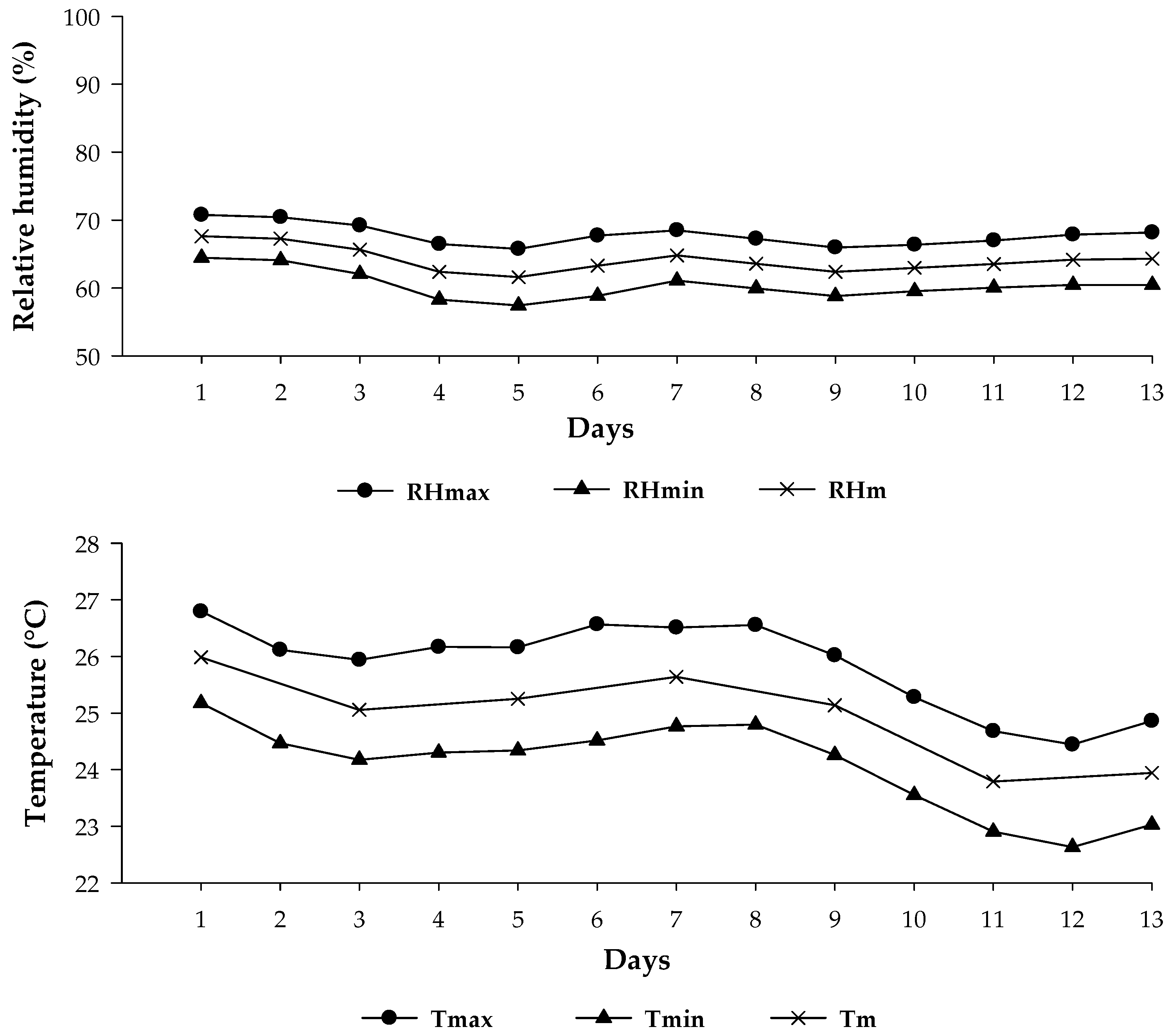
Figure 1. Greenhouse daily values, maximum (RHmax), minimum (RHmin), and average (RHa) relative humidity, maximum (Tmax), minimum (Tmin), and average (Ta) temperatures during the trial period.
Forests 16 01802 g001
Figure 2. Scheme of measurements taken in each period considering the three treatments applied. Leaf stomatal conductance (gs); Leaf carbon assimilation rate (A); Leaf transpiration rate (E); Leaf water potential (Ψleaf); Contents of leaf chlorophyll (Cla and Clb); Leaf superoxide dismutase (SOD); Leaf catalase (CAT).
Forests 16 01802 g002
Figure 3. Leaf stomatal conductance (gs) of three Eucalyptus clones (E. urophylla; hybrid E. urophylla × E. grandis; hybrid E. urophylla × E. camaldulensis) grown in pots under greenhouse conditions and submitted to three different watering conditions. Different letters indicate significant differences at p = 0.05 for the last measurement within all treatments. The bars represent the standard error.
Forests 16 01802 g003
Figure 4. Leaf carbon assimilation rate (A) of three Eucalyptus clones (E. urophylla; hybrid E. urophylla × E. grandis; hybrid E. urophylla × E. camaldulensis) grown in pots, under greenhouse conditions, and submitted to three different watering conditions. Different letters indicate significant differences at p = 0.05 for the last measurement within all treatments. The bars represent the standard error.
Forests 16 01802 g004
Figure 5. Leaf transpiration rate (E) of three Eucalyptus clones (E. urophylla; hybrid E. urophylla × E. grandis; hybrid E. urophylla × E. camaldulensis) grown in pots, under greenhouse conditions, and submitted to three different watering conditions. Different letters indicate significant differences at p = 0.05 for the last measurement within all treatments. The bars represent the standard error.
Forests 16 01802 g005
Figure 6. Leaf water potential (Ψleaf), at predawn (04 h 30) and at noon (12 h 00) of three eucalyptus clones (E. urophylla; hybrid E. urophylla × E. grandis; hybrid E. urophylla × E. camaldulensis) grown in pots, under greenhouse conditions, and submitted to three different watering conditions.
Forests 16 01802 g006
Figure 7. Contents of leaf chlorophyll (a and b) in mmol/g fresh weight (mmol/gFW) of three Eucalyptus clones (E. urophylla; hybrid E. urophylla × E. grandis; hybrid E. urophylla × E. camaldulensis) grown in pots, under greenhouse conditions, and submitted to three different watering conditions. Bars followed by the same letter within each clone do not differ significantly according to Tukey’s HSD test (p ≤ 0.05).
Forests 16 01802 g007
Figure 8. Leaf proline content (μmol·g−1) of three Eucalyptus clones (E. urophylla; hybrid E. urophylla × E. grandis; hybrid E. urophylla × E. camaldulensis) grown in pots, under greenhouse conditions, and submitted to three different watering conditions. Different letters indicate significant differences at p = 0.05 within all treatments. The bars represent the standard error.
Forests 16 01802 g008
Figure 9. Leaf superoxide dismutase (SOD) activity of three Eucalyptus clones (E. urophylla; hybrid E. urophylla × E. grandis; hybrid E. urophylla × E. camaldulensis) grown in pots, under greenhouse conditions, and submitted to three different watering conditions. Different letters indicate significant differences at p = 0.05 for the last measurement within all treatments.
Forests 16 01802 g009
Figure 10. Leaf catalase (CAT) activity of three Eucalyptus clones (E. urophylla; hybrid E. urophylla × E. grandis; hybrid E. urophylla × E. camaldulensis) grown in pots, under greenhouse conditions, and submitted to three different watering conditions. Different letters indicate significant differences at p = 0.05 for the last measurement within all treatments.
Forests 16 01802 g010
Table 1. Analysis of soil sample fertility.
pH (H2O)P (Mehlich) mg dm−3O.M
(g kg−1)
cmolc dm−3 of SoilV
H + AlK+Ca2+Mg2+BSCEC(%)
5.90.50.61.500.030.20.10.331.8318
P—Phosphorus; OM—Organic matter; H + Al—Potential acidity; K—Potassium; Ca—Calcium; Mg—Magnesium; BS—Sum of bases; CEC—Cation exchange capacity; V—Base saturation. Units: P in mg dm−3; OM in g kg−1; H + Al, K+, Ca2+, Mg2+, BS, and CEC in cmol₍c₎ dm−3.
Disclaimer/Publisher’s Note: The statements, opinions and data contained in all publications are solely those of the individual author(s) and contributor(s) and not of MDPI and/or the editor(s). MDPI and/or the editor(s) disclaim responsibility for any injury to people or property resulting from any ideas, methods, instructions or products referred to in the content.