Review

Tree-Ring Proxies for Forest Productivity Reconstruction: Advances and Future Directions

1
Key Laboratory of Land Surface Pattern and Simulation, Institute of Geographic Sciences and Natural Resources Research, Chinese Academy of Sciences, Beijing 100101, China
2
University of Chinese Academy of Sciences, Beijing 100049, China
*
Author to whom correspondence should be addressed.
Forests 2025, 16(12), 1803; https://doi.org/10.3390/f16121803 (registering DOI)
Submission received: 5 November 2025 / Revised: 27 November 2025 / Accepted: 28 November 2025 / Published: 30 November 2025
(This article belongs to the Section Forest Meteorology and Climate Change)

Abstract

Forest productivity is a critical indicator of forest ecosystem vitality and carbon budget status. Understanding its historical trends and driving mechanisms is essential for assessing forest responses to climate change. Currently, widely used methods for productivity reconstruction, including forest inventories, eddy covariance observations, and remote sensing models, have temporal limitations and cannot adequately meet the demands of long-term ecological research. Tree-ring data, with their advantages of annual resolution and extended time series, have become an important tool for reconstructing historical forest productivity. Research has demonstrated that tree-ring width, stable isotopes, wood density, and anatomical properties are closely related to forest productivity. Mechanistic studies indicate that the climate–canopy–stem coupling relationship exhibits three key nonlinear characteristics: the bidirectional threshold effect of precipitation, the inverted U-shaped temperature response, and the carbon allocation “legacy effect”. Correlation analyses show that the optimal response period between tree rings and productivity is concentrated primarily in the growing season or summer, reflecting the critical regulatory role of temperature and moisture on tree growth. Based on this understanding, existing research has focused predominantly on mid- to high-latitude temperate forests in the Northern Hemisphere that are sensitive to climate, with tree-ring chronologies from arid regions showing stronger correlations with forest productivity. Given current progress and existing limitations, future research should address the impact of stand dynamics on reconstruction accuracy, strengthen linkages between vegetation indices and tree-ring data, integrate belowground productivity, and deepen understanding of the physiological mechanisms underlying forest productivity.

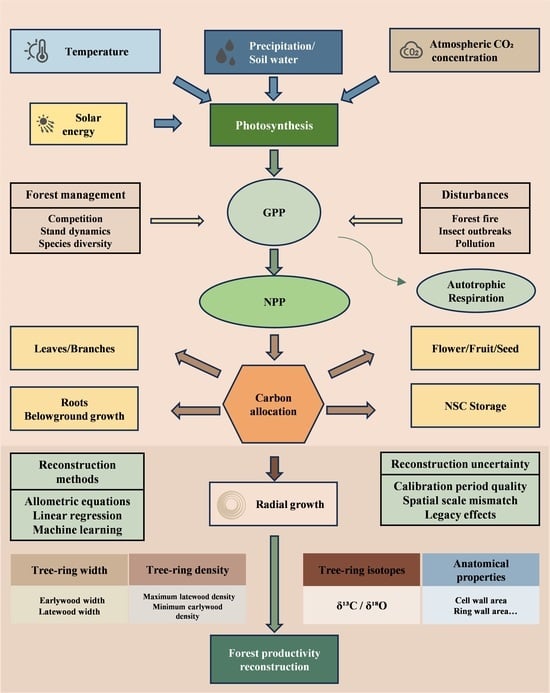
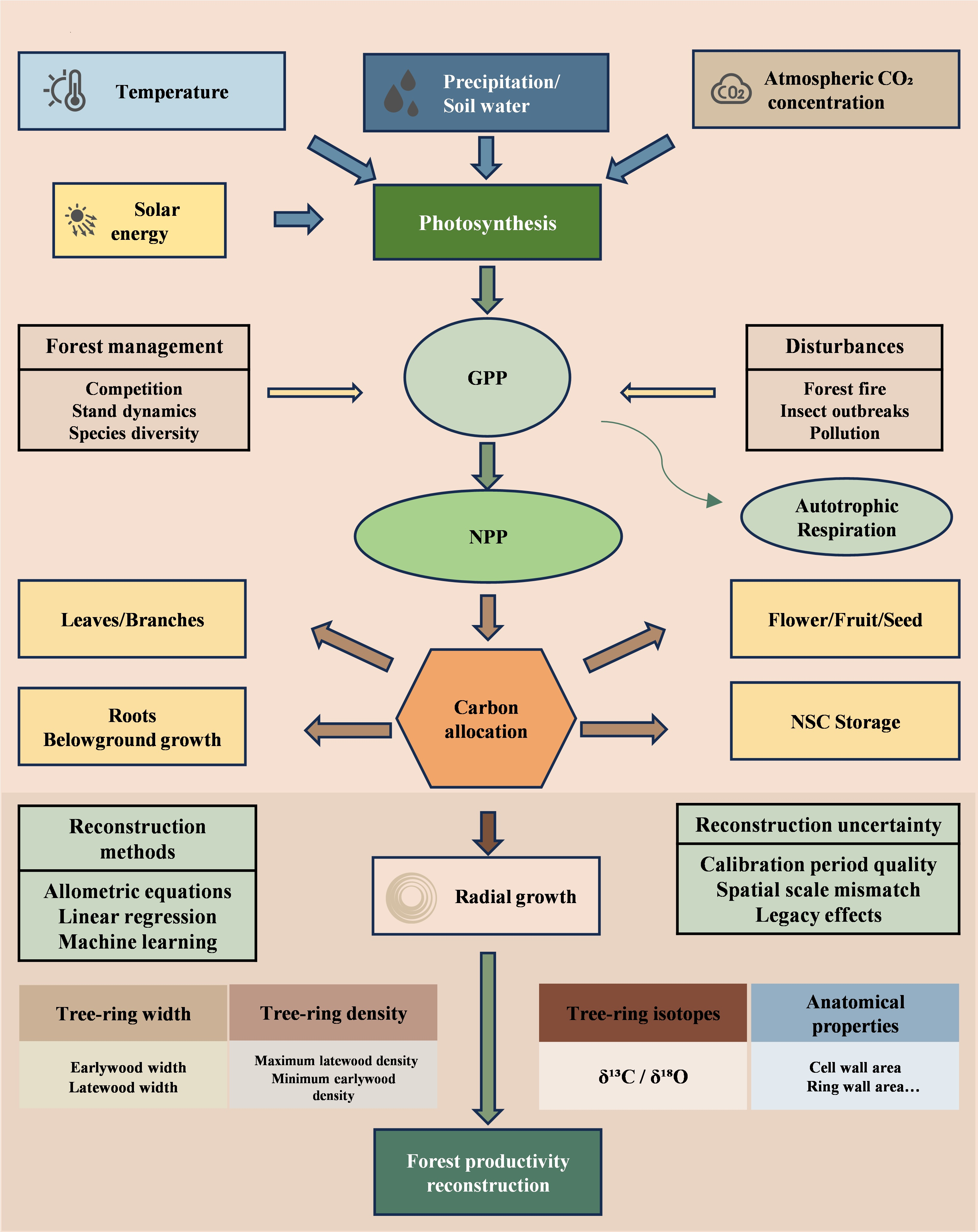
Graphical Abstract

1. Introduction

Climate change is profoundly reshaping the global carbon cycle. Extreme climate events such as heat waves, droughts, and storms are occurring with increasing frequency, affecting not only the structure, composition, and function of terrestrial ecosystems but also triggering cascading ecological consequences [1,2]. As the largest terrestrial carbon pool, forest ecosystems possess substantial productivity and biomass storage, playing an irreplaceable role in regulating atmospheric CO2 concentrations and mitigating climate warming. They constitute a core component of nature-based climate solutions [3,4]. Currently, the assessment of carbon cycling processes in forest ecosystems primarily relies on parameters such as Gross Primary Production (GPP) and Net Primary Production (NPP). GPP represents the total organic carbon fixed by producers in terrestrial ecosystems through photosynthesis and serves as the foundation of terrestrial ecosystem carbon cycling. The remaining portion after autotrophic respiration is NPP, which represents the net carbon absorbed by vegetation from the atmosphere [5]. Forest productivity characterizes the carbon fixation capacity of ecosystem photosynthesis and serves as a key indicator for assessing carbon storage and ecosystem function, as well as a key driver of the terrestrial carbon cycle [6,7]. Understanding the long-term trends in forest ecosystem productivity is essential for elucidating the mechanisms by which forests respond to climate change and for implementing effective forest management strategies.
Current estimation of forest productivity is primarily achieved through forest resource inventories, eddy covariance flux tower observations, and model simulations [8]. Forest inventory data provide long time spans and detailed information but are typically conducted on a 5-year cycle, making it difficult to capture interannual productivity variations [9]. Eddy covariance flux tower technology can obtain high-precision carbon flux data at daily scales, providing insights into short-term productivity dynamics [10]. However, limited by operational costs and deployment density, this approach has poor regional representativeness and data continuity. Model simulation is an important approach in productivity estimation research and typically includes remote sensing models, process-based models, and machine learning simulations [8]. Remote sensing models are suitable for large-scale monitoring with broad coverage and high temporal frequency, but their spatial resolution is relatively coarse, especially in regions with complex terrain or high heterogeneity. Moreover, optical remote sensing products have limited canopy penetration and primarily capture horizontal canopy structure, making it difficult to accurately characterize vertical structural information related to tree stems, thereby limiting estimation accuracy [11]. Although process-based models have physiological mechanistic foundations, they require extensive parameterization and input variables. Without long-term empirical data for validation, their outputs contain considerable uncertainty [12,13]. Current remote sensing technologies and Earth system models are unable to accurately reconstruct long-term patterns of forest productivity change. With the rapid development of tree ecology, remote sensing technology, and ecological modeling, estimation methods have evolved toward process simulation and machine learning approaches that integrate multi-source data, significantly improving estimation accuracy [14,15]. However, these methods still have limitations in regional coverage, species representativeness, and model robustness. Therefore, new proxy data are needed to achieve high temporal resolution reconstruction of historical forest productivity across multiple scales.
Tree rings have the advantages of extended temporal coverage (Table 1), high temporal resolution, precise dating, and wide spatial distribution, and are widely used in long-term historical climate reconstruction [16,17]. Meanwhile, tree-ring data can also reflect environmental disturbances during tree growth, such as competition [18,19], drought [20,21], frost [22,23], wildfire [24], and landslides [25,26]. Physical and chemical proxy such as tree-ring width, density, and stable isotopes record the growth environment and physiological activities of trees, providing critical insights into the effects of climate, topography, and physiological mechanisms on tree growth. Recent studies have analyzed significant correlations between tree-ring data and forest productivity, reconstructed historical forest productivity series, assessed the impacts of environmental factors, and revealed response patterns of forest ecosystems under climate change.
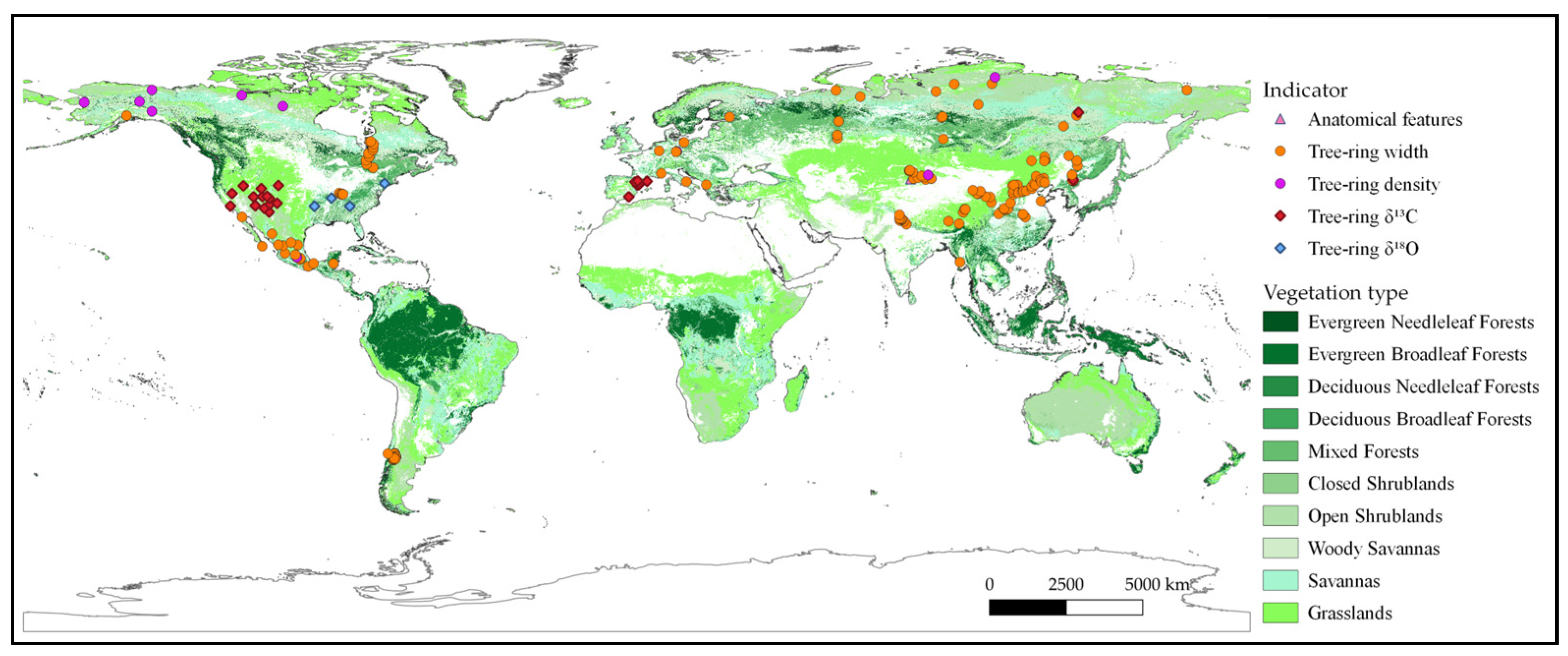
Based on recent research progress, this review examines studies on the relationships between tree-ring data and forest productivity from the perspective of climate–canopy–stem coupling. The main objectives of this study are (i) to elucidate the quantitative relationships between tree-ring indicators and forest productivity metrics, and to synthesize productivity reconstruction methodologies; (ii) to explore the external factors that modulate the stability and reliability of the relationships between tree-ring data and forest productivity; (iii) to identify technical limitations and challenges in current research, thereby providing scientific guidance for forest management under carbon neutrality goals. Figure 1 displays the geographic distribution of tree-ring sampling sites across different parameters, encompassing both relational studies between tree-ring data and forest productivity indicators (or proxies) and temporal reconstruction studies.
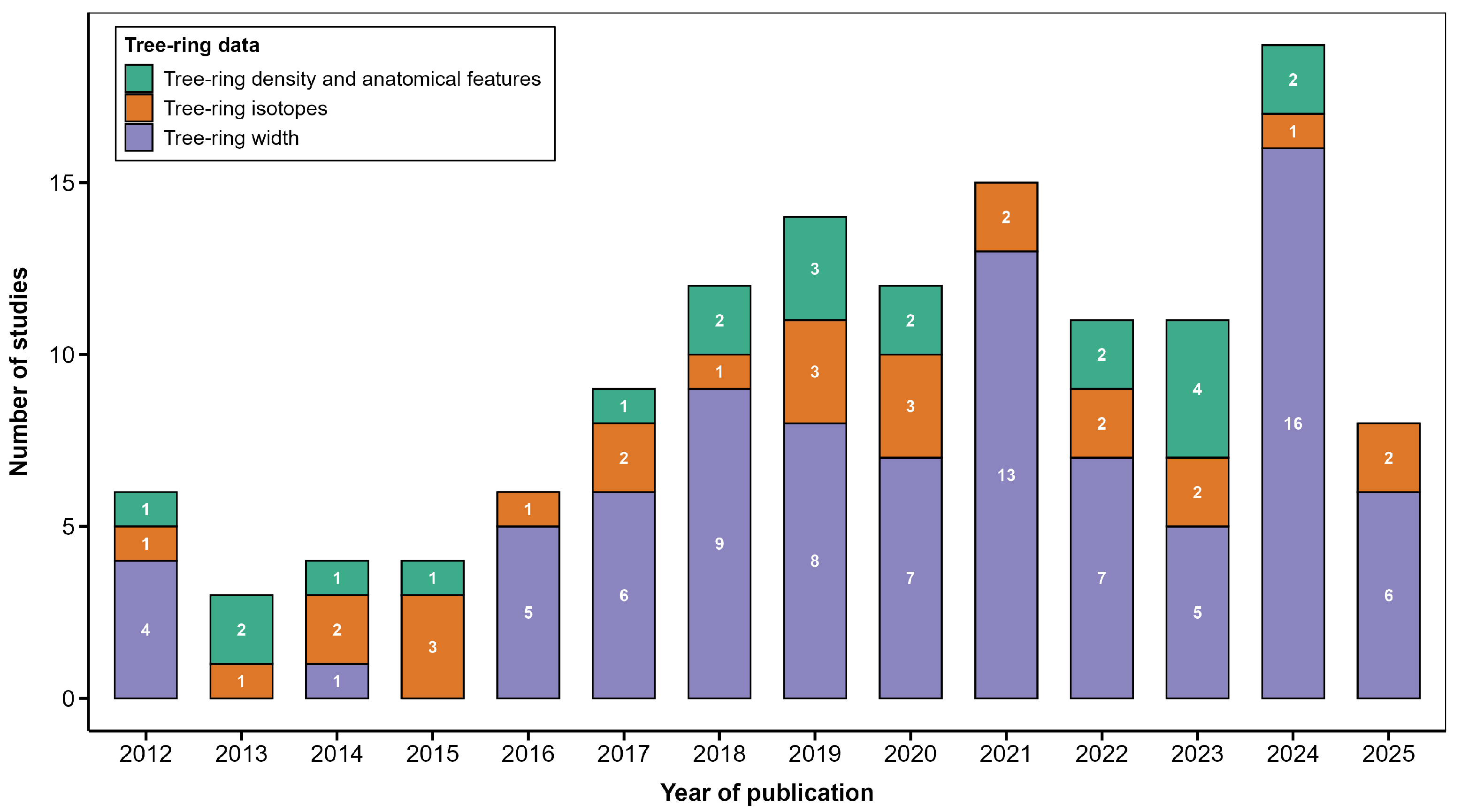
This review article utilized the Web of Science Core Collection as the primary source for scientific research, supplemented by the China National Knowledge Infrastructure (CNKI) database. We employed rigorous methods to retrieve relevant research articles. Our search period focused on 2012–2025, employing key terms including: tree rings, tree-ring width, tree-ring density, tree-ring isotopes, ecosystem productivity, gross primary productivity (GPP), net primary productivity (NPP), NDVI, vegetation index, and reconstruction. Through these specific terminology searches, we aimed to collect accurate scientific studies. Following comprehensive retrieval and screening, we obtained 134 peer-reviewed journal articles (Figure 2). All articles were closely related to our topic, discussing the relationship between tree-ring data and forest productivity or productivity proxy indicators. Some studies conducted reconstructions, with 2024 showing the highest number of published papers.

2. Research on the Relationship Between Tree-Ring Data and Forest Productivity

2.1. Tree-Ring Width

2.1.1. Relationship Between Tree-Ring Width and Forest Productivity

Understanding the relationship between tree radial growth and forest productivity is fundamental for conducting long-term productivity reconstruction. Studies have shown that tree-ring width is an ideal proxy for investigating this relationship [27,28]. Tree radial growth depends on canopy photosynthetic fixation of CO2 and water. Photosynthetic products are allocated to branches, leaves, roots, and stem xylem. Climatic conditions affect photosynthesis, and both canopy activity and tree radial growth are closely related to climate variability. As a direct manifestation of radial growth, tree-ring width reflects the environmental regulation of canopy photosynthesis. Therefore, tree-ring width serves as an important proxy of forest productivity changes [29,30,31,32].
Based on these physiological mechanisms, tree-ring width has been widely applied across different regions and tree species to investigate its correlation with forest productivity. Regarding species selection, significant differences exist in reconstruction effectiveness among different tree species. Existing studies predominantly employ coniferous species that exhibit pronounced interannual variation and sensitive climate responses. For example, in the Qilian Mountains of Northwest China, the tree-ring width of Picea crassifolia Kom. showed a correlation coefficient of 0.81 with annual aboveground NPP over a 108-year period [33]. In the northwestern Himalayas, significant positive correlations exist between tree-ring width and annual GPP for Pinus roxburghii Sarg. and Picea smithiana (Wall.) Boiss. [34]. During the growing season, enhanced photosynthesis allocates more carbon to secondary growth, and tree-ring width effectively reflects forest productivity during this period. In the western European part of the West Siberian Plain, a clear relationship exists between the radial growth of Pinus sylvestris L. and GPP from early June to early July [35]. Similarly, at the Asahidake site in northern Hokkaido, Japan, tree-ring width showed the highest positive correlation with June NPP (R = 0.39) [36].
In addition to GPP and NPP, the Normalized Difference Vegetation Index (NDVI), by characterizing the absorption of photosynthetically active radiation, indirectly reflects vegetation greenness and canopy dynamics. It is a remote sensing index for estimating trends in forest primary productivity and is particularly suitable for regions lacking long-term ground-based observations [37,38,39]. In recent years, scholars have increasingly focused on the correlation between NDVI and tree-ring width to explore the coupling mechanisms between primary and secondary growth. At both global and regional scales, significant positive correlations generally exist between tree-ring width and NDVI for most tree species, although the strength of correlation varies across sites [40,41,42]. The correlation patterns between tree-ring width and NDVI are similar to those of productivity indicators. Temporally, high correlations commonly occur during the growing season or summer, as favorable temperature and moisture conditions enhance photosynthesis and internal water content, promote nutrient accumulation and cambial cell division, and accelerate radial growth. This indicates that the growing season or summer is the period when climate exerts the greatest influence on both tree radial growth and canopy development. The optimal correlation window between tree-ring width and NDVI is related to species phenology and climate sensitivity [43,44,45]. In arid and semi-arid regions, tree species are predominantly drought-tolerant and highly sensitive to water availability. Significant positive correlations between tree-ring width and NDVI have been found in low-elevation arid areas of Cyprus in the eastern Mediterranean [46], dry forests of northern Ethiopia [47], high-latitude dry sites in the Patagonian Andes [48], and grassland ecosystems [49,50,51].
Generally, higher forest carbon uptake corresponds to faster tree radial growth rates. However, the coupling relationship between tree-ring width and productivity is not always synchronous, sometimes exhibiting lag or decoupling phenomena. This characteristic has been observed in correlation studies based on both GPP and NDVI primarily due to differential responses of tree radial growth and canopy activity to climatic factors within the growing season [52,53,54,55,56]. For example, in the Sierra Nevada of California, USA, the tree-ring width of Douglas fir (Pseudotsuga menziesii (Mirb.) Franco) showed the highest correlation with GPP from the latter half of the previous year’s growing season, with median correlation coefficients across sample sites reaching 0.7 after time-lag correction [57]. In eastern Siberia, average GPP from May to September maintained a stable positive correlation with the following year’s tree-ring width throughout the study period [58]. Various ecological and physiological factors, such as tree vigor, carbon allocation mechanisms, soil moisture conditions, and stand structure, may lead to lag or decoupling phenomena between tree-ring chronologies and forest productivity. The underlying mechanism involves shifts in carbohydrate allocation strategies [59,60]. Under extreme conditions, particularly drought stress, carbon allocation patterns may shift, with a reduced proportion of non-structural carbohydrates allocated to xylem and more directed toward leaf growth with shorter turnover periods. Simultaneously, some carbon is stored within the tree for delayed use in radial growth the following year. This spatiotemporal mismatch in resource utilization is known as the “legacy effect” [57]. Additionally, spatial scale mismatches exist between tree-ring chronologies and large-scale data sources (such as remote sensing products) [31]. Traditional sampling methods overlook differences in stand structure and density and lack sufficient spatial and species representativeness, resulting in tree-ring data that fail to fully capture the contributions of other vegetation within the stand to productivity [61]. NDVI may exhibit saturation during the growing season in ecosystems such as evergreen coniferous forests, weakening its sensitivity to seasonal carbon flux variations [62,63] and presenting a risk of underestimating productivity dynamics.
To reduce lag or decoupling phenomena in the relationship between tree rings and productivity and improve the accuracy of tree-ring data in reflecting forest productivity, researchers have focused on key aspects including sample site selection, sampling strategies, and data selection. Regarding regional selection, temperate forests exhibit stronger correlations compared to tropical and subtropical regions [64]. In tropical and subtropical forests, the proportion of species forming distinct annual rings is relatively low, climate seasonality is less pronounced, and ecosystem structure is more complex, making the relationship between tree-ring width and productivity difficult to identify. Temperate forests have distinct seasonal climate variation and relatively low species diversity. Consequently, tree growth is more sensitive to climate signals, and dominant tree species often explain a substantial portion of forest productivity, making these regions particularly suitable for tree-ring-based productivity assessments. In sampling design, collecting tree-ring data by adjusting sampling proportions according to diameter at breast height (DBH) classes, with sampling proportions increasing with DBH, can control for age bias while accounting for the contributions of different age classes to productivity [65,66]. Furthermore, forest productivity data with high spatial resolution and extended temporal coverage can provide more growth information and capture the relationship between tree-ring width and productivity more accurately than low-resolution data [67,68].

2.1.2. Reconstruction of Forest Productivity Using Tree-Ring Width

Reconstructing productivity based on tree-ring width is an important method for revealing forest productivity changes and their responses to climatic factors. From an ecological perspective, NPP is defined as the net accumulation of organic matter produced by plant community photosynthesis after deducting autotrophic respiration. Therefore, forest NPP has a close relationship with actual biomass increment [69]. In practical applications, considering that the volume and variability of litterfall in many temperate forests are relatively small, its impact on overall ecosystem productivity assessment can usually be neglected. Therefore, annual forest NPP is often evaluated using annual aboveground biomass increment as the primary productivity indicator, with the two exhibiting a strong positive correlation [70,71]. The traditional calculation method involves estimating annual DBH through tree-ring width, combining species-specific or habitat-specific height-DBH relationships and allometric equations to obtain individual tree biomass, which is then converted to plot-level NPP [72,73]. Allometric equations are empirical models established based on field survey data and are used to quantify the relationship between vegetation structural parameters and biomass. According to the number of parameters, they can be divided into univariate equations with DBH as the variable and bivariate equations with both DBH and tree height as variables [74]. Due to the difficulty in obtaining tree height, although remote sensing data can provide canopy height information, their temporal coverage is limited. Therefore, some studies substitute measured data with DBH-tree height regression models for biomass estimation [75,76]. The conversion from individual tree to stand productivity can be achieved by collecting tree cores across diameter classes, establishing representative growth patterns for each diameter class, and combining DBH survey data to calculate total plot productivity. Stand-level biomass can be obtained based on density and biomass per unit area, or by collecting and cumulatively calculating all qualified trees within the plot [65,70,77]. Although using average tree growth in sample plots to characterize stand productivity may produce deviations over time, under the same environmental conditions, productivity change trends across multiple sample plots show consistency, demonstrating the feasibility of productivity reconstruction methods based on tree-ring width. Tree-ring reconstruction is suitable as a tool for revealing long-term trends in forest productivity.
Extensive work has been conducted domestically and internationally on establishing biomass equations at different scales and for different tree species, forming a relatively complete system of regionalized biomass equation parameters. Representative examples include the systematic work of Fang et al. and Li et al. in China [78,79,80], and the parameter compilation by Michael T. Ter-Mikaelian et al. for North American forests [81]. The establishment of regionalized parameter databases has resolved technical issues concerning growth pattern differences among climate zones and forest types, laying a methodological foundation for global-scale comparative studies of forest productivity. Forest biomass reconstruction methods based on tree-ring width and allometric equations have demonstrated significant advantages in revealing long-term dynamics of forest ecosystems, which manifest in two aspects: temporal scale expansion and quantification of response mechanisms. Devi et al. reconstructed centennial-scale biomass dynamics in the treeline ecotone of the Polar Urals through tree-ring width, finding that the biomass in the treeline, open forest, and closed forest areas increased 86-fold, 59-fold, and 39-fold, respectively, since 1950, attributing this to growing season warming and increased dormant season precipitation [77]. A long-term study by Martin-Benito et al. [82] further confirmed the contribution of this method in quantifying forest stability and carbon cycle timescales, advancing traditional forest disturbance theory from qualitative description to quantitative assessment. Overall, the method of estimating forest biomass based on tree-ring width and allometric equations is reliable, with results showing high consistency with eddy covariance flux tower monitoring data, forest inventory data, and permanent plot measurements.
However, biomass equations have technical limitations in estimating forest biomass. First, sample quality issues such as incomplete cores that do not reach the pith, missing rings, and false rings cause DBH increment values to deviate from true values [83]. Second, equation applicability varies with tree developmental stages, and the lack of unified accuracy verification standards has led to widespread use of equations with questionable reliability. Additionally, existing equations generally exclude fine roots and litterfall, leading to underestimation of productivity [84,85]. Furthermore, the missing contribution of trees lost to mortality is also a source of uncertainty [86].
To reduce uncertainties caused by biomass model parameters and forest degradation, scholars have indirectly reconstructed regional forest productivity through the linear relationship between tree-ring width chronologies and biomass. Based on the relationship between tree-ring width and forest growing season productivity, domestic scholars have conducted studies on productivity dynamics using NDVI in regions including Northeast China, North China, Northwest China, and the Tibetan Plateau. Reconstruction periods primarily focus on the growing season (April–September), with average correlation coefficients between tree-ring width and growing season NDVI reaching 0.65 [87,88,89,90]. The strong coupling relationship between the two indicates that tree radial growth and forest productivity respond consistently to climate during the growing season, and tree-ring width can effectively reflect the accumulation of photosynthetic products at the canopy level. Reconstruction targets are mostly coniferous species sensitive to climate change, such as Cedrus deodara (Roxb.) G. Don in the Himalayas [27], Picea crassifolia in the Qilian Mountains [91,92], and Picea schrenkiana Fisch. & C.A.Mey. in the Tianshan Mountains [89,93]. Since NDVI represents regional overall vegetation conditions, a single tree species often cannot comprehensively reflect regional dynamics. To improve the representativeness of reconstruction results, some studies integrate width chronologies from multiple tree species to reduce the limitations of single-species ecological responses. In the southern Lesser Khingan Mountains, correlations between width chronologies established separately for Pinus koraiensis Siebold & Zucc., Abies nephrolepis Maxim., and Quercus mongolica Fisch. ex Ledeb. and July NDVI were lower than those of the composite chronology [94]. Principal component analysis (PCA) extracts the first principal component (PC1) from multi-species tree-ring chronologies, capturing the common response patterns of different species and indicators to environmental changes and integrating them into a unified regional signal to comprehensively reflect regional NDVI dynamics [95,96].
Traditional forest productivity reconstruction methods primarily rely on binary linear regression models between tree-ring width and productivity indicators. This simplified linear assumption has difficulty fully capturing complex ecological processes, as tree growth and environmental factors often exhibit nonlinear characteristics such as threshold effects, interactions, and time-lag responses. With the development of computational technology and deepening understanding of ecological theory, reconstruction methods have shifted from linear to nonlinear approaches and from parametric to non-parametric methods. The advantage of non-parametric methods such as machine learning lies in their ability to adaptively learn complex patterns in data without requiring predetermined mathematical functional forms. Li et al., based on 16 tree-ring width chronologies from southern Indiana, USA, employed the random forest method to reconstruct the spatial distribution of NPP from 1940 to 2013 on a gridded basis, not only improving spatial resolution but also achieving a methodological transformation from point-based to area-based reconstruction [64]. Using NDVI data as a modern reference, Meléndez et al. employed neural network models to reconstruct NDVI over the past 1500 years in the El Alto-Ancasti mountain range, achieving effective extrapolation from modern remote sensing observations to historical periods [97]. Furthermore, technical improvements are also reflected in the comprehensive utilization of multi-source environmental information, enhancing reconstruction accuracy and spatial representativeness by integrating ecological and environmental data from multiple dimensions [98]. Overall, machine learning-based nonlinear reconstruction methods are becoming an important direction in historical forest productivity reconstruction research.

2.2. Tree-Ring Stable Isotopes

Tree-ring width is affected by non-climatic factors, making it difficult to comprehensively explain the relationship between forest productivity and tree growth using tree-ring width alone. During tree growth, the isotopic composition of elements such as H, C, N, and O undergoes specific changes due to fractionation during physiological processes such as photosynthesis, transpiration, and nutrient uptake, thereby recording tree responses to climate and nutritional conditions. Therefore, isotopes are commonly used for climate reconstruction and forest health assessment [99,100]. As tracers of non-structural carbohydrate accumulation, storage, and utilization in trees, as well as indicators of water use, isotopes comprehensively reflect the carbon assimilation processes underlying tree growth [101].

2.2.1. Relationship Between Tree-Ring Stable Isotopes and Forest Productivity

Tree-ring stable isotopes depend on leaf photosynthesis and stomatal conductance. Photosynthesis and stomatal conductance are regulated by physiological processes and are strongly influenced by climatic conditions such as atmospheric CO2 concentration, humidity, precipitation, and irradiance. They affect remote sensing estimation parameters such as leaf area index and absorbed photosynthetically active radiation. Therefore, close connections exist between tree-ring carbon and oxygen isotopes and forest productivity [6,102,103]. The accumulation of δ13C in tree rings originates from atmospheric CO2. During photosynthesis, gaseous CO2 is fixed and converted to carbohydrates by carboxylase enzymes, with simultaneous carbon fractionation occurring. Therefore, tree-ring stable carbon isotopes are primarily influenced by atmospheric CO2 [104,105]. Since the Industrial Revolution, non-climatic factors such as increased atmospheric CO2 concentration and decreased δ13C values have affected tree-ring carbon isotopes. Therefore, corrections are necessary to reflect the response of tree-ring δ13C to climate change [106]. Changes in tree-ring δ18O are mainly influenced by the δ18O content in soil water and leaf water enrichment, thus sensitively responding to changes in precipitation and relative humidity [102,107]. Meta-analysis of δ13C and biomass in woody plants globally indicates that the two generally show a positive correlation, with stronger relationships in subtropical and temperate species [108]. In temperate forests in the northeastern United States, latewood δ13C of dominant tree species Quercus rubra L. and Tsuga canadensis (L.) Carrière showed significant positive correlations with growing season GPP monitored by eddy covariance flux towers [109]. In temperate old-growth forests in northeastern China, Pinus koraiensis earlywood and latewood δ13C showed correlations of 0.81 and 0.57 with GPP from May–July and July–September, respectively, while tree-ring width showed no correlation with GPP [110]. The relationship between forest productivity and tree-ring δ13C exhibits significant differences across regions with varying drought intensity. In some arid regions, vegetation greenness and tree water use efficiency show synchronous temporal variation. Under drought conditions, trees close their stomata to reduce water loss, leading to increased tree-ring δ13C, and the connection between NDVI and tree water use efficiency becomes closer. In more humid regions, the relationship between NDVI and δ13C is weaker, and in such environments, changes in δ13C may be more strongly influenced by non-water factors [111,112]. Unlike the positive correlation pattern of δ13C, a generally negative correlation exists between δ18O and forest productivity. In the northeastern United States, tree-ring δ18O showed significant negative correlations with NPP across large regions, while δ13C showed correlations only at some sites with limited spatial representativeness. Since vapor pressure deficit (VPD) is one of the core climate variables in NPP products, the strong coupling between δ18O and VPD explains this widespread correlation [113]. Additionally, tree-ring stable isotopes provide new pathways for identifying “legacy effects” in carbon allocation. The significant correlation between earlywood δ13C and previous year’s latewood δ13C reveals time-lag responses in carbon utilization, providing new perspectives for understanding tree carbon dynamics [84].

2.2.2. Reconstruction of Forest Productivity Using Stable Isotopes

Due to the relatively short overlap period between productivity data and isotope chronologies, current research on reconstructing forest productivity using tree-ring stable isotopes is limited (Table 1). However, tree-ring isotopes provide physiological mechanism explanations for productivity research. Researchers have established relationship models between stomatal conductance, water use efficiency, and GPP based on parameters such as tree-ring δ13C, stem sap flow, and meteorological data, achieving daily GPP calculations and overcoming limitations of eddy covariance methods in terms of site location establishment [114,115]. Furthermore, tree-ring δ13C can be effectively utilized as calibration training data to refine process-based forest growth models such as 3-PG, thereby reducing errors in simulating forest growth and carbon sequestration processes, and facilitating informed forest management [116]. Tree-ring stable isotopes demonstrate significant potential in reconstructing long-term series of forest productivity.

2.3. Tree-Ring Density and Anatomical Features

Tree-ring density reflects the dry matter mass per unit volume of stem and more directly reflects the accumulation of xylem biomass compared to tree-ring width. Therefore, it is an effective proxy for revealing forest productivity changes. In boreal coniferous forests, growing season or late growing season temperature is closely related to latewood density. Temperature increases enhance photosynthesis and carbon assimilation, thereby promoting cell wall thickening and increasing latewood density [117,118]. Tree-ring density not only records temperature changes but also reflects photosynthetic product accumulation. In forest regions where temperature is the main limiting factor, significant positive correlations exist between maximum latewood density (MXD) and forest productivity, and MXD can effectively represent forest productivity and canopy activity [119]. MXD chronologies of white spruce (Picea glauca Voss.) from western to central high-latitude North America record changes in early growing season NDVI, although response times vary across sites [120]. Minimum earlywood density (MID) shows negative correlations with growing season NDVI, possibly because carbon allocation in the early growing season is primarily directed toward branch and leaf growth and cambial activity, with xylem cell division and expansion prioritized over cell wall thickening [31,121]. Traditional biomass estimation methods often assume that wood density remains constant over time and among individuals. This simplified assumption leads to systematic biases in reconstruction results [122]. To address this issue, researchers have utilized density to correct for interannual density variations and individual differences in average density, adjusted the correspondence between biomass and wood properties, optimized allometric equations, and significantly reduced errors [70,123].
Wood anatomical properties reveal intra-annual dynamics between carbon uptake and tree-ring data at the cellular level. In eastern Canadian white pine forests, cell wall area and ring wall area are highly coupled with GPP at intra-annual and interannual scales, showing significant correlations with growing season and summer GPP. Latewood cell wall area showed a correlation of 0.89 with GPP from July to September [124]. Despite the advantages of physiological mechanisms and fine temporal resolution offered by wood density and anatomical properties, the number of related studies remains limited due to the high cost of X-ray densitometry equipment and the complex technical procedures of wood anatomical analysis (Table 1). Research is mostly concentrated on correlation analysis and method validation stages and has not yet advanced to more in-depth and comprehensive productivity reconstruction.

3. Factors Affecting the Stability of the Relationship Between Tree-Ring Data and Forest Productivity

3.1. Climatic Factors

Based on reconstructed historical forest productivity series, the stable relationship between tree growth and forest productivity is driven by climatic factors, with local water and heat conditions directly affecting vegetation physiological processes. In arid and semi-arid regions, tree radial growth is primarily limited by water availability. Precipitation or snowfall during the growing season, early growing season, and the preceding autumn and winter provides water for plant growth, accelerates tree growth, increases forest productivity, and results in significant correlations between tree-ring data and forest productivity [46,111,125]. However, when precipitation is excessive, water limitation on tree growth decreases, and risks of soil hypoxia, reduced radiation, and frost damage increase, weakening or decoupling the relationship between tree-ring data and forest productivity [46,126]. In high-latitude or high-altitude cold-humid regions not limited by drought, temperature is the main limiting factor affecting tree growth, and both tree radial growth and forest productivity are usually significantly positively correlated with growing season temperature [126,127,128,129]. At low temperatures, photosynthetic enzyme activity weakens, inhibiting growth and forming narrow rings. When growing season temperature increases, carbohydrates in trees accumulate, breaking dormancy, extending the growing season, forming wider rings, and simultaneously improving forest productivity [33]. It should be noted that the optimal temperatures required for xylem cell division and canopy growth differ [130]. When temperature exceeds the optimal threshold, enhanced evapotranspiration leads to water stress; stomatal closure inhibits CO2 uptake, thereby reducing photosynthetic rates; and tree growth and productivity are suppressed [131,132,133,134], affecting the stable relationship between tree growth and forest productivity. Various climate variables interact in forest ecosystems, with dominant limiting factors constantly changing across different years and seasons, and species adaptability to dry, wet, cold, and warm conditions also regulating the relationship between forest productivity and climate factors [135,136].

3.2. Topographic Factors

Topographic factors regulate the redistribution of water and heat conditions, with elevation being a key factor. In arid and semi-arid regions, as elevation increases, temperature decreases while precipitation increases, and the main limiting factor for tree growth shifts from water stress to temperature constraint, leading to transformation in the association pattern between tree radial growth and forest productivity [33,137]. As elevation increases, the correlation between tree-ring data and NDVI shows a declining trend. The primary reason may be that in low-elevation areas, vegetation types are dominated by grasslands and shrubs, which are highly sensitive to drought. Tree-ring radial growth and NPP are jointly limited by precipitation, resulting in strong correlations between the two. High-elevation areas are dominated by forests and woody savannas with high species richness, milder responses to environmental fluctuations, cold-humid environments that reduce pest risks, and higher nitrogen deposition, resulting in more stable productivity [33,46,138,139,140]. However, in certain high-altitude regions, the climate may exhibit cold and dry characteristics, with water remaining the limiting factor for tree growth. Differences in radiation and water and heat conditions caused by slope aspect also affect vegetation growth rhythms, with correlations between tree-ring width and forest productivity on sunny slopes considerably higher than on shady slopes [139,141,142].

3.3. Atmospheric CO2 Concentration

Atmospheric carbon dioxide concentration affects tree physiological and ecological processes, such as carbon allocation patterns and tree-ring formation, influencing the relationship between tree-ring width and productivity. The CO2 concentration effect has global and long-term cumulative characteristics. Elevated CO2 concentration stimulates photosynthesis, improves water use efficiency, increases tree radial growth, and promotes forest productivity [143]. However, its “fertilization effect” on productivity is limited, as some tree species have not significantly benefited from growth due to saturation of intrinsic water use efficiency and sensitivity to drought [144]. Therefore, when reconstructing forest productivity using tree rings, it is necessary to consider the interference effects of elevated CO2 concentration to improve reconstruction accuracy.
Additionally, the association between tree-ring data and forest productivity may be affected by non-climatic factors such as soil conditions, species richness, and stand density. Soil conditions have a regulatory effect on the connection between tree radial growth and vegetation activity. Poor soils have low water use efficiency and nutrient deficiency, while soils with high organic matter and mineral content have stronger water-holding capacity, providing continuous water supply during drought periods to alleviate drought stress [145]. Generally, productivity in mixed forests with higher species richness is greater than in pure forests. Complementary resource utilization among species with different shade tolerances in mixed forests, faster nutrient cycling, and water storage during the dry season have positive effects on forest productivity [146,147]. However, in areas with high species diversity, responses to environmental changes are mild and self-regulation capacity is high, making reconstruction of productivity using any tree-ring data potentially inapplicable. Stand density regulates forest productivity through inter-tree competition. In high-density stands, canopy and root closure are high, interspecific competition is intense, and trees reduce radial growth to expand canopies to compete for light resources. During extreme drought, water stress is further exacerbated, leading to tree mortality [33,148,149]. Simultaneously, the allometric relationships among variables such as DBH, tree height, and canopy size are substantially altered [150,151]. Consequently, allometric growth equations must incorporate inter-tree competition effects. Anthropogenic disturbances directly restructure forest architecture via forest extraction, afforestation initiatives, and human-ignited fire. Among key drivers, the hierarchical ranking of impact magnitude is livestock > afforestation > population > farmland [152]. Concomitantly, nitrogen deposition derived from livestock production systems partially attenuates the drought stress experienced by forest ecosystems [153].
In summary, environmental heterogeneity and changes in stand structure not only affect forest productivity itself but also interfere with the ability of tree-ring data to record its long-term dynamics, affecting the stability of the relationship between the two.

4. Challenges and Future Directions

The systematic absence of stand dynamics information is the primary factor constraining reconstruction accuracy. Traditional sampling of isolated old trees cannot reflect changes in stand density and competition intensity experienced during their growth, preventing tree-ring width from accurately representing stand-level productivity. Solutions should focus on utilizing stand dynamics information contained within tree rings themselves: by analyzing differences in tree-ring sequences among age classes at the same site, the temporal evolution of historical competition intensity can be reconstructed [154,155]; by correlating years of abrupt tree-ring width changes with historically documented forest disturbance events (fires, pest outbreaks, logging), disturbance impacts on productivity can be identified and quantified [156,157].
The limitations of NDVI-tree ring integration stem from spatiotemporal mismatches. NDVI saturates in high-biomass ecosystems [158], and its peak period occurs earlier than the peak of xylem cell division [159]. Tree-ring data can be used to calibrate vegetation-index-based phenological models or process-based forest growth models [116,160], enabling accurate quantification of forest productivity changes. Tree rings’ intrinsic canopy information should be exploited: tree-ring stable isotopes (δ13C) record long-term carbon assimilation processes, and their ratio to tree-ring width can indicate photosynthetic efficiency per unit radial growth, with high-ratio years corresponding to high canopy productivity; changes in the earlywood-to-latewood width ratio reflect intra-annual carbon allocation patterns. High earlywood proportions indicate rapid spring canopy growth or, conversely, growth suppression caused by late-season drought, pests, or diseases. High latewood proportions correspond to sustained summer photosynthesis or, alternatively, growth constraints from spring drought and frost. The specific mechanisms underlying these patterns require further investigation. Furthermore, integrating multiple vegetation indices represents a promising pathway to enhance the accuracy of forest productivity reconstruction. For instance, the Enhanced Vegetation Index (EVI) exhibits reduced saturation effects in high-biomass ecosystems compared with the NDVI [158]. Recent studies have demonstrated that Near-Infrared Reflectance of Vegetation (NIRv) and Solar-Induced Chlorophyll Fluorescence (SIF) serve as more promising proxies for GPP than NDVI and EVI [161]. Integrating tree-ring data with multi-source vegetation indices enables more accurate characterization of spatiotemporal patterns in forest productivity dynamics.
The core directions for future research should be grounded in the centennial-scale interannual resolution characteristics of tree-ring data: firstly, we should construct multi-proxy joint reconstruction frameworks that integrate complementary information from tree-ring width, isotopes, and density, extracting common productivity signals through principal component analysis or Bayesian hierarchical models to reduce uncertainties from single proxies. Secondly, we should develop dynamic relationship models that account for non-stationarity, using moving window correlation analysis to identify evolutionary patterns in tree-ring–productivity relationships under changing climates and adjusting reconstruction parameters under long-term trends such as warming and rising CO2 concentrations. Thirdly, we should expand into underrepresented ecosystem types, prioritizing the establishment of multi-species composite chronologies in subtropical evergreen broadleaf forests, leveraging differential species responses to climate to enhance the robustness of regional productivity signals. Fourthly, we must strengthen cross-validation between tree-ring reconstruction results and paleoecological evidence (such as pollen records), where consistency between ancient fire frequencies and low-productivity periods recorded in tree rings can improve reconstruction credibility.

5. Conclusions

This review systematically synthesizes recent advances in applying tree-ring data to forest productivity reconstruction across three dimensions: methodological development, mechanistic understanding, and data accumulation. At the methodological level, tree-ring reconstruction techniques have evolved from conventional linear regression to multi-source data-driven nonlinear modeling approaches. Tree-ring width, stable isotopes, wood density, and anatomical characteristics each present distinct advantages and limitations in reconstruction workflows, necessitating the establishment of integrated frameworks to harness the synergistic benefits of multiple tree-ring proxies. Regarding mechanistic understanding, we have identified three critical nonlinear features in the “climate–canopy–stem” coupling system: first, a dual-threshold effect of precipitation on tree-ring–productivity relationships; second, a unimodal response whereby temperatures exceeding species-specific optima enhance transpiration and induces water stress; however, in regions with severe growth limitations, this bell-shaped response pattern may only be partially expressed; and third, a “legacy effect” in carbon allocation, wherein photosynthetically fixed carbon is preferentially allocated to foliage over xylem, with stored carbon from the previous year fueling radial growth. Additionally, the CO2 fertilization effect becomes ineffective in some tree species when water-use efficiency reaches saturation. Current patterns of data accumulation reveal pronounced geographic bias: existing research is concentrated on temperate coniferous forests in the Northern Hemisphere. Coniferous species are particularly suitable as proxy indicators due to their distinct annual ring structure, relatively consistent water-use strategies, and low reliance on stored carbon for secondary growth. However, case studies from subtropical evergreen broadleaf forests and tropical rainforests remain limited, and in species-rich forest regions, ring chronologies of single dominant species cannot adequately represent stand-level productivity dynamics.
The unique value of tree-ring data lies in revealing forest response patterns to centennial-scale climate variability, thereby providing scientific evidence for assessing carbon sequestration potential and designing nature-based climate solutions. To fully exploit the information potential of tree-ring data, integration of tree ecology, remote sensing technology, and ecosystem models is essential to establish a multi-spatiotemporal-scale monitoring and prediction system for forest productivity. Such an integrated approach will provide indispensable scientific support for sustainable forest management under carbon neutrality objectives.

Author Contributions

Conceptualization, R.Y. and M.L.; resources, R.Y.; writing—original draft preparation, R.Y.; writing—review and editing, M.L.; visualization, R.Y.; supervision, M.L.; project administration, M.L.; funding acquisition, M.L. All authors have read and agreed to the published version of the manuscript.

Funding

This research was supported by the Second Tibetan Plateau Scientific Expedition and Research Program (Grant No. 2019QZKK0301) and the National Natural Science Foundation of China (Grant No. 41977391).

Data Availability Statement

The data of this study may be available from the corresponding author upon reasonable request.

Conflicts of Interest

The authors declare no conflicts of interest.

References

  1. Frank, D.; Reichstein, M.; Bahn, M.; Thonicke, K.; Frank, D.; Mahecha, M.D.; Smith, P.; Van Der Velde, M.; Vicca, S.; Babst, F.; et al. Effects of Climate Extremes on the Terrestrial Carbon Cycle: Concepts, Processes and Potential Future Impacts. Glob. Change Biol. 2015, 21, 2861–2880. [Google Scholar] [CrossRef] [PubMed]
  2. Piao, S.; Zhang, X.; Chen, A.; Liu, Q.; Lian, X.; Wang, X.; Peng, S.; Wu, X. The Impacts of Climate Extremes on the Terrestrial Carbon Cycle: A Review. Sci. China Earth Sci. 2019, 62, 1551–1563. [Google Scholar] [CrossRef]
  3. Ellis, P.W.; Page, A.M.; Wood, S.; Fargione, J.; Masuda, Y.J.; Carrasco Denney, V.; Moore, C.; Kroeger, T.; Griscom, B.; Sanderman, J.; et al. The Principles of Natural Climate Solutions. Nat. Commun. 2024, 15, 547. [Google Scholar] [CrossRef]
  4. Keeling, H.C.; Phillips, O.L. The Global Relationship between Forest Productivity and Biomass. Glob. Ecol. Biogeogr. 2007, 16, 618–631. [Google Scholar] [CrossRef]
  5. Goulden, M.L.; Mcmillan, A.M.S.; Winston, G.C.; Rocha, A.V.; Manies, K.L.; Harden, J.W.; Bond-Lamberty, B.P. Patterns of NPP, GPP, Respiration, and NEP during Boreal Forest Succession. Glob. Change Biol. 2011, 17, 855–871. [Google Scholar] [CrossRef]
  6. Babst, F.; Alexander, M.R.; Szejner, P.; Bouriaud, O.; Klesse, S.; Roden, J.; Ciais, P.; Poulter, B.; Frank, D.; Moore, D.J.P.; et al. A Tree-Ring Perspective on the Terrestrial Carbon Cycle. Oecologia 2014, 176, 307–322. [Google Scholar] [CrossRef] [PubMed]
  7. Peng, J.; Shen, H.; Wu, W.; Liu, Y.; Wang, Y. Net Primary Productivity (NPP) Dynamics and Associated Urbanization Driving Forces in Metropolitan Areas: A Case Study in Beijing City, China. Landsc. Ecol. 2016, 31, 1077–1092. [Google Scholar] [CrossRef]
  8. Pandey, V.; Harde, S.; Rajasekaran, E.; Deb Burman, P.K. Gross Primary Productivity of Terrestrial Ecosystems: A Review of Observations, Remote Sensing, and Modelling Studies over South Asia. Theor. Appl. Climatol. 2024, 155, 8461–8491. [Google Scholar] [CrossRef]
  9. Zhang, Y.; Wang, X. Productivity and Carbon Sink Capacity of Eucalyptus Plantations in China from 1973 to 2018. Sci. Silvae Sin. 2023, 59, 54–64. [Google Scholar]
  10. Dragoni, D.; Schmid, H.P.; Grimmond, C.S.B.; Loescher, H.W. Uncertainty of Annual Net Ecosystem Productivity Estimated Using Eddy Covariance Flux Measurements. J. Geophys. Res. Atmospheres 2007, 112, 2006JD008149. [Google Scholar] [CrossRef]
  11. Tian, L.; Wu, X.; Tao, Y.; Li, M.; Qian, C.; Liao, L.; Fu, W. Review of Remote Sensing-Based Methods for Forest Aboveground Biomass Estimation: Progress, Challenges, and Prospects. Forests 2023, 14, 1086. [Google Scholar] [CrossRef]
  12. Xing, X.; Wu, M.; Zhang, W.; Ju, W.; Tagesson, T.; He, W.; Wang, S.; Wang, J.; Hu, L.; Yuan, S.; et al. Modeling China’s Terrestrial Ecosystem Gross Primary Productivity with BEPS Model: Parameter Sensitivity Analysis and Model Calibration. Agric. For. Meteorol. 2023, 343, 109789. [Google Scholar] [CrossRef]
  13. Zhou, L.; Dong, Q.; Pan, Y.; Yang, F.; He, M.; Huang, X.; Xu, J. Spatiotemporal Variations and Driving Forces of Regional-Scale NPP Based on a Multi-Method Integration: A Case Study in the Beibu Gulf Economic Zone. Ecol. Indic. 2025, 174, 113453. [Google Scholar] [CrossRef]
  14. Bai, Y.; Pang, Y.; Kong, D. Integrating Remote Sensing and 3-PG Model to Simulate the Biomass and Carbon Stock of Larix olgensis Plantation. For. Ecosyst. 2024, 11, 100213. [Google Scholar] [CrossRef]
  15. Yao, W.; Bie, Q. Global-Scale Improvement of Terrestrial Gross Primary Productivity Estimation by Integrating Optical Remote Sensing with Meteorological Data. Ecol. Indic. 2025, 173, 113429. [Google Scholar] [CrossRef]
  16. Stahle, D.W.; Fye, F.K.; Cook, E.R.; Griffin, R.D. Tree-Ring Reconstructed Megadroughts over North America since A.D. 1300. Clim. Change 2007, 83, 133. [Google Scholar] [CrossRef]
  17. Yang, B.; Qin, C.; Bräuning, A.; Osborn, T.J.; Trouet, V.; Ljungqvist, F.C.; Esper, J.; Schneider, L.; Grießinger, J.; Büntgen, U.; et al. Long-Term Decrease in Asian Monsoon Rainfall and Abrupt Climate Change Events over the Past 6,700 Years. Proc. Natl. Acad. Sci. USA 2021, 118, e2102007118. [Google Scholar] [CrossRef]
  18. Kwon, S.; Pan, L.; Shi, Z.; Yang, X.; Zhang, X.; Liu, Y.; Zhang, K. Radial Growth of Mongolian Pine and its Response to Climate at Different Competition Intensities. J. Ecol. 2019, 38, 1962–1972. [Google Scholar] [CrossRef]
  19. Liang, H.; Huang, J.-G.; Ma, Q.; Li, J.; Wang, Z.; Guo, X.; Zhu, H.; Jiang, S.; Zhou, P.; Yu, B.; et al. Contributions of Competition and Climate on Radial Growth of Pinus massoniana in Subtropics of China. Agric. For. Meteorol. 2019, 274, 7–17. [Google Scholar] [CrossRef]
  20. Huang, M.; Wang, X.; Keenan, T.F.; Piao, S. Drought Timing Influences the Legacy of Tree Growth Recovery. Glob. Change Biol. 2018, 24, 3546–3559. [Google Scholar] [CrossRef] [PubMed]
  21. Walker, X.J.; Mack, M.C.; Johnstone, J.F. Stable Carbon Isotope Analysis Reveals Widespread Drought Stress in Boreal Black Spruce Forests. Glob. Change Biol. 2015, 21, 3102–3113. [Google Scholar] [CrossRef]
  22. Meyer, B.F.; Buras, A.; Gregor, K.; Layritz, L.S.; Principe, A.; Kreyling, J.; Rammig, A.; Zang, C.S. Frost Matters: Incorporating Late-Spring Frost into a Dynamic Vegetation Model Regulates Regional Productivity Dynamics in European Beech Forests. Biogeosciences 2024, 21, 1355–1370. [Google Scholar] [CrossRef]
  23. Payette, S.; Delwaide, A.; Simard, M. Frost-ring Chronologies as Dendroclimatic Proxies of Boreal Environments. Geophys. Res. Lett. 2010, 37, 2009GL041849. [Google Scholar] [CrossRef]
  24. Cerano-Paredes, J.; Iniguez, J.M.; González-Castañeda, J.L.; Cervantes-Martínez, R.; Cambrón-Sandoval, V.H.; Esquivel-Arriaga, G.; Nájera-Luna, J.A. Increasing the Risk of Severe Wildfires in San Dimas, Durango, Mexico Caused by Fire Suppression in the Last 60 Years. Front. For. Glob. Change 2022, 5, 940302. [Google Scholar] [CrossRef]
  25. Kozák, M.; Šilhán, K. Comprehensive Landslide Analysis Using a Tree-Ring-Based Approach. Landslides 2024, 21, 1425–1437. [Google Scholar] [CrossRef]
  26. Stoffel, M.; Trappmann, D.G.; Coullie, M.I.; Ballesteros Cánovas, J.A.; Corona, C. Rockfall from an Increasingly Unstable Mountain Slope Driven by Climate Warming. Nat. Geosci. 2024, 17, 249–254. [Google Scholar] [CrossRef]
  27. Singh, A.K.; Shah, S.K.; Pandey, U.; Deeksha; Thomte, L.; Rahman, T.W.; Mehrotra, N.; Singh, D.S.; Kotlia, B.S. Vegetation Index (NDVI) Reconstruction from Western Himalaya through Dendrochronological Analysis of Cedrus deodara. Theor. Appl. Climatol. 2024, 155, 1713–1727. [Google Scholar] [CrossRef]
  28. Xu, K.; Wang, X.; Liang, P.; An, H.; Sun, H.; Han, W.; Li, Q. Tree-Ring Widths Are Good Proxies of Annual Variation in Forest Productivity in Temperate Forests. Sci. Rep. 2017, 7, 1945. [Google Scholar] [CrossRef]
  29. Ainsworth, E.A.; Bush, D.R. Carbohydrate Export from the Leaf: A Highly Regulated Process and Target to Enhance Photosynthesis and Productivity. Plant Physiol. 2011, 155, 64–69. [Google Scholar] [CrossRef] [PubMed]
  30. Poorter, H.; Niklas, K.J.; Reich, P.B.; Oleksyn, J.; Poot, P.; Mommer, L. Biomass Allocation to Leaves, Stems and Roots: Meta-analyses of Interspecific Variation and Environmental Control. New Phytol. 2012, 193, 30–50. [Google Scholar] [CrossRef]
  31. Song, J.; Zhang, T.; Fan, Y.; Liu, Y.; Yu, S.; Jiang, S.; Guo, D.; Hou, T.; Guo, K. Evaluating the Effect of Vegetation Index Based on Multiple Tree-Ring Parameters in the Central Tianshan Mountains. Forests 2023, 14, 2362. [Google Scholar] [CrossRef]
  32. Mašek, J.; Tumajer, J.; Lange, J.; Kaczka, R.; Fišer, P.; Treml, V. Variability in Tree-Ring Width and NDVI Responses to Climate at a Landscape Level. Ecosystems 2023, 26, 1144–1157. [Google Scholar] [CrossRef]
  33. Wu, X.; Jiao, L.; Du, D.; Xue, R.; Wei, M.; Zhang, P. Elevation Response of Above-Ground Net Primary Productivity for Picea crassifolia to Climate Change in Qilian Mountains of Northwest China Based on Tree Rings. J. Geogr. Sci. 2024, 34, 146–164. [Google Scholar] [CrossRef]
  34. Sarkar, A.; Das, P.; Mukherjee, S.; Deb Burman, P.K.; Chakraborty, S. Evaluating Tree-Ring Proxies for Representing the Ecosystem Productivity in India. Int. J. Biometeorol. 2025, 69, 137–155. [Google Scholar] [CrossRef]
  35. Rygalova, N.V.; Mordvin, E.Y.; Bondarovich, A.A. Productivity and Carbon Sequestration of Pinus sylvestris, L. Ribbon Forests in the Dry Steppe of Western Siberia According to Dendrochronology and MODIS Satellite Measurements. Contemp. Probl. Ecol. 2024, 17, 881–891. [Google Scholar] [CrossRef]
  36. Koide, D.; Ito, A. Temporal Changes in the Relationship between Tree-ring Growth and Net Primary Production in Northern Japan: A Novel Approach to the Estimation of Seasonal Photosynthate Allocation to the Stem. Ecol. Res. 2018, 33, 1275–1287. [Google Scholar] [CrossRef]
  37. Myneni, R.B.; Hall, F.G.; Sellers, P.J.; Marshak, A.L. The Interpretation of Spectral Vegetation Indexes. IEEE Trans. Geosci. Remote Sens. 1995, 33, 481–486. [Google Scholar] [CrossRef]
  38. Yuan, K.; Xu, H.; Zhang, G. Is There Spatial and Temporal Variability in the Response of Plant Canopy and Trunk Growth to Climate Change in a Typical River Basin of Arid Areas. Water 2022, 14, 1573. [Google Scholar] [CrossRef]
  39. Wang, J.; Rich, P.M.; Price, K.P.; Kettle, W.D. Relations between NDVI and Tree Productivity in the Central Great Plains. Int. J. Remote Sens. 2004, 25, 3127–3138. [Google Scholar] [CrossRef]
  40. Vicente-Serrano, S.M.; Camarero, J.J.; Olano, J.M.; Martín-Hernández, N.; Peña-Gallardo, M.; Tomás-Burguera, M.; Gazol, A.; Azorin-Molina, C.; Bhuyan, U.; El Kenawy, A. Diverse Relationships between Forest Growth and the Normalized Difference Vegetation Index at a Global Scale. Remote Sens. Environ. 2016, 187, 14–29. [Google Scholar] [CrossRef]
  41. Pompa-García, M.; Vivar-Vivar, E.D.; Sigala-Rodríguez, J.A.; Padilla-Martínez, J.R. What Are Contemporary Mexican Conifers Telling Us? A Perspective Offered from Tree Rings Linked to Climate and the NDVI along a Spatial Gradient. Remote Sens. 2022, 14, 4506. [Google Scholar] [CrossRef]
  42. Bhuyan, U.; Zang, C.; Vicente-Serrano, S.; Menzel, A. Exploring Relationships among Tree-Ring Growth, Climate Variability, and Seasonal Leaf Activity on Varying Timescales and Spatial Resolutions. Remote Sens. 2017, 9, 526. [Google Scholar] [CrossRef]
  43. Acosta-Hernández, A.C.; Pompa-García, M.; Martínez-Rivas, J.A.; Vivar-Vivar, E.D. Cutting the Greenness Index into 12 Monthly Slices: How Intra-Annual NDVI Dynamics Help Decipher Drought Responses in Mixed Forest Tree Species. Remote Sens. 2024, 16, 389. [Google Scholar] [CrossRef]
  44. Xu, P.; Fang, W.; Zhou, T.; Zhao, X.; Luo, H.; Hendrey, G.; Yi, C. Spatial Upscaling of Tree-Ring-Based Forest Response to Drought with Satellite Data. Remote Sens. 2019, 11, 2344. [Google Scholar] [CrossRef]
  45. Hou, T.; Chen, F.; Zhao, X.; Hu, M.; Wang, S.; Hadad, M.A.; Roig, F.A.; Zhang, H.; Chen, Y.; Xu, H. Tree Radial Growth and Vegetation Dynamics in Northern China and Northern Patagonia Regulated by Ocean–Atmosphere Circulation. For. Ecol. Manag. 2025, 593, 122913. [Google Scholar] [CrossRef]
  46. Coulthard, B.L.; Touchan, R.; Anchukaitis, K.J.; Meko, D.M.; Sivrikaya, F. Tree Growth and Vegetation Activity at the Ecosystem-Scale in the Eastern Mediterranean. Environ. Res. Lett. 2017, 12, 084008. [Google Scholar] [CrossRef]
  47. Siyum, Z.G.; Ayoade, J.O.; Onilude, M.A.; Feyissa, M.T. Relationship between Space-Based Vegetation Productivity Index and Radial Growth of Main Tree Species in the Dry Afromontane Forest Remnants of Northern Ethiopia. J. Appl. Sci. Environ. Manag. 2019, 22, 1781. [Google Scholar] [CrossRef]
  48. Gallardo, V.B.; Hadad, M.A.; Roig, F.A.; Gatica, G.; Chen, F. Spatio-Temporal Linkage Variations between NDVI and Tree Rings on the Leeward Side of the Northern Patagonian Andes. For. Ecol. Manag. 2024, 553, 121593. [Google Scholar] [CrossRef]
  49. Erasmi, S.; Klinge, M.; Dulamsuren, C.; Schneider, F.; Hauck, M. Modelling the Productivity of Siberian Larch Forests from Landsat NDVI Time Series in Fragmented Forest Stands of the Mongolian Forest-Steppe. Environ. Monit. Assess. 2021, 193, 200. [Google Scholar] [CrossRef]
  50. He, J.; Shao, X. Relationships between Tree-Ring Width Index and NDVI of Grassland in Delingha. Chin. Sci. Bull. 2006, 51, 1106–1114. [Google Scholar] [CrossRef]
  51. Wang, Q.; Shi, X.; Liu, Y.; Qin, N.; Shao, X. Relationship between Tree Ring Indices and Vegetation Index(NDVI) in Buha River Basin, Qinghai. J. Glaciol. Geocryol. 2012, 34, 1424–1432. [Google Scholar]
  52. Brehaut, L.; Danby, R.K. Inconsistent Relationships between Annual Tree Ring-Widths and Satellite-Measured NDVI in a Mountainous Subarctic Environment. Ecol. Indic. 2018, 91, 698–711. [Google Scholar] [CrossRef]
  53. Pompa-García, M.; Camarero, J.J.; Colangelo, M.; Gallardo-Salazar, J.L. Xylogenesis Is Uncoupled from Forest Productivity. Trees 2021, 35, 1123–1134. [Google Scholar] [CrossRef]
  54. Wang, R.; Cheng, R.; Xiao, W.; Feng, X.; Liu, Z.; Wang, X. Relationship between masson pine tree-ring width and NDVI in North Subtropical Region. Acta Ecol. Sin. 2011, 31, 5762–5770. [Google Scholar]
  55. Pompa-García, M.; Camarero, J.J.; Colangelo, M.; González-Cásares, M. Inter and Intra-Annual Links between Climate, Tree Growth and NDVI: Improving the Resolution of Drought Proxies in Conifer Forests. Int. J. Biometeorol. 2021, 65, 2111–2121. [Google Scholar] [CrossRef]
  56. Mašek, J.; Tumajer, J.; Lange, J.; Vejpustková, M.; Kašpar, J.; Šamonil, P.; Chuman, T.; Kolář, T.; Rybníček, M.; Jeníček, M.; et al. Shifting Climatic Responses of Tree Rings and NDVI along Environmental Gradients. Sci. Total Environ. 2024, 908, 168275. [Google Scholar] [CrossRef]
  57. Wong, C.Y.S.; Young, D.J.N.; Latimer, A.M.; Buckley, T.N.; Magney, T.S. Importance of the Legacy Effect for Assessing Spatiotemporal Correspondence between Interannual Tree-Ring Width and Remote Sensing Products in the Sierra Nevada. Remote Sens. Environ. 2021, 265, 112635. [Google Scholar] [CrossRef]
  58. Tei, S.; Sugimoto, A.; Kotani, A.; Ohta, T.; Morozumi, T.; Saito, S.; Hashiguchi, S.; Maximov, T. Strong and Stable Relationships between Tree-Ring Parameters and Forest-Level Carbon Fluxes in a Siberian Larch Forest. Polar Sci. 2019, 21, 146–157. [Google Scholar] [CrossRef]
  59. Kannenberg, S.A.; Novick, K.A.; Alexander, M.R.; Maxwell, J.T.; Moore, D.J.P.; Phillips, R.P.; Anderegg, W.R.L. Linking Drought Legacy Effects across Scales: From Leaves to Tree Rings to Ecosystems. Glob. Change Biol. 2019, 25, 2978–2992. [Google Scholar] [CrossRef] [PubMed]
  60. Rocha, A.V.; Goulden, M.L.; Dunn, A.L.; Wofsy, S.C. On Linking Interannual Tree Ring Variability with Observations of Whole-forest CO2 Flux. Glob. Change Biol. 2006, 12, 1378–1389. [Google Scholar] [CrossRef]
  61. Kannenberg, S.A.; Schwalm, C.R.; Anderegg, W.R.L. Ghosts of the Past: How Drought Legacy Effects Shape Forest Functioning and Carbon Cycling. Ecol. Lett. 2020, 23, 891–901. [Google Scholar] [CrossRef] [PubMed]
  62. Bonney, M.T.; He, Y. Temporal Connections between Long-Term Landsat Time-Series and Tree-Rings in an Urban–Rural Temperate Forest. Int. J. Appl. Earth Obs. Geoinf. 2021, 103, 102523. [Google Scholar] [CrossRef]
  63. Vicca, S.; Balzarolo, M.; Filella, I.; Granier, A.; Herbst, M.; Knohl, A.; Longdoz, B.; Mund, M.; Nagy, Z.; Pintér, K.; et al. Remotely-Sensed Detection of Effects of Extreme Droughts on Gross Primary Production. Sci. Rep. 2016, 6, 28269. [Google Scholar] [CrossRef]
  64. Li, H.; Speer, J.H.; Thapa, I. Reconstructing and Mapping Annual Net Primary Productivity (NPP) Since 1940 Using Tree Rings in Southern Indiana, U.S. J. Geophys. Res. Biogeosci. 2024, 129, e2023JG007929. [Google Scholar] [CrossRef]
  65. Wang, T.; Bao, A.; Xu, W.; Zheng, G.; Nzabarinda, V.; Yu, T.; Huang, X.; Long, G.; Naibi, S. Dynamics of Forest Net Primary Productivity Based on Tree Ring Reconstruction in the Tianshan Mountains. Ecol. Indic. 2023, 146, 109713. [Google Scholar] [CrossRef]
  66. Xu, K.; Wang, X.; Liang, P.; Wu, Y.; An, H.; Sun, H.; Wu, P.; Wu, X.; Li, Q.; Guo, X.; et al. A New Tree-Ring Sampling Method to Estimate Forest Productivity and Its Temporal Variation Accurately in Natural Forests. For. Ecol. Manag. 2019, 433, 217–227. [Google Scholar] [CrossRef]
  67. Nasiri, V.; Hawryło, P.; Tompalski, P.; Wertz, B.; Socha, J. Linking Remotely Sensed Growth-Related Canopy Attributes to Interannual Tree-Ring Width Variations: A Species-Specific Study Using Sentinel Optical and SAR Time Series. ISPRS J. Photogramm. Remote Sens. 2025, 221, 347–362. [Google Scholar] [CrossRef]
  68. Vicente-Serrano, S.M.; Martín-Hernández, N.; Camarero, J.J.; Gazol, A.; Sánchez-Salguero, R.; Peña-Gallardo, M.; El Kenawy, A.; Domínguez-Castro, F.; Tomas-Burguera, M.; Gutiérrez, E.; et al. Linking Tree-Ring Growth and Satellite-Derived Gross Primary Growth in Multiple Forest Biomes. Temporal-Scale Matters. Ecol. Indic. 2020, 108, 105753. [Google Scholar] [CrossRef]
  69. Zhao, M.; Zhou, G.-S. Estimation of Biomass and Net Primary Productivity of Major Planted Forests in China Based on Forest Inventory Data. For. Ecol. Manag. 2005, 207, 295–313. [Google Scholar] [CrossRef]
  70. Babst, F.; Bouriaud, O.; Papale, D.; Gielen, B.; Janssens, I.A.; Nikinmaa, E.; Ibrom, A.; Wu, J.; Bernhofer, C.; Köstner, B.; et al. Above-ground Woody Carbon Sequestration Measured from Tree Rings Is Coherent with Net Ecosystem Productivity at Five Eddy-covariance Sites. New Phytol. 2014, 201, 1289–1303. [Google Scholar] [CrossRef]
  71. Dye, A.; Barker Plotkin, A.; Bishop, D.; Pederson, N.; Poulter, B.; Hessl, A. Comparing Tree-ring and Permanent Plot Estimates of Aboveground Net Primary Production in Three Eastern U.S. Forests. Ecosphere 2016, 7, e01454. [Google Scholar] [CrossRef]
  72. Fang, O.; Wang, Y.; Shao, X. Advances in Study of Reconstruction of Regional Forest Net Primary Productivity based on Tree Rings. Prog. Geogr. 2014, 33, 1039–1046. [Google Scholar]
  73. Ni, J.; Xu, H.; Liu, L. Low Net Primary Productivity of Dominant Tree Species in a Karst Forest, Southwestern China: First Evidences from Tree Ring Width and Girth Increment. Acta Geochim. 2017, 36, 482–485. [Google Scholar] [CrossRef]
  74. Wang, X.; Zhang, Y. Study on forest volume-to-biomass modeling and carbon storage dynamics in China. Sci. Sin. Vitae 2021, 51, 199–214. [Google Scholar] [CrossRef]
  75. Fang, O.; Wang, Y.; Shao, X. The Effect of Climate on the Net Primary Productivity (NPP) of Pinus koraiensis in the Changbai Mountains over the Past 50 Years. Trees 2016, 30, 281–294. [Google Scholar] [CrossRef]
  76. Liu, L.; Xu, H.; Guo, Y.; Liang, H.; Lu, X.; Zhang, H.; Liang, E.; Ni, J. Reconstruction of above-ground biomass and net primary productivity of dominant tree species in Guizhou forests over past five decades based on tree-ring data. Acta. Ecol. Sin. 2020, 40, 3441–3451. [Google Scholar]
  77. Devi, N.M.; Kukarskih, V.V.; Galimova, A.A.; Mazepa, V.S.; Grigoriev, A.A. Climate Change Evidence in Tree Growth and Stand Productivity at the Upper Treeline Ecotone in the Polar Ural Mountains. For. Ecosyst. 2020, 7, 7. [Google Scholar] [CrossRef]
  78. Fang, J.; Wang, G.G.; Liu, G.; Xu, S. Forest Biomass of China: An Estimate Based on the Biomass–Volume Relationship. Ecol. Appl. 1998, 8, 1084–1091. [Google Scholar] [CrossRef]
  79. Fang, J.; Wang, Z.M. Forest Biomass Estimation at Regional and Global Levels, with Special Reference to China’s Forest Biomass. Ecol. Res. 2001, 16, 587–592. [Google Scholar] [CrossRef]
  80. Li, H.; Lei, Y.; Zeng, W. Forest Carbon Storage in China Estimated Using Forestry Inventory Data. Sci. Silvae Sin. 2011, 47, 7–12. [Google Scholar]
  81. Ter-Mikaelian, M.T.; Korzukhin, M.D. Biomass Equations for Sixty-Five North American Tree Species. For. Ecol. Manag. 1997, 97, 1–24. [Google Scholar] [CrossRef]
  82. Martin-Benito, D.; Pederson, N.; Férriz, M.; Gea-Izquierdo, G. Old Forests and Old Carbon: A Case Study on the Stand Dynamics and Longevity of Aboveground Carbon. Sci. Total Environ. 2021, 765, 142737. [Google Scholar] [CrossRef]
  83. Lockwood, B.R.; Maxwell, J.T.; Robeson, S.M.; Au, T.F. Assessing Bias in Diameter at Breast Height Estimated from Tree Rings and Its Effects on Basal Area Increment and Biomass. Dendrochronologia 2021, 67, 125844. [Google Scholar] [CrossRef]
  84. Jia, H.; Zhou, Y.; Zhang, J.; Sun, S.; Meng, P. Early–Latewood Carbon Isotope Enhances the Understanding of the Relationship between Tree Biomass Growth and Forest-Level Carbon Fluxes. Agric. For. Meteorol. 2022, 315, 108818. [Google Scholar] [CrossRef]
  85. Sileshi, G.W. A Critical Review of Forest Biomass Estimation Models, Common Mistakes and Corrective Measures. For. Ecol. Manag. 2014, 329, 237–254. [Google Scholar] [CrossRef]
  86. Alexander, M.R.; Rollinson, C.R.; Babst, F.; Trouet, V.; Moore, D.J.P. Relative Influences of Multiple Sources of Uncertainty on Cumulative and Incremental Tree-Ring-Derived Aboveground Biomass Estimates. Trees 2018, 32, 265–276. [Google Scholar] [CrossRef]
  87. Li, X.; Wang, Z.; Luo, T.; Wang, X.; Wang, A.; Zhang, D. Reconstruction of NDVI Based on Larix gmelinii Tree-Rings during June–September 1759–2021. Front. For. Glob. Change 2024, 7, 1283956. [Google Scholar] [CrossRef]
  88. Liu, R.; Song, Y.; Liu, Y.; Li, X.; Song, H.; Sun, C.; Li, Q.; Cai, Q.; Ren, M.; Wang, L. Changes in the Tree-Ring Width-Derived Cumulative Normalized Difference Vegetation Index over Northeast China during 1825 to 2013 CE. Forests 2021, 12, 241. [Google Scholar] [CrossRef]
  89. Zhang, Q.; Liu, Y.; Li, Q.; Sun, C.; Li, T.; Li, P.; Ye, Y. Reconstruction of Summer NDVI over the Past 339 Years Based on the Tree-ring Width of Picea schrenkiana in Bayinbuluke, Central Tianshan, China. J. Appl. Ecol. 2021, 32, 3671–3679. [Google Scholar] [CrossRef]
  90. Zhu, X.; Li, S.; Bai, H.; Hou, L.; Chen, L.; Qin, J. Reconstruction of July NDVI over 172 Years Based on Tree-ring Width of Larix chinensis in Taibai Mountain Nature Reserve, China. J. Appl. Ecol. 2018, 29, 2382–2390. [Google Scholar] [CrossRef]
  91. Wang, Y.; Ma, Y.; Lu, R.; Gao, S. Summer NDVI Variability Recorded by Tree Radial Growth in the Xinglong Mountain, the Eastward Extension of the Qilian Mountains, since 1845 AD. Geogr. Res. 2016, 35, 653–663. [Google Scholar]
  92. Wang, W.; Liu, X.; Chen, T.; An, W.; Xu, B. Reconstruction of Regional NDVI Using Tree-ring Width Chronologies in the Qilian Mountains, Northwestern China. J. Plant Ecol. 2010, 34, 1033–1044. [Google Scholar]
  93. Ma, Y.; Liu, Y.; Song, H.; Zhang, Q.; Cai, Q.; Ren, M.; Li, P. Reconstructed July to September NDVI of Past 565 Years in Baluntai region of central Tianshan Mountains based on Picea schrenkian. Quat. Sci. 2024, 44, 869–881. [Google Scholar]
  94. Zhang, X.; Song, W.; Zhao, H.; Zhu, J.; Wang, X. Variation of July NDVI Recorded by Tree-ring Index of Pinus koraiensis and Abies nephrolepis Forests in the Southern Xiaoxing’an Mountains of Northeastern China. J. Beijing For. Univ. 2018, 40, 9–17. [Google Scholar] [CrossRef]
  95. Liang, E.; Eckstein, D.; Liu, H. Assessing the Recent Grassland Greening Trend in a Long-Term Context Based on Tree-Ring Analysis: A Case Study in North China. Ecol. Indic. 2009, 9, 1280–1283. [Google Scholar] [CrossRef]
  96. Bunn, A.G.; Hughes, M.K.; Kirdyanov, A.V.; Losleben, M.; Shishov, V.V.; Berner, L.T.; Oltchev, A.; Vaganov, E.A. Comparing Forest Measurements from Tree Rings and a Space-Based Index of Vegetation Activity in Siberia. Environ. Res. Lett. 2013, 8, 035034. [Google Scholar] [CrossRef]
  97. Meléndez, A.S.; Burry, L.S.; Palacio, P.I.; Trivi, M.E.; Quesada, M.N.; Zuccarelli Freire, V.; D’Antoni, H. Ecosystems Dynamics and Environmental Management: An NDVI Reconstruction Model for El Alto-Ancasti Mountain Range (Catamarca, Argentina) from 442 AD through 1980 AD. Quat. Sci. Rev. 2024, 324, 108450. [Google Scholar] [CrossRef]
  98. Li, H.; Thapa, I.; Speer, J.H. Fine-Scale NDVI Reconstruction Back to 1906 from Tree-Rings in the Greater Yellowstone Ecosystem. Forests 2021, 12, 1324. [Google Scholar] [CrossRef]
  99. Di Matteo, G.; Nardi, P.; Fabbio, G. On the Use of Stable Carbon Isotopes to Detect the Physiological Impact of Forest Management: The Case of Mediterranean Coppice Woodland. For. Ecol. Manag. 2017, 389, 158–166. [Google Scholar] [CrossRef]
  100. Sun, C.; Wu, X.; Li, Q.; Liu, Y.; Ren, M.; Cai, Q.; Song, H.; Ma, Y. Tree-Ring Stable Oxygen Isotope Ratio (δ18O) Records Precipitation Changes over the Past Century in the Central Part of Eastern China. Forests 2024, 15, 128. [Google Scholar] [CrossRef]
  101. Tu, K.P.; Bowen, G.J.; Hemming, D.; Kahmen, A.; Knohl, A.; Lai, C.; Werner, C. Stable Isotopes as Indicators, Tracers, and Recorders of Ecological Change: Synthesis and Outlook. In Terrestrial Ecology; Elsevier: Amsterdam, The Netherlands, 2007; Volume 1, pp. 399–405. ISBN 978-0-12-373627-7. [Google Scholar]
  102. Kruse, J.; Hopmans, P.; Rennenberg, H.; Adams, M. Modern Tools to Tackle Traditional Concerns: Evaluation of Site Productivity and Pinus radiata Management via δ13C- and δ18O-Analysis of Tree-Rings. For. Ecol. Manag. 2012, 285, 227–238. [Google Scholar] [CrossRef]
  103. Diao, H.; Wang, A.; Yuan, F.; Guan, D.; Wu, J. Relationship Between Tree Ring δ13C and Net Primary Productivity of Pinus koraiensis in Changbai Mountain, China. J. Appl. Ecol. 2019, 30, 3327–3335. [Google Scholar] [CrossRef]
  104. Giammarchi, F.; Cherubini, P.; Pretzsch, H.; Tonon, G. The Increase of Atmospheric CO2 Affects Growth Potential and Intrinsic Water-Use Efficiency of Norway Spruce Forests: Insights from a Multi-Stable Isotope Analysis in Tree Rings of Two Alpine Chronosequences. Trees 2017, 31, 503–515. [Google Scholar] [CrossRef]
  105. Liao, C.; Yang, B. Review of Tree-ring Stable Carbon Isotopes. Quat. Sci. 2024, 44, 1044–1061. [Google Scholar]
  106. Tian, Q.; Gou, X.; Tian, Y.; Zhang, Y.; Peng, J.; Zhang, Y. Analysis on the Relationship Between Tree-Growth and Ecology Environment by 13C/12C Ratios of Tree Ring Cellulose. J. Arid. Land Resour. Environ. 2004, S2, 36–42. [Google Scholar]
  107. Siegwolf, R.T.W.; Brooks, J.R.; Roden, J.; Saurer, M. (Eds.) Stable Isotopes in Tree Rings: Inferring Physiological, Climatic and Environmental Responses: Tree Physiology; Springer International Publishing: Cham, Switzerland, 2022; Volume 8, ISBN 978-3-030-92697-7. [Google Scholar]
  108. Fardusi, M.J.; Ferrio, J.P.; Comas, C.; Voltas, J.; Resco De Dios, V.; Serrano, L. Intra-Specific Association between Carbon Isotope Composition and Productivity in Woody Plants: A Meta-Analysis. Plant Sci. 2016, 251, 110–118. [Google Scholar] [CrossRef] [PubMed]
  109. Belmecheri, S.; Maxwell, R.S.; Taylor, A.H.; Davis, K.J.; Freeman, K.H.; Munger, W.J. Tree-Ring δ13C Tracks Flux Tower Ecosystem Productivity Estimates in a NE Temperate Forest. Environ. Res. Lett. 2014, 9, 074011. [Google Scholar] [CrossRef]
  110. Diao, H.; Wang, A.; Gharun, M.; Saurer, M.; Yuan, F.; Guan, D.; Dai, G.; Wu, J. Tree-Ring δ13C of Pinus koraiensis is a Better Tracer of Gross Primary Productivity than Tree-Ring Width Index in an Old-Growth Temperate Forest. Ecol. Indic. 2023, 153, 110418. [Google Scholar] [CrossRef]
  111. Del Castillo, J.; Voltas, J.; Ferrio, J.P. Carbon Isotope Discrimination, Radial Growth, and NDVI Share Spatiotemporal Responses to Precipitation in Aleppo Pine. Trees 2015, 29, 223–233. [Google Scholar] [CrossRef]
  112. Leavitt, S.W.; Chase, T.N.; Rajagopalan, B.; Lee, E.; Lawrence, P.J. Southwestern U.S. Tree-ring Carbon Isotope Indices as a Possible Proxy for Reconstruction of Greenness of Vegetation. Geophys. Res. Lett. 2008, 35, 2008GL033894. [Google Scholar] [CrossRef]
  113. Levesque, M.; Andreu-Hayles, L.; Smith, W.K.; Williams, A.P.; Hobi, M.L.; Allred, B.W.; Pederson, N. Tree-Ring Isotopes Capture Interannual Vegetation Productivity Dynamics at the Biome Scale. Nat. Commun. 2019, 10, 742. [Google Scholar] [CrossRef]
  114. Klein, T.; Rotenberg, E.; Tatarinov, F.; Yakir, D. Association between Sap Flow-derived and Eddy Covariance-derived Measurements of Forest Canopy CO2 Uptake. New Phytol. 2016, 209, 436–446. [Google Scholar] [CrossRef]
  115. Tatarinov, F.; Rotenberg, E.; Yakir, D.; Klein, T. Forest GPP Calculation Using Sap Flow and Water Use Efficiency Measurements. BIO-Protoc. 2017, 7, e2221. [Google Scholar] [CrossRef]
  116. Yu, X.; Zhong, L.; Zhou, H.; Gong, L.; Zhao, Y.; Wei, L. Tree-Ring Based Forest Model Calibrations with a Deep Learning Algorithm. For. Ecol. Manag. 2024, 569, 122154. [Google Scholar] [CrossRef]
  117. Björklund, J.; Von Arx, G.; Nievergelt, D.; Wilson, R.; Van Den Bulcke, J.; Günther, B.; Loader, N.J.; Rydval, M.; Fonti, P.; Scharnweber, T.; et al. Scientific Merits and Analytical Challenges of Tree-Ring Densitometry. Rev. Geophys. 2019, 57, 1224–1264. [Google Scholar] [CrossRef]
  118. Li, M.; Lan, Y.A. July–August Mean-Temperature Dataset Reconstructed based on the Maximum Latewood Density of Hailar Pine in the North Greater Khingan Mountains (1781–2013). J. Glob. Change Data Discov. 2022, 6, 395–401+572–578. [Google Scholar]
  119. D’Arrigo, R.D.; Malmstrom, C.M.; Jacoby, G.C.; Los, S.O.; Bunker, D.E. Correlation between Maximum Latewood Density of Annual Tree Rings and NDVI Based Estimates of Forest Productivity. Int. J. Remote Sens. 2000, 21, 2329–2336. [Google Scholar] [CrossRef]
  120. Beck, P.S.A.; Andreu-Hayles, L.; D’Arrigo, R.; Anchukaitis, K.J.; Tucker, C.J.; Pinzón, J.E.; Goetz, S.J. A Large-Scale Coherent Signal of Canopy Status in Maximum Latewood Density of Tree Rings at Arctic Treeline in North America. Glob. Planet. Change 2013, 100, 109–118. [Google Scholar] [CrossRef]
  121. Correa-Díaz, A.; Gómez-Guerrero, A.; Vargas-Hernández, J.J.; Rozenberg, P.; Horwath, W.R. Long-Term Wood Micro-Density Variation in Alpine Forests at Central México and Their Spatial Links with Remotely Sensed Information. Forests 2020, 11, 452. [Google Scholar] [CrossRef]
  122. Bouriaud, O.; Teodosiu, M.; Kirdyanov, A.V.; Wirth, C. Influence of Wood Density in Tree-Ring-Based Annual Productivity Assessments and Its Errors in Norway Spruce. Biogeosciences 2015, 12, 6205–6217. [Google Scholar] [CrossRef]
  123. Ortega Rodriguez, D.R.; Tomazello-Filho, M. Clues to Wood Quality and Production from Analyzing Ring Width and Density Variabilities of Fertilized Pinus taeda Trees. New For. 2019, 50, 821–843. [Google Scholar] [CrossRef]
  124. Puchi, P.F.; Khomik, M.; Frigo, D.; Arain, M.A.; Fonti, P.; Arx, G.V.; Castagneri, D. Revealing How Intra- and Inter-Annual Variability of Carbon Uptake (GPP) Affects Wood Cell Biomass in an Eastern White Pine Forest. Environ. Res. Lett. 2023, 18, 024027. [Google Scholar] [CrossRef]
  125. Qin, J.; Bai, H.; Zhao, P.; Fang, S.; Xiang, Y.; Huang, X. Dendrochronology-Based Normalized Difference Vegetation Index Reconstruction in the Qinling Mountains, North-Central China. Forests 2022, 13, 443. [Google Scholar] [CrossRef]
  126. Yan, M.; Xue, M.; Zhang, L.; Tian, X.; Chen, B.; Dong, Y. A Decade’s Change in Vegetation Productivity and Its Response to Climate Change over Northeast China. Plants 2021, 10, 821. [Google Scholar] [CrossRef]
  127. Bhattarai, P.; Zheng, Z.; Bhatta, K.P.; Adhikari, Y.P.; Zhang, Y. Climate-Driven Plant Response and Resilience on the Tibetan Plateau in Space and Time; A Review. Plants 2021, 10, 480. [Google Scholar] [CrossRef]
  128. Nie, W.; Li, M. July Mean Temperature Reconstruction for the Southern Tibetan Plateau Based on Tree-Ring Width Data during 1763–2020. Forests 2022, 13, 1911. [Google Scholar] [CrossRef]
  129. Kong, G.; Luo, T.; Liu, X.; Zhang, L.; Liang, E. Annual Ring Widths Are Good Predictors of Changes in Net Primary Productivity of Alpine Rhododendron Shrubs in the Sergyemla Mountains, Southeast Tibet. Plant Ecol. 2012, 213, 1843–1855. [Google Scholar] [CrossRef]
  130. Gao, X.; Li, J.; Sun, W.; Chen, Z. Warming Unsynchronised Tree Radial Growth and Regional Vegetation Canopy Growth in Semi-Arid Areas of North-Eastern China—A Case of Pinus sylvestris Var. Mongolica in Plantation. Int. J. Biometeorol. 2025, 69, 1969–1985. [Google Scholar] [CrossRef]
  131. Li, J.; Wang, S.; Qin, N.; Liu, X.; Jin, L. Vegetation Index Reconstruction and Linkage with Drought for the Source Region of the Yangtze River Based on Tree-Ring Data. Chin. Geogr. Sci. 2021, 31, 684–695. [Google Scholar] [CrossRef]
  132. Ueyama, M.; Kudo, S.; Iwama, C.; Nagano, H.; Kobayashi, H.; Harazono, Y.; Yoshikawa, K. Does Summer Warming Reduce Black Spruce Productivity in Interior Alaska? J. For. Res. 2015, 20, 52–59. [Google Scholar] [CrossRef]
  133. Rossi, S.; Morin, H.; Deslauriers, A.; Plourde, P.-Y. Predicting Xylem Phenology in Black Spruce under Climate Warming: Xylem Phenology under Climate Warming. Glob. Change Biol. 2011, 17, 614–625. [Google Scholar] [CrossRef]
  134. Zhang, Y.; Liu, B.; Su, Y. Relationship Between Radial Growth and NDVI of Larix gmelinii During Rapid Warming and Intermittent Warming. For. Eng. 2025, 41, 676–690. [Google Scholar] [CrossRef]
  135. Boisvenue, C.; Running, S.W. Impacts of Climate Change on Natural Forest Productivity–Evidence since the Middle of the 20th Century. Glob. Change Biol. 2006, 12, 862–882. [Google Scholar] [CrossRef]
  136. Ma, Y.; Eziz, A.; Halik, Ü.; Abliz, A.; Kurban, A. Precipitation and Temperature Influence the Relationship between Stand Structural Characteristics and Aboveground Biomass of Forests—A Meta-Analysis. Forests 2023, 14, 896. [Google Scholar] [CrossRef]
  137. Yu, J.; Liu, Q. Larix olgensis Growth–Climate Response between Lower and Upper Elevation Limits: An Intensive Study along the Eastern Slope of the Changbai Mountains, Northeastern China. J. For. Res. 2020, 31, 231–244. [Google Scholar] [CrossRef]
  138. Wen, Y.; Jiang, Y.; Jiao, L.; Hou, C.; Xu, H. Inconsistent Relationships between Tree Ring Width and Normalized Difference Vegetation Index in Montane Evergreen Coniferous Forests in Arid Regions. Trees 2022, 36, 379–391. [Google Scholar] [CrossRef]
  139. Wang, Z.; Lyu, L.; Liu, W.; Liang, H.; Huang, J.; Zhang, Q.-B. Topographic Patterns of Forest Decline as Detected from Tree Rings and NDVI. CATENA 2021, 198, 105011. [Google Scholar] [CrossRef]
  140. Zhou, Y.; Yi, Y.; Jia, W.; Cai, Y.; Yang, W.; Li, Z. Applying Dendrochronology and Remote Sensing to Explore Climate-Drive in Montane Forests over Space and Time. Quat. Sci. Rev. 2020, 237, 106292. [Google Scholar] [CrossRef]
  141. Zhang, C.; Li, S.; Bai, H.; Zhu, X.; Yang, Q. Multi-scale Periodic Variation of NDVI in July and its Response to Climatic Factors in the Taibai Mountain area. Resour. Sci. 2019, 41, 2131–2143. [Google Scholar] [CrossRef]
  142. Peng, J.; Cui, J.; Li, J.; Peng, M.; Ma, Y.; Wei, X.; Li, J.; Li, X.; Liu, Y.; Li, J. Microenvironmental Effects on Growth Response of Pinus massoniana to Climate at Its Northern Boundary in the Tongbai Mountains, Central China. J. For. Res. 2024, 35, 26. [Google Scholar] [CrossRef]
  143. Wang, Y.; Zhang, Y.; Fang, O.; Shao, X. Long-Term Changes in the Tree Radial Growth and Intrinsic Water-Use Efficiency of Chuanxi Spruce (Picea likiangensis var. balfouriana) in Southwestern China. J. Geogr. Sci. 2018, 28, 833–844. [Google Scholar] [CrossRef]
  144. Oulehle, F.; Šamonil, P.; Urban, O.; Čáslavský, J.; Ač, A.; Vašíčková, I.; Kašpar, J.; Hubený, P.; Brázdil, R.; Trnka, M. Growth and Assemblage Dynamics of Temperate Forest Tree Species Match Physiological Resilience to Changes in Atmospheric Chemistry. Glob. Change Biol. 2025, 31, e70147. [Google Scholar] [CrossRef] [PubMed]
  145. Alla, A.Q.; Pasho, E.; Shallari, S. Tree Growth Variability in Pinus nigra Plantations Modulated by Climate and Soil Properties. Eur. J. For. Res. 2025, 144, 179–192. [Google Scholar] [CrossRef]
  146. Jucker, T.; Avăcăriței, D.; Bărnoaiea, I.; Duduman, G.; Bouriaud, O.; Coomes, D.A. Climate Modulates the Effects of Tree Diversity on Forest Productivity. J. Ecol. 2016, 104, 388–398. [Google Scholar] [CrossRef]
  147. Kara, F.; Keleş, S.Ö. Tree Species Richness Influence Productivity and Anatomical Characteristics in Mixed Fir-Pine-Beech Forests. Plant Ecol. 2023, 224, 479–489. [Google Scholar] [CrossRef]
  148. Kholdaenko, Y.A.; Babushkina, E.A.; Belokopytova, L.V.; Zhirnova, D.F.; Koshurnikova, N.N.; Yang, B.; Vaganov, E.A. The More the Merrier or the Fewer the Better Fare? Effects of Stand Density on Tree Growth and Climatic Response in a Scots Pine Plantation. Forests 2023, 14, 915. [Google Scholar] [CrossRef]
  149. Kholdaenko, Y.A.; Belokopytova, L.V.; Zhirnova, D.F.; Upadhyay, K.K.; Tripathi, S.K.; Koshurnikova, N.N.; Sobachkin, R.S.; Babushkina, E.A.; Vaganov, E.A. Stand Density Effects on Tree Growth and Climatic Response in Picea obovata Ledeb. Plantations. For. Ecol. Manag. 2022, 519, 120349. [Google Scholar] [CrossRef]
  150. Del Río, M.; Bravo-Oviedo, A.; Ruiz-Peinado, R.; Condés, S. Tree Allometry Variation in Response to Intra- and Inter-Specific Competitions. Trees 2019, 33, 121–138. [Google Scholar] [CrossRef]
  151. Forrester, D.I.; Tachauer, I.H.H.; Annighoefer, P.; Barbeito, I.; Pretzsch, H.; Ruiz-Peinado, R.; Stark, H.; Vacchiano, G.; Zlatanov, T.; Chakraborty, T.; et al. Generalized Biomass and Leaf Area Allometric Equations for European Tree Species Incorporating Stand Structure, Tree Age and Climate. For. Ecol. Manag. 2017, 396, 160–175. [Google Scholar] [CrossRef]
  152. Dong, J.; Yin, T.; Liu, H.; Sun, L.; Qin, S.; Zhang, Y.; Liu, X.; Fan, P.; Wang, H.; Zheng, P.; et al. Vegetation Greenness Dynamics in the Western Greater Khingan Range of Northeast China Based on Dendrochronology. Biology 2022, 11, 679. [Google Scholar] [CrossRef]
  153. Dulamsuren, C.; Hauck, M. Drought Stress Mitigation by Nitrogen in Boreal Forests Inferred from Stable Isotopes. Glob. Change Biol. 2021, 27, 5211–5224. [Google Scholar] [CrossRef]
  154. Ise, T.; Moorcroft, P.R. Quantifying Local Factors in Medium-Frequency Trends of Tree Ring Records: Case Study in Canadian Boreal Forests. For. Ecol. Manag. 2008, 256, 99–105. [Google Scholar] [CrossRef]
  155. Weber, P.; Bugmann, H.; Fonti, P.; Rigling, A. Using a Retrospective Dynamic Competition Index to Reconstruct Forest Succession. For. Ecol. Manag. 2008, 254, 96–106. [Google Scholar] [CrossRef]
  156. Čada, V.; Svoboda, M.; Janda, P. Dendrochronological Reconstruction of the Disturbance History and Past Development of the Mountain Norway Spruce in the Bohemian Forest, Central Europe. For. Ecol. Manag. 2013, 295, 59–68. [Google Scholar] [CrossRef]
  157. Zielonka, T.; Holeksa, J.; Fleischer, P.; Kapusta, P. A Tree-Ring Reconstruction of Wind Disturbances in a Forest of the Slovakian Tatra Mountains, Western Carpathians. J. Veg. Sci. 2010, 21, 31–42. [Google Scholar] [CrossRef]
  158. Huete, A.; Didan, K.; Miura, T.; Rodriguez, E.P.; Gao, X.; Ferreira, L.G. Overview of the Radiometric and Biophysical Performance of the MODIS Vegetation Indices. Remote Sens. Environ. 2002, 83, 195–213. [Google Scholar] [CrossRef]
  159. Huang, J.-G.; Deslauriers, A.; Rossi, S. Xylem Formation Can Be Modeled Statistically as a Function of Primary Growth and Cambium Activity. New Phytol. 2014, 203, 831–841. [Google Scholar] [CrossRef]
  160. Di Fiore, L.; Brunetti, M.; Baliva, M.; Förster, M.; Heinrich, I.; Piovesan, G.; Di Filippo, A. Modelling Fagus Sylvatica Stem Growth along a Wide Thermal Gradient in Italy by Incorporating Dendroclimatic Classification and Land Surface Phenology Metrics. Int. J. Biometeorol. 2022, 66, 2433–2448. [Google Scholar] [CrossRef]
  161. Zhang, J.; Xiao, J.; Tong, X.; Zhang, J.; Meng, P.; Li, J.; Liu, P.; Yu, P. NIRv and SIF Better Estimate Phenology than NDVI and EVI: Effects of Spring and Autumn Phenology on Ecosystem Production of Planted Forests. Agric. For. Meteorol. 2022, 315, 108819. [Google Scholar] [CrossRef]
Figure 1. Global studies analyzing the correlation between tree-ring data and forest productivity. Note: The vegetation types are determined based on the International Geosphere-Biosphere Programme (IGBP) vegetation classification scheme, and the data originate from the MODIS product MCD12Q1.
Forests 16 01803 g001
Figure 2. Temporal distribution of publications.
Forests 16 01803 g002
Table 1. Comparison of forest productivity indicators reconstructed based on tree ring data.
IndicatorAdvantagesDisadvantages
Tree-ring widthWell-developed methodology;
Cost-effective;
Provides extended temporal coverage for productivity reconstruction;
Direct reflection of radial growth rate.
Influenced by non-climatic factors;
May exhibit lag or decoupling phenomena;
Does not account for variations in wood density.
Tree-ring isotopesClear physiological mechanisms and interpretable correlation;
Less affected by external disturbances;
Highly sensitive to extreme climate events.
High technical complexity and cost;
Precision of productivity reconstruction is affected by fractionation coefficients;
Complex environmental signals may interfere with productivity interpretation.
Tree-ring densityDirectly reflects productivity;
Strong correlation with productivity under temperature-limited conditions;
Provides clear seasonal signals.
High technical complexity and cost;
Significant limitations in application for diffuse-porous broadleaf species productivity.
Anatomical propertiesCapable of identifying seasonal carbon allocation;
Allows for reconstruction of intra-annual productivity allocation patterns.
High technical complexity and cost;
Anatomical structure easily affected by local disturbances;
Low interannual variability;
Non-normal statistical distributions.
Disclaimer/Publisher’s Note: The statements, opinions and data contained in all publications are solely those of the individual author(s) and contributor(s) and not of MDPI and/or the editor(s). MDPI and/or the editor(s) disclaim responsibility for any injury to people or property resulting from any ideas, methods, instructions or products referred to in the content.