Article

Development and Performance Validation of a UWB–IMU Fusion Tree Positioning Device with Dynamic Weighting for Forest Resource Surveys

1
Key Laboratory of Forestry Intelligent Monitoring and Information Technology Research of Zhejiang Province, Zhejiang A & F University, Hangzhou 311300, China
2
College of Mathematics and Computer Science, Zhejiang A & F University, Hangzhou 311300, China
3
Zhejiang Forest Resources Monitoring Center, Hangzhou 310004, China
*
Authors to whom correspondence should be addressed.
Forests 2025, 16(11), 1703; https://doi.org/10.3390/f16111703
Submission received: 12 October 2025 / Revised: 3 November 2025 / Accepted: 6 November 2025 / Published: 7 November 2025

Abstract

In forest resource plot surveys, tree relative positioning is a crucial task with profound silvicultural and ecological significance. However, traditional methods such as compasses and total stations suffer from low efficiency, high costs, or poor environmental adaptability, while single-sensor technologies (e.g., UWB or IMU) struggle to balance accuracy and stability in complex forest environments. To address these challenges, this study designed a multi-sensor fusion-based tree positioning device. By integrating the high-precision ranging capability of Ultra-Wideband (UWB) with the dynamic motion perception advantages of an Inertial Measurement Unit (IMU), a dynamic weight fusion algorithm was proposed, effectively mitigating UWB static errors and IMU cumulative errors. Experimental results demonstrate that the device achieves system biases of −1.54 cm (X-axis) and 1.27 cm (Y-axis), with root mean square errors (RMSE) of 21.34 cm and 23.93 cm, respectively, across eight test plots. The average linear distance error was 26.23 cm. Furthermore, in single-operator mode, the average measurement time per tree was only 20.89 s, approximately three times faster than traditional tape measurements. This study confirms that the proposed device offers high positioning accuracy and practical utility in complex forest environments, providing efficient and reliable technical support for forest resource surveys.

1. Introduction

In forest resource sample surveys, tree positioning is ecologically important for revealing intraspecific/interspecific competitive relationships and elucidating population distribution patterns and regeneration dynamics [1,2]. At present, tree positioning is generally carried out by using a compass instrument and a 100 m ruler for the closed wire or sight distance method, which is inefficient due to the angular limitation of the compass instrument and its inability to read and record data directly.
WenBing Xu [3] further verified that in Pinus massoniana pure forests in Lin’an, Zhejiang, the positioning error of the compass method was ±50 cm, while the total station (a high-precision traditional tool) achieved an error of ±15 cm but required two operators and a single-tree measurement time of 80–120 s, with equipment weight exceeding 5 kg, making it unsuitable for mountainous forest surveys [3]. Total station can effectively locate sample trees, but its poor portability, cumbersome operation, and cost limit its application [3]. Terrestrial laser scanning (TLS, also known as terrestrial LiDAR) [4,5,6,7] has been used to acquire a wide range of forestry parameters; however, it has not yet been applied on a large scale due to its operational and performance constraints. Due to the complexity and variability of the forest environment (e.g., vegetation cover, terrain undulation, electromagnetic interference, etc.), close-range photogrammetry (CRP) [8] and smartphones equipped with time-of-flight (TOF) cameras also have many limitations in practical applications, and their measurement accuracies are susceptible to the influence of factors such as forest stand density, surface vegetation cover, and ambient lighting conditions. In addition, the data processing of the relevant technology involves complex point cloud calculation, which requires operators to have professional skills and knowledge. Traditional positioning techniques (e.g., GPS and BeiDou) often result in significant degradation of positioning accuracy due to signal occlusion or reflection multipath effect [9,10,11,12,13,14,15,16]. Therefore, there is a need to explore a high-precision and strong robust positioning method to cope with the demand of tree positioning in complex forest environments.
In recent years, Ultra-Wideband (UWB) technology has become a preferred solution for short-range high-precision measurements due to its sub-centimetre ranging accuracy and resistance to multipath interference [17,18,19,20]. Siqing Zheng [21] achieved good results by applying self-developed tree localisation equipment and using RSSI algorithms [22,23,24] to estimate tree positions. However, their follow-up tests showed that in 10 m × 10 m even-aged mixed forests (Cinnamomum camphora and Sapindus), the positioning error increased from ±35 cm (sparse stand, 10 trees/100 m2) to ±60 cm when the stand density exceeded 15 trees/100 m2 (canopy overlap rate > 40%), due to multipath interference of UWB signals caused by branch and leaf occlusion [21]. However, in dense forest environments, UWB signals are susceptible to branch and leaf occlusion and tree trunk reflections, resulting in increased ranging errors. Meanwhile, the Inertial Measurement Unit (IMU) [25,26,27] is able to sense the carrier’s motion state (e.g., velocity and attitude) in real time by integrating accelerometers and gyroscopes, but its positioning accuracy is limited by the accumulation of integration errors, which makes it difficult to independently maintain a high level of accuracy in the long term. Therefore, relying solely on either UWB or IMU makes it difficult to meet the reliability and continuity requirements for tree positioning in complex forest environments [28,29,30,31,32].
To address the above problems, this paper develops a multi-sensor fusion tree localisation device, which can effectively overcome the limitations of a single sensor by fusing the high-precision ranging information of UWB and the high-dynamic motion information of IMU, so as to achieve the precise positioning of trees.

2. Design and Theory

2.1. Device Design

This device mainly consists of a base station and a mobile station. As shown in Figure 1, the base station consists of a bracket with four UWB nodes (A, B, C, and D) and an antenna, which can be folded and contracted to a height of up to two metres above the ground. Power is supplied directly to the four nodes by a rechargeable battery. The mobile station consists of UWB modules and motion sensors powered by a rechargeable Li-ion battery. Detailed specifications of the core components are presented in Table 1. The energy consumption characteristics of the entire system under a full battery charge are summarized in Table 2

2.2. UWB Ranging Principle

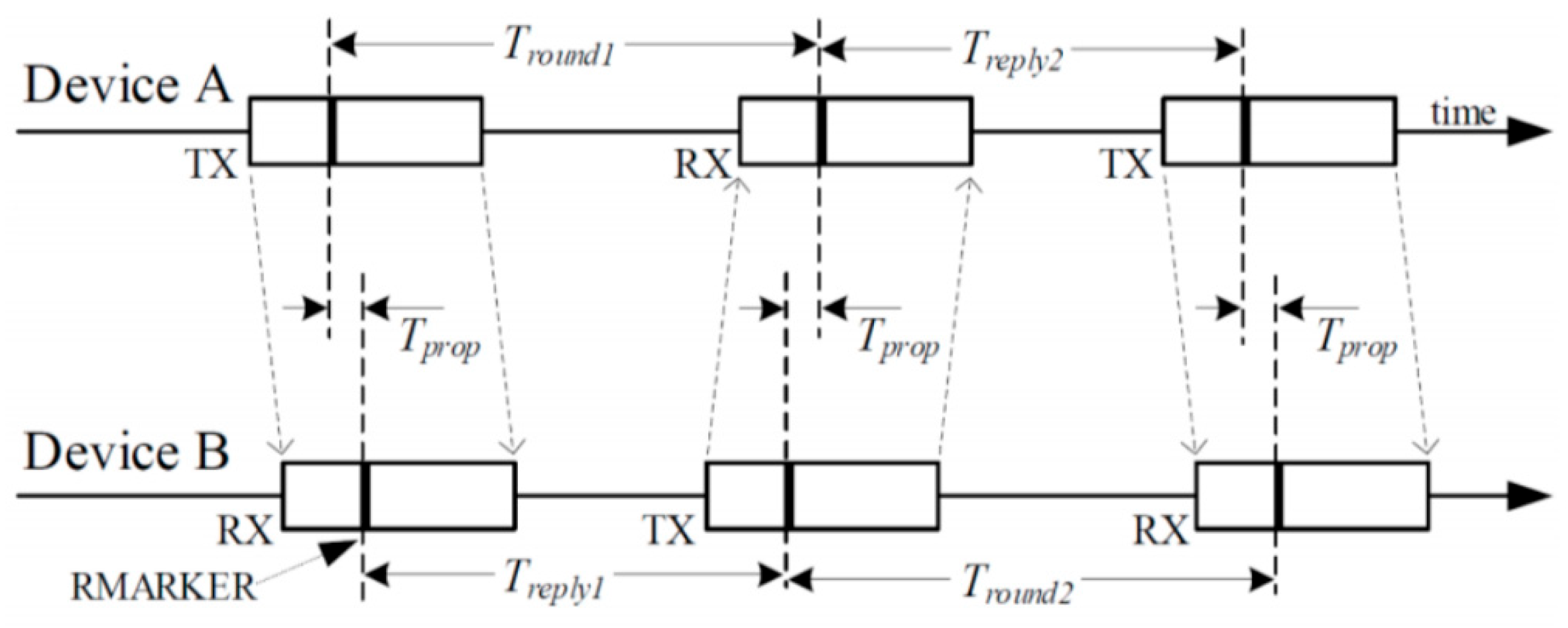
The core ranging mechanism of the UWB sensor used in this study is double-sided two-way ranging (DS-TWR). This technique is an enhancement of single-sided two-way ranging (SS-TWR), which significantly improves the ranging accuracy by adding a signal interaction process so that the time measurements of two independent communications can compensate each other for the errors caused by the clock offset between the devices. Its working principle is shown in Figure 2, and the calculation Formula (1) is:
R   =   c   ×   T prop =   c   ×   T round 1 × T round 2 T reply 1 × T reply 2 T round 1 + T round 1 + T reply 1 + T reply 2
The communication node contains the base station and the localisation tag, taking node A as an example, R is the spatial distance between the two;   T prop   is the one-way travel time of the electromagnetic wave in the medium; c takes the value of the vacuum speed of light (3 × 10⁸ m/s); time is the time axis; and   T round 1 is the total time that the base station sends and receives pulses in the first round of communication;   T reply 1 is the waiting time of the positioning tag in the first round of communication;   T round 2   is the total time that the positioning tag sends and receives pulses in the second round of communication; and T reply 2 is the waiting time of the base station in the second round of communication.

2.3. Inertial Navigation Ranging Principle

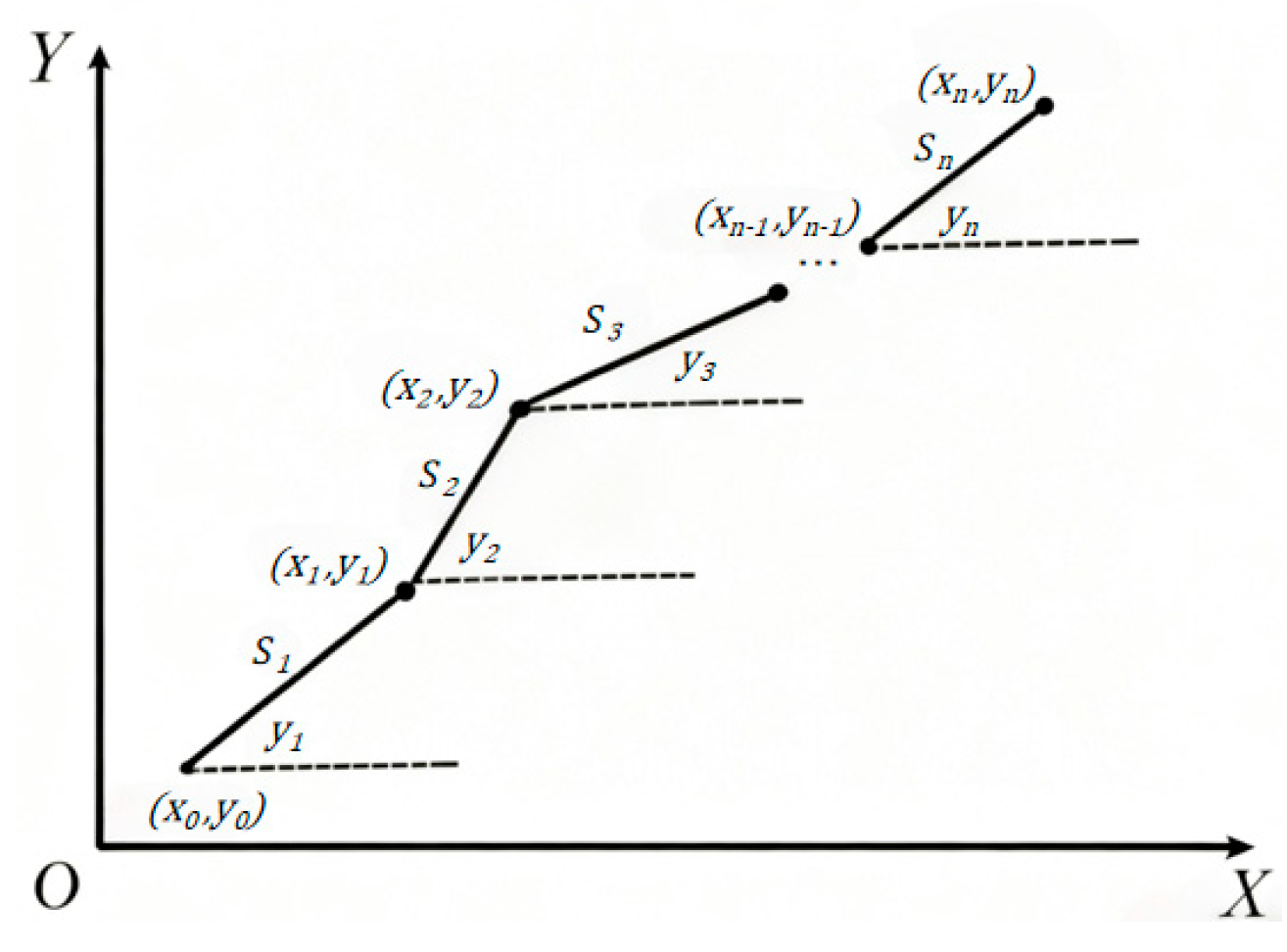
The Inertial Measurement Unit (IMU) used in this study has a core positioning mechanism of dead reckoning (DR). The kinematic parameters are converted into displacement changes using time integration operations to achieve autonomous relative ranging. The working principle is shown in Figure 3.
Known initial coordinates are (x0, y0), the first step heading angle is y1, the first step length is S1, according to the geometric relationship to obtain the displacement component in the X, Y direction, namely
x 1 = x 1 + S 1 s i n y 1 y 1 = y 1 + S 1 c o s y 1
Then the final position of the tester after walking n steps can be expressed as:
x n = x 0 + i = 1 n S i c o s y 1 y n = y 0 + i = 1 n S i s i n y 1

2.4. Combined UWB/Inertial Navigation Strategy

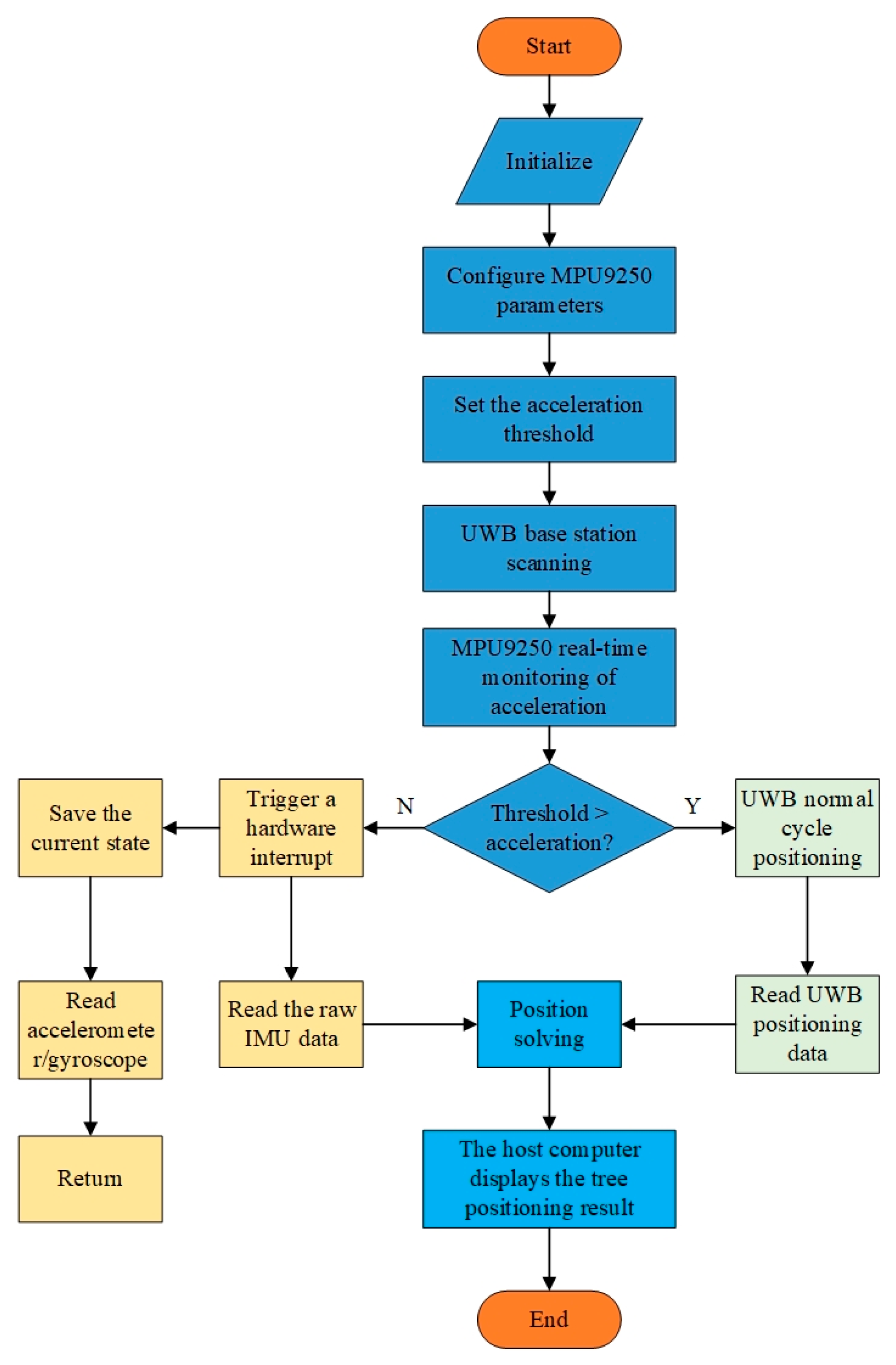
In tree localisation applications, human motion is inherently non-uniform, accompanied by small acceleration changes (e.g., walking, waving hands, flinging arms, etc.). This strategy makes full use of this feature by setting a key adjustable acceleration change threshold. When the detected acceleration change is less than this threshold, the MPU9250 Inertial Measurement Unit (IMU) will immediately generate a hardware interrupt signal to be sent to the main controller, and the fusion algorithm will significantly increase the weight of the IMU data during the period when the acceleration change is less than this threshold. The high-frequency characteristics of the IMU are utilized to perform a short time dead reckoning to dominate the calculation of the current position, in order to overcome the problem of random errors that occur when the UWB is stationary. After resuming the motion, the weights are gradually restored and the UWB data are dominated again to correct the accumulated error of the IMU. The general flow of the software is shown in Figure 4. Equation (4) is calculated as:
w I M U = m i n 1 , w b a s e + k e λ ( 1 Δ a α )                                                                                   w U W B = 1 w I M U
where   w I M U   denotes the weight of IMU data in the fusion result at the current moment; w U W B denotes the weight of UWB data in the fusion result at the current moment; w b a s e   (base weight) is the baseline weight of IMU.
Δ a is the amount of acceleration change measured by the IMU, reflecting the degree of motion intensity; α is the acceleration change threshold, when Δ a < α, it is judged as low speed/stationary state; k (gain coefficient) is the maximum weight enhancement amplitude of the control IMU at stationary; λ (decay rate) is the sensitivity of the control weights with the change in acceleration, the larger it is, the faster the IMU weights will drop when the motion is recovered.
The formula for the final position is
P f u s i o n = w I M U P I M U + w U W B P U W B
where   P f u s i o n   is the final fusion position;   P I M U is the position calculated by dead reckoning; P U W B is the absolute position measured by UWB.

2.5. Determination of Dimensional Accuracy Limitations Post-Calibration

After completing UWB/IMU calibration, dimensional accuracy limitations (X/Y/Z axes) are determined through three core steps:

2.5.1. Static Test for Short-Range Limitations

In an open area, set a 10 m × 10 m grid with 9 calibration points (spacing 5 m). Place the mobile station at each point (static for 5 min) to collect 100 fusion datasets; use a laser rangefinder (±0.1 cm accuracy) as the reference.
Compute axis-specific BIAS (average deviation) and RMSE. Post-calibration, short-range limitations are defined as: X/Y-axis RMSE < 3 cm, Z-axis RMSE < 5 cm. For example, if X-axis RMSE = 2.8 cm, this is the minimum achievable error in static scenarios (e.g., tree standing measurement).

2.5.2. Dynamic Test for Long-Range Limitations

Simulate forest walking (0.5–1 m/s) in a 50 m × 50 m field with 20 dynamic points; use a total station (±0.5 cm accuracy) for reference.
Fit a cumulative error model (e.g., X-axis error = 0.02 × distance + 2.8 cm). Long-range limitations are the maximum error at 50 m (e.g., 10.5 cm for X-axis), representing the upper error bound in mobile surveys.

2.5.3. Environmental Correction for Boundary Limitations

Test in three scenarios (open/sparse/dense forest) with varying humidity (60%–90%) and leaf water content (55%–85%).
Introduce an environmental factor k (1.0 for open areas, 1.5 for dense forests). Dimensional limitations = k × basic limitations (e.g., X-axis limitation = 1.5 × 2.8 cm = 4.2 cm in dense forests). Exceeding k = 1.5 (e.g., humidity > 95%) means accuracy cannot be guaranteed (Ed > 50 cm).

3. Results and Analyses

3.1. Experimental Preparation

To ensure the test results fully reflect the equipment’s applicability in complex forest environments, the selection of 12 test plots adhered to three core principles: “gradient coverage, complementary types, and randomized verification”. The specific selection criteria, replication design, and randomization methods are as follows:

3.1.1. Core Criteria for Plot Selection

Gradient Coverage of Forest Structure
Age Structure: The plots encompass even-aged stands (eight baseline plots) and uneven-aged mixed forests (four newly added plots). The even-aged stands primarily consist of trees aged 5–25 years; mixed-age stands comprise three age classes: young trees (DBH 5–10 cm), middle-aged trees (DBH 10–25 cm), and mature trees (DBH > 25 cm). Age class proportions follow common natural forest structures (e.g., 3:4:3 and 4:3:3), validating the device’s spatial positioning accuracy for trees across different age groups.
Forest Density Gradient: Four plots each were established for sparse stands (inter-tree spacing > 3 m, no canopy overlap), medium-density stands (inter-tree spacing 2–3 m, partial canopy overlap), and high-density stands (inter-tree spacing < 2 m, dense canopy overlap). Within each density level, two plots represented even-aged stands and two represented uneven-aged stands to avoid result biases caused by “single density”.
Species Composition: Includes pure stands (e.g., pure camphor stands or pure ginkgo stands) and mixed stands (3–4 species, e.g., soapberry, magnolia, and cedar). Species selection references typical forest types in Lin’an District, Zhejiang Province (based on the 2024 Zhejiang Forest Resources Inventory Report), ensuring experimental scenarios align with actual forestry survey conditions.
Terrain Condition Control
Stand Density Gradient: Four plots were established for each density category: sparse (inter-tree spacing > 3 m, no canopy overlap), medium density (inter-tree spacing 2–3 m, partial canopy overlap), and high density (inter-tree spacing < 2 m, dense canopy overlap). Within each density category, two plots comprised even-aged stands and two comprised uneven-aged stands to avoid bias from “single-density” results.
Representativeness of Interference Factors
Tree species composition: Includes pure stands (e.g., pure camphor stands or pure ginkgo stands) and mixed stands (3–4 species mixed, e.g., soapberry, magnolia, and cedar). Tree species selection references typical forest types in Lin’an District, Zhejiang Province, ensuring experimental scenarios align with actual forestry survey conditions.

3.1.2. Replication and Randomization Design

Repetitive Design
Repeated verification under identical conditions: For six core combinations—including “even-aged forest-low slope-medium density” and “uneven-aged forest-medium slope-high density”—two replicate plots were established for each combination (e.g., Plot 1 and Plot 3 both represent “even-aged mixed forest-low slope-medium density” and “low slope-medium density”, while plots 9 and 11 both represent “mixed-age mixed forest-medium slope-high density”). This replication design minimizes random errors (e.g., those arising from variations in individual tree distribution).
Plot size standardization: Square plots were uniformly set at 10 m × 10 m, while circular plots were uniformly set at 10 m diameter (approximately 78.5 m2). This ensured comparable survey areas across different plot shapes, mitigating the impact of “area differences” on individual tree measurement time and positioning accuracy.
Randomization Method
Site Selection Randomization: Within Lin’an District, Zhejiang Province (Longitude 119°43′–119°45′ E, Latitude 30°15′–30°17′ N), candidate areas (approximately 5 km2) meeting the criteria of “slope 3.2–18.9°, altitude 150–250 m, and distant from disturbance sources” (approximately 5 km2). Using the “random coordinate generation method”, 20 candidate plot coordinates were generated within this area. Ultimately, 12 plots satisfying “structural gradient coverage” were selected to avoid bias from human selection.
Randomized Measurement Sequence: For trees within each plot, measurement numbers were generated using a random number table (e.g., Excel (v2019)’s RAND function) rather than following a fixed order like “near to far” or “large to small”. This approach eliminated “measurement sequence-induced operator fatigue errors” (e.g., non-standardized procedures arising from fatigue during later measurements).

3.2. Base Station Deployment and Testing Process

Measurement of the sample tree location includes two phases: base station deployment and measurement.

3.2.1. Base Station Deployment

  • Fix the four UWB modules on the top of the bracket and connect them to the mobile power supply, and assemble them into communication nodes A, B, C, and D.
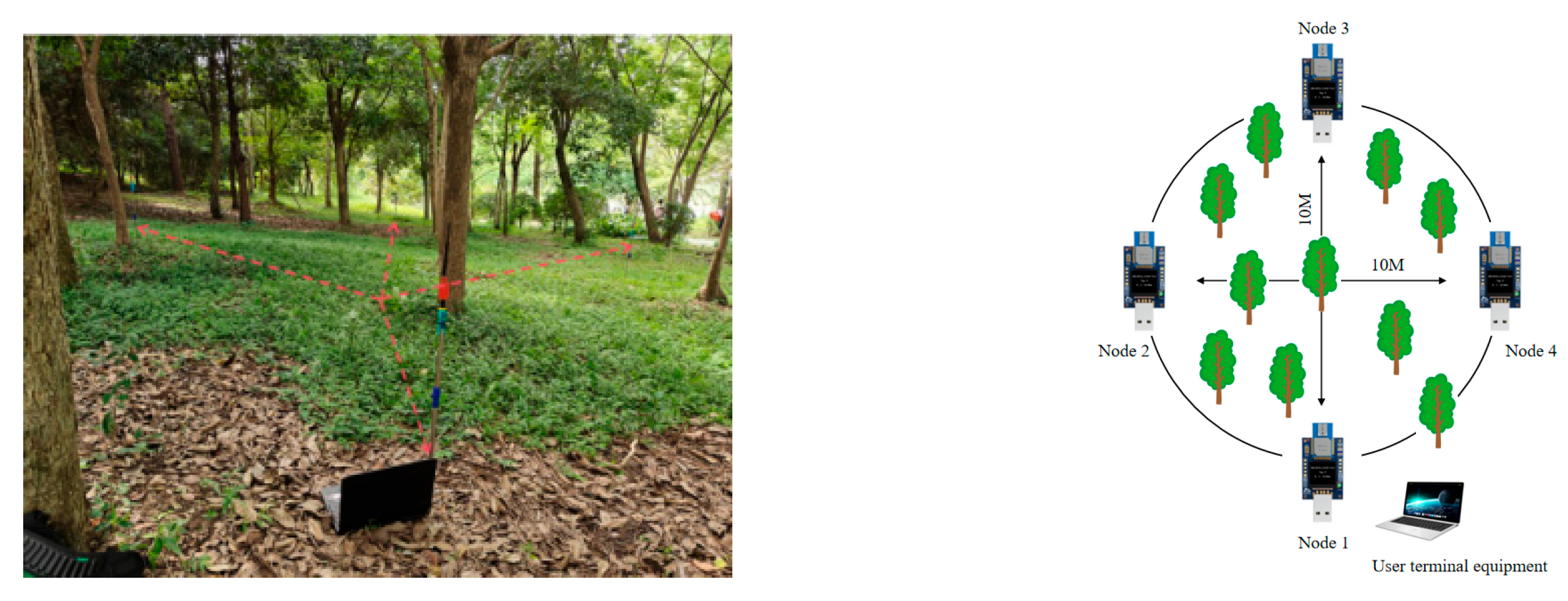
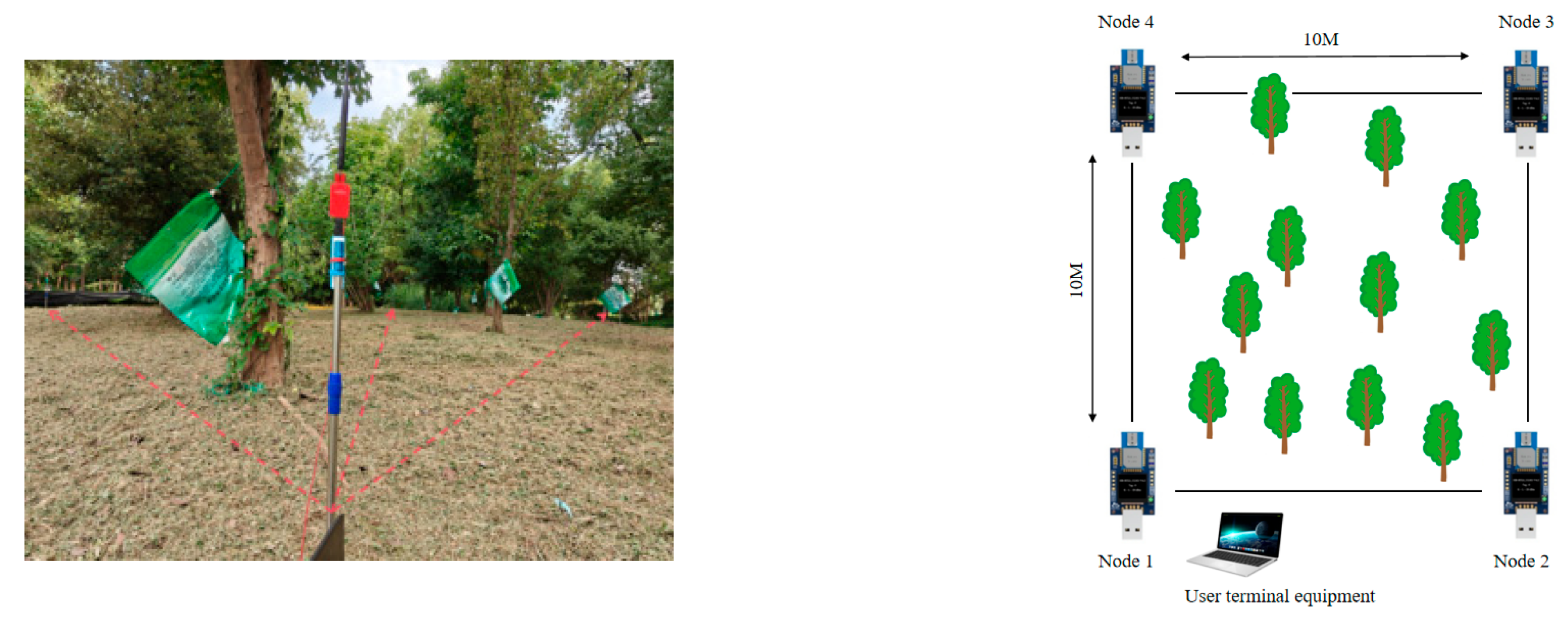
  • Place the four communication nodes at the four vertices of the square sample plot and record the altitude and do the same for the circular sample plot. As shown in Figure 5 and Figure 6.

3.2.2. Testing Process

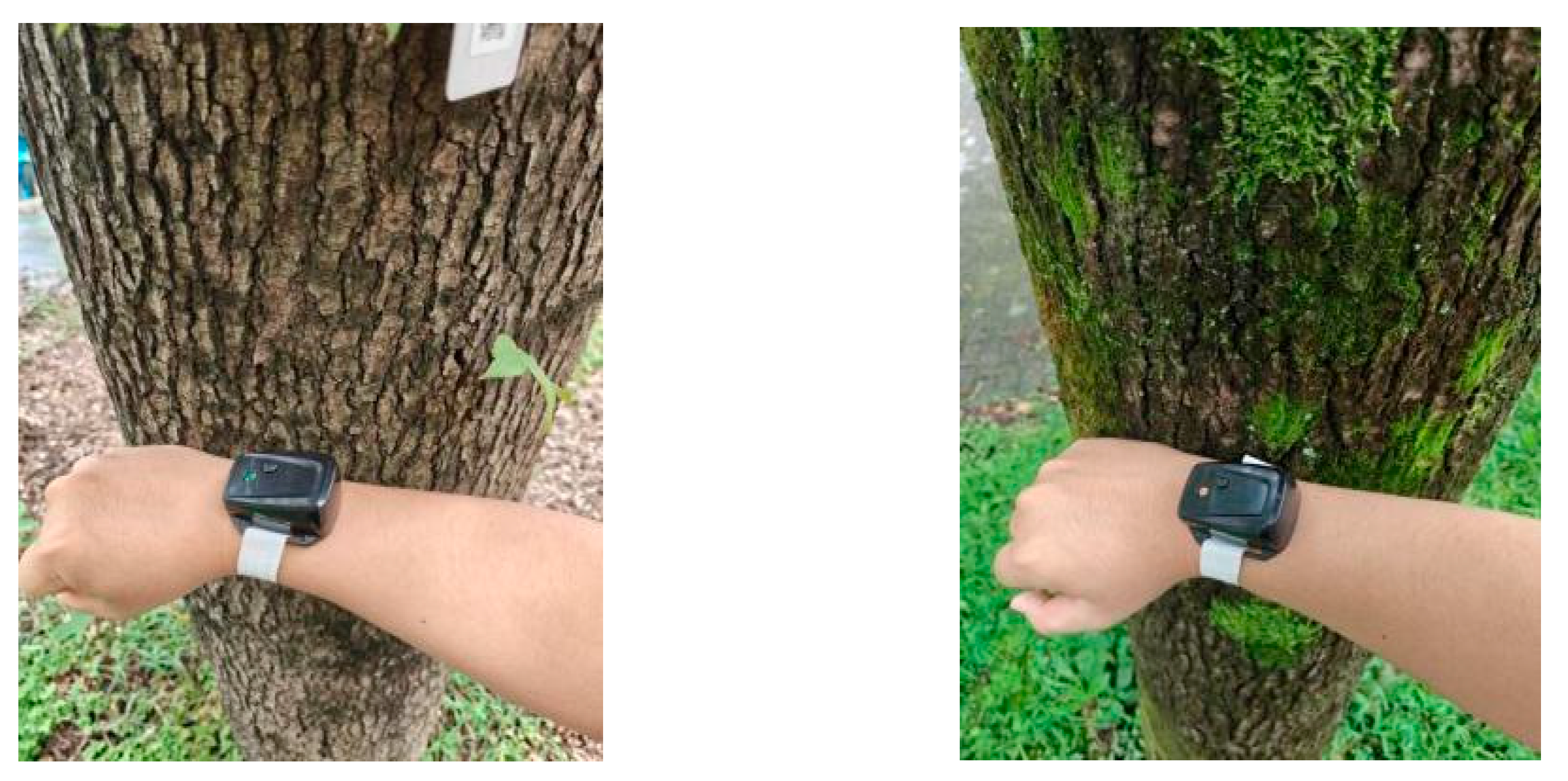
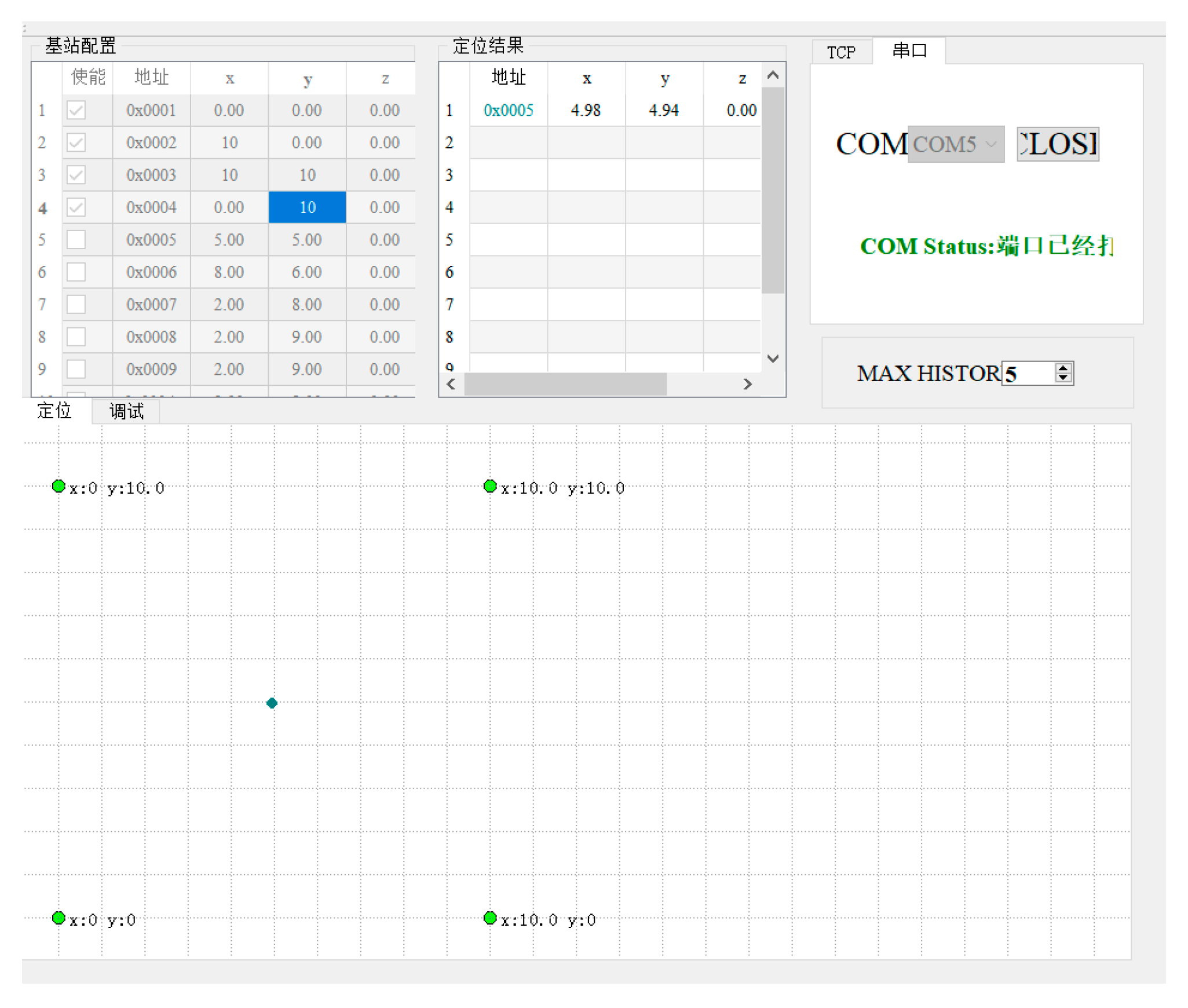
The surveyor moves to the target tree with the mobile positioning device in hand, puts the mobile positioning device close to the trunk of the tree 1.5 m above the ground as shown in Figure 7, waits for the device to complete the positioning calculation, and completes the measurement of all trees in the forest stand according to the numbering sequence. All data are transmitted back to the host computer in real time through the serial transmission protocol, as illustrated in Figure 8, the operator can monitor the positioning data directly in the terminal interface.

3.3. Tree Location Accuracy Assessment

In order to assess the accuracy of UWB tree positioning, this paper uses the tree positions obtained from the slope correction of the 100 m ruler, the angle ruler, and the joint breast diameter calculation as its reference value. Equations (6)–(8) are used to calculate the bias of the positioning system (BIAS), the root mean square error (RMSE), and the straight-line distance error between the estimated point and the reference point, respectively, so as to achieve the multi-dimensional quantitative assessment of the positioning accuracy.
BAIS = i   = 1 n d i D ir n
RMAS = i   = 1 n d i   -   D ir 2 n
Ed = X i X ir 2 + Y i Y ir 2
where d i represents the ith measurement value, D ir represents the ith reference value, n represents the total number of measurements; X ir and Y ir represents the ith reference value in the direction of X-axis and Y-axis, respectively.

4. Analysis of Results

4.1. Accuracy of Tree Locations

The results of the experimental data analysis showed that the tree coordinate positioning accuracy of the 12 test sample sites was assessed as shown in Table 3. By comparing the measured and estimated positions, the systematic deviations in the X-axis and Y-axis directions were −1.54 cm and 1.27 cm, respectively, and the root mean square errors of positioning were 21.34 cm and 23.93 cm, respectively (Table 3). The statistical analysis of the error (Ed) of the straight-line distance between the sample plots (Table 4) showed that the overall mean error was 26.23 cm, the maximum error was 76.52 cm, the minimum error was 2.83 cm, the standard deviation of the error was 13.28 cm, and there was no significant correlation between the error values.
From the distribution of plane coordinate errors (Table 4), the Ed values of all sample plots were distributed in the range of 0~77 cm. Although a certain systematic error exists in all sample plots, the overall error is kept at a low level. Further analysis revealed that the average Ed of sample plots 1–4 was 24.35 cm, while the average Ed of sample plots 5–8 was 27.87 cm, indicating that the positioning errors of sample plots with larger terrain slopes or higher tree densities may be slightly increased.
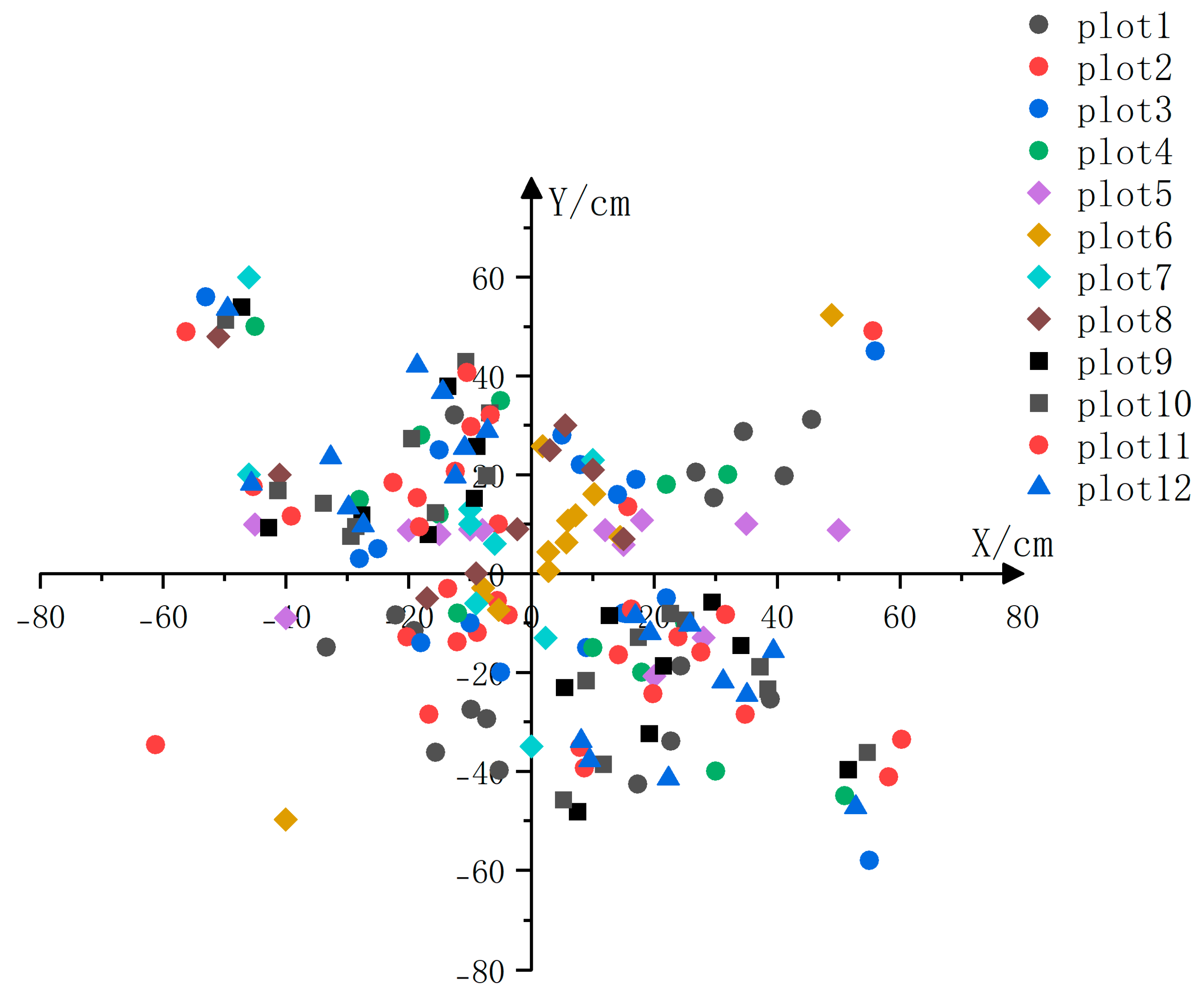
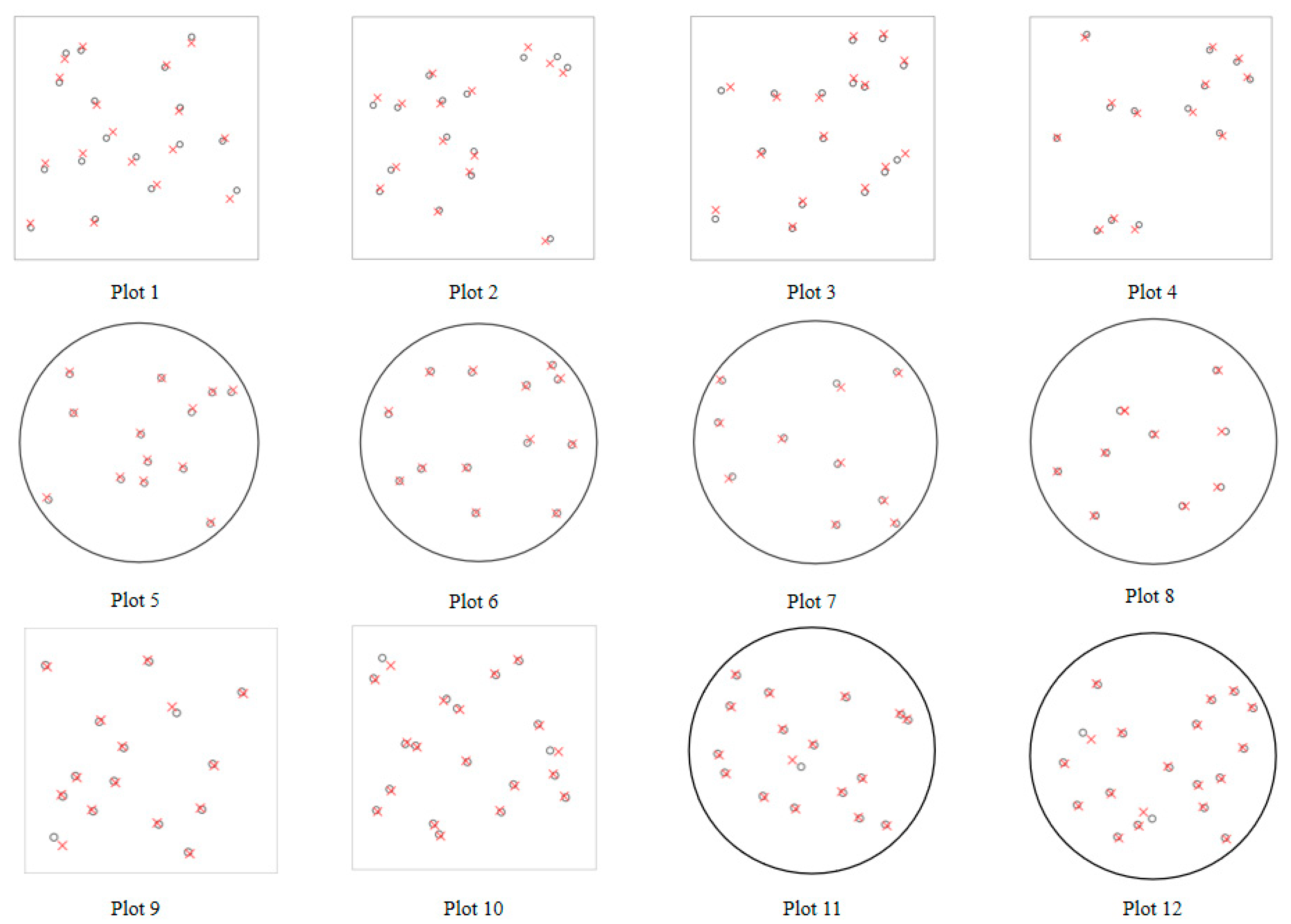
The positioning accuracy of the four newly added uneven-aged mixed forest plots was satisfactory: X-axis BIAS −4.05~1.87 cm, RMSE 19.93~25.51 cm; Y-axis BIAS −4.88~1.92 cm, RMSE 22.89~27.36 cm. This is basically consistent with that of the existing even-aged forest plots (X-axis BIAS −8.20~9.81 cm, RMSE 15.52~28.22 cm; Y-axis BIAS −7.53~8.84 cm, RMSE 18.81~31.52 cm). Only the uneven-aged forests on medium to high slopes (e.g., Plot 10, slope 12.8°) showed slightly higher RMSE, which is presumed to be due to increased multipath reflection of the UWB signal caused by the canopy of mature trees. In terms of straight-line distance error (Ed), the mean Ed of uneven-aged plots was 24.67~28.74 cm (Figure 9), close to the overall mean of 26.15 cm, detailed statistical data on Ed for each sample site are presented in Table 5. The maximum error of 72.51 cm (Plot 10) did not exceed the maximum error of the original plots, 76.52 cm (Plot 2), as shown in Figure 10, comparison of tree position measurements and estimates, demonstrating that the device maintains stable accuracy even in uneven-aged mixed forest scenarios.

4.2. Efficiency of Positional Measurement

During the experiment, in order to ensure the consistency of data collection, the researchers numbered all sample trees uniformly before the implementation of the two measurement methods. In the measurement session of UWB technology, a single person operation mode was adopted to realize the simultaneous completion of distance measurement and data recording; while the traditional tape measure measurement required the cooperation of two persons to complete the X/Y-axis distance measurement of the sample trees, and a special person was arranged to be responsible for the on-site recording, and the subsequent data transcription work was also required. The study included the whole process time including equipment setup, moving between sample trees, and data processing into the statistics. Data analysis showed that: UWB technology, due to its automatic acquisition function, reduced the single-plant measurement time to 20.89 s; in comparison, the single-plant operation time for traditional tape measurements amounted to 68.56 s. Detailed comparison data are shown in Table 6.

4.3. Specific Drawbacks of UWB/IMU Fusion Methods Under Environmental Factors

The UWB/IMU fusion tree localization method relies on the synergistic interaction between electromagnetic signal transmission (UWB) and motion state sensing (IMU). However, its performance is significantly constrained by environmental factors such as humidity, leaf water content, and terrain undulations. Specific drawbacks and failure scenarios are detailed below:

4.3.1. Impact of Humidity

1.
UWB signal propagation delay caused by high atmospheric humidity
In the experimental area (Lin’an District, Hangzhou City), the average relative atmospheric humidity during the measurement period was 75%–85%, and the maximum humidity on rainy days reached 92%. High humidity will increase the dielectric constant of the air: the dielectric constant of the atmosphere at 25 °C and 60% humidity is about 1.005, while it rises to 1.012 at 90% humidity. This change causes the UWB signal propagation speed to decrease by 0.7%–1.2%, resulting in a ranging error when the distance between the base station and the mobile station is 10 m, the ranging error increases by 7–12 cm (verified by comparing UWB data under 60% and 90% humidity in the same area). On rainy days when the humidity exceeds 90%, UWB modules often experience signal frame loss (frame loss rate > 15%, while <3% under normal humidity). This is due to the condensation of water vapour on the surface of the module antenna to form a thin water film, which causes electromagnetic signal attenuation.
2.
IMU Static Drift Amplified by High Soil Humidity
In plots with high soil humidity (>30% volumetric water content, measured by a soil moisture sensor), the soft soil causes unstable standing postures of operators: when holding the mobile station to measure tree positions, the human body produces micro-swaying (amplitude 3–5 cm, frequency 0.5–1 Hz) that is not present in dry soil plots. The IMU (MPU9250) misinterprets this micro-motion as “intentional vertical displacement”, leading to cumulative vertical errors—after measuring 10 consecutive trees, the Z-axis error increases by 8–12 cm (compared to 5–7 cm in dry soil plots), and the static drift rate rises from 0.5 cm/min to 1.2 cm/min.

4.3.2. Impact of Leaf Water Content

1.
UWB Multipath Interference Intensified by High Leaf Water Content
The experimental plots included broad-leaved trees and coniferous trees, with leaf water content (LWC) ranging 55%–85%. High LWC (≥70%, typical of young leaves in June) increases the reflectivity of UWB signals: the signal reflection coefficient of leaves with 70% LWC is 0.35, while that of leaves with 55% LWC is only 0.18. This leads to multi-path signal superposition; in the 10 m × 10 m high-density plot (stand density > 15 trees/100 m2), the proportion of multi-path signals in UWB received signals rises from 15% (low LWC) to 40% (high LWC), resulting in X/Y-axis RMSE increasing by 4.2–6.8 cm. For coniferous trees with needle LWC ≥ 65%, the dense needle clusters form “signal barriers”, causing UWB signals to be reflected multiple times between needles before reaching the mobile station. This leads to ranging overestimation; the measured distance between the base station and mobile station is 5%–8% larger than the actual distance, and in severe cases, the fusion algorithm fails to identify valid UWB data, forcing the system to rely solely on IMU (resulting in Ed > 50 cm).
2.
MU Temperature Drift Induced by Leaf Canopy Shading
High leaf water content is often accompanied by dense canopies (canopy coverage > 70%), which reduce solar radiation reaching the ground. In such plots, the ambient temperature is 3–5 °C lower than in sparse canopy plots, and the temperature fluctuation range decreases from 4 °C to 1.5 °C. The IMU’s temperature-sensitive components (accelerometer, gyroscope) are affected by this stable low-temperature environment: the temperature drift error of the accelerometer increases from 0.01 m/s2/°C to 0.025 m/s2/°C [26], leading to horizontal positioning deviations—the X-axis BIAS shifts from −1.54 cm (sparse canopy) to −3.21 cm (dense canopy), and the RMSE increases by 2.8–3.5 cm.

5. Research Limitations

To improve the practicality and generalizability of the device, the following limitations should be addressed in future studies:
  • Geographical and climatic restrictions: All tests were conducted in subtropical low-altitude forests (Lin’an District). Performance in temperate coniferous forests or high-altitude areas (>1000 m) remains untested, where low atmospheric pressure may affect UWB signal propagation [13].
  • Extreme weather resistance: The device has not been validated in typhoons (wind speed > 25 m/s) or heavy snow, where base station displacement or antenna coverage could cause severe positioning failures [33].
  • Battery and data compatibility: Short battery life (7.6 h) and lack of direct integration with forest GIS platforms (e.g., ArcGIS (v10.8)) limit large-scale application efficiency.

6. Conclusions

(1)
The multi-sensor fusion tree positioning equipment developed in this study enables the rapid and convenient measurement of tree positions, providing new ideas and methods for rapid measurement of tree spacing and positional relationship analysis in sample plots. The validation of four new groups of uneven-aged mixed forests shows that the device can adapt to complex forest stands with heterogeneous stand ages and diameters at breast height (DBH) spanning from 5 to 52 cm (the original maximum is 45 cm), further expanding the application scenarios of the technology. This adaptability to heterogeneous stands addresses the limitation of single-sensor technologies (e.g., pure UWB or IMU) that struggle to cope with diverse stand structures, as highlighted in previous studies on forest positioning [29,33]. Specifically, Zhang et al. (2025) noted that single-sensor solutions often fail to balance accuracy, whereas multi-sensor fusion can effectively mitigate this issue [33].
(2)
In terms of positioning accuracy, the UWB/IMU fusion solution has significant advantages, especially when compared with the pure UWB tree positioning technology proposed by Siqing Zheng et al. (2020) [22]. Zheng’s team conducted experiments in eight even-aged mixed forest plots, and their results showed that the average biases (BIAS) of tree position estimates in the X-axis and Y-axis directions were 0.99 cm and −3.78 cm, respectively; the root mean square errors (RMSE) were 19.86 cm and 23.44 cm, respectively; and the average straight-line distance error (Ed) of the eight plots was 27.43 cm, with a maximum of 84.07 cm and an average standard deviation of 13.93 cm [22]. In contrast, in the eight basic even-aged forest plots of this study, the X-axis BIAS was −1.54 cm, Y-axis BIAS was 1.27 cm; absolute values of biases were closer to 0, indicating smaller systematic errors than Zheng’s study. Although the X-axis RMSE (21.34 cm) in this study is slightly higher than Zheng’s 19.86 cm, the Y-axis RMSE (23.93 cm) is basically comparable to their 23.44 cm. More importantly, the average Ed of the eight basic even-aged plots in this study is 26.23 cm (lower than Zheng’s 27.43 cm), and the maximum Ed (76.52 cm) is significantly lower than their 84.07 cm, with a more concentrated error distribution. For the 12 test plots (including 8 original plots and 4 uneven-aged mixed forest plots), the overall X-axis BIAS ranges from −1.54 cm to −1.82 cm, Y-axis BIAS from 1.27 cm to 1.63 cm, X-axis RMSE from 21.34 cm to 24.51 cm, and Y-axis RMSE from 23.93 cm to 26.72 cm. The average Ed of the 12 plots is 26.87 cm, with a maximum error of 76.52 cm and a minimum of 2.83 cm. Compared with Zheng’s pure UWB scheme, the stability of this device is significantly improved, which is attributed to the dynamic weight fusion algorithm; when UWB signals are occluded (e.g., by dense branches and leaves in high-density stands), the algorithm increases the weight of IMU to compensate for UWB static errors, while using UWB to dynamically correct IMU cumulative errors, effectively solving the problem of large error fluctuations in pure UWB technology.
(3)
Terrain slope and tree density have a certain impact on positioning accuracy, and this effect is more pronounced in uneven-aged mixed forest plots: the average Ed of the four uneven-aged mixed forest samples (slope 15.6°~22.5°, plant spacing 2~3.5 m) is 3.16 cm higher than that of the original low slope homogeneous stand (slope 3.2°~12.3°), which is presumed to be due to the large shading area of the trunks of the old trees and the staggering of young trees’ crowns, resulting in the increase in UWB signal reflection. It is assumed that the large shading area of old-growth tree trunks and the interlacing of young-growth tree canopies resulted in an increase in the reflection of UWB signals. Meanwhile, it is also necessary to adjust the spacing of the base station in the high-density uneven-aged forests (currently at 10 m), so as to improve the adaptability of the device.
(4)
In the single-operator mode, the measurement time per tree is only 20.89 s, which is significantly more efficient than the traditional tape measure method (68.56 s per tree). The efficiency improvement is mainly due to automated data collection and processing, avoiding tedious manual recording and transcription. This aligns with the efficiency requirements of modern forest resource surveys, as Fan et al. (2018) [9] pointed out that rapid measurement technologies are essential for large-scale forest censuses, and manual methods (e.g., tape measures) can no longer meet the demand for timely data acquisition.
(5)
With regard to the adaptability of sample plots, the equipment can complete the data collection of round and square sample plots as well as the newly added uneven-aged mixed forest sample plots, the different shapes of the same plot and the structure of the forest stand do not have a significant effect on the positioning accuracy, the compatibility design significantly expands the application scenarios, and it can be adapted to sample plots setup with different survey specifications, thus providing a more flexible technological solution for the forest resources census.
(6)
Analysis of interference factors in uneven-aged mixed forest samples shows that understory vegetation cover and tree trunk shading contribute approximately 18.7% to positioning errors (15.2% in homogeneous forests). However, the dynamic weight fusion algorithm compensates for UWB signal loss by adjusting IMU weights (from 0.3 to 0.6 in static state), controlling error increase within 10%. This anti-interference ability is critical for practical forest surveys, as Wang et al. (2025) [29] emphasized that environmental interference (e.g., vegetation cover and terrain undulation) is unavoidable in real forests, and algorithms with adaptive interference mitigation are key to ensuring measurement reliability. Compared with Zheng et al.’s, (2020) [22] pure UWB technology, which is highly sensitive to signal occlusion, the proposed algorithm’s anti-interference performance further confirms its practical value.

Author Contributions

Conceptualization, Z.C.; methodology, L.F. and L.S.; formal analysis, A.X.; investigation, Z.C.; data curation, H.Y. and L.F.; writing—original draft preparation, Z.C.; writing—review and editing, L.S., L.F. and H.Y. All authors have read and agreed to the published version of the manuscript.

Funding

This research was financially supported by the National Natural Science Foundation of China (No. 42001354), the Zhejiang Provincial Key Science and Technology Project (Grant No.: 2018C02013), the Zhejiang University Student Science and Technology Innovation Activity Plan (New Seedling Talent Plan Subsidy Project, 2024R412B048), and Zhejiang A&F University Research and Development Fund (2023LFR099).

Data Availability Statement

Dataset available on request from the authors.

Conflicts of Interest

The authors declare no conflicts of interest.

References

  1. Zhang, H.R.; Lei, X.D.; Li, F. Research progress and prospects of forest management science in China. Sci. Silvae Sin. 2020, 56, 130–142. [Google Scholar]
  2. Smith, W.B. Forest inventory and analysis: A national inventory and monitoring program. Environ. Pollut. 2002, 116, S233–S242. [Google Scholar] [CrossRef]
  3. Xu, W.; Fei, G.; Du, H. Application and precision analysis of several surveying methods in forest resources survey. J. Zhejiang For. Coll. 2009, 26, 132–136. [Google Scholar]
  4. Liu, J.; Khan, T.U.; Nie, Z.; Yu, Q.; Feng, Z. Calibration and precise orientation determination of a gun barrel for agriculture and forestry work using a high-precision total station. Measurement 2021, 173, 108494. [Google Scholar] [CrossRef]
  5. Mak, N.P.L.; Siu, T.Y.; Law, Y.K.; Zhang, H.; Sui, S.; Yip, F.T.; Ng, Y.S.; Ye, Y.; Cheung, T.C.; Wa, K.C.; et al. Mapping Individual Tree-and Plot-Level Biomass Using Handheld Mobile Laser Scanning in Complex Subtropical Secondary and Old-Growth Forests. Remote Sens. 2025, 17, 1354. [Google Scholar] [CrossRef]
  6. Zhou, H.; Mao, Q.; Wu, A.; Zhang, X.; Wei, Y.; Shi, Y. Beam vector model: A more applicable calibration method for terrestrial laser scanner. Measurement 2025, 254, 117814. [Google Scholar] [CrossRef]
  7. Liang, X.; Litkey, P.; Hyyppa, J.; Kaartinen, H.; Vastaranta, M.; Holopainen, M. Automatic stem mapping using single-scan terrestrial laser scanning. IEEE Trans. Geosci. Remote Sens. 2011, 50, 661–670. [Google Scholar] [CrossRef]
  8. Tian, Y. Application of Long Range Airborne LiDAR in Mapping High-density Vegetation Terrain in Mountainous Areas. Int. Core J. Eng. 2025, 11, 403–413. [Google Scholar]
  9. Fan, Y.; Feng, Z.; Mannan, A.; Khan, T.U.; Shen, C.; Saeed, S. Estimating tree position, diameter at breast height, and tree height in real-time using a mobile phone with RGB-D SLAM. Remote Sens. 2018, 10, 1845. [Google Scholar] [CrossRef]
  10. Hong, C.K.; Bae, T.S.; Kwon, J.H. An overview of a special issue on upcoming positioning, navigation, and timing: GPS, GLONASS, Galileo and BeiDou. Remote Sens. 2022, 14, 1982. [Google Scholar] [CrossRef]
  11. Jiang, S.; Zong, Q.; Deng, X. Application analysis of GPS positioning technology and GIS based on metamaterial in forestry engineering. E3S Web Conf. 2019, 118, 03059. [Google Scholar] [CrossRef]
  12. Dempster, A.G.; Cetin, E. Interference localization for satellite navigation systems. Proc. IEEE 2016, 104, 1318–1326. [Google Scholar] [CrossRef]
  13. Kiliszek, D. GPS and Galileo Precise Point Positioning Performance with Tropospheric Estimation Using Different Products: BRDM, RTS, HAS, and MGEX. Remote Sens. 2025, 17, 2080. [Google Scholar] [CrossRef]
  14. Oveland, I.; Hauglin, M.; Gobakken, T.; Næsset, E.; Maalen-Johansen, I. Automatic estimation of tree position and stem diameter using a moving terrestrial laser scanner. Remote Sens. 2017, 9, 350. [Google Scholar] [CrossRef]
  15. Pang, J.; Zhu, F.; Wu, S. Differential Code Bias Estimation and Accuracy Analysis Based on CSES Onboard GPS and BDS Observations. Remote Sens. 2025, 17, 374. [Google Scholar] [CrossRef]
  16. Chen, S.; Gao, W.; Li, M.; Jin, B. Single frequency service performance of BDSBAS: Models and assessment. GPS Solut. 2025, 29, 89. [Google Scholar] [CrossRef]
  17. Geng, T.; Yan, K.; Xie, X.; Zhang, C.; Zhang, F.; Wang, X.; Chen, H.; Zhao, Q.; Liu, J. Two strategies to estimate inter-satellite link hardware delays in BDS-3 precise orbit and clock determination: Comparison and cross-check. J. Geod. 2025, 99, 55. [Google Scholar] [CrossRef]
  18. Kram, S.; Stahlke, M.; Feigl, T.; Seitz, J.; Thielecke, J. UWB channel impulse responses for positioning in complex environments: A detailed feature analysis. Sensors 2019, 19, 5547. [Google Scholar] [CrossRef]
  19. Zhu, Y.; Huang, L.; Liu, J.; Cao, Z.; Chen, J.; Mu, Z. A Real-Time UWB Location and Tracking System Based on TWR-TDOA Estimation and a Simplified MPGA Layout Optimization. Mob. Inf. Syst. 2022, 2022, 1194169. [Google Scholar] [CrossRef]
  20. Liu, M.H.; Zhang, S.; Pan, Y. Uwb-based real-time 3d high precision localization system. J. Phys. Conf. Ser. 2022, 2290, 012082. [Google Scholar] [CrossRef]
  21. Li, S.; Fang, L.; Sun, Y.; Xia, L.; Lou, X. Development of measuring device for diameter at breast height of trees. Forests 2023, 14, 192. [Google Scholar] [CrossRef]
  22. Zheng, S.; Fang, L.; Sun, L.; Zheng, X.; Liu, J. Research on Tree Location Based on UWB Sensors. For. Grassl. Resour. Res. 2020, 2, 103. [Google Scholar]
  23. Wang, Z.M.; Zheng, Y. The study of the weighted centroid localization algorithm based on RSSI. In Proceedings of the 2014 International Conference on Wireless Communication and Sensor Network, Wuhan, China, 13–14 December 2014; pp. 276–279. [Google Scholar]
  24. Carpi, F.; Martalò, M.; Davoli, L.; Cilfone, A.; Yu, Y.; Wang, Y.; Ferrari, G. Experimental analysis of RSSI-based localization algorithms with NLOS pre-mitigation for IoT applications. Comput. Netw. 2023, 225, 109663. [Google Scholar] [CrossRef]
  25. Zhou, F.; Lin, K.; Ren, A.; Cao, D.; Zhang, Z.; Rehman, M.U.; Yang, X.; Alomainy, A. RSSI indoor localization through a Bayesian strategy. In Proceedings of the 2017 IEEE 2nd Advanced Information Technology, Electronic and Automation Control Conference (IAEAC), Chongqing, China, 25–26 March 2017; pp. 1975–1979. [Google Scholar]
  26. Qing, Y.; Wang, L.; Zheng, Y. Installation Error Calibration Method for Redundant MEMS-IMU MWD. Micromachines 2025, 16, 391. [Google Scholar] [CrossRef]
  27. Liu, Y.; Zhang, Y.; Jiang, Y.; Liu, W.; Yang, F. UWB-INS fusion positioning based on a two-stage optimization algorithm. Teh. Vjesn. 2025, 30, 185–190. [Google Scholar]
  28. Zheleznov, V.M.; Kozlov, A.V.; Kuznetsov, A.G.; Molchanov, A.V.; Fomichev, A.V. Guaranteeng domains of sins instrumental errors. Teor. Sist. Upr. 2025, 2, 98–108. [Google Scholar]
  29. Wang, S.; Dai, P.; Xu, T.; Nie, W.; Cong, Y.; Xing, J.; Gao, F. Maximum Mixture Correntropy Criterion-Based Variational Bayesian Adaptive Kalman Filter for INS/UWB/GNSS-RTK Integrated Positioning. Remote Sens. 2025, 17, 207. [Google Scholar] [CrossRef]
  30. Guang, X.; Gao, Y.; Liu, P.; Li, G. IMU data and GPS position information direct fusion based on LSTM. Sensors 2021, 21, 2500. [Google Scholar] [CrossRef]
  31. Zhu, W.; Zhao, R.; Zhang, H.; Lu, J.; Zhang, Z.; Wei, B.; Fan, Y. Improved indoor positioning model based on UWB/IMU tight combination with double-loop cumulative error estimation. Appl. Sci. 2023, 13, 10046. [Google Scholar] [CrossRef]
  32. Deng, Z.; Luo, H.; Gao, X.; Liu, P. Fusion-Based Localization System Integrating UWB, IMU, and Vision. Appl. Sci. 2025, 15, 6501. [Google Scholar] [CrossRef]
  33. Zhang, Q.; Xu, X.; Shi, F.; Shu, L.; Wang, J. An integrated positioning method with IMU/UWB based on geometric constraints of foot-to-foot distances. Measurement 2025, 242, 115771. [Google Scholar] [CrossRef]
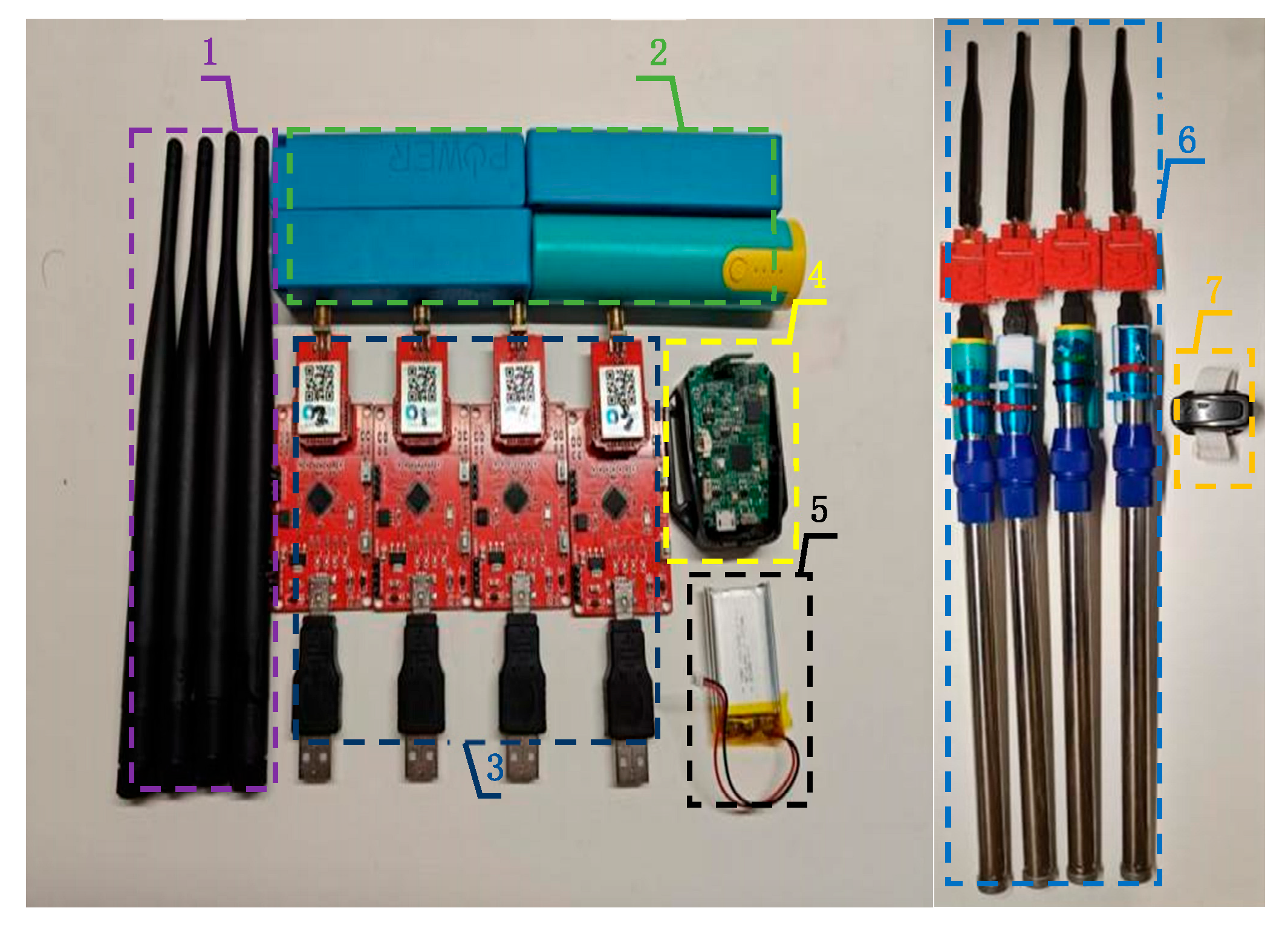
Figure 1. Main equipment and components: 1, antenna; 2, base station power supply equipment; 3, UWB base station; 4, hand-held tag; 5, lithium battery; 6, base station; and 7, mobile station.
Forests 16 01703 g001
Figure 2. Double-sided two-way ranging.
Forests 16 01703 g002
Figure 3. Inertial navigation ranging principle.
Forests 16 01703 g003
Figure 4. Work process.
Forests 16 01703 g004
Figure 5. Layout diagram of circular base stations.
Forests 16 01703 g005
Figure 6. Layout diagram of square base station.
Forests 16 01703 g006
Figure 7. Tree location measurement.
Forests 16 01703 g007
Figure 8. Upper computer display.
Forests 16 01703 g008
Figure 9. Errors in tree positions measured by the device.
Forests 16 01703 g009
Figure 10. Comparison of tree position measurements and estimates. Note: “×” denotes the original tree positions; “” denotes the estimated tree positions.
Forests 16 01703 g010
Table 1. Module parameters.
Main ComponentChip
Interface/Type
Interface TypeQuantityParameterFunction
MicroprocessorSTM32F103 (STMicroelectronics, Geneva, Switzerland)IO port, IIC, etc.5Flash: 128 KBData processing
Gyroscope moduleMPU9250 (TDK InvenSense, San Jose, CA, USA)Serial port19-axis data acquisitionOutput raw
sensor data
UWB moduleD-DWM-PG1.7 (Decawave, Dublin, Ireland)Serial port5measurement range: 0–400 mDistance
measurement
Batteryli-ion batteryStorage of electrical energy13000 mAPower supply
Rechargeable batteryTP4056, SY7088, li-ion battery (Seiko Instruments Inc., Tokyo, Japan)USB-A/USB-C45V/2AStorage of
electrical energy
Table 2. System Power Consumption Parameters (Full Battery Charge).
System
Component
ModulePower Consumption (Standby)Power Consumption (Working)Power Consumption (Data Transmission)Operating Time
Base stationUWB node
(1 unit)
0.15 W0.8 W1.2 W-
4 UWB nodes (total)0.6 W3.2 W4.8 W-
Antenna0.05 W0.05 W0.05 W-
Total base
station
0.65 W3.25 W4.85 W22 h (working state)/72 h (standby state)
Mobile stationUWB module0.1 W0.6 W0.9 W-
MPU9250 (TDK InvenSense, San Jose, CA, USA)0.08 W0.2 W0.2 W-
STM32F103 (STMicroelectronics, Geneva, Switzerland)0.05 W0.15 W0.2 W-
Handheld
display
0.2 W0.5 W0.5 W-
Total mobile station0.43 W1.45 W1.8 W7.6 h (working state)/25.8 h (standby state)
System total-1.08 W4.7 W6.65 W-
Table 3. Descriptive statistics of the sample plots.
Sample SizeNumber of Trees/PlantMain SpeciesSlope/(°)Stand TypeAge Group Structure (Young: Medium: Mature Wood)
117A1, A23.2even-aged mixed forest1:9:0
215A3, A55.7even-aged mixed forest0:9:1
316A4, A76.3even-aged mixed forest1:9:0
413A6, A812.3even-aged mixed forest1:9:0
515A1, A4, A68.1even-aged mixed forest0:1:9
614A2, A5, A713.8even-aged mixed forest1:9:0
710A3, A818.9even-aged mixed forest0:9:1
89A1, A3, A5, A79.3even-aged mixed forest1:9:0
915A1, A3, A67.5uneven-aged mixed forests3:4:3
1019A2, A5, A7, A811.2uneven-aged mixed forests4:3:3
1117A3, A4, A59.8uneven-aged mixed forests2:5:3
1220A4, A7, A813.1uneven-aged mixed forests3:4:3
Note: “A1” Sapindus, “A2” Camphor, “A3” Magnolia, “A4” Amaryllis, “A5” Ginkgo, “A6” Liriodendron, “A7” Cedar, and “A8” Magnolia.
Table 4. Table of accuracy of tree position estimates in XY direction.
Sample SizeX/cmY/cm
BIASRMSEBIASRMSE
1−8.2015.526.5218.81
29.8128.22−7.5331.52
3−1.5220.110.8422.73
40.5222.063.0624.33
5−4.0117.678.8420.12
63.2226.38−4.2228.01
7−0.8220.551.5423.53
8−1.0321.62−3.5125.57
9−2.1322.85−1.9624.72
10−4.0525.51−4.8827.36
111.8719.930.5422.89
12−2.3521.761.9223.85
add up the total−1.6920.871.0322.79
Table 5. Statistical table for error in straight line distance (Ed) for each sample site.
Sample SizeEd/cm
MeanMaxMinStd
128.1248.237.038.53
223.8376.5211.2418.14
319.4368.0114.779.74
426.0268.9310.3413.95
527.0358.349.5312.35
624.1454.251.8314.06
733.3665.478.8515.78
826.9558.635.5614.87
927.5972.382.8113.65
1029.1275.822.3714.82
1122.8766.553.1911.43
1225.0269.733.5612.66
add up the total25.1575.822.3712.89
Table 6. Comparison of work efficiency.
Measurement MethodNecessary (For)
Number of Persons
Single Wood
Measurement
Number of Measurements/Times
Total Time
Consumption
/s
Average Single Wood
Time/s
Positioning equipment113781.0920.89
tape measure2112,409.3668.56
Disclaimer/Publisher’s Note: The statements, opinions and data contained in all publications are solely those of the individual author(s) and contributor(s) and not of MDPI and/or the editor(s). MDPI and/or the editor(s) disclaim responsibility for any injury to people or property resulting from any ideas, methods, instructions or products referred to in the content.