Article

In Vitro and Greenhouse Evaluation of Fungicides and Bacillus Antagonists Against Diplodia corticola (Botryosphaeriaceae, Botryosphaeriales) on Quercus suber

by
Hanna Rathod Uppara
1,2,
Dalmau Albó
2,3,
Carlos Colinas
2,3,* and
Emigdio Jordán Muñoz-Adalia
3,4
1
Forest Bioengineering Solutions, S.A. (Sociedad Anónima), Carretera St. Llorenç de Morunys, km 2, 25280 Solsona, Spain
2
Department of Agricultural and Forest Sciences and Engineering, University of Lleida, Av. de l’Alcalde Rovira Roure 191, 25198 Lleida, Spain
3
Forest Sciences Center of Catalonia (CTFC), Carretera St. Llorenç de Morunys, km 2, 25280 Solsona, Spain
4
Department of Agroforestry Sciences, ETSIIAA Palencia, iuFOR, University of Valladolid, Av. de Madrid 57, 34004 Palencia, Spain
*
Author to whom correspondence should be addressed.
Forests 2025, 16(11), 1704; https://doi.org/10.3390/f16111704
Submission received: 5 September 2025 / Revised: 2 November 2025 / Accepted: 7 November 2025 / Published: 8 November 2025

Abstract

Cork oak (Quercus suber) forests are threatened by emergent fungal pathogen Diplodia corticola, which causes significant economic and ecological losses. This study evaluates the efficacy of synthetic and natural fungicides, as well as Bacillus antagonistic agents, against this phytopathogen in vitro and in vivo. Eighteen fungicidal agents were tested across three concentrations, whereas the bacterial antagonistic agents Bacillus amyloliquefaciens and a mixture of B. amyloliquefaciens + Bacillus mojavensis were tested at a fixed concentration. The assayed chemicals, including penconazole, clove oil, vanillin, and belthanol, showed 100 ± 0.0% radial growth inhibition (n = 24) and conidiation (n = 24), highlighting their potential as alternatives to benomyl and methyl thiophanate (Restricted in the European Union). In vivo assays further validated the efficacy of these agents in reducing symptom incidence and seedling mortality in cork oak seedlings. Similarly, the Bacillus-based treatments showed 47.6 ± 0.9% (n = 35) in vitro antagonistic effects and in vivo application on seedlings (n = 470) significantly reduced disease symptoms and supported physiological stability (GLMs with Tukey HSD post hoc). The study aimed to evaluate chemical, natural and biological control agents against this pathogen to identify effective management alternatives for forest nurseries and cork oak.

1. Introduction

Cork oak (Quercus suber L.) is a medium-sized evergreen oak (Fagaceae), characterized by a thick bark of up to 15 cm that can regenerate naturally over time [1,2]. It occupies approximately 2.12 million hectares worldwide, predominantly distributed along the western Mediterranean Basin, including Portugal, Spain, France, Italy, Morocco, Algeria, and Tunisia, as well as the islands of Corsica, Sardinia, and Sicily [3,4]. Among these countries, Portugal (~720,000 ha; 34%) and Spain (~574,000 ha; 27%) encompass more than 60% of the global cork oak area (Mata and Dos-Santos, 2024). The annual global cork production is estimated at ~187,000 t, dominated by Portugal (~85,000 t; 46%) and Spain (~61,000 t; 33%), together representing over 75% of global output. Economically, the cork sector holds major significance; Portugal’s cork exports reached a record €1.232 billion in 2023, largely from wine-stopper production, contributing substantially to national trade (Table 1) [4]. However, climate-driven droughts and root diseases are caused by Phytophthora spp and Botryosphaeria spp. are increasingly reported as key factors behind cork oak decline throughout the Mediterranean region, including Portugal, Spain, Italy, Morocco, and Tunisia [5]. More recently, D. corticola has been detected in the United Kingdom on Abies procera Rehder and multiple Quercus species, with identity confirmed by qPCR adapted from [6] further expanding its known host range and distribution [7].
Several biotic and abiotic threats are involved in the decline of cork oak. One of the most relevant is Botryosphaeria corticola A.J.L. Phillips, A. Alves & J. Luque (anamorph: Diplodia corticola, A.J.L. Phillips, A. Alves & J. Luque), causal agent of Botryosphaeria canker [9]. Botryosphaeria canker has been known to infect cork oaks in Catalonia since 1934 [10], but in recent years the number of infected trees has increased significantly, likely due to climatic conditions and forest management factors [11]. The disease stems from the ascomycete fungus D. corticola, initially characterized by [12] as Botryosphaeria corticola Phillips, Alves & Luque anamorph: Diplodia mutila (Fr.) Mont.) [9,13]. Diplodia corticola causes sunken, bleeding cankers on the trunk, branches, and exposed phelloderm, often followed by shoot dieback and vascular necrosis, leading to foliage wilting and reduced cork regeneration [14,15]. In severe infections, progressive physiological decline can culminate in tree mortality within a few years, posing a serious ecological and economic threat to cork oak stands [14]. Cankers may allow other pathogens and subcortical insects to invade and kill the tree. Diplodia corticola conidia are produced in pycnidia and can be dispersed by air [11,16] and insects [6].
The incidence of this disease has led forest owners to demand management alternatives. Until the early 2000s, benomyl (C14H18N4O3) based chemical treatments were routinely used as a preventive measure against D. corticola by spraying freshly debarked cork oak trunks, and this was a standard practice in Spanish cork oak stands. However, benomyl was banned in April 2004 following the implementation of European Directive 2002/928/EC [9]. Subsequently, methyl thiophanate (C12H14N4O4S2) was used as an alternative but was also withdrawn from EU-authorized pesticide lists by 2020 [15]. This situation persisted despite the perceived effectiveness of benomyl against Botryosphaeria canker and the current absence of any other viable product to manage the disease both in the greenhouse and in the field.
In response to the challenges associated with disease management, this study has evaluated alternative registered products targeting Botryosphaeriaceae species. Carbendazim, tebuconazole, and fluazinam reduced severity from Diplodia seriata De Not. and Diplodia mutila (Fr.). Mont. in vineyards. Benzimidazole chemicals, primarily Carbendazim, were utilized to control D. corticola on cork oaks with promising results [9,13]. kresoxim-methyl, trifloxystrobin, neem oil, and clove showed effective control against Botryosphaeria dothidea (Moug.) Ces. & De Not. and Botryosphaeria obtusa (Schwein.) Shoemaker, particularly in managing Apple Stem Cankers [17]. Moreover, several plant-derived antifungal products have been evaluated against grapevine trunk diseases caused by D. seriata and Phaeomoniella chlamydospora (W. Gams et al.) Crous & W. Gams, with promising management outcomes [18]. These results motivate their evaluation for canker diseases in other woody hosts.
One of the most promising alternatives to chemicals is biological control agents (BCAs). In recent years, the search for environmentally sustainable alternatives to synthetic fungicides has intensified due to increasing ecological concerns and legislative restrictions. Particularly interesting are bacterial strains from the Bacillus genus, which have shown potential against a variety of plant pathogens. These bacteria exert antagonistic activity through multiple mechanisms, including the secretion of antimicrobial lipopeptides such as iturins, fengycins, and surfactins [19], as well as volatile organic compounds and siderophores (that is, iron-chelating molecules that sequester iron from the environment), thereby limiting iron availability to competing phytopathogens and suppressing their growth [20,21]. Notably, Bacillus amyloliquefaciens Fukumoto and Bacillus mojavensis Roberts et al. have been investigated for their efficacy against D. corticola [22], offering a new promising alternative for sustainable disease management in cork oak forests.
The main hypothesis of this study was that other chemical and biocontrol agents already found effective in other fungal pathogens that infect trunk tissues could be used against D. corticola as alternative measures for managing Botryosphaeria canker. Accordingly, the main objective of this study was to evaluate the effectiveness of chemical fungicides and biological control agents (BCAs) for managing infections caused by D. corticola in Q. suber through coordinated in vitro and greenhouse experiments. Specifically, we (i) assessed the in vitro antifungal activity of synthetic and natural compounds representing key modes of action. Triazoles (sterol biosynthesis inhibitors), strobilurins (mitochondrial respiration inhibitors), phenylpyrroles and dicarboximides (osmotic-signaling/OS pathway inhibitors), and plant-derived phenolics (membrane disruptive) against multiple wild-type strains of D. corticola; (ii) evaluated in vitro the antagonistic potential of two Bacillus based BCAs (acting via antibiosis, resource competition, and potential induced resistance); (iii) under controlled greenhouse conditions, tested the in vivo effectiveness on Q. suber seedlings of the most promising chemical and biological treatments identified in in vitro; and (iv) monitored and analyzed the seedlings’ physiological and symptomatology responses.

2. Materials and Methods

2.1. In Vitro Experimental Design

2.1.1. Fungal Strains Characterization

Four D. corticola strains (Table 2) were used to evaluate the efficacy of synthetic fungicides and natural antifungal agents, while seven wild type strains were used to assess the antagonistic activity of Bacillus spp. All strains were cultured on 3.90% (w/v) Potato Dextrose Agar (PDA; Biokar). They were isolated from infected tree tissues under field conditions, identified based on morphological characteristics, and confirmed using ribosomal ITS and LSU molecular markers in previous studies.

2.1.2. Fungicidal and Antagonist Agents

Eighteen fungicides were tested as potential fungicides against D. corticola (Table 2). The biological control agents, whose antagonism was evaluated, were two commercial aqueous suspensions (e.g., microorganisms and their metabolites): [1, code: BAM] solution of B. amyloliquefaciens (1 × 10⁸ cfu·ml−1) and [2, code: BMX] solution mix of B. amyloliquefaciens + B. mojavensis (species ratio 1:1, 1 × 10⁸ cfu·ml−1) [22]. Both formulations were provided by the company Probelte SAU (Murcia, Spain). The fungal isolates were grown in Petri plates containing PDA modified with different concentrations of each fungicidal compound (Table 3). The optimal concentrations of fungicidal compounds were based on the commercial dose recommended by the manufacturer and those tested in previous literature [13,17,23,24,25]. Additionally, two more concentrations of each compound were evaluated, namely 50% (Low) and 150% (High) of the optimal (referred as 100% hereinafter) to ensure both sub and supra optimal levels could be evaluated within practical field limits.

2.1.3. Vegetative Growth Inhibition Test

Fungicide Compounds
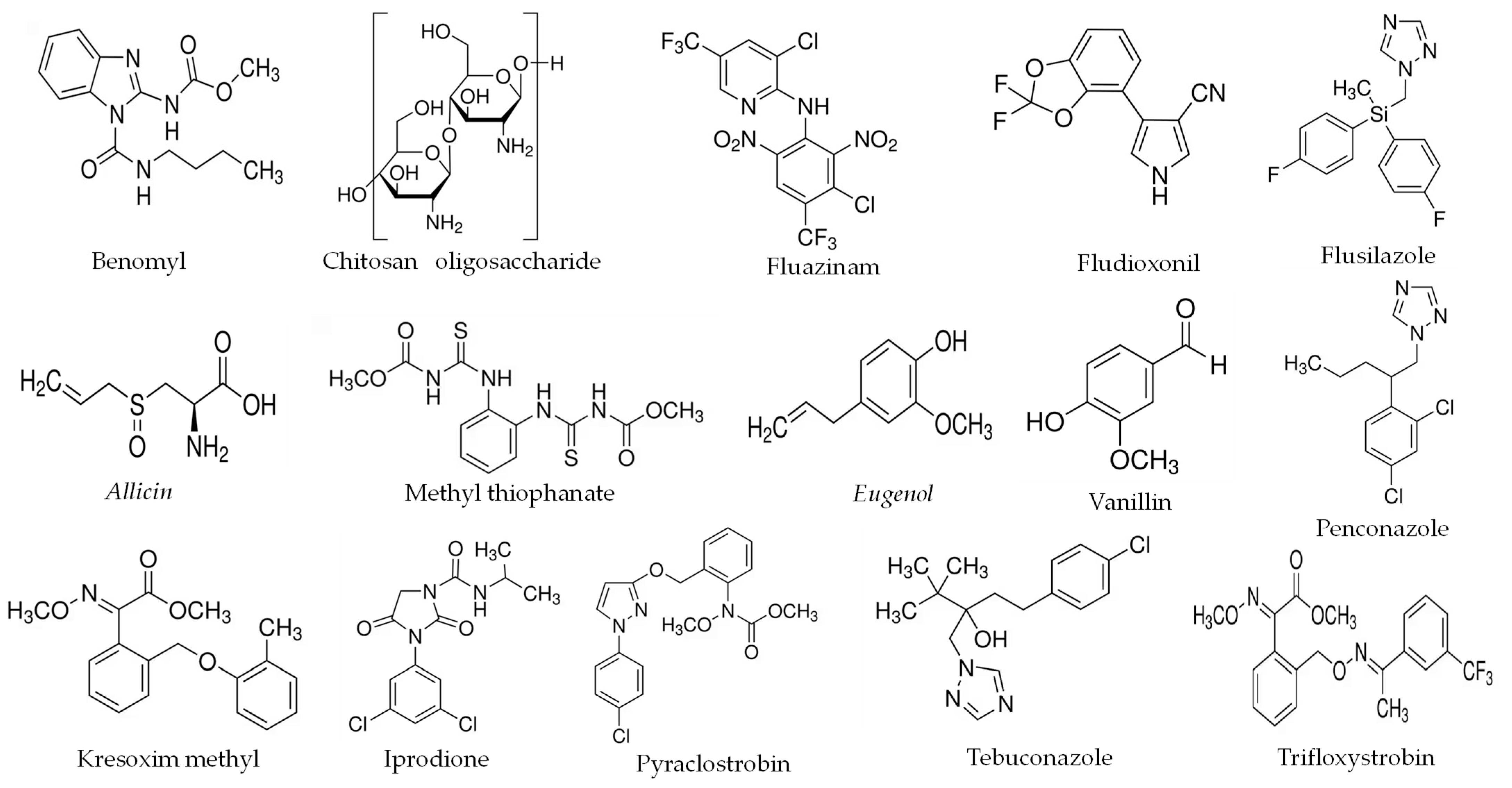
To evaluate the antifungal activity of the agents in Table 3 (Figure 1), stock solutions of each fungicidal compound were prepared and incorporated into PDA to reach the target final concentrations. Each agent was dissolved in 50 mL of distilled water; for poorly water-soluble compounds, 70% (v/v) ethanol was used as the alternative solvent. Solutions were sterilized through 0.22 μm syringe filters (Thermo Scientific™ Nalgene™, Thermo Fisher Scientific, Madrid, Spain) to ensure asepsis. A sterile 50 mL aliquot of each stock was then aseptically mixed with 200 mL of 3.90% (w/v) PDA that had been autoclaved on a liquid cycle at 121 °C for 20 min. Incorporation was performed at ~50 °C (post-autoclave) to minimize thermal degradation and preserve physicochemical stability. Each plate batch totaled 250 mL, stocks were prepared at 5× the intended final dose (i.e., Cstock = 5 × Cfinal); equivalently, the amount of active per batch is Cfinal × 0.25 L. “Low” and “High” levels correspond to 0.5× and 1.5× of the 100% dose using the same 50 mL:200 mL mixing ratio.
Mycelial plugs (5 × 5 mm) from 8-day old D. corticola cultures were centrally placed on Petri dishes and incubated at 25 °C for 10 days. Radial growth was measured every 48 h along two orthogonal axes. At each assessment we measured two perpendicular colony diameters (d1, d2; mm). Colony area was approximated as an ellipse shown in Equation (1):
A =   π   d 1 d 2 4
The assay ended when 80% of control plates reached full colonization. For treatment comparisons, growth inhibition was expressed as a percentage relative to the strain-matched control Equation (2):
I = 1 G m e a n   t r e a t m e n t G m e a n   c o n t r o l
Bacterial Agents
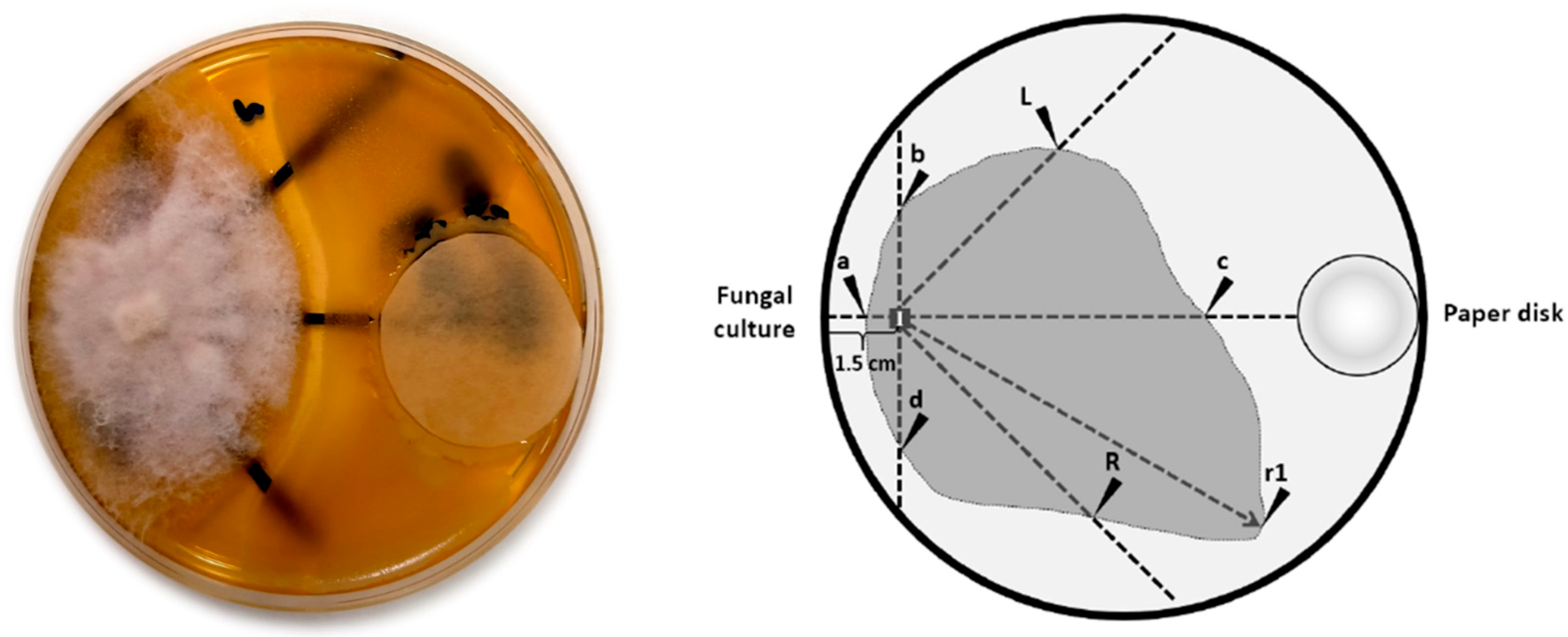
The dual-culture Petri plate method was used to assess the antagonistic effects of BAM and BMX against seven D. corticola strains, with each strain–treatment combination replicated five times. Controls were treated with 100 µL of sterile distilled water. In each plate, a 3.3 cm sterile paper disc was inoculated at the centre with 100 µL of bacterial treatment, while a 5 × 5 mm PDA plug with fungal mycelium was placed 1.5 cm from the opposite edge (Figure 2). Plates were maintained in the laboratory under ambient temperature (≈25 °C; no incubator used). For each strain and treatment, replicate plates were arranged in a completely randomized design, with positions randomly assigned and rotated daily within and across the trays. No blocking was implemented, and plate position was not included as a factor, ensuring uniform environmental conditions across all plates.
In the dual-culture assay we recorded directional and lateral colony growth to quantify antagonism. We measured four perpendicular radii (a, b, c, d; with c oriented toward the antagonist streak), two oblique axes (L and R), and the longest radius (r1). From these measurements we derived five descriptors: c (cm), the radius toward the antagonist; Sc (cm), an asymmetry coefficient defined as the difference between the mean lateral growth and c; I (%), the primary outcome, expressing percent inhibition of radial growth relative to the reference radius; AI (%), an antagonism index that integrates three orthogonal radii to summarize overall suppression; and DAI (%), a dual antagonism index that integrates lateral and maximum axes to capture colony deflection near the confrontation line (Figure 2). Reporting I as the primary endpoint ensures interpretability and comparability across strains and treatments, while c, Sc, AI, and DAI are retained as complementary metrics to describe the asymmetric colony morphologies that frequently arise during confrontations.
Radial growth was measured at both seven and fourteen days after inoculation. However, statistical analysis of antagonistic activity was based on data collected when the fungal mycelium reached the paper disc in 80% of control plates. Using these radii values (Figure 2), five distinct antagonism indices were computed to quantitatively assess the inhibitory effects of the biological treatments.
Index c (cm): represents the progress of the pathogen towards the treatment and corresponds to the values of the radius “c” (Figure 2).
Shape Coefficient (SC, cm): Describes the symmetry of fungal growth, used by [26] calculated according to Equation (3) and defined as:
S C = L + R 2 C
Growth Inhibition Index (I, %): this is the percentage of radial growth inhibition and is calculated according to Equation (4), collected by [26]:
I = 100 × [ r 1 c r 1 ]
Antagonism Index (AI, %): understood as the index of specific antagonism by D. corticola [27], used to assess the main effects of the antagonistic interaction and calculated according to Equation (5):
A I = 100 × a + b + c 3 c a + b + d  
Dual Antagonism Index (DAI, %): represents the modified version of the antagonism index [22] and is calculated according to Equation (6) (see Figure 2):
D A I = 100 × L + R + r 1 3 c L + R + r 1

2.1.4. Conidia Production Inhibition Test:

Conidiation of fungal strains on control and fungicide-amended plates was assessed 30 days after inoculation. For each plate, conidia were harvested by adding 100 µL of sterile distilled water containing 0.01% (v/v) Tween-20 (Panreac) [28,29], gently resuspending by pipetting and vortexing for 10–15 s; ten-fold serial dilutions were prepared as required. An aliquot of 10 µL was loaded into an improved Thoma hemocytometer and counted under a Leica DMLB microscope (Leica Microsystems GmbH, Wetzlar, Germany) (Supplementary Figure S1). Conidia concentration was calculated as in Equation (7)
C i = N 0.000004 × f / 10 6
where
  • Ci = abundance of conidia (million conidia/mL)
  • N = mean number of counted conidia (n = 5 squares)
  • f = dilution factor
Results are reported as ×106 conidia·mL−1. Three plates were analyzed per strain × treatment. This procedure follows standard hemocytometer practice and protocols used for conidial suspensions in fungal assays with the concentration conversion adapted from Muñoz-Adalia [30].

2.2. In Vivo Greenhouse Experiment

2.2.1. Inoculation of Q. suber Seedlings

The bioassay was conducted in a greenhouse at ETSEA-FiV (41.628° N, 0.598° E; Lleida, Spain) from 22 July 2021 to 3 April 2022 (256 days). Greenhouse temperature (T, °C) during the experimental period was recorded with an EasyLog EL-USB-2 sensor (Lascar Electronics, UK) and averaged 13.3 ± 9.1 °C; the maximum was 41.0 °C and the minimum was −4.5 °C. A total of 470 three-year-old Q. suber seedlings (mean height: 54.60 ± 12.90 cm: standard deviation) were acclimatized for 60 days before inoculation. Seven D. corticola strains (Table 1) were sub-cultured as in the in vitro assays. Treatments included eight antifungal agents (selected based on in vitro efficacy; Table 4), two biological control formulations (BAM and BMX), and three controls: (i) fungal strains without fungicides (n = 35), (ii) fungicides without fungi (n = 50), and (iii) distilled water with PDA for healthy seedlings (n = 35).
Each treatment was replicated five times. Seedlings were wounded 5 to 6 cm above the root collar and inoculated with 5 × 5 mm PDA plugs containing active-growing mycelium. For treated groups, 50 µL of fungicide was applied over the plug, and wounds were sealed with Parafilm® (Figure S2). Plants were irrigated regularly: thrice weekly (July–August), twice weekly (September–November), and weekly thereafter. Weeds were manually removed monthly. A single fertilization was applied during acclimatization using 0.25% Fertiprón EVO NPK 20-20-20 (PROBELTE, Spain).

2.2.2. Monitoring of Physiological Variables and Disease Symptoms

Physiological and morphological assessments were conducted throughout the trial period to evaluate seedling responses to both treatments and D. corticola strains. Stomatal conductance (gsw, mol H2O·m−2·s−1) and chlorophyll content (SPAD) were measured biweekly on three fully expanded leaves of all Q. suber seedlings [31], using a porometer (LI-600; LI-COR Biosciences, Lincoln, NE, USA) and a fluorometer (SPAD 502 Plus; Konica Minolta, Tokyo, Japan), respectively. The leaves selected for measurement varied between sampling events to avoid mechanical damage and to represent the overall plant condition at each time point. Morphological symptoms including chlorosis (CH), epicormic shoots (ES), wilting (WLT), dead branches (DBR), lesion length (LL), pycnidia presence (PP), and new growth (NG) were assessed twice weekly following protocols adapted from [32], with additional criteria for PP, ES, DBR, and NG specific to this study (Supplementary Figure S3). Symptom incidence was quantified using the Area Under the Disease Progress Curve (AUDPC), while binary presence (1)/absence (0) scores were used for variables CH, ES, WLT, DBR, LL, PP, and NG with frequent zero values. Disease progression for each seedling was evaluated visually based on the presence (1) or absence (0) of specific external symptoms (chlorosis, leaf wilting, desiccation, epicormic shoots, dieback, and necrosis) at each assessment date. These binary data were used to compute the Area Under the Disease Progress Curve (AUDPC) for each variable according to the trapezoidal integration method (Equation (8)), as adapted from [33].
A U D P C = i = 1 n y i + y i + 1 2 t i + 1 t i
where n is the total number of observations, yi is the symptom presence (0 or 1) at the ith observation, and ti is the corresponding time (days after inoculation). Since data were binary, AUDPC values represent the cumulative duration of symptom presence across the study period. Calculations were performed in Microsoft Excel© using sequential cell-based formulas equivalent to the above expression.

2.3. Statistical Analysis

Statistical analyses were performed in R [34] using R version 4.3.2 (R Core Team, Vienna, Austria) [34] using RStudio version 2023.09.1+494 (Posit Software, Boston, MA, USA) [35], employing the packages car [36], carData [36], DHARMa [37], MASS [38], and emmeans [39] for model fitting, diagnostics, and post hoc testing. For the in vitro assay on fungicidal agents, the variation in vegetative growth (Gmean) was analysed using General Linear Models (GLMs) with Gaussian distribution, and conidiation rates (S) was evaluated using Negative Binomial Regression. Explanatory variables of both kinds of models included fungal strain and treatment. Model selection was based on parsimony using the Akaike Information Criterion (AIC; [40]), with Chi-square tests used when ΔAIC ≤ 2 between the most parsimonious models in order to compare models. Tukey’s HSD was used as post hoc analysis. In vivo assays assessed physiological parameters (SPAD and gsw) and symptomatology (e.g., CH, ES, DBR, WLT, NG, FG, and PP), using GLMs with Gaussian or Binomial errors based on data distribution. A synthetic variable “Combine” (strain × treatment; included 72 levels (4 strains × 18 treatments)) was created to investigate the interaction effects and avoid model convergence issues. For antagonist agents, five in vitro antagonism indices (c, Sc, I, AI, DAI) and conidiation were analysed using Gaussian and Negative Binomial GLMs, respectively, with “Combine” (20 levels, 4 strains × 5 agents) as predictors. In the in vivo assay, symptomatology and physiological variables were analysed using the computed AUDPC values, again applying Gaussian and Binomial GLMs as appropriate and using the combined strain-treatment factor to account for interaction effects. Model selection and post hoc testing followed the same approach as for fungicidal agents.

3. Results

3.1. In Vitro Assay Results

3.1.1. Fungicidal Compounds and Natural Anti-Fungal Agents

These analyses revealed how fungicides inhibit mycelial growth and conidiation at room temperature, compared to untreated controls. For both vegetative growth and conidia production, the GLM incorporated treatment and strain as explanatory variables, showing a significant effect of the treatment on Gmean and Conidiation (p < 0.05; Table 5).
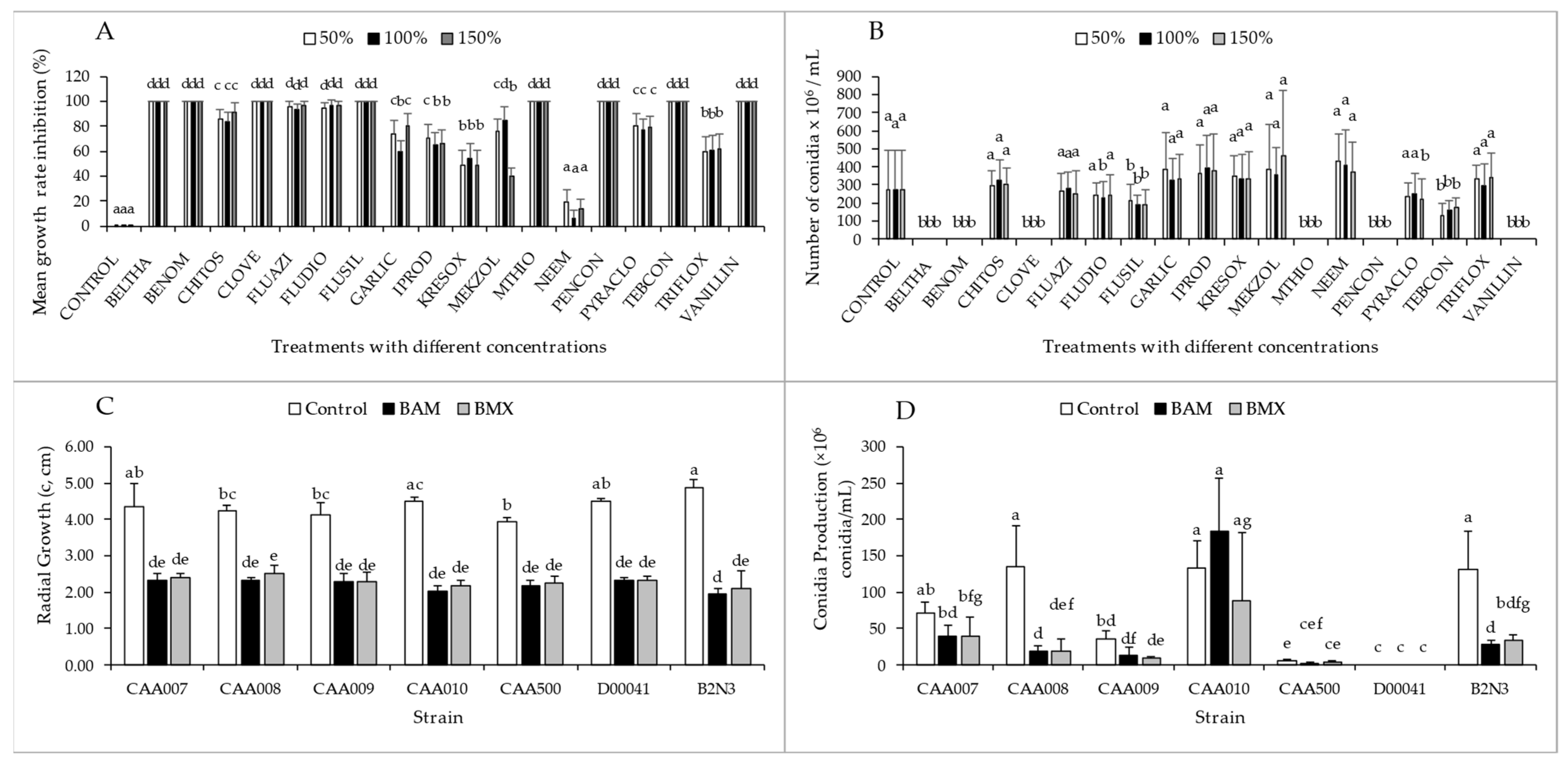
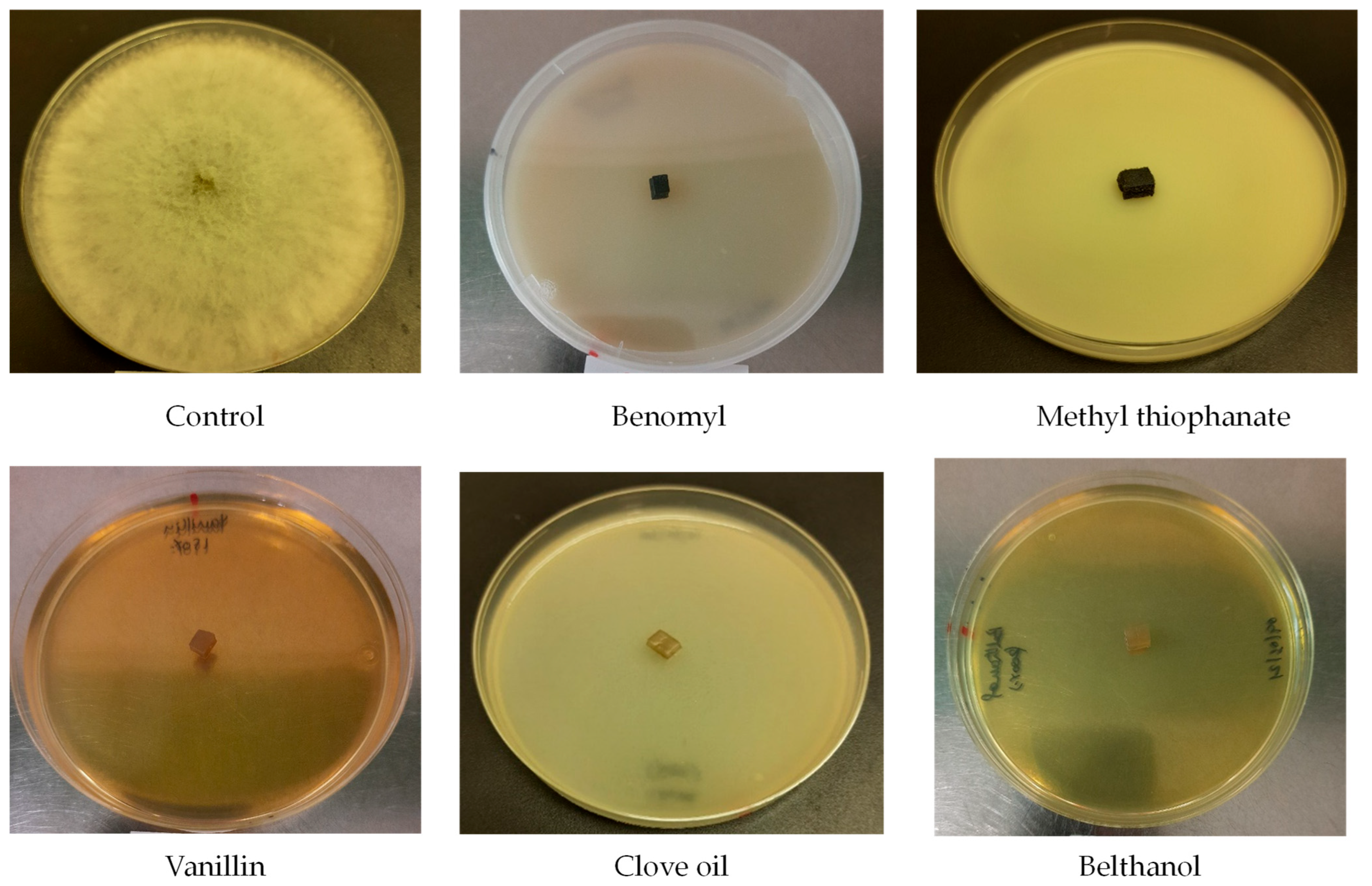
Vegetative growth analysis identified the additive model with treatment and strain as fixed effects (M1; Table 5) as the most parsimonious. Treatment significantly affected Gmean (p < 0.05), while strain showed no significant difference. Treatment effects were clearly distinguished across concentration levels (Figure 3A). Treatments such as belthanol, benomyl, clove oil, flusilazole, methyl thiophanate, penconazole, tebuconazole, and vanillin showed 100% growth inhibition (n = 24 per fungicide; n = 8 per concentration) at all tested concentrations (Figure 4). Fluazinam and fludioxonil also showed high efficacy, inhibiting mycelial growth by >94% (n = 24 per fungicide). in contrast, chitosan oligosaccharide 83–92%; garlic extract 59–80%; iprodione 65–71%; kresoxim-methyl 48–54%; mekzol 40–85%; neem oil 6–19%; pyraclostrobin 77–81%; trifloxystrobin 60–62% showed a concentration-dependent response (Figure 3A and Table S2).
Among the tested models, the treatment only model (M2) was the most parsimonious for conidia production (Table 5), indicating that treatment significantly influenced conidiation (p < 0.05), while strain had no significant effect (p > 0.05). The absence of conidia production (n = 24 per fungicide, n = 8 per concentration) was recorded at all concentrations for belthanol, benomyl, clove oil, methyl thiophanate, and vanillin (Figure 3B).
Partial inhibition (3–31%) was recorded for fluazinam, fludioxonil, flusilazole, and pyraclostrobin. In contrast, chitosan oligosaccharide, garlic extract, iprodione, kresoxim-methyl, mekzol, neem oil, and trifloxystrobin showed no detectable effect on conidiation. Notably, although tebuconazole and flusilazole showed 100% mycelial growth inhibition, after 14 days of inoculation (Figure 4), conidiation was detected around after 30 days of incubation (Figure 3B).

3.1.2. Antagonist Biological Agents

Among the five antagonism indices evaluated, statistically significant differences (p < 0.05) between dual culture treatments and controls were found for c, I, and AI across most fungal strains (Table 5, Figure 3C; see Supplementary Figures S5 and S6). Notable exceptions included strain B2N3-BAM for index I and CAA500-BMX for index AI. Median reductions in the c index relative to the control were typically on the order of 40–50% across strains (Figure 3C and Tables S4–S6). Comparison between the two bacterial formulations (BAM and BMX) revealed no significant differences (p > 0.05) across any index, suggesting similar antagonistic performance (see Supplementary Figures S4–S7).
Radial growth (c index) was significantly reduced by both BAM and BMX across all strains compared to the control (Figure 3C). Other antagonism indices are shown in Supplementary Figures S4–S7. For conidiation, significant differences (p < 0.05) between treatments and controls were detected only in strains CAA008 and B2N3 as determined by Tukey’s multiple comparisons test (Figure 3D). In contrast, strain D00041 exhibited no conidiation under any tested conditions. Additionally, no significant differences were observed between the two bacterial formulations in relation to conidia production for any strain (p > 0.05) (Figure 3D).

3.2. In Vivo Greenhouse Results

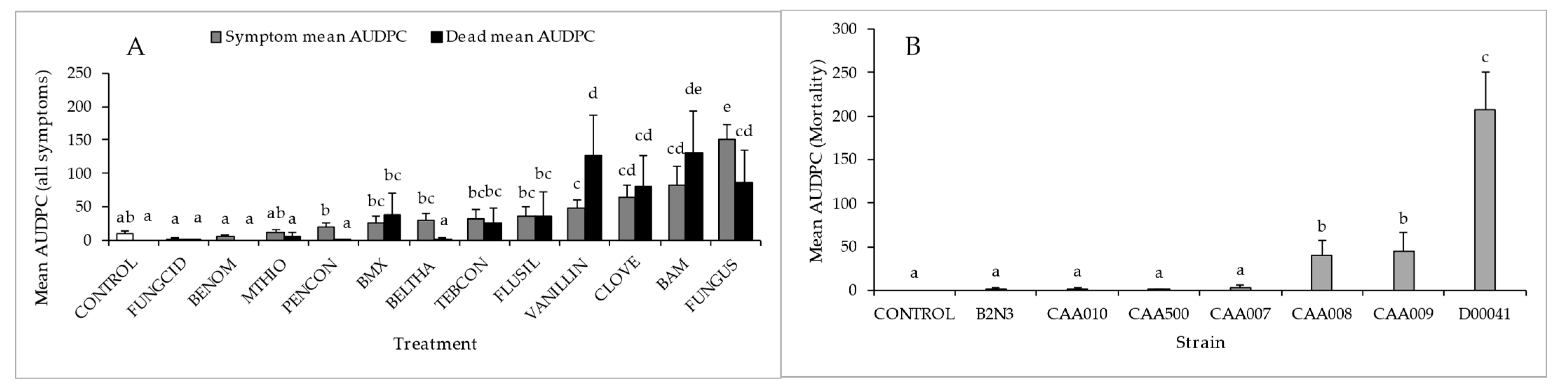
The greenhouse assay showed that the negative control group (fungus only, no treatment) had the highest disease impact, with 91.43% of seedlings showing symptom incidence and 11.43% seedling mortality. In contrast, the positive control group (PDA + sterile distilled water, no fungus) exhibited mild physiological responses, such as occasional chlorosis, likely due to the wound (Figure 5A).
GLM with Tukey’s test revealed that the effect of the strains on overall symptom incidence was not significantly different (p > 0.05), but it significantly increased seedling mortality (p < 0.05) compared with control. Strain D00041 caused the highest symptom incidence, followed by CAA008 and CAA009; other strains did not show significant effects (Tukey, p < 0.05) (Figure 5B).
Among infected plants, those exhibiting early wilting invariably progressed to death, and are therefore recorded as seedling mortality. In this analysis, symptomatic plants were defined as those showing visible symptoms of infection, excluding “New Growth”, which was not considered a disease symptom rather than a defensive response against the infection. There was no significant difference between the treatments in the relative control group (p > 0.05) consisting of seedlings that received the fungicidal agents but were not inoculated with any fungus. However, some seedlings treated only with antifungal agents developed epicormic shoots, attributed to phytotoxic effects rather than fungal infection, thereby validating the control setup. Among these, belthanol was the only treatment that induced visible symptoms without causing seedling mortality, indicating a phytotoxic response specific to this fungicide compound.

3.2.1. Effect of Fungicidal and Natural Antifungal Agents

Disease Symptoms and Seedling Survival
The models showed that chlorosis (CH) and epicormic shoots (ES) were significantly affected by treatment and strain (p < 0.05) without interactions. For the remaining variables including wilting (WLT), dead branches (DBR), lesion length (LL), pycnidia presence (PP), and new growth (NG), GLMs were fitted, and models selected based on AIC, and global significance assessed using Type II Anova. Across all these symptoms, only strain D00041 differed significantly from the control (sterile water) (p < 0.05), and among treatments, only the fungus-only treatment was significantly different from the Control (sterile water). Thus, chlorosis and epicormic shoots were the most responsive indicators (Table 6).
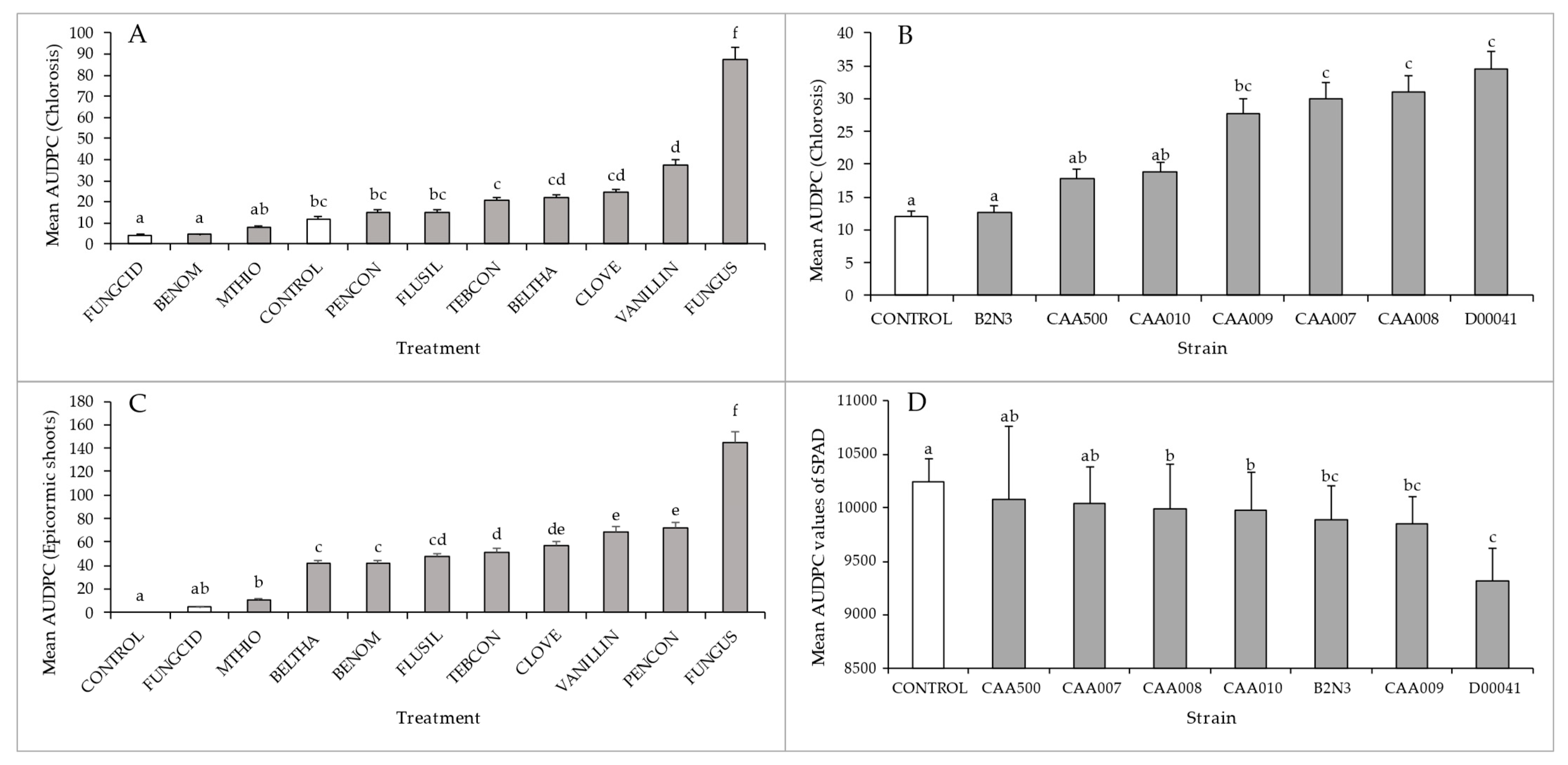
Chlorosis was best explained by the additive model including treatment and strain (M2a). This model outperformed the interaction model, as shown by a notably lower AIC value (Table 6) and residual diagnostics that confirmed good model fit, with no signs of overdispersion or deviation from the expected distribution. Treatments with benomyl (4.5 ± 0.3), clove oil (24.4 ± 1.6), flusilazole (15.0 ± 1.0), methyl thiophanate (8.20 ± 0.50), penconazole (15.00 ± 1.00), tebuconazole (20.60 ± 1.40), and vanillin (37.70 ± 2.50) resulted in significantly reduced chlorosis compared to the control (12.00 ± 0.80) (p < 0.05) (Figure 5A). Strains CAA007 (30.00 ± 2.50), CAA008 (30.90 ± 2.50), and CAA009 (27.70 ± 2.30) exhibited consistently higher chlorosis values, with D00041 (34.40 ± 2.80) showing the most pronounced increase compared with other strains (p < 0.05) (Figure 6B).
The presence of epicormic shoots was best explained by the additive model including treatment and strain (M3a), as indicated by a lower AIC value and robust model diagnostics (Table 6). Both treatment and strain had significant effects on ES compared with the control (p < 0.05). According to the results, belthanol (41.80 ± 2.70), benomyl (41.80 ± 2.70), flusilazole (47.60 ± 3.10), methyl thiophanate (11.10 ± 0.70), and tebuconazole (51.20 ± 3.40) induced the lowest ES levels, while clove oil (56.80 ± 3.70), vanillin (68.40 ± 4.50), penconazole (72.20 ± 4.70), and especially the fungus control (144.80 ± 9.50) showed the highest responses. The fungicide control (FUNGCID) (5.10 ± 0.30) and the untreated control (0.00 ± 0.00) exhibited minimal ES formation (Figure 6C).
Epicormic shoot formation differed significantly among strains (p < 0.05), with D00041 (130.30 ± 10.70) inducing the highest AUDPC values, followed by CAA008 (66.40 ± 5.50). The remaining strains showed lower values, including CAA009 (43.20 ± 3.50), CAA007 (42.20 ± 3.50), B2N3 (32.60 ± 2.70), CAA010 (32.40 ± 2.70), and CAA500 (25.40 ± 2.10), with the control remaining lowest (0.00 ± 0.00) (Supplementary Figure S10).
Physiological Parameters of Fungicidal and Natural Antifungal Agents
Chlorophyll content (SPAD) varied significantly among strains (p < 0.05; partial η2 = 0.91) and treatments (p < 0.05; partial η2 = 0.06) but Tukey’s HSD post hoc pairwise comparisons of each treatment vs. the control (sterile water) were not significant and was therefore best explained by the model including strain alone (M1a; Table 6). Post hoc comparisons showed that plants inoculated with D00041 (9317.90 ± 301.60) exhibited significantly lower SPAD values compared to those inoculated with the control (10,240.40 ± 223.60) and strains CAA500 (10,084.60 ± 676.10) and CAA007 (10,043.50 ± 344.30) (p < 0.05). The highest SPAD values were observed in seedlings treated with CAA500 (10,084.60 ± 676.10), CAA007 (10,043.50 ± 344.30), and CAA008 (9986.70 ± 418.40), indicating reduced physiological stress (Figure 6D). Stomatal conductance (gsw) did not show statistically significant variation across treatments (p = 0.40) or strains (p = 0.06).

3.2.2. Antagonist Agents

The GLM showed significant effects of treatment and strain on symptoms like CH and ES (p < 0.05), indicating they were the most responsive symptoms. In contrast, for remaining variables including WLT, DBR, LL, PP, and NG, the same pattern was observed as fungicidal agents, with only strain D00041 and the fungus-only treatment differing significantly from the control (p < 0.05). Tukey’s test revealed no significant difference despite significant global effects. Physiological parameters SPAD and GSW showed significant effects only by strain (p < 0.05) (Table 7).
Symptomatology of Antagonist Agents
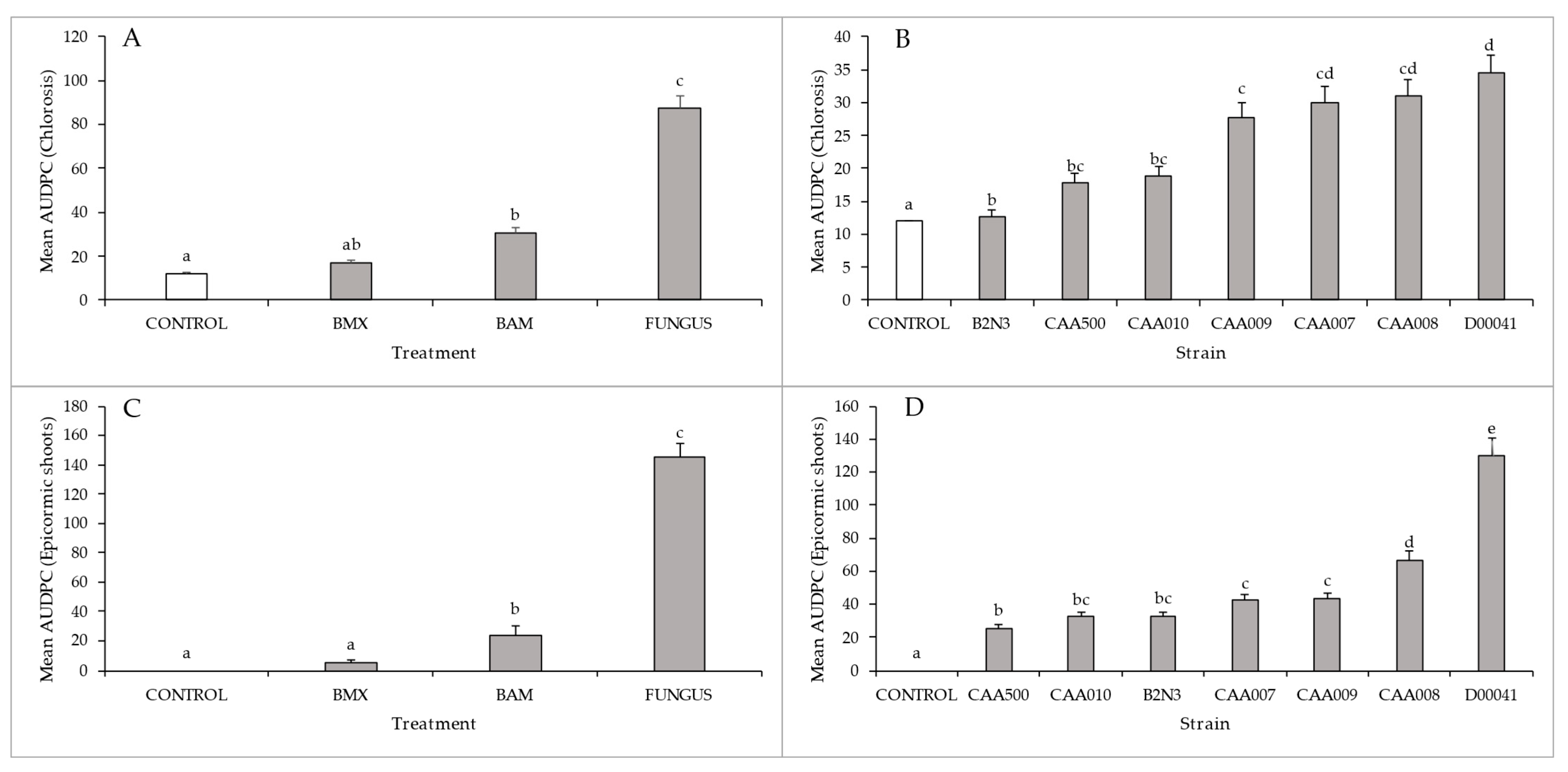
For chlorosis (CH), the most parsimonious model was the additive model including treatment and strain (M3b), selected based on the lowest AIC value (Table 7), with no evidence supporting interaction effects. Significant differences in chlorosis incidence were observed among treatments (p < 0.05). The fungus-inoculated group showed the highest chlorosis levels (87.5 ± 5.7), clearly exceeding all other treatments. In contrast, BMX (17.30 ± 1.10) and BAM (30.80 ± 2.00) treatments substantially reduced symptom severity compared with the control (12.00 ± 0.80) (Figure 7A).
Strain effects on chlorosis were significant (p < 0.05), with D00041 (34.40 ± 2.80), CAA008 (30.90 ± 2.50), and CAA007 (30.00 ± 2.50) inducing the highest symptom incidence, whereas B2N3 (12.60 ± 1.00) and CAA500 (17.70 ± 1.50) showed the lowest levels, and CAA009 (27.70 ± 2.30) and CAA010 (18.80 ± 1.50) exhibited intermediate responses (Figure 7B).
Epicormic shoots (ES) were best explained by the additive model including treatment and strain (M4b), supported by the lowest AIC value (Table 7). Treatments significantly affected ES (p < 0.01), with fungus-inoculated plants showing the highest AUDPC values (144.80 ± 9.50). BAM (30.80 ± 2.00) and BMX (17.30 ± 1.10) recorded markedly lower values than the fungus treatment, and both remained close to control (12.0 ± 0.8) (Figure 7C).
Strain significantly influenced ES incidence (p < 0.05), with D00041 (130.30 ± 10.70) and CAA008 (66.40 ± 5.50) inducing the highest responses, CAA500 (25.40 ± 2.10) and CAA010 (32.40 ± 2.70) the lowest, and B2N3 (32.60 ± 2.70), CAA007 (42.20 ± 3.50), and CAA009 (43.20 ± 3.50) eliciting intermediate levels (Figure 7D). Detailed numerical summaries, including mean differences and 95% confidence intervals for BAM and BMX compared with the control, are provided in Supplementary Table S7.
Physiological Parameters of Antagonist Agents
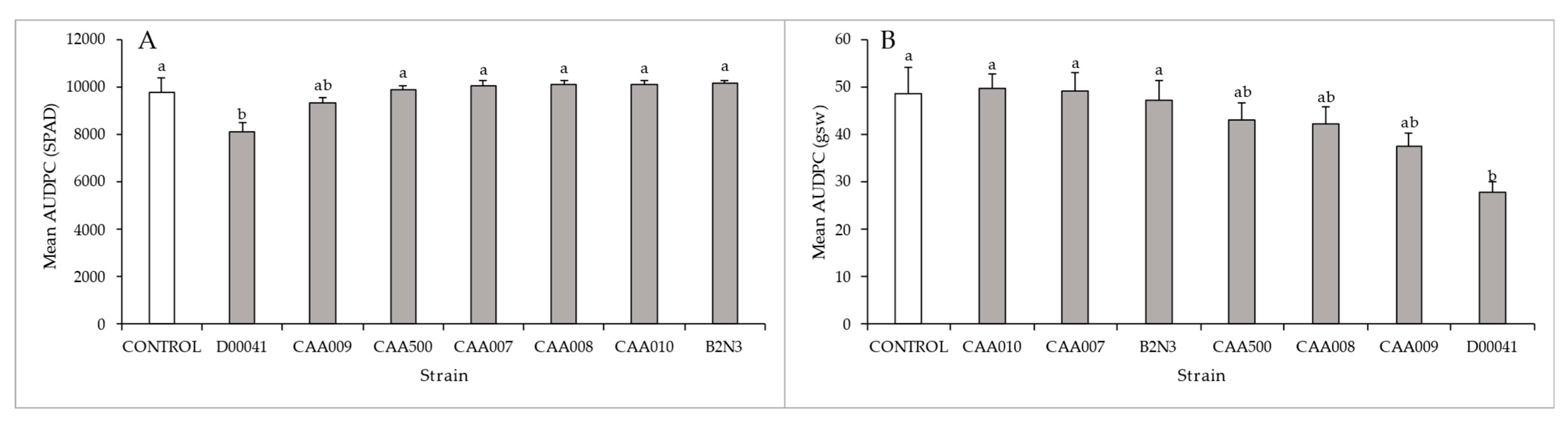
Chlorophyll content (SPAD) was best explained by a model including strain as the sole predictor (M1b, Table 7). Strain significantly affected SPAD values (p < 0.05), with D00041 showing the lowest levels (8118.70 ± 387.06) compared to all other strains. The rest showed a uniform group without significant differences (Figure 8A).
For gsw, the best fit model included strain alone (M2b, Table 6), highlighting its influence. D00041 exhibited significantly lower values (27.75 ± 2.24) than B2N3 (47.3 ± 4.17), CAA010 (49.56 ± 3.16), and CAA007 (49.11 ± 3.91) (p < 0.05), while the remaining strains showed no significant differences (Figure 8B).

4. Discussion

4.1. Evaluation of Fungicidal and Natural Antifungal Agents

Diplodia corticola, a pathogenic fungus of significant concern, has severely impacted oak species across western Mediterranean countries, causing ecological and economic losses. Benomyl and methyl thiophanate were once effective fungicides but were restricted in the EU. Our findings provide a foundation for integrating alternative agents into sustainable management strategies for D. corticola control by comparing our results with similar studies and clarifying similarities, differences, and implications. In this study, we reported for the first time the capacity of a wide range of chemical fungicidal agents, including belthanol, flusilazole, fludioxonil, iprodione, mekzol, penconazole, tebuconazole, and trifloxystrobin, as well as natural antifungal agents such as chitosan, clove oil, garlic extract, neem oil, and vanillin, to control D. corticola in both an in vitro and an in vivo experiment. The most effective agents against D. corticola in the in vitro test were selected for the in vivo test, including belthanol, clove oil, flusilazole, penconazole, tebuconazole, and vanillin.
The in vitro experiments showed significant mycelial growth inhibition by benzimidazole fungicides such as benomyl and methyl thiophanate, which achieved 100% growth inhibition (Gmean = 0.00 ± 0.00 mm2·day−1; n = 24 per fungicide; n = 8 per concentration) across all tested concentrations. These findings are consistent with earlier studies confirming the high efficacy of benzimidazole fungicides in controlling Botryosphaeriaceae pathogens [9,13]. This agreement supports using benzimidazoles as a high-efficacy benchmark for subsequent comparisons in our study; however, EU restrictions demand alternatives [9,15,41]. These fungicides were used as a reference in this study to compare the efficacy of other tested controlling agents.
Belthanol and mekzol have been identified by certain phytosanitary suppliers as potential disinfectants for sanitising equipment after cork debarking. Belthanol showed high antimicrobial efficacy on Rhizoctonia sp. and Phytophthora spp., consistent with previous reports that highlighted its strong controlling effects [42]. Similarly, [43] reported that belthanol (chinosol) was highly effective in inhibiting the mycelial growth of Phytophthora spp., supporting its potential as a reliable disinfectant. Our results indicated that belthanol showed 100% control, comparable to standard fungicides such as benomyl and methyl thiophanate, across all tested concentrations. Mekzol exhibited varying levels of efficacy, with optimal concentrations improving its antifungal activity. These findings indicate that belthanol has potential as a D. corticola controlling agent. Overall, belthanol emerges as a strong sanitation tool, while mekzol may require dose/formulation optimization before recommendation (Figure 3A).
Triazole fungicides, including flusilazole, penconazole, and tebuconazole, exhibited 100% in vitro inhibition of D. corticola mycelial growth, confirming their strong antifungal activity. Tebuconazole, is known for its efficacy against D. seriata, [41]. Flusilazole and tebuconazole have also been identified as effective pruning wound protectants in bioassays and vineyard trials against Botryosphaeria spp [44]. The findings of this study are congruent with previous research demonstrating that triazole fungicides strongly inhibit D. mutila, D. seriata, and Neofusicoccum sp. [45,46]. Penconazole also showed 100% in vitro inhibition (n = 24), highlighting its potential as an alternative control agent. Additionally, tebuconazole and flusilazole significantly suppressed conidiation, reducing the risk of fungal dissemination. Our in vitro results are consistent with previous studies on trunk disease management, confirming the robust antifungal activity of the tested agents. However, practical application remains challenged by regulatory restrictions and the potential for resistance development in field settings [39,42,43,44].
Flusilazole and tebuconazole showed the strongest antifungal activity against D. corticola in both in vitro and in vivo experiments, with 100% inhibition (n = 8) of mycelial growth and conidia production at all tested concentrations. In the greenhouse assay, they significantly reduced disease symptoms, with only 31.43% and 34.29% of treated Q. suber seedlings showing symptoms, respectively. These findings are in line with the results of [47], where flusilazole and tebuconazole achieved 100% and 87% protection of pruning wounds in field-grown grapevines infected with Neofusicoccum luteum (Pennycook & Samuels) Crous, Slippers & A.J.L. Phillip. Differences between greenhouse and field contexts reported in the literature likely reflect formulation, exposure, and persistence on woody tissues [44,47]. Field use requires careful consideration of formulation type (e.g., sprays vs. pastes), optimal dosage, and timing relative to pruning, cork harvesting, or infection events [46]. Furthermore, as [41] and [45] noted, repeated application of systemic fungicides such as triazoles may lead to resistance development and ecotoxicological risks to non-target fungi and associated wildlife, reinforcing the need for careful risk analyses.
Strobilurin fungicides, including kresoxim-methyl, pyraclostrobin, and trifloxystrobin, showed moderate inhibitory effects against D. corticola, with in vitro inhibition rates ranging from 54% to 79%. These findings are consistent with those of [17], who reported that kresoxim-methyl and trifloxystrobin significantly reduced canker incidence caused by Botryosphaeria spp, although their effects did not result in disease suppression. Similarly, [41] observed that strobilurins were generally less effective than benzimidazoles in controlling Botryosphaeriaceae pathogens in grapevines, likely due to their different modes of action. Overall, strobilurins exhibited lower efficacy compared to triazoles and benzimidazoles, both in our experiments and in previous studies. This indicates that strobilurins are best suited as rotation or mixture partners rather than as primary control agents.
Although chemical and synthetic fungicides have been extensively studied and remain effective, their deployment in field settings is increasingly constrained by evolving regulatory frameworks in Europe, primarily due to safety and environmental concerns. Simultaneously, societal demand for sustainable and eco-friendly crop protection practices is accelerating a shift away from conventional chemical pesticides. These dynamics have prompted many countries to adopt integrated pest management strategies that prioritize agents with lower ecological footprints and human health risks. In this context, natural antifungal agents such as plant-derived extracts, essential oils, and bio-based formulations like chitosan emerge as compelling alternatives. A growing body of research underscores their broad-spectrum antifungal properties and their promise in mitigating reliance on synthetic chemicals, thereby aligning disease management with environmental stewardship and regulatory compliance. Ongoing efforts to characterize their efficacy, optimize formulations, and minimize phytotoxicity will be critical for their successful integration into sustainable disease management programs. [18]. Natural antifungal agents such as clove oil and vanillin exhibited strong antifungal activity, achieving 100% inhibition of D. corticola mycelial growth across all tested concentrations, consistent with [18], who reported similar effects against grapevine trunk disease pathogens. These phenolic compounds can disrupt fungal cell membranes and interfere with enzymatic activity [48]. However, variability was observed among natural antifungal agents, as garlic extract and neem oil showed only moderate inhibition, emphasizing the need for further identification of potential natural antifungal agents [18]. Our physiological assessments, particularly SPAD measurements, underscore the potential for vanillin to induce phytotoxic effects in vivo, revealing a trade-off that often goes unaddressed in studies focused solely on disease control efficacy. This observation highlights the importance of considering both pathogen suppression and host health when evaluating natural antifungal agents.
Airborne dispersal of D. corticola conidia has been confirmed through environmental detection using High-Throughput Sequencing (HTS) and real-time PCR, underscoring the epidemiological importance of limiting inoculum sources in oak ecosystems [11,16]. In our study, marked differences were observed in conidia production among D. corticola strains, with strains CAA008 and B2N3 exhibiting notably higher pycnidia formation in vitro. This strain-dependent variability in sporulation suggests that certain isolates may pose a greater risk for disease spread, emphasizing the need for targeted management strategies. Importantly, we found that belthanol, clove oil, flusilazole, penconazole, tebuconazole, and vanillin significantly reduced conidiation in vitro, indicating their value in suppressing inoculum buildup. However, the effectiveness of these treatments may be influenced by environmental conditions such as humidity and application timing, which are known to drive conidiation events. These findings highlight the necessity of integrating strain-specific responses into control programs, as differing sporulation capacities could impact overall management efficacy [31]. Thus, future research should further elucidate the interaction between environmental factors, strain variability, and antifungal treatments to optimize disease suppression and prevent airborne dissemination of the pathogen [11,16,31].
In vivo trials showed the robust efficacy of synthetic fungicides, particularly triazoles such as penconazole and tebuconazole, in suppressing D. corticola symptom incidence and reducing seedling mortality in Q. suber seedlings. These findings are consistent with both our in vitro results and prior field studies, which have established triazole fungicides as highly effective against Botryosphaeriaceae pathogens in grapevines and cork oaks [13,24,41,44,45,46]. In parallel, natural antifungal agents including clove oil and vanillin exhibited promising disease suppression, corroborating previous research on their broad-spectrum activity against grapevine trunk pathogens [18,48]. However, physiological assessments using SPAD values revealed that vanillin-treated seedlings experienced significant reductions in chlorophyll content and visible chlorosis, indicating phytotoxic effects potentially unrelated to pathogen infection. This observation differs from the pathogen-induced stress responses reported by [49], where reductions in chlorophyll content and stomatal conductance (gsw) were directly attributed to D. corticola infection. Our results further align with [31], who demonstrated that D. corticola strains induce strain-specific physiological alterations, including impaired photosynthetic performance and oxidative stress, absent in non-inoculated controls. Notably, strain-dependent variability in pathogenicity was evident, with certain isolates causing greater host stress and mortality, underscoring the importance of integrating strain-specific analyses into management strategies. Collectively, these findings highlight the necessity of balancing disease suppression with host health when deploying both synthetic and natural antifungal agents, and they emphasize the value of physiological metrics such as SPAD and gsw in distinguishing pathogen-related from chemical-induced stress responses. Ongoing work should focus on optimizing formulations to minimize phytotoxicity and on tailoring control approaches to strain-specific risks, thereby enhancing the sustainability of D. corticola management in forestry ecosystems.
In vivo assessments revealed pronounced strain-dependent differences in D. corticola pathogenicity, with D00041 consistently resulting in the highest seedling mortality (60%) and symptom incidence (100%), as shown in Figure 5B and aligning with the physiological stress markers (SPAD and chlorosis) observed. These patterns mirror the robust in vitro inhibition of mycelial growth and conidiation by synthetic and natural agents described earlier, yet the persistence of symptoms and mortality in some strains underscores limitations seen in comparable studies, such as [31] and [13], which also report incomplete protection in greenhouse or field conditions. Notably, less virulent strains (e.g., B2N3, CAA500, CAA007, and CAA010) produced symptoms without causing seedling death, reflecting the nuanced spectrum of aggressiveness and host response that can complicate management, as highlighted by [31]. While in vitro tests indicated strong fungicidal activity, particularly for triazoles and select natural compounds, the in vivo outcomes reveal that strain variability and host physiological responses must be considered when translating laboratory efficacy to real-world scenarios. This is consistent with prior field trials [18,24] that emphasize the gap between laboratory inhibition and durable disease control. Our results therefore support the integration of both in vitro and in vivo analyses for a more comprehensive understanding of agent performance, and reinforce the need for targeted, strain-specific strategies in disease management programs. These findings, together with the observed physiological impacts, highlight the importance of optimizing treatment regimens and considering host health in addition to pathogen suppression.

4.2. Antagonist Biological Control Agents

This study evaluated the antagonistic and biocontrol efficacy of two commercial Bacillus sp. formulations (BAM and BMX) against D. corticola. Both formulations suppressed fungal growth in in vitro dual cultures. However, the degree of inhibition did not differ significantly between the two formulations, suggesting that the combination of B. amyloliquefaciens and B. mojavensis did not enhance antagonistic activity. This result may be attributed to faster growth of B. amyloliquefaciens in the mixture, leading to a competitive advantage [22]. These findings indicate that strain selection and compatibility should precede formulation.
In this study, three out of the five antagonistic indices evaluated (c, I, and AI) showed significant differences between dual culture treatments between biological control agents (BCAs) and control plates, reinforcing the strong antagonistic potential of the bacterial formulations. Notably, mycelial growth inhibition under dual culture with either BAM or BMX ranged from 39% to 60% across all tested strains within 4 to 14 days, indicating a substantial reduction in fungal expansion (Supplementary Figures S4–S7). This suggests that bacterial treatments effectively restrict fungal spread through a combination of antagonistic strategies. Bacillus spp., including B. amyloliquefaciens and B. mojavensis, are well documented for their ability to outcompete fungal pathogens not only by occupying physical space or sequestering nutrients but also by producing a broad spectrum of bioactive compounds. These include lipopeptides, volatile organic compounds, and other secondary metabolites with strong antifungal properties [20,21,50]. Such multifaceted antagonism helps explain the suppression of D. corticola symptoms observed in bacterial-treated seedlings in our study. Our observations, particularly the inhibition of fungal growth without direct contact (see below), suggest the involvement of diffusible bioactive compounds, warranting further exploration.
Bacteria inhibited the growth of the fungus without establishing physical contact between colonies (Supplementary; Figure S8A,B), leading to the research question of what metabolites cause the retraction of the mycelium prior to contact between fungal and bacterial colonies [i.e., lipopeptides such as surfactins, iturins and fengicins already described in other Bacillus species [19,21,51]. Additionally, the exacerbated accumulation of mycelium (abnormal mycelium) at the leading edge of growth of some fungal strains (Supplementary; Figure S9) could also be attributed to the production of antibiotic substances that cause changes in the morphology of hyphae and mycelium [21,51,52]. Pinpointing the active metabolite classes can guide selection of strains and stabilization in future formulations.
Regarding the antagonistic effects on the asexual cycle of the fungus, our results suggest that bacterial formulations did not consistently inhibit conidiation across all D. corticola strains (Figure 3D). This variation may be explained either by differences in the capacity of bacterial strains to produce antifungal compounds under the tested conditions or by the ability of certain fungal strains to tolerate or bypass the effects of these compounds during conidiation. Similar variability in antagonistic interactions has been observed in previous in vitro studies, where inhibition of fungal growth by Bacillus spp. was dependent on both the bacterial strain and fungal isolate involved [22]. These findings highlight the importance of verifying antagonistic activity through strain-specific testing and the need to better understand the biochemical and physiological factors that mediate conidiation suppression.
In vivo trials are a crucial step in the selection of bacterial species and the subsequent production of formulations at the commercial level. According to [50], traditional selection methodology is too heavily based on in vitro testing, which is biased in favor of biocontrol by antibiosis, justifying the need for complementary in vivo trials, as was conducted in the present work.
A notable reduction in the percentage of symptomatic plants was observed following treatment with the BCAs compared to the fungal control [BAM: 45.7%; BMX: 60%], supporting the protective effect of the bacteria against fungal infection and aligning with in vitro observations. However, in neither case was seedling mortality fully prevented. Consequently, while the in vivo trial confirms a protective effect of Bacillus spp., the formulations evaluated at the applied concentrations were insufficient to suppress seedling mortality. This residual seedling mortality, though limited, represents the main limitation that must be addressed. Importantly, even in the absence of visible external symptoms, the pathogen was found to persist within plant tissues. Internal lesions were observed during post-assay inspections, and subsequent re-isolation confirmed the presence of D. corticola based on its morphological characteristics (data not shown). This raises the concern that asymptomatic but infected seedlings could still harbor viable inoculum and serve as sources of field dissemination, highlighting the need for treatments that achieve both symptom suppression and pathogen eradication. This presence also opens the question of whether D. corticola, or some of its strains, can live as asymptomatic endophytes in individuals of Q. suber. Although BCAs reduced symptom incidence, mortality was not fully prevented at the tested doses, indicating the need for optimization of dose, timing, and application strategy before large-scale deployment. The persistence of D. corticola in asymptomatic tissues further underscores the importance of multi-season field verification.
Strain D00041 consistently induced the most symptoms across all evaluated parameters, indicating its high virulence and potential role as a major pathogenic threat to cork oak compared with all other strains used in this assay.
A methodological limitation was the absence of a solvent-only (ethanol) control for the clove-oil plates; however, plates were poured immediately after adding the solution at ≈50 °C and cooled slowly at room temperature allowing for evaporation of residual ethanol; also previous Botryosphaeriaceae canker studies have shown that ethanol alone does not produce fungicidal effects [17]. The strong inhibition observed here, including complete suppression of conidiation, therefore exceeds any plausible solvent influence, but future assays will include matched ethanol-only controls to confirm this. Finally, potential resistance development and ecotoxicological risks associated with systemic fungicides such as triazoles warrant careful, regulation-compliant field validation before recommending their use in forest management.


5. Conclusions

This study demonstrated the efficacy of both synthetic and natural fungicides, as well as Bacillus-based biological control agents, against D. corticola in Q. suber. Fungicides, penconazole, tebuconazole, clove oil, and vanillin, significantly inhibited fungal growth and conidiation in vitro and reduced symptom incidence and seedling mortality in vivo. Similarly, the Bacillus formulations B. amyloliquefaciens alone and in combination with B. mojavensis exhibited strong antagonistic activity in vitro and provided effective protection under greenhouse conditions without phytotoxic effects. These findings support the integration of chemical and biological agents into sustainable disease management strategies for cork oak, promoting ecological safety while maintaining control efficacy.

Supplementary Materials

The following supporting information can be downloaded at: https://www.mdpi.com/article/10.3390/f16111704/s1, Figure S1: Conidia count by Thoma hemocytometer. Figure S2: Schematic representation of the steps followed during the seedling inoculation process. (A) Random allocation and design of the in vivo study; (B) code allocation with different color tags; (C) inoculation incision; (D) inoculation of fungal mycelium; (E) fungicide application; (F) sealed with Parafilm®. Figure S3: Mosaic with images of the main symptoms detected in the seedlings of the trial in vivo: (A) Chlorosis; (B) Wilting; (C) Epicormic Shoots; (D) Dead Branches; (E) Presence of Pycnidia; (F) New Growth. Figure S4: Shape coefficient (Sc, cm) of fungal strains under treatments in dual culture assay. Treatments with the same letter are not significantly different (Tukey’s HSD, p < 0.05). Figure S5: Mean radial growth inhibition index (I, %) of fungal strains exposed to treatments in dual culture assay. Treatments with the same letter are not significantly different (Tukey’s HSD, p < 0.05). Figure S6: Specific antagonism index (AI, %) of fungal strains in response to treatments. Treatments with the same letter are not significantly different (Tukey’s HSD, p < 0.05). Figure S7: Modified antagonism index (DAI, %) of fungal strains in dual culture assay. Treatments with the same letter are not significantly different (Tukey’s HSD, p < 0.05). Figure S8: Petri dishes corresponding to the three treatments (CONTROL, BAM, BMX) applied to strains CAA007 (19 days after inoculation) and D00041 (4 days after inoculation). Scale bar = 2 cm. Figure S9: Abnormal mycelium morphology in Petri dishes of strain CAA010 treated with BAM and BMX, 19 days after inoculation. Scale bar = 2 cm. Figure S10: Epicormic shoots (ES) AUDPC in Q. suber seedlings inoculated with different D. corticola strains (in vivo fungicide assay). Bars show mean ± SE; letters indicate Tukey’s HSD groupings (p < 0.05). n = 35 per strain. “Control” = sterile-water control. Figure S11: Chemical structure of Azadirachtin. Table S1. Binomial GLM outputs for vegetative growth (Gmean) and conidia production (Conidia). The best models are highlighted in different colors. Table S2. Growth rate of Diplodia corticola strains under different fungicidal treatments on PDA after 14 days at 50%, 100%, and 150% concentrations. Mean ± SE values are shown. Lowercase letters (a–d) indicate significant differences according to Tukey’s test (p < 0.05; n = 8 per treatment concentration). Table S3. Conidia production of Diplodia corticola on PDA after 30 days under fungicidal treatments at three concentrations (50%, 100%, and 150%). Mean ± SE values are expressed as ×106 conidia·mL−1. Within each concentration, different letters indicate Tukey’s HSD groups (p < 0.05; n = 8 per treatment, 4 strains × 2 plates). Table S4. Mean ± SD values of the antagonism indices c (colony interaction index) and Sc (shape coefficient) for each treatment and strain in the in vitro dual-culture assay. Lowercase letters indicate significant differences (p < 0.05; Tukey’s multiple comparison test; n = 35). Table S5. Mean ± SD values of the antagonism indices I (inhibition index) and AI (antagonism index) for each treatment and strain in the in vitro dual-culture assay. Lowercase letters indicate significant differences (p < 0.05; Tukey’s multiple comparison test; n = 35). Table S6. Mean ± SD values of the modified antagonism index DAI and conidial production for each treatment and strain in the in vitro dual-culture assay. Lowercase letters indicate significant differences (p < 0.05; Tukey’s multiple comparison test; n = 35). Table S7. Mean area under the disease progress curve (AUDPC ± SE) for BAM, BMX, and control treatments, together with mean differences versus control (95% confidence intervals). “Symptoms” represents the mean of chlorosis, epicormic shoots, and dead branches (new growth excluded); “Mortality” corresponds to wilting (WLT). n = 35 per treatment (7 strains × 5 plants).

Author Contributions

Conceptualization, C.C. and E.J.M.-A.; methodology, H.R.U., D.A., C.C. and E.J.M.-A.; software, H.R.U.; validation, H.R.U., D.A., C.C. and E.J.M.-A.; formal analysis, H.R.U. and E.J.M.-A.; investigation, H.R.U. and D.A.; resources, C.C.; data curation, H.R.U.; writing—original draft preparation, H.R.U. and D.A.; writing—review and editing, H.R.U., D.A., C.C. and E.J.M.-A.; visualization, H.R.U.; supervision, C.C. and E.J.M.-A.; project administration, C.C.; funding acquisition, C.C. All authors have read and agreed to the published version of the manuscript.

Funding

This research was partially funded by the Generalitat de Catalunya, Departament d’Acció Climàtica, Alimentació i Agenda Rural (formerly Departament d’Agricultura, Ramaderia, Pesca i Alimentació), under grant number E-25-2020-0115755. Hanna R. Uppara was supported by an Industrial Pre-Doctoral Fellowship from Forest Bioengineering Solutions (FBS) and the Forest Science and Technology Centre of Catalonia (CTFC).

Data Availability Statement

The data presented in this study are available on request from the corresponding author.

Acknowledgments

The authors wish to express their gratitude to Andreu Meijer (CTFC) for his contribution to the laboratory work. We thank Probelte S.A.U. (Murcia, Spain) for supplying the solutions of B. amyloliquefaciens and B. amyloliquefaciens + B. mojavensis, and Frosch Chemie (Barcelona, Spain) for providing the mekzol compounds used in the experiments. We thank Artur Alves’s team (University of Aveiro, Portugal) for providing the fungal strains originating from Portugal that were utilized in this study.

Conflicts of Interest

The authors declare no conflicts of interest.

Abbreviations

AICAkaike Information Criterion
AIAntagonism Index (%)
AUDPCArea Under the Disease Progress Curve
BCA(s)Biological Control Agent(s)
CFUColony-Forming Units
CHChlorosis
DAIModified Antagonism Index (%)
DBRDead Branches
DHARMaDiagnostics for Hierarchical Regression Models (R package, version 0.4.6)
EMMEANSEstimated Marginal Means (R package)
ESEpicormic Shoots
GLM(s)Generalized Linear Model(s)
GSW (gsw)Stomatal Conductance
HSDTukey’s Honestly Significant Difference
IRadial Growth Inhibition Index (%)
LLLesion Length
MASSModern Applied Statistics with S (R package)
NGNew Growth
PDAPotato Dextrose Agar
PPPycnidia Presence
qPCRQuantitative Polymerase Chain Reaction
RR statistical software
RStudioR Integrated Development Environment
ScShape Coefficient
SConidiation Rate
SPADChlorophyll Content Index
WLTWilting

References

  1. Pereira, H. Cork: Biology, Production and Uses; Elsevier: Lisbon, Portugal, 2011; ISBN 978-0-444-52967-1. [Google Scholar]
  2. Rives, J.; Fernandez-Rodriguez, I.; Gabarrell, X.; Rieradevall, J. Conservation and recycling: Environmental analysis of cork granulate production in Catalonia–northern Spain. Resour. Conserv. Recycl. 2012, 58, 132–142. [Google Scholar] [CrossRef]
  3. Costa-e-Silva, F.; Correia, A.C.; Pinto, C.A.; David, J.S.; Hernandez-Santana, V.; David, T.S. Effects of cork oak stripping on tree carbon and water fluxes. For. Ecol. Manag. 2021, 486, 118966. [Google Scholar] [CrossRef]
  4. Mata, F.; dos Santos, M. Modeling cork yield, thickness, price, and gross income in the Portuguese cork oak montado. Forests 2024, 15, 2163. [Google Scholar] [CrossRef]
  5. Gosling, R.H.; Jackson, R.W.; Elliot, M.; Nichols, C.P. Oak declines: Reviewing the evidence for causes, management implications and research gaps. Ecol. Solut. Evid. 2024, 5, e12395. [Google Scholar] [CrossRef]
  6. Muñoz-Adalia, E.J.; Meijer, A.; Colinas, C. New qPCR protocol to detect Diplodia corticola shows phoretic association with the oak pinhole borer Platypus cylindrus. Pest Manag. Sci. 2022, 78, 3534–3539. [Google Scholar] [CrossRef] [PubMed]
  7. Crampton, M.; Prakash-Arumugam, A.; Ockenden, A.; Hall, G.; Biddle, M.; Suresh, V.; Denman, S.; Barnes, A.V. First report of Diplodia corticola on Abies and Quercus species in the UK. New Dis. Rep. 2025, 52, 2–3. [Google Scholar] [CrossRef]
  8. APCOR The Cork Sector: Characterisation; Portuguese Cork Association: Portugal. 2023. Available online: https://apcor.pt/uploads/homepage/destaques/3_O%20Setor%20da%20Cortica_Caracterizacao_EN.pdf (accessed on 17 October 2025).
  9. Luque, J.; Pera, J.; Parladé, J. Evaluation of fungicides for the control of Botryosphaeria corticola on cork oak in Catalonia (NE Spain). For. Pathol. 2008, 38, 147–155. [Google Scholar] [CrossRef]
  10. Luque, J.; Girbal, J. Dieback of cork oak (Quercus suber) in Catalonia (NE Spain) caused by Botryosphaeria stevensii. Eur. J. For. Pathol. 1989, 19, 199–207. [Google Scholar] [CrossRef]
  11. Muñoz-Adalia, J.; Uppara, A.B.; Albó, D.; Meijer, A.; Colinas, C. Cork harvest planning and climate: High air humidity favors availability of airborne inoculum of Diplodia corticola. For. Ecol. Manag. 2023, 536, 120935. [Google Scholar] [CrossRef]
  12. Alves, A.; Correia, A.; Luque, J.; Phillips, A. Botryosphaeria corticola sp. nov. on Quercus species, with notes and description of Botryosphaeria stevensii and its anamorph, Diplodia mutila authors. Mycol. Res. 2004, 96, 598–613. [Google Scholar] [CrossRef]
  13. Serrano, M.S.; Romero, M.A.; Jiménez, J.J.; De Vita, P.; Ávila, A.; Trapero, A.; Sánchez, M.E. Preventive control of Botryosphaeria canker affecting Quercus suber in southern Spain. Forestry 2015, 88, 500–507. [Google Scholar] [CrossRef]
  14. Moricca, S.; Linaldeddu, B.T.; Ginetti, B.; Scanu, B.; Franceschini, A.; Ragazzi, A. Endemic and emerging pathogens threatening cork oak trees: Management options for conserving a unique forest ecosystem. Plant Dis. 2016, 100, 2184–2193. [Google Scholar] [CrossRef]
  15. Muñoz-Adalia, E.J.; Colinas, C. Susceptibility of cork oak (Quercus suber) to canker disease caused by Diplodia corticola: When time is of the essence. New For. 2021, 52, 863–873. [Google Scholar] [CrossRef]
  16. Bérubé, J.A.; Gagné, P.N.; Ponchart, J.P.; Tremblay, É.D.; Bilodeau, G.J. Detection of Diplodia corticola spores in Ontario and Québec based on high throughput sequencing (HTS) methods. Can. J. Plant Pathol. 2018, 40, 378–386. [Google Scholar] [CrossRef]
  17. Brown-Rytlewski, D.E.; McManus, P.S. Virulence of Botryosphaeria dothidea and Botryosphaeria obtusa on apple and management of stem cankers with fungicides. Plant Dis. 2000, 84, 1031–1037. [Google Scholar] [CrossRef]
  18. Cobos, R.; Mateos, R.M.; Álvarez-Pérez, J.M.; Olego, M.A.; Sevillano, S.; González-García, S.; Garzón-Jimeno, E.; Coque, J.J.R. Effectiveness of natural antifungal compounds in controlling infection by grapevine trunk disease pathogens through pruning wounds. Appl. Environ. Microbiol. 2015, 81, 6474–6483. [Google Scholar] [CrossRef] [PubMed]
  19. Calvo, H.; Marco, P.; Blanco, D.; Oria, R.; Venturini, M.E. Potential of a new strain of Bacillus amyloliquefaciens BUZ-14 as a biocontrol agent of postharvest fruit diseases. Food Microbiol. 2017, 63, 101–110. [Google Scholar] [CrossRef] [PubMed]
  20. Carmona-Hernandez, S.; Reyes-Pérez, J.J.; Chiquito-Contreras, R.G.; Rincon-Enriquez, G.; Cerdan-Cabrera, C.R.; Hernandez-Montiel, L.G. Biocontrol of postharvest fruit fungal diseases by bacterial antagonists: A review. Agronomy 2019, 9, 121. [Google Scholar] [CrossRef]
  21. Ji, S.H.; Paul, N.C.; Deng, J.X.; Kim, Y.S.; Yun, B.S.; Yu, S.H. Biocontrol activity of Bacillus amyloliquefaciens CNU114001 against fungal plant diseases. Mycobiology 2013, 41, 234–242. [Google Scholar] [CrossRef]
  22. Muñoz-Adalia, E.J.; Meijer, A.; Campillo-Brocal, J.C.; Colinas, C. Antagonistic effect in vitro of three commercial strains of Bacillus spp. against the forest pathogen Diplodia corticola. For. Pathol. 2021, 51, e12711. [Google Scholar] [CrossRef]
  23. Olmo, D.; Armengol, J.; León, M.; Gramaje, D. Characterization and pathogenicity of Botryosphaeriaceae species isolated from almond trees on the island of Mallorca (Spain). Plant Dis. 2016, 100, 2483–2491. [Google Scholar] [CrossRef] [PubMed]
  24. Pitt, W.M.; Sosnowski, M.R.; Huang, R.; Qiu, Y.; Steel, C.C.; Savocchia, S. Evaluation of fungicides for the management of Botryosphaeria canker of grapevines. Plant Dis. 2012, 96, 1303–1308. [Google Scholar] [CrossRef] [PubMed]
  25. Smahi, H.; Belhoucine-Guezouli, L.; Berraf-Tebbal, A.; Chouih, S.; Arkam, M.; Franceschini, A.; Linaldeddu, B.T.; Phillips, A.J.L. Molecular characterization and pathogenicity of Diplodia corticola and other Botryosphaeriaceae species associated with canker and dieback of Quercus suber in Algeria. Mycosphere 2017, 8, 1261–1272. [Google Scholar] [CrossRef]
  26. Martínez-Álvarez, P.; Fernández-González, R.A.; Sanz-Ros, A.V.; Pando, V.; Diez, J.J. Two fungal endophytes reduce the severity of pitch canker disease in Pinus radiata seedlings. Biol. Control 2016, 94, 1–10. [Google Scholar] [CrossRef]
  27. Campanile, G.; Ruscelli, A.; Luisi, N. Antagonistic activity of endophytic fungi towards Diplodia corticola assessed by in vitro and in planta tests. Eur. J. Plant Pathol. 2007, 119, 27–35. [Google Scholar] [CrossRef]
  28. Alves, S.B.; Rossi, L.S.; Lopes, R.B.; Tamai, M.A.; Pereira, R.M. Beauveria bassiana yeast phase on agar medium and its pathogenicity against Diatraea saccharalis (Lepidoptera: Crambidae) and Tetranychus urticae (Acari: Tetranychidae). Biol. Control 2011, 81, 70–77. [Google Scholar] [CrossRef]
  29. Deak, E.; Wilson, S.D.; White, E.; Carr, J.H.; Balajee, S.A. Aspergillus terreus accessory conidia are unique in surface architecture, cell wall composition and germination kinetics. PLoS ONE 2009, 4, e7673. [Google Scholar] [CrossRef]
  30. Muñoz-Adalia, E.J. Ejercicios de Biología en el Entorno de Programación R; Universitat de Lleida: Lleida, Spain, 2022; Volumen 2: Conteo de Esporas y Preparación de Suspensiones Esporales. [Google Scholar]
  31. Félix, C.; Pinto, G.; Amaral, J.; Fernandes, I.; Alves, A.; Esteves, A.C. Strain-related pathogenicity in Diplodia corticola. For. Pathol. 2017, 47, e12366. [Google Scholar] [CrossRef]
  32. Bolyen, E.; Rideout, J.R.; Dillon, M.R.; Bokulich, N.A.; Abnet, C.C.; Al-Ghalith, G.A.; Alexander, H.; Alm, E.J.; Arumugam, M.; Asnicar, F.; et al. Reproducible, interactive, scalable and extensible microbiome data science using QIIME 2. Nat. Biotechnol. 2019, 37, 852–857. [Google Scholar] [CrossRef]
  33. Muñoz-Adalia, E.J.; Flores-Pacheco, J.A.; Martínez-Álvarez, P.; Martín-García, J.; Fernández, M.; Diez, J.J. Effect of mycoviruses on the virulence of Fusarium circinatum and laccase activity. Physiol. Mol. Plant Pathol. 2016, 94, 8–15. [Google Scholar] [CrossRef]
  34. R Core Team. R: A Language and Environment for Statistical Computing, Version R 4.4.3-win; R Foundation for Statistical Computing: Vienna, Austria, 2024. Available online: https://www.R-project.org/ (accessed on 17 October 2025).
  35. RStudio Team. RStudio: Integrated Development Environment for R, Version 2025.09.1+401; Posit Software, PBC: Boston, MA, USA, 2025. Available online: https://posit.co/products/open-source/rstudio/ (accessed on 17 October 2025).
  36. Fox, J.; Weisberg, S.; Price, B. carData: Companion to Applied Regression Data Sets; Sage Publications: Thousand Oaks, CA, USA, 2022; Available online: https://CRAN.R-project.org/package=carData (accessed on 17 October 2025).
  37. Hartig, F. DHARMa: Residual Diagnostics for Hierarchical (Multi-Level/Mixed) Regression Models, R package version 4.4.3-win; R Foundation for Statistical Computing: Vienna, Austria, 2024. Available online: https://CRAN.R-project.org/package=DHARMa (accessed on 17 October 2025).
  38. Venables, W.N.; Ripley, B.D. Modern Applied Statistics with S, 4th ed.; Springer: New York, NY, USA, 2002; ISBN 0-387-95457-0. [Google Scholar]
  39. Lenth, R. Emmeans: Estimated Marginal Means (Least-Squares Means), R package version 4.4.3-win; R Foundation for Statistical Computing: Vienna, Austria, 2024. Available online: https://CRAN.R-project.org/package=emmeans (accessed on 17 October 2025).
  40. Burnham, K.P.; Anderson, D.R. Model Selection and Multimodel Inference: A Practical Information-Theoretic Approach, 2nd ed.; Springer: New York, NY, USA, 2002; ISBN 0-387-95364-7. [Google Scholar]
  41. Díaz, G.A.; Latorre, B.A. Efficacy of paste and liquid fungicide formulations to protect pruning wounds against pathogens associated with grapevine trunk diseases in Chile. Crop Prot. 2013, 46, 106–112. [Google Scholar] [CrossRef]
  42. AI-Mansoury, S.A.; Abdul-Ridha, Y. Evaluation of the efficiency of bioagents Trichoderma harzianum and T. longibrachiatum and some fungicides against Rhizoctonia spp. in in vitro assays of eggplant root rot. Euphrates J. Agric. Sci. 2022, 13, 210–231. Available online: https://iasj.rdd.edu.iq/journals/journal/issue/15249 (accessed on 15 August 2025).
  43. Mannai, S.; Boughalleb-M’hamdi, N. In vitro and in vivo effects of some chemical fungicides against Pythium ultimum and Phytophthora citrophthora associated with peach seedling decline. Nova Res. Microbiol. J. 2021, 5, 1431–1446. [Google Scholar] [CrossRef]
  44. Bester, W.; Crous, P.W.; Fourie, P.H. Evaluation of fungicides as potential grapevine pruning wound protectants against Botryosphaeria species. Australas. Plant Pathol. 2007, 36, 73–77. [Google Scholar] [CrossRef]
  45. Torres, C.; Latorre, B.A.; Undurraga, P.; Besoain, X. Evaluation of DMI fungicides against species of Diplodia and Neofusicoccum associated with Botryosphaeria canker of grapevine. Cienc. Investig. Agrar. 2013, 40, 131–138. [Google Scholar] [CrossRef]
  46. Latorre, B.A.; Torres, R.; Silva, T.; Elfar, K. Evaluation of the use of wound-protectant fungicides and biological control agents against stem canker (Neofusicoccum parvum) of blueberry. Cienc. Investig. Agrar. 2013, 40, 547–557. [Google Scholar] [CrossRef]
  47. Amponsah, N.T.; Jones, E.; Ridgway, H.J.; Jaspers, M.V. Evaluation of fungicides for the management of Botryosphaeria dieback diseases of grapevines. Pest Manag. Sci. 2012, 68, 676–683. [Google Scholar] [CrossRef] [PubMed]
  48. Davidova, S.; Galabov, A.S.; Satchanska, G. Antibacterial, antifungal, antiviral activity, and mechanisms of action of plant polyphenols. Microorganisms 2024, 12, 2502. [Google Scholar] [CrossRef] [PubMed]
  49. Linaldeddu, B.T.; Sirca, C.; Spano, D.; Franceschini, A. Physiological responses of cork oak and holm oak to infection by fungal pathogens involved in oak decline. For. Pathol. 2009, 39, 232–238. [Google Scholar] [CrossRef]
  50. Dimopoulou, A.; Theologidis, I.; Varympopi, A.; Papafotis, D.; Mermigka, G.; Tzima, A.; Panopoulos, N.J.; Skandalis, N. Shifting perspectives of translational research in bio-bactericides: Reviewing the Bacillus amyloliquefaciens paradigm. Biology 2021, 10, 1202. [Google Scholar] [CrossRef]
  51. Torres, M.J.; Brandan, C.P.; Petroselli, G.; Erra-Balsells, R.; Audisio, M.C. Antagonistic effects of Bacillus subtilis and B. amyloliquefaciens against Macrophomina phaseolina: SEM study of fungal changes and UV-MALDI-TOF MS analysis of their bioactive compounds. Microbiol. Res. 2016, 182, 31–39. [Google Scholar] [CrossRef] [PubMed]
  52. Yin, X.; Xu, L.; Xu, L.; Fan, S.; Liu, Z.; Zhang, X. Evaluation of the efficacy of endophytic Bacillus amyloliquefaciens against Botryosphaeria dothidea and other phytopathogenic microorganisms. Afr. J. Microbiol. Res. 2011, 5, 340–345. [Google Scholar] [CrossRef]
Figure 1. Structural formulas of synthetic fungicides and natural bioactive compounds evaluated in this study. The figure includes chemical structures of benomyl, chitosan (oligosaccharide unit), fluazinam, fludioxonil, flusilazole, iprodione, kresoxim-methyl, methyl thiophanate, penconazole, pyraclostrobin, tebuconazole, trifloxystrobin, vanillin, and the main active constituents of plant extracts—Eugenol (clove oil), Allicin (garlic extract), and Azadirachtin (neem oil). Mekzol (quaternary ammonium compound mixture) and belthanol (8-hydroxyquinoline sulfate) are commercial formulations. See Supplementary Figure S11 for the chemical structure of Azadirachtin.
Forests 16 01704 g001
Figure 2. Schematic representation of a Petri dish showing the arrangement of the paper disc and the fungal inoculation point (I), as well as a series of growth radii. The radius “a” marks the distance of the inoculum from the edge of the plate. Radius “c” represents the growth of the fungus towards the treatment. The radii “b” and “d” represent the fungal growth at 90° from the inoculation point and the radii “R” and “L” the same measure at 45°. Finally, the radius “r1” represents the maximum growth distance of the fungus in any direction from the point of inoculation is also represented. Source: [22]. In the photograph (left), the white colony represents Diplodia corticola, and the yellow-brown zone around the paper disc corresponds to the Bacillus-based antagonist treatment. In the schematic (right), the shaded grey area represents the fungal colony and the white circle represents the paper disc inoculated with the bacterial treatment.
Forests 16 01704 g002
Figure 3. In vitro assay: (A) Growth rate inhibition (I%) with three dose concentrations (50%, 100%, 150%) (B) Conidia production (×106 conidia·mL−1) at day 30 with three dose concentrations (C) Radial growth (c, cm) in dual culture with Bacillus antagonists. (D) Conidia production (×106 conidia·mL−1) in dual culture. Bars show mean ± SE; Different letters denote among groups within each panel Tukey’s HSD (p < 0.05; n = 8 for A–B, n = 35 for (C,D). Abbreviations: BELTHA—belthanol; BENOM—benomyl; CHITOS—chitosan oligosaccharide; CLOVE—clove oil; FLUAZI—fluazinam; FLUDIO—fludioxonil; FLUSIL—flusilazole; GARLIC—garlic extract; IPROD—iprodione; KRESOX—kresoxim-methyl; MEKZOL—mekzol; MTHIO—methyl thiophanate; NEEM—neem oil; PENCON—penconazole; PYRACLO—pyraclostrobin; TEBCON—tebuconazole; TRIFLOX—trifloxystrobin; VANILLIN—vanillin; CONTROL—untreated.
Forests 16 01704 g003
Figure 4. Macroscopic state of D. corticola strain D00041 after 14 days under different treatments.
Forests 16 01704 g004
Figure 5. In vivo assay: (A) Mean ± standard error (SE) of AUDPC for symptom incidence (mean of chlorosis, epicormic shoots, dead branches) and seedling mortality (wilting) across treatments. (B) Mean ± SE of AUDPC for seedling mortality across D. corticola strains. Different letters indicate Tukey’s HSD groups (p < 0.05). Sample sizes: treatments n = 35 per treatment (7 strains × 5 plants), except FUNGCID (10 chemicals × 5 plants; n = 50); strains n = 35 per strain. Abbreviations as in Table 3.
Forests 16 01704 g005
Figure 6. In vivo screening of fungicides against D. corticola in Q. suber seedlings. (A) Chlorosis AUDPC across treatments; (B) chlorosis AUDPC across strains; (C) epicormic shoots (ES) AUDPC across treatments; (D) chlorophyll (SPAD) at day 256 across strains. Bars are mean ± SE; letters denote Tukey’s HSD groups (p < 0.05). Sample sizes: n = 35 per strain and treatment except FUNGCID (n = 50). Treatment abbreviations are in Table 3; ES by strain is provided in Supplementary Figure S10.
Forests 16 01704 g006
Figure 7. In vivo Bacillus antagonist assay. Disease responses of Q. suber seedlings inoculated with D. corticola: (A) chlorosis AUDPC by treatment; (B) chlorosis AUDPC by pathogen strain; (C) epicormic shoots (ES) AUDPC by treatment; (D) ES AUDPC by strain (analysis shown in Supplementary Figure S10). Bars show mean ± SE; Different letters denote Tukey’s HSD homogeneous groups (p < 0.05). Sample sizes: n = 35 per treatment and n = 35 per strain. Treatment abbreviations are given in Table 3.
Forests 16 01704 g007
Figure 8. In vivo Bacillus antagonist assay—physiological traits. (A) SPAD chlorophyll index and (B) stomatal conductance (gsw) by the strain. Bars show mean ± SE (n = 35). Different letters indicate homogeneous groups (Tukey’s HSD, p < 0.05).
Forests 16 01704 g008
Table 1. Global distribution, annual raw cork production, and estimated economic value of the cork oak industry by country. Economic values reflect approximate 2023 export or market estimates. (Data compiled from [4,5,8]).
CountryCork Oak Area (ha)% of Global AreaRaw Cork
Production (t yr−1)
% of Global ProductionEstimated Cork Industry Value (€ Million yr−1)
Portugal720,0003485,00046≈1230
Spain574,0002761,00033≈250–300
Morocco383,0001812,0006≈50
Algeria230,0001110,0005≈40
Tunisia86,000470004≈25
France65,000352003≈20
Italy65,000360003≈25
Total/Worldwide≈2,123,000100≈187,000100≈1.4–1.5 billion (2023)
Table 2. List of D. corticola strains used in vitro and in vivo assays, indicating host, origin, and source. *: strains used to evaluate both synthetic fungicides and natural antifungal agents.
Strain Code (NCBI GenBank Accession Number)HostOriginSource
D00041 (MW699642) (D4) *Quercus suberArbúcies, Girona, SpainCTFC
CAA009 (MW699644) (C9)Q. suberSamoa Correia, Santarém, PortugalUniversity of Aveiro
CAA010 (MW699643) (C1) *Q. suberSamoa Correia, Santarém, PortugalUniversity of Aveiro
CAA007 (MW699645) (C7) *Q. subern.a, PortugalUniversity of Aveiro
CAA500 (MW699646) (C5)Eucalyptus globulusAnadia, PortugalUniversity of Aveiro
CAA008 (MW699647) (C8)Q. subern.a, PortugalUniversity of Aveiro
B2N3 (MN994429) (B2) *Q. suberTordera, Barcelona, SpainCTFC
Table 3. Synthetic fungicides and natural antifungal agents evaluated against D. corticola in the in vitro assay. Each compound was tested at three doses (50%, 100%, and 150% of the standard label). The table lists the active ingredients, the 100% dose as final concentration in PDA (per L), the manufacturer (country; catalog/reference no.), and the treatment code. * Clove oil was prepared in 70% (v/v) ethanol to aid solubilization; a solvent-only control was not included. All other compounds were diluted in sterile water.
Active IngredientDose (100%) Final Concentration in PDA Manufacturer (Country; Catalog/Reference No) Code
Belthanol10.70 mL·L−1Probelte, S.A. (Murcia, Spain; Cat. No: 25492-500 mL)BELTHA
Benomyl1.00 g·L−1Merck (Sigma-Aldrich) (Darmstadt, Germany; Cat. No: 381586-50 g)BENOM
Chitosan oligosaccharide10.00 g·L−1Glentham Life Sciences (Corsham, United Kingdom; Cat. No: GU0761-100 g)CHITOS
Clove oil4.00 mL·L−1 *Plantis (Alicante, Spain; SKU 044676-30 mL)CLOVE
Fluazinam5.00 mg·L−1Merck (Sigma-Aldrich) (Germany; Cat. No: 34095-100 mg)FLUAZI
Fludioxonil5.00 mg·L−1Merck (Sigma-Aldrich) (Germany; Cat. No: 74123-50 mg)FLUDIO
Flusilazole5.00 mg·L−1Merck (Sigma-Aldrich) (Germany; Cat. No: 45753-100 mg)FLUSIL
Garlic extract40.00 mL·L−1Self-Preparation [18]GARLIC
Iprodione5.00 mg·L−1Merck (Sigma-Aldrich) (Germany; Cat. No: 36132-100 mg)IPROD
Kresoxim-methyl225.00 mg·L−1Merck (Sigma-Aldrich) (Germany; Cat. No: 37899-100 mg)KRESOX
Mekzol5.00 mL·L−1Frosch Chemie S.A. (Barcelona, Spain; Cat. No: Mekzol RF 5002-500 mL)MEKZOL
Methyl thiophanate1.50 mL·L−1CERTIS Europe B.V. (Lorca, Spain; Cat. No: 3112988)MTHIO
Neem oil40.00 mL·L−1MARNYS (Martínez Nieto S.A., Murcia, Spain; Cat. No: 88512-30 mL)NEEM
Penconazole5.00 mg·L−1ASCENZA Portugal S.A. (Lisbon, Portugal; Cat. No: 24064-500 mL)PENCON
Pyraclostrobin100.00 mg·L−1Merck (Sigma-Aldrich) (Germany; Cat. No: 33986-100 mg)PYRACLO
Tebuconazole50.00 mg·L−1Merck (Sigma-Aldrich) (Germany; Cat. No: 32013-250 mg)TEBCON
Trifloxystrobin225.00 mg·L−1Merck (Sigma-Aldrich) (Germany; Cat. No: 46447-100 mg)TRIFLOX
Vanillin10.00 g·L−1Merck (Sigma-Aldrich) (Germany; Cat. No.: V1104)VANILLIN
Control (Sterilized water)n.a.n.a.CONTROL
Table 4. Selected fungicidal compounds and Bacillus-based biological control agents used in the in vivo assay against D. corticola. The table includes active ingredients, manufacturers, applied concentrations, and treatment codes. Compounds were selected based on their efficacy in the prior in vitro screening. cfu: colony forming units.
Active IngredientUsed Dose (w/v or v/v)Code
Belthanol (0.17%)10.70 mL·L−1BELTHA
Benomyl (0.10%)1.00 g·L−1BENOM
Clove oil (4.00%)4.00 mL·L−1CLOVE
Flusilazole (5 × 10⁻⁴%)5.00 mg·L−1FLUSIL
M.thiophanate (0.15%)1.50 mL·L−1MTHIO
Penconazole (5 × 10⁻⁴%)5.00 mg·L−1PENCON
Tebuconazole (5 × 10⁻³%)50.00 mg·L−1TEBCON
Vanillin (1.00%)10.00 g·L−1VANILLIN
B. amyloliquefaciens1 × 108 cfu·mL−1BAM
B. amyloliquefaciens + B. mojavensisratio 1:1, 1 × 10⁸ cfu·mL−1BMX
Control (Sterile water)n.a.CONTROL
Fungus controln.a.FUNGUS
Fungicide controln.a.FUNGCID
Bacterial controln.a.BACTERIA
Table 5. Best fitting generalized linear models (GLMs) for the in vitro assays with D. corticola. The table lists the most parsimonious models (lowest AIC) for: (i) the fungicide mycelial growth (Gmean) and conidia production (×106 conidia·mL−1); and (ii) the Bacillus antagonism assay indices c (radial growth toward treatment, cm), Sc (shape coefficient, cm), I (inhibition, %), AI (specific antagonism index, %), DAI (modified antagonism index, %), and conidiation (×106 conidia·mL−1). For each model we report the number of observations (n), degrees of freedom (df), log-likelihood (logLik), and Akaike information criterion (AIC). Sample sizes: fungicides, n = 8 per treatment concentration; antagonists, n = 35 per treatment. * Models marked with an asterisk (*) include the interaction term between strain and treatment (strain × treatment).
ModelVariablenDescriptiondflogLikAIC
M1Mycelial growth456Gmean~Strain + Treatment60−30.76200.05
M2Conidia 456Conidia~Treatment57−0.0047130.61
Mc3c105c~Strain ∗ Treatment2213.0430.27
MSc3Sc105Sc~Strain ∗ Treatment2238.62−20.90
MI3I105I~Strain ∗ Treatment22−330.44717.21
MAI3AI105AI~Strain ∗ Treatment22−305.59655.37
MDAI3DAI105DAI~Strain ∗ Treatment22−200.81457.96
Msp3Conidia63Conidia~Strain ∗ Treatment22−213.73471.46
Table 6. Generalized Linear Models (GLMs) fitted to each response variable using the additive predictors Treatment and Strain. SPAD (chlorophyll content) was modelled with a Gaussian distribution, while CH (chlorosis) and ES (epicormic shoots) were modelled with binomial distributions. The table presents the response variable, model formula, degrees of freedom (df), log-likelihood (LogLik), and Akaike Information Criterion (AIC).
ModelVariableFormuladfLogLikAIC
M1aSPAD (Chlorophyll content)SPAD~Strain15−3255.176528.81
M2aCH (Chlorosis)CH~Treatment + Strain15−101.37380.10
M3aES (Epicormic shoots)ES~Treatment + Strain15−108.33394.04
Table 7. Generalized Linear Models (GLMs) fitted to each response variable using the predictors Treatment and Strain. The best-fitting models for each symptom are shown. SPAD (chlorophyll content) and GSW (stomatal conductance) were modelled using Gaussian distributions, while CH (chlorosis) and ES (epicormic shoots) were modelled using binomial distributions. The table presents the response variable, model formula, degrees of freedom (df), log-likelihood (LogLik), and Akaike Information Criterion (AIC).
ModelResponse VariableFormuladfLogLikAIC
M1bSPAD (Chlorophyll content)SPAD~Strain9−1258.202536.09
M2bGSW (Stomatal conductance)GSW~Strain9−615.371250.03
M3bCH (Chlorosis)CH~Treatment + Strain9−59.02139.61
M4bES (Epicormic shoots)ES~Treatment + Strain9−56.92135.42
Disclaimer/Publisher’s Note: The statements, opinions and data contained in all publications are solely those of the individual author(s) and contributor(s) and not of MDPI and/or the editor(s). MDPI and/or the editor(s) disclaim responsibility for any injury to people or property resulting from any ideas, methods, instructions or products referred to in the content.