

Article

Effects of Separation Geotextiles in Unpaved Forest Roads on Control Measurements Using the Light Weight Deflectometer


Faculty of Forestry and Wood Sciences, Czech University of Life Sciences Prague, Kamýcká 129, 165 00 Praha, Czech Republic
*
Author to whom correspondence should be addressed.
Forests 2025, 16(11), 1650; https://doi.org/10.3390/f16111650
Submission received: 9 October 2025 / Revised: 24 October 2025 / Accepted: 28 October 2025 / Published: 29 October 2025

Abstract

Geosynthetics are increasingly used in forest road construction for their potential to improve structural performance and reduce material consumption. However, little is known about their influence on dynamic modulus measurements derived from Light Weight Deflectometer (LWD) testing. This study investigates how different geotextiles affect stiffness measurements immediately after construction and two years later. Five reconstructed forest roads in the Czech Republic were divided into control and geotextile-reinforced subsections (PP150 with geogrid, PP200, and PP800). Modulus differences between the surface and subgrade (S–SG) and differences after two years (S2–SG) were analysed using permutation ANOVA, Cohen’s d, and linear mixed-effects models. The results showed significant short-term reductions in measured modulus for PP150 and PP800, which diminished over time. Only PP800 maintained a strong effect at the two-year mark. Interaction effects with base material types revealed potentially adverse synergies, particularly between PP800 and vibrated gravel. These findings suggest that as LWD is commonly used during road construction for quality control, these early misleading readings may lead to unnecessary over-compaction or increased layer thicknesses, resulting in elevated construction costs and a higher carbon footprint, which counteract the sustainability goals often associated with geosynthetic use. The study highlights the need for long-term monitoring and method refinement in evaluating geosynthetic-reinforced unpaved roads.

1. Introduction

Geosynthetics have been widely used in unpaved and paved roads, providing reinforcement, drainage, filtration, and separation functions. Their application in forest roads has shown benefits, including improved trafficability and reduced base course thickness, which leads to a decreased use of high-quality geomaterials, such as crushed gravel [1,2,3]. Geosynthetics can mitigate the environmental impact of unpaved roads by reducing the need for maintenance and the amount of aggregate and fill material that often gets pushed off the road and into adjacent areas [4,5,6].
Geosynthetics are capable of enhancing the load-bearing capacity of a road and, in many cases, can prevent road failure [7,8,9], or they can provide an alternative to traditional aggregate base course strengthening [6,9,10]. The implementation and practical use of geosynthetics in forestry road construction and reconstruction is a slow process, as forestry in Central Europe is usually a very conservative field of expertise. In other countries, the research on geosynthetics in low-traffic volume road construction is longstanding and established [11,12,13], albeit there is a lack of information on the design procedures and material selection [6,9,14,15,16,17]. As a result, many road owners/managers have limited knowledge of effectively utilising these materials.
Geosynthetics can provide several functions in construction. Geotextiles usually provide separation and filtration and might provide reinforcement; geogrids provide reinforcement, but in some cases, can provide separation as well [18]. The reinforcement of the subgrade is considered in several ways. The reinforcement can reduce plastic shear stresses, restrain lateral movements in the subgrade, or create support due to the tensioned membrane effect, thus increasing the bearing capacity [19]. As such, with the use of reinforcing geosynthetics, the designer can reduce the thickness of the subgrade, thus lowering the cost of the road. In the case of soft subgrades, research shows that geosynthetics can significantly reduce the thickness of a fill; for example, 280 mm of the crushed base with geogrid can achieve the same results as 430 mm of the crushed base alone [20]. As such, this method has been used in construction on swampy, wet patches, where the geotextiles prevent fine subgrade soil from migrating into the aggregate [13]. However, the issue with using geotextiles is their durability in road construction. As observed by [21], damage occurs in two stages. The first stage is the construction of the road itself, when the geotextile is subjected to stress from aggregate being laid, resulting in a loss of strength ranging between 10 and 42 per cent. The second stage is long-term degradation, which in the above-mentioned study resulted in additional loss of strength, ranging between 2 and 12 per cent. However, strength is not a design criterion, as even damaged geotextiles still function as separation layers.
During any road construction, quality inspections are carried out according to various standards to make sure proper compaction and resilience of the layers are achieved. In Central Europe, Light Weight Deflectometers (LWD) are used during construction. LWDs are widely used in road construction to measure the mechanical properties of pavement layers, particularly the stiffness modulus (Edef,2) and the resilient modulus (Evd). These parameters are critical for assessing the structural integrity and long-term performance of both paved and unpaved roads. Edef,2 refers to the stiffness modulus, which represents material’s ability to sustain a load, while Evd represents the resilient modulus, which is the ability of the material to recover from repeated loading [22,23]. The LWD operates by applying a dynamic load to the pavement surface and measuring the resulting deflections. The stiffness modulus (Edef,2) is calculated based on the elastic half-space theory, which assumes that the pavement layer behaves as an isotropic, homogeneous, and linear elastic material. The resilient modulus (Evd), on the other hand, is determined by applying repeated loads and measuring the recoverable deformations.
Nowadays, the use of LWD is a common practice in addition to the use of static loading tests, and as such, it is standardised in numerous countries. In Germany, refs. [24,25] LWD is used to check the compaction of construction layers with statistical evaluation. Austria has a similar approach but also uses the ratio of Evds of different layers, where the ratio needs to be in the specified range [26]. The Czech Republic [27] allows the use of LWD in larger projects, but only with correlating static loading tests or Proctor-standard tests. Poland and Slovakia have similar approaches to additional LWD testing [28,29]. The US standard [30] differs mainly in the interpretation of the results; Evd from LWD is used mainly for temporary constructions, where the results are only suggestive as to whether the construction can carry on, or if there is a need for more compaction. It correlates well with conventional tests such as the plate loading test (PLT) and dynamic cone penetration test (DCPT), providing real-time data for quality control in earthwork projects. This method facilitates efficient construction processes and ensures consistent compaction across projects [31,32]. However, LWD provides dynamic deformation modulus (Evd), which may contain both plastic and elastic deformations. Therefore, for final inspection, a static load method is used.
Geosynthetics are typically homogeneous materials, as their composition and structure are consistent throughout. This homogeneity ensures predictable behaviour under various loads, making them reliable for pavement applications [33,34]. In general, these materials are considered isotropic in design and analysis, meaning their properties are uniform in all directions. This assumption simplifies modelling and analysis, especially in finite element studies [35,36]. However, some studies suggest that geosynthetics may exhibit anisotropic behaviour depending on their manufacturing process and in-service conditions [35].
While geosynthetics are often modelled as linear elastic materials for simplicity, research indicates that under cyclic loading, they can exhibit nonlinear behaviour. This nonlinearity is particularly evident in their stress–strain relationships, especially when subjected to repeated traffic loads [37,38].
Despite both LWD and geosynthetics being widely used, there is a severe lack of data on how geosynthetics affect the modulus measurements, especially LWD testing, where elastic deformations can be included in the measurements. A membrane effect of geotextiles is a perfect example of such a possible deformation. A false reading may mean an increase in the thickness of construction layers, failure to meet inspection parameters, and so on. Therefore, we decided to investigate this specific interaction across different geosynthetics and construction layers, as reliance on LWD measurements is even more pronounced in the construction of service roads, a typical example being forest roads.
For this, we postulate the following hypothesis:
The use of geosynthetics in road construction affects the measurements taken by LWD during construction.
The forest road network is a vital part of forest management. For example, as of 2021, the Czech Republic had 47,405 km [39] of forest roads. For comparison, the public road network in the country extends to around 55,800 km of roads [40]. Despite this fact, and that low-volume roads take up two-thirds of all roads [41], the lack of understanding of how geosynthetics may affect readings, therefore causing issues during the construction, is severe.

2. Materials and Methods

For this study, five forest road reconstructions with unbounded layers in the Czech Republic were utilised. A test section was selected for every road, where terrain conditions were mostly uniform. This section was divided into four 30 m-long subsections, where one served as the control subsection, and the rest utilised different geosynthetics–nonwoven geotextile MOKRUTEX HQ PP 800 g/m2, MOKRUTEX HQ PP 200 g/m2, and nonwoven geotextile MOKRUTEX HQ PP 150 g/m2 with monolithic geogrid M-GRID B 30/30 XL on the subgrade. The layout of the subsections is presented in Figure 1.
The length of each subsection was set to 30 m because the design vehicle length is 20 m. After the deployment of geosynthetics, other road construction layers were laid. Each road had a different layer composition, given its respective requirements and best practices. This allowed for examinations of the interactions between different layer types and geotextiles. The construction layers and road characteristics are presented in Table 1. Given the specifics of reconstructions, there were no data available on standardised international soil nomenclature; therefore, the Czech nomenclature is used. An approximation conversion table for the soil types is presented in the Supplementary Materials.
During the construction of each road, after laying every construction layer and on the subgrade, ten measurements with LWD were taken in expected vehicle tracks (width 2.2 m); five measurements were taken in each track to measure dynamic modulus of deformation (Evd). A fine sand was used to fill up the space between the grains of the gravel under the plate, and ten drops were carried out before measurements were taken to ensure a solid contact of the plate, based on observations reported in [41].
The used LWD (Zorn ZFG 3000 GPS, ZORN INSTRUMENTS GmbH & Co. KG, Stendal, Germany) was properly calibrated and certified prior to use, and all measurements were taken in accordance with the relevant standards [27,42]. These standards do not require the measurement of in situ moisture content during dynamic load testing; instead, they prescribe testing only under suitable field conditions, where the material is neither oversaturated nor excessively dry. For cohesive soils, compaction and testing are implicitly expected to occur near the optimum moisture content determined from laboratory Proctor tests (typically within ±2–3%). Consequently, moisture was not measured directly, as all tests were conducted under conditions consistent with the requirements of the cited standards.
Two years after the construction, the same measurement regime was used on the finished road surface, as concerns had arisen about the layers settling, partly due to the nature of freezing and thawing in the four-season climate of Central Europe.

2.1. Statistical Analysis

The tests were chosen after normality checks: visual inspection of Q-Q plots and Shapiro–Wilk tests. For data that do not follow normal distributions, permutation ANOVA is used in both a non-stratified and a stratified manner, followed by tests described below.
All tests and analyses were carried out using the R software(version 4.4.0) [43] with 95 per cent confidence intervals.

2.2. Preliminary Checks

Preliminary checks using Shapiro–Wilk tests and Q-Q plots revealed that both metrics—the initial modulus difference between the surface of the finished road and its subgrade (S–SG), and the same difference where the modulus on the surface was taken two years after the construction finished (S2–SG)—significantly deviated from normal distribution, showing skewness and heavy tails. This immediately indicated that traditional parametric methods (e.g., ANOVA, t-tests) would be inappropriate without risking misleading conclusions.

2.3. Permutation-Based ANOVA

To robustly assess whether LWD-derived modulus differences varied significantly between treatments, a permutation ANOVA was applied using the aovperm() function with 10,000 permutations. This non-parametric approach avoids assumptions of normality and homoscedasticity, making it ideal for the observed data structure. Furthermore, a stratified permutation test was conducted to account for the repeated measures across different roads by using the road identifier as a blocking factor. This preserved the integrity of within-road comparisons while testing for overall treatment effects.

2.4. Effect Size Estimation (Cohen’s D)

Recognising that statistical significance does not equate to practical relevance, Cohen’s d was calculated to quantify the magnitude of differences between the Control and each geosynthetic treatment. This provided insight into whether the differences detected by LWD were trivial or substantial from an engineering perspective.

2.5. Linear Mixed-Effects Models (LMMs)

To further explore interactions between treatment types and gravel composition while controlling for road-specific variability, LMMs were implemented. A linear mixed-effects model was fitted using Restricted Maximum Likelihood (REML) to investigate the effects of treatment, type of running coarse layer, and type of subbase layer on the variable S–SG and S2–SG (differences between Evd of subgrade and on the surface). The model included all two-way interactions between treatment and base material types, with road included as a random intercept to account for grouping within roads. The model was fit using the lmer() function from the lmerTest package in R, and degrees of freedom were estimated using Satterthwaite’s method.

3. Results

In total, 400 relevant measurements of Evd were taken with the LWD. The averages achieved for each road, treatment and road layer are shown in Table 2. Despite the subplots being located right next to each other, the variation, even at the subgrade level, is significant, with values as high as 50 MPa. This can be attributed to differing terrain morphology and changes in the local level of geology. As such, the results of practical tests, such as this study, may be different from tests carried out in a controlled lab environment. The analysis focuses on two metrics: the initial modulus difference between the surface of the finished road and its subgrade (S–SG), and the same difference, where the modulus on the surface was taken two years after the construction finished (S2–SG).

3.1. Initial Findings

Exploratory statistics are shown in Table 2. For the S–SG, there is a consistent standard deviation of around 16.5 MPa. In case of S2–SG, there is already ongoing differentiation, standard deviation between 17.1 and 29.2 MPa, probably due to local conditions taking effect.
Figure 1 displays the raw LWD measurement distributions for each treatment and road at both measurement times. The plots illustrate the variability in responses across roads and treatments, and the general trend where the measurements are starting to spread as the local conditions take effect and affect the local conditions two years after construction.
For both S–SG and S2–SG datasets, the Shapiro–Wilk test shows significant differences from normality (p-values < 0.001 and 0.002, respectively). Visual inspection using Q-Q plots also shows deviations beyond ±1.5 quantiles.
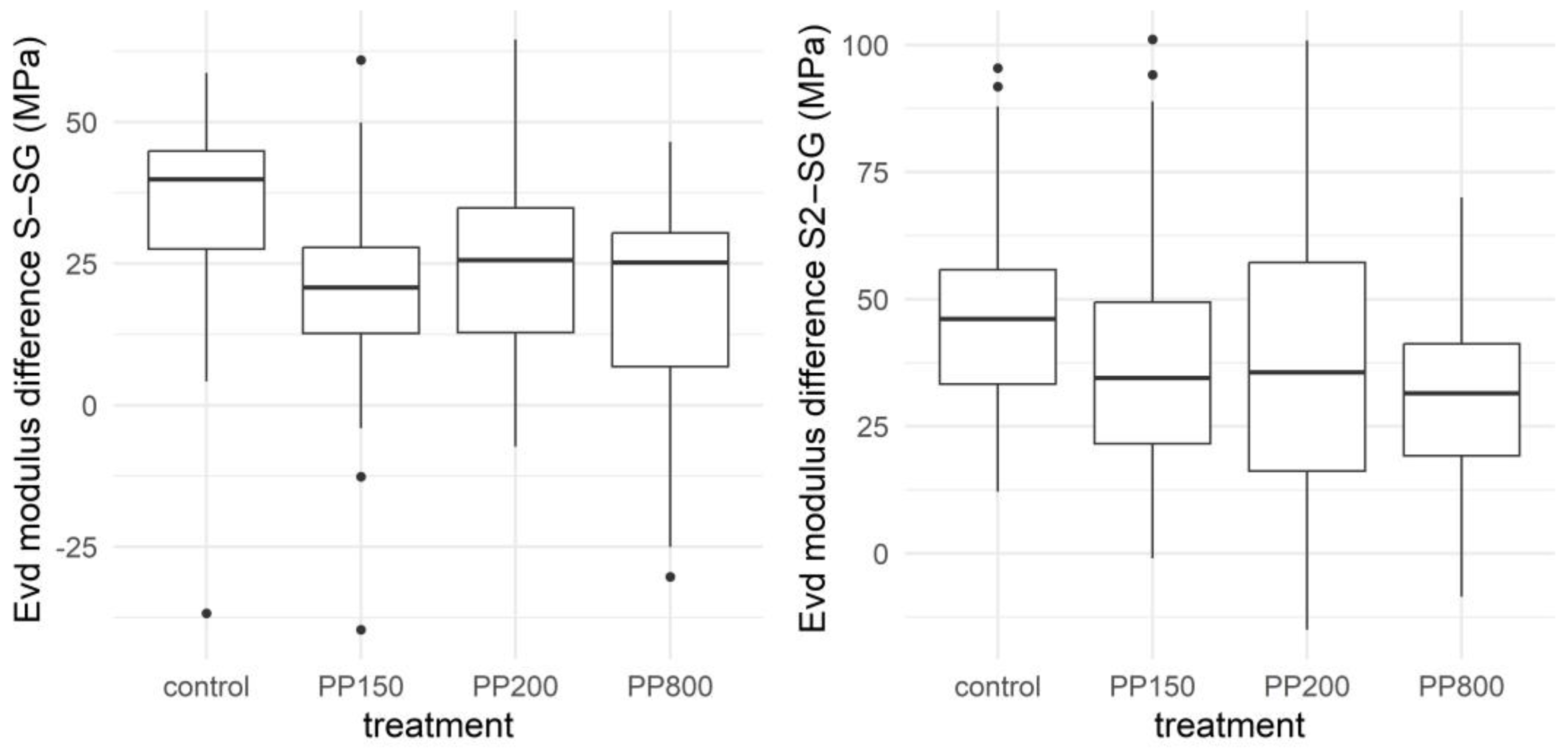
Linear mixed models (LMM) are fairly robust to m inor normality violations; however, to double-check, permutation-based ANOVA was used to maintain the structure of the data across different roads. For both S–SG (p-value 0.0001) and S2–SG (p-value 0.0054), permutation-based ANOVA tests show significant differences between readings across different treatments, ignoring road-specific data stratification. The description statistics can be seen for both datasets in the standard boxplot format in Figure 2.
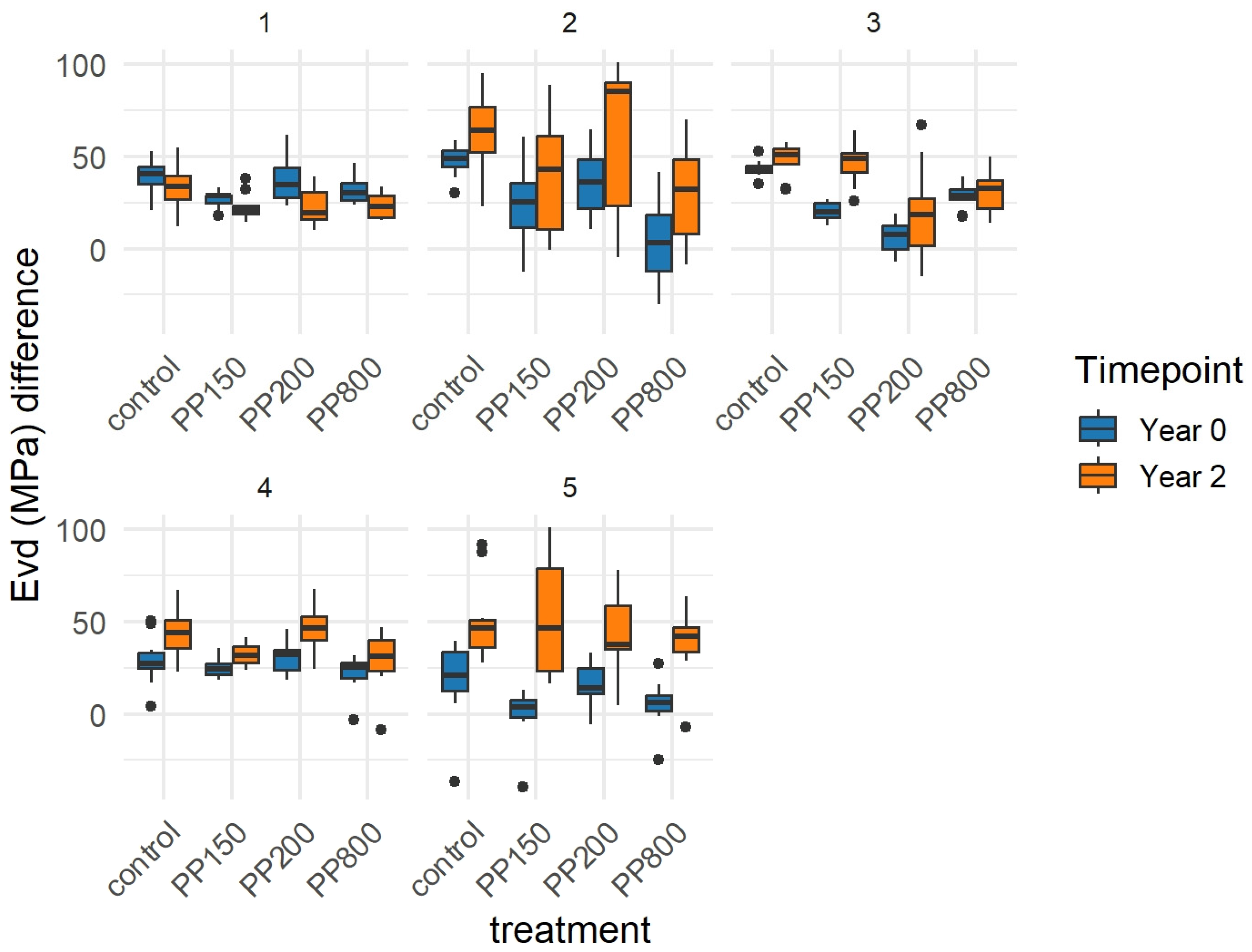
In all instances, the modulus gain was lower where geosynthetics were used. After two years, this difference between treatments is less than right after construction. When the road-based stratification is included, both S–SG and S2–SG show a significant difference (p-value < 0.001) in both cases. The road-stratified descriptive statistics are shown in boxplots in Figure 3.
In general, the inter-quartile range (IQR) was similar across roads and treatments, with two exceptions: road #2, where the drainage was poor and in the case of the PP150 treatment on road #5.

3.2. Cohen’s D

For both S–SG and S2–SG, Cohen’s was calculated for the geotextiles against the control to establish the magnitude of the effect that the geosynthetics have on the LWD measurements. The comparison of effect sizes reveals distinct patterns over time for each treatment group. For PP150, there is a large negative effect on S–SG (Cohen’s d = −0.99), indicating a substantial reduction in the measured values of Evd compared to the control group, but this effect diminishes to a small-to-moderate level after two years in S2–SG (Cohen’s d = −0.41), suggesting settlement over time. PP200 shows a moderate negative effect on S–SG (Cohen’s d = −0.58), which also lessens to a small effect in S2–SG (Cohen’s d = −0.36), indicating a relatively mild and stable impact across the two-year period. In contrast, PP800 maintains large negative effects on the measurements at both time points (S–SG: Cohen’s d = −0.98; S2–SG: Cohen’s d = −0.94), demonstrating a strong and persistent reduction in Evd values compared to the control group, which remains stable over the two years.

3.3. Linear Mixed Models

The analysis revealed a significant negative effect of the PP150 and PP800 treatments on the S–SG difference, with PP150 (Estimate = −17.81, 95% CI [−30.01, −5.61], p = 0.0047) and PP800 (Estimate = −12.44, 95% CI [−24.64, −0.23], p = 0.047) both reducing values relative to the control. The PP200 treatment showed no significant effect (Estimate = −2.19, 95% CI [−14.39, 10.02], p = 0.726). The use of vibrated running coarse significantly increased the S–SG (Estimate = 29.90, 95% CI [13.08, 46.73], p = 0.015), as did the subbase type 32–63 (Estimate = 19.26, 95% CI [5.52, 32.99], p = 0.037). A significant interaction was found between the PP800 treatment and vibrated running coarse (Estimate = −30.03, 95% CI [−47.29, −12.77], p = 0.0008), indicating a compounded reduction in response under this condition. The model accounted for variability across roads (random intercept SD = 4.18), with residual variation estimated at SD = 13.92. Model diagnostics indicated acceptable residual distribution (REML = 1558.8, scaled residuals ranging from −3.93 to 2.63).
The two-year follow-up model showed that none of the main treatment effects were statistically significant. The PP150 treatment exhibited a small, non-significant positive effect (Estimate = 1.54, 95% CI [−16.66, 19.73], p = 0.869), whereas PP800 showed a greater, albeit still non-significant, negative effect (Estimate = −11.77, 95% CI [−29.96, 6.43], p = 0.207). Neither the use of vibrated running coarse (Estimate = 10.10, 95% CI [−14.41, 34.60], p > 0.4) nor the 32–63 subbase type (Estimate = −9.19, 95% CI [−29.20, 10.83], p > 0.4) had significant main effects. However, there was a marginally non-significant interaction between PP150 and vibrated running coarse (Estimate = −22.98, 95% CI [−48.71, 2.75], p = 0.082), suggesting a potential trend toward reduced performance under this combination, which may warrant further study. The model accounted for variability across roads (random intercept SD = 5.92), and residual variation was estimated at SD = 20.76. Residual diagnostics indicated a reasonable distribution (REML = 1708.8; scaled residuals range: −3.24 to 2.38), with no significant deviations observed.

4. Discussion

The combination of nonparametric statistics, effect size estimation, and mixed-effects modelling provided a robust analytical framework for evaluating the performance of geosynthetic-reinforced forest roads. These methods were essential, given the complexity and variability of field conditions, as well as the known limitations of the Light Weight Deflectometer (LWD) in isolating the mechanical effects of reinforcement layers, such as geotextiles.
Most studies present the use of geosynthetics on low-bearing subgrades [37,44,45,46]. They discuss methods to achieve the required bearing capacity, with the analysis of the increase itself being only a secondary concern. Data on the use of geosynthetics on good subgrades to lower the height of construction layers in unbound gravel roads are not so abundant, as most data pertain to flexible pavements [47,48,49] or subgrade soil stabilisation [50].
Effect size analysis using Cohen’s d revealed substantial short-term impacts of PP150 and PP800 on LWD-derived stiffness measurements. These treatments significantly reduced surface-to-subgrade modulus differences (S–SG), suggesting that geosynthetics affected the measured response, likely through membrane action or interface dampening [19]. However, the observed effect diminished after 2 years for PP150 and PP200, whereas PP800 maintained a consistent impact (d = −0.94), suggesting a potential long-term stiffness-related interaction or the persistence of membrane effects.
The linear mixed-effects models confirmed this temporal pattern, with significant effects of treatments and material combinations (e.g., PP800 × vibrated gravel) observed in the short term but not after 2 years. These interactions suggest that while LWD can detect treatment-induced changes shortly after construction, it may fail to capture the full functional longevity of geosynthetic reinforcement, especially as the road structure stabilises over time. These findings contrast with established research that shows that geosynthetics reinforce and increase the modulus characteristics [45,46]; however, they are not contradictory.
Critically, the findings highlight a potential challenge in using LWD for quality control in geosynthetic-reinforced road construction. The observed short-term reductions in LWD-derived stiffness due to the presence of geosynthetics could be misinterpreted as insufficient compaction, potentially leading to over-compaction or unnecessary layer thickening. While not directly quantified in this study, such practices would logically increase construction costs and the associated carbon footprint, as additional material transport and compaction effort are required [51,52]. These implications underscore the importance of context-sensitive interpretation of LWD results and the need for future design guidelines to incorporate correction factors or complementary assessment methods when geosynthetics are used.
These results underscore the need for further field-based calibration of LWD protocols and long-term performance studies to ensure that geosynthetics are evaluated fairly and accurately within sustainable infrastructure projects. As other studies suggest, the individual technological solutions for geosynthetic reinforcement require setting up bearing capacity standards [53]. For static load plate testing, however, standards and corrections for additional LWD testing during construction should also be devised.

5. Conclusions

This study evaluated the performance of geosynthetic-reinforced unpaved forest roads using Light Weight Deflectometer (LWD) testing immediately after construction and after two years of service. The results showed that geosynthetics, particularly PP150 and PP800, significantly influenced the short-term stiffness response of the road structure, with PP800 producing the strongest reduction in LWD-derived modulus values. These short-term reductions diminished over time, and by the two-year follow-up, differences between reinforced and control sections were largely attenuated, indicating the structural stabilisation and adaptation of the reinforced layers.
Significant interactions were also identified between certain treatments and base material types—most notably between PP800 and vibrated running coarse—revealing complex, material-dependent behaviour under field conditions. The use of the differential modulus parameter (S–SG) proved effective in controlling for subgrade variability, confirming that the observed treatment effects were related primarily to the structural layer response.
From a practical standpoint, the findings suggest that short-term reductions in LWD-derived stiffness caused by geosynthetics can lead to misinterpretation during compaction control, potentially prompting unnecessary over-compaction or layer thickening. While such consequences were not directly quantified, they may increase material use, construction costs, and the associated carbon footprint. These results emphasise the importance of context-sensitive interpretation of LWD data and the need for refined testing or evaluation protocols when geosynthetics are used in road construction. Continued long-term monitoring is essential to capture the full performance and sustainability benefits of these materials.

Supplementary Materials

The following supporting information can be downloaded at: https://www.mdpi.com/article/10.3390/f16111650/s1, Table S1: Approximate correspondence between local pedological units (WRB 2022) and engineering soil classifications (EN ISO 14688 / USCS); Table S2: Raw Data Points.

Author Contributions

Conceptualization, J.J. and K.Z.; methodology, J.J.; investigation, O.N. and J.J.; resources, V.M.; data curation, O.N.; writing—original draft preparation, O.N.; writing—review and editing, V.M.; visualisation, O.N.; supervision, K.Z.; project administration, J.J.; funding acquisition, J.J. All authors have read and agreed to the published version of the manuscript.

Funding

This research was funded by Faculty of Forestry and Wood Sciences, Czech University of Life Sciences in Prague, grant number IGA_A_20_25.

Data Availability Statement

The original contributions presented in this study are included in the article/Supplementary Materials. Further inquiries can be directed to the corresponding author(s).

Acknowledgments

The authors would like to thank Krkonošký Národní Park and Lesy ČZU for allowing the research on their road reconstruction sites.

Conflicts of Interest

The authors declare no conflicts of interest.

Abbreviations

The following abbreviations are used in this manuscript:
LWDLight Weight Deflectometer
PLTPlate Load Testing
DCPTDynamic cone penetration test

References

  1. Martins, C.; Macedo, J.; Pinho-Lopes, M. Geocells for Unpaved Roads: Analysis of Design Methods from the Literature. Int. J. Geosynth. Ground Eng. 2024, 10, 57. [Google Scholar] [CrossRef]
  2. Piechowicz, K.; Szymanek, S.; Kowalski, J.; Lendo-Siwicka, M. Stabilization of Loose Soils as Part of Sustainable Development of Road Infrastructure. Sustainability 2024, 16, 3592. [Google Scholar] [CrossRef]
  3. Bräu, G.; Vogt, S. Field and Laboratory Tests on the Bearing Behaviour of Unpaved Roads Reinforced by Different Geosynthetics. Geotech. Eng. 2018, 49, 115–123. [Google Scholar]
  4. Zadehmohamad, M.; Luo, N.; Abu-Farsakh, M.; Voyiadjis, G. Evaluating Long-Term Benefits of Geosynthetics in Flexible Pavements Built over Weak Subgrades by Finite Element and Mechanistic-Empirical Analyses. Geotext. Geomembr. 2022, 50, 455–469. [Google Scholar] [CrossRef]
  5. Khoueiry, N.; Briançon, L.; Riot, M.; Daouadji, A. Full-Scale Laboratory Tests of Geosynthetic Reinforced Unpaved Roads on a Soft Subgrade. Geosynth. Int. 2021, 28, 435–449. [Google Scholar] [CrossRef]
  6. Palmeira, E.M.; Araújo, G.L.S.; Santos, E.C.G. Sustainable Solutions with Geosynthetics and Alternative Construction Materials—A Review. Sustainability 2021, 13, 12756. [Google Scholar] [CrossRef]
  7. Zargar, T.I.; Choudhary, A.K.; Choudhary, A.K. Performance Evaluation of Recycled Concrete Aggregates with Geosynthetics as an Alternative Subbase Course Material in Pavement Construction. Road Mater. Pavement Des. 2024, 25, 2685–2708. [Google Scholar] [CrossRef]
  8. Rimoldi, P.; Shamrock, J.; Kawalec, J.; Touze, N. Sustainable Use of Geosynthetics in Dykes. Sustainability 2021, 13, 4445. [Google Scholar] [CrossRef]
  9. Giroud, J.P.; Han, J.; Tutumluer, E.; Dobie, M.J.D. The Use of Geosynthetics in Roads. Geosynth. Int. 2023, 30, 47–80. [Google Scholar] [CrossRef]
  10. Wright, J.; Kim, S.S.; Kim, B. Stiffness and Strength Improvement of Geosynthetic-Reinforced Pavement Foundation Using Large-Scale Wheel Test. Infrastructures 2020, 5, 33. [Google Scholar] [CrossRef]
  11. Douglas, R.A.; Kelly, M.A. Geotextile ‘Reinforced’ Unpaved Logging Roads: The Effect of Anchorage. Geotext. Geomembr. 1986, 4, 93–106. [Google Scholar] [CrossRef]
  12. Cuelho, E.V.; Perkins, S.W. Geosynthetic Subgrade Stabilization—Field Testing and Design Method Calibration. Transp. Geotech. 2017, 10, 22–34. [Google Scholar] [CrossRef]
  13. Keller, G.; Berry, J. The Long History of Geosynthetics Use on Forest Roads. Transp. Res. Rec. J. Transp. Res. Board 2015, 2473, 242–249. [Google Scholar] [CrossRef]
  14. Zornberg, J.G.; Roodi, G.H. Use of Geosynthetics to Mitigate Problems Associated with Expansive Clay Subgrades. Geosynth. Int. 2020, 28, 279–302. [Google Scholar] [CrossRef]
  15. Patra, S.; Bera, A.K. Development of Design Chart for Jute Geotextiles Reinforced Low Volume Road Section by Finite Element Analysis. Transp. Infrastruct. Geotechnol. 2021, 8, 88–113. [Google Scholar] [CrossRef]
  16. Szafranko, E. Problem of selection of suitable geosynthetics for the strengthening of subgrade in road construction, selection of assessment criteria. Acta Sci. Pol. Architectura 2021, 20, 93–101. [Google Scholar] [CrossRef]
  17. Zheng, G.; Alimohammadi, H.; Zheng, J.; Schaefer, V.R. Effectiveness of Geosynthetics in the Construction of Roadways: A Full-Scale Field Studies Review. In Proceedings of the IFCEE 2021, Dallas, TX, USA, 10–14 May 2021; pp. 223–232. [Google Scholar] [CrossRef]
  18. Kelch, W.W.; Rodgers, M.B.; Rawlinson, T.A.; McVay, M.C.; Herrera, R.A.; Horhota, D.J. Mechanically Stabilized Earth Pressures against Unyielding Surfaces Using Inextensible Reinforcement. J. Geotech. Geoenviron. Eng. 2024, 150, 04024009. [Google Scholar] [CrossRef]
  19. Haliburton, T.A.; Lawmaster, J.D.; McGuffey, V.C. Use of Engineering Fabrics in Transportation-Related Applications; Federal Highway Administration: Washington, DC, USA, 1981. [Google Scholar]
  20. Huntington, G.; Ksaibati, K. Evaluation of Geogrid-Reinforced Granular Base. Geotech. Fabr. Rep. 2000, 18, 22–28. [Google Scholar]
  21. Powell, B.; Mohney, J. Durability of Geotextiles Used in Reinforcement of Walls and Road Subgrade. Transp. Res. Rec. 1994, 1439, 20–24. [Google Scholar]
  22. Fleming, P.R.; Frost, M.W.; Lambert, J.P. Review of Lightweight Deflectometer for Routine In Situ Assessment of Pavement Material Stiffness. Transp. Res. Rec. 2007, 2004, 80–87. [Google Scholar] [CrossRef]
  23. Kuttah, D. Determining the Resilient Modulus of Sandy Subgrade Using Cyclic Light Weight Deflectometer Test. Transp. Geotech. 2021, 27, 100482. [Google Scholar] [CrossRef]
  24. FGSV. ZTV E-StB 17: Zusätzliche Technische Vertragsbedingungen Und Richtlinien Für Erdarbeiten Im Straßenbau; FGSV: Cologne, Germany, 2017. [Google Scholar]
  25. BASt. TP BF-StB Part B 8.3: Technische Prüfvorschriften Für Boden Und Fels Im Straßenbau—Dynamischer Plattendruckversuch; Bundesanstalt für Straßenwesen: Bergisch Gladbach, Germany, 2012. [Google Scholar]
  26. FSV. RVS 08.03.01 Erdarbeiten; Forschungsgesellschaft Straße—Schiene—Verkehr (FSV): Vienna, Austria, 2024. [Google Scholar]
  27. Český Normalizační Institut. ČSN 73 6192: Rázové Zatěžovací Zkoušky Vozovek a Podloží; Český Normalizační Institut: Praha, Česká republika, 1996. [Google Scholar]
  28. IBDiM. Badanie i Ustalenie Zależności Korelacyjnych Dla Oceny Stanu Zagęszczenia i Nośności Gruntów Niespoistych Płytą Dynamiczną; Instytut Badawczy Dróg i Mostów: Warszawa, Poland, 2005. [Google Scholar]
  29. Slovenský Ústav Technickej Normalizácie, Metrológie a Skúšobníctva. STN 73 6192:2011—Ľahký Dynamický Doskový Skúšobný Test Vrstiev Stavebných Konštrukcií; Slovenský Ústav Technickej Normalizácie, Metrológie a Skúšobníctva: Bratislava, Slovakia, 2011. [Google Scholar]
  30. ASTM International. ASTM E2835-21: Standard Test Method for Measuring Deflections Using a Portable Impulse Plate Load Test Device; ASTM International: West Conshohocken, PA, USA, 2021. [Google Scholar]
  31. Kim, J.Y.; Cho, J.W.; Lee, S.Y. Field Evaluation and Application of Intelligent Quality Control Systems. Appl. Sci. 2024, 14, 7142. [Google Scholar] [CrossRef]
  32. Kleiziene, R.; Vaitkus, A.; Zofka, A.; Simanaviciene, R. An Alternative Method for Determination of Compaction Level for the Pavement Granular Layers. Road Mater. Pavement Des. 2023, 24, 3029–3045. [Google Scholar] [CrossRef]
  33. Khodakarami, M.I.; Moghaddam, H.K. Evaluating the Performance of Rehabilitated Roadway Base with Geogrid Reinforcement in the Presence of Soil-Geogrid-Interaction. J. Rehabil. Civ. Eng. 2017, 5, 33–46. [Google Scholar] [CrossRef]
  34. Song, F.; Chen, W.; Nie, Y.; Ma, L. Evaluation of Required Stiffness and Strength of Cellular Geosynthetics. Geosynth. Int. 2022, 29, 217–228. [Google Scholar] [CrossRef]
  35. Kwon, J.; Tutumluer, E.; Kim, M. Development of a Mechanistic Model for Geosynthetic-Reinforced Flexible Pavements. Geosynth. Int. 2005, 12, 310–320. [Google Scholar] [CrossRef]
  36. Chhetri, S.; Deb, P. Finite Element Analysis of Geogrid-Incorporated Flexible Pavement with Soft Subgrade. Appl. Sci. 2024, 14, 5798. [Google Scholar] [CrossRef]
  37. Ahmed Alkawaaz, N.G.; Al-Badran, Y.M.; Muttashar, Y.H. Evaluation of Geogrid-Reinforced Flexible Pavement System Based on Soft Subgrade Soils Under Cyclic Loading. Civ. Environ. Res. 2017, 9, 55–68. Available online: https://www.iiste.org/Journals/index.php/CER/article/view/40284/41432 (accessed on 28 September 2025).
  38. Kumar, V.V.; Saride, S.; Zornberg, J.G. Mechanical Response of Full-Scale Geosynthetic-Reinforced Asphalt Overlays Subjected to Repeated Loads. Transp. Geotech. 2021, 30, 100617. [Google Scholar] [CrossRef]
  39. Ministerstvo Zemědělství. Zpráva o Stavu Lesa a Lesního Hospodářství 2021. eAgri.cz; 2022. Available online: https://mze.gov.cz/public/portal/mze/publikace/zpravy-o-stavu-lesa-a-lesniho/zprava-o-stavu-lesa-a-lesniho-2021 (accessed on 28 September 2025).
  40. Český Statistický Úřad. Dopravní Infrastruktura–Časové Řady (doicr080123_2.xlsx). 2023. Available online: https://csu.gov.cz/docs/107508/2264c51a-40fe-369d-cff7-a7e92bfb890b/doicr080123_2.xlsx?version=1.0 (accessed on 28 September 2025).
  41. Faiz, A. The Promise of Rural Roads: Review of the Role of Low-Volume Roads in Rural Connectivity, Poverty Reduction, Crisis Management, and Livability. Transp. Res. Circ. No. E-C167; Transportation Research Board: Washington, DC, USA, 2012; 52p, Available online: https://onlinepubs.trb.org/onlinepubs/circulars/ec167.pdf (accessed on 8 September 2025).
  42. Český Normalizační Institut. ČSN 72 1006: Kontrola Zhutnění Zemin a Sypanin; Český Normalizační Institut: Praha, Česká republika, 2015. [Google Scholar]
  43. R Core Team. R: A Language and Environment for Statistical Computing; R Foundation for Statistical Computing: Vienna, Austria, 2017. [Google Scholar]
  44. Grigolato, S.; Trzcí, G. Bearing Capacity of Forest Roads on Poor-Bearing Road Subgrades Following Six Years of Use. Forests 2022, 13, 1888. [Google Scholar] [CrossRef]
  45. Abu-Farsakh, M.; Hanandeh, S.; Mohammad, L.; Chen, Q. Performance of Geosynthetic Reinforced/Stabilized Paved Roads Built over Soft Soil under Cyclic Plate Loads. Geotext. Geomembr. 2016, 44, 845–853. [Google Scholar] [CrossRef]
  46. Kiptoo, D.K. An Investigation of the Effect of Dynamic and Static Loading to Geosynthetic Reinforced Pavements Overlying a Soft Subgrade; University of Cape Town: Cape Town, South Africa, 2016. [Google Scholar]
  47. Kumar, V.V.; Roodi, G.H.; Subramanian, S.; Zornberg, J.G. Influence of Asphalt Thickness on Performance of Geosynthetic-Reinforced Asphalt: Full-Scale Field Study. Geotext. Geomembr. 2022, 50, 1052–1059. [Google Scholar] [CrossRef]
  48. Alimohammadi, H.; Schaefer, V.R.; Zheng, J.; Li, H. Performance Evaluation of Geosynthetic Reinforced Flexible Pavement: A Review of Full-Scale Field Studies. Int. J. Pavement Res. Technol. 2021, 14, 30–42. [Google Scholar] [CrossRef]
  49. Neves, J.; Lima, H.; Gonçalves, M. A Numerical Study on the Implications of Subgrade Reinforcement with Geosynthetics in Pavement Design. Procedia Eng. 2016, 143, 888–895. [Google Scholar] [CrossRef]
  50. Singh, M.; Trivedi, A.; Shukla, S.K. Strength Enhancement of the Subgrade Soil of Unpaved Road with Geosynthetic Reinforcement Layers. Transp. Geotech. 2019, 19, 54–60. [Google Scholar] [CrossRef]
  51. Karlsson, I.; Rootzén, J.; Johnsson, F. Reaching Net-Zero Carbon Emissions in Construction Supply Chains—Analysis of a Swedish Road Construction Project. Renew. Sustain. Energy Rev. 2020, 120, 109651. [Google Scholar] [CrossRef]
  52. Zornberg, J.G.; Subramanian, S.; Roodi, G.H.; Yalcin, Y.; Kumar, V.V. Sustainability Benefits of Adopting Geosynthetics in Roadway Design. Int. J. Geosynth. Ground Eng. 2024, 10, 1–27. [Google Scholar] [CrossRef]
  53. Czerniak, A.; Grajewski, S.M.; Kurowska, E.E. Bearing Capacity Standards for Forest Roads Constructed Using Various Technologies from Mechanically and Chemically Stabilised Aggregate. Croat. J. For. Eng. 2021, 42, 477–489. [Google Scholar] [CrossRef]
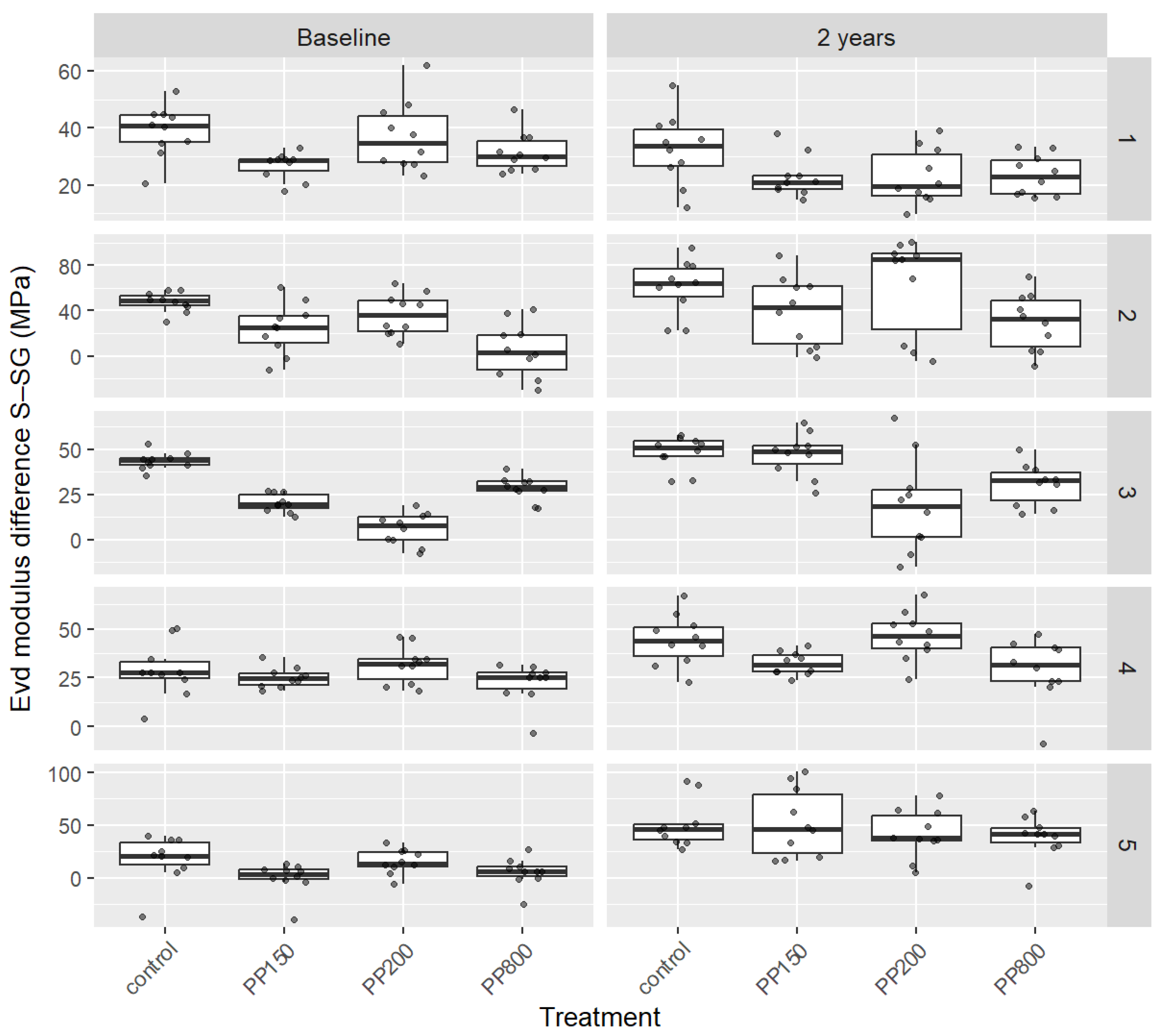
Figure 1. Distribution of raw Evd (MPa) modulus differences (S–SG) for each treatment and road at baseline and after two years. Boxplots display the interquartile range (IQR; 25th–75th percentile) with the median shown as a horizontal line. Whiskers extend to 1.5× the IQR, and individual points represent raw measurements.
Forests 16 01650 g001
Figure 2. Standard boxplots of Evd modulus differences between surface and subgrade (S–SG) and surface after two years and subgrade (S2–SG) with different treatments. Boxes display the interquartile range (IQR; 25th–75th percentile) with the median shown as a horizontal line. Whiskers extend to 1.5× the IQR, and individual points represent outliers.
Forests 16 01650 g002
Figure 3. Standard boxplots with descriptive statistics of road-stratified Evd modulus differences between surface and subgrade (S–SG) and surface after two years and subgrade (S2–SG) on different treatments. Boxes display the interquartile range (IQR; 25th–75th percentile) with the median shown as a horizontal line. Whiskers extend to 1.5× the IQR, and individual points represent outliers.
Forests 16 01650 g003
Table 1. Characteristics of the forest roads included in the dataset.
RoadSubgrade Soil TypeLengthSubgrade TreatmentSub-Base MaterialSub-Base HeightBase-Coarse MaterialBase-Coarse Height
--(m)--(mm)-(mm)
#1undeveloped soil on weathered phyllite2695compactiongravel aggregate 32/63 fraction200gravel aggregate 0/32 fraction100
#2haplic podzols on weathered phyllite3355compactiongravel aggregate 0/63 fraction200vibrated gravel100
#3stagnic luvisols on weathered breccia1334lime stabilisation (400 mm depth)gravel aggregate 0/63 fraction200vibrated gravel200
#4haplic luvisols on weathered phyllite1556compactiongravel aggregate 32/63 fraction200gravel aggregate 0/32 fraction100
#5haplic podzols on weathered phyllite2509compactiongravel aggregate 32/63 fraction200gravel aggregate 0/63 fraction100
Table 2. Exploratory statistics (mean and standard deviation) of the modulus difference between surface and subgrade (S–SG) and surface after two years and subgrade (S2–SG) across the different treatments (control—no treatment, PP150—Polypropylene geotextile 150 g/m2 with monolithic geogrid, PP200—Polypropylene geotextile 200 g/m2, PP800—Polypropylene geotextile 800 g/m2).
TreatmentMean
S–SG
SD
S–SG
Mean
S2–SG
SD
S2–SG
(MPa)
control35.416.647.318.8
PP15019.315.738.822.7
PP20025.517.338.529.2
PP80018.617.430.417.1
Disclaimer/Publisher’s Note: The statements, opinions and data contained in all publications are solely those of the individual author(s) and contributor(s) and not of MDPI and/or the editor(s). MDPI and/or the editor(s) disclaim responsibility for any injury to people or property resulting from any ideas, methods, instructions or products referred to in the content.