Recreational Visit to Suburban Forests during the COVID-19 Pandemic: A Case Study of Taiwan



Abstract
1. Introduction
2. Literature Review
3. Methods
3.1. Study Site
3.2. Data Collection
3.3. Data Analysis
4. Results
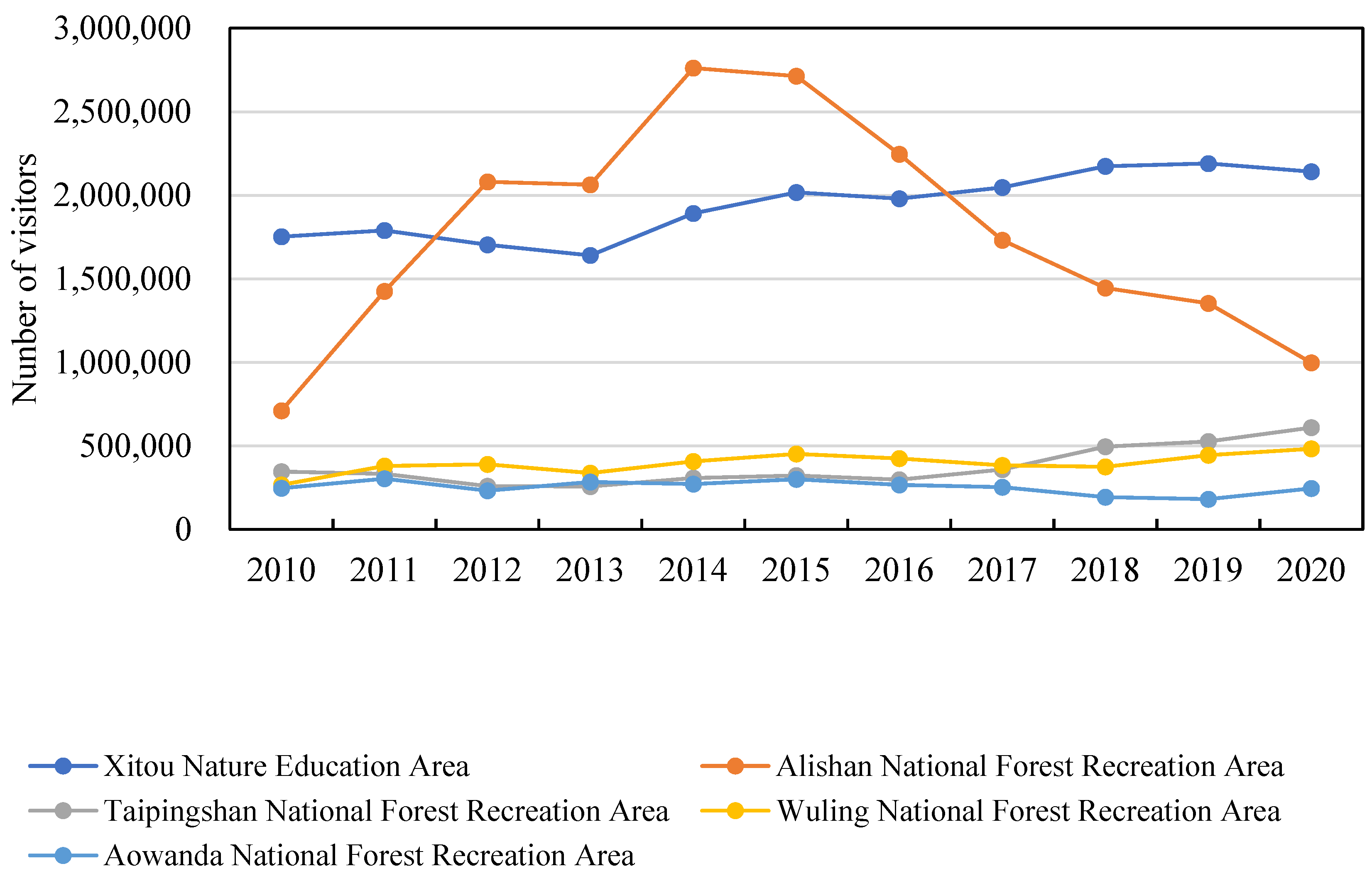
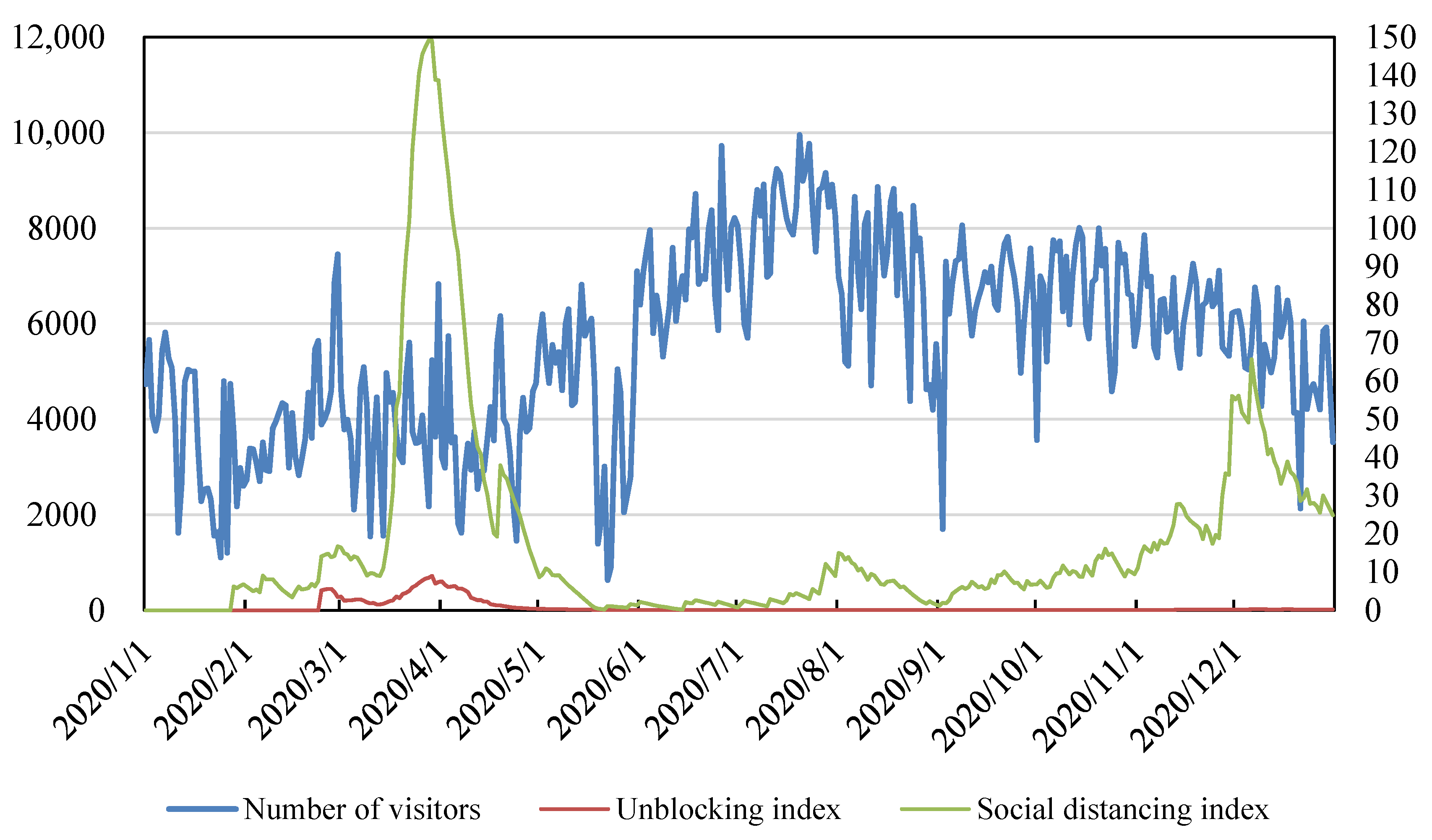
4.1. Data Trends
4.2. Regression Analysis
4.3. Revenge Travel
5. Discussion
5.1. COVID-19 and Forest Recreation
5.2. Revenge Travel and Suburban Forests
6. Implications and Conclusions
Author Contributions
Funding
Acknowledgments
Conflicts of Interest
References
- Zhu, N.; Zhang, D.; Wang, W.; Li, X.; Yang, B.; Song, J.; Zhao, X.; Huang, B.; Shi, W.; Lu, R.; et al. A novel coronavirus from patients with pneumonia in China, 2019. N. Engl. J. Med. 2020, 382, 727–733. [Google Scholar] [CrossRef] [Scilit] [PubMed]
- Chang, C.L.; McAleer, M.; Wong, W.K. Risk and financial management of COVID-19 in business, economics and finance. J. Risk. Insur. 2020, 13, 102. [Google Scholar] [CrossRef] [Scilit]
- Gössling, S.; Scott, D.; Hall, C.M. Pandemics, tourism and global change: A rapid assessment of COVID-19. J. Sustain. Tour. 2020, 29, 1–20. [Google Scholar] [CrossRef] [Scilit]
- Škare, M.; Soriano, D.R.; PoradaRochoń, M. Impact of COVID-19 on the travel and tourism industry. Technol. Forecast. Soc. Change 2021, 163, 120469. [Google Scholar] [CrossRef] [Scilit]
- Chakraborty, I.; Maity, P. COVID-19 outbreak: Migration, effects on society, global environment and prevention. Environ. Sci. Technol. 2020, 728, 138882. [Google Scholar] [CrossRef] [Scilit] [PubMed]
- Chang, C.L.; McAleer, M.; Ramos, V. The future of tourism in the COVID-19 era. Advances in Decision Sciences. Adv. Decis. Sci. 2020, 24, 218–230. [Google Scholar]
- Wang, L.E.; Tian, B.; Filimonau, V.; Ning, Z.; Yang, X. The impact of the COVID-19 pandemic on revenues of visitor attractions: An exploratory and preliminary study in China. Tour. Econ. 2021, 28, 153–174. [Google Scholar] [CrossRef] [Scilit]
- Qiu, R.T.; Park, J.; Li, S.; Song, H. Social costs of tourism during the COVID-19 pandemic. Ann. Tour. Res. 2020, 84, 102994. [Google Scholar] [CrossRef] [Scilit]
- Wilson, M.E.; Chen, L.H. Re-starting travel in the era of COVID-19: Preparing anew. J. Travel Med. 2020, 27, taaa108. [Google Scholar] [CrossRef] [Scilit]
- Uğur, N.G.; Akbıyık, A. Impacts of COVID-19 on global tourism industry: A cross-regional comparison. Tour. Manag. Perspect. 2020, 36, 100744. [Google Scholar] [CrossRef] [Scilit]
- Choudhary, N.; Manda, V.K. Revenge travel or the road less traveled? Opting for a suitable option in pandemic times. Int. J. Adv. Innov. Res. 2021, 8, 37–45. [Google Scholar]
- Revenge Travel is the Phenomenon That Could Bring Back Tourism with a Bang. Available online: https://www.washingtonpost.com/travel/2020/07/29/revenge-travel-is-phenomenon-that-could-bring-back-tourism-with-bang/ (accessed on 27 May 2022).
- Girish, V.G. COVID-19 pandemic and the emergence of revenge travel. Int. J. Cult. Tour. Hosp. Res. 2021, 35, 125–129. [Google Scholar] [CrossRef] [Scilit]
- Wassler, P.; Fan, D.X. A tale of four futures: Tourism academia and COVID-19. Tour. Manag. Perspect. 2021, 38, 100818. [Google Scholar] [CrossRef] [Scilit] [PubMed]
- Oktaviani, D.; Sutisna, D. An analytical study of the readiness of eco-tourism based transactions in the mount Putri Bandung (Indonesia) tourism area. Rev. Int. Geogr. Educ. Online 2021, 11, 229–234. [Google Scholar]
- Kuščer, K.; Eichelberger, S.; Peters, M. Tourism organizations’ responses to the COVID-19 pandemic: An investigation of the lockdown period. Curr. Issues Tour. 2022, 25, 247–260. [Google Scholar] [CrossRef] [Scilit]
- Lee, Y.F.; Chi, Y.Y. Natural disaster impact on annual visitors of recreation area: The Taiwan case. Int. J. Econ. Manag. Eng. 2013, 7, 2715–2719. [Google Scholar] [CrossRef]
- Hui, T.K.; Yuen, C.C. A study in the seasonal variation of Japanese tourist arrivals in Singapore. Tour. Manag. 2002, 23, 127–131. [Google Scholar] [CrossRef] [Scilit]
- Cho, V. A comparison of three different approaches to tourist arrival forecasting. Tour. Manag. 2003, 24, 323–330. [Google Scholar] [CrossRef] [Scilit]
- Taylor, T.; Ortiz, R.A. Impacts of climate change on domestic tourism in the UK: A panel data estimation. Tour. Econ. 2009, 15, 803–812. [Google Scholar] [CrossRef] [Scilit]
- Albalate, D.; Bel, G. Tourism and urban public transport: Holding demand pressure under supply constraints. Tour. Manag. 2010, 31, 425–433. [Google Scholar] [CrossRef] [Scilit]
- McAleer, M.; Huang, B.W.; Kuo, H.I.; Chen, C.C.; Chang, C.L. An econometric analysis of SARS and Avian Flu on international tourist arrivals to Asia. Environ. Model. Softw. 2010, 25, 100–106. [Google Scholar] [CrossRef] [Scilit] [PubMed]
- Chiou, C.R.; Huang, M.Y.; Tsai, W.L.; Lin, L.C.; Yu, C.P. Assessing impact of natural disasters on tourist arrivals: The case of Xitou nature education area (XNEA), Taiwan. Int. J. Tour. Sci. 2013, 13, 47–64. [Google Scholar] [CrossRef] [Scilit]
- Pichlerová, M.; Önkal, D.; Bartlett, A.; Výbošťok, J.; Pichler, V. Variability in forest visit numbers in different regions and population segments before and during the COVID-19 pandemic. Int. J. Environ. Res. Public Health 2021, 18, 3469. [Google Scholar] [CrossRef] [Scilit] [PubMed]
- National Parks Hosted 237 Million Visitors in 2020. Available online: https://www.nps.gov/orgs/1207/02-25-21-national-parks-hosted-237-million-visitors-in-2020.htm (accessed on 27 May 2022).
- Schägner, J.P.; Brander, L.; Maes, J.; Paracchini, M.L.; Hartje, V. Mapping recreational visits and values of European national parks by combining statistical modelling and unit value transfer. J. Nat. Conserv. 2016, 31, 71–84. [Google Scholar] [CrossRef] [Scilit]
- Derks, J.; Giessen, L.; Winkel, G. COVID-19-induced visitor boom reveals the importance of forests as critical infrastructure. For. Policy Econ. 2020, 118, 102253. [Google Scholar] [CrossRef] [Scilit]
- Geng, D.C.; Innes, J.; Wu, W.; Wang, G. Impacts of COVID-19 pandemic on urban park visitation: A global analysis. J. For. Res. 2021, 32, 553–567. [Google Scholar] [CrossRef] [Scilit]
- Chen, Y.; Liu, X.; Gao, W.; Wang, R.Y.; Li, Y.; Tu, W. Emerging social media data on measuring urban park use. Urban For. Urban Green. 2018, 31, 130–141. [Google Scholar] [CrossRef] [Scilit]
- Wolff, M.; Scheuer, S.; Haase, D. Looking beyond boundaries: Revisiting the rural-urban interface of Green Space Accessibility in Europe. Ecol. Ind. 2020, 113, 106245. [Google Scholar] [CrossRef] [Scilit]
- Thomsen, J.M.; Powell, R.B.; Allen, D. Park health resources: Benefits, values, and implications. Park Sci. 2013, 30, 30–36. [Google Scholar]
- Grima, N.; Corcoran, W.; Hill-James, C.; Langton, B.; Sommer, H.; Fisher, B. The importance of urban natural areas and urban ecosystem services during the COVID-19 pandemic. PLoS ONE 2020, 15, e0243344. [Google Scholar] [CrossRef] [Scilit]
- Liu, H.; Liu, W.; Wang, Y. A study on the influencing factors of tourism demand from mainland China to Hong Kong. J. Hosp. Tour. Res. 2021, 45, 171–191. [Google Scholar] [CrossRef] [Scilit]
- Millhäusler, A.; Anderwald, P.; Haeni, M.; Haller, R.M. Publicity, economics and weather–Changes in visitor numbers to a European national park over 8 years. J. Outdoor Recreat. Tour. 2016, 16, 50–57. [Google Scholar] [CrossRef] [Scilit]
- Bar-On, R.R. Middle East and the Mediterranean to 1999, and preliminary worldwide estimates for 2000. Tour. Econ. 2001, 7, 89–103. [Google Scholar] [CrossRef] [Scilit]
- Huang, J.H.; Min, J.C. Earthquake devastation and recovery in tourism: The Taiwan case. Tour. Manag. 2002, 23, 145–154. [Google Scholar] [CrossRef] [Scilit]
- Prideaux, B. Tourism perspectives of the Asian financial crisis: Lessons for the future. Curr. Issues Tour. 1999, 2, 279–293. [Google Scholar] [CrossRef] [Scilit]
- Chuang, C.; Liu, W.Y. An analysis of influencing factors on visitor numbers of national parks in Taiwan. Agric. Econ. 2018, 60, 65–100. [Google Scholar] [CrossRef]
- Liu, W.Y. Examining attributes associated with tourist arrivals to forest parks through linear and curve estimations. Adv. Hosp. Leis. 2018, 14, 93–109. [Google Scholar] [CrossRef] [Scilit]
- Yu, C.P.; Chang, W.C.; Ramanpong, J. Assessing visitors’ memorable tourism experiences (MTEs) in forest recreation destination: A case study in Xitou nature education area. Forests 2019, 10, 636. [Google Scholar] [CrossRef] [Scilit]
- Wen, Z.; Huimin, G.; Kavanaugh, R.R. The impacts of SARS on the consumer behaviour of Chinese domestic tourists. Curr. Issues Tour. 2005, 8, 22–38. [Google Scholar] [CrossRef] [Scilit]
- Zeng, B.; Carter, R.W.; De Lacy., T. Short-term perturbations and tourism effects: The case of SARS in China. Curr. Issues Tour. 2005, 8, 306–322. [Google Scholar] [CrossRef] [Scilit]
- Marafa, L.M.; Tung, F. Changes in participation in leisure and outdoor recreation activities among Hong Kong people during the SARS outbreak. World Leis. J. 2004, 46, 38–47. [Google Scholar] [CrossRef] [Scilit]
- Vaishar, A.; Šťastná, M. Impact of the COVID-19 pandemic on rural tourism in Czechia preliminary considerations. Curr. Issues Tour. 2022, 25, 187–191. [Google Scholar] [CrossRef] [Scilit]
- Kuo, H.I.; Chen, C.C.; Tseng, W.C.; Ju, L.F.; Huang, B.W. Assessing impacts of SARS and Avian Flu on international tourism demand to Asia. Tour. Manag. 2008, 29, 917–928. [Google Scholar] [CrossRef] [Scilit] [PubMed]
- Min, J.C. The effect of the SARS illness on tourism in Taiwan: An empirical study. Int. J. Manag. 2005, 22, 497. [Google Scholar]
- Min, J.C.; Lim, C.; Kung, H.H. Intervention analysis of SARS on Japanese tourism demand for Taiwan. Qual. Quant. 2011, 45, 91–102. [Google Scholar] [CrossRef] [Scilit]
- Mao, C.K.; Ding, C.G.; Lee, H.Y. Post-SARS tourist arrival recovery patterns: An analysis based on a catastrophe theory. Tour. Manag. 2010, 31, 855–861. [Google Scholar] [CrossRef] [Scilit]
- Impact Assessment of the COVID-19 Outbreak on International Tourism. Available online: https://www.unwto.org/impact-assessment-of-the-covid-19-outbreak-on-international-tourism (accessed on 27 May 2022).
- 2020: Worst Year in Tourism History with 1 Billion Fewer International Arrivals. Available online: https://www.unwto.org/news/2020-worst-year-in-tourism-history-with-1-billion-fewer-international-arrivals (accessed on 27 May 2022).
- Kupfer, J.A.; Li, Z.; Ning, H.; Huang, X. Using mobile device data to track the effects of the COVID-19 Pandemic on spatiotemporal patterns of national park visitation. Sustainability 2021, 13, 9366. [Google Scholar] [CrossRef] [Scilit]
- Miller, Z.D.; Freimund, W.; Dalenberg, D.; Vega, M. Observing COVID-19 related behaviors in a high visitor use area of Arches National Park. PLoS ONE 2021, 16, e0247315. [Google Scholar] [CrossRef] [Scilit]
- Tran, B.L.; Chen, C.C.; Tseng, W.C.; Liao, S.Y. Tourism under the early phase of COVID-19 in four APEC economies: An estimation with special focus on SARS experiences. Int. J. Environ. Res. Public Health 2020, 17, 7543. [Google Scholar] [CrossRef] [Scilit]
- Eichner, M.; Schwehm, M.; Wilson, N.; Baker, M.G. Small islands and pandemic influenza: Potential benefits and limitations of travel volume reduction as a border control measure. BMC Infect. Dis. 2009, 9, 160. [Google Scholar] [CrossRef] [Scilit]
- Chang, Y.K.; Hung, C.L.; Timme, S.; Nosrat, S.; Chu, C.H. Exercise behavior and mood during the COVID-19 pandemic in Taiwan: Lessons for the future. International journal of environmental research and public health. Int. J. Public Health 2020, 17, 7092. [Google Scholar] [CrossRef] [Scilit] [PubMed]
- Landry, C.E.; Bergstrom, J.; Salazar, J.; Turner, D. How has the COVID-19 pandemic affected outdoor recreation in the US? A revealed preference approach. Appl. Econ. Perspect. Policy 2021, 43, 443–457. [Google Scholar] [CrossRef] [Scilit]
- Chen, S.L.S.; Yen, A.M.F.; Lai, C.C.; Hsu, C.Y.; Chan, C.C.; Chen, T.H.H. An index for lifting social distancing during the COVID-19 pandemic: Algorithm recommendation for lifting social distancing. J. Med. Internet Res. 2020, 22, e22469. [Google Scholar] [CrossRef] [Scilit]
- Remuzzi, A.; Remuzzi, G. COVID-19 and Italy: What next? Lancet 2020, 395, 1225–1228. [Google Scholar] [CrossRef] [Scilit]
- International Social Distance Calculation Formula. Available online: https://covid-19.nchc.org.tw/docs/distance5.png (accessed on 27 May 2022).
- Suppasri, A.; Goto, K.; Muhari, A.; Ranasinghe, P.; Riyaz, M.; Affan, M.; Mas, E.; Yasuda, M.; Imamura, F. A decade after the 2004 Indian Ocean tsunami: The progress in disaster preparedness and future challenges in Indonesia, Sri Lanka, Thailand and the Maldives. Pure Appl. Geophys. 2015, 172, 3313–3341. [Google Scholar] [CrossRef] [Scilit]
- Henderson, J.C.; Ng, A. Responding to crisis: Severe acute respiratory syndrome (SARS) and hotels in Singapore. Int. J. Tour. Res. 2004, 6, 411–419. [Google Scholar] [CrossRef] [Scilit]
- Pine, R.; McKercher, B. The impact of SARS on Hong Kong’s tourism industry. Int. J. Contemp. Hosp. Manag. 2004, 16, 139–143. [Google Scholar] [CrossRef] [Scilit]
- Page, S.; Song, H.; Wu, D.C. Assessing the impacts of the global economic crisis and swine flu on inbound tourism demand in the United Kingdom. J. Travel Res. 2012, 51, 142–153. [Google Scholar] [CrossRef] [Scilit]
- Tsai, M.J. The Experimental Forest, College of Bio-Resources and Agriculture, National Taiwan University; The Experimental Forest, College of Bio-Resources and Agriculture, National Taiwan University: Nantou, Taiwan, 2018; 56p. [Google Scholar]
- Ramanpong, J.; Wu, C.D.; Yu, C.P.; Tsai, M.J. A retrospective analysis of injury cases for visitor risk management in a nature-based touristic destination. Curr. Issues Tour. 2021, 24, 3552–3568. [Google Scholar] [CrossRef] [Scilit]
- Wang, Y.N.; Lin, L.C.; Chang, P.C.; Huang, Y.R.; Wang, C.T. Preliminary investigation of visitor arrivals and management implication in Xitou nature education area. J. Exp. For. Natl. Taiwan Univ. 2011, 25, 181–191. [Google Scholar] [CrossRef]
- Kuo, M. How might contact with nature promote human health? Promising mechanisms and a possible central pathway. Front. Psychol. 2015, 6, 1093. [Google Scholar] [CrossRef] [Scilit] [PubMed]
- Tsao, T.M.; Tsai, M.J.; Hwang, J.S.; Cheng, W.F.; Wu, C.F.; Chou, C.K.; Su, T.C. Health effects of a forest environment on natural killer cells in humans: An observational pilot study. Oncotarget 2018, 9, 16501–16511. [Google Scholar] [CrossRef] [Scilit] [PubMed]
- Yu, C.P.; Hsieh, H. Beyond restorative benefits: Evaluating the effect of forest therapy on creativity. Urban For. Urban Green. 2018, 51, 126670. [Google Scholar] [CrossRef] [Scilit]
- Simkin, J.; Ojala, A.; Tyrväinen, L. Restorative effects of mature and young commercial forests, pristine old-growth forest and urban recreation forest-A field experiment. Urban For. Urban Green. 2020, 48, 126567. [Google Scholar] [CrossRef] [Scilit]
- Souza, C.N.; Rodrigues, A.C.; Correia, R.A.; Normande, I.C.; Costa, H.C.; GuedesSantos, J.; Ladle, R.J. No visit, no interest: How COVID-19 has affected public interest in world’s national parks. Biol. Conserv. 2021, 256, 109015. [Google Scholar] [CrossRef] [Scilit]
- Zaman, U.; Raza, S.H.; Abbasi, S.; Aktan, M.; Farías, P. Sustainable or a butterfly effect in global tourism? nexus of pandemic fatigue, COVID-19-branded destination safety, travel stimulus incentives, and post-pandemic revenge travel. Sustainability 2021, 13, 12834. [Google Scholar] [CrossRef] [Scilit]
- Hawryluck, L.; Gold, W.L.; Robinson, S.; Pogorski, S.; Galea, S.; Styra, R. SARS control and psychological effects of quarantine, Toronto, Canada. Emerg. Infect. Dis. 2004, 10, 1206. [Google Scholar] [CrossRef] [Scilit]
- Wachyuni, S.S.; Kusumaningrum, D.A. The effect of COVID-19 pandemic: How are the future tourist behavior. J. Educ. Soc. Behav. Sci. 2020, 33, 67–76. [Google Scholar] [CrossRef] [Scilit]
- Ivanova, M.; Ivanov, I.K.; Ivanov, S. Travel behaviour after the pandemic: The case of Bulgaria. Anatolia 2021, 32, 1–11. [Google Scholar] [CrossRef] [Scilit]
- Weiss, G.; Martin, S.; Matilainen, A.; Vennesland, B.; Nastase, C.; Nybakk, E.; Bouriaud, L. Innovation processes in forest-related recreation services: The role of public and private resources in different institutional backgrounds. Small-Scale For. 2007, 6, 423–442. [Google Scholar] [CrossRef] [Scilit]
- Gil-Alana, L.A.; Poza, C. The impact of COVID-19 on the Spanish tourism sector. Tour. Econ. 2022, 28, 646–653. [Google Scholar] [CrossRef] [Scilit]
- Payne, J.E.; GilAlana, L.A.; Mervar, A. Persistence in Croatian tourism: The impact of COVID-19. Tour. Econ. 2021. [CrossRef] [Scilit]
- Jin, X.; Bao, J.; Tang, C. Profiling and evaluating Chinese consumers regarding post-COVID-19 travel. Curr. Issues Tour. 2021, 25, 745–763. [Google Scholar] [CrossRef] [Scilit]
- Zhao, J.; An, Y. Behavioural intention of forest therapy tourism in China: Based on health belief model and the theory of planned behaviour. Curr. Issues Tour. 2021, 24, 3425–3432. [Google Scholar] [CrossRef] [Scilit]
- Zhang, S.; Paterson, J.S.; Hujala, T. Sustaining forest ecosystem services through social enterprises: Motivations and challenges from a case study in Scotland. Small-Scale For. 2021, 20, 627–647. [Google Scholar] [CrossRef] [Scilit]
- Viscusi, W.K. Pricing the global health risks of the COVID-19 pandemic. J. Risk. Uncertain. 2020, 61, 101–128. [Google Scholar] [CrossRef] [Scilit]



| Recreation Sites | Jan | Feb 1 | Mar | Apr | May | Jun | Jul | Aug | Sep | Oct | Nov | Dec | |
|---|---|---|---|---|---|---|---|---|---|---|---|---|---|
| Xitou Nature Education Area | Number of visitors | −6085 | 13,000 | −23,084 | −58,586 | −37,065 | 50,819 | 34,443 | 19,500 | 3106 | 6038 | 11,606 | −290 |
| Ratio | −5.0% | 12.0% | −19.2% | −54.4% | −26.2% | 23.1% | 13.0% | 8.9% | 1.6% | 2.8% | 6.1% | −0.2% | |
| Alishan National Forest Recreation Area | Number of visitors | −41,818 | −51,364 | −103,246 | −140,699 | −73,166 | −23,392 | −10,342 | 5909 | −1745 | −9084 | −30,201 | −33,459 |
| Ratio | −35.5% | −36.7% | −45.8% | −79.5% | −72.0% | −26.8% | −8.7% | 5.2% | −2.2% | −8.0% | −26.7% | −27.7% | |
| Taipingshan National Forest Recreation Area | Number of visitors | 5067 | −1676 | −5551 | −11311 | −2738 | 11,038 | 18,529 | 44,754 | 16,157 | 32,524 | 28,643 | 13,615 |
| Ratio | 16.4% | −3.9% | −21.6% | −34.5% | −9.2% | 33.7% | 35.5% | 95.4% | 47.7% | 70.6% | 63.6% | 32.9% | |
| Wuling National Forest Recreation Area | Number of visitors | 363 | 29,542 | −12,219 | −9467 | −1215 | 10,588 | 8994 | 9262 | 5339 | 11,988 | 20,344 | 7985 |
| Ratio | 1.2% | 32.3% | −25.9% | −41.0% | −8.3% | 65.3% | 29.9% | 34.4% | 31.0% | 48.4% | 48.9% | 22.0% | |
| Aowanda National Forest Recreation Area | Number of visitors | −7209 | −822 | −1351 | −549 | 341 | 677 | 8489 | 6255 | 2046 | 5746 | 16,309 | 6738 |
| Ratio | −31.4% | −4.3% | −17.7% | −8.8% | 8.0% | 11.2% | 95.2% | 95.1% | 35.9% | 36.7% | 40.8% | 10.3% |
| Total Number of Visitors | Coefficient | t Value | R2 | Adjusted R2 | Significance | DW Value | |
|---|---|---|---|---|---|---|---|
| Unblocking index | Monthly data | −881.888 | −3.325 | 0.551 | 0.501 | 0.009 *** | 1.653 |
| Weekly data | −526.012 | −4.799 | 0.344 | 0.329 | 0.000 *** | 0.755 | |
| Social distancing index | Monthly data | −51.15 | −2.286 | 0.367 | 0.297 | 0.048 ** | 1.147 |
| Weekly data | −25.208 | −3.192 | 0.188 | 0.170 | 0.003 *** | 0.613 |
| Total Number of Visitors | Minimum Value | Maximum Value | Mean | Standard Deviation | Number | ||
|---|---|---|---|---|---|---|---|
| Unblocking index | Monthly data | Predictive value | 89,019.289 | 200,666.266 | 178,340.000 | 38,042.946 | 11 |
| Residuals | −55,314.004 | 63,854.754 | 0.000 | 34,322.230 | 11 | ||
| Standard predictive value | −2.348 | 0.587 | 0.000 | 1.000 | 11 | ||
| Standard residuals | −1.529 | 1.765 | 0.000 | 0.949 | 11 | ||
| Weekly data | Predictive value | 15,452.257 | 43,890.598 | 40,686.174 | 6537.216 | 46 | |
| Residuals | −24,830.416 | 18,386.439 | 0.000 | 9035.751 | 46 | ||
| Standard predictive value | −3.860 | 0.490 | 0.000 | 1.000 | 46 | ||
| Standard residuals | −2.717 | 2.012 | 0.000 | 0.989 | 46 | ||
| Social distancing index | Monthly data | Predictive value | 117,610.453 | 205,251.969 | 178,340.000 | 31,050.908 | 11 |
| Residuals | −79,563.539 | 63,065.953 | 0.000 | 40,756.869 | 11 | ||
| Standard predictive value | −1.956 | 0.867 | 0.000 | 1.000 | 11 | ||
| Standard residuals | −1.852 | 1.468 | 0.000 | 0.949 | 11 | ||
| Weekly data | Predictive value | 20,904.895 | 43,929.949 | 40,686.174 | 4836.037 | 46 | |
| Residuals | −25,014.949 | 18,838.615 | 0.000 | 10,049.514 | 46 | ||
| Standard predictive value | −4.090 | 0.671 | 0.000 | 1.000 | 46 | ||
| Standard residuals | −2.461 | 1.854 | 0.000 | 0.989 | 46 |
| Mean | Standard Deviation | t Value | p | ||
|---|---|---|---|---|---|
| Mar–May | Past 3 years | 162,894.67 | 17,896.54 | −3.833 | 0.062 * |
| 2020 | 123,316.33 | 17,156.94 | |||
| Jun–Dec | Past 3 years | 192,684.57 | 22,831.22 | 2.536 | 0.044 ** |
| 2020 | 210,573.43 | 30,660.63 |
Publisher’s Note: MDPI stays neutral with regard to jurisdictional claims in published maps and institutional affiliations. |
© 2022 by the authors. Licensee MDPI, Basel, Switzerland. This article is an open access article distributed under the terms and conditions of the Creative Commons Attribution (CC BY) license (https://creativecommons.org/licenses/by/4.0/).
Share and Cite
Chen, Y.-C.; Tsai, F.C.; Tsai, M.-J.; Liu, W.-Y. Recreational Visit to Suburban Forests during the COVID-19 Pandemic: A Case Study of Taiwan. Forests 2022, 13, 1181. https://doi.org/10.3390/f13081181
Chen Y-C, Tsai FC, Tsai M-J, Liu W-Y. Recreational Visit to Suburban Forests during the COVID-19 Pandemic: A Case Study of Taiwan. Forests. 2022; 13(8):1181. https://doi.org/10.3390/f13081181
Chicago/Turabian StyleChen, Yung-Chih, Frank C. Tsai, Ming-Jer Tsai, and Wan-Yu Liu. 2022. "Recreational Visit to Suburban Forests during the COVID-19 Pandemic: A Case Study of Taiwan" Forests 13, no. 8: 1181. https://doi.org/10.3390/f13081181
APA StyleChen, Y.-C., Tsai, F. C., Tsai, M.-J., & Liu, W.-Y. (2022). Recreational Visit to Suburban Forests during the COVID-19 Pandemic: A Case Study of Taiwan. Forests, 13(8), 1181. https://doi.org/10.3390/f13081181