Abstract
This study examines state-owned forest areas in Heilongjiang Province, China, and uses statistical data from 2011 to 2019 to evaluate the dynamic coupling and coordination relationship between the forest environment and economic development. The study aims to provide guidelines for the sustainable development of forest areas. The study concludes that: (1) There is a significant interaction between the environment and economic development, which manifests in coercion and restriction effects during the ecological construction and economic development processes. (2) The forest area environment in 2011–2019, within the coupling and coordination relationship with economic development, was generally of a high quality. (3) Forest environment construction achieved remarkable results in 2011–2019 and benefitted from China’s new position on ecological restoration in key state-owned forest areas. (4) The economic development of forest areas after 2015 showed a lag, which restricted the level and progress in the coordinated development of the environment and the economies of the forest areas. (5) During the 14th Five-Year Plan period (2021–2025), the key state-owned forest areas still fully incorporated the strategic positioning of ecological protection and economic development coordination. This study provides countermeasures and suggestions to further improve the ecological and economic development of key state-owned forest areas.
1. Introduction
The international community still faces a structural shortage of resources when dealing with climate change and environment protection, despite the positive progress that has been made [1,2]. Some countries and regions, faced with the challenges of alleviating poverty, economic development, and ecological restoration, and resource protection, have to make difficult choices to achieve an effective balance between ecology and sustainable economic development [3,4]. It is a major topic that countries and regions, including China, continue to explore and study [5]. The 19th National Congress of the Communist Party of China called for modernization in which man and nature coexist in harmony along with greater efforts to protect ecosystems. Major projects need to be carried out to protect and restore important ecosystems, improve ecological security barriers, build ecological corridors and biodiversity protection networks, and improve the quality and stability of ecosystems. A good balance between the environment and economic development is an important part of promoting economic and social progress, as well as an important path for building a moderately prosperous society and realizing the goals of “five-in-one” socialism with Chinese characteristics. While China’s economic development continues to improve and public welfare programs continue to make progress, the country still faces a series of ecological challenges [6].
Key forestry areas have supported the accumulation of original national capital and resources for social and economic development for a long time. These key state-owned forest areas have experienced a shift from timber production to ecological construction after entering the 21st century. Exploring the coupling and coordination relationship between the environment and economic development in key state-owned forest areas in the current period provides important content for the evaluation of the reform and transformation of state-owned forest areas. Through the clear judgment and positioning of the coupling and coordination relationship, this study summarizes the experiences gained from the long-term development and provide guidelines for the forest areas to achieve win–win cooperation in improving the environment and developing the forestry economy.
1.1. Research Literature
The dynamic relationship between ecological protection and economic development has attracted increasing attention from experts and scholars in China and globally [7,8,9]. Foreign scholars have studied the relationship between ecology and economy since 1936 and have revealed the internal law of coordination between environment and economy through different models [10,11,12,13]. Using mathematical and simulation models, the literature shows that the relationship between ecology and economy is a coupling relationship that coordinates, influences, and promotes each other [14,15].
Since 1980, domestic researchers have actively discussed the theory and practice of eco-cities from an ecological perspective and identified three systematic theories: social, economic, and natural [16]. Ren Jizhou [17] first applied the concept of system coupling to the field of ecological economy, followed by Liu et al. [18], Zhu and He [19], and Gui-lin Lei [20]. Chinese scholars have subsequently also applied system coupling to the field of agro-ecology. Studies have also used input–output models to investigate the environment and the level of economic development. Researchers examined the interaction between the coupling coordination model and the environment and coordinated economic development based on a time and space evolution analysis. Scholars used the grey relational analysis (GRA) model and system dynamics model to forecast the environment and analyze coordinated economic development in three aspects [21,22,23]. The relevant literature provides sufficient references and inspiration for exploring the coupling and coordinated development relationship between the environment and economic development in key state-owned forest areas in terms of providing technical tools and research paradigms. Wen-jun Wang [24] explored ways to promote the sustainable development of rural economies during ecological construction. For forestry economic development and environmental protection, scholars such as Li Jieying [25], Sheng Wang [26], and Su Lizhuo [27], have suggested that forestry economic development plays an important role in forestry ecological protection and sustainable development in China.
This study analyzes the current status of forestry environment protection and economic development, and discusses China’s forestry environment protection within its forestry economic development strategy to promote the sustainable development of China’s forestry economy.
The Kuznets curve was created in the 1950s by economist Kuznets to demonstrate that income disparity increases with economic development. Panayotou [28] constructed a model with cross-sectional data to verify that forest resource consumption shows an inverted U-shape with per capita income growth. Cao et al. [29] argued that reducing the arc of the environmental Kuznets curve is of great significance for state forest conservation. Song et al. [30] claimed that the development process of state-owned forest areas goes through four stages of forest deficit sequentially: expansion, maintenance, reduction, and surplus, i.e., the process of gradual decoupling of forest resources from timber production. Li et al. [31] reasoned that measure such as industrial restructuring and investment can be taken to reduce the arc of the Kuznets curve and achieve the recovery of forest resources.
Many studies have explored ways for state-owned forest areas to stop the commercial harvesting of natural forests in terms of economic development [32,33]. Using the Yichun forest district in the Lesser Khingan Mountains as an example, studies have highlighted the necessity of strengthening policy support for state-owned forest areas after logging activities come to an end [34,35]. The complete cessation of commercial logging in natural forests presents various challenges that seriously affect the sustainable development of forest areas. Counter measures and suggestions have been put forward, such as increasing policy support at a national level and adjusting tax policies [36]. Once commercial logging in natural forests has stopped in key state-owned forest areas, the state should adjust the logging tax policy and use fiscal and tax levers to adjust and support industrial development with ecological construction as the main focus. Commercial logging of natural forests has stopped in key state-owned forest areas in Heilongjiang Province (KSOFAsHP) and maintaining ecological security and providing ecological products has become the primary strategic task [37].
Scholars have explored the topic by combining state-owned forest areas and the ecological economic system [38]. Under the guidance of sustainable development theory and system science theory, this paper analyzed the social and economic structure of state-owned forest areas in Heilongjiang Province and the causal feedback relationship among various factors, and then established a system dynamics model of social and economic development of state-owned forest areas in Heilongjiang Province. Geng and Zhang [39] analyzed the composition of forestry industries and ecosystems in the state-owned forest areas in northeast China. Some studies examined the coordination of forest eco-economic development based on system theory [25,26,27]. An evaluation model for the coordinated development of forest eco-economic systems has been developed based on the evaluation index system. The coordinated development of forest eco-economic systems in Heilongjiang Province has been empirically studied based on the evaluation index system [39].
On the coupling of state-owned forests and the eco-economic system, Zheng et al. [40] and Dong et al. [41] combined the slope correlation degree and grey theory (where white refers to complete certainty of information, black refers to complete uncertainty of information, and gray refers to uncertainty of information, i.e., grey theory). The principle is to seek the degree of similarity or dissimilarity of the trends between factors by using sample characteristics data and making full use of the small amount of data to propose a coupling degree model for the forestry industry and forest ecosystem. Zhang et al. [42] used a coupling coordination degree model to evaluate the coupling coordination level between economic development and environment in Yuhuan City. Tang et al. [43] quantitatively analyzed economic development and the environment in Shaanxi Province from 2008 to 2018 to explore the coupling and coordination relationship between the two and the main influencing factors of coupling and coordinated development to provide a reference for the coordinated and sustainable development of the economic environment in Shaanxi Province. Xie et al. [44] constructed a development level index for the economic development and environment subsystems of Qinghai Province using the entropy weight method. The coupling coordination degree model was used to quantitatively analyze the coupling coordination degree between economic development subsystem and environment subsystem and its dynamic changes, and evaluate the ecological restoration level of Qinghai Province.
1.2. Purpose of the Research
This study’s research objectives have two aspects. First, we scientifically evaluate the coupling and coordination relationship between environment construction and economic development in key state-owned forest areas, and summarize the development rules of the forest eco-economic system in the dynamic coupling and coordination relationship. Second, based on a dynamic analysis of the coupling and coordination relationship, we identify the policy factors affecting the coordinated and healthy development of different forest systems to lay the foundation for inspiring forest areas to explore innovative development paths.
2. Research Area and Research Logic
2.1. Study Area
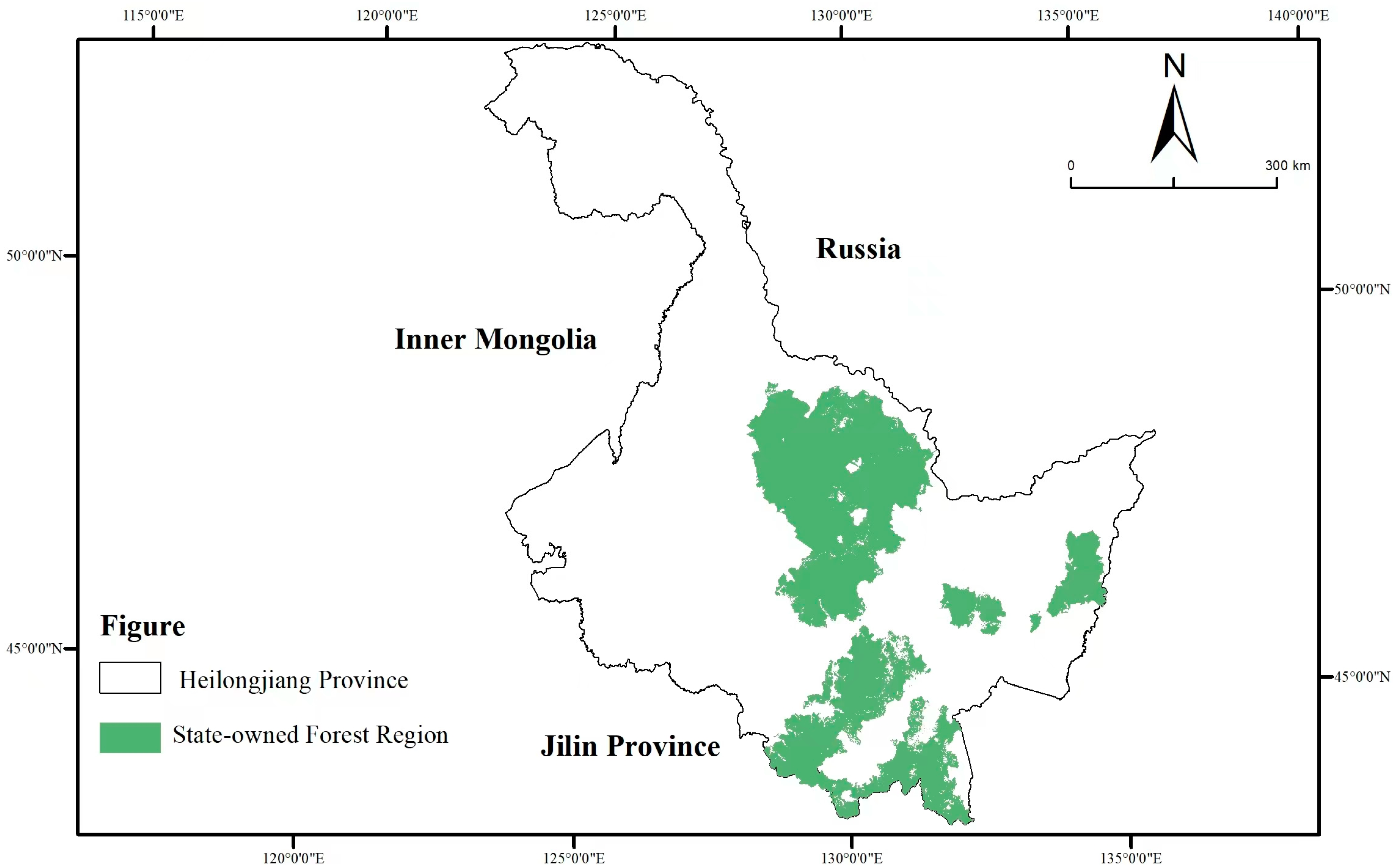
The study area refers to the state-owned forest areas in Heilongjiang Province in northeast China (Figure 1).
Figure 1.
Regional map of state-owned forest areas in Heilongjiang Province, China.
Heilongjiang has a key state-owned forest region in northeast China. In 1998, it began to reposition itself from primarily timber production to a greater emphasis on ecological development. This new phase represented a functional change to environmental construction and economic and social development. In 2014, Heilongjiang Province, the largest key state-owned forest area in China, took the lead in a nationwide pilot project for the implementation of a new policy to completely stop the commercial logging of natural forest resources, following the International Union for Conservation of Nature policies [45]. This policy, which is China’s strictest management and control policy of natural forest resources in history, posed an unprecedented challenge for the coordination between ecological protection and economic and social development in key state-owned forest areas.
It also provided an opportunity for theoretical research into the deep coupling and coordinated development of environments and economy in forest areas. After years of practice and exploration, the KSOFAsHP have made some progress in the process of coupling and coordination between environment and economic development. On the one hand, relying on the natural forest protection policy, the construction of national ecological function zones and sustained long-term investment in environment construction has achieved positive results. On the other hand, despite the closure of logging activities and the loss of subsistence industries, enforced forest economic transformation and the vigorous development of non-wood replacement industries has led a gradual recovery in economic growth. In this context, the forest environment and the interactive relationship between economic development and coupling coordination level on empirical research, focus on the collaboration between environment and economic development, the relationship between bound and limit characteristics for identification and dynamic evaluation, so as to other resources dependent region cooperation between environment and economic sustainable development to provide inspiration.
2.2. Research Logic
Using typical representatives of KSOFAsHP as the research object, this study conducts a quantitative identification and dynamic evaluation of the interaction and coordination relationship between forest areas’ environment and economic development since 2011.
This study is based on the GRA, which identifies and examines the interactive and cooperative relationship between the forest environment and economic development. As viewed from a system perspective, the characteristics of the relationship between the environment and economic development are explored. Next, the degree of coupling coordination model was used to measure the level of coordinated development between the environment and economic development in forest areas, and the degree of coordination between them was obtained, and a dynamic analysis of its change trend was carried out. Last, combined with changes in the degree of coordination, the environment evaluation index and the economic development evaluation index in the coupled coordination degree model were used to deconstruct and analyze the factors or obstacles that drive the coupling coordination relationship between the environment and economic development in forest areas. The results are used to provide inspiration and ideas for the continuous optimization of the relationship.
3. Materials and Methods
3.1. Grey Relational Analysis Model
The basic idea of GRA is to judge whether the relationship between sequence curves is close according to the degree of similarity of their geometric shapes. The closer the curve, the greater the degree of correlation between corresponding sequences and in the case of the opposite, the smaller the degree of correlation [46]. This paper aims to examine the basic relationship of interaction and cooperation between environment and economic development in key state-owned forest areas using the GRA model. The specific steps of the analysis steps are:
- Index forward;
- Determine the analysis sequence, including the parent sequence (similar to the dependent variable Y, denoted as X here0) and sub-series (similar to independent variable X, denoted as (X) here1, X2, …, Xm));
- Variable preprocessing (removing dimensional influence and reducing variable range to simplify calculation);
- Define and calculate the GRA correlation coefficient;
- Obtain the GRA correlation degree matrix.
Among them, the first three steps have been widely used in academic circles, and will not be repeated. The GRA correlation coefficients between different indicators are as follows:
In the above equations, a is the minimum difference between two poles, b is the maximum difference between two poles; p is the resolution coefficient, 0 < p < 1. If p is smaller, the difference between the correlation coefficients is larger, and the discrimination ability is stronger. Usually, p is 0.5. The GRA correlation degree matrix is finally obtained in Equation (1).
3.2. Coupling Coordination Degree Model
The basic idea of the coupling coordination degree model is to determine the relationship between the environment and economic development based on the coupling degree and coordination degree, and obtain the interaction relationship and coupling coordination development level between them [47]. The coupling degree reflects the degree of interaction between the environment and economic development, regardless of the advantages and disadvantages. The degree of coordination refers to the degree of benign coupling in the interaction, which reflects the quality of the coordination, and can determine whether the system functions of key state-owned forest areas promote each other at a high level or restrict each other at a low level.
The model of coupling coordination degree between environment and economic development can be presented as follows:
In the above equation, D is the coupling coordination degree between the environment and economic development in key state-owned forest areas, C is the coupling degree, and T is the comprehensive evaluation index of the coupling coordination development level between them. Where, f(x) and g(y) are the environment evaluation index and economic development evaluation index of key state-owned forest areas, respectively. In addition, in view of the objective reality of the functional orientation of key state-owned forest areas at the present stage, the coefficients α and β in Equation (6) are set as 0.6 and 0.4, respectively.
To effectively distinguish the coupling coordination level between the environment and economic development, the concept of coordination level is introduced. According to the quantitative relationship between f(x) and g(y), if f(x) > g(y), it is an economic lag type T1. If f(x) = g(y), it is T of the synchronous type of environment and lag type 2. If f(x) < g(y), it is the environment lag type T3. The specific classification standards and types of coupling coordination degree are summarized in Table 1.
Table 1.
Classification standards and types of coupling coordination degrees.
3.3. Evaluation Index System of the Relationship between Environment and Economic Development
This study examines the state-owned forests in Heilongjiang Province and its specific ecological protection practices and economic development results. In order to develop a comprehensive evaluation index system, this study follows scientific, systematic, typicality, operability, and comprehensive basic principles. For instance, it examines how the environment is related to economic development in Heilongjiang Province and develops a comprehensive evaluation index system based on this information [48]. The results are summarized in Table 2. Among them, the first-level indicators of the different systems are environment and economic development. The first-level indicators are further observed by the second- and third-level indicators. The environment construction of key state-owned forest areas is reflected by ecological construction and environmental protection, while economic development is reflected by economic scale and economic structure. Table 2 provides the basic index system for the subsequent empirical study of the GRA correlation degree and coupling coordination degree model. The weight of each index in the table is obtained according to the entropy weight method (in view of the extensive application of the entropy weight method, the process will not be described in detail).
Table 2.
Comprehensive evaluation index system of the relationship between environment and economic development.
3.4. Data Sources
The study’s main data sources included:
- China Forestry Statistical Yearbook (2012–2018), State Forestry Administration, China Forestry Press, 2012–2018.
- State Forestry and Grassland Administration, China Forestry and Grassland Statistical Yearbook (2019–2020), China Forestry Press, 2019–2020.
- National Bureau of Statistics, Heilongjiang Statistical Yearbook (2012–2020), China Statistics Press, 2012–2020.
- Statistics published on the website of the State Forestry and Grassland Administration (www.forestry.gov.cn/) and others accessed on 15 July 2022.
- Data from the Ninth National Forest Resources Inventory of China (China Forestry Network http//:www.forestry.gov.cn/) accessed on 21 July 2022.
Data translated with www.DeepL.com/Translator (free version) accessed on 1 August 2022 are from the China Forestry Statistical Yearbook issued by China Forestry Publishing House from 2012 to 2020 (China Forestry and Grassland Statistical Yearbook after 2018); the Heilongjiang Statistical Yearbook issued by China Statistics Press from 2012 to 2020; statistics published on the website of the National Forestry and Grassland Administration; and data from China’s ninth National Forest Resources Inventory.
4. Results and Discussion
4.1. Analysis of the Stress and Limitation between the Environment and Economic Development
The correlation degree matrix of the interaction between environment and economic development indicators at various levels in the key state-owned forest areas of Heilongjiang Province from 2011 to 2019 was calculated using the GRA model (Table 3). Table 3 shows that the degree of correlation between the environment and the indicators of all levels of economic development was higher than 0.5, which is a medium correlation. First, the results confirm the basic hypothesis of an effective correlation between the environment and economic development in key state-owned forest areas. Further, by ranking the average value of the correlation degree among indicators, we obtained the interaction stress and limiting factors of the corresponding indicators.
Table 3.
Grey relational analysis correlation degree matrix between the environment and economic development.
4.1.1. Analysis of the Stress and Limitation of the Environment on Economic Development
According to the second-level indicators under the criterion level, the average correlation degree between the two indicators—ecological construction and environmental protection, which constitute the environment system, and the economic development system of the KSOFAsHP—was higher than 0.6. The results show that environmental protection has a more prominent restriction effect on economic development.
Specifically, the second phase of the Natural Forest Protection Project (2010–2020) was officially implemented in key state-owned forests in 2011. The first phase of the project (2000–2010) aimed to reduce timber harvesting by 50%. The volume of timber harvested in the forest area decreased from 4.025 million cubic meters in 2010 to 774,000 cubic meters in 2013. Logging of natural forest resources stopped after 2014.
The strictly enforced policy of prohibiting the logging of natural forest resources has had a direct impact on traditional forest industries in the forest areas. Forest industries of different sizes have either shrunk or closed down, and economic development in the forest areas has suffered from the stress effect of environment construction. In addition, based on furthering the ecological construction of forest areas, forest management, financial input in engineering, forest to ecological construction and protection, state investment reached 9.585 billion yuan in 2018, with an additional 60.36 million yuan invested in the development of forestry industries. The huge difference in ecological protection capital investment has become an important factor that restricts the economic development of forest industry logging.
Among the three levels of indicators, the forest construction index X in ecological construction11 (0.7075) has the most prominent stress effect on the economic development of the KSOFAsHP. Combining the original forests and artificial afforestation, forest management plays an important role in the ecological construction of the whole system and involves a large amount of capital and labor input. The core role in the woodland multifunctional use of the forest region is to develop alternative industries and speed up the upgrading of traditional abilities and the scale of the logging industry objectively and confine the formation stress effect. That is, the investment is mainly in the construction of forestry, rather than in the harvesting and processing industry. Therefore, the input index of environmental protection X21 (0.6551) has an obvious limiting effect on the economic development of the forest areas, mainly due to an unbalanced allocation of capital, policy, labor, and other key factors in forest areas, which produces an insufficient driving force and support for the economic development of forest areas, and further weakens the economic development ability and efficiency of the forest areas.
4.1.2. Analysis of the Stress and Restriction of Economic Development on the Environment
From the perspective of the second-level indicators under the criterion level, the average degree of correlation between the economic scale and economic structure of the economic development system and the ecological construction system of the KSOFAsHP is 0.6353 and 0.6029, respectively. Both are lower than the average correlation level of 0.6355 between the forest ecological construction system and economic development (namely, the average of the two indicators of ecological construction and environmental protection), indicating that economic development has a more significant stress restriction effect on forest ecological construction.
In other words, economic scale has played a more important role than economic structure in two ways: (1) Since 2011, the economic scale of the KSOFAsHP has shown a basic trend of total increase but slow and weak growth. The value of the total economic output of the forest area increased from 36.316 billion yuan in 2011 to 60.729 billion yuan in 2018, with a growth rate of 67.23%, but the average annual growth rate decreased from 12.95% in 2011 to 10.12% in 2018, and declined further to −3.86% in 2014. Forest undergrowth enterprises took a long time to speed up the development of a variety of alternative industries. In addition to the development of forest tourism, food, and other industries, cottage industries, such as understory plant breeding, represent small-scale, decentralized operations that are unable to support regional economic development. In the forest community, the burden of obtaining employment is becoming increasingly serious due to the huge loss of talent. This has a limiting effect on accelerating the promotion of new breakthroughs in ecological construction in the forest areas [49]. (2) From the perspective of economic structure, the prominent labor-intensive characteristics of the primary industry, the severe contraction of forest product processing industries, and the structural imbalance of the three industries cannot provide an effective economic basis and value feedback for forest environment construction.
From the three-level indicators under the criterion level, labor remuneration in economic development is Y14 (0.6771) and the economic aggregate is Y11 (0.6770). The two indexes have a high degree of correlation with the environment construction of the KSOFAsHP, and have relatively obvious and almost indistinct restrictive and limiting effects on the ecological construction and environmental protection of the forest areas. Specifically, there are two main effects: (1) In terms of labor remuneration, in 2019, logging enterprises in the key state-owned forest region in Heilongjiang Province had more than 200,000 employees. When logging activities stopped, these employees were impacted by layoffs, but the development of alternative industries had not yet reached scale benefits and therefore not able to provide jobs and higher pay [50]. (2) In terms of economy development, the current economic benefits of the key state-owned forest region from primary industries and the increase in tertiary industries related to forest tourism and ecological services are still unable to form effective decoupling. Forest resources rather than the wood of the forestry industry are still heavily dependent on capital and resources. There is still a large gap in realizing the expected goal of the economic development of non-forest and non-wood industries feeding back into environment construction.
4.2. Dynamic Analysis of the Coupling Coordination Relationship between the Environment and Economic Development
Equations (4)–(6) and the basic data, show the changes in the coupling coordination relationship between the environment and economic development in the key state-owned forest areas of Heilongjiang Province from 2011 to 2019, and are summarized in Table 4.
Table 4.
The coupling coordination relationship between environment and economic development in key state-owned forest areas of Heilongjiang Province from 2011 to 2019.
4.2.1. The Coupling and Coordination Relationship between the Environment and Economic Development Tends to Be Good
Table 4 shows the level of coupling coordination between the environment and economic development in key state-owned forest areas of Heilongjiang Province since 2011; the stage and type of coupling coordination relationship between them are dynamically identified. The relationship between them tends to be generally excellent.
First, in terms of development stage, the relationship between the environment and economic development in the forest area has experienced a relatively complex transition process. The primary coordination between the two was realized from 2011 to 2012, which means that the key state-owned forest areas steadily cut back on logging activities and reduced production levels. By actively developing multiple understory management initiatives during the first phase of the national forest protection project, they gradually adapted to find a balance between ecology and economy and win–win development solutions [51]. However, in 2012, the large-scale reduction in timber output of the leading traditional forest industry had a huge impact. The emerging alternative industries could not effectively support the forest regions’ economic growth, and the fragile balance between ecology and economy was broken. Before 2015, both were on the verge of dysregulation and recession. Ecological prioritization of time for space did not begin to change until 2016 [52,53]. After 2016, the environment construction and economic development of the forest area adjusted and re-adapted over nearly four years, getting rid of the previous dysregulation and recession dilemma, and started to enter a phase of high-quality coordinated development. The reasons are directly related to the acceleration of the adaptive development of the understory economy, an increase in the government’s capital investment in forest areas, and the continuous improvement in the environment. In spite of the positive development of the economic and ecological sectors since 2016, the relationship between them has not remained stable. In order to ensure stable development and effectively promote the high-quality development of the regional forest and grass industries during the period of change, it became imperative that the department responsible for the key state-owned forest region pay more attention by the end of 2019 to ensure stability in development.
4.2.2. Improvement in the Economic Development of Forest Areas under the Orientation of Ecological Construction
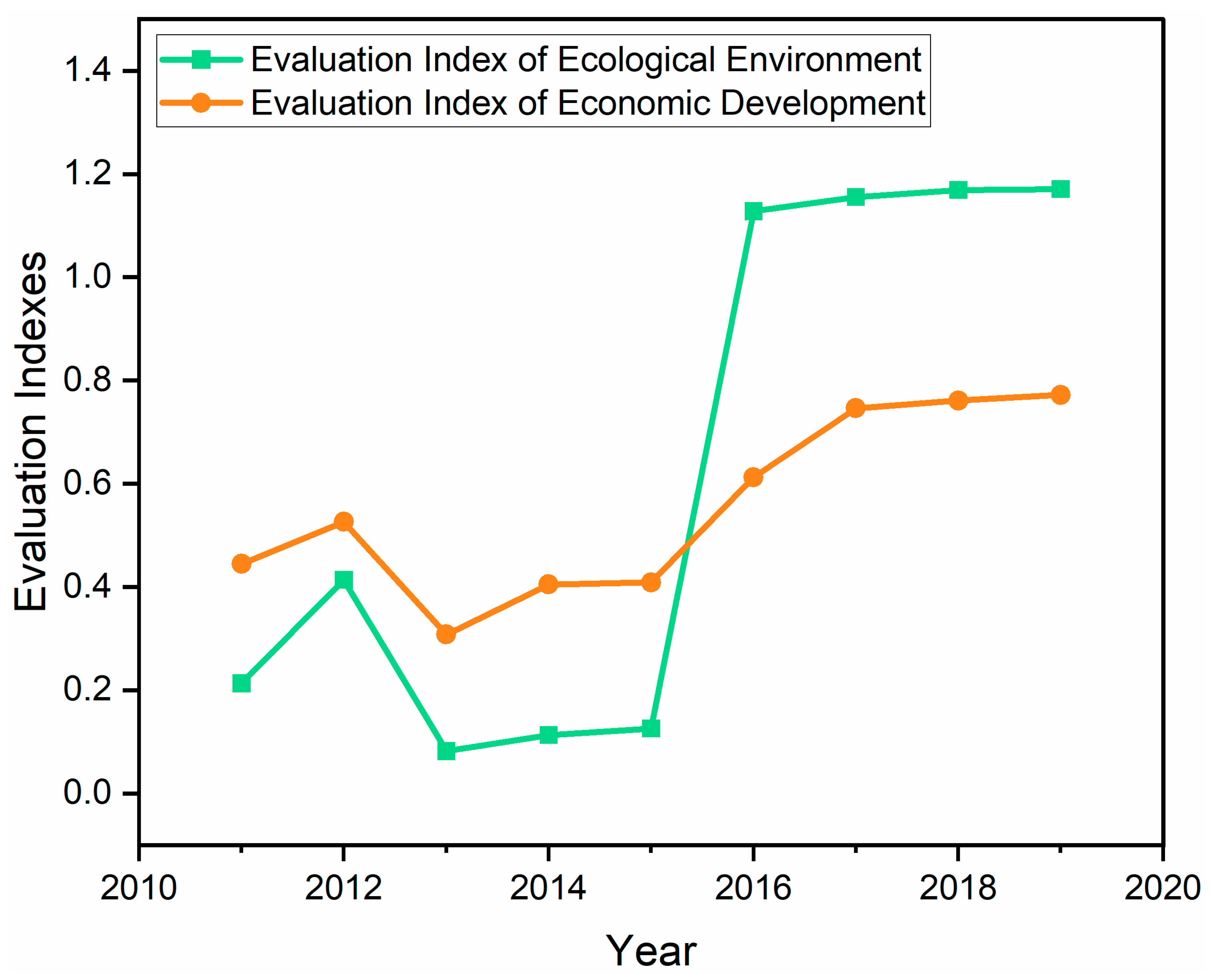
Table 4 shows the key state-owned forest regions in Heilongjiang Province from 2011 to 2019 during the coordinated development of the environment and changes in economic development type (as shown in Figure 2), specifically the changing trends in the evaluation index of the environment and economic development, as well as the impact of the coupled coordination of the forest environment and economic development.
Figure 2.
Change trends in the evaluation index of the environment and economic development from 2011 to 2019.
Figure 2 shows that the evaluation indexes of environment and economic development in the key state-owned forest areas of Heilongjiang Province maintained a highly consistent upward trend from 2011 to 2019, indicating that the forest areas had achieved positive results in the fields of ecological construction and economic development in recent years. This is related to the long-term implementation of effective ecological engineering policies in the forest areas and the reversal of understory economic transformation and development. Especially after 2015, both development indexes showed significant growth as the result of the effective adaptation to the no-logging policy decision in 2014, the stimulus provided by the comprehensive launch of the state-owned forest resource management system in 2015, and the restructuring and reform policy of forest industrial enterprises in the state-owned forest areas [54].
From a development perspective, the environment development evaluation index began to exceed the economic development evaluation index after 2015. The forest areas also officially changed from the environment lag period to the economic development lag period as the 100-year history of commercial logging of natural forests in the key state-owned forest areas of Heilongjiang Province came to an end. The forest areas entered a new phase in which the mountains were closed for afforestation and recuperation. The ecological priority strategy of exchanging time for space makes the environment construction in forest areas the core task for the future [55,56]. At the same time, the reform of the system mechanism became the focus of forest management after 2015. Despite the government’s fiscal reform of the forest areas and the provision of special funds, economic development has been challenged by insufficient talent, capital, industry, and multiple factors such as the supply of resources. Development results are far less than environment construction [57].
The reform of the management system of the key state-owned forest region in Heilongjiang Province in 2020 still needs to strengthen all kinds of industry development and support to achieve the protection and restoration of the natural forests against the background of environment construction. In particular, there is still room for the non-wood forestry economy to develop and improve.
4.3. Results and Discussion
Key state-owned forest areas have undertaken the task to protect natural forest resources, practice green economic development, and support national ecological progress. The quantitative evaluation and analysis of the coupling and coordination between environment and economic development of forest areas have deepened the understanding of sustainable development of forest areas. However, there are still some deep-seated problems worthy of further discussion and exploration.
Firstly, based on the construction concept of ecological priority, it is necessary to explore policies and measures to stimulate economic development from the perspective of resource allocation [25]. Weak economic development in key state-owned forest areas has limited environment construction. To achieve the goal of ecological protection and economic transformation in forest areas, the central government issued relevant economic support policies and investment stimulus policies. These policies need to be refined further. On the premise of adhering to the concept of ecological priority construction, it is necessary to optimize the factor supply structure and scale for the cultivation of replacement industries and the development of enterprises in forest areas, especially in traditional factors such as capital and labor, which are moderately inclined to the economic transformation.
Secondly, a new policy design for forest areas is very critical to promote its environment and economic development. The central government has issued a new ecological policy for key state-owned forest areas to protect and restore natural forests. It is necessary to speed up the development of the key state-owned forest areas’ forest ecosystem protection and restoration measures [58]. On the basis of fully using the natural forest protection repair system plan and the implementation scheme of protection and restoration of natural forests in Heilongjiang Province, the key ecological forests, wetlands, lakes, river basin areas related to the natural ecological system, wild animals, and plant resources and habitats require comprehensive repair management and protection to achieve the goal of ecological protection [59].
Thirdly, it is necessary to expand the research horizon and strengthen the integrated development of key state-owned forest areas and their surrounding areas. The reformed management system of forest resources in key state-owned forest areas has been devolved from the central government to local governments, and cooperation should be carried out with local regions for ecological restoration, resource protection, and environmental pollution prevention and control, rather than independent decision making and management of the past, to obtain maximum ecological protection benefits. At the same time, in terms of economic development, we should actively promote the integration of the forestry industry and local agricultural resources and industries [57], accelerate the flow of production factors across regions, explore a broader spatial scope of economic and social interaction and integration development model [60], and improve the factors and market environment of forest economic transformation and development [61,62,63].
5. Conclusions
Based on the empirical evaluation of the long-term coupling and coordination relationship between the environment and economic development in the key state-owned forest areas of Heilongjiang Province, the following conclusions are drawn:
- (1)
- From 2011 to 2019, the key state-owned forest areas achieved positive results in ecological construction and economic development, especially in ecological construction. The ecological construction evaluation index increased by 448.99%, and the economic development evaluation index increased by 73.56%.
- (2)
- There was a significant interaction between environment and economic development in key state-owned forest areas from 2011 to 2019. The average correlation degree between ecological construction and environmental protection and economic development of forest areas was 0.6158 and 0.6551, respectively. The average correlation degree between economic scale and economic results and forest environment was 0.6353 and 0.6029, respectively.
- (3)
- From 2011 to 2019, the interaction between the environment and economic development in key state-owned forest areas showed a gradual high-quality trend. The coupling coordination degree increased from 0.5351 in 2011 to 0.9112 in 2019, and the coupling coordination relationship shifted from a barely coordinated development stage to a high-quality coordinated development stage.
- (4)
- The average correlation degree between economic development and environment in key state-owned forest areas was 0.6191, which was lower than between the environment and economic development (0.6355), indicating that economic development in forest areas had certain stress and restriction effects on environment construction.
- (5)
- Key state-owned forest areas began to enter the stage of economic development lag from the stage of eco-environmental development lag in 2015. It is an important task for forest areas to continuously accelerate economic transformation and development in the future.
Author Contributions
Conceptualization, X.L. and M.A.; methodology, X.L., M.A. and Z.W.; software, X.L., M.A. and Z.W.; validation, X.L., M.A. and Z.W.; formal analysis, X.L., M.A. and Z.W.; investigation, X.L., M.A. and Z.W.; resources, X.L., M.A., Z.W. and Z.Z.; data curation, X.L., M.A. and Z.W.; writing—original draft preparation, X.L.; writing—review and editing, X.L., M.A., Z.W. and Z.Z.; visualization, X.L., M.A. and Z.W.; supervision, M.A. and Z.W.; project administration, M.A. and Z.W.; funding acquisition, X.L., M.A., Z.W. and Z.Z. All authors have read and agreed to the published version of the manuscript.
Funding
This research was funded by the International Young Talents Program (No. QN2022168001L), China and the Heilongjiang Provincial Key Foundation for Philosophy and Social Sciences (No. 21GLA449), China.
Institutional Review Board Statement
Not applicable.
Informed Consent Statement
Not applicable.
Data Availability Statement
The data supporting the findings of this study are available from the corresponding author upon reasonable request.
Conflicts of Interest
The authors declare no conflict of interest.
References
- Geng, Q.; Muhammad, A.; Yuan, Z.; Zheng, J.; He, X.; Ding, D.; Yin, F.; Li, C. Plant species composition and diversity along successional gradients in arid and semi-arid regions of China. For. Ecol. Manag. 2022, 524, 120542. [Google Scholar] [CrossRef]
- Zheng, J.; Arif, M.; He, X.; Ding, D.; Zhang, S.; Ni, X.; Li, C. Plant community assembly is jointly shaped by environmental and dispersal filtering along elevation gradients in a semiarid area, China. Front. Plant Sci. 2022, 13, 1–14. [Google Scholar] [CrossRef]
- Muhammad, A.; Li, C. Impacts of environmental literacy on ecological networks in the Three Gorges Reservoir, China. Ecol. Indic. 2022, 145, 109571. [Google Scholar] [CrossRef]
- Arif, M.; Li, J.; Tahir, M.; Zheng, J.; Li, C. Environmental literacy scenarios lead to land degradation and changes in riparian zones: Implications for policy in China. Land Degrad. Dev. 2022, 4450, 1–17. [Google Scholar] [CrossRef]
- Wu, J.G.; He, C.Y.; Zhang, Q.Y.; Yu, D.Y.; Huang, G.L.; Huang, Q.X. Coupling model of global change and regional sustainable development and regulation countermeasures. Adv. Earth Sci. 2014, 29, 1315–1324. [Google Scholar]
- Zhou, Y.; Pu, Y.; Chen, S.; Fang, F. Government support and development of new industries: A case study of new energy. J. Econ. Res. 2015, 50, 147–161. [Google Scholar]
- Couto, E.V.; Oliveira, P.B.; Vieira, L.M.; Schmitz, M.H.; Ferreira, J.H.D. Integrating environmental, geographical and social data to assess sustainability in hydrographic basins: The ESI approach. Sustainability 2020, 12, 3057. [Google Scholar] [CrossRef]
- Conceição, E.O.; Garcia, J.M.; Alves, G.H.Z.; Delanira-Santos, D.; Corbetta, D.d.F.; Betiol, T.C.C.; Pacifico, R.; Romagnolo, M.B.; Batista-Silva, V.F.; Bailly, D.; et al. The impact of downsizing protected areas: How a misguided policy may enhance landscape fragmentation and biodiversity loss. Land Use Policy 2022, 112, 105835. [Google Scholar] [CrossRef]
- Ferreira, I.J.M.; Bragion, G.d.R.; Ferreira, J.H.D.; Benedito, E.; Couto, E.V.d. Landscape pattern changes over 25 years across a hotspot zone in southern Brazil. South. For. J. For. Sci. 2019, 81, 175–184. [Google Scholar] [CrossRef]
- Fan, P.; Liang, L.; Li, Y.; Duan, L.; Wang, N.; Chen, C. Evaluation of coordinated urbanization development in Beijing-Tianjin-Hebei region from the perspective of system coupling. Resour. Sci. 2016, 38, 2361–2374. [Google Scholar]
- Jin, F. The coordinated promotion strategy of ecological protection and high-quality development in the Yellow River Basin. Reform 2019, 11, 33–39. [Google Scholar]
- Brown, L.R. Building a sustainable society. Society 1982, 19, 75–85. [Google Scholar] [CrossRef]
- Allan, G.N.; Hanley, P.; McGregor, K. The impact of increased efficiency in the industrial use of energy: A computable general equilibrium analysis for the United Kingdom. Energy Econ. 2007, 27, 89–95. [Google Scholar] [CrossRef]
- Muhammad, S.; Ilhan, O.; Talat, A.; Amjad, A. Revisiting the environment Kuznets curve in a global economy. Renew. Sust. Energy Rev. 2013, 25, 494–502. [Google Scholar]
- Bradley, B.W. Local management of mangrove forests in the Philippines: Successful conservation and efficient resource exploitation. Hum. Ecol. 2004, 32, 177–195. [Google Scholar]
- Ma, S.; Wang, R.; Ma, S.J.; Wang, S.S. Socio-economic-natural complex ecosystem. Acta Ecol. Sin. 1984, 4, 3–11. [Google Scholar]
- Ren, J.Z. Grassland Agroecology; China Agricultural Press: Beijing, China, 1995; pp. 139–152. ISBN 7-109-02963-8/S.1885. [Google Scholar]
- Liu, A.M.; Liu, Y.; Gao, X. Regional differentiation and coupling of agriculture and animal husbandry in Hexi region. J. Econ. Geogr. 2002, 22, 49–53. [Google Scholar]
- Zhu, H.; He, S. Coupling effect in the development of agricultural resources. J. Nat. Resour. 2003, 5, 583–588. [Google Scholar]
- Lei, G. Coupling model and benefit of mountain and oasis ecosystem. Pratacultural Sci. 2003, 5, 64–66. [Google Scholar]
- Liu, X.X.; Wang, R.; Chen, X.Z. Ecological environment analysis and green trade transition of China’s foreign trade: An empirical study based on embodied carbon. Resour. Sci. 2015, 37, 280–290. [Google Scholar]
- Shu, X.L.; Gao, Y.B.; Zhang, Y.X.; Yang, C.Y. Coupling relationship and coordinated development of tourism industry and ecological civilization city. China Popul. Resour. Environ. 2015, 25, 82–90. [Google Scholar]
- Zhou, C.; Feng, X.; Tang, R. Analysis and prediction of the coupled and coordinated development of regional economy, eco-environment and tourism industry: A case study of provinces and cities along the Yangtze River economic belt. J. Econ. Geogr. 2016, 36, 186–193. [Google Scholar]
- Wang, W.J. How ecological civilization construction promotes rural economic development. China Collect. Econ. 2021, 23, 22–23. [Google Scholar]
- Li, Y.J. Analysis of forestry economic development under the protection of forestry ecological environment. Flowers 2018, 22, 264–265. [Google Scholar]
- Sheng, W. Based on the angle of ecological environment protection of forestry economic development strategy. J. South. Agric. 2021, 21, 73–74. [Google Scholar]
- Su, L. Under the forestry ecological environment protection of forestry economic development study. J. Shanxi Agric. Econ. 2022, 2, 118–120. [Google Scholar]
- Panayotou, T. Empirical Tests and Policy Analysis of Environmental Degradation at Different Stages of Economic Development; ILO Working Papers 992927783402676; International Labour Organization: Geneva, Switzerland, 1993. [Google Scholar]
- Cao, Y.K.; Tang, X.W.; Wang, Y. Reducing the arc of the environmental Kuznets curve to protect state forest resources. For. Econ. 2000, 3, 70–72. [Google Scholar]
- Song, W.M.; Yang, C. Forestry industry structure, spatial layout and its evolution mechanism since 1949. For. Econ. 2020, 42, 3–17. [Google Scholar]
- Li, L.C.; Li, X.F.; Cheng, B.D.; Liu, J.L. Analysis of forest transformation in China based on environmental Kuznets curve. World For. Res. 2016, 29, 56. [Google Scholar]
- Ma, M.Q.; Wang, M.Y.; Huang, Q. Study on supporting policy of state forest after logging suspension: A case study of Yichun Forest in Lesser Hinggan Mountains. China For. Econ. 2015, 6, 4. [Google Scholar]
- Arif, M.; Qi, Y.; Dong, Z.; Wei, H. Rapid retrieval of cadmium and lead content from urban greenbelt zones using hyperspectral characteristic bands. J. Clean. Prod. 2022, 374, 133922. [Google Scholar] [CrossRef]
- Wang, Z.W.; Wang, S. Study on the adjustment of sustainable development path of state-owned forest area after logging cessation: A case study of state-owned forest area in greater khingan mountains. Issues For. Econ. 2014, 4, 309–313. [Google Scholar]
- Yuan, S.; Shen, Q.; Tian, J.; Bai, X. The full stop forest commercial cuts of Heilongjiang forest study. J. For. Econ. 2015, 2, 47–51. [Google Scholar]
- Yu, L.C.; Liu, Y.Z. Discussion on tax and fee policy after the complete stop of commercial logging of natural forests in key state-owned forest areas. Green Account. 2015, 6, 3–5. [Google Scholar]
- Bai, X.H. Reflections on the construction of ecological civilization in key state-owned forest areas of Heilongjiang Province. For. Explor. Des. 2017, 3, 17–18. [Google Scholar] [CrossRef]
- Song, C.P.; Fang, F. Study on simulation and development strategy of social and economic system in state-owned forest areas of Heilongjiang Province. China For. Econ. 2012, 3, 26–29. [Google Scholar]
- Geng, Y.; Zhang, Z. Study on Mechanism of niche construction in the evolution of forestry industry in state-owned forest areas. Issues For. Econ. 2012, 32, 195–199. [Google Scholar]
- Zheng, L.J.; Wan, Z.F.; Li, W. Heilongjiang forest ecological economy system coordination development evaluation. J. For. Econ. 2018, 40, 28–32. [Google Scholar]
- Dong, P.W.; Zhang, X.Z. Study on coupling degree of forestry industry and forest ecosystem. China Soft Sci. 2013, 11, 178–184. [Google Scholar]
- Zhang, J.Y.; Long, F.; Bi, F.F.; Ge, C.Z.; Duan, X.M. Study on the coupling coordination between economic development and ecological environment of coastal industrial city: A case study of Yuhuan City. Environ. Pollut. Prev. 2021, 2, 255–258. [Google Scholar]
- Tang, X.L.; Feng, Y.R.; Du, L. Study on the coupling and coordinated development of economic development and ecological environment in Shaanxi Province. Environ. Pollut. Prev. 2021, 4, 16–526. [Google Scholar]
- Xie, W.J.; Wang, S.X. Coupling coordination between economic development and ecological environment on the Qinghai-Tibet Plateau: A case study of ecological civilization construction in Qinghai Province. Plateau Sci. Res. 2020, 4, 36–45. [Google Scholar]
- Behzad, H.M.; Arif, M.; Duan, S.; Kavousi, A.; Cao, M.; Liu, J.; Jiang, Y. Seasonal variations in water uptake and transpiration for plants in a karst critical zone in China. Sci. Total Environ. 2022, 160424. [Google Scholar] [CrossRef] [PubMed]
- Zhang, J.C.; Zhi, R. Analysis and optimization adjustment of forestry industrial structure in Inner Mongolia: Based on grey relational analysis correlation degree and grey theory development decision analysis. Issues For. Econ. 2018, 38, 78–85, 110. [Google Scholar]
- Jiang, Y.; Yang, Y.L. Analysis on the coupling coordination relationship between ecological environment and social economy in key state-owned forest areas of Heilongjiang province. Chin. Econ. 2022, 1, 134–135. [Google Scholar]
- Wang, Y.; Hao, X.; Yao, L. Spatial-temporal evolution of the coupled and coordinated development of regional economy and eco-environment: A case study of Heilongjiang province. Resour. Ind. 2021, 23, 21–30. [Google Scholar]
- Zhang, I.P. Forestry ecology construction and forests coordinated economic development way analysis. J. Agric. Sci. Technol. Inf. Technol. 2021, 10, 81–83. [Google Scholar]
- Zhu, H.G.; Zhang, S.P.; Hu, Q.X. Comprehensive Ting Fa policy impact on household income of state-owned forest. J. For. Econ. 2019, 33, 6:457–464. [Google Scholar]
- Wang, Y.Z.; Song, Y.; Wu, G.C. Research on the implementation performance, problems and countermeasures of Tianbao project in Heilongjiang province. For. Econ. 2012, 10, 68–71. [Google Scholar]
- Gao, Y.J.; Guan, C. Study on the development of Understory economy and industry in Heilongjiang Province during the second phase of the Tianbao project. Issues For. Econ. 2020, 40, 618–625. [Google Scholar]
- Li, C.H.; Wei, W.; Liu, S.X. Performance evaluation of natural forest resources protection project in state-owned forest areas: A case study of key state-owned forest areas in Heilongjiang province. Sci. Silvae Sin. 2021, 57, 153–162. [Google Scholar]
- Chen, H.; Peng, Y. Study on the relationship between understory economic development and financial support in Heilongjiang province. China For. Econ. 2018, 3, 9–12, 76. [Google Scholar]
- Dai, X.L. Suggestions on deepening the reform of management system of state-owned key forest areas in Heilongjiang province. For. Explor. Des. 2017, 2, 11–12. [Google Scholar]
- Muhammad, A.; Jiajia, L.; Dongdong, D.; Xinrui, H.; Qianwen, G.; Fan, Y.; Songlin, Z.; Changxiao, L. Effect of topographical features on hydrologically connected riparian landscapes across different land-use patterns in colossal dams and reservoirs. Sci. Total Environ. 2022, 851, 158131. [Google Scholar] [CrossRef]
- Wang, R.Z. Analysis on forestry ecological construction and understory economic industry development. New Agric. 2021, 24, 10. [Google Scholar]
- General Office of the State Council of the People’s Republic of China. Natural forest protection and restoration system scheme. Hebei For. 2019, 9, 16–18. [Google Scholar]
- Yuancai, Q.; Arif, M.; Dong, Z.; Ting, W.; Qin, Y.; Bo, P.; Peng, W.; Wei, H. The effect of hydrological regimes on the concentrations of nonstructural carbohydrates and organic acids in the roots of Salix matsudana in the Three Gorges Reservoir, China. Ecol. Indic. 2022, 142, 109176. [Google Scholar] [CrossRef]
- Arif, M.; Hussain, A.; Shahzad, M.K.; Khan, W.R.; Na, N.; Zarif, N.; Liu, X.; Amin, H.; Yukun, C. One belt one road initiative: Pakistan’s forest-based sector investment opportunities within the context of globalization. Custos Agronegocio 2019, 15, 165–194. [Google Scholar]
- Hira, A.; Arif, M.; Zarif, N.; Gul, Z.; Liu, X.; Cao, Y. Impacts of stressors on riparian health indicators in the upper and lower indus river basins in Pakistan. Int. J. Environ. Res. Public Healthy 2022, 19, 13239. [Google Scholar] [CrossRef]
- Muhammad, A.; Behzad, H.M.; Tahir, M.; Changxiao, L. Nature-based tourism influences ecosystem functioning along waterways: Implications for conservation and management. Sci. Total Environ. 2022, 842, 156935. [Google Scholar] [CrossRef]
- Arif, M.; Behzad, H.M.; Tahir, M.; Li, C. The impact of ecotourism on ecosystem functioning along main rivers and tributaries: Implications for management and policy changes. J. Environ. Manag. 2022, 320, 115849. [Google Scholar] [CrossRef] [PubMed]
Publisher’s Note: MDPI stays neutral with regard to jurisdictional claims in published maps and institutional affiliations. |
© 2022 by the authors. Licensee MDPI, Basel, Switzerland. This article is an open access article distributed under the terms and conditions of the Creative Commons Attribution (CC BY) license (https://creativecommons.org/licenses/by/4.0/).