Article

Mechanical Property Prediction of Larix gmelinii Wood Based on Vis-Near-Infrared Spectroscopy

College of Engineering and Technology, Northeast Forestry University, Harbin 150040, China
*
Author to whom correspondence should be addressed.
Forests 2022, 13(12), 1995; https://doi.org/10.3390/f13121995
Submission received: 31 October 2022 / Revised: 17 November 2022 / Accepted: 23 November 2022 / Published: 25 November 2022
(This article belongs to the Section Wood Science and Forest Products)

Abstract

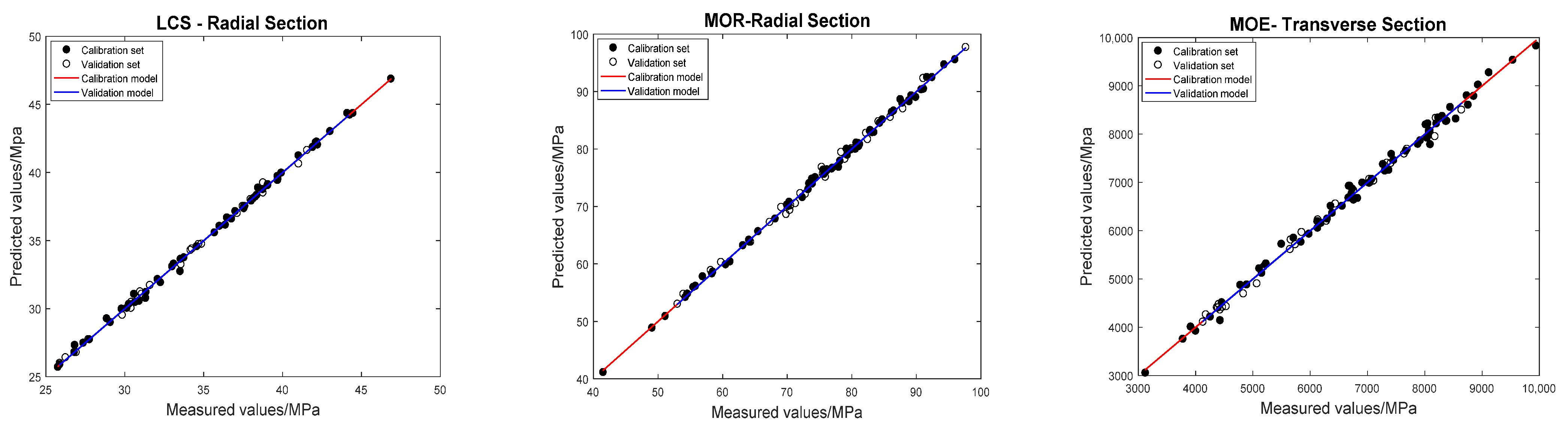
Larix gmelinii is the major tree species in Northeast China. The wood properties of different Larix gmelinii are quite different and under strong genetic controls, so it can be better improved through oriented breeding. In order to detect the longitudinal compressive strength (LCS), modulus of rupture (MOR) and modulus of elasticity (MOE) in real-time, fast and non-destructively, a prediction model of wood mechanical properties with high precision and stability is constructed based on visible-near-infrared spectroscopy (Vis-NIRS) technology. The featured wavelengths were selected with the algorithms of competitive adaptive reweighted sampling (CARS), successive projection algorithm (SPA), uninformative variable elimination (UVE), synergy interval partial least squares (SiPLS) and their combinations. The prediction models were then developed based on the partial least square regression (PLSR). The predictive ability of models was evaluated with coefficient of determination (R2) and root mean square error (RMSE). It indicated that CARS performed the best among the four methods examined in terms of wavelength-variable selection. The combined featured wavelength selecting method of SiPLS-CARS showed better performance than the single wavelength selection method. The optimal models of LCS, MOR and MOE are the SiPLS-CARS-PLSR model, with the R2 of the calibration set and the validation set are both greater than 0.99, and RMSE the smallest. The NIR optimal models for wood mechanical properties predictions has high predictive accuracy and good robustness.
Keywords: near-infrared spectroscopy; wood mechanical property; wavelength selection; competitive adaptive reweighted sampling; synergy interval partial least square near-infrared spectroscopy; wood mechanical property; wavelength selection; competitive adaptive reweighted sampling; synergy interval partial least square