


Fungi from Galleries of the Emerald Ash Borer Produce Cankers in Ash Trees


Abstract
1. Introduction
2. Materials and Methods
2.1. Fungi Used for Inoculation
2.2. Field Trials
3. Results
3.1. Experiment 1
3.2. Experiment 2
4. Discussion
Author Contributions
Funding
Data Availability Statement
Acknowledgments
Conflicts of Interest
References
- Cappaert, D.; McCullough, D.G.; Poland, T.M.; Siegert, N.W. Emerald ash borer in North America: A research and regulatory challenge. Am. Entomol. 2005, 51, 152–165. [Google Scholar] [CrossRef] [Scilit]
- Herms, D.A.; McCullough, D.G. Emerald ash borer invasion of North America: History, biology, ecology, impacts, and management. Annu. Rev. Entomol. 2014, 59, 13–30. [Google Scholar] [CrossRef] [Scilit] [PubMed]
- Haack, R.A.; Baranchikov, Y.; Bauer, L.S.; Poland, T.M. Chapter 1: Emerald ash borer biology and invasion history. In Biology and Control of Emerald Ash Borer; USDA: Washington, DC, USA, 2015; pp. 1–14. [Google Scholar]
- United States Department of Agriculture. Available online: https://www.aphis.usda.gov/import_export/plants/manuals/domestic/downloads/eab-manual.pdf (accessed on 25 February 2021).
- Minnesota Department of Agriculture. Available online: https://www.mda.state.mn.us/minnesota-will-continue-emerald-ash-borer-regulations (accessed on 25 February 2021).
- Liu, H.; Bauer, L.S.; Miller, D.L.; Zhao, T.; Gao, R.; Song, L.; Luan, Q.; Jin, R.; Gao, C. Seasonal abundance of Agrilus planipennis (Coleoptera: Buprestidae) and its natural enemies Oobius agrili (Hymenoptera: Encyrtidae) and Tetrastichus planipennisi (Hymenoptera: Eulophidae) in China. Biol. Control 2007, 42, 61–71. [Google Scholar] [CrossRef] [Scilit]
- Liu, H.; Bauer, L.S.; Gao, R.; Zhao, T.; Petrice, T.R.; Haack, R.A. Exploratory survery for the emerald ash borer, Agrilus planipennis (Coleoptera: Buprestidae), and its natural enemies in China. Great Lakes Entomol. 2003, 36, 14. [Google Scholar]
- Cipollini, D. White fringetree as a novel larval host for emerald ash borer. J. Econ. Entomol. 2015, 108, 370–375. [Google Scholar] [CrossRef] [Scilit]
- Bauer, L.S.; Duan, J.J.; Gould, J.R. Chapter 17: Emerald ash borer (Agrilus planipennis Fairmaire) (Coleoptera: Buprestidae). In The Use of Classical Biological Control to Preserve Forests in North America; U.S. Department of Agriculture, Forest Service, Forest Health Technology Enterprise Team: Morgantown, VA, USA, 2014; pp. 189–209. [Google Scholar]
- Held, B.W.; Simeto, S.; Rajtar, N.N.; Cotton, A.J.; Showalter, D.N.; Bushley, K.E.; Blanchette, R.A. Fungi associated with galleries of the emerald ash borer. Fungal Biol. 2021, 125, 551–559. [Google Scholar] [CrossRef] [Scilit]
- O’Donnell, K.; Cigelnik, E. Two divergent intragenomic RDNA ITS2 types within a monophyletic lineage of the fungus Fusarium are onorthologous. Mol. Phylogenet. Evol. 1997, 7, 103–116. [Google Scholar] [CrossRef] [Scilit]
- Glass, N.L.; Donaldson, G.C. Development of primer sets designed for use with the PCR to amplify conserved genes from filamentous Ascomycetes. Appl. Environ. Microbiol. 1995, 61, 1323–1330. [Google Scholar] [CrossRef] [Scilit]
- Carbone, I.; Kohn, L.M. A method for designing primer sets for speciation studies in filamentous ascomycetes. Mycologia 1999, 91, 553–556. [Google Scholar] [CrossRef] [Scilit]
- Altschul, S.F.; Gish, W.; Miller, W.; Myers, E.W.; Lipman, D.J. Basic local alignment search tool. J. Mol. Biol. 1990, 215, 403–410. [Google Scholar] [CrossRef]
- Stauder, C.; Utano, N.; Kasson, M. Resolving host and species boundaries for perithecia-producing nectriaceous fungi across the Central Appalachian Mountains. Fungal Ecol. 2020, 47, 100980. [Google Scholar] [CrossRef] [Scilit]
- Zhou, X.; O’Donnell, K.; Aoki, T.; Smith, J.A.; Kasson, M.T.; Cao, Z.-M. Two novel Fusarium species that cause canker disease of prickly ash (Zanthoxylum bungeanum) in northern China form a novel clade with Fusarium torreyae. Mycologia 2016, 108, 668–681. [Google Scholar] [CrossRef] [Scilit]
- SAS v 9.4; SAS Institue Inc.: Cary, NC, USA, 2013.
- Kowalski, T.; Bilański, P.; Kraj, W. Pathogenicity of fungi associated with ash dieback towards Fraxinus excelsior. Plant Pathol. 2017, 66, 1228–1238. [Google Scholar] [CrossRef] [Scilit]
- Kraj, W.; Kowalski, T.; Zarek, M. Structure and genetic variation of Diplodia mutila on declining ashes (Fraxinus excelsior) in Poland. J. Plant Pathol. 2013, 95, 499–507. [Google Scholar] [CrossRef] [Scilit]
- Díaz, G.A.; Latorre, B.A.; Ferrada, E.; Gutiérrez, M.; Bravo, F.; Lolas, M. First report of Diplodia mutila causing branch dieback of English Walnut Cv. Chandler in the Maule Region, Chile. Plant Dis. 2018, 102, 1451. [Google Scholar] [CrossRef] [Scilit]
- Kepley, J.B.; Jacobi, W.R. Pathogenicity of Cytospora Fungi on six hardwood species. J. Arboric. 2000, 26, 326–333. [Google Scholar]
- Bush, E.A. Botryosphaeria Canker and Dieback of Trees and Shrubs in the Landscape. Available online: https://vtechworks.lib.vt.edu/bitstream/handle/10919/54993/450-726.pdf?sequence=1 (accessed on 25 February 2021).
- Feng, H.; Hong, K.; Xi, H.; Song, L.; Wen, C.; Zang, R. First report of branch canker on chinese date caused by Diplodia mutila in China. J. Plant Pathol. 2019, 101, 1251. [Google Scholar] [CrossRef] [Scilit]
- Brown-Rytlewski, D.E.; McManus, P.S. Virulence of Botryosphaeria dothidea and Botryosphaeria obtusa on apple and management of stem cankers with fungicides. Plant Dis. 2000, 84, 1031–1037. [Google Scholar] [CrossRef] [Scilit]
- Cloete, M.; Fourie, P.H.; Damm, U.; Crous, P.W.; Mostert, L. Fungi associated with die-back symptoms of apple and pear trees, a possible inoculum source of grapevine trunk disease pathogens. Phytopathol. Mediterr. 2011, 50, S176–S190. [Google Scholar]
- Kurbetli, İ.; Demirci, F. Outbreak of stem canker and dieback of pear trees caused by Botryosphaeria obtusa (anamorph Diplodia seriata) in Turkey. New Dis. Rep. 2014, 30, 6. [Google Scholar] [CrossRef] [Scilit]
- Verkley, G.J.M.; Silva, M.; Wicklow, D.T.; Crous, P.W. Paraconiothyrium, a new genus to accommodate the mycoparasite Coniothyrium minitans, anamorphs of Paraphaeosphaeria, and four new species. Stud. Mycol. 2004, 50, 323–335. [Google Scholar]
- Hausner, G.; Eyjólfsdóttir, G.G.; Reid, J.; Klassen, G.R. Two additional species of the genus Togninia. Can. J. Bot. 1992, 70, 724–734. [Google Scholar] [CrossRef] [Scilit]
- Mostert, L.; Groenewald, J.Z.; Summerbell, R.C.; Gams, W.; Crous, P.W. Taxonomy and pathology of Togninia (Diaporthales) and its Phaeoacremonium anamorphs. Stud. Mycol. 2006, 54, 1–113. [Google Scholar] [CrossRef] [Scilit]
- Eskalen, A.; Rooney-Latham, S.; Gubler, W.D. Occurrence of Togninia fraxinopennsylvanica on esca-diseased grapevines (Vitis vinifera) and declining ash trees (Fraxinus latifolia) in California. Plant Dis. 2005, 89, 528. [Google Scholar] [CrossRef] [Scilit]
- Bedker, P.; Blanchette, R. Development of cankers caused by Nectria cinnabarina on honey locusts after root pruning. Am. Phytopathol. Soc. 1983, 67, 1010–1013. [Google Scholar] [CrossRef] [Scilit]
- Grand, L.F.; Vernia, C.S.; Hodges, C.S. First report of Thyronectria austroamericana canker on thornless honey locust in North Carolina. Plant Dis. 1999, 83, 1177. [Google Scholar] [CrossRef] [Scilit]
- Jacobi, W.R.; Riffle, J.W. Effects of water stress on Thyronectria canker of honeylocusts. Phytopathology 1989, 79, 1333–1337. [Google Scholar] [CrossRef] [Scilit]
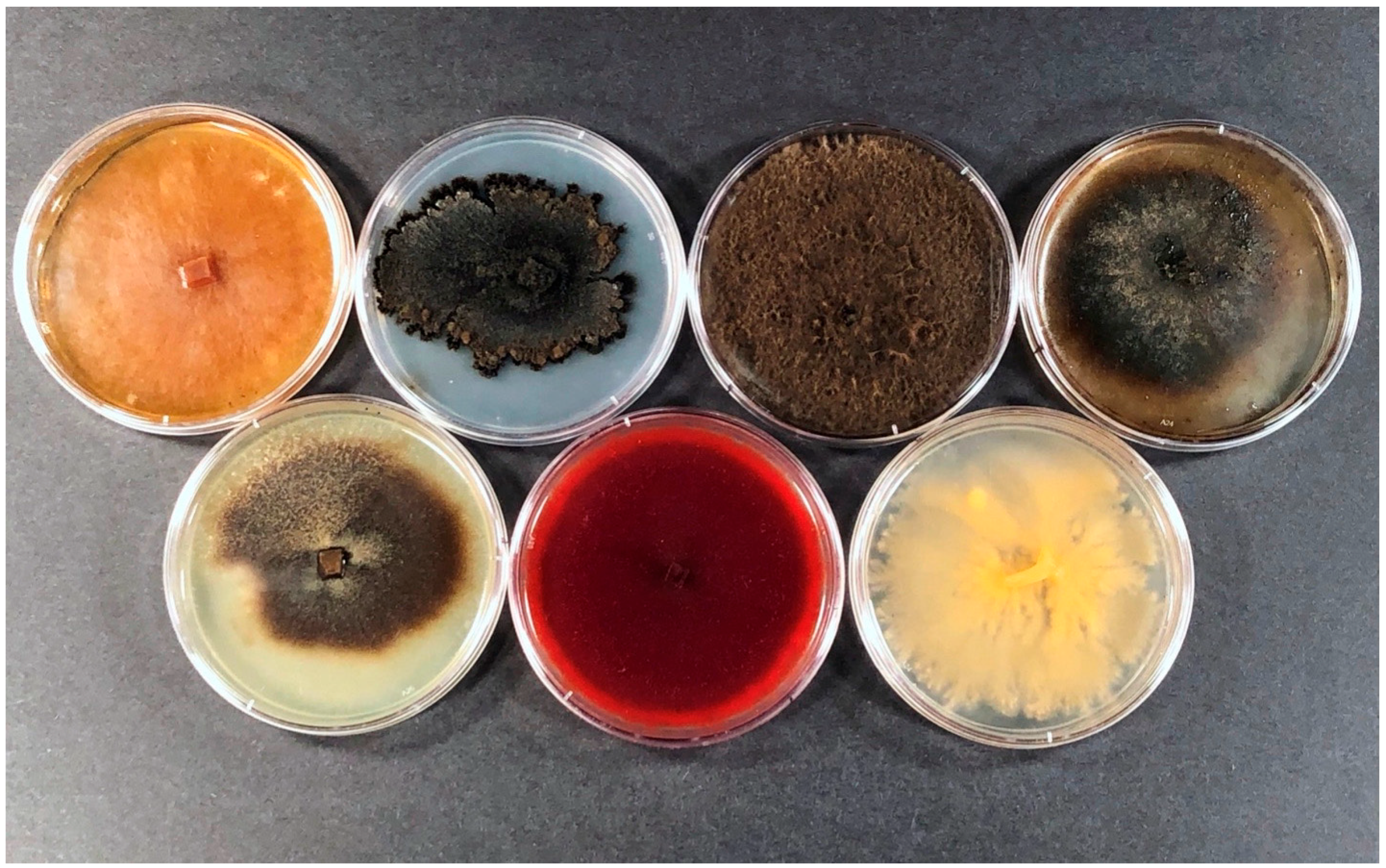
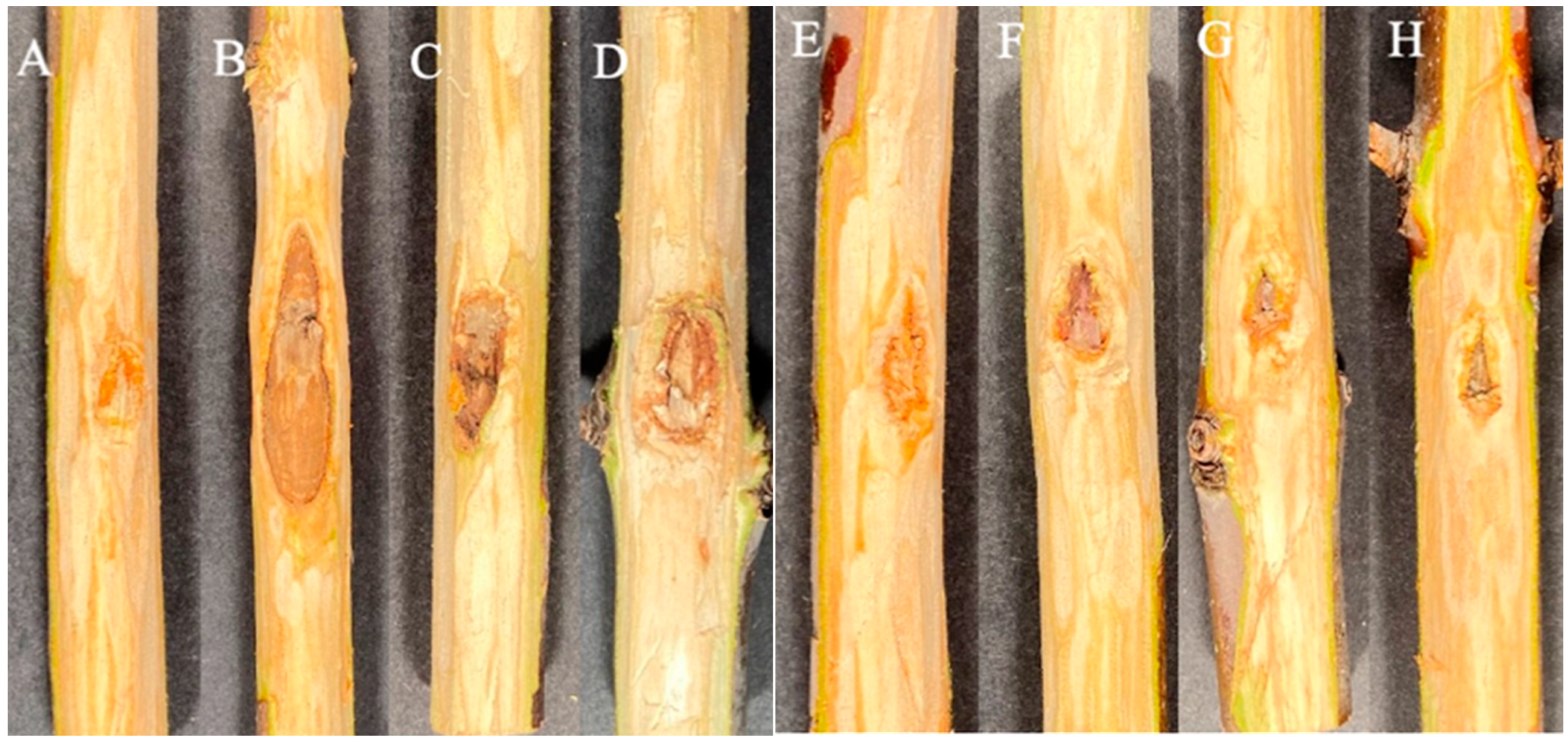

| Experiment 1 | Experiment 2 | |||
|---|---|---|---|---|
| Fungus | Agar Plug | Woodchip | Agar Plug | Woodchip |
| Control | 2/7 | 3/7 | 0/7 | 0/7 |
| Cytospora pruinosa (EAB 67-4) | 7/7 | 5/7 | 6/6 a | 6/6 a |
| Diplodia mutila (EAB 42-6) | 6/6 a | 6/6 a | 7/7 | 7/7 |
| Diplodia seriata (EAB 64-12) | 5/7 | 5/7 | 5/7 | 7/7 |
| Paraconiothyrium brasiliense (EAB 58-13) | 1/7 | 2/7 | 3/7 | 6/7 |
| Phaeoacremonium minimum (EAB 66-10) | 6/7 | 6/7 | 6/7 | 6/7 |
| Phaeoacremonium scolyti (EAB 64-22) | 4/7 | 6/7 | 4/6 a | 4/6 a |
| Thyronectria aurigera (EAB 45-20) | 4/7 | 6/7 | 6/7 | 6/7 |
| Agar Plug | Wood Chip | |||||
|---|---|---|---|---|---|---|
| Area (mm2) | Area (mm2) | |||||
| Fungus | Median | Interquartile Range | p-Value | Median | Interquartile Range | p-Value |
| Control | 0 | 0–16.5 | - | 0 | 0–15.5 | - |
| Cytospora pruinosa (EAB 67-4) | 169.2 | 48.5–218.8 | 0.04 | 63.9 | 0–82.5 | 0.2 |
| Diplodia mutila (EAB 42-6) | 270.8 | 86.4–507.3 | 0.02 | 141.6 | 37.9–176.9 | 0.03 |
| Diplodia seriata (EAB 64-12) | 36.5 | 0–93.3 | 0.2 | 34.8 | 0–85.8 | 0.25 |
| Paraconiothyrium brasiliense (EAB 58-13) | 0 | 0–0 | 0.6 | 0 | 0–37.5 | 0.77 |
| Phaeoacremonium minimum (EAB 66-10) | 23.9 | 13.2–36.4 | 0.12 | 24.8 | 15.6–64.7 | 0.11 |
| Phaeoacremonium scolyti (EAB 64-22) | 42.3 | 0–62.0 | 0.37 | 31.5 | 24.8–43.0 | 0.11 |
| Thyronectria aurigera (EAB 45-20) | 63.8 | 0–75.6 | 0.37 | 59 | 9.7–74.8 | 0.17 |
| Experiment 1 | Experiment 2 | |||||
|---|---|---|---|---|---|---|
| Fungus | Agar Plug | Woodchip | Percent Recovery (Agar Plug, Woodchip) | Agar Plug | Woodchip | Percent Recovery (Agar Plug, Woodchip) |
| Control | 0/7 | 0/7 | 0, 0 | 0/7 | 0/7 | 0, 0 |
| Cytospora pruinosa (EAB 67-4) | 5/7 | 4/7 | 71, 57 | 6/6 | 6/6 | 100, 100 |
| Diplodia mutila (EAB 42-6) | 6/6 | 6/6 | 100, 100 | 7/7 | 7/7 | 100, 100 |
| Diplodia seriata (EAB 64-12) | 6/7 | 7/7 | 86, 100 | 7/7 | 7/7 | 100, 100 |
| Paraconiothyrium Brasiliense (EAB 58-13) | 7/7 | 7/7 | 100, 100 | 6/7 | 6/7 | 86, 86 |
| Phaeoacremonium minimum (EAB 66-10) | 7/7 | 7/7 | 100, 100 | 5/7 | 6/7 | 71, 86 |
| Phaeoacremonium scolyti (EAB 64-22) | 5/7 | 6/7 | 71, 86 | 5/6 | 5/6 | 71, 71 |
| Thyronectria aurigera (EAB 45-20) | 0/7 | 0/7 | 0, 0 | 0/7 | 0/7 | 0, 0 |
| Agar Plug | Wood Chip | |||||
|---|---|---|---|---|---|---|
| Area (mm2) | Area (mm2) | |||||
| Fungus | Median | Interquartile Range | p-Value | Median | Interquartile Range | p-Value |
| Control | 0 | 0–0 | - | 0 | 0–0 | - |
| Cytospora pruinosa (EAB 67-4) | 72.6 | 38.5–121.6 | 0.008 | 74.4 | 70.5–96.0 | 0.008 |
| Diplodia mutila (EAB 42-6) | 341.9 | 101.0–928.1 | 0.006 | 323.5 | 233.2–402.5 | 0.006 |
| Diplodia seriata (EAB 64-12) | 69.9 | 0–77.4 | 0.03 | 74.5 | 63.3–99.8 | 0.006 |
| Paraconiothyrium brasiliense (EAB 58-13) | 0 | 0–29.8 | 0.1 | 59.2 | 27.3–70.0 | 0.01 |
| Phaeoacremonium minimum (EAB 66-10) | 35.8 | 30.4–50.9 | 0.01 | 32.6 | 21.0–107.5 | 0.01 |
| Phaeoacremonium scolyti (EAB 64-22) | 41.6 | 0–63.3 | 0.04 | 46.1 | 0–75.8 | 0.04 |
| Thyronectria aurigera (EAB 45-20) | 38.2 | 10.9–74.3 | 0.01 | 46.1 | 18.9–52.8 | 0.01 |
Publisher’s Note: MDPI stays neutral with regard to jurisdictional claims in published maps and institutional affiliations. |
© 2021 by the authors. Licensee MDPI, Basel, Switzerland. This article is an open access article distributed under the terms and conditions of the Creative Commons Attribution (CC BY) license (https://creativecommons.org/licenses/by/4.0/).
Share and Cite
Rajtar, N.N.; Held, B.W.; Blanchette, R.A. Fungi from Galleries of the Emerald Ash Borer Produce Cankers in Ash Trees. Forests 2021, 12, 1509. https://doi.org/10.3390/f12111509
Rajtar NN, Held BW, Blanchette RA. Fungi from Galleries of the Emerald Ash Borer Produce Cankers in Ash Trees. Forests. 2021; 12(11):1509. https://doi.org/10.3390/f12111509
Chicago/Turabian StyleRajtar, Nickolas N., Benjamin W. Held, and Robert A. Blanchette. 2021. "Fungi from Galleries of the Emerald Ash Borer Produce Cankers in Ash Trees" Forests 12, no. 11: 1509. https://doi.org/10.3390/f12111509
APA StyleRajtar, N. N., Held, B. W., & Blanchette, R. A. (2021). Fungi from Galleries of the Emerald Ash Borer Produce Cankers in Ash Trees. Forests, 12(11), 1509. https://doi.org/10.3390/f12111509

