

Co-Creating Conceptual and Working Frameworks for Implementing Forest and Landscape Restoration Based on Core Principles

 , and
, and 
Abstract
1. Introduction: Process, Principles, and Practice of Forest and Landscape Restoration
2. Challenges for Implementing FLR and Achieving Long-Term Outcomes
2.1. Challenges in Recognizing FLR and Measuring Outcomes
2.2. Institutional and Governance Challenges
2.3. Challenges in Financing FLR
2.4. Lack of Technical Capacity and Decision Support Tools
3. Working FLR Strategies and Frameworks Based on a Shared Conceptual Framework
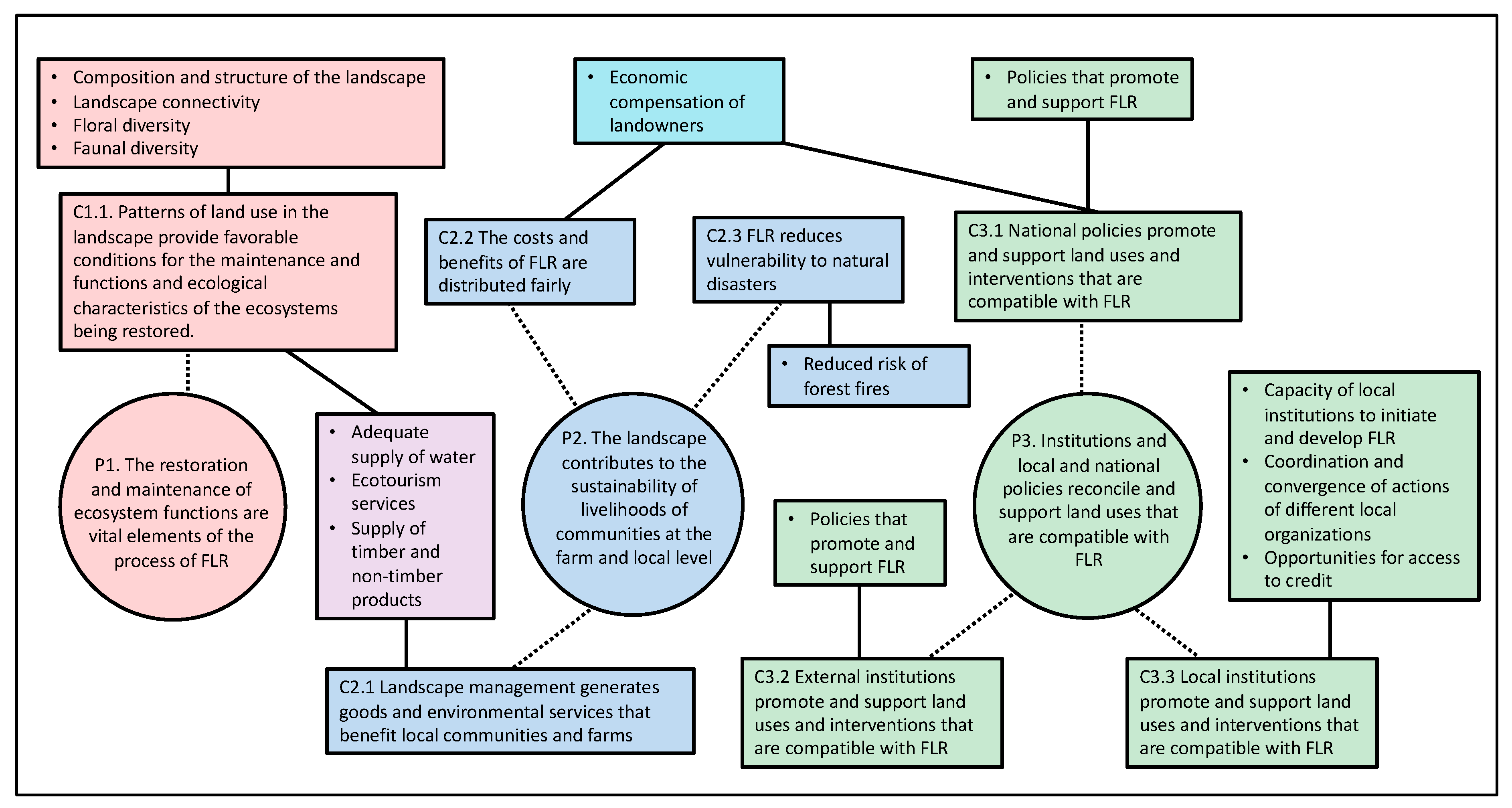
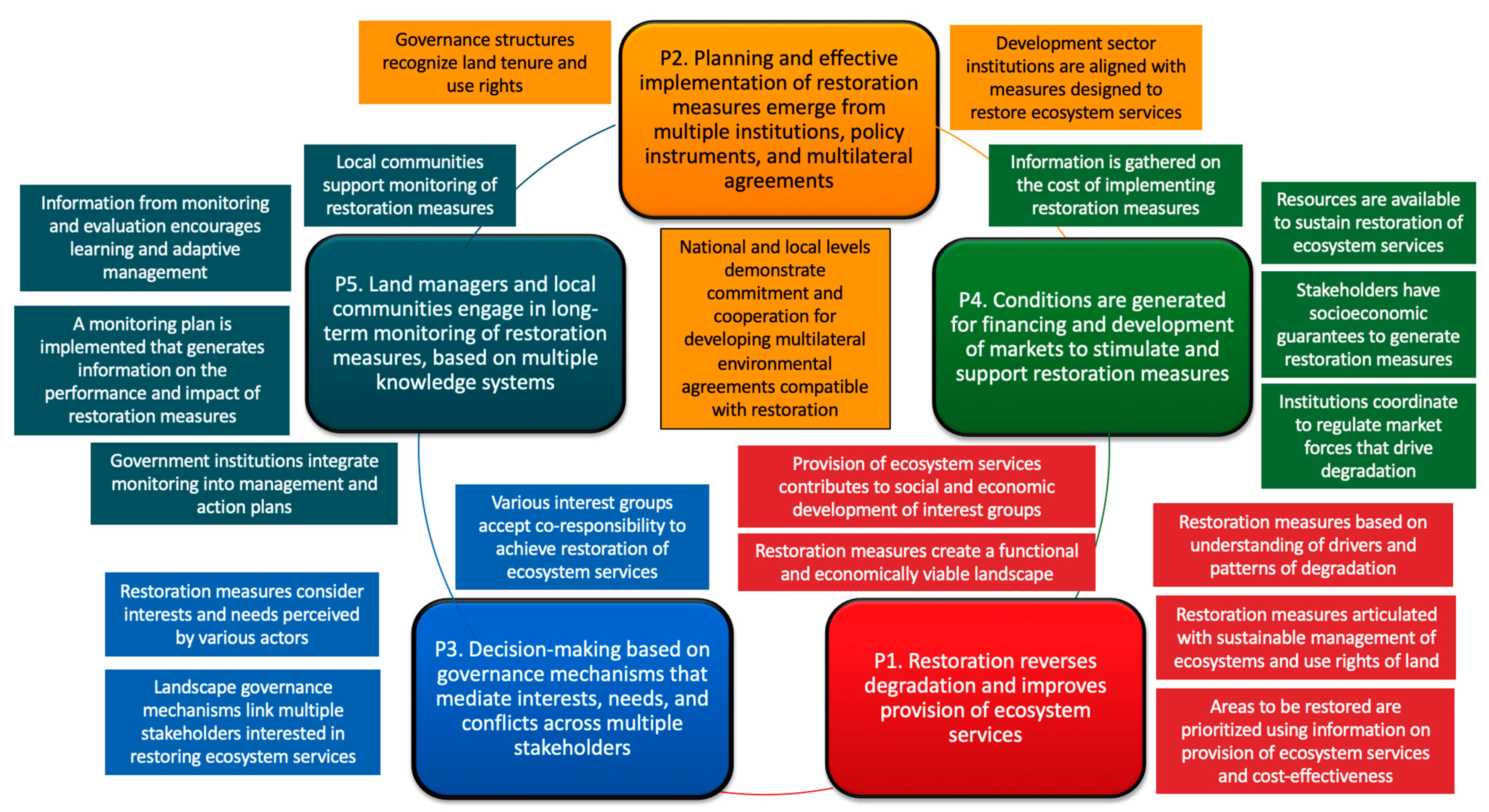
3.1. A Shared Conceptual Framework
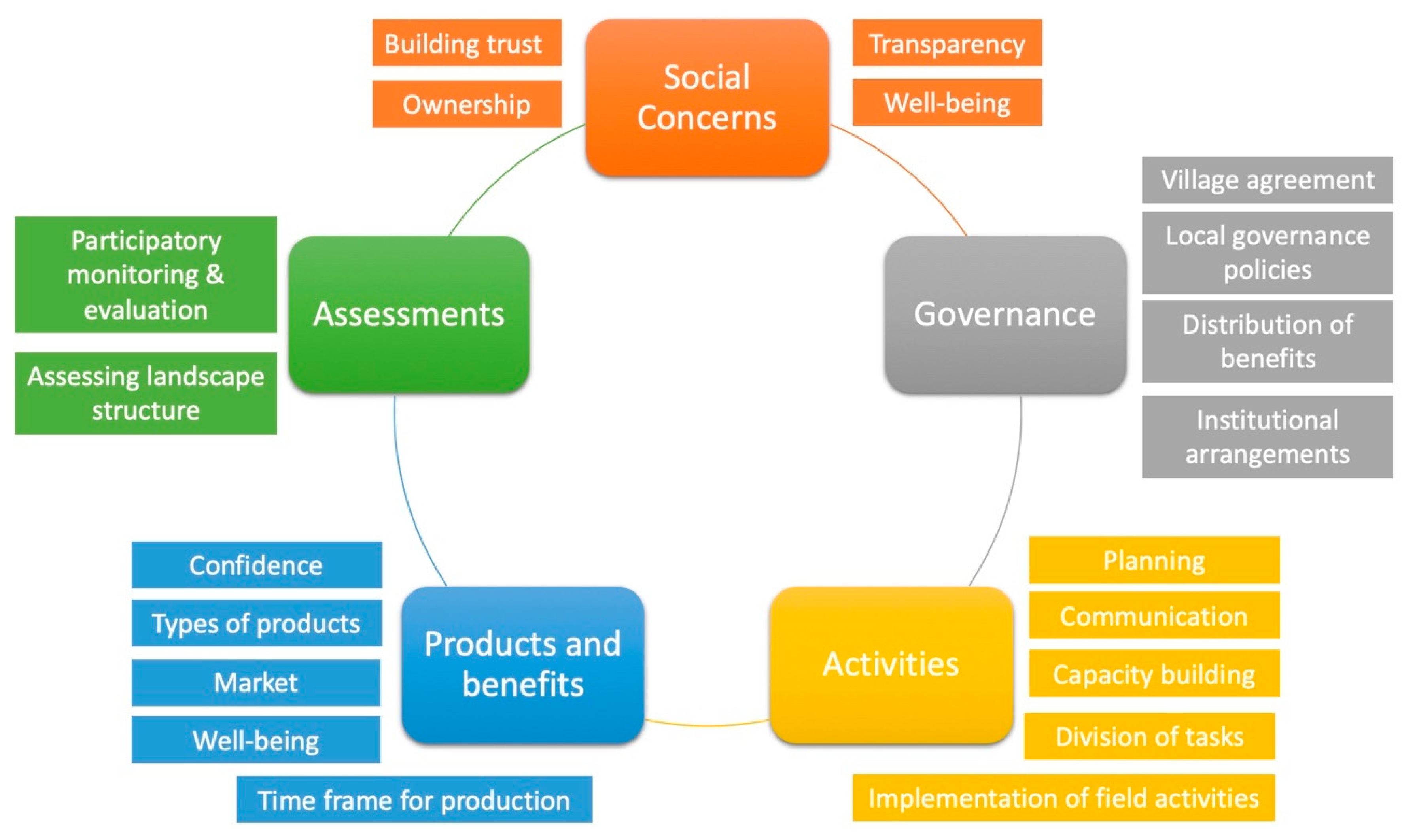
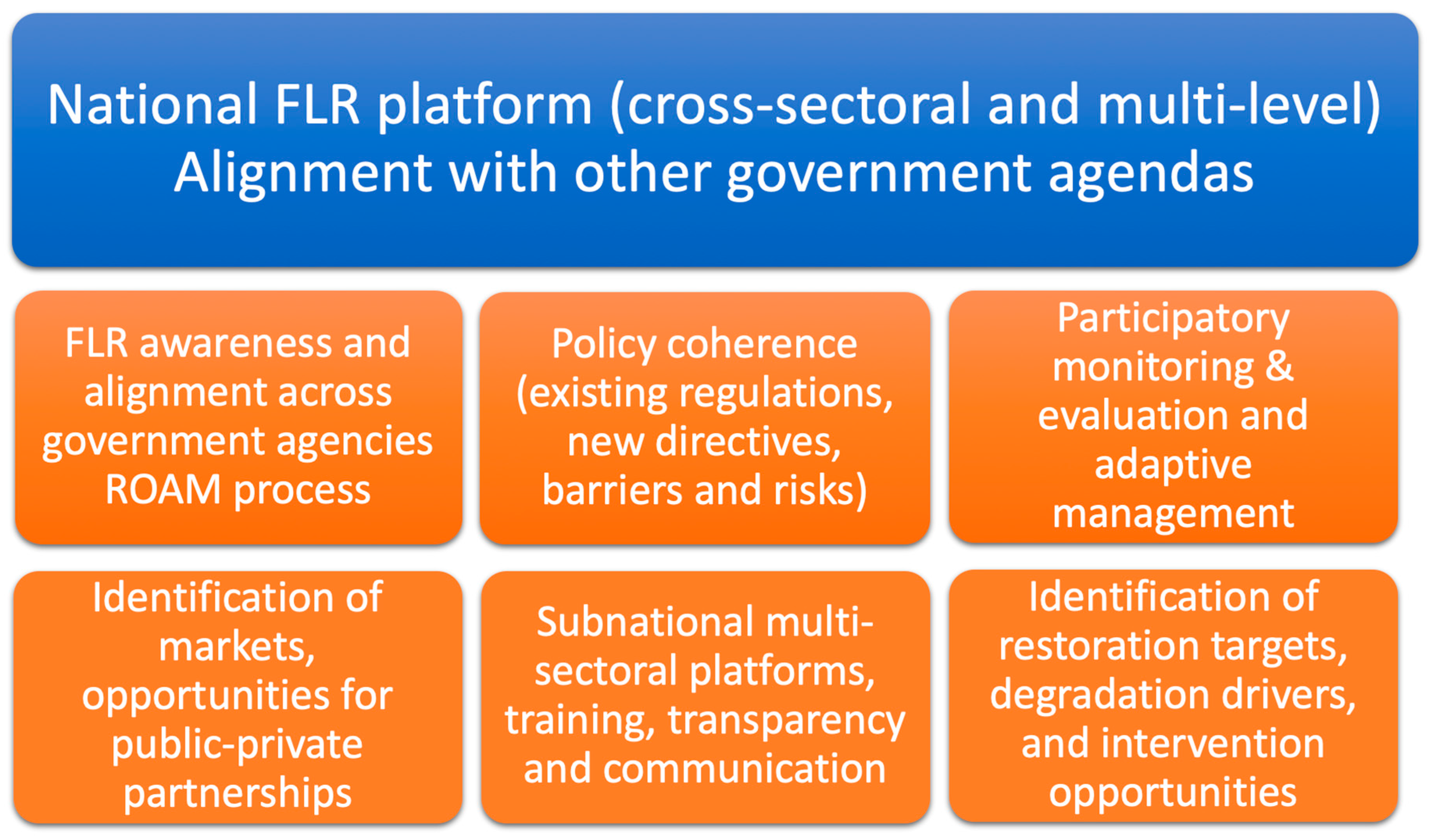
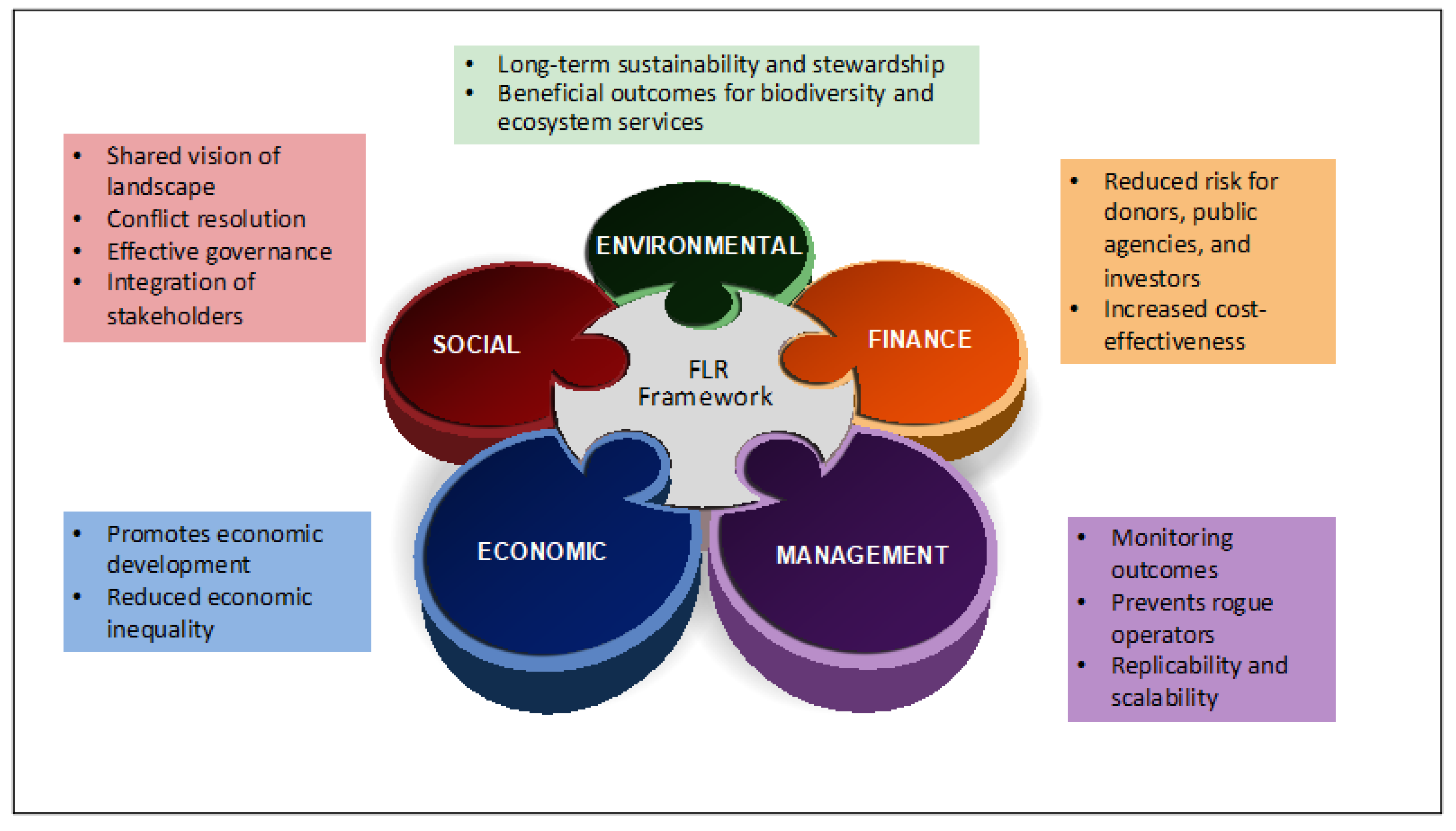
3.2. Working Frameworks
3.3. How Different Actors Can Co-Develop Working FLR Frameworks
- Local landowners, land managers, and communities that seek to practice FLR or enhance existing community-based restoration and reforestation can develop working frameworks to chart a FLR pathway or strategy that gradually adds components and criteria over time using adaptive management approaches.
- Local, regional, and national governments: tailored FLR working frameworks can be used to optimize spatial locations for different interventions within landscapes, to assess the level of stakeholder engagement, and to construct a set of social and environmental indicators to track outcomes and apply adaptive management.
- Non-governmental organizations that work to improve livelihoods or enhance biodiversity conservation through implementing and supporting FLR interventions on a project basis, a working framework can identify interventions and indicators that are directly linked to livelihood improvement, more effective governance, or to biodiversity conservation and would initially emphasize these aspects.
- Funding agencies, impact investors, and donors place a high importance on financial viability, impact, accountability, and transparency. Therefore, selection criteria and management protocols must ensure that core principles and values are upheld to reduce the risk of investments. To evaluate whether the actions and outcomes of investments in the name of FLR actually conform to the core principles, these actors could develop a criteria and indicators framework that emphasizes stakeholder-driven processes, landscape-level scope and approach, adequate time scale for unrolling FLR, economic and financial viability and profits, transparency of interventions and costs, and effective monitoring of social and environmental outcomes.
3.4. Uses and Benefits of Principles-Based Working FLR Frameworks
- A self-assessment tool for communities, NGOs, and local government agencies to evaluate FLR progress and identify missing elements/components to improve the quality of outcomes.
- A way for investors to favor investments with lower risk and that lead to successful social and environmental outcomes.
- A tool for national or international foundations or donors selecting FLR projects to prioritize, support, or use as inspirational models.
- A way to promote knowledge exchange among regions and ecosystems, as a shared framework and data generation, and as a robust tool for reporting on restoration commitments.
- A tool for independent validation and verification for organizations.
- A way to increase credibility, transparency, and stakeholder trust in the FLR process.
- A way for funding agencies to coalesce investments focused in specific restoration outcomes, like biodiversity conservation, carbon sequestration, and watershed services, into a single large and integrated program.
4. What Can We Learn from Existing FLR Guidelines?

| Guidelines and Best Practices | Purpose and Intended Users | Relevance to FLR |
|---|---|---|
| Keenleyside, K., N. Dudley, S. Cairns, C. Hall, and S. Stolton. 2012. Ecological restoration for protected areas: principles, guidelines and best practices. 2831715334, IUCN, Switzerland. [81] | Used by protected area managers that implement ecological restoration | Ecological restoration enhances landscape connectivity, supports biodiversity conservation, and enhances resilience (Principles 1, 3, 4, and 6) |
| Pistorius, T., and L. Kiff. 2017. From a biodiversity perspective: risks, tradeoffs, and international guidance for forest landscape restoration. UNIQUE Forestry and Land Use GmbH, Freiburg, Germany. [82] | Analyzes the need and identifies potential options for mitigating biodiversity risks and trade-offs that are associated with implementing FLR at scale | Suggests that countries with FLR commitments define their own rules and modalities for implementation. No specific guidelines or frameworks are presented |
| Assessing the ITTO Guidelines for the Restoration, Management and Rehabilitation of Degraded Secondary Tropical Forests International Tropical Timber Organization (ITTO) consultancy with the World Resources Institute (WRI) 2015. Case studies of Ghana, Indonesia and Mexico (Kathleen Buckingham and Sarah Weber) [83] | Designed for policy planning and management; and stand-level principles and forest management. Have had limited use due to a lack of awareness by forestry managers, professionals and practitioners at different levels. | ITTO Guidelines and Principles are not yet adapted for FLR context, but links between FLR principles and ITTO 2002 guidelines are being strengthened. |
| Sustainable financing for forest and landscape restoration: Opportunities, challenges and the way forward. 2015. Discussion paper. (FAO and Global Mechanism of the UNCCD, Rome) [64] | This publication is oriented toward public policy makers and shares the experiences of some initiatives on financing FLR from around the world | The document provides background information on FLR and recommendations to help policy makers improve their support for FLR financing |
| Principles and practice of FLR: Case studies from the drylands of Latin America (Newton, A. C., and N. Tejedor, editors. 2011, IUCN, Gland, Switzerland) [84] | A compilation of case studies from an international research project, to examine application of the FLR approach to dryland forest ecosystems in Latin America | Developed conceptual frameworks for FLR based on DPSIR (Driving forces –Pressures–State–Impacts–Responses) framework based on European Environmental Agency |
| Implementing FLR, a practitioner’s guide. 2017 (Stanturf, J., S. Mansourian, and M. Kleine. 2017. International Union of Forest Research Organizations, Vienna, Austria) [24] | Intended as a training resource for FLR facilitators who have a broad approach to land management; | Project-focused guidelines designed primarily for external actors who are facilitating FLR; approach is based on FLR principles, but criteria and indicators are developed directly from project objectives |
| Voluntary Guidelines for FLR under AFR 100 https://afr100.org/content/voluntary-guidelines-forest-landscape-restoration-under-afr100 | To provide guiding principles for the needs of decision-makers working in the African context and with AFR100 pledges | Emphasizes guiding principles for FLR; no explicit guidelines are presented beyond suggesting the ROAM process and FLR trainings. |
| AFR 100 Monitoring Guidelines https://afr100.org/sites/default/files/Monitoring%20Progress_English_Draft.pdf | To guide AFR100 partners to set up a national restoration monitoring system for FLR | Steps are described to guide a uniform and efficient approach to monitoring FLR using the FAO/WRI Restoration Goal Wheel and Relevant Indicators; FLR principles are not mentioned |
| FAO Global Guidelines for Dryland Restoration. 2015 (Berrahmouni, N., P. Regato, and M. Parfondry) Forestry Paper No. 175. Rome, Food and Agriculture Organization of the United Nations. [85] | A compilation of lessons from many experiences in dryland restoration worldwide. It is targeted at policymakers and other decision-makers, and dryland restoration practitioners | Useful guidelines are listed for policy makers, decision makers and practitioners that feed into FAO’s Monitoring and Reporting Tool for Forest and Landscape Restoration. Guidelines are not presented in a unified framework based on FLR principles. |
| Forest and Landscape Restoration Module; Sustainable Forest Management Toolbox (FAO; http://www.fao.org/sustainable-forest-management/toolbox/modules/forest-and-landscape-restoration/basic-knowledge/en/) | Intended for people involved in restoration of forest cover at landscape scale, including decision makers and practitioners. Provides links to tools and case studies. | Reviews technologies, institutional arrangements, and financial arrangements likely to be needed for implementation of FLR. Presents principles of FLR and basic steps of FLR implementation, but no specific guidelines. |
| Biodiversity Guidelines for FLR opportunities. 2018 (Beatty, C., N. Cox, and M. E. Kuzee, IUCN, Gland, Switzerland) [86] | The objective of this publication is to offer the FLR practitioner, the landscape restoration planner and the decision-maker guidelines for how to better integrate biodiversity knowledge and data into FLR opportunities and assessments | Biodiversity guidelines are best used in tandem with the Restoration Opportunities Assessment Methodology (ROAM); specific guidelines are not described in a working format |
| Scaling up Regreening: Six Steps to Success. A Practical Approach to Forest and Landscape Restoration. 2015. (Reij, C. and R. Winterbottom, World Resources Institute, Washington, D.C.). [73] | Offers a scaling strategy for regreening that is informed by experience of practitioners, communities, governments, and other key stakeholders | Six steps are based on practical experience and application of FLR principles, focused on regreening as a form of FLR practiced in drylands in Africa. |
| The Restoration Diagnostic: A Method for Developing Forest Landscape Restoration Strategies by Rapidly Assessing the Status of Key Success Factors. 2015. (Hansen, C., K. Buckinghman, S. DeWitt, and L. Laestadius, World Resources Institute, Washington, D.C.) [87] | Designed to provide guidance to governments, civil society, and companies regarding how to implement FLR well on a large scale | A tool, based on case studies, to assess the status of three categories of key success factors: (1) motivation to catalyze FLR processes, (2) enabling conditions in place, and (3) capacity and resources for sustained implementation. Case studies are also presented. |
| Gender Responsive Restoration Guidelines (IUCN 2017) [88] | Designed for countries using ROAM to assess restoration opportunities | Present guidelines for the ROAM process for specific actions for identifying gender considerations and developing a gender-responsive approach and outcomes for FLR initiatives; FLR principles are not mentioned. |
| The Forest Landscape Restoration Handbook 2012 [89] | An edited book written by a team of experts to help forest restoration practitioners to understand FLR, appreciate its benefits and start implementation | Provides practical guidance on implementing FLR; two case studies presented. Emphasizes the “double filter” criterion of FLR: the joint objectives of enhanced ecological integrity and human well-being cannot be traded off against each other at a landscape level |
| 4 Returns from Landscape Restoration (2015) Commonland Foundation) [90] | Design strategies to build bridges between farmers and local landowners, investors, companies and governments to promote long-lasting partnerships between stakeholders investing in large-scale landscape | A business approach to FLR based on four outcomes: return of inspiration, return of social capital, return of natural capital, and return of financial capital. |
| Mapping social landscapes: A guide to restoration opportunities mapping. 2018. (Buckingham, K., S. Ray, B. Arakwiye, A. G. Morales, R. Singh, D. Maneerattana, S. Wicaksono, and H. Chrysolite, World Resources Institute, Washington, DC.) [91] | The guide is designed to support policymakers, researchers, and those involved in restoration decision-making and implementation by offering a social landscapes assessment methodology for use in restoration efforts | Offers a guide to actionable, environmental-related strategies to build a social movement around restoration; supplements (ROAM) through its focus on social aspects. |
| International standards and principles for the practice of ecological restoration. Second Edition. 2019. https://doi.org/10.1111/rec.13035 [92] | A robust framework based on eight principles for ecological restoration projects to achieve intended goals, while addressing challenges including effective design and implementation, accounting for complex ecosystem dynamics (especially in the context of climate change), and navigating trade-offs associated with land management priorities and decisions | Does not focus on landscape approaches involving multiple types of interventions. Guidance focuses on achieving ecological restoration within a context of reference ecosystems. |
| Measuring progress in status of land under forest landscape restoration using abiotic and biotic indicators. 2018. Dudley, N., S. A. Bhagwat, J. Harris, S. Maginnis, J. G. Moreno, G. M. Mueller, S. Oldfield, and G. Walters. Restoration Ecology 26:5-12. [93] | The authors suggest a minimum set of abiotic and biotic threshold indicators and progress indicators if FLR, then also briefly discusses progress indicators of pressures and project outputs | Present a set of abiotic, biotic, and progress indicators for measuring changing conditions and the status of forest restoration and ecosystem services across a wider landscape. No indictors focus on social dimensions; no mention of FLR core principles. |
| Cohen-Shacham, E., Andrade, A., Dalton, J., Dudley, N., Jones, M., Kumar, C., Maginnis, S., Maynard, S., Nelson, C.R., Renaud, F.G., 2019. Core principles for successfully implementing and upscaling Nature-based Solutions. Environmental Science & Policy 98, 20-29. [7] | Presents definition and principles underpinning the Nature-based Solutions framework recently adopted by the International Union for Conservation of Nature | Compares eight NbS core principles to six FLR core principles. |
| FAO and WRI. 2019 The road to restoration: A guide to identifying priorities and indicators for monitoring forest and landscape restoration, FAO & World Resources Institute, Rome, Washington, D.C. p. 70. [94] | A practical guide to help governments, businesses, communities and anyone actively restoring land identify priorities and set up goals grounded in reality. The guide helps practitioners develop an indicator framework by identifying appropriate metrics and measures. | This guide is intended to be used at the landscape level but can be adapted to suit local needs and different scales. It is focused on project objectives, and is not based on FLR principles |
| Guidelines for Forest Landscape Restoration in the Tropics. 2020. International Tropical Timber Organization. https://www.itto.int/direct/topics/topics_pdf_download/topics_id=6423&no=1&disp=inline [23] | Developed using the FLR principles (Table 1) to provide guidance on the development and implementation of forest landscape restoration processes. The guidelines are linked fundamentally to the principles using a conceptual framework of guiding elements and recommended actions. | Well-developed guiding elements that provide an excellent basis for working frameworks discussed here. Introduces the idea of FLR scenarios and provides illustrative case studies for implementing FLR under certain broadly representative restoration scenarios. |
| Guariguata, M. R., Evans, K. 2019. A diagnostic for collaborative monitoring in forest landscape restoration. Restoration Ecology doi:10.1111/rec.13076 [95] | A checklist of core factors that contribute to successful collaborative monitoring in FLR at various scales. | The diagnostic explicitly addresses issues of scale, including multiple sites, governance levels, and changes over time and at different stages in the planning, implementation and evaluation of FLR interventions. |
5. Conclusions: The Manila Declaration and Next Steps
Supplementary Materials
Author Contributions
Funding
Acknowledgments
Conflicts of Interest
References
- Laestadius, L.; Buckingham, K.; Maginnis, S.; Saint-Laurent, C. Back to Bonn and beyond: A history of forest landscape restoration and an outlook for the future. Unasylva 245 2015, 66, 1–8. [Google Scholar]
- Mansourian, S.; Vallauri, D.; Dudley, N. Forest Restoration in Landscapes: Beyond Planting Trees; Springer: New York, NY, USA, 2005. [Google Scholar]
- Maginnis, S.; Jackson, W. What is FLR and How Does it Differ from Current Approaches. In The Forest Landscape Restoration Handook; Reitbergen-McCracken, J., Maginnis, S., Sarre, A., Eds.; Earthscan: London, UK, 2007; pp. 5–20. [Google Scholar]
- Rietbergen-McCracken, J.; Maginnis, S.; Sarre, A. The Forest Landscape Restoration Handbook; Sayer, J.A., Ed.; Earthscan: London, UK, 2007. [Google Scholar]
- Sayer, J.; Sunderland, T.; Ghazoul, J.; Pfund, J.-L.; Sheil, D.; Meijaard, E.; Venter, M.; Boedhihartono, A.K.; Day, M.; Garcia, C.; et al. Ten principles for a landscape approach to reconciling agriculture, conservation, and other competing land uses. Proc. Natl. Acad. Sci. USA 2013, 110, 8349–8356. [Google Scholar] [CrossRef] [PubMed]
- Pistorius, T.; Carodenuto, S.; Wathum, G. Implementing Forest Landscape Restoration in Ethiopia. Forests 2017, 8, 61. [Google Scholar] [CrossRef]
- Cohen-Shacham, E.; Andrade, A.; Dalton, J.; Dudley, N.; Jones, M.; Kumar, C.; Maginnis, S.; Maynard, S.; Nelson, C.R.; Renaud, F.G.; et al. Core principles for successfully implementing and upscaling Nature-based Solutions. Environ. Sci. Policy 2019, 98, 20–29. [Google Scholar] [CrossRef]
- Griscom, B.; Adams, J.; Ellis, P.W.; Houghton, R.A.; Lomax, G.; Miteva, D.A.; Schlesinger, W.H.; Shoch, D.; Siikamäki, J.V.; Smith, P.; et al. Natural climate solutions. Proc. Natl. Acad. Sci. USA 2017, 114, 11645–11650. [Google Scholar] [CrossRef]
- UN (United Nations). Transforming our World: The 2030 Agenda for Sustainable Development. 2015. Available online: https://sustainabledevelopment.un.org/content/documents/21252030%20Agenda%20for%20Sustainable%20Development%20web.pdf (accessed on 13 June 2020).
- UNFCCC (United Nations Framework Convention on Climate Change). The Paris Agreement and NDCs. 2015. Available online: https://unfccc.int/process-and-meetings/the-paris-agreement/the-paris-agreement/nationally-determined-contributions-ndcs. (accessed on 13 June 2020).
- NYDF (New York Declaration on Forests) Global Platform. Available online: https://www.nydfglobalplatform.org/ (accessed on 13 June 2020).
- Bonn Challenge. 2011. Available online: http://www.bonnchallenge.org/content/challenge (accessed on 24 February 2015).
- Appanah, S.; Lamb, D.; Durst, P.; Thaung, T.L.; Sabogal, C.; Gritten, D.; Mohns, B.; Atkinson, J.; Shono, K. Forest Landscape Restoration for Asia-Pacific Forests: A Synthesis; FAO and RECOFTC: Bangkok, Thailand, 2016; p. 1. [Google Scholar]
- Reij, C.; Garrity, D. Scaling up farmer-managed natural regeneration in Africa to restore degraded landscapes. Biotropica 2016, 48, 834–843. [Google Scholar] [CrossRef]
- Meli, P.; Herrera, F.; Melo, F.P.L.; Pinto, S.; Aguirre, N.; Musalem, K.; Minaverry, C.; Ramírez, W.; Brancalion, P.H.S. Four approaches to guide ecological restoration in Latin America. Restor. Ecol. 2016, 25, 156–163. [Google Scholar] [CrossRef]
- Cruz-Alonso, V.; Ruiz-Benito, P.; Villar-Salvador, P.; Rey-Benayas, J.M. Long-term recovery of multifunctionality in Mediterranean forests depends on restoration strategy and forest type. J. Appl. Ecol. 2019, 56, 745–757. [Google Scholar] [CrossRef]
- Besseau, P.; Graham, S.; Christophersen, T. Restoring Forests and Landscapes: The Key to a Sustainable Future; IUFRO on behalf of the Global Partnership on Forest and Landscape Restoration: Vienna, Austria, 2018. [Google Scholar]
- Sabogal, C.; Besacier, C.; McGuire, D. Forest and landscape restoration: Concepts, approaches and challenges for implementation. Unasylva 245 2015, 66, 3–10. [Google Scholar]
- Chazdon, R.; Guariguata, M. Decision Support Tools for Forest Landscape Restoration: Current Status and Future Outlook; CIFOR Occasional Paper 183; Center for International Forestry Research: Bogor, Indonesia, 2018. [Google Scholar]
- Méndez-Toribio, M.; Martínez-Garza, C.; Ceccon, E.; Guariguata, M.R. Current ecological restoration plans in Latin America: Progress and omissions. Trop. J. Environ. Sci. 2017, 52, 1–30. [Google Scholar]
- Schweizer, D.; Meli, P.; Brancalion, P.H.S.; Guariguata, M.R. Implementing forest landscape restoration in Latin America: Stakeholder perceptions on legal frameworks. Land Use Policy 2019, 104244. [Google Scholar] [CrossRef]
- IUCN. The Bonn Challenge: Catalysing Leadership in Latin America. Available online: https://www.iucn.org/theme/forests/resources/forest-briefs (accessed on 9 September 2018).
- ITTO. Guidelines for Forest Landscape Restoration in the Tropics; ITTO Policy Development Series No. 23; International Tropical Timber Organization (ITTO): Yokohama, Japan, 2020; p. 153. [Google Scholar]
- Stanturf, J.; Mansourian, S.; Kleine, M. Implementing Forest Landscape Restoration: A Practitioner’s Guide; International Union of Forest Research Organizations: Vienna, Austria, 2017; p. 128. [Google Scholar]
- FAO. The Forest and Landscape Restoration Mechanism Knowledge Base. Available online: http://wwwfaoorg/in-action/forest-landscape-restoration-mechanism/knowledge-base/monitoring-evaluation/en/2020 (accessed on 13 June 2020).
- Dave, R.; Saint-Laurent, C.; Moraes, M.; Simonit, S.; Raes, L.; Karangwa, C. Bonn Challenge Barometer of Progress; IUCN: Gland, Switzerland, 2017. [Google Scholar]
- Gourevitch, J.D.; Hawthorne, P.L.; Keeler, B.L.; Beatty, C.R.; Greve, M.; A Verdone, M. Optimizing investments in national-scale forest landscape restoration in Uganda to maximize multiple benefits. Environ. Res. Lett. 2016, 11, 114027. [Google Scholar] [CrossRef]
- Molin, P.G.; Chazdon, R.L.; Ferraz, S.F.; Brancalion, P.H.S. A landscape approach for cost-effectiven large-scale forest restoration. J. Appl. Ecol. 2018, 55, 2767–2778. [Google Scholar] [CrossRef]
- Strassburg, B.B.N.; Beyer, H.; Crouzeilles, R.; Iribarrem, A.; Barros, F.; De Siqueira, M.F.; Sánchez-Tapia, A.; Balmford, A.; Sansevero, J.B.B.; Brancalion, P.H.S.; et al. Strategic approaches to restoring ecosystems can triple conservation gains and halve costs. Nat. Ecol. Evol. 2018, 3, 62–70. [Google Scholar] [CrossRef] [PubMed]
- Brancalion, P.H.S.; Niamir, A.; Broadbent, E.N.; Crouzeilles, R.; Barros, F.S.M.; Zambrano, A.M.A.; Baccini, A.; Aronson, J.; Goetz, S.; Reid, J.L.; et al. Global restoration opportunities in tropical rainforest landscapes. Sci. Adv. 2019, 5, eaav3223. [Google Scholar] [CrossRef]
- Faruqi, S.; Wu, A.; Anchondo Ortega, A.; Batista, A.; Brolis, E. The Business of Planting Trees: A Growing Investment Opportunity; World Resources Institute: Washington, DC, USA, 2018. [Google Scholar]
- GIIN (Global Impact Investing Network). Annual Impact Investor Survey 2018. 2018. Available online: https://thegiin.org/research/publication/annualsurvey2018 (accessed on 30 January 2019).
- Hamrick, K. State of Private Investment in Conservation 2016–Forest Trends. Available online: https://www.forest-trends.org/publications/state-of-private-investment-in-conservation-2016/ (accessed on 30 January 2019).
- Goldstein, A. Taking Stock of the Role of Offsets in Corporate Carbon Strategies–Forest Trends. Available online: https://www.forest-trends.org/publications/buying-in/ (accessed on 30 January 2019).
- Koh, N.S.; Hahn, T.; Boonstra, W.J. How much of a market is involved in a biodiversity offset? A typology of biodiversity offset policies. J. Environ. Manag. 2019, 232, 679–691. [Google Scholar] [CrossRef]
- NYDF Assessment Partners. Protecting and Restoring Forests: A Story of Large Commitments yet Limited Progress. New York Declaration on Forests Five-Year Assessment Report. Climate Focus (Coordinator and Editor). Available online: https://forestdeclarationorg/images/uploads/resource/2019NYDFReportpdf (accessed on 13 June 2020).
- Mansourian, S.; Dudley, N.; Vallauri, D. Forest Landscape Restoration: Progress in the Last Decade and Remaining Challenges. Ecol. Restor. 2017, 35, 281–288. [Google Scholar] [CrossRef]
- Redford, K.H.; Padoch, C.; Sunderland, T. Fads, funding, and forgetting in tree decades of conservation. Conserv. Biol. 2013, 27, 437–438. [Google Scholar] [CrossRef]
- Djenontin, I.N.S.; Foli, S.; Zulu, L.C. Revisiting the Factors Shaping Outcomes for Forest and Landscape Restoration in Sub-Saharan Africa: A Way Forward for Policy, Practice and Research. Sustainability 2018, 10, 906. [Google Scholar] [CrossRef]
- Fagan, M.E.; Reid, J.L.; Holland, M.B.; Drew, J.G.; Zahawi, R.A. How feasible are global forest restoration commitments? Conserv. Lett. 2020, 12700. [Google Scholar] [CrossRef]
- Mansourian, S.; Parrotta, J.; Balaji, P.; Bellwood-Howard, I.; Bhasme, S.; Bixler, R.P.; Boedhihartono, A.K.; Carmenta, R.; Jedd, T.; Jong, W.; et al. Putting the pieces together: Integration for forest landscape restoration implementation. Land Degrad. Dev. 2019, 31, 419–429. [Google Scholar] [CrossRef]
- Sayer, J.; Margules, C.; Boedhihartono, A.K.; Sunderland, T.; Langston, J.D.; Reed, J.; Riggs, R.A.; Buck, L.E.; Campbell, B.M.; Kusters, K.; et al. Measuring the effectiveness of landscape approaches to conservation and development. Sustain. Sci. 2016, 12, 465–476. [Google Scholar] [CrossRef]
- Chazdon, R.L.; Wilson, S.J.; Brondizio, E.S.; Guariguata, M.R.; Herbohn, J. Governance challenges for planning and implementing Forest and Landscape Restoration. Land Use Policy 2020, in press. [Google Scholar]
- Ota, L.; Herbohn, J.; Firn, J.; Chazdon, R.; Gregorio, N.; Mukul, S.A.; Viani, R.A.G.; Romero, C. Using leading and lagging indicators for forest restoration. J. Appl. Ecol. 2000. in review. [Google Scholar]
- Sayer, J.; Campbell, B.; Petheram, L.; Aldrich, M.; Pérez, M.R.; Endamana, D.; Dongmo, Z.-L.N.; Defo, L.; Mariki, S.; Doggart, N.; et al. Assessing environment and development outcomes in conservation landscapes. Biodivers. Conserv. 2006, 16, 2677–2694. [Google Scholar] [CrossRef]
- McCall, M.K. Beyond “Landscape” in REDD+: The Imperative for “Territory”. World Dev. 2016, 85, 58–72. [Google Scholar] [CrossRef]
- Wiegant, D.; Peralvo, M.; van Oel, P.; Dewulf, A. Five scale challenges in Ecuadorian forest and landscape restoration governance. Land Use Policy 2020, 96, 104686. [Google Scholar] [CrossRef]
- Brancalion, P.H.S.; Chazdon, R. Beyond hectares: four principles to guide reforestation in the context of tropical forest and landscape restoration. Restor. Ecol. 2017, 25, 491–496. [Google Scholar] [CrossRef]
- Chazdon, R.; Brancalion, P.H.S. Restoring forests as a means to many ends. Sci. 2019, 365, 24–25. [Google Scholar] [CrossRef]
- Mansourian, S. In the eye of the beholder: Reconciling interpretations of forest landscape restoration. Land Degrad. Dev. 2018, 29, 2888–2898. [Google Scholar] [CrossRef]
- Erbaugh, J.; Oldekop, J.A. Forest landscape restoration for livelihoods and well-being. Curr. Opin. Environ. Sustain. 2018, 32, 76–83. [Google Scholar] [CrossRef]
- Evans, K.; Guariguata, M.R.; Brancalion, P.H.S. Participatory monitoring to connect local and global priorities for forest restoration. Conserv. Boil. 2018, 32, 525–534. [Google Scholar] [CrossRef] [PubMed]
- Kumar, C.; Begeladze, S.; Calmon, M.; Saint-Laurent, C. Enhancing Food Security Through Forest Landscape Restoration: Lessons from Burkina Faso, Brazil, Guatemala, Viet Nam, Ghana, Ethiopia and Philippines; IUCN: Gland, Switzerland, 2015; pp. 5–217. [Google Scholar]
- Reed, J.; Van Vianen, J.; Deakin, E.L.; Barlow, J.; Sunderland, T. Integrated landscape approaches to managing social and environmental issues in the tropics: learning from the past to guide the future. Glob. Chang. Boil. 2016, 22, 2540–2554. [Google Scholar] [CrossRef] [PubMed]
- Carmenta, R.; Coomes, D.A.; Declerck, F.A.; Hart, A.K.; Harvey, C.A.; Milder, J.; Reed, J.; Vira, B.; Estrada-Carmona, N. Characterizing and Evaluating Integrated Landscape Initiatives. One Earth 2020, 2, 174–187. [Google Scholar] [CrossRef]
- Reed, J.; Van Vianen, J.; Barlow, J.; Sunderland, T. Have integrated landscape approaches reconciled societal and environmental issues in the tropics? Land Use Policy 2017, 63, 481–492. [Google Scholar] [CrossRef]
- Sapkota, R.; Stahl, P.; Rijal, K. Restoration governance: An integrated approach towards sustainably restoring degraded ecosystems. Environ. Dev. 2018, 27, 83–94. [Google Scholar] [CrossRef]
- Kusters, K.; De Graaf, M.; Buck, L.; Galido, K.; Maindo, A.; Mendoza, H.; Nghi, T.H.; Purwanto, E.; Zagt, R. Inclusive Landscape Governance for Sustainable Development: Assessment Methodology and Lessons for Civil Society Organizations. Land 2020, 9, 128. [Google Scholar] [CrossRef]
- Sari, D.A.; Sayer, J.; Margules, C.; Boedhihartono, A.K. Determining the effectiveness of forest landscape governance: A case study from the Sendang landscape, South Sumatra. For. Policy Econ. 2019, 102, 17–28. [Google Scholar] [CrossRef]
- Boedhihartono, A.K.; Sayer, J.A. Forest landscape restoration: Restoring what and for whom. In Forest Landscape Restoration: Integrating Natural and Social Sciences; Stanturf, J.A., Lamb, D., Madsen, P., Eds.; Springer: New York, NY, USA, 2012; pp. 309–323. [Google Scholar]
- Kusters, K.; Buck, L.; De Graaf, M.; Minang, P.; Van Oosten, C.; Zagt, R. Participatory Planning, Monitoring and Evaluation of Multi-Stakeholder Platforms in Integrated Landscape Initiatives. Environ. Manag. 2017, 62, 170–181. [Google Scholar] [CrossRef]
- Brancalion, P.H.S.; Pinto, S.; Pugliese, L.; Padovezi, A.; Rodrigues, R.R.; Calmon, M.; Carrascosa, H.; Castro, P.; Mesquita, B. Governance innovations from a multi-stakeholder coalition to implement large-scale Forest Restoration in Brazil. World Dev. Perspect. 2016, 3, 15–17. [Google Scholar] [CrossRef]
- Ferwerda, W.H.; Moolenar, S. Four returns: A long-term holistic framework for integrate landscape management and restoration Involving business. Solutions 2016, 7, 36–41. [Google Scholar]
- FAO, UNCCD GMot. Sustainable Financing for Forest and Landscape Restoration: Opportunities, Challenges and the Way Forward. Discussion Paper; FAO/UNCCD: Rome, Italy, 2015. [Google Scholar]
- Ding, H.; Altamirano, J.C.; Anchondo, A.; Faruqi, S.; Verdone, M.; Wu, A.; Zamora, R.; Chazdon, R.; Vergara, W. Roots of Prosperity: The Economics and Finance of Restoring Land; World Resources Institute: Washington, DC, USA, 2017. [Google Scholar]
- Brancalion, P.H.S.; Lamb, D.; Ceccon, E.; Boucher, D.; Herbohn, J.; Strassburg, B.; Edwards, D.P. Using markets to leverage investment in forest and landscape restoration in the tropics. For. Policy Econ. 2017, 85, 103–113. [Google Scholar] [CrossRef]
- Tipper, R.; Coad, N.; Burnett, J. Is “Insetting” the New Offsetting. Econometrica. Available online: https://ecometricacom/assets/insetting_offsetting_technicalpdf (accessed on 16 May 2020).
- Gutierrez, V.; Keijzer, M.-N. Funding forest landscape restoration using a business-centered approach: An NGO’s perspective. Unasylva 2015, 66, 99–105. [Google Scholar]
- Hodge, I.D.; Adams, W.M. Short-Term Projects versus Adaptive Governance: Conflicting Demands in the Management of Ecological Restoration. Land 2016, 5, 39. [Google Scholar] [CrossRef]
- Holl, K.D.; Brancalion, P.H.S. Tree planting is not a simple solution. Science 2020, 368, 580–581. [Google Scholar] [CrossRef] [PubMed]
- Van Oosten, C.; Runhaar, H.; Arts, B. Capable to govern landscape restoration? Exploring landscape governance capabilities, based on literature and stakeholder perceptions. Land Use Policy 2019, 104020. [Google Scholar] [CrossRef]
- Sapkota, L.M.; Jihadah, L.; Sato, M.; Greijmans, M.; Wiset, K.; Aektasaeng, N.; Daisai, A.; Gritten, D. Translating global commitments into action for successful forest landscape restoration: Lessons from Ing watershed in northern Thailand. Land Use Policy 2019, 104063. [Google Scholar] [CrossRef]
- Reij, C.; Winterbottom, R. Scaling up Regreening: Six Steps to Success: A Practical Approach to Forest and Landscape Restoration; World Resources Institute: Washington, DC, USA, 2015. [Google Scholar]
- Crouzeilles, R.; Alexandre, N.S.; Beyer, H.; Bodin, B.; Guariguata, M.R.; Chazdon, R.L. Giving Nature a Hand; Conservation International, International Institute for Sustainability, Center for International Forestry Research: Washington, DC, USA, 2019. [Google Scholar]
- Prabhu, R.; Colfer, C.P.; Venkateswarlu, P.; Tan, L.C.; Soekarmadi, R.; Wollenberg, E. Testing criteria and indicators for the sustainable management of forests: phase 1. Final Report; Center for International Forestry Research (CIFOR): Bogor, Indonesia, 1996. [Google Scholar]
- Prabhu, R.; Colfer, C.; Shepherd, G. Criteria and Indicators for Sustainable Forest Management: New Findings from CIFOR’s Forest Management Unit Level Research; Rural Development Forestry Network; Overseas Development Institute: London, UK, 1998. [Google Scholar]
- Brancalion, P.H.S.; Garcia, L.C.; Loyola, R.; Rodrigues, R.R.; Pillar, V.D.; Lewinsohn, T.M. A critical analysis of the Native Vegetation Protection Law of Brazil (2012): updates and ongoing initiatives. Natureza & Conservação 2016, 14, 1–15. [Google Scholar] [CrossRef]
- Salazar, M.; Campos, J.J.; Villalobos, R.; Prins, C.; Finegan, B. Evaluación de la restauración del paisaje en el cantón de Hojancha, Costa Rica. Recur. Nat. Ambiente 2005, 45, 81–90. [Google Scholar]
- Bustos Linares, E. Propuesta de estándar para la restauración a escala de paisaje; Tesis de Maestría, CATIE: Turrialba, Costa Rica, 2018. [Google Scholar]
- Making FLR happen through engaging local people: A learning journey from Biliran to Tacloban and on to Manila. Available online: https://partners-rcn.org/2019/03/making-flr-happen/ (accessed on 19 June 2020).
- Keenleyside, K.; Dudley, N.; Cairns, S.; Hall, C.; Stolton, S. Ecological Restoration for Protected Areas: Principles, Guidelines and Best Practices; Report No.: 2831715334; IUCN: Gland, Switzerland, 2012. [Google Scholar]
- Pistorius, T.; Kiff, L. From a Biodiversity Perspective: Risks, Tradeoffs, and International Guidance for Forest Landscape Restoration; UNIQUE Forestry and Land Use GmbH: Freiburg, Germany, 2017. [Google Scholar]
- Buckingham, K.; Weber, S. Assessing the ITTO Guidelines for the Restoration, Management and Rehabilitation of Degraded Secondary Tropical Forests: Case studies of Ghana, Indonesia and Mexico. International Tropical Timber Organization. Available online: https://www.itto.int/news_releases/id=4632 (accessed on 16 May 2020).
- Newton, A.C.; Tejedor, N. Introduction. In Principles and Practice of Forest Landscape Restoration: Case Studies from the Drylands of Latin America; Newton, A.C., ejedor, N., Eds.; IUCN: Gland, Switzerland, 2011; pp. 1–22. [Google Scholar]
- FAO. Global Guidelines for the Restoration of Degraded Forests and Landscapes in Drylands: Building Resilience and Benefitting Livelihoods; Food and Agriculture Organization of the United Nations (FAO): Rome, Italy, 2015. [Google Scholar]
- Beatty, C.; Cox, N.A.; Kuzee, M. Biodiversity Guidelines for Forest Landscape Restoration Opportunities Assessments; IUCN: Gland, Switzerland, 2018. [Google Scholar]
- WRI. The Restoration Diagnostic: A Method for Developing Forest Landscape Restoration Strategies by Rapidly Assessing the Status of Key Success Factors; World Resources Institute: Washington, DC, USA, 2015. [Google Scholar]
- IUCN. Gender-Responsive Restoration Guidelines: A Closer Look at Gender in the Restoration Opportunities Assessment Methodology; IUCN: Gland, Switzerland, 2017. [Google Scholar]
- Maginnis, S. The Forest Landscape Restoration Handbook; Informa UK Limited: Colchester, UK, 2012. [Google Scholar]
- Ferwerda, W. 4 Returns, 3 Zones, 20 years: A Holistic Framework for Ecological Restoration by People and Business for Next Generations; Commonland: Amsterdam, The Netherlands, 2015. [Google Scholar]
- Buckingham, K.; Ray, S.; Arakwiye, B.; Morales, A.G.; Singh, R.; Maneerattana, D.; Chrysolite, H. Mapping Social Landscapes: A Guide to Restoration Opportunities Mapping; World Resources Institute: Washington, DC, USA, 2018. [Google Scholar]
- Gann, G.; McDonald, T.; Walder, B.; Aronson, J.; Nelson, C.R.; Nelson, J.; Eisenberg, C.; Hallet, J.; Guariguata, M.R.; Liu, J.; et al. International Standards and Principles for the Practice of Ecological Restoration. Restor. Ecol. 2019, 27, S1–S46. [Google Scholar] [CrossRef]
- Dudley, N.; Bhagwat, S.A.; Harris, J.; Maginnis, S.; García-Moreno, J.; Mueller, G.M.; Oldfield, S.; Walters, G. Measuring progress in status of land under forest landscape restoration using abiotic and biotic indicators. Restor. Ecol. 2018, 26, 5–12. [Google Scholar] [CrossRef]
- FAO, WRI. The Road to Restoration: A Guide to Identifying Priorities and Indicators for Monitoring Forest and Landscape Restoration; World Resources Institute: Washington, DC, USA, 2019. [Google Scholar]
- Guariguata, M.R.; Evans, K. A diagnostic for collaborative monitoring in forest landscape restoration. Restor. Ecol. 2019. [Google Scholar] [CrossRef]
- Taming the FLR beast: The Mission of the Forest and Landscape Restoration Standards (FLORES) task force. Available online: https://partners-rcn.org/2017/09/taming-the-flr-beast/ (accessed on 19 June 2020).
- How to Know it When we See it? A Case for Forest and Landscape Restoration Quality Standard, Center for International Forestry Research, Bogor, Indonesia. Available online: https://www.cifor.org/knowledge/publication/6678/ (accessed on 19 June 2020).
- For the Love of Restoration. Available online: https://partners-rcn.org/2018/10/for-the-love-of-restoration/ (accessed on 19 June 2020).
- Ota, L.; Chazdon, R.L.; Herbohn, J.; Gregorio, N.; Mukul, S.A.; Wilson, S.J. Achieving Quality Forest and Landscape Restoration in the Tropics. Forests 2020. in review. [Google Scholar]
- Chazdon, R.; Herbohn, J.; Mukul, S.A.; Gregorio, N.; Ota, L.; Harrison, R.D.; Durst, P.B.; Chaves, R.; Pasa, A.; Hallett, J.; et al. Manila Declaration on Forest and Landscape Restoration: Making It Happen. Forests 2020, 11, 685. [Google Scholar] [CrossRef]
- UN. Decade on Ecosystem Restoration 2021–2030. United Nations Environmental Program. Available online: https://www.decadeonrestoration.org/ (accessed on 13 June 2020).
- WEF (World Economic Forum). A Platform for the Trillion Tree Community. Available online: https://www.1t.org/ (accessed on 13 June 2020).
| Main Focus of Principle | How the Principle Applies to Forest and Landscape Restoration |
|---|---|
| 1. FOCUS ON LANDSCAPES | FLR takes place within and across entire landscapes, not individual sites, representing mosaics of interacting land uses and management practices under various tenure and governance systems. At this scale ecological, social, and economic priorities can be balanced. |
| 2. ENGAGE STAKEHOLDERS AND SUPPORT PARTICIPATORY GOVERNANCE | FLR actively engages stakeholders at different scales, including vulnerable groups, in planning and decision-making regarding land use, restoration goals and strategies, implementation methods, benefit sharing, monitoring, and review processes. |
| 3. RESTORE MULTIPLE FUNCTIONS FOR MULTIPLE BENEFITS | FLR interventions aim to restore multiple ecological, social, and economic functions across a landscape and generate a range of ecosystem goods and services that benefit multiple stakeholder groups. |
| 4. MAINTAIN AND ENHANCE NATURAL ECOSYSTEMS WITHIN LANDSCAPES | FLR does not lead to the conversion or destruction of natural forests or other ecosystems. It enhances the conservation, recovery, and sustainable management of forests and other ecosystems. |
| 5. TAILOR TO THE LOCAL CONTEXT USING A VARIETY OF APPROACHES | FLR uses a variety of approaches that are adapted to the local social, cultural, economic, and ecological values, needs, and landscape history. It draws on latest science and best practice, and traditional and indigenous knowledge, and applies that information in the context of local capacities and existing or new governance structures |
| 6. MANAGE ADAPTIVELY FOR LONG-TERM RESILIENCE | FLR seeks to enhance the resilience of the landscape and its stakeholders over the medium and long-term. Restoration approaches should enhance species and genetic diversity and be adjusted over time to reflect changes in climate and other environmental conditions, knowledge, capacities, stakeholder needs, and societal values. As restoration progresses, information from monitoring activities, research, and stakeholder guidance should be integrated into management plans. |
© 2020 by the authors. Licensee MDPI, Basel, Switzerland. This article is an open access article distributed under the terms and conditions of the Creative Commons Attribution (CC BY) license (http://creativecommons.org/licenses/by/4.0/).
Share and Cite
Chazdon, R.L.; Gutierrez, V.; Brancalion, P.H.S.; Laestadius, L.; Guariguata, M.R. Co-Creating Conceptual and Working Frameworks for Implementing Forest and Landscape Restoration Based on Core Principles. Forests 2020, 11, 706. https://doi.org/10.3390/f11060706
Chazdon RL, Gutierrez V, Brancalion PHS, Laestadius L, Guariguata MR. Co-Creating Conceptual and Working Frameworks for Implementing Forest and Landscape Restoration Based on Core Principles. Forests. 2020; 11(6):706. https://doi.org/10.3390/f11060706
Chicago/Turabian StyleChazdon, Robin L., Victoria Gutierrez, Pedro H. S. Brancalion, Lars Laestadius, and Manuel R. Guariguata. 2020. "Co-Creating Conceptual and Working Frameworks for Implementing Forest and Landscape Restoration Based on Core Principles" Forests 11, no. 6: 706. https://doi.org/10.3390/f11060706
APA StyleChazdon, R. L., Gutierrez, V., Brancalion, P. H. S., Laestadius, L., & Guariguata, M. R. (2020). Co-Creating Conceptual and Working Frameworks for Implementing Forest and Landscape Restoration Based on Core Principles. Forests, 11(6), 706. https://doi.org/10.3390/f11060706

