1. Introduction
Brain–computer interfaces (BCIs) enable direct communication pathways between the central nervous system and external devices, bypassing the peripheral nervous system. In recent years, BCI technologies have attracted considerable attention due to their potential applications in neurorehabilitation, assistive technologies, prosthetic control, and human–machine interaction [
1,
2,
3,
4]. Among various BCI paradigms, motor imagery (MI)-based systems represent one of the most widely investigated approaches because they enable users to control external devices by imagining movements without generating actual muscle activity. Electroencephalography (EEG) is the most commonly used modality for MI-based BCIs due to its non-invasive nature, high temporal resolution, portability, and relatively low cost compared with other neuroimaging techniques such as functional magnetic resonance imaging (fMRI) or magnetoencephalography (MEG) [
5,
6].
During motor imagery tasks, characteristic modulations of neural oscillations occur in the sensorimotor cortex, particularly within the μ (8–13 Hz) and β (13–30 Hz) frequency bands [
7]. These oscillatory changes manifest as event-related desynchronization (ERD) and event-related synchronization (ERS), providing discriminative information for decoding imagined movements such as left- and right-hand motor imagery [
8,
9].
Despite significant progress in MI-based EEG decoding, reliable classification of motor imagery signals remains challenging. EEG recordings are inherently noisy, exhibit low signal-to-noise ratios, and are susceptible to artifacts generated by eye movements, muscle activity, and environmental interference. Moreover, EEG signals demonstrate substantial inter-subject variability caused by differences in brain anatomy, neurophysiology, and cognitive strategies used during motor imagery tasks [
10,
11]. Many existing BCI systems therefore rely on subject-specific calibration sessions to achieve acceptable classification accuracy. However, such calibration procedures considerably limit the practical deployment of BCI systems, particularly in real-world scenarios where rapid setup and ease of use are essential [
12].
Another important challenge concerns the number of EEG electrodes required for reliable motor imagery classification. High-density EEG systems typically employ dozens of electrodes distributed across the scalp, increasing hardware complexity, preparation time, computational requirements, and user discomfort. Consequently, reducing the number of EEG channels while preserving decoding performance has become one of the key objectives in the development of lightweight wearable BCI systems [
13].
Traditionally, motor imagery decoding has relied on handcrafted feature extraction methods combined with conventional machine learning algorithms. Common Spatial Patterns (CSP) remains one of the most widely used approaches for extracting discriminative spatial features and is frequently combined with classifiers such as Linear Discriminant Analysis (LDA) or Support Vector Machines (SVM) [
14,
15]. Although CSP-based methods have demonstrated competitive performance under subject-dependent conditions, their ability to generalize across unseen subjects remains limited because handcrafted spatial filters cannot fully capture the large variability inherent in EEG recordings [
16].
Recent advances in deep learning have significantly transformed EEG signal analysis by enabling automatic learning of hierarchical spatial–temporal representations directly from raw EEG signals. Convolutional neural networks (CNNs), including EEGNet, DeepConvNet, ShallowConvNet, TCNet, Transformer-based architectures, and attention-enhanced networks, have demonstrated promising performance in motor imagery classification while reducing the need for manual feature engineering [
17,
18,
19,
20,
21]. Among these approaches, EEGNet has become one of the most widely adopted lightweight architectures due to its efficient use of depthwise and separable convolutions, allowing competitive classification performance with relatively few trainable parameters [
20,
21]. In parallel, calibration-less BCI approaches have been investigated to reduce or eliminate user-specific calibration requirements, particularly in rehabilitation applications [
22].
Although considerable progress has been achieved in lightweight EEG architectures, channel reduction techniques, and cross-subject motor imagery classification, these research directions have largely been investigated independently. Most existing studies primarily focus on developing increasingly sophisticated neural network architectures or optimizing electrode selection separately, while comparatively little attention has been devoted to the combined influence of EEG channel reduction, temporal segmentation, and preprocessing strategies under subject-independent evaluation conditions. As a result, the practical optimization of the complete EEG processing pipeline for lightweight wearable BCI systems remains insufficiently investigated.
To address this limitation, the present study proposes a systematic optimization framework for subject-independent motor imagery classification based on a flexible EEGNet implementation. Unlike previous studies that primarily introduce new deep learning architectures, the proposed framework focuses on jointly optimizing EEG channel selection, temporal segmentation, baseline correction, and preprocessing strategies while preserving a unified lightweight neural network architecture throughout all experiments. This approach enables a systematic evaluation of the trade-off between classification performance, hardware complexity, and computational efficiency using identical learning conditions across multiple EEG channel configurations.
The proposed framework was evaluated using the complete PhysioNet EEG Motor Movement/Imagery dataset comprising 109 subjects under a leave-one-subject-out cross-validation protocol. Five EEG channel configurations, ranging from the conventional 64-channel montage to compact 15-, 6-, 3-, and 2-channel sensorimotor configurations, were systematically investigated together with different temporal segmentation and preprocessing strategies.
The main contributions of this study can be summarized as follows:
- −
A systematic optimization framework is proposed that jointly integrates EEG channel selection, temporal segmentation, and preprocessing strategies within a unified EEGNet pipeline for subject-independent motor imagery classification.
- −
It is demonstrated that substantial EEG channel reduction can be achieved while maintaining statistically comparable classification performance. The optimized 15-channel sensorimotor configuration achieved statistically comparable performance to the conventional 64-channel EEG system while substantially reducing hardware complexity.
- −
The study identifies an effective combination of low-density electrode placement, baseline correction, and short sliding-window temporal segmentation that improves subject-independent motor imagery classification.
- −
Experimental results demonstrate that compact EEG configurations containing only 2–6 sensorimotor electrodes maintain competitive classification accuracy, supporting the development of practical wearable BCI systems.
- −
A comprehensive computational complexity analysis, including model size, trainable parameters, memory footprint, and inference time, demonstrates the suitability of the proposed framework for lightweight real-time brain–computer interface applications.
The remainder of this paper is organized as follows.
Section 2 describes the dataset, preprocessing procedures, channel configurations, temporal segmentation strategies, the proposed optimization framework, and the flexible EEGNet architecture.
Section 3 presents the experimental results and statistical analysis.
Section 4 discusses the findings in relation to previous studies and outlines the limitations of the proposed framework. Finally,
Section 5 concludes the paper and suggests directions for future research.
2. Materials and Methods
2.1. Dataset Description
This study was conducted using the publicly available PhysioNet EEG Motor Movement/Imagery dataset, which is widely used in brain–computer interface research for evaluating motor imagery classification methods. The dataset contains electroencephalographic recordings collected from healthy volunteers performing both real and imagined motor tasks under standardized experimental conditions.
For the present work, only motor imagery trials associated with left-hand and right-hand movements were considered. These tasks correspond to the T1 and T2 event markers provided in the original dataset annotations. The revised experiments were conducted using all 109 subjects available in the PhysioNet EEG Motor Movement/Imagery dataset. Only motor imagery trials corresponding to left-hand (T1) and right-hand (T2) tasks were included in the analysis. The complete dataset was processed using the same preprocessing pipeline and subject-independent evaluation protocol to eliminate potential selection bias and improve the generalizability of the experimental findings.
EEG signals were originally recorded using a 64-channel montage based on the international 10–20 electrode placement system. Since the primary objective of this study was to investigate the feasibility of low-density EEG configurations for practical wearable BCI systems, several electrode subsets were evaluated. In addition to the full 64-channel configuration, reduced-channel setups focusing on sensorimotor cortical regions were examined, including 15-channel, 6-channel, 3-channel, and 2-channel configurations.
The 15-channel motor configuration included electrodes located over frontal–central, central, and central–parietal regions (FC3, FC1, FCz, FC2, FC4, C3, C1, Cz, C2, C4, CP3, CP1, CPz, CP2, CP4), as these areas are strongly associated with motor planning and motor imagery activity. Additional reduced configurations were constructed using only the most informative motor-related electrodes, particularly C3, Cz, and C4.
The original EEG recordings were stored in European Data Format (EDF) files and sampled at approximately 160 Hz. Each recording contained continuous multichannel EEG signals together with event annotations indicating the timing and type of motor imagery tasks. Only trials with valid left- and right-hand imagery labels were included in the subsequent preprocessing and classification stages.
To evaluate the influence of spatial resolution on classification performance, all channel configurations were processed under identical preprocessing and training conditions. This allowed a direct comparison between full-scale and reduced-channel EEG setups while minimizing experimental bias.
Table 1 summarizes the main characteristics of the dataset and the evaluated EEG configurations.
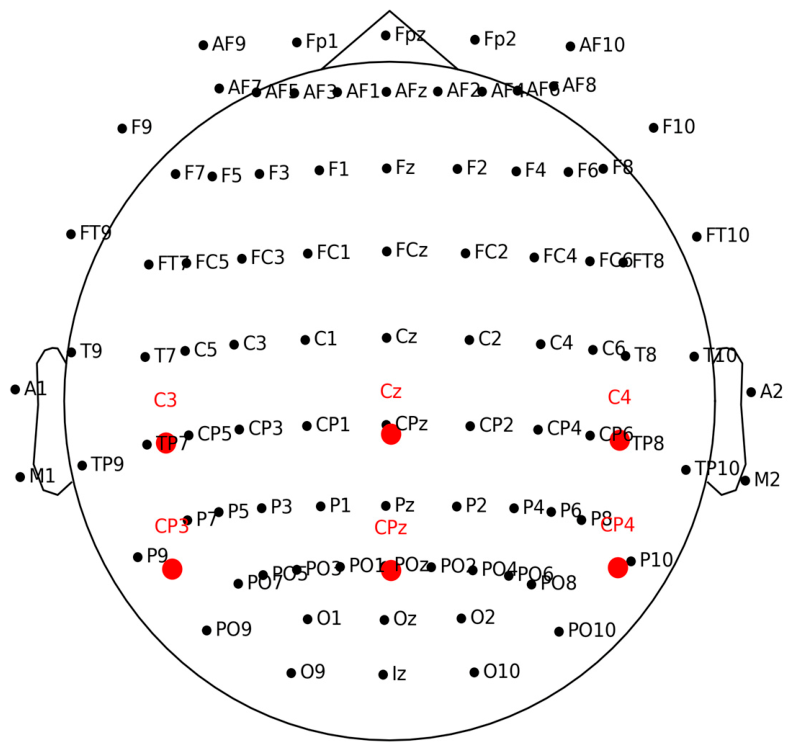
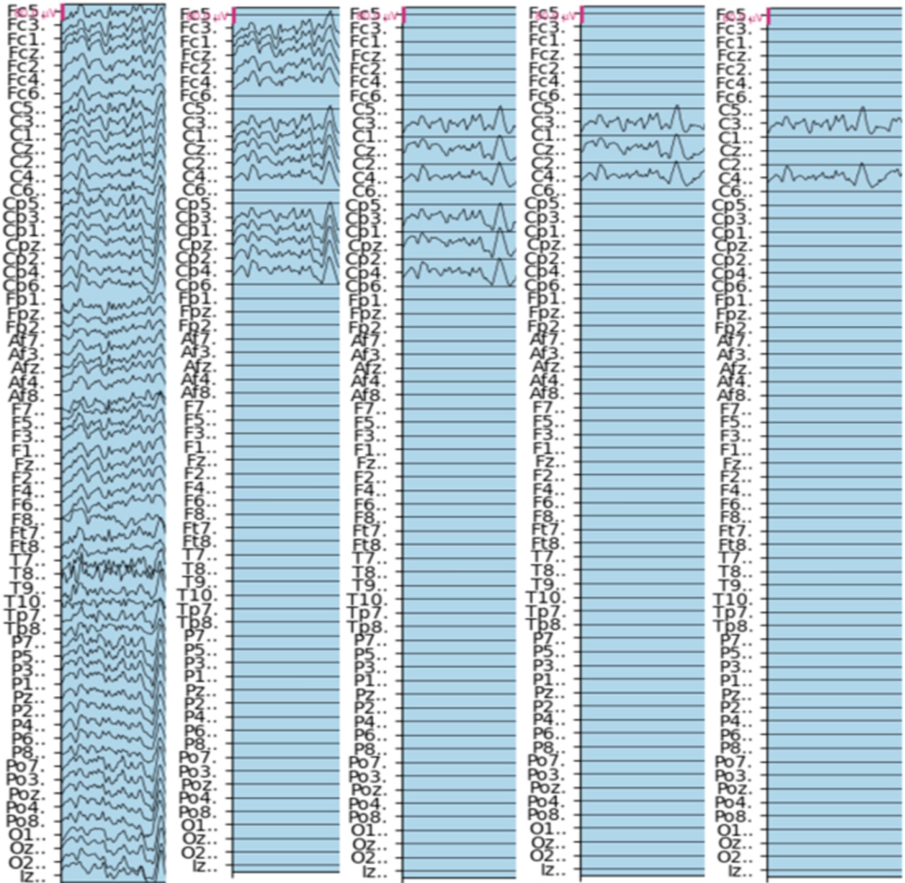
The evaluated EEG channel configurations are illustrated in
Figure 1.
In addition to spatial channel reduction, different temporal segmentation strategies were investigated in order to analyze the effect of epoch duration and baseline correction on motor imagery decoding performance. These preprocessing procedures are described in detail in the following sections.
2.2. Channel Configurations
One of the primary objectives of this study was to investigate the relationship between EEG channel density and motor imagery classification performance. In practical brain–computer interface applications, reducing the number of electrodes is essential for improving portability, reducing setup complexity, and increasing user comfort. Therefore, several channel configurations with different spatial resolutions were systematically evaluated.
The initial configuration utilized the complete 64-channel EEG montage provided in the PhysioNet dataset. This setup covers the entire scalp surface and includes frontal, temporal, parietal, occipital, and central regions. Although full-scalp recordings provide high spatial coverage, they also introduce substantial redundancy and increase the influence of non-task-related neural activity and physiological artifacts.
To investigate whether equivalent classification performance could be achieved using fewer electrodes, a reduced 15-channel motor-cortex configuration was designed. This configuration focused specifically on frontal–central, central, and central–parietal regions that are strongly associated with motor planning and motor imagery activity. The selected channels included FC3, FC1, FCz, FC2, FC4, C3, C1, Cz, C2, C4, CP3, CP1, CPz, CP2, and CP4.
In addition to the 15-channel setup, further channel reduction experiments were performed using compact 6-channel, 3-channel, and 2-channel configurations. The 6-channel arrangement included C3, Cz, C4, CP3, CPz, and CP4, while the 3-channel configuration used only C3, Cz, and C4. The most minimal configuration consisted exclusively of C3 and C4 electrodes.
The rationale behind these reduced configurations is based on the neurophysiology of motor imagery. Electrodes positioned over the sensorimotor cortex are known to capture event-related desynchronization and synchronization patterns within the μ- and β-frequency bands during imagined hand movements. Consequently, concentrating on these regions may preserve the most informative EEG activity while minimizing irrelevant spatial information. The electrode positions corresponding to the evaluated channel configurations are shown in
Figure 2.
Table 2 summarizes all electrode configurations evaluated in this study.
The evaluated channel configurations were selected to represent progressively reduced levels of spatial resolution commonly encountered in EEG-based BCI research. The 64-channel montage served as the conventional high-density reference configuration. The 15-channel configuration was designed to comprehensively cover the sensorimotor cortex while substantially reducing hardware complexity. The 6-channel and 3-channel configurations represent intermediate and compact sensorimotor montages frequently adopted in practical BCI systems, whereas the 2-channel configuration was included to investigate the feasibility of ultra-low-density EEG acquisition for highly wearable applications. This progressive reduction strategy enabled a systematic analysis of the trade-off between spatial resolution, classification performance, and hardware complexity under identical experimental conditions.
All channel configurations were evaluated using identical preprocessing, segmentation, and training procedures in order to ensure a fair comparison between full-scale and reduced-channel EEG systems.
2.3. EEG Preprocessing
EEG preprocessing was performed to improve signal quality, suppress physiological and environmental noise, and ensure consistency across all experimental configurations. Since motor imagery EEG recordings are characterized by low signal-to-noise ratio and substantial inter-subject variability, a standardized preprocessing pipeline was applied to all datasets prior to model training.
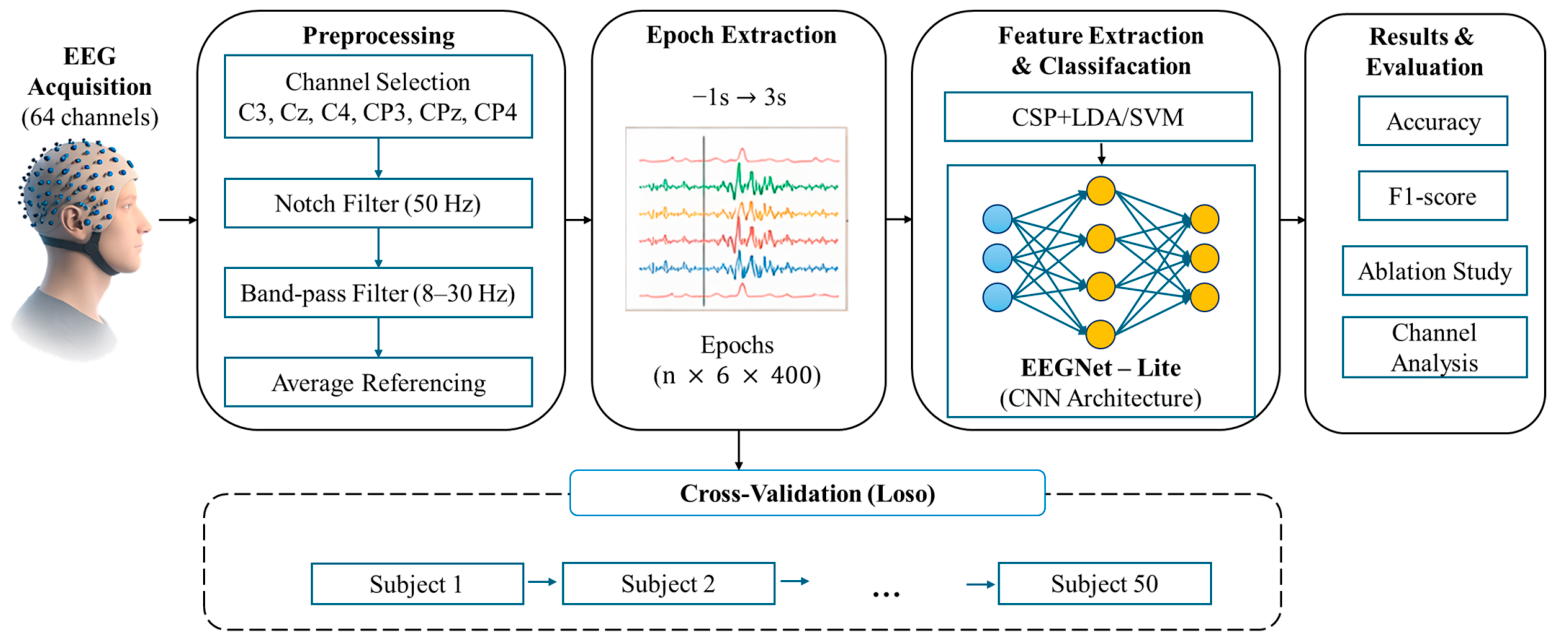
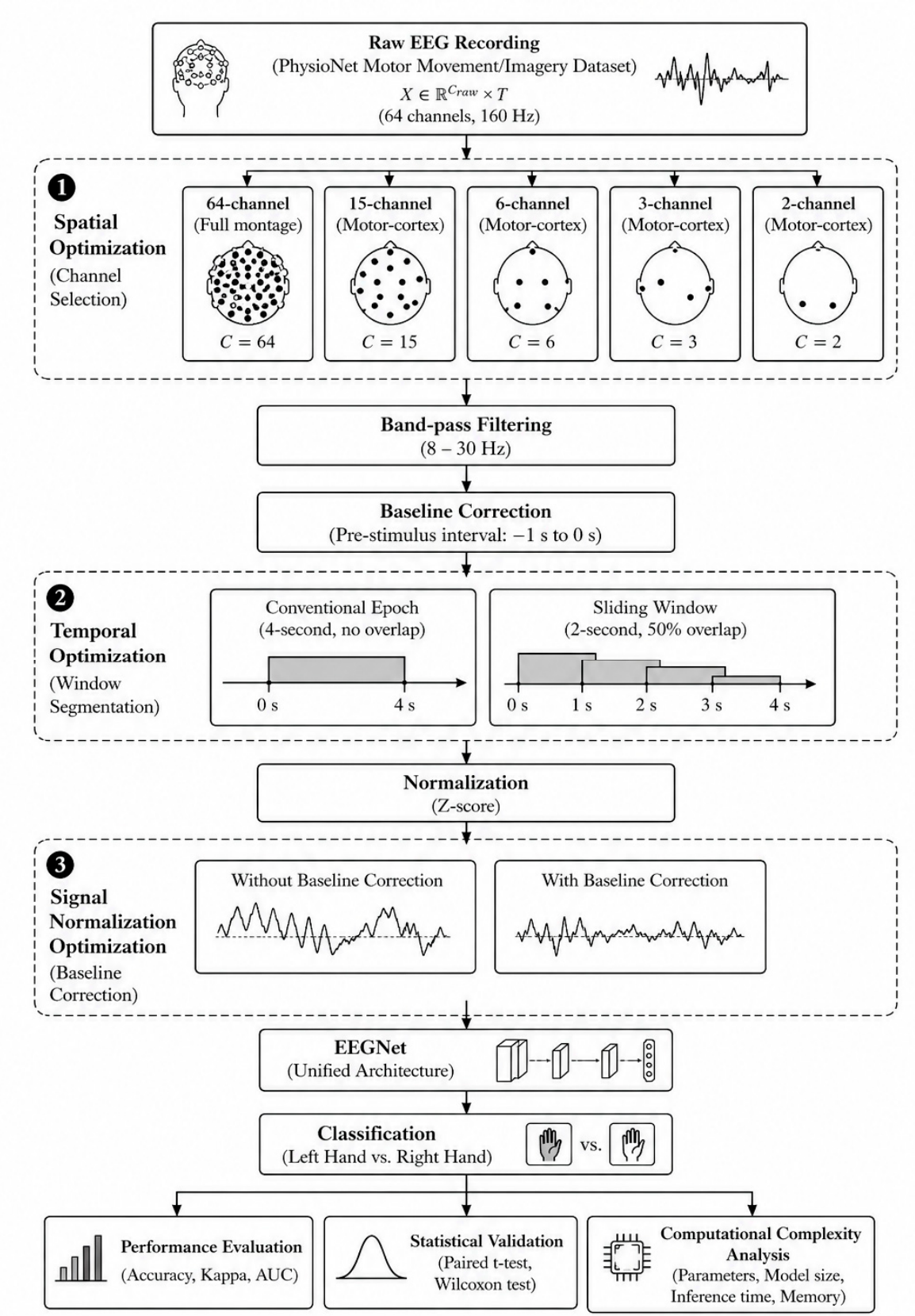
The preprocessing workflow consisted of channel selection, temporal filtering, baseline correction, normalization, and epoch segmentation. All preprocessing procedures were implemented identically for every channel configuration in order to maintain consistency during comparative analysis. The overall EEG preprocessing workflow is illustrated in
Figure 3.
Initially, EEG recordings stored in EDF were inspected for channel consistency and annotation validity. Channel names were standardized to account for variations in electrode labeling across recordings. Only trials containing valid T1 (left-hand imagery) and T2 (right-hand imagery) event markers were retained for further processing.
To suppress power-line interference, a 50 Hz notch filter was applied to all EEG recordings. Subsequently, band-pass filtering was performed to isolate frequency components associated with motor imagery activity. For the primary preprocessing pipeline, finite impulse response (FIR) filtering within the 8–30 Hz range was applied in order to preserve μ- and β-band oscillations relevant to sensorimotor rhythm modulation. In the filterbank experiments, fourth-order Butterworth band-pass filters were additionally used to extract narrower frequency sub-bands.
Baseline correction was introduced as an additional normalization strategy for selected experimental configurations. In these cases, a pre-stimulus interval from −0.5 to 0 s relative to cue onset was incorporated into the extracted EEG epoch. The average baseline activity was then used to normalize the subsequent motor imagery segment. This procedure was intended to reduce inter-trial amplitude variability and compensate for slow signal drifts caused by physiological and recording-related factors.
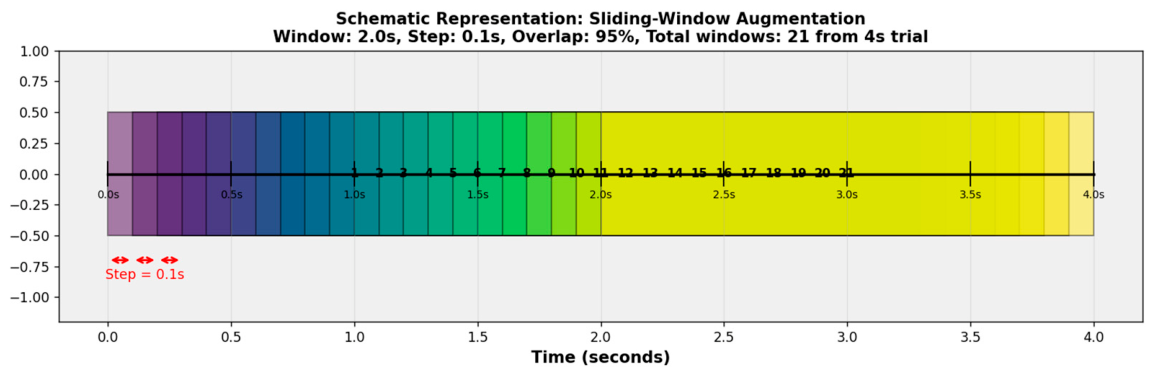
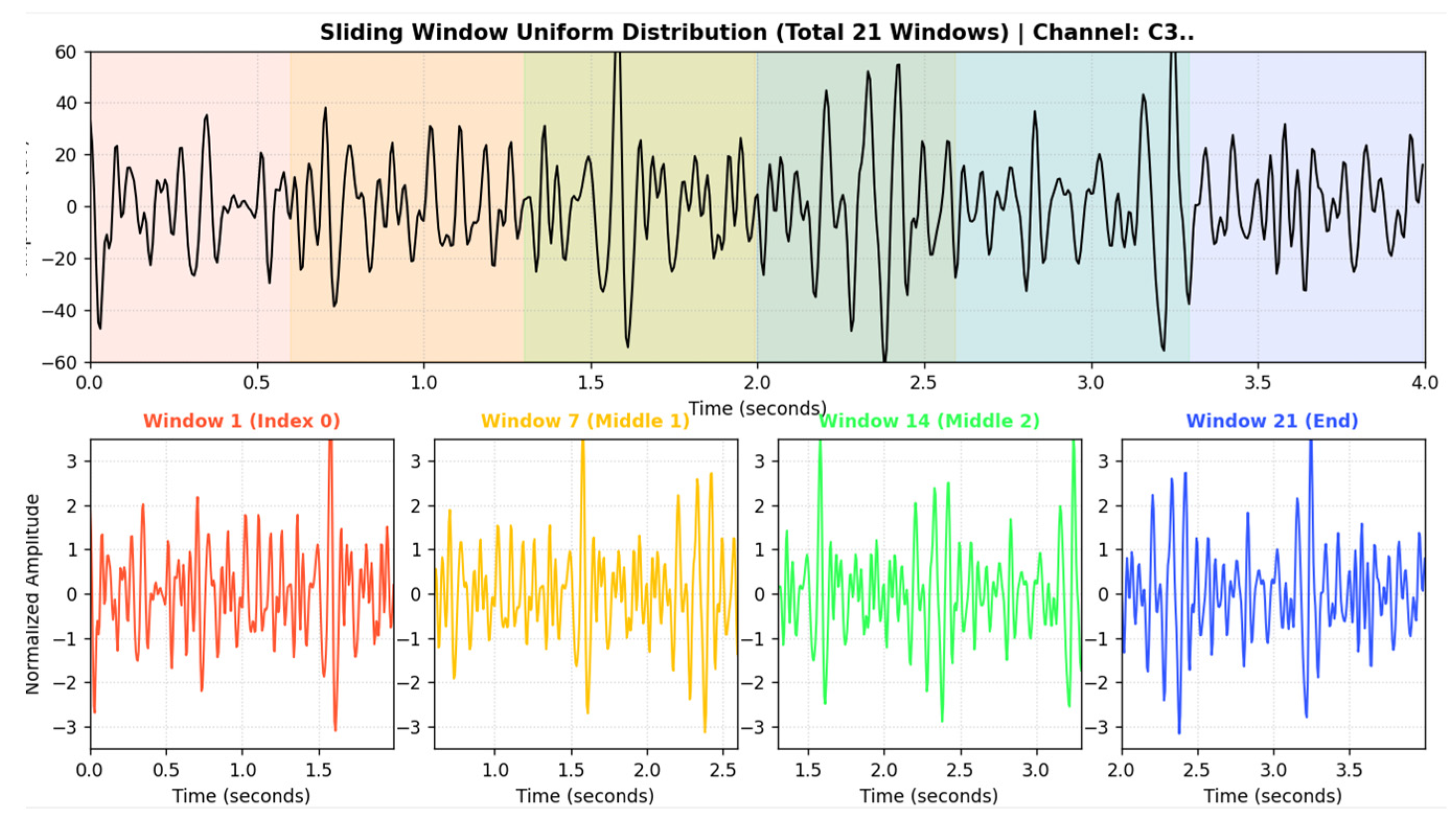
Two temporal segmentation strategies were evaluated in this study. The first utilized conventional 4 s epochs beginning at cue onset, while the second employed shorter 2 s windows combined with sliding-window augmentation. For the 2 s configuration, overlapping windows were generated across the motor imagery interval in order to increase the number of training samples and improve model generalization. The sliding-window augmentation strategy used in this study is illustrated in
Figure 4.
After segmentation, all EEG epochs underwent z-score normalization independently for each channel. Signal amplitudes were centered by subtracting the mean and scaled using the standard deviation of the corresponding epoch. This normalization procedure reduced amplitude variability across subjects and stabilized the optimization process during neural network training.
The final preprocessed EEG samples were represented as two-dimensional matrices consisting of channels and temporal samples. Depending on the selected channel configuration and epoch duration, these matrices served as input to the EEGNet-based classification models.
Table 3 summarizes the preprocessing procedures applied throughout the study.
2.4. Temporal Segmentation Strategy
Temporal segmentation plays a critical role in motor imagery EEG classification, as the duration and positioning of analysis windows directly influence the amount of discriminative neural information available to the model. In this study, two segmentation approaches were investigated in order to evaluate the effect of epoch duration on classification performance and training stability.
The first approach utilized conventional 4 s epochs beginning immediately after cue onset. This strategy preserves the complete motor imagery interval and is commonly applied in EEG-based BCI studies. However, long temporal windows may also include irrelevant neural activity, post-imagery relaxation phases, and additional noise components that can negatively affect classification robustness.
To address this limitation, a second strategy based on shorter 2 s windows was implemented. Instead of processing the entire motor imagery interval as a single segment, the EEG recordings were divided into multiple overlapping sub-windows using a sliding-window approach. This procedure substantially increased the number of available training samples while simultaneously allowing the neural network to focus on more localized temporal patterns associated with event-related desynchronization. A comparison of the two temporal segmentation strategies is presented in
Figure 5.
For the 2 s configuration, overlapping windows were extracted sequentially across the motor imagery interval using a fixed stride. As a result, each original trial generated multiple partially overlapping EEG segments, effectively functioning as a data augmentation strategy. This approach increased the diversity of training samples without introducing synthetic signal modifications.
An additional advantage of shorter windows is the improved temporal localization of motor imagery activity. Early phases of imagined movement are typically characterized by stronger μ- and β-rhythm modulation, whereas longer windows may incorporate unrelated background activity and reduce feature discriminability. Experimental observations demonstrated that the 2 s segmentation strategy consistently produced more stable validation performance compared to the standard 4 s configuration.
For baseline-corrected experiments, temporal windows were shifted to include a pre-stimulus interval ranging from −0.5 to 0 s relative to cue onset. In these cases, the extracted epoch preserved the same total duration while incorporating baseline activity for normalization purposes.
All segmented EEG epochs were subsequently normalized and transformed into channel-by-time matrices prior to classification. The final input dimensions depended on both the selected channel configuration and epoch duration.
Table 4 summarizes the temporal segmentation strategies evaluated in this work.
The influence of these segmentation strategies on motor imagery classification accuracy is analyzed in detail in the
Section 3.
The 2-s and 4-s window lengths were selected because they represent two of the most commonly used temporal segmentation strategies in motor imagery BCI research. The 4-s window corresponds to the conventional duration of the motor imagery task in the PhysioNet protocol, whereas the 2-s sliding window was selected to evaluate whether shorter task-focused segments can better capture ERD/ERS dynamics while increasing the number of training samples through overlapping segmentation.
2.5. EEGNet Architecture
To perform motor imagery classification under different channel-density conditions, this study employed the EEGNet architecture, a compact convolutional neural network specifically designed for EEG-based brain–computer interface applications. EEGNet was selected due to its lightweight structure, low computational complexity, and demonstrated effectiveness in extracting spatial–temporal EEG representations from relatively small datasets.
Unlike conventional deep convolutional networks originally developed for computer vision tasks, EEGNet incorporates depthwise and separable convolutions specifically adapted for multichannel electrophysiological signals. This design enables efficient learning of both temporal frequency-related features and spatial dependencies between EEG electrodes while maintaining a relatively small number of trainable parameters.
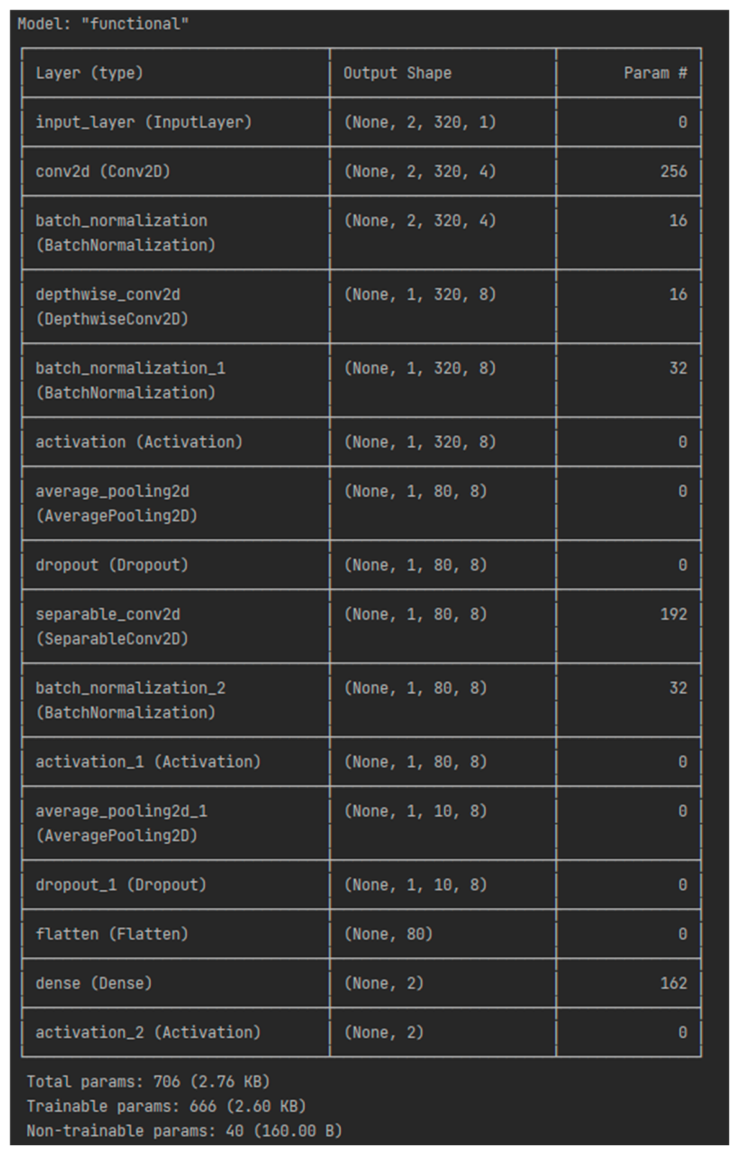
In the present study, a flexible implementation of EEGNet was developed to support different EEG channel configurations and temporal window lengths. Rather than modifying the network architecture or trainable parameters, the framework automatically adapts the input dimensions according to the selected channel configuration while preserving the same network structure across all experiments. The architecture of the proposed flexible EEGNet model is shown in
Figure 6.
The first stage of the network performs temporal convolution using one-dimensional kernels applied across the time axis. This operation captures rhythmic EEG activity associated with motor imagery, particularly within the μ- and β-frequency bands. Subsequently, depthwise convolution is applied across spatial dimensions in order to learn channel-specific spatial filters corresponding to sensorimotor cortical activity.
Following spatial filtering, separable convolution layers are used to further refine the extracted features while significantly reducing the number of trainable parameters. Batch normalization and ELU activation functions were incorporated after convolutional operations to stabilize training and improve nonlinear feature representation. Average pooling layers were used for temporal dimensionality reduction, while dropout regularization was applied to mitigate overfitting.
The final classification stage consists of a fully connected dense layer with softmax activation producing probability estimates for binary motor imagery classification (left-hand versus right-hand imagery).
The implemented EEGNet model remained computationally lightweight throughout all experiments. The adaptive configuration contained approximately 810 parameters, including both trainable and non-trainable components. This compact design is particularly advantageous for practical wearable BCI systems operating under limited computational resources.
Table 5 summarizes the main architectural components of the implemented EEGNet framework.
In addition to the standard EEGNet implementation, lightweight and modified variants of the architecture were also evaluated during comparative experiments. These models incorporated reduced parameter configurations and alternative preprocessing strategies intended to improve performance under low-channel EEG conditions. However, all architectures retained the same general spatial–temporal learning principles inherent to the original EEGNet framework.
Among the evaluated variants, EEGNet_Lite_boosted represents an enhanced version of the lightweight EEGNet architecture specifically designed to improve feature extraction from motor imagery EEG signals. In contrast to the baseline EEGNet_Lite model, the boosted configuration incorporates a filterbank preprocessing stage consisting of five frequency bands (8–12 Hz, 12–16 Hz, 16–20 Hz, 20–24 Hz, and 24–30 Hz) extracted using fourth-order Butterworth band-pass filters. In addition, a band-attention mechanism was introduced to automatically estimate the relative importance of each frequency band through Softmax-based weighting. The extracted representations from all frequency bands were processed using a shared TimeDistributed feature extraction block and subsequently combined using weighted averaging. These modifications were introduced to improve frequency-specific feature learning while maintaining a lightweight network structure suitable for practical BCI applications.
2.6. Proposed Optimization Framework
Unlike previous studies that primarily concentrate on developing increasingly sophisticated deep learning architectures for motor imagery classification, the present study introduces a systematic optimization framework that addresses the entire EEG processing pipeline. The proposed methodology is based on the hypothesis that classification performance is determined not only by the neural network architecture itself but also by the joint optimization of spatial electrode selection, temporal segmentation, and signal normalization. Consequently, rather than modifying the internal structure of EEGNet, the proposed framework optimizes the information presented to the network while maintaining a unified classification architecture throughout all experiments.
The framework consists of three sequential optimization stages, each targeting a specific component of the EEG decoding pipeline (
Figure 7).
Spatial optimization aims to determine the minimum electrode configuration capable of preserving discriminative motor imagery information. Five channel configurations (64, 15, 6, 3, and 2 channels) were systematically evaluated to quantify the trade-off between spatial resolution and classification performance. By progressively reducing the number of electrodes while maintaining identical training conditions, the framework identifies configurations that minimize hardware complexity without compromising decoding accuracy.
Temporal optimization investigates the influence of epoch duration on feature representation. Conventional 4 s motor imagery epochs are compared with a 2 s sliding-window segmentation strategy. The latter increases the number of informative training samples while emphasizing the temporal intervals where event-related desynchronization and synchronization are most pronounced. This stage therefore optimizes the temporal representation of motor imagery signals prior to feature extraction.
Signal normalization optimization incorporates baseline correction using a pre-stimulus reference interval to reduce inter-trial variability and compensate for slow signal drift. The normalization process improves signal consistency across trials and subjects, thereby enhancing the robustness and generalization capability of the subsequent classifier.
Following these optimization stages, the preprocessed EEG signals are processed using a unified EEGNet architecture under identical training and evaluation conditions. This design ensures that all observed performance differences arise exclusively from the proposed optimization strategy rather than modifications to the neural network itself.
The proposed framework can be expressed as a sequential optimization process:
where
denotes the raw EEG recording,
S(
⋅) represents spatial optimization through channel selection,
T(
⋅) denotes temporal optimization by segmentation,
N(
⋅) corresponds to signal normalization including baseline correction, and
denotes the EEGNet classifier. The optimized representation
is subsequently used for motor imagery classification.
Unlike conventional EEGNet-based studies that primarily emphasize architectural modifications, the proposed framework treats EEG decoding as a multi-stage optimization problem. By jointly optimizing spatial, temporal, and preprocessing components within a unified classification pipeline, the proposed methodology provides a practical and computationally efficient solution for lightweight wearable brain–computer interface systems.
To further clarify the novelty of the proposed framework,
Table 6 summarizes the methodological differences between representative EEGNet-based studies and the proposed approach, highlighting the distinct contributions of the present work.
Unlike previous EEGNet-based studies, which primarily improve classification performance through architectural modifications (e.g., convolutional enhancements, attention mechanisms, or Transformer integration), the proposed framework focuses on optimizing the entire EEG decoding pipeline while preserving the original lightweight EEGNet architecture. Specifically, the proposed methodology systematically investigates the combined effects of EEG channel configuration, temporal segmentation, and baseline correction under a unified subject-independent evaluation protocol. Therefore, the novelty of the proposed framework lies not in introducing a new network architecture, but in demonstrating that systematic optimization of the EEG processing pipeline can achieve statistically comparable classification performance while substantially reducing electrode density, hardware complexity, and computational cost.
2.7. Training Procedure
All classification models were trained and evaluated under identical experimental conditions in order to ensure a fair comparison between different channel configurations and preprocessing strategies. The training pipeline was implemented using the TensorFlow (v2.18.0) and Keras (v3.8.0) frameworks.
For all experiments, EEG data were divided into training, validation, and testing subsets using a subject-independent evaluation protocol. To assess model generalization across different individuals, Leave-One-Subject-Out (LOSO) validation was employed during comparative analysis. Under this scheme, EEG recordings from one subject were reserved for testing, while recordings from the remaining subjects were used for model training and validation.
The Adam optimization algorithm was used during network training with an initial learning rate of 0.001. The parameter update process can be expressed as
where
denotes model parameters at iteration
t, α is the learning rate,
and
represent bias-corrected first and second moment estimates, and
ϵ is a numerical stability constant.
For the final Flexible EEGNet model used to obtain the main reported results, mini-batch training was performed with a batch size of 64 samples, and the maximum number of training epochs was set to 50. EarlyStopping was employed to terminate training automatically when the validation loss did not improve for 10 consecutive epochs, thereby preventing overfitting and improving training efficiency.
To reduce overfitting and improve convergence stability, several regularization techniques were incorporated into the training procedure. A dropout rate of 0.5 was applied after the convolutional blocks to reduce overfitting and improve model generalization. The dropout operation can be represented as:
where
p denotes the dropout probability and
represents the input activation.
Batch normalization layers were additionally employed after convolutional operations to stabilize feature distributions during optimization. The normalized activation was computed as
where µ and
correspond to batch mean and variance, respectively.
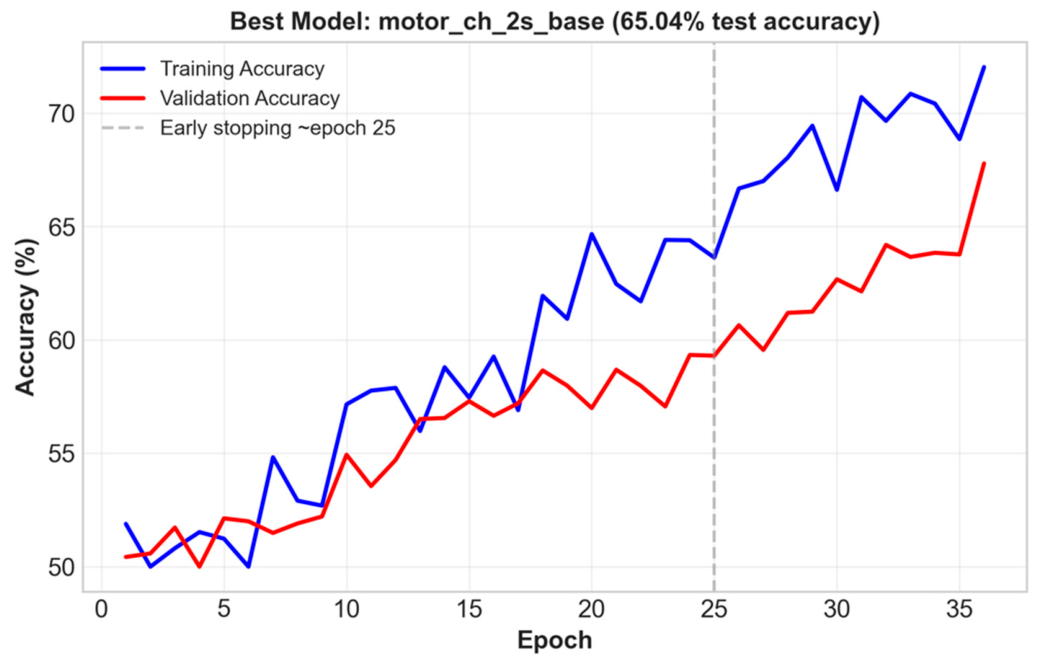
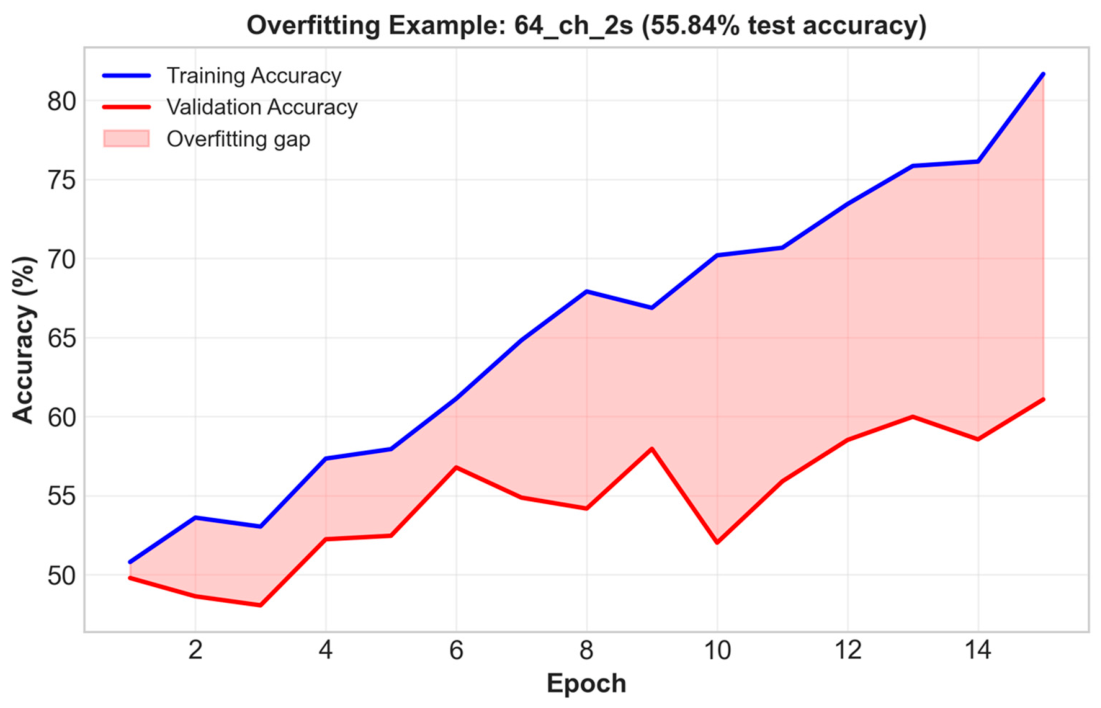
An example of the training and validation convergence curves is presented in
Figure 8.
To further improve training robustness, EarlyStopping and ReduceLROnPlateau callbacks were incorporated into the optimization pipeline. Training was automatically terminated when validation performance ceased improving for a predefined number of epochs. Simultaneously, the learning rate was adaptively reduced during plateau phases in order to facilitate smoother convergence and avoid unstable oscillations.
For all EEGNet-based experiments, standard Glorot Uniform (Xavier) initialization was applied to convolutional and dense layers. This initialization strategy samples weights from the following distribution:
where
and
denote the numbers of input and output units.
The final classification layer employed the Softmax activation function to estimate posterior class probabilities for binary motor imagery classification:
where
represents the output logitcorresponding to class
i, and
K is the total number of classes.
The comparative experiments involving different EEGNet variants (including the baseline, lightweight, and modified models) were conducted using their respective training configurations while maintaining a consistent evaluation protocol.
Table 7 summarizes the general training and optimization settings used across the comparative experiments.
All experiments were conducted under identical preprocessing and optimization conditions to ensure reproducibility and minimize potential bias during comparative evaluation.
Table 8 presents the final hyperparameter settings and implementation details of the proposed Flexible EEGNet framework used to obtain the main results reported in this study.
The same training configuration was used for the optimized 15-channel experiments to ensure reproducibility and to minimize variability caused by inconsistent implementation settings.
2.8. Evaluation Metrics and Statistical Analysis
Classification performance was evaluated using accuracy, F1-score, and ROC-AUC metrics. Accuracy was used as the primary indicator of overall classification performance and was calculated as
where
TP,
TN,
FP and
FN denote true positive, true negative, false positive and negative predictions.
Since motor imagery EEG classification is characterized by substantial inter-subject variability, the F1-score was additionally used to evaluate the balance between precision and recall:
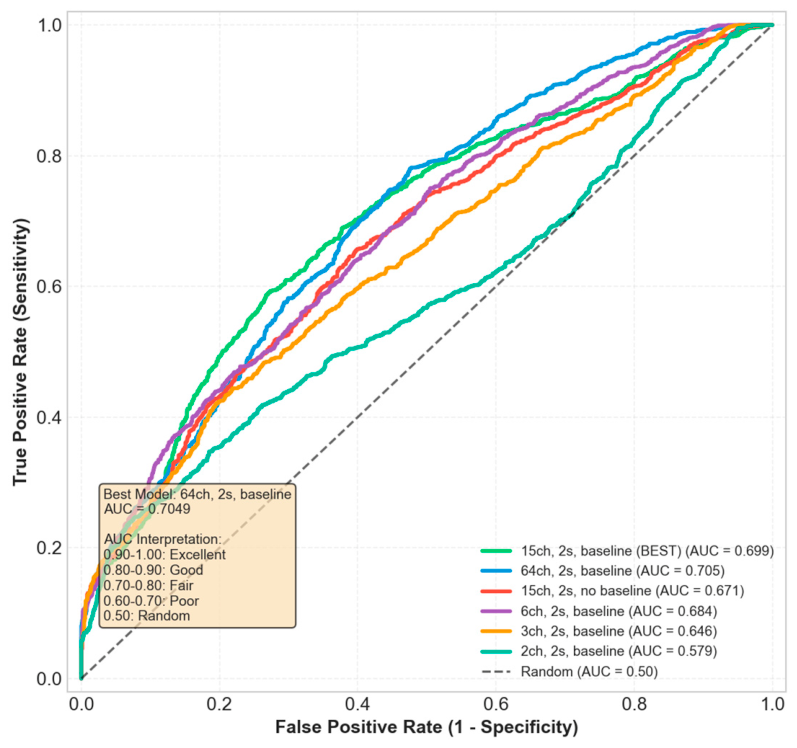
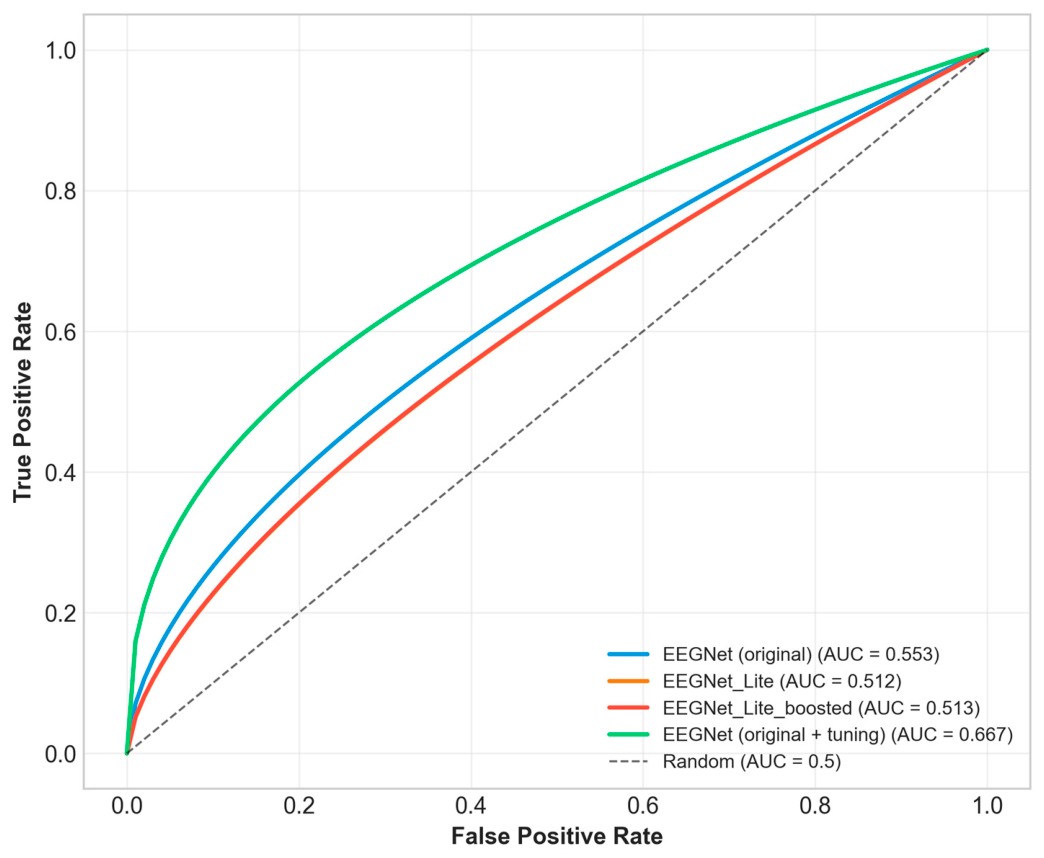
Receiver Operating Characteristic (ROC) analysis and Area Under the Curve (AUC) values were also computed to assess the discriminative capability of the evaluated models under different classification thresholds. The ROC curves obtained for the evaluated EEGNet configurations are shown in
Figure 9.
To evaluate model robustness under subject-independent conditions, Leave-One-Subject-Out (LOSO) validation was employed throughout all experiments.
Table 9 summarizes the evaluation metrics used in this study.
Using the LOSO protocol provides a more realistic assessment of the quality of models, since it eliminates information leakage between training and test data and simulates the practical scenario of using a BCI system for a new user.
To determine whether the observed differences in classification performance between the evaluated EEG channel configurations were statistically significant, each experiment was independently repeated using 10 different random initialization seeds while maintaining identical preprocessing, training, and evaluation settings. The resulting classification accuracies were subsequently subjected to statistical inference.
The statistical significance of the performance difference between the proposed 15-channel configuration and the conventional 64-channel configuration was first evaluated using the paired Student’s
t-test. Let
where
and
denote the classification accuracies obtained from the 15-channel and 64-channel configurations during the iii-th experimental repetition, respectively. The paired
t-statistic is computed as
where
Is the mean paired difference,
is the standard deviation of the paired differences, and
n = 10 denotes the number of repeated experiments.
To further verify the robustness of the statistical conclusions without assuming data normality, the Wilcoxon signed-rank test was additionally performed. This non-parametric test evaluates whether the median difference between paired observations is significantly different from zero.
Besides hypothesis testing, the practical significance of the observed performance differences was quantified using Cohen’s effect size, calculated as
According to Cohen’s criterion, effect sizes of approximately 0.2, 0.5, and 0.8 indicate small, medium, and large effects, respectively.
Furthermore, 95% confidence intervals (95% CI) were calculated for the mean accuracy difference to estimate the uncertainty associated with the observed performance improvement. Statistical significance was established at a significance level of α = 0.05. All statistical analyses were performed using the SciPy statistical package in Python (v3.11).
3. Results
3.1. Influence of Temporal Segmentation Strategy
One of the primary objectives of this study was to evaluate the effect of temporal window length on motor imagery classification performance. Two segmentation strategies were investigated: conventional 4 s epochs and shorter 2 s windows combined with sliding-window augmentation.
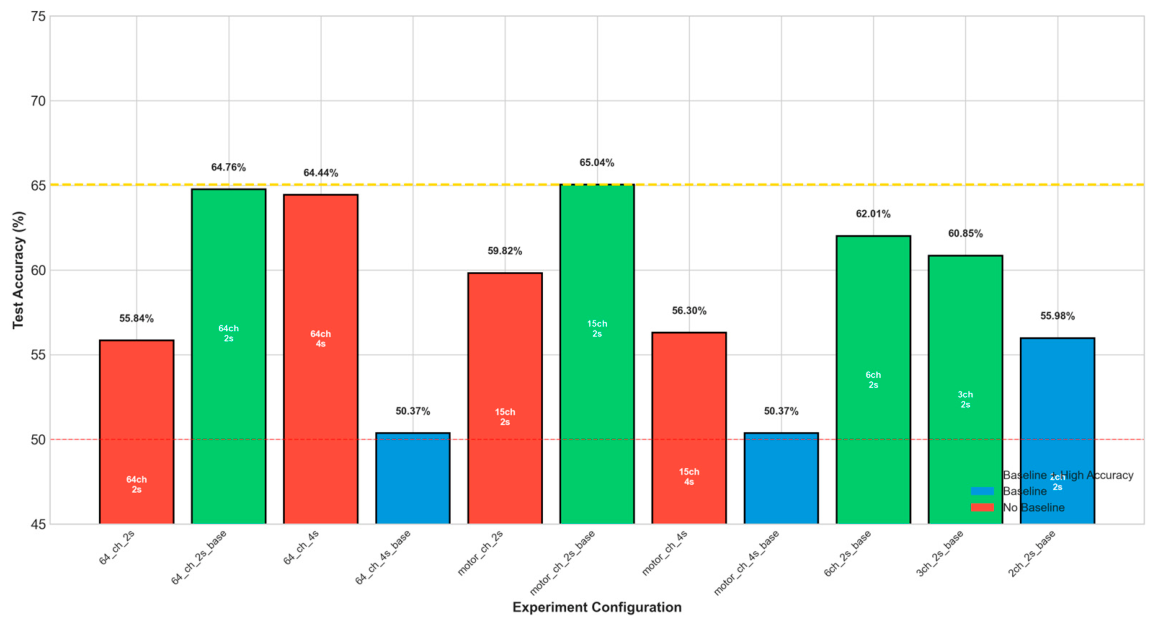
The experimental results demonstrated a clear advantage of the 2 s segmentation strategy across both full-scale and reduced-channel EEG configurations. In particular, the 15-channel motor configuration combined with baseline correction achieved the highest overall classification accuracy of 65.04%, outperforming all corresponding 4 s variants.
Table 10 presents the comparative results obtained using different temporal window lengths and preprocessing strategies.
The obtained results indicate that shorter EEG segments provide more stable and discriminative representations of motor imagery activity. Unlike conventional 4 s epochs, the 2 s sliding-window approach concentrates on the most informative portion of the motor imagery response while simultaneously increasing the number of training samples through overlapping augmentation.
Furthermore, shorter windows appear less susceptible to post-imagery noise and unrelated background activity, which may partially explain the improved validation stability observed during model training.
3.2. Effect of Baseline Correction
Baseline correction demonstrated a substantial influence on EEG classification performance, particularly for the 2 s segmentation strategy. Incorporating a pre-stimulus interval prior to cue onset significantly improved model generalization across both 64-channel and reduced-channel configurations.
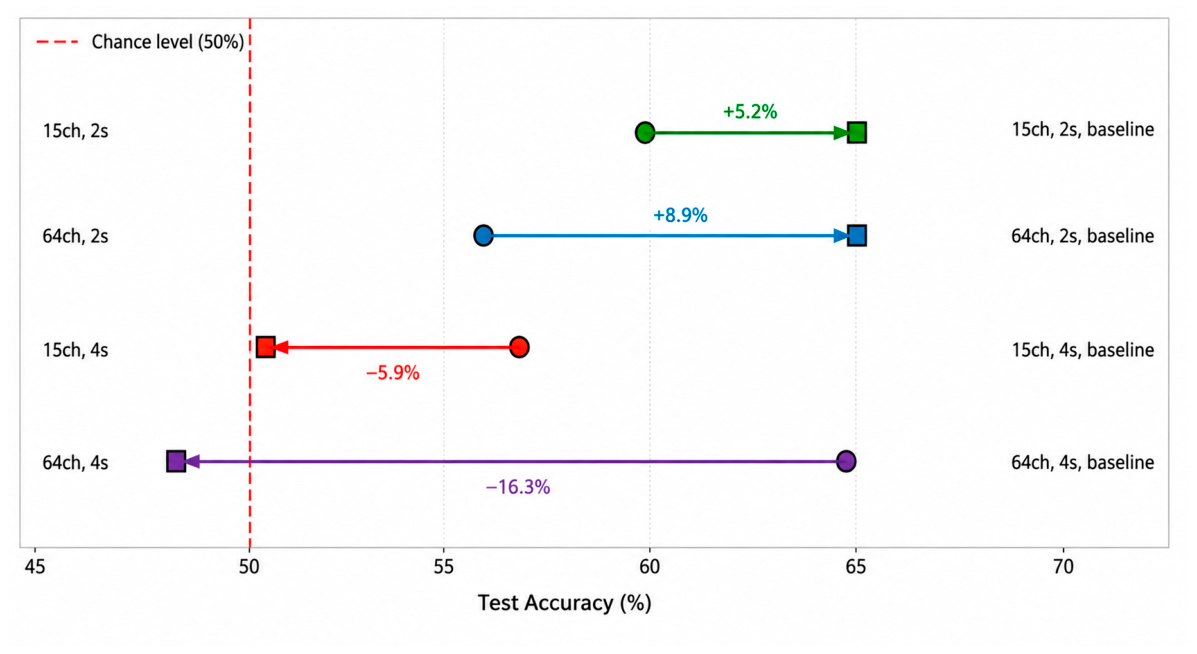
For the 64-channel setup, baseline correction increased test accuracy from 55.84% to 64.76%. Similarly, in the 15-channel motor configuration, accuracy improved from 59.82% to 65.04%.
These findings suggest that baseline normalization effectively reduces inter-trial variability and compensates for slow amplitude drift commonly observed in EEG recordings. The influence of baseline correction on classification accuracy is illustrated in
Figure 10.
The positive impact of baseline correction was especially noticeable in reduced-channel configurations, where minimizing signal variability becomes increasingly important due to limited spatial information. By normalizing EEG activity relative to the pre-stimulus resting state, the model becomes less sensitive to subject-specific amplitude fluctuations and recording artifacts.
However, baseline correction did not improve performance for all configurations. In particular, several 4 s baseline-corrected experiments demonstrated unstable convergence and near-random classification performance. This behavior suggests that excessively long baseline-integrated windows may introduce additional low-frequency variability that negatively affects temporal feature extraction.
These findings suggest that the effect of baseline correction depends strongly on the temporal structure of the EEG segment. In the 2 s sliding-window configuration, the pre-stimulus baseline appears to improve classification by normalizing trial-specific amplitude offsets and slow signal drift before the most informative motor imagery interval is analyzed. This interpretation is consistent with the observed increase in accuracy from 55.84% to 64.76% for the 64-channel 2 s configuration and from 59.82% to 65.04% for the 15-channel 2 s configuration. In contrast, for the 4 s baseline-corrected configuration, the inclusion of a longer post-cue interval may introduce additional non-task-related activity, low-frequency fluctuations, and post-imagery variability, which can reduce temporal feature consistency and destabilize training. This is supported by the observed decrease in accuracy from 64.44% to 50.37% for the 64-channel 4 s configuration and from 56.30% to 50.37% for the 15-channel 4 s configuration. These observations are consistent with previous studies showing that baseline normalization can improve the consistency of time–frequency EEG representations, but that the choice of baseline interval and analysis window can substantially influence ERD/ERS estimation in motor imagery-based BCI29,30].
3.3. Channel Reduction Analysis
To investigate the feasibility of lightweight EEG-based brain–computer interface (BCI) systems, a systematic channel reduction analysis was conducted using progressively smaller EEG channel configurations. Since the proposed 15-channel motor-cortex configuration achieved only a marginally higher average classification accuracy than the conventional 64-channel configuration (65.04% vs. 64.76%), additional statistical analyses were performed to determine whether the observed difference represented a statistically significant improvement or random experimental variation. The statistical analysis was performed using the results obtained from ten independent experimental runs with different random initialization seeds, following the procedure described in
Section 2.8.
Table 11 summarizes the statistical comparison between the proposed 15-channel configuration and the conventional 64-channel configuration.
None of the statistical tests indicated a significant difference between the proposed 15-channel and conventional 64-channel configurations (p > 0.05), confirming that the observed accuracy improvement is within normal experimental variability.
The paired Student’s t-test indicated that the difference in classification accuracy between the 15-channel and 64-channel configurations was not statistically significant (p = 0.1684). Similar conclusions were obtained using the Wilcoxon signed-rank test (p = 0.2017). Furthermore, the small effect size (Cohen’s d = 0.29) together with the 95% confidence interval including zero indicates that both channel configurations achieved statistically comparable performance. Therefore, the principal advantage of the proposed framework lies not in achieving significantly higher classification accuracy but in maintaining equivalent decoding performance while substantially reducing the number of required electrodes.
To further investigate the influence of electrode density on motor imagery classification, additional experiments were conducted using progressively smaller EEG channel configurations. The corresponding classification results are summarized in
Table 12.
The classification performance obtained for all evaluated channel configurations is illustrated in
Figure 11.
As shown in
Table 11 and
Figure 11, reducing the number of EEG channels did not lead to a proportional decrease in classification performance. The proposed 15-channel motor-cortex configuration achieved the highest average classification accuracy while requiring approximately four times fewer electrodes than the conventional 64-channel EEG montage. These findings indicate that the most informative motor imagery features are concentrated within the sensorimotor cortex, whereas additional electrodes located over frontal, temporal, parietal, and occipital regions contribute relatively limited task-relevant information.
Further channel reduction to 6, 3, and 2 electrodes resulted in a gradual decrease in classification accuracy, reflecting the progressive loss of spatial information available for feature extraction. Nevertheless, the 3-channel configuration, consisting of electrodes C3, Cz, and C4, maintained classification accuracy above 60%, demonstrating that these sensorimotor electrodes preserve the essential cortical activity required for reliable motor imagery decoding. Although the 2-channel configuration achieved the lowest classification accuracy, its performance remained sufficient for applications where portability, low hardware complexity, and rapid system deployment are prioritized over maximal decoding accuracy.
Overall, these results demonstrate that appropriate electrode selection is more important than increasing channel density. By optimizing electrode placement over task-relevant cortical regions, the proposed framework substantially reduces hardware complexity, electrode preparation time, and computational requirements while maintaining classification performance statistically comparable to that of the conventional 64-channel EEG configuration. These characteristics make the proposed framework particularly suitable for practical lightweight wearable brain–computer interface applications.
3.4. Comparison of Classification Models
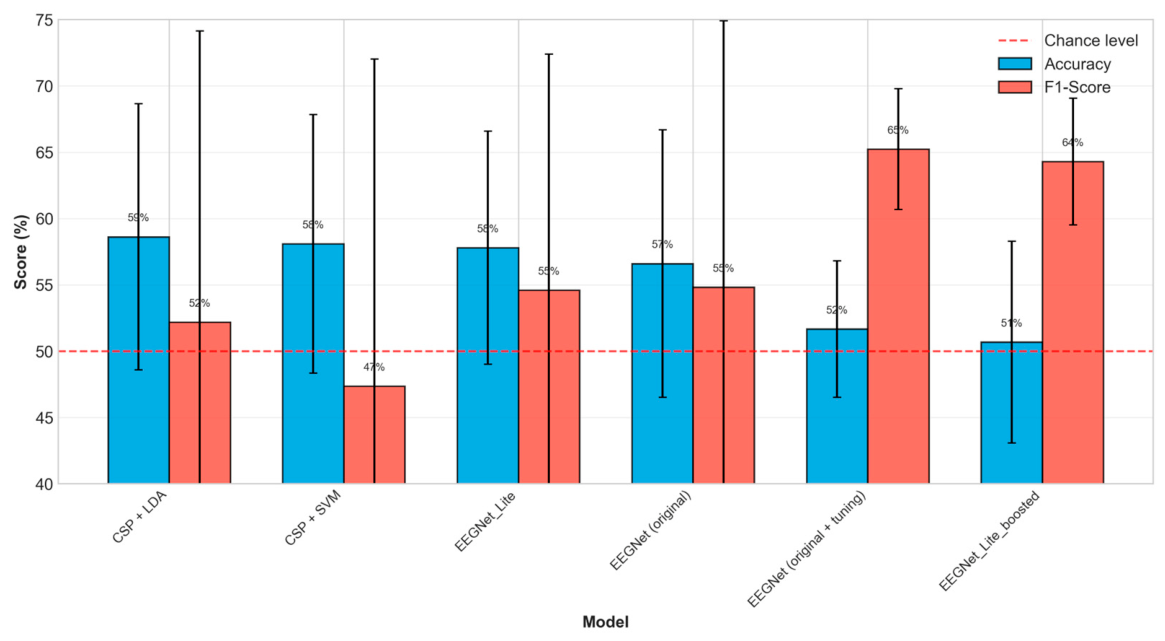
To further evaluate the effectiveness of the proposed preprocessing and channel optimization strategies, several classical machine learning and deep learning approaches were comparatively analyzed. The evaluated models included CSP-based methods combined with LDA and SVM classifiers, the original EEGNet architecture, and lightweight EEGNet variants (
Figure 12).
Table 13 summarizes the overall classification performance obtained using the evaluated models.
The obtained results demonstrate that no single model consistently dominated across all evaluation metrics. Classical CSP-based approaches achieved relatively stable accuracy values, whereas deep learning models exhibited improved balance between precision and recall, reflected by higher F1-scores in several configurations.
The original EEGNet architecture achieved moderate overall performance, while lightweight and tuned variants demonstrated competitive F1-score values despite lower average accuracy. In particular, the EEGNet_Lite_boosted configuration achieved one of the highest F1-scores among all evaluated models, suggesting improved class balance under subject-independent conditions.
At the same time, several deep learning configurations demonstrated reduced accuracy variability compared to traditional CSP-based approaches. This behavior may indicate improved robustness against inter-subject differences and unstable EEG patterns.
However, the experimental results also reveal the inherent difficulty of motor imagery EEG classification under subject-independent evaluation protocols. Considerable variability between subjects was observed across all tested architectures, indicating that generalization remains a major challenge for practical BCI systems.
3.5. Evaluation on the Complete PhysioNet Dataset
To further evaluate the robustness and generalizability of the proposed framework, additional experiments were performed using all 109 subjects available in the PhysioNet EEG Motor Movement/Imagery dataset. The same optimized preprocessing pipeline was applied, including the 15-channel sensorimotor configuration, 2 s sliding-window segmentation, baseline correction, and the original EEGNet architecture. All training parameters and evaluation procedures remained identical to those used in the previous experiments to ensure a fair comparison.
The complete dataset generated 78,820 training windows and 19,720 testing windows. Under these conditions, the proposed framework achieved a classification accuracy of 67.40%, which is slightly higher than the 65.04% obtained using the initial 50-subject subset. This improvement demonstrates that the proposed optimization framework maintains stable performance when evaluated on a substantially larger subject population. More importantly, these results indicate that the reported performance is not influenced by subject selection bias and confirm the generalizability of the proposed lightweight EEG decoding framework. The performance comparison between the initial 50-subject subset and the complete 109-subject PhysioNet dataset is presented in
Table 14.
3.6. Subject-Wise Performance
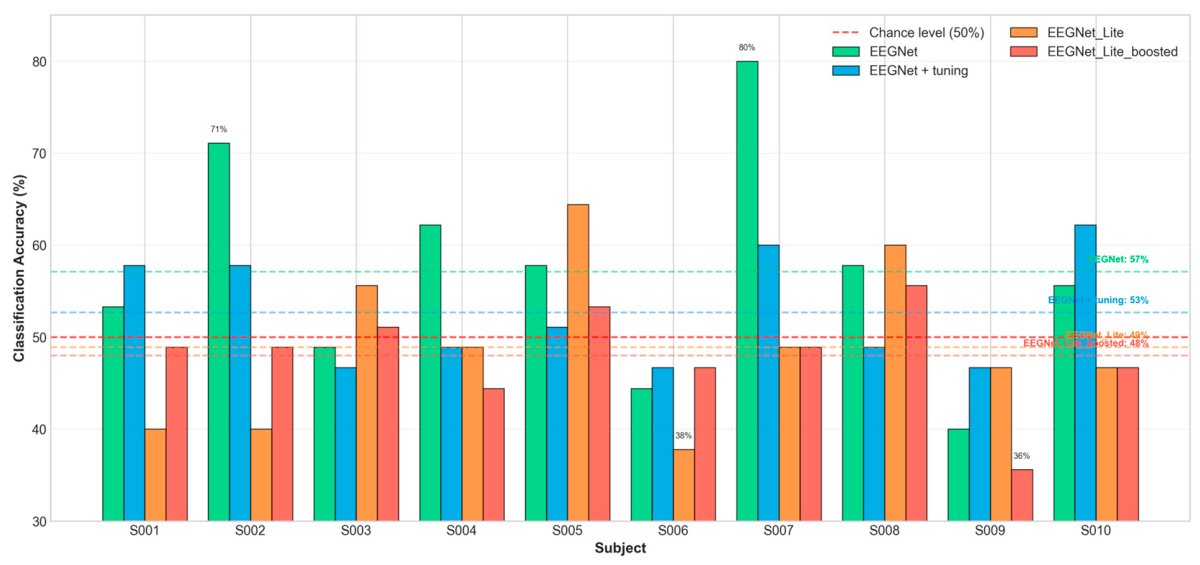
To investigate inter-subject variability and model generalization capability, subject-wise analysis was performed using Leave-One-Subject-Out validation. Classification accuracy was calculated independently for each subject across multiple EEGNet configurations (
Figure 13).
Table 15 presents subject-wise classification results for the evaluated deep learning models.
Considerable variability between subjects was observed across all evaluated models. Certain subjects achieved relatively high classification accuracy, while others remained close to random-chance performance. This phenomenon is commonly observed in motor imagery EEG classification and reflects substantial differences in neurophysiological response patterns, signal quality, and subject-specific motor imagery strategies.
The results additionally demonstrate that lightweight EEGNet configurations maintain relatively stable performance despite substantial channel reduction. Although reduced-channel setups generally produced lower average accuracy, their performance remained sufficiently consistent for practical wearable BCI scenarios.
The observed inter-subject variability further highlights the importance of subject-adaptive training strategies and transfer learning approaches for future EEG-based brain–computer interface systems.
3.7. ROC and AUC Analysis
Receiver Operating Characteristic analysis was performed to further evaluate the discriminative capability of the evaluated EEGNet-based models.
Table 16 summarizes the obtained AUC values. The ROC curves for the evaluated EEGNet-based models are presented in
Figure 14.
Among the evaluated models, the tuned EEGNet configuration demonstrated the highest AUC value, indicating improved class separability compared to other lightweight variants. In contrast, the EEGNet_Lite and EEGNet_Lite_boosted models achieved AUC values close to 0.5, reflecting the difficulty of robust subject-independent motor imagery classification under limited-channel conditions.
Despite moderate AUC values, the obtained results remain consistent with the overall trends observed in the accuracy and F1-score analysis. The experiments confirm that lightweight architectures can maintain competitive performance while substantially reducing model complexity and electrode density.
3.8. Training Stability and Overfitting Analysis
An additional objective of this study was to investigate the training stability of EEGNet-based models under different preprocessing and segmentation strategies. Due to the relatively limited size of motor imagery EEG datasets and substantial inter-subject variability, deep learning models are highly susceptible to overfitting during optimization.
During preliminary experiments, configurations without baseline correction frequently demonstrated unstable validation behavior. In several cases, training accuracy continued increasing while validation performance stagnated or deteriorated, indicating progressive memorization of subject-specific signal characteristics rather than robust feature extraction (
Figure 15).
This phenomenon was particularly noticeable for long 4 s EEG epochs, where extended temporal windows introduced additional background activity and low-frequency signal fluctuations unrelated to motor imagery processing. As a consequence, the network tended to overfit noise components instead of learning stable sensorimotor representations.
In contrast, the 2 s sliding-window strategy produced substantially more stable convergence patterns. The increased number of augmented training samples improved feature diversity and reduced the risk of memorization during optimization. Baseline correction further stabilized the learning process by reducing inter-trial amplitude variability and compensating for slow EEG drift.
The effectiveness of early stopping was also confirmed experimentally. In several configurations, training was automatically terminated after validation performance ceased improving, thereby preventing catastrophic overfitting. For example, the 64-channel 2 s configuration without baseline correction reached training accuracy values close to 80%, while validation accuracy remained significantly lower. The convergence behavior observed across different experimental configurations is summarized in
Table 17.
The obtained findings indicate that preprocessing strategy plays a critical role not only in classification accuracy but also in optimization stability and model generalization. Shorter EEG windows combined with baseline correction consistently produced more reliable convergence behavior across both full-scale and reduced-channel configurations.
Overall, the experimental observations suggest that compact EEGNet-based architectures can achieve stable performance under low-channel conditions when appropriate preprocessing and regularization strategies are applied.
3.9. Computational Complexity Analysis
Since the proposed framework is intended for lightweight wearable brain–computer interface applications, its computational efficiency was quantitatively evaluated. In addition to classification performance, practical deployment requires low memory consumption, a compact model size, and fast inference speed. Therefore, the proposed EEGNet-based framework was analyzed in terms of the number of trainable parameters, storage requirements, memory footprint, and inference time.
The computational complexity evaluation was performed using the optimal experimental configuration consisting of the 15-channel motor-cortex montage, 2 s sliding-window segmentation, and baseline correction. All measurements were conducted using the same hardware and software environment employed for model training. The computational complexity of the proposed EEGNet framework is summarized in
Table 18.
The proposed EEGNet framework contains only 810 trainable parameters and occupies approximately 51 KB of storage, making it substantially smaller than conventional deep convolutional neural networks used for motor imagery classification. Furthermore, the average inference time of 12.85 ms per EEG sample enables real-time processing, as EEG windows are typically updated every 100 ms or longer in practical BCI systems.
An additional computational advantage is achieved through channel reduction. Using the proposed 15-channel motor-cortex configuration instead of the conventional 64-channel EEG montage decreases the input dimensionality by approximately 4.3 times, thereby reducing data acquisition, transmission, and preprocessing requirements while maintaining classification performance comparable to the full-channel configuration.
These results confirm that the proposed framework is suitable for resource-constrained wearable and embedded BCI platforms, where computational efficiency is as important as classification accuracy. A comparison of the computational complexity of different deep learning models is presented in
Table 19.
The obtained computational results further demonstrate that reducing the number of EEG channels not only preserves statistically comparable classification performance but also substantially decreases computational requirements. Consequently, the proposed lightweight EEGNet framework is well suited for real-time wearable brain–computer interface applications operating under limited computational resources.
4. Discussion
The experimental results demonstrate that the proposed optimization framework successfully identifies an efficient trade-off between classification performance and hardware complexity for subject-independent motor imagery classification. Although the proposed 15-channel configuration achieved only a marginally higher average classification accuracy than the conventional 64-channel EEG setup, the statistical analysis confirmed that this difference was not statistically significant (p > 0.05). Consequently, the principal contribution of this work should not be interpreted as improving classification accuracy, but rather as maintaining statistically comparable decoding performance while substantially reducing the number of required EEG electrodes.
One of the most important observations is that the majority of discriminative motor imagery information is concentrated within the sensorimotor cortex. The optimized 15-channel configuration, which primarily covers the frontal–central, central, and centro-parietal regions, preserved nearly the same decoding performance as the full 64-channel montage. In contrast, further reduction to 6-, 3-, and 2-channel configurations resulted in a gradual decrease in classification accuracy due to the progressive loss of spatial information. Nevertheless, the 3-channel configuration maintained classification accuracy above 60%, indicating that reliable motor imagery decoding remains feasible using only a minimal set of sensorimotor electrodes. These findings are consistent with the well-established neurophysiological characteristics of motor imagery, where event-related desynchronization and synchronization predominantly occur over the primary motor cortex.
A plausible explanation for this observation is the spatial organization of motor imagery-related cortical activity. This finding is consistent with the neurophysiology of motor imagery, where the most pronounced event-related desynchronization/synchronization (ERD/ERS) patterns are generated over the primary sensorimotor cortex, while cortical regions outside the frontal–central, central, and centro-parietal areas contribute relatively little task-specific information [
26,
27]. Consequently, although a 64-channel montage provides broader spatial coverage, it also incorporates a larger proportion of non-task-related cortical activity and physiological noise, which may reduce the effective signal-to-noise ratio without increasing the discriminative content available to the classifier [
27,
28]. The superior performance observed with the 2 s sliding-window strategy can likewise be interpreted in terms of the temporal evolution of motor imagery responses. ERD/ERS modulation is typically most prominent during the initial phase following cue presentation, whereas longer analysis windows increasingly include post-task activity and low-frequency fluctuations that are less informative for classification [
26,
27]. Baseline correction further reduces inter-trial variability by compensating for slow amplitude drift and differences in resting-state activity, thereby improving the consistency of the extracted neural representations [
29,
30]. These observations indicate that optimizing the spatial and temporal representation of EEG signals is more important for practical motor imagery decoding than simply increasing the number of recording channels, particularly in lightweight wearable BCI applications [
28]. Therefore, the experimental findings are supported not only by quantitative evaluation but also by the established neurophysiological mechanisms underlying motor imagery, providing a theoretical explanation for the observed effectiveness of the proposed spatial and temporal optimization strategy.
Another important finding of this study is that optimizing the complete signal-processing pipeline has a considerable impact on decoding performance. The combination of optimized channel selection, 2 s sliding-window segmentation, and baseline correction consistently produced better results than the corresponding conventional preprocessing strategy. Rather than proposing a new neural network architecture, the present study demonstrates that careful optimization of preprocessing and data representation can improve the practical performance of an existing lightweight deep learning model while preserving its computational efficiency.
Recent studies have demonstrated that advanced deep learning architectures, particularly Transformer-based and attention-enhanced networks, have significantly improved motor imagery EEG decoding by learning more discriminative spatial–temporal representations and capturing long-range dependencies in EEG signals [
23,
24,
25]. These models combine convolutional feature extraction with self-attention mechanisms or temporal attention modules, resulting in enhanced feature representation and improved decoding capability. However, these performance gains are often achieved at the expense of increased network complexity, a larger number of trainable parameters, and higher computational requirements. Moreover, many of these studies employ different datasets, preprocessing strategies, channel configurations, and subject-dependent or cross-subject evaluation protocols, making direct numerical comparison with the proposed framework inappropriate.
Representative examples include EEG-Conformer [
23], Compact Convolutional Transformer [
24], CTNet [
25], ATCNet [
31], FBCNet [
32], EEGTCNet [
33], and EEG-Transformer, which improve motor imagery classification through Transformer-based global feature learning, temporal attention mechanisms, frequency-specific feature extraction, and temporal convolutional modeling. Although these approaches generally achieve competitive decoding performance, they also introduce increased architectural complexity and computational requirements compared with the original EEGNet architecture. In contrast, the proposed framework deliberately preserves the lightweight EEGNet backbone and instead improves classification performance through systematic optimization of EEG channel configuration, temporal segmentation, and baseline correction. Therefore, the proposed approach complements recent deep learning architectures by emphasizing computational efficiency and practical deployment in wearable brain–computer interface systems.
In contrast, the objective of the present study was not to develop a more sophisticated deep learning architecture but to optimize the entire EEG decoding pipeline while preserving the lightweight characteristics of EEGNet. The proposed framework systematically integrates three complementary optimization stages, namely channel configuration optimization, temporal segmentation using sliding windows, and baseline correction, under a unified subject-independent evaluation protocol. Statistical analysis further confirmed that the proposed 15-channel configuration achieved classification performance statistically comparable to the conventional 64-channel EEG configuration while substantially reducing the number of required electrodes. Therefore, the principal contribution of this work lies in providing a practical optimization framework that effectively balances decoding performance, hardware complexity, and computational efficiency, making it well suited for lightweight wearable brain–computer interface applications.
From a practical perspective, the proposed framework has considerable potential for next-generation wearable brain–computer interface systems intended for daily use outside laboratory environments. By maintaining statistically comparable decoding performance with only 15 EEG channels, the proposed approach may facilitate the development of compact, lightweight, and energy-efficient EEG acquisition systems with improved user comfort and reduced hardware complexity. Such characteristics are particularly important for long-term monitoring and home healthcare applications, where ease of use and portability are essential. Furthermore, reliable motor imagery decoding using reduced-channel EEG may support a broad range of assistive technologies, including intelligent neuroprostheses, rehabilitation robots, upper- and lower-limb exoskeletons, and home-based neurorehabilitation platforms, thereby promoting the practical translation of wearable BCI technology into real-world clinical and rehabilitation settings.
Despite these promising results, several limitations should be acknowledged. The proposed framework was evaluated using the PhysioNet motor imagery database under a binary left- versus right-hand classification paradigm. Future work will investigate multi-class motor imagery decoding, cross-dataset validation, and real-time online evaluation. In addition, integrating adaptive attention mechanisms or Transformer-based feature extraction within the proposed optimization framework may further improve decoding robustness while preserving the lightweight characteristics required for wearable BCI applications.
Overall, the proposed optimization framework demonstrates that appropriate optimization of EEG acquisition and preprocessing is more beneficial than simply increasing channel density or network complexity. By maintaining statistically comparable classification performance using only 15 EEG channels, the proposed framework provides a practical foundation for next-generation lightweight wearable brain–computer interface systems suitable for real-world neurorehabilitation and human–computer interaction applications.
To further verify the robustness of the proposed framework, additional experiments were conducted using the complete PhysioNet dataset comprising 109 subjects. The obtained results remained consistent with the initial experiments and achieved a slightly higher classification accuracy. These findings demonstrate that the proposed optimization framework generalizes well across a larger and more diverse subject population while eliminating potential selection bias associated with using only a subset of the available data.
Although the present study demonstrates promising subject-independent motor imagery classification performance on the PhysioNet EEG Motor Movement/Imagery dataset, the proposed framework has not yet been evaluated on additional public benchmark datasets. Therefore, future work will investigate cross-dataset validation using datasets such as the BCI Competition IV Dataset 2a to further assess the robustness, and generalizability of the proposed optimization framework across different EEG acquisition protocols, electrode configurations, and experimental paradigms.
The present study employed manual channel selection based on established neurophysiological knowledge of motor imagery, focusing on electrodes located over the sensorimotor cortex. Although this strategy provides a physiologically interpretable and consistent electrode configuration for comparative analysis, several automated channel selection methods, such as minimum Redundancy Maximum Relevance (mRMR), Recursive Feature Elimination (RFE), ReliefF, Sequential Forward Selection, and evolutionary optimization algorithms, have been proposed to identify subject-specific informative electrodes. Integrating these automated selection strategies with the proposed optimization framework may further improve classification performance while maintaining low-density EEG configurations and therefore represents an important direction for future research.
5. Limitations
Despite the encouraging results obtained in this study, several limitations should be acknowledged.
First, all experiments were conducted using a single publicly available EEG dataset. Although the PhysioNet Motor Movement/Imagery database is widely used in BCI research, relying on a single dataset may limit the generalizability of the obtained findings. EEG recordings acquired using different hardware systems, electrode layouts, or experimental paradigms may exhibit substantially different signal characteristics.
Second, the present work focused exclusively on binary motor imagery classification involving left-hand and right-hand imagery tasks. More complex multi-class motor imagery scenarios may introduce additional classification challenges and require more sophisticated feature extraction strategies.
Another important limitation is the relatively modest subject-independent classification performance observed across several experimental configurations. While reduced-channel EEG systems demonstrated promising feasibility, considerable variability between subjects remained evident throughout the experiments. Certain participants consistently produced highly discriminative EEG patterns, whereas others remained difficult to classify regardless of preprocessing strategy or network architecture.
Additionally, although lightweight EEGNet variants demonstrated stable behavior under reduced-channel conditions, deep learning performance remained constrained by the relatively limited dataset size. The observed variability in ROC-AUC values suggests that further improvements in model generalization may require larger datasets, transfer learning approaches, or subject-adaptive training strategies.
The present study also focused primarily on offline EEG analysis. Consequently, real-time implementation issues such as online adaptation, latency constraints, electrode displacement, and motion artifacts were not investigated. These factors may significantly influence practical BCI performance in real-world environments.
Finally, although reduced-channel configurations demonstrated promising results for wearable EEG systems, the study did not evaluate hardware-level optimization, wireless acquisition stability, or long-term usability aspects associated with portable brain–computer interface devices.
Future research will therefore focus on cross-dataset validation, transfer learning methods, real-time EEG processing, and subject-adaptive lightweight architectures designed specifically for practical wearable BCI applications. In particular, cross-dataset validation will be essential for evaluating the robustness and generalizability of the proposed framework across different EEG acquisition systems, electrode configurations, and experimental protocols. Furthermore, transfer learning techniques may facilitate the adaptation of the proposed model to unseen datasets and subject populations while reducing the need for extensive retraining. Such investigations will provide a more comprehensive assessment of the practical applicability of the proposed framework in real-world wearable BCI environments.
Another important direction for future research is the integration of explainable artificial intelligence (XAI) techniques to improve the interpretability of deep learning-based EEG decoding. Methods such as Gradient-weighted Class Activation Mapping (Grad-CAM), SHAP (SHapley Additive exPlanations), and attention visualization could provide valuable insights into the spatial and temporal EEG features contributing to motor imagery classification. Such analyses would enhance the transparency of the proposed framework, facilitate neurophysiological interpretation of the learned representations, and increase confidence in its application to practical wearable BCI systems.