1. Introduction
Health systems are increasingly characterized by complexity, uncertainty, and dynamic interdependencies, particularly under rapid digital transformation and evolving global health challenges [
1,
2,
3]. In this regard, the World Health Organization recommends integrated digital health strategies to develop systems that are more resilient, interoperable, and data-driven [
4]. These challenges are further compounded by global systemic pressures, where increasing evidence indicates that climate change, delayed policy responses, and associated, increasingly interconnected, and escalating risks are placing health systems at greater risk, thus highlighting the need for an adaptive and resilient approach to the design of the systems [
5].
As a result, traditional modes of analysis do not accommodate dynamic feedback mechanisms and nonlinear relationships mirroring the dynamic, nonlinear operating environment of current healthcare infrastructure [
6,
7]. This limitation underscores the need for more data-driven, digitally enabling models for health systems governance to be developed. In this context, increasingly evidentiary material from national digital transformation projects, and the rapidly digitizing systems of health systems as seen in Saudi Arabia, show a rising role for data-driven administration in contemporary health systems design and decision-making [
8].
Health systems are seen as complex adaptive systems (CAS) characterized by diverse actors operating across different levels and developing system-level behavior [
1,
6]. Recognizing system outcomes not as the result of a set of isolated parts but as the outcome of the concurrent dynamics among behavior, institutional systems, and policy interventions indicates that system dimensions of this complexity would be best captured by more integrative and system-wide perspectives [
5,
9]. With these changes comes the focus on systems thinking, an essential perspective to recognize and solve the challenges in healthcare [
10,
11].
Several perspectives of systems analytics have been used to implement this perspective in health systems studies. System dynamics (SD), in particular, has become well established as one of the predominant modalities for macro-level models of health systems [
2,
12]. SD models are also helpful for performing analysis of long-term system behavior and policy effects by modeling feedback loops, time delays, and flow of resources [
13]. Systematic literature reviews indicate that SD is very useful in health and medical research, to the extent that SD is valuable for the analysis of system dynamics and complexity of the system and policy dynamics [
14].
Based on the theories developed in complexity systems approaches, these models have been widely utilized in many healthcare contexts [
14,
15] such as epidemic modeling, hospital capacity planning, healthcare resource allocation and deployment, and health intervention on a population level. System dynamic analysis has recently emerged as valuable for designing and assessing policy interventions in heterogeneous health systems, particularly in the context of complex systems problems, such as obesity, where systems that are interdependent (e.g., involving behavioral, environmental, and institutional components) result in adverse outcomes. Recent results indicate SD as a powerful tool for both simulation and policy design for designing interventions and identifying potential leverage points and feedback loops in complex systems [
16].
At the micro level, agent-based modeling (ABM) allows for the abstraction of decentralized decisions and heterogeneous interactions of agents [
17,
18]. These models have been commonly used to model disease flow and behavioral expressions across healthcare delivery systems [
19]. Despite these achievements, ABM approaches often neglect macro-level feedback networks and long-term system change, resulting in little foundation in support of integrated, long-range planning and system-level policy.
At the meso-level, network analysis is a useful tool to unpack the interconnecting webs and reciprocities between health systems [
3,
20,
21,
22]. Such methods can be useful in examining coordination dynamics, referral systems, information dissemination, and governance relationships within healthcare networks, while also contributing to a better understanding of health system resilience [
20,
21,
22]. However, network models only account for certain aspects of …
Such methods can be useful in examining coordination dynamics, referral systems, and information dissemination within healthcare networks [
23]. However, network models only account for certain aspects of temporal dynamics and changes in policy-induced systems.
Although the use of these approaches is increasing in popularity, the reviewed literature is largely fragmented as most studies adopted single-method and methodological paradigms [
10,
22]. Such methodological separation has a limit in depicting cross-level interactions among individual behavior, network structures, and system-wide dynamics and thus is a deterrent to the development of integrative and system-based analytical frameworks for addressing health system complexity. Moreover, it restricts the incorporation of governance and adaptive decision-making mechanisms that are critical for managing resilience in complex and uncertain environments [
9,
22].
In addition, it limits the use of governance and adaptive decision-making models that are necessary for managing resilience in complex and uncertain contexts. Consequently, current models often do not capture the full multifactorial aspects of health systems and offer limited support for making decisions even in the face of ambiguity. Scenario-based analysis is the primary approach, while real-time decision-making support is only offered through evaluating predetermined policy options, without being guided by feedback or mechanisms of adapting policies dynamically [
6,
23].
Despite these advances, a critical gap remains in linking multi-level system modeling with adaptive, intelligence-driven policy mechanisms. Addressing this gap requires next-generation systems analytics frameworks capable of integrating multi-level modeling with continuous, feedback-driven policy adaptation.
The proposed framework enables micro-level behaviors, meso-level structures, and macro-level dynamics to be connected, which can capture emergent system characteristics providing better insight and ability to make policy decisions in uncertain conditions. A theoretical development of a systems thinking-based approach that expands on the theoretical principles of integration principles: a holistic and interdependent system design [
24] is embedded into an integrated analytical framework of systems with adaptive intelligence and feedback-driven policy instruments.
This ultimately contributes to our understanding of the struggle to keep high-quality healthcare system performance in view of growing complexity and world health challenges [
25]. Systems thinking develops an appreciation of systems interactions and feedback processes holistic in form and as such, addressing health systems complexity is a process where analytical solutions are required [
26].
The study builds on the converging forces of digital transformation, crisis-driven system adaptation, and intelligent policy levers which collectively constitute a reforging of the governance of health systems. In other words, digital health infrastructures make it possible to combine real-time data, and crises test any static policy frameworks; yet conventional approaches have become fragmented: technical capability is dependent on adaptive decision making [
9,
22].
In response to these challenges and in order to frame the proposed framework in relation to emerging health systems literature, one is required to systematically explore the literature. While several prior works add to our understanding that health systems are complex adaptive systems (such as system dynamics, agent-based modeling, network analyses), and analysis methods (such as system dynamics, agent-based modeling, network analysis) have been proposed previously, these approaches are fairly isolated, not fully suitable as modes for adaptive and policy decision-making. Therefore, it reviews the theoretical and methodological base of health systems analytics with respect to the proposed approach, particularly the way in which models are incorporated and also considers digital transformation to facilitate the adaptive and resilient design of systems.
1.1. Research Contributions
This study is relevant to a broad audience of researchers, policymakers, healthcare administrators, and systems analysts interested in complex adaptive systems, digital health governance, systems analytics, simulation modeling, and adaptive policy design. The proposed framework provides both theoretical and practical value for decision-makers seeking resilient, data-driven, and adaptive approaches to healthcare planning under uncertainty. In particular, the integration of multi-level modeling and Adaptive Policy Intelligence offers an advanced analytical perspective for scholars working on healthcare resilience, intelligent governance systems, digital transformation, and policy-oriented simulation environments.
This study makes four key contributions to the literature. First, it advances systems analytics by developing a multi-paradigm modeling framework that integrates agent-based modeling, system dynamics, and network analysis within a unified analytical architecture, enabling the representation of cross-level interactions and emergent system behavior.
Second, it introduces Adaptive Policy Intelligence as a novel conceptual and operational mechanism that enables continuous monitoring, feedback-driven learning, and real-time policy adaptation, thereby addressing a critical limitation in existing scenario-based modeling approaches.
Third, the study provides a comprehensive analytical perspective on how micro-level behaviors, meso-level network structures, and macro-level system dynamics interact to shape system performance, resilience, and service continuity under conditions of uncertainty.
Finally, the study offers practical and policy-relevant contributions by presenting an adaptive decision-support framework that supports policymakers in designing resilient, data-driven, and dynamically responsive health systems.
1.2. Paper Structure
The remainder of this paper is organized as follows.
Section 2 reviews the relevant literature.
Section 3 presents the theoretical foundation.
Section 4 develops the model.
Section 5 presents the simulation results.
Section 6 discusses the findings, and
Section 7 concludes the paper.
2. Literature Review
This literature review is organized around the major analytical and theoretical perspectives that shape contemporary health systems analytics research. The review begins by examining systems thinking and complexity theory as the conceptual foundation for understanding health systems as complex adaptive systems. It then explores the three dominant analytical paradigms used in health systems modeling, namely system dynamics, agent-based modeling, and network analysis, highlighting their respective strengths and methodological limitations. The review subsequently examines emerging efforts toward integrated systems analytics approaches and the growing role of digital transformation and adaptive policy mechanisms in health system governance. Finally, the section synthesizes the identified limitations within existing literature and establishes the research gap that motivates the development of the proposed multi-level systems analytics framework with Adaptive Policy Intelligence.
2.1. Systems Thinking and Complexity in Health Systems
Health systems are increasingly understood as complex adaptive systems characterized by nonlinear interactions, feedback mechanisms, and emergent behavior [
1,
8]. Within this perspective, system performance arises from the interaction of multiple actors operating across different levels rather than from isolated components [
5,
9].
This view has led to the growing adoption of systems thinking as a framework for analyzing healthcare complexity and informing policy design [
10,
11]. Such an approach is grounded in foundational work that conceptualizes health systems as interconnected and dynamic structures shaped by feedback mechanisms and system interdependencies [
26]. This perspective is further reinforced by systematic evidence highlighting that systems thinking in health is rooted in core complexity concepts, including interdependencies, nonlinearity, and emergent behavior, which are essential for understanding system performance and policy dynamics [
27].
Other research has shown that linear conventional models are inadequate for modeling the uncertainty and interdependence inherent in contemporary health systems. On the other hand, complexity-based approaches are more appropriate for modeling systems, especially in environments of frequent changes and complex interactions [
6,
23]. Nonetheless, this is a work in progress and far from the reality of their practical applications—many are mostly theoretical or do not incorporate empirical or simulation-based approaches, limiting their usefulness and policy applicability.
In addition, the evidence from a series of studies and experiments on fragile settings suffering violence reveals that system resilience is the expression of adaptable, decentralized, context-specific governance processes that help health systems maintain basic delivery of services in times of prolonged instability and change [
28,
29].
In this context, resilience is coming to be conceived of as more of a dynamic and multi-faceted construct comprising the capacity to absorb and adapt (or at least adapt) in real time, to shocks, and as the responses for long-term stresses on the system [
30]. This conceptualization extends longstanding definitions of resilience that highlight the ability of health systems to absorb shocks, respond to changes, and preserve critical service delivery during and following crises [
31].
More than that, there is further evidence from community-based health systems that resilience is enacted at the operational level through localization of coordination and adaptive service delivery mechanisms [
32].
At the organizational level, resilience is built on institutional capacity for learning, adaptation, and response to disruption, demonstrating the role of internal system capabilities in sustaining performance [
33].
Global challenges such as climate change are exacerbating these dynamics, adding further uncertainty and systemic risk within health systems, which underscores the necessity of adaptive and resilience-oriented system design approaches [
5].
2.2. System Dynamics in Health Systems
System dynamics (SD) has emerged as one of the most widely used approaches for modeling health systems at the macro level [
2,
12]. By representing feedback loops, time delays, and resource flows, SD models enable the analysis of long-term system behavior and policy impacts [
12,
13].
These models have been widely applied across diverse healthcare contexts, including epidemic modeling, hospital capacity planning, healthcare resource allocation, and population-level health interventions informed by complex systems approaches [
12,
13].
SD is particularly valuable for capturing complex system behavior through feedback structures, nonlinear interactions, and time-dependent dynamics, making it well-suited for analyzing long-term system evolution. However, its reliance on aggregated representations limits its ability to capture micro-level heterogeneity and decentralized behavioral responses within complex health systems [
12,
34]. Consequently, SD models face inherent limitations in representing decentralized decision-making processes at the individual and organizational levels.
2.3. Agent-Based Modeling in Healthcare
Agent-based modeling (ABM) represents a powerful computational paradigm for simulating complex systems through the interactions of autonomous and heterogeneous agents. By explicitly modeling micro-level behaviors and localized decision-making processes, ABM enables the exploration of emergent system-level dynamics that are often inaccessible to traditional aggregate modeling approaches [
35,
36,
37]. This micro–macro linkage addresses key limitations of conventional analytical frameworks, particularly in capturing nonlinearity, adaptation, and interaction-driven outcomes [
16,
18].
Methodologically, ABM is based on well-known frameworks for designing, calibrating, and validating agent-based simulations, ensuring both analytical rigor and computational robustness [
37]. This enables the systematic model visualization of agent actions, interaction rules, and environmental limitations in complex adaptive systems.
Due to the modeling capability of ABM at the healthcare level, decentralized decision-making, adaptive responses of behavioral systems, heterogeneous population dynamics, etc., are especially beneficial. The modeling of disease transfer or healthcare use, or infection spread has been widely deployed in computational settings [
18,
19].
The application of ABM has recently been extended due to the association with data-rich digital ecosystems, which allows for real-time dynamic modeling of disease dynamics and their behavioral adjustment under an ongoing stream of data [
38].
Expanding on these advances, a greater amount of multimodal sensing data and machine-learning approaches for behavioral and mental health detection have contributed to the increased realism and analytical depth of agent-based systems by making it feasible to represent individual behaviors, dynamic state transitions, and adaptive reactions in complex (health) systems via data-driven abstraction of behavior.
Such support also helps the interlocking of micro behavioral intelligence in the context of multi-level system analytics and underpins adaptive intelligence-driven policy formulation [
39].
By way of the interaction of diverse agents, ABM makes it possible to develop complex system behavior that cannot be captured in the isolation of a single component [
35,
36].
Thus, ABM has been extensively developed for the modeling of complex adaptive systems; these system-level outcomes arise from decentralized agent interactions [
35].
However, ABM approaches also face important limitations. While they provide detailed insights into individual-level behavior, they often lack the ability to adequately represent macro-level system structures and long-term feedback dynamics [
18]. Consequently, their usefulness for strategic planning and system-wide policy analysis remains constrained.
2.4. Network Analysis in Health Systems
Network analysis offers a complementary meso-level perspective by focusing on relational structures and interaction patterns within health systems [
3,
20,
21]. These approaches are particularly useful for understanding coordination mechanisms, referral systems, and information flow across healthcare networks [
21]. Recent evidence from multilevel patient-sharing network analysis further highlights the critical role of relational structures in shaping coordination and system performance across healthcare systems [
11].
Network-based solutions are particularly useful for assessing coordination efficiency and system connectivity. Nevertheless, they remain limited in capturing dynamic system evolution over time and do not include feedback-driven policy mechanisms. Consequently, their single application offers a partial representation of health system behavior.
On a wider scale, however, while system dynamics (SD), agent-based modeling (ABM), and network analysis work very well, the methods have not fully developed, and most research has concentrated on isolating these methods, leading to methodological fragmentation [
10,
22].
Such a dichotomy limits the capture of the interactions between individual behavior, the relations formed between two or more participants in time and space, and dynamics at the system level, and hence not only the explanatory strength but, importantly, the policy relevance of the current models. What is more, this fragmentation obstructs developing integrated, system-oriented analytical frameworks to be able to deal with health systems adequately [
9].
Especially single-method approaches do not encompass the interaction effects of behavioral dynamics, structural relations, and feedback-driven system processes.
As a result, some new reviews indicate that no model-driven approach is sufficient to model the full complexity of health systems, pointing to the necessity of integrative, multi-level approaches that include mechanisms for governance and adaptive decision-making for managing resilience amidst uncertainty [
22].
Another recent scoping review protocol has demonstrated that social network analysis plays a prominent role in health research, with emphasis on relational structures, coordination mechanisms, and system-level interactions [
21]. Reviews of professional networks in healthcare organizations have also shown that relational structures are key in shaping coordination, knowledge exchange, and system performance across health settings [
20].
2.5. Toward Integrated Systems Analytics Approaches
In reaction to these limitations, there has been an increased exploration toward the integration of multiple modeling approaches in a bid to capture the complexities in health systems. These integrative efforts are among the broader direction of unified modeling frameworks and hybrid modeling frameworks, which merge different analytical paradigms under a single overarching framework [
40,
41].
It has been suggested that hybrid frameworks can be built [
42], integrating system dynamics (SD) and agent-based modeling (ABM) to connect macro-level system dynamics with micro-level behavioral processes. Hybrid simulation methods have received considerable attention as viable means of integrating different modeling styles and tackling cross-level system complexity [
41].
Likewise, with the consideration of network analysis, the portrayal of relational structures and interaction patterns is more realistic for complex systems with increased interactivity [
41].
Such integrated methods of approach can capture system behavior across levels and emergent system characteristics and afford the health systems to be better characterizable.
Nevertheless, most existing frameworks mainly focus on structural integration and lack dynamic decision-making and policy adaptation mechanisms.
In parallel, digital transformation has emerged as a critical enabler of integrated health system analytics by facilitating data integration, real-time monitoring, and enhanced system coordination. Digital transformation has become a critical enabler of health system resilience and performance, particularly through the integration of data infrastructures and intelligent decision-support systems. According to the World Health Organization, digital health strategies play a central role in improving system coordination, resource efficiency, and responsiveness to emerging health challenges [
43].
Recent studies further emphasize that digital resilience, AI-enabled decision support, and adaptive governance mechanisms are increasingly central to the design of intelligent healthcare systems operating under uncertainty [
44,
45].
Artificial intelligence further strengthens this transformation by enabling advanced predictive modeling, decision support, and data-driven system optimization across healthcare contexts [
46]. Emerging technologies, including artificial intelligence, IoT, and advanced data analytics, play a critical role in enabling integrated, data-driven, and adaptive system architectures, thereby supporting more effective decision-making and sustainability-oriented system design [
4]. However, the effectiveness of these technologies depends not only on technical capabilities but also on factors such as technology acceptance, user adoption, and organizational readiness, which play a decisive role in the successful implementation and sustainability of digital health solutions [
47].
Importantly, recent evidence from multilevel patient-sharing network analysis highlights the critical role of relational structures and interaction patterns in shaping system-wide coordination and performance, reinforcing the need for integrative and system-oriented analytical approaches [
11].
Collectively, these limitations highlight the need for next-generation frameworks that go beyond structural integration to incorporate adaptive, data-driven, and intelligence-enabled mechanisms for real-time decision-making. This gap provides the foundation for the development of integrated systems analytics approaches that combine multi-level modeling with adaptive policy capabilities.
2.6. Research Gap
Based on the preceding review, a critical gap remains in the literature. Existing studies provide valuable insights into health systems modeling; however, they remain fragmented and lack a fully integrated framework capable of capturing the complexity of health systems across multiple analytical dimensions. In particular, prior research has not sufficiently addressed the need for approaches that simultaneously capture micro-level agent behavior, meso-level network interactions, and macro-level system dynamics within a unified modeling structure.
Moreover, while system dynamics, agent-based modeling, and network analysis have each been widely applied, they are typically employed in isolation or partially integrated, limiting their ability to represent cross-level interactions and emergent system behavior. In addition, existing models are predominantly designed for scenario-based analysis rather than continuous policy adaptation, thereby restricting their applicability in dynamic and uncertain environments.
Although recent work by the authors has explored digital and adaptive governance architectures in broader socio-technical systems, the present study differs substantially by introducing a dedicated multi-level health systems analytics framework integrating system dynamics, agent-based modeling, network analysis, and Adaptive Policy Intelligence specifically for healthcare planning under uncertainty.
To address these limitations, this study develops an integrated multi-level systems analytics framework that combines system dynamics, agent-based modeling, and network analysis within a unified architecture. The study further contributes by introducing Adaptive Policy Intelligence as a novel mechanism that enables continuous monitoring, feedback-driven learning, and real-time policy adjustment. Through this integration, the proposed framework advances existing research by providing a comprehensive, adaptive, and policy-relevant approach for analyzing and managing complex health systems.
3. Theoretical Foundation
3.1. Health Systems as Complex Adaptive Systems (CAS)
Health systems are increasingly conceptualized as complex adaptive systems (CAS) characterized by nonlinear interactions, decentralized decision-making, feedback mechanisms, and emergent behavior [
16,
17,
18,
19,
20]. Within this perspective, system outcomes emerge from dynamic interactions among heterogeneous agents operating across multiple organizational and institutional levels rather than from isolated interventions.
Unlike traditional deterministic models, CAS emphasizes adaptation, co-evolution, and self-organization, where system actors continuously adjust their behavior in response to environmental change and policy intervention. In healthcare contexts, these interactions involve patients, healthcare providers, institutions, and regulatory bodies collectively shaping system performance and resilience [
9,
48].
Recent studies further highlight that health systems exhibit key CAS properties, including sensitivity to initial conditions, path dependency, and delayed feedback effects, which complicate prediction and policy design [
33,
49]. These characteristics underscore the need for analytical approaches capable of capturing dynamic multi-level interactions and evolving system behavior over time. Consequently, CAS provides the theoretical foundation for the proposed framework by supporting the integration of adaptive decision-making, cross-level interactions, and feedback-driven system analysis within complex healthcare environments [
26].
3.2. Multi-Level Systems Analytics Perspective
Building on the CAS paradigm, this study adopts a multi-level systems analytics perspective that integrates micro-, meso-, and macro-level dynamics within a unified analytical framework.
3.2.1. Micro-Level (Agent-Based Modeling—ABM)
Captures individual behaviors, decision rules, and interactions among heterogeneous agents, such as patients and healthcare providers.
3.2.2. Meso-Level (Network Analysis)
Represents relational structures, coordination mechanisms, and information flows across healthcare organizations and systems.
3.2.3. Macro-Level (System Dynamics—SD)
Models aggregate system behavior, including resource flows, capacity constraints, and feedback loops over time.
This multi-level perspective enables the analysis of cross-scale interactions, where micro-level behaviors influence macro-level outcomes, while system-level policies shape individual and organizational responses. This interplay is critical for understanding how health system performance and quality outcomes emerge from the dynamic interaction between actors, structures, and governance processes [
25,
27].
Building on this perspective, the proposed approach moves beyond the limitations of prior studies that apply analytical methods in isolation by emphasizing structural integration. This enables the simultaneous representation of behavioral, relational, and dynamic system components, thereby providing a more comprehensive and policy-relevant understanding of complex health systems.
3.3. Policy Intelligence in Complex Health Systems
Traditional health systems models are primarily designed for scenario analysis rather than adaptive decision-making, as they typically evaluate predefined policy options without incorporating mechanisms for continuous learning or real-time policy adjustment. In recent years, digital public health has emerged as a key paradigm for enhancing system efficiency, data integration, and governance capabilities. These digital processes enable real-time monitoring, data-driven decision-making, and improved coordination across health system components, thereby supporting adaptive and resilient system design [
50,
51]. However, the effectiveness of digital transformation depends not only on technological capabilities but also on organizational readiness and technology acceptance, as successful implementation is shaped by users’ perceptions of usefulness, ease of use, and institutional alignment [
47].
Evidence from crisis contexts, particularly during the COVID-19 pandemic, further highlights the limitations of static policy frameworks and underscores the importance of adaptive, feedback-driven responses to maintain service continuity under uncertainty [
52]. In response, this study conceptualizes policy intelligence as the capability of a system to continuously monitor system states, learn from feedback, and dynamically adjust policy interventions. This perspective extends beyond traditional decision-support approaches by embedding adaptive learning mechanisms within system architectures, enabling continuous system adaptation and policy evolution [
6,
49].
The integration of digital transformation and adaptive policy mechanisms is reshaping how health systems are designed and governed. Digital infrastructures facilitate system-wide coordination and real-time data integration, while adaptive policy capabilities enable responsive and resilience-oriented governance. Within this context, policy intelligence functions as a bridging paradigm that connects technological capability with adaptive decision-making, supporting the transition from static planning toward intelligent, feedback-driven health system governance.
3.4. Adaptive Policy Intelligence Layer (APIL)
Building on the concept of policy intelligence, this study introduces the Adaptive Policy Intelligence Layer (APIL) as a central component of the proposed framework. The APIL functions as an intermediary decision-making layer that connects system analytics with policy execution, enabling continuous interaction between system states and policy responses. Specifically, the APIL integrates three core functionalities: feedback integration, scenario evaluation, and dynamic policy adjustment. Through feedback integration, the layer continuously captures system outputs—such as demand levels, resource capacity, and service performance—and evaluates system conditions in real time. Scenario evaluation enables the simulation of alternative policy interventions under varying conditions, including uncertainty and external shocks, allowing decision-makers to assess potential outcomes before implementation. Building on these capabilities, dynamic policy adjustment enables continuous updates based on system feedback, supporting adaptive and responsive decision-making.
By embedding these mechanisms within the system architecture, the APIL transforms the modeling framework from a passive analytical tool into an active, adaptive decision-support system. This enables the framework to respond to evolving system conditions, enhance policy responsiveness, and support resilience-oriented governance in complex health systems.
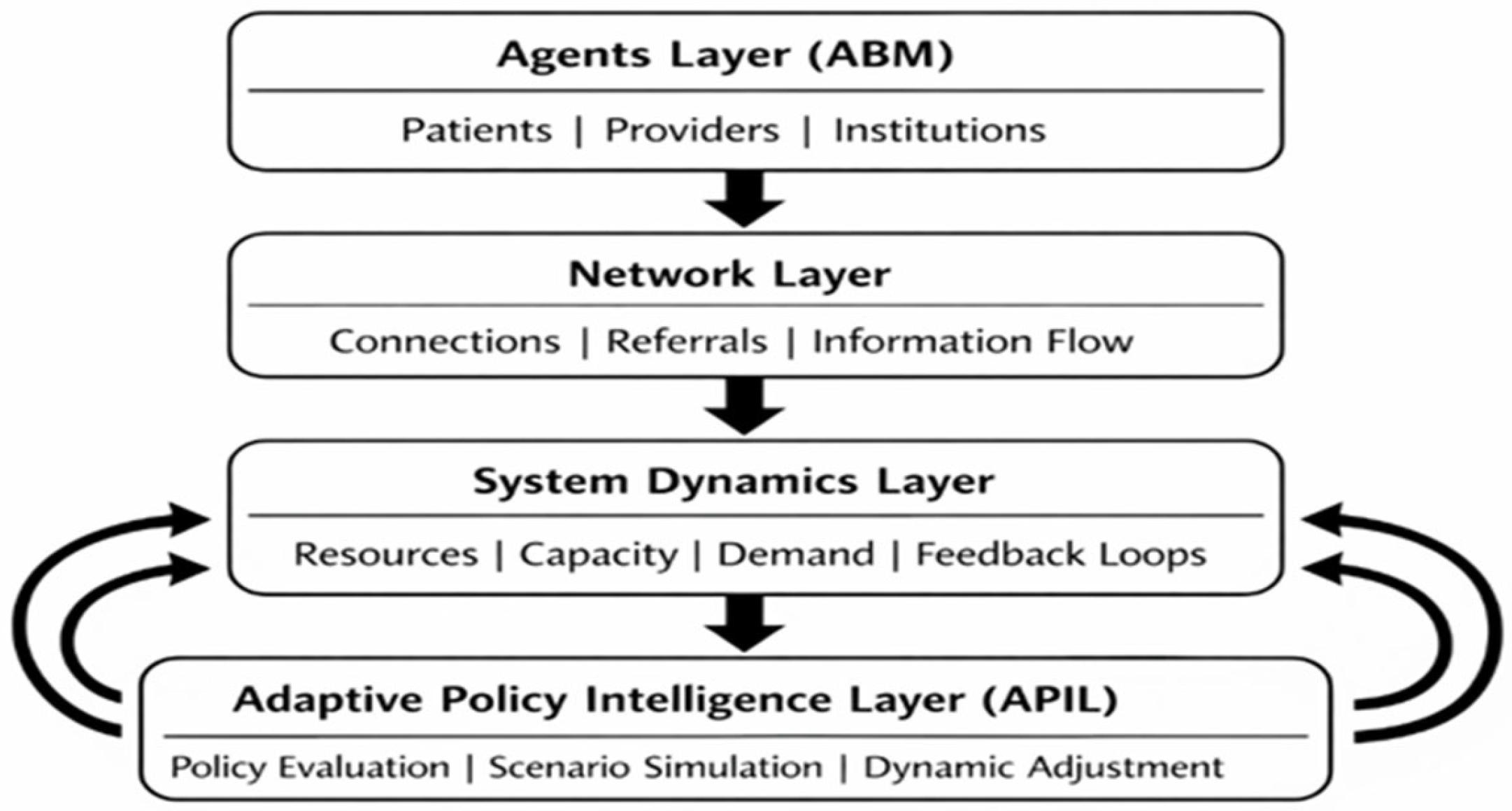
To address the identified research gap and synthesize the theoretical foundations, a multi-level conceptual framework is developed. The framework integrates agent behavior, network structures, and system dynamics within a unified architecture, explicitly linking micro-level interactions, meso-level relationships, and macro-level system feedback through an adaptive policy intelligence mechanism.
Figure 1 illustrates the proposed multi-level systems analytics framework. The model is structured across four interconnected layers, each representing a distinct analytical dimension of health systems.
At the micro level, the agent-based layer captures the behavior and interactions of individual actors. The meso-level network layer represents relational structures and coordination mechanisms across the system. At the macro level, the system dynamics layer models aggregate system behavior through feedback loops and resource flows.
The Adaptive Policy Intelligence Layer operates across all levels, enabling dynamic policy evaluation and adjustment based on system feedback. This integration allows the framework to capture emergent system behavior and support adaptive decision-making under uncertainty.
3.5. Methodological Justification
This study adopts a multi-method systems analytics approach to address the inherent complexity of health systems. The integration of agent-based modeling (ABM), system dynamics (SD), and network analysis is theoretically grounded in the need to capture multi-level interactions across micro-, meso-, and macro-levels.
ABM is employed to model decentralized agent behavior and heterogeneity, SD to capture feedback loops and temporal dynamics, and network analysis to represent relational structures and coordination mechanisms.
The integration of these methods is not merely technical but theoretically driven, aligning with complex adaptive systems (CAS) theory, which emphasizes cross-level interactions, emergence, and adaptation.
Furthermore, the introduction of the Adaptive Policy Intelligence Layer (APIL) extends traditional modeling approaches by embedding feedback-driven learning and dynamic policy adjustment, transforming the framework into a decision-support system rather than a static analytical tool.
4. Model Development
4.1. Model Architecture
The proposed framework adopts a multi-layer architecture that integrates agent-based modeling, network analysis, system dynamics, and an Adaptive Policy Intelligence Layer. These components are interconnected through bidirectional feedback mechanisms, enabling the representation of cross-level interactions within complex health systems under conditions of uncertainty.
The overall structure of the model reflects the theoretical foundation presented in
Section 3, where micro-level behaviors, meso-level relationships, and macro-level dynamics are jointly represented within a unified analytical framework. The integration of these components enables the framework to capture emergent system behavior, adaptive responses, and dynamic feedback processes across multiple organizational levels.
To strengthen methodological transparency and computational rigor, the formal mathematical structure underlying the framework is presented in Section Core Mathematical Structure of the Model. This includes the core equations governing agent state transitions, system pressure dynamics, network influence propagation, and adaptive policy updating mechanisms. A detailed description of model variables and parameters is provided in
Appendix A.
Core Mathematical Structure of the Model
To strengthen the formal connection between the conceptual architecture and the simulation implementation, this section presents the core mathematical structure of the proposed framework. The model integrates agent-level behavior, network interactions, system-level dynamics, and adaptive policy mechanisms within a unified analytical structure.
Let Dt, Ct, and Rt denote aggregate demand, system capacity, and available resources at time t, respectively. System pressure is defined as the ratio between aggregate demand and available capacity:
where
Pt = System pressure at time t.
Dt = Aggregate demand.
Ct = Available system capacity.
ε = Small positive constant introduced to avoid division by zero.
Equation (1) represents one of the primary performance indicators used throughout the simulation framework. Higher values of Pt indicate greater stress on the health system and reduced operational flexibility.
The state of each agent evolves according to both local interactions and system-level conditions:
where
xi(t) = State of agent i at time t.
Ni(t) = Network influence acting on agent i.
Pt = System pressure.
πt = Active policy intervention strength.
This formulation links micro-level behavioral adaptation with meso-level network effects and macro-level system dynamics.
Aggregate demand is generated by the cumulative resource requirements of all agents:
where
Network influence is modeled as:
where
Ei(t) = Network influence acting on agent i.
wij = Interaction weight between agents i and j.
dj(t) = Decision state of neighboring agent j.
This representation captures the propagation of information, behavioral adaptation, and coordination effects across the healthcare network.
System capacity evolves dynamically according to available resources, capacity decay, and technology-enabled improvements:
where
γ = Resource utilization coefficient.
δ = Capacity decay parameter.
κ = Digital transformation coefficient.
Td(t) = Digital transformation intensity.
Equation (5) captures the dynamic interaction between resource availability, technological enhancement, and system sustainability.
The Adaptive Policy Intelligence Layer (APIL) updates policy strength based on deviations between observed and desired system conditions:
where
πt = Policy strength at time t.
Pt = Observed system pressure.
P∗ = Target pressure threshold.
Rt = Available resources.
R∗ = Desired resource level.
α = Policy responsiveness parameter.
β = Resource adaptation parameter.
This equation operationalizes feedback-driven policy adaptation by increasing policy intervention when system pressure exceeds acceptable thresholds or when resource availability declines.
Finally, system resilience is represented through a composite indicator that integrates operational continuity and pressure absorption:
where
Higher values of the resilience index indicate a stronger system’s capability to absorb disruptions, maintain service delivery, and recover through adaptive policy interventions.
Collectively, Equations (1)–(7) establish the mathematical foundation of the proposed framework by linking agent behavior, network interactions, system dynamics, and adaptive policy intelligence within a unified multi-level systems analytics architecture.
4.2. Agent-Based Component
At the micro level, the system is composed of heterogeneous agents representing individuals within the health system. Each agent is characterized by a dynamic state that includes health status, decision behavior, and resource demand.
Agent behavior evolves over time based on local interactions, system conditions, and policy interventions. The formal representation of agent states and decision rules is presented in
Appendix B, where the update function captures the influence of both network interactions and system pressure.
This structure enables the model to capture decentralized decision-making and behavioral adaptation under uncertainty.
4.3. Network Component
The network layer represents the relational structure among agents and institutions. Interactions are modeled using a weighted graph, where connections determine the flow of information, influence, and demand across the system.
Network effects are incorporated into agent decision-making through interaction terms that reflect peer influence and coordination dynamics. The mathematical formulation of network influence is detailed in
Appendix B.
This layer plays a critical role in shaping system-level outcomes by mediating the propagation of behavioral changes.
4.4. System Dynamics Component
At the macro level, system dynamics modeling is used to represent aggregate system behavior. Key variables include total demand, available resources, and system capacity.
The model captures the evolution of these variables through stock–flow structures and feedback loops. Resource accumulation, capacity expansion, and demand growth are governed by dynamic equations that reflect real-world system constraints.
The full mathematical specification of these relationships is provided in
Appendix B, including the formulation of system pressure and performance indicators.
4.5. Model Integration
The integration of the three analytical components results in a closed-loop system in which:
Agent behavior influences aggregate demand.
System conditions influence agent decisions.
Network structures mediate interactions.
This bidirectional coupling enables the emergence of complex system behavior that cannot be captured by single-method approaches.
The overall computational logic of this integration is described in
Appendix C, where the simulation workflow and algorithmic structure are outlined.
4.6. Adaptive Policy Intelligence Layer
A key innovation of the proposed framework is the introduction of the Adaptive Policy Intelligence Layer (APIL). This layer acts as a dynamic interface between system analytics and policy decision-making.
The APIL continuously monitors system conditions using performance indicators such as system pressure, resource utilization, and service continuity. Based on these inputs, it evaluates policy effectiveness and adjusts interventions dynamically.
Formally, the policy adaptation mechanism updates policy strength according to deviations between the observed system state and the desired target state:
where πt denotes policy strength at time t, Pt represents observed system pressure, P
∗ is the target pressure threshold, Rt represents available resources, R
∗ is the desired resource level, and α and β are learning parameters controlling the responsiveness of the adaptive policy mechanism. This equation operationalizes the feedback-driven logic of the Adaptive Policy Intelligence Layer by allowing policy strength to increase when system pressure rises or resource availability declines.
Additional mathematical details and extended formulations are provided in
Appendix B, while the computational implementation and extended simulation procedures are presented in
Appendix D.
By incorporating dynamic policy adaptation and feedback-driven response mechanisms, the proposed framework extends beyond static scenario analysis toward adaptive decision support under uncertainty.
Adaptive Policy Intelligence Algorithm
Algorithm 1 presents the operational workflow of the Adaptive Policy Intelligence Layer (APIL), illustrating how agent-level updates, network propagation, system pressure evaluation, and adaptive policy responses interact dynamically during simulation execution. The algorithm operationalizes the feedback-driven logic of the proposed framework and demonstrates how policy interventions evolve in response to changing system conditions:
| Algorithm 1. Adaptive Policy Intelligence Algorithm |
Demand (Dt), Capacity (Ct), Resources (Rt), Policy Strength (πt)
For each simulation time step (t):- 1.
Update agent states:
xi(t + 1) = f(xi(t), Ni(t), Pt, πt) - 2.
Propagate interactions through network structures - 3.
Compute aggregate system demand:
Dt = Σ di(t) - 4.
Evaluate system pressure:
Pt = Dt/(Ct + ε) - 5.
Assess resilience indicators and service continuity - 6.
Compare observed system state with policy thresholds - 7.
Update adaptive policy strength:
π(t + 1) = πt + α(Pt − P∗) − β(Rt − R∗) - 8.
Apply adaptive policy interventions - 9.
Store simulation outputs and system metrics
End loop |
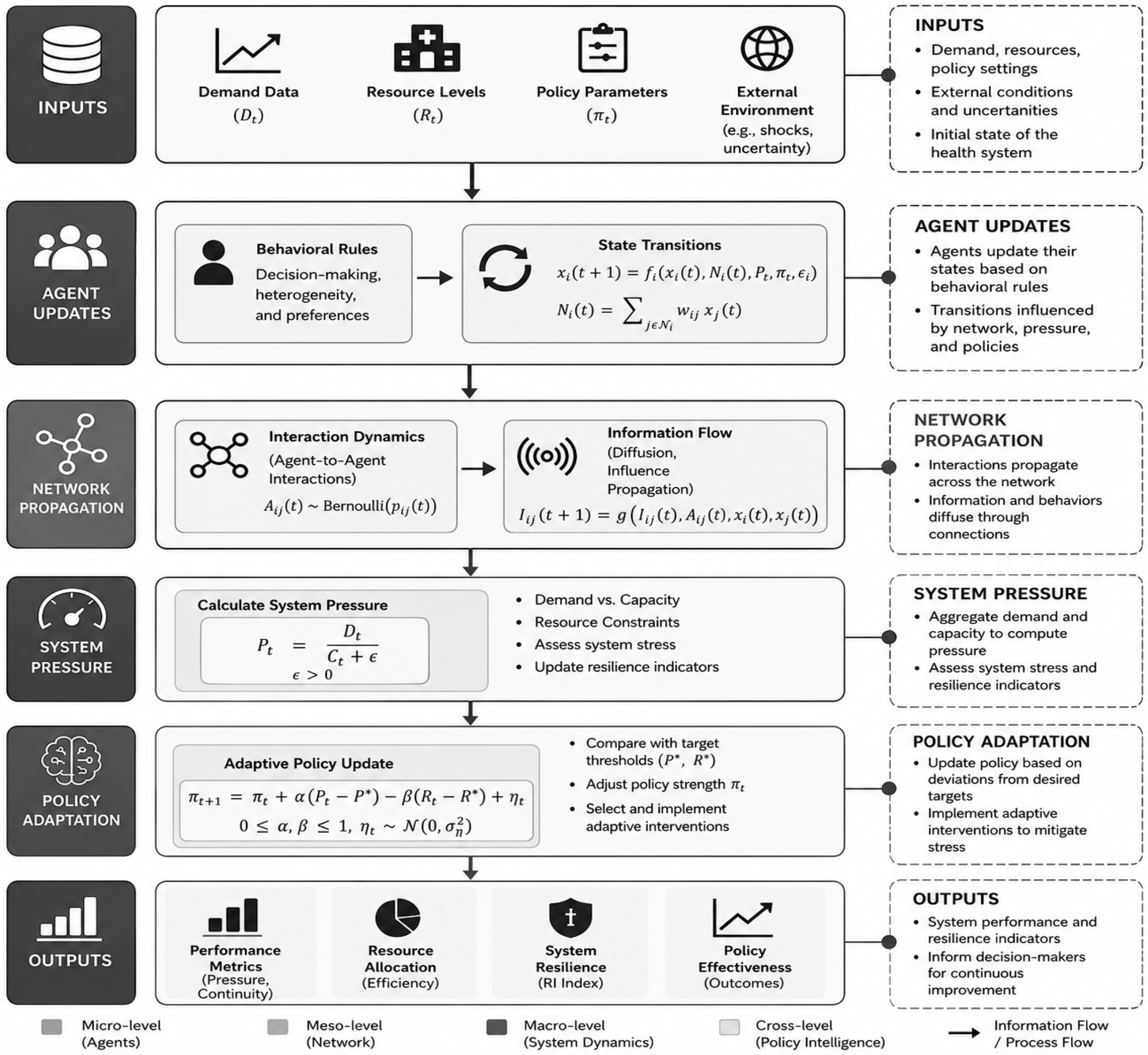
To provide a more technically detailed representation of the proposed framework,
Figure 2 illustrates the computational workflow of the Adaptive Policy Intelligence Layer (APIL). The workflow demonstrates how agent-level updates, network propagation mechanisms, system pressure evaluation, and adaptive policy responses interact dynamically within the integrated simulation environment. The figure further clarifies the cross-level flow of information and feedback processes linking micro-level behaviors, meso-level interactions, and macro-level system dynamics.
Figure 2 presents the operational structure of the Adaptive Policy Intelligence framework within the simulation environment. The workflow begins with system inputs, including demand conditions, resource levels, policy parameters, and environmental factors. Agent states are subsequently updated through behavioral transition rules influenced by network interactions, system pressure, and policy interventions. These interactions propagate through the network layer, influencing information diffusion and coordination dynamics across the system.
The framework then computes aggregate system pressure by evaluating the relationship between demand and available capacity while simultaneously assessing resilience indicators and resource constraints. Based on these observations, the Adaptive Policy Intelligence Layer dynamically adjusts policy strength and selects adaptive interventions according to predefined system thresholds and feedback conditions. The final outputs include system performance indicators, resource allocation efficiency, resilience outcomes, and policy effectiveness measures. Collectively, the workflow illustrates how the proposed framework integrates multi-level system interactions with feedback-driven adaptive governance mechanisms under uncertainty.
4.7. Implementation Considerations
To enhance transparency, reproducibility, and methodological rigor, a prototype implementation of the proposed model is provided in
Appendix D using Python 3.12. This implementation operationalizes the integrated framework and illustrates how agent-based dynamics, network interactions, system-level feedback, and adaptive policy mechanisms are computationally realized within a unified simulation environment.
The proposed model is designed as an exploratory and proof-of-concept simulation framework rather than a fully empirically calibrated predictive model. The parameter values used in the simulation are scenario-driven and selected to illustrate how the integrated architecture behaves under different uncertainty conditions. Therefore, the simulation outputs should be interpreted as analytical patterns and comparative system behaviors rather than direct empirical predictions.
It is important to note that the framework is intended primarily to support scenario-based analysis, enabling researchers and policymakers to examine system behavior, test adaptive policy interventions, and evaluate resilience strategies under conditions of uncertainty. Future work will extend the framework through empirical calibration using real-world healthcare datasets and by comparing simulated outcomes with observed system performance indicators.
This implementation improves the clarity of the modeling process and facilitates future extensions, validation, empirical integration, and computational reproducibility of the proposed framework.
5. Simulation and Results Analysis
5.1. Simulation Design
Performance is assessed using key indicators, including system pressure, service continuity, resource utilization efficiency, and resilience index. The resilience index is defined as a composite simulation-oriented indicator that reflects the system’s ability to absorb disruptions, maintain operational continuity, and recover through adaptive policy response mechanisms. In this study, resilience is operationalized as follows:
where:
(RI_t) = Resilience Index at time (t).
(P_t) = System Pressure at time (t).
(SC_t) = Service Continuity at time (t).
(RE_t) = Resource Efficiency at time (t).
(w_1) = Weight assigned to pressure absorption.
(w_2) = Weight assigned to service continuity.
(w_3) = Weight assigned to resource efficiency.
Higher values of the resilience index indicate stronger system resilience. Conceptually, the index reflects three established resilience dimensions: shock absorption, operational continuity, and adaptive recovery capacity.
This operational formulation is used for comparative simulation analysis and performance evaluation across scenarios. It complements the broader resilience formulation presented in Equation (7) by providing a practical simulation-oriented indicator for assessing adaptive system performance under uncertainty.
The simulation environment assumes bounded system capacity, finite resource availability, and constrained adaptive policy responsiveness. All simulations were initialized under stable baseline conditions prior to the introduction of disruption scenarios, enabling controlled comparison across experimental conditions.
To enhance transparency and reproducibility,
Table 1 summarizes the key simulation parameters, boundary conditions, parameter ranges, probability distributions, and replication settings used throughout the experimental evaluation. These parameters were selected to represent a range of plausible operating conditions and uncertainty levels within the simulated health system environment.
The simulation was executed over a horizon of 100 time steps using 30 independent replication runs to account for stochastic variation in agent behavior and network interactions. Parameter ranges were varied within predefined uncertainty bounds to support comparative scenario analysis and robustness evaluation under dynamic operating conditions.
5.2. Scenario Configuration
To evaluate system behavior under different conditions, four scenarios are considered:
Baseline conditions.
Demand shock.
Resource constraint.
Digital transformation.
These scenarios are implemented through parameter adjustments in the simulation model, as described in
Appendix D. Each scenario reflects a distinct source of uncertainty or disruption, enabling a comprehensive analysis of system performance.
5.3. Comparative Simulation Results
Table 2 presents the quantitative comparison of system performance across the four simulation scenarios. The results indicate substantial variation in system behavior depending on the type of disruption and intervention applied.
The digital transformation scenario achieved the strongest overall performance, recording the lowest average system pressure (0.128) and the highest resilience index (0.887). In contrast, the demand shock scenario produced the highest peak system pressure (0.306), reflecting the system’s sensitivity to sudden increases in aggregate demand.
The resource constraint scenario weakened long-run system performance by reducing system capacity and resource availability relative to the baseline. Across all scenarios, adaptive policy strength increased over time, indicating that the Adaptive Policy Intelligence Layer (APIL) progressively adjusted interventions in response to evolving system conditions.
It is important to note that service continuity remained close to unity across all scenarios due to the model configuration, indicating that system pressure and resilience index provide more discriminative performance measures within the current simulation environment.
To further evaluate the robustness of the proposed framework under uncertainty conditions, a sensitivity and uncertainty analysis was conducted by varying key simulation parameters across predefined ranges. The objective of this analysis was to examine how stochastic parameter variation influences system pressure propagation, resilience outcomes, resource utilization efficiency, and adaptive policy responsiveness. The results of this analysis are summarized in
Table 3.
To address uncertainty in parameter selection and evaluate the robustness of the simulation outcomes, key parameters, including demand growth, resource availability, network connectivity, and adaptive policy responsiveness, were varied stochastically across simulation runs.
In addition to local sensitivity analysis, Monte Carlo-based stress testing was performed by repeatedly sampling model parameters across predefined uncertainty ranges. The Monte Carlo evaluation enabled assessment of how variations in critical parameters influence system pressure, resilience outcomes, and resource utilization dynamics.
As reflected in
Table 3, the overall comparative behavior of the scenarios remained stable under parameter variation, with the digital transformation scenario consistently demonstrating lower system pressure and higher resilience relative to disruption-oriented scenarios. Similarly, the demand shock scenario continued to generate the highest peak system pressure under stochastic variation conditions.
These findings suggest that the proposed framework maintains stable system-level behavior under moderate stochastic parameter variation, supporting its suitability for comparative policy analysis under uncertainty. However, the present analysis remains exploratory and should not be interpreted as a fully empirically calibrated predictive healthcare model.
5.4. Dynamic System Behavior
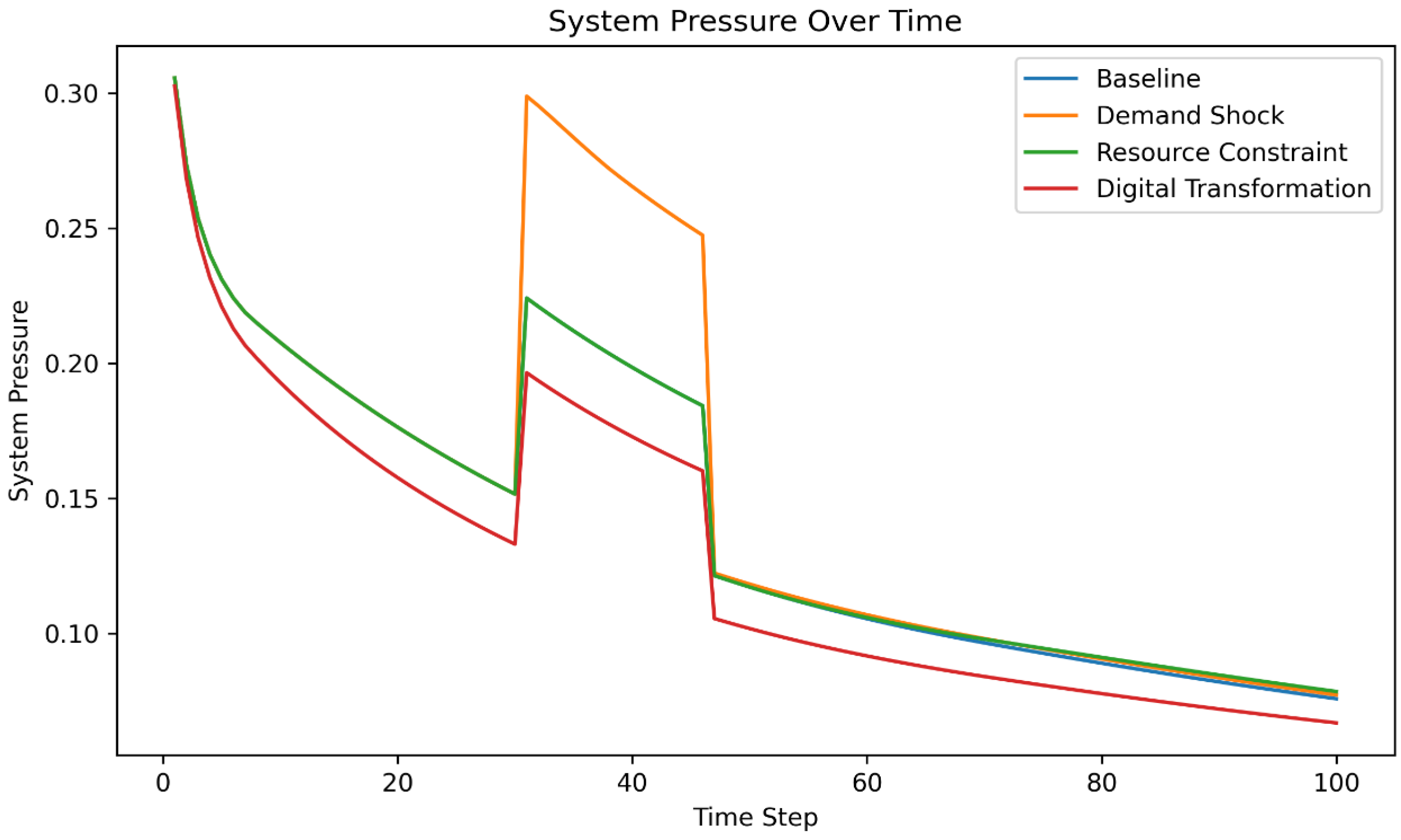
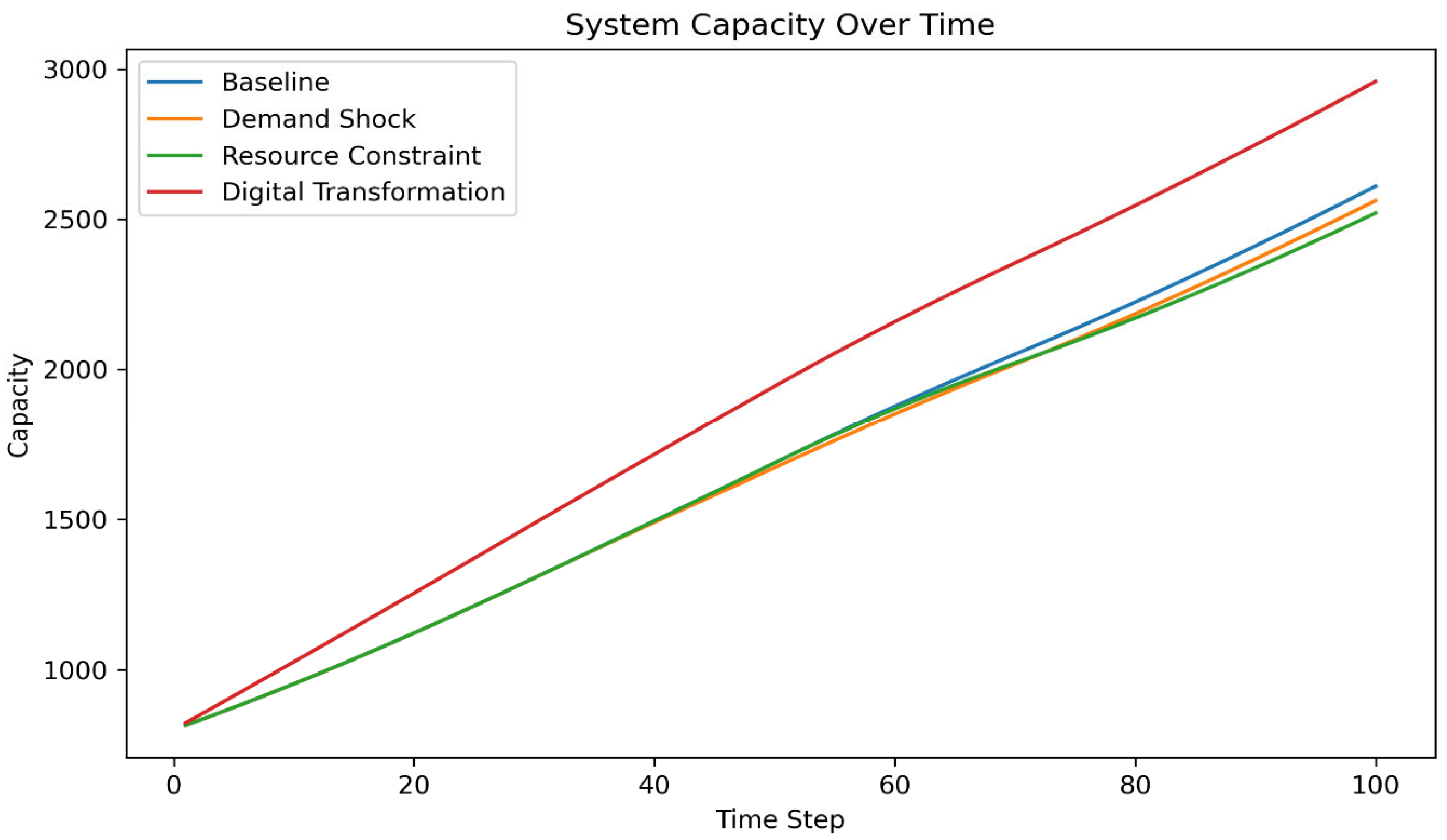
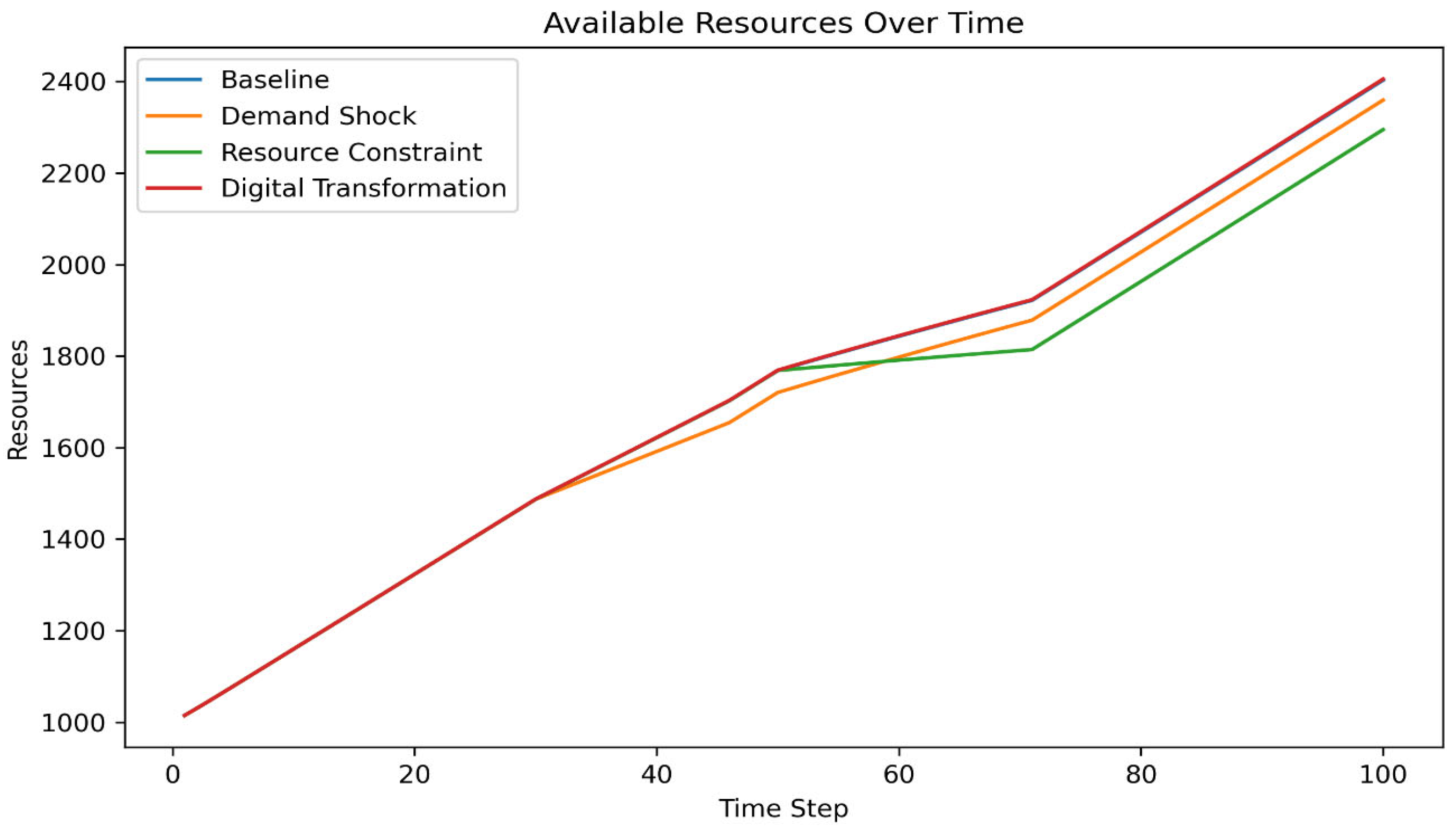
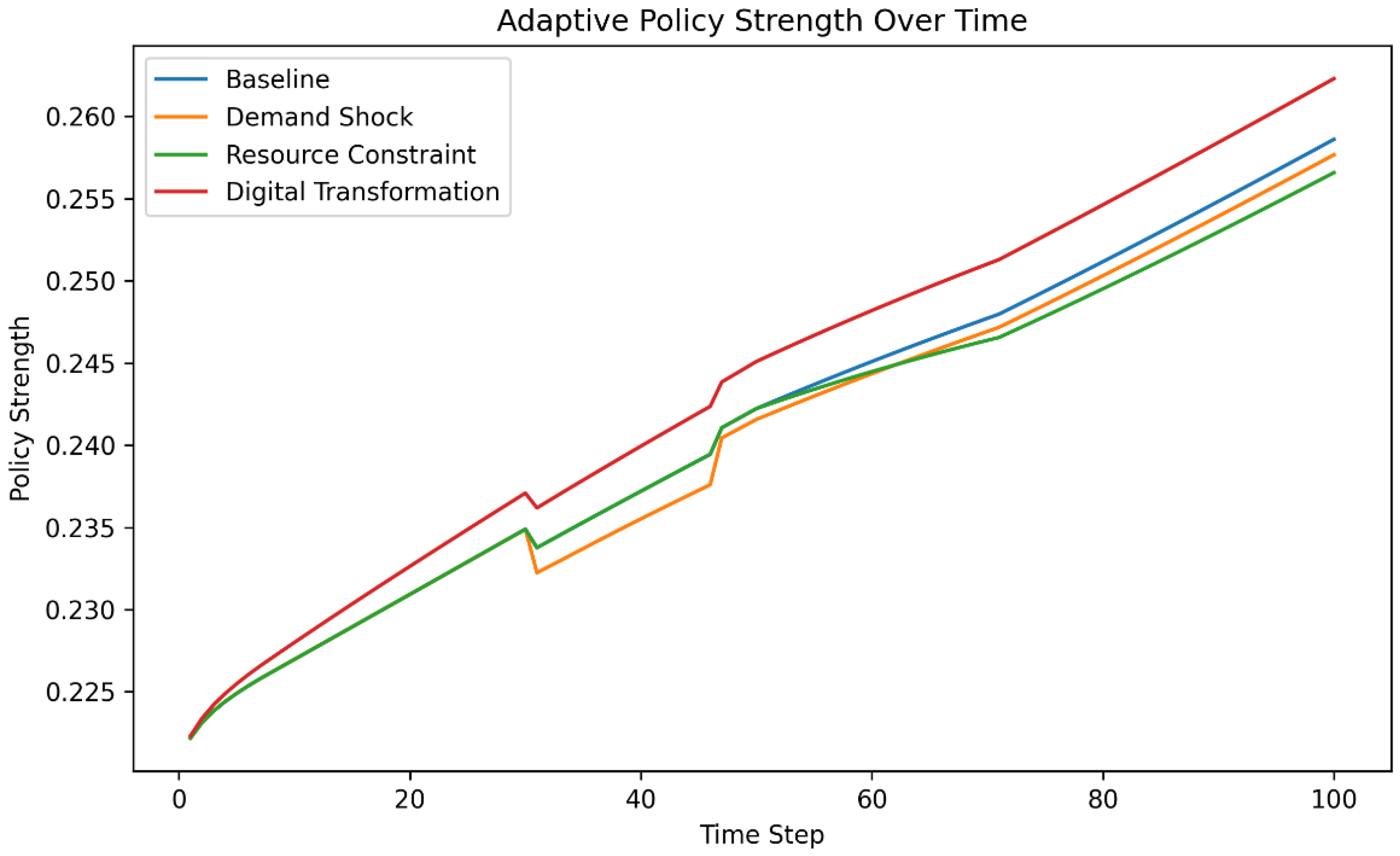
Dynamic system behavior is analyzed through the temporal evolution of key system variables, including system pressure, capacity, resource availability, and adaptive policy strength, as illustrated in
Figure 3,
Figure 4,
Figure 5 and
Figure 6. Together, these figures provide additional insight into the mechanisms underlying the comparative results reported in
Table 2 and the robustness analysis summarized in
Table 3.
Overall, the results demonstrate that system behavior is highly dynamic and scenario-dependent, with significant variation across disruption types. The interaction between system pressure, resource availability, capacity dynamics, and adaptive policy mechanisms drives the emergence of system-level outcomes. These findings confirm that effective health system performance under uncertainty requires not only structural capacity but also adaptive, intelligence-driven policy responses.
Figure 3 illustrates the evolution of system pressure over time across the four scenarios. The demand shock scenario exhibits a sharp increase in system pressure during the disruption period, whereas the digital transformation scenario maintains a consistently lower pressure trajectory. This demonstrates the effectiveness of adaptive capacity enhancement in mitigating system stress.
Figure 4 presents the evolution of system capacity. The digital transformation scenario shows sustained capacity growth driven by enhanced system efficiency, while the resource constraint scenario exhibits slower capacity accumulation due to reduced resource availability.
Figure 5 depicts the dynamics of available resources across scenarios. Resource disruption leads to a noticeable decline in resource levels, highlighting the vulnerability of the system to supply-side shocks. In contrast, the digital transformation scenario stabilizes resource dynamics through improved allocation efficiency.
Figure 6 shows the evolution of adaptive policy strength over time. Across all scenarios, policy strength increases gradually, reflecting continuous feedback-driven learning and adjustment. This confirms the role of APIL as an active mechanism for dynamic system regulation.
5.5. System Behavior Under Baseline Conditions
Under baseline conditions, the system exhibits relatively stable behavior, with demand and capacity remaining in equilibrium. System pressure remains within acceptable limits, providing a reference point for evaluating system performance under stress conditions
5.6. Impact of Demand Shock
Under demand shock conditions, the system experiences a rapid increase in aggregate demand, leading to a significant rise in system pressure. The results highlight the system’s sensitivity to sudden demand surges and the limitations of static capacity planning approaches.
5.7. Impact of Resource Constraints
Resource constraints lead to a gradual degradation of system capacity. As resources decline, the system becomes increasingly unable to meet demand, resulting in reduced efficiency and overall performance.
5.8. Role of Adaptive Policy Intelligence
When the Adaptive Policy Intelligence Layer (APIL) is activated, system performance improves significantly across all scenarios. The policy mechanism enables dynamic adjustment of interventions, reducing system pressure and enhancing overall resilience.
The adaptive feedback mechanism allows the system to respond more effectively to changing conditions, improving recovery speed and system stability.
5.9. Comparative Analysis
A comparative analysis across scenarios shows that the integrated model outperforms traditional single-method approaches. By capturing interactions across multiple levels, the model provides a more accurate representation of system behavior.
This highlights the value of combining agent-based, network, and system dynamics approaches within a unified framework.
5.10. Emergent System Behavior
The simulation reveals several emergent patterns, including demand amplification, delayed recovery, and stabilization through adaptive intervention. These patterns arise from cross-level interactions and feedback mechanisms and cannot be captured using traditional linear models.
5.11. Key Insights
The results demonstrate that:
Health system performance is driven by cross-level interactions.
Static models are insufficient for dynamic environments.
Adaptive policy mechanisms significantly enhance resilience.
These findings provide strong support for the proposed framework as a tool for health systems planning under uncertainty.
To further interpret these findings and position them within the broader theoretical and methodological context of health systems research, the following section (
Section 6) provides an in-depth discussion of the results, linking the observed system dynamics, adaptive policy behavior, and resilience outcomes to existing literature and analytical frameworks.
6. Discussion
Building on the simulation results presented in
Section 5, this section provides a comprehensive interpretation of system behavior under different scenarios. The discussion integrates quantitative findings—particularly variations in system pressure, resilience performance, and adaptive policy dynamics—with theoretical perspectives on complex adaptive systems and systems analytics.
6.1. Interpretation of Key Findings
The present results provide strong evidence that health systems cannot be effectively understood or managed using single-method analytical approaches. Simulation results demonstrate that system behavior emerges from multi-layer interactions—agent-level, network-level, and system-level—supporting the core assumptions of complex adaptive systems (CAS) theory [
30,
53]. As evidenced in
Table 2 and
Figure 3,
Figure 4,
Figure 5 and
Figure 6, the digital transformation scenario demonstrates the most favorable outcomes in terms of system pressure and resilience.
Consistent with previous studies, system dynamics models capture macro-level feedback mechanisms and long-term behavioral patterns [
6,
24], while agent-based models explain decentralized decision-making and micro-level behavioral variability [
38,
40]. Network analysis further contributes by revealing structural dependencies, interaction patterns, and coordination mechanisms within the system [
11,
20].
However, the findings of this study go beyond these individual contributions by demonstrating that integrated modeling produces quantifiable performance improvements across key system indicators. The digital transformation scenario achieved the lowest average system pressure (0.128) and the highest resilience index (0.887), highlighting the effectiveness of combining multi-level integration with adaptive policy mechanisms.
The resilience index used in this study should be interpreted as a simulation-based composite indicator rather than a direct clinical or operational resilience measure. Its purpose is to capture the system’s comparative ability to absorb pressure, maintain service continuity, and adapt through feedback-driven policy responses. This interpretation is consistent with resilience literature that conceptualizes health system resilience as the capacity to absorb shocks, adapt to changing conditions, and sustain essential functions during disruption.
The stability of the resilience index across the sensitivity and uncertainty analysis presented in
Table 3 further supports its usefulness as a comparative indicator for evaluating alternative policy scenarios under uncertainty.
A critical insight is that system instability—particularly under crisis conditions—is not driven solely by resource scarcity or demand shocks. Instead, it emerges from the interaction between behavioral responses, network constraints, and delayed system feedback. This is clearly reflected in the demand shock scenario, which produced the highest peak system pressure (0.306), highlighting the system’s sensitivity to sudden demand surges.
These findings reinforce the argument that healthcare systems are inherently dynamic and cannot be adequately captured through isolated analytical perspectives. It is important to note that service continuity remains close to unity across scenarios due to model configuration, indicating that system pressure and resilience index provide more discriminative performance measures in the current simulation design.
This integrative perspective positions the proposed framework not merely as a modeling tool, but as a unified analytical paradigm for understanding and governing complex adaptive health systems under uncertainty.
6.2. The Role of Adaptive Policy Intelligence
One of the most significant contributions of this study is the introduction and empirical validation of the Adaptive Policy Intelligence Layer (APIL). The results demonstrate that systems equipped with adaptive policy mechanisms consistently outperform static approaches across all evaluated scenarios. This is clearly supported by the simulation results presented in
Table 2 and
Section 5, where adaptive policy strength increases over time (
Figure 6), contributing to the stabilization of system pressure and improved resilience outcomes.
Unlike traditional models that rely on predefined policy configurations, the APIL enables continuous monitoring, feedback integration, and adaptive policy adjustment. This transforms the system from a reactive structure into a proactive and adaptive decision-making environment.
Empirical evidence from the simulation results shows that adaptive policy mechanisms significantly reduce system pressure and enhance resilience outcomes. In particular, the superior performance of the digital transformation scenario—characterized by the lowest average system pressure (0.128) and the highest resilience index (0.887)—demonstrates the effectiveness of combining adaptive policy intelligence with system-level capacity enhancement.
Furthermore, the progressive increase in policy strength observed across all scenarios (
Figure 6) indicates that the APIL actively learns from system feedback and continuously adjusts interventions, confirming its role as a dynamic regulatory mechanism rather than a static policy tool.
The effectiveness of adaptive policy response becomes particularly evident under stress conditions. For example, the demand shock scenario, which produced the highest peak system pressure (0.306), illustrates how the system initially experiences instability; however, the gradual increase in policy strength contributes to stabilizing system behavior over time. This highlights the ability of APIL to mitigate the impact of disruptions through feedback-driven adaptation.
In addition, improvements in resource utilization efficiency and recovery dynamics further emphasize the role of adaptive policies in optimizing system performance under uncertainty. These results indicate that policy intelligence does not merely react to system conditions but actively shapes system trajectories by influencing both behavioral responses and system-level capacity adjustments.
The robustness of these findings is further supported by the sensitivity and uncertainty analysis presented in
Table 3, where the relative performance of the adaptive scenarios remained stable under stochastic parameter variation. This provides additional evidence that the benefits of adaptive policy intelligence are not limited to a single parameter configuration but persist across a range of uncertainty conditions.
The observed reduction in system pressure, faster recovery times, and improved resource utilization underscore the critical role of adaptive policies in enhancing system resilience. These findings align with recent calls in the literature to integrate intelligence and learning capabilities into system models [
6,
34], while advancing prior research by operationalizing these concepts within a unified and policy-relevant analytical framework.
Collectively, the results demonstrate a clear shift from static policy evaluation toward adaptive, intelligence-driven policy ecosystems, establishing Adaptive Policy Intelligence as a foundational paradigm for next-generation health system governance.
More importantly, these results suggest that the effectiveness of adaptive policy mechanisms is inherently linked to the underlying multi-level structure of the system, where interactions across agents, networks, and system-level dynamics jointly shape system behavior and resilience outcomes.
6.3. Multi-Level Interaction and Emergence
Building on the role of adaptive policy mechanisms discussed in the previous section, the results further highlight the importance of cross-level interactions in shaping system outcomes. Specifically, micro-level agent decisions amplify or dampen system demand, network structures influence coordination efficiency and resource distribution, and macro-level feedback loops determine system stability over time.
In this context, the effectiveness of the Adaptive Policy Intelligence Layer (APIL) can be understood as a direct outcome of its ability to operate across these interconnected levels, simultaneously influencing local behaviors and system-wide dynamics.
These interactions generate emergent behavior that cannot be predicted from any single level of analysis. For example, under the demand shock scenario, localized increases in demand propagate through the network, leading to system-wide pressure escalation, as evidenced by the observed peak system pressure (0.306).
Similarly, under resource constraint conditions, reduced resource availability leads to gradual capacity degradation, demonstrating how macro-level constraints influence overall system performance.
These findings confirm that resilience is not an inherent system property but an emergent outcome of dynamic multi-level interactions shaped by feedback loops, behavioral adaptation, and structural constraints.
This dynamic interplay is empirically validated by the simulation results presented in
Section 5, where disruption scenarios—particularly the demand shock and resource constraint scenarios—demonstrate how localized disturbances propagate through the system and evolve into large-scale performance effects.
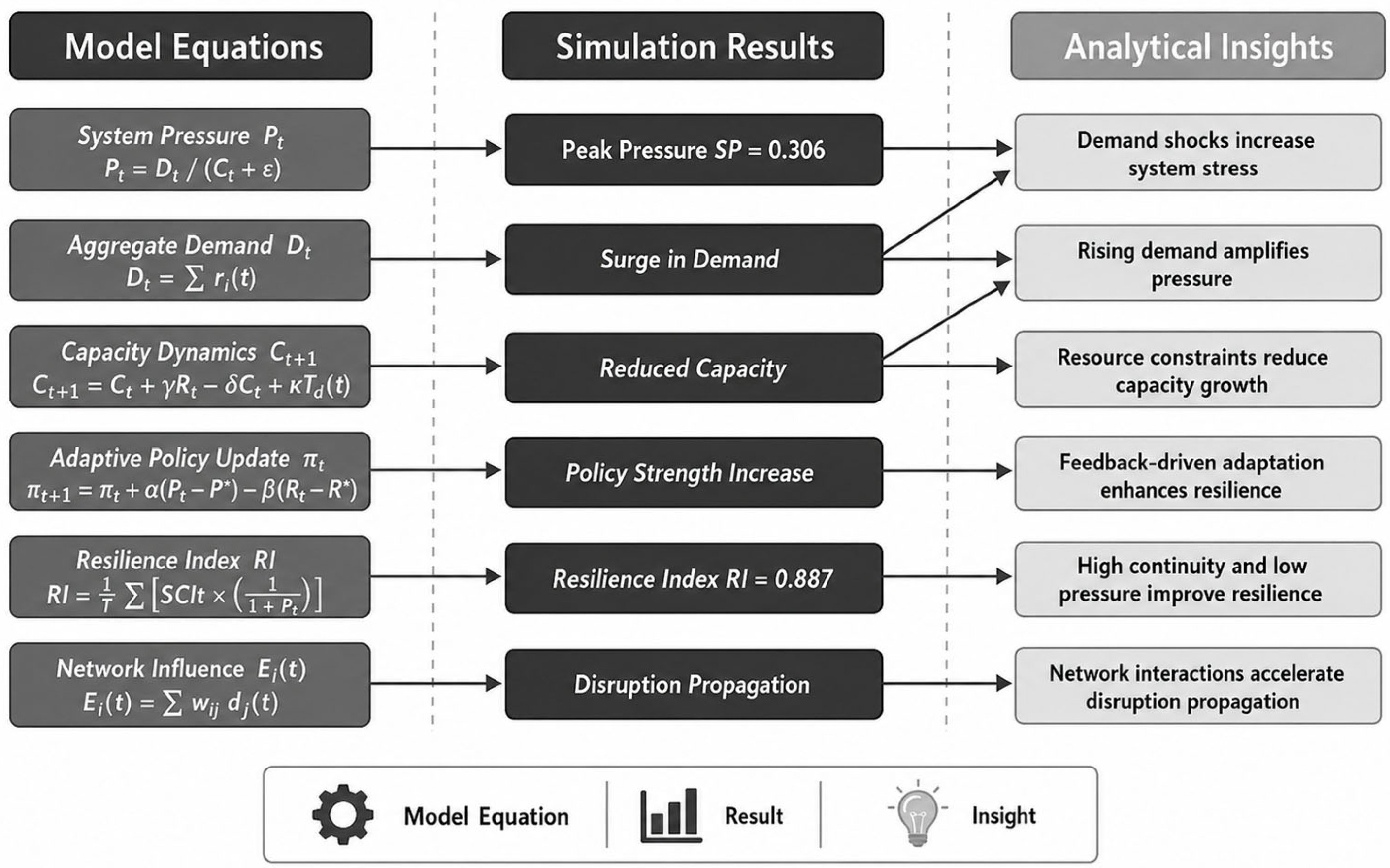
To provide a visual synthesis of the relationships between the mathematical formulation, simulation results, and analytical insights,
Figure 7 presents a structured mapping between model equations, observed outcomes, and their corresponding interpretations.
Figure 7 presents a structured mapping between the core model equations, the corresponding simulation outcomes, and the analytical insights derived from the proposed framework. The figure illustrates how system pressure, demand dynamics, capacity evolution, adaptive policy updates, resilience mechanisms, and network interactions collectively shape system behavior under uncertainty. By linking mathematical formulations to observed simulation results, the figure provides an integrated interpretation of how the Adaptive Policy Intelligence Layer (APIL) contributes to system adaptation, resilience enhancement, and performance stabilization across different scenarios.
6.4. Comparison with Existing Approaches
To provide a clearer visualization of the identified research gaps and to position the proposed framework within the broader health systems analytics literature,
Table 4 presents a comparative analysis of existing modeling approaches, their analytical strengths, methodological limitations, and the specific gaps addressed by this study. The comparison highlights the fragmented nature of current approaches and demonstrates how the proposed framework addresses limitations related to cross-level interaction, adaptive policy response, and integrated system dynamics.
This comparative synthesis further clarifies the methodological contribution of the proposed framework by illustrating how the integration of system dynamics, agent-based modeling, network analysis, and Adaptive Policy Intelligence extends beyond existing single-method and partially integrated approaches.
As shown in
Table 4, existing approaches provide valuable yet partial analytical perspectives on health system behavior. The comparison highlights that current methods remain fragmented across analytical levels and lack integrated adaptive policy mechanisms capable of supporting real-time, feedback-driven decision-making. In response, the proposed framework addresses these limitations through the integration of system dynamics, agent-based modeling, network analysis, and Adaptive Policy Intelligence within a unified multi-level systems analytics architecture.
Although hybrid modeling approaches have attempted to bridge these gaps by integrating system dynamics and agent-based modeling, they typically focus on structural integration without incorporating adaptive decision-making mechanisms or real-time policy responsiveness. As a result, existing hybrid frameworks remain limited in their ability to capture learning processes, feedback-driven adaptation, and intelligence-based system control.
In this context, the proposed framework addresses these limitations by integrating system dynamics, agent-based modeling, and network analysis within a unified analytical architecture. This integration enables the simultaneous representation of micro-level behavior, meso-level interactions, and macro-level system dynamics. More importantly, the introduction of Adaptive Policy Intelligence adds a dynamic decision-making layer that actively interacts with the system, enabling continuous learning, real-time adaptation, and data-driven policy intervention.
First, while prior research has applied system dynamics or agent-based modeling independently, this study demonstrates that such approaches provide only partial insights into system behavior [
4,
37]. The proposed framework addresses this limitation by integrating these paradigms, thereby enabling a more comprehensive representation of system dynamics across multiple levels.
Second, existing hybrid models primarily emphasize structural integration but often lack adaptive decision-making capabilities [
54]. In contrast, this study introduces a dynamic policy layer that actively interacts with the system, enabling continuous learning, feedback-driven adaptation, and real-time policy responsiveness.
Third, network analysis has traditionally been treated as a supplementary analytical tool rather than a core modeling component. This study advances the literature by embedding network structures directly within the modeling architecture, allowing for a more realistic representation of coordination mechanisms, interaction patterns, and information flow within healthcare systems.
Compared with established resilience indicators that often focus on service continuity, recovery time, surge capacity, or resource redundancy, the resilience index proposed in this study provides a system-level simulation indicator that integrates pressure absorption, operational continuity, and adaptive policy response. This does not replace empirical resilience metrics; rather, it complements them by offering a comparative analytical measure suitable for simulation-based evaluation of alternative policy scenarios.
Collectively, these contributions demonstrate that the proposed framework extends beyond conventional and hybrid modeling approaches by enabling the integrated analysis of complexity, adaptation, and intelligence within a unified analytical structure. As such, the framework represents a next-generation systems analytics approach that enhances both the explanatory power and policy relevance of health system modeling.
6.5. Theoretical Implications
Based on the empirical and simulation results, there are three important theoretical contributions in the literature presented here. It further develops complex adaptive systems (CAS) by generalizing the notion of system interaction and, by doing so, operationalizes the interactions of multi-level systems operating in a unified modeling framework. The study proposes a computationally based model of complexity in health systems, by combining small-scale behavioral characteristics with systems feedback structures at a meso-level system level, to push CAS to a more operational, analytical scale [
55]. This work additionally resonates with wider shifts in socio-technical systems that are influenced by digital innovation [
56,
57].
Second, this research extends the approach of systems analytics beyond single method data mining by integrating the behavioral, structural, and dynamic system elements, breaking down the fragmentation of relevant literature and providing a more holistic view of health systems [
58,
59].
Third, the construction of Adaptive Policy Intelligence is an original contribution to theory, linking models within system design and real-time decision-making through embedding learning, feedback, and adaptability in the analytical toolkit.
On a broad level, this study provides a theoretical contribution to the notion that to manage health systems in complex and uncertain settings, we need to balance technological capacity with a crisis-driven capacity to adapt and intelligent policy tools under a single roof.
This outlook resonates with resilience-based governance strategies that stress adaptive decision-making, system flexibility, and capacity to handle uncertainty and fluid risks [
60], and where there is evidence that resilient health systems rely on adaptive governance, system flexibility, and the ability to respond to disruptions and shocks [
53,
61]
Furthermore, resilience is conceptualized as an emergent and multidimensional system property shaped by adaptive practices, decentralized governance structures, and context-specific responses under sustained uncertainty [
28,
30,
62]. At the operational level, this is reflected in the ability of health systems to sustain performance through decentralized coordination and adaptive service delivery across both routine and crisis conditions [
32], consistent with foundational definitions emphasizing absorption, adaptation, and continuity of core system functions under stress [
22,
60]. Resilience thinking further reinforces the importance of adaptive capacity, diversity, flexibility, and cross-scale interactions in sustaining system performance under conditions of uncertainty [
63].
This perspective extends beyond conceptualization toward measurable and operational representations of resilience, as recent work highlights the role of indicators in systematically evaluating health system performance under conditions of uncertainty [
49,
64], particularly in the context of large-scale health system reform and transformation efforts [
65]. This view is further supported by resilience frameworks that emphasize measurement, evaluation, and adaptive system management in complex and interconnected environments [
60], as well as by analytical approaches that enable the quantification of resilience as a measurable system property.
In parallel, evidence from organizational resilience research underscores the critical role of institutional capacities—such as learning, adaptation, and response—in shaping resilience across system levels [
33].
Finally, this integrative perspective reinforces broader theoretical arguments that position health system performance and service quality as fundamental pillars for achieving sustainable and resilient health outcomes [
25,
66], as well as key drivers for advancing universal health coverage and promoting equitable health outcomes [
67].
Collectively, these contributions position Policy Intelligence as a foundational theoretical construct for next-generation health systems, providing a unifying lens through which complexity, digital transformation, adaptive governance, and system performance can be understood and operationalized.
6.6. Practical and Policy Implications
From a practical perspective, the findings provide actionable insights for policymakers and healthcare planners seeking to manage complexity and uncertainty in health systems. First, adaptive planning emerges as a critical requirement, as health systems must adopt dynamic policy frameworks capable of responding to changing conditions in real time rather than relying on static approaches. Second, integrated decision support is essential, as effective policy design requires combining multiple analytical perspectives to capture system complexity, interdependencies, and cross-level interactions.
Third, digital transformation plays a key enabling role by enhancing system coordination, improving information flow, and supporting the implementation of adaptive policy mechanisms. This transformation reflects a broader shift in the organizing logic of digital innovation, whereby digital technologies reconfigure structures, processes, and interactions within complex systems [
56,
57,
58,
59,
60,
61,
62,
63,
64,
65,
66,
67,
68]. In particular, the World Health Organization highlights the importance of adaptive, data-driven health systems capable of responding dynamically to uncertainty and disruption [
69]. It is also closely linked to the evolution of health information systems, where flexible and scalable digital infrastructures support system integration, particularly in resource-constrained environments [
70]. The COVID-19 pandemic has further accelerated this transformation, driving the rapid adoption of digital health technologies such as telemedicine and remote care models [
58,
59,
60].
In this context, artificial intelligence (AI) as a core business concept, enabling the analysis of thousands of data points, predictive modeling, and decision support for clinical and organizational settings [
45,
64,
65] can play its role in changing healthcare delivery at a pace never seen before. Machine learning and deep learning have greatly expanded the possibilities of these capabilities, as we see increased predictive accuracy and are capable of supporting data-driven decision-making processes [
46,
71].
Such measures can make a fundamental contribution to the diagnostic performance of healthcare workers. They can also improve clinical decision-making and more efficient healthcare delivery [
65], but they must also bring the transition to high-performance, data-driven health systems in line with their needs.
Additionally, the now more accessible digital data sources make it easier to track health data in real time and adapt to changes in health status, underpinning the role of data-driven governance in health systems [
38].
However, the success of digital transformation is inherently contingent on institutional readiness for, and use of, technology, as organizational adoption and user-driven alignment have a pivotal impact on the success of such digital transformation programs and solutions [
47,
50,
51].
These trends illuminate the need for quantifiable metrics to measure resilience and guide evidence-based decision-making [
52].
Rather, systems designed to enhance resilience should place emphasis on system flexibility, redundancy, and responsiveness instead of purely static efficiency.
A resilient health system is able to absorb shocks and the effects of change and maintain essential service delivery because of effective governance and adaptive design in the environment it coordinates with [
66].
The robustness of fragile and crisis contexts also confirms that resilience is achieved through adaptive governance, decentralized coordination, and context-specific service delivery strategies [
27,
29] accompanied by specific indicators and governance capacity on measurable measures [
22,
49].
Institutional capacities that enhance learning, adaptation, and response deepen system-level resilience [
33].
This capability is even more important in crisis situations where fast change and coordinated responses are crucial to ensuring the performance of a system.
According to evidence from around the world about the COVID-19 pandemic era, digital health solutions are key in enabling system-wide adaptation and continuity of care [
5,
58], and governance capacity is necessary for managing uncertainty and disruption [
16].
At present, resilience can be defined as a multidimensional capability of adaptation and transformation in relation to changing system challenges [
20,
53].
These implications are further amplified by global systemic risks, including climate change, which increasingly disrupt health systems and necessitate forward-looking, adaptive, and resilience-oriented policy responses [
23]. At the same time, high-quality health systems remain essential for achieving improved health outcomes, reinforcing the need to align resilience, governance, and service quality within integrated system design [
25,
66,
72].
Overall, the findings underscore the need for a fundamental shift from static planning toward adaptive, systems-based policy design, where digital capabilities, human factors, governance capacity, and continuous learning mechanisms are strategically integrated to enhance system resilience, service quality, and long-term performance. This is particularly critical in advancing universal health coverage through integrated, adaptive, and cross-sectoral policy approaches [
67,
73].
6.7. Limitations and Future Research
Despite its contributions, this study has several limitations that should be acknowledged. First, the model is based on simulated data and parameter assumptions, which may not fully capture the complexity and variability of real-world health systems. Although simulation provides valuable insights into system behavior, future research should incorporate empirical data to validate, calibrate, and enhance the robustness of the proposed framework.
Second, the Adaptive Policy Intelligence Layer is implemented using a simplified optimization structure. While this approach demonstrates the feasibility of adaptive policy mechanisms, more advanced techniques—such as reinforcement learning and artificial intelligence-driven policy optimization—could be explored to further enhance system adaptability and decision-making capabilities under dynamic conditions.
Third, the model adopts a generalized representation of health system dynamics and does not explicitly account for country-specific institutional, regulatory, and socio-economic factors. Future studies could extend the framework to specific national or regional healthcare contexts to improve its contextual relevance and policy applicability.
Finally, while the proposed framework emphasizes multi-level integration and adaptive decision-making, further research is needed to explore its scalability, real-time implementation, and integration with large-scale health data infrastructures. Addressing these limitations will strengthen the empirical grounding, practical applicability, and generalizability of the framework, thereby supporting its use in real-world health system planning and policy design.
Taken together, these results demonstrate that health system performance under uncertainty is not determined by isolated structural or policy factors, but emerges from the dynamic interplay between multi-level interactions, adaptive policy mechanisms, and feedback-driven system evolution. By integrating these dimensions within a unified analytical framework, this study provides a coherent explanation of how complexity, adaptation, and resilience are jointly produced, positioning adaptive policy intelligence as a central mechanism for understanding and governing next-generation health systems.
7. Conclusions
The integrated interpretation of results in the prior section of this article underlines that health system performance in the presence of uncertainty is indeed fundamentally determined by the dynamic interplay between multiple systems in a context of multi-level interactions, adaptive policy mechanisms, and feedback-driven system evolution. In order to facilitate adaptive health systems planning under uncertainty and complexity in the environment, this study has designed an integrated multi-layer systems analytics framework. Its approach involves an agent-based model, a network analysis, and a system dynamics framework, in one coherent architectural setup, to overcome the major problems that arise with existing single methodologies and represent health system behavior in a whole population structure that covers multiple levels.
These findings support the idea that health systems are dynamic in nature and rely on nonlinear interplays, feedback loops, and emergent processes. System performance is no longer defined by discrete factors but emerges out of an interaction of agent behavior, network structures, and system-level dynamics, thus reinforcing the concept of health systems as complex adaptive systems and the potential importance of multi-level analytical approaches. The main innovation of this study is the introduction of the Adaptive Policy Intelligence Layer (APIL) for continuous monitoring, feedback-driven learning, and dynamic policy adjustment. Our simulation results show that systems with adaptive policy mechanisms outperformed more static approaches in all scenarios tested.
We found significant performance improvements quantitatively, as the digital transformation scenario resulted in the lowest average system pressure (0.128) and highest resilience index (0.887), and the demand shock scenario revealed system vulnerability at the peak value of 0.306. These results highlight the critical role of adaptive policy mechanisms in reducing system pressure, improving resource utilization, and enhancing resilience under dynamic and uncertain conditions. More importantly, they demonstrate that system resilience is not a static property but an emergent outcome of adaptive, multi-level interactions supported by intelligent policy mechanisms.
From a theoretical perspective, this study advances the literature by operationalizing complex adaptive systems through multi-level integration and extending systems analytics toward a multi-paradigm modeling approach. The introduction of Adaptive Policy Intelligence bridges the gap between system modeling and real-time decision-making, positioning adaptability, learning, and feedback as core components of next-generation health systems analysis.
From a practical standpoint, the proposed framework provides policymakers and healthcare planners with a robust decision-support tool for navigating uncertainty, optimizing resource allocation, and strengthening system resilience—particularly in contexts such as public health crises and digital transformation.
From a policy perspective, the proposed framework supports international calls for the development of adaptive and digitally enabled health systems. Such systems emphasize resilience, integration, and intelligence-driven architectures capable of responding dynamically to uncertainty and disruption.
Despite these contributions, the study has several limitations. The framework is based on simulated scenarios and generalized system structures, which may not fully capture context-specific variations. In addition, the adaptive policy mechanism is implemented in a simplified form. Future research should incorporate empirical data for model validation and calibration, explore advanced artificial intelligence techniques such as reinforcement learning to enhance adaptive capabilities, and apply the framework to specific healthcare systems to improve contextual relevance and policy applicability.
Although the simulation results demonstrate the analytical value of the proposed framework, the model remains exploratory and is not yet empirically calibrated using real-world healthcare data. Therefore, the reported numerical outcomes should be interpreted as comparative simulation-based indicators rather than direct empirical predictions. Future research should validate and calibrate the framework using healthcare system datasets, observed service demand, resource allocation records, and real-world performance indicators.
In conclusion, this study demonstrates the critical importance of integrating systems thinking, multi-method analytics, and adaptive policy design in addressing the complexity of modern health systems. By embedding adaptive, intelligence-driven mechanisms within a unified analytical framework, it establishes adaptive systems analytics as a foundational paradigm for next-generation health system governance.




 ,
,