


Abstract
This research introduces a novel methodology that combines Building Information Modelling (BIM) and Economic Multi-Criteria Decision-Making (EMCDM) with Neural Networks to optimize hybrid renewable energy systems in small communities. Its core aim is to improve sustainability, technical performance, and financial vokiability through integrated modelling and decision-making. The approach is applied to a hydropower site, evaluating five Scenarios (IDs 1–5) under a Community and Industry model. Financial benchmarks include a 10% Minimum Required Return and a 7-year payback period. ID3—hydropower, solar, and wind—proves most effective, with ANPV of €10,905 (wet) and €4501 (dry), and ROI of 155%/64%. Its ROIA/MRA Index peaks at 539%, and Payback/N ratios remain within acceptable limits (55%/96%). LCOE stays stable in average conditions (0.042–0.046 €/kWh), rising in dry years (0.07–0.10 €/kWh). Profitability differences primarily stem from demand and curtailment, rather than production costs. The NARX neural network reliably models SS% values from renewable inputs with low error across scenarios. The integrated BIM–EMCDM framework ensures transparent, sustainable, and risk-balanced energy system decisions for long-term autonomy.
1. Introduction
The implementation of Building Information Modelling (BIM) in hydropower infrastructure projects relies on a range of tools and methodologies that enhance collaboration, improve design accuracy, and streamline project management throughout all phases. One of the central tools in BIM workflows is Revit, which is widely used to create detailed 3D parametric models of hydropower components such as dams, powerhouses, and penstocks [1]. These parametric models ensure that any change made to one part of the system automatically updates all related elements, maintaining consistency across the design [2]. For hydropower applications, Revit is often paired with Civil 3D, a tool tailored for civil engineering that supports terrain modelling, alignment design, and integration of water flow systems essential to hydropower planning. BIM’s role in hydropower has been extensively documented, highlighting its capacity to integrate digital twins, GIS, and simulation tools across the lifecycle of hydropower assets [3].
The integration of renewable energy into small communities requires a nuanced, data-driven methodology that balances technical feasibility, economic viability, and social acceptance. It begins with a foundational inquiry into the community’s energy needs and broader aspirations for sustainability, resilience, and autonomy. These initial reflections shape the philosophical and practical direction of the project. Once priorities are clarified, the analysis phase defines geographic and operational boundaries and gathers building and infrastructure data using Building Information Modelling (BIM). This digital representation is enriched with technical assessments, economic modelling, and stakeholder input to create a multidimensional understanding of the project space. BIM’s ability to support participatory planning and visualize energy infrastructure has proven essential in community-scale renewable energy projects [4,5].
In the context of hybrid energy systems, the Analytic Hierarchy Process (AHP) is particularly valuable for integrating stakeholder preferences [6]. For illustration, a municipality may prioritize energy autonomy and environmental impact, while a private investor may focus on financial returns and payback period. AHP allows these priorities to be transparently modelled and incorporated into the final decision. The process typically involves:
- Defining the decision goal (e.g., selecting the optimal hybrid energy configuration);
- Establishing criteria (e.g., Self-Sufficiency %, LPSP and other KPIs);
- Normalizing the data scaling to ensure comparability;
- Conducting pairwise comparisons to derive weights;
- Aggregating scores to rank alternatives.
This methodology ensures that the final decision reflects both objective performance data and subjective stakeholder values. AHP has been successfully applied to hybrid energy systems to prioritize configurations based on technical, economic, and social criteria [6,7].
Economic Multi-Criteria Decision-Making (EMCDM) expands upon Classical Methodologies of Investment Analysis (CMIA), which rely heavily on singular financial indicators like Net Present Value (NPV) and Internal Rate of Return (IRR) [8]. While CMIA is suitable for stable low-risk investments, it falls short when applied to capital-intensive and volatile projects such as hybrid renewable systems, where long-term uncertainty and multidimensional performance are the standard. EMCDM introduces a multi-index framework that evaluates both returns and risks across several dimensions [9]. It incorporates technical performance indicators (e.g., Self-Sufficiency %, Loss of Load Probability), economic metrics (e.g., NPV, IRR, Payback Period), and decision-making perspectives (e.g., Power Security, Long-Term Profit, Balanced Approach). These indicators are normalized and weighted according to stakeholder priorities, often using AHP as the weighting mechanism [10]. By integrating technical simulations with economic and decision-analytic tools, EMCDM provides a holistic framework for evaluating hybrid renewable energy systems, offering stakeholders a transparent and data-driven basis for investment decisions.
By combining AHP and EMCDM, decision-makers gain a holistic view of each configuration’s viability. This dual approach enables transparent, data-driven planning that aligns with both technical feasibility and strategic goals [11]. The indicators are weighted according to priorities defined in the AHP hierarchy. These weights reflect the relative importance of each criterion under the three decision-making perspectives: Power Security, Long-Term Profit, and Balanced Approach [12]. In conclusion, the Economic Multi-Criteria Decision-Making (EMCDM) represents a significant advancement over traditional investment analysis techniques. Its ability to synthesize diverse performance metrics, accommodate stakeholder preferences, and account for uncertainty makes it particularly well-suited for evaluating complex energy systems [13]. Through an integrated model application in this study, the model will demonstrate its potential to guide strategic planning and optimize resource allocation in the development of sustainable and economically sound hybrid energy infrastructures [14,15].
Hence, the primary contribution is the integrated, multi-dimensional decision-making framework that bridges the gap between static infrastructure design and dynamic financial risk analysis. Unlike standalone methodologies such as Classical Methodologies of Investment Analysis (CMIA), which often rely on singular metrics like NPV or IRR, the developed framework integrates BIM for high-fidelity spatial data and NARX Neural Networks for predictive performance. The integration allows for a “risk-balanced” approach where technical simulation (SS%, LPSP) is directly linked to stakeholder-weighted economic indicators (via AHP), ensuring that the final configuration is not just technically feasible but also socially and economically optimized.
2. Methodology and Materials
2.1. Definitions
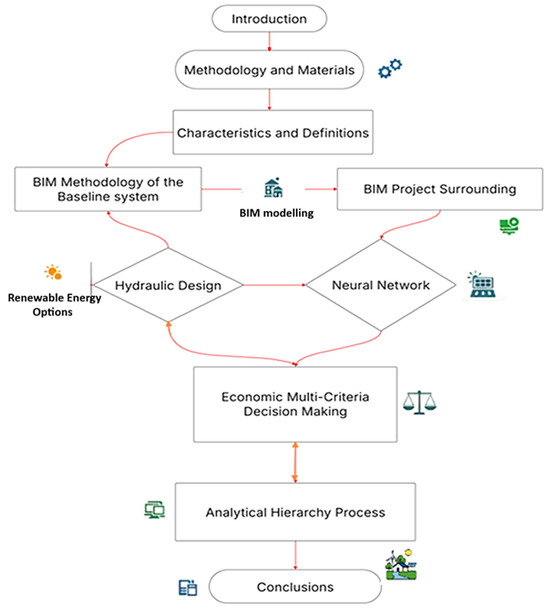
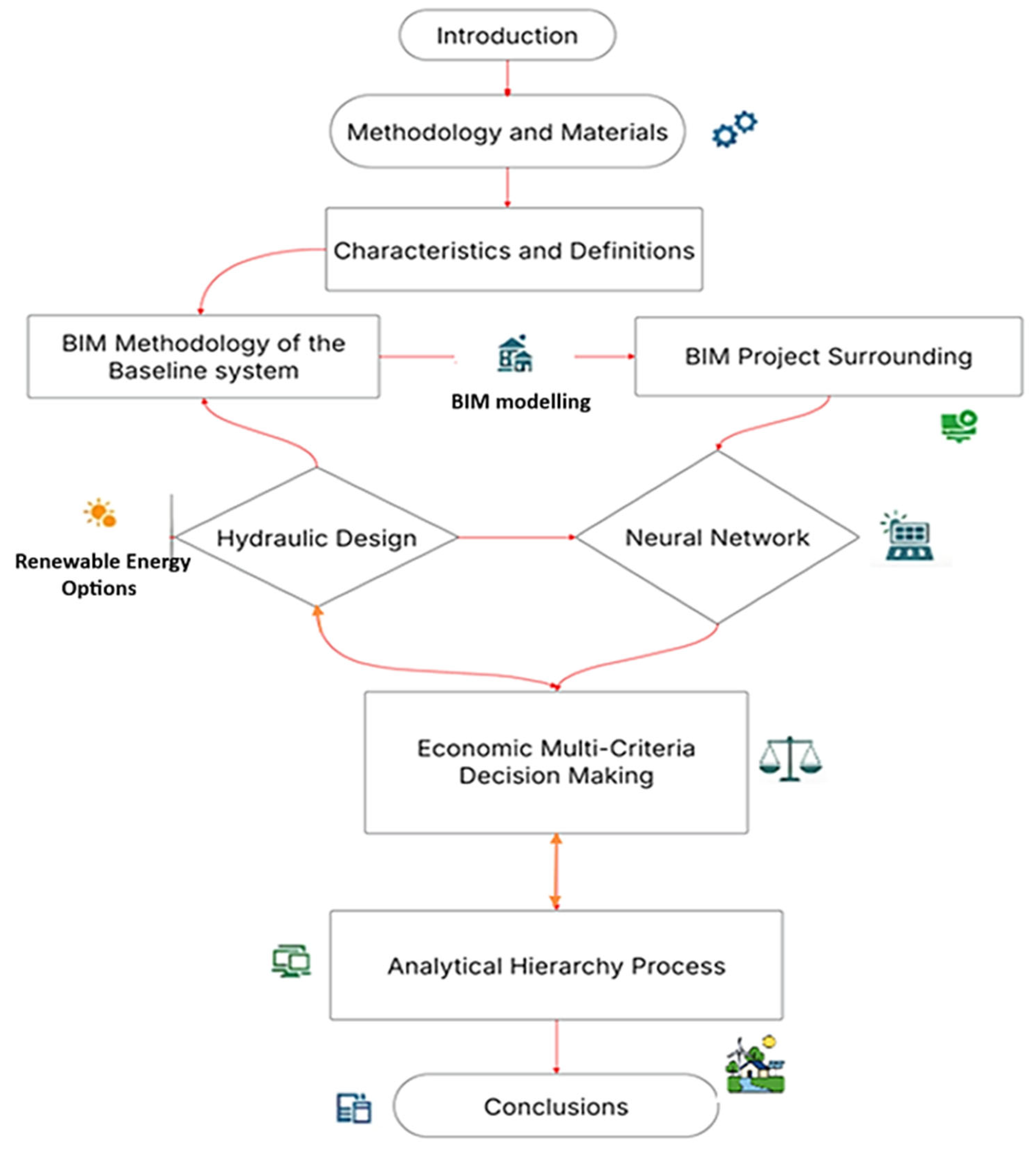
The methodology comprises a hybrid Economic Multi-Criteria Decision-Making framework using a Neural Network that merges BIM with the Analytic Hierarchy Process (AHP). BIM serves as a Common Data Environment (CDE) that transcends 3D modelling. Specifically, BIM provides the semantic spatial data (geospatial orientation, building energy demands, and topographical constraints) required to create a Digital Twin of the energy community. This allows for precise simulation of renewable resource potential (like solar incident radiation on specific geometries) and the optimization of energy distribution networks within a smart grid context. BIM simulations visualize energy flows and spatial constraints, while AHP introduces a structured evaluation of alternatives based on defined criteria such as cost, efficiency, environmental impact, and social acceptance. These criteria are weighted through pairwise comparisons, embedding community values into the decision model. This integrated model enables a robust assessment of renewable energy solutions, producing a ranked list supported by consistency ratios and key performance indicator (KPI) analyses. The optimal solution selected is not only technically thorough but also socially endorsed and economically justified. Following the selection, the implementation phase uses BIM visualization tools to communicate the strategy. Renewable technologies are deployed, and BIM-integrated monitoring systems track performance, maintenance, and energy savings in real time, ensuring adaptability to changing conditions. The BIM integration in our study is intended to be dynamic and parametric due to (i) dynamic linking, because parametric models ensure any change to any one part of the system (e.g., penstock geometry or building orientation) automatically updates all related elements; (ii) real-time potential, where the framework supports interoperability for dynamic performance simulations, suggesting the framework is designed for active management rather than just post-construction visualization. The final phase involves reflection and projection, evaluating the effectiveness of the integration and exploring opportunities for scaling or replication (Figure 1).
Figure 1.
Scheme of the applied methodology of BIM + NN + EMCDM + AHP for a small energy community.
Throughout, environmental data from sources like ArcGIS and sustainability criteria are referenced to maintain alignment with broader goals. In the context of hydropower projects, this methodology demonstrates a sophisticated application of BIM [16]. Topographic data sourced from 1.8ArcGIS Pro is processed in AutoCAD 25.1 to generate contour lines and elevation profiles, which are then imported into Revit. Using tools like “Toposolid” and “Toposurface,” a three-dimensional terrain model is constructed, accurately reflecting elevation changes and natural landforms. The model is further enriched with environmental and structural features, such as access roads, vegetation zones, water channels, and nearby buildings, modelled with simplified geometry to preserve spatial relationships and support environmental assessments and stakeholder presentations [17]. Hydrological data—including river flow paths, reservoir boundaries, and flood zones—is integrated using ARGIS overlays, enabling dynamic analysis of water behaviour in relation to infrastructure [18]. The model supports interoperability with other BIM tools, facilitating clash detection, construction sequencing, and performance simulations.
Additional topographic corrections refine terrain discontinuities, especially at lateral boundaries, improving slope analysis and runoff simulations. Vegetation modelling, based on satellite imagery and GIS data, enhances visual realism and supports microclimate studies and environmental impact assessments.
In the planning and evaluation of hybrid renewable energy systems, the integration of the Analytic Hierarchy Process (AHP) and Economic Multi-Criteria Decision-Making (EMCDM) provides a comprehensive framework capable of addressing the complexity and multidimensionality of infrastructure decisions. Hybrid systems—often combining solar, wind, hydro, and energy storage—present a unique challenge, as they must be assessed not only on technical performance and economic feasibility [19,20]. Traditional financial metrics, such as Net Present Value or Internal Rate of Return, while useful, are insufficient to capture the full spectrum of considerations required for sustainable infrastructure planning. AHP offers a structured approach to decision-making by decomposing the problem into a hierarchy of goals, criteria, and alternatives. This method allows stakeholders to participate actively by assigning relative weights to each criterion through pairwise comparisons, which are then used to calculate priority scores for each alternative. For instance, in a community-driven energy project, stakeholders may prioritize environmental sustainability over initial cost, and AHP can reflect this preference in the final ranking of system configurations. Complemented by AHP, EMCDM introduces a rigorous economic lens to the decision-making process. It integrates financial indicators with different metrics, enabling planners to simulate trade-offs and assess long-term viability under various scenarios. EMCDM can account for externalities such as carbon pricing, maintenance risks, and policy incentives, offering a more nuanced understanding of economic performance [21]. This methodology supports scenario analysis, allowing decision-makers to explore how fluctuations in energy solutions, technology costs, or regulatory frameworks might influence the feasibility of different hybrid configurations. Together, BIM, AHP, and EMCDM form a synergistic decision-making engine that is both stakeholder-driven and economically grounded. BIM visualises the solution, and AHP captures the values and priorities of the community, while EMCDM ensures that these priorities are evaluated against a robust financial and technical backdrop. This dual approach is particularly effective in hybrid renewable energy planning, where the optimal solution must balance competing interests and adapt to dynamic conditions. BIM tools (Revit and ArcGIS) provide topographic and geometric parameters (e.g., elevation, terrain, building shadows). These parameters are used in simulation software (like PVsyst and HOMER) to generate “Total Renewable” production time-series data, which directly serves as the Exogenous (u) input for the NARX Neural Network. AHP weights to EMCDM: Stakeholder preferences are processed through AHP pairwise comparisons to derive specific priority weights (e.g., for Power Security or Long-Term Profit). These weights are then applied to the normalized performance indicators within the EMCDM matrix, transforming raw simulation outputs into a final ranked score for each energy scenario.
Ultimately, this methodology highlights the synergistic relationship between the three main pillars (BIM, AHP, and EMCDM):
- Step 1: Data Generation (BIM and Simulation): BIM-derived spatial and topographic data (from ArcGIS and Revit) drive the technical simulations. These simulations generate the raw Technical Indicators that serve as inputs for the decision matrix.
- Step 2: Valuation (AHP): Simultaneously, the AHP process captures subjective stakeholder priorities (e.g., municipal autonomy vs. private profit) through pairwise comparisons. This step produces the Weights for each criterion.
- Step 3: Synthesis (EMCDM): The EMCDM framework (using the Multi-Index Methodology) then acts as the integration layer. It takes the weighted values from AHP and applies them to the technical and economic indicators.
- Step 4: Decision Output: This interaction transforms raw performance data into a normalized, ranked list of energy configurations (IDs 1–5), ensuring the final choice is “not only technically thorough but also socially endorsed and economically justified”.
So, the integration of these methodologies fosters inclusive, transparent, and adaptive planning. It empowers communities and planners to move beyond one-size-fits-all models and make informed decisions that are technically and economically viable, and socially endorsed. This approach is especially valuable in decentralized energy systems, smart grid development, and climate-resilient infrastructure, where complexity is the norm, and alignment is essential for long-term success.
2.2. BIM Methodology of the Baseline System
To initiate the study of the turbine solution for the case study hydropower plant, a 3D AutoCAD representation served as the foundational reference. Upon converting this representation into Revit format, it became possible to model the existing infrastructure. Based on the available information regarding the existing structure and the AutoCAD model, it is evident that the adopted solution underwent modifications concerning the type of turbine to be installed. During the integration of the AutoCAD document into the BIM environment, it was observed that the model was defined using a rectangular coordinate system. This system was retained in Revit to ensure accurate positioning of the modelled elements. Consequently, a coordinate correction was necessary, which was achieved by referencing a specific point within the solution representation. To facilitate the modelling process, various elevation levels were defined. Their definition was based on data extracted from the 3D AutoCAD model. Using the imported lines from the AutoCAD document and the previously established levels, the modelling process started. The objective was to achieve a representation that closely mirrored the original reference. Given the uniqueness of the components involved, the modelling was executed using wall elements with variable thicknesses and customized profiles. For specialized geometries, voids were employed. To streamline the analysis of the BIM representation, two key colours were selected: grey for reinforced concrete structures and orange for steel structures corresponding to the sluice gates.
Finally, to complete the modelling of the existing structure, the material characteristics were defined. In the absence of specific data regarding these elements, materials deemed appropriate for the context of the study were assumed (Table 1).
Table 1.
Materials used in the modelling of the existing infrastructure.
2.3. Hydropower Plant
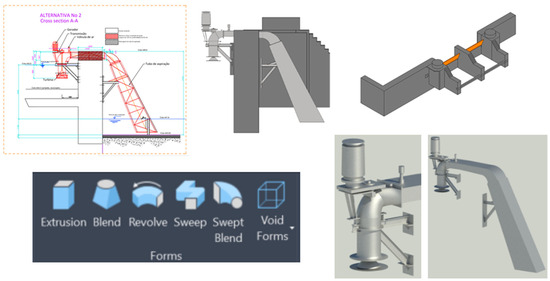
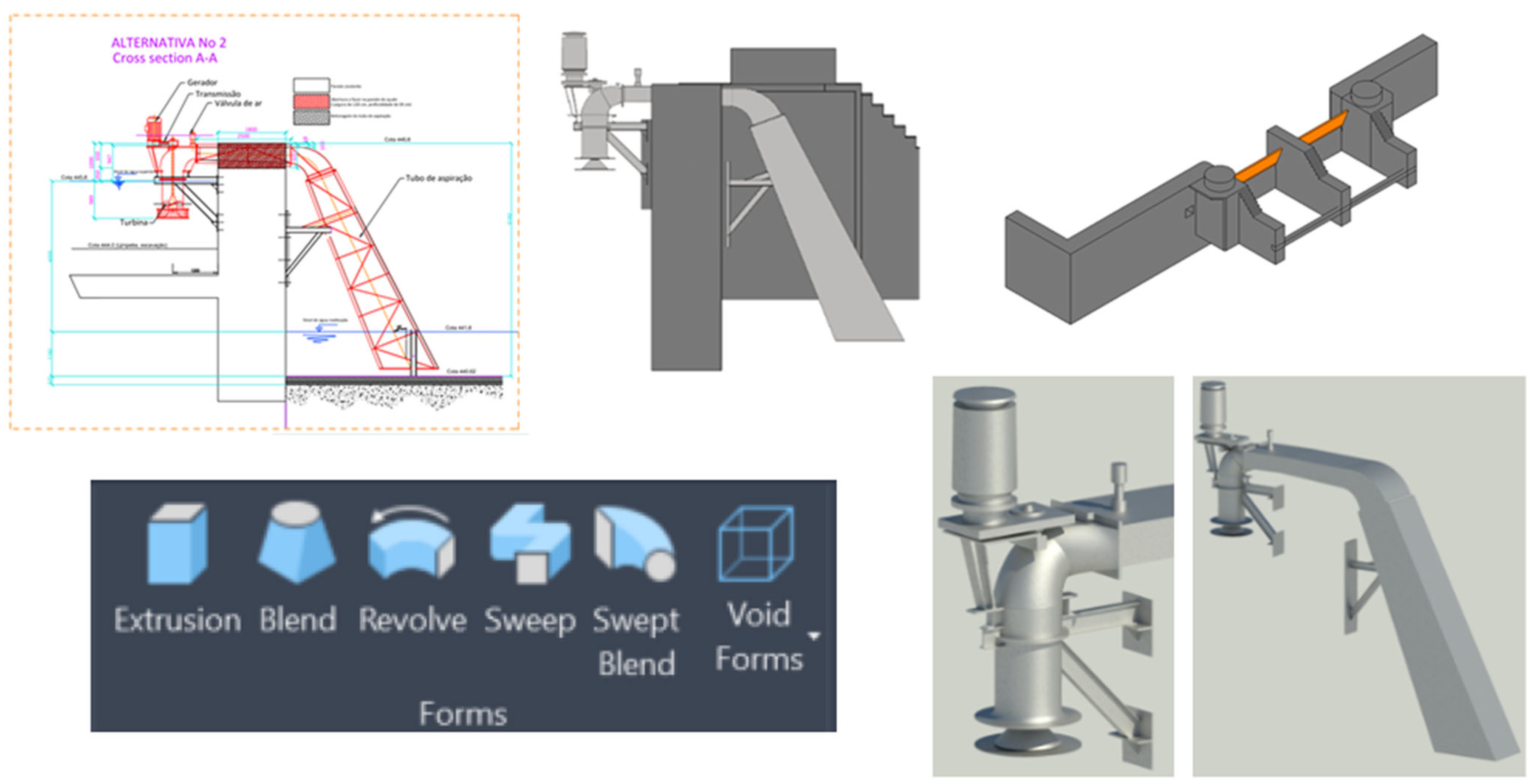
The turbine selected for this study is a siphon-type turbine manufactured by Mavel (Benesov, Czech Republic), model “Turbine TM5”, over the dam, to avoid civil works reconstruction. For the case under analysis, technical drawings were available: a representation of the turbine installed on the dam under study, including the downstream discharge pipes (Figure 2). For the modelling process, the drawing depicting the turbine already integrated into the dam was used as the primary reference. To model the turbine, a custom family was created in Revit. The AutoCAD representation of the solution was imported, with appropriate scaling applied. The turbine components were modelled using the following Revit functions:
Figure 2.
Revit functions used for shape generation and detailed rendering of the turbine model.
- Revolve for cylindrical and straight-axis modules;
- Swept Blend for curved segments with varying cross-sections;
- Extrusion for straight segments with constant cross-sections.
To enhance realism, the internal geometry of the turbine was also modelled. This was achieved by duplicating the previously created solid components, placing them in the same location, reducing their cross-sections to a thickness of 10 mm for the conduits, and converting these new elements into voids. The Cut function was then applied to subtract the voids from the solids, thereby creating internal cavities. For the modelling of the turbine supports, Extrusion was used for the metal plates and Sweep for the steel profiles shaped like “‡.” These modelling functions are illustrated in Figure 2. To facilitate understanding of the turbine model, several visual representations were extracted, presenting a general side view of the turbine, including the draft tube and its supports. The turbine itself is shown with a half-axis cut to reveal its interior. Additionally, two renderings were produced to improve the visual clarity of the model. Upon completion of the turbine model, the finalized family is imported into the Revit project and positioned at the designated location.
2.4. Economic Multi-Criteria Decision-Making (EMCDM)
Multi-Index Methodology (MIM) [12] is applied in this study for the economic evaluation of the hybrid renewable energy system. MIM represents an extended and more comprehensive alternative to the Classical Methodologies of Investment Analysis (CMIA), which primarily rely on a narrow set of financial indicators such as Net Present Value (NPV) and Internal Rate of Return (IRR) (Table 2). While CMIA can be effective for projects with stable financial conditions, it often lacks the depth required to assess capital-intensive and volatile projects, such as hybrid renewable systems. To address these limitations, MIM introduces a broader framework that evaluates both returns and risks across multiple dimensions. This allows for a more nuanced and reliable assessment of economic viability, especially in scenarios where uncertainty, variability, and long-term investment are involved.
Table 2.
Multi-index methodology.
According to [12,13], the use of MIM enhances decision-making by improving the visibility of both profitability and risk factors, making it particularly relevant for renewable energy investments. In this research, MIM is employed to evaluate the Hybrid Energy System under realistic financial conditions, enabling a more informed judgment on its economic feasibility.
Self-Sufficiency (SS) represents the proportion of the community’s electricity demand that is met by the hybrid energy system. It indicates how much of the total electricity consumption is supplied directly by the Hybrid Energy System, rather than relying on external sources such as the grid. This KPI is crucial as it reflects the system’s ability to independently satisfy the load demand, which is a key goal in enhancing energy autonomy and resilience. A higher SS value signifies greater reliance on local renewable generation. It is expressed as a percentage and calculated using the following formula:
Loss of Power Supply Probability (LPSP) is a key reliability indicator that quantifies the proportion of time during which the hybrid energy system is unable to meet the electricity demand of the community. It is extensively used in the assessment of hybrid renewable energy systems as a measure of system adequacy and performance:
where U(t) is binary indicator of unmet demand at time step t, Egen is electricity generation from Hybrid Energy System, and Eload is Electricity demand from the community at the specific hour (h).
where T is the total number of time steps (e.g., 8760 for one year of hourly data). The result is a value between 0% and 100%. LPSP = 0%, perfect system reliability (demand always met). LPSP = 100%, system never meets the load completely.
Power curtailment refers to the unused portion of electricity generated by the hybrid system when production exceeds demand and available storage capacity. This typically occurs during periods of high renewable output, such as midday for solar PV. In this study, curtailed energy is assumed to be exported to the public grid, but at a significantly lower tariff of about 67% less than the purchase price due to model default export assumptions. While curtailment reduces energy waste, elevated levels may indicate oversizing of generation assets and can negatively impact economic efficiency.
This formula is valid in case of no energy exported to the public grid and no storage used. The Levelized Cost of Energy (LCOE) quantifies the average cost of generating one kilowatt-hour of electricity over an energy system’s lifetime, accounting for both capital (CAPEX) and operational (OPEX) expenses. While infrastructure aging can increase maintenance costs, a constant value to maintain model stability across the 25-year projection was used. Future iterations of the framework could incorporate a non-linear degradation factor for maintenance costs. As a standardized metric, it enables cost-effectiveness comparisons across technologies and scales. In this study, LCOE is used to evaluate the economic viability of hybrid configurations by relating total system costs to total energy output.
2.5. Neural Network Structure
In this research, a nonlinear auto-regressive network with exogenous inputs (NARX) was used to consider the total renewable as input () and the output SS% () [22,23,24]. The selection of NARX is accomplished by highlighting its specific strengths for renewable energy (RE) time-series: (i) suitability—NARX is a dynamic recurrent network that excels at modelling nonlinear systems with memory. Its ability to capture the influence of both historical outputs (autoregressive) and external weather-dependent inputs (exogenous) makes it highly effective for RE data, which is governed by temporal patterns and meteorological variables; (ii) comparison to LSTM/GRU: while LSTM and GRU are powerful for very long-range dependencies in massive datasets, NARX often provides a more efficient and interpretable surrogate model for engineering applications where the feedback loop between input and output is direct and the dataset size is moderate. It offers high accuracy with faster training cycles for community-scale simulations.
The formula employed is presented as follows:
where represents the time.
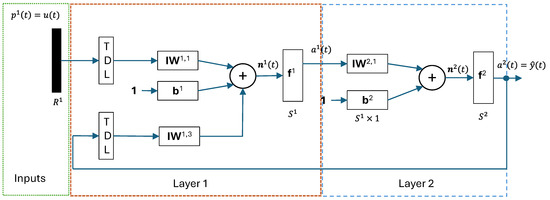
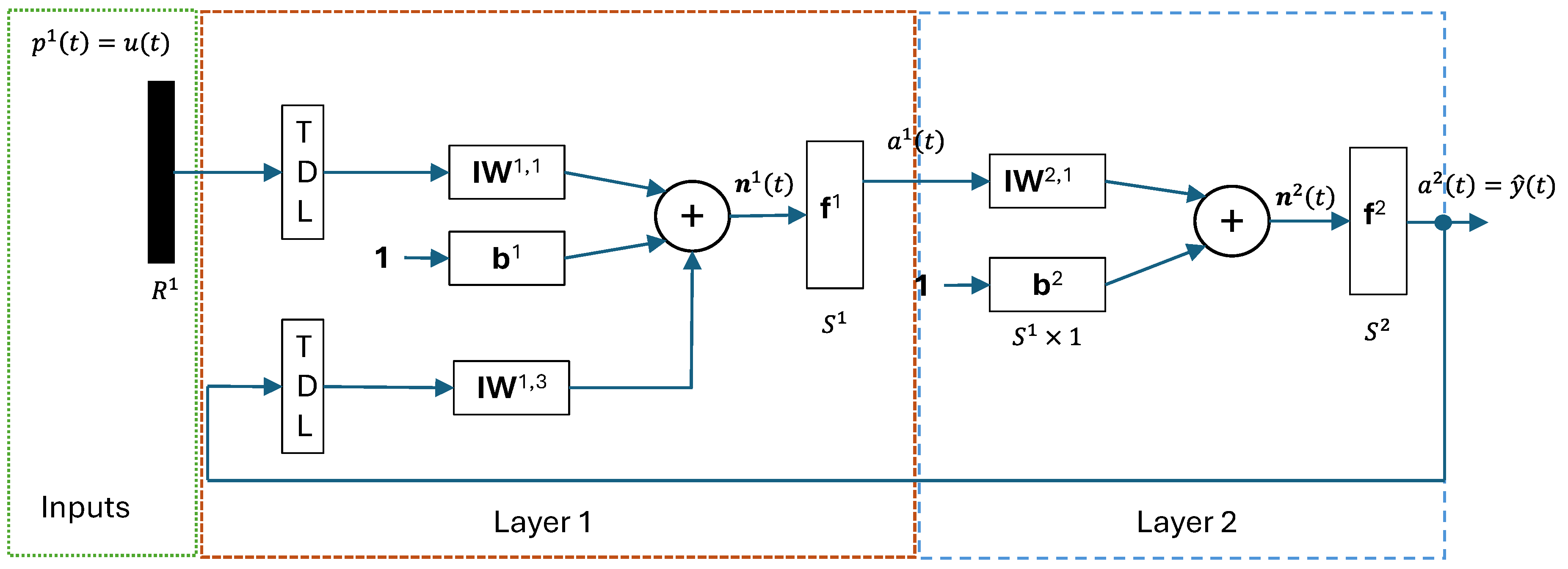
Figure 3 illustrates the structure of a two-layer feedforward network for function approximation, which can be employed in a vector ARX model where both inputs and outputs may be multidimensional. A tapped delay line (TDL) is used to fully exploit the linear component of the network, forming an N-dimensional vector of the input signal. In the analysis, the influence of each neuron is represented through the weight (IW), while the bias (b) term is incorporated into the activation function. A time delay of two months was applied in the neural network, with a hidden layer comprising ten neurons.
Figure 3.
Network defined with a two-layer feedforward.
The Levenberg–Marquardt algorithm was used to train the model with 70% of the available dataset. Consequently, 15% of the time series was employed for validation and the remaining 15% for testing. In this case, the Jacobian matrix has dimensions of Q × n, where Q is the number of training samples, and n is the number of weights and biases. The Jacobian matrix can be used to approximate the Hessian matrix as follows:
The implementation of this procedure involves the analysis of five scenarios, each considering different values of Total Renewable and SS, comprising a total of 3020 values.
The mean square error was used as the statistical measure, defined as follows:
where is the total number of observations of the time series, is the vector of observed SS values, and is the vector of predicted SS% values by the neural network.
For the NARX series, the correlation coefficient (R) is computed as follows:
where corresponds to the average of the observed SS values, and refers to the average of predicted values.
3. Results and Discussion
3.1. Hydraulic Design Specifications
The hydraulic head losses and turbomachine specifications are calculated to define the characteristic parameters of the power plant (Table 3).
Table 3.
Specifications of the turbine.
Different turbine flows were analysed to define the rated conditions, resulting in an average annual production of 138 MWh.
3.2. BIM Project Surrounding
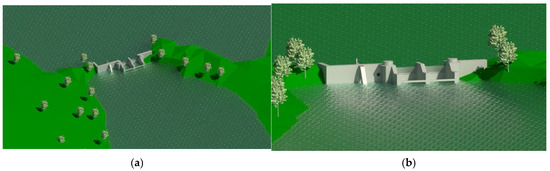
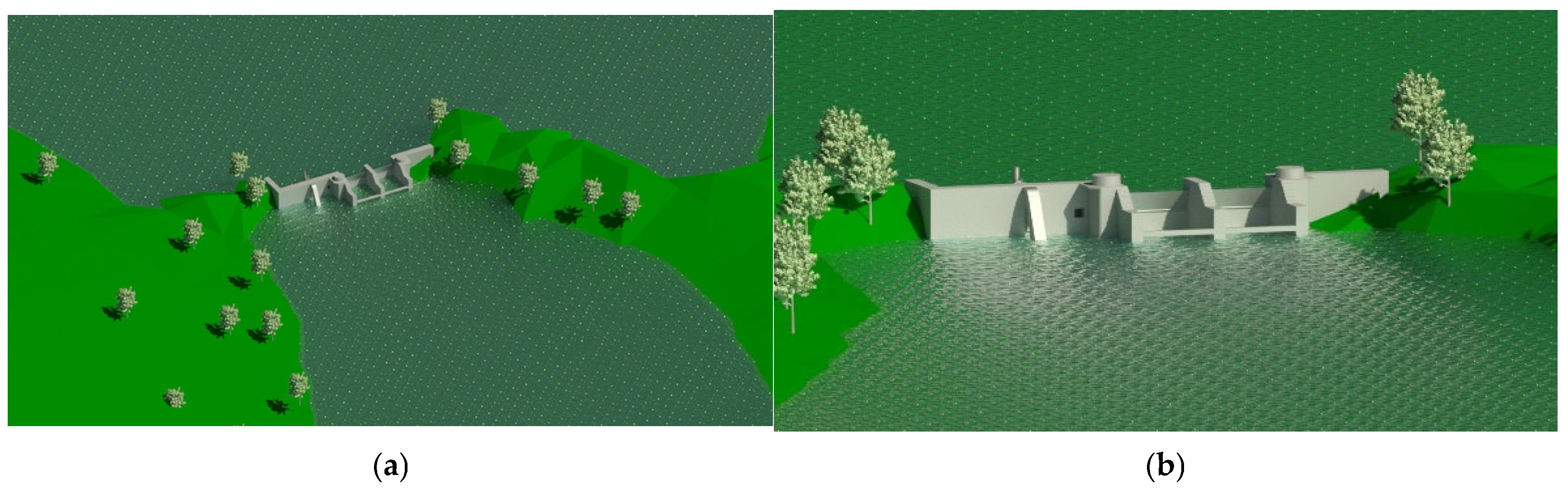
To ensure a comprehensive representation of the baseline hydropower system, the surrounding environment of the site was also modelled. This contextual modelling aimed to provide spatial coherence and facilitate the integration of the infrastructure within its natural and built environs. The topographic data were obtained from ArcGIS and subsequently processed in AutoCAD to generate contour lines and elevation profiles. These elements were then imported into Revit, where the ground was reconstructed using the Toposurface tool. This allowed for the creation of a three-dimensional terrain model that accurately reflects the site’s geographical features. In addition, key environmental and structural elements adjacent to the hydropower infrastructure were included. These components were modelled using simplified geometry to maintain visual clarity while preserving the spatial relationships essential for analysis and presentation. The integration of the surroundings into the BIM model enhances the project’s realism and supports further studies related to environmental impact, accessibility, and construction planning (Figure 4).
Figure 4.
Overview of hydropower system surroundings (a); downstream view (b).
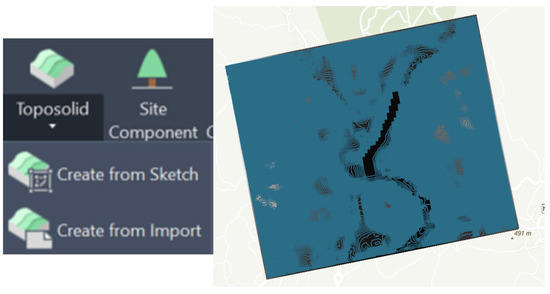
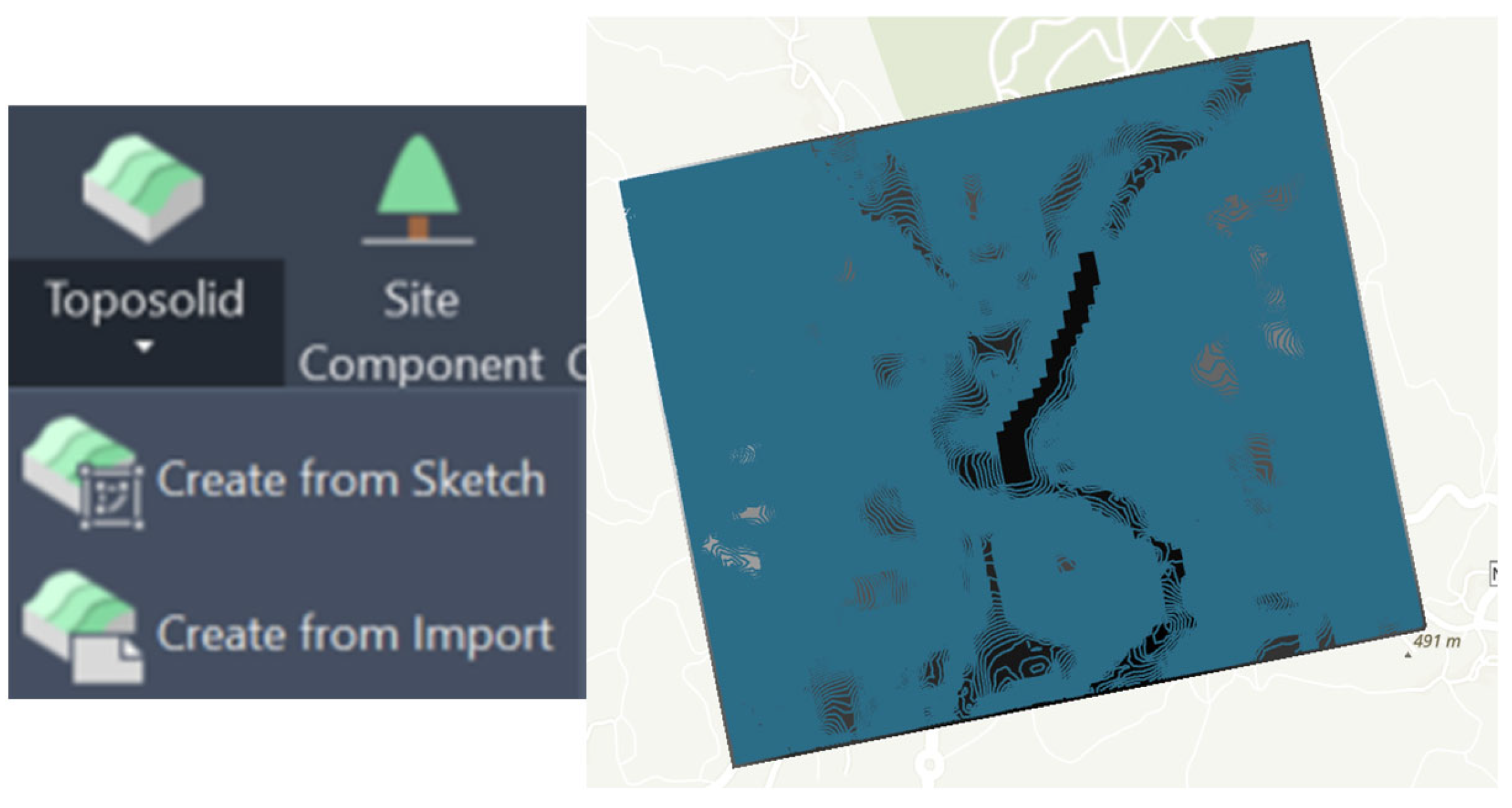
In AutoCAD, it was possible to verify the scale of the contour lines, which enabled their import into Revit. Within the Revit project, using the “Massing & Site” function, a “toposolid” was created by importing the AutoCAD file. The topographic correction was primarily based on the presence of a void beneath the structure, as well as along its lateral boundaries. To address this, points and lines were created to refine the appearance of the surrounding area, resulting in a representation that more closely reflects authenticity. Finally, several trees were modelled to enhance the practicality of the environment, as rendered in Figure 5.
Figure 5.
Rendering of the hydropower system development.
With this, the overall modelling process is considered complete, encompassing the dam structure, turbine, and surrounding environment.
3.3. Economic Multi-Criteria Decision-Making
The simulation integrates technical, economic, and multi-criteria analyses using PVsyst 8, HOMER Pro 3.18.4, Python 3.10.18 and Microsoft Excel 2024. Photovoltaic configurations were initially designed in PVsyst using site-specific solar data, then exported to HOMER Pro via the PVsyst Wizard to ensure compatibility. In HOMER Pro, a hybrid energy model was constructed incorporating electricity demand, hydrological and wind data, and component specifications (e.g., turbines, batteries, converters). The HOMER optimizer was used to size batteries and inverters for optimal performance and cost-efficiency.
3.3.1. Scenario Definition
Simulations were run over a 25-year horizon with hourly resolution (8760 h/year), assuming non-leap years. Results were analysed in Python and Excel to assess economic viability, sensitivity, and key performance indicators (KPIs) across five hybrid scenarios of ID solutions under both dry and wet conditions (Table 4).
Table 4.
Hybrid setup arrangements.
3.3.2. Neural Network Results
This section presents the results of the training conducted using the neural network structure shown in Figure 3. The five scenarios previously identified for the total renewable (input) and SS (output) time series were analysed. All calculations were performed using MATLAB R2024b. The time series dataset comprises 298 months, spanning from January 2026 to December 2050. The data was generated through an integrated simulation workflow:
- PVsyst was used for site-specific solar data and photovoltaic configurations.
- HOMER Pro integrated this with hydrological and wind data, component specifications, and electricity demand to create the hybrid energy model.
- MATLAB R2024b was then used for the Neural Network training and time-series analysis.
The mean square error (MSE) and coefficient of correlation (R) values (see Table 5) indicate excellent performance, confirming that the neural network provides an effective approach to time series prediction.
Table 5.
Performance metrics of the neural network.
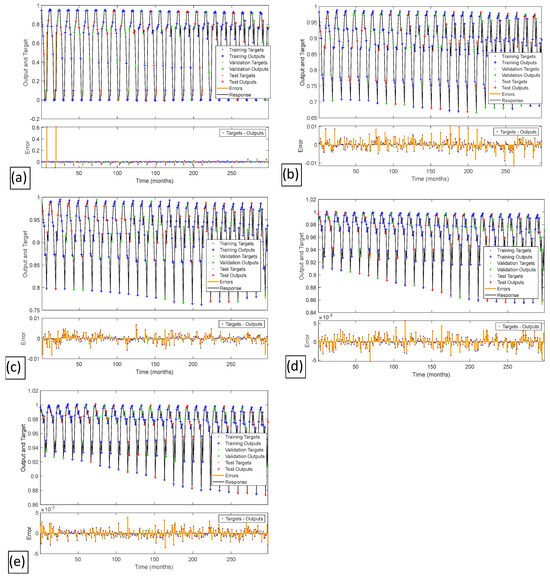
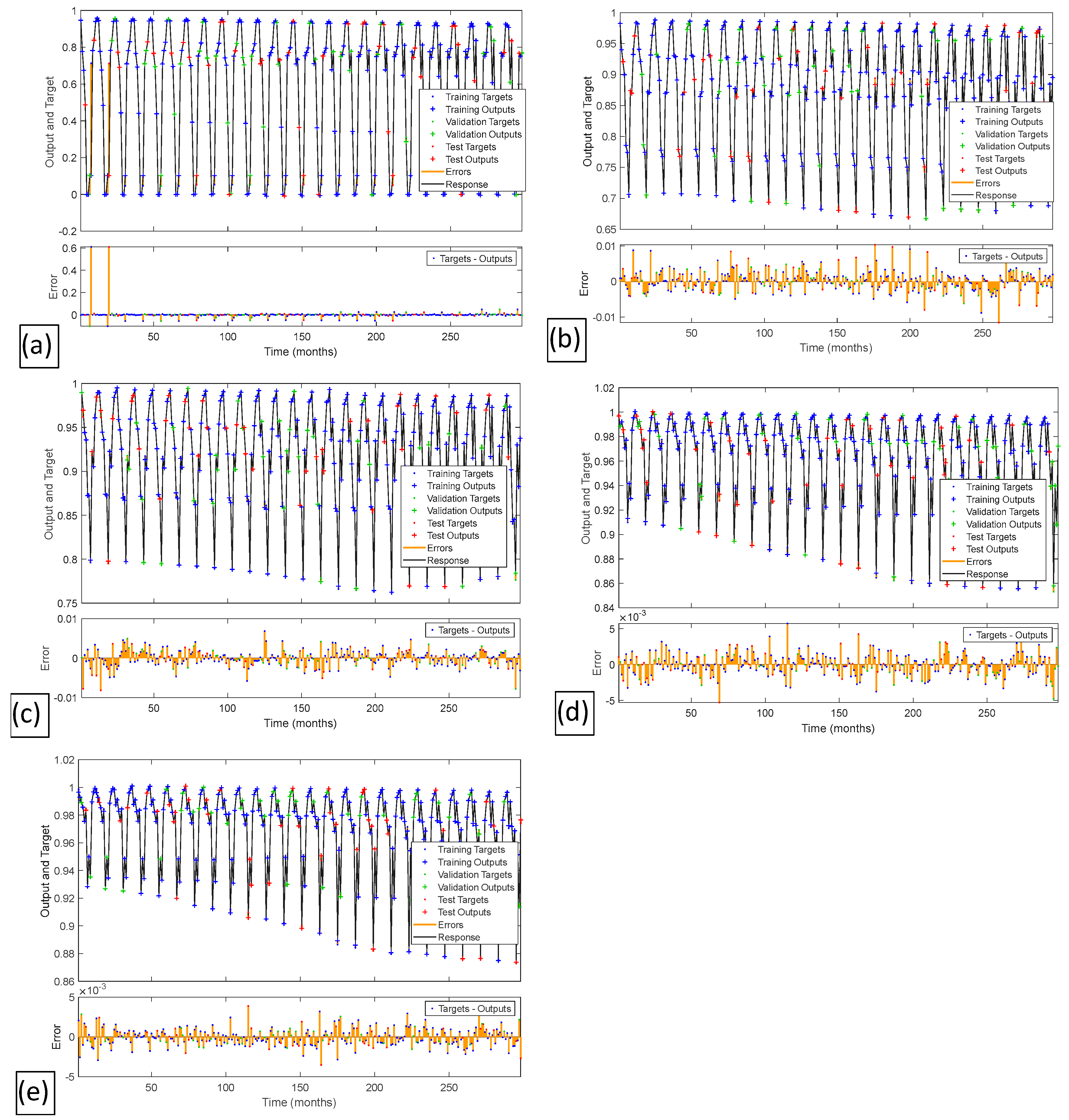
The SS time series were computed using the neural network structure shown in Figure 6. The prediction of the SS time series for the five scenarios is satisfactory when using total renewable as the input. The model response is illustrated by the black line, while the time-dependent error is shown by the yellow line in the lower part of each subfigure. Figure 6 illustrates the performance of a neural network in predicting SS% time series across five distinct scenarios, labelled (a) through (e). In each case, the top graph compares the true SS values with the predicted SS outputs, while the bottom graph tracks the error over time. In Figure 6a, the predicted SS aligns closely with the true values from the outset, and the error rapidly declines and stabilizes at a low level, suggesting slower learning dynamics and moderate predictive performance. In Figure 6b, it shows slightly less deviation between predicted and true SS values, with a constant error. In Figure 6c, similar behaviour to Figure 6b happened. In Figure 6d, the neural network achieves excellent alignment between predicted and true SS% values, as reflected in the sharp decline and stabilization of the error curve—this indicates effective learning. There was persistent alignment between SS_true and SS_predicted, with the error remaining quite small, which points to good fitting or adequate model generalization as well for Figure 6e. These last two scenarios demonstrate consistently strong agreement, with minimal error throughout the time series, reflecting optimal model performance and robust generalization across conditions. Overall, this figure highlights varying degrees of neural network effectiveness, with Figure 6b,d,e showing successful learning and prediction, while Figure 6c reveals limitations that may require further tuning or architectural adjustments. The error fluctuations observed in Figure 6 are primarily associated with high-gradient regions and extrema of the SS signal, reflecting the neural network’s adaptive response to variations in the observed data.
Figure 6.
Computation of SS time series using the neural network for: (a) Scenario 1; (b) Scenario 2; (c) Scenario 3; (d) Scenario 4; and (e) Scenario 5.
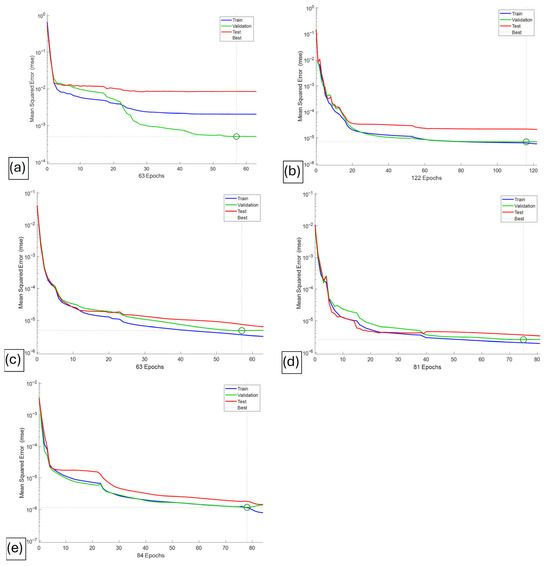
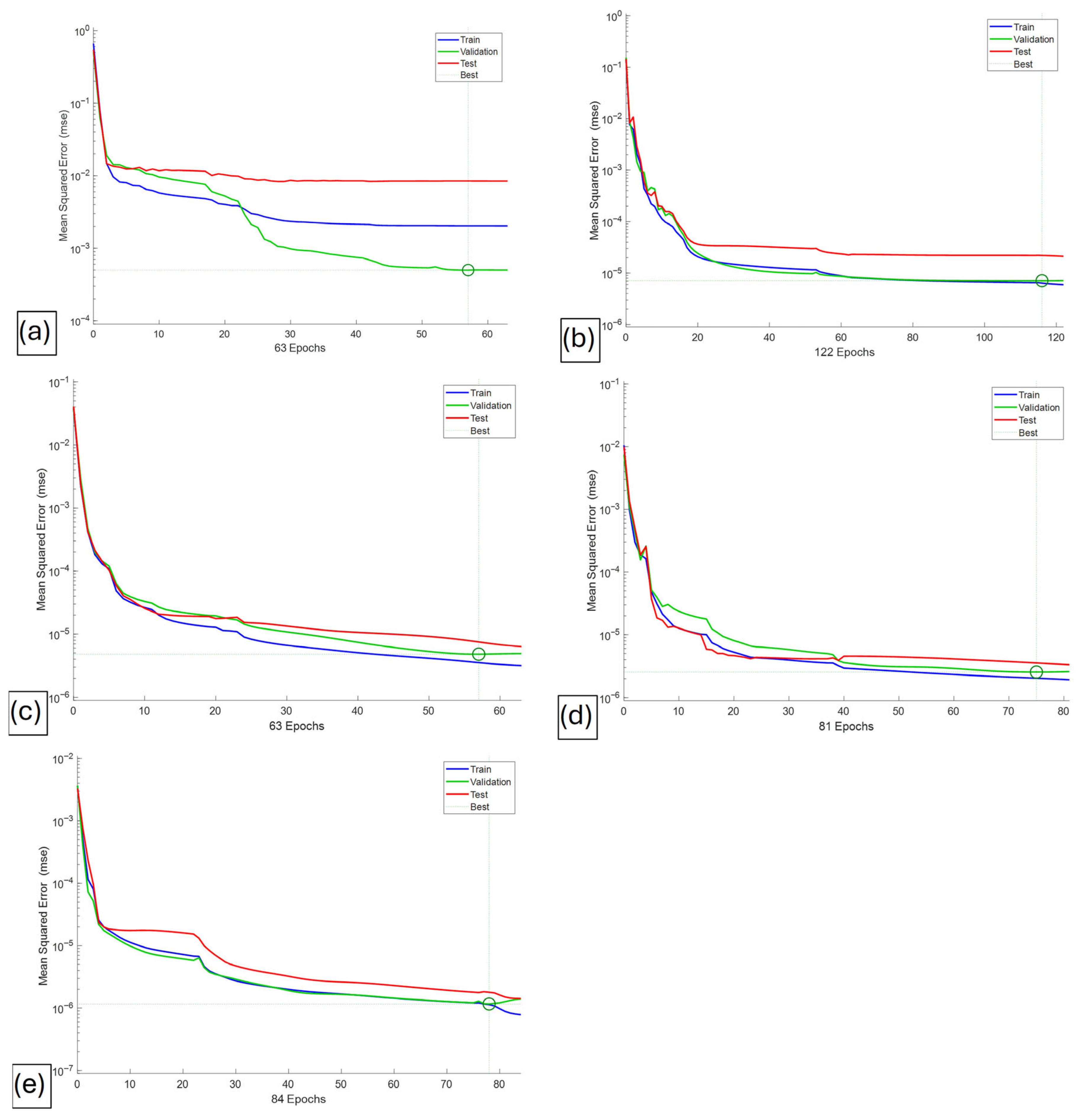
The epoch values for the five scenarios in the developed neural network were analysed (see Figure 7) to observe a complete training cycle. Ensuring that the model learns appropriately is essential, as this prevents both overfitting and underfitting of the neural network. Across all scenarios, the number of epochs achieved ranges from 63 to 122. Figure 7 highlights the epoch corresponding to the best performance for each scenario using a vertical dotted line. The associated mean square error (MSE) values are as follows: Scenario 1, 0.00049946 at epoch 57; Scenario 2, 7.1169 × 10⁻⁶ at epoch 116; Scenario 3, 4.7983 × 10⁻⁶ at epoch 57; Scenario 4, 2.5462 × 10⁻⁶ at epoch 75; and Scenario 5, 1.1645 × 10⁻⁶ at epoch 78.
Figure 7.
Calculation of epochs for: (a) Scenario 1; (b) Scenario 2; (c) Scenario 3; (d) Scenario 4; and (e) Scenario 5.
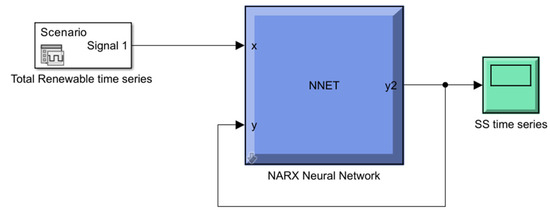
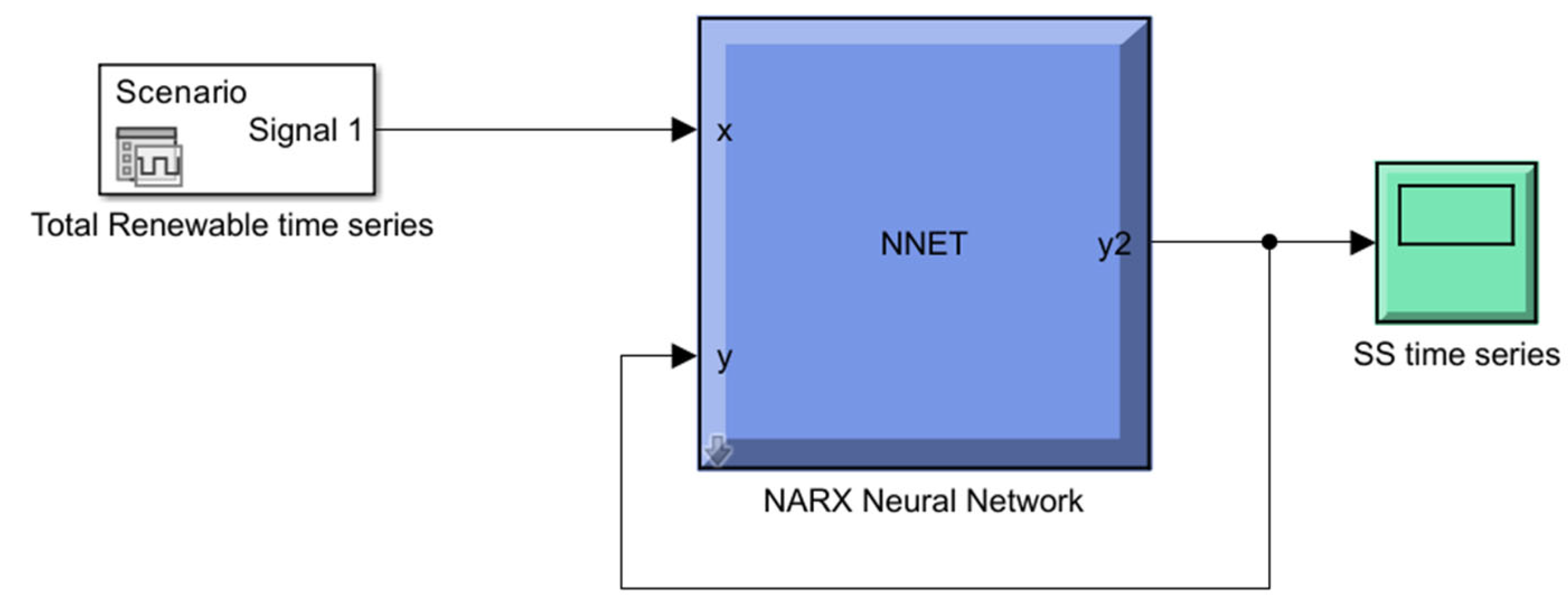
The results demonstrate that the neural network can be implemented as a practical tool for decision-makers to understand the behaviour of SS values using total renewables as input, thereby simplifying the interpretation of the system. In this regard, the neural network can also be exported to the Simulink environment (see Figure 8) for easy calculations.
Figure 8.
Neural network exported to Simulink environment.
Figure 8 presents a block diagram of a NARX (Nonlinear Autoregressive with Exogenous Inputs) neural network architecture used for time series prediction in different renewable energy scenarios. The diagram illustrates the flow of data through the model and highlights its feedback structure. On the left, the input block labelled “Scenario” provides two key signals: Signal 1 and the Total Renewable time series. These represent the exogenous inputs that influence the system’s behaviour. These inputs are fed into the central block labelled “NNET”, which represents the NARX neural network. The NNET block receives:
x: the external input signals from the Scenario block.
y: a feedback signal from the output y2, forming the autoregressive loop typical of NARX models.
The output of the NNET block is labelled “y2”, which represents the predicted or simulated output of the system. Finally, y2 is directed to the “SS time series” block, indicating that the network’s output is used to generate or reconstruct the time series. This architecture captures both the influence of external inputs and the system’s own past outputs, making it well-suited for modelling dynamic systems with memory, such as renewable energy generation patterns. The feedback loop enhances temporal learning, allowing the network to adapt to evolving conditions and improve prediction accuracy over time.
3.3.3. Technical and Economic KPIs
Technical and economic KPIs are defined across all hybrid configurations under different operational conditions. The framework is built precisely to assist decision-makers in these situations: In drought modelling, the use of the “Dry Year” scenario serves as a proxy for severe climate events like prolonged droughts, allowing stakeholders to see the “worst-case” technical and economic outcomes. The decision Support with AHP “Power Security” perspective specifically assists decision-makers by prioritizing energy resilience (high self-sufficiency and low loss of power supply) over immediate financial gains. The backup planning in the framework allows for the identification of configurations like ID4 or ID5 (incorporating battery storage), which can be evaluated against ID3 to see if the added cost of batteries provides enough “backup” security during extreme periods. Table 6 presents a comparative analysis of technical and economic key performance indicators (KPIs) for all five hybrid energy solutions under both dry and wet year conditions. This table serves as a comprehensive reference for scenario-wise comparison of system reliability (SS%, LPSP%), energy efficiency (Curtailment), and financial outcomes (NPV, IRR, Payback). From a technical standpoint, the SS% values indicate the reliability of each system, with Scenario 5 achieving the highest value—86.10% in dry years and 97.85% in wet years—demonstrating superior operational stability. In contrast, Scenario 1 shows the lowest SS values, suggesting limited reliability. The loss of power supply probability (LPSP) further reinforces this trend, with Scenario 5 exhibiting the lowest LPSP around 16%, while Scenario 1 records the highest values, reaching 75.89% in dry years. Curtailment values, which reflect unused energy, vary across scenarios; although, Scenario 5 has relatively high curtailment (24,020 kWh in dry years), similar to Scenario 3, indicating potential inefficiencies in energy utilization.
Table 6.
Technical and economic KPIs for the tested hybrid solutions.
Economically, the Net Present Value (NPV) and internal rate of return (IRR) provide insight into the financial viability of each solution. Scenario 3 stands out with the highest NPV for the Community and Industry model ($153,700), as well as the strongest IRR of 17.71%, suggesting robust investment potential. Scenario 1, by contrast, yields the lowest NPV, indicating a bit lower economic attractiveness. Payback periods further differentiate the scenarios; Scenarios 2 and 3 offer relatively short payback times (~6.7 years for Community and Industry), while Scenarios 4 and 5, despite their high returns, require a bit longer payback period of 7.4 years. Overall, Scenarios 3 and 5 emerge as the most balanced and high-performing options, combining technical reliability with strong economic returns, whereas Scenario 1 appears the least favourable across both dimensions.
Table 7 presents a detailed comparison of EMCDM indicators across all hybrid configurations (ID 1–5) within the Community and Industry operational models. The analysis is based on a Minimum Required Return (MRA) of 10% and an expected Payback period of 12 years (used to calculate the Payback/N index). These benchmark values help assess the financial feasibility and relative profitability of each configuration.
Table 7.
EMCDM results for Community and Industry solution.
Among the ID solutions, ID-3 stands out as an optimal solution even with ±10% variation in hardware costs affecting the ROIA/MRA Index, showing strong performance in both wet and dry years. ID3 yields the highest ANPV (€10,905/€4501) and ROI (155%/64%), with the ROIA/MRA Index peaking at 539% in the dry year, indicating a substantial return above the investor’s required rate. Meanwhile, its Payback/N index of 55%/96% stays within the acceptable limit, meaning payback occurs well within the project lifespan. Overall, Table 7 acts as a quantitative decision benchmark, supporting stakeholders in selecting configurations that balance profitability, risk mitigation, and return expectations.
The Levelized Cost of Electricity (LCOE) remains remarkably stable across all ID solutions, ranging between 0.042 and 0.046 €/kWh for average hydrological conditions. This low variability indicates that system economics are not highly sensitive to configuration changes, and differences in profitability stem mainly from demand structure and curtailment rather than unit production costs. In contrast, the Dry Year scenario shows noticeably higher LCOE values (0.07–0.10 €/kWh), reflecting reduced hydropower availability and lower overall energy generation, which increases the unit cost. These results confirm that while ID solution choice influences technical reliability and profitability, LCOE remains a stable indicator for this case study.
3.3.4. Analytical Hierarchy Process
The primary objective is to provide a clear and transparent ranking of the different hybrid energy configurations, based on prioritized objectives. The model was designed around three distinct decision-making perspectives:
- Long-Term Profit: This objective emphasizes economic performance, with NPV and IRR as the highest-weighted indicators. Technical performance, such as SS%, is treated as a secondary priority. It aligns with private investors or public–private partnerships aiming for financial sustainability.
- Power Security: This objective prioritizes energy resilience (e.g., high self-sufficiency and low loss of power supply) over financial gains. It is suitable for stakeholders focused on energy autonomy, such as municipalities or isolated communities.
- Combined score: This method seeks to identify configurations that offer a well-rounded performance, balancing technical reliability and long-term economic benefits. It is designed to reflect a compromise between public interest and commercial feasibility.
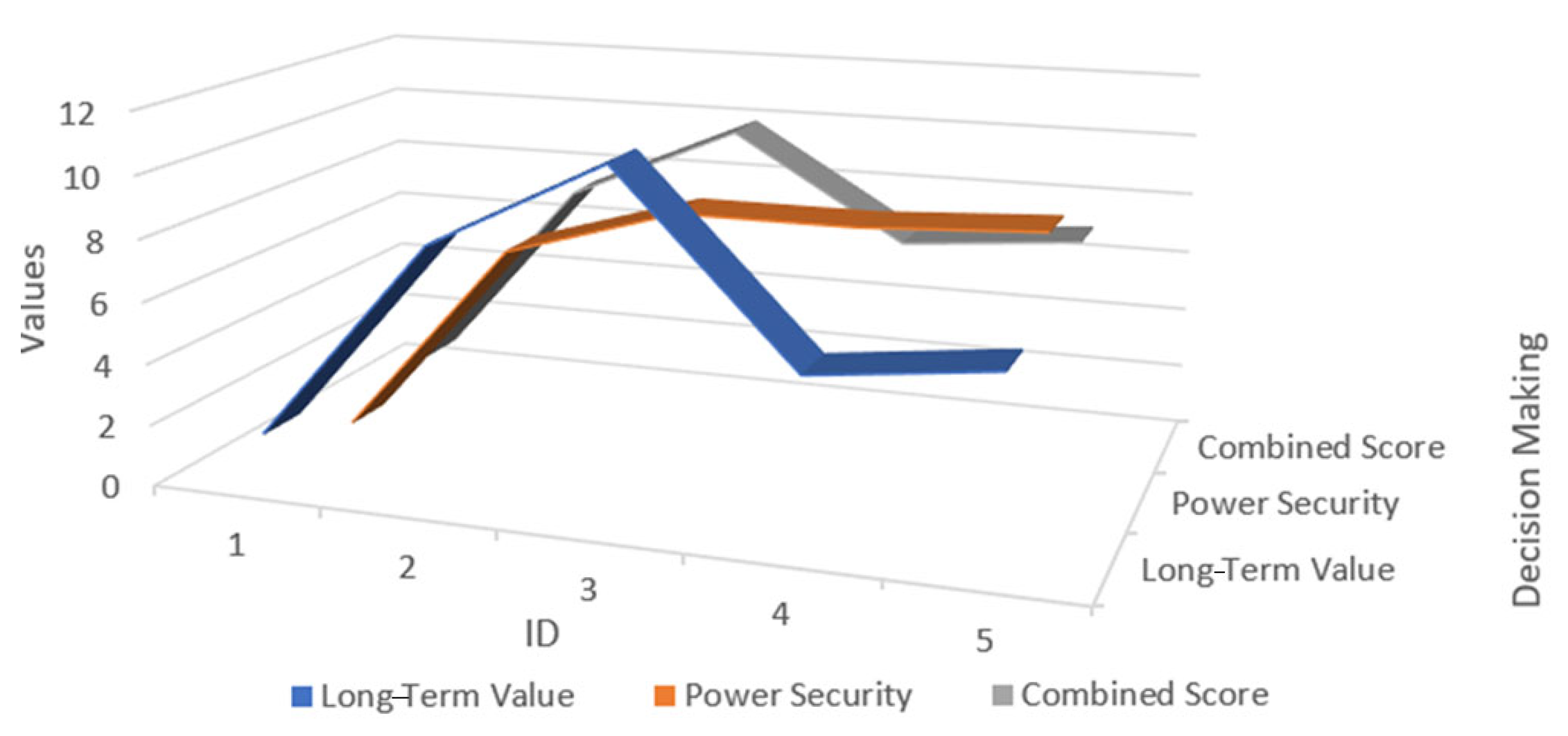
To support this decision process, the selected key performance indicators (KPIs) were used: Self-Sufficiency (SS%), Loss of Load Probability (LPSP), Net Present Value (NPV), Internal Rate of Return (IRR), and Payback period. These indicators are input criteria within the AHP structure. The Consistency Ratio (CR) was used to confirm that the logic used in these comparisons was mathematically consistent (CR < 0.1). Before applying AHP, all KPI values were normalized between 0 and 1 to ensure fair comparison across metrics with different units and scales. In Figure 9, where the objective is to prioritize long-term economic performance, ID 3 emerges as the top-ranked alternative in general for all criteria. This is followed by ID 2 in long-term and combined score and ID 5 in power security, which also performs well economically while requiring a slightly lower initial investment.
Figure 9.
EMCDM-AHP analysis application.
These results reflect the importance of optimizing the hybrid system type not only for maximum Net Present Value (NPV) and Internal Rate of Return (IRR) but also for keeping capital expenditures reasonable. ID 3 position confirms its strong profitability, while ID 2 demonstrates a more cost-efficient combined score between investment and return, making it also a viable choice for those seeking high long-term returns without excessive upfront costs.
4. Conclusions
This research presents a new methodology that integrates Building Information Modelling (BIM), Economic Multi-Criteria Decision-Making (EMCDM), Neural Networks, and the Analytic Hierarchy Process (AHP) to optimize the planning, design, and evaluation of hybrid renewable energy systems. The central goal is to enhance sustainability, technical performance, and economic viability by combining digital modelling tools with structured decision-making frameworks. Applied to a hydropower site, the study demonstrates how BIM plans and visualizes infrastructure, while EMCDM and Neural Network analysis evaluate financial feasibility across multiple scenarios, and AHP captures stakeholder preferences.
As a decision-support tool, the methodology moves beyond traditional static analysis by providing a dynamic “Digital Twin” environment. It enables the selection of optimal energy configurations by balancing criteria such as self-sufficiency, investment return, and payback period. In the case study, the configuration combining hydropower, photovoltaic, and wind energy (ID 3) emerged as the most favourable. Using a Minimum Required Return (MRA) of 10%, ID 3 proved its robustness as a low-risk investment, delivering high ANPV (€10,905 in wet years; €4501 in dry) and an exceptional ROIA/MRA Index (up to 539%). For investors, this clarifies the “safety margin” of the project, showing that even in unfavourable climatic conditions, the configuration remains financially superior.
For energy policy-makers, this framework offers a scientific blueprint for the transition to decentralized, smart energy communities. The study highlights that profitability differences stem more from demand management and curtailment than production costs (LCOE 0.042–0.046 €/kWh). This suggests that policy interventions should prioritize grid flexibility and local demand-side management rather than just generation subsidies. Furthermore, by incorporating the NARX neural network to predict self-sufficiency (with MSE < 0.0085), the framework provides a predictive capability that allows local governments to anticipate energy deficits and plan backup infrastructure or energy-sharing agreements well in advance.
Crucially, the comparison between “Wet” and “Dry” years provides a high-fidelity assessment of climate resilience. By explicitly showing how dry years raise LCOE to 0.07–0.10 €/kWh, the framework assists decision-makers in planning for severe climate events, such as prolonged droughts, ensuring that chosen configurations are not just profitable under average conditions but resilient under stress.
Overall, the methodology offers a transparent and adaptable framework that de-risks the adoption of hybrid renewables. It empowers stakeholders—from municipal planners to private investors—to make informed choices that reflect technical realities and long-term development goals. By bridging the gap between high-level policy targets and site-specific technical constraints, this integrated approach serves as a vital instrument for achieving regional energy autonomy and sustainable urban development.
Author Contributions
Conceptualisation: H.M.R. and O.E.C.-H.; Methodology: H.M.R., O.E.C.-H., A.P.F. and P.B.; validation and formal analysis: H.M.R., P.B., O.E.C.-H., F.-J.S.-R. and M.P.-S.; writing—original draft preparation: H.M.R., P.B. and O.E.C.-H.; writing—review and editing: H.M.R., A.P.F., O.E.C.-H. and M.P.-S.; supervision: H.M.R. and M.P.-S.; and final review: H.M.R., A.P.F., F.-J.S.-R., O.E.C.-H. and M.P.-S. All authors have read and agreed to the published version of the manuscript.
Funding
A scholarship was paid to one of the co-authors by the project HY4RES (Hybrid Solutions for Renewable Energy Systems) EAPA_0001/2022 from the INTERREG ATLANTIC AREA PROGRAMME.
Data Availability Statement
The original contributions presented in this study are included in the article. Further inquiries can be directed to the corresponding authors.
Acknowledgments
This work was supported by FCT, UID/6438/2025 CERIS, in the Hydraulic Laboratory, for experiments on pumped storage performance, and the project HY4RES (Hybrid Solutions for Renewable Energy Systems) EAPA_0001/2022 from the INTERREG ATLANTIC AREA PROGRAMME.
Conflicts of Interest
The authors declare no conflicts of interest.
Symbology
| AHP | Analytical Hierarchy Process |
| ANPV | Annualized Net Present Value (€) |
| BCR | Benefit–Cost Ratio |
| BIM | Building Information Modelling |
| Cf0 | Initial investment (€) |
| CMIM | Classical Multi-Index Methodology |
| EMCDM | Economic Multi-Criteria Decision-Making |
| EMIM | Extended Multi-Index Methodology (Maximum variation of MRA, Initial Investment) |
| IRR | Internal Rate of Return (%) |
| KPI | Key Performance Indicator |
| LCOE | Levelized Cost of Electricity (€/kWh) |
| LPSP | Loss of Power Supply Probability (%) |
| MCDC | Multi-Criteria Decision Comparison |
| MIM | Multi-Index Methodology |
| MRA | Minimum Required Return (%) |
| NPV | Net Present Value (€) |
| PB | Payback (years) |
| PV* | Present Value (€) |
| ROA | Real Option Analysis |
| ROI | Return on Investment (%) |
| ROIA | Additional Return on Investment (%) |
| SS | Self Sufficiency (%) |
References
- GhaffarianHoseini, A.; Tookey, J.; GhaffarianHoseini, A.; Naismith, N.; Azhar, S.; Efimova, O.; Raahemifar, K. Building Information Modelling (BIM) uptake: Clear benefits, understanding its implementation, risks and challenges. Renew. Sustain. Energy Rev. 2017, 75, 1046–1053. [Google Scholar] [CrossRef] [Scilit]
- Zhang, J.; Guo, Y.; Xu, M.; Zhang, R.; Shen, Y.; Zhang, K. Research on High Voltage Insulation Performance of Grounding Grid in Large Substation. IOP Conf. Ser. Earth Environ. Sci. 2021, 692, 022032. [Google Scholar] [CrossRef] [Scilit]
- Wangchuk, J.; Banihashemi, S.; Abbasianjahromi, H.; Antwi-Afari, M.F. Building information modelling in hydropower infrastructures: Design, engineering and management perspectives. Infrastructures 2024, 9, 98. [Google Scholar] [CrossRef] [Scilit]
- Wang, Y.; Schnabel, M.A.; Zhang, Y.; Wang, K.; Guo, F. AI-Enabled Digital Twins in the Built Environment: A Bibliometric Review of Applications, Trends, and Future Directions. Buildings 2026, 16, 809. [Google Scholar] [CrossRef] [Scilit]
- Iqbal, F.; Mirzabeigi, S. Digital Twin-Enabled Building Information Modeling–Internet of Things (BIM-IoT) Framework for Optimizing Indoor Thermal Comfort Using Machine Learning. Buildings 2025, 15, 1584. [Google Scholar] [CrossRef] [Scilit]
- Pohekar, S.D.; Ramachandran, M. Application of multi-criteria decision making to sustainable energy planning—A review. Renew. Sustain. Energy Rev. 2004, 8, 365–381. [Google Scholar] [CrossRef] [Scilit]
- Tomczewski, A.; Mikulski, S.; Szymenderski, J. Application of the Analytic Hierarchy Process Method to Select the Final Solution for Multi-Criteria Optimization of the Structure of a Hybrid Generation System with Energy Storage. Energies 2024, 17, 6435. [Google Scholar] [CrossRef] [Scilit]
- Wang, J.; Jing, Y.; Zhang, C.; Zhao, J. Review on multi-criteria decision analysis aid in sustainable energy decision-making. Renew. Sustain. Energy Rev. 2009, 13, 2263–2278. [Google Scholar] [CrossRef] [Scilit]
- Kabir, G.; Sadiq, R.; Tesfamariam, S. A review of multi-criteria decision-making methods for infrastructure management. Struct. Infrastruct. Eng. 2014, 10, 1176–1210. [Google Scholar] [CrossRef] [Scilit]
- Robles Algarín, C.; Polo Llanos, A.; Ospino Castro, A. An Analytic Hierarchy Process Based Approach for Evaluating Renewable Energy Sources. Int. J. Energy Econ. Policy 2017, 7, 38–47. Available online: https://hdl.handle.net/11159/1258 (accessed on 5 March 2025).
- Okosun, N.T. Multi-Criteria Analysis for Renewable Energy Infrastructure Planning. Master’s Thesis, Umeå University, Umeå, Sweden, 2022. Available online: https://umu.diva-portal.org/smash/get/diva2:1675534/FULLTEXT01.pdf (accessed on 20 May 2025).
- Richards, D.; Yabar, H.; Mizunoya, T.; Koon Koon, R.; Tran, G.H.; Esopere, Y. Sustainable solar energy deployment: A multi-criteria decision-making approach for site suitability and greenhouse gas emission reduction. Environ. Sci. Pollut. Res. 2025, 32, 2007–2035. [Google Scholar] [CrossRef] [Scilit] [PubMed]
- Mardani, A.; Jusoh, A.; Zavadskas, E.K.; Cavallaro, F.; Khalifah, Z. Sustainable and Renewable Energy: An Overview of the Application of Multiple Criteria Decision Making Techniques and Approaches. Sustainability 2015, 7, 13947–13984. [Google Scholar] [CrossRef] [Scilit]
- Peirow, S.; Astaraei, F.R.; Saifoddin, A. Techno-Economic and Environmental Assessment of a Hybrid Renewable Energy System for a Hospital Using Multi-Criteria Decision-Making Method. Energies 2023, 16, 1916. [Google Scholar] [CrossRef] [Scilit]
- Liu, H.; Tian, S.; Wang, X.; Cao, Y.; Zeng, M.; Li, Y. Optimal planning design of a district-level integrated energy system considering the impacts of multi-dimensional uncertainties: A multi-objective interval optimization method. IEEE Access 2021, 9, 26278–26289. Available online: https://ieeexplore.ieee.org/abstract/document/9337924 (accessed on 24 June 2025). [CrossRef] [Scilit]
- Dahal, S. BIM Based Design of Hydropower in Nepal: Lower Piluwa Small Hydropower Project. 2019. Available online: https://www.theseus.fi/handle/10024/264162 (accessed on 20 May 2025).
- Flenniken, J.M.; Stuglik, S.; Iannone, B.V. Quantum GIS (QGIS): An introduction to a free alternative to more costly GIS platforms: FOR359/FR428, 2/2020. EDIS 2020, 2020, 7. [Google Scholar] [CrossRef] [Scilit]
- Oyedepo, S.O.; Kilanko, O.; Babalola, P.O. Composite Multi-Criteria Decision Analysis for Optimization of Hybrid Renewable Energy Systems for Geopolitical Zones in Nigeria. Sustainability 2020, 12, 5732. [Google Scholar] [CrossRef] [Scilit]
- Mnyashanu, D.; Mbohwa, C. Multi-criteria planning of microgrids for rural electrification using fuzzy-AHP and HOMER Pro. J. Smart Environ. Green Comput. 2021, 1, 45–58. Available online: https://www.oaepublish.com/articles/jsegc.2021.06 (accessed on 20 May 2025).
- Prasetyo, A.R.; Nugroho, Y. Composite Multi-Criteria Decision Analysis for Optimization of Hybrid Renewable Energy Systems: IKN-Nusantara as a Case Study. In Smart Innovation in Green and Sustainable Energy (ICOME 2023); Springer: Singapore, 2024; pp. 481–491. Available online: https://link.springer.com/chapter/10.1007/978-981-97-8197-3_47 (accessed on 24 June 2025).
- Rueda Delgado, R.; Baca Ruíz, L.G.; Pegalajar Cuéllar, M.; Delgado Calvo-Flores, M.; Pegalajar Jiménez, M.d.C. A Comparison Between NARX Neural Networks and Symbolic Regression: An Application for Energy Consumption Forecasting. In Information Processing and Management of Uncertainty in Knowledge-Based Systems. Applications. IPMU 2018; Communications in Computer and Information Science; Medina, J., Ojeda-Aciego, M., Verdegay, J., Perfilieva, I., Bouchon-Meunier, B., Yager, R., Eds.; Springer: Cham, Switzerland, 2018; Volume 855. [Google Scholar] [CrossRef] [Scilit]
- Ben Saïd-Romdhane, M.; Boussaada, Z.; Curea, O.; Skander-Mustapha, S. Enhanced NARX Neural Network Model for Specific Time-Series Prediction. Case Study: Battery State of Charge in Electric Vehicles. In Proceedings of the 2023 14th International Renewable Energy Congress (IREC), Sousse, Tunisia, 16–18 December 2023; pp. 1–6. [Google Scholar] [CrossRef] [Scilit]
- Arellanos-Tafur, E.; Rojas-Arquinego, F.; Damas-Nino, M. Prediction of electrical energy generation from photovoltaic plants with NARX neural network. In Proceedings of the 23rd LACCEI International Multi-Conference for Engineering, Education, and Technology: “Engineering, Artificial Intelligence, and Sustainable Technologies in Service of Society”. Hybrid Event, Mexico City, Mexico, 16–18 July 2025. [Google Scholar]
- Ibrahim, M.M.; Elfeky, A.A.; El Berry, A. Forecasting energy production of a PV system connected by using NARX neural network model. AIMS Energy 2024, 12, 968–983. [Google Scholar] [CrossRef] [Scilit]

Disclaimer/Publisher’s Note: The statements, opinions and data contained in all publications are solely those of the individual author(s) and contributor(s) and not of MDPI and/or the editor(s). MDPI and/or the editor(s) disclaim responsibility for any injury to people or property resulting from any ideas, methods, instructions or products referred to in the content. |
© 2026 by the authors. Licensee MDPI, Basel, Switzerland. This article is an open access article distributed under the terms and conditions of the Creative Commons Attribution (CC BY) license.