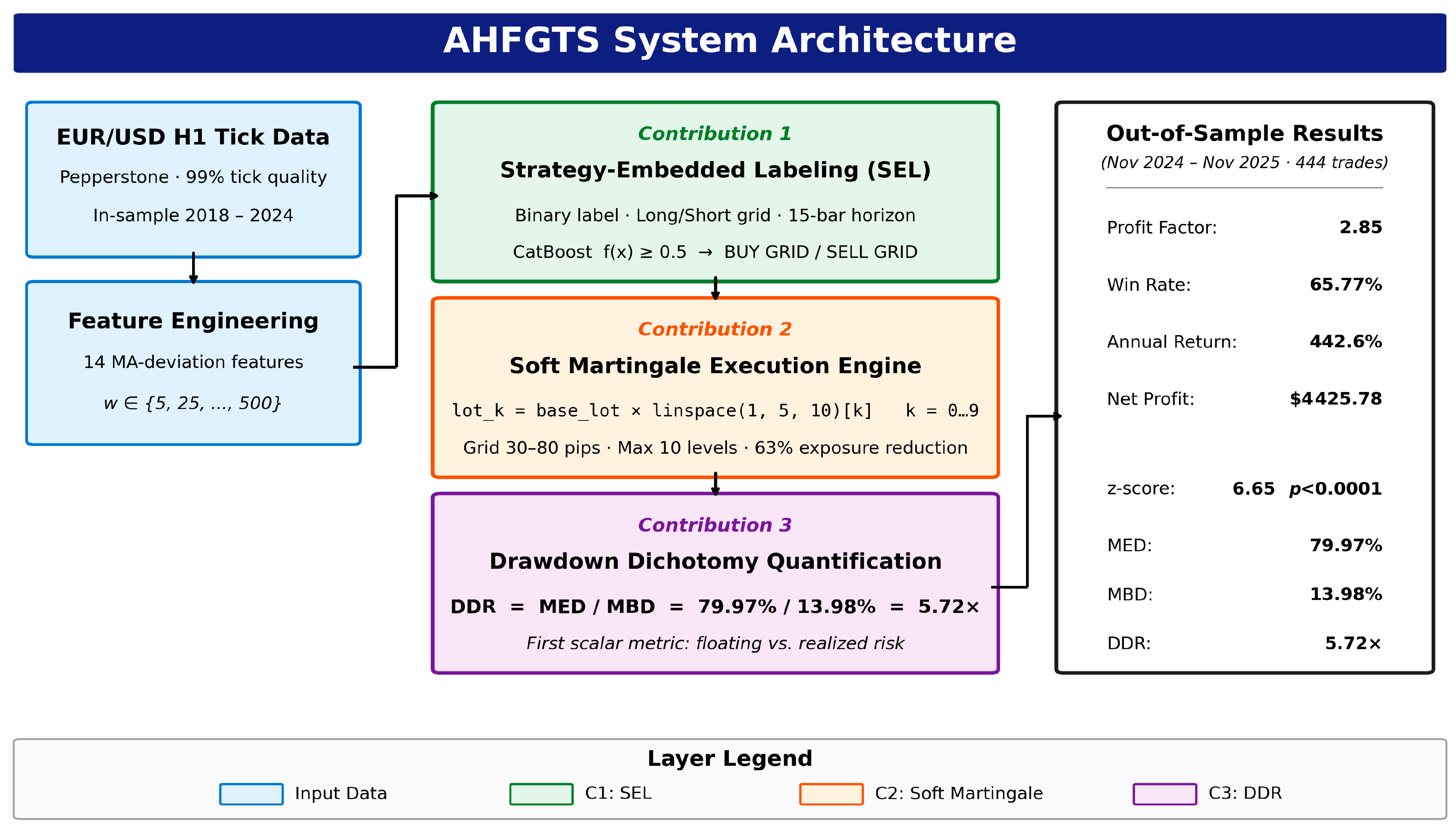


ML-Augmented High-Frequency Grid Trading: Strategy-Embedded Labeling, Soft Martingale Execution, and Drawdown Dichotomy Quantification

Abstract
1. Introduction
1.1. Research Objectives and Questions
- RQ1: To what extent can a gradient boosting classifier trained on moving-average deviation features generate statistically reliable directional signals in a high-frequency Forex environment?
- RQ2: Does the SEL framework produce statistically significant improvements in risk-adjusted trading performance relative to conventional directional labeling and random entry baselines?
- RQ3: How should an ML signal be integrated into a grid/martingale execution engine to control excessive capital exposure during adverse price excursions?
- RQ4: What is the trade-off between profitability and financial sustainability in the AHFGTS, and how effectively does Soft Martingale scaling limit maximum equity drawdown relative to classical doubling?
1.2. Original Contributions

| Dimension | AHFGTS (This Study) | GTSbot [6] | Yeh et al. [7] | Horizon/Meta-Label [4] | Classical 2× Martingale |
|---|---|---|---|---|---|
| Training label | Strategy-embedded (grid-payoff sim.) | Horizon direction | Horizon return | Horizon direction/meta-filter | N/A (unsupervised) |
| Lot scaling | Soft Martingale (sub-linear) | Constant lot | Constant/adaptive | N/A | Geometric 2× |
| Risk metric reported | MBD, MED, and DDR | MBD only | MBD only | MBD only | MBD only |
| Formal characterization | Algorithm 1 and Algorithm 2; Definition 1 | Flowchart | Algorithmic sketch | Equation for label | Rule |
| Empirical verifiability | MT5 report + P&L log released | In-paper only | In-paper only | N/A | N/A |
| Algorithm 1. Strategy-Embedded Labeling (SEL). Time complexity , space , where T is the number of bars, H = 15 the forward horizon, and K = 10 the number of grid levels. On the in-sample split (T ≈ 40,000 H1 bars) this amounts to approximately 6 × 10⁶ grid-simulation micro-steps per epoch |
| Input: price series for ; lot coefficients ; |
| grid spacings (linspace(0.003, 0.008, K = 10) in quote units); markup ; horizon . |
| Output: labels and validity mask for . |
| 1: for to do |
| 2: ← ▷ horizon close |
| 3: ← − min {, …, } ▷ drawdown depth |
| 4: ← max {, …, } − ▷ drawup depth |
| 5: ← ( − ) − ▷ BUY market-order P&L seed |
| 6: ← ( − ) − ▷ SELL market-order P&L seed |
| 7: ← 0; ← 0 ▷ cumulative depth & BUY fills |
| 8: ← 0; ← 0 ▷ cumulative depth & SELL fills |
| 9: for to do |
| 10: if + ≤ then ▷ BUY pending k fills |
| 11: ← + ; ← + 1 |
| 12: ← + ( − + ) · − · |
| 13: end if |
| 14: if + ≤ then ▷ SELL pending k fills |
| 15: ← + ; ← + 1 |
| 16: ← + ( − + ) · − · |
| 17: end if |
| 18: end for |
| 19: if > ∧ > 0 then ← 0; ← 1 ▷ Long-grid preferred |
| 20: else if > ∧ > 0 then ← 1; ← 1 ▷ Short-grid preferred |
| 21: else ← ∅; ← 0 ▷ excluded from training |
| 22: end for |
| 23: return (, ) |
| Algorithm 2. Soft Martingale Execution per H1 bar with cumulative grid construction |
| Input: bar open price ; classifier ; ; |
| lot coefficients from linspace(1, 5, ); |
| grid distances from linspace(0.003, 0.008, ) quote units. |
| Output: one market order and up to pending orders submitted at bar . |
| 1: if not then return |
| 2: ) ▷ P(label = 1), i.e., Short-grid |
| 3: if then ← BUY else ← SELL |
| 4: if then |
| 5: ▷ signal-driven reversal |
| 6: end if |
| 7: if not then return |
| 8: , = , = ) |
| 9: ← 0 ▷ cumulative-distance anchor |
| 10: for to do |
| 11: ← + ▷ cumulative depth from |
| 12: ← − if = BUY else + |
| 13: ← round_to_step(, 0.01) |
| 14: , = , = ) |
| 15: end for |
1.3. Scope and Delimitations
1.4. Paper Organization
2. Related Work
2.1. Market Efficiency and Forex Predictability
2.2. Machine Learning in Forex Algorithmic Trading
2.3. Gradient Boosting: Foundations and Algorithm Selection
2.4. Grid Trading Theory and Martingale Risk
2.5. Risk Management and Sustainability in Algorithmic Trading
2.6. ML-Grid Integration: Prior Work and Identified Gaps
3. System Architecture and Methodology
3.1. Research Paradigm: Design Science Research
3.2. Mathematical Problem Formulation
3.3. Data Collection and Temporal Partitioning
3.4. Feature Engineering: Multi-Scale MA Deviation Framework
3.5. Strategy-Embedded Labeling (SEL)
3.5.1. Motivation
3.5.2. Labeling Algorithm
3.6. Gradient Boosting Model and GMM Augmentation
3.6.1. Algorithm Selection
3.6.2. Class Imbalance and GMM Augmentation
3.6.3. Hyperparameters and Model Selection
3.7. Soft Martingale Execution Architecture
3.7.1. MetaTrader 5 Agent Design
3.7.2. Grid Structure and Lot Scaling
3.8. Evaluation Methodology and Baselines
3.9. Grid Size Calibration and Market Microstructure
3.10. Computational Architecture and MQL5 Deployment
4. Empirical Results
4.1. Simulation Configuration
4.2. Aggregate Financial Performance
| Metric | Value | Benchmark/Interpretation |
|---|---|---|
| Initial Deposit | USD 1000 | Starting capital |
| Total Net Profit | USD 4425.78 | 442.6% annualized return |
| Ending Balance | USD 5425.78 | 5.43× capital growth |
| Profit Factor | 2.85 | ≥2.0: robust edge |
| Overall Win Rate | 65.77% | 292 of 444 trades |
| Total Trades | 444 | ~1.7 per trading day |
| Gross Profit | USD 6823.95 | Cumulative winner P&L |
| Gross Loss | USD −2398.17 | Cumulative loser P&L |
| Sharpe Ratio | 1.20 | Acceptable risk-adjusted return |
| Max. Balance DD (MBD) | 13.98% | Realized equity peak-to-trough |
| Max. Equity DD (MED) | 79.97% | Floating equity incl. open positions |
| DDR | 5.72× | MED/MBD structural risk metric |
| Leverage Applied | 1:500 | Offshore broker condition |
4.3. Directional Signal Accuracy (RQ1)
| Direction | Trades | Won | Win Rate | vs. 50% |
|---|---|---|---|---|
| Long (Buy Grid) | 238 | 169 | 71.01% | +21.01% |
| Short (Sell Grid) | 206 | 123 | 59.71% | +9.71% |
| Overall | 444 | 292 | 65.77% | Z = 6.65, p < 0.0001 |
4.4. SEL Efficacy (RQ2)
| Criterion | SEL (This Study) | Horizon Labeling [4] |
|---|---|---|
| Label Source | Simulated 15 bar grid P&L | Price return sign at horizon |
| Execution Alignment | Direct: full payoff encoded | Indirect: directional proxy only |
| Ambiguous Label Exclusion | Yes (~15% bars excluded) | No: all bars labeled |
| Profit Factor Achieved | 2.85 | 1.20–1.50 (lit. baseline) |
| Improvement vs. Baseline | +90% to +138% | Reference (0%) |
4.5. Soft Martingale and Adaptive Exposure Control (RQ3)
| Level | Entry Price | Soft Lots | Classic Lots | Reduction |
|---|---|---|---|---|
| 0 | 1.05497 (Market) | 0.04 | 0.04 | - |
| 1 | 1.05141 (−35.6 pips) | 0.04 (1.00×) | 0.08 (2.00×) | −50% |
| 2 | 1.04753 (−74.4 pips) | 0.06 (1.50×) | 0.16 (2.00×) | −62% |
| 3 | 1.04280 (−121.7 pips) | 0.08 (1.33×) | 0.32 (2.00×) | −75% |
| Total (4 levels) | 0.22 lots | 0.60 lots | −63% |
4.6. Financial Sustainability and Leverage Analysis (RQ4)
| Dimension | AHFGTS Result | Benchmark |
|---|---|---|
| Max. Balance Drawdown | 13.98% | <20% (low risk) |
| Max. Equity Drawdown | 79.97% | ≤30% (fund-halt) |
| Drawdown Dichotomy (DDR) | 5.72× | ≤1.5× (non-martingale) |
| Net Annual Return | 442.6% | 20–40% (systematic funds) |
| Margin 1:500 at 4 levels | USD 46.20 (viable) | Reference |
| Margin 1:30 ESMA at 4 levels | USD 1925 (margin call) | Not viable retail |
4.7. Comparative Performance Benchmark
4.8. The Drawdown Dichotomy: Floating vs. Realized Risk in Martingale Systems
4.9. Feature Importance and Signal Quality
4.10. Adaptive Grid Reversal Dynamics
4.11. Cross-Regime Performance Decomposition
4.12. Failure Modes and Black-Swan Stress Analysis
5. Discussion
5.1. The Probability-Structure Trade-Off
5.2. SEL as a Generalizable ML Methodology
5.3. Drawdown Dichotomy Quantification as a Risk Disclosure Standard
5.4. Regulatory Bifurcation and Applicability Domain
5.5. Limitations and Threats to Validity
5.6. Implications for the ML-Grid Research Agenda
5.7. Ethical Considerations
6. Conclusions
- Formal Risk Disclosure.
| (i) The reported Profit Factor of 2.85 and the 442.6% annualized return are structurally coupled with the risk quantified by DDR = 5.72× (MED = 79.97% on USD 1000 starting equity); they are not achievable in isolation from that structural risk. (ii) The reported profitability is conditional on 1:500 leverage, market continuity (no price gaps or flash crashes that skip grid levels), and persistence of the EUR/USD H1 mean-reverting regime; under ESMA 1:30 or similar constraints the system is not retail-deployable as evaluated. (iii) The system as presented is a research demonstration of the SEL, Soft Martingale, and DDR methodologies; it is not a turnkey trading solution. (iv) DDR is proposed as a disclosure element for Martingale-family systems alongside, not instead of, MBD. |
Supplementary Materials
Author Contributions
Funding
Data Availability Statement
Conflicts of Interest
Abbreviations
| Abbreviation | Definition |
| AHFGTS | ML-Augmented High-Frequency Grid Trading System |
| AMH | Adaptive Markets Hypothesis |
| ATR | Average True Range |
| DDR | Drawdown Dichotomy Ratio |
| DSR | Design Science Research |
| EMH | Efficient Market Hypothesis |
| GMM | Gaussian Mixture Model |
| MA | Moving Average |
| MBD | Maximum Balance Drawdown |
| MED | Maximum Equity Drawdown |
| PF | Profit Factor |
| SEL | Strategy-Embedded Labeling |
| SR | Sharpe Ratio |
| ADF | Augmented Dickey–Fuller (unit-root test) |
| BGC | Bi-directional Grid Constrained (framework) |
| BIC | Bayesian Information Criterion |
| EFB | Exclusive Feature Bundling (LightGBM) |
| FNN | Feed-forward Neural Network |
| GOSS | Gradient-based One-Side Sampling (LightGBM) |
| KPSS | Kwiatkowski–Phillips–Schmidt–Shin (stationarity test) |
| LSTM | Long Short-Term Memory |
| MAE | Mean Absolute Error |
| OTS | Ordered Target Statistics (CatBoost) |
| SHAP | SHapley Additive exPlanations |
References
- Bank for International Settlements. Triennial Central Bank Survey: OTC Foreign Exchange Turnover in April 2022; BIS: Basel, Switzerland, 2022. [Google Scholar]
- Taranto, A.; Khan, S. Gambler’s Ruin Problem and Bi-directional Grid Constrained Trading and Investment Strategies. Investig. Manag. Finan. Innov. 2020, 17, 54–66. [Google Scholar] [CrossRef]
- Taranto, A.; Khan, S. Application of Bi-directional Grid Constrained Stochastic Processes to Algorithmic Trading. J. Math. Stat. 2021, 17, 22–29. [Google Scholar] [CrossRef]
- López de Prado, M. Advances in Financial Machine Learning; Wiley: Hoboken, NJ, USA, 2018. [Google Scholar]
- Hevner, A.R.; March, S.T.; Park, J.; Ram, S. Design Science in Information Systems Research. MIS Q. 2004, 28, 75–105. [Google Scholar] [CrossRef]
- Rundo, F.; Trenta, F.; di Stallo, A.L.; Battiato, S. Grid Trading System Robot (GTSbot): A Novel Mathematical Algorithm for Trading FX Market. Appl. Sci. 2019, 9, 1796. [Google Scholar] [CrossRef]
- Yeh, W.-C.; Hsieh, Y.-H.; Hsu, K.-Y.; Huang, C.-L. ANN and SSO Algorithms for a Newly Developed Flexible Grid Trading Model. Electronics 2022, 11, 3259. [Google Scholar] [CrossRef]
- Malkiel, B.G.; Fama, E.F. Efficient Capital Markets: A Review of Theory and Empirical Work. J. Financ. 1970, 25, 383–417. [Google Scholar] [CrossRef]
- Fama, E.F. Efficient Capital Markets: II. J. Financ. 1991, 46, 1575–1617. [Google Scholar] [CrossRef]
- Meese, R.A.; Rogoff, K. Empirical Exchange Rate Models of the Seventies: Do They Fit Out of Sample? J. Int. Econ. 1983, 14, 3–24. [Google Scholar] [CrossRef]
- Lo, A.W.; MacKinlay, A.C. Stock Market Prices Do Not Follow Random Walks: Evidence from a Simple Specification Test. Rev. Financ. Stud. 1988, 1, 41–66. [Google Scholar] [CrossRef]
- Lo, A.W.; Mamaysky, H.; Wang, J. Foundations of Technical Analysis. J. Financ. 2000, 55, 1705–1765. [Google Scholar] [CrossRef]
- Ayitey Junior, M.; Appiahene, P.; Appiah, O.; Bombie, C.N. Forex Market Forecasting Using Machine Learning: Systematic Literature Review and Meta-Analysis. J. Big Data 2023, 10, 9. [Google Scholar] [CrossRef]
- Lo, A.W. The Adaptive Markets Hypothesis: Market Efficiency from an Evolutionary Perspective. J. Portf. Manag. 2004, 30, 15–29. [Google Scholar] [CrossRef]
- Guyard, K.C.; Deriaz, M. Predicting Foreign Exchange EUR/USD Direction Using Machine Learning. In Proceedings of the 7th International Conference on Machine Learning and Machine Intelligence (MLMI), Osaka, Japan, 2–4 August 2024; pp. 1–14. [Google Scholar] [CrossRef]
- Yildirim, D.C.; Toroslu, I.H.; Fiore, U. Forecasting Directional Movement of Forex Data Using LSTM with Technical and Macroeconomic Indicators. Financ. Innov. 2021, 7, 1. [Google Scholar] [CrossRef]
- Nguyen, P.D.; Thao, N.N.; Kim Chi, D.T.; Nguyen, H.-C.; Mach, B.-N.; Nguyen, T.Q. Deep learning-based predictive models for forex market trends: Practical implementation and performance evaluation. Sci. Prog. 2024, 107, 00368504241275370. [Google Scholar] [CrossRef] [PubMed]
- Ntakaris, A.; Kanniainen, J.; Gabbouj, M.; Iosifidis, A. Mid-price prediction based on machine learning methods with technical and quantitative indicators. PLoS ONE 2020, 15, e0234107. [Google Scholar] [CrossRef]
- Friedman, J.H. Greedy Function Approximation: A Gradient Boosting Machine. Ann. Stat. 2001, 29, 1189–1232. [Google Scholar] [CrossRef]
- Chen, T.; Guestrin, C. XGBoost: A Scalable Tree Boosting System. In Proceedings of the 22nd ACM SIGKDD, San Francisco, CA, USA, 13–17 August 2016; pp. 785–794. [Google Scholar] [CrossRef]
- Ke, G.; Meng, Q.; Finley, T.; Wang, T.; Chen, W.; Ma, W.; Ye, Q.; Liu, T.-Y. LightGBM: A Highly Efficient Gradient Boosting Decision Tree. In Advances in Neural Information Processing Systems 30; Neural Information Processing Systems Foundation, Inc.: San Diego, CA, USA, 2017; Volume 30, pp. 3149–3157. [Google Scholar]
- Prokhorenkova, L.; Gusev, G.; Vorobev, A.; Dorogush, A.V.; Gulin, A. CatBoost: Unbiased Boosting with Categorical Features. In Advances in Neural Information Processing Systems 31; Neural Information Processing Systems Foundation, Inc.: San Diego, CA, USA, 2018; Volume 31, pp. 6639–6649. [Google Scholar]
- Edwards, A.W.F. Pascal’s Problem: The ‘Gambler’s Ruin’. Int. Stat. Rev. 1983, 51, 73–79. [Google Scholar] [CrossRef]
- Shoesmith, E. Huygens’ Solution to the Gambler’s Ruin Problem. Hist. Math. 1986, 13, 157–164. [Google Scholar] [CrossRef]
- Merton, R.C. Optimum Consumption and Portfolio Rules in a Continuous-Time Model. J. Econ. Theory 1971, 3, 373–413. [Google Scholar] [CrossRef]
- Brock, W.; Lakonishok, J.; LeBaron, B. Simple Technical Trading Rules and the Stochastic Properties of Stock Returns. J. Financ. 1992, 47, 1731–1764. [Google Scholar] [CrossRef]
- Chong, T.T.-L.; Ng, W.-K. Technical Analysis and the London Stock Exchange: Testing the MACD and RSI Rules Using the FT30. Appl. Econ. Lett. 2008, 15, 1111–1114. [Google Scholar] [CrossRef]
- Kelly, J.L., Jr. A New Interpretation of Information Rate. Bell Syst. Tech. J. 1956, 35, 917–926. [Google Scholar] [CrossRef]
- Bollinger, J.A. Bollinger on Bollinger Bands; McGraw-Hill: New York, NY, USA, 2002. [Google Scholar]
- Hastie, T.; Tibshirani, R.; Friedman, J. The Elements of Statistical Learning, 2nd ed.; Springer: New York, NY, USA, 2009. [Google Scholar]
- Sullivan, R.; Timmermann, A.; White, H. Data-Snooping, Technical Trading Rule Performance, and the Bootstrap. J. Financ. 1999, 54, 1647–1691. [Google Scholar] [CrossRef]
- Hamilton, J.D. A New Approach to the Economic Analysis of Nonstationary Time Series and the Business Cycle. Econometrica 1989, 57, 357–384. [Google Scholar] [CrossRef]
- Cohen, J. Statistical Power Analysis for the Behavioral Sciences, 2nd ed.; Lawrence Erlbaum Associates: Hillsdale, NJ, USA, 1988. [Google Scholar]
- Rodriguez-Gonzalez, A.; Garcia-Crespo, A.; Colomo-Palacios, R.; Guldrís Iglesias, F.; Gomez-Berbís, J.M. CAST: Using Neural Networks to Improve Trading Systems Based on Technical Analysis by Means of the RSI Financial Indicator. Expert Syst. Appl. 2011, 38, 11489–11500. [Google Scholar] [CrossRef]
- Murphy, J.J. Technical Analysis of the Financial Markets; NYIF: New York, NY, USA, 1999. [Google Scholar]
- Friedman, J.H. Stochastic Gradient Boosting. Comput. Stat. Data Anal. 2002, 38, 367–378. [Google Scholar] [CrossRef]
- Cheevirot, S. A Machine Learning Algorithm for High-Frequency Grid Trading in Foreign Exchange Market. Ph.D. Thesis, Department of Information Technology and Digital Innovation, King Mongkut’s University of Technology North Bangkok, Bangkok, Thailand, 2026. [Google Scholar]
- Wilder, J.W. New Concepts in Technical Trading Systems; Trend Research: Greensboro, NC, USA, 1978. [Google Scholar]

| Criterion | XGBoost [20] | LightGBM [21] | CatBoost [22] |
|---|---|---|---|
| Release Year | 2016 | 2017 | 2018 |
| Core Innovation | Regularized GBDT | GOSS + EFB | Ordered Boosting |
| Prediction Shift Prevention | No | No | Yes (critical) |
| Categorical Features | Manual encoding | Histogram-based | Native OTS |
| Training Speed | Moderate | Very fast | Moderate |
| Native C++/MQL5 Export | Partial | Partial | Yes (native) |
| Selected for AHFGTS | No | No | Yes |
| Scheme | Lot Schedule (First 4 Levels) | 4-Level Cumulative Lots | vs. Base (×) | Recovery Speed |
|---|---|---|---|---|
| Constant | 0.04, 0.04, 0.04, 0.04 | 0.16 | 4.0× | None |
| Square-root ( = 0.04 · √(k + 1)) | 0.04, 0.06, 0.07, 0.08 | 0.25 | 6.2× | Slow |
| Soft Martingale (this paper) | 0.04, 0.04, 0.06, 0.08 | 0.22 | 5.5× | Moderate |
| Fibonacci | 0.04, 0.04, 0.08, 0.12 | 0.28 | 7.0× | Moderate–fast |
| Classical 2× | 0.04, 0.08, 0.16, 0.32 | 0.60 | 15.0× | Fast (unbounded) |
| Metric | AHFGTS | Random Grid | Static Grid [6] | ML Only [13] |
|---|---|---|---|---|
| Profit Factor | 2.85 | ~1.20 | 1.2–1.5 | 1.3–1.8 |
| Win Rate | 65.77% | ~50% | 55–65% | 55–60% |
| Net Annual Return | 442.6% | 50–80% | 30–100% | 10–50% |
| Max. Balance DD | 13.98% | 30–50% | 40–60% | 10–25% |
| Max. Equity DD | 79.97% | ~90%+ | 80–95% | 15–35% |
| Regulatory Status | Offshore only | Offshore only | Offshore only | Universal |
| Risk Metric | Value | Classification |
|---|---|---|
| Max. Balance Drawdown (MBD) | USD 272.59 (13.98%) | Low: Well Within Benchmark |
| Max. Equity Drawdown (MED) | USD 1242.09 (79.97%) | Extreme: Martingale signature |
| Drawdown Dichotomy Ratio (DDR) | 5.72× | First formal scalar metric |
| Min. Account Equity | ~USD 311.35 | Peak grid depth exposure |
| Scenario | Adverse Move | Grid State | Probable Consequence |
|---|---|---|---|
| Sustained one-way trend | ~550 pips | All 10 pending levels filled; total 1.24 lots (market + 10 pendings) | Margin call highly probable; MED reaches the structural ceiling |
| Central-bank shock (gap open) | 500+ pip gap | Intermediate pending levels skipped; slippage beyond grid depth | Equity discontinuity exceeding stated leverage; outcome broker-dependent |
| Flash crash with rapid recovery | 200–300 pip round trip within minutes | Multiple levels activate then unwind | Survives if no broker stop-out, but MED spikes 80–90% during the event |
| Regime change to strong trend | Persistent directional drift | Frequent grid reversals; win rate falls below the ~54% break-even line | Progressive balance erosion; P&L turns negative over weeks |
Disclaimer/Publisher’s Note: The statements, opinions and data contained in all publications are solely those of the individual author(s) and contributor(s) and not of MDPI and/or the editor(s). MDPI and/or the editor(s) disclaim responsibility for any injury to people or property resulting from any ideas, methods, instructions or products referred to in the content. |
© 2026 by the authors. Licensee MDPI, Basel, Switzerland. This article is an open access article distributed under the terms and conditions of the Creative Commons Attribution (CC BY) license.
Share and Cite
Cheevirot, S.; Smanchat, S.; Nuchitprasitchai, S. ML-Augmented High-Frequency Grid Trading: Strategy-Embedded Labeling, Soft Martingale Execution, and Drawdown Dichotomy Quantification. Algorithms 2026, 19, 442. https://doi.org/10.3390/a19060442
Cheevirot S, Smanchat S, Nuchitprasitchai S. ML-Augmented High-Frequency Grid Trading: Strategy-Embedded Labeling, Soft Martingale Execution, and Drawdown Dichotomy Quantification. Algorithms. 2026; 19(6):442. https://doi.org/10.3390/a19060442
Chicago/Turabian StyleCheevirot, Seksin, Sucha Smanchat, and Siranee Nuchitprasitchai. 2026. "ML-Augmented High-Frequency Grid Trading: Strategy-Embedded Labeling, Soft Martingale Execution, and Drawdown Dichotomy Quantification" Algorithms 19, no. 6: 442. https://doi.org/10.3390/a19060442
APA StyleCheevirot, S., Smanchat, S., & Nuchitprasitchai, S. (2026). ML-Augmented High-Frequency Grid Trading: Strategy-Embedded Labeling, Soft Martingale Execution, and Drawdown Dichotomy Quantification. Algorithms, 19(6), 442. https://doi.org/10.3390/a19060442