
Article

Improved Dhole Optimization Algorithm for Optimal Parameter Estimation of PEMFC Models for High-Fidelity Energy Conversion


1
Department of Electrical Techniques, Polytechnic College of Engineering, Middle Technical University, Baghdad 10074, Iraq
2
Technical Instructor Training Institute, Middle Technical University, Baghdad 10074, Iraq
3
Water Resources Techniques Department, Polytechnic College of Engineering, Middle Technical University, Baghdad 10074, Iraq
4
College of Engineering, Gulf University, Sanad 26489, Bahrain
5
Department of Petroleum Engineering, College of Engineering, Al-Naji University, Baghdad 10015, Iraq
6
Department of Petroleum Engineering, College of Engineering, University of Baghdad, Baghdad 10071, Iraq
*
Author to whom correspondence should be addressed.
Algorithms 2026, 19(5), 385; https://doi.org/10.3390/a19050385
Submission received: 30 March 2026 / Revised: 24 April 2026 / Accepted: 4 May 2026 / Published: 11 May 2026
(This article belongs to the Special Issue AI-Driven Engineering Optimization)

Abstract

Proton Exchange Membrane Fuel Cells (PEMFCs) are crucial for the advancement of environmentally friendly hydrogen cars. It is one of the promising solutions for alternatives to conventional engines, primarily due to their ability to convert hydrogen into electricity. Fuel cell systems have a complex and non-linear mathematical model. Accurate identification of unknown parameters of the PEMFC mathematical model is an important aspect in energy conversion. This research intends to provide a novel meta-heuristic algorithm, which is known as the Improved Dhole Optimization Algorithm (IDOA), to estimate the unknown parameters of PEMFC models. The proposed IDOA is inspired by the collective hunting behavior of dholes. In this algorithm, candidate solutions are systematically arranged and dynamically updated to enhance the overall search process. The objective function is to minimize the sum of squared errors (SSE) between the actual and model-estimated voltages obtained using the proposed IDOA algorithm. In this research, three commonly known PEMFC benchmark models, NedStack PS6, BCS 500 W, and Horizon 500 W, are utilized to assess the performance of the IDOA algorithm. Also, the obtained results are compared against each other to validate their effectiveness. The comparative performance with an array of known optimization algorithms reported in the literature indicates that the IDOA algorithm has low estimation error, an excellent convergence rate, and superior robustness. Furthermore, these results support the appropriateness of the proposed IDOA algorithm for high-accuracy PEMFC modeling in energy conversion models.

1. Introduction

The world’s pursuit of reliable and sustainable energy systems has significantly increased the deployment of modern energy conversion technologies. One of the great concerns about developing sustainable energy sources is that rising fossil fuel costs are increasing pollution, and the growing impact of climate change has further encouraged a shift to low-carbon energy solutions [1].
Meanwhile, several alternative energy sources have been introduced to reduce the impacts of global climate change and support the reduction of carbon emissions [2,3,4], which have included fuel cell technologies, which have remained one of the promising alternatives with high conversion efficiency and lesser environmental impact, especially in the transportation applications sector [5]. The PEMFCs have a service life of about 8000 h, which makes FC systems competitive with other energy technologies [6]. Fuel cells are also an option for sustainable power generation since they are highly reliable, do not demand significant maintenance, and can be utilized with renewable power sources. These advantages have not only seen PEMFCs being utilized in niche industries like aerospace and defense, but they have also increased their application in electric vehicles and in handheld power systems. As a result, growing research interest has focused on PEMFC-related challenges, including thermal management, control strategies, and optimization of modeling performance [7,8,9]. Although these have been beneficial, the practical application and control of PEMFC systems heavily rely on the accuracy of realistic mathematical modeling that can replicate their nonlinear, dynamic, and multi-physical functions under a wide range of operational conditions.
Despite significant advancements in PEMFC development, the design and functioning of fuel cell stacks is still a complex task. In this regard, reliable electrochemical models are critical for analyzing their performance, strategy of control, and faults [3,4]. Manganese-doped bimetallic phosphide electrocatalysts demonstrate enhanced activity and stability during water splitting, which is particularly relevant for PEMFCs as they contribute to a broader understanding of optimizing electrochemical performance through innovative catalyst engineering [10].
In the same context, optimization of a hybrid multi-effect distillation (MED) system combined with permeate reprocessing reverse osmosis (PRRO) is investigated by system formulation as a constrained non-linear programming optimization problem [11]. Similarly, a multi-objective optimization framework based on particle swarm optimization is presented for effectively addressing trade-offs among competing performance criteria, including energy consumption, cost, and system reliability, which enhances the overall efficiency of the MED system [12].
In the recent decades, numerous modeling methods of PEMFC have been proposed, which vary in empirical complexity and physical detail. These models are commonly classified into two broad categories: physics-based (mechanistic) and semi-empirical models [13]. The Amphlett model has been widely adopted among the semi-empirical models because it strikes a balance between accuracy and simplicity, and it has also been widely tested in validation across different PEMFC systems [14]. Nonlinear least-squares fitting methods were the main early calibration methods for empirical and semi-empirical models that gave reasonable parameter estimates but were constrained to locally optimal solutions [15]. As PEMFC models and operating conditions became more complicated, these traditional methods were found to be limited. For example, they were sensitive to initial estimates and prone to local minima, which often required a lot of manual tuning. Therefore, the accurate estimation of parameters has emerged as a crucial challenge in PEMFC modeling studies [16,17,18]. Recently, there has been an increasing focus on nature-inspired metaheuristic optimization algorithms for parameter estimation, with the aim of addressing the shortcomings of the local minimization problem in classical optimization algorithms. Such nature-inspired search algorithms provide gradient-free improved strengths in non-homogeneous multimodal optimization surfaces, which are highly effective in optimization in PEMFC modeling problems [19,20].
The genetic algorithms (GA) [16,19] and the simple genetic algorithm (S-GA) [17] have been established as effective for identifying PEMFC parameters. In addition, numerous metaheuristic optimization algorithms have been implemented to estimate PEMFC model parameters, including war strategy optimization (WSO) [18], differential evolution (DE) [20], harmony search optimization (HSO) [21], grasshopper optimization algorithm (GOA) [22], teaching–learning-based optimization (TLBO) [23], multiverse optimizer (MVO) [24], slime mould algorithm (SMA) [25], and shark smell optimization (SSO) [26]. Additional algorithms, such as Harris hawks optimization (HHO) [27], bald eagle search (BES) [28], and grey wolf optimizer (GWO) [29], have confirmed varying capabilities in navigating complex, nonconvex error landscapes without reliance on gradient information. In addition to independent search-based optimization algorithms, hybrid optimization algorithms have also been proposed to improve the performance of the baseline algorithm by better balancing global exploration and local exploitation.
Some examples of enhanced baseline algorithms include hybrid artificial bee colony (HABC) algorithms [7], improved heap-based optimizer (IHBO) [9], hybrid adaptive differential evolution (HADE) [20], vortex search algorithm (VSA), differential evolution (DE) terms as VSADE [30], and the heterogeneous comprehensive learning-based bald eagle search (HCL-BES) algorithm, which integrates comprehensive learning mechanisms to improve convergence robustness [5]. Despite some thorough reviews of the reported PEMFC parameter identification methodologies [31], current research still aims to identify optimization schemes that attain faster convergence, enhanced performance in various FC designs, and stable applicability of PEMFC modules in real time [32].

Survey of Existing Studies

Empirical and semi-empirical PEMFC mathematical models began with pioneering work that established voltage–current relationships to the experimental data [5]. Amphlett et al. [15] developed an empirical model of the Ballard Mark IV fuel cell based on nonlinear regression to describe losses in activation and concentration yields, with characteristic predictions being made reliably over a limited operating range [19]. Later studies proposed simplified activation and ohmic overpotential formulations, which were used as a reference point in PEMFC model investigations [33]. The predictive ability was further increased with physics-based models that included the proton transport resistance and water management effects, although accuracy was easily determined by the choice of the parameters and system scaling [34,35]. Due to the shortcomings of conventional curve-fitting techniques, nature-based metaheuristic optimization algorithms have been actively applied in the parameter identification of PEMFCs. Evolutionary algorithms such as GWO, SSA, BES, MOV and HBO swarm-based algorithms have shown better resilience to stranger, multimodal error surfaces without using gradient information [8,9,26,36,37]. However, there are still challenges of premature convergence, computational expense, and parameter optimization especially in identification systems, which need to operate in real time [14]. The parameters of the PEMFC have been estimated accurately using the WSO algorithm, which is inspired by military strategies and employs dynamic rules for updating, which shows its effectiveness in a high-dimensional optimization problem [18]. In the same direction, an enhanced BES organizes the search into surveying, swooping, and capturing stages to balance exploration and exploitation.
In order to verify the enhanced BES algorithm, the application PEMFC estimation was studied using three fuel cell models [28,34]. PEMFC parameter estimation using a conventional genetic algorithm was studied by the authors in [19], who reported improved global search ability relative to gradient-based algorithms. However, the algorithm exhibited premature convergence produced by limited mutation diversity. Alternative estimation algorithms, including non-iterative resistance-based modeling [33] and an adaptive RNA-based genetic algorithm [16], have also been documented in the literature. Some studies have also examined optimization algorithms that are based on probabilistic and physics-inspired methods. For example, the authors in [9] introduced a HBO algorithm that accelerates the search process by using smart data structures. In the work [8], MVO was proposed to enhance the parameter estimates of PEMFC but exhibited limitations in effectively coordinating exploration and exploitation, particularly in scenarios with high-dimensional parameter spaces where traditional methods struggle to balance these two aspects.
Similarly, the shuffled multi-simplex search (SMS) algorithm is introduced [38], which excels at keeping a diverse set of solutions for multivariable optimization problems in addition to avoiding a local optima solution. Despite these advancements, population-based algorithms frequently necessitate extensive fine-tuning and can stall when addressing complex problems. To overcome these challenges, researchers have created hybrid optimization algorithms that blend the best features of different algorithms, but they still require high computational resources [5]. In the study reported in [30], the authors combined vortex search with differential evolution, called the VSDE algorithm, and used Lévy-flight sampling to improve convergence in different operating conditions. Teaching–learning-based optimization (TLBO), augmented by an elite retention method for improving convergence speed at the expense of increased algorithmic complexity, has been shown to be effective in various optimization problems, particularly in scenarios where traditional methods struggle to achieve optimal solutions [23]. In their work, ref. [24] used the SSO algorithm and mentioned its simplicity and its ability to search globally, but its convergence rate slowed down in high-dimensional problems. The combined JAYA optimization algorithm, enhanced by the Nelder–Mead simplex algorithm, has been introduced to effectively explore and accurately estimate parameters of PEMFCs by minimizing fine-tuning and thereby reducing fitting errors [35].
Three benchmark algorithms are studied by [39]: the firefly optimization algorithm (FOA), the imperial competitive algorithm (ICA), and the shuffled frog-leaping algorithm (SFLA). These parameter estimation algorithms were used to estimate the PEMFC model parameters in different PEMFC modeling scenarios, and the result shows the significance of selecting proper algorithms that are tailored to specific contexts. Although such algorithms are computationally simple, they suffer from convergence issues and are sensitive to parameter initialization, which can lead to suboptimal solutions for multidimensional optimization tasks, particularly in complex scenarios where the landscape of the solution space is highly variable. In [7], a hybrid artificial bee colony (HABC) algorithm was developed, which enhanced performance in terms of convergence, although early convergence was still observed.
Recent research [40] introduced the Spiral Search and Dynamic Crossover Butterfly Optimization (SCBO) algorithm. The SCBO algorithm enhances the balance between global exploration and local exploitation by integrating a spin-search strategy and an adaptive factor to address the nonlinear complexities of PEMFC modeling. In addition, a dynamic crossover operation is employed to maintain population diversity, effectively preventing the stagnation in local optima common in standard metaheuristics.
An extensive analysis of the current optimization methods shows that search-based algorithms are the most credible and efficient framework to tackle optimization problems and estimate the unknown parameters of PEMFCs.
The unknown parameters of PEMFC stacks have been estimated using a broad set of search-based optimization algorithms as summarized in Table 1. All these studies indicate the effectiveness of a search-based optimization algorithm that is computationally efficient, flexible, and simple and has the capability to reach a broad portion of the solution space, converge quickly to the best solutions, and enable real-time application. The following requirements were the main reasons behind the development of the proposed novel IDOA algorithm presented in this work. The success of parameter estimation in optimization problems is highly reliant on an accurate description of the objective function, which influences the breadth of the search in the solution space to reach globally optimal values. In the literature that has been published, the sum of squared errors (SSE) has often been chosen as a standard parameter identification criterion [7,8,9,14,17,18,19,20,21,22,23,24,26,27,28,30,32,33,34,35,37,38,39,41,42].
The current research proposes implementation of a novel recently developed stochastic optimization approach, known as the Improved Dhole Optimization Algorithm (IDOA), for the estimation of PEMFC parameters using experimentally acquired data. The parameter identification process is guided by an objective function expressed based on deviation between simulated and measured cell voltage for different data points. The proposed novel IDOA optimizer is utilized to identify the unknown parameter set of the PEMFC mathematical model by minimizing the SSE function. In order to validate the performance of the IDOA algorithm, three unknown parameters of the PEMFC stacks (NedStack PS6, the BCS 500 W, and the Horizon 500 W) are considered [5,35,38]. The differing features of these stacks provide a suitable benchmark for evaluating the accuracy and robustness of the proposed IDOA optimizer.
The main contributions of the paper are listed as follows:
  • A novel search-based optimization algorithm is proposed for estimating the unknown optimal parameters of PEMFC models, and IDOA algorithm performance is introduced using three test cases: NedStack PS6, BCS 500 W, and Horizon 500 W stacks.
  • The proposed IDOA demonstrates improved convergence speed, higher solution accuracy, and enhanced robustness compared to the original Dhole Optimization Algorithm (DOA), particularly when addressing complex and multi-dimensional optimization problems.
  • A comprehensive statistical analysis is conducted by computing the average Mean Absolute Error (MAE), the sum of squared errors (SSE), and the Root Mean Squared Error (RMSE), along with the best SSE performance for each algorithm, which is determined by indicating the minimum SSE across independently executed simulations. In addition, the best, worst, average, median, variance, and standard deviations are reported.
  • Finally, the proposed IDOA algorithm overcomes the limitations of state-of-the-art algorithms by employing an adaptive optimization mechanism that does not require any externally tuned parameters. In addition, it achieved high-quality optimal solutions with faster convergence than the state-of-the-art algorithms, including the original DOA [45], GWO [46], HHO [47], and SMA [25].

2. Electrochemical Modeling of the PEMFC

The PEMFCs are typically represented by electrochemical models that encompass all operational behaviors, thereby enabling simulation-based studies. Thus, this research focuses on the practical applicability of the PEMFC model developed by [48], which provides an effective mathematical representation relying solely on measurable voltage and current signal.
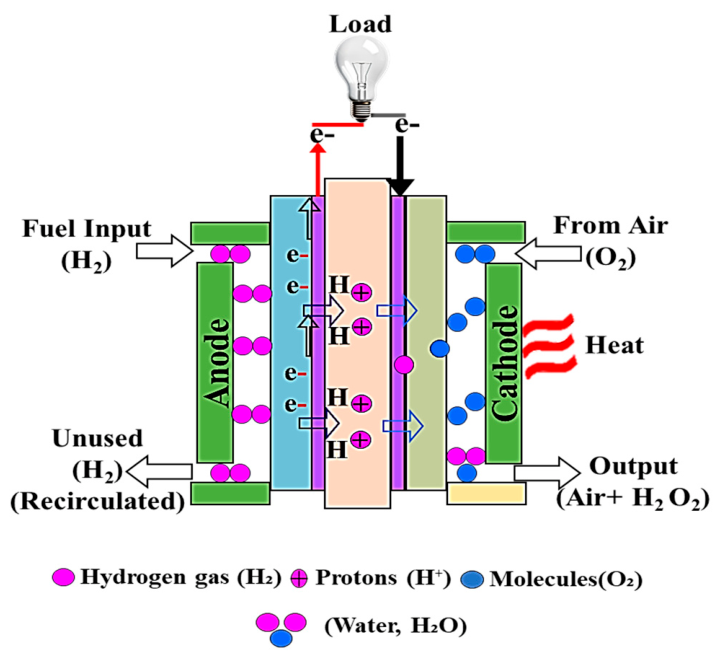
A typical PEMFC is composed of an anode, a cathode and an electrolyte that conducts protons, as seen in Figure 1. The electrode surfaces are coated with catalysts to lower the energy barrier to the hydrogen oxidation reaction and, therefore, promote the dissociation of hydrogen molecules to form protons and electrons [30].

2.1. PEMFC-Based Mathematical Model

The principal electrochemical reactions of hydrogen and oxygen are fundamental to the PEMFC operation, as described in [30,49]. These reactions control the production of electrical energy by coupling charge transfer and mass transport processes in the cell.
At the anode, hydrogen H 2 is oxidized by releasing protons H + and electrons e , according to the following reaction:
2 H 2 4 H + + 4 e
A platinum-based catalyst that promotes the dissociation of hydrogen molecules supports this reaction and makes it more efficient [38]. Oxygen O 2 at the cathode reacts with hydrogen supplied by the membrane and electrons supplied via the external circuit to produce water and heat as follows:
4 H + + 4 e + 1 2 O 2 2 H 2 O
The anodic and cathodic reactions give the net electrochemical reaction of PEMFC, and this reaction evokes the production of water, H2O, and heat [14].
2 H 2 + 2 e + O 2 2 H 2 O
The terminal voltage of a PEMFC is determined by the thermodynamic potential minus the losses due to activation, ohmic, and concentration overpotentials:
V F C = E N e r n s t   V a c t   V o h m V C o n
The reversible open-circuit voltage can be represented as a Nernst potential as stated below:
E N e r n s t = E 0 + R T K F ζ ln ( P H 2 P O 2 )
where E 0 represents the standard potential, R denotes the universal gas constant, F Faraday’s constant, ζ is the number of electrons transferred, T K is the cell temperature, and P H 2 and P O 2 are the partial pressures of hydrogen and oxygen, respectively. For practical calculations, this equation can be rewritten in a more specific form [28]:
E N e r n s t = 1.229 85 × 10 5 ( T K 298.15 ) + 430.85 × 10 7 T K ln ( P H 2 P O 2 )
The activation overpotential, denoted as V a c t , originates from the kinetics of electrochemical reactions and is described as follows:
V a c t = R T K 2 α F ln ( i j 0 )
where i represents the current density, j 0 is exchange current density, and α is the charge transfer coefficient. Empirical expressions are frequently utilized to integrate temperature and concentration effects [19]:
V a c t = ( ξ 1 + T K ( ξ 2 + ξ 3 ln ( C O 2 ) + ξ 4 ln ( i ) ) )
where oxygen concentration C O 2 is expressed as:
C O 2 = P O 2 50.8   ×   10 5 e x p 498 T K
Ohmic losses are defined based on both ionic and electronic resistances, and the voltage drops are represented as
V o h m = i Υ m   l A + R c
where Υ m   is the membrane resistivity, l is the membrane thickness, A denotes the active area, and R c denotes the contact resistance. The membrane resistivity is directly related to the operating conditions and current density, which can be defined as follows:
Υ m   = 181.6 1   +   3   ×   10 3 i A   +   62   ×   10 3 T K 303 i A 2.5 λ     0.634     3 i A   e 4.18 T K     303 T K
where λ represents the membrane water content. Concentration overpotential, V C o n , reflects limitations in mass transport:
V C o n = b ln ( 1 i j 0 m a x A   )  
where j 0 m a x is the maximum current density, and b represents a constant. Finally, the total voltage of a PEMFC stack composed of n s cells connected in series can be represented as
V S t a c k = n s E N e r n s t + V a c t + E o h m + V C o n
The V S t a c k provides a comprehensive detailed model of the PEMFC stack and describes the operation of PEMFC stacks by incorporating thermodynamic choices, reaction rate, resistive losses, and mass transport limitations [19].

2.2. Objective Function

The previously described PEMFC mathematical model should match the experimental data to enable accurate performance predictions. The mathematical model includes seven parameters: ξ 1 , ξ 2 , ξ 3 , ξ 4 , λ , R c , and b , which significantly affect the performance characteristics of the PEMFC stack. Accurately estimating these parameters is therefore crucial to the practical design of the PMFC model. In this research, the SEE is considered as the objective function, which is the sum between the simulated output voltage and the voltage measured experimentally across all the data points and is given as:
F O b j = j = 1 N ( V S i m V E x p ) 2
The V S i m represents the simulated output voltage, and V E x p is the measured voltage.

3. Dhole Optimization Algorithm

First, this section explains the biological inspiration for the proposed novel IDOA algorithm and then describes the conceptual, logical, and mathematical foundations of the model.

3.1. Algorithm Inspiration

The dholes are highly social animals that live in clans rather than rigid packs. Despite the existence of much larger clans, these groups typically consist of around twelve individuals [45]. Dholes prefer short, coordinated attacks to long chases during hunting operations. They use sounds and sights to coordinate their movements. This behavior inspired the creation of IDOA, which uses mathematical representations to express a balance between exploration and exploitation.

3.2. Initialization

The IDOA is a population-based metaheuristic in which each search agent represents a dhole that corresponds to a candidate solution. The position of each dhole in the search space represents a specific combination of decision variable values. Thus, the population can be mathematically represented by a matrix X = D N × m , where D R N × m is a matrix that encompasses all candidate solutions (dholes), N denotes the total number of dholes, and m is the number of decision variables. Each row X i stands for the i th dhole, while each column stands for a decision variable. In order to ensure comprehensive coverage of the search domain, all population members are randomly initialized at the beginning of the optimization process [5]. After initialization, the objective function is computed for each candidate solution by substituting its variable values.
The computed objective values are stored in a vector F R N × 1 , where each element is defined as F i = F ( X i ) , representing the cost of the i th dhole [45].

3.3. Determination of Pack Size and Prey Scale

Dhole packs exhibit a high degree of coordination through structured and cooperative hunting strategies. In order to reflect this natural variability, the number of pack members in the proposed model is typically randomly assigned according to
P W N = r ( [ W 1 , W 2 ] )
P W N denotes the number of pack members, r denotes a uniformly distributed random value r a n d [ 0,1 ] , and W 1 and W 2 are arbitrary numbers typically ranging from 5 to 20 individuals.
Dholes can hunt animals of various sizes such as medium and large ungulates. The effective prey scale depends on pack size, cooperative strength, prey availability, and environmental conditions. Also, dholes are primarily crepuscular predators, screening peak hunting activity by dawn and dusk, which aligns with the activity patterns of many prey species. This behavior is incorporated into the optimization model through a prey suitability function defined below
P s = C i 1 + e x p ( n · P W N ) L 2   E f
P s represents the suitability of hunting time, L is the optimal pack size, E f [ 0,1 ] denotes environmental factors, n   controls hunting efficiency, and C 1 regulates prey size adaptation under varying conditions.

3.4. Mathematical Modeling of IDOA

In the IDOA optimizer, the position update mechanism is designed around three sequential phases inspired by the cooperative hunting behaviour of dholes.
Step 1: (Exploration) Searching Stage
Before initiating the search process, a target position (prey) is defined as the average of the best solution in the current population and the best solution obtained across all iterations:
P r e y = P r e y L + P r e y G 2
P r e y L represents the local best position in the current iteration, while P r e y G represents the global best solution.
The dynamic switching mechanism presented in this paper is the optimization process in order to achieve a more effective balance between global exploration and local refinement. The probability of switching, which is referred to as pc, is obtained as shown below:
P C L = 0.6 0.1 T t T
T is the maximum number of iterations, and t denotes the current number of iterations.
If the pack size determined by Equation (17) is less than ω 3 = 10 and the vocalization parameter (a random value) is below P C L , dholes explore the search space by moving toward the prey according to:
D i , j t + 1 = d i , j t + C 2 · r ( P r e y d i , j t )
d i , j t denotes the current position of the ith dhole in the jth dimension at iteration t , and C 2 is a linearly decreasing coefficient defined as
C 2 = 1 t T
This step enhances global exploration by guiding solutions toward promising regions. Also, i = 1,2 , 3 , , N indexes the dhole (search agent) in the population, and i = 1,2 , 3 , , m indexes the decision variable (dimension) of the optimization problem.
Step 2: (Exploration) Encircling Stage
When the pack size exceeds P W N and the vocalization value remains below P C L , the dholes collaboratively encircle the prey. The position update in this stage is expressed as
D i , j t + 1 = d i , j t d y , j t + P r e y j
D i , j t + 1 is the updated position after applying the IDOA movement rules, and y is a randomly selected dhole index defined by
y = 1 + r o u n d ( r · ( N 1 ) , y i
This mechanism fosters competition among individuals, promoting diversity while ensuring continued exploration.
Step 3: (Exploitation) Attacking Stage
Once vocalization exceeds P C L , the attacking phase begins. The size of the prey is initially calculated as
S = C 3 × r × Z i Z p e r y
C 3 stands for the maximum prey factor and is set to 3. If S > ( C 3 + 1 ) / 2 , the prey is considered large, and dholes weaken it gradually using:
W P r e y = e x p ( 1 S )   P r e y L
Following coordinated attacks are modeled as:
D i , j t + 1 = d i , j t + W P r e y · P S · cos ( 2 π r ) + sin ( 2 π r )
P S denotes prey suitability. On the other hand, if S > ( C 3 + 1 ) / 2 , the prey is weak enough to be eliminated immediately, and the updated rule becomes:
D i , j t + 1 = P S ( d i , j t P r e y G ) + P S · r d i , j t
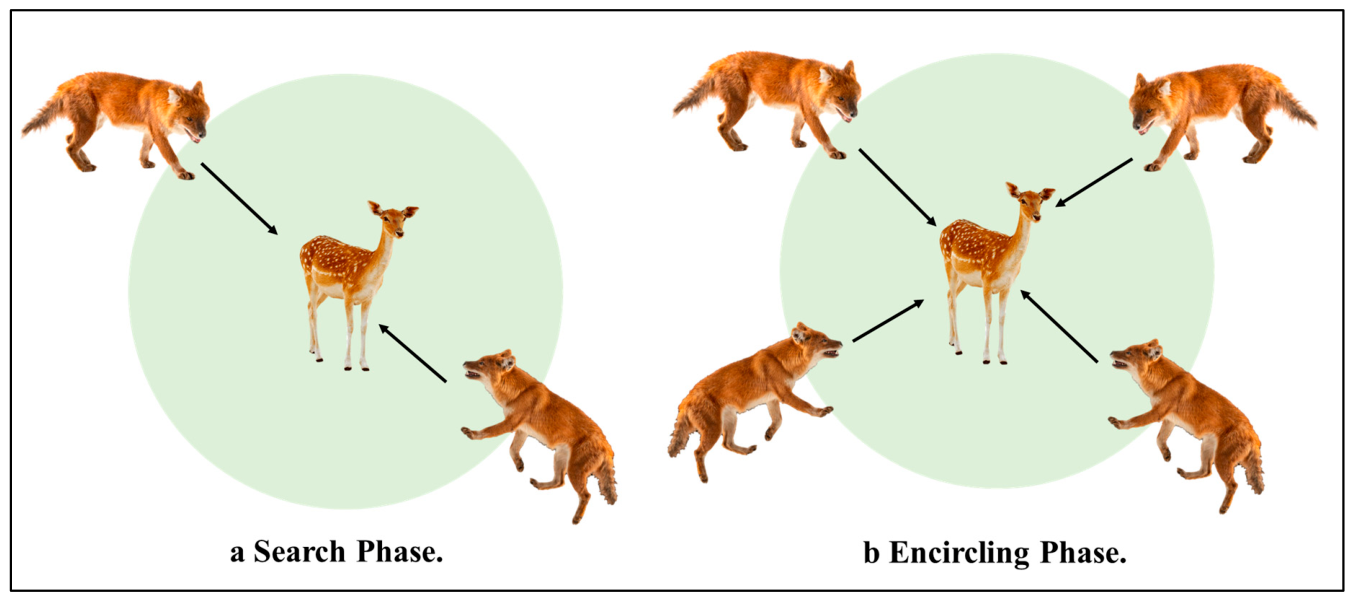
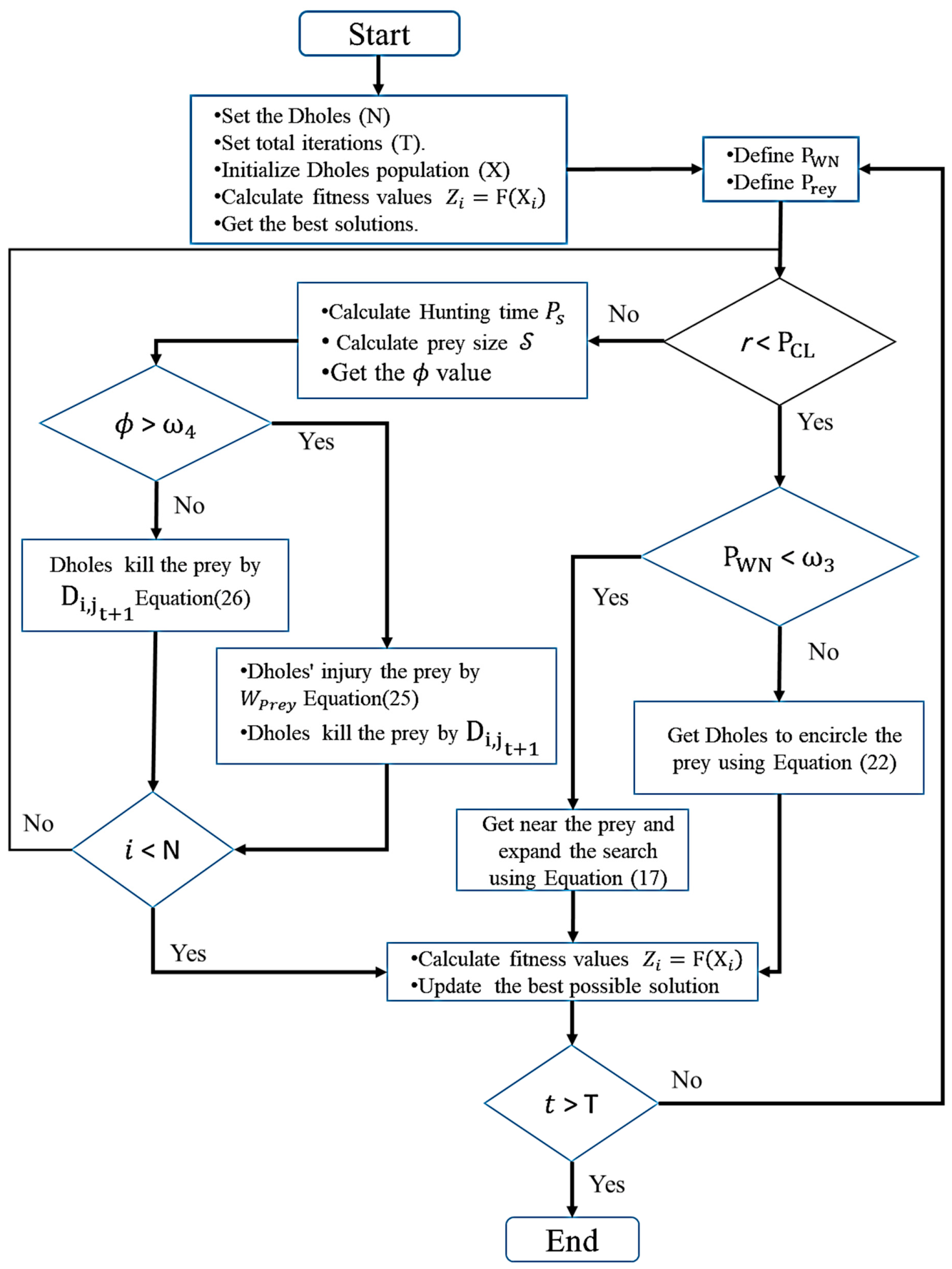
Through this adaptive attacking strategy, IDOA progressively converges toward the optimal solution by strengthening exploitation while preserving stability. Figure 2 shows the search stage and encircling stage of IDOA, and Figure 3 illustrates the overall flowchart of the proposed algorithm.
As illustrated in Figure 3, the overall workflow of the proposed IDOA algorithm outlines its iterative optimization mechanism to balance exploration and exploitation. In accordance with this flowchart, the subsequent section presents a simulation implementation of the proposed IDOA algorithm, followed by a performance evaluation of benchmark functions that highlights the convergence and potential limitations of IDOA for complex optimization problems, along with a comprehensive comparison with its counterpart algorithms.

4. Performance Analysis on Benchmark Functions

The effectiveness of the proposed IDOA is evaluated using four multimodal test benchmark functions, each with 20 dimensions [50]. The selection of a multi-dimensional optimization problem increases the complexity of the search space and provides additional guarantees for the robustness of the optimization algorithm, which is crucial for effectively navigating the diverse landscapes presented by the benchmark functions used in this evaluation, such as ensuring that the proposed algorithm can adapt to varying conditions and identify optimal solutions across different scenarios. The characteristics of the benchmark functions and search ranges are summarized in Table 2.
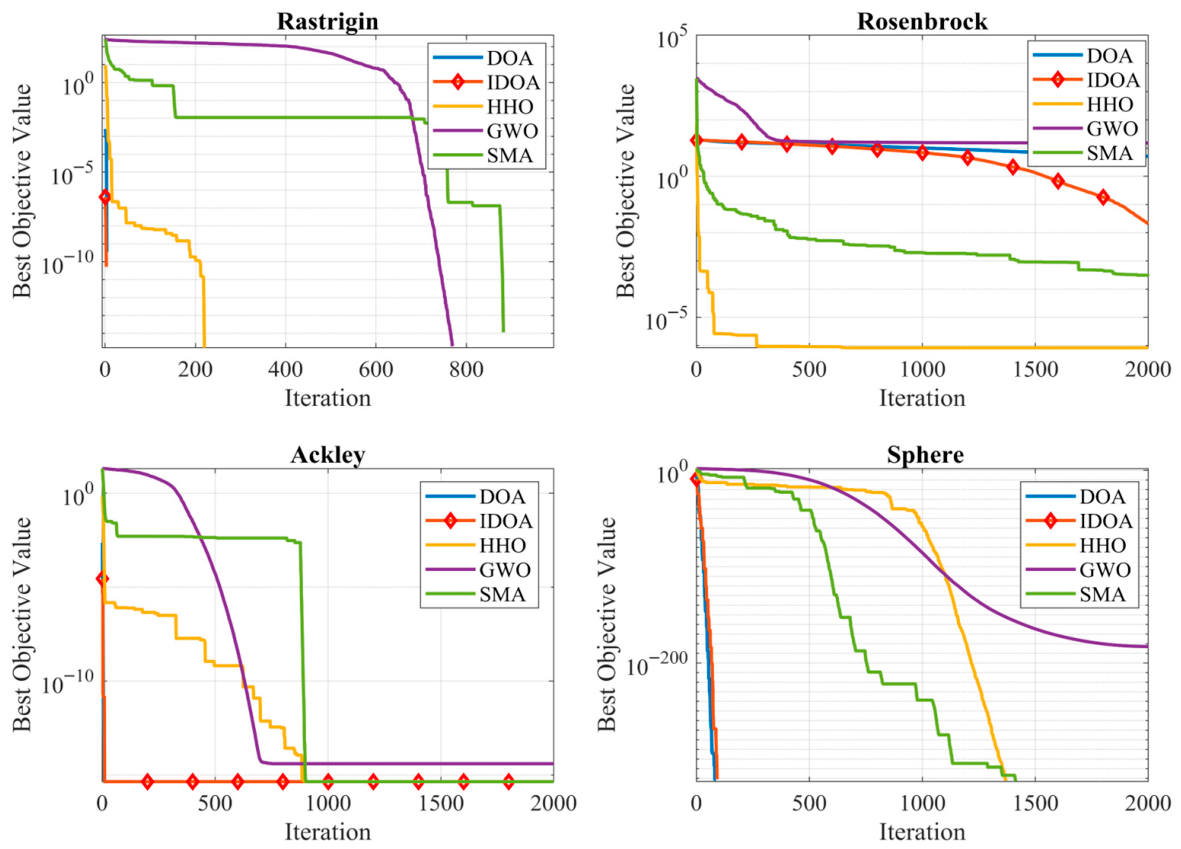
To validate the IDOA effectiveness, comparative experiments are conducted with the original DOA [45] and three baseline algorithms, namely GWO [46], HHO [47], and SMA [25], on four typical benchmark functions. All competing algorithms were evaluated under uniform experimental conditions, comprising a population size of 100, a maximum of 2000 iterations, and 30 independent runs to guarantee statistically significant outcomes. The parameter settings for each considered algorithm are listed in Table 3, the convergence of each benchmark function is shown in Figure 4, and the comparative performance results are presented in Table 4.
As observed in Table 4, the IDOA demonstrates superior performance on F 1 . All of the statistical measures (best, worst, average, and median) are nearest to zero, which is significantly lower than those obtained by DOA and the other competing algorithms. This substantial improvement indicates that the proposed modifications effectively improve the exploitation capability of the original DOA even in a 20-dimensional search space.
For the function F 2 , which is known to be challenging due to its narrow and curved search region, IDOA significantly outperforms DOA, GWO, and SMA in terms of average and median values. Although HHO achieves slightly lower best-case values, IDOA exhibits more stable behavior with competitive mean performances and reduced variance, suggesting better reliability across multiple runs.
In the case of function F 3 , all algorithms converge to nearly identical values on the order of 10−16 indicating that this function is less sensitive to dimensionality. The proposed IDOA matches the best-performing algorithm without any degradation in accuracy. For function F 4 , all algorithms successfully reach the global optimum with zero error, confirming that this function serves as a baseline validation problem even at higher dimensions.
The convergence behaviors shown in Figure 4 further highlight the advantages of IDOA. The proposed optimizer exhibits a rapid reduction in objective value during the early iterations, followed by a smooth transition toward the global optimum. In contrast, DOA converges more slowly and tends to stall at suboptimal values, particularly for the more complex function in the case of F 3 . Other algorithms, such as GWO, HHO, and SMA, demonstrate either a delay in convergence or a tendency to stagnate prematurely when navigating the 20-dimensional search space.
Finally, the results obtained for the IDOA indicated that the improved version provided an improvement in convergence speed and higher accuracy to reach optimum solutions, and it is much better than the original DOA, especially in complex and high-dimensional optimization problems.
The next section provides details on the simulation implementation and performance assessment of the proposed IDOA algorithm for estimating PEMFC parameters, which is analyzed using three typical commercial datasets for PEM fuel cell models.

5. Simulation Results and Discussion

The proposed IDOA-optimizer parameter identification is validated using three commercially available PEM fuel cell stacks: BCS 500 W, NedStack PS6, and Horizon 500 W [38]. PEMFC modeling studies extensively use these datasets due to their public availability and inclusion of broad operating conditions with experimentally measured electrical features. Consequently, these I–V data provide a reliable basis for evaluating both the modeling accuracy and generalization capability of optimization-driven identification algorithms. According to the developed electrochemical model, seven parameters, ξ 1 , ξ 2 , ξ 3 , ξ 4 , λ , R c , and b , are subject to estimation. The permissible upper and lower search intervals for these variables, which critically affect optimization performance, are summarized in Table 5 [5]. The corresponding experimental operating conditions for all fuel cell systems are taken from [38]. For consistency, all simulations are conducted using a population size of 100 and a termination criterion of 2000 iterations. The proposed algorithm is implemented in MATLAB 2022b on a computing platform equipped with a 13th Gen Intel(R) Core (TM) i7-13700H (2.40 GHz) and 16 GB RAM. To benchmark its performance, the convergence behavior of IDOA is examined against several established population-based metaheuristics, namely DOA [45], GWO [46], HHO [47], and SMA [25]. The parameter settings adopted for these comparative algorithms are detailed in Table 2.

5.1. NedStack PS6 Configuration

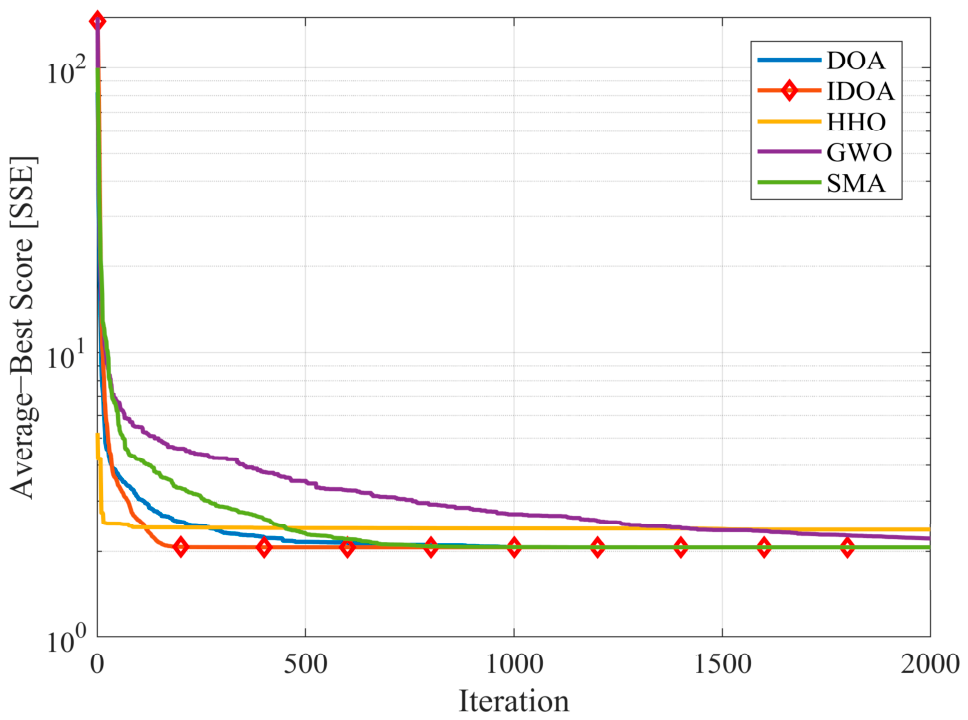
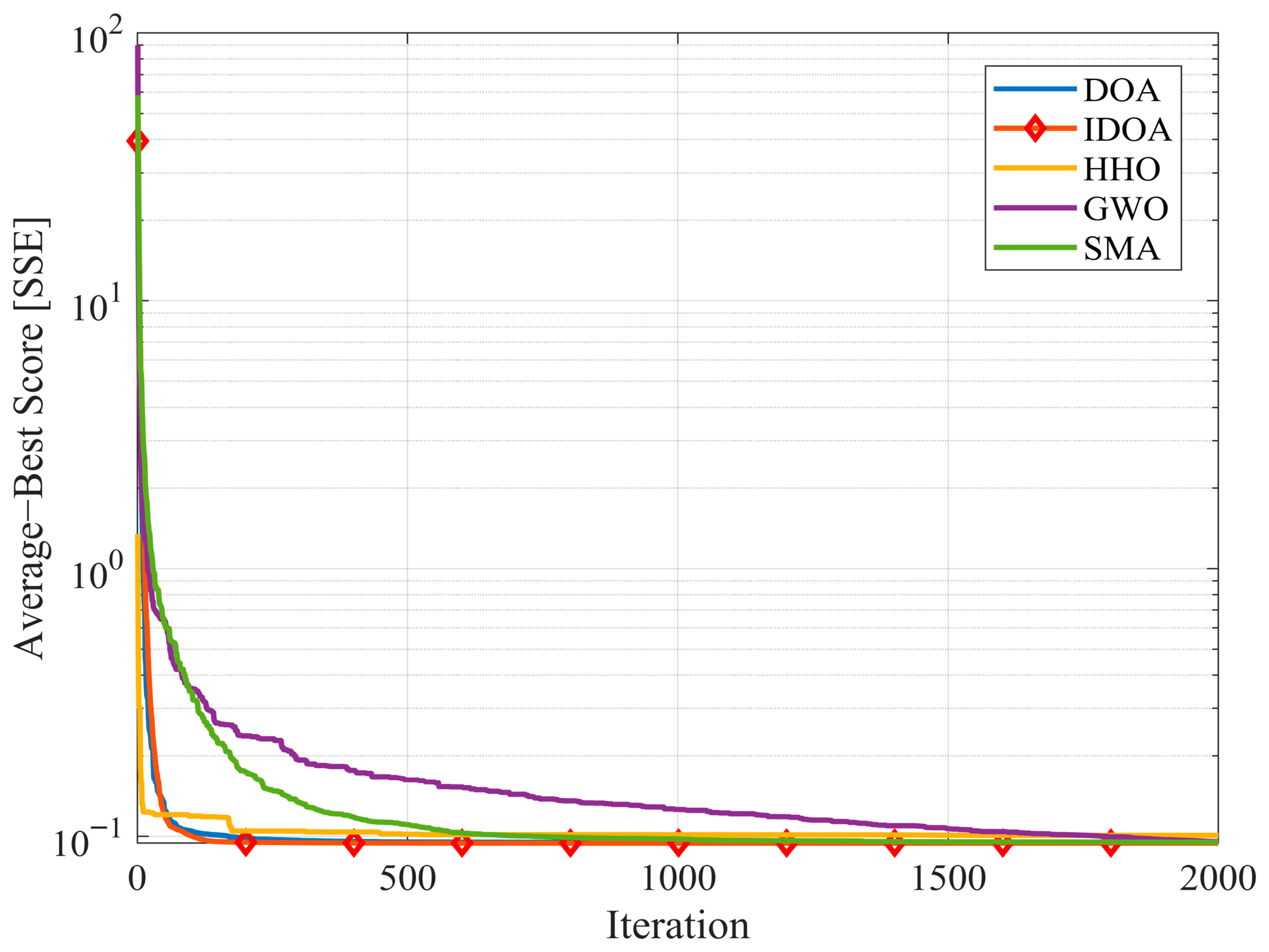
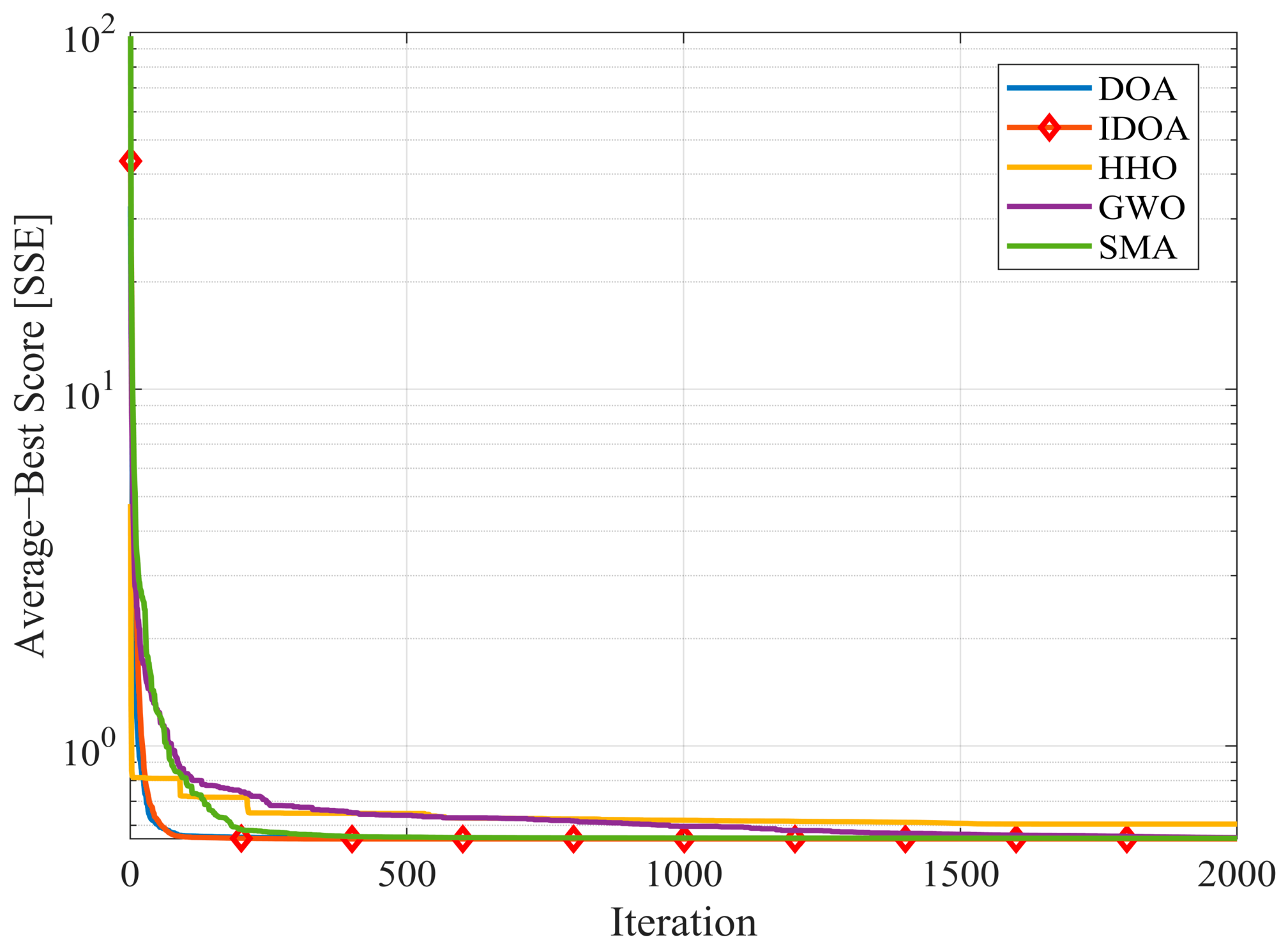
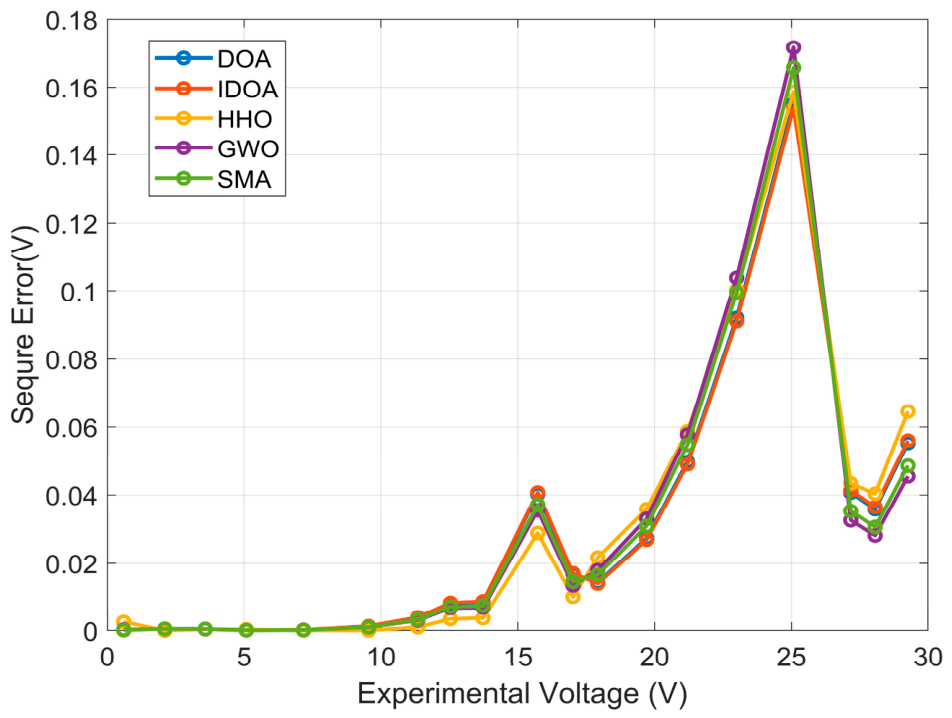
The convergence characteristics obtained for the NedStack PS6 system are depicted in Figure 5. The results indicate that the IDOA algorithm attains the global optimum within a limited number of iterations, demonstrating both rapid convergence and stable search behavior. A comparison of square errors between experimentally measured stack voltages and model-predicted voltages is provided in Figure 6. The IDOA consistently has square error values that are the lower than those of the benchmark algorithms (DOA, HHO, GWO, and SMA), especially in areas where the error spikes. However, the IDOA shows small improvements in robustness and consistency.
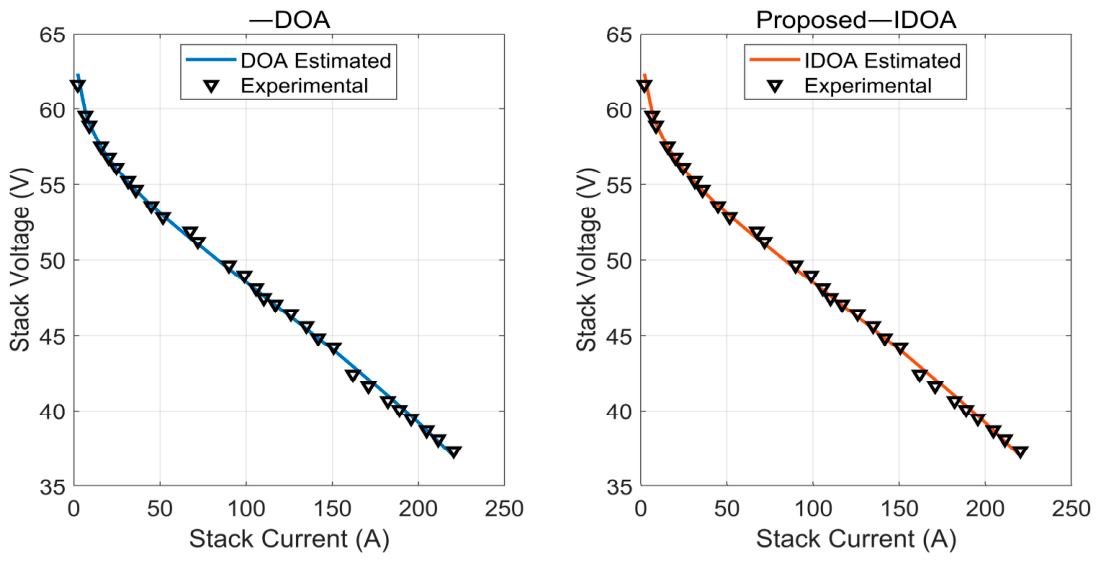
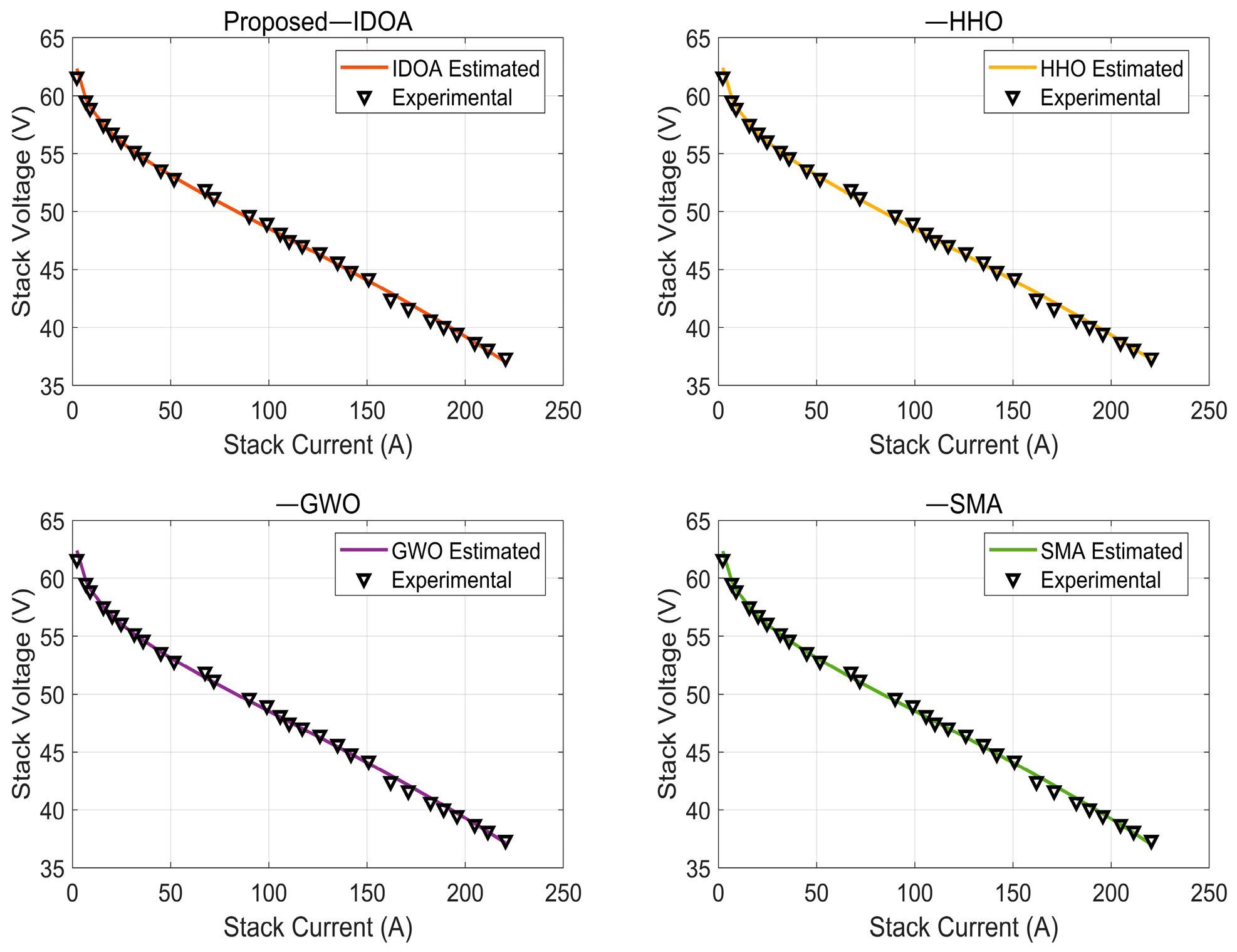
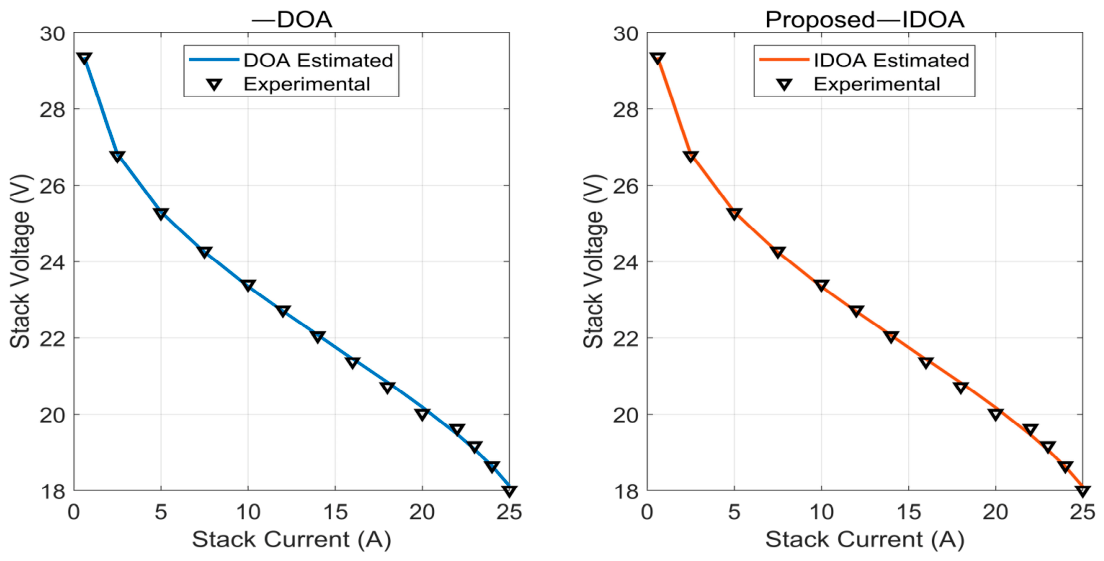
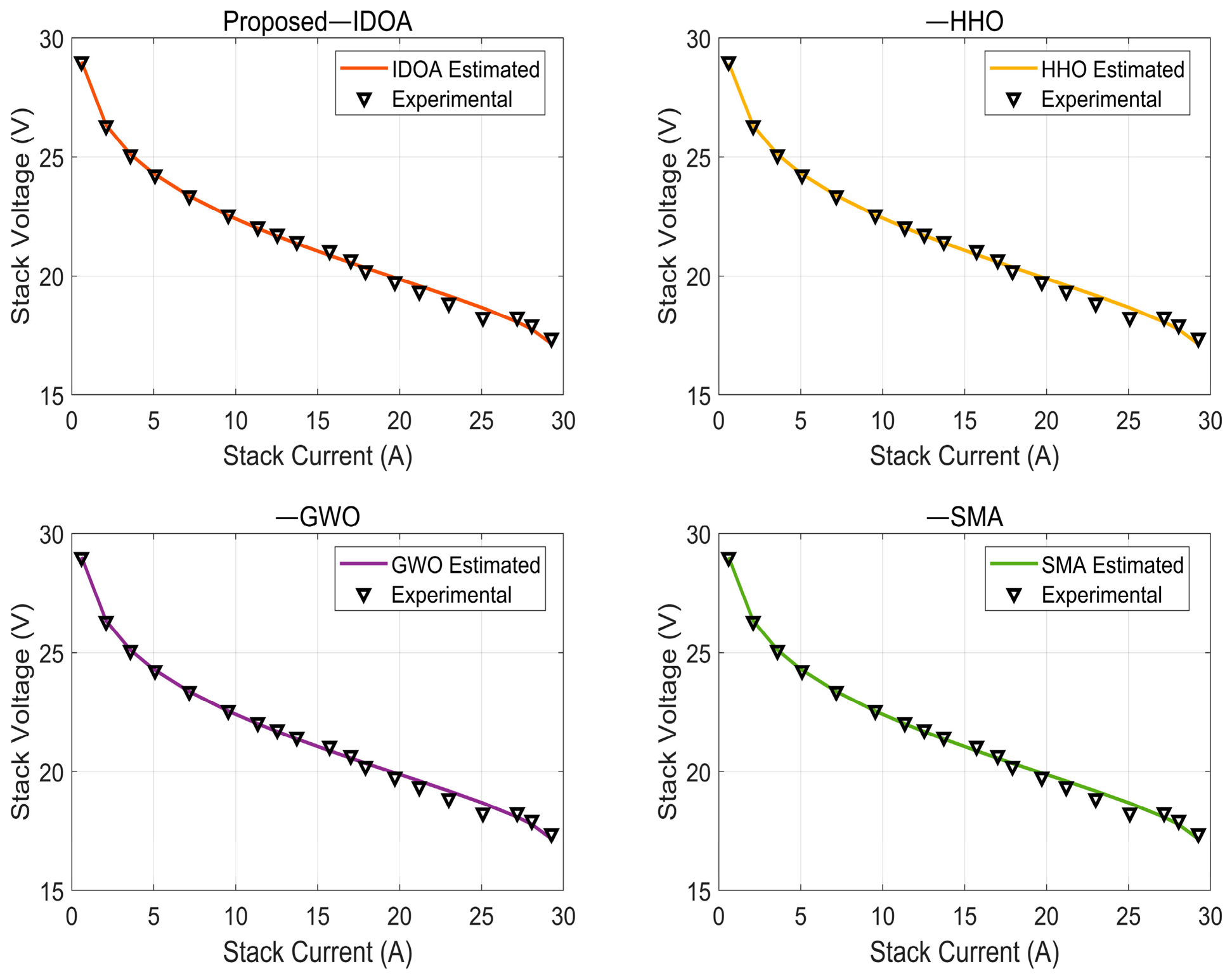
The optimized parameter values derived using IDOA and competing algorithms are summarized in Table 6. In addition, the polarization characteristics obtained from experimental data and model estimates are presented in Figure 7, and Figure 8 illustrates a close agreement across the entire operating range.

5.2. Horizon 500 W Configuration

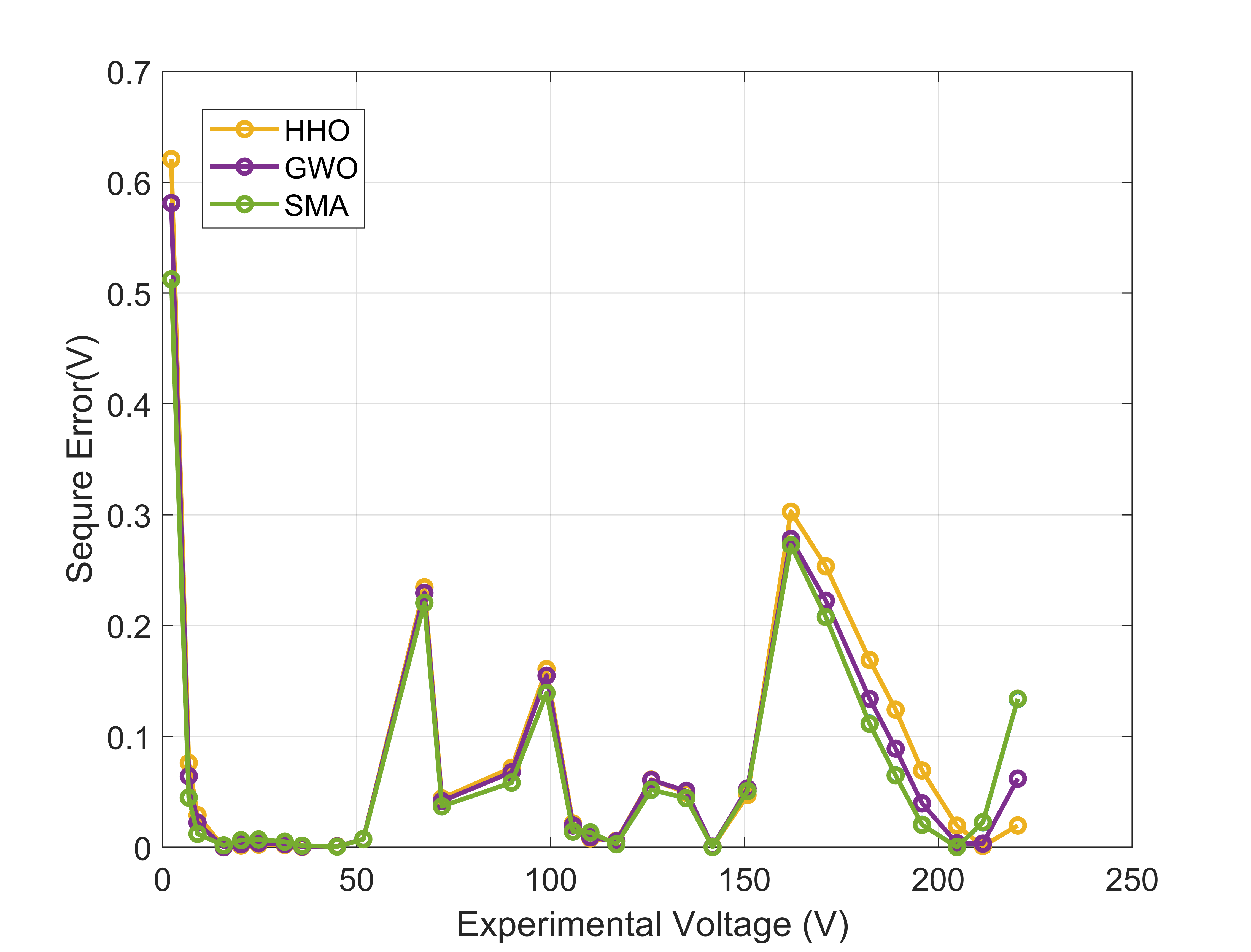
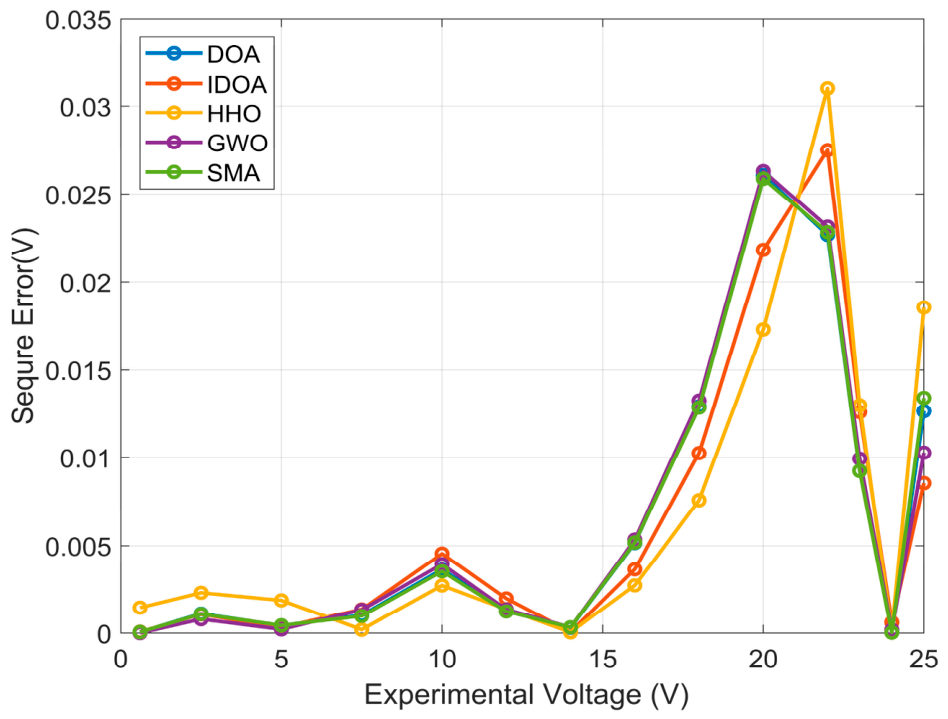
Figure 9 shows the convergence curves of the proposed IDOA and comparative algorithms for the Horizon 500 W PEMFC model. The presence of premature convergence in several benchmark algorithms highlights their susceptibility to local optima, whereas IDOA maintains consistent global search capability. The squared error curves between the experimental and estimated voltages, as a function of the experimental voltages for IDOA and other algorithms, are shown in Figure 10.
Among the considered algorithms, GWO, HHO, and SMA show highly similar performance, closely tracking each other across the voltage range, especially at higher voltages where the squared error increases. Moreover, the original DOA curve also shows that squared error values in most voltage ranges are low. The squared error results confirm that all four algorithms maintain low error across most of the operating range, with the proposed IDOA showing robust, stable performance.
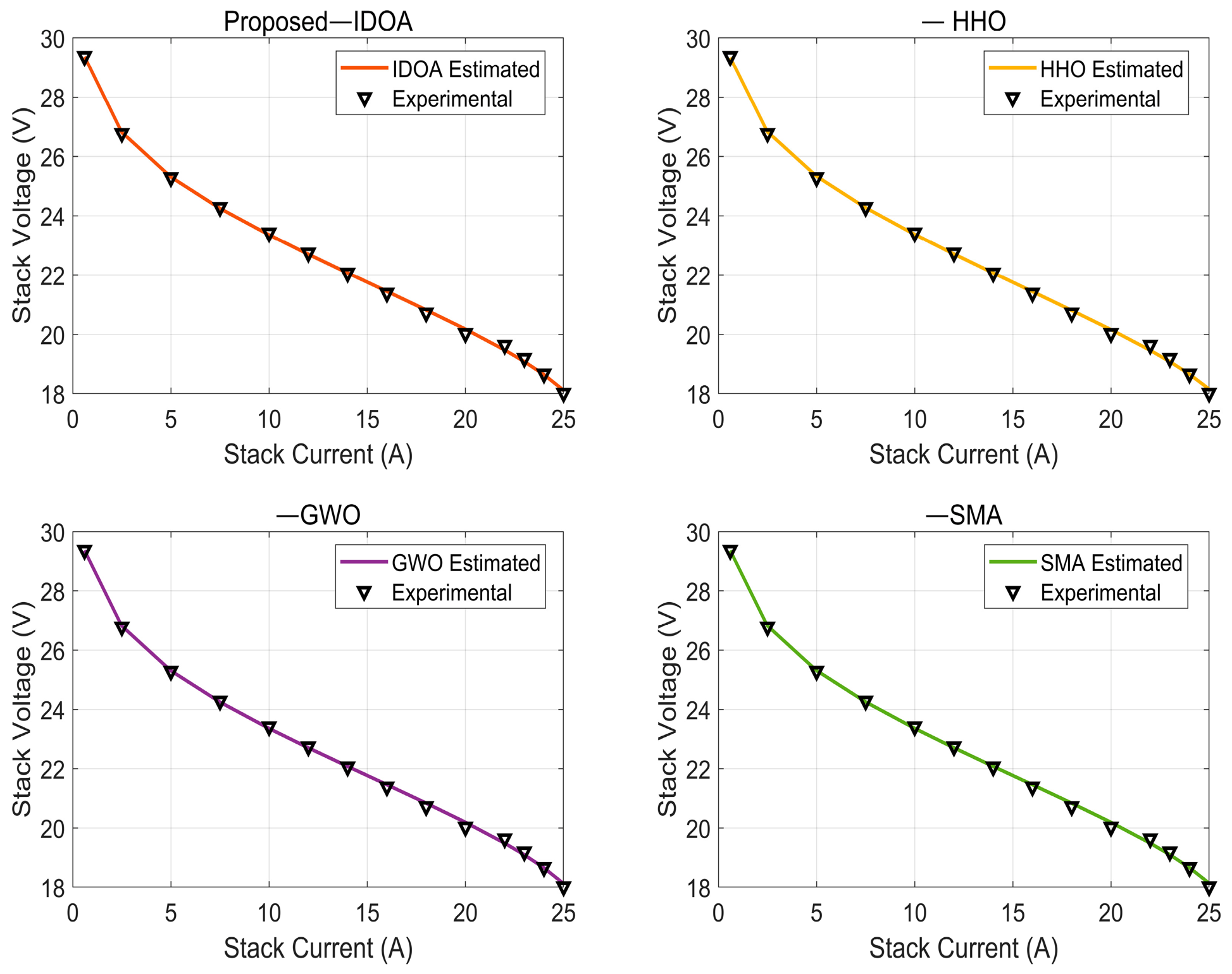
The resulting polarization curve comparing experimental observations with model predictions is illustrated in Figure 11, and the resulting polarization curve for the original DOA and proposed IDOA is depicted in Figure 12.

5.3. BCS 500 W Configuration

The convergence behavior of the IDOA and original DOA algorithms for the BCS 500 W dataset is presented in Figure 13. Comparative analysis reveals that the proposed IDOA outperforms the original DOA and other reference metaheuristic algorithms in terms of convergence rate and estimation accuracy.
Figure 14 shows the squared error for the IDOA and other optimization algorithms across a range of experimental voltages.
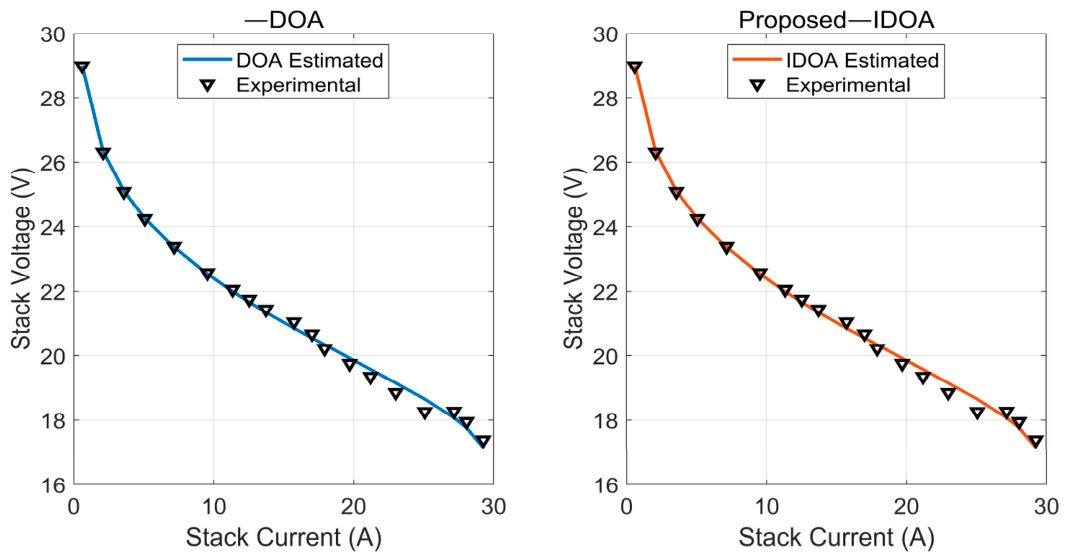
Among the considered algorithms, IDOA, DOA, GWO, and SMA show nearly overlapping squared error curves, particularly at higher voltages, while HHO exhibits slightly greater variation at the highest voltage points. Furthermore, the polarization curve constructed from both experimental measurements and estimated model outputs is shown in Figure 15, and Figure 16 assures the high accuracy of the identified parameters.
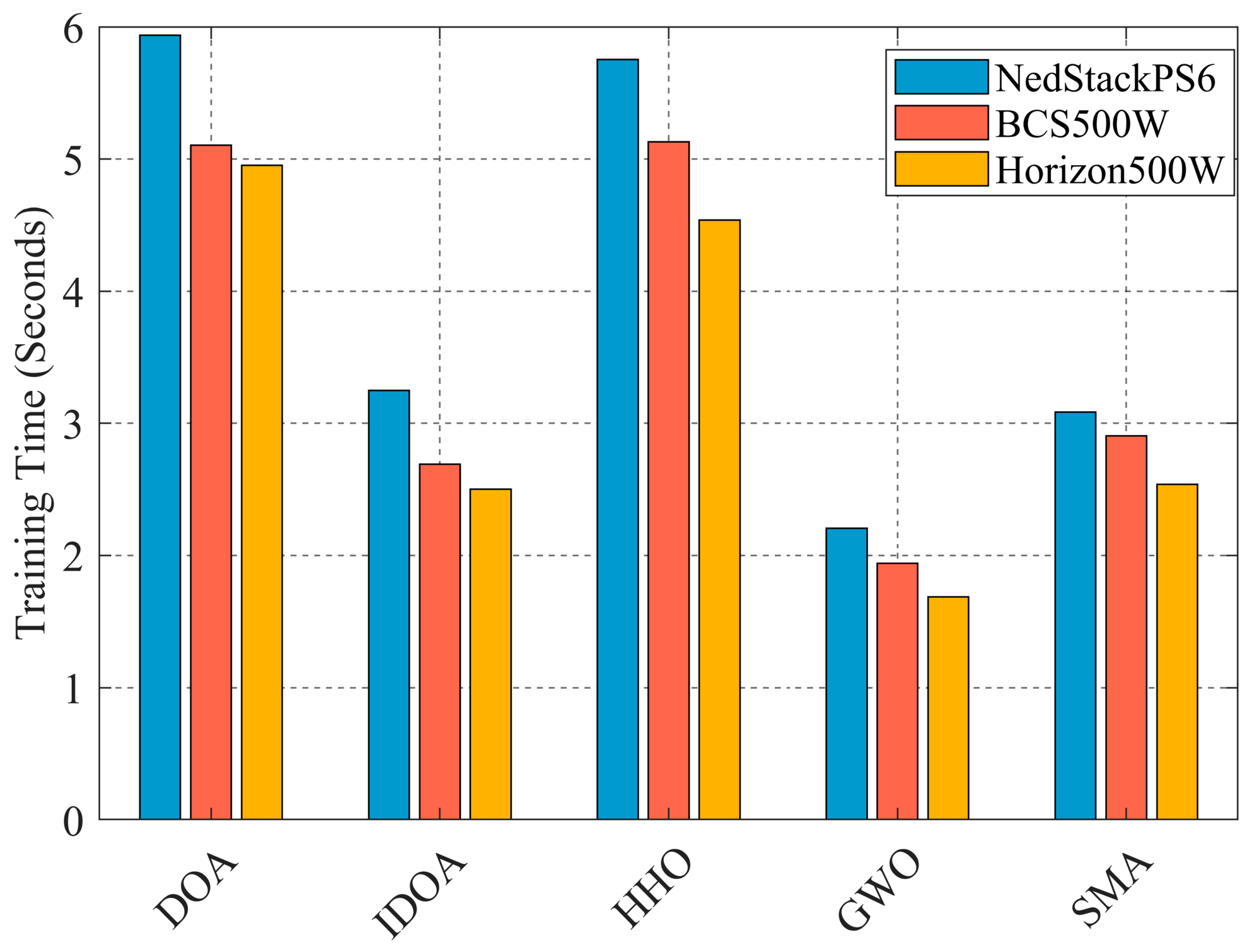
Figure 17 depicts differences in the convergence training times among the proposed IDOA, DOA and three tested optimization algorithms across tested cases of the PEMFC models. As Figure 17 shows, the GWO has the shortest training time of all the algorithms and fuel cell models tested. For example, using the NedStack PS6 model, the GWO optimizer is trained in about 3 s, whereas the HHO optimizer needs almost 9 s. This indicates that the GWO is about three times faster than the HHO.
In contrast, the Horizon 500 W model exhibits the shortest training times among all the algorithms, indicating a lower computational complexity. Among the algorithms, IDOA exhibits a modest training time for complete convergence iteration for one independent run with all the fuel cell models considered. Also in Figure 17, IDOA obtained a faster training time than the DOA and HHO algorithms, but its convergence rate is lower than the GWO and SMA algorithms. To illustrate, when used on the NedStack PS6 model, IDOA speeds up training by almost half the time required to train with DOA, which indicates the validity of its improvements.

5.4. Comparison with Algorithms Reported in the Literature

The convergence curves of the proposed IDOA algorithm derived using multiple datasets indicate excellent algorithmic performance. This improvement can be attributed to its high global search ability, effective control between exploration and exploitation, adaptive weighting strategy, and the repositioning of poor-quality candidate solutions at each iteration. To evaluate the efficiency of the IDOA in the estimation of unknown parameters of PEMFC, the proposed algorithm is compared with some of the state-of-the-art search-based optimization algorithms reported in the recent literature. Table 7 summarizes the corresponding statistical results of the considered PEMFC models.
The convergence curves illustrated in Figure 3, Figure 9 and Figure 13 demonstrate that the IDOA allows the SSE function to achieve its optimal value significantly faster than other competing algorithms. The best SSE value achieved by the IDOA is approximately an order of magnitude better than those obtained using the HHO, GWO, and SMA algorithms. Furthermore, the estimated PEMFC parameters closely align with experimental observations, as shown by the synthesized data in Figure 7, Figure 8, Figure 11, Figure 12, Figure 15 and Figure 16.
Search optimization-based algorithm robustness is essential for ensuring estimation accuracy, as demonstrated by statistical performance indicators in Table 7. The estimated parameters of the proposed DOA algorithm and the other implemented algorithm, compared with the recent literature, are shown in Table 6, along with associated objective function values (SSE). As indicated in Table 6, the IDOA algorithm demonstrates the lowest SSE compared to all other search-based optimization algorithms. Moreover, the RMSE and MAE between the measured and estimated stack current–voltage curves for the experimental data are calculated to evaluate the effectiveness of the implemented algorithm variant. The best run index of the algorithm indicates the minimum SSE during the 30 independent simulations conducted.
Furthermore, it can be observed that the proposed IDOA algorithm demonstrates consistently strong performance for parameter identification across the three introduced tested cases (BCS 500 W, Nedstack PS6, and Horizon 500 W), revealing the reliability and effectiveness of the proposed search-based optimization algorithm.

6. Conclusions

This paper proposes an effective parameter estimation algorithm for PEMFC based on a novel optimizer named the IDOA optimizer. The proposed IDOA algorithm draws stimulation from classical military strategic planning principles and is designed to enhance global search efficiency. An objective function formulated using the SSE was utilized to estimate seven unknown parameters of the PEMFC mathematical model. The proposed IDOA algorithm is validated for the parameter estimation using three tested cases: Nedstack PS6, Horizon 500 W, and BCS 500 W stacks. The obtained SSE values for these test cases are 2.06556, 0.094839, and 0.55979179, respectively. A comparative assessment with existing optimization algorithms reported in the literature demonstrates that the proposed IDOA-based method consistently achieves fewer estimation errors. These results confirm the superiority and reliability of the proposed IDOA for accurate PEMFC parameter identification.
Nevertheless, the proposed IDOA is a population-based optimization algorithm that is not inherently limited to low-dimensional problems. Its demonstrated convergence behavior and exploration/exploitation balance indicate potential applicability to higher-dimensional and more complex optimization tasks. However, extending the algorithm to high-fidelity models introduces challenges, including increased parameter dimensionality, strong parameter coupling, and significantly higher computational cost.
Therefore, the effectiveness of the proposed IDOA was confirmed for low-dimensional PEMFC modeling in this work, but its application to high-fidelity models requires further investigation, possibly involving surrogate modeling, hybrid optimization strategies, and parallel computation.
Future studies can also investigate the real-time implementation of proposed IDOAs, hybrid optimization algorithms, and adaptive mechanisms to further enhance convergence efficiency and applicability across diverse PEMFC operating conditions.

Author Contributions

Conceptualization, methodology, software, and validation: A.K.A. investigation, A.K.A., M.A.A.-O. and A.H.I.; writing—original draft preparation, A.K.A., M.A.A.-O. and M.N.M.; writing—review and editing, A.H.I. and D.S.; for-mal analysis, A.H.I. and M.A.A.-O.; data curation, supervision, and project administration, D.S. and M.N.M. All authors have read and agreed to the published version of the manuscript.

Funding

This research received no external funding.

Data Availability Statement

All data sources used in this paper are either cited within the text or included in the tables.

Conflicts of Interest

The authors declare no conflicts of interest.

References

  1. Priya, K.; Sathishkumar, K.; Rajasekar, N. A Comprehensive Review on Parameter Estimation Techniques for Proton Exchange Membrane Fuel Cell Modelling. Renew. Sustain. Energy Rev. 2018, 93, 121–144. [Google Scholar] [CrossRef]
  2. Mirzapour, F.; Lakzaei, M.; Varamini, G.; Teimourian, M.; Ghadimi, N. A New Prediction Model of Battery and Wind-Solar Output in Hybrid Power System. J. Ambient Intell. Humaniz. Comput. 2019, 10, 77–87. [Google Scholar] [CrossRef]
  3. Gong, W.; Yan, X.; Hu, C.; Wang, L.; Gao, L. Fast and Accurate Parameter Extraction for Different Types of Fuel Cells with Decomposition and Nature-Inspired Optimization Method. Energy Convers. Manag. 2018, 174, 913–921. [Google Scholar] [CrossRef]
  4. Liu, B.; Chen, H.; Zhang, T.; Pei, P. A Vehicular Proton Exchange Membrane Fuel Cell System Co-Simulation Modeling Method Based on the Stack Internal Distribution Parameters Monitoring. Energy Convers. Manag. 2019, 197, 111898. [Google Scholar] [CrossRef]
  5. Ali, A.K.; Hussain, A.N.; Al-obaidi, M.A. Upgrading Sustainability in Clean Energy: Optimization for Proton Exchange Membrane Fuel Cells Using Heterogeneous Comprehensive Learning Bald Eagle Search Algorithm. Sustainability 2025, 17, 9729. [Google Scholar] [CrossRef]
  6. Sun, Z.; Sun, J.; Xie, X.; An, Z.; Hong, Y.; Sun, Z. Multi-Population Mutative Moth-Flame Optimization Algorithm for Modeling and the Identification of PEMFC Parameters. Renew. Energy 2025, 240, 122238. [Google Scholar] [CrossRef]
  7. Zhang, W.; Wang, N.; Yang, S. Hybrid Artificial Bee Colony Algorithm for Parameter Estimation of Proton Exchange Membrane Fuel Cell. Int. J. Hydrogen Energy 2013, 38, 5796–5806. [Google Scholar] [CrossRef]
  8. Fathy, A.; Rezk, H. Multi-Verse Optimizer for Identifying the Optimal Parameters of PEMFC Model. Energy 2018, 143, 634–644. [Google Scholar] [CrossRef]
  9. Abdel-Basset, M.; Mohamed, R.; Elhoseny, M.; Chakrabortty, R.K.; Ryan, M.J. An Efficient Heap-Based Optimization Algorithm for Parameters Identification of Proton Exchange Membrane Fuel Cells Model: Analysis and Case Studies. Int. J. Hydrogen Energy 2021, 46, 11908–11925. [Google Scholar] [CrossRef]
  10. Kandel, M.R.; Pan, U.N.; Dhakal, P.P.; Ghising, R.B.; Sidra, S.; Kim, D.H.; Kim, N.H.; Lee, J.H. Manganese-Doped Bimetallic (Co, Ni) 2P Integrated CoP in N, S Co-Doped Carbon: Unveiling a Compatible Hybrid Electrocatalyst for Overall Water Splitting. Small 2024, 20, 230–7241. [Google Scholar] [CrossRef]
  11. Al-hotmani, O.M.A.; Al-obaidi, M.A.; John, Y.M.; Patel, R.; Manenti, F.; Mujtaba, I.M. Minimisation of Energy Consumption via Optimisation of a Simple Hybrid System of Multi Effect Distillation and Permeate Reprocessing Reverse Osmosis Processes for Seawater Desalination. Comput. Chem. Eng. 2021, 148, 107261. [Google Scholar] [CrossRef]
  12. Al-hotmani, O.M.A.; Al-Obaidi, M.A.; Li, J.P.; John, Y.M.; Patel, R.; Mujtaba, I.M. A Multi-Objective Optimisation Framework for MED-TVC Seawater Desalination Process Based on Particle Swarm Optimisation. Desalination 2022, 525, 115504. [Google Scholar] [CrossRef]
  13. Yang, S.; Chellali, R.; Lu, X.; Li, L.; Bo, C. Modeling and Optimization for Proton Exchange Membrane Fuel Cell Stack Using Aging and Challenging P Systems Based Optimization Algorithm. Energy 2016, 109, 569–577. [Google Scholar] [CrossRef]
  14. Ettihir, K.; Boulon, L.; Becherif, M.; Agbossou, K.; Ramadan, H.S. Online Identification of Semi-Empirical Model Parameters for PEMFCs. Int. J. Hydrogen Energy 2014, 39, 21165–21176. [Google Scholar] [CrossRef]
  15. Amphlett, J.C.; Baumert, R.M.; Mann, R.F.; Peppley, B.A.; Roberge, P.R.; Harris, T.J. Performance Modeling of the Ballard Mark IV Solid Polymer Electrolyte Fuel Cell: II. Empirical Model Development. J. Electrochem. Soc. 1995, 142, 9–15. [Google Scholar] [CrossRef]
  16. Zhang, L.; Wang, N. An Adaptive RNA Genetic Algorithm for Modeling of Proton Exchange Membrane Fuel Cells. Int. J. Hydrogen Energy 2013, 38, 219–228. [Google Scholar] [CrossRef]
  17. Ohenoja, M.; Leiviskä, K. Validation of Genetic Algorithm Results in a Fuel Cell Model. Int. J. Hydrogen Energy 2010, 35, 12618–12625. [Google Scholar] [CrossRef]
  18. Ayyarao, T.S.L.V.; Polumahanthi, N.; Khan, B. An Accurate Parameter Estimation of PEM Fuel Cell Using War Strategy Optimization. Energy 2024, 290, 130235. [Google Scholar] [CrossRef]
  19. Priya, K.; Sudhakar Babu, T.; Balasubramanian, K.; Sathish Kumar, K.; Rajasekar, N. A Novel Approach for Fuel Cell Parameter Estimation Using Simple Genetic Algorithm. Sustain. Energy Technol. Assess. 2015, 12, 46–52. [Google Scholar] [CrossRef]
  20. Sun, Z.; Wang, N.; Bi, Y.; Srinivasan, D. Parameter Identification of PEMFC Model Based on Hybrid Adaptive Differential Evolution Algorithm. Energy 2015, 90, 1334–1341. [Google Scholar] [CrossRef]
  21. Yadav, P.; Kumar, R.; Panda, S.K.; Chang, C.S. An Intelligent Tuned Harmony Search Algorithm for Optimisation. Inf. Sci. 2012, 196, 47–72. [Google Scholar] [CrossRef]
  22. El-Fergany, A.A. Electrical Characterisation of Proton Exchange Membrane Fuel Cells Stack Using Grasshopper Optimizer. IET Renew. Power Gener. 2018, 12, 9–17. [Google Scholar] [CrossRef]
  23. Turgut, O.E.; Coban, M.T. Optimal Proton Exchange Membrane Fuel Cell Modelling Based on Hybrid Teaching Learning Based Optimization—Differential Evolution Algorithm. Ain Shams Eng. J. 2016, 7, 347–360. [Google Scholar] [CrossRef]
  24. Rao, Y.; Shao, Z.; Ahangarnejad, A.H.; Gholamalizadeh, E.; Sobhani, B. Shark Smell Optimizer Applied to Identify the Optimal Parameters of the Proton Exchange Membrane Fuel Cell Model. Energy Convers. Manag. 2019, 182, 1–8. [Google Scholar] [CrossRef]
  25. Li, S.; Chen, H.; Wang, M.; Asghar, A.; Mirjalili, S. Slime Mould Algorithm: A New Method for Stochastic Optimization. Future Gener. Comput. Syst. 2020, 111, 300–323. [Google Scholar] [CrossRef]
  26. El-Fergany, A.A. Extracting Optimal Parameters of PEM Fuel Cells Using Salp Swarm Optimizer. Renew. Energy 2018, 119, 641–648. [Google Scholar] [CrossRef]
  27. Shehab, M.; Mashal, I.; Momani, Z.; Shambour, M.K.Y.; AL-Badareen, A.; Al-Dabet, S.; Bataina, N.; Alsoud, A.R.; Abualigah, L. Harris Hawks Optimization Algorithm: Variants and Applications. Arch. Comput. Methods Eng. 2022, 29, 5579–5603. [Google Scholar] [CrossRef]
  28. Alsaidan, I.; Shaheen, M.A.M.; Hasanien, H.M.; Alaraj, M.; Alnafisah, A.S. A PEMFC Model Optimization Using the Enhanced Bald Eagle Algorithm. Ain Shams Eng. J. 2022, 13, 101749. [Google Scholar] [CrossRef]
  29. Diab, A.A.Z.; Ramadan, H.A.; Abdul-ghaffar, H.I.; Ahmed, A.A. An Effective Model Parameter Estimation of PEMFCs Using GWO Algorithm and Its Variants. IET Renew. Power Gener. 2022, 16, 1380–1400. [Google Scholar] [CrossRef]
  30. Fathy, A.; Elaziz, M.A.; Alharbi, A.G. A Novel Approach Based on Hybrid Vortex Search Algorithm and Differential Evolution for Identifying the Optimal Parameters of PEM Fuel Cell. Renew. Energy 2020, 146, 1833–1845. [Google Scholar] [CrossRef]
  31. Rathod, A.A.; Sharma, P.; Choudhary, A.; Raju, S.; Subramanian, B. An Efficient Framework for Proton Exchange Membrane Fuel Cell Parameter Estimation Using Numerous MH Algorithms. Renew. Sustain. Energy Rev. 2025, 216, 115603. [Google Scholar] [CrossRef]
  32. Kandidayeni, M.; Macias, A.; Amamou, A.A.; Boulon, L.; Kelouwani, S.; Chaoui, H. Overview and Benchmark Analysis of Fuel Cell Parameters Estimation for Energy Management Purposes. J. Power Sources 2018, 380, 92–104. [Google Scholar] [CrossRef]
  33. Bankupalli, P.T.; Ghosh, S.; Kumar, L.; Samanta, S.; Dixit, T.V. A Non-Iterative Approach for Maximum Power Extraction from PEM Fuel Cell Using Resistance Estimation. Energy Convers. Manag. 2019, 187, 565–577. [Google Scholar] [CrossRef]
  34. Alsattar, H.A.; Zaidan, A.A.; Zaidan, B.B. Novel Meta-Heuristic Bald Eagle Search Optimisation Algorithm. Artif. Intell. Rev. 2020, 53, 2237–2264. [Google Scholar] [CrossRef]
  35. Xu, S.; Wang, Y.; Wang, Z. Parameter Estimation of Proton Exchange Membrane Fuel Cells Using Eagle Strategy Based on JAYA Algorithm and Nelder-Mead Simplex Method. Energy 2019, 173, 457–467. [Google Scholar] [CrossRef]
  36. Mirjalili, S.; Gandomi, A.H.; Mirjalili, S.Z.; Saremi, S.; Faris, H.; Mirjalili, S.M. Salp Swarm Algorithm: A Bio-Inspired Optimizer for Engineering Design Problems. Adv. Eng. Softw. 2017, 114, 163–191. [Google Scholar] [CrossRef]
  37. Rezk, H.; Wilberforce, T.; Olabi, A.G.; Ghoniem, R.M.; Sayed, E.T.; Ali Abdelkareem, M. Optimal Parameter Identification of a PEM Fuel Cell Using Recent Optimization Algorithms. Energies 2023, 16, 5246. [Google Scholar] [CrossRef]
  38. Li, J.; Gao, X.; Cui, Y.; Hu, J.; Xu, G.; Zhang, Z. Accurate, Efficient and Reliable Parameter Extraction of PEM Fuel Cells Using Shuffled Multi-Simplexes Search Algorithm. Energy Convers. Manag. 2020, 206, 112501. [Google Scholar] [CrossRef]
  39. Kandidayeni, M.; Macias, A.; Khalatbarisoltani, A.; Boulon, L.; Kelouwani, S. Benchmark of Proton Exchange Membrane Fuel Cell Parameters Extraction with Metaheuristic Optimization Algorithms. Energy 2019, 183, 912–925. [Google Scholar] [CrossRef]
  40. Sun, Z.; Song, Y.; Du, Y.; Sun, Z. Estimation of PEMFC Optimal Parameters Based on an Improved Butterfly Optimization Algorithm. Phys. Chem. Chem. Phys. 2025, 27, 1483–1493. [Google Scholar] [CrossRef]
  41. Priya, K.; Rajasekar, N. Application of Flower Pollination Algorithm for Enhanced Proton Exchange Membrane Fuel Cell Modelling. Int. J. Hydrogen Energy 2019, 44, 18438–18449. [Google Scholar] [CrossRef]
  42. Ali, M.; Elhameed, M.A.; Farahat, M.A. Effective Parameters Identification for Polymer Electrolyte Membrane Fuel Cell Models Using Grey Wolf Optimizer. Renew. Energy 2017, 111, 455–462. [Google Scholar] [CrossRef]
  43. Niu, Q.; Zhang, H.; Li, K. An Improved TLBO with Elite Strategy for Parameters Identification of PEM Fuel Cell and Solar Cell Models. Int. J. Hydrogen Energy 2014, 39, 3837–3854. [Google Scholar] [CrossRef]
  44. El-Fergany, A.A.; Hasanien, H.M.; Agwa, A.M. Semi-Empirical PEM Fuel Cells Model Using Whale Optimization Algorithm. Energy Convers. Manag. 2019, 201, 112197. [Google Scholar] [CrossRef]
  45. Mohammed, B.O.; Aghdasi, H.S.; Salehpour, P. Dhole Optimization Algorithm: A New Metaheuristic Algorithm for Solving Optimization Problems. Clust. Comput. 2025, 28, 430. [Google Scholar] [CrossRef]
  46. Mirjalili, S.; Mirjalili, S.M.; Lewis, A. Grey Wolf Optimizer. Adv. Eng. Softw. 2014, 69, 46–61. [Google Scholar] [CrossRef]
  47. Askari, Q.; Saeed, M.; Younas, I. Heap-Based Optimizer Inspired by Corporate Rank Hierarchy for Global Optimization. Expert Syst. Appl. 2020, 161, 113702. [Google Scholar] [CrossRef]
  48. Squadrito, G.; Maggio, G.; Passalacqua, E.; Lufrano, F.; Patti, A. Empirical Equation for Polymer Electrolyte Fuel Cell (PEFC) Behaviour. J. Appl. Electrochem. 1999, 29, 1449–1455. [Google Scholar] [CrossRef]
  49. Rowe, A.; Li, X. Mathematical Modeling of Proton Exchange Membrane Fuel Cells. J. Power Sources 2001, 102, 82–96. [Google Scholar] [CrossRef]
  50. Adorio, E.P.; Diliman, U. Mvf-Multivariate Test Functions Library in C for Unconstrained Global Optimization. 2005. 44. Available online: http://www.geocities.ws/eadorio/mvf.pdf (accessed on 18 April 2026).
Figure 1. Simplified configuration of PEMFC.
Algorithms 19 00385 g001
Figure 2. Illustration of the search and encircling phases in thte IDOA model. In the search phase (a), the arrow indicates the movement of a dhole toward the prey. In the encircling phase (b), dholes surround the prey to represent convergence [45].
Algorithms 19 00385 g002
Figure 3. Flowchart of the proposed IDOA optimizer.
Algorithms 19 00385 g003
Figure 4. Convergence curves of algorithms used across benchmark functions.
Algorithms 19 00385 g004
Figure 5. Convergence curves for the Nedstack PS6 model.
Algorithms 19 00385 g005
Figure 6. The square error values between the experimental and estimated curves obtained by the IDOA algorithm and the other algorithms for the Nedstack PS6 model.
Algorithms 19 00385 g006
Figure 7. Polarization curves comparing the experimental data and those estimated by the IDOA algorithm and the other algorithms for the Nedstack PS6 model.
Algorithms 19 00385 g007
Figure 8. Polarization curves comparing the experimental data and those estimated by the IDOA algorithm and the original DOA for the Nedstack PS6 model.
Algorithms 19 00385 g008
Figure 9. Convergence curves for the Horizon 500 W model.
Algorithms 19 00385 g009
Figure 10. The square error values between the experimental and estimated curves obtained by the IDOA algorithm and the other algorithms for the Horizon 500 W model.
Algorithms 19 00385 g010
Figure 11. Polarization curves comparing the experimental data and those estimated by the IDOA algorithm and the other algorithms for the Horizon 500 W model.
Algorithms 19 00385 g011
Figure 12. Polarization curves comparing the experimental data and those estimated by the IDOA and the original DOA algorithm for the Horizon 500 W model.
Algorithms 19 00385 g012
Figure 13. Convergence curves for the BCS 500 W model.
Algorithms 19 00385 g013
Figure 14. The square error values between the experimental and estimated curves obtained by the IDOA algorithm and the other algorithms for the BCS 500 W model.
Algorithms 19 00385 g014
Figure 15. Polarization curves comparing the experimental data with those estimated by the IDOA algorithm and the other algorithms for the BCS 500 W model.
Algorithms 19 00385 g015
Figure 16. Polarization curves comparing the experimental data and those estimated by the IDOA and the DOA algorithms for the BCS 500 W model.
Algorithms 19 00385 g016
Figure 17. Training convergence time comparison of the IDOA algorithm and other considered algorithms for three tested cases: NedStack PS6, BCS 500 W, and Horizon 500 W PEMFC stacks.
Algorithms 19 00385 g017
Table 1. Comparison of existing studies on optimization algorithms for PEMFCs parameter estimation.
Ref.AlgorithmComparison of the Studied Configuration with Optimization AlgorithmsIterationSearch Agents
BCS 500 WNedStack PS6Horizon 500 W
[5]HCLBESASO, BES, GWO, HHO, SSAASO, BES, GWO, HHO, SSAASO, BES, GWO, HHO, SSA 2000100
[30]MVOHADE [20], HABC [7], Real−GA [17]200050
[30]VSDESSO [24,26]GHO [22], SSO [26]STLBO, TLBO [43], ITHS [21], HABC [7], MVO [8], Real GA [17]50050
[9]IHBOFPA [41], WOA [44], SSA [26]FPA [41], WOA [44], SSA [26]FPA [41], WOA [44], SSA [26]5000
[28]BESALO, COOT, EO, HBO [28]500
[26]SSADEM, GA, GHO [22], GWO [42], SSO [26]DEM, GA, GHO [22], GWO [42], SSO [26]100
In line with this methodological convention, the current research utilizes the SSE as the objective measure of evaluating the performance of the optimization algorithms under consideration.
Table 2. Standard benchmark functions for performance evaluation [50].
FunctionFormulaConstraints
Rastrigin F 1 x = 10 D + n = 1 D [ x n 2 10 cos 2 π x n ] x [ 5.12 , 5.12 ] D
Rosenbrock F 2 x = n = 1 D 1 100 x n + 1 x n 2 2 + ( x n 1 ) 2 x [ 2.048 , 2.048 ] D
Sphere F 3 x = n = 1 D x n 2 x [ 5.12 , 5.12 ] D
Ackley F 4 x = 20 exp ( 0.2 1 D n = 1 D n x n 2 ) exp ( 1 D n = 1 D cos 2 π x n + 20 + e 1 x [ 32.768 , 32.768 ] D
Here, x n = ( x 1 , x 2 x D ) represents a D-dimensional decision vector, where D denotes the dimensionality of the problem, meaning the number of variables involved in the decision-making process.
Table 3. Parameter configuration of each algorithm.
Cond/AlgParameter Settings and Range
IDOA P W N [ 5 20 ] : controls behavioral phase diversity.
C 2 1 0 : linearly decreases to shift from exploration to exploitation.
P C L [ 0.5 0.6 ] : maintains balanced switching probability; slight increase enhances exploitation in later stages.
S : (adaptive): dynamically adjusts step size based on solution quality, improving convergence accuracy.
DOA P W N [ 5 15 ] : maintains randomness in movement patterns.
C [ 1 0 ] : standard exploration–exploitation control parameter.
Q : helps distinguish between strong and weak candidate solutions, guiding search behavior.
GWO a = 2 2 t T [ 2 0 ] : controls convergence speed; widely validated in the literature.
A [ a a ] : enables both exploration and exploitation phases.
C [ 0 2 ] : adds stochasticity to position updates.
HHO E 1 = 2 1 t T [ 2 0 ] : models decreasing prey energy, driving exploitation.
E 2 2 : escaping energy determines transition between exploration and exploitation.
q , r [ 0 1 ] : random variables ensuring diverse attack strategies.
SMA Z 0.003 : small probability encourages occasional random exploration.
a = a t a n h ( 1 t T ) : nonlinear control improves exploration–exploitation balance.
b = 1 t t [ 1 0 ] : gradual reduction enhances local search refinement.
W Adaptive: fitness-based weight guiding agents toward promising regions.
Table 4. Comparison of algorithms used across benchmark functions.
ModelCond/AlgBestWorstAverMedianAverStd
F 1 IDOA2.3 × 10−302.3 × 10−302.3 × 10−302.3 × 10−3000
DOA2 × 10−262 × 10−262 × 10−262 × 10−2600
HHO2 × 10−162 × 10−162 × 10−162 × 10−1600
GWO2 × 10−162 × 10−162 × 10−162 × 10−1600
SMA2 × 10−162 × 10−162 × 10−162 × 10−1600
F 2 IDOA6.78 × 10−51.82 × 10−12.11 × 10−24.26 × 10−31.80 × 10−34.24 × 10⁻²
DOA1.577.795.115.202.251.50
HHO6.20 × 10−91.19 × 10−58.35 × 10−78.09 × 10−97.39 × 10−122.72 × 10⁻⁶
GWO14.216.215.115.20.3270.572
SMA1.54 × 10−81.88 × 10−32.94 × 10−44.92 × 10−52.71 × 10−75.21 × 10⁻⁴
F 3 IDOA4.44 × 10−164.44 × 10−164.44 × 10−164.44 × 10−1600
DOA4.44 × 10−164.44 × 10−164.44 × 10−164.44 × 10−1600
HHO4.44 × 10−164.44 × 10−164.44 × 10−164.44 × 10−1600
GWO4 × 10−154 × 10−154 × 10−154 × 10−1500
SMA4.44 × 10−164.44 × 10−164.44 × 10−164.44 × 10−1600
F 4 IDOA000000
DOA000000
HHO000000
GWO000000
SMA000000
Table 5. Upper and lower bounds for the unknown parameters.
Parameters ξ 1 ξ 2 ξ 3 ξ 4 λ b R c
Upper−0.85320.0053.6 × 10−5−9.54 × 10−5100.01368 × 10−4
Lower−1.199690.0019.8 × 10−5−2.6 × 10−4240.51 × 10−4
Table 6. The comparison of optimal parameters obtained from the IDOA algorithm and other algorithms for the three tested cases: Nedstack PS6, Horizon 500 W, and BCS 500 W stacks.
ModelCond/Alg ξ 1 ξ 2 × 10 3 ξ 3 ξ 4 × 10 4 λ b × 10 2 R C × 10 4 SSE M A E × 10 2 R M S × 10 2 Best-Run
NedStack PS6IDOA−1.043.38−1.04−0.9512.61.401.002.0726.720.53
DOA−1.023.42−1.02−0.95012.61.401.002.0726.720.510
HHO−0.8532.47−0.853−0.95013.31.801.572.3428.621.328.00
GWO−1.003.17−1.00−0.95013.05.601.032.1727.320.927.00
SMA−1.053.33−1.05−0.95012.61.401.02.0726.720.528.00
VSDE [30]−1.083.66−1.08−0.95012.61.401.002.0726.720.59.00
SSA [26]−1.023.38−1.02−0.95014.11.441.02.4730.422.615.00
BES [28]−1.043.45−1.04−0.95012.61.601.022.0926.820.58.00
Horizon 500 WIDOA−1.022.79−1.02−1.3122.52.207.990.09448.216.5720.00
DOA−1.022.78−1.02−1.3221.22.205.820.09478.316.5719.00
HHO−0.9612.55−0.961−1.9116.51.401.160.5620.17213.330.00
GWO−0.9933.04−0.993−1.9119.41.405.080.5550.17113.130.00
SMA−1.023.05−1.02−1.9021.31.407.530.5510.17013.228.00
VSDE [30]−1.093.50−1.09−1.9021.71.407.990.5500.17013.310.00
SSA [26]−1.043.23−1.04−1.9119.11.404.820.5550.17113.110.00
BES [28]−1.093.52−1.09−1.9021.71.408.000.5500.17013.318.00
BCS 500 WIDOA−1.013.11−1.01−1.9021.71.4080.5500.1700.13320.00
DOA−1.043.28−1.04−1.9021.51.407.820.5500.1700.13318.00
HHO−1.043.03−1.04−1.3118.12.001.480.09668.296.6330.00
GWO−1.012.61−1.01−1.3220.62.204.310.09568.336.558.00
SMA−1.022.71−1.02−1.3220.02.104.030.09518.306.578.00
VSDE [30]−1.093.19−1.09−1.3221.42.206.200.09528.256.5825.00
SSA [26]−1.042.88−1.04−1.3019.72.005.160.09878.406.6722.00
BES [28]−1.093.26−1.09−1.3221.82.206.540.09508.266.5614.00
Table 7. Statistical analysis for the IDOA algorithm and the other algorithms for the three tested cases: Nedstack PS6, Horizon 500 W, and BCS 500 W stacks.
ModelCond/AlgBestWorstAverMedianAverStd.
NedStack PS6IDOA2.072.072.072.072.19 × 10−294.68 × 10⁻¹⁶
DOA2.072.072.072.072.07 × 10−94.55 × 10⁻⁵
HHO2.073.332.342.070.1690.411
GWO2.072.422.172.149.16 × 10−30.0957
SMA2.072.072.072.071.14 × 10−133.38 × 10⁷
Horizon 500 WIDOA0.09440.09459.44 × 10−29.44 × 10−21.83 × 10−101.35 × 10⁻⁵
DOA0.09440.0956 0.0947 0.0945 1.67 × 10−74.08 × 10−4
HHO0.5610.5650.5620.5611.43 × 10−61.19 × 10⁻³
GWO0.5500.5620.5550.5531.91 × 10−54.37 × 10³
SMA0.5500.5580.5510.5504.32 × 10−62.08 × 10⁻³
BCS 500 WIDOA0.5500.5500.5500.5501.72 × 10−301.31 × 10⁻¹⁵
DOA0.5500.5560.5500.5501.56 × 10−61.25 × 10⁻³
HHO0.09550.10.09660.09562.47 × 10−61.57 × 10⁻³
GWO0.09450.1030.09560.09522.43 × 10−61.56 × 10⁻³
SMA0.09440.09590.09510.09501.43 × 10−43.79 × 10⁻⁴
Disclaimer/Publisher’s Note: The statements, opinions and data contained in all publications are solely those of the individual author(s) and contributor(s) and not of MDPI and/or the editor(s). MDPI and/or the editor(s) disclaim responsibility for any injury to people or property resulting from any ideas, methods, instructions or products referred to in the content.