Article

Perturbation of Highly Dispersive Solitons in Optical Metamaterials with Twin-Core Couplers and Power-Law of Self-Phase Modulation by Laplace–Adomian Decomposition


by
Oswaldo González-Gaxiola
1,
Jehan Saleh Ahmed
2,
Lina S. Calucag
3 and
Anjan Biswas
4,5,6,7,*
1
Applied Mathematics and Systems Department, Universidad Autónoma Metropolitana–Cuajimalpa, Vasco de Quiroga 4871, Mexico City 05348, Mexico
2
Department of Business Administration, Al-Esraa University, Baghdad 10069, Iraq
3
Department of Mathematics and Science, University of Technology Bahrain, Salmabad 8041, Bahrain
4
Department of Mathematics and Physics, Grambling State University, Grambling, LA 71245-2715, USA
5
Department of Mathematics, Faculty of Science, Karadeniz Technical University, Trabzon 61080, Türkiye
6
Department of Physics and Electronics, Khazar University, Baku 1096, AZ, Azerbaijan
7
Department of Mathematics and Applied Mathematics, Sefako Makgatho Health Sciences University, Medunsa, Pretoria 0204, South Africa
*
Author to whom correspondence should be addressed.
Algorithms 2026, 19(5), 342; https://doi.org/10.3390/a19050342
Submission received: 1 April 2026 / Revised: 23 April 2026 / Accepted: 25 April 2026 / Published: 29 April 2026
(This article belongs to the Special Issue Recent Advances in Numerical Algorithms and Their Applications)

Abstract

This paper utilizes the Laplace–Adomian decomposition method to numerically investigate the highly dispersive bright soliton solutions in twin-core optical couplers that employ metamaterials as waveguides. The focus of the study is on the power-law self-phase modulation. The results of the simulations and the accompanying error analysis demonstrate exceptional accuracy for this numerical approach. These findings suggest that the Laplace–Adomian decomposition method is a robust tool for tackling complex nonlinear problems in optical systems. Furthermore, the implications of this research could pave the way for advancements in the design and optimization of metamaterial-based waveguides, potentially leading to improved performance in applications, such as telecommunications and sensing technologies.

1. Introduction

Recently, the study on solitons in optical couplers with metamaterials centers on strongly nonlinear, highly dispersive, and topological soliton regimes in twin-core and multiple-core couplers, treated with advanced analytical and semi-analytical methods rather than purely numerical or experimental platforms. Most work remains theoretical or semi-analytical, with explicit soliton solutions playing a central role, while the experimental realization of such structures is still emerging. Below is a compact overview of key directions and recent advances.
  • The authors in [1,2,3] start from a coupled-system generalization of the nonlinear Schrödinger equation (NLSE) tailored for directional couplers made of optical metamaterials. These metamaterials introduce negative refraction, anomalous dispersion, and strongly tailorable nonlinear indices (Kerr-like, power-law, or generalized forms, including cubic–quartic dependence).
  • In refs. [4,5], the usual setting is a twin-core or multi-core coupler, where each core is filled with metamaterial, and the linkage is described by coupled NLSE-type equations with cross-phase modulation and inter-core coupling.
  • In refs. [6,7], the authors investigate various nonlinear forms of the refractive index, such as Kerr, power-law, and Kudryashov-type generalized forms. They combine these with higher-order dispersion, which includes cubic and quartic terms.
  • Cross-phase modulation strengths and coupling coefficients, which adjust power transfer thresholds and switching behavior in all-optical logic and switching, were recently studied and reported in [8].
  • In refs. [9,10,11,12], the authors investigate stochastic and perturbed regimes, such as the generalized nonlinear Schrödinger equation with noise. They suggest that soliton-like robustness may continue to exist in realistic, noisy coupler–metamaterial systems that are pertinent to on-chip integrated photonics.
The study of solitons in couplers, particularly when optical metamaterials are used as waveguides, has not been extensively explored using a numerical algorithm-based approach. The current paper, therefore, bridges the gap. The highly dispersive optical solitons are addressed when the chromatic dispersion (CD) runs low in a waveguide. Therefore, to offset this low count of CD, additional dispersive effects are taken into consideration. These are first, third, fourth, fifth, and sixth order dispersive effects. There are detrimental effects that are being overlooked in the work to focus on the soliton core. One such immediate issue is the substantial soliton radiation whose effect is being neglected. The issues of pulse broadening and pulse pulse-flattening are also discarded.
The perturbation terms are taken to be of Hamiltonian type, and thus the integrability aspect of the model is preserved. The self-phase modulation is with a power-law and its parameters having its own restrictions to circumvent the self-focusing singularity. It must be noted that while highly dispersive optical solitons have been quite extensively studied in the past in optical fibers and birefringent fibers along with the conservation laws and the usage of the semi-inverse variational principle, this paper addresses the perturbed version of such solitons for the first time in twin-core couplers. The Laplace–Adomian decomposition (LADM) scheme is the integration algorithm that is adopted in this paper. The results are with exceptional accuracy and an impressively low count of error measurements. After a quick and succinct introduction to the integration scheme, the rest of the paper displays the results.

2. Description of the Governing Model

The current investigation introduces a novel dimensionless form for highly dispersive couplers with optical metamaterials that exhibit a power-law nonlinear refractive index. This form is represented as follows [13]:
i q t + i a 1 q x + a 2 q x x + i a 3 q x x x + a 4 q x x x x + i a 5 q x x x x x + a 6 q x x x x x x + c 1 | q | 2 m q = α 1 ( | q | 2 q ) x x + β 1 | q | 2 q x x + γ 1 q 2 q x x * + δ 1 r + i [ λ 1 ( q 2 q ) x + μ 1 ( q 2 ) x q + θ 1 q 2 q x ] ,
i r t + i b 1 r x + b 2 r x x + i b 3 r x x x + b 4 r x x x x + i b 5 r x x x x x + b 6 r x x x x x x + c 2 | r | 2 m r = α 2 ( | r | 2 r ) x x + β 2 | r | 2 r x x + γ 2 r 2 r x x * + δ 2 q + i [ λ 2 ( r 2 r ) x + μ 2 ( r 2 ) x r + θ 2 r 2 r x ] .
In this context, q ( x , t ) and r ( x , t ) represent complex-valued functions that characterize the wave profiles, while q * ( x , t ) and r * ( x , t ) designate their complex conjugates. Here, i signifies the imaginary unit, and x and t refer to the independent spatial and temporal variables, respectively. The remaining terms and coefficients possess the following interpretations:
  • Linear-temporal evolutions are represented by q t and r t .
  • The coefficients a 1 and b 1 are employed to measure Intra-Modal Dispersion (IMD).
  • Chromatic Dispersion (CD) is represented by a 2 and b 2 .
  • Third-Order Dispersion (3OD) is represented by a 3 and b 3 .
  • The values a 4 and b 4 stand for Fourth-Order Dispersion (4OD).
  • The values a 5 and b 5 stand for Fifth-Order Dispersion (5OD).
  • The values a 6 and b 6 stand for Sixth-Order Dispersion (6OD).
  • The coefficients for power-law nonlinearity are c j , where j = 1 , 2 .
  • The constants α j , β j , and γ j , with j = 1 , 2 , represent coefficients associated with optical metamaterials.
  • The constants δ j , for j = 1 , 2 , indicate coupling parameters.
  • Self-steepening (SS) terms are represented by λ j , while higher-order nonlinear dispersion terms are represented by μ j and θ j , with j = 1 , 2 .
The system of Equations (1) and (2) features a power law of nonlinearity typically expressed as c j F ( s ) = s m for j = 1 , 2 . To prevent wave collapse, it is essential that 0 < m < 2 . Moreover, to avoid a self-focusing singularity, it is crucial that m 2 [14]. This form of nonlinearity is observed in nonlinear plasmas and addresses the problem of small K-condensation within weak turbulence theory. It also arises in the context of nonlinear optics. Physically, various materials, including semiconductors, exhibit power law nonlinearities. However, it is not known if they correspond to second-order nonlinear materials with non-centered symmetry. The case, where m = 1 , is studied in the context of soliton turbulence.
It is typical that third-order dispersion (3OD) is included when the chromatic dispersion is low during soliton propagation through optical fibers over transoceanic distances. But the disadvantage is that 3OD produces soliton radiation, which would lead to the spreading of the waves. Therefore, SPM plays a crucial role in mitigating the effects of 3OD. The SPM effect holds back the waves, while 3OD tends to spread them. Thus, the delicate balance between 3OD and SPM is sustained throughout the soliton propagation for intercontinental distances.
Typically, in fiber optics, one looks at double negative metamaterials, which are engineered composites that simultaneously exhibit negative permittivity as well as negative permeability within specific frequency bands. These “left-handed” materials produce a negative refractive index, enabling unconventional electromagnetic behavior like reversed Snell’s law, Cerenkov radiation, and the Doppler effect.

3. Highly Dispersive Solitons for the Model Given in Equations (1) and (2)

The dark highly dispersive optical soliton solution to (1) and (2) was recently derived in [13] using an algebraic mathematical technique. The general form of these solutions is presented as follows:
q ( x , t ) = g 1 ( x , t ) × exp { i ( κ x + ω t + Θ 0 ) } , r ( x , t ) = g 2 ( x , t ) × exp { i ( κ x + ω t + Θ 0 ) }
where g i ( i = 1 , 2 ) represents the pulse shapes, κ indicates the soliton frequency, ω refers to the soliton wave number, and Θ 0 is the phase constant.
The shapes of the pulses appear to be
g 1 ( x , t ) = ± 9 a 6 ( 40 m 5 + 274 m 4 + 675 m 3 + 765 m 2 + 405 m + 81 ) c 1 1 2 m × A m sech [ A ( x v t ) ] 3 m
g 2 ( x , t ) = ± K 9 a 6 ( 40 m 5 + 274 m 4 + 675 m 3 + 765 m 2 + 405 m + 81 ) c 1 1 2 m × A m sech [ A ( x v t ) ] 3 m
where v denotes the velocity of the soliton. A is any non-negative real number and K 0 or K 1 .
In addition, the following restrictions must be met to ensure the existence of the soliton and the condition of integrability:
a 6 c 1 > 0 ,
α 1 = 0 , β 1 + γ 1 = 0 , λ 1 + θ 1 = 0 ,
α 2 = 0 , β 2 + γ 2 = 0 , λ 2 + θ 2 = 0 ,
ω = 5 κ 4 a 6 ( 20 m 2 + 36 m + 27 ) A 2 κ 2 ( 64 m 4 + 684 m 2 + 648 m + 288 m 3 + 243 ) A 4 m 2 9 a 6 ( 2 m + 3 ) 2 ( 4 m + 3 ) 2 A 4 m 2 ,
a 2 = 6 A 4 a 6 ( 64 m 4 + 684 m 2 + 648 m + 288 m 3 + 243 ) 6 a 6 κ 2 ( 20 n 2 + 36 m + 27 ) m 2 + κ m 4 ( 40 κ 2 a 5 + 75 κ 3 a 6 3 a 3 ) ,
a 4 = 5 κ ( a 5 + 3 κ a 6 ) a 6 A 2 κ 2 ( 20 m 2 + 36 m + 27 ) m 2 .

4. Utilization of the Laplace Transform in Conjunction with the Adomian Decomposition Method

This section explores the framework for obtaining a numerical solution to the system of Equations (1) and (2) with the specified boundary conditions for bright solitons. The technique we outline and implement is the well-known Adomian decomposition method, enhanced by the Laplace transform (LADM), which was first introduced in [15,16].
To enhance the implementation of LADM, we reformulate the system of Equations (1) and (2) in the following manner:
q t = a 1 q x + i a 2 q x x a 3 q x x x + i a 4 q x x x x a 5 q x x x x x + i a 6 q x x x x x x + δ 1 r + Q ( q ) ,
r t = b 1 r x + i b 2 r x x b 3 r x x x + i b 4 r x x x x b 5 r x x x x x + i b 6 r x x x x x x + δ 2 q + R ( r ) .
To facilitate mathematical manipulation, Equations (12) and (13) can be presented in a more compact format as
D t q = k = 1 3 i a 2 k D x 2 k a 2 k 1 D x 2 k 1 q + δ 1 r + Q ( q ) ,
D t r = k = 1 3 i a 2 k D x 2 k a 2 k 1 D x 2 k 1 r + δ 2 q + R ( r ) ,
with initial conditions q ( x , 0 ) = f ( x ) and r ( x , 0 ) = g ( x ) .
The notation in Equations (14) and (15) is as follows:
  • The operator D t denotes the derivative with respect to t.
  • D x k is the k th order linear differential operator k x k .
  • Q and R are nonlinear operators acting on the functions q and r.
In the context of the system of Equations (1) and (2), the operators Q and R are defined as follows:
Q ( q , r ) = α 1 ( | q | 2 q ) x x + β 1 | q | 2 q x x + γ 1 q 2 q x x * + i [ λ 1 ( q 2 q ) x + μ 1 ( q 2 ) x q + θ 1 q 2 q x ] c 1 | q | 2 m q ,
R ( q , r ) = α 2 ( | r | 2 r ) x x + β 2 | r | 2 r x x + γ 2 r 2 r x x * + i [ λ 2 ( r 2 r ) x + μ 2 ( r 2 ) x r + θ 2 r 2 r x ] c 2 | r | 2 m r .
To implement the method, we plan to use, we first apply the Laplace transform to both sides of the equations in the system (14) and (15). Subsequently, by utilizing the initial conditions, we obtain
q ( x , s ) = f ( x ) s + 1 s L k = 1 3 i a 2 k 1 D x 2 k a 2 k 1 1 D x 2 k 1 q + δ 1 r + Q ( q ) ,
r ( x , s ) = g ( x ) s + 1 s L k = 1 3 i a 2 k 2 D x 2 k a 2 k 1 2 D x 2 k 1 r + δ 2 q + R ( r ) .
Thus, by applying L 1 , we obtain
q ( x , t ) = q ( x , 0 ) + L 1 1 s L k = 1 3 i a 2 k 1 D x 2 k a 2 k 1 1 D x 2 k 1 q + δ 1 r + Q ( q ) ,
r ( x , t ) = r ( x , 0 ) + L 1 1 s L k = 1 3 i a 2 k 2 D x 2 k a 2 k 1 2 D x 2 k 1 r + δ 2 q + R ( r ) .
According to the standard Adomian decomposition method, the solutions q and r can be expressed as an infinite series in the following manner
q ( x , t ) = n = 0 q n ( x , t ) ,
r ( x , t ) = n = 0 r n ( x , t ) .
The nonlinear terms are decomposed into specific polynomials of the variables q 0 , , q n and r 0 , , r n , respectively. These polynomials are referred to as Adomian polynomials [17,18]. Given the nonlinear terms presented in Equations (16) and (17), we can express the decompositions as follows:
A 0 = Q ( q 0 ) , A n = Q ( q 0 , q 1 , , q n ) , n 1 ,
B 0 = R ( r 0 ) , B n = R ( r 0 , r 1 , , r n ) , n 1 .
By substituting Equations (22)–(25) into Equations (20) and (21), we arrive at the following equalities:
n = 0 q n = q ( x , 0 ) + L 1 1 s L k = 1 3 i a 2 k 1 D x 2 k a 2 k 1 1 D x 2 k 1 n = 0 q n + δ 1 n = 0 r n + n = 0 A n ,
n = 0 r n = r ( x , 0 ) + L 1 1 s L k = 1 3 i a 2 k 2 D x 2 k a 2 k 1 2 D x 2 k 1 n = 0 r n + δ 2 n = 0 q n + n = 0 B n .
Now, based on the proposed method, we present the following algorithm for generating the q n and r n components of the solution to the system of differential Equations (12) and (13):
q 0 ( x , t ) = q ( x , 0 ) = f ( x ) , q n + 1 ( x , t ) = L 1 1 s L k = 1 3 i a 2 k 1 D x 2 k a 2 k 1 1 D x 2 k 1 q n + δ 1 r n + A n , n 0 ,
r 0 ( x , t ) = r ( x , 0 ) = g ( x ) , r n + 1 ( x , t ) = L 1 1 s L k = 1 3 i a 2 k 2 D x 2 k a 2 k 1 2 D x 2 k 1 r n + δ 2 q n + B n , n 0 .
An approximate N-component solution for systems (1) and (2) is derived from (28) and (29) by simple truncation, as follows:
q N = i = 0 N q i ( x , t ) ,
and
r N = i = 0 N r i ( x , t ) .
The series solutions presented in Equations (30) and (31) can be applied numerically. For additional details on the convergence of the proposed method, refer to [19,20].

The Adomian Polynomial Calculation

We now compute the Adomian polynomial sequences { A n } n 0 and { B n } n 0 that decompose the nonlinear components Q and R, as symbolically represented in Equations (24) and (25). To conduct the computation effectively, we employ the recursive algorithm outlined in [18], which is described as follows:
A 0 = Q ( q 0 ) , A n = 1 n k = 0 n 1 ( k + 1 ) q k + 1 q 0 A n 1 k , n 1 ,
B 0 = R ( r 0 ) , B n = 1 n k = 0 n 1 ( k + 1 ) r k + 1 r 0 B n 1 k , n 1 .
To initialize the recursive algorithms provided in Equations (32) and (33), we need to consider
A 0 = Q ( q 0 ) = α 1 ( | q 0 | 2 q 0 ) x x + β 1 | q 0 | 2 q 0 x x + γ 1 q 0 2 q 0 x x * + i [ λ 1 ( q 0 2 q 0 ) x + μ 1 ( q 0 2 ) x q 0 + θ 1 q 0 2 q 0 x ] c 1 | q 0 | 2 m q 0 ,
B 0 = R ( r 0 ) = α 2 ( | r 0 | 2 r 0 ) x x + β 2 | r 0 | 2 r 0 x x + γ 2 r 0 2 r 0 x x * + i [ λ 2 ( r 0 2 r 0 ) x + μ 2 ( r 0 2 ) x r 0 + θ 2 r 0 2 r 0 x ] c 2 | r 0 | 2 m r 0 .
Using the algorithm from Equations (32) and (33), along with the initial iterations from equalities (34) and (35) in Appendix A, we present the first Adomian polynomials A n and B n to decompose the nonlinear terms P and Q as expressed in Equations (16) and (17).
LADM provides a rapidly convergent series solution that can be computed analytically, setting it apart from traditional finite-difference or finite-element methods [19]. This approach eliminates the need for spatial or temporal discretization, thereby avoiding truncation and round-off errors commonly associated with grid-based techniques [16]. LADM effectively manages nonlinearities through the use of Adomian polynomials, removing the necessity for linearization or small-parameter assumptions [18]. It is especially proficient in addressing initial-value and mixed initial-boundary problems due to the Laplace transform’s capability to seamlessly incorporate initial conditions [21]. When appropriately adapted, LADM can accommodate various boundary conditions, including Dirichlet and Neumann, without the need for special reformulations. Furthermore, this methodology is applicable to fractional-order differential equations and systems, demonstrating success in contexts such as fractional diffusion-wave equations, reaction–diffusion models, and porous-medium equations, where conventional methods may become cumbersome [22,23]. This versatility renders LADM a valuable asset for both theoretical analysis and numerical benchmarking.
The next section provides numerical examples to illustrate the high accuracy, ease of implementation, and efficacy of the suggested method’s algorithm.

5. Graphical Results and Numerical Simulations

In this section, we derive solutions for the system of Equations (1) and (2), beginning with initial conditions for bright solitons. This approach aims to illustrate the efficiency, accuracy, and usefulness of the proposed method.
To conduct numerical simulations, it is imperative to choose the power-law parameter such that 0 < m < 2 . This is because when m = 2 , we would face a self-focusing singularity [24,25]. This fact has been well-known for several decades and was derived during 2008 [25].

Bright Soliton Simulation

To simulate bright solitons, we investigate the nonlinear system of evolution Equations (1) and (2). The necessary coefficients and parameters are outlined in the following cases:
  • Case m = 1 2 :
    a 1 = 2.22 , a 2 = 3.45 , a 3 = 2.55 , a 4 = 6.56 , a 5 = 11.24 , a 6 = 7.95 , c 1 = 4.48 , α 1 = 0.55 , β 1 = 2.75 , γ 1 = 0.85 , δ 1 = 3.45 , λ 1 = 5.32 , μ 1 = 3.54 , θ 1 = 1.59 b 1 = 4.02 , b 2 = 1.15 , b 3 = 0.85 , b 4 = 2.16 , b 5 = 7.34 , b 6 = 1.25 , c 2 = 2.18 , α 2 = 7.22 , β 2 = 2.45 , γ 2 = 2.95 , δ 2 = 2.26 , λ 2 = 2.18 , μ 2 = 2.23 , θ 2 = 0.25 .
    Furthermore, let us consider the initial profiles of the soliton at time t = 0 :
    q ( x , 0 ) = 32.1 sech 6 ( x ) × exp { i ( 3.45 x + 6.75 ) } , r ( x , 0 ) = 15.05 sech 6 ( x ) × exp { i ( 1.34 x 0.48 ) } .
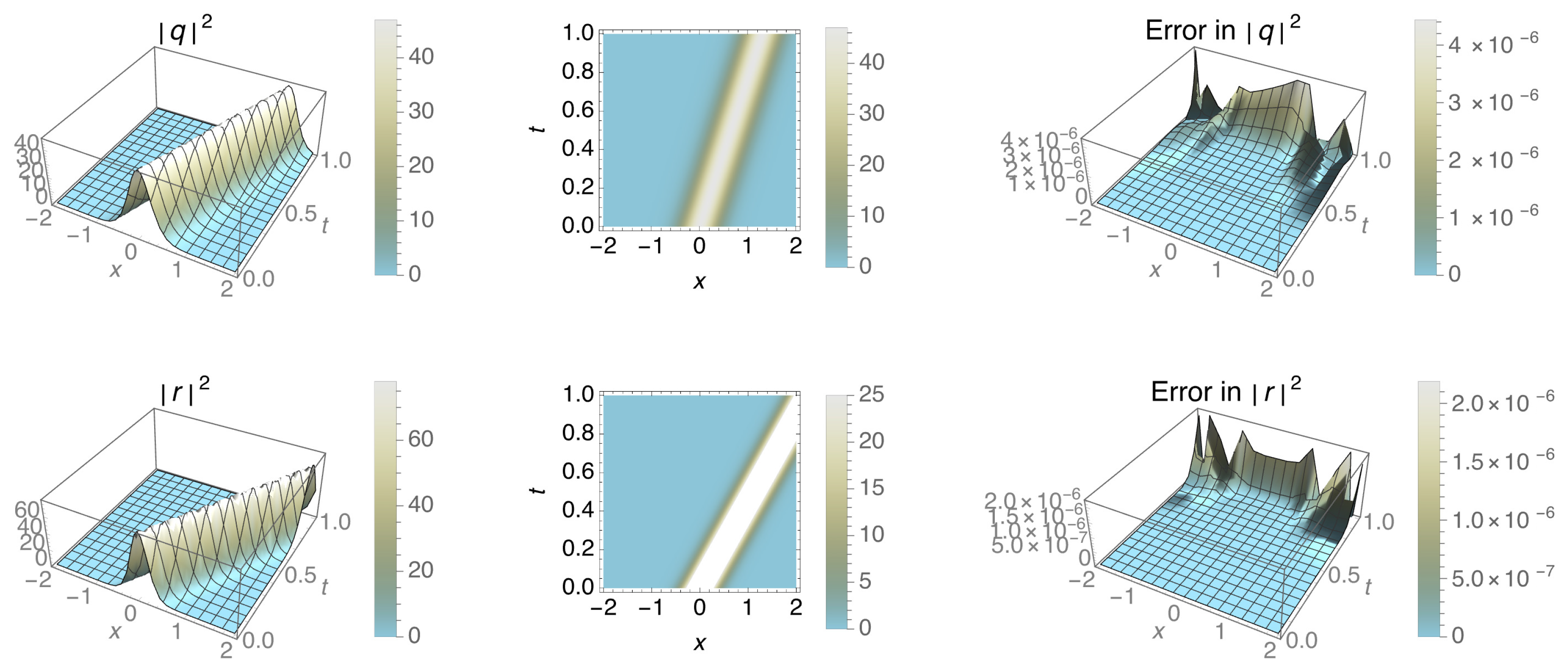
    Figure 1 shows the 3D simulations for the evolution profiles of | q | 2 and | r | 2 , the 2D density plots, and the absolute errors from the 12-step iteration for this case.
  • Case m = 1 4 :
    a 1 = 0.55 , a 2 = 0.15 , a 3 = 1.65 , a 4 = 2.34 , a 5 = 1.03 , a 6 = 1.55 , c 1 = 2.22 , α 1 = 1.37 , β 1 = 0.12 , γ 1 = 0.05 , δ 1 = 1.05 , λ 1 = 2.30 , μ 1 = 0.85 , θ 1 = 2.22 b 1 = 0.07 , b 2 = 1.18 , b 3 = 1.25 , b 4 = 1.23 , b 5 = 2.42 , b 6 = 0.15 , c 2 = 2.56 , α 2 = 0.15 , β 2 = 4.78 , γ 2 = 1.63 , δ 2 = 0.48 , λ 2 = 3.76 , μ 2 = 5.14 , θ 2 = 0.08 .
    Furthermore, let us consider the initial profiles of the soliton at time t = 0 :
    q ( x , 0 ) = 55.41 sech 12 ( x ) × exp { i ( 2.63 x 0.24 ) } , r ( x , 0 ) = 65.8 sech 12 ( x ) × exp { i ( 0.5 x 1.78 ) } .
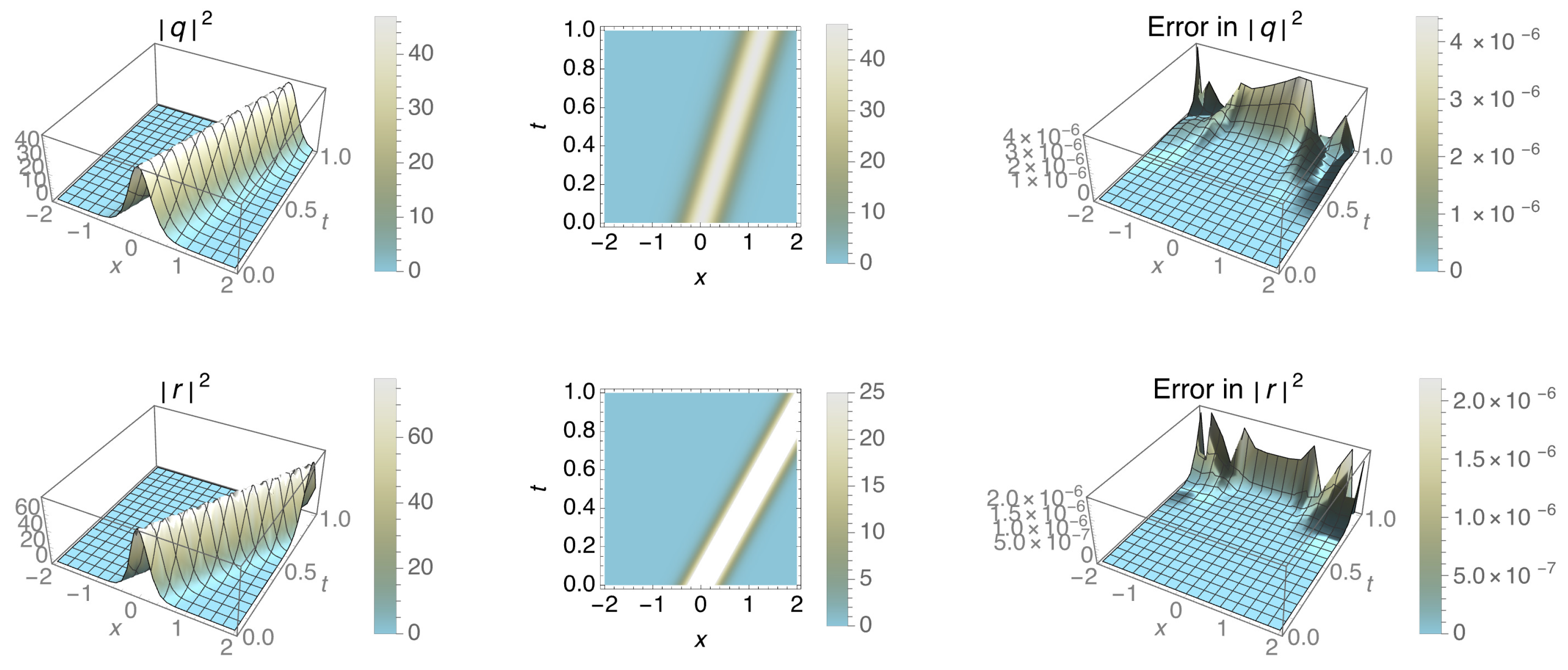
    Figure 2 shows the 3D simulations for the evolution profiles of | q | 2 and | r | 2 , the 2D density plots, and the absolute errors from the 12-step iteration for this case.
  • Case m = 5 4 :
    a 1 = 3.85 , a 2 = 1.45 , a 3 = 0.58 , a 4 = 4.56 , a 5 = 5.78 , a 6 = 3.44 , c 1 = 6.45 , α 1 = 0.55 , β 1 = 0.75 , γ 1 = 1.22 , δ 1 = 5.45 , λ 1 = 1.76 , μ 1 = 5.43 , θ 1 = 3.76 b 1 = 2.87 , b 2 = 2.33 , b 3 = 6.76 , b 4 = 1.55 , b 5 = 0.05 , b 6 = 0.22 , c 2 = 1.45 , α 2 = 4.76 , β 2 = 2.11 , γ 2 = 3.22 , δ 2 = 0.05 , λ 2 = 3.46 , μ 2 = 1.87 , θ 2 = 0.95 .
    Furthermore, let us consider the initial profiles of the soliton at time t = 0 :
    q ( x , 0 ) = 101.72 sech 12 / 5 ( x ) × exp { i ( 3.15 x + 7.44 ) } , r ( x , 0 ) = 82.34 sech 12 / 5 ( x ) × exp { i ( 4.97 x + 0.76 ) } .
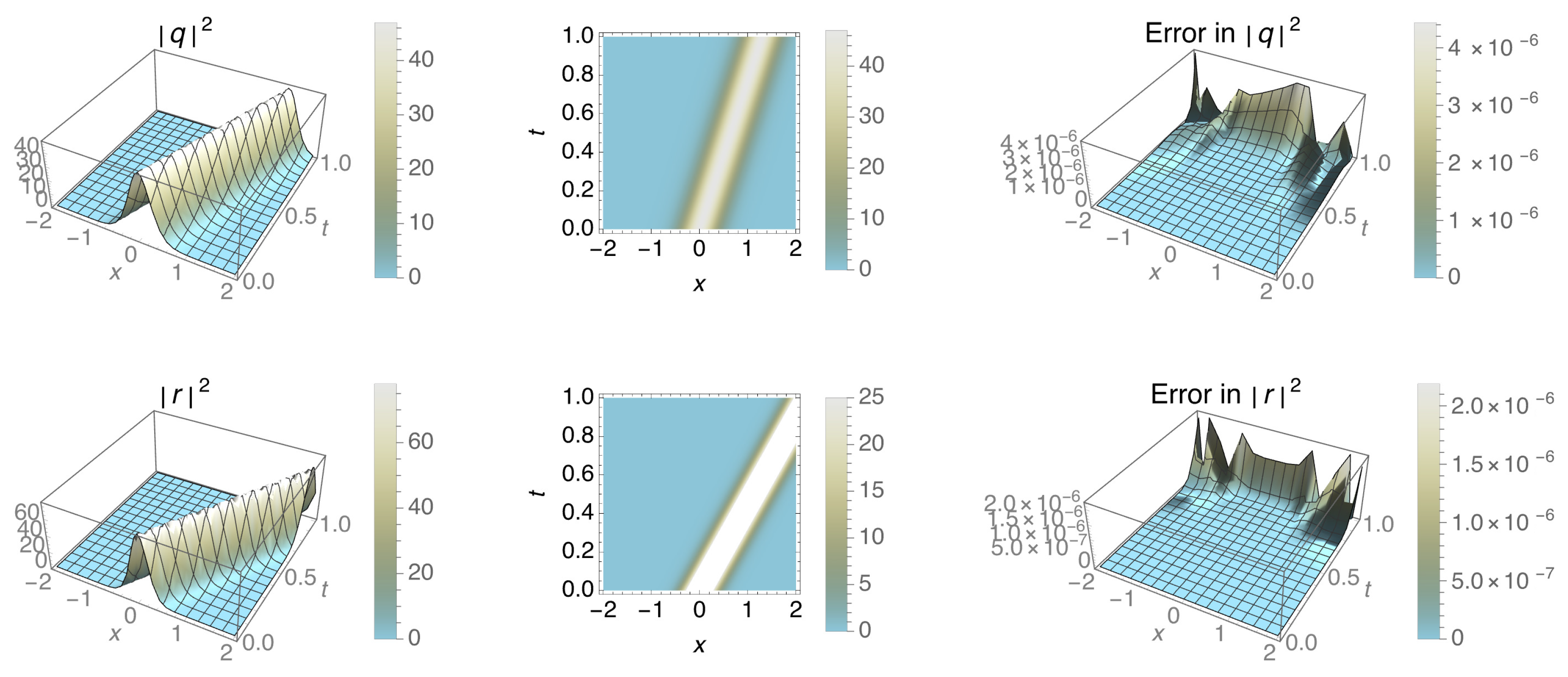
    Figure 3 shows the 3D simulations for the evolution profiles of | q | 2 and | r | 2 , the 2D density plots, and the absolute errors from the 12-step iteration for this case.
  • Case m = 7 4 :
    a 1 = 5.47 , a 2 = 4.32 , a 3 = 1.28 , a 4 = 0.03 , a 5 = 0.36 , a 6 = 4.07 , c 1 = 2.25 , α 1 = 0.01 , β 1 = 0.05 , γ 1 = 0.37 , δ 1 = 3.74 , λ 1 = 1.28 , μ 1 = 0.54 , θ 1 = 2.66 b 1 = 3.22 , b 2 = 1.06 , b 3 = 2.36 , b 4 = 0.85 , b 5 = 2.07 , b 6 = 3.88 , c 2 = 0.98 , α 2 = 5.15 , β 2 = 3.17 , γ 2 = 3.76 , δ 2 = 2.47 , λ 2 = 2.78 , μ 2 = 0.02 , θ 2 = 0.33 .
    Furthermore, let us consider the initial profiles of the soliton at time t = 0 :
    q ( x , 0 ) = 41.37 sech 12 / 7 ( x ) × exp { i ( 0.45 x + 5.73 ) } , r ( x , 0 ) = 63.04 sech 12 / 7 ( x ) × exp { i ( 6.02 x + 0.59 ) } .
    Figure 4 shows the 3D simulations for the evolution profiles of | q | 2 and | r | 2 , the 2D density plots, and the absolute errors from the 12-step iteration for this case.

6. Conclusions and Perspectives

The paper examined highly dispersive perturbed bright solitons in twin-core optical couplers using the LADM. The perturbation terms were chosen to be of Hamiltonian type to maintain the integrability of the model. The integration scheme demonstrated impressive accuracy and an exceptionally small error measure. Consequently, the results are novel and applicable to the study of other types of solitons, including dark solitons.
Additional forms of optical couplers were addressed using the LADM schemes, such as multiple-core couplers, where the coupling is with the nearest neighbors as well as with all neighbors. The research is currently underway, and we progressively reveal and report the results of these projects. We await the outcomes. This report marks the beginning of our findings. The comprehensive results provide greater insight into the behavior of solitons and their applications across various fields, including advanced signal modulation [26] and the fabrication of bimetallic nanoparticles, metamaterials, and metasurfaces [27,28,29]. As we continue our analyses, we expect to identify significant patterns and potential breakthroughs that could influence future research directions.

Author Contributions

Conceptualization and project administration, A.B.; methodology and writing—original draft preparation, O.G.-G.; software, validation and investigation, J.S.A. and L.S.C. All authors have read and agreed to the published version of the manuscript.

Funding

This research received no external funding.

Institutional Review Board Statement

Not applicable.

Informed Consent Statement

Not applicable.

Data Availability Statement

The original contributions presented in this study are included in the article. Further inquiries can be directed to the corresponding author.

Acknowledgments

The work of the last author (AB) was supported by Grambling State University for the Endowed Chair of Mathematics. The author gratefully acknowledges this support.

Conflicts of Interest

The authors declare no conflicts of interest.

Appendix A. First Adomian Polynomials An and Bn

A 0 = q 0 2 q 0 * + q 0 2 q 0 x x * + 4 q 0 q 0 x * q 0 x + 2 q 0 * q 0 q 0 x x + 2 q 0 x 2 q 0 * + q 0 * q 0 q 0 x x + q 0 2 q 0 x * + q 0 2 q 0 * + q 0 q 0 * q 0 x , A 1 = q 1 * q 0 2 + 2 q 0 * q 1 q 0 + q 0 2 q 1 x x * + 2 q 0 q 1 q 0 x x * + 4 ( q 0 q 0 x * q 1 x + q 0 q 1 x * q 0 x + q 1 q 0 x * q 0 x ) + 2 ( q 1 * q 0 x q 0 x x + q 0 * q 1 x q 0 x x + q 0 * q 0 x q 1 x x ) + 2 ( q 1 * q 0 x 2 + 2 q 0 * q 1 x q 0 x ) + q 1 * q 0 q 0 x x + q 0 * q 1 q 0 x x + q 0 * q 0 q 1 x x + q 0 2 q 1 x * + 2 q 0 q 1 q 0 x * + 2 q 0 q 1 q 0 * + q 0 2 q 1 * + q 0 q 0 * q 1 x + q 0 q 1 * q 0 x + q 1 q 0 * q 0 x , A 2 = q 2 * q 0 2 + q 0 * q 1 2 + 2 q 0 * q 2 q 0 + 2 q 1 * q 1 q 0 + q 1 2 q 0 x x * + 2 q 0 q 2 q 0 x x * + 2 q 0 q 1 q 1 x x * + q 0 2 q 2 x x * + 4 ( q 0 q 0 x * q 2 x + q 0 q 1 x * q 1 x + q 0 q 2 x * q 0 x + q 1 q 0 x * q 1 x + q 1 q 1 x * q 0 x + q 2 q 0 x * q 0 x ) + 2 ( q 2 * q 0 x q 0 x x + q 1 * q 1 x q 0 x x + q 0 * q 2 x q 0 x x + q 1 * q 0 x q 1 x x + q 0 * q 1 x q 1 x x + q 0 * q 0 x q 2 x x ) + 2 ( q 2 * q 0 x 2 + q 0 * q 1 x 2 + 2 q 0 * q 2 x q 0 x + 2 q 1 * q 1 x q 0 x ) + q 2 * q 0 q 0 x x + q 1 * q 1 q 0 x x + q 0 * q 2 q 0 x x + q 1 * q 0 q 1 x x + q 0 * q 1 q 1 x x + q 0 * q 0 q 2 x x + q 1 2 q 0 x * + q 0 2 q 2 x * + 2 q 0 q 1 q 1 x * + 2 q 0 q 2 q 0 x * + 2 q 0 q 2 q 0 * + q 1 2 q 0 * + 2 q 0 q 1 q 1 * + q 0 2 q 2 * + q 0 q 0 * q 2 x + q 0 q 1 * q 1 x + q 0 q 2 * q 0 x + q 1 q 0 * q 1 x + q 1 q 1 * q 0 x + q 2 q 0 * q 0 x , A 3 = q 3 * q 0 2 + q 1 * q 1 2 + 2 q 2 * q 1 q 0 + 2 q 1 * q 2 q 0 + 2 q 0 * q 3 q 0 + 2 q 0 * q 1 q 2 + q 1 2 q 1 x x * + 2 q 1 q 2 q 0 x x * + 2 q 0 q 3 q 0 x x * + 2 q 0 q 2 q 1 x x * + 2 q 0 q 1 q 2 x x * + q 0 2 q 3 x x * + 4 ( q 0 q 0 x * q 3 x + q 0 q 1 x * q 2 x + q 0 q 2 x * q 1 x + q 0 q 3 x * q 0 x + q 1 q 0 x * q 2 x + q 1 q 1 x * q 1 x + q 1 q 2 x * q 0 x + q 2 q 0 x * q 1 x + q 2 q 1 x * q 0 x + q 3 q 0 x * q 0 x ) + 2 ( q 3 * q 0 x q 0 x x + q 2 * q 1 x q 0 x x + q 1 * q 2 x q 0 x x + q 0 * q 3 x q 0 x x + q 2 * q 0 x q 1 x x + q 1 * q 1 x q 1 x x + q 0 * q 2 x q 1 x x + q 1 * q 0 x q 2 x x + q 0 * q 1 x q 2 x x + q 0 * q 0 x q 3 x x ) + 2 ( q 3 * q 0 x 2 + q 1 * q 1 x 2 + 2 q 2 * q 1 x q 0 x + 2 q 1 * q 2 x q 0 x + 2 q 0 * q 3 x q 0 x + 2 q 0 * q 1 x q 2 x ) + q 3 * q 0 q 0 x x + q 2 * q 1 q 0 x x + q 1 * q 2 q 0 x x + q 0 * q 3 q 0 x x + q 2 * q 0 q 1 x x + q 1 * q 1 q 1 x x + q 0 * q 2 q 1 x x + q 1 * q 0 q 2 x x + q 0 * q 1 q 2 x x + q 0 * q 0 q 3 x x + q 1 2 q 1 x * + q 0 2 q 3 x * + 2 q 0 q 1 q 2 x * + 2 q 0 q 2 q 1 x * + 2 q 0 q 3 q 0 x * + 2 q 1 q 2 q 0 x * + 2 q 0 q 3 q 0 * + 2 q 1 q 2 q 0 * + 2 q 0 q 2 q 1 * + q 1 2 q 1 * + 2 q 0 q 1 q 2 * + q 0 2 q 3 * + q 0 q 0 * q 3 x + q 0 q 1 * q 2 x + q 0 q 2 * q 1 x + q 0 q 3 * q 0 x + q 1 q 0 * q 2 x + q 1 q 1 * q 1 x + q 1 q 2 * q 0 x + q 2 q 0 * q 1 x + q 2 q 1 * q 0 x + q 3 q 0 * q 0 x , A 4 = q 4 * q 0 2 + q 2 * q 1 2 + q 0 * q 2 2 + 2 q 3 * q 1 q 0 + 2 q 2 * q 2 q 0 + 2 q 1 * q 3 q 0 + 2 q 0 * q 4 q 0 + 2 q 1 * q 1 q 2 + 2 q 0 * q 1 q 3 + q 1 2 q 2 x x * + 2 q 1 q 2 q 1 x x * + q 2 2 q 0 x x * + 2 q 1 q 3 q 0 x x * + 2 q 0 q 4 q 0 x x * + 2 q 0 q 3 q 1 x x * + 2 q 0 q 2 q 2 x x * + 2 q 0 q 1 q 3 x x * + q 0 2 q 4 x x * + 4 ( q 0 q 0 x * q 4 x + q 0 q 1 x * q 3 x + q 0 q 2 x * q 2 x + q 0 q 3 x * q 1 x + q 0 q 4 x * q 0 x + q 1 q 0 x * q 3 x + q 1 q 1 x * q 2 x + q 1 q 2 x * q 1 x + q 1 q 3 x * q 0 x + q 2 q 0 x * q 2 x + q 2 q 1 x * q 1 x + q 2 q 2 x * q 0 x + q 3 q 0 x * q 1 x + q 3 q 1 x * q 0 x + q 4 q 0 x * q 0 x ) + 2 ( q 4 * q 0 x q 0 x x + q 3 * q 1 x q 0 x x + q 2 * q 2 x q 0 x x + q 1 * q 3 x q 0 x x + q 0 * q 4 x q 0 x x + q 3 * q 0 x q 1 x x + q 2 * q 1 x q 1 x x + q 1 * q 2 x q 1 x x + q 0 * q 3 x q 1 x x + q 2 * q 0 x q 2 x x + q 1 * q 1 x q 2 x x + q 0 * q 2 x q 2 x x + q 1 * q 0 x q 3 x x + q 0 * q 1 x q 3 x x + q 0 * q 0 x q 4 x x ) + 2 ( q 4 * q 0 x 2 + q 2 * q 1 x 2 + q 0 * q 2 x 2 + 2 q 3 * q 1 x q 0 x + 2 q 2 * q 2 x q 0 x + 2 q 1 * q 3 x q 0 x + 2 q 0 * q 4 x q 0 x + 2 q 1 * q 1 x q 2 x + 2 q 0 * q 1 x q 3 x ) + q 4 * q 0 q 0 x x + q 3 * q 1 q 0 x x + q 2 * q 2 q 0 x x + q 1 * q 3 q 0 x x + q 0 * q 4 q 0 x x + q 3 * q 0 q 1 x x + q 2 * q 1 q 1 x x + q 1 * q 2 q 1 x x + q 0 * q 3 q 1 x x + q 2 * q 0 q 2 x x + q 1 * q 1 q 2 x x + q 0 * q 2 q 2 x x + q 1 * q 0 q 3 x x + q 0 * q 1 q 3 x x + q 0 * q 0 q 4 x x + q 2 2 q 0 x * + q 1 2 q 2 x * + 2 q 0 q 1 q 3 x * + 2 q 0 q 2 q 2 x * + 2 q 0 q 3 q 1 x * + 2 q 0 q 4 q 0 x * + 2 q 1 q 2 q 1 x * + 2 q 1 q 3 q 0 x * + q 0 * q 2 2 + 2 q 0 q 0 * q 4 + 2 q 0 * q 1 q 3 + 2 q 0 q 1 * q 3 + 2 q 1 q 1 * q 2 + 2 q 0 q 2 * q 2 + q 1 2 q 2 * + 2 q 0 q 1 * q 3 + q 0 2 q 4 * + q 0 q 0 * q 4 x + q 0 q 1 * q 3 x + q 0 q 2 * q 2 x + q 0 q 3 * q 1 x + q 0 q 4 * q 0 x + q 1 q 0 * q 3 x + q 1 q 1 * q 2 x + q 1 q 2 * q 1 x + q 1 q 3 * q 0 x + q 2 q 0 * q 2 x + q 2 q 1 * q 1 x + q 2 q 2 * q 0 x + q 3 q 0 * q 1 x + q 3 q 1 * q 0 x + q 4 q 0 * q 0 x .
B 0 = r 0 2 r 0 * + r 0 2 r 0 x x * + 4 r 0 r 0 x * r 0 x + 2 r 0 * r 0 r 0 x x + 2 r 0 x 2 r 0 * + r 0 * r 0 r 0 x x + r 0 2 r 0 x * + r 0 2 r 0 * + r 0 r 0 * r 0 x , B 1 = r 1 * r 0 2 + 2 r 0 * r 1 r 0 + r 0 2 r 1 x x * + 2 r 0 r 1 r 0 x x * + 4 ( r 0 r 0 x * r 1 x + r 0 r 1 x * r 0 x + r 1 r 0 x * r 0 x ) + 2 ( r 1 * r 0 x r 0 x x + r 0 * r 1 x r 0 x x + r 0 * r 0 x r 1 x x ) + 2 ( r 1 * r 0 x 2 + 2 r 0 * r 1 x r 0 x ) + r 1 * r 0 r 0 x x + r 0 * r 1 r 0 x x + r 0 * r 0 r 1 x x + r 0 2 r 1 x * + 2 r 0 r 1 r 0 x * + 2 r 0 r 1 r 0 * + r 0 2 r 1 * + r 0 r 0 * r 1 x + r 0 r 1 * r 0 x + r 1 r 0 * r 0 x , B 2 = r 2 * r 0 2 + r 0 * r 1 2 + 2 r 0 * r 2 r 0 + 2 r 1 * r 1 r 0 + r 1 2 r 0 x x * + 2 r 0 r 2 r 0 x x * + 2 r 0 r 1 r 1 x x * + r 0 2 r 2 x x * + 4 ( r 0 r 0 x * r 2 x + r 0 r 1 x * r 1 x + r 0 r 2 x * r 0 x + r 1 r 0 x * r 1 x + r 1 r 1 x * r 0 x + r 2 r 0 x * r 0 x ) + 2 ( r 2 * r 0 x r 0 x x + r 1 * r 1 x r 0 x x + r 0 * r 2 x r 0 x x + r 1 * r 0 x r 1 x x + r 0 * r 1 x r 1 x x + r 0 * r 0 x r 2 x x ) + 2 ( r 2 * r 0 x 2 + r 0 * r 1 x 2 + 2 r 0 * r 2 x r 0 x + 2 r 1 * r 1 x r 0 x ) + r 2 * r 0 r 0 x x + r 1 * r 1 r 0 x x + r 0 * r 2 r 0 x x + r 1 * r 0 r 1 x x + r 0 * r 1 r 1 x x + r 0 * r 0 r 2 x x + r 1 2 r 0 x * + r 0 2 r 2 x * + 2 r 0 r 1 r 1 x * + 2 r 0 r 2 r 0 x * + 2 r 0 r 2 r 0 * + r 1 2 r 0 * + 2 r 0 r 1 r 1 * + r 0 2 r 2 * + r 0 r 0 * r 2 x + r 0 r 1 * r 1 x + r 0 r 2 * r 0 x + r 1 r 0 * r 1 x + r 1 r 1 * r 0 x + r 2 r 0 * r 0 x , B 3 = r 3 * r 0 2 + r 1 * r 1 2 + 2 r 2 * r 1 r 0 + 2 r 1 * r 2 r 0 + 2 r 0 * r 3 r 0 + 2 r 0 * r 1 r 2 + r 1 2 r 1 x x * + 2 r 1 r 2 r 0 x x * + 2 r 0 r 3 r 0 x x * + 2 r 0 r 2 r 1 x x * + 2 r 0 r 1 r 2 x x * + r 0 2 r 3 x x * + 4 ( r 0 r 0 x * r 3 x + r 0 r 1 x * r 2 x + r 0 r 2 x * r 1 x + r 0 r 3 x * r 0 x + r 1 r 0 x * r 2 x + r 1 r 1 x * r 1 x + r 1 r 2 x * r 0 x + r 2 r 0 x * r 1 x + r 2 r 1 x * r 0 x + r 3 r 0 x * r 0 x ) + 2 ( r 3 * r 0 x r 0 x x + r 2 * r 1 x r 0 x x + r 1 * r 2 x r 0 x x + r 0 * r 3 x r 0 x x + r 2 * r 0 x r 1 x x + r 1 * r 1 x r 1 x x + r 0 * r 2 x r 1 x x + r 1 * r 0 x r 2 x x + r 0 * r 1 x r 2 x x + r 0 * r 0 x r 3 x x ) + 2 ( r 3 * r 0 x 2 + r 1 * r 1 x 2 + 2 r 2 * r 1 x r 0 x + 2 r 1 * r 2 x r 0 x + 2 r 0 * r 3 x r 0 x + 2 r 0 * r 1 x r 2 x ) + r 3 * r 0 r 0 x x + r 2 * r 1 r 0 x x + r 1 * r 2 r 0 x x + r 0 * r 3 r 0 x x + r 2 * r 0 r 1 x x + r 1 * r 1 r 1 x x + r 0 * r 2 r 1 x x + r 1 * r 0 r 2 x x + r 0 * r 1 r 2 x x + r 0 * r 0 r 3 x x + r 1 2 r 1 x * + r 0 2 r 3 x * + 2 r 0 r 1 r 2 x * + 2 r 0 r 2 r 1 x * + 2 r 0 r 3 r 0 x * + 2 r 1 r 2 r 0 x * + 2 r 0 r 3 r 0 * + 2 r 1 r 2 r 0 * + 2 r 0 r 2 r 1 * + r 1 2 r 1 * + 2 r 0 r 1 r 2 * + r 0 2 r 3 * + r 0 r 0 * r 3 x + r 0 r 1 * r 2 x + r 0 r 2 * r 1 x + r 0 r 3 * r 0 x + r 1 r 0 * r 2 x + r 1 r 1 * r 1 x + r 1 r 2 * r 0 x + r 2 r 0 * r 1 x + r 2 r 1 * r 0 x + r 3 r 0 * r 0 x , B 4 = r 4 * r 0 2 + r 2 * r 1 2 + r 0 * r 2 2 + 2 r 3 * r 1 r 0 + 2 r 2 * r 2 r 0 + 2 r 1 * r 3 r 0 + 2 r 0 * r 4 r 0 + 2 r 1 * r 1 r 2 + 2 r 0 * r 1 r 3 + r 1 2 r 2 x x * + 2 r 1 r 2 r 1 x x * + r 2 2 r 0 x x * + 2 r 1 r 3 r 0 x x * + 2 r 0 r 4 r 0 x x * + 2 r 0 r 3 r 1 x x * + 2 r 0 r 2 r 2 x x * + 2 r 0 r 1 r 3 x x * + r 0 2 r 4 x x * + 4 ( r 0 r 0 x * r 4 x + r 0 r 1 x * r 3 x + r 0 r 2 x * r 2 x + r 0 r 3 x * r 1 x + r 0 r 4 x * r 0 x + r 1 r 0 x * r 3 x + r 1 r 1 x * r 2 x + r 1 r 2 x * r 1 x + r 1 r 3 x * r 0 x + r 2 r 0 x * r 2 x + r 2 r 1 x * r 1 x + r 2 r 2 x * r 0 x + r 3 r 0 x * r 1 x + r 3 r 1 x * r 0 x + r 4 r 0 x * r 0 x ) + 2 ( r 4 * r 0 x r 0 x x + r 3 * r 1 x r 0 x x + r 2 * r 2 x r 0 x x + r 1 * r 3 x r 0 x x + r 0 * r 4 x r 0 x x + r 3 * r 0 x r 1 x x + r 2 * r 1 x r 1 x x + r 1 * r 2 x r 1 x x + r 0 * r 3 x r 1 x x + r 2 * r 0 x r 2 x x + r 1 * r 1 x r 2 x x + r 0 * r 2 x r 2 x x + r 1 * r 0 x r 3 x x + r 0 * r 1 x r 3 x x + r 0 * r 0 x r 4 x x ) + 2 ( r 4 * r 0 x 2 + r 2 * r 1 x 2 + r 0 * r 2 x 2 + 2 r 3 * r 1 x r 0 x + 2 r 2 * r 2 x r 0 x + 2 r 1 * r 3 x r 0 x + 2 r 0 * r 4 x r 0 x + 2 r 1 * r 1 x r 2 x + 2 r 0 * r 1 x r 3 x ) + r 4 * r 0 r 0 x x + r 3 * r 1 r 0 x x + r 2 * r 2 r 0 x x + r 1 * r 3 r 0 x x + r 0 * r 4 r 0 x x + r 3 * r 0 r 1 x x + r 2 * r 1 r 1 x x + r 1 * r 2 r 1 x x + r 0 * r 3 r 1 x x + r 2 * r 0 r 2 x x + r 1 * r 1 r 2 x x + r 0 * r 2 r 2 x x + r 1 * r 0 r 3 x x + r 0 * r 1 r 3 x x + r 0 * r 0 r 4 x x + r 2 2 r 0 x * + r 1 2 r 2 x * + 2 r 0 r 1 r 3 x * + 2 r 0 r 2 r 2 x * + 2 r 0 r 3 r 1 x * + 2 r 0 r 4 r 0 x * + 2 r 1 r 2 r 1 x * + 2 r 1 r 3 r 0 x * + r 0 * r 2 2 + 2 r 0 r 0 * r 4 + 2 r 0 * r 1 r 3 + 2 r 0 r 1 * r 3 + 2 r 1 r 1 * r 2 + 2 r 0 r 2 * r 2 + r 1 2 r 2 * + 2 r 0 r 1 * r 3 + r 0 2 r 4 * + r 0 r 0 * r 4 x + r 0 r 1 * r 3 x + r 0 r 2 * r 2 x + r 0 r 3 * r 1 x + r 0 r 4 * r 0 x + r 1 r 0 * r 3 x + r 1 r 1 * r 2 x + r 1 r 2 * r 1 x + r 1 r 3 * r 0 x + r 2 r 0 * r 2 x + r 2 r 1 * r 1 x + r 2 r 2 * r 0 x + r 3 r 0 * r 1 x + r 3 r 1 * r 0 x + r 4 r 0 * r 0 x .

References

  1. Koprulu, M.O.; Izgi, Z.P. Solitons of the twin-core couplers with fractional beta derivative evolution in optical metamaterials via two distinct methods. J. Math. 2024, 2024, 8852337. [Google Scholar] [CrossRef]
  2. Arshed, S.; Biswas, A.; Kamis Alzahrani, A.; Belic, M.R. Solitons in nonlinear directional couplers with optical metamaterials by first integral method. Optik 2020, 218, 165208. [Google Scholar] [CrossRef]
  3. Iwanaga, M. Photonic metamaterials: A new class of materials for manipulating light waves. Sci. Technol. Adv. Mater. 2012, 13, 053002. [Google Scholar] [CrossRef] [PubMed]
  4. Liu, X.N.; Hu, G.K.; Sun, C.T.; Huang, G.L. Wave propagation characterization and design of two-dimensional elastic chiral metacomposite. J. Sound Vib. 2011, 330, 2536–2553. [Google Scholar] [CrossRef]
  5. Oh, J.H.; Kwon, Y.E.; Lee, H.J.; Kim, Y.Y. Elastic metamaterials for independent realization of negativity in density and stiffness. Sci. Rep. 2016, 6, 23630. [Google Scholar] [CrossRef]
  6. Asad, A.; Riaz, M.B.; Geng, Y. Sensitive demonstration of the twin-core couplers including Kerr law non-linearity via beta derivative evolution. Fractal Fract. 2022, 6, 697. [Google Scholar] [CrossRef]
  7. Pinar Izgi, Z. Rogue waves and solitons of the generalized modified nonlinear Schrödinger equations. Math. Comput. Simul. 2023, 208, 535–549. [Google Scholar] [CrossRef]
  8. Aguilera-Rojas, P.J.; Alfaro-Bittner, K.; Clerc, M.G.; Díaz-Zúñiga, M.; Moya, A.; Pinto-Ramos, D.; Rojas, R.G. Nonlinear wave propagation in a bistable optical chain with nonreciprocal coupling. Commun. Phys. 2024, 7, 195. [Google Scholar] [CrossRef]
  9. Karim, K.A.; Hamdy, M.A.; Akgül, A.; Hassani, M.K.; Hendy, A.S.; Samir, I. Identification of stochastic optical solitons in a generalized NLSE characterized by fourth order dispersion and weak nonlocality. Sci. Rep. 2025, 15, 33805. [Google Scholar] [CrossRef]
  10. Trouba, N.T.; Xu, H.; Alngar, M.E.M.; Shohib, R.M.A.; El-Meligy, M.; Zhu, X.; Sharaf, M. Optical soliton solutions of the stochastic generalized nonlinear Schrödinger equation with arbitrary refractive index in Itô sense. Sci. Rep. 2025, 15, 36172. [Google Scholar] [CrossRef]
  11. Zayed, E.M.E.; El-Shater, M.; Murad, M.A.S.; Secer, A.; Ozisik, M.; Arnous, A.H. Investigating broadly dispersive solitons in optical couplers for metamaterials with nonlinear cubic-quintic-septic dynamics and white noise using distinct integration approaches. Phys. Lett. A 2025, 539, 130367. [Google Scholar] [CrossRef]
  12. Zayed, E.M.E.; Alurrfi, K.A.E.; Hasek, A.M.M.; Arar, N.; Arnous, A.H.; Yildirim, Y. Novel highly dispersive soliton solutions in couplers for optical metamaterials: Leveraging generalized Kudryashov’s Law of refractive index with eighth-order dispersion and multiplicative white noise. Phys. Scr. 2024, 99, 095220. [Google Scholar] [CrossRef]
  13. Alngar, M.E.M. Soliton propagation and interaction in highly dispersive power-law optical metamaterial couplers via Kudryashov’s Addendum method. J. Opt. 2026. [Google Scholar] [CrossRef]
  14. Biswas, A.; Konar, S. Introduction to Non-Kerr Law Optical Solitons; Chapman and Hall/CRC: New York, NY, USA, 2006. [Google Scholar]
  15. Adomian, G.; Rach, R. On the solution of nonlinear differential equations with convolution product nonlinearities. J. Math. Anal. Appl. 1986, 114, 171–175. [Google Scholar] [CrossRef]
  16. Adomian, G. Solving Frontier Problems of Physics: The Decomposition Method; Kluwer: Boston, MA, USA, 1994. [Google Scholar]
  17. Adomian, G. Nonlinear Stochastic Operator Equations; Academic Press: New York, NY, USA, 1986. [Google Scholar]
  18. Duan, J.S. Convenient analytic recurrence algorithms for the Adomian polynomials. Appl. Math. Comput. 2011, 217, 6337–6348. [Google Scholar] [CrossRef]
  19. Hosseini, M.M.; Nasabzadeh, H. On the convergence of Adomian decomposition method. Appl. Math. Comput. 2006, 182, 536–543. [Google Scholar] [CrossRef]
  20. Babolian, E.; Biazar, J. On the order of convergence of Adomian method. Appl. Math. Comput. 2002, 130, 383–387. [Google Scholar] [CrossRef]
  21. Khuri, S.A. A Laplace decomposition algorithm applied to a class of nonlinear differential equations. J. Appl. Math. 2001, 1, 141–155. [Google Scholar] [CrossRef]
  22. Ahmed, H.F.; Bahgat, M.S.M.; Zaki, M. Analytical approaches to space- and time-fractional coupled Burgers’ equations. Pramana-J. Phys. 2019, 92, 38. [Google Scholar] [CrossRef]
  23. Paul, S.; Mondal, S.P.; Bhattacharya, P. Numerical solution of Lotka Volterra prey predator model by using Runge–Kutta–Fehlberg method and Laplace Adomian decomposition method. Alex. Eng. J. 2016, 55, 613–617. [Google Scholar] [CrossRef]
  24. Ablowitz, M.J.; Segur, H. Solitons and the Inverse Scattering Transform; SIAM Studies in Applied Mathematics: Philadelphia, PA, USA, 1981. [Google Scholar]
  25. Kohl, R.; Biswas, A.; Milovic, D.; Zerrad, E. Optical soliton perturbation in a non-Kerr law media. Opt. Laser Technol. 2008, 40, 647–662. [Google Scholar] [CrossRef]
  26. Martines-Arano, H.; Valdivia-Flores, A.; Castillo-Cruz, J.; García-Pérez, B.E.; Torres-Torres, C. Spatially modulated ablation driven by chaotic attractors in human lung epithelial cancer cells. Biomed. Phys. Eng. Express 2024, 10, 035041. [Google Scholar] [CrossRef] [PubMed]
  27. Elsayed, K.A.; Alomari, M.; Drmosh, Q.A.; Alheshibri, M.; Al Baroot, A.; Al-Alotaibi, A.L. Fabrication of ZnO-Ag bimetallic nanoparticles by laser ablation for anticancer activity. Alex. Eng. J. 2022, 61, 1449–1457. [Google Scholar] [CrossRef]
  28. Xiao, Q.; Fan, L.H.; Ma, Q.; Ning, Y.M.; Gu, Z.; Chen, L.; Li, L.; You, J.W.; Niu, Y.F.; Cui, T.J. Secure wireless communication of brain–computer interface and mind control of smart devices enabled by space-time-coding metasurface. Nat. Commun. 2025, 16, 7914. [Google Scholar] [CrossRef] [PubMed]
  29. Yao, J.; Hsu, W.-L.; Liang, Y.; Lin, R.; Chen, M.K.; Tsai, D.P. Nonlocal metasurface for dark-field edge emission. Sci. Adv. 2024, 10, eadn2752. [Google Scholar] [CrossRef]
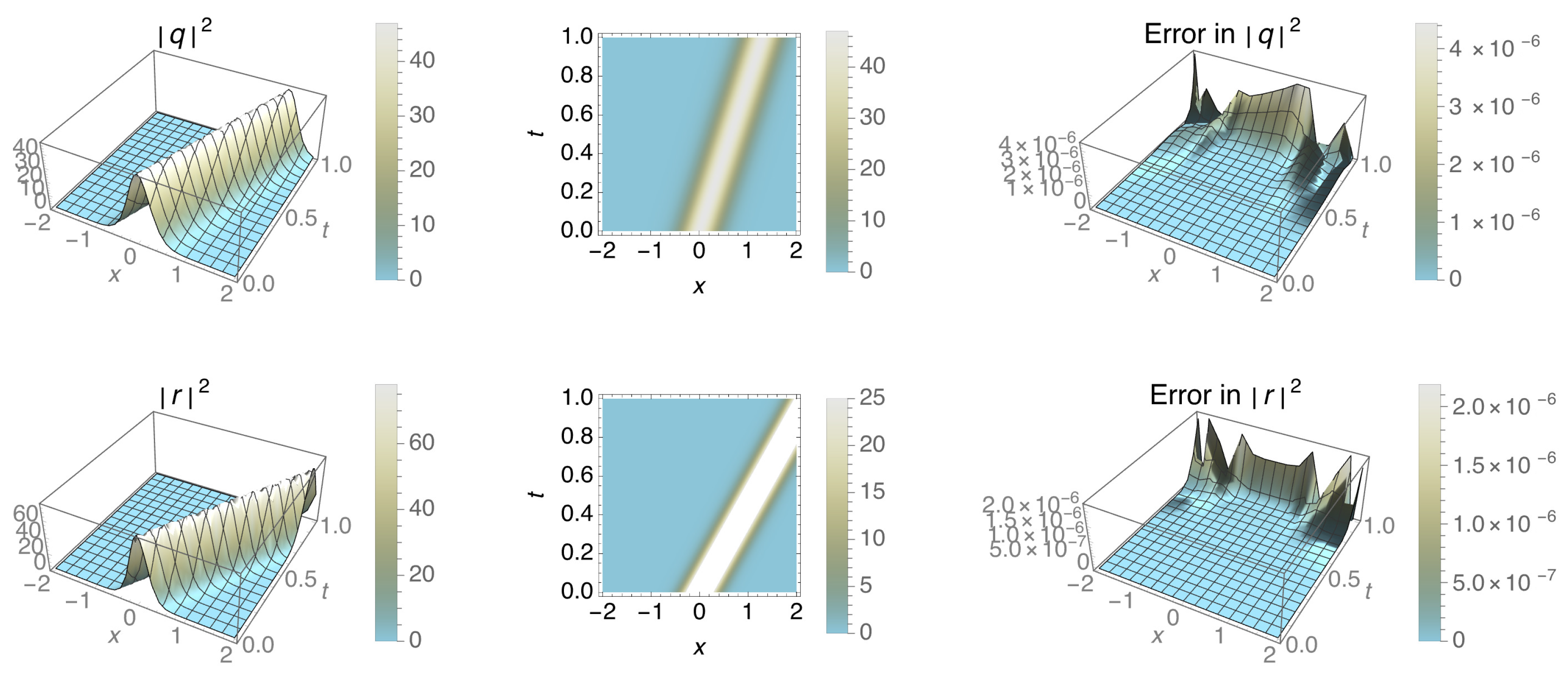
Figure 1. (Above) 3D simulations for the evolution profiles of | q | 2 obtained numerically by LADM, the corresponding 2D density plot, and the absolute error. (Below) 3D simulations for the evolution profiles of | r | 2 obtained numerically by LADM, the corresponding 2D density plot, and the absolute error for the parameter values of Case m = 1 2 .
Algorithms 19 00342 g001
Figure 2. (Above) 3D simulations for the evolution profiles of | q | 2 obtained numerically by LADM, the corresponding 2D density plot, and the absolute error. (Below) 3D simulations for the evolution profiles of | r | 2 obtained numerically by LADM, the corresponding 2D density plot, and the absolute error for the parameter values of Case m = 1 4 .
Algorithms 19 00342 g002
Figure 3. (Above) 3D simulations for the evolution profiles of | q | 2 obtained numerically by LADM, the corresponding 2D density plot, and the absolute error. (Below) 3D simulations for the evolution profiles of | r | 2 obtained numerically by LADM, the corresponding 2D density plot, and the absolute error for the parameter values of Case m = 5 4 .
Algorithms 19 00342 g003
Figure 4. (Above) 3D simulations for the evolution profiles of | q | 2 obtained numerically by LADM, the corresponding 2D density plot, and the absolute error. (Below) 3D simulations for the evolution profiles of | r | 2 obtained numerically by LADM, the corresponding 2D density plot, and the absolute error for the parameter values of Case m = 7 4 .
Algorithms 19 00342 g004
Disclaimer/Publisher’s Note: The statements, opinions and data contained in all publications are solely those of the individual author(s) and contributor(s) and not of MDPI and/or the editor(s). MDPI and/or the editor(s) disclaim responsibility for any injury to people or property resulting from any ideas, methods, instructions or products referred to in the content.