1. Introduction
Knowledge Tracing (KT) is an essential task in adaptive learning systems, enabling intelligent tutoring systems (ITSs) to assess learners’ knowledge states and predict their future performance. Accurate KT is foundational for personalizing educational experiences, as it informs instructional decisions and helps to adapt content based on a learner’s evolving understanding [
1].
Despite the notable success of Deep Learning-based Knowledge Tracing (DLKT) models, significant limitations remain. Current models primarily excel at capturing short-term patterns but often struggle with long-sequence problems [
2]. In educational scenarios, a student’s performance is influenced by two distinct temporal scales: short-term fluctuations, which reflect immediate difficulties or recent successes in specific exercises, and long-term knowledge retention, which represents the durable mastery of concepts accumulated over extended periods. For instance, while a student might solve basic algebraic equations by relying on immediate prior exercises (short sequence), mastering complex engineering statics or geometric proofs requires integrating a vast history of related practice and prior mastery (long sequence). Neglecting the long-term dependencies in these trajectories results in an incomplete and often inaccurate representation of the learner’s true knowledge state.
Existing models, such as the original Deep Knowledge Tracing (DKT) based on standard Long Short-Term Memory (LSTM) networks, have improved predictive accuracy by capturing non-linear temporal dependencies [
3,
4]. However, standard LSTMs face inherent challenges in managing very long-range information due to gradient vanishing issues and limited memory capacity [
5]. Furthermore, while recent attention-based models or graph-based approaches (like GCNs) have been proposed to mitigate these issues, they often introduce significant computational complexity or require specific data structures that may not be optimal for all types of student interaction sequences. Therefore, enhancing the model’s ability to maintain high-capacity memory over long learning sequences while remaining sensitive to immediate shifts is of great significance for the next generation of ITSs.
To better address these dual-scale temporal challenges, this paper proposes a novel Knowledge Tracing model based on the Extended Long Short-Term Memory (xLSTM) architecture, named xDKT. The model leverages the specialized memory blocks of the xLSTM family. While architecture theoretically offers mLSTM for associative matrix memory and sLSTM for scalar tracking, our systematic evaluation over massive sequence lengths reveals a crucial insight: the sLSTM’s exponential gating and scalar memory are exceptionally well-suited for tracking the strictly sequential, step-by-step evolution of student cognitive states across both short and long contexts.
While the xLSTM architecture has demonstrated success in managing long sequences in domains such as finance [
6] and wind energy [
7], its application within Intelligent Tutoring Systems (ITSs) is a nascent area of research. During the preparation and submission of this manuscript, two related studies emerged: xLSTMKT [
8] (published in August 2025) and DKT2 [
9] (published in June 2025). We consider these to be concurrent works that validate the growing timeliness and relevance of exploring xLSTM in educational contexts. However, our specific implementation of xDKT addresses a fundamentally different set of challenges related to the long-sequence problem.
The expected benefit of xDKT is its ability to maintain high-capacity memory over long learning sequences while remaining sensitive to immediate fluctuations, without the need for manual feature engineering. By overcoming the memory limitations of standard recurrent networks, xDKT provides a more nuanced foundation for intelligent tutoring, allowing for immediate feedback and the development of stable, personalized learning strategies that evolve alongside the student.
3. Method
In this section, a detailed description and explanation of the xDKT architecture and workflow are provided.
Section 3.1 presents the problem setting of Knowledge Tracing.
Section 3.2 shows the overall framework and workflow of the xDKT model. The remaining subsections will break down key modules in detail, including the sLSTM and mLSTM blocks—and explain their functions in capturing dual-scale temporal dependencies.
3.1. Problem Setting of Knowledge Tracing
Each student’s individual performance profile in digital learning environments is divided into two primary components. One is the individual problem attempted at each discrete time step; the second is the corresponding student response under these steps. When a student interacts with the system from the starting point until time step t, a tuple can be obtained by combining the exercises, knowledge concepts, and student responses during this period: (, , ), where denotes the problem practiced by the student at time step t; denotes the associated knowledge concept (skill); and in {0, 1} represents the student’s response, where 0 indicates an incorrect answer and 1 indicates a correct answer.
To address the potential over-parameterization that occurs when training with extensive sequences and to better capture the student’s learning dynamics, we introduce the problem attributes based on the distinct skills involved. This allows the model to accurately capture responses to different types of knowledge components, thereby avoiding the overfitting of excessive behavioral details. To better characterize the multi-scale temporal problem—specifically the distinction between short-term fluctuations and long-term retention—the sequences we process are structured into uniform windows. On this basis, we omit the student superscript to discuss the future performance status of a single learner. Therefore, given the set of interactions from time step 1 to t − 1 as (, , ), …, (, , ), the objective is to predict the student’s response , to question on concept at the current time step t.
Inspired by the foundational work of Piech et al. [
3], we utilize a real-valued vector
to denote the original encoding of each question–response pair. Here,
represents the mastery signal acquired by the learner through answering a question. For these interaction sequences, we employ a dual-channel one-hot encoding where the first N indices represent correct responses (1) and the subsequent N indices represent incorrect responses (0), where N denotes the total number of unique skills (concepts). Since the concept index
was introduced to prevent over-parameterization and ensure scalability, all problems involving the same concept are aggregated. In this case, we simplify the mapping such that
=
and the total number of input features is 2N. To ensure computational efficiency and focus on multi-scale dependencies, to ensure computational efficiency and focus on multi-scale dependencies, student trajectories are divided into uniform subsequences of 50 steps (MAX_STEP). This fixed window size was selected to maintain parity with established benchmarks in the literature, such as the original DKT implementation, thereby ensuring that performance gains are attributed to the xDKT architecture rather than expanded historical data access. This preprocessing step provides a structured temporal window for the memory blocks of the xDKT model.
3.2. The Proposed Model xDKT
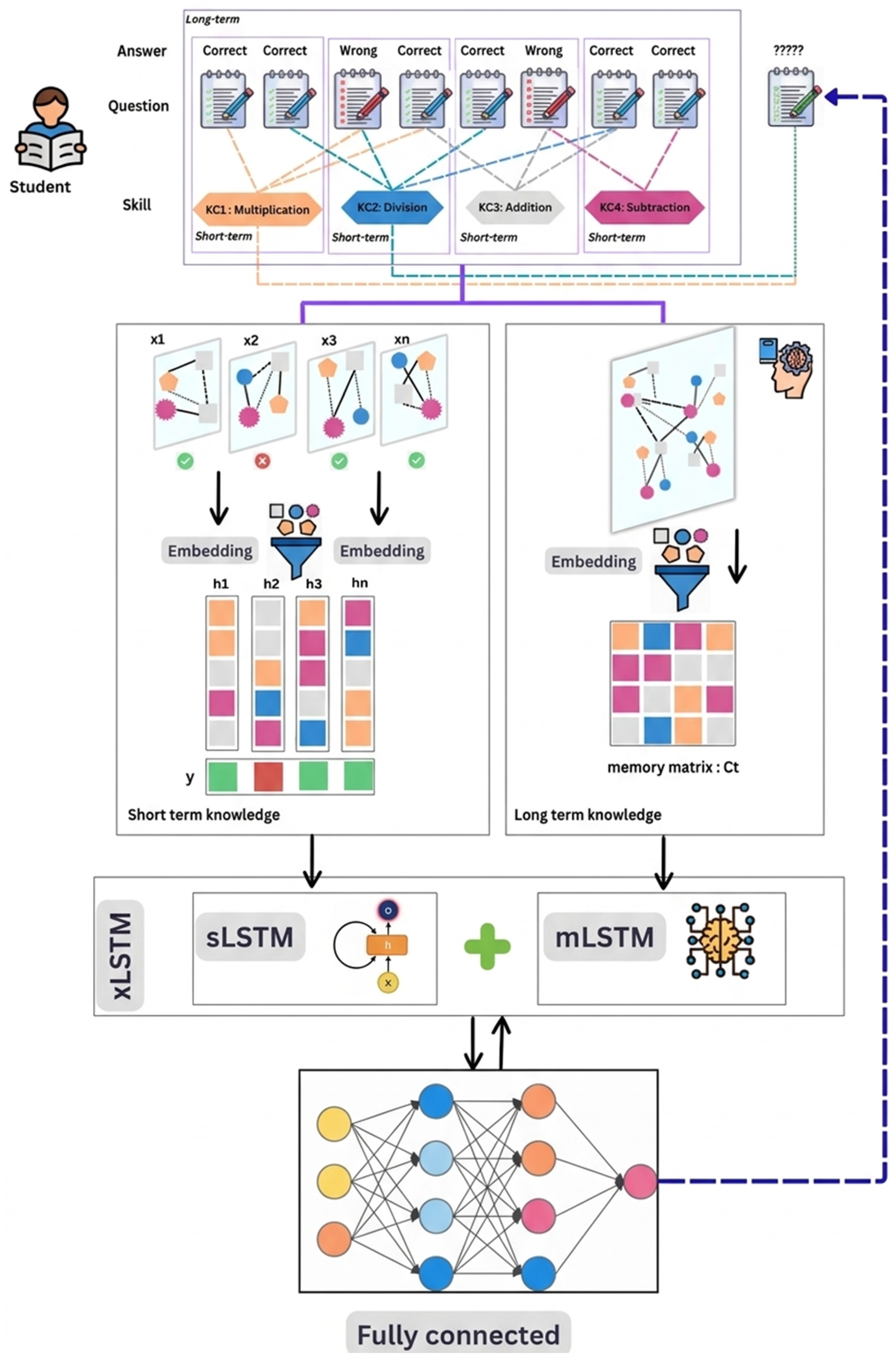
The proposed xDKT model (
Figure 1) integrates the extended LSTM architecture (xLSTM) into the standard DKT framework to better capture the dual nature of student learning. In practice, xDKT replaces the vanilla LSTM of DKT with a stack of xLSTM blocks, while preserving the overall prediction framework of DKT. Student interaction sequences are fed into the xLSTM-based recurrent network, which processes them and produces probability predictions for each skill at each time step, similar to DKT’s output layer.
A key strength of the xDKT framework lies in its utilization of advanced memory structures. Initially, the architecture was designed to combine sLSTM for short-term dynamics and mLSTM for long-term dependencies. However, as demonstrated in our extensive ablation studies, the sLSTM block—empowered by exponential gating—proves to be the most critical component. It provides both the responsiveness needed for recent learning events and the gradient stability required for cumulative, long-term knowledge growth over sequences as long as 1000 steps. Moreover, xLSTM enhances the gating mechanism by replacing traditional sigmoid-based gates with exponential gating, which provides more precise control over information retention, forgetting, and transfer. This advanced regulation of memory flow enables the model to maintain longer-term information without sacrificing sensitivity to short-term fluctuations. Finally, the output layer of xDKT applies a sigmoid activation to yield the probability that a student will answer the next question correctly for each skill. By leveraging xLSTM within the DKT paradigm, xDKT preserves the strengths of sequential modeling while overcoming the limitations of vanilla LSTM in capturing both long-term dependencies and short-term learning dynamics.
3.3. Extended Long Short-Term Memory (xLSTM)
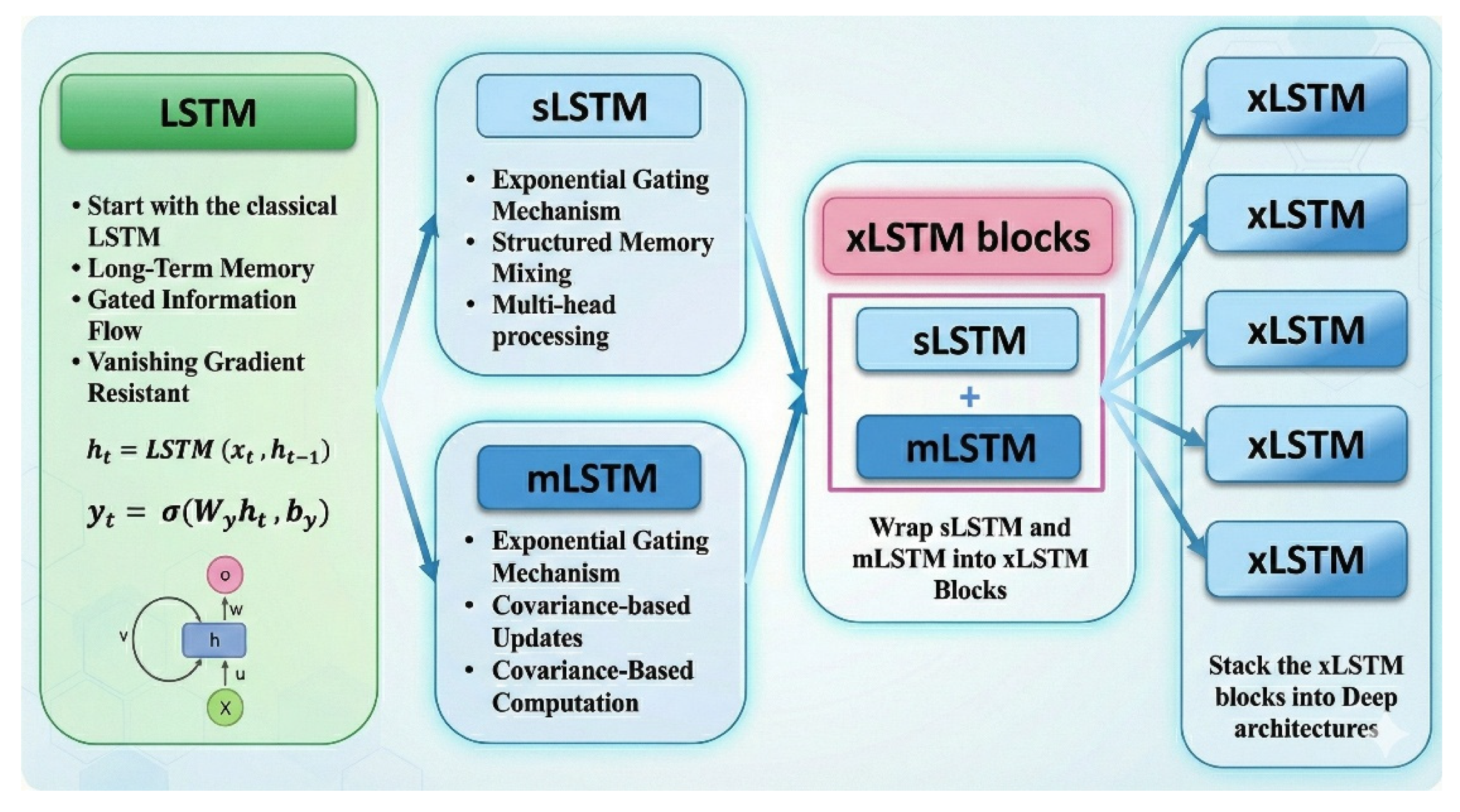
The Extended Long Short-Term Memory (xLSTM) architecture (
Figure 2), introduced by Beck et al. [
24], represents a significant evolution of LSTM networks designed to overcome their limitations in modeling long-range dependencies. This architecture is built upon a hierarchical set of innovations that fundamentally revise the original LSTM cell. It begins by replacing the standard gating and constant error carousel with two new memory cells: sLSTM and mLSTM, both of which introduce exponential gating. The sLSTM cell offers a new memory mixing technique, while the mLSTM is fully parallelizable, featuring a novel matrix memory cell state and a new covariance update rule. These sLSTM and mLSTM cells are then integrated within residual blocks to create xLSTM blocks, which are stacked to form the complete xLSTM architecture.
Through these enhanced memory structures and refined gating mechanisms, xLSTM achieves superior gradient flow and multi-scale temporal processing. This dual capability allows it to distinguish between short-term performance fluctuations and long-term knowledge acquisition, making it exceptionally well-suited for adaptive learning systems. Consequently, xLSTM can power more nuanced educational interventions by providing immediate, responsive feedback while simultaneously building evolving, personalized learning strategies.
3.3.1. sLSTM: Capturing Sequential Learning Dynamics
The sLSTM retains a scalar memory structure
, but its update is designed to rapidly adapt to recent inputs, making it sensitive to short-term changes in student performance:
Components:
: input, forget, and output gates.
To prevent numerical overflow from exponential gates, a stabilizer is applied, producing stable gates et .
Key Advantages:
Short-term sensitivity: exponential gating allows rapid adaptation to recent student performance.
Stable updates: the normalizer and stabilizer prevent instability from large gate values.
Memory mixing: multiple memory cells with recurrent connections enable parallel tracking of dependencies within each head.
Multi-head processing, similar to Transformer attention, for parallel tracking of dependencies within each head.
Efficient handling of short-term dependencies and fast computation.
In short, sLSTM acts as a highly effective sequential memory that captures rapid learning fluctuations while maintaining gradient stability over long trajectories, making it the core driver for our Knowledge Tracing task.
3.3.2. mLSTM: High-Capacity Associative Matrix Memory
The mLSTM is an evolution of the traditional Long Short-Term Memory (LSTM) network, designed to significantly enhance its storage capacity. The core innovation of mLSTM is the replacement of the LSTM’s scalar memory cell
with a matrix memory cell
, allowing it to function as an associative key-value memory.
Components:: matrix memory (stores richer long-term patterns).
: at each timestep t, the mLSTM stores information by associating a key vector with a value vector .
Key/value/query vectors (): derived from the input through linear projections, similar to the attention mechanism in Transformers.
A key challenge in mLSTM is maintaining stability, particularly due to the use of exponential activation functions for the gates. To address this, the model introduces a normalizer state.
: The refined result. An output gate acts on to control what is ultimately exposed, emphasizing important details and suppressing irrelevant ones.
Key Advantages:
High-Capacity Associative Memory: The matrix memory cell stores complex relationships between key-value vector pairs, offering a vastly larger and more structured storage capacity than the scalar cell of a standard LSTM. It allows gradual accumulation of knowledge across many time steps.
Content-Addressable Retrieval: information is retrieved using a query vector to probe the memory matrix, allowing the model to recall specific values based on the query’s content, similar to attention mechanisms in Transformers.
Outer-product updates create interactions between past and current knowledge, capturing patterns that evolve over multiple sessions.
Stable Retrieval Dynamics: a dedicated normalizer state tracks the history of stored keys to stabilize the retrieval process, preventing outputs from exploding due to large gate values or query interactions.
Parallelizable operations, ideal for high-performance hardware.
Superior retention of long-term dependencies, essential for gradual learning tasks.
A covariance-style update, enriching the model’s ability to learn complex interactions.
In short, functioning as a high-capacity associative memory within a recurrent framework, mLSTM provides a detailed memory of a student’s evolving skill mastery. It excels at instantly retrieving a student’s history with the specific concepts in a new problem, making it ideal for personalizing the learning path with fine-grained precision.
3.3.3. Architectural and Empirical Comparisons of LSTM and xLSTM
The Extended Long Short-Term Memory (xLSTM) architecture represents a significant evolution from the traditional Long Short-Term Memory (LSTM) network, addressing critical limitations that led to the dominance of Transformer models. By introducing innovative gating mechanisms and memory structures, xLSTM enhances the capabilities of LSTMs in terms of scalability, memory capacity, and parallelization.
The core of xLSTM’s advancement lies in two new types of memory cells: Scalar LSTM (sLSTM) and Matrix LSTM (mLSTM), which work in concert to create a more powerful and efficient recurrent architecture.
Key Architectural Differences
A fundamental upgrade in xLSTM is the replacement of the standard sigmoid gating with exponential gating. This allows the model to make more drastic and flexible revisions to its memory, overcoming a key LSTM weakness where stored information was difficult to completely overwrite or update.
Table 2 summarizes the differences between the components [
24].
Head-to-Head Comparison: LSTM vs. xLSTM
Table 3 provides an enriched comparison highlighting the key distinctions between the two architectures [
24].
In summary, while the traditional LSTM was groundbreaking architecture, its inherent sequential nature and memory limitations held it back.
Table 4 summarizes the key characteristics of the standard LSTM alongside the new sLSTM and mLSTM modules [
24]. The xLSTM revitalizes the recurrent network paradigm by integrating a parallelizable, high-capacity matrix memory (mLSTM) with a refined sequential memory (sLSTM), positioning it as a powerful and scalable alternative in the modern AI landscape.
By integrating these advancements into a Deep Knowledge Tracing model, our proposed xDKT model is uniquely positioned to enhance adaptive learning. This approach aims to create a more precise and effective learning experience, as will be detailed in the next section.
4. Experiment
To evaluate the performance of the proposed xDKT (Extended Deep Knowledge Tracing) model in tracing student knowledge and predicting assessment outcomes, we conducted a series of experiments across multiple datasets, subjects, and prediction intervals, comparing xDKT with the traditional DKT model.
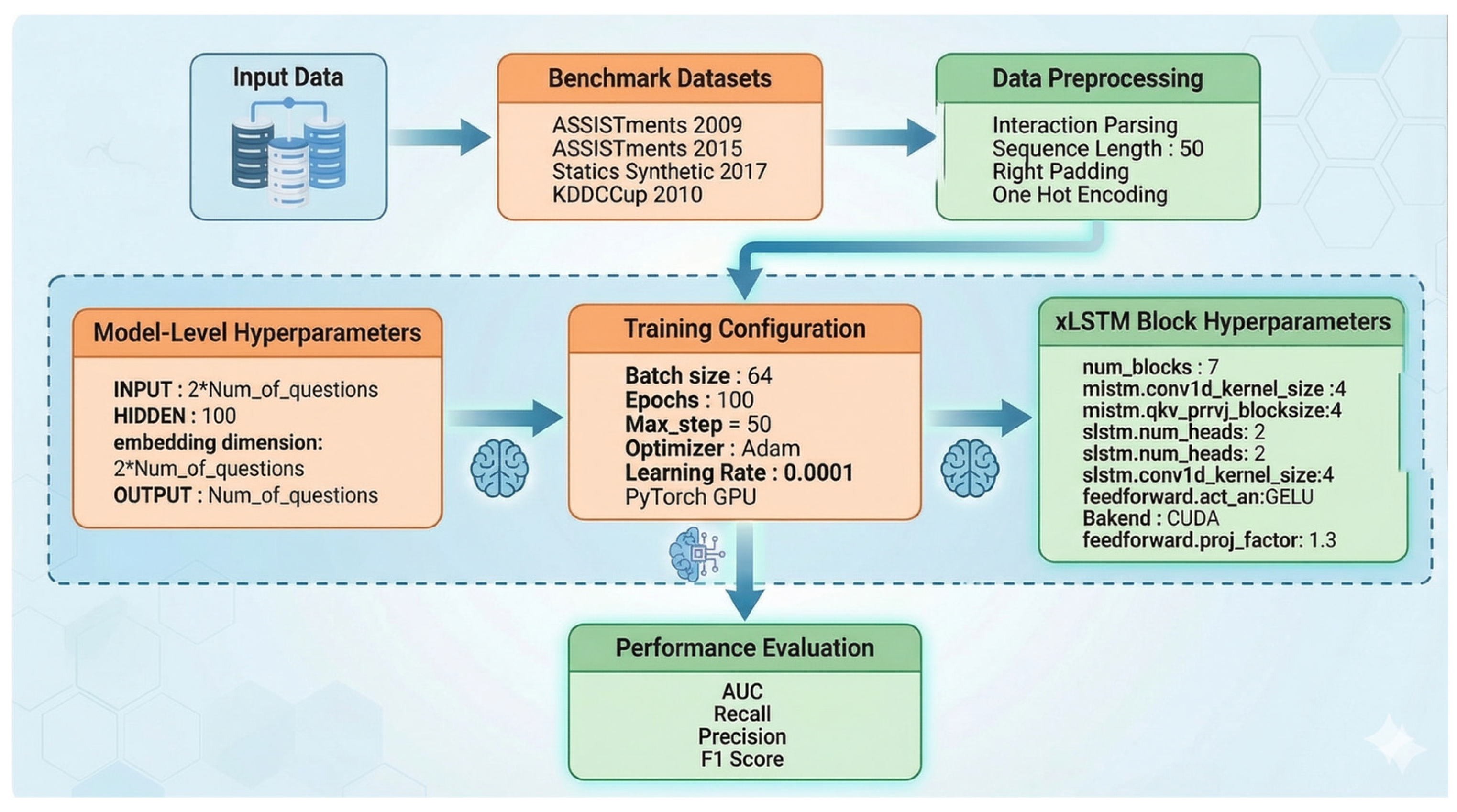
Figure 3 illustrates the overall experimental framework, including data preprocessing steps, model training, hyperparameter configurations, and evaluation procedures using the following metrics: AUC, Recall, Precision, and F1-score (Table 6).
4.1. Dataset
To evaluate the effectiveness of the proposed xDKT model, six benchmark datasets were employed. These datasets represent a diverse range of learning environments, problem types, and student populations, allowing for a robust and comprehensive evaluation. Each dataset contains sequential student–problem interaction logs, including correctness labels, associated skills, and in some cases, timestamps (
Table 5). Together, they capture both short-term fluctuations and long-term knowledge accumulation, which are essential for testing xDKT’s ability to model multi-scale temporal learning dynamics.
Algebra 2005–2006 (algebra05): Released in the KDD Cup 2010 Challenge [
25], this dataset records authentic student interactions in middle/high-school algebra. It has become a standard benchmark in educational data mining due to its size and detailed skill tagging, with over 173 k problem-solving attempts linked to 112 distinct skills.
ASSISTments 2009–2010 (assist09): Extracted from the ASSISTments ITS, this dataset includes 3241 students and 17,709 items annotated with 124 skills. It reflects students’ responses to online mathematics exercises but lacks precise timestamps. Its large scale and diversity make it suitable for testing generalization.
ASSISTments 2015 (assist15): A curated version of ASSISTments logs, containing 14,567 learners, 100 items, and 100 skills. This dataset is smaller in terms of item coverage but is widely used in KT studies due to its well-structured mapping between items and skills.
ASSISTments Challenge 2017 (assist17): Released as part of the ASSISTments 2017 challenge [
26], this dataset includes 1708 students, 3162 items, and 102 skills, with timestamps available. It is known for its sparsity, making it a challenging benchmark for KT models.
Statics 2011 (statics11): Sourced from the PSLC DataShop [
25], this dataset captures 282 students’ interactions in engineering courses, focusing on problems related to forces and moments. With 1223 items and 98 skills, it provides a domain-specific testbed beyond mathematics.
Synthetic dataset: A simulated dataset where 2000 virtual students solve 50 exercises linked to five knowledge components. Each student has a latent knowledge state per concept, and exercises vary in difficulty. This dataset includes timestamps and serves as a controlled environment for analyzing model behavior under known conditions.
4.2. Data Preprocessing
To prepare the input data for training and evaluation, we designed a standardized preprocessing pipeline applicable across all six benchmark datasets used in this study: ASSITments 2009, 2015, 2017, Statics 2011, algebra05, and a synthetic dataset. Each raw dataset was first structured such that every student’s interaction history was parsed into triplets: the sequence length, the item identifiers (question IDs), and binary correctness labels (1 for correct, 0 for incorrect). This triplet format is widely adopted in the Knowledge Tracing literature and ensures consistency across different data sources.
Given that deep sequential models like DKT and xDKT require fixed-length input sequences, each student sequence was divided into uniform subsequences of length 50 (MAX_STEP). Sequences shorter than this threshold were padded on the right with a placeholder value (−1), ensuring dimensional consistency while preserving temporal structure. This padding mechanism accommodates variable-length student trajectories without introducing semantic bias and aligns with prior work such as the original DKT formulation.
Each interaction was encoded into a one-hot vector of size 2N, where N is the total number of unique questions in the dataset (e.g., N = 50 for synthetic). This dual-channel representation splits the vector space into two halves: the first N positions encode correct responses, and the remaining N positions encode incorrect responses. For instance, if a student answered question 5 correctly, the fifth index was activated in the first half of the vector; if the answer was incorrect, the corresponding index in the second half was activated instead. This scheme enables the model to distinguish between mastery and non-mastery signals for each item.
Following encoding, the data was wrapped into custom PyTorch (version 2.4, Linux Foundation, San Francisco, CA, USA) Dataset objects (xDKTDataSet class), which handle dynamic construction of training examples and perform real-time one-hot conversion. These datasets were subsequently passed to DataLoader instances to enable efficient mini-batch training and evaluation, leveraging GPU acceleration. The preprocessing routines were implemented through a modular pipeline composed of readdata.py, xDKTDataSet.py, and dataloader.py, ensuring compatibility with both RNN-based and Transformer-style KT models. This setup facilitates scalable experimentation, uniform batch processing, and supports generalization across multiple Knowledge Tracing benchmarks.
4.3. Experiment Setup
Model Training: The xDKT model was trained using preprocessed student interaction data across several benchmark datasets, including synthetic and real-world educational datasets such as ASSIST2009, ASSIST2015, ASSIST2017, and algebra05. The preprocessing pipeline ensured fixed-length sequences (length 50) and one-hot encoding of student responses as described in the Data Preprocessing section.
For each dataset, the pre-split training and test files were directly used, as no further validation set was explicitly constructed. The xDKT model was trained using mini batches of size 64 for 100 epochs with the Adam optimizer and a fixed learning rate of 0.0001. Training was conducted on a GPU using PyTorch for efficient parallelization. Each batch consisted of input tensors with dimensions [batch_size, sequence_length, 2 × N], where N is the number of unique items (questions) in the dataset.
Hyperparameter Tuning: The model configuration was fixed for all datasets to enable fair comparison and to reflect typical usage of Deep Knowledge Tracing systems. The xDKT architecture leverages the xLSTM block stack, which was configured with seven blocks, an embedding dimension of 100, and structured attention via mLSTM and sLSTM components. Key xLSTM-specific hyperparameters include:
mLSTM block: convolutional kernel size of 4, two attention heads, and block size of 4 for QKV projections.
sLSTM block: two heads, convolutional kernel size of 4, and a feedforward projection factor of 1.3 with GELU activation.
Unlike traditional models that require manual feature engineering or handcrafted rules, xDKT’s architecture dynamically captures temporal dependencies and latent learning states without requiring manual prediction intervals (e.g., t + 1, t + 3). The numbers of LSTM layers and hidden units were kept constant (1 layer, 50 hidden units), reflecting the base DKT structure, while the extended expressivity was delegated to the xLSTM components.
No dropout or early stopping was applied in the current setup, and hyperparameter tuning was not performed beyond the fixed configuration to isolate and evaluate the architectural contribution of the xLSTM within xDKT.
To prevent performance inflation through epoch selection, all reported metrics (AUC, F1, Precision, Recall) are taken from the final training epoch (Epoch 100), representing the converged state of the model.
4.4. Evaluation Methodology
To evaluate the performance of the proposed xDKT model, we assessed its ability to predict student responses over time using the held-out test sets of each dataset. The evaluation was conducted after each training epoch, ensuring that model performance reflects its generalization capabilities on unseen student interaction sequences.
The evaluation framework focuses on binary prediction: for each time step, the model outputs a probability indicating the likelihood of a correct answer for the next question. Predictions and ground truth values were extracted for all students and time steps using a temporal alignment strategy, whereby the prediction at time t is evaluated against the actual response at time t + 1. To ensure reliability, only valid (non-padded) time steps were considered.
For the calculation of threshold-dependent metrics, including Precision, Recall, and F1-score, we applied a classification threshold of 0.5 to the model’s continuous output probabilities. This value was chosen as the standard benchmark in the Knowledge Tracing literature to ensure consistency and comparability with previous models. Predictions where are classified as correct, while those below are classified as incorrect.
To provide full transparency on the calculation of our evaluation metrics, we first define the four basic components of the confusion matrix used in our performance assessment:
True Positive (TP): the number of instances where the model correctly predicts that a student will answer the next question correctly.
True Negative (TN): the number of instances where the model correctly predicts that a student will answer the next question incorrectly.
False Positive (FP): the number of instances where the model incorrectly predicts a correct response.
False Negative (FN): the number of instances where the model incorrectly predicts an incorrect response.
We employed four standard classification metrics commonly used in Knowledge Tracing evaluations to assess model effectiveness (
Table 6).
4.5. Results
4.5.1. Comparison with DKT Baseline
We trained both the original DKT model and the xDKT model on the preprocessed and refined datasets to evaluate their performance. Our model (xDKT) outperforms the baseline DKT model on all six datasets in terms of AUC and F1-score, confirming its robustness across both synthetic and real-world educational datasets. For Recall and Precision, performance is more dataset-dependent; however, xDKT generally maintains more balanced and reliable predictions. Execution times are longer for xDKT due to its richer architecture, but the improvements in predictive performance justify this computational cost. The results are summarized in
Table 7.
4.5.2. Comparison with Recent KT Models
To situate xDKT within the broader landscape of Knowledge Tracing research, we also compared it against several advanced models, including DKT+, DKVMN, SAKT, and AKT. Because re-implementing and training all these models was computationally prohibitive, we report the published benchmark results available in the literature on the same datasets. Specifically, the comparative results for these models are taken from the study by Ghosh et al. [
23], which introduced the Context-Aware Attentive Knowledge Tracing (AKT) model and provided extensive evaluations across multiple educational datasets.
Table 8 summarizes these comparisons, showing that xDKT achieves the highest AUC scores on complex datasets such as Statics2011 (0.8562) and ASSISTments2009 (0.8318), outperforming all other models in these settings.
The xDKT model demonstrates a superior ability to predict students’ responses accurately. This enhancement not only improves the model’s ability to simulate student learning states but also strengthens its capacity to predict knowledge retention and understanding more effectively.
4.5.3. Sensitivity Analysis on Sequence Length
To rigorously evaluate the model’s capacity to capture true long-range dependencies, we conducted a sensitivity analysis by extending the maximum interaction sequence length (MAX_STEP) beyond the standard 50 steps used in our initial benchmarks. In traditional Recurrent Neural Networks (RNNs) and standard LSTMs, processing excessively long sequences typically leads to severe performance degradation due to the vanishing gradient problem. To test the limits of our proposed architecture, we evaluated the base xDKT model on the complex Statics2011 dataset using maximum sequence lengths of 100, 200, and 1000 steps. As detailed in
Table 9, the predictive performance of xDKT remains exceptionally stable across all extended contexts. Notably, even when the temporal window is expanded to a massive 1000 steps, the model maintains a highly competitive AUC of 0.8552, while the F1-score and Recall slightly increase to 0.8721 and 0.8988, respectively. This remarkable consistency provides strong empirical evidence that the underlying xLSTM architecture effectively avoids catastrophic forgetting and gradient degradation. It confirms that the performance gains achieved by xDKT are fundamentally driven by its robust long-term memory capacity rather than short-term fitting.
4.5.4. Ablation Study: sLSTM vs. mLSTM
To rigorously isolate the specific contributions of the scalar (sLSTM) and matrix (mLSTM) memory modules within the xLSTM architecture, we conducted a systematic ablation study on the Statics2011 dataset. We evaluated three distinct architectural configurations over extended sequence lengths of 200 and 1000 steps: an sLSTM-only configuration, an mLSTM-only configuration, and the Combined base xDKT model.
The comparative results, presented in
Table 10, provide profound theoretical insights into the mechanics of Knowledge Tracing. Across both sequence lengths, the mLSTM-only configuration yielded the lowest performance (e.g., AUC = 0.8181 at 1000 steps). While matrix memory excels at parallelized retrieval in natural language processing, it struggles to efficiently capture the strictly sequential, step-by-step evolution of a student’s cognitive state.
Conversely, the sLSTM-only configuration achieved the highest peak performance (AUC = 0.8615 at 200 steps and 0.8589 at 1000 steps), consistently outperforming both the mLSTM-only and the combined architectures. This is a highly significant empirical finding: it demonstrates that the scalar memory mechanism (sLSTM), driven by its exponential gating, is exceptionally well-suited for tracking sequential skill acquisition over both short-term fluctuations and massive long-term learning trajectories. While the combined model performs robustly, integrating the mLSTM module in this specific educational context introduces unnecessary parameter complexity and slight noise. Consequently, this ablation study empirically identifies the high-capacity scalar memory of the sLSTM module as the primary and optimal structural driver of the reported improvements.
5. Discussion
This section presents a comparative analysis of the xDKT model’s predictive performance relative to the baseline DKT, using established evaluation metrics across multiple educational datasets. Evaluation metrics such as AUC, F1-score, Recall, and Precision were used to assess predictive accuracy and model robustness.
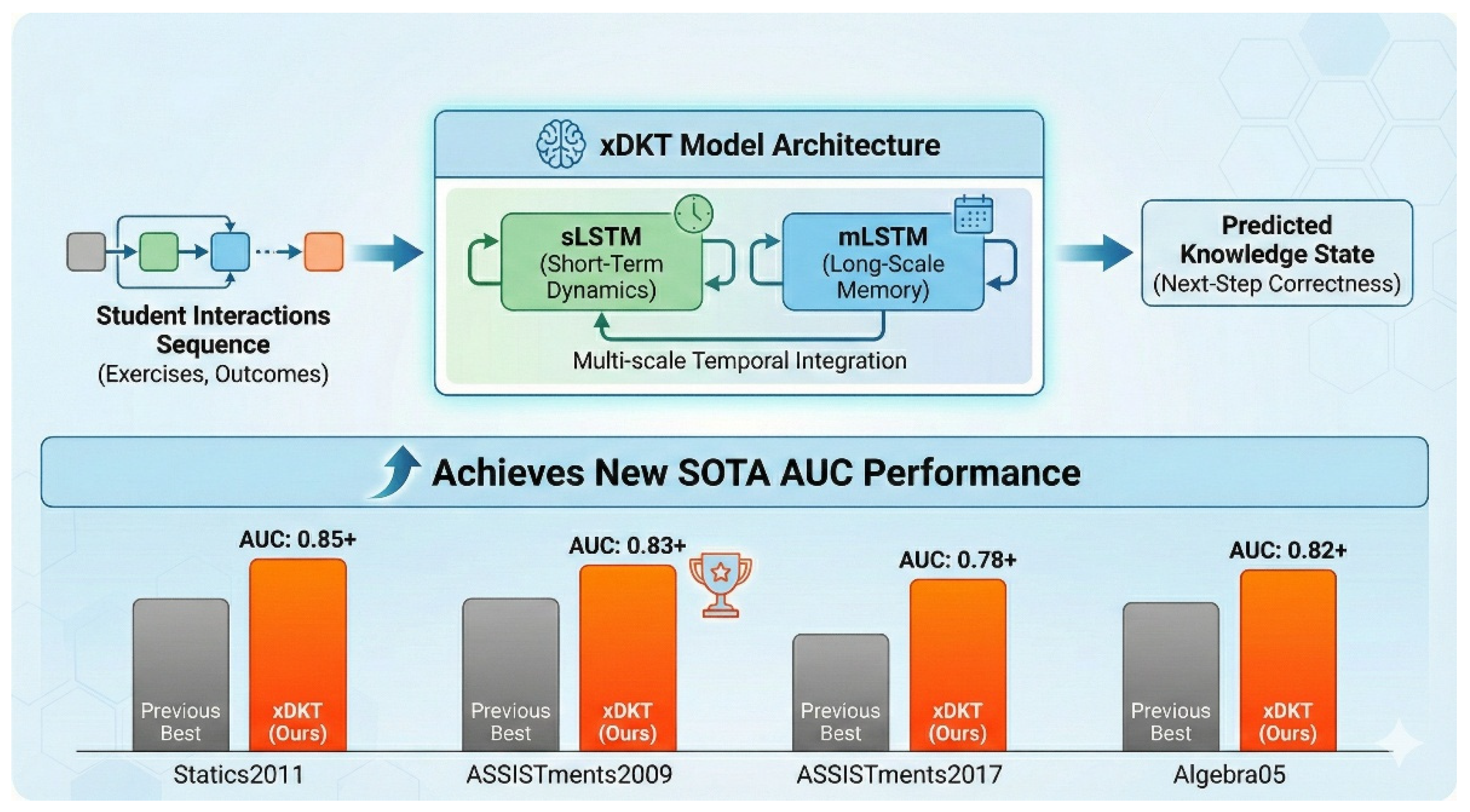
Overall, xDKT consistently outperforms the standard DKT model, particularly on large-scale or complex datasets such as Statics2011, ASSITments2009, and algebra05 (
Figure 4) For instance, on Statics2011, the AUC increased significantly from 0.5177 to 0.8562, and the F1-score improved from 0.6030 to 0.8703. These results demonstrate the superior ability of xDKT to capture rich temporal dependencies and patterns in students’ learning behaviors.
On datasets like ASSITments2015, where interaction sequences are shorter or less varied, the performance gap between xDKT and DKT is narrower but still in favor of xDKT. In more challenging settings, such as ASSITments2017, which features highly imbalanced or sparse interaction patterns, xDKT produces more stable predictions, reflected in better Recall and F1-scores.
These improvements highlight the effectiveness of the xLSTM architecture. Notably, our ablation study reveals that the sLSTM blocks, utilizing exponential scalar memory, are the primary drivers for these enhancements over extended sequences. This architectural design enables xDKT to learn more expressive representations from student sequences without relying on handcrafted features or predefined prediction intervals.
Moreover, xDKT outperforms the baseline DKT model, which relies solely on standard RNN structures, by capturing subtle and long-range learning dynamics, especially in datasets with high variability in student behavior, such as ASSITments2009 and algebra05. The structured attention mechanism in xDKT helps the model selectively focus on relevant parts of the interaction history, addressing known DKT limitations in handling long-term dependencies and generalizing to unseen sequences. This selective attention is particularly advantageous in real-world educational settings where student engagement is often irregular or sparse.
To further contextualize xDKT’s performance, we compared its AUC scores with other advanced Knowledge Tracing models, including DKT+, DKVMN, SAKT, and AKT, across four datasets (Statics2011, ASSITments2009, ASSITments2015, and ASSITments2017), as shown in
Table 8, utilizing published benchmark values available in the literature.
It is important to acknowledge a methodological limitation in this comparison: while the evaluation between the baseline DKT and xDKT is strictly controlled through our own re-implementation and standardized preprocessing, the comparison with attention-based models assumes that the results reported by Ghosh et al. [
23] provide a representative upper bound for the performance of those models. Consequently, xDKT achieves the highest AUC on Statics2011 (0.8562, compared to 0.8301 for DKT+ and 0.8265 for AKT) and on ASSITments2009 (0.8318, vs. 0.8169 for AKT and 0.8093 for DKVMN). These findings suggest that xDKT excels in modeling learning behaviors in datasets with well-structured and lengthy interaction histories.
However, on ASSITments2015 and ASSITments2017, xDKT records slightly lower AUC scores (0.6544 and 0.6797, respectively) than AKT (0.7828 and 0.7282) and DKT+. This difference can be explained by the architectural properties of the models. AKT incorporates temporal-aware attention mechanisms that are particularly effective at capturing short and noisy interaction sequences, allowing it to adapt rapidly to local temporal fluctuations in student performance. In contrast, xDKT is specifically designed to model long-range dependencies through its advanced memory components (particularly the sLSTM module), making it especially well-suited for datasets with richer and longer interaction histories, such as Statics2011 and ASSISTments2009. These complementary strengths suggest that attention-based models may excel in sparse short-sequence contexts, whereas memory-augmented architectures like xDKT provide substantial advantages in long-term Knowledge Tracing tasks.
Nevertheless, xDKT remains competitive against both memory-augmented models (e.g., DKVMN) and attention-based models (e.g., SAKT, AKT). Given that xDKT achieves strong performance without pretraining or complex positional encodings, its simpler yet powerful architecture offers a compelling trade-off between model complexity and predictive accuracy.
It is also important to note that we re-implemented and evaluated the baseline DKT model ourselves across all six datasets. The results we obtained indicate that DKT performs less effectively than originally reported by Piech et al. [
3]. For instance, the AUC values we recorded for DKT were 0.5177 on Static2011, 0.7204 on ASSIST2009, and 0.6131 on ASSIST2015, which are significantly lower than those reported in earlier works. This aligns with findings from subsequent research, which showed that when data preprocessing errors are properly accounted for, RNN-based DKT models do not consistently outperform traditional models like Bayesian Knowledge Tracing (BKT) across multiple datasets. As highlighted by [
27], some of DKT’s performance advantages may have been overstated due to inconsistent or error-prone data preprocessing. These insights underscore the necessity of rigorous benchmarking protocols and standardized data preparation to enable reliable and fair model comparisons.
Beyond numerical performance, these findings highlight a theoretical contribution: xDKT advances the RNN-based lineage of KT models by embedding multi-scale temporal representations (sLSTM, mLSTM). Unlike attention-driven models (e.g., SAKT, AKT), which emphasize local sequence adaptivity, xDKT demonstrates how recurrent structures can effectively capture both short- and long-term dependencies without external memory modules. This positions xDKT as a theoretical bridge between classical recurrent KT approaches and more recent attention-based paradigms.
5.1. Theoretical and Practical Implications
5.1.1. Theoretical Implications
Our findings demonstrate that the xDKT model offers substantial improvements over traditional Deep Knowledge Tracing variants by effectively capturing both the dynamic and latent aspects of student learning behaviors. The incorporation of multi-scale temporal representations through memory LSTM (mLSTM) and scalar LSTM (sLSTM) blocks advances the theoretical foundations of recurrent KT models. Unlike conventional DKT, which relies solely on RNN structures, xDKT models long-term dependencies more effectively without requiring handcrafted features or manual prediction intervals. These results highlight those recurrent architectures, when properly extended, remain a theoretically sound and competitive approach to KT, even compared to more recent attention-based models such as SAKT and AKT. The complementarity observed—where attention-based models excel in sparse or short-sequence contexts, while xDKT performs best in long, structured sequences—provides new theoretical insight into the strengths and limitations of different KT paradigms.
5.1.2. Computational Efficiency and Scalability
Beyond predictive accuracy, the architectural design of xDKT offers significant advantages in terms of computational throughput and resource management:
Training Efficiency (Parallelization): A primary bottleneck in traditional Knowledge Tracing (KT) is the strictly sequential nature of standard Recurrent Neural Networks (RNNs). In contrast, the mLSTM blocks in xDKT are designed to be fully parallelizable. This allows the model to leverage optimized GPU kernels to perform simultaneous computations across the entire sequence length during the training phase.
Empirical Execution Time: In our experimental setup—utilizing a high-RAM Google Colaboratory (Google LLC, Mountain View, CA, USA) environment, the total execution time for training and evaluating xDKT across all six diverse benchmark datasets ranged between 9 and 12 h. This duration highlights the model’s efficiency, especially given the dual-LSTM structure and the large scale of datasets like ASSISTments and Statics2011.
Optimized Memory Footprint: Unlike attention-based models that may require storing an increasingly large attention matrix of past student interactions, xDKT utilizes a matrix memory approach. This architecture provides a high-capacity knowledge representation while maintaining a constant memory overhead during inference. By avoiding the linear growth of memory requirements associated with long interaction histories, xDKT remains highly suitable for deployment on standard server hardware.
5.1.3. Practical Implications
From an application perspective, xDKT’s consistent gains in AUC and F1-score across several real-world datasets, particularly Statics2011 and ASSITments2009, underscore its robustness for intelligent tutoring systems and adaptive learning environments. Accurate modeling of learner knowledge enables timely feedback, personalized content recommendations, and improved learning outcomes. Furthermore, xDKT achieves its competitive performance without relying on deep attention stacks or extensive pretraining, which makes the model relatively efficient, interpretable, and scalable. This balance between predictive accuracy and implementation feasibility positions xDKT as a strong candidate for deployment in diverse educational contexts, ranging from K − 12 to higher education and professional training. At the same time, the slightly lower performance observed on datasets such as ASSITments2015 suggests practical directions for future refinement, such as hybrid architectures that integrate temporal attention or noise-robust encoding strategies.
6. Conclusions and Future Work
In this study, we introduced xDKT, a novel Deep Knowledge Tracing model designed to overcome the inherent limitations of traditional recurrent architectures in capturing multi-scale temporal dependencies. By integrating the xLSTM architecture, specifically through its mLSTM and sLSTM blocks, xDKT provides a robust solution to the gradient stability and memory capacity problems inherent in sequential modeling, effectively capturing complex dependencies within the observation window.
Following the original DKT framework, our model fundamentally relies on question-level interactions to discover latent knowledge representations without requiring manual expert intervention or pre-defined skill mappings. Our experimental results across six benchmark datasets demonstrate that xDKT consistently shows competitively improved performance compared to established architectures, including DKT+, DKVMN, and SAKT, which we compared under identical question-based settings to ensure a rigorous evaluation. xDKT establishes improved AUC scores on complex datasets such as Statics2011 (0.8562) and ASSISTments2009 (0.8318), confirming its effectiveness in modeling granular learning processes.
The structural effectiveness of our xLSTM-based framework lies in its unprecedented ability to model both short-term performance fluctuations and long-term knowledge retention over massive interaction sequences. Furthermore, our extensive ablation studies over sequence lengths up to 1000 steps yield a crucial architectural insight for the field of educational data mining: the scalar memory mechanism (sLSTM), empowered by exponential gating, is exceptionally well-suited for tracking the strictly sequential nature of student knowledge acquisition. It consistently outperforms both the matrix-based mLSTM and hybrid configurations, proving that high-capacity scalar memory is the optimal structural driver for long-sequence Knowledge Tracing. However, despite these encouraging findings, several avenues for future research remain:
Richer Representations and Behavioral Integration: future work should explore the inclusion of multidimensional embeddings and auxiliary behavioral signals—such as engagement levels and interaction times—to uncover deeper latent structures in learning behaviors.
Architectural Hybrids and Interpretability: To further improve model transparency and handle sparse datasets, we aim to investigate the integration of xDKT with graph-based architectures, such as SGKT [
28], or hierarchical attention mechanisms like those found in BPSKT [
29]. Combining localized relational modeling with long-range sequential memory could lead to more generalizable and explainable AI in education.
Scalability and Performance Optimization: While xDKT provides superior accuracy, its architectural complexity incurs higher computational costs. Future efforts will focus on hyperparameter optimization and efficiency refinements to support real-time deployment in large-scale educational platforms.
Continuous and Polytomous Assessment: we plan to extend the model to handle polytomous data and graded responses, enabling finer-grained predictions of multi-level mastery and support for more complex, diverse academic disciplines.
Development of a Dedicated Scalar Architecture (sDKT): Building upon our pivotal finding that scalar memory is the primary driver of predictive performance in educational sequences, our immediate future research will introduce a novel, specialized model designated as Scalar Deep Knowledge Tracing (sDKT). This upcoming work will deeply investigate the isolated role of exponential gating and scalar gradient tracking in cognitive modeling. The objective is to design a highly optimized, computationally lightweight architecture that maximizes the precision of step-by-step sequential learning tracking.
In summary, xDKT establishes a powerful foundation for the next generation of adaptive learning systems. By bridging the gap between classical recurrent methods and high-capacity associative memory, this work contributes a scalable and effective framework for understanding and supporting learners through data-driven precision.





 ,
,