

A Systematic Literature Review on the Pedagogical Implications and Impact of GenAI on Students’ Critical Thinking


Abstract
1. Introduction
- What patterns and findings emerge from the recent empirical literature regarding the impact of GenAI tools on the development of students’ critical thinking in higher education?
- What are the primary cognitive affordances and pedagogical risks associated with GenAI use in CT development, and what methodological or theoretical gaps persist in current research?
- What implications can be drawn from this synthesis to inform responsible and evidence-based redesign of learning environments, ensuring that GenAI complements, rather than substitutes, human critical thinking?
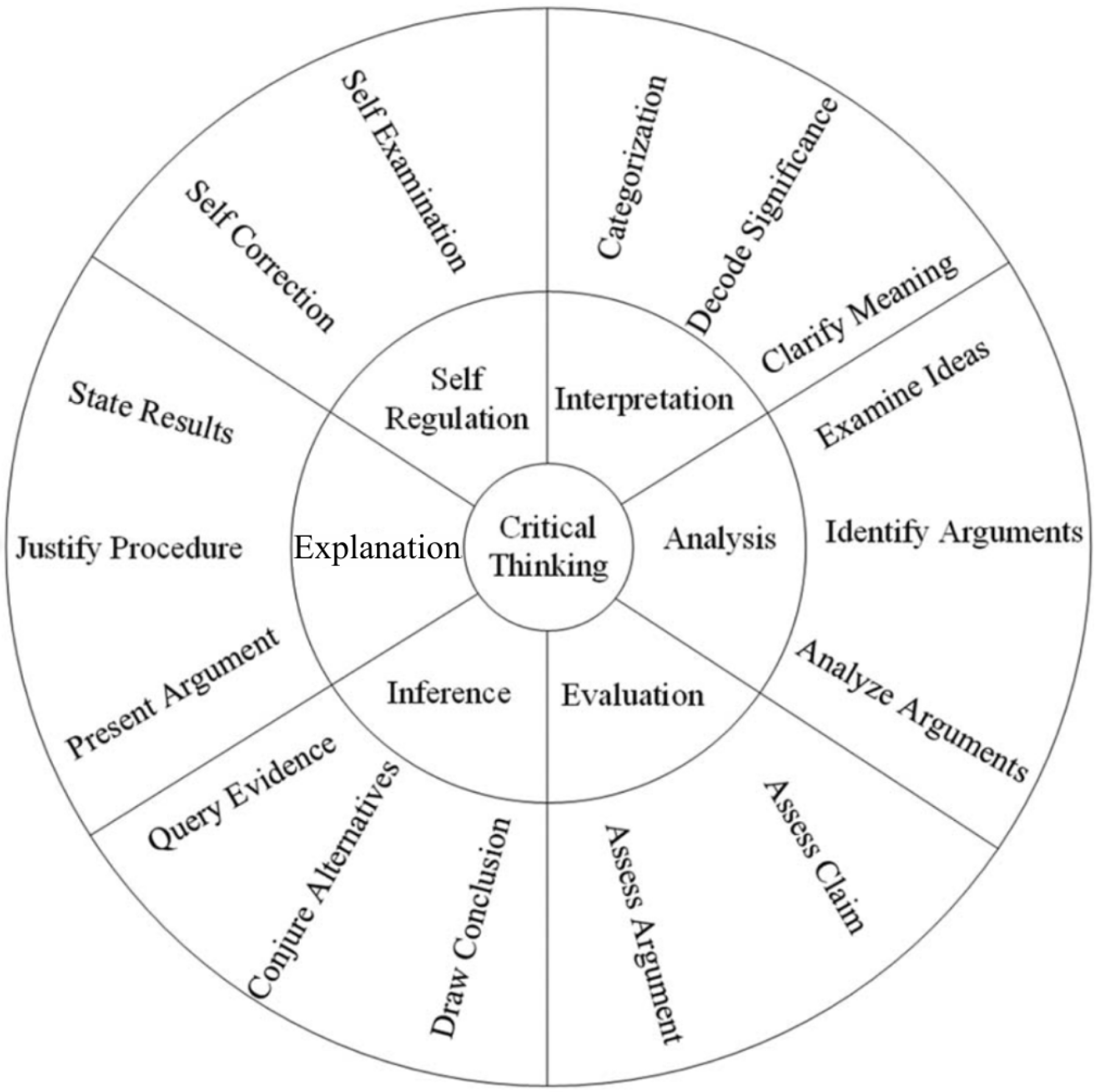
2. Conceptual Frameworks for Critical Thinking
3. Background
3.1. Impact of GenAI on Critical Thinking
3.2. Previous Systematic Literature Reviews
4. Methodology
4.1. Search Strategy
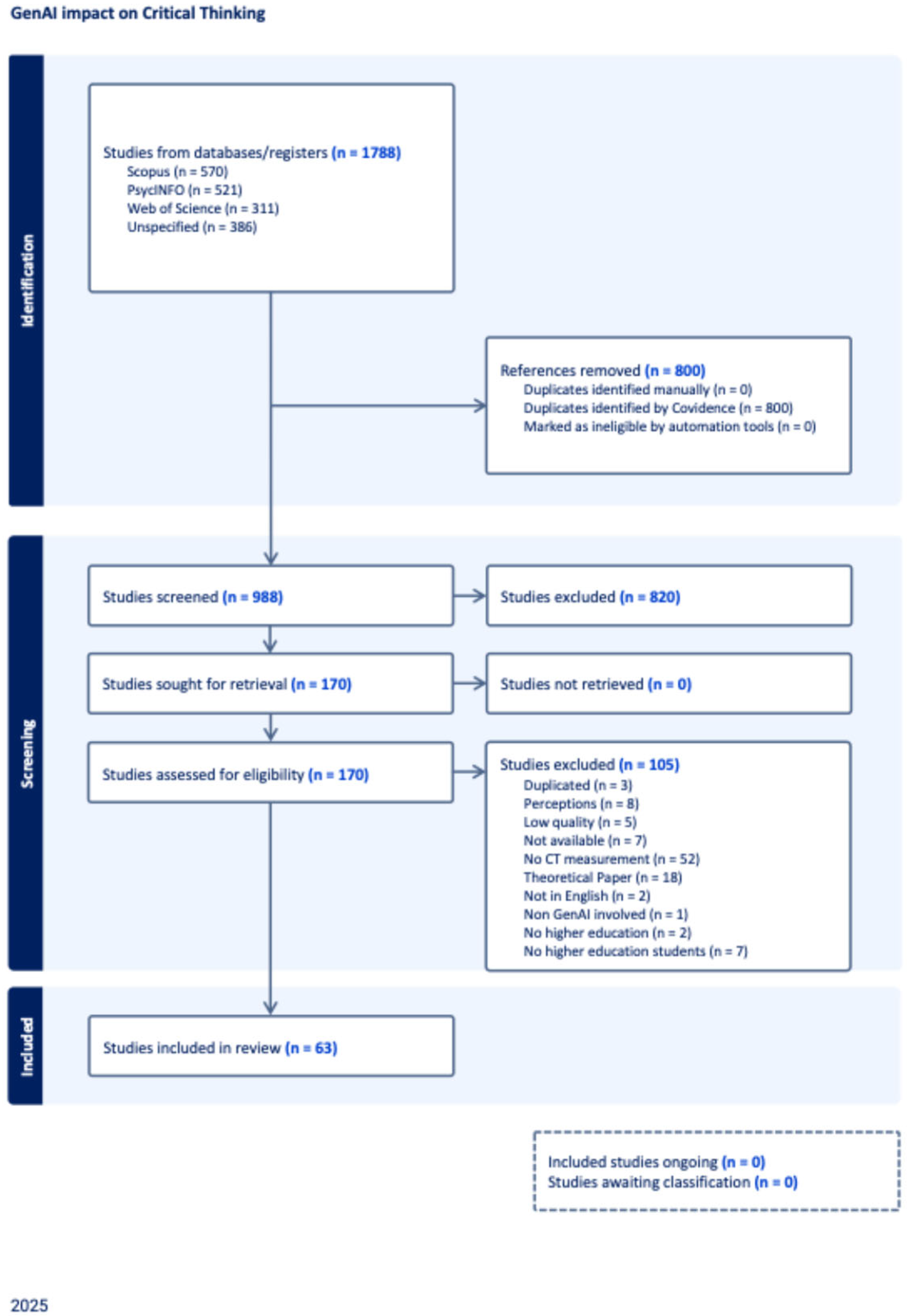
4.2. Screening
4.3. Analysis Strategy
5. Results
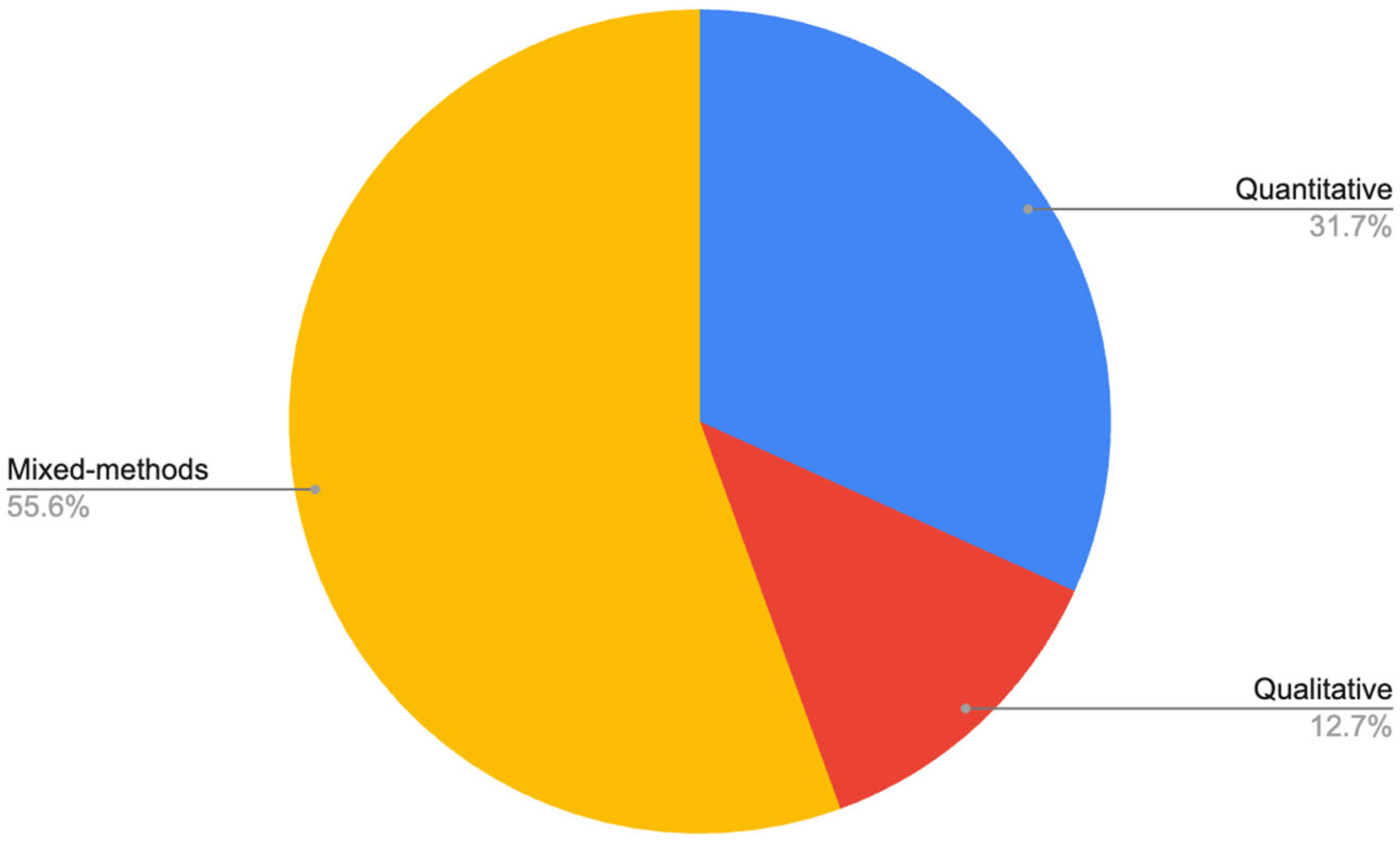
5.1. Methodological Approaches and Study Designs
5.2. Critical Thinking Constructs and Theoretical Frameworks
5.3. Assessment of Critical Thinking
5.4. GenAI Integration Strategies and Pedagogical Designs
- Formative feedback engine: Provides adaptive hints, corrective suggestions, or automated scoring to guide reasoning.
- Metacognitive scaffold: Prompts self-reflection, self-regulation, and monitoring of thought processes.
- Socratic tutor or coach: Engages learners in structured dialogue, questioning assumptions and prompting deeper analysis.
- Problem-solving assistant: Supports brainstorming, solution generation, and iterative problem analysis.
- Simulator/role-play partner: Acts as an expert, stakeholder, or devil’s advocate to stimulate perspective-taking and ethical reasoning.
- Idea generator and research assistant: Assists with evidence synthesis, source evaluation, and ideation tasks.
5.4.1. Feedback Prompts/AI-Based Metacognitive Scaffold
5.4.2. Dialogue Simulation and Reflection
5.4.3. AI-Based Peer Review
5.4.4. Critical Engagement with AI-Generated Content
5.5. Reported Impacts on Critical Thinking
6. Limitations
7. Discussion
7.1. Summary of Key Findings
7.1.1. Primary Cognitive Affordances
7.1.2. Moderating Factors
7.1.3. Principal Pedagogical Risks
7.2. Methodological Strengths and Gaps
7.3. Pedagogical Implications and Recommendations
8. Conclusions and Future Directions
Author Contributions
Funding
Data Availability Statement
Conflicts of Interest
References
- Ahern, A.; Dominguez, C.; McNally, C.; O’Sullivan, J.J.; Pedrosa, D. A Literature Review of Critical Thinking in Engineering Education. Stud. High. Educ. 2019, 44, 816–828. [Google Scholar] [CrossRef]
- Facione, P. Critical Thinking: A Statement of Expert Consensus for Purposes of Educational Assessment and Instruction (The Delphi Report). In Educational Resources Information Center (ERIC); California Academic Press: Millbrae, CA, USA, 1990; pp. 1–112. [Google Scholar]
- Deo, S.; Hölttä-Otto, K. Critical Thinking Assessment in Engineering Education: A Scopus-Based Literature Review. J. Mech. Des. 2024, 146, 072301. [Google Scholar] [CrossRef]
- Bhuttah, T.M.; Xusheng, Q.; Abid, M.N.; Sharma, S. Enhancing Student Critical Thinking and Learning Outcomes through Innovative Pedagogical Approaches in Higher Education: The Mediating Role of Inclusive Leadership. Sci. Rep. 2024, 14, 24362. [Google Scholar] [CrossRef] [PubMed]
- Van Damme, D.; Zahner, D.; Cortellini, O.; Dawber, T.; Rotholz, K. Assessing and Developing Critical-thinking Skills in Higher Education. Eur. J. Educ. 2023, 58, 369–386. [Google Scholar] [CrossRef]
- Belkina, M.; Daniel, S.; Nikolic, S.; Haque, R.; Lyden, S.; Neal, P.; Grundy, S.; Hassan, G.M. Implementing Generative AI (GenAI) in Higher Education: A Systematic Review of Case Studies. Comput. Educ. Artif. Intell. 2025, 8, 100407. [Google Scholar] [CrossRef]
- Shanto, S.S.; Ahmed, Z.; Jony, A.I. Enriching Learning Process with Generative AI: A Proposed Framework to Cultivate Critical Thinking in Higher Education Using Chat GPT. Tuijin Jishu J. Propuls. Technol. 2024, 45, 3019–3029. [Google Scholar]
- Celik, I.; Gedrimiene, E.; Siklander, S.; Muukkonen, H. The Affordances of Artificial Intelligence-Based Tools for Supporting 21st-Century Skills: A Systematic Review of Empirical Research in Higher Education. Australas. J. Educ. Technol. 2024, 40, 19–38. [Google Scholar] [CrossRef]
- Husain, N. Educational Renaissance: Unleashing the Potential of Interdisciplinary AI Integration. J. Environ. Sci. Technol. 2023, 2, 159–166. [Google Scholar]
- Deng, R.; Jiang, M.; Yu, X.; Lu, Y.; Liu, S. Does ChatGPT Enhance Student Learning? A Systematic Review and Meta-Analysis of Experimental Studies. Comput. Educ. 2025, 227, 105224. [Google Scholar] [CrossRef]
- Gerlich, M. AI Tools in Society: Impacts on Cognitive Offloading and the Future of Critical Thinking. Societies 2025, 15, 6. [Google Scholar] [CrossRef]
- Zhai, X.; Nyaaba, M.; Ma, W. Can Generative AI and ChatGPT Outperform Humans on Cognitive-Demanding Problem-Solving Tasks in Science? Sci. Educ. 2025, 34, 649–670. [Google Scholar] [CrossRef]
- Styve, A.; Virkki, O.T.; Naeem, U. Developing Critical Thinking Practices Interwoven with Generative AI Usage in an Introductory Programming Course. In Proceedings of the 2024 IEEE Global Engineering Education Conference (EDUCON), Kos Island, Greece, 8–11 May 2024; IEEE: Kos Island, Greece, 2024; pp. 01–08. [Google Scholar]
- Suriano, R.; Plebe, A.; Acciai, A.; Fabio, R.A. Student Interaction with ChatGPT Can Promote Complex Critical Thinking Skills. Learn. Instr. 2025, 95, 102011. [Google Scholar] [CrossRef]
- Zhou, X.; Teng, D.; Al-Samarraie, H. The Mediating Role of Generative AI Self-Regulation on Students’ Critical Thinking and Problem-Solving. Educ. Sci. 2024, 14, 1302. [Google Scholar] [CrossRef]
- Kalita, A.; Singh, P.; Saikia, A.P. An Outcome-Based Learning Framework for Promoting Critical Thinking in Undergraduate Engineering Students. In Advances in Higher Education and Professional Development; Barua, K., Radwan, N., Singh, V., Figueiredo, R., Eds.; IGI Global: Hershey, PA, USA, 2023; pp. 271–296. ISBN 978-1-66849-472-1. [Google Scholar]
- Heimdal, A.; Lande, I.; Almlie, G.S.; Roaldsøy, E.Ø. Students’ Experiences from Using AI in Engineering Education. In Proceedings of the International Conference on Engineering and Product Design Education, EPDE 2024, Birmingham, UK, 5–6 September 2024; The Design Society: Glasgow, UK, 2024; pp. 497–502. [Google Scholar]
- Zhai, C.; Wibowo, S.; Li, L.D. The Effects of Over-Reliance on AI Dialogue Systems on Students’ Cognitive Abilities: A Systematic Review. Smart Learn. Environ. 2024, 11, 28. [Google Scholar] [CrossRef]
- Melisa, R.; Ashadi, A.; Triastuti, A.; Hidayati, S.; Salido, A.; Ero, P.E.L.; Marlini, C.; Zefrin, Z.; Al Fuad, Z. Critical Thinking in the Age of AI: A Systematic Review of AI’s Effects on Higher Education. Educ. Process Int. J. 2025, 14, e2025031. [Google Scholar] [CrossRef]
- Benvenuti, M.; Cangelosi, A.; Weinberger, A.; Mazzoni, E.; Benassi, M.; Barbaresi, M.; Orsoni, M. Artificial Intelligence and Human Behavioral Development: A Perspective on New Skills and Competences Acquisition for the Educational Context. Comput. Hum. Behav. 2023, 148, 107903. [Google Scholar] [CrossRef]
- Page, M.J.; McKenzie, J.E.; Bossuyt, P.M.; Boutron, I.; Hoffmann, T.C.; Mulrow, C.D.; Shamseer, L.; Tetzlaff, J.M.; Akl, E.A.; Brennan, S.E.; et al. The PRISMA 2020 Statement: An Updated Guideline for Reporting Systematic Reviews. BMJ 2021, 372, 71. [Google Scholar] [CrossRef] [PubMed]
- Garcia Castro, R.A.; Mayta Cachicatari, N.A.; Bartesaghi Aste, W.M.; Llapa Medina, M.P. Exploration of ChatGPT in Basic Education: Advantages, Disadvantages, and Its Impact on School Tasks. Contemp. Educ. Technol. 2024, 16, ep484. [Google Scholar] [CrossRef]
- Facione, P.A. Critical Thinking: What It Is and Why It Counts. Insight Assess. 2011, 1, 1–23. [Google Scholar]
- Paul, R.; Elder, L. Critical Thinking: Tools for Taking Charge of Your Professional and Personal Life; Pearson Education: Upper Saddle River, NJ, USA, 2013; ISBN 0-13-311528-3. [Google Scholar]
- Ennis, R.H. A Logical Basis for Measuring Critical Thinking Skills. Educ. Leadersh. 1985, 43, 44–48. [Google Scholar]
- Essien, A.; Bukoye, O.T.; O’Dea, X.; Kremantzis, M. The Influence of AI Text Generators on Critical Thinking Skills in UK Business Schools. Stud. High. Educ. 2024, 49, 865–882. [Google Scholar] [CrossRef]
- Krathwohl, D.R. A Revision of Bloom’s Taxonomy: An Overview. Theory Pract. 2002, 41, 212–218. [Google Scholar] [CrossRef]
- Lee, H.-Y.; Chen, P.-H.; Wang, W.-S.; Huang, Y.-M.; Wu, T.-T. Empowering ChatGPT with Guidance Mechanism in Blended Learning: Effect of Self-Regulated Learning, Higher-Order Thinking Skills, and Knowledge Construction. Int. J. Educ. Technol. High. Educ. 2024, 21, 16. [Google Scholar] [CrossRef]
- ElSayary, A. Integrating Generative AI in Active Learning Environments: Enhancing Metacognition and Technological Skills. J. Syst. Cybern. Inf. 2024, 22, 34–37. [Google Scholar] [CrossRef]
- Hutson, J.; Plate, D. Human-AI Collaboration for Smart Education: Reframing Applied Learning to Support Metacognition. In Advanced Virtual Assistants-A Window to the Virtual Future; IntechOpen: London, UK, 2023. [Google Scholar]
- Gunawan, A.; Wiputra, R. Exploring the Impact of Generative AI on Personalized Learning in Higher Education; IEEE: Piscataway, NJ, USA, 2024; pp. 280–285. [Google Scholar]
- Youssef, E.; Medhat, M.; Abdellatif, S.; Al Malek, M. Examining the Effect of ChatGPT Usage on Students’ Academic Learning and Achievement: A Survey-Based Study in Ajman, UAE. Comput. Educ. Artif. Intell. 2024, 7, 100316. [Google Scholar] [CrossRef]
- Sabharwal, D.; Kabha, R.; Srivastava, K. Artificial Intelligence (AI)-Powered Virtual Assistants and Their Effect on Human Productivity and Laziness: Study on Students of Delhi-NCR (India) & Fujairah (UAE). J. Content Community Commun. 2023, 17, 162–174. [Google Scholar] [CrossRef]
- Modran, H.A.; Chamunorwa, T.; Ursuțiu, D.; Samoilă, C. Integrating Artificial Intelligence and ChatGPT into Higher Engineering Education. In Towards a Hybrid, Flexible and Socially Engaged Higher Education; Auer, M.E., Cukierman, U.R., Vendrell Vidal, E., Tovar Caro, E., Eds.; Lecture Notes in Networks and Systems; Springer Nature Switzerland: Cham, Switzerland, 2024; Volume 899, pp. 499–510. ISBN 978-3-031-51978-9. [Google Scholar]
- Cai, L.Y.; Msafiri, M.M.; Kangwa, D. Exploring the Impact of Integrating AI Tools in Higher Education Using the Zone of Proximal Development. Educ. Inf. Technol. 2025, 30, 7191–7264. [Google Scholar] [CrossRef]
- Ilic, J.; Ivanovic, M.; Klasnja-Milicevic, A. The Impact of ChatGPT on Student Learning Experience in Higher STEM Education: A Systematic Literature Review. In Proceedings of the 2024 IEEE 11th International Conference on e-Learning e-Education and Online Education (ICILE), Belgrade, Serbia, 23–25 May 2024; pp. 1–9. [Google Scholar]
- Nguyen, K.V. The Use of Generative AI Tools in Higher Education: Ethical and Pedagogical Principles. J. Acad. Ethics 2025, 23, 1435–1455. [Google Scholar] [CrossRef]
- Tillmanns, T.; Salomão Filho, A.; Rudra, S.; Weber, P.; Dawitz, J.; Wiersma, E.; Dudenaite, D.; Reynolds, S. Mapping Tomorrow’s Teaching and Learning Spaces: A Systematic Review on GenAI in Higher Education. Trends High. Educ. 2025, 4, 2. [Google Scholar] [CrossRef]
- Vargas-Murillo, A.R.; de la Asuncion Pari-Bedoya, I.N.M.; de Jesús Guevara-Soto, F. Challenges and Opportunities of AI-Assisted Learning: A Systematic Literature Review on the Impact of ChatGPT Usage in Higher Education. Int. J. Learn. Teach. Educ. Res. 2023, 22, 122–135. [Google Scholar] [CrossRef]
- Sardi, J.; Candra, O.; Yuliana, D.F.; Yanto, D.T.P.; Eliza, F. How Generative AI Influences Students’ Self-Regulated Learning and Critical Thinking Skills? A Systematic Review. Int. J. Eng. Pedagog. 2025, 15, 94–108. [Google Scholar] [CrossRef]
- Hooshyar, D.; Pedaste, M.; Saks, K.; Leijen, Ä.; Bardone, E.; Wang, M. Open Learner Models in Supporting Self-Regulated Learning in Higher Education: A Systematic Literature Review. Comput. Educ. 2020, 154, 103878. [Google Scholar] [CrossRef]
- Kellermeyer, L.; Harnke, B.; Knight, S. Covidence and Rayyan. J. Med. Libr. Assoc. 2018, 106, 580–583. [Google Scholar] [CrossRef]
- Galli, C.; Gavrilova, A.V.; Calciolari, E. Large Language Models in Systematic Review Screening: Opportunities, Challenges, and Methodological Considerations. Information 2025, 16, 378. [Google Scholar] [CrossRef]
- Van Dinter, R.; Tekinerdogan, B.; Catal, C. Automation of Systematic Literature Reviews: A Systematic Literature Review. Inf. Softw. Technol. 2021, 136, 106589. [Google Scholar] [CrossRef]
- Darmawansah, D.; Rachman, D.; Febiyani, F.; Hwang, G.-J. ChatGPT-Supported Collaborative Argumentation: Integrating Collaboration Script and Argument Mapping to Enhance EFL Students’ Argumentation Skills. Educ. Inf. Technol. 2025, 30, 3803–3827. [Google Scholar] [CrossRef]
- Dindorf, C.; Weisenburger, F.; Bartaguiz, E.; Dully, J.; Klappenberger, L.; Lang, V.; Zimmermann, L.; Fröhlich, M.; Seibert, J.-N. Exploring Decision-Making Competence in Sugar-Substitute Choices: A Cross-Disciplinary Investigation among Chemistry and Sports and Health Students. Educ. Sci. 2024, 14, 531. [Google Scholar] [CrossRef]
- Lu, J.; Zheng, R.; Gong, Z.; Xu, H. Supporting Teachers’ Professional Development with Generative AI: The Effects on Higher Order Thinking and Self-Efficacy. IEEE Trans. Learn. Technol. 2024, 17, 1279–1289. [Google Scholar] [CrossRef]
- Li, T.; Ji, Y.; Zhan, Z. Expert or Machine? Comparing the Effect of Pairing Student Teacher with in-Service Teacher and ChatGPT on Their Critical Thinking, Learning Performance, and Cognitive Load in an Integrated-STEM Course. Asia Pac. J. Educ. 2024, 44, 45–60. [Google Scholar] [CrossRef]
- Liu, W.; Wang, Y. The Effects of Using AI Tools on Critical Thinking in English Literature Classes Among EFL Learners: An Intervention Study. Eur. J. Educ. 2024, 59, e12804. [Google Scholar] [CrossRef]
- Naatonis, R.N.; Rusijono, R.; Jannah, M.; Malahina, E.A.U. Evaluation of Problem Based Gamification Learning (PBGL) Model on Critical Thinking Ability with Artificial Intelligence Approach Integrated with ChatGPT API: An Experimental Study. Qubahan Acad. J. 2024, 4, 485–520. [Google Scholar] [CrossRef]
- Saritepeci, M.; Durak, H. Effectiveness of Artificial Intelligence Integration in Design-Based Learning on Design Thinking Mindset, Creative and Reflective Thinking Skills: An Experimental Study. Educ. Inf. Technol. 2024, 29, 25175–25209. [Google Scholar] [CrossRef]
- Shin, H.; De Gagne, J.C.; Kim, S.S.; Hong, M. The Impact of Artificial Intelligence-Assisted Learning on Nursing Students’ Ethical Decision-Making and Clinical Reasoning in Pediatric Care: A Quasi-Experimental Study. CIN-Comput. Inform. Nurs. 2024, 42, 704–711. [Google Scholar] [CrossRef] [PubMed]
- Wang, P.; Yin, K.; Zhang, M.; Zheng, Y.; Zhang, T.; Kang, Y.; Feng, X. The Effect of Incorporating Large Language Models into the Teaching on Critical Thinking Disposition: An “AI + Constructivism Learning Theory” Attempt. Educ. Inf. Technol. 2025, 30, 11625–11647. [Google Scholar] [CrossRef]
- Zhang, Y.; Lai, X.; Yi, S.; Lu, Y. Does ChatGPT-Based Reading Platform Impact Foreign Language Paper Reading? Evidence from a Quasi-Experimental Study on Chinese Undergraduate Students. Educ. Inf. Technol. 2025, 30, 9737–9754. [Google Scholar] [CrossRef]
- Chen, X.; Jia, B.; Peng, X.; Zhao, H.; Yao, J.; Wang, Z.; Zhu, S. Effects of ChatGPT and Argument Map(AM)-Supported Online Argumentation on College Students’ Critical Thinking Skills and Perceptions. Educ. Inf. Technol. 2025, 30, 17623–17658. [Google Scholar] [CrossRef]
- De La Puente, M.; Torres, J.; Troncoso, A.L.B.; Meza, Y.Y.H.; Carrascal, J.X.M. Investigating the Use of chatGPT as a Tool for Enhancing Critical Thinking and Argumentation Skills in International Relations Debates among Undergraduate Students. Smart Learn. Environ. 2024, 11, 55. [Google Scholar] [CrossRef]
- Huang, Y.-M.; Chen, P.-H.; Lee, H.-Y.; Sandnes, F.E.; Wu, T.-T. ChatGPT-Enhanced Mobile Instant Messaging in Online Learning: Effects on Student Outcomes and Perceptions. Comput. Hum. Behav. 2025, 168, 108659. [Google Scholar] [CrossRef]
- Lin, C.-J.; Lee, H.-Y.; Wang, W.-S.; Huang, Y.-M.; Wu, T.-T. Enhancing Reflective Thinking in STEM Education through Experiential Learning: The Role of Generative AI as a Learning Aid. Educ. Inf. Technol. 2025, 30, 6315–6337. [Google Scholar] [CrossRef]
- Shalong, W.; Yi, Z.; Bin, Z.; Ganglei, L.; Jinyu, Z.; Yanwen, Z.; Zequn, Z.; Lianwen, Y.; Feng, R. Enhancing Self-Directed Learning with Custom GPT AI Facilitation among Medical Students: A Randomized Controlled Trial. Med. Teach. 2024, 47, 1126–1133. [Google Scholar] [CrossRef] [PubMed]
- Singh, A.; Brooks, C.; Wang, X.; Li, W.; Kim, J.; Wilson, D. Bridging Learnersourcing and AI: Exploring the Dynamics of Student-AI Collaborative Feedback Generation. In Proceedings of the 14th Learning Analytics and Knowledge Conference, Kyoto, Japan, 18–22 March 2024; ACM: Kyoto Japan, 2024; pp. 742–748. [Google Scholar]
- Wang, W.-S.; Lin, C.-J.; Lee, H.-Y.; Huang, Y.-M.; Wu, T.-T. Integrating Feedback Mechanisms and ChatGPT for VR-Based Experiential Learning: Impacts on Reflective Thinking and AIoT Physical Hands-on Tasks. Interact. Learn. Environ. 2025, 33, 1770–1787. [Google Scholar] [CrossRef]
- Aure, P.A.; Cuenca, O. Fostering Social-Emotional Learning through Human-Centered Use of Generative AI in Business Research Education: An Insider Case Study. J. Res. Innov. Teach. Learn. JRIT 2024, 17, 168–181. [Google Scholar] [CrossRef]
- Aydın Yıldız, T. Exploring the Impact of ChatGPT on Improving 21st-Century Skills for Future English Teachers During Lesson Planning. Comput. Sch. 2024, 42, 119–142. [Google Scholar] [CrossRef]
- Datskiv, O.; Zadorozhna, I.; Shon, O. Developing Future Teachers’ Academic Writing and Critical Thinking Skills Using ChatGPT. Int. J. Emerg. Technol. Learn. 2024, 19, 126–136. [Google Scholar] [CrossRef]
- Shen, Y.; Chen, L. ‘Critical Chatting’ or ‘Casual Cheating’: How Graduate Efl Students Utilize Chatgpt for Academic Writing. Comput. Assist. Lang. Learn. 2025, 1–29. [Google Scholar] [CrossRef]
- Jiang, X.; Li, J.; Chen, C.H. Enhancing Critical Thinking Skills with ChatGPT-Powered Activities in Chinese Language Classrooms. J. Chin. Lang. Teach. 2024, 5, 47–73. [Google Scholar]
- Dilekli, Y.; Boyraz, S. From “Can AI Think?” to “Can AI Help Thinking Deeper?”: Is Use of ChatGPT in Higher Education a Tool of Transformation or Fraud? Int. J. Mod. Educ. Stud. 2024, 8, 49–71. [Google Scholar] [CrossRef]
- Chen, M.-S.; Hsu, T.-P.; Hsu, T.-C. GAI-Assisted Personal Discussion Process Analysis. In Innovative Technologies and Learning; Lecture Notes in Computer Science; Springer Nature Switzerland: Cham, Switzerland, 2024; pp. 194–204. ISBN 978-3-031-65883-9. [Google Scholar]
- Fabio, R.A.; Plebe, A.; Suriano, R. Ai-Based Chatbot Interactions and Critical Thinking Skills: An Exploratory Study. Curr. Psychol. J. Divers. Perspect. Divers. Psychol. Issues 2024, 44, 8082–8095. [Google Scholar] [CrossRef]
- Pellas, N. The Role of Students’ Higher-Order Thinking Skills in the Relationship between Academic Achievements and Machine Learning Using Generative AI Chatbots. Res. Pract. Technol. Enhanc. Learn. 2024, 20, 36. [Google Scholar] [CrossRef]
- Wu, C.-H.; Weng, T.-S.; Liu, C.-H. Exploring ChatGPT’s Potential to Enhance Problem-Solving and Critical Thinking in Education. Educ. Technol. Soc. 2025, 28, 310–326. [Google Scholar]
- Avsheniuk, N.; Lutsenko, O.; Svyrydiuk, T.; Seminikhyna, N. Empowering Language Learners’ Critical Thinking: Evaluating ChatGPT’s Role in English Course Implementation. Arab World Engl. J. 2024, 1, 210–224. [Google Scholar] [CrossRef]
- Barana, A.; Marchisio, M.; Roman, F. Fostering Problem Solving and Critical Thinking in Mathematics through Generative Artificial Intelligence. In Proceedings of the 20th International Conference on Cognition and Exploratory Learning in Digital Age (CELDA 2023), Funchal, Portugal, 21–23 October 2023. [Google Scholar]
- Sharma, D. Critical Thinking and Problem-Solving in the Age of ChatGPT: Experiential-Bibliotherapy-Blogging Project. Bus. Prof. Commun. Q. 2024, 87, 630–653. [Google Scholar] [CrossRef]
- Drushlyak, M.; Lukashova, T.; Shamonia, V.; Semenikhina, O. ChatGPT-Based Simulation Helps to Develop the Pre-Service Mathematics Teachers’ Critical Thinking. Int. J. Instr. 2025, 18, 153–172. [Google Scholar] [CrossRef]
- Exintaris, B.; Karunaratne, N.; Yuriev, E. Metacognition and Critical Thinking: Using ChatGPT-Generated Responses as Prompts for Critique in a Problem-Solving Workshop (SMARTCHEMPer). J. Chem. Educ. 2023, 100, 2972–2980. [Google Scholar] [CrossRef]
- Chu, H.C.; Lu, Y.C.; Tu, Y.F. How GenAI-Supported Multi-Modal Presentations Benefit Students with Different Motivation Levels: Evidence from Digital Storytelling Performance, Critical Thinking Awareness, and Learning Attitude. Educ. Technol. Soc. 2025, 28, 250–269. [Google Scholar]
- Kim, D.; Majdara, A.; Olson, W. A Pilot Study Inquiring into the Impact of ChatGPT on Lab Report Writing in Introductory Engineering Labs. Int. J. Technol. Educ. IJTE 2024, 7, 259–289. [Google Scholar] [CrossRef]
- Michalon, B.; Camacho-Zuñiga, C. ChatGPT, a Brand-New Tool to Strengthen Timeless Competencies. Front. Educ. 2023, 8, 1251163. [Google Scholar] [CrossRef]
- Gonsalves, C. Generative AI’s Impact on Critical Thinking: Revisiting Bloom’s Taxonomy. J. Mark. Educ. 2024, 48, 02734753241305980. [Google Scholar] [CrossRef]
- Huang, K.; Liu, Y.; Dong, M. Incorporating AIGC into Design Ideation: A Study on Self-Efficacy and Learning Experience Acceptance under Higher-Order Thinking. Think. Ski. Creat. 2024, 52, 101508. [Google Scholar] [CrossRef]
- Kartal, G. The Influence of ChatGPT on Thinking Skills and Creativity of EFL Student Teachers: A Narrative Inquiry. J. Educ. Teach. 2024, 50, 627–642. [Google Scholar] [CrossRef]
- Li, Y.; Keung, J.; Ma, X. Integrating Generative AI in Software Engineering Education: Practical Strategies. In Proceedings of the 2024 International Symposium on Educational Technology (ISET), Macau, Macao, 29 July–1 August 2024; IEEE: Macau, Macao; pp. 49–53.
- Lin, C.-H.; Zhou, K.; Li, L.; Sun, L. Integrating Generative AI into Digital Multimodal Composition: A Study of Multicultural Second-Language Classrooms. Comput. Compos. 2025, 75, 102895. [Google Scholar] [CrossRef]
- Sanchez-Guerrero, J.; Miranda-Lopez, X.; Buenano, H.; Lozada-Miranda, D. ChatGPT to Motivate Critical Thinking in the Teaching–Learning Process of First Semester Students at the Technical University of Ambato; Springer Science and Business Media Deutschland GmbH: Bogota, Colombia, 2024; Volume 380, pp. 169–179. [Google Scholar]
- Chang, C.-Y.; Yang, C.-L.; Jen, H.-J.; Ogata, H.; Hwang, G.-H. Facilitating Nursing and Health Education by Incorporating ChatGPT into Learning Designs. Educ. Technol. Soc. 2024, 27, 215–230. [Google Scholar]
- Hwang, G.-J.; Cheng, P.-Y.; Chang, C.-Y. Facilitating Students’ Critical Thinking, Metacognition and Problem-Solving Tendencies in Geriatric Nursing Class: A Mixed-Method Study. Nurse Educ. Pract. 2025, 83, 104112. [Google Scholar] [CrossRef]
- Liu, W.; Cui, X. Generative AI-Assisted Collaborative Argumentation: Implications for the Argumentation Process and Outcome; IEEE: Piscataway, NJ, USA, 2024; pp. 220–225. [Google Scholar]
- Farinetti, L.; Canale, L. Chatbot Development Using LangChain: A Case Study to Foster Critical Thinking and Creativity; Association for Computing Machinery: Milan, Italy, 2024; Volume 1, pp. 401–407. [Google Scholar]
- Zhang, J. Generative AI in Higher Education: Challenges and Opportunities for Course Learning. Adv. Soc. Sci. Res. J. 2025, 12, 11–18. [Google Scholar] [CrossRef]
- Wang, W.; Lin, C.; Lee, H.; Huang, Y.; Wu, T. Enhancing Self-Regulated Learning and Higher-Order Thinking Skills in Virtual Reality: The Impact of ChatGPT-Integrated Feedback Aids. Educ. Inf. Technol. 2025, 30, 19419–19445. [Google Scholar] [CrossRef]
- Palupi, S.; Hardi, R.; Pribadi, A.S.; Zulkarnain, R.; Setiawan, M.N.; Sari, N.W.W.; Utomo, D.T. Enhancing Computational Strategies to Decode ChatGPT’s Influence on the Critical Thinking Abilities of University Students. In Proceedings of the 2024 4th International Conference of Science and Information Technology in Smart Administration (ICSINTESA), Balikpapan, Indonesia, 12 July 2024; IEEE: Balikpapan, Indonesia; pp. 27–32.
- Baláž, N.; Porubän, J.; Horváth, M.; Kormaník, T. Using ChatGPT During Implementation of Programs in Education. In OpenAccess Series in Informatics (OASIcs); Schloss Dagstuhl–Leibniz-Zentrum für Informatik: Wadern, Germany, 2024; Volume 122, pp. 18:1–18:9. [Google Scholar] [CrossRef]
- Santamaría-Velasco, J.; Núñez-Naranjo, A.; Morales-Urrutia, X. Critical Thinking and AI: Enhancing History Teaching through ChatGPT Simulations. Int. J. Innov. Res. Sci. Stud. 2025, 8, 564–575. [Google Scholar] [CrossRef]
- Yusuf, A.; Bello, S.; Pervin, N.; Tukur, A.K. Implementing a Proposed Framework for Enhancing Critical Thinking Skills in Synthesizing AI-Generated Texts. Think. Ski. Creat. 2024, 53, 101625. [Google Scholar] [CrossRef]
- Essel, H.B.; Vlachopoulos, D.; Essuman, A.B.; Amankwa, J.O. ChatGPT Effects on Cognitive Skills of Undergraduate Students: Receiving Instant Responses from AI-Based Conversational Large Language Models (LLMs). Comput. Educ. Artif. Intell. 2024, 6, 100198. [Google Scholar] [CrossRef]
- Moustaghfir, S.; Brigui, H. Navigating Critical Thinking in the Digital Era: An Informative Exploration. Int. J. Linguist. Lit. Transl. 2024, 7, 137–143. [Google Scholar] [CrossRef]
- Díaz, B.; Delgado, C. Artificial Intelligence: Tool or Teammate? J. Res. Sci. Teach. 2024, 61, 2575–2584. [Google Scholar] [CrossRef]
- Singh, A.; Taneja, K.; Guan, Z.; Ghosh, A. Protecting Human Cognition in the Age of AI. arXiv 2025, arXiv:2502.12447. [Google Scholar] [CrossRef]
- Ji, Y.; Zhan, Z.; Li, T.; Zou, X.; Lyu, S. Human-Machine Co-Creation: The Effects of ChatGPT on Students’ Learning Performance, AI Awareness, Critical Thinking, and Cognitive Load in a STEM Course towards Entrepreneurship. IEEE Trans. Learn. Technol. 2025, 18, 402–415. [Google Scholar] [CrossRef]
- Huang, C.-W.; Coleman, M.; Gachago, D.; Van Belle, J.-P. Using ChatGPT to Encourage Critical AI Literacy Skills and for Assessment in Higher Education; Springer Science and Business Media Deutschland GmbH: Gauteng, South Africa, 2024; Volume 1862, pp. 105–118. [Google Scholar]
- Bond, M.; Khosravi, H.; De Laat, M.; Bergdahl, N.; Negrea, V.; Oxley, E.; Pham, P.; Chong, S.W.; Siemens, G. A Meta Systematic Review of Artificial Intelligence in Higher Education: A Call for Increased Ethics, Collaboration, and Rigour. Int. J. Educ. Technol. High. Educ. 2024, 21, 4. [Google Scholar] [CrossRef]
- Abu Saa, A.; Al-Emran, M.; Shaalan, K. Factors Affecting Students’ Performance in Higher Education: A Systematic Review of Predictive Data Mining Techniques. Technol. Knowl. Learn. 2019, 24, 567–598. [Google Scholar] [CrossRef]
- Premkumar, P.P.; Yatigammana, M.R.K.N.; Kannangara, S. Impact of Generative AI on Critical Thinking Skills in Undergraduates: A Systematic Review. J. Desk Res. Rev. Anal. 2024, 2, 199–215. [Google Scholar] [CrossRef]
- Perifanou, M.; Economides, A.A. Collaborative Uses of GenAI Tools in Project-Based Learning. Educ. Sci. 2025, 15, 354. [Google Scholar] [CrossRef]
- Jin, Y.; Yan, L.; Echeverria, V.; Gašević, D.; Martinez-Maldonado, R. Generative AI in Higher Education: A Global Perspective of Institutional Adoption Policies and Guidelines. Comput. Educ. Artif. Intell. 2025, 8, 100348. [Google Scholar] [CrossRef]
- Balart, T.S.; Shryock, K.J. A Framework for Integrating Artificial General Intelligence into Engineering Education. Int. J. Eng. Educ. 2025, 41, 171–194. [Google Scholar]


| Category | Terms Used |
|---|---|
| GenAI Tools | “Generative Artificial Intelligence” OR “GenAI” OR “Generative AI” OR “GAI” OR “ChatGPT” OR “chat generative pre-trained transformer” OR “GPT-3.5” OR “GPT-4” OR “GPT-4o” OR “generative model” OR “artificial intelligence generated content” OR “AIGC” OR “AI-generated” |
| Critical Thinking | “critical thinking” OR “CT” OR “thinking skills” OR “critical literacy” |
| Educational Context | “higher education” OR “student” OR “universit*” OR “postgrad*” OR “undergrad*” OR “sophomore” OR “college” OR “course” OR “freshman” OR “tertiary” OR “post-secondary education” OR “pupil” OR “teacher” OR “lecturer” OR “professor” OR “faculty” OR “Instructor” |
| Language | English |
| Date Range | January 2023–April 2025 |
| Category | Terms Used | |
|---|---|---|
| Compendex & Inspec (Elsevier) | 386 | |
| Web of Science | 311 | |
| Education Source + ERIC + APA PsycInfo (EBSCO) | 521 | |
| Scopus | 570 | |
| Total | 1788 (800 duplicates removed) | 988 (After duplicates extraction) |
| Inclusion Criteria | Exclusion Criteria |
|---|---|
| - Studies published between January 2023 and April 2025, to capture recent developments in GenAI applications. - Articles written in English. - Research conducted in higher education settings (e.g., undergraduate or graduate students). - Studies addressing GenAI tools. - Empirical studies that include measurable outcomes or observations related to critical thinking skills, including dimensions such as analysis, evaluation, inference, metacognition, ethical reasoning, or self-regulation. | Theoretical papers, conceptual frameworks, opinion pieces, or editorials without empirical data. - Studies analyzing perspectives on GenAI. - Studies focused solely on K-12 or informal education contexts. - Studies examining student interaction with GenAI tools such as ChatGPT, large language models, or other GenAI systems used in educational contexts that do not explicitly examine CT or related constructs as an outcome or objective. - Studies examining AI in education not related to generative technologies (e.g., chatbots, personalized learning, predictive analytics, automated grading). - Research not involving student participants (e.g., faculty-only perspectives, professional development, system design papers). |
| Study Design | Number of Studies | Examples |
|---|---|---|
| Quasi-experimental (pre-post with comparison group) | 19 | [26,45,46,47,48,49,50,51,52,53,54] |
| Randomized controlled trial | 11 | [28,55,56,57,58,59,60,61] |
| Case study | 6 | [62,63,64,65,66,67] |
| Observational survey | 6 | [14,15,68,69,70,71] |
| Pre-experimental (single-group pre-post) | 10 | [72,73,74,75,76,77,78] |
| Action research | 3 | [13,66,79] |
| Others (e.g., narrative inquiry) | 8 | [32,80,81,82] |
| Four Main Typologies of Integration | Explanation | Examples |
|---|---|---|
| Feedback prompts (AI-based metacognitive scaffold) | AI-generated formative quizzes, automated scoring, or real-time feedback prompts (e.g., GPTFAS in VR, test-style assessments, auto-scored reflections). | [26,32,45,55,68,86,91] |
| Dialogue simulation and reflection | Conversational agents taking on roles (e.g., regulator, peer, expert) to challenge student reasoning, support perspective-taking, and surface hidden biases. Structured activities in which students and instructors jointly interpret AI outputs, fostering dialogic meaning-making and shared metacognition. | [49,62,77,88,92] |
| AI-Based peer review | Multi-week PBL interventions where ChatGPT guides students through project phases (idea generation, analysis, report drafting). GenAI tools that supply exemplar feedback, suggested criteria, or consistency checks to help students critique one another’s work more rigorously. Help with coding tasks. | [13,26,56,65,71,80] |
| Critical Engagement with AI-Generated Content | Tasks requiring students to audit, correct, or improve AI-generated outputs, spotting “hallucinations”, logical flaws, or unsupported claims. Structured activities in which students and instructors jointly interpret AI outputs, fostering dialogic. meaning-making and shared metacognition. | [65,68,74,75,76,90] |
Disclaimer/Publisher’s Note: The statements, opinions and data contained in all publications are solely those of the individual author(s) and contributor(s) and not of MDPI and/or the editor(s). MDPI and/or the editor(s) disclaim responsibility for any injury to people or property resulting from any ideas, methods, instructions or products referred to in the content. |
© 2026 by the authors. Licensee MDPI, Basel, Switzerland. This article is an open access article distributed under the terms and conditions of the Creative Commons Attribution (CC BY) license.
Share and Cite
Balart, T.; Díaz, B.; Shryock, K. A Systematic Literature Review on the Pedagogical Implications and Impact of GenAI on Students’ Critical Thinking. Algorithms 2026, 19, 179. https://doi.org/10.3390/a19030179
Balart T, Díaz B, Shryock K. A Systematic Literature Review on the Pedagogical Implications and Impact of GenAI on Students’ Critical Thinking. Algorithms. 2026; 19(3):179. https://doi.org/10.3390/a19030179
Chicago/Turabian StyleBalart, Trini, Brayan Díaz, and Kristi Shryock. 2026. "A Systematic Literature Review on the Pedagogical Implications and Impact of GenAI on Students’ Critical Thinking" Algorithms 19, no. 3: 179. https://doi.org/10.3390/a19030179
APA StyleBalart, T., Díaz, B., & Shryock, K. (2026). A Systematic Literature Review on the Pedagogical Implications and Impact of GenAI on Students’ Critical Thinking. Algorithms, 19(3), 179. https://doi.org/10.3390/a19030179