

Efficient Recurrent Multi-Layer Neural Network for Multi-Scale Noise and Activity Drift Mitigation in Wideband Cognitive Radio Networks


Abstract
1. Introduction
1.1. Contributions of the Research
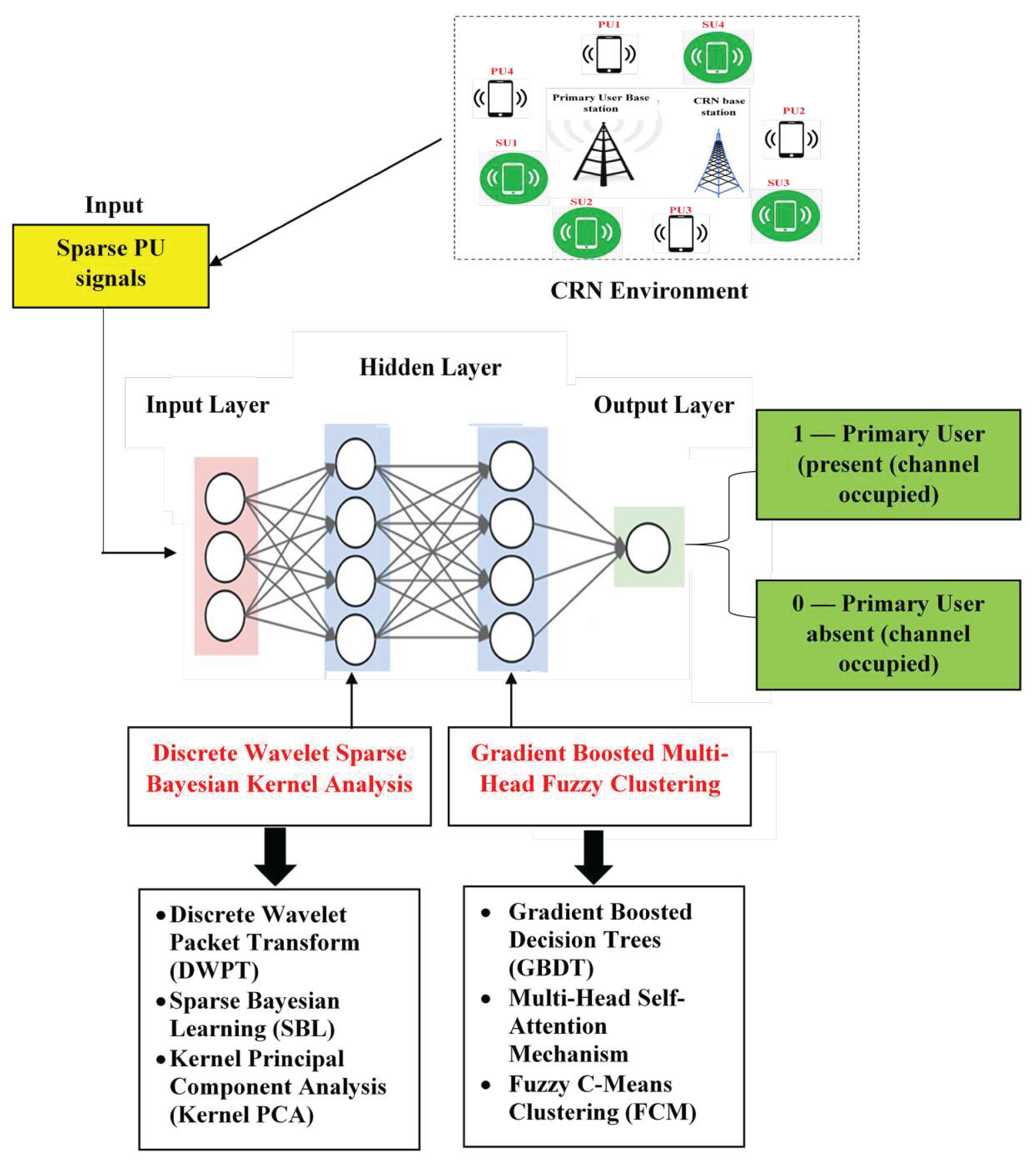
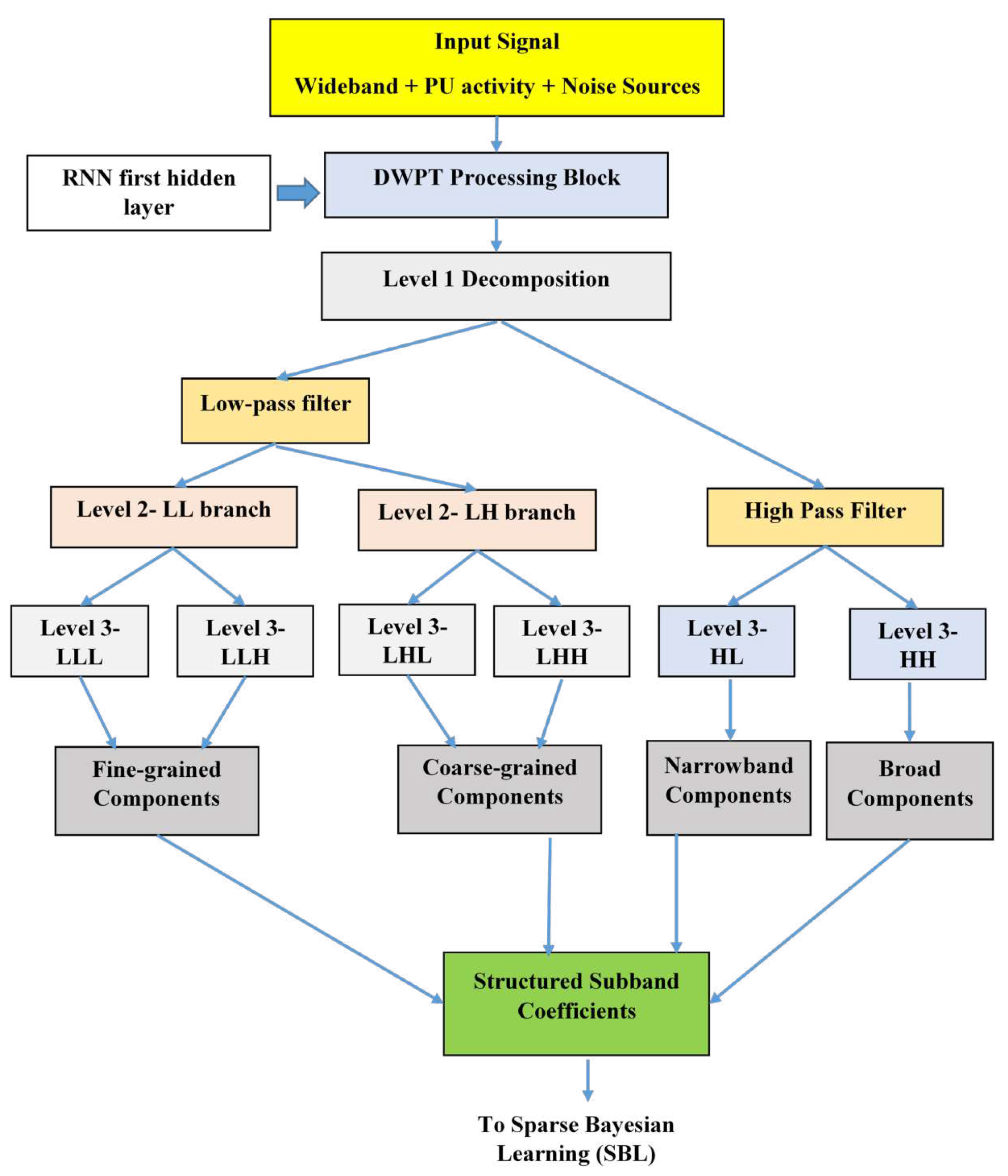
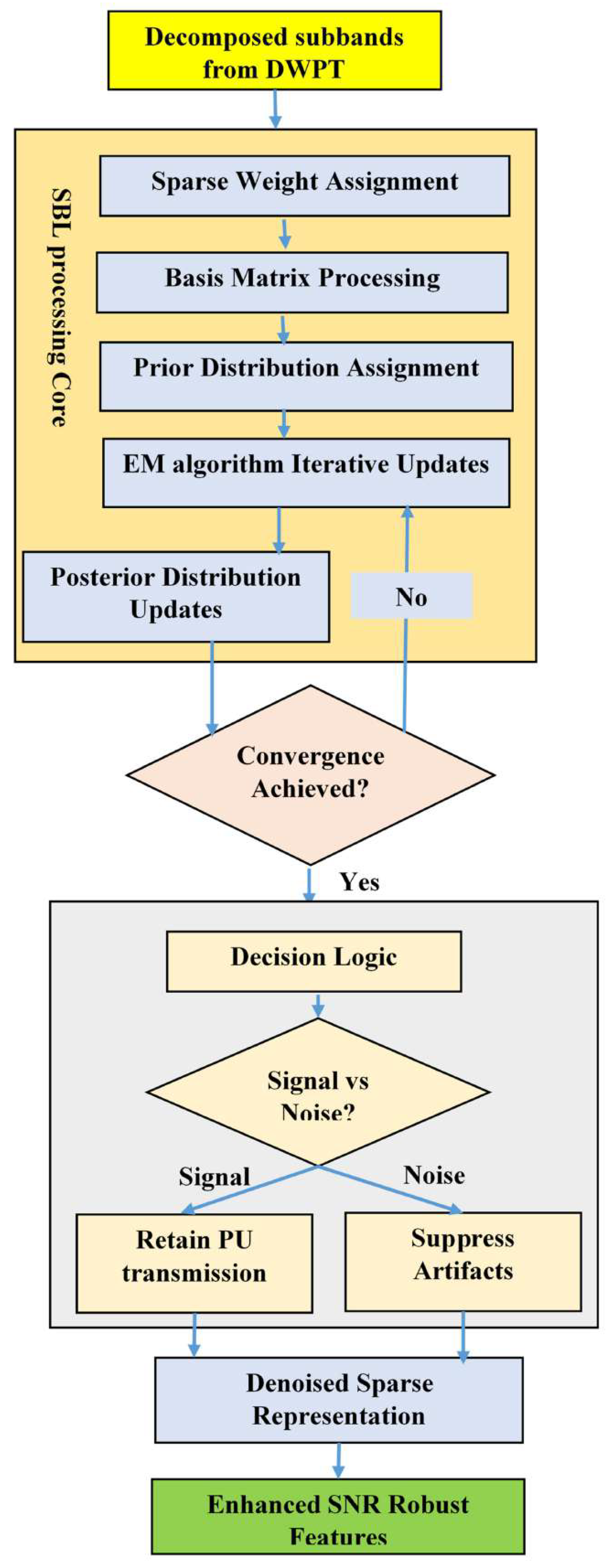
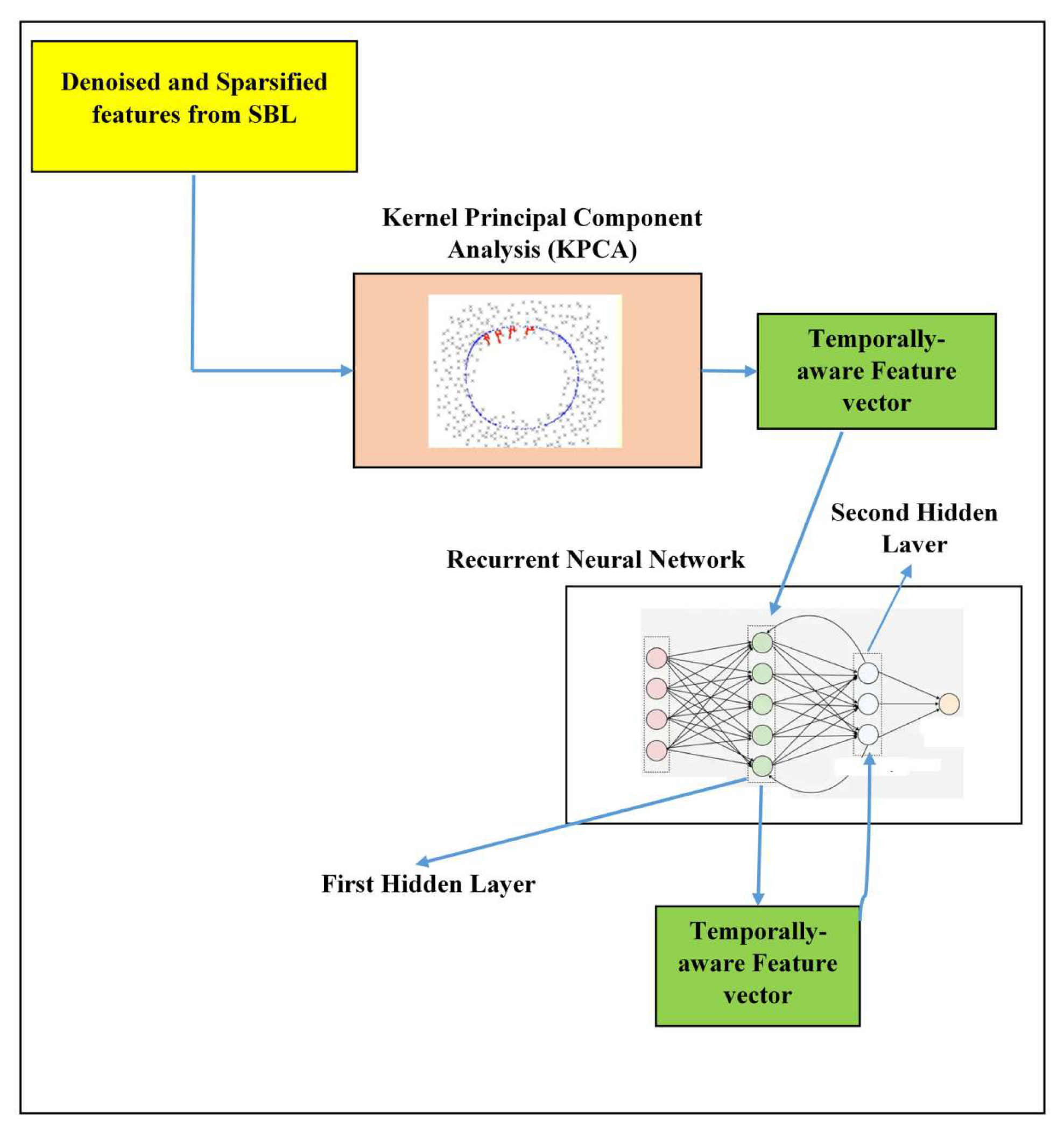
- To reduce the false alarms and mitigate the noise-induced masking in wideband CRN, the novel Discrete Wavelet Sparse Bayesian Kernel Analysis (DW-SBK) is proposed, which integrates the Discrete Wavelet Packet Transform (DWPT), Sparse Bayesian Learning (SBL), and Kernel Principal Component Analysis (Kernel PCA) within the first hidden layer of the RNN. It suppresses the multi-scale noise clustering, recovers the true sparse occupancy, and enhances weak PU signal detection.
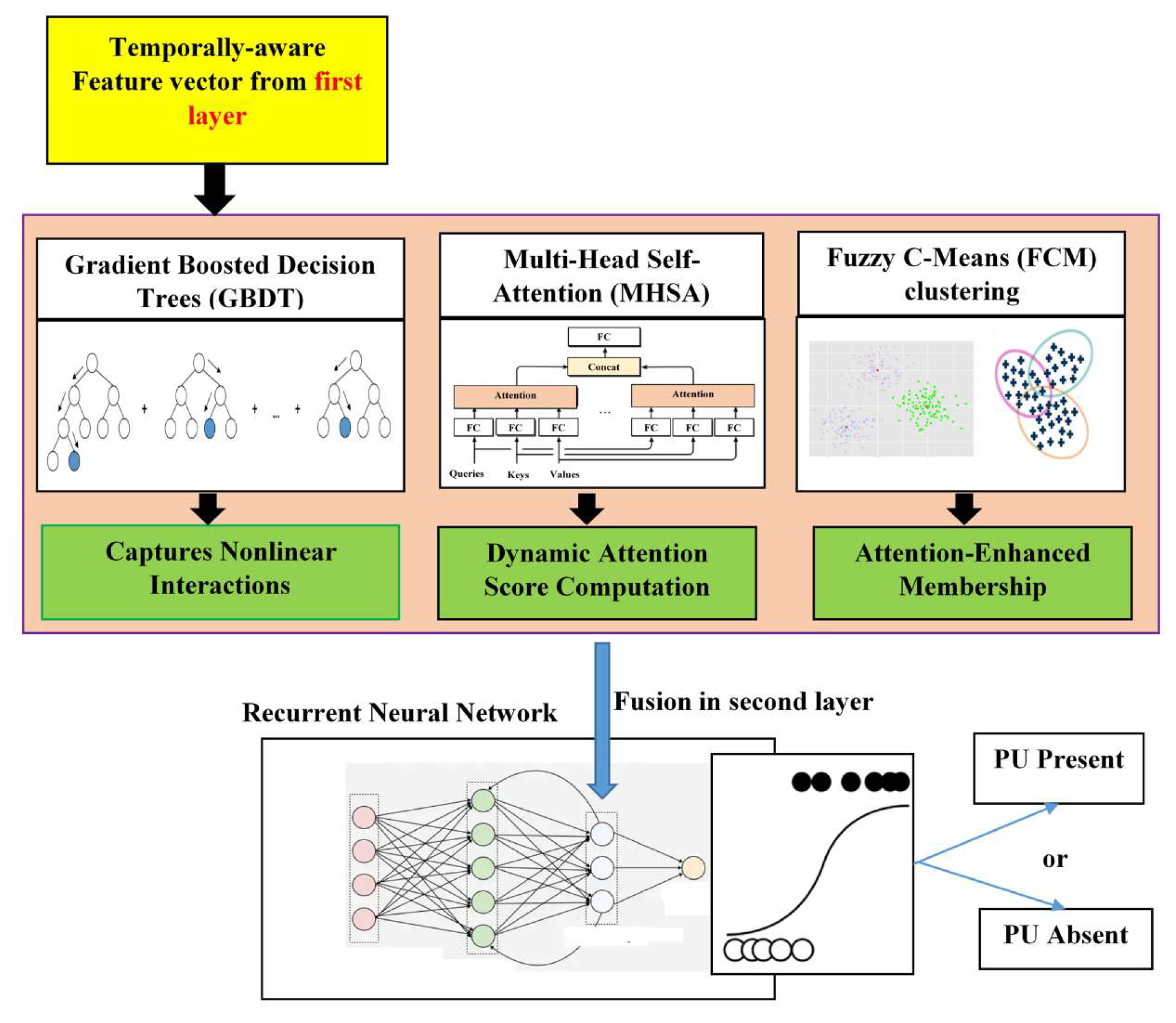
- The proposed Gradient Boosted Multi-Head Fuzzy Clustering (GB-MHFC) incorporates Gradient Boosted Decision Trees (GBDT), Fuzzy C-Means Clustering (FCM), and Multi-Head Self-Attention (MHSA) in the second hidden layer of the RNN, which captures nonlinear drift transitions, restores temporal continuity across fragmented bursts, and provides uncertainty-aware clustering of PU behavior, thereby ensuring strong sensing under cross-scale activity drift and temporal fragmentation.
1.2. Organization of the Paper
2. Literature Survey
Motivation
3. Proposed Methodology
3.1. Discrete Wavelet Sparse Bayesian Kernel Analysis
| Algorithm 1: Discrete Wavelet Sparse Bayesian Kernel Analysis (DW-SBK) |
Input: Received wideband signal at the secondary user (SU), ; Sparse PU activity masked by multi-scale noise. Output: Refined feature vectors for PU detection; Temporally aware probabilistic representation of PU presence. Steps:
|
3.2. Gradient Boosted Multi-Head Fuzzy Clustering
4. Result and Discussion
4.1. Dataset Description
4.2. System Configuration
4.3. Hyperparameter Settings
4.4. Simulation Result
4.5. Performance of the GDWB-KBSC-NN Framework
4.6. Comparison of Proposed Method Versus Existing Method
4.7. Discussion
4.8. Ablation Study
5. Conclusions
5.1. Limitations
5.2. Future Work
Author Contributions
Funding
Data Availability Statement
Acknowledgments
Conflicts of Interest
References
- Dhivya, R. AI-Driven Spectrum Sensing for Cognitive Radio Networks in Dynamic IoT Environments. IIRJET 2025, 10, 4. [Google Scholar]
- Kumari, S.; Chadhar, R.M. Cognitive Radio Networks for Wireless Communications using Spectrum Sensing Technique: A Review. Int. J. Adv. Res. Multidiscip. Trends 2025, 2, 69–79. [Google Scholar]
- Nayanam, K.; Sharma, V. Cognitive Radio Based Enhanced Compressive Spectrum Sensing Technique for 5G Adhoc Networks. Int. J. Eng. Res. 2024, 13, 1–8. [Google Scholar] [CrossRef]
- Xu, Y.; Zheng, K.; Liu, X.; Li, Z.; Liu, J. Cognitive Radio Networks: Technologies, Challenges and Applications. Sensors 2025, 25, 1011. [Google Scholar] [CrossRef] [PubMed]
- Bharathi, V.; Hallur, G.G.; Ramarajan, S.; Kumar, K.V. Enhancing Cooperative Spectrum Sensing Efficiency in CBRS-based CRN for Unmanned Mobile Robot Applications. Meas. Sci. Rev. 2024, 24, 260–264. [Google Scholar] [CrossRef]
- Elghamrawy, S.; Hamdy, A.; Hassanien, A.E. Energy consumption optimization in green cognitive radio networks based on collaborative spectrum sensing. EURASIP J. Wirel. Commun. Netw. 2024, 2024, 78. [Google Scholar] [CrossRef]
- Kaur, M.; Kumar, S. Ensemble Classification-Based Spectrum Sensing Using SVM for Cognitive Radio Networks. Internet Technol. Lett. 2025, 8, e70063. [Google Scholar] [CrossRef]
- Almuqren, L.; Maray, M.; Alotaibi, F.A.; Alzahrani, A.; Mahmud, A.; Rizwanullah, M. Optimal Deep Learning Empowered Malicious User Detection for Spectrum Sensing in Cognitive Radio Networks. IEEE Access 2024, 12, 35300–35308. [Google Scholar] [CrossRef]
- Balakumar, D.; Nandakumar, S. Blockchain-enabled cooperative spectrum sensing in 5G and B5G cognitive radio via massive multiple-input multiple-output nonorthogonal multiple access. Results Eng. 2024, 24, 102840. [Google Scholar] [CrossRef]
- Mohapatra, M.; Das, A. Enhanced Compressive Spectrum Sensing Method for 5G Adhoc Networks Using Cognitive Radio. unpublished.
- Saraswathi, M.; Logashanmugam, E. Chicken swarm optimization modelling for cognitive radio networks using deep belief network-enabled spectrum sensing technique. PLoS ONE 2024, 19, e0305987. [Google Scholar] [CrossRef]
- Vedachalam, S.; Raj, D. Development of a Privacy-Preserved and Secure Cooperative Spectrum Sensing System in CRN Using ATSNRNN-Enabled FPPDES. IEEE Access 2024, 12, 155838–155850. [Google Scholar] [CrossRef]
- Wang, K.; Chen, Y.; Bo, D.; Wang, S. A novel multi-user collaborative cognitive radio spectrum sensing model: Based on a CNN-LSTM model. PLoS ONE 2025, 20, e0316291. [Google Scholar] [CrossRef] [PubMed]
- Hong, S.; Xu, W. Spectrum Sensing in Very Low SNR Environment Using Multi-Scale Temporal Correlation Perception with Residual Attention. Sensors 2025, 25, 528. [Google Scholar] [CrossRef]
- Pan, G.; Yau, D.K.Y.; Zhou, B.; Wu, Q. Deep Learning for Spectrum Prediction in Cognitive Radio Networks: State-of-the-Art, New Opportunities, and Challenges. IEEE Netw. 2025, 40, 192–200. [Google Scholar] [CrossRef]
- Ge, J.; Liang, Y.-C.; Wang, S.; Sun, C. RIS-Assisted Cooperative Spectrum Sensing for Cognitive Radio Networks. IEEE Trans. Wirel. Commun. 2024, 23, 12547–12562. [Google Scholar] [CrossRef]
- Yao, J.; Jin, M.; Wu, T.; Elkashlan, M.; Yuen, C.; Wong, K.-K.; Karagiannidis, G.K.; Shin, H. FAS-Driven Spectrum Sensing for Cognitive Radio Networks. IEEE Internet Things J. 2025, 12, 6046–6049. [Google Scholar] [CrossRef]
- Benzater, H.A.; Teguig, D.; Lassami, N. Enhanced Cooperative Compressive Spectrum Sensing in Cognitive Radio Networks. Trans. Emerg. Telecommun. Technol. 2024, 35, e70000. [Google Scholar] [CrossRef]
- Srivastava, V.; Singh, P.; Mahajan, S.; Pandit, A.K.; Alshamrani, A.M.; Abouhawwash, M. Performance enhancement in clustering cooperative spectrum sensing for CRN using metaheuristic algorithm. Sci. Rep. 2023, 13, 16827. [Google Scholar] [CrossRef]
- Nie, D.; Yu, W.; Ni, Q.; Pervaiz, H.; Min, G. Cluster Control and Energy Consumption Minimization for Cooperative Prediction Based Spectrum Sensing in CRN. IEEE Trans. Commun. 2023, 71, 5580–5594. [Google Scholar] [CrossRef]
- Wang, J.; Liu, C. An imperfect spectrum sensing-based multi-hop clustering routing protocol for cognitive radio sensor networks. Sci. Rep. 2023, 13, 4853. [Google Scholar] [CrossRef] [PubMed]
- Joykutty, A.; Baranidharan, B. Optimized Cooperative Spectrum Sensing in Cognitive Radio Sensor Networks Using Extended XGBoost Model. Int. J. Comput. Netw. Appl. 2025, 12, 554–571. [Google Scholar] [CrossRef]
- Dibal, P.Y.; Onwuka, E.N.; Agajo, J.; Alenoghena, C.O. Wideband spectrum sensing in cognitive radio using discrete wavelet packet transform and PCA. Phys. Commun. 2020, 38, 100918. [Google Scholar] [CrossRef]
- Liu, X.; Li, X.; Zheng, K.; Liu, J. AoI minimization of ambient backscatter-assisted EH-CRN with cooperative spectrum sensing. Comput. Netw. 2024, 245, 110389. [Google Scholar] [CrossRef]
- Zheng, K.; Jia, X.; Chi, K.; Liu, X. DDPG-Based Joint Time and Energy Management in Ambient Backscatter-Assisted Hybrid Underlay CRNs. IEEE Trans. Commun. 2023, 71, 441–456. [Google Scholar] [CrossRef]
- Datta, J.; Zabala-Blanco, D.; Soria, F.R.C. Deep Neural Network aided Sparse Bayesian Learning for Wireless Access Channel Estimation in mm-Wave Massive MIMO Cloud Radio Access Network Systems. In Proceedings of the 2022 International Conference on Futuristic Technologies (INCOFT), Belgaum, India, 25–27 November 2022; pp. 1–7. [Google Scholar] [CrossRef]
- Pallam, V.; Khan, H.; Surampudi, S.R.; Immadi, G. Reduced Kernel PCA Model for Nonlinear Spectrum Sensing in Cognitive Radio Network. J. Inst. Eng. (India) Ser. B 2025, 106, 181–187. [Google Scholar] [CrossRef]
- Goyal, S.B.; Bedi, P.; Kumar, J.; Varadarajan, V. Deep learning application for sensing available spectrum for cognitive radio: An ECRNN approach. Peer-Peer Netw. Appl. 2021, 14, 3235–3249. [Google Scholar] [CrossRef]
- Usha, N.; Reddy, K.V.; Nagendra, N.N. Dynamic Spectrum Sensing in Cognitive Radio Networks using ML Model. In Proceedings of the 2020 Third International Conference on Smart Systems and Inventive Technology (ICSSIT), Tirunelveli, India, 20–22 August 2020; pp. 975–979. [Google Scholar] [CrossRef]
- Devarakonda, B.V.R.; Nandanavanam, V. Multi-Head Attention-Based Spectrum Sensing for Cognitive Radio. Int. J. Electr. Comput. Eng. Syst. 2023, 14, 135–143. [Google Scholar] [CrossRef]
- Yadav, D.; Majumder, S.; Raghuvanshi, A.S. FCM Based Spectrum Sensing For NOMA Cognitive Radio Networks. In Proceedings of the 2024 2nd World Conference on Communication & Computing (WCONF), Raipur, India, 12–14 July 2024; pp. 1–6. [Google Scholar] [CrossRef]
- Dari, A. CASS Spectrum Dataset: Labeled Spectrum Measurements for Cognitive Adaptive Signal Sensing (CASS). Kaggle. Available online: https://www.kaggle.com/datasets/ajithdari/cass-spectrum-dataset/data (accessed on 29 November 2025).
- Vijay, E.V.; Aparna, K. RNN-BIRNN-LSTM based spectrum sensing for proficient data transmission in cognitive radio. e-Prime 2023, 6, 100378. [Google Scholar] [CrossRef]
- Wang, A.; Zhu, T.; Meng, Q. Spectrum Sensing Method Based on STFT-RADN in Cognitive Radio Networks. Sensors 2024, 24, 5792. [Google Scholar] [CrossRef]
- Venkatapathi, P.; Khan, H.; Rao, S.S.; Immadi, G. Cooperative Spectrum Sensing Performance Assessment using Machine Learning in Cognitive Radio Sensor Networks. Eng. Technol. Appl. Sci. Res. 2024, 14, 12875–12879. [Google Scholar] [CrossRef]
- Nandhini, P.; Vimalnath, S. Optimized multi-scale graph neural network with attention mechanism for cooperative spectrum sensing in cognitive radio networks. Sci. Rep. 2025, 15, 41130. [Google Scholar] [CrossRef]
- Veerappan, K.; Gopalakrishnan, S. Deep learning-based spectrum sensing in cognitive radio networks using stacked LSTM: Performance analysis of SNR and BER. J. Comput. Sci. 2025, 21, 2547–2556. [Google Scholar] [CrossRef]






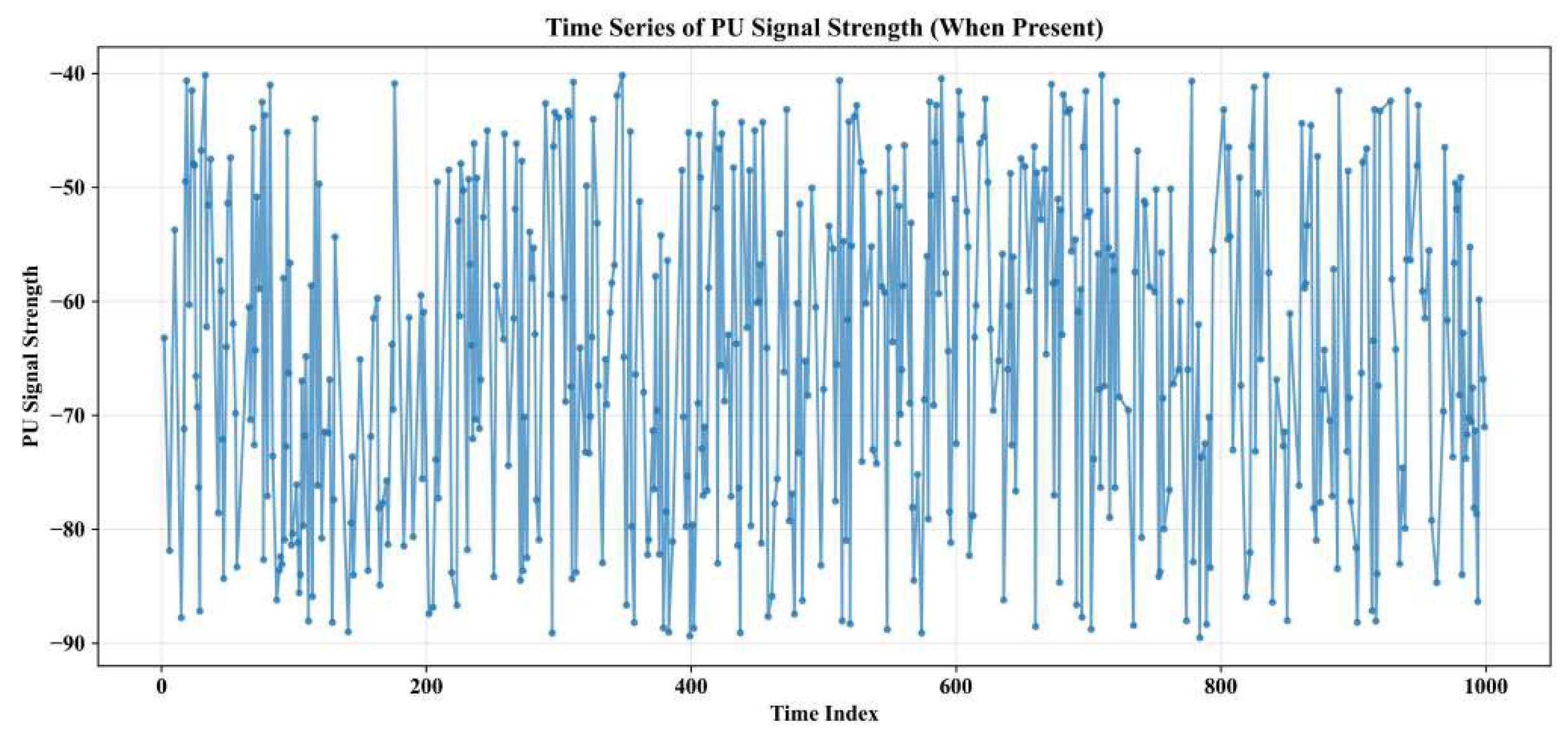

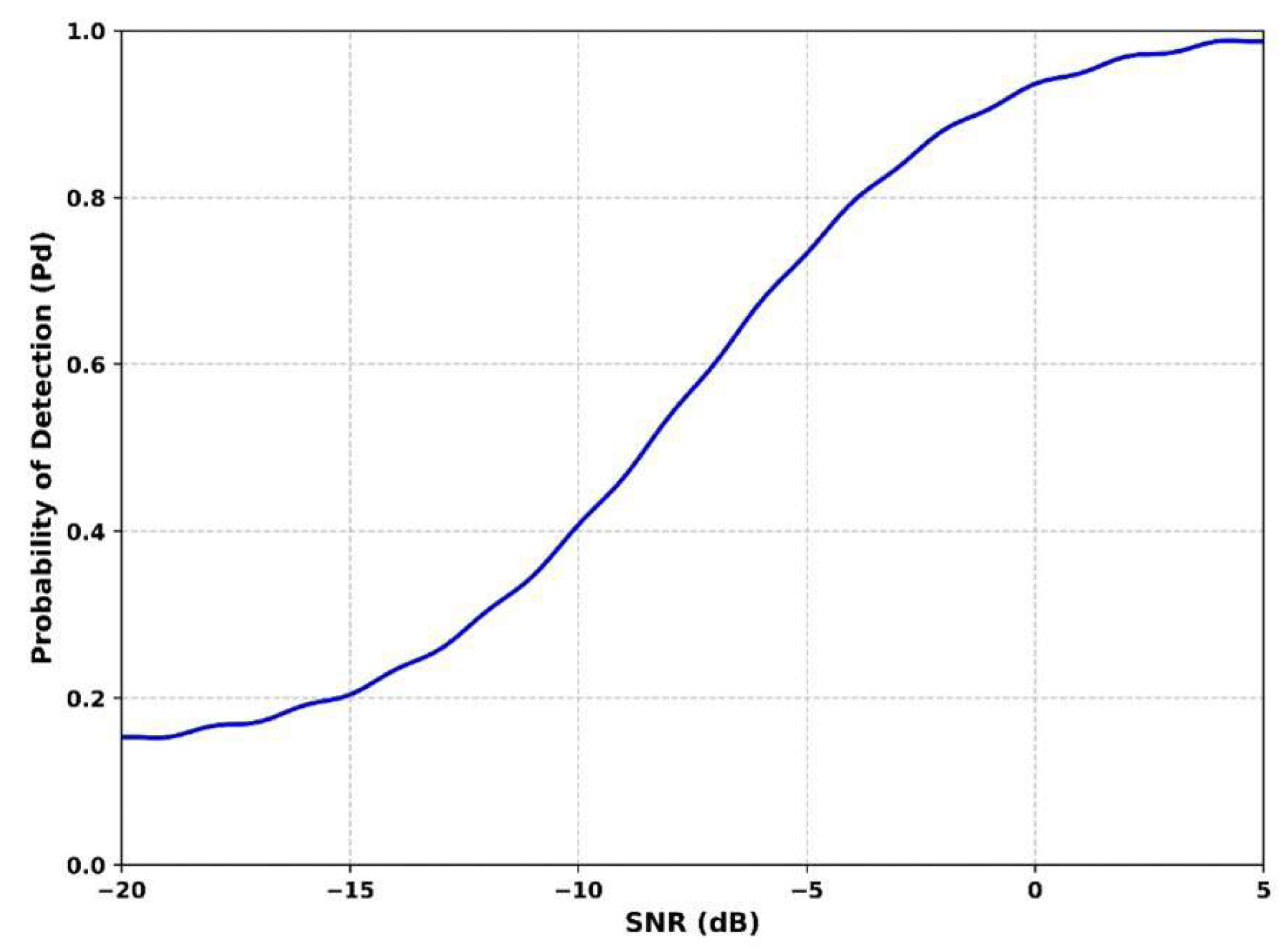
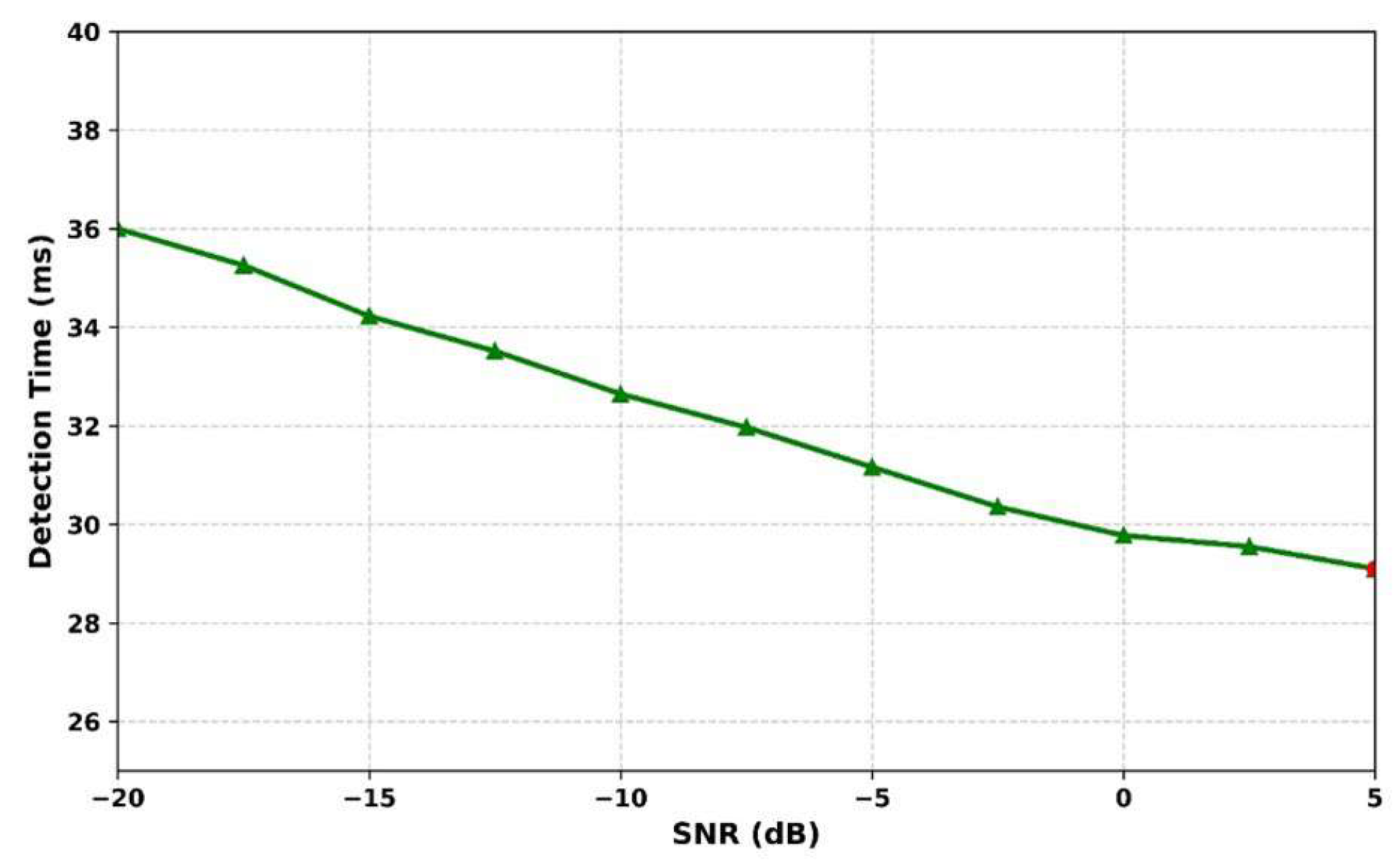
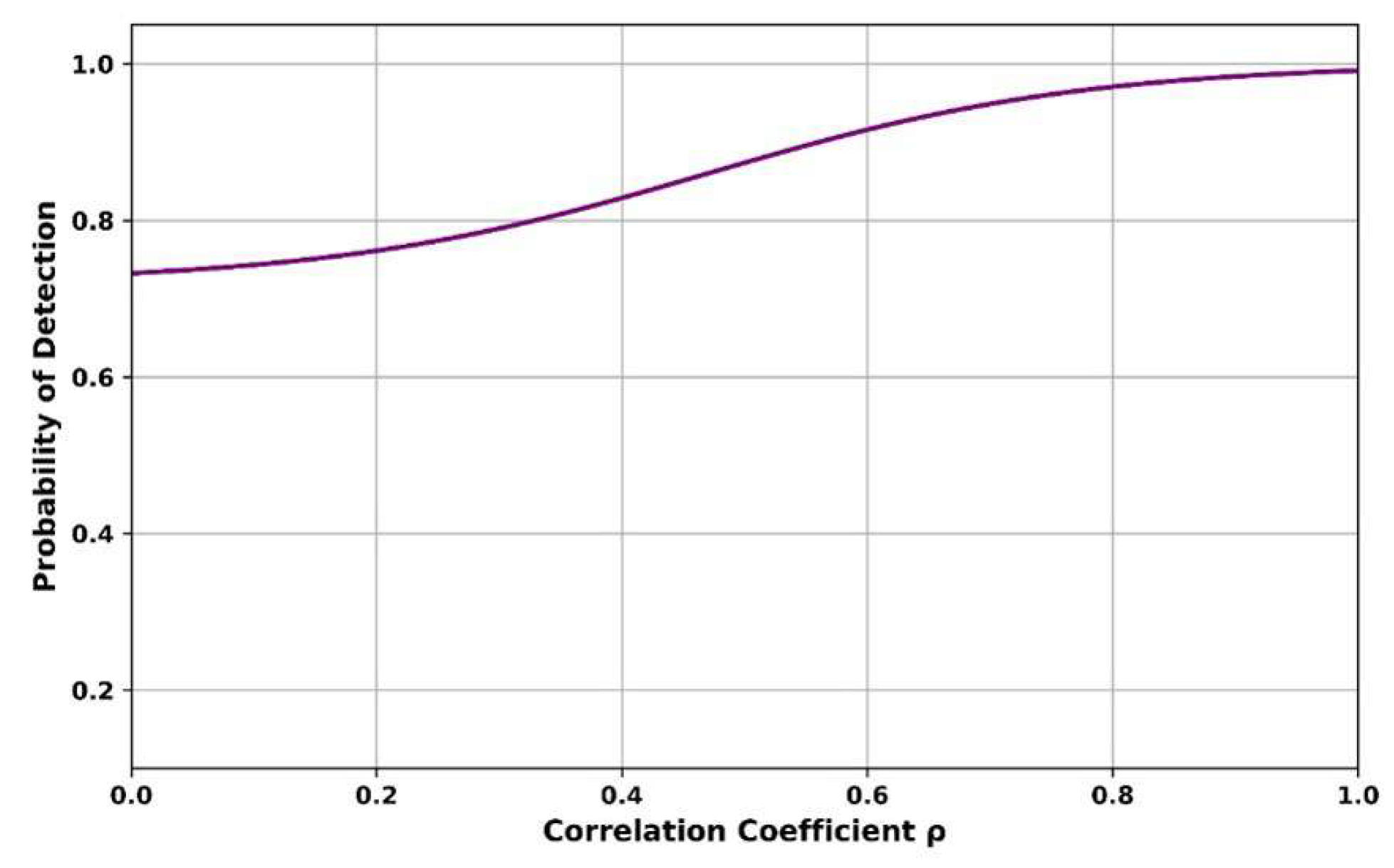





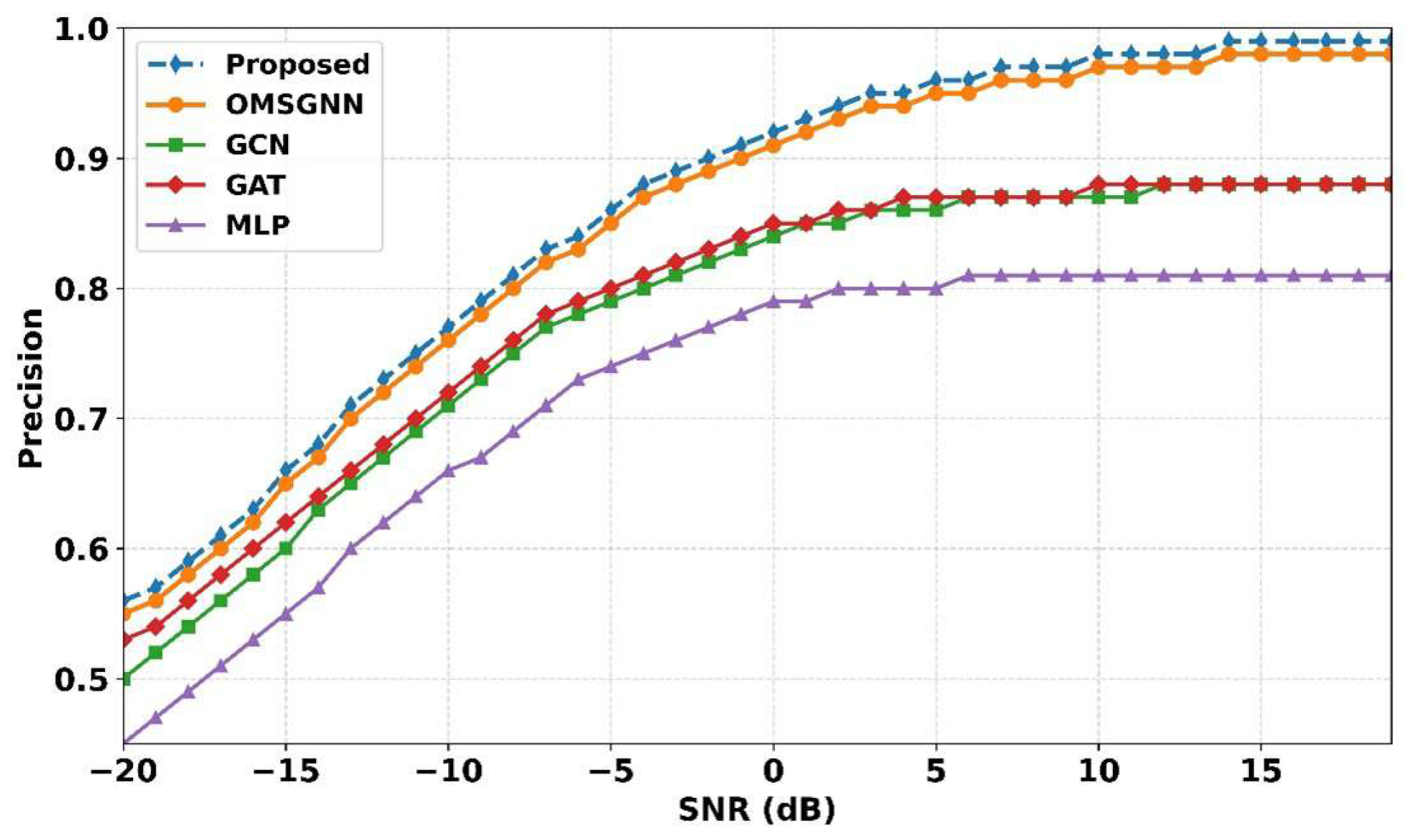
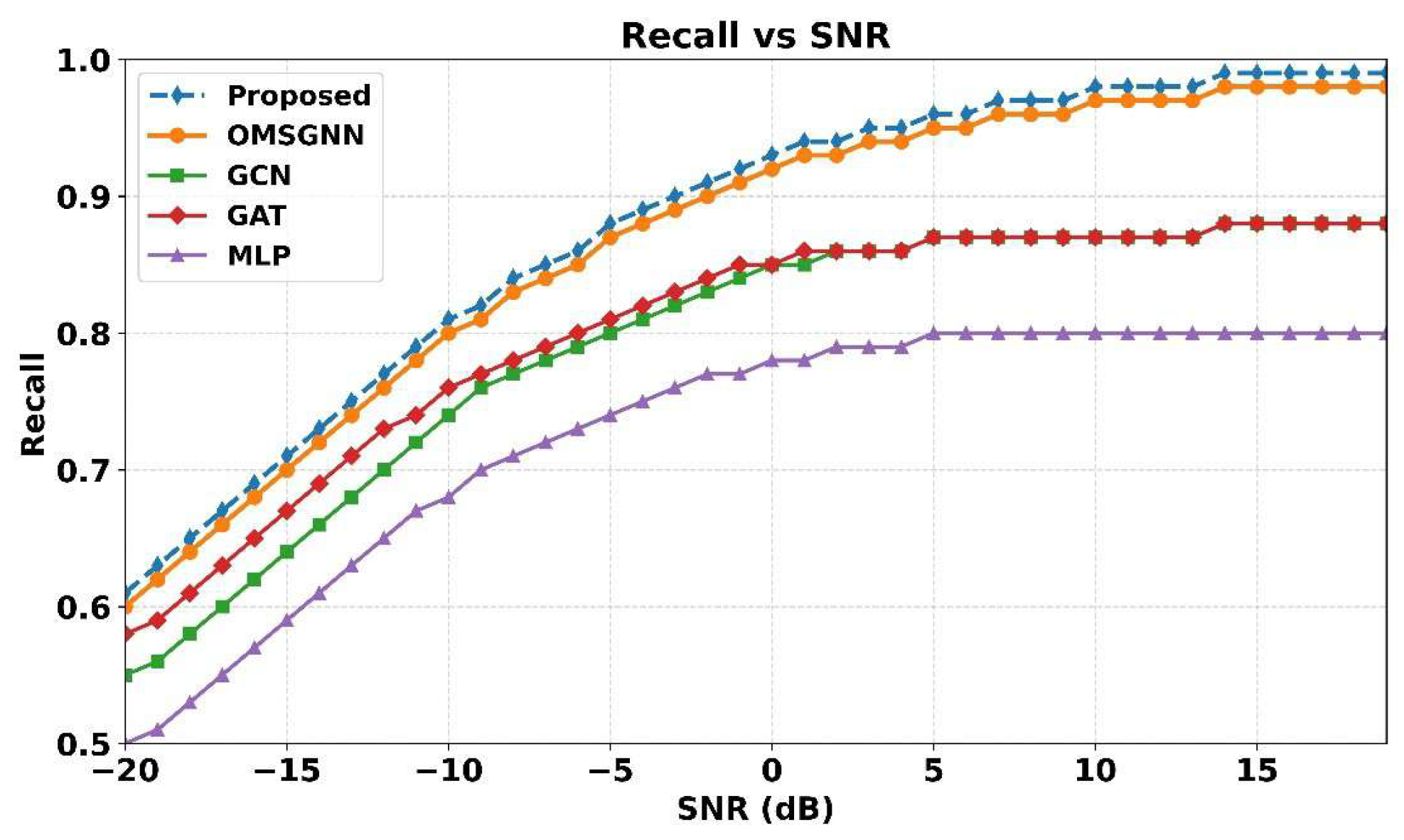


| Module | Component | Hyperparameter | Value | |
|---|---|---|---|---|
| DWSBKA | Wavelet Transform | Wavelet type | db4 | |
| Sparse Bayesian Learning | Max iterations | 100 | ||
| Convergence tolerance | ||||
| Kernel PCA | Kernel | RBF | ||
| No. of components | 10 | |||
| GBMFCL | Gradient Boosting (GBDT) | No. of estimators | 50 | |
| Learning rate | 0.1 | |||
| Random state | 42 | |||
| Multi-Head Attention | No. of heads | 2 | ||
| Dropout | 0.0 | |||
| Fuzzy C-Means | Max iterations | 100 | ||
| Convergence tolerance | ||||
| PU Presence Model | Gradient Boosting | No. of estimators | 100 | |
| Learning rate | 0.05 | |||
| Max depth | 4 | |||
| Training | Data split | Train/Test | 80/20 |
| Config. | Acc. (%) | F1 (%) | Pd (%) | Err. (%) |
|---|---|---|---|---|
| Without DWPT | 93.5 | 91.8 | 94.2 | 9.25 |
| Without SBL | 94.2 | 92.4 | 94.8 | 8.90 |
| Without KPCA | 95.0 | 93.5 | 95.5 | 7.85 |
| Without GBDT | 95.8 | 94.2 | 96.1 | 7.05 |
| Without MHSA | 96.2 | 94.8 | 96.5 | 6.72 |
| Without FCM | 96.5 | 95.1 | 97.0 | 6.25 |
| Full Mode | 98.0 | 97.0 | 99.0 | 5.41 |
Disclaimer/Publisher’s Note: The statements, opinions and data contained in all publications are solely those of the individual author(s) and contributor(s) and not of MDPI and/or the editor(s). MDPI and/or the editor(s) disclaim responsibility for any injury to people or property resulting from any ideas, methods, instructions or products referred to in the content. |
© 2026 by the authors. Licensee MDPI, Basel, Switzerland. This article is an open access article distributed under the terms and conditions of the Creative Commons Attribution (CC BY) license.
Share and Cite
Jatti, S.; Tyagi, A. Efficient Recurrent Multi-Layer Neural Network for Multi-Scale Noise and Activity Drift Mitigation in Wideband Cognitive Radio Networks. Algorithms 2026, 19, 172. https://doi.org/10.3390/a19030172
Jatti S, Tyagi A. Efficient Recurrent Multi-Layer Neural Network for Multi-Scale Noise and Activity Drift Mitigation in Wideband Cognitive Radio Networks. Algorithms. 2026; 19(3):172. https://doi.org/10.3390/a19030172
Chicago/Turabian StyleJatti, Sunil, and Anshul Tyagi. 2026. "Efficient Recurrent Multi-Layer Neural Network for Multi-Scale Noise and Activity Drift Mitigation in Wideband Cognitive Radio Networks" Algorithms 19, no. 3: 172. https://doi.org/10.3390/a19030172
APA StyleJatti, S., & Tyagi, A. (2026). Efficient Recurrent Multi-Layer Neural Network for Multi-Scale Noise and Activity Drift Mitigation in Wideband Cognitive Radio Networks. Algorithms, 19(3), 172. https://doi.org/10.3390/a19030172