1. Introduction
Gait alterations are prevalent across a wide spectrum of conditions and represent a growing clinical concern in aging societies [
1]. Neurological disorders, including both chronic neurodegenerative diseases and acute events such as stroke, are among the most common causes of persistent gait impairment [
2]. These alterations have a direct impact on daily functioning and quality of life, particularly in older adults [
3]. In this specific group, deviations from typical walking patterns are also frequently observed prior to formal neurological diagnosis, as subclinical motor changes may precede functional decline [
4,
5].
From a clinical perspective, gait is characterized through a combination of spatio-temporal parameters, balance-related observations, and qualitative evaluation of upper- and lower-limb coordination [
6,
7,
8]. Integrating these heterogeneous cues into a single judgment of gait quality is inherently subjective and often expressed through coarse ordinal scales, which provide limited resolution [
7]. As a result, mild or early-stage gait alterations may not be reliably captured, despite their relevance for fall risk and functional decline [
6].
Recent advances in computer vision and markerless human pose estimation (HPE) have enabled the extraction of gait features from RGB or RGB-D videos in unconstrained environments, fostering automatic estimation of clinical gait scores [
9]. In Parkinson’s disease, several studies have used pose-based representations to regress ordinal clinical scores such as the MDS-UPDRS gait item, reporting moderate agreement with clinician ratings [
10,
11,
12]. Large-scale benchmarks, such as the recently released CARE-PD [
13], further showed that performance strongly depends on the training domain and typically drops in cross-dataset evaluations, while intermediate severity levels remain poorly separated [
14]. In addition, the discrete nature of clinical scores constrains resolution and provides limited insight into which specific gait components are altered, reducing interpretability and clinical transparency [
15]. While markerless motion analysis addresses scalable data acquisition, it leaves open the question of how gait information should be summarized in a clinically meaningful and generalizable manner. Several gait indices have been proposed, typically relying on laboratory-grade motion capture systems and often tailored to specific pathologies or populations [
16]. Well-established indices such as the Gait Deviation Index (GDI) [
17] and the Gait Profile Score (GPS) [
18] still require marker-based technologies and primarily focus on lower-limb joint kinematics, neglecting relevant aspects such as arm swing and dynamic stability. These limitations, together with cost and infrastructure requirements, restrict applicability in preventive, home-based, and telemedicine-oriented settings. There is therefore a practical need for an index that can be computed from a limited number of interpretable gait parameters, is compatible with low-cost markerless acquisition technologies, and reflects gait abnormality as a functional deviation rather than a disease-specific label.
In this work, we introduce and preliminarily validate the Gait Alteration Index(GAI), a pathology-agnostic measure designed to quantify deviations from typical walking patterns using a compact set of gait parameters extracted from straight-path walking acquired with an RGB-D camera system (Azure Kinect), previously developed within the REHOME project [
19]. The GAI integrates information from three complementary domains—spatio-temporal characteristics of lower-limb motion, surrogates of dynamic stability, and arm swing kinematics, providing both an overall index and domain-specific sub-indices. The methodological approach combines markerless 3D skeletal tracking, supervised feature selection, and a geometric formulation based on class centroids to define a bounded and interpretable index. This study is thus designed to answer the following questions in relation to GAI:
Can gait abnormality be quantified as a continuous functional deviation from typical walking using low-cost markerless RGB-D acquisition?
Does the proposed index align with clinician-derived gait assessments across heterogeneous populations?
To address these research questions, the rest of the manuscript is organised as follows.
Section 2 describes the acquisition system and datasets, the extracted gait parameters, and the feature selection and centroid-based formulation used to define the GAI.
Section 3 reports the experimental results and the preliminary validation against clinician-derived assessments.
Section 4 discusses the implications of the findings, the interpretability of the global index and sub-indices, and the limitations of the current evaluation.
Section 5 concludes the paper by summarizing the overall work and future directions of research.
2. Materials and Methods
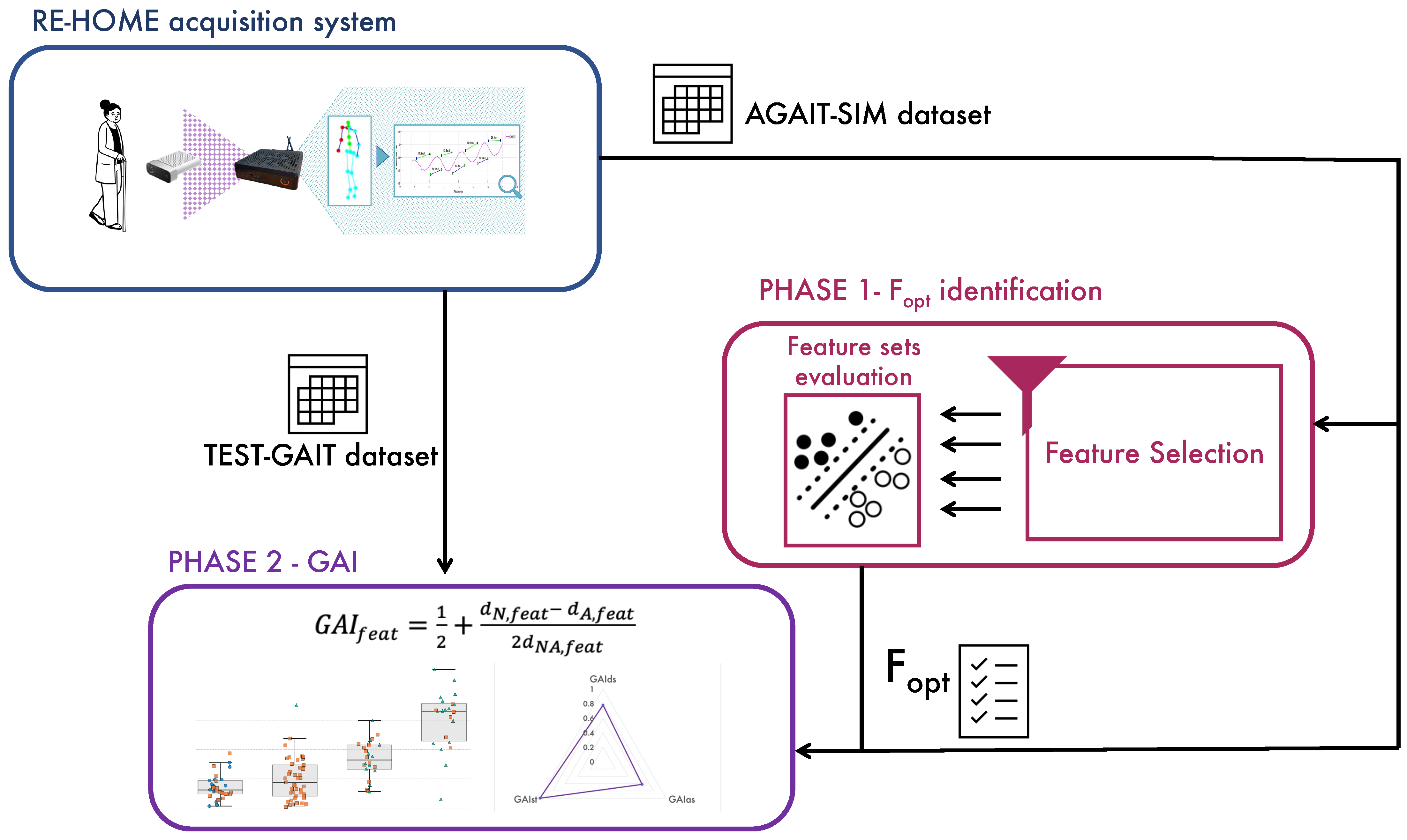
The schematic representation in
Figure 1 outlines the key stages of the study. The retrospective datasets employed are described in
Section 2.1, along with a brief overview of the dataset creation process. In Phase 1 of the study, (
Section 2.2), an optimal subset of features was identified from the AGAIT-SIM dataset using filter-based feature selection methods and a Support Vector Machine (SVM) model. In Phase 2 (
Section 2.3), the selected features from Phase 1 were used to design the GAI, which was then evaluated on a dataset of gait profiles (TEST-GAIT) that includes non-pathological (NP) individuals, PD patients, and post-stroke (PS) subjects.
2.1. Gait Datasets
This study uses two datasets of gait profiles collected using the acquisition and analysis video system developed for the REHOME project [
19]. The acquisition system was based on a single RGB-D sensor (Microsoft Azure Kinect, Microsoft, Redmond, WA, USA) and its proprietary 3D motion tracking algorithm. The collected 3D skeletal models were processed offline using custom scripts written in Matlab R2022b to extract the gait features reported in
Table 1 and
Table 2. These parameters include measures of lower limb mobility, arm swing ability, and dynamic sway of the center of mass during gait. For further information about the feature extraction procedure, refer to the description reported in [
20], as the same methodology was replicated in this work.
The first dataset (AGAIT-SIM) includes gait profiles from ten healthy volunteers (average age: 50.2 ± 15.8; age range: 45–66; five males and five females) that performed three gait trials characterized by normal and simulations of altered gait patterns [
21]. Specifically, normal pace walking sessions (NPS), low-speed and short-step walking sessions (RPS), and dangling walking sessions (DPS) were considered to simulate altered walking patterns typical in elderly and pathological subjects with gait disorders, such as parkinsonian and PS individuals with hemiplegia. For each session, three walking trials were included. According to the acquisition protocol, each subject started 5 m away and walked toward the RGB-D sensor along a straight path. In this way, the subject entered the tracking region, approximately from 4.5 m to 2 m from the RGB-D sensor, fully operational, allowing the correct detection of each step and the estimation of gait parameters. The final AGAIT-SIM dataset contains 30 NPS, 26 RPS, and 28 DPS.
The second dataset (TEST-GAIT) contains gait sessions acquired using the proposed system at the Division of Neurology and Neurorehabilitation of San Giuseppe Hospital (Istituto Auxologico Italiano, Piancavallo, Verbania, Italy) and in the facilities of a local patients’ association (Associazione Amici Parkinsoniani Piemonte Onlus). The data were collected in an experimental session approved in advance by the local ethics committee according to the Declaration of Helsinki (1964) and its amendments. This dataset contains 79 PD, 28 PS and 16 NP walking trials for a total of 123 samples. The inclusion criteria for PS subjects were: ability to walk 10 m without the assistance of another person or aids, ability to understand the instructions for performing the gait analysis test. The inclusion criteria for PD subjects were: tremor severity ≤ 1, H&Y score in 1–3 range. The exclusion criteria for both groups were: cognitive impairment with Mini-Mental State Examination (MMSE) < 27/30, previous neurosurgical procedures, history of other neurological or musculoskeletal disorders unrelated to stroke and PD. The exclusion criteria did not include age, sex, side dominance, or therapy. NP subjects were recruited among caregivers and clinical personnel of the hospital and the patients’ association, excluding subjects with a clinical diagnosis of pathological gait or a history of injuries that may impact gait profiles. This dataset shows different types and degrees of alteration, across two distinct pathological conditions affecting gait. This choice reflects the goal for GAI to measure generic gait alterations rather then disease-specific information. This means that gait alterations could be identified by the GAI also in NP subjects and, for instance, not in parkinsonian subjects whose gait is not yet severely impaired by the disease.
2.2. Phase 1: Selection of the Optimal Features
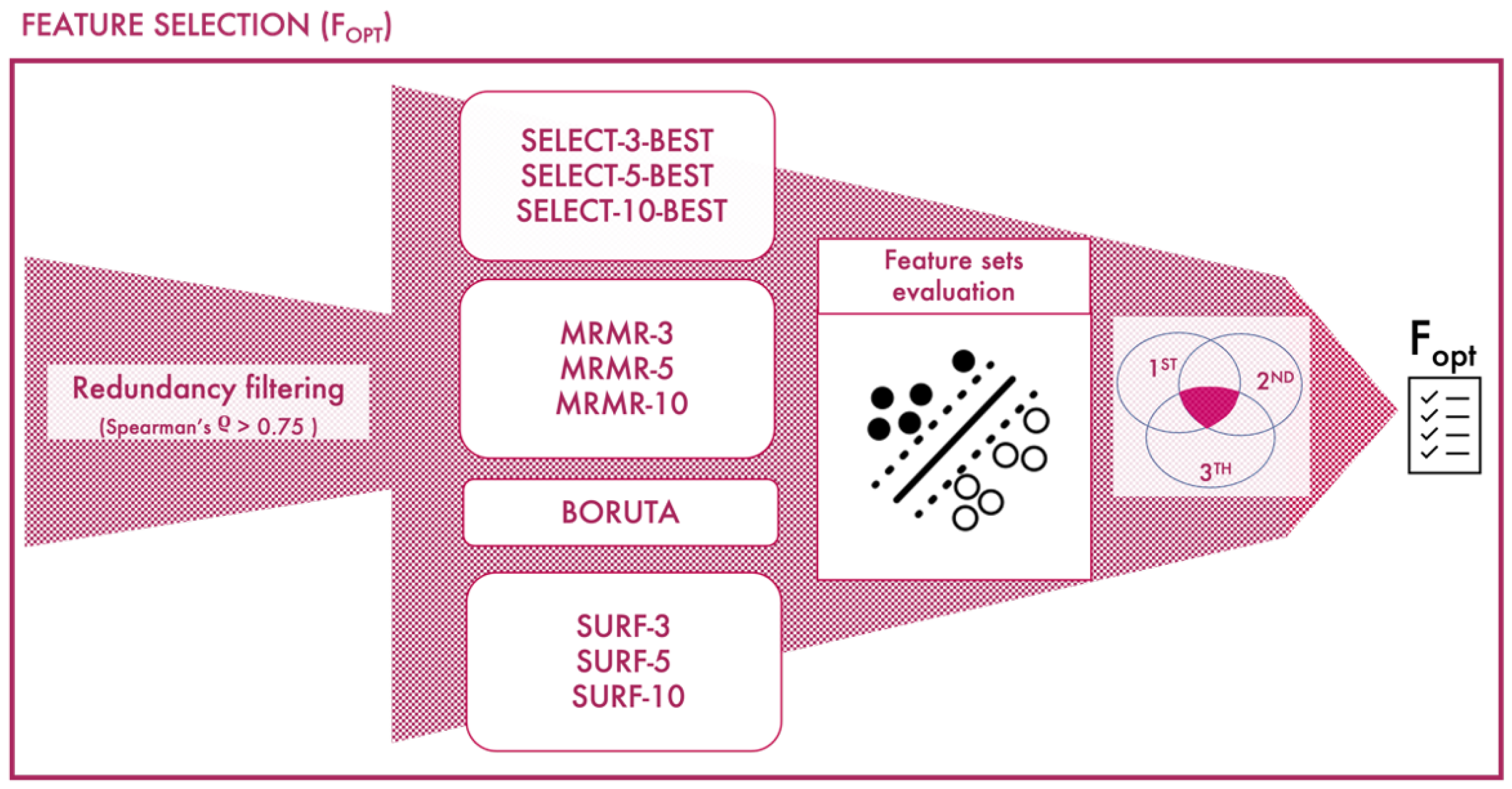
The selection of optimal markers of gait alterations was conducted to identify a reduced set of significant gait features. The procedure encompassed several steps, as illustrated in
Figure 2: redundancy filtering using correlation; evaluation of several filter-based feature selection approaches; finally the intersection of the best performing candidate sets, to generate the optimal set
.
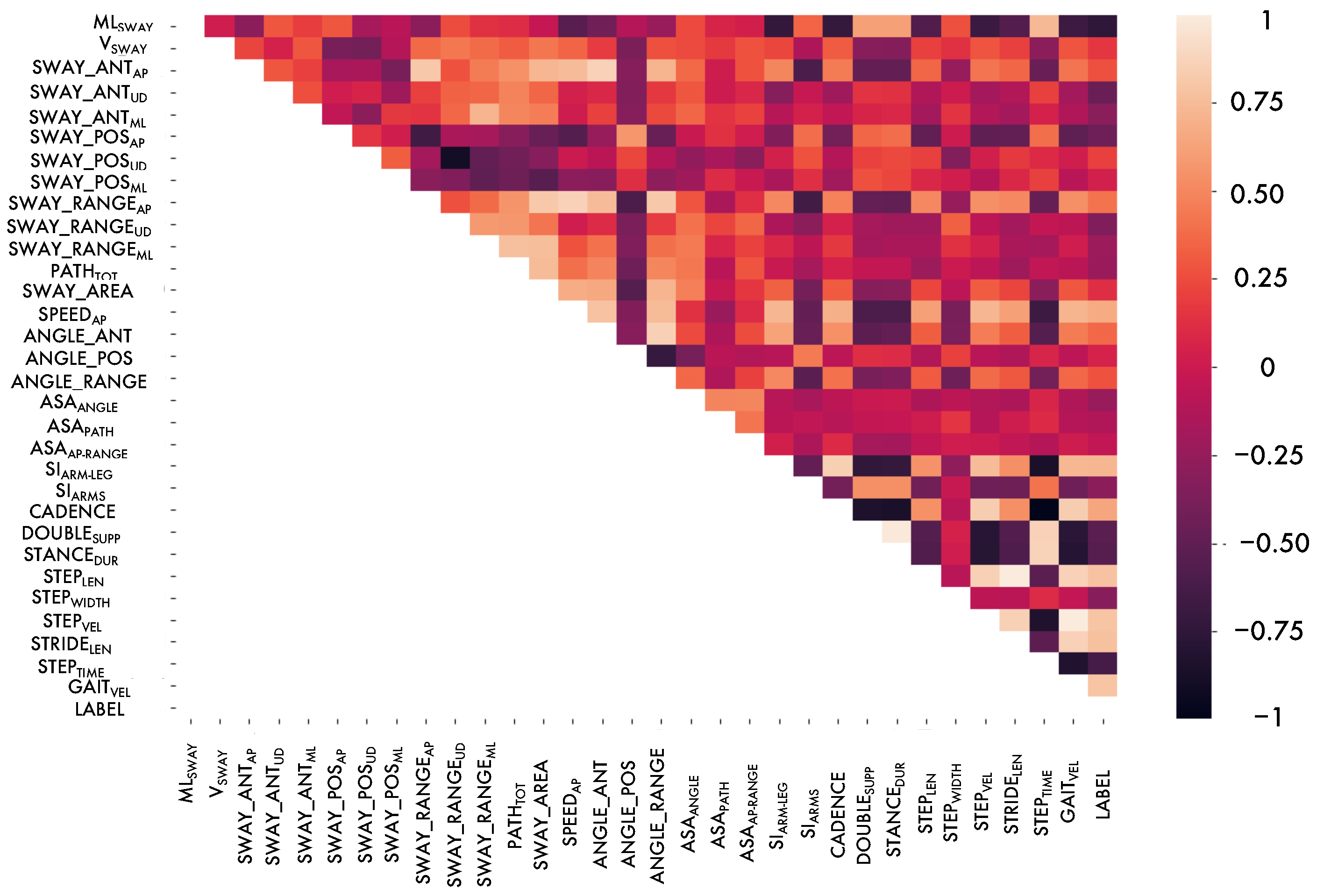
As a preliminary step to limit redundancy across optimal features, redundancy filtering was applied before any selection method. The procedure consisted of computing pairwise Spearman’s correlation
between features, identifying pairs having
. Spearman’s correlation was selected as it is robust, compared to other variants such as Pearson’s correlation, to non-normal distributions, which is the case for most of the gait features in the dataset. For each pair, only the feature with the highest correlation to the class label (NPS, RPS, and DPS) was maintained while removing the other. A priori redundancy removal is essential to prevent the final optimal set from containing only highly correlated features, which could overshadow other relevant and peculiar aspects, for a more comprehensive evaluation of gait from different viewpoints [
22]. Indeed, we expected
to be composed of a subset of features from each of the three initial groups (spatiotemporal, dynamic stability, and arm swing) since these groups convey different but equally relevant information to identify the alterations in the AGAIT-SIM dataset. Moreover, this preliminary step may improve the redundancy removal power of the subsequent feature selection methods.
Four popular feature selection methods for identifying
were considered: Select-K-best, using as metric Spearman’s correlation to class label [
23]; Minimum Redundancy—Maximum Relevance (MRMR) [
24]; Boruta [
25]; Speeded Up Robust Features (SURF) [
26]. While the Boruta algorithm does not require setting any hyperparameter, in the case of Select-K-best, MRMR, and SURF, the number of features K to retain during the selection process was set to values 3, 5, and 10 for preliminary exploration. For the comparison of the methods, as many SVM models as the obtained feature sets were trained and evaluated using bayesian search for identifying SVM optimal hyperparameters (i.e., kernel, cost of misclassification C, degree,
), combined with nested cross-validation (10 outer splits, 5 inner splits) for overall model evaluation.
, which is then employed in Phase 2, is obtained considering the intersection of the three best-performing feature sets from nested-cross-validation.
2.3. Phase 2: GAI Proposal and Preliminary Validation
Conceptually, the Gait Alteration Index (GAI) is designed to capture gait abnormality as a functional deviation from typical walking by integrating complementary aspects of locomotion. The spatio-temporal domain reflects the efficiency and regularity of lower-limb progression, capturing changes such as reduced gait speed, altered step timing, or shortened steps, which are among the most salient indicators of impaired walking. The dynamic stability domain quantifies surrogates of postural control during gait, reflecting the individual’s ability to maintain balance and control the center of mass while moving. Finally, the arm swing domain captures upper-limb contribution and coordination with lower limbs, which are known to be altered in several neurological and age-related conditions and to play a role in balance and gait stability. By combining these three domains, the GAI provides an overall measure of gait alteration that reflects not a single isolated deficit, but the integrated functional impact of multiple interacting gait components, in line with the way clinicians qualitatively assess walking performance [
27]. The mathematical definition of GAI is based on the modeling of
Normal and
Altered gait sessions from the AGAIT-SIM dataset using the concept of class centroid, as defined in Equation (
1):
where
is the centroid of class
l (i.e., Normal
N or Altered
A),
L is the cardinality of such class, and
is a datapoint (a gait session) belonging to it, represented as a vector whose components correspond to the
f optimal features in
. The centroids are computed after
z-score standardization of
, such that all feature dimensions have comparable scaling. The same z-score normalization is applied to the testing data before evaluating the GAI.
Denoting by the centroid of the Normal class and by that of the Altered class, these two vectors result from the concatenation of three subvectors, each referring to one of the three feature groups included in the original feature set and then reduced in , namely spatiotemporal (ST), dynamic stability (DS), and arm swing (AS). For instance, can be expressed as the concatenation of the subvectors , , and .
Therefore, given a new gait session represented by the vector
(and its subcomponents
,
, and
), the computation of the GAI starts from the evaluation of three feature-group-specific indices, namely
,
, and
, using Equations (
2)–(
4):
where feat denotes the feature group under consideration (ST, DS, or AS), and
l indicates the class label of the centroid (either
N or
A).
The overall GAI is then computed as the average of the three feature-group-specific indices, as reported in Equation (
5):
As can be inferred from the formulation, the GAI (as well as its feature-group-specific components) always lies in the range
, thanks to geometric properties of triangles and to the
shifting factor included in Equation (
4). Values close to 0 correspond to a normal gait pattern, whereas values approaching 1 indicate increasingly altered gait performance.
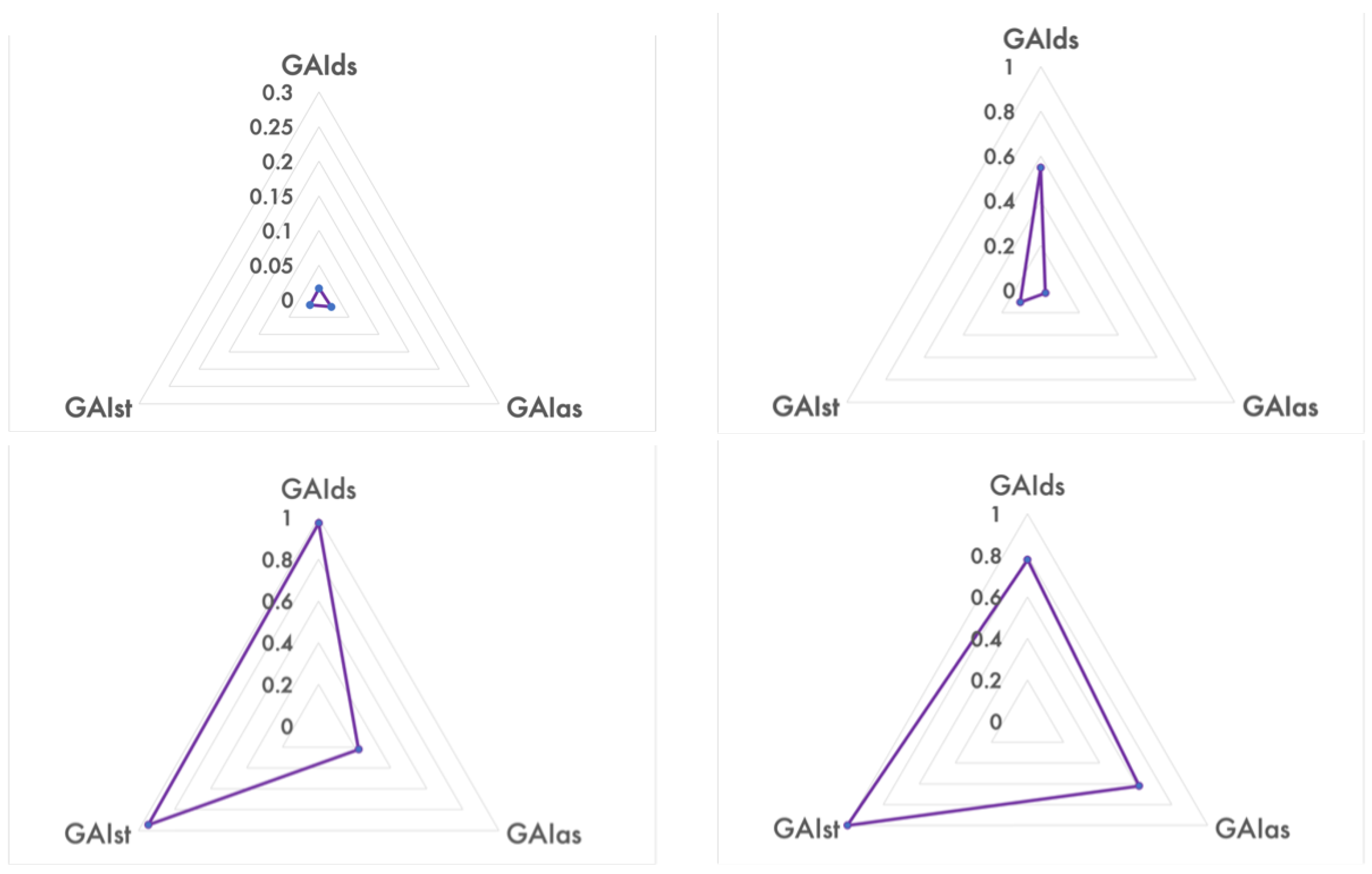
The proposed GAI definition offers several advantages. First, in addition to evaluating the overall index, it allows identifying which specific gait aspects are most compromised through the analysis of the three feature-group-specific GAIs. Second, the index could potentially be adapted to assign different weights to the three contributions, depending on the pathology or population under analysis. Finally, the computation can be specialized by defining as the centroid of a specific type of alteration (e.g., RPS or DPS from AGAIT-SIM), thus tailoring the index to quantify the tendency toward a specific gait impairment, such as slowness/reduced step length or trunk instability.
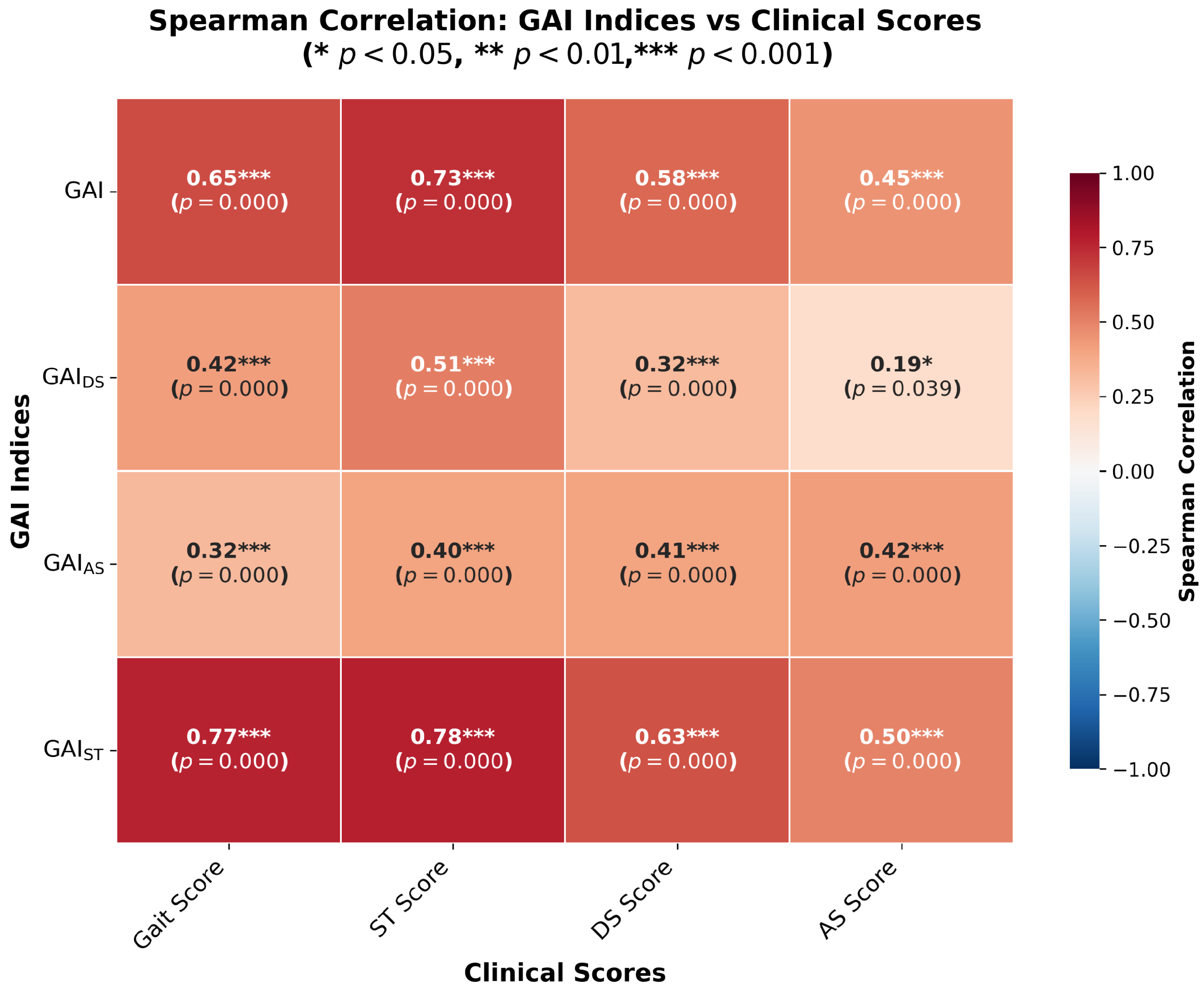
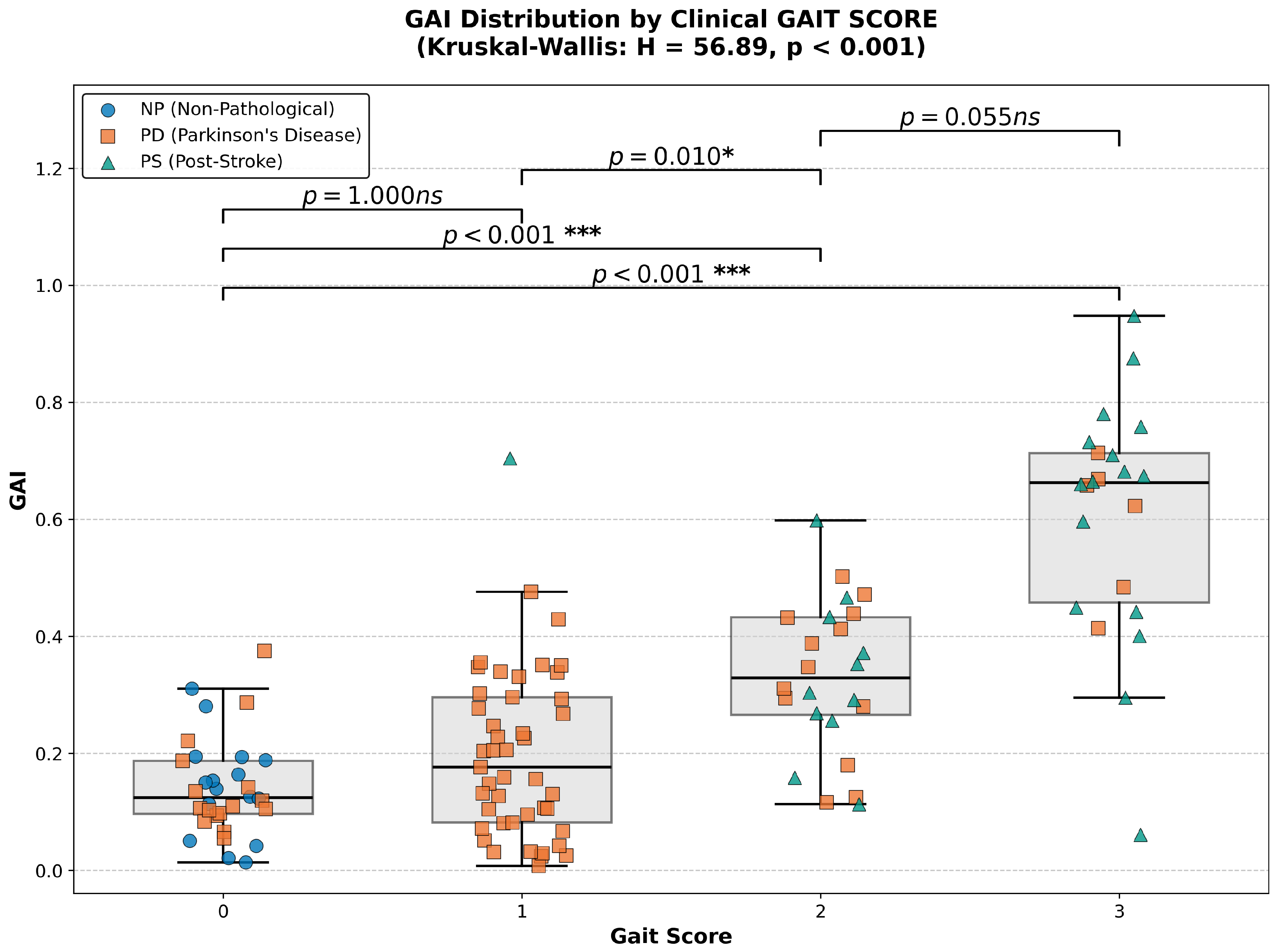
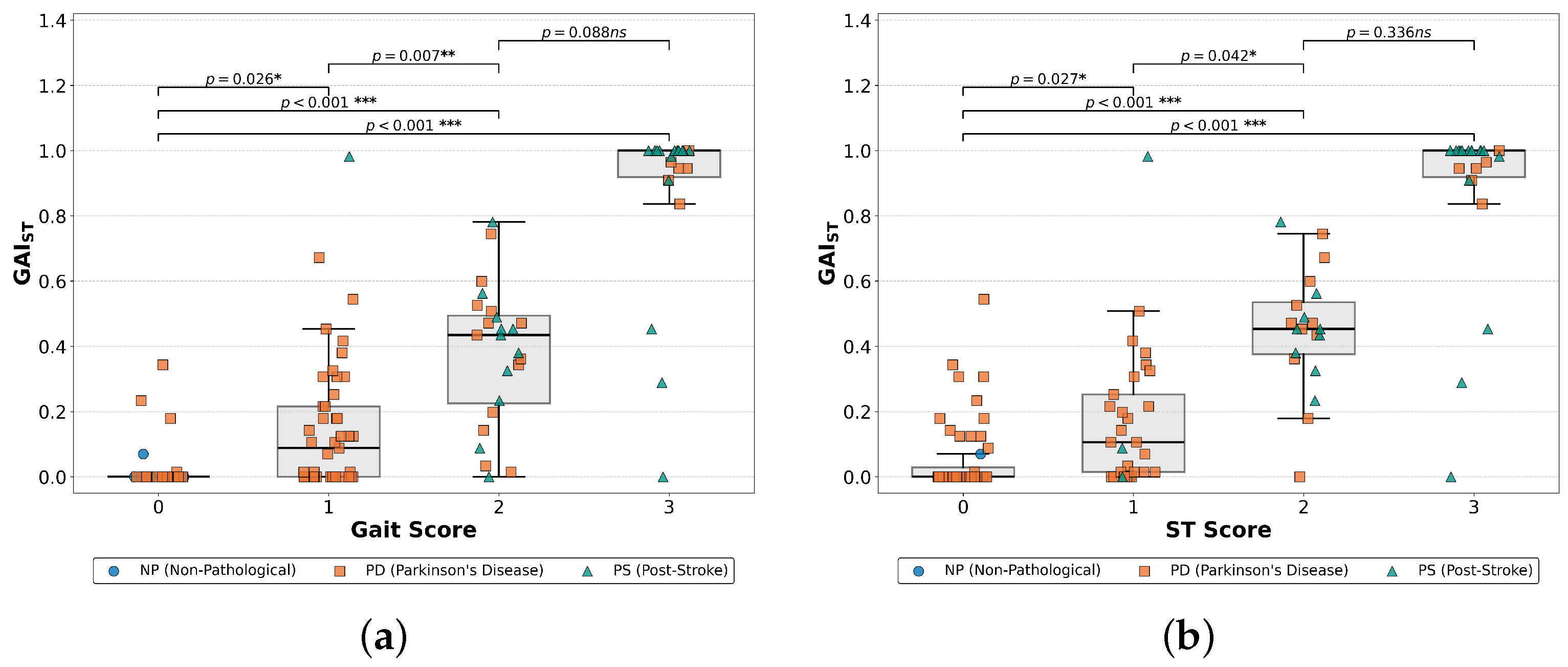
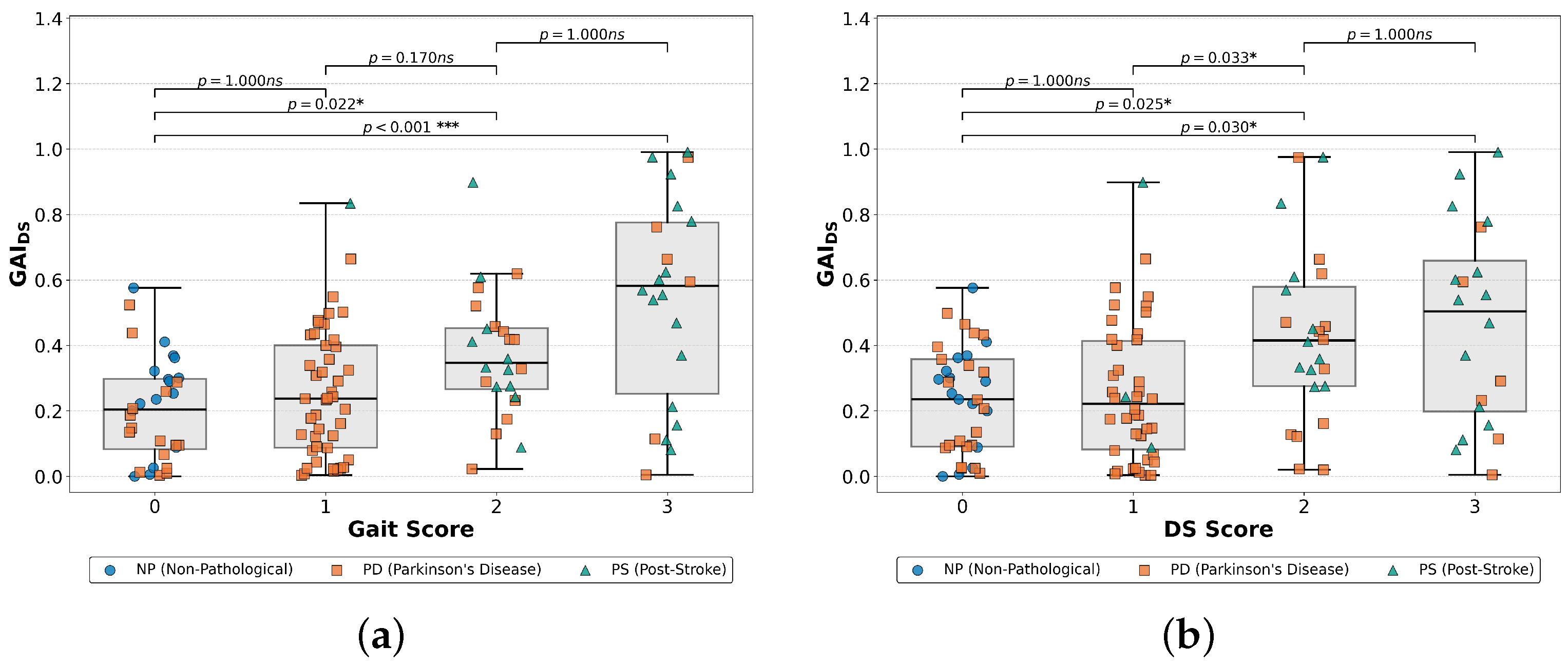
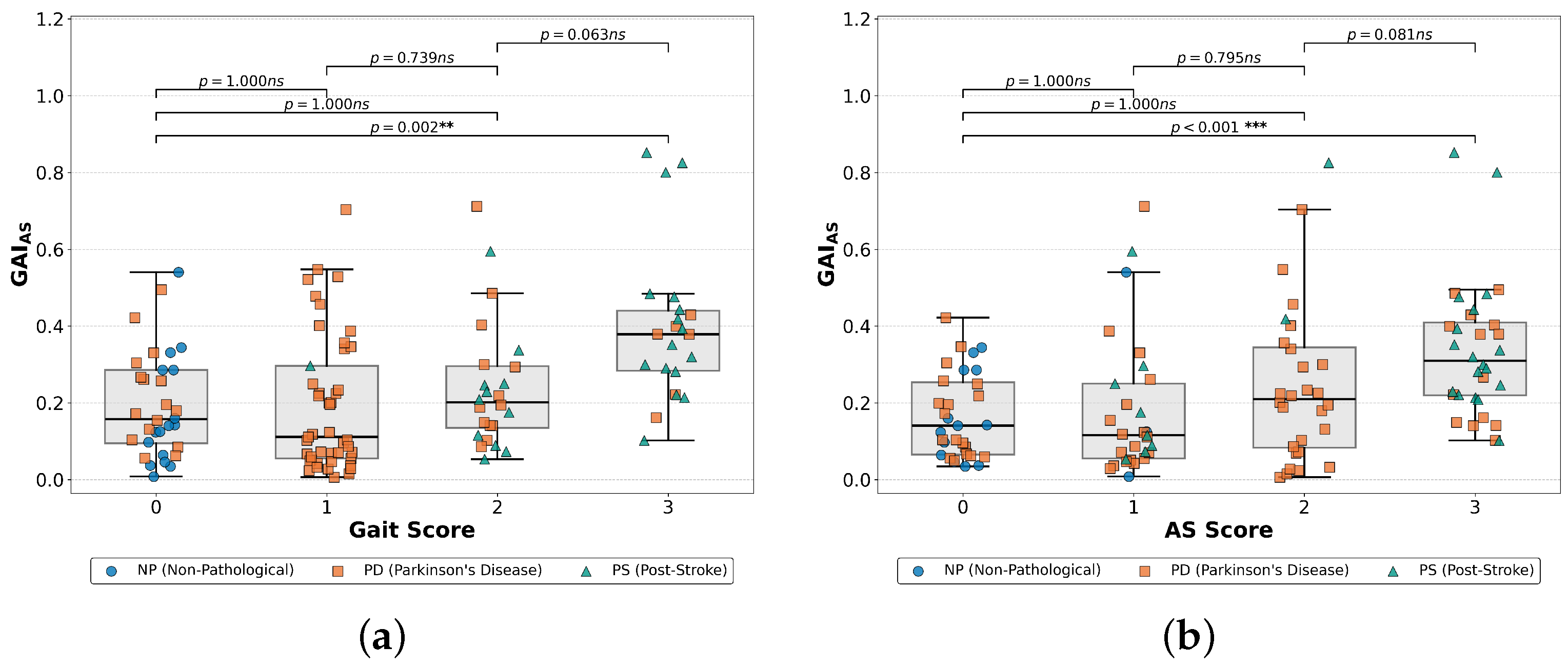
As a preliminary investigation about the informative power of the index with respect to alterations in gait due to pathological impairment, we computed GAI for the subjects in the TEST-GAIT dataset. Weights for the subcomponents were maintained equal, to avoid bias towards specific types of impairment or pathology (e.g., post-stroke subjects may have more markedly distrupted arm swing symmetry). We then compared GAI values with clinical scores assigned to the video in TEST-GAIT by an experienced neurologist, investigating statistically significant correlations (
p-value < 0.05). We asked the clinician to assign both an overall Gait score, and three domain-specific scores focusing on: spatio-temporal impairment from lower-limb dynamic (ST score); dynamic stability impairment during walking (DS score); arm swing alteration (AS score). All these scores ranged from 0 (no impairment) to 4 (severe impairment), as typically done for gait assessment in the Unified Parkinson’s Disease Rating Scale (UPDRS) [
27].
4. Discussion
In an aging population, the constant growth in the incidence of disabilities caused by chronic and progressive neurological diseases such as Parkinson’s disease (PD), and acute events such as stroke, requires specific and prolonged health treatments. These disability conditions negatively impact several motor functions, among which gait impairment is one of the most disabling since it can result in increased risk of falls, reduced independence in daily-life activities, and general worsening in overall quality of life. New telemedicine solutions investigating gait impairment aim to support objective evaluation of gait quality through emerging technological approaches that could be sufficiently accurate and usable outside traditional hospital settings. However, despite the large number of potential solutions that could enable this monitoring, the field still lacks a summary measure that accounts for the different contributions of the objective parameters, providing clinicians with a single, comprehensive evaluation that is coherent with clinical scales. Despite the effort, machine learning or deep learning models that can accurately distinguish among standard clinical severity levels with a generalizable and cross-dataset-transferable approach are still lacking [
13]. This is largely due to the uncertain nature of the clinical labels, as well as the coarse-grained structure of reference scales themselves, which provide limited and often ambiguous severity levels rather than a continuous measure of impairment. Moreover, established indices for measuring gait impairment often rely on high-quality motion capture data to be computed that are disease-specific, rather than generalizable to multiple pathologies.
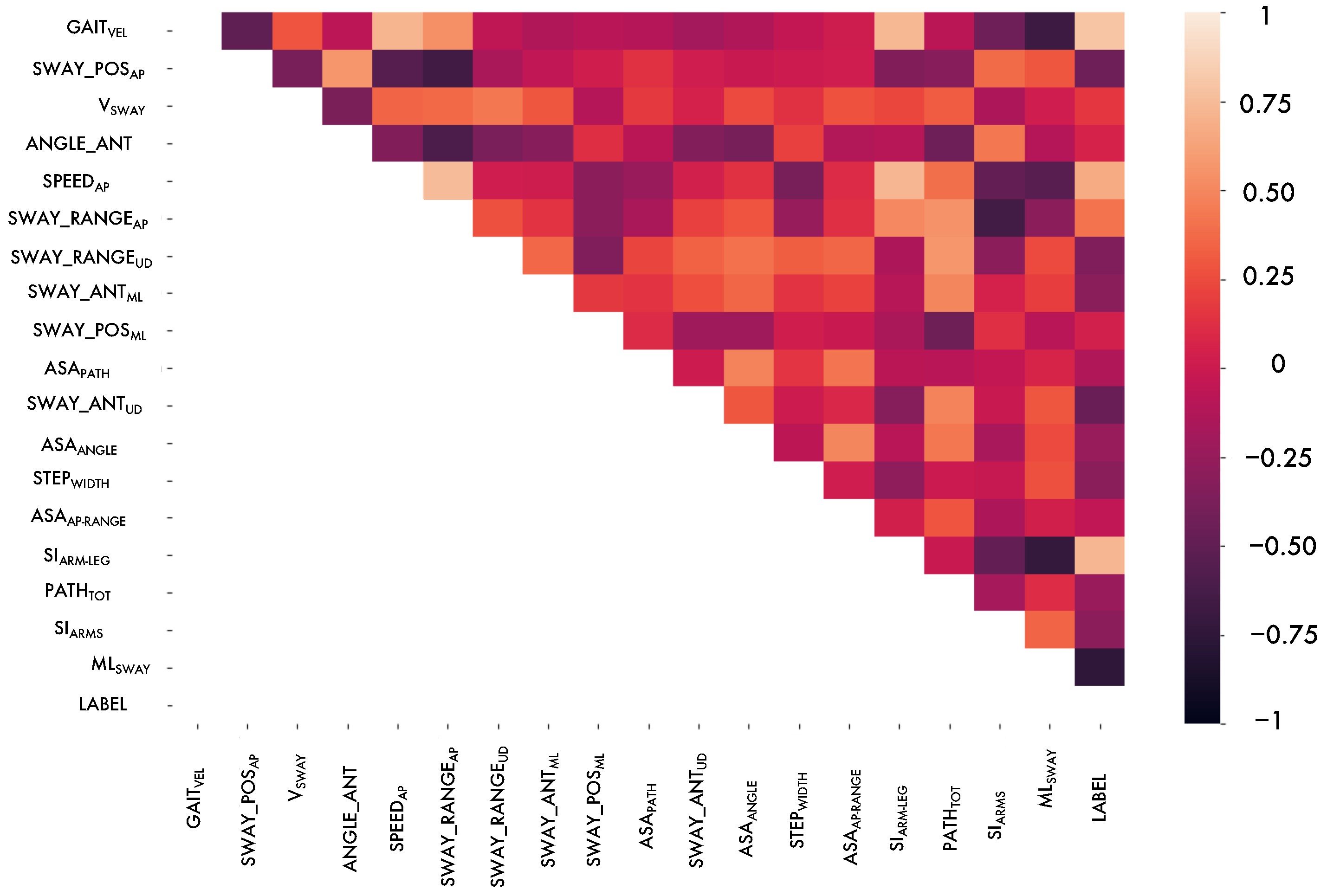
To overcome these limitations, we proposed the Gait Alterations Index (GAI), a simple yet effective index of gait impairment. This index is computed by exploiting gait parameters from 5-m straight walking sessions recorded through an Azure Kinect device (or any RGB-D camera compatible with Azure Kinect Body Tracking), making it a portable solution for the assessment of gait alterations. To derive and validate GAI, we exploited two previously recorded datasets: the AGAIT-SYM, containing data from non-pathological (NP) subjects simulating gait alterations, was used to identify relevant markers of impairment to compute the index, and served to define extreme values for healthy and altered gait patterns. The search for relevant and simple biomarkers of gait impairment included: spatio-temporal gait parameters, accounting for motion of the lower limbs; dynamic stability parameters related to the center of mass sway in the vertical and medio-lateral directions; arm swing parameters, including measures of symmetry and coordination between upper and lower limbs. Relevant biomarkers were selected using a combination of a filter approach, removing first the most redundant features (Spearman’s ), and a wrapper approach, exploiting an SVM model to identify key factors for the automatic recognition of altered gait profiles.
This analysis summarized spatio-temporal parameters into a single aspect, i.e., the gait velocity. This is reasonable considering that lower limbs parameters show a high degree of correlation among each other [
20] and changes in step/stride length or timing inevitably affect velocity. Moreover, gait velocity is a well known indicator of general well-being in older adults [
28], as well as one of the main biomarkers of improvement after treatments targeting gait impairment, such as deep brain stimulation [
29]. Regarding dynamic stability parameters, both vertical and medio-lateral sway of the center of mass were retained, supporting the idea that observing oscillations in both these directions is necessary to quantify dynamic postural instability. Finally, for arm swing, features considered relevant were those accounting for amplitude and speed of the sway, as well as the lack of synchronicity in upper and lower limbs motion (
).
The gait profiles defined by these characteristics were clearly different when measured in the TEST-GAIT dataset, across non-pathological (NP) subjects and post-stroke (PS) and parkinsonian patients. The pathological groups reported gait profiles coherent with the expected alterations (
Table 4): both groups exhibited reduced gait velocity, more evident instability both in the medio-lateral and vertical directions, especially the PS group, a reduced arm swing amplitude and speed accompanied by compromised synchronicity in limb motion. This latter aspect is especially evident in the PS group, coherently with the typical hemiparesis caused by the stroke event. These gait profiles demonstrate strong consistency with literature findings, particularly in capturing the distinct motor impairments of PD and PS populations through Kinect-based technology [
30,
31]. The median gait velocity for PD (0.85 m/s) aligns closely with reported averages ranging from 0.61 to 0.83 m/s [
31,
32], while the lower velocity for PS (0.44 m/s) correctly mirrors the trend of significant speed reduction observed in hemiplegic gait [
31,
33]. Regarding postural stability, the finding that PS subjects exhibit the highest lateral instability (114.17 mm
) is coherent with previous research works identifying increased body sway and lateral body shifts as primary compensatory strategies for unilateral weakness and abnormal torso tilting [
31,
33]. Vertical sway values (38.75 mm for PD and 45.31 mm for PS) are highly consistent with ranges from 33 mm to 50 mm reported in the literature [
30,
31,
33], which describe the vertical trajectory of the centre of mass as a reliable indicator of movement efficiency and severity of impairment. For arm swing, parameters in the PD population are coherent with those reported in [
20,
34] for amplitude in the UD direction (SWAY_RANGE
UD median 50.25 mm in [
20], 46.6 mm in [
34]) and
(median value in this work: 0.81, 0.79 in [
20]). The speed of arm motion in the AP direction is on average larger (median value in this study: 521.86 mm/s, 365.1 mm/s in [
20], 372.2 mm/s in [
34]), this may stem from the larger pool of subjects with PD in this work compared to these previous studies, of which the majority spans lower levels of gait impairment according to clinical evaluation, as it can be appreciated in
Figure 6.
The validation analyses for the proposed GAI provide converging evidence that the index captures clinically meaningful gait deviations while remaining interpretable through its sub-domain structure. First, the observed association between the overall GAI and the clinician-derived gait score suggests that aggregating deviations across multiple gait dimensions yields a more stable indicator than relying on a single domain. This is coherent with the practical reality of clinical gait assessment: clinicians implicitly integrate heterogeneous cues (e.g., pace, rhythm, step length regularity, trunk control, arm swing) into an overall impression [
27], whereas individual kinematic descriptors may only partially reflect perceived impairment. In this sense, the GAI can be interpreted as a quantitative proxy of a clinician’s global impression, with the additional advantage of being continuous rather than discrete. Second, the sub-index analysis supports the design decision to decompose gait abnormality into separable components. The spatio-temporal sub-index showed the strongest alignment with the clinical scores and the clearest separation across gait severity categories. This result is not surprising and can be regarded as a positive confirmation: spatio-temporal alterations (e.g., reduced speed, shortened steps, increased variability) are among the most salient cues for human observers, and they are also among the most robust outputs of contemporary camera-based motion analysis [
35,
36]. From an implementation standpoint, this means that the GAI retains sensitivity to clinically obvious gait changes while remaining feasible for low-cost deployment.
It is important to note that dynamic stability and arm swing sub-indices exhibited weaker or less consistent agreement with the clinician’s video-based ratings. These findings should not be read only as limitations of the proposed approach; rather, they likely reflect a combination of measurement and reference-label constraints, and highlight why a multi-domain index is preferable to a single-domain descriptor. It must be considered that clinical ratings were performed on video, which inherently compresses 3D motion into a 2D representation and may attenuate sway cues. In practice, clinicians can reliably identify gross instability events, but mild-to-moderate 3D imbalance may be difficult to quantify visually, and small changes in trunk motion may not translate into consistent ordinal ratings. Therefore, part of the reduced agreement may reflect the limited observability of stability phenomena in video rather than a true lack of relationship between the extracted stability surrogates and functional balance. Regarding arm swing, this domain is clinically informative but also highly variable in the general population [
20]. It is influenced by walking speed, attention/dual-tasking, arm dominance, and compensatory strategies, and it can be altered intentionally or unconsciously (e.g., when subjects focus on the walking task or try to perform well during recording). Moreover, upper-limb pose estimation is particularly susceptible to self-occlusion, clothing, and depth ambiguities, and these issues can degrade the reliability of arm kinematics compared to lower-limb spatio-temporal measures [
36] when using HPE technologies. From a biomechanical standpoint, arm swing also interacts with trunk motion and balance control: experimental evidence in PD indicates that constraining arm swing and adding a dual task can worsen trunk control and modify dynamic balance-related measures [
37]. In our context, this implies two plausible (and not mutually exclusive) explanations for less optimal arm-swing agreement: the video-based clinical score may be less sensitive to subtle arm-swing deviations (especially when the view is not strictly sagittal and when the arms overlap the torso), and the extracted arm-swing descriptors may capture real variability that is not consistently interpreted as abnormal by the clinician. A key conceptual point in interpreting the validation is that GAI is designed to quantify
gait abnormality rather than to identify a specific pathology. This is critical when considering individuals categorized as non-pathological based on the absence of a formal diagnosis. The literature shows that neurological gait abnormalities can be present and relatively common even in older community-dwellers without recognized neurological disease [
7]. Therefore, cases in which the GAI suggests a deviation while the clinical label is low (or normal) may reflect early/subclinical changes not detected in routine assessment, non-neurological contributors (e.g., mild musculoskeletal limitations), or limits of the ordinal clinical rating itself.
From a screening and monitoring perspective, this behaviour should not necessarily be interpreted as undesirable: an index that can flag subtle deviations may be clinically useful, provided that its interpretation is carefully framed as a degree of deviation from typical gait rather than the presence of pathology. Recent work has demonstrated that clinically meaningful gait parameters can be extracted from simple videos using HPE and validated against laboratory motion capture, including applications in PD and PS cohorts [
38]. In addition, reliability studies on single-camera markerless systems highlight both the potential and the practical constraints required for stable overground measurements (e.g., sufficient trials, proper positioning within the capture volume) [
39]. Our contribution is complementary: rather than proposing another parameter set, we introduce a low-cost
indexing layer that summarizes multi-domain gait deviation into an interpretable score (and sub-scores), explicitly targeting the translational gap between raw kinematic outputs and clinically actionable interpretation. This design choice is aligned with the broader aim of improving accessibility of gait assessment while preserving interpretability and enabling longitudinal tracking.
4.1. Limitations
As a preliminary analysis, this work has several limitations that should be interpreted in light of both the reference standard adopted and the sensing technology employed. A first set of limitations arises from the clinical scoring procedure used as reference. Clinical gait scores were derived from video-based assessments, which may have limited sensitivity to three-dimensional balance phenomena and subtle instabilities. This constraint likely affected agreement particularly for the dynamic stability and arm swing domains, where mild alterations may not be easily observable in standard video recordings. In addition, clinical ratings were provided by a single expert rater; while this choice ensured consistency, it does not allow estimation of inter-rater variability and may introduce subjective bias. A second limitation concerns the study design and sample characteristics. The sample size and the distribution of gait severity levels may limit generalizability across populations and pathological spectra. Larger and more heterogeneous cohorts, as well as repeated acquisitions, are required to assess the robustness and test–retest stability of the GAI in longitudinal and real-world scenarios. Finally, additional limitations stem from the accuracy of markerless pose estimation itself. Although low-cost acquisition improves feasibility, pose estimation reliability is known to depend on factors such as viewpoint, clothing, self-occlusions, and joint type, with reduced accuracy for distal joints and non-sagittal movements [
35,
36]. These effects may introduce noise in specific gait parameters, particularly those related to upper-limb kinematics, and should be considered when interpreting sub-index behaviour.
4.2. Future Work
Future work should proceed along three main directions. First, strengthen the reference standard: include multi-rater clinical assessments with inter-rater reliability analysis and incorporate a motion-capture benchmark subset to quantify construct validity for each sub-index. Second, translate to RGB-only pipelines: since the GAI definition is parameter-based and computationally lightweight, it is well positioned for porting to RGB-only pose estimation workflows, which have shown a strong promise for clinical gait analysis using simple devices [
36,
38,
39]. Finally, longitudinal and real-world validation: test the GAI sensitivity to change (rehabilitation, disease progression), assess its behaviour in home-like conditions, and investigate whether elevated GAI in non-pathological individuals may predict future diagnosis, functional decline, or falls, which would support its use as a screening and monitoring tool [
6,
7]. In this direction, exploring also clinically-informed weighting of the GAI sub indices, as well as sensitivity analysis on the effect of this parameter may provide additional improvement in the correspondence of GAI with impairment caused by specific motor pathologies.